WO2006069376A2 - Improved superprimer - Google Patents
Improved superprimer Download PDFInfo
- Publication number
- WO2006069376A2 WO2006069376A2 PCT/US2005/047036 US2005047036W WO2006069376A2 WO 2006069376 A2 WO2006069376 A2 WO 2006069376A2 US 2005047036 W US2005047036 W US 2005047036W WO 2006069376 A2 WO2006069376 A2 WO 2006069376A2
- Authority
- WO
- WIPO (PCT)
- Prior art keywords
- silane
- composition
- bis
- superprimer
- weight percent
- Prior art date
- Legal status (The legal status is an assumption and is not a legal conclusion. Google has not performed a legal analysis and makes no representation as to the accuracy of the status listed.)
- Ceased
Links
Classifications
-
- C—CHEMISTRY; METALLURGY
- C09—DYES; PAINTS; POLISHES; NATURAL RESINS; ADHESIVES; COMPOSITIONS NOT OTHERWISE PROVIDED FOR; APPLICATIONS OF MATERIALS NOT OTHERWISE PROVIDED FOR
- C09D—COATING COMPOSITIONS, e.g. PAINTS, VARNISHES OR LACQUERS; FILLING PASTES; CHEMICAL PAINT OR INK REMOVERS; INKS; CORRECTING FLUIDS; WOODSTAINS; PASTES OR SOLIDS FOR COLOURING OR PRINTING; USE OF MATERIALS THEREFOR
- C09D5/00—Coating compositions, e.g. paints, varnishes or lacquers, characterised by their physical nature or the effects produced; Filling pastes
- C09D5/08—Anti-corrosive paints
- C09D5/10—Anti-corrosive paints containing metal dust
- C09D5/106—Anti-corrosive paints containing metal dust containing Zn
-
- C—CHEMISTRY; METALLURGY
- C09—DYES; PAINTS; POLISHES; NATURAL RESINS; ADHESIVES; COMPOSITIONS NOT OTHERWISE PROVIDED FOR; APPLICATIONS OF MATERIALS NOT OTHERWISE PROVIDED FOR
- C09D—COATING COMPOSITIONS, e.g. PAINTS, VARNISHES OR LACQUERS; FILLING PASTES; CHEMICAL PAINT OR INK REMOVERS; INKS; CORRECTING FLUIDS; WOODSTAINS; PASTES OR SOLIDS FOR COLOURING OR PRINTING; USE OF MATERIALS THEREFOR
- C09D5/00—Coating compositions, e.g. paints, varnishes or lacquers, characterised by their physical nature or the effects produced; Filling pastes
- C09D5/002—Priming paints
-
- C—CHEMISTRY; METALLURGY
- C09—DYES; PAINTS; POLISHES; NATURAL RESINS; ADHESIVES; COMPOSITIONS NOT OTHERWISE PROVIDED FOR; APPLICATIONS OF MATERIALS NOT OTHERWISE PROVIDED FOR
- C09D—COATING COMPOSITIONS, e.g. PAINTS, VARNISHES OR LACQUERS; FILLING PASTES; CHEMICAL PAINT OR INK REMOVERS; INKS; CORRECTING FLUIDS; WOODSTAINS; PASTES OR SOLIDS FOR COLOURING OR PRINTING; USE OF MATERIALS THEREFOR
- C09D5/00—Coating compositions, e.g. paints, varnishes or lacquers, characterised by their physical nature or the effects produced; Filling pastes
- C09D5/08—Anti-corrosive paints
-
- C—CHEMISTRY; METALLURGY
- C23—COATING METALLIC MATERIAL; COATING MATERIAL WITH METALLIC MATERIAL; CHEMICAL SURFACE TREATMENT; DIFFUSION TREATMENT OF METALLIC MATERIAL; COATING BY VACUUM EVAPORATION, BY SPUTTERING, BY ION IMPLANTATION OR BY CHEMICAL VAPOUR DEPOSITION, IN GENERAL; INHIBITING CORROSION OF METALLIC MATERIAL OR INCRUSTATION IN GENERAL
- C23C—COATING METALLIC MATERIAL; COATING MATERIAL WITH METALLIC MATERIAL; SURFACE TREATMENT OF METALLIC MATERIAL BY DIFFUSION INTO THE SURFACE, BY CHEMICAL CONVERSION OR SUBSTITUTION; COATING BY VACUUM EVAPORATION, BY SPUTTERING, BY ION IMPLANTATION OR BY CHEMICAL VAPOUR DEPOSITION, IN GENERAL
- C23C2222/00—Aspects relating to chemical surface treatment of metallic material by reaction of the surface with a reactive medium
- C23C2222/20—Use of solutions containing silanes
Definitions
- the present inventions relates to corrosion protection and increased adhesion between substrates and a subsequent bonded material. More specifically, the present invention is related to primers, manufactured from at least one organofunctional bis-silane, having increased film thickness, chemical and scratch resistance, as well as being substantially chromate-free and comprising little to no VOCs.
- the present invention provides an improved superprimer that can be used in a wide range of environments, on all metals of engineering interest, as a standalone process or as a primer for a paint application process.
- the exemplary improved superprimer may function as a final coating and may likewise be applied to a substrate without a conversion coating or pretreatment process.
- An exemplary superprimer in accordance with the instant invention includes a composition capable of coating a substrate and curing to provide a hydrophobic film inhibiting corrosion, the composition comprising: (a) a bis-silane; and (b) a water soluble or dispersible polymer.
- the invention includes the aforementioned superprimer composition, further comprising at least one of an emulsifier, a surfactant, a film builder, a thickener, a toughening agent, an ultraviolet absorber, and an ultraviolet reflector.
- the invention includes the aforementioned superprimer composition, further comprising a leachable inhibitor.
- the invention includes the aforementioned superprimer composition, wherein the leachable inhibitor includes at least one of a salt of trivalent cerium (Ce), a salt of trivalent lanthanum (Le), a salt of yttrium (Y), a molybdate, a phosphate, a phosphonate, a phosphomolybdate, a vanadate, a borate, an amine, a glycolate, a sulfenamide, and a tungstate.
- the leachable inhibitor includes at least one of a salt of trivalent cerium (Ce), a salt of trivalent lanthanum (Le), a salt of yttrium (Y), a molybdate, a phosphate, a phosphonate, a phosphomolybdate, a vanadate, a borate, an amine, a glycolate, a sulfenamide, and a tungstate.
- the invention includes the aforementioned superprimer composition, wherein the bis-silane comprises between about 0.5 percent to about 50 weight percent by weight of the composition, and the water soluble or dispersible polymer comprises between 10 percent to about 80 weight percent by weight of the composition.
- the invention includes the aforementioned superprimer composition, wherein the bis-silane comprises a mixture of silanes comprising at least one partially hydrolyzed bis-silane.
- the invention includes the aforementioned superprimer composition, wherein the bis-silane comprises a mixture of bis-silanes.
- the invention includes the aforementioned superprimer composition, further comprising a crosslinking agent for at least one of the resin and the silane.
- the invention includes the aforementioned superprimer composition, further comprising nanoparticles. Moreover, the invention includes the aforementioned superprimer composition, further comprising at least one of oxidic particles and non-oxidic particles comprising between about 1 to about 95 weight percent of the composition. Moreover, the invention includes the aforementioned superprimer composition, wherein the composition includes at least one of zinc dust, carbon black, silica, and iron oxide.
- the instant invention includes a method of a coating inhibiting the permeability of a fluid comprising the steps of: (a) mixing a bis-silane and a soluble or dispersible polymer to comprise a resultant mixture; (b) applying the resultant mixture to a substrate; and (c) curing the resultant mixture on the substrate to create a corrosion barrier.
- the invention includes the aforementioned method, wherein the mixing step further includes mixing at least a partially hydrolyzed bis-silane with a water soluble or dispersible polymer.
- the invention includes the aforementioned method, wherein the mixing step further includes mixing multiple silanes, including a bis-silane, with the soluble or dispersible polymer.
- An exemplary superprimer in accordance with the instant invention includes a liquid coating composition, adapted to be applied to a substrate to form a coating, comprising between about 30-95 weight percent zinc dust, between about 5-22 weight percent organic binder, between about 0.2-4 weight percent silane. Moreover, the invention includes the aforementioned coating composition, further comprising a curing agent from about 0.1 to about 4 weight percent of the liquid coating composition.
- the instant invention includes a method of forming a liquid coating composition comprising: (a) mixing zinc dust, a solvent, and a resin to form a first part; (b) mixing a silane and a curing agent to form a second part; and (c) mixing the first part and the second part to provide a liquid coating composition comprising between about 15-80 weight percent zinc dust, between about 5-22 weight percent water soluble resin, between about 0.5-50 weight percent silane, between about 1-4 weight percent curing agent, and between about 5-40 weight percent solvent.
- the aforementioned method may also include the act of mixing the first part and the second part under high shear conditions.
- the instant invention includes a method of forming a coating composition comprising: (a) mixing zinc dust, a solvent, and a resin to form a first part; and, (b) mixing a silane, the first part, and a curing agent to provide a liquid coating composition comprising between about 15-80 weight percent zinc dust, between about 5-22 weight percent water soluble resin, between about 0.5-50 weight percent silane, between about 1-4 weight percent curing agent, and between about 5-40 weight percent solvent.
- the aforementioned method may also include the act of mixing the silane, the first part, and the curing agent under high shear conditions.
- the instant invention includes a method of forming a coating composition comprising: (a) mixing a non-acqueous solvent and a resin to form a first part; and (b) mixing a silane and the first part to provide a liquid coating composition comprising between about 5-60 weight percent water soluble resin, between about 0.5-50 weight percent silane, and between about 5-40 weight percent solvent.
- the aforementioned method may also include the act of mixing the silane, the first part, and the curing agent under high shear conditions.
- the instant invention includes a method of forming a coating composition comprising: (a) mixing zinc dust, non-acqueous solvent, and a resin to form a water based first part; and (b) mixing the first part with a silane to provide a liquid composition comprising between about 15-80 weight percent zinc dust, between about 5-22 weight percent water soluble resin, between about 0.5-50 weight percent silane, and between about 5-40 weight percent solvent.
- the instant invention includes a method of forming a coating composition comprising mixing zinc dust, a resin, and a silane substantially simultaneously to comprise a water based liquid composition comprising between about 30-75 weight percent zinc dust, between about 5-22 weight percent water soluble resin, between about 0.5-50 weight percent silane, between about 1-4 weight percent curing agent, and between about 5-40 weight percent solvent, where the coating composition is adapted to be applied to a substrate to form a coating.
- the aforementioned method may further comprising the step of adding a corrosion inhibitor to the composition, wherein the coating composition comprises between about 1-50 weight percent corrosion inhibitor, and wherein at least one of the mixing steps occurs under high shear conditions.
- An exemplary superprimer in accordance with the instant invention includes a composition capable of coating a substrate and curing to provide a hydrophobic film inhibiting corrosion, the composition comprising: (a) a mixture of silanes; (b) a dispersible or soluble resin; and (c) an aqueous or non-aqueous solvent.
- the invention includes the aforementioned superprimer composition, wherein the mixture of silanes includes at least one of a bis-sulfur silane, a bis-benzene silane, a bis-alkane silane, a bis-alkene silane, and a bis-amino silane.
- the invention includes the aforementioned superprimer composition, wherein the bis-amino silane includes bis-trimethoxysilylpropylamine, bis- trimethoxysilylpropyldiamine; the bis-sulfur silane includes at least one of bis- (triethylsilylpropyl) disulfide and bis[3-(triethoxysilyl)propyl] disulfide; the bis-benzene silane includes l,4-bis(trimethoxysilylethyl)benzene; and the bis-alkane silane includes bis- (triethoxysilyl) ethane and bis-triethoxysilyloctane.
- the bis-amino silane includes bis-trimethoxysilylpropylamine, bis- trimethoxysilylpropyldiamine
- the bis-sulfur silane includes at least one of bis- (triethylsilylpropyl) disulfide and bis
- the invention includes the aforementioned superprimer composition, wherein the silane includes a mixture of bis- silanes; the dispersible or soluble resin includes at least one of an epoxy resin, polyurethane resin, an amino resin, a polyisocyanate resin, a polyester resin, a polyalkyd resin, and an acrylic resin; and the aqueous or non-aqueous solvent includes water, acetone, ketones, alcohols, and alcohol derivatives.
- the invention includes the aforementioned superprimer composition, wherein the epoxy resin includes a novalac or a diglycidyl ether of bisphenol A; the polyurethane resin includes a polyether urea component; and the amino resin includes an aliphatic amine.
- the invention includes the aforementioned superprimer composition, wherein the bis-silane comprises between about 0.5 percent by weight to about 50 percent by weight of the composition; and the dispersible of soluble resin comprises between about 5 percent by weight to about 90 percent by weight of the composition.
- An exemplary superprimer in accordance with the instant invention includes the aforementioned superprimer composition, further comprising at least one of zinc dust, carbon black, potassium silicate platelets, titanium dioxide, trimethysilyloxy modified silica, silica, talc, clays, iron oxide, and precipitated silica.
- the invention includes the aforementioned superprimer composition, wherein the zinc dust and/or the carbon black comprises between about 1 percent by weight to about 90 percent by weight of the composition.
- the invention includes the aforementioned superprimer composition, further comprising at least one of a curing agent, an anti-settling agent; a defoaming agent, a wetting agent, a crosslinker, a corrosion inhibitor, a coalescing agent, an emulsifier, and an inorganic color pigment.
- the invention includes the aforementioned superprimer composition, wherein the crosslinker comprises between about 0.1 percent by weight to about 5 percent by weight of the composition.
- the invention includes the aforementioned superprimer composition, wherein the crosslinker includes at least one of an isocyanurate, an amine, dibutyltin dilaurate, and an imine.
- the invention includes the aforementioned superprimer composition, wherein the curing agent comprises between about 0.1 percent by weight to about 5 percent by weight of the composition. Moreover, the invention includes the aforementioned superprimer composition, wherein the curing agent includes at least one of a polyisocyanate and an amine adduct. Moreover, the invention includes the aforementioned superprimer composition, wherein the anti-settling agent comprises between about 0.1 percent by weight to about 5 percent by weight of the composition. Moreover, the invention includes the aforementioned superprimer composition, wherein the corrosion inhibitor comprises between about 0.01 percent by weight to about 25 percent by weight of the composition.
- the invention includes the aforementioned superprimer composition, wherein the corrosion inhibitor includes at least one of zinc phosphate, zinc molybdate, calcium-zinc molybdate, cerium vanadium oxide, calcium-zinc phosphosilicate, cerium acetate, sodium metavanadate, and calcium zinc phosphomolybdate.
- the invention includes the aforementioned superprimer composition, wherein the coalescing agent comprises between about 0.1 percent by weight to about 5 percent by weight of the composition.
- the invention includes the aforementioned superprimer composition, wherein the coalescing agent includes a coalescing agent for a latex.
- the invention includes the aforementioned superprimer composition, further comprising a latex.
- the invention includes the aforementioned superprimer composition, wherein the latex includes an acrylate latex. Moreover, the invention includes the aforementioned superprimer composition, wherein the inorganic color pigment includes iron oxide, cobalt, cobalt complexes, titania, metallic nanoparticles, and metallic flakes.
- the instant invention includes a method of formulating a liquid coating, the method comprising mixing a silane mixture with a dispersed or soluble resin to form a liquid coating composition.
- the invention includes the aforementioned method, wherein the silane mixture includes a bis-silane mixture.
- the invention includes the aforementioned method, wherein the silane includes at least one of of a bis-sulfur silane, a bis-benzene silane, a bis-alkane silane, a bis-alkene silane, and a bis-amino silane.
- the invention includes the aforementioned method, wherein the silane includes a first silane mixture comprising a vinyltriacetoxysilane and a bis-trimethoxysilylpropylamine silane in a 5:1 weight ratio; and, the silane includes a second silane component comprising at least one of a bis-[triethoxysilylpropyl] tetrasulfide silane and tetraethoxysilane. Moreover, the invention includes the aforementioned method, further comprising diluting the first silane mixture with a acqueous or non-acqueous solvent to create a first silane component; and, mixing the first silane component with the dispersed or soluble resin to form a liquid coating composition. Moreover, the invention includes the aforementioned method, wherein the act of mixing the silane mixture and the disbursed or soluble resin is carried out under high shear conditions. Moreover, the invention includes the aforementioned method, wherein the silane » ⁇ 7D3B
- the e comprises between about 0.5 to about 75 weight percent of the liquid coating osition; and, the dispersed or soluble resin comprises between about 25 to about 95 .at percent of the liquid coating composition.
- the invention includes the mentioned method, further comprising mixing at least one of carbon black and zinc dust at least one of the silane mixture and the dispersed or soluble resin.
- the ition includes the aforementioned method, wherein the zinc dust comprises between 15 to about 50 weight percent of the liquid coating composition.
- the invention des the aforementioned method, wherein the dispersed or soluble resin includes at least )f an epoxy, an acrylic, a polyurethane, and an acrylate copolymer.
- An exemplary method of formulating a liquid coating in accordance with the instant ition includes method, further comprising mixing a crosslinker with at least one of the e mixture and the dispersed or soluble resin. Moreover, the invention includes the mentioned method, wherein the crosslinker comprises between about 0.01 to about 5 ht percent of the liquid coating composition. Moreover, the invention includes the mentioned method, further comprising mixing an acqueous solvent with at least one of ilane mixture and the dispersed or soluble resin. Moreover, the invention includes the mentioned method, wherein the acqueous solvent comprises between about 10 to about eight percent of the liquid coating composition.
- the invention includes the mentioned method, further comprising mixing a non-acqueous solvent with at least one e silane mixture and the dispersed or soluble resin. Moreover, the invention includes the mentioned method, wherein the non-acqueous solvent comprises between about 10 to 1 50 weight percent of the liquid coating composition. Moreover, the invention includes forementioned method, further comprising mixing an additive with at least one of the e mixture and the dispersed or soluble resin, the additive comprising at least one of a ig agent, a thickening agent, a corrosion inhibitor, and a wetting agent. Moreover, the ition includes the aforementioned method, wherein the additive comprises between t 0.5 to about 50 weight percent of the liquid coating.
- an exemplary superprimer in accordance with the instant invention includes a silane containing coating comprising: (a) zinc dust, comprising between about 70 to about 90 weight percent of a resulting coating; (b) a dispersible resin comprising between about 10 to about 30 weight percent of the resulting coating; and (c) a silane comprising between about 0.5 to about 20 weight percent of the resulting coating.
- An exemplary superprimer in accordance with the instant invention includes a silane containing coating comprising: (a) carbon black, comprising between about 40 to about 80 weight percent of a resulting coating; (b) a dispersible resin comprising between about 10 to about 30 weight percent of the resulting coating; and (c) a silane comprising between about 0.5 to about 50 weight percent of the resulting coating.
- FIG. 1 is a pictorial representation of an exemplary aluminum alloy panel coated with an exemplary superprimer formulation after 14 days of salt spray testing;
- FIG. 2 is a graphical representation of Electrochemical Impedance Spectroscopy (EIS) data for an exemplary superprimer and for a commercially available primer;
- FIGS. 3 and 4 pictorially represent exemplary panels coated with the zinc-rich paint and coated with the zinc-rich superprimer, respectively, after 336 hours of salt spray testing
- FIG. 3 is a pictorial representation of exemplary panels coated with a commercially available zinc-rich paint after 336 hours of salt spray testing;
- FIG. 4 is a pictorial representation of exemplary panels coated with an exemplary zinc-rich superprimer formulation after 336 hours of salt spray testing;
- FIG. 5 is a pictorial representation of exemplary panels coated with an exemplary zinc-rich superprimer formulation after 200 hours of salt spray testing;
- FIG. 6 is a pictorial representation of exemplary panels coated with a commercially available chromate primer after 200 hours of salt spray testing;
- FIG. 7 is a graphical representation of Electrochemical Impedance Spectroscopy (EIS) data for the commercially available zinc rich primer using data taken between 2 hours and six weeks of immersion in a salt solution;
- EIS Electrochemical Impedance Spectroscopy
- FIG. 8 is a graphical representation of Electrochemical Impedance Spectroscopy (EIS) data for the zinc rich superprimer of Experiment 2 taken at selective increments over a period of six weeks while the panels were immersed in a salt solution;
- EIS Electrochemical Impedance Spectroscopy
- FIG. 9 is a graphical representation of Electrochemical Impedance Spectroscopy (EIS) modulus data for Experiment 3 on a controlled set of panels immersed in a salt solution;
- EIS Electrochemical Impedance Spectroscopy
- FIG. 10 is a graphical representation of Electrochemical Impedance Spectroscopy (EIS) phase angle data for Experiment 3 on a controlled set of panels immersed in a salt solution;
- EIS Electrochemical Impedance Spectroscopy
- FIG. 11 is a graphical representation of Electrochemical Impedance Spectroscopy (EIS) modulus data for Experiment 3 on a set of panels having a first exemplary superprimer formulation applied thereto and immersed in a salt solution;
- EIS Electrochemical Impedance Spectroscopy
- FIG. 12 is a graphical representation of Electrochemical Impedance Spectroscopy (EIS) phase angle data for Experiment 3 on a set of panels having the first exemplary superprimer formulation applied thereto and immersed in a salt solution;
- EIS Electrochemical Impedance Spectroscopy
- FIG. 13 is a graphical representation of Electrochemical Impedance Spectroscopy (EIS) modulus data for Experiment 3 on a set of panels having a commercially available zinc rich primer applied thereto and immersed in a salt solution;
- EIS Electrochemical Impedance Spectroscopy
- FIG. 14 is a graphical representation of Electrochemical Impedance Spectroscopy (EIS) phase angle data for Experiment 3 on a set of panels having the commercially available zinc rich primer applied thereto and immersed in a salt solution;
- FIG. 15 is a graphical representation of Electrochemical Impedance Spectroscopy (EIS) modulus data for Experiment 8 on a set of panels having a first exemplary superprimer formulation applied thereto and immersed in a salt solution;
- FIG. 16 is a graphical representation of Electrochemical Impedance Spectroscopy (EIS) phase angle data for Experiment 8 on a set of panels having the first exemplary superprimer formulation applied thereto and immersed in a salt solution;
- EIS Electrochemical Impedance Spectroscopy
- FIG. 17 is a graphical representation of Electrochemical Impedance Spectroscopy (EIS) modulus data for Experiment 8 on a set of panels having a second exemplary superprimer formulation applied thereto and immersed in a salt solution;
- EIS Electrochemical Impedance Spectroscopy
- FIG. 18 is a graphical representation of Electrochemical Impedance Spectroscopy (EIS) phase angle data for Experiment 8 on a set of panels having the second exemplary superprimer formulation applied thereto and immersed in a salt solution;
- EIS Electrochemical Impedance Spectroscopy
- FIG. 19 is a graphical representation of Electrochemical Impedance Spectroscopy (EIS) modulus data for Experiment 8 on a set of panels having a third exemplary superprimer formulation applied thereto and immersed in a salt solution;
- EIS Electrochemical Impedance Spectroscopy
- FIG. 20 is a graphical representation of Electrochemical Impedance Spectroscopy (EIS) phase angle data for Experiment 8 on a set of panels having the third exemplary superprimer formulation applied thereto and immersed in a salt solution;
- EIS Electrochemical Impedance Spectroscopy
- FIG. 21 a [0039] FIG. 21 a
- FIG. 22 is a
- FIG. 23 a graphical representation of Electrochemical Impedance Spectroscopy (EIS) modulus data for Experiment 10 on a set of panels having a first exemplary superprimer formulation applied thereto and immersed in a salt solution;
- FIG. 24 is a graphical representation of Electrochemical Impedance Spectroscopy (EIS) modulus data for Experiment 10 on a set of panels having a commercially available zinc rich paint applied thereto and immersed in a salt solution;
- FIG. 25 is a graphical representation of Electrochemical Impedance Spectroscopy (EIS) data for Experiment 10 comparing the commercially available zinc rich paint to the first exemplary superprimer formulation;
- EIS Electrochemical Impedance Spectroscopy
- FIG. 26 a graphical representation of Electrochemical Impedance Spectroscopy (EIS) modulus data for Experiment 10 on a set of panels having a second exemplary superprimer formulation applied thereto and immersed in a salt solution;
- EIS Electrochemical Impedance Spectroscopy
- FIG. 27 is a graphical representation of Electrochemical Impedance Spectroscopy (EIS) modulus data for Experiment 10 on a set of panels having a second exemplary superprimer formulation applied thereto and immersed in a salt solution;
- EIS Electrochemical Impedance Spectroscopy
- FIG. 28 is a graphical representation of Electrochemical Impedance Spectroscopy (EIS) data for Experiment 10 comparing the commercially available zinc rich paint to the second and third exemplary superprimer formulations;
- EIS Electrochemical Impedance Spectroscopy
- FIG. 29 is a pictorial representation of a panel coated with the commercially available zinc rich paint after 168 hours of immersion in a salt solution;
- FIG. 30 is a pictorial representation of a panel coated with the first exemplary superprimer formulation of Experiment 10 after 168 hours of immersion in a salt solution;
- FIG. 31 is a listing of the exemplary formulations of Experiment 11.
- FIG. 32 is a graphical representation of Electrochemical Impedance Spectroscopy (EIS) modulus data for Experiment 11 on a controlled set of panels having no primer applied thereto and immersed in a salt solution
- FIG. 33 is a graphical representation of Electrochemical Impedance Spectroscopy (EIS) phase angle data for Experiment 11 on a controlled set of panels having no primer applied thereto and immersed in a salt solution
- FIG. 34 is a graphical representation of Electrochemical Impedance Spectroscopy (EIS) modulus data for Experiment 11 on a set of panels having a first exemplary superprimer formulation applied thereto and immersed in a salt solution;
- EIS Electrochemical Impedance Spectroscopy
- FIG. 35 is a graphical representation of Electrochemical Impedance Spectroscopy (EIS) phase angle data for Experiment 11 on a set of panels having a first exemplary superprimer formulation applied thereto and immersed in a salt solution;
- EIS Electrochemical Impedance Spectroscopy
- FIG. 36 is a graphical representation of Electrochemical Impedance Spectroscopy (EIS) modulus data for Experiment 11 on a set of panels having a second exemplary superprimer formulation applied thereto and immersed in a salt solution;
- EIS Electrochemical Impedance Spectroscopy
- FIG. 37 is a graphical representation of Electrochemical Impedance Spectroscopy (EIS) phase angle data for Experiment 11 on a set of panels having a second exemplary superprimer formulation applied thereto and immersed in a salt solution;
- EIS Electrochemical Impedance Spectroscopy
- FIG. 38 is a graphical representation of Electrochemical Impedance Spectroscopy (EIS) modulus data for Experiment 11 on a set of panels having a third exemplary superprimer formulation applied thereto and immersed in a salt solution;
- EIS Electrochemical Impedance Spectroscopy
- FIG. 39 is a graphical representation of Electrochemical Impedance Spectroscopy (EIS) phase angle data for Experiment 11 on a set of panels having a third exemplary superprimer formulation applied thereto and immersed in a salt solution;
- EIS Electrochemical Impedance Spectroscopy
- FIG. 40 is a graphical representation of Electrochemical Impedance Spectroscopy (EIS) modulus data for Experiment 11 on a set of panels having a fourth exemplary superprimer formulation applied thereto and immersed in a salt solution
- FIG. 41 is a graphical representation of Electrochemical Impedance Spectroscopy (EIS) phase angle data for Experiment 11 on a set of panels having a fourth exemplary superprimer formulation applied thereto and immersed in a salt solution;
- FIG. 42 is a graphical representation of Electrochemical Impedance Spectroscopy (EIS) modulus data for Experiment 11 on a set of panels having a fifth exemplary superprimer formulation applied thereto and immersed in a salt solution;
- EIS Electrochemical Impedance Spectroscopy
- FIG. 43 is a graphical representation of Electrochemical Impedance Spectroscopy (EIS) phase angle data for Experiment 11 on a set of panels having a fifth exemplary superprimer formulation applied thereto and immersed in a salt solution;
- EIS Electrochemical Impedance Spectroscopy
- FIG. 44 is a graphical representation of Electrochemical Impedance Spectroscopy (EIS) modulus data for Experiment 11 on a set of panels having a sixth exemplary superprimer formulation applied thereto and immersed in a salt solution;
- EIS Electrochemical Impedance Spectroscopy
- FIG. 45 is a graphical representation of Electrochemical Impedance Spectroscopy (EIS) phase angle data for Experiment 11 on a set of panels having a sixth exemplary superprimer formulation applied thereto and immersed in a salt solution;
- EIS Electrochemical Impedance Spectroscopy
- FIG. 46 is a graphical representation of Electrochemical Impedance Spectroscopy (EIS) modulus data for Experiment 11 on a set of panels having a seventh exemplary superprimer formulation applied thereto and immersed in a salt solution;
- EIS Electrochemical Impedance Spectroscopy
- FIG. 47 is a graphical representation of Electrochemical Impedance Spectroscopy (EIS) phase angle data for Experiment 11 on a set of panels having a seventh exemplary superprimer formulation applied thereto and immersed in a salt solution;
- EIS Electrochemical Impedance Spectroscopy
- FIG. 48 is a graphical representation of Electrochemical Impedance Spectroscopy (EIS) modulus data for Experiment 11 on a set of panels having a eighth exemplary superprimer formulation applied thereto and immersed in a salt solution
- FIG. 49 is a graphical representation of Electrochemical Impedance Spectroscopy (EIS) phase angle data for Experiment 11 on a set of panels having a eighth exemplary superprimer formulation applied thereto and immersed in a salt solution;
- FIG. 50 is a graphical representation of Electrochemical Impedance Spectroscopy (EIS) modulus data for Experiment 11 on a set of panels having a ninth exemplary superprimer formulation applied thereto and immersed in a salt solution;
- EIS Electrochemical Impedance Spectroscopy
- FIG. 51 is a graphical representation of Electrochemical Impedance Spectroscopy (EIS) phase angle data for Experiment 11 on a set of panels having a ninth exemplary superprimer formulation applied thereto and immersed in a salt solution;
- EIS Electrochemical Impedance Spectroscopy
- FIG. 52 is a listing of the exemplary formulations of Experiment 12.
- FIG. 53 is a graphical representation of Electrochemical Impedance Spectroscopy (EIS) modulus data for Experiment 12 on a set of panels having a first exemplary superprimer formulation applied thereto and immersed in a salt solution;
- EIS Electrochemical Impedance Spectroscopy
- FIG. 54 is a graphical representation of Electrochemical Impedance Spectroscopy (EIS) phase angle data for Experiment 12 on a set of panels having a first exemplary superprimer formulation applied thereto and immersed in a salt solution;
- EIS Electrochemical Impedance Spectroscopy
- FIG. 55 is a graphical representation of Electrochemical Impedance Spectroscopy (EIS) modulus data for Experiment 12 on a set of panels having a second exemplary superprimer formulation applied thereto and immersed in a salt solution;
- EIS Electrochemical Impedance Spectroscopy
- FIG. 56 is a graphical representation of Electrochemical Impedance Spectroscopy (EIS) phase angle data for Experiment 12 on a set of panels having a second exemplary superprimer formulation applied thereto and immersed in a salt solution;
- EIS Electrochemical Impedance Spectroscopy
- FIG. 57 is a graphical representation of Electrochemical Impedance Spectroscopy (EIS) modulus data for Experiment 12 on a set of panels having a third exemplary superprimer formulation applied thereto and immersed in a salt solution;
- FIG. 58 is a graphical representation of Electrochemical Impedance Spectroscopy EIS) phase angle data for Experiment 12 on a set of panels having a third exemplary iuperprimer formulation applied thereto and immersed in a salt solution;
- FIG. 59 is a graphical representation of Electrochemical Impedance Spectroscopy EIS) modulus data for Experiment 12 on a set of panels having a fourth exemplary iuperprimer formulation applied thereto and immersed in a salt solution;
- FIG. 60 is a graphical representation of Electrochemical Impedance Spectroscopy EIS) phase angle data for Experiment 12 on a set of panels having a fourth exemplary iuperprimer formulation applied thereto and immersed in a salt solution;
- FIG. 61 is a graphical representation of Electrochemical Impedance Spectroscopy EIS) modulus data for Experiment 12 on a set of panels having a fifth exemplary iuperprimer formulation applied thereto and immersed in a salt solution;
- FIG. 62 is a graphical representation of Electrochemical Impedance Spectroscopy TBIS) phase angle data for Experiment 12 on a set of panels having a fifth exemplary mperprimer formulation applied thereto and immersed in a salt solution;
- FIG. 63 is a graphical representation of Electrochemical Impedance Spectroscopy TEIS) modulus data for Experiment 12 on a set of panels having a sixth exemplary ⁇ uperprimer formulation applied thereto and immersed in a salt solution;
- FIG. 64 is a graphical representation of Electrochemical Impedance Spectroscopy TEIS) phase angle data for Experiment 12 on a set of panels having a sixth exemplary superprimer formulation applied thereto and immersed in a salt solution;
- FIG. 65 is a graphical representation of Electrochemical Impedance Spectroscopy [EIS) modulus data for Experiment 12 on a set of panels having a seventh exemplary superprimer formulation applied thereto and immersed in a salt solution;
- FIG. 66 is a graphical representation of Electrochemical Impedance Spectroscopy (EIS) phase angle data for Experiment 12 on a set of panels having a seventh exemplary superprimer formulation applied thereto and immersed in a salt solution;
- FIG. 67 is a graphical representation of Electrochemical Impedance Spectroscopy (EIS) modulus data for Experiment 12 on a set of panels having a eighth exemplary superprimer formulation applied thereto and immersed in a salt solution;
- EIS Electrochemical Impedance Spectroscopy
- FIG. 68 is a graphical representation of Electrochemical Impedance Spectroscopy (EIS) phase angle data for Experiment 12 on a set of panels having a eighth exemplary superprimer formulation applied thereto and immersed in a salt solution;
- EIS Electrochemical Impedance Spectroscopy
- FIG. 69 is a pictorial representation of panels coated with the exemplary superprimer formulations of Experiment 12 after being immersed in a salt solution for 200 hours;
- FIG. 70 is a graphical representation of Electrochemical Impedance Spectroscopy (EIS) modulus data for Experiment 13 on a group of panels having exemplary superprimer formulations applied thereto and immersed in a salt solution for 14 days;
- EIS Electrochemical Impedance Spectroscopy
- FIG. 71 is a graphical representation of Electrochemical Impedance Spectroscopy (EIS) phase angle data for Experiment 13 on a group of panels having exemplary superprimer formulations applied thereto and immersed in a salt solution for 14 days;
- EIS Electrochemical Impedance Spectroscopy
- FIG. 72 is a graphical representation of Electrochemical Impedance Spectroscopy (EIS) modulus data for Experiment 13 on a group of panels having exemplary superprimer formulations applied thereto and immersed in a salt solution for 16 days;
- EIS Electrochemical Impedance Spectroscopy
- FIG. 73 is a graphical representation of Electrochemical Impedance Spectroscopy (EIS) phase angle data for Experiment 13 on a group of panels having exemplary superprimer formulations applied thereto and immersed in a salt solution for 16 days;
- FIG. 74 is a graphical representation of Electrochemical Impedance Spectroscopy (EIS) modulus data for Experiment 13 on a group of panels having exemplary superprimer formulations applied thereto and immersed in a salt solution for 21 days;
- FIG. 75 is a graphical representation of Electrochemical Impedance Spectroscopy (EIS) phase angle data for Experiment 13 on a group of panels having exemplary superprimer formulations applied thereto and immersed in a salt solution for 21 days;
- EIS Electrochemical Impedance Spectroscopy
- FIG. 76 is a graphical representation of Electrochemical Impedance Spectroscopy (EIS) modulus data for Experiment 13 on a group of panels having exemplary superprimer formulations applied thereto and immersed in a salt solution for 24 or 28 days;
- EIS Electrochemical Impedance Spectroscopy
- FIG. 77 is a graphical representation of Electrochemical Impedance Spectroscopy (EIS) phase angle data for Experiment 13 on a group of panels having exemplary superprimer formulations applied thereto and immersed in a salt solution for 24 or 28 days;
- EIS Electrochemical Impedance Spectroscopy
- FIG. 78 is a graphical representation of Electrochemical Impedance Spectroscopy (EIS) modulus data for Experiment 13 on a group of panels having exemplary superprimer formulations applied thereto and immersed in a salt solution for 34 days;
- EIS Electrochemical Impedance Spectroscopy
- FIG. 79 is a graphical representation of Electrochemical Impedance Spectroscopy (EIS) phase angle data for Experiment 13 on a group of panels having exemplary superprimer formulations applied thereto and immersed in a salt solution for 34 days;
- EIS Electrochemical Impedance Spectroscopy
- FIGS. 80 and 81 are graphical representations of Electrochemical Impedance Spectroscopy (EIS) data of exemplary superprimer formulations of Experiment 14;
- FIGS. 82 and 83 are pictorial representations of exemplary coated panels after salt spray testing in Experiment 15;
- FIGS. 84 and 85 are graphical representations of Electrochemical Impedance Spectroscopy (EIS) data of exemplary coating formulations of Experiment 15; [Oldl] FIG. 86 is a graphical representation reflecting water permeability for an exemplary coating formulation of Experiment 17;
- EIS Electrochemical Impedance Spectroscopy
- FIG. 87 is a graphical representation of Electrochemical Impedance Spectroscopy (EIS) data of an exemplary coating formulation of Experiment 19;
- FIGS. 88 and 89 are pictorial representations of exemplary coated panels after corrosion testing in Experiment 19;
- FIGS. 90-92 are pictorial representations of exemplary coated panels after corrosion testing in Experiment 20;
- FIGS. 93-98 are pictorial representations of exemplary coated panels after corrosion testing in Experiment 21;
- FIG. 99 is a graphical representation of impedance versus time for the exemplary coating formulations of Experiment 22;
- FIGS. 100-102 are pictorial representations of exemplary coated panels after corrosion testing in Experiment 18;
- FIGS. 103 and 104 are pictorial representations of exemplary coated panels after corrosion testing in Experiment 23;
- FIG. 105 is a graphical representation of impedance versus time for the exemplary coating formulations of Experiment 24;
- FIGS. 106-109 are pictorial representations of exemplary coated panels after corrosion testing in Experiment 24;
- FIG. 110 is a graphical representation of impedance versus time for the exemplary coating formulations of Experiment 24;
- FIGS. Ill and 112 are graphical representations of Electrochemical Impedance Spectroscopy (EIS) data of exemplary coating formulations of Experiment 24;
- FIGS. 113-115 are pictorial representations of exemplary panels after corrosion testing in Experiment 27;
- FIG. 116-118 are pictorial representations of exemplary coated panels after corrosion testing in Experiment 29;
- FIGS. 119 and 120 are pictorial representations of exemplary panels after corrosion testing in Experiment 30;
- FIG. 121 and 122 are pictorial representations of exemplary coated panels after corrosion testing in Experiment 31.
- FIG. 123 and 124 are pictorial representations of exemplary coated panels after corrosion testing in Experiment 32.
- the exemplary embodiments of the present invention are described and illustrated below to encompass methods of formulating improved superprimers as well as the resulting compositions of matter from such formulations. Moreover, the exemplary embodiments encompass method of applying an improved superprimer to a substrate.
- the exemplary embodiments discussed below are illustrative in nature and may be reconfigured without departing from the scope and spirit of the present invention. However, for clarity and precision, the exemplary embodiments as discussed below may include optional steps, methods, components, and features that one of ordinary skill should recognize as not being a requisite to fall within the scope of the present invention.
- the present invention is an improved superprimer that may include one or more organofunctional silane, such as a bis-silane.
- An exemplary group of bis-silanes shown to be effective in the present invention are:
- the improved superprimer may also include a low-molecular weight water soluble or dispersible polymer or copolymer as well as higher molecular weight polymers having been end-functionalized so as to become water soluble or dispersible.
- This polymer or copolymer is generally selected from the classes of: epoxy, polyester, polyurethane or acrylate.
- Additional components may be added to the improved superprimer such as, without limitation pigments, leachable inhibitors, and emulsifiers, surfactants, film builders, UV absorbers or reflectors (such as zinc oxide (ZnO) and titanium dioxide (TiO 2 )), thickeners, or toughening agents such as end-functionalized silicones.
- pigments include, without limitation, nanoparticles generally having a size on the order of 0.01-500 nm.
- the particles may be: carbon black, zinc dust, metal oxides that adsorbs silanes such as zinc oxide, aluminum oxide, iron oxide, magnesium oxide and silica; phthalocyanines; sulfides; silicone oils such as xanthene and anthraquinone dyes; vat dyes such as 3 -hydroxy indole (indoxyl), 7,8,7,8-dibenzothioindigo, pyranthrone and indanthrene brilliant orange.
- the pigment may be dispersed into the coating by sol-gel methods or by high-shear blending.
- Exemplary leachable inhibitors include, without limitation, salt of trivalent cerium (Ce), salt of trivalent lanthanum (Le), salts of yttrium (Y), molybdates, phosphates, phosphonates, phosphomolybdates, vanadates, borates, amines, glycolates, sulfenamides, tungstates, and various mixtures of the above.
- the concentration of inhibitor present within the improved superprimer will generally be less than 5% of the resultant superprimer, while the concentration of emulsifiers, surfactants, film builders, UV absorbers or reflectors (such as zinc oxide (ZnO) and titanium dioxide (TiO 2 )), thickeners, or toughening agents such as end- functionalized silicones within the improved superprimer will generally be less than 3% of the solids.
- the result of such a composition is a much thicker and denser film than one produced using a silane alone or a polymer film alone. Since the siloxane network is very hydrophobic, the film will have an extremely low permeability to water. The organofunctional silane film alone would be brittle at high thicknesses, but the presence of the interpenetrated polymer will result in a much more pliable and formable material. One could argue that the polymer acts as a toughener of the organofunctional silane film.
- the present invention is also compatible with conventional corrosion inhibition strategies.
- the function of a conventional inhibitor is to provide corrosion protection from nicks and scratches in the coating. Since the film produced by the present invention is densely cross-linked, a water soluble inhibitor may be added to the coating that leaches out very slowly due to the extreme hydrophobicity of the film.
- Some exemplary inhibitors that may be utilized in the present invention include: organophosphonates, useful for steel substrates; amines useful for steel and zinc substrates; benzothiazoles, useful on zinc substrates; cobalt ions, useful on zinc substrates; thioglycolates, useful on zinc substrates; tolyltriazole, benzocarboxytriazole and cerium ions, Ce(III), useful on aluminum alloy substrates; tobacco extract, useful on aluminum substrates; benzocarboxytriazole and tolytriazole, useful on aluminum alloy substrates.
- the present invention provides flexibility when choosing the inhibitor based on the target substrate. It is also a consideration to choose an inhibitor showing minimal chemical reactivity with either the silane or the resin.
- the inhibitor may also replace the defect healing capabilities of chromates used in conventional metal primers.
- a UV absorber zinc oxide
- silanes are known to adsorb on zinc oxide.
- nanoparticles of various types SiO 2 , Fe 2 O 3 , CuO
- TiO 2 can be generated by in-situ sol-gel methods from alkoxy compounds. These particles can play a number of roles such as reinforcement, pigmentation and UV protection.
- the flexibility of the present invention also allows the use of TiO 2 as the UV scatterer in those cases where ZnO might lead to excessive heating of the coating.
- Silanes - Silquest A 1289 a bis-ftriethoxysilylproyli tetrasulfide silane (available from General Electric,); TEOS, tetraethoxysilane (available from Stochem Specialty Chemicals,); and, AV5 ⁇ 5:1 weight % ratio of a silane mixture containing VTAS (vinyltriacetoxysilane, available from Gelest,) and A 1170 (bis-trim ethoxysilylpropylamine, available from General Electric,).
- VTAS vinyltriacetoxysilane, available from Gelest,
- a 1170 bis-trim ethoxysilylpropylamine, available from General Electric,
- Resin- EPI-REZ 3540-WY-55 a 55% solid dispersion of epoxy resin in water and 2-propoxyethanol (available from Resolution Performance Products, www.resins.com).
- a 1170 and VTAS are mixed in a 5: 1 volume ratio, referred to below as AV5.
- 10 grams of AV5 is added 90 grams of deionized water adjusted to a pH of approximately 3.0 using acetic acid to provide a 10% diluted solution of AV5.
- Preparation of the improved superprimer formulation includes adding 9 grams of the diluted AV5 solution, 10.5 grams of A-1289, and 0.5 grams of TEOS to 80 grams of EPI-REZ 3540- WY-55 resin. The components are gently initially mixed, followed by high shear mixing at 2000 rpm for 10 minutes.
- Substrates A-2024 T3 aluminum alloy panels were cleaned in a 7% KOH solution at 60-70 0 C for 3 minutes and rinsed in deionized water and dried before being coated.
- a first group of aluminum alloy panels coated with the improved superprimer was scribed with an "X” and was subjected to salt spray for 14 days in accordance with ASTM Bl 17. This first group of panels was compared against a first controlled group of aluminum alloy panels coated with the commercially available primer containing chromates. These controlled panels were likewise scribed with an "X” and subjected to salt spray for 14 days in accordance with ASTM Bl 17.
- a second group of aluminum alloy panels was also coated with the improved superprimer and scribed with an "X" and immersed in a 3.5 percent (by weight) NaCl solution for two months.
- This second group of panels was compared against a second controlled group of aluminum alloy panels coated with the commercially available primer containing chromates.
- Electrochemical impedance spectroscopy (EIS) testing was done in a 3.5 percent (by weight) NaCl solution with a saturated calomel electrode (SCE) and a. graphite counter electrode for both groups of panels.
- EIS Electrochemical impedance spectroscopy
- FIG. 1 shows pictorially an exemplary aluminum alloy panel coated with the exemplary superprimer after 14 days of salt spray testing.
- FIG. 2 provides Electrochemical Impedance Spectroscopy (EIS) testing data for the exemplary superprimer versus the commercially available primer.
- EIS Electrochemical Impedance Spectroscopy
- Table 1 provides a qualitative summary of the ASTM Bl 17 salt spray testing results after 336 hours of testing.
- FIGS. 3 and 4 pictorially represent exemplary panels coated with the zinc-rich paint and coated with the zinc-rich superprimer, respectively, after 336 hours of salt spray testing.
- the improved superprimer formulation did show corrosion in the scribe after two weeks, however, the contact angle of the improved superprimer film indicates a more hydrophobic film than the commercially available chromate primer.
- the hardness values, the adhesion values, and the paint adhesion values of both coatings were roughly equal. It should be noted that a value of 5B is the best value according to an ASTM tape adhesion test.
- Components (Y) Silanes - TEOS, tetraethoxysilane (available from Stochem Specialty Chemicals,); AV5, 5:1 weight % ratio of a silane mixture containing VTAS (vinyltriacetoxysilane, available from Gelest,) and A 1170 (bis-trimethoxysilylpropylamine, available from General Electric,).
- VTAS vinyltriacetoxysilane, available from Gelest,
- a 1170 bis-trimethoxysilylpropylamine, available from General Electric,).
- a 1170 and VTAS are mixed in a 5:1 volume ratio, referred to below as AV5.
- 10 grams of AV5 is added 90 grams of deionized water adjusted to a pH of approximately 3.0 using acetic acid to provide 10% diluted solution of AV5.
- Preparation of the improved superprimer formulation includes adding 5.7 grams of the diluted AV5 solution and 0.3 grams of TEOS to 24 grams of EPI-REZ 3540-WY-55 resin, referred to as WSP-I.
- WSP-I is high shear mixed for 10 minutes at 2100 rpm. Thereafter, 70 grams of zinc dust is incrementally added to the WSP-I an after the entire addition of zinc dust is complete, the mixture is high shear mixed for 20 minutes at 3000 rpm.
- Substrates Corten steel panels were cleaned in a 7% KOH solution at 60-70 0 C for less than 3 minutes and rinsed in deionized water and dried before being coated.
- the second group of steel panel coated with the improved superprimer was scribed with an "X" and each immersed in a 3.5 percent (by weight) NaCl solution for six weeks.
- Electrochemical impedance spectroscopy (EIS) testing was done in a 3.5 percent (by weight) NaCl solution with a saturated calomel electrode (SCE) and a graphite counter electrode.
- SCE saturated calomel electrode
- FIGS 5 and 6 show pictorial data derived after 200 hours of salt spray testing on the first set of steel panels (FIG. 5) and the steel panels coated with the commercially available zinc rich primer (FIG. 6).
- FIGS. 7 and 8 show EIS data derived from the immersion of the steel panels in the 3.5 percent NaCl solution for six weeks.
- Silanes - Y-9805 a bis-[triethoxysilylethane] (available from General Electric, ).
- Resin- EPI-REZ WD-510 a water dispersible bisphenol A epoxy resin (available from Resolution Performance Products,); ECOCRYL 9790, a 42% anionic water dispersion of aery late copolymer in water (available from Shell Chemical LP 3 ).
- the Superprimer is prepared by a mixture of resins, a non-hydro lyzed silane, a crosslinker, and deionized water. 70 grams of ECOCRYL 9790 is added to an empty container. 20 grams of EPI-REZ WD- 510 are added to the container, as well as 30 grams of Y-9805, a non-hydrolyzed silane.
- the resulting mixture of silane and resins is diluted with deionized water to arrive at the desired viscosity, and may be determinative in the thickness of the eventual coating applied to the particular substrate.
- deionized water Generally an addition of 30-40 grams of deionized water to the above mixture of resins and silane results in a coating ranging from 15-40 ⁇ m. Thinner coatings can be obtained by addition of more water, however, excessive addition of water may result in loss of wettability of the substrate to be coated and may be remedied by the addition of surfactants.
- a crosslinker in the amount of 2.5 grams of Alink-25, is added to the diluted silane and resin mixture. The resulting solution is mixed and 379.2 grams of zinc dust is incorporated and the resulting Superprimer formulation is high shear blended. The mixture is high shear blended for approximately 5-10 minutes at 4500rpm under high shear conditions using a 100 LC High-Shear Blender, with a micro-assembly attachment.
- Electrochemical impedance spectroscopy (EIS) testing was done in a 3.5% (by weight) NaCl solution with a saturated calomel electrode (SCE) and a graphite counter electrode.
- SCE saturated calomel electrode
- FIGS. 9-14 reflect the data generated by the EIS testing.
- FIGS. 9 and 10 correspond to EIS testing data performed upon the first set of controlled panels having no primer applied thereto.
- FIGS. 11 and 12 correspond to EIS testing data performed upon the set of panels having the superprimer applied thereto.
- FIGS. 13 and 14 correspond to EIS testing data performed upon the second set of controlled panels having a commercially available zinc-rich primer (commercially available formulation described above) applied thereto.
- Four data sets are displayed on FIGS. 9-14, with each corresponding to test results conducted initially, two days after immersion in the NaCl solution, four days after immersion in the NaCl solution, and seven days after immersion in the NaCl solution.
- FIGS. 12 and 13 corresponding to test results conducted two hours after application of the primer, one day after immersion in the NaCl solution, three days after immersion in the NaCl solution, and seven days after immersion in the NaCl solution.
- the percent composition of the eventual coatings comprise between about 70-90% zinc dust, between about 10-25% water soluble resin, and between about 1-4% silane(s).
- the percent compositions of the liquid coatings prior to application and diluting by solvent comprise between about 50-80% zinc dust, between about 9-23% water soluble resin, between about 1-4% silane(s), and between about 1-4% curing agent, where dilution by one or more solvents will correspondingly decrease the respective percentages.
- the percent solvent of the composition should be between about 5-40% of the overall liquid coating formulation.
- silane-enhanced zinc-rich coating is based upon a 3 -component formulation as recited below.
- the individual components are mixed together using a commercially available high shear mixer for 10 minutes.
- the exemplary formulation may be amended to generate a coating having anywhere between 40-95 weight percent zinc and between 0.1-10 weight percent silane. No induction time is required prior to application, however, those of ordinary skill will readily understand that the formulation may be utilized with predetermined induction times.
- Part A DPW 6520 13.2 18.20
- DPW 6520 is a diglycidyl ether of bisphenol A (DGEBA) epoxy 53% water dispersion, available from Resolution Performance LLC,;
- Bis-amino silane and VTAS are mixed with acetone and denatured ethanol to form a 10% AV5 solution at ECOSIL; and
- (C) Zn dust is super fine #7 available from US Zinc,.
- Formulation and Preparation of Exemplary Formulation #1 5.5 mL of 10% AV5 (Part B) is added to 13.2 mL of DPW 6520 water dispersion (Part A) and mixed thoroughly. 35.25 grams of zinc dust (Part C) is thereafter added to the above two-component mixture. The final mixture is thoroughly mixed using a high shear mixer.
- Exemplary Formulation #1 was drawn down onto two sets of Corten steel panels using a #30 draw down bar.
- the Exemplary Formulation #1 was cured at ambient temperature and pressure for 2 hours before topcoating.
- Topcoat Application A waterbome epoxy topcoat based upon a 2-component formulation (see below) was drawn-down onto each set of Corten panels using a #30 draw down bar. It is preferred that a 30 minute induction time is allotted prior to application of the epoxy topcoat. The epoxy topcoat was cured at ambient temperature and pressure for 1 day before testing was conducted.
- EPI-REZ 5522-WY-55 is a diglycidyl ether of bisphenol A (DGEBA) epoxy 55% water dispersion, available from Resolution Performance LLC,; and
- ASTM D3359-B cross-hatch testing was conducted on multiple of the Corten panels after 1 day of ambient curing for a dry film adhesion.
- ASTM D3363 pencil hardness testing was conducted on multiple of the Corten panels (without topcoat) for hardness.
- Results Table 2 provides a summary listing of the results of the above-described testing carried out on the Corten steel panels.
- silane-enhanced zinc-rich coating is based upon a 3-component formulation as recited below.
- the individual components are mixed together using a commercially available high shear mixer for 10 minutes.
- the exemplary formulation may be amended to generate a coating having anywhere between 40-95 weight percent zinc and between 0.1-10 weight percent silane. No induction time is required prior to application, however, those of ordinary skill will readily understand that the formulation may be utilized with predetermined induction times.
- EPI-REZ 3540-WY-55 is a diglycidyl ether of bisphenol A (DGEBA) epoxy 53% water dispersion, available from Resolution Performance LLC,; and RHEOLATE 216 is a VOC-free, highly efficient polyether urea polyurethane associative thickener, available from;
- bis-amino silane and VTAS are mixed at ECOSIL; and
- Exemplary Formulation #2 was spray-applied onto two sets of Corten steel panels with an HVLP air spraying gun. The Exemplary Formulation #2 was thereafter cured at ambient temperature and pressure for 24 hours before topcoating.
- ASTM D3359-B cross-hatch testing was conducted on multiple of the Corten panels for dry film adhesion.
- ASTM D3363 pencil hardness testing was conducted on multiple of the Corten panels for hardness.
- Results Table 3 provides a summary listing of the results of the above-described testing carried out on the coated Corten steel panels.
- silane-enhanced zinc-rich coating is based upon a 3-component, water based, formulation as recited below.
- the individual components are mixed together using a commercially available high shear mixer for 10 minutes.
- the exemplary formulation may be amended to generate a coating having anywhere between 40-95 weight percent zinc and between 0.1-10 weight percent silane. No induction time is required prior to application, however, those of ordinary skill will readily understand that the formulation may be utilized with predetermined induction times.
- Part B EPI-KURE 3274 2.0 2.23
- Zn dust is super fine #7 available from US Zinc
- EPI-REZ WD 510 is a diglycidyl ether of bisphenol A (DGEBA) epoxy resin, available from Resolution Performance LLC,
- RHEOLATE 216 is a VOC-free, highly efficient poly ether urea polyurethane associative thickener, available from Elementis Specialties Inc.
- Texaphor ® 963 is an anti-settling agent, available from Cognis
- EPI-KURE 3274 curing agent is a aliphatic amine, available from Resolution Performance LLC,;
- (C) AV5 is a 5: 1 weight % ratio of a silane mixture containing bis- trimethoxysilylpropylamine (bis-amino silane, Silquest ® A-1170, available from GE Silicones,) and vinyltriacetoxysilane (VTAS, available from Gelest Inc,).
- Formulation and Preparation of Exemplary Formulation #3 3 grams of an acetone and 2-propoxyethanol mixture (2:1 ratio) is added to 5 grams of EPI-REZ WD 510 resin and mixed. 0.125 grams of RHEOLATE 216 associative thickener and 0.125 grams of Texaphor ® 963 are added to the above mixture and thoroughly mixed. Zn dust is then added to this mixture, thereby forming Part A.
- Part B is 2.0 grams of EPI-KURE 3274.
- Part C is formed by adding 0.6 grams of AV5 to 9.4 grams of DI water, where the resulting mixture is thoroughly mixed. Parts A, B and C are thereafter thoroughly mixed together.
- ASTM D3359-B cross-hatch testing was conducted on multiple of the Corten panels for dry film adhesion.
- Results Table 4 provides a summary listing of the results of the above-described testing carried out on the Corten steel panels. Table 4
- All coating solutions are made by direct addition of the various components almost simultaneously and immediate high shear mixing.
- the exemplary formulation may be changed to generate a coating composition that is not water-based by using organic solvents, whether polar or nonpolar.
- the total weight of the coating solutions produced is 100 grams, and those of ordinary skill will readily understand the scalability.
- Silanes - Silquest A 1289 a bis-ftriethoxysilylprovl] tetrasulfide silane (available from General Electric,); TEOS, tetraethoxysilane (available from Stochem Specialty Chemicals,); AV5, 5:1 weight % ratio of a silane mixture containing VTAS (vinyltriacetoxysilane, available from Gelest,) and A 1170 (bis-trimethoxysilylpropylamine, available from General Electric,).
- Resin- EPI-REZ 3540-WY-55 a 55% solid dispersion of epoxy resin in water and 2- ⁇ ropoxyethanol (available from Resolution Performance Products, www.resins.com).
- a 1170 and VTAS are mixed in a 5:1 volume ratio, referred to below as AV5.
- 10 grams of AV5 is added 90 grams of deionized water adjusted to a pH of approximately 3.0 using acetic acid to provide 10% diluted solution of AV5.
- Preparation of the improved superprimer formulation includes adding 9 grams of the diluted AV5 solution, 10.5 grams of A-1289, 0.5 grams of TEOS, 3 grams of Carbon black to 77 grams of EPI-REZ 3540-WY-55 resin. The resulting mixture is high shear mixed for 10 minutes at 2100 rpm.
- Substrates Aluminum 2024 T3 panels were cleaned in a 7% KOH solution at 60- 7O 0 C for less than three minutes and rinsed in deionized water and dried before being coated.
- Resin- EPI-REZ WD-510 a water dispersible bisphenol A epoxy resin (available from Resolution Performance Products,); ECOCRYL 9790, a 42% anionic water dispersion of aery late copolymer in water (available from Shell Chemical LP 3 ).
- the Superprimer is prepared by a mixture of resins, a non-hydrolyzed silane, a crosslinker, and deionized water. 70 grams of ECOCRYL 9790 is added to an empty container. 20 grams of EPI-REZ WD- 510 are added to the container, as well as 30 grams of Y-9805, a non-hydrolyzed silane.
- the resulting mixture of silane and resins is diluted with deionized water to arrive at the desired viscosity, and may be determinative in the thickness of the eventual coating applied to the particular substrate.
- deionized water Generally an addition of 40 grams of deionized water to the above mixture of resins and silane results in a coating ranging from 15-40 ⁇ m. Thinner coatings can be obtained by addition of more water, however, excessive addition of water may result in loss of wettability of the substrate to be coated and may be remedied by the addition of surfactants.
- a crosslinker in the amount of 2.5 grams of Alink-25, is added to the diluted silane and resin mixture to arrive at a resulting solution.
- a first exemplary formulation in accordance with this experiment does not include the addition or carbon black particles and the resulting solution is high shear blended.
- the mixture is high shear blended for approximately 5-10 minutes at 4000 using a 100 LC High- Shear Blender, with a micro-assembly attachment.
- a second exemplary formulation in accordance with this experiment includes incorporating 0.33 grams of carbon black to the resulting solution and the first resulting superprimer formulation is high shear blended.
- the mixture is high shear blended for approximately 5-10 minutes at 4500rpm using a 100 LC High-Shear Blender, with a micro- assembly attachment.
- a third exemplary formulation in accordance with this experiment includes incorporating 2.22 grams of carbon black to the resulting solution and the first resulting superprimer formulation is high shear blended. The mixture is high shear blended for approximately 5-10 minutes at 4500rpm using a 100 LC High-Shear Blender, with a micro- assembly attachment.
- Substrates and Preparation Aluminum panels (A-6111), were cleaned and degreased. This process included ultrasonic cleaning in ethanol, followed by immersion in an alkaline cleaner for 5 minutes at 65 0 C. The panels were removed from the alkaline cleaner and rinsed with deionized water and blown dry with compressed air.
- Electrochemical impedance spectroscopy (EIS) testing was done in a 3.5% (by weight) NaCl solution with a saturated calomel electrode (SCE) and a graphite counter electrode on a first set of the panels. The data was collected at constant OCP and the panels were subjected to an electrolyte typically for one hour. Two scans were run for each sample.
- EIS Electrochemical impedance spectroscopy
- FIGS. 15-20 reflect the data generated by the EIS testing.
- FIGS. 15 and 16 correspond to EIS testing data performed upon panels having the first exemplary superprimer formulation applied thereto. Four data sets are displayed on FIGS. 15 and 16, with each corresponding to test results conducted initially, two days after immersion in the NaCl solution, five days after immersion in the NaCl solution, and nine days after immersion in the NaCl solution.
- FIGS. 17 and 18 correspond to EIS testing data performed upon panels having the second exemplary superprimer formulation applied thereto. Seven data sets are displayed on FIGS. 17 and 18, with each corresponding to test results conducted initially, two days after immersion in the NaCl solution, five days after immersion in the NaCl solution, nine days after immersion in the NaCl solution, twelve days after immersion in the NaCl solution, twenty days after immersion in the NaCl solution, and thirty days after immersion in the NaCl solution.
- FIGS. 19 and 20 correspond to EIS testing data performed upon panels having the third exemplary superprimer formulation applied thereto.
- Four data sets are displayed on FIGS. 19 and 20, with each corresponding to test results conducted initially, two days after immersion in the NaCl solution, five days after immersion in the NaCl solution, and nine days after immersion in the NaCl solution.
- Resin- NEOREZ R-972 a water-based polyurethane resin (available from DSM NeoResins,).
- Salt water immersion testing was carried out on coated panels by partially immersing multiple coated panels in 3.5% by weight NaCl solution for a period of 60 days. The panels were scribed across the coated surface and taped on the bare side. The coating and the scribed surface were examined for occurrence of corrosion.
- FIG. 21 reflects an exemplary panel subsequent to salt water immersion testing.
- some corrosion products (white rust) were visible on the scribes, but the remainder of the coated surface was essentially free of any form of corrosion. No delamination or blistering was observed over the entire panel, however, pitting could be observed under magnification.
- FIG. 22 is a plot of EIS data of the superprimer coating system cured at room temperature. EIS data were collected over a period of 23 days. The variation of the modulus at low frequency (10 mHz) is the point of interest here. The modulus of impedance of the coating at low frequency i.e., 10 mHz gives the overall resistance or impedance of the coating, which can be correlated to the overall corrosion resistance of the coating. The modulus value at higher frequencies reflects the water intake in the coating.
- the superprimer coating is a water-based, chromate-free, low- VOC, silane-based corrosion resistant coating system with high flexibility, good adhesion, and high solvent resistance. No chromate conversion coating is required for this coating system and is environmentally benign.
- Components for Zinc Rich Paint (1) Carbozinc 859 (part A, part B and Zn filler, available from Carboline,); and (2) n-butoxyethanol (available from Fisher Scientific). [0227] Components for Zinc Rich Superprimer.
- Silanes - Al 170- bis-amino silane bis-trimethoxysilylpropylamine, available from General Electric,
- a 1289 bis-sulfur silane( bis-[triethoxysilyl ⁇ royl] tetrasulfide silane, available from General Electric,).
- Zinc Superprimer 90 grams of zinc dust is added to 10 gram of base formulation #1 and 1 gram of BAS. The mixture was allowed to stand for 30 minutes, followed by high shear mixing for approximately 15 minutes.
- Base formulation 1 in the exemplary improved superprimer formulation comprises 53.4 weight percent n- butoxyethanol, 36.1 weight percent epoxy primer, and 10.1 weight percent of a 2% hydrolyzed bis-amino silane.
- BAS comprises a 1:1 mixture of a non-hydrolyzed bis-amino silane with a non-hydrolyzed bis-sulfur silane.
- the epoxy primer comprises a low molecular weight epoxy resin (75-80 wt %), a polyisocyanate-based curing agent (15-20 wt %), and a tin catalyst (0.5-1 wt %).
- the 2% hydrolyzed bis-amino silane is prepared using 2 volume percent bis-amino silane, with 2 volume percent of deionized water, and with 96 volume percent ethanol.
- Coatings of the exemplary zinc-rich superprimer were applied to two sets of CRS panels using a drawn-down bar technique consistent with normal paint/coating procedures. A # 28 bar was used, but the zinc-rich superprimer displayed a low viscosity that might utilize a lower bar # for optimum application. The coated panels were cured at 5O 0 C for 30 minutes, followed by one week at room temperature.
- Electrochemical impedance spectroscopy (EIS) testing was done on the first set of panels coated with the zinc-rich paint and the first set of panels coated with the zinc- rich superprimer in a 3.5% (by weight) NaCl solution with a saturated calomel electrode (SCE) and a graphite counter electrode.
- FIGS. 23 and 24 compare the EIS data of the zinc- rich paint (FIG. 23) against the zinc-rich superprimer (FIG. 24).
- ASTM Bl 17 salt spray testing was conducted on the second set of panels coated with the zinc-rich paint and the second set of panels coated with the zinc-rich superprimer.
- FIG. 23 and 24 reflect the EIS data of the zinc-rich paint (FIG. 23) versus the zinc-rich superprimer (FIG. 24) at various time delayed intervals.
- FIG. 25 directly compares the EIS data of the zinc-rich paint against the zinc-rich superprimer six weeks after testing began.
- Table 5 provides a qualitative summary of the ASTM Bl 17 salt spray testing results after 168 hours of testing.
- FIGS. 39 and 30 pictorially represent exemplary panels coated with the zinc-rich paint and coated with the zinc-rich superprimer, respectively, after 168 hours of salt spray testing.
- These additional exemplary formulations comprise 90 grams of zinc dust added to 100 grams of n-butoxyethanol and 10 grams of X, where: X in a second exemplary formulation comprises 55.4 weight percent n-butoxyethanol, 33.8 weight percent epoxy primer, and 10.8 weight percent of a 1:1 mixture of a non-hydrolyzed bis- amino silane with a non-hydrolyzed bis-sulfur silane (FIG.
- X in a third exemplary formulation comprises 44.3 weight percent n-butoxyethanol, 27.1 weight percent epoxy primer, 8.6 weight percent of a 1:1 mixture of a non-hydrolyzed bis-amino silane with a non- hydrolyzed bis-sulfur silane; and 20.0 weight percent of a non-hydrolyzed bis-sulfur silane (FIG. 27).
- FIG. 28 compares the EIS data of the second and third exemplary formulations against the zinc-rich paint after one week's worth of testing. It can be seen that the second and third exemplary formulations performed as well or better than the zinc-rich paint, also without using chromates.
- Resin- EPI-REZ WD-510 a water dispersible bisphenol A epoxy resin (available from Resolution Performance Products,); ECOCRYL 9790, a 42% anionic water dispersion of acrylate copolymer in water (available from Shell Chemical LP 5 ).
- the Superprimer is prepared by a mixture of resins, a non-hydrolyzed silane, and deionized water. 70 grams of ECOCRYL 9790 is added to an empty container. 20 grams of EPI-REZ WD- 510 are added to the container, as well as 30 grams of a non-hydrolyzed silane.
- the non-hydrolyzed silane may comprise either Y-9805, A-1289, or a mixture of these silanes. Mixtures of these silanes, in exemplary form, comprise ratios of 1:1, 2:1, or 1:2. If a mixture of silanes is used, the silanes are mixed separately in a vessel and then added in the recited amount to the mixture of the ECOCRYL 9790 and EPI-REZ WD-510.
- the resulting mixture of silanes and resin is diluted with deionized water to arrive at the desired viscosity, and may be determinative in the thickness of the eventual coating applied to the particular substrate.
- deionized water Generally an addition of 30-40 grams of deionized water to the above mixture of resin and silane results in a coating ranging from 15-40 ⁇ m. Thinner coatings can be obtained by addition of more water, however, excessive addition of water may result in loss of wettability of the substrate to be coated and may be remedied by the addition of surfactants.
- This diluted mixture of silanes and resin is high shear blended for approximately 5-10 minutes at 3500 rpm using a 100 LC High-Shear Blender, with a micro-assembly attachment.
- the resulting blended mixture has a pot life of approximately 5 hours.
- FIG. 31 provides a listing of the exemplary formulations applied to selected metal panels.
- Substrates and Preparation Metal panels (AA 2024 T3 alloy) were cleaned and degreased. This process included ultrasonic cleaning in ethanol at 5O 0 C for ten minutes, followed by immersion in an alkaline cleaner at 65 0 C for 3-5 minutes. The panels were removed from the alkaline cleaner and rinsed with deionized water and blown dry with compressed air.
- Electrochemical impedance spectroscopy (EIS) testing was done in a 3.5% (by weight) NaCl solution with a saturated calomel electrode (SCE) and a graphite counter electrode. The data was collected at constant OCP and the panels were subjected to an electrolyte typically for one hour.
- EIS Electrochemical impedance spectroscopy
- FIGS. 32-51 reflect the data generated by the EIS testing of the exemplary panels listed in FIG. 31, with FIGS. 32 and 33 corresponding to a blank panel and continuing through FIGS. 50 and 51 corresponding to a panel having coating #9 applied thereto.
- Silanes - Silquest A 1289 a bis-[triethoxysilyl ⁇ royl] tetrasulflde silane (available from General Electric,); Y-9805, a bis-[triethoxysilylethane], available from General Electric,).
- Resin- EPI-REZ WD-510 a water dispersible bisphenol A epoxy resin (available from Resolution Performance Products,); ECOCRYL 9790, a 42% anionic water dispersion of acrylate copolymer in water (available from Shell Chemical LP 5 ).
- the Superprimer is prepared by a mixture of resins, a non-hydro lyzed silane, and deionized water. 70 grams of ECOCRYL 9790 is added to an empty container. 20 grams of EPI-REZ WD- 510 are added to the container, as well as 30 grams of a non-hydrolyzed silane.
- the non-hydro lyzed silane may comprise either Y-9805, A- 1289, or a mixture of these silanes. Mixtures of these silanes, in exemplary form, comprise ratios of 1:1, 2:1, or 1:2. If a mixture of silanes is used, the silanes are mixed separately in a vessel and then added in the recited amount to the mixture of the ECOCRYL 9790 and EPI-REZ WD-510.
- the resulting mixture of silanes and resin is diluted with deionized water to arrive at the desired viscosity, and may be determinative in the thickness of the eventual coating applied to the particular substrate.
- deionized water Generally an addition of 30-40 grams of deionized water to the above mixture of resin and silane results in a coating ranging from 15-40 ⁇ m. Thinner coatings can be obtained by addition of more water, however, excessive addition of water may result in loss of wettability of the substrate to be coated and may be remedied by the addition of surfactants.
- the diluted silane and resin mixture may include the addition of a cosslinker if a room temperature cure is desired.
- exemplary crosslinkers for use in the present formulation include, without limitation, Alink-25, Alink-15 (both available from Gelest, Inc.,) and CX- 100 (available from Neo Resins,). These crosslinkers are an isocyanourate, amine and imine based crosslinker respectively. This is an optional step and can be ignored if a high temperature cure of the superprimer is desired.
- high temperature cure generally refers to curing the superprimer at temperatures above HO 0 C for a period exceeding three hours.
- additives such as, without limitation, nano particles including carbon black or zinc dust may be provided to the aforementioned formulation. These additives may be incorporated into the diluted silane and resin mixture during high shear blending or at preliminary stages of blending.
- This diluted mixture of silanes, resin, and any additives are high shear blended for approximately 5-10 minutes at 3500 using a 100 LC High-Shear Blender, with a micro- assembly attachment.
- the resulting blended mixture has a pot life of approximately 5 hours.
- FIG. 52 provides a listing of the exemplary formulations applied to selected metal panels.
- Substrates and Preparation Metal panels (AA 2024 T3 alloy) were cleaned and degreased. This process included ultrasonic cleaning in ethanol at 5O 0 C for ten minutes, followed by immersion in an alkaline cleaner at 65 0 C for 3-5 minutes. The panels were removed from the alkaline cleaner and rinsed with deionized water and blown dry with compressed air.
- Electrochemical impedance spectroscopy (EIS) testing was done in a 3.5% (by weight) NaCl solution with a saturated calomel electrode (SCE) and a graphite counter electrode. The data was collected at constant OCP and the panels were subjected to an electrolyte typically for one hour.
- EIS Electrochemical impedance spectroscopy
- FIGS. 53-68 reflect the data generated by the EIS testing of the exemplary panels listed in FIG. 52, with FIGS. 53 and 54 corresponding to a panel having coating #1 applied thereto and continuing through FIGS. 67 and 68 corresponding to a panel having coating #8 applied thereto.
- FIG. 69 includes pictorial data derived after 200 hours of NaCl solution immersion testing on the each of the exemplary coatings listed in FIG. 52.
- Resin- EPI-REZ WD-510 a water dispersible bisphenol A epoxy resin (available from Resolution Performance Products,); ECOCRYL 9790, a 42% anionic water dispersion of aery late copolymer in water (available from Shell Chemical LP,).
- the Superprimer is prepared by a mixture of resins, a non-hydrolyzed silane, a crosslinker, and deionized water. 70 grams of ECOCRYL 9790 is added to an empty container. 20 grams of EPI-REZ WD- 510 are added to the container, as well as 30 grams of Y-9805, a non-hydrolyzed silane.
- the resulting mixture of silane and resins is diluted with deionized water to arrive at the desired viscosity, and may be determinative in the thickness of the eventual coating applied to the particular substrate.
- deionized water Generally an addition of 30-40 grams of deionized water to the above mixture of resins and silane results in a coating ranging from 15-40 ⁇ m. Thinner coatings can be obtained by addition of more water, however, excessive addition of water may result in loss of wettability of the substrate to be coated and may be remedied by the addition of surfactants.
- a crosslinker in the amount of 2.5 grams of Alink-25, is added to the diluted silane and resin mixture.
- the resulting mixture is high shear blended for approximately 5-10 minutes at 4500rpm using a 100 LC High-Shear Blender, with a micro-assembly attachment.
- Substrates and Preparation Five sets of metal panels ⁇ CRS Cold Rolled Steel ⁇ were cleaned and degreased. The first set was cleaned by scrubbing, ethanol swabs, and acetone swabs. The second set was cleaned by scrubbing, ethanol swabs, and acetone ultrasonic cleaning for 10 minutes. The third set was cleaned by scrubbing, ethanol swabs, acetone ultrasonic cleaning for 10 minutes, and 5 minutes in an alkaline cleaner at 55 0 C. The fourth set was cleaned by ethanol swabs and acetone swabs. The fifth set was cleaned by ethanol swabs and acetone ultrasonic cleaning for 10 minutes. All of the panels were rinsed with deionized water and blown dry with compressed air.
- Electrochemical impedance spectroscopy (EIS) testing was done in a 3.5% (by weight) NaCl solution with a saturated calomel electrode (SCE) and a graphite counter electrode. The data was collected at constant OCP and the panels were subjected to an electrolyte typically for one hour.
- EIS Electrochemical impedance spectroscopy
- FIGS. 70-79 reflect the data generated by the EIS testing.
- FIGS. 70 and 71 correspond to EIS testing data performed upon the panels 14 days after application of the superprimer to the first set of panels.
- FIGS. 72 and 73 correspond to EIS testing data performed upon the panels 16 days after application of the superprimer to the first set of panels.
- FIGS. 74 and 75 correspond to EIS testing data performed upon the panels 21 days after application of the superprimer to the first set of panels.
- FIGS. 76 and 77 correspond to EIS testing data performed upon some of the panels 24 or 28 days after application of the superprimer to the first set of panels.
- FIGS. 78 and 79 correspond to EIS testing data performed upon some of the panels 34 days after application of the superprimer to the first set of panels.
- Resin- NEOREZ R-972 a water-based polyurethane resin (available from DSM NeoResins,); and, EPI-REZ 5003-W-55, a water-based aromatic epoxy resin dispersion (available from Resolution Performance Products,);.
- the first superprimer formulation was prepared by mixing EPIREZ 5003-W-55 and EPIKURE 6870- W-53 in a 4:1 weight ratio in a high shear mixer.
- NEOREZ R-972 was added in the amount of 10 wt % of the total weight of the EPIREZ 5003-W-55, EPIKURE 6870- W-53, and NEOREZ R-972 formulation.
- A-1289 bis-sulfur silane
- NEOCRYL CX-100 was added as a crosslinker in the amount of 5 wt % of the NEOREZ R-972.
- a second superprimer formulation was exactly the same of the first superprimer formulation, with the exception of omitting the A- 1289.
- Salt water immersion testing was carried out on coated panels by partially immersing multiple coated panels in 3.5% by weight NaCl solution for a period of 40 days. The panels were scribed across the coated surface and taped on the bare side. The coating and the scribed surface were examined for occurrences of corrosion. Some corrosion products (white rust) were visible on the scribes, but the remainder of the coated surface was essentially free of any form of corrosion. No delamination or blistering was observed on the panels.
- FIGS. 80 and 81 are plots of EIS data of the superprimer coating system cured at room temperature, with FIG. 80 corresponding to the first superprimer formulation, and FIG. 81 corresponding to the second superprimer formulation. EIS data were collected over a period of 27 days.
- the variation of the modulus at low frequency (10 mHz) is the point of interest here.
- the modulus of impedance of the coating at low frequency i.e. 10 mHz gives the overall resistance or impedance of the coating, which can be correlated to the overall corrosion resistance of the coating.
- the modulus value at higher frequencies provides information about the water intake in the coating. A gradual decreasing trend in the modulus value is observed, but even after 27 days the modulus values remain high.
- the coatings were also subjected to ASTM D5402 MEK rub test. The coatings sustained more than 100 double rubs at room temperature curing.
- the coating system is low- VOC, chromate free, HAP-free waterbased system with excellent corrosion resistance and barrier properties for AA 2024-T3 alloy. It is highly flexible with high hardness. It does not require the use of chromate conversion coating. It is a environmentally benign coating with good adhesion, improved chemical and solvent resistance and is cured at room temperature.
- VTAS vinyltriacetoxysilane, available from Gelest,
- a 1170 bis- trimethoxysilylpropylamine, available from General Electric
- Silquest® A- 1289 Bis-[3- (triethoxysilyl) propyl] tetrasulfide , a bis-sulfur silane (available from General Electric,).
- Resin- EPI-REZ 5003-W-55 a water-based aromatic epoxy resin dispersion (available from Resolution Performance Products,);.
- the first superprimer formulation was prepared by mixing EPIREZ 5003-W-55 and EPIKURE 6870-W-53 in a 4:1 weight ratio in a high shear mixer. 5 weight % AV5 hydrolyzed solution (95 weight % water or other polar solvent) was added to the EPIREZ and EPIKURE mixture in the amount of 20 weight % of the aggregate EPIREZ 5003-W-55 and EPIKURE 6870-W-53.
- a second superprimer formulation was exactly the same of the first superprimer formulation, with the exception of omitting the 5%
- FIGS. 82 and 83 are panels scribed across the coated surface and taped on the bare side, with FIG. 82 corresponding to the first superprimer formulation and FIG. 83 corresponding to the second superprimer formulation.
- the coating and the scribed surface were examined for occurrences of corrosion. Some corrosion products (white rust) were visible on the scribes, but the remainder of the coated surface was essentially free of any form of corrosion. No delamination or blistering was observed on the panels.
- FIGS. 84 and 85 are plots of EIS data of the superprimer coating system, with FIG. 84 corresponding to the first superprimer formulation and FIG. 85 corresponding to the second superprimer formulation. EIS data were collected over a period of 41 days.
- the variation of the modulus at low frequency (10 mHz) is the point of interest here.
- the modulus of impedance of the coating at low frequency i.e. 10 mHz gives the overall resistance or impedance of the coating which can be correlated to the overall corrosion resistance of the coating.
- the modulus value at higher frequencies provides information regarding the water intake in the coating. A gradual decreasing trend in the modulus value is observed, but even after 41 days the modulus values remain high.
- the novol superprimer coating is a waterbased, low VOC, chromate free, HAP free, silane-based coating system with excellent corrosion resistance for aluminum alloys.
- the coatings have improved chemical resistance, solvent resistance and water resistance because of the higher crosslinking density due to high functionality of the novolac resin. It is may be better suited for high temperature applications and could be applied to various substrates such as cold rolled steel and hot dip galvanized steel.
- Resin- ECOCRYL 9790 a 42% by weight anionic water dispersion of acrylate copolymer in water (available from Shell Chemical LP 5 ); EPI-REZ WD-510, a bisphenol epoxy resin (available from Resolution Performance Products,).
- Electrochemical Impedance Spectroscopy was used to evaluate the corrosion behavior of the coating systems on AA 2024-T3 panels in a 3.5% by weight NaCl solution.
- the EIS measurements were conducted using an SR 810 frequency response analyzer connected to a Gamry CMS 100 potentiostat. The measured range of frequency was from 10 5 to 10 "2 Hz, with an alternating circuit (AC) voltage amplitude of ⁇ 10 mV.
- a commercial Saturated Calomel Electrode (SCE) was used as the reference electrode coupled with a graphite counter electrode. The surface area exposed to the electrolyte was 5.16 cm 2 during the measurements.
- the MEK double rub test was conducted by rubbing a primer-coated sample with cheesecloth dipped in methyl ethyl ketone in accordance with the ASTM D 4572 standards.
- the MEK double rub number gives an indication of the extent of cure of a coating and is also an indication of the extent of crosslink density in the coating.
- Components (1) Silanes - bis-(triethoxysilypropyl) ethane, BTSE silane (available from General Electric,); bis-(triethylsilylpro ⁇ yl) tetrasulfide, bis-sulfur silane (available from General Electric,).
- Resin- ECOCRYL 9790 a 42% by weight anionic water dispersion of acrylate copolymer in water (available from Shell Chemical LP,); EPI-REZ WD-510, a bisphenol epoxy resin (available from Resolution Performance Products,).
- Additives- (3) Additives- Silquest® A-LinkTM 25 Silane, a crosslinking agent (available from General Electric,).
- the Superprimer was prepared by mixing 3 grams of EPI-REZ WD-510, 7 grams of ECOCRYL 9790, 3 grams of BTSE silane, and 0.25 grams of A-Link 25. To this resulting mixture was added 4 grams of deionized water and mixed in a high shear blender at 3500 rpm for 5 minutes.
- the superprimer coating has application in the bottling industry where the diffusion of gases through the bottle medium needs to be prevented for preservation of the food and beverages.
- This coating could also be used for coating of bathroom appliances and other plastic ware to make it extremely hydrophobic.
- Resin- ECOCRYL 9790 a 42% by weight anionic water dispersion of aery late copolymer in water (available from Shell Chemical LP,); EPI-REZ WD-510, a bisphenol epoxy resin (available from Resolution Performance Products,).
- the Superprimer was prepared by mixing 3 grams of EPI-REZ WD-510, 7 grams of ECOCRYL 9790, and 1.5 grams of bis-sulfur silane. To this mixture was added 4 grams of acetone and 1.5 grams of hydrogen peroxide. This resulting mixture was mixed in a high shear blender at 2500 rpm for 3-5 minutes.
- Substrates and Preparation Multiple polypropylene substrates were cleaned by first scrubbing the surface of with a Scotch-Brite dipped in ethanol, followed by 15 minutes of ultrasonic cleaning in ethanol, followed by rinsing the substrates in water. These steps were followed by thorough wipes with Kim-wipes dipped in acetone.
- Application and Cure Multiple polypropylene substrates were coated with the superprimer formulation using a #28 drawdown bar while the acetone film from wiping with Kim-swipes had not dried up and was still visible. The coated sample was cured at 110 0 C for 2 hours.
- Components (I) Silane - l,4-bis(trimethoxysilylethyl)benzene SIB 1831, bis- benzene silane (available from Gelest, Inc., www.gelest.com). (2) Resin- DPW-6520, a dispersion of solid bisphenol A epoxy resin with a non- HAPS (available from Resolution Performance Products,); EPI-REZ WD-510, a bisphenol epoxy resin (available from Resolution Performance Products,).
- additive- DPC-6870 curing agent comprising an aqueous dispersion of an amine adduct curing agent (available from available from Resolution Performance Products,).
- Each of the two superprimer formulations were applied to one of the two sets of steel substrates using a #28 draw down bar. Each set of steel substrates was broken down into three groups based upon the three differing curing processes. The first curing process included curing the superprimer formulations at 6O 0 C for 1 hour, followed by 15O 0 C for 1 hour. A second curing process included curing the superprimer formulations at ambient conditions for 14 days, while a third curing process included curing the superprimer formulations at ambient conditions for 14 days, followed by curing at 15O 0 C for 10 minutes.
- Electrochemical Impedance Spectroscopy was used to evaluate the corrosion behavior of the coating systems on two groups of steel substrates immersed in a 3.5% by weight NaCl solution for 10 days.
- FIG. 87 is a plot of EIS data for the two groups of steel substrates, each having one of the two superprimer formulations applied thereto, being cured at 6O 0 C for 1 hour.
- FIGS. 88 and 89 are photographs of steel substrates under the O ring - after 35 days, with FIG. 88 corresponding to the first superprimer formulation, while FIG. 89 corresponds to the second superprimer formulation.
- EIS measurements were carried out on HDG steel substrates coated with one of the two supeprimer formulations discussed above. An area of 5.06 cm 2 of the coated substrates was exposed to a corrosive 0.6 MNaCl electrolyte. An SR810 frequency response analyzer connected to a Gamry CMSlOO potentiostat was used for this purpose. Measurements were made at frequencies ranging between 10-2 to 105 Hz, with an AC excitation amplitude of 10 mV. A standard calomel electrode was used as the reference electrode with a graphite rod acting as the counter electrode.
- An (methyl ethyl ketone) MEK double rub test in most cases, is an excellent way of determining the extent of curing and drying of most of the coatings. This test involves repetitive rubbing of a coating using cheese cloth dipped in MEK till the coating material is removed from the coating surface. It was carried out on cured steel substrates according to ASTM D4752-03 standards. This test is particularly beneficial for room temperature cured coatings. This test was used for performance evaluation as well as for characterization studies.
- Pencil hardness tests were also conducted on the substrates and provides a simple and quick way of detecting roughly, the extent of cure and drying of a film. Cured films of the two formulations were allowed sufficient curing time (in this study, it was 14 days for room temperature cured coatings) and the test was carried out in accordance with the ASTM - D 3363-00 standard. This test involves scratching a coating using pencils of increasing hardness. The coating's hardness is indicated by the first pencil which can scratch it. This test too is particularly beneficial for room temperature cured coatings.
- Resin- DPW-6520 a dispersion of solid bisphenol A epoxy resin with a non- HAPS (available from Resolution Performance Products,).
- additive- DPC-6870 curing agent comprising an aqueous dispersion of an amine adduct curing agent (available from available from Resolution Performance Products,); Phosguard J0806, a micronized zinc phosphate/molybdate corrosion inhibitor (available from Rockwood Pigments,); Tronox RF-K-2, a micronized rutile pigment coated with aluminum compound to improve hydrophobicity (available from Kerr McGee Pigments,); and, Alsibronz 06, an ultra-fine sized, chemically inert potassium silicate platelets (available from Engelhard Corporation, Iselin, New Jersey, USA).
- Phosguard J0806 a micronized zinc phosphate/molybdate corrosion inhibitor
- Tronox RF-K-2 a micronized rutile pigment coated with aluminum compound to improve hydrophobicity
- Alsibronz 06 an ultra-fine sized, chemically inert potassium silicate platelets (available from Engelhard Corporation, Iselin, New Jersey, USA).
- the first superprimer formulation comprised 80 grams of DPW-6520 added to 15 grams of deionized water, added to 10 grams of Phosguard, added to 2.5 grams of Tronox, added to 2.5 grams of Alsibronz, added to 20 grams of DPC-6870.
- the second superprimer formulation comprised 80 grams of DPW-6520 added to 20 grams of at least partially hydrolyzed BTSE silane, added to 10 grams of Phosguard, added to 2.5 grams of Tronox, added to 2.5 grams of Alsibronz, added to 20 grams of DPC-6870.
- the BTSE silane was prepared using a 1 : 1 volume mixture of water and neat BTSE for three hours at 300 rpm. After the respective components of each superprimer formulation had been added, the resulting mixture was mixed until the mixture became essentially homogenous.
- FIGS. 90-92 are photographs of exemplary panels after undergoing the ASTM Bl 17 test that were coated with the Devguard primer, the first superprimer formulation, and the second superprimer formulation, respectively.
- a Machu test was carried out on the HDG panels, which is an accelerated corrosion test for painted HDG widely used in Europe.
- the solution used in this test directly attacks the paint-metal interface due to the presence of the oxidizer H 2 O 2 and the test results are claimed to correlate with 500 hours of ASTM B 117 salt spray test.
- This test is especially useful for galvanized steels.
- the painted panels are cross-scribed on the surfaces, and then immersed in a solution of 5% NaCl + 0.6% H 2 O 2 at 37 0 C for two days. On the second day 0.6% H 2 O 2 is added to maintain the peroxide levels. After 2 days of immersion, the panels are taken out and adhesive tape is used to pull off any delaminated paints. Alternatively, a knife can be used to lightly scrape off the paint in any delaminated areas along the scribe lines. The extent of delamination around the scribe is a measure of paint adhesion and corrosion performance of the entire system.
- Components (1) Silane ⁇ bis[3-(trieithoxysilyl)propyl] tetrasulfide, bis-sulfur silane (available from GE Silicones as Silquest A1289,).
- Resin- DPW-6520 a dispersion of solid bisphenol A epoxy resin with a non- HAPS (available from Resolution Performance Products,).
- additive- DPC-6870 curing agent comprising an aqueous dispersion of an amine adduct curing agent (available from available from Resolution Performance Products,); Molywhite CZM, a calcium-zinc molybdate corrosion inhibitor (available from Molywhite Pigments Group,); Corrostain 228, a cynergistic corrosion inhibitor (available from Wayne Pigment Corporation, www.waynepigment.com); cerium silica; Phosguard J0806, a micronized zinc phosphate/molybdate corrosion inhibitor (available from Rockwood Pigments,); Tronox RF-K-2, a micronized rutile pigment coated with aluminum compound to improve hydrophobicity (available from Kerr McGee Pigments,); Alsibronz 06, an ultra-fine sized, chemically inert potassium silicate platelets (available from Engelhard Corporation, I
- the first superprimer formulation comprised 80 grams of DPW-6520 added to 5 grams of deionized water, added to 10 grams of bis-sulfur silane, added to 20 grams of DPC 6870.
- the second superprimer formulation comprised 80 grams of DPW-6520 added to 10 grams of deionized water, added to 15 grams of Molywhite CZM, added to 10 grams of bis-sulfur silane, added to 20 grams of DPC 6870.
- the third superprimer formulation comprised 160 grams of DPW-6520 added to 20 grams of bis-sulfur silane, added to 10 grams of Nanoactive S titanium, added to 20 grams of deionized water, added to 20 grams of Corrostain 228, added to 5 grams of Tronox RF-K-2, added to 5 grams of Alsibronz 06, added to 40 grams of DPC 6870.
- the fourth superprimer formulation comprised 160 grams of DPW-6520 added to 20 grams of bis-sulfur silane, added to 10 grams of Nanoactive S titanium, added to 20 grams of deionized water, added to 10 grams of Cerium silica, added to 10 grams of Tronox RF-K-2, added to 10 grams of Alsibronz 06, added to 40 grams of DPC 6870.
- the fifth superprimer formulation comprised 160 grams of DPW-6520 added to 20 grams of bis-sulfur silane, added to 10 grams of Nanoactive S titanium, added to 20 grams of deionized water, added to 10 grams of cerium silica, added to 10 grams of Corrostain 228, added to 10 grams of Phosguard, added to 40 grams of DPC 6870.
- Substrates and Preparation Multiple Hot Dip Galvanized (HDG) steel substrates were wiped with cotton swabs dipped in acetone and scrubbed with a scrotchbrite pad. The steel substrates were then ultrasonically cleaned in ethanol and acetone successively for 10 minutes each. The steel substrates were finally dipped in an alkaline cleaner at 65 0 C for 3 minutes, rinsed with distilled water, and forced air dried.
- HDG Multiple Hot Dip Galvanized
- FIGS. 93 and 94 corresponding to formulations 1 and 2, we can see that due to the presence of CZM in formulation 2, it does not show white rust as seen in formulation 1.
- FIGS. 95-98 with FIG. 95 corresponding to formulation 1 (cured at ambient conditions for 14 days, followed by 1 hour at 15O 0 C), and FIGS. 96-98 corresponding to formulations 3, 4 and 5, we can notice the absence of any scribe creep or corrosion in formulations 3, 4 and 5 (unlike formulation 1) due to the inhibitors present in them.
- ASTM Bl 17 salt spray test were conducted upon the steel substrates coated with the instant superprimer formulations.
- ASTM Bl 17 are widely used in the coatings industry to evaluate the corrosion resistance of coated metal substrates.
- coated panels of HDG coated with primer and without any topcoat
- 5% salt solution NaCl
- ASTM 1654-92 The actual Bl 17 test does not involve scribing of the panels. However both tests are known by the 'Bl 17' name in the industry).
- the exposed panels are periodically checked for corrosion in the scribe, formation of blisters and de lamination in the general coating area /near the scribe. Thus, this test evaluates the corrosion protection and adhesion performance of the coatings.
- the three inhibitors, Corrostain 228, Molywhite CZM, Zinc Phosphate (Phosguard) and cerium silica tested work either individually or in combination with other inhibitors to inhibit corrosion of the underlying substrate.
- the presence of fillers like Titania (Tronox Rf-K-2) and Mica (Alsibronz 06) increase the barrier effect of the film.
- the presence of Titania suspension (nanoactive S ) increases the hiding power (i.e., the ability of a pigmented coating to hide completely the original color of the substrate) of the film as well as aids pigment dispersion in the primer formulation.
- Components (1) Silane -bis[3-(trieithoxysilyl)propyl] tetrasulfide, bis-sulfur silane (available from GE Silicones as Silquest A1289,).
- Resin- DPW-6520 a dispersion of solid bisphenol A epoxy resin with a non- HAPS (available from Resolution Performance Products,).
- additive- DPC-6870 curing agent comprising an aqueous dispersion of an amine adduct curing agent (available from available from Resolution Performance Products,); Phosguard J0806, a micronized zinc phosphate/molybdate corrosion inhibitor (available from Rockwood Pigments,); Archer RC, a nonvolatile coalescing agent for latex pigments (available from Archer Daniels Midland Company, www.admworld.com); and, Nanoactive S titanium dioxide, a 12-15% by weight suspension of titanium in water (available from NanoScale Materials, Inc., www.nanoactive.com).
- the first superprimer formulation comprised 160 grams of DPW-6520 added to 20 grams of bis-sulfur silane, added to 30 grams of Phosguard, added to 10 grams of deionized water, added to 40 grams of DPC 6870, added to 10 grams of Nanoactive S titanium, added to 10 grams of acetone.
- the second superprimer formulation comprised 160 grams of DPW-6520 added to 20 grams of bis-sulfur silane, added to 30 grams of Phosguard, added to 20 grams of deionized water, added to 40 grams of DPC 6870, added to 10 grams of Nanoactive S titanium.
- the third superprimer formulation comprised 160 grams of DPW- 6520 added to 20 grams of bis-sulfur silane, added to 30 grams of Phosguard, added to 10 grams of deionized water, added to 40 grams of DPC 6870, added to 10 grams of Nanoactive S titanium, added to 10 grams of Archer RC. The components of each formulation were added together and mixed until each formulation was substantially homogenous.
- Substrates and Preparation Multiple Hot Dip Galvanized (HDG) steel substrates were wiped with cotton swabs dipped in acetone and scrubbed with a scrotchbrite pad. The steel substrates were then ultrasonically cleaned in ethanol and acetone successively for 10 minutes each. The steel substrates were finally dipped in an alkaline cleaner at 65 0 C for 3 minutes, rinsed with distilled water, and forced air dried.
- HDG Galvanized
- FIG. 99 is a plot of impedence versus time in days, for each of the three superprimer formulations.
- FIG. 100 is a picture of a steel substrate coated with the first superprimer formulation after 35 days of salt spray testing.
- FIGS. 101 and 102 are pictures of steel substrates coated with the second and third superprimer formulations, respectively, after 35 days of salt spray testing.
- the substitution of water with an organic co-solvent such as acetone/Archer RC does not deteriorate the performance of the epoxy films (notably because of the mild differences in the impedance curves and similar scribe conditions).
- the addition of the organic co-solvent facilitates the manipulation of the primers rheology, making the primer more workable.
- the primer can be made less viscous (by adding acetone) or more viscous (by adding Archer). If pigments are added to the system, the co-solvent can aid their dispersion (acetone) or prevent settling (Archer). Also, the room temperature drying of the superprimer can be accelerated by addition of an organic cosolvent (acetone).
- Components (1) Silane - bis[3-(trieithoxysilyl)propyl] tetrasulfide, bis-sulfur silane (available from GE Silicones as Silquest A1289,).
- Resin- DPW-6520 a dispersion of solid bisphenol A epoxy resin with a non- HAPS (available from Resolution Performance Products,).
- additive- DPC-6870 curing agent comprising an aqueous dispersion of an amine adduct curing agent (available from available from Resolution Performance Products,); Phosguard J0806, a micronized zinc phosphate/molybdate corrosion inhibitor (available from Rockwood Pigments,); DBTL, dibutyltin dilaurate, a crosslinker for silanes (available from Sigma-Aldrich, www.sigmaaldrich.com); and, Nanoactive S titanium dioxide, a 12-15% by weight suspension of titanium in water (available from NanoScale Materials, Inc., www.nanoactive.com).
- the first superprimer formulation comprised 80 grams of DPW-6520 added to 20 grams of deionized water, added to 15 grams of Phosguard, added to 10 grams of bis-sulfur silane, added to 20 grams of DPC 6870.
- the second superprimer formulation comprised 160 grams of DPW-6520 added to 20 grams of bis-sulfur silane, added to 10 grams of Nanoactive S titanium, added to 20 grams of deionized water, added to 30 grams of Phosguard, added to 2 grams of DBTL, added to 40 grams of DPC 6870.
- the components of each formulation were added together and mixed until each formulation was substantially homogenous.
- Substrates and Preparation Multiple Hot Dip Galvanized (HDG) steel substrates were wiped with cotton swabs dipped in acetone and scrubbed with a scrotchbrite pad. The steel substrates were then ultrasonically cleaned in ethanol and acetone successively for 10 minutes each. The steel substrates were finally dipped in an alkaline cleaner at 65 0 C for 3 minutes, rinsed with distilled water, and forced air dried.
- HDG Galvanized
- FIGS. 103 and 104 are photographs of steel substrates coated with the first superprimer formulation and the second superprimer formulation, respectively, after 1350 hours of the salt spray testing. The results of the pencil hardness test are listed below.
- Components (1) Silane - bis-[trimethoxysilylproply] amine, bis-amino silane (available from GE Silicones as Silquest Al 170,); bis[3-(trieithoxysilyl)propyl] tetrasulfide, bis-sulfur silane (available from GE Silicones as Silquest A1289,); TEOS, tetraethoxysilane (available from Stochem Specialty Chemicals,); vinyltriacetoxysilane, (available from Gelest,); and, AV5.J>:1 weight % ratio of a silane mixture containing VTAS (vinyltriacetoxysilane, available from Gelest,) and A 1170 (bis-trimethoxysilylpropylamine, available from General Electric,) in a ratio of 5:1 by volume.
- VTAS vinyltriacetoxysilane, available from Gelest,
- a 1170 bis-trimethoxysilylpropy
- Resin- DPW-6520 a dispersion of solid bisphenol A epoxy resin with a non- HAPS (available from Resolution Performance Products,).
- EPI-REZ 5522-WY-55 is a diglycidyl ether of bisphenol A (DGEBA) epoxy 55% water dispersion in water and 2-propoxyethanol (available from Resolution Performance LLC 5 ); EPI-REZ 3540-WY-55, a 55% solid dispersion of epoxy resin in water and 2-propoxyethanol (available from Resolution Performance Products,); Ancarez AR550, a waterborne solid epoxy resin dispersion that does not gel immediately with certain silanes (available from Air Products and Chemicals, Inc.); Neorez R-972, a water-based polyurethane resin (available from DSM NeoResins,); and, Surfynol MD 20,
- the first superprimer formulation comprised 80 grams of EPI-REZ 3540 added to 9 grams of AV 5 (10% by volume diluted with deionized water and pH adjusted to 6 using an acetic acid buffer), added to 10 grams of A1289, added to 1 gram of TEOS.
- the second superprimer formulation comprised 80 grams of EPI-REZ 3540 added to 9 grams of AV5 (10% by volume diluted with deionized water and pH adjusted to 6 using an acetic acid buffer), added to 10 grams of A1289, added to 1 gram of TEOS, added to 10 grams of EPIKURE 8290.
- the third superprimer formulation comprised 80 grams of EPI-REZ 5522 added to 9 grams of AV5 (10% by volume diluted with deionized water and pH adjusted to 6 using an acetic acid buffer), added to 10 grams of A1289, added to 1 gram of TEOS, added to 10 grams of EPIKURE 8290.
- the fourth superprimer formulation comprised 80 grams of DPW 6520 added to 9 grams of AV5 (10% by volume diluted with deionized water and pH adjusted to 6 using an acetic acid buffer), added to 10 grams of A1289, added to 1 gram of TEOS, added to 10 grams of EPIKURE 8290.
- the fifth superprimer formulation comprised 80 grams of DPW 6520 added to 20 grams of DPC 6870, added to 10 grams of A1289.
- the sixth superprimer formulation comprised 35 grams of Ancarez AR 550 added to 10 grams of Neorez 972, added to 5 grams of A1289, added to 0.05 grams of Surfynol MD 20, added to 30 grams of DPW 6520, added to 20 grams of DPC 6870. The components of each formulation were added together and mixed until each formulation was substantially homogenous.
- FIG. 105 is a plot of impedance versus time in days associated with the Ford AGPE tests for the first four superprimer formulations.
- FIG. 106 is a photograph of an exemplary steel substrate coated with the first superprimer formulation after 2 cycles.
- FIG. 107 is a photograph of an exemplary steel substrate coated with the second superprimer formulation after 8 cycles.
- FIG. 108 is a photograph of an exemplary steel substrate coated with the third superprimer formulation after 8 cycles.
- FIG. 109 is a photograph of an exemplary steel substrate coated with the fourth superprimer formulation after 8 cycles.
- FIG. 110 is a plot of impedance versus time in days associated with the salt spray tests for the first four superprimer formulations, and also includes a fifth data set corresponding to an uncoated substrate.
- FIGS. Ill and 112 are EIS plots of substrates coated with the fifth and sixth superprimer formulations, respectively.
- Neorez R 972 and Ecocryl 9790 leads to the formation of films which show improvement over the time of electrolyte exposure (increasing impedance in #6), while the base supeprimer without these additions (#5) degrades over time.
- the addition of a defoamer is important when including Ancarez Ar550, as it is susceptible to much foaming.
- a decorative coating appearance such as matte surface
- a certain amount of matting agent such as silica nano-particles
- the addition of a matting agent degrades coating performance in terms of corrosion protection and chemical resistance.
- the formulation designed here does not cause degradation in coating performance, as is evidenced by the test results listed in Table 15.
- Components (1) Silane-bis-triethoxysilylpropyloctane, BTSO(available from GE Silicones as Y-15445,).
- Resin- ECO-CRYL 9790 a 42% acrylic copolymer in 45% water and 13% co- solvents (available from Resolution Performance LLC,; and, EPI-REZ WD 510, a diglycidyl ether of bisphenol A (DGEBA) epoxy resin (available from Resolution Perfo ⁇ nance LLC 5 ).
- the superprimer coating is based upon the following formulation.
- the individual components were stir-mixed according to the ratio given below. A homogeneous mixture should be achieved before coating application.
- the amount of DI water is adjustable, from 5.5 to 16.5 (weight part).
- the experiment includes a formulation for a brass substrate clear coat.
- This coating is capable of preventing the major metallic elements of brass, such as Cu and Zn, from leaching out of the surface.
- this instant coating is fairly hard (2H pencil hardness) and adheres to the brass substrate very well (5B).
- the 32-day salt spray test result also demonstrates the coating's good corrosion protective performance.
- the uncoated brass on the contrary, was corroded in less than 4 hrs when subjected to a salt spray test (test results are not provided here).
- Table 17 gives a 19-day immersion test results in the form of the concentration of Cu and Zn ions leaching into the test solution .
- the coated brass exhibits much smaller concentration of Cu and Zn ions than the uncoated substrate, indicating that less Cu and Zn has leached out of brass. In other words, the coating efficiently retards the leaching of Cu and Zn from brass.
- Silane - Silquest A 1289 a bis-[triethoxysilylproyl] tetrasulfide silane (available from General Electric,);
- Latex- Duratop A.C.W. W-7735 AV an acrylate latex (available from The Thermoclad Company).
- the superprimer coating is based upon the following formulation.
- the individual components were stir-mixed according to the ratio given below. A homogeneous mixture should be achieved before coating application.
- the silane content in wet formulation is between 2% to 5%. It should be noted that other silanes such as, without limitation, BTSE, and BTSO may be used in place of the A1289 silane.
- FIGS. 113-115 are photographs of panels show the ASTM Bl 17 test results for coatings with and without silanes.
- silane-containing coating shows no corrosion after 335 hrs of salt spray exposure, while the coating without silane (FIG. 114) exhibits severe corrosion along the edges of the substrate. Moreover, the untreated HDG substrate (FIG. 113) shows 100% corrosion after 17 hrs of exposure. In conclusion, the addition of silane provides an acceptable latex-based coating.
- Resin- EPI-REZ WD-510 a water dispersible bisphenol A epoxy resin (available from Resolution Performance Products,); ECOCRYL 9790, a 42% anionic water dispersion of acrylate copolymer in water (available from Shell Chemical LP,).
- Additives- EnviroGem AE 03 a wetting agent and defoamer (available from Air Products Chemicals, Inc.; Triton X-IOO, an emulsifier (available from Dow Chemical Company, Midland, MI, USA); V-9250 BLUE, an inorganic color pigment (available from Ferro Corporation, Washington, PA, USA).
- the superprimer coating is based upon the following formulation.
- the coating is based upon a 2-component formulation, with the two components being mixed together to achieve a substantially homogeneous mixture.
- the silane content in wet formulation is between 2% to 5%.
- Components (1) Silane -bis[3-(trieithoxysilyl)propyl] tetrasulfide, bis-sulfur silane (available from GE Silicones as Silquest A1289,).
- Resin- ECO-CRYL 9790 a 42% acrylic copolymer in 45% water and 13% co- solvents (available from Resolution Performance LLC,; and, EPI-REZ WD 510, a diglycidyl ether of bisphenol A (DGEBA) epoxy resin (available from Resolution Performance LLC,).
- Additives- Alink-25 a crosslinker (available from General Electric,); calcium zinc phosphomolybdate (CZPM) (available from MoIy- White Pigments Group, http://www.moly- white.com); and, zinc phosphate (available from Alfa Aesar, www.alfa.com).
- CZPM calcium zinc phosphomolybdate
- ZPM zinc phosphate
- Components (1) Silane -bis[3-(trieithoxysilyl)propyl] tetrasulfide, bis-sulfur silane (available from GE Silicones as Silquest A1289,).
- Resin- ECO-CRYL 9790 a 42% acrylic copolymer in 45% water and 13% co- solvents (available from Resolution Performance LLC,; and, EPI-REZ WD 510, a diglycidyl ether of bisphenol A (DGEBA) epoxy resin (available from Resolution Performance LLC,).
- additive- Alink-25 a crosslinker (available from General Electric,); iron oxide colorant (available from, Bayer AG, Germany, www.bayferrox.com); and, zinc phosphate (available from Alfa Aesar, www.alfa.com).
- a single superprimer formulation was prepared in the instant experiment using a base formulation comprising 70 grams of ECO-CRYL 9790 added to 30 grams of EPI-REZ WD 510, added to 15 grams of A1289, added to 2.5 grams of Alink- 25.
- the superprimer formulation includes the base formulation mixed with 50.4 grams of zinc phosphate and 2 grams of iron oxide, and thereafter high shear mixed for 6 minutes.
- Substrates and Preparation Aluminum alloy 7075-T6 (AA7075) substrates were sanded and alkaline cleaned.
- Components (1) Silane_- bis-triethoxysilylpropylethane, BTSE (available from GE Silicones as Y-9805 ® ,).
- Resin- ECO-CRYL 9790 a 42% acrylic copolymer in 45% water and 13% co- solvents (available from Resolution Performance LLC,; and, EPI-REZ WD 510, a diglycidyl ether of bisphenol A (DGEBA) epoxy resin (available from Resolution Performance LLC 5 ).
- a single superprimer formulation was prepared in the instant experiment using a base formulation comprising 70 grams of ECO-CRYL 9790 added to 30 grams of EPI-REZ WD 510, added to 20 grams of BTSE.
- the superprimer formulation includes the base formulation mixed with 12.3 grams of cerium vandium oxide in a high shear mixer for 6 minutes.
- Testins & Results The A-2024 T3 substrates were immersed for 30 days in a 3.5% by weight NaCl solution. The results of the immersion are shown pictorially in FIGS. 121 and 122, with FIG. 121 showing a substrate coated with the base formulation (without CeVO 4 ), while FIG. 122 shows a substrate coated with the superprimer formulation (with CeVO 4 ).
- Components (1) Silane - bis-triethoxysilylpropylethane, BTSE (available from GE Silicones as Y-9805 ® ,).
- Resin- ECO-CRYL 9790 a 42% acrylic copolymer in 45% water and 13% co- solvents (available from Resolution Performance LLC,; and, EPI-REZ WD 510, a diglycidyl ether of bisphenol A (DGEBA) epoxy resin (available from Resolution Performance LLC,).
- DGEBA diglycidyl ether of bisphenol A epoxy resin
- Additives- cerium acetate available from Alfa Aesa, Inc.,); benzotriazole (BTA) (available from PMC, Inc.,); and plasma monomer octfluorotoluene (OFT) (available from Alfa Aesa, Inc.,).
- the substrates were scribed in an "X" shaped pattern.
- FIGS. 123 and 124 The Aluminum alloy A-2024 T3 substrates were immersed for 17 days in a 3.5% by weight NaCl solution. The results of the NaCl immersion test are shown pictorially in FIGS. 123 and 124, with FIG. 123 a substrate coated with the base superprimer formulation, and FIG. 124 corresponding to a substrate coated with the improved superprimer formulation.
- the exemplary plasma coating process can be applied to convert hydrophilic pigment into hydrophobic corrosion inhibitors suitable for primer coating.
- the inhibitor can be various combinations of organic pigments and plasma treated organic pigments, such as a combination of untreated BTA, plasma treated sodium vanadate and plasma treated cerium acetate.
- the hydrophobicity of corrosion inhibitors can be tuned according to the requirements by selecting the plasma monomer or adjusting the monomer pressure and excitation power.
Landscapes
- Chemical & Material Sciences (AREA)
- Life Sciences & Earth Sciences (AREA)
- Engineering & Computer Science (AREA)
- Materials Engineering (AREA)
- Wood Science & Technology (AREA)
- Organic Chemistry (AREA)
- Paints Or Removers (AREA)
Abstract
Description





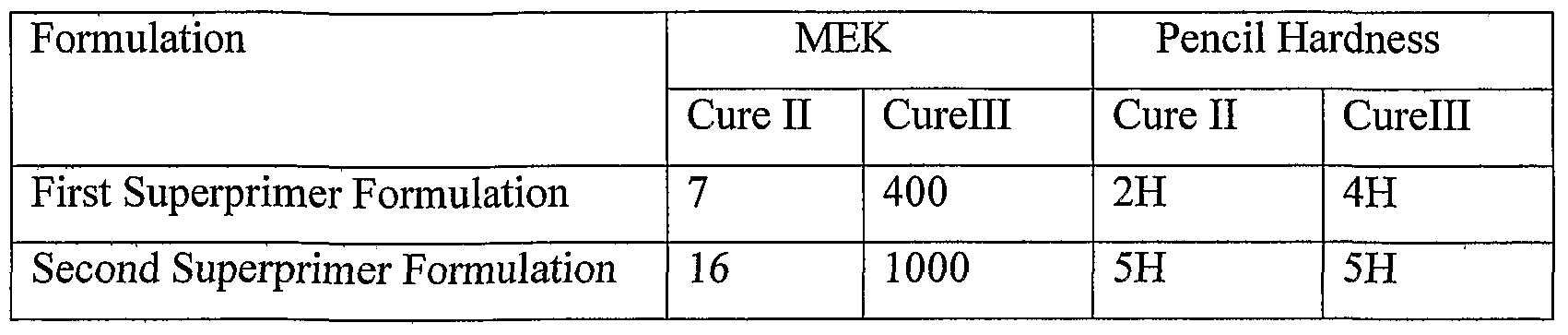


Claims
Priority Applications (2)
| Application Number | Priority Date | Filing Date | Title |
|---|---|---|---|
| US11/821,089 US20080081120A1 (en) | 2004-12-22 | 2007-06-21 | Superprimer |
| US12/367,571 US20090264574A1 (en) | 2004-12-22 | 2009-02-09 | Superprimer |
Applications Claiming Priority (4)
| Application Number | Priority Date | Filing Date | Title |
|---|---|---|---|
| US63872904P | 2004-12-22 | 2004-12-22 | |
| US60/638,729 | 2004-12-22 | ||
| US69533305P | 2005-06-30 | 2005-06-30 | |
| US60/695,333 | 2005-06-30 |
Related Child Applications (1)
| Application Number | Title | Priority Date | Filing Date |
|---|---|---|---|
| US11/821,089 Continuation US20080081120A1 (en) | 2004-12-22 | 2007-06-21 | Superprimer |
Publications (2)
| Publication Number | Publication Date |
|---|---|
| WO2006069376A2 true WO2006069376A2 (en) | 2006-06-29 |
| WO2006069376A3 WO2006069376A3 (en) | 2006-10-26 |
Family
ID=36215679
Family Applications (1)
| Application Number | Title | Priority Date | Filing Date |
|---|---|---|---|
| PCT/US2005/047036 Ceased WO2006069376A2 (en) | 2004-12-22 | 2005-12-22 | Improved superprimer |
Country Status (2)
| Country | Link |
|---|---|
| US (2) | US20080081120A1 (en) |
| WO (1) | WO2006069376A2 (en) |
Cited By (9)
| Publication number | Priority date | Publication date | Assignee | Title |
|---|---|---|---|---|
| EP2223975A4 (en) * | 2007-12-07 | 2011-03-02 | Dipsol Chem | Surface-treating aqueous solution and treatment methods for forming corrosion-resistant coating film over zinc or zinc alloy deposit |
| WO2013135751A1 (en) * | 2012-03-16 | 2013-09-19 | Akzo Nobel Coatings International B.V. | Aqueous anti-corrosive primer composition |
| WO2013178525A1 (en) * | 2012-06-01 | 2013-12-05 | Valsem Industries Sas | Low environmental impact compound film for corrosion protection |
| WO2015026465A1 (en) * | 2013-08-21 | 2015-02-26 | General Electric Company | Coating systems and fluorescent lamps provided therewith |
| FR3047491A1 (en) * | 2016-02-09 | 2017-08-11 | Safran | DEVELOPMENT OF SOL-GEL ANTI-CORROSION TREATMENT |
| CN109971313A (en) * | 2019-04-16 | 2019-07-05 | 江苏碳谷二维世界科技有限公司 | A kind of carbon nanomaterial modified epoxy zinc rich primer and preparation method thereof |
| CN110079164A (en) * | 2018-01-25 | 2019-08-02 | 江南大学 | A kind of preparation and its application of water-based antirust agent |
| CN112375482A (en) * | 2020-11-30 | 2021-02-19 | 江苏科技大学 | Chromium-free water-based paint and preparation method and application thereof |
| CN119823445A (en) * | 2025-01-23 | 2025-04-15 | 中国科学院长春应用化学研究所 | Heteropoly acid compound-phosphonate liquid flame retardant, preparation method and application thereof |
Families Citing this family (46)
| Publication number | Priority date | Publication date | Assignee | Title |
|---|---|---|---|---|
| US6863825B2 (en) * | 2003-01-29 | 2005-03-08 | Union Oil Company Of California | Process for removing arsenic from aqueous streams |
| US8066874B2 (en) | 2006-12-28 | 2011-11-29 | Molycorp Minerals, Llc | Apparatus for treating a flow of an aqueous solution containing arsenic |
| US8252087B2 (en) | 2007-10-31 | 2012-08-28 | Molycorp Minerals, Llc | Process and apparatus for treating a gas containing a contaminant |
| US20090107925A1 (en) * | 2007-10-31 | 2009-04-30 | Chevron U.S.A. Inc. | Apparatus and process for treating an aqueous solution containing biological contaminants |
| US8349764B2 (en) * | 2007-10-31 | 2013-01-08 | Molycorp Minerals, Llc | Composition for treating a fluid |
| US8314201B2 (en) | 2007-11-30 | 2012-11-20 | The United States Of America As Represented By The Administration Of The National Aeronautics And Space Administration | Highly porous ceramic oxide aerogels having improved flexibility |
| US8258251B2 (en) * | 2007-11-30 | 2012-09-04 | The United States Of America, As Represented By The Administrator Of The National Aeronautics And Space Administration | Highly porous ceramic oxide aerogels having improved flexibility |
| US8074625B2 (en) * | 2008-01-07 | 2011-12-13 | Mcalister Technologies, Llc | Fuel injector actuator assemblies and associated methods of use and manufacture |
| US8413634B2 (en) * | 2008-01-07 | 2013-04-09 | Mcalister Technologies, Llc | Integrated fuel injector igniters with conductive cable assemblies |
| US8635985B2 (en) | 2008-01-07 | 2014-01-28 | Mcalister Technologies, Llc | Integrated fuel injectors and igniters and associated methods of use and manufacture |
| US8365700B2 (en) | 2008-01-07 | 2013-02-05 | Mcalister Technologies, Llc | Shaping a fuel charge in a combustion chamber with multiple drivers and/or ionization control |
| US8225768B2 (en) * | 2008-01-07 | 2012-07-24 | Mcalister Technologies, Llc | Integrated fuel injector igniters suitable for large engine applications and associated methods of use and manufacture |
| US7628137B1 (en) * | 2008-01-07 | 2009-12-08 | Mcalister Roy E | Multifuel storage, metering and ignition system |
| US8561598B2 (en) | 2008-01-07 | 2013-10-22 | Mcalister Technologies, Llc | Method and system of thermochemical regeneration to provide oxygenated fuel, for example, with fuel-cooled fuel injectors |
| US8387599B2 (en) | 2008-01-07 | 2013-03-05 | Mcalister Technologies, Llc | Methods and systems for reducing the formation of oxides of nitrogen during combustion in engines |
| US20100155330A1 (en) * | 2008-11-11 | 2010-06-24 | Molycorp Minerals, Llc | Target material removal using rare earth metals |
| BRPI1008696A2 (en) * | 2009-02-17 | 2016-03-08 | Mcalister Technologies Llc | electrolytic cell and method for using it. |
| DE102009017822A1 (en) | 2009-04-20 | 2010-10-21 | Evonik Degussa Gmbh | Aqueous silane systems based on tris (alkoxysilylalkyl) amines and their use |
| EP2470485A4 (en) * | 2009-08-27 | 2012-12-26 | Mcalister Technologies Llc | CERAMIC ISOLATOR AND METHODS OF USE AND MANUFACTURE |
| CN102713244A (en) | 2009-08-27 | 2012-10-03 | 麦卡利斯特技术有限责任公司 | Shaped supply fuel in combustors with multiple drivers and/or ionization control |
| KR20120086375A (en) | 2009-12-07 | 2012-08-02 | 맥알리스터 테크놀로지즈 엘엘씨 | Adaptive control system for fuel injectors and igniters |
| US20110297753A1 (en) | 2010-12-06 | 2011-12-08 | Mcalister Roy E | Integrated fuel injector igniters configured to inject multiple fuels and/or coolants and associated methods of use and manufacture |
| US8205805B2 (en) | 2010-02-13 | 2012-06-26 | Mcalister Technologies, Llc | Fuel injector assemblies having acoustical force modifiers and associated methods of use and manufacture |
| CN102844540A (en) | 2010-02-13 | 2012-12-26 | 麦卡利斯特技术有限责任公司 | Methods and systems for adaptively cooling combustion chambers in engines |
| US9550855B2 (en) | 2010-05-28 | 2017-01-24 | The Johns Hopkins University | Self-healing coatings |
| US8528519B2 (en) | 2010-10-27 | 2013-09-10 | Mcalister Technologies, Llc | Integrated fuel injector igniters suitable for large engine applications and associated methods of use and manufacture |
| US8091528B2 (en) | 2010-12-06 | 2012-01-10 | Mcalister Technologies, Llc | Integrated fuel injector igniters having force generating assemblies for injecting and igniting fuel and associated methods of use and manufacture |
| US8820275B2 (en) | 2011-02-14 | 2014-09-02 | Mcalister Technologies, Llc | Torque multiplier engines |
| US9233863B2 (en) | 2011-04-13 | 2016-01-12 | Molycorp Minerals, Llc | Rare earth removal of hydrated and hydroxyl species |
| US8919377B2 (en) | 2011-08-12 | 2014-12-30 | Mcalister Technologies, Llc | Acoustically actuated flow valve assembly including a plurality of reed valves |
| CN103890343B (en) | 2011-08-12 | 2015-07-15 | 麦卡利斯特技术有限责任公司 | Systems and methods for improved engine cooling and power generation |
| GB201307914D0 (en) * | 2013-05-02 | 2013-06-12 | Asociacion Ct De Investigacion Cooperativa En Biomateriales | Sample plates for surface assisted laser desorption ionization mass spectrometry |
| US9975787B2 (en) | 2014-03-07 | 2018-05-22 | Secure Natural Resources Llc | Removal of arsenic from aqueous streams with cerium (IV) oxide compositions |
| US20150322271A1 (en) * | 2014-05-09 | 2015-11-12 | Prc-Desoto International, Inc. | Chromate free pretreatment primer |
| US20160257819A1 (en) * | 2015-03-06 | 2016-09-08 | Prc-Desoto International Incorporated | Partially reacted silane primer compositions |
| US9873759B2 (en) | 2015-04-27 | 2018-01-23 | King Fahd University Of Petroleum And Minerals | Epoxy composite resins and sol-gel compositions thereof |
| KR101752306B1 (en) * | 2015-10-07 | 2017-06-30 | (주)켐옵틱스 | Adhesive composition for uv-crosslinkable interface and surface modification method of substrate using thereof |
| US12227433B2 (en) * | 2016-02-19 | 2025-02-18 | Hewlett Packard Enterprise Development Lp | Electrical frequency response fluid analysis |
| CN107057569A (en) * | 2017-01-16 | 2017-08-18 | 惠州市博罗至诚化工有限公司 | A kind of nano inorganic silicate zinc-rich composite anticorrosion coating and preparation method thereof |
| CN109486324B (en) * | 2018-11-09 | 2021-03-23 | 中建铝新材料福建有限公司 | Film-coated aluminum alloy template and film-coating process thereof |
| CA3128950A1 (en) * | 2019-02-13 | 2020-08-20 | Chemetall Gmbh | Improved method for applying silane-based coatings on solid surfaces, in particular on metal surfaces |
| US11173692B2 (en) | 2019-12-19 | 2021-11-16 | Prc-Desoto International, Inc. | Free radical polymerizable adhesion-promoting interlayer compositions and methods of use |
| US11608458B2 (en) | 2019-12-19 | 2023-03-21 | Prc-Desoto International, Inc. | Adhesion-promoting interlayer compositions containing organic titanates/zirconates and methods of use |
| US11624007B2 (en) | 2020-01-29 | 2023-04-11 | Prc-Desoto International, Inc. | Photocurable adhesion-promoting compositions and methods of use |
| WO2021242437A1 (en) * | 2020-05-26 | 2021-12-02 | Rohm And Haas Company | Rheology modifier and aminosilane waterborne admixture |
| CN118620510A (en) * | 2023-04-06 | 2024-09-10 | 金华市美林涂料有限公司 | A water-based coating and preparation method thereof |
Family Cites Families (57)
| Publication number | Priority date | Publication date | Assignee | Title |
|---|---|---|---|---|
| NL301959A (en) * | 1962-12-17 | |||
| NL124542C (en) * | 1963-01-30 | |||
| US3620784A (en) * | 1968-01-24 | 1971-11-16 | Nasa | Potassium silicate-zinc coatings |
| US3653930A (en) * | 1969-10-22 | 1972-04-04 | Ameron Inc | One package zinc rich protective coating |
| US3832204A (en) * | 1970-09-08 | 1974-08-27 | D Boaz | Silicate polymer vehicles for use in protective coatings and process of making |
| US3917648A (en) * | 1971-01-18 | 1975-11-04 | G D Mcleod & Sons Inc | Galvanic coating compositions comprising polyol silcates and zinc dust |
| GB1340263A (en) * | 1971-04-06 | 1973-12-12 | Berger Jenson & Nicholson Ltd | Titanium ester coatings |
| US3954506A (en) * | 1971-11-16 | 1976-05-04 | Polaroid Corporation | Zinc anode and composition and method for producing same |
| BE793557A (en) * | 1971-12-30 | 1973-06-29 | Stauffer Chemical Co | COATING COMPOSITIONS PROVIDING GALVANIC PROTECTION |
| IT973303B (en) * | 1972-03-28 | 1974-06-10 | Rhone Poulenc Sa | STABLE STABLE BINDERS BASED ON ALKYL SILICATES AND TITANATES AND OR THEIR POLYMERS AND FILMOGENIC RESINS |
| US3954693A (en) * | 1973-09-24 | 1976-05-04 | Lockheed Aircraft Corporation | Coating |
| US4218354A (en) * | 1974-03-22 | 1980-08-19 | Stauffer Chemical Company | Binder composition and coating containing the same |
| US3998771A (en) * | 1975-04-11 | 1976-12-21 | Mobil Oil Corporation | Water-based epoxy resin zinc-rich coating compositions |
| GB1562651A (en) * | 1976-07-20 | 1980-03-12 | Kansai Paint Co Ltd | Surface treatment of metals |
| US4346143A (en) * | 1977-11-07 | 1982-08-24 | Ppg Industries, Inc. | Method of applying zinc-rich primer and product |
| US4277284A (en) * | 1978-04-28 | 1981-07-07 | Union Carbide Corporation | Single-package zinc-rich coatings |
| US4250074A (en) * | 1979-09-06 | 1981-02-10 | Ameron, Inc. | Interpenetrating polymer network comprising epoxy polymer and polysiloxane |
| US4239539A (en) * | 1979-06-25 | 1980-12-16 | Union Carbide Corporation | Aminosilane modified zinc-rich coating compositions |
| US4311738A (en) * | 1980-05-27 | 1982-01-19 | Dow Corning Corporation | Method for rendering non-ferrous metals corrosion resistant |
| US4417007A (en) * | 1981-06-30 | 1983-11-22 | Elkem Metals Company | Zinc rich paint formulations employing manganomanganic oxide fume pigment |
| US4476260A (en) * | 1983-10-26 | 1984-10-09 | Union Carbide Corporation | Zinc rich coatings |
| FR2602239B1 (en) * | 1986-07-30 | 1988-10-07 | Savin Ronald | COATING COMPOSITIONS CONTAINING REACTIVE PIGMENTS AND HAVING EXCELLENT RESISTANCE TO AGGRESSION OF THE ENVIRONMENT |
| US5859095A (en) * | 1987-05-11 | 1999-01-12 | Morton International, Inc. | Epoxy corrosion-inhibiting coating composition |
| US5001173A (en) * | 1987-05-11 | 1991-03-19 | Morton Coatings, Inc. | Aqueous epoxy resin compositions and metal substrates coated therewith |
| US5098938A (en) * | 1989-03-03 | 1992-03-24 | Savin Roland R | Coating composition exhibiting improved resistance to environmental attack |
| US5413628A (en) * | 1993-09-22 | 1995-05-09 | Savin; Ronald R. | Stable inorganic zinc-powder rich coating composition |
| US5338348A (en) * | 1993-09-22 | 1994-08-16 | Savin Roland R | Zinc powder-rich coating composition |
| NZ303624A (en) * | 1995-03-08 | 1999-01-28 | Du Pont | Reactive organosilicons as coatings, adhesives, and sealants |
| DE69635805T2 (en) * | 1995-08-23 | 2006-10-19 | Kansai Paint Co., Ltd., Amagasaki | One component epoxy resin composition, one component corrosion resistant LCK composition, method for coating this composition |
| DE19748764A1 (en) * | 1997-11-05 | 1999-05-06 | Henkel Kgaa | Conductive, organic coatings |
| US6281321B1 (en) * | 1997-11-27 | 2001-08-28 | Akzo Nobel N.V. | Coating compositions |
| US6610407B1 (en) * | 1998-02-26 | 2003-08-26 | Tsubakimoto Chain Co. | Corrosion resistant coating for an iron-based part and method for applying same |
| FR2784108A1 (en) * | 1998-09-11 | 2000-04-07 | Inst Francais Du Petrole | NEW CROSS-LINKED POLYMERS BASED ON BIS-SILANE DERIVATIVES, BIS-THIOETHERS, BIS-SULFOXIDES, BIS-SULPHONES AND BUTANE DI-YL FROM POLYSACCHARIDES AND OLIGOSACCHARIDES, AND THEIR FORMATION INTO SUPPORTED MATERIALS |
| US6071566A (en) * | 1999-02-05 | 2000-06-06 | Brent International Plc | Method of treating metals using vinyl silanes and multi-silyl-functional silanes in admixture |
| PT1177260E (en) * | 1999-03-18 | 2005-05-31 | Akzo Nobel Coatings Int Bv | PRIMARY COATING OF ACO |
| US6468336B1 (en) * | 1999-05-26 | 2002-10-22 | J.C. Hempel's Skibsfarve-Fabrik A/S | Water-borne zinc silicate shop primers |
| US6270884B1 (en) * | 1999-08-02 | 2001-08-07 | Metal Coatings International Inc. | Water-reducible coating composition for providing corrosion protection |
| JP3857866B2 (en) * | 2000-02-29 | 2006-12-13 | 日本ペイント株式会社 | Non-chromate metal surface treatment agent, surface treatment method and treated painted steel |
| US6541088B1 (en) * | 2000-03-03 | 2003-04-01 | Eg Technology Partners, L.P. | Alkylenimine/organic barrier coatings having bis-silane additives |
| US6416817B1 (en) * | 2000-03-03 | 2002-07-09 | Dow Corning Sa | Barrier coatings having bis-silanes |
| DK1317515T3 (en) * | 2000-09-13 | 2006-05-01 | Akzo Nobel Coatings Int Bv | Grounding of steel |
| WO2002022746A1 (en) * | 2000-09-13 | 2002-03-21 | Akzo Nobel N.V. | Primer coating of steel |
| WO2002024344A2 (en) * | 2000-09-25 | 2002-03-28 | Chemetall Gmbh | Method for pretreating and coating metal surfaces, prior to forming, with a paint-like coating and use of substrates so coated |
| EP1191074A1 (en) * | 2000-09-25 | 2002-03-27 | Sigma Coatings B.V. | Water-based two component protective coating compositions |
| DE10149148B4 (en) * | 2000-10-11 | 2006-06-14 | Chemetall Gmbh | A method of coating metallic surfaces with an aqueous polymer-containing composition, the aqueous composition, and the use of the coated substrates |
| EP1328590B1 (en) * | 2000-10-11 | 2011-08-03 | Chemetall GmbH | Method for pretreating and/or coating metallic surfaces with a paint-like coating prior to forming and use of substrates coated in this way |
| FR2819801B1 (en) * | 2001-01-24 | 2004-10-01 | Saint Gobain Vetrotex | SIZED GLASS WIRES, SIZING COMPOSITION AND COMPOSITES COMPRISING SAID WIRES |
| US20030077059A1 (en) * | 2001-03-13 | 2003-04-24 | Ching-Kee Chien | Optical fiber coating compositions |
| JP3938352B2 (en) * | 2001-11-05 | 2007-06-27 | アイシン化工株式会社 | Zinc powder-containing slurry and water-based coating material |
| JP4469178B2 (en) * | 2001-12-18 | 2010-05-26 | 東レ・ダウコーニング株式会社 | Photo-curable organic polymer composition |
| TWI259216B (en) * | 2002-07-23 | 2006-08-01 | Kansai Paint Co Ltd | Surface-treated steel sheet excellent in resistance to white rust and method for production thereof |
| WO2004009717A1 (en) * | 2002-07-24 | 2004-01-29 | University Of Cincinnati | Superprimer |
| AU2003259218A1 (en) * | 2002-07-24 | 2004-02-09 | University Of Cincinnati | Reduced chromate silane film |
| US20040099845A1 (en) * | 2002-10-10 | 2004-05-27 | Simendinger William H. | Anti-corrosion composition |
| EP1500686B1 (en) * | 2003-07-22 | 2011-07-13 | Hoden Seimitsu Kako Kenkyusho Co., Ltd. | Rust inhibitive treatment method for metals |
| US6991826B2 (en) * | 2004-04-20 | 2006-01-31 | 3M Innovative Properties Company | Antisoiling coatings for antireflective substrates |
| US7288607B2 (en) * | 2004-10-12 | 2007-10-30 | E. I. Du Pont De Nemours & Co. | High solids primer composition based on epoxy ring opening curing reaction |
-
2005
- 2005-12-22 WO PCT/US2005/047036 patent/WO2006069376A2/en not_active Ceased
-
2007
- 2007-06-21 US US11/821,089 patent/US20080081120A1/en not_active Abandoned
-
2009
- 2009-02-09 US US12/367,571 patent/US20090264574A1/en not_active Abandoned
Cited By (14)
| Publication number | Priority date | Publication date | Assignee | Title |
|---|---|---|---|---|
| EP2223975A4 (en) * | 2007-12-07 | 2011-03-02 | Dipsol Chem | Surface-treating aqueous solution and treatment methods for forming corrosion-resistant coating film over zinc or zinc alloy deposit |
| WO2013135751A1 (en) * | 2012-03-16 | 2013-09-19 | Akzo Nobel Coatings International B.V. | Aqueous anti-corrosive primer composition |
| WO2013178525A1 (en) * | 2012-06-01 | 2013-12-05 | Valsem Industries Sas | Low environmental impact compound film for corrosion protection |
| WO2015026465A1 (en) * | 2013-08-21 | 2015-02-26 | General Electric Company | Coating systems and fluorescent lamps provided therewith |
| US9404034B2 (en) | 2013-08-21 | 2016-08-02 | General Electric Company | Coating systems and fluorescent lamps provided therewith |
| WO2017137704A1 (en) * | 2016-02-09 | 2017-08-17 | Safran | Development of a sol-gel anticorrosion treatment |
| FR3047491A1 (en) * | 2016-02-09 | 2017-08-11 | Safran | DEVELOPMENT OF SOL-GEL ANTI-CORROSION TREATMENT |
| CN109154086A (en) * | 2016-02-09 | 2019-01-04 | 赛峰集团 | The exploitation of sol-gel anti-corrosion treatment |
| RU2721694C2 (en) * | 2016-02-09 | 2020-05-21 | Сафран | Development of sol-gel anti-corrosion treatment |
| US11028275B2 (en) | 2016-02-09 | 2021-06-08 | Safran | Development of a sol-gel anticorrosion treatment |
| CN110079164A (en) * | 2018-01-25 | 2019-08-02 | 江南大学 | A kind of preparation and its application of water-based antirust agent |
| CN109971313A (en) * | 2019-04-16 | 2019-07-05 | 江苏碳谷二维世界科技有限公司 | A kind of carbon nanomaterial modified epoxy zinc rich primer and preparation method thereof |
| CN112375482A (en) * | 2020-11-30 | 2021-02-19 | 江苏科技大学 | Chromium-free water-based paint and preparation method and application thereof |
| CN119823445A (en) * | 2025-01-23 | 2025-04-15 | 中国科学院长春应用化学研究所 | Heteropoly acid compound-phosphonate liquid flame retardant, preparation method and application thereof |
Also Published As
| Publication number | Publication date |
|---|---|
| US20090264574A1 (en) | 2009-10-22 |
| US20080081120A1 (en) | 2008-04-03 |
| WO2006069376A3 (en) | 2006-10-26 |
Similar Documents
| Publication | Publication Date | Title |
|---|---|---|
| US20080081120A1 (en) | Superprimer | |
| KR101471948B1 (en) | Zinc-based metal coated steel sheet | |
| CA2492936C (en) | Superprimer | |
| KR101296611B1 (en) | Epoxy silane oligomer and coating composition containing same | |
| CN103119200B (en) | Surface treatment fluid for zinc-plated steel sheet, zinc-plated steel sheet, and manufacturing method for the same | |
| CA2919806C (en) | Coating composition for metal surface pre-treatment, its preparation and use thereof | |
| CN105143513B (en) | Coated steel plate is with base treatment composition and has carried out the coated steel sheet and its manufacture method, application coated steel sheet and its manufacture method of base treatment | |
| JP5554531B2 (en) | How to paint metal materials | |
| KR20070119073A (en) | Epoxy Silane Oligomer and Coating Compositions Comprising the Same | |
| JP2017071762A (en) | Anticorrosive coating composition | |
| EP3131978A1 (en) | Corrosion-resistant coating composition | |
| JP5592579B2 (en) | How to paint metal materials | |
| KR100880461B1 (en) | Water-soluble baking zinc coating composition excellent in corrosion resistance and a manufacturing method thereof | |
| JP6498817B1 (en) | Coating composition, coating film and coating method | |
| JP7438078B2 (en) | Water-based coating agent for steel materials, film, coating method for steel materials, and steel materials | |
| AU2020478543B2 (en) | Anticorrosive coating composition | |
| Van Ooij | A Chromium-Free Coating System for DoD Applications | |
| Shivane | ENVIRONMENT-FRIENDLY ANTI-CORROSION'SUPERPRIMERS'FOR HDG | |
| Vanooij et al. | Wash Primer Replacement Based on the Superprimer Technology | |
| JP2023141838A (en) | Primid curable polyester resin composition and powder coating | |
| Mugada | Superprimer: Chromate Free Coating System for DoD Applications | |
| Suryanarayanan | Integral Epoxy Resin-silane Primer System for Hot-dip Galvanized Steel | |
| Iroh | I, Karthik Suryanarayanan | |
| Mittal | A novel low-VOC, chromate-free, one-step primer system for corrosion protection of metals and alloys |
Legal Events
| Date | Code | Title | Description |
|---|---|---|---|
| AK | Designated states |
Kind code of ref document: A2 Designated state(s): AE AG AL AM AT AU AZ BA BB BG BR BW BY BZ CA CH CN CO CR CU CZ DE DK DM DZ EC EE EG ES FI GB GD GE GH GM HR HU ID IL IN IS JP KE KG KM KN KP KR KZ LC LK LR LS LT LU LV LY MA MD MG MK MN MW MX MZ NA NG NI NO NZ OM PG PH PL PT RO RU SC SD SE SG SK SL SM SY TJ TM TN TR TT TZ UA UG US UZ VC VN YU ZA ZM ZW |
|
| AL | Designated countries for regional patents |
Kind code of ref document: A2 Designated state(s): BW GH GM KE LS MW MZ NA SD SL SZ TZ UG ZM ZW AM AZ BY KG KZ MD RU TJ TM AT BE BG CH CY CZ DE DK EE ES FI FR GB GR HU IE IS IT LT LU LV MC NL PL PT RO SE SI SK TR BF BJ CF CG CI CM GA GN GQ GW ML MR NE SN TD TG |
|
| WWE | Wipo information: entry into national phase |
Ref document number: 11821089 Country of ref document: US |
|
| NENP | Non-entry into the national phase |
Ref country code: DE |
|
| 121 | Ep: the epo has been informed by wipo that ep was designated in this application |
Ref document number: 05855571 Country of ref document: EP Kind code of ref document: A2 |
|
| 122 | Ep: pct application non-entry in european phase |
Ref document number: 05855571 Country of ref document: EP Kind code of ref document: A2 |