WO2006066155A2 - Hydrogen production by a thermochemical water splitting cycle - Google Patents
Hydrogen production by a thermochemical water splitting cycle Download PDFInfo
- Publication number
- WO2006066155A2 WO2006066155A2 PCT/US2005/045824 US2005045824W WO2006066155A2 WO 2006066155 A2 WO2006066155 A2 WO 2006066155A2 US 2005045824 W US2005045824 W US 2005045824W WO 2006066155 A2 WO2006066155 A2 WO 2006066155A2
- Authority
- WO
- WIPO (PCT)
- Prior art keywords
- metal based
- recited
- water
- alkali
- earth metal
- Prior art date
- Legal status (The legal status is an assumption and is not a legal conclusion. Google has not performed a legal analysis and makes no representation as to the accuracy of the status listed.)
- Ceased
Links
Classifications
-
- C—CHEMISTRY; METALLURGY
- C01—INORGANIC CHEMISTRY
- C01B—NON-METALLIC ELEMENTS; COMPOUNDS THEREOF; METALLOIDS OR COMPOUNDS THEREOF NOT COVERED BY SUBCLASS C01C
- C01B3/00—Hydrogen; Gaseous mixtures containing hydrogen; Separation of hydrogen from mixtures containing it; Purification of hydrogen; Reversible storage of hydrogen
- C01B3/02—Production of hydrogen; Production of gaseous mixtures containing hydrogen
- C01B3/04—Production of hydrogen; Production of gaseous mixtures containing hydrogen by decomposition of inorganic compounds
- C01B3/042—Decomposition of water
-
- C—CHEMISTRY; METALLURGY
- C01—INORGANIC CHEMISTRY
- C01B—NON-METALLIC ELEMENTS; COMPOUNDS THEREOF; METALLOIDS OR COMPOUNDS THEREOF NOT COVERED BY SUBCLASS C01C
- C01B13/00—Oxygen; Ozone; Oxides or hydroxides in general
- C01B13/02—Preparation of oxygen
- C01B13/0203—Preparation of oxygen from inorganic compounds
- C01B13/0207—Water
-
- Y—GENERAL TAGGING OF NEW TECHNOLOGICAL DEVELOPMENTS; GENERAL TAGGING OF CROSS-SECTIONAL TECHNOLOGIES SPANNING OVER SEVERAL SECTIONS OF THE IPC; TECHNICAL SUBJECTS COVERED BY FORMER USPC CROSS-REFERENCE ART COLLECTIONS [XRACs] AND DIGESTS
- Y02—TECHNOLOGIES OR APPLICATIONS FOR MITIGATION OR ADAPTATION AGAINST CLIMATE CHANGE
- Y02E—REDUCTION OF GREENHOUSE GAS [GHG] EMISSIONS, RELATED TO ENERGY GENERATION, TRANSMISSION OR DISTRIBUTION
- Y02E60/00—Enabling technologies; Technologies with a potential or indirect contribution to GHG emissions mitigation
- Y02E60/30—Hydrogen technology
- Y02E60/36—Hydrogen production from non-carbon containing sources, e.g. by water electrolysis
-
- Y—GENERAL TAGGING OF NEW TECHNOLOGICAL DEVELOPMENTS; GENERAL TAGGING OF CROSS-SECTIONAL TECHNOLOGIES SPANNING OVER SEVERAL SECTIONS OF THE IPC; TECHNICAL SUBJECTS COVERED BY FORMER USPC CROSS-REFERENCE ART COLLECTIONS [XRACs] AND DIGESTS
- Y02—TECHNOLOGIES OR APPLICATIONS FOR MITIGATION OR ADAPTATION AGAINST CLIMATE CHANGE
- Y02P—CLIMATE CHANGE MITIGATION TECHNOLOGIES IN THE PRODUCTION OR PROCESSING OF GOODS
- Y02P20/00—Technologies relating to chemical industry
- Y02P20/10—Process efficiency
- Y02P20/133—Renewable energy sources, e.g. sunlight
Definitions
- This invention pertains generally to the production of hydrogen from water, and more particularly to a thermochemical cycle using a renewable energy source that efficiently separates water into its components.
- Hydrogen is mainly produced from natural gas through steam reforming and dry reforming of methane and other fossil fuels, and from coal through gasification. Hydrogen is also produced through electrolysis. These production methods consume fossil fuels, electricity, or both, and produce unwanted carbon dioxide as a byproduct. In addition, the hydrogen product usually requires separation from other by-products, such as carbon monoxide and carbon dioxide.
- Thermal decomposition of water typically requires temperatures greater than 2273 K (about 2000 0 C).
- the present invention provides a novel thermochemical cycle for the decomposition of water.
- the cycle involves an alkali or alkali earth metal based catalyst and a variety of reaction intermediates.
- the cycle is driven by renewable energy sources, and can have a maximum operating temperature below 1173 K (900 0 C). Alternatively, the cycle can operate at much higher temperatures.
- the kinetics of the cycle are based on the reactant behavior as well as the separability characteristics of the chemicals involved.
- An aspect of the invention is a method, comprising using an alkali metal based or alkali earth metal based process intermediate in a thermochemical cycle for water splitting.
- the thermochemical cycle operates in the absence of solids.
- the thermochemical cycle operates at temperatures at or below about 1 173 K.
- Another aspect of the invention is a method for water splitting, comprising: introducing water into a system, introducing an alkali metal based or alkali earth metal based process intermediate into the system, separating the alkali metal based or alkali earth metal based process intermediate to produce reaction intermediates, reacting a subset of the reaction intermediates with water to produce hydrogen and hydroxide, combining a subset of the reaction intermediates with the hydroxide to produce water and oxygen, reforming the alkali metal based or alkali earth metal based process intermediate for continued use in the system, and removing the hydrogen and the oxygen from the system.
- One embodiment further comprises removing heat from the system, and generating power, electricity, or both from the heat.
- a still further aspect of the invention is a system for water splitting, comprising: a plurality of interconnected reaction vessels, wherein the plurality of interconnected reaction vessels is configured to receive water from a source of water, wherein the plurality of interconnected reaction vessels is configured to admit an alkali metal based or alkali earth metal based process intermediate into the system, wherein water undergoes a series of thermochemical reactions with said alkali metal based or alkali earth metal based process intermediate, and wherein hydrogen and oxygen are recoverable from the system.
- the alkali metal based or alkali earth metal based process intermediate is combined with a transition metal.
- the alkali metal based or alkali earth metal based process intermediate comprises a carbonate or a hydroxide, or comprises more than one type of alkali metal or alkali earth metal.
- the system is operated in a polytropic manner.
- the system operates at temperatures at or below about 1300 K.
- the system operates in the absence of solids within the system.
- heat generated by the series of thermochemical reactions is used to produce power, electricity, or both.
- heat required for the series of thermochemical reactions is derived from solar or non-solar energy sources.
- FIG. 1 is one embodiment of the thermochemical water splitting cycle according to the present invention.
- FIG. 2 is a second embodiment of the thermochemical water splitting cycle according to the present invention.
- FIG. 3 is a third embodiment of the thermochemical water splitting cycle according to the present invention.
- FIG. 4 is a thermochemical water splitting cycle associated with data in
- FIG. 5 is a steam cycle used in conjunction with the cycle of FIG. 4 to produce power and/or electricity.
- FIG. 1 through FIG. 5 the present invention is embodied in the system generally shown in FIG. 1 through FIG. 5. It will be appreciated that the system may vary as to configuration and as to details of the parts, and that the method may vary as to the specific steps and sequence, without departing from the basic concepts as disclosed herein.
- the present invention is a novel thermochemical cycle 10 that accomplishes the water decomposition reaction.
- the following examples detail various embodiments of the instant invention.
- temperatures shown are shown by way of example, and are not intended to limit the invention.
- the maximum operating temperature can be less than or equal to 1173 K, but operating temperatures in the range of 298 K to 1300 K are within the scope of the invention.
- the choice of operating temperature is driven by several factors, including capital costs for the reactors and associated material movement equipment, operating cost for the cycle, and costs related to available high temperature energy sources.
- thermochemical cycle can involve sodium, sodium bicarbonate, sodium carbonate, sodium hydride, sodium hydroxide, sodium monoxide, and carbon dioxide as intermediates.
- sodium, sodium bicarbonate, sodium carbonate, sodium hydride, sodium hydroxide, sodium monoxide, and carbon dioxide as intermediates.
- FIG. 1 A process according to this embodiment is shown in FIG. 1.
- Sodium carbonate is first placed in vessel 22 and heated.
- the sodium carbonate decomposes to a gaseous mixture of sodium, oxygen, and carbon dioxide.
- the gas mixture is then cooled to liquefy the sodium.
- the mixture enters vessel 24, where separation takes place.
- the sodium is sent to vessel 26, where it reacts to completion with sodium hydroxide (molten) to produce sodium monoxide and hydrogen (gas).
- the sodium monoxide is sent to vessel
- sodium hydroxide 28 where it is placed in contact with water to form sodium hydroxide.
- Some of the sodium hydroxide from vessel 28 is recycled back to vessel 26 to react with the sodium and to facilitate transport of both heat and sodium monoxide.
- Some sodium hydroxide is also sent to vessel 30, where it is placed in contact with oxygen and carbon dioxide from vessel 24. The carbon dioxide is adjusted so that the reaction proceeds to completion to form sodium carbonate (molten). The molten sodium carbonate is then fed to vessel 22.
- the heat produced in vessels 26 and 28, the heat from the exit streams containing hydrogen and oxygen, and the heat from the exit of reaction vessel 22 can be heat and power integrated with the heating needs of the system (e.g., heating of carbonate in and before vessel 22; heating of inlet water); and outside hot utilities (e.g., solar, nuclear, fossil fuel based, geothermal, etc.) and cold utilities (e.g., cooling water) to produce electricity.
- Example 2 Example 2
- thermochemical cycle involves sodium, sodium carbonate, sodium hydroxide, and carbon dioxide as intermediates that help facilitate water decomposition.
- a process according to this embodiment is shown in FIG. 2.
- reaction (6) is endothermic and can typically be carried out around 1173 K, where all its products are gases.
- Kinetic rate information at 1173 K is given in Hughes et al., "Production of the Boranes and Related Research", Academic Press, New York, 1967.
- Reaction (7) is exothermic and can be carried out at room temperature or even around 1133 K. Care must be taken to control the rate of reaction (7). This can be accomplished by running the reaction with excess steam.
- Reaction (8) is also exothermic and can also be carried out around 1133 K. The choice of operating temperature for these reactions depends on several factors including capital costs for the reactors and reactors and associated material moving equipment, operating cost for the cycle, as well as the available high temperature energy source. Stable operation requires efficient heat removal from reactions (7) and (8).
- sodium carbonate is first placed in vessel 42 and heated.
- the sodium carbonate decomposes to a gaseous mixture of sodium, oxygen, and carbon dioxide.
- the gas mixture is then cooled to liquefy the sodium, and the mixture is sent to vessel 44, where separation takes place.
- the sodium is sent to vessel 46, where it reacts to completion with water (steam) to form sodium hydroxide (molten) and hydrogen (gas). Heat must be removed form vessel 46 to ensure stable operation.
- the sodium hydroxide is sent to vessel 48, where it is placed in contact with the oxygen and carbon dioxide from vessel 44.
- the carbon dioxide is adjusted so that the reaction proceeds to completion and forms sodium carbonate (molten).
- the molten sodium carbonate is then sent to vessel 42.
- the heat from the reactions in vessels 46 and 48, the heat from the exit streams containing hydrogen and oxygen, and the heat from the exit of reaction vessel 42 can be heat and power integrated with the heating needs of the system (e.g., heating of carbonate in and before vessel 42, heating of inlet water), and outside hot utilities (e.g., solar, nuclear, fossil fuel based, geothermal, etc.) and cold utilities (e.g., cooling water) to produce electricity.
- Example 3 A third embodiment is given by the system of equations:
- the sodium hydroxide and some water are then sent to vessel 68, where it is placed in contact with the oxygen and carbon dioxide from vessel 64.
- the carbon dioxide is adjusted so that the hydroxide reacts to completion and forms sodium carbonate and sodium bicarbonate.
- the sodium bicarbonate and sodium carbonate solution is fed to vessel 70, where the bicarbonate decomposes to carbonate, water, and carbon dioxide, the water is vaporized, and the carbonate melts.
- the carbon dioxide and water gases are then separated and recycled, while the sodium carbonate is sent to vessel 62.
- FIG. 4 shows a thermochemical cycle utilizing reactions (2) through (5), much like that in FIG. 3.
- FIG. 5 is a standard reheat steam cycle associated with the cycle of FIG. 4.
- Tables 1-9 The data associated with the cycles shown in FIG. 4 and FIG. 5 are presented in Tables 1-9.
- Tables 1 A-1 B show the characteristics of each stream shown in Fig. 4 and Fig. 5, including temperature, flow rate, and composition. Note that the composition of streams S15-S20 is water only, as these streams comprise the steam cycle.
- Tables 2-4 provide thermodynamic data for the individual components at 1173 K, 1 133 K, and 298 K, respectively.
- Tables 5A-5B provide the operating conditions for each heat exchanger
- Table 6 indicates the heat load for the heat exchangers in the two systems
- Table 7 indicates the work load for the turbines and the pump.
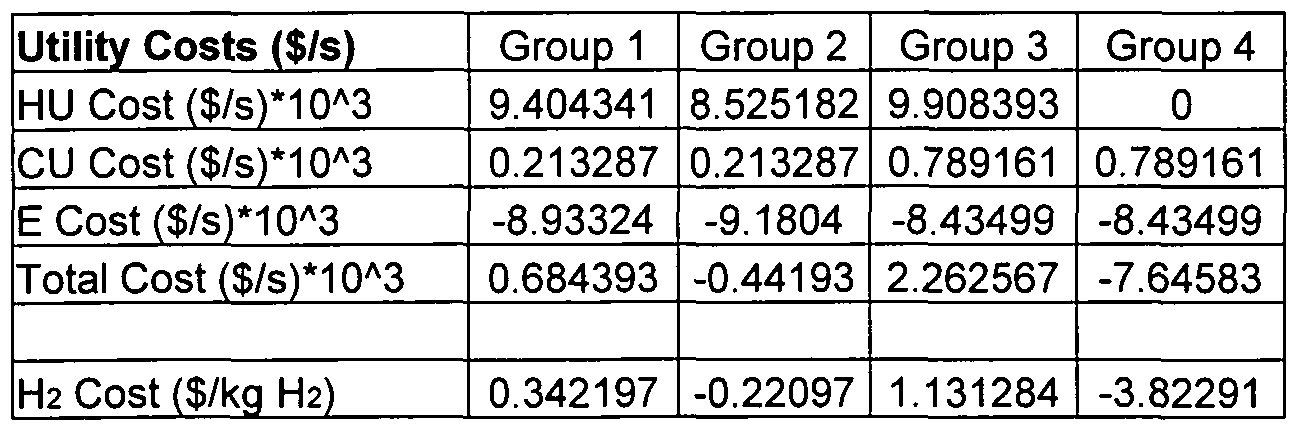
- Tables 8 and 9 quantify the cost coefficients ($/GJ) and the utility cost
- Hot Utility (HU) Cost for Groups 1-3 reflects the cost of natural gas. Fluctuations in the cost of natural gas will directly affect the cost efficiency of the cycle. For Group 4, the cost coefficient is zero, reflecting the use of solar power as the hot energy source. Note that the use of solar power realizes the greatest benefit in terms of cost. Table 9 also indicates the cost to produce hydrogen using the cycle of FIG. 4. [0059] In the cycle shown in FIG. 4, sodium carbonate enters reaction vessel
- V1 as stream S1.
- sodium carbonate is separated into sodium, oxygen, and carbon dioxide, which exits in stream S2.
- Stream S2 enters vessel V2.
- FIG. 5 shows a standard reheat steam cycle utilizing streams S15-S20, which generates power or electricity from a thermochemical cycle such as that shown in FIG. 4.
- Heat exchangers H8 and H10 pick up energy from heat exchangers H2, H3, H4, H5, H6, shown in FIG. 4, and utilize turbines T1 and T2 to generate power and/or electricity. Note that the heat load, shown in Table 6, for H8+H10 is equal in magnitude to that of H2+H3+H4+H5+H6.
- FIG. 5 The steam cycle shown in FIG. 5 is intended only as an example, and other elements may be used to achieve similar or better results.
- fuel cells can be utilized instead of turbines for energy generation.
- FIGS. 4 and 5, and their associated data represent one example of the use of the present invention and does not represent the maximum system efficiency possible. Other embodiments of the present invention could achieve efficiencies of 75-80%.
Landscapes
- Chemical & Material Sciences (AREA)
- Organic Chemistry (AREA)
- Inorganic Chemistry (AREA)
- Health & Medical Sciences (AREA)
- General Health & Medical Sciences (AREA)
- Engineering & Computer Science (AREA)
- Combustion & Propulsion (AREA)
- Hydrogen, Water And Hydrids (AREA)
- Engine Equipment That Uses Special Cycles (AREA)
- Organic Low-Molecular-Weight Compounds And Preparation Thereof (AREA)
- Oxygen, Ozone, And Oxides In General (AREA)
Abstract
Description


Claims
Priority Applications (1)
| Application Number | Priority Date | Filing Date | Title |
|---|---|---|---|
| US11/745,256 US7960063B2 (en) | 2004-12-16 | 2007-05-07 | Hydrogen production by a thermochemical water splitting cycle |
Applications Claiming Priority (2)
| Application Number | Priority Date | Filing Date | Title |
|---|---|---|---|
| US63704804P | 2004-12-16 | 2004-12-16 | |
| US60/637,048 | 2004-12-16 |
Related Child Applications (1)
| Application Number | Title | Priority Date | Filing Date |
|---|---|---|---|
| US11/745,256 Continuation US7960063B2 (en) | 2004-12-16 | 2007-05-07 | Hydrogen production by a thermochemical water splitting cycle |
Publications (2)
| Publication Number | Publication Date |
|---|---|
| WO2006066155A2 true WO2006066155A2 (en) | 2006-06-22 |
| WO2006066155A3 WO2006066155A3 (en) | 2006-08-17 |
Family
ID=36588625
Family Applications (1)
| Application Number | Title | Priority Date | Filing Date |
|---|---|---|---|
| PCT/US2005/045824 Ceased WO2006066155A2 (en) | 2004-12-16 | 2005-12-16 | Hydrogen production by a thermochemical water splitting cycle |
Country Status (2)
| Country | Link |
|---|---|
| US (1) | US7960063B2 (en) |
| WO (1) | WO2006066155A2 (en) |
Families Citing this family (8)
| Publication number | Priority date | Publication date | Assignee | Title |
|---|---|---|---|---|
| US8940269B2 (en) | 2012-04-06 | 2015-01-27 | California Institute Of Technology | Methods and materials for the thermochemical production of hydrogen from water |
| CA3131163A1 (en) | 2019-04-03 | 2020-10-08 | Mark E. Davis | Integration of thermochemical water splitting with co2 direct air capture |
| US12055131B2 (en) | 2022-02-28 | 2024-08-06 | EnhancedGEO Holdings, LLC | Geothermal power from superhot geothermal fluid and magma reservoirs |
| US12326278B2 (en) | 2022-02-28 | 2025-06-10 | EnhancedGEO Holdings, LLC | Geothermal power from superhot geothermal fluid and magma reservoirs |
| US12504203B2 (en) | 2023-02-10 | 2025-12-23 | EnhancedGEO Holdings, LLC | Reverse-flow magma-based geothermal generation |
| US11912573B1 (en) | 2023-03-03 | 2024-02-27 | EnhancedGEO Holdings, LLC | Molten-salt mediated thermochemical reactions using geothermal energy |
| US12522710B2 (en) | 2023-08-14 | 2026-01-13 | EnhancedGEO Holdings, LLC | Flow through process for thermal depolymerization and monomer repurposing using geothermal energy |
| US12570826B2 (en) | 2023-08-14 | 2026-03-10 | EnhancedGEO Holdings, LLC | Thermal depolymerization and monomer repurposing using geothermal energy |
Family Cites Families (23)
| Publication number | Priority date | Publication date | Assignee | Title |
|---|---|---|---|---|
| US497700A (en) * | 1893-05-16 | Process of manufacturing hydrogen gas | ||
| DE1811168C3 (en) * | 1968-11-27 | 1980-01-10 | Bayer Ag, 5090 Leverkusen | Process for making soda |
| US3819813A (en) * | 1971-09-09 | 1974-06-25 | Dow Chemical Co | Method for producing an alkali metal carbonate |
| US3996342A (en) * | 1974-09-05 | 1976-12-07 | Agency Of Industrial Science & Technology | Method for thermochemical production of hydrogen from water |
| US3929979A (en) * | 1974-09-10 | 1975-12-30 | Us Energy | Process for generating hydrogen |
| US3929980A (en) * | 1974-12-26 | 1975-12-30 | Us Energy | Method of producing hydrogen |
| US3927192A (en) * | 1975-01-29 | 1975-12-16 | Us Energy | Chemical cycle for thermochemical production of hydrogen from water |
| JPS537595A (en) * | 1976-07-12 | 1978-01-24 | Agency Of Ind Science & Technol | Hydrogen production by thermochemical decomposition of water |
| US4169884A (en) * | 1978-08-17 | 1979-10-02 | The United States Of America As Represented By The United States Department Of Energy | Hydrogen production from water using copper and barium hydroxide |
| JPS5567503A (en) * | 1978-11-14 | 1980-05-21 | Mitsubishi Heavy Ind Ltd | Chemical production of hydrogen from water |
| US4237105A (en) * | 1979-06-20 | 1980-12-02 | The United States Of America As Represented By The United States Department Of Energy | Thermochemical cyclic system for splitting water and/or carbon dioxide by means of cerium compounds and reactions useful therein |
| US4309403A (en) * | 1980-02-08 | 1982-01-05 | The United States Of America As Represented By The United States Department Of Energy | Thermochemical generation of hydrogen and oxygen from water |
| US4276279A (en) * | 1980-02-08 | 1981-06-30 | The United States Of America As Represented By The United States Department Of Energy | Thermochemical generation of hydrogen and oxygen from water |
| US4313925A (en) * | 1980-04-24 | 1982-02-02 | The United States Of America As Represented By The United States Department Of Energy | Thermochemical cyclic system for decomposing H2 O and/or CO2 by means of cerium-titanium-sodium-oxygen compounds |
| US4356163A (en) * | 1981-12-28 | 1982-10-26 | Davidson Research Ltd. | Process for the production of hydrogen |
| JPS6044242B2 (en) * | 1982-04-27 | 1985-10-02 | 株式会社星子療科研究所 | How to generate oxygen in an emergency |
| JPS61228882A (en) * | 1985-04-02 | 1986-10-13 | 植野 信治 | Generation of oxygen in emergency |
| US6458183B1 (en) * | 1999-09-07 | 2002-10-01 | Colonial Metals, Inc. | Method for purifying ruthenium and related processes |
| US7407905B2 (en) * | 2000-06-14 | 2008-08-05 | Battelle Energy Alliance, Llc | Method for reactivating catalysts and a method for recycling supercritical fluids used to reactivate the catalysts |
| US6994839B2 (en) * | 2001-08-15 | 2006-02-07 | Ovonic Battery Company, Inc. | Carbonate recycling in a hydrogen producing reaction |
| JP4395570B2 (en) * | 2002-07-30 | 2010-01-13 | 独立行政法人産業技術総合研究所 | Method for producing hydrogen by thermochemical decomposition of water |
| US20060013761A1 (en) * | 2004-07-01 | 2006-01-19 | Westinghouse Electric Company Llc | Isolated hydrogen production process |
| US7261874B2 (en) * | 2005-06-03 | 2007-08-28 | Westinghouse Electric Co. Llc | Gas phase electrolyzer process for producing hydrogen |
-
2005
- 2005-12-16 WO PCT/US2005/045824 patent/WO2006066155A2/en not_active Ceased
-
2007
- 2007-05-07 US US11/745,256 patent/US7960063B2/en not_active Expired - Fee Related
Also Published As
| Publication number | Publication date |
|---|---|
| US7960063B2 (en) | 2011-06-14 |
| US20070289863A1 (en) | 2007-12-20 |
| WO2006066155A3 (en) | 2006-08-17 |
Similar Documents
| Publication | Publication Date | Title |
|---|---|---|
| Perkins et al. | Likely near-term solar-thermal water splitting technologies | |
| US8697027B2 (en) | Methods and systems of producing hydrogen and oxygen for power generation, and power source | |
| Phan et al. | Hydrogen production from biogas: Process optimization using ASPEN Plus® | |
| Kodama | High-temperature solar chemistry for converting solar heat to chemical fuels | |
| RU2534077C2 (en) | Method of combined production of synthesis-gas and electric energy | |
| Al-Zareer et al. | Performance analysis of a supercritical water-cooled nuclear reactor integrated with a combined cycle, a Cu-Cl thermochemical cycle and a hydrogen compression system | |
| US7960063B2 (en) | Hydrogen production by a thermochemical water splitting cycle | |
| KR20220071234A (en) | How to convert carbon dioxide | |
| Zedtwitz et al. | Hydrogen production via the solar thermal decarbonization of fossil fuels | |
| US20110131991A1 (en) | Methods and systems for the production of hydrogen | |
| Ortiz et al. | Optimization of power and hydrogen production from glycerol by supercritical water reforming | |
| US7537750B2 (en) | Method for producing hydrogen gas by steam methane reforming using solar energy | |
| JP2009197733A (en) | Method of storing solar heat energy | |
| Warren et al. | Solar thermochemical fuels: Present status and future prospects | |
| Al-Zareer et al. | Development of an integrated system for electricity and hydrogen production from coal and water utilizing a novel chemical hydrogen storage technology | |
| JP2009197734A (en) | Method of converting solar heat energy | |
| Wu et al. | Design and energy evaluation of a stand‐alone copper‐chlorine (Cu‐Cl) thermochemical cycle system for trigeneration of electricity, hydrogen, and oxygen | |
| KR20170088932A (en) | Solar powered systems and methods for generating hydrogen gas and oxygen gas from water | |
| JPH03200734A (en) | Synthesis of methanol | |
| Diaz et al. | Performance assessment of concentrated solar power plants based on carbon and hydrogen fuel cells | |
| US20060102493A1 (en) | Enrichment of oxygen for the production of hydrogen from hydrocarbons with co2 capture | |
| KR102621148B1 (en) | Thermochemical redox cycle combined with biomass gasification process for hydrogen production | |
| Obermeier et al. | Energy Storage and Transportation Based on Solar Irradiation‐Aided CaO‐Looping | |
| ES2792748B2 (en) | MECHANICAL THERMOCHEMICAL ENERGY STORAGE INSTALLATION AND ENERGY STORAGE PROCEDURE | |
| Wang et al. | A new energy supply system based on the complementary utilization of concentrated solar-driven thermochemical water splitting and chemical recuperation cycle |
Legal Events
| Date | Code | Title | Description |
|---|---|---|---|
| AK | Designated states |
Kind code of ref document: A2 Designated state(s): AE AG AL AM AT AU AZ BA BB BG BR BW BY BZ CA CH CN CO CR CU CZ DE DK DM DZ EC EE EG ES FI GB GD GE GH GM HR HU ID IL IN IS JP KE KG KM KN KP KR KZ LC LK LR LS LT LU LV LY MA MD MG MK MN MW MX MZ NA NG NI NO NZ OM PG PH PL PT RO RU SC SD SE SG SK SL SM SY TJ TM TN TR TT TZ UA UG US UZ VC VN YU ZA ZM ZW |
|
| AL | Designated countries for regional patents |
Kind code of ref document: A2 Designated state(s): BW GH GM KE LS MW MZ NA SD SL SZ TZ UG ZM ZW AM AZ BY KG KZ MD RU TJ TM AT BE BG CH CY CZ DE DK EE ES FI FR GB GR HU IE IS IT LT LU LV MC NL PL PT RO SE SI SK TR BF BJ CF CG CI CM GA GN GQ GW ML MR NE SN TD TG |
|
| 121 | Ep: the epo has been informed by wipo that ep was designated in this application | ||
| WWE | Wipo information: entry into national phase |
Ref document number: 11745256 Country of ref document: US |
|
| NENP | Non-entry into the national phase |
Ref country code: DE |
|
| WWP | Wipo information: published in national office |
Ref document number: 11745256 Country of ref document: US |
|
| 122 | Ep: pct application non-entry in european phase |
Ref document number: 05857120 Country of ref document: EP Kind code of ref document: A2 |