WO2006040645A1 - N-(3,5-dichloropyridin-4-yl)-2,4,5-alkoxy and 2,3,4-alkoxy benzamide derivatives as pde-iv (phophodiesterase type-iv) inhibitors for the treatment of inflammatory diseases such as asthma - Google Patents

N-(3,5-dichloropyridin-4-yl)-2,4,5-alkoxy and 2,3,4-alkoxy benzamide derivatives as pde-iv (phophodiesterase type-iv) inhibitors for the treatment of inflammatory diseases such as asthma Download PDF

Info

Publication number
WO2006040645A1
WO2006040645A1 PCT/IB2005/003017 IB2005003017W WO2006040645A1 WO 2006040645 A1 WO2006040645 A1 WO 2006040645A1 IB 2005003017 W IB2005003017 W IB 2005003017W WO 2006040645 A1 WO2006040645 A1 WO 2006040645A1
Authority
WO
WIPO (PCT)
Prior art keywords
compound
formula
alkyl
heteroaryl
give
Prior art date
Legal status (The legal status is an assumption and is not a legal conclusion. Google has not performed a legal analysis and makes no representation as to the accuracy of the status listed.)
Ceased
Application number
PCT/IB2005/003017
Other languages
French (fr)
Inventor
Ramnik Sharma
Kumar Hari Bhushan
Bhargav Pandya
Ram Chander Aryan
Yatendra Kumar
Current Assignee (The listed assignees may be inaccurate. Google has not performed a legal analysis and makes no representation or warranty as to the accuracy of the list.)
Ranbaxy Laboratories Ltd
Original Assignee
Ranbaxy Laboratories Ltd
Priority date (The priority date is an assumption and is not a legal conclusion. Google has not performed a legal analysis and makes no representation as to the accuracy of the date listed.)
Filing date
Publication date
Application filed by Ranbaxy Laboratories Ltd filed Critical Ranbaxy Laboratories Ltd
Publication of WO2006040645A1 publication Critical patent/WO2006040645A1/en
Anticipated expiration legal-status Critical
Ceased legal-status Critical Current

Links

Classifications

    • CCHEMISTRY; METALLURGY
    • C07ORGANIC CHEMISTRY
    • C07DHETEROCYCLIC COMPOUNDS
    • C07D213/00Heterocyclic compounds containing six-membered rings, not condensed with other rings, with one nitrogen atom as the only ring hetero atom and three or more double bonds between ring members or between ring members and non-ring members
    • C07D213/02Heterocyclic compounds containing six-membered rings, not condensed with other rings, with one nitrogen atom as the only ring hetero atom and three or more double bonds between ring members or between ring members and non-ring members having three double bonds between ring members or between ring members and non-ring members
    • C07D213/04Heterocyclic compounds containing six-membered rings, not condensed with other rings, with one nitrogen atom as the only ring hetero atom and three or more double bonds between ring members or between ring members and non-ring members having three double bonds between ring members or between ring members and non-ring members having no bond between the ring nitrogen atom and a non-ring member or having only hydrogen or carbon atoms directly attached to the ring nitrogen atom
    • C07D213/60Heterocyclic compounds containing six-membered rings, not condensed with other rings, with one nitrogen atom as the only ring hetero atom and three or more double bonds between ring members or between ring members and non-ring members having three double bonds between ring members or between ring members and non-ring members having no bond between the ring nitrogen atom and a non-ring member or having only hydrogen or carbon atoms directly attached to the ring nitrogen atom with hetero atoms or with carbon atoms having three bonds to hetero atoms with at the most one bond to halogen, e.g. ester or nitrile radicals, directly attached to ring carbon atoms
    • C07D213/72Nitrogen atoms
    • C07D213/75Amino or imino radicals, acylated by carboxylic or carbonic acids, or by sulfur or nitrogen analogues thereof, e.g. carbamates
    • AHUMAN NECESSITIES
    • A61MEDICAL OR VETERINARY SCIENCE; HYGIENE
    • A61PSPECIFIC THERAPEUTIC ACTIVITY OF CHEMICAL COMPOUNDS OR MEDICINAL PREPARATIONS
    • A61P11/00Drugs for disorders of the respiratory system
    • A61P11/06Antiasthmatics
    • CCHEMISTRY; METALLURGY
    • C07ORGANIC CHEMISTRY
    • C07DHETEROCYCLIC COMPOUNDS
    • C07D213/00Heterocyclic compounds containing six-membered rings, not condensed with other rings, with one nitrogen atom as the only ring hetero atom and three or more double bonds between ring members or between ring members and non-ring members
    • C07D213/02Heterocyclic compounds containing six-membered rings, not condensed with other rings, with one nitrogen atom as the only ring hetero atom and three or more double bonds between ring members or between ring members and non-ring members having three double bonds between ring members or between ring members and non-ring members
    • C07D213/89Heterocyclic compounds containing six-membered rings, not condensed with other rings, with one nitrogen atom as the only ring hetero atom and three or more double bonds between ring members or between ring members and non-ring members having three double bonds between ring members or between ring members and non-ring members with hetero atoms directly attached to the ring nitrogen atom

Definitions

  • the present invention relates to benzamide derivatives, which can be used as selective inhibitors of phosphodiesterase (PDE) type IV.
  • PDE phosphodiesterase
  • Compounds disclosed herein can be useful in the treatment of AIDS, asthma, arthritis, bronchitis, chronic obstructive pulmonary disease (COPD), psoriasis, allergic rhinitis, shock, atopic dermatitis, Crohn's disease, adult respiratory distress syndrome (ARDS), eosinophilic granuloma, allergic conjunctivitis, osteoarthritis, ulcerative colitis and other inflammatory diseases especially in humans.
  • COPD chronic obstructive pulmonary disease
  • psoriasis psoriasis
  • allergic rhinitis shock
  • atopic dermatitis Crohn's disease
  • ARDS adult respiratory distress syndrome
  • eosinophilic granuloma allergic conjunctivitis
  • osteoarthritis ulcerative co
  • cyclic adenosine-3 ',5 '-monophosphate exhibits an important role of acting as an intracellular secondary messenger (Sutherland, et al., Pharmacol. Rev., 1960,12, 265). Its intracellular hydrolysis to adenosine 5'- monophosphate (AMP) causes a number of inflammatory conditions which include, but are not limited to, psoriasis, allergic rhinitis, shock, atopic dermatitis, Crohn's disease, adult respiratory distress syndrome (ARDS), eosinophilic granuloma, allergic conjunctivitis, osteoarthritis, ulcerative colitis.
  • ARDS adult respiratory distress syndrome
  • PDE cyclic nucleotide phosphodiesterases
  • PDE cyclic nucleotide phosphodiesterase
  • 02/062750 disclose cannabinoid receptor ligands which exhibit anti-inflammatory and immunodulatory activity.
  • WO 00/42020 discloses phenylphenanthridines with PDE-IV inhibiting activity.
  • the present invention provides benzamide derivatives, which can be used for the treatment of AIDS, asthma, arthritis, bronchitis, chronic obstructive pulmonary disease (COPD), psoriasis, allergic rhinitis, shock, atopic dermatitis, Crohn's disease, adult respiratory distress syndrome (ARDS), eosinophilic granuloma, allergic conjunctivitis, osteoarthritis, ulcerative colitis and other inflammatory diseases, and the processes for the synthesis of these compounds.
  • COPD chronic obstructive pulmonary disease
  • COPD chronic obstructive pulmonary disease
  • psoriasis psoriasis
  • allergic rhinitis shock
  • atopic dermatitis Crohn's disease
  • ARDS adult respiratory distress syndrome
  • eosinophilic granuloma allergic conjunctivitis
  • osteoarthritis ulcerative colitis and other inflammatory diseases
  • compositions containing the compounds can be used for the treatment of AIDS, asthma, arthritis, bronchitis, chronic obstructive pulmonary disease (COPD), psoriasis, allergic rhinitis, shock, atopic dermatitis, Crohn's disease, adult respiratory distress syndrome, eosinophilic granuloma, allergic conjunctivitis, osteoarthritis, ulcerative colitis and other inflammatory diseases.
  • COPD chronic obstructive pulmonary disease
  • Ri is hydrogen, alkyl, alkenyl, alkynyl, haloalkyl, aryl, cycloalkyl, heteroaryl, heterocyclyl, aralkyl, heterocyclylalkyl, heteroarylalkyl or cycloalkylalkyl;
  • R 2 is aryl, heteroaryl, heterocyclyl or cycloalkyl
  • R 3 is independently alkyl, alkenyl, alkynyl, aryl, cycloalkyl, heteroaryl, heterocyclyl, aralkyl, heterocyclylalkyl, heteroarylalkyl or cycloalkylalkyl.
  • alkyl refers to a monoradical branched or unbranched saturated hydrocarbon chain having from 1 to 20 carbon atoms.
  • This term can be exemplified by groups such as methyl, ethyl, n-propyl, iso-propyl, n-butyl, iso-butyl, sec-butyl, t-butyl, n-pentyl, isopentyl, neopentyl, n-hexyl, n-decyl, tetradecyl, and the like.
  • R f and R q are independently selected from alkyl, alkenyl, cycloalkyl, cycloalkenyl, aryl, aralkyl, heterocyclyl, heteroaryl, heterocyclylalkyl, heteroarylalkyl ⁇ , nitro, or -SO 2 R 6 (wherein R 6 is alkyl, alkenyl, alkynyl, cycloalkyl, aralkyl, aryl, heterocyclyl, heteroaryl, heteroarylalkyl or heterocyclylalkyl).
  • alkenyl refers to a monoradical of a branched or unbranched unsaturated hydrocarbon group having from 2 to 20 carbon atoms with cis, trans, or geminal geometry. In the event that alkenyl is attached to a heteroatom, the double bond cannot be alpha to the heteroatom.
  • alkynyl refers to a monoradical of an unsaturated hydrocarbon, having from 2 to 20 carbon atoms.
  • cycloalkyl refers to cyclic alkyl groups of from 3 to 20 carbon atoms having a single cyclic ring or multiple condensed rings, which may optionally contain one or more olefinic bonds, unless otherwise constrained by the definition.
  • Such cycloalkyl groups can include, for example, single ring structures, including cyclopropyl, cyclobutyl, cyclooctyl, cyclopentenyl, and the like, or multiple ring structures, including adamantanyl, and bicyclo [2.2.1] heptane, or cyclic alkyl groups to which is fused an aryl group, for example, indane, and the like.
  • Cycloalkylalkyl refers to alkyl-cycloalkyl group linked through alkyl portion, wherein the alkyl and cycloalkyl are the same as defined earlier.
  • alkoxy denotes the group O-alkyl, wherein alkyl is the same as defined above.
  • haloalkyl refers to alkyl (wherein alkyl is the same as defined above) substituted with one or more halogen (F, Cl, Br or I).
  • aralkyl refers to alkyl-aryl linked through an alkyl portion (wherein alkyl is as defined above) and the alkyl portion contains 1-6 carbon atoms and aryl is as defined below.
  • alkyl groups include benzyl, ethylphenyl and the like.
  • the substituents are attached to a ring atom, i.e., carbon or heteroatom in the ring.
  • heteroaryl groups include oxazolyl, imidazolyl, pyrrolyl, 1,2,3-triazolyl, 1,2,4-triazolyl, tetrazolyl, thiazolyl, oxadiazolyl, benzoimidazolyl, thiadiazolyl, pyridinyl, pyridazinyl, pyrimidinyl, pyrazinyl, thienyl, isoxazolyl, triazinyl, furanyl, benzofuranyl, indolyl, benzothiazolyl, or benzoxazolyl, and the like.
  • Heterocyclyl can optionally include rings having one or more double bonds. Unless otherwise constrained by the definition, the substituents are attached to the ring atom, i.e., carbon or heteroatom in the ring. Also, unless otherwise constrained by the definition, the heterocyclyl ring optionally may contain one or more olefinic bond(s).
  • heterocyclyl groups include oxazolidinyl, tetrahydro furanyl, dihydro furanyl, dihydropyridinyl, dihydroisoxazolyl, dihydrobenzofuryl, azabicyclohexyl, dihydroindolyl, pyridinyl, isoindole 1,3-dione, piperidinyl or piperazinyl.
  • Heteroarylalkyl refers to alkyl-heteroaryl group linked through alkyl portion, wherein the alkyl and heteroaryl are as defined earlier.
  • halogen e.g., F, Cl, Br, I
  • Heterocyclyl can optionally include rings having one or more double bonds. Unless otherwise constrained by the definition, the substituents are attached to the ring atom, i.e., carbon or heteroatom in the ring. Also, unless otherwise constrained by the definition, the heterocyclyl ring optionally may contain one or more olefinic bond(s).
  • heterocyclyl groups include oxazolidinyl, tetrahydrofuranyl, dihydrofuranyl, dihydropyridinyl, dihydroisoxazolyl, dihydrobenzofuryl, azabicyclohexyl, dihydroindolyl, pyridinyl, isoindole 1,3-dione, piperidinyl or piperazinyl
  • Heterocyclylalkyl refers to alkyl-heterocyclyl group linked through alkyl portion, wherein the alkyl and heterocyclyl are as defined earlier.
  • protecting groups refers to moieties that prevent chemical reaction at a location of a molecule intended to be left unaffected during chemical modification of such molecule. Unless otherwise specified, protecting groups may be used on groups, such as hydroxy, amino, or carboxy. Examples of protecting groups are found in T. W. Greene and P.G.M. Wuts, "Protective Groups in Organic Synthesis", 2 nd Ed., John Wiley and Sons, New York, N. Y., which is incorporated herein by reference. The species of the carboxylic protecting groups, amino protecting groups or hydroxy protecting groups employed are not critical, as long as the derivatised moieties/moiety is/are stable to conditions of subsequent reactions and can be removed without disrupting the remainder of the molecule.
  • phosphodiesterase Type IV enzyme for treatment or prophylaxis of an animal or a human suffering from an inflammatory disease or disorder wherein the disease or disorder is mediated through phosphodiesterase Type IV enzyme.
  • the method includes administration of at least one compound having the structure of Formula I.
  • a method for treatment or prophylaxis of an animal or a human suffering from a disease or disorder associated with phosphodiesterase Type IV enzyme comprising administering to a patient in need thereof, an effective amount of a phosphodiesterase Type IV inhibitor compound as described above.
  • a method for treatment or prophylaxis of an animal or a human suffering from AIDS, asthma, arthritis, bronchitis, chronic obstructive pulmonary disease, psoriasis, allergic rhinitis, shock, atopic dermatitis, Crohn's disease, adult respiratory distress syndrome, eosinophilic granuloma, allergic conjunctivitis, osteoarthritis, ulcerative colitis and other inflammatory diseases including administration of at least one compound having the structure of Formula I.
  • the compounds of the present invention may be prepared by techniques known in the art.
  • the compounds of the present invention may be prepared following a reaction sequence, for example, as depicted below.
  • Formula XII The compound of Formula XII can be prepared by following the procedure as depicted in Scheme I.
  • a compound of Formula II (wherein R p is alkyl, alkenyl or alkynyl) can be deprotected to give a compound of Formula III, which can undergo O- protection with a compound of Formula P-hal (wherein P is aralkyl (for example benzyl) or alkyl (for example methyl, isopropyl or t-butyl)] to give a compound of Formula IV, which can be reacted with a compound of Formula R k -hal (wherein R k is alkyl substituted with cycloalkyl, aryl, heterocyclyl or heteroaryl) to give a compound of Formula V, which can be deprotected to give a compound of Formula VI, which can be reacted with a compound of Formula VII (wherein X is -H or -COOCH 3 ) to give a compound of Formula VIII
  • boron and aluminum halides for example boron trichloride, aluminum tribromide or aluminum trichloride can also be used in an organic solvent, for example, pentane, benzene, toluene or dichloromethane.
  • the compound of Formula III can undergo O-protection with a compound of Formula P-hal to give a compound of Formula IV in dipolar aprotic solvent, for example, dimethylsulphoxide, dimethylformamide or hexamethylphosphoric triamide in the presence of a base, for example, potassium hydroxide, sodium hydroxide or lithium hydroxide.
  • dipolar aprotic solvent for example, dimethylsulphoxide, dimethylformamide or hexamethylphosphoric triamide
  • a base for example, potassium hydroxide, sodium hydroxide or lithium hydroxide.
  • monomethylation of the para-hydroxyl group can be carried out by using controlled quantity of diazomethane in an organic solvent, for example, diethyl ether, ethanol, isopropanol, methanol or dichloromethane.
  • organic solvent for example, diethyl ether, ethanol, isopropanol, methanol or dichloromethane.
  • the compound of Formula IV can be reacted with a compound of Formula R k -hal to give a compound of Formula V in an organic solvent, for example, dimethylsulphoxide, dimethylformamide, diethyl ether, tetrahydrofuran or dioxane, in the presence of a base, for example, potassium hydroxide, sodium hydroxide or lithium hydroxide.
  • an organic solvent for example, dimethylsulphoxide, dimethylformamide, diethyl ether, tetrahydrofuran or dioxane
  • a base for example, potassium hydroxide, sodium hydroxide or lithium hydroxide.
  • the compound of Formula V (when P is benzyl) can undergo deprotection to give a compound VI, in the presence of deprotecting agent, for example, palladium on carbon in the presence of hydrogen gas or palladium on carbon in ammonium formate solution, in an organic solvent, for example, ethyl acetate or by utilizing hydrochloric acid in acetic acid.
  • deprotecting agent for example, palladium on carbon in the presence of hydrogen gas or palladium on carbon in ammonium formate solution
  • organic solvent for example, ethyl acetate or by utilizing hydrochloric acid in acetic acid.
  • the compound of Formula V (when P is alkyl) can be deprotected to give a compound of Formula VI by following the procedure as described in T. W. Greene and P.G.M.Wuts, "Protective Groups in Organic Synthesis.” 2 nd Ed, John Wiley and Sons, New York, N.Y.
  • the compound of Formula VI can be reacted with a compound of Formula VII
  • a compound of Formula VIII in an organic solvent, for example, dimethylsulphoxide, dioxane, dimethylformamide, toluene, tetrahydrofuran or diethyl ether, in the presence of a base, for example, potassium hydroxide, sodium hydroxide, butyl lithium, triethyl amine or pyridine with catalyst, for example, benzyltriethyl ammonium chloride, benzyltrimethyl ammonium chloride, benzyltributyl ammonium chloride, tetrabutyl ammonium bromide.
  • organic solvent for example, dimethylsulphoxide, dioxane, dimethylformamide, toluene, tetrahydrofuran or diethyl ether
  • a base for example, potassium hydroxide, sodium hydroxide, butyl lithium, triethyl amine or pyridine with catalyst, for example, benzyltriethyl ammonium chloride,
  • the compound of Formula VIII can be oxidized to give a compound of Formula IX with an oxidizing agent, for example, sodium chlorite, sodium dichromate, potassium permanganate or potassium dichromate, in an organic solvent, for example, acetic acid or formic acid.
  • an oxidizing agent for example, sodium chlorite, sodium dichromate, potassium permanganate or potassium dichromate
  • organic solvent for example, acetic acid or formic acid.
  • the compound of Formula IX can be converted to a compound of Formula X with an acid activating agent, for example, thionyl chloride, phosphorous pentachloride or phosphorous trichloride, in an organic solvent, for example, toluene, benzene or xylene.
  • an acid activating agent for example, thionyl chloride, phosphorous pentachloride or phosphorous trichloride
  • organic solvent for example, toluene, benzene or xylene.
  • the compound of Formula X can be reacted with a compound of Formula XI to give a compound of Formula XII in an organic solvent, for example, tetrahydrofuran, dimethylformamide, diethyl ether or dioxane, in the presence of a base, for example, sodium hydride, diisopropylethylamine or butyl lithium.
  • organic solvent for example, tetrahydrofuran, dimethylformamide, diethyl ether or dioxane
  • a base for example, sodium hydride, diisopropylethylamine or butyl lithium.
  • the compound of Formula XIX can be prepared, for example, by following the reaction procedure as depicted in Scheme II.
  • a compound of Formula XIII can undergo formylation to give a compound of Formula XIV, which can be reacted with a compound of Formula VII (wherein X is -H or -COOCH 3 ) to give a compound of Formula XV, which can be reacted with a compound of Formula R k -hal to give a compound of Formula XVI, which can undergo oxidation to give a compound of Formula XVII, which can be converted to a compound of Formula XVIII (wherein hal is Br, Cl or I), which can be reacted with a compound of Formula XI to give a compound of Formula XIX.
  • the compound of Formula XIII can undergo formylation to give a compound of Formula XIV with a formylation agent, for example, dimethyl formamide, triformamide, tris(diformylamino)methane, tris(dichloromethyl)amine or N,N,N,N-tetraformylhydrazine in the presence of a Lewis acid, for example phosphorous oxychloride, aluminum trichloride or boron trichloride, followed by deprotection with a strong mineral acid, for example, hydrochloric acid, nitric acid or sulphuric acid.
  • a formylation agent for example, dimethyl formamide, triformamide, tris(diformylamino)methane, tris(dichloromethyl)amine or N,N,N,N-tetraformylhydrazine in the presence of a Lewis acid, for example phosphorous oxychloride, aluminum trichloride or boron trich
  • the compound of Formula XIV can be reacted with a compound of Formula VII (wherein X is -COOCH 3 ) to give a compound of Formula XV in an organic solvent, for example dimethylsulphoxide, dimethylformamide, tetrahydrofuran, diethyl ether or dioxane, in the presence of a base, for example, cesium carbonate, sodium carbonate, lithium carbonate or potassium carbonate.
  • an organic solvent for example dimethylsulphoxide, dimethylformamide, tetrahydrofuran, diethyl ether or dioxane
  • a base for example, cesium carbonate, sodium carbonate, lithium carbonate or potassium carbonate.
  • the compound of Formula XIV can be reacted with a compound of Formula VII (when X is -H) to give a compound of Formula XV in an organic solvent, for example, dioxane, dimethylformamide, toluene, dimethylsulphoxide, tetrahydrofuran or diethyl ether, in the presence of a base, for example, sodium hydroxide, butyl lithium, triethyl amine or pyridine with catalyst for example, benzyltriethyl ammonium chloride, benzyltrimethyl ammonium chloride, benzyltributyl ammonium chloride, tetrabutyl ammonium bromide.
  • an organic solvent for example, dioxane, dimethylformamide, toluene, dimethylsulphoxide, tetrahydrofuran or diethyl ether
  • a base for example, sodium hydroxide, butyl lithium, triethyl amine or pyridine
  • the compound of Formula XV can be reacted with a compound of Formula R k -hal to give a compound of Formula XVI in an organic solvent, for example, dimethylsulphoxide, dimethylformamide, tetrahydrofuran, diethyl ether or dioxane, in the presence of a base, for example, potassium hydroxide, sodium hydroxide or lithium hydroxide.
  • a base for example, potassium hydroxide, sodium hydroxide or lithium hydroxide.
  • the compound of Formula XVI can be oxidized to give a compound of Formula
  • XVII with oxidizing agent for example, sodium chlorite, sodium dichromate, potassium permanganate or potassium dichromate, in an organic solvent, for example, acetic acid, or formic acid.
  • oxidizing agent for example, sodium chlorite, sodium dichromate, potassium permanganate or potassium dichromate
  • organic solvent for example, acetic acid, or formic acid.
  • the compound of Formula XVII can be converted to a compound of Formula XVIII with an acid activating group, for example, thionyl chloride, phosphorous pentachloride or phosphorous trichloride, in an organic solvent, for example, toluene, xylene or benzene.
  • an acid activating group for example, thionyl chloride, phosphorous pentachloride or phosphorous trichloride
  • organic solvent for example, toluene, xylene or benzene.
  • the compound of Formula XVIII can be reacted with a compound of Formula XI to give a compound of Formula XIX in an organic solvent, for example, tetrahydrofuran, dimethylformamide, diethyl ether or dioxane, in the presence of a base, for example, sodium hydride, diisopropylethylamine or butyl lithium.
  • organic solvent for example, tetrahydrofuran, dimethylformamide, diethyl ether or dioxane
  • a base for example, sodium hydride, diisopropylethylamine or butyl lithium.
  • the compounds of Formula XXI can be prepared, for example, following the procedure as depicted in Scheme III.
  • the compound of Formula XX can undergo N- oxidation to give a compound of Formula XXI.
  • the compound of Formula XX can be reacted with an oxidizing agent, for example, magnesium monoperoxyphthalate hexahydrate (MMPP), metachloroperbenzoic acid (m-CPBA), hydrogen peroxide (H 2 O 2 ) or oxone (KHSO 5 ) in the presence of a solvent mixture, for example, dichloromethane in methanol to give a compound of Formula XXI.
  • an oxidizing agent for example, magnesium monoperoxyphthalate hexahydrate (MMPP), metachloroperbenzoic acid (m-CPBA), hydrogen peroxide (H 2 O 2 ) or oxone (KHSO 5 ) in the presence of a solvent mixture, for example, dichloromethane in methanol to give a compound of
  • ethers are specified at a position ortho to the amide group
  • one skilled in the art could optionally deprotect them to their respective alcohols, for example deprotection of alkyl ethers (such as methyl or ethyl ethers) to their corresponding alcohols can be carried out with hydrochloric acid or hydrobromic acid in aqueous acetic acid or following the procedure a described in T. W. Greene and P.G.M. Wuts, "Protective Groups in Organic Synthesis", 2 nd Ed, John Wiley and Sons, New York, N. Y.,
  • Suitable salts of the compounds represented by the Formula I can also be prepared so as to solubilize the compound in aqueous medium for biological evaluations, as well as to be compatible with various dosage formulations and also to aid in the bioavailability of the compounds.
  • examples of such salts include pharmacologically acceptable salts such as inorganic acid salts (for example, hydrochloride, hydrobromide, sulphate, nitrate and phosphate), organic acid salts (for example, acetate, tartarate, citrate, fumarate, maleate, tolounesulphonate and methanesulphonate).
  • These salts may be prepared by various techniques, such as treating the compound with an equivalent amount of inorganic or organic, acid or base in a suitable solvent.
  • the compounds described herein may be administered to an animal for treatment orally, or by a parenteral route.
  • the pharmaceutical compositions described herein can be produced and administered in dosage units, each unit containing a certain amount of at least one compound described herein and/or at least one physiologically acceptable addition salt thereof.
  • the dosage may be varied over extremely wide limits, as the compounds are effective at low dosage levels and relatively free of toxicity.
  • the compounds may be administered in the low micromolar concentration, which is therapeutically effective, and the dosage may be increased as desired up to the maximum dosage tolerated by the patient.
  • the compounds described herein can be produced and formulated as their enantiomers, diastereomers, N-Oxides, polymorphs, solvates and pharmaceutically acceptable salts, as well as metabolites having the same type of activity.
  • Pharmaceutical compositions comprising the molecules of Formula I or metabolites, enantiomers, diastereomers, N-oxides, polymorphs, solvates or pharmaceutically acceptable salts thereof, in combination with pharmaceutically acceptable carrier and optionally included excipient can also be produced.
  • Step b 4-(Benzyloxy)-5-hydroxy-2-methoxy benzaldehyde
  • Step c 4-Benzyloxy-5-(cyclopropyImethoxy)-2-methoxy benzaldehyde
  • Step e 5-(Cyclopropylmethoxy)-4-(difluoromethoxy)-2-methoxy benzaldehyde
  • Step f 5-(Cyclopropylmethoxy)-4-difluoromethoxy-2-methoxy benzoic acid
  • Step g 5-Cyclopropylmethoxy-N-(3,5-dichloropyridin-4-yl)-4-difluoromethoxy-2- methoxy benzamide (Compound No. 1)
  • the acid chloride thus obtained was dissolved in tetrahydrofuran (5 ml) and this mixture was added dropwise to an already 15 minutes stirred mixture of 3,5- dichloro-4-amino pyridine (0.7 g, 0.0043 mol) and sodium hydride (60%, 0.38 g, 0.0095 mol) in tetrahydrofuran (5 ml) at 15 0 C.
  • the reaction mixture was stirred for approximately 2 hours and subsequently poured the reaction mass into water (50 ml) with constant stirring. It was acidified with hydrochloric acid (3 ml) and extracted the product with ethyl acetate, washed with water, dried over anhydrous sodium sulphate and evaporated the solvent under reduced pressure.
  • Step c 4-(Difluoromethoxy)-3-hydroxy-2-methoxy benzaldehyde
  • Step d 3-(Cyclopropylmethoxy)-4-(difluoromethoxy)-2-methoxy benzaldehyde
  • Step e 3-(Cyclopropylmethoxy)-4-(difluoromethoxy)-2-methoxy benzoic acid
  • sodium chlorite solution (0.16 g, 0.0017 mol in 0.5 ml OfH 2 O) maintaining the temperature below 15°C.
  • the resulting reaction mixture was stirred at 8°C for 1 hour and then at room temperature for 1 hour followed by the addition of water.
  • the product was extracted with ethyl acetate.
  • the organic layer was washed with water and dried over anhydrous sodium sulphate.
  • the compound No. 1 (0.2 g, 0.00046 mol) was dissolved in a mixture of dichloromethane (1 ml) and methanol (1 ml) followed by the addition of magnesium monoperoxy- phthalate hexahydrate (MMPP) (0.457 g) and stirred for 24 hours at 40°C. To the resulting reaction mixture was added dichloromethane (1 ml), methanol (1 ml) and magnesium monoperoxyphthalate hexahydrate (0.248 g) and stirred for 12 hours. This process was repeated one more time.
  • MMPP magnesium monoperoxy- phthalate hexahydrate
  • PDE-IV Enzyme Assay The efficacy of compounds as PDE-4 inhibitor was determined by an enzyme assay (Burnouf et al.; J. Med. Chem., 2000, 43:4850-4867).
  • the PDE-4 enzyme source used was U937 cell cytosolic fraction prepared by sonication. The enzyme reaction was carried out, with the cytosolic fraction as the enzyme source, in the presence of cAMP (1 ⁇ M) at 30 0 C in the presence or absence of NCE for 45 -60 min. An aliquot of this reaction mixture was taken further for the ELISA assay to determine level of cAMP in the sample. The concentration of the cAMP in the sample directly correlates with the degree of PDE-4 enzyme inhibition.
  • Results were expressed as percent control and the IC 50 values of test compounds 1 and 2 (three test repetitions each) were found to be approximately 1.9 ( ⁇ 0.7) and 2.3 ( ⁇ 0.9) nM, respectively.
  • the values for rolipram (7 repetitions) and rofiumilast (two repetitions) were 463 ( ⁇ 103 and 0.051 ( ⁇ 0.028) nM, respectively.

Landscapes

  • Chemical & Material Sciences (AREA)
  • Organic Chemistry (AREA)
  • Health & Medical Sciences (AREA)
  • Pulmonology (AREA)
  • Engineering & Computer Science (AREA)
  • Bioinformatics & Cheminformatics (AREA)
  • Chemical Kinetics & Catalysis (AREA)
  • General Chemical & Material Sciences (AREA)
  • Medicinal Chemistry (AREA)
  • Nuclear Medicine, Radiotherapy & Molecular Imaging (AREA)
  • Pharmacology & Pharmacy (AREA)
  • Life Sciences & Earth Sciences (AREA)
  • Animal Behavior & Ethology (AREA)
  • General Health & Medical Sciences (AREA)
  • Public Health (AREA)
  • Veterinary Medicine (AREA)
  • Pharmaceuticals Containing Other Organic And Inorganic Compounds (AREA)

Abstract

The present invention relates to benzamide derivatives, which can be used as selective inhibitors of phosphodiesterase (PDE) type IV, having the structure of Formula (I), its pharmaceutically acceptable salts, pharmaceutically acceptable solvates, enantiomers, diastereomers of N-oxides wherein R1 is hydrogen, alkyl, alkenyl, alkynyl, aryl, cycloalkyl, heteroaryl, heterocyclyl, aralkyl, heterocyclylalkyl, heteroarylalkyl or cycloalkylalkyl; R2 is aryl, heteroaryl, heterocyclyl of cycloalkyl; and R3 is alkyl, alkenyl, alkynyl, aryl, cycloalkyl, heteroaryl, heterocyclyl, aralkyl, heterocyclylalkyl, heteroarylalkyl or cycloalkylalkyl. Compounds disclosed herein can be useful in the treatment of inflammatory diseases, AIDS, asthma, arthritis, bronchitis, chronic obstructer pulmonary disease (COPD), psoriasis, allergic rhinitis, shock, atopic dermatitis, Crohn’ s disease, adult respiratory distress syndrome (ARDS), eosinophilic granuloma, allergic conjunctivitis, osteoarthritis and ulcerative colitis.

Description

N- ( 3 , 5-DICHLOROPYRIDIN^ -YL ) -2 , 4 , 5-ALKOXY AND 2 , 3 , 4-ALKOXY BENZAMIDE DERIVATIVES AS PDE-IV ( PHOPHODIESTERASE TYPE-IV) INHIBITORS FOR THE TREATMENT OF INFLAMMATORY DISEASES SUCH AS ASTHMA
INHIBITORS OF PHOPHODIESTERASE TYPE-IV
Field of the Invention
The present invention relates to benzamide derivatives, which can be used as selective inhibitors of phosphodiesterase (PDE) type IV. Compounds disclosed herein can be useful in the treatment of AIDS, asthma, arthritis, bronchitis, chronic obstructive pulmonary disease (COPD), psoriasis, allergic rhinitis, shock, atopic dermatitis, Crohn's disease, adult respiratory distress syndrome (ARDS), eosinophilic granuloma, allergic conjunctivitis, osteoarthritis, ulcerative colitis and other inflammatory diseases especially in humans. Processes for the preparation of the compounds described herein are provided, as well as pharmaceutical compositions containing these compounds, and their use as phosphodiesterase (PDE) type IV inhibitors.
Background of the Invention
It is known that cyclic adenosine-3 ',5 '-monophosphate (cAMP) exhibits an important role of acting as an intracellular secondary messenger (Sutherland, et al., Pharmacol. Rev., 1960,12, 265). Its intracellular hydrolysis to adenosine 5'- monophosphate (AMP) causes a number of inflammatory conditions which include, but are not limited to, psoriasis, allergic rhinitis, shock, atopic dermatitis, Crohn's disease, adult respiratory distress syndrome (ARDS), eosinophilic granuloma, allergic conjunctivitis, osteoarthritis, ulcerative colitis. The most important role in the control of cAMP (as well as of cGMP) levels is played by cyclic nucleotide phosphodiesterases (PDE) which represent a biochemically and functionally, highly variable superfamily of the enzyme; eight distinct families with more than 15 gene products are currently recognized. Although PDE I, PDE II, PDE III, PDE IV, and PDE VII all use cAMP as a substrate, only the PDE IV and PDE VII types are highly selective for hydrolysis of cAMP. Inhibitors of PDE, particularly the PDE IV inhibitors, such as roflumilast or rolipram are therefore known as cAMP-enhancers. Immune cells contain type IV and type III PDE, the PDE IV type being prevalent in human mononuclear cells. Thus the inhibition of phosphodiesterase type IV has been a target for modulation and, accordingly, for therapeutic intervention in a range of disease processes. The initial observation that xanthine derivatives, theophylline and caffeine inhibit the hydrolysis of cAMP led to the discovery of the required hydrolytic activity in the cyclic nucleotide phosphodiesterase (PDE) enzymes. More recently, distinct classes of PDE have been recognized (Bervo et al, TIPS, 1990, JJ., 150), and their selective inhibition has led to improved drug therapy (Nicholus, et al , TIPS, 1991, 12, 19). Thus it was recognized that inhibition of PDE IV could lead to inhibition of inflammatory mediator release (Verghese et al, J. MoI. Cell. Cardiol.. 1989, 12 (Suppl.II), S 61).
U.S. Patent No. 5,712,298 and PCT application WO 95/01338 disclose fluoroalkoxy-substituted benzamides and their use as cyclic nucleotide phosphodiesterase inhibitors. U.S. Patent Application No. 2003/0232859 and PCT application WO
02/062750 disclose cannabinoid receptor ligands which exhibit anti-inflammatory and immunodulatory activity. WO 00/42020 discloses phenylphenanthridines with PDE-IV inhibiting activity.
Summary of the Invention The present invention provides benzamide derivatives, which can be used for the treatment of AIDS, asthma, arthritis, bronchitis, chronic obstructive pulmonary disease (COPD), psoriasis, allergic rhinitis, shock, atopic dermatitis, Crohn's disease, adult respiratory distress syndrome (ARDS), eosinophilic granuloma, allergic conjunctivitis, osteoarthritis, ulcerative colitis and other inflammatory diseases, and the processes for the synthesis of these compounds.
Pharmaceutically acceptable salts, pharmaceutically acceptable solvates, enantiomers, diastereomers or N-oxides of these compounds having the same type of activity are also provided.
Pharmaceutical compositions containing the compounds, which may also contain pharmaceutically acceptable carriers or diluents, can be used for the treatment of AIDS, asthma, arthritis, bronchitis, chronic obstructive pulmonary disease (COPD), psoriasis, allergic rhinitis, shock, atopic dermatitis, Crohn's disease, adult respiratory distress syndrome, eosinophilic granuloma, allergic conjunctivitis, osteoarthritis, ulcerative colitis and other inflammatory diseases. Other aspects will be set forth in the accompanying description which follows and in part will be apparent from the description or may be learnt by the practice of the invention.
In accordance with one aspect, there is provided a compound having the structure of Formula I
Figure imgf000004_0001
its pharmaceutically acceptable salts, pharmaceutically acceptable solvates, enantiomers, diastereomers or N-oxides wherein Ri is hydrogen, alkyl, alkenyl, alkynyl, haloalkyl, aryl, cycloalkyl, heteroaryl, heterocyclyl, aralkyl, heterocyclylalkyl, heteroarylalkyl or cycloalkylalkyl;
R2 is aryl, heteroaryl, heterocyclyl or cycloalkyl; and
R3 is independently alkyl, alkenyl, alkynyl, aryl, cycloalkyl, heteroaryl, heterocyclyl, aralkyl, heterocyclylalkyl, heteroarylalkyl or cycloalkylalkyl. The term "alkyl," unless otherwise specified, refers to a monoradical branched or unbranched saturated hydrocarbon chain having from 1 to 20 carbon atoms. This term can be exemplified by groups such as methyl, ethyl, n-propyl, iso-propyl, n-butyl, iso-butyl, sec-butyl, t-butyl, n-pentyl, isopentyl, neopentyl, n-hexyl, n-decyl, tetradecyl, and the like. Alkyl groups may be substituted further with one or more substituents selected from alkenyl, alkynyl, alkoxy, cycloalkyl, cycloalkenyl, acyl, acylamino, acyloxy, alkoxycarbonylamino, azido, cyano, halogen, hydroxy, oxo, thiocarbonyl, carboxy, carboxyalkyl, aryl, heterocyclyl, heteroaryl, arylthio, thiol, alkylthio, aryloxy, nitro, aminosulfonyl, aminocarbonylamino, -NHC(=O)Rf, -NRfRq, -C(=O)NRfRq,
-NHC(=O)NRfRq,, -C(=O)heteroaryl, C(=O)heterocyclyl, -O-C(=O)NRfRq {wherein Rf and Rq are independently selected from alkyl, alkenyl, cycloalkyl, cycloalkenyl, aryl, aralkyl, heterocyclyl, heteroaryl, heterocyclylalkyl, heteroarylalkyl}, nitro, or -SO2R6 (wherein R6 is alkyl, alkenyl, alkynyl, cycloalkyl, aralkyl, aryl, heterocyclyl, heteroaryl, heteroarylalkyl or heterocyclylalkyl). Unless otherwise constrained by the definition, alkyl substituents may be further substituted by 1 -3 substituents selected from alkyl, carboxy, -NRfRq, -C(=O)NRfRq,
Figure imgf000005_0001
(wherein Rf and Rq are the same as defined earlier), hydroxy, alkoxy, halogen, CF3, cyano, and -SO2R6, (wherein R6 are the same as defined earlier); or an alkyl group also may be interrupted by 1-5 atoms of groups independently selected from oxygen, sulfur or -NRa- {wherein R3 is selected from hydrogen, alkyl, cycloalkyl, alkenyl, cycloalkenyl, alkynyl, aryl, acyl, aralkyl,-C(=O)ORf (wherein Rf is the same as defined earlier), SO2R6 (where R6 is as defined earlier), or -C(=O)NRfRq (wherein Rf and Rq are as defined earlier)}. Unless otherwise constrained by the definition, all substituents may be substituted further by 1-3 substituents selected from alkyl, carboxy, -NRfRq, -C (=O)NRfRq, -O-C(=O)NRfRq (wherein Rf and Rq are the same as defined earlier) hydroxy, alkoxy, halogen, CF3, cyano, and -SO2R6 (where R6 is same as defined earlier); or an alkyl group as defined above that has both substituents as defined above and is also interrupted by 1-5 atoms or groups as defined above.
The term "alkenyl," unless otherwise specified, refers to a monoradical of a branched or unbranched unsaturated hydrocarbon group having from 2 to 20 carbon atoms with cis, trans, or geminal geometry. In the event that alkenyl is attached to a heteroatom, the double bond cannot be alpha to the heteroatom. Alkenyl groups may be substituted further with one or more substituents selected from alkyl, alkynyl, alkoxy, cycloalkyl, cycloalkenyl, acyl, acylamino, acyloxy, -NHC (=O)Rf, -NRfRq, C(=O)NRfRq, -NHC(=0)NRfRq, -O-C(=O)NRfRq (wherein Rf and Rq are the same as defined earlier), alkoxycarbonylamino, azido, cyano, halogen, hydroxy, oxo, thiocarbonyl, carboxy, arylthio, thiol, alkylthio, aryl, aralkyl, aryloxy, heterocyclyl, heteroaryl, heterocyclyl alkyl, heteroaryl alkyl, aminosulfonyl, aminocarbonylamino, alkoxyamino, nitro, or SO2R6 (wherein R6 are is same as defined earlier). Unless otherwise constrained by the definition, alkenyl substituents optionally may be substituted further by 1-3 substituents selected from alkyl, carboxy, hydroxy, alkoxy, halogen, -CF3, cyano, -NRfRq, -Q=O)NRfRq, -O-C(=O)NRfRq (wherein Rf and Rq are the same as defined earlier) and - SO2Rό( where R6 is same as defined earlier). The term "alkynyl," unless otherwise specified, refers to a monoradical of an unsaturated hydrocarbon, having from 2 to 20 carbon atoms. In the event that alkynyl is attached to a heteroatom, the triple bond cannot be alpha to the heteroatom. Alkynyl groups may be substituted further with one or more substituents selected from alkyl, alkenyl, alkoxy, cycloalkyl, cycloalkenyl, acyl, acylamino, acyloxy, alkoxycarbonylamino, azido, cyano, halogen, hydroxy, oxo, thiocarbonyl, carboxy, arylthio, thiol, alkylthio, aryl, aralkyl, aryloxy, aminosulfonyl, aminocarbonylamino, nitro, heterocyclyl, heteroaryl, heterocyclylalkyl, heteroarylalkyl, -NHC(=O)Rf, -NRfRq, -NHC(=O)NRfRq , - C(=O)NRfRq, -O-C(=O)NRfRq (wherein Rf and Rq are the same as defined earlier), or - SO2R6 (wherein R6 is as defined earlier). Unless otherwise constrained by the definition, alkynyl substituents optionally may be substituted further by 1-3 substituents selected from alkyl, carboxy, carboxyalkyl, hydroxy, alkoxy, halogen, CF3, -NRfRq, -C(=O)NRfRq, -NHC(=O)NRfRq , -C(=O)NRfRq (wherein Rf and Rq are the same as defined earlier), cyano, or -SO2R6 (where R6 is same as defined earlier). The term "cycloalkyl," unless otherwise specified, refers to cyclic alkyl groups of from 3 to 20 carbon atoms having a single cyclic ring or multiple condensed rings, which may optionally contain one or more olefinic bonds, unless otherwise constrained by the definition. Such cycloalkyl groups can include, for example, single ring structures, including cyclopropyl, cyclobutyl, cyclooctyl, cyclopentenyl, and the like, or multiple ring structures, including adamantanyl, and bicyclo [2.2.1] heptane, or cyclic alkyl groups to which is fused an aryl group, for example, indane, and the like. Spiro and fused ring structures can also be included. Cycloalkyl groups may be substituted further with one or more substituents selected from alkyl, alkenyl, alkynyl, alkoxy, cycloalkyl, cycloalkenyl, acyl, acylamino, acyloxy, alkoxycarbonylamino, azido, cyano, halogen, hydroxy, oxo, thiocarbonyl, carboxy, carboxyalkyl, arylthio, thiol, alkylthio, aryl, aralkyl, aryloxy, aminosulfonyl, aminocarbonylamino, -NRfRq, -NHC (=0) NRfRq, -NHC (=0) Rf, C (=0) NRfRq, -O-C (=O)NRfRq (wherein Rf and Rq are the same as defined earlier), nitro, heterocyclyl, heteroaryl, heterocyclylalkyl, heteroarylalkyl, or SO2-R6 (wherein R6 is same as defined earlier). Unless otherwise constrained by the definition, cycloalkyl substituents optionally may be substituted further by 1-3 substituents selected from alkyl, carboxy, hydroxy, alkoxy, halogen, CF3, -NRfRq, -C(O)NRfR4,, -NHC(=0)NRfRq , -OC(=O)NRfRq (wherein Rf and Rq are the same as defined earlier), cyano or -SO2R6 (where R6 is same as defined earlier). "Cycloalkylalkyl" refers to alkyl-cycloalkyl group linked through alkyl portion, wherein the alkyl and cycloalkyl are the same as defined earlier.
The term "alkoxy" denotes the group O-alkyl, wherein alkyl is the same as defined above. The term "haloalkyl" refers to alkyl (wherein alkyl is the same as defined above) substituted with one or more halogen (F, Cl, Br or I).
The term "aryl," unless otherwise specified, refers to carbocyclic aromatic groups, for example, phenyl, biphenyl or napthyl ring and the like, optionally substituted with 1 to 3 substituents selected from halogen (e.g., F, Cl, Br, I), hydroxy, alkyl, alkenyl, alkynyl, cycloalkyl, alkoxy, acyl, aryloxy, CF3, cyano, nitro, COORe (wherein Re is hydrogen, alkyl, alkenyl, cycloalkyl, aralkyl, heterocyclylalkyl, heteroarylalkyl), NHC(=O)Rf, - NRfRq, -C(=O)NRfRq, -NHC(=O)NRfRq , -O-C(=O)NRfRq (wherein Rf and Rq are the same as defined earlier), -SO2R6 (wherein R6 is same as defined earlier), carboxy, heterocyclyl, heteroaryl, heterocyclylalkyl, heteroarylalkyl or amino carbonyl amino. The aryl group optionally may be fused with a cycloalkyl group, wherein the cycloalkyl group may optionally contain heteroatoms selected from O, N or S.
The term "aralkyl," unless otherwise specified, refers to alkyl-aryl linked through an alkyl portion (wherein alkyl is as defined above) and the alkyl portion contains 1-6 carbon atoms and aryl is as defined below. Examples of aralkyl groups include benzyl, ethylphenyl and the like.
The term "carboxy" as defined herein refers to -C(=O)OH.
The term "heteroaryl," unless otherwise specified, refers to an aromatic ring structure containing 5 or 6 ring atoms, or a bicyclic aromatic group having from 8 to 10 ring atoms, with one or more heteroatom(s) independently selected from N, O or S optionally substituted with 1 to 4 substituent(s) selected from halogen (e.g., F, Cl, Br, I), hydroxy, alkyl, alkenyl, alkynyl, cycloalkyl, acyl, carboxy, aryl, alkoxy, aralkyl, cyano, nitro, heterocyclyl, heteroaryl, -NRfR41, CH=NOH, -(CH2)wC(=O)Rg {wherein w is an integer from 0-4 and Rg is hydrogen, hydroxy, ORf, NRfRq, -NHORZ or -NHOH} , C(=O)NRfRq and -NHC(=O)NRfRq , -SO2R6, -O-C(=O)NRfRq, -O-C(=O)Rf, O-C(=O)ORf (wherein R6, Rf and Rq are as defined earlier, and Rz is alkyl, cycloalkyl, aryl, heteroaryl, heterocyclyl, heteroarylalkyl or heterocyclylalkyl). Unless otherwise constrained by the definition, the substituents are attached to a ring atom, i.e., carbon or heteroatom in the ring. Examples of heteroaryl groups include oxazolyl, imidazolyl, pyrrolyl, 1,2,3-triazolyl, 1,2,4-triazolyl, tetrazolyl, thiazolyl, oxadiazolyl, benzoimidazolyl, thiadiazolyl, pyridinyl, pyridazinyl, pyrimidinyl, pyrazinyl, thienyl, isoxazolyl, triazinyl, furanyl, benzofuranyl, indolyl, benzothiazolyl, or benzoxazolyl, and the like.
The term 'heterocyclyl," unless otherwise specified, refers to a non-aromatic monocyclic or bicyclic cycloalkyl group having 5 to 10 atoms wherein 1 to 4 carbon atoms in a ring are replaced by heteroatoms selected from O, S or N, and optionally are benzofused or fused heteroaryl having 5-6 ring members and/or optionally are substituted, wherein the substituents are selected from halogen (e.g., F, Cl, Br, I), hydroxy, alkyl, alkenyl, alkynyl, cycloalkyl, acyl, aryl, alkoxy, alkaryl, cyano, nitro, oxo, carboxy, heterocyclyl, heteroaryl, -O-C(=O)Rf, -O-C(=O)ORf, -C(=O)NRfRq, SO2R6, -O- C(O)NRfRq,
Figure imgf000008_0001
-NRfRq (wherein R6, Rf and Rq are as defined earlier) or guanidine. Heterocyclyl can optionally include rings having one or more double bonds. Unless otherwise constrained by the definition, the substituents are attached to the ring atom, i.e., carbon or heteroatom in the ring. Also, unless otherwise constrained by the definition, the heterocyclyl ring optionally may contain one or more olefinic bond(s). Examples of heterocyclyl groups include oxazolidinyl, tetrahydro furanyl, dihydro furanyl, dihydropyridinyl, dihydroisoxazolyl, dihydrobenzofuryl, azabicyclohexyl, dihydroindolyl, pyridinyl, isoindole 1,3-dione, piperidinyl or piperazinyl.
"Heteroarylalkyl" refers to alkyl-heteroaryl group linked through alkyl portion, wherein the alkyl and heteroaryl are as defined earlier.
The term 'heterocyclyl," unless otherwise specified, refers to a non-aromatic monocyclic or bicyclic cycloalkyl group having 5 to 10 atoms wherein 1 to 4 carbon atoms in a ring are replaced by heteroatoms selected from O, S or N, and optionally are benzofused or fused heteroaryl having 5-6 ring members and/or optionally are substituted, wherein the substituents are selected from halogen (e.g., F, Cl, Br, I), hydroxy, alkyl, alkenyl, alkynyl, cycloalkyl, acyl, aryl, alkoxy, alkaryl, cyano, nitro, oxo, carboxy, heterocyclyl, heteroaryl, -O-C(=O)Rf, -O-C(=O)ORf, -C(=O)NRfRq, SO2R6, -O-
C(=0)NRfRq,
Figure imgf000008_0002
-NRfRq (wherein R6, Rf and Rq are as defined earlier) or guanidine. Heterocyclyl can optionally include rings having one or more double bonds. Unless otherwise constrained by the definition, the substituents are attached to the ring atom, i.e., carbon or heteroatom in the ring. Also, unless otherwise constrained by the definition, the heterocyclyl ring optionally may contain one or more olefinic bond(s). Examples of heterocyclyl groups include oxazolidinyl, tetrahydrofuranyl, dihydrofuranyl, dihydropyridinyl, dihydroisoxazolyl, dihydrobenzofuryl, azabicyclohexyl, dihydroindolyl, pyridinyl, isoindole 1,3-dione, piperidinyl or piperazinyl
"Heterocyclylalkyl" refers to alkyl-heterocyclyl group linked through alkyl portion, wherein the alkyl and heterocyclyl are as defined earlier. " Acyl" refers to -C(=O)R' ' wherein R' ' is selected from hydrogen, alkyl, cycloalkyl, aryl, aralkyl, heteroaryl, heterocyclyl, heteroarylalkyl or heterocyclylalkyl.
The term "protecting groups" refers to moieties that prevent chemical reaction at a location of a molecule intended to be left unaffected during chemical modification of such molecule. Unless otherwise specified, protecting groups may be used on groups, such as hydroxy, amino, or carboxy. Examples of protecting groups are found in T. W. Greene and P.G.M. Wuts, "Protective Groups in Organic Synthesis", 2nd Ed., John Wiley and Sons, New York, N. Y., which is incorporated herein by reference. The species of the carboxylic protecting groups, amino protecting groups or hydroxy protecting groups employed are not critical, as long as the derivatised moieties/moiety is/are stable to conditions of subsequent reactions and can be removed without disrupting the remainder of the molecule.
In accordance with a further aspect, there are provided methods for treatment or prophylaxis of an animal or a human suffering from an inflammatory disease or disorder wherein the disease or disorder is mediated through phosphodiesterase Type IV enzyme. The method includes administration of at least one compound having the structure of Formula I.
In accordance with another aspect, there is provided a method for treatment or prophylaxis of an animal or a human suffering from a disease or disorder associated with phosphodiesterase Type IV enzyme, comprising administering to a patient in need thereof, an effective amount of a phosphodiesterase Type IV inhibitor compound as described above. In accordance with yet another aspect, there is provided a method for treatment or prophylaxis of an animal or a human suffering from AIDS, asthma, arthritis, bronchitis, chronic obstructive pulmonary disease, psoriasis, allergic rhinitis, shock, atopic dermatitis, Crohn's disease, adult respiratory distress syndrome, eosinophilic granuloma, allergic conjunctivitis, osteoarthritis, ulcerative colitis and other inflammatory diseases including administration of at least one compound having the structure of Formula I.
In accordance with still another aspect, there are provided processes for preparing the compounds described herein.
Detailed Description of the Invention
The compounds of the present invention may be prepared by techniques known in the art. In addition, the compounds of the present invention may be prepared following a reaction sequence, for example, as depicted below.
Scheme I
Figure imgf000010_0001
Formula I Formula IV Formula V
depnotection
VII
Figure imgf000010_0002
Figure imgf000010_0003
H2NR2 Formula Xl
Figure imgf000010_0004
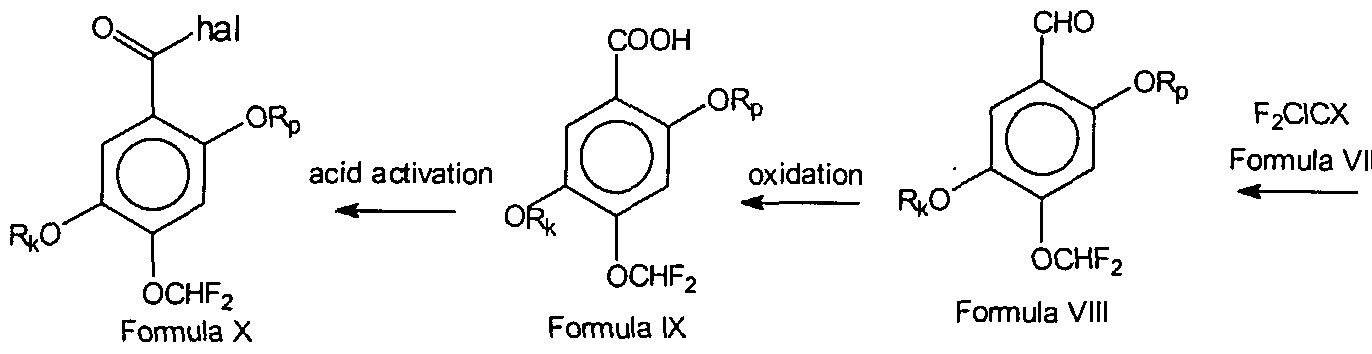
Formula XII The compound of Formula XII can be prepared by following the procedure as depicted in Scheme I. Thus, a compound of Formula II (wherein Rp is alkyl, alkenyl or alkynyl) can be deprotected to give a compound of Formula III, which can undergo O- protection with a compound of Formula P-hal (wherein P is aralkyl (for example benzyl) or alkyl (for example methyl, isopropyl or t-butyl)] to give a compound of Formula IV, which can be reacted with a compound of Formula Rk-hal (wherein Rk is alkyl substituted with cycloalkyl, aryl, heterocyclyl or heteroaryl) to give a compound of Formula V, which can be deprotected to give a compound of Formula VI, which can be reacted with a compound of Formula VII (wherein X is -H or -COOCH3) to give a compound of Formula VIII, which can undergo oxidation to give a compound of Formula IX, which can be converted to a compound of Formula X (wherein hal is Cl, Br or I), which can be further reacted with a compound of Formula XI (wherein R2 is the same as defined earlier) to give a compound of Formula XII.
The deprotection of a compound of Formula II to give a compound of Formula III can be carried out with phosphorous pentachloride. Alternatively, boron and aluminum halides for example boron trichloride, aluminum tribromide or aluminum trichloride can also be used in an organic solvent, for example, pentane, benzene, toluene or dichloromethane.
The compound of Formula III can undergo O-protection with a compound of Formula P-hal to give a compound of Formula IV in dipolar aprotic solvent, for example, dimethylsulphoxide, dimethylformamide or hexamethylphosphoric triamide in the presence of a base, for example, potassium hydroxide, sodium hydroxide or lithium hydroxide.
Alternatively, monomethylation of the para-hydroxyl group can be carried out by using controlled quantity of diazomethane in an organic solvent, for example, diethyl ether, ethanol, isopropanol, methanol or dichloromethane.
The compound of Formula IV can be reacted with a compound of Formula Rk-hal to give a compound of Formula V in an organic solvent, for example, dimethylsulphoxide, dimethylformamide, diethyl ether, tetrahydrofuran or dioxane, in the presence of a base, for example, potassium hydroxide, sodium hydroxide or lithium hydroxide. The compound of Formula V (when P is benzyl) can undergo deprotection to give a compound VI, in the presence of deprotecting agent, for example, palladium on carbon in the presence of hydrogen gas or palladium on carbon in ammonium formate solution, in an organic solvent, for example, ethyl acetate or by utilizing hydrochloric acid in acetic acid.
The compound of Formula V (when P is alkyl) can be deprotected to give a compound of Formula VI by following the procedure as described in T. W. Greene and P.G.M.Wuts, "Protective Groups in Organic Synthesis." 2nd Ed, John Wiley and Sons, New York, N.Y. The compound of Formula VI can be reacted with a compound of Formula VII
(when X is -COOCH3) to give a compound of Formula VIII in an organic solvent, for example, dimethylformamide, dimethylsulphoxide, tetrahydrofuran, diethyl ether or dioxane in the presence of a base, for example, cesium carbonate, sodium carbonate, lithium carbonate or potassium carbonate. The compound of Formula VI can be reacted with a compound of Formula VII
(when X is -H) to give a compound of Formula VIII, in an organic solvent, for example, dimethylsulphoxide, dioxane, dimethylformamide, toluene, tetrahydrofuran or diethyl ether, in the presence of a base, for example, potassium hydroxide, sodium hydroxide, butyl lithium, triethyl amine or pyridine with catalyst, for example, benzyltriethyl ammonium chloride, benzyltrimethyl ammonium chloride, benzyltributyl ammonium chloride, tetrabutyl ammonium bromide.
The compound of Formula VIII can be oxidized to give a compound of Formula IX with an oxidizing agent, for example, sodium chlorite, sodium dichromate, potassium permanganate or potassium dichromate, in an organic solvent, for example, acetic acid or formic acid.
The compound of Formula IX can be converted to a compound of Formula X with an acid activating agent, for example, thionyl chloride, phosphorous pentachloride or phosphorous trichloride, in an organic solvent, for example, toluene, benzene or xylene.
The compound of Formula X can be reacted with a compound of Formula XI to give a compound of Formula XII in an organic solvent, for example, tetrahydrofuran, dimethylformamide, diethyl ether or dioxane, in the presence of a base, for example, sodium hydride, diisopropylethylamine or butyl lithium.
Particular illustrative compound(s) which can be prepared following Scheme I include:
5-Cyclopropylmethoxy-N-(3,5-dichloropyridin-4-yl)-4-difluoromethoxy-2-methoxy benzamide (Compound No. 1)
Scheme Il
Figure imgf000013_0001
Formula XJV Formula XV
Rk — hal
Figure imgf000013_0002
The compound of Formula XIX can be prepared, for example, by following the reaction procedure as depicted in Scheme II. Thus, a compound of Formula XIII can undergo formylation to give a compound of Formula XIV, which can be reacted with a compound of Formula VII (wherein X is -H or -COOCH3) to give a compound of Formula XV, which can be reacted with a compound of Formula Rk-hal to give a compound of Formula XVI, which can undergo oxidation to give a compound of Formula XVII, which can be converted to a compound of Formula XVIII (wherein hal is Br, Cl or I), which can be reacted with a compound of Formula XI to give a compound of Formula XIX.
The compound of Formula XIII can undergo formylation to give a compound of Formula XIV with a formylation agent, for example, dimethyl formamide, triformamide, tris(diformylamino)methane, tris(dichloromethyl)amine or N,N,N,N-tetraformylhydrazine in the presence of a Lewis acid, for example phosphorous oxychloride, aluminum trichloride or boron trichloride, followed by deprotection with a strong mineral acid, for example, hydrochloric acid, nitric acid or sulphuric acid.
The compound of Formula XIV can be reacted with a compound of Formula VII (wherein X is -COOCH3) to give a compound of Formula XV in an organic solvent, for example dimethylsulphoxide, dimethylformamide, tetrahydrofuran, diethyl ether or dioxane, in the presence of a base, for example, cesium carbonate, sodium carbonate, lithium carbonate or potassium carbonate.
The compound of Formula XIV can be reacted with a compound of Formula VII (when X is -H) to give a compound of Formula XV in an organic solvent, for example, dioxane, dimethylformamide, toluene, dimethylsulphoxide, tetrahydrofuran or diethyl ether, in the presence of a base, for example, sodium hydroxide, butyl lithium, triethyl amine or pyridine with catalyst for example, benzyltriethyl ammonium chloride, benzyltrimethyl ammonium chloride, benzyltributyl ammonium chloride, tetrabutyl ammonium bromide. The compound of Formula XV can be reacted with a compound of Formula Rk-hal to give a compound of Formula XVI in an organic solvent, for example, dimethylsulphoxide, dimethylformamide, tetrahydrofuran, diethyl ether or dioxane, in the presence of a base, for example, potassium hydroxide, sodium hydroxide or lithium hydroxide. The compound of Formula XVI can be oxidized to give a compound of Formula
XVII with oxidizing agent, for example, sodium chlorite, sodium dichromate, potassium permanganate or potassium dichromate, in an organic solvent, for example, acetic acid, or formic acid.
The compound of Formula XVII can be converted to a compound of Formula XVIII with an acid activating group, for example, thionyl chloride, phosphorous pentachloride or phosphorous trichloride, in an organic solvent, for example, toluene, xylene or benzene.
The compound of Formula XVIII can be reacted with a compound of Formula XI to give a compound of Formula XIX in an organic solvent, for example, tetrahydrofuran, dimethylformamide, diethyl ether or dioxane, in the presence of a base, for example, sodium hydride, diisopropylethylamine or butyl lithium.
Particular illustrative compound(s) which can be prepared following Scheme II include:
3-Cyclopropylmethoxy-N-(3,5-dichloropyridin-4-yl)-4-difluoromethoxy-2-methoxy benzamide (Compound No. 3)
Scheme III
Figure imgf000015_0001
The compounds of Formula XXI can be prepared, for example, following the procedure as depicted in Scheme III. Thus, the compound of Formula XX can undergo N- oxidation to give a compound of Formula XXI. The compound of Formula XX can be reacted with an oxidizing agent, for example, magnesium monoperoxyphthalate hexahydrate (MMPP), metachloroperbenzoic acid (m-CPBA), hydrogen peroxide (H2O2) or oxone (KHSO5) in the presence of a solvent mixture, for example, dichloromethane in methanol to give a compound of Formula XXI.
Particular illustrative compounds which may be prepared following Scheme III include: 5-Cyclopropylmethoxy-N-(3,5-dichloro-l-oxido-pyridin-4-yl)-4-difluoromethoxy-2- methoxy benzamide (Compound No. 2),
3-Cyclopropylmethoxy-N-(3,5-dichloro-l-oxido-pyridin-4-yl)-4-difluoromethoxy-2- methoxy benzamide (Compound No. 4).
Also, in all the above representative examples wherever ethers are specified at a position ortho to the amide group, one skilled in the art could optionally deprotect them to their respective alcohols, for example deprotection of alkyl ethers (such as methyl or ethyl ethers) to their corresponding alcohols can be carried out with hydrochloric acid or hydrobromic acid in aqueous acetic acid or following the procedure a described in T. W. Greene and P.G.M. Wuts, "Protective Groups in Organic Synthesis", 2nd Ed, John Wiley and Sons, New York, N. Y.,
In the above scheme, where specific bases, condensing agents, protecting groups, deprotecting agents, solvents, catalysts, temperatures, etc. are mentioned, it is to be understood that other bases, protecting groups, deprotecting agents, solvents, temperatures, etc. known to those skilled in the art may be used. Similarly, the reaction temperature and duration may be adjusted according to the desired needs.
Suitable salts of the compounds represented by the Formula I can also be prepared so as to solubilize the compound in aqueous medium for biological evaluations, as well as to be compatible with various dosage formulations and also to aid in the bioavailability of the compounds. Examples of such salts include pharmacologically acceptable salts such as inorganic acid salts (for example, hydrochloride, hydrobromide, sulphate, nitrate and phosphate), organic acid salts (for example, acetate, tartarate, citrate, fumarate, maleate, tolounesulphonate and methanesulphonate). These salts may be prepared by various techniques, such as treating the compound with an equivalent amount of inorganic or organic, acid or base in a suitable solvent.
Particular illustrative compounds which may be produced by Schemes I, II and III, are listed below in Table I
Table I
Because of their valuable pharmacological properties, the compounds described herein may be administered to an animal for treatment orally, or by a parenteral route. The pharmaceutical compositions described herein can be produced and administered in dosage units, each unit containing a certain amount of at least one compound described herein and/or at least one physiologically acceptable addition salt thereof. The dosage may be varied over extremely wide limits, as the compounds are effective at low dosage levels and relatively free of toxicity. The compounds may be administered in the low micromolar concentration, which is therapeutically effective, and the dosage may be increased as desired up to the maximum dosage tolerated by the patient. The compounds described herein can be produced and formulated as their enantiomers, diastereomers, N-Oxides, polymorphs, solvates and pharmaceutically acceptable salts, as well as metabolites having the same type of activity. Pharmaceutical compositions comprising the molecules of Formula I or metabolites, enantiomers, diastereomers, N-oxides, polymorphs, solvates or pharmaceutically acceptable salts thereof, in combination with pharmaceutically acceptable carrier and optionally included excipient can also be produced.
The examples mentioned below demonstrate general synthetic procedures, as well as specific preparations of particular compounds. The examples are provided to illustrate the details of the invention and do not limit the scope of the present invention. EXPERIMENTAL
Example 1: Synthesis of 5-cvclopropylmethoxy-N-(3,5-dichloropyridin-4-yl')-4- difluoromethoxy-2-methoxy benzamide (Compound No. 1) Step a: 4,5-dihydroxy-2-methoxy benzaldehyde
To the compound 2-methoxy-4,5-methylenedioxy benzaldehyde (available commercially) (4 g, 0.022 mol) was added phosphorous pentachloride (13.72 g, 0.066 mol) and stirred the reaction mixture for 3 hours at 8O0C. The reaction mass was poured in water with constant stirring and extracted with ethyl acetate. The organic layer was washed with water and dried over anhydrous sodium sulphate. The solvent was evaporated under reduced pressure and the residue thus obtained was triturated with a mixture of isopropanol (10 ml) and hexane (20 ml). The reaction mixture was filtered and dried under reduced pressure to furnish the title compound. Yield = 0.4 g. 1H NMR (DMSO-d6):δ 3.79 (s, 3H), 6.54 (s, IH), 7.06 (s, IH), 9.2 (bs, IH), 10.1 (s, IH), 10.3 (bs, IH); Mass (M++l): 169.15.
Step b: 4-(Benzyloxy)-5-hydroxy-2-methoxy benzaldehyde
To a solution of the compound obtained from step a above (30 g, 0.17 mol) in dimethyl sulphoxide (210 ml), was added pulverized potassium hydroxide (9.6 g, 0.17 mol) and stirred at room temperature for 20 minutes. To it was added benzyl chloride (20.4 ml, 0.176 mol) and stirred the reaction mixture at 700C for 5 hours followed by addition of next lot of benzyl chloride (2.0 ml). The resulting reaction mixture was again stirred for 1 hour at 7O0C. The reaction contents were cooled to room temperature and subsequently poured into water. The product was extracted with ethyl acetate. The organic layer was washed with water, dried over anhydrous sodium sulphate and evaporated under reduced pressure. The residue thus obtained was purified by column chromatography using dichloromethane as eluent to furnish the title compound. Yield = 18 g.
1R NMR (CDCl3):δ 3.85 (s, 3H), 5.20 (s, 2H), 5.38 (bs, IH), 6.54 (s, IH), 7.30-7.42 (m, 6H), 10.29 (s, IH); Mass (M++l): 259.1.
Step c: 4-Benzyloxy-5-(cyclopropyImethoxy)-2-methoxy benzaldehyde
To a solution of the compound obtained from step b above (10 g, 0.0387 mol) in dimethylsulphoxide (65 ml), was added pulverized potassium hydroxide (2.47 g, 0.044 mol) and stirred for 20 minutes followed by the addition of cyclopropylm ethyl bromide (5.2 g, 0.0391 mol). The reaction mixture was stirred at 5O0C for 3 hours followed by cooling it to room temperature. The reaction mixture was poured into water and extracted with ethyl acetate. The organic layer was washed with sodium hydroxide (5%), water and brine, dried over anhydrous sodium sulphate and evaporated under reduced pressure to furnish the title compound. Yield = 11.5 g. 1H NMR (CDCl3):δ 0.33-0.36 (m, 2H), 0.59-0.65 (m, 2H), 1.26-1.34 (m, IH), 3.81 (s, 3H), 3.87-3.89 (d, 2H), 5.25 (s, 2H), 6.5 (s, IH), 7.31-7.46 (m, 6H), 10.27 (s, IH); Mass (M++l): 312. Step d: 5-(Cyclopropylmethoxy)-4-hydroxy-2-methoxy benzaldehyde
The compound obtained from step c above (4.5 g, 0.0144 mol) was dissolved in ethyl acetate (90 ml) followed by the addition of palladium on carbon (10% w/w, 0.8 g). Hydrogenation was carried out under hydrogen atmosphere at 45°C for 5 hours. The reaction mixture was filtered through celite pad and solvent was evaporated under reduced pressure. The residue thus obtained was triturated with a mixture of hexane (20 ml) and isopropylalcohol (5 ml) to furnish the title compound. Yield = 2.5 g. 1H NMR (CDCl3):δ 0.31-0.36 (m, 2H), 0.62-0.68 (m, 2H), 1.23-1.28 (m, IH), 3.87 (s, 3H), 3.89 (bs, 2H), 6.40 (s, IH), 6.59 (s, IH), 7.30 (s, IH), 10.28 (s, IH); Mass (M++l): 223.0.
Step e: 5-(Cyclopropylmethoxy)-4-(difluoromethoxy)-2-methoxy benzaldehyde
Route I: To a solution of the compound obtained from step d above (4.0 g, 0.018 mol) in dimethylformamide (28 ml) was added cesium carbonate (5.9 g, 0.018 mol) and stirred the mixture for 15 minutes at 27°C followed by the addition of methyl chlorodifluoroacetate (3.3 g, 0.0229 mol). The resulting reaction mixture was stirred at 80°C for 3 hours followed by cooling it to room temperature. The reaction mixture was poured into water and extracted the product with ethyl acetate. The solvent was removed under reduced pressure and the residue thus obtained was purified by column chromatography to furnish the title compound. Yield = 1.1 g.
Route II: To a solution of the compound obtained from step d above (0.1 g, 0.00045 mol) in dimethylsulphoxide was added pulverized potassium hydroxide (0.063g, 0.0012mole) and potassium iodide (O.lg, 0.0006 mole). Chlorodifluoromethane was bubbled through it and stirred the reaction mixture for 2 hours followed by the addition of , sodium hydroxide (0.5g, 0.0125 mol). The reaction mixture was again stirred for 3 hours and subsequently poured into water. The product was extracted with ethyl acetate, washed the organic layer with sodium hydroxide solution (5%) and water, dried over anhydrous sodium sulphate and evaporated the solvent under reduced pressure to furnish the title compound. Yield = 0.6 g.
1H NMR (CDCl3):δ 0.33-0.34 (m, 2H), 0.61-0.65 (m, 2H), 1.23-1.30 (m, IH), 3.8-3.92 (m, 5H), 6.81 (t, IH), 6.83 (s, IH), 7.41 (s, IH), 10.37 (s, IH).
Step f: 5-(Cyclopropylmethoxy)-4-difluoromethoxy-2-methoxy benzoic acid
The compound obtained from step e above (1.1 g, 0.004 mol) in acetic acid (5.5 ml), was added sulfamic acid (0.7 g) and cooled the reaction mixture to 100C followed by the addition of sodium chlorite solution dropwise (0.8 g in 1.65 ml H2O). The reaction mixture was stirred for 20 minutes in ice bath followed by stirring it at 27°C for approx 2 hours. The reaction contents were poured into water (50 ml) and extracted with ethyl acetate (150 ml). The solvent was evaporated under reduced pressure to furnish the title compound. Yield = 1.0 g.
1H NMR (CDCl3):δ 0.32-0.37 (m, 2H), 0.62-0.66 (m, 2H), 1.24-1.30 (m, IH), 3.88-3.91 (d, 2H), 4.04 (s, 3H), 6.83 (t, IH), 6.90 (s, IH), 7.75 (s, IH), 10.68 (bs, IH); Mass (M++l): 289.
Step g: 5-Cyclopropylmethoxy-N-(3,5-dichloropyridin-4-yl)-4-difluoromethoxy-2- methoxy benzamide (Compound No. 1)
To a solution of the compound obtained from step/above (1.0 g, 0.0035 mol) in toluene (6.6 ml) was added thionyl chloride (8.32 g, 0.0699 mol) and toluene (6.6 ml) and stirred for 2 hours at 850C. Excess of thionyl chloride and toluene were distilled off under reduced pressure. The acid chloride thus obtained was dissolved in tetrahydrofuran (5 ml) and this mixture was added dropwise to an already 15 minutes stirred mixture of 3,5- dichloro-4-amino pyridine (0.7 g, 0.0043 mol) and sodium hydride (60%, 0.38 g, 0.0095 mol) in tetrahydrofuran (5 ml) at 150C. The reaction mixture was stirred for approximately 2 hours and subsequently poured the reaction mass into water (50 ml) with constant stirring. It was acidified with hydrochloric acid (3 ml) and extracted the product with ethyl acetate, washed with water, dried over anhydrous sodium sulphate and evaporated the solvent under reduced pressure. The residue thus obtained was crystallized from a mixture of isopropanol (3 ml) and dichloromethane (3 ml) followed by the addition of charcoal (30 mg) in isopropyl alcohol to furnish the title compound. The compound was again recrystallised from isopropanol (3 ml). Yield = 0.34 g. 1H NMR (CDCl3):δ 0.33-0.38 (m, 2H), 0.62-0.68 (m, 2H), 1.22-1.30 (m, IH), 3.93 (d,
2H), 4.05 (s, 3H), 6.84 (t, IH), 6.93 (s, IH), 7.88 (s, IH), 8.57 (s, 2H), 9.88 (s, IH); Mass (M++l): 433.1. Example 2: Synthesis of 3-Cvclopropylmethoxy-N-(3,5-dichloropyridin-4-yl)-4- difluoromethoxy-2-methoxy benzamide (Compound No. 3) Step a: 4-methoxy-benzo[l,3,2]dioxaborol-2-ol
To 3-methoxycatechol (3 g, 0.021 mol) (available commercially) was added borax (8.0 g, 0.021 mol) and water (150 ml) and stirred for 3 hours at 45-50°C. Water was evaporated under reduced pressure. Traces of water were removed azeotropically with toluene (150 ml) under reduced pressure. The residue thus obtained was diluted with dimethylformamide followed by evaporating it under reduced pressure to furnish the title compound. Yield = 8.5 g. 1H NMR (D2O):δ 3.88 (s, 3H), 6.49-6.74 (m, 3H).
Step b: 3,4-Dihydroxy-2-methoxy benzaldehyde
To dimethylformamide (260 ml) was added phosphorous oxychloride dropwise maintaining the temperature below 7O0C and stirred at room temperature for 1 hour. To it was added the compound obtained from step a above (94 g) in small lots keeping the temperature below 6O0C and stirred for 3 hours at 600C. The reaction mixture was cooled to room temperature and subsequently poured into water (1000 ml) and hydrochloric acid (50 ml) solution maintaining the temperature below 55°C. The mixture was stirred at room temperature for approx. 2 hour and extracted with ethyl acetate. The mixture of isomers was purified by column chromatography using mixture of methanol (1%) and chloroform (99%) as eluent to furnish the title compound. Yield = 4.2 g.
1H NMR (CDC13):5 3.99 (s, 3H), 5.72 (s, IH), 5.93 (s, IH), 6.81-6.84 (d, IH), 7.35-7.38 (d, IH), 10.07 (s, IH); Mass (M++l): 169.
Step c: 4-(Difluoromethoxy)-3-hydroxy-2-methoxy benzaldehyde
To a solution of the compound obtained from step b above (0.5 g, 0.0029 mol) in dimethyl formamide (7 ml), was added cesium carbonate (0.8 g, 0.00246 mol) and stirred the reaction mixture at room temperature for 20 minutes followed by the addition of methyl chlorodifluoroacetate (0.5 g, 0.00342 mol). The mixture was again stirred at 65- 7O0C for 3 hours and was subsequently poured into water. The product was extracted with ethyl acetate, washed with water, borax solution (10%) and again with water, dried over anhydrous sodium sulphate. The solvent was evaporated under reduced pressure. The residue thus obtained was stirred in a mixture of hexane (20 ml) and isopropyl alcohol (2 ml). The reaction mixture was filtered and evaporated the solvent under reduced pressure to furnish the title compound. Yield = 170 mg.
1U NMR (CDCl3):δ 4.06 (s, 3H), 6.43-6.92 (t, IH), 6.99-7.02 (d, IH), 7.39-7.42 (d, IH), 10.28 (s, IH); Mass (M++l): 218.9.
Step d: 3-(Cyclopropylmethoxy)-4-(difluoromethoxy)-2-methoxy benzaldehyde
To a solution of compound obtained from step c above (0.55 g, 0.0025 mol) in dimethyl sulphoxide (10 ml), was added pulverized potassium hydroxide (0.132 g, 0.00233 mol) and stirred for 20 minutes followed by the addition of cyclopropylmethyl bromide (0.33 g, 0.0024 mol). The reaction mixture was stirred for 2 hours at room temperature and subsequently poured into water and extracted with ethyl acetate. The organic layer was washed with sodium hydroxide (5%) and water, dried over anhydrous sodium sulphate and evaporated under reduced pressure. The residue thus obtained was stirred in hexane and filtered. The solvent was evaporated under reduced pressure to furnish the title compound. Yield = 0.56 g.
1H NMR (CDC13):6 0.28-0.32 (m, 2H), 0.59-0.65 (m, 2H), 1.26-1.31 (m, IH), 3.89-3.91 (d, 2H), 4.08 (s, 3H), 6.45-6.94 (t, IH), 6.97-6.99 (d, IH), 7.57-7.60 (d, IH), 10.32 (s, IH); Mass (M++l): 273.
Step e: 3-(Cyclopropylmethoxy)-4-(difluoromethoxy)-2-methoxy benzoic acid To a solution of the compound obtained from step d above (0.2 g, 0.00073 mol) and sulfamic acid (0.154 g, 0.00015 mol) in acetic acid at 8°C, was added sodium chlorite solution (0.16 g, 0.0017 mol in 0.5 ml OfH2O) maintaining the temperature below 15°C. The resulting reaction mixture was stirred at 8°C for 1 hour and then at room temperature for 1 hour followed by the addition of water. The product was extracted with ethyl acetate. The organic layer was washed with water and dried over anhydrous sodium sulphate. The solvent was evaporated under reduced pressure to furnish the title compound. Yield = 220 mg.
1H NMR (CDCl3):δ 0.27-0.32 (m, 2H), 0.6-0.66 (m, 2H), 1.25-1.31 (m, IH), 3.88-3.9 (d, 2H), 4.16 (s, 3H), 6.42-6.92 (t, IH), 7.04-7.07 (d, IH), 7.89-7.92 (d, IH); Mass (M++!): 289.2. Step f: 3-Cyclopropylmthoxy-N-(3,5-dichloropyridin-4-yI)-4-difluoromethoxy-2- methoxy benzamide (Compound No. 3)
To a solution of the compound obtained from step e above (220 mg, 0.000764 mol) in toluene (3.0 ml), was added thionyl chloride (0.6 ml, 0.008 mol) and stirred at 800C for approx. 2 hours. Excess of thionyl chloride and toluene were evaporated under reduced pressure. The residue thus obtained was dissolved in tetrahydrofuran (3 ml) and the resulting mixture was added dropwise to an already 15 minutes stirred mixture of 3,5- dichloro-4-aminopyridine (154 mg, 0.00095 mol) and sodium hydride (60%, 0.083 g, 0.002 mol) in tetrahydrofuran (3 ml) at 10-120C. The reaction mixture was stirred at 100C for 1 hour and subsequently poured into water (50 ml). The product was extracted with ethyl acetate, washed with hydrochloric acid solution (5%), water and dried over anhydrous sodium sulphate. The solvent was evaporated under reduced pressure to furnish the title compound. Yield = 260 mg.
1H NMR (CDCl3):δ 0.32-0.34 (m, 2H), 0.63-0.66 (m, 2H), 1.26-1.31 (m, IH), 3.91-3.93 (d, 2H), 4.21 (s, 3H), 6.44-6.94 (t, IH), 7.06-7.09 (d, IH), 7.97-8.00 (d, IH), 8.58 (s, 2H), 9.89 (s, IH); Mass (M++l): 433.
Example 3: Synthesis of 3-cycIopropylmethoxy-N-(3,5-dichIoro-l-oxido-pyridin-4- yl)-4-difluoromethoxy-2-methoxy benzamide (Compound No. 4)
The compound No. 3 (140 mg, 0.00032 mol) was dissolved in a mixture of dichloromethane (1 ml) and methanol (1 ml) followed by the addition of magnesium monoperoxyphthalate hexahydrate (0.32 g, 0.00064 mol). The reaction mixture was stirred at room temperature for 6 hours followed by the addition of magnesium monoperoxyphthalate hexahydrate (0.2 g). This procedure was repeated four times. The resulting mixture was diluted with water and extracted with ethyl acetate. The organic layer was washed with ammonium acetate solution and water. The solvent was evaporated under reduced pressure to furnish the title compound. Yield = 100 mg. 1H NMR (CDC13):5 0.26-0.29 (m, 2H), 0.57-0.62 (m, 2H), 1.21-1.26 (m, IH), 3.86-3.91 (d, 2H), 4.15 (s, 3H), 6.4-6.89 (t, IH), 7.02-7.05 (d, IH), 7.90-7.93 (d, IH), 8.26 (s, 2H), 9.70 (s, IH); Mass (M++l): 449. Example 4: Synthesis of 5-Cyclopropylmethoxy-N-(3,5-dichloro-l-oxido-pyridin-4- yl)-4-difluoromethoxy-2-methoxy benzamide (Compound No. 2)
The compound No. 1 (0.2 g, 0.00046 mol) was dissolved in a mixture of dichloromethane (1 ml) and methanol (1 ml) followed by the addition of magnesium monoperoxy- phthalate hexahydrate (MMPP) (0.457 g) and stirred for 24 hours at 40°C. To the resulting reaction mixture was added dichloromethane (1 ml), methanol (1 ml) and magnesium monoperoxyphthalate hexahydrate (0.248 g) and stirred for 12 hours. This process was repeated one more time. To the resulting reaction mixture was added magnesium monoperoxyphthalate hexahydrate (MMPP) (0.248 g) and stirred the reaction mixture for 24 hours with a constant addition of methanol (1 ml) after every 4 hours. The reaction mixture was diluted with water and extracted the product with ethyl acetate (50 ml). The organic layer was washed with ammonium acetate solution (25%), water and brine, dried over anhydrous sodium sulphate and evaporated under reduced pressure. The residue thus obtained was recrystallised using a mixture of isopropanol (1.5 ml) and dichloromethane (2 ml) to furnish the title compound. Yield = 140 mg.
1H NMR (CDCl3):δ 0.34-0.38 (m, 2H), 0.62-0.69 (m, 2H), 1.22-1.31 (m, IH), 3.91-3.93 (d, 2H), 4.05 (s, 3H), 6.85 (t, 3H), 6.94 (s, IH), 7.86 (s, IH), 8.26 (s, 2H), 9.67 (s, IH); Mass (M++l): 449.2.
PDE-IV Enzyme Assay The efficacy of compounds as PDE-4 inhibitor was determined by an enzyme assay (Burnouf et al.; J. Med. Chem., 2000, 43:4850-4867). The PDE-4 enzyme source used was U937 cell cytosolic fraction prepared by sonication. The enzyme reaction was carried out, with the cytosolic fraction as the enzyme source, in the presence of cAMP (1 μM) at 300C in the presence or absence of NCE for 45 -60 min. An aliquot of this reaction mixture was taken further for the ELISA assay to determine level of cAMP in the sample. The concentration of the cAMP in the sample directly correlates with the degree of PDE-4 enzyme inhibition. Results were expressed as percent control and the IC50 values of test compounds 1 and 2 (three test repetitions each) were found to be approximately 1.9 (±0.7) and 2.3 (±0.9) nM, respectively. The values for rolipram (7 repetitions) and rofiumilast (two repetitions) were 463 (±103 and 0.051 (±0.028) nM, respectively.

Claims

WE CLAIM: 1. A compound having the structure of Formula I,
Figure imgf000025_0001
its pharmaceutically acceptable salts, pharmaceutically acceptable solvates, enantiomers, diastereomers or N-oxides wherein Ri is hydrogen, alkyl, alkenyl, alkynyl, aryl, cycloalkyl, heteroaryl, heterocyclyl, aralkyl, heterocyclylalkyl, heteroarylalkyl or cycloalkylalkyl; R2 is aryl, heteroaryl, heterocyclyl or cycloalkyl; and R3 is alkyl, alkenyl, alkynyl, aryl, cycloalkyl, heteroaryl, heterocyclyl, aralkyl, heterocyclylalkyl, heteroarylalkyl or cycloalkylalkyl. 2. A compound according to claim 1, wherein Ri is alkyl, R2 is heteroaryl substituted with one or more of halogen and R3 is cycloalkylalkyl or alkyl substituted with one or more of halogen. 3. A compound according to claim 2, wherein R] is methyl, R2 is dichloropyridyl, R3 is difluoromethyl or cyclopropylmethyl. 4. A compound which is selected from 5-cyclopropylmethoxy-N-(3,5-dichloropyridin-4-yl)-4-difluoro methoxy-2-methoxy benzamide (Compound No. 1), 5-Cyclopropylmethoxy-N-(3,5-dichloro-l-oxido-pyridin-4-yl)-4-difluoromethoxy-2- methoxy benzamide (Compound No.
2), 3-Cyclopropylmethoxy-N-(3,5-dichloropyridine-4-yl)-4-difluoromethoxy-2-methoxy benzamide (Compound No. 3),
3-Cyclopropylmethoxy-N-(3,5-dichloro- 1 -oxido-pyridin-4-yl)-4-difluoromethoxy-2- methoxy benzamide (Compound No.
4), or pharmaceutically acceptable salts, or solvates thereof.
5. A pharmaceutical composition comprising a therapeutically effective amount of a compound of claim 1 together with pharmaceutically acceptable carriers, excipients or diluents.
6. A method of treating an animal or human suffering from AIDS, asthma, arthritis, bronchitis, chronic obstructer pulmonary disease (COPD), psoriasis, allergic rhinitis, shock, atopic dermatitis, Crohn's disease, adult respiratory distress syndrome (ARDS), eosinophilic granuloma, allergic conjunctivitis, osteoarthritis, ulcerative colitis and other inflammatory diseases in an animal or human comprising administering to said animal or human a therapeutically effective amount of a compound according claim.
7. A method of preventing, inhibiting or suppressing inflammatory condition in an animal or human comprising administering to said animal or human a therapeutically effective amount of a compound according to claim 1.
8. A method of preventing, inhibiting or suppressing inflammatory disease in an animal or human comprising administering to said animal or human a therapeutically effective amount of the pharmaceutical composition according to claim 7.
9. A method for preparing a compound of Formula XII and its pharmaceutically acceptable salts, pharmaceutically acceptable solvates, enantiomers, diastereomers or N- oxides
Figure imgf000026_0001
wherein Rp is alkyl, alkenyl or alkynyl; P is aralkyl (for example benzyl) or alkyl (for example methyl, isopropyl or t-butyl); Rk is alkyl substituted with cycloalkyl, aryl, heterocyclyl or heteroaryl; and R2 is aryl, heteroaryl, heterocyclyl or cycloalkyl, wherein the method comprises: a) deprotecting a compound of Formula II to give a compound of Formula III;
Figure imgf000027_0001
b) O-protecting the compound of Formula III with a compound of Formula P-hal (wherein P is aralkyl or alkyl) to give a compound of Formula IV;
Figure imgf000027_0002
c) reacting the compound of Formula IV with a compound of Formula Rk-hal (wherein Rk is alkyl substituted with cycloalkyl, aryl, heterocyclyl or heteroaryl) to give a compound of Formula V; d) deprotecting the compound of Formula V to give a compound of Formula VI;
Figure imgf000027_0003
Formula Vl
e) reacting the compound of Formula VI with a compound of Formula VII (wherein X is -H or -COOCH3) to give a compound of Formula VIII; VII
Figure imgf000028_0001
Formula VIII
f) oxidizing the compound of Formula VIII to give a compound of Formula IX;
Figure imgf000028_0002
g) converting the compound of Formula IX to a compound of Formula X (wherein hal is Cl, Br or I); and
Figure imgf000028_0003
Formula X
H2NR2 Formula Xl
h) reacting the compound of Formula X with a compound of Formula XI (wherein R2 is the same as defined earlier) to give a compound of Formula XII.
10. A method for preparing a compound of Formula XIX and its pharmaceutically acceptable salts, pharmaceutically acceptable solvates, enantiomers, diastereomers or N- oxides
Figure imgf000028_0004
Formula XX wherein P is aralkyl (for example benzyl) or alkyl (for example methyl, isopropyl or t-butyl); Rk is alkyl substituted with cycloalkyl, aryl, heterocyclyl or heteroaryl; and R2 is aryl, heteroaryl, heterocyclyl or cycloalkyl, wherein the method comprises: a) formylating a compound of Formula XIII to give a compound of Formula XIV;
Figure imgf000029_0001
Formula XlII
Figure imgf000029_0002
b) reacting the compound of Formula XIV with a compound of Formula VII (wherein X is -H or -COOCH3) to give a compound of Formula XV;
F2OCXXXH3 FormulaVII
Figure imgf000029_0003
Formula XW c) reacting the compound of Formula XV with a compound of Formula Rk-hal to give a compound of Formula XVI;
Figure imgf000029_0004
Formula XVI d) oxidizing the compound of Formula XVI to give a compound of Formula XVII;
Figure imgf000029_0005
Formula XVII e) converting the compound of Formula XVII to a compound of Formula XVIII (wherein hal is Br, Cl or I); and
Figure imgf000030_0001
Formula Will
F) reacting the compound of Formula XVIII with a compound of Formula XI (H2NR2) to give a compound of Formula XIX.
11. A method for preparing a compound of Formula XXI and its pharmaceutically acceptable salts, pharmaceutically acceptable solvates, enantiomers, diastereomers or N- oxides
Figure imgf000030_0002
wherein
Hal is halogen (Cl, Br or I);
Ri is hydrogen, alkyl, alkenyl, alkynyl, aryl, cycloalkyl, heteroaryl, heterocyclyl, aralkyl, heterocyclylalkyl, heteroarylalkyl or cycloalkylalkyl; and
R3 is alkyl, alkenyl, alkynyl, aryl, cycloalkyl, heteroaryl, heterocyclyl, aralkyl, heterocyclylalkyl, heteroarylalkyl or cycloalkylalkyl, the method comprising N-oxidizing a compound of Formula XX to give the compound of Formula XXI.
PCT/IB2005/003017 2004-10-11 2005-10-11 N-(3,5-dichloropyridin-4-yl)-2,4,5-alkoxy and 2,3,4-alkoxy benzamide derivatives as pde-iv (phophodiesterase type-iv) inhibitors for the treatment of inflammatory diseases such as asthma Ceased WO2006040645A1 (en)

Applications Claiming Priority (2)

Application Number Priority Date Filing Date Title
IN1960/DEL/2004 2004-10-11
IN1960DE2004 2004-10-11

Publications (1)

Publication Number Publication Date
WO2006040645A1 true WO2006040645A1 (en) 2006-04-20

Family

ID=35747438

Family Applications (1)

Application Number Title Priority Date Filing Date
PCT/IB2005/003017 Ceased WO2006040645A1 (en) 2004-10-11 2005-10-11 N-(3,5-dichloropyridin-4-yl)-2,4,5-alkoxy and 2,3,4-alkoxy benzamide derivatives as pde-iv (phophodiesterase type-iv) inhibitors for the treatment of inflammatory diseases such as asthma

Country Status (1)

Country Link
WO (1) WO2006040645A1 (en)

Cited By (3)

* Cited by examiner, † Cited by third party
Publication number Priority date Publication date Assignee Title
JP2010513334A (en) * 2006-12-22 2010-04-30 レオ ファーマ アクティーゼルスカブ Substituted acetophenones useful as PDE4 inhibitors
WO2010142752A1 (en) * 2009-06-11 2010-12-16 F. Hoffmann-La Roche Ag Janus kinase inhibitor compounds and methods
CN102276522A (en) * 2011-06-15 2011-12-14 无锡泓兴生物医药科技有限公司 Method for preparing roflumilast and intermediate of roflumilast

Citations (23)

* Cited by examiner, † Cited by third party
Publication number Priority date Publication date Assignee Title
US3415841A (en) * 1965-06-12 1968-12-10 Kuhlmann Ets 6-amino-chloro-indazoles and n-acylated derivatives thereof
JPS5522634A (en) * 1978-08-03 1980-02-18 Hisamitsu Pharmaceut Co Inc Novel aminonicotinic acid derivative
JPS5869812A (en) * 1981-10-22 1983-04-26 Chugai Pharmaceut Co Ltd Blood sugar level depressing agent
US4720500A (en) * 1985-07-11 1988-01-19 Rhone-Poulenc Sante N-1,8-naphthyridin-2-yl amides useful as immunostimulants
EP0602478A1 (en) * 1992-12-18 1994-06-22 F. Hoffmann-La Roche Ag Novel process for producing N4-acyl-5'-deoxy-5-fluorocytidine derivatives
WO1996011690A1 (en) * 1994-10-14 1996-04-25 Institut De Recherche Jouveinal Diazepino-indoles as phosphodiesterase iv inhibitors
EP0714898A1 (en) * 1994-06-21 1996-06-05 Otsuka Pharmaceutical Factory, Inc. PYRAZOLO [1,5-a]PYRIMIDINE DERIVATIVE
WO1996021435A1 (en) * 1995-01-10 1996-07-18 Euro-Celtique, S.A. Compounds for and method of inhibiting phosphodiesterase iv
WO1997014681A1 (en) * 1995-10-16 1997-04-24 Fujisawa Pharmaceutical Co., Ltd. Heterocyclic compounds as h+-atpases
JPH10101672A (en) * 1996-08-06 1998-04-21 Otsuka Pharmaceut Factory Inc Adenosine enhancer
WO1999005104A1 (en) * 1997-07-23 1999-02-04 Pfizer Pharmaceuticals Inc. Indole compounds as cox-2 inhibitors
EP0915093A1 (en) * 1996-06-06 1999-05-12 Otsuka Pharmaceutical Factory, Inc. Amide derivatives
JPH11222435A (en) * 1998-02-05 1999-08-17 Otsuka Pharmaceut Factory Inc Nitric oxide synthase inhibitor
WO1999061013A2 (en) * 1998-05-22 1999-12-02 Avanir Pharmaceuticals COMPOUNDS HAVING IgE AFFECTING PROPERTIES
WO2000042018A1 (en) * 1999-01-15 2000-07-20 Byk Gulden Lomberg Chemische Fabrik Gmbh Polysubstituted 6-phenylphenanthridines with pde-iv inhibiting activity
EP1052254A1 (en) * 1998-01-26 2000-11-15 Eisai Co., Ltd. Nitrogenous heterocyclic derivatives and medicine thereof
WO2001093909A2 (en) * 2000-06-06 2001-12-13 Glaxo Group Limited Cancer treatment composition containing an anti-neoplastic agent and a pde4 inhibitor
WO2002064545A1 (en) * 2001-02-13 2002-08-22 Aventis Pharma Deutschland Gmbh Acylated indanyl amines and their use as pharmaceuticals
WO2002092062A2 (en) * 2001-05-15 2002-11-21 Leo Pharma A/S Combination of vitamin d analogue and pyrimidine nucleoside analogue
WO2002096879A1 (en) * 2001-05-31 2002-12-05 Sanofi-Synthelabo Aminoquinoline and aminopyridine derivatives and their use as adenosine a3 ligands
WO2004000806A1 (en) * 2002-06-24 2003-12-31 Elbion Ag Amides of cyclic amino acids used as pde 4 inhibitors
DE10229762A1 (en) * 2002-07-03 2004-01-22 Aventis Pharma Deutschland Gmbh Pyrazoloisoquinoline derivatives for the inhibition of NFkappaB-inducing kinase
WO2004029055A1 (en) * 2002-09-30 2004-04-08 Bayer Pharmaceuticals Corporation Fused azole-pyrimidine derivatives

Patent Citations (23)

* Cited by examiner, † Cited by third party
Publication number Priority date Publication date Assignee Title
US3415841A (en) * 1965-06-12 1968-12-10 Kuhlmann Ets 6-amino-chloro-indazoles and n-acylated derivatives thereof
JPS5522634A (en) * 1978-08-03 1980-02-18 Hisamitsu Pharmaceut Co Inc Novel aminonicotinic acid derivative
JPS5869812A (en) * 1981-10-22 1983-04-26 Chugai Pharmaceut Co Ltd Blood sugar level depressing agent
US4720500A (en) * 1985-07-11 1988-01-19 Rhone-Poulenc Sante N-1,8-naphthyridin-2-yl amides useful as immunostimulants
EP0602478A1 (en) * 1992-12-18 1994-06-22 F. Hoffmann-La Roche Ag Novel process for producing N4-acyl-5'-deoxy-5-fluorocytidine derivatives
EP0714898A1 (en) * 1994-06-21 1996-06-05 Otsuka Pharmaceutical Factory, Inc. PYRAZOLO [1,5-a]PYRIMIDINE DERIVATIVE
WO1996011690A1 (en) * 1994-10-14 1996-04-25 Institut De Recherche Jouveinal Diazepino-indoles as phosphodiesterase iv inhibitors
WO1996021435A1 (en) * 1995-01-10 1996-07-18 Euro-Celtique, S.A. Compounds for and method of inhibiting phosphodiesterase iv
WO1997014681A1 (en) * 1995-10-16 1997-04-24 Fujisawa Pharmaceutical Co., Ltd. Heterocyclic compounds as h+-atpases
EP0915093A1 (en) * 1996-06-06 1999-05-12 Otsuka Pharmaceutical Factory, Inc. Amide derivatives
JPH10101672A (en) * 1996-08-06 1998-04-21 Otsuka Pharmaceut Factory Inc Adenosine enhancer
WO1999005104A1 (en) * 1997-07-23 1999-02-04 Pfizer Pharmaceuticals Inc. Indole compounds as cox-2 inhibitors
EP1052254A1 (en) * 1998-01-26 2000-11-15 Eisai Co., Ltd. Nitrogenous heterocyclic derivatives and medicine thereof
JPH11222435A (en) * 1998-02-05 1999-08-17 Otsuka Pharmaceut Factory Inc Nitric oxide synthase inhibitor
WO1999061013A2 (en) * 1998-05-22 1999-12-02 Avanir Pharmaceuticals COMPOUNDS HAVING IgE AFFECTING PROPERTIES
WO2000042018A1 (en) * 1999-01-15 2000-07-20 Byk Gulden Lomberg Chemische Fabrik Gmbh Polysubstituted 6-phenylphenanthridines with pde-iv inhibiting activity
WO2001093909A2 (en) * 2000-06-06 2001-12-13 Glaxo Group Limited Cancer treatment composition containing an anti-neoplastic agent and a pde4 inhibitor
WO2002064545A1 (en) * 2001-02-13 2002-08-22 Aventis Pharma Deutschland Gmbh Acylated indanyl amines and their use as pharmaceuticals
WO2002092062A2 (en) * 2001-05-15 2002-11-21 Leo Pharma A/S Combination of vitamin d analogue and pyrimidine nucleoside analogue
WO2002096879A1 (en) * 2001-05-31 2002-12-05 Sanofi-Synthelabo Aminoquinoline and aminopyridine derivatives and their use as adenosine a3 ligands
WO2004000806A1 (en) * 2002-06-24 2003-12-31 Elbion Ag Amides of cyclic amino acids used as pde 4 inhibitors
DE10229762A1 (en) * 2002-07-03 2004-01-22 Aventis Pharma Deutschland Gmbh Pyrazoloisoquinoline derivatives for the inhibition of NFkappaB-inducing kinase
WO2004029055A1 (en) * 2002-09-30 2004-04-08 Bayer Pharmaceuticals Corporation Fused azole-pyrimidine derivatives

Non-Patent Citations (4)

* Cited by examiner, † Cited by third party
Title
DATABASE CA [online] CHEMICAL ABSTRACTS SERVICE, COLUMBUS, OHIO, US; 2003, GARNIER, ETHEL ET AL: "New access to oxazolopyridines via hydroxyamidine derivatives; application to quinolines", XP002367914, retrieved from STN Database accession no. 2003:790967 *
DATABASE CHEMCATS 2001, ASINEX EXPRESS GOLD COLLECTION, Database accession no. 2001:543291 CHEMCATS *
DATABASE REGISTRY 5 January 2001 (2001-01-05), XP002367915, Database accession no. RN: 312943-96-7 *
SYNTHESIS , (13), 2033-2040 CODEN: SYNTBF; ISSN: 0039-7881, 2003 *

Cited By (12)

* Cited by examiner, † Cited by third party
Publication number Priority date Publication date Assignee Title
JP2010513334A (en) * 2006-12-22 2010-04-30 レオ ファーマ アクティーゼルスカブ Substituted acetophenones useful as PDE4 inhibitors
US8148537B2 (en) * 2006-12-22 2012-04-03 Leo Pharma A/S Substituted acetophenones useful as PDE4 inhibitors
US8324394B2 (en) 2006-12-22 2012-12-04 Leo Pharma A/S Substituted acetophenones useful as PDE4 inhibitors
US8497380B2 (en) 2006-12-22 2013-07-30 Leo Pharma A/S Substituted acetophenones useful as PDE4 inhibitors
WO2010142752A1 (en) * 2009-06-11 2010-12-16 F. Hoffmann-La Roche Ag Janus kinase inhibitor compounds and methods
CN102459187A (en) * 2009-06-11 2012-05-16 弗·哈夫曼-拉罗切有限公司 Janus Kinase Inhibiting Compounds and Methods
JP2012529470A (en) * 2009-06-11 2012-11-22 エフ.ホフマン−ラ ロシュ アーゲー Janus kinase inhibitor compounds and methods
US8486950B2 (en) 2009-06-11 2013-07-16 F. Hoffmann-La Roche Ag Janus kinase inhibitor compounds and methods
CN102459187B (en) * 2009-06-11 2015-06-17 弗·哈夫曼-拉罗切有限公司 Janus Kinase Inhibiting Compounds and Methods
AU2010258597B2 (en) * 2009-06-11 2016-02-25 F. Hoffmann-La Roche Ag Janus kinase inhibitor compounds and methods
CN102276522A (en) * 2011-06-15 2011-12-14 无锡泓兴生物医药科技有限公司 Method for preparing roflumilast and intermediate of roflumilast
CN102276522B (en) * 2011-06-15 2013-04-17 无锡泓兴生物医药科技有限公司 Method for preparing roflumilast and intermediate of roflumilast

Similar Documents

Publication Publication Date Title
TWI825524B (en) Process for synthesizing 2-hydroxy-6-((2-(1-isopropyl-1hpyrazol-5-yl)-pyridin-3-yl)methoxy)benzaldehyde
JP6880127B2 (en) Synthesis of polycyclic carbamoylpyridone compounds
RU2135498C1 (en) Pyrazolo- and pyrrolopyridines
JP4248605B2 (en) Pyridin-2-yl-methylamine derivatives, processes for their preparation and their application as pharmaceuticals
JPS63139182A (en) Production of thiazolidinedione derivative
SK282338B6 (en) N-heteroaryl-pyridinesulphonamide derivatives, their preparation method, intermediates and use of these derivatives as endothelin antagonists
CN106660996B (en) 2,5-Substituted Pyrimidines as PDE4 Inhibitors
CA2828337A1 (en) Fluoro-pyridinone derivatives useful as antibacterial agents
KR890003839B1 (en) Method for preparing cyclopenta [D] pyrimidine derivative
EP3310772A1 (en) Spiro[cyclobutane-1,3'-indolin]-2'-one derivatives as bromodomain inhibitors
JP2021501184A (en) P2X3 and / or P2X2 / 3 receptor antagonists, pharmaceutical compositions containing them and their use
HUP0102646A2 (en) Phthalazine derivatives phosphodiesterase 4 inhibitors and pharmaceutical compositions containing the same
TW202402741A (en) Novel processes and intermediates for the preparation of soluble guanylate cyclase stimulators
JP2008530078A (en) Inhibitors of type IV phosphodiesterase
WO2007031977A2 (en) Substituted pyrazolo [3,4-b]pyridines as phosphodiesterase inhibitors
RS20060206A (en) Aminopyridine-derivatives as inducible no-synthase inhibitors
US12297193B2 (en) PTPN2/PTP1B degrader and therapeutic method thereof
WO2006040645A1 (en) N-(3,5-dichloropyridin-4-yl)-2,4,5-alkoxy and 2,3,4-alkoxy benzamide derivatives as pde-iv (phophodiesterase type-iv) inhibitors for the treatment of inflammatory diseases such as asthma
KR900003497B1 (en) Quinazoline diones and pyrido pyrimidine-diones and its pharmaceutical composition
KR950011748B1 (en) Sulfenamide derivatives and preparation methods thereof
AU2019424628B2 (en) 1,2,3,4-tetrahydroquinoxaline derivative, preparation method therefor and application thereof
JP2022532875A (en) Synthesis of CRAC channel inhibitors
EP1879884B1 (en) Azole-based phosphodiesterase inhibitors
WO2007004041A2 (en) New compounds and their pharmaceutical use
JP2007522181A (en) Substituted azetidine compounds as cyclooxygenase-1 and cyclooxygenase-2 inhibitors, and their preparation and use as pharmaceuticals

Legal Events

Date Code Title Description
AK Designated states

Kind code of ref document: A1

Designated state(s): AE AG AL AM AT AU AZ BA BB BG BR BW BY BZ CA CH CN CO CR CU CZ DE DK DM DZ EC EE EG ES FI GB GD GE GH GM HR HU ID IL IN IS JP KE KG KM KP KR KZ LC LK LR LS LT LU LV LY MA MD MG MK MN MW MX MZ NA NG NI NO NZ OM PG PH PL PT RO RU SC SD SE SG SK SL SM SY TJ TM TN TR TT TZ UA UG US UZ VC VN YU ZA ZM ZW

AL Designated countries for regional patents

Kind code of ref document: A1

Designated state(s): GM KE LS MW MZ NA SD SL SZ TZ UG ZM ZW AM AZ BY KG KZ MD RU TJ TM AT BE BG CH CY CZ DE DK EE ES FI FR GB GR HU IE IS IT LT LU LV MC NL PL PT RO SE SI SK TR BF BJ CF CG CI CM GA GN GQ GW ML MR NE SN TD TG

121 Ep: the epo has been informed by wipo that ep was designated in this application
NENP Non-entry into the national phase

Ref country code: DE

122 Ep: pct application non-entry in european phase

Ref document number: 05818852

Country of ref document: EP

Kind code of ref document: A1