WO2006038983A2 - Sulfonated poly(arylene) films as polyelectrolyte membranes - Google Patents
Sulfonated poly(arylene) films as polyelectrolyte membranes Download PDFInfo
- Publication number
- WO2006038983A2 WO2006038983A2 PCT/US2005/028466 US2005028466W WO2006038983A2 WO 2006038983 A2 WO2006038983 A2 WO 2006038983A2 US 2005028466 W US2005028466 W US 2005028466W WO 2006038983 A2 WO2006038983 A2 WO 2006038983A2
- Authority
- WO
- WIPO (PCT)
- Prior art keywords
- film
- membrane
- polymer
- fuel cell
- polyelectrolyte
- Prior art date
- Legal status (The legal status is an assumption and is not a legal conclusion. Google has not performed a legal analysis and makes no representation as to the accuracy of the status listed.)
- Ceased
Links
Classifications
-
- C—CHEMISTRY; METALLURGY
- C08—ORGANIC MACROMOLECULAR COMPOUNDS; THEIR PREPARATION OR CHEMICAL WORKING-UP; COMPOSITIONS BASED THEREON
- C08J—WORKING-UP; GENERAL PROCESSES OF COMPOUNDING; AFTER-TREATMENT NOT COVERED BY SUBCLASSES C08B, C08C, C08F, C08G or C08H
- C08J5/00—Manufacture of articles or shaped materials containing macromolecular substances
- C08J5/20—Manufacture of shaped structures of ion-exchange resins
- C08J5/22—Films, membranes or diaphragms
- C08J5/2287—After-treatment
-
- H—ELECTRICITY
- H01—ELECTRIC ELEMENTS
- H01M—PROCESSES OR MEANS, e.g. BATTERIES, FOR THE DIRECT CONVERSION OF CHEMICAL ENERGY INTO ELECTRICAL ENERGY
- H01M8/00—Fuel cells; Manufacture thereof
- H01M8/10—Fuel cells with solid electrolytes
- H01M8/1016—Fuel cells with solid electrolytes characterised by the electrolyte material
- H01M8/1018—Polymeric electrolyte materials
- H01M8/102—Polymeric electrolyte materials characterised by the chemical structure of the main chain of the ion-conducting polymer
- H01M8/1023—Polymeric electrolyte materials characterised by the chemical structure of the main chain of the ion-conducting polymer having only carbon, e.g. polyarylenes, polystyrenes or polybutadiene-styrenes
-
- H—ELECTRICITY
- H01—ELECTRIC ELEMENTS
- H01M—PROCESSES OR MEANS, e.g. BATTERIES, FOR THE DIRECT CONVERSION OF CHEMICAL ENERGY INTO ELECTRICAL ENERGY
- H01M8/00—Fuel cells; Manufacture thereof
- H01M8/10—Fuel cells with solid electrolytes
- H01M8/1016—Fuel cells with solid electrolytes characterised by the electrolyte material
- H01M8/1018—Polymeric electrolyte materials
- H01M8/102—Polymeric electrolyte materials characterised by the chemical structure of the main chain of the ion-conducting polymer
- H01M8/1032—Polymeric electrolyte materials characterised by the chemical structure of the main chain of the ion-conducting polymer having sulfur, e.g. sulfonated-polyethersulfones [S-PES]
-
- H—ELECTRICITY
- H01—ELECTRIC ELEMENTS
- H01M—PROCESSES OR MEANS, e.g. BATTERIES, FOR THE DIRECT CONVERSION OF CHEMICAL ENERGY INTO ELECTRICAL ENERGY
- H01M8/00—Fuel cells; Manufacture thereof
- H01M8/10—Fuel cells with solid electrolytes
- H01M8/1016—Fuel cells with solid electrolytes characterised by the electrolyte material
- H01M8/1018—Polymeric electrolyte materials
- H01M8/1039—Polymeric electrolyte materials halogenated, e.g. sulfonated polyvinylidene fluorides
-
- H—ELECTRICITY
- H01—ELECTRIC ELEMENTS
- H01M—PROCESSES OR MEANS, e.g. BATTERIES, FOR THE DIRECT CONVERSION OF CHEMICAL ENERGY INTO ELECTRICAL ENERGY
- H01M8/00—Fuel cells; Manufacture thereof
- H01M8/10—Fuel cells with solid electrolytes
- H01M8/1016—Fuel cells with solid electrolytes characterised by the electrolyte material
- H01M8/1018—Polymeric electrolyte materials
- H01M8/1069—Polymeric electrolyte materials characterised by the manufacturing processes
- H01M8/1086—After-treatment of the membrane other than by polymerisation
- H01M8/1088—Chemical modification, e.g. sulfonation
-
- C—CHEMISTRY; METALLURGY
- C08—ORGANIC MACROMOLECULAR COMPOUNDS; THEIR PREPARATION OR CHEMICAL WORKING-UP; COMPOSITIONS BASED THEREON
- C08J—WORKING-UP; GENERAL PROCESSES OF COMPOUNDING; AFTER-TREATMENT NOT COVERED BY SUBCLASSES C08B, C08C, C08F, C08G or C08H
- C08J2365/00—Characterised by the use of macromolecular compounds obtained by reactions forming a carbon-to-carbon link in the main chain; Derivatives of such polymers
-
- H—ELECTRICITY
- H01—ELECTRIC ELEMENTS
- H01M—PROCESSES OR MEANS, e.g. BATTERIES, FOR THE DIRECT CONVERSION OF CHEMICAL ENERGY INTO ELECTRICAL ENERGY
- H01M8/00—Fuel cells; Manufacture thereof
- H01M8/10—Fuel cells with solid electrolytes
- H01M8/1004—Fuel cells with solid electrolytes characterised by membrane-electrode assemblies [MEA]
-
- Y—GENERAL TAGGING OF NEW TECHNOLOGICAL DEVELOPMENTS; GENERAL TAGGING OF CROSS-SECTIONAL TECHNOLOGIES SPANNING OVER SEVERAL SECTIONS OF THE IPC; TECHNICAL SUBJECTS COVERED BY FORMER USPC CROSS-REFERENCE ART COLLECTIONS [XRACs] AND DIGESTS
- Y02—TECHNOLOGIES OR APPLICATIONS FOR MITIGATION OR ADAPTATION AGAINST CLIMATE CHANGE
- Y02E—REDUCTION OF GREENHOUSE GAS [GHG] EMISSIONS, RELATED TO ENERGY GENERATION, TRANSMISSION OR DISTRIBUTION
- Y02E60/00—Enabling technologies; Technologies with a potential or indirect contribution to GHG emissions mitigation
- Y02E60/30—Hydrogen technology
- Y02E60/50—Fuel cells
-
- Y—GENERAL TAGGING OF NEW TECHNOLOGICAL DEVELOPMENTS; GENERAL TAGGING OF CROSS-SECTIONAL TECHNOLOGIES SPANNING OVER SEVERAL SECTIONS OF THE IPC; TECHNICAL SUBJECTS COVERED BY FORMER USPC CROSS-REFERENCE ART COLLECTIONS [XRACs] AND DIGESTS
- Y02—TECHNOLOGIES OR APPLICATIONS FOR MITIGATION OR ADAPTATION AGAINST CLIMATE CHANGE
- Y02P—CLIMATE CHANGE MITIGATION TECHNOLOGIES IN THE PRODUCTION OR PROCESSING OF GOODS
- Y02P70/00—Climate change mitigation technologies in the production process for final industrial or consumer products
- Y02P70/50—Manufacturing or production processes characterised by the final manufactured product
Definitions
- the invention relates to polyelectrolyte membranes and their use as proton exchange membranes in fuel cells. More particularly, the invention relates, to treatment of certain poly(arylene) films to provide a polyelectrolyte for fuel cell applications.
- An exemplary fuel cell has a membrane electrode assembly with catalytic electrodes and a membrane formed between the electrodes. Hydrogen fuel is supplied to the anode side of the assembly, while oxygen is supplied to the cathode.
- the membrane provides an electrical connection between the anode and cathode, and provides a medium through which fuel oxidation products are transported from the anode to combine with the reduced oxygen at the cathode.
- the overall reaction in the fuel cell is the combination of hydrogen and oxygen to yield water and an electromotive potential. Because the oxidation product of the fuel is essentially H + or a proton, the polyelectrolyte membrane is also known as a proton conducting membrane or a proton exchange membrane (PEM).
- PEM proton exchange membrane
- PEM fuel cells operate at temperatures up to about 95°C with external humidification at elevated pressures being required to maintain proton conductivity. As the membranes dry out at reduced humidity, proton conductivity deteriorates rapidly.
- Polyelectrolyte membranes suitable for use in a fuel cell are provided as a solid state sulfonation product of particular fluorinated polymers, or alternatively as a fluorination product of particular sulfonated polymers.
- the fluorinated polymer that is sulfonated to provide the polyelectrolyte membranes contains repeating units of monomers represented by
- the groups AM and Ar2 are independently selected from the group consisting of aryl rings, aryl ring systems, and thiophene rings.
- the groups AM and Ar2 can be substituted with Ci to C 4 alkyl groups or with other substituents that do not interfere with use of the sulfonation products as polyelectrolyte membranes.
- the fluorinated polymers containing repeating units given above are prepared in various embodiments from polymers having the corresponding structure,
- the carbonyl of the side chain is reduced to an alcohol.
- the alcohol is fluorinated with suitable fluorination reagents.
- a solid state film made from the fluorinated polymer is then sulfonated by exposing the film to known sulfonating agents.
- Figure 1 is a schematic illustration of three cells in a stack in an exemplary fuel cell system.
- DETAILED DESCRIPTION OF THE PREFERRED EMBODIMENTS [0010] The following description of the preferred embodiment(s) is merely exemplary in nature and is in no way intended to limit the invention, its application, or uses.
- a polyelectrolyte membrane suitable for use in a fuel cell comprises a solid state sulfonation product of a fluorinated polymer.
- the fluorinated polymer is preferably in film form when the sulfonation reaction is carried out.
- the fluorinated polymer contains repeating units represented by the structure,
- Ar1 and Ar2 are independently selected form the group consisting of aryl rings, aryl ring systems, and thiophene rings.
- the groups Ar1 and Ar2 are optionally substituted with Ci to C 4 alkyl groups and/or halogen.
- Ar1 and Ar2 are independently selected from the group consisting of phenyl rings and thiophene rings.
- the membranes are made by a process comprising contacting a film of the fluorinated polymer with the sulfonating agent.
- a method is provided for making polyelectrolyte membranes and films as described above. The method comprises reacting an arylene polymer with a reducing agent to produce a reduced polymer.
- the reduced polymer contains repeating units of structure,
- a film is then solution cast from a solution of the reduced polymer.
- the film is then reacted with a fluorinating agent to produce a fluorinated film.
- the fluorinatedfilm is contacted with a sulfonating agent to prepare the polyelectrolyte film.
- the polyelectrolyte film of the invention is made by carrying out a series of reduction, fluorination, and sulfonation steps on a poly(arylene) polymer containing substituted aryloyl- (benzoyl- or arylketo-) groups as pendant groups on a main chain containing arylene repeating units.
- aryloyl groups have a structure represented by,
- Ar' corresponds generally to the group Ar2 given in the structures above.
- a sulfonated polymer contains repeating units represented by structure, wherein the groups Ar3 and Ar4 are independently selected from the group consisting of aryl rings, aryl ring systems, and thiophene rings, and where at least one of Ar3 and Ar4 is substituted with a sulfonate group.
- Films suitable for use as a polyelectrolyte membrane are prepared from the sulfonated polymers.
- a fuel cell comprises an anode, a cathode, and a polyelectrolyte membrane disposed between the anode and the cathode to form a membrane electrode assembly (MEA).
- MEA membrane electrode assembly
- the fuel cells further comprise an inlet for hydrogen fuel adjacent the anode and an inlet for oxygen adjacent the cathode. The fuel cell is operated by providing hydrogen fuel to the anode side and oxygen to the cathode side.
- arylene polymers are reduced to form reduced polymers.
- the reduced polymers are then fluorinated to form fluorinated polymers.
- the fluorinated polymers are sulfonated to provide sulfonated polymers of the invention useful as polyelectrolyte membranes.
- the arylene polymers of the invention contain aryl groups or thiophene rings in the main chain of a polymer. They are prepared by homo- or copolymerization of aryl (or thiophene) di-halides catalyzed by nickel or other suitable catalyst compositions, as described further below. At least some of the aryl groups or thiophene rings in the main chain are substituted with an arylacyl group, providing a pendant side chain.
- the arylene polymers may contain aryl ⁇ ring systems in the main chain.
- aryl group refers to a phenyl, naphthyl or other single or multiring fused structure
- an aryl ring system refers to systems that contain a plurality of aryl groups attached to one another by bonds that do not form part of an aryl ring. Examples of aryl ring systems include diphenyl, as illustrated further below.
- the arylene polymers contain arylene repeating units, including those represented by structure
- AM and Ar2 are independently selected from the group consisting of aryl rings, aryl ring systems, and thiophene rings, and are optionally substituted with Ci to C- 4 alkyl groups or other substituent that do not interfere with the function of the polyelectrolyte membranes made from them.
- at least a portion of the arylene repeating units contain an arylacyl group -C(O)-Ar', wherein Ar' is an aryl group such as phenyl.
- the arylene polymers can contain repeating units derived from other arylene groups.
- Non-limiting examples of arylene groups and arylene ring systems include:
- arylene monomers include the fluorinated monomers such as described in U.S. Patent 6,515,101 to Sheares, the disclosure of which is herein incorporated by reference.
- Suitable arylene polymers include poly(3-benzacyl-2,5-thiophene> and substituted derivatives thereof, as well as poly(2,5-benzophenone> and its derivatives.
- the former may be synthesized by nickel catalyzed polymerization of a monomer of structure,
- arylene polymers can be synthesized by polymerizing the dichlorothiophene monomers with other arylene monomers that do not contain the arylacyl group.
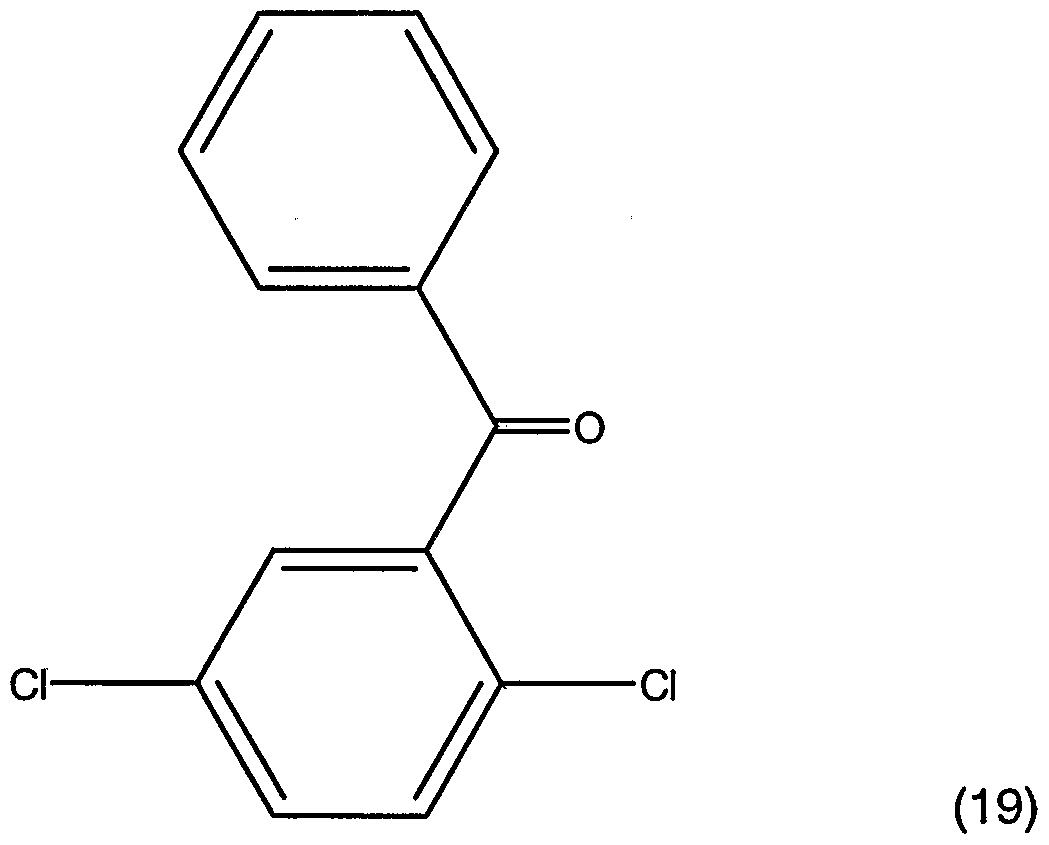
- Poly(2,5-benzophenones) can be synthesized by polymerizing monomers having in the structure
- phenyl rings in the structure above may alternatively be substituted with Ci to C 4 alkyl groups, aryl groups, or other groups that do not interfere with operation of the polyelectrolyte membrane.
- Suitable polymers and conditions for their polymerization are given, for example in Wang et al., Polymer Preprints, 1997, Vol. 38, pgs 263-264, and in Pasquale et al., Polymer Preprints, 1997, Vol. 38, pgs 170-171, the disclosures of which are herein incorporated by reference.
- the arylene polymers described above can be synthesized by heating combinations of the respective monomers with a suitable catalyst system.
- Catalysts system for synthesizing the arylene polymers are well known, and are described for example in U.S. 6,555,626, the disclosure of which is herein incorporated by reference.
- the catalyst systems preferably contain either a combination of a transition metal salt and one or more ligands, or a transition metal having one or more ligands coordinated onto the transition metal.
- the systems further contain a reducing agent.
- a salt may be added to the catalyst system to increase the rate of polymerization.
- transition metal salt examples include nickel compounds such as nickel chloride, nickel bromide, nickel iodide, and nickel acetylacetonates. Palladium compounds, iron compounds, and cobalt compounds can also be used: Examples of ligands include triphenylphosphine, 2,2'-bipyridine, 1 ,5-cyclooctadiene, and the like. Examples of reducing agents include iron, zinc, manganese, aluminum, magnesium, sodium, and calcium. In various embodiments, zinc, magnesium, and manganese are preferred. [0026] As noted above, the arylene polymers contain arylacyl groups pendant from a poly(arylene) main chain.
- the arylene polymer is reduced to convert the keto group of the pendant arylacyl group to a secondary alcohol.
- Reduction to the alcohol is preferably carried out in solution.
- suitable reducing agents are well known in the art.
- a non-limiting example is borane (BH 3 ) in tetrahydrofuran.
- the specific reducing agent to be used is not particularly critical, but it should be chosen for favorable characteristics, such as high yield, relatively low temperatures, or relative lack of impurities that would interfere with subsequent reactions.
- a reduced polymer is thus prepared by the action of a reducing agent on the arylene polymers described above.
- the reduced polymer is fluorinated to provide a fluorinated polymer.
- the fluorination reaction occurs by reaction of a fluorinating agent on the reduced polymer to reduce a polymer having repeating units of structure
- Suitable fluorinating agents can be selected from among those known in the art.
- a preferred fluorinating agent is diethylaminosulfur trifluoride (DAST).
- DAST diethylaminosulfur trifluoride
- Other fluorinating agents include, without limitation, bis(2-methoxyethyl)aminosulfur trifluoride, sulfur tetrafluoride, selenium tetrafluoride, cobalt trifluoride, and phenylsulfur trifluoride.
- fluorination of the reduced polymer is carried out on a solution cast film of the reduced polymer.
- the reduced polymer is solution cast according, to known procedures.
- the fluorination step is carried out by contacting the cast film with a solution of the fluorinating agent.
- the fluorinated polymer preferably in the form of a film as discussed- above, is sulfonated to provided a polyelectrolyte membrane.
- the sulfonation step introduces sulfonic acid groups onto the fluorinated polymer.
- the precise location of the sulfonic acid groups on the polymer is not precisely known, but it is expected that sulfonic acid groups will be attached to aryl and thiophene rings of the polymers.
- the sulfonic acid group can be incorporated by sulfonating the fluorinated polymer films with known sulfonating agents such as sulfuric acid anhydride, fuming sulfuric acid, chlorosulfonic acid, sulfuric acid, and sodium hydrogen sulfite under known conditions.
- the sulfonation is carried out by contacting the fluorinated polymer, preferably in the form of a film, with a solution of the sulfonating agent.
- the time and temperature of the contact can be varied to incorporate more or fewer sulfonic acid groups as desired.
- the arylketone polymers can first be sulfonated, then reduced and fluorinated as described above, followed by a hydrolysis step to prepare the sulfonated films.
- a hydrolysis step to prepare the sulfonated films.
- the incorporation of sulfonic acid groups can be determined by measuring the ion exchange capacity (IEC) of the membrane by known methods. For example, the membrane is suspended in water and titrated to a pH of 7 with sodium hydroxide. The IEC of the membranes is conveniently expressed in meq SO 3 H/g of polymer, where meq stands for milliequivalents. For use as polyelectrolyte membranes, enough sulfonic acid groups should be incorporated to provide sufficient proton conductivity. On the other hand, high levels of sulfonic acid group incorporation should be avoided because it tends to solubilize the sulfonated films in water.
- IEC ion exchange capacity
- the amount of sulfonic acid groups contained in the polymer is generally from 0.5 to about 5 meq per gram, preferably from about 1 to about 4 meq per gram of the polymer. In a preferred embodiment, the IEC is 3.2 meq/g or less and greater than about 0.5 meq/g.
- the film After the film is immersed in the chlorosulfonic solution, it is exposed to water to hydrolyze chlorosulfonic groups to sulfonic acid groups. In one embodiment, the film is exposed to boiling water for a suitable time, for example about an hour.
- Fuel cells are provided according to the invention by using a polyelectrolyte film made by the above method as the proton exchange membrane of a membrane electrode assembly (MEA).
- the sulfonate content of the proton exchange membrane is 1.7 meq/g or greater, and the liquid water conductivity at 100°C is greater than 0.2 S/cm. In other preferred embodiments, the sulfonate content is 1.9 meq/g or higher.
- PEM fuel cells according to one preferred embodiment of the present invention are connected to form a stack.
- Each PEM fuel cell has membrane- electrode-assemblies (MEA) 13,15,14, respectively, separated from one another by electrically conductive, impermeable separator plates 16,18, and further sandwiched between terminal separator plates 20,22 at each end of the stack with each terminal plate 20,22 having only one electrically active side 24,26.
- MEA membrane- electrode-assemblies
- An individual fuel cell which is not connected in series within a stack, has a separator plate, with only a single electrically active side.
- a preferred bipolar separator plate 16 typically has two electrically active sides 28,30 respectively facing a separate MEA 13,15 with opposite charges that are separated, hence the so-called "bipolar" plate.
- the fuel cell stack has conductive bipolar separator plates in a stack with multiple fuel cells, however the present invention is equally applicable to conductive separator plates within a stack having only a single fuel cell.
- the MEAs 13,15,14 and bipolar plates 16,18 are stacked together between aluminum clamping plates 32 at each end of the stack and the end contact terminal plate elements 20,22.
- the end contact terminal plate elements 20,22, as well as working faces 28,30 and 31 ,33 of both bipolar separator plates 16,18, contain a plurality of gas flow channels (not shown) for distributing fuel and oxidant gases (i.e., H 2 & O 2 ) to the MEAs 13,15,14.
- Nonconductive gaskets or seals (not shown) provide seals and electrical insulation between the several components of the fuel cell stack.
- Gas-permeable conductive diffusion media 34 press up against the electrode faces of the MEAs 13,15,14. When the fuel cell stack is assembled, the conductive gas diffusion layers 34 assist in even distribution of gas across the electrodes of the MEAs 13,15,14 and also assist in conducting electrical current throughout the stack.
- An inlet for oxygen adjacent the cathode and an inlet for hydrogen adjacent the anode are also provided.
- Oxygen is supplied to the cathode side 36 of each fuel cell in the stack from storage tank 40 via appropriate supply plumbing 42 to provide an inlet for oxygen adjacent the cathode, while hydrogen is supplied to the anode side 38 of the fuel cell from storage tank 44, via appropriate supply plumbing 46 to provide an inlet for hydrogen adjacent the anode.
- air may be supplied to the cathode side 36 from the ambient, and hydrogen to the anode 38 from a methanol or gasoline reformer, or the like.
- Exhaust plumbing for the anode side 48 and the cathode side 50 of the MEAs 13,15,14 are provided.
- the plumbing defines an exit side.
- Gas flow into and out of the stack is typically facilitated by fans 60, such as those shown in the exemplary configuration of Figure 1. Any means of transporting fluids into and out of the stack are feasible, and the configuration and number of fans shown is merely exemplary and not limiting.
- the cathode effluent 50 is routed from the stack to a condenser 54, which serves to liquefy and recover the vapors in the cathode effluent stream 50.
- the liquids e.g. water
- the effluent stream 50 from the cathode has a high concentration of vapor (water vapor, for example) due to the water generated by the electrochemical reactions occurring within the MEA and any additional water introduced for cooling.
- the water evaporates due to pressure and temperature conditions within the fuel cell.
- the effluent stream is saturated with vapor (e.g. in the case of water at approximately 100% relative humidity ⁇ .
- the supply conduits 61 provide water to the cathode side of each MEA 13,15,14 by interconnecting the reservoir 56 to the fuel cells in the stack.
- a pump (not shown) may optionally be included in the system to facilitate the transport of the liquid from the reservoir 56 to the stack, or through other areas of the system.
- Poly(2,5-benzophenone) is dissolved in methylene chloride (1 gm of polymer in 15 mL methylene chloride).
- 10 ml_ of 1M BhMetrahydrofuran complex (Aldrich) is added by syringe and the mixture heated at reflux for 1 hour.
- Methanol is added to the gelled reaction mixture at 25C. After gassing subsides, the polymer is collected by filtration, washed with water and then methanol, and vacuum dried.
- the polymer is dissolved in tetrahydrofuran (15% solids) and cast into a film on a glass plate using a Bird applicator with a 30 mil (0.030 inches, or about 0.075 cm) gap.
- the dried film has an IR spectrum consistent with phenyl-CH(OH)-phenyl group in which all the carbonyl or the former aryloyl groups have been converted to hydroxyls.
- the film is immersed in methylene chloride (100 mL) containing 10 mL of DAST (diethylaminosulfur trifluoride) in a glass baking dish enclosed in a sealed Ziploc ® plastic bag.
- the film is removed from the reaction solution after immersion for 16 hours and dried.
- the hydroxy groups are completely replaced by fluorine as shown by infrared spectroscopy.
- the resultant film is immersed in chlorosulfonic acid (1 mL in methylene chloride, 100 mL) for 16 hours.
- the red-black film is removed, washed in water for 16 hours, and dried.
- the acid number of the film is 2.5 meq SO 3 H/g as determined by titration with standardized sodium hydroxide.
- a membrane is made as in Example 1 , except that sulfonation is with 30 hours reaction with 30% oleum.
- the acid number/ion exchange capacity is 2.5
- Wet conductivity is 0.187 S/cm at 100 0 C, while one-hour water uptake at 100 0 C is 35%.
Landscapes
- Chemical & Material Sciences (AREA)
- Manufacturing & Machinery (AREA)
- Engineering & Computer Science (AREA)
- Chemical Kinetics & Catalysis (AREA)
- General Chemical & Material Sciences (AREA)
- Life Sciences & Earth Sciences (AREA)
- Electrochemistry (AREA)
- Sustainable Energy (AREA)
- Sustainable Development (AREA)
- Crystallography & Structural Chemistry (AREA)
- Health & Medical Sciences (AREA)
- Organic Chemistry (AREA)
- Polymers & Plastics (AREA)
- Medicinal Chemistry (AREA)
- Materials Engineering (AREA)
- Fuel Cell (AREA)
- Manufacture Of Macromolecular Shaped Articles (AREA)
- Conductive Materials (AREA)
- Addition Polymer Or Copolymer, Post-Treatments, Or Chemical Modifications (AREA)
Abstract
Description




Claims


Priority Applications (2)
| Application Number | Priority Date | Filing Date | Title |
|---|---|---|---|
| JP2007534584A JP5042026B2 (en) | 2004-10-01 | 2005-08-11 | Sulfonated poly (arylene) films as polymer electrolyte membranes |
| DE112005002426T DE112005002426B4 (en) | 2004-10-01 | 2005-08-11 | Polyelectrolyte membrane, fuel cell, process for producing a polyelectrolyte film and film |
Applications Claiming Priority (2)
| Application Number | Priority Date | Filing Date | Title |
|---|---|---|---|
| US10/956,653 | 2004-10-01 | ||
| US10/956,653 US7220510B2 (en) | 2004-10-01 | 2004-10-01 | Sulfonated poly(arylene) films as polyelectrolyte membranes |
Publications (2)
| Publication Number | Publication Date |
|---|---|
| WO2006038983A2 true WO2006038983A2 (en) | 2006-04-13 |
| WO2006038983A3 WO2006038983A3 (en) | 2006-12-07 |
Family
ID=36125918
Family Applications (1)
| Application Number | Title | Priority Date | Filing Date |
|---|---|---|---|
| PCT/US2005/028466 Ceased WO2006038983A2 (en) | 2004-10-01 | 2005-08-11 | Sulfonated poly(arylene) films as polyelectrolyte membranes |
Country Status (5)
| Country | Link |
|---|---|
| US (1) | US7220510B2 (en) |
| JP (1) | JP5042026B2 (en) |
| CN (1) | CN100539283C (en) |
| DE (1) | DE112005002426B4 (en) |
| WO (1) | WO2006038983A2 (en) |
Families Citing this family (2)
| Publication number | Priority date | Publication date | Assignee | Title |
|---|---|---|---|---|
| KR100590041B1 (en) * | 2004-10-04 | 2006-06-14 | 삼성에스디아이 주식회사 | Fuel cell system and stack used therein |
| US11476485B1 (en) * | 2018-05-31 | 2022-10-18 | Triad National Security, Llc | Polyaromatic electrolytes for alkaline membrane fuel cells |
Family Cites Families (8)
| Publication number | Priority date | Publication date | Assignee | Title |
|---|---|---|---|---|
| WO1999005100A1 (en) * | 1997-07-25 | 1999-02-04 | Acep Inc | Ionic compounds with delocalized anionic charge, their use as components of ionic conductors or catalyst |
| US6515101B1 (en) * | 1998-09-25 | 2003-02-04 | Iowa State University Research Foundation, Inc. | High performance fluorinated polymers and methods |
| EP1138712B1 (en) * | 2000-03-29 | 2006-01-18 | JSR Corporation | Polyarylene copolymers and proton-conductive membrane |
| DE10201886B4 (en) * | 2001-01-19 | 2014-01-23 | Honda Giken Kogyo K.K. | A polymer electrolyte membrane and a process for producing the same, and solid polymer electrolyte fuel cell using the same |
| JP3411562B2 (en) * | 2001-01-19 | 2003-06-03 | 本田技研工業株式会社 | Electrode structure and polymer electrolyte fuel cell comprising the same |
| JP2002305007A (en) * | 2001-04-05 | 2002-10-18 | Honda Motor Co Ltd | Polymer electrolyte fuel cell |
| WO2004110599A2 (en) * | 2003-05-27 | 2004-12-23 | Haering Thomas | Multilayered structures and methods for producing the same |
| JP2005314452A (en) * | 2004-04-27 | 2005-11-10 | Sumitomo Chemical Co Ltd | Polyarylene polymer and use thereof |
-
2004
- 2004-10-01 US US10/956,653 patent/US7220510B2/en not_active Expired - Lifetime
-
2005
- 2005-08-11 CN CNB2005800410344A patent/CN100539283C/en not_active Expired - Lifetime
- 2005-08-11 WO PCT/US2005/028466 patent/WO2006038983A2/en not_active Ceased
- 2005-08-11 DE DE112005002426T patent/DE112005002426B4/en not_active Expired - Lifetime
- 2005-08-11 JP JP2007534584A patent/JP5042026B2/en not_active Expired - Fee Related
Also Published As
| Publication number | Publication date |
|---|---|
| DE112005002426B4 (en) | 2013-08-29 |
| US7220510B2 (en) | 2007-05-22 |
| WO2006038983A3 (en) | 2006-12-07 |
| CN101069318A (en) | 2007-11-07 |
| US20060073369A1 (en) | 2006-04-06 |
| CN100539283C (en) | 2009-09-09 |
| JP2008515162A (en) | 2008-05-08 |
| DE112005002426T5 (en) | 2007-08-23 |
| JP5042026B2 (en) | 2012-10-03 |
Similar Documents
| Publication | Publication Date | Title |
|---|---|---|
| US9975995B2 (en) | Ion conducting polymer comprising partially branched block copolymer and use thereof | |
| US7691515B2 (en) | Proton exchange membranes using cycloaddition reaction between azide and alkyne containing components | |
| JP3878520B2 (en) | Proton conducting polymer solid electrolyte and method for producing the same | |
| JP4051736B2 (en) | Polymer electrolyte, polymer electrolyte membrane, and fuel cell | |
| US20050271922A1 (en) | Solid polymer electrolyte, a membrane using thereof, a solution for coating electrode catalyst, a membrane/electrode assembly, and a fuel cell | |
| KR100370399B1 (en) | Partially fluorinated copolymer based on trifluorostyrene and substituted vinyl compound and ion conductive polymer layer formed therefrom | |
| WO2008141018A1 (en) | Novel electrolyte utilizing a lewis acid/bronstead acid complex | |
| CN101161639B (en) | Solid acid, polymer electrolyte membrane containing it, and fuel cell using the same | |
| US20120296065A1 (en) | Polyarylene ionomers membranes | |
| US20080241628A1 (en) | Membrane-electrode assembly for solid polymer electrolyte fuel cell | |
| US7115333B2 (en) | High temperature composite proton exchange membranes | |
| US7220510B2 (en) | Sulfonated poly(arylene) films as polyelectrolyte membranes | |
| JP4245991B2 (en) | Solid polymer electrolyte, membrane using the same, catalyst electrode layer, membrane / electrode assembly, and fuel cell | |
| KR101773245B1 (en) | Sulfonated hydrocarbon nanocomposite membrane comprising polyhedral oligomeric silsesquioxane with proton donor and proton acceptor and Method of preparing the same | |
| KR20170107634A (en) | Fluorinated nanocomposite membrane comprising polyhedral oligomeric silsesquioxane with proton donor and proton acceptor and Method of preparing the same | |
| KR20170107633A (en) | Sulfonated hydrocarbon nanocomposite membrane comprising polyhedral oligomeric silsesquioxane with proton donor and proton acceptor and Method of preparing the same | |
| JP3911120B2 (en) | Solid polymer electrolyte, membrane thereof, electrode catalyst coating solution, membrane / electrode assembly using the same, and fuel cell | |
| JP2018529792A (en) | Hydrocarbon nanocomposite membrane containing polyhedral oligomeric silsesquioxane having proton donor and proton acceptor and method for producing the same | |
| KR101773246B1 (en) | Fluorinated nanocomposite membrane comprising polyhedral oligomeric silsesquioxane with proton donor and proton acceptor and Method of preparing the same | |
| US20120302725A1 (en) | Polyarylene ionomers | |
| JP4099967B2 (en) | Fuel cell, proton conductor, and method for producing proton conductor | |
| JP2005194304A (en) | Phosphate group-containing hydrocarbon oligomer material and / or phosphate group-containing hydrocarbon polymer material, and composite solid electrolyte membrane containing acidic group-containing fullerene derivative and use thereof | |
| US20120289678A1 (en) | Method of making polyarylene ionomers and membranes | |
| JP4255890B2 (en) | Membrane / electrode assembly and fuel cell using the same | |
| US20040018408A1 (en) | Proton conductive solid polymer electrolyte and method for producing the same |
Legal Events
| Date | Code | Title | Description |
|---|---|---|---|
| AK | Designated states |
Kind code of ref document: A2 Designated state(s): AE AG AL AM AT AU AZ BA BB BG BR BW BY BZ CA CH CN CO CR CU CZ DE DK DM DZ EC EE EG ES FI GB GD GE GH GM HR HU ID IL IN IS JP KE KG KM KP KR KZ LC LK LR LS LT LU LV MA MD MG MK MN MW MX MZ NA NG NI NO NZ OM PG PH PL PT RO RU SC SD SE SG SK SL SM SY TJ TM TN TR TT TZ UA UG US UZ VC VN YU ZA ZM ZW |
|
| AL | Designated countries for regional patents |
Kind code of ref document: A2 Designated state(s): GM KE LS MW MZ NA SD SL SZ TZ UG ZM ZW AM AZ BY KG KZ MD RU TJ TM AT BE BG CH CY CZ DE DK EE ES FI FR GB GR HU IE IS IT LT LU LV MC NL PL PT RO SE SI SK TR BF BJ CF CG CI CM GA GN GQ GW ML MR NE SN TD TG |
|
| 121 | Ep: the epo has been informed by wipo that ep was designated in this application | ||
| WWE | Wipo information: entry into national phase |
Ref document number: 2007534584 Country of ref document: JP |
|
| WWE | Wipo information: entry into national phase |
Ref document number: 1120050024261 Country of ref document: DE |
|
| WWE | Wipo information: entry into national phase |
Ref document number: 200580041034.4 Country of ref document: CN |
|
| RET | De translation (de og part 6b) |
Ref document number: 112005002426 Country of ref document: DE Date of ref document: 20070823 Kind code of ref document: P |
|
| 122 | Ep: pct application non-entry in european phase |
Ref document number: 05802639 Country of ref document: EP Kind code of ref document: A2 |
|
| REG | Reference to national code |
Ref country code: DE Ref legal event code: 8607 |