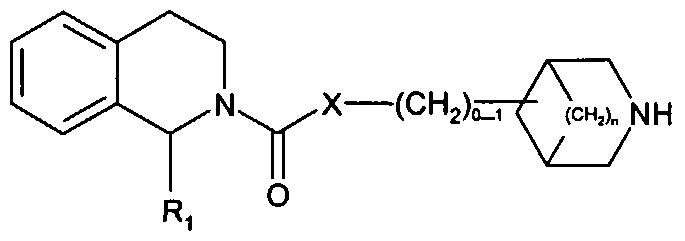
3 , 4-DIHYDROISOQUINOLINE COMPOUNDS AS MUSCARINIC RECEPTOR ANTAGONISTS FOR THE TREATMENT OF RESPIRATORY , URINARY AND GASTROINTESTINAL DISEASES .
Field of the Invention
The present invention generally relates to muscarinic receptor antagonists, which 5 are useful, among other uses, for the treatment of various diseases of the respiratory, urinary and gastrointestinal systems mediated through muscarinic receptors. The invention also relates to the process for the preparation of disclosed compounds, pharmaceutical compositions containing the disclosed compounds, and the methods for treating diseases mediated through muscarinic receptors.
10
Background of the Invention
Muscarinic receptors as members of the G Protein Coupled Receptors (GPCRs) are composed of a family of 5 receptor sub-types (Mi, M2, M3, M4 and M5) and are activated by the neurotransmitter acetylcholine. These receptors are widely distributed on multiple
15 organs and tissues and are critical to the maintenance of central and peripheral cholinergic neurotransmission. The regional distribution of these receptor sub-types in the brain and other organs has been documented, (for example, the Mj subtype is located primarily in neuronal tissues such as cereberal cortex and autonomic ganglia, the M2 subtype is present mainly in the heart where it mediates cholinergically induced bradycardia, and the M3
20 subtype is located predominantly on smooth muscle and salivary glands {Nature, 323, p.411 (1986); Science, 237, p.527 (1987)).
A review in Current Opinions in Chemical Biology, 3, p. 426 (1999), as well as in Trends in Pharmacological Sciences, 22, p. 409 (2001) by Eglen et. al., describes the biological potentials of modulating muscarinic receptor subtypes by ligands in different 25 disease conditions, such as Alzheimer's Disease, pain, urinary disease condition, chronic obstructive pulmonary disease, and the like. A review in J. Med. Chem., 43, p. 4333 (2000), by Felder et. al. describes therapeutic opportunities for muscarinic receptors in the central nervous system and elaborates on muscarinic receptor structure and function, pharmacology and their therapeutic uses. The pharmacological and medical aspects of the
muscarinic class of acetylcholine agonists and antagonists are presented in a review in Molecules, 6, p. 142 (2001).
Birdsall et. al. in Trends in Pharmacological Sciences, TL, p. 215 (2001) have also summarized the recent developments on the role of different muscarinic receptor subtypes using different muscarinic receptor of knock out mice. Annual Review of
Pharmacological Toxicol, 41, p. 691 (2001), describes the pharmacology of the lower urinary tract infections. Almost all smooth muscle tissues express both M2 and M3 receptors, both of which have the functional role. M2 receptors outnumber M3 receptors by a proportion of approximately 4 to 1. Generally, M3 receptors mediate the direct contractile effects of acetylcholine in the vast majority of smooth muscle tissues. M2 receptors, on the other hand, cause smooth muscle contraction indirectly by inhibiting sympathetically (/3-adrenoreceptor)-mediated relaxation. Compounds that act as antagonists of muscarinic receptors have been used to treat several disease states associated with improper smooth muscle function, as well as in the treatment of cognitive and neurodegerative disorders such as Alzheimer's disease. Until recently, most of these compounds have been non-selective for the various muscarinic receptor subtypes, leading to unpleasant anti-cholinergic side effects such as dry mouth, constipation, blurred vision, or tachycardia. The most common of these side-effects is dry mouth resulting from muscarinic receptor blockade in the salivary gland. Recently developed M2 or M3 specific antagonists have been shown to have reduced side effects. And also the side effects associated with oxybutynin, the nonselective antimuscarinic agent, are believed to be due to its affinity for the M5 muscarinic receptor.
Evidence suggests that mechanistically, concurrent blockade Of M2 and M3 receptors by sparing M5 receptors could be therapeutically effective in the treatment of the disease states associated with smooth muscle disorders. Few M2/M3 selective and M5 sparing antagonists have been developed.
Compounds described as having antagonistic activity against muscarinic receptors have been described in Japanese patent application Laid Open Number 92921/1994 and 135958/1994; WO 93/16048; U.S. Patent No. 3,176,019; GB 940,540; EP 0325 571; WO 98/29402; EP 0801067; EP 0388054; WO 9109013; U.S. Patent No. 5,281,601. Also,
U.S. Patent Nos. 6,174,900, 6,130,232 and 5,948,792; WO 93/16018 and WO96/33973 are
other references of interest; compounds disclosed in WO 97/45414 are 1 ,4-disubstituted piperidine derivatives; WO 98/05641 describes fluorinated, 1,4-disubstitued piperidine derivatives; US Patent No. 5,397,800 discloses l-azabicyclo[2.2.1]heptanes. US Patent No.5, 001,160 describes l-aryl-l-hydroxy-l-substituted-3-(4-substituted-l-piperazinyl)-2- propanones. WO 99/43657 describes 2-arylethyl-(piperidin-4-ylmethyl)amine derivatives as muscarinic receptors antagonists. WO 01/090082 describes substituted 1-amino-alkyl lactams and their use as muscarinic receptor antagonists. WO 01/47893 describes azabicycloctane derivatives useful in the treatment of cardiac arrhythmias. WO 01/42213 describes 2-biphenyl-4-piperidinyl ureas. WO 01/42212 describes carbamate derivatives. WO 01/90081 describes amino alkyl lactam. WO 02/53564 describes novel quinuclidine derivatives. WO 02/00652 describes carbamates derived from arylalkyl amines. WO 02/06241 describes l,2,3,5-tetrahydrobenzo(c)azepin-4-one derivatives. U.S. application No. 20030105071 describes thiazole and other heterocyclic ligands for mammalian dopamine, muscarinic and serotonic receptors and transporters, and method of use thereof. WO 03/033495 describes quinuclidine derivatives and their use as M2 and/or M3 muscarinic receptor antagonists. US2003/0171362 describes amino-tetralin derivatives as muscarinic receptor antagonists. US2003/0162780 describes 4-piperidinyl alkyl amine derivatives as muscarinic receptor antagonists. US 5,179,108 disclose derivatives of 4- (aminomethyl) piperidine and their therapeutic applications. WO 03/048125 discloses aminotetralin derivatives as muscarinic receptor antagonists. WO 03/048124 discloses 4- piperidinyl alkylamine derivatives as muscarinic receptor antagonists. WO 2004/052857 and WO 04/004629 disclose 3,6-disubstituted azabicyclo [3.1.0] hexane derivatives useful as muscarinic receptor antagonists. WO 04/005252 discloses azabicyclo derivatives as muscarinic receptor antagonists. WO 04/014853, WO 04/067510 and WO 04/014363 disclose derivatives of 3,6-disubstituted azabicyclohexane useful as muscarinic receptor antagonists. WO 04/056810 discloses xanthine derivatives as muscarinic receptor antagonists. WO 04/056811 discloses flaxavate derivatives as muscarinic receptor antagonists. WO 04/056767 discloses 1 -substituted-3 -pyrrolidine derivatives as muscarinic receptor antagonists. WO 04/018422 disclose fluoro and sulphonylamino containing 3,6-disubstituted azabicyclo[3.1.0] hexane derivatives as muscarinic receptor antagonists.
J.Med.Chem., 44, p. 984 (2002), describes cyclohexylmethylpiperidinyl- triphenylpropioamide derivatives as selective M3 antagonist discriminating against the other receptor subtypes. J.Med.Chem., 36> P- 610 (1993), describes the synthesis and antimuscarinic activity of some 1-cycloalkyl-l -hydroxy- l-phenyl-3-(4-substituted piperazinyl)-2-propanones and related compounds. J.Med.Chem., 34, p.3065 (1991), describes analogues of oxybutynin, synthesis and antimuscarinic activity of some substituted 7-ammo-l-hydroxy-5-heptyn-2-ones and related compounds.
Summary of the Invention In one aspect, there are provided muscarinic receptor antagonists, which can be useful as safe and effective therapeutic or prophylactic agents for the treatment of various diseases of the respiratory, urinary and gastrointestinal systems. Also provided are processes for synthesizing such compounds.
In another aspect, pharmaceutical compositions containing such compounds are provided together with acceptable carriers, excipients or diluents which can be useful for the treatment of various diseases of the respiratory, urinary and gastrointestinal systems.
The enantiomers, diastereomers, N-oxides, polymorphs, pharmaceutically acceptable salts and pharmaceutically acceptable solvates of these compounds as well as metabolites having the same type of activity are also provided, as well as pharmaceutical compositions comprising the compounds, their metabolites, enantiomers, diastereomers, N-oxides, polymorphs, solvates or pharmaceutically acceptable salts thereof, in combination with a pharmaceutically acceptable carrier and optionally included excipients.
Other aspects will be set forth in the description which follows, and in part will be apparent from the description or may be learnt by the practice of the invention.
In accordance with one aspect, there are provided compounds having the structure of Formula I
and their pharmaceutically acceptable salts, pharmaceutically acceptable solvates, esters, enantiomers, diastereomers, N-oxides, polymorphs, metabolites, wherein
\_y represents a nitrogen-containing ring having from 5 to 9 carbon atoms and T is a bridging group selected from the group consisting of -(CH2V, -CH(Q)CH2-, - CH2CH(Q)CH2-, -CH(Q)-, -CH2-O-CH2- or -CH2-NH-CH2-), where n is an integer selected from 0-3 (wherein when n is zero then T represents a direct bond);
Y is alkylene, alkenylene, alkynylene or no atom; X is -NH or oxygen;
Ri is alkyl, alkenyl, alkynyl, -NRxRy [wherein Rx and Ry are independently selected from the group consisting of hydrogen, alkyl, alkenyl, alkynyl, hydroxy (provided that both Rx and Ry are not hydroxy at the same time), cycloalkyl, aryl, aralkyl, -SO2R3, heteroaryl, heterocyclyl, heterocyclylalkyl or heteroarylalkyl; Rx and Ry may also together join to form a heterocyclyl ring], cycloalkyl, aryl, aralkyl, heterocyclyl, heteroaryl, heteroarylalkyl, heterocyclylalkyl, -COOR2, -SO2R3, halogen, hydroxy, alkoxy, aryloxy, -CHO, -CN, acyl, -C(=O)NRxRy, -0C(=0)NRxRy, -NHC(=O)RX, -NRwC(=0)NRwRy, -NRxC(=O)ORy (wherein Rx and Ry are the same as defined above).
R2 is alkyl, alkenyl, alkynyl, cycloalkyl, aryl, aralkyl, heteroarylalkyl or heterocyclylalkyl. R3 is alkyl, alkenyl, alkynyl, cycloalkyl, -NRpRq (wherein Rp and Rq are selected from the group consisting of hydrogen, alkyl, alkenyl, alkynyl, cycloalkyl, aryl, aralkyl, heterocyclyl, heteroaryl, heterocyclylalkyl or heteroarylalkyl).
R2 is hydrogen, alkyl, alkenyl, alkynyl, halogen, cycloalkyl, aryl, hydroxy, -C(=0)NRxRy, OC(O)NRxRy, -COOR2, -SO2R3, alkoxy, aryloxy, -NRWSO2RW, -CN, acyl, heteroaryl, heterocyclyl, heterocyclylalkyl, heteroarylalkyl, aralkyl, -NRxC(=0)0Ry or -NHC(=0)Rw.
Rw is hydrogen, alkyl, alkenyl, alkynyl, cycloalkyl, aryl, heterocyclyl, heteroaryl, aralkyl, heterocyclylalkyl or heteroarylalkyl;
Q is alkyl, alkenyl, alkynyl, cycloalkyl, aryl, heteroaryl, heterocyclyl, aralkyl, heteroarylalkyl or heterocyclylalkyl.
The following definitions apply to terms as used herein
The term "alkyl," unless otherwise specified, refers to a monoradical branched or unbranched saturated hydrocarbon chain having from 1 to 20 carbon atoms. This term can be exemplified by groups such as methyl, ethyl, n-propyl, iso-propyl, n-butyl, iso-butyl, sec-butyl, t-butyl, n-pentyl, isopentyl, neopentyl, n-hexyl, n-decyl, tetradecyl, and the like. Alkyl groups may be substituted further with one or more substituents selected from alkenyl, alkynyl, alkoxy, cycloalkyl, cycloalkenyl, acyl, acylamino, acyloxy, alkoxycarbonylamino, azido, cyano, halogen, hydroxy, oxo, thiocarbonyl, carboxy, carboxyalkyl, aryl, heterocyclyl, heteroaryl, arylthio, thiol, alkylthio, aryloxy, nitro, aminosulfonyl, aminocarbonylamino, -NHC(=O)Rf, -NRfRq, -C(=O)NRfRq, -NHC(=O)NRfRq,, -C(=O)heteroaryl, C(=O)heterocyclyl, -O-C(=O)NRfRq {wherein Rf and Rq are independently selected from alkyl, alkenyl, cycloalkyl, cycloalkenyl, aryl, aralkyl, heterocyclyl, heteroaryl, heterocyclylalkyl, heteroarylalkyl}, nitro, or -SO2R6 (wherein R6 is alkyl, alkenyl, alkynyl, cycloalkyl, aralkyl, aryl, heterocyclyl, heteroaryl, heteroarylalkyl or heterocyclylalkyl). Unless otherwise constrained by the definition, alkyl substituents may be further substituted by 1-3 substituents selected from alkyl, carboxy, -NRfRq, -C(O)NR1Rq, -0C(=0) NRfRq , -NHC(=0)NRfRq (wherein Rfand Rq are the same as defined earlier), hydroxy, alkoxy, halogen, CF3, cyano, and -SO2R6,
(wherein R6 are the same as defined earlier); or an alkyl group also may be interrupted by 1 -5 atoms of groups independently selected from oxygen, sulfur or -NR3- {wherein Ra is selected from hydrogen, alkyl, cycloalkyl, alkenyl, cycloalkenyl, alkynyl, aryl, acyl, aralkyl,-C(=O)ORf (wherein Rf is the same as defined earlier), SO2R6 (where R6 is as defined earlier), or -C(=O)NRfRq (wherein Rf and Rq are as defined earlier)} . Unless otherwise constrained by the definition, all substituents may be substituted further by 1-3 substituents selected from alkyl, carboxy, -NRfRq, -C (=O)NRfRq, -O-C(=O)NRfRq (wherein Rf and Rq are the same as defined earlier) hydroxy, alkoxy, halogen, CF3, cyano, and -SO2R6 (where R6 is same as defined earlier); or an alkyl group as defined above that has both substituents as defined above and is also interrupted by 1 -5 atoms or groups as defined above.
The term "alkylene," as used herein, refers to a diradical branched or unbranched saturated hydrocarbon chain having from 1 to 6 carbon atoms and one or more hydrogen can optionally be substituted with alkyl, hydroxy, halogen or oximes. This term can be exemplified by groups such as methylene, ethylene, propylene isomers (e.g., -CH2CH2CH2 and -CH(CH3)CH2) and the like. Alkylene may further be substituted with one or more substituents such as alkyl, alkenyl, alkynyl, alkoxy, cycloalkyl, acyl, acylamino, acyloxy, alkoxycarbonylamino, azido, cyano, halogen, hydroxy, oxo, thiocarbonyl, carboxy, arylthio, thiol, alkylthio, aryloxy, heteroaryloxy, aminosulfonyl, -COOR2 (wherein R2 is the same as defined earlier), -NHC(O)Rx, -NRxRy, -C(=0)NRxRy, -NHC(=0)NRxRy, -C(=O)heteroaryl, C(=O)heterocyclyl, -0-C(=0)NRxRy (wherein Rx and Ry are the same as defined earlier), nitro, -S(O)nR3 (wherein n and R3 are the same as defined earlier). Unless otherwise constrained by the definition, all substituents may be further substituted by 1-3 substituents chosen from alkyl, carboxy, -COOR2 (wherein R2 is the same as defined earlier), -NRxRy, -C(=0)NRxRy, -0C(=0)NRxRy, -NHC(=O)NRxRy (wherein Rx and Ry are the same as defined earlier), hydroxy, alkoxy, halogen, CF3, cyano, and -S(O)nR3 (where R3 and n are the same as defined earlier). Alkylene can also be optionally interrupted by 1-5 atoms of groups independently chosen from oxygen, sulfur and -NRa, where R3 is chosen from hydrogen, alkyl, cycloalkyl, alkenyl, alkynyl, aryl, acyl, aralkyl, -C(=0)0R2 (wherein R2 is the same as defined earlier), -S(O)nR3 (where n and R3 are the same as defined earlier), -C(=0)NRxRy (wherein Rx and Ry are as defined earlier) -CONH-, -C=O or -C=NOH.
The term "alkenyl," unless otherwise specified, refers to a monoradical of a branched or unbranched unsaturated hydrocarbon group having from 2 to 20 carbon atoms with cis, trans, or geminal geometry. In the event that alkenyl is attached to a heteroatom, the double bond cannot be alpha to the heteroatom. Alkenyl groups may be substituted further with one or more substituents selected from alkyl, alkynyl, alkoxy, cycloalkyl, cycloalkenyl, acyl, acylamino, acyloxy, -NHC (=0)Rf, -NRfRq, -C(=O)NRfRq, -NHC(=0)NRfRq, -0-C(=0)NRfRq (wherein Rf and R4, are the same as defined earlier), alkoxycarbonylamino, azido, cyano, halogen, hydroxy, oxo, thiocarbonyl, carboxy, arylthio, thiol, alkylthio, aryl, aralkyl, aryloxy, heterocyclyl, heteroaryl, heterocyclyl alkyl, heteroaryl alkyl, aminosulfonyl, aminocarbonylamino, alkoxyamino, nitro, or SO2RO (wherein R6 are is same as defined earlier). Unless otherwise constrained by the
definition, alkenyl substituents optionally may be substituted further by 1-3 substituents selected from alkyl, carboxy, hydroxy, alkoxy, halogen, -CF3, cyano, -NRfRq, -CX=O)NRfRq, -0-CC=O)NRfRq (wherein Rf and Rq are the same as defined earlier) and -SO2Rg( where R6 is same as defined earlier). The term "alkenylene" unless otherwise specified, refers to a diradical of a branched or unbranched unsaturated hydrocarbon group preferably having from 2 to 6 carbon atoms with cis, trans or geminal geometry. In the event that alkenylene is attached to the heteroatom, the double bond cannot be alpha to the heteroatom. The alkenylene group can be connected by two bonds to the rest of the structure of compound of Formula I. Alkenylene may further be substituted with one or more substituents such as alkyl, alkynyl, alkoxy, cycloalkyl, acyl, acylamino, acyloxy, -NHC(=O)RX, -NRxRy, -C(=0)NRxRy, -NHC(=O)NRxRy , -0C(=0)NRxRy (wherein Rx and Ry are the same as defined earlier), alkoxycarbonylamino, azido, cyano, halogen, hydroxy, oxo, thiocarbonyl, carboxy, -COOR2 (wherein R2 is the same as defined earlier), arylthio, thiol, alkylthio, aryl, aralkyl, aryloxy, heterocyclyl, heteroaryl, heterocyclyl alkyl, heteroaryl alkyl, aminosulfonyl, alkoxyamino, nitro, -S(O)nR3 (where R3 and n are the same as defined earlier). Unless otherwise constrained by the definition, all substituents may optionally be further substituted by 1-3 substituents chosen from alkyl, carboxy, -COOR2 (wherein R2 is the same as defined earlier), hydroxy, alkoxy, halogen, -CF3, cyano, -NRxRy, -C(=0)NRxRy, -0C(=0)NRxRy (wherein Rx and Ry are the same as defined earlier) and - S(O)nR3 (where R3 and n are the same as defined earlier).
The term "alkynyl," unless otherwise specified, refers to a monoradical of an unsaturated hydrocarbon, having from 2 to 20 carbon atoms. In the event that alkynyl is attached to a heteroatom, the triple bond cannot be alpha to the heteroatom. Alkynyl groups may be substituted further with one or more substituents selected from alkyl, alkenyl, alkoxy, cycloalkyl, cycloalkenyl, acyl, acylamino, acyloxy, alkoxycarbonylamino, azido, cyano, halogen, hydroxy, oxo, thiocarbonyl, carboxy, arylthio, thiol, alkylthio, aryl, aralkyl, aryloxy, aminosulfonyl, aminocarbonylamino, nitro, heterocyclyl, heteroaryl, heterocyclylalkyl, heteroarylalkyl, -NHC(=0)Rf> -NRfRq, -NHC(=O)NRfRq , -C(=O)NRfRq, -O-C(=O)NRfRq (wherein Rf and R, are the same as defined earlier), or
-SO2R6 (wherein R6 is as defined earlier). Unless otherwise constrained by the definition, alkynyl substituents optionally may be substituted further by 1-3 substituents selected
from alkyl, carboxy, carboxyalkyl, hydroxy, alkoxy, halogen, CF3, -NRfRq, -C(=O)NRfRq, -NHC(=O)NRfRq , -CC=O)NRfRq (wherein Rf and R, are the same as defined earlier), cyano, or -SO2Rβ (where R6 is same as defined earlier).
The term "alkynylene" unless otherwise specified, refers to a diradical of a triply- unsaturated hydrocarbon, preferably having from 2 to 6 carbon atoms. In the event that alkynylene is attached to the heteroatom, the triple bond cannot be alpha to the heteroatom. The alkenylene group can be connected by two bonds to the rest of the structure of compound of Formula I. Alkynylene may further be substituted with one or more substituents such as alkyl, alkenyl, alkoxy, cycloalkyl, acyl, acylamino, acyloxy, alkoxycarbonylamino, azido, cyano, halogen, hydroxy, oxo, thiocarbonyl, carboxy, arylthio, thiol, alkylthio, aryl, aralkyl, aryloxy, aminosulfonyl, nitro, heterocyclyl, heteroaryl, heterocyclyl alkyl, heteroarylalkyl, -NHC(=O)R
X -NR
xR
y, -NHC(=0)NR
xR
y, -CC=O)NR
xR
y, -OC(=O)NR
xR
y (wherein R
x and R
y are the same as defined earlier), -S(O)
nR
3 (where R
3 and n are the same as defined earlier). Unless otherwise constrained by the definition, all substituents may optionally be further substituted by 1 -3 substituents chosen from alkyl, carboxy, -COOR
2 (wherein R
2 is the same as defined earlier), hydroxy, alkoxy, halogen, CF
3, -NR
xR
y, -C(=0)NR
xR
y, -NHC(=0)NR
xR
y, -C(=0)NR
xR
y (wherein R
x and R
y are the same as defined earlier), cyano, and -S(O)
nR
3 (where R
3 and n are the same as defined earlier). The term "cycloalkyl," unless otherwise specified, refers to cyclic alkyl groups of from 3 to 20 carbon atoms having a single cyclic ring or multiple condensed rings, which may optionally contain one or more olefϊnic bonds, unless otherwise constrained by the definition. Such cycloalkyl groups can include, for example, single ring structures, including cyclopropyl, cyclobutyl, cyclooctyl, cyclopentenyl, and the like, or multiple ring structures, including adamantanyl, and bicyclo [2.2.1] heptane, or cyclic alkyl groups to which is fused an aryl group, for example, indane, and the like. Spiro and fused ring structures can also be included. Cycloalkyl groups may be substituted further with one or more substituents selected from alkyl, alkenyl, alkynyl, alkoxy, cycloalkyl, cycloalkenyl, acyl, acylamino, acyloxy, alkoxycarbonylamino, azido, cyano, halogen, hydroxy, oxo, thiocarbonyl, carboxy, carboxyalkyl, arylthio, thiol, alkylthio, aryl, aralkyl, aryloxy, aminosulfonyl, aminocarbonylamino, -NR
fRq, -NHC (=0) NR
fRq, -NHC (=0) R
f, C (=0) NR
fR
q, -O-C (=O)NR
fR
q (wherein R
f and R
q are the same as defined earlier), nitro,
heterocyclyl, heteroaryl, heterocyclylalkyl, heteroarylalkyl, or SO
2-R
6 (wherein R
6 is same as defined earlier). Unless otherwise constrained by the definition, cycloalkyl substituents optionally may be substituted further by 1-3 substituents selected from alkyl, carboxy, hydroxy, alkoxy, halogen, CF
3, -NR
fR
q, -C(=O)NR
fR
q, -NHC(=O)NR
fR
q ,
(wherein R
f and R
q are the same as defined earlier), cyano or -SO
2R
6 (where R
6 is same as defined earlier). "Cycloalkylalkyl" refers to alkyl-cycloalkyl group linked through alkyl portion, wherein the alkyl and cycloalkyl are the same as defined earlier.
The term "alkoxy" denotes the group O-alkyl wherein alkyl is the same as defined above. The term "aralkyl," unless otherwise specified, refers to alkyl-aryl linked through an alkyl portion (wherein alkyl is as defined above) and the alkyl portion contains 1-6 carbon atoms and aryl is as defined below. Examples of aralkyl groups include benzyl, ethylphenyl and the like.
The term "aryl," unless otherwise specified, refers to carbocyclic aromatic groups, for example, phenyl, biphenyl or napthyl ring and the like, optionally substituted with 1 to 3 substituents selected from halogen (e.g., F, Cl, Br, I), hydroxy, alkyl, alkenyl, alkynyl, cycloalkyl, alkoxy, acyl, aryloxy, CF3, cyano, nitro, COORe (wherein Re is hydrogen, alkyl, alkenyl, cycloalkyl, aralkyl, heterocyclylalkyl, heteroarylalkyl), NHC(=O)Rf, -NRfRq, -C(O)NRfRq, -NHC(=O)NRfRq , -O-C(=O)NRfRq (wherein Rf and Rq are the same as defined earlier), -SO2RO (wherein R6 is same as defined earlier), carboxy, heterocyclyl, heteroaryl, heterocyclylalkyl, heteroarylalkyl or amino carbonyl amino. The aryl group optionally may be fused with a cycloalkyl group, wherein the cycloalkyl group may optionally contain heteroatoms selected from O, N or S.
The term "carboxy" as defined herein refers to -C(=0)0H. The term "heteroaryl," unless otherwise specified, refers to an aromatic ring structure containing 5 or 6 ring atoms, or a bicyclic aromatic group having from 8 to 10 ring atoms, with one or more heteroatom(s) independently selected from N, O or S optionally substituted with 1 to 4 substituent(s) selected from halogen (e.g., F, Cl, Br, I), hydroxy, alkyl, alkenyl, alkynyl, cycloalkyl, acyl, carboxy, aryl, alkoxy, aralkyl, cyano, nitro, heterocyclyl, heteroaryl, -NRfRq, CH=NOH, -(CH2)wC(=0)Rg {wherein w is an integer from 0-4 and Rg is hydrogen, hydroxy, 0Rf, NRfRq, -NHOR2 or -NH0H},
-C(=O)NRfRq and -NHC(O)NRfRq , -SO2R6, -0-CC=O)NRfRq, -O-C(=O)Rf, -O-C(=O)ORf (wherein R6, Rf and Rq are as defined earlier, and Rz is alkyl, cycloalkyl, aryl, heteroaryl, heterocyclyl, heteroarylalkyl or heterocyclylalkyl). Unless otherwise constrained by the definition, the substituents are attached to a ring atom, i.e., carbon or heteroatom in the ring. Examples of heteroaryl groups include oxazolyl, imidazolyl, pyrrolyl, 1,2,3-triazolyl, 1,2,4-triazolyl, tetrazolyl, thiazolyl, oxadiazolyl, benzoimidazolyl, thiadiazolyl, pyridinyl, pyridazinyl, pyrimidinyl, pyrazinyl, thienyl, isoxazolyl, triazinyl, furanyl, benzofuranyl, indolyl, benzothiazolyl, or benzoxazolyl, and the like.
The term 'heterocyclyl," unless otherwise specified, refers to a non-aromatic monocyclic or bicyclic cycloalkyl group having 5 to 10 atoms wherein 1 to 4 carbon atoms in a ring are replaced by heteroatoms selected from O, S or N, and optionally are benzofused or fused heteroaryl having 5-6 ring members and/or optionally are substituted, wherein the substituents are selected from halogen (e.g., F, Cl, Br, I), hydroxy, alkyl, alkenyl, alkynyl, cycloalkyl, acyl, aryl, alkoxy, alkaryl, cyano, nitro, oxo, carboxy, heterocyclyl, heteroaryl, -O-C(=O)Rf, -O-C(=O)ORf; -C(O)NRfRq, SO2R6,
-0-C(=0)NRfRq, -NHC(O)NRfRq, -NRfRq (wherein R6, Rf and Rq are as defined earlier) or guanidine. Heterocyclyl can optionally include rings having one or more double bonds. Unless otherwise constrained by the definition, the substituents are attached to the ring atom, i.e., carbon or heteroatom in the ring. Also, unless otherwise constrained by the definition, the heterocyclyl ring optionally may contain one or more olefinic bond(s).
Examples of heterocyclyl groups include oxazolidinyl, tetrahydrofuranyl, dihydrofuranyl, dihydropyridinyl, dihydroisoxazolyl, dihydrobenzofuryl, azabicyclohexyl, dihydroindolyl, pyridinyl, isoindole 1,3-dione, piperidinyl or piperazinyl.
"Heteroarylalkyl" refers to heteroaryl (wherein heteroaryl is same as defined earlier) linked through alkyl (wherein alkyl is the same as defined above) portion and the said alkyl portion contains carbon atoms from 1-6.
"Heterocyclylalkyl" refers to heterocyclyl (wherein heterocyclyl is same as defined earlier) linked through alkyl (wherein alkyl is the same as defined above) portion and the said alkyl portion contains carbon atoms from 1-6. "Acyl" refers to -C(O)R" wherein R" is selected from the group hydrogen, alkyl, cycloalkyl, aryl, aralkyl, heteroaryl, heterocyclyl, heteroarylalkyl or heterocyclylalkyl.
The term "protecting groups" refers to moieties that prevent chemical reaction at a location of a molecule intended to be left unaffected during chemical modification of such molecule. Unless otherwise specified, protecting groups may be used on groups, such as hydroxy, amino, or carboxy. Examples of protecting groups are found in T. W. Greene and P.G.M. Wuts, "Protective Groups in Organic Synthesis", 2nd Ed., John Wiley and Sons, New York, N. Y., which is incorporated herein by reference. The species of the carboxylic protecting groups, amino protecting groups or hydroxy protecting groups employed are not critical, as long as the derivatised moieties/moiety is/are stable to conditions of subsequent reactions and can be removed without disrupting the remainder of the molecule.
In accordance with a further aspect, there is provided a method for treatment or prophylaxis of an animal or a human suffering from a disease or disorder of the respiratory, urinary and gastrointestinal systems, wherein the disease or disorder is mediated through muscarinic receptors. The method includes administration of at least one compound having the structure of Formula I.
In accordance with another aspect, there is provided a method for treatment or prophylaxis of an animal or a human suffering from a disease or disorder associated with muscarinic receptors, comprising administering to a patient in need thereof, an effective amount of a muscarinic receptor antagonist compound as described above. In accordance with yet a further aspect, there is provided a method for treatment or prophylaxis of an animal or a human suffering from a disease or disorder of the respiratory system such as bronchial asthma, chronic obstructive pulmonary disorders (COPD), pulmonary fibrosis, and the like; urinary system which induce such urinary disorders as urinary incontinence, lower urinary tract symptoms (LUTS), etc.; and gastrointestinal system such as irritable bowel syndrome, obesity, diabetes and gastrointestinal hyperkinesis with compounds as described above, wherein the disease or disorder is associated with muscarinic receptors.
In accordance with yet another aspect, there are provided processes for preparing the compounds as described above. The compounds described herein exhibit significant potency in terms of their activity, as determined by in vitro receptor binding and functional assays and in vivo
experiments using anaesthetized rabbits. The compounds that were found active in vitro were tested in vivo. Some of the compounds are potent muscarinic receptor antagonists with high affinity towards M2 and/or M3 receptors with M5 sparing activity. Therefore, pharmaceutical compositions for the possible treatment for the disease or disorders associated with muscarinic receptors are provided. In addition, the compounds can be administered orally or parenterally.
Detailed Description of the Invention
The compounds of the present invention may be prepared by techniques well known in the art and familiar to a practitioner skilled in art of this invention. In addition, the compounds of the present invention may be prepared by the processes described herein, these processes are not the only means by which the compounds described may be synthesised. Further, the various synthetic steps described herein may be performed in an alternate sequence or order to give the desired compounds.
Scheme I
Formula Il Formula IV
reduction
VII
The compounds of Formulae VI and VIII can be prepared for example, by the reaction sequence as depicted in Scheme I, thus a compound of Formula II can be reacted with a compound of Formula III (wherein Ri is the same as defined earlier and hal is Br, Cl or I) to give a compound of Formula IV, which can undergo a cyclodehydration reaction to give a compound of Formula V, which can undergo a reduction to give a
compound of Formula VI, which can be reacted with a compound of Formula VII (wherein Rk is optionally substituted alkyl or aryl and hal is the same as defined above) to give a compound of Formula VIII.
The reaction of a compound of Formula II with a compound of Formula III to give a compound of Formula IV can be carried out in the presence of a base, for example, sodium hydroxide, lithium hydroxide, potassium hydroxide or potassium carbonate.
The compound of Formula IV undergoes cyclodehydration to give compound of Formula V in the presence of a Lewis acid, for example, phosphorous oxychloride, zinc chloride or phosphorous pentachloride with dehydrating agent, for example, phosphorous pentaoxide in an organic solvent, for example, xylene or toluene.
The reduction of a compound of Formula V to give a compound of Formula VI can be carried out in an organic solvent, for example, ethanol, methanol, propanol or isopropylalcohol with a reducing agent, for example, sodium borohydride, lithium borohydride, sodium cyanoborohydride or palladium on carbon with hydrogen gas. The compound of Formula VI is reacted with a compound of Formula VII to give a compound of Formula VIII in an organic solvent, for example, dichloromethane, dichloroethane, chloroform or carbontetrachloride in the presence of a base, for example, triethylamine, pyridine, N-methylmorpholine or diisopropylethylamine.
Representative compounds which may be prepared following Scheme I include: 1 -Phenyl-1 ,2,3,4-tetrahydroisoquinoline,
Ethyl- 1 -phenyl-3 ,4-dihydroisoquinoline-2( 1 H)-carboxylate, 4-Nitrophenyl- 1 -phenyl-3 ,4-dihydroisoquinoline-2( 1 H)-carboxylate.
Scheme Il
Formula Xl
The compounds of Formulae XI and XII can be prepared for example by the reaction sequence as depicted in Scheme II. Thus, a compound of Formula VI can be reacted with a compound of Formula VII and Formula IX (where P is a protecting group for example aralkyl, -C(=O)OC(CH3)3, -C(=O)OC(CH3)2CBr2 or -C(=O)O-C(CH3)2CC13) to give a compound of Formula X, which can undergo deprotection to give a compound of Formula XI, which can undergo N-alkylation to give a compound of Formula XII (wherein Rt is optionally substituted alkyl).
The reactions of a compound of Formula VI with a compound of Formula VII and a compound of Formula IX to give a compound of Formula X can be carried out in an organic solvent, for example, acetonitrile, acetone, ethanol or isopropylalcohol in the presence of a base, for example, triethylamine, pyridine, N-methylmorpholine or diisopropylethylamine.
Alternatively, compound of Formula X can be prepared by reacting a compound of Formula VI with appropriate isocyanate or by using carbonyldiimidazole in place of chloroformates of Formula VII.
The deprotection of a compound of Formula X (when P is aralkyl) to give a compound of Formula XI can be carried out in an organic solvent, for example, dichloroethane, methanol, ethanol, propanol or isopropylalcohol in the presence of a deprotecting agent, for example, palladium on carbon, platinum on carbon, α-chloro ethylchloroformate or 1 , 1 , 1 -trichloro ethylchloroformate.
The deprotection of a compound of Formula X (when P is -CC=O)OCCH3) to give a compound of Formula XI can be carried out in an organic solvent, for example, methanol, ethanol, propanol or isopropylalcohol in the presence of methanolic or etheral hydrochloric acid, solution of hydrochloric acid in ethyl acetate or trifluoroacetic acid. The deprotection of a compound of Formula X (when P is -C(=O)C(CH3)2CHBr2) to give a compound of Formula XI can be carried out in an organic solvent, for example, methanol, ethanol, propanol or isopropylalcohol or by hydrobromic acid (45% w/v solution in acetic acid).
The deprotection of a compound of Formula X (when P is -C(=O)OC(CH3)2CC13) to give a compound of Formula XI can be carried out by supernucleophile, for example, lithium cobalt (I) phthalocyanine, zinc and acetic acid or cobalt phthalocyanine.
The N-alkylation of a compound of Formula XI to give a compound of Formula XII can be carried out in the presence of a base, for example, potassium carbonate, sodium carbonate, lithium carbonate, potassium bicarbonate or sodium bicarbonate. Representative compounds which may be prepared following Scheme II include:
N-(3-benzyl-3-azabicyclo[3.1.0]hex-6-yl)-l-phenyl-3,4-dihydroisoquinoline-2(lH)- carboxamide (Compound No. 1),
N-[(3-benzyl-3-azabicyclo[3.1.0]hex- 1 -yl)methyl]- 1 -phenyl-3,4-dihydroisoquinoline-2 (lH)-carboxamide (Compound No. 2), and N-{3-[2-(l,3-benzodioxol-5-yl)ethyl]-3-azabicyclo[3.1.0]hex-6-yl}-l-phenyl-3,4- dihydroisoquinoline-2(lH)-carboxamide (Compound No. 3).
Scheme I
Formula XIV deprotection
Formula XV
The compounds of Formulae XIV and Formula XV can be prepared, for example by the reaction sequence as depicted in Scheme III. Thus, a compound of Formula VIII can be reacted with a compound of Formula XIII (wherein n is the same as defined earlier and X is -NH or O) to give a compound of Formula XIV, which can undergo deprotection to give a compound of Formula XV.
The reaction of a compound of Formula VIII with a compound of Formula XIII (when X is oxygen) to give a compound of Formula XIV can be carried out in an organic solvent, for example, toluene, benzene or xylene in the presence of a base, for example, sodium hydride, lithium hydride, butyl lithium or lithium diisopropylamide.
The reaction of a compound of Formula VIII with a compound of Formula XIII (when X is -NH) to give a compound of Formula XIV can be carried out in an organic solvent, for example, dimethylsulphoxide or dimethylformamide in the presence of a base, for example, diisopropylethylamine, triethylamine, pyridine or N-methylmorpholine. The deprotection of a compound of Formula XTV (wherein P is aralkyl,
-C(=O)OC(CH3)3, -C(=O)OC(CH3)2CBr2 or -C(=O)OC(CH3)2CC13) to give a compound of Formula XV can be carried out, for example, by following the procedure as described for the synthesis of compound of Formula XI in Scheme II.
Representative compounds which may be prepared following Scheme III include:
(3-Benzyl-3-azabicyclo[3.1.0]hex-6-yl)methyl l-phenyl-3,4-dihydroisoquinoline-2(lH)- carboxylate (Compound No. 4),
3-azabicyclo[3.1.0]hex-6-ylmethyl l-phenyl-3,4-dihydroisoquinoline-2(lH)-carboxylate (Compound No. 5), N-[(3 -Benzyl-3 -azabicyclo [3.1.0]hex-6-yl)methyl] - 1 -phenyl-3 ,4-dihydroisoquinoline- 2(lΗ)-carboxamide (Compound No. 6),
N-(3-Azabicyclo[3.1.0]hex-6-ylmethyl)-l-phenyl-3,4-dihydroisoquinoline-2(lH)- carboxamide (Compound No. 7),
3-Benzyl-3-azabicyclo[3.2.1]oct-8-yl-l-phenyl-3,4-dihydroisoquinoline-2(lH)- carboxylate (Compound No. 8), and
3-Azabicyclo[3.2.1]oct-8-yl l-phenyl-3,4-dihydroisoquinoline-2(lH)-carboxylate (Compound No. 9).
Also, in all the above representative examples wherever amines are specified, one skilled in an art would optionally convert them to their respective salts, for example amines can be converted to corresponding tartarate salts by using tartaric acid in ethanol or hydrochloride salts with ethanolic hydrochloric acid solution in an organic solvent selected from the group consisting of dichloromethane, dichloroethane, chloroform or carbon tetrachloride.
In the above schemes, where specific bases, solvents, condensing agents, etc. are mentioned, it is to be understood that other acids, bases, solvents, condensing agents, hydrolyzing agents, etc, known to those skilled in an art may also be used. Similarly the reaction temperature and duration of the reactions may be adjusted according to desired needs.
Particular compounds produced by the schemes described above are listed in the table below:
Because of their valuable pharmacological properties, the compounds described herein may be administered to an animal for treatment orally, or by a parenteral route. The pharmaceutical compositions described herein can be produced and administered in dosage units, each unit containing a certain amount of at least one compound described herein and/or at least one physiologically acceptable addition salt thereof. The dosage may be varied over extremely wide limits, as the compounds are effective at low dosage levels and relatively free of toxicity. The compounds may be administered in the low micromolar concentration, which is therapeutically effective, and the dosage may be increased as desired up to the maximum dosage tolerated by the patient.
The compounds described herein can be produced and formulated as their enantiomers, diastereomers, N-oxides, polymorphs, solvates and pharmaceutically acceptable salts, as well as metabolites having the same type of activity. Pharmaceutical compositions comprising the molecules of Formula I or metabolites, enantiomers, diastereomers, N-oxides, polymorphs, solvates or pharmaceutically acceptable salts thereof, in combination with pharmaceutically acceptable carrier and optionally included excipient can also be produced.
The examples mentioned below demonstrate general synthetic procedures, as well as specific preparations of particular compounds. The examples are provided to illustrate particular aspects of the invention and do not limit the scope of the present invention.
Examples
Various solvents, such as acetone, methanol, pyridine, ether, tetrahydrofuran, hexanes, and dichloromethane, were dried using various drying reagents according to procedures described in the literature. IR spectra were recorded as nujol mulls or a thin neat film on a Perkin Elmer Paragon instrument, Nuclear Magnetic Resonance (NMR) were recorded on a Varian XL-300 MHz instrument using tetramethylsilane as an internal standard.
Scheme I, procedure:
Example 1: Synthesis of ethyl l-phenyl-3,4-dihydroisoquinoline-2(lH')-carboxylate Step a: N-(2-phenylethyl) benzamide
Phenylethylamine (20 g, 0.1652 mol) was added to sodium hydroxide solution (26.5 g in 150 ml Of H2O), followed by the addition of benzoyl chloride (38.6 ml, 0.33 mol) dropwise at 00C. The reaction mixture was then brought to room temperature and stirred for 25 minutes. The solid thus obtained was filtered, washed with water and dried under reduced pressure to furnish the title compound. Yield: 33.26 g.
Step b: l-Phenyl-3,4-dihydroisoquinoline
To a solution of phosphorous pentaoxide (25.2 g, 177.6 mol) in xylene (150 ml), was added the compound obtained from step a above (5 g, 22.2 mmol), followed by the addition of phosphorous oxychloride (30.5 ml, 328 mmol) and the reaction mixture was refluxed for 4 hours. The reaction mixture was cooled to room temperature and poured into ice. The organic layer was separated and aqueous layer was made alkaline with sodium hydroxide solution (20%). It was extracted with ethylacetate, washed the organic layer with water and brine, dried over anhydrous sodium bisulphate and concentrated under reduced pressure to furnish the title compound. Yield: 4.25 g. Step c : l-Phenyl-l,2,3,4-tetrahydroisoquinoline
A solution of the compound obtained from step b above (4.2 g, 20.28 mmol) in ethanol (50 ml) was cooled in an ice bath followed by the addition of sodium borohydride (0.848 g, 22.31 mmol) in small lots and stirred the reaction mixture at room temperature for overnight. The reaction mixture was concentrated under reduced pressure and the residue thus obtained was taken in water and extracted with ethyl acetate. The organic layer was dried over anhydrous sodium sulphate and concentrated under reduced pressure. The residue thus obtained was purified by column chromatography using 45% ethyl acetate in hexane solvent mixture to furnish the title compound. Yield: 3.35g.
Step d: Ethyl-l-phenyI-3,4-dihydro-2(lH)-carboxylate To a solution of the compound obtained from step c above (3.3 g) in dichloromethane, was added triethylamine (1.75 g, 17.34 mmol) and ethylchloroformate (1.850 g, 17.052 mmol). The reaction mixture was stirred at room temperature for 48 hours and the resulting reaction mixture was washed with water followed acidifying it with hydrochloric acid (IN). The organic layer was dried over anhydrous sodium sulphate and concentrated under reduced pressure to furnish the title compound. Yield: 4.7 g.
1H NMR (CDCl3): 7.28-7.04 (m, 9H), 6.39 (bs, IH), 4.23-4.08 (m, 3H), 3.29-3.20 (m, IH), 3.04-3.02 (m, IH), 2.99-2.73 (m, IH), 1.32-1.26 (m, 3H); IR (DCM): 1695 cm"1.
Analogues of ethyl l-phenyl-3,4-dihydroisoquinoline-2(lH)-carboxylate, described below, can be prepared by using appropriate chloroformate in place of ethyl chloroformate, respectively, as applicable in each case.
4-Nitrophenyl 1 -phenyl-3 ,4-dihydroisoquinoline-2( 1 H)-carboxylate
1H NMR (CDCl3): 8.27-8.24 (m, 2H), 7.31-7.08 (m, HH), 6.49 (bs, IH), 4.22-4.17 (m, IH), 3.47 (m, IH), 3.15-3.06 (m, IH), 2.93-2.85 (m, IH).
Scheme II, Procedure Example 2: Synthesis of N-("3-benzyl-3-azabicvclo[3.1.01hex-6-yl)-l-phenyl-3,4- dihvdroisoquinoline-2( 1 HVcarboxamide (Compound No. 1)
To a solution of a compound 3-benzylaza-bicyclo[3.1.0]hexan-6-amine (0.2 g, 0.001 mol) [prepared following the procedure as described in Synlett, 1097-1102 (1996)] in acetonitrile (10 ml), was added p-nitrophenyl chloroformate (0.216 g, 0.001 mol) and triethylamine (0.214 g, 0.00212 mol). The resulting reaction mixture was stirred at room temperature for 3 hours followed by the addition of 1 -phenyl- 1,2,3, 4- tetrahydroisoquinoline (0.2 Ig, 0.001 mol). The reaction mixture was refluxed for 12 hours followed by cooling it to room temperature. The contents of the reaction mixture were poured into water and extracted with ethyl acetate. The organic layer was dried over anhydrous sodium sulphate and concentrated under reduced pressure. The residue thus obtained was purified by column chromatography using ethyl acetate and hexane solvent mixture to furnish the title compound. Yield: 0.11 g.
1H NMR (CDCl3): 7.37-7.06 (m, 14H), 6.30 (s, IH), 4.84 (bs, IH), 3.58 (s, 2H), 3.56-3.49 (m, 2H), 3.11-2.74 (m, 7H), 1.26 (s, 2H); IR (DCM): 1622 cm"1
Analogues of N-(3-benzyl-3-azabicyclo[3.1.0]hex-6-yl)-l -phenyl-3 ,4- dihydroisoquinoline-2(lH)-carboxamide (Compound No. 1), described below, can be prepared by using appropriate amine in place of 3-benzylbicyclo[3.1.0]hexane-6-amine, respectively as applicable in each case.
N-[(3-benzyl-3-azabicyclo[3.1.0]hex-l-yl)methyl]-l-phenyl-3,4-dihydroisoquinoline-2 (lH)-carboxamide (Compound No. 2)
1H NMR (CDCl3): 7.31-7.14 (m, 14H), 6.21-6.18 (d, IH), 4.48 (bs, IH), 3.65-3.48 (m, 4H), 3.24-3.0 (m, 2H), 2.90-2.79 (m, 4H), 2.25-2.22 (m, 2H) 5.03 (m, 2H), 0.25 (m, IH).
Example 3: Synthesis of N-(3-[2-(l,3-benzodioxol-5-yl)ethyl1-3-azabicvclor3.1.01hex-6- yl|-l-phenyl-3.4-dihydroisoquinoline-2(lH)-carboxamide (Compound No. 3)
Step a: N-3-azabicyclo[3.1.0]hex-6-yl-l-phenyl-3,4-dihydroisoquinoline-2(lΗ) carboxamide
To a solution of Compound No. 1 (630 mg) in methanol (50 ml) was added a suspension of palladium on carbon in methanol (100 mg) and the reaction mixture was stirred at room temperature under hydrogen atmosphere for 7 hours. The reaction mixture was filtered over celite pad, washed with methanol and concentrated under reduced pressure to furnish the title compound. Yield: 464 mg.
Step br N-fa-IZ-CljS-benzodioxol-S-yOethylJ-S-azabicyclop.l.Olhex-ό-ylJ-l-phenyl- l,2,3,4-tetrahydronaphthalene-2-carboxamide
A solution of the compound obtained from Step a above (0.25 g, 0.75 mmol), 5-(2- bromoethyi)-l,3-benzodioxole (0.258 g, 1.1 mmol), potassium carbonate (0.15 g, 1.1 mmol) and potassium iodide (0.183 g, 1.1 mmol) was refluxed for 8-9 hours. The reaction mixture was concentrated under reduced pressure and the residue thus obtained was taken in ethylacetate and washed with water. The organic layer was dried over anhydrous sodium sulphate and concentrated under reduced pressure. The residue thus obtained was purified by column chromatography with 90% ethyl acetate in dichloromethane solvent mixture to furnish the title compound. Yield: 70 mg
1H NMR (CDCl3): 1.22-1 Al (m, 10H), 6.71-6.60 (m, 2H), 6.29 (s, IH), 5.90 (s, 2H), 4.61 (s, IH), 3.57-3.49 (m, 2H), 3.8-3.14 (m, 2H), 2.87-2.78 (m, 3H), 2.60-2.58 (m, 4H), 2.40- 2.37 (m, 2H), 1.25 (m, 2H); IR (DCM): 1622 cm"1; m.p: 63-67°C.
Scheme III, Procedure
Example 4: Synthesis of (3-benzyl-3-azabicvclo[3.1.01hex-6-yl')methyl l-phenyl-3,4- dihydroisoquinoline-2(lH)-carboxylate (Compound No. 4)
To a solution of the compound ethyl l-phenyl-3,4-dihydroisoquinoline-2(lH)- carboxylate (0.25 g, 0.8896 mmol) and (3-benzylbicyclo[3.1.0]hex-6-yl)methanol (0.180, 0.8896 mmol) (prepared following the procedure as described in Synlett, 1996, 1097- 1102) in toluene (50 ml), was added sodium hydride (0.071 g, 1.779 mmol). The reaction mixture was refluxed for 5-6 hours with removal of ethanol and subsequently stirred at room temperature overnight. The reaction mixture was cooled, diluted with brine and extracted with ethylacetate. The organic layer was dried and concentrated under reduced pressure. The residue thus obtained was purified by column chromatography using 15% ethylacetate in hexane solvent mixture to furnish the title compound. Yield: 90 mg.
1H NMR (CDCl3): 7.28-7.04 (m, 14H), 6.45 (bs, IH), 4.03-3.89 (m, 3H), 3.59 (s, 2H), 3.28-3.21 (m, IH), 3.00-2.98 (m, 3H), 219-2.1 A (m, IH), 2.37-2.35 (m, 2H), 1.36 (m, 3H).
Analogues of (3-benzyl-3-azabicyclo[3.1.0]hex-6-yl)methyl l-phenyl-3,4- dihydroisoquinoline-2(lH)-carboxylate (Compound No. 4), described below, can be prepared by using appropriate alcohol in place of (3-benzylbicyclo[3.1.0]hex-6- yl)methanol, respectively, as applicable in each case.
3-Benzyl-3-azabicyclo[3.2.1]oct-8-yl l-phenyl-3,4-dihydroisoquinoline-2(lΗ)- carboxylate (Compound No. 8)
1H NMR (CDCl3): 7.34-7.11 (m, 14H), 6.25 (m, IH), 4.77 (bs, IH), 4.0 (m, IH), 3.52-2.17 (m, 1 IH), 1.26 (m, 4H); IR (DCM): 1697 cm 1
Example 5: Synthesis of 3-azabicyclor3.1.01hex-6-ylmethyl l-phenyl-3,4- dihydroisoquinoline-2(lH)-carboxylate (Compound No. 5)
To a solution of the Compound No. 4 (0.3 g, 0.685 mmol) in methanol (30 ml), was added palladium on carbon (10%) and ammonium formate (0.215 g, 3.42 mmol). The
reaction mixture was refluxed for 1 hour followed by filtering it over celite pad. The filtrate was concentrated under reduced pressure and the residue thus obtained was diluted with water, acidified with dilute hydrochloric acid and extracted with dichloromethane. The aqueous layer was basified with sodium hydroxide solution and extracted with ethyl acetate. The organic layer was washed with water, dried over anhydrous sodium sulphate and concentrated under reduced pressure to furnish the compound. Yield: 110 mg
1H NMR (CDCl3): 7.29-7.03 (m, 9H), 6.38-6.26 (m, IH), 4.13-4.05 (m, 3H), 3.51-3.25 (m, 5H), 2.98-2.76 (m, 2H), 1.25 (m, 3H).
Analogues of 3-azabicyclo[3.1.0]hex-6-ylmethyl l-phenyl-3,4-dihydroisoquinoline-2(lH)- carboxylate (Compound No. 5), described below, can be prepared by deprotecting appropriate amine in place of Compound No. 4, respectively, as applicable in each case.
3-azabicyclo[3.2.1]oct-8-yl l-phenyl-3,4-dihydroisoquinoline-2(lΗ)-carboxylate (Compound No. 9)
1H NMR (CDCl3): 7.30-7.13 (m, 9H), 6.4 (m, IH), 4.81 (IH) 4.14-4.11 (bs, IH), 3.38- 1.86 (m, 8H), 1.25 (m, 5H); HPLC: 90.2%
Example 6: Synthesis of N-r(3-benzyl-3-azabicvclo[3.1.01hex-6-yl)methyl]-l-phenyl-3.4- dihydroisoquinoline-2(lH)-carboxamide (Compound No. 6)
A solution of the compound 4-nitrophenyl l-phenyl-3,4-dihydroisoquinoline- 2(lH)-carboxylate (0.2 g, 0.534 mmol) and l-(3-benzylbicyclo[3.1.0]hex-6-yl- methanamine (0.108 g, 0.53 mmol) (prepared following the procedure described in EP 0 413 455) and diisopropylethylamine (0.207 g, 1.604 mmol) in dimethylsulphoxide (2 ml) was heated at 65-7O0C for 20 hours. The reaction mixture was poured into water and extracted with ethyl acetate. The organic layer was washed with water and brine, dried over anhydrous sodium sulphate and concentrated under reduced pressure. The residue thus obtained was purified by column chromatography using 70% ethylacetate in hexane solvent mixture to furnish the title compound. Yield: 80 mg.
1H NMR (CDCl3): 7.28-7.16 (m, 14H), 6.28 (bs, IH), 4.49 (bs, IH), 3.62-3.56 (m, 4H), 3.10-2.80 (m, 6H), 2.33-2.31 (m, 2H), 1.23 (m, 3H).
Example 7: Synthesis of N-(3-azabicyclo[3.1.0]hex-6-ylmethyl)-l-phenyl-3,4- dihydroisoquinoline-2flH)-carboxamide (Compound No. 7)
The title compound was prepared by following the procedure as described for the synthesis of Compound No. 5, by deprotecting Compound No. 6 in place of compound No. 4. Yield: 110 mg.
1H NMR (CDCl3): 7.26-7.19 (m, 9H), 6.27 (s, IH), 4.57 (s, IH), 3.64-3.62 (m, 2H), 3.20- 2.87 (m, 8H), 1.25 (m, 3H).
Biological Activity Radioligand Binding Assays:
The affinity of test compounds for M2 and M3 muscarinic receptor subtypes was determined by [3H]-N-methylscopolamine binding studies using rat heart and submandibular gland respectively as described by Moriya et al., {Life ScL, 1999, 64(25):2351-2358) with minor modifications. In competition binding studies, specific binding of [3H] NMS was also determined using membranes from Chinese hamster ovary (CHO) cells expressing cloned human M1, M2, M3, M4 and M5 receptors. Selectivities were calculated from the Kj values obtained on these human cloned membranes.
Membrane preparation: Submandibular glands and heart were isolated and placed in ice cold homogenising buffer (HEPES 2OmM, 1OmM EDTA, pH 7.4) immediately after sacrifice. The tissues were homogenised in 10 volumes of homogenising buffer and the homogenate was filtered through two layers of wet gauze and filtrate was centrifuged at 500g for lOmin. The supernatant was subsequently centrifuged at 40,00Og for 20 min. The pellet thus obtained was resuspended in assay buffer (HEPES 20 mM, EDTA 5mM, pH 7.4) and were stored at -7O0C until the time of assay.
Ligand binding assay: The compounds were dissolved and diluted in DMSO. The membrane homogenates (1,50-250 μg protein) were incubated in 250 μl of assay volume
(HEPES 20 raM, pH 7.4) at 24-25°C for 3hours. Non-specific binding was determined in the presence of 1 μM atropine. The incubation was terminated by vacuum filtration over GF/B fiber filters(Wallac). The filters were then washed with ice-cold 5OmM Tris HCl buffer (pH 7.4). The filter mats were dried and bound radioactivity retained on filters was counted. The IC50 and Kd values were estimated by using the non-linear curve fitting program using G Pad Prism software. The value of inhibition constant Kj was calculated from competitive binding studies by using Cheng & Prusoff equation (Biochem. Pharmacol, 1973, 22: 3099-3108), Kj = IC50 /(1+L/Ka), where L is the concentration of
[^H]NMS used in the particular experiment, pki is -log [Ki]. Functional Experiments using isolated rat bladder: Methodology:
Animals were euthanized by overdose of thiopentone and whole bladder was isolated and removed rapidly and placed in ice cold Tyrode buffer with the following composition (mMol/L) NaCl 137; KCl 2.7; CaCl2 1.8; MgCl2 0.1; NaHCO3 11.9; NaH2PO4 0.4; Glucose 5.55 and continuously gassed with 95% O2 and 5 % CO2.
The bladder was cut into longitudinal strips (3mm wide and 5-6 mm long) and mounted in 10 ml organ baths at 30° C, with one end connected to the base of the tissue holder and the other end connected through a force displacement transducer. Each tissue was maintained at a constant basal tension of 1 g and allowed to equilibrate for 11/2hour during which the Tyrode buffer was changed every 15-20 min. At the end of equilibration period the stabilization of the tissue contractile response was assessed with lμmol/L of Carbachol till a reproducible response is obtained. Subsequently a cumulative concentration response curve to carbachol (10"9 mol/L to 3 X 10"4 mol/L) was obtained. After several washes, once the baseline was achieved, cumulative concentration response curve was obtained in presence of NCE (NCE added 20 min. prior to the second cumulative response curve.
The contractile results were expressed as % of control E max. ED50 values were calculated by fitting a non-linear regression curve (Graph Pad Prism). pKb values were calculated by the formula pKb = - log [ (molar concentration of antagonist/ (dose ratio- 1))] where,
dose ratio = ED50 in the presence of antagonist/EDso in the absence of antagonist.
The above specified compounds showed pK; values for M2 receptors from about 13,800 nM to about 700 nM, for example, from about 10,000 nM to about 700 nM, or from about 1000 nM to about 700 nM. The above specified compounds showed pIQ values for M3 receptors in the range of from about 4200 nM to about 65 nM, for example, from about 1000 nM to about 65 nM, or from about 270 nM to about 65 nM.
While the present invention has been described in terms of its specific embodiments, certain modification and equivalents will be apparent to those skilled in the art and are intended to be included within the scope of the present invention.