WO2006032893A2 - Trityl derivatives for enhancing mass spectrometry - Google Patents

Trityl derivatives for enhancing mass spectrometry Download PDF

Info

Publication number
WO2006032893A2
WO2006032893A2 PCT/GB2005/003654 GB2005003654W WO2006032893A2 WO 2006032893 A2 WO2006032893 A2 WO 2006032893A2 GB 2005003654 W GB2005003654 W GB 2005003654W WO 2006032893 A2 WO2006032893 A2 WO 2006032893A2
Authority
WO
WIPO (PCT)
Prior art keywords
independently
formula
group
groups
iia
Prior art date
Legal status (The legal status is an assumption and is not a legal conclusion. Google has not performed a legal analysis and makes no representation as to the accuracy of the status listed.)
Ceased
Application number
PCT/GB2005/003654
Other languages
French (fr)
Other versions
WO2006032893A3 (en
Inventor
Mikhail Sergeevich Shchepinov
Edwin Mellor Southern
Vladimir A. Korshun
Current Assignee (The listed assignees may be inaccurate. Google has not performed a legal analysis and makes no representation or warranty as to the accuracy of the list.)
Oxford Gene Technology IP Ltd
Original Assignee
Oxford Gene Technology IP Ltd
Priority date (The priority date is an assumption and is not a legal conclusion. Google has not performed a legal analysis and makes no representation as to the accuracy of the date listed.)
Filing date
Publication date
Application filed by Oxford Gene Technology IP Ltd filed Critical Oxford Gene Technology IP Ltd
Priority to JP2007531841A priority Critical patent/JP2008513429A/en
Priority to US11/663,300 priority patent/US20090023926A1/en
Priority to EP05784799A priority patent/EP1802630A2/en
Publication of WO2006032893A2 publication Critical patent/WO2006032893A2/en
Publication of WO2006032893A3 publication Critical patent/WO2006032893A3/en
Anticipated expiration legal-status Critical
Ceased legal-status Critical Current

Links

Classifications

    • CCHEMISTRY; METALLURGY
    • C07ORGANIC CHEMISTRY
    • C07DHETEROCYCLIC COMPOUNDS
    • C07D207/00Heterocyclic compounds containing five-membered rings not condensed with other rings, with one nitrogen atom as the only ring hetero atom
    • C07D207/02Heterocyclic compounds containing five-membered rings not condensed with other rings, with one nitrogen atom as the only ring hetero atom with only hydrogen or carbon atoms directly attached to the ring nitrogen atom
    • C07D207/30Heterocyclic compounds containing five-membered rings not condensed with other rings, with one nitrogen atom as the only ring hetero atom with only hydrogen or carbon atoms directly attached to the ring nitrogen atom having two double bonds between ring members or between ring members and non-ring members
    • C07D207/34Heterocyclic compounds containing five-membered rings not condensed with other rings, with one nitrogen atom as the only ring hetero atom with only hydrogen or carbon atoms directly attached to the ring nitrogen atom having two double bonds between ring members or between ring members and non-ring members with hetero atoms or with carbon atoms having three bonds to hetero atoms with at the most one bond to halogen, e.g. ester or nitrile radicals, directly attached to ring carbon atoms
    • C07D207/36Oxygen or sulfur atoms
    • C07D207/402,5-Pyrrolidine-diones
    • C07D207/4162,5-Pyrrolidine-diones with hetero atoms or with carbon atoms having three bonds to hetero atoms with at the most one bond to halogen, e.g. ester or nitrile radicals, directly attached to other ring carbon atoms
    • CCHEMISTRY; METALLURGY
    • C07ORGANIC CHEMISTRY
    • C07CACYCLIC OR CARBOCYCLIC COMPOUNDS
    • C07C217/00Compounds containing amino and etherified hydroxy groups bound to the same carbon skeleton
    • C07C217/54Compounds containing amino and etherified hydroxy groups bound to the same carbon skeleton having etherified hydroxy groups bound to carbon atoms of at least one six-membered aromatic ring and amino groups bound to acyclic carbon atoms or to carbon atoms of rings other than six-membered aromatic rings of the same carbon skeleton
    • C07C217/56Compounds containing amino and etherified hydroxy groups bound to the same carbon skeleton having etherified hydroxy groups bound to carbon atoms of at least one six-membered aromatic ring and amino groups bound to acyclic carbon atoms or to carbon atoms of rings other than six-membered aromatic rings of the same carbon skeleton with amino groups linked to the six-membered aromatic ring, or to the condensed ring system containing that ring, by carbon chains not further substituted by singly-bound oxygen atoms
    • C07C217/62Compounds containing amino and etherified hydroxy groups bound to the same carbon skeleton having etherified hydroxy groups bound to carbon atoms of at least one six-membered aromatic ring and amino groups bound to acyclic carbon atoms or to carbon atoms of rings other than six-membered aromatic rings of the same carbon skeleton with amino groups linked to the six-membered aromatic ring, or to the condensed ring system containing that ring, by carbon chains not further substituted by singly-bound oxygen atoms linked by carbon chains having at least three carbon atoms between the amino groups and the six-membered aromatic ring or the condensed ring system containing that ring
    • CCHEMISTRY; METALLURGY
    • C07ORGANIC CHEMISTRY
    • C07CACYCLIC OR CARBOCYCLIC COMPOUNDS
    • C07C217/00Compounds containing amino and etherified hydroxy groups bound to the same carbon skeleton
    • C07C217/78Compounds containing amino and etherified hydroxy groups bound to the same carbon skeleton having amino groups and etherified hydroxy groups bound to carbon atoms of six-membered aromatic rings of the same carbon skeleton
    • C07C217/80Compounds containing amino and etherified hydroxy groups bound to the same carbon skeleton having amino groups and etherified hydroxy groups bound to carbon atoms of six-membered aromatic rings of the same carbon skeleton having amino groups and etherified hydroxy groups bound to carbon atoms of non-condensed six-membered aromatic rings
    • CCHEMISTRY; METALLURGY
    • C07ORGANIC CHEMISTRY
    • C07CACYCLIC OR CARBOCYCLIC COMPOUNDS
    • C07C233/00Carboxylic acid amides
    • C07C233/01Carboxylic acid amides having carbon atoms of carboxamide groups bound to hydrogen atoms or to acyclic carbon atoms
    • C07C233/16Carboxylic acid amides having carbon atoms of carboxamide groups bound to hydrogen atoms or to acyclic carbon atoms having the nitrogen atom of at least one of the carboxamide groups bound to a carbon atom of a hydrocarbon radical substituted by singly-bound oxygen atoms
    • C07C233/17Carboxylic acid amides having carbon atoms of carboxamide groups bound to hydrogen atoms or to acyclic carbon atoms having the nitrogen atom of at least one of the carboxamide groups bound to a carbon atom of a hydrocarbon radical substituted by singly-bound oxygen atoms with the substituted hydrocarbon radical bound to the nitrogen atom of the carboxamide group by an acyclic carbon atom
    • C07C233/18Carboxylic acid amides having carbon atoms of carboxamide groups bound to hydrogen atoms or to acyclic carbon atoms having the nitrogen atom of at least one of the carboxamide groups bound to a carbon atom of a hydrocarbon radical substituted by singly-bound oxygen atoms with the substituted hydrocarbon radical bound to the nitrogen atom of the carboxamide group by an acyclic carbon atom having the carbon atom of the carboxamide group bound to a hydrogen atom or to a carbon atom of an acyclic saturated carbon skeleton
    • CCHEMISTRY; METALLURGY
    • C07ORGANIC CHEMISTRY
    • C07CACYCLIC OR CARBOCYCLIC COMPOUNDS
    • C07C235/00Carboxylic acid amides, the carbon skeleton of the acid part being further substituted by oxygen atoms
    • C07C235/02Carboxylic acid amides, the carbon skeleton of the acid part being further substituted by oxygen atoms having carbon atoms of carboxamide groups bound to acyclic carbon atoms and singly-bound oxygen atoms bound to the same carbon skeleton
    • C07C235/04Carboxylic acid amides, the carbon skeleton of the acid part being further substituted by oxygen atoms having carbon atoms of carboxamide groups bound to acyclic carbon atoms and singly-bound oxygen atoms bound to the same carbon skeleton the carbon skeleton being acyclic and saturated
    • C07C235/18Carboxylic acid amides, the carbon skeleton of the acid part being further substituted by oxygen atoms having carbon atoms of carboxamide groups bound to acyclic carbon atoms and singly-bound oxygen atoms bound to the same carbon skeleton the carbon skeleton being acyclic and saturated having at least one of the singly-bound oxygen atoms further bound to a carbon atom of a six-membered aromatic ring, e.g. phenoxyacetamides
    • C07C235/20Carboxylic acid amides, the carbon skeleton of the acid part being further substituted by oxygen atoms having carbon atoms of carboxamide groups bound to acyclic carbon atoms and singly-bound oxygen atoms bound to the same carbon skeleton the carbon skeleton being acyclic and saturated having at least one of the singly-bound oxygen atoms further bound to a carbon atom of a six-membered aromatic ring, e.g. phenoxyacetamides having the nitrogen atoms of the carboxamide groups bound to hydrogen atoms or to acyclic carbon atoms
    • CCHEMISTRY; METALLURGY
    • C07ORGANIC CHEMISTRY
    • C07CACYCLIC OR CARBOCYCLIC COMPOUNDS
    • C07C243/00Compounds containing chains of nitrogen atoms singly-bound to each other, e.g. hydrazines, triazanes
    • C07C243/24Hydrazines having nitrogen atoms of hydrazine groups acylated by carboxylic acids
    • C07C243/38Hydrazines having nitrogen atoms of hydrazine groups acylated by carboxylic acids with acylating carboxyl groups bound to carbon atoms of six-membered aromatic rings
    • CCHEMISTRY; METALLURGY
    • C07ORGANIC CHEMISTRY
    • C07CACYCLIC OR CARBOCYCLIC COMPOUNDS
    • C07C281/00Derivatives of carbonic acid containing functional groups covered by groups C07C269/00 - C07C279/00 in which at least one nitrogen atom of these functional groups is further bound to another nitrogen atom not being part of a nitro or nitroso group
    • C07C281/02Compounds containing any of the groups, e.g. carbazates
    • CCHEMISTRY; METALLURGY
    • C07ORGANIC CHEMISTRY
    • C07CACYCLIC OR CARBOCYCLIC COMPOUNDS
    • C07C43/00Ethers; Compounds having groups, groups or groups
    • C07C43/02Ethers
    • C07C43/20Ethers having an ether-oxygen atom bound to a carbon atom of a six-membered aromatic ring
    • C07C43/23Ethers having an ether-oxygen atom bound to a carbon atom of a six-membered aromatic ring containing hydroxy or O-metal groups
    • CCHEMISTRY; METALLURGY
    • C07ORGANIC CHEMISTRY
    • C07CACYCLIC OR CARBOCYCLIC COMPOUNDS
    • C07C69/00Esters of carboxylic acids; Esters of carbonic or haloformic acids
    • C07C69/66Esters of carboxylic acids having esterified carboxylic groups bound to acyclic carbon atoms and having any of the groups OH, O—metal, —CHO, keto, ether, acyloxy, groups, groups, or in the acid moiety
    • C07C69/67Esters of carboxylic acids having esterified carboxylic groups bound to acyclic carbon atoms and having any of the groups OH, O—metal, —CHO, keto, ether, acyloxy, groups, groups, or in the acid moiety of saturated acids
    • C07C69/708Ethers
    • C07C69/712Ethers the hydroxy group of the ester being etherified with a hydroxy compound having the hydroxy group bound to a carbon atom of a six-membered aromatic ring
    • CCHEMISTRY; METALLURGY
    • C07ORGANIC CHEMISTRY
    • C07CACYCLIC OR CARBOCYCLIC COMPOUNDS
    • C07C69/00Esters of carboxylic acids; Esters of carbonic or haloformic acids
    • C07C69/66Esters of carboxylic acids having esterified carboxylic groups bound to acyclic carbon atoms and having any of the groups OH, O—metal, —CHO, keto, ether, acyloxy, groups, groups, or in the acid moiety
    • C07C69/73Esters of carboxylic acids having esterified carboxylic groups bound to acyclic carbon atoms and having any of the groups OH, O—metal, —CHO, keto, ether, acyloxy, groups, groups, or in the acid moiety of unsaturated acids
    • C07C69/734Ethers
    • CCHEMISTRY; METALLURGY
    • C07ORGANIC CHEMISTRY
    • C07DHETEROCYCLIC COMPOUNDS
    • C07D207/00Heterocyclic compounds containing five-membered rings not condensed with other rings, with one nitrogen atom as the only ring hetero atom
    • C07D207/02Heterocyclic compounds containing five-membered rings not condensed with other rings, with one nitrogen atom as the only ring hetero atom with only hydrogen or carbon atoms directly attached to the ring nitrogen atom
    • C07D207/44Heterocyclic compounds containing five-membered rings not condensed with other rings, with one nitrogen atom as the only ring hetero atom with only hydrogen or carbon atoms directly attached to the ring nitrogen atom having three double bonds between ring members or between ring members and non-ring members
    • C07D207/444Heterocyclic compounds containing five-membered rings not condensed with other rings, with one nitrogen atom as the only ring hetero atom with only hydrogen or carbon atoms directly attached to the ring nitrogen atom having three double bonds between ring members or between ring members and non-ring members having two doubly-bound oxygen atoms directly attached in positions 2 and 5
    • C07D207/448Heterocyclic compounds containing five-membered rings not condensed with other rings, with one nitrogen atom as the only ring hetero atom with only hydrogen or carbon atoms directly attached to the ring nitrogen atom having three double bonds between ring members or between ring members and non-ring members having two doubly-bound oxygen atoms directly attached in positions 2 and 5 with only hydrogen atoms or radicals containing only hydrogen and carbon atoms directly attached to other ring carbon atoms, e.g. maleimide
    • C07D207/452Heterocyclic compounds containing five-membered rings not condensed with other rings, with one nitrogen atom as the only ring hetero atom with only hydrogen or carbon atoms directly attached to the ring nitrogen atom having three double bonds between ring members or between ring members and non-ring members having two doubly-bound oxygen atoms directly attached in positions 2 and 5 with only hydrogen atoms or radicals containing only hydrogen and carbon atoms directly attached to other ring carbon atoms, e.g. maleimide with hydrocarbon radicals, substituted by hetero atoms, directly attached to the ring nitrogen atom
    • CCHEMISTRY; METALLURGY
    • C07ORGANIC CHEMISTRY
    • C07DHETEROCYCLIC COMPOUNDS
    • C07D211/00Heterocyclic compounds containing hydrogenated pyridine rings, not condensed with other rings
    • C07D211/04Heterocyclic compounds containing hydrogenated pyridine rings, not condensed with other rings with only hydrogen or carbon atoms directly attached to the ring nitrogen atom
    • C07D211/06Heterocyclic compounds containing hydrogenated pyridine rings, not condensed with other rings with only hydrogen or carbon atoms directly attached to the ring nitrogen atom having no double bonds between ring members or between ring members and non-ring members
    • C07D211/36Heterocyclic compounds containing hydrogenated pyridine rings, not condensed with other rings with only hydrogen or carbon atoms directly attached to the ring nitrogen atom having no double bonds between ring members or between ring members and non-ring members with hetero atoms or with carbon atoms having three bonds to hetero atoms with at the most one bond to halogen, e.g. ester or nitrile radicals, directly attached to ring carbon atoms
    • C07D211/40Oxygen atoms
    • C07D211/44Oxygen atoms attached in position 4
    • C07D211/46Oxygen atoms attached in position 4 having a hydrogen atom as the second substituent in position 4
    • CCHEMISTRY; METALLURGY
    • C07ORGANIC CHEMISTRY
    • C07DHETEROCYCLIC COMPOUNDS
    • C07D333/00Heterocyclic compounds containing five-membered rings having one sulfur atom as the only ring hetero atom
    • C07D333/02Heterocyclic compounds containing five-membered rings having one sulfur atom as the only ring hetero atom not condensed with other rings
    • C07D333/04Heterocyclic compounds containing five-membered rings having one sulfur atom as the only ring hetero atom not condensed with other rings not substituted on the ring sulphur atom
    • C07D333/06Heterocyclic compounds containing five-membered rings having one sulfur atom as the only ring hetero atom not condensed with other rings not substituted on the ring sulphur atom with only hydrogen atoms, hydrocarbon or substituted hydrocarbon radicals, directly attached to the ring carbon atoms
    • C07D333/14Radicals substituted by singly bound hetero atoms other than halogen
    • C07D333/16Radicals substituted by singly bound hetero atoms other than halogen by oxygen atoms
    • CCHEMISTRY; METALLURGY
    • C07ORGANIC CHEMISTRY
    • C07DHETEROCYCLIC COMPOUNDS
    • C07D335/00Heterocyclic compounds containing six-membered rings having one sulfur atom as the only ring hetero atom
    • C07D335/04Heterocyclic compounds containing six-membered rings having one sulfur atom as the only ring hetero atom condensed with carbocyclic rings or ring systems
    • C07D335/10Dibenzothiopyrans; Hydrogenated dibenzothiopyrans
    • C07D335/12Thioxanthenes
    • C07D335/14Thioxanthenes with hetero atoms or with carbon atoms having three bonds to hetero atoms with at the most one bond to halogen, e.g. ester or nitrile radicals, directly attached in position 9
    • C07D335/16Oxygen atoms, e.g. thioxanthones
    • CCHEMISTRY; METALLURGY
    • C07ORGANIC CHEMISTRY
    • C07DHETEROCYCLIC COMPOUNDS
    • C07D409/00Heterocyclic compounds containing two or more hetero rings, at least one ring having sulfur atoms as the only ring hetero atoms
    • C07D409/14Heterocyclic compounds containing two or more hetero rings, at least one ring having sulfur atoms as the only ring hetero atoms containing three or more hetero rings
    • CCHEMISTRY; METALLURGY
    • C07ORGANIC CHEMISTRY
    • C07DHETEROCYCLIC COMPOUNDS
    • C07D493/00Heterocyclic compounds containing oxygen atoms as the only ring hetero atoms in the condensed system
    • C07D493/02Heterocyclic compounds containing oxygen atoms as the only ring hetero atoms in the condensed system in which the condensed system contains two hetero rings
    • C07D493/08Bridged systems
    • CCHEMISTRY; METALLURGY
    • C07ORGANIC CHEMISTRY
    • C07FACYCLIC, CARBOCYCLIC OR HETEROCYCLIC COMPOUNDS CONTAINING ELEMENTS OTHER THAN CARBON, HYDROGEN, HALOGEN, OXYGEN, NITROGEN, SULFUR, SELENIUM OR TELLURIUM
    • C07F7/00Compounds containing elements of Groups 4 or 14 of the Periodic Table
    • C07F7/02Silicon compounds
    • C07F7/08Compounds having one or more C—Si linkages
    • C07F7/18Compounds having one or more C—Si linkages as well as one or more C—O—Si linkages
    • C07F7/1804Compounds having Si-O-C linkages
    • CCHEMISTRY; METALLURGY
    • C07ORGANIC CHEMISTRY
    • C07FACYCLIC, CARBOCYCLIC OR HETEROCYCLIC COMPOUNDS CONTAINING ELEMENTS OTHER THAN CARBON, HYDROGEN, HALOGEN, OXYGEN, NITROGEN, SULFUR, SELENIUM OR TELLURIUM
    • C07F9/00Compounds containing elements of Groups 5 or 15 of the Periodic Table
    • C07F9/02Phosphorus compounds
    • C07F9/547Heterocyclic compounds, e.g. containing phosphorus as a ring hetero atom
    • C07F9/6558Heterocyclic compounds, e.g. containing phosphorus as a ring hetero atom containing at least two different or differently substituted hetero rings neither condensed among themselves nor condensed with a common carbocyclic ring or ring system
    • C07F9/65586Heterocyclic compounds, e.g. containing phosphorus as a ring hetero atom containing at least two different or differently substituted hetero rings neither condensed among themselves nor condensed with a common carbocyclic ring or ring system at least one of the hetero rings does not contain nitrogen as ring hetero atom
    • CCHEMISTRY; METALLURGY
    • C07ORGANIC CHEMISTRY
    • C07HSUGARS; DERIVATIVES THEREOF; NUCLEOSIDES; NUCLEOTIDES; NUCLEIC ACIDS
    • C07H21/00Compounds containing two or more mononucleotide units having separate phosphate or polyphosphate groups linked by saccharide radicals of nucleoside groups, e.g. nucleic acids
    • CCHEMISTRY; METALLURGY
    • C07ORGANIC CHEMISTRY
    • C07BGENERAL METHODS OF ORGANIC CHEMISTRY; APPARATUS THEREFOR
    • C07B2200/00Indexing scheme relating to specific properties of organic compounds
    • C07B2200/11Compounds covalently bound to a solid support
    • CCHEMISTRY; METALLURGY
    • C07ORGANIC CHEMISTRY
    • C07CACYCLIC OR CARBOCYCLIC COMPOUNDS
    • C07C2603/00Systems containing at least three condensed rings
    • C07C2603/02Ortho- or ortho- and peri-condensed systems
    • C07C2603/40Ortho- or ortho- and peri-condensed systems containing four condensed rings
    • C07C2603/42Ortho- or ortho- and peri-condensed systems containing four condensed rings containing only six-membered rings
    • C07C2603/50Pyrenes; Hydrogenated pyrenes

Definitions

  • This invention relates to compounds useful in mass spectrometry, hi particular, it relates to compounds and solid supports useful in the methods of international patent application WO2005/057207.
  • the invention further relates to derivatised biopolymers and ions obtainable therefrom.
  • Mass spectrometry is a versatile analytical technique possessing excellent detection range and speed of detection with respect to High Performance Liquid Chromatography (HPLC), Gas Chromatography (GC), Infra-Red (IR) and Nuclear Magnetic Resonance (NMR).
  • HPLC High Performance Liquid Chromatography
  • GC Gas Chromatography
  • IR Infra-Red
  • NMR Nuclear Magnetic Resonance
  • the invention provides compounds of formulae (Ha) and (lib) which may be reacted with a biopolymer in the methods of WO2005/057207 to provide biopolymers derivatised as specified in formulae (Ilia) and (HIb).
  • the biopolymer derivatives of formulae (Ilia) and (HIb) can be readily ionised to form ions of formula (I), which are particularly suitable for mass spectrometry analysis.
  • triphenylmethyl derivatives covalently attached to certain biopolymers are known in the prior art [e.g. Chem. Soc. Rev. (2003) 32, p. 3-13], the prior art attaches the polymer to the a-triphenylmethyl carbon atom through a non-aromatic linker.
  • the biopolymer is attached to the a-triarylmethyl carbon atom via an aromatic group adjacent to the central carbon atom.
  • X is a group capable of being cleaved from the a -carbon atom to form an ion of formula (T)
  • C* is a carbon atom bearing a single positive charge or a single negative charge
  • M is independently a reactive functional group
  • Ar 1 is independently an aromatic group or an aromatic group substituted with one or more A;
  • Ar 2 is independently an aromatic group or an aromatic group substituted with one or more A; optionally wherein (a) two or three of the groups Ar 1 and Ar 2 are linked together by one or more L 5 , where L 5 is independently a single bond or a linker atom or group; and/or (b) two or three of the groups Ar 1 and Ar 2 together form an aromatic group or an aromatic group substituted with one or more A;
  • A is independently a substituent
  • the compounds of formula (Ha) may be employed in the methods of WO2005/057207 (e.g. of claims 1, 2, 15 or 16) by reacting them with a biopolymer, B P , having at least one group capable of reacting with M to form a covalent linkage, to provide a biopolymer derivative of the formula (Ilia):
  • Bp 1 is independently the biopolymer residue of Bp produced on formation of the covalent linkage
  • M' is independently the residue of M produced on formation of the covalent linkage.
  • X* is a counter-ion to C*; and C*, M, Ar 1 , Ar 2 , L M , n, m, p and q are as defined above.
  • the compounds of formula (lib) may be employed in the methods of WO2005/057207 (e.g. of claims 1, 2, 15 or 16) by reacting them with a biopolymer, B P , having at least one group capable of reacting with M to form a covalent linkage, to provide a biopolymer derivative of the formula (HIb):
  • the counter-ion X* may be dissociated from the derivative of formula (Illb) to form an ion of formula (I):
  • biopolymer derivatives of the formula (Ilia) or (Illb), as defined above have enhanced ionisability with respect to free biopolymer, Bp.
  • the biopolymer derivatives may not require a matrix (e.g. as used in MALDI-MS) in order to elicit ionisation, although a matrix may help to enhance ionisation.
  • ionisation may be obtained without requiring acid treatment, in particular by direct laser illumination.
  • ions of formula (I), as defined above are stabilised by the resonance effect of the aromatic groups Ar 1 and Ar 2 .
  • Electron-withdrawing groups, when C* is an anion, or electron-donating groups, when C* is a cation may optionally be provided on Ar 1 and/or Ar 2 to assist this resonance effect. Consequently, the biopolymer derivatives of the invention readily form ions of formula (I) relative to the native biopolymer, Bp.
  • the ions of formula (I) are generally only ever seen on a mass spectrum with a single charge, which is advantageous since it reduces cluttering of the mass spectrum.
  • the invention provides compounds of the formulae (Ha) and (lib), as defined above, which are useful for forming ions of formula (I).
  • the derivatised compounds of the invention allow analysis of the biopolymer Bp, which may be otherwise difficult or impossible to analyse using known mass spectrometrical techniques.
  • the compounds of formulae (Ha) and (lib) may form ions of formula (T) by either cleaving the C-X bond between X and the a-carbon atoms in the case of the compounds of formula (Ha) or dissociating X* in the case of compounds of formula (lib).
  • ions of formula (I 1 ), as defined above, are provided. Ions of formula (I 1 ) are stabilised by the resonance effect of the aromatic groups Ar 1 and Ar 2 . Electron- withdrawing groups, when C* is an anion, or electron-donating groups, when C* is a cation, may optionally be provided on Ar 1 and/or Ar 2 to assist this resonance effect.
  • the compounds of formulae (Ha) and (lib) are useful in the methods disclosed in WO2005/057207, claiming priority from UK patent application GB 03 284 14.8. The invention therefore provides the methods of WO2005/057207, e.g. of claims 1, 2, 15 or 16, comprising a compound of formula (Ha) or (lib) disclosed herein.
  • compositions of the invention include more uniformity of the signal intensity between different analytes (useful for quantitative studies) and similar desorption properties between compounds with different, but close, masses, so that techniques such as isotope coded affinity tagging (ICAT) can be employed with the compounds of the invention.
  • ICAT isotope coded affinity tagging
  • C* is a carbon atom bearing a single positive charge or a single negative charge
  • X is a group capable of being cleaved from the a-carbon atom to form an ion of formula (I)
  • M is independently a group capable of reacting with Bp to form the covalent linkage
  • Bp' is independently the biopolymer residue of Bp produced on formation of the covalent linkage
  • M' is independently the residue of M produced on formation of the covalent linkage
  • Ar 1 is independently an aromatic group or an aromatic group substituted with one or more A;
  • Ar 2 is independently an aromatic group or an aromatic group substituted with one or more A; optionally wherein (a) two or three of the groups Ar 1 and Ar 2 are linked together by one or more L 5 , wh'ere L 5 is independently a single bond or a linker atom or group; and/or (b) two or three of the groups Ar 1 and Ar 2 together form an aromatic group or an aromatic group substituted with one or more A; A is independently a substituent;
  • a compound of formula (Ilia) obtainable from a compound of formula (Ha) selected from the compounds of formulae (Ha- Ia) to (IIa-69) of the sixth aspect of the invention by the method of the eighth aspect of the invention.
  • a compound of formula (I) obtainable from a compound of formula (Ha) selected from the compounds of formulae (Ha- Ia) to (IIa-69) of the sixth aspect of the invention by the method of the eighth aspect of the invention.
  • X* is a counter-ion to C*; and C*, M, B P ', M', Ar 1 , Ar 2 , L M , n, m, p and q are as defined in the eighth aspect of the invention; wherein the compound of formula (lib) is selected from the compounds of formulae (IIb-28c), (IIb-28d) and (IIb-47b) of the seventh aspect of the invention.
  • a compound of formula (HIb) obtainable from a compound of formula (lib) selected from the compounds of formulae (IIb-28c), (IIb-28d) and (IIb-47b) of the seventh aspect of the invention by the method of the eleventh aspect of the invention.
  • a compound of formula (I) obtainable from a compound of formula (lib) selected from the compounds of formulae (IIb-28c), (IIb-28d) and
  • the compounds of formulae (Ha) or (lib) may optionally be purified after step (i) of methods of the eighth and eleventh aspects of the invention.
  • the invention also provides biopolymer derivatives of the formula (Ilia) or (HIb), as defined above.
  • the biopolymer derivatives of the invention have enhanced ionisability with respect to free biopolymer, Bp.
  • the biopolymer derivatives may not require a matrix ⁇ e.g. as used in MALDI-MS) in order to elicit ionisation, although a matrix may help to enhance ionisation.
  • ionisation may be obtained without requiring acid treatment, in particular by direct laser illumination.
  • the invention also provides ions of formula (I), as defined above. These ions are stabilised by the resonance effect of the aromatic groups Ar 1 and Ar 2 .
  • Electron-withdrawing groups, when C* is an anion, or electron-donating groups, when C* is a cation, may optionally be provided on Ar 1 and/or Ar 2 to assist this resonance effect. Consequently, the biopolymer derivatives of the invention readily form ions of formula (I) relative to the native biopolymer, Bp.
  • the ions of formula (I) are generally only ever seen on a mass spectrum with a single charge, which is advantageous since it reduces cluttering of the mass spectrum.
  • the invention also provides compounds of the formula (Ha) and (lib), as defined above. As mentioned above, these compounds are useful for forming ions of formula (I). As the difference in the molecular mass of the ions of formula (I) and that of the free biopolymer can be accurately calculated, the derivatised compounds of the invention allow analysis of the biopolymer Bp, which may be otherwise difficult or impossible to analyse using known mass spectrometrical techniques.
  • compositions of the invention include more uniformity of the signal intensity between different analytes (useful for quantitative studies) and similar desorption properties between compounds with different, but close, masses, so that techniques such as isotope coded affinity tagging (ICAT) can be employed with the compounds of the invention.
  • ICAT isotope coded affinity tagging
  • homogeneous methods of the invention are particularly appropriate for small molecules, e.g. amines.
  • the invention also provides intermediates useful in the synthesis of compounds of formulae (Ha) and (lib) having the formulae: Solid Supports
  • the invention also provides solid supports of formula (IVai), (IVaii) or (IVaiii):
  • X, Ar 1 , Ar 2 , L M , M, n, m, p and q are as defined above;
  • Ss is a solid support
  • C- - -Ss comprises a cleavable bond between C and Ss
  • Ss- - -Ar 1 comprises a cleavable bond between Ar 1 and Ss;
  • Ss- - -Ar 2 comprises a cleavable bond between Ar 2 and Ss.
  • the cleavable bond of C- - -Ss, Ss- - -Ar 1 or Ss- - -Ar 2 may be a covalent, ionic, hydrogen, dipole-dipole or van der Waals bond.
  • the solid supports of formula (Wai), (IVaii) and (IVaiii) may form ions of formula (I 1 ):
  • the solid supports of formula (IVbii) and (IVbiii) may form ions of formula (I 1 ): (a) for modified solid supports of formula (F/bii) by, either simultaneously or sequentially, dissociating X* from the derivative of formula (IVbii) and cleaving the Ss- - -Ar 1 bond between the solid support and the Ar 1 group to form an ion of formula (I 1 ); or
  • the invention also provides solid supports of formula (IVaiv) or (IVbiv):
  • X, X*, Ar 1 , Ar 2 , L M , M, p, q, n, m, and S s are as defined above; M"- - -Ss comprises a bond between M" and Ss; and
  • M" is the same as M except that Ss is bound to a portion of M which does not form part of the residue of M" remaining attached to the ion of formula (T) which residue is produced after reaction of group M".
  • the solid support is bound to a part of group M" which does not go on to form part of the residue of M" remaining attached to the ion of formula (I 1 ) which residue is produced after reaction of group M".
  • solid supports of formula (IVai), (IVaii), (IVaiii), (IVbii), (IVbiii), (IVaiv) and (IVbiv) are useful in the methods disclosed in WO2005/057207.
  • the invention also provides a method for analysing a biopolymer, Bp, comprising the steps of:
  • the biopolymer will typically have been obtained using a preparative or analytical process. For example, it may have been purified using various separation methods (e.g. 1 -dimensional or 2-dimensional, reverse-phase or normal-phase separation, by e.g. chromatography or electrophoresis) and the separation may be based on any of a number of characteristics (e.g. isoelectric point, molecular weight, charge, hydrophobicity, etc.). Typical methods include 2D SDS-PAGE , 2D liquid chromatography ⁇ e.g. Multidimensional Protein Identification Technology, MudPIT, or 2D HPLC methods). The separation method can preferably interface directly with the mass spectrometer.
  • various separation methods e.g. 1 -dimensional or 2-dimensional, reverse-phase or normal-phase separation, by e.g. chromatography or electrophoresis
  • Typical methods include 2D SDS-PAGE , 2D liquid chromatography ⁇ e.g. Multidimensional Protein Identification Technology, MudPIT, or 2D HPLC
  • a particularly preferred method involves 2D-P AGE of a biopolymer, or mixture of biopolymers, selection of a spot of interest in the electrophoretogram, and then derivatisation and analysis of that spot using the techniques of the invention.
  • the biopolymer may be proteolytically digested prior to its analysis (typically within the PAGE gel, but optionally digested after extraction from the gel) and/or may itself be the product of a proteolytic digest.
  • the invention also provides, in a method for analysing a biopolymer, B P , the improvement consisting of: (i) reacting a biopolymer, Bp with a compound of formula (Ha) or (lib), wherein the compound of formula (Ha) or (lib) is selected from the compounds of formulae (Ha- Ia) to (IIa-69) or the compounds of formulae (IIb-28c), (IIb-28d) and (IIb-47b) described above; (ii) providing an ion of formula (I); and (iii) analysing the ion by mass spectrometry.
  • the analysis by mass spectrometry is carried out in a spectrometer which is suitable for MALDI-TOF spectrometry.
  • the ion source may be a matrix-assisted laser desorption ionisation (MALDI), an electrospray ionisation (ESI) ion source, a Fast-Atom Bombardment (FAB) ion source.
  • MALDI matrix-assisted laser desorption ionisation
  • ESI electrospray ionisation
  • FAB Fast-Atom Bombardment
  • the ion source is a MALDI ion source.
  • the MALDI ion source may be traditional MALDI source (under vacuum) or may be an atmospheric pressure MALDI (AP-MALDI) source.
  • MALDI is a preferred ionisation method, although the use of a matrix is generally not required
  • the mass analyser may be a time of flight (TOF), quadrupole time of flight (Q-TOF), ion trap (IT), quadrupole ion trap (Q-IT), triple quadrupole (QQQ) Ion Trap or Time-Of- Flight Time-Of-Flight (TOFTOF) or Fourier transform ion cyclotron resonance (FTICR) mass analyser.
  • TOF time of flight
  • Q-TOF quadrupole time of flight
  • Ion trap Ion trap
  • Q-IT quadrupole ion trap
  • QQQQ triple quadrupole
  • Ion Trap or Time-Of- Flight Time-Of-Flight (TOFTOF) or Fourier transform ion cyclotron resonance (FTICR) mass analyser.
  • TOFTOF Time-Of- Flight Time-Of-Flight
  • FTICR Fourier transform ion cyclotron resonance
  • the mass analyser is a TOF mass analyser.
  • the mass spectrometer is a MALDI-TOF mass spectrometer.
  • the non-covalent bond may be direct between M 1 and Bp 1 or may be provided by one or more binding groups present on M' and/or Bp'.
  • Preferred non-covalent bonds are those having an association constant (K a ) of at least 10 14 M '1 , preferably about 10 15 M "1 .
  • K a association constant
  • one of M' and B P ' will have a binding group comprising biotin
  • the other of M' and Bp 1 will have a binding group comprising avidin or streptavidin.
  • the compounds of the invention comprise a non-covalent bond between M' and Bp' and a cleavable bond between C and Ss, Ai *1 and Ss, or Ar 2 and Ss
  • these bonds are differentially cleavable.
  • the non-covalent bond between M 1 and Bp 1 is not cleaved under conditions which the cleavable bond between C and Ss, Ai -1 and Ss, or Ar 2 and Ss, as appropriate, is cleaved.
  • L M is bound to Ar 1 by more than one covalent bond (e.g. 2 or 3 bonds) which are either single, double or triple covalent bonds, or one or more multiple bonds ⁇ e.g. double or triple covalent bonds).
  • covalent bond e.g. 2 or 3 bonds
  • AU the other features of the invention are the same except the groups which relate to the bond or bonds between Ar 1 and L M -
  • the present invention may be used for ionising any molecule or complex of molecules which requires mass spectrum analysis.
  • the above-mentioned embodiments of the invention may also be provided in which Bp is replaced by any molecule or complex having at least one group capable of reacting with M to form a covalent linkage. All the other features of the invention are the same, except group M is group capable of reacting with the molecule to be analysed.
  • Examples of other molecules which may be analysed in the present invention include non-biological polymers ⁇ e.g. synthetic polyesters, polyamides and polycarbonates), petrochemicals and small molecules ⁇ e.g. alkanes, alkenes, amines, alcohols, esters and amides).
  • RNA and/or peptide nucleic acid (PNA) complexes examples include double- and triple- stranded RNA, DNA and/or peptide nucleic acid (PNA) complexes, enzyme/substrate complexes, multimeric proteins (e.g. dimers, trimers, tetramers, pentamers, etc.), virions, etc.
  • PNA peptide nucleic acid
  • C* bears a single positive charge such that ions of the invention are cations, the ion of formula (I 1 ) has the following structure:
  • n may not be less than 1.
  • p 1 , 2 or 3.
  • p 1.
  • q 1 , 2 or 3.
  • q 1.
  • Preferred compounds of formula (Ha) are those wherein at least one (e.g. 1, 2, 3, 4, 5 or 6) of the groups X, Ar 1 , Ar 2 , L M , M and L 5 (where present) are selected from the groups X, Ar 1 , Ar 2 , L M , M and L 5 listed in table 3.
  • Particularly preferred compounds of formula (Ha) are those wherein all of the groups X, Ar 1 , Ar 2 , L M , M and L 5 are selected from the groups X, Ar 1 , Ar 2 , L M , M and L 5 listed in table 3.
  • Preferred compounds of formula (lib) are those wherein at least one (e.g.
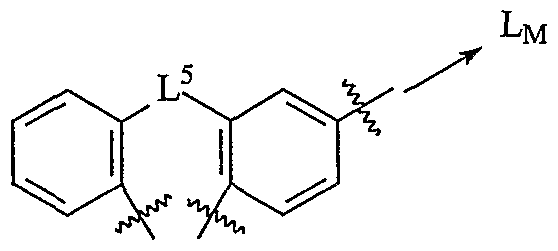
  • one Ar 1 and one Ar 2 are combined to form the group:
  • L 5 is O (e.g. compound (IIa-68)) or S (e.g. compounds (IIa-58a) and (IIa-69)).
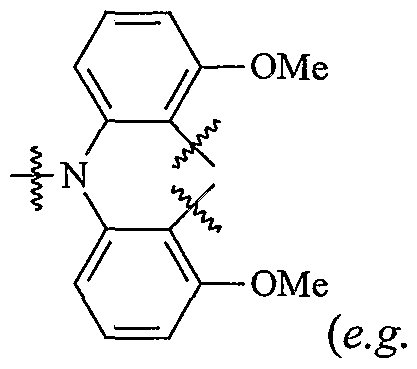
  • Preferred optional substituents A are -OMe (e.g. compounds IIa-68 and IIa-69), preferably para to C* .
  • one Ar 1 and one Ar 2 are combined to form the group:
  • L 5 is O or S (e.g. compound (IIa-67)), preferably S.
  • Compounds of this embodiment also show improved mass spectrometry enhancing properties.
  • Preferred optional substituents A are -OMe (e.g. compound IIa-67), preferably para to C* .
  • two Ar 1 or Ar 2 groups are linked by one L 5 , wherein one Ar 1 or Ar 2 group is a polycyclic aromatic group (e.g. naphthyl or pyrenyl), preferably a pyrenyl group.
  • Ar 1 or Ar 2 group is a polycyclic aromatic group (e.g. naphthyl or pyrenyl), preferably a pyrenyl group.
  • Such combinations of Ar groups are fluorescent and allow labelling, e.g. of the biopolymer.
  • An example of such a combination of Ar groups is:
  • A e.g. -OMe
  • Ar 1 optionally substituted by A, e.g. -OMe, wherein when one or more of the Ar groups is Ar 1 , the combination includes an appropriate number of L M ⁇ M ⁇ P groups.
  • L 5 is S.
  • a particularly preferred combination of Ar groups in this embodiment is: optionally substituted by A, e.g. -OMe, e.g.
  • the combination includes an appropriate number of L M ⁇ M ⁇ p groups.
  • biopolymer' includes polymers found in biological samples, including polypeptides, polysaccharides, and polynucleotides (e.g. DNA or RNA).
  • Polypeptides may be simple copolymers of amino acids, or they may include post-translational modifications e.g. glycosylation, lipidation, phosphorylation, etc.
  • Polynucleotides may be single-stranded (in whole or in part), double-stranded (in whole or in part), DNA/RNA hybrids, etc.
  • RNA may be mRNA, rRNA or tRNA.
  • Biopolymers for use in the invention comprise two or more monomers, which may be the same or different as each other.
  • Preferred biopolymers comprise at least pp monomers, where pp is 5 or more (e.g. 6, 7, 8, 9, 10, 15, 20, 25, 30, 35, 40, 45, 50, 60, 70, 80, 90, 100, 125, 150, 175, 200, 250). More preferred biopolymers comprise ppp or fewer monomers where ppp is 300 or less (e.g. 200, 100, 50).
  • Preferred biopolymers are those having a molecular mass within the range of detection of a mass spectrometer. More preferred biopolymers have a molecular mass of qqq kDa or less, where qqq is 30 or less (e.g. 20, 10, 5).
  • the ratio m(Bp') / m(IX) is preferably more than nn, where nn is at least 2 (e.g. 3, 4, 5, 10, 100, 1000, etc.).
  • the invention is suitable for use with purified biopolymers or mixtures of biopolymers.
  • a pure recombinant protein could be derivatised and analysed by MS, or biopolymers within a cellular lysate or extract could be derivatives and then analysed.
  • Preferred biopolymers are polypeptides. Particularly preferred biopolymers are polypeptides formed after proteolytic digestion of a protein.
  • Biopolymers bound to solid supports hi preferred embodiments of the invention the biopolymer is bound to a solid support such that it is cleavable from the solid support at least once it has been derivatised by a compound of the invention. Bp is thus derivatised in situ while bound to the support, and is then released.
  • this aspect of the invention is particular relevant to methods involving compounds of formulae (Ha) and (lib).
  • the biopolymer may be bound to the solid support by a covalent, ionic, hydrogen, dipole-dipole or van der Waals bond (also known as a dispersion bond or a London forces bond).
  • the covalent, ionic, hydrogen, dipole-dipole or van der Waals bond may be direct between the biopolymer and the solid support or may be provided by one or more binding groups present on the biopolymer and/or solid support. Preferred groups are non-covalent groups.
  • the solid support is provided with -(NMe 3 ) "1" binding groups and the biopolymer has a net negative charge, or vice versa ⁇ i.e. the -(NMe 3 ) "1" is on the biopolymer).
  • the solid support is provided with anions such as carboxylate, phosphate or sulphate, or anions formed from acid groups, and the biopolymer ⁇ e.g. a histone) has a net positive charge, or vice versa.
  • the biopolymers have at least one reactive group capable of reacting with M to form a covalent linkage.
  • groups typically include naturally occurring groups and groups formed synthetically on the biopolymer.
  • Naturally occurring groups include lipid groups of lipoproteins ⁇ e.g. myristoyl, glycosylphosphatidylinositol, ethanolamine phosphoglycerol, palmitate, stearate, S- or N- or O-acyl groups, lipoic acid, isoprenyl, geranylgeranyl, farnesyl, etc.), amide, carbohydrate groups of N- and O- glycoproteins, amine groups ⁇ e.g. on lysine residues or at the N-terminus of a protein), hydroxyl ⁇ e.g.
  • the reactive group is bound to the biopolymer by one or more covalent bonds (e.g. 2 or 3 bonds), which are either single, double or triple covalent bonds (preferably single bonds).
  • the reactive group is bound to the biopolymer by one single bond.
  • -P(ZR)Y e.g. -P(OH)Y; -PY 2 ; -Z-P(ZR)Y; -Z-PY 2 ; -P(R)Y e.g. -P(H)Y; -Z-P(R)Y.
  • a particularly preferred group is -Z-P(ZR)Y, especially a phosphoramidite group:
  • a group which may be formed naturally or synthetically on the biopolymer and which is bound to the biopolymer by one bond is -Y.
  • the reactive group when the reactive group is halo (especially iodo), the reactive group may be bound to an aliphatic or aromatic carbon.
  • Groups which may be formed synthetically on the biopolymer and which are bound to the biopolymer by two bonds include -N(R)- e.g. -NH-; -S-; -0-; -B(Y)-; -C(R)(Y)-; -CY 2 -; -C(O)-; -C(OH)(OR)-; -C(OR) 2 -.
  • biopolymer by three bonds include C(Y)
  • Preferred groups include nucleophilic groups, either natural or synthetic, e.g.: -NR 2 e.g. -NHR, especially -NH 2 ; -SR e.g. -SH; -OR e.g. -OH; -N(R)- e.g. -NH-; -S-; and -0-.
  • the groups -NH 2 , -SH and -OH are particularly preferred.
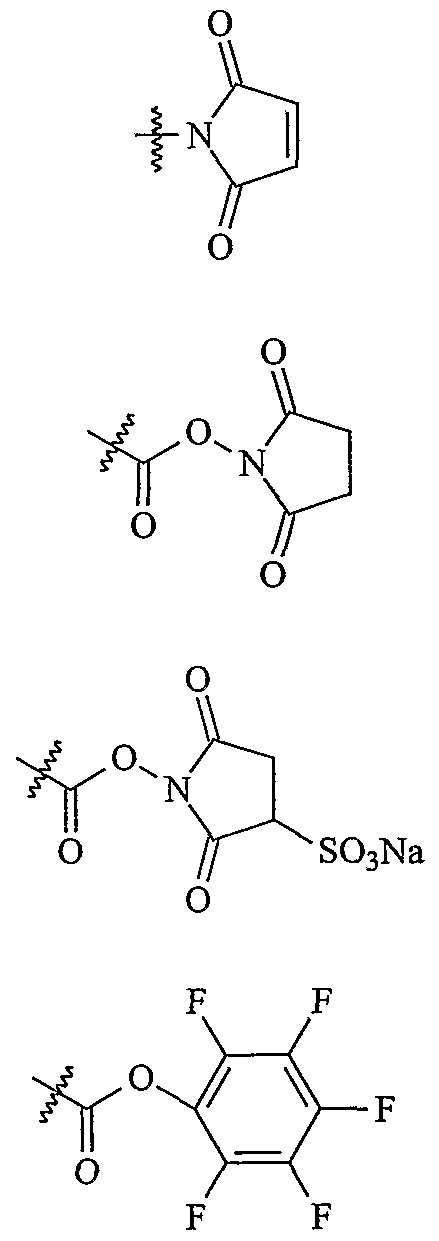
  • Another preferred reactive group is maleimidyl:
  • Y is independently a leaving group, including groups capable of leaving in an SN 2 substitution reaction or being eliminated in an addition-elimination reaction with the reactive group of the biopolymer B P .
  • Y include halogen (preferably iodo), Ci -8 hydrocarbyloxy (e.g. Ci -8 alkoxy), substituted with one or . more A, C 1-8 heterohydrocarbyloxy, Q-gheterohydrocarbyloxy substituted with one or more A, mesyl, tosyl, pentafiuorophenyl, -O-succinimidyl (formula VII) or a sulfo sodium salt thereof (sulfoNHS - formula Vila), -S-succinimidyl, or phenyloxy substituted with one or more A e.g. p-nitrophenyloxy (formula VIII) or pentafluorophenoxy (formula Villa).
  • halogen preferably iodo
  • Ci -8 hydrocarbyloxy e.g. Ci -8 alkoxy
  • Q-gheterohydrocarbyloxy substituted with one or more A mesy
  • Y include -ZR.
  • Particularly preferred examples of Y are -ZH (e.g. -OH or -NH 2 ) and -Z-Ci -8 alkyl groups such as -NH-Ci -8 alkyl groups (e.g. -NHMe) and -O-C 1-8 alkyl groups (e.g. -O-t-butyl).
  • preferred reactive groups are -C(O)-NH-Ci -8 alkyl and -C(O)-O-C 1- 8 alkyl (e.g. -C(O)-O-t-butyl).
  • Y include -Z-ZR.
  • Particularly preferred examples include -NR-NR 2 , especially -NH-NH 2 , and -ONR 2 , especially -O-NH 2 .
  • R is independently H, Ci-shydrocarbyl (e.g. Ci.galkyl) or Cj-shydrocarbyl substituted with one or more A.
  • R is preferably H.
  • the reactive group may be -Si(R) 2 -Y, with Y being halo (e.g. chloro) being especially preferred.
  • Preferred groups R in this embodiment are d-galkyl, especially methyl.
  • a particularly preferred reactive group in this embodiment is -Si(Me) 2 Cl.
  • groups which may be formed naturally or synthetically on the biopolymer include groups capable of reacting in a cycloaddition reaction, especially a Diels- Alder reaction.
  • the reactive group on the biopolymer is either a diene or a dienophile.
  • Preferred diene groups are
  • a 1 is -R 1 or -Z 1 R 1 , where R 1 and Z 1 are defined below.
  • a particularly preferred dienophile group is maleimidyl.
  • the group M is a reactive functional group.
  • Reactive functional groups include groups capable of reacting to form a covalent linkage and groups capable of ionic bonding, hydrogen bonding, dipole- dipole bonding or van der Waals bonding.
  • Particularly preferred groups M are those capable of reacting to form a covalent linkage.
  • the group M is bound to L M by one or more covalent bonds (e.g. 2 or 3 bonds, especially 2 such
  • LM M as ⁇ - — s ), which are either single, double or triple covalent bonds (preferably single bonds).
  • M is bound to L M by one single bond.
  • M is bound by more than one L M , such L M either being attached to the same or different Ar 1 or Ar 2 .
  • M is bound by more than one L M from different Ar 1 or Ar 2 , e.g.:
  • Particularly preferred groups M are those capable of reacting to form a covalent linkage.
  • the group M is capable of reacting with the reactive group of the biopolymer, Bp, to form a covalent linkage.
  • -NR 2 e.g. -NHR
  • -NHMe e.g. compound (IIa-17b)
  • -SR e.g. -SH
  • -OR e.g. -OH e.g. compound (IIa-3a)
  • Another example of a group M bound to L M by one bond is -CN.
  • group M bound to L M by one bond are -P(ZR)Y e.g. -P(OH)Y; -PY 2 ; -Z-P(ZR)Y; -Z-PY 2 ; -P(R)Y e.g. -P(H)Y; -Z-P(R)Y.
  • a particularly preferred group M is -Z-P(ZR)Y, especially a phosphoramidite group:
  • group M bound to L M by one bond is -Y.
  • M may be bound to an aliphatic (e.g. compound (Ha- 17c)) or aromatic carbon (e.g. compounds (IIb-28c) & (IIb-28d)).
  • M is halo (e.g. iodo) and is bound to an aromatic carbon
  • L M may, for example, be a single bond.
  • groups of group M bound to L M by two bonds include -N(R)- e.g.
  • Examples of group M bound to L M by three bonds include C(Y)
  • Preferred groups M include electrophilic groups, especially those susceptible to SN 2 substitution reactions, addition-elimination reactions and addition reactions, e.g. -B(R)Y; -BY 2 ; -C(R) 2 Y;
  • Another preferred electrophilic group M is -CN.
  • group M are orthoesters, e.g. -C(OR) 3 .
  • the R groups are linked together to form a hydrocarbyl group, e.g. a Q-salkyl group.
  • a preferred example of group M in this embodiment is:
  • Another preferred group M is maleimido (e.g. compound (Ha- 1 Sd)).
  • Y is independently a leaving group, including groups capable of leaving in an SN 2 substitution reaction or being eliminated in an addition-elimination reaction.
  • Preferred examples of Y include halogen (preferably iodo), Ci -8 hydrocarbyloxy (e.g.
  • Ci -8 hydrocarbyloxy substituted with one or more A Ci.sheterohydrocarbyloxy, Ci -8 heterohydrocarbyloxy substituted with one or more A, mesyl, tosyl, pentafluorophenyl, -O-succinimidyl (formula VII) or a sulfo sodium salt thereof (sulfoNHS - formula Vila), -S-succinimidyl, or phenyloxy substituted with one or more A e.g. p-nitrophenyloxy (formula VIII) or pentafluorophenoxy (formula Villa) (e.g. compound (Ha- 16)).
  • Y include -ZR.
  • Particularly preferred examples of Y are -ZH (e.g. -OH or -NH 2 ) and -Z-Ci -8 alkyl groups such as -NH-Ci -8 alkyl groups (e.g. -NHMe) and -O-Ci -8 alkyl groups (e.g. -O-t-butyl).
  • preferred groups M are -C(O)-NH-Ci -8 alkyl (e.g. -C(O)NHMe) and -C(O)-O-C 1-8 alkyl (e.g. -C(O)-O-t-butyl (e.g. compounds (IIa-24a) & (IIa-33a)).
  • Y include -Z-ZR.
  • Particularly preferred examples include -NR-NR 2 , especially -NH-NH 2 (e.g. compounds (IIa-35Ab), (IIa-35Bc) and (IIa-35Bd)), and -ONR 2 , especially -0-NH 2 (e.g. compounds (IIa-35Cc) and (IIa-35Cd)).
  • R is independently H, C 1-8 hydrocarbyl (e.g. Ci -8 alkyl) or Q.shydrocarbyl substituted with one or more A.
  • R is preferably H.
  • M may be -Si(R) 2 -Y, with Y being halo (e.g. chloro) being especially preferred.
  • Preferred groups R in this embodiment are C 1-8 alkyl, especially methyl.
  • a particularly preferred group M in this embodiment is -Si(Me) 2 Cl (e.g. compound (Ha- 19d)).
  • M may be -C(Ar 2 ) 2 X.
  • Preferred groups Ar and X are set out below, hi this embodiment it is preferred that L M is a bond.
  • a particularly preferred group M in this embodiment is:
  • groups M include groups capable of reacting in a cycloaddition reaction, especially a Diels- Alder reaction.
  • the group M is either a diene or a dienophile.
  • Preferred diene groups are
  • a 1 is -R 1 Or-Z 1 R 1 , where R 1 and Z 1 are defined below.
  • a particularly preferred dienophile group is maleimidyl.
  • Preferred examples of group M are shown in figures 2 A and 2B.
  • group M is a reactive functional group capable of ionic bonding
  • group M typically comprises one or more chelating ligands.
  • Suitable chelating ligands which can bind anions include polyamines and cryptands.
  • Suitable chelating ligands which can bind cations include polyacidic compounds (e.g. EDTA) and crown ethers.
  • group M is a reactive functional group capable of hydrogen bonding
  • M will typically bear one or more hydroxy, amino or thio hydrogen atoms or a group bearing an atom having one or more lone pair of electrons ⁇ e.g. an oxygen, sulphur or nitrogen atom).
  • Preferred groups capable of hydrogen bonding include biotin, avidin and streptavidin.
  • Dipole-Dipole Bonding Where group M is a reactive functional group capable of dipole-dipole bonding, the dipole-dipole bond may be formed between permanent dipoles or between a permanent dipole and an induced dipole.
  • Preferred groups M capable of dipole-dipole bonding comprise acid groups, or -(NMe 3 ) 4" , carboxy, carboxylate, phosphate or sulphate groups.
  • M is a reactive functional group capable van der Waals bonding
  • M will typically comprise a hydrocarbyl or heterohydrocarbyl group (usually a large hydrocarbyl group having at least ten carbon atoms up to about 50 carbon atoms), optionally substituted with one or more A.
  • Hydrocarbyl or heterohydrocarbyl groups are particularly preferred.
  • the hydrocarbyl or heterohydrocarbyl groups are aryl or heteroaryl groups or groups of the formula -C(R 6 ) 2 Ar 3 , -C(R 6 XAr 3 );, or -C(Ar 3 ) 3 , where Ar 3 is independently defined the same as Ar 2 and R 6 is H, C 1-8 hydrocarbyl, Ci -8 hydrocarbyl substituted by one or more A, Ci -8 heterohydrocarbyl or Ci -8 heterohydrocarbyl substituted by one or more A.
  • a preferred group capable of van der Waals bonding is tetrabenzofuUerene (formula X).
  • adamantyl e.g. 2-adamantyl (e.g. compound (IIa-36a)
  • phenyl e.g. example (IIa-37b).
  • these groups are linked to a hydrocarbylene group (e.g. Ci -8 alkylene group) which forms L M or a part thereof.
  • a hydrocarbylene group e.g. Ci -8 alkylene group
  • the reactive group on the biopolymer and the group M must be dependently selected in order to form the covalent linkage.
  • M may also be -CN.
  • one of the reactive group on the biopolymer and group M is a maleimidyl and the other will be a -SH group.
  • covalent linkage when the covalent linkage is to be formed by a Diels Alder reaction, one of the reactive group on the biopolymer and group M will typically be a diene and the other will be a dienophile.
  • Preferred covalent linkages are those produced through the reaction of the following groups:
  • the covalent residue M'-Bp' is the reaction product of M and Bp.
  • Bp 1 will generally be the same as Bp except that instead of the reactive group, Bp 1 will have a residue of the reactive group covalently bound to the residue M'.
  • M' and the residue of the reactive group will typically form linkages, in the orientation L M -M'-B ?
  • M" is the same as M except that Ss is bound to a portion of M which does not from part of the residue of M" remaining attached to the ion of formula (I 1 ) which residue is produced after reaction of group M".
  • M is a residue of M formable by the conjugation of M and Ss.
  • M need not necessarily be formed by the conjugation of M and Ss.
  • M" — Ss comprises a covalent, ionic, dipole-dipole, hydrogen, or van der Waals bond.
  • the covalent, ionic, hydrogen, dipole-dipole or van der Waals bond may be direct between M" and Ss or may be provided by one or more binding groups present on M" and/or Ss.
  • This embodiment of the invention is advantageous, since the derivativisation of the biopolymer will also release the derivatised biopolymer from the solid support. Thus, an additional step of cleaving the biopolymer from the solid support is not required.
  • Preferred groups M" are groups M having a leaving group, wherein the group Ss is bound to the leaving group, e.g. groups M mentioned above having a leaving group Y, wherein the group Ss is bound to the leaving group Y.
  • a particularly preferred group M" is:
  • group L M is a linker atom or group, it has a sufficient number of linking covalent bonds to link L M to the group Ar 1 by a single covalent bond (or more, as appropriate) and to link L M to the p instances of M groups (which may be attached to L M by one or more bonds).
  • the group L M may be directly bound to the aromatic part of Ar 1 , bound to one or more of the substituents A of Ar 1 , or both.
  • L M is bound directly to the aromatic part of Ar 1 .
  • L M may be bound to L 5 .
  • linker atoms are O or S, particularly O.
  • L M is a linker group
  • preferred linker groups in the orientation Ar 1 -(L M ⁇ M ⁇ p ) q , are -E M -, -(D M )t-, -(E M -D M )t-, -(D M -E M ) r , -E M -(D M -E M ) t - or -D M -(E M -D M ) r , where a sufficient number of linking covalent bonds, in addition to the covalent bonds at the chain termini shown, are provided on groups E M and D M for linking the p instances of M groups.
  • D M is independently C 1-8 hydrocarbylene or C 1-8 hydrocarbylene substituted with one or more A.
  • Preferred D M are Ci -8 alkylene, C 1-8 alkenylene and Ci -8 alkynylene, especially Ci -8 alkylene and
  • Ci -8 alkynylene each optionally substituted with one or more A (preferably unsubstituted).
  • a preferred substituent A is 2 H.
  • -C C-CH 2 - (e.g. compounds (IIa-12b) & (IIa-12c)) and-CH 2 CH 2 CH 2 - (e.g. compounds (II-4a),
  • the group -Si(R M ) 2 -Z M - is particularly preferred.
  • Z M is preferably O.
  • R M is preferably C 1-8 alkyl, preferably methyl.
  • D M may also be Ci -8 heterohydrocarbylene or C 1-8 heterohydrocarbylene substituted with one or more A.
  • D M may also be Ci -8 heterohydrocarbylene or C 1-8 heterohydrocarbylene substituted with one or more A.
  • preferred L M groups -D M -E M -D M - are, in the orientation AT ⁇ (LM (MJP) 9 ,
  • t 1 or more, e.g. from 1 to 50, lto 40, 1 to 30, 1 to 20 or 1 to 10.
  • t 1, 2, 3, 4, 5, 6, 7, 8, 9, or 10.
  • L M links one group M to Ar 1 , M is linked to LM by a single covalent bond and therefore no additional bonds are required (e.g. LM(M) 1 may be -E M - ⁇ M), -(D M ) t -(M), -(E M -D M ) t - ⁇ M ⁇ , -(D M -E M ) t - ⁇ M ⁇ , -E M -(D M -E M ) t - ⁇ M ⁇ or -D M -(E M -D M ) t - ⁇ M ⁇ ).
  • LM includes a group which also falls within the definition of group M
  • the group M is preferably more reactive than the group included in LM-
  • LM is preferably -(D M ) t -, -(E M -D M ) t -, or -D M -(E M -D M ) t -.
  • D M is preferably Ci ⁇ alkylene, preferably Ci.salkylene, preferably methylene or ethylene.
  • t is preferably 1.
  • LM are, in the orientation Ar 1 -(L M (M ⁇ p ) q , -0-CH 2 CH 2 CH 2 - (e.g.
  • E M is Ci -8 alkylene and t is 1.
  • Particularly preferred L M groups are:
  • the group -(D M -E M ) t - is also preferred when D M is Ci_ 8 alkylene and t is 1.
  • a particularly preferred example is -CH 2 CH 2 CH 2 N(Me)C(O)-.
  • L M is a single covalent bond.
  • L M is preferably provided in a position ortho or para to C* .
  • L M is preferably attached to an atom which bears the charge in at least one of the resonance structures of the ions of formula (I 1 ).
  • L M is preferably an electron-donating group.
  • C* is an anion
  • L M is preferably an electron-withdrawing group.
  • L M Preferred examples of L M are shown in figures IA and IB.
  • C- - -Ss, Ss- - -Ar 1 and S s - - -Ar 2 comprise a cleavable covalent, ionic, hydrogen, dipole-dipole or van der Waals bond (also known as a dispersion bond or a London forces bond).
  • the covalent, ionic, hydrogen, dipole-dipole or van der Waals bond may be direct between C and Ss, Ar 1 and Ss, or Ar 2 and Ss, or may be provided by one or more binding groups present on C and/or Ss, Ar 1 and/or Ss, or Ar 2 and/or Ss, respectively.
  • the bond may be direct ⁇ e.g. C-Ss, Ar'-Ss or Ar ⁇ -Ss, respectively) or may be provided by a linker atom or group L 4 ⁇ e.g. C-L 4 -Ss, Ar'-L ⁇ Ss or Ai ⁇ -L ⁇ Ss, respectively).
  • preferred linker groups are -E 4 -, -(D 4 )t"- 5 -(E 4 -D 4 ) t »-, -(D 4 -E 4 )t"-, -E 4 -(D 4 -E 4 ) t - or -D 4 -(E 4 -D 4 ) t »-.
  • D 4 is independently Cj.shydrocarbylene or Ci-shydrocarbylene substituted with one or more A.
  • Z 4 is independently O, S or N(R 4 ), and where R 4 is independently H, Ci-shydrocarbyl ⁇ e.g. Ci-galkyl) or C 1-8 hydrocarbyl substituted with one or more A.
  • R 4 is independently H, Ci-shydrocarbyl ⁇ e.g. Ci-galkyl) or C 1-8 hydrocarbyl substituted with one or more A.
  • E 4 is, in the orientation C-L 4 -Ss, -O-,
  • L 4 includes a group which also falls within the definition of group M, the group M is preferably more reactive than the group included in L 5 .
  • L 4 is preferably a linker atom, preferably O or S, particularly O.
  • L 4 is preferably covalently attached to the Ss by a sulphide or disulphide group.
  • the bond is typically direct (e.g. C* Ss*, where Ss* is a solid support counterion to C*).
  • binding groups e.g. chelating ligands, present on C or Ss, Ar 1 or Ss, or Ar 2 or Ss, respectively, hi the case of C — Ss bonds, the chelating ligand is typically only present on Ss and chelates with C* .
  • Suitable chelating ligands which can bind anions include polyamines and cryptands.
  • Suitable chelating ligands which can bind cations include polyacidic compounds (e.g. EDTA) and crown ethers.
  • the bond is usually provided by binding groups present on C or Ss, Ar 1 or S s , or Ar 2 or Ss, respectively.
  • one of C or Ss, Ar 1 or Ss, or Ar 2 or Ss will have a binding group bearing one or more hydroxy, amino or thio hydrogen atoms
  • the other of C or Ss, Ar 1 or Ss, or Ar 2 or Ss, respectively will have a binding group bearing an atom having one or more lone pair of electrons (e.g. an oxygen, sulphur or nitrogen atom).
  • one of C or Ss, Ar 1 or S 5 , or Ar 2 or Ss, as appropriate, will have a binding group comprising biotin, and the other of C or Ss, Ar 1 or S 3 , or Ar 2 or Ss, respectively, will have a binding group comprising avidin or streptavidin.
  • the hydrogen bond may be direct. Dipole-Dipole Bonding
  • the bond is a dipole-dipole bond, it may be formed between permanent dipoles or between a permanent dipole and an induced dipole.
  • one of Ss and the compound of the invention has a permanent dipole and the other of Ss and the compound of the invention has an induced dipole or a permanent dipole, the attraction between the dipoles forming a dipole-dipole bond.
  • Ss comprises binding groups (e.g. acid groups, -(NMe 3 ) "1" , carboxy, carboxylate, phosphate or sulphate groups) which produce a dipole at the surface of the solid support to bind the compound of the invention.
  • Van der Waals Bonding Where the bond is a van der Waals bond, the bonding is usually provided by binding groups present on C or Ss, Ar 1 or S s , or Ar 2 or Ss, respectively.
  • At least one, but preferably both, of C or Ss, Ar 1 or Ss, or Ar 2 or Ss, as appropriate, will have a hydrocarbyl or heterohydrocarbyl group (usually a large hydrocarbyl group having at least ten carbon atoms up to about 50 carbon atoms), optionally substituted with one or more A.
  • a hydrocarbyl or heterohydrocarbyl group usually a large hydrocarbyl group having at least ten carbon atoms up to about 50 carbon atoms
  • Polyfiuorinated hydrocarbyl and heterohydrocarbyl groups are particularly preferred.
  • the hydrocarbyl or heterohydrocarbyl groups are aryl or heteroaryl groups or groups of the formula -C(R 6 ) 2 Ar 3 , -C(R 6 )(Ar 3 ) 2 or -C(Ar 3 ) 3i where Ar 3 is independently defined the same as Ar 2 and R 6 is H, C 1 - S hydrocarbyl, C 1-8 hydrocarbyl substituted by one or more A, C 1 _ 8 heterohydrocarbyl or Cj -8 heterohydrocarbyl substituted by one or more A.
  • a preferred binding group is tetrabenzofullerene (formula X).
  • the van der Waals bond may be direct.
  • the ions of formula (I 1 ) have a pK ⁇ - value of at least zz, where zz is 0 or more (e.g. 0, 1, 2, 3, 4, 5, 6, 7, 8, 9, 10, 11, 12, 13, 14). More preferably, zz is 1 or more, still more preferably 2 or more, still more preferably 3 or more.
  • the ions of formula (I) have a pK r+ value of at least zz, where zz is defined above.
  • the compounds of formula (Ha), (lib), (Ilia) or (HIb) or the solid supports of formula (IVai), (IVaii), (TVaiii), (IVb ⁇ ), (IVbiii), (IVaiv) or (IVbiv) provide ions of formula (F) having a pK ⁇ - value of at least zz, where zz is defined above.
  • the C-X bonds are cleavable by irradiation, electron bombardment, electrospray, fast atom bombardment (FAB), inductively coupled plasma (ICP) or chemical ionisation.
  • the C-X bonds are cleavable by irradiation or chemical ionisation.
  • the term 'irradiation' includes, for example, laser illumination, in particular as used in MALDI mass spectrometry. Laser light of about 340 nm is particularly preferred because it is typically used in MALDI mass spectrometers.
  • 'electron bombardment' includes, for example, bombardment with electrons having energy of about 70 ev.
  • Chemical ionisation can be effected, for example, by treatment with acid or acidic matrices (e.g. acidic matrices used in MALDI analysis).
  • acid or acidic matrices e.g. acidic matrices used in MALDI analysis.
  • group X is halogen, hydroxy, Ci -8 hydrocarbyloxy, Ci -8 hydrocarbyloxy substituted with one or more A, Ci-sheterohydrocarbyloxy, Q.sheterohydrocarbyloxy substituted with one or more A, mesyl, tosyl, pentafluorophenyl, -O-succinimidyl -S-succinimidyl, or phenyloxy substituted with one or more A e.g. p-nitrophenyloxy.
  • the groups pentafluorophenyl, -O-succinimidyl, -S-succinimidyl, and p-nitrophenyloxy are preferred.
  • Particularly preferred groups X are halogen, hydroxy, Ci -8 hydrocarbyloxy.
  • Especially preferred groups are hydroxy (e.g. compounds (IIa-61a) & (IIa-62a)), ethoxy (e.g. compound (Ha- 14a)) and chloro (e.g. compound (IIa-64b)) groups.
  • alkyl ethers e.g.:
  • Group X may also be a -Q-oligonucleotide, where Q is O, S or N(R), where R is H, Q- ⁇ hydrocarbyl or Ci-ghydrocarbyl substituted with one or more A.
  • Q is preferably O.
  • Group X may also be a nucleoside, preferably where the nucleoside is bound via its 5' end, e.g.:
  • Bp is an antibody (particularly where it is a monoclonal antibody that recognises a tumour-associated antigen)
  • X is not:
  • X is not any other 2,6-diaminopurine nucleoside prodrug group.
  • X is not H. IfX is H, preferably at least one of Ar 1 and Ar 2 is polycyclic, heterocyclic or unsubstituted.
  • Ionic C* X* Bonds X* is any counterion for forming salts with compounds of the invention.
  • X* includes ions having single charges and multiple charges. Typically ions having multiple charges will be associated with an appropriate number of compounds of formula (lib), (IVbii), (rVbiii) or (IVbiv), in order to balance the charge. Ions having multiple charges include doubly charged ions (e.g. SO 4 2" ) and triply charged ions. X* preferably has a single charge.
  • the counterion X* may be dissociated from the derivative of formula (lib), (IVbii), (IVbiii), (IVbiv) or (Vbii) by irradiation, electron bombardment, electrospray, fast atom bombardment (FAB), inductively coupled plasma (ICP) or chemical ionisation.
  • the counterion X* may be dissociated by irradiation.
  • X* When X* is a cation, X* is preferably H + or Li + , especially Li + .
  • X* is an anion, X* is preferably, BF 4 ' or ClO 4 " , especially BF 4 " (e.g. compounds (IIb-28b), (IIb-28c) & (IIb-28d)).
  • X ⁇ *r is an anion. Preferred examples of group X* are shown in figure 4.
  • the C Ss, Ss Ar 1 or Ss Ar 2 bonds are cleavable by irradiation, electron bombardment, electrospray, fast atom bombardment (FAB), inductively coupled plasma (ICP) or chemical ionisation.
  • FAB fast atom bombardment
  • ICP inductively coupled plasma
  • the C- - -Ss, Ss- - -Ar 1 or Ss- - -Ar 2 bonds are cleavable by irradiation or chemical ionisation.
  • the C S s , S s Ai- 1 or S 5 Ar 2 bonds may be cleaved simultaneously or sequentially with the cleaving of the C-X bond or the dissociation of X*, as appropriate, by selection of suitable cleaving/dissociating conditions.
  • the C- - -Ss bond in the solid support of formula (Vai) may be cleaved in sub-steps of step (iia) so that in a first sub-step a residue X (where X is the leaving group defined above) is provided and in a second subsequent sub-step the C-X bond is cleaved thereby forming the ion of formula (I).
  • the second sub-step may be carried out substantially (e.g. seconds, minutes, hours or even days) after the first sub-step.
  • Ar 2 is independently an aromatic group or an aromatic group substituted with one or more A and is preferably independently cyclopropyl, cyclopropyl substituted with one or more A, aryl, aryl substituted with one or more A, heteroaryl, or heteroaryl substituted with one or more A.
  • aryl or substituted aryl Ar 2 is preferably C 6-30 aryl or substituted C 6-3O aryl.
  • heteroaryl or substituted heteroaryl Ar 2 is preferably C 6-30 heteroaryl or substituted C 6-3O heteroaryl.
  • monocyclic aromatic groups e.g. phenyl or pyridyl
  • fused polycyclic aromatic groups e.g. napthyl, such as 1-napthyl or 2-napthyl
  • aryl groups are monovalent derivatives of aceanthrylene, acenaphthylene, acephenanthrylene, anthracene, azulene, chrysene, coronene, fluoranthene, fluorene, ⁇ s-indacene, s- indacene, indene, naphthalene, ovalene, perylene, phenalene, phenanthrene, picene, pleiadene, pyrene, pyranthrene and rubicene, which groups may be optionally substituted by one or more A.
  • heteroaryl groups are monovalent derivatives of acridine, carbazole, jS-carboline, chromene, cinnoline, furan, imidazole, indazole, indole, indolizine, isobenzofuran, isochromene, isoindole, isoquinoline, isothiazole, isoxazole, naphthyridine, perimidine, phenanthridine, phenanthroline, phenazine, phthalazine, purine, pyran, pyrazine, pyrazole, pyridazine, pyridine, pyrimidine, pyrrole, pyrrolizine, quinazoline, quinoline, quinolizine, quinoxaline, thiophene and xanthene, which groups may be optionally substituted by one or more A.
  • Preferred heteroaryl groups are five- and six-membered monovalent derivatives, such as the monovalent derivatives of furan, imidazole, isothiazole, isoxazole, pyran, pyrazine, pyrazole, pyridazine, pyridine, pyrimidine, pyrrole, pyrrolizine and thiophene.
  • the five-membered monovalent derivatives are particularly preferred, i.e. the monovalent derivatives of furan, imidazole, isothiazole, isoxazole, pyrazole, pyrrole and thiophene.
  • the heteroaryl groups may be attached to the remainder of the compound by any carbon or hetero (e.g. nitrogen) atom.
  • Ar 2 is preferably C 6-3 oaryl substituted by one or more A, preferably phenyl or napthyl (e.g. 1-napthyl or 2-napthyl, especially 2-napthyl) substituted by one or more A, more preferably phenyl substituted by one or more A.
  • A is preferably provided in a position ortho or para to C*.
  • Ar 2 is other than phenyl, A is preferably attached to an atom which bears the charge in at least one of the resonance structures of the ions of formula (I).
  • Fused polycyclic aromatic groups optionally substituted with one or more A, are particularly preferred.
  • a particularly preferred Ar 2 is unsubstituted pyrenyl or pyrenyl substituted with one or more A.
  • Unsubstituted pyrenyl is preferred.
  • the pyrenyl group may be 1 -pyrenyl ⁇ e.g. compounds (IIa-38a), (IIa-38b), (IIa-39a), (IIa-41a) & (IIa-41b)), 2-pyrenyl ⁇ e.g. compounds (IIa-42a) & (IIa-42b)) or 4- pyrenyl ⁇ e.g. compounds (IIa-43a) & (IIa-43b)).
  • Preferred heteroaryl Ar 2 groups are pyridyl, pyrrolyl, thienyl and furyl, especially thienyl.
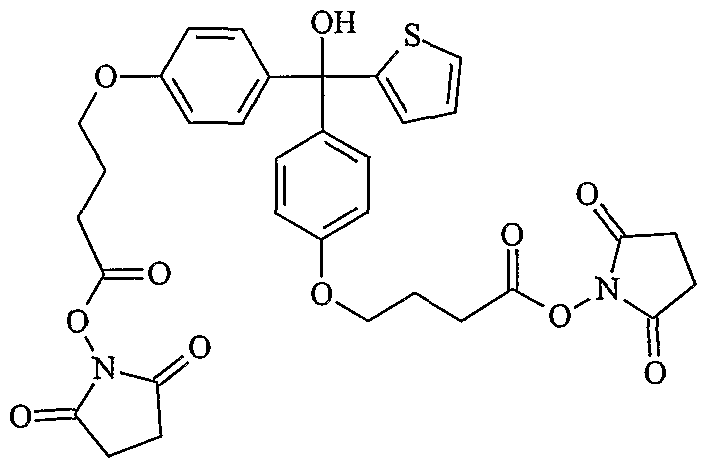
  • a preferred Ar 2 group is thiophenyl or thiophenyl substituted with one or more A. Unsubstituted thiophenyl is preferred. Examples of thiophenyl are thiophen-2-yl and thiophen-3-yl, with thiophen- 2-yl being especially preferred ⁇ e.g. compounds 50a, 51a & 51b).
  • Ar 2 is preferably substituted by 1, 2 or 3 A.
  • Ar 2 is preferably:
  • Ar 2 is preferably:
  • Ar 2 is cyclopropyl or cyclopropyl substituted with one or more A.
  • Unsubstituted cyclopropyl is preferred (e.g. compound (IIa-44a)).
  • One or more, preferably one, of Ar 2 may be cyclopropyl.
  • Preferred examples of group Ar 2 are shown in figures 3 A and 3B.
  • Ar 1 is independently an aromatic group or an aromatic group substituted with one or more A.
  • the definition of Ar 1 is the same as Ar 2 (as defined above), except that the valency of the group Ar 1 is adapted to accommodate the q instances of the linker L M - Preferred Ar 2 groups are also preferred Ar 1 groups, (as defined above), except that the valency of the group Ar 1 is adapted to accommodate the q instances of the linker L M .
  • Ar 1 is a divalent radical and is preferably independently cyclopropylene, cyclopropylene substituted with one or more A, arylene, arylene substituted with one or more A, heteroarylene, or heteroarylene substituted with one or more A.
  • arylene or substituted arylene Ar 1 is preferably C 6-3O arylene or substituted C 6-3O arylene.
  • heteroarylene or substituted heteroarylene Ar 1 is preferably C 6-3O heteroarylene or substituted C 6-3O heteroarylene.
  • monocyclic aromatic groups e.g. phenylene or pyridylene
  • fused polycyclic aromatic groups e.g. napthylene
  • arylene groups are polyvalent derivatives (where the valency is adapted to accommodate the q instances of the linker L M ) of aceanthrylene, acenaphthylene, acephenanthrylene, anthracene, azulene, chrysene, coronene, fluoranthene, fluorene, ⁇ s ⁇ indacene, s-indacene, indene, naphthalene, ovalene, perylene, phenalene, phenanthrene, picene, pleiadene, pyrene, pyranthrene and rubicene, which groups may be optionally substituted by one or more A.
  • heteroarylene groups are polyvalent derivatives (where the valency is adapted to accommodate the q instances of the linker L M ) of acridine, carbazole, ⁇ -carboline, chromene, cinnoline, furan, imidazole, indazole, indole, indolizine, isobenzofuran, isochromene, isoindole, isoquinoline, isothiazole, isoxazole, naphthyridine, perimidine, phenanthridine, phenanthroline, phenazine, phthalazine, purine, pyran, pyrazine, pyrazole, pyridazine, pyridine, pyrimidine, pyrrole, pyrrolizine, quinazoline, quinoline, quinolizine, quinoxaline, thiophene and xanthene, which groups may be optionally substituted by one or more A.
  • Preferred heteroaryl groups are five- and six- membered polyvalent derivatives, such as the polyvalent derivatives of furan, imidazole, isothiazole, isoxazole, pyran, pyrazine, pyrazole, pyridazine, pyridine, pyrimidine, pyrrole, pyrrolizine and thiophene.
  • the five-membered polyvalent derivatives are particularly preferred, i.e. the polyvalent derivatives of furan, imidazole, isothiazole, isoxazole, pyrazole, pyrrole and thiophene.
  • the heteroaryl groups may be attached to the remainder of the compound by any carbon or hetero (e.g. nitrogen) atom.
  • Ar 1 is preferably C 6-3 oarylene substituted by one or more A, preferably phenylene or napthylene substituted by one or more A, more preferably phenylene substituted by one or more A.
  • A is preferably provided in a position ortho or para to C*.
  • Ar 1 is other than phenylene, A is preferably attached to an atom which bears the charge in at least one of the resonance structures of the ions of formula (I).
  • Ar 1 When substituted, Ar 1 is preferably substituted by 1, 2 or 3 A. When unsubstituted, preferred Ar 1 are:
  • two or three of the groups Ar 1 and Ar 2 are linked together by one or more L 5 , where L 5 is independently a single bond or a linker atom or group; and/or two or three of the groups Ar 1 and Ar 2 together form an aromatic group or an aromatic group substituted with one or more A.
  • preferred linker groups are -E 5 -, -(D 5 ) t '- 5 -(E 5 -D 5 ) t '-, -(D 5 -E 5 )f-, -E 5 -(D 5 -E 5 ) t - or -D 5 -(E 5 -D 5 ) t -.
  • D 5 is independently C ⁇ hydrocarbylene or Ci-ghydrocarbylene substituted with one or more A.
  • L 5 includes an atom or group which also falls within the definition of group M
  • the group M is preferably more reactive than the group included in L 5 .
  • L 5 is preferably a linker atom, preferably O or S, particularly O.
  • L 5 is a linker group
  • a preferred L 5 is -N(R 5 )-.
  • L 5 is -S(O)- (e.g. compound (IIa-56b))
  • L 5 When two of the groups Ar 1 and Ar 2 are linked together by one or more (e.g. 2, 3 or 4) L 5 , they are preferably linked together by one L 5 , preferably O.
  • Preferred combinations of Ar are two Ar 2 (e.g. two Ar 2 phenyl groups) linked together by one L 5 (e.g. O or S).
  • Ar 2 phenyl groups optionally substituted by one or more A (preferably unsubstituted), linked together by one L 5 (e.g. O or S), where is L 5 is ortho to C* with respect to both phenyl groups.
  • L 5 e.g. O or S
  • Especially preferred combinations of two Ar 2 groups are:
  • a preferred combination of one Ar 1 and one Ar 2 is:
  • L 5 is O (e.g. compound (IIa-68)) or S (e.g. compounds (IIa-58a) and (IIa-69)).
  • Preferred optional substituents A are -OMe (e.g. compounds IIa-68 and IIa-69), preferably para to C* .
  • a preferred combination of one Ar 1 and one Ar 2 is: optionally substituted by A.
  • L 5 is O or S ⁇ e.g. compound (IIa-67)), preferably S.
  • Preferred optional substituents A are -OMe (e.g. compound IIa-67), preferably para to C* .
  • a preferred combination of Ar are two Ar 1 or Ar 2 groups (i.e. Ar 1 +Ar 1 , Ar 1 +Ar 2 , or Ar 2 + Ar 2 ), linked by one L 5 , wherein one Ar 1 or Ar 2 group is a polycyclic aromatic group (e.g. naphthyl or pyrenyl), preferably a pyrenyl group.
  • Such combinations of Ar groups are fluorescent and allow labelling, e.g. of the biopolymer.
  • An example of such a combination of Ar groups is:
  • A e.g. -OMe
  • Ar 1 optionally substituted by A, e.g. -OMe, wherein when one or more of the Ar groups is Ar 1 , the combination includes an appropriate number of LM ⁇ M ⁇ P groups.
  • L 5 is S.
  • a particularly preferred combination of Ar groups in this embodiment is:
  • A e.g. -OMe, e.g.
  • the combination includes an appropriate number of L M ⁇ M ⁇ p groups.
  • At least one L M is linked to an atom or group L 5 .
  • the preferred L 5 mentioned above are, where appropriate, modified to remove substituents R 5 in order to accommodate L M , e.g. the R 5 substituent of the group -N(R 5 )- is replaced by L M -
  • the L 5 group to which L M is bound is preferably:
  • Preferred combinations of Ar 1 and/or Ar 2 in this embodiment are:
  • the aromatic group may be a carbocyclic aromatic group or a carbocyclic aromatic group in which one or more carbon atoms are each replaced by a hetero atom.
  • the aromatic group in which one or more carbon atoms are each replaced by a hetero atom up to three carbons are so replaced, preferably up to two carbon atoms, more preferably one carbon atom.
  • Preferred hetero atoms are O, Se, S or N, more preferably O, S or N.
  • aromatic groups are C 8-5 o aromatic groups.
  • monocyclic aromatic groups e.g. radicals of suitable valency derived from benzene
  • fused polycyclic aromatic groups e.g. radicals of suitable valency derived from napthalene
  • preferred groups are radicals of suitable valency obtained from napthalene, anthracene or phenanthracene, chrysene, aceanthrylene, acenaphthylene, acephenanthrylene, azulene, fluoranthene, fluorene, as-indacene, s-indacene, indene, phenalene, and pleiadene.
  • preferred groups are radicals of suitable polyvalency obtained from acridine, carbazole, ⁇ -carboline, chromene, cinnoline, indole, indolizine, isobenzofuran, isochromene, isoindole, isoquinoline, naphthyridine, perimidine, phenanthridine, phenanthroline, phenazine, phthalazine, pteridine, purine, pyrrolizine, quinazoline, quinoline, quinolizine and quinoxaline.
  • Ar 1 and Ar 2 ' Anions and Cations
  • A is preferably an electron-donating group, including -R 1 or -Z 1 R 1 , where R 1 and Z 1 are defined below.
  • R 1 is C 1-8 hydrocarbyl, more preferably especially methyl.
  • Z 1 is preferably O, S or NR 1 .
  • R 1 may be substituted with one or more S u t, 2 , but is preferably unsubstituted.
  • A is preferably -OMe (e.g. compound (IIa-55a)), -SMe ⁇ e.g.
  • A is preferably an electron- withdrawing group, including halogen, trihalomethyl, -NO 2 , -CN, -N + (R ⁇ 2 O " , -CO 2 H, -CO 2 R 1 , -SO 3 H, -SOR 1 , -SO 2 R 1 , -SO 3 R 1 ,
  • the group A may also comprise one or more isotopes of the atoms making up group A (e.g. example 60), thus, as discussed in more detail below, allowing the masses of the compounds of the invention to be varied.
  • Preferred isotopes are 13 C, 18 O and 2 H. When providing a series of compounds which differ only in their masses, 13 C and 18 O are particularly preferred as 2 H atoms may cause a substantial change in the chemical properties of the compound due to the kinetic isotope effect.
  • Solid supports' for use with the invention include polymer beads, metals, resins, columns, surfaces (including porous surfaces) and plates (e.g. mass-spectrometry plates).
  • the solid support is preferably one suitable for use in a mass spectrometer, such that the invention can be conveniently accommodated into existing MS apparatus.
  • Ionisation plates from mass spectrometers are thus preferred solid supports, e.g. gold, glass-coated or plastic-coated plates. Solid gold supports are particularly preferred.
  • Resins or columns are particularly useful for receiving solutions of biopolymers (purified or mixtures).
  • a cellular lysate could be passed through such a column of formula (IVai), (IVaii), (IVaiii), (IVaiv), (IVbU), (IVbiii) or (IVbiv) followed by cleavage of the support to leave compounds of formula (I).
  • Solid supports of formulae (IVai), (IVaii), (IVaiii), (IVaiii), (IVaiv), (F/bii), (IVbiii) or (IVbiv) will generally present exposed groups M capable of reacting with a biopolymer, Bp.
  • groups M capable of reacting with a biopolymer, Bp.
  • ions preferably have a predictable mass to charge (m/e) ratio. If a biopolymer reacts with more than one M group, however, then it will carry more than one positive charge once ionised, and its m/e ratio will decrease.
  • the groups M are arranged such that any biopolymer molecule will covalently link with only a single group M. Consequently, each biopolymer will, on ionisation, carry a single positive charge and thus have a predictable mass to charge ratio.
  • the surface density of the solid supports of (IVai), (FVaU), (IVaiii), (FVaiv), (FVbU), (FVbiii) or (FVbiv) will be provided so that a biopolymer molecule can only covalently link with one group M and thus to prevent the formation of multiply derivatised biopolymers.
  • the masses of the compounds of the invention can be varied via L M , Ar 1 and/or Ar 2 .
  • the masses of the compounds of the invention are varied by varying A on the groups Ar 1 and/or Ar 2 .
  • compounds of the invention advantageously comprise one or more of F or I as substituents A of the groups Ar 1 , Ar 2 or Ar 3 .
  • F and I each only have one naturally occurring isotope, 19 F and 127 I respectively, and thus by varying the number of F and I atoms present in the structure of the compounds, can provide a series of molecular mass labels having substantially identical shaped peaks on a mass spectrum.
  • Compounds of the invention may also include one or more 2 H atoms, preferably as a substituent A or a part thereof of the groups L M , Ar 1 , Ai- 2 or Ar 3 (in particular L M ), in order to vary the masses of the compounds of the invention.
  • the compounds of the invention may include isotopes of 13 C and 18 O, prefererably as a substituent A or a part thereof of the groups L M , Ar 1 , Ar 2 or Ar 3 (in particular Ar 1 , Ar 2 or Ar 3 ), in order to vary the masses of the compounds of the invention.
  • Compounds comprising 2 H, 13 C and 18 O may also be used to provide a series of molecular mass labels having substantially identical shaped peaks on a mass spectrum, by varying the number of 2 H, 13 C and 18 O atoms present in the structure of the compounds.
  • 13 C and 18 O are particularly preferred as 2 H atoms may cause a substantial change in the chemical properties of the compound due to the kinetic isotope effect.
  • one or more of Ar 1 and Ar 2 may be substituted by one or more dendrimer radicals of appropriate valency, either as substituent A or group L M .
  • Preferred dendrimer radicals are the radicals obtained from the dendrimers of US 6,455,071 and PAMAM dendrimers.
  • the compounds of the invention may advantageously be used in the method of analysing a biopolymer disclosed herein, in particular in a method for following a reaction involving a biopolymer, Bp, since the abundance of a species of may be determined by mass spectrometry by measuring the intensity of the relevant peak in an obtained mass spectrum.
  • a method for analysing biopolymer Bp comprising the steps of:
  • step (ii) reacting a second sample comprising biopolymer Bp with a compound of formula (Ha) or (lib), wherein the compound of formula (Ila) or (lib) is selected from the compounds of formulae (Ila-la) to (IIa-69) or the compounds of formulae (IIb-28c), (IIb-28d) and (IIb-47b) described above, at a later time t 2 ; (iii) preparing and analysing cations of formula (I) from the first and second samples; and (iv) comparing the results of the analysis from step (iii).
  • different compounds of formula (Ha) or (lib) are used at different times in order to facilitate simultaneous and parallel analysis of the first and second samples. For example, if the two compounds used at times ti and t 2 differ only by a 1 H to 19 F substitution then the relative abundance of Bp at the two times can be determined by comparing peaks separated by 18 units.
  • the reaction of the biopolymer with the compound of formula (Ha) or (lib) will fix the biopolymer to prevent it reacting further and the steps of providing and analysing the cations may be carried out at a later convenient time.
  • a cation of formula (I) from the reaction product of step (i) or step (v) should be obtained as soon as possible after reaction of the biopolymer with the compound of formula (Ha) or (lib).
  • the present invention is particularly directed to compounds of formula (Ha) of the formulae (Ha- 1) to (IIa-69) set out in table 3 and to compounds of formula (lib) of the formulae (IIb-28c), (IIb-28d) and (IIb-47b) set out in table 4.
  • Group X of formula -X(IIa-48e) has the following structure:
  • Group X of formula -X(IIa-63c) has the following structure:
  • Group X of formula -X(IIa-63d) has the following structure:
  • Group X of formula -X(IIa-63e) has the following structure:
  • Group X of fonnula -X(IIa-63f) has the following structure:
  • Compound IIa-66 may be synthesised similarly to compound IIa-8c by example 8 of EP 1 506 959 A, but by utilising N,N-disulfosuccinimidyl carbonate in place of N,N-disuccinimidyl carbonate. Synthesises for compounds of formulae (IIa-67) and (IIa-68) are described in examples 3 and 4 herein, respectively.
  • the ions of the invention are stabilised by the resonance effect of the aromatic groups Ar 1 and Ar 2 .
  • the term 'C-A" is a carbon atom bearing a single positive charge or a single negative charge' therefore not only includes structures having the charge localised on the carbon atom but also resonance structures in which the charge is delocalised from the carbon atom.
  • 'linker atom or group' includes any divalent atom or divalent group.
  • 'aromatic group' includes quasi and/or pseudo-aromatic groups, e.g. cyclopropyl and cyclopropylene groups.
  • 'halogen' includes fluorine, chlorine, bromine and iodine.
  • hydrocarbyl' includes linear, branched or cyclic monovalent groups consisting of carbon and hydrogen.
  • Hydrocarbyl groups thus include alkyl, alkenyl and alkynyl groups, cycloalkyl (including polycycloalkyl), cycloalkenyl and aryl groups and combinations thereof, e.g. alkylcycloalkyl, alkylpolycycloalkyl, alkylaryl, alkenylaryl, cycloalkylaryl, cycloalkenylaryl, cycloalkylalkyl, polycycloalkylalkyl, arylalkyl, arylalkenyl, arylcycloalkyl and arylcycloalkenyl groups.
  • Preferred hydrocarbyl are C 1-14 hydrocarbyl, more preferably C 1-8 hydrocarbyl.
  • hydrocarbylene' includes linear, branched or cyclic divalent groups consisting of carbon and hydrogen formally made by the removal of two hydrogen atoms from the same or different (preferably different) skeletal atoms of the group.
  • Hydrocarbylene groups thus include alkylene, alkenylene and alkynylene groups, cycloalkylene (including polycycloalkylene), cycloalkenylene and arylene groups and combinations thereof, e.g. alkylenecycloalkylene, alkylenepolycycloalkylene, alkylenearylene, alkenylenearylene, cycloalkylenealkylene, polycycloalkylenealkylene, arylenealkylene and arylenealkenylene groups.
  • Preferred hydrocarbylene are Ci-J 4 hydrocarbylene, more preferably Ci -8 hydrocarbylene.
  • 'hydrocarbyloxy means hydrocarbyl-O-.
  • 'alkyP, 'alkylene', 'alkenyF, 'alkenylene', 'alkynyl', or 'alkynylene' are used herein to refer to both straight, cyclic and branched chain forms. Cyclic groups include C 3-8 groups, preferably C 5-8 groups.
  • alkyl' includes monovalent saturated hydrocarbyl groups.
  • Preferred alkyl are C ]-8 , more preferably Cj -4 alkyl such as methyl, ethyl, n-propyl, i-propyl or t-butyl groups.
  • Preferred cycloalkyl are C 5-8 cycloalkyl.
  • 'alkoxy means alkyl-O-.
  • alkenyl' includes monovalent hydrocarbyl groups having at least one carbon-carbon double bond and preferably no carbon-carbon triple bonds.
  • Preferred alkenyl are C 2-4 alkenyl.
  • alkynyl' includes monovalent hydrocarbyl groups having at least one carbon-carbon triple bond and preferably no carbon-carbon double bonds.
  • Preferred alkynyl are C 2-4 alkynyl.
  • 'aryP includes monovalent aromatic groups, such as phenyl or naphthyl.
  • the aryl groups may be monocyclic or polycyclic fused ring aromatic groups.
  • Preferred aryl are C 6 -Ci 4 aryl.
  • aryl groups are monovalent derivatives of aceanthrylene, acenaphthylene, acephenanthrylene, anthracene, azulene, chrysene, coronene, fiuoranthene, fluorene, ⁇ s-indacene, s- indacene, indene, naphthalene, ovalene, perylene, phenalene, phenanthrene, picene, pleiadene, pyrene, pyranthrene and rubicene.
  • alkylene' includes divalent saturated hydrocarbylene groups.
  • Preferred alkylene are Cj -4 alkylene such as methylene, ethylene, n-propylene, i-propylene or t-butylene groups.
  • Preferred cycloalkylene are C 5-8 cycloalkylene.
  • the term 'alkenylene' includes divalent hydrocarbylene groups having at least one carbon-carbon double bond and preferably no carbon-carbon triple bonds.
  • Preferred alkenylene are C 2-4 alkenylene.
  • alkynylene' includes divalent hydrocarbylene groups having at least one carbon-carbon triple bond and preferably no carbon-carbon double bonds.
  • Preferred alkynylene are C 2-4 alkynylene.
  • 'arylene' includes divalent aromatic groups, such phenylene or naphthylene.
  • the arylene groups may be monocyclic or polycyclic fused ring aromatic groups.
  • Preferred arylene are C6-C] 4 arylene.
  • arylene groups are divalent derivatives of aceanthrylene, acenaphthylene, acephenanthrylene, anthracene, azulene, chrysene, coronene, fiuoranthene, fluorene, ⁇ s-indacene, s- indacene, indene, naphthalene, ovalene, perylene, phenalene, phenanthrene, picene, pleiadene, pyrene, pyranthrene and rubicene.
  • heterohydrocarbyl' includes hydrocarbyl groups in which up to three carbon atoms, preferably up to two carbon atoms, more preferably one carbon atom, are each replaced independently by O, S, Se or N, preferably O, S or N.
  • Heterohydrocarbyl groups thus include heteroalkyl, heteroalkenyl and heteroalkynyl groups, cycloheteroalkyl (including polycycloheteroalkyl), cycloheteroalkenyl and heteroaryl groups and combinations thereof, e.g.
  • heteroalkylcycloalkyl alkylcycloheteroalkyl, heteroalkylpolycycloalkyl, alkylpolycycloheteroalkyl, heteroalkylaryl, alkylheteroaryl, heteroalkenylaiyl, alkenylheteroaryl, cycloheteroalkylaryl, cycloalkylheteroaryl, heterocycloalkenylaryl, cycloalkenylheteroaryl, cycloalkylheteroalkyl, cycloheteroalkylalkyl, polycycloalkylheteroalkyl, polycycloheteroalkylalkyl, arylheteroalkyl, heteroarylalkyl, arylheteroalkenyl, heteroarylalkenyl, arylcycloheteroalkyl, heteroarylcycloalkyl, arylheteroalkenyl, heteroarylalkenyl,
  • heterohydrocarbyl groups may be attached to the remainder of the compound by any carbon or hetero (e.g. nitrogen) atom.
  • the term 'heterohydrocarbylene' includes hydrocarbylene groups in which up to three carbon atoms, preferably up to two carbon atoms, more preferably one carbon atom, are each replaced independently by O, S, Se or N, preferably O, S or N.
  • Heterohydrocarbylene groups thus include heteroalkylene, heteroalkenylene and heteroalkynylene groups, cycloheteroalkylene (including polycycloheteroalkylene), cycloheteroalkenylene and heteroarylene groups and combinations thereof, e.g.
  • heteroalkylenecycloalkylene alkylenecycloheteroalkylene, heteroalkylenepolycycloalkylene, alkylenepolycycloheteroalkylene, heteroalkylenearylene, alkyleneheteroarylene, heteroalkenylenearylene, alkenyleneheteroarylene, cycloalkyleneheteroalkylene, cycloheteroalkylenealkylene, polycycloalkyleneheteroalkylene, polycycloheteroalkylenealkylene, aryleneheteroalkylene, heteroarylenealkylene, aryleneheteroalkenylene, heteroarylenealkenylene groups.
  • the heterohydrocarbylene gi'oups may be attached to the remainder of the compound by any carbon or hetero (e.g. nitrogen) atom.
  • -CH 2 - is replaced by -O-, -S- or -Se-.
  • heteroalkyl' includes alkyl groups in which up to three carbon atoms, preferably up to two carbon atoms, more preferably one carbon atom, are each replaced independently by O, S, Se or N, preferably O, S or N.
  • heteroalkenyP includes alkenyl groups in which up to three carbon atoms, preferably up to two carbon atoms, more preferably one carbon atom, are each replaced independently by O, S, Se or N, preferably O, S or N.
  • heteroalkynyl' includes alkynyl groups in which up to three carbon atoms, preferably up to two carbon atoms, more preferably one carbon atom, are each replaced independently by O, S, Se or N, preferably O, S or N.
  • heteroaryF includes aryl groups in which up to three carbon atoms, preferably up to two carbon atoms, more preferably one carbon atom, are each replaced independently by O, S, Se or N, preferably O, S or N.
  • Preferred heteroaryl are C 5-14 heteroaryl. Examples of heteroaryl are pyridyl, pyrrolyl, thienyl or furyl.
  • heteroaryl groups are monovalent derivatives of acridine, carbazole, ⁇ -carboline, chromene, cinnoline, furan, imidazole, indazole, indole, indolizine, isobenzofuran, isochromene, isoindole, isoquinoline, isothiazole, isoxazole, naphthyridine, perimidine, phenanthridine, phenanthroline, phenazine, phthalazine, purine, pyran, pyrazine, pyrazole, pyridazine, pyridine, pyrimidine, pyrrole, pyrrolizine, quinazoline, quinoline, quinolizine, quinoxaline, thiophene and xanthene.
  • Preferred heteroaryl groups are five- and six-membered monovalent derivatives, such as the monovalent derivatives of furan, imidazole, isothiazole, isoxazole, pyran, pyrazine, pyrazole, pyridazine, pyridine, pyrimidine, pyrrole, pyrrolizine and thiophene.
  • the five-membered monovalent derivatives are particularly preferred, i.e. the monovalent derivatives of furan, imidazole, isothiazole, isoxazole, pyrazole, pyrrole and thiophene.
  • heteroalkylene' includes alkylene groups in which up to three carbon atoms, preferably up to two carbon atoms, more preferably one carbon atom, are each replaced independently by O, S, Se or N, preferably O, S or N.
  • heteroalkenylene' includes alkenylene groups in which up to three carbon atoms, preferably up to two carbon atoms, more preferably one carbon atom, are each replaced independently by O, S, Se or N, preferably O, S or N.
  • heteroalkynylene' include alkynylene groups in which up to three carbon atoms, preferably up to two carbon atoms, more preferably one carbon atom, are each replaced independently by O, S, Se or N, preferably O, S or N.
  • the term 'heteroarylene' includes arylene groups in which up to three carbon atoms, preferably up to two carbon atoms, more preferably one carbon atom, are each replaced independently by O, S, Se or N, preferably O, S or N.
  • Preferred heteroarylene are C 5-14 heteroarylene. Examples of heteroarylene are pyridylene, pyrrolylene, thienylene or furylene.
  • heteroarylene groups are divalent derivatives (where the valency is adapted to accommodate the q instances of the linker L M ) of acridine, carbazole, ⁇ -carboline, chromene, cinnoline, furan, imidazole, indazole, indole, indolizine, isobenzofuran, isochromene, isoindole, isoquinoline, isothiazole, isoxazole, naphthyridine, perimidine, phenanthridine, phenanthroline, phenazine, phthalazine, purine, pyran, pyrazine, pyrazole, pyridazine, pyridine, pyrimidine, pyrrole, pyrrolizine, quinazoline, quinoline, quinolizine, quinoxaline, thiophene and xanthene.
  • Preferred heteroarylene groups are five- and six-membered divalent derivatives, such as the divalent derivatives of furan, imidazole, isothiazole, isoxazole, pyran, pyrazine, pyrazole, pyridazine, pyridine, pyrimidine, pyrrole, pyrrolizine and thiophene.
  • the five-membered divalent derivatives are particularly preferred, i.e. the divalent derivatives of furan, imidazole, isothiazole, isoxazole, pyrazole, pyrrole and thiophene.
  • Substitution A is independently a substituent, preferably a substituent S ub ! .
  • A may be 2 H.
  • R 1 is independently H, C 1-8 hydrocarbyl, C 1-8 hydrocarbyl substituted with one or more S ub 2 , C 1-8 heterohydrocarbyl or C 1-8 heterohydrocarbyl substituted with one or more S ⁇ 2 -
  • A may optionally be a monovalent dendrimer radical or a monovalent dendrimer radical substituted with one or more substituents S ⁇ 1 .
  • composition comprising X may consist exclusively of X or may include something additional e.g. X + Y.
  • Tables Table 1 — C* is a cation
  • Figures IA and IB show preferred examples of group L M and compounds of the invention.
  • Figures 2 A and 2B show preferred examples of group M and compounds of the invention.
  • Figures 3A and 3B show preferred examples of groups Ar 1 and Ar 2 and compounds of the invention.
  • Figure 4 shows preferred examples of groups X and X* and compounds of the invention.
  • Figure 5 shows preferred examples of substituent group A and compounds of the invention.
  • 6-(3,6-dimethoxy-9-oxo-5H-thioxanthen-2-yloxy) hexanoic acid 2 g (430.51 mwt, 4.46 mmol) of starting material placed in a 100 ml round bottom flask, 20 ml of tetrahydrofuran and methanol respectively were added. Lithium hydroxide (23.95 mwt, 4 eqt., 0.445 g, 18.58 mmol) was added and the reaction heated at reflux for 5 hours. The reaction was allowed to cool to room temperature. The crude reaction mixture was concentrated under reduced pressure too 1/3 the original volume and added to cold IN HCl.
  • 6-(3,6-diemthoxy-9-oxo-9H-thioxanthen-2-yloxy)hexanoyl chloride 1.5 g of acid placed in a dry 100 ml round bottom flask, dry dichloromethane (40ml) was added under an atmosphere of argon. A few drops of dry dimethylformamide was added to the suspension, followed by oxalyl chloride dropwise (126.63 nwt, d 1.455, 3 eqt, 1.41 g, 0.973 ml, 11.18 minol). The suspension slowly dissolves after 2 hours of stirring. The acid chloride was concentrated under reduced pressure and azeotroped with toluene (5 ml x 3). The product was then dried thoroughly under high vacuum and used immediately.
  • tert-butyl 6-(3,6-dimethoxy-9-oxo-9H-thioxanthen-2-yloxy)hexanoate was placed in dry 100 ml round bottom flask, dichloromethane and tert- butanol, 20 ml and 30 ml respectively were added, followed by triethylamine (101.19 mwt, d 0.726, 2 eqt., 0.76 g, 1.1 ml, 7.46 mmol). The reaction was stirred overnight (TLC control). The reaction mixture was concentrated under reduced pressure and diluted with 100 ml of dichloromethane.
  • tert-butyl 6-(9-hydroxy-3-methoxy-9-(4-methoxyphenyl)-9H-xanthen-6-yl)hex-5-ynoate 0.720 g of starting material (392.44 mwt, 1.83 mmol) was added to a dry 100 ml round bottom flask, dry T ⁇ F (30 ml) was added under an argon atmosphere. 4-methoxyphenyl magnesium bromide (0.5 M solution in T ⁇ F, 2 eqt, 3.66 mmol, 7.35 ml) was added dropwise to the reaction mixture at room temperature. The reaction was stirred overnight. The reaction mixture was quenched with water (10 ml), concentrated in vacuo.
  • Acetonitrile (30 ml) was added followed by N,N'-disuccinimidyl carbonate (256.17 mwt, 1.25 eqt, 1.296 mmol, 0.332 g) and triethylamine (101.19 mwt, d 0.721, 4 eqt, 4.148 mmol, 0.420 g, 0.58 ml).
  • the reaction was stirred overnight.
  • the reaction mixture was concentrated invacuo.
  • the crude product dissolved in ethyl acetate (100 ml), organic phase was washed with water (50 ml x 2).
  • 3-(3-bromophenyl)propanoyl chloride 29.4 grams of 3-(3-bromophenyl)propanoic acid (229.07 mwt, 0.128 mol) was added to a 250 ml round bottom flask. 100 ml of dry dichloromethane was added, followed by a cat. amount of DMF. Oxalyl chloride (126.93 mwt, d 1,478, 1.5 eqt, 24.44 g, 16.53 ml, 0.192 mol) was added slowly at room temperature. The reaction was stirred for 2 hours. The reaction was filtered and concentrated under reduced pressure. The product was azeotroped with toluene (5 ml x 3) to give a viscous oil 31. 77 g, 100 %.
  • reaction was refluxed for 4 hours.
  • the reaction mixture was poured into 300 ml of IN HCl, extracted with of ethyl acetate (300 ml x 2), washed with water, (150 ml x 3).
  • Organic phases were combined and dried over sodium sulphate, filtered and the solvent removed in vacuo. 21.9 g, 65 % of a single compound obtained.
  • compound (IIa-69) may be prepared as follows:

Landscapes

  • Chemical & Material Sciences (AREA)
  • Organic Chemistry (AREA)
  • Molecular Biology (AREA)
  • Life Sciences & Earth Sciences (AREA)
  • Biochemistry (AREA)
  • Health & Medical Sciences (AREA)
  • General Health & Medical Sciences (AREA)
  • Engineering & Computer Science (AREA)
  • Biotechnology (AREA)
  • Genetics & Genomics (AREA)
  • Organic Low-Molecular-Weight Compounds And Preparation Thereof (AREA)
  • Other Investigation Or Analysis Of Materials By Electrical Means (AREA)
  • Heterocyclic Carbon Compounds Containing A Hetero Ring Having Oxygen Or Sulfur (AREA)
  • Plural Heterocyclic Compounds (AREA)
  • Addition Polymer Or Copolymer, Post-Treatments, Or Chemical Modifications (AREA)

Abstract

The present invention provides a compound of the formula: (IIa); having a reactive functional group M, capable of reacting with a biopolymer, BP, having at least one group capable of reacting with M to form a covalent linkage, to provide a biopolymer derivative of the formula: (IIIa). The biopolymer derivatives of the invention have enhanced ionisability with respect to free 10 biopolymer (Bp) enabling improved analysis of the biopolymer using mass spectrometry. The invention further provides specific examples of compounds formula (IIa), e.g. compounds of formula: (IIa-2a) and (IIa-58a).

Description

TRITYL DERIVATIVES FOR ENHANCING MASS SPECTROMETRY
All documents cited herein are incorporated by reference in their entirety.
TECHNICAL FIELD
This invention relates to compounds useful in mass spectrometry, hi particular, it relates to compounds and solid supports useful in the methods of international patent application WO2005/057207. The invention further relates to derivatised biopolymers and ions obtainable therefrom.
BACKGROUND OF THE INVENTION
Mass spectrometry is a versatile analytical technique possessing excellent detection range and speed of detection with respect to High Performance Liquid Chromatography (HPLC), Gas Chromatography (GC), Infra-Red (IR) and Nuclear Magnetic Resonance (NMR).
However, many biopolymers, such as carbohydrates and proteins, are difficult to analyse using mass spectrometry due to significant difficulties in ionising the biopolymer, even using Matrix Assisted Laser Desorption/Ionisation Time Of Flight (MALDI-TOF) techniques. Despite the considerable resolving power of 2D-P AGE, this technology has fallen far short of the ultimate goal of displaying the whole proteome in a single experiment, as many proteins are resistance to 2D-P AGE analysis (e.g those with low or high molecular masses, membrane proteins, proteins with extreme isoelectric points, etc.). Many proteins are thus invisible to 2-D PAGE [Cravatt & Sorensen (2000) Current Opinion in Chemical Biology vol. 4, p. 663-668]. WO2005/057207 discloses methods for improving ionisation of biopolymers, thus allowing improved analysis of biopolymers by mass spectrometry and analysis of biopolymers which may be otherwise difficult or impossible to analyse using known mass spectrometry techniques.
However, there remains a need for new and improved compounds for enhancing mass spectrometry which are useful in the methods of WO2005/057207. DISCLOSURE OF THE INVENTION
It has been found that covalent attachment of trityl derivatives to biopolymers can improve the ionisation properties of the biopolymer. The invention provides compounds of formulae (Ha) and (lib) which may be reacted with a biopolymer in the methods of WO2005/057207 to provide biopolymers derivatised as specified in formulae (Ilia) and (HIb). The biopolymer derivatives of formulae (Ilia) and (HIb) can be readily ionised to form ions of formula (I), which are particularly suitable for mass spectrometry analysis.
Whereas triphenylmethyl derivatives covalently attached to certain biopolymers (e.g. DNA) are known in the prior art [e.g. Chem. Soc. Rev. (2003) 32, p. 3-13], the prior art attaches the polymer to the a-triphenylmethyl carbon atom through a non-aromatic linker. In contrast, under the present invention the biopolymer is attached to the a-triarylmethyl carbon atom via an aromatic group adjacent to the central carbon atom. Consequently, ionisation of the prior art derivatives results in separation of the triphenylmethyl derivative and the biopolymer, whereas according to the present invention the biopolymer remains bound to the trityl derivative on ionisation, thereby allowing analysis of the biopolymer by mass spectrometry. In a first aspect of the invention, there is therefore provided a compound of formula (Ha):
(Ar2)n- C- [Ax1- (LM{M}p)q]m
X (Ha); where:
X is a group capable of being cleaved from the a -carbon atom to form an ion of formula (T)
(Ar2) - C— [A^- (LM(M)11)J111
* (T); C* is a carbon atom bearing a single positive charge or a single negative charge;
M is independently a reactive functional group;
Ar1 is independently an aromatic group or an aromatic group substituted with one or more A;
Ar2 is independently an aromatic group or an aromatic group substituted with one or more A; optionally wherein (a) two or three of the groups Ar1 and Ar2 are linked together by one or more L5, where L5 is independently a single bond or a linker atom or group; and/or (b) two or three of the groups Ar1 and Ar2 together form an aromatic group or an aromatic group substituted with one or more A;
A is independently a substituent;
LM is independently a single bond or a linker atom or group; n = 0, 1 or 2 and m = 1, 2j or 3, provided the sum of n+m = 3; p independently = 1 or more; and q independently = 1 or more.
The compounds of formula (Ha) may be employed in the methods of WO2005/057207 (e.g. of claims 1, 2, 15 or 16) by reacting them with a biopolymer, BP, having at least one group capable of reacting with M to form a covalent linkage, to provide a biopolymer derivative of the formula (Ilia):
(Ar2)n- C- [Ar1- (LM (M'- BP'}p)q]m
X (Ilia); where:
X, Ar1, Ar2, LM, n, m, p and q are defined above;
Bp1 is independently the biopolymer residue of Bp produced on formation of the covalent linkage; and
M' is independently the residue of M produced on formation of the covalent linkage.
The C — X bond between X and the a -carbon atom of the derivative of formula (Ilia) may be cleaved to form an ion of formula (T):
Figure imgf000004_0001
where:
Bp', M', Ar1, Ar2, LM, n, m, p and q are defined above; and
C * is a carbon atom bearing a single positive charge or a single negative charge. In a second aspect of the invention, there is provided a compound of formula (lib):
Figure imgf000004_0004
where:
X* is a counter-ion to C*; and C*, M, Ar1, Ar2, LM, n, m, p and q are as defined above. The compounds of formula (lib) may be employed in the methods of WO2005/057207 (e.g. of claims 1, 2, 15 or 16) by reacting them with a biopolymer, BP, having at least one group capable of reacting with M to form a covalent linkage, to provide a biopolymer derivative of the formula (HIb):
Figure imgf000004_0003
where: C*, X*, Ar1, Ar2, LM, n, m, p, q, Bp' and M1 are defined above.
The counter-ion X* may be dissociated from the derivative of formula (Illb) to form an ion of formula (I):
Figure imgf000004_0002
where: C*, Bp', M', Ar1, Ar2, LM, n, m, p and q are defined above. hi a third aspect of the invention, there is provided biopolymer derivatives of the formula (Ilia) or (Illb), as defined above. The biopolymer derivatives of the invention have enhanced ionisability with respect to free biopolymer, Bp. Advantageously, the biopolymer derivatives may not require a matrix (e.g. as used in MALDI-MS) in order to elicit ionisation, although a matrix may help to enhance ionisation. Preferably, ionisation may be obtained without requiring acid treatment, in particular by direct laser illumination. hi a fourth aspect of the invention, there is provided ions of formula (I), as defined above. These ions are stabilised by the resonance effect of the aromatic groups Ar1 and Ar2. Electron-withdrawing groups, when C* is an anion, or electron-donating groups, when C* is a cation, may optionally be provided on Ar1 and/or Ar2 to assist this resonance effect. Consequently, the biopolymer derivatives of the invention readily form ions of formula (I) relative to the native biopolymer, Bp. The ions of formula (I) are generally only ever seen on a mass spectrum with a single charge, which is advantageous since it reduces cluttering of the mass spectrum.
The invention provides compounds of the formulae (Ha) and (lib), as defined above, which are useful for forming ions of formula (I). As the difference in the molecular mass of the ions of formula (I) and that of the free biopolymer can be accurately calculated, the derivatised compounds of the invention allow analysis of the biopolymer Bp, which may be otherwise difficult or impossible to analyse using known mass spectrometrical techniques.
The compounds of formulae (Ha) and (lib) may form ions of formula (T) by either cleaving the C-X bond between X and the a-carbon atoms in the case of the compounds of formula (Ha) or dissociating X* in the case of compounds of formula (lib).
In a fifth aspect of the invention, ions of formula (I1), as defined above, are provided. Ions of formula (I1) are stabilised by the resonance effect of the aromatic groups Ar1 and Ar2. Electron- withdrawing groups, when C* is an anion, or electron-donating groups, when C* is a cation, may optionally be provided on Ar1 and/or Ar2 to assist this resonance effect. The compounds of formulae (Ha) and (lib) are useful in the methods disclosed in WO2005/057207, claiming priority from UK patent application GB 03 284 14.8. The invention therefore provides the methods of WO2005/057207, e.g. of claims 1, 2, 15 or 16, comprising a compound of formula (Ha) or (lib) disclosed herein.
Other advantageous features of the compounds of the invention include more uniformity of the signal intensity between different analytes (useful for quantitative studies) and similar desorption properties between compounds with different, but close, masses, so that techniques such as isotope coded affinity tagging (ICAT) can be employed with the compounds of the invention.
The homogeneous methods of the invention are particularly appropriate for small molecules, e.g. amines. In a sixth aspect of the invention, there is provided compounds of formula (Ha) of formulae (Ha- Ia) to (IIa-69):
Figure imgf000005_0001
(Ha- Ia) (IIa-2a) (IIa-4a)
Figure imgf000006_0001
Figure imgf000006_0002
(IIa-7b) Me (IIa-7c)
Figure imgf000007_0001
Figure imgf000008_0001
(IIa-15a)
Figure imgf000009_0001
(IIa-19e)
Figure imgf000010_0001
(IIa-30Ac)
Figure imgf000010_0002
(IIa-32a) (IIa-33a)
Figure imgf000011_0001
(IIa-35Ab)
Figure imgf000011_0002
(IIa-35Bc)
Figure imgf000011_0003
(IIa-36a) (IIa-37a)
Figure imgf000012_0001
(IIa-41b)
Figure imgf000012_0002
(IIa-42b)
Figure imgf000012_0003
(IIa-43b)
Figure imgf000013_0001
Figure imgf000013_0003
(IIa-51b)
Figure imgf000013_0002
(IIa-53a)
Figure imgf000013_0004
Figure imgf000014_0001
(IIa-53c) (IIa-53d)
Figure imgf000014_0002
(IIa-53e) (IIa-54a)
Figure imgf000014_0003
(IIa-54b) (IIa-54c)
Figure imgf000014_0004
(IIa-56a) (IIa-56b)
Figure imgf000014_0005
(IIa-57a)
Figure imgf000014_0006
(IIa-58a)
Figure imgf000014_0007
Figure imgf000015_0001
(IIa-60a)
(IIa~60b)
Figure imgf000015_0002
Figure imgf000016_0001
In a seventh aspect of the invention, there is provided compounds of formula (lib) of formulae (IIb-28c), (IIb-28d) and (IIb-47b):
Figure imgf000017_0001
The compounds of formulae (Ha- Ia) to (IIa-69), (IIb-28c), (IIb-28d) and (IIb-47b), are particularly useful in the methods of WO2005/057207. Thus, in an eighth aspect of the invention, there is provided a method of forming an ion of formula (I):
Figure imgf000017_0002
comprising the steps of:
(i) reacting a compound of the formula (Ha):
(Ar2)n- C- [Ar1- (LM{M}p)q]m X (Ha); with a biopolymer, Bp, having at least one group capable of reacting with M to form a covalent linkage, to provide a biopolymer derivative of the formula (Ilia):
(Ar2X1-C- [Ar1- (LM{M'- BP'}p)q]m
X (Ilia); and
(ii) cleaving the C — X bond between X and the a-carbon atom of the derivative of formula (Ilia) to form the ion of formula (I); where:
C* is a carbon atom bearing a single positive charge or a single negative charge; X is a group capable of being cleaved from the a-carbon atom to form an ion of formula (I); M is independently a group capable of reacting with Bp to form the covalent linkage; Bp' is independently the biopolymer residue of Bp produced on formation of the covalent linkage;
M' is independently the residue of M produced on formation of the covalent linkage;
Ar1 is independently an aromatic group or an aromatic group substituted with one or more A;
Ar2 is independently an aromatic group or an aromatic group substituted with one or more A; optionally wherein (a) two or three of the groups Ar1 and Ar2 are linked together by one or more L5, wh'ere L5 is independently a single bond or a linker atom or group; and/or (b) two or three of the groups Ar1 and Ar2 together form an aromatic group or an aromatic group substituted with one or more A; A is independently a substituent;
LM is independently a single bond or a linker atom or group; n = 0, 1 or 2 and m = 1, 2, or 3, provided the sum of n+m = 3; p independently = 1 or more; and q independently = 1 or more; and wherein the compound of formula (Ha) is selected from the compounds of formulae (Ha- Ia) to (IIa-69) of the sixth aspect of the invention.
In a ninth aspect of the invention, there is provided a compound of formula (Ilia) obtainable from a compound of formula (Ha) selected from the compounds of formulae (Ha- Ia) to (IIa-69) of the sixth aspect of the invention by the method of the eighth aspect of the invention. In a tenth aspect of the invention, there is provided a compound of formula (I) obtainable from a compound of formula (Ha) selected from the compounds of formulae (Ha- Ia) to (IIa-69) of the sixth aspect of the invention by the method of the eighth aspect of the invention.
Furthermore, in an eleventh aspect of the invention, there is provided a method of forming an ion of formula (I)5 comprising the steps of: (i) reacting a compound of the formula (lib):
(Ar2)n- C- [Ar1- (LM {M}p)q]m
X* (lib); with a biopolymer, Bp, having at least one group capable of reacting with M to form a covalent linkage, to provide a biopolymer derivative of the formula (HIb):
(Ar2)n- C- [Ar1- (LM {M'— BP'}p)q]m
X* (HIb); and dissociating X* from the derivative of formula (HIb), to form the ion of formula (I); where:
X*is a counter-ion to C*; and C*, M, BP', M', Ar1, Ar2, LM, n, m, p and q are as defined in the eighth aspect of the invention; wherein the compound of formula (lib) is selected from the compounds of formulae (IIb-28c), (IIb-28d) and (IIb-47b) of the seventh aspect of the invention. In a twelfth aspect of the invention, there is provided a compound of formula (HIb) obtainable from a compound of formula (lib) selected from the compounds of formulae (IIb-28c), (IIb-28d) and (IIb-47b) of the seventh aspect of the invention by the method of the eleventh aspect of the invention.
In a thirteenth aspect of the invention, there is provided a compound of formula (I) obtainable from a compound of formula (lib) selected from the compounds of formulae (IIb-28c), (IIb-28d) and
(IIb-47b) of the seventh aspect of the invention by the method of the eleventh aspect of the invention.
The compounds of formulae (Ha) or (lib) may optionally be purified after step (i) of methods of the eighth and eleventh aspects of the invention.
The invention also provides biopolymer derivatives of the formula (Ilia) or (HIb), as defined above. The biopolymer derivatives of the invention have enhanced ionisability with respect to free biopolymer, Bp. Advantageously, the biopolymer derivatives may not require a matrix {e.g. as used in MALDI-MS) in order to elicit ionisation, although a matrix may help to enhance ionisation. Preferably, ionisation may be obtained without requiring acid treatment, in particular by direct laser illumination. The invention also provides ions of formula (I), as defined above. These ions are stabilised by the resonance effect of the aromatic groups Ar1 and Ar2. Electron-withdrawing groups, when C* is an anion, or electron-donating groups, when C* is a cation, may optionally be provided on Ar1 and/or Ar2 to assist this resonance effect. Consequently, the biopolymer derivatives of the invention readily form ions of formula (I) relative to the native biopolymer, Bp. The ions of formula (I) are generally only ever seen on a mass spectrum with a single charge, which is advantageous since it reduces cluttering of the mass spectrum.
The invention also provides compounds of the formula (Ha) and (lib), as defined above. As mentioned above, these compounds are useful for forming ions of formula (I). As the difference in the molecular mass of the ions of formula (I) and that of the free biopolymer can be accurately calculated, the derivatised compounds of the invention allow analysis of the biopolymer Bp, which may be otherwise difficult or impossible to analyse using known mass spectrometrical techniques.
Other advantageous features of the compounds of the invention include more uniformity of the signal intensity between different analytes (useful for quantitative studies) and similar desorption properties between compounds with different, but close, masses, so that techniques such as isotope coded affinity tagging (ICAT) can be employed with the compounds of the invention.
The homogeneous methods of the invention are particularly appropriate for small molecules, e.g. amines.
The invention also provides intermediates useful in the synthesis of compounds of formulae (Ha) and (lib) having the formulae:
Figure imgf000020_0001
Solid Supports
The invention also provides solid supports of formula (IVai), (IVaii) or (IVaiii):
Figure imgf000020_0002
(IVaii); [Ar1- (LM{M}p)q]m
Figure imgf000021_0001
(IVaiϋ); where:
X, Ar1, Ar2, LM, M, n, m, p and q are as defined above;
Ss is a solid support; C- - -Ss comprises a cleavable bond between C and Ss;
Ss- - -Ar1 comprises a cleavable bond between Ar1 and Ss; and
Ss- - -Ar2 comprises a cleavable bond between Ar2 and Ss.
The cleavable bond of C- - -Ss, Ss- - -Ar1 or Ss- - -Ar2 may be a covalent, ionic, hydrogen, dipole-dipole or van der Waals bond. The solid supports of formula (Wai), (IVaii) and (IVaiii) may form ions of formula (I1):
(a) for modified solid supports of formula (IYai) by cleaving the C-Ss bond between the a-carbon atom of the modified solid support of formula (IVai) and the solid support Ss to form the ion of formula (I1);
(b) for modified solid supports of formula (IVaii) by, either simultaneously or sequentially, cleaving the C-X bond between X and the a-carbon atom and cleaving the Ss — Ar1 bond between the solid support and the Ar1 group to form the ion of formula (I1); or
(c) for modified solid supports of formula (IVaiii) by, either simultaneously or sequentially, cleaving the C-X bond between X and the a-carbon atom and cleaving the Ss — Ar2 bond between the solid support and the Ar2 group to form the ion of formula (T). The invention also provides solid supports of formula (IVbii) or (IVbiii):
Figure imgf000021_0002
X* (IVbii);
Figure imgf000021_0003
(ArV1- C— [Ar1- (LM{M}p)q]m
X* (IVbiii) where: X*, Ar1, Ar2, LM, M, n, m, p, q, Ss, C- - -Ss, Ss- - -Ar1 and Ss- - -Ar2 are as defined above.
The solid supports of formula (IVbii) and (IVbiii) may form ions of formula (I1): (a) for modified solid supports of formula (F/bii) by, either simultaneously or sequentially, dissociating X* from the derivative of formula (IVbii) and cleaving the Ss- - -Ar1 bond between the solid support and the Ar1 group to form an ion of formula (I1); or
(b) for modified solid supports of formula (IVbiii) by, either simultaneously or sequentially, dissociating X* from the derivative of formula (IVbiii) and cleaving the Ss- - -Ar2 bond between the solid support and the Ar2 group to form an ion of formula (I1).
The invention also provides solid supports of formula (IVaiv) or (IVbiv):
(IVaiv);
Figure imgf000022_0001
X* (IVbiv); where:
X, X*, Ar1, Ar2, LM, M, p, q, n, m, and Ss are as defined above; M"- - -Ss comprises a bond between M" and Ss; and
M" is the same as M except that Ss is bound to a portion of M which does not form part of the residue of M" remaining attached to the ion of formula (T) which residue is produced after reaction of group M".
In this embodiment of the invention, the solid support is bound to a part of group M" which does not go on to form part of the residue of M" remaining attached to the ion of formula (I1) which residue is produced after reaction of group M".
The solid supports of formula (IVai), (IVaii), (IVaiii), (IVbii), (IVbiii), (IVaiv) and (IVbiv) are useful in the methods disclosed in WO2005/057207.
Methods of Analysis
The invention also provides a method for analysing a biopolymer, Bp, comprising the steps of:
(i) reacting the biopolymer Bp with a compound of formula (Ha) or (lib), wherein the compound of formula (Ha) or (lib) is selected from the compounds of formulae (Ila-la) to (IIa-69) or the compounds of formulae (IIb-28c), (IIb-28d) and (IIb-47b) described above;
(ii) providing an ion of formula (I); and (iii) analysing the ion of formula (I) by mass spectrometry.
The biopolymer will typically have been obtained using a preparative or analytical process. For example, it may have been purified using various separation methods (e.g. 1 -dimensional or 2-dimensional, reverse-phase or normal-phase separation, by e.g. chromatography or electrophoresis) and the separation may be based on any of a number of characteristics (e.g. isoelectric point, molecular weight, charge, hydrophobicity, etc.). Typical methods include 2D SDS-PAGE , 2D liquid chromatography {e.g. Multidimensional Protein Identification Technology, MudPIT, or 2D HPLC methods). The separation method can preferably interface directly with the mass spectrometer.
Known analytical techniques can thus be adapted or improved by the method of the invention. A particularly preferred method involves 2D-P AGE of a biopolymer, or mixture of biopolymers, selection of a spot of interest in the electrophoretogram, and then derivatisation and analysis of that spot using the techniques of the invention. The biopolymer may be proteolytically digested prior to its analysis (typically within the PAGE gel, but optionally digested after extraction from the gel) and/or may itself be the product of a proteolytic digest. The invention also provides, in a method for analysing a biopolymer, BP, the improvement consisting of: (i) reacting a biopolymer, Bp with a compound of formula (Ha) or (lib), wherein the compound of formula (Ha) or (lib) is selected from the compounds of formulae (Ha- Ia) to (IIa-69) or the compounds of formulae (IIb-28c), (IIb-28d) and (IIb-47b) described above; (ii) providing an ion of formula (I); and (iii) analysing the ion by mass spectrometry. Typically, the analysis by mass spectrometry is carried out in a spectrometer which is suitable for MALDI-TOF spectrometry.
In the spectrometer, the ion source may be a matrix-assisted laser desorption ionisation (MALDI), an electrospray ionisation (ESI) ion source, a Fast-Atom Bombardment (FAB) ion source. Preferably, the ion source is a MALDI ion source. The MALDI ion source may be traditional MALDI source (under vacuum) or may be an atmospheric pressure MALDI (AP-MALDI) source. MALDI is a preferred ionisation method, although the use of a matrix is generally not required
In the spectrometer, the mass analyser may be a time of flight (TOF), quadrupole time of flight (Q-TOF), ion trap (IT), quadrupole ion trap (Q-IT), triple quadrupole (QQQ) Ion Trap or Time-Of- Flight Time-Of-Flight (TOFTOF) or Fourier transform ion cyclotron resonance (FTICR) mass analyser. Preferably, the mass analyser is a TOF mass analyser.
Preferably, the mass spectrometer is a MALDI-TOF mass spectrometer. Further Embodiments
M' bound to Bp' by a non-covalent linker
The above-mentioned embodiments of the invention may also be provided in which M' is bound to Bp1 by a non-covalent bond. All the other features of the invention are the same except the groups which relate to the non-covalent bond between M1 and Bp'.
The non-covalent bond may be direct between M1 and Bp1 or may be provided by one or more binding groups present on M' and/or Bp'.
Preferred non-covalent bonds are those having an association constant (Ka) of at least 1014 M'1, preferably about 1015 M"1. In preferred embodiment, one of M' and BP' will have a binding group comprising biotin, and the other of M' and Bp1 will have a binding group comprising avidin or streptavidin.
Preferably, when the compounds of the invention comprise a non-covalent bond between M' and Bp' and a cleavable bond between C and Ss, Ai*1 and Ss, or Ar2 and Ss, these bonds are differentially cleavable. More preferably, the non-covalent bond between M1 and Bp1 is not cleaved under conditions which the cleavable bond between C and Ss, Ai-1 and Ss, or Ar2 and Ss, as appropriate, is cleaved.
LM bound to Ar1 by more than one bond
The above-mentioned embodiments of the invention may also be provided in which LM is bound to Ar1 by more than one covalent bond (e.g. 2 or 3 bonds) which are either single, double or triple covalent bonds, or one or more multiple bonds {e.g. double or triple covalent bonds). AU the other features of the invention are the same except the groups which relate to the bond or bonds between Ar1 and LM-
Ionisation of Compounds other than Biopolymers
In addition to biopolymers, the present invention may be used for ionising any molecule or complex of molecules which requires mass spectrum analysis. Thus, the above-mentioned embodiments of the invention may also be provided in which Bp is replaced by any molecule or complex having at least one group capable of reacting with M to form a covalent linkage. All the other features of the invention are the same, except group M is group capable of reacting with the molecule to be analysed. Examples of other molecules which may be analysed in the present invention include non-biological polymers {e.g. synthetic polyesters, polyamides and polycarbonates), petrochemicals and small molecules {e.g. alkanes, alkenes, amines, alcohols, esters and amides). Amines are particularly preferred. Examples of complexes which may be analysed in the present invention include double- and triple- stranded RNA, DNA and/or peptide nucleic acid (PNA) complexes, enzyme/substrate complexes, multimeric proteins (e.g. dimers, trimers, tetramers, pentamers, etc.), virions, etc.
Disclaimers Preferably, all embodiments of the invention (including products of formulae (I) and (Ha)) involving or relating to the compound of formula (XI) are disclaimed
solid
Figure imgf000025_0001
Preferably, all embodiments of the invention (including products of formulae (I) and (Ha)) involving or relating to the compound of formula (XIa) are disclaimed.
Figure imgf000025_0002
Preferably, all embodiments of the invention (including products of formulae (I) and (Ha)) involving or relating to the compound of formula (XIb) are disclaimed
Figure imgf000025_0003
Preferably, all embodiments of the invention (including products of formulae (I) and (Ha)) involving or relating to the compound of formula (XIc) are disclaimed
Figure imgf000026_0001
Preferably, all embodiments of the invention (including products of formulae (I) and (Ha)) involving or relating to the compound of formula (XId) are disclaimed
Figure imgf000026_0002
Preferably, all embodiments of the invention (including products of formulae (I) and (Ha)) involving or relating to the compound of formula (XIe) are disclaimed
Figure imgf000026_0003
Preferably, all embodiments of the invention (including products of formulae (I) and (Ha)) involving or relating to the compound of formula (XIe) are disclaimed
Figure imgf000027_0001
Preferably, all embodiments of the invention (including products of formulae (I) and (Ha)) involving or relating to the compound of formula (Xlg-j) are disclaimed
Figure imgf000027_0002
Ar = p-anisyl
Figure imgf000027_0004
Preferably, all embodiments of the invention (including products of formulae (I) and (Ha)) involving or relating to the compound of formula (Xlk-n) are disclaimed
Figure imgf000027_0003
Ar = p-anisyl
Figure imgf000027_0005
Preferred Embodiments
Definition of C *
Preferably, C* bears a single positive charge such that ions of the invention are cations, the ion of formula (I1) has the following structure:
Figure imgf000028_0005
the ion of formula (I) has the following structure:
Figure imgf000028_0004
and the compounds of formulae (lib), (HIb), (IVbii), (IVbiii) and (IVbiv) have the structures disclosed in table 1.
n, m,p and q
For the purposes of compounds of the invention having n-1 groups Ar2, n may not be less than 1.
Preferably n = 2 and m = 1. Preferably p = 1 , 2 or 3. Preferably p = 1. Preferably q = 1 , 2 or 3. Preferably q = 1. Preferably n = 2, m = l, p = l and q = 1. Thus, the ion of formula (I1) has the structure:
Figure imgf000028_0002
or more preferably '
Figure imgf000028_0003
the ion of formula (I) has the structure:
Figure imgf000028_0001
, and the compounds of formulae (Ha), (lib), (Ilia), (HIb), (IVai), (IVaii), (IVaiϋ), (IVaiv), (IVbii), (IVbiii) and (IVbiv) have the structures disclosed in table 2.
X, Ar1 , Ar1, LM, M and L5
Preferred compounds of formula (Ha) are those wherein at least one (e.g. 1, 2, 3, 4, 5 or 6) of the groups X, Ar1, Ar2, LM, M and L5 (where present) are selected from the groups X, Ar1, Ar2, LM, M and L5 listed in table 3. Particularly preferred compounds of formula (Ha) are those wherein all of the groups X, Ar1, Ar2, LM, M and L5 are selected from the groups X, Ar1, Ar2, LM, M and L5 listed in table 3. Preferred compounds of formula (lib) are those wherein at least one (e.g. 1, 2, 3, 4, 5 or 6) of the groups X*, Ar1, Ar2, LM, M and L5 are selected from the X*, Ar1, Ar2, LM, M and L5 listed in table 4. Particularly preferred compounds of formula (Ha) are those wherein all of the X*, Ar1, Ar2, LM, M and L5 are selected from the groups X*, Ar1, Ar2, LM, M and L5 listed in table 4.
Combinations of Ar Groups
In a preferred embodiment, one Ar1 and one Ar2 are combined to form the group:
Figure imgf000029_0001
optionally substituted by A. Preferably, L5 is O (e.g. compound (IIa-68)) or S (e.g. compounds (IIa-58a) and (IIa-69)). Compounds of this embodiment show improved mass spectrometry enhancing properties. Preferred optional substituents A are -OMe (e.g. compounds IIa-68 and IIa-69), preferably para to C* .
In another preferred embodiment, one Ar1 and one Ar2 are combined to form the group:
Figure imgf000029_0002
optionally substituted by A. Preferably, L5 is O or S (e.g. compound (IIa-67)), preferably S. Compounds of this embodiment also show improved mass spectrometry enhancing properties. Preferred optional substituents A are -OMe (e.g. compound IIa-67), preferably para to C* .
In another preferred embodiment, two Ar1 or Ar2 groups (i.e. Ar1H-Ar1, Ar1H-Ar2, or Ar2H-Ar2), are linked by one L5, wherein one Ar1 or Ar2 group is a polycyclic aromatic group (e.g. naphthyl or pyrenyl), preferably a pyrenyl group. Such combinations of Ar groups are fluorescent and allow labelling, e.g. of the biopolymer. An example of such a combination of Ar groups is:
Figure imgf000029_0003
optionally substituted by A, e.g. -OMe, wherein when one or more of the Ar groups is Ar1, the combination includes an appropriate number of LM{M}P groups.
It is particularly preferred in this embodiment that L5 is S. The S atom may be oxidised to S=O without loss of the X group, advantageously allowing modification of the properties (e.g. fluorescent properties) of the combined Ar group. A particularly preferred combination of Ar groups in this embodiment is:
Figure imgf000030_0001
optionally substituted by A, e.g. -OMe, e.g.
Figure imgf000030_0002
wherein when one or more of the Ar groups is Ar1, the combination includes an appropriate number of LM {M} p groups.
Biopolymers
The term 'biopolymer' includes polymers found in biological samples, including polypeptides, polysaccharides, and polynucleotides (e.g. DNA or RNA). Polypeptides may be simple copolymers of amino acids, or they may include post-translational modifications e.g. glycosylation, lipidation, phosphorylation, etc. Polynucleotides may be single-stranded (in whole or in part), double-stranded (in whole or in part), DNA/RNA hybrids, etc. RNA may be mRNA, rRNA or tRNA.
Advantageous biopolymers are those which do not readily form a molecular ion in known MALDI-TOF MS techniques, especially those which do not form a molecular ion on illumination of laser light at 340 nm. Biopolymers for use in the invention comprise two or more monomers, which may be the same or different as each other. Preferred biopolymers comprise at least pp monomers, where pp is 5 or more (e.g. 6, 7, 8, 9, 10, 15, 20, 25, 30, 35, 40, 45, 50, 60, 70, 80, 90, 100, 125, 150, 175, 200, 250). More preferred biopolymers comprise ppp or fewer monomers where ppp is 300 or less (e.g. 200, 100, 50).
Biopolymers may have a molecular mass of at least qq kDa, where qq = 0.5 or more (e.g. 0.6, 0.7, 0.8, 0.9, 1, 1.5, 2, 3, 4, 5, 6, 7, 8, 9, 10, 15, 20, 25, 30, 40, 50, 75, 100, etc.). Preferred biopolymers are those having a molecular mass within the range of detection of a mass spectrometer. More preferred biopolymers have a molecular mass of qqq kDa or less, where qqq is 30 or less (e.g. 20, 10, 5).
Preferably, the mass, m(IX), of the fragment (IX)
Figure imgf000030_0003
of the cation of formula (I) is significantly less than the mass, m(Bp'), of the biopolymer residue Bp'. For example the ratio m(Bp') / m(IX) is preferably more than nn, where nn is at least 2 (e.g. 3, 4, 5, 10, 100, 1000, etc.). The invention is suitable for use with purified biopolymers or mixtures of biopolymers. For example, a pure recombinant protein could be derivatised and analysed by MS, or biopolymers within a cellular lysate or extract could be derivatives and then analysed.
Preferred biopolymers are polypeptides. Particularly preferred biopolymers are polypeptides formed after proteolytic digestion of a protein.
Biopolymers bound to solid supports hi preferred embodiments of the invention the biopolymer is bound to a solid support such that it is cleavable from the solid support at least once it has been derivatised by a compound of the invention. Bp is thus derivatised in situ while bound to the support, and is then released. As the biopolymer is bound to the solid support, this aspect of the invention is particular relevant to methods involving compounds of formulae (Ha) and (lib).
The biopolymer may be bound to the solid support by a covalent, ionic, hydrogen, dipole-dipole or van der Waals bond (also known as a dispersion bond or a London forces bond). The covalent, ionic, hydrogen, dipole-dipole or van der Waals bond may be direct between the biopolymer and the solid support or may be provided by one or more binding groups present on the biopolymer and/or solid support. Preferred groups are non-covalent groups.
Examples of groups which can form these types of bond, and methods for cleaving these types of bond, are set out below in connection with C- - -Ss bonds, etc.
In a particularly preferred embodiment, the solid support is provided with -(NMe3)"1" binding groups and the biopolymer has a net negative charge, or vice versa {i.e. the -(NMe3)"1" is on the biopolymer). In other preferred embodiments, the solid support is provided with anions such as carboxylate, phosphate or sulphate, or anions formed from acid groups, and the biopolymer {e.g. a histone) has a net positive charge, or vice versa.
Reactivity with group M The biopolymers have at least one reactive group capable of reacting with M to form a covalent linkage. Such groups typically include naturally occurring groups and groups formed synthetically on the biopolymer.
Naturally occurring groups include lipid groups of lipoproteins {e.g. myristoyl, glycosylphosphatidylinositol, ethanolamine phosphoglycerol, palmitate, stearate, S- or N- or O-acyl groups, lipoic acid, isoprenyl, geranylgeranyl, farnesyl, etc.), amide, carbohydrate groups of N- and O- glycoproteins, amine groups {e.g. on lysine residues or at the N-terminus of a protein), hydroxyl {e.g. in β-hydroxyaspartate, β-hydroxyasparagine, 5-hydroxylysine, %-hydroxyproline), thiol, sulfhydryl, phosphoryl, sulfate, methyl, acetyl, formyl {e.g. on N-terminal methionines from prokaryotes), phenyl, indolyl, guanidyl, hydroxyl, phosphate, methylthio, ADP-ribosyl etc. The reactive group is bound to the biopolymer by one or more covalent bonds (e.g. 2 or 3 bonds), which are either single, double or triple covalent bonds (preferably single bonds). Preferably, the reactive group is bound to the biopolymer by one single bond.
Groups which may be formed naturally or synthetically on the biopolymer and which are bound to the biopolymer by one bond include: -NR2 e.g. -NHR, especially -NH2; -SR e.g. -SH; -OR e.g. -OH; -B(R)Y; -BY2; -C(R)2Y; -C(R)Y2; -CY3; -C(=Z)Y e.g. -C(=O)Y; -Z-C(=Z)Y; -C(=Z)R e.g. -C(=Z)H, especially -C(=O)H; -C(R)(OH)OR; -C(R)(OR)2; -S(=O)Y; -Z-S(=O)Y; -S(=O)2Y; -Z-S(O)2Y; -S(=O)3Y; -Z-S(=O)3Y; -P(=Z)(ZR)Y e.g. -P(O)(OH)Y; -P(=Z)Y2; -Z-P(=Z)(ZR)Y; -Z-P(=Z)Y2; -P(=Z)(R)Y e.g. -P(O)(H)Y; -Z-P(=Z)(R)Y; or -N=C(=Z) e.g. -N=C(O). Another group which may be formed naturally or synthetically on the biopolymer and which is bound to the biopolymer by one bond is -CN.
Other groups which may be formed naturally or synthetically on the biopolymer and which are bound to the biopolymer by one bond are: -P(ZR)Y e.g. -P(OH)Y; -PY2; -Z-P(ZR)Y; -Z-PY2; -P(R)Y e.g. -P(H)Y; -Z-P(R)Y. A particularly preferred group is -Z-P(ZR)Y, especially a phosphoramidite group:
X NCiPr)2
O
-CN
Another example of a group which may be formed naturally or synthetically on the biopolymer and which is bound to the biopolymer by one bond is -Y. In particular, when the reactive group is halo (especially iodo), the reactive group may be bound to an aliphatic or aromatic carbon. Groups which may be formed synthetically on the biopolymer and which are bound to the biopolymer by two bonds include -N(R)- e.g. -NH-; -S-; -0-; -B(Y)-; -C(R)(Y)-; -CY2-; -C(O)-; -C(OH)(OR)-; -C(OR)2-.
Groups which may be formed synthetically on the biopolymer and which are bound to the
biopolymer by three bonds include C(Y) Preferred groups include nucleophilic groups, either natural or synthetic, e.g.: -NR2 e.g. -NHR, especially -NH2; -SR e.g. -SH; -OR e.g. -OH; -N(R)- e.g. -NH-; -S-; and -0-. The groups -NH2, -SH and -OH are particularly preferred.
Another preferred reactive group is maleimidyl:
Figure imgf000032_0001
Y is independently a leaving group, including groups capable of leaving in an SN2 substitution reaction or being eliminated in an addition-elimination reaction with the reactive group of the biopolymer BP.
Preferred examples of Y include halogen (preferably iodo), Ci-8hydrocarbyloxy (e.g. Ci-8alkoxy),
Figure imgf000033_0001
substituted with one or . more A, C1-8heterohydrocarbyloxy, Q-gheterohydrocarbyloxy substituted with one or more A, mesyl, tosyl, pentafiuorophenyl, -O-succinimidyl (formula VII) or a sulfo sodium salt thereof (sulfoNHS - formula Vila), -S-succinimidyl, or phenyloxy substituted with one or more A e.g. p-nitrophenyloxy (formula VIII) or pentafluorophenoxy (formula Villa).
Figure imgf000033_0002
illa)
Thus, preferred reactive group on the biopolymer are:
Figure imgf000033_0003
Other preferred examples of Y include -ZR. Particularly preferred examples of Y are -ZH (e.g. -OH or -NH2) and -Z-Ci-8alkyl groups such as -NH-Ci-8alkyl groups (e.g. -NHMe) and -O-C1-8alkyl groups (e.g. -O-t-butyl). Thus, preferred reactive groups are -C(O)-NH-Ci-8alkyl and -C(O)-O-C1- 8alkyl (e.g. -C(O)-O-t-butyl).
Other preferred examples of Y include -Z-ZR. Particularly preferred examples include -NR-NR2, especially -NH-NH2, and -ONR2, especially -O-NH2. Z is independently O, S or N(R). Preferred (=Z) is (=0).
R is independently H, Ci-shydrocarbyl (e.g. Ci.galkyl) or Cj-shydrocarbyl substituted with one or more A.
R is preferably H.
Other preferred reactive groups include -C(=0)Y, especially -C(=O)-O-succinimidyl and -C(=O)-O-(p-nitrophenyl).
In a further embodiment, the reactive group may be -Si(R)2-Y, with Y being halo (e.g. chloro) being especially preferred. Preferred groups R in this embodiment are d-galkyl, especially methyl. A particularly preferred reactive group in this embodiment is -Si(Me)2Cl.
Other groups which may be formed naturally or synthetically on the biopolymer include groups capable of reacting in a cycloaddition reaction, especially a Diels- Alder reaction.
In the case of Diels-Alder reactions, the reactive group on the biopolymer is either a diene or a dienophile. Preferred diene groups are
Figure imgf000034_0001
and multivalent derivatives formally formed by removal of one or more hydrogen atoms, where A1 is -R1 or -Z1R1 , where R1 and Z1 are defined below.
Preferred dienophile groups are -CR^CR1^ -CR1=C(R1)A2, -CA^CR^, -CA2=C(R!)A2 or -CA2=CA2 2, and multivalent derivatives formally formed by removal of one or more hydrogen atoms, where R1 is defined below and A2 is independently halogen, trihalomethyl, -NO2, -CN, -N+(R1^O-, -CO2H, -CO2R1, -SO3H, -SOR1, -SO2R1, -SO3R1, -OC(=O)OR\ -C(=0)H, -C(O)R1, -OCC=O)R1, , -OC(=O)NR! 2, -N(R1)C(=0)R1, -C(=S)NR1 2, -NR1Q=S)R1, -SO2NR^, -NR1SO2R1, -N(R1)C(=S)NR1 2, or -N(R^SO2NR1;,, where R1 is defined below. A particularly preferred dienophile group is maleimidyl.
Group M
The group M is a reactive functional group. Reactive functional groups include groups capable of reacting to form a covalent linkage and groups capable of ionic bonding, hydrogen bonding, dipole- dipole bonding or van der Waals bonding. Particularly preferred groups M are those capable of reacting to form a covalent linkage.
The group M is bound to LM by one or more covalent bonds (e.g. 2 or 3 bonds, especially 2 such
— LM M as ^- — s ), which are either single, double or triple covalent bonds (preferably single bonds). Preferably, M is bound to LM by one single bond.
Alternatively, or in addition, M is bound by more than one LM, such LM either being attached to the same or different Ar1 or Ar2. hi a preferred embodiment M is bound by more than one LM from different Ar1 or Ar2, e.g.:
A^-C-Ar1^ ^
Covalent Linkage
Particularly preferred groups M are those capable of reacting to form a covalent linkage. Preferably, the group M is capable of reacting with the reactive group of the biopolymer, Bp, to form a covalent linkage.
Examples of group M bound to LM by one bond include -NR2 e.g. -NHR (e.g. -NHMe (e.g. compound (IIa-17b)), especially -NH2 (e.g. compounds (IIa-12c) & (IIa-13b)); -SR e.g. -SH; -OR e.g. -OH (e.g. compound (IIa-3a)); -B(R)Y; -BY2; -C(R)2Y; -C(R)Y2; -CY3; -C(=Z)Y e.g. -C(=O)Y;
-Z-C(=Z)Y; -C(=Z)R e.g. -CC=Z)H, especially -CC=O)H; -C(R)(OH)OR; -C(R)(OR)2; -SC=O)Y;
-Z-S(=O)Y; -S(=O)2Y; -Z-SC=O)2Y; -S(=O)3Y; -Z-S(=O)3Y; -PC=Z)(ZR)Y e.g. -P(O)(OH)Y;
-PC=Z)Y2; -Z-P(=Z)(ZR)Y; -Z-PC=Z)Y2; -PC=Z)(R)Y e.g. -PC=O)(H)Y; -Z-P(=Z)(R)Y; or -N=C(=Z) e.g. -N=C(O).
Another example of a group M bound to LM by one bond is -CN.
Other examples of group M bound to LM by one bond are -P(ZR)Y e.g. -P(OH)Y; -PY2; -Z-P(ZR)Y; -Z-PY2; -P(R)Y e.g. -P(H)Y; -Z-P(R)Y. A particularly preferred group M is -Z-P(ZR)Y, especially a phosphoramidite group:
Figure imgf000035_0001
(e.g. compound Ha- 14c)
Another example of group M bound to LM by one bond is -Y. hi particular, when group M is halo (especially iodo), M may be bound to an aliphatic (e.g. compound (Ha- 17c)) or aromatic carbon (e.g. compounds (IIb-28c) & (IIb-28d)). When M is halo (e.g. iodo) and is bound to an aromatic carbon, LM may, for example, be a single bond. Examples of group M bound to LM by two bonds include -N(R)- e.g. -NH-; -S-; -O-; -B(Y)-; -C(R)(Y)-; -CY2-; -C(=O)-; -C(OH)(OR)-; -C(OR)2-.
Examples of group M bound to LM by three bonds include C(Y)
Preferred groups M include electrophilic groups, especially those susceptible to SN2 substitution reactions, addition-elimination reactions and addition reactions, e.g. -B(R)Y; -BY2; -C(R)2Y;
-C(R)Y2; -CY3; -C(=Z)Y e.g. -C(O)Y, especially -C(O)OH (e.g. compound 24b) and -C(O)NH2
(e.g. compound 19e); -Z-C(=Z)Y; -C(=Z)R e.g. -C(=Z)H, especially -C(O)H; -C(R)(OH)OR;
-C(R)(OR)2; -S(O)Y; -Z-S(=O)Y; -S(O)2Y; -Z-S(O)2Y; -S(O)3Y; -Z-S(O)3Y; -P(=Z)(ZR)Y e.g. -P(O)(OH)Y; -P(=Z)Y2; -Z-P(=Z)(ZR)Y; -Z-P(=Z)Y2; -P(=Z)(R)Y e.g. -P(O)(R)Y; -Z-P(=Z)(H)Y; -N=C(=Z) e.g. -NO(O); -B(Y)-; -C(R)(Y)-; -CY2-; -C(O)-; -C(OH)(OR)-;
-C(OR)2-; or — C(Y) .
Another preferred electrophilic group M is -CN.
Still further preferred examples of group M are orthoesters, e.g. -C(OR)3. In a preferred embodiment, the R groups are linked together to form a hydrocarbyl group, e.g. a Q-salkyl group. A preferred example of group M in this embodiment is:
CH3 o— / (e.g. compound (IIa-34a))
Another preferred group M is maleimido (e.g. compound (Ha- 1 Sd)).
Y is independently a leaving group, including groups capable of leaving in an SN2 substitution reaction or being eliminated in an addition-elimination reaction. Preferred examples of Y include halogen (preferably iodo), Ci-8hydrocarbyloxy (e.g.
Figure imgf000036_0001
Ci-8hydrocarbyloxy substituted with one or more A, Ci.sheterohydrocarbyloxy, Ci-8heterohydrocarbyloxy substituted with one or more A, mesyl, tosyl, pentafluorophenyl, -O-succinimidyl (formula VII) or a sulfo sodium salt thereof (sulfoNHS - formula Vila), -S-succinimidyl, or phenyloxy substituted with one or more A e.g. p-nitrophenyloxy (formula VIII) or pentafluorophenoxy (formula Villa) (e.g. compound (Ha- 16)).
Figure imgf000036_0002
Figure imgf000037_0001
(Villa)
Thus, preferred groups M are:
Figure imgf000037_0002
(e.g. compounds (Ha- 18d) & (IIa-30Ac))
Figure imgf000037_0003
(e.g. compound (IIa-24c)) O
SO3Na ° (e.g. compound (IIa-2a))
Figure imgf000037_0004
Other preferred examples of Y include -ZR. Particularly preferred examples of Y are -ZH (e.g. -OH or -NH2) and -Z-Ci-8alkyl groups such as -NH-Ci-8alkyl groups (e.g. -NHMe) and -O-Ci-8alkyl groups (e.g. -O-t-butyl). Thus, preferred groups M are -C(O)-NH-Ci-8alkyl (e.g. -C(O)NHMe) and -C(O)-O-C1-8alkyl (e.g. -C(O)-O-t-butyl (e.g. compounds (IIa-24a) & (IIa-33a)).
Other preferred examples of Y include -Z-ZR. Particularly preferred examples include -NR-NR2, especially -NH-NH2 (e.g. compounds (IIa-35Ab), (IIa-35Bc) and (IIa-35Bd)), and -ONR2, especially -0-NH2 (e.g. compounds (IIa-35Cc) and (IIa-35Cd)).
Z is independently O5 S or N(R). Preferred (=Z) is (=0). R is independently H, C1-8hydrocarbyl (e.g. Ci-8alkyl) or Q.shydrocarbyl substituted with one or more A.
R is preferably H.
Particularly preferred groups M include -C(=O)Y, especially -C(=O)-O-succinimidyl and -C(=O)-O-(p-nitrophenyl). In a further embodiment, M may be -Si(R)2-Y, with Y being halo (e.g. chloro) being especially preferred. Preferred groups R in this embodiment are C1-8alkyl, especially methyl. A particularly preferred group M in this embodiment is -Si(Me)2Cl (e.g. compound (Ha- 19d)). hi a further embodiment, M may be -C(Ar2)2X. Preferred groups Ar and X are set out below, hi this embodiment it is preferred that LM is a bond. A particularly preferred group M in this embodiment is:
Figure imgf000038_0001
(e g compound (IIa-32a).
Other groups M include groups capable of reacting in a cycloaddition reaction, especially a Diels- Alder reaction.
In the case of Diels-Alder reactions, the group M is either a diene or a dienophile. Preferred diene groups are
Figure imgf000038_0002
and multivalent derivatives formally formed by removal of one or more hydrogen atoms, where A1 is -R1 Or-Z1R1, where R1 and Z1 are defined below.
Preferred dienophile groups are -CR1OR^, -CR1=C(R1)A2, -CA2OR^, -CA2=C(R])A2 or -CA2=CA2 2, and multivalent derivatives formally formed by removal of one or more hydrogen atoms, where R1 is defined below and A2 is independently halogen, trihalomethyl, -NO2, -CN,
-N+(R^2O", -CO2H, -CO2R1, -SO3H, -SOR1, -SO2R1, -SO3R1, -OCt=O)OR1, -C(O)H, -C(O)R1,
-OC(O)R1, , -OC(O)NR1Z, -N(R^C(O)R1, -C(=S)NR1 2, -NR1Q=S)R1, -SO2NR1 Z, -NR1SO2R1,
-N(R1)C(=S)NR1 2, or -N(R^SO2NR1 Z, where R1 is defined below. A particularly preferred dienophile group is maleimidyl.
Preferred examples of group M are shown in figures 2 A and 2B.
Ionic Bonding
Where group M is a reactive functional group capable of ionic bonding, group M typically comprises one or more chelating ligands. Suitable chelating ligands which can bind anions include polyamines and cryptands.
Suitable chelating ligands which can bind cations include polyacidic compounds (e.g. EDTA) and crown ethers.
Hydrogen Bonding Where group M is a reactive functional group capable of hydrogen bonding, M will typically bear one or more hydroxy, amino or thio hydrogen atoms or a group bearing an atom having one or more lone pair of electrons {e.g. an oxygen, sulphur or nitrogen atom).
Preferred groups capable of hydrogen bonding include biotin, avidin and streptavidin. Dipole-Dipole Bonding Where group M is a reactive functional group capable of dipole-dipole bonding, the dipole-dipole bond may be formed between permanent dipoles or between a permanent dipole and an induced dipole.
Preferred groups M capable of dipole-dipole bonding comprise acid groups, or -(NMe3)4", carboxy, carboxylate, phosphate or sulphate groups.
Van der Waals Bonding
Where group M is a reactive functional group capable van der Waals bonding, M will typically comprise a hydrocarbyl or heterohydrocarbyl group (usually a large hydrocarbyl group having at least ten carbon atoms up to about 50 carbon atoms), optionally substituted with one or more A. Polyfluorinated hydrocarbyl and heterohydrocarbyl groups are particularly preferred. Typically, the hydrocarbyl or heterohydrocarbyl groups are aryl or heteroaryl groups or groups of the formula -C(R6)2Ar3, -C(R6XAr3);, or -C(Ar3)3, where Ar3 is independently defined the same as Ar2 and R6 is H, C1-8 hydrocarbyl, Ci-8 hydrocarbyl substituted by one or more A, Ci-8 heterohydrocarbyl or Ci-8 heterohydrocarbyl substituted by one or more A.
A preferred group capable of van der Waals bonding is tetrabenzofuUerene (formula X).
(formula X)
Figure imgf000039_0001
Other preferred groups capable of van der Waals bonding are adamantyl (e.g. 2-adamantyl (e.g. compound (IIa-36a)) and phenyl (e.g. example (IIa-37b).
Preferably, these groups are linked to a hydrocarbylene group (e.g. Ci-8 alkylene group) which forms LM or a part thereof. Matching Bp and M
The reactive group on the biopolymer and the group M must be dependently selected in order to form the covalent linkage. For example, where the biopolymer includes the groups -NH2, -OH or -SH, M will typically be -B(R)Y; -BY2; -C(R)2Y; -C(R)Y2; -CY3; -C(=Z)Y e.g. -C(O)Y; -Z-C(=Z)Y; -C(=Z)R e.g. -C(=Z)H, especially -C(O)H; -C(R)(OH)OR; -C(R)(OR)2; -S(=O)Y; -Z-S(=O)Y; -S(O)2Y; -Z-S(O)2Y; -S(O)3Y; -Z-S(O)3Y; -P(=Z)(ZR)Y e.g. -P(O)(OH)Y; -P(=Z)Y2; -Z-P(=Z)(ZR)Y; -Z-P(=Z)Y2; -P(=Z)(R)Y e.g. -P(O)(H)Y; -Z-P(=Z)(R)Y; -N=C(=Z) e.g.
-N=C(O); -B(Y)-; -C(R)(Y)-; -CY2-; -C(O)-; -C(OH)(OR)-; -C(OR)2-; or — C(Y) . M may also be -CN. In a preferred embodiment, one of the reactive group on the biopolymer and group M is a maleimidyl and the other will be a -SH group.
Alternatively, when the covalent linkage is to be formed by a Diels Alder reaction, one of the reactive group on the biopolymer and group M will typically be a diene and the other will be a dienophile. Preferred covalent linkages are those produced through the reaction of the following groups:
Figure imgf000040_0001
The covalent residue M'-Bp' is the reaction product of M and Bp. Bp1 will generally be the same as Bp except that instead of the reactive group, Bp1 will have a residue of the reactive group covalently bound to the residue M'. Depending on the choice of the reactive group and the choice of M, M' and the residue of the reactive group will typically form linkages, in the orientation LM-M'-B?', including -C(R)2Z-, -ZC(R)2-, -C(=Z)Z-, -ZC(=Z)-, -ZC(=Z)Z-, -C(OH)(R)Z-, -ZC(OH)(R)-, -C(R)(OR)Z-, -ZC(R)(OR)-, -C(R)(OR)Z-, -ZC(R)(OR)-, -S(O)Z-, -ZS(O)-, -ZS(O)Z-, -S(O)2Z-, -ZS(O)2-, -ZS(O)2Z-, -S(O)3Z-, -ZS(O)3-, -ZS(O)3Z-, -P(=Z)(ZR)Z-, -ZP(=Z)(ZR)-, -ZP(=Z)(ZR)Z-, -P(=Z)(R)Z-, -ZP(=Z)(R)-, -ZP(=Z)(R)Z-, -NH-C(=Z)-Z-, where Z and R are as defined above. Group M"
M" is the same as M except that Ss is bound to a portion of M which does not from part of the residue of M" remaining attached to the ion of formula (I1) which residue is produced after reaction of group M". Thus, M" is a residue of M formable by the conjugation of M and Ss. However, M" need not necessarily be formed by the conjugation of M and Ss.
M" — Ss comprises a covalent, ionic, dipole-dipole, hydrogen, or van der Waals bond. The covalent, ionic, hydrogen, dipole-dipole or van der Waals bond may be direct between M" and Ss or may be provided by one or more binding groups present on M" and/or Ss.
Examples of groups which can form these types of bond, and methods for cleaving these types of bond, are set out below in connection with C- - -Ss bonds, etc.
This embodiment of the invention is advantageous, since the derivativisation of the biopolymer will also release the derivatised biopolymer from the solid support. Thus, an additional step of cleaving the biopolymer from the solid support is not required.
Preferred groups M" are groups M having a leaving group, wherein the group Ss is bound to the leaving group, e.g. groups M mentioned above having a leaving group Y, wherein the group Ss is bound to the leaving group Y.
A particularly preferred group M" is:
Figure imgf000041_0001
Where the group LM is a linker atom or group, it has a sufficient number of linking covalent bonds to link LM to the group Ar1 by a single covalent bond (or more, as appropriate) and to link LM to the p instances of M groups (which may be attached to LM by one or more bonds).
The group LM may be directly bound to the aromatic part of Ar1, bound to one or more of the substituents A of Ar1, or both. Preferably, LM is bound directly to the aromatic part of Ar1. In an alternative embodiment, LM may be bound to L5.
When LM is a linker atom, preferred linker atoms are O or S, particularly O.
When LM is a linker group, preferred linker groups, in the orientation Ar1-(LM{M}p)q, are -EM-, -(DM)t-, -(EM-DM)t-, -(DM-EM)r, -EM-(DM-EM)t- or -DM-(EM-DM)r, where a sufficient number of linking covalent bonds, in addition to the covalent bonds at the chain termini shown, are provided on groups EM and DM for linking the p instances of M groups. DM is independently C1-8hydrocarbylene or C1-8hydrocarbylene substituted with one or more A.
Preferred DM are Ci-8alkylene, C1-8alkenylene and Ci-8alkynylene, especially Ci-8alkylene and
Ci-8alkynylene, each optionally substituted with one or more A (preferably unsubstituted). A preferred substituent A is 2H. Preferred LM in the orientation Ar'-OU^MJp),, are: -CH2CH2- (e.g. compounds Ia & 2a); -C=C-CH2CH2CH2- (e.g. compounds (IIa-6b), (IIa-6c), (IIa-6d), (IIa-7a),
' (IIa-7b) & (IIa-7c)); -(CH2)5- (e.g. compounds (IIa-8a), (IIa-8b) & (IIa-8c));-CD2CD2CH2CH2CH2-;
-C=C-CH2- (e.g. compounds (IIa-12b) & (IIa-12c)) and-CH2CH2CH2- (e.g. compounds (II-4a),
(IIa-5a), (IIa-13a) & (IIa-13b)).
EM, in the orientation A^-(LM {M}p)q, is independently -ZM-, -C(=ZM)-, -ZMC(=ZM)-, -C(=ZM)ZM-, -ZMC(=ZM)ZM-, -S(=O)-, -ZMS(=O)-, -S(=O)ZM-, -ZMS(=O)ZM-, -S(=O)2-, -ZMS(=O)2-, -S(=O)2ZM-,
-ZMS(=O)2ZM-, where ZM is independently O, S or N(RM) and where RM is independently H, C1-8hydrocarbyl (e.g. C1-8alkyl) or C1-8hydrocarbyl substituted with one or more A. Preferably EM is, in the orientation
Figure imgf000042_0001
-O-, -S-, -C(=O)-, -C(=O)O-, -C(=S)-, -C(=S)O-, -OC(=S)-,
-C(=O)S-, -SC(=O)-, -S(O)-, -S(O)2-, -NRM-, -C(=O)N(RM)-, -C(=S)N(RM)-, -N(RM)C(=O)-, -N(RM)C(=S)-, -S(=O)N(RM)-, -N(RM)S(=O)-, -S(=O)2N(RM)-, -N(RM)S(=O)2-, -OC(=O)O-,
-SC(O)O-, -OC(=O)S-, -N(RM)C(=O)O-, -OC(=O)N(RM)-, -N(RM)C(=O)N(RM)-,
-N(RM)C(=S)N(RM)-, -N(RM)S(=O)N(RM)- or-N(RM)S(=O)2N(RM)-.
Alternative groups EM to those defined above, in the orientation are -
ZM-Si(RM)2-ZM-, -Si(RM)2-ZM- and -ZM-Si(RM)2-. The group -Si(RM)2-ZM- is particularly preferred. ZM is preferably O. RM is preferably C1-8alkyl, preferably methyl. These groups EM are particularly preferred in the groups -(EM-DM)t-, especially when t=l and DM is C1-8alkylene. The following group is especially preferred:
Figure imgf000042_0003
(e.g. compound (Ha- 19e)) hi addition to the above definition of DM, DM may also be Ci-8heterohydrocarbylene or C1-8heterohydrocarbylene substituted with one or more A. In this embodiment,
C1-8cycloheteroalkylene groups are particularly preferred,
Figure imgf000042_0004
Thus, preferred LM groups -DM-EM-DM- are, in the orientation AT^(LM (MJP)9,
-Ci-8alkylene-C(O)- C1-8cycloheteroalkylene (preferably where the hetero atom is N and is bound to the carboxy), especially:
Figure imgf000042_0005
(e.g. compounds (IIa-14b) & (IIa-14c)). t = 1 or more, e.g. from 1 to 50, lto 40, 1 to 30, 1 to 20 or 1 to 10. Preferably t = 1, 2, 3, 4, 5, 6, 7, 8, 9, or 10.
Preferably, LM links one group M to Ar1, M is linked to LM by a single covalent bond and therefore no additional bonds are required (e.g. LM(M) 1 may be -EM-{M), -(DM)t-(M), -(EM-DM)t-{M}, -(DM-EM)t- {M} , -EM-(DM-EM)t- {M} or -DM-(EM-DM)t- {M}).
Where LM includes a group which also falls within the definition of group M, the group M is preferably more reactive than the group included in LM-
LM is preferably -(DM)t-, -(EM-DM)t-, or -DM-(EM-DM)t-.
When group LM is -(DM)t~, t is preferably 1. DM is preferably Ci^alkylene, preferably Ci.salkylene, preferably methylene or ethylene.
When group LM is -(EM-DM)t-, or -DM-(EM-DM)t-, EM is preferably (in the orientation Ar^(LM(MJp)11), -C(=O)N(RM)- (e.g. -C(=O)NH-) or O (preferably O), and DM is preferably C1-8alkylene, preferably ethylene, propylene, butylene or pentylene. t is preferably 1. Especially preferred LM are, in the orientation Ar1-(LM(M}p)q, -0-CH2CH2CH2- (e.g. compounds (IIa-15a), (IIa-15b), (IIa-15c) & (IIa-16a)) and -0-CH2CH2CH2CH2CH2- (e.g. compounds (Ha-IOa), (Ila-lOb), (Ha-IOc), (Ha-I Ia), (Ila-l lb) & (Ha-Hc)).
Another preferred group -DM-(EM-DM)t- is where DM is Ci-8alkylene and t is 1. Preferred EM in this group, in the orientation A^-(LM (M) p)q, are -ZMC(=ZM)- (especially -N(RM)C(=O)-, e.g. -N(Me)C(=0)-) and -C(=ZM)ZM- (especially -C(O)O-). Particularly preferred LM groups are:
(e.g. compound (IIa-3a))
.g. compound (Ha- 18d))
(e.g. compound (Ha- 17c))
The group -(EM-DM)t- is preferred, a particularly preferred example of which is (in the orientation Ar1-(LM{M)p)q) -C(=O)NH-CH2CH2CH2-O-CH2CH2-O-CH2CH2-O-CH2CH2CH2-. The group -(DM-EM)t- is also preferred when DM is Ci_8alkylene and t is 1. Preferred EM in this group, in the orientation A^-(LM(M) *), are -ZMC(=ZM> and-C(=ZM)ZM-, especially -ZMC(=ZM)- (particularly -N(RM)C(=O)-, e.g. -N(Me)C(=O)-). A particularly preferred example is -CH2CH2CH2N(Me)C(O)-. hi an alternative embodiment it is preferred that LM is a single covalent bond.
When Ar2 is phenyl, LM is preferably provided in a position ortho or para to C* . When Ar2 is other than phenyl, LM is preferably attached to an atom which bears the charge in at least one of the resonance structures of the ions of formula (I1).
Where C* is a cation, LM is preferably an electron-donating group. Where C* is an anion, LM is preferably an electron-withdrawing group.
Preferred examples of LM are shown in figures IA and IB.
C- - -Ss, Ss- - -Ar1 and Ss- - -Ar2 Bonds
C- - -Ss, Ss- - -Ar1 and Ss- - -Ar2 comprise a cleavable covalent, ionic, hydrogen, dipole-dipole or van der Waals bond (also known as a dispersion bond or a London forces bond). The covalent, ionic, hydrogen, dipole-dipole or van der Waals bond may be direct between C and Ss, Ar1 and Ss, or Ar2 and Ss, or may be provided by one or more binding groups present on C and/or Ss, Ar1 and/or Ss, or Ar2 and/or Ss, respectively.
Covalent Bonding
Where the bond is covalent, the bond may be direct {e.g. C-Ss, Ar'-Ss or Ar^-Ss, respectively) or may be provided by a linker atom or group L4 {e.g. C-L4-Ss, Ar'-L^Ss or Ai^-L^Ss, respectively).
When L4 is a linker group, preferred linker groups are -E4-, -(D4)t"-5 -(E4-D4)t»-, -(D4-E4)t"-, -E4-(D4-E4)t- or -D4-(E4-D4)t»-.
D4 is independently Cj.shydrocarbylene or Ci-shydrocarbylene substituted with one or more A.
E4 is, in the orientation C-L4-Ss, independently -Z4-, -C(=Z4)-, -Z4C(=Z4)-, -C(=Z4)Z4-, -Z4C(=Z4)Z4-, -S(=O)-, -Z4S(=O)-, -S(=O)Z4-, -Z4S(=O)Z4-, -S(=O)2-, -Z4S(=O)2-, -S(=O)2Z4-, -Z4S(=O)2Z4-, where
Z4 is independently O, S or N(R4), and where R4 is independently H, Ci-shydrocarbyl {e.g. Ci-galkyl) or C1-8hydrocarbyl substituted with one or more A. Preferably E4 is, in the orientation C-L4-Ss, -O-,
-S-, -C(=O)-, -C(=O)O-, -C(=S)-, -C(=S)O-, -OC(=S)-, -C(O)S-, -SC(=O)-, -S(O)-, -S(O)2-,
-N(R4)-, -C(=O)N(R4)-, -C(=S)N(R4)-, -N(R4)C(=O)-, -N(R4)C(=S)-, -S(=O)N(R4)-, -N(R4)S(=O)-, -S(=O)2N(R4)-, -N(R4)S(=O)2-, -OC(=O)O-, -SC(=O)O-, -OC(=O)S-, -N(R4)C(=O)O-,
-0C(=0)N(R4)-, -N(R4)C(=O)N(R4)-, -N(R4)C(=S)N(R4)-, -N(R4)S(=O)N(R4)- or
-N(R4)S(=O)2N(R4)-. t" = 1 or more, e.g. from 1 to 50, lto 40, 1 to 30, 1 to 20 or 1 to 10. Preferably t" = 1, 2, 3, 4, 5, 6, 7, 8, 9, or 10. Where L4 includes a group which also falls within the definition of group M, the group M is preferably more reactive than the group included in L5.
L4 is preferably a linker atom, preferably O or S, particularly O.
When the solid support Ss is gold, L4 is preferably covalently attached to the Ss by a sulphide or disulphide group.
Ionic Bonding
Where the bond is ionic, the bond is typically direct (e.g. C* Ss*, where Ss* is a solid support counterion to C*).
Alternatively, it may be provided by binding groups, e.g. chelating ligands, present on C or Ss, Ar1 or Ss, or Ar2 or Ss, respectively, hi the case of C — Ss bonds, the chelating ligand is typically only present on Ss and chelates with C* .
Suitable chelating ligands which can bind anions include polyamines and cryptands.
Suitable chelating ligands which can bind cations include polyacidic compounds (e.g. EDTA) and crown ethers.
Hydrogen Bonding
Where the bond is a hydrogen bond, the bond is usually provided by binding groups present on C or Ss, Ar1 or Ss, or Ar2 or Ss, respectively.
Typically, in order to form the hydrogen bond, one of C or Ss, Ar1 or Ss, or Ar2 or Ss, as appropriate, will have a binding group bearing one or more hydroxy, amino or thio hydrogen atoms, and the other of C or Ss, Ar1 or Ss, or Ar2 or Ss, respectively, will have a binding group bearing an atom having one or more lone pair of electrons (e.g. an oxygen, sulphur or nitrogen atom). Preferably, one of C or Ss, Ar1 or S5, or Ar2 or Ss, as appropriate, will have a binding group comprising biotin, and the other of C or Ss, Ar1 or S3, or Ar2 or Ss, respectively, will have a binding group comprising avidin or streptavidin. Alternatively, the hydrogen bond may be direct. Dipole-Dipole Bonding
Where the bond is a dipole-dipole bond, it may be formed between permanent dipoles or between a permanent dipole and an induced dipole.
Typically, in order to form the dipole-dipole bond, one of Ss and the compound of the invention has a permanent dipole and the other of Ss and the compound of the invention has an induced dipole or a permanent dipole, the attraction between the dipoles forming a dipole-dipole bond. Preferably, Ss comprises binding groups (e.g. acid groups, -(NMe3)"1", carboxy, carboxylate, phosphate or sulphate groups) which produce a dipole at the surface of the solid support to bind the compound of the invention.
Van der Waals Bonding Where the bond is a van der Waals bond, the bonding is usually provided by binding groups present on C or Ss, Ar1 or Ss, or Ar2 or Ss, respectively.
Typically, in order to form the van der Waals bond, at least one, but preferably both, of C or Ss, Ar1 or Ss, or Ar2 or Ss, as appropriate, will have a hydrocarbyl or heterohydrocarbyl group (usually a large hydrocarbyl group having at least ten carbon atoms up to about 50 carbon atoms), optionally substituted with one or more A. Polyfiuorinated hydrocarbyl and heterohydrocarbyl groups are particularly preferred. Typically, the hydrocarbyl or heterohydrocarbyl groups are aryl or heteroaryl groups or groups of the formula -C(R6)2Ar3, -C(R6)(Ar3)2 or -C(Ar3)3i where Ar3 is independently defined the same as Ar2 and R6 is H, C1-S hydrocarbyl, C1-8 hydrocarbyl substituted by one or more A, C1 _8 heterohydrocarbyl or Cj-8 heterohydrocarbyl substituted by one or more A. A preferred binding group is tetrabenzofullerene (formula X).
(formula X)
Figure imgf000046_0001
Alternatively, the van der Waals bond may be direct.
Bond Cleavage
Preferably, the ions of formula (I1) have a pKπ- value of at least zz, where zz is 0 or more (e.g. 0, 1, 2, 3, 4, 5, 6, 7, 8, 9, 10, 11, 12, 13, 14). More preferably, zz is 1 or more, still more preferably 2 or more, still more preferably 3 or more.
Preferably, the ions of formula (I) have a pKr+ value of at least zz, where zz is defined above.
Preferably, the compounds of formula (Ha), (lib), (Ilia) or (HIb) or the solid supports of formula (IVai), (IVaii), (TVaiii), (IVbϋ), (IVbiii), (IVaiv) or (IVbiv) provide ions of formula (F) having a pKπ- value of at least zz, where zz is defined above.
C-XBonds
The C-X bonds are cleavable by irradiation, electron bombardment, electrospray, fast atom bombardment (FAB), inductively coupled plasma (ICP) or chemical ionisation. Preferably, the C-X bonds are cleavable by irradiation or chemical ionisation. The term 'irradiation' includes, for example, laser illumination, in particular as used in MALDI mass spectrometry. Laser light of about 340 nm is particularly preferred because it is typically used in MALDI mass spectrometers.
The term 'electron bombardment' includes, for example, bombardment with electrons having energy of about 70 ev.
Chemical ionisation can be effected, for example, by treatment with acid or acidic matrices (e.g. acidic matrices used in MALDI analysis).
Preferably group X is halogen, hydroxy, Ci-8hydrocarbyloxy, Ci-8hydrocarbyloxy substituted with one or more A, Ci-sheterohydrocarbyloxy, Q.sheterohydrocarbyloxy substituted with one or more A, mesyl, tosyl, pentafluorophenyl, -O-succinimidyl -S-succinimidyl, or phenyloxy substituted with one or more A e.g. p-nitrophenyloxy. The groups pentafluorophenyl, -O-succinimidyl, -S-succinimidyl, and p-nitrophenyloxy are preferred.
Particularly preferred groups X are halogen, hydroxy, Ci-8hydrocarbyloxy. Especially preferred groups are hydroxy (e.g. compounds (IIa-61a) & (IIa-62a)), ethoxy (e.g. compound (Ha- 14a)) and chloro (e.g. compound (IIa-64b)) groups.
Other preferred groups X are alkyl ethers, e.g.:
Figure imgf000047_0001
compound (IIa-63f)); or
Figure imgf000047_0002
compound (IIa-63d)).
Group X may also be a -Q-oligonucleotide, where Q is O, S or N(R), where R is H, Q-βhydrocarbyl or Ci-ghydrocarbyl substituted with one or more A. Q is preferably O.
Group X may also be a nucleoside, preferably where the nucleoside is bound via its 5' end, e.g.:
Figure imgf000048_0001
In some embodiments of the invention, where Bp is an antibody (particularly where it is a monoclonal antibody that recognises a tumour-associated antigen), X is not:
Figure imgf000048_0002
or, optionally, X is not any other 2,6-diaminopurine nucleoside prodrug group.
In some embodiments of the invention, X is not H. IfX is H, preferably at least one of Ar1 and Ar2 is polycyclic, heterocyclic or unsubstituted.
Preferred examples of group X are shown in figure 4.
Ionic C* X* Bonds X* is any counterion for forming salts with compounds of the invention.
X* includes ions having single charges and multiple charges. Typically ions having multiple charges will be associated with an appropriate number of compounds of formula (lib), (IVbii), (rVbiii) or (IVbiv), in order to balance the charge. Ions having multiple charges include doubly charged ions (e.g. SO4 2") and triply charged ions. X* preferably has a single charge. The counterion X* may be dissociated from the derivative of formula (lib), (IVbii), (IVbiii), (IVbiv) or (Vbii) by irradiation, electron bombardment, electrospray, fast atom bombardment (FAB), inductively coupled plasma (ICP) or chemical ionisation. Preferably, the counterion X* may be dissociated by irradiation.
When X* is a cation, X* is preferably H+ or Li+, especially Li+. When X* is an anion, X* is preferably, BF4 ' or ClO4 ", especially BF4 " (e.g. compounds (IIb-28b), (IIb-28c) & (IIb-28d)).
It is preferred that Xτ*r is an anion. Preferred examples of group X* are shown in figure 4.
C- - -Ss, Ss- - -Ar1 or Ss- - -A/
The C Ss, Ss Ar1 or Ss Ar2 bonds are cleavable by irradiation, electron bombardment, electrospray, fast atom bombardment (FAB), inductively coupled plasma (ICP) or chemical ionisation. Preferably, the C- - -Ss, Ss- - -Ar1 or Ss- - -Ar2 bonds are cleavable by irradiation or chemical ionisation.
Where appropriate, the C Ss, Ss Ai-1 or S5 Ar2 bonds may be cleaved simultaneously or sequentially with the cleaving of the C-X bond or the dissociation of X*, as appropriate, by selection of suitable cleaving/dissociating conditions. In one embodiment of the invention, the C- - -Ss bond in the solid support of formula (Vai) may be cleaved in sub-steps of step (iia) so that in a first sub-step a residue X (where X is the leaving group defined above) is provided and in a second subsequent sub-step the C-X bond is cleaved thereby forming the ion of formula (I). If desired, the second sub-step may be carried out substantially (e.g. seconds, minutes, hours or even days) after the first sub-step. Ar1 and A/
Ar2
Ar2 is independently an aromatic group or an aromatic group substituted with one or more A and is preferably independently cyclopropyl, cyclopropyl substituted with one or more A, aryl, aryl substituted with one or more A, heteroaryl, or heteroaryl substituted with one or more A. Where aryl or substituted aryl, Ar2 is preferably C6-30 aryl or substituted C6-3O aryl. Where heteroaryl or substituted heteroaryl, Ar2 is preferably C6-30 heteroaryl or substituted C6-3O heteroaryl.
Examples of aryl and heteroaryl are monocyclic aromatic groups (e.g. phenyl or pyridyl), fused polycyclic aromatic groups (e.g. napthyl, such as 1-napthyl or 2-napthyl) and unfused polycyclic aromatic groups (e.g. monocyclic or fused polycyclic aromatic groups linked by a single bond, a double bond, or by a -(CH=CH)1- linking group, where r is one or more (e.g. 1, 2, 3, 4 or 5).
Other examples of aryl groups are monovalent derivatives of aceanthrylene, acenaphthylene, acephenanthrylene, anthracene, azulene, chrysene, coronene, fluoranthene, fluorene, αs-indacene, s- indacene, indene, naphthalene, ovalene, perylene, phenalene, phenanthrene, picene, pleiadene, pyrene, pyranthrene and rubicene, which groups may be optionally substituted by one or more A. Other examples of heteroaryl groups are monovalent derivatives of acridine, carbazole, jS-carboline, chromene, cinnoline, furan, imidazole, indazole, indole, indolizine, isobenzofuran, isochromene, isoindole, isoquinoline, isothiazole, isoxazole, naphthyridine, perimidine, phenanthridine, phenanthroline, phenazine, phthalazine, purine, pyran, pyrazine, pyrazole, pyridazine, pyridine, pyrimidine, pyrrole, pyrrolizine, quinazoline, quinoline, quinolizine, quinoxaline, thiophene and xanthene, which groups may be optionally substituted by one or more A. Preferred heteroaryl groups are five- and six-membered monovalent derivatives, such as the monovalent derivatives of furan, imidazole, isothiazole, isoxazole, pyran, pyrazine, pyrazole, pyridazine, pyridine, pyrimidine, pyrrole, pyrrolizine and thiophene. The five-membered monovalent derivatives are particularly preferred, i.e. the monovalent derivatives of furan, imidazole, isothiazole, isoxazole, pyrazole, pyrrole and thiophene. The heteroaryl groups may be attached to the remainder of the compound by any carbon or hetero (e.g. nitrogen) atom.
Ar2 is preferably C6-3oaryl substituted by one or more A, preferably phenyl or napthyl (e.g. 1-napthyl or 2-napthyl, especially 2-napthyl) substituted by one or more A, more preferably phenyl substituted by one or more A. When Ar2 is phenyl, A is preferably provided in a position ortho or para to C*. When Ar2 is other than phenyl, A is preferably attached to an atom which bears the charge in at least one of the resonance structures of the ions of formula (I).
Fused polycyclic aromatic groups, optionally substituted with one or more A, are particularly preferred.
A particularly preferred Ar2 is unsubstituted pyrenyl or pyrenyl substituted with one or more A. Unsubstituted pyrenyl is preferred. The pyrenyl group may be 1 -pyrenyl {e.g. compounds (IIa-38a), (IIa-38b), (IIa-39a), (IIa-41a) & (IIa-41b)), 2-pyrenyl {e.g. compounds (IIa-42a) & (IIa-42b)) or 4- pyrenyl {e.g. compounds (IIa-43a) & (IIa-43b)).
Preferred heteroaryl Ar2 groups, whether substituted or unsubstituted, are pyridyl, pyrrolyl, thienyl and furyl, especially thienyl. A preferred Ar2 group is thiophenyl or thiophenyl substituted with one or more A. Unsubstituted thiophenyl is preferred. Examples of thiophenyl are thiophen-2-yl and thiophen-3-yl, with thiophen- 2-yl being especially preferred {e.g. compounds 50a, 51a & 51b).
When substituted, Ar2 is preferably substituted by 1, 2 or 3 A. Ar2 is preferably:
Figure imgf000050_0001
When unsubstituted, Ar2 is preferably:
{e.g. compounds (IIa-24a), (IIa-24b) & (IIa-24c))
Figure imgf000050_0002
(e.g. compound (IIa-52a))
Figure imgf000050_0003
Figure imgf000051_0001
In another preferred embodiment, Ar2 is cyclopropyl or cyclopropyl substituted with one or more A. Unsubstituted cyclopropyl is preferred (e.g. compound (IIa-44a)). One or more, preferably one, of Ar2 may be cyclopropyl. Preferred examples of group Ar2 are shown in figures 3 A and 3B.
Ar1
Ar1 is independently an aromatic group or an aromatic group substituted with one or more A. The definition of Ar1 is the same as Ar2 (as defined above), except that the valency of the group Ar1 is adapted to accommodate the q instances of the linker LM- Preferred Ar2 groups are also preferred Ar1 groups, (as defined above), except that the valency of the group Ar1 is adapted to accommodate the q instances of the linker LM.
When q = 1, Ar1 is a divalent radical and is preferably independently cyclopropylene, cyclopropylene substituted with one or more A, arylene, arylene substituted with one or more A, heteroarylene, or heteroarylene substituted with one or more A. Where arylene or substituted arylene, Ar1 is preferably C6-3O arylene or substituted C6-3O arylene. Where heteroarylene or substituted heteroarylene, Ar1 is preferably C6-3O heteroarylene or substituted C6-3O heteroarylene.
Examples of arylene and heteroarylene are monocyclic aromatic groups (e.g. phenylene or pyridylene), fused polycyclic aromatic groups (e.g. napthylene) and unfused polycyclic aromatic groups (e.g. monocyclic or fused polycyclic aromatic groups linked by a single bond, a double bond, or by a -(CH=CH)r- linking group, where r is one or more (e.g. 1 , 2, 3, 4 or 5).
Other examples of arylene groups are polyvalent derivatives (where the valency is adapted to accommodate the q instances of the linker LM) of aceanthrylene, acenaphthylene, acephenanthrylene, anthracene, azulene, chrysene, coronene, fluoranthene, fluorene, αs~indacene, s-indacene, indene, naphthalene, ovalene, perylene, phenalene, phenanthrene, picene, pleiadene, pyrene, pyranthrene and rubicene, which groups may be optionally substituted by one or more A.
Other examples of heteroarylene groups are polyvalent derivatives (where the valency is adapted to accommodate the q instances of the linker LM) of acridine, carbazole, ^-carboline, chromene, cinnoline, furan, imidazole, indazole, indole, indolizine, isobenzofuran, isochromene, isoindole, isoquinoline, isothiazole, isoxazole, naphthyridine, perimidine, phenanthridine, phenanthroline, phenazine, phthalazine, purine, pyran, pyrazine, pyrazole, pyridazine, pyridine, pyrimidine, pyrrole, pyrrolizine, quinazoline, quinoline, quinolizine, quinoxaline, thiophene and xanthene, which groups may be optionally substituted by one or more A. Preferred heteroaryl groups are five- and six- membered polyvalent derivatives, such as the polyvalent derivatives of furan, imidazole, isothiazole, isoxazole, pyran, pyrazine, pyrazole, pyridazine, pyridine, pyrimidine, pyrrole, pyrrolizine and thiophene. The five-membered polyvalent derivatives are particularly preferred, i.e. the polyvalent derivatives of furan, imidazole, isothiazole, isoxazole, pyrazole, pyrrole and thiophene. The heteroaryl groups may be attached to the remainder of the compound by any carbon or hetero (e.g. nitrogen) atom.
Ar1 is preferably C6-3oarylene substituted by one or more A, preferably phenylene or napthylene substituted by one or more A, more preferably phenylene substituted by one or more A. When Ar1 is phenylene, A is preferably provided in a position ortho or para to C*. When Ar1 is other than phenylene, A is preferably attached to an atom which bears the charge in at least one of the resonance structures of the ions of formula (I).
When substituted, Ar1 is preferably substituted by 1, 2 or 3 A. When unsubstituted, preferred Ar1 are:
Figure imgf000052_0001
{e.g. compound (IIa-32a)) Preferred examples of group Ar1 are shown in figures 3 A and 3B.
Combinations of Ar Optionally two or three of the groups Ar1 and Ar2 are linked together by one or more L5, where L5 is independently a single bond or a linker atom or group; and/or two or three of the groups Ar1 and Ar2 together form an aromatic group or an aromatic group substituted with one or more A.
When L5 is a linker group, preferred linker groups are -E5-, -(D5)t'-5 -(E5-D5)t'-, -(D5-E5)f-, -E5-(D5-E5)t- or -D5-(E5-D5)t-. D5 is independently C^hydrocarbylene or Ci-ghydrocarbylene substituted with one or more A.
E5 is independently -Z5-, -C(=Z5)-, -Z5C(=Z5)-, -C(=Z5)Z5-, -Z5C(=Z5)Z5-, -S(=O)-, -Z5S(=O)-, -S(=O)Z5-, -Z5S(=O)Z5-, -S(=O)2-, -Z5SC=O)2-, -S(=O)2Z5-, -Z5SC=O)2Z5-, where Z5 is independently O, S or N(R5) and where R5 is independently H, Ci-8hydrocarbyl or C].8hydrocarbyl substituted with one or more A. Preferably E5 is -O-, -S-, -C(=O)-, -C(=O)O-, -C(=S)-, -C(=S)O-, -OCC=S)-, -C(=O)S-, -SC(=O>, -S(O)-, -S(O)2-, -N(R5)-, -C(=O)N(R5)-, -C(=S)N(R5)-, -N(R5)C(=O)-, -N(R5)C(=S)-, -S(O)N(R5)-, -N(R5)S(=O)-, -S(=O)2N(R5)-, -N(R5)S(=O)2-, -OC(O)O-, -SC(O)O-, -OC(O)S-, -N(R5)C(=O)O-, -0C(=0)N(R5)-, -N(R5)C(=O)N(R5)-, -N(R5)C(=S)N(R5)-, -N(R5)S(=O)N(R5)- or -N(R5)S(=O)2N(R5)-. t' = 1 or more, e.g. from 1 to 50, lto 40, 1 to 30, 1 to 20 or 1 to 10. Preferably t' = 1, 2, 3, 4, 5, 6, 7, 8, 9, or 10. Most preferably t'=l .
Where L5 includes an atom or group which also falls within the definition of group M, the group M is preferably more reactive than the group included in L5.
L5 is preferably a linker atom, preferably O or S, particularly O. When L5 is a linker group, a preferred L5 is -N(R5)-.
In another embodiment in which L5 is a linker group, L5 is -S(O)- (e.g. compound (IIa-56b))
When two of the groups Ar1 and Ar2 are linked together by one or more (e.g. 2, 3 or 4) L5, they are preferably linked together by one L5, preferably O.
Preferred combinations of Ar are two Ar2 (e.g. two Ar2 phenyl groups) linked together by one L5 (e.g. O or S).
Particularly preferred combinations of Ar are two Ar2 phenyl groups, optionally substituted by one or more A (preferably unsubstituted), linked together by one L5 (e.g. O or S), where is L5 is ortho to C* with respect to both phenyl groups. Especially preferred combinations of two Ar2 groups are:
Figure imgf000053_0001
(e.g. compounds (IIa-48a), (IIa-48b), (IIa-48c), (IIa-48d) & (IIa-48e))
and
Figure imgf000053_0002
(e.g. compound (IIa-49a)).
In another embodiment, a preferred combination of one Ar1 and one Ar2 is:
Figure imgf000053_0003
optionally substituted by A. Preferably, L5 is O (e.g. compound (IIa-68)) or S (e.g. compounds (IIa-58a) and (IIa-69)). Compounds of this embodiment show improved mass spectrometry enhancing properties. Preferred optional substituents A are -OMe (e.g. compounds IIa-68 and IIa-69), preferably para to C* .
In another embodiment, a preferred combination of one Ar1 and one Ar2 is:
Figure imgf000054_0001
optionally substituted by A. Preferably, L5 is O or S {e.g. compound (IIa-67)), preferably S. Compounds of this embodiment also show improved mass spectrometry enhancing properties. Preferred optional substituents A are -OMe (e.g. compound IIa-67), preferably para to C* . In another embodiment, a preferred combination of Ar are two Ar1 or Ar2 groups (i.e. Ar1 +Ar1, Ar1 +Ar2, or Ar2+ Ar2), linked by one L5, wherein one Ar1 or Ar2 group is a polycyclic aromatic group (e.g. naphthyl or pyrenyl), preferably a pyrenyl group. Such combinations of Ar groups are fluorescent and allow labelling, e.g. of the biopolymer. An example of such a combination of Ar groups is:
Figure imgf000054_0002
optionally substituted by A, e.g. -OMe, wherein when one or more of the Ar groups is Ar1, the combination includes an appropriate number of LM{M}P groups.
It is particularly preferred in this embodiment that L5 is S. The S atom may be oxidised to S=O without loss of the X group, advantageously allowing modification of the properties (e.g. fluorescent properties) of the combined Ar group. A particularly preferred combination of Ar groups in this embodiment is:
Figure imgf000054_0003
optionally substituted by A, e.g. -OMe, e.g.
Figure imgf000054_0004
wherein when one or more of the Ar groups is Ar1, the combination includes an appropriate number of LM {M} p groups.
In another embodiment, at least one LM is linked to an atom or group L5. m this embodiment, the preferred L5 mentioned above are, where appropriate, modified to remove substituents R5 in order to accommodate LM, e.g. the R5 substituent of the group -N(R5)- is replaced by LM- In this embodiment, the L5 group to which LM is bound is preferably:
Figure imgf000055_0001
AΓVAI2
Preferred combinations of Ar1 and/or Ar2 in this embodiment are:
Figure imgf000055_0003
compound (IIb-28c))
Figure imgf000055_0002
(e.g. compounds (IIb-28d) &
(IIb-47b)) When two or three of the groups Ar1 and Ar2 together form an aromatic group or an aromatic group substituted with one or more A, the aromatic group may be a carbocyclic aromatic group or a carbocyclic aromatic group in which one or more carbon atoms are each replaced by a hetero atom. Typically, in an aromatic group in which one or more carbon atoms are each replaced by a hetero atom, up to three carbons are so replaced, preferably up to two carbon atoms, more preferably one carbon atom.
Preferred hetero atoms are O, Se, S or N, more preferably O, S or N.
When two or three of the groups Ar1 and Ar2 together form an aromatic group or an aromatic group substituted with one or more A, preferred aromatic groups are C8-5o aromatic groups.
The aromatic groups may be monocyclic aromatic groups (e.g. radicals of suitable valency derived from benzene), fused polycyclic aromatic groups (e.g. radicals of suitable valency derived from napthalene) and unfused polycyclic aromatic groups (e.g. monocyclic or fused polycyclic aromatic groups linked by a single bond, a double bond, or by a -(CH=CH)1- linking group, where r is one or more (e.g. 1, 2, 3, 4 or 5).
When two or three of the groups Ar1 and Ar2 together form a carbopolycyclic fused ring aromatic group, preferred groups are radicals of suitable valency obtained from napthalene, anthracene or phenanthracene, chrysene, aceanthrylene, acenaphthylene, acephenanthrylene, azulene, fluoranthene, fluorene, as-indacene, s-indacene, indene, phenalene, and pleiadene.
When two or three of the groups Ar1 and Ar2 together form a carbopolycyclic fused ring aromatic group in which one or more carbon atoms are each replaced by a hetero atom, preferred groups are radicals of suitable polyvalency obtained from acridine, carbazole, β-carboline, chromene, cinnoline, indole, indolizine, isobenzofuran, isochromene, isoindole, isoquinoline, naphthyridine, perimidine, phenanthridine, phenanthroline, phenazine, phthalazine, pteridine, purine, pyrrolizine, quinazoline, quinoline, quinolizine and quinoxaline. Substitution of Ar1 and Ar2 ' — Anions and Cations
When C* is a cation, A is preferably an electron-donating group, including -R1 or -Z1R1, where R1 and Z1 are defined below. Preferably, R1 is C1-8hydrocarbyl, more preferably
Figure imgf000056_0001
especially methyl. Z1 is preferably O, S or NR1. R1 may be substituted with one or more Sut,2, but is preferably unsubstituted. When C* is a cation, A is preferably -OMe (e.g. compound (IIa-55a)), -SMe {e.g. compounds (IIa-53a), (IIa-53b), (IIa-53c), (IIa-53d) & (IIa-53e)), -N(Me)2 {e.g. compounds (IIa-54a), (IIa-54b) & (IIa-54c)) or Me (e.g. compound (IIa-58a)). When C* is a cation, A, when an electron- donating group, is preferably provided (especially in relation to Ar1 or Ar2 being phenyl) in a position ortho or para to C*, preferably para. Furthermore, when C* is a cation, A, when an electron- withdrawing group {e.g. F (e.g. compound (IIa-57a))), is preferably provided (especially in relation to Ar1 or Ar2 being phenyl) in a position meta to C*. Thus, preferred groups Ar1 and Ai"2 are as follows:
Figure imgf000056_0002
{e.g. compounds (IIa-53a), (IIa-53b), (IIa-53c), (IIa-53d) & (IIa-53e))
Figure imgf000056_0003
compounds (IIa-54a), (IIa-54b) & (IIa-54c))
{e.g. compound (IIa-55a))
(e.g. compound (IIa-57a))
Figure imgf000056_0004
{e.g. compound (IIa-58a))
Figure imgf000056_0005
compound (IIa-59b))
When C* is an anion, A is preferably an electron- withdrawing group, including halogen, trihalomethyl, -NO2, -CN, -N+(R^2O", -CO2H, -CO2R1, -SO3H, -SOR1, -SO2R1, -SO3R1,
-OC(=O)OR1, -C(=O)H, -C(=O)R1, -OC(=O)R1, -C(=O)NH2, -C(=0)NR1 2, -N(R1)C(=0)0R1,
-N(R1)C(=0)NR1 2, -0C(=0)NR1 2, -N(R1)C(=O)R1, -C(=S)NR1 2, -NR1C(=S)R1, -SO2NR1 Z,
-NR1SO2R1, -N(R1)C(=S)NR1 2, or -N(R^SO2NR1 Z, where R1 is defined below. When C* is an anion, A, when an electron-withdrawing group, is preferably provided (especially in relation to Ar1 or Ar2 being phenyl) in a position ortho or para to C*, preferably para. Furthermore, when C* is an anion, A, when an electron-donating group, is preferably provided (especially in relation to Ar1 or
Ar2 being phenyl) in a position meta to C* . The group A may also comprise one or more isotopes of the atoms making up group A (e.g. example 60), thus, as discussed in more detail below, allowing the masses of the compounds of the invention to be varied. Preferred isotopes are 13C, 18O and 2H. When providing a series of compounds which differ only in their masses, 13C and 18O are particularly preferred as 2H atoms may cause a substantial change in the chemical properties of the compound due to the kinetic isotope effect.
Solid Supports
'Solid supports' for use with the invention include polymer beads, metals, resins, columns, surfaces (including porous surfaces) and plates (e.g. mass-spectrometry plates).
The solid support is preferably one suitable for use in a mass spectrometer, such that the invention can be conveniently accommodated into existing MS apparatus. Ionisation plates from mass spectrometers are thus preferred solid supports, e.g. gold, glass-coated or plastic-coated plates. Solid gold supports are particularly preferred.
Resins or columns, such as those used in affinity chromatography and the like, are particularly useful for receiving solutions of biopolymers (purified or mixtures). For example, a cellular lysate could be passed through such a column of formula (IVai), (IVaii), (IVaiii), (IVaiv), (IVbU), (IVbiii) or (IVbiv) followed by cleavage of the support to leave compounds of formula (I).
Solid supports of formulae (IVai), (IVaii), (IVaiii), (IVaiv), (F/bii), (IVbiii) or (IVbiv) will generally present exposed groups M capable of reacting with a biopolymer, Bp. For MS analysis, ions preferably have a predictable mass to charge (m/e) ratio. If a biopolymer reacts with more than one M group, however, then it will carry more than one positive charge once ionised, and its m/e ratio will decrease. Advantageously, therefore, the groups M are arranged such that any biopolymer molecule will covalently link with only a single group M. Consequently, each biopolymer will, on ionisation, carry a single positive charge and thus have a predictable mass to charge ratio.
Typically, the surface density of the solid supports of (IVai), (FVaU), (IVaiii), (FVaiv), (FVbU), (FVbiii) or (FVbiv) will be provided so that a biopolymer molecule can only covalently link with one group M and thus to prevent the formation of multiply derivatised biopolymers.
Varying the mass of compounds of the invention
Within the general formulae (I), (Ha), (lib), (Ilia), (HIb), (FVai), (FVaii), (FVaiii), (IVaiv), (FVbii), (FVbiii), (FVbiv), (Vai), (Vaii), (Vaiii), (Vaiv), (Vbii), (Vbiii) and (Vbiv), there is much scope for variation. There is thus much scope of variation in the mass of these compounds. In some embodiments of the invention, it is preferred to use a series of two or more (e.g. 2, 3, 4, 5, 6 or more) compounds with different and defined molecular masses.
The masses of the compounds of the invention can be varied via LM, Ar1 and/or Ar2. Preferably, the masses of the compounds of the invention are varied by varying A on the groups Ar1 and/or Ar2. In this aspect of invention, compounds of the invention advantageously comprise one or more of F or I as substituents A of the groups Ar1, Ar2 or Ar3. F and I each only have one naturally occurring isotope, 19F and 127I respectively, and thus by varying the number of F and I atoms present in the structure of the compounds, can provide a series of molecular mass labels having substantially identical shaped peaks on a mass spectrum.
Compounds of the invention may also include one or more 2H atoms, preferably as a substituent A or a part thereof of the groups LM, Ar1, Ai-2 or Ar3 (in particular LM), in order to vary the masses of the compounds of the invention. The compounds of the invention may include isotopes of 13C and 18O, prefererably as a substituent A or a part thereof of the groups LM, Ar1, Ar2 or Ar3 (in particular Ar1, Ar2 or Ar3), in order to vary the masses of the compounds of the invention. Compounds comprising 2H, 13C and 18O may also be used to provide a series of molecular mass labels having substantially identical shaped peaks on a mass spectrum, by varying the number of 2H, 13C and 18O atoms present in the structure of the compounds. When providing a series of compounds which differ only in their masses, 13C and 18O are particularly preferred as 2H atoms may cause a substantial change in the chemical properties of the compound due to the kinetic isotope effect.
In order to increase the molecular mass of the compounds of the invention and to increase the number of available sites for substitution by A, especially F and I, one or more of Ar1 and Ar2 may be substituted by one or more dendrimer radicals of appropriate valency, either as substituent A or group LM. Preferred dendrimer radicals are the radicals obtained from the dendrimers of US 6,455,071 and PAMAM dendrimers.
The compounds of the invention may advantageously be used in the method of analysing a biopolymer disclosed herein, in particular in a method for following a reaction involving a biopolymer, Bp, since the abundance of a species of may be determined by mass spectrometry by measuring the intensity of the relevant peak in an obtained mass spectrum.
Specifically, there is provided a method for analysing biopolymer Bp, comprising the steps of:
(i) reacting a first sample comprising biopolymer Bp with a compound of formula (Ha) or (lib), wherein the compound of formula (Ha) or (lib) is selected from the compounds of formulae (Ila-la) to (IIa-69) or the compounds of formulae (IIb-28c), (IIb-28d) and (IIb-47b) described above, at a time ti;
(ii) reacting a second sample comprising biopolymer Bp with a compound of formula (Ha) or (lib), wherein the compound of formula (Ila) or (lib) is selected from the compounds of formulae (Ila-la) to (IIa-69) or the compounds of formulae (IIb-28c), (IIb-28d) and (IIb-47b) described above, at a later time t2; (iii) preparing and analysing cations of formula (I) from the first and second samples; and (iv) comparing the results of the analysis from step (iii).
If levels of the biopolymer Bp decrease between times t] and t2 then there will be a decrease in detected ion; if levels of the biopolymer Bp increase between times ti and t2 then there will be an increase in detected ion. The effects of stimuli on transcription and/or translation can therefore be monitored.
Advantageously, different compounds of formula (Ha) or (lib) are used at different times in order to facilitate simultaneous and parallel analysis of the first and second samples. For example, if the two compounds used at times ti and t2 differ only by a 1H to 19F substitution then the relative abundance of Bp at the two times can be determined by comparing peaks separated by 18 units. Advantageously, the reaction of the biopolymer with the compound of formula (Ha) or (lib) will fix the biopolymer to prevent it reacting further and the steps of providing and analysing the cations may be carried out at a later convenient time. Alternatively, if the reaction of the biopolymer with the compound of formula (Ha) or (lib) does not quench the reaction of the biopolymer being followed, a cation of formula (I) from the reaction product of step (i) or step (v) should be obtained as soon as possible after reaction of the biopolymer with the compound of formula (Ha) or (lib).
Compounds of Formulae (Ha) and (lib)
Compounds of Formulae (Ha- 1) to (IIa-69), (IIb-28c), (IIb-28d) and (IIb-47b)
The present invention is particularly directed to compounds of formula (Ha) of the formulae (Ha- 1) to (IIa-69) set out in table 3 and to compounds of formula (lib) of the formulae (IIb-28c), (IIb-28d) and (IIb-47b) set out in table 4.
Table 3 Compounds of formulae (Ha- 1) to (IIa-69)
3Na
Figure imgf000060_0001
Figure imgf000061_0001
Figure imgf000062_0001
Figure imgf000063_0001
Figure imgf000064_0001
Figure imgf000065_0001
Figure imgf000066_0001
Figure imgf000067_0001
Figure imgf000068_0001
Figure imgf000069_0001
Figure imgf000070_0001
Figure imgf000071_0001
Figure imgf000072_0001
Figure imgf000073_0001
Figure imgf000074_0001
Figure imgf000075_0001
Figure imgf000076_0001
Figure imgf000077_0001
Figure imgf000078_0001
Figure imgf000079_0001
Figure imgf000080_0001
Figure imgf000081_0001
Figure imgf000082_0001
Figure imgf000083_0001
Group X of formula -X(IIa-48e) has the following structure:
Figure imgf000084_0001
Figure imgf000085_0001
Figure imgf000086_0001
Figure imgf000087_0001
Figure imgf000088_0001
Figure imgf000089_0001
Group X of formula -X(IIa-63c) has the following structure:
Figure imgf000089_0002
Group X of formula -X(IIa-63d) has the following structure:
Group X of formula -X(IIa-63e) has the following structure:
5 Group X of fonnula -X(IIa-63f) has the following structure:
Figure imgf000090_0001
Table 4 Compounds of formulae (IIb-28c), (IIb-28d) and (IIb-47b)
Figure imgf000091_0001
Methods for synthesising compounds of formulae (IIa-1) to (IIa-64b), (IIb-28c), (IIb-28d) and (IIb-47b) are described in detail in European patent application 04 104 605.3, published as EP 1 506 959 A, as summarised in table 5 below:
Table 5
Figure imgf000092_0001
Figure imgf000093_0001
Figure imgf000094_0001
Figure imgf000095_0001
Compound IIa-66 may be synthesised similarly to compound IIa-8c by example 8 of EP 1 506 959 A, but by utilising N,N-disulfosuccinimidyl carbonate in place of N,N-disuccinimidyl carbonate. Synthesises for compounds of formulae (IIa-67) and (IIa-68) are described in examples 3 and 4 herein, respectively.
The compound of formula (IIa-69) may be synthesised by the route described in example 5 herein. Intermediates of Formulae (1Ia)' and (Hb)'
Methods for synthesising compounds of formulae (IIa'-39a), (IIa'-44a), (IIa'-52a), (IIa'-55a) and (IIb'-28b) are described in detail in European patent application 04 104 605.3, published as EP 1 506 959 A, as summarised in table 6 below:
Table 6
Figure imgf000095_0002
Synthesises for compounds of fonnulae (IIa'-70) and (IIa'-71) are described in examples 1 and 2 herein, respectively.
Intermediates of the invention may be modified into compounds of formulae (Ha) or (lib), e.g. by the addition of one or more groups LM{M}P, by the procedures disclosed in EP 1 506 959 A and the documents mentioned below describing the synthesis of compounds of formulae (Ha) or (lib). Preparation of Compounds of Formula (Ua) or (lib)
The compounds of formula (Ha) or (lib) are available commercially or may be synthesised by known techniques.
Commercially available compounds of formula (Ha) or (lib) are disclosed, for example in the Molecular Probes Catalogue, 2002. Commercially available trityls, and derivatives and analogues thereof, may also be derivatised with the groups (LM{M}p)q by known techniques.
Methods for synthesis of compounds of formula (Ha) or (lib) useful in the present invention are described in Chem. Soc. Rev. (2003) 32, p. 3-13, scheme 2 and "1. introduction", last two paragraphs. Groups (LM{M}p)q are usually introduced into the intermediates and the compounds are then assembled using the appropriate pathways. Alternatively, the groups (LM-{M}p)q may be added after assembly of the aromatic groups and a-carbon of the compounds.
Methods for synthesis of compounds of formulae (Ha) or (lib) are also described in WO99/60007.
Chemical Groups
The ions of the invention are stabilised by the resonance effect of the aromatic groups Ar1 and Ar2. The term 'C-A" is a carbon atom bearing a single positive charge or a single negative charge' therefore not only includes structures having the charge localised on the carbon atom but also resonance structures in which the charge is delocalised from the carbon atom.
The term 'linker atom or group' includes any divalent atom or divalent group.
The term 'aromatic group' includes quasi and/or pseudo-aromatic groups, e.g. cyclopropyl and cyclopropylene groups.
The term 'halogen' includes fluorine, chlorine, bromine and iodine.
The term 'hydrocarbyl' includes linear, branched or cyclic monovalent groups consisting of carbon and hydrogen. Hydrocarbyl groups thus include alkyl, alkenyl and alkynyl groups, cycloalkyl (including polycycloalkyl), cycloalkenyl and aryl groups and combinations thereof, e.g. alkylcycloalkyl, alkylpolycycloalkyl, alkylaryl, alkenylaryl, cycloalkylaryl, cycloalkenylaryl, cycloalkylalkyl, polycycloalkylalkyl, arylalkyl, arylalkenyl, arylcycloalkyl and arylcycloalkenyl groups. Preferred hydrocarbyl are C1-14 hydrocarbyl, more preferably C1-8 hydrocarbyl.
Unless indicated explicitly otherwise, where combinations of groups are referred to herein as one moiety, e.g. arylalkyl, the last mentioned group contains the atom by which the moiety is attached to the rest of the molecule.
The term 'hydrocarbylene' includes linear, branched or cyclic divalent groups consisting of carbon and hydrogen formally made by the removal of two hydrogen atoms from the same or different (preferably different) skeletal atoms of the group. Hydrocarbylene groups thus include alkylene, alkenylene and alkynylene groups, cycloalkylene (including polycycloalkylene), cycloalkenylene and arylene groups and combinations thereof, e.g. alkylenecycloalkylene, alkylenepolycycloalkylene, alkylenearylene, alkenylenearylene, cycloalkylenealkylene, polycycloalkylenealkylene, arylenealkylene and arylenealkenylene groups. Preferred hydrocarbylene are Ci-J4 hydrocarbylene, more preferably Ci-8 hydrocarbylene.
The term 'hydrocarbyloxy' means hydrocarbyl-O-. The terms 'alkyP, 'alkylene', 'alkenyF, 'alkenylene', 'alkynyl', or 'alkynylene' are used herein to refer to both straight, cyclic and branched chain forms. Cyclic groups include C3-8 groups, preferably C5-8 groups.
The term 'alkyl' includes monovalent saturated hydrocarbyl groups. Preferred alkyl are C]-8, more preferably Cj-4 alkyl such as methyl, ethyl, n-propyl, i-propyl or t-butyl groups. Preferred cycloalkyl are C5-8 cycloalkyl. The term 'alkoxy' means alkyl-O-.
The term 'alkenyl' includes monovalent hydrocarbyl groups having at least one carbon-carbon double bond and preferably no carbon-carbon triple bonds. Preferred alkenyl are C2-4 alkenyl.
The term 'alkynyl' includes monovalent hydrocarbyl groups having at least one carbon-carbon triple bond and preferably no carbon-carbon double bonds. Preferred alkynyl are C2-4 alkynyl.
The term 'aryP includes monovalent aromatic groups, such as phenyl or naphthyl. In general, the aryl groups may be monocyclic or polycyclic fused ring aromatic groups. Preferred aryl are C6-Ci4aryl.
Other examples of aryl groups are monovalent derivatives of aceanthrylene, acenaphthylene, acephenanthrylene, anthracene, azulene, chrysene, coronene, fiuoranthene, fluorene, αs-indacene, s- indacene, indene, naphthalene, ovalene, perylene, phenalene, phenanthrene, picene, pleiadene, pyrene, pyranthrene and rubicene.
The term 'alkylene' includes divalent saturated hydrocarbylene groups. Preferred alkylene are Cj-4 alkylene such as methylene, ethylene, n-propylene, i-propylene or t-butylene groups.
Preferred cycloalkylene are C5-8 cycloalkylene. The term 'alkenylene' includes divalent hydrocarbylene groups having at least one carbon-carbon double bond and preferably no carbon-carbon triple bonds. Preferred alkenylene are C2-4 alkenylene.
The term 'alkynylene' includes divalent hydrocarbylene groups having at least one carbon-carbon triple bond and preferably no carbon-carbon double bonds. Preferred alkynylene are C2-4 alkynylene.
The term 'arylene' includes divalent aromatic groups, such phenylene or naphthylene. In general, the arylene groups may be monocyclic or polycyclic fused ring aromatic groups. Preferred arylene are C6-C]4arylene.
Other examples of arylene groups are divalent derivatives of aceanthrylene, acenaphthylene, acephenanthrylene, anthracene, azulene, chrysene, coronene, fiuoranthene, fluorene, αs-indacene, s- indacene, indene, naphthalene, ovalene, perylene, phenalene, phenanthrene, picene, pleiadene, pyrene, pyranthrene and rubicene.
The term 'heterohydrocarbyl' includes hydrocarbyl groups in which up to three carbon atoms, preferably up to two carbon atoms, more preferably one carbon atom, are each replaced independently by O, S, Se or N, preferably O, S or N. Heterohydrocarbyl groups thus include heteroalkyl, heteroalkenyl and heteroalkynyl groups, cycloheteroalkyl (including polycycloheteroalkyl), cycloheteroalkenyl and heteroaryl groups and combinations thereof, e.g. heteroalkylcycloalkyl, alkylcycloheteroalkyl, heteroalkylpolycycloalkyl, alkylpolycycloheteroalkyl, heteroalkylaryl, alkylheteroaryl, heteroalkenylaiyl, alkenylheteroaryl, cycloheteroalkylaryl, cycloalkylheteroaryl, heterocycloalkenylaryl, cycloalkenylheteroaryl, cycloalkylheteroalkyl, cycloheteroalkylalkyl, polycycloalkylheteroalkyl, polycycloheteroalkylalkyl, arylheteroalkyl, heteroarylalkyl, arylheteroalkenyl, heteroarylalkenyl, arylcycloheteroalkyl, heteroarylcycloalkyl, arylheterocycloalkenyl and heteroarylcycloalkenyl groups. The heterohydrocarbyl groups may be attached to the remainder of the compound by any carbon or hetero (e.g. nitrogen) atom. The term 'heterohydrocarbylene' includes hydrocarbylene groups in which up to three carbon atoms, preferably up to two carbon atoms, more preferably one carbon atom, are each replaced independently by O, S, Se or N, preferably O, S or N. Heterohydrocarbylene groups thus include heteroalkylene, heteroalkenylene and heteroalkynylene groups, cycloheteroalkylene (including polycycloheteroalkylene), cycloheteroalkenylene and heteroarylene groups and combinations thereof, e.g. heteroalkylenecycloalkylene, alkylenecycloheteroalkylene, heteroalkylenepolycycloalkylene, alkylenepolycycloheteroalkylene, heteroalkylenearylene, alkyleneheteroarylene, heteroalkenylenearylene, alkenyleneheteroarylene, cycloalkyleneheteroalkylene, cycloheteroalkylenealkylene, polycycloalkyleneheteroalkylene, polycycloheteroalkylenealkylene, aryleneheteroalkylene, heteroarylenealkylene, aryleneheteroalkenylene, heteroarylenealkenylene groups. The heterohydrocarbylene gi'oups may be attached to the remainder of the compound by any carbon or hetero (e.g. nitrogen) atom.
Where reference is made to a carbon atom of a hydrocarbyl or other group being replaced by an O, S, Se or N atom, what is intended is that:
— CH- — N — is replaced by
-CH= is replaced by -N=; or
-CH2- is replaced by -O-, -S- or -Se-.
The term 'heteroalkyl' includes alkyl groups in which up to three carbon atoms, preferably up to two carbon atoms, more preferably one carbon atom, are each replaced independently by O, S, Se or N, preferably O, S or N.
91 The term 'heteroalkenyP includes alkenyl groups in which up to three carbon atoms, preferably up to two carbon atoms, more preferably one carbon atom, are each replaced independently by O, S, Se or N, preferably O, S or N.
The term 'heteroalkynyl' includes alkynyl groups in which up to three carbon atoms, preferably up to two carbon atoms, more preferably one carbon atom, are each replaced independently by O, S, Se or N, preferably O, S or N.
The term 'heteroaryF includes aryl groups in which up to three carbon atoms, preferably up to two carbon atoms, more preferably one carbon atom, are each replaced independently by O, S, Se or N, preferably O, S or N. Preferred heteroaryl are C5-14heteroaryl. Examples of heteroaryl are pyridyl, pyrrolyl, thienyl or furyl.
Other examples of heteroaryl groups are monovalent derivatives of acridine, carbazole, ^-carboline, chromene, cinnoline, furan, imidazole, indazole, indole, indolizine, isobenzofuran, isochromene, isoindole, isoquinoline, isothiazole, isoxazole, naphthyridine, perimidine, phenanthridine, phenanthroline, phenazine, phthalazine, purine, pyran, pyrazine, pyrazole, pyridazine, pyridine, pyrimidine, pyrrole, pyrrolizine, quinazoline, quinoline, quinolizine, quinoxaline, thiophene and xanthene. Preferred heteroaryl groups are five- and six-membered monovalent derivatives, such as the monovalent derivatives of furan, imidazole, isothiazole, isoxazole, pyran, pyrazine, pyrazole, pyridazine, pyridine, pyrimidine, pyrrole, pyrrolizine and thiophene. The five-membered monovalent derivatives are particularly preferred, i.e. the monovalent derivatives of furan, imidazole, isothiazole, isoxazole, pyrazole, pyrrole and thiophene.
The term 'heteroalkylene' includes alkylene groups in which up to three carbon atoms, preferably up to two carbon atoms, more preferably one carbon atom, are each replaced independently by O, S, Se or N, preferably O, S or N.
The term 'heteroalkenylene' includes alkenylene groups in which up to three carbon atoms, preferably up to two carbon atoms, more preferably one carbon atom, are each replaced independently by O, S, Se or N, preferably O, S or N.
The term 'heteroalkynylene' include alkynylene groups in which up to three carbon atoms, preferably up to two carbon atoms, more preferably one carbon atom, are each replaced independently by O, S, Se or N, preferably O, S or N. The term 'heteroarylene' includes arylene groups in which up to three carbon atoms, preferably up to two carbon atoms, more preferably one carbon atom, are each replaced independently by O, S, Se or N, preferably O, S or N. Preferred heteroarylene are C5-14heteroarylene. Examples of heteroarylene are pyridylene, pyrrolylene, thienylene or furylene.
Other examples of heteroarylene groups are divalent derivatives (where the valency is adapted to accommodate the q instances of the linker LM) of acridine, carbazole, ^-carboline, chromene, cinnoline, furan, imidazole, indazole, indole, indolizine, isobenzofuran, isochromene, isoindole, isoquinoline, isothiazole, isoxazole, naphthyridine, perimidine, phenanthridine, phenanthroline, phenazine, phthalazine, purine, pyran, pyrazine, pyrazole, pyridazine, pyridine, pyrimidine, pyrrole, pyrrolizine, quinazoline, quinoline, quinolizine, quinoxaline, thiophene and xanthene. Preferred heteroarylene groups are five- and six-membered divalent derivatives, such as the divalent derivatives of furan, imidazole, isothiazole, isoxazole, pyran, pyrazine, pyrazole, pyridazine, pyridine, pyrimidine, pyrrole, pyrrolizine and thiophene. The five-membered divalent derivatives are particularly preferred, i.e. the divalent derivatives of furan, imidazole, isothiazole, isoxazole, pyrazole, pyrrole and thiophene.
Substitution A is independently a substituent, preferably a substituent Sub !. Alternatively, A may be 2H.
Sub 1 is independently halogen, trihalomethyl, -NO2, -CN, -N+(R1 )2O~, -CO2H, -CO2R1, -SO3H, -SOR1, -SO2R1, -SO3R1, -OCC=O)OR1, -C(=O)H, -CC=O)R1, -OCC=O)R1, -NR'2, -C(=0)NH2, -CC=O)NR1 Z, -N(R^CC=O)OR1, -NCR^CH^NR^, -OC(=O)NR! 2, -NCR])CC=O)R], -CC=S)NR^, -NR1CC=S)R1, -SO2NR] 2, -NR1SO2R1, -N(R1)C(=S)NR1 2, -N^SOzNR1^ -R1 Or -Z1R1. Z1 Is O5 S5 Se Or NR1.
R1 is independently H, C1-8hydrocarbyl, C1-8 hydrocarbyl substituted with one or more Sub 2, C1-8 heterohydrocarbyl or C1-8 heterohydrocarbyl substituted with one or more S^2-
Sub 2 is independently halogen, trihalomethyl, -NO2, -CN5 -N^Ci.ealkyl^O", -CO2H, -CO2C1-6alkyl, -SO3H, -SOC!.6alkyl, -SO2C1-6alkyl, -SO3C,-6alkyl, -OC(=O)Od.5alkyl, -C(=0)H, -C(=O)d-6alkyl, -OC(=O)C,.6alkyl, -N(Ci-6alkyl)2, -C(=O)NH2, -C(=O)N(C1-6alkyl)2,
-N(C1-6alkyl)C(=O)O(C1-6alkyl), -N(C1-6alkyl)C(=O)N(C1-6alkyl)25 -OC(=O)N(C1-6alkyl)2,
-N(C]-6alkyl)C(=O)Ci-6alkyl, -C(=S)N(C1-6alkyl)2, -N(C1-6alkyl)C(=S)C1-6alkyl, -SO2N(C1-6alkyl)2, -N(C]-6alkyl)SO2C1-6alkyl, -N(C1-6alkyl)C(=S)N(C1-6alkyl)25 -N(C1-6alkyl)SO2N(C1-6alkyl)25 C1-6alkyl or -Z'Cμealkyl. Where reference is made to a substituted group, the substituents are preferably from 1 to 5 in number, most preferably 1.
Preferred examples of substituent group A are shown in figure 5.
Miscellaneous
A may optionally be a monovalent dendrimer radical or a monovalent dendrimer radical substituted with one or more substituents S^1.
General
The term "comprising" means "including" as well as "consisting" e.g. a composition "comprising" X may consist exclusively of X or may include something additional e.g. X + Y.
The term "about" in relation to a numerical value x means, for example, x+10%. The word "substantially" does not exclude "completely" e.g. a composition which is "substantially free" from Y may be completely free from Y. Where necessary, the word "substantially" may be omitted from the definition of the invention.
Tables Table 1 — C* is a cation
Figure imgf000101_0001
Table 2 — n = 2, m = l, p = / and q = 1
Figure imgf000101_0002
Figure imgf000102_0001
Figure imgf000103_0002
BRIEF DESCRIPTION OF THE DRAWINGS
Figures IA and IB show preferred examples of group LM and compounds of the invention.
Figures 2 A and 2B show preferred examples of group M and compounds of the invention. Figures 3A and 3B show preferred examples of groups Ar1 and Ar2 and compounds of the invention. Figure 4 shows preferred examples of groups X and X* and compounds of the invention. Figure 5 shows preferred examples of substituent group A and compounds of the invention.
MODES FOR CARRYING OUT THE INVENTION
Example 1 - Preparation of Intermediate (IIa'-70)
Figure imgf000103_0001
2-(l,3-dihydropyren-8-ylthio)-4-methoxybenzoic acid. 1O g of 2-mercapto-4-methoxybenzoic acid (184.21 mwt, 0.0542 mol), 1-bromopyrene (281.16 mwt, 2.41 g, 1 eqt, 0.0542 mol) were placed in
100 ml round bottom flask. Potassium carbonate (138.21 mwt, 1.18 g, 1 eqt, 0.0542 mol) and 300 mg of Cu were also added, followed by 70 ml of dry DMF. The reaction was refluxed for 4 hours. The reaction mixture poured into 300 ml of IN HCl, extracted ethyl acetate (300 ml x 2). The combined organic phases were then washed with water (150 ml x 3). Organic phase was filtered and dried over sodium sulphate, the solvent removed in vacuo, to give 0.474 g, 15 % yield of a single compound by TLC.
1H NMR (400 MHz, DMSO-J6): δ = 8.5 -8.3 (m, 8H), 8.25 - 8.12 (t, J= 7.65 Hz, IH), 8.1 - 8.0 (d, J = 8.7 Hz, IH), 6.8 - 6.7 (d, J= 8.8 Hz, IH), 5.7 - 5.6 (d, J= 2.4 Hz, IH), 3.5 - 3.4 (br OH, IH), 3.35 (s, 3H). 13C NMR (400 MHz, DMSO-J6): δ = 167.95, 162.98, 145.59, 135.73, 134.73, 134.04, 133.23, 131.49, 131.15, 130.22, 129.75, 128.12, 127.74, 127.12, 126.76, 126.44, 125.48, 125.18, 124.34, 119.95, 113.49, 109.61. HRMS (ESI): m/z calcd for C24Hi6NaO3S [M + Na+]: 407.0718; found 407.0717.
Figure imgf000104_0001
2-(l,3-dihydropyren-8-ylthio)-4-methoxybenzoyl chloride. 10-methoxy-lH-phenaleno[l ,9- 6c]thioxanthen-7(14H)-one (384.44 mwt, 0.474 g, 1.23 mmol), placed in a 50 ml round bottom flask under an argon atmosphere. 50 ml of dry dichloromethane was added followed by a few drops of dimethylformamide. Oxalyl chloride (126.43 mwt, d 1.455, 4 eqt. 0.63 g, 0.42 ml, 4.93 mmol) was added drop wise with stirring. The reaction was stirred for 1 hour or longer until the suspension dissolved. The product was concentrated under reduced pressure and azeotroped with toluene (5 ml x 3) and then dried under high vacuum to give a foamy solid, 0.472 g, 95%), product was used immediately.
Figure imgf000104_0002
10-methoxy-lH-phenaleno[l,9-6c]thioxanthen-7(14H)-one. The acid chloride (402.89 mwt, 0.472 g, 1.17 mmol) was placed in a 100 ml round bottom flask, 30 ml of dry dichloromethane was added under an argon atmosphere. Aluminium chloride (133.34 mwt, 1.5 eqt., 0.234 g, 1.75 mmol) was added slowly and the reaction stirred at room temperature. The reaction was complete within 1 hour. The reaction was slowly quenched with 15 ml of water and extracted with dichloromethane (50 ml x 2). The organic phases were combined and dried over sodium sulphate, filtered and reduced to give the crude product. Product purified via column chromatography, silica gel, hexane: ethyl acetate gradient eluention. (8:1 - 1:1). Product obtained as faint yellow solid, 0.35 g, 81% yield. Alternatively the product can be purified via recrystallisation, from hexane and ethyl acetate. Reaction repeated to give the product in yields ranging from 80 - 93 %. 1H NMR (200 MHz, CDCl3): δ = 8.9 (s, IH), 8.7 - 8.6 (d, J= 8.9 Hz, IH), 8.59 - 8.48 (d, J= 93 Hz, IH), 8.35 - 7.9 (m, 6H), 7.24 - 7 (m, 2H), 4 (s, 3H). 13C NMR (500 MHz, CDCl3): δ = 180.14, 162.71, 138.72, 132.18, 131.98, 131.73, 131.01, 129.15, 128.44, 128.37, 127.79, 127.56, 126.79, 126.50, 126.21, 125.87, 125.78, 125.49, 124.20, 122.58, 122, 115.33, 108.53, 55.84. HRMS (ESI): m/z calcd for C24Hi5O2S [M + H]: 267.0793; found 267.0797.
Figure imgf000105_0001
10-Methoxy-7-(4-methoxyphenyl)-7H-phenaleno[l,9-6c]thioxanthen-7-ol 0.09g of ketone (368.44 mwt, 0.244 mmol) was placed in a 100 ml round bottom flask under a positive atmosphere of argon. 10 ml of dry THF was added, followed by 4-methoxyphenyl magnesium bromide (0.5 M solution in THF, 5 eqt, 1.22 mmol, 2.44 ml). The suspension was then refluxed over night. The reaction was slowly quenched with 10 ml of water and extracted with ethyl acetate (50 ml x 2). The organic phases were combined and washed with water (50 ml), dried over sodium sulphate. Filtered and concentrated invacuo to give the crude product. Product purified via column chromatography, silica gel, hexane: ethyl acetate gradient elution. (3:1). Product obtained as faint yellow solid, 0.045 g, 39% yield. HRMS (MALDI): m/z calcd for C3]H22NaO3S [M - OH]: 457.5696; found 457.0418.
Example 2 - Preparation of Intermediate (IIa'-71)
Figure imgf000105_0002
10-Methoxy-7-(4-methoxyphenyl)-7H-benzo(<fe) anthracen-7-ol. of 7H- benzo[de]anthracen-7-one (230.27 mwt, 0.0.1 mol) was placed in a 250 ml round bottom flask under a positive atmosphere of argon. 40 ml of dry TΗF was added, followed by 4-methoxyphenyl magnesium bromide (0.5 M solution in THF, 1.5 eqt, 0.02 mol, 40.9 ml). The reaction was then stirred over night at room temperature. The reaction was slowly quenched with 50 ml of water and extracted with ethyl acetate (150 ml x 2). The organic phases were combined and washed with water (150 ml), dried over sodium sulphate. Filtered and concentrated invacuo to give the crude product. Product purified via column chromatography, silica gel, hexane: ethyl acetate gradient elution. (5:1). Product obtained as faint yellow solid, 3.4 g, 68 % yield. 60 mg of sample purified by preperative TLC (hexane: ethyl acetate). MALDI: m/z calcd for C25H20NaO3 [M0+]: 368.1412; found 337.9097.
Example 3 —Preparation of Compound (IIa-67)
Figure imgf000106_0001
2-((4-(5-(ethoxycarbonyl)pentyloxy)-3-methoxyphenyl)sulfanyl)-4-methoxybenzoic acid. 6.64 g of 2-mercapto-4-methoxybenzoic acid (184.21 mwt, 0.036 mol), 12.83 g ethyl 6-(4-bromo-2- methoxyphenoxyl) hexanoate (345.22 mwt, leqt, 0.036 mol) were placed in 250 ml round bottom flask. Potassium carbonate (138.21 mwt, 4.95 g, 1 eqt, 0.036 mol) and 0.6 g of Cu were also added, followed by 100 ml of dry DMF. The reaction was refluxed for 4 hours. The reaction mixture was poured into 300 ml of IN HCl, extracted with of ethyl acetate (300 ml x 2), washed with water, (150 ml x 3). Organic phases were combined and dried over sodium sulphate, filtered and the solvent removed in vacuo. 14.46 g, 89.4 % of a single compound obtained.
Figure imgf000106_0002
Ethyl 6-(3,6-dimethoxy-9-oxo-9H-thioxanthen-2-yloxy)hexanoyl chloride. The acid (448.52 mwt, 5.89 g, 0.013 mol), placed in 100 ml round bottom flask under an argon atmosphere. 50 ml of dry dichloromethane was added followed by a few drops of dimethylformamide. Oxalyl chloride (126.43 mwt, d 1.455, 2 eqt. 3.32 g, 2.28 ml, 0.0262 mol) was added dropwise with stirring. The reaction was stirred for 1 hour or longer until the suspension dissolved. The product was concentrated under reduced pressure and azeotroped with toluene (5 ml x 3) and then dried under high vacuum to give a foamy solid, 6.11 g, 100%. Product used without further purification.
Figure imgf000107_0001
Ethyl 6-(3,6-dimethoxy-9-oxo-9Jϊ-thioxanthen-2-yloxy)hexanoate. The acid chloride (466.97 mwt, 6.1 g, 0.013 mol) was placed in a 250 ml round bottom flask, 80 ml of dry dichloromethane was added under an argon atmosphere. The reaction was stirred at room temperature and aluminium chloride ( 133.34 mwt, 1.5 eqt., 2.61 g, 0.019 mol) was slowly added. The reaction was complete within 1 hour. The reaction was slowly quenched with 30 ml of water and extracted with dichloromethane, (100 ml x 2). The organic phases were then combined and then washed with a solution of sodium chloride (100 ml), dried over sodium sulphate, filtered and reduced to give the crude product. Product purified via column chromatography, silica gel, hexane: ethyl acetate gradient eluention. (3:1). Product obtained as a pale yellow solid 3.38 g, 60 % yield. Alternatively the product can be purified via recrystallisation, from hexane and ethyl acetate. MALDI: m/z calcd for C23H27O6 [M + H]: 430.1450; found 431.0.
Figure imgf000107_0002
6-(3,6-dimethoxy-9-oxo-5H-thioxanthen-2-yloxy) hexanoic acid. 2 g (430.51 mwt, 4.46 mmol) of starting material placed in a 100 ml round bottom flask, 20 ml of tetrahydrofuran and methanol respectively were added. Lithium hydroxide (23.95 mwt, 4 eqt., 0.445 g, 18.58 mmol) was added and the reaction heated at reflux for 5 hours. The reaction was allowed to cool to room temperature. The crude reaction mixture was concentrated under reduced pressure too 1/3 the original volume and added to cold IN HCl. The precipitate generated was filtered and dried under high vacuum to give a white solid, 1.8 g, 96 % yield MALDI: m/z calcd for C2iH23O6S[M + H]: 402.1137; found 403.0.
Figure imgf000108_0001
6-(3,6-diemthoxy-9-oxo-9H-thioxanthen-2-yloxy)hexanoyl chloride. 1.5 g of acid placed in a dry 100 ml round bottom flask, dry dichloromethane (40ml) was added under an atmosphere of argon. A few drops of dry dimethylformamide was added to the suspension, followed by oxalyl chloride dropwise (126.63 nwt, d 1.455, 3 eqt, 1.41 g, 0.973 ml, 11.18 minol). The suspension slowly dissolves after 2 hours of stirring. The acid chloride was concentrated under reduced pressure and azeotroped with toluene (5 ml x 3). The product was then dried thoroughly under high vacuum and used immediately.
Figure imgf000108_0002
tert-butyl 6-(3,6-dimethoxy-9-oxo-9H-thioxanthen-2-yloxy)hexanoate. The acid chloride (420.9 mwt, 1.57 g, 3.73 mmol) was placed in dry 100 ml round bottom flask, dichloromethane and tert- butanol, 20 ml and 30 ml respectively were added, followed by triethylamine (101.19 mwt, d 0.726, 2 eqt., 0.76 g, 1.1 ml, 7.46 mmol). The reaction was stirred overnight (TLC control). The reaction mixture was concentrated under reduced pressure and diluted with 100 ml of dichloromethane. The organic phase was washed with sodium bicarbonate solution (50 ml x 3), water (50 ml x 2) and the organic phase dried over sodium sulphate. The product was then filtered and concentrated under reduced pressure to give a solid, 1.4 g, 84 %. MALDI: m/z calcd for C223O6S[M + H]: 402.1137; found 402.87.
Figure imgf000108_0003
tert-butyl 6-(9-hydroxy-3,6-dimethoxy-9-(4-methoxyphenyl) -9H-thioxanthen-2- yloxy)hexanoate. 1.395 g'of ketone (446.55 mwt, 3.12 mmol) was placed in a dry 100 ml round bottom flask, dry tetrahydrofuran (40 ml) was added. 4-methoxyphenyl magnesium bromide (0.5 M, 2 eqt, 12.49 ml, 6.24 mmol) was added and the reaction mixture was refluxed for 4 hours under an argon atmosphere. (TLC control). The reaction was quenched with 10 ml of water and stirred for 10 minutes. The reaction mixture was concentrated under reduced pressure. Ethyl acetate (50 ml) was added and the organic phase washed with sodium chloride solution (30 ml), water, (30 ml x 2). The organic phase was dried over sodium sulphate, filtered to give the product as a foamy solid, 1.3 g, 73.4 % yield. MALDI: m/z calcd for C32H37O6S [M" OH]: 549.2305; found 549.0457. Example 4 - Preparation of Compound (IIa-68)
Figure imgf000109_0001
tert-butyl 6-(9-hydroxy-3-methoxy-9-(4-methoxyphenyl)-9H-xanthen-6-yl)hex-5-ynoate. 0.720 g of starting material (392.44 mwt, 1.83 mmol) was added to a dry 100 ml round bottom flask, dry TΗF (30 ml) was added under an argon atmosphere. 4-methoxyphenyl magnesium bromide (0.5 M solution in TΗF, 2 eqt, 3.66 mmol, 7.35 ml) was added dropwise to the reaction mixture at room temperature. The reaction was stirred overnight. The reaction mixture was quenched with water (10 ml), concentrated in vacuo. Ethyl acetate (150 ml) was added and the organic phase was washed with water (100 ml x 2). The product dried over sodium sulphate, filtered and concentrated in vacuo. Crude product purified by column chromatography, hexane:ethyl acetate, gradient elution (4:1). 0.524 g, 57.3 % yield.
Figure imgf000110_0001
6-(9-hydroxy-3-methoxy-9-(4-methoxyphenyl)-PJΪ-xanthen-6-yl)hex-5-ynoic acid. 0.520 g of starting material (500.58 mwt, 1.038 rnmol) was added to a dry 100 ml round bottom flask, DCM: TFA (6 ml respectively) was added and the reaction was stirred overnight. The reaction mixture was concentrated invacuo. The product was then azeotroped with toluene (5 ml x 4) until traces of TFA was complete removed. Product isolated as a viscous oil, 0.461 g, 100 % yield.
6-(9-hydroxy-3-methoxy-9-(4-methoxyphenyl)r5>H-xanthen-6-yl)hex-5-ynoate-iV- hydroxysucdniraide. 0.461 g of starting material (444.47 mwt, 1.037 mmol) was added to a dry 100 ml round bottom flask. Acetonitrile (30 ml) was added followed by N,N'-disuccinimidyl carbonate (256.17 mwt, 1.25 eqt, 1.296 mmol, 0.332 g) and triethylamine (101.19 mwt, d 0.721, 4 eqt, 4.148 mmol, 0.420 g, 0.58 ml). The reaction was stirred overnight. The reaction mixture was concentrated invacuo. The crude product dissolved in ethyl acetate (100 ml), organic phase was washed with water (50 ml x 2). The organic was dried over sodium sulphate, filtered and concentrated in vacuo to give a very pure product, isolated as a viscous oil, 0.561 g, 100 % yield. MALDI: m/z calcd for C3iH26NO7 [M" OH]: 524.1704; found 524.04.
Figure imgf000111_0001
6-(9-hydroxy-3-methoxy-9-(4-methoxyphenyl)-PH-xanthen-6-yl)hexanoate-iV- hydroxysuccinimide. 0.275 g of starting material (541.54 mwt, 0.5078 mmol) was added to a dry 100 ml round bottom flask. Dry ethyl acetate (30 ml) was added followed by Palladium, 10% on carbon (106.4 mwt, 1 eqt, 0.5078 mmol, 0.054 g). The reaction was then purged with hydrogen (3 times), The reaction was stirred for 4 days under a positive pressure of hydrogen. The crude product was then filtered through a short pad of silica and concentrated invacuo. Product, isolated as a viscous oil, 0.277 g, 100 % yield. MALDI: m/z calcd for C3]H30NO7 [M OH]: 528.2017; found 527.98.
Example 5 -Preparation of Compound (IIa-69)
Figure imgf000111_0002
3-(3-bromophenyl)propanoic acid. 450 ml of triethylamine was added dropwise to an ice cold solution of formic acid (300 ml). 3-Bromobenzaldehyde (46.25 g, 0.249 mol, 1 eqt.) and meldrums acid (36 g, 0.249 mol, 1 eqt.) were added. The reaction mixture was refluxed for 20 hours. The reaction mixture was cooled to room temperature and poured into 500 ml of 6N HCl. The precipitate was collected by filtration. The solid was dissolved in 300 ml of chloroform, the organic phase was washed with water (200 ml x 2). The organic phase was dried over magnesium sulphate, filtered and concentrated invacuo to give a white solid, 34 grams, 59.4 %
Figure imgf000112_0001
3-(3-bromophenyl)propanoyl chloride. 29.4 grams of 3-(3-bromophenyl)propanoic acid (229.07 mwt, 0.128 mol) was added to a 250 ml round bottom flask. 100 ml of dry dichloromethane was added, followed by a cat. amount of DMF. Oxalyl chloride (126.93 mwt, d 1,478, 1.5 eqt, 24.44 g, 16.53 ml, 0.192 mol) was added slowly at room temperature. The reaction was stirred for 2 hours. The reaction was filtered and concentrated under reduced pressure. The product was azeotroped with toluene (5 ml x 3) to give a viscous oil 31. 77 g, 100 %.
Figure imgf000112_0002
Methyl 3-(3-bromophenyl)propanoate. 30 g of 3-(3-bromophenyl)propanoyl chloride (247.51 mwt, 0.121 mol) was placed in a 250 ml round bottom flask. 60 ml of dry dichloromethane was added followed by the slow addition of dry methanol (100 ml). The reaction was stirred for 2 hours at room temperature. The reaction was concentrated under reduced pressure to give a viscous oil 25.82 g, 87.6 %.
Figure imgf000112_0003
C18Hi8OsS
Exact Mass: 346.0875
MoI. Wt.: 346.3975 2-((3-(2-(methoxycarbonyl(ethyl)phenyl)suIfanyl)-4-methoxybenzoic acid. 18 g of 2-mercapto-4- methoxybenzoic acid (184.21 mwt, 0.097 mol), 23.75 g methyl 3-(3-bromophenyl)propanoate (243.09 mwt, leqt, 0.097 mol) were placed in 250 ml round bottom flask. Potassium carbonate (138.21 mwt, 13.5 g, 1 eqt, 0.097 mol) and 1.0 g of Cu were also added, followed by 100 ml of dry DMF. The reaction was refluxed for 4 hours. The reaction mixture was poured into 300 ml of IN HCl, extracted with of ethyl acetate (300 ml x 2), washed with water, (150 ml x 3). Organic phases were combined and dried over sodium sulphate, filtered and the solvent removed in vacuo. 21.9 g, 65 % of a single compound obtained.
Ill
Figure imgf000113_0001
C-IsH-IyCIO4S
Exact Mass: 364.0536 MoI. Wt.: 364.8432
Methyl 3-(3-(2-(chlorocarbonyI)-5-methoxyphenyl thio (phenyl) propanoate. The acid (346.39 mwt, 21.9 g, 0.063 mol) was placed in a 100 ml round bottom flask under an argon atmosphere. 50 ml of dry dichloromethane was added followed by a few drops of dimethylformamide. Oxalyl chloride (126.43 mwt, d 1.455, 2 eqt. 15.98 g, 10.98 ml, 0.126 mol) was added dropwise with stirring. The reaction was stirred for 1 hour or longer until the suspension dissolved. The product was concentrated under reduced pressure and azeotroped with toluene (5 ml x 3) and then dried under high vacuum to give a foamy solid, 23 g, 100%.
Figure imgf000113_0002
C"I8H-|6O4S
Exact Mass: 328.0769 MoI. Wt.: 328.3822 Methyl 3-(3-methoxy-9-oxo-#H-thioxantheii-6-yl) propanoate. The acid chloride (364.84 mwt, 23 g, 0.063 mol) was placed in a 100 ml round bottom flask, 100 ml of dry dichloromethane was added under an argon atmosphere. The reaction was stirred at room temperature, aluminium chloride ( 133.34 mwt, 1.5 eqt, 12.6 g, 0.0.945 mol) was slowly added. The reaction was complete within 1 hour. The reaction was slowly quenched with water (30 ml) and extracted with dichloromethane (100 ml x 2). The organic phases were combined and dried over sodium sulphate, filtered and concentrated under reduced pressure to give the crude product. Product purified via column chromatography, silica gel, hexane: ethyl acetate gradient eluention. (3:1). Product obtained as faint yellow solid, 6.67 g, 32 % yield.
Compound (IIa-69). From the intermediate above, compound (IIa-69) may be prepared as follows:
Figure imgf000114_0001
(9:1)
Figure imgf000114_0002
It will be understood that the invention is described above by way of example only and modifications may be made whilst remaining within the scope and spirit of the invention.

Claims

1. A compound of formula:
Figure imgf000115_0001
;
Figure imgf000115_0002
(IIa-6a);
Figure imgf000115_0003
(IIa-6c);
Figure imgf000115_0004
(IIa-6d) ;Me (IIa-7a);
Figure imgf000116_0001
(IIa-9a);
Figure imgf000116_0002
(IIa-9b); Me (IIa~9c);
Figure imgf000116_0003
(Ha- 10a); (Ha- 10b);
Figure imgf000117_0001
Figure imgf000118_0001
Figure imgf000119_0001
(IIa-19e);
Figure imgf000119_0002
Me
Figure imgf000120_0001
(IIa-30Ac);
Figure imgf000120_0002
Figure imgf000120_0003
(IIa-35Ab);
Figure imgf000120_0004
(IIa-35Bc);
Figure imgf000121_0001
Figure imgf000122_0001
(IIa-41b);
Figure imgf000122_0002
(IIa-42b);
Figure imgf000122_0003
(IIa-43b);
Figure imgf000122_0004
Figure imgf000123_0001
Figure imgf000124_0001
Figure imgf000125_0001
Figure imgf000126_0001
2. A compound of formula:
Figure imgf000127_0001
3. A compound of formula:
Figure imgf000127_0002
4. A compound of formula (Ha):
(A^)n- C— [Ar1- (LM{M}p)q]m
X (Ha); where:
X is a group capable of being cleaved from the a-carbon atom to form an ion of formula (I1)
(Ar2) - C— [Ar1- (LM {M}p)q]m * (F);
C* is a carbon atom bearing a single positive charge or a single negative charge;
M is independently a reactive functional group;
Ar1 is independently an aromatic group or an aromatic group substituted with one or more A;
Ar2 is independently an aromatic group or an aromatic group substituted with one or more A; optionally wherein (a) two or three of the groups Ar1 and Ar2 are linked together by one or more L5, where L5 is independently a single bond or a linker atom or group; and/or (b) two or three of the groups Ar1 and Ar2 together form an aromatic group or an aromatic group substituted with one or more A;
A is independently a substituent; LM is independently a single bond or a linker atom or group; n = 0, 1 or 2 and m = 1, 2, or 3, provided the sum of n+m = 3; p independently = 1 or more; and q independently = 1 or more.
5. A compound of formula (lib):
(Ar2X1-C-[Ar1- (LM{M}p)q]m
X* (lib); where:
X* is a counter-ion to C*;
C* is a carbon atom bearing a single positive charge or a single negative charge; M is independently a reactive functional group;
Ar1 is independently an aromatic group or an aromatic group substituted with one or more A; Ar2 is independently an aromatic group or an aromatic group substituted with one or more A; optionally wherein (a) two or three of the groups Ar1 and Ar2 are linked together by one or more L5, where L5 is independently a single bond or a linker atom or group; and/or (b) two or three of the groups Ar1 and Ar2 together form an aromatic group or an aromatic group substituted with one or more A;
A is independently a substituent;
LM is independently a single bond or a linker atom or group; n = 0, 1 or 2 and m = 1, 2, or 3, provided the sum of n+m = 3; p independently = 1 or more; and q independently = 1 or more.
6. An ion of formula (F) :
Figure imgf000129_0001
where:
C* is a carbon atom bearing a single positive charge or a single negative charge; M is independently a reactive functional group;
Ar1 is independently an aromatic group or an aromatic group substituted with one or more A; Ar2 is independently an aromatic group or an aromatic group substituted with one or more A; optionally wherein (a) two or three of the groups Ar1 and Ar2 are linked together by one or more L5, where L5 is independently a single bond or a linker atom or group; and/or (b) two or three of the groups Ar1 and Ar2 together form an aromatic group or an aromatic group substituted with one or more A; A is independently a substituent;
LM is independently a single bond or a linker atom or group; n = 0, 1 or 2 and m = 1 , 2, or 3, provided the sum of n+m = 3; p independently = 1 or more; and q independently = 1 or more.
7. A solid support of formula (IVai), (IVaii) or (IVaiii):
Figure imgf000129_0002
Figure imgf000130_0001
(IVaii);
[Ar1- (LM{M}p)q]m (IVaiii); where:
X is a group capable of being cleaved from the a-carbon atom of the compound of formula (II) to form an ion of formula (Y)
Figure imgf000130_0003
C* is a carbon atom bearing a single positive charge or a single negative charge;
M is independently a reactive functional group;
Ar1 is independently an aromatic group or an aromatic group substituted with one or more A; Ar2 is independently an aromatic group or an aromatic group substituted with one or more A; optionally wherein (a) two or three of the groups Ar1 and Ar2 are linked together by one or more L5, where L5 is independently a single bond or a linker atom or group; and/or (b) two or three of the groups Ar1 and Ar2 together form an aromatic group or an aromatic group substituted with one or more A; A is independently a substituent;
LM is independently a single bond or a linker atom or group; n = 0, 1 or 2 and m = 1, 2, or 3, provided the sum of n+m = 3; p independently = 1 or more; q independently = 1 or more; Ss is a solid support;
C- - -Ss comprises a cleavable bond between C and Ss;
Ss- - -Ar1 comprises a cleavable bond between Ar1 and Ss; and
Ss- - -Ar2 comprises a cleavable bond between Ar2 and Ss.
8. A solid support of formula (IVbii) or (IVbiii):
Figure imgf000131_0001
X* (IVbii);
Figure imgf000131_0002
X* (IVbiii) where: X*, Ar1, Ar2, LM, M, n, m, p, q, Ss, C- - -Ss, Ss- - -Ar1 and S8- - -Ar2 are as defined above. X * is a counter-ion to C * ;
C* is a carbon atom bearing a single positive charge or a single negative charge;
M is independently a reactive functional group;
Ar1 is independently an aromatic group or an aromatic group substituted with one or more A;
Ar2 is independently an aromatic group or an aromatic group substituted with one or more A; optionally wherein (a) two or three of the groups Ar1 and Ar2 are linked together by one or more L5, where L5 is independently a single bond or a linker atom or group; and/or (b) two or three of the groups Ar1 and Ar2 together form an aromatic group or an aromatic group substituted with one or more A;
A is independently a substituent; LM is independently a single bond or a linker atom or group; n = 0, 1 or 2 and m = 1 , 2, or 3, provided the sum of n+m = 3; p independently = 1 or more; q independently = 1 or more;
Ss is a solid support; C- - -Ss comprises a cleavable bond between C and Ss;
Ss- - -Ar1 comprises a cleavable bond between Ar1 and Ss; and Ss- - -Ar2 comprises a cleavable bond between Ar2 and Ss.
9. A solid support of formula (IVaiv) or (IVbiv):
Figure imgf000132_0001
(IVaiv);
Figure imgf000132_0002
X* (IVbiv); where: X is a group capable of being cleaved from the a -carbon atom of the compound of formula
(II) to form an ion of formula (I1)
Figure imgf000132_0003
X*is a counter-ion to C*;
C* is a carbon atom bearing a single positive charge or a single negative charge; M is independently a reactive functional group;
Ar1 is independently an aromatic group or an aromatic group substituted with one or more A; Ar2 is independently an aromatic group or an aromatic group substituted with one or more A; optionally wherein (a) two or three of the groups Ar1 and Ar2 are linked together by one or more L5, where L5 is independently a single bond or a linker atom or group; and/or (b) two or three of the groups Ar1 and Ar2 together foπn an aromatic group or an aromatic group substituted with one or more A;
A is independently a substituent;
LM is independently a single bond or a linker atom or group; n = 0, 1 or 2 and m = 1, 2, or 3, provided the sum of n+m = 3; p independently = 1 or more; q independently = 1 or more;
Ss is a solid support;
M"- - -Ss comprises a bond between M" and Ss; and M" is the same as M except that Ss is bound to a portion of M which does not form part of the residue of M" remaining attached to the ion of formula (P) which residue is produced after reaction of group M".
10. A method of forming an ion of formula (I):
(Ar2) - C— [V-(LM (M1- Bp'}p)q]m
* (I) comprising the steps of:
(i) reacting a compound of the formula (Ha):
(ArV- C- [Ar1- (LM{M}p)q]m
X (Ha); with a biopolymer, BP, having at least one group capable of reacting with M to form a covalent linkage, to provide a biopolymer derivative of the formula (Ilia):
(ArV- C- [Ar1- (LM (M'- BP'}p)q]m
X (Ilia); and
(ii) cleaving the C — X bond between X and the a -carbon atom of the derivative of formula (Ilia) to form the ion of formula (I); where:
C* is a carbon atom bearing a single positive charge or a single negative charge;
X is a group capable of being cleaved from the a -carbon atom to form an ion of formula (I);
M is independently a group capable of reacting with Bp to form the covalent linkage;
Bp' is independently the biopolymer residue of Bp produced on formation of the covalent linkage;
M' is independently the residue of M produced on formation of the covalent linkage;
Ar1 is independently an aromatic group or an aromatic group substituted with one or more A;
Ar2 is independently an aromatic group or an aromatic group substituted with one or more A; optionally wherein (a) two or three of the groups Ar1 and Ar2 are linked together by one or more L5, where L5 is independently a single bond or a linker atom or group; and/or (b) two or three of the groups Ar1 and Ar2 together form an aromatic group or an aromatic group substituted with one or more A;
A is independently a substituent;
LM is independently a single bond or a linker atom or group; n = 0, 1 or 2 and m = 1, 2, or 3, provided the sum of n+m = 3; p independently = 1 or more; and q independently = 1 or more.
11. The method of claim 10 wherein the compound of formula (Ha) is a compound of claim 1.
12. A method of forming an ion of formula (I), comprising the steps of: (i) reacting a compound of the formula (lib):
Figure imgf000134_0001
with a biopolymer, BP, having at least one group capable of reacting with M to form a covalent linkage, to provide a biopolymer derivative of the formula (HIb):
Figure imgf000134_0002
dissociating X* from the derivative of formula (Illb), to form the ion of formula (I); where: X * is a counter-ion to C * ; and C*, M, Bp1, M', Ar1, Ar2, LM, n, m, p and q are as defined in claim 11.
13. The method of claim 12 wherein the compound of formula (lib) is a compound of claim 2.
PCT/GB2005/003654 2004-09-22 2005-09-22 Trityl derivatives for enhancing mass spectrometry Ceased WO2006032893A2 (en)

Priority Applications (3)

Application Number Priority Date Filing Date Title
JP2007531841A JP2008513429A (en) 2004-09-22 2005-09-22 Trityl derivatives for improving mass spectrometry
US11/663,300 US20090023926A1 (en) 2004-09-22 2005-09-22 Trityl Derivatives for Enhancing Mass Spectrometry
EP05784799A EP1802630A2 (en) 2004-09-22 2005-09-22 Trityl derivatives for enhancing mass spectrometry

Applications Claiming Priority (2)

Application Number Priority Date Filing Date Title
EP04104605A EP1506959A3 (en) 2004-09-22 2004-09-22 Derivatised molecules for mass spectrometry
EP04104605.3 2004-09-22

Publications (2)

Publication Number Publication Date
WO2006032893A2 true WO2006032893A2 (en) 2006-03-30
WO2006032893A3 WO2006032893A3 (en) 2006-08-03

Family

ID=33560919

Family Applications (1)

Application Number Title Priority Date Filing Date
PCT/GB2005/003654 Ceased WO2006032893A2 (en) 2004-09-22 2005-09-22 Trityl derivatives for enhancing mass spectrometry

Country Status (4)

Country Link
US (1) US20090023926A1 (en)
EP (2) EP1506959A3 (en)
JP (1) JP2008513429A (en)
WO (1) WO2006032893A2 (en)

Cited By (3)

* Cited by examiner, † Cited by third party
Publication number Priority date Publication date Assignee Title
JP2008064739A (en) * 2006-06-20 2008-03-21 Nagasaki Univ Ionized labeling agent for mass spectrometry and mass spectrometry using the same
WO2010026225A1 (en) * 2008-09-04 2010-03-11 Commissariat A L'energie Atomique New method of imaging by mass spectrometry and new mass tag associated trityl derivatives
WO2013090682A1 (en) * 2011-12-14 2013-06-20 Indicator Systems International, Inc. Trisubstituted methyl alcohols and their polymerizable derivatives

Families Citing this family (8)

* Cited by examiner, † Cited by third party
Publication number Priority date Publication date Assignee Title
EP1506959A3 (en) * 2004-09-22 2005-07-27 Oxford Gene Technology Ip Limited Derivatised molecules for mass spectrometry
TW200533919A (en) * 2003-12-08 2005-10-16 Oxford Gene Tech Ip Ltd Derivatived molecules for mass spectrometry
GB0512316D0 (en) * 2005-06-16 2005-07-27 Oxford Gene Tech Ip Ltd Trityl derivatives for enhancing mass spectrometry
CA2772887C (en) 2009-09-02 2018-03-06 University Of Virginia Patent Foundation Reagents for electron transfer dissociation in mass spectrometry analysis
ES2676183T3 (en) 2010-07-02 2018-07-17 Ventana Medical Systems, Inc. Target detection using mass marks and mass spectrometry
WO2012172271A1 (en) 2011-06-17 2012-12-20 Centre National De La Recherche Scientifique Bifunctional phosphonate chelating agents
GB2522457B (en) * 2014-01-24 2016-05-25 Cambridge Display Tech Ltd Compound, composition and organic light-emitting device
CN109678751A (en) * 2019-01-07 2019-04-26 广州同隽医药科技有限公司 A kind of compound containing diphenyl-methane structure

Family Cites Families (7)

* Cited by examiner, † Cited by third party
Publication number Priority date Publication date Assignee Title
US5410068A (en) * 1989-10-23 1995-04-25 Perseptive Biosystems, Inc. Succinimidyl trityl compounds and a process for preparing same
WO1998020019A1 (en) * 1996-11-06 1998-05-14 Sequenom, Inc. Compositions and methods for immobilizing nucleic acids to solid supports
ATE256142T1 (en) * 1998-05-15 2003-12-15 Isis Innovation LIBRARIES OF DIFFERENTLY MARKED OLIGOMERS
GB0007530D0 (en) * 2000-03-28 2000-05-17 Isis Innovation Trityl-type compounds and their use
WO2003092581A2 (en) * 2001-07-16 2003-11-13 Hk Pharmaceuticals, Inc. Capture compounds, collections thereof and methods for analyzing the proteome and complex compositions
EP1506959A3 (en) * 2004-09-22 2005-07-27 Oxford Gene Technology Ip Limited Derivatised molecules for mass spectrometry
TW200533919A (en) * 2003-12-08 2005-10-16 Oxford Gene Tech Ip Ltd Derivatived molecules for mass spectrometry

Cited By (5)

* Cited by examiner, † Cited by third party
Publication number Priority date Publication date Assignee Title
JP2008064739A (en) * 2006-06-20 2008-03-21 Nagasaki Univ Ionized labeling agent for mass spectrometry and mass spectrometry using the same
WO2010026225A1 (en) * 2008-09-04 2010-03-11 Commissariat A L'energie Atomique New method of imaging by mass spectrometry and new mass tag associated trityl derivatives
EP2163900A1 (en) 2008-09-04 2010-03-17 Commissariat A L'energie Atomique New method of imaging by mass spectrometry and new mass tag associated trityl derivatives
WO2013090682A1 (en) * 2011-12-14 2013-06-20 Indicator Systems International, Inc. Trisubstituted methyl alcohols and their polymerizable derivatives
US9115066B2 (en) 2011-12-14 2015-08-25 Indicator Systems International, Inc. Trisubstituted methyl alcohols and their polymerizable derivatives

Also Published As

Publication number Publication date
EP1506959A3 (en) 2005-07-27
JP2008513429A (en) 2008-05-01
EP1802630A2 (en) 2007-07-04
WO2006032893A3 (en) 2006-08-03
EP1506959A2 (en) 2005-02-16
US20090023926A1 (en) 2009-01-22

Similar Documents

Publication Publication Date Title
WO2006032893A2 (en) Trityl derivatives for enhancing mass spectrometry
JP3692299B2 (en) Arylsulfone linkers for mass spectrometry
JP2016536292A (en) 3-Arylpropionitrile compounds for thiol labeling
CN109824565A (en) A kind of optical Response multifunctional chemical crosslinking agent and the preparation method and application thereof
WO2010055207A1 (en) Chelating, chelating agents and conjugates deriver thereof
EP1700116A1 (en) Trityl derivatives for enhancing mass spectrometry
Liu et al. Design, synthesis and biological activity evaluation of a series of bardoxolone methyl prodrugs
Chee et al. A diazirine-based photoaffinity etoposide probe for labeling topoisomerase II
WO2006134379A1 (en) Trityl derivatives for enhancing mass spectrometry
US8158782B2 (en) Biomolecule labeling reactants based on azacycloalkanes and conjugates derived thereof
JP7231621B2 (en) Novel water-soluble mono- and bi-branched complexing agents and corresponding lanthanide complexes
US20080248584A1 (en) Trityl derivatives for enhancing mass spectrometry
JP7481122B2 (en) Fluorescent dyes and their uses
EP3207367B1 (en) Method for mass spectrometry analysis, compounds and kit useful therefor
US20090182135A1 (en) Amino modifiers
Arslantas et al. TAME‐Hex A− A Novel Bifunctional Chelating Agent for Radioimmunoimaging
US6818453B1 (en) Label for making a charge-transfer fluorescent probe
WO2005087835A1 (en) Molecular-wire type fluorescent chiral sensor
US20110257047A1 (en) Methods for Labeling a Substrate Using a Hetero-Diels-Alder Reaction
JP2006038745A (en) Method for mass spectrometry of peptides, fullerene derivative, fullerene-peptide complex and method for producing the same
CN119751321B (en) Dinaphthalene sulfonamide derivative and application thereof
KR102582698B1 (en) organic compounds for N-glycan tagging with enhanced glycan analysis by mass spectrometry
JP7195568B2 (en) complex
AU2006274477B2 (en) Oxidised phospholipids comprising a fluorophore moiety and use in the determination of the presence of enzymes having antiatherogenetic activity
Soto-Castro et al. PAMAM-dendrimer bearing 1, 2-diphenylethyne core obtained by palladium-catalyzed coupling assisted by silver oxide: In vitro evaluation of antioxidant properties

Legal Events

Date Code Title Description
AK Designated states

Kind code of ref document: A2

Designated state(s): AE AG AL AM AT AU AZ BA BB BG BR BW BY BZ CA CH CN CO CR CU CZ DE DK DM DZ EC EE EG ES FI GB GD GE GH GM HR HU ID IL IN IS JP KE KG KM KP KR KZ LC LK LR LS LT LU LV LY MA MD MG MK MN MW MX MZ NA NG NI NO NZ OM PG PH PL PT RO RU SC SD SE SG SK SL SM SY TJ TM TN TR TT TZ UA UG US UZ VC VN YU ZA ZM ZW

AL Designated countries for regional patents

Kind code of ref document: A2

Designated state(s): BW GH GM KE LS MW MZ NA SD SL SZ TZ UG ZM ZW AM AZ BY KG KZ MD RU TJ TM AT BE BG CH CY CZ DE DK EE ES FI FR GB GR HU IE IS IT LT LU LV MC NL PL PT RO SE SI SK TR BF BJ CF CG CI CM GA GN GQ GW ML MR NE SN TD TG

WWE Wipo information: entry into national phase

Ref document number: 2007531841

Country of ref document: JP

NENP Non-entry into the national phase

Ref country code: DE

WWE Wipo information: entry into national phase

Ref document number: 2005784799

Country of ref document: EP

WWP Wipo information: published in national office

Ref document number: 2005784799

Country of ref document: EP

WWE Wipo information: entry into national phase

Ref document number: 11663300

Country of ref document: US