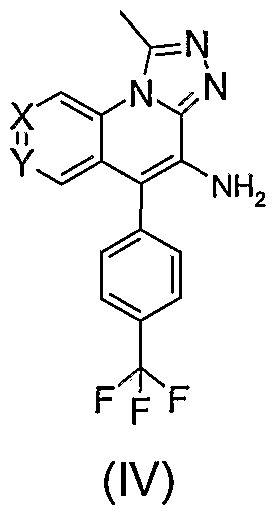
Compounds Which Increase Apolipoprotein A-1 Production And Uses Thereof In Medicine
The present invention relates to substituted triazoloquinoline compounds and salts solvates and prodrugs thereof, pharmaceutical compositions containing them and to their use in medicine. In particular, the invention relates to novel substituted triazoloquinoline compounds which exhibit increased apo-A1 production.
The novel triazoloquinoline derivatives are useful in the treatment of atherosclerosis, dyslipidemia, peripheral vascular disease, hyperbetalipoproteinemia, hypoalphalipoproteinemia, hypercholesterolemia, hypertriglyceridemia, familial hypercholesterolemia, cardiovascular diseases, angina, ischemia, cardiac ischemia, stroke, myocardial infarction, reperfusion injury, angioplastic restenosis, hypertension, vascular complications of diabetes, obesity, thrombosis and endotoxemia.
The novel triazoloquinoline derivatives of the present invention have also been shown to inhibit cytokine release from a microglial (CNS immune) cell line. Accordingly, the compounds may also be useful in the treatment of diseases which demonstrate neuroinflammation pathology and neurodegenerative diseases such as multiple sclerosis, Alzheimer's disease and Parkinson's disease.
The novel triazoloquinoline derivatives of the invention are also useful in the treatment of inflammation, for example in the treatment of skin conditions (e.g. sunburn, burns, eczema, dermatitis, psoriasis); ophthalmic diseases such as glaucoma, retinitis, retinopathies, uveitis and/or acute injury to the eye tissue (e.g. conjunctivitis); lung diseases (e.g. asthma, bronchitis, emphysema, allergic rhinitis, respiratory distress syndrome, pigeon fancier's disease, farmer's lung, chronic obstructive pulmonary disease, (COPD); gastrointestinal tract diseases (e.g. aphthous ulcer, Crohn's disease, atopic gastritis, gastritis varialoforme, ulcerative colitis, coeliac disease, regional ileitis, irritable bowel syndrome, inflammatory bowel disease, gastrointestinal reflux disease); organ transplantation; inflammatory joint diseases such as rheumatoid arthritis, psoriatic arthritis, juvenile arthritis and osteoarthritis; and other conditions with an inflammatory component such as vascular disease, migraine, periarteritis nodosa, thyroiditis, aplastic anaemia, Hodgkin's disease, sclerodoma, myaesthenia gravis, sarcoidosis, nephrotic syndrome, Bechet's syndrome, gingivitis, myocardial ischemia, pyrexia, systemic lupus erythematosus, polymyositis, tendinitis, bursitis, endotoxemia and Sjogren's syndrome.
Atherosclerotic cardiovascular disease is the leading cause of death in developed countries. Epidemiological studies have identified a variety of independent risk factors which contribute to coronary artery disease. Most notable are high levels of low-density lipoprotein (LDL) cholesterol and low levels of high-density lipoprotein (HDL) cholesterol (Gordon, DJ. and Rifkind, B.M. (1989) N. Engl. J. Med. VoI 321 , 1311-1316; Corti, M.C.,
Guralnik, J.M., Salive, M.E., Harris, T., Field, T.S., et al. (1995) Jama. VoI 274, 539-544). The atheroprotective effects of increased HDL are still being investigated and are likely to involve several different mechanisms. For example, HDL particles might inhibit the oxidation and aggregation of LDL (Rong, J.X. and Fisher, E.A. (2000) Ann. Med. VoI 32, 642-651). Principal among the proposed mechanisms is the essential function of HDL in reverse cholesterol transport, attributed to its ability to promote cholesterol efflux from cells and mediate the transport of cholesterol to the liver for catabolism (Fielding, CJ. , and Fielding, P.E. (1995) J. Lipid Res. VoI 36, 211-228).
Apolipoprotein A-1 (apoA-1) is the primary structural protein component of HDL (Duverger, N., Rader, D., Duchateau, P., Fruchart, J. C, Castro, G., and Brewer, H. B., Jr (1993) Biochemistry. VoI 32, 12372-12379). A central role of this apolipoprotein in the synthesis and assembly of HDL is suggested by the tight correlation between plasma apoA-1 and plasma HDL-cholesterol levels (Rubin, E. M., Ishida, B.Y., Clift, S. M., and Krauss, R.M. (1991) Proc. Natl. Acad. ScL USA. VoI 88, 434-438; Schaefer, E.J., Heaton, W.H., Wetzel, M. G., and Brewer, H. B., Jr (1982) Arteriosclerosis. VoI 2, 16-26). ApoA-1 is likely the physiological acceptor of free cholesterol from peripheral tissues, as lipid free apoA-1 is more efficient than plasma HDL at promoting the efflux of cholesterol from macrophage-derived foam cells (Yancey, P. G., Bielicki, J. K., Johnson, W.J., Lund-Katz, S., Palgunachari, M. N., Anantharamaiah, G. M., Segrest, J. P., Phillips, M. C, and Rothblat, G. H. (1995) Biochemistry. VoI 34, 7955-7965). Substantial support for the concept that overexpression of human apoA-1 reduces atherogenesis has been provided in studies utilising rabbits fed a high fat diet, as well as transgenic C57BL/6 and hyperlipidemic apoE knock-out mice (Duverger, N., Kruth, H., Emmanuel, F., Caillaud, J. M., Viglietta, C, Castro, G., Tailleux, A., Fievet, C, Fruchart , J. C, Houdebine, L.M., and Denefle, P. (1996) Circulation. VoI 94, 713-717; Rubin, E.M., Krauss, R.M., Spangler, E.A., Verstuyft, J.G., and Clift, S.M. (1991) Nature. VoI 353, 265-267; Plump, A.S., Scott, CJ. , and Breslow, J. L. (1994) Proc. Natl. Acad. ScL USA., VoI 91 , 9607-9611 ; Paszty, C, Maeda, N., Verstuyft, J., and Rubin, E.M. (1994) J. Clin. Invest VoI 94, 899-903). These studies show that increased levels of human apoA-1 in plasma effectively delay the progression of atherosclerosis. Furthermore, intravenous infusion of apoA-1 /phosphatidylcholine discs rapidly increased plasma pre-b apoA-1 and HDL cholesterol concentrations in humans, through an increase in reverse cholesterol transport (Nanjee, M.N., Doran ; J. E., Lerch , P. G., and Miller N. E. (1999) Arterioscler. Thromh. Vase. Biol. VoI 19, 979-989; Nanjee, M.N., Cooke, CJ., Garvin, R., Semeria, F., Lewis, G., Olszewski, W. L., and Miller N. E. (2001) J. Lipid Res. VoI 42, 1586-1593). It will therefore be appreciated that there is increasing evidence from epidemiological, clinical, and basic mechanistic studies to support the importance of HDL and apoA-1 in preventing or even reversing atherosclerosis. Therefore, finding drugs for increasing apoA-1 production by the liver and/or the small intestine, unique organs synthesising apoA-1 , remains an attractive option for increasing HDL cholesterol in humans.
It has now been discovered that certain substituted triazoloquinoline compounds, as described below, increase apoA-1 production and are therefore useful in the treatment or prophylaxis of atherosclerosis and related diseases. The compounds also possess other properties which enable their use in the treatment or prophylaxis of other diseases and conditions.
Konishi, M. and Mori, Y. (1982) Journal of Chromatography, 229, 355-363 discloses 7- chloro-5-(2-chlorophenyl)-1-methyl-{1 ,2,4]triazolo[4,3-a]quinolin-4-amine as derived from the cyclisation of triazolo-benzophenone, which is a sleep inducer. Stemm, N. L., Skoug, J.W., and Robins, R.H. (1995) Pharmaceutical Research, Vo1 12, No 5, 738-745 discloses 7-chloro-5-phenyl-[1 ,2,4]triazolo[4,3-a]quinolin-4-amine and 7-chloro-5-(2-chlorophenyl)-1- methyl-{1 ,2,4]triazolo[4,3-a]quinolin-4-amine as degradation products of the drug adinazolam mesylate for panic disease. Cabrera, C. Gallardo, Goldberg de Waisbaum, R. and Nudelman, N.S. (2005) Journal of Physical Organic Chemistry, 18, 156-161 , Cabrera, C. Gallardo and Nudelman, N.S. (2002) Journal of Pharmaceutical Sciences, 91 (5) 1274- 1286 and Cabrera, C. Gallardo and Nudelman, N.S. (2002) Journal of Pharmaceutical and Biomedical Analysis, 30, 887-893, all disclose 7-chloro-1-methyl-5- phenyl[1 ,2,4]triazolo[4,3-a]quinolin-4-amine (triazolaminoquinoleine) as a photodegradation product of the ansiolytic drug alprazolam.
Therefore according to a first aspect, the invention provides a compound of formula (I), or a pharmaceutically acceptable salt thereof, or a solvate thereof or a prodrug thereof or a combination thereof:
<» wherein
• X represents CH or N;
• Y represents CH or N;
• R1 represents H or C1-2alkyl; • R2 represents H or C1-4alkyl;
• R3 represents C1-6alkyl, carbocyclyl, carbocyclylC1-4alkyl, heterocyclyl or heterocyclylC1-4alkyl, wherein any of the carbocyclyl or heterocyclyl groups are optionally substituted by one or two groups selected from: halogen, C1-6alkyl, haloC1-6alkyl, hydroxyC1-6alkyl, Ci-6alkoxy, haloC1-6alkoxy, nitro, cyano, -COH, -COOH, Ci-6alkoxycarbonyl, C1- 6alkylcarbonyl, -C(OH)R5R6 (wherein R5 and R6 independently represent H or C1-
6alkyl), -(CH2)nNR3aR3b and -O(CH2)pNR3aR3b (wherein n represents 1 , 2 or 3, p represents 2 or 3 and R3a and R3b independently represent H, C1-6alkyl or carbocyclylC1-4alkyl, or R3a and R3b together with the interconnecting atoms form a 5 or 6-membered ring which ring optionally contains one or two heteroatoms independently selected from the group consisting of O, S and N);
• R4 represents H, hydroxy, halo, C1-6alkyl, haloC1-6alkyl, hydroxyC1-6alkyl, C2-6alkenyl, C1-6alkoxy, haloC1-6alkoxy, carbocyclyl or heterocyclyl, wherein the carbocyclyl or heterocyclyl group is optionally substituted by one or two groups selected from: halogen, C1-6alkyl, haloC1-6alkyl, Ci-6alkoxy, haloC1-6alkoxy, nitro and cyano; and provided that the compound is not:
7-chloro-5-phenyl-[1 ,2,4]triazolo[4,3-a]quinolin-4-amine; 7-chloro-1-methyl-5-phenyl[1 ,2,4]triazolo[4,3-a]quinolin-4-amine; or T-chloro-δ^-chlorophenyO-i-methyKi^^triazolo^.S-alquinolin^-amine.
In another aspect, the invention provides a compound of formula (I1), or a pharmaceutically acceptable salt thereof, or a solvate thereof or a prodrug thereof or a combination thereof:
• X represents CH or N;
• Y represents CH or N;
• R1 represents H or C1-2alkyl;
• R2 represents H or d-4alkyl; • R3 represents C1-6alkyl, carbocyclyl, carbocyclylCi-4alkyl, heterocyclyl or heterocyclylC1-4alkyl, wherein any of the carbocyclyl or heterocyclyl groups are optionally substituted by one or two groups selected from: halogen, C1-6alkyl, haloC1-6alkyl, hydroxyC1-6alkyl, Ci-6alkoxy, haloCi-6alkoxy, nitro, cyano, -COH, -COOH, C1-6alkoxycarbonyl, C1- 6alkylcarbonyl, -C(OH)R5R6 (wherein R5 and R6 independently represent H or C1- βalkyl), -(CH2)nNR3aR3b and -O(CH2)pNR3aR3b (wherein n represents 1 , 2 or 3, p represents 2 or 3 and R3a and R3b independently . represent H, C1-6alkyl or carbocyclylC1-4alkyl, or R3a and R3b together with the interconnecting atoms form a 5 or 6-membered ring which ring optionally contains one or two heteroatoms independently selected from the group consisting of O, S and N);
• R4 represents H, hydroxy, halo, C1-6alkyl, haloC1-6alkyl, hydroxyC1-6alkyl, C2-6alkenyl,
C1-6alkoxy, haloC1-6alkoxy, carbocyclyl or heterocyclyl, wherein the carbocyclyl or heterocyclyl group is optionally substituted by one or two groups selected from: halogen, C1-6alkyl, haloC1-6alkyl, C1-6alkoxy, haloC1-6alkoxy, nitro and cyano; wherein when R4 is 7-chloro, R1 is methyl or hydrogen, and R2 is hydrogen, R3 is not unsubstituted phenyl and R3 is not 2-chlorophenyl.
As used herein, the term "alkyl" refers to straight or branched hydrocarbon chains containing the specified number of carbon atoms. For example,
means a straight or branched alkyl containing at least 1 , and at most 6, carbon atoms. Examples of "C
1- 2alkyl" as used herein include methyl and ethyl. Examples of "Ci
-4alkyl" include, in addition, n-propyl, isopropyl, n-butyl, isobutyl, t-butyl and sec-butyl,. Examples of "Ci-
6alkyl" include, in addition, 1 ,1-dimethylpropyl, n-pentyl, isopentyl, neopentyl, n-hexyl, and the like.
As used herein, the term "alkoxy" refers to a straight or branched alkoxy group containing the specified number of carbon atoms. For example, d-6alkoxy means a straight or branched alkoxy group containing at least 1 , and at most 6, carbon atoms. Examples of "alkoxy" as used herein include, but are not limited to, methoxy, ethoxy, propoxy, prop-2- oxy, butoxy, but-2-oxy, 2-methylprop-1~oxy, 2-methylprop-2-oxy, pentoxy and hexyloxy.
As used herein, the terms "halogen" and its abbreviation "halo" refer to the elements fluorine, chlorine, bromine and iodine.
The term "haloC1-6alkyl" as used herein refers to a C1-6alkyl group as defined herein wherein at least one hydrogen atom is replaced with halogen. Examples of such groups include fluoroethyl, trifluoromethyl, trifluoroethyl and the like. The term "haloCi-6alkoxy" as used herein refers to a C1-6alkoxy group as herein defined wherein at least one hydrogen atom is replaced with halogen. Examples of such groups include difluoromethoxy, trifluoromethoxy and the like.
The term "hydroxyC1-6alkyl" refers to a group -(C1-6alkyl)-OH.
The term "C2-6alkenyl" refers to a straight or branched hydrocarbon group containing one or more carbon-carbon double bonds and having from 2 to 6 carbon atoms. Unless otherwise indicated, a C2-6alkenyl group may contain up to 3 double bonds which may be conjugated. Examples of such groups include ethenyl, propenyl, butenyl, pentenyl, hexenyl, vinyl, allyl and butadienyl.
As used herein, the term "carboxy" refers to a carboxylic acid group.
As used herein, the term "Ci-6alkoxycarbonyl" refers to a group -COOC1-6alkyl.
As used herein, the term "C1-6alkylcarbonyr refers to a group -COC1-6alkyl.
Unless otherwise indicated, the terms "carbocyclyl" and "carbocyclic" refer either to a monocyclic group which contains 3 to 8 ring-atoms, or a bicyclic fused group which contains 6 to 11 atoms, wherein the monocyclic group or the bicyclic group may be saturated, unsaturated or aromatic. Examples of monocyclic saturated carbocyclyl groups include cyclopropyl, cyclobutyl, cyclopentyl and cyclohexyl. Unsaturated carbocyclyl groups may for example contain up to 3 double bonds. An example of an aromatic monocyclic carbocyclyl group is phenyl. Examples of bicyclic fused carbocyclyl group includes naphthyl, anthryl, phenanthryl, indanyl, indenyl, azulenyl, azulanyl, and fluorenyl.
Unless otherwise indicated, the terms "heterocyclyl" and "heterocyclic" refer either to a monocyclic group which contains 5 to 7 ring-atoms up to 4 of which is a heteroatom selected from nitrogen, oxygen and sulfur, or a bicyclic fused group which contains 6 to 11 atoms up to 6 of which is a heteroatom selected from nitrogen, oxygen and sulfur, wherein the monocyclic group or the bicyclic group may be saturated, unsaturated or aromatic. Examples of monocyclic heterocyclyl groups include furyl, thienyl, pyrrolyl, pyrrolinyl, pyrrolidinyl, imidazolyl, dioxolanyl, oxazolyl, thiazolyl, imidazolyl, imidazolinyl, imidazolidinyl, pyrazolyl, pyrazolinyl, pyrazolidinyl, isoxazolyl, isothiazolyl, oxadiazolyl, triazolyl, thiadiazolyl, pyranyl, pyridyl, piperidinyl, homopiperazinyl, dioxanyl, morpholino, dithianyl, thiomorpholino, pyridazinyl, pyrimidinyl, pyrazinyl, piperazinyl, sulfolanyl, tetrazolyl, triazinyl, azepinyl, oxazepinyl, thiazepinyl, diazepinyl and thiazolinyl. Examples of bicyclic heterocyclyl groups include benzodioxolyl, benzimidazolyl, benzoxazolyl, imidazopyridinyl, benzoxazinyl, benzothiazinyl, oxazolopyridinyl, benzofuranyl, quinolinyl, quinazolinyl, quinoxalinyl, dihydroquinazolinyl, benzothiazolyl, phthalimido, benzofuranyl, benzodiazepinyl, indolyl and isoindolyl.
As used herein, the term "substituted" refers to substitution with the named substituent or substituents, multiple degrees of substitution being allowed unless otherwise stated.
For the avoidance of doubt, the term "independently" means that where more than one substituent is selected from a number of possible substituents, those substituents may be the same or different.
As used herein, the term "pharmaceutically acceptable" means a compound which is suitable for pharmaceutical use.
Salts and solvates of compounds of formula (I) which are suitable for use in medicine are those wherein the counterion or associated solvent is pharmaceutically acceptable. However, salts and solvates having non-pharmaceutically acceptable counterions or associated solvents are within the scope of the present invention, for example, for use as intermediates in the preparation of other compounds of formula (I) and their pharmaceutically acceptable salts, solvates, prodrugs and combinations thereof.
As used herein, the term "solvate" refers to a complex of variable stoichiometry formed by a solute (in this invention, a compound of formula (I) or a salt thereof) and a solvent. Such solvents for the purpose of the invention may not interfere with the biological activity of the solute. Examples of suitable solvents include water, methanol, ethanol and acetic acid. For example, the solvent used is water, in which case the solvate may be referred to as a hydrate. Thus, the present invention provides a solvate of a compound of formula (I) as defined above, which is a hydrate. Some of the compounds of this invention may be crystallised or recrystallised from solvents such as aqueous and organic solvents. In such cases solvates may be formed. This invention includes within its scope stoichiometric solvates including hydrates as well as compounds containing variable amounts of water that may be produced by processes such as lyophilisation.
It will be appreciated that for use in medicine the salts of formula (I) should be physiologically (i.e. pharmaceutically) acceptable. Suitable physiologically acceptable salts will be apparent to those skilled in the art and include for example acid salts, for example sodium, potassium, calcium, magnesium and tetraalkylammonium and the like, acid addition salts formed with inorganic acids e.g. hydrochloric, hydrobromic, sulfuric, nitric, sulfamic or phosphoric acid; and mono- or di- basic salts with the appropriate acid for example organic carboxylic acids such as formic, acetic, lactic, fumaric, glutamic, tartaric, malic, maleic, mandelic, isethionic, lactobionic and succinic acids; organic sulfonic acids such benzoic, naphthalenesulfonic, methanesulfonic, ethanesulfonic, benzenesulfonic and p-toluenesulfonic acids. Other non-physiologically acceptable salts e.g. oxalates, may be used, for example in the isolation of compounds of formula (I) and are included within the scope of this invention. Reference is made to Berge et al. J. Pharm. ScL, 1977, 66, 1-19, which is incorporated herein by reference. Certain of the compounds of formula (I) may form acid addition salts with one or more equivalents of the acid. The present invention includes within its scope all possible stoichiometric and non- stoichiometric forms thereof.
As used herein, the term "prodrug" means a compound which is converted within the body, e.g. by hydrolysis in the blood, into its active form that has medical effects. Pharmaceutically acceptable prodrugs are described in T. Higuchi and V. Stella, Prodrugs as Novel Delivery Systems, Vol. 14 of the A.C.S. Symposium Series, and in Edward B. Roche, ed., Bioreversible Carriers in Drug Design, American Pharmaceutical Association and Pergamon Press, 1987, both of which are. incorporated herein by reference. Esters may be active in their own right and /or be hydrolysable under in vivo conditions in the human body. Suitable pharmaceutically acceptable in vivo hydrolysable ester groups include those which break down readily in the human body to leave the parent acid or its salt.
Certain compounds of formula (I) may exist in stereoisomeric forms (e.g. they may contain one or more asymmetric carbon atoms). For example, where R3 is a carbocyclic group
such as phenyl which is substituted by a group -CH(OH)CH3, this gives rise to two isomers. Individual stereoisomers (enantiomers and diastereomers) and mixtures of these are included within the scope of the present invention. The present invention also covers the individual isomers of the compounds represented by formula (I) as mixtures with isomers thereof in which one or more chiral centres are inverted. Likewise, it is understood that compounds of formula (I) may exist in tautomeric forms other than that shown in the formula and these are also included within the scope of the present invention.
In one aspect of the invention, X and Y both represent CH.
In one aspect of the invention, R1 represents H or methyl. In yet another aspect, R1 represents methyl.
In one aspect of the invention, R2 represents H, methyl, ethyl or propyl. In yet another aspect, R2 represents H.
In one aspect of the invention, R3 represents C1-6alkyl (such as methyl, isopropyl or n- butyl), phenyl, a monocyclic heterocyclyl group (such as furyl, thienyl, pyridinyl or pyrimidinyl) or a bicyclic heterocyclyl group (such as benzodioxolyl), wherein the phenyl, the monocyclic heterocyclyl group and the bicyclic heterocyclyl group are:
- optionally substituted by one or two groups selected from: halogen, C1-6alkyl, haloCi. 6alkyl, hydroxyC1-6alkyl, C1-6alkoxy, haloC1-6alkoxy, nitro, cyano, -COH, -COOH, C1- 6alkoxycarbonyl, C1-6alkylcarbonyl, -C(OH)R5R6 (wherein R5 and R6 independently represent H or C1-6alkyl); or
- optionally substituted by the group -(CH2)nNR3aR3b and -O(CH2)pNR3aR3b (wherein n represents 1 , 2 or 3, p represents 2 or 3 and R3a and R3b independently represent H, C1- 6alkyl or carbocyclylC1-4alkyl, or R3a and R3b together with the interconnecting atoms form a 5 or 6-membered ring which ring optionally contains one or two heteroatoms independently selected from the group consisting of O, S and N).
In one aspect of the invention R3 represents phenyl, which is:
- optionally substituted by one or two groups selected from: halogen, C1-6alkyl, haloC^ 6alkyl, hydroxyC1-6alkyl, C1-6alkoxy, haloC1-6alkoxy, nitro, cyano, -COH, -COOH, C1- 6alkoxycarbonyl, Ci-6alkylcarbonyl, -C(OH)R5R6 (wherein R5 and R6 independently represent H or C1-6alkyl); or
- optionally substituted by the group -(CH2)nNR3aR3b and -O(CH2)pNR3aR3b (wherein n represents 1 , 2 or 3, p represents 2 or 3 and R3a and R3b independently represent H, C1- 6alkyl or carbocyclylC1-4alkyl, or R3a and R3b together with the interconnecting atoms form a 5 or 6-membered ring which ring optionally contains one or two heteroatoms independently selected from the group consisting of O, S and N .
In one aspect of the invention, R3 represents 4-trifluoromethyl-phenyl.
In one aspect of the invention, R4 is H, hydroxy, halogen (such as fluorine, chlorine or bromine), C2-6alkenyl (such as -CH2CH=CH2), C1-6alkoxy (such as methoxy), phenyl or a heterocyclyl group (such as furyl or pyridyl); wherein the phenyl and the heterocyclyl group are optionally substituted by one or two groups selected from: halogen, C1-6alkyl, haloC1-6alkyl, C1-6alkoxy, haloC1-6alkoxy, nitro and cyano.
In one aspect of the invention, R4 is H, hydroxy, halo (such as fluorine, chlorine or bromine), C2-6alkenyl (such as -CH2CH=CH2), C1-6alkoxy (such as methoxy), furanyl or pyridyl.
In one aspect of the invention, the present invention provides a compound of formula (I") or a pharmaceutically acceptable salt thereof, or a solvate thereof or a prodrug thereof or a combination thereof:
(I") wherein
• X represents CH or N;
• Y represents CH or N;
• R1 represents H or C1-2alkyl;
• R2 represents H or C1-4alkyl;
• R3 represents C1-6alkyl, monocyclic carbocyclyl, monocyclic carbocyclylC1-4alkyl, monocyclic heterocyclyl or monocyclic heterocyclylC1-4alkyl, wherein any of the carbocyclyl or heterocyclyl groups are:
- optionally substituted by a group -0(CH2)m0- (wherein m is 1 or 2) to form a fused dioxanyl group or a fused dioxolanyl group; or
- optionally substituted by one or two groups selected from: halogen, C1-6alkyl, haloC1-6alkyl, hydroxyC1-6alkyl, C1-6alkoxy, haloCi-6alkoxy, nitro, cyano, -COH, - COOH1 C1-6alkoxycarbonyl, C1-6alkylcarbonyl, -C(OH)R5R6 (wherein R5 and R6 independently represent H or Ci-6alkyl); or
-(CH2)nNR3aR3b and -O(CH2)pNR3aR3b (wherein n represents 1 , 2 or 3, p represents 2 or 3 and R3a and R3b independently represent H, C1-6alkyl or carbocyclylCi-4alkyl, or R3a and R3b together with the interconnecting atoms form a 5 or 6-membered ring which ring optionally contains one or two heteroatoms independently selected from the group consisting of O, S and N);
• R4 represents H, hydroxy, halo, C1-6alkyl, haloC1-6alkyl, hydroxyC1-6alkyl, C2-6alkenyl, C1-6alkoxy, haloC1-6alkoxy, a monocyclic carbocyclyl group or a monocyclic
heterocyclyl group, wherein the monocyclic carbocyclyl or monocyclic heterocyclyl group is:
- optionally substituted by a group -O(CH2)qO- (wherein q is 1 or 2) to form a fused dioxanyl group or a fused dioxolanyl group; or - optionally substituted by one or two groups selected from: halogen, C1-6alkyl, haloC1-6alkyl, C1-6alkoxy, haloC1-6alkoxy, nitro and cyano; and provided that the compound is not: 7-chloro-5-phenyl-[1 ,2,4]triazolo[4,3-a]quinolin-4-amine; 7-chloro-1 -methyl-5-phenyl[1 ,2,4]triazolo[4,3-a]quinolin-4-amine; or 7-chloro-5-(2-chlorophenyl)-1 -methyl-{1 ,2,4]triazolo[4,3-a]quinolin-4-amine.
It will be appreciated that the present invention is intended to include compounds having any combination of the features hereinbefore mentioned. Thus, the embodiments described above for formula (I) apply to all of formula (I1), (I") and (I'") mutatis mutandis.
Examples of compounds of of the present invention include:
1-methyl-7-(methoxy)-5-[4-(trifluoromethyl)phenyl][1 ,2,4]triazolo[4,3-a]quinolin-4-amine;
7-chloro-1-methyl-5-(4-pyridinyl)[1,2,4]triazolo[4,3-a]quinolin-4-amine;
7-chloro-1-methyl-5-(3-pyridinyl)[1 ,2,4]triazolo[4,3-a]quinolin-4-amine; 1 -methyl-7-(methyloxy)-5-(3-pyridinyl)[1 ,2,4]triazolo[4,3-a]quinolin-4-amine
1-methyl-5-(4-pyridinyl)[1 ,2,4]triazolo[4,3-a]quinolin-4-amine;
5-(4-chlorophenyl)-1-methyl-7-(methyloxy)[1 ,2,4]triazolo[4,3-a]quinolin-4-amine;
5-(4-fluorophenyl)-1-methyl-7-(methyloxy)[1 ,2,4]triazolo[4,3-a]quinolin-4-amine;
1-methyl-5-phenyl[1 ,2,4]triazolo[4,3-a]quinolin-4-amine; 1 -methyl-5-[3-(methyloxy)phenyl][1 ,2,4]triazolo[4,3-a]quinolin-4-amine;
7-fluoro-1-methyl-5-[3-(methyloxy)phenyl][1 ,2,4]triazolo[4,3-a]quinolin-4-amine;
5-(1 ,3-benzodioxol-5-yl)-1 -methyl-7-(methyloxy)[1 ,2,4]triazolo[4,3-a]quinolin-4-amine;
7-chloro-5-(2-fluorophenyl)[1 ,2,4]triazolo[4,3-a]quinolin-4-amine;
5-(2-chlorophenyl)-7-(methyloxy)[1 ,2,4]triazolo[4,3-a]quinolin-4-amine; 1 ,5-dimethyl[1 ,2,4]triazolo[4,3-a]quinolin-4-amine;
5-butyl-1-methyl-7-(methyloxy)[1,2,4]triazolo[4,3-a]quinolin-4-amine;
1-ethyl-7-(methyloxy)-5-[4-(trifluoromethyl)phenyl][1 ,2,4]triazolo[4,3-a]quinolin-4-amine;
5-(3-fluorophenyl)-1-methyl-7-(methyloxy)[1 ,2,4]triazolo[4,3-a]quinolin-4-amine;
1 -methyl-5-[4-(trifluoromethyl)phenyl][1 ,2,4]triazolo[4,3-a]-1 ,7-naphthyridin-4-amine; 1 -methyl-5-[4-(trifluoromethyl)phenyl][1 ,2,4]triazolo[4,3-a]-1 ,7-naphthyridin-4-amine;
7-bromo-5-(2-fluorophenyl)-1-methyl[1 ,2,4]triazolo[4,3-a]quinolin-4-amine;
5-(2-fluorophenyl)-1-methyl[1 ,2,4]triazolo[4,3-a]quinolin-4-amine;
1-methyl-5-(1-methylethyl)-7-(methyloxy)[1 ,2,4]triazolo[4,3-a]quinolin-4-amine;
5-(2-fluorophenyl)-7-(2-furanyl)-1-methyl[1 ,2,4]triazolo[4,3-a]quinolin-4-amine; 5-(2-fluorophenyl)-1 -methyl-7-(2-propen-1 -yl)[1 ,2,4]triazolo[4,3-a]quinolin-4-amine;
5-(2-fluorophenyl)-1-methyl-7-(2-pyridinyl)[1 ,2,4]triazolo[4,3-a]quinolin-4-amine;
4-amino-1-methyl-5-[4-(trifluoromethyl)phenyl][1 ,2,4]triazolo[4,3-a]quinolin-7-ol;
7-chloro-5-(2-fluoro-4-pyridinyl)-1-methyl[1 ,2,4]triazolo[4,3-a]quinolin-4-amine;
methyl 4-(4-amino-7-chloro-1 -methyl[1 ,2,4]triazolo[4,3-a]quinolin-5-yl)benzoate;
7-chloro-1-methyl-5-(5-pyrimidinyl)[1 ,2,4]tria2olo[4,3-a]quinolin-4-amine;
/-chloro-i-methyl-δ-CS-thienyOti ^^ltriazoloμ^-alquinolin^-aπnine;
4-(4-amino-7-chloro-1-methyl[1 ,2,4]triazolo[4,3-a]quinolin-5-yl)benzonitrile; 7-chloro-5-(2-furanyl)-1 -methyl[1 ,2,4]triazolo[4,3-a]quinolin-4-amine;
7-chloro-5-(3-furanyl)-1-methyl[1 ,2,4]triazolo[4,3-a]quinolin-4-amine;
4-(4-amino-7-chloro-1-methyl[1 ,2,4]triazolo[4)3-a]quinolin-5-yl)benzoic acid;
7-chloro-1-methyl-5-[3-(4-morpholinylmethyl)phenyl][1 ,2,4]triazolo[4,3-a]quinolin-4-amine;
7-chloro-1-methyl-5-(3-{[(phenylmethyl)amino]methyl}phenyl)[1,2,4]triazolo[4,3-a]quinolin- 4-amine;
7-chloro-1-methyl-5-(4-{[(phenylmethyl)amino]methyl}phenyl)[1 ,2,4]triazolo[4,3-a]quinolin-
4-amine;
7-chloro-5-{4-[(dimethylamino)methyl]phenyl}-1-methyl[1 ,2,4]triazolo[4,3-a]quinolin-4- amine; 7-chloro-5-{3-[(dimethylamino)methyl]phenyl}-1 -methyl[1 ,2,4]triazolo[4,3-a]quinolin-4- amine;
7-chloro-1-methyI-5-[3-(1-piperidinylmethyl)phenyl][1 ,2,4]triazolo[4,3-a]quinolin-4-amine;
7-chloro-1-methyl-5-[3-(1-pyrrolidinylmethyl)phenyl][1 ,2,4]triazolo[4,3-a]quinolin-4-amine;
7-chloro-5-{5-[(dimethylamino)methyl]-2-furanyl}-1-methyl[1 ,2,4]triazolo[4,3-a]quinolin-4- amine;
[4-(4-amino-7-chloro-1-methyl[1 ,2,4]triazolo[4,3-a]quinolin-5-yl)phenyl]methanol;
1-[4-(4-amino-7-chloro-1-methyl[1 ,2,4]triazolo[4,3-a]quinolin-5-yl)phenyl]ethanol;
1 -[3-(4-amino-7-chloro-1 -methyl[1 ,2,4]triazolo[4,3-a]quinolin-5-yl)phenyl]ethanol;
2-[3-(4-amino-7-chloro-1-methyl[1 ,2,4]triazolo[4,3-a]quinolin-5-yl)phenyl]-2-propanol; N-ethyl-5-(2-fluorophenyl)-1 -methyl[1 ,2,4]triazolo[4,3-a]quinolin-4-amine;
N,1-dimethyl-5-phenyl[1 ,2,4]triazolo[4,3-a]quinolin-4-amine;
1-methyl-7-(methyloxy)-N-propyl-5-[4-(trifluoromethyl)phenyl][1 ,2,4]triazolo[4,3-a]quinolin-
4-amine; and pharmaceutically acceptable salts thereof, solvates thereof, prodrugs thereof and combinations thereof.
Description of Figures
Figure 1 shows the 13C solid-state NMR spectrum of Form 1 of Example 1.
Figure 2 shows the 13C solid-state NMR spectrum of Form 2 of Example 1.
13C solid-state NMR spectra were acquired using a Bruker Avance 400 system operating at a proton frequency of 399.87 MHz. A Bruker 4-mm triple-resonance MAS (magic- angle spinning) probe was employed. Approximately 25 mg of each sample was packed into 4-mm outer rotors, sealed with a plug and a drive tip, and spun at 8 kHz +/- 2 Hz under active control. Cross-polarization from proton to carbon-13 nuclei was used to enhance sensitivity. A 2-ms contact time and a power ramp were used [1]. Spinning sidebands were suppressed using a five-pulse TOSS (total suppression of sidebands) pulse sequence [2]. 1 H decoupling was performed at -105 kHz using the TPPM
decoupling pulse sequence [3]. Spectra were referenced to tetramethylsilane (TMS) using hexamethylbenzene as a secondary external carbon-13 reference [4]. The spectra shown in the Figures herein were the result of approximately four thousand averaged scans using a 10-second relaxation delay.
[1] G. Metz, X. Wu, S. O. Smith, J. Magn. Reson. A 110 (1994) 219-227. [2] O. N. Antzutkin, Prog. NMR Spectros. 35 (1999) 203-266.
[3] A. E. Bennett, C. M. Rienstra, M. Auger, K. V. Lakshmi, R. G. Griffin, J. Chem. Phys. 103 (1995) 6951-6958. [4] W. L. Earl, D. L. Vanderhart, J. Magn. Reson. 48 (1982) 35-54.
As mentioned above, the compounds of the present invention are useful for diseases or conditions caused by or associated with low plasma apoA-1 levels, diseases or conditions caused by or associated with abnormal plasma lipid profile (otherwise known as dislipidemia), diseases or conditions caused by or associated with raised levels of LDL- cholesterol, other cardiovascular diseases or conditions, inflammation diseases, diseases or conditions displaying neuroinflammatory pathology and neurodegenerative diseases.
Diseases or conditions caused by or associated with an abnormal plasma lipid profile (otherwise known as dyslipidemia) include hypoalphalipoproteinemia, hypertriglyceridemia, hyperbetalipoproteinemia, hypercholesterolemia, familial hypercholesterolemia, metabolic syndrome, atherosclerosis, angina, ischemia, cardiac ischemia, stroke, myocardial infarction and obesity. Other cardiovascular diseases for which the compounds of the present invention are useful include peripheral vascular disease, reperfusion injury, angioplasty restenosis, hypertension, vascular complications of diabetes and thrombosis.
Inflammation diseases include skin conditions (e.g. sunburn, burns, eczema, dermatitis, psoriasis); ophthalmic diseases such as glaucoma, retinitis, retinopathies, uveitis and/or acute injury to the eye tissue (e.g. conjunctivitis); lung disorders (e.g. asthma, bronchitis, emphysema, allergic rhinitis, respiratory distress syndrome, pigeon fancier's disease, farmer's lung, chronic obstructive pulmonary disease, (COPD); gastrointestinal tract disorders (e.g. aphthous ulcer, Crohn's disease, atopic gastritis, gastritis varialoforme, ulcerative colitis, coeliac disease, regional ileitis, irritable bowel syndrome, inflammatory bowel disease, gastrointestinal reflux disease); organ transplantation; inflammatory joint diseases such as rheumatoid arthritis, psoriatic arthritis, juvenile arthritis and osteoarthritis; and other conditions with an inflammatory component such as vascular disease, migraine, periarteritis nodosa, thyroiditis, aplastic anaemia, Hodgkin's disease, sclerodoma, myaesthenia gravis, sarcoidosis, nephrotic syndrome, Bechet's syndrome, gingivitis, myocardial ischemia, pyrexia, systemic lupus erythematosus, polymyositis, tendinitis, bursitis, endotoxemia and Sjogren's syndrome.
Disease or condition displaying neuroinflammation pathology and neurodegenerative diseases include chronic neurodegenerative conditions including dementias such as Alzheimer's disease, Parkinson's disease, progressive supranuclear palsy, subacute sclerosing panencephalitic parkinsonism, postencephalitic parkinsonism, pugilistic encephalitis, guam parkinsonism-dementia complex, Pick's disease, corticobasal degeneration, frontotemporal dementia, Huntingdon's disease, AIDS associated dementia, amyotrophic lateral sclerosis, multiple sclerosis, age related cognitive decline and mild cognitive impairment, ADHD (Attention Deficit Disorder/Hyperactivity Syndrome), Down's syndrome, hereditary cerebral haemorrhage, diffuse Lewis body type of Alzheimer's disease, and apoptotic insults caused by beta-amyloid treatment.
According to a further aspect, the invention provides a compound of formula (I1"), a pharmaceutically acceptable salt thereof, or a solvate thereof or a prodrug thereof or a combination thereof:
• ('"") wherein
• X represents CH or N;
• Y represents CH or N;
• R1 represents H or C1-2alkyl; • R2 represents H or C^alkyl;
• R3 represents C1-6alkyl, carbocyclyl, carbocyclylC1-4alkyl, heterocyclyl or heterocyclylC1-4alkyl, wherein any of the carbocyclyl or heterocyclyl groups are optionally substituted by one or two groups selected from: halogen, Chalky!, haloC1-6alkyl, hydroxyC^alkyl, C1-6alkoxy, haloCi-6alkoxy, nitro, cyano, -COH, -COOH, C1-6alkoxycarbonyl, C1- 6alkylcarbonyl, -C(OH)R5R6 (wherein R5 and R6 independently represent H or C1- 6alkyl), -(CH2)nNR3aR3b and -O(CH2)pNR3aR3b (wherein n represents 1 , 2 or 3, p represents 2 or 3 and R3a and R3b independently represent H, Ci-6alkyl or carbocyclylCi-4alkyl, or R3a and R3b together with the interconnecting atoms form a 5 or 6-membered ring which ring optionally contains one or two heteroatoms independently selected from the group consisting of O, S and N);
• R4 represents H, hydroxy, halo, C1-6alkyl, haloC1-6alkyl, hydroxyC1-6alkyl, C2-6alkenyl, C1-6alkoxy, haloC1-6alkoxy, carbocyclyl or heterocyclyl, wherein the carbocyclyl or heterocyclyl group is optionally substituted by one or two groups selected from: halogen, C1-6alkyl, haloCi-6alkyl, C1-6alkoxy, haloC1-6alkoxy, nitro and cyano; for use as a medicament.
The present invention also provides a compound of formula (I), or a pharmaceutically acceptable salt thereof, or a solvate thereof or a prodrug thereof or a combination thereof:
(I) wherein
• X represents CH or N;
• Y represents CH or N;
• R1 represents H or C1-2alkyl;
• R2 represents H or C1-4alkyl;
• R3 represents C1-6alkyl, carbocyclyl, carbocyclylC1-4alkyl, heterocyclyl or heterocyclylC-ι-4alkyl, wherein any of the carbocyclyl or heterocyclyl groups are optionally substituted by one or two groups selected from: halogen, C1-6alkyl, haloC1-6alkyl, hydroxyCi-6alkyl, C1-6alkoxy, haloC1-6alkoxy, nitro, cyano, -COH, -COOH, C1-6alkoxycarbonyl, C1- 6alkylcarbonyl, -C(OH)R5R6 (wherein R5 and R6 independently represent H or C1. βalkyl), -(CH2)nNR3aR3b and -O(CH2)pNR3aR3b (wherein n represents 1 , 2 or 3, p represents 2 or 3 and R3a and R3b independently represent H, C1-6alkyl or carbocyclylC1-4alkyl, or R3a and R3b together with the interconnecting atoms form a 5 or 6-membered ring which ring optionally contains one or two heteroatoms independently selected from the group consisting of O, S and N);
• R4 represents H, hydroxy, halo, C1-6alkyl, haloCi.6alkyl, hydroxyCi-6alkyl, C2-6alkenyl, C1-6alkoxy, haloC1-6alkoxy, carbocyclyl or heterocyclyl, wherein the carbocyclyl or heterocyclyl group is optionally substituted by one or two groups selected from: halogen, C1-6alkyl, haloC^alkyl, C1-6alkoxy, haloC1-6alkoxy, nitro and cyano; and provided that the compound is not: 7-chloro-5-phenyl-[1 ,2,4]triazolo[4,3-a]quinolin-4-amine; 7-chloro-1 ~methyl-5-phenyl[1 ,2,4]triazolo[4,3-a]quinolin-4-amine; or 7-chloro-5-(2-chlorophenyl)-1-methyl-{1 ,2,4]triazolo[4,3-a]quinolin-4-amine; for use as a medicament.
In another aspect, the invention provides a compound of formula (I
1), or a pharmaceutically acceptable salt thereof, or a solvate thereof or a prodrug thereof or a combination thereof:
(I1) wherein
• X represents CH or N;
• Y represents CH or N;
• R1 represents H or C1-2alkyl;
• R2 represents H or C1-4alkyl;
• R3 represents C1-6alkyl, carbocyclyl, carbocyclylC1-4alkyl, heterocyclyl or heterocyclylCi-4alkyl, wherein any of the carbocyclyl or heterocyclyl groups are optionally substituted by one or two groups selected from: halogen, C1-ealkyl, haloC1-6alkyl, hydroxyC1-6alkyl, C1-6alkoxy, haloC1-6alkoxy, nitro, cyano, -COH, -COOH, C1-6alkoxycarbonyl, C1- 6alkylcarbonyl, -C(OH)R5R6 (wherein R5 and R6 independently represent H or C1- βalkyl), -(CH2)nNR3aR3b and -O(CH2)PNR3aR3b (wherein n represents 1 , 2 or 3, p represents 2 or 3 and R3a and R3b independently represent H, C1-6alkyl or carbocyclylC1-4alkyl, or R3a and R3b together with the interconnecting atoms form a 5 or 6-membered ring which ring optionally contains one or two heteroatoms independently selected from the group consisting of O, S and N);
• R4 represents H, hydroxy, halo, C^alkyl, haloCi.6alkyl, hydroxyC1-6alkyl, C2-6alkenyl, Ci-6alkoxy, haloC1-6alkoxy, carbocyclyl or heterocyclyl, wherein the carbocyclyl or heterocyclyl group is optionally substituted by one or two groups selected from: halogen, C1-6alkyl, haloCi-6alkyl, C1-6alkoxy, haloC1-6alkoxy, nitro and cyano; wherein when R4 is 7-chloro, R1 is methyl or hydrogen, and R2 is hydrogen, R3 is not unsubstituted phenyl and R3 is not 2-chlorophenyl; for use as a medicament.
In another aspect of the invention, the present invention provides a compound of formula (I") or a pharmaceutically acceptable salt thereof, or a solvate thereof or a prodrug thereof or a combination thereof:
(I") wherein
• X represents CH or N;
• Y represents CH or N; • R1 represents H or Ci-2alkyl;
• R2 represents H or C1-4alkyl;
• R3 represents Ci-6alkyl, monocyclic carbocyclyl, monocyclic carbocyclylC1-4alkyl, monocyclic heterocyclyl or monocyclic heterocyclylC1-4alkyl, wherein any of the carbocyclyl or heterocyclyl groups are: - optionally substituted by a group -0(CH2)m0- (wherein m is 1 or 2) to form a fused dioxanyl group or a fused dioxolanyl group; or
- optionally substituted by one or two groups selected from: halogen, C1-6alkyl, haloCi-6alkyl, hydroxyC1-6alkyl, Ci-6alkoxy, haloCi-6alkoxy, nitro, cyano, -COH, - COOH, C1-6alkoxycarbonyl, Ci-6alkylcarbonyl, -C(OH)R5R6 (wherein R5 and R6 independently represent H or Ci.6alkyl); or
-(CH2)nNR3aR3b and -O(CH2)pNR3aR3b (wherein n represents 1 , 2 or 3, p represents 2 or 3 and R3a and R3b independently represent H, d-6alkyl or carbocyclylCi-4alkyl, or R3a and R3b together with the interconnecting atoms form a 5 or 6-membered ring which ring optionally contains one or two heteroatoms independently selected from the group consisting of O, S and N);
• R4 represents H, hydroxy, halo, C1-6alkyl, haloC1-6alkyl, hydroxyCi-6alkyl, C2-6alkenyl, C1-6alkoxy, haloCi-6alkoxy, a monocyclic carbocyclyl group or a monocyclic heterocyclyl group, wherein the monocyclic carbocyclyl or monocyclic heterocyclyl group is: - optionally substituted by a group -O(CH2)qO- (wherein q is 1 or 2) to form a fused dioxanyl group or a fused dioxolanyl group; or
- optionally substituted by one or two groups selected from: halogen, Ci-6alkyl, haloC1-6alkyl, C1-6alkoxy, haloCi-6alkoxy, nitro and cyano; and provided that the compound is not: 7-chloro-5-phenyl-[1 ,2,4]triazolo[4,3-a]quinolin-4-amine;
7-chloro-1-methyl-5-phenyl[1 ,2,4]triazolo[4,3-a]quinolin-4-amine; or 7-chloro-5-(2-chlorophenyl)-1-methyl-{1 ,2,4]triazolo[4,3-a]quinolin-4-amine; for use as a medicament.
According to a further aspect, the invention provides the use of a compound of formula (I), (I1), (I") or (I'") as defined above, pharmaceutically acceptable salt thereof, or a solvate
thereof or a prodrug thereof or a combination thereof, in the preparation of a medicament for treating a disease or condition caused by or associated with low plasma ApoA1 levels, a disease or condition caused by or associated with abnormal plasma lipid profile (otherwise known as dislipidemia), disease or condition caused by or associated with raised levels of LDL-cholesterol, other cardiovascular diseases or conditions, an inflammation disease, a disease or condition displaying neuroinflammatory pathology or a neurodegenerative disease.
In one embodiment, the disease or condition is atherosclerosis, dyslipidemia, peripheral vascular disease, hyperbetalipoproteinemia, hypoalphalipoproteinemia, hypercholesterolemia, hypertriglyceridemia, familial hypercholesterolemia, cardiovascular diseases, angina, ischemia, cardiac ischemia, stroke, myocardial infarction, reperfusion injury, angioplastic restenosis, hypertension, vascular complications of diabetes, obesity, thrombosis, endotoxemia, multiple sclerosis, Alzheimer's disease, Parkinson's disease, or an inflammatory disease.
The term "treatment" includes prophylaxis in respect of the appropriate conditions or diseases.
It will be appreciated that the invention includes the following further aspects. The embodiments described for the first aspect extend these further aspects:
i) a pharmaceutical composition comprising a compound of formula (I), (I'), (I") or (I'") or a pharmaceutically acceptable salt thereof, or a solvate thereof or a prodrug thereof or a combination thereof, and a pharmaceutically acceptable carrier or diluent; ii) a method of treating a disease or condition caused by or associated with low plasma ApoA1 levels, a disease or condition caused by or associated with abnormal plasma lipid profile (otherwise known as dislipidemia), a disease or condition caused by or associated with raised levels of LDL-cholesterol, other cardiovascular diseases or conditions, an inflammation disease, a disease or condition displaying neuroinflammatory pathology or a neurodegenerative disease in a mammal, comprising administering an effective amount of a compound of the. invention of formula (I), (I1), (I") or (I1") or a pharmaceutically acceptable salt thereof, or a solvate thereof or a prodrug thereof or a combination thereof; iii) A method of treating atherosclerosis, dyslipidemia, peripheral vascular disease, hyperbetalipoproteinemia, hypoalphalipoproteinemia, hypercholesterolemia, hypertriglyceridemia, familial hypercholesterolemia, cardiovascular diseases, angina, ischemia, cardiac ischemia, stroke, myocardial infarction, reperfusion injury, angioplastic restenosis, hypertension, vascular complications of diabetes, obesity, thrombosis, endotoxemia, multiple sclerosis, Alzheimer's disease, Parkinson's disease, or an inflammatory disease in a mammal, comprising administering an effective amount of a compound of the invention of formula
formula (I), (I1), (I") or (I'") or a pharmaceutically acceptable salt thereof, or a solvate thereof or a prodrug thereof or a combination thereof; iv) a method of increasing plasma apoA-1 levels in a mammal which comprises administering an effective amount of a compound of formula formula (I), (I1), (I") or (I1") or a pharmaceutically acceptable salt thereof, or a solvate thereof or a prodrug thereof or a combination thereof; and v) a combination of a compound of formula formula (I), (I'), (I") or (I1") or a pharmaceutically acceptable salt thereof, or a solvate thereof or a prodrug thereof or a combination thereof with a further pharmaceutically active agent selected from the list: an inhibitor of cholesteryl ester transferase (CETP inhibitors), a HMG-CoA reductase inhibitor, a microsomal triglyceride transfer protein, a peroxisome proliferator-activated receptor activator (PPAR agonist), a bile acid reuptake inhibitor, a cholesterol absorption inhibitor, a cholesterol synthesis inhibitor, a fibrate, niacin, an ion-exchange resin, an antioxidant, an inhibitor of AcylCoA: cholesterol acyltransferase (ACAT inhibitor) and a bile acid sequestrant.
Since the compounds of the invention are intended for use in pharmaceutical compositions it will readily be understood that they are each preferably provided in substantially pure form, for example at least 60% pure, more suitably at least 75% pure and preferably at least 85%, especially at least 98% pure (% are on a weight for weight basis). Impure preparations of the compounds may be used for preparing the more pure forms used in the pharmaceutical compositions; these less pure preparations of the compounds should contain at least 1%, more suitably at least 5% and preferably from 10 to 59% of a compound of the invention.
Compounds of the invention may be prepared, in known manner in a variety of ways. In the following reaction schemes and hereafter, unless otherwise stated R1 to R4 and n are as defined above. These processes form further aspects of the invention.
Throughout the specification, general formulae are designated by Roman numerals (I), (II), (III), (IV) etc.
Compounds of formula (Ia), wherein R^ is H, may be prepared according to reaction scheme 1 by reacting compounds of formula (III) with hydrazine hydrate at reflux temperature, followed by reaction of the resulting hydrazone (II) with R1C(OR)3 at reflux temperature in a suitable solvent such as ethanol/toluene. Compounds of formula (III), may be prepared by reacting compounds of formula (IV) with Lawesson's reagent or P4S10 in a suitable solvent such as toluene or pyridine at reflux temperature.
Compounds of formula (IV), may be prepared by reaction of a compound of formula (Vl) with pyridine at reflux temperature, followed by reaction of the resulting pyridinium salt (V) with hydrazine hydrate in a suitable solvent such as ethanol at reflux temperature.
Compounds of formula (Ia), wherein R2 is H, may be prepared according to reaction scheme 1 by reacting compounds of formula (III) with hydrazine hydrate at reflux temperature, followed by reaction of the resulting hydrazone (II) with R1C(OR)3 at reflux temperature in a suitable solvent such as ethanol/toluene. Compounds of formula (III), may be prepared by reacting compounds of formula (IV) with Lawesson's reagent or P4Si0 in a suitable solvent such as toluene or pyridine at reflux temperature.
Compounds of formula (IV), may be prepared by reaction of a compound of formula (Vl) with pyridine at reflux temperature, followed by reaction of the resulting pyridinium salt (V) with hydrazine hydrate in a suitable solvent such as ethanol at reflux temperature.
Scheme 1
Lawesson's or reagent 4°10
H2N-NH2-H2O Pyridine
EtOH reflux
Compounds of formula (Ib), wherein R2 represents C-|_4 alkyl, may be prepared according to reaction scheme 2, by reacting compounds of formula (Ia) with sodium hydride as base and an alkyl halide in a suitable solvent such as THF.
Compounds of formula (II) may be prepared according to reaction scheme 3, by reacting compounds of formula (V) with POCI3 to give an intermediate of formula (VII), which is then reacted with hydrazine hydrate at reflux temperature to give compounds of formula (ID-
Scheme 3
(V) (VIl) (H)
Compounds of formula (Vl) may be prepared according to reaction scheme 4 by reaction of compounds of formula (VIII) with chloroacetyl chloride in a suitable solvent such as THF or CH2CI2. Compounds of formula (VIII) may be prepared by reacting compounds of formula (IX) with R3-Br [compounds of formula (X)], in the presence of BuLi at -78°C in a suitable solvent such as THF.
Alternatively, compounds of formula (VIII) may be prepared according to reaction scheme 4 by reacting compounds of formula (XII) with phenylmagnesium halide (XIII) in a suitable solvent such as THF, followed by hydrolysis of the resulting compounds of formula (Xl) in the presence of 6N HCI in a suitable solvent such as ethanol.
Compounds of formula (VIII) may be prepared according to reaction scheme (5) by ortholithiation of pivaloylaminopyridine with butyllithium, and further quenching with N- methoxy N-methyl benzamide, in a suitable solvent such as THF, followed by hydrolysis of the resulting compounds of formula (XIV) in the presence of 3N HCI.
Scheme 5
(XIV) (VIM)
Compounds of formula (IX) may be prepared according to reaction scheme 6 by reacting compounds of formula (XV) with Λ/,O-dimethylhydroxylamine hydrochloride in the presence of a coupling reagent such as EDCI or CDI and Et3N as a base in a suitable solvent such as acetonitrile or THF at room temperature.
Alternatively compounds of formula (IX) may be prepared by reacting compounds of formula (XVI) with Λ/,O-dimethylhydroxylamine hydrochloride in the presence of a base such as Et3N in a suitable solvent such as EtOH/H2O at reflux temperature.
Scheme 6
(XV)
(IX)
H-N(OMe)Me-HCI
Et3N EtOH/H2O
Alternatively, compounds of formula (Ia) may be prepared according to reaction scheme 7 by reacting compounds of formula (XVII) with boronic acid (XVIII) using Suzuki coupling conditions. Compounds of formula (XVI) may be prepared by reacting compounds of formula (XX) with iron in a suitable solvent, such as acetic acid, and then treating the resulting amine (XIX) with bromine in a suitable solvent such as CHCI3.
Compounds of formula (XX) may be prepared according to reaction scheme 7 by reacting compounds of formula (XXII) with hydrazine hydrate in a suitable solvent such as ethanol, followed by reaction of the resulting hydrazone (XXI) with R1C(OMe)3 or R1C(OEt)3 in the presence of sulfuric acid in a suitable solvent such as methanol or EtOH. Compounds of formula (XXII) may be prepared by reacting compounds of formula (XXIV) with ethyl nitroacetate in the presence of a base such as piperidine in a suitable solvent such as ethanol at reflux temperature, followed by reaction of compounds of formula (XXIII) with phosphorus oxychloride at reflux temperature.
Scheme 7
(XVII) (Ia)
(XIX)
POCI,
(XXIII)
(XXIV)
Alternatively, compounds of formula (Ia), may be prepared according to reaction scheme 8 from compounds of formula (XXVI). Compounds of formula (XXVI) are reacted with boronic acid derivatives (XVIII) using Suzuki coupling conditions to give compounds of formula (XXV) which are hydrolyzed in the presence of hydrochloric acid to give compounds of formula (Ia).
Compounds of formula (XXVI) may be prepared by reacting compounds of formula (XIX) with acetyl chloride in the presence of a base such as NaH in a suitable solvent such as THF at room temperature to give amide compounds of formula (XXVII) which are then reacted with bromine in a suitable solvent such as CHCI3 at 600C to give compounds of formula (XXVI).
Scheme 8
Alternatively, compounds of formula (I) may be prepared according to reaction scheme 9, by reacting compounds of formula (Ic): (R4=Br) with compounds of formula (XXVIII) [stannyl derivatives R4-Sn(Bu)3 ] to give compounds of formula (I).
Scheme 9
Alternatively, compounds of formula (I) may be prepared according to reaction scheme 10, by reaction of the carboxaldehyde (Id) with R3aR3b|sjH jn the presence of a reducing agent such as sodium cyanoborohydride, in a suitable solvent such as THF at reflux temperature.
Scheme 10
(Id) (I)
Compounds of formula (Ie), wherein R3 is Ph-CH2OH, may be prepared according to reaction scheme 11 by reacting compounds of formula (Id) with a reducing agent such as sodium borohydride, in a suitable solvent such as THF at room temperature.
Scheme 11
(Id) (Ie)
Compounds of formula (Ig) , wherein R3 is the group -PhC(OH)R5R6 and R5 is hydrogen or C-j_ρalkyl, may be prepared according to reaction scheme 12 by reacting compounds of formula (If) with R6-MgX (wherein R6 is C^^alkyl), in a suitable solvent such as THF at low temperature.
Scheme 12
Compounds of formula (Ii) , wherein R4 is a hydroxy group, may be prepared according to reaction scheme 13 by reacting compounds of formula (Ih) with boron tribromide (wherein R4 is methoxy), in a suitable solvent such as methylenechloride at low temperature.
Scheme 13
(Ih) (N)
Further details for the preparation of compounds of formula (I) are found in the examples section hereinafter.
Thus, in another aspect, the present invention provides a process for preparing a compound of formula (I), comprising: (1)(a) reacting a compound of formula (II):
wherein X, Y, R3 and R4 are as defined for formula (I), with a compound R1C(OR)3 wherein R1 and R3 are as defined for formula (I) to form a first product; and (b) optionally reacting the first product with a compound of formula R2-halo wherein R2 is C1-4alkyl, to form a secondary amine; or
(2)(a) reacting a compound of formula (XVII):
wherein X, Y, R1 and R2 are as defined for formula (I) in claim 1 and L is a leaving group, with a compound R3B(OH)2 wherein R3 is as defined for formula (I) to form a first product; and (b) optionally further reacting the first product with a compound of formula R2-halo wherein R2 is Ci-4alkyl; or
(3) reacting a compound of formula (XXV):
(XXV)
wherein X, Y, R1, R3 and R4 are as defined for formula (I) and PG is a protecting group, with a compound of formula R2-halo wherein R2 is as defined for formula (I);
and optionally thereafter for process (1) or process (2) or process (3): • forming a salt; and/or • converting one compound of formula (I) as defined in claim 1 to a different compound of formula (I).
The compounds of the invention may be prepared singly or as compound libraries comprising at least 2, for example 5 to 1 ,000 compounds, and more preferably 10 to 100 compounds. Libraries of compounds of the invention may be prepared by a combinatorial 'split and mix' approach or by multiple parallel synthesis using either solution phase or solid phase chemistry, by procedures known to those skilled in the art. Thus according to a further aspect there is provided a compound library comprising at least 2 compounds of the invention.
Compounds of the invention may be administered in combination with other therapeutic agents. Preferred therapeutic agents are selected from the list: an inhibitor of cholesteryl
ester transferase (CETP inhibitors), a HMG-CoA reductase inhibitor, a microsomal triglyceride transfer protein, a peroxisome proliferator-activated receptor activator (PPAR agonist ), a bile acid reuptake inhibitor, a cholesterol absorption inhibitor, a cholesterol synthesis inhibitor, a fibrate, niacin, an ion-exchange resin, an antioxidant, an inhibitor of AcylCoA : cholesterol acyltransferase (ACAT inhibitor) and a bile acid sequestrant.
The compounds of the invention may be administered in conventional dosage forms prepared by combining a compound of the invention with standard pharmaceutical carriers or diluents according to conventional procedures well known in the art. These procedures may involve mixing, granulating and compressing or dissolving the ingredients as appropriate to the desired preparation.
The pharmaceutical compositions of the invention may be formulated for administration by any route, and include those in a form adapted for oral, topical or parenteral administration to mammals including humans.
The compositions may be formulated for administration by any route. The compositions may be in the form of tablets, capsules, powders, granules, lozenges, creams or liquid preparations, such as oral or sterile parenteral solutions or suspensions.
The topical formulations of the present invention may be presented as, for instance, ointments, creams or lotions, eye ointments and eye or ear drops, impregnated dressings and aerosols, and may contain appropriate conventional additives such as preservatives, solvents to assist drug penetration and emollients in ointments and creams.
The formulations may also contain compatible conventional carriers, such as cream or ointment bases and ethanol or oleyl alcohol for lotions. Such carriers may be present as from about 1% up to about 98% of the formulation. More usually they will form up to about 80% of the formulation.
Tablets and capsules for oral administration may be in unit dose presentation form, and may contain conventional excipients such as binding agents, for example syrup, acacia, gelatin, sorbitol, tragacanth, or polyvinylpyrrolidone; fillers, for example lactose, sugar, maize-starch, calcium phosphate, sorbitol or glycine; tabletting lubricants, for example magnesium stearate, talc, polyethylene glycol or silica; disintegrants, for example potato starch; or acceptable wetting agents such as sodium lauryl sulphate. The tablets may be coated according to methods well known in normal pharmaceutical practice. Oral liquid preparations may be in the form of, for example, aqueous or oily suspensions, solutions, emulsions, syrups or elixirs, or may be presented as a dry product for reconstitution with water or other suitable vehicle before use. Such liquid preparations may contain conventional additives, such as suspending agents, for example sorbitol, methyl cellulose, glucose syrup, gelatin, hydroxyethyl cellulose, carboxymethyl cellulose, aluminium stearate gel or hydrogenated edible fats, emulsifying agents, for example lecithin, sorbitan
monooleate, or acacia; non-aqueous vehicles (which may include edible oils), for example almond oil, oily esters such as glycerine, propylene glycol, or ethyl alcohol; preservatives, for example methyl or propyl p-hydroxybenzoate or sorbic acid, and, if desired, conventional flavouring or colouring agents.
Suppositories will contain conventional suppository bases, e.g. cocoa-butter or other glyceride.
For parenteral administration, fluid unit dosage forms are prepared utilising the compound and a sterile vehicle, water being preferred. The compound, depending on the vehicle and concentration used, can be either suspended or dissolved in the vehicle. In preparing solutions the compound can be dissolved in water for injection and filter sterilised before filling into a suitable vial or ampoule and sealing.
Advantageously, agents such as a local anaesthetic, preservative and buffering agents can be dissolved in the vehicle. To enhance the stability, the composition can be frozen after filling into the vial and the water removed under vacuum. The dry lyophilised powder is then sealed in the vial and an accompanying vial of water for injection may be supplied to reconstitute the liquid prior to use. Parenteral suspensions are prepared in substantially the same manner except that the compound is suspended in the vehicle instead of being dissolved and sterilisation cannot be accomplished by filtration. The compound can be sterilised by exposure to ethylene oxide before suspending in the sterile vehicle. Advantageously, a surfactant or wetting agent is included in the composition to facilitate uniform distribution of the compound.
The compositions may contain from 0.1% by weight, preferably from 10-60% by weight, of the active material, depending on the method of administration. Where the compositions comprise dosage units, each unit will preferably contain from 50-500 mg of the active ingredient. The dosage as employed for adult human treatment will preferably range from 100 to 3000 mg per day, for instance 1500 mg per day depending on the route and frequency of administration. Such a dosage corresponds to 1.5 to 50 mg/kg per day. Suitably the dosage is from 5 to 20 mg/kg per day.
It will be recognised by one of skill in the art that the optimal quantity and spacing of individual dosages of a compound of the invention will be determined by the nature and extent of the condition being treated, the form, route and site of administration, and the particular mammal being treated, and that such optimums can be determined by conventional techniques. It will also be appreciated by one of skill in the art that the optimal course of treatment, i.e., the number of doses of a compound of the invention given per day for a defined number of days, can be ascertained by those skilled in the art using conventional course of treatment determination tests.
No toxicological effects are indicated when a compound of the invention is administered in the above-mentioned dosage range.
All publications, including, but not limited to, patents and patent applications cited in this specification, are herein incorporated by reference as if each individual publication were specifically and individually indicated to be incorporated by reference herein as though fully set forth.
The following non-limiting examples illustrate the present invention.
Abbreviations
TLC - thin layer chromatography
AcOH - acetic acid
BuLi - butyl lithium n-BuLi - normal butyl lithium
CDI - 1,1'-carbonyldiimidazole
DMF - N,N-dimethylformamide
EDCI - 1-[3-(dimethylamino)propyl]-3-ethylcarbodiimide hydrochloride
Et2O - diethyl ether
Et3N - triethylamine
EtOH - ethanol
EtOAc - ethyl acetate
Lawesson's - 2,4-bis(4-methoxyphenyl)-1 ,3-dithia-2,4-diphosphetane-2,4-disulphide
Reagent
MeCN - acetonitrile
MeOH - methanol
Pd(PPh3H - palladium tetrakistriphenylphosphine
Rt - retention time
THF - tetrahydrofuran
RT - room temperature
LC/MS refers to analyses by analytical HPLC which were conducted on two kinds of apparatus: a) On a Supelcosil LCABZ+PLUS column (3μm, 3.3cm x 4.6mm ID) eluting with 0.1% HCO2H and 0.01 M ammonium acetate in water (solvent A), and 95% acetonitrile and 0.05% HCO2H in water (solvent B), using the following elution gradient 0-0.7 minutes 0%B, 0.7-4.2 minutes 0→100%B, 4.2-5.3 minutes 100%B, 5.3-5.5 minutes 100→0%B at a flow rate of 3 ml/minute. The mass spectra (MS) were recorded on a Fisons VG Platform mass spectrometer using electrospray positive ionisation [(ES+ve to give [M+H]+ and [M+NH4]+ molecular ions] or electrospray negative ionisation [(ES-ve to give [M-H]- molecular ion] modes. Analytical data from this apparatus are given with the following format : [M+H]+ or [M-H]".
b) On a Chromolith Performance RP 18 column (100 x 4.6 mm id) eluting with 0.01 M ammonium acetate in water (solvent A) and 100% acetonitrile (solvent B), using the following elution gradient 0-4 minutes 0 <S] 100% B, 4-5 minutes 100% B at a flow rate of 5 ml/minute. The mass spectra (MS) were recorded on a micromass Platform-LC mass spectrometer using atmospheric pressure chemical positive ionisation [AP+ve to give MH+ molecular ions] or atmospheric pressure chemical negative ionisation [AP-ve to give (M-H)" molecular ions] modes. Analytical data from this apparatus are given with the following format: [M+H]+ or [M-H]- preceded by the acronym APCI to specify between both mass spectrometry analyses sources.
LC/HRMS: Analytical HPLC was conducted on a Uptisphere-hsc column (3μm 33 x 3 mm id) eluting with 0.01 M ammonium acetate in water (solvent A) and 100% acetonitrile (solvent B), using the following elution gradient 0-0.5 minutes 5% B, 0.5-3.75 minutes 50100% B, 3.75-4.5 100% B, 4.5-5 10005% B, 5-5.5 5% B at a flow rate of 1.3 ml/minute. The mass spectra (MS) were recorded on a micromass LCT mass spectrometer using electrospray positive ionisation [ES+ve to give MH+ molecular ions] or electrospray negative ionisation [ES-ve to give (M-H)- molecular ions] modes.
BiotageTM chromatography refers to purification carried out using equipment sold by Dyax Corporation (either the Flash 4Oi or Flash 15Oi) and cartridges pre-packed with KP- SiITM silica.
Mass directed auto-prep HPLC refers to the method where the material was purified by high performance liquid chromatography on a HPLCABZ+ 5μm column (5cm x 10mm i.d.) with 0.1 % HCO2H in water and 95% MeCN1 5% water (0.5% HCO2H) utilising the following gradient elution conditions: 0-1.0 minutes 5%B, 1.0-8.0 minutes 5→30%B, 8.0-
8.9 minutes 30%B, 8.9-9.0 minutes 30→95%B, 9.0-9.9 minutes 95%B, 9.9-10 minutes
95→0%B at a flow rate of 8ml/minute. The Gilson 202-fraction collector was triggered by a VG Platform Mass Spectrometer on detecting the mass of interest.
SPE (solid phase extraction) refers to the use of cartridges sold by International Sorbent Technology Ltd. SCX is a benzene sulfonic acid stationary phase.
TLC (thin layer chromatography) refers to the use of TLC plates sold by Merck coated with silica gel 60 F254.
Intermediate 1 : 2-Amino-5-chloro-Λ/-methyl-Λ/-(methyloxy)benzamide
To a solution of 2-amino-5-chlorobenzoic acid (17.1 g, 0.1 mol) in THF (170 ml_) was added 1,1 '-carbonyldiimidazole (16.2 g, 0.1 mol) and the mixture was stirred at room temperature under a nitrogen atmosphere. After 2 hours, a suspension of N
1O- dimethylhydroxylamine hydrochloride (10.7 g, 0.11 mol) and Et
3N (15.3 ml_, 0.11 mol) in THF (170 ml_) was added and the resulting mixture was stirred at room temperature overnight and evaporated to dryness. The residue was triturated with 1N sodium hydroxide, extracted with EtOAc, washed with brine, dried over Na
2SO
4, filtered and evaporated to give the title compound as a yellow oil (14.6 g, 68%). LC/MS: m/z 215 (M+H)
+, Rt: 2.28 min.
Intermediate 2: 2-Amino-/V-methyl-/\/,5-bis(methyloxy)benzamide
To a solution of 2-amino-5-methyloxybenzoic acid (16.7 g, 0.1 mol) in acetonitrile (300 ml_) was added Et3N (41.6 ml_, 0.3 mol), Λ/,O-dimethylhydroxylamine hydrochloride (14.55 g, 0.148 mol) and EDCI (28.65 g, 0.15 mol) and the mixture was stirred at room temperature under nitrogen over the weekend. The reaction mixture was then evaporated to dryness, the residue was dissolved in CH2CI2, washed with a saturated solution of NaHCO3, with brine, and then dried over Na2SO4, filtered and evaporated under reduced pressure to give the title compound as a brown oil (14.6 g, 69%).
1H NMR (CDCI3) δ 6.95 (d, J = 2.83 Hz, 1 H), 6.85 (dd, J = 8.67 Hz, J = 2.83 Hz, 1 H), 6.7 (d, J = 8.86 Hz, 1 H), 4.3 (br s, 2H), 3.8 (s, 3H), 3.65 (s, 3H), 3.35 (s, 3H).
Intermediate s: 2-Amino-5-fluoro-A/-methyl-/V-(methyloxy)benzamide
To a solution of Λ/,O-dimethylhydroxylamine hydrochloride (4.56 g, 46.8 mmol) in a mixture of EtOH/H2O (27/3 ml.) containing Et3N (4.72 g, 46.8 mmol) was added 6-fluoro-
2H-3,1-benzoxazine-2,4(1H)-dione (4.72 g, 26 mmol) and the reaction mixture was stirred at reflux for 16 hours. After cooling at room temperature, water was then added and the aqueous phase was basified with a saturated solution of NaHCO3, and extracted with
EtOAc. The organic extract was dried over Na2SO4, filtered and evaporated under reduced pressure. The residue was purified by flash column chromatography on silica gel eluting with CH2CI2/MeOH: 98/2 to give the title compound as an oil (4.18 g, 81%). LC/MS: m/z 199 (M+H)\ Rt: 1.48 min.
Intermediate 4: A/-[2-(1 ,3-Benzodioxol-5-ylcarbonyl)-4-(methyloxy)phenyllacetamide
To a stirred solution of 2-methyl-6-(methyloxy)-4H-3,1-benzoxazin-4-one (4.36 g, 22.8 mmol) in THF (45 mL) cooled to 00C, was added a solution of 3,4-(methylenedioxy) phenylmagnesium bromide (22.8 mL, 1 N in THF) and the reaction mixture was stirred at room temperature for 16 hours. A saturated solution of NH4CI was then added and the mixture was extracted with EtOAc. The organic extracts were washed with brine, dried over Na2SO4, filtered and evaporated under reduced pressure. The residue was purified by flash column chromatography on silica gel eluting with cyclohexane/EtOAc: 80/20 to give the title compound as a yellow solid (1.52 g, 21 %) after recrystallization from methanol. LC/MS: m/z 314 (M+H)+, Rt: 2.07 min.
Intermediate 5: 2,2-Dimethyl-N-(3-{r4-(trifluoromethy0phenvπcarbonyl)-4- pyridinvDpropanamide
To a solution of 2,2-dimethyl-Λ/-4-pyridinylpropanamide (5.12 g, 29 mmol) in THF (100 mL) was added n-BuLi (43.5 mL, 69.6 mmol, 1.6 M solution in hexane) at -780C and the mixture was stirred for 30 min and quenched with a solution of Λ/-methyl-Λ/-(methyloxy)-4- (trifluoromethyl)benzamide (10.13 g, 43.5 mmol) in THF(40 mL). The reaction mixture was warmed to room temperature, stirred for 3 hours and poured into a saturated solution of NaHCO3. The product was extracted with EtOAc and the organic layer was washed with brine, dried over Na2SO4, filtered and evaporated under reduced pressure to give the title compound as a pale yellow solid (5.72 g, 56%) after crystallization from diisopropyl ether. LC/MS: m/z 351 (IvRH)+, Rt: 3.42 min.
The following compound was similarly prepared by analogous method to that described for Intermediate 5.
Intermediate 6 : 2,2-Dimethyl-/V-(4-{r4-(trifluoromethvπphenyl1carbonylV-3- pyridinvOpropanamide
from 2,2-dimethyl-Λ/-3-pyridinylpropanamide and (Λ/-methyl-Λ/-(methyloxy)-4- (trifluoromethyl)benzamide. LC/MS: m/z 351 (M+H)+, Rt: 3.10 min.
Intermediate 7: r2-Amino-5-(methvloxv)phenvlir4-(trifluoromethv0phenvl1methanone
To a solution of Intermediate 2 (16.8 g, 80 mmol) and 4-bromobenzotrifluoride (18.9 g, 84 mmol) in anhydrous THF (250 ml_) was added n-BuLi (100 ml_, 160 mmol, 1.6M solution in hexane) over 40 min at -78°C and under a nitrogen atmosphere. The temperature rose to -600C. After 2 hours at -78°C, a saturated solution of NH4CI was added and the mixture was allowed to return to room temperature and then extracted with 300 mL EtOAc twice.
The organic phase was washed with water, brine, dried over Na2SO4, filtered and evaporated under reduced pressure. The residue was purified by flash column chromatography on silica gel eluting with cyclohexane / EtOAc : 80/20 to give the title compound as a yellow oil (10.9 g, 46%). LC/MS: m/z 296 (M+H)+, Rt: 2.87 min.
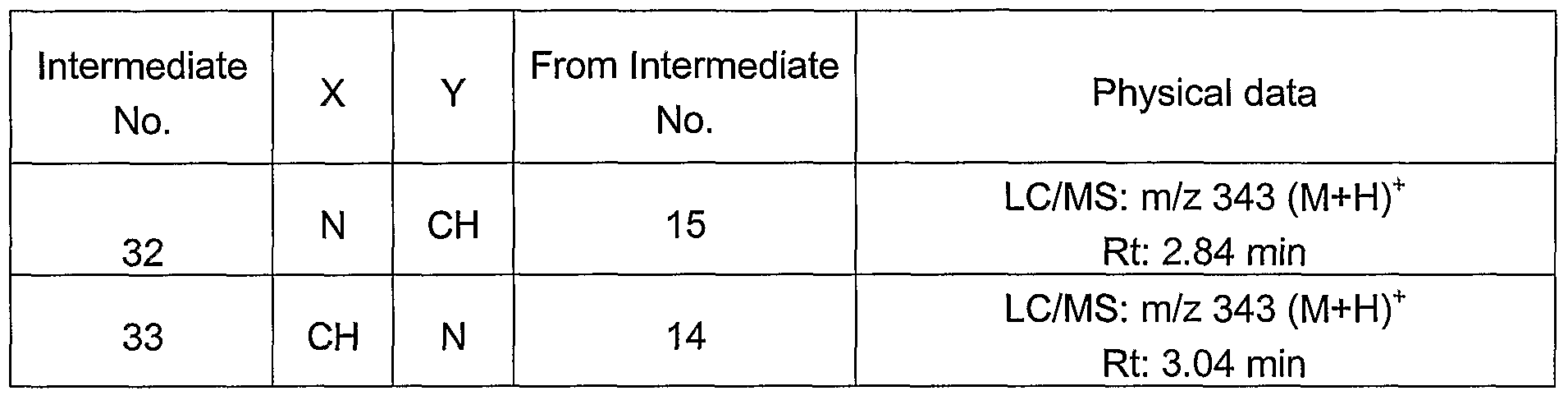
The following compounds of formula (VIIi) were similarly prepared by analogous methods to that described for Intermediate 7 (see Table 1 ):
(VIII)
Table 1
Intermediate 13: r2-Amino-5-(methyloxy)phenyll(1 ,3-benzodioxol-5-yl)methanone
To a solution of Intermediate 4 (1.52 g, 4.9 mmol) in EtOH (50 mL) was added 6N HCI (10 mL) and the mixture was stirred under reflux for 22 hours. The solvents were removed under reduced pressure and the residue was diluted with water and basified with a solution of NH4OH. The aqueous phase was extracted with EtOAc and the organic phase was washed with brine, dried over Na2SO4, filtered and evaporated to dryness to give the title compound as a yellow solid (1.26 g, 95%).
1H NMR (CDCI3) δ 7.14-7 (m, 2H), 6.98-6.85 (m, 2H), 6.8 (d, J = 9.04 Hz, 1H), 6.7 (d, J = 2.8 Hz, 1H), 6.02 (s, 2H), 3.54-2.94 (br s, 2H).
Intermediate 14: (4-Amino-3-pyridinyl)f4-(trifluoromethyl)phenyllmethanone
A solution of Intermediate 5 (5.72 g, 16.3 mmol) in 3N aqueous HCI (60 mL) was heated to reflux for 36 hours. After cooling to room temperature, the aqueous layer was neutralized with potassium carbonate and the product was extracted with EtOAc. The organic layer was washed with brine, dried over Na2SO4, filtered and evaporated to dryness to give the title compound as a yellow oil (4.51 g, 100%). LC/MS: m/z 267 (IVH-H)+, Rt: 2.66 min.
The following compound was similarly prepared by analogous method to that described for Intermediate 14.
from Intermediate 6, LC/MS: m/z 267 (M+H)
+, Rt: 2.89 min.
Intermediate 16: 1 -[2-Amino-5-(methyloxy)phenvn-2-methyl-1 -propanone
To a solution of 2-methyl-6-(methyloxy)-4H-3,1-benzoxazin-4-one (20 g, 105 mmol) in a mixture of toluene (50 mL) and Et2O (100 mL) was added dropwise at 00C under a nitrogen atmosphere a solution of isopropylmagnesiumchloride (52 mL, 2N). After stirring 12 hours at room temperature the reaction is quenched with 1N HCI (100 mL) and the mixture was extracted with CH2CI2. The organic phase was then dried over Na2SO4, filtered and evaporated under reduced pressure. The residue was purified by flash column
chromatography on silica gel eluting with DCM to give the title compound as a yellow oil (3 g, 12 %). LC/MS: m/z 194 (M+H)+, Rt 2.54 min.
Intermediate 17 2-Chloro-A/-(4-(methyloxy)-2-([4-(trifluoromethyl)phenvncarbonyl) phenvD-acetamide
To a solution of Intermediate 7 (24 g, 81.3 mmol) in CH2CI2 (400 ml.) cooled to O0C under a nitrogen atmosphere, was added a solution of chloroacetylchloride (6.5 mL, 89.5 mmol) in CH2CI2 (50 mL), maintaining the temperature at 2-3°C during the addition. The mixture was allowed to return to room temperature and was left overnight at room temperature. The organic phase was washed with a saturated solution of NaHCO3, with brine, dried over Na2SO4, filtered and evaporated under reduced pressure. The oily residue was crystallized from hexane to give the title compound as a yellow powder (26.9 g, 89%). LCMS: m/z 370 (M-H)+, Rt: 2.85 min, mp: 94°C.
The following compounds of formula (Vl) were similarly prepared by analogous methods to that described for Intermediate 17 (see Table 2). In some cases, Et3N was added to the initial reaction mixture. c,
Table 2
The following compounds of formula (VI) were similarly prepared by analogous methods to that described for Intermediate 17 (see Table 3):
Table 3
Intermediate 34: 1-{6-(Methyloxy)-2-oxo-4-f4-(trifluoromethyl)phenyll-1 ,2-dihydro-3- quinolinvDpyridinium chloride
A solution of Intermediate 17 (26.9 g, 72.5 mmol) in pyridine (200 mL) was stirred under reflux for 2 hours under a nitrogen atmosphere. The suspension was then cooled to 100C and the solid obtained was filtered, washed with Et2O and dried to give the title compound as a yellow solid in a quantitative yield. LC/MS: m/z 397, Rt: 2.05 min, mp >250°C.
The following compounds of formula (V) were similarly prepared by analogous methods to that described for Intermediate 34 (see Table 4):
The following compounds of formula (V) were similarly prepared by analogous methods to that described for Intermediate 34 (see Table 5):
Table 5
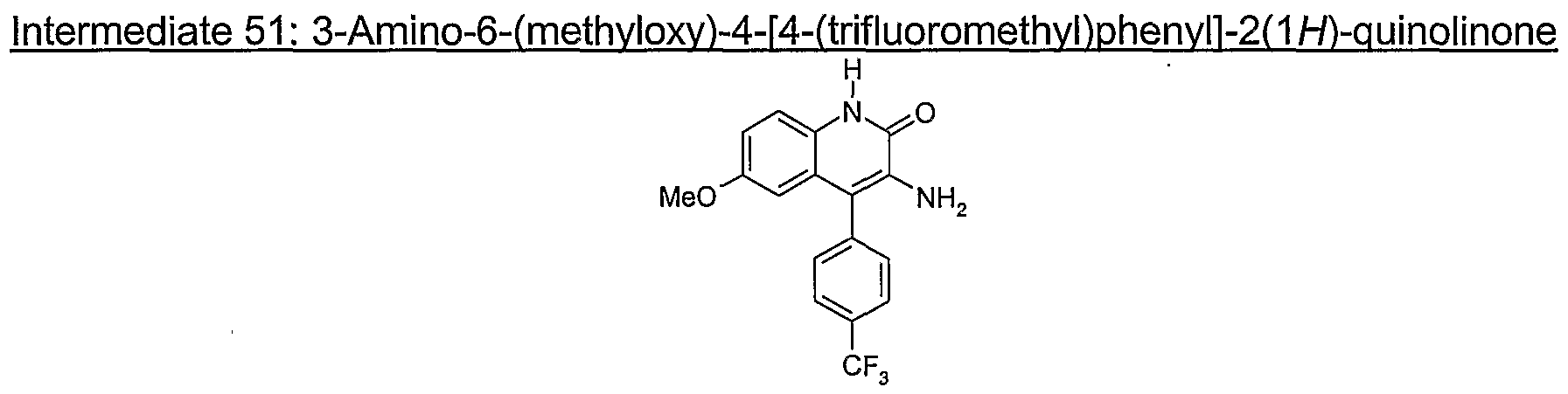
To a suspension of Intermediate 34 (11.6 g, 26.8 mmol) in EtOH (100 ml_) was added hydrazine monohydrate (12.9 mL, 266 mmol) and the mixture was stirred under reflux for 3 hours. After cooling at room temperature, the precipitate was filtered, washed with diisopropyl ether and dried (8.25g). The filtrate was dried and resuspended in H2O, extracted with EtOAc, washed with brine, dried over Na2SO4 and evaporated to dryness. Recrystallisation from EtOH gave 290mg. Total yield of the title compound as yellow crystals (8.5 g, 95%). LCMS: m/z 335 (M+H)+, Rt: 2.55 min, mp >250°C.
The following compounds of formula (IV) were similarly prepared by analogous methods to that described for Intermediate 51 (see Table 6):
(IV)
Table 6
The following compounds of formula (IV) were similarly prepared by analogous methods to that described for Intermediate 51 (see Table 7):
Table 7
Intermediate 67: 3-Amino-6-(methyloxy)-4-r4-(trifluoromethvDphenvπ-2(1 H)- quinolinethione
To a suspension of Intermediate 51 (21 g, 62.9 mmol) in toluene (600 mL) was added Lawesson's reagent (20.32 g, 50 mmol), and was stirred at 8O0C overnight. After cooling, the precipitate was filtered, rinsed, then triturated in cold diisopropyl ether and dried to give the title compound as yellow crystals (15.2 g, 69%). LC/MS: m/z 351 (M+H)+, Rt: 3.01 min, mp >250°C.
The following compounds of formula (III) were similarly prepared by analogous methods to that described for Intermediate 67 (see Table 8):
Table 8
The following compounds of formula (III) were similarly prepared by analogous methods to that described for Intermediate 67 (see Table 9):
Table 9
Intermediate 84: 3-Amino-6-(methyloxy)-4-r4-(trifluoromethyl)phenyll-2(1 /-/)-quinolinone hydrazone
Intermediate 67 (20.4 g, 58.3 mmol) was suspended in hydrazine monohydrate (200 ml_) and the mixture was heated at reflux overnight under nitrogen. After cooling at room temperature, the precipitate was filtered, washed with water and dried to give the title compound as yellow crystals (18.5 g, 91%). LC/MS: m/z 349 (M+H)
+, Rt: 2.57 min, mp: 205
0C.
The following compounds of formula (II) were similarly prepared by analogous methods to that described for Intermediate 84 (see Table 10):
Table 10
The following compounds of formula (II) were similarly prepared by analogous methods to that described for Intermediate 84 (see Table 11):
Table 11
Intermediate 101: 3-Amino-4-(3-fluorophenvD-6-(methyloxy)-2(1H)-quinolinone hydrazone
A suspension of Intermediate 43 (4.2 g, 12.2 mmol) in POCI3 (100 mL) was refluxed for 4 hours, and then concentrated to dryness. The crude residue was triturated with diisopropyl ether and afforded after filtration the pyridinium intermediate as a pale yellow powder (4.4 g, 100%) which was used without further purification and put in suspension in hydrazine hydrate (30 mL). The reaction mixture was stirred under reflux for 16 hours and then diluted with water and extracted with CH2CI2. The organic phase was dried over Na2SO4, filtered and evaporated under reduced pressure to give the title compound (3.6 g, 100%). LC/MS: m/z 299 (IvRH)+' Rt: 2.60 min.
Intermediate 102: 6-Chloro-3-nitro-2(1H)-quinolinone
To a solution of 2~amino-5-chlorobenzaldehyde (6.22 g, 40 mmol) in EtOH (120 mL) was added ethyl nitroacetate (10.64 g, 80 mmol) and piperidine (1.97 mL, 20 mmol) and the mixture was stirred under reflux for 6 hours. After cooling to room temperature, the solid was filtered, washed with diisopropyl ether and dried to give the title compound as yellow crystals (5.4 g, 60%), mp : 264-266°C. LC/MS: m/z 225 (M+H) +, Rt : 1.82 min.
Intermediate 103: 2,6-Dichloro-3-nitroquinoline
A suspension of Intermediate 102 (3.36 g, 15 mmol) in POCI3 (28 mL, 300 mmol) was stirred under reflux for 16 hours. The solution was then cooled to O0C and poured slowly in
ice-water and the mixture was stirred for 1 hour. The solid was extracted with CH2CI2 and the organic phase was washed with water, brine, dried over Na2SO4, filtered and evaporated under reduced pressure. The solid obtained was recrystallized from diisopropyl ether to give the title compound as yellow crystals (3.2 g, 88%), mp: 1900C.
Intermediate 104: 6-Chloro-3-nitro-2(1H)-αuinolinone hvdrazone
To a suspension of Intermediate 103 (11.7 g, 48 mmol) in EtOH (200 ml.) was added dropwise hydrazine hydrate (23.4 ml_, 480 mmol) and the mixture was stirred at room temperature for 3 hours. The solid was then filtered, washed with EtOH and diisopropyl ether and dried to give the title compound as orange crystals (11 g, 96%), mp: 176-178°C. LCMS: m/z 239 (M+H)+, Rt : 2.16 min.
Intermediate 105: 7-Chloro-1-metriyl-4-nitroH ,2,41triazolof4,3-alquinoline
A suspension of Intermediate 104 (11 g, 46.2 mmol) in EtOH (300 ml_) containing a drop of H2SO4 was added triethyl orthoacetate (8.98 g, 55.46 mmol) and the mixture was stirred under reflux 2 hours and at room temperature for 16 hours. The solid was filtered, washed with diisopropyl ether and recrystallized from DMF to give the title compound as yellow crystals (11.1 g, 92%), mp: >260°C. LCMS: m/z 263 (M+H)+, Rt: 1.62 min. Intermediate 106: 7-Chloro-1-methviπ ,2,41triazolo[4,3-alquinolin-4-amine
To a solution of Intermediate 105 (32.2 g, 0.123 mol) in acetic acid (1 L), stirred at 600C, was added portionwise iron (27.45 g, 0.49 mol). At the end of the addition, the mixture was stirred at 60° for 4 hours. The mixture was then cooled to room temperature, poured into water (2 L) and concentrated hydrochloric acid (100 mL) was added. The precipitate was filtered, washed with water and dried. The aqueous phase was extracted with EtOAc, washed with water, with a dilute NaOH solution, dried over Na2SO4, filtered and evaporated under reduced pressure and the solid obtained was combined with the first
fraction. The solid was recrystallized from DMF to give the title compound as a yellow solid (17.5 g, 611%), mp: 218°C. LCMS: m/z 233 (M+H) +, Rt : 1.83 min.
Intermediate 107: 5-Bromo-7-chloro-1-methviri .2,41triazolo[4,3-alquinolin-4-amine
To a suspension of Intermediate 106 (1.1 g, 4.74 mmol) in chloroform (100 ml.) was added dropwise bromine (290 μl_, 5.68 mmol) and the mixture was stirred at room temperature for 10 min. A saturated solution of NaHCO3 was then added and the resulting precipitate was filtered and washed with ethanol to give the compound as a pink solid (1.1 g, 75%). LCMS: m/z 311 and 313 (M+H)+, Rt : 2.75 min.
Intermediate 108: N-(7-Chloro-1 -methylH ,2,41triazolor4,3-a1quinolin-4-yl)acetamide
To a suspension of Intermediate 106 (464 mg, 2 mmol) in THF (100 imL) was added NaH (88 mg, 2.23 mmol) at 00C and the mixture was stirred at the same temperature for 1 hour. Acetyl chloride (157 mg, 2 mmol) was then added and the reaction mixture was stirred at room temperature for 1 hour. Water was then added and the precipitate obtained was filtered and washed with ethanol to give the title compound as a cream solid (480 mg, 87%), LCMS: m/z 275 (M+H)+, Rt: 2.18 min.
Intermediate 109: N-(5-Bromo-7-chloro-1-methyiri,2,41triazolor4,3-alquinolin-4- vPacetamide
To a suspension of Intermediate 108 (5 g, 18.2 mmol) in chloroform (300 mL) was added dropwise bromine (1.9 mL, 36 mmol) and the mixture was stirred at 60°C for 18 hours. After cooling to room temperature, a dilute solution of NaOH was added and the mixture was extracted with CH2CI2. The organic phase was washed with brine, dried over Na2SO4, filtered and evaporated under reduced pressure. The solid was triturated from
acetonitrile to give the title compound as a cream solid (4 g, 62%), LC/MS: m/z 353 and 355 (M+H)\ Rt: 2.12 min.
Intermediate 110: 4-(4-Amino-7-chloro-1-methyiri.2,4ltriazolor4,3-a1quinolin-5- vPbenzaldehvde
To a suspension of Intermediate 107 (3 g, 9.6 mmol) in a mixture of 1 ,2-dimethoxyethane (500 ml_), EtOH (200 mL) and water (100 ml.) was added (4-formylphenyl)boronic acid (1.6 g, 10.67 mmol), sodium carbonate (3.05 g, 28.77 mmol) and Pd(PPh3)4 (550 mg) and the mixture was stirred under reflux for 16 hours. The solvents were then removed under reduced pressure and the residue was dissolved in CH2CI2. The organic phase was washed with a 1N NaOH solution, dried over Na2SO4, filtered and evaporated to dryness to give the title compound as a solid (1.52 g, 47%), LC/MS: 337 m/z (M+H)+, Rt : 2.79 min.
The following compounds were similarly prepared by analogous method to that described for Intermediate 110 (see Table 12) using the appropriate boronic acid.
Table 12
Example 1 : 1-Methyl-7-(methyloxy)-5-r4-(trifluoromethyl)phenyliπ ,2,41triazolor.4,3- aiαuinolin-4-amine
To a solution of Intermediate 84 (6.6 g, 18.96 mmol, 1 eq) in a mixture of toluene/ethanol (50 ml_ / 70 ml_) was added triethyl orthoacetate (5 eq) and the mixture was stirred under reflux under nitrogen overnight. The solution was then cooled to room temperature and the precipitate obtained was filtered and washed with the minimum of 2-propanol. The solid was then purified by flash column chromatography eluting with CH2CI2/Me0H: 97/3 to give the title compound as white crystals (6.19 g, 86%) after recrystallization from 2- propanol, mp: 236°C.
HRMS calculated for C19H15F3N4O (M+H) + 373.1276, found: 373.1281, Rt: 2.89 min. 1H NMR (DMSO) δ 8.35(d, J = 9.23 Hz, 1 H), 8.1 (d, J = 8.10 Hz, 2H), 7.75 (d, J = 7.72 Hz, 2H), 7.2 (dd, J = 9.23 Hz, J = 2.82, 1 H), 6.55 (d, J = 2.83 Hz, 1 H), 5.74 (s, 2H), 3.81 (s, 3H), 3.22 (s, 3H).
Several forms of the compound of Example 1 were identified. Solid-state carbon-13 NMR spectra for two of these forms, Form 1 and Form 2, are shown in Figure 1 and Figure 2 respectively. To prepare Form 1 , a suspension of 1-methyl-7-(methyloxy)~5-[4- (trifluoromethyl)phenyl][1 ,2,4]triazolo[4,3-a]quinolin-4-amine in water-saturated methyl ethyl ketone (MEK, 14 volumes) was heated to 71-74 0C until complete dissolution was observed (30-60 minutes). The reaction mixture was kept at 71-74 0C for 30 minutes, after which time the temperature was adjusted to 65 0C and Form 1 seed crystals (1% wt/wt) were added as a slurry in water. The mixture was allowed to cool slowly to 5 0C over approx. 1 hour and stirred at this temperature for 60 minutes. The solids were filtered, the reactor washed with 3 x 1 volumes water, and the solids dried under vacuum at 55 0C to give an off-white solid (85-90% yield). Exposure of Form 1 to ambient humidity brings the hydration state up towards a monohydrate, while vacuum drying brings it down towards a hemihydrate. Form 2 was prepared from Form 1 by placing the compound in an oven at 60 0C under a vacuum of 25" Hg for 12 hours. Form 2 can be converted back to Form 1 by exposure to moderate to high humidity (35-75% RH) for 72 hours. Intermediate hydration states can be prepared by exposure of Form 1 or Form 2 to controlled relative humidities.
The following compounds of formula (I) were prepared by analogous methods to that described for Example 1 using the appropriate orthoester (see Table 9):
(I)
Table 9
The following compounds of formula (IV) were similarly prepared by analogous methods to that described for Example 1 (see Table 10):
Table 10
Example 20: 7-bromo-5-(2-fluorophenyl)-1-methviπ ,2,41triazolor4,3-a1quinolin-4-amine
A solution of 3-amino-6-bromo-4-(2-fluorophenyl)-2(1H)-quinolinone (5.5 g, 16.5 mmol) and Lawesson's reagent (10 g, 24.8 mmol) in toluene (200 mL) was stirred at 80°C for 1 hour. After cooling at room temperature, water (20OmL) was added and the reaction mixture was extracted with EtOAc (2x 20OmL). The combined organic layers were dried over Na2SO4, filtered and concentrated to dryness. The residue obtained was used without further purifications and put in reaction with hydrazine hydrate (30 mL). The resulting mixture was heated to reflux for 1 hour and an additional amount of hydrazine hydrate was added (2OmL). The reaction was monitored by LC/MS and stopped with a remaining 20% of starting material. Water was added and extraction was carried out with EtOAC to afford 5.5g of the hydrazone intermediate after drying over Na2SO4, filtering and concentrating to dryness. The crude product was then put in reaction in a mixture of THF/EtOH with trimethylorthoacetate (3.15 mL,24.7 mmol) and a catalytic amount of sulphuric acid ( 200μL). The mixture was stirred at room temperature 12 hours and concentrated under vacuo. The residue was dissolved in EtOAc ( 300 mL) and washed with a NaHCO3 solution. The organic layer was dried over Na2SO4, filtered and concentrated to give the title compound as white crystals (4.5 g, 74%), mp > 250 0C. HRMS calculated for C17H12BrFN4 (M+H) + 371.0308, found: 371.0291 , Rt: 2.76 min.
Example 21 : 5-(2-fluorophenyl)-1-methylH ,2,41triazolor4,3-alαuinolin-4-amine
the title compound was similarly prepared by analogous methods to that described for example 20 starting from the 3-amino-4-(2-fluorophenyl)-2(1H)-quinolinone.
HRMS calculated for C17H13FN4 (M+H) + 293.1202, found: 293.1141 , Rt: 2.27 min.
Example 22: 1 -methyl-5-(1 -methylethvO-7-(methyloxy)H ,2,41triazolor4,3-alquinolin-4- amine
To a solution of Intermediate 16 (900 mg, 4.66 mmol) in DCM (50 ml.) was added chloroacetylchloride (371 μL, 4.66 mmol) at 00C and the resulting mixture was stirred at room temperature for 1 hour and then concentrated under reduced pressure. The residue was dissolved in pyridine (20 mL) and heated at reflux temperature for 1 hour. After cooling at room temperature the mixture was taken up with JPr2O and the resulting precipitate was filtered and dried. The powder was then placed in a round bottom flask with POCI3 (30 mL) and heated at reflux for 3 hours. The excess of POCI3 was removed by concentration under reduced pressure and coevaporation with toluene. Then hydrazine hydrate (20 mL) was added to the resulting chlorimine and the mixture was heated to reflux temperature for 18 hours. The mixture was diluted with water, extracted with DCM, and the organic layer was dried over Na2SO4, filtered and evaporated to dryness. The residue was dissolved in EtOH (50 mL), trimethylorthoacetate (10 mL) was added and the mixture was heated at reflux temperature for 8 hours and concentrated under reduced pressure. The residue was diluted with H2O, extracted with DCM and the organic layer was separated, dried over Na2SO4, filtered and concentrated to dryness. The residue was recrystallized from CH3CN/MeOH to give the title compound as a white solid (130 mg), mp: 258-2600C. HRMS calculated for Ci5H18N4O (M+H)+ 271.1559, found: 271.1538; Rt : 2.38 min.
Example 23: 5-(2-Fluorophenyl)-7-(2-furanvO-1-methviri .2.41triazolor4,3-alαuinolin-4- amine
To a suspension of Example 20 (100 mg, 0.27 mmol) in toluene under a nitrogen atmosphere, was added tributyl(2-furanyl)stannane (95 μL, 0.3 mmol) and Pd(PPh3)4 (30 mg) and the mixture was stirred under reflux for 24 hours. The solution was then cooled at room temperature and quenched with a saturated solution of NH4CI, washed with a saturated solution of NaHCO3. The organic layer was dried over Na2SO4, and filtered through Celite. The solid was purified by flash column chromatography eluting with
CH2CI2/Me0H: 96/4 to give after recrystallization from ethanol, the title compound as a pink solid (10 mg, 10%).
HRMS calculated for C21H15FN4O (M+H)+ 359.1308, found: 359.1307; Rt: 2.49 min.
The following compounds of formula (I) were similarly prepared by analogous methods to that described for Example 23 (see Table 11 ):
Table 11
Example 26: 4-Amino-1-methyl-5-[4-(trifluoromethyl)phenyliri ,2,41triazolor4,3-alquinolin-7- ol
To a solution of Example 1 (1.5 g, 4 mmol) in DCM (150 ml_) cooled at -780C, was added dropwise BBr3 (17 mL, 16.8 mmol, 1 M in DCM). After 30 min the bath was removed, and
the mixture was stirred at room temperature for 16 hours. The resulting mixture was basified with a 1N NaOH, and then readjusted to pH=7 with a 1 N HCI. The solid which precipitated was filtered, washed with water and dried to give the title compound as a cream solid (1.36 g, 90 %). Mp: >260°C. HRMS calculated for C18H13F3N4O (M+H)+ 359.1120 found: 359.1148; Rt: 2.42 min.
Example 27 : 7-Chloro-5-(2-fluoro-4-pyridinvO-1-methviri ,2Λltriazolor4,3-a1quinoHn-4- amine
To a suspension of Intermediate 107 (311 mg, 1 mmol) in 1,2-dimethoxyethane (300 mL) was added (2-fluoro-4-pyridinyl)boronic acid (280 mg, 2 mmol), Pd(PPh3)4 (60 mg) and a 2M solution of sodium carbonate (1.2 mL, 2.5 mmol) and the mixture was stirred under reflux for 24 hours. The solvent was then evaporated under reduced pressure and the residue was dissolved in CH2CI2. The organic phase was washed with a saturated solution of NaHCO3, dried over Na2SO4, filtered and evaporated to dryness. The residue was purified by flash column chromatography eluting with CH2CI2/Me0H: 95/5 and recrystallized from acetonitrile to give the title compound as a white solid (50 mg, 15%), mp : >250°C. HRMS calculated for C16H11CIFN5 (M+H)+ 328.0765, found : 328.0758. Rt: 2.39 min
The following compounds of formula (I) were similarly prepared by analogous methods to that described for Example 27 using the appropriate boronic derivative (see Table 12):
Table 12
Example 30: 7-Chloro-1-methyl-5-(3-thienvθri ,2,41triazolor4.3-alquinolin-4-amine
To a suspension of Intermediate 109 (353 mg, 1 mmol) in toluene/ethanol (80/20 ml_) was added 3-thienylboronic acid (154 mg, 1.2 mmol), Pd(PPh3)4 (58 mg) and a 2M solution of sodium carbonate (1.5 ml_, 3 mmol) and the mixture was stirred under reflux for 16 hours. The mixture was then evaporated under reduced pressure and the residue was dissolved in CH2CI2. The organic phase was washed with a saturated solution of NaHCO3, dried over Na2SO4, filtered and evaporated to dryness. The solid was crystallized from acetonitrile to give the acetamide intermediate as a cream solid (40 mg, 11%), mp : >260°C, LC/MS: 357 m/z (M+H)+, Rt : 2.40 min. To a suspension of acetamide (40 mg, 0.11 mmol) in EtOH (80 mL) containing 5N HCI (10 ml_) was stirred under reflux for 5 hours. The solvent was removed under reduced pressure and the residue was dissolved in CH2CI2. The organic phase was washed with brine, dried over Na2SO4, filtered and evaporated to dryness. The solid was crystallized from acetonitrile to give the title compound as a brown solid (20 mg, 57%), mp : >260°C, HRMS calculated for C15H11CIN4S (M+H)+ 315.0471, found: 315.0474; Rt: 2.72 min.
The following compounds of formula (I) were similarly prepared by analogous methods to that described for Example 30 using the appropriate boronic derivative (see Table 13):
Table 13
Example 34: 4-(4-amino-7-chloro-1-methyl[1 ,2,41triazolor4,3-alquinolin-5-yl)benzoic acid
To a solution of Example 28 (0.3 g, 0.82 mmol) in EtOH (20 ml.) was added 1 N NaOH
(4ml_) and the mixture was stirred under reflux for 3 hours. After cooling at room temperature 6N HCI was added and the precipitate was filtered, washed with water and
diisopropyl ether and recrystallized from EtOH to give the title compound as a white powder (125 mg, 47%).
HRMS calculated for C18H13CIN4O2 (M+H)+ 353.0805, found : 353.0837; Rt : 1.76 min
Example 35: 7-Chloro-1-methyl-5-r3-(4-morpholinylmethvDphenvnπ .2.41triazolof4.3-al- αuinolin-4-amine
To a solution of Intermediate 111 (150 mg, 0.44 mmol) and morpholine (58 mg, 0.66 mmol) in THF (10 ml_) was added sodium cyanoborohydride (112 mg, 1.78 mmol) and the mixture was stirred at 6O0C for 24 hours. A saturated NaHCO3 solution was added and the mixture was extracted with EtOAc. The organic phase was washed with brine, dried over Na2SO4, filtered and evaporated to dryness. The residue was purified by flash column chromatography eluting with CH2CI2/Me0H: 95/5 to give the title compound as a white solid (170 mg, 93%). HRMS calculated for C22H22CIN5O (M+H) + 408.1591 , found : 408.1577, Rt = 2.64 min.
The following compounds of formula (I) were similarly prepared by analogous methods to that described for Example 35 (see Table 14):
(D
Table 14
From
Ex. R3 Intermediate Physical data No
HRMS (M+H)+:
3-(phenylmethyl)amino]- calculated for
36 111 methyljphenyl) C
25H
22CIN
5 Theo: 428.1642
Example 42: 7-chloro-5-{5-r(dimethylamino)methyll-2-furanyl>-1-methyiri ,2,4ltriazolo [4,3- alquinolin-4-amine
To a solution of Intermediate 107 (311 mg, 1 mmol) in dimethoxyethane (300 mL) and EtOH (20 mL) were consecutively added (5-formyl-2-furanyl)boronic acid (280 mg, 2 mmol) , sodium carbonate (318 mg, 3 mmol) and palladium tetrakis (58 mg,0.05 mmol). The resulting mixture was heated at 130°C for 4 hours and 2 additionnal equivalents of boronic acid were added and heating was continued 12 hours. The solvent was removed under reduced pressure and the residue was dissolved in EtOAc. The organic phase was separated and washed with brine, dried over Na2SO4, filtered and evaporated to dryness. Flash column chromatography purification afforded the expected aldehyde intermediate (40 mg) which was dissolved in anhydrous THF. Dimethylamine (74 μL, 0.148 mmol) and triacetoxysodiumborohydride (32 mg, 0.148 mmol) was added and the resulting mixture was heated to 600C for 12 hours. DCM was added and the organic phase was separated, washed with brine, dried over Na2SO4, filtred and concentrated under reduced pressure. The residue was purified by flash column chromatography eluting with DCM/MeOH (95/5) to give the title compound as an off-white powder (40mg) after recrystallization from diisopropyl ether, mp: 217°C HRMS calculated for C18H18CIN5O (M+H)+ 356.1278, found : 356.1265, Rt = 2.39 min.
Example 43: [4-(4-Amino-7-chloro-1-methyl[1 ,2,41triazolor4.3-alquinolin-5-yl)phenyl-l- methanol
To a solution of Intermediate 110 (420 mg, 1.25 mmol) in THF (15 mL) was added portionwise sodium borohydride (70 mg, 1.87 mmol) and the mixture was stirred at room temperature for 30 min. Water was added and the mixture was extracted with CH2CI2. The organic phase was washed with brine, dried over Na2SO4, filtered and evaporated to dryness. The residue was crystallized from acetonitrile to give the title compound as a solid (85 mg, 20%).
HRMS calculated for C18H15CIN4O (M+H)+ 339.1013, found : 339.1012, Rt = 2.28 min.
Example 44: 1-r4-(4-Amino-7-chloro-1-methyiπ ,2,41triazolor4,3-alαuinolin-5-yl)phenyll- ethanol
To a solution of Intermediate 110 (300 mg, 0.89 mmol) in THF (50 mL) was added dropwise a 3M solution of methylmagnesium bromide (0.89 mL, 2.67 mmol) in Et2O at O0C. The mixture was then stirred at room temperature for 4 hours, and a saturated solution of NH4CI was added. The mixture was extracted with EtOAc and the organic phase was washed with brine, dried over Na2SO4, filtered and evaporated to dryness. The residue was purified by flash column chromatography eluting with CH2CI2/Me0H: 95/5 to give the title compound as a cream solid (85 mg, 27%). HRMS calculated for C19H17CIN4O (IVH-H) + 353.1169, found: 353.1156, Rt = 2.37 min.
The following compounds were similarly prepared by an analogous method to that described for Example 44 (see Table 15).
Table 15
Example 47: A/-ethyl-5-(2-fluorophenyl)-1-methyl[1 ,2,41triazolor4,3-alquinolin-4-amine
To a solution of Example 21 (125 mg, 0.43 mmol) in THF (20 ml_) was added 60% NaH (21 mg, 0.51 mmol). The resulting mixture was stirred to room temperature for 1 hour and ethyl iodide (34 μL, 0.43 mmol) was added. After stirring for 3 days to room temperature the reaction was quenched with H2O and the mixture was extracted with EtOAc. The organic layer was washed with brine, dried Na2SO4 and concentrated under reduced pressure to give the title compound (34 mg, 24%). HRMS calculated for C19Hi7FN4 (M+H)+ 321.1516, found : 321.1503, Rt = 2.47 min.
The following compounds were similarly prepared by an analogous method to that described for Example 47 (see Table 16).
(I)
Table 16
Biological Assays
Luciferase assay A transcriptional screen on HepG2 cells was used for primary screening of compounds. Briefly, HepG2 cells were transfected with a plasmid encoding firefly luciferase under the control of 1123 bp of the human apoA-1 promoter region and 232 bp after the transcription start site (-1162, +232), and the 3'-UTR of the human apoA-1 gene (+1037, +1091). Stably transfected cells were obtained by adding 500 μg/ml of Geneticin into culture medium. A stably transfected HepG2 cell line was chosen for screening, and grown in BME medium containing 10% heat inactivated fetal calf serum (FCS), glutamine, sodium pyruvate, non essential amino acids, penicillin-streptomycin and 100 μg/ml of geneticin at 37°C in a 95% air - 5% CO2 humidified atmosphere. Compounds were dissolved in DMSO, added onto cells in BME medium containing 1% FCS and all other additives. After a 16 to 20 hour incubation, luciferase activity was quantified in cell lysates by adding Bright Glow™ substrate (Promega). Results are expressed as % of controls, and the
concentration of compounds leading to a 70% increase in luciferase activity over controls is determined.
Human apoA-1 promoter sequence (-1162 + 232)
AGATCTAGTG ATGTCACAGT TCCTCTCAGC CTGCATCACA GGCTCTAGGA
CTCAGGTCCT ATCAGTAACC TGCTGGGGGA GGTCTGGGCC TTCCAGGAGA
AACCTGACAA GATGGTGCTG CAAACACCGA ACGGACACAC AGCACTTTAC
ATTCACAGGC TGTCTCAGGG GCCTCCAACA ACCCTGACCA TTCTTGCCCC
ATTTTGCAGA TAGAAAACCG AGGCTCAGAG AGTTATATAA CTTGCCCACG
ATCTTCCTCC AGCAAGATGG AGGCCAAGTG AAATGCAGGT CTCCTGCCAC
TTCCTTTGCC CAGAGGTCTT CTCCCCACAC CAGGGCTTCC CAAGGGCTGA
GATCCAGTCA CACCTGTGCG TGATCAAATA TAAGTGTGAA CAATGCAAAG
GGAGACGTCT TCAATCTAAG GGGCTTCAAT TCTGTAATGT AATTCTGAGA
TTATGCCCTT TTTTGTTAAA GCCTTTCCTT TTTGAAGTGA TGGTCACTGT
AGATGGTGAG GGTTTTTTGG AGGCGGACAA TATCTTTACA TGACAAAATT
AAAAGTTGGC AGCTCCGAAT TGATCTCTGG AGTGTTTTGA AATGCAAGAG
GTCTCCGAAA CCTCAGTCTG GGAGCCACGG AGGGCTCTCC CCTCTCCCCA
GGTTTACCAG TTTGGAGGCT TGAGAGAGGC CTGAGGACCT GCTGGGGACT
AAAGAAGAGC ACTGGTGGGA GGACAGGGCG GGGGAAGGGG GAGGGGAGTG
AAGTAGTCTC CCTGGAATGC TGGTGGTGGG GGAGGCAGTC TCCTTGGTGG
AGGAGTCCCA GCGTCCCTCC CCTCCCCTCC TCTGCCAACA CAATGGACAA
TGGCAACTGC CCACACACTC CCATGGAGGG GAAGGGGATG AGTGCAGGGA
ACCCCGACCC CACCCGGGAG ACCTGCAAGC CTGCAGACAC TCCCCTCCCG
CCCCCACTGA ACCCTTGACC CCTGCCCTGC AGCCCCCGCA GCTTGCTGTT
TGCCCACTCT ATTTGCCCAG CCCCAGGGAC AGAGCTGATC CTTGAACTCT
TAAGTTCCAC ATTGCCAGGA CCAGTGAGCA GCAACAGGGC CGGGGCTGGC
TTATCAGCCT CCCAGCCCAG ACCCTGGCTG CAGACATAAA TAGGCCCTGC
AAGAGCTGGC TGCTTAGAGA CTGCGAGAAG GAGGTGCGTC CTGCTGCCTG
CCCCGGTCAC TCTGGCTCCC CAGCTCAAGG TTCAGGCCTT GCCCCAGGCC
GGGCCTCTGG TACCTGAGGT CTTCTCCCGC TCTGTGCCCT TCTCCTCACC
TGGCTGCAAC TGAGTTCGGG GAGCACGGGG CTTCTGCATG CTGAAGGCAC
CCACTCAGCC AGGCCCTTCT TCTCCTCCAG GTCCCCCACG GCCCTTCAGG
AAGCTT
Human apoA-1 3'UTR sequence (+ 1037 + 1091)
TCTAGAGGCG CCCGCCGCCG CCCCCCTTCC CGGTGCTCAG AATAAACGTT TCCAAAGTGG GGGATCC
Using this assay, all examples gave a pEC-^n of between 5.2 to 7.5.
ApoA-1 secretion assay
Some of the compounds of the invention were also tested for their ability to increase apoA-1 production by HepG2 cells. HepG2 cells were grown in BME medium containing 10% heat inactivated FCS, glutamine, sodium pyruvate, non essential amino acids and penicillin-streptomycin at 37°C in a 95% air - 5% CO2 humidified atmosphere. The compounds of the invention were first incubated onto confluent HepG2 cells in BME medium containing 1% FCS and all other additives. After a 48 hour incubation, the supematants were removed and compounds were re-added onto cells in RPMI-1640 medium depleted in methionine and cysteine, and supplemented with 1% cystine, 1% glutamine, 1% penicillin-streptomycin and 35S-methionine. The incubation was maintained for 6 additional hours at 370C. Neosynthesized radiolabeled secreted proteins were then analyzed on 5-12% SDS Page. After exposure of gels onto Phosphorlmager screens, radiolabeled secreted apoA-1 was quantified using a Storm 860 (Molecular Dynamics) apparatus. The concentration of compounds giving a 50% increase in secreted apoA-1 over controls (the basal level being arbitrarly at 100%) was determined and referred as the HepG2 EC150. All tested examples gave a EC150 of between 5 μm and 0.1 μm.
Assay for anti-inflammatory profile in human endothelial cells (HUVEC)
The effect of some compounds of the present invention on the following inflammation assay were investigated. Human Umbilical Vein Endothelial Cells (HUVECs) were grown to confluence in 96-well plates (approximately 20,000 cells/well). HUVECs were treated with a test compound for 1 hour before the addition of 20 pM TNFα for 4 hours. RNA levels for VCAM-1 , IL8, ICAM-1, CX3CL1 , MCP-1, COX2, E-selectin and GAPDH (as internal control) were determined using the eTag Multiplex RNA Invader Assay (Aclara Biosciences, Mountain View, CA, USA). Following the reaction, products were separated by capillary electrophoresis (MegaBACE 1000, Amersham Biosciences) and raw data were analyzed using the eTag Informer software (Aclara Biosciences, Mountain View, CA, USA). Each point was performed as a biological duplicate and each sample was run twice on the capillary electrophoresis apparatus. Each analyte was normalized to the internal GAPDH control. Results may be expressed as ICs0 (μM) of the test compound on each parameter measured.
Assay for anti-inflammatory profile in human C-13 microglial cells
The effect of some compounds of the present invention on the following inflammation assay were investigated. C-13 cells were seeded in 96 well tissue culture plates and incubated for 16 hours at 370C in a humidified 5% CO2 atmosphere prior to assay. To test the ability of a test compound to inhibit IL1β induced production of IL6 and IL8, the medium was removed from the cells and replaced with fresh medium containing 1 ng/ml IL1β and the test compound (10-point 3-fold serial dilution from 10 μM). Compound- treated cells were then incubated for 18 hours at 370C in a humidified 5% CO2 atmosphere, following which the supematants were decanted. The amounts of IL6 and IL8 in the supematants were quantitated by a multiplexed Luminex assay using anti-IL6 (Endogen) and anti-IL8 (BD Pharmingen) coated beads to capture the antigens. Bound antigens were detected using anti-IL6-biotin (Endogen) and anti-IL8-biotin (BD
Pharmingen), followed by streptavidin-phycoerythrin (Europa Bioproducts). To determine if the test compound exhibited any cytotoxicity, cells were fixed (following removal of supernatants) with PBS, 4% paraformaldehyde, 2.5 μg/ml Hoechst 33342 for 20 minutes at room temperature. Hoechst 33342-stained nuclei were then counted on the Cellomics Arrayscan Il using the Mitotic Index algorithm to determine any reduction in cell number that would be expected due to cytotoxicity. Results may be expressed as IC50 (μM) of the test compound on each parameter measured.
Assay for anti-apoptotic activity in human neuroblastic SH-SY5Y cells The effect of some compounds of the present invention on caspases 3/7 activity were investigated. SH-SY5Y cells were seeded in 96 well tissue culture plates and incubated for 24 hours at 370C in a humidified 5% CO2 atmosphere prior to assay. To test the ability of a test compound to inhibit the activation of caspases 3 and 7 by Noc-18, the medium was removed from the cells and replaced with fresh medium containing 1 mM Noc-18 and the test compound (10-point 3-fold serial dilution from 10 μM). Compound-treated cells were then incubated for 16 hours at 370C in a humidified 5% CO2 atmosphere, following which they were removed from the incubator and 100 μl per well of Apo-One Homogeneous Caspase 3/7 Assay Reagent (Promega) was added. The assay plates were then incubated for 2 hours at room temperature in the dark before reading on a fluorescence plate reader (excitation wavelength : 485 nm; emission wavelength : 535 nm). Results may be expressed as IC50 (μM) of the test compound on each parameter measured.
Assay for anti-inflammatory activity in human hepatic HepG2 cells The effect of the compound of Example 1 on IL6-induced fibrinogen expression in HepG2 cells was investigated. The compound of Example 1 was incubated onto HepG2 cells in BME containing 1% FCS, penicillin-streptomycin, glutamine, sodium pyruvate and non essential amino acids. After 1 hour, 10 ng/ml of recombinant human IL6 was added or not onto cells. Following a 48 hour incubation, medium was removed and cells lysed for mRNA extraction. Human β chain-fibrinogen and cyclophilin mRNA were quantified by quantitative RT-PCR using specific primers. Results may be expressed as IC50 (μM) of the test compound on basal β chain-fibrinogen expression, or IL6-induced β chain-fibrinogen expression, after normalization with cyclophilin.
Assay for anti-inflammatory activity in peripheral blood mononuclear cells (PBMC)
The effect of some test compounds of the present invention on LPS-induced IL6 and TNF-α production in human, rat and/or mouse PBMC was investigated. Blood samples from male CD rats, male Balb/c mice and human donors were taken into tubes containing heparin (rat and mouse) or sodium citrate (human), and kept on ice before isolation of blood mononuclear cells using Histopaque-1077 gradient from Sigma. After two washes in phosphate buffer saline, cells were seeded in 96well tissue culture plates in RPMI-1640 medium containing 1 or 5% FCS, penicillin-streptomycin and glutamine, and incubated for 1 hour at 370C in a humidified 5% CO2 atmosphere prior to assay. A test compound was
then added onto cells at different concentrations (10 μM to 10 nM), followed by the addition of LPS (100 ng/ml final concentration) one hour later. After a 24 hour incubation, supernatants were taken and filtered on MAHV-45 microplates (Millipore) to remove cells. IL6 and TNF-α concentrations in conditioned media were measured by specific Elisa from R&D. Results may be expressed as IC50 (μM) of the test compound on LPS-induced IL6 and TNF-αproduction.