WO2006032097A1 - Synergistic solvent extraction process - Google Patents
Synergistic solvent extraction process Download PDFInfo
- Publication number
- WO2006032097A1 WO2006032097A1 PCT/AU2005/001452 AU2005001452W WO2006032097A1 WO 2006032097 A1 WO2006032097 A1 WO 2006032097A1 AU 2005001452 W AU2005001452 W AU 2005001452W WO 2006032097 A1 WO2006032097 A1 WO 2006032097A1
- Authority
- WO
- WIPO (PCT)
- Prior art keywords
- metal ions
- group
- solution
- aqueous
- zinc
- Prior art date
- Legal status (The legal status is an assumption and is not a legal conclusion. Google has not performed a legal analysis and makes no representation as to the accuracy of the status listed.)
- Ceased
Links
- CFPNMYCFVVUHHC-UITAMQMPSA-N Cc(cc1)cc(/C=N\O)c1O Chemical compound Cc(cc1)cc(/C=N\O)c1O CFPNMYCFVVUHHC-UITAMQMPSA-N 0.000 description 1
Classifications
-
- C—CHEMISTRY; METALLURGY
- C22—METALLURGY; FERROUS OR NON-FERROUS ALLOYS; TREATMENT OF ALLOYS OR NON-FERROUS METALS
- C22B—PRODUCTION AND REFINING OF METALS; PRETREATMENT OF RAW MATERIALS
- C22B15/00—Obtaining copper
- C22B15/0063—Hydrometallurgy
- C22B15/0084—Treating solutions
-
- C—CHEMISTRY; METALLURGY
- C22—METALLURGY; FERROUS OR NON-FERROUS ALLOYS; TREATMENT OF ALLOYS OR NON-FERROUS METALS
- C22B—PRODUCTION AND REFINING OF METALS; PRETREATMENT OF RAW MATERIALS
- C22B23/00—Obtaining nickel or cobalt
- C22B23/04—Obtaining nickel or cobalt by wet processes
- C22B23/0453—Treatment or purification of solutions, e.g. obtained by leaching
-
- C—CHEMISTRY; METALLURGY
- C22—METALLURGY; FERROUS OR NON-FERROUS ALLOYS; TREATMENT OF ALLOYS OR NON-FERROUS METALS
- C22B—PRODUCTION AND REFINING OF METALS; PRETREATMENT OF RAW MATERIALS
- C22B23/00—Obtaining nickel or cobalt
- C22B23/04—Obtaining nickel or cobalt by wet processes
- C22B23/0453—Treatment or purification of solutions, e.g. obtained by leaching
- C22B23/0461—Treatment or purification of solutions, e.g. obtained by leaching by chemical methods
-
- C—CHEMISTRY; METALLURGY
- C22—METALLURGY; FERROUS OR NON-FERROUS ALLOYS; TREATMENT OF ALLOYS OR NON-FERROUS METALS
- C22B—PRODUCTION AND REFINING OF METALS; PRETREATMENT OF RAW MATERIALS
- C22B3/00—Extraction of metal compounds from ores or concentrates by wet processes
- C22B3/20—Treatment or purification of solutions, e.g. obtained by leaching
- C22B3/26—Treatment or purification of solutions, e.g. obtained by leaching by liquid-liquid extraction using organic compounds
- C22B3/30—Oximes
-
- C—CHEMISTRY; METALLURGY
- C22—METALLURGY; FERROUS OR NON-FERROUS ALLOYS; TREATMENT OF ALLOYS OR NON-FERROUS METALS
- C22B—PRODUCTION AND REFINING OF METALS; PRETREATMENT OF RAW MATERIALS
- C22B3/00—Extraction of metal compounds from ores or concentrates by wet processes
- C22B3/20—Treatment or purification of solutions, e.g. obtained by leaching
- C22B3/26—Treatment or purification of solutions, e.g. obtained by leaching by liquid-liquid extraction using organic compounds
- C22B3/38—Treatment or purification of solutions, e.g. obtained by leaching by liquid-liquid extraction using organic compounds containing phosphorus
- C22B3/384—Pentavalent phosphorus oxyacids, esters thereof
- C22B3/3842—Phosphinic acid, e.g. H2P(O)(OH)
-
- C—CHEMISTRY; METALLURGY
- C22—METALLURGY; FERROUS OR NON-FERROUS ALLOYS; TREATMENT OF ALLOYS OR NON-FERROUS METALS
- C22B—PRODUCTION AND REFINING OF METALS; PRETREATMENT OF RAW MATERIALS
- C22B3/00—Extraction of metal compounds from ores or concentrates by wet processes
- C22B3/20—Treatment or purification of solutions, e.g. obtained by leaching
- C22B3/26—Treatment or purification of solutions, e.g. obtained by leaching by liquid-liquid extraction using organic compounds
- C22B3/40—Mixtures
- C22B3/409—Mixtures at least one compound being an organo-metallic compound
-
- Y—GENERAL TAGGING OF NEW TECHNOLOGICAL DEVELOPMENTS; GENERAL TAGGING OF CROSS-SECTIONAL TECHNOLOGIES SPANNING OVER SEVERAL SECTIONS OF THE IPC; TECHNICAL SUBJECTS COVERED BY FORMER USPC CROSS-REFERENCE ART COLLECTIONS [XRACs] AND DIGESTS
- Y02—TECHNOLOGIES OR APPLICATIONS FOR MITIGATION OR ADAPTATION AGAINST CLIMATE CHANGE
- Y02P—CLIMATE CHANGE MITIGATION TECHNOLOGIES IN THE PRODUCTION OR PROCESSING OF GOODS
- Y02P10/00—Technologies related to metal processing
- Y02P10/20—Recycling
Definitions
- the present invention relates to a synergistic solvent extraction process for separating one group of metal ions from a second group of metal ions.
- the process is suitable for separating copper and/or zinc and/or ferric iron from cobalt and/or nickel contained in an aqueous solution.
- the process is also suitable for separating any ⁇ one of these metal ions from any others, alone or in combination.
- the world mineral industry is experiencing an unprecedented interest in metal extraction from laterite and sulphide ores through hydrometallurgical processes.
- the hydrometallurgical process involves grinding, leaching and solvent extraction (SX) , with recovery of product via precipitation or reduction processes.
- the intensity of the leaching process depends on the nature of the ore (mineralogy, grade) , the distribution of the metal (s) to be recovered and the particle size reduction achieved during grinding.
- Leach solutions often contain copper, nickel, cobalt and zinc (and/or manganese) as metals to be recovered (target metals) , with calcium, magnesium, iron and aluminium (and manganese if not be to be recovered) as impurity metals to be rejected.
- Iron (as ferric) and aluminium are often removed by precipitation at low pH (pH 2.5 - 5.0) prior to SX.
- a separation of industrial significance that has proven to be particularly troublesome is the separation of copper and/or zinc and/or ferric iron from cobalt and/or nickel.
- Nickel and cobalt are often the metals of greatest value in leach solutions.
- the present invention is generally based on the development of an organic solution of phosphinic acid and hydroxyoxime which is effective in shifting the pH isotherms of metal ions in such a way as to enable separation of certain groups of these metal ions (elements) from each other.
- the organic solution is effective in shifting the pH isotherms of nickel, cobalt, copper, zinc, and ferric iron in a beneficial manner.
- the isotherms of the elements copper, zinc, and ferric iron are separated from the isotherms of cobalt and nickel to allow effective separation of these groups of elements.
- the isotherms of the individual metals, copper, ferric iron, zinc, cobalt and nickel can be sufficiently separated from each other to allow effective separation of these elements (individually, or in particular combinations) from each other.
- this organic extractant solution when this organic extractant solution is contacted with certain leach solutions containing appropriate levels of elements, and in appropriate pH conditions (as can be identified from the pH isotherms) , it becomes possible to separate (and optionally thereafter recover) copper, iron, zinc, cobalt and nickel.
- the present invention provides a process for the extraction of one or more metal ions from an aqueous solution, comprising the step of subjecting the aqueous solution to solvent extraction using a mixture of a phosphinic acid and a hydroxyoxime.
- the present invention provides a process for separating one or more metal ions forming a first group of metal ions, from one or more other metal ions forming a second group of metal ions, comprising: - contacting an aqueous solution comprising said first and second groups of metal ions with an organic solution comprising a phosphinic acid and a hydroxyoxime to extract one of said groups of metal ions into the organic phase, and - separating the organic and aqueous phases.
- One of the groups of metals reports to the organic phase, with the other of the groups of metal ions remaining in the aqueous phase.
- these phases can be subjected to further processing, depending on the metal ion content therein, or the metal ions can be recovered therefrom.
- the aqueous solution comprises at least two metal ions selected from copper, zinc, ferric iron, cobalt and nickel, and the first group of metal ions comprises one or more of these ions, and the second group comprises one or more different ions from the aqueous solution.
- the solvent extraction mixture of phosphinic acid and hydroxyoxime is particularly good at shifting the pH isotherms of the metals such that the pH isotherms for cobalt and nickel are reasonably separated from those of copper, zinc and ferric iron, thereby enabling the separation of these elements from each other, to the extent that they are present in an aqueous solution.
- the first group comprises one or more ions selected from copper, zinc and ferric ions
- the second group comprises cobalt and/or nickel.
- the first group of ions is generally extracted into the organic phase. Thereafter the copper and/or zinc and/or ferric iron may be recovered from this phase, and the cobalt and/or nickel recovered from the aqueous phase - generally known as the raffinate.
- the solvent extraction mixture can be used to separate other groups of elements from one another, such as copper from ferric iron, zinc from ferric iron, and so forth.
- the first group comprises one metal ion selected from copper, zinc and ferric iron
- the second group comprises one or both of the metal ions not present in the first group, selected from copper, zinc and ferric iron.
- the first group comprises cobalt
- the second group comprises nickel
- the aqueous solution may suitably be a leach solution that has been subjected to preliminary process steps, such as preliminary solvent extraction stages, partial purification and/or concentration (in any suitable order) .
- the leach solution may be one containing low levels of aluminium, manganese, calcium, magnesium and ferrous iron.
- the leach solution may in certain embodiments be one that contains high levels of nickel and cobalt.
- Figure 1 is a graph of the extraction pH isotherms for metals using the phosphinic acid Cyanex 272 in Shellsol D70.
- Figure 2 is a graph of the extraction pH isotherms for metals using the hydroxyoxime Acorga M5640 with the phosphinic acid Cyanex 272 in Shellsol D70.
- Figure 3 is a graph of the extraction pH isotherms for metals using the hydroxyoxime LIX860 with the phosphinic acid Cyanex 272 in Shellsol D70.
- Figure 4 is a graph of the extraction pH isotherms for metals using the hydroxyoxime LIX63 with the phosphinic acid Cyanex 272 in Shellsol D70.
- Figure 5 is a graph of the extraction pH isotherms for metals using a higher concentration of hydroxyoxime LIX63 with the phosphinic acid Cyanex 272 in Shellsol D70, as compared with Figure 4.
- Figure 6 is a graph of the extraction pH isotherms for a different aqueous solution of metals using a different concentration of hydroxyoxime LIX860 and phosphinic acid Cyanex 272 in Shellsol D70, as compared with Figure 3.
- Figure 7 is a schematic flow chart of the steps of a process of one embodiment of the invention.
- the solvent extraction mixture comprises a combination of phosphinic acid and hydroxyoxime synergist.
- This synergistic solvent extraction mixture is capable of separating particular groups of metals from one another that have historically been difficult to separate.
- a synergistic solvent extraction step using this new mixture effects extraction of a large proportion of the copper, zinc and ferric iron into an organic phase (to the extent that these elements are present) , with a large proportion of the cobalt and nickel being rejected to the aqueous phase.
- the metals can report to either the organic phase or the aqueous phase, as is chosen for a particular aqueous leach solution.
- the synergistic solvent extraction mixture of phosphinic acid with hydroxyoxime offers particular advantages over solvent extractions with either agent used alone. For example, it is generally difficult to separate copper and cobalt using phosphinic acid reagents; similarly, it is generally difficult to separate zinc from cobalt using hydroxyoximes.
- the mixture of phosphinic acid with hydroxyoxime can readily separate copper, zinc (and ferric iron) from cobalt (and nickel) .
- composition of the organic extractant mixture in terms of both the chemical structures of the phosphinic acid and hydroxyoxime present and the (relative) concentrations of the phosphinic acid and hydroxyoxime present. This is discussed in further detail below.
- the phosphinic acid is di-2,4,4-trimethylpentyl phosphinic acid (eg Cyanex 272) .
- Phosphinic acids specifically organophosphinic acids
- R represents an organic group.
- the two organic groups R which may be the same or different, can be selected from optionally substituted branched, straight chained or cyclic alkyl, alkenyl or alkynyl groups.
- the organic groups are fairly bulky, and have a minimum of 4 carbon atoms, more preferably from 4 to 18 carbon atoms.
- the organic groups are preferably unsubstituted branched, straight chained or cyclic alkyl groups, and may suitably be n-octyl, cyclooctyl, 2-ethylhexyl or 2,4,4-trimethylpentyl.
- alkyl used either alone or in a compound word such as “optionally substituted alkyl” or “optionally substituted cycloalkyl” denotes straight chain, branched or mono- or poly- cyclic alkyl, preferably Cl-30 alkyl or cycloalkyl.
- straight chain and branched alkyl examples include methyl, ethyl, propyl, isopropyl, butyl, isbutyl, sec-butyl, tert-butyl, amyl, isoamyl, sec- amyl, 1,2-dimethylpropyl, 1,1-dimethylpropyl, hexyl, 4- methylpentyl, 1-methylpentyl, 2-methylpentyl, 3- methylpentyl, 1,1-dimethylbutyl, 2,2-dimethylbutyl, 3,3- dimethylbutyl, 1,2-dimethylbutyl, 1,3-dimethylbutyl, 1,2,2-trimethylpropyl, 1,1,2-trimethylpropyl, heptyl, 5- methylhexyl, 1-methylhexyl, 2,2-dimethylpentyl, 3,3- dimethylpentyl, 4,4-dimetylpentyl, 1,2-dimethylpentyl, 1,
- cyclic alkyl examples include cyclopropyl, cyclobutyl, cyclopentyl, cyclohexyl, cycloheptyl, cyclooctyl, cyclononyl and cyclodecyl and the like.
- the alkyl may optionally be substituted by any non- deleterious substituent.
- optionally substituted means that a group may or may not be further substituted with one or more groups selected from alkyl, alkenyl, alkynyl, aryl, halo, haloalkyl, haloalkenyl, haloalkynyl, haloaryl, hydroxy, alkoxy, alkenyloxy, aryloxy, benzyloxy, haloalkoxy, haloalkenyloxy, haloaryloxy, nitro, nitroalkyl, nitroalkenyl, nitroalkynyl, nitroaryl, nitroheterocyclyl, amino, alkylamino, dialkylamino, alkenylamino, alkynylamino, arylamino, diarylamino, benzylamino, dibenzylamino, acyl, alkenylacyl, alkynylacyl, arylacyl, acylamino, diacylamino,
- Suitable optional substituents will be chosen on the basis that the organophosphinic acid have the desired extraction characteristics, and the substituents do not react with any other component of the mixture under the given extraction conditions.
- a hydroxyoxime is used as a synergist with, the phosphinic acid in the solvent extraction step.
- a hydroxyoxime is a compound containing an oxime group and a hydroxy group. Preferably, the groups are in an ⁇ -position with respect to each other. Such ⁇ -hydroxyoximes are chelating, whereas oximes are generally non-chelating and thus behave differently.
- the hydroxyoxime may be a C8-C26 hydroxyoxime.
- the hydroxyoxime may be an aliphatic hydroxyoxime or an aromatic hydroxyoxime.
- the hydroxyoxime is of one or a mixture of hydroxyoximes of formulae (I) and/or (II) :
- D ID in which A is selected from a hydrogen atom, a methyl group or an optionally substituted, straight chain, branched or cyclic alkyl or aryl group containing from 2 to 15 carbon atoms.
- A is a hydrogen atom or a methyl group.
- R 1 , R 2 and R 3 are each selected from an optionally substituted, straight chain, branched or cyclic alkyl or aryl group containing from 2 to 15 carbon atoms.
- each of R 1 , R 2 and R 3 are unsubstituted alkyl groups, most preferably a heptyl, nonyl or dodecyl group.
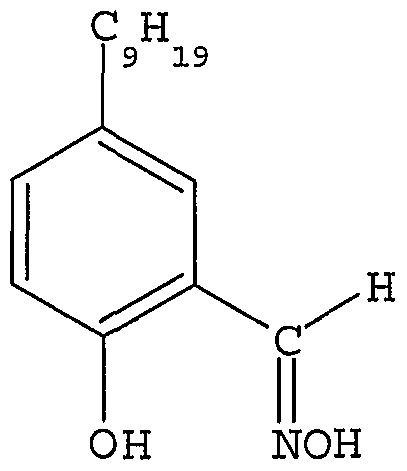
- Examples of such compounds are 5, 8-diethyl-7-hydroxy-6- dodecanone oxime (the active component of a commercial agent LIX 63) , 5-nonylsalicylaldoxime (the active component of Acorga M5640) , 5-dodecylsalicylaldoxime (the active component of LIX 860) and 2-hydroxy-5- nonylacetophenone (the active component of LIX 84) .
- These have the following structures:
- the hydroxyoxime synergist is suitably one that is capable of increasing the pH gap, ApH 50 , between isotherms for copper, zinc and ferric iron and those for cobalt and nickel. This results in advantageous selectivity of copper, zinc and ferric iron, over cobalt and nickel, the latter metals usually being those of most value in the (partially-purified and concentrated) leach solution.
- the pH 50 value is the pH at which 50% metal extraction is achieved.
- ApH 50 is the difference between the pH 50 values for two metals, or the difference between the pH 50 values for the same metal under different extraction conditions.
- the aqueous solution is preferably a leach solution.
- the aqueous (leach) solution subjected to the synergistic solvent extraction with phosphinic acid and hydroxyoxime is preferably any type of leach solution containing at least two elements selected from copper, zinc, ferric iron, cobalt and nickel. According to one embodiment, it contains at least three of, and suitably all of the elements copper, zinc, ferric iron, cobalt and nickel. According to one embodiment, the leach solution may- contain the following levels of elements:
- the solution contains at least two of the elements, preferably at a level of at least 0.5 g/L.
- the leach solution is suitably one that is partially- purified and concentrated.
- the leach solution may for instance be a solution obtained from releaching a mixed hydroxide or sulphide precipitate, isolated after the pressure acid leaching of any suitable ore type, such as a laterite or sulphide ore. Otherwise, the leach solution may be a leach solution that has been subjected to previous solvent extraction stages.
- Leach solutions often contain copper, nickel, cobalt and zinc as metals to be recovered (target metals) , with calcium, magnesium, iron, aluminium and manganese as impurity metals to be rejected. Iron (as ferric) and aluminium are often removed by precipitation at low pH (pH 2.5 - 5.0) prior to further purification and concentration steps.
- the initial leach solution may be obtained by pressure acid leaching of any suitable ore type, such as a laterite or sulphide ore. It may alternatively be a solution from bio-leach, atmospheric acid leach, oxidative leach, reductive leach, chloride leach or any combination of these leach processes. The steps involved in producing such leach solutions are well known in the art.
- the (partially-purified and concentrated) leach solution is preferably a solution that has been subjected to
- a preliminary iron and/or aluminium precipitation step to precipitate out iron and/or aluminium to leave an aqueous leach solution containing the target elements and 2.
- a purification and concentration step to remove impurity elements such as manganese, calcium and magnesium, and to concentrate the target metals copper, zinc, cobalt and nickel.
- the leach solution may alternatively or further have been subjected to one or more additional treatment or processing stages.
- group in the context of a group of metal ions is to be read as encompassing a single species of metal ion, in addition to multiple (two or more) species of metal ions.
- the solvent extraction step involves contacting an organic solvent containing the phosphinic acid and hydroxyoxime with the (aqueous) leach solution. This is followed by phase separation of the aqueous and organic phases.
- the organic solvent may be any suitable organic solvent known in the art. Kerosene is the most common solvent/diluent used for this purpose due to its low cost and availability. Shellsol D70 is one specific example.
- the amount of phosphinic acid and hydroxyoxime in the organic solution used in the solvent extraction step will depend on the concentration of the copper, zinc and ferric iron (and optionally cobalt and nickel) to be extracted and the A/0 (aqueous/organic) flow rate ratio.
- concentration would typically be in the range of from 0.05 to 2.0 M for phosphinic acid, with a preferred range of 0.1 to 1.0M, and 0.01 to 1.0 M for hydroxyoxime.
- the pH of the aqueous phase is preferably maintained in a range from
- the temperature is preferably maintained in the range of from 10 0 C to 6O 0 C, more preferably from 20 to 40 0 C. Whilst temperatures as low as 10 0 C are achievable, a temperature lower than 15°C results in high viscosity. At temperatures higher than 60 0 C there is a risk of evaporation and degradation of the organic phase.
- the aqueous to organic ratio (A/0) in the extraction step is most suitably 1:1, but may lie in the range from 10:1 to 1:10, and preferably 1:5 to 5:1.
- the aqueous to organic ratio maintained in the scrubbing step may lie within the range from 1:5 to 1:200, but preferably it is in the range of 1:5 to 1:20.
- the organic phase from the synergistic extraction step of the invention is suitably subjected to scrubbing.
- the scrub solution may suitably be a process stream recycled from the process, and is preferably derived from an aqueous stream of a stripping stage (which may be a selective stripping stage) following the scrubbing stage.
- the organic phase containing targeted metals is subjected to selective stripping to separate to a significant extent the various metals contained therein.
- Selective stripping is a term of the art, and is used to refer to the stripping of selected metals from the organic phase, without stripping other metals also present in the organic phase.
- the selective strip suitably involves contacting the organic phase from the synergistic extraction with an acidic aqueous solution to yield (a) a loaded aqueous strip liquor containing the most readily stripped metal (usually the metal with the highest pHso) and (b) a selectively stripped organic solution containing the remaining metals present in the organic phase from the synergistic extraction.
- the acidic aqueous solution for the selective strip is suitably sulphuric acid solution, although other aqueous acid solutions known in the art (such as hydrochloric) may be used.
- the pH of the acidic aqueous solution is kept in a suitable range to effect optimal separation. This range will depend on the composition of the loaded organic solution (reagent and metal concentrations) .
- the combination of the described synergistic extraction with the selective strip is a very useful combination, enabling the recovery of more than one metal using only one solvent extraction circuit (although more than one circuit could be used if so desired with other process steps) .
- the elements copper and/or zinc and/or ferric iron extracted into the organic phase during solvent extraction are recovered therefrom, and cobalt and/or nickel are recovered from the aqueous raffinate.
- the recovery step may comprise bulk stripping of the element from the organic phase. Bulk stripping is a term of the art referring to the stripping of all metal ions present in the phase . . The bulk stripping may optionally be combined with ion exchange to remove any minor amounts of "impurity" elements.
- the recovery step may comprise selective stripping and bulk stripping of the organic phase to separate the copper, zinc and ferric iron from each other.
- the elements may be separated by sequential extraction steps (followed by appropriate stripping steps), at progressively higher pH values.
- the elements may be separated by a bulk extraction step followed by appropriate selective stripping steps at progressively lower pH values.
- inventions include any combination of sequential extraction and/or selective stripping steps to effect separation of the elements into groups or individual metals.
- the synergistic extraction step of the present invention may be combined with different preliminary and subsequent process steps for the development of processes suitable for the recovery of copper, zinc, cobalt and nickel when different impurity elements may be present. It is noted that ferric iron is not typically recovered, as it is generally a low value impurity.
- scrubbing stages of the type well known in the art may be used for recovering elements even if the scrubbing stages are not specifically mentioned.
- the design of the optimum arrangement of scrubbing stages will depend on the specific aqueous leach solution and the elements desired to be recovered therefrom (and target percentage recovery levels) .
- Example 1 Extraction pH isotherms of metals with Cyanex 272 and Cyanex 272 / Acorga M5640, Cyanex 272 / LIX860 and Cyanex 272 / LIX63 synergistic systems.
- the aqueous solution was a synthetic solution to simulate a typical partially-purified and concentrated laterite leach solution containing 105 g/L Ni, 8 g/L Co, 1.5 g/L Zn, 1.2 g/L Cu and 0.5 g/L Fe(III) .
- This example illustrates how the position of pH isotherms of metals using the hydroxyoxime LIX 63, with the phosphinic acid, Cyanex 272, can be influenced by organic reagent concentration, for the same stated aqueous solution as that used in example 1.
- the plots show that varying the concentration of the hydroxyoxime LIX 63 from 0.06M ( Figure 4) to 0.10M ( Figure 5), while keeping the concentration of Cyanex 272 constant at 0.15M, causes significant shifts in the positions of the pH isotherms.
- the pH isotherms for Fe(III), Zn and Cu are all shifted to lower pH with increasing LIX63 concentration. This provides for even better separation of a first group of metal ions (ferric iron, zinc and copper) from a second group (nickel and cobalt) .
- Example 3 Extraction pH isotherms of metals with the Cyanex 272 / LIX860 synergistic system ( Figures 3 and 6) .
- Example 4 Based on the above findings, a new synergistic solvent extraction (SSX) process flow sheet was designed. The flow sheet is shown in Figure 7.
- SSX synergistic solvent extraction
- the leach solution ( W PLS" - plant leach solution) contains nickel, cobalt, iron, aluminium, chromium, manganese, magnesion, calcium, copper and zinc.
- CCDs Counter Current Decantation
- the plant leach solution is initially in the form of a leach slurry and is subjected to solid-liquid separation via settlers (CCD 1 s) in a CCD circuit.
- the settler over ⁇ flow is a clarified leach solution that is fed to the next stage of the process.
- the leach solution is subjected to preliminary neutralisation with limestone at pH 4.5 - 5.0 to precipitate impurity elements Fe (III) , Al and Cr.
- Sulphide precipitation (Sulphide PPT) Neutralised leach solution is subjected to sulphide precipitation.
- the leach solution is contacted with hydrogen sulphide gas to precipitate mixed nickel/cobalt sulphides.
- the precipitate further contains copper, zinc and iron as sulphide precipitates.
- the precipitated product is collected using standard techniques known in the art.
- the precipitate is re-leached through oxidation of the precipitate.
- the iron content is oxidised to ferric iron.
- the releached leach solution generally contains 50-120 g/L
- an organic solution of phosphinic acid (Cyanex 272) and a hydroxyoxime (LIX 63) in organic diluent Shellsol D70 is contacted with the leach solution, to which sodium hydroxide is added to achieve the desired pH, to obtain
- the loaded organic solution is stripped with sulphuric acid solution to strip zinc, copper and ferric iron therefrom.
- the stripped organic phase is recycled to SSX EXl.
- the aqueous raffinate containing nickel and cobalt is subjected to a second stage of extraction using Cyanex
- Sodium hydroxide is added to set the appropriate pH to effect separation of the nickel into the aqueous raffinate, and cobalt into the loaded organic phase.
- the aqueous phase is sent to nickel recovery where the nickel is recovered by any technique known in the art. Stripping (ST2)
Landscapes
- Chemical & Material Sciences (AREA)
- Engineering & Computer Science (AREA)
- Organic Chemistry (AREA)
- Metallurgy (AREA)
- Mechanical Engineering (AREA)
- Materials Engineering (AREA)
- Manufacturing & Machinery (AREA)
- Geology (AREA)
- Life Sciences & Earth Sciences (AREA)
- Geochemistry & Mineralogy (AREA)
- General Life Sciences & Earth Sciences (AREA)
- Environmental & Geological Engineering (AREA)
- Chemical Kinetics & Catalysis (AREA)
- General Chemical & Material Sciences (AREA)
- Manufacture And Refinement Of Metals (AREA)
- Extraction Or Liquid Replacement (AREA)
Abstract
Description



Claims

Priority Applications (4)
| Application Number | Priority Date | Filing Date | Title |
|---|---|---|---|
| CA002581106A CA2581106A1 (en) | 2004-09-24 | 2005-09-23 | Synergistic solvent extraction process |
| AU2005287877A AU2005287877B2 (en) | 2004-09-24 | 2005-09-23 | Synergistic solvent extraction process |
| BRPI0516055-3A BRPI0516055A (en) | 2004-09-24 | 2005-09-23 | synergistic solvent extraction process |
| US11/663,681 US7837959B2 (en) | 2004-09-24 | 2005-09-23 | Synergistic solvent extraction process |
Applications Claiming Priority (2)
| Application Number | Priority Date | Filing Date | Title |
|---|---|---|---|
| AU2004905512 | 2004-09-24 | ||
| AU2004905512A AU2004905512A0 (en) | 2004-09-24 | Synergistic solvent extraction process |
Publications (1)
| Publication Number | Publication Date |
|---|---|
| WO2006032097A1 true WO2006032097A1 (en) | 2006-03-30 |
Family
ID=36089780
Family Applications (1)
| Application Number | Title | Priority Date | Filing Date |
|---|---|---|---|
| PCT/AU2005/001452 Ceased WO2006032097A1 (en) | 2004-09-24 | 2005-09-23 | Synergistic solvent extraction process |
Country Status (4)
| Country | Link |
|---|---|
| US (1) | US7837959B2 (en) |
| BR (1) | BRPI0516055A (en) |
| CA (1) | CA2581106A1 (en) |
| WO (1) | WO2006032097A1 (en) |
Cited By (5)
| Publication number | Priority date | Publication date | Assignee | Title |
|---|---|---|---|---|
| WO2006104816A1 (en) * | 2005-03-29 | 2006-10-05 | Cytec Technology Corp. | Modification of copper/iron selectivity in oxime-based copper solvent extraction systems |
| WO2010109078A1 (en) * | 2009-03-27 | 2010-09-30 | Outotec Oyj | Apparatus and method for removing impurities in connection with liquid-liquid extraction of copper |
| US20130228524A1 (en) * | 2011-09-05 | 2013-09-05 | Cytec Technology Corp. | Processes for Recovering Organic Solvent Extractant from Solid-Stabilized Emulsions Formed in Hydrometallurgical Solvent Extraction Circuits |
| US8979976B2 (en) | 2010-05-20 | 2015-03-17 | Cesl Limited | Solvent extraction process for separating cobalt from nickel in aqueous solution |
| CN120719120A (en) * | 2025-06-22 | 2025-09-30 | 赣州寒锐新能源科技有限公司 | A method for synergistic extraction of Cu and Mn from cobalt sulfate solution |
Families Citing this family (6)
| Publication number | Priority date | Publication date | Assignee | Title |
|---|---|---|---|---|
| JP5902601B2 (en) * | 2012-12-13 | 2016-04-13 | Jx金属株式会社 | Method for separating metal in mixed metal solution |
| US8924950B2 (en) * | 2012-12-17 | 2014-12-30 | Itron, Inc. | Utility node software/firmware update through a multi-type package |
| US8938730B2 (en) | 2012-12-17 | 2015-01-20 | Itron, Inc. | Utilizing a multi-system set configuration to update a utility node system set |
| FI20136129L (en) | 2013-11-15 | 2015-05-16 | Outotec Finland Oy | Process for the recovery of cobalt and copper |
| FI126210B (en) | 2014-01-22 | 2016-08-15 | Outotec Finland Oy | Method for the recovery of copper and zinc |
| CN114182106B (en) * | 2021-11-25 | 2022-08-19 | 北京科技大学 | Method for separating and purifying platinum group metal in iron alloy |
Citations (6)
| Publication number | Priority date | Publication date | Assignee | Title |
|---|---|---|---|---|
| KR940007372B1 (en) * | 1992-09-22 | 1994-08-16 | 김병남 | Method of purification cobalt |
| JPH06264156A (en) * | 1993-03-09 | 1994-09-20 | Sekiyu Sangyo Kasseika Center | Method for separating and recovering nickel and / or cobalt |
| JPH0892665A (en) * | 1994-09-20 | 1996-04-09 | Catalysts & Chem Ind Co Ltd | Method for selectively separating and recovering nickel and/or cobalt |
| US6210647B1 (en) * | 1996-12-23 | 2001-04-03 | Henkel Corporation | Process of recovery of metals from aqueous ammoniacal solutions employing an ammonia antagonist having only hydrogen bond acceptor properties |
| US20040124141A1 (en) * | 2002-10-15 | 2004-07-01 | Commissariat A L'energie Atomique | Cyclic method for separating chemcial elements present in an aqueous solution |
| JP2004307983A (en) * | 2003-04-10 | 2004-11-04 | National Institute Of Advanced Industrial & Technology | Method for recovering nickel from nickel-containing aqueous solution |
Family Cites Families (2)
| Publication number | Priority date | Publication date | Assignee | Title |
|---|---|---|---|---|
| US5855858A (en) * | 1993-07-29 | 1999-01-05 | Cominco Engineering Services Ltd. | Process for the recovery of nickel and/or cobalt from an ore or concentrate |
| US5470553A (en) * | 1993-12-07 | 1995-11-28 | Industrial Technology Research Institute | Method for separating cobalt, nickel, and aluminum ions in sulfuric acid aqueous solutions and the extractant compositions used therein |
-
2005
- 2005-09-23 BR BRPI0516055-3A patent/BRPI0516055A/en not_active IP Right Cessation
- 2005-09-23 US US11/663,681 patent/US7837959B2/en not_active Expired - Fee Related
- 2005-09-23 WO PCT/AU2005/001452 patent/WO2006032097A1/en not_active Ceased
- 2005-09-23 CA CA002581106A patent/CA2581106A1/en not_active Abandoned
Patent Citations (6)
| Publication number | Priority date | Publication date | Assignee | Title |
|---|---|---|---|---|
| KR940007372B1 (en) * | 1992-09-22 | 1994-08-16 | 김병남 | Method of purification cobalt |
| JPH06264156A (en) * | 1993-03-09 | 1994-09-20 | Sekiyu Sangyo Kasseika Center | Method for separating and recovering nickel and / or cobalt |
| JPH0892665A (en) * | 1994-09-20 | 1996-04-09 | Catalysts & Chem Ind Co Ltd | Method for selectively separating and recovering nickel and/or cobalt |
| US6210647B1 (en) * | 1996-12-23 | 2001-04-03 | Henkel Corporation | Process of recovery of metals from aqueous ammoniacal solutions employing an ammonia antagonist having only hydrogen bond acceptor properties |
| US20040124141A1 (en) * | 2002-10-15 | 2004-07-01 | Commissariat A L'energie Atomique | Cyclic method for separating chemcial elements present in an aqueous solution |
| JP2004307983A (en) * | 2003-04-10 | 2004-11-04 | National Institute Of Advanced Industrial & Technology | Method for recovering nickel from nickel-containing aqueous solution |
Non-Patent Citations (4)
| Title |
|---|
| DATABASE WPI Week 199442, 20 September 1994 Derwent World Patents Index; Class M25, AN 1994-338605 * |
| DATABASE WPI Week 1996, 16 August 1994 Derwent World Patents Index; Class J01, AN 1996-219924 * |
| DATABASE WPI Week 199624, 9 April 1996 Derwent World Patents Index; Class J01, AN 1996-236429 * |
| DATABASE WPI Week 200478, 4 November 2004 Derwent World Patents Index; Class D15, AN 2004-789309 * |
Cited By (10)
| Publication number | Priority date | Publication date | Assignee | Title |
|---|---|---|---|---|
| WO2006104816A1 (en) * | 2005-03-29 | 2006-10-05 | Cytec Technology Corp. | Modification of copper/iron selectivity in oxime-based copper solvent extraction systems |
| US8282857B2 (en) | 2005-03-29 | 2012-10-09 | Cytec Technology Corp. | Modification of copper/iron selectivity in copper solvent extraction systems |
| US8349208B2 (en) | 2005-03-29 | 2013-01-08 | Cytec Technology Corp. | Modification of copper/iron selectivity in copper solvent extraction systems |
| WO2010109078A1 (en) * | 2009-03-27 | 2010-09-30 | Outotec Oyj | Apparatus and method for removing impurities in connection with liquid-liquid extraction of copper |
| EA020768B1 (en) * | 2009-03-27 | 2015-01-30 | Ототек Оюй | DEVICE AND METHOD FOR REMOVING IMPURITIES WITH THE HELP OF LIQUID EXTRACTION OF COPPER |
| US8961795B2 (en) | 2009-03-27 | 2015-02-24 | Outotec Oyj | Apparatus and method for removing impurities in connection with liquid-liquid extraction of copper |
| US8979976B2 (en) | 2010-05-20 | 2015-03-17 | Cesl Limited | Solvent extraction process for separating cobalt from nickel in aqueous solution |
| US20130228524A1 (en) * | 2011-09-05 | 2013-09-05 | Cytec Technology Corp. | Processes for Recovering Organic Solvent Extractant from Solid-Stabilized Emulsions Formed in Hydrometallurgical Solvent Extraction Circuits |
| US9474990B2 (en) * | 2011-09-05 | 2016-10-25 | Cytec Technology Corp. | Processes for recovering organic solvent extractant from solid-stabilized emulsions formed in hydrometallurgical solvent extraction circuits |
| CN120719120A (en) * | 2025-06-22 | 2025-09-30 | 赣州寒锐新能源科技有限公司 | A method for synergistic extraction of Cu and Mn from cobalt sulfate solution |
Also Published As
| Publication number | Publication date |
|---|---|
| BRPI0516055A (en) | 2008-08-19 |
| US7837959B2 (en) | 2010-11-23 |
| US20080245734A1 (en) | 2008-10-09 |
| CA2581106A1 (en) | 2006-03-30 |
Similar Documents
| Publication | Publication Date | Title |
|---|---|---|
| US20040050212A1 (en) | Solvent extraction process for recovering nickel and cobalt from each solutions | |
| AU2005209332B2 (en) | Solvent extraction process for separating cobalt and/or nickel from impurities in leach solutions. | |
| AU2005209326B2 (en) | Solvent extraction process for separating cobalt and/or manganese from impurities in leach solutions | |
| Nusen et al. | Recovery of indium and gallium from synthetic leach solution of zinc refinery residues using synergistic solvent extraction with LIX 63 and Versatic 10 acid | |
| US3276863A (en) | Separation of nickel and cobalt values using alpha-hydroxy oximes | |
| US7837959B2 (en) | Synergistic solvent extraction process | |
| WO2002022897A1 (en) | Recovery of nickel and cobalt from leach solutions | |
| US4233273A (en) | Selective extraction of iron and aluminum from acidic solutions | |
| CA2252592C (en) | Process for the recovery of nickel | |
| AU2005287877B2 (en) | Synergistic solvent extraction process | |
| WO2002022898A1 (en) | Separation of cobalt from manganese using organophosphoric acid solvent extraction | |
| KR20250128982A (en) | manganese extraction process | |
| EP3068912B1 (en) | Method of recovering cobalt and copper | |
| WO2001012288A1 (en) | Nickel recovery process and compositions for use therein | |
| AU2001293468A1 (en) | Solvent extraction process for recovering nickel and cobalt from leach solutions | |
| EP4624602A1 (en) | Environmentally benign method for removing uranium from nickel- and/or cobalt-containing resources | |
| WO2025202333A1 (en) | Environmentally benign method for removing uranium and/or scandium from nickel- and/or cobalt-containing resources | |
| AU2002316765A1 (en) | Solvent extraction mixture comprising substituted imidazole or benzimidazole for the separation of groups of base metals | |
| WO2002101182A2 (en) | Solvent extraction mixture comprising substituted imidazole or benzimidazole for the separation of groups of base metals | |
| MXPA06008551A (en) | Solvent extraction process for separating cobalt and/or manganese from impurities in leach solutions | |
| Tanaka et al. | Recovery of Nickel from Spent Electroless Nickel Plating Baths |
Legal Events
| Date | Code | Title | Description |
|---|---|---|---|
| AK | Designated states |
Kind code of ref document: A1 Designated state(s): AE AG AL AM AT AU AZ BA BB BG BR BW BY BZ CA CH CN CO CR CU CZ DE DK DM DZ EC EE EG ES FI GB GD GE GH GM HR HU ID IL IN IS JP KE KG KM KP KR KZ LC LK LR LS LT LU LV LY MA MD MG MK MN MW MX MZ NA NG NI NO NZ OM PG PH PL PT RO RU SC SD SE SG SK SL SM SY TJ TM TN TR TT TZ UA UG US UZ VC VN YU ZA ZM ZW |
|
| AL | Designated countries for regional patents |
Kind code of ref document: A1 Designated state(s): GM KE LS MW MZ NA SD SL SZ TZ UG ZM ZW AM AZ BY KG KZ MD RU TJ TM AT BE BG CH CY CZ DE DK EE ES FI FR GB GR HU IE IS IT LT LU LV MC NL PL PT RO SE SI SK TR BF BJ CF CG CI CM GA GN GQ GW ML MR NE SN TD TG |
|
| 121 | Ep: the epo has been informed by wipo that ep was designated in this application | ||
| DPE1 | Request for preliminary examination filed after expiration of 19th month from priority date (pct application filed from 20040101) | ||
| WWE | Wipo information: entry into national phase |
Ref document number: 2005287877 Country of ref document: AU |
|
| WWE | Wipo information: entry into national phase |
Ref document number: 2581106 Country of ref document: CA |
|
| NENP | Non-entry into the national phase |
Ref country code: DE |
|
| ENP | Entry into the national phase |
Ref document number: 2005287877 Country of ref document: AU Date of ref document: 20050923 Kind code of ref document: A |
|
| WWP | Wipo information: published in national office |
Ref document number: 2005287877 Country of ref document: AU |
|
| WWE | Wipo information: entry into national phase |
Ref document number: 11663681 Country of ref document: US |
|
| 122 | Ep: pct application non-entry in european phase |
Ref document number: 05784541 Country of ref document: EP Kind code of ref document: A1 |
|
| ENP | Entry into the national phase |
Ref document number: PI0516055 Country of ref document: BR |