WO2005115304A2 - Use of c-kit inhibitors for treating fibrodysplasia - Google Patents

Use of c-kit inhibitors for treating fibrodysplasia Download PDF

Info

Publication number
WO2005115304A2
WO2005115304A2 PCT/IB2005/001371 IB2005001371W WO2005115304A2 WO 2005115304 A2 WO2005115304 A2 WO 2005115304A2 IB 2005001371 W IB2005001371 W IB 2005001371W WO 2005115304 A2 WO2005115304 A2 WO 2005115304A2
Authority
WO
WIPO (PCT)
Prior art keywords
alkyl
halogen
group
basic nitrogen
optionally substituted
Prior art date
Legal status (The legal status is an assumption and is not a legal conclusion. Google has not performed a legal analysis and makes no representation as to the accuracy of the status listed.)
Ceased
Application number
PCT/IB2005/001371
Other languages
French (fr)
Other versions
WO2005115304A3 (en
Inventor
Alain Moussy
Jean-Pierre Kinet
Current Assignee (The listed assignees may be inaccurate. Google has not performed a legal analysis and makes no representation or warranty as to the accuracy of the list.)
AB Science SA
Original Assignee
AB Science SA
Priority date (The priority date is an assumption and is not a legal conclusion. Google has not performed a legal analysis and makes no representation as to the accuracy of the date listed.)
Filing date
Publication date
Application filed by AB Science SA filed Critical AB Science SA
Publication of WO2005115304A2 publication Critical patent/WO2005115304A2/en
Publication of WO2005115304A3 publication Critical patent/WO2005115304A3/en
Anticipated expiration legal-status Critical
Ceased legal-status Critical Current

Links

Classifications

    • AHUMAN NECESSITIES
    • A61MEDICAL OR VETERINARY SCIENCE; HYGIENE
    • A61KPREPARATIONS FOR MEDICAL, DENTAL OR TOILETRY PURPOSES
    • A61K31/00Medicinal preparations containing organic active ingredients
    • A61K31/33Heterocyclic compounds
    • A61K31/395Heterocyclic compounds having nitrogen as a ring hetero atom, e.g. guanethidine or rifamycins
    • A61K31/41Heterocyclic compounds having nitrogen as a ring hetero atom, e.g. guanethidine or rifamycins having five-membered rings with two or more ring hetero atoms, at least one of which being nitrogen, e.g. tetrazole
    • A61K31/42Oxazoles
    • A61K31/4211,3-Oxazoles, e.g. pemoline, trimethadione
    • AHUMAN NECESSITIES
    • A61MEDICAL OR VETERINARY SCIENCE; HYGIENE
    • A61KPREPARATIONS FOR MEDICAL, DENTAL OR TOILETRY PURPOSES
    • A61K31/00Medicinal preparations containing organic active ingredients
    • AHUMAN NECESSITIES
    • A61MEDICAL OR VETERINARY SCIENCE; HYGIENE
    • A61KPREPARATIONS FOR MEDICAL, DENTAL OR TOILETRY PURPOSES
    • A61K31/00Medicinal preparations containing organic active ingredients
    • A61K31/33Heterocyclic compounds
    • A61K31/395Heterocyclic compounds having nitrogen as a ring hetero atom, e.g. guanethidine or rifamycins
    • A61K31/41Heterocyclic compounds having nitrogen as a ring hetero atom, e.g. guanethidine or rifamycins having five-membered rings with two or more ring hetero atoms, at least one of which being nitrogen, e.g. tetrazole
    • A61K31/425Thiazoles
    • A61K31/4261,3-Thiazoles
    • AHUMAN NECESSITIES
    • A61MEDICAL OR VETERINARY SCIENCE; HYGIENE
    • A61KPREPARATIONS FOR MEDICAL, DENTAL OR TOILETRY PURPOSES
    • A61K31/00Medicinal preparations containing organic active ingredients
    • A61K31/33Heterocyclic compounds
    • A61K31/395Heterocyclic compounds having nitrogen as a ring hetero atom, e.g. guanethidine or rifamycins
    • A61K31/495Heterocyclic compounds having nitrogen as a ring hetero atom, e.g. guanethidine or rifamycins having six-membered rings with two or more nitrogen atoms as the only ring heteroatoms, e.g. piperazine or tetrazines
    • A61K31/505Pyrimidines; Hydrogenated pyrimidines, e.g. trimethoprim
    • A61K31/506Pyrimidines; Hydrogenated pyrimidines, e.g. trimethoprim not condensed and containing further heterocyclic rings
    • AHUMAN NECESSITIES
    • A61MEDICAL OR VETERINARY SCIENCE; HYGIENE
    • A61PSPECIFIC THERAPEUTIC ACTIVITY OF CHEMICAL COMPOUNDS OR MEDICINAL PREPARATIONS
    • A61P19/00Drugs for skeletal disorders
    • A61P19/08Drugs for skeletal disorders for bone diseases, e.g. rachitism, Paget's disease

Definitions

  • the present invention relates to a method for treating fibrodysplasia such as fibrodysplasia ossificans progressive comprising administering a compound capable of depleting mast cells or a compound inhibiting mast cell degranulation, to a human in need of such treatment.
  • a compound capable of depleting mast cells or a compound inhibiting mast cell degranulation can be chosen from c-kit inhibitors and more particularly non-toxic, selective and potent c-kit inhibitors.
  • said inhibitor is unable to promote death of IL-3 dependent cells cultured in presence of IL-3.
  • Fibrodysplasia ossificans progressiva is an extremely rare and disabling genetic disorder of connective tissue. The condition is characterized by congenital malformation of the great toes and by progressive heterotopic ossification of the tendons, ligaments, fasciae, and striated muscles. Fibrodysplasia ossificans progressiva occurs sporadically and is transmitted as a dominant trait with variable expression and complete penetrance. Reproductive fitness is low. There are fewer than 150 known patients with the disorder in the United States. A point prevalence of one affected patient in every 2 million of population has been observed. There is no sexual, racial, or ethnic predilection. This disease appears in early life and its course is unavoidably progressive.
  • Mast cell density at the periphery of FOP lesional tissue has been observed to be significantly greater than in normal control skeletal muscle.
  • Mast cells are tissue elements derived from a particular subset of hematopoietic stem cells that express CD34, c-kit and CD 13 antigens (Kirshenbaum, 1999 and Ishizaka, 1993). Immature MC progenitors circulate in the bloodstream and differentiate in tissues.
  • Mast cells produce a large variety of mediators categorized into three groups: preformed granule-associated mediators (histamine, proteoglycans, and neutral proteases), lipid- derived mediators (prostaglandins, thromboxanes and leucotrienes), and various cytokines (IL-1, IL-2, IL-3, IL-4, IL-5, IL-6, IL-8, TNF- ⁇ , GM-CSF, MIP-lo, MIP-1/3 and IFN- ⁇ ), most of them having strong pro-inflammatory activities. For instance, a massive release of MCs mediators is responsible for anaphylactic reactions that could be sometimes fatal to the patients and are always responsible for a significant morbidity. Since MCs are distributed in almost all the body sites, hypersecretion of mediators by activated elements can lead to multiple organ failures.
  • mast cells are central players involved in genetic disorders such as fibrodysplasia.
  • c-kit inhibitors as a new route for treating fibrodysplasia ossificans progressiva, which consists of destroying mast cells playing a role in inflammation and development of FOP lesions.
  • the present invention relates to a method for treating fibrodysplasia and related disorders comprising administering a compound capable of depleting mast cells or blocking mast cells degranulation to a human in need of such treatment.
  • Said method for treating fibrodysplasia can comprise administering a c-kit inhibitor to a human in need of such treatment.
  • Preferred compounds are c-kit inhibitor, more particularly a non-toxic, selective and potent c-kit inhibitor.
  • Such inhibitors can be selected from the group consisting of 2-(3- Substitutedaryl)amino-4-aryl-thiazoles such as 2-(3-amino)arylamino-4-aryl-fhiazoles, 2- aminoaryloxazoles, pyrimidine derivatives, pyrrolopyrimidine derivatives, quinazoline derivatives, quinoxaline derivatives, pyrazoles derivatives, bis monocyclic, bicyclic or heterocyclic aryl compounds, vinyl ene-azaindole derivatives and pyridyl-quinolones derivatives, styryl compounds, styryl-substituted pyridyl compounds, seleoindoles, selenides, tricyclic polyhydroxylic compounds and benzylphosphonic acid compounds.
  • pyrimidine derivatives such as N-phenyl-2-pyrimidine-amine derivatives (US 5,521,184 and WO 99/03854), indolinone derivatives and pyrrol-substituted indolinones (US 5,792,783, EP 934 931, US 5,834,504), US 5,883,116, US 5,883,113, US 5, 886,020, WO 96/40116 and WO 00/38519), as well as bis monocyclic, bicyclic aryl and heteroaryl compounds (EP 584 222, US 5,656,643 and WO 92/20642), quinazoline derivatives (EP 602 851, EP 520 722, US 3,772,295 and US 4,343,940), 4-amino-substituted quinazolines (US 3,470,182), 4-thienyl-2-(lH)-quinazolones, 6,7-dialkoxyquinazolines (US 3,800,039)
  • the invention relates to a method for treating fibrodysplasia comprising administering a non toxic, potent and selective c-kit inhibitor is a pyrimidine derivatives, more particularly N-phenyl-2-pyrimidine-amine derivatives of formula I :
  • Rl, R2, R3, R13 to R17 groups have the meanings depicted in EP 564 409 Bl, incorporated herein in the description.
  • the N-phenyl-2-pyrimidine-amine derivative is selected from the compounds corresponding to formula II :
  • Rl, R2 and R3 are independently chosen from H, F, CI, Br, I, a C1-C5 alkyl or a cyclic or heterocyclic group, especially a pyridyl group;
  • R4, R5 and R6 are independently chosen from H, F, CI, Br, I, a C1-C5 alkyl, especially a methyl group; and R7 is a phenyl group bearing at least one substituent, which in turn possesses at least one basic site, such as an amino function.
  • R7 is the following group :
  • Rl is a heterocyclic group, especially a pyridyl group
  • R2 and R3 are H
  • R4 is a C1-C3 alkyl, especially a methyl group
  • R5 and R6 are H
  • R7 is a phenyl group bearing at least one substituent, which in turn possesses at least one basic site, such as an amino function, for example the group :
  • the invention relates to a method for treating fibrodysplasia comprising the administration of an effective amount of the compound known in the art as CGP57148B :
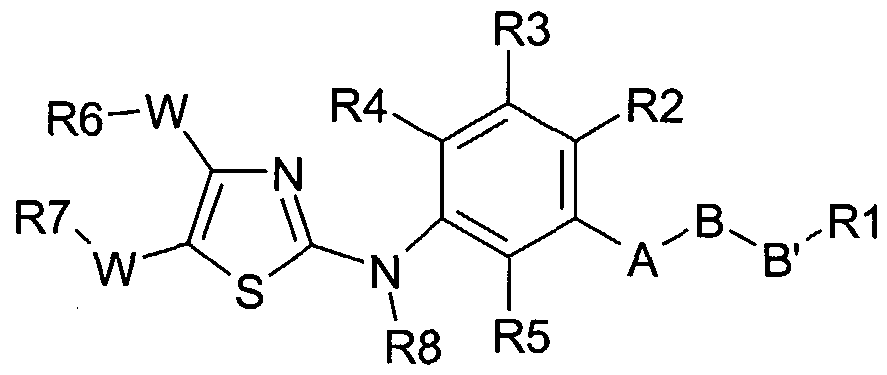
  • the invention contemplates the method mentioned above, wherein said c-kit inhibitor is selected from 2-(3-Substitutedaryl)amino-4-aryl- thiazoles such as those for which the applicant filed PCT/IB2005/000401, incorporated herein by reference, especially compounds of formula III :
  • R 6 and R 7 are independently from each other chosen from one of the following: i) hydrogen, a halogen (selected from F, CI, Br or I), ii) an alkyl 1 group defined as a linear, branched or cycloalkyl group containing from 1 to 10 carbon atoms, or from 2 or 3 to 10 carbon atoms, (for example methyl, ethyl, propyl, butyl, pentyl, hexyl%) and optionally substituted with one or more hetereoatoms such as halogen (selected from F, CI, Br or I), oxygen, and nitrogen (the latter optionally in the form of a pendant basic nitrogen functionality); as well as trifluoromethyl, carboxyl, cyano, nitro, formyl; (iii) an aryl 1 group defined as phenyl or a substituted variant thereof bearing any combination, at any one ring position, of one or more substituents such as - halogen(selected from I,
  • a heteroaryl 1 group defined as a pyridyl, pyrimidinyl, pyrazinyl, pyridazinyl, thienyl, thiazolyl, imidazolyl, pyrazolyl, pyrrolyl, furanyl, oxazolyl, isoxazolyl , triazolyl, tetrazolyl, indolyl, benzimidazole, quinolinyl group, which may additionally bear any combination, at any one ring position, of one or more substituents such as - halogen (selected from F, CI, Br or I); an alkyl 1 group; a cycloalkyl, aryl or heteroaryl group optionally substituted by a pendant basic nitrogen functionality, - trifluoromethyl, O-alkyl 1 , carboxyl, cyano, nitro, formyl, hydroxy, NH-alkyl 1 , N(alkyl')(
  • R 8 is one of the following:
  • R2, R3, R4 and R5 each independently are selected from hydrogen, halogen (selected from F, CI, Br or I), a linear or branched alkyl group containing from 1 to 10 carbon atoms and optionally substituted with one or more hetereoatoms such as halogen (selected from F, CI, Br or I), oxygen, and nitrogen, the latter optionally in the form of a pendant basic nitrogen functionality; as well as trifluoromethyl, 6 alkylamino, di(C ⁇ .
  • R is a linear or branched alkyl group containing from 1 to 10 carbon atoms and optionally substituted with at least one heteroatom, notably a halogen (selected from F, CI, Br or I), oxygen, and nitrogen, the latter optionally in the form of a pendant basic nitrogen functionality.
  • A is : CH2, O, S, SO2, CO, or COO
  • B is a bond or NH, NCH3, NR*, (CH2)n (n is 0, 1 or 2), O, S, SO2, CO, or COO,
  • B' is a bond or NH, NCH3, NR*, (CH2)n (n is 0, 1 or 2), O, S, SO2, CO or COO;
  • R* being an alkyl 1 , aryl 1 or heteroaryl 1
  • W is a bond or a linker selected from NH, NHCO, NHCOO, NHCONH, NHSO2, NHSO2NH, CO, CONH, COO, COCH2, (CH2)n (n is 0, 1 or 2), CH2-CO, CH2COO,
  • R s a) a linear or branched alkyl group containing from 1 to 10 carbon atoms optionally substituted with at least one heteroatom, notably a halogen selected from I, CI, Br and F, and / or bearing a pendant basic nitrogen functionality; b) an aryl or heteroaryl group optionally substituted by an alkyl or aryl group optionally substituted with a heteroatom, notably a halogen selected from I, CI, Br and F or bearing a pendant basic nitrogen functionality c) an alkyl 1 , aryl 1 or heteroaryl 1 .
  • a C1-C10 alkyl encompasses a methyl, ethyl, propyl, and a C2 to C4 alkyl or a C2 to CIO alkyl.
  • a subset of compounds may correspond to
  • Rl, R4 and R6 have the meaning as defined above.
  • A-B-B 1 includes but is not limited to : CH2, CH2-CO, CH2-CO-CH2, CH2COO, CH2-CH2-CO, CH2-CH2-COO, CH2-NH,
  • A-B-B' also includes but is not limited to :
  • NH in B or B' can also be NCH3
  • - R6 is (iv), R4 is H or CH3, A-B-B' is CO-NH and Rl is as defined above.
  • - R6 is (iv), R4 is H or CH3, A-B-B' is CH2-CO-NH and Rl is as defined above.
  • R6 is (iv)
  • R4 is H or CH3
  • A-B-B' is CH2-CO and Rl is as defined above.
  • R6 is (iv)
  • R4 is H or CH3
  • A-B-B' is CH2-NH-CO and Rl is as defined above.
  • - R6 is (iv), R4 is H or CH3, A-B-B' is CH2-NH and Rl is as defined above.
  • - R6 is (iv), R4 is H or CH3, A-B-B' is CH2 and Rl is as defined above.
  • R6 is W-(iv)
  • R4 is a C1-C2 alkyl
  • A-B-B' is CO-NH
  • Rl is as defined above.
  • R6 is (iv)
  • R4 is a C1-C2 alkyl
  • A-B-B' is CH2-CO-NH
  • Rl is as defined above.
  • R6 is (iv)
  • R4 is a C1-C2 alkyl
  • A-B-B' is CH2-CO
  • Rl is as defined above.
  • R6 is a pyridyl according to (iv)
  • R4 is a C1-C2 alkyl
  • A-B-B' is CO-NH, CH2-CO-NH, CH2-CO, CH2-NH, CH2-NH-CO and Rl is as defined above.
  • Rl can be an alkyl 1 . In the above combination, Rl can be an aryl 1 .
  • Rl can be an heteroaryl 1 .
  • the invention contemplated the method mentioned above, wherein said c-kit inhibitor is selected from 2-(3-amino)arylamino-4-aryl- thiazoles such as those for which the applicant filed WO 2004/014903, incorporated herein in the description, especially compounds of formula IN :
  • R 1 is : a) a linear or branched alkyl group containing from 1 to 10 carbon atoms optionally substituted with at least one heteroatom, notably a halogen selected from I, CI, Br and F, and / or bearing a pendant basic nitrogen functionality; b) an aryl or heteroaryl group optionally substituted by an alkyl or aryl group optionally substituted with a heteroatom, notably a halogen selected from I, CI, Br and F or bearing a pendant basic nitrogen functionality; c) a -CO-NH-R, -CO-R, -CO-OR or a -CO-NRR' group, wherein R and R' are independently chosen from H or an aryl, heteroaryl, alkyl and cycloalkyl group optionally substituted with at least one heteroatom, notably a halogen selected from I, CI, Br and F, and / or bearing a pendant basic nitrogen functionality;
  • R 2 is hydrogen, halogen or a linear or branched alkyl group containing from 1 to 10 carbon atoms, trifluoromethyl or alkoxy;
  • R 3 is hydrogen, halogen or a linear or branched alkyl group containing from 1 to 10 carbon atoms, trifluoromethyl or alkoxy;
  • R 4 is hydrogen, halogen or a linear or branched alkyl group containing from 1 to 10 carbon atoms, trifluoromethyl or alkoxy
  • R 5 is hydrogen, halogen or a linear or branched alkyl group containing from 1 to 10 carbon atoms, trifluoromethyl or alkoxy
  • R is one of the following:
  • an aryl group such as phenyl or a substituted variant thereof bearing any combination, at any one ring position, of one or more substituents such as halogen, alkyl groups containing from 1 to 10 carbon atoms, trifluoromethyl, and alkoxy;
  • a heteroaryl group such as a 2, 3, or 4-pyridyl group, which may additionally bear any combination of one or more substituents such as halogen, alkyl groups containing from 1 to 10 carbon atoms, trifluoromethyl and alkoxy;
  • a five-membered ring aromatic heterocyclic group such as for example 2-thienyl, 3- thienyl, 2-thiazolyl, 4-thiazolyl, 5-thiazolyl, which may additionally bear any combination of one or more substituents such as halogen, an alkyl group containing from
  • R 7 is one of the following:
  • an aryl group such as phenyl or a substituted variant thereof bearing any combination, at any one ring position, of one or more substituents such as halogen, alkyl groups containing from 1 to 10 carbon atoms, trifluoromethyl, and alkoxy;
  • a heteroaryl group such as a 2, 3, or 4-pyridyl group, which may additionally bear any combination of one or more substituents such as halogen, alkyl groups containing from 1 to 10 carbon atoms, trifluoromethyl and alkoxy;
  • a five-membered ring aromatic heterocyclic group such as for example 2-thienyl, 3- thienyl, 2-thiazolyl, 4-thiazolyl, 5-thiazolyl, which may additionally bear any combination of one or more substituents such as halogen, an alkyl group containing from 1 to 10 carbon atoms, trifluoromethyl, and alkoxy.
  • H a halogen selected from I, F, CI or Br
  • NH2, NO2 or SO2-R wherein R is a linear or branched alkyl goup containing one or more group such as 1 to 10 carbon atoms, and optionally substituted with at least one heteroatom, notably a halogen selected from I, CI, Br and F, and / or bearing a pendant basic nitrogen functionality.
  • R is H or an organic group that can be selected for example from a linear or branched alkyl group containing from 1 to 10 carbon atoms optionally substituted with at least one heteroatom or bearing a pendant basic nitrogen functionality; a cycloalkyl, an aryl or heteroaryl group optionally substituted by an alkyl, a cycloalkyl, an aryl or heteroaryl group optionally substituted with a heteroatom, notably a halogen selected from I, CI, Br and F and / or bearing a pendant basic nitrogen functionality.
  • the invention is directed to amide-aniline, amide-benzylamine, amide-phenol, urea compounds of the following formulas respectively :
  • R is H or an organic group that can be selected for example from a linear or branched alkyl group containing from 1 to 10 carbon atoms optionally substituted with at least one heteroatom or bearing a pendant basic nitrogen functionality; a cycloalkyl, an aryl or heteroaryl group optionally substituted with a heteroatom, notably a halogen selected from I, CI, Br and F and / or bearing a pendant basic nitrogen functionality; or a a cycloalkyl, an aryl or heteroaryl group optionally substituted with a cycloalkyl, an aryl or heteroaryl group optionally substituted with a heteroatom, notably a halogen selected from I, CI, Br and F and / or bearing a pendant basic nitrogen functionality; a -SO2-R group wherein R is an alkyl, cycloalkyl, aryl or heteroaryl optionally substituted with an heteroatom, notably a halogen selected from I, CI, Br and F and /
  • Y is a linear or branched alkyl group containing from 1 to 10 carbon atoms; wherein Z represents an aryl or heteroaryl group, optionally substituted at one or more ring position with any permutation of the following groups: - a halogen such as F, CI, Br, I; - a linear or branched alkyl group containing from 1 to 10 carbon atoms atoms optionally substituted with at least one heteroatom (for example a halogen) and / or bearing a pendant basic nitrogen functionality; a cycloalkyl, an aryl or heteroaryl group optionally substituted with at least one heteroatom, notably a halogen selected from I, CI, Br and F, and / or bearing a pendant basic nitrogen functionality; or a cycloalkyl, an aryl or heteroaryl group substituted by an alkyl, a cycloalkyl, an aryl or heteroaryl group optionally substituted with an heteroatom, notably a hal
  • Ra and Rb are a hydrogen or a linear or branched alkyl group containing from 1 to 10 carbon atoms atoms optionally substituted with at least one heteroatom (for example a halogen) and / or bearing a pendant basic nitrogen functionality; a cycloalkyl, an aryl or heteroaryl group optionally substituted with at least one heteroatom, notably a halogen selected from I, CI, Br and F, and / or bearing a pendant basic nitrogen functionality; or a cycloalkyl, an aryl or heteroaryl group substituted by an alkyl, a cycloalkyl, an aryl or heteroaryl group optionally substituted with an heteroatom, notably a halogen selected from I, CI, Br and F, and / or bearing a pendant basic nitrogen functionality;
  • R is a linear or branched alkyl group containing from 1 to 10 carbon atoms atoms optionally substituted with at least one heteroatom (for example a halogen) and / or bearing a pendant basic nitrogen functionality; a cycloalkyl, an aryl or heteroaryl group optionally substituted with at least one heteroatom, notably a halogen selected from I, CI, Br and F, and / or bearing a pendant basic nitrogen functionality; or a cycloalkyl, an aryl or heteroaryl group substituted by an alkyl, a cycloalkyl, an aryl or heteroaryl group optionally substituted with an heteroatom, notably a halogen selected from I, CI, Br and F, and / or bearing a pendant basic nitrogen functionality; an NHCOOR, where R is a linear or branched alkyl group containing from 1 to 10 carbon atoms atoms optionally substituted with at least one heteroatom (for example a halogen) and
  • an OSO 2 R where R is a linear or branched alkyl group containing from 1 to 10 carbon atoms atoms optionally substituted with at least one heteroatom (for example a halogen) and / or bearing a pendant basic nitrogen functionality; a cycloalkyl, an aryl or heteroaryl group optionally substituted with at least one heteroatom, notably a halogen selected from I, CI, Br and F, and / or bearing a pendant basic nitrogen functionality; or a cycloalkyl, an aryl or heteroaryl group substituted by an alkyl, a cycloalkyl, an aryl or heteroaryl group optionally substituted with an heteroatom, notably a halogen selected from I, CI, Br and F, and / or bearing a pendant basic nitrogen functionality; an NRaOSO 2 Rb, where Ra and Rb are a linear or branched alkyl group
  • R 2 is hydrogen, halogen or a linear or branched alkyl group containing from 1 to 10 carbon atoms, trifluoromethyl or alkoxy;
  • R 3 is hydrogen, halogen or a linear or branched alkyl group containing from 1 to 10 carbon atoms, trifluoromethyl or alkoxy;
  • R 4 is hydrogen, halogen or a linear or branched alkyl group containing from 1 to 10 carbon atoms, trifluoromethyl or alkoxy
  • R 5 is hydrogen, halogen or a linear or branched alkyl group containing from 1 to 10 carbon atoms, trifluoromethyl or alkoxy
  • R 6 is one of the following:
  • an aryl group such as phenyl or a substituted variant thereof bearing any combination, at any one ring position, of one or more substituents such as halogen, alkyl groups containing from 1 to 10 carbon atoms, trifluoromethyl, and alkoxy;
  • a heteroaryl group such as a 2, 3, or 4-pyridyl group, which may additionally bear any combination of one or more substituents such as halogen, alkyl groups containing from 1 to 10 carbon atoms, trifluoromethyl and alkoxy;
  • a five-membered ring aromatic heterocyclic group such as for example 2-thienyl, 3- thienyl, 2-thiazolyl, 4-thiazolyl, 5-thiazolyl, which may additionally bear any combination of one or more substituents such as halogen, an alkyl group containing from 1 to 10 carbon atoms, trifluoromethyl, and alkoxy.
  • R is a linear or branched alkyl goup containing one or more group such as 1 to 10 carbon atoms, and optionally substituted with at least one heteroatom, notably a halogen selected from I, CI, Br and F, and / or bearing a pendant basic nitrogen functionality; and R 7 is one of the following: (i) an aryl group such as phenyl or a substituted variant thereof bearing any combination, at any one ring position, of one or more substituents such as halogen, alkyl groups containing from 1 to 10 carbon atoms, trifluoromethyl, and alkoxy; (ii) a heteroaryl group such as a 2, 3, or 4-pyridyl group, which may additionally bear any combination of one or more substituents such as halogen, alkyl groups containing from 1 to 10 carbon atoms, trifluoromethyl and alkoxy;
  • a five-membered ring aromatic heterocyclic group such as for example 2-thienyl, 3- thienyl, 2-thiazolyl, 4-thiazolyl, 5-thiazolyl, which may additionally bear any combination of one or more substituents such as halogen, an alkyl group containing from 1 to 10 carbon atoms, trifluoromethyl, and alkoxy.
  • a C1-C10 alkyl encompasses a methyl, ethyl, propyl, and a C2 to C4 alkyl or a C2 to C 10 alkyl.
  • X is R or ⁇ RR' and wherein R and R' are independently chosen from H, an aryl, a heteroaryl, an alkyl , or a cycloalkyl group optionally substituted with at least one heteroatom, such as for example a halogen chosen from F, I, CI and Br and optionally bearing a pendant basic nitrogen functionality; or an aryl, a heteroaryl, an alkyl or a cycloalkyl group substituted with an aryl, a heteroaryl, an alkyl or a cycloalkyl group optionally substituted with at least one heteroatom, such as for example a halogen chosen from F, I, CI and Br and optionally bearing a pendant basic nitrogen functionality,
  • R 2 is hydrogen, halogen or a linear or branched alkyl group containing from 1 to 10 carbon atoms, trifluoromethyl or alkoxy;
  • R 3 is hydrogen, halogen or a linear or branched alkyl group containing from 1 to 10 carbon atoms, trifluoromethyl or alkoxy
  • R 4 is hydrogen, halogen or a linear or branched alkyl group containing from 1 to 10 carbon atoms, trifluoromethyl or alkoxy
  • R 5 is hydrogen, halogen or a linear or branched alkyl group containing from 1 to 10 carbon atoms, trifluoromethyl or alkoxy;
  • R 6 is one of the following:
  • an aryl group such as phenyl or a substituted variant thereof bearing any combination, at any one ring position, of one or more substituents such as halogen, alkyl groups containing from 1 to 10 carbon atoms, trifluoromethyl, and alkoxy;
  • a heteroaryl group such as a 2, 3, or 4-pyridyl group, which may additionally bear any combination of one or more substituents such as halogen, alkyl groups containing from 1 to 10 carbon atoms, trifluoromethyl and alkoxy;
  • a five-membered ring aromatic heterocyclic group such as for example 2-thienyl, 3- fhienyl, 2-thiazolyl, 4-thiazolyl, 5-thiazolyl, which may additionally bear any combination of one or more substituents such as halogen, an alkyl group containing from 1 to 10 carbon atoms, trifluoromethyl, and alkoxy.
  • H a halogen selected from I, F, CI or Br
  • NH2, NO2 or SO2-R wherein R is a linear or branched alkyl goup containing one or more group such as 1 to 10 carbon atoms, and optionally substituted with at least one heteroatom, notably a halogen selected from I, CI, Br and F, and / or bearing a pendant basic nitrogen functionality.
  • substituent R6 which in the formula II is connected to position 4 of the thiazole ring, may instead occupy position 5 of the thiazole ring.
  • Rl or X is a substituted alkyl, aryl or heteroaryl group bearing a pendant basic nitrogen functionality represented for example by the structures a to f and g to m shown below, wherein the wavy line corresponds to the point of attachment to core structure of formula III, IV or V:
  • group a to f is preferentially group d.
  • the arrow may include a point of attachment to the core structure via a phenyl group.
  • the invention concerns the compounds in which R 2 and R 3 are hydrogen.
  • R 4 is a methyl group and R 5 is H.
  • R 6 is preferentially a 3-pyridyl group (cf. structure g below), or a 4-pyridyl group (cf. structure h below) or a benzonitrile group.
  • the wavy line in structure g and h correspond to the point of attachment to the core structure of formula III, IV or V.
  • the invention concerns the compounds in which R6 or R7 is preferentially a cyanophenyl group as shown below, wherein the wavy line in structure p and q correspond to the point of attachment to the core structure of formula III, IV or V:
  • Rl in formula III and IV, X in formula V and Z in formula IVbis can be :
  • Ri, Rj, Rk, Rl, Rm, Ro, and Rp are independently chosen from : - H, an halogen such as CI, F, Br, I ; a trifluoromethyl group, a CN group, SO2, OH, or a group selected for example from a linear or branched alkyl group containing from 1 to 10 carbon atoms optionally substituted with at least one heteroatom and / or bearing a pendant basic nitrogen functionality; a cycloalkyl, an aryl or heteroaryl group optionally substituted with a heteroatom, notably a halogen selected from I, CI, Br and F or bearing a pendant basic nitrogen functionality; or a cycloalkyl, an aryl or heteroaryl group optionally substituted with a cycloalkyl, an aryl or heteroaryl group optionally substituted with an heteroatom, notably a halogen selected from I, CI, Br and F or bearing a pendant basic nitrogen functionality; - a NRR
  • one of Ri, Rj, Rk, Rl, Rm, Ro or Rp is selected from group a, b, c, g, h, i, j, k, 1, m as defined above such as Rk is one of a, b, c, g, h, i, j, k, 1, m and Ri, Rj, Rl, Rm is H.
  • the invention contemplates: 1- A compound of formula V as depicted above, wherein X is group d and R 6 is a 3- pyridyl group.
  • X is R or NRR' and wherein R and R' are independently chosen from H or an organic group that can be selected for example from a linear or branched alkyl group containing from 1 to 10 carbon atoms optionally substituted with at least one heteroatom or bearing a pendant basic nitrogen functionality; a cycloalkyl, an aryl or heteroaryl group optionally substituted with an heteroatom, notably a halogen selected from I, CI, Br and F or bearing a pendant basic nitrogen functionality; or a a cycloalkyl, an aryl or heteroaryl group optionally substituted with a cycloalkyl, an aryl or heteroaryl group optionally substituted with an heteroatom, notably a halogen selected from I, CI, Br and F or bearing a pendant basic nitrogen functionality; a -SO2-R group wherein R is an alkyl, cycloalkyl, aryl or heteroaryl optionally substituted with a heteroatom, notably a halogen selected from I
  • an aryl group such as phenyl or a substituted variant thereof bearing any combination, at any one ring position, of one or more substituents such as halogen, alkyl groups containing from 1 to 10 carbon atoms, trifluoromethyl, and alkoxy;
  • a heteroaryl group such as a 2, 3, or 4-pyridyl group, which may additionally bear any combination of one or more substituents such as halogen, alkyl groups containing from 1 to 10 carbon atoms, trifluoromethyl and alkoxy;
  • a five-membered ring aromatic heterocyclic group such as for example 2-thienyl, 3- thienyl, 2-thiazolyl, 4-thiazolyl, 5-thiazolyl, which may additionally bear any combination of one or more substituents such as halogen, an alkyl group containing from 1 to 10 carbon atoms, trifluoromethyl, and alkoxy.
  • H a halogen selected from I, F, CI or Br
  • NH2, NO2 or SO2-R wherein R is a linear or branched alkyl goup containing one or more group such as 1 to 10 carbon atoms, and optionally substituted with at least one heteroatom, notably a halogen selected from I, CI, Br and F, and / or bearing a pendant basic nitrogen functionality.
  • substituent R6 which in the formula III is connected to position 4 of the thiazole ring, may instead occupy position 5 of the thiazole ring.
  • the invention is particularly embodied by the compounds wherein X is a urea group, a -CO-NRR' group, corresponding to the [3- (thiazol-2-ylamino)-phenyl]-urea family and the following formula:
  • Ra, Rb are independently chosen from Y-Z as defined above or H or an organic group that can be selected for example from a linear or branched alkyl group containing from 1 to 10 carbon atoms optionally substituted with at least one heteroatom and / or bearing a pendant basic nitrogen functionality; a cycloalkyl, an aryl or heteroaryl group optionally substituted with a heteroatom, notably a halogen selected from I, CI, Br and F or bearing a pendant basic nitrogen functionality; or a cycloalkyl, an aryl or heteroaryl group optionally substituted with a cycloalkyl, an aryl or heteroaryl group optionally substituted with a heteroatom, notably a halogen selected from I, CI, Br and F or bearing a pendant basic nitrogen functionality; a -SO2-R group wherein R is an alkyl, cycloalkyl, aryl or heteroaryl optionally substituted with an heteroatom, notably a halogen selected from I,
  • an aryl group such as phenyl or a substituted variant thereof bearing any combination, at any one ring position, of one or more substituents such as halogen, alkyl groups containing from 1 to 10 carbon atoms, trifluoromethyl, and alkoxy;
  • a heteroaryl group such as a 2, 3, or 4-pyridyl group, which may additionally bear any combination of one or more substituents such as halogen, alkyl groups containing from 1 to 10 carbon atoms, trifluoromethyl and alkoxy;
  • a five-membered ring aromatic heterocyclic group such as for example 2-thienyl, 3- thienyl, 2-thiazolyl, 4-thiazolyl, 5-thiazolyl, which may additionally bear any combination of one or more substituents such as halogen, an alkyl group containing from 1 to 10 carbon atoms, trifluoromethyl, and alkoxy.
  • H a halogen selected from I, F, CI or Br
  • NH2, NO2 or SO2-R wherein R is a linear or branched alkyl goup containing one or more group such as 1 to 10 carbon atoms, and optionally substituted with at least one heteroatom, notably a halogen selected from I, CI, Br and F, and / or bearing a pendant basic nitrogen functionality.
  • the invention is particularly embodied by the compounds wherein X is a -OR group, co ⁇ esponding to the family [3-(Thiazol-2- ylamino)-phenyl]-carbamate and the following formula 1N-6
  • R is independently chosen from an organic group that can be selected for example from a linear or branched alkyl group containing from 1 to 10 carbon atoms optionally substituted with at least one heteroatom and / or bearing a pendant basic nitrogen functionality; a cycloalkyl, an aryl or heteroaryl group optionally substituted with an heteroatom, notably a halogen selected from I, CI, Br and F and / or bearing a pendant basic nitrogen functionality; or a cycloalkyl, an aryl or heteroaryl group optionally substituted with a cycloalkyl, an aryl or heteroaryl group optionally substituted with a heteroatom, notably a halogen selected from I, CI, Br and F and / or bearing a pendant basic nitrogen functionality; R4 and R6 are as defined above.
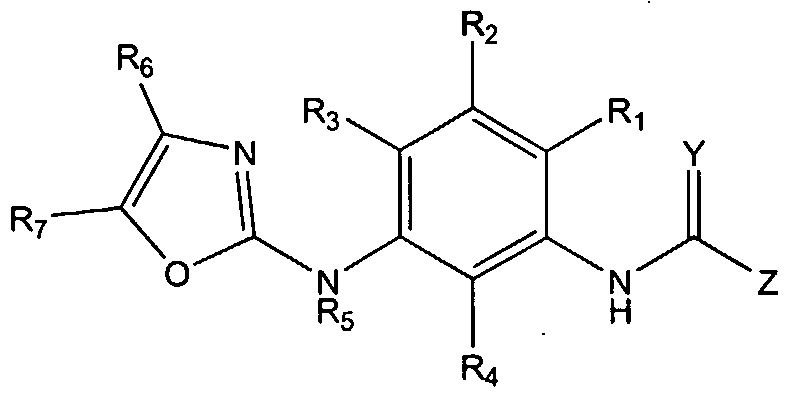
  • said c-kit inhibitor is selected from 2-aminoaryloxazoles of formula X :
  • Rl, R2, R3 and R4 each independently are selected from hydrogen, halogen (selected from F, CI, Br or I), a linear or branched alkyl group containing from 1 to 10 carbon atoms and optionally substituted with one or more hetereoatoms such as halogen (selected from F, CI, Br or I), oxygen, and nitrogen, the latter optionally in the form of a pendant basic nitrogen functionality; as well as trifluoromethyl, Ci- ⁇ alkyloxy, amino, . 6 alkylamino, di(C ⁇ .
  • R is a linear or branched alkyl group containing from 1 to 10 carbon atoms and optionally substituted with at least one heteroatom, notably a halogen (selected from F, CI, Br or I), oxygen, and nitrogen, the latter optionally in the form of a pendant basic nitrogen functionality.
  • R5 is one of the following:
  • R8 may be - a linear or branched alkyl group containing from 1 to 10 carbon atoms and optionally substituted with one or more hetereoatoms such as halogen (selected from F,
  • R is a linear or branched alkyl group containing from 1 to 10 carbon atoms and optionally substituted with at least one heteroatom, notably a halogen (selected from F, CI, Br or I), oxygen, and nitrogen, the latter optionally in the form of a pendant basic nitrogen functionality, or - a heteroaryl group such as a pyridyl, pyrimidinyl, pyrazinyl, pyridazinyl, thienyl, thiazolyl, imidazolyl, pyrazolyl, py ⁇ olyl, furanyl, oxazolyl, isoxazolyl, triazolyl, tetrazolyl, indolyl, benzimidazole, qui
  • R6 and R7 each independently are selected from: i) hydrogen, a halogen (selected from F, CI, Br or I), or ii) an alkyl 1 group defined as a linear, branched or cycloalkyl group containing from 1 to 10 carbon atoms and optionally substituted with one or more hetereoatoms such as halogen (selected from F, CI, Br or I), oxygen, and nitrogen (the latter optionally in the form of a pendant basic nitrogen functionality); as well as trifluoromethyl, carboxyl, cyano, nitro, formyl; as well as CO-R, COO-R, CONH-R, SO2-R, and SO2NH-R wherein R is a linear or branched alkyl group containing 1 to 10 carbon atoms and optionally substituted with at least one heteroatom, notably a halogen (selected from F, CI, Br or I), oxygen, and nitrogen, the latter optionally in the form of a pendant basic nitrogen functionality ;
  • a heteroaryl 1 group defined as a pyridyl, pyrimidinyl, pyrazinyl, pyridazinyl, thienyl, thiazolyl, imidazolyl, pyrazolyl, py ⁇ olyl, furanyl, oxazolyl, isoxazolyl , triazolyl, tetrazolyl, indolyl, benzimidazole, quinolinyl group, which may additionally bear any combination, at any one ring position, of one or more substituents such as - halogen (selected from F, CI, Br or I); an alkyl 1 group; - a cycloalkyl, aryl or heteroaryl group optionally substituted by a pendant basic nitrogen functionality, - trifluoromethyl, O-alkyl 1 , carboxyl, cyano, nitro, formyl, hydroxy, NH-alkyl 1 , N(alkyl 1
  • X is:
  • R9 and / or R10 are hydrogen or: i) an alkyl 1 group, CF3 or ii) an aryl 1 , heteroaryl 1 or cycloalkyl group optionally substituted by a a pendant basic nitrogen functionality, or iii) a CO-R, COO-R, CON-RR'or SO2-R, where R and R' are a hydrogen, alkyl 1 , aryl 1 or heteroaryl 1 , optionally substituted by a a pendant basic nitrogen functionality; or:
  • R9 and / or RIO are hydrogen or: i) an alkyl 1 group, CF3 or ii) an aryl 1 , heteroaryl 1 or cycloalkyl group optionally substituted by a a pendant basic nitrogen functionality.
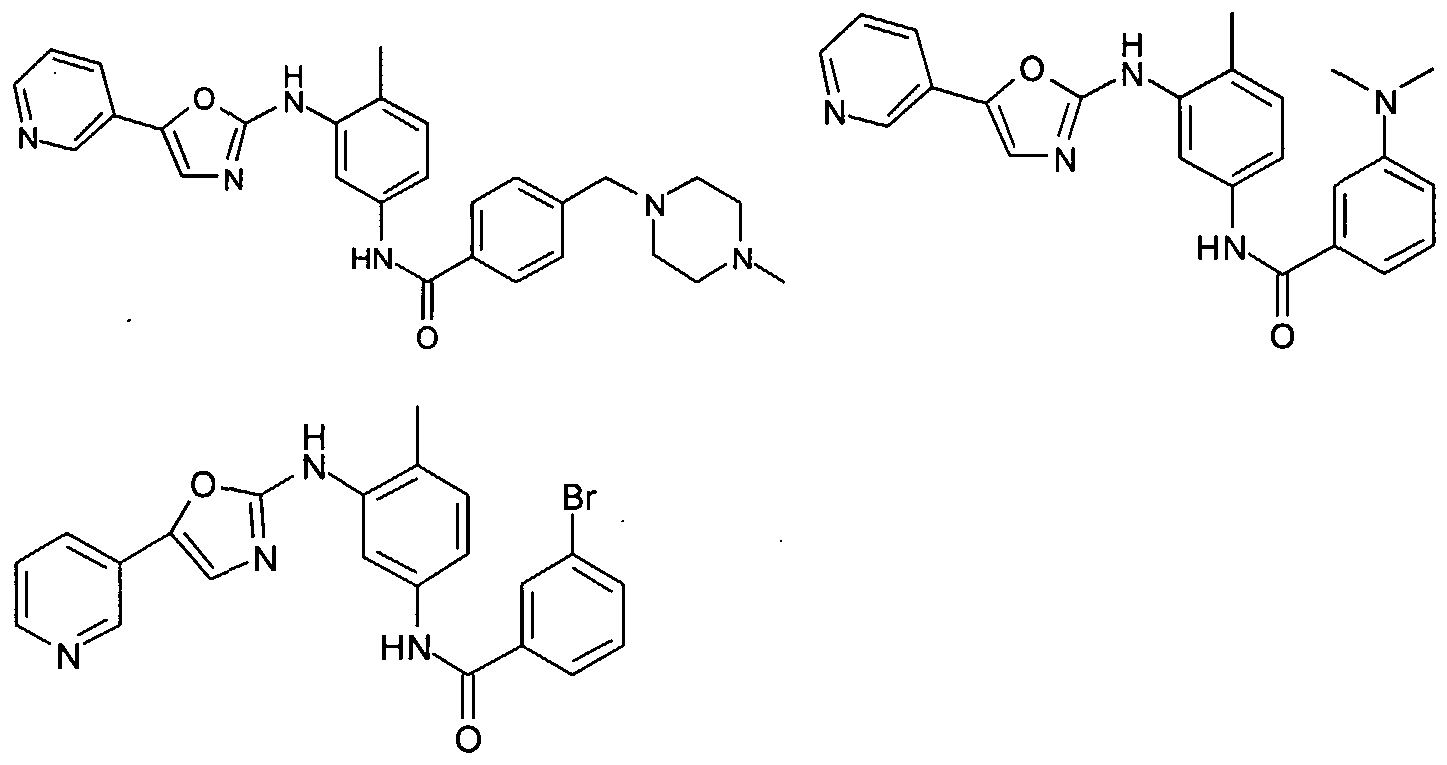
  • Such compound may be selected from N-Aminoalkyl-N'-oxazol-2-yl-benzene-l,3- diamines of the following formula:
  • R5 H
  • Y is a linear or branched alkyl group containing from 1 to 10 carbon atoms and Z represents an aryl or a heteroaryl group, optionally substituted by a pendant basic nitrogen functionality.
  • the above 2-aminoaryloxazoles compounds may have the formula XI:
  • R5 is H
  • Y is selected from O, S and Z co ⁇ esponds to H, alkyl, or NRR', wherein R and R' are independently chosen from H or alkyl 1 or aryl 1 or heteroaryl 1 , optionally substituted by a pendant basic nitrogen functionality, for example :
  • Ra, Rb are independently chosen from H or alkyl 1 or aryl 1 or heteroaryl 1 , optionally substituted by a pendant basic nitrogen functionality, for example :
  • R5 H
  • Z is an aryl 1 group, aryl 1 being selected from : a phenyl or a substituted variant thereof bearing any combination, at any one ring position, of one or more substituents such as - halogen(selected from I, F, CI or Br); - an alkyl 1 group; - a cycloalkyl, aryl or heteroaryl group optionally substituted by a pendant basic nitrogen functionality; - trifluoromethyl, O-alkyl 1 , carboxyl, cyano, nitro, formyl, hydroxy, NH-alkyl 1 , N(alkyl')(alkyl 1 ), and amino, the latter nitrogen substituents optionally in the form of a basic nitrogen functionality;
  • R5 H and R is independently alkyl , aryl or heteroaryl as defined above
  • Substituent "L" in formula 10 is a nucleofugal leaving group in nucleophilic substitution reactions (for example, L can be selected from chloro, bromo, iodo, toluenesulfonyloxy, methanesulfonyloxy, trifluoromethanesulfonyloxy, etc., with L being preferentially a bromo group).
  • Group "PG" in formula 1 lc is a suitable protecting group of a type commonly utilized by the person skilled in the art.
  • Formula 12b describes a precursor to compounds of formula III which lack substituent Rl. Therefore, in a second phase of the synthesis, substituent Rl is connected to the free amine group in 12b, leading to the complete structure embodied by formula III:
  • Rl the nature of which is as described on page 3 for the general formula m, is achieved by the use of standard reactions that are well known to the person skilled in the art, such as alkylation, acylation, sulfonylation, formation of ureas, etc.
  • Formula 12c describes an N-protected variant of compound 12b.
  • Group "PG" in formula 12c represents a protecting group of the type commonly utilized by the person skilled in the art. Therefore, in a second phase of the synthesis, group PG is cleaved to transform compound 12c into compound 12b. Compound 12b is subsequently advanced to structures of formula I as detailed above.
  • Formula 12d describes a nitro analogue of compound 12b.
  • the nitro group of compound 12d is reduced by any of the several methods utilized by the person skilled in the art to produce the co ⁇ esponding amino group, namely compound 12b.
  • Compound 12b thus obtained is subsequently advanced to structures of formula III as detailed above.
  • fibrodysplasia as refe ⁇ ed herein includes the following therapeutic applications : all forms of fibrodysplasia including fibrodysplasia ossificans progressiva.
  • c-kit inhibitors as mentioned above are inhibitors of wild type or mutant activated c-kit.
  • the invention contemplates a method for treating fibrodysplasia comprising administering to a human in need of such treatment a compound that is a selective, potent and non toxic inhibitor of c-kit obtainable by a screening method which comprises : a) bringing into contact (i) activated c-kit and (ii) at least one compound to be tested; under conditions allowing the components (i) and (ii) to form a complex, b) selecting compounds that inhibit activated c-kit, c) testing and selecting a subset of compounds identified in step b), which are unable to promote death of IL-3 dependent cells cultured in presence of IL-3.
  • This screening method can further comprise the step consisting of testing and selecting a subset of compounds identified in step b) that are inhibitors of mutant activated c-kit (for example in the transphosphorylase domain), which are also capable of inhibiting SCF- activated c-kit wild.
  • activated c-kit is SCF-activated c-kit wild.
  • step c) IL-3 is preferably present in the culture media of IL-3 dependent cells at a concentration comprised between 0.5 and 10 ng/ml, preferably between 1 to 5 ng/ml.
  • the invention embraces the use of the compounds defined above to manufacture a medicament for treating fibrodysplasia and related disorders, such as fibrodysplasia ossificans.
  • compositions utilized in this invention may be administered by any number of routes including, but not limited to, oral, intravenous, intramuscular, intra- arterial, intramedullary, intrathecal, intraventricular, transdermal, subcutaneous, intraperitoneal, intranasal, enteral, sublingual, or rectal means.
  • these pharmaceutical compositions may contain suitable pharmaceutically-acceptable carriers comprising excipients and auxiliaries which facilitate processing of the active compounds into preparations which can be used pharmaceutically. Further details on techniques for formulation and administration may be found in the latest edition of Remington's Pharmaceutical Sciences (Maack Publishing Co., Easton, Pa.).
  • compositions for oral administration can be formulated using pharmaceutically acceptable carriers well known in the art in dosages suitable for oral administration.
  • Such carriers enable the pharmaceutical compositions to be formulated as tablets, pills, dragees, capsules, liquids, gels, syrups, slurries, suspensions, and the like, for ingestion by the patient.
  • the invention relates to a pharmaceutical composition intended for oral administration.
  • compositions suitable for use in the invention include compositions wherein compounds for depleting mast cells, such as c-kit inhibitors, or compounds inhibiting mast cells degranulation are contained in an effective amount to achieve the intended purpose.
  • compounds for depleting mast cells such as c-kit inhibitors, or compounds inhibiting mast cells degranulation are contained in an effective amount to achieve the intended purpose.
  • a therapeutically effective dose refers to that amount of active ingredient, which ameliorates the symptoms or condition.
  • Therapeutic efficacy and toxicity may be determined by standard pharmaceutical procedures in cell cultures or experimental animals, e.g., ED50 (the dose therapeutically effective in 50% of the population) and LD50 (the dose lethal to 50% of the population).
  • the dose ratio of toxic to therapeutic effects is the therapeutic index, and it can be expressed as the ratio,
  • Example 1 AB compounds of formula III, IV, V and X are selective and potent c- Kit and mast cell inhibitors.
  • the specific compounds as listed above are non limitative illustrative examples of AB compounds. They display IC50 below 5 ⁇ M, 1 ⁇ M or even 0.1 ⁇ M on different forms of c-ICIT ( Figure 1). Also, these AB compounds are selective for c-KIT versus other tyrosine kinases (Table 1). Table 1 Inhibition of various protein tyrosine kinases by the AB compound in vitro
  • the AB compounds potently and dose-dependently inhibited the growth of the mast cells (MC) when they were cultured in the presence of SCF (with an IC50 of ⁇ 0.1 ⁇ M). Again these in vitro data confirmed the potent and selective inhibitory activity of c-Kit tyrosine kinase activity as well as the ability of the AB compound to inhibit almost completely the survival of MC population at concentration lower than 0.1 ⁇ M. AB compounds have also been shown to deplete mast cells in vivo. The AB compound has successfully completed preclinical development in September 2003. Safety pharmacology studies revealed no significant effects of the AB compound on the central nervous, cardiovascular and respiratory systems.

Landscapes

  • Health & Medical Sciences (AREA)
  • Chemical & Material Sciences (AREA)
  • Medicinal Chemistry (AREA)
  • Pharmacology & Pharmacy (AREA)
  • Life Sciences & Earth Sciences (AREA)
  • Animal Behavior & Ethology (AREA)
  • General Health & Medical Sciences (AREA)
  • Public Health (AREA)
  • Veterinary Medicine (AREA)
  • Epidemiology (AREA)
  • Physical Education & Sports Medicine (AREA)
  • Orthopedic Medicine & Surgery (AREA)
  • Rheumatology (AREA)
  • Engineering & Computer Science (AREA)
  • Bioinformatics & Cheminformatics (AREA)
  • Chemical Kinetics & Catalysis (AREA)
  • General Chemical & Material Sciences (AREA)
  • Nuclear Medicine, Radiotherapy & Molecular Imaging (AREA)
  • Organic Chemistry (AREA)
  • Pharmaceuticals Containing Other Organic And Inorganic Compounds (AREA)
  • Medicines That Contain Protein Lipid Enzymes And Other Medicines (AREA)
  • Acyclic And Carbocyclic Compounds In Medicinal Compositions (AREA)

Abstract

The present invention relates to a method for treating fibrodysplasia such as fibrodysplasia ossificans progressive comprising administering a compound capable of depleting mast cells or a compound inhibiting mast cell degranulation, to a human in need of such treatment. Such compounds can be chosen from c-kit inhibitors and more particularly non-toxic, selective and potent c-kit inhibitors. Preferably, said inhibitor is unable to promote death of IL-3 dependent cells cultured in presence of IL-3.

Description

Use of c-kit inhibitors for treating fibrodysplasia
The present invention relates to a method for treating fibrodysplasia such as fibrodysplasia ossificans progressive comprising administering a compound capable of depleting mast cells or a compound inhibiting mast cell degranulation, to a human in need of such treatment. Such compounds can be chosen from c-kit inhibitors and more particularly non-toxic, selective and potent c-kit inhibitors. Preferably, said inhibitor is unable to promote death of IL-3 dependent cells cultured in presence of IL-3.
Fibrodysplasia ossificans progressiva (FOP) is an extremely rare and disabling genetic disorder of connective tissue. The condition is characterized by congenital malformation of the great toes and by progressive heterotopic ossification of the tendons, ligaments, fasciae, and striated muscles. Fibrodysplasia ossificans progressiva occurs sporadically and is transmitted as a dominant trait with variable expression and complete penetrance. Reproductive fitness is low. There are fewer than 150 known patients with the disorder in the United States. A point prevalence of one affected patient in every 2 million of population has been observed. There is no sexual, racial, or ethnic predilection. This disease appears in early life and its course is unavoidably progressive. Most patients are confined to a wheelchair by the third decade of life and often succumb to pulmonary complications in the 5th/6th decade of life. At present there is no effective prevention or treatment (Mahboubi S. et al, Pediatr Radiol. 2001 May;31(5):307-14).
Thus, there is a need for a treatment for such disabling and uncommon disease.
Mast cell density at the periphery of FOP lesional tissue has been observed to be significantly greater than in normal control skeletal muscle. Mast cells (MC) are tissue elements derived from a particular subset of hematopoietic stem cells that express CD34, c-kit and CD 13 antigens (Kirshenbaum, 1999 and Ishizaka, 1993). Immature MC progenitors circulate in the bloodstream and differentiate in tissues.
Mast cells produce a large variety of mediators categorized into three groups: preformed granule-associated mediators (histamine, proteoglycans, and neutral proteases), lipid- derived mediators (prostaglandins, thromboxanes and leucotrienes), and various cytokines (IL-1, IL-2, IL-3, IL-4, IL-5, IL-6, IL-8, TNF-α, GM-CSF, MIP-lo, MIP-1/3 and IFN-γ), most of them having strong pro-inflammatory activities. For instance, a massive release of MCs mediators is responsible for anaphylactic reactions that could be sometimes fatal to the patients and are always responsible for a significant morbidity. Since MCs are distributed in almost all the body sites, hypersecretion of mediators by activated elements can lead to multiple organ failures.
We propose here that mast cells (MC) are central players involved in genetic disorders such as fibrodysplasia.
In connection with the present invention, we provide c-kit inhibitors as a new route for treating fibrodysplasia ossificans progressiva, which consists of destroying mast cells playing a role in inflammation and development of FOP lesions.
Description
The present invention relates to a method for treating fibrodysplasia and related disorders comprising administering a compound capable of depleting mast cells or blocking mast cells degranulation to a human in need of such treatment. Said method for treating fibrodysplasia can comprise administering a c-kit inhibitor to a human in need of such treatment.
Preferred compounds are c-kit inhibitor, more particularly a non-toxic, selective and potent c-kit inhibitor. Such inhibitors can be selected from the group consisting of 2-(3- Substitutedaryl)amino-4-aryl-thiazoles such as 2-(3-amino)arylamino-4-aryl-fhiazoles, 2- aminoaryloxazoles, pyrimidine derivatives, pyrrolopyrimidine derivatives, quinazoline derivatives, quinoxaline derivatives, pyrazoles derivatives, bis monocyclic, bicyclic or heterocyclic aryl compounds, vinyl ene-azaindole derivatives and pyridyl-quinolones derivatives, styryl compounds, styryl-substituted pyridyl compounds, seleoindoles, selenides, tricyclic polyhydroxylic compounds and benzylphosphonic acid compounds.
Among preferred compounds, it is of interest to focus on pyrimidine derivatives such as N-phenyl-2-pyrimidine-amine derivatives (US 5,521,184 and WO 99/03854), indolinone derivatives and pyrrol-substituted indolinones (US 5,792,783, EP 934 931, US 5,834,504), US 5,883,116, US 5,883,113, US 5, 886,020, WO 96/40116 and WO 00/38519), as well as bis monocyclic, bicyclic aryl and heteroaryl compounds (EP 584 222, US 5,656,643 and WO 92/20642), quinazoline derivatives (EP 602 851, EP 520 722, US 3,772,295 and US 4,343,940), 4-amino-substituted quinazolines (US 3,470,182), 4-thienyl-2-(lH)-quinazolones, 6,7-dialkoxyquinazolines (US 3,800,039), aryl and heteroaryl quinazoline (US 5,721,237, US 5,714,493, US 5,710,158 and WO 95/15758), 4-anilinoquinazoline compounds (US 4,464,375), and 4-thienyl-2-(lH)- quinazolones (US 3,551,427).
So, preferably, the invention relates to a method for treating fibrodysplasia comprising administering a non toxic, potent and selective c-kit inhibitor is a pyrimidine derivatives, more particularly N-phenyl-2-pyrimidine-amine derivatives of formula I :
Figure imgf000005_0001
wherein the Rl, R2, R3, R13 to R17 groups have the meanings depicted in EP 564 409 Bl, incorporated herein in the description.
Preferably, the N-phenyl-2-pyrimidine-amine derivative is selected from the compounds corresponding to formula II :
Figure imgf000005_0002
Wherein Rl, R2 and R3 are independently chosen from H, F, CI, Br, I, a C1-C5 alkyl or a cyclic or heterocyclic group, especially a pyridyl group;
R4, R5 and R6 are independently chosen from H, F, CI, Br, I, a C1-C5 alkyl, especially a methyl group; and R7 is a phenyl group bearing at least one substituent, which in turn possesses at least one basic site, such as an amino function.
Preferably, R7 is the following group :
Figure imgf000006_0001
Among these compounds, the preferred are defined as follows : Rl is a heterocyclic group, especially a pyridyl group, R2 and R3 are H,
R4 is a C1-C3 alkyl, especially a methyl group, R5 and R6 are H, and R7 is a phenyl group bearing at least one substituent, which in turn possesses at least one basic site, such as an amino function, for example the group :
Figure imgf000006_0002
Therefore, in a preferred embodiment, the invention relates to a method for treating fibrodysplasia comprising the administration of an effective amount of the compound known in the art as CGP57148B :
4-(4-mehylpiperazine-l-ylmethyl)-N-[4-methyl-3-(4-pyridine-3-yl)pyrimidine-2 ylamino)phenyl]-benzamide corresponding to the following formula :
Figure imgf000006_0003
The preparation of this compound is described in example 21 of EP 564409 and the β- form, which is particularly useful is described in WO 99/03854.
In another preferred embodiment, the invention contemplates the method mentioned above, wherein said c-kit inhibitor is selected from 2-(3-Substitutedaryl)amino-4-aryl- thiazoles such as those for which the applicant filed PCT/IB2005/000401, incorporated herein by reference, especially compounds of formula III :
Figure imgf000007_0001
FORMULA III wherein
R6 and R7 are independently from each other chosen from one of the following: i) hydrogen, a halogen (selected from F, CI, Br or I), ii) an alkyl1 group defined as a linear, branched or cycloalkyl group containing from 1 to 10 carbon atoms, or from 2 or 3 to 10 carbon atoms, (for example methyl, ethyl, propyl, butyl, pentyl, hexyl...) and optionally substituted with one or more hetereoatoms such as halogen (selected from F, CI, Br or I), oxygen, and nitrogen (the latter optionally in the form of a pendant basic nitrogen functionality); as well as trifluoromethyl, carboxyl, cyano, nitro, formyl; (iii) an aryl1 group defined as phenyl or a substituted variant thereof bearing any combination, at any one ring position, of one or more substituents such as - halogen(selected from I, F, CI or Br); - an alkyl1 group; a cycloalkyl, aryl or heteroaryl group optionally substituted by a pendant basic nitrogen functionality; trifluoromethyl, O-alkyl1, carboxyl, cyano, nitro, formyl, hydroxy, NH-alkyl1, N(alkyl')(alkyl1), and amino, the latter nitrogen substituents optionally in the form of a basic nitrogen functionality;
(iv) a heteroaryl1 group defined as a pyridyl, pyrimidinyl, pyrazinyl, pyridazinyl, thienyl, thiazolyl, imidazolyl, pyrazolyl, pyrrolyl, furanyl, oxazolyl, isoxazolyl , triazolyl, tetrazolyl, indolyl, benzimidazole, quinolinyl group, which may additionally bear any combination, at any one ring position, of one or more substituents such as - halogen (selected from F, CI, Br or I); an alkyl1 group; a cycloalkyl, aryl or heteroaryl group optionally substituted by a pendant basic nitrogen functionality, - trifluoromethyl, O-alkyl1, carboxyl, cyano, nitro, formyl, hydroxy, NH-alkyl1, N(alkyl')(alkyl1), and amino, the latter nitrogen substituents optionally in the form of a basic nitrogen functionality; (v) trifluoromethyl, carboxyl, cyano, nitro, formyl, hydroxy, N(alkyl')(alkyl1), and amino, the latter nitrogen substituents optionally in the form of a basic nitrogen functionality.
R8 is one of the following:
(i) hydrogen, or
(ii) a linear or branched alkyl group containing from 1 to 10 carbon atoms and optionally substituted with one or more hetereoatoms such as halogen (selected from F, CI, Br or I), oxygen, and nitrogen, the latter optionally in the form of a pendant basic nitrogen functionality, or (iii) CO-R8 or COOR8 or CONHR8 or SO2R8 wherein R8 may be - a linear or branched alkyl group containing from 1 to 10 carbon atoms and optionally substituted with one or more hetereoatoms such as halogen (selected from F, CI, Br or I), oxygen, and nitrogen, the latter optionally in the form of a pendant basic nitrogen functionality, or - an aryl group such as phenyl or a substituted variant thereof bearing any combination, at any one ring position, of one or more substituents such as halogen (selected from F, CI, Br or I), alkyl groups containing from 1 to 10 carbon atoms and optionally substituted with one or more hetereoatoms such as halogen (selected from F, CI, Br or I), oxygen, and nitrogen, the latter optionally in the form of a pendant basic nitrogen functionality; as well as trifluoromethyl, Cι-6alkyloxy, carboxyl, cyano, nitro, formyl, hydroxy,
Figure imgf000009_0001
di(Ci-6alkyl)amino, and amino, the latter nitrogen substituents optionally in the form of a pendant basic nitrogen functionality; as well as CO-R, COO-R, CONH-R, SO2-R, and SO2NH-R wherein R is a linear or branched alkyl group containing from 1 to 10 carbon atoms and optionally substituted with at least one heteroatom, notably a halogen (selected from F, CI, Br or I), oxygen, and nitrogen, the latter optionally in the form of a pendant basic nitrogen functionality, or - a heteroaryl group such as a pyridyl, pyrimidinyl, pyrazinyl, pyridazinyl, thienyl, thiazolyl, imidazolyl, pyrazolyl, pyrrolyl, furanyl, oxazolyl, isoxazolyl, triazolyl, tetrazolyl, indolyl, benzimidazole, quinolinyl group, which may additionally bear any combination, at any one ring position, of one or more substituents such as halogen (selected from F, CI, Br or I), alkyl groups containing from 1 to 10 carbon atoms and optionally substituted with one or more hetereoatoms such as halogen (selected from F, CI, Br or I), oxygen, and nitrogen, the latter optionally in the form of a pendant basic nitrogen functionality; as well as trifluoromethyl,
Figure imgf000009_0002
carboxyl, cyano, nitro, formyl, hydroxy, Ci-όalkylamino, di(Cι-6alkyl)amino, and amino, the latter nitrogen substituents optionally in the form of a basic nitrogen functionality; as well as CO-R, COO-R, CONH-R, SO2-R, and SO2NH-R wherein R is a linear or branched alkyl group containing from 1 to 10 carbon atoms and optionally substituted with at least one heteroatom, notably a halogen (selected from F, CI, Br or I), oxygen, and nitrogen, the latter optionally in the form of a pendant basic nitrogen functionality.
R2, R3, R4 and R5 each independently are selected from hydrogen, halogen (selected from F, CI, Br or I), a linear or branched alkyl group containing from 1 to 10 carbon atoms and optionally substituted with one or more hetereoatoms such as halogen (selected from F, CI, Br or I), oxygen, and nitrogen, the latter optionally in the form of a pendant basic nitrogen functionality; as well as trifluoromethyl,
Figure imgf000010_0001
6alkylamino, di(Cι.6alkyl)amino, carboxyl, cyano, nitro, formyl, hydroxy, and CO-R, COO-R, CONH-R, SO2-R, and SO2NH-R wherein R is a linear or branched alkyl group containing from 1 to 10 carbon atoms and optionally substituted with at least one heteroatom, notably a halogen (selected from F, CI, Br or I), oxygen, and nitrogen, the latter optionally in the form of a pendant basic nitrogen functionality.
A is : CH2, O, S, SO2, CO, or COO,
B is a bond or NH, NCH3, NR*, (CH2)n (n is 0, 1 or 2), O, S, SO2, CO, or COO,
B' is a bond or NH, NCH3, NR*, (CH2)n (n is 0, 1 or 2), O, S, SO2, CO or COO;
R* being an alkyl1, aryl1 or heteroaryl1
W is a bond or a linker selected from NH, NHCO, NHCOO, NHCONH, NHSO2, NHSO2NH, CO, CONH, COO, COCH2, (CH2)n (n is 0, 1 or 2), CH2-CO, CH2COO,
CH2-NH, O, OCH2, S, SO2, and SO2NH
R s : a) a linear or branched alkyl group containing from 1 to 10 carbon atoms optionally substituted with at least one heteroatom, notably a halogen selected from I, CI, Br and F, and / or bearing a pendant basic nitrogen functionality; b) an aryl or heteroaryl group optionally substituted by an alkyl or aryl group optionally substituted with a heteroatom, notably a halogen selected from I, CI, Br and F or bearing a pendant basic nitrogen functionality c) an alkyl1, aryl1 or heteroaryl1.
It will be understood that a C1-C10 alkyl encompasses a methyl, ethyl, propyl, and a C2 to C4 alkyl or a C2 to CIO alkyl.
For example, a subset of compounds may correspond to
Figure imgf000011_0001
Wherein Rl, R4 and R6 have the meaning as defined above.
It will be understood that A-B-B1 includes but is not limited to : CH2, CH2-CO, CH2-CO-CH2, CH2COO, CH2-CH2-CO, CH2-CH2-COO, CH2-NH,
CH2-CH2-NH, CH2-NH-CH2 or CH2-NH-CO or CH2-CO-NH
It will be understood that A-B-B' also includes but is not limited to :
CO-CH2, COO-CH2, CO-CH2-CH2, CO-NH, or CO-NH-CH2 as well as O-CH2 It will also be understood that NH in B or B' can also be NCH3
In the above formula III, when W is other than a single bond, it will be understood that A can be also be NH or NCH3.
In the above formula, the following combinations are contemplated :
- R6 is (iv), R4 is H or CH3, A-B-B' is CO-NH and Rl is as defined above. - R6 is (iv), R4 is H or CH3, A-B-B' is CH2-CO-NH and Rl is as defined above.
- R6 is (iv), R4 is H or CH3, A-B-B' is CH2-CO and Rl is as defined above.
- R6 is (iv), R4 is H or CH3, A-B-B' is CH2-NH-CO and Rl is as defined above.
- R6 is (iv), R4 is H or CH3, A-B-B' is CH2-NH and Rl is as defined above. - R6 is (iv), R4 is H or CH3, A-B-B' is CH2 and Rl is as defined above.
- R6 is W-(iv), R4 is a C1-C2 alkyl, A-B-B' is CO-NH and Rl is as defined above.
- R6 is (iv), R4 is a C1-C2 alkyl, A-B-B' is CH2-CO-NH and Rl is as defined above.
- R6 is (iv), R4 is a C1-C2 alkyl, A-B-B' is CH2-CO and Rl is as defined above.
- R6 is a pyridyl according to (iv), R4 is a C1-C2 alkyl, A-B-B' is CO-NH, CH2-CO-NH, CH2-CO, CH2-NH, CH2-NH-CO and Rl is as defined above.
In the above combination, Rl can be an alkyl1. In the above combination, Rl can be an aryl1.
In the above combination, Rl can be an heteroaryl1.
In another preferred embodiment, the invention contemplated the method mentioned above, wherein said c-kit inhibitor is selected from 2-(3-amino)arylamino-4-aryl- thiazoles such as those for which the applicant filed WO 2004/014903, incorporated herein in the description, especially compounds of formula IN :
Figure imgf000012_0001
FORMULA IV and wherein R1 is : a) a linear or branched alkyl group containing from 1 to 10 carbon atoms optionally substituted with at least one heteroatom, notably a halogen selected from I, CI, Br and F, and / or bearing a pendant basic nitrogen functionality; b) an aryl or heteroaryl group optionally substituted by an alkyl or aryl group optionally substituted with a heteroatom, notably a halogen selected from I, CI, Br and F or bearing a pendant basic nitrogen functionality; c) a -CO-NH-R, -CO-R, -CO-OR or a -CO-NRR' group, wherein R and R' are independently chosen from H or an aryl, heteroaryl, alkyl and cycloalkyl group optionally substituted with at least one heteroatom, notably a halogen selected from I, CI, Br and F, and / or bearing a pendant basic nitrogen functionality;
R2 is hydrogen, halogen or a linear or branched alkyl group containing from 1 to 10 carbon atoms, trifluoromethyl or alkoxy;
R3 is hydrogen, halogen or a linear or branched alkyl group containing from 1 to 10 carbon atoms, trifluoromethyl or alkoxy;
R4 is hydrogen, halogen or a linear or branched alkyl group containing from 1 to 10 carbon atoms, trifluoromethyl or alkoxy; R5 is hydrogen, halogen or a linear or branched alkyl group containing from 1 to 10 carbon atoms, trifluoromethyl or alkoxy;
R is one of the following:
(i) an aryl group such as phenyl or a substituted variant thereof bearing any combination, at any one ring position, of one or more substituents such as halogen, alkyl groups containing from 1 to 10 carbon atoms, trifluoromethyl, and alkoxy;
(ii) a heteroaryl group such as a 2, 3, or 4-pyridyl group, which may additionally bear any combination of one or more substituents such as halogen, alkyl groups containing from 1 to 10 carbon atoms, trifluoromethyl and alkoxy;
(iii) a five-membered ring aromatic heterocyclic group such as for example 2-thienyl, 3- thienyl, 2-thiazolyl, 4-thiazolyl, 5-thiazolyl, which may additionally bear any combination of one or more substituents such as halogen, an alkyl group containing from
1 to 10 carbon atoms, trifluoromethyl, and alkoxy, iv) H, a halogen selected from I, F, CI or Br; NH2, NO2 or SO2-R, wherein R is a linear or branched alkyl goup containing one or more group such as 1 to 10 carbon atoms, and optionally substituted with at least one heteroatom, notably a halogen selected from I, CI, Br and F, and / or bearing a pendant basic nitrogen functionality; and R7 is one of the following:
(i) an aryl group such as phenyl or a substituted variant thereof bearing any combination, at any one ring position, of one or more substituents such as halogen, alkyl groups containing from 1 to 10 carbon atoms, trifluoromethyl, and alkoxy; (ii) a heteroaryl group such as a 2, 3, or 4-pyridyl group, which may additionally bear any combination of one or more substituents such as halogen, alkyl groups containing from 1 to 10 carbon atoms, trifluoromethyl and alkoxy;
(iii) a five-membered ring aromatic heterocyclic group such as for example 2-thienyl, 3- thienyl, 2-thiazolyl, 4-thiazolyl, 5-thiazolyl, which may additionally bear any combination of one or more substituents such as halogen, an alkyl group containing from 1 to 10 carbon atoms, trifluoromethyl, and alkoxy. iv) H, a halogen selected from I, F, CI or Br; NH2, NO2 or SO2-R, wherein R is a linear or branched alkyl goup containing one or more group such as 1 to 10 carbon atoms, and optionally substituted with at least one heteroatom, notably a halogen selected from I, CI, Br and F, and / or bearing a pendant basic nitrogen functionality.
In another preferred embodiment, when R1 has the meaning depicted in c) above, the invention is directed to compounds of the following formulas:
Figure imgf000014_0001
wherein R is H or an organic group that can be selected for example from a linear or branched alkyl group containing from 1 to 10 carbon atoms optionally substituted with at least one heteroatom or bearing a pendant basic nitrogen functionality; a cycloalkyl, an aryl or heteroaryl group optionally substituted by an alkyl, a cycloalkyl, an aryl or heteroaryl group optionally substituted with a heteroatom, notably a halogen selected from I, CI, Br and F and / or bearing a pendant basic nitrogen functionality.
Among the particular compounds in which Rl has the meaning as depicted in c) above, the invention is directed to amide-aniline, amide-benzylamine, amide-phenol, urea compounds of the following formulas respectively :
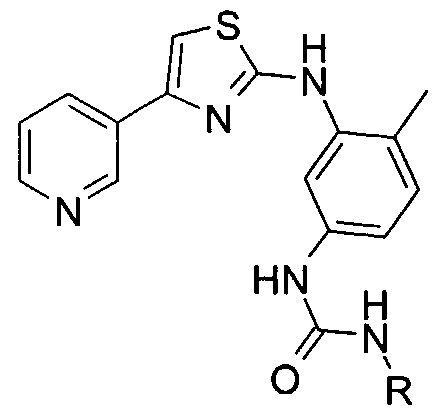
Figure imgf000015_0001
Figure imgf000016_0001
wherein R is H or an organic group that can be selected for example from a linear or branched alkyl group containing from 1 to 10 carbon atoms optionally substituted with at least one heteroatom or bearing a pendant basic nitrogen functionality; a cycloalkyl, an aryl or heteroaryl group optionally substituted with a heteroatom, notably a halogen selected from I, CI, Br and F and / or bearing a pendant basic nitrogen functionality; or a a cycloalkyl, an aryl or heteroaryl group optionally substituted with a cycloalkyl, an aryl or heteroaryl group optionally substituted with a heteroatom, notably a halogen selected from I, CI, Br and F and / or bearing a pendant basic nitrogen functionality; a -SO2-R group wherein R is an alkyl, cycloalkyl, aryl or heteroaryl optionally substituted with an heteroatom, notably a halogen selected from I, CI, Br and F and / or bearing a pendant basic nitrogen functionality; or a -CO-R or a -CO-NRR' group, wherein R and R' are independently chosen from H, an alkyl, a cycloalkyl, an aryl or heteroaryl group optionally substituted with at least one heteroatom, notably selected from I, CI, Br and F, and / or bearing a pendant basic nitrogen functionality.
Among the particular compounds in which Rl has the meaning as depicted in a) and b) above, the invention is directed to N-Aminoalkyl-N'-thiazol-2-yl-benzene-l,3-diamine compounds of the following formula IVbis:
Figure imgf000016_0002
wherein Y is a linear or branched alkyl group containing from 1 to 10 carbon atoms; wherein Z represents an aryl or heteroaryl group, optionally substituted at one or more ring position with any permutation of the following groups: - a halogen such as F, CI, Br, I; - a linear or branched alkyl group containing from 1 to 10 carbon atoms atoms optionally substituted with at least one heteroatom (for example a halogen) and / or bearing a pendant basic nitrogen functionality; a cycloalkyl, an aryl or heteroaryl group optionally substituted with at least one heteroatom, notably a halogen selected from I, CI, Br and F, and / or bearing a pendant basic nitrogen functionality; or a cycloalkyl, an aryl or heteroaryl group substituted by an alkyl, a cycloalkyl, an aryl or heteroaryl group optionally substituted with an heteroatom, notably a halogen selected from I, CI, Br and F, and / or bearing a pendant basic nitrogen functionality; an O-R, where R is a linear or branched alkyl group containing from 1 to 10 carbon atoms atoms optionally substituted with at least one heteroatom (for example a halogen) and / or bearing a pendant basic nitrogen functionality; a cycloalkyl, an aryl or heteroaryl group optionally substituted with at least one heteroatom, notably a halogen selected from I, CI, Br and F, and / or bearing a pendant basic nitrogen functionality; or a cycloalkyl, an aryl or heteroaryl group substituted by an alkyl, a cycloalkyl, an aryl or heteroaryl group optionally substituted with an heteroatom, notably a halogen selected from I, CI, Br and F, and / or bearing a pendant basic nitrogen functionality; - an NRaRb, where Ra and Rb represents a hydrogen, or a linear or branched alkyl group containing from 1 to 10 carbon atoms atoms optionally substituted with at least one heteroatom (for example a halogen) and / or bearing a pendant basic nitrogen functionality or a cycle; a cycloalkyl, an aryl or heteroaryl group optionally substituted with at least one heteroatom, notably a halogen selected from I, CI, Br and F, and / or bearing a pendant basic nitrogen functionality; or a cycloalkyl, an aryl or heteroaryl group substituted by an alkyl, a cycloalkyl, an aryl or heteroaryl group optionally substituted with an heteroatom, notably a halogen selected from I, CI, Br and F, and / or bearing a pendant basic nitrogen functionality; - a COOR, where R is a linear or branched alkyl group containing from 1 to 10 carbon atoms atoms optionally substituted with at least one heteroatom (for example a halogen) and / or bearing a pendant basic nitrogen functionality; a cycloalkyl, an aryl or heteroaryl group optionally substituted with at least one heteroatom, notably a halogen selected from I, CI, Br and F, and / or bearing a pendant basic nitrogen functionality; or a cycloalkyl, an aryl or heteroaryl group substituted by an alkyl, a cycloalkyl, an aryl or heteroaryl group optionally substituted with an heteroatom, notably a halogen selected from I, CI, Br and F, and / or bearing a pendant basic nitrogen functionality;
- a CONRaRb, where Ra and Rb are a hydrogen or a linear or branched alkyl group containing from 1 to 10 carbon atoms atoms optionally substituted with at least one heteroatom (for example a halogen) and / or bearing a pendant basic nitrogen functionality; a cycloalkyl, an aryl or heteroaryl group optionally substituted with at least one heteroatom, notably a halogen selected from I, CI, Br and F, and / or bearing a pendant basic nitrogen functionality; or a cycloalkyl, an aryl or heteroaryl group substituted by an alkyl, a cycloalkyl, an aryl or heteroaryl group optionally substituted with an heteroatom, notably a halogen selected from I, CI, Br and F, and / or bearing a pendant basic nitrogen functionality;
- an NHCOR, where R is a linear or branched alkyl group containing from 1 to 10 carbon atoms atoms optionally substituted with at least one heteroatom (for example a halogen) and / or bearing a pendant basic nitrogen functionality; a cycloalkyl, an aryl or heteroaryl group optionally substituted with at least one heteroatom, notably a halogen selected from I, CI, Br and F, and / or bearing a pendant basic nitrogen functionality; or a cycloalkyl, an aryl or heteroaryl group substituted by an alkyl, a cycloalkyl, an aryl or heteroaryl group optionally substituted with an heteroatom, notably a halogen selected from I, CI, Br and F, and / or bearing a pendant basic nitrogen functionality; an NHCOOR, where R is a linear or branched alkyl group containing from 1 to 10 carbon atoms atoms optionally substituted with at least one heteroatom (for example a halogen) and / or bearing a pendant basic nitrogen functionality; a cycloalkyl, an aryl or heteroaryl group optionally substituted with at least one heteroatom, notably a halogen selected from I, CI, Br and F, and / or bearing a pendant basic nitrogen functionality; or a cycloalkyl, an aryl or heteroaryl group substituted by an alkyl, a cycloalkyl, an aryl or heteroaryl group optionally substituted with an heteroatom, notably a halogen selected from I, CI, Br and F, and / or bearing a pendant basic nitrogen functionality; an NHCONRaRb, where Ra and Rb are a hydrogen or a linear or branched alkyl group containing from 1 to 10 carbon atoms atoms optionally substituted with at least one heteroatom (for example a halogen) and / or bearing a pendant basic nitrogen functionality; a cycloalkyl, an aryl or heteroaryl group optionally substituted with at least one heteroatom, notably a halogen selected from I, CI, Br and F, and / or bearing a pendant basic nitrogen functionality; or a cycloalkyl, an aryl or heteroaryl group substituted by an alkyl, a cycloalkyl, an aryl or heteroaryl group optionally substituted with an heteroatom, notably a halogen selected from
I, CI, Br and F, and / or bearing a pendant basic nitrogen functionality; an OSO2R, where R is a linear or branched alkyl group containing from 1 to 10 carbon atoms atoms optionally substituted with at least one heteroatom (for example a halogen) and / or bearing a pendant basic nitrogen functionality; a cycloalkyl, an aryl or heteroaryl group optionally substituted with at least one heteroatom, notably a halogen selected from I, CI, Br and F, and / or bearing a pendant basic nitrogen functionality; or a cycloalkyl, an aryl or heteroaryl group substituted by an alkyl, a cycloalkyl, an aryl or heteroaryl group optionally substituted with an heteroatom, notably a halogen selected from I, CI, Br and F, and / or bearing a pendant basic nitrogen functionality; an NRaOSO2Rb, where Ra and Rb are a linear or branched alkyl group containing from 1 to 10 carbon atoms atoms optionally substituted with at least one heteroatom (for example a halogen) and / or bearing a pendant basic nitrogen functionality; Ra can also be a hydrogen; a cycloalkyl, an aryl or heteroaryl group optionally substituted with at least one heteroatom, notably a halogen selected from I, CI, Br and F, and / or bearing a pendant basic nitrogen functionality; or a cycloalkyl, an aryl or heteroaryl group substituted by an alkyl, a cycloalkyl, an aryl or heteroaryl group optionally substituted with an heteroatom, notably a halogen selected from I, CI, Br and F, and / or bearing a pendant basic nitrogen functionality;
R2 is hydrogen, halogen or a linear or branched alkyl group containing from 1 to 10 carbon atoms, trifluoromethyl or alkoxy;
R3 is hydrogen, halogen or a linear or branched alkyl group containing from 1 to 10 carbon atoms, trifluoromethyl or alkoxy;
R4 is hydrogen, halogen or a linear or branched alkyl group containing from 1 to 10 carbon atoms, trifluoromethyl or alkoxy; R5 is hydrogen, halogen or a linear or branched alkyl group containing from 1 to 10 carbon atoms, trifluoromethyl or alkoxy;
R6 is one of the following:
(i) an aryl group such as phenyl or a substituted variant thereof bearing any combination, at any one ring position, of one or more substituents such as halogen, alkyl groups containing from 1 to 10 carbon atoms, trifluoromethyl, and alkoxy;
(ii) a heteroaryl group such as a 2, 3, or 4-pyridyl group, which may additionally bear any combination of one or more substituents such as halogen, alkyl groups containing from 1 to 10 carbon atoms, trifluoromethyl and alkoxy; (iii) a five-membered ring aromatic heterocyclic group such as for example 2-thienyl, 3- thienyl, 2-thiazolyl, 4-thiazolyl, 5-thiazolyl, which may additionally bear any combination of one or more substituents such as halogen, an alkyl group containing from 1 to 10 carbon atoms, trifluoromethyl, and alkoxy. iv) H, a halogen selected from I, F, CI or Br; NH2, NO2 or SO2-R, wherein R is a linear or branched alkyl goup containing one or more group such as 1 to 10 carbon atoms, and optionally substituted with at least one heteroatom, notably a halogen selected from I, CI, Br and F, and / or bearing a pendant basic nitrogen functionality; and R7 is one of the following: (i) an aryl group such as phenyl or a substituted variant thereof bearing any combination, at any one ring position, of one or more substituents such as halogen, alkyl groups containing from 1 to 10 carbon atoms, trifluoromethyl, and alkoxy; (ii) a heteroaryl group such as a 2, 3, or 4-pyridyl group, which may additionally bear any combination of one or more substituents such as halogen, alkyl groups containing from 1 to 10 carbon atoms, trifluoromethyl and alkoxy;
(iii) a five-membered ring aromatic heterocyclic group such as for example 2-thienyl, 3- thienyl, 2-thiazolyl, 4-thiazolyl, 5-thiazolyl, which may additionally bear any combination of one or more substituents such as halogen, an alkyl group containing from 1 to 10 carbon atoms, trifluoromethyl, and alkoxy. iv) H, an halogen selected from I, F, CI or Br; NH2, NO2 or SO2-R, wherein R is a linear or branched alkyl goup containing one or more group such as 1 to 10 carbon atoms, and optionally substituted with at least one heteroatom, notably a halogen selected from I, CI, Br and F, and / or bearing a pendant basic nitrogen functionality. It will be understood that a C1-C10 alkyl encompasses a methyl, ethyl, propyl, and a C2 to C4 alkyl or a C2 to C 10 alkyl.
An example of preferred compounds of the above formula is depicted below: 4-{[4-Methyl-3-(4-pyridin-3-yl-thiazol-2-ylamino)-phenylamino]-methyl}-benzoic acid methyl ester
Among the compounds of formula III or IN, the invention is particularly embodied by the compounds of the following formula V:
Figure imgf000022_0001
FORMULA V wherein X is R or ΝRR' and wherein R and R' are independently chosen from H, an aryl, a heteroaryl, an alkyl , or a cycloalkyl group optionally substituted with at least one heteroatom, such as for example a halogen chosen from F, I, CI and Br and optionally bearing a pendant basic nitrogen functionality; or an aryl, a heteroaryl, an alkyl or a cycloalkyl group substituted with an aryl, a heteroaryl, an alkyl or a cycloalkyl group optionally substituted with at least one heteroatom, such as for example a halogen chosen from F, I, CI and Br and optionally bearing a pendant basic nitrogen functionality,
R2 is hydrogen, halogen or a linear or branched alkyl group containing from 1 to 10 carbon atoms, trifluoromethyl or alkoxy;
R3 is hydrogen, halogen or a linear or branched alkyl group containing from 1 to 10 carbon atoms, trifluoromethyl or alkoxy; R4 is hydrogen, halogen or a linear or branched alkyl group containing from 1 to 10 carbon atoms, trifluoromethyl or alkoxy;
R5 is hydrogen, halogen or a linear or branched alkyl group containing from 1 to 10 carbon atoms, trifluoromethyl or alkoxy; R6 is one of the following:
(i) an aryl group such as phenyl or a substituted variant thereof bearing any combination, at any one ring position, of one or more substituents such as halogen, alkyl groups containing from 1 to 10 carbon atoms, trifluoromethyl, and alkoxy; (ii) a heteroaryl group such as a 2, 3, or 4-pyridyl group, which may additionally bear any combination of one or more substituents such as halogen, alkyl groups containing from 1 to 10 carbon atoms, trifluoromethyl and alkoxy;
(iii) a five-membered ring aromatic heterocyclic group such as for example 2-thienyl, 3- fhienyl, 2-thiazolyl, 4-thiazolyl, 5-thiazolyl, which may additionally bear any combination of one or more substituents such as halogen, an alkyl group containing from 1 to 10 carbon atoms, trifluoromethyl, and alkoxy. iv) H, a halogen selected from I, F, CI or Br; NH2, NO2 or SO2-R, wherein R is a linear or branched alkyl goup containing one or more group such as 1 to 10 carbon atoms, and optionally substituted with at least one heteroatom, notably a halogen selected from I, CI, Br and F, and / or bearing a pendant basic nitrogen functionality.
In another alternative, substituent R6, which in the formula II is connected to position 4 of the thiazole ring, may instead occupy position 5 of the thiazole ring.
Among the preferred compounds corresponding formula III, IN or V, the invention is directed to compounds in which Rl or X is a substituted alkyl, aryl or heteroaryl group bearing a pendant basic nitrogen functionality represented for example by the structures a to f and g to m shown below, wherein the wavy line corresponds to the point of attachment to core structure of formula III, IV or V:
Figure imgf000024_0001
Figure imgf000024_0002
m
Among group a to f, is preferentially group d. Also, for g to m, the arrow may include a point of attachment to the core structure via a phenyl group.
Furthermore, among the preferred compounds of formula III, IV or V, the invention concerns the compounds in which R2 and R3 are hydrogen. Preferentially, R4 is a methyl group and R5 is H. In addition, R6 is preferentially a 3-pyridyl group (cf. structure g below), or a 4-pyridyl group (cf. structure h below) or a benzonitrile group. The wavy line in structure g and h correspond to the point of attachment to the core structure of formula III, IV or V.
Figure imgf000024_0003
Alternatively, among the preferred compounds of formula III, IV or V, the invention concerns the compounds in which R6 or R7 is preferentially a cyanophenyl group as shown below, wherein the wavy line in structure p and q correspond to the point of attachment to the core structure of formula III, IV or V:
Figure imgf000025_0001
P q
In one particular embodiment, Rl in formula III and IV, X in formula V and Z in formula IVbis can be :
Figure imgf000025_0002
Figure imgf000025_0003
wherein Ri, Rj, Rk, Rl, Rm, Ro, and Rp are independently chosen from : - H, an halogen such as CI, F, Br, I ; a trifluoromethyl group, a CN group, SO2, OH, or a group selected for example from a linear or branched alkyl group containing from 1 to 10 carbon atoms optionally substituted with at least one heteroatom and / or bearing a pendant basic nitrogen functionality; a cycloalkyl, an aryl or heteroaryl group optionally substituted with a heteroatom, notably a halogen selected from I, CI, Br and F or bearing a pendant basic nitrogen functionality; or a cycloalkyl, an aryl or heteroaryl group optionally substituted with a cycloalkyl, an aryl or heteroaryl group optionally substituted with an heteroatom, notably a halogen selected from I, CI, Br and F or bearing a pendant basic nitrogen functionality; - a NRR', NRCOR, NRCONR'R", NROSO2R', SO2-R, COOR, CONRR', NHCOOR, CO-R, CO-NRR', OR or OSO2R group where R and R' are idenpendently chosen from H or a linear or branched alkyl group containing from 1 to 10 carbon atoms optionally substituted with at least one heteroatom and / or bearing a pendant basic nitrogen functionality; a cycloalkyl, an aryl or heteroaryl group optionally substituted with a heteroatom, notably a halogen selected from I, CI, Br and F or bearing a pendant basic nitrogen functionality; or a cycloalkyl, an aryl or heteroaryl group optionally substituted with a cycloalkyl, an aryl or heteroaryl group optionally substituted with an heteroatom, notably a halogen selected from I, CI, Br and F or bearing a pendant basic nitrogen functionality.
For example, one of Ri, Rj, Rk, Rl, Rm, Ro or Rp is selected from group a, b, c, g, h, i, j, k, 1, m as defined above such as Rk is one of a, b, c, g, h, i, j, k, 1, m and Ri, Rj, Rl, Rm is H.
Thus, the invention contemplates: 1- A compound of formula V as depicted above, wherein X is group d and R6 is a 3- pyridyl group. 2- A compound of formula V as depicted above, wherein X is group d and R4 is a methyl group. 3- A compound of formula III or IV as depicted above, wherein R1 is group d and R2 and or R3 and/or R5 is H. 4- A compound of formula HI or IV as depicted above, wherein R6 is a 3-pyridyl group and R4 is a methyl group. 5- A compound of formula IH or IV as depicted above, wherein R2 and/or R3 and or R5 is H and R4 is a methyl group. 6- A compound of formula III or IV as depicted above wherein R2 and/or R3 and/or R5 is H, R4 is a methyl group and R6 is a 3-pyridyl group.
Among the compounds of formula IV, the invention is particularly embodied by the compounds wherein R2, R3, R5 are hydrogen, corresponding to the following formula
Figure imgf000027_0001
wherein X is R or NRR' and wherein R and R' are independently chosen from H or an organic group that can be selected for example from a linear or branched alkyl group containing from 1 to 10 carbon atoms optionally substituted with at least one heteroatom or bearing a pendant basic nitrogen functionality; a cycloalkyl, an aryl or heteroaryl group optionally substituted with an heteroatom, notably a halogen selected from I, CI, Br and F or bearing a pendant basic nitrogen functionality; or a a cycloalkyl, an aryl or heteroaryl group optionally substituted with a cycloalkyl, an aryl or heteroaryl group optionally substituted with an heteroatom, notably a halogen selected from I, CI, Br and F or bearing a pendant basic nitrogen functionality; a -SO2-R group wherein R is an alkyl, cycloalkyl, aryl or heteroaryl optionally substituted with a heteroatom, notably a halogen selected from I, CI, Br and F or bearing a pendant basic nitrogen functionality; or a -CO-R or a -CO-NRR' group, wherein R and R' are independently chosen from H, an alkyl, a cycloalkyl, an aryl or heteroaryl group optionally substituted with at least one heteroatom, notably selected from I, CI, Br and F, and / or bearing a pendant basic nitrogen functionality. R4 is hydrogen, halogen or a linear or branched alkyl group containing from 1 to 10 carbon atoms, trifluoromethyl or alkoxy; R6 is one of the following:
(i) an aryl group such as phenyl or a substituted variant thereof bearing any combination, at any one ring position, of one or more substituents such as halogen, alkyl groups containing from 1 to 10 carbon atoms, trifluoromethyl, and alkoxy; (ii) a heteroaryl group such as a 2, 3, or 4-pyridyl group, which may additionally bear any combination of one or more substituents such as halogen, alkyl groups containing from 1 to 10 carbon atoms, trifluoromethyl and alkoxy;
(iii) a five-membered ring aromatic heterocyclic group such as for example 2-thienyl, 3- thienyl, 2-thiazolyl, 4-thiazolyl, 5-thiazolyl, which may additionally bear any combination of one or more substituents such as halogen, an alkyl group containing from 1 to 10 carbon atoms, trifluoromethyl, and alkoxy. iv) H, a halogen selected from I, F, CI or Br; NH2, NO2 or SO2-R, wherein R is a linear or branched alkyl goup containing one or more group such as 1 to 10 carbon atoms, and optionally substituted with at least one heteroatom, notably a halogen selected from I, CI, Br and F, and / or bearing a pendant basic nitrogen functionality.
In another alternative, substituent R6, which in the formula III is connected to position 4 of the thiazole ring, may instead occupy position 5 of the thiazole ring.
Examples :
2-(2-methyl-5-amino)phenyl-4-(3-pyridyl)-thiazole
4-(4-Methyl-piperazin-l-ylmethyl)-N-[3-(4-pyridin-3-yl-thiazol-2-ylamino)-phenyl]-benzamide
N-[4-Methyl-3-(4-phenyl-thiazol-2-ylamino)-phenyl]-4-(4-methyl-piperazin-l-ylmethyl)- benzamide N-[3-([2,4']Bithiazolyl-2'-ylamino)-4-methyl-phenyl]-4-(4-methyl-piperazin-l-ylmethyl)- benzamide
4-(4-Methyl-piperazin-l-ylmethyl)-N-[4-methyl-3-(4-pyrazin-2-yl-thiazol-2-ylamino)-phenyl]- benzamide
2-[5-(3-Iodo-benzoylamino)-2-methyl-ρhenylamino]-thiazole-4-carboxylic acid ethyl ester 2-{2-Methyl-5-[4-(4-methyl-piperazin-l-ylmethyl)-benzoylamino]-phenylamino}-thiazole-4- carboxylic acid ethyl ester
2-(2-chloro-5-amino)phenyl-4-(3-pyridyl)-thiazole
3-Bromo-N-{3-[4-(4-chloro-phenyl)-5-methyl-thiazol-2-ylamino]-4-methyl-phenyl}-benzamide {3-[4-(4-Chloro-phenyl)-5-methyl-thiazol-2-ylamino]-4-methyl-phenyl}-carbamic acid isobutyl ester
2-[5-(3-Bromo-benzoylamino)-2-methyl-phenylamino]-5-(4-chloro-phenyl)-thiazole-4- carboxylic acid ethyl ester
2-[5-(3-Bromo-benzoylamino)-2-methyl-phenylamino]-5-(4-chloro-phenyl)-thiazole-4- carboxylic acid (2-dimethylamino-ethyl)-amide
N-{3-[4-(4-Methoxy-phenyl)-thiazol-2-ylamino]-4-methyl-phenyl}-4-(4-methyl-piperazin-l ylmethyl)-benzamide
4-(4-Methyl-piperazin-l-ylmethyl)-N-{4-methyl-3-[4-(3-trifluoromethyl-phenyl)-thiazol-2- ylamino]-phenyl } -benzamide N- {4-Methyl-3-[4-(3-nitro-phenyl)-thiazol-2-ylamino]-phenyl }-4-(4-methyl-piperazin- 1 - ylmethyl)-benzamide
N-{3-[4-(2,5-Dimethyl-phenyl)-thiazol-2-ylamino]-4-methyl-phenyl}-4-(4-methyl-piperazin-l- ylmethyl)-benzamide
N-{3-[4-(4-Chloro-phenyl)-thiazol-2-ylamino]-4-methyl-phenyl}-4-(4-methyl-piperazin-l- ylmethyl)-benzamide
N-{3-[4-(3-Methoxy-phenyl)-thiazol-2-ylamino]-4-methyl-phenyl}-4-(4-methyl-piperazin-l- ylmethyl)-benzamide
N-[4-Methyl-3-(4-pyridin-3-yl-thiazol-2-ylamino)-phenyl]-isonicotinamide
2,6-Dichloro-N-[4-methyl-3-(4-pyridin-3-yl-thiazol-2-ylamino)-phenyl]-isonicotinamide 3-Phenyl-propynoic acid [4-methyl-3-(4-pyridin-3-yl-thiazol-2-ylamino)-phenyl]-amide
Cyclohexanecarboxylic acid [4-methyl-3-(4-pyridin-3-yl-thiazol-2-ylmethyl)-phenyl]-amide
5-[4-Methyl-3-(4-pyridin-3-yl-thiazol-2-ylamino)-phenylcarbamoyl]-pentanoic acid ethyl ester
1 -Methyl-cyclohexanecarboxylic acid [4-methyl-3-(4-pyridin-3-yl-thiazol-2-ylmethyl)-phenyl]- amide 4-tert-Butyl-cyclohexanecarboxylic acid [4-methyl-3-(4-pyridin-3-yl-thiazol-2-ylamino)- phenyl] -amide N-[4-Methyl-3-(4-pyridin-3-yl-thiazol-2-ylamino)-phenyl]-4-mo holin-4-yl-butyramide
Among the compounds of formula IV, the invention is particularly embodied by the compounds wherein X is a urea group, a -CO-NRR' group, corresponding to the [3- (thiazol-2-ylamino)-phenyl]-urea family and the following formula:
Figure imgf000030_0001
wherein Ra, Rb are independently chosen from Y-Z as defined above or H or an organic group that can be selected for example from a linear or branched alkyl group containing from 1 to 10 carbon atoms optionally substituted with at least one heteroatom and / or bearing a pendant basic nitrogen functionality; a cycloalkyl, an aryl or heteroaryl group optionally substituted with a heteroatom, notably a halogen selected from I, CI, Br and F or bearing a pendant basic nitrogen functionality; or a cycloalkyl, an aryl or heteroaryl group optionally substituted with a cycloalkyl, an aryl or heteroaryl group optionally substituted with a heteroatom, notably a halogen selected from I, CI, Br and F or bearing a pendant basic nitrogen functionality; a -SO2-R group wherein R is an alkyl, cycloalkyl, aryl or heteroaryl optionally substituted with an heteroatom, notably a halogen selected from I, CI, Br and F or bearing a pendant basic nitrogen functionality; or a -CO-R or a -CO-NRR' group, wherein R and R' are independently chosen from H, an alkyl, a cycloalkyl, an aryl or heteroaryl group optionally substituted with at least one heteroatom, notably selected from I, CI, Br and F, or bearing a pendant basic nitrogen functionality. R4 is hydrogen, halogen or a linear or branched alkyl group containing from 1 to 10 carbon atoms, trifluoromethyl or alkoxy; R6 is one of the following:
(i) an aryl group such as phenyl or a substituted variant thereof bearing any combination, at any one ring position, of one or more substituents such as halogen, alkyl groups containing from 1 to 10 carbon atoms, trifluoromethyl, and alkoxy; (ii) a heteroaryl group such as a 2, 3, or 4-pyridyl group, which may additionally bear any combination of one or more substituents such as halogen, alkyl groups containing from 1 to 10 carbon atoms, trifluoromethyl and alkoxy;
(iii) a five-membered ring aromatic heterocyclic group such as for example 2-thienyl, 3- thienyl, 2-thiazolyl, 4-thiazolyl, 5-thiazolyl, which may additionally bear any combination of one or more substituents such as halogen, an alkyl group containing from 1 to 10 carbon atoms, trifluoromethyl, and alkoxy. iv) H, a halogen selected from I, F, CI or Br; NH2, NO2 or SO2-R, wherein R is a linear or branched alkyl goup containing one or more group such as 1 to 10 carbon atoms, and optionally substituted with at least one heteroatom, notably a halogen selected from I, CI, Br and F, and / or bearing a pendant basic nitrogen functionality.
Example 1 l-(4-Methoxy-phenyl)-3-[4-methyl-3-(4-pyridin-3-yl-thiazol-2-ylamino)-phenyl]-urea l-(4-Bromo-phenyl)-3-[4-methyl-3-(4-pyridin-3-yl-thiazol-2-ylamino)-phenyl]-urea l-[4-Methyl-3-(4-pyridin-3-yl-thiazol-2-ylamino)-phenyl]-3-(4-trifluoromethyl-phenyl)-urea l-(4-Fluoro-phenyl)-3-[4-methyl-3-(4-pyridin-3-yl-thiazol-2-ylamino)-phenyl]-urea l-[4-Methyl-3-(4-pyridin-3-yl-thiazol-2-ylamino)-phenyl]-3-(3,4,5-trimethoxy-phenyl)-urea 4-{3-[4-Methyl-3-(4-pyridin-3-yl-thiazol-2-ylamino)-phenyl]-ureido}-benzoic acid ethyl ester l-[4-Methyl-3-(4-pyridin-3-yl-thiazol-2-ylamino)-phenyl]-3-thiophen-2-yl-urea l-Cyclohexyl-l-(N-Cyclohexyl-formamide)-3-[4-methyl-3-(4-pyridin-3-yl-thiazol-2-ylamino)- phenyl]-urea l-(2,4-Dimethoxy-phenyl)-3-[4-methyl-3-(4-pyridin-3-yl-thiazol-2-ylamino)-phenyl]-urea l-(2-Iodo-phenyl)-l-(N-(2-Iodo-phenyl)-formamide)-3-[4-methyl-3-(4-pyridin-3-yl-thiazol-2- ylamino)-phenyl]-urea l-(3,5-Dimethyl-isoxazol-4-yl)-3-[4-methyl-3-(4-pyridin-3-yl-thiazol-2-ylamino)-phenyl]-urea l-(2-Iodo-phenyl)-3-[4-methyl-3-(4-pyridin-3-yl-thiazol-2-ylamino)-phenyl]-urea l-(4-Difluoromethoxy-phenyl)-3-[4-methyl-3-(4-pyridin-3-yl-thiazol-2-ylamino)-phenyl]-urea l-(4-Dimethylamino-phenyl)-3-[4-methyl-3-(4-pyridin-3-yl-thiazol-2-ylamino)-phenyl]-urea l-(2-Fluoro-phenyl)-3-[4-methyl-3-(4-pyridin-3-yl-thiazol-2-ylamino)-phenyl]-urea l-(2-Chloro-phenyl)-3-[4-methyl-3-(4-pyridin-3-yl-thiazol-2-ylamino)-phenyl]-urea l-(3-Fluoro-phenyl)-3-[4-methyl-3-(4-pyridin-3-yl-thiazol-2-ylamino)-phenyl]-urea l-[4-Methyl-3-(4-pyridin-3-yl-thiazol-2-ylamino)-phenyl]-3-p-tolyl-urea 3-Bromo-N-[4-methyl-3-(4-pyridin-3-yl-thiazol-2-ylamino)-phenyl]-benzamide 3-Iodo-N-[4-methyl-3-(4-pyridin-3-yl-thiazol-2-ylamino)-phenyl]-benzamide
4-Hydroxymethyl-N-[4-methyl-3-(4-pyridin-3-yl-thiazol-2-ylamino)-phenyl]-benzamide 4-Amino-N-[4-methyl-3-(4-pyridin-3-yl-thiazol-2-ylamino)-phenyl]-benzamide 2-Iodo-N-[4-methyl-3-(4-pyridin-3-yl-thiazol-2-ylamino)-phenyl]-benzamide 4-Iodo-N-[4-methyl-3-(4-pyridin-3-yl-thiazol-2-ylamino)-phenyl]-benzamide 4-(3- {4-[4-Methyl-3-(4-pyridin-3-yl-thiazol-2-ylamino)-phenylcarbamoyl]-phenyl} -ureido)- benzoic acid ethyl ester
N-[4-Methyl-3-(4-pyridin-3-yl-thiazol-2-ylamino)-phenyl]-4-[3-(4-trifluoromethyl-phenyl)- ureido] -benzamide 4-[3-(4-Bromo-phenyl)-ureido]-N-[4-methyl-3-(4-pyridin-3-yl-thiazol-2-ylamino)-phenyl]- benzamide
4-Hydroxy-N-[4-methyl-3-(4-pyridin-3-yl-thiazol-2-ylamino)-phenyl]-benzamide N-[4-Methyl-3-(4-pyridin-3-yl-thiazol-2-ylamino)-phenyl]-4-(3-thiophen-2-yl-ureido)- benzamide 4-[3-(3,5-Dimethyl-isoxazol-4-yl)-ureido]-N-[4-methyl-3-(4-pyridin-3-yl-thiazol-2-ylamino)- phenyl]-benzamide
4-[3-(4-Methoxy-phenyl)-ureido]-N-[4-methyl-3-(4-pyridin-3-yl-thiazol-2-ylamino)-phenyl]- benzamide
4-[3-(4-Difluoromethoxy-phenyl)-ureido]-N-[4-methyl-3-(4-pyridin-3-yl-thiazol-2-ylamino)- phenyl]-benzamide Thiophene-2-sulfonic acid 4-[4-methyl-3-(4-pyridin-3-yl-thiazol-2-ylamino)-phenylcarbamoyl]- phenyl ester
4-Iodo-benzenesulfonic acid 4-[4-methyl-3-(4-pyridin-3-yl-thiazol-2-ylamino)- phenylcarbamoyl]-phenyl ester N-[4-Methyl-3-(4-pyridin-3-yl-thiazol-2-ylamino)-phenyl]-4-(thiophene-2-sulfonylamino)- benzamide
3-Fluoro-N-[4-methyl-3-(4-pyridin-3-yl-thiazol-2-ylamino)-phenyl]-benzamide N-[4-Methyl-3-(4-pyridin-3-yl-thiazol-2-ylamino)-phenyl]-4-pyridin-4-yl-benzamide 4-Dimethylamino-N-[4-methyl-3-(4-pyridin-3-yl-thiazol-2-ylamino)-phenyl]-benzamide 2-Fluoro-5-methyl-N-[4-methyl-3-(4-pyridin-3-yl-thiazol-2-ylamino)-phenyl]-benzamide 4-tert-Butyl-N-[4-methyl-3-(4-pyridin-3-yl-thiazol-2-ylamino)-phenyl]-benzamide 4-Isopropoxy-N-[4-methyl-3-(4-pyridin-3-yl-thiazol-2-ylmethyl)-phenyl]-benzamide Benzo[l ,3]dioxole-5-carboxylic acid [4-methyl-3-(4-pyridin-3-yl-thiazol-2-ylmethyl)-phenyl]- amide N-[4-Methyl-3-(4-pyridin-3-yl-thiazol-2-ylamino)-phenyl]-3-(2-morpholin-4-yl-ethoxy)- benzamide
N-[4-Methyl-3-(4-pyridin-3-yl-thiazol-2-ylmethyl)-phenyl]-4-pyridin-4-yl-benzamide 3-Cyano-N-[4-methyl-3-(4-pyridin-3-yl-thiazol-2-ylamino)-phenyl]-benzamide 2-Fluoro-N-[4-methyl-3-(4-pyridin-3-yl-thiazol-2-ylamino)-phenyl]-3-trifluoromethyl- benzamide
3-Fluoro-benzenesulfonic acid 4-[4-methyl-3-(4-pyridin-3-yl-thiazol-2-ylamino)- phenylcarbamoyl]-phenyl ester
4-Aminomethyl-N-[4-methyl-3-(4-pyridin-3-yl-thiazol-2-ylamino)-phenyl]-benzamide 2-Fluoro-benzenesulfonic acid 4-[4-methyl-3-(4-pyridin-3-yl-thiazol-2-ylamino)- phenyIcarbamoyl]-phenyl ester
3-Methoxy-N-[4-methyl-3-(4-p τidin-3-yl-thiazol-2-ylmethyl)-phenyl]-benzamide 4-(4-Methyl-piperazin-l-yl)-N-[4-methyl-3-(4-pyridin-3-yl-thiazol-2-ylmethyl)-phenyl]- benzamide 3-Methyl-N-[4-methyl-3-(4-pyridin-3-yl-thiazol-2-ylamino)-phenyl]-benzamide Biphenyl-3-carboxylic acid [4-methyl-3-(4-pyridin-3-yl-thiazol-2-ylamino)-phenyl]-amide N-[4-Methyl-3-(4-pyridin-3-yl-thiazol-2-ylamino)-phenyl]-3-trifluoromethyl-benzamide N-[4-Methyl-3-(4-pyridin-3-yl-thiazol-2-ylamino)-phenyl]-4-pyrrolidin-l-ylmethyl-benzamide 4-[3-(2,4-Dimethoxy-phenyl)-ureido]-N-[4-methyl-3-(4-pyridin-3-yl-thiazol-2-ylamino)- phenyl]-benzamide 4-[3-(2-Iodo-phenyl)-ureido]-N-[4-methyl-3-(4-pyridin-3-yl-thiazol-2-ylamino)-phenyl]- benzamide
4-[3-(4-Fluoro-phenyl)-ureido]-N-[4-methyl-3-(4-pyridin-3-yl-thiazol-2-ylamino)-phenyl]- benzamide
3-Bromo-4-methyl-N-[4-methyl-3-(4-pyridin-3-yl-thiazol-2-ylamino)-phenyl]-benzamide 4-Fluoro-N-[4-methyl-3-(4-pyridin-3-yl-thiazol-2-ylamino)-phenyl]-benzamide 4-Cyano-N-[4-methyl-3-(4-pyridin-3-yl-thiazol-2-ylamino)-phenyl]-benzamide 4-Fluoro-N-[4-methyl-3-(4-pyridin-3-yl-thiazol-2-ylamino)-phenyl]-benzamide
Example 2 4-(4-methyl-piperazin-l-ylmethyl)-N-[4-methyl-3-(4-pyridin-3-yl-thiazol-2-ylamino)-phenyl]- benzamide
3,5-Dibromo-4-(4-methyl-piperazin-l-ylmethyl)-N-[4-methyl-3-(4-pyridin-3-yl-thiazol-2- ylamino)-phenyl]-benzamide
4-Diethylaminomethyl-N-[4-methyl-3-(4-pyridin-3-yl-thiazol-2-ylamino)-phenyl]-benzamide N-[4-Methyl-3-(4-pyridin-3-yl-thiazol-2-ylamino)-phenyl]-4-morpholin-4-ylmethyl-benzamide
4-Dipropylaminomethyl-N-[4-methyl-3-(4-pyridin-3-yl-thiazol-2-ylamino)-phenyl]-benzamide
N-[4-Methyl-3-(4-pyridin-3-yl-thiazol-2-ylamino)-phenyl]-4-piperidin-l-ylmethyl-benzamide
4-[(Diisopropylamino)-methyl]-N-[4-methyl-3-(4-pyridin-3-yl-thiazol-2-ylamino)-phenyl]- benzamide {4-[4-Methyl-3-(4-pyridin-3-yl-thiazol-2-ylamino)-phenylcarbamoyl]-benzyl}-carbamic acid tert-butyl ester
3-Fluoro-4-(4-methyl-piperazin-l-ylmethyl)-N-[4-methyl-3-(4-pyridin-3-yl-thiazol-2-ylamino)- phenyl]-benzamide
4-(4-Methyl-piperazin-l-ylmethyl)-N-[4-methyl-3-(4-pyridin-3-yl-thiazol-2-ylmethyl)-phenyl]- 3-trifluoromethyl-benzamide 2,3,5,6-Tetrafluoro-4-(4-methyl-piperazin-l-ylmethyl)-N-[4-methyl-3-(4-pyridin-3-yl-thiazol-2- ylamino)-phenyl]-benzamide
N-{3-[4-(4-Fluoro-phenyl)-thiazol-2-ylamino]-4-methyl-phenyl}-4-(4-methyl-piperazin-l- ylmethyl)-benzamide
3-Bromo-4-(4-methyl-piperazin-l-ylmethyl)-N-[4-methyl-3-(4-pyridin-3-yl-thiazol-2-ylamino)- phenyl] -benzamide
3-Chloro-4-(4-methyl-piperazin-l-ylmethyl)-N-[4-methyl-3-(4-pyridin-3-yl-thiazol-2-ylamino)- phenyl]-benzamide 4-(4-Methyl-piperazin-l-ylmethyl)-N-[4-methyl-3-(4-pyridin-4-yl-thiazol-2-ylamino)-phenyl]- benzamide
N-{3-[4-(4-Cyano-phenyl)-thiazol-2-ylamino]-4-methyl-phenyl}-4-(4-methyl-piperazin-l- ylmethyl)-benzamide
4-[l-(4-Methyl-piperazin-l-yl)-ethyl]-N-[4-methyl-3-(4-pyridin-3-yl-thiazol-2-ylmethyl)- phenyl]-benzamide
4-(l-Methoxy-ethyl)-N-[4-methyl-3-(4-pyridin-3-yl-thiazol-2-ylmethyl)-phenyl]-benzamide
N-{4-Methyl-3-[4-(5-methyl-pyridin-3-yl)-thiazol-2-ylamino]-phenyl}-4-(4-methyl-piperazin-l- ylmethyl)-benzamide 3-Iodo-4-(4-methyl-piperazin-l-ylmethyl)-N-[4-methyl-3-(4-pyridin-3-yl-thiazol-2-ylmethyl)- phenyl]-benzamide
N-[4-Methyl-3-(4-pyridin-3-yl-thiazol-2-ylamino)-phenyl]-4-[3-(4-trifluoromethyl-phenyl)- ureidomethyl]-benzamide
3,5-Dibromo-N-[4-methyl-3-(4-pyridin-3-yl-thiazol-2-ylamino)-phenyl]-4-[(3-morpholin-4-yl- propylamino)-methyl]-benzamide 3,5-Dibromo-N-[4-methyl-3-(4-pyridin-3-yl-thiazol-2-ylamino)-phenyl]-4-piperidin-l-ylmethyl- benzamide
4-(4-Methyl-piperazin-l-ylmethyl)-N-[4-methyl-3-(4-pyridin-2-yl-thiazol-2-ylamino)-phenyl]- benzamide
N-{3-[4-(3-Fluoro-phenyl)-thiazol-2-ylamino]-4-methyl-phenyl}-4-(4-methyl-piperazin-l- ylmethyl)-benzamide N-{3-[4-(2-Fluoro-phenyl)-thiazol-2-ylamino]-4-methyl-phenyl}-4-(4-methyl-piperazin-l- ylmethyl)-benzamides
Example 3 3-Dimethylamino-N-[4-methyl-3-(4-pyridin-3-yl-thiazol-2-ylamino)-phenyl]-benzamide 3-(4-Methyl-piperazin-l-yl)-N-[4-methyl-3-(4-pyridin-3-yl-thiazol-2-ylamino)-phenyl]- benzamide N-[4-Methyl-3-(4-pyridin-3-yl-thiazol-2-ylamino)-phenyl]-3-moφholin-4-yl-benzamide
Among the compounds of formula IV, the invention is particularly embodied by the compounds wherein X is a -OR group, coπesponding to the family [3-(Thiazol-2- ylamino)-phenyl]-carbamate and the following formula 1N-6
FORMULA IV-6
Figure imgf000036_0001
wherein R is independently chosen from an organic group that can be selected for example from a linear or branched alkyl group containing from 1 to 10 carbon atoms optionally substituted with at least one heteroatom and / or bearing a pendant basic nitrogen functionality; a cycloalkyl, an aryl or heteroaryl group optionally substituted with an heteroatom, notably a halogen selected from I, CI, Br and F and / or bearing a pendant basic nitrogen functionality; or a cycloalkyl, an aryl or heteroaryl group optionally substituted with a cycloalkyl, an aryl or heteroaryl group optionally substituted with a heteroatom, notably a halogen selected from I, CI, Br and F and / or bearing a pendant basic nitrogen functionality; R4 and R6 are as defined above. In still another prefeπed embodiment, the invention contemplated the method mentioned above, wherein said c-kit inhibitor is selected from 2-aminoaryloxazoles of formula X :
Figure imgf000037_0001
FORMULA X
wherein substituents Rl - R7 and X are defined as follows:
Rl, R2, R3 and R4 each independently are selected from hydrogen, halogen (selected from F, CI, Br or I), a linear or branched alkyl group containing from 1 to 10 carbon atoms and optionally substituted with one or more hetereoatoms such as halogen (selected from F, CI, Br or I), oxygen, and nitrogen, the latter optionally in the form of a pendant basic nitrogen functionality; as well as trifluoromethyl, Ci-βalkyloxy, amino, . 6alkylamino, di(Cι.6alkyl)amino, carboxyl, cyano, nitro, formyl, hydroxy, and CO-R, COO-R, CONH-R, SO2-R, and SO2NH-R wherein R is a linear or branched alkyl group containing from 1 to 10 carbon atoms and optionally substituted with at least one heteroatom, notably a halogen (selected from F, CI, Br or I), oxygen, and nitrogen, the latter optionally in the form of a pendant basic nitrogen functionality.
R5 is one of the following:
(i) hydrogen, or
(ii) a linear or branched alkyl group containing from 1 to 10 carbon atoms and optionally substituted with one or more hetereoatoms such as halogen (selected from F, CI, Br or I), oxygen, and nitrogen, the latter optionally in the form of a pendant basic nitrogen functionality, or
(iii) CO-R8 or COOR8 or CONHR8 or SO2R8 wherein R8 may be - a linear or branched alkyl group containing from 1 to 10 carbon atoms and optionally substituted with one or more hetereoatoms such as halogen (selected from F,
CI, Br or I), oxygen, and nitrogen, the latter optionally in the form of a pendant basic nitrogen functionality, or - an aryl group such as phenyl or a substituted variant thereof bearing any combination, at any one ring position, of one or more substituents such as halogen (selected from F, CI, Br or I), alkyl groups containing from 1 to 10 carbon atoms and optionally substituted with one or more hetereoatoms such as halogen (selected from F, CI, Br or I), oxygen, and nitrogen, the latter optionally in the form of a pendant basic nitrogen functionality; as well as trifluoromethyl, Cι-6alkyloxy, carboxyl, cyano, nitro, formyl, hydroxy, Cι-6alkylamino, di(C].6alkyl)amino, and amino, the latter nitrogen substituents optionally in the form of a pendant basic nitrogen functionality; as well as CO-R, COO-R, CONH-R, SO2-R, and SO2NH-R wherein R is a linear or branched alkyl group containing from 1 to 10 carbon atoms and optionally substituted with at least one heteroatom, notably a halogen (selected from F, CI, Br or I), oxygen, and nitrogen, the latter optionally in the form of a pendant basic nitrogen functionality, or - a heteroaryl group such as a pyridyl, pyrimidinyl, pyrazinyl, pyridazinyl, thienyl, thiazolyl, imidazolyl, pyrazolyl, pyπolyl, furanyl, oxazolyl, isoxazolyl, triazolyl, tetrazolyl, indolyl, benzimidazole, quinolinyl group, which may additionally bear any combination, at any one ring position, of one or more substituents such as halogen (selected from F, CI, Br or I), alkyl groups containing from 1 to 10 carbon atoms and optionally substituted with one or more hetereoatoms such as halogen (selected from F, CI, Br or I), oxygen, and nitrogen, the latter optionally in the form of a pendant basic nitrogen functionality; as well as trifluoromethyl, Cι-6alkyloxy, carboxyl, cyano, nitro, formyl, hydroxy, Cι-6alkylamino, di(C].6alkyl)amino, and amino, the latter nitrogen substituents optionally in the form of a basic nitrogen functionality; as well as CO-R, COO-R, CONH-R, SO2-R, and SO2NH-R wherein R is a linear or branched alkyl group containing from 1 to 10 carbon atoms and optionally substituted with at least one heteroatom, notably a halogen (selected from F, CI, Br or I), oxygen, and nitrogen, the latter optionally in the form of a pendant basic nitrogen functionality.
R6 and R7 each independently are selected from: i) hydrogen, a halogen (selected from F, CI, Br or I), or ii) an alkyl1 group defined as a linear, branched or cycloalkyl group containing from 1 to 10 carbon atoms and optionally substituted with one or more hetereoatoms such as halogen (selected from F, CI, Br or I), oxygen, and nitrogen (the latter optionally in the form of a pendant basic nitrogen functionality); as well as trifluoromethyl, carboxyl, cyano, nitro, formyl; as well as CO-R, COO-R, CONH-R, SO2-R, and SO2NH-R wherein R is a linear or branched alkyl group containing 1 to 10 carbon atoms and optionally substituted with at least one heteroatom, notably a halogen (selected from F, CI, Br or I), oxygen, and nitrogen, the latter optionally in the form of a pendant basic nitrogen functionality ; as well as a cycloalkyl or aryl or heteroaryl group optionally substituted by a a pendant basic nitrogen functionality, or (iii) an aryl1 group defined as phenyl or a substituted variant thereof bearing any combination, at any one ring position, of one or more substituents such as - halogen(selected from I, F, CI or Br); - an alkyl1 group; a cycloalkyl, aryl or heteroaryl group optionally substituted by a pendant basic nitrogen functionality; - trifluoromethyl, O-alkyl1, carboxyl, cyano, nitro, formyl, hydroxy, NH-alkyl1, N(alkyl')(alkyl'), and amino, the latter nitrogen substituents optionally in the form of a basic nitrogen functionality; - NHCO-R or NHCOO-R or NHCONH-R or NHSO2-R or NHSO2NH-R or CO-R or COO-R or CONH-R or SO2-R or SO2NH-R wherein R coπesponds to hydrogen, alkyl1, aryl or heteroaryl, or
(iv) a heteroaryl1 group defined as a pyridyl, pyrimidinyl, pyrazinyl, pyridazinyl, thienyl, thiazolyl, imidazolyl, pyrazolyl, pyπolyl, furanyl, oxazolyl, isoxazolyl , triazolyl, tetrazolyl, indolyl, benzimidazole, quinolinyl group, which may additionally bear any combination, at any one ring position, of one or more substituents such as - halogen (selected from F, CI, Br or I); an alkyl1 group; - a cycloalkyl, aryl or heteroaryl group optionally substituted by a pendant basic nitrogen functionality, - trifluoromethyl, O-alkyl1, carboxyl, cyano, nitro, formyl, hydroxy, NH-alkyl1, N(alkyl')(alkyl1), and amino, the latter nitrogen substituents optionally in the form of a basic nitrogen functionality; - NHCO-R or NHCOO-R or NHCONH-R or NHSO2-R or NHSO2NH-R or CO-R or COO-R or CONH-R or SO2-R or SO2NH-R wherein R coπesponds to hydrogern, alkyl1, or (v) an O-aryl1, orNH-aryl1, or O-heteroaryl1 or NH-heteroaryl1 group (vi) trifluoromethyl, O-alkyl1, carboxyl, cyano, nitro, formyl, hydroxy, NH-alkyl1, N(alkyl')(alkyl1), and amino, the latter nitrogen substituents optionally in the form of a basic nitrogen functionality, or
(vi) NHCO-R or NHCOO-R or NHCONH-R or NHSO2-R or NHSO2NH-R or CO-R or COO-R or CONH-R or SO2-R or SO2NH-R wherein R coπesponds to hydrogen, alkyl1, aryl or heteroaryl.
X is:
-NR9R10, wherein R9 and / or R10 are hydrogen or: i) an alkyl1 group, CF3 or ii) an aryl1, heteroaryl1 or cycloalkyl group optionally substituted by a a pendant basic nitrogen functionality, or iii) a CO-R, COO-R, CON-RR'or SO2-R, where R and R' are a hydrogen, alkyl1, aryl1 or heteroaryl1, optionally substituted by a a pendant basic nitrogen functionality; or:
-CO-NR9R10, wherein R9 and / or RIO are hydrogen or: i) an alkyl1 group, CF3 or ii) an aryl1, heteroaryl1 or cycloalkyl group optionally substituted by a a pendant basic nitrogen functionality.
Such compound may be selected from N-Aminoalkyl-N'-oxazol-2-yl-benzene-l,3- diamines of the following formula:
Figure imgf000041_0001
wherein R5 = H, Y is a linear or branched alkyl group containing from 1 to 10 carbon atoms and Z represents an aryl or a heteroaryl group, optionally substituted by a pendant basic nitrogen functionality.
For example, it is the 4-{[4-Methyl-3-(4-pyridin-3-yl-oxazol-2-ylamino)-phenylamino]- methyl}-benzoic acid methyl ester.
The above 2-aminoaryloxazoles compounds may have the formula XI:
FORMULA XI
Figure imgf000042_0001
Wherein R5 is H, Y is selected from O, S and Z coπesponds to H, alkyl, or NRR', wherein R and R' are independently chosen from H or alkyl1 or aryl1 or heteroaryl1, optionally substituted by a pendant basic nitrogen functionality, for example :
Figure imgf000042_0002
or a compound of formula XI- 1 :
FORMULA XI- 1
Figure imgf000042_0003
wherein Ra, Rb are independently chosen from H or alkyl1 or aryl1 or heteroaryl1, optionally substituted by a pendant basic nitrogen functionality, for example :
Figure imgf000043_0001
Figure imgf000043_0002
or a compound of formula XI-2
FORMULA XI-2
Figure imgf000043_0003
wherein R5 = H, Z is an aryl1 group, aryl1 being selected from : a phenyl or a substituted variant thereof bearing any combination, at any one ring position, of one or more substituents such as - halogen(selected from I, F, CI or Br); - an alkyl1 group; - a cycloalkyl, aryl or heteroaryl group optionally substituted by a pendant basic nitrogen functionality; - trifluoromethyl, O-alkyl1, carboxyl, cyano, nitro, formyl, hydroxy, NH-alkyl1, N(alkyl')(alkyl1), and amino, the latter nitrogen substituents optionally in the form of a basic nitrogen functionality;
NHCO-R or NHCOO-R or NHCONH-R or NHSO2-R or NHSO2NH-R or CO-R or COO-R or CONH-R or SO2-R or SO2NH-R wherein R coπesponds to hydrogen, alkyl1, aryl or heteroaryl, for example
Figure imgf000044_0001
or a compound of formula XI-3:
FORMULA XI-3
Figure imgf000044_0002
wherein R5 = H and R is independently alkyl , aryl or heteroaryl as defined above
Examples of compounds of Formula X : 4- {[4-Methyl-3-(4-pyridin-3-yl-oxazol-2-ylamino)-phenylamino]-methyl}-benzoic acid methyl ester
4-Methyl-Nl-(5-pyridin-3-yl-oxazol-2-yl)-N3-(5-pyridin-4-yl-oxazol-2-yl)-benzene-l,3-diamine m.p. 4-Methyl-Nl-(5-phenyl-oxazol-2-yl)-N3-(5-pyridin-4-yl-oxazol-2-yl)-benzene-l,3-diamine 4-Methyl-Nl -(5-phenyl-[ 1 ,3,4]oxadiazol-2-yl)-N3-(5-pyridin-4-yl-oxazol-2-yl)-benzene- 1,3- diamine
Nl-Benzooxazol-2-yl-4-methyl-N3-(5-pyridin-4-yl-oxazol-2-yl)-benzene-l,3-diamine N-[4-Methyl-3-(5-pyridin-4-yl-oxazol-2-ylamino)-phenyl]-C-phenyl-methanesulfon -amide N-[4-Methyl-3-(5-pyridin-3-yl-oxazol-2-ylamino)-phenyl]-acetamide
2-Cyano-N-[4-methyl-3-(5-pyridin-4-yl-oxazol-2-ylamino)-phenyl]-acetamide 2-Ethoxy-N-[4-methyl-3-(5-pyridin-3-yl-oxazol-2-ylamino)-phenyl]-acetamide 3-Methoxy-N-[4-methyl-3-(5-pyridin-3-yl-oxazol-2-ylamino)-phenyl]-propionamide l-(4-Cyano-phenyl)-3-[4-methyl-3-(5-pyridin-3-yl-oxazol-2-ylamino)-phenyl]-urea 1 -(4-Fluoro-phenyl)-3-[4-methyl-3-(5-ρyridin-3-yl-oxazol-2-ylamino)-phenyl]-urea l-(2-Fluoro-phenyl)-3-[4-methyl-3-(5-pyridin-3-yl-oxazol-2-ylamino)-phenyl]-urea l-[4-Methyl-3-(5-pyridin-3-yl-oxazol-2-ylamino)-phenyl]-3-(4-trifluoromethyl-phenyl)-urea l-(4-Chloro-phenyl)-3-[4-methyl-3-(5-pyridin-3-yl-oxazol-2-ylamino)-phenyl]-urea l-[4-Methyl-3-(5-phenyl-oxazol-2-ylamino)-phenyl]-3-(3-trifluoromethyl-phenyl)-urea l-(4-Cyano-phenyl)-3-[4-methyl-3-(5-pyridin-3-yl-oxazol-2-ylamino)-phenyl]-thiourea l-(4-Cyano-phenyl)-3-[4-methyl-3-(5-pyridin-4-yl-oxazol-2-ylamino)-phenyl]-thiourea (2- {2-Methyl-5-[3-(4-trifluoromethyl-phenyl)-ureido]-phenylamino} -oxazol-5-yl)-acetic acid ethyl ester l-Benzyl-3-[4-methyl-3-(5-pyridin-4-yl-oxazol-2-ylamino)-phenyl]-thiourea 4-(4-Methyl-piperazin-l-ylmethyl)-Ν-[4-methyl-3-(5-pyridin-3-yl-oxazol-2-ylamino)-phenyl]- benzamide
3-Dimethylamino-N-[4-methyl-3-(5-pyridin-3-yl-oxazol-2-ylamino)-phenyl]-benzamide 3-Bromo-Ν-[4-methyl-3-(5-pyridin-3-yl-oxazol-2-ylamino)-phenyl]-benzamide N-[4-Methoxy-3-(5-pyridin-3-yl-oxazol-2-ylamino)-phenyl]-3-trifluoromethyl-benzamide 4-(3-Dimethylamino-propylamino)-N-[4-methyl-3-(5-pyridin-3-yl-oxazol-2-ylamino)-phenyl]-3- trifluoromethyl-benzamide
N-[4-Fluoro-3-(5-pyridin-3-yl-oxazol-2-ylamino)-phenyl]-3-trifluoromethyl-benzamide l /-Indole-6-carboxylic acid [4-methyl-3-(5-pyridin-4-yl-oxazol-2-ylamino)-phenyl]-amide 3-Isopropoxy-N-[4-methyl-3-(5-pyridin-4-yl-oxazol-2-ylamino)-phenyl]-benzamide N-[4-Methyl-3-(5-pyridin-2-yl-oxazol-2-ylamino)-phenyl]-3-trifluoromethyl-benzamide 3,5-Dimethoxy-N-[4-methyl-3-(5-pyridin-4-yl-oxazol-2-ylamino)-phenyl]-benzamide N-[3-(5-Pyridin-3-yl-oxazol-2-ylamino)-phenyl]-3-trifluoromethyl-benzamide N-[4-Methyl-3-(5-phenyl-oxazol-2-ylamino)-phenyl]-3-trifluoromethyl-benzamide 3-Fluoro-4-(4-methyl-piperazin-l-ylmethyl)-N-f4-methyl-3-(5-pyridin-3-yl-oxazol-2-ylamino)- phenyl]-benzamide
N-[4-Chloro-3-(5-pyridin-3-yl-oxazol-2-ylamino)-phenyl]-3-trifluoromethyl-benzamide N-[4-Methyl-3-(5-pyridin-3-yl-oxazol-2-ylamino)-phenyl]-terephthalamide 5-Methyl-isoxazole-4-carboxylic acid [4-methyl-3-(5-pyridin-4-yl-oxazol-2-ylamino)-phenyl]- amide
4-Cyano-N-[4-methyl-3-(5-pyridin-4-yl-oxazol-2-ylamino)-phenyl]-benzamide N-[4-Methyl-3-(5-pyridin-3-yl-oxazol-2-ylamino)-phenyl]-isonicotinamide N-[4-Methyl-3-(4-pyridin-3-yl-oxazol-2-ylamino)-phenyl]-3-trifluoromethyl-benzamide [4-Methyl-3-(5-pyridin-3-yl-oxazol-2-ylamino)-phenyl]-carbamic acid isobutyl ester (5-Isobutoxycarbonylamino-2-methyl-phenyl)-(5-pyridin-3-yl-oxazol-2-yl)-carbamic acid isobutyl ester [4-Methyl-3-(5-pyridin-4-yl-oxazol-2-ylamino)-phenyl]-carbamic acid isobutyl ester N-[4-Methyl-3-(5-pyridin-4-yl-oxazol-2-ylamino)-phenyl]-2-m-tolyl-acetamide 2-(4-Fluoro-phenyl)-N-[4-methoxy-3-(5-pyridin-4-yl-oxazol-2-ylamino)-phenyl]-acetamide 2-(2,4-Difluoro-phenyl)-N-[4-methyl-3-(5-phenyl-oxazol-2-ylamino)-phenyl]-acetamide 2-(3-Bromo-phenyl)-N-[4-methyl-3-(5-pyridin-2-yl-oxazol-2-ylamino)-phenyl]-acetamide 3-(4-Fluoro-phenyl)-N-[4-methyl-3-(5-pyridin-4-yl-oxazol-2-ylamino)-phenyl]-propionamide N-{3-[5-(4-Cyano-phenyl)-oxazol-2-ylamino]-4-methyl-phenyl}-2-(2,4-difluoro-phenyl)- acetamide 4-Methyl-pentanoic acid [4-methyl-3-(5-pyridin-3-yl-oxazol-2-ylamino)-phenyl]-amide N-[4-Methyl-3-(5-pyridin-3-yl-oxazol-2-ylamino)-phenyl]-2-piperazin-l-yl-acetamide N-[4-Methyl-3-(5-pyridin-3-yl-oxazol-2-ylamino)-phenyl]-3-piperazin-l-yl-propionamide 2-(2,6-Dichloro-phenyl)-N-[4-methyl-3-(5-pyridin-4-yl-oxazol-2-ylamino)-phenyl]-acetamide N-[4-Methyl-3-(5-pyridin-3-yl-oxazol-2-ylamino)-phenyl]-3-pyrrolidin-l-yl-propionamide N-[4-Methoxy-3-(5-pyridin-4-yl-oxazol-2-ylamino)-phenyl]-2-(4-trifluoromethyl-phenyl)- acetamide
2-(4-Methoxy-phenyl)-N-[4-methyl-3-(5-pyridin-4-yl-oxazol-2-ylamino)-phenyl]-acetamide N-(4-Cyano-phenyl)-4-methyl-3-(5-pyridin-3-yl-oxazol-2-ylamino)-benzamide N-(3-Dimethylamino-phenyl)-4-methyl-3-(5-pyridin-4-yl-oxazol-2-ylamino)-benzamide N-(2-Dimethylamino-ethyl)-4-methyl-3-(5-pyridin-3-yl-oxazol-2-ylamino)-benzamide N-(3-Fluoro-4-methyl-phenyl)-4-methyl-3-(5-pyridin-4-yl-oxazol-2-ylamino)-benzamide N-(3-Chloro-phenyl)-4-methyl-3-(5-pyridin-3-yl-oxazol-2-ylamino)-benzamide N-Benzyl-4-methyl-3-(5-pyridin-4-yl-oxazol-2-ylamino)-benzamide N-(4-Methoxy-benzyl)-4-methyl-3-(5-pyridin-4-yl-oxazol-2-ylamino)-benzamide [4-Methyl-3-(5-pyridin-4-yl-oxazol-2-ylamino)-phenyl]-mo holin-4-yl-methanone [4-Methyl-3-(5-pyridin-4-yl-oxazol-2-ylamino)-phenyl]-piperazin-l-yl-methanone N-(4-Fluoro-phenyl)-2-[4-methyl-3-(5-pyridin-4-yl-oxazol-2-ylamino)-phenyl]-acetamide
Process for manufacturing a compound of formula III depicted above. This entails the condensation of a substrate of general formula 10 with a thiourea of the type 11.
Figure imgf000047_0001
1 1 a: X = ΝH-R1 10 11 b: X = ΝH2 11 c: X = NH-PG 11 d: X = NO2
Substituent "L" in formula 10 is a nucleofugal leaving group in nucleophilic substitution reactions (for example, L can be selected from chloro, bromo, iodo, toluenesulfonyloxy, methanesulfonyloxy, trifluoromethanesulfonyloxy, etc., with L being preferentially a bromo group).
Group Rl in formula 11 a coπesponds to group Rl as described in formula III.
Group "PG" in formula 1 lc is a suitable protecting group of a type commonly utilized by the person skilled in the art.
The reaction of 10 with 1 a-d leads to a thiozole-type product of formula 12a-d.
Figure imgf000048_0001
12 b: X = NH2 12 c: X = NH-PG 12 d: X = NO2 Formula 12a is the same as formula I. Therefore, Rl in 12a coπesponds to Rl in formula m.
Formula 12b describes a precursor to compounds of formula III which lack substituent Rl. Therefore, in a second phase of the synthesis, substituent Rl is connected to the free amine group in 12b, leading to the complete structure embodied by formula III:
Figure imgf000048_0002
The introduction of Rl, the nature of which is as described on page 3 for the general formula m, is achieved by the use of standard reactions that are well known to the person skilled in the art, such as alkylation, acylation, sulfonylation, formation of ureas, etc.
Formula 12c describes an N-protected variant of compound 12b. Group "PG" in formula 12c represents a protecting group of the type commonly utilized by the person skilled in the art. Therefore, in a second phase of the synthesis, group PG is cleaved to transform compound 12c into compound 12b. Compound 12b is subsequently advanced to structures of formula I as detailed above.
Formula 12d describes a nitro analogue of compound 12b. In a second phase of the synthesis, the nitro group of compound 12d is reduced by any of the several methods utilized by the person skilled in the art to produce the coπesponding amino group, namely compound 12b. Compound 12b thus obtained is subsequently advanced to structures of formula III as detailed above.
Examples of compound synthesis is found in our previous applications WO 2004/014903 and US 60/513,214, incorporated herein by reference.
The expression fibrodysplasia as refeπed herein includes the following therapeutic applications : all forms of fibrodysplasia including fibrodysplasia ossificans progressiva.
In a further embodiment, c-kit inhibitors as mentioned above are inhibitors of wild type or mutant activated c-kit. In this regard, the invention contemplates a method for treating fibrodysplasia comprising administering to a human in need of such treatment a compound that is a selective, potent and non toxic inhibitor of c-kit obtainable by a screening method which comprises : a) bringing into contact (i) activated c-kit and (ii) at least one compound to be tested; under conditions allowing the components (i) and (ii) to form a complex, b) selecting compounds that inhibit activated c-kit, c) testing and selecting a subset of compounds identified in step b), which are unable to promote death of IL-3 dependent cells cultured in presence of IL-3.
This screening method can further comprise the step consisting of testing and selecting a subset of compounds identified in step b) that are inhibitors of mutant activated c-kit (for example in the transphosphorylase domain), which are also capable of inhibiting SCF- activated c-kit wild. Alternatively, in step a) activated c-kit is SCF-activated c-kit wild.
A best mode for practicing this method consists of testing putative inhibitors at a concentration above 10 μM in step a). In step c), IL-3 is preferably present in the culture media of IL-3 dependent cells at a concentration comprised between 0.5 and 10 ng/ml, preferably between 1 to 5 ng/ml. These screening may be performed following our previous applcation WO 03/003006, which is incorporated herein by reference.
Therefore, the invention embraces the use of the compounds defined above to manufacture a medicament for treating fibrodysplasia and related disorders, such as fibrodysplasia ossificans.
The pharmaceutical compositions utilized in this invention may be administered by any number of routes including, but not limited to, oral, intravenous, intramuscular, intra- arterial, intramedullary, intrathecal, intraventricular, transdermal, subcutaneous, intraperitoneal, intranasal, enteral, sublingual, or rectal means.
In addition to the active ingredients, these pharmaceutical compositions may contain suitable pharmaceutically-acceptable carriers comprising excipients and auxiliaries which facilitate processing of the active compounds into preparations which can be used pharmaceutically. Further details on techniques for formulation and administration may be found in the latest edition of Remington's Pharmaceutical Sciences (Maack Publishing Co., Easton, Pa.).
Pharmaceutical compositions for oral administration can be formulated using pharmaceutically acceptable carriers well known in the art in dosages suitable for oral administration. Such carriers enable the pharmaceutical compositions to be formulated as tablets, pills, dragees, capsules, liquids, gels, syrups, slurries, suspensions, and the like, for ingestion by the patient.
More particularly, the invention relates to a pharmaceutical composition intended for oral administration.
Pharmaceutical compositions suitable for use in the invention include compositions wherein compounds for depleting mast cells, such as c-kit inhibitors, or compounds inhibiting mast cells degranulation are contained in an effective amount to achieve the intended purpose. The determination of an effective dose is well within the capability of those skilled in the art. A therapeutically effective dose refers to that amount of active ingredient, which ameliorates the symptoms or condition. Therapeutic efficacy and toxicity may be determined by standard pharmaceutical procedures in cell cultures or experimental animals, e.g., ED50 (the dose therapeutically effective in 50% of the population) and LD50 (the dose lethal to 50% of the population). The dose ratio of toxic to therapeutic effects is the therapeutic index, and it can be expressed as the ratio,
LD50/ED50. Pharmaceutical compositions which exhibit large therapeutic indices are prefeπed. Example 1 : AB compounds of formula III, IV, V and X are selective and potent c- Kit and mast cell inhibitors. The specific compounds as listed above are non limitative illustrative examples of AB compounds. They display IC50 below 5 μM, 1 μM or even 0.1 μM on different forms of c-ICIT (Figure 1). Also, these AB compounds are selective for c-KIT versus other tyrosine kinases (Table 1). Table 1 Inhibition of various protein tyrosine kinases by the AB compound in vitro
Figure imgf000052_0001
In addition, the AB compounds potently and dose-dependently inhibited the growth of the mast cells (MC) when they were cultured in the presence of SCF (with an IC50 of <0.1 μM). Again these in vitro data confirmed the potent and selective inhibitory activity of c-Kit tyrosine kinase activity as well as the ability of the AB compound to inhibit almost completely the survival of MC population at concentration lower than 0.1 μM. AB compounds have also been shown to deplete mast cells in vivo. The AB compound has successfully completed preclinical development in September 2003. Safety pharmacology studies revealed no significant effects of the AB compound on the central nervous, cardiovascular and respiratory systems.

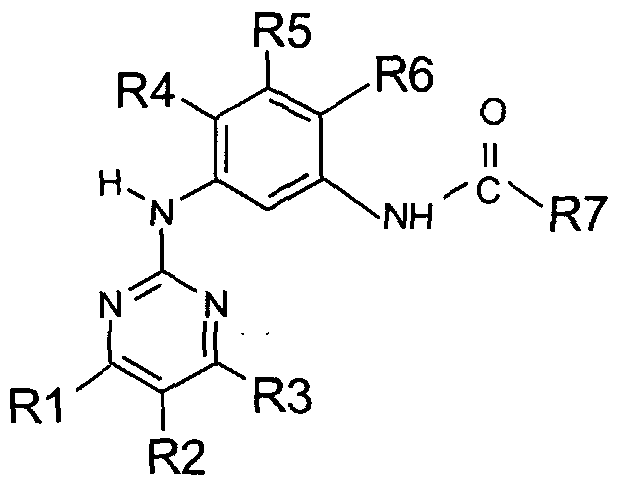
Claims

CLAIMS A method for treating fibrodysplasia and related disorders, such as fibrodysplasia ossificans, comprising administering a compound capable of depleting mast cells or a compound inhibiting mast cells degranulation in a human in need of such treatment.
2. The method according to claim 1 for treating patients suffering from fibrodysplasia and related disorders comprising administering a c-kit inhibitor to a human in need of such treatment.
3. The method according to claim 2, wherein said c-kit inhibitor is a non-toxic, selective and potent c-kit inhibitor wherein it is unable to promote death of IL-3 dependent cells cultured in presence of IL-3.
4. The method according to claim 1 or 3 wherein said inhibitor is selected from the group consisting of :
- 2-(3-Substitutedaryl)amino-4-aryl-thiazoles such as 2-(3-amino)arylamino-4-aryl- thiazoles,
- 2-aminoaryloxazoles,
- pyrimidine derivatives, more particularly N-phenyl-2-pyrimidine-amine derivatives,
- indolinone derivatives, more particularly pyπol-substituted indolinones,
- monocyclic, bicyclic aryl and heteroaryl compounds, - and quinazoline derivatives.
5. The method according to claim 4, wherein said c-kit inhibitor is selected from compounds belonging to the 2-(3-Substitutedaryl)amino-4-aryl -thiazoles of formula III:
Figure imgf000054_0001
FORMULA III
wherein R6 and R7 are independently from each other chosen from one of the following: i) hydrogen, a halogen (selected from F, CI, Br or I), ii) an alkyl1 group defined as a linear, branched or cycloalkyl group containing from 1 to 10 carbon atoms, or from 2 or 3 to 10 carbon atoms, (for example methyl, ethyl, propyl, butyl, pentyl, hexyl...) and optionally substituted with one or more hetereoatoms such as halogen (selected from F, CI, Br or I), oxygen, and nitrogen (the latter optionally in the form of a pendant basic nitrogen functionality); as well as trifluoromethyl, carboxyl, cyano, nitro, formyl;
(iii) an aryl1 group defined as phenyl or a substituted variant thereof bearing any combination, at any one ring position, of one or more substituents such as - halogen(selected from I, F, CI or Br); - an alkyl1 group; - a cycloalkyl, aryl or heteroaryl group optionally substituted by a pendant basic nitrogen functionality; - trifluoromethyl, O-alkyl1, carboxyl, cyano, nitro, formyl, hydroxy, NH-alkyl1, N(alkyl')(alkyl1), and amino, the latter nitrogen substituents optionally in the form of a basic nitrogen functionality;
(iv) a heteroaryl1 group defined as a pyridyl, pyrimidinyl, pyrazinyl, pyridazinyl, thienyl, thiazolyl, imidazolyl, pyrazolyl, pyrrolyl, furanyl, oxazolyl, isoxazolyl , triazolyl, tetrazolyl, indolyl, benzimidazole, quinolinyl group, which may additionally bear any combination, at any one ring position, of one or more substituents such as - halogen (selected from F, CI, Br or 1); an alkyl1 group; - a cycloalkyl, aryl or heteroaryl group optionally substituted by a pendant basic nitrogen functionality, - trifluoromethyl, O-alkyl1, carboxyl, cyano, nitro, formyl, hydroxy, NH-alkyl1, N(alkyl1)(alkyl ), and amino, the latter nitrogen substituents optionally in the form of a basic nitrogen functionality; (v) trifluoromethyl, carboxyl, cyano, nitro, formyl, hydroxy, N(alkyl1)(alkyl1), and amino, the latter nitrogen substituents optionally in the form of a basic nitrogen functionality.
R8 is one of the following: (i) hydrogen, or
(ii) a linear or branched alkyl group containing from 1 to 10 carbon atoms and optionally substituted with one or more hetereoatoms such as halogen (selected from F, CI, Br or I), oxygen, and nitrogen, the latter optionally in the form of a pendant basic nitrogen functionality, or (iii) CO-R8 or COOR8 or CONHR8 or SO2R8 wherein R8 may be - a linear or branched alkyl group containing from 1 to 10 carbon atoms and optionally substituted with one or more hetereoatoms such as halogen (selected from F, CI, Br or I), oxygen, and nitrogen, the latter optionally in the form of a pendant basic nitrogen functionality, or - an aryl group such as phenyl or a substituted variant thereof bearing any combination, at any one ring position, of one or more substituents such as halogen (selected from F, CI, Br or I), alkyl groups containing from 1 to 10 carbon atoms and optionally substituted with one or more hetereoatoms such as halogen (selected from F, CI, Br or I), oxygen, and nitrogen, the latter optionally in the form of a pendant basic nitrogen functionality; as well as trifluoromethyl, Cι-6alkyloxy, carboxyl, cyano, nitro, formyl, hydroxy, Cι.6alkylamino, di(Cι-6alkyl)amino, and amino, the latter nitrogen substituents optionally in the form of a pendant basic nitrogen functionality; as well as CO-R, COO-R, CONH-R, SO2-R, and SO2NH-R wherein R is a linear or branched alkyl group containing from 1 to 10 carbon atoms and optionally substituted with at least one heteroatom, notably a halogen (selected from F, CI, Br or I), oxygen, and nitrogen, the latter optionally in the form of a pendant basic nitrogen functionality, or - a heteroaryl group such as a pyridyl, pyrimidinyl, pyrazinyl, pyridazinyl, thienyl, thiazolyl, imidazolyl, pyrazolyl, pyrrolyl, furanyl, oxazolyl, isoxazolyl, triazolyl, tetrazolyl, indolyl, benzimidazole, quinolinyl group, which may additionally bear any combination, at any one ring position, of one or more substituents such as halogen (selected from F, CI, Br or I), alkyl groups containing from 1 to 10 carbon atoms and optionally substituted with one or more hetereoatoms such as halogen (selected from F, CI, Br or I), oxygen, and nitrogen, the latter optionally in the form of a pendant basic nitrogen functionality; as well as trifluoromethyl, Cι-6alkyloxy, carboxyl, cyano, nitro, formyl, hydroxy, Cι-6alkylamino, di(C1-6alkyl)amino, and amino, the latter nitrogen substituents optionally in the form of a basic nitrogen functionality; as well as CO-R, COO-R, CONH-R, SO2-R, and SO2NH-R wherein R is a linear or branched alkyl group containing from 1 to 10 carbon atoms and optionally substituted with at least one heteroatom, notably a halogen (selected from F, CI, Br or I), oxygen, and nitrogen, the latter optionally in the form of a pendant basic nitrogen functionality.
R2, R3, R4 and R5 each independently are selected from hydrogen, halogen (selected from F, CI, Br or I), a linear or branched alkyl group containing from 1 to 10 carbon atoms and optionally substituted with one or more hetereoatoms such as halogen (selected from F, CI, Br or I), oxygen, and nitrogen, the latter optionally in the form of a pendant basic nitrogen functionality; as well as trifluoromethyl, Cι-6alkyloxy, amino, Ci. 6alkylamino, di(Cι-6alkyl)amino, carboxyl, cyano, nitro, formyl, hydroxy, and CO-R, COO-R, CONH-R, SO2-R, and SO2NH-R wherein R is a linear or branched alkyl group containing from 1 to 10 carbon atoms and optionally substituted with at least one heteroatom, notably a halogen (selected from F, CI, Br or I), oxygen, and nitrogen, the latter optionally in the form of a pendant basic nitrogen functionality.
A is : CH2, O, S, SO2, CO, or COO,
B is a bond or NH, NCH3, NR*, (CH2)n (n is 0, 1 or 2), O, S, SO2, CO, or COO, B' is a bond or NH, NCH3, NR*, (CH2)n (n is 0, 1 or 2), O, S, SO2, CO or COO; R* being an alkyl1, aryl1 or heteroaryl1
W is a bond or a linker selected from NH, NHCO, NHCOO, NHCONH, NHSO2, NHSO2NH, CO, CONH, COO, COCH2, (CH2)n (n is 0, 1 or 2), CH2-CO, CH2COO, CH2-NH, O, OCH2, S, SO2, and SO2NH
R1 is : a) a linear or branched alkyl group containing from 1 to 10 carbon atoms optionally substituted with at least one heteroatom, notably a halogen selected from I, CI, Br and F, and / or bearing a pendant basic nitrogen functionality; b) an aryl or heteroaryl group optionally substituted by an alkyl or aryl group optionally substituted with a heteroatom, notably a halogen selected from I, CI, Br and F or bearing a pendant basic nitrogen functionality c) an alkyl1, aryl1 or heteroaryl1.
6. A method according to claim 5, wherein said c-kit inhibitor is selected from compounds of formula V :
Figure imgf000058_0001
FORMULA V
wherein X is R or NRR' and wherein R and R' are independently chosen from H, an aryl, a heteroaryl, an alkyl , or a cycloalkyl group optionally substituted with at least one heteroatom, such as for example a halogen chosen from F, I, CI and Br and optionally bearing a pendant basic nitrogen functionality; or an aryl, a heteroaryl, an alkyl or a cycloalkyl group substituted with an aryl, a heteroaryl, an alkyl or a cycloalkyl group optionally substituted with at least one heteroatom, such as for example a halogen chosen from F, I, CI and Br and optionally bearing a pendant basic nitrogen functionality,
R2 is hydrogen, halogen or a linear or branched alkyl group containing from 1 to 10 carbon atoms, trifluoromethyl or alkoxy;
R3 is hydrogen, halogen or a linear or branched alkyl group containing from 1 to 10 carbon atoms, trifluoromethyl or alkoxy; R4 is hydrogen, halogen or a linear or branched alkyl group containing from 1 to 10 carbon atoms, trifluoromethyl or alkoxy;
R5 is hydrogen, halogen or a linear or branched alkyl group containing from 1 to 10 carbon atoms, trifluoromethyl or alkoxy;
R6 is one of the following: (i) an aryl group such as phenyl or a substituted variant thereof bearing any combination, at any one ring position, of one or more substituents such as halogen, alkyl groups containing from 1 to 10 carbon atoms, trifluoromethyl, and alkoxy; (ii) a heteroaryl group such as a 2, 3, or 4-pyridyl group, which may additionally bear any combination of one or more substituents such as halogen, alkyl groups containing from 1 to 10 carbon atoms, trifluoromethyl and alkoxy;
(iii) a five-membered ring aromatic heterocyclic group such as for example 2-thienyl, 3- thienyl, 2-thiazolyl, 4-thiazolyl, 5-thiazolyl, which may additionally bear any combination of one or more substituents such as halogen, an alkyl group containing from
1 to 10 carbon atoms, trifluoromethyl, and alkoxy. iv) H, a halogen selected from I, F, CI or Br; NH2, NO2 or SO2-R, wherein R is a linear or branched alkyl goup containing one or more group such as 1 to 10 carbon atoms, and optionally substituted with at least one heteroatom, notably a halogen selected from I, CI,
Br and F, and / or bearing a pendant basic nitrogen functionality.
7. The method according to claim 4, wherein said c-kit inhibitor is selected from 2- aminoaryloxazoles of formula X :
Figure imgf000059_0001
FORMULA X
wherein substituents Rl - R7 and X are defined as follows:
Rl, R2, R3 and R4 each independently are selected from hydrogen, halogen (selected from F, CI, Br or I), a linear or branched alkyl group containing from 1 to 10 carbon atoms and optionally substituted with one or more hetereoatoms such as halogen (selected from F, CI, Br or I), oxygen, and nitrogen, the latter optionally in the form of a pendant basic nitrogen functionality; as well as trifluoromethyl,
Figure imgf000060_0001
amino, Cι_ 6alkylamino, di(Cι.6alkyl)amino, carboxyl, cyano, nitro, formyl, hydroxy, and CO-R, COO-R, CONH-R, SO2-R, and SO2NH-R wherein R is a linear or branched alkyl group containing from 1 to 10 carbon atoms and optionally substituted with at least one heteroatom, notably a halogen (selected from F, CI, Br or I), oxygen, and nitrogen, the latter optionally in the form of a pendant basic nitrogen functionality.
R5 is one of the following: (i) hydrogen, or (ii) a linear or branched alkyl group containing from 1 to 10 carbon atoms and optionally substituted with one or more hetereoatoms such as halogen (selected from F, CI, Br or I), oxygen, and nitrogen, the latter optionally in the form of a pendant basic nitrogen functionality, or (iii) CO-R8 or COOR8 or CONHR8 or SO2R8 wherein R8 may be - a linear or branched alkyl group containing from 1 to 10 carbon atoms and optionally substituted with one or more hetereoatoms such as halogen (selected from F, CI, Br or I), oxygen, and nitrogen, the latter optionally in the form of a pendant basic nitrogen functionality, or - an aryl group such as phenyl or a substituted variant thereof bearing any combination, at any one ring position, of one or more substituents such as halogen (selected from F, CI, Br or I), alkyl groups containing from 1 to 10 carbon atoms and optionally substituted with one or more hetereoatoms such as halogen (selected from F, CI, Br or I), oxygen, and nitrogen, the latter optionally in the form of a pendant basic nitrogen functionality; as well as trifluoromethyl, Cι-6alkyloxy, carboxyl, cyano, nitro, formyl, hydroxy, Ci-όalkylamino, di(Cι.6alkyl)amino, and amino, the latter nitrogen substituents optionally in the form of a pendant basic nitrogen functionality; as well as CO-R, COO-R, CONH-R, SO2-R, and SO2NH-R wherein R is a linear or branched alkyl group containing from 1 to 10 carbon atoms and optionally substituted with at least one heteroatom, notably a halogen (selected from F, CI, Br or I), oxygen, and nitrogen, the latter optionally in the form of a pendant basic nitrogen functionality, or - a heteroaryl group such as a pyridyl, pyrimidinyl, pyrazinyl, pyridazinyl, thienyl, thiazolyl, imidazolyl, pyrazolyl, pyπolyl, furanyl, oxazolyl, isoxazolyl, triazolyl, tetrazolyl, indolyl, benzimidazole, quinolinyl group, which may additionally bear any combination, at any one ring position, of one or more substituents such as halogen (selected from F, CI, Br or I), alkyl groups containing from 1 to 10 carbon atoms and optionally substituted with one or more hetereoatoms such as halogen (selected from F, CI, Br or I), oxygen, and nitrogen, the latter optionally in the form of a pendant basic nitrogen functionality; as well as trifluoromethyl, Cι-6alkyloxy, carboxyl, cyano, nitro, formyl, hydroxy,
Figure imgf000061_0001
di(Cι-6alkyl)amino, and amino, the latter nitrogen substituents optionally in the form of a basic nitrogen functionality; as well as CO-R, COO-R, CONH-R, SO2-R, and SO2NH-R wherein R is a linear or branched alkyl group containing from 1 to 10 carbon atoms and optionally substituted with at least one heteroatom, notably a halogen (selected from F, CI, Br or I), oxygen, and nitrogen, the latter optionally in the form of a pendant basic nitrogen functionality.
R6 and R7 each independently are selected from: i) hydrogen, a halogen (selected from F, CI, Br or I), or ii) an alkyl1 group defined as a linear, branched or cycloalkyl group containing from 1 to 10 carbon atoms and optionally substituted with one or more hetereoatoms such as halogen (selected from F, CI, Br or I), oxygen, and nitrogen (the latter optionally in the form of a pendant basic nitrogen functionality); as well as trifluoromethyl, carboxyl, cyano, nitro, formyl; as well as CO-R, COO-R, CONH-R, SO2-R, and SO2NH-R wherein R is a linear or branched alkyl group containing. 1 to 10 carbon atoms and optionally substituted with at least one heteroatom, notably a halogen (selected from F, CI, Br or I), oxygen, and nitrogen, the latter optionally in the form of a pendant basic nitrogen functionality ; as well as a cycloalkyl or aryl or heteroaryl group optionally substituted by a a pendant basic nitrogen functionality, or
(iii) an aryl1 group defined as phenyl or a substituted variant thereof bearing any combination, at any one ring position, of one or more substituents such as - halogen(selected from I, F, CI or Br); - an alkyl1 group; a cycloalkyl, aryl or heteroaryl group optionally substituted by a pendant basic nitrogen functionality; trifluoromethyl, O-alkyl1, carboxyl, cyano, nitro, formyl, hydroxy, NH-alkyl1, N(alkyl')(alkyl1), and amino, the latter nitrogen substituents optionally in the form of a basic nitrogen functionality; - NHCO-R or NHCOO-R or NHCONH-R or NHSO2-R or NHSO2NH-R or CO-R or COO-R or CONH-R or SO2-R or SO2NH-R wherein R coπesponds to hydrogen, alkyl1, aryl or heteroaryl, or (iv) a heteroaryl1 group defined as a pyridyl, pyrimidinyl, pyrazinyl, pyridazinyl, thienyl, thiazolyl, imidazolyl, pyrazolyl, pyπolyl, furanyl, oxazolyl, isoxazolyl , triazolyl, tetrazolyl, indolyl, benzimidazole, quinolinyl group, which may additionally bear any combination, at any one ring position, of one or more substituents such as - halogen (selected from F, CI, Br or I); - an alkyl1 group; a cycloalkyl, aryl or heteroaryl group optionally substituted by a pendant basic nitrogen functionality, trifluoromethyl, O-alkyl1, carboxyl, cyano, nitro, formyl, hydroxy, NH-alkyl1, N(alkyl')(alkyl1), and amino, the latter nitrogen substituents optionally in the form of a basic nitrogen functionality; - NHCO-R or NHCOO-R or NHCONH-R or NHSO2-R or NHSO2NH-R or CO-R or COO-R or CONH-R or SO2-R or SO2NH-R wherein R coπesponds to hydrogern, alkyl1, or (v) an O-aryl1, or H-aryl1, or O-heteroaryl1 or NH-heteroaryl1 group (vi) trifluoromethyl, O-alkyl1, carboxyl, cyano, nitro, formyl, hydroxy, NH-alkyl1, N(alkyl')(alkyl1), and amino, the latter nitrogen substituents optionally in the form of a basic nitrogen functionality, or (vi) NHCO-R or NHCOO-R or NHCONH-R or NHSO2-R or NHSO2NH-R or CO-R or COO-R or CONH-R or SO2-R or SO2NH-R wherein R corresponds to hydrogen, alkyl1, aryl or heteroaryl.
X is: -NR9R10, wherein R9 and / or Rl 0 are hydrogen or: i) an alkyl1 group, CF3 or ii) an aryl1, heteroaryl1 or cycloalkyl group optionally substituted by a a pendant basic nitrogen functionality, or iii) a CO-R, COO-R, CON-RR'or SO2-R, where R and R' are a hydrogen, alkyl1, aryl1 or heteroaryl1, optionally substituted by a a pendant basic nitrogen functionality; or:
-CO-NR9R10, wherein R9 and / or RIO are hydrogen or: i) an alkyl1 group, CF3 or ii) an aryl1, heteroaryl1 or cycloalkyl group optionally substituted by a a pendant basic nitrogen functionality.
8. The method according to claim 4, wherein said inhibitor is selected from the group consisting of N-phenyl-2-pyrimidine-amine derivatives having the formula II :
Figure imgf000064_0001
wherein Rl, R2 and R3 are independently chosen from H, F, CI, Br, I, a C1-C5 alkyl or a cyclic or heterocyclic group, especially a pyridyl group;
R4, R5 and R6 are independently chosen from H, F, CI, Br, I, a C1-C5 alkyl, especially a methyl group; and R7 is a phenyl group bearing at least one substituent, which in turn possesses at least one basic site, such as an amino function.
9. The method according to claim 8, wherein said inhibitor is the 4-(4-mehylpiperazine- l-ylmethyl)-N-[4-methyl-3-(4-pyridine-3-yl)pyrimidine-2 ylamino)phenyl] -benzamide.
10. A method for treating fibrodysplasia and related disorders comprising administering to a human in need of such treatment a compound that is a selective, potent and non toxic inhibitor of activated c-kit obtainable by a screening method which comprises : a) bringing into contact (i) activated c-kit and (ii) at least one compound to be tested; under conditions allowing the components (i) and (ii) to form a complex, b) selecting compounds that inhibit activated c-kit, c) testing and selecting a subset of compounds identified in step b), which are unable to promote death of IL-3 dependent cells cultured in presence of IL-3.
11. The method according to one of claims 1 to 10 for treating fibrodysplasia and related disorders, such as fibrodysplasia ossificans.
12. The use of a compound as defined in one of claims 1 to 9 or obtainable by the method of claim 10 to manufacture a medicament for treating fibrodysplasia and related disorders, such as fibrodysplasia ossificans.
PCT/IB2005/001371 2004-05-24 2005-04-19 Use of c-kit inhibitors for treating fibrodysplasia Ceased WO2005115304A2 (en)

Applications Claiming Priority (2)

Application Number Priority Date Filing Date Title
US57334504P 2004-05-24 2004-05-24
US60/573,345 2004-05-24

Publications (2)

Publication Number Publication Date
WO2005115304A2 true WO2005115304A2 (en) 2005-12-08
WO2005115304A3 WO2005115304A3 (en) 2006-04-06

Family

ID=35276073

Family Applications (1)

Application Number Title Priority Date Filing Date
PCT/IB2005/001371 Ceased WO2005115304A2 (en) 2004-05-24 2005-04-19 Use of c-kit inhibitors for treating fibrodysplasia

Country Status (1)

Country Link
WO (1) WO2005115304A2 (en)

Cited By (18)

* Cited by examiner, † Cited by third party
Publication number Priority date Publication date Assignee Title
WO2008067115A2 (en) 2006-11-03 2008-06-05 The Board Of Trustees Of The Leland Stanford Junior University Selective immunodepletion of endogenous stem cell niche for engraftment
WO2009114552A1 (en) * 2008-03-10 2009-09-17 The Board Of Trustees Of The Leland Stanford Junior University Heteroaryl compounds, compositions, and methods of use in cancer treatment
US8088771B2 (en) 2008-07-28 2012-01-03 Gilead Sciences, Inc. Cycloalkylidene and heterocycloalkylidene inhibitor compounds
US8088806B2 (en) 2005-05-09 2012-01-03 Achillion Pharmaceuticals, Inc. Thiazole compounds and methods of use
US8106209B2 (en) 2008-06-06 2012-01-31 Achillion Pharmaceuticals, Inc. Substituted aminothiazole prodrugs of compounds with anti-HCV activity
US8124764B2 (en) 2008-07-14 2012-02-28 Gilead Sciences, Inc. Fused heterocyclyc inhibitor compounds
US8134000B2 (en) 2008-07-14 2012-03-13 Gilead Sciences, Inc. Imidazolyl pyrimidine inhibitor compounds
US8183263B2 (en) 2007-05-22 2012-05-22 Achillion Pharmaceuticals, Inc. Heteroaryl substituted thiazoles
US8258316B2 (en) 2009-06-08 2012-09-04 Gilead Sciences, Inc. Alkanoylamino benzamide aniline HDAC inhibitor compounds
US8283357B2 (en) 2009-06-08 2012-10-09 Gilead Sciences, Inc. Cycloalkylcarbamate benzamide aniline HDAC inhibitor compounds
US8344018B2 (en) 2008-07-14 2013-01-01 Gilead Sciences, Inc. Oxindolyl inhibitor compounds
US10450269B1 (en) 2013-11-18 2019-10-22 Global Blood Therapeutics, Inc. Compounds and uses thereof for the modulation of hemoglobin
US10864194B2 (en) 2016-06-08 2020-12-15 Clementia Pharmaceuticals Inc. Methods for treating heterotopic ossification
US10980778B2 (en) 2016-11-16 2021-04-20 Clementia Pharmaceuticals Inc. Methods for treating multiple osteochondroma (MO)
US11053195B2 (en) 2013-03-15 2021-07-06 Global Blood Therapeutics, Inc. Compounds and uses thereof for the modulation of hemoglobin
WO2021214020A1 (en) 2020-04-24 2021-10-28 Bayer Aktiengesellschaft Substituted aminothiazoles as dgkzeta inhibitors for immune activation
US11433039B2 (en) 2010-09-01 2022-09-06 Thomas Jefferson University Composition and method for muscle repair and regeneration
US11786557B2 (en) 2017-10-02 2023-10-17 Fred Hutchinson Cancer Center Luteinizing hormone receptor binding agents and luteinizing hormone agonists to identify, expand, ablate and modify stem cells

Family Cites Families (6)

* Cited by examiner, † Cited by third party
Publication number Priority date Publication date Assignee Title
US6326390B1 (en) * 1998-08-25 2001-12-04 King Pharmaceuticals Reseach And Development, Inc. Use of adenosine A3 receptor antagonists to inhibit tumor growth
US20020137755A1 (en) * 2000-12-04 2002-09-26 Bilodeau Mark T. Tyrosine kinase inhibitors
AU2002232919A1 (en) * 2000-12-29 2002-07-16 Alteon, Inc. Method for treating fibrotic diseases or other indications
AU2002257456A1 (en) * 2001-05-24 2002-12-03 University Of Western Ontario Control of myogenesis by modulation of p38 map kinase activity
ATE401079T1 (en) * 2001-06-29 2008-08-15 Ab Science THE USE OF C-KITE INHIBITORS TO TREAT AUTOIMMUNE DISEASES
CA2494695C (en) * 2002-08-02 2011-04-05 Ab Science 2-(3-aminoaryl)amino-4-aryl-thiazoles and their use as c-kit inhibitors

Cited By (27)

* Cited by examiner, † Cited by third party
Publication number Priority date Publication date Assignee Title
US8088806B2 (en) 2005-05-09 2012-01-03 Achillion Pharmaceuticals, Inc. Thiazole compounds and methods of use
WO2008067115A2 (en) 2006-11-03 2008-06-05 The Board Of Trustees Of The Leland Stanford Junior University Selective immunodepletion of endogenous stem cell niche for engraftment
EP3255061A1 (en) 2006-11-03 2017-12-13 The Board of Trustees of the Leland Stanford Junior University Selective immunodepletion of endogenous stem cell niche for engraftment
US8183263B2 (en) 2007-05-22 2012-05-22 Achillion Pharmaceuticals, Inc. Heteroaryl substituted thiazoles
WO2009114552A1 (en) * 2008-03-10 2009-09-17 The Board Of Trustees Of The Leland Stanford Junior University Heteroaryl compounds, compositions, and methods of use in cancer treatment
US8106209B2 (en) 2008-06-06 2012-01-31 Achillion Pharmaceuticals, Inc. Substituted aminothiazole prodrugs of compounds with anti-HCV activity
US8124764B2 (en) 2008-07-14 2012-02-28 Gilead Sciences, Inc. Fused heterocyclyc inhibitor compounds
US8134000B2 (en) 2008-07-14 2012-03-13 Gilead Sciences, Inc. Imidazolyl pyrimidine inhibitor compounds
US8344018B2 (en) 2008-07-14 2013-01-01 Gilead Sciences, Inc. Oxindolyl inhibitor compounds
US8088771B2 (en) 2008-07-28 2012-01-03 Gilead Sciences, Inc. Cycloalkylidene and heterocycloalkylidene inhibitor compounds
US8258316B2 (en) 2009-06-08 2012-09-04 Gilead Sciences, Inc. Alkanoylamino benzamide aniline HDAC inhibitor compounds
US8283357B2 (en) 2009-06-08 2012-10-09 Gilead Sciences, Inc. Cycloalkylcarbamate benzamide aniline HDAC inhibitor compounds
US11433039B2 (en) 2010-09-01 2022-09-06 Thomas Jefferson University Composition and method for muscle repair and regeneration
US12023312B2 (en) 2010-09-01 2024-07-02 Thomas Jefferson University Composition and method for muscle repair and regeneration
US11053195B2 (en) 2013-03-15 2021-07-06 Global Blood Therapeutics, Inc. Compounds and uses thereof for the modulation of hemoglobin
US10450269B1 (en) 2013-11-18 2019-10-22 Global Blood Therapeutics, Inc. Compounds and uses thereof for the modulation of hemoglobin
US11622959B2 (en) 2016-06-08 2023-04-11 Clementia Pharmaceuticals Inc. Methods for treating heterotopic ossification
US10864194B2 (en) 2016-06-08 2020-12-15 Clementia Pharmaceuticals Inc. Methods for treating heterotopic ossification
US12138245B2 (en) 2016-06-08 2024-11-12 Clementia Pharmaceuticals Inc. Methods for treating heterotopic ossification
US12201614B2 (en) 2016-06-08 2025-01-21 Clementia Pharmaceuticals Inc. Methods for treating heterotopic ossification
US12458626B2 (en) 2016-06-08 2025-11-04 Clementia Pharmaceuticals Inc. Methods for treating heterotopic ossification
US10980778B2 (en) 2016-11-16 2021-04-20 Clementia Pharmaceuticals Inc. Methods for treating multiple osteochondroma (MO)
US11786557B2 (en) 2017-10-02 2023-10-17 Fred Hutchinson Cancer Center Luteinizing hormone receptor binding agents and luteinizing hormone agonists to identify, expand, ablate and modify stem cells
US12295973B2 (en) 2017-10-02 2025-05-13 Fred Hutchinson Cancer Center Luteinizing hormone receptor binding agents and luteinizing hormone agonists to identify, expand, ablate and modify stem cells
WO2021214019A1 (en) 2020-04-24 2021-10-28 Bayer Aktiengesellschaft Substituted aminothiazoles as dgkzeta inhibitors for immune activation
WO2021214020A1 (en) 2020-04-24 2021-10-28 Bayer Aktiengesellschaft Substituted aminothiazoles as dgkzeta inhibitors for immune activation
US11964953B2 (en) 2020-04-24 2024-04-23 Bayer Aktiengesellschaft Substituted aminothiazoles as DGKzeta inhibitors for immune activation

Also Published As

Publication number Publication date
WO2005115304A3 (en) 2006-04-06

Similar Documents

Publication Publication Date Title
WO2005115304A2 (en) Use of c-kit inhibitors for treating fibrodysplasia
KR101036866B1 (en) 2- (3-aminoaryl) amino-4-aryl-thiazole and its use as C-VIT inhibitors
WO2005016323A2 (en) Use of c-kit inhibitors for treating type ii diabetes
JP2007533730A (en) Use of c-kit inhibitors for treating inflammatory myopathy including myositis and muscular dystrophy
WO2005102346A2 (en) Use of c-kit inhibitors for treating fibrosis
RU2005121897A (en) AMINOINDAZOLE DERIVATIVES AND THEIR APPLICATION AS KINAZ INHIBITORS
WO2005102318A1 (en) Use of c-kit inhibitors for treating hiv related diseases
RU2005109561A (en) NEW AMINOINDAZOLE DERIVATIVES AS MEDICINES AND CONTAINING THEIR PHARMACEUTICAL COMPOSITIONS
WO2005102326A2 (en) Use of c-kit inhibitors for treating renal diseases
CA2691214A1 (en) Therapy using cytokine inhibitors
RU2007132262A (en) COMPOUNDS AND COMPOSITIONS AS PROTEINKINASE INHIBITORS
WO2005115385A1 (en) Use of c-kit inhibitors for treating acne
US20080004279A1 (en) Use of C-Kit Inhibitors for Treating Plasmodium Related Diseases
RU2008120850A (en) COMPOUNDS AND COMPOSITIONS AS PROTEINKINASE INHIBITORS
JP2007538064A (en) Use of mast cell inhibitors to treat patients exposed to chemical or biological weapons
US20070191267A1 (en) Use of tyrosine kinase inhibitors for treating cerebral ischemia
CA2585423A1 (en) Methods and compositions using pde4 modulators for treatment and management of central nervous system injury
CA2613585A1 (en) Combination of a renin inhibitor and an insulin secretion enhancer or an insulin sensitizer
HK1084382B (en) 2-(3-aminoaryl) amino-4-aryl-thiazoles and their use as c-kit inhibitors

Legal Events

Date Code Title Description
AK Designated states

Kind code of ref document: A2

Designated state(s): AE AG AL AM AT AU AZ BA BB BG BR BW BY BZ CA CH CN CO CR CU CZ DE DK DM DZ EC EE EG ES FI GB GD GE GH GM HR HU ID IL IN IS JP KE KG KM KP KR KZ LC LK LR LS LT LU LV MA MD MG MK MN MW MX MZ NA NI NO NZ OM PG PH PL PT RO RU SC SD SE SG SK SL SM SY TJ TM TN TR TT TZ UA UG US UZ VC VN YU ZA ZM ZW

AL Designated countries for regional patents

Kind code of ref document: A2

Designated state(s): BW GH GM KE LS MW MZ NA SD SL SZ TZ UG ZM ZW AM AZ BY KG KZ MD RU TJ TM AT BE BG CH CY CZ DE DK EE ES FI FR GB GR HU IE IS IT LT LU MC NL PL PT RO SE SI SK TR BF BJ CF CG CI CM GA GN GQ GW ML MR NE SN TD TG

121 Ep: the epo has been informed by wipo that ep was designated in this application
NENP Non-entry into the national phase

Ref country code: DE

WWW Wipo information: withdrawn in national office

Country of ref document: DE

122 Ep: pct application non-entry in european phase