WO2005108374A1 - Insecticidal diazole and triazole derivatives - Google Patents

Insecticidal diazole and triazole derivatives Download PDF

Info

Publication number
WO2005108374A1
WO2005108374A1 PCT/US2005/014926 US2005014926W WO2005108374A1 WO 2005108374 A1 WO2005108374 A1 WO 2005108374A1 US 2005014926 W US2005014926 W US 2005014926W WO 2005108374 A1 WO2005108374 A1 WO 2005108374A1
Authority
WO
WIPO (PCT)
Prior art keywords
chch
alkyl
hydrogen
compound
halogen
Prior art date
Legal status (The legal status is an assumption and is not a legal conclusion. Google has not performed a legal analysis and makes no representation as to the accuracy of the status listed.)
Ceased
Application number
PCT/US2005/014926
Other languages
French (fr)
Inventor
Rene K. Amaning
Scott D. Crawford
Benjamin J. Dugan
Robert N. Henrie Ii
John W. Lyga
Ernest L. Plummer
David M. Roush
Walter H. Yeager
Steve Szczepanski
Harvey Wendt
Zeinab Elshenawy
Current Assignee (The listed assignees may be inaccurate. Google has not performed a legal analysis and makes no representation or warranty as to the accuracy of the list.)
FMC Corp
Original Assignee
FMC Corp
Priority date (The priority date is an assumption and is not a legal conclusion. Google has not performed a legal analysis and makes no representation as to the accuracy of the date listed.)
Filing date
Publication date
Application filed by FMC Corp filed Critical FMC Corp
Priority to US11/573,924 priority Critical patent/US7811669B2/en
Publication of WO2005108374A1 publication Critical patent/WO2005108374A1/en
Anticipated expiration legal-status Critical
Ceased legal-status Critical Current

Links

Classifications

    • CCHEMISTRY; METALLURGY
    • C07ORGANIC CHEMISTRY
    • C07DHETEROCYCLIC COMPOUNDS
    • C07D233/00Heterocyclic compounds containing 1,3-diazole or hydrogenated 1,3-diazole rings, not condensed with other rings
    • C07D233/54Heterocyclic compounds containing 1,3-diazole or hydrogenated 1,3-diazole rings, not condensed with other rings having two double bonds between ring members or between ring members and non-ring members
    • AHUMAN NECESSITIES
    • A01AGRICULTURE; FORESTRY; ANIMAL HUSBANDRY; HUNTING; TRAPPING; FISHING
    • A01NPRESERVATION OF BODIES OF HUMANS OR ANIMALS OR PLANTS OR PARTS THEREOF; BIOCIDES, e.g. AS DISINFECTANTS, AS PESTICIDES OR AS HERBICIDES; PEST REPELLANTS OR ATTRACTANTS; PLANT GROWTH REGULATORS
    • A01N43/00Biocides, pest repellants or attractants, or plant growth regulators containing heterocyclic compounds
    • A01N43/64Biocides, pest repellants or attractants, or plant growth regulators containing heterocyclic compounds having rings with three nitrogen atoms as the only ring hetero atoms
    • A01N43/647Triazoles; Hydrogenated triazoles
    • A01N43/6531,2,4-Triazoles; Hydrogenated 1,2,4-triazoles
    • CCHEMISTRY; METALLURGY
    • C07ORGANIC CHEMISTRY
    • C07DHETEROCYCLIC COMPOUNDS
    • C07D233/00Heterocyclic compounds containing 1,3-diazole or hydrogenated 1,3-diazole rings, not condensed with other rings
    • C07D233/54Heterocyclic compounds containing 1,3-diazole or hydrogenated 1,3-diazole rings, not condensed with other rings having two double bonds between ring members or between ring members and non-ring members
    • C07D233/66Heterocyclic compounds containing 1,3-diazole or hydrogenated 1,3-diazole rings, not condensed with other rings having two double bonds between ring members or between ring members and non-ring members with hetero atoms or with carbon atoms having three bonds to hetero atoms with at the most one bond to halogen, e.g. ester or nitrile radicals, directly attached to ring carbon atoms
    • C07D233/68Halogen atoms
    • CCHEMISTRY; METALLURGY
    • C07ORGANIC CHEMISTRY
    • C07DHETEROCYCLIC COMPOUNDS
    • C07D233/00Heterocyclic compounds containing 1,3-diazole or hydrogenated 1,3-diazole rings, not condensed with other rings
    • C07D233/54Heterocyclic compounds containing 1,3-diazole or hydrogenated 1,3-diazole rings, not condensed with other rings having two double bonds between ring members or between ring members and non-ring members
    • C07D233/66Heterocyclic compounds containing 1,3-diazole or hydrogenated 1,3-diazole rings, not condensed with other rings having two double bonds between ring members or between ring members and non-ring members with hetero atoms or with carbon atoms having three bonds to hetero atoms with at the most one bond to halogen, e.g. ester or nitrile radicals, directly attached to ring carbon atoms
    • C07D233/70One oxygen atom
    • CCHEMISTRY; METALLURGY
    • C07ORGANIC CHEMISTRY
    • C07DHETEROCYCLIC COMPOUNDS
    • C07D233/00Heterocyclic compounds containing 1,3-diazole or hydrogenated 1,3-diazole rings, not condensed with other rings
    • C07D233/54Heterocyclic compounds containing 1,3-diazole or hydrogenated 1,3-diazole rings, not condensed with other rings having two double bonds between ring members or between ring members and non-ring members
    • C07D233/66Heterocyclic compounds containing 1,3-diazole or hydrogenated 1,3-diazole rings, not condensed with other rings having two double bonds between ring members or between ring members and non-ring members with hetero atoms or with carbon atoms having three bonds to hetero atoms with at the most one bond to halogen, e.g. ester or nitrile radicals, directly attached to ring carbon atoms
    • C07D233/72Two oxygen atoms, e.g. hydantoin
    • C07D233/80Two oxygen atoms, e.g. hydantoin with hetero atoms or acyl radicals directly attached to ring nitrogen atoms
    • CCHEMISTRY; METALLURGY
    • C07ORGANIC CHEMISTRY
    • C07DHETEROCYCLIC COMPOUNDS
    • C07D233/00Heterocyclic compounds containing 1,3-diazole or hydrogenated 1,3-diazole rings, not condensed with other rings
    • C07D233/54Heterocyclic compounds containing 1,3-diazole or hydrogenated 1,3-diazole rings, not condensed with other rings having two double bonds between ring members or between ring members and non-ring members
    • C07D233/66Heterocyclic compounds containing 1,3-diazole or hydrogenated 1,3-diazole rings, not condensed with other rings having two double bonds between ring members or between ring members and non-ring members with hetero atoms or with carbon atoms having three bonds to hetero atoms with at the most one bond to halogen, e.g. ester or nitrile radicals, directly attached to ring carbon atoms
    • C07D233/84Sulfur atoms
    • CCHEMISTRY; METALLURGY
    • C07ORGANIC CHEMISTRY
    • C07DHETEROCYCLIC COMPOUNDS
    • C07D235/00Heterocyclic compounds containing 1,3-diazole or hydrogenated 1,3-diazole rings, condensed with other rings
    • C07D235/02Heterocyclic compounds containing 1,3-diazole or hydrogenated 1,3-diazole rings, condensed with other rings condensed with carbocyclic rings or ring systems
    • C07D235/04Benzimidazoles; Hydrogenated benzimidazoles
    • C07D235/06Benzimidazoles; Hydrogenated benzimidazoles with only hydrogen atoms, hydrocarbon or substituted hydrocarbon radicals, directly attached in position 2
    • C07D235/08Radicals containing only hydrogen and carbon atoms
    • CCHEMISTRY; METALLURGY
    • C07ORGANIC CHEMISTRY
    • C07DHETEROCYCLIC COMPOUNDS
    • C07D249/00Heterocyclic compounds containing five-membered rings having three nitrogen atoms as the only ring hetero atoms
    • C07D249/02Heterocyclic compounds containing five-membered rings having three nitrogen atoms as the only ring hetero atoms not condensed with other rings
    • C07D249/081,2,4-Triazoles; Hydrogenated 1,2,4-triazoles
    • C07D249/101,2,4-Triazoles; Hydrogenated 1,2,4-triazoles with hetero atoms or with carbon atoms having three bonds to hetero atoms with at the most one bond to halogen, e.g. ester or nitrile radicals, directly attached to ring carbon atoms
    • C07D249/12Oxygen or sulfur atoms
    • CCHEMISTRY; METALLURGY
    • C07ORGANIC CHEMISTRY
    • C07DHETEROCYCLIC COMPOUNDS
    • C07D249/00Heterocyclic compounds containing five-membered rings having three nitrogen atoms as the only ring hetero atoms
    • C07D249/02Heterocyclic compounds containing five-membered rings having three nitrogen atoms as the only ring hetero atoms not condensed with other rings
    • C07D249/081,2,4-Triazoles; Hydrogenated 1,2,4-triazoles
    • C07D249/101,2,4-Triazoles; Hydrogenated 1,2,4-triazoles with hetero atoms or with carbon atoms having three bonds to hetero atoms with at the most one bond to halogen, e.g. ester or nitrile radicals, directly attached to ring carbon atoms
    • C07D249/14Nitrogen atoms
    • CCHEMISTRY; METALLURGY
    • C07ORGANIC CHEMISTRY
    • C07DHETEROCYCLIC COMPOUNDS
    • C07D249/00Heterocyclic compounds containing five-membered rings having three nitrogen atoms as the only ring hetero atoms
    • C07D249/16Heterocyclic compounds containing five-membered rings having three nitrogen atoms as the only ring hetero atoms condensed with carbocyclic rings or ring systems
    • C07D249/18Benzotriazoles
    • CCHEMISTRY; METALLURGY
    • C07ORGANIC CHEMISTRY
    • C07DHETEROCYCLIC COMPOUNDS
    • C07D401/00Heterocyclic compounds containing two or more hetero rings, having nitrogen atoms as the only ring hetero atoms, at least one ring being a six-membered ring with only one nitrogen atom
    • C07D401/02Heterocyclic compounds containing two or more hetero rings, having nitrogen atoms as the only ring hetero atoms, at least one ring being a six-membered ring with only one nitrogen atom containing two hetero rings
    • C07D401/04Heterocyclic compounds containing two or more hetero rings, having nitrogen atoms as the only ring hetero atoms, at least one ring being a six-membered ring with only one nitrogen atom containing two hetero rings directly linked by a ring-member-to-ring-member bond
    • CCHEMISTRY; METALLURGY
    • C07ORGANIC CHEMISTRY
    • C07DHETEROCYCLIC COMPOUNDS
    • C07D409/00Heterocyclic compounds containing two or more hetero rings, at least one ring having sulfur atoms as the only ring hetero atoms
    • C07D409/02Heterocyclic compounds containing two or more hetero rings, at least one ring having sulfur atoms as the only ring hetero atoms containing two hetero rings
    • C07D409/12Heterocyclic compounds containing two or more hetero rings, at least one ring having sulfur atoms as the only ring hetero atoms containing two hetero rings linked by a chain containing hetero atoms as chain links

Definitions

  • the present invention relates to diazole and triazole derivatives and compositions containing the same, which are useful for controlling insects and acarids in agricultural crops. More particularly, this invention relates to certain multiply substituted diazole and triazole derivatives, compositions containing them, and their use as insecticides against insects, such as cotton aphid.
  • Insecticides and acaricides are useful for controlling insects and acarids which may otherwise cause significant damage to crops such as wheat, corn, soybeans, potatoes, and cotton to name a few.
  • crops such as wheat, corn, soybeans, potatoes, and cotton to name a few.
  • insecticides and acaricides are desired which can control the insects and acarids without damaging the crops, and have no deleterious effects to mammals and other living organisms.
  • a number of patents and publications disclose a variety of substituted benzimidazoles, some of which have insecticidal and acaricidal activity.
  • X ⁇ -X 4 are hydrogen; halogen; cyano; nitro; optionally substituted alkyl, alkoxy, alkylthio, alkylsulphinyl, alkylsulphonyl, or cycloalkyl; optionally substituted fused alkylenedioxy; COOH; alkanoyl; alkoxycarbonyl; cycloalkoxycarbonyl; optionally substituted amino or carbamoyl; or Ari; OAri; SAri; SOAri, SO 2 Ar ⁇ ; OSO 2 Ar ⁇ , COAn, COOAr,, or SO 2 CH 2 SAr,; at least one being other than hydrogen and halogen;
  • Ari is optionally substituted aryl
  • Ri is hydrogen; alkyl; or optionally substituted aryl
  • R 2 is hydroxy; cyano; optionally substituted alkyl, alkenyl, alkynyl, alkoxy, alkenyloxy, alkynyloxy, alkylthio, amino, alkanoyl, alkoxycarbonyl, alkanoyloxy, or dialkoxyphosphoryl; or Ar 2 ; COAr 2 ; COOAr 2 ; OCOAr ; or OCONHCONHAr 2 ; Ar is optionally substituted aryl or heteroaryl.
  • Ri is hydrogen; chlorine; fluorine; 1-6C perfluoroalkyl; or -(CHZ) n CH 2 Z, where each Z is hydrogen or halogen, n is 0-1;
  • R 2 is CF 3 ; CF 2 C1; or CF 2 H;
  • benzimidazole derivatives have also found utility for control of insects and acarids that prey on animals found in the animal husbandry industry.
  • certain benzimidazoles of the following formula are useful in the control of insect and acarid animal parasites:
  • R is CI, CF 3 , CHF 2) CC1 2 F;
  • R 2 is CC1F 2 , CF 2 CHF 2 , CF 2 CF 3 , CF2CF 2 CF 3 , or CF(CF 3 ) 2 ;
  • R 3 is C ⁇ -C 6 alkyl, C -C 3 alkenyl, phenyl, or benzyl;
  • R 4 is C
  • R 5 is C ⁇ -C 3 alkyl, or phenyl; or the ammonium, alkali metal, or alkaline earth metal salts of the above compounds wherein Ri
  • the piercing-sucking insects that remove plant carbohydrates and nutrients. This type of insect may also inject toxins while feeding that add to the injury of the crop plant.
  • the piercing-sucking insects include, without limitation, lygus bugs, aphids, whiteflies, plant hoppers, and other piercing-sucking insects. It is estimated that the piercing-sucking insects alone cause in excess of two billion dollars worth of damage to agricultural crops worldwide each year. Accordingly, control of piercing-sucking insects, as well as other categories of insects, that negatively impact agricultural crops is needed.
  • diazole and triazole derivatives are represented by the following general formula (I)
  • the present invention is also directed to compositions containing an insecticidally effective amount of at least one of a compound of formula (I), and optionally, an effective amount of at least one of a second compound, with at least one insecticidally compatible carrier.
  • the present invention is also directed to methods of controlling insects, where control is desired, which comprise applying an insecticidally effective amount of the above composition to the locus of crops, or other areas where insects are present or are expected to be present.
  • One aspect of the present invention relates to certain new and useful compounds, namely certain novel multiply substituted diazole and triazole derivatives that possess unexpected insecticidal activity.
  • These diazole and triazole derivatives are represented by the following general formula (I)
  • M is carbon or nitrogen
  • Q is selected from the group consisting of carbon, nitrogen, and carbonyl; when Q is carbonyl, the nitrogen in the 3-position is optionally substituted with alkyl; and when Q is carbon,
  • R is selected from the group consisting of hydrogen, halogen, hydroxy, thiol, straight or branched chain alkyl, cycloalkyl, alkoxy, alkenyl, alkenyloxy haloalkyl, hydroxyalkyl, alkylthio, alkoxyalkyl, carboxyl, formyl, aminocarbonyl, amino, cyano, nitro, alkylsulfonyl, aminosulfonyl, cyanoalkyl, cyanothio, cyanothioalkyl, alkylcarbonyl haloalkylcarbonyl, alkoxycarbonyl, haloalkoxycarbonyl, alkoxycarbonylalkylthio, and aminocarbonylalkyl, where the amino group may be substituted with one or two substituents independently selected from alkyl, hydroxy, alkoxy, carboxyl, aryl, alkylcarbonyl, haloalkylcarbonyl, alkoxycarbon
  • R 1 and R 2 are independently selected from the group consisting of hydrogen, halogen, alkyl, haloalkyl, alkoxy, haloalkoxy, alkylthio, haloalkyl thio, haloalkylsulfinyl, haloalkylsulfonyl, amino, alkylamino, dialkylamino, aryl, and heteroaryl, where aryl and heteroaryl are optionally substituted with one or more of halogen, alkyl, haloalkyl, alkoxy, and haloalkoxy; and,
  • X is selected from the group consisting of straight or branched chain alkylenyl, alkylenyloxy, alkenylenyl, alkynylenyl; and -(CH 2 ) m -U(R ) p -(CH ) m ⁇ -, where m and m 1 are independently 0-4;
  • Y is selected from the group consisting of cycloalkyl, phenyl, benzo[b]furanyl, benzodioxolanyl, pyridyl, pyrimidinyl, pyridazinyl, thienyl, 1,3-thiazolyl, 1,3,4- thiadiazolyl, furanyl, 1,3-oxazolyl, 1,3,4-oxadiazolyl, pyrrolyl, 1-methylpyrrolyl, pyrazolyl, benzoxazolyl, 1-methylpyrazolyl, imidazolyl, 2H-tetrazolyl, 1- methyl-2H- 1 ,3-diazolyl, 4H- 1 ,4-benzoxazinyl, 4H- 1 ,4-benzoxazin-3-onyl, adamantyl, naphthyl, oxaindanyl, benzo[b]-l,3-dioxolany
  • R 4 is selected from the group consisting of hydrogen, halogen, alkyl, haloalkyl, alkoxyalkyl, hydroxy, alkoxy, haloalkoxy, hydroxyalkoxy, alkoxyalkoxy, alkoxyalkoxyalkoxy, cycloalkoxy, cycloalkylalkoxy, cycloalkoxyalkyl, alkylthio, alkylsulfinyl, alkylsulfonyl, cyano, cyanoalkoxy, nitro, amino, alkylamino, dialkylamino, alkylaminoalkoxy, guanadinoalkoxy, alkylsulfonylamino, carboxyl, alkylcarbonyl, alkoxycarbonyl, dialkylphosphonyl, trialkylsilylalkoxy, aryl, aryloxy, arylalkoxy, aryloxyalkoxy, arylsulfonylalk
  • W is oxygen, or NR 3 , where R 3 is hydrogen;
  • X is straight or branched chain alkylenyl or -(CH 2 ) m -U(R 5 ) p -(CH 2 ) m ⁇ -, where U is carbon, CH, or
  • X is straight or branched chain alkylenyl or -(CH 2 ) m -U(R 5 ) p -(CH 2 ) m ⁇ -, where U is carbon;
  • Y is phenyl, benzo[b]furanyl, benzodioxolanyl, or oxaindanyl;
  • R 4 is i) 3-chloro-4- butoxy; ii) 3-fluoro-4-butoxy; iii) 3-methyl-4-butoxy; iv) 3-cyano-4-butoxy; v) 3,5- dichloro-4-butoxy; vi) 3,5-dimethyl-4-butoxy; vii) 3-amino-5-chloro-4-butoxy; viii) 3-chloro-4-(4-fluorobutoxy); and ix) 4-(O) t -(CH 2 ) v -Z-R 6 , where t and v are 0; and R 6 is ethyl.
  • the compounds of formula (I) possess asymmetric centers, which can give rise to optical enantiomorphs and diastereomers.
  • the compounds may also possess acidic or basic moieties, which may allow for the formation of agriculturally acceptable salts or agriculturally acceptable metal complexes. This invention includes such enantiomorphs, salts and metal complexes.
  • Agriculturally acceptable salts and metal complexes include, without limitation, for example, ammonium salts, the salts of hydrochloric acid, sulfonic acid, ethanesulfonic acid, trifluoroacetic acid, methylbenzenesulfonic acid, phosphoric acid, gluconic acid, pamoic acid, and other acid salts, and the alkali metal and alkaline earth metal complexes with, for example, sodium, potassium, lithium, magnesium, calcium, and other metals.
  • Another aspect of the present invention relates to compositions containing an insecticidally effective amount of at least one compound of formula (I) with at least one insecticidally compatible carrier therefor.
  • compositions containing an insecticidally effective amount of at least one compound of formula (I), and an effective amount of at least one second compound, with at least one insecticidally compatible carrier therefor Another aspect of the present invention relates to methods of controlling insects by applying an insecticidally effective amount of a composition set forth above to a locus of crops such as, without limitation, cotton, vegetables, and fruits, or other areas where insects are present or are expected to be present.
  • the modifier "about” is used herein to indicate that certain preferred operating ranges, such as ranges for molar ratios for reactants, material amounts, and temperature, are not fixedly determined. The meaning will often be apparent to one of ordinary skill.
  • a recitation of a temperature range of about 120°C to about 135°C in reference to, for example, an organic chemical reaction would be interpreted to include other like temperatures that can be expected to favor a useful reaction rate for the reaction, such as 105°C or 150°C.
  • the "about" range shall be not more than 10% of the absolute value of an end point or 10% of the range recited, whichever is less.
  • alkyl, alkoxy, alkanoate, alkanoic, and haloalkyl used alone or as part of a larger moiety, includes straight or branched chains of at least one or two carbon atoms, as appropriate to the substituent, and preferably up to 12 carbon atoms, more preferably up to ten carbon atoms, most preferably up to seven carbon atoms.
  • cycloalkyl used alone or as part of a larger moiety, includes rings of three to twelve carbon atoms, preferably three to six carbon atoms.
  • alkenyl used alone or as part of a larger moiety, includes straight or branched chains of at least two carbon atoms containing at least one carbon-carbon double bond, and preferably up to 12 carbon atoms, more preferably up to ten carbon atoms, most preferably up to seven carbon atoms.
  • aryl refers to an aromatic ring structure, including fused rings, having four to ten carbon atoms.
  • heteroaryl refers to an aromatic ring structure, including fused rings, having at least one nitrogen, sulfur, or oxygen atom.
  • THF refers to tetrahydrofuran.
  • diazole and triazole derivatives of formula (I) can be synthesized by methods that are individually known to one skilled in the art from intermediate compounds readily available in commerce. Scheme I below illustrates a general procedure for synthesizing diazole and triazole derivatives of formula (I), inter alia, where W is amino (NR 3 where R 3 is hydrogen) or oxygen, X is ethylenyl, and Y is phenyl:
  • Intermediate (1) for example, a 1-hydroxydiazole or a 1 -hydroxy triazole, can be reacted (Reaction C) with an appropriately substituted alkyl halide (3), under basic conditions in a suitable solvent, for example, DMF and acetone, affording compounds of formula (I) where W is oxygen.
  • a suitable solvent for example, DMF and acetone
  • Intermediate (1) can be reacted (Reaction B) with triphenylphosphine, DEAD, and an appropriately substituted alkyl alcohol (3), in a suitable solvent, for example, THF, also affording compounds of formula (I) where W is oxygen.
  • 1-hydroxydiazoles or 1-hydroxytriazoles useful in the context of the present invention include, without limitation, l-hydroxy-2- methylbenzimidazole, 4-chloro- 1 -hydroxy-2-methylbenzimidazole, 4-fluoro- 1 - hydroxy-2-methylbenzimidazole, l-hydroxy-2,4-dimethylbenzimidazole, 1- hydroxy-2-methyl-4,5,6,7-tetrahydrobenzimidazole, l-hydroxy-2,4,5- trimethylimidazole, 1 -hydroxy- lH-benzotriazole hydrate, and other 1- hydroxydiazoles and 1-hydroxytriazoles (1).
  • substituted alkyl halides and substituted alkyl alcohols (3) useful in the context of the present invention include, without limitation, 2-(3-chloro-4-n-butoxyphenyl)ethanol, 2-[3-chloro-4- (l,l-dimethylethyl)phenyl]ethyl bromide, 2-[3,5-difluoro-4- (ethoxyiminomethyl)phenyl]ethanol, and other substituted alkyl halides (3) and substituted alkyl alcohols (3).
  • Reactions B and C are set forth as Examples 1, 2, 4, 6, 9, 11-13, and 16 hereinbelow.
  • Intermediate (2) for example, a 1-aminodiazole or a 1-aminotriazole
  • Reaction D an appropriately substituted alkyl aldehyde (4) and a suitable reducing agent, for example, sodium borohydride or sodium cyanoborohydride, in a suitable solvent, for example, ethanol or acetic acid, affording compounds of formula (I) where W is amino.
  • a suitable reducing agent for example, sodium borohydride or sodium cyanoborohydride
  • Examples of 1- aminodiazoles or 1-aminotriazoles useful in the context of the present invention include, without limitation, l-amino-2-methylbenzimidazole, l-amino-4-chloro-2- methylbenzimidazole, l-amino-4-fluoro-2-methylbenzimidazole, l-amino-5-fluoro- 2-methylbenzimidazole, 1 -amino-2,4-dimethylbenzimidazole, 1 -amino- 1 ,3-dihydro- 3-methyl-2H-benzimidazol-2-one, and other 1-aminodiazoles or 1-aminotriazoles (2).
  • substituted alkyl aldehydes (4) useful in the context of the present invention include, without limitation, 3-chloro-4-n-butoxyphenylacetaldehyde, 4-n- butoxy-3,5-dimethylbenzaldehyde, propyl 2-chloro-4-formylmethylbenzoate, 2- methyl-2-(4- «-butoxyphenyl)propionaldehyde, and other substituted alkyl aldehydes (4).
  • Reaction D are set forth as Examples 3, 5, 7, 8, 10, 14 and 15 hereinbelow.
  • Intermediates (1) and (2), useful in the preparation of compounds of formula (I) are available in commerce or can be prepared using methods known to one skilled in the art.
  • Intermediate (2) for example l-amino-4-fluoro-2-methylbenzimidazole, was prepared in a step-wise manner by cyclizing 2-fluoro-6-nitroaniline (set forth above) with iron filings and acetic anhydride in acetic acid, affording the corresponding 4- fluoro-2-methylbenzimidazole.
  • the so-prepared 4-fluoro-2-methylbenzimidazole was in turn aminated with hydroxylamine- ⁇ 9-sulfonic acid under basic conditions in a suitable solvent, for example, THF and water, affording the corresponding 1- amino-4-fluoro-2-methylbenzimidazole (2).
  • Example 5 sets forth in detail the foregoing method of preparing this intermediate from 4-fluoro-2- methylbenzimidazole, which is a composition of matter known in the art.
  • Intermediate (2) l-amino-2-methylbenzimidazole
  • Example 5 was also prepared by the method set forth in Example 5, from the commercially available 2-methylbenzimidazole.
  • Intermediate (2) for example l-amino-5-fluoro-2-methylbenzimidazole, was prepared in a stepwise manner using the method disclosed by Tschirret-Guth et al (J. Org. Chem.
  • Example 8 sets forth in detail the foregoing method of preparing this intermediate.
  • Appropriately substituted alkyl alcohols (3) that find utility in the reaction with Intermediate (1) affording compounds of formula (I) were also prepared by methods known to one skilled in the art. For example, for use in Reaction B set forth in Scheme 1, the alkyl alcohol 2-
  • (3-chloro-4-n-butoxyphenyl)ethanol (3) was prepared in a step-wise manner by esterifying the commercially available 3-chloro-4-hydroxyphenylacetic acid with an alcohol, for example, ethanol, under acid catalysis with, for example, p- toluenesulfonic acid, affording the corresponding ethyl 3-chloro-4- hydroxyphenylacetate.
  • the 4-hydroxyphenylacetate was in turn treated with sodium hydride, and then was reacted with an alkyl halide, for example 1-iodobutane, affording the corresponding ethyl 3-chloro-4-n-butoxyphenylacetate.
  • Example 1 sets forth in detail the foregoing methods of preparing this intermediate from ethyl 3-chloro-4- hydroxyphenylacetate, which is a composition of matter known in the art.
  • An alternate preparation of 2-(3-chloro-4- ⁇ -butoxyphenyl)ethanol (3) from 3-chloro-4- hydroxyphenylacetic acid was realized by the alkylation of the acetic acid with an alkyl halide, for example 1-iodobutane, as set forth above, yielding the corresponding 3-chloro-4-n-butoxyphenylacetic acid.
  • Example 1 sets forth in detail the foregoing methods of preparing this intermediate from 3-chloro-4-n- butoxyphenylacetic acid, which is a composition of matter known in the art.
  • Other alkyl alcohols (3) were also prepared by methods known to one skilled in the art for use in Reaction B set forth in Scheme 1.
  • the alkyl alcohol 2-[3,5-difluoro-4-(ethoxyiminomethyl)phenyl]ethanol (3) was prepared in a step- wise manner from commercially available 3,5-difluorophenylacetic acid by first converting the acetic acid to the corresponding 2-(3,5-difluorophenyl)ethanol by methods described above.
  • the OH of the so-prepared ethanol was then protected by treating it with triisopropylsilyl chloride and imidazole in a suitable solvent, for example, methylene chloride, affording the corresponding tri(l-rnethylethyl)silyl 2- (3,5-difluorophenyl)ethyl ether, which was in turn treated with n-butyllithium in a suitable solvent, for example, THF at depressed temperature, and then reacted with DMF, yielding the corresponding 2,6-difluoro-4-[2-[tri(l- methylethyl)silyloxy]ethyl]benzaldehyde.
  • a suitable solvent for example, methylene chloride
  • the aldehyde was then reacted with, for example, O-ethylhydroxylamine hydrochloride, providing the corresponding tri(l- methylethyl)silyl 2-[3,5-difluoro-4-(ethoxyiminomethyl)phenyl]ethyl ether.
  • the tri(l-mefhylethyl)silyl moiety was then cleaved by treating the ether with tetrabutylammonium fluoride, yielding the unprotected alcohol, 2-[3,5-difluoro-4- (ethoxyiminomethyl)phenyl]ethanol (3).
  • Example 9 sets forth in detail the foregoing method of preparing this intermediate.
  • 3-chloro-4-n-butoxyphenylacetaldehyde (4) was prepared from 2-(3-chloro-4-n-butoxyphenyl)ethanol (described above) by treating the ethanol with dichlorotris(triphenylphosphine)ruthenium(II) and iodobenzene diacetate in a suitable solvent, for example, methylene chloride, affording the corresponding 3- chloro-4-n-butoxyphenylacetaldehyde (3).
  • a suitable solvent for example, methylene chloride
  • alkyl aldehyde (4) for example, 4-/ ⁇ -butoxy-3,5- dimethylphenylacetaldehyde, was prepared in a step-wise manner from commercially available 3,5-dimethyl-4-hydroxybenzaldehyde by first reacting the benzaldehyde with, for example, 1-iodobutane under basic conditions, yielding the corresponding 4-n-butoxy-3,5-dimethylbenzaldehyde.
  • alkyl aldehyde (4), propyl 2-chloro-4-formylmethylbenzoate was prepared in a step-wise manner by first chlorinating the known ethyl (4- aminophenyl) acetate with N-chlorosuccinimide, affording the corresponding ethyl (3-chloro-4-aminophenyl)acetate. The 3-chloro derivative was then treated with tert.
  • Example 10 sets forth in detail the foregoing method of preparing this intermediate from 4-bromo-3-chlorophenylacetaldehyde, which is a composition of matter known in the art.
  • the alkyl aldehyde (4), 2-methyl-2-(4-n-butoxyphenyl)propionaldehyde was prepared in a step-wise manner by first alkylating the commercially available 4- hydroxyphenylacetonitrile with, for example, 1-iodobutane and potassium carbonate, affording the corresponding 4-n-butoxyphenylacetonitrile, The alkylated acetonitrile was in turn treated with potassium tert.-butoxide in a suitable solvent, for example, THF, then reacted with, for example, methyl iodide, affording the corresponding 2-methyl-2-(4-n-butoxyphenyl)propionitrile.
  • a suitable solvent for example, THF
  • Example 14 sets forth in detail the foregoing method of preparing this intermediate from 2-methyl-2-(4-n- butoxyphenyl)propionitrile, which is a composition of matter known in the art. It is contemplated that in the reaction of, for example, Intermediate (1) with an appropriately substituted alkyl alcohol (3) or alkyl halide (3), or of Intermediate (2) with an appropriately substituted alkyl aldehyde (4), that more than one targeted compound of formula (I) can be formed.
  • Certain compounds of formula (I) can be further reacted to obtain other compounds of formula (I).
  • l-[2-(4-methoxyphenyl)ethoxy]-2,4- dimethylbenzimidazole (I) was treated with boron tribromide, affording the corresponding l-[2-(4-hydroxyphenyl)ethoxy]-2,4-dimethylbenzimidazole, which was in turn reacted with 4-heptanol, triphenylphosphine, and DEAD in THF, yielding the targeted l-[2-[4-(l-propylbutoxy)phenyl]ethoxy]-2,4- dimethylbenzimidazole (I).
  • Example 11 sets forth in detail the preparation of this compound.
  • the present invention also relates to insecticidal compositions that combine insecticidally effective amounts of the active compounds with adjuvants and carriers normally employed in the art for facilitating the dispersion of active ingredients for the particular utility desired.
  • insecticidal compositions that combine insecticidally effective amounts of the active compounds with adjuvants and carriers normally employed in the art for facilitating the dispersion of active ingredients for the particular utility desired.
  • adjuvants and carriers normally employed in the art for facilitating the dispersion of active ingredients for the particular utility desired.
  • a toxicant may affect the activity of the material in a given application.
  • the present insecticidal compounds may be formulated as a granular of relatively large particle size (for example, 8/16 or 4/8 US Mesh), as water-soluble or water-dispersible granules, as powdery dusts, as wettable powders, as emulsifiable concentrates, as aqueous emulsions, as solutions, or as any of other known types of agriculturally-useful formulations, depending on the desired mode of application. It is to be understood that the amounts specified in this specification are intended to be approximate only, as if the word "about" were placed in front of the amounts specified.
  • insecticidal compositions may be applied either as water-diluted sprays, or dusts, or granules to the areas in which suppression of insects is desired.
  • These formulations may contain as little as 0.1%, 0.2% or 0.5% to as much as 95% or more by weight of active ingredient.
  • Dusts are free flowing admixtures of the active ingredient with finely divided solids such as talc, natural clays, kieselguhr, flours such as walnut shell and cottonseed flours, and other organic and inorganic solids which act as dispersants and carriers for the toxicant; these finely divided solids have an average particle size of less than about 50 microns.
  • a typical dust formulation useful herein is one containing 1.0 part or less of the insecticidal compound and 99.0 parts of talc.
  • Wettable powders also useful formulations for insecticides, are in the form of finely divided particles which disperse readily in water or other dispersant.
  • the wettable powder is ultimately applied to the locus where insect control is needed either as a dry dust or as an emulsion in water or other liquid.
  • Typical carriers for wettable powders include Fuller's earth, kaolin clays, silicas, and other highly absorbent, readily wet inorganic diluents. Wettable powders normally are prepared to contain about 5-80% of active ingredient, depending on the absorbency of the carrier, and usually also contain a small amount of a wetting, dispersing or emulsifying agent to facilitate dispersion.
  • a useful wettable powder formulation contains 80.0 parts of the insecticidal compound, 17.9 parts of Palmetto clay, and 1.0 part of sodium lignosulfonate and 0.3 part of sulfonated aliphatic polyester as wetting agents. Additional wetting agent and/or oil will frequently be added to a tank mix for to facilitate dispersion on the foliage of the plant.
  • ECs emulsifiable concentrates
  • ECs emulsifiable concentrates
  • ECs emulsifiable concentrates
  • these concentrates are dispersed in water or other liquid carrier and normally applied as a spray to the area to be treated.
  • the percentage by weight of the essential active ingredient may vary according to the manner in which the composition is to be applied, but in general comprises 0.5 to 95% of active ingredient by weight of the insecticidal composition.
  • Flowable formulations are similar to ECs except that the active ingredient is suspended in a liquid carrier, generally water.
  • Flowables like ECs, may include a small amount of a surfactant, and will typically contain active ingredients in the range of 0.5 to 95%, frequently from 10 to 50%, by weight of the composition.
  • flowables may be diluted in water or other liquid vehicle, and are normally applied as a spray to the area to be treated.
  • Typical wetting, dispersing or emulsifying agents used in agricultural formulations include, but are not limited to, the alkyl and alkylaryl sulfonates and sulfates and their sodium salts; alkylaryl polyether alcohols; sulfated higher alcohols; polyethylene oxides; sulfonated animal and vegetable oils; sulfonated petroleum oils; fatty acid esters of polyhydric alcohols and the ethylene oxide addition products of such esters; and the addition product of long-chain mercaptans and ethylene oxide.
  • Many other types of useful surface-active agents are available in commerce. Surface-active agents, when used, normally comprise 1 to 15% by weight of the composition.
  • compositions include suspensions of the active ingredient in a relatively non-volatile solvent such as water, corn oil, kerosene, propylene glycol, or other suitable solvents.
  • Still other useful formulations for insecticidal applications include simple solutions of the active ingredient in a solvent in which it is completely soluble at the desired concentration, such as acetone, alkylated naphthalenes, xylene, or other organic solvents.
  • Granular formulations, wherein the toxicant is carried on relative coarse particles are of particular utility for aerial distribution or for penetration of cover crop canopy.
  • Pressurized sprays typically aerosols wherein the active ingredient is dispersed in finely divided form as a result of vaporization of a low- boiling dispersant solvent carrier may also be used.
  • Water-soluble or 1 water- dispersible granules are free flowing, non-dusty, and readily water-soluble or water- miscible.
  • the granular formulations, emulsifiable concentrates, flowable concentrates, aqueous emulsions, solutions, etc. may be diluted with water to give a concentration of active ingredient in the range of say 0.1% or 0.2% to 1.5% or 2%.
  • the active insecticidal compounds of this invention may be formulated and/or applied with one or more second compounds.
  • Second compounds include, but are not limited to, other pesticides, plant growth regulators, fertilizers, soil conditioners, or other agricultural chemicals.
  • an effective amount and concentration of the active compound is of course employed; the amount may vary in the range of, e.g. about 0.01 to about 3 kg/ha, preferably about 0.03 to about 1 kg/ha.
  • higher application rates e.g., four times the rates mentioned above may be employed.
  • the herbicides include, without limitation, for example: N- (phosphonomethyl)glycine ("glyphosate”); aryloxyalkanoic acids such as (2,4- dichlorophenoxy)acetic acid (“2,4-D"), (4-chloro-2-methylphenoxy)acetic acid (“MCPA”), (+/-)-2-(4chloro-2-methylphenoxy)pro ⁇ anoic acid (“MCPP”); ureas such as N,N-dimethyl-N'-[4-(l-methylethyl)phenyl]urea (“isoproturon”); imidazolinones such as 2-[4,5-dihydro-4-methyl-4-(l-methylethyl)-5-oxo-lH- imidazol-2-yl]-3-pyridinecarboxylic acid (“imazapyr”)
  • the other insecticides include, for example: organophosphate insecticides, such as chlorpyrifos, diazinon, dimethoate, malathion, parathion- methyl, and terbufos; pyrethroid insecticides, such as fenvalerate, deltamethrin, fenpropathrin, cyfluthrin, flucythrinate, /pn ⁇ -cypermethrin, biphenthrin, resolved cyhalothrin, etofenprox, esfenvalerate, tralomehtrin, tefluthrin, cycloprothrin, betacyfluthrin, and acrinathrin; carbamate insecticides, such as aldecarb, carbaryl, carbofuran
  • the fungicides include, for example: benzimidazole fungicides, such as benomyl, carbendazim, thiabendazole, and thiophanate-methyl; 1,2,4-triazole fungicides, such as epoxyconazole, cyproconazole, flusilazole, flutriafol, propiconazole, tebuconazole, triadimefon, and triadimenol; substituted anilide fungicides, such as metalaxyl, oxadixyl, procymidone, and vinclozolin; organophosphorus fungicides, such as fosetyl, iprobenfos, pyrazophos, edifenphos, and tolclofos-methyl; morpholine fung
  • the active insecticidal compounds of the present invention are used in combination with one or more of second compounds, e.g., with other pesticides such as nematicides
  • the nematicides include, for example: carbofuran, carbosulfan, turbufos, aldecarb, ethoprop, fenamphos, oxamyl, isazofos, cadusafos, and other nematicides.
  • the plant growth regulators include, for example: maleic hydrazide, chlormequat, ethephon, gibberellin, mepiquat, thidiazon, inabenfide, triaphenthenol, paclobutrazol, unaconazol, DCPA, prohexadione, trinexapac-ethyl, and other plant growth regulators.
  • Soil conditioners are materials which, when added to the soil, promote a variety of benefits for the efficacious growth of plants.
  • Soil conditioners are used to reduce soil compaction, promote and increase effectiveness of drainage, improve soil permeability, promote optimum plant nutrient content in the soil, and promote better pesticide and fertilizer incorporation.
  • the soil conditioners include organic matter, such as humus, which promotes retention of cation plant nutrients in the soil; mixtures of cation nutrients, such as calcium, magnesium, potash, sodium, and hydrogen complexes; or microorganism compositions which promote conditions in the soil favorable to plant growth.
  • microorganism compositions include, for example, bacillus, pseudomonas, azotobacter, azospirillum, rhizobium, and soil-borne cyanobacteria.
  • Fertilizers are plant food supplements, which commonly contain nitrogen, phosphorus, and potassium.
  • the fertilizers include nitrogen fertilizers, such as ammonium sulfate, ammonium nitrate, and bone meal; phosphate fertilizers, such as superphosphate, triple superphosphate, ammonium sulfate, and diammonium sulfate; and potassium fertilizers, such as muriate of potash, potassium sulfate, and potassium nitrate, and other fertilizers.
  • nitrogen fertilizers such as ammonium sulfate, ammonium nitrate, and bone meal
  • phosphate fertilizers such as superphosphate, triple superphosphate, ammonium sulfate, and diammonium sulfate
  • potassium fertilizers such as muriate of potash, potassium sulfate, and potassium nitrate, and other fertilizers.
  • EXAMPLE 1 This example illustrates one protocol for the preparation of 1 -[2-(3-chloro-4- «-butoxyphenyl)ethoxy]-2-methylbenzimidazole ( Compound 163 in table below)
  • reaction mixture was extracted with two 100 mL portions of ethyl acetate.
  • the extracts were combined and washed with two 50 mL portions of aqueous 3M hydrochloric acid , then with two 50 mL portions of an aqueous solution of saturated sodium chloride.
  • the organic layer was dried with magnesium sulfate, filtered and evaporated under reduced pressure, yielding 4.0g of the subject compound.
  • the NMR spectrum was consistent with the proposed structure.
  • Step B Synthesis of Compound 163
  • the reaction mixture stirred at ambient temperature for about 18 hours. After this time the reaction mixture was poured, with stirring, into 150 mL of aqueous 10% sodium hydroxide. The mixture was extracted with three 50 mL portions of heptane.
  • Step A Synthesis of 3-chloro-4-n-butoxyphenylacetaldehyde as an intermediate Under a nitrogen atmosphere, a solution of 10.0 grams (0.044 mole) of 2-(3- chloro-4-ra-butoxyphenyl)ethanol (prepared in accordance with Step A of Example 1) and 2.0 grams (0.002 mole) of dichlorotris(triphenylphosphine)ruthenium(II) in 100 mL of methylene chloride was stirred and a solution of 15.6 grams (0.048 mole) of iodobenzene diacetate in 50 mL of methylene chloride was added dropwise during a one hour period. Upon completion of addition the reaction mixture was stirred for an additional three hours.
  • reaction mixture was washed with one 100 mL portion of an aqueous solution saturated with sodium chloride, dried with magnesium sulfate, and filtered.
  • the filtrate was concentrated under reduced pressure to an oil residue.
  • the residue was purified by column chromatography on silica gel using mixtures of heptane and ethyl acetate. The fractions containing product were combined and concentrated under reduced pressure, yielding 4.5 grams of the subject compound.
  • the NMR spectrum was consistent with the proposed structure.
  • Step B Synthesis of Compound 314 Under a nitrogen atmosphere, a stirred solution of 2.7 grams (0.012 mole) of
  • Step A Synthesis of 4-fluoro-l-hydroxy-2-methylbenzimidazole as an intermediate
  • the reaction mixture was stirred at about 5-10 °C for 1.5 hours. After this time, about 2.0 grams of ammonium chloride, followed by about 5 mL of aqueous IN hydrochloric acid were added to the reaction mixture.
  • the volume of the reaction mixture was reduced to about two-thirds under reduced pressure, then the reaction mixture was extracted with five 40 mL portions of ethyl acetate. The combined extracts were dried with sodium sulfate and filtered. The filtrate was concentrated under reduced pressure to an oily solid residue. The solid was triturated with two 40 mL portions of heptane, yielding about 0.3 gram of subject compound.
  • the NMR spectrum was consistent with the proposed structure.
  • Step B Synthesis of Compound 246 This compound was prepared in accordance with the method of Example 1, Step B, using 0.30 gram (0.0018 mole) of 4-fluoro-l-hydroxy-2- methylbenzimidazole, 0.41 gram (0.0018 mole) of 2-(3-chloro-4-n- butoxyphenyl)ethanol, 0.52 gram (0.0020 mole) of triphenylphosphine, and 0.35 gram (0.0020 mole) of DEAD in 30 ml of THF. The product was purified by column chromatography on silica gel using mixtures of heptane and ethyl acetate. The fractions containing product were combined and concentrated under reduced pressure, yielding 0.17 gram of Compound 246. The NMR spectrum was consistent with the proposed structure.
  • EXAMPLE 5 This example illustrates one protocol for the preparation of l-[2-(3-chloro-4- n-butoxyphenyl)ethylamino]-4-fluoro-2-methylbenzimidazole (Compound 323 in table below)
  • the solid was triturated with 50 mL of 2/1-ethyl acetate/methanol, and the triturate was concentrated, yielding 0.33 gram of product, which according to the NMR spectrum, consisted of about a 1/1 mixture of the proposed 4-fluorobenzimidazole and its isomer, the 7-fluorobenzimidazole.
  • the isolated product was combined with the isolated product of another run of this reaction.
  • the 4-fluorobenzimidazole and 7-fluorobenzimidazole isomers of the combination were separated by column chromatography on alumina using mixtures of heptane and ethyl acetate.
  • Step B using 0.4 gram (0.002 mole) of 3-chloro-4-n-butoxyphenylacetaldehyde, 0.5 gram (0.014 mole) of l-amino-4-fluoro-2-methylbenzimidazole, 2.0 mL (excess) of acetic acid, and 0.33 gram (0.005 mole) of sodium cyanoborohydride in 20 mL of ethanol.
  • the product was purified by column chromatography on silica gel using mixtures of heptane and ethyl acetate. The fractions containing product were combined and concentrated under reduced pressure, yielding 0.31 gram of Compound 323.
  • the NMR spectrum was consistent with the proposed structure.
  • Step A Synthesis of l-hydroxy-2,4-dimethylbenzimidazole as an intermediate
  • a freshly prepared solution of 200 mL of 10% aqueous sodium hydroxide was vigorously stirred, and 9.0 grams (0.046 mole) of N-(2-methyl-6-nitrophenyl)acetamide (known compound) was added.
  • the reaction mixture was stirred for about 20 to 30 minutes, during which time the reaction went to completion.
  • reaction mixture was cooled, then treated with concentrated hydrochloric acid until a solid precipitate formed.
  • the reaction mixture was filtered to remove the solid; the filtrate was saturated with sodium chloride and extracted with three 100 mL portions of THF. The combined extracts were dried with magnesium sulfate, and the mixture was filtered. The filtrate was concentrated under reduced pressure, yielding 4.2 grams of subject compound.
  • Step B Synthesis of Compound 266
  • This compound was prepared in accordance with the method of Example 1 , Step B, using 1.2 grams (0.0073 mole) of l-hydroxy-2,4-dimethylbenzimidazole, 1.5 grams (0.0066 mole) of 2-(3-chloro-4-n-butoxyphenyl)ethanol, 1.9 grams (0.0072 mole) of triphenylphosphine, and 1.3 mL (0.0076 mole) of DEAD in 20 mL of THF.
  • the product was purified by column chromatography on silica gel using mixtures of methylene chloride and methanol. The fractions containing product were combined and concentrated under reduced pressure, yielding 2.3 grams of Compound 266.
  • the NMR spectrum was consistent with the proposed structure.
  • EXAMPLE 7 This example illustrates one protocol for the preparation of l-[2-(3,5- dimethyl-4-n-butoxyphenyl)ethylamino]-2-methylbenzimidazole(Compound 320 in table below)
  • Step A Synthesis of 4-n-butoxy-3,5-dimethylbenzaldehyde as an intermediate A mixture of 5.0 grams (0.0332 mole) of 3,5-dimethyl-4- hydroxybenzaldehyde and 9.0 grams (0.0664 mole) of potassium carbonate in 50 mL of DMF was stirred, and 6.1 grams (0.0332 mole) of 1-iodobutane was added.
  • reaction mixture was stirred at ambient temperature for about 18 hours.
  • the reaction mixture was then poured into 200 mL of an aqueous solution saturated with sodium chloride and extracted with three 100 mL portions of ethyl acetate.
  • the combined extracts were washed with three 30 mL portions of water, then with three 30 mL portions of an aqueous solution saturated with sodium chloride.
  • the organic layer was dried with magnesium sulfate and filtered. The filtrate was concentrated under reduced pressure, yielding 6.1 grams of the subject compound.
  • the NMR spectrum was consistent with the proposed structure.
  • Step B Synthesis of l-(4- «-butoxy-3,5-dimethylphenyl)-2-methoxyethene as an intermediate A mixture of 7.5 grams (0.0216 mole) of (methoxymethyl)triphenylphosphonium chloride and 0.85 gram (0.0216 mole) of
  • Step C Synthesis of 4-n-butoxy-3,5-dimethylphenylacetaldehyde as an intermediate
  • the reaction mixture was poured into 100 mL of aqueous dilute solution of sodium bicarbonate, and was extracted with three 100 mL portions of diethyl ether. The combined extracts were dried with sodium sulfate and filtered.
  • the filtrate was concentrated under reduced pressure to a residue.
  • the residue was purified by column chromatography on silica gel using mixtures of hexanes and diethyl ether. The fractions containing product were combined and concentrated under reduced pressure, yielding 0.8 gram of the subject compound.
  • the NMR spectrum was consistent with the proposed structure.
  • Step B using 0.6 gram (0.0027 mole) of 4- «-butoxy-3,5- dimethylphenylacetaldehyde, 0.6 gram (0.041 mole) of l-amino-2- methylbenzimidazole, 1.0 mL of acetic acid, and 0.38 gram (0.0062 mole) of sodium cyanoborohydride in 30 mL of ethanol.
  • the product was purified by column chromatography on silica gel using mixtures of methylene chloride and methanol. The fractions containing product were combined and concentrated under reduced pressure, yielding 0.55 gram of Compound 320.
  • the NMR spectrum was consistent with the proposed structure.
  • EXAMPLE 8 This example illustrates one protocol for the preparation of l-[2-(3,5- dimethyl-4-n-butoxyphenyl)ethylamino]-5-fluoro-2-methylbenzimidazole (Compound 329 in table below)
  • Step A Synthesis of l-acetyl-2-(4-fluoro-2-nitrophenyl)hydrazine as an intermediate Under a nitrogen atmosphere, a solution of 4.8 grams (0.030 mole) of 2,5- difluoronitrobenzene and 5.4 mL (0.066 mole) of pyridine in 40 mL of acetonitrile was stirred, and 1.1 mL (0.033 mole) anhydrous hydrazine was added.
  • reaction mixture was stirred for about 15 minutes and 2.5 mL (0.035 mole) of acetyl chloride was added.
  • the addition caused an exothermic reaction, which caused the reaction mixture temperature to rise to about 55 °C.
  • the reaction mixture was allowed to cool to about ambient temperature, and the solvent was removed under vacuum.
  • the residue was taken up in 200 mL of water and 100 mL of methylene chloride. The layers were separated and the aqueous layer was extracted with two 100 mL portions of methylene chloride. The organic layers were combined and dried with magnesium sulfate.
  • the mixture was filtered and the filtrate was subjected to column chromatography by pouring the filtrate into about 500 mL of silica gel in a 600 mL sintered glass funnel. Unreacted 2,5- difluoronitrobenzene was collected by elution with about 1000 mL of methylene chloride. The proposed product was then collected by elution with about 2500 mL of 1: 1 ethyl acetate: methylene chloride. The eluant containing the proposed product was concentrated under reduced pressure, yielding about 0.8 gram of that material. The NMR spectrum was consistent with the proposed structure. The reaction was repeated in order to isolate additional product.
  • Step B Synthesis of (5-fluoro-2-methylbenzimidazol-l-yl)acetamide as an intermediate
  • Step C Synthesis of l-amino-5-fluoro-2-methylbenzimidazole as an intermediate
  • a solution of 2.2 grams (0.011 mole) of (5-fluoro-2-methylbenzimidazol-l- yl)acetamide in 10 mL of methanol was stirred, and about 200 mL of aqueous 2N hydrochloric acid was added.
  • the mixture was heated at reflux for about 30 minutes, and then it was cooled to ambient temperature.
  • the mixture was extracted with one 100 mL portion of methylene chloride and one 100 mL portion of ethyl acetate.
  • the aqueous solution was made basic with 200 mL of aqueous 10% sodium hydroxide, and then it was extracted with four 100 mL portions of ethyl acetate. The corhbined extracts were concentrated under reduced pressure to a residue. The residue was dried under vacuum at 60 °C, yielding 1.7 grams of the subject compound.
  • the NMR spectrum was consistent with the proposed structure.
  • Step B using 0.76 gram (0.0034 mole) of 4-n-butoxy-3,5- dimethylphenylacetaldehyde, 0.50 gram (0.034 mole) of l-amino-5-fluoro-2- methylbenzimidazole, 0.05 gram of /?-toluenesulfonic acid, 0.36 gram (0.0057 mole) of sodium cyanoborohydride and 2 mL of ethanol in 25 mL of toluene.
  • the product was purified by column chromatography on silica gel using 10% acetone in methylene chloride. The fractions containing product were combined and concentrated under reduced pressure, yielding 0.70 gram of Compound 329.
  • the NMR spectrum was consistent with the proposed structure.
  • EXAMPLE 9 This example illustrates one protocol for the preparation of l-[2-(3,5- difluoro-4-ethoxyiminomethylphenyl)ethoxy]-2-methylbenzimidazole (Compound 1323 in table
  • Step A Synthesis of 2-(3,5-difluorophenyl)ethanol as an intermediate
  • a stirred solution of 10.0 grams (0.058 mole) of 3,5-difluorophenylacetic acid in 100 mL of THF was cooled to about 5 °C, and 80 mL of a 1.0M solution of borane-THF complex (in 80 mL of THF) was added dropwise, while maintaining the reaction mixture temperature between about 5 °C and about 10 °C.
  • the reaction mixture was stirred as it warmed to ambient temperature. After this time the reaction mixture was treated with a solution of 7.5 grams of sodium hydroxide in 100 mL of water.
  • the mixture was extracted with two 200 mL portions of diethyl ether, and the combined extracts were dried with magnesium sulfate. The mixture was filtered and the filtrate was concentrated under reduced pressure to a residue. The residue was purified by column chromatography on silica gel using mixtures of methylene chloride and diethyl ether. The fractions containing product were combined and concentrated under reduced pressure, yielding 8.6 grams of the subject compound.
  • the NMR spectrum was consistent with the proposed structure.
  • Step B Synthesis of tri(l-methylethyl)silyl 2-(3,5-difluorophenyl)ethyl ether as an intermediate A solution of 8.3 grams (0.052 mole) of 2-(3,5-difluorophenyl)ethanol and
  • Step C Synthesis of 2,6-difluoro-4-[2-[tri(l-methylethyl)silyloxy]ethyl]benz- aldehyde as an intermediate
  • a stirred solution of 3.0 grams (0.0095 mole) of tri(l-methylethyl)silyl 2- (3,5-difluorophenyl)ethyl ether in 50 mL of THF was cooled to about -78 °C, and 4.0 mL of 2.5M solution of n-butyllithium (0.0100 mole-in hexane) was added dropwise during a 15 minute period while maintaining the reaction mixture temperature at about -75 °C.
  • Step D Synthesis of tri(l-methylethyl)silyl 2-[3,5-difluoro-4-(ethoxyimino- methyl)phenyl]ethyl ether as an intermediate
  • reaction mixture was diluted with about 70 mL of water and extracted with two 75 mL portions of ethyl acetate. The combined extracts were dried with magnesium sulfate and filtered. The filtrate was concentrated under reduced pressure to a residue. The residue was purified by column chromatography on silica gel using mixtures of methylene chloride and petroleum ether. The fractions containing product were combined and concentrated under reduced pressure, yielding 1.2 grams of the subject compound. The NMR spectrum was consistent with the proposed structure.
  • Step E Synthesis of 2-[3,5-difluoro-4-(ethoxyiminomethyl)phenyl]ethanol as an intermediate
  • a solution of 0.95 gram (0.0025 mole) of tri(l-methylethyl)silyl 2-[3,5- difluoro-4-(ethoxyiminomethyl)phenyl]ethyl ether in 25 mL of THF was stirred, and 3.7 mL (0.0037 mole) of IM of tetrabutylammonium fluoride (in THF) was added in one portion.
  • the reaction mixture was stirred for about two hours. After this time, the reaction mixture was diluted with water and extracted with two 75 mL portions of ethyl acetate.
  • Step F Synthesis of Compound 1323 This compound was prepared in accordance with the method of Example 1 , Step B, using 0.32 gram (0.0022 mole) of l-hydroxy-2-methylbenzimidazole, 0.3 gram (0.0013 mole) of 2-[3,5-difluoro-4-(ethoxyiminomethyl)phenyl]ethanol, 0.58 gram (0.0022 mole) of triphenylphosphine, and 0.38 gram (0.0022 mole) of DEAD in 15 mL of THF. The product was purified by column chromatography on neutral alumina using methylene chloride. The fractions containing product were combined and concentrated under reduced pressure, yielding 0.34 gram of Compound 1323, mp 70-72 °C. The NMR spectrum was consistent with the proposed structure.
  • EXAMPLE 10 This example illustrates one protocol for the preparation of propyl 2-chloro- 4-[2-(2-methylbenzimidazol-l-ylamino)ethyl]benzoate (Compound 302 in table below)
  • Step A Synthesis of 2-[(4-bromo-3-chlorophenyl)methyl]-l,3-dioxolane as an intermediate
  • the heterogeneous reaction mixture was then stirred with a small amount of diethyl ether to dissolve an oil, and the solution was washed in turn with one portion of aqueous 5% potassium carbonate solution, one portion of water, and one portion of an aqueous solution saturated with sodium chloride.
  • the organic layer was dried with magnesium sulfate and filtered.
  • the filtrate was concentrated under reduced pressure to a residual oil.
  • the oil was purified by column chromatography on silica gel using mixtures of hexane and ethyl acetate. The fractions containing product were combined and concentrated under reduced pressure, yielding 16.0 grams of the subject compound.
  • the NMR spectrum was consistent with the proposed structure.
  • Step B Synthesis of lithium 2-chloro-4-( 1 ,3-dioxolan- 1 -ylmethyl)benzoate as an intermediate
  • reaction mixture stirred for about 20 minutes, then an excess of carbon dioxide (from dry ice) was bubbled into the reaction mixture. The exothermic reaction caused the reaction mixture temperature to rise to about 40 °C. Upon completion of addition the reaction mixture stirred for about 45 minutes, then it was poured into 200 mL of hexane. The resultant solid was collected by filtration and washed in turn with two portions of 20% diethyl ether in hexane and one portion of hexane. The solid was dried, yielding 1.5 grams of the subject compound. The NMR spectrum was consistent with the proposed structure.
  • Step C Synthesis of propyl 2-chloro-4-(l,3-dioxolan-l-ylmethyl)benzoate as an intermediate A solution of 1.1 grams (0.0044 mole) of lithium 2-chloro-4-(l,3-dioxolan-l- ylmethyl)benzoate and 1.1 grams (0.0088 mole) of n-propyl bromide in 20 mL of
  • the filtrate was concentrated under reduced pressure, yielding 0.52 gram of residue.
  • the water layer above and all of the water washes were combined and saturated with sodium chloride.
  • the mixture was extracted with two portions of ethyl acetate, and the combined extracts were washed with one portion of an aqueous solution saturated with sodium chloride.
  • the organic layer was dried with sodium sulfate and filtered.
  • the filtrate was combined with the 0.52 gram of residue above, and the mixture was concentrated under reduced pressure, yielding 0.90 gram of residue.
  • the residue was purified by column chromatography on silica gel using mixtures of hexane and ethyl acetate. The fractions containing product were combined and concentrated under reduced pressure, yielding 0.76 gram of the subject compound.
  • the NMR spectrum was consistent with the proposed structure.
  • Step D Synthesis of propyl 2-chloro-4-formylmethylbenzoate as an intermediate
  • a stirred solution of 0.65 gram (0.0023 mole) of propyl 2-chloro-4-(l,3- dioxolan-l-ylmethyl)benzoate and 15 mL of aqueous 2N hydrochloric acid in 15 mL of THF was heated at reflux for about seven hours. After this time the reaction mixture was allowed to cool to ambient temperature while it stood for about 18 hours. The reaction mixture was placed in a separatory funnel with an aqueous solution saturated with sodium chloride, and the mixture was extracted with ethyl acetate. The combined extracts were concentrated under reduced pressure, yielding 0.62 gram of the subject compound.
  • the NMR spectrum was consistent with the proposed structure.
  • Step E Synthesis of Compound 302
  • This compound was prepared in accordance with the method of Example 3, Step B, using 0.62 gram (0.0023 mole) of propyl 2-chloro-4-formylmethylbenzoate, 0.40 gram (0.027 mole) of l-amino-2-methylbenzimidazole, 0.13 gram (0.0007 mole) of p-toluenesulfonic acid, 0.29 gram (0.0046 mole) of sodium cyanoborohydride, 1 mL of ethanolic hydrochloric acid, and 10 mL of ethanol in toluene.
  • the product was purified by column chromatography on silica gel using mixtures of ethyl acetate and hexane. The fractions containing product were combined and concentrated under reduced pressure, yielding 0.35 gram of Compound 302.
  • the NMR spectrum was consistent with the proposed structure.
  • EXAMPLE 11 This example illustrates one protocol for the preparation of l-[2-[4-(l- propylbutoxy)phenyl]ethoxy]-2,4-dimethylbenzimidazole (Compound 413 in table below)
  • Step B using 1.8 grams (0.0111 mole) of l-hydroxy-2,4-dimethylbenzimidazole, 1.5 grams (0.0099 mole) of 2-(4-methoxyphenyl)ethanol, 2.9 grams (0.0111 mole) of triphenylphosphine, and 1.8 mL (0.0144 mole) of DEAD in 20 mL of THF.
  • the yield of the subject compound was 1.4 grams.
  • the NMR spectrum was consistent with the proposed structure.
  • Step B Synthesis of l-[2-(4-hydroxyphenyl)ethoxy]-2,4- dimethylbenzimidazole as an intermediate
  • a stirred solution of 1.4 grams (0.0049 mole) of l-[2-(4- methoxyphenyl)ethoxy]-2,4-dimethylbenzimidazole in 200 mL of chloroform was cooled to about -60 °C, and 15 mL of a IM solution (in methylene chloride) of boron tribromide was added slowly.
  • the reaction mixture was allowed to warm to ambient temperature as it stirred for about 18 hours. After this time the reaction mixture was slowly poured into 600 mL of an aqueous solution saturated with sodium bicarbonate.
  • Step B using 0.33 gram (0.0012 mole) of l-[2-(4-hydroxyphenyl)ethoxy]-2,4- dimethylbenzimidazole, 0.16 gram (0.0014 mole) of 4-heptanol, 0.37 gram (0.0014 mole) of triphenylphosphine, and 0.23 mL (0.0015 mole) of DEAD in 10 mL of THF.
  • the product was purified by column chromatography on silica gel using mixtures of ethyl acetate and hexane. The fractions containing product were combined and concentrated under reduced pressure, yielding 0.11 gram of Compound 416.
  • the NMR spectrum was consistent with the proposed structure.
  • EXAMPLE 12 This example illustrates one protocol for the preparation of l-[2-(3-chloro-4- n-butoxyphenyl)ethoxy]-2-methyl-4,5,6,7-tetrahydrobenzimidazole (Compound 244 in table below)
  • Step A Synthesis of l-hydroxy-2-methyl-4,5,6,7-tetrahydrobenzimidazole as an intermediate
  • the resultant exothermic reaction caused the reaction mixture temperature to rise to about 30-40 °C.
  • the reaction mixture was then stirred as it cooled to ambient temperature, and then it was concentrated under reduced pressure to a residue, yielding 1.6 grams of crude (25-50% pure) subject compound.
  • the subject compound was used without further purification.
  • Step B Synthesis of Compound 244 This compound was prepared in accordance with the method of Example 1 , Step B, using 1.60 grams (0.0053 mole) of l-hydroxy-2-methyl-4,5,6,7- tetrahydrobenzimidazole (25-50% pure), 0.60 gram (0.0026 mole) of 2-(3-chloro-4- «-butoxyphenyl)ethanol, 1.40 grams (0.0053 mole) of triphenylphosphine, and 0.88 gram (0.0051 mole) of DEAD in about 15 mL of THF. The product was purified by column chromatography on silica gel using mixtures of methylene chloride and methanol. The fractions containing product were combined and concentrated under reduced pressure, yielding 0.50 gram of Compound 244 that was about 90% pure. The NMR spectrum was consistent with the proposed structure.
  • Step B using 0.30 gram (0.0024 mole) of l-hydroxy-2,4,5-trimethylimidazole (known compound), 0.50 gram (0.0022 mole) of 2-(3-chloro-4-n- butoxyphenyl)ethanol, 0.65 gram (0.0025 mole) of triphenylphosphine, and 0.40 gram (0.0025 mole) of DEAD in 10 mL of THF.
  • Compound 9 was isolated without further purification in greater than 90% purity, yielding 0.65 gram of product.
  • the NMR spectrum was consistent with the proposed structure.
  • the reaction mixture was then poured into 50 mL of water and extracted with two 20 mL portions of ethyl acetate. The combined extracts were washed with an aqueous solution saturated with sodium chloride, dried with sodium sulfate, and filtered. The filtrate was concentrated under reduced pressure, yielding 1.2 grams of the subject compound.
  • the NMR spectrum was consistent with the proposed structure.
  • Step B Synthesis of Compounds 305 and 384 These compounds were prepared in accordance with the method of Example 3, Step B, using about 0.75 gram (0.0051 mole) of 2-methyl-2-(4-/z- butoxyphenyl)propionaldehyde, 1.3 grams (0.0059 mole) of l-amino-2- methylbenzimidazole, 0.5 mL (0.0087 mole) of acetic acid, and 0.60 gram (0.0096 mole) of sodium cyanoborohydride in 50 mL of ethanol. The products were purified and separated by column chromatography on silica gel using mixtures of ethyl acetate and heptane. The appropriate fractions containing each product were combined and concentrated under reduced pressure, yielding 0.38 gram of Compound 305, and 0.28 gram of Compound 384. The NMR spectra were consistent with the proposed structures.
  • EXAMPLE 15 This example illustrates one protocol for the preparation of l-[2-(3-chloro-4- n-butoxyphenyl)ethylamino]-l,3-dihydro-3-methyl-2H-benzimidazol-2-one (Compound 417 in table below)
  • This compound was prepared in accordance with the method of Example 3, Step B, using 0.30 gram (0.0013 mole) of 3-chloro-4-n-butoxyphenylacetaldehyde, about 0.34 gram (0.0021 mole) of 1 -amino- l,3-dihydro-3-methyl-2H-benzimidazol- 2-one (known compound), 2 mL of acetic acid, and 0.13 gram (0.0020 mole) of sodium cyanoborohydride in 20 mL of ethanol.
  • EXAMPLE 16 This example illustrates one protocol for the preparation of l-[2-(3-chloro-4- n-butoxyphenyl)ethoxy]-lH-benzotriazole (Compound 285 in table below)
  • This compound was prepared in accordance with the method of Example 1 , Step B, using 0.30 gram (0.0022 mole) of 1 -hydroxy- lH-benzotriazole hydrate, 0.35 gram (0.0015 mole) of 2-(3-chloro-4- ⁇ -butoxyphenyl)ethanol, 1.20 gram (0.0046 mole) of triphenylphosphine, 0.75 gram (0.0048 mole) of DEAD, and a small quantity of molecular sieves in about 10 mL of THF.
  • the product was purified by column chromatography on silica gel using methylene chloride. The fractions containing product were combined and concentrated under reduced pressure, yielding about 0.20 gram of Compound 285.
  • the NMR spectrum was consistent with the
  • EXAMPLE 17 This example illustrates one protocol for the preparation of l-(7-Butoxy-3,7- dimethyl-oct-2-enyl)-2-chloro-lH-benzoimidazole (Compound 1343 in table below)
  • Step A Synthesis of 2-Chloro-l-(3,7-dimethyl-octa-2,6-dienyl)-lH- benzoimidazole as an intermediate
  • a stirred solution of 1.6 grams (0.040 mole) of sodium hydride in 50 mL of DMF was cooled to about 5 °C, and 5.45 grams (0.036 mole) of 2- Chlorobenzimidazole in 5 ml DMF was added dropwise, while maintaining the reaction mixture temperature between about 5 °C and about 10 °C.
  • reaction mixture was stirred as it warmed to ambient temperature. After this time the reaction mixture was added to 100 mL of water. The mixture was extracted with 100 mL of ethyl acetate, and the extract was rinsed twice with 200 ml water and once with 100 ml saturated sodium chloride solution then dried with magnesium sulfate. The mixture was filtered and the filtrate was concentrated under reduced pressure to a residue, yielding 9.4 grams of the subject compound. The NMR spectrum was consistent with the proposed structure.
  • Step B Synthesis of compound 1343 A suspension of 1.82 grams (0.0057 mole) of mercuric acetate in about 50 mL of n-butanol was vigorously stirred, and 1.5 grams (0.0052 mole) of 2-Chloro-l- (3,7-dimethyl-octa-2,6-dienyl)-lH-benzoimidazole was added in one portion. Upon completion of addition, the reaction mixture stirred at ambient temperature for about 18 hours. After this time the reaction mixture was cooled while maintaining the reaction mixture temperature between about 5 °C and about 10 °C, 10 ml of 3M sodium hydroxide was added followed by 25 ml 0.5M sodium borohydride (in a solution of 3M sodium hydroxide).
  • reaction mixture was stirred as it warmed to ambient temperature.
  • the reaction mixture was added to 100 ml water.
  • the mixture was extracted with 100 mL of heptane, and the extract was rinsed with 100 ml 3M sodium hydroxide, 100 ml water and with 100 ml saturated sodium chloride solution then dried with magnesium sulfate.
  • the mixture was filtered and the filtrate was concentrated under reduced pressure to a residue.
  • the residue was purified by column chromatography on silica gel using methylene chloride. The fractions containing product were combined and concentrated under reduced pressure, yielding 0.82 grams of the subject compound.
  • the NMR spectrum was consistent with the proposed structure.
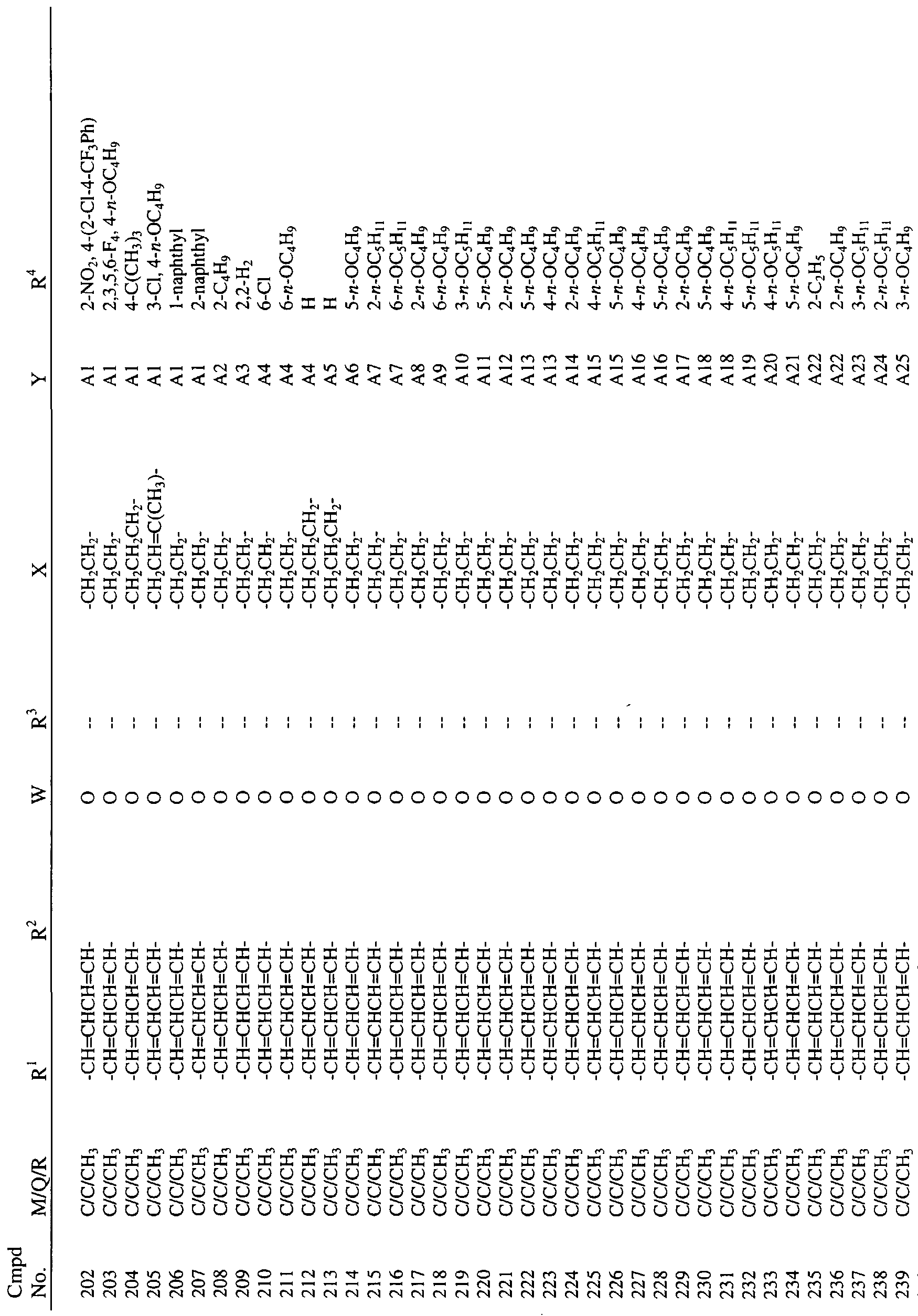
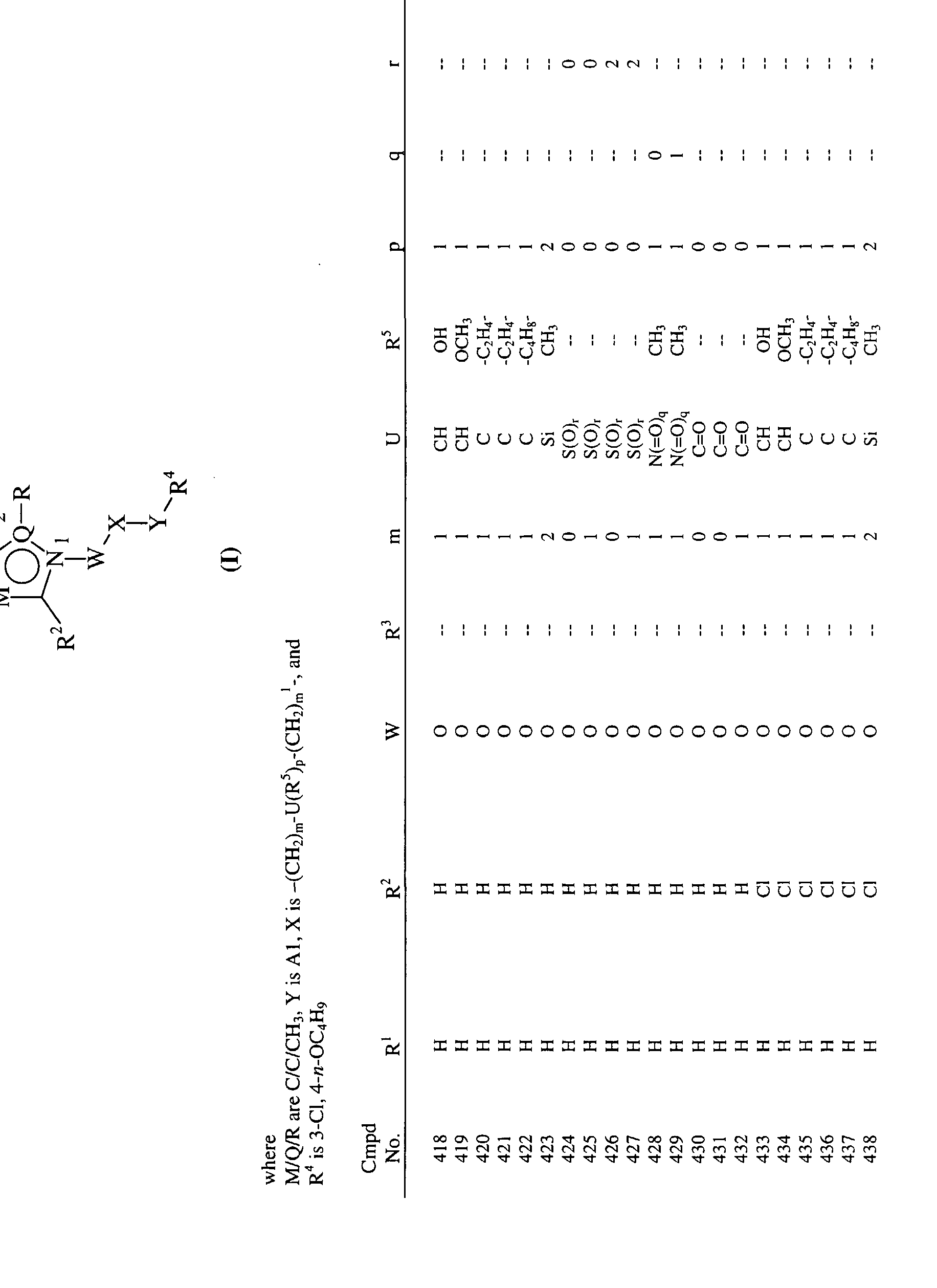
  • the compounds of formula (I) of the present invention can contain optically active and racemic forms. It is also well known in the art that the compounds of formula (I) may contain stereoisomeric forms and/or exhibit polymo ⁇ hism. It is to be understood that the present invention encompasses any racemic, optically-active, polymo ⁇ hic, or stereoisomeric form, or mixtures thereof. It should be noted that it is well known in the art how to prepare optically active forms, for example by resolution of a racemic mixture, or by synthesis from optically-active intermediates. The following table sets forth additional compounds of the present invention, where Y is selected from the following:
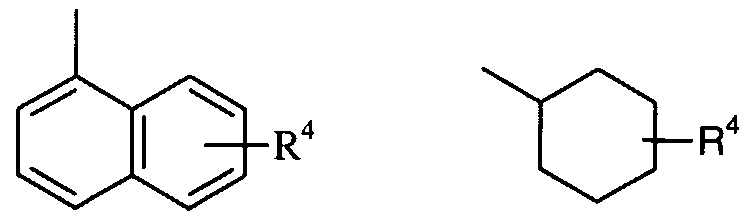
  • R 4 is, inter alia, selected from the following:
  • Rates of application of compounds of formula (I) may range from about 1000 parts per million (ppm), or more, to about 3 ppm, or less, in a rate series of, for example, 1000 ppm, 300 ppm, 100 ppm, 30 ppm, 10 ppm, and 3 ppm.
  • the solutions containing each rate of application of compounds of formula (I) were then sprayed to run-off to both the upper and lower portions of the leaves of the aphid-infested cotton seedlings.
  • Each test of foliar-applied compounds of formula (I) included appropriate standard insecticides of known insecticidal activity and blank treatments to aid in assessing the insecticidal activity of the compounds of formula (I).
  • the cotton seedlings were maintained in a growth chamber for a period of 72 hours. After this time, the seedlings were examined for dead insects. Insects were classified as dead if they were off-color or brown and desiccated. Upon completion of the evaluation of the test, the percent mortality of the cotton aphid for each rate of application of compounds of formula (I) was determined by comparison of the total number of dead insects to the total number of insects in the test. Insecticidal activity data at selected rates of application are provided in Table 2. The test compounds of formula (I) are identified by numbers that correspond to those in Table 1.
  • the compounds of formula (I) of the present invention were insecticidally active in the above foliar test against cotton aphid. Over forty of the compounds of formula (I) that were tested exhibited percent mortality of cotton aphid of 80% or greater at a rate of application of 1000 ppm. Five of the compounds of formula (I) exhibited percent mortality of cotton aphid of 60% or greater at a rate of application of 100 ppm. Of these five, compounds 249 and 263 exhibited 97% and 90% mortality, respectively, of cotton aphid at a rate of application of lOOppm.

Landscapes

  • Chemical & Material Sciences (AREA)
  • Organic Chemistry (AREA)
  • Life Sciences & Earth Sciences (AREA)
  • Agronomy & Crop Science (AREA)
  • Pest Control & Pesticides (AREA)
  • Plant Pathology (AREA)
  • Health & Medical Sciences (AREA)
  • Engineering & Computer Science (AREA)
  • Dentistry (AREA)
  • General Health & Medical Sciences (AREA)
  • Wood Science & Technology (AREA)
  • Zoology (AREA)
  • Environmental Sciences (AREA)
  • Plural Heterocyclic Compounds (AREA)
  • Agricultural Chemicals And Associated Chemicals (AREA)

Abstract

It has now been found that certain novel diazole and triazole derivatives have provided unexpected insecticidal activity. These compounds are represented by formula (I). Preferred are those compounds of formula (I) where M and Q are carbon; R is methyl; R1 and R2 taken together are -CH=CHCH=CH-, -C(Cl)=CHCH=CH-, -C(F)=CHCH=CH-, or -C(CH3)=CHCH=CH-; X is straight or branched chain alkylenyl; Y is phenyl; and R4 is one or more hydrogen, halogen, alkyl, haloalkyl, alkoxy, haloalkoxy, cyano, amino, or -(O)t-(CH2)v-Z-R6, where Z is -C(R7)=C(R8)-, -C≡C-, or -C(R7)=NO-; and, R6, R7 and R8 are indepdently hydrogen, halogen, or alky. In addition, compositions comprising an insecticidally effective amount of at least one compound of formula (I), and optionally, an effective amount of at least one of a second compound, with at least one insecticidally compatible carrier are also disclosed; along with methods of controlling insects comprising applying said compositions to the locus of crops where insects are present or are expected to be present.

Description

INSECTICIDAL DIAZOLE AND TRIAZOLE DERIVATIVES
This application claims the benefit of U.S. Provisional Application No. 60/566,496, filed April 29, 2004.
FIELD OF THE INVENTION The present invention relates to diazole and triazole derivatives and compositions containing the same, which are useful for controlling insects and acarids in agricultural crops. More particularly, this invention relates to certain multiply substituted diazole and triazole derivatives, compositions containing them, and their use as insecticides against insects, such as cotton aphid.
BACKGROUND OF THE INVENTION There is a continuing demand for new insecticides and acaricides that are safer, more effective, and less costly. Insecticides and acaricides are useful for controlling insects and acarids which may otherwise cause significant damage to crops such as wheat, corn, soybeans, potatoes, and cotton to name a few. For crop protection, insecticides and acaricides are desired which can control the insects and acarids without damaging the crops, and have no deleterious effects to mammals and other living organisms. A number of patents and publications disclose a variety of substituted benzimidazoles, some of which have insecticidal and acaricidal activity. For example, as set forth in German Offenlegungsschrift DE 42 37 567 Al, certain 1-substituted 2-cyanobenzimidazole derivatives of the following formula are useful as insecticides, acaricides, nematicides, and fungicides:
Figure imgf000002_0001
where, Xι-X4 are hydrogen; halogen; cyano; nitro; optionally substituted alkyl, alkoxy, alkylthio, alkylsulphinyl, alkylsulphonyl, or cycloalkyl; optionally substituted fused alkylenedioxy; COOH; alkanoyl; alkoxycarbonyl; cycloalkoxycarbonyl; optionally substituted amino or carbamoyl; or Ari; OAri; SAri; SOAri, SO2Arι ; OSO2Arι, COAn, COOAr,,
Figure imgf000003_0001
or SO2CH2SAr,; at least one being other than hydrogen and halogen;
Ari is optionally substituted aryl; Ri is hydrogen; alkyl; or optionally substituted aryl;
R2 is hydroxy; cyano; optionally substituted alkyl, alkenyl, alkynyl, alkoxy, alkenyloxy, alkynyloxy, alkylthio, amino, alkanoyl, alkoxycarbonyl, alkanoyloxy, or dialkoxyphosphoryl; or Ar2; COAr2; COOAr2; OCOAr ; or OCONHCONHAr2; Ar is optionally substituted aryl or heteroaryl. As set forth in Belgian Patent BE 829,630, certain l-hydroxy-2,6- bis(polyfluoroalkyl)-4-nitrobenzimidazole ethers and esters of the following formula are useful as herbicides, insecticides, and as intermediates for other benzimidazoles:
Figure imgf000003_0002
where, Ri is hydrogen; chlorine; fluorine; 1-6C perfluoroalkyl; or -(CHZ)nCH2Z, where each Z is hydrogen or halogen, n is 0-1;
R2 is CF3; CF2C1; or CF2H;
R3 is 1-8C alkyl; 2-8C alkenyl; 5-6C cycloalkyl; benzyl; phenethyl; 2-16C alkanoyl; 3-16C alkenoyl; CXNR4Pv4 (X is O, or S; P is 1-4C alkyl, or 2-4C alkenyl, and one of them may also be hydrogen; the two R 's together are not more than 5C, or the two R4's can together be 2-6C alkylene); CO(R5)nPh (R5 is CH2, CH2CH2, or CH=CH); COQ, or COR6OQ (Q is phenyl substituted with 1-3 same or different NH2, NO2, F, CH3, or OCH3; R6 is 1-4C alkylene); SO2R7 (R7 is 1-4C alkyl, 5-6C cycloalkyl, phenyl optionally substituted as above, or benzyl); 2- tetrahydrofuranyl, COXPh, or COX(l-4 alkyl). As set forth in Belgian Patent BE 766,870, certain benzimidazole derivatives of the following formula are acaricidal:
Figure imgf000004_0001
where;
X is hydrogen, halogen, NO2, CF3, CH3SO2, C2H5SO2, CN; n is 1-4; Ri is hydrogen; (Ph)3C, (p-Cl-Ph)3C, COOR6 (R6 is 1-8C alkyl, or phenyl), when R2 is CF2CHC12 or (b) RI is OH, OR3 (R3 is 1-8C alkyl; 2,4-dinitrophenyl), OC(=O)OR4 (R4 is 1-8C alkyl, or phenyl), OC(=O)R5 (R5 is 1-lOC alkyl or alkenyl, or phenyl) when R2 is CF2CHC12, CF2C1, CF2OCH3, CC1=CC12, CF3 provided that R is not OH when R2 is CF3 or CF2CFC1 , or (c) R| is hydrogen or Rhal when R2 is S-Rhal provided that Rhal is identical for R; and R and is CF2CHC1F, CF2CHF2, CF2CHFCF3, CF2CH2C1, CF2CH2Br, and CF2CHC12. In some instances benzimidazole derivatives have also found utility for control of insects and acarids that prey on animals found in the animal husbandry industry. For example, as set forth in US Patent 3,980,784, certain benzimidazoles of the following formula are useful in the control of insect and acarid animal parasites:
Figure imgf000004_0002
where
R is CI, CF3, CHF2) CC12F; R1 is hydrogen, OH, CO2R4, C(=O)R5, SO2R5, C(=S)N(Cι-C3alkyl)2, O(C,-C3alkyl), or OC(=O)R5; R2 is CC1F2, CF2CHF2, CF2CF3, CF2CF2CF3, or CF(CF3)2; R3 is Cι-C6alkyl, C -C3alkenyl, phenyl, or benzyl; R4 is C|-C5alkyl, phenyl, chlorophenyl, anisyl, or tolyl; R5 is Cι-C3alkyl, or phenyl; or the ammonium, alkali metal, or alkaline earth metal salts of the above compounds wherein Ri is hydrogen. Among the different categories of insect pests preying on agricultural crops are, for example, the piercing-sucking insects that remove plant carbohydrates and nutrients. This type of insect may also inject toxins while feeding that add to the injury of the crop plant. Examples of the piercing-sucking insects include, without limitation, lygus bugs, aphids, whiteflies, plant hoppers, and other piercing-sucking insects. It is estimated that the piercing-sucking insects alone cause in excess of two billion dollars worth of damage to agricultural crops worldwide each year. Accordingly, control of piercing-sucking insects, as well as other categories of insects, that negatively impact agricultural crops is needed.
SUMMARY OF THE INVENTION In accordance with the present invention, it has been found that certain defined diazole and triazole derivatives, more particularly multiply substituted diazole and triazole derivatives, and agriculturally acceptable salts and metal complexes thereof, are useful as active ingredients in the insecticidal compositions and methods of this invention. These diazole and triazole derivatives are represented by the following general formula (I)
Figure imgf000005_0001
(I) where M, Q, R, R1, R2, W, X, Y, and R4 are described below. Among the preferred compounds are those where Q is carbon; R is hydrogen, halogen, or straight or branched chain alkyl; R1 and R2 taken together are -CH=CHCH=CH-, - C(C1)=CHCH=CH-, -C(F)=CHCH=CH-, or -C(CH3)=CHCH=CH-; X is straight or branched chain alkylenyl or -(CH )m-U(R5)p-(CH2)ml-, where U is carbon; Y is phenyl, benzo[b]furanyl, benzodioxolanyl, or oxaindanyl where Y is substituted with R4, which is one or more of hydrogen, halogen, alkyl, haloalkyl, alkoxy, haloalkoxy, cyano, amino, or -(O),-(CH2)v-Z-R6, where Z is -C(R7)=C(R8)-, -C≡C-, or -C(R7)=NO-; and m, p, m1, t, v, R5, R6, R7, and R8 are described below. The present invention is also directed to compositions containing an insecticidally effective amount of at least one of a compound of formula (I), and optionally, an effective amount of at least one of a second compound, with at least one insecticidally compatible carrier. The present invention is also directed to methods of controlling insects, where control is desired, which comprise applying an insecticidally effective amount of the above composition to the locus of crops, or other areas where insects are present or are expected to be present.
DETAILED DESCRIPTION OF THE INVENTION One aspect of the present invention relates to certain new and useful compounds, namely certain novel multiply substituted diazole and triazole derivatives that possess unexpected insecticidal activity. These diazole and triazole derivatives are represented by the following general formula (I)
Figure imgf000006_0001
(I) wherein;
M is carbon or nitrogen;
Q is selected from the group consisting of carbon, nitrogen, and carbonyl; when Q is carbonyl, the nitrogen in the 3-position is optionally substituted with alkyl; and when Q is carbon,
R is selected from the group consisting of hydrogen, halogen, hydroxy, thiol, straight or branched chain alkyl, cycloalkyl, alkoxy, alkenyl, alkenyloxy haloalkyl, hydroxyalkyl, alkylthio, alkoxyalkyl, carboxyl, formyl, aminocarbonyl, amino, cyano, nitro, alkylsulfonyl, aminosulfonyl, cyanoalkyl, cyanothio, cyanothioalkyl, alkylcarbonyl haloalkylcarbonyl, alkoxycarbonyl, haloalkoxycarbonyl, alkoxycarbonylalkylthio, and aminocarbonylalkyl, where the amino group may be substituted with one or two substituents independently selected from alkyl, hydroxy, alkoxy, carboxyl, aryl, alkylcarbonyl, haloalkylcarbonyl, alkoxycarbonyl, haloalkoxycarbonyl, alkylsulfonyl, and haloalkylsulfonyl;
R1 and R2 are independently selected from the group consisting of hydrogen, halogen, alkyl, haloalkyl, alkoxy, haloalkoxy, alkylthio, haloalkyl thio, haloalkylsulfinyl, haloalkylsulfonyl, amino, alkylamino, dialkylamino, aryl, and heteroaryl, where aryl and heteroaryl are optionally substituted with one or more of halogen, alkyl, haloalkyl, alkoxy, and haloalkoxy; and,
R1 and R2 taken together are C3-C5 alkylenyl, -CH2CH2O-, -CH2CH2C(CH3)2O-, - OCH2O-, -OCH2CH2O-, -OCF2CF2-, -CF2CF2O-, -OCF2CF2O-, -CH=CHCH=CH- , -CH=CHO-, -CH=CHN-, -CH=C(Br)N-, -CH=C(CF3)N-, -CH=C(CN)N-, -CH=C(NO2)N-, -CH=CHS-, -CH=C(CH2OCH3)O-, -CH=C(CH3)S-, -CH=C(CF3)S-, - CH=NN(CH3)-, -CH=NN(C2H5)-, -C(CH3)=NN(CH3)-, -N=CHNH-, -C(C1)=CHCH=CH-, -CH=C(Br)CH=CH-, -C(F)=CHCH=CH-, -C(CH3)=CHCH=CH-, -CH=C(CH3)CH=CH-, -CH=CHC(CH3)=CH-, -CH=C(CH3)C(CH3)=CH-, -C(CH3)=CHCH=C(CH3)-, -C(OCH3)=CHCH=CH-, -C(C≡CH)=CHCHC=CH-, -CH=CHC(C1)=CH-, -CH=C(NO2)CH=N-, -OCH=CH-, -CH=C(CF3)CH=N-, -CH=CHCH=C(C1)-, -C(CF3)=CHCH=CH-, -SCH=CH-, -C(C1)=NCH=CH-, -CH2SCH2-, -CH2S(O)CH2-, -CH2S(O)2CH2-, -SN=N-, -CH2N(C2H5)CH2-, =CHN(C2H5)CH=, -N(CH3)CH=CH-, -N(CH2Ph)CH=CH-, -N=CHS-, - N=C(CH3)S-, -N=CHCH=CH-, -CH=CHN=CH-, -CH=NCH=CH-, -CH=CHC(NO2)=CH-, -CH=CHCH=N-, -N=CHC(CF3)=CH-, -CH=C(F)CH=CH-, -C(F)=C(F)CH=CH-, -CH=CHC(F)=CH-,-CH=C(F)C(F)=CH-, -CH=CHCH=C(F)-,- CH=CHCH=C(CH3)-, -C(CH3)=C(CH3)CH=CH-, -C(CH3)=CHC(CH3)=CH-, and -C(CN)=CHCH=CH-;
W is selected from the group consisting of oxygen, -C6H -, -CH2-, NR' , N=, sulfur, S(O), and S(O)2) where R3 is hydrogen, alkyl, haloalkyl, hydroxy, alkoxy, haloalkoxy, alkylcarbonyl, haloalkylcarbonyl, alkoxycarbonyl, haloalkoxycarbonyl, alkylsulfonyl, haloalkylsulfonyl, and aryl;
X is selected from the group consisting of straight or branched chain alkylenyl, alkylenyloxy, alkenylenyl, alkynylenyl; and -(CH2)m-U(R )p-(CH )mι-, where m and m1 are independently 0-4; U is carbon, CH, Si, S(O)r, N(=O)q, or C=O, where r is 0-2, and q is 0 or 1; and when U is carbon, R5 is C2-C5 alkylenyl, and p is 1; when U is CH, R5 is hydroxy, or alkoxy, and p is 1; when U is Si, R" is alkyl, and p is 1-2; when U is S(O)r, p is 0; when U is N(=O)q, R5 is alkyl, and p is 1; and when U is C=O, p is 0;
Y is selected from the group consisting of cycloalkyl, phenyl, benzo[b]furanyl, benzodioxolanyl, pyridyl, pyrimidinyl, pyridazinyl, thienyl, 1,3-thiazolyl, 1,3,4- thiadiazolyl, furanyl, 1,3-oxazolyl, 1,3,4-oxadiazolyl, pyrrolyl, 1-methylpyrrolyl, pyrazolyl, benzoxazolyl, 1-methylpyrazolyl, imidazolyl, 2H-tetrazolyl, 1- methyl-2H- 1 ,3-diazolyl, 4H- 1 ,4-benzoxazinyl, 4H- 1 ,4-benzoxazin-3-onyl, adamantyl, naphthyl, oxaindanyl, benzo[b]-l,3-dioxolanyl, and a bond bridging X and R4; and Y is optionally substituted with one or more of R4, where
R4 is selected from the group consisting of hydrogen, halogen, alkyl, haloalkyl, alkoxyalkyl, hydroxy, alkoxy, haloalkoxy, hydroxyalkoxy, alkoxyalkoxy, alkoxyalkoxyalkoxy, cycloalkoxy, cycloalkylalkoxy, cycloalkoxyalkyl, alkylthio, alkylsulfinyl, alkylsulfonyl, cyano, cyanoalkoxy, nitro, amino, alkylamino, dialkylamino, alkylaminoalkoxy, guanadinoalkoxy, alkylsulfonylamino, carboxyl, alkylcarbonyl, alkoxycarbonyl, dialkylphosphonyl, trialkylsilylalkoxy, aryl, aryloxy, arylalkoxy, aryloxyalkoxy, arylsulfonylalkoxy, arylalkyliminoalkoxy, arylcarbonylaminoalkoxy, heteroaryl, heteroaryloxy, heteroarylalkoxy, 2,4-dialkyl-l,3-dioxolanyl, l,2,3-trihydro-2- azaquinazolin-4-onyl, and -(O)t-(CH2)v-Z-R6 where t is 0 or 1, v is 0-4; Z is - C(R7)=C(R8)-, -OCH2C(R7)=C(R8)-, -OC-, -C≡CS-, -C≡CN(R7)-, -C≡CCO2-, and -C(R7)=NO-, and where the aryl of aryl, aryloxy, arylalkoxy, aryloxyalkoxy, arylsulfonylalkoxy, arylalkyliminoalkoxy, arylcarbonylaminoalkoxy, heteroaryl, heteroaryloxy, and heteroarylalkoxy is optionally substituted with one or more of halogen, alkyl, haloalkyl, alkoxy, and haloalkoxy; R6 is selected from the group consisting of hydrogen, halogen, alkyl, cycloalkyl, cycloalkylalkyl, alkoxyalkyl, haloalkyl, alkylthioalkyl, trialkylsilyl, aminoalkyl, alkylaminoalkyl, dialkylaminoalkyl, alkylcarbonyl, alkylcarbonyl, alkoxycarbonylalkyl, alkoxycarbonylalkyl, aryl, arylalkyl, heteroaryl, and heteroarylalkyl; R and R are independently selected from the group consisting of hydrogen, halogen, alkyl, and haloalkyl, and R7 and R8 taken together are C2-C5 alkylenyl; and agriculturally-acceptable salts and agriculturally acceptable metal complexes thereof. Preferred species are those compounds of formula (I) where M and Q are carbon; R is hydrogen, halogen, hydroxy, straight or branched chain alkyl, or amino; R1 and R2 taken together are -CH=CHCH=CH-, -C(C1)=CHCH=CH-, - C(F)=CHCH=CH-,
-CH=C(F)CH=CH-, -CH=CHC(F)=CH-, -CH=CHCH=C(F)-, -C(F)=C(F)CH=CH-, -CH=C(F)C(F)=CH-, -C(CH3)=CHCH=CH-, -CH=C(CH3)CH=CH-, -C(OCH3)=CHCH=CH-, -C(C=CH)=CHCHC=CH-, -C(CF3)=CHCH=CH-, -N=CHCH=CH-, -CH=NCH=CH-, or -CH=CHCH=N-; W is oxygen, or NR3, where R3 is hydrogen; X is straight or branched chain alkylenyl or -(CH2)m-U(R5)p-(CH2)mι-, where U is carbon, CH, or C=O; Y is cycloalkyl, phenyl, benzo[b]furanyl, benzodioxolanyl, pyridyl, naphthyl, or oxaindanyl, R4 is one or more of hydrogen, halogen, alkyl, haloalkyl, alkoxy, haloalkoxy, alkoxyalkoxy, cycloalkoxy, cycloalkylalkoxy, cyano, amino, alkylamino, dialkylamino, alkoxycarbonyl, aryl, heteroaryl, 2,4-dialkyl-l,3-dioxolanyl, or -(O)t-(CH2)v-Z-R6 where Z is -C(R7)=C(R8)-, -OCH2C(R7)=C(R8)-, -C≡C-, or -C(R7)=NO-; R6 is hydrogen, halogen, alkyl, or haloalkyl; and R7 and R8 are independently hydrogen, halogen, or alkyl. More preferred are those compounds of formula (I) where Q is carbon; R is hydrogen, halogen, or straight or branched chain alkyl; R and R taken together are -CH=CHCH=CH-, -C(C1)=CHCH=CH-, -C(F)=CHCH=CH-, or C(CH3)=CHCH=CH-;
X is straight or branched chain alkylenyl or -(CH2)m-U(R5)p-(CH2)mι-, where U is carbon; Y is phenyl, benzo[b]furanyl, benzodioxolanyl, or oxaindanyl; R4 is one or more of hydrogen, halogen, alkyl, haloalkyl, alkoxy, haloalkoxy, cyano, amino, or -(O)r(CH2)v-Z-R6, where Z is -C(R7)=C(R8)-, -C≡C-, or -C(R7)=NO-; and, R6 is hydrogen, halogen, or alkyl. Yet more preferred are those compounds of formula (I) where R is methyl; X is ethylenyl; Y is phenyl; R4 is one or more of hydrogen, halogen, alkyl, alkoxy, haloalkoxy, cyano, amino, or -(O)r(CH2)v-Z-R6, Z is -C(R7)=NO-; R6 is alkyl; and R7 is hydrogen. Most preferred are those compounds of formula (I) where R4 is i) 3-chloro-4- butoxy; ii) 3-fluoro-4-butoxy; iii) 3-methyl-4-butoxy; iv) 3-cyano-4-butoxy; v) 3,5- dichloro-4-butoxy; vi) 3,5-dimethyl-4-butoxy; vii) 3-amino-5-chloro-4-butoxy; viii) 3-chloro-4-(4-fluorobutoxy); and ix) 4-(O)t-(CH2)v-Z-R6, where t and v are 0; and R6 is ethyl. In addition, in certain cases the compounds of formula (I) possess asymmetric centers, which can give rise to optical enantiomorphs and diastereomers. The compounds may also possess acidic or basic moieties, which may allow for the formation of agriculturally acceptable salts or agriculturally acceptable metal complexes. This invention includes such enantiomorphs, salts and metal complexes. Agriculturally acceptable salts and metal complexes include, without limitation, for example, ammonium salts, the salts of hydrochloric acid, sulfonic acid, ethanesulfonic acid, trifluoroacetic acid, methylbenzenesulfonic acid, phosphoric acid, gluconic acid, pamoic acid, and other acid salts, and the alkali metal and alkaline earth metal complexes with, for example, sodium, potassium, lithium, magnesium, calcium, and other metals. Another aspect of the present invention relates to compositions containing an insecticidally effective amount of at least one compound of formula (I) with at least one insecticidally compatible carrier therefor. Another aspect of the present invention relates to compositions containing an insecticidally effective amount of at least one compound of formula (I), and an effective amount of at least one second compound, with at least one insecticidally compatible carrier therefor. Another aspect of the present invention relates to methods of controlling insects by applying an insecticidally effective amount of a composition set forth above to a locus of crops such as, without limitation, cotton, vegetables, and fruits, or other areas where insects are present or are expected to be present. The modifier "about" is used herein to indicate that certain preferred operating ranges, such as ranges for molar ratios for reactants, material amounts, and temperature, are not fixedly determined. The meaning will often be apparent to one of ordinary skill. For example, a recitation of a temperature range of about 120°C to about 135°C in reference to, for example, an organic chemical reaction would be interpreted to include other like temperatures that can be expected to favor a useful reaction rate for the reaction, such as 105°C or 150°C. Where guidance from the experience of those of ordinary skill is lacking, guidance from the context is lacking, and where a more specific rule is not recited below, the "about" range shall be not more than 10% of the absolute value of an end point or 10% of the range recited, whichever is less. As used in this specification and unless otherwise indicated the substituent terms alkyl, alkoxy, alkanoate, alkanoic, and haloalkyl, used alone or as part of a larger moiety, includes straight or branched chains of at least one or two carbon atoms, as appropriate to the substituent, and preferably up to 12 carbon atoms, more preferably up to ten carbon atoms, most preferably up to seven carbon atoms. The term "cycloalkyl", used alone or as part of a larger moiety, includes rings of three to twelve carbon atoms, preferably three to six carbon atoms. The term "alkenyl", used alone or as part of a larger moiety, includes straight or branched chains of at least two carbon atoms containing at least one carbon-carbon double bond, and preferably up to 12 carbon atoms, more preferably up to ten carbon atoms, most preferably up to seven carbon atoms. The term "aryl" refers to an aromatic ring structure, including fused rings, having four to ten carbon atoms. The term "heteroaryl" refers to an aromatic ring structure, including fused rings, having at least one nitrogen, sulfur, or oxygen atom. The term "THF" refers to tetrahydrofuran. The term "DMF" refers to N.N-dimethylformamide, The term "DEAD" refers to diethyl azodicarboxylate. "Halogen" or "halo" refers to fluorine, bromine, iodine, or chlorine. The diazole and triazole derivatives of formula (I) can be synthesized by methods that are individually known to one skilled in the art from intermediate compounds readily available in commerce. Scheme I below illustrates a general procedure for synthesizing diazole and triazole derivatives of formula (I), inter alia, where W is amino (NR3 where R3 is hydrogen) or oxygen, X is ethylenyl, and Y is phenyl:
Scheme I
Figure imgf000012_0001
B) (Ph)3P, DEAD, THF; C) K2C03, DMF or (CH3)2CO; D) CH3COOH, NaBH3CN, C2H5OH
Intermediate (1), for example, a 1-hydroxydiazole or a 1 -hydroxy triazole, can be reacted (Reaction C) with an appropriately substituted alkyl halide (3), under basic conditions in a suitable solvent, for example, DMF and acetone, affording compounds of formula (I) where W is oxygen. In a preferred method, Intermediate (1) can be reacted (Reaction B) with triphenylphosphine, DEAD, and an appropriately substituted alkyl alcohol (3), in a suitable solvent, for example, THF, also affording compounds of formula (I) where W is oxygen. Examples of 1-hydroxydiazoles or 1-hydroxytriazoles useful in the context of the present invention include, without limitation, l-hydroxy-2- methylbenzimidazole, 4-chloro- 1 -hydroxy-2-methylbenzimidazole, 4-fluoro- 1 - hydroxy-2-methylbenzimidazole, l-hydroxy-2,4-dimethylbenzimidazole, 1- hydroxy-2-methyl-4,5,6,7-tetrahydrobenzimidazole, l-hydroxy-2,4,5- trimethylimidazole, 1 -hydroxy- lH-benzotriazole hydrate, and other 1- hydroxydiazoles and 1-hydroxytriazoles (1). Examples of substituted alkyl halides and substituted alkyl alcohols (3) useful in the context of the present invention include, without limitation, 2-(3-chloro-4-n-butoxyphenyl)ethanol, 2-[3-chloro-4- (l,l-dimethylethyl)phenyl]ethyl bromide, 2-[3,5-difluoro-4- (ethoxyiminomethyl)phenyl]ethanol, and other substituted alkyl halides (3) and substituted alkyl alcohols (3). Detailed Examples of Reactions B and C are set forth as Examples 1, 2, 4, 6, 9, 11-13, and 16 hereinbelow. Intermediate (2), for example, a 1-aminodiazole or a 1-aminotriazole, can be reacted (Reaction D) with an appropriately substituted alkyl aldehyde (4) and a suitable reducing agent, for example, sodium borohydride or sodium cyanoborohydride, in a suitable solvent, for example, ethanol or acetic acid, affording compounds of formula (I) where W is amino. Examples of 1- aminodiazoles or 1-aminotriazoles useful in the context of the present invention include, without limitation, l-amino-2-methylbenzimidazole, l-amino-4-chloro-2- methylbenzimidazole, l-amino-4-fluoro-2-methylbenzimidazole, l-amino-5-fluoro- 2-methylbenzimidazole, 1 -amino-2,4-dimethylbenzimidazole, 1 -amino- 1 ,3-dihydro- 3-methyl-2H-benzimidazol-2-one, and other 1-aminodiazoles or 1-aminotriazoles (2). Examples of substituted alkyl aldehydes (4) useful in the context of the present invention include, without limitation, 3-chloro-4-n-butoxyphenylacetaldehyde, 4-n- butoxy-3,5-dimethylbenzaldehyde, propyl 2-chloro-4-formylmethylbenzoate, 2- methyl-2-(4-«-butoxyphenyl)propionaldehyde, and other substituted alkyl aldehydes (4). Detailed Examples of Reaction D are set forth as Examples 3, 5, 7, 8, 10, 14 and 15 hereinbelow. Intermediates (1) and (2), useful in the preparation of compounds of formula (I) are available in commerce or can be prepared using methods known to one skilled in the art. Intermediates (1), for example, 4-fluoro-l-hydroxy-2-methylbenzimidazole and l-hydroxy-2,4-dimethylbenzimidazole, were prepared in a step-wise manner by first aminating the corresponding 3-fluoronitrobenzene and 3-nitrotoluene with 1,1,1-trimethylhydrazinium iodide and potassium tert.-butoxide in a suitable solvent, for example, DMSO, affording the corresponding 2-fluoro-6-nitroaniline and 2- methyl-6-nitroaniline. The anilines were then reacted with acetic anhydride in acetic acid, yielding N-(2-fluoro-6-nitrophenyl)acetamide and N-(2-mefhyl-6- nitrophenyl)acetamide, which were then cyclized with sodium hydrosulfite in aqueous 10% sodium hydroxide, providing the targeted 4-fluoro-l-hydroxy-2- methylbenzimidazole and l-hydroxy-2,4-dimethylbenzimidazole (1). Examples 4 and 6 set forth in detail the foregoing method of preparing these intermediates from the corresponding acetamides, which are compositions of matter known in the art. The preparation of Intermediate (1), l-hydroxy-2,4,5-trimethylimidazole, is disclosed by Akagane et al (Bull. Chem. Soc. Japan, 1969, 3204). Another Intermediate (1), l-hydroxy-2-methyl-4,5,6,7-tetrahydrobenzimidazole, was prepared using the method disclosed by Akagane et al, wherein the known intermediate 1,2-cyclohexanonemonoxime (Geissman et al, J. Org. Chem., 1946, 771) was treated with an appropriate aldehyde, for example acetaldehyde, and ammonium hydroxide in a suitable solvent, for example, ethanol or dioxane, affording the targeted l-hydroxy-2-methyl-4,5,6,7-tetrahydrobenzimidazole (1). Example 12 sets forth in detail the foregoing method of preparing this intermediate from the known 1,2-cyclohexanonemonoxime. Intermediate (2), for example l-amino-4-fluoro-2-methylbenzimidazole, was prepared in a step-wise manner by cyclizing 2-fluoro-6-nitroaniline (set forth above) with iron filings and acetic anhydride in acetic acid, affording the corresponding 4- fluoro-2-methylbenzimidazole. The so-prepared 4-fluoro-2-methylbenzimidazole was in turn aminated with hydroxylamine-<9-sulfonic acid under basic conditions in a suitable solvent, for example, THF and water, affording the corresponding 1- amino-4-fluoro-2-methylbenzimidazole (2). Example 5 sets forth in detail the foregoing method of preparing this intermediate from 4-fluoro-2- methylbenzimidazole, which is a composition of matter known in the art. Intermediate (2), l-amino-2-methylbenzimidazole, was also prepared by the method set forth in Example 5, from the commercially available 2-methylbenzimidazole. Intermediate (2), for example l-amino-5-fluoro-2-methylbenzimidazole, was prepared in a stepwise manner using the method disclosed by Tschirret-Guth et al (J. Org. Chem. 1998, 63, 9711) wherein an appropriately substituted 2- fluoronitrobenzene, for example 2,5-difluoronitrobenzene, was reacted with hydrazine and then immediately with acetyl chloride, affording the corresponding 1- acetyl-2-(4-fluoro-2-nitrophenyl)hydrazine. Using the method disclosed by Sheng et al (J. Org. Chem. 1963, 28, 736), the so-prepared hydrazine was then reduced by hydrogenation and cyclized with, for example acetic acid, affording the corresponding (5-fluoro-2-methylbenzimidazol-l-yl)acetamide. The acetamide was then treated with 2N hydrochloric acid, followed by 10% aqueous sodium hydroxide, yielding the targeted l-amino-5-fluoro-2-methylbenzimidazole (2). Example 8 sets forth in detail the foregoing method of preparing this intermediate. Appropriately substituted alkyl alcohols (3) that find utility in the reaction with Intermediate (1) affording compounds of formula (I) were also prepared by methods known to one skilled in the art. For example, for use in Reaction B set forth in Scheme 1, the alkyl alcohol 2-
(3-chloro-4-n-butoxyphenyl)ethanol (3) was prepared in a step-wise manner by esterifying the commercially available 3-chloro-4-hydroxyphenylacetic acid with an alcohol, for example, ethanol, under acid catalysis with, for example, p- toluenesulfonic acid, affording the corresponding ethyl 3-chloro-4- hydroxyphenylacetate. The 4-hydroxyphenylacetate was in turn treated with sodium hydride, and then was reacted with an alkyl halide, for example 1-iodobutane, affording the corresponding ethyl 3-chloro-4-n-butoxyphenylacetate. The 4-n- butoxyphenylacetate was then treated with lithium aluminum hydride, affording the corresponding 2-(3-chloro-4-«-butoxyphenyl)ethanol (3). Example 1 sets forth in detail the foregoing methods of preparing this intermediate from ethyl 3-chloro-4- hydroxyphenylacetate, which is a composition of matter known in the art. An alternate preparation of 2-(3-chloro-4-π-butoxyphenyl)ethanol (3) from 3-chloro-4- hydroxyphenylacetic acid was realized by the alkylation of the acetic acid with an alkyl halide, for example 1-iodobutane, as set forth above, yielding the corresponding 3-chloro-4-n-butoxyphenylacetic acid. The so-prepared acetic acid was then treated with, for example borane-THF complex, affording the corresponding 2-(3-chloro-4-n-butoxyphenyl)ethanol (3). Example 1 sets forth in detail the foregoing methods of preparing this intermediate from 3-chloro-4-n- butoxyphenylacetic acid, which is a composition of matter known in the art. Other alkyl alcohols (3) were also prepared by methods known to one skilled in the art for use in Reaction B set forth in Scheme 1. For example, the alkyl alcohol 2-[3,5-difluoro-4-(ethoxyiminomethyl)phenyl]ethanol (3) was prepared in a step- wise manner from commercially available 3,5-difluorophenylacetic acid by first converting the acetic acid to the corresponding 2-(3,5-difluorophenyl)ethanol by methods described above. The OH of the so-prepared ethanol was then protected by treating it with triisopropylsilyl chloride and imidazole in a suitable solvent, for example, methylene chloride, affording the corresponding tri(l-rnethylethyl)silyl 2- (3,5-difluorophenyl)ethyl ether, which was in turn treated with n-butyllithium in a suitable solvent, for example, THF at depressed temperature, and then reacted with DMF, yielding the corresponding 2,6-difluoro-4-[2-[tri(l- methylethyl)silyloxy]ethyl]benzaldehyde. The aldehyde was then reacted with, for example, O-ethylhydroxylamine hydrochloride, providing the corresponding tri(l- methylethyl)silyl 2-[3,5-difluoro-4-(ethoxyiminomethyl)phenyl]ethyl ether. The tri(l-mefhylethyl)silyl moiety was then cleaved by treating the ether with tetrabutylammonium fluoride, yielding the unprotected alcohol, 2-[3,5-difluoro-4- (ethoxyiminomethyl)phenyl]ethanol (3). Example 9 sets forth in detail the foregoing method of preparing this intermediate. When advantageous, appropriately substituted alkyl halides (3) were reacted, according to Reaction C as set forth in Scheme 1, with Intermediate (1) affording compounds of formula (I). The useful alkyl halides (3) were also prepared by methods known by one skilled in the art. For example, the alkyl halide 2-[3-chloro- 4-(l,l-dimethylethyl)phenyl]ethyl bromide (3) was prepared from commercially available 2-[3-chloro-4-(l,l-dimethylethyl)phenyl]ethanol by bromination of the ethanol with phosphorous tribromide in a suitable solvent, for example, methylene chloride, affording the corresponding ethyl bromide (3). Example 2 sets forth in detail the use of this known composition of matter to prepare compounds of formula
(I). Appropriately substituted alkyl aldehydes (4) that find utility in the reaction with Intermediate (2) affording compounds of formula (I) were also prepared by methods known to one skilled in the art. For example, for use in Reaction D set forth in Scheme 1, the alkyl aldehyde
3-chloro-4-n-butoxyphenylacetaldehyde (4) was prepared from 2-(3-chloro-4-n- butoxyphenyl)ethanol (described above) by treating the ethanol with dichlorotris(triphenylphosphine)ruthenium(II) and iodobenzene diacetate in a suitable solvent, for example, methylene chloride, affording the corresponding 3- chloro-4-n-butoxyphenylacetaldehyde (3). Example 3 sets forth in detail the foregoing method of preparing this intermediate. An additional alkyl aldehyde (4), for example, 4-/ι-butoxy-3,5- dimethylphenylacetaldehyde, was prepared in a step-wise manner from commercially available 3,5-dimethyl-4-hydroxybenzaldehyde by first reacting the benzaldehyde with, for example, 1-iodobutane under basic conditions, yielding the corresponding 4-n-butoxy-3,5-dimethylbenzaldehyde. The so-prepared benzaldehyde was then reacted with the ylide derived from (methoxymethyl)triphenylphosphonium chloride and sodium hydride in a suitable solvent, for example, THF, affording the corresponding l-(4-n-butoxy-3,5- dimethylphenyl)-2-methoxyethene, which was in turn reacted with hydrochloric acid in a suitable solvent, for example, acetonitrile, affording the corresponding 4-n- butoxy-3,5-dimethylphenylacetaldehyde (4). Example 7 sets forth in detail the foregoing method of preparing this intermediate. Also, the alkyl aldehyde (4), propyl 2-chloro-4-formylmethylbenzoate was prepared in a step-wise manner by first chlorinating the known ethyl (4- aminophenyl) acetate with N-chlorosuccinimide, affording the corresponding ethyl (3-chloro-4-aminophenyl)acetate. The 3-chloro derivative was then treated with tert. -butyl nitrite and copper(II) bromide, yielding the brominated intermediate, ethyl (4-bromo-3-chlorophenyl)acetate, which was in turn treated with diisobutylaluminum hydride, affording the corresponding 4-bromo-3- chlorophenylacetaldehyde. The carbonyl moiety of the aldehyde was then protected by treating it with p-toluenesulfonic acid and 1,2-ethanediol, affording the corresponding 2-[(4-bromo-3-chlorophenyl)methyl]-l,3-dioxolane. Treatment of the dioxolane with n-butyllithium and carbon dioxide gave the corresponding lithium 2-chloro-4-(l,3-dioxolan-l-ylmethyl)benzoate, which was then reacted with, for example, n-propyl bromide, yielding propyl 2-chloro-4-(l,3-dioxolan-l- ylmethyl)benzoate. The 1,3-dioxolan-l-yl moiety was then cleaved from the so- prepared propyl benzoate by treating it with dilute hydrochloric acid, affording the corresponding unprotected aldehyde compound, propyl 2-chloro-4- formylmefhylbenzoate (4). Example 10 sets forth in detail the foregoing method of preparing this intermediate from 4-bromo-3-chlorophenylacetaldehyde, which is a composition of matter known in the art. Also, the alkyl aldehyde (4), 2-methyl-2-(4-n-butoxyphenyl)propionaldehyde was prepared in a step-wise manner by first alkylating the commercially available 4- hydroxyphenylacetonitrile with, for example, 1-iodobutane and potassium carbonate, affording the corresponding 4-n-butoxyphenylacetonitrile, The alkylated acetonitrile was in turn treated with potassium tert.-butoxide in a suitable solvent, for example, THF, then reacted with, for example, methyl iodide, affording the corresponding 2-methyl-2-(4-n-butoxyphenyl)propionitrile. The so-prepared propionitrile was then reduced with diisobutylaluminum hydride in a suitable solvent, for example, toluene, yielding 2-methyl-2-(4-n- butoxyphenyl)propionaldehyde (4). Example 14 sets forth in detail the foregoing method of preparing this intermediate from 2-methyl-2-(4-n- butoxyphenyl)propionitrile, which is a composition of matter known in the art. It is contemplated that in the reaction of, for example, Intermediate (1) with an appropriately substituted alkyl alcohol (3) or alkyl halide (3), or of Intermediate (2) with an appropriately substituted alkyl aldehyde (4), that more than one targeted compound of formula (I) can be formed. For example, in the reaction of Intermediate (2), l-amino-2-methylbenzimidazole, and intermediate (4), 2-mefhyl-2- (4-n-butoxyphenyl)propionaldehyde, by methods described above, two compounds of formula (I) were prepared and isolated. Example 14 sets forth in detail the preparation and isolation of l-[[2-methyl-2-(4-n-butoxyphenyl)propyl]amino]-2- methylbenzimidazole (where W is amino) and l-[[2-methyl-2-(4-/τ- butoxyphenyl)propyl]imino]-2-methylbenzimidazole (where W is N=). Certain compounds of formula (I) can be further reacted to obtain other compounds of formula (I). For example, l-[2-(4-methoxyphenyl)ethoxy]-2,4- dimethylbenzimidazole (I) was treated with boron tribromide, affording the corresponding l-[2-(4-hydroxyphenyl)ethoxy]-2,4-dimethylbenzimidazole, which was in turn reacted with 4-heptanol, triphenylphosphine, and DEAD in THF, yielding the targeted l-[2-[4-(l-propylbutoxy)phenyl]ethoxy]-2,4- dimethylbenzimidazole (I). Example 11 sets forth in detail the preparation of this compound. The present invention also relates to insecticidal compositions that combine insecticidally effective amounts of the active compounds with adjuvants and carriers normally employed in the art for facilitating the dispersion of active ingredients for the particular utility desired. One skilled in the art will of course recognize that the formulation and mode of application of a toxicant may affect the activity of the material in a given application. Thus, for agricultural use the present insecticidal compounds may be formulated as a granular of relatively large particle size (for example, 8/16 or 4/8 US Mesh), as water-soluble or water-dispersible granules, as powdery dusts, as wettable powders, as emulsifiable concentrates, as aqueous emulsions, as solutions, or as any of other known types of agriculturally-useful formulations, depending on the desired mode of application. It is to be understood that the amounts specified in this specification are intended to be approximate only, as if the word "about" were placed in front of the amounts specified. These insecticidal compositions may be applied either as water-diluted sprays, or dusts, or granules to the areas in which suppression of insects is desired. These formulations may contain as little as 0.1%, 0.2% or 0.5% to as much as 95% or more by weight of active ingredient. Dusts are free flowing admixtures of the active ingredient with finely divided solids such as talc, natural clays, kieselguhr, flours such as walnut shell and cottonseed flours, and other organic and inorganic solids which act as dispersants and carriers for the toxicant; these finely divided solids have an average particle size of less than about 50 microns. A typical dust formulation useful herein is one containing 1.0 part or less of the insecticidal compound and 99.0 parts of talc. Wettable powders, also useful formulations for insecticides, are in the form of finely divided particles which disperse readily in water or other dispersant. The wettable powder is ultimately applied to the locus where insect control is needed either as a dry dust or as an emulsion in water or other liquid. Typical carriers for wettable powders include Fuller's earth, kaolin clays, silicas, and other highly absorbent, readily wet inorganic diluents. Wettable powders normally are prepared to contain about 5-80% of active ingredient, depending on the absorbency of the carrier, and usually also contain a small amount of a wetting, dispersing or emulsifying agent to facilitate dispersion. For example, a useful wettable powder formulation contains 80.0 parts of the insecticidal compound, 17.9 parts of Palmetto clay, and 1.0 part of sodium lignosulfonate and 0.3 part of sulfonated aliphatic polyester as wetting agents. Additional wetting agent and/or oil will frequently be added to a tank mix for to facilitate dispersion on the foliage of the plant. Other useful formulations for insecticidal applications are emulsifiable concentrates (ECs) which are homogeneous liquid compositions dispersible in water or other dispersant, and may consist entirely of the insecticidal compound and a liquid or solid emulsifying agent, or may also contain a liquid carrier, such as xylene, heavy aromatic naphthas, isphorone, or other non-volatile organic solvents. For insecticidal application these concentrates are dispersed in water or other liquid carrier and normally applied as a spray to the area to be treated. The percentage by weight of the essential active ingredient may vary according to the manner in which the composition is to be applied, but in general comprises 0.5 to 95% of active ingredient by weight of the insecticidal composition. Flowable formulations are similar to ECs except that the active ingredient is suspended in a liquid carrier, generally water. Flowables, like ECs, may include a small amount of a surfactant, and will typically contain active ingredients in the range of 0.5 to 95%, frequently from 10 to 50%, by weight of the composition. For application, flowables may be diluted in water or other liquid vehicle, and are normally applied as a spray to the area to be treated. Typical wetting, dispersing or emulsifying agents used in agricultural formulations include, but are not limited to, the alkyl and alkylaryl sulfonates and sulfates and their sodium salts; alkylaryl polyether alcohols; sulfated higher alcohols; polyethylene oxides; sulfonated animal and vegetable oils; sulfonated petroleum oils; fatty acid esters of polyhydric alcohols and the ethylene oxide addition products of such esters; and the addition product of long-chain mercaptans and ethylene oxide. Many other types of useful surface-active agents are available in commerce. Surface-active agents, when used, normally comprise 1 to 15% by weight of the composition. Other useful formulations include suspensions of the active ingredient in a relatively non-volatile solvent such as water, corn oil, kerosene, propylene glycol, or other suitable solvents. Still other useful formulations for insecticidal applications include simple solutions of the active ingredient in a solvent in which it is completely soluble at the desired concentration, such as acetone, alkylated naphthalenes, xylene, or other organic solvents. Granular formulations, wherein the toxicant is carried on relative coarse particles, are of particular utility for aerial distribution or for penetration of cover crop canopy. Pressurized sprays, typically aerosols wherein the active ingredient is dispersed in finely divided form as a result of vaporization of a low- boiling dispersant solvent carrier may also be used. Water-soluble or1 water- dispersible granules are free flowing, non-dusty, and readily water-soluble or water- miscible. In use by the farmer on the field, the granular formulations, emulsifiable concentrates, flowable concentrates, aqueous emulsions, solutions, etc., may be diluted with water to give a concentration of active ingredient in the range of say 0.1% or 0.2% to 1.5% or 2%. The active insecticidal compounds of this invention may be formulated and/or applied with one or more second compounds. Second compounds include, but are not limited to, other pesticides, plant growth regulators, fertilizers, soil conditioners, or other agricultural chemicals. In applying an active compound of this invention, whether formulated alone or with other agricultural chemicals, an effective amount and concentration of the active compound is of course employed; the amount may vary in the range of, e.g. about 0.01 to about 3 kg/ha, preferably about 0.03 to about 1 kg/ha. For field use, where there are losses of insecticide, higher application rates (e.g., four times the rates mentioned above) may be employed. When the active insecticidal compounds of the present invention are used in combination with one or more of second compounds, e.g., with other pesticides such as herbicides, the herbicides include, without limitation, for example: N- (phosphonomethyl)glycine ("glyphosate"); aryloxyalkanoic acids such as (2,4- dichlorophenoxy)acetic acid ("2,4-D"), (4-chloro-2-methylphenoxy)acetic acid ("MCPA"), (+/-)-2-(4chloro-2-methylphenoxy)proρanoic acid ("MCPP"); ureas such as N,N-dimethyl-N'-[4-(l-methylethyl)phenyl]urea ("isoproturon"); imidazolinones such as 2-[4,5-dihydro-4-methyl-4-(l-methylethyl)-5-oxo-lH- imidazol-2-yl]-3-pyridinecarboxylic acid ("imazapyr"), a reaction product comprising (+/-)-2-[4,5-dihydro-4-methyl-4-(l-methylethyl)-5-oxo-lH-imidazol-2- yl]-4-methylbenzoic acid and (+/-)2-[4,5-dihydro-4-methyl-4-(l-methylethyl)-5- oxo-lH-imidazol-2-yl]-5-methylbenzoic acid ("imazamethabenz"), (+/-)-2-[4,5- dihydro-4-methyl-4-(l-methylethyl)-5-oxo-lH-imidazol-2-yl]-5-ethyl-3- pyridinecarboxylic acid ("imazethapyr"), and (+/-)-2-[4,5-dihydro-4-methyl-4-(l- methylethyl)-5-oxo-lH-imidazol-2-yl]-3-quinolinecarboxylic acid ("imazaquin"); diphenyl ethers such as 5-[2-chloro-4-(trifluoromethyl)phenoxy]-2-nitrobenzoic acid ("acifluorfen"), methyl 5-(2,4-dichlorophenoxy)-2-nitrobenzoate ("bifenox"), and 5- [2-chloro-4-(trifluoromethyl)phenoxy]-N-(methylsulfonyl)-2-nitrobenzamide ("fomasafen"); hydroxybenzonitriles such as 4-hydroxy-3,5-diiodobenzonitrile ("ioxynil") and 3,5-dibromo-4-hydroxybenzonitrile ("bromoxynil"); sulfonylureas such as 2-[[[[(4chloro-6-methoxy-2- pyrimidinyl)amino]carbonyl]amino]sulfonyl]benzoic acid ("chlorimuron"), 2- chloro-N-[ [(4-methoxy-6-methyl-l,3,5-triazin-2- yl)amino]carbonyl]benzenesulfonamide (achlorsulfuron"), 2-[[[[[(4,6-dimethoxy-2- pyrimidinyl)amino]carbonyl]amino]sufonyl]methyl]benzoic acid ("bensulfuron"), 2- [[[[(4,6-dimethoxy-2-pyrimidinyl)amino]carbonyl]amino]sulfonyl]-l-methy-lH- pyrazol-4-carboxylic acid ("pyrazosulfuron"), 3-[[[[(4-methoxy-6-methyl-l,3,5- triazin-2-yl)amino]carbonyl]amino]sulfonyl]-2-thiophenecarboxylic acid
("thifensulfuron"), and 2-(2-chloroethoxy)-N[[(4-methoxy-6-methyl-l,3,5-triazin-2- yl)amino]carbonyl]benzenesulfonamide ("triasulfuron"); 2-(4-aryloxy- phenoxy)alkanoic acids such as (+/-)-2[4-[(6-chloro-2-benzoxazolyl)oxy]phenoxy]- propanoic acid (fenoxaprop"), (+/-)-2-[4[[5-(trifluoromethyl)-2-pyridinyl]oxy]- phenoxyjpropanoic acid ("fluazifop"), (+/-)-2-[4-(6chloro-2-quinoxalinyl)oxy]- phenoxyjpropanoic acid ("quizalofop"), and (+ /-) -2-[(2,4- dichlorophenoxy)phenoxy]propanoic acid ("diclofop"); benzothiadiazinones such as 3-(l-methylethyl)-lH-l,2,3-benzothiadiazin-4(3H)-one-2,2-dioxide ("bentazone"); 2-chloroacetanilides such as N-(butoxymethyl)-2-chloro-N-(2,6- diethylphenyl)acetamide ("butachlor"), 2-chloro-N-(2-ethyl-6-methylphenyl)-N-(2- methoxy- 1 -methylethyl)acetamide ("metolachlor"), 2-chloro-N-(ethoxymethyl)-N- (2-ethyl-6-methylphenyl)acetamide ("acetochlor"), and (/?5)-2-chloro-N-(2,4- dimethyl-3-thienyl)-N-(2-methoxy-l-methylethyl)acetamide ("dimethenamide"); arenecarboxylic acids such as 3,6-dichloro-2-methoxybenzoic acid ("dicamba"); pyridyloxyacetic acids such as [(4-amino-3,5-dichloro-6-fluoro-2- pyridinyl)oxy] acetic acid ("fluroxypyr"), and other herbicides. When the active insecticidal compounds of the present invention are used in combination with one or more of second compounds, e.g., with other pesticides such as other insecticides, the other insecticides include, for example: organophosphate insecticides, such as chlorpyrifos, diazinon, dimethoate, malathion, parathion- methyl, and terbufos; pyrethroid insecticides, such as fenvalerate, deltamethrin, fenpropathrin, cyfluthrin, flucythrinate, /pnα-cypermethrin, biphenthrin, resolved cyhalothrin, etofenprox, esfenvalerate, tralomehtrin, tefluthrin, cycloprothrin, betacyfluthrin, and acrinathrin; carbamate insecticides, such as aldecarb, carbaryl, carbofuran, and methomyl; organochlorine insecticides, such as endosulfan, endrin, heptachlor, and lindane; benzoylurea insecticides, such as diflubenuron, triflumuron, teflubenzuron, chlorfluazuron, flucycloxuron, hexaflumuron, flufenoxuron, and lufenuron; and other insecticides, such as amitraz, clofentezine, fenpyroximate, hexythiazox, and imidacloprid. When the active insecticidal compounds of the present invention are used in combination with one or more of second compounds, e.g., with other pesticides such as fungicides, the fungicides include, for example: benzimidazole fungicides, such as benomyl, carbendazim, thiabendazole, and thiophanate-methyl; 1,2,4-triazole fungicides, such as epoxyconazole, cyproconazole, flusilazole, flutriafol, propiconazole, tebuconazole, triadimefon, and triadimenol; substituted anilide fungicides, such as metalaxyl, oxadixyl, procymidone, and vinclozolin; organophosphorus fungicides, such as fosetyl, iprobenfos, pyrazophos, edifenphos, and tolclofos-methyl; morpholine fungicides, such as fenpropimorph, tridemorph, and dodemorph; other systemic fungicides, such as fenarimol, imazalil, prochloraz, tricyclazole, and triforine; dithiocarbamate fungicides, such as mancozeb, maneb, propineb, zineb, and ziram; non-systemic fungicides, such as chlorothalonil, dichlofluanid, dithianon, and iprodione, captan, dinocap, dodine, fluazinam, gluazatine, PCNB, pencycuron, quintozene, tricylamide, and validamycin; inorganic fungicides, such as copper and sulphur products, and other fungicides. When the active insecticidal compounds of the present invention are used in combination with one or more of second compounds, e.g., with other pesticides such as nematicides, the nematicides include, for example: carbofuran, carbosulfan, turbufos, aldecarb, ethoprop, fenamphos, oxamyl, isazofos, cadusafos, and other nematicides. When the active insecticidal compounds of the present invention are used in combination with one or more of second compounds, e.g., with other materials such as plant growth regulators, the plant growth regulators include, for example: maleic hydrazide, chlormequat, ethephon, gibberellin, mepiquat, thidiazon, inabenfide, triaphenthenol, paclobutrazol, unaconazol, DCPA, prohexadione, trinexapac-ethyl, and other plant growth regulators. Soil conditioners are materials which, when added to the soil, promote a variety of benefits for the efficacious growth of plants. Soil conditioners are used to reduce soil compaction, promote and increase effectiveness of drainage, improve soil permeability, promote optimum plant nutrient content in the soil, and promote better pesticide and fertilizer incorporation. When the active insecticidal compounds of the present invention are used in combination with one or more of second compounds, e.g., with other materials such as soil conditioners, the soil conditioners include organic matter, such as humus, which promotes retention of cation plant nutrients in the soil; mixtures of cation nutrients, such as calcium, magnesium, potash, sodium, and hydrogen complexes; or microorganism compositions which promote conditions in the soil favorable to plant growth. Such microorganism compositions include, for example, bacillus, pseudomonas, azotobacter, azospirillum, rhizobium, and soil-borne cyanobacteria. Fertilizers are plant food supplements, which commonly contain nitrogen, phosphorus, and potassium. When the active insecticidal compounds of the present invention are used in combination with one or more of second compounds, e.g., with other materials such as fertilizers, the fertilizers include nitrogen fertilizers, such as ammonium sulfate, ammonium nitrate, and bone meal; phosphate fertilizers, such as superphosphate, triple superphosphate, ammonium sulfate, and diammonium sulfate; and potassium fertilizers, such as muriate of potash, potassium sulfate, and potassium nitrate, and other fertilizers. The following examples further illustrate the present invention, but, of course, should not be construed as in any way limiting its scope. The examples are organized to present protocols for the synthesis of the diazole and triazole derivatives of the present invention, set forth a list of such synthesized species, and set forth certain biological data indicating the efficacy of such compounds.
EXAMPLE 1 This example illustrates one protocol for the preparation of 1 -[2-(3-chloro-4- «-butoxyphenyl)ethoxy]-2-methylbenzimidazole ( Compound 163 in table below)
Step A Synthesis of 2-(3-chloro-4-n-butoxyphenyl)ethanol as an Intermediate A stirred solution of 20 mL of 1.0M lithium aluminum hydride (0.02 mole-in
THF) was cooled to below 10 °C, and a solution of 5.0 grams (0.019 mole) of ethyl 3-chloro-4-n-butoxyphenylacetate (a known compound) in 10 mL of THF was added dropwise at a rate to maintain the reaction mixture temperature at about 10 °C. Upon completion of addition, the reaction mixture was stirred for about 3 hours. Water, 5 ml, was then added dropwise, which caused an exothermic reaction and evolution of hydrogen. The reaction mixture thickened and stirring became difficult. Vigorous stirring continued, and 10 mL of 3M hydrochloric acid was added dropwise. During the addition, the thickness of the reaction mixture dissipated. Upon completion of addition, the reaction mixture was extracted with two 100 mL portions of ethyl acetate. The extracts were combined and washed with two 50 mL portions of aqueous 3M hydrochloric acid , then with two 50 mL portions of an aqueous solution of saturated sodium chloride. The organic layer was dried with magnesium sulfate, filtered and evaporated under reduced pressure, yielding 4.0g of the subject compound. The NMR spectrum was consistent with the proposed structure.
Synthesis of 2-(3-chloro-4-«-butoxyphenyl)ethanol as an Intermediate, Alternate Method Under a nitrogen atmosphere, a stirred solution of 3.0 grams (0.012 mole) of
(4-n-butoxy-3-chlorophenyl)acetic acid (known compound) in 25 mL of THF was cooled to about 10 °C and 16 mL of a solution of IM borane-THF complex (in THF) was added dropwise during a 25 minute period. Upon completion of addition, the reaction mixture was allowed to warm to ambient temperature where it stirred for about two hours. After this time, 10 mL of aqueous 3N sodium hydroxide was slowly added, then the reaction mixture was stirred for about 15 minutes. After this time the reaction mixture was poured into 50 mL of an aqueous solution saturated with sodium bicarbonate, then extracted with two 50 mL portions of diethyl ether. The combined extracts were washed with an aqueous solution saturated with sodium chloride, dried with sodium sulfate, and filtered. The filtrate was concentrated under reduced pressure to a residual oil. The oil was purified by column chromatography on silica gel using mixtures of heptane and ethyl acetate. The fractions containing product were combined and concentrated under reduced pressure, yielding 2.5 grams of the subject compound. The NMR spectrum was consistent with the proposed structure.
Step B Synthesis of Compound 163 A solution of 0.40 gram (0.0027 mole) of l-hydroxy-2-methylbenzimidazole (known compound), 0.61 gram (0.0027 mole) of 2-(3-chloro-4-n- butoxyphenyl)ethanol, and 0.85 gram (0.0027 mole) of triphenylphosphine in 10 mL of THF was stirred, and 0.5 gram (0.0027 mole) of DEAD was added. Upon completion of addition, the reaction mixture stirred at ambient temperature for about 18 hours. After this time the reaction mixture was poured, with stirring, into 150 mL of aqueous 10% sodium hydroxide. The mixture was extracted with three 50 mL portions of heptane. The combined extracts were washed with one 100 mL portion of water, then with one 100 mL portion of an aqueous solution saturated with sodium chloride. The organic layer was dried with magnesium sulfate and filtered. The filtrate was concentrated under reduced pressure, yielding an oil. The oil was purified by column chromatography on silica gel using mixtures of methylene chloride and methanol. The fractions containing product were combined and concentrated under reduced pressure, yielding 0.77 gram of Compound 163. The NMR spectrum was consistent with the proposed structure.
EXAMPLE 2 This example illustrates one protocol for the preparation of l-[2-[3-chloro-4-
(l,l-dimethylethyl)phenyl]ethoxy]-2-methylbenzimidazole (Compound 135 in table below) A solution of 0.49 gram (0.003 mole) of l-hydroxy-2-methylbenzimidazole,
0.75 gram (0.003 mole) of 2-[3-chloro-4-(l,l-dimethylethyl)phenyl]ethyl bromide (known compound), 0.55 gram (0.004 mole) of potassium carbonate, and 5 mL of DMF in 30 mL of acetone was stirred at ambient temperature for about 18 hours. After this time the reaction mixture was concentrated under reduced pressure to a residue. The residue was taken up in 50 mL of methylene chloride and filtered through silica gel. The filtrate was concentrated under reduced pressure to a residue. The residue was purified by column chromatography on silica gel using mixtures of heptane and ethyl acetate. The fractions containing product were combined and concentrated under reduced pressure, yielding 0.52 gram of Compound 135. The NMR spectrum was consistent with the proposed structure.
EXAMPLE 3 This example illustrates one protocol for the preparation of l-[2-(3-chloro-4- n-butoxyphenyl)ethylamino]-2-methylbenzimidazole (Compound 314 in table below)
Step A Synthesis of 3-chloro-4-n-butoxyphenylacetaldehyde as an intermediate Under a nitrogen atmosphere, a solution of 10.0 grams (0.044 mole) of 2-(3- chloro-4-ra-butoxyphenyl)ethanol (prepared in accordance with Step A of Example 1) and 2.0 grams (0.002 mole) of dichlorotris(triphenylphosphine)ruthenium(II) in 100 mL of methylene chloride was stirred and a solution of 15.6 grams (0.048 mole) of iodobenzene diacetate in 50 mL of methylene chloride was added dropwise during a one hour period. Upon completion of addition the reaction mixture was stirred for an additional three hours. After this time the reaction mixture was washed with one 100 mL portion of an aqueous solution saturated with sodium chloride, dried with magnesium sulfate, and filtered. The filtrate was concentrated under reduced pressure to an oil residue. The residue was purified by column chromatography on silica gel using mixtures of heptane and ethyl acetate. The fractions containing product were combined and concentrated under reduced pressure, yielding 4.5 grams of the subject compound. The NMR spectrum was consistent with the proposed structure.
Step B Synthesis of Compound 314 Under a nitrogen atmosphere, a stirred solution of 2.7 grams (0.012 mole) of
3-chloro-4-ra-butoxyphenylacetaldehyde, 2.1 grams (0.014 mole) of l-amino-2- methylbenzimidazole (known compound), and 2.4 grams (0.040 mole) of acetic acid in 60 mL of ethanol was heated under gentle reflux for about two hours. After this time, a solution of 1.0 gram (0.016 mole) of sodium cyanoborohydride in 10 mL of ethanol was added during a 10 minute period. Upon completion of addition, the reaction mixture was stirred at reflux for an additional two hours. After this time the reaction mixture was cooled and concentrated under reduced pressure to a residue. The residue was taken up in 75 mL of an aqueous solution saturated with sodium bicarbonate, and the mixture was extracted with three 60 mL portions of ethyl acetate. The combined extracts were washed with one portion of an aqueous solution saturated with sodium chloride, dried with sodium sulfate, and filtered. The filtrate was concentrated under reduced pressure to an oil residue. The residue was purified by column chromatography on silica gel using mixtures of heptane and ethyl acetate. The fractions containing product were combined and concentrated under reduced pressure, yielding 2.3 grams of Compound 314. The NMR spectrum was consistent with the proposed structure.
EXAMPLE 4 This example illustrates one protocol for the preparation of l-[2-(3-chloro-4- n-butoxyphenyl)ethoxy]-4-fluoro-2-methylbenzimidazole (Compound 246 in table below)
Step A Synthesis of 4-fluoro-l-hydroxy-2-methylbenzimidazole as an intermediate A stirred solution of 0.84 gram (0.004 mole) of N-(2-fluoro-6- nitrophenyl)acetamide (known compound) in 30 mL of aqueous 10% sodium hydroxide was cooled to about 5 °C, and 2.1 grams (0.012 mole) of sodium hydrosulfite was added in about three equal portions about five minutes apart. Upon completion of addition, the reaction mixture was stirred at about 5-10 °C for 1.5 hours. After this time, about 2.0 grams of ammonium chloride, followed by about 5 mL of aqueous IN hydrochloric acid were added to the reaction mixture. The volume of the reaction mixture was reduced to about two-thirds under reduced pressure, then the reaction mixture was extracted with five 40 mL portions of ethyl acetate. The combined extracts were dried with sodium sulfate and filtered. The filtrate was concentrated under reduced pressure to an oily solid residue. The solid was triturated with two 40 mL portions of heptane, yielding about 0.3 gram of subject compound. The NMR spectrum was consistent with the proposed structure.
Step B Synthesis of Compound 246 This compound was prepared in accordance with the method of Example 1, Step B, using 0.30 gram (0.0018 mole) of 4-fluoro-l-hydroxy-2- methylbenzimidazole, 0.41 gram (0.0018 mole) of 2-(3-chloro-4-n- butoxyphenyl)ethanol, 0.52 gram (0.0020 mole) of triphenylphosphine, and 0.35 gram (0.0020 mole) of DEAD in 30 ml of THF. The product was purified by column chromatography on silica gel using mixtures of heptane and ethyl acetate. The fractions containing product were combined and concentrated under reduced pressure, yielding 0.17 gram of Compound 246. The NMR spectrum was consistent with the proposed structure.
EXAMPLE 5 This example illustrates one protocol for the preparation of l-[2-(3-chloro-4- n-butoxyphenyl)ethylamino]-4-fluoro-2-methylbenzimidazole (Compound 323 in table below)
Step A Synthesis of l-amino-4-fluoro-2-methylbenzimidazole as an intermediate Under a nitrogen atmosphere, a stirred solution of 1.0 gram (0.007 mole) of
4-fluoro-2-methylbenzimidazole (known compound) and 2.0 grams (0.036 mole) of potassium hydroxide in 30 mL of 20/1-water/THF was cooled in a cold water bath, and 1.1 grams (0.010 mole) of hydroxylamine-0-sulfonic acid was added in about four equal portions during a 20 minute period. Upon completion of addition, the reaction mixture was allowed to warm to ambient temperature, where it stirred for about 18 hours. After this time a solid precipitate was collected by filtration, washed with water, and dried under vacuum. The solid was triturated with 50 mL of 2/1-ethyl acetate/methanol, and the triturate was concentrated, yielding 0.33 gram of product, which according to the NMR spectrum, consisted of about a 1/1 mixture of the proposed 4-fluorobenzimidazole and its isomer, the 7-fluorobenzimidazole. The isolated product was combined with the isolated product of another run of this reaction. The 4-fluorobenzimidazole and 7-fluorobenzimidazole isomers of the combination were separated by column chromatography on alumina using mixtures of heptane and ethyl acetate. The appropriate fractions containing each isomer were combined and concentrated under reduced pressure, yielding 0.65 gram of the 7-fluorobenzimidazole isomer, and 0.54 gram of the 4-fluorobenzimidazole isomer. The NMR spectra were consistent with the proposed structures.
Step B Synthesis of Compound 323 This compound was prepared in accordance with the method of Example 3,
Step B, using 0.4 gram (0.002 mole) of 3-chloro-4-n-butoxyphenylacetaldehyde, 0.5 gram (0.014 mole) of l-amino-4-fluoro-2-methylbenzimidazole, 2.0 mL (excess) of acetic acid, and 0.33 gram (0.005 mole) of sodium cyanoborohydride in 20 mL of ethanol. The product was purified by column chromatography on silica gel using mixtures of heptane and ethyl acetate. The fractions containing product were combined and concentrated under reduced pressure, yielding 0.31 gram of Compound 323. The NMR spectrum was consistent with the proposed structure.
EXAMPLE 6 This example illustrates one protocol for the preparation of l-[2-(3-chloro-4- n-butoxyphenyl)ethoxy]-2,4-dimethylbenzimidazole (Compound 266 in table below)
Step A Synthesis of l-hydroxy-2,4-dimethylbenzimidazole as an intermediate In a method analogous to that of Step A of Example 4, A freshly prepared solution of 200 mL of 10% aqueous sodium hydroxide was vigorously stirred, and 9.0 grams (0.046 mole) of N-(2-methyl-6-nitrophenyl)acetamide (known compound) was added. To this was then added 15.5 grams (0.089 mole) of sodium hydrosulfite in one-to-two gram portions, at a rate to keep the reaction mixture temperature below 40 °C. Upon completion of addition, the reaction mixture was stirred for about 20 to 30 minutes, during which time the reaction went to completion. The reaction mixture was cooled, then treated with concentrated hydrochloric acid until a solid precipitate formed. The reaction mixture was filtered to remove the solid; the filtrate was saturated with sodium chloride and extracted with three 100 mL portions of THF. The combined extracts were dried with magnesium sulfate, and the mixture was filtered. The filtrate was concentrated under reduced pressure, yielding 4.2 grams of subject compound.
Step B Synthesis of Compound 266 This compound was prepared in accordance with the method of Example 1 , Step B, using 1.2 grams (0.0073 mole) of l-hydroxy-2,4-dimethylbenzimidazole, 1.5 grams (0.0066 mole) of 2-(3-chloro-4-n-butoxyphenyl)ethanol, 1.9 grams (0.0072 mole) of triphenylphosphine, and 1.3 mL (0.0076 mole) of DEAD in 20 mL of THF. The product was purified by column chromatography on silica gel using mixtures of methylene chloride and methanol. The fractions containing product were combined and concentrated under reduced pressure, yielding 2.3 grams of Compound 266. The NMR spectrum was consistent with the proposed structure.
EXAMPLE 7 This example illustrates one protocol for the preparation of l-[2-(3,5- dimethyl-4-n-butoxyphenyl)ethylamino]-2-methylbenzimidazole(Compound 320 in table below)
Step A Synthesis of 4-n-butoxy-3,5-dimethylbenzaldehyde as an intermediate A mixture of 5.0 grams (0.0332 mole) of 3,5-dimethyl-4- hydroxybenzaldehyde and 9.0 grams (0.0664 mole) of potassium carbonate in 50 mL of DMF was stirred, and 6.1 grams (0.0332 mole) of 1-iodobutane was added.
Upon completion of addition, the reaction mixture was stirred at ambient temperature for about 18 hours. The reaction mixture was then poured into 200 mL of an aqueous solution saturated with sodium chloride and extracted with three 100 mL portions of ethyl acetate. The combined extracts were washed with three 30 mL portions of water, then with three 30 mL portions of an aqueous solution saturated with sodium chloride. The organic layer was dried with magnesium sulfate and filtered. The filtrate was concentrated under reduced pressure, yielding 6.1 grams of the subject compound. The NMR spectrum was consistent with the proposed structure. Step B Synthesis of l-(4-«-butoxy-3,5-dimethylphenyl)-2-methoxyethene as an intermediate A mixture of 7.5 grams (0.0216 mole) of (methoxymethyl)triphenylphosphonium chloride and 0.85 gram (0.0216 mole) of
60% sodium hydride in 50 mL of THF was stirred for 30 minutes at ambient temperature. The mixture was then cooled to about 0 °C, and a solution of 3.0 grams (0.0144 mole) of 4-n-butoxy-3,5-dimethylbenzaldehyde in 10 mL of THF was added dropwise. Upon completion of addition, the reaction mixture was allowed to warm to ambient temperature where it stirred for about 18 hours. The reaction mixture was then poured into 100 mL of water and extracted with three 100 mL portions of diethyl ether. The combined extracts were dried with sodium sulfate and filtered. The filtrate was concentrated under reduced pressure to a residue. The residue was taken up in about 30 mL of hexanes and passed through a pad of silica gel. The filtrate was concentrated under reduced pressure, yielding 2.6 grams of the subject compound. The NMR spectrum was consistent with the proposed structure.
Step C Synthesis of 4-n-butoxy-3,5-dimethylphenylacetaldehyde as an intermediate A stirred solution of 2.0 grams (0.0085 mole) of l-(4-n-butoxy-3,5- dimethylphenyl)-2-methoxyethene and 2.4 mL of aqueous IN hydrochloric acid in 9.6 mL of acetonitrile was heated at 60 °C for six hours, then it was allowed to cool to ambient temperature where it stirred for about 18 hours. The reaction mixture was poured into 100 mL of aqueous dilute solution of sodium bicarbonate, and was extracted with three 100 mL portions of diethyl ether. The combined extracts were dried with sodium sulfate and filtered. The filtrate was concentrated under reduced pressure to a residue. The residue was purified by column chromatography on silica gel using mixtures of hexanes and diethyl ether. The fractions containing product were combined and concentrated under reduced pressure, yielding 0.8 gram of the subject compound. The NMR spectrum was consistent with the proposed structure.
Step D Synthesis of Compound 320 This compound was prepared in accordance with the method of Example 3,
Step B, using 0.6 gram (0.0027 mole) of 4-«-butoxy-3,5- dimethylphenylacetaldehyde, 0.6 gram (0.041 mole) of l-amino-2- methylbenzimidazole, 1.0 mL of acetic acid, and 0.38 gram (0.0062 mole) of sodium cyanoborohydride in 30 mL of ethanol. The product was purified by column chromatography on silica gel using mixtures of methylene chloride and methanol. The fractions containing product were combined and concentrated under reduced pressure, yielding 0.55 gram of Compound 320. The NMR spectrum was consistent with the proposed structure. EXAMPLE 8 This example illustrates one protocol for the preparation of l-[2-(3,5- dimethyl-4-n-butoxyphenyl)ethylamino]-5-fluoro-2-methylbenzimidazole (Compound 329 in table below) Step A Synthesis of l-acetyl-2-(4-fluoro-2-nitrophenyl)hydrazine as an intermediate Under a nitrogen atmosphere, a solution of 4.8 grams (0.030 mole) of 2,5- difluoronitrobenzene and 5.4 mL (0.066 mole) of pyridine in 40 mL of acetonitrile was stirred, and 1.1 mL (0.033 mole) anhydrous hydrazine was added. Upon completion of addition, the reaction mixture was stirred for about 15 minutes and 2.5 mL (0.035 mole) of acetyl chloride was added. The addition caused an exothermic reaction, which caused the reaction mixture temperature to rise to about 55 °C. The reaction mixture was allowed to cool to about ambient temperature, and the solvent was removed under vacuum. The residue was taken up in 200 mL of water and 100 mL of methylene chloride. The layers were separated and the aqueous layer was extracted with two 100 mL portions of methylene chloride. The organic layers were combined and dried with magnesium sulfate. The mixture was filtered and the filtrate was subjected to column chromatography by pouring the filtrate into about 500 mL of silica gel in a 600 mL sintered glass funnel. Unreacted 2,5- difluoronitrobenzene was collected by elution with about 1000 mL of methylene chloride. The proposed product was then collected by elution with about 2500 mL of 1: 1 ethyl acetate: methylene chloride. The eluant containing the proposed product was concentrated under reduced pressure, yielding about 0.8 gram of that material. The NMR spectrum was consistent with the proposed structure. The reaction was repeated in order to isolate additional product.
Step B Synthesis of (5-fluoro-2-methylbenzimidazol-l-yl)acetamide as an intermediate A mixture of 5.1 grams (0.0240 mole) of l-acetyl-2-(4-fluoro-2- nitrophenyl)hydrazine and 0.5 gram (catalyst) of 5% palladium on carbon in 100 L of acetic acid was hydrogenated using a Parr hydrogenator. Following the theoretical uptake amount of hydrogen gas, the mixture was filtered and the filtrate was immediately heated under a nitrogen atmosphere to reflux, where it stirred for about 18 hours. The acetic acid was then removed under vacuum to leave a residue, which was dried at about 60 °C for one hour. The residue was purified by column chromatography on neutral alumina using methylene chloride and mixtures of methylene chloride and methanol. The fractions containing product were combined and concentrated under reduced pressure, yielding 2.2 grams of the subject compound. The NMR spectrum was consistent with the proposed structure.
Step C Synthesis of l-amino-5-fluoro-2-methylbenzimidazole as an intermediate A solution of 2.2 grams (0.011 mole) of (5-fluoro-2-methylbenzimidazol-l- yl)acetamide in 10 mL of methanol was stirred, and about 200 mL of aqueous 2N hydrochloric acid was added. The mixture was heated at reflux for about 30 minutes, and then it was cooled to ambient temperature. The mixture was extracted with one 100 mL portion of methylene chloride and one 100 mL portion of ethyl acetate. The aqueous solution was made basic with 200 mL of aqueous 10% sodium hydroxide, and then it was extracted with four 100 mL portions of ethyl acetate. The corhbined extracts were concentrated under reduced pressure to a residue. The residue was dried under vacuum at 60 °C, yielding 1.7 grams of the subject compound. The NMR spectrum was consistent with the proposed structure.
Step D Synthesis of Compound 329 This compound was prepared in accordance with the method of Example 3,
Step B, using 0.76 gram (0.0034 mole) of 4-n-butoxy-3,5- dimethylphenylacetaldehyde, 0.50 gram (0.034 mole) of l-amino-5-fluoro-2- methylbenzimidazole, 0.05 gram of /?-toluenesulfonic acid, 0.36 gram (0.0057 mole) of sodium cyanoborohydride and 2 mL of ethanol in 25 mL of toluene. The product was purified by column chromatography on silica gel using 10% acetone in methylene chloride. The fractions containing product were combined and concentrated under reduced pressure, yielding 0.70 gram of Compound 329. The NMR spectrum was consistent with the proposed structure. EXAMPLE 9 This example illustrates one protocol for the preparation of l-[2-(3,5- difluoro-4-ethoxyiminomethylphenyl)ethoxy]-2-methylbenzimidazole (Compound 1323 in table below)
Step A Synthesis of 2-(3,5-difluorophenyl)ethanol as an intermediate A stirred solution of 10.0 grams (0.058 mole) of 3,5-difluorophenylacetic acid in 100 mL of THF was cooled to about 5 °C, and 80 mL of a 1.0M solution of borane-THF complex (in 80 mL of THF) was added dropwise, while maintaining the reaction mixture temperature between about 5 °C and about 10 °C. Upon completion of addition, the reaction mixture was stirred as it warmed to ambient temperature. After this time the reaction mixture was treated with a solution of 7.5 grams of sodium hydroxide in 100 mL of water. The mixture was extracted with two 200 mL portions of diethyl ether, and the combined extracts were dried with magnesium sulfate. The mixture was filtered and the filtrate was concentrated under reduced pressure to a residue. The residue was purified by column chromatography on silica gel using mixtures of methylene chloride and diethyl ether. The fractions containing product were combined and concentrated under reduced pressure, yielding 8.6 grams of the subject compound. The NMR spectrum was consistent with the proposed structure.
Step B Synthesis of tri(l-methylethyl)silyl 2-(3,5-difluorophenyl)ethyl ether as an intermediate A solution of 8.3 grams (0.052 mole) of 2-(3,5-difluorophenyl)ethanol and
8.9 grams (0.130 mole) of imidazole in about 100 mL of methylene chloride was stirred, and a solution of 13.9 mL (0.065 mole) of triisopropylsilyl chloride in about 25 mL of methylene chloride was added dropwise. Upon completion of addition, the reaction mixture stirred at ambient temperature for about 18 hours. After this time the reaction mixture was diluted with about 200 mL of water, the organic layer was separated, and the aqueous layer was extracted with one 150 mL portion of methylene chloride. The methylene chloride extract was combined with the organic layer, and filtering it through a silicone-coated filter paper dried the combination. The filtrate was concentrated under reduced pressure to a residue. The residue was purified by column chromatography on silica gel using mixtures of methylene chloride and petroleum ether. The fractions containing product were combined and concentrated under reduced pressure, yielding 15.8 grams of the subject compound. The NMR spectrum was consistent with the proposed structure.
Step C Synthesis of 2,6-difluoro-4-[2-[tri(l-methylethyl)silyloxy]ethyl]benz- aldehyde as an intermediate A stirred solution of 3.0 grams (0.0095 mole) of tri(l-methylethyl)silyl 2- (3,5-difluorophenyl)ethyl ether in 50 mL of THF was cooled to about -78 °C, and 4.0 mL of 2.5M solution of n-butyllithium (0.0100 mole-in hexane) was added dropwise during a 15 minute period while maintaining the reaction mixture temperature at about -75 °C. Upon completion of addition, the cold reaction mixture was stirred for about 30 minutes and a solution of 1.4 grams (0.0190 mole) of DMF in 25 mL of THF was added dropwise. Upon completion of addition, stirring of the reaction mixture was continued at about -75 °C for 1.5 hours. The reaction mixture was then treated with a dilute aqueous ammonium chloride solution, and extracted with two 200 mL portions of diethyl ether. The combined extracts were washed with one 75 mL portion of aqueous 10% lithium chloride, dried with magnesium sulfate, and filtered. The filtrate was concentrated under reduced pressure to a residue. The residue was purified by column chromatography on silica gel using mixtures of methylene chloride and petroleum ether. The fractions containing product were combined and concentrated under reduced pressure, yielding 1.6 grams of the subject compound. The NMR spectrum was consistent with the proposed structure.
Step D Synthesis of tri(l-methylethyl)silyl 2-[3,5-difluoro-4-(ethoxyimino- methyl)phenyl]ethyl ether as an intermediate A solution of 1.2 grams (0.0035 mole) of 2,6-difluoro-4-[2-[tri(l- methylethyl)silyloxy]ethyl]benzaldehyde and 0.56 gram (0.0058 mole) of O- ethylhydroxylamine hydrochloride in 30 mL of acetonitrile was stirred, and 0.59 gram (0.0058 mole) of triethylamine was added. Upon completion of addition, the reaction mixture was stirred at ambient temperature for about 18 hours. After this time, the reaction mixture was diluted with about 70 mL of water and extracted with two 75 mL portions of ethyl acetate. The combined extracts were dried with magnesium sulfate and filtered. The filtrate was concentrated under reduced pressure to a residue. The residue was purified by column chromatography on silica gel using mixtures of methylene chloride and petroleum ether. The fractions containing product were combined and concentrated under reduced pressure, yielding 1.2 grams of the subject compound. The NMR spectrum was consistent with the proposed structure.
Step E Synthesis of 2-[3,5-difluoro-4-(ethoxyiminomethyl)phenyl]ethanol as an intermediate A solution of 0.95 gram (0.0025 mole) of tri(l-methylethyl)silyl 2-[3,5- difluoro-4-(ethoxyiminomethyl)phenyl]ethyl ether in 25 mL of THF was stirred, and 3.7 mL (0.0037 mole) of IM of tetrabutylammonium fluoride (in THF) was added in one portion. Upon completion of addition, the reaction mixture was stirred for about two hours. After this time, the reaction mixture was diluted with water and extracted with two 75 mL portions of ethyl acetate. The combined extracts were dried with magnesium sulfate and filtered. The filtrate was concentrated under reduced pressure to a residue. The residue was purified by column chromatography on neutral alumina using mixtures of diethyl ether and petroleum ether. The fractions containing product were combined and concentrated under reduced pressure, yielding 0.55 gram of the subject compound. The NMR spectrum was consistent with the proposed structure. Step F Synthesis of Compound 1323 This compound was prepared in accordance with the method of Example 1 , Step B, using 0.32 gram (0.0022 mole) of l-hydroxy-2-methylbenzimidazole, 0.3 gram (0.0013 mole) of 2-[3,5-difluoro-4-(ethoxyiminomethyl)phenyl]ethanol, 0.58 gram (0.0022 mole) of triphenylphosphine, and 0.38 gram (0.0022 mole) of DEAD in 15 mL of THF. The product was purified by column chromatography on neutral alumina using methylene chloride. The fractions containing product were combined and concentrated under reduced pressure, yielding 0.34 gram of Compound 1323, mp 70-72 °C. The NMR spectrum was consistent with the proposed structure.
EXAMPLE 10 This example illustrates one protocol for the preparation of propyl 2-chloro- 4-[2-(2-methylbenzimidazol-l-ylamino)ethyl]benzoate (Compound 302 in table below)
Step A Synthesis of 2-[(4-bromo-3-chlorophenyl)methyl]-l,3-dioxolane as an intermediate A stirred solution of 27.9 grams (0.199 mole) of 4-bromo-3- chlorophenylacetaldehyde (known compound), 8.5 grams (0.137 mole) of 1,2- ethanediol, and an catalytic amount of /7-toluenesulfonic acid in 300 mL of hexane was heated at reflux for about three hours. After this time the reaction mixture was allowed to cool to ambient temperature as it stood for about 18 hours. The heterogeneous reaction mixture was then stirred with a small amount of diethyl ether to dissolve an oil, and the solution was washed in turn with one portion of aqueous 5% potassium carbonate solution, one portion of water, and one portion of an aqueous solution saturated with sodium chloride. The organic layer was dried with magnesium sulfate and filtered. The filtrate was concentrated under reduced pressure to a residual oil. The oil was purified by column chromatography on silica gel using mixtures of hexane and ethyl acetate. The fractions containing product were combined and concentrated under reduced pressure, yielding 16.0 grams of the subject compound. The NMR spectrum was consistent with the proposed structure. Step B Synthesis of lithium 2-chloro-4-( 1 ,3-dioxolan- 1 -ylmethyl)benzoate as an intermediate A stirred solution of 5.0 mL (0.0079 mole) of 1.6M n-butyllithium (in hexanes) in 40 mL of THF was cooled to -60 °C, and a solution of 2.0 grams (0.0072 mole) of 2-[(4-bromo-3-chlorophenyl)methyl]-l,3-dioxolane in 10 mL of THF was added at a rate to maintain the reaction mixture temperature below -60 °C. Upon completion of addition, the reaction mixture stirred for about 20 minutes, then an excess of carbon dioxide (from dry ice) was bubbled into the reaction mixture. The exothermic reaction caused the reaction mixture temperature to rise to about 40 °C. Upon completion of addition the reaction mixture stirred for about 45 minutes, then it was poured into 200 mL of hexane. The resultant solid was collected by filtration and washed in turn with two portions of 20% diethyl ether in hexane and one portion of hexane. The solid was dried, yielding 1.5 grams of the subject compound. The NMR spectrum was consistent with the proposed structure.
Step C Synthesis of propyl 2-chloro-4-(l,3-dioxolan-l-ylmethyl)benzoate as an intermediate A solution of 1.1 grams (0.0044 mole) of lithium 2-chloro-4-(l,3-dioxolan-l- ylmethyl)benzoate and 1.1 grams (0.0088 mole) of n-propyl bromide in 20 mL of
DMF was warmed to 60 °C where it stirred for about 18 hours. After this time the reaction mixture was placed in a separatory funnel with water. The mixture was extracted with two portions of ethyl acetate, and the combined extracts were washed in turn with one portion of water and one portion of an aqueous solution saturated with sodium chloride. The organic layer was dried with sodium sulfate and filtered.
The filtrate was concentrated under reduced pressure, yielding 0.52 gram of residue. In an effort to isolate additional material, the water layer above and all of the water washes were combined and saturated with sodium chloride. The mixture was extracted with two portions of ethyl acetate, and the combined extracts were washed with one portion of an aqueous solution saturated with sodium chloride. The organic layer was dried with sodium sulfate and filtered. The filtrate was combined with the 0.52 gram of residue above, and the mixture was concentrated under reduced pressure, yielding 0.90 gram of residue. The residue was purified by column chromatography on silica gel using mixtures of hexane and ethyl acetate. The fractions containing product were combined and concentrated under reduced pressure, yielding 0.76 gram of the subject compound. The NMR spectrum was consistent with the proposed structure.
Step D Synthesis of propyl 2-chloro-4-formylmethylbenzoate as an intermediate A stirred solution of 0.65 gram (0.0023 mole) of propyl 2-chloro-4-(l,3- dioxolan-l-ylmethyl)benzoate and 15 mL of aqueous 2N hydrochloric acid in 15 mL of THF was heated at reflux for about seven hours. After this time the reaction mixture was allowed to cool to ambient temperature while it stood for about 18 hours. The reaction mixture was placed in a separatory funnel with an aqueous solution saturated with sodium chloride, and the mixture was extracted with ethyl acetate. The combined extracts were concentrated under reduced pressure, yielding 0.62 gram of the subject compound. The NMR spectrum was consistent with the proposed structure.
Step E Synthesis of Compound 302 This compound was prepared in accordance with the method of Example 3, Step B, using 0.62 gram (0.0023 mole) of propyl 2-chloro-4-formylmethylbenzoate, 0.40 gram (0.027 mole) of l-amino-2-methylbenzimidazole, 0.13 gram (0.0007 mole) of p-toluenesulfonic acid, 0.29 gram (0.0046 mole) of sodium cyanoborohydride, 1 mL of ethanolic hydrochloric acid, and 10 mL of ethanol in toluene. The product was purified by column chromatography on silica gel using mixtures of ethyl acetate and hexane. The fractions containing product were combined and concentrated under reduced pressure, yielding 0.35 gram of Compound 302. The NMR spectrum was consistent with the proposed structure.
EXAMPLE 11 This example illustrates one protocol for the preparation of l-[2-[4-(l- propylbutoxy)phenyl]ethoxy]-2,4-dimethylbenzimidazole (Compound 413 in table below)
Step A Synthesis of l-[2-(4-methoxyphenyl)ethoxy]-2,4- dimethylbenzimidazole as an intermediate This compound was prepared in accordance with the method of Example 1 ,
Step B, using 1.8 grams (0.0111 mole) of l-hydroxy-2,4-dimethylbenzimidazole, 1.5 grams (0.0099 mole) of 2-(4-methoxyphenyl)ethanol, 2.9 grams (0.0111 mole) of triphenylphosphine, and 1.8 mL (0.0144 mole) of DEAD in 20 mL of THF. The yield of the subject compound was 1.4 grams. The NMR spectrum was consistent with the proposed structure.
Step B Synthesis of l-[2-(4-hydroxyphenyl)ethoxy]-2,4- dimethylbenzimidazole as an intermediate A stirred solution of 1.4 grams (0.0049 mole) of l-[2-(4- methoxyphenyl)ethoxy]-2,4-dimethylbenzimidazole in 200 mL of chloroform was cooled to about -60 °C, and 15 mL of a IM solution (in methylene chloride) of boron tribromide was added slowly. Upon completion of addition, the reaction mixture was allowed to warm to ambient temperature as it stirred for about 18 hours. After this time the reaction mixture was slowly poured into 600 mL of an aqueous solution saturated with sodium bicarbonate. The mixture was stirred for about two hours, and then it was extracted with two 200 mL portions of ethyl acetate. The combined extracts were washed with one portion of an aqueous solution saturated with sodium chloride, dried with sodium sulfate, and filtered. The filtrate was concentrated under reduced pressure, yielding 1.2 grams of the subject compound. The NMR spectrum was consistent with the proposed structure.
Step C Synthesis of Compound 413 This compound was prepared in accordance with the method of Example 1,
Step B, using 0.33 gram (0.0012 mole) of l-[2-(4-hydroxyphenyl)ethoxy]-2,4- dimethylbenzimidazole, 0.16 gram (0.0014 mole) of 4-heptanol, 0.37 gram (0.0014 mole) of triphenylphosphine, and 0.23 mL (0.0015 mole) of DEAD in 10 mL of THF. The product was purified by column chromatography on silica gel using mixtures of ethyl acetate and hexane. The fractions containing product were combined and concentrated under reduced pressure, yielding 0.11 gram of Compound 416. The NMR spectrum was consistent with the proposed structure. EXAMPLE 12 This example illustrates one protocol for the preparation of l-[2-(3-chloro-4- n-butoxyphenyl)ethoxy]-2-methyl-4,5,6,7-tetrahydrobenzimidazole (Compound 244 in table below)
Step A Synthesis of l-hydroxy-2-methyl-4,5,6,7-tetrahydrobenzimidazole as an intermediate A solution of 1.35 gram (0.0106 mole) of 1 ,2-cyclohexanone monoxime (known compound) and 0.6 mL (0.0107 mole) of acetaldehyde in 8 mL of ethanol was stirred, and 1.4 mL (excess) of ammonium hydroxide was added in one portion. The resultant exothermic reaction caused the reaction mixture temperature to rise to about 30-40 °C. The reaction mixture was then stirred as it cooled to ambient temperature, and then it was concentrated under reduced pressure to a residue, yielding 1.6 grams of crude (25-50% pure) subject compound. The subject compound was used without further purification.
Step B Synthesis of Compound 244 This compound was prepared in accordance with the method of Example 1 , Step B, using 1.60 grams (0.0053 mole) of l-hydroxy-2-methyl-4,5,6,7- tetrahydrobenzimidazole (25-50% pure), 0.60 gram (0.0026 mole) of 2-(3-chloro-4- «-butoxyphenyl)ethanol, 1.40 grams (0.0053 mole) of triphenylphosphine, and 0.88 gram (0.0051 mole) of DEAD in about 15 mL of THF. The product was purified by column chromatography on silica gel using mixtures of methylene chloride and methanol. The fractions containing product were combined and concentrated under reduced pressure, yielding 0.50 gram of Compound 244 that was about 90% pure. The NMR spectrum was consistent with the proposed structure.
EXAMPLE 13 This example illustrates one protocol for the preparation of l-[2-(3-chloro-4-
«-butoxyphenyl)ethoxy]-2,4,5-trimethylimidazole (Compound 9 in table below)
This compound was prepared in accordance with the method of Example 1 ,
Step B, using 0.30 gram (0.0024 mole) of l-hydroxy-2,4,5-trimethylimidazole (known compound), 0.50 gram (0.0022 mole) of 2-(3-chloro-4-n- butoxyphenyl)ethanol, 0.65 gram (0.0025 mole) of triphenylphosphine, and 0.40 gram (0.0025 mole) of DEAD in 10 mL of THF. Compound 9 was isolated without further purification in greater than 90% purity, yielding 0.65 gram of product. The NMR spectrum was consistent with the proposed structure.
EXAMPLE 14 This example illustrates one protocol for the preparation of l-[[2-methyl-2-
(4-n-butoxyphenyl)propyl] amino] -2-methylbenzimidazole (Compound 305 in table below) and l-[[2-methyl-2-(4-n-butoxyphenyl)propyl]imino]-2- methylbenzimidazole (Compound 384 in table below) Step A Synthesis of 2-methyl-2-(4-n-butoxyphenyl)propionaldehyde as an intermediate
Under a nitrogen atmosphere, a stirred solution of 1.4 grams (0.0064 mole) of 2- methyl-2-(4-n-butoxyphenyl)propionitrile (known compound) in 25 mL of toluene was cooled to about -45 °C and 10 mL of 1 Molar (in toluene) diisobutylaluminum hydride was added dropwise at a rate to maintain the reaction mixture temperature below about -40 °C. Upon completion of addition, the reaction mixture was warmed to about -5 °C where it stirred for about one hour. After this time, 10 L of an aqueous solution of 2N sulfuric acid was added slowly. Upon completion of addition, the reaction mixture was stirred for an additional one hour. The reaction mixture was then poured into 50 mL of water and extracted with two 20 mL portions of ethyl acetate. The combined extracts were washed with an aqueous solution saturated with sodium chloride, dried with sodium sulfate, and filtered. The filtrate was concentrated under reduced pressure, yielding 1.2 grams of the subject compound. The NMR spectrum was consistent with the proposed structure.
Step B Synthesis of Compounds 305 and 384 These compounds were prepared in accordance with the method of Example 3, Step B, using about 0.75 gram (0.0051 mole) of 2-methyl-2-(4-/z- butoxyphenyl)propionaldehyde, 1.3 grams (0.0059 mole) of l-amino-2- methylbenzimidazole, 0.5 mL (0.0087 mole) of acetic acid, and 0.60 gram (0.0096 mole) of sodium cyanoborohydride in 50 mL of ethanol. The products were purified and separated by column chromatography on silica gel using mixtures of ethyl acetate and heptane. The appropriate fractions containing each product were combined and concentrated under reduced pressure, yielding 0.38 gram of Compound 305, and 0.28 gram of Compound 384. The NMR spectra were consistent with the proposed structures.
EXAMPLE 15 This example illustrates one protocol for the preparation of l-[2-(3-chloro-4- n-butoxyphenyl)ethylamino]-l,3-dihydro-3-methyl-2H-benzimidazol-2-one (Compound 417 in table below) This compound was prepared in accordance with the method of Example 3, Step B, using 0.30 gram (0.0013 mole) of 3-chloro-4-n-butoxyphenylacetaldehyde, about 0.34 gram (0.0021 mole) of 1 -amino- l,3-dihydro-3-methyl-2H-benzimidazol- 2-one (known compound), 2 mL of acetic acid, and 0.13 gram (0.0020 mole) of sodium cyanoborohydride in 20 mL of ethanol. The product was purified by column chromatography on alumina using methylene chloride and mixtures of methylene chloride and methanol. The fractions containing product were combined and concentrated under reduced pressure, yielding 0.18 gram of Compound 417. The NMR spectrum was consistent with the proposed structure.
EXAMPLE 16 This example illustrates one protocol for the preparation of l-[2-(3-chloro-4- n-butoxyphenyl)ethoxy]-lH-benzotriazole (Compound 285 in table below) This compound was prepared in accordance with the method of Example 1 , Step B, using 0.30 gram (0.0022 mole) of 1 -hydroxy- lH-benzotriazole hydrate, 0.35 gram (0.0015 mole) of 2-(3-chloro-4-π-butoxyphenyl)ethanol, 1.20 gram (0.0046 mole) of triphenylphosphine, 0.75 gram (0.0048 mole) of DEAD, and a small quantity of molecular sieves in about 10 mL of THF. The product was purified by column chromatography on silica gel using methylene chloride. The fractions containing product were combined and concentrated under reduced pressure, yielding about 0.20 gram of Compound 285. The NMR spectrum was consistent with the proposed structure.
EXAMPLE 17 This example illustrates one protocol for the preparation of l-(7-Butoxy-3,7- dimethyl-oct-2-enyl)-2-chloro-lH-benzoimidazole (Compound 1343 in table below) Step A Synthesis of 2-Chloro-l-(3,7-dimethyl-octa-2,6-dienyl)-lH- benzoimidazole as an intermediate A stirred solution of 1.6 grams (0.040 mole) of sodium hydride in 50 mL of DMF was cooled to about 5 °C, and 5.45 grams (0.036 mole) of 2- Chlorobenzimidazole in 5 ml DMF was added dropwise, while maintaining the reaction mixture temperature between about 5 °C and about 10 °C. Upon completion of addition, the reaction mixture was stirred as it warmed to ambient temperature. After this time the reaction mixture was added to 100 mL of water. The mixture was extracted with 100 mL of ethyl acetate, and the extract was rinsed twice with 200 ml water and once with 100 ml saturated sodium chloride solution then dried with magnesium sulfate. The mixture was filtered and the filtrate was concentrated under reduced pressure to a residue, yielding 9.4 grams of the subject compound. The NMR spectrum was consistent with the proposed structure.
Step B Synthesis of compound 1343 A suspension of 1.82 grams (0.0057 mole) of mercuric acetate in about 50 mL of n-butanol was vigorously stirred, and 1.5 grams (0.0052 mole) of 2-Chloro-l- (3,7-dimethyl-octa-2,6-dienyl)-lH-benzoimidazole was added in one portion. Upon completion of addition, the reaction mixture stirred at ambient temperature for about 18 hours. After this time the reaction mixture was cooled while maintaining the reaction mixture temperature between about 5 °C and about 10 °C, 10 ml of 3M sodium hydroxide was added followed by 25 ml 0.5M sodium borohydride (in a solution of 3M sodium hydroxide). Upon completion of addition, the reaction mixture was stirred as it warmed to ambient temperature. The reaction mixture was added to 100 ml water. The mixture was extracted with 100 mL of heptane, and the extract was rinsed with 100 ml 3M sodium hydroxide, 100 ml water and with 100 ml saturated sodium chloride solution then dried with magnesium sulfate. The mixture was filtered and the filtrate was concentrated under reduced pressure to a residue. The residue was purified by column chromatography on silica gel using methylene chloride. The fractions containing product were combined and concentrated under reduced pressure, yielding 0.82 grams of the subject compound. The NMR spectrum was consistent with the proposed structure. It is well known to one of ordinary skill in the art that the compounds of formula (I) of the present invention can contain optically active and racemic forms. It is also well known in the art that the compounds of formula (I) may contain stereoisomeric forms and/or exhibit polymoφhism. It is to be understood that the present invention encompasses any racemic, optically-active, polymoφhic, or stereoisomeric form, or mixtures thereof. It should be noted that it is well known in the art how to prepare optically active forms, for example by resolution of a racemic mixture, or by synthesis from optically-active intermediates. The following table sets forth additional compounds of the present invention, where Y is selected from the following:
Figure imgf000046_0001
Al A2 A3 A4 Phenyl Benzo[b]furan-5-yl Benzodioxolan-5- Pyrid-3-yl
Figure imgf000046_0002
l A8
Figure imgf000046_0003
Pyrimidin-5-yl
Figure imgf000046_0004
5-yl
l, l
,3,
Figure imgf000047_0001
3-yl
Figure imgf000047_0002
l-Methylpyrrol-4- yi
Figure imgf000047_0003
Pyrazol-1-yl 1-Methyl-2H-1,3- A27 A28 diazol-4-yl 4H-1,4-Benz- 4H-l,4-Benzoxa- oxazin-7-yl zin-3-one-7-yl
Figure imgf000047_0004
A29 Naphth-2-yl Oxaindan-5-yl A32 Benzoxazol-5-yl Adamant- 1-yl
Figure imgf000047_0005
A33 A34 Naphth-1-yl Cyclohexyl
and where R4 is, inter alia, selected from the following:
4 y y
Figure imgf000048_0001
Table 1
Figure imgf000048_0002
(I)
Cmpd
No. M/Q/R R1 R W W R3 R4
1 C/C/CHj H H O CH2CH2- Al 3-C1, 4-n-OC4H9
2 C/C/CH3 H CI O CH2CH2- Al 3-C1, 4-n-OC4H9
3 C/C/CH3 CI H O CH2CH2- Al 3-C1, 4-n-OC4H
4 C/C/CH3 CI CI O CH2CH2- Al 3-C1, 4-n-OC4H
5 C/C/CH3 H CH3 O CH2CH2- Al 3-C1, 4-n-OC4H
6 C/C/CH3 CH3 H O CH2CH2- Al 3-C1, 4-n-OC4H
7 C/C/CH3 CH3 CI O CH2CH2- Al 3-C1, 4-«-OC4H9
8 C/C/CH-, CI CH3 O CH2CH2- Al 3-C1, 4-n-OC4H
9 C/C/CH3 CH3 CH3 O CH2CH2- Al 3-C1, 4-n-OC4H
10 C/C/CH, H OCH3 0 CH2CH2- Al 3-C1, 4-n-OC4H9
1 1 C/C/CH, OCH3 H 0 CH2CH2- A l 3-C1, 4-n-OC4H9
12 C/C/CH3 OCH3 CI 0 CH2CH2- A l 3-C1, 4-/ι-OC4H9
13 C/C/CH3 CI OCH3 0 CH2CH2- Al 3-C1, 4-n-OC4H
14 C/C/CH3 OCH3 OCH3 0 CH2CH2- Al 3-CI, 4-n-OC4H9
15 C/C/CH3 CH3 C2H5 0 CH2CH2- Al 3-C1, 4-n-OC4H9
16 C/C/CH3 C2H5 CH3 0 CH2CH2- Al 3-CI, 4-n-OC4H9
17 C/C/CH-, CF3 H 0 CH2CH2- Al 3-CI, 4-n-OC4H9
18 C/C/CH3 H CF3 0 CH2CH2- A l 3-CI, 4-/ι-OC4H9
19 C/C/CH, CF3 CI 0 CH2CH2- A l 3-CI, 4-/ι-OC4H9
20 C/C/CH3 CI CF3 0 CH2CH2- A l 3-CI, 4-n-OC4H
21 C/C/CH3 CF3 CF3 0 CH2CH2- Al 3-CI, 4-n-OC4H
22 C/C/CH3 CF3 CH3 0 CH2CH2- Al 3-CI, 4-«-OC4H9
23 C/C/CH3 CH3 CF3 0 CH2CH2- Al 3-CI, 4-/j-OC4H9 mpd
Figure imgf000049_0001
24 C/C/CH3 OCF3 H 0 - -CH2CH2- Al 3-CI, 4-n-OC4H 25 C/C/CH3 H OCF3 0 - -CH2CH2- Al 3-CI, 4-n-OC4H 26 C/C/CH3 OCF3 CI 0 - -CH2CH2- A l 3-CI, 4-«-OC4H9 27 C/C/CH3 CI OCF, 0 - -CH2CH2- Al 3-CI, 4-π-OC4H9 28 C/C/CH3 OCF, OCF3 0 - -CH2CH2- Al 3-CI, 4-n-OC4H9 29 C/C/CH3 OCF3 CH3 0 - -CH2CH2- A l 3-CI, 4-n-OC4H9 30 C/C/CH3 CH3 OCF3 0 - -CH2CH2- Al 3-CI, 4-/ι-OC4H9 31 C/C/CH3 SCF3 H O - -CH2CH2- Al 3-CI, 4-n-OC4H 32 C/C/CH, H SCF3 O - -CH2CH2- Al 3-CI, 4-n-OC4H9 33 C/C/CH3 SCF3 CI 0 - -CH2CH2- Al 3-CI, 4-/ι-OC4H 34 C/C/CH3 CI SCF3 0 - -CH2CH2- Al 3-CI, 4-n-OC4H 35 C/C/CH3 SCF3 SCF3 0 - -CH2CH2- Al 3-CI, 4-n-OC4H 36 C/C/CH, S(0)CF3 S(0)CF3 0 - -CH2CH2- Al 3-CI, 4-«-OC4H9 37 C/C/CHλ S(0)2CF3 S(0)2CF3 0 - -CH2CH2- Al 3-CI, 4-«-OC4H 38 C/C/CH3 SCF3 CH3 0 - -CH2CH2- Al 3-CI, 4-n-OC4H9 39 C/C/CH3 CH3 SCF3 0 - -CH2CH2- Al 3-CI, 4-«-OC4H 40 C/C/CH, NH2 H 0 - -CH2CH2- Al 3-CI, 4-n-OC4H 41 C/C/CH3 H NH2 0 - -CH2CH2- Al 3-CI, 4-/ι-OC4H 42 C/C/CH3 NH2 NH2 0 - -CH2CH2- A l 3-CI, 4-n-OC4H9 43 C/C/CH3 NHCH3 H 0 - -CH2CH2- Al 3-CI, 4-n-OC4H9 44 C/C/CH3 H NHCH3 0 - -CH2CH2- Al 3-CI, 4-«-OC4H9 45 C/C/CH3 NHCH3 NHCH, 0 - -CH2CH2- Al 3-CI, 4-n-OC4H 46 C/C/CH3 NHCH3 CH3 0 - -CH2CH2- Al 3-Cl,-4-n-OC4H9 47 C/C/CH, CH, NHCH, 0 - -CH2CH2- Al 3-CI, 4-n-OC4H 48 C/C/CH3 H N(CH3)2 0 - -CH2CH2- Al 3-CI, 4-n-OC4H 49 C/C/CH, N(CH3)2 H 0 - -CH2CH2- A l 3-CI, 4-«-OC4H9 50 C/C/CH3 N(CH3)2 N(CH3)2 0 - -CH2CH2- Al 3-CI, 4-n-OC4H 51 C/C/CH3 N(CH3)2 CH, 0 - -CH2CH2- A l 3-CI, 4-n-OC4H9 52 C/C/CH3 CH3 N(CH3)2 0 - -CH2CH2- Al 3-CI, 4-«-OC4H9 53 C/C/CH3 phenyl H 0 - -CH2CH2- Al 3-CI, 4-/ι-OC4Hy 54 C/C/CH3 H phenyl 0 - -CH2CH2- Al 3-CI, 4-«-OC4H9 55 C/C/CH3 phenyl CI 0 - -CH2CH2- Al 3-CI, 4-n-OC4H 56 C/C/CH3 CI phenyl 0 - -CH2CH2- Al 3-CI, 4-π-OC4H 57 C/C/CH3 phenyl CH3 0 - -CH2CH2- A l 3-CI, 4-n-OC4H 58 C/C/CH3 CH3 phenyl 0 - -CH2CH2- A l 3-CI, 4-«-OC4H9 59 C/C/CH3 H 4-Clphenyl 0 - -CH2CH2- Al 3-CI, 4-n-OC4H 60 C/C/CH3 4-Clphenyl CI 0 - -CH2CH2- Al 3-CI, 4-«-OC4H9 61 C/C/CH3 CI 4-Clphenyl 0 - -CH2CH2- Al 3-CI, 4-«-OC4H9 62 C/C/CH3 4-Clphenyl CH3 0 - -CH2CH2- Al 3-CI, 4-w-OC4H,j 63 C/C/CH3 CH, 4-Clphenyl 0 - -CH2CH2- Al 3-CI, 4-n-OC4H9 64 C/C/CH3 pyrid-2-yl H 0 - -CH2CH2- Al 3-CI, 4-n-OC4H9 65 C/C/CH3 H pyrid-2-yl 0 - -CH2CH2- Al 3-CI, 4-ra-OC4H9 66 C/C/CH, pyrid-2-yl CI 0 - -CH2CH2- A l 3-CI, 4-«-OC4H9 67 C/C/CH3 CI pyrid-2-yl 0 - -CH2CH2- Al 3-CI, 4-n-OC4H9 68 C/C/CH3 pyrid-2-yl CH3 0 - -CH2CH2- Al 3-CI, 4-n-OC4H 69 C/C/CH3 CH3 pyrid-2-yl 0 ~ -CH2CH2- A l 3-CI, 4-n-OC4H 70 C/C/CH3 pyrid-3-yl H 0 - -CH2CH2- Al 3-CI, 4-π-OC4H9 71 C/C/CH3 H pyrid-3-yl 0 - -CH2CH2- Al 3-CI, 4-«-OC4H9 72 C/C/CH, pyrid-3-yl CI 0 - -CH2CH2- Al 3-CI, 4-n-OC4H 73 C/C/CH3 CI pyrid-3-yl 0 - -CH2CH2- Al 3-CI, 4-«-OC4H 74 C/C/CH3 pyrid-3-yl CH3 0 - -CH2CH2- Al 3-CI, 4-/Ϊ-OC4H9 75 C/C/CH3 CH3 pyrid-3-yl 0 - -CH2CH2- A l 3-CI, 4-π-OC4H9 76 C/C/CH3 pyrid-4-yl H 0 - -CH2CH2- Al 3-CI, 4-n-OC4H9 77 C/C/CH3 H pyrid-4-yI 0 - -CH2CH2- A l 3-CI, 4-n-OC4H9 78 C/C/CH3 pyrid-4-yl CI 0 - -CH2CH2- Al 3-CI, 4-n-OC4H9 79 C/C/CH3 CI pyrid-4-yl 0 - -CH2CH2- Al 3-CI, 4-n-OC4H9 80 C/C/CH3 pyrid-4-yl CH3 0 - -CH2CH2- Al 3-CI, 4-/z-OC4H 81 C/C/CH3 CH3 pyrid-4-yl 0 - -CH2CH2- A l 3-CI, 4-n-OC4H 82 C/C/CH3 6-Clpyrid- H 0 - -CH2CH2- Al 3-CI, 4-n-OC4H 2-yl 83 C/C/CH3 H 6-Clpyrid- 0 - -CH2CH2- A l 3-CI, 4-n-OC4H 2-yl mpd
Figure imgf000050_0001
84 C/C/CH-j 6-Clpyrid- CI 0 - -CH2CH2- Al 3-CI, 4-n-OC4H9 2-yl 85 C/C/CH3 CI 6-Clpyrid- O -- -CH2CH2- Al 3-CI, 4-n-OC4H9 2-yl 86 C/C/CH3 6-Clpyrid- CH3 0 - -CH2CH2- Al 3-CI, 4-rc-OC4H9 2-yl 87 C/C/CH3 CH3 6-Clpyrid- O — -CH2CH2- Al 3-CI, 4-n-OC4H9 2-yl 88 N/C/CH, H NR3 H -CH2CH2- Al 3-CI, 4-»-OC4H9 89 N/C/CH3 — CI NR3 H -CH2CH2- Al 3-CI, 4-/ι-OC4H 90 N/C/CH3 — CH3 NR3 H -CH2CH2- Al 3-CI, 4-«-OC4H9 91 N/C/CH3 — OCH3 NR3 H Al 3-CI, 4-n-OC4H9 CH2C(CH3)2- 92 N/C/CH3 — CF3 NR3 H Al 3-CI, 4-«-OC4H9 CH2C(CH3)2- 93 N/C/CH3 — OCF3 NR3 H Al 3-CI, 4-n-OC4H9 CH2C(CH3)2- 94 N/C/CH3 — SCF3 NR3 H Al 3-CI, 4-n-OC4H9 CH2C(CH3)2- 95 N/C/CH3 — S(0)CF3 NR3 H Al 3-CI, 4-«-OC4H CH2C(CH3)2- 96 N/C/CH3 — S(0)2CF3 NR3 H Al 3-CI, 4-n-OC4H9 CH2C(CH3)2- 97 N/C/CH3 — NH2 NR3 H Al 3-CI, 4-n-OC4H9 CH2C(CH3)2- 98 N/C/CH3 — NHCH3 NR3 H Al 3-CI, 4- ι-OC4H9 CH2C(CH3)2- 99 N/C/CH3 — N(CH3)2 NR3 H A l 3-CI, 4-/τ-OC4H CH2C(CH3)2- 100 N/C/CH., — phenyl NR3 H Al 3-CI, 4-«-OC4H9 CH2C(CH3)2- 101 N/C/CH3 — 4-Clphenyl NR3 H Al 3-CI, 4-π-OC4H9 CH2C(CH3)2- 102 N/C/CH3 — pyrid-2-yl NR3 H Al 3-CI, 4-«-OC4H9 CH2C(CH3)2- 103 N/C/CH3 — pyrid-3-yl NR3 H A l 3-CI, 4-n-OC4H9 CH2C(CH3)2- 104 N/C/CH3 — pyrid-4-yl NR3 H Al 3-CI, 4-«-OC4H9 CH2C(CH3)2- 105 N/C/CH, — 6-Clpyrid- NR3 H Al 3-CI, 4-n-OC4H9 2-yl CH2C(CH,)2- 106 N/C/CH3 — H N= — -CHCH2- Al 3-CI, 4-n-OC4H9 107 N/C/CH3 — CI N= - -CHCH2- Al 3-CI, 4-n-OC4H 108 N/C/CH3 — CH, N= - -CHCH2- Al 3-CI, 4-n-OC4H9 109 N/C/CH3 OCH3 N= — -CHCH2- A l 3-CI, 4-π-OC4H9 1 10 N/C/CH, CF3 N= - -CHCH2- Al 3-CI, 4-n-OC4H 1 1 1 N/C/CH3 — OCF3 N= - -CHCH2- Al 3-CI, 4-n-OC4H9 1 12 N/C/CH3 SCF3 N= - -CHCH2- A l 3-CI, 4-n-OC4H9 1 13 N/C/CH, .... S(0)CF, N= - -CHCH2- Al 3-CI, 4-n-OC4H9 1 14 N/C/CH3 .... S(0)2CF3 N= - -CHCH2- A l 3-CI, 4-n-OC4H9 1 15 N/C/CH3 — NH2 N= - -CHCH2- A l 3-CI, 4-π-OC4H9 1 16 N/C/CH3 — NHCH3 N= — -CHCH2- Al 3-CI, 4-n-OC4H9 1 17 N/C/CH3 .... N(CH3)2 N= - -CHCH2- Al 3-CI, 4-n-OC4H9 1 18 N/C/CH3 .... phenyl N= - -CHCH2- A l 3-CI, 4-«-OC4H9 1 19 N/C/CH3 _— 4-Clphenyl N= ~ -CHCH2- Al 3-CI, 4-π-OC4H9 120 N/C/CH3 — pyrid-2-yl N= - -CHCH2- A l 3-CI, 4-n-OC4H9 121 N/C/CH3 — pyrid-3-yl N= - -CHCH2- A l 3-CI, 4-«-OC4H9 122 N/C/CH3 .... pyrid-4-yl N= - -CHCH2- A l 3-CI, 4-n-OC4H 123 N/C/CH3 — 6-Clpyrid- N= — -CHCH2- A l 3-CI, 4-n-OC4H 2-yl
Figure imgf000051_0001
Figure imgf000052_0001
U 9 έ "n M <
u X u
0
33 II X o v u X u u u θ t- t
Figure imgf000053_0001
Figure imgf000054_0001
Z6H0/£00ZSfl/13d t_.C80l/£00Z OΛV
Figure imgf000055_0001
Figure imgf000056_0001
Figure imgf000057_0001
Figure imgf000058_0001
Z6H0/£00ZSfl/I3d t_.C80l/£00Z OΛV
Figure imgf000059_0001
Z6H0/£00ZSfl/I3d t_.C80l/£00Z OΛV 4-'
Figure imgf000060_0001
i z 3 o P -α
xQQQQQQQQQQQQQQQQQQQΩQQQQQQQQQQxxxxxxxxx
nxQQQQQQQQQQQQQQQxxxxxxxxxxxxxxxQQQQQQQQQ 50
oooooooooooooooooooooooooooooooooooooooo
50
— — o o — — — o — o to — — — — — — o o — — — o — o to — — — — — — oo — — — o — o
nn n n z z oo oo oo n n n z z oo on z z oo oo oo Λ oooooϋ SSSSϊnnnSι|!)^δδSSSS"nonϊioδoδoSSSS
o n n o ή ή ή o _ n n π ή x x x to ή o C _J n n x x 50 ?x χ χ x x x i —i * ή• t
— o o o — — o o o o to — — — — — o o o — — o oo o to — — — — — O O O — — o o o o
I — O
] ! I to w o o ! I ! I I I I I ! I ! to to o o I ! ! ! ! I ! I I ! i to to o o
— o — o o o o — o — o — to — o — o — o o o o — o — o — to — o — o — o o o o — o —
Z6H0/£00ZSfl/X3d t_.C80l/£00Z OΛV O — OI — — O — O O O O — O — O — C — o — o — o o o o — O — O — M — o — o — o o
O O M N O O CN C ! O O CN OI
I o — ! O
— — — — I O O O O — — O O O — — — — — OI O O O O — — O O O — — — — — OI O O O O —
Xχ χ £ X X X a £ X X £ X X X x X X X x X υuuϋ u o °oy oo u o u ° o o o o υ o
O " O g υ o υ Λ 9,99,9 " O II O II O » - ^r o o X -o 0 u υ u II z z u u u u CΛ § 99° 9 X U O U U U Z Z
— — --. — ot o — 0 — — — 00 — — — — — — 010 — o — — — 00 — — — — — — oi o — o — — i
0000000000000000000000000000000000000000
i XuXuXuuXuXXuoXXuuXuXXoXuoXXuXX XX x x xxxxxxx —x — rxrxxrjxrj txj rxfxj rxrxrxjxr
i xxxx UxU UxxUxU UxxU UxUxxU Ux J UxxUxU UxxU UxUxUxxUxUxU UxxU Ux
- <^ θ ^ c r^ ^ ιn (^ oo ^ θ ^ C, r τr ιn ^ r^ oo θ ~ c^ ro ^ ^ ^ r^ OO OO OO OO CO OO ∞ OO OO OO CΛ CΛ ^ C σ ^ C ^ ^ CΛ O O O O © 0 © u ε z ^ τf ^ f r N ^ ^ ^ τt -r ^ ^ i- N* t - ^ ^ ^ ^ iΛ iΛ iΛ ^ vι ιn ιn i vn ιn v^ Ltl ioft NΛ co sj
QQ
XX
Z 73Z73
33 33 J ,—
M 1 n
o π
* X
to
o —
Figure imgf000062_0001
Z6H0/£00ZSfl/X3d t_.C80l/£00Z OΛV
Figure imgf000063_0001
Z6H0/£00ZSfl/X3d ϊLtmxi mz OΛV
Figure imgf000064_0001
o — o o 01 oi
o o o —
X u
— o — —
OOOO
?;?:?;?; V — 94- 9 — V — uxxouxux x?:x?; t(i. Vt-.9tL, 9tt. uouo
Figure imgf000065_0001
Figure imgf000066_0001
Figure imgf000067_0001
Z6H0/£00ZSfl/X3d t_.C80l/£00Z OΛV Z 3 P 3 o.
50 nnnnnnnnnnnnnnnnnnnoooonnnnnnnnnnnnnnnnn
XXXXXXXXXXXXXXXXXXXXXXXXXXXXXXXXXXXXXXXX II II II M II II II II II II II II M il II II II II M M II II 11 II II II II M M II M II II M II II II II nnnnnnnoonnnnnnnnnnnnnnnnooon nnnnonnnnn
XXXXXXXXXXX^—. "^ "^ 'Λ " 'O O " " ' " "O XXXXXXXXXXXXXX nonnnononnnyyyyyϋyϋϋϋϋ ϋϋϋonnnonnnnnnonn nn n nonnnnnnonnnnn(~ιnrιon<~10xxxxxxxxxxxxxx n n n n n n n n n n n ii n M M II M M II M M II M M M M M M M M M M M II II M II II M II xxxxxxxxxxxnnnnnnnnnnnnnnnnnnnnnnnnonnnn 50
oooooooooooooooooooooooooooooooooooooooo
50
— — o — O rO — — — — — — O O ' — O — O to — — — — — — O O — — — O — O IO — — z z n <~> ^ n oo oo oo oo n n n n n z z n b9999 - ° n n x x & o ooo 9999 - n ° n x x 0 o o o oSSSS - n ° °
n o ή ή ή o n o ή ή ή o 0 n n x -r — *--, .v. n o n n o n n o 50 X χ χp x x x x " JF x x =c x x .HC x X x X x ^
— O O O to — — M- — M- o o ^- — o o o o to — — — — — o o — — o o o to — — — —
— O I I ! I I I I I ! I I I I — O l
I to to o o ! 1 I ; I I I I I I I to to o o ! ! I ! I ! ! ! ! ! I to to o o !
O O — O — O — to — o — o — o o o o — o — o — to — O — O — O OO O — O — O — IO — o
Z6H0/£00ZSfl/X3d t_.C80l/£00Z OΛV N r i r f i i n rn rn ^ OO CΛ OO OO OO OO OO CO ∞
Figure imgf000069_0001
oo oo 00 oo 00 00 oo -J O j j ^ j ^ - i ^j σv ^ oΛ σN Oλ ^ t^ ^ σH ^ υi N/ i LΛ N LΛ υt NΛ NΛ ^ Z 3 P -o ft.
50 noπnnnnonπonoπnπonoonπnn nπππonoπnnonooo nnnnnnnnnnn n n n cj κ κ - !i -c κ s i-- E ! ! ) -ι n
M II II M II II M M II M II x x K !-H , - II M II ϊϊϊϊϊϊϊYϊϊϊϊϊϊϊrinnn n nnnnnnnnnnn n ll nnno o. nnnnnnnnnnnnnnnnnnxxxxxxxxx X X nnnnnnnnnnn n n nnnnnnnnnnnnnnnnnnnnnnnnn n X X
II II II II 11 II II II II II M II II nnnnnnnnnnn n n x x n xnxnxn6n6nnΩnΩnhnnΩnnΩnΩnnΩnn^Y^Y^Y^YSYYxYxγxγ 50 xxxxxxxxxxxxxxxnnonnnoOn
^^»Λ»S^^WW^OOOOOOOOOOOOOOOOOOOOOOOO
50
— — o — to — — o — o — o — o — o — o o — — — o O to — — — — — — oo — — — o — o z z nnn00 oo oo oo oo nnnnnnnn n n n n n n n g g g ^gggg Λ n 0 n xx ό-όδoδSSSS
nnnnnnnnθθθθnooo n n o n n n o _ n n
XXXXXXXXXXXXXXXX x x x X X X x x x x oo o — — o o o o to — — — — — o o o — — oo o o
I ! I i to to o o ! I I I ! I ! I ! ! I to to o o
— o — to o — o — o — o o — — o o o — o o o o — o — © — to — o — o — o o o o — o —
Z6H0/£00ZSfl/X3d t_.C80l/£00Z OΛV O OI O O O — o o — — o — O — O — O — O — O — O — — O — ol — o — o — o o o o — o
000001010101 o o 0101 o o o o — — — — ftj — — oi oi oi o o o o o o o o o o o o OI O O O O — — o o o
X X X X X X X oi af x X X oυouoouu ° oυuo u u
Figure imgf000071_0001
zzzzzzzzzzzzzzzzzzzzzzzzzzzzzzzzzzzzzzzz
oi xxxxxxxxxxxxxxxxxxxxxxxxxxxxxxxxxxxxxx o IIoυ IIoooυoυoυυ X IIX IIX MX IIX IIX II JXX IIX IIυooυyoυooυυ999999999999999 XX MX X IIX IIX IIX IIX ifX IIX IIX IIX IIX IIX IIg 4X 4XX 44X 4X 4X 4X 4X 4X 4X 4X 4X 4X 4X xox fυ 11ux 11ox x 11oxυoxuxx i ox xxxxxxxxxxx x if 11 11 if 11υ 11υ 11o ifu 11 o 11u ifυ 11u 11u ny ¥u nu nu no ¥ 0 A0 A9 A9 A9 A9 A9 A9 Au AV Aθ Au Ao Au Au A X X X X X X X X X X X X X X X X X X X X X X X t tL, tt. U, B. tL, lι. U- U. U. tL, U. -L. t-. t-.
Figure imgf000071_0002
99999999999999999999999000009999999999 oi
ft. — ( m oo σ θ
& C00000 M M Cv| u OO ∞ OO
Figure imgf000071_0003
— O — ol —
— — — — OI
9S9 — — — — — — oi 33 •!■ 33 33
cn H ιn ^o ^ ιn ^ι ι ιo ιn ιn ^ι CO^ C_K C^
Figure imgf000072_0001
a' 0 fj' 0\ 0\ -. > tO - 0 00 - J ON Ul -. ) tO - 23 ft.
T^ TI X xxx X X Tl n II n II n II n II n II n II n II n M n II 33 33 33 33 33 33 33 33 33 33 33 X X X X X
— — o — — —
I* !o ιι θθM O ILθ Ay δ
— — o ro
oo o o
Figure imgf000073_0001
Z6nθ/SOOZSΛ/lDd t_.C80l/£00Z OΛV
Figure imgf000074_0001
Z6H0/£00ZSfl/X3d t_.C80T/£00Z: OΛV o — O — N — o — O — O O O O — O — O — ol — o — o — o o o o — o — o — Ol — o — o — O Ol Ol O O Ol Ol
OI O O O O — — O O O — — — — — OI O O O O — — O O O — — — — — I O O O fi :-. X HH x x x — O « t rr X X ° x ?;o X Xo X X X X X o- α o u o o o o o o x X X x x o o ° o o υ υ o o
Figure imgf000075_0001
— — — — ol O - O — — — O O — — — — — — OI O — O — — — O O — — — — — — OI O — o
— -— « Ε 3- — — ] * —I- — — 3— — I- 3— -— < — H— ϋ — 3- — ϋ — — — Sri — — — - 3- — — i-G — -L, 3- i— — β£ --; --; r-- c-; --; H< --: --:--! θ- --: o- --; --; --; --:. zzzzzzzzzzzzzzzzz zzzzzzzzzzzzzzzzzzzzzz
33 33 33 33 33 33 33 33 33 33 33 33 33 33 33 33 33 33 33 33 33 33 33 33 9 0 00 O O 9 099099009000000000000000 II If II II If II II if II II II If II if if II If If II If if II II if II II II II II II II II II II II II II II II
Oi o o 0 υ 00000 oυooooυo X X X X X X X X X X X X X X X X X X X X X X X X II X X X X X X X 33 33 33 33 33 33 33 33 y,99,y,9999y,9,999999y,9,y,9y,y,y,y. o O O OO oυoooυoυ ooυυooυoooυooooooooυoooo X 0 00 00 0 X X X X X X I II if II II II u 0 0 0 IIu IIu If u X X X n If I IIu Tlu ifu IIu II M M II if II II if If II II II II If II 11 0 O O O O O O II X xxxxxxxxxxxxxxxxxxxxxxxxxxxxxx oυυooooo 9 9999999999999999999999999£99yyχxxxxxxxx oooυooooυυo ooooυυoυoυooυoυoooooooooυooo
«; cn Nθ ,_
Figure imgf000075_0002
0 0 0 0 0 0 0 00 0 0 0 0 0 0 0 0 0
Figure imgf000076_0001
Z6H0/£00ZSfl/X3d t_.C80l/£00Z OΛV
Figure imgf000077_0001
Figure imgf000078_0001
Figure imgf000079_0001
Figure imgf000080_0001
Figure imgf000081_0001
Figure imgf000082_0001
Figure imgf000083_0001
Figure imgf000084_0001
Figure imgf000085_0001
Figure imgf000086_0001
Figure imgf000087_0001
Figure imgf000088_0001
Figure imgf000089_0001
(I) where Y is a bond bridging X and R4
Cmpd No. M/Q/R R' R2 W X 1324 C/C/CH3 -CH=CHCH=CH- CH2 -CH=C(CH3)CH2- -CH2CH=C(CH3)2 1325 C/C/CH3 -CH=CHCH=CH- CH2 -CH=C(CH3)CH2- -CH2CH2C(CH3)2θCH3 1326 C/C/CH3 -CH=CHCH=CH- CH2 -CH=C(CH3)CH2- -CH2CH2C(CH3)2OC2H5 1327 C/C/CH3 -CH=CHCH=CH- CH2 -CH=C(CH3)CH2- -CH2CH2C(CH3)20-n-C7H15 1328 C/C/H -CH=CHCH=CH- CH2 -CH=C(CH3)CH2- -CH2CH=C(CH3)2 1329 C/C/CH3 -CH=CHCH=CH- CH2 -CH=C(CH3)CH2- -CH2CH2C(CH3)20-n-C4H9 1330 C/C/CH3 -CH=CHCH=CH- CH2 -CH=C(CH3)CH2- -CH2CH2C(CH3)2θ-n-C8H17 1331 C/C/CHj -CH=CHCH=CH- CH2 -CH=C(CH3)CH2- -CH2CH2C(CH3)2θ-n-C3H7 1332 C/C/CH3 -CH=CHCH=CH- CH2 -CH=C(CH3)CH2- -CH2CH2C(CH3)20-n-C5H| , 1333 C/C/CH3 -CH=CHCH=CH- CH2 -CH=C(CH3)CH2- -CH2CH2C(CH3)20-n-C6H , 3 1334 C/C/CH3 -CH=CHCH=CH- CH2 -CH=C(CH3)CH2- -CH2CH2C(CH3)2θ-n-C10H21 1335 C/C/CH3 -CH=CHCH=CH- CH2 -CH=C(CH3)CH2- -CH2CH2C(CH3)2OC9H19 1336 C/C/CH3 -CH=CHCH=CH- CH2 -CH=C(CH3)CH2- -CH2CH2C(CH3)2OCH2C6H5 1337 C/C/CH3 -CH=CHCH=CH- CH2 -C6H5-3-OC6H5 1338 c/αcH3 -CH=CHCH=CH- CH2 -n-C9H2ι 1339 C/C/CH3 -C(N02)=CHCH=CH- CH2 -CH=C(CH3)CH2- -CH2CH2C(CH3)2OC2H5 1340 C/C/NHCH3 -CH=CHCH=CH- CH2 -CH=C(CH3)CH2- -CH2CH2C(CH3)2θ-n-C4H9 1341 C/C/CH3 -CH=CHCH=CH- CH2 -CH2CH CH2- -CβH3-3-Cl-4-OH 1342 c/c/α -CH=CHCH=CH- CH2 -CH=C(CH3)CH2- -CH2CH=C(CH3)2 1343 C/C/Cl -CH=CHCH=CH- CH2 -CH=C(CH3)CH2- -CH2CH2C(CH3)20-n-C4H9 1344 C/C/H -CH=CHCH=CH- CH2 -CH=C(CH3)CH2- -CH2CH2C(CH3)20-n-C4H9 1345 C/C/CH3 -CH=CHCH=CH- CH2 -S-CHCH(CH3)CH2- -CH2CH=C(CH3)2 1346 C/C/CH3 -CH=CHCH=CH- CH2 -R-CHCH(CH3)CH2- -CH2CH=C(CH3)2 1347 C/C/CH3 -CH=CHCH=CH- CH, -S-CHCH(CH3)CH2- -CH2CH2C(CH3)20-n-C4H9
_ Z, n 3 uι _ι iΛ t P -H
33 33 3 33 33 33 33 33 X X X X 3X3 3X3 3X3 3X3 3X3 X X X X
X X X n n ή ή
χ χ χ χ
Figure imgf000090_0001
Z6H0.S00ZSfl.I3d ϊLtmxismz OΛV
Figure imgf000091_0001
Z6H0/S00ZSfl/I3d t_.C80l/£00Z OΛV Insecticidal testing was conducted on specific compounds of the present invention. Specifically, the compounds referenced below were evaluated on 7-10 day old cotton seedlings infested with cotton aphid (Aphis gossypiϊ). At least 12 hours prior to the test, leaf cuttings containing about 50 adult aphids were placed on leaves of each of duplicate cotton seedlings for each rate of application of compound of formula (I). Solutions of the compounds of formula (I) were prepared for testing by serial dilution of a standard solution comprised of an appropriate amount of the test material in a water/acetone solvent, which contained a small amount of a surfactant. Rates of application of compounds of formula (I) may range from about 1000 parts per million (ppm), or more, to about 3 ppm, or less, in a rate series of, for example, 1000 ppm, 300 ppm, 100 ppm, 30 ppm, 10 ppm, and 3 ppm. The solutions containing each rate of application of compounds of formula (I) were then sprayed to run-off to both the upper and lower portions of the leaves of the aphid-infested cotton seedlings. Each test of foliar-applied compounds of formula (I) included appropriate standard insecticides of known insecticidal activity and blank treatments to aid in assessing the insecticidal activity of the compounds of formula (I). Upon completion of the spraying with compounds of formula (I), the cotton seedlings were maintained in a growth chamber for a period of 72 hours. After this time, the seedlings were examined for dead insects. Insects were classified as dead if they were off-color or brown and desiccated. Upon completion of the evaluation of the test, the percent mortality of the cotton aphid for each rate of application of compounds of formula (I) was determined by comparison of the total number of dead insects to the total number of insects in the test. Insecticidal activity data at selected rates of application are provided in Table 2. The test compounds of formula (I) are identified by numbers that correspond to those in Table 1.
Table 2 Insecticidal Activity of Certain Diazole and Triazole Derivatives In Tests Against Cotton Aphid
Figure imgf000093_0001
Figure imgf000094_0001
Average of two tests. 2Average of three tests. The compounds of formula (I) of the present invention were insecticidally active in the above foliar test against cotton aphid. Over forty of the compounds of formula (I) that were tested exhibited percent mortality of cotton aphid of 80% or greater at a rate of application of 1000 ppm. Five of the compounds of formula (I) exhibited percent mortality of cotton aphid of 60% or greater at a rate of application of 100 ppm. Of these five, compounds 249 and 263 exhibited 97% and 90% mortality, respectively, of cotton aphid at a rate of application of lOOppm. While this invention has been described with an emphasis upon preferred embodiments, it will be obvious to those of ordinary skill in the art that variations of the preferred embodiments may be used and that it is intended that the invention may be practiced otherwise than as specifically described herein. Accordingly, this invention includes all modifications encompassed within the spirit and scope of the invention as defined by the following claims.

Claims

WHAT IS CLAIMED IS:
Claim 1. A compound represented by the general formula (I)
Figure imgf000096_0001
(I) wherein;
M is carbon or nitrogen;
Q is selected from the group consisting of carbon, nitrogen, and carbonyl; when Q is carbonyl, the nitrogen in the 3-position is optionally substituted with alkyl; and when Q is carbon,
R is selected from the group consisting of hydrogen, halogen, hydroxy, thiol, straight or branched chain alkyl, cycloalkyl, alkoxy, alkenyl, alkenyloxy haloalkyl, hydroxyalkyl, alkylthio, alkoxyalkyl, carboxyl, formyl, aminocarbonyl, amino, cyano, nitro, alkylsulfonyl, aminosulfonyl, cyanoalkyl, cyanothio, cyanothioalkyl, alkylcarbonyl ' haloalkylcarbonyl, alkoxycarbonyl, haloalkoxycarbonyl, alkoxycarbonylalkylthio, and aminocarbonylalkyl, where the amino group may be substituted with one or two substituents independently selected from alkyl, hydroxy, alkoxy, carboxyl, aryl, alkylcarbonyl, haloalkylcarbonyl, alkoxycarbonyl, haloalkoxycarbonyl, alkylsulfonyl, and haloalkylsulfonyl;
R1 and R2 are independently selected from the group consisting of hydrogen, halogen, alkyl, haloalkyl, alkoxy, haloalkoxy, alkylthio, haloalkylthio, haloalkylsulfinyl, haloalkylsulfonyl, amino, alkylamino, dialkylamino, aryl, and heteroaryl, where aryl and heteroaryl are optionally substituted with one or more of halogen, alkyl, haloalkyl, alkoxy, and haloalkoxy; and,
R1 and R2 taken together are C3-C5 alkylenyl, -CH2CH2O-, -CH2CH2C(CH3)2O-, - OCH2O-, -OCH2CH2O-, -OCF2CF2-, -CF2CF2O-, -OCF2CF2O-, -CH=CHCH=CH-, - CH=CHO-, -CH=CHN-, -CH=C(Br)N-, -CH=C(CF3)N-, -CH=C(CN)N-, -CH=C(NO2)N-, -CH=CHS-, -CH=C(CH2OCH3)O-, -CH=C(CH3)S-, -CH=C(CF3)S-, -CH=NN(CH3)-, -CH=NN(C2H5)-, -C(CH3)=NN(CH3)-, -N=CHNH-, -C(C1)=CHCH=CH-, -CH=C(Br)CH=CH-, -C(F)=CHCH=CH-, -C(CH3)=CHCH=CH-, -CH=C(CH3)CH=CH-, -CH=CHC(CH3)=CH-, -CH=C(CH3)C(CH3)=CH-, -C(CH3)=CHCH=C(CH3)-, -C(OCH3)=CHCH=CH-, -C(C≡CH)=CHCHC=CH-, -CH=CHC(C1)=CH-, -CH=C(NO2)CH=N-, -OCH=CH-, -CH=C(CF3)CH=N-, -CH=CHCH=C(C1)-, -C(CF3)=CHCH=CH-, -SCH=CH-, -C(C1)=NCH=CH-, -CH2SCH2-, -CH2S(O)CH2-, -CH2S(O)2CH2-, -SN=N-, -CH2N(C2H,)CH2-, =CHN(C2H5)CH=, -N(CH3)CH=CH-, -N(CH2Ph)CH=CH-, -N=CHS-, -N=C(CH3)S-, -N=CHCH=CH-, -CH=CHN=CH-, -CH=NCH=CH-, -CH=CHC(NO2)=CH-, -CH=CHCH=N-, -N=CHC(CF3)=CH-, -CH=C(F)CH=CH-, -C(F)=C(F)CH=CH-, -CH=CHC(F)=CH-,-CH=C(F)C(F)=CH-, -CH=CHCH=C(F)-,-CH=CHCH=C(CH3)-, -C(CH3)=C(CH3)CH=CH-, -C(CH3)=CHC(CH3)=CH-, and -C(CN)=CHCH=CH-;
W is selected from the group consisting of oxygen, -CόHt-, -CH2-, NR3, N=, sulfur, S(O), and S(O)2, where R3 is hydrogen, alkyl, haloalkyl, hydroxy, alkoxy, haloalkoxy, alkylcarbonyl, haloalkylcarbonyl, alkoxycarbonyl, haloalkoxycarbonyl, alkylsulfonyl, haloalkylsulfonyl, and aryl;
X is selected from the group consisting of straight or branched chain alkylenyl, alkylenyloxy, alkenylenyl, alkynylenyl; and -(CH2)m-U(R5)p-(CH2)mι-, where m and m1 are independently 0-4; U is carbon, CH, Si, S(O)r, N(=O)q, or C=O, where r is 0-2, and q is 0 or 1 ; and when U is carbon, R5 is C2-C5 alkylenyl, and p is I ; when U is CH, R5 is hydroxy, or alkoxy, and p is 1 ; when U is Si, R5 is alkyl, and p is 1 -2; when U is S(O)r, p is 0; when U is N(=O)q, R5 is alkyl, and p is 1 ; and when U is C=O, p is 0; Y is selected from the group consisting of cycloalkyl, phenyl, benzo[b]furanyl, benzodioxolanyl, pyridyl, pyrimidinyl, pyridazinyl, thienyl, 1 ,3-thiazolyl, 1 ,3,4- thiadiazolyl, furanyl, 1 ,3-oxazolyl, 1,3,4-oxadiazolyl, pyrrolyl, 1-methylpyrrolyl, pyrazolyl, benzoxazolyl, 1-methylpyrazolyl, imidazolyl, 2H-tetrazolyl, 1-methyl- 2H-l ,3-diazolyl, 4H-l,4-benzoxazinyl, 4H-l,4-benzoxazin-3-onyl, adamantyl, naphthyl, oxaindanyl, benzo[b]-l ,3-dioxolanyl, and a bond bridging X and R4; and Y is optionally substituted with one or more of R4, where
R4 is selected from the group consisting of one or more of hydrogen, halogen, alkyl, haloalkyl, alkoxyalkyl, hydroxy, alkoxy, haloalkoxy, hydroxyalkoxy, alkoxyalkoxy, alkoxyalkoxyalkoxy, cycloalkoxy, cycloalkylalkoxy, cycloalkoxyalkyl, alkylthio, alkylsulfinyl, alkylsulfonyl, cyano, cyanoalkoxy, nitro, amino, alkylamino, dialkylamino, alkylaminoalkoxy, guanadinoalkoxy, alkylsulfonylamino, carboxyl, alkylcarbonyl, alkoxycarbonyl, dialkylphosphonyl, trialkylsilylalkoxy, aryl, aryloxy, arylalkoxy, aryloxyalkoxy, arylsulfonylalkoxy, arylalkyliminoalkoxy, arylcarbonylaminoalkoxy, heteroaryl, heteroaryloxy, heteroarylalkoxy, 2,4-dialkyl- 1,3-dioxolanyl, l,2,3-trihydro-2-azaquinazolin-4-onyl, and -(O)t-(CH2)v-Z-R6 where t is 0 or 1, v is 0-4; Z is -C(R7)=C(R8)-, -OCH2C(R7)=C(R8)-, -C≡C-, -C≡CS-, -C≡CN(R7)-, -C≡CCO2-, and -C(R7)=NO-, and where the aryl of aryl, aryloxy, arylalkoxy, aryloxyalkoxy, arylsulfonylalkoxy, arylalkyliminoalkoxy, arylcarbonylaminoalkoxy, heteroaryl, heteroaryloxy, and heteroarylalkoxy is optionally substituted with one or more of halogen, alkyl, haloalkyl, alkoxy, and haloalkoxy;
R6 is selected from the group consisting of hydrogen, halogen, alkyl, cycloalkyl, cycloalkylalkyl, alkoxyalkyl, haloalkyl, alkylthioalkyl, trialkylsilyl, aminoalkyl, alkylaminoalkyl, dialkylaminoalkyl, alkylcarbonyl, alkylcarbonyl, alkoxycarbonylalkyl, alkoxycarbonylalkyl, aryl, arylalkyl, heteroaryl, and heteroaryl alkyl;
R7 and R8 are independently selected from the group consisting of hydrogen, halogen, alkyl, and haloalkyl, and R7 and R8 taken together are C2-C5 alkylenyl; and agriculturally acceptable salts, and agriculturally acceptable metal complexes thereof.
Claim 2. The compound according to claim 1 , wherein
M and Q are carbon;
R is hydrogen, halogen, hydroxy, straight or branched chain alkyl, or amino;
R' and R2 taken together are -CH=CHCH=CH-, -C(C1)=CHCH=CH-, -C(F)=CHCH=CH-
-CH=C(F)CH=CH-, -CH=CHC(F)=CH-, -CH=CHCH=C(F)-, -C(F)=C(F)CH=CH-, -CH=C(F)C(F)=CH-, -C(CH3)=CHCH=CH-, -CH=C(CH3)CH=CH-, -C(OCH3)=CHCH=CH-, -C(C≡CH)=CHCHC=CH-, -C(CF3)=CHCH=CH-, -N=CHCH=CH-, -CH=NCH=CH-, or -CH=CHCH=N-;
W is oxygen, or NR , where R is hydrogen;
X is straight or branched chain alkylenyl or -(CH2)„,-U(R5)p-(CH2)rni-, where U is carbon, CH, or C=O;
Y is cycloalkyl, phenyl, benzo[b]furanyl, benzodioxolanyl, pyridyl, naphthyl, or oxaindanyl,
R4 is one or more of hydrogen, halogen, alkyl, haloalkyl, alkoxy, haloalkoxy, alkoxyalkoxy, cycloalkoxy, cycloalkylalkoxy, cyano, amino, alkylamino, dialkylamino, alkoxycarbonyl, aryl, heteroaryl, 2,4-dialkyl-l,3-dioxolanyl, or -(O)t-(CH2)v-Z-R6 where Z is -C(R7)=C(R8)-, -OCH2C(R7)=C(R8)-, -C≡C-, or -C(R7)=NO-;
R6 is hydrogen, halogen, alkyl, or haloalkyl; and
R and R are independently hydrogen, halogen, or alkyl.
Claim 3. The compound according to claim 2, wherein
Q is carbon;
R is hydrogen, halogen, or straight or branched chain alkyl;
R1 and R2 taken together are -CH=CHCH=CH-, -C(C1)=CHCH=CH-, -C(F)=CHCH=CH- , or -C(CH3)=CHCH=CH-; X is straight or branched chain alkylenyl or -(CH2)m-U(R5)p-(CH2)mι-, where U is carbon; Y is phenyl, benzo[b]furanyl, benzodioxolanyl, or oxaindanyl; R4 is one or more of hydrogen, halogen, alkyl, haloalkyl, alkoxy, haloalkoxy, cyano, amino, or -(O)r(CH2)v-Z-R6, where Z is -C(R7)=C(R8)-, -C≡C-, or -C(R7)=NO-; and, R6 is hydrogen, halogen, or alkyl.
Claim 4. The compound according to claim 3, wherein R is methyl; X is ethylenyl; Y is phenyl; R4 is one or more of hydrogen, halogen, alkyl, alkoxy, haloalkoxy, cyano, amino, or -(O)t-(CH2)v-Z-R6, Z is -C(R7)=NO-; R6 is alkyl; and R7 is hydrogen.
Claim 5. The compound according to claim 4, wherein R4 is i) 3-chloro-4-butoxy; ii) 3-fluoro-4-butoxy; iii) 3-methyl-4-butoxy; iv) 3-cyano-4-butoxy; v) 3,5-dichloro-4- butoxy; vi) 3,5-dimethyl-4-butoxy; vii) 3-amino-5-chloro-4-butoxy; viii) 3-chloro-4-(4- fluorobutoxy; and ix) 4-(O)r(CH2)v-Z-R6, where t and v are 0; and R6 is ethyl.
Claim 6. An insecticidal composition comprising an insecticidally effective amount of at least one compound of claim 1 and an insecticidally compatible carrier therefor.
Claim 7. The insecticidal composition of claim 6, further comprising one or more second compounds.
Claim 8. A method of controlling insects, comprising applying an insecticidally effective amount of a composition of claim 6 to a locus where insects are present or are expected to be present.
Claim 9. An insecticidal composition comprising an insecticidally effective amount of at least one compound of claim 2 and an insecticidally compatible carrier therefor.
Claim 10. The insecticidal composition of claim 9, further comprising one or more second compounds.
Claim 1 1. A method of controlling insects, comprising applying an insecticidally effective amount of a composition of claim 9 to a locus where insects are present or are expected to be present.
Claim 12. An insecticidal composition comprising an insecticidally effective amount of at least one compound of claim 3 and an insecticidally compatible carrier therefor.
Claim 13. The insecticidal composition of claim 12, further comprising one or more second compounds.
Claim 14. A method of controlling insects, comprising applying an insecticidally effective amount of a composition of claim 12 to a locus where insects are present or are expected to be present.
Claim 15. An insecticidal composition comprising an insecticidally effective amount of at least one compound of claim 4 and an insecticidally compatible carrier therefor.
Claim 16. The insecticidal composition of claim 15, further comprising one or more second compounds.
Claim 17. A method of controlling insects, comprising applying an insecticidally effective amount of a composition of claim 15 to a locus where insects are present or are expected to be present.
Claim 18. An insecticidal composition comprising an insecticidally effective amount of at least one compound of claim 5 and an insecticidally compatible carrier therefor.
Claim 19. The insecticidal composition of claim 18, further comprising one or more second compounds.
Claim 20. A method of controlling insects, comprising applying an insecticidally effective amount of a composition of claim 18 to a locus where insects are present or are expected to be present.
PCT/US2005/014926 2004-04-29 2005-04-29 Insecticidal diazole and triazole derivatives Ceased WO2005108374A1 (en)

Priority Applications (1)

Application Number Priority Date Filing Date Title
US11/573,924 US7811669B2 (en) 2004-08-17 2005-08-15 Gas barrier laminated film and process for producing the same

Applications Claiming Priority (2)

Application Number Priority Date Filing Date Title
US56649604P 2004-04-29 2004-04-29
US60/566,496 2004-04-29

Publications (1)

Publication Number Publication Date
WO2005108374A1 true WO2005108374A1 (en) 2005-11-17

Family

ID=35320172

Family Applications (1)

Application Number Title Priority Date Filing Date
PCT/US2005/014926 Ceased WO2005108374A1 (en) 2004-04-29 2005-04-29 Insecticidal diazole and triazole derivatives

Country Status (1)

Country Link
WO (1) WO2005108374A1 (en)

Cited By (11)

* Cited by examiner, † Cited by third party
Publication number Priority date Publication date Assignee Title
US7598248B2 (en) 2006-08-02 2009-10-06 Cytokinetics, Inc. Certain 1H-imidazo[4,5-b]pyrazin-2(3H)-ones and 1H-imidazo[4,5-b]pyrazin-2-ols, compositions thereof, and methods for their use
US7851484B2 (en) 2007-03-30 2010-12-14 Cytokinetics, Inc. Certain chemical entities, compositions, and methods
US7989469B2 (en) 2008-02-04 2011-08-02 Cytokinetics, Incorporated Certain chemical entities, compositions, and methods
US7998976B2 (en) 2008-02-04 2011-08-16 Cytokinetics, Inc. Certain chemical entities, compositions and methods
US8227603B2 (en) 2006-08-01 2012-07-24 Cytokinetics, Inc. Modulating skeletal muscle
US8299248B2 (en) 2006-08-02 2012-10-30 Cytokinetics, Incorporated Certain 1H-imidazo[4,5-b]pyrazin-2(3H)-ones and 1H-imidazo[4,5-b]pyrazin-2-ols and methods for their use
US9199975B2 (en) 2011-09-30 2015-12-01 Asana Biosciences, Llc Biaryl imidazole derivatives for regulating CYP17
RU2601564C1 (en) * 2015-10-26 2016-11-10 Федеральное государственное бюджетное учреждение науки Институт элементоорганических соединений им. А.Н. Несмеянова Российской академии наук (ИНЭОС РАН) Method of producing 1-(7-methoxy-3,7-dimethyl-2e-octen-1-yl)-2-methylbenzimidazole
US10272082B2 (en) 2011-07-13 2019-04-30 Cytokinetics, Inc. Combination ALS therapy
CN111269215A (en) * 2020-04-01 2020-06-12 中科利健制药(广州)有限公司 Nitrogen-containing heterocyclic organic compound and preparation method and application thereof
CN115594638A (en) * 2022-11-11 2023-01-13 华南农业大学(Cn) Benzimidazole compound, preparation thereof and application thereof in resisting agricultural pathogenic fungi

Non-Patent Citations (2)

* Cited by examiner, † Cited by third party
Title
DATABASE CAS [online] "Relation of N-alkoxybenzimidazoles to nucleophilic reagents. Attemps to synthesize N-hydroxy-2-aminobenzimidazoles", accession no. STN Database accession no. 1979:203959 *
KHIMIYA GETEROTSIKLICHESKIKH SOEDINENII, vol. 2, 1979, pages 200 - 206 *

Cited By (15)

* Cited by examiner, † Cited by third party
Publication number Priority date Publication date Assignee Title
US8227603B2 (en) 2006-08-01 2012-07-24 Cytokinetics, Inc. Modulating skeletal muscle
US8716291B2 (en) 2006-08-02 2014-05-06 Cytokinetics, Inc. Certain 1H-imidazo[4,5-b]pyrazin-2(3H)-ones and 1H-imidazo[4,5-b]pyrazin-2-ols and methods for their use
US7956056B2 (en) 2006-08-02 2011-06-07 Cytokinetics, Inc. Certain 1H-imidazo[4,5-B]pyrazin-2(3H)-ones and 1H-imidazo[4,5-B]pyrazin-2-ols, compositions thereof, and methods for their use
US7598248B2 (en) 2006-08-02 2009-10-06 Cytokinetics, Inc. Certain 1H-imidazo[4,5-b]pyrazin-2(3H)-ones and 1H-imidazo[4,5-b]pyrazin-2-ols, compositions thereof, and methods for their use
US10766899B2 (en) 2006-08-02 2020-09-08 Cytokinetics, Incorporated Methods for preparing substituted imidazo[4,5-b]pyrazines
US8293761B2 (en) 2006-08-02 2012-10-23 Cytokinetics, Inc. Certain chemical entities, compositions and methods
US8299248B2 (en) 2006-08-02 2012-10-30 Cytokinetics, Incorporated Certain 1H-imidazo[4,5-b]pyrazin-2(3H)-ones and 1H-imidazo[4,5-b]pyrazin-2-ols and methods for their use
US7851484B2 (en) 2007-03-30 2010-12-14 Cytokinetics, Inc. Certain chemical entities, compositions, and methods
US7989469B2 (en) 2008-02-04 2011-08-02 Cytokinetics, Incorporated Certain chemical entities, compositions, and methods
US7998976B2 (en) 2008-02-04 2011-08-16 Cytokinetics, Inc. Certain chemical entities, compositions and methods
US10272082B2 (en) 2011-07-13 2019-04-30 Cytokinetics, Inc. Combination ALS therapy
US9199975B2 (en) 2011-09-30 2015-12-01 Asana Biosciences, Llc Biaryl imidazole derivatives for regulating CYP17
RU2601564C1 (en) * 2015-10-26 2016-11-10 Федеральное государственное бюджетное учреждение науки Институт элементоорганических соединений им. А.Н. Несмеянова Российской академии наук (ИНЭОС РАН) Method of producing 1-(7-methoxy-3,7-dimethyl-2e-octen-1-yl)-2-methylbenzimidazole
CN111269215A (en) * 2020-04-01 2020-06-12 中科利健制药(广州)有限公司 Nitrogen-containing heterocyclic organic compound and preparation method and application thereof
CN115594638A (en) * 2022-11-11 2023-01-13 华南农业大学(Cn) Benzimidazole compound, preparation thereof and application thereof in resisting agricultural pathogenic fungi

Similar Documents

Publication Publication Date Title
US20070269664A1 (en) Gas Barrier Laminated Film and Process for Producing the Same
AU2003225189B2 (en) Pesticidal heterocycles
US6277847B1 (en) Herbicidal isoindolinonyl-and 3,4-dihydroisoquinolonyl-substituted heterocycles
WO2006130403A1 (en) Phenylalkyl substituted heteroaryl devivatives
EP1620093B1 (en) Pesticidal (dihalopropenyl) phenylalkyl substituted benzoxazole and benzothiazole derivatives
WO2005108374A1 (en) Insecticidal diazole and triazole derivatives
EP1828127A2 (en) INSECTICIDAL BIS(SUBSTITUTED PHENYL)-1-äÝ4-(SATURATED HETEROCYCLYL-SUBSTITUTED)PHENYLMETHYL¨-(4-PIPERIDYL)üMETHANE DERIVATIVES
US7671055B2 (en) Insecticidal 3-(dihaloalkenyl) phenyl derivatives
US7713970B2 (en) Substituted cyclic urea derivatives
WO2006078619A1 (en) Insecticidal heterocyclic 1,4-disubstituted benzene n-oxides
USH1951H1 (en) Herbicidal benzofuranyl derived uracils and production thereof
MX2007004631A (en) Insecticidal 3-(dihaloalkenyl) phenyl derivatives
WO2007128409A1 (en) Insecticidal despyrrole analogs of lisuride and lysergamides

Legal Events

Date Code Title Description
AK Designated states

Kind code of ref document: A1

Designated state(s): AE AG AL AM AT AU AZ BA BB BG BR BW BY BZ CA CH CN CO CR CU CZ DE DK DM DZ EC EE EG ES FI GB GD GE GH GM HR HU ID IL IN IS JP KE KG KM KP KR KZ LC LK LR LS LT LU LV MA MD MG MK MN MW MX MZ NA NI NO NZ OM PG PH PL PT RO RU SC SD SE SG SK SL SM SY TJ TM TN TR TT TZ UA UG US UZ VC VN YU ZA ZM ZW

AL Designated countries for regional patents

Kind code of ref document: A1

Designated state(s): GM KE LS MW MZ NA SD SL SZ TZ UG ZM ZW AM AZ BY KG KZ MD RU TJ TM AT BE BG CH CY CZ DE DK EE ES FI FR GB GR HU IE IS IT LT LU MC NL PL PT RO SE SI SK TR BF BJ CF CG CI CM GA GN GQ GW ML MR NE SN TD TG

121 Ep: the epo has been informed by wipo that ep was designated in this application
NENP Non-entry into the national phase

Ref country code: DE

WWW Wipo information: withdrawn in national office

Country of ref document: DE

WWE Wipo information: entry into national phase

Ref document number: 11573924

Country of ref document: US

122 Ep: pct application non-entry in european phase
WWP Wipo information: published in national office

Ref document number: 11573924

Country of ref document: US