WO2005080372A1 - Dihydropyridinone derivatives - Google Patents

Dihydropyridinone derivatives Download PDF

Info

Publication number
WO2005080372A1
WO2005080372A1 PCT/EP2005/001192 EP2005001192W WO2005080372A1 WO 2005080372 A1 WO2005080372 A1 WO 2005080372A1 EP 2005001192 W EP2005001192 W EP 2005001192W WO 2005080372 A1 WO2005080372 A1 WO 2005080372A1
Authority
WO
WIPO (PCT)
Prior art keywords
alkyl
alkoxy
group
substimted
hydroxycarbonyl
Prior art date
Legal status (The legal status is an assumption and is not a legal conclusion. Google has not performed a legal analysis and makes no representation as to the accuracy of the status listed.)
Ceased
Application number
PCT/EP2005/001192
Other languages
French (fr)
Inventor
Heike Gielen-Haertwig
Barbara Albrecht
Marcus Bauser
Jörg Keldenich
Volkhart Li
Josef Pernerstorfer
Karl-Heinz Schlemmer
Leila Telan
Current Assignee (The listed assignees may be inaccurate. Google has not performed a legal analysis and makes no representation or warranty as to the accuracy of the list.)
Bayer AG
Original Assignee
Bayer Healthcare AG
Priority date (The priority date is an assumption and is not a legal conclusion. Google has not performed a legal analysis and makes no representation as to the accuracy of the date listed.)
Filing date
Publication date
Application filed by Bayer Healthcare AG filed Critical Bayer Healthcare AG
Priority to CA2556463A priority Critical patent/CA2556463C/en
Priority to AT05701362T priority patent/ATE516285T1/en
Priority to US10/589,907 priority patent/US8097629B2/en
Priority to EP05701362A priority patent/EP1720857B1/en
Priority to JP2006553484A priority patent/JP5134248B2/en
Publication of WO2005080372A1 publication Critical patent/WO2005080372A1/en
Anticipated expiration legal-status Critical
Ceased legal-status Critical Current

Links

Classifications

    • C—CHEMISTRY; METALLURGY
    • C07—ORGANIC CHEMISTRY
    • C07D—HETEROCYCLIC COMPOUNDS
    • C07D487/00—Heterocyclic compounds containing nitrogen atoms as the only ring hetero atoms in the condensed system, not provided for by groups C07D451/00 - C07D477/00
    • C07D487/02—Heterocyclic compounds containing nitrogen atoms as the only ring hetero atoms in the condensed system, not provided for by groups C07D451/00 - C07D477/00 in which the condensed system contains two hetero rings
    • C07D487/04—Ortho-condensed systems
    • A—HUMAN NECESSITIES
    • A61—MEDICAL OR VETERINARY SCIENCE; HYGIENE
    • A61P—SPECIFIC THERAPEUTIC ACTIVITY OF CHEMICAL COMPOUNDS OR MEDICINAL PREPARATIONS
    • A61P11/00—Drugs for disorders of the respiratory system
    • A—HUMAN NECESSITIES
    • A61—MEDICAL OR VETERINARY SCIENCE; HYGIENE
    • A61P—SPECIFIC THERAPEUTIC ACTIVITY OF CHEMICAL COMPOUNDS OR MEDICINAL PREPARATIONS
    • A61P29/00—Non-central analgesic, antipyretic or antiinflammatory agents, e.g. antirheumatic agents; Non-steroidal antiinflammatory drugs [NSAID]
    • A—HUMAN NECESSITIES
    • A61—MEDICAL OR VETERINARY SCIENCE; HYGIENE
    • A61P—SPECIFIC THERAPEUTIC ACTIVITY OF CHEMICAL COMPOUNDS OR MEDICINAL PREPARATIONS
    • A61P9/00—Drugs for disorders of the cardiovascular system
    • A—HUMAN NECESSITIES
    • A61—MEDICAL OR VETERINARY SCIENCE; HYGIENE
    • A61P—SPECIFIC THERAPEUTIC ACTIVITY OF CHEMICAL COMPOUNDS OR MEDICINAL PREPARATIONS
    • A61P9/00—Drugs for disorders of the cardiovascular system
    • A61P9/04—Inotropic agents, i.e. stimulants of cardiac contraction; Drugs for heart failure
    • A—HUMAN NECESSITIES
    • A61—MEDICAL OR VETERINARY SCIENCE; HYGIENE
    • A61P—SPECIFIC THERAPEUTIC ACTIVITY OF CHEMICAL COMPOUNDS OR MEDICINAL PREPARATIONS
    • A61P9/00—Drugs for disorders of the cardiovascular system
    • A61P9/10—Drugs for disorders of the cardiovascular system for treating ischaemic or atherosclerotic diseases, e.g. antianginal drugs, coronary vasodilators, drugs for myocardial infarction, retinopathy, cerebrovascula insufficiency, renal arteriosclerosis
    • C—CHEMISTRY; METALLURGY
    • C07—ORGANIC CHEMISTRY
    • C07D—HETEROCYCLIC COMPOUNDS
    • C07D211/00—Heterocyclic compounds containing hydrogenated pyridine rings, not condensed with other rings
    • C07D211/04—Heterocyclic compounds containing hydrogenated pyridine rings, not condensed with other rings with only hydrogen or carbon atoms directly attached to the ring nitrogen atom
    • C07D211/80—Heterocyclic compounds containing hydrogenated pyridine rings, not condensed with other rings with only hydrogen or carbon atoms directly attached to the ring nitrogen atom having two double bonds between ring members or between ring members and non-ring members
    • C07D211/84—Heterocyclic compounds containing hydrogenated pyridine rings, not condensed with other rings with only hydrogen or carbon atoms directly attached to the ring nitrogen atom having two double bonds between ring members or between ring members and non-ring members with hetero atoms or with carbon atoms having three bonds to hetero atoms, with at the most one bond to halogen directly attached to ring carbon atoms
    • C07D211/90—Carbon atoms having three bonds to hetero atoms with at the most one bond to halogen
    • C—CHEMISTRY; METALLURGY
    • C07—ORGANIC CHEMISTRY
    • C07D—HETEROCYCLIC COMPOUNDS
    • C07D401/00—Heterocyclic compounds containing two or more hetero rings, having nitrogen atoms as the only ring hetero atoms, at least one ring being a six-membered ring with only one nitrogen atom
    • C07D401/02—Heterocyclic compounds containing two or more hetero rings, having nitrogen atoms as the only ring hetero atoms, at least one ring being a six-membered ring with only one nitrogen atom containing two hetero rings
    • C07D401/06—Heterocyclic compounds containing two or more hetero rings, having nitrogen atoms as the only ring hetero atoms, at least one ring being a six-membered ring with only one nitrogen atom containing two hetero rings linked by a carbon chain containing only aliphatic carbon atoms
    • C—CHEMISTRY; METALLURGY
    • C07—ORGANIC CHEMISTRY
    • C07D—HETEROCYCLIC COMPOUNDS
    • C07D401/00—Heterocyclic compounds containing two or more hetero rings, having nitrogen atoms as the only ring hetero atoms, at least one ring being a six-membered ring with only one nitrogen atom
    • C07D401/02—Heterocyclic compounds containing two or more hetero rings, having nitrogen atoms as the only ring hetero atoms, at least one ring being a six-membered ring with only one nitrogen atom containing two hetero rings
    • C07D401/12—Heterocyclic compounds containing two or more hetero rings, having nitrogen atoms as the only ring hetero atoms, at least one ring being a six-membered ring with only one nitrogen atom containing two hetero rings linked by a chain containing hetero atoms as chain links
    • C—CHEMISTRY; METALLURGY
    • C07—ORGANIC CHEMISTRY
    • C07D—HETEROCYCLIC COMPOUNDS
    • C07D401/00—Heterocyclic compounds containing two or more hetero rings, having nitrogen atoms as the only ring hetero atoms, at least one ring being a six-membered ring with only one nitrogen atom
    • C07D401/14—Heterocyclic compounds containing two or more hetero rings, having nitrogen atoms as the only ring hetero atoms, at least one ring being a six-membered ring with only one nitrogen atom containing three or more hetero rings
    • C—CHEMISTRY; METALLURGY
    • C07—ORGANIC CHEMISTRY
    • C07D—HETEROCYCLIC COMPOUNDS
    • C07D405/00—Heterocyclic compounds containing both one or more hetero rings having oxygen atoms as the only ring hetero atoms, and one or more rings having nitrogen as the only ring hetero atom
    • C07D405/02—Heterocyclic compounds containing both one or more hetero rings having oxygen atoms as the only ring hetero atoms, and one or more rings having nitrogen as the only ring hetero atom containing two hetero rings
    • C07D405/12—Heterocyclic compounds containing both one or more hetero rings having oxygen atoms as the only ring hetero atoms, and one or more rings having nitrogen as the only ring hetero atom containing two hetero rings linked by a chain containing hetero atoms as chain links
    • C—CHEMISTRY; METALLURGY
    • C07—ORGANIC CHEMISTRY
    • C07D—HETEROCYCLIC COMPOUNDS
    • C07D409/00—Heterocyclic compounds containing two or more hetero rings, at least one ring having sulfur atoms as the only ring hetero atoms
    • C07D409/02—Heterocyclic compounds containing two or more hetero rings, at least one ring having sulfur atoms as the only ring hetero atoms containing two hetero rings
    • C07D409/12—Heterocyclic compounds containing two or more hetero rings, at least one ring having sulfur atoms as the only ring hetero atoms containing two hetero rings linked by a chain containing hetero atoms as chain links

Definitions

  • the present invention relates to novel dihydropyridinone derivatives, processes for their preparation, and their use in medicaments, especially for the treatment of chronic obstructive pulmonary diseases, acute coronary syndrome, acute myocardial infarction and heart failure development.
  • the fibrous protein elastin which comprises an appreciable percentage of all protein content in some tissues, such as the arteries, some ligaments, the lungs and the heart, can be hydrolysed or otherwise destroyed by a select group of enzymes classified as elastases.
  • Human leukocyte elastase HLE, EC 3.4.21.37
  • HNE human neutrophil elastase
  • PMN polymo ⁇ honuclear leukocytes
  • HNE is capable of degrading a wide range of matrix proteins including elastin and collagen, and in addition to these actions on connective tissue HNE has a broad range of inflammatory actions including upregulation of E -8 gene expression, oedema formation, mucus gland hype ⁇ lasia and mucus hypersecretion. It also acts as a mediator of tissue injury by hydrolysing collagen structures, e.g. in the heart after acute myocardial infarction or during the development of heart failure, thus damaging endothelial cells, promoting extravasation of neutrophils adhering to the endothelium and influencing the adhesion process itself.
  • HNE Pulmonary diseases where HNE is believed to play a role include lung fibrosis, pneumonia, acute respiratory distress syndrome (ARDS), pulmonary emphysema, including smoking-induced emphysema, chronic obstructive pulmonary diseases (COPD) and cystic fibrosis.
  • ARDS acute respiratory distress syndrome
  • COPD chronic obstructive pulmonary diseases
  • cystic fibrosis In cardiovascular diseases, HNE is involved in the enhanced generation of ischaemic tissue injury followed by myocardial dysfunction after acute myocardial infarction and in the remodelling processes occurring during the development of heart failure. HNE has also been causally implicated in rheumatoid arthritis, atherosclerosis, brain trauma, cancer and related conditions in which neutrophil participation is involved.
  • inhibitors of HLE activity can be potentially useful in the treatment of a number of inflammatory diseases, especially of chronic obstructive pulmonary diseases [R.A. Stockley, Neutrophils and protease/antiprotease imbalance, Am. J. Respir. Crit. Care 160. S49-S52 (1999)].
  • Inhibitors of HLE activity can also be potentially useful in the treatment of acute myocardial syndrome, unstable angina pectoris, acute myocardial infarction and coronary artery bypass grafts (CABG) [C.P. Tiefenbacher et al., Inhibition of elastase improves myocardial function after repetitive ischaemia and myocardial infarction in the rat heart, Eur. J. Physiol.
  • Ethyl 6-armno-l,4-bis(4-chloro ⁇ henyl)-5-cyano-2-methyl-l,4-dihydro-3-pyridinecarboxylate has been synthesized and tested for potential antimicrobial activity as described in A.W. Erian et al, Pharmazie 53 (11), 748-751 (1998).
  • the present invention relates to compounds of the general formula (I)
  • A represents an aryl or heteroaryl ring
  • R 1 , R 2 and R 3 independently from each other represent hydrogen, halogen, nitro, cyano, trifluoro- methyl, C C 6 -alkyl, hydroxy, C C 6 -alkoxy or trifluoromethoxy, wherein Ci-C ⁇ -alkyl and C C 6 -alkoxy can be further substituted with one to three identical or different radicals selected from the group consisting of hydroxy and C C -alkoxy,
  • R 4 represents CrC 6 -alkylcarbonyl, C C 6 -alkoxycarbonyl, C 2 -C 6 -alkenoxycarbonyl, hydroxy- carbonyl, aminocarbonyl, mono- or di-Ci-C ⁇ -alkylaminocarbonyl, C 3 -C 8 -cycloalkylamino- carbonyl, N-(heterocyclyl)-aminocarbonyl or cyano, wherein C ⁇ -C 6 -alkylcarbonyl, C ⁇ -C 6 - alkoxycarbonyl, mono- and di-C ⁇ -C 6 -alkylaminocarbonyl can be substituted with one to three identical or different radicals selected from the group consisting of hydroxy, Ci-C 4 - alkoxy, hydroxycarbonyl, C ⁇ -C 4 -alkoxycarbonyl, amino, mono- and di-C C 4 -alkylamino, aminocarbonyl, mono- and di-C ⁇ -C 4
  • Z represents CH 2 or ⁇ -R 6A , wherein R 6A represents hydrogen, C ⁇ -C 6 -alkyl, C ⁇ -C 6 - alkylcarbonyl or C r C 6 -alkoxycarbonyl, - a group of the formula
  • R is selected from the group consisting of
  • phenyl or 5- to 6-membered heteroaryl each of which can be further substimted by up to three radicals independently selected from the group consisting of halogen, trifluoromethyl, nitro, cyano, C ⁇ -C 6 -alkyl, hydroxycarbonyl, C C 6 -alkoxycarbonyl and Ci-C ⁇ -alkylcarbonyl,
  • Ci-Cg-alkyl which is substituted by hydroxy, Ci-C ⁇ -alkoxy, di-Ci-Cg-alkylamino, hydroxycarbonyl, Ci-C ⁇ -alkoxycarbonyl, 5- to 6-membered heterocyclyl or by 5- to 6-membered heteroaryl or phenyl which for their part can be further substituted by, up to three radicals independently selected from the group consisting of C C 4 -alkyl, halogen and hydroxycarbonyl,
  • R 6C represents hydrogen or C C -alkyl
  • R 60 represents hydrogen or halogen
  • n an integer of 1 or 2
  • R 6E represents C r C 6 -alkyl, C ⁇ -C 6 -alkylcarbonyl, C ⁇ -C 6 -alkoxycarbonyl or phenyl which for its part can be further substimted by halogen, C ⁇ -C 4 -alkyl or C ⁇ -C - alkoxy,
  • alkyl moiety can be further substituted by phenyl, 5- to 6-membered heteroaryl, hydroxycarbonyl or C ⁇ -C 6 -alkoxy- carbonyl,
  • aryl moiety is further substimted- by one, two or three radicals independently selected from the group consisting of trifluoromethyl and C ⁇ -C 4 - alkyl,
  • aryl moiety is substimted by one, two or three radicals independently selected from the group consisting of C ⁇ -C 4 -alkyl and halogen, and/or wherein the alkyl moiety is substimted by phenyl, or
  • R 6F represents hydrogen hydrogen, C C 6 -alkyl, C ⁇ -C 6 -alkylcarbonyl or C C 6 - alkoxycarbonyl, represents hydrogen, halogen, nitro, cyano, trifluoromethyl, C C 6 -alkyl, hydroxy, C r C 6 - alkoxy or trifluoromethoxy, wherein C C 6 -alkyl and C ⁇ -C 6 -alkoxy can be further sub- stituted with one to three identical or different radicals selected from the group consisting of hydroxy and C r C 4 -alkoxy,
  • Y 1 , Y 2 , Y 3 , Y 4 and Y 5 independently from each other represent CH or N, wherein the ring contains either 0, 1 or 2 nitrogen atoms.
  • the compounds according to this invention can also be present in the form of their salts, hydrates and/or solvates.
  • Physiologically acceptable salts are preferred in the context of the present invention.
  • Physiologically acceptable salts according to the invention are non-toxic salts which in general are accessible by reaction of the compounds (I) with an inorganic or organic base or acid conventionally used for this pu ⁇ ose.
  • Non-limiting examples of pharmaceutically acceptable salts of compounds (I) include the alkali metal salts, e.g.
  • the alkaline earth metal salts such as magnesium and calcium salts
  • the quaternary ammonium salts such as, for example, triethyl ammonium salts, acetates, benzene sulphonates, benzoates, dicarbonates, disulphates, ditartrates, borates, bromides, carbonates, chlorides, citrates, dihydrochlorides, fumarates, gluconates, glutamates, hexyl resorcinates, hydrobromides, hydrochlorides, hydroxy- naphthoates, iodides, isothionates, lactates, laurates, malates, maleates, mandelates, mesylates, methylbromides, methylnitrates, methylsulphates, nitrates, oleates, oxalates, palmitates, panto- thenates, phosphates, diphosphates, polygalacturonates, sal
  • Hydrates of the compounds of the invention or their salts are stoichiometric compositions of the compounds with water, such as for example hemi-, mono-, or dihydrates.
  • Solvates of the compounds of the invention or their salts are stoichiometric compositions of the compounds with solvents.
  • the present invention includes both the individual enantiomers or diastereomers and the corresponding racemates or diastereomeric mixtures of the compounds according to the invention and their respective salts.
  • all possible tautomeric forms of the compounds described above are included according to the present invention.
  • the diastereomeric mixtures can be separated into the individual isomers by chromatographic processes.
  • the racemates can be resolved into the respective enantiomers either by chromatographic processes on chiral phases or by resolution.
  • Alkyl in general represents a straight-chain or branched hydrocarbon radical having 1 to 6, preferably 1 to 4 carbon atoms.
  • Non-limiting examples include methyl, ethyl, n-propyl, isopropyl, n-butyl, isobutyl, sec-butyl, tert.-butyl, pentyl, isopentyl, hexyl, isohexyl.
  • radicals such as alkoxy, alkylamino, alkoxycarbonyl and alkoxycarbonylamino.
  • Alkoxy illustratively and preferably represents methoxy, ethoxy, n-propoxy, isopropoxy, ter -butoxy, n-pentoxy and n-hexoxy.
  • Alkenoxy illustratively and preferably represents allyloxy, but-2-en-l-oxy, pent-3-en-l-oxy and hex- 2-en-l-oxy.
  • Alkylcarbonyl in general represents a straight-chain or branched hydrocarbon radical having 1 to 6, preferably 1 to 4 carbon atoms which has a carbonyl function at the position of attachment.
  • Non- limiting examples include formyl, acetyl, n-propionyl, n-butyryl, isobutyryl, pivaloyl, n-hexanoyl.
  • Alkylcarbonylamino in general represents a straight-chain or branched hydrocarbon radical having 1 to 6, preferably 1 to 4 carbon atoms which has a carbonylamino (-CO-NH-) function at the position of attachment and which is bonded to the carbonyl group.
  • Non-limiting examples include formylamino, acetylamino, n-propionylamino, n-butyrylamino, isobutyrylamino, pivaloylamino, n- hexanoylamino.
  • Alkoxycarbonyl illustratively and preferably represents methoxycarbonyl, ethoxycarbonyl, n-prop- oxycarbonyl, isopropoxycarbonyl, tert.-butoxycarbonyl, n-pentoxycarbonyl and n-hexoxycarbonyl.
  • Alkenoxycarbonyl illustratively and preferably represents allyloxycarbonyl, but-2-en-l -oxycarbonyl, pent-3 -en- 1 -oxycarbonyl and hex-2-en-l-oxycarbonyl.
  • Alkylamino represents an alkylamino radical having one or two (independently selected) alkyl substituents, illustratively and preferably representing methylamino, ethylamino, n-propylamino, isopropylamino, tert.-butylamino, n-pentylamino, n-hexylamino, NN-dimethylamino, N,N-diethyl- amino, N-ethyl-N-memylamino, N-methyl-N-n-propylamino, N-isopropyl-N-n-propylamino, N-tert- butyl-N-methylamino, N-ethyl-N-n-pentylamino and N-n-hexyl-N-methylamino.
  • Alkylaminocarbonyl represents an alkylaminocarbonyl radical having one or two (independently selected) alkyl substituents, illustratively and preferably representing methylaminocarbonyl, ethyl- aminocarbonyl, n-propylaminocarbonyl, isopropylaminocarbonyl, tert-butylaminocarbonyl, n-pentyl- aminocarbonyl, n-hexylaminocarbonyl, NN-dimethylaminocarbonyl, N,N-diethylaminocarbonyl, N- ethyl-N-methylaminocarbonyl, N-memyl-N-n-propylaminocarbonyl, N-isopropyl-N-n-propylamino- carbonyl, N-tert.-butyl-N-methylaminocarbonyl, N-ethyl-N-n-pentylamino-carbonyl
  • Alkylsulfonyloxy in general represents a straight-chain or branched hydrocarbon radical having 1 to 4, preferably 1 to 3 carbon atoms which has a sulfonyloxy (-SO 2 -O-) function at the position of attachment and which is bonded to the sulfonyl group.
  • ⁇ on-limiting examples include methyl- sulfonyloxy, ethylsulfonyloxy, n-propylsulfonyloxy, isopropylsulfonyloxy, n-butylsulfonyloxy, ter - butylsulfonyloxy.
  • Cycloalkyl in general represents a cyclic saturated hydrocarbon radical having 3 to 8, preferably 3 to 6 carbon atoms. ⁇ on-limiting examples include cyclopropyl, cyclobutyl, cyclopentyl, cyclohexyi and cycloheptyl.
  • Cycloalkylaminocarbonyl represents a cycloalkylaminocarbonyl radical having one or two (independently selected) cycloalkyl substituents with 3 to 8, preferably 4 to 6 ring carbon atoms which is bound via a carbonyl group, illustratively and preferably representing cyclopropyl-- aminocarbonyl, cyclobutylaminocarbonyl, cyclopentylaminocarbonyl, cyclohexylaminocarbonyl and cycloheptylaminocarbonyl.
  • aryloxycarbonyl or arylaminocarbonyl represents a mono- to tricyclic aromatic carbocyclic radical having generally 6 to 14 carbon atoms, illustratively and preferably representing phenyl, naphthyl and phenanthrenyl.
  • Arylcarbonyl illustratively and preferably represents benzoyl and naphthoyl.
  • Aryloxycarbonyl illustratively and preferably represents phenoxycarbonyl and naphthoxycarbonyl.
  • Arylaminocarbonyl illustratively and preferably represents phenylaminocarbonyl and naphthyl- aminocarbonyl.
  • Heteroaryl represents an aromatic mono- or bicyclic radical having generally 5 to 10 and preferably 5 or 6 ring atoms and up to 5 and preferably up to 4 hetero atoms selected from the group consisting of S, O and ⁇ , illustratively and preferably representing thienyl, furyl, pyrrolyl, thiazolyl, oxazolyl, imidazolyl, pyridyl, pyrimidyl, pyridazinyl, indolyl, indazolyl, benzofuranyl, benzothiophenyl, quinolinyl, isoquinolinyl.
  • Heterocyclyl per se and in heterocyclylcarbonyl represents a mono- or polycyclic, preferably mono- or bicyclic, nonaromatic heterocyclic radical having generally 4 to 10 and preferably 5 to 8 ring atoms and up to 3 and preferably up to 2 heteroatoms and/or hetero groups selected from the group consisting of N, O, S, SO and SO 2 .
  • the heterocyclyl radicals can be saturated or partially unsaturated.
  • Heterocyclylcarbonyl illustratively and preferably represents tetrahydrofuran-2-carbonyl, pyrroli- dine-1 -carbonyl, pyrrolidine-2-carbonyl, pyrrolidine-3 -carbonyl, pyrrolinecarbonyl, piperidine- carbonyl, mo ⁇ holinecarbonyl, perhydroazepinecarbonyl.
  • Halogen represents fluorine, chlorine, bromine and iodine.
  • CH shall also stand for a ring carbon atom, which is substimted with a substituent R 3 or R 7 .
  • a * symbol next to a bond denotes the point of attachment in the molecule.
  • the present invention relates to compounds of general formula (I), wherein
  • A represents an aryl or heteroaryl ring
  • R 1 , R 2 ,and R 3 independently from each other represent hydrogen, halogen, nitro, cyano, trifluoromethyl, C ⁇ -C 6 -alkyl, hydroxy, C C 6 -alkoxy or trifluoromethoxy, wherein C r C 6 - alkyl and C ⁇ -C 6 -alkoxy can be further substimted with one to three identical or different radicals selected from the group consisting of hydroxy and C C -alkoxy,
  • R 4 represents Ci-C 6 -alkylcarbonyl, CpC ⁇ -alkoxycarbonyl, hydroxycarbonyl, aminocarbonyl, mono- or di-C ⁇ -C 4 -alkylaminocarbonyl or cyano, wherein C ⁇ -C 6 -alkylcarbonyl, C C 6 - alkoxycarbonyl, mono- and di-C ⁇ -C 4 -alkylaminocarbonyl can be substimted with one to three identical or different radicals selected from the group consisting of hydroxy, C ⁇ -C - alkoxy, hydroxycarbonyl, C ⁇ -C -alkoxycarbonyl, amino, mono- and di-C ⁇ -C 4 -alkylamino, aminocarbonyl, mono- and di-C C -alkylaminocarbonyl, C ⁇ -C -alkylcarbonylamino and heteroaryl,
  • R 5 represents C ⁇ -C 4 -alkyl
  • R 6 represents
  • R ® is selected from the group consisting of
  • phenyl or pyridyl each of which can be further substimted by up to three radicals independently selected from the group consisting of halogen, trifluoromethyl, nitro, cyano, C ⁇ -C 6 -alkyl, hydroxycarbonyl, C ⁇ -C 6 -alkoxycarbonyl and C ⁇ -C 6 -alkyl- carbonyl,
  • C r C 6 -alkyl which is substimted by hydroxy, C C 6 -alkoxy, di-C ⁇ -C 6 -alkylamino, hydroxycarbonyl, C ⁇ -C 6 -alkoxycarbonyl, 5- to 6-membered heterocyclyl or by 5- to 6-membered heteroaryl or phenyl which for their part can be further substimted by up to three radicals independently selected from the group consisting of C C 4 -alkyl, halogen and hydroxycarbonyl, and
  • phenyl or 5- to 6-membered heteroaryl each of which are further substimted by one, two or three radicals independently selected from the group consisting of halogen, nitro, cyano, trifluoromethyl, C ⁇ -C 4 -alkyl, hydroxy, C C -alkoxy, trifluoromethoxy, di-C C -alkylamino, hydroxycarbonyl and C ⁇ -C 4 -alkoxycarbonyl, • Ci-C ⁇ -alkoxy which is further substimted by hydroxy, C C -alkoxy, di-C C 4 -alkyl- amino, C ⁇ -C -alkoxycarbonyl or hydroxycarbonyl, or by
  • R 6E represents C C 6 -alkyl, C ⁇ -C 6 -alkylcarbonyl, C C 6 -alkoxycarbonyl or phenyl which for its part can be further substimted by halogen, C C 4 -alkyl or C C 4 - alkoxy, or - N-C ⁇ -C 6 -alkyl-N-C 3 -C 8 -cycloalkylaminocarbonyl wherein the alkyl moiety can be further substimted by phenyl, 5- to 6-membered heteroaryl, hydroxycarbonyl or C ⁇ -C 6 -alkoxy- carbonyl,
  • R 7 represents hydrogen, halogen, nitro, cyano, trifluoromethyl, C ⁇ -C 6 -alkyl, hydroxy, C ⁇ -C 6 - alkoxy or trifluoromethoxy, wherein C ⁇ -C 6 -alkyl and C ⁇ -C 6 -alkoxy can be further sub- stituted with one to three identical or different radicals selected from the group consisting of hydroxy and C ⁇ -C 4 -alkoxy,
  • Y 1 , Y 2 , Y 3 , Y 4 and Y 5 independently from each other represent CH or ⁇ , wherein the ring contains either 0, 1 or 2 nitrogen atoms.
  • the present invention relates to compounds of general formula (I), wherein
  • A represents a phenyl or pyridyl ring
  • R 1 , R 2 and R 3 independently from each other represent hydrogen, fluoro, chloro, bromo, nitro, cyano, methyl, ethyl, trifluoromethyl or trifluoromethoxy,
  • R 4 represents Ci-C ⁇ -alkylcarbonyl, C r C 6 -alkoxycarbonyl or cyano, wherein C r C 6 -alkyl- carbonyl and C ⁇ -C 6 -alkoxycarbonyl can be substimted with one to two identical or different radicals selected from the group consisting of hydroxy, methoxy, hydroxycarbonyl, methoxycarbonyl, amino, mono- and di-C ⁇ -C -alkylamino,
  • R 5 represents methyl
  • R 6 represents
  • R 6B is selected from the group consisting of
  • phenyl or pyridyl each of which can be further substimted by up to three radicals independently selected from the group consisting of fluoro, chloro, trifluoromethyl, nitro, cyano, C r C -alkyl, hydroxycarbonyl, C C -alkoxycarbonyl and C ⁇ -C 4 -alkyl- carbonyl,
  • C C 4 -alkyl which is substituted by hydroxy, C C -alkoxy, di-C ⁇ -C -alkylamino, hydroxycarbonyl, C ⁇ -C 4 -alkoxycarbonyl, tetrahydrofuryl, mo ⁇ holinyl, thienyl or by phenyl which for its part can be further substituted by up to three radicals independently selected from the group consisting of C ⁇ -C 4 -alkyl, fluoro, chloro and hydroxycarbonyl, and • C ⁇ -C 4 -alkoxycarbonyl,
  • phenyl, pyridyl or pyrimidinyl each of which are further substimted by one, two or three radicals independently selected from the group consisting of fluoro, chloro, nitro, cyano, trifluoromethyl, C ⁇ -C 4 -alkyl, hydroxy, C ⁇ -C 4 -alkoxy, trifluoromethoxy, di- - -alkylamino, hydroxycarbonyl and C ⁇ -C 4 -alkoxycarbonyl,
  • R 6E represents C ⁇ -C -alkyl, C C 4 -alkylcarbonyl, C ⁇ -C -alkoxycarbonyl or phenyl which for its part can be further substimted by fluoro, chloro, C ⁇ -C 4 -alkyl or C C 4 -alkoxy, or
  • alkyl moiety can be further substimted by phenyl, furyl, pyridyl, hydroxycarbonyl or C ⁇ -C 4 -alkoxycarbonyl,
  • R 7 represents hydrogen, halogen, nitro, cyano, trifluoromethyl, trifluoromethoxy, methyl or ethyl,
  • Y 1 , Y 2 , Y 3 , Y 4 and Y 5 each represent CH.
  • the present invention relates to compounds of general formula (I), wherein
  • A represents a phenyl ring
  • R 1 represents hydrogen
  • R 2 represents cyano, bromo or nitro
  • R 3 represents hydrogen
  • R 4 represents Ci-C -alkylcarbonyl, C ⁇ -C 4 -alkoxycarbonyl or cyano, wherein - -alkyl- carbonyl and C ⁇ -C 4 -alkoxycarbonyl can be substimted with hydroxycarbonyl or C 1 -C 4 - alkoxycarbonyl,
  • R 5 represents methyl
  • R 6 represents
  • R is selected from the group consisting of
  • phenyl or pyridyl each of which can be further substimted by up to three radicals independently selected from the group consisting of fluoro, chloro, trifluoromethyl, nitro, cyano, C ⁇ -C 4 -alkyl, hydroxycarbonyl, C ⁇ -C 4 -alkoxycarbonyl and C C 4 -alkyl- carbonyl,
  • C C 4 -alkyl which is substituted by hydroxy, C C 4 -alkoxy, di-C ⁇ -C -alkylamino, hydroxycarbonyl, C ⁇ -C 4 -alkoxycarbonyl, tetrahydrofuryl, mo ⁇ holinyl, thienyl or by phenyl which for its part can be further substimted by up to three radicals independently selected from the group consisting of C ⁇ -C 4 -alkyl, fluoro, chloro and hydroxycarbonyl, and • C C -alkoxycarbonyl,
  • phenyl, pyridyl or pyrimidinyl each of which are further substimted by one, two or three radicals independently selected from the group consisting of fluoro, chloro, nitro, cyano, trifluoromethyl, C ⁇ -C 4 -alkyl, hydroxy, C ⁇ -C 4 -alkoxy, trifluoromethoxy, di-C ⁇ -C 4 -alkylamino, hydroxycarbonyl and C ⁇ -C 4 -alkoxycarbonyl,
  • R 6E represents C ⁇ -C 4 -alkyl, C ⁇ -C 4 -alkylcarbonyl, C C 4 -alkoxycarbonyl or phenyl which for its part can be further substimted by fluoro, chloro, C ⁇ -C 4 -alkyl or C C 4 -alkoxy, or
  • alkyl moiety can be further substituted by phenyl, furyl, pyridyl, hydroxycarbonyl or -Gralkoxycarbonyl,
  • R 7 represents trifluoromethyl or nitro
  • Y 1 , Y 2 , Y 3 , Y 4 and Y 5 each represent CH.
  • the present invention relates to compounds according to general formula (I), wherein A is phenyl.
  • the present invention relates to compounds according to general formula (I), wherein R 1 is hydrogen.
  • the present invention relates to compounds according to general formula (T), wherein R 2 is cyano, especially wherein A is phenyl and R 2 is cyano located in para-position relative to the dihydropyridinone ring.
  • the present invention relates to compounds according to general formula (I), wherein R 3 is hydrogen.
  • the present invention relates to compounds according to general formula (I), wherein R 4 is acetyl, methoxycarbonyl, ethoxycarbonyl or cyano.
  • the present invention relates to compounds accordmg to general formula (I), wherein R 5 is methyl.
  • the present invention relates to compounds according to ' general formula (I), wherein R 7 is trifluoromethyl or nitro.
  • the present invention relates to compounds of general formula (IA)
  • R 1 , R 3 and R 6 have the meaning indicated above.
  • the compounds of the present invention can enolize into the corresponding enoles:
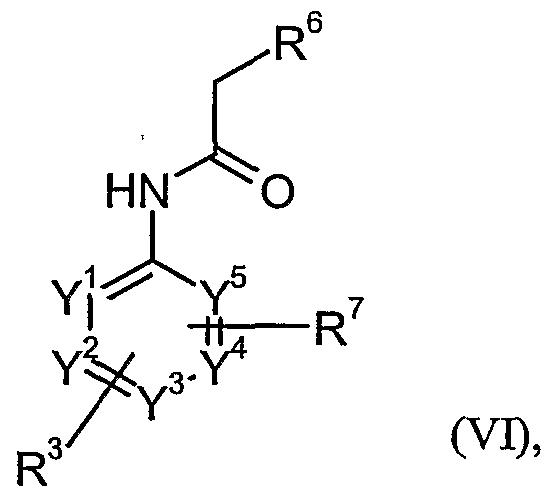
  • the present invention relates to processes for synthesizing the compounds of general formula (I), characterized in that
  • R 1 to R 7 , A and Y 1 to Y 5 have the meaning described above, are hydrolyzed with water
  • R , R , R , and Y to Y have the meaning described above, in the presence of a base, such as N-tettabutylammoniumfluoride or lithium diisopropyl- amide, to give compounds of general formula (VH) wherein R 1 to R 5 , R 6 , R 7 , A, and Y 1 to Y 5 have the meaning described above, which are then cyclized to compounds of general formula (I) in the presence of an acidic ion exchange resin, such as Amberlyst ® -15, and a dehydrating agent, such as magnesium sulfate.
  • a base such as N-tettabutylammoniumfluoride or lithium diisopropyl- amide
  • Suitable solvents for the process are generally customary organic solvents which do not change under the reaction conditions. These include ethers such as diethyl ether, diisopropyl ether, 1,2- dimethoxyethane, dioxan or tetrahydrofuran, ethylacetate, acetone, acetonitrile, dimethylsulfoxide, dimethylformamide, or alcohols such as methanol, ethanol, n-propanol, isopropanol, n-butanol or t-butanol, or hydrocarbons such as pentane, hexane, cyclohexane, benzene, toluene or xylene, or halogeno-hydrocarbons such as dichloromethane, dichloroethane, trichloromethane or chloro- benzene. It is also possible to use mixtures of the above-mentioned solvents. Preferred for the process is water and ace
  • the process can take place in the presence of an acid.
  • Suitable acids for the process are generally inorganic or organic acids. These preferably include carboxylic acids, such as, for example acetic acid or trifluoroacetic acid, or sulfonic acids, such as, for example, methanesulfonic acid or p- toluenesulfonic acid. Preference is given to acetic acid or trifluoroacetic acid.
  • the acid is employed in an amount from 0.25 mol to 100 mol, relative to 1 mol of the compound of the general formula (IT).
  • the process is in general carried out in a temperature range from +20°C to +150°C, preferably from +60°C to +130°C.
  • the process is generally carried out at normal pressure. However, it is also possible to carry it out at elevated pressure or at reduced pressure (for example in a range from 0.5 to 5 bar).
  • the compounds of general formula (H) can be synthesized by condensing compounds of general formula (TE)
  • Suitable solvents for the process are generally customary organic solvents which do not change under the reaction conditions. These include ethers such as diethyl ether, diisopropyl ether, 1,2- dimethoxyethane, dioxan or tetrahydrofuran, ethylacetate, acetone, acetonitrile, dimethylsulfoxide, dimethylformamide, or alcohols such as methanol, ethanol, n-propanol, isopropanol, n-butanol or t-butanol, or hydrocarbons such as pentane, hexane, cyclohexane, benzene, toluene or xylene, or halogeno-hydrocarbons such as dichloromethane, dichloroethane, trichloromethane or chloro- benzene. It is also possible to use inixtures of the above-mentioned solvents. Preferred for the process is ethanol.
  • Suitable bases for the process are generally inorganic or organic bases. These preferably include cyclic amines, such as, for example, piperidine, mo ⁇ holine, N-methylmo ⁇ holine, pyridine or 4-
  • NN-dimethylaminopyridine or (C C )-trialkyl-amines, such as, for. example, ttiethylamine or diisopropylethylamine.
  • the base is employed in an amount from 0.1 mol to 10 mol, preferably from 0.1 mol to 1 mol, relative to 1 mol of the compound of the general formula (IS).
  • the process is in general carried out in a temperature range from +20°C to +150°C, preferably from +60°C to +130°C.
  • the process is generally carried out at normal pressure. However, it is also possible to carry it out at elevated pressure or at reduced pressure (for example in a range from 0.5 to 5 bar).
  • the compounds of general formula (UT) can be synthesized by reacting compounds of general formula (X)
  • R 4 and R have the meaning described above.
  • Suitable solvents for the process are generally customary organic solvents which do not change under the reaction conditions. These include ethers such as diethyl ether, diisopropyl ether, 1,2- dimethoxyethane, dioxan or tetrahydrofuran, ethylacetate, acetone, acetonitrile, dimethylsulfoxide, dimethylformamide, or alcohols such as methanol, ethanol, n-propanol, isopropanol, n-butanol or t-butanol, or hydrocarbons such as pentane, hexane, cyclohexane, benzene, toluene or xylene, or halogeno-hydrocarbons such as dichloromethane, dichloroethane, trichloromethane or chloro- benzene.
  • acetic acid can be employed as solvent. It is also possible to use mixtures of the above-mentioned
  • Suitable acids for the process are generally inorganic or organic acids. These preferably include carboxylic acids, such as, for example acetic acid or trifluoroacetic acid, or sulfonic acids, such as, for example, methanesulfonic acid or p-toluenesulfonic acid. Preference is given to acetic acid or trifluoroacetic acid.
  • the acid is employed in an amount from 0.25 mol to 100 mol, relative to 1 mol of the compounds of the general formulas (X) and (XL), respectively.
  • the process is in general carried out in a temperature range from +20°C to +150°C, preferably from +60°C to +130°C.
  • the process is generally carried out at normal pressure. However, it is also possible to carry it out at elevated pressure or at reduced pressure (for example in a range from 0.5 to 5 bar).
  • compounds of the general formula (IV) can be prepared in sim, or in a first step compounds of the general formulas (VIII) and (XIT) can be reacted, and the resulting product is reacted with compounds of the general formulas (LLT) in a second step.
  • Suitable solvents for the process are generally customary organic solvents which do not change under the reaction conditions. These include ethers such as diethyl ether, diisopropyl ether, 1,2- dimethoxyethane, dioxan or tetrahydrofuran, ethylacetate, acetone, acetonitrile, dimethylsulfoxide, dimethylformamide, or alcohols such as methanol, ethanol, n-propanol, isopropanol, n-butanol or t-butanol, or hydrocarbons such as pentane, hexane, cyclohexane, benzene, toluene or xylene, or halogeno-hydrocarbons such as dichloromethane, dichloroethane, trichloromethane or chloro- benzene. It is also possible to use mixtures of the above-mentioned solvents. Preferred for the process is ethanol.
  • Suitable bases for the process are generally inorganic or organic bases. These preferably include cyclic amines, such as, for example, piperidine, mo ⁇ holine, N-methylmo ⁇ holine, pyridine or 4- N,N-dimethylaminopyridine, or (C ⁇ -C 4 )-trialkyl-amines, such as, for example, ttiethylamine or diisopropylethylamine. Preference is given to piperidine.
  • the base is employed in an amount from 0.1 mol to 10 mol, preferably from 0.1 mol to 1 mol, relative to 1 mol of the compound of the general formula (III).
  • the process is in general carried out in a temperature range from +20°C to +150°C, preferably from +60°C to +130°C.
  • the process is generally carried out at normal pressure. However, it is also possible to carry it out at elevated pressure or at reduced pressure (for example in a range from 0.5 to 5 bar).
  • the compounds of the general formula (IV) are known per se, or they can be prepared by reacting compounds of general formula (VEX), wherein R 1 , R 2 and A have the meaning described above, with compounds of general formula (XH)
  • R 6 has the meaning described above and Alk stands for alkyl, in the presence of a base.
  • Suitable solvents for the process are generally customary organic solvents which do not change under the reaction conditions. These include ethers such as diethyl ether, diisopropyl ether, 1,2- dimethoxyethane, dioxan or tetrahydrofuran, ethylacetate, acetone, acetonitrile, dimethylsulfoxide, dimethylformamide, or alcohols such as methanol, ethanol, n-propanol, isopropanol, n-butanol or t-butanol, or hydrocarbons such as pentane, hexane, cyclohexane, benzene, toluene or xylene, or halogeno-hydrocarbons such as dichloromethane, dichloroethane, trichloromethane or chloro- benzene. It is also possible to use mixtures of the above-mentioned solvents. Preferred for the ' process is m
  • Suitable bases for the process are generally inorganic or organic bases. These preferably include cyclic amines, such as, for example, piperidine, mo ⁇ holine, N-methylmo ⁇ holine, pyridine or 4- N,N-dimethylaminopyridine, or (C ⁇ -C 4 )-trialkyl-amines, such as, for example, ttiethylamine or diisopropylethylamine. Preference is given to piperidine.
  • the base is employed in an amount from 0.1 mol to 10 mol, preferably from 1 mol to 3 mol, relative to 1 mol of the compound of the general formula (XEf).
  • the process is in general carried out in a temperamre range from +20°C to +150°C, preferably from +60°C to +130°C.
  • the process is generally carried out at normal pressure. However, it is also possible to carry it out at elevated pressure or at reduced pressure (for example in a range from 0.5 to 5 bar).
  • the reaction (V) + (VI) -» (VH) is preferably carried out at room temperamre in tettahydrofuran as solvent.
  • the reaction (VH) -»• (I) is preferably carried out in alcoholic solvents, such as methanol or ethanol, at a temperamre range from +20°C to +80°C.
  • the process is generally carried out at normal pressure. However, it is also possible to carry it out at elevated pressure or at reduced pressure (for example in a range from 0.5 to 5 bar).
  • the compounds of the general formula (V) are available by Knoevenagel condensation between the compounds of general formula (VIE) and (XI).
  • the compounds of general formula (I) can also be synthesized by reacting compounds of general formula (V) with compounds of general formula (XHI)
  • R , R , and Y to Y have the meaning described above, and Z represents benzyl or allyl
  • R to R , R , A, Y to Y , and Z have the meaning described above,
  • R to R , R , A, and Y to ⁇ Y/5 have the meaning described above, and subsequently coupled with primary or secondary amines (as comprised in the definition of R 6 as described above) in the presence of a condensing agent and a base to give the amide derivatives of general formula (I).
  • the hydrogenolysis reaction in step (X1N) ⁇ (XV) is preferably carried out at room temperature in tettahydrofuran as solvent using palladium as hydrogenation catalyst.
  • the reaction is generally carried out at normal pressure. However, it is also possible to carry it out at elevated pressure (for example in a range from 1 to 10 bar).
  • allyl ester cleavage in step (XIV) - (XV) is preferably carried out at room temperamre in tettahydrofuran as solvent using tetrakis(triphenylphosphine)palladium(0) as catalyst in combination with mo ⁇ holine.
  • Suitable solvents for the amide forming reaction in step (XV) -> (I) are generally customary organic solvents which do not change under the reaction conditions. These include ethers such as diethyl ether, diisopropyl ether, 1,2-dimethoxyethane, dioxan or tettahydrofuran, or hydrocarbons such as pentane, hexane, cyclohexane, benzene, toluene or xylene, or halogeno-hydrocarbons such ' as dichloromethane, 1,2-dichloroethane, trichloromethane, tetrachloromethane or chlorobenzene, or other solvents such as ethyl acetate, acetonitrile, pyridine, dimethylsulfoxide, N,N-dimethyl- formamide, NN'-dimethylpropylene urea (DMPU) or N-methylpyrrolidone ( ⁇ MP). It
  • Suitable coupling agents for the amide forming reaction in step (XV) -» (I) include, for instance, carbodiimides such as N,N'-diethyl-, NN'-dipropyl-, N,N'-diisopropyl-, N,N'-dicyclohexylcarbodi- imide (DCC), N-(3-dimethylaminoisopropyl)-N'-ethylcarbodiimide hydrochloride (EDC), or phosgene derivatives such as N,N'-carbonyldiimidazole, or 1,2-oxazolium compounds such as 2- ethyl-5-phenyl-l,2-oxazolium-3-sulfate or 2-tert.-butyl-5-methyl-isoxazolium-perchlorate, or acyl- amino derivatives such as 2-ethoxy-l-ethoxycafbonyl-l,2-dihydroquinoline,
  • sodium or potassium carbonate or hydrogencarbonate or organic bases such as trialkyl amines or cyclic amines, e.g. ttiethylamine, N-methylmo ⁇ holine, N- methylpiperidine, N,N-diisopropylethylamine or pyridine.
  • Preferred for the process is TBTU in combination with N,N-diisopropylethylamine.
  • the amide forming reaction in step (XV) - (I) is generally carried out in a temperature range from 0°C to +100°C, preferably from 0°C to +40°C.
  • the process is generally carried out at normal pressure. However, it is also possible to carry it out at elevated pressure or at reduced pressure (for example in a range from 0.5 to 5 bar).
  • the compounds of the present invention show human neutrophil elastase (HNE) inhibitory activity and are therefore suitable for the preparation of medicaments for the treatment of diseases associated with HNE activity. They may thus provide an effective treatment of acute and chronic inflammatory processes, such as rheumatoid arthritis, atherosclerosis, and especially of acute and chronic pulmonary diseases, such as lung fibrosis, cystic fibrosis, pneumonia, acute respiratory distress syndrome (ARDS), in particular pulmonary emphysema, including smoking- induced emphysema, and chronic obstructive pulmonary diseases (COPD), chronic bronchitis and bronchiectasis.
  • HNE human neutrophil elastase
  • the compounds of the present invention may further provide an effective treatment for cardiovascular ischaemic diseases such as acute coronary syndrome, acute myocardial infarction, unstable and stable angina pectoris, coronary artery bypass grafts (CABG) and heart failure development, for atherosclerosis, mitral valvular disease, atrial septal defects, percutaneous transluminal coronary angioplasty (PTCA), inflammation after open heart surgery and for pulmonary hypertension.
  • cardiovascular ischaemic diseases such as acute coronary syndrome, acute myocardial infarction, unstable and stable angina pectoris, coronary artery bypass grafts (CABG) and heart failure development, for atherosclerosis, mitral valvular disease, atrial septal defects, percutaneous transluminal coronary angioplasty (PTCA), inflammation after open heart surgery and for pulmonary hypertension.
  • rheumatoid arthritis acute inflammatory arthritis, cancer, acute pancreatitis, ulcerative colitis, periodontal disease, Chury-Strauss syndrome, acute and chronic atopic dermatitis, psoriasis, systemic lupus erythematosus, bullous pemphigus, sepsis, alcoholic hepatitis, liver fibrosis, Behcet's disease, allergic fungal sinusitis, allergic sinusitis, Crohn's disease, Kawasaki disease, glomerulonephritis, acute pyelonephritis, colorectal diseases, chronic suppurative otitis media, chronic venous leg ulcers, inflammatory bowel disease, bacterial and viral infections, brain trauma, stroke and other conditions in which neutrophil participation is involved.
  • the present invention further provides medicaments containing at least one compound according to the invention, preferably together with one or more pharmacologically safe excipient or carrier substances, and also their use for the abovementioned pu ⁇ oses.
  • the active component can act systemically and/or locally.
  • it can be applied in a suitable manner, for example orally, parenterally, pulmonally, nasally, sublingually, lingually, buccally, rectally, transdermally, conjunctivally, otically or as an implant.
  • the active component can be administered in suitable application forms.
  • Useful oral application forms include application forms which release the active component rapidly and or in modified form, such as for example tablets (non-coated and coated tablets, for example with an enteric coating), capsules, sugar-coated tablets, granules, pellets, powders, emulsions, suspensions, solutions and aerosols.
  • Parenteral application can be carried out with avoidance of an abso ⁇ tion step (intravenously, intraarterially, intracardially, intraspinally or intralumbarly) or with inclusion of an abso ⁇ tion (intramuscularly, subcutaneously, intracutaneously, percutaneously or intraperitoneally).
  • Useful parenteral application forms include injection and infusion preparations in the form of solutions, suspensions, emulsions, lyophilisates and sterile powders.
  • Forms suitable for other application routes include for example inhalatory pharmaceutical forms (including powder inhalers, nebulizers), nasal drops/solutions, sprays; tablets or capsules to be administered lingually, sublingually or buccally, suppositories, ear and eye preparations, vaginal capsules, aqueous suspensions (lotions, shake mixtures), lipophilic suspensions, ointments, creams, milk, pastes, dusting powders or implants.
  • inhalatory pharmaceutical forms including powder inhalers, nebulizers
  • nasal drops/solutions, sprays including lingually, sublingually or buccally, suppositories, ear and eye preparations, vaginal capsules, aqueous suspensions (lotions, shake mixtures), lipophilic suspensions, ointments, creams, milk, pastes, dusting powders or implants.
  • the active components can be converted into the recited application forms in a manner known per se. This is carried out using inert non-toxic, pharmaceutically suitable excipients.
  • inert non-toxic, pharmaceutically suitable excipients include inter alia carriers (for example microcrystalline cellulose), solvents (for example liquid polyethylene glycols), emulsif ⁇ ers (for example sodium dodecyl sulphate), dispersing agents (for example polyvinylpyrrolidone), synthetic and natural biopolymers (for example albumin), stabilizers (for example antioxidants such as ascorbic acid), colorants (for example inorganic pigments such as iron oxides) or taste and/or odor corrigents.
  • carriers for example microcrystalline cellulose
  • solvents for example liquid polyethylene glycols
  • emulsif ⁇ ers for example sodium dodecyl sulphate
  • dispersing agents for example polyvinylpyrrolidone
  • synthetic and natural biopolymers for example albumin
  • stabilizers for
  • oral administration in the case of oral administration, it is recommendable to administer doses of from 0.001 to 50 mg kg, preferably of 0.01 mg/kg to 20 mg/kg.
  • parenteral administration such as, for example, intravenously or via mucous membranes nasally, buccally or inhalationally, it is recommendable to use doses of 0.001 mg/kg to 0.5 mg/kg.
  • assay buffer 0.1 M HEPES-NaOH buffer pH 7.4, 0.5 M NaCl, 0.1% (w/v) bovine serum albumin;
  • HNE HNE (18 U/mg lyophil., #20927.01, SERVA Electrophoresis GmbH, Heidelberg, Germany) in assay buffer;
  • test compounds diluted with assay buffer from a 10 mM stock solution in DMSO.
  • the elastase substrate MeOSuc-Ala-Ala-Pro-Val-AMC (#324740, Calbiochem- Novabiochem Co ⁇ oration, Merck KGaA, Darmstadt, Germany) is used.
  • the test solution is prepared by mixing 10 ⁇ l of test compound dilution, 20 ⁇ l of HNE enzyme dilution (final concentration 8 - 0.4 ⁇ U/ml, routinely 2.1 ⁇ U/ml) and 20 ⁇ l of substrate dilution (final concentration 1 mM - 1 ⁇ M, routinely 20 ⁇ M), respectively.
  • the solution is incubated for 0 - 2 hrs at 37°C (routinely one hour).
  • the fluorescence of the liberated AMC due to the enzymatic reaction is measured at 37°C (TECAN spectra fluor plus plate reader).
  • the rate of increase of the fluorescence (ex. 395 nm, em. 460 nm) is proportional to elastase activity.
  • IC 50 values are determined by RFU-versus-[EJ plots.
  • K m and K m(app . ) values are determined by Lineweaver-Burk plots and converted to K; values by Dixon plots.
  • the elastase substrate elastin-fluorescein (#100620, ICN Biomedicals GmbH, Eschwege, Germany) is used.
  • the test solution is prepared by mixing 3 ⁇ l of test compound dilution, 77 ⁇ l of HNE enzyme dilution (final concentration 0.22 U/ml - 2.2 mU/ml, routinely 21.7 ⁇ U/ml) and 80 ⁇ l substrate suspension (final concentration 2 mg/ml).
  • the suspension is incubated for 0 - 16 hrs at 37°C (routinely four hours) under slightly shaking conditions.
  • 160 ⁇ l of 0.1 M acetic acid are added to the test solution (final concentration 50 mM).
  • the polymeric elastin-fluorescein is pulled down by centrifugation (Eppendorf 5804 centrifuge, 3.000 ⁇ m, 10 min). The supernatant is transferred into a new MTP and the fluorescence of the liberated peptide fluorescein due to the enzymatic reaction is measured (BMG Fluostar plate reader). The rate of fluorescence (ex. 490 nm, em. 520 nm) is proportional to elastase activity. IC 50 values are determined by RFU-versus-[I] plots. ⁇ . In vitro human neutrophil assays
  • This assay is used to determine the elastolytic potential of human polymo ⁇ honuclear cells (PMNs) and assess the proportion of degradation due to neutrophil elastase [cf. Z.W. She et al., Am. J. Respir. Cell. Mol. Biol. 9, 386-392 (1993)].
  • Tritiated elastin, in suspension, is coated on to a 96 well plate at 10 ⁇ g per well.
  • Test and reference [ZD-0892 (J. Med. Chem. 40, 1876-1885, 3173-3181 (1997), WO 95/21855) and ⁇ l protease inhibitor ( ⁇ lPI)] compounds are added to the wells at the appropriate concentrations.
  • Human PMNs are separated from peripheral venous blood of healthy donors and resuspended in culmre media.
  • the neutrophils are added to the coated wells at concentrations ranging between 1 x 10 6 to 1 x 10 5 cells per well.
  • Porcine pancreatic elastase (1.3 ⁇ M) is used as a positive conttol for the assay, and ⁇ lPI (1.2 ⁇ M) is used as the positive inhibitor of neutrophil elastase.
  • the cellular , control is PMNs without compound at each appropriate cell density.
  • the cells plus compounds are incubated in a humidified incubator at 37°C for 4 hours.
  • the plates are centrifuged to allow the ' harvest of cell supernatant only.
  • the supernatant is transferred in 75 ⁇ l volumes to corresponding wells of a 96 well LumaplateTM (solid scintillant containing plates). The plates are dried until no liquid is visible in the wells and read in a beta counter for 3 minutes per well.
  • Elastolysis of the 3 H-elastin results in an increase in counts in the supernatant.
  • An inhibition of this elastolysis shows a decrease, from the cellular control, of tritium in the supernatant.
  • Measurement of the inhibition of elastase bound to neutrophil membranes is performed using a human neutrophil assay. Neutrophils are stimulated with LPS at 37°C for 35 min and then spun at 1600 ⁇ m. Subsequently, the membrane bound elastase is fixed to the neutrophils with 3% paraformaldehyde and 0.25% glutaraldehyde for 3 min at 4°C. The neutrophils are then spun, and vehicle and the compound under evaluation are added, followed by addition of the substrate MeOSuc-Ala-Ala-Pro-Val-AMC (#324740, Calbiochem-Novabiochem Co ⁇ oration, Merck KGaA, Darmstadt, Germany) at 200 ⁇ M.
  • IC 50 values are determined by inte ⁇ olation from plots of relative fluorescence vs. inhibitor concentration.
  • HNE human neutrophil elastase
  • Rats are anaesthetised with Hypnorm/Hypnovel/water and instilled with HNE or saline delivered by microsprayer into the lungs.
  • Test compounds are administered by intravenous injection, by oral gavage or by inhalation at set times prior to the administration of HNE.
  • Sixty minutes after the administration of elastase animals are killed by an anaesthetic overdose (sodium pentobarbitone) and the lungs lavaged with 2 ml heparinised phosphate buffered saline (PBS).
  • Bronchoalveolar lavage (BAL) volume is recorded and the samples kept on ice. Each BAL sample is centrifuged at 900 r.p.m.
  • the absorbance of the well contents is measured at 415 nm using a specttophotometer.
  • a standard curve is constructed by measuring the OD at 415 nm of different concentrations of blood in 0.1% CTAB/PBS. Blood content values are calculated by comparison to the standard curve (included in each plate) and normalised for the volume of BAL fluid retrieved.
  • the compounds of this mvention are evaluated intravenously, orally or by inhalation for their inhibitory activity in this model of HNE-induced haemorrhage in the rat.
  • Elastase inhibitors are tested in a rat thread infarct model.
  • Male Wistar rats (weighing >300 g) receive 10 mg/kg aspirin 30 min prior to surgery. They are anaesthetized by isofluran and ventilated (120-130 strokes/min, 200-250 ⁇ l stroke volume; MiniVent Type 845, Hugo Sachs Elekttonik, Germany) during the whole surgery.
  • MiniVent Type 845 Hugo Sachs Elekttonik, Germany
  • the thorax is closed and the animal is allowed to recover for 4 days.
  • rats are anaesthetized with ether for 3 min, and the thread is tied and the LAD occluded under ECG control.
  • Test compounds are administered before or after LAD occlusion per os, intraperitoneally or intravenously (bolus or permanent infusion). After 1 hr occlusion, the thread is reopened to allow reperfusion.
  • Hearts are excised, and infarct sizes are determined 48 hours later by staining of the re-occluded hearts with Evans blue, followed by TTC (ttiphenyltetrazolium chloride) staining of 2 mm heart sections.
  • Normoxic not occluded tissue areas stain blue, ischemic (occluded but surviving tissue) areas stain red and necrotic (occluded dead tissue) areas remain white. Each tissue section is scanned and infarct sizes are determined by computer planimetry.
  • Example 1A To a tettahydrofuran (350 ml) solution of ethyl 3-oxo-3- ⁇ [3-(trifluoromethyl)phenyl]amino ⁇ - propanoate (5 g, 18.17 mmol) (Example 1A) is added lithium hydroxide (435 mg, 18.17 mmol) in water (150 ml). The solution is stirred at room temperature for 4 hours, and then concentrated to afford a white solid. The crude product is used without further purification.
  • the reaction is stirred for 2 hours at room temperature, then concentrated in vacuo and chromatographed over silica gel 60 with cyclohexane / ethyl acetate mixtures as eluent.
  • the product is isolated as a mixture of diastereomers.
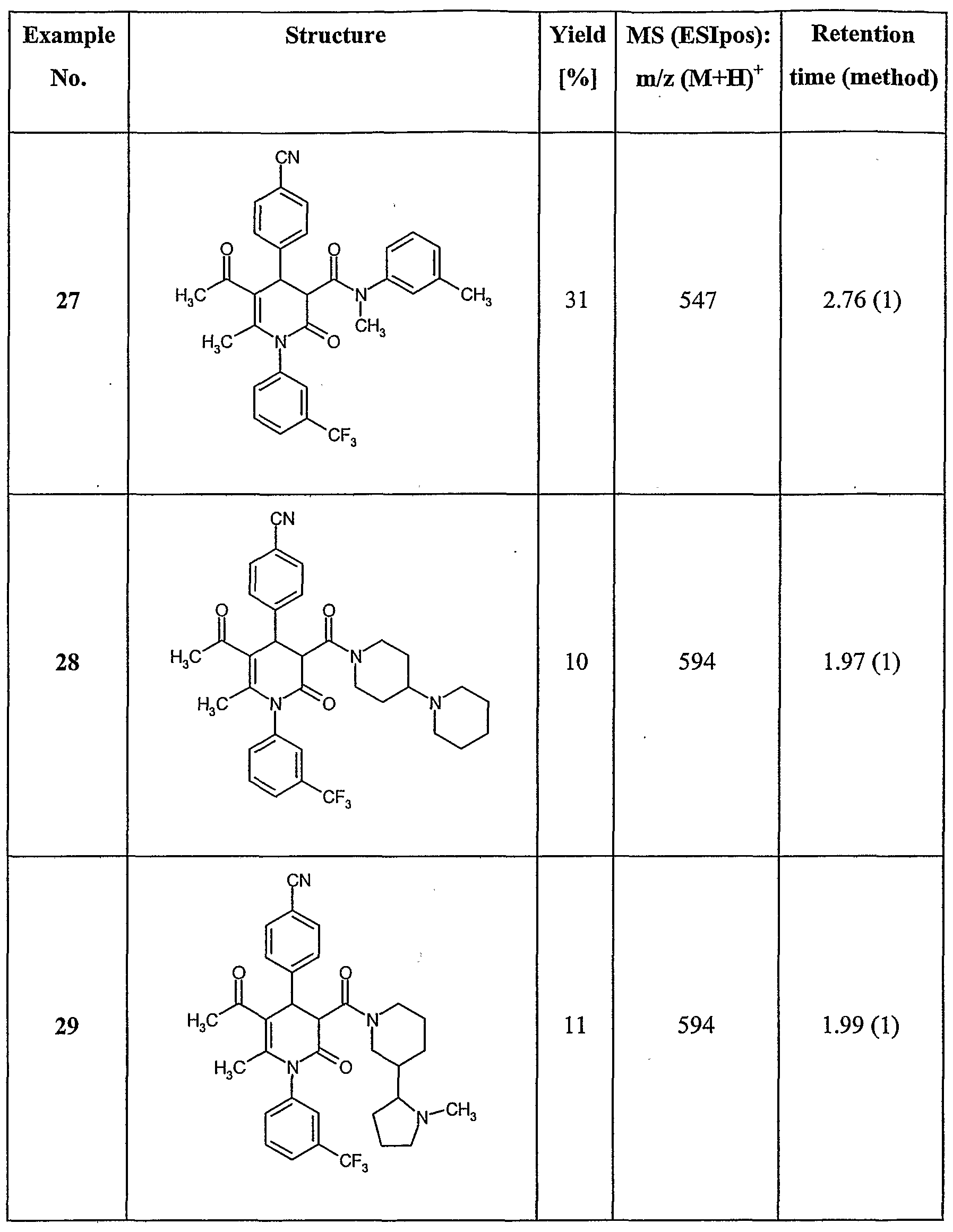
  • Example 7A A solution of Example 7A (0.10 mmol), N-[(lH-l,2,3-benzottiazol-l-yloxy)(dimethylamino)- methylene]-N-methylmethanaminium tetrafluoroborate (0.13 mmol), diisopropylethylamine (0.20 ml) and respective amine component (0.10 mmol) in dimethylsulfoxide (0.50 ml) is stirred at room temperamre overnight.
  • the compounds according to the invention can be converted into pharmaceutical preparations as follows:
  • Example 1 100 mg of the compound of Example 1, 50 mg of lactose (monohydrate), 50 mg of maize starch (native), 10 mg of polyvinylpyrrolidone (PVP 25) (from BASF, Ludwigshafen, Germany) and 2 mg of magnesium stearate.
  • the mixture of active component, lactose and starch is granulated with a 5% solution (m/m) of the PVP in water. After drying, the granules are mixed with magnesium stearate for 5 min. This mixture is moulded using a customary tablet press (tablet format, see above). The moulding force . applied is typically 15 kN.
  • a single dose of 100 mg of the compound according to the invention is provided by 10 ml of oral suspension.
  • Rhodigel is suspended in ethanol and the active component is added to the suspension.
  • the water is added with stirring. Stirring is continued for about 6h until the swelling of the Rhodigel is complete.

Landscapes

  • Chemical & Material Sciences (AREA)
  • Organic Chemistry (AREA)
  • Health & Medical Sciences (AREA)
  • Engineering & Computer Science (AREA)
  • Bioinformatics & Cheminformatics (AREA)
  • Pharmacology & Pharmacy (AREA)
  • Veterinary Medicine (AREA)
  • Chemical Kinetics & Catalysis (AREA)
  • General Chemical & Material Sciences (AREA)
  • Medicinal Chemistry (AREA)
  • Nuclear Medicine, Radiotherapy & Molecular Imaging (AREA)
  • Life Sciences & Earth Sciences (AREA)
  • Animal Behavior & Ethology (AREA)
  • General Health & Medical Sciences (AREA)
  • Public Health (AREA)
  • Cardiology (AREA)
  • Heart & Thoracic Surgery (AREA)
  • Hospice & Palliative Care (AREA)
  • Urology & Nephrology (AREA)
  • Vascular Medicine (AREA)
  • Pain & Pain Management (AREA)
  • Rheumatology (AREA)
  • Pulmonology (AREA)
  • Pharmaceuticals Containing Other Organic And Inorganic Compounds (AREA)
  • Plural Heterocyclic Compounds (AREA)
  • Nitrogen Condensed Heterocyclic Rings (AREA)
  • Pyridine Compounds (AREA)

Abstract

The invention relates to novel dihydropyridinone derivatives, processes for their preparation, and their use in medicaments, especially for the treatment of chronic obstructive pulmonary diseases, acute coronary syndrome, acute myocardial infarction and heart failure development.

Description

Dihydropyridinone derivatives
The present invention relates to novel dihydropyridinone derivatives, processes for their preparation, and their use in medicaments, especially for the treatment of chronic obstructive pulmonary diseases, acute coronary syndrome, acute myocardial infarction and heart failure development.
The fibrous protein elastin, which comprises an appreciable percentage of all protein content in some tissues, such as the arteries, some ligaments, the lungs and the heart, can be hydrolysed or otherwise destroyed by a select group of enzymes classified as elastases. Human leukocyte elastase (HLE, EC 3.4.21.37), also known as human neutrophil elastase (HNE), is a glycosylated, strongly basic serine protease and is found in the azurophilic granules of human polymoφhonuclear leukocytes (PMN). HNE is released from activated PMN and has been implicated causally in the pathogenesis of acute and chronic inflammatory diseases. HNE is capable of degrading a wide range of matrix proteins including elastin and collagen, and in addition to these actions on connective tissue HNE has a broad range of inflammatory actions including upregulation of E -8 gene expression, oedema formation, mucus gland hypeφlasia and mucus hypersecretion. It also acts as a mediator of tissue injury by hydrolysing collagen structures, e.g. in the heart after acute myocardial infarction or during the development of heart failure, thus damaging endothelial cells, promoting extravasation of neutrophils adhering to the endothelium and influencing the adhesion process itself.
Pulmonary diseases where HNE is believed to play a role include lung fibrosis, pneumonia, acute respiratory distress syndrome (ARDS), pulmonary emphysema, including smoking-induced emphysema, chronic obstructive pulmonary diseases (COPD) and cystic fibrosis. In cardiovascular diseases, HNE is involved in the enhanced generation of ischaemic tissue injury followed by myocardial dysfunction after acute myocardial infarction and in the remodelling processes occurring during the development of heart failure. HNE has also been causally implicated in rheumatoid arthritis, atherosclerosis, brain trauma, cancer and related conditions in which neutrophil participation is involved.
Thus, inhibitors of HLE activity can be potentially useful in the treatment of a number of inflammatory diseases, especially of chronic obstructive pulmonary diseases [R.A. Stockley, Neutrophils and protease/antiprotease imbalance, Am. J. Respir. Crit. Care 160. S49-S52 (1999)]. Inhibitors of HLE activity can also be potentially useful in the treatment of acute myocardial syndrome, unstable angina pectoris, acute myocardial infarction and coronary artery bypass grafts (CABG) [C.P. Tiefenbacher et al., Inhibition of elastase improves myocardial function after repetitive ischaemia and myocardial infarction in the rat heart, Eur. J. Physiol. 433. S563-S570 (1997); Dinerman et al., Increased neutrophil elastase release in unstable angina pectoris and acute myocardial infarction, J. Am. Coll. Cardiol. 15, 1559-1563 (1990)], of the development of heart failure [S.J. Gilbert et al., Increased expression of promatrix metalloproteinase-9 and neutrophil elastase in canine dilated cardiomyopathy, Cardiov. Res. 34, S377-S383 (1997)] and of atherosclerosis PoUery et al., Neutrophil elastase in human atherosclerotic plaque, Circulation 107. 2829-2836 (2003)].
Ethyl 6-armno-l,4-bis(4-chloroρhenyl)-5-cyano-2-methyl-l,4-dihydro-3-pyridinecarboxylate has been synthesized and tested for potential antimicrobial activity as described in A.W. Erian et al, Pharmazie 53 (11), 748-751 (1998).
The present invention relates to compounds of the general formula (I)
Figure imgf000003_0001
wherein
A represents an aryl or heteroaryl ring,
R1, R2 and R3 independently from each other represent hydrogen, halogen, nitro, cyano, trifluoro- methyl, C C6-alkyl, hydroxy, C C6-alkoxy or trifluoromethoxy, wherein Ci-Cβ-alkyl and C C6-alkoxy can be further substituted with one to three identical or different radicals selected from the group consisting of hydroxy and C C -alkoxy,
R4 represents CrC6-alkylcarbonyl, C C6-alkoxycarbonyl, C2-C6-alkenoxycarbonyl, hydroxy- carbonyl, aminocarbonyl, mono- or di-Ci-Cό-alkylaminocarbonyl, C3-C8-cycloalkylamino- carbonyl, N-(heterocyclyl)-aminocarbonyl or cyano, wherein Cι-C6-alkylcarbonyl, Cι-C6- alkoxycarbonyl, mono- and di-Cι-C6-alkylaminocarbonyl can be substituted with one to three identical or different radicals selected from the group consisting of hydroxy, Ci-C4- alkoxy, hydroxycarbonyl, Cι-C4-alkoxycarbonyl, amino, mono- and di-C C4-alkylamino, aminocarbonyl, mono- and di-Cι-C4-alkylaminocarbonyl, Cι-C4-alkylcarbonylamino, phenyl, heteroaryl and heterocyclyl, and wherein phenyl can be further substituted with halogen and wherein N-(heterocyclyl)-aminocarbonyl can be further substimted with - C4-alkyl or benzyl, represents Cι-C -alkyl, represents
- a group of the formula
Figure imgf000004_0001
which can be substimted by up to two radicals independently selected from the group consisting of Ci-Cβ-alkyl, CrC6-alkoxy, hydroxycarbonyl, Cι-C6-alkoxycarbonyl and phenoxy which for its part can be further substituted by halogen or trifluoromethyl,
- a group of the formula
Figure imgf000004_0002
which are substimted by one or two radicals independently selected from the group consisting of Cι-C6-alkyl, hydroxy, Ci-Ce-alkoxy, hydroxycarbonyl, Cι-C6-alkoxycarbonyl, Cι-C6-alkoxycarbonylamino, oxo, N- -Cβ-alkylimino, N-C Cβ-alkoxyimmo, benzyl and 5- to 6-membered heterocyclyl which for its part can be further substituted by Cι-C -alkyl,
- a group of the formula
Figure imgf000004_0003
wherein Z represents CH2 or Ν-R6A, wherein R6A represents hydrogen, Cι-C6-alkyl, Cι-C6- alkylcarbonyl or CrC6-alkoxycarbonyl, - a group of the formula
Figure imgf000005_0001
wherein R is selected from the group consisting of
• phenyl or 5- to 6-membered heteroaryl each of which can be further substimted by up to three radicals independently selected from the group consisting of halogen, trifluoromethyl, nitro, cyano, Cι-C6-alkyl, hydroxycarbonyl, C C6-alkoxycarbonyl and Ci-Cβ-alkylcarbonyl,
• C3-C8-cycloalkyl
• Ci-Cg-alkyl which is substituted by hydroxy, Ci-Cβ-alkoxy, di-Ci-Cg-alkylamino, hydroxycarbonyl, Ci-Cβ-alkoxycarbonyl, 5- to 6-membered heterocyclyl or by 5- to 6-membered heteroaryl or phenyl which for their part can be further substituted by, up to three radicals independently selected from the group consisting of C C4-alkyl, halogen and hydroxycarbonyl,
• 5- to 6-membered heteroarylcarbonyl and
• Ci-Cβ-alkoxycarbonyl,
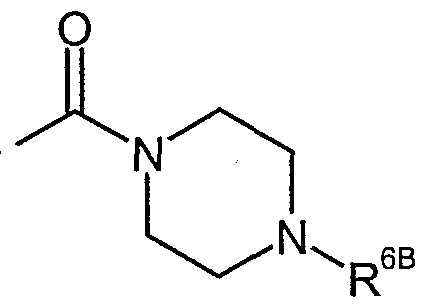
- a group of the formula
Figure imgf000005_0002
- a group of the formula
Figure imgf000006_0001
wherein R6C represents hydrogen or C C -alkyl, and R60 represents hydrogen or halogen,
Figure imgf000006_0002
wherein n represents an integer of 1 or 2,
mono- or di-CrC6-alkylaminocarbonyl wherein the alkyl moiety or at least one alkyl moiety, respectively, is substimted by phenyl or 5- to 6-membered heteroaryl each of which are further substimted by one, two or three radicals independently selected from the group consisting of halogen, nitro, cyano, trifluoromethyl, CrC4-alkyl, hydroxy, - -alkoxy, trifluoromethoxy, di-Cι-C -alkylamino, hydroxycarbonyl and Cι-C4-alkoxycarbonyl, -Cβ-alkoxy which is further substimted by hydroxy, Cι-C -alkoxy, di-Cι-C4-alkyl- amino, Cι-C -alkoxycarbonyl or hydroxycarbonyl, phenoxy
N-Cι-C -alkyl-N-phenylamino
C3-C8-cycloalkyl
• cyano or by • a group of the formula
Figure imgf000007_0001
wherein R6E represents CrC6-alkyl, Cι-C6-alkylcarbonyl, Cι-C6-alkoxycarbonyl or phenyl which for its part can be further substimted by halogen, Cι-C4-alkyl or Cι-C - alkoxy,
- N-C C6-alkyl-N-C3-C8-cycloalkylaminocarbonyl wherein the alkyl moiety can be further substituted by phenyl, 5- to 6-membered heteroaryl, hydroxycarbonyl or Cι-C6-alkoxy- carbonyl,
- arylaminocarbonyl wherein the aryl moiety is further substimted- by one, two or three radicals independently selected from the group consisting of trifluoromethyl and Cι-C4- alkyl,
- N- -Cβ-alkyl-N-arylaminocarbonyl wherein the aryl moiety is substimted by one, two or three radicals independently selected from the group consisting of Cι-C4-alkyl and halogen, and/or wherein the alkyl moiety is substimted by phenyl, or
- a group of the formula
Figure imgf000007_0002
wherein R6F represents hydrogen hydrogen, C C6-alkyl, Cι-C6-alkylcarbonyl or C C6- alkoxycarbonyl, represents hydrogen, halogen, nitro, cyano, trifluoromethyl, C C6-alkyl, hydroxy, CrC6- alkoxy or trifluoromethoxy, wherein C C6-alkyl and Cι-C6-alkoxy can be further sub- stituted with one to three identical or different radicals selected from the group consisting of hydroxy and CrC4-alkoxy,
and
Y1, Y2, Y3, Y4 and Y5 independently from each other represent CH or N, wherein the ring contains either 0, 1 or 2 nitrogen atoms.
The compounds according to this invention can also be present in the form of their salts, hydrates and/or solvates.
Physiologically acceptable salts are preferred in the context of the present invention.
Physiologically acceptable salts according to the invention are non-toxic salts which in general are accessible by reaction of the compounds (I) with an inorganic or organic base or acid conventionally used for this puφose. Non-limiting examples of pharmaceutically acceptable salts of compounds (I) include the alkali metal salts, e.g. lithium, potassium and sodium salts, the alkaline earth metal salts such as magnesium and calcium salts, the quaternary ammonium salts such as, for example, triethyl ammonium salts, acetates, benzene sulphonates, benzoates, dicarbonates, disulphates, ditartrates, borates, bromides, carbonates, chlorides, citrates, dihydrochlorides, fumarates, gluconates, glutamates, hexyl resorcinates, hydrobromides, hydrochlorides, hydroxy- naphthoates, iodides, isothionates, lactates, laurates, malates, maleates, mandelates, mesylates, methylbromides, methylnitrates, methylsulphates, nitrates, oleates, oxalates, palmitates, panto- thenates, phosphates, diphosphates, polygalacturonates, salicylates, stearates, sulphates, succinates, tartrates, tosylates, valerates, and other salts used for medicinal pmposes.
Hydrates of the compounds of the invention or their salts are stoichiometric compositions of the compounds with water, such as for example hemi-, mono-, or dihydrates.
Solvates of the compounds of the invention or their salts are stoichiometric compositions of the compounds with solvents.
The present invention includes both the individual enantiomers or diastereomers and the corresponding racemates or diastereomeric mixtures of the compounds according to the invention and their respective salts. In addition, all possible tautomeric forms of the compounds described above are included according to the present invention. The diastereomeric mixtures can be separated into the individual isomers by chromatographic processes. The racemates can be resolved into the respective enantiomers either by chromatographic processes on chiral phases or by resolution. lh the context of the present invention, the substituents, if not stated otherwise, in general have the following meaning:
Alkyl in general represents a straight-chain or branched hydrocarbon radical having 1 to 6, preferably 1 to 4 carbon atoms. Non-limiting examples include methyl, ethyl, n-propyl, isopropyl, n-butyl, isobutyl, sec-butyl, tert.-butyl, pentyl, isopentyl, hexyl, isohexyl. The same applies to radicals such as alkoxy, alkylamino, alkoxycarbonyl and alkoxycarbonylamino.
Alkoxy illustratively and preferably represents methoxy, ethoxy, n-propoxy, isopropoxy, ter -butoxy, n-pentoxy and n-hexoxy.
Alkenoxy illustratively and preferably represents allyloxy, but-2-en-l-oxy, pent-3-en-l-oxy and hex- 2-en-l-oxy.
Alkylcarbonyl in general represents a straight-chain or branched hydrocarbon radical having 1 to 6, preferably 1 to 4 carbon atoms which has a carbonyl function at the position of attachment. Non- limiting examples include formyl, acetyl, n-propionyl, n-butyryl, isobutyryl, pivaloyl, n-hexanoyl.
Alkylcarbonylamino in general represents a straight-chain or branched hydrocarbon radical having 1 to 6, preferably 1 to 4 carbon atoms which has a carbonylamino (-CO-NH-) function at the position of attachment and which is bonded to the carbonyl group. Non-limiting examples include formylamino, acetylamino, n-propionylamino, n-butyrylamino, isobutyrylamino, pivaloylamino, n- hexanoylamino.
Alkoxycarbonyl illustratively and preferably represents methoxycarbonyl, ethoxycarbonyl, n-prop- oxycarbonyl, isopropoxycarbonyl, tert.-butoxycarbonyl, n-pentoxycarbonyl and n-hexoxycarbonyl.
Alkenoxycarbonyl illustratively and preferably represents allyloxycarbonyl, but-2-en-l -oxycarbonyl, pent-3 -en- 1 -oxycarbonyl and hex-2-en-l-oxycarbonyl.
Alkylamino represents an alkylamino radical having one or two (independently selected) alkyl substituents, illustratively and preferably representing methylamino, ethylamino, n-propylamino, isopropylamino, tert.-butylamino, n-pentylamino, n-hexylamino, NN-dimethylamino, N,N-diethyl- amino, N-ethyl-N-memylamino, N-methyl-N-n-propylamino, N-isopropyl-N-n-propylamino, N-tert- butyl-N-methylamino, N-ethyl-N-n-pentylamino and N-n-hexyl-N-methylamino.
Alkylaminocarbonyl represents an alkylaminocarbonyl radical having one or two (independently selected) alkyl substituents, illustratively and preferably representing methylaminocarbonyl, ethyl- aminocarbonyl, n-propylaminocarbonyl, isopropylaminocarbonyl, tert-butylaminocarbonyl, n-pentyl- aminocarbonyl, n-hexylaminocarbonyl, NN-dimethylaminocarbonyl, N,N-diethylaminocarbonyl, N- ethyl-N-methylaminocarbonyl, N-memyl-N-n-propylaminocarbonyl, N-isopropyl-N-n-propylamino- carbonyl, N-tert.-butyl-N-methylaminocarbonyl, N-ethyl-N-n-pentylamino-carbonyl and N-n-hexyl-N- methylaminocarbonyl.
Alkylsulfonyloxy in general represents a straight-chain or branched hydrocarbon radical having 1 to 4, preferably 1 to 3 carbon atoms which has a sulfonyloxy (-SO2-O-) function at the position of attachment and which is bonded to the sulfonyl group. Νon-limiting examples include methyl- sulfonyloxy, ethylsulfonyloxy, n-propylsulfonyloxy, isopropylsulfonyloxy, n-butylsulfonyloxy, ter - butylsulfonyloxy.
Cycloalkyl in general represents a cyclic saturated hydrocarbon radical having 3 to 8, preferably 3 to 6 carbon atoms. Νon-limiting examples include cyclopropyl, cyclobutyl, cyclopentyl, cyclohexyi and cycloheptyl.
Cycloalkylaminocarbonyl represents a cycloalkylaminocarbonyl radical having one or two (independently selected) cycloalkyl substituents with 3 to 8, preferably 4 to 6 ring carbon atoms which is bound via a carbonyl group, illustratively and preferably representing cyclopropyl-- aminocarbonyl, cyclobutylaminocarbonyl, cyclopentylaminocarbonyl, cyclohexylaminocarbonyl and cycloheptylaminocarbonyl.
Aryl per se and in arylcarbonyl. aryloxycarbonyl or arylaminocarbonyl represents a mono- to tricyclic aromatic carbocyclic radical having generally 6 to 14 carbon atoms, illustratively and preferably representing phenyl, naphthyl and phenanthrenyl.
Arylcarbonyl illustratively and preferably represents benzoyl and naphthoyl.
Aryloxycarbonyl illustratively and preferably represents phenoxycarbonyl and naphthoxycarbonyl.
Arylaminocarbonyl illustratively and preferably represents phenylaminocarbonyl and naphthyl- aminocarbonyl.
Heteroaryl represents an aromatic mono- or bicyclic radical having generally 5 to 10 and preferably 5 or 6 ring atoms and up to 5 and preferably up to 4 hetero atoms selected from the group consisting of S, O and Ν, illustratively and preferably representing thienyl, furyl, pyrrolyl, thiazolyl, oxazolyl, imidazolyl, pyridyl, pyrimidyl, pyridazinyl, indolyl, indazolyl, benzofuranyl, benzothiophenyl, quinolinyl, isoquinolinyl.
Heterocyclyl per se and in heterocyclylcarbonyl represents a mono- or polycyclic, preferably mono- or bicyclic, nonaromatic heterocyclic radical having generally 4 to 10 and preferably 5 to 8 ring atoms and up to 3 and preferably up to 2 heteroatoms and/or hetero groups selected from the group consisting of N, O, S, SO and SO2. The heterocyclyl radicals can be saturated or partially unsaturated. Preference is given to 5- to 8-membered monocyclic saturated heterocyclyl radicals having up to two heteroatoms selected from the group consisting of O, N and S, such as illustratively and preferably tetrahydrofuran-2-yl, pyrrolin-1-yl, pyrrolidin-2-yl, pyrrolidin-3-yl, pyrrolinyl, piperidinyl, moφholinyl, thiomoφholinyl, perhydroazepinyl.
Heterocyclylcarbonyl illustratively and preferably represents tetrahydrofuran-2-carbonyl, pyrroli- dine-1 -carbonyl, pyrrolidine-2-carbonyl, pyrrolidine-3 -carbonyl, pyrrolinecarbonyl, piperidine- carbonyl, moφholinecarbonyl, perhydroazepinecarbonyl.
Halogen represents fluorine, chlorine, bromine and iodine.
When stated, that Y1. Y2. Y3. Y4 and Y5 represent CH or N, CH shall also stand for a ring carbon atom, which is substimted with a substituent R3 or R7.
A * symbol next to a bond denotes the point of attachment in the molecule.
In another preferred embodiment, the present invention relates to compounds of general formula (I), wherein
A represents an aryl or heteroaryl ring,
R1, R2 ,and R3 independently from each other represent hydrogen, halogen, nitro, cyano, trifluoromethyl, Cι-C6-alkyl, hydroxy, C C6-alkoxy or trifluoromethoxy, wherein CrC6- alkyl and Cι-C6-alkoxy can be further substimted with one to three identical or different radicals selected from the group consisting of hydroxy and C C -alkoxy,
R4 represents Ci-C6-alkylcarbonyl, CpCβ-alkoxycarbonyl, hydroxycarbonyl, aminocarbonyl, mono- or di-Cι-C4-alkylaminocarbonyl or cyano, wherein Cι-C6-alkylcarbonyl, C C6- alkoxycarbonyl, mono- and di-Cι-C4-alkylaminocarbonyl can be substimted with one to three identical or different radicals selected from the group consisting of hydroxy, Cι-C - alkoxy, hydroxycarbonyl, Cι-C -alkoxycarbonyl, amino, mono- and di-Cι-C4-alkylamino, aminocarbonyl, mono- and di-C C -alkylaminocarbonyl, Cι-C -alkylcarbonylamino and heteroaryl,
R5 represents Cι-C4-alkyl,
R6 represents
- a group of the formula
Figure imgf000012_0001
which are substimted by one or two radicals independently selected from the group consisting of C C6-alkyl, hydroxy, C C6-alkoxy, hydroxycarbonyl, C C6-alkoxycarbonyl, Ci-Cβ-alkoxycarbonylamino, oxo, pyrrolidino, piperidino and moφholino,
a group of the formula
Figure imgf000012_0002
wherein R® is selected from the group consisting of
• phenyl or pyridyl each of which can be further substimted by up to three radicals independently selected from the group consisting of halogen, trifluoromethyl, nitro, cyano, Cι-C6-alkyl, hydroxycarbonyl, Cι-C6-alkoxycarbonyl and Cι-C6-alkyl- carbonyl,
• CrC6-alkyl which is substimted by hydroxy, C C6-alkoxy, di-Cι-C6-alkylamino, hydroxycarbonyl, Cι-C6-alkoxycarbonyl, 5- to 6-membered heterocyclyl or by 5- to 6-membered heteroaryl or phenyl which for their part can be further substimted by up to three radicals independently selected from the group consisting of C C4-alkyl, halogen and hydroxycarbonyl, and
• Ci-Cfi-alkoxycarbonyl,
mono- or di-Cι-C6-alkylaminocarbonyl wherein the alkyl moiety or at least one alkyl moiety, respectively, is substituted by
• phenyl or 5- to 6-membered heteroaryl each of which are further substimted by one, two or three radicals independently selected from the group consisting of halogen, nitro, cyano, trifluoromethyl, Cι-C4-alkyl, hydroxy, C C -alkoxy, trifluoromethoxy, di-C C -alkylamino, hydroxycarbonyl and Cι-C4-alkoxycarbonyl, • Ci-Cβ-alkoxy which is further substimted by hydroxy, C C -alkoxy, di-C C4-alkyl- amino, Cι-C -alkoxycarbonyl or hydroxycarbonyl, or by
• a group of the formula
Figure imgf000013_0001
wherein R6E represents C C6-alkyl, Cι-C6-alkylcarbonyl, C C6-alkoxycarbonyl or phenyl which for its part can be further substimted by halogen, C C4-alkyl or C C4- alkoxy, or - N-Cι-C6-alkyl-N-C3-C8-cycloalkylaminocarbonyl wherein the alkyl moiety can be further substimted by phenyl, 5- to 6-membered heteroaryl, hydroxycarbonyl or Cι-C6-alkoxy- carbonyl,
R7 represents hydrogen, halogen, nitro, cyano, trifluoromethyl, Cι-C6-alkyl, hydroxy, Cι-C6- alkoxy or trifluoromethoxy, wherein Cι-C6-alkyl and Cι-C6-alkoxy can be further sub- stituted with one to three identical or different radicals selected from the group consisting of hydroxy and Cι-C4-alkoxy,
and
Y1, Y2, Y3, Y4 and Y5 independently from each other represent CH or Ν, wherein the ring contains either 0, 1 or 2 nitrogen atoms.
In another particular preferred embodiment, the present invention relates to compounds of general formula (I), wherein
A represents a phenyl or pyridyl ring,
R1, R2 and R3 independently from each other represent hydrogen, fluoro, chloro, bromo, nitro, cyano, methyl, ethyl, trifluoromethyl or trifluoromethoxy,
R4 represents Ci-Cβ-alkylcarbonyl, CrC6-alkoxycarbonyl or cyano, wherein CrC6-alkyl- carbonyl and Cι-C6-alkoxycarbonyl can be substimted with one to two identical or different radicals selected from the group consisting of hydroxy, methoxy, hydroxycarbonyl, methoxycarbonyl, amino, mono- and di-Cι-C -alkylamino,
R5 represents methyl,
R6 represents
- a group of the formula
Figure imgf000014_0001
which are substimted by one or two radicals independently selected from the group consisting of Cι-C -alkyl, hydroxy, Cι-C4-alkoxy, hydroxycarbonyl, CrC4-alkoxycarbonyl, Cι-C4-alkoxycarbonylamino, oxo, pyrrolidino, piperidino and moφholino, - a group of the formula
Figure imgf000014_0002
wherein R6B is selected from the group consisting of
• phenyl or pyridyl each of which can be further substimted by up to three radicals independently selected from the group consisting of fluoro, chloro, trifluoromethyl, nitro, cyano, CrC -alkyl, hydroxycarbonyl, C C -alkoxycarbonyl and Cι-C4-alkyl- carbonyl,
• C C4-alkyl which is substituted by hydroxy, C C -alkoxy, di-Cι-C -alkylamino, hydroxycarbonyl, Cι-C4-alkoxycarbonyl, tetrahydrofuryl, moφholinyl, thienyl or by phenyl which for its part can be further substituted by up to three radicals independently selected from the group consisting of Cχ-C4-alkyl, fluoro, chloro and hydroxycarbonyl, and • Cι-C4-alkoxycarbonyl,
- mono- or di-C C4-alkylaminocarbonyl wherein the alkyl moiety or at least one alkyl moiety, respectively, is substimted by
• phenyl, pyridyl or pyrimidinyl each of which are further substimted by one, two or three radicals independently selected from the group consisting of fluoro, chloro, nitro, cyano, trifluoromethyl, Cι-C4-alkyl, hydroxy, Cι-C4-alkoxy, trifluoromethoxy, di- - -alkylamino, hydroxycarbonyl and Cι-C4-alkoxycarbonyl,
• C C4-alkoxy which is further substimted by hydroxy, C C4-alkoxy, di-Cι-C -alkyl- amino, Cj-C4-alkoxycarbonyl or hydroxycarbonyl, or by
• a group of the formula
Figure imgf000015_0001
wherein R6E represents Cι-C -alkyl, C C4-alkylcarbonyl, Cι-C -alkoxycarbonyl or phenyl which for its part can be further substimted by fluoro, chloro, Cι-C4-alkyl or C C4-alkoxy, or
- N-Cι-C -alkyl-N-C3-C6-cycloalkylaminocarbonyl wherein the alkyl moiety can be further substimted by phenyl, furyl, pyridyl, hydroxycarbonyl or Cι-C4-alkoxycarbonyl,
R7 represents hydrogen, halogen, nitro, cyano, trifluoromethyl, trifluoromethoxy, methyl or ethyl,
and
Y1, Y2, Y3, Y4 and Y5 each represent CH.
In another very particular preferred embodiment, the present invention relates to compounds of general formula (I), wherein
A represents a phenyl ring, R1 represents hydrogen,
R2 represents cyano, bromo or nitro,
R3 represents hydrogen,
R4 represents Ci-C -alkylcarbonyl, Cι-C4-alkoxycarbonyl or cyano, wherein - -alkyl- carbonyl and Cι-C4-alkoxycarbonyl can be substimted with hydroxycarbonyl or C1-C4- alkoxycarbonyl,
R5 represents methyl,
R6 represents
- a group of the formula
Figure imgf000016_0001
which are substimted by one or two radicals independently selected from the group consisting of Cι-C4-alkyl, hydroxy, Cι-C4-alkoxy, hydroxycarbonyl, - -alkoxycarbonyl, Cι-C -alkoxycarbonylamino, oxo, pyrrolidino, piperidino and moφholino, a group of the formula
Figure imgf000016_0002
wherein R is selected from the group consisting of
• phenyl or pyridyl each of which can be further substimted by up to three radicals independently selected from the group consisting of fluoro, chloro, trifluoromethyl, nitro, cyano, Cι-C4-alkyl, hydroxycarbonyl, Cι-C4-alkoxycarbonyl and C C4-alkyl- carbonyl,
• C C4-alkyl which is substituted by hydroxy, C C4-alkoxy, di-Cι-C -alkylamino, hydroxycarbonyl, Cι-C4-alkoxycarbonyl, tetrahydrofuryl, moφholinyl, thienyl or by phenyl which for its part can be further substimted by up to three radicals independently selected from the group consisting of Cι-C4-alkyl, fluoro, chloro and hydroxycarbonyl, and • C C -alkoxycarbonyl,
- mono- or di-C C4-alkylaminocarbonyl wherein the alkyl moiety or at least one alkyl moiety, respectively, is substimted by
• phenyl, pyridyl or pyrimidinyl each of which are further substimted by one, two or three radicals independently selected from the group consisting of fluoro, chloro, nitro, cyano, trifluoromethyl, Cι-C4-alkyl, hydroxy, Cι-C4-alkoxy, trifluoromethoxy, di-Cι-C4-alkylamino, hydroxycarbonyl and Cι-C4-alkoxycarbonyl,
• Cι-C4-alkoxy which is further substimted by hydroxy, CrC -alkoxy, di-C C4-alkyl- amino, C C4-alkoxycarbonyl or hydroxycarbonyl, or by • a group of the formula
Figure imgf000017_0001
wherein R6E represents Cι-C4-alkyl, Cι-C4-alkylcarbonyl, C C4-alkoxycarbonyl or phenyl which for its part can be further substimted by fluoro, chloro, Cι-C4-alkyl or C C4-alkoxy, or
- N-Cι-C4-alkyl-N-C3-C6-cycloalkylaminocarbonyl wherein the alkyl moiety can be further substituted by phenyl, furyl, pyridyl, hydroxycarbonyl or -Gralkoxycarbonyl,
R7 represents trifluoromethyl or nitro,
and
Y1, Y2, Y3, Y4 and Y5 each represent CH. In another likewise preferred embodiment, the present invention relates to compounds according to general formula (I), wherein A is phenyl.
In another likewise preferred embodiment, the present invention relates to compounds according to general formula (I), wherein R1 is hydrogen.
In another likewise preferred embodiment, the present invention relates to compounds according to general formula (T), wherein R2 is cyano, especially wherein A is phenyl and R2 is cyano located in para-position relative to the dihydropyridinone ring.
In another likewise preferred embodiment, the present invention relates to compounds according to general formula (I), wherein R3 is hydrogen.
In another likewise preferred embodiment, the present invention relates to compounds according to general formula (I), wherein R4 is acetyl, methoxycarbonyl, ethoxycarbonyl or cyano.
In another likewise preferred embodiment, the present invention relates to compounds accordmg to general formula (I), wherein R5 is methyl.
In another likewise preferred embodiment, the present invention relates to compounds according to ' general formula (I), wherein R7 is trifluoromethyl or nitro.
In another likewise particular preferred embodiment, the present invention relates to compounds of general formula (IA)
Figure imgf000018_0001
wherein R1, R3 and R6have the meaning indicated above.
The compounds of the present invention can enolize into the corresponding enoles:
Figure imgf000019_0001
In another embodiment, the present invention relates to processes for synthesizing the compounds of general formula (I), characterized in that
[A] compounds of general formula (H)
Figure imgf000019_0002
wherein R1 to R7, A and Y1 to Y5 have the meaning described above, are hydrolyzed with water,
or
[B] compounds of general formula (HI)
Figure imgf000019_0003
wherein R3, R4, R5, R7, and Y1 to Y5 have the meaning described above, are reacted with compounds of general formula (IV)
Figure imgf000020_0001
wherein R , R , R and A have the meaning described above,
or
[C] compounds of general formula (V)
wherein R , R , R , R and A have the meaning described above, are reacted with compounds of general formula (Vl)
Figure imgf000020_0003
wherein R , R , R , and Y to Y have the meaning described above, in the presence of a base, such as N-tettabutylammoniumfluoride or lithium diisopropyl- amide, to give compounds of general formula (VH)
Figure imgf000021_0001
wherein R1 to R5, R6, R7, A, and Y1 to Y5 have the meaning described above, which are then cyclized to compounds of general formula (I) in the presence of an acidic ion exchange resin, such as Amberlyst®-15, and a dehydrating agent, such as magnesium sulfate.
Process 1A1
Suitable solvents for the process are generally customary organic solvents which do not change under the reaction conditions. These include ethers such as diethyl ether, diisopropyl ether, 1,2- dimethoxyethane, dioxan or tetrahydrofuran, ethylacetate, acetone, acetonitrile, dimethylsulfoxide, dimethylformamide, or alcohols such as methanol, ethanol, n-propanol, isopropanol, n-butanol or t-butanol, or hydrocarbons such as pentane, hexane, cyclohexane, benzene, toluene or xylene, or halogeno-hydrocarbons such as dichloromethane, dichloroethane, trichloromethane or chloro- benzene. It is also possible to use mixtures of the above-mentioned solvents. Preferred for the process is water and acetic acid.
The process can take place in the presence of an acid. Suitable acids for the process are generally inorganic or organic acids. These preferably include carboxylic acids, such as, for example acetic acid or trifluoroacetic acid, or sulfonic acids, such as, for example, methanesulfonic acid or p- toluenesulfonic acid. Preference is given to acetic acid or trifluoroacetic acid. The acid is employed in an amount from 0.25 mol to 100 mol, relative to 1 mol of the compound of the general formula (IT).
The process is in general carried out in a temperature range from +20°C to +150°C, preferably from +60°C to +130°C.
The process is generally carried out at normal pressure. However, it is also possible to carry it out at elevated pressure or at reduced pressure (for example in a range from 0.5 to 5 bar). The compounds of general formula (H) can be synthesized by condensing compounds of general formula (TE)
Figure imgf000022_0001
wherein R3, R4, R5, R7, and Y1 to Y5 have the meaning described above,
in the presence of a base, in a three-component-reaction, with compounds of the general formulas (Vffl) and (LX)
Figure imgf000022_0002
wherein R1, R2, R6 and A have the meaning described above. Alternatively, compounds of the general formulas (VIH) and (LX) can be reacted first, and the resulting product is then reacted with or without isolation with compounds of the general formula (111) in a second step.
Suitable solvents for the process are generally customary organic solvents which do not change under the reaction conditions. These include ethers such as diethyl ether, diisopropyl ether, 1,2- dimethoxyethane, dioxan or tetrahydrofuran, ethylacetate, acetone, acetonitrile, dimethylsulfoxide, dimethylformamide, or alcohols such as methanol, ethanol, n-propanol, isopropanol, n-butanol or t-butanol, or hydrocarbons such as pentane, hexane, cyclohexane, benzene, toluene or xylene, or halogeno-hydrocarbons such as dichloromethane, dichloroethane, trichloromethane or chloro- benzene. It is also possible to use inixtures of the above-mentioned solvents. Preferred for the process is ethanol.
Suitable bases for the process are generally inorganic or organic bases. These preferably include cyclic amines, such as, for example, piperidine, moφholine, N-methylmoφholine, pyridine or 4-
NN-dimethylaminopyridine, or (C C )-trialkyl-amines, such as, for. example, ttiethylamine or diisopropylethylamine. Preference is given to piperidine. The base is employed in an amount from 0.1 mol to 10 mol, preferably from 0.1 mol to 1 mol, relative to 1 mol of the compound of the general formula (IS).
The process is in general carried out in a temperature range from +20°C to +150°C, preferably from +60°C to +130°C.
The process is generally carried out at normal pressure. However, it is also possible to carry it out at elevated pressure or at reduced pressure (for example in a range from 0.5 to 5 bar).
The compounds of general formula (UT) can be synthesized by reacting compounds of general formula (X)
Figure imgf000023_0001
wherein R3, R7, and Y1 to Y5 have the meaning described above,
with compounds of the general formula (XI)
Figure imgf000023_0002
wherein R4 and R have the meaning described above.
Suitable solvents for the process are generally customary organic solvents which do not change under the reaction conditions. These include ethers such as diethyl ether, diisopropyl ether, 1,2- dimethoxyethane, dioxan or tetrahydrofuran, ethylacetate, acetone, acetonitrile, dimethylsulfoxide, dimethylformamide, or alcohols such as methanol, ethanol, n-propanol, isopropanol, n-butanol or t-butanol, or hydrocarbons such as pentane, hexane, cyclohexane, benzene, toluene or xylene, or halogeno-hydrocarbons such as dichloromethane, dichloroethane, trichloromethane or chloro- benzene. For the process also acetic acid can be employed as solvent. It is also possible to use mixtures of the above-mentioned solvents. Preferred for the process is ethanol, toluene or benzene.
Suitable acids for the process are generally inorganic or organic acids. These preferably include carboxylic acids, such as, for example acetic acid or trifluoroacetic acid, or sulfonic acids, such as, for example, methanesulfonic acid or p-toluenesulfonic acid. Preference is given to acetic acid or trifluoroacetic acid. The acid is employed in an amount from 0.25 mol to 100 mol, relative to 1 mol of the compounds of the general formulas (X) and (XL), respectively.
The process is in general carried out in a temperature range from +20°C to +150°C, preferably from +60°C to +130°C.
The process is generally carried out at normal pressure. However, it is also possible to carry it out at elevated pressure or at reduced pressure (for example in a range from 0.5 to 5 bar).
The compounds of the general formulas (VET), (EX), (X) and (XT) are known per se, or they can be prepared by customary methods.
Process IB!
For process [B], compounds of the general formula (IV) can be prepared in sim, or in a first step compounds of the general formulas (VIII) and (XIT) can be reacted, and the resulting product is reacted with compounds of the general formulas (LLT) in a second step.
Suitable solvents for the process are generally customary organic solvents which do not change under the reaction conditions. These include ethers such as diethyl ether, diisopropyl ether, 1,2- dimethoxyethane, dioxan or tetrahydrofuran, ethylacetate, acetone, acetonitrile, dimethylsulfoxide, dimethylformamide, or alcohols such as methanol, ethanol, n-propanol, isopropanol, n-butanol or t-butanol, or hydrocarbons such as pentane, hexane, cyclohexane, benzene, toluene or xylene, or halogeno-hydrocarbons such as dichloromethane, dichloroethane, trichloromethane or chloro- benzene. It is also possible to use mixtures of the above-mentioned solvents. Preferred for the process is ethanol.
Suitable bases for the process are generally inorganic or organic bases. These preferably include cyclic amines, such as, for example, piperidine, moφholine, N-methylmoφholine, pyridine or 4- N,N-dimethylaminopyridine, or (Cι-C4)-trialkyl-amines, such as, for example, ttiethylamine or diisopropylethylamine. Preference is given to piperidine. The base is employed in an amount from 0.1 mol to 10 mol, preferably from 0.1 mol to 1 mol, relative to 1 mol of the compound of the general formula (III).
The process is in general carried out in a temperature range from +20°C to +150°C, preferably from +60°C to +130°C.
The process is generally carried out at normal pressure. However, it is also possible to carry it out at elevated pressure or at reduced pressure (for example in a range from 0.5 to 5 bar). The compounds of the general formula (IV) are known per se, or they can be prepared by reacting compounds of general formula (VEX), wherein R1, R2 and A have the meaning described above, with compounds of general formula (XH)
Figure imgf000025_0001
wherein R6 has the meaning described above and Alk stands for alkyl, in the presence of a base.
Suitable solvents for the process are generally customary organic solvents which do not change under the reaction conditions. These include ethers such as diethyl ether, diisopropyl ether, 1,2- dimethoxyethane, dioxan or tetrahydrofuran, ethylacetate, acetone, acetonitrile, dimethylsulfoxide, dimethylformamide, or alcohols such as methanol, ethanol, n-propanol, isopropanol, n-butanol or t-butanol, or hydrocarbons such as pentane, hexane, cyclohexane, benzene, toluene or xylene, or halogeno-hydrocarbons such as dichloromethane, dichloroethane, trichloromethane or chloro- benzene. It is also possible to use mixtures of the above-mentioned solvents. Preferred for the' process is methanol, ethanol or toluene.
Suitable bases for the process are generally inorganic or organic bases. These preferably include cyclic amines, such as, for example, piperidine, moφholine, N-methylmoφholine, pyridine or 4- N,N-dimethylaminopyridine, or (Cι-C4)-trialkyl-amines, such as, for example, ttiethylamine or diisopropylethylamine. Preference is given to piperidine. The base is employed in an amount from 0.1 mol to 10 mol, preferably from 1 mol to 3 mol, relative to 1 mol of the compound of the general formula (XEf).
The process is in general carried out in a temperamre range from +20°C to +150°C, preferably from +60°C to +130°C.
The process is generally carried out at normal pressure. However, it is also possible to carry it out at elevated pressure or at reduced pressure (for example in a range from 0.5 to 5 bar).
The compounds of the general formula (XII) are known per se, or they can be prepared by customary methods. Process FCl
The reaction (V) + (VI) -» (VH) is preferably carried out at room temperamre in tettahydrofuran as solvent. The reaction (VH) -»• (I) is preferably carried out in alcoholic solvents, such as methanol or ethanol, at a temperamre range from +20°C to +80°C.
The process is generally carried out at normal pressure. However, it is also possible to carry it out at elevated pressure or at reduced pressure (for example in a range from 0.5 to 5 bar).
The compounds of the general formula (V) are available by Knoevenagel condensation between the compounds of general formula (VIE) and (XI).
The compounds of the general formula (VI) can be synthesized following the reaction sequence illustrated in Scheme 1:
Scheme 1
Figure imgf000026_0001
[EDC = N'-(3-dimethylaminopropyl)-N-ethylcarbodiimide x HCl; HOBt = 1 -hydroxy- 1/J-benzo- ttiazole x H2O].
In a variation of process [C], the compounds of general formula (I) can also be synthesized by reacting compounds of general formula (V) with compounds of general formula (XHI)
Figure imgf000027_0001
wherein R , R , and Y to Y have the meaning described above, and Z represents benzyl or allyl,
in the two-step sequence described above to give compounds of general formula (XFV)
Figure imgf000027_0002
wherein R to R , R , A, Y to Y , and Z have the meaning described above,
which are then converted by hydrogenolysis (for Z = benzyl) or palladium-catalyzed allyl ester cleavage (for Z = allyl) into carboxylic acids of general formula (XV)
Figure imgf000027_0003
wherein R to R , R , A, and Y to Λ Y/5 have the meaning described above, and subsequently coupled with primary or secondary amines (as comprised in the definition of R6 as described above) in the presence of a condensing agent and a base to give the amide derivatives of general formula (I).
The hydrogenolysis reaction in step (X1N) → (XV) (for Z = benzyl) is preferably carried out at room temperature in tettahydrofuran as solvent using palladium as hydrogenation catalyst. The reaction is generally carried out at normal pressure. However, it is also possible to carry it out at elevated pressure (for example in a range from 1 to 10 bar).
The allyl ester cleavage in step (XIV) - (XV) (for Z = allyl) is preferably carried out at room temperamre in tettahydrofuran as solvent using tetrakis(triphenylphosphine)palladium(0) as catalyst in combination with moφholine.
Suitable solvents for the amide forming reaction in step (XV) -> (I) are generally customary organic solvents which do not change under the reaction conditions. These include ethers such as diethyl ether, diisopropyl ether, 1,2-dimethoxyethane, dioxan or tettahydrofuran, or hydrocarbons such as pentane, hexane, cyclohexane, benzene, toluene or xylene, or halogeno-hydrocarbons such ' as dichloromethane, 1,2-dichloroethane, trichloromethane, tetrachloromethane or chlorobenzene, or other solvents such as ethyl acetate, acetonitrile, pyridine, dimethylsulfoxide, N,N-dimethyl- formamide, NN'-dimethylpropylene urea (DMPU) or N-methylpyrrolidone (ΝMP). It is also possible to use mixtures of the above-mentioned solvents. Preferred for the process is dimethylsulfoxide.
Suitable coupling agents for the amide forming reaction in step (XV) -» (I) include, for instance, carbodiimides such as N,N'-diethyl-, NN'-dipropyl-, N,N'-diisopropyl-, N,N'-dicyclohexylcarbodi- imide (DCC), N-(3-dimethylaminoisopropyl)-N'-ethylcarbodiimide hydrochloride (EDC), or phosgene derivatives such as N,N'-carbonyldiimidazole, or 1,2-oxazolium compounds such as 2- ethyl-5-phenyl-l,2-oxazolium-3-sulfate or 2-tert.-butyl-5-methyl-isoxazolium-perchlorate, or acyl- amino derivatives such as 2-ethoxy-l-ethoxycafbonyl-l,2-dihydroquinoline, or agents such as isobutylchloroformate, propanephosphonic acid anhydride, cyanophosphonic acid diethyl ester, bis-(2-oxo-3-oxazolidinyl)-phosphorylchloride, benzotriazol-l-yloxy-tris(dimethylamino)phospho- nium-hexafluorophosphate, benzotriazol- 1 -yloxy-ttis(pyrrolidino)phosphonium-hexafluorophos- phate (PyBOP), O-O enzotriazol-l-y^-NN.N'.N'-tetramethyluronium-hexafluorophosphate (HBTU), 0-(benzotriazol-l-yl)-NN,N',N'-tetramethyluronium-tetrafluoroborate (TBTU), 2-(2-oxo- l-(2H)-pyridyl)-l3l,3,3-tetramethyluronium-tetrafluoroborate (TPTU) or <9-(7-azabenzotriazol-l- yl)-N,N,N',N'-tettamethyluronium-hexafluorophosphate (HATU), optionally in combination with auxiliary agents such as 1-hydroxybenzotriazole (HOBt) or N-hydroxysuccinimide (HOSu), and with bases such as alkali carbonates, e.g. sodium or potassium carbonate or hydrogencarbonate, or organic bases such as trialkyl amines or cyclic amines, e.g. ttiethylamine, N-methylmoφholine, N- methylpiperidine, N,N-diisopropylethylamine or pyridine. Preferred for the process is TBTU in combination with N,N-diisopropylethylamine.
The amide forming reaction in step (XV) - (I) is generally carried out in a temperature range from 0°C to +100°C, preferably from 0°C to +40°C. The process is generally carried out at normal pressure. However, it is also possible to carry it out at elevated pressure or at reduced pressure (for example in a range from 0.5 to 5 bar).
The above-mentioned methods can be illustrated by the following Scheme 2:
Scheme 2
Figure imgf000029_0001
(I) The compounds according to the invention exhibit an unforeseeable, useful pharmacological and pharmacokinetic activity spectrum.
They are therefore suitable for use as medicaments for the treatment and/or prophylaxis of disorders in humans and animals.
Suφrisingly, the compounds of the present invention show human neutrophil elastase (HNE) inhibitory activity and are therefore suitable for the preparation of medicaments for the treatment of diseases associated with HNE activity. They may thus provide an effective treatment of acute and chronic inflammatory processes, such as rheumatoid arthritis, atherosclerosis, and especially of acute and chronic pulmonary diseases, such as lung fibrosis, cystic fibrosis, pneumonia, acute respiratory distress syndrome (ARDS), in particular pulmonary emphysema, including smoking- induced emphysema, and chronic obstructive pulmonary diseases (COPD), chronic bronchitis and bronchiectasis. The compounds of the present invention may further provide an effective treatment for cardiovascular ischaemic diseases such as acute coronary syndrome, acute myocardial infarction, unstable and stable angina pectoris, coronary artery bypass grafts (CABG) and heart failure development, for atherosclerosis, mitral valvular disease, atrial septal defects, percutaneous transluminal coronary angioplasty (PTCA), inflammation after open heart surgery and for pulmonary hypertension. They may also prove useful for an effective treatment of rheumatoid arthritis, acute inflammatory arthritis, cancer, acute pancreatitis, ulcerative colitis, periodontal disease, Chury-Strauss syndrome, acute and chronic atopic dermatitis, psoriasis, systemic lupus erythematosus, bullous pemphigus, sepsis, alcoholic hepatitis, liver fibrosis, Behcet's disease, allergic fungal sinusitis, allergic sinusitis, Crohn's disease, Kawasaki disease, glomerulonephritis, acute pyelonephritis, colorectal diseases, chronic suppurative otitis media, chronic venous leg ulcers, inflammatory bowel disease, bacterial and viral infections, brain trauma, stroke and other conditions in which neutrophil participation is involved.
The present invention further provides medicaments containing at least one compound according to the invention, preferably together with one or more pharmacologically safe excipient or carrier substances, and also their use for the abovementioned puφoses.
The active component can act systemically and/or locally. For this puφose, it can be applied in a suitable manner, for example orally, parenterally, pulmonally, nasally, sublingually, lingually, buccally, rectally, transdermally, conjunctivally, otically or as an implant.
For these application routes, the active component can be administered in suitable application forms. Useful oral application forms include application forms which release the active component rapidly and or in modified form, such as for example tablets (non-coated and coated tablets, for example with an enteric coating), capsules, sugar-coated tablets, granules, pellets, powders, emulsions, suspensions, solutions and aerosols.
Parenteral application can be carried out with avoidance of an absoφtion step (intravenously, intraarterially, intracardially, intraspinally or intralumbarly) or with inclusion of an absoφtion (intramuscularly, subcutaneously, intracutaneously, percutaneously or intraperitoneally). Useful parenteral application forms include injection and infusion preparations in the form of solutions, suspensions, emulsions, lyophilisates and sterile powders.
Forms suitable for other application routes include for example inhalatory pharmaceutical forms (including powder inhalers, nebulizers), nasal drops/solutions, sprays; tablets or capsules to be administered lingually, sublingually or buccally, suppositories, ear and eye preparations, vaginal capsules, aqueous suspensions (lotions, shake mixtures), lipophilic suspensions, ointments, creams, milk, pastes, dusting powders or implants.
The active components can be converted into the recited application forms in a manner known per se. This is carried out using inert non-toxic, pharmaceutically suitable excipients. These include inter alia carriers (for example microcrystalline cellulose), solvents (for example liquid polyethylene glycols), emulsifϊers (for example sodium dodecyl sulphate), dispersing agents (for example polyvinylpyrrolidone), synthetic and natural biopolymers (for example albumin), stabilizers (for example antioxidants such as ascorbic acid), colorants (for example inorganic pigments such as iron oxides) or taste and/or odor corrigents.
For human use, in the case of oral administration, it is recommendable to administer doses of from 0.001 to 50 mg kg, preferably of 0.01 mg/kg to 20 mg/kg. In the case of parenteral administration, such as, for example, intravenously or via mucous membranes nasally, buccally or inhalationally, it is recommendable to use doses of 0.001 mg/kg to 0.5 mg/kg.
In spite of this, it can be necessary in certain circumstances to depart from the amounts mentioned, namely as a function of body weight, application route, individual behaviour towards the active component, manner of preparation and time or interval at which application takes place. It can for instance be sufficient in some cases to use less than the aforementioned minimum amount, while in other cases the upper limit mentioned will have to be exceeded. In the case of the application of larger amounts, it can be advisable to divide them into a plurality of individual doses spread through the day. The percentages in the tests and examples which follows are, unless otherwise stated, by weight; parts are by weight. Solvent ratios, dilution ratios and concentrations reported for liquid/liquid solutions are each based on the volume.
A. Evaluation of physiological activity
The potential of the compounds of the invention to inhibit neutrophil elastase activity may be demonstrated, for example, using the following assays:
I. In vitro enzyme assays of human neutrophil elastase (ΗNE)
Assay contents
assay buffer: 0.1 M HEPES-NaOH buffer pH 7.4, 0.5 M NaCl, 0.1% (w/v) bovine serum albumin;
suitable concentration (see below) of HNE (18 U/mg lyophil., #20927.01, SERVA Electrophoresis GmbH, Heidelberg, Germany) in assay buffer;
suitable concentration (see below) of substrate in assay buffer;
suitable concentration of test compounds diluted with assay buffer from a 10 mM stock solution in DMSO.
Example I-A
In vitro inhibition of HNE using a fluorogenic peptide substrate (continuous read-out signal, 384 MTP assay format):
In this protocol, the elastase substrate MeOSuc-Ala-Ala-Pro-Val-AMC (#324740, Calbiochem- Novabiochem Coφoration, Merck KGaA, Darmstadt, Germany) is used. The test solution is prepared by mixing 10 μl of test compound dilution, 20 μl of HNE enzyme dilution (final concentration 8 - 0.4 μU/ml, routinely 2.1 μU/ml) and 20 μl of substrate dilution (final concentration 1 mM - 1 μM, routinely 20 μM), respectively. The solution is incubated for 0 - 2 hrs at 37°C (routinely one hour). The fluorescence of the liberated AMC due to the enzymatic reaction is measured at 37°C (TECAN spectra fluor plus plate reader). The rate of increase of the fluorescence (ex. 395 nm, em. 460 nm) is proportional to elastase activity. IC50 values are determined by RFU-versus-[EJ plots. Km and Km(app.) values are determined by Lineweaver-Burk plots and converted to K; values by Dixon plots.
The preparation examples have IC50 values within the range of 10 nM - 1 μM in this assay. Representative data are given in Table 1: Table 1
Figure imgf000034_0001
Example I-B
In vitro inhibition of HNE using a fluorogenic, unsoluble elastin substrate (discontinuous read-out signal, 96 MTP assay format):
In this protocol the elastase substrate elastin-fluorescein (#100620, ICN Biomedicals GmbH, Eschwege, Germany) is used. The test solution is prepared by mixing 3 μl of test compound dilution, 77 μl of HNE enzyme dilution (final concentration 0.22 U/ml - 2.2 mU/ml, routinely 21.7 μU/ml) and 80 μl substrate suspension (final concentration 2 mg/ml). The suspension is incubated for 0 - 16 hrs at 37°C (routinely four hours) under slightly shaking conditions. To stop the enzymatic reaction, 160 μl of 0.1 M acetic acid are added to the test solution (final concentration 50 mM). The polymeric elastin-fluorescein is pulled down by centrifugation (Eppendorf 5804 centrifuge, 3.000 φm, 10 min). The supernatant is transferred into a new MTP and the fluorescence of the liberated peptide fluorescein due to the enzymatic reaction is measured (BMG Fluostar plate reader). The rate of fluorescence (ex. 490 nm, em. 520 nm) is proportional to elastase activity. IC50 values are determined by RFU-versus-[I] plots. π. In vitro human neutrophil assays
Example II-A
In vitro PMN elastolysis assay:
This assay is used to determine the elastolytic potential of human polymoφhonuclear cells (PMNs) and assess the proportion of degradation due to neutrophil elastase [cf. Z.W. She et al., Am. J. Respir. Cell. Mol. Biol. 9, 386-392 (1993)].
Tritiated elastin, in suspension, is coated on to a 96 well plate at 10 μg per well. Test and reference [ZD-0892 (J. Med. Chem. 40, 1876-1885, 3173-3181 (1997), WO 95/21855) and αl protease inhibitor (αlPI)] compounds are added to the wells at the appropriate concentrations. Human PMNs are separated from peripheral venous blood of healthy donors and resuspended in culmre media. The neutrophils are added to the coated wells at concentrations ranging between 1 x 10⁶ to 1 x 10⁵ cells per well. Porcine pancreatic elastase (1.3 μM) is used as a positive conttol for the assay, and αlPI (1.2 μM) is used as the positive inhibitor of neutrophil elastase. The cellular , control is PMNs without compound at each appropriate cell density. The cells plus compounds are incubated in a humidified incubator at 37°C for 4 hours. The plates are centrifuged to allow the ' harvest of cell supernatant only. The supernatant is transferred in 75 μl volumes to corresponding wells of a 96 well Lumaplate™ (solid scintillant containing plates). The plates are dried until no liquid is visible in the wells and read in a beta counter for 3 minutes per well.
Elastolysis of the 3H-elastin results in an increase in counts in the supernatant. An inhibition of this elastolysis shows a decrease, from the cellular control, of tritium in the supernatant. αlPI gave 83.46 ± 3.97% (mean ± s.e.m.) inhibition at 1.2 μM (n = 3 different donors at 3.6 x 10⁵ cells per well). IC50 values were obtained for the reference compound ZD-0892 of 45.50 ± 7.75 nM (mean ± s.e.m.) (n = 2 different donors at 3.6 x 10⁵ cells per well).
Given that ZD-0892 is a selective inhibitor of PMN elastase along with the data from αlPI inhibition, these results indicate that the majority of elastin degradation by PMNs is due to the release of neutrophil elastase, and not to another elastolytic enzyme such as matrix metalloproteases (MMPs). The compounds of this invention are evaluated for their inhibitory activity in this HNE-dependent model of neutrophil elastolysis. Example II-B
In vitro inhibition of membrane bound elastase:
Measurement of the inhibition of elastase bound to neutrophil membranes is performed using a human neutrophil assay. Neutrophils are stimulated with LPS at 37°C for 35 min and then spun at 1600 φm. Subsequently, the membrane bound elastase is fixed to the neutrophils with 3% paraformaldehyde and 0.25% glutaraldehyde for 3 min at 4°C. The neutrophils are then spun, and vehicle and the compound under evaluation are added, followed by addition of the substrate MeOSuc-Ala-Ala-Pro-Val-AMC (#324740, Calbiochem-Novabiochem Coφoration, Merck KGaA, Darmstadt, Germany) at 200 μM. Following a 25 min incubation at 37°C, the reaction is terminated with PMSF (phenylmethanesulfonyl fluoride), and the fluorescence is read at ex: 400 nm and em: 505 nm. IC50 values are determined by inteφolation from plots of relative fluorescence vs. inhibitor concentration.
HI. In vivo models
Example Ht-A
In vivo model of acute lung injury in the rat:
Instillation of human neutrophil elastase (HNE) into rat lung causes acute lung damage. The extent of this injury can be assessed by measuring lung haemorrhage.
Rats are anaesthetised with Hypnorm/Hypnovel/water and instilled with HNE or saline delivered by microsprayer into the lungs. Test compounds are administered by intravenous injection, by oral gavage or by inhalation at set times prior to the administration of HNE. Sixty minutes after the administration of elastase animals are killed by an anaesthetic overdose (sodium pentobarbitone) and the lungs lavaged with 2 ml heparinised phosphate buffered saline (PBS). Bronchoalveolar lavage (BAL) volume is recorded and the samples kept on ice. Each BAL sample is centrifuged at 900 r.p.m. for 10 minutes at 4-10°C. The supernatant is discarded and the cell pellet resuspended in PBS and the sample spun down again. The supernatant is again discarded and the cell pellet resuspended in 1 ml 0.1% cetyltrimethyl-ammonium bromide (CTAB) / PBS to lyse the cells. Samples are frozen until blood content is assayed. Prior to the haemorrhage assay the samples are defrosted and mixed. 100 μl of each sample are placed into a separate well of a 96 well flat- bottomed plate. All samples are tested in duplicate. 100 μl 0.1% CTAB/PBS is included as a blank. The absorbance of the well contents is measured at 415 nm using a specttophotometer. A standard curve is constructed by measuring the OD at 415 nm of different concentrations of blood in 0.1% CTAB/PBS. Blood content values are calculated by comparison to the standard curve (included in each plate) and normalised for the volume of BAL fluid retrieved.
The compounds of this mvention are evaluated intravenously, orally or by inhalation for their inhibitory activity in this model of HNE-induced haemorrhage in the rat.
Example III-B
In vivo model of acute myocardial infarction in the rat:
Elastase inhibitors are tested in a rat thread infarct model. Male Wistar rats (weighing >300 g) receive 10 mg/kg aspirin 30 min prior to surgery. They are anaesthetized by isofluran and ventilated (120-130 strokes/min, 200-250 μl stroke volume; MiniVent Type 845, Hugo Sachs Elekttonik, Germany) during the whole surgery. Following a left thoracotomy at the fourth intercostal space, the pericardium is opened and the heart briefly exteriorized. A thread is turned around the left coronary artery (LAD) without occluding the artery. The thread is passed under the skin to the neck of the animal. The thorax is closed and the animal is allowed to recover for 4 days. At the fifth day, rats are anaesthetized with ether for 3 min, and the thread is tied and the LAD occluded under ECG control. Test compounds are administered before or after LAD occlusion per os, intraperitoneally or intravenously (bolus or permanent infusion). After 1 hr occlusion, the thread is reopened to allow reperfusion. Hearts are excised, and infarct sizes are determined 48 hours later by staining of the re-occluded hearts with Evans blue, followed by TTC (ttiphenyltetrazolium chloride) staining of 2 mm heart sections. Normoxic (not occluded tissue) areas stain blue, ischemic (occluded but surviving tissue) areas stain red and necrotic (occluded dead tissue) areas remain white. Each tissue section is scanned and infarct sizes are determined by computer planimetry.
B. Examples
Abbreviations:
DMSO Dimethylsulfoxide
ESI electro-spray ionisation (for MS)
HPLC high pressure liquid chromatography
LC-MS liquid chromatography coupled with mass spectroscopy
Min minute(s)
MS mass spectroscopy
NMR nuclear magnetic resonance
ofth. of theoretical (yield)
Rt retention time (for HPLC)
LC-MS Method 1
Instrument: Micromass Quattto LCZ with HPLC Agilent Series 1100; Column: Phenomenex Synergi 2μ Hydro-RP Mercury 20 mm x 4 mm; Eluent A: 1 1 water + 0.5 ml 50% formic acid, Eluent B: 1 1 acetonitrile + 0.5 ml 50% formic acid; Gradient: 0.0 min 90% A → 2.5 min 30% A -» 3.0 min 5% A → 4.5 min 5% A; Flow: 0.0 min 1 ml/min → 2.5 min/3.0 min/4.5 min 2 ml/min; Oven: 50°C; UV detection: 208-400 nm.
LC-MS Method 2
Instrument MS: Micromass TOF (LCT); Instrument HPLC: 2-column-switching, Waters 2690; Column: YMC-ODS-AQ, 50 mm x 4.6 mm, 3.0 μm; Eluent A: water + 0.1% formic acid, Eluent B: acetonitrile + 0.1% formic acid; Gradient: 0.0 min 100% A → 0.2 min 95% A → 1.8 min 25% A - 1.9 min 10% A → 2.0 min 5% A →- 3.2 min 5% A; Oven: 40°C; Flow: 3.0 ml/min; UV detection: 210 nm. HPLC Method 3
lhstrument: HP 1100 with DAD detection; Column: Kromasil RP-18, 60 mm x 2 mm, 3.5 μm; Eluent A: 5 ml HClO^l water, Eluent B: acetonitrile; Gradient: 0 min 2% B → 0.5 min 2% B → 4.5 min 90% B → 6.5 min 90% B; Flow: 0.75 ml/min; Oven: 30°C; UV detection: 210 nm.
Starting Materials:
Example 1A
Ethyl 3 -oxo-3 - { [3 -(trifluoromethyl)phenyl] aminojpropanoate
Figure imgf000039_0001
To a stirred solution of 3-trifluoromethylaniline (1.90 g, 11.8 mmol), ttiethylamine (1.43 g, 14.5 mmol) and 4-N,N-dimethylaminopyridine (1 mg) in dichloromethane (20 ml) is added at 0°C ethyl malonyl chloride (1.78 g, 11.8 mmol). The reaction mixture is warmed to room temperature, overnight, then allowed to stand for two days. Water (20 ml) is added and the product is extracted with dichloromethane (1 1). The organic phase is washed with saturated ammonium chloride solution (500 ml) and saturated sodium chloride solution (200 ml), dried over magnesium sulphate monohydrate, filtered and concentrated. The crude product is chromatographed over silica gel with cyclohexane / ethyl acetate mixtures as eluent.
Yield: 3 g (92% of th.)
HPLC (method 3): Rt = 4.38 min.
MS (ESIpos): m/z = 276 (M+H)+
Η-ΝMR (200 MHz, CDC13): δ = 9.55 (s, IH), 7.86 (s, IH), 7.77 (d, IH), 7.52-7.32 (m, 2H), 4.37- 4.16 (m, 2H), 3.51 (s, 2H), 1.34 (m, 3H).
Example 2A
Lithium 3 -oxo-3- { [3 -(trifluoromethyl)phenyl] aminojpropanoate
Figure imgf000040_0001
To a tettahydrofuran (350 ml) solution of ethyl 3-oxo-3-{[3-(trifluoromethyl)phenyl]amino}- propanoate (5 g, 18.17 mmol) (Example 1A) is added lithium hydroxide (435 mg, 18.17 mmol) in water (150 ml). The solution is stirred at room temperature for 4 hours, and then concentrated to afford a white solid. The crude product is used without further purification.
Yield: 4.62 g (99% of th.)
HPLC (method 3): Rt = 3.88 min., A™* 202 nm
MS (ESIpos): m/z = 254 (M+H)+
'H-NMR (300 MHz, DMSO-d6): δ = 12.84 (s, IH), 8.10 (s, IH), 7.66 (d, IH), 7.51 (t, IH), 7.33 (d, IH), 2.90 (s, 2H).
Example 3A
Benzyl 3 -oxo-3 - { [3 -(trifluoromethyl)phenyl] amino}propanoate
Figure imgf000040_0002
To a stirred solution of lithium 3-oxo-3-{[3-(trifluoromethyl)phenyl]amino}propanoate (2.0 g, 7.9 mmol) (Example 2 A) in water (15 ml) is added a solution of Aliquat 336® (3.1 g) and benzyl bromide (1.35 g, 7.5 mmol) in dichloromethane (15 ml). The reaction mixture is stirred for two days at room temperature, then extracted with dichloromethane (500 ml). The organic phase is dried over anhydrous magnesium sulfate, filtered and concentrated in vacuo. The residue is purified by flash chromatography over silica gel 60 with cyclohexane / ethyl acetate mixtures as eluent.
Yield: 2 g (75% of th.)
MS (ESIpos): m/z = 355 (M+NH4)+ HPLC (method 3): Rt = 4.80 min, λ^ = 204 nm
Η-NMR (300 MHz, CDC13): δ = 9.33 (br s, IH), 7.84-7.71 (m, 2H), 7.49-7.30 (m, 7H), 5.24 (s, 2H), 3.54 (s, 2H).
Example 4A
4-(2-Acetyl-3 -oxobut- 1 -en- 1 -yl)benzonitrile
Figure imgf000041_0001
A solution of 4-cyanobenzonitrile (20 g, 0.15 mol), 2,4-pentanedione (17 g, 0.17 mol), piperidine (130 mg, 1.5 mmol) and p-toluene sulfonic acid (260 mg, 1.5 mmol) in toluene (400 ml) is' refluxed overnight with a Dean-Stark trap. The solution is concentrated in vacuo and purified over silica gel with cyclohexane / ethyl acetate mixtures as eluent.
Yield: 30 g (92% of th.)
HPLC (method 3): Rt = 3.81 min, « = 284 nm
MS (ESIpos): m/z = 231 (M+NH4)+
Η-NMR (300 MHz, CDC13): δ = 7.68 (d, 2H), 7.49 (d, 2H), 7.44 (s, IH), 2.44 (s, 3H), 2.28 (s, 3H).
Example 5A
Benzyl 4-acetyl-3-(4-cyanophenyl)-5-oxo-2-({[3-(trifluoromethyl)phenyl]amino}carbonyl)- hexanoate
Figure imgf000042_0001
To a stirred solution of benzyl 3-oxo-3-{[3-(trifluoromethyl)phenyl]amino}propanoate (6.7 g, 19.2 mmol) (Example 3A) and 4-(2-acetyl-3-oxobut-l-en-l-yl)benzonitrile (4.2 g, 19.2 mmol) (Example 4A) in tettahydrofuran (140 ml) is added tettabutylammonium fluoride (9.9 ml of a 1 M solution in tettahydrofuran). The reaction is stirred for 2 hours at room temperature, then concentrated in vacuo and chromatographed over silica gel 60 with cyclohexane / ethyl acetate mixtures as eluent. The product is isolated as a mixture of diastereomers.
Yield: 4.3 g (40% of th.)
MS (ESIpos): m/z = 551 (M+H)+
HPLC (method 3): Rt = 5.07 min, λ^ = 200 nm.
Example 6A
Benzyl 5-acetyl-4-(4-cyanophenyl)-6-methyl-2-oxo-l-[3-(trifluoromethyl)phenyl]-l,2,3,4-tetra- hydropyridine-3 -carboxylate
Figure imgf000043_0001
A suspension of benzyl 4-acetyl-3-(4-cyanophenyl)-5-oxo-2-({[3-(trifluoromethyl)phenyl]amino}- carbonyl)hexanoate (7.5 g, 15.6 mmol) (Example 5A), anhydrous magnesium sulfate (15 g, 125. mmol) and Amberlyst 15® (7.5 g) in ethanol (300 ml) is stirred overnight at reflux. The reaction is cooled to room temperamre, filtered through a pad of celite and concenttated in vacuo. The residue is purified by flash chromatography over silica gel 60 with cyclohexane / ethyl acetate mixtures as eluent.
Yield: 4.64 g (64% of th.)
HPLC (method 3): Rt = 5.12 min, λmax= 200 nm
MS (ESIpos): m/z = 533 (M+H)+
Η-NMR (300 MHz, CDC13): δ = 7.79-6.96 (m, 13H), 5.47 (d, J = 11.9 Hz, 1H),,5.12 (d, J = 11. Hz, IH), 4.76 (br s, IH), 3.87 (d, J = 2.3 Hz, IH), 2.15 (s, 3H), 1.89 (s, 3H). Example 7A
5 -Acetyl-4-(4-cyanophenyl)-6-methyl-2-oxo- 1 -[3 -(ttifluoromethyl)phenyl]- 1 ,2,3 ,4-tettahydro- pyridine-3 -carboxylic acid
Figure imgf000044_0001
A stirred suspension of benzyl 5-acetyl-4-(4-cyanophenyl)-6-methyl-2-oxo-l-[3-(trifluoromethyl)- phenyl]-l,2,3,4-tefrahydropyridine-3-carboxylate (7.5 g, 14 mmol) (Example 6A) and 10%. palladium on charcoal (255 mg) in tettahydrofuran (975 ml) is tteated with hydrogen gas at room temperamre under atmospheric pressure. After 15 minutes, the reaction is stopped and the solution is filtered and concentrated. The residue is immediately used in the next step without further purification and characterisation.
Preparation Examples:
General procedure for the preparation of dihydropyridinone-3-carboxamide derivatives:
A solution of Example 7A (0.10 mmol), N-[(lH-l,2,3-benzottiazol-l-yloxy)(dimethylamino)- methylene]-N-methylmethanaminium tetrafluoroborate (0.13 mmol), diisopropylethylamine (0.20 ml) and respective amine component (0.10 mmol) in dimethylsulfoxide (0.50 ml) is stirred at room temperamre overnight. The reaction mixture is filtered and the residue is purified by preparative LC-MS chromatography [sample preparation: 100 μmol in 0.8 ml DMSO; columns: Kromasil- 100A C18, 50 x 20 mm, 5.0 μm (acidic gradients), Zorbax Extend C18, 50 x 20 mm, 5.0 μm (basic gradients); eluent (acidic): A = acetonitrile, B = water + 0.1% formic acid; eluent (basic): A = acetonitrile, B = water + 0.1% ttiethylamine; gradient: 0.0 min 90% B - 0.75 min 90% B → 5.5 min 0% B → 6.5 min 0% B → 7.0 min 90% B; flow rate HPLC: 40 ml/min; UV detection (2 wavelengths): 214 nm / 254 nm].
Using this procedure, the following examples are obtained (the amine components employed in these reactions are commercially available, known per se or can be prepared by customary methods):
Figure imgf000045_0001
Figure imgf000046_0001
Figure imgf000047_0001
Figure imgf000048_0001
Figure imgf000049_0001
Figure imgf000050_0001
Figure imgf000051_0001
Figure imgf000052_0001
Figure imgf000053_0001
Figure imgf000054_0001
Figure imgf000055_0001
Figure imgf000056_0001
Figure imgf000057_0001
Figure imgf000058_0001
Figure imgf000059_0001
Figure imgf000060_0001
Figure imgf000061_0001
Figure imgf000062_0001
Figure imgf000063_0001
Figure imgf000064_0001
Figure imgf000066_0001
C. Operative examples relating to pharmaceutical compositions
The compounds according to the invention can be converted into pharmaceutical preparations as follows:
Tablet:
Composition:
100 mg of the compound of Example 1, 50 mg of lactose (monohydrate), 50 mg of maize starch (native), 10 mg of polyvinylpyrrolidone (PVP 25) (from BASF, Ludwigshafen, Germany) and 2 mg of magnesium stearate.
Tablet weight 212 mg, diameter 8 mm, curvature radius 12 mm.
Preparation:
The mixture of active component, lactose and starch is granulated with a 5% solution (m/m) of the PVP in water. After drying, the granules are mixed with magnesium stearate for 5 min. This mixture is moulded using a customary tablet press (tablet format, see above). The moulding force . applied is typically 15 kN.
Orally administrable suspension:
Composition:
1000 mg of the compound of Example 1, 1000 mg of ethanol (96%), 400 mg of Rhodigel (xanthan gum from FMC, Pennsylvania, USA) and 99 g of water.
A single dose of 100 mg of the compound according to the invention is provided by 10 ml of oral suspension.
Preparation:
The Rhodigel is suspended in ethanol and the active component is added to the suspension. The water is added with stirring. Stirring is continued for about 6h until the swelling of the Rhodigel is complete.

Claims

m
Compounds of the general formula (I)
Figure imgf000068_0001
wherein
A represents an aryl or heteroaryl ring,
R1, R2 and R3 independently from each other represent hydrogen, halogen, nitro, cyano, trifluoromethyl, Ci-Cβ-alkyl, hydroxy, Ci-Cβ-alkoxy or trifluoromethoxy, wherein Ci-Cέ-alkyl and Cι-C6-alkoxy can be further substimted with one to three identical or different radicals selected from the group consisting of hydroxy and Cι-C - alkoxy,
R4 represents Cι-C6-alkylcarbonyl, Cι-C6-alkoxycarbonyl, C2-C6-alkenoxycarbonyl, hydroxycarbonyl, aminocarbonyl, mono- or di-Ci-Cβ-alkylaminocarbonyl, C3-C6- cycloalkylaminocarbonyl, N-(heterocyclyl)-aminocarbonyl or cyano, wherein - Cβ-alkylcarbonyl, Cι-C6-alkoxycarbonyl, mono- and di-Ci-C6-alkylaminocarbonyl can be substimted with one to three identical or different radicals selected from the group consisting of hydroxy, C C4-alkoxy, hydroxycarbonyl, C C -alkoxy- carbonyl, amino, mono- and di-Cι-C4-alkylamino, aminocarbonyl, mono- and di- Cι-C -alkylaminocarbonyl, C C4-alkylcarbonylamino, phenyl, heteroaryl and heterocyclyl, and wherein phenyl can be further substimted with halogen and wherein N-(heterocyclyl)-aminocarbonyl can be further substimted with C C4- alkyl or benzyl,
R5 represents C1-C -alkyl,
R6 represents - a group of the formula
Figure imgf000069_0001
which can be substimted by up to two radicals independently selected from the group consisting of Cι-C6-alkyl, Cι-C6-alkoxy, hydroxycarbonyl, -Cβ-alkoxy- carbonyl and phenoxy which for its part can be further substimted by halogen or trifluoromethyl, a group of the formula
Figure imgf000069_0002
which are substimted by one or two radicals independently selected from the grou ' consisting of Cι-C6-alkyl, hydroxy, C C6-alkoxy, hydroxycarbonyl, Cι-C6-alkoxy- carbonyl, CrC6-alkoxycarbonylamino, oxo, N-C C6-alkylimino, N-Cι-C6-alkoxy- imino, benzyl and 5- to 6-membered heterocyclyl which for its part can be further substimted by Cι-C4-alkyl,
- a group of the formula
Figure imgf000069_0003
wherein Z represents CH2 or N-R6A, wherein R6A represents hydrogen, Cι-C6-alkyl, Ct-Cβ-alkylcarbonyl or Cι-C6-alkoxycarbonyl,
- a group of the formula
Figure imgf000070_0001
wherein R is selected from the group consisting of
• phenyl or 5- to 6-membered heteroaryl each of which can be further substimted by up to three radicals independently selected from the group consisting of halogen, trifluoromethyl, nitro, cyano, Cι-C6-alkyl, hydroxycarbonyl, Cι-C6-alkoxycarbonyl and CrC6-alkylcarbonyl,
• C3-C8-cycloalkyl
• CrC6-alkyl which is substituted by hydroxy, Cι-C6-alkoxy, di-CrC6-alkyl- amino, hydroxycarbonyl, Cι-C6-alkoxycarbonyl, 5- to 6-membered hetero- cyclyl or by 5- to 6-membered heteroaryl or phenyl which for their part can - be further substimted by up to three radicals independently selected from the group consisting of Cι-C4-alkyl, halogen and hydroxycarbonyl,
• 5- to 6-membered heteroarylcarbonyl and • CrC6-alkoxycarbonyl,
a group of the formula
Figure imgf000070_0002
a group of the formula
Figure imgf000071_0001
wherein R6C represents hydrogen or Cι-C4-alkyl, and R6D represents hydrogen or halogen,
Figure imgf000071_0002
wherein n represents an integer of 1 or 2,
mono- or di-Cι-C6-alkylaminocarbonyl wherein the alkyl moiety or at least one alkyl moiety, respectively, is substimted by
• phenyl or 5- to 6-membered heteroaryl each of which are further substimted by one, two or three radicals independently selected from the group consisting of halogen, nitro, cyano, trifluoromethyl, C1-C4-alkyl, hydroxy, C C4-alkoxy, trifluoromethoxy, di-Cι-C4-alkylamino, hydroxycarbonyl and CrC4-alkoxycarbonyl,
• Cι-C6-alkoxy which is further substimted by hydroxy, Cι-C -alkoxy, di- - C -alkylamino, Cι-C4-alkoxycarbonyl or hydroxycarbonyl,
• phenoxy
• N-Cι-C4-alkyl-N-phenylamino
• C3-C8-cycloalkyl cyano orby • a group of the formula
Figure imgf000072_0001
wherein R6H represents Cι-C6-alkyl, Cι-C6-alkylcarbonyl, Cι-C6-alkoxy- carbonyl or phenyl which for its part can be further substimted by halogen, C C4-alkyl or C C4-alkoxy,
- N-Cι-C6-alkyl-N-C3-C8-cycloalkylaminocarbonyl wherein the alkyl moiety can be further substimted by phenyl, 5- to 6-membered heteroaryl, hydroxycarbonyl or C C6-alkoxycarbonyl,
- arylaminocarbonyl wherein the aryl moiety is further substimted by one, two or three radicals independently selected from the group consisting of trifluoromethyl and Cι-C -alkyl,
- N-Cι-C6-alkyl-N-arylaminocarbonyl wherein the aryl moiety is substimted by one, two or three radicals independently selected from the group consisting of Cι-C - alkyl and halogen, and/or wherein the alkyl moiety is substimted by phenyl, or a group of the formula
Figure imgf000072_0002
wherein R6F represents hydrogen, CrC6-alkyl, Cι-C6-alkylcarbonyl or -C6- alkoxycarbonyl, represents hydrogen, halogen, nitro, cyano, ttifluoromethyl, Cι-C6-alkyl, hydroxy, C C6-alkoxy or trifluoromethoxy, wherein Cι-C6-alkyl and Ct-Cβ-alkoxy can be further substimted with one to three identical or different radicals selected from the group consisting of hydroxy and Cι-C4-alkoxy, and
Yl, Y2, Y3, Y4 and Ys independently from each other represent CH or N, wherein the ring contains either 0, 1 or 2 nitrogen atoms, and their salts, hydrates and or solvates, and their tautomeric forms.
2. Compounds of general formula (I) according to Claim 1, wherein
A represents an aryl or heteroaryl ring,
R1, R2 and R3 independently from each other represent hydrogen, halogen, nitro, cyano, trifluoromethyl, C C6-alkyl, hydroxy, -Cβ-alkoxy or ttifluoromethoxy, wherein Cι-C6-alkyl and Cι-C6-alkoxy can be further substimted with one to three identical or different radicals selected from the group consisting of hydroxy and Cι-C - - alkoxy,
R4 represents Cι-C6-alkylcarbonyl, Cι-C6-alkoxycarbonyl, hydroxycarbonyl, amino- carbonyl, mono- or di-Cι-C4-alkylaminocarbonyl or cyano, wherein Cι-C6-alkyl- carbonyl, Cι-C6-alkoxycarbonyl, mono- and di-Cι-C4-alkylaminocarbonyl can be substituted with one to three identical or different radicals selected from the group consisting of hydroxy, Cι-C -alkoxy, hydroxycarbonyl, CrC -alkoxycarbonyl, amino, mono- and di-Cι-C -alkylamino, aminocarbonyl, mono- and di-Cι-C4- alkylaminocarbonyl, Cι-C -alkylcarbonylamino and heteroaryl,
R5 represents Cι-C4-alkyl,
R6 represents
- a group of the formula
Figure imgf000073_0001
which are substimted by one or two radicals independently selected from the group consisting of Ci-Cβ-alkyl, hydroxy, Ci-Cβ-alkoxy, hydroxycarbonyl, Cj-Cg-alkoxy- carbonyl, Cι-C6-alkoxycarbonylamino, oxo, pyrrolidino, piperidino and moφholino,
- a group of the formula
Figure imgf000074_0001
wherein R6B is selected from the group consisting of
• phenyl or pyridyl each of which can be further substimted by up to three radicals independently selected from the group consisting of halogen, trifluoromethyl, nitro, cyano, Cι-C6-alkyl, hydroxycarbonyl, Ci-Cβ-alkoxy- carbonyl and Cι-C6-alkylcarbonyl, • Ci-Cβ-alkyl which is substimted by hydroxy, Cι-C6-alkoxy, di- -Cβ- alkylamino, hydroxycarbonyl, Cι-C6-alkoxycarbonyl, 5- to 6-membered . heterocyclyl or by 5- to 6-membered heteroaryl or phenyl which for their part can be further substimted by up to three radicals independently selected from the group consisting of C C4-alkyl, halogen and hydroxycarbonyl, and
• Ci-Cβ-alkoxycarbonyl,
- mono- or di-Ci-Cβ-alkylaminocarbonyl wherein the alkyl moiety or at least one alkyl moiety, respectively, is substimted by
• phenyl or 5- to 6-membered heteroaryl each of which are further substimted by one, two or three radicals independently selected from the group consisting of halogen, nitro, cyano, ttifluoromethyl, CrC4-alkyl, hydroxy, Cι-C -alkoxy, trifluoromethoxy, di- - -alkylamino, hydroxycarbonyl and - -alkoxycarbonyl,
• Ct-Cβ-alkoxy which is further substimted by hydroxy, Cι-C4-alkoxy, di-Cr C -alkylamino, C C -alkoxycarbonyl or hydroxycarbonyl, or by • a group of the formula
Figure imgf000075_0001
wherein R6E represents CrC6-alkyl, C C6-alkylcarbonyl, Cι-C6-alkoxy- carbonyl or phenyl which for its part can be further substimted by halogen, C C4-alkyl or Cι-C -alkoxy, or
- N-Cι-C6-alkyl-N-C3-C8-cycloalkylaminocarbonyl wherein the alkyl moiety can be further substimted by phenyl, 5- to 6-membered heteroaryl, hydroxycarbonyl or C C6-alkoxycarbonyl, R7 represents hydrogen, halogen, nitro, cyano, trifluoromethyl, Cι-C6-alkyl, hydroxy, Cι-C6-alkoxy or trifluoromethoxy, wherein C C6-alkyl and Ci-Cδ-alkoxy can be further substimted with one to three identical or different radicals selected from the group consisting of hydroxy and Cι-C -alkoxy, and Y1, Y2, Y3, Y4 and Y5 independently from each other represent CH or Ν, wherein the ring contains either 0, 1 or 2 nitrogen atoms.
3. Compounds of general formula (I) according to Claim 1 or 2, wherein
A represents a phenyl or pyridyl ring,
R1, R2 and R3 independently from each other represent hydrogen, fluoro, chloro, bromo, nitro, cyano, methyl, ethyl, trifluoromethyl or trifluoromethoxy,
R4 represents Ci-Cβ-alkylcarbonyl, C C6-alkoxycarbonyl or cyano, wherein Ci-Cβ- alkylcarbonyl and Ci-Cό-alkoxycarbonyl can be substimted with one to two identical or different radicals selected from the group consisting of hydroxy, methoxy, hydroxycarbonyl, methoxycarbonyl, amino, mono- and di-C C4-alkyl- amino,
R5 represents methyl, represents
- a group of the formula
Figure imgf000076_0001
which are substimted by one or two radicals independently selected from the group consisting of Cι-C4-alkyl, hydroxy, - -alkoxy, hydroxycarbonyl, Cι~C4-alkoxy- carbonyl, Cι-C4-alkoxycarbonylamino, oxo, pyrrolidino, piperidino and moφholino, a group of the formula
Figure imgf000076_0002
wherein R6B is selected from the group consisting of
• phenyl or pyridyl each of which can be further substimted by up to three radicals independently selected from the group consisting of fluoro, chloro, ttifluoromethyl, nitro, cyano, C C -alkyl, hydroxycarbonyl, Cι-C4-alkoxy- carbonyl and Ct-C -alkylcarbonyl, • CrC4-alkyl which is substimted by hydroxy, C C -alkoxy, di-C C4-alkyl- amino, hydroxycarbonyl, C!-C4-alkoxycarbonyl, tetrahydrofuryl, moφho- linyl, thienyl or by phenyl which for its part can be further substituted by up to three radicals independently selected from the group consisting of - - alkyl, fluoro, chloro and hydroxycarbonyl, and
• Cι-C4-alkoxycarbonyl,
- mono- or di-Cι-C -alkylaminocarbonyl wherein the alkyl moiety or at least one alkyl moiety, respectively, is substimted by • phenyl, pyridyl or pyrimidinyl each of which are further substimted by one, two or three radicals independently selected from the group consisting of fluoro, chloro, nitro, cyano, trifluoromethyl, CrC -alkyl, hydroxy, Cι-C - alkoxy, trifluoromethoxy, di-Cι-C -alkylamino, hydroxycarbonyl and Cι-C - alkoxycarbonyl,
• C C4-alkoxy which is further substimted by hydroxy, Cι-C4-alkoxy, di-C_- C4-alkylamino, C C -alkoxycarbonyl or hydroxycarbonyl, or by
• a group of the formula
Figure imgf000077_0001
wherein R6E represents Cι-C4-alkyl, Cι-C4-alkylcarbonyl, Cι-C -alkoxy- carbonyl or phenyl which for its part can be further substimted by fluoro, chloro, CrC -alkyl or C C4-alkoxy, or - N-CrC^alkyl-N-Cs-Ce-cycloalkylaminocarbonyl wherein the alkyl moiety can be further substimted by phenyl, furyl, pyridyl, hydroxycarbonyl or Cι-C -alkoxy- carbonyl,
R7 represents hydrogen, halogen, nitro, cyano, trifluoromethyl, trifluoromethoxy, methyl or ethyl, and
Y1, Y2, Y3, Y4 and Y5 each represent CH.
4. Compounds of general formula (I) according to Claim 1, 2 or 3, wherein
A represents a phenyl ring,
R1 represents hydrogen, R2 represents cyano, bromo or nitro, R3 represents hydrogen,
R4 represents C C -alkylcarbonyl, C C -alkoxycarbonyl or cyano, wherein C C - alkylcarbonyl and CrC4-alkoxycarbonyl can be substimted with hydroxycarbonyl or C C4-alkoxycarbonyl,
R5 represents methyl,
R6 represents
- a group of the formula
Figure imgf000078_0001
which are substimted by one or two radicals independently selected from the group consisting of Cι-C -alkyl, hydroxy, Cι-C4-alkoxy, hydroxycarbonyl, Cι-C4-alkoxy- carbonyl, C C -alkoxycarbonylamino, oxo, pyrrolidino, piperidino and moφholino, a group of the formula
Figure imgf000078_0002
wherein R is selected from the group consisting of
• phenyl or pyridyl each of which can be further substimted by up to three radicals independently selected from the group consisting of fluoro, chloro, trifluoromethyl, nitro, cyano, Cι-C4-allcyl, hydroxycarbonyl, Cι-C -alkoxy- carbonyl and Cι-C -alkylcarbonyl, • CrC -alkyl which is substimted by hydroxy, C C4-alkoxy, di-Cι-C4-alkyl- amino, hydroxycarbonyl, Cι-C4-alkoxycarbonyl, tetrahydrofuryl, moφho- linyl, thienyl or by phenyl which for its part can be further substimted by up to three radicals independently selected from the group consisting of C C4- alkyl, fluoro, chloro and hydroxycarbonyl, and
• Cι-C4-alkoxycarbonyl, - mono- or di-Cι-C4-alkylaminocarbonyl wherein the alkyl moiety or at least one alkyl moiety, respectively, is substimted by
• phenyl, pyridyl or pyrimidinyl each of which are further substimted by one, two or three radicals independently selected from the group consisting of fluoro, chloro, nitro, cyano, trifluoromethyl, C C4-alkyl, hydroxy, C C4- alkoxy, trifluoromethoxy, di-Cι-C4-alkylamino, hydroxycarbonyl and Cι-C4- alkoxycarbonyl,
• Cι-C4-alkoxy which is further substimted by hydroxy, Cι-C4-alkoxy, di-C C4-alkylamino, Cι-C4-alkoxycarbonyl or hydroxycarbonyl, or by • a group of the formula
Figure imgf000079_0001
wherein R6E represents CrC -alkyl, C C4-alkylcarbonyl, C C -alkoxy- carbonyl or phenyl which for its part can be further substimted by fluoro, chloro, Cι-C4-alkyl or Cι-C4-alkoxy, or
N-C C4-alliyl-N-C3-C6-cycloalkylaminocarbonyl wherein the alkyl moiety can be further substituted by phenyl, furyl, pyridyl, hydroxycarbonyl or Cι-C4-alkoxy- carbonyl,
R7 represents ttifluoromethyl or nitro,
and
Y1, Y2, Y3, Y4 and Y5 each represent CH.
5. Compounds of general formula (I) according to at least one of Claims 1 to 4, wherein A is phenyl.
6. Compounds of general formula (D according to at least one of Claims 1 to 5, wherein R1 is hydrogen.
7. Compounds of general formula (I) according to at least one of Claims 1 to 6, wherein R2 is cyano.
8. Compounds of general formula (I) according to at least one of Claims 1 to 7, wherein R3 is hydrogen.
9. Compounds of general formula (I) according to at least one of Claims 1 to 8, wherein R4 is acetyl, methoxycarbonyl, ethoxycarbonyl or cyano.
10. Compounds of general formula (I) according to at least one of Claims 1 to 9, wherein R5 is methyl.
11. Compounds of general formula (I) according to at least one of Claims 1 to 10, wherein R7 is trifluoromethyl or nitro.
12. Compounds of general formula (IA)
Figure imgf000080_0001
wherein R , R and R have the meaning indicated in Claims 1 to 11.
13. Processes for synthesizing the compounds of general formula ( ) or (IA), respectively, as defined in Claims 1 to 12, characterized in that [A] compounds of general formula (H)
Figure imgf000081_0001
wherein R to R , A and Y to . V YS have the meaning indicated in Claims 1 to 12, are hydrolyzed with water,
or
[B] compounds of general formula (HT)
Figure imgf000081_0002
wherein R , R , R , R , and Y to Y have the meaning indicated in Claims 1 to 12, are reacted with compounds of general formula (IN)
Figure imgf000081_0003
wherein R1, R2, R6 and A have the meaning indicated in Claims 1 to 12,
or [C] compounds of general formula (V)
Figure imgf000082_0001
wherein R , R , R , R and A have the meaning indicated in Claims 1 to 12, are reacted with compounds of general formula (VI)
Figure imgf000082_0002
wherein R , R , R , and Y to Y have the meaning indicated in Claims 1 to 12, in the presence of N-tettabutylammoniumfluoride to give compounds of general formula (VH)
Figure imgf000082_0003
wherein R1 to R5, R6, R7, A, and Y1 to Y5 have the meaning indicated in Claims 1 to 12, which are then cyclized to compounds of general formula (I) in the presence of an acidic ion exchange resin, such as Amberlyst®- 15, and a dehydrating agent, such as magnesium sulfate.
14. The composition containing at least one compound of general formula (I) or (IA), as defined in Claims 1 to 12, and a pharmacologically acceptable diluent.
15. A composition according to Claim 14 for the treatment of acute and chronic inflammatory, ischaemic and/or remodelling processes.
16. The process for the preparation of compositions according to Claim 14 and 15 characterized in that the compounds of general formula (I) or (LA), as defined in Claims 1 to 12, together with customary auxiliaries are brought into a suitable application form.
17. Use of the compounds of general formula (I) or (IA), as defined in Claims 1 to 12, for the preparation of medicaments.
18. Use according to Claim 17 for the preparation of medicaments for the treatment of acute and chronic inflammatory, ischaemic and/or remodelling processes.
19. Use according to Claim 18, wherein the process is chronic obstructive pulmonary disease, acute coronary syndrome, acute myocardial infarction or development of heart failure.
20. Process for controlling chronic obstructive pulmonary disease, acute coronary syndrome, acute myocardial infarction or development of heart failure in humans and animals by administration of an neutrophil elastase inhibitory amount of at least one compound according to any of Claims 1 to 12.
PCT/EP2005/001192 2004-02-19 2005-02-05 Dihydropyridinone derivatives Ceased WO2005080372A1 (en)

Priority Applications (5)

Application Number Priority Date Filing Date Title
CA2556463A CA2556463C (en) 2004-02-19 2005-02-05 Dihydropyridinone derivatives
AT05701362T ATE516285T1 (en) 2004-02-19 2005-02-05 DIHYDROPYRIDINONE DERIVATIVES
US10/589,907 US8097629B2 (en) 2004-02-19 2005-02-05 Dihydropyridinone derivatives
EP05701362A EP1720857B1 (en) 2004-02-19 2005-02-05 Dihydropyridinone derivatives
JP2006553484A JP5134248B2 (en) 2004-02-19 2005-02-05 Dihydropyridinone derivatives

Applications Claiming Priority (2)

Application Number Priority Date Filing Date Title
EP04003741.8 2004-02-19
EP04003741 2004-02-19

Publications (1)

Publication Number Publication Date
WO2005080372A1 true WO2005080372A1 (en) 2005-09-01

Family

ID=34878163

Family Applications (1)

Application Number Title Priority Date Filing Date
PCT/EP2005/001192 Ceased WO2005080372A1 (en) 2004-02-19 2005-02-05 Dihydropyridinone derivatives

Country Status (7)

Country Link
US (1) US8097629B2 (en)
EP (1) EP1720857B1 (en)
JP (1) JP5134248B2 (en)
AT (1) ATE516285T1 (en)
CA (1) CA2556463C (en)
ES (1) ES2367699T3 (en)
WO (1) WO2005080372A1 (en)

Cited By (25)

* Cited by examiner, † Cited by third party
Publication number Priority date Publication date Assignee Title
WO2007129962A1 (en) 2006-05-08 2007-11-15 Astrazeneca Ab 2-pyridone derivatives for the treatment of disease or condition in which inhibition of neutrophil elastase activity is beneficial.
WO2008104752A1 (en) * 2007-02-26 2008-09-04 Astrazeneca Ab Dihydropyridones as elastase inhibitors
DE102007019690A1 (en) 2007-04-26 2008-10-30 Bayer Healthcare Ag Use of cyclic substituted furopyrimidine derivatives for the treatment of pulmonary arterial hypertension
DE102007019691A1 (en) 2007-04-26 2008-10-30 Bayer Healthcare Ag Use of acyclically substituted furopyrimidine derivatives for the treatment of pulmonary arterial hypertension
DE102007027800A1 (en) 2007-06-16 2008-12-18 Bayer Healthcare Ag Substituted bicyclic heteroaryl compounds and their use
DE102007027799A1 (en) 2007-06-16 2008-12-18 Bayer Healthcare Ag Substituted furopyrimidines and their use
DE102007051762A1 (en) 2007-10-30 2009-05-07 Bayer Healthcare Ag Substituted pyrrolotriazines and their use
WO2009060206A1 (en) * 2007-11-07 2009-05-14 Argenta Discovery Limited 3,4,6,7-tetrahydro-1h-pyrrolo[3,4-d]pyrimidine-2,5-diones and their therapeutic use
DE102007054786A1 (en) 2007-11-16 2009-05-20 Bayer Healthcare Ag Trisubstituted Furopyrimidines and their Use
DE102008007400A1 (en) 2008-02-04 2009-08-06 Bayer Healthcare Ag Substituted furans and their use
JP2009544586A (en) * 2006-07-14 2009-12-17 塩野義製薬株式会社 Oxime compounds and uses thereof
WO2010078953A1 (en) 2009-01-09 2010-07-15 Bayer Schering Pharma Aktiengesellschaft Triazolo and tetrazolo pyrimidine derivatives as hne inhibitors for treating copd
EP2280006A1 (en) 2005-08-08 2011-02-02 Pulmagen Therapeutics (Synergy) Limited Pharmaceutical composition for inhalation comprising an oxazole or thiazole m3 muscarinic receptor antagonist
EP2281813A1 (en) 2005-08-08 2011-02-09 Pulmagen Therapeutics (Synergy) Limited Bicyclo[2.2.1]hept-7-ylamine derivatives and their uses
WO2011051673A1 (en) 2009-10-28 2011-05-05 Vantia Limited Aminothiazole derivatives useful as klk1 inhibitors
WO2011051671A1 (en) 2009-10-28 2011-05-05 Vantia Limited Aminopyridine derivatives as kallikrein inhibitors
WO2011051672A1 (en) 2009-10-28 2011-05-05 Vantia Limited Azaindole derivatives
US8063073B2 (en) 2003-09-18 2011-11-22 Astrazeneca Ab 2-pyridone derivatives as neutrophil elastase inhibitors and their use
US8114881B2 (en) 2006-05-08 2012-02-14 Astrazeneca Ab 2-pyrazinone derivatives for the treatment of disease or condition in which inhibition of neutrophil elastase activity is beneficial
US8232296B2 (en) 2009-02-20 2012-07-31 Astrazeneca Ab Salt 628
US8436024B2 (en) 2009-10-02 2013-05-07 Astrazeneca Ab 2-pyridone compounds
US8466284B2 (en) 2007-11-06 2013-06-18 Astra Zeneca Ab Some 2-pyrazinone derivatives and their use as inhibitors of neutrophile elastase
WO2015150363A1 (en) 2014-04-03 2015-10-08 Bayer Pharma Aktiengesellschaft 2,5-disubstituted cyclopentane carboxylic acids and use thereof
WO2015150350A1 (en) 2014-04-03 2015-10-08 Bayer Pharma Aktiengesellschaft 2,5-disubstituted cyclopentane carboxylic acids for the treatment of respiratoy tract diseases
WO2015150362A2 (en) 2014-04-03 2015-10-08 Bayer Pharma Aktiengesellschaft Chiral 2,5-disubstituted cyclopentanecarboxylic acid derivatives and use thereof

Families Citing this family (7)

* Cited by examiner, † Cited by third party
Publication number Priority date Publication date Assignee Title
DK2384753T3 (en) 2003-08-29 2016-04-11 Brigham & Womens Hospital Hydantoin derivatives as inhibitors of cell necrosis
ES2367699T3 (en) 2004-02-19 2011-11-07 Bayer Pharma Aktiengesellschaft DERIVATIVES OF DIHYDROPIRIDINONE.
WO2005082864A1 (en) * 2004-02-26 2005-09-09 Bayer Healthcare Ag 1,4-diaryl-dihydropyrimidin-2-ones and their use as human neutrophil elastase inhibitors
ES2428503T3 (en) * 2004-02-26 2013-11-08 Bayer Intellectual Property Gmbh 1,4-Diaryl-dihydropyrimidin-2-ones and their use as human neutrophil elastase inhibitors
BRPI0923126A2 (en) 2008-12-23 2021-09-08 President And Fellows Of Harvard College SMALL MOLECULE NECROPTOSIS INHIBITOR COMPOUNDS, USE AND COMPOSITION COMPRISING THE SAME AND METHOD OF LOWERING NECROPTOSIS
EP2968276A4 (en) 2013-03-15 2017-02-15 President and Fellows of Harvard College Hybrid necroptosis inhibitors
WO2016094846A1 (en) 2014-12-11 2016-06-16 President And Fellows Of Harvard College Inhibitors of cellular necrosis and related methods

Citations (5)

* Cited by examiner, † Cited by third party
Publication number Priority date Publication date Assignee Title
EP0002231A1 (en) * 1977-12-03 1979-06-13 Bayer Ag 1-N-aryl-1,4-dihydropyridines, process for their preparation and their pharmaceutical application
WO1995021855A1 (en) 1994-02-11 1995-08-17 Zeneca Limited Diastereomeric pure trifluoromethyl ketone peptide derivatives as inhibitors of human leukocyte elastase
GB2383326A (en) * 2001-12-20 2003-06-25 Bayer Ag Antiinflammatory dihydropyridines
WO2004020412A1 (en) 2002-08-27 2004-03-11 Bayer Healthcare Ag Dihydropyridine derivatives for use as human neutrophil elastase inhibitors
WO2004020410A2 (en) * 2002-08-27 2004-03-11 Bayer Healthcare Ag Dihydropyridinone derivatives as hne inhibitors

Family Cites Families (7)

* Cited by examiner, † Cited by third party
Publication number Priority date Publication date Assignee Title
GB9214053D0 (en) 1992-07-02 1992-08-12 Ici Plc Heterocyclic amides
CA2470813A1 (en) 2001-12-20 2003-07-03 Bayer Healthcare Ag 1,4-dihydro-1,4-diphenylpyridine derivatives
PL375647A1 (en) 2002-09-10 2005-12-12 Bayer Healthcare Ag Pyrimidinone derivatives as therapeutic agents against acute and chronic inflammatory, ischaemic and remodelling processes
EP1675834A4 (en) 2003-10-16 2008-08-27 Cytokinetics Inc Compounds, compositions, and methods
ES2367699T3 (en) 2004-02-19 2011-11-07 Bayer Pharma Aktiengesellschaft DERIVATIVES OF DIHYDROPIRIDINONE.
ES2428503T3 (en) 2004-02-26 2013-11-08 Bayer Intellectual Property Gmbh 1,4-Diaryl-dihydropyrimidin-2-ones and their use as human neutrophil elastase inhibitors
WO2005082864A1 (en) 2004-02-26 2005-09-09 Bayer Healthcare Ag 1,4-diaryl-dihydropyrimidin-2-ones and their use as human neutrophil elastase inhibitors

Patent Citations (5)

* Cited by examiner, † Cited by third party
Publication number Priority date Publication date Assignee Title
EP0002231A1 (en) * 1977-12-03 1979-06-13 Bayer Ag 1-N-aryl-1,4-dihydropyridines, process for their preparation and their pharmaceutical application
WO1995021855A1 (en) 1994-02-11 1995-08-17 Zeneca Limited Diastereomeric pure trifluoromethyl ketone peptide derivatives as inhibitors of human leukocyte elastase
GB2383326A (en) * 2001-12-20 2003-06-25 Bayer Ag Antiinflammatory dihydropyridines
WO2004020412A1 (en) 2002-08-27 2004-03-11 Bayer Healthcare Ag Dihydropyridine derivatives for use as human neutrophil elastase inhibitors
WO2004020410A2 (en) * 2002-08-27 2004-03-11 Bayer Healthcare Ag Dihydropyridinone derivatives as hne inhibitors

Non-Patent Citations (6)

* Cited by examiner, † Cited by third party
Title
A.W. ERIAN ET AL., PHARMAZIE, vol. 53, no. 11, 1998, pages 748 - 751
DINERMAN ET AL.: "Increased neutrophil elastase release in unstable angina pectoris and acute myocardial infarction", J. AM. COLL. CARDIOL., vol. 15, 1990, pages 1559 - 1563
DOLLERY ET AL.: "Neutrophil elastase in human atherosclerotic plaque", CIRCULATION, vol. 107, 2003, pages 2829 - 2836
J. MED. CHEM., vol. 40, 1997, pages 1876 - 1885
S.J. GILBERT ET AL.: "Increased expression of promatrix metalloproteinase-9 and neutrophil elastase in canine dilated cardiomyopathy", CARDIOV. RES., vol. 34, 1997, pages S377 - S383
Z.W. SHE ET AL., AM. J. RESPIR. CELL. MOL. BIOL., vol. 9, 1993, pages 386 - 392

Cited By (28)

* Cited by examiner, † Cited by third party
Publication number Priority date Publication date Assignee Title
US8063073B2 (en) 2003-09-18 2011-11-22 Astrazeneca Ab 2-pyridone derivatives as neutrophil elastase inhibitors and their use
US8501784B2 (en) 2003-09-18 2013-08-06 Astrazeneca Ab 2-pyridone derivatives as neutrophil elastase inhibitors and their use
EP2280006A1 (en) 2005-08-08 2011-02-02 Pulmagen Therapeutics (Synergy) Limited Pharmaceutical composition for inhalation comprising an oxazole or thiazole m3 muscarinic receptor antagonist
EP2281813A1 (en) 2005-08-08 2011-02-09 Pulmagen Therapeutics (Synergy) Limited Bicyclo[2.2.1]hept-7-ylamine derivatives and their uses
US7998984B2 (en) 2006-05-08 2011-08-16 Astrazeneca Ab 2-pyridone derivatives for the treatment of disease or condition in which inhibition of neutrophil elastase activity is beneficial
WO2007129962A1 (en) 2006-05-08 2007-11-15 Astrazeneca Ab 2-pyridone derivatives for the treatment of disease or condition in which inhibition of neutrophil elastase activity is beneficial.
US8114881B2 (en) 2006-05-08 2012-02-14 Astrazeneca Ab 2-pyrazinone derivatives for the treatment of disease or condition in which inhibition of neutrophil elastase activity is beneficial
JP2009544586A (en) * 2006-07-14 2009-12-17 塩野義製薬株式会社 Oxime compounds and uses thereof
WO2008104752A1 (en) * 2007-02-26 2008-09-04 Astrazeneca Ab Dihydropyridones as elastase inhibitors
DE102007019691A1 (en) 2007-04-26 2008-10-30 Bayer Healthcare Ag Use of acyclically substituted furopyrimidine derivatives for the treatment of pulmonary arterial hypertension
DE102007019690A1 (en) 2007-04-26 2008-10-30 Bayer Healthcare Ag Use of cyclic substituted furopyrimidine derivatives for the treatment of pulmonary arterial hypertension
DE102007027799A1 (en) 2007-06-16 2008-12-18 Bayer Healthcare Ag Substituted furopyrimidines and their use
DE102007027800A1 (en) 2007-06-16 2008-12-18 Bayer Healthcare Ag Substituted bicyclic heteroaryl compounds and their use
DE102007051762A1 (en) 2007-10-30 2009-05-07 Bayer Healthcare Ag Substituted pyrrolotriazines and their use
US8466284B2 (en) 2007-11-06 2013-06-18 Astra Zeneca Ab Some 2-pyrazinone derivatives and their use as inhibitors of neutrophile elastase
WO2009060206A1 (en) * 2007-11-07 2009-05-14 Argenta Discovery Limited 3,4,6,7-tetrahydro-1h-pyrrolo[3,4-d]pyrimidine-2,5-diones and their therapeutic use
DE102007054786A1 (en) 2007-11-16 2009-05-20 Bayer Healthcare Ag Trisubstituted Furopyrimidines and their Use
DE102008007400A1 (en) 2008-02-04 2009-08-06 Bayer Healthcare Ag Substituted furans and their use
DE102009004197A1 (en) 2009-01-09 2010-07-15 Bayer Schering Pharma Aktiengesellschaft Heterocyclic fused diaryldihydropyrimidine derivatives and their use
WO2010078953A1 (en) 2009-01-09 2010-07-15 Bayer Schering Pharma Aktiengesellschaft Triazolo and tetrazolo pyrimidine derivatives as hne inhibitors for treating copd
US8232296B2 (en) 2009-02-20 2012-07-31 Astrazeneca Ab Salt 628
US8436024B2 (en) 2009-10-02 2013-05-07 Astrazeneca Ab 2-pyridone compounds
WO2011051671A1 (en) 2009-10-28 2011-05-05 Vantia Limited Aminopyridine derivatives as kallikrein inhibitors
WO2011051672A1 (en) 2009-10-28 2011-05-05 Vantia Limited Azaindole derivatives
WO2011051673A1 (en) 2009-10-28 2011-05-05 Vantia Limited Aminothiazole derivatives useful as klk1 inhibitors
WO2015150363A1 (en) 2014-04-03 2015-10-08 Bayer Pharma Aktiengesellschaft 2,5-disubstituted cyclopentane carboxylic acids and use thereof
WO2015150350A1 (en) 2014-04-03 2015-10-08 Bayer Pharma Aktiengesellschaft 2,5-disubstituted cyclopentane carboxylic acids for the treatment of respiratoy tract diseases
WO2015150362A2 (en) 2014-04-03 2015-10-08 Bayer Pharma Aktiengesellschaft Chiral 2,5-disubstituted cyclopentanecarboxylic acid derivatives and use thereof

Also Published As

Publication number Publication date
US8097629B2 (en) 2012-01-17
JP2007523105A (en) 2007-08-16
US20080045541A1 (en) 2008-02-21
CA2556463A1 (en) 2005-09-01
ES2367699T3 (en) 2011-11-07
EP1720857A1 (en) 2006-11-15
JP5134248B2 (en) 2013-01-30
EP1720857B1 (en) 2011-07-13
CA2556463C (en) 2012-08-14
ATE516285T1 (en) 2011-07-15

Similar Documents

Publication Publication Date Title
EP1720857B1 (en) Dihydropyridinone derivatives
EP1539710B1 (en) Heterocyclic derivatives
US7687510B2 (en) Pyrimidinone derivatives as therapeutic agents against acute and chronic inflammatory, ischaemic and remodelling processes
US7691854B2 (en) Dihydropyridine derivatives for use as human neutrophil elastase inhibitors
US8343987B2 (en) Heterocyclic derivatives
EP1554246B1 (en) Dihydropyridinone derivatives as hne inhibitors
EP1723121B1 (en) 1,4-diaryl-dihydropyrimidin-2-ones and their use as human neutrophil elastase inhibitors
GB2392910A (en) 2-Oxopyrimidine derivatives and their use as human leukocyte elastase inhibitors
SA04250299B1 (en) 2- pyridone derivatives as neutrophil elastase inhibitors and their use
JP4708025B2 (en) Heterocyclic derivatives

Legal Events

Date Code Title Description
AK Designated states

Kind code of ref document: A1

Designated state(s): AE AG AL AM AT AU AZ BA BB BG BR BW BY BZ CA CH CN CO CR CU CZ DE DK DM DZ EC EE EG ES FI GB GD GE GH GM HR HU ID IL IN IS JP KE KG KP KR KZ LC LK LR LS LT LU LV MA MD MG MK MN MW MX MZ NA NI NO NZ OM PG PH PL PT RO RU SC SD SE SG SK SL SY TJ TM TN TR TT TZ UA UG US UZ VC VN YU ZA ZM ZW

AL Designated countries for regional patents

Kind code of ref document: A1

Designated state(s): BW GH GM KE LS MW MZ NA SD SL SZ TZ UG ZM ZW AM AZ BY KG KZ MD RU TJ TM AT BE BG CH CY CZ DE DK EE ES FI FR GB GR HU IE IS IT LT LU MC NL PL PT RO SE SI SK TR BF BJ CF CG CI CM GA GN GQ GW ML MR NE SN TD TG

121 Ep: the epo has been informed by wipo that ep was designated in this application
WWE Wipo information: entry into national phase

Ref document number: 2005701362

Country of ref document: EP

WWE Wipo information: entry into national phase

Ref document number: 2556463

Country of ref document: CA

WWE Wipo information: entry into national phase

Ref document number: 2006553484

Country of ref document: JP

NENP Non-entry into the national phase

Ref country code: DE

WWW Wipo information: withdrawn in national office

Country of ref document: DE

WWP Wipo information: published in national office

Ref document number: 2005701362

Country of ref document: EP

WWE Wipo information: entry into national phase

Ref document number: 10589907

Country of ref document: US

WWP Wipo information: published in national office

Ref document number: 10589907

Country of ref document: US