WO2005059005A1 - Moisture curable high strength, flexible rtv organic copolymer compositions and methods of preparation - Google Patents

Moisture curable high strength, flexible rtv organic copolymer compositions and methods of preparation Download PDF

Info

Publication number
WO2005059005A1
WO2005059005A1 PCT/US2004/042059 US2004042059W WO2005059005A1 WO 2005059005 A1 WO2005059005 A1 WO 2005059005A1 US 2004042059 W US2004042059 W US 2004042059W WO 2005059005 A1 WO2005059005 A1 WO 2005059005A1
Authority
WO
WIPO (PCT)
Prior art keywords
block
polyester
composition
polyether
group
Prior art date
Legal status (The legal status is an assumption and is not a legal conclusion. Google has not performed a legal analysis and makes no representation as to the accuracy of the status listed.)
Ceased
Application number
PCT/US2004/042059
Other languages
French (fr)
Inventor
Deborah E. Duch
Steven T. Nakos
Thomas Fay-Oy Lim
Current Assignee (The listed assignees may be inaccurate. Google has not performed a legal analysis and makes no representation or warranty as to the accuracy of the list.)
Henkel Corp
Original Assignee
Henkel Corp
Priority date (The priority date is an assumption and is not a legal conclusion. Google has not performed a legal analysis and makes no representation as to the accuracy of the date listed.)
Filing date
Publication date
Application filed by Henkel Corp filed Critical Henkel Corp
Publication of WO2005059005A1 publication Critical patent/WO2005059005A1/en
Anticipated expiration legal-status Critical
Ceased legal-status Critical Current

Links

Classifications

    • CCHEMISTRY; METALLURGY
    • C08ORGANIC MACROMOLECULAR COMPOUNDS; THEIR PREPARATION OR CHEMICAL WORKING-UP; COMPOSITIONS BASED THEREON
    • C08GMACROMOLECULAR COMPOUNDS OBTAINED OTHERWISE THAN BY REACTIONS ONLY INVOLVING UNSATURATED CARBON-TO-CARBON BONDS
    • C08G18/00Polymeric products of isocyanates or isothiocyanates
    • C08G18/06Polymeric products of isocyanates or isothiocyanates with compounds having active hydrogen
    • C08G18/70Polymeric products of isocyanates or isothiocyanates with compounds having active hydrogen characterised by the isocyanates or isothiocyanates used
    • C08G18/71Monoisocyanates or monoisothiocyanates
    • C08G18/718Monoisocyanates or monoisothiocyanates containing silicon
    • CCHEMISTRY; METALLURGY
    • C08ORGANIC MACROMOLECULAR COMPOUNDS; THEIR PREPARATION OR CHEMICAL WORKING-UP; COMPOSITIONS BASED THEREON
    • C08GMACROMOLECULAR COMPOUNDS OBTAINED OTHERWISE THAN BY REACTIONS ONLY INVOLVING UNSATURATED CARBON-TO-CARBON BONDS
    • C08G18/00Polymeric products of isocyanates or isothiocyanates
    • C08G18/06Polymeric products of isocyanates or isothiocyanates with compounds having active hydrogen
    • C08G18/08Processes
    • C08G18/10Prepolymer processes involving reaction of isocyanates or isothiocyanates with compounds having active hydrogen in a first reaction step
    • CCHEMISTRY; METALLURGY
    • C08ORGANIC MACROMOLECULAR COMPOUNDS; THEIR PREPARATION OR CHEMICAL WORKING-UP; COMPOSITIONS BASED THEREON
    • C08GMACROMOLECULAR COMPOUNDS OBTAINED OTHERWISE THAN BY REACTIONS ONLY INVOLVING UNSATURATED CARBON-TO-CARBON BONDS
    • C08G18/00Polymeric products of isocyanates or isothiocyanates
    • C08G18/06Polymeric products of isocyanates or isothiocyanates with compounds having active hydrogen
    • C08G18/28Polymeric products of isocyanates or isothiocyanates with compounds having active hydrogen characterised by the compounds used containing active hydrogen
    • C08G18/2805Compounds having only one group containing active hydrogen
    • C08G18/288Compounds containing at least one heteroatom other than oxygen or nitrogen
    • C08G18/289Compounds containing at least one heteroatom other than oxygen or nitrogen containing silicon
    • CCHEMISTRY; METALLURGY
    • C08ORGANIC MACROMOLECULAR COMPOUNDS; THEIR PREPARATION OR CHEMICAL WORKING-UP; COMPOSITIONS BASED THEREON
    • C08GMACROMOLECULAR COMPOUNDS OBTAINED OTHERWISE THAN BY REACTIONS ONLY INVOLVING UNSATURATED CARBON-TO-CARBON BONDS
    • C08G18/00Polymeric products of isocyanates or isothiocyanates
    • C08G18/06Polymeric products of isocyanates or isothiocyanates with compounds having active hydrogen
    • C08G18/70Polymeric products of isocyanates or isothiocyanates with compounds having active hydrogen characterised by the isocyanates or isothiocyanates used
    • C08G18/72Polyisocyanates or polyisothiocyanates
    • C08G18/74Polyisocyanates or polyisothiocyanates cyclic
    • C08G18/76Polyisocyanates or polyisothiocyanates cyclic aromatic
    • C08G18/7614Polyisocyanates or polyisothiocyanates cyclic aromatic containing only one aromatic ring
    • C08G18/7628Polyisocyanates or polyisothiocyanates cyclic aromatic containing only one aromatic ring containing at least one isocyanate or isothiocyanate group linked to the aromatic ring by means of an aliphatic group
    • C08G18/765Polyisocyanates or polyisothiocyanates cyclic aromatic containing only one aromatic ring containing at least one isocyanate or isothiocyanate group linked to the aromatic ring by means of an aliphatic group alpha, alpha, alpha', alpha', -tetraalkylxylylene diisocyanate or homologues substituted on the aromatic ring
    • CCHEMISTRY; METALLURGY
    • C08ORGANIC MACROMOLECULAR COMPOUNDS; THEIR PREPARATION OR CHEMICAL WORKING-UP; COMPOSITIONS BASED THEREON
    • C08GMACROMOLECULAR COMPOUNDS OBTAINED OTHERWISE THAN BY REACTIONS ONLY INVOLVING UNSATURATED CARBON-TO-CARBON BONDS
    • C08G63/00Macromolecular compounds obtained by reactions forming a carboxylic ester link in the main chain of the macromolecule
    • C08G63/66Polyesters containing oxygen in the form of ether groups
    • C08G63/668Polyesters containing oxygen in the form of ether groups derived from polycarboxylic acids and polyhydroxy compounds
    • C08G63/672Dicarboxylic acids and dihydroxy compounds
    • CCHEMISTRY; METALLURGY
    • C08ORGANIC MACROMOLECULAR COMPOUNDS; THEIR PREPARATION OR CHEMICAL WORKING-UP; COMPOSITIONS BASED THEREON
    • C08GMACROMOLECULAR COMPOUNDS OBTAINED OTHERWISE THAN BY REACTIONS ONLY INVOLVING UNSATURATED CARBON-TO-CARBON BONDS
    • C08G63/00Macromolecular compounds obtained by reactions forming a carboxylic ester link in the main chain of the macromolecule
    • C08G63/68Polyesters containing atoms other than carbon, hydrogen and oxygen
    • C08G63/695Polyesters containing atoms other than carbon, hydrogen and oxygen containing silicon
    • C08G63/6954Polyesters containing atoms other than carbon, hydrogen and oxygen containing silicon derived from polxycarboxylic acids and polyhydroxy compounds
    • C08G63/6956Dicarboxylic acids and dihydroxy compounds
    • CCHEMISTRY; METALLURGY
    • C08ORGANIC MACROMOLECULAR COMPOUNDS; THEIR PREPARATION OR CHEMICAL WORKING-UP; COMPOSITIONS BASED THEREON
    • C08GMACROMOLECULAR COMPOUNDS OBTAINED OTHERWISE THAN BY REACTIONS ONLY INVOLVING UNSATURATED CARBON-TO-CARBON BONDS
    • C08G63/00Macromolecular compounds obtained by reactions forming a carboxylic ester link in the main chain of the macromolecule
    • C08G63/91Polymers modified by chemical after-treatment
    • C08G63/914Polymers modified by chemical after-treatment derived from polycarboxylic acids and polyhydroxy compounds
    • C08G63/916Dicarboxylic acids and dihydroxy compounds
    • CCHEMISTRY; METALLURGY
    • C08ORGANIC MACROMOLECULAR COMPOUNDS; THEIR PREPARATION OR CHEMICAL WORKING-UP; COMPOSITIONS BASED THEREON
    • C08GMACROMOLECULAR COMPOUNDS OBTAINED OTHERWISE THAN BY REACTIONS ONLY INVOLVING UNSATURATED CARBON-TO-CARBON BONDS
    • C08G2261/00Macromolecular compounds obtained by reactions forming a carbon-to-carbon link in the main chain of the macromolecule
    • C08G2261/10Definition of the polymer structure
    • C08G2261/12Copolymers
    • C08G2261/126Copolymers block

Definitions

  • compositions of the present invention are prepared from siloxy end-capped ABA Triblock copolymers, which have polyether and polyester backbone segments joined by urethane and/or urea linkages.
  • Flexible RTV moisture curing polymers have been known in the art as useful adhesives, coatings, potting compounds and sealants. Silicones, urethanes, silicone/urethanes, silicone/acrylates to name a few general classes, have been widely used.
  • RTV polymers will largely depend on their backbone, the relative amounts of hard and soft segments present, and the presence of strength enhancing additives such as fillers.
  • the present invention seeks to provide a convenient, cost efficient method of preparing triblock copolymers, which cure under ambient conditions to provide high strength, yet flexible materials.
  • compositions including a polymer having the formula: where ABA is a polyester/polyether/polyester triblock copolymer;
  • R is C 1-6 alkyl group or C 6 aryl group, which may optionally be substituted by halo, sulfur or oxygen;
  • R 1 is C 1-6 alkyl group; m is 0-2;
  • X is independently at each occurrence a urethane linkage HN — C — O or a urea linkage
  • R 3 is alkylene
  • R 4 is alk , aryl, alkaryl or aryalkyl
  • p is 0 or 1.
  • composition including a polymer having the formula:
  • ABA is a polyester/polyether/polyester triblock copolymer
  • R is C ⁇ -6 alkyl group or C 6 aryl group, which may optionally be substituted with halo, sulfur or oxygen;
  • R 1 is C 1-6 alkyl group; m is 0-2; O II
  • X is independently at each occurrence a urethane linkage HN — C — O or a urea linkage
  • R 3 is alkylene
  • R 4 is alkyl, aryl, alkaryl or aryalkyl
  • p is 0 or 1 ;
  • step (b) further reacting the structure formed in step (a) with a molar excess of an isocyanatoalkyl polyalkoxysilane to form a moisture curable composition.
  • Figure 1 is a graphic depiction of the effect on tensile strength by the addition of filler or inventive compositions 1-5 disclosed herein.
  • Figure 2 is a graphic depiction of the effect on elongation at break by the addition of filler or inventive compositions 1-5 disclosed herein.
  • composition of the present invention provides RTV copolymers, which cure in the presence of moisture to provide high strength, flexible adhesives.
  • the moisture curing compositions of the present invention are triblock copolymers having the general structure:
  • ABA is a polyester/polyether/polyester triblock copolymer
  • R is Ci- 6 alkyl group or C 6 aryl group, which may optionally be substituted by halo, sulfur or oxygen;
  • R 1 is C 1-6 alkyl group; m is 0-2;
  • X is independently at each occurrence a urethane linkage HN — C — O or a urea linkage
  • R 3 is alkylene
  • R 4 is alkyl, aryl, alkaryl or aryalkyl
  • p is O or 1.
  • the B block or segment of the copolymer is a polyether diradical, desirably a poly(alkylene) ether or copoly(alkylene)ether which may conform to the general structures IH and IV:
  • R 5 is H or C 1- alkyl
  • R 6 is -CH-
  • R 7 is H, C MO alkyl; x is about 20 to about 100; and n is 1-10; or
  • R 5 , R 6 , R 7 , n and x are defined as in structural formula III; and R 8 is alkylene.
  • the starting materials for forming the B block may conform to the following structural formulas V and VI:
  • R > s , R , R , n and x are defined as in structural formula III above, and R is alkylene; or
  • Particularly useful polyalkylene oxide diols include polypropylene oxide diols such as those sold under the tradenames ACCLAIM sold by Bayer AG, and POLYMEG, sold by Lyondell Chemical Co., Houston, TX.
  • polypropylene oxide diols such as those sold under the tradenames ACCLAIM sold by Bayer AG, and POLYMEG, sold by Lyondell Chemical Co., Houston, TX.
  • Acclaim 2200 and Polymeg 2000 are commercially available poly(propylene ether) diols useful in the present invention.
  • the molecular weight of useful polyalkylene ether diols desirably range from about 1500 to about 5,000. Large molecular weights may also be useful, depending on the degree of stiffness or flexibility desired in the final triblock copolymer.
  • the B block segment be linear in order to provide a high degree of flexibility in the segment and ultimately to the final triblock polymer and cured compositions thereof.
  • Suitable B block segments include polyethylene oxide, polypropylene oxide and polytetramethylene oxide polymers. Desirably the molecular weights of the B block segments range from about 1500 to about 5000, and more desirably from about 2000 to about 4000.
  • B block segments are derived from hydroxy or amino terminated poly(alkylene oxide) polymers.
  • hydroxy or amino terminated polypropylene oxide polymers are particularly useful materials for the B block segment.
  • Useful diisocyanates include, without limitation, tetramethylxylylene diisocyanate, phenyl diisocyanate, toluene diisocyanate, 4,4'-diphenyl diisocyanate, 4,4'- diphenylene methane diisocyanate, dianisidine diisocyanate, 1,5-naphthalene diisocyanate, 4,4'- diphenyl ether diisocyanate, p-phenylene diisocyanate, 4,4'-dicyclo-hexylmethane diisocyanate, l,3-bis-(isocyanatomethyl) cyclohexane, cyclohexylene diisocyanate, tetrachlorophenylene diisocyanate, 2,6-diethyl-p-phenylenediisocyanate, and 3,5-diethyl-4,4'-diisocyanatodiphenyl- methane,
  • the polyalkylene ether polyol is mixed with the diisocyanate and reacted at temperatures of about 50°C to about 80°C for a period of about 0.5 to 2.5 hours, desirably in inert atmosphere, such as a nitrogen blanket to form the B block isocyanate end-capped segment.
  • Hydroxy terminated polyesters useful as the A block segments include a wide variety of materials including polyalkylene glycol esters such as polyethylene and polypropylene glycol esters. Particularly useful are poly(diethylene glycol ortho phthalates).
  • polyester diols are polyaliphatic and polyaromatic esters.
  • esters such as those conforming to the general structural formula:
  • R 9 is a poly(alkylene) or poly(arylene) radical and n is 1-100.
  • Polyaromatic esters such as those having the following formula are also useful:
  • R .10 is C 2-1 o polyalkylene oxide, and desirably di-, tri- or tetra-methylene oxide.
  • the molecular weight of the polyalkylene esters may vary in the range of about
  • Useful isocyanatoalkylpolyalkoxysilanes include isocyanatomethyl-, isocyanatoethyl- and isocyanatopropyltriethoxy silane, as well as isocyanatomethyltrimethoxysilane, isocyanatoethyltrimethoxysilanes, and isocyanatopropyltrimethoxysilanes. Isocyanato- alkyldialkoxysilanes are also useful.
  • the isocyanatoalkylpolyalkoxysilanes generally conform to the structure:
  • the hydroxy terminated ABA triblock segment (OH-AB A-OH) may be reacted first with a diisocyanate to provide NCO end-capping and introduce additional urethane linkages into the backbone. This reaction product is then further reacted with an aminoalkylenepolyalkoxysilane, such as N-cyclohexylaminomethyltrimethoxysilane.
  • an aminoalkylenepolyalkoxysilane such as N-cyclohexylaminomethyltrimethoxysilane.
  • Step 2 Formation of ABA Triblock Segment
  • R is C 1-6 alkyl group or C 6 aryl group, which may optionally be substituted with halo, sulfur or oxygen;
  • R 1 is C 1-6 alkyl group;
  • m is 0-2; and
  • n is 1-3; or
  • R is the organic diradical moiety between the diisocyanate groups and its identity depends on the particular diisocyanate chosen for the reaction.
  • reaction products are further reacted with an aminoalkylenepolyalkoxysilane to provide a final moisture curable polymer.
  • R is C 1-6 alkyl or C 6 aryl, which optionally may be substituted by halo, sulfur or oxygen;
  • R 1 is C 1-6 alkyl;
  • R 3 is alkylene;
  • R 4 is alkyl, aryl, alkaryl or arylalkyl;
  • m is 0-2; and
  • n is 1-3; and R is as defined above.
  • the moisture curable compositions of the present invention may be obtained by adding to 100 parts by weight of the moisture curable triblock polymer prepared in accordance with the process of the present invention:
  • the moisture curing catalyst may be present in amounts of about 0.01% to about
  • the useful moisture cure catalysts are organometals selected from titanium, tin and zirconium compounds.
  • organometals selected from titanium, tin and zirconium compounds.
  • dibutyl tin dilaurate, tetraisopropoxytitanate and tetrabutoxytitanate may be used.
  • amines, phosphines and imidazoles may also be used.
  • specific useful compounds are l,8-diazabicyclo[5.4.0] undec-7-ene (DBU) and dimethylaminopyridine. Certain of these catalysts are employed in the synthesis of moisture curable ABA triblock copolymer, as well as formulated into the final moisture curing composition.
  • Fillers may also be employed to change the viscosity and flow properties as well as the strength of the final composition.
  • Such fillers include, without limitation, alkali metal carbonates, carbon black, fumed silica, precipitated silica, sulfates, metal silicates, metal oxides and combinations thereof.
  • sillikolloid available from Hoffmann Mineral, GmbH, clay filler has been found to be particularly useful for enhancing the physical properties of the cured inventive polymers. It has been discovered that the addition of sillikolloid clay filler substantially increased tensile strength, modulus, elongation at break, as well as hardness properties, as further described in the examples to follow.
  • Amounts of filler are generally about 5% to about 70% by weight of the total composition. More desirably, fillers may be present in amount of about 10% to about 45%.
  • Other additives such as plasticizers, diluents, fillers, coloring agents, pigments, viscosity modifiers, thixotropic agents and adhesion promoters may be added in conventional amounts for their intended purposes.
  • Stepanpol PD 110 LV available from Stepan Chemical, Northfield, IL,
  • Stepanpol PD 200 LV available from Stepan Chemical, Northfield, IL
  • the polyalkylene ether (B Segment starting material, e.g. Acclaim or Polymeg) was added along with the diisocyanate, antioxidant and catalyst to the reactor. The reaction was permitted to proceed for 2 hours at 80°C under a nitrogen blanket. The NCO content was then determined by titration. To this reaction mixture was added the polyester diol (A Segment) and the mixture was stirred for 2 hours at 80°C. The plasticizer was then added. The mixture was then checked by IR for the disappearance of NCO. Then the moisture cure end capping component was added and stirred for 1.5 hours at 80°C to form the final moisture curing ABA triblock copolymer.
  • B Segment starting material e.g. Acclaim or Polymeg
  • compositions were then formulated with different amounts of filler to observe for changes in physical properties. These compositions are provided below:
  • copolymer and filler were combined in a mixer for 30 minutes at 2000 rpm.
  • N-cyclohexylaminomethyltriethoxy silane was added to this.
  • Mixing was continued for about 30 minutes at about 80°C, at which time HDMZ was added and mixing was continued for 30 minutes under a nitrogen blanket.
  • no moisture cure catalyst was required to effectuate cure.
  • Test samples in the form of sheets were then made.
  • the sheets were about 6" long x 6" wide x 1/8" thick.
  • the sheets were cured for 7 days at ambient conditions and tested for various physical properties. The results are shown below: Test Results* Example 6
  • compositions 7 A-7E were cured into test sheets and their physical properties tested after 6 days of cure at ambient conditions.
  • each of the physical properties increase when additional filler is added as compared to the composition without filler.
  • the % elongation at break begins to decrease. This is believed to be partially due to substitution of filler for poly(propylene oxide) content (Segment B).
  • test sheets After 6 days of cure at ambient conditions, the test sheets were tested for their physical properties.
  • each of the physical properties increase when additional filler is added as compared to the composition without filler.
  • the % elongation at break begins to decrease. This is believed to be partially due to substitution of filler for poly ropylene oxide) content (Segment B).
  • the tensile strength of inventive compositions 1-5 increased dramatically as the filler content increased.
  • Figure 2 shows the % elongation at break declined as the filler content increased.

Landscapes

  • Chemical & Material Sciences (AREA)
  • Health & Medical Sciences (AREA)
  • Chemical Kinetics & Catalysis (AREA)
  • Medicinal Chemistry (AREA)
  • Polymers & Plastics (AREA)
  • Organic Chemistry (AREA)
  • General Chemical & Material Sciences (AREA)
  • Adhesives Or Adhesive Processes (AREA)
  • Polyurethanes Or Polyureas (AREA)
  • Compositions Of Macromolecular Compounds (AREA)

Abstract

Flexible, moisture curing ABA triblock copolymers are prepared from poly(alkylene oxide) diols as the B segment and polyester diols as the A block. This backbone is end-capped with siloxy end groups to obtain RTV moisture curing triblocks having high strength and flexibility.

Description

MOISTURE CURABLE HIGH STRENGTH, FLEXIBLE RTV ORGANIC COPOLYMER COMPOSITIONS AND METHODS OF PREPARATION
BACKGROUND OF THE INVENTION Field Of The Invention
[0001] This invention relates to the preparation and use of high strength, flexible RTV moisture curable polymers. More particularly, the compositions of the present invention are prepared from siloxy end-capped ABA Triblock copolymers, which have polyether and polyester backbone segments joined by urethane and/or urea linkages.
Brief Description Of Related Technology
[0002] Flexible RTV moisture curing polymers have been known in the art as useful adhesives, coatings, potting compounds and sealants. Silicones, urethanes, silicone/urethanes, silicone/acrylates to name a few general classes, have been widely used.
[0003] The flexibility and strength of RTV polymers will largely depend on their backbone, the relative amounts of hard and soft segments present, and the presence of strength enhancing additives such as fillers.
[0004] Often, flexible RTV polymers suffer from lack of adequate physical properties such as tensile strength. The present invention seeks to provide a convenient, cost efficient method of preparing triblock copolymers, which cure under ambient conditions to provide high strength, yet flexible materials.
SUMMARY OF THE INVENTION
[0005] One aspect of the present invention provides a composition including a polymer having the formula:
Figure imgf000004_0001
where ABA is a polyester/polyether/polyester triblock copolymer;
R is C1-6 alkyl group or C6 aryl group, which may optionally be substituted by halo, sulfur or oxygen;
R1 is C1-6 alkyl group; m is 0-2;
O
II
X is independently at each occurrence a urethane linkage HN — C — O or a urea linkage
Figure imgf000004_0002
where R3 is alkylene; R4 is alk , aryl, alkaryl or aryalkyl; and p is 0 or 1.
[0006] In another aspect of the invention, there is provided a reaction product of
(a) a composition including a polymer having the formula:
Figure imgf000004_0003
where ABA is a polyester/polyether/polyester triblock copolymer;
R is Cι-6 alkyl group or C6 aryl group, which may optionally be substituted with halo, sulfur or oxygen;
R1 is C1-6 alkyl group; m is 0-2; O II
X is independently at each occurrence a urethane linkage HN — C — O or a urea linkage
Figure imgf000005_0001
where R3 is alkylene; R4 is alkyl, aryl, alkaryl or aryalkyl; p is 0 or 1 ; and
(b) a moisture cure catalyst.
[0007] In a further aspect of the invention, there is provided a method of preparing a moisture curing composition including the steps of:
(a) reacting a NCO capped polyether polymer with a polyester diol having each of two ends terminated with a hydroxy group, where the molar ratio of NCO capped polyester prepolymer to polyether diol being equal to or less than 1 :2 to form a block copolymer represented by the structure:
HO A B A O H where B is a polyether block and A is a polyester block; and
(b) further reacting the structure formed in step (a) with a molar excess of an isocyanatoalkyl polyalkoxysilane to form a moisture curable composition.
BRIEF DESCRIPTION OF THE DRAWINGS
[0008] Figure 1 is a graphic depiction of the effect on tensile strength by the addition of filler or inventive compositions 1-5 disclosed herein.
[0009] Figure 2 is a graphic depiction of the effect on elongation at break by the addition of filler or inventive compositions 1-5 disclosed herein. DETAILED DESCRIPTION OF THE INVENTION
[0010] The composition of the present invention provides RTV copolymers, which cure in the presence of moisture to provide high strength, flexible adhesives.
[0011] The moisture curing compositions of the present invention are triblock copolymers having the general structure:
Figure imgf000006_0001
where ABA is a polyester/polyether/polyester triblock copolymer;
R is Ci-6 alkyl group or C6 aryl group, which may optionally be substituted by halo, sulfur or oxygen;
R1 is C1-6 alkyl group; m is 0-2;
O
II
X is independently at each occurrence a urethane linkage HN — C — O or a urea linkage
Figure imgf000006_0002
where R3is alkylene; R4 is alkyl, aryl, alkaryl or aryalkyl; and p is O or 1.
[0012] The B block or segment of the copolymer is a polyether diradical, desirably a poly(alkylene) ether or copoly(alkylene)ether which may conform to the general structures IH and IV:
Figure imgf000007_0001
where R5 is H or C1- alkyl; R6 is -CH-;
R7 is H, CMO alkyl; x is about 20 to about 100; and n is 1-10; or
R5 R7
HNRfc CH— (-R6}-θ| — R8 *NH-
IV
where R5, R6, R7, n and x are defined as in structural formula III; and R8 is alkylene.
[0013] The starting materials for forming the B block may conform to the following structural formulas V and VI:
Figure imgf000007_0002
where R >s , R , R , n and x are defined as in structural formula III above, and R is alkylene; or
Figure imgf000007_0003
where R >5 , τ R> 6 , τ R>7 , R , n and x are defined as in structural formula V above. [0014] Particularly useful polyalkylene oxide diols include polypropylene oxide diols such as those sold under the tradenames ACCLAIM sold by Bayer AG, and POLYMEG, sold by Lyondell Chemical Co., Houston, TX. For example, Acclaim 2200 and Polymeg 2000 are commercially available poly(propylene ether) diols useful in the present invention. The molecular weight of useful polyalkylene ether diols desirably range from about 1500 to about 5,000. Large molecular weights may also be useful, depending on the degree of stiffness or flexibility desired in the final triblock copolymer.
[0015] It is particularly desirable, although not necessary, that the B block segment be linear in order to provide a high degree of flexibility in the segment and ultimately to the final triblock polymer and cured compositions thereof.
[0016] Suitable B block segments include polyethylene oxide, polypropylene oxide and polytetramethylene oxide polymers. Desirably the molecular weights of the B block segments range from about 1500 to about 5000, and more desirably from about 2000 to about 4000.
[0017] B block segments are derived from hydroxy or amino terminated poly(alkylene oxide) polymers. For example, hydroxy or amino terminated polypropylene oxide polymers are particularly useful materials for the B block segment.
[0018] The hydroxy or amino terminated polyalkylene esters useful in forming the B block segment are reacted with a diisocyanate to produce N=C=O capped polyethers which are then further reacted with the A block segment to produce the ABA triblock.
[0019] A variety of diisocyanates are useful and the choice of any particular one will largely be dictated by the commercial availability and properties desired.
[0020] Useful diisocyanates include, without limitation, tetramethylxylylene diisocyanate, phenyl diisocyanate, toluene diisocyanate, 4,4'-diphenyl diisocyanate, 4,4'- diphenylene methane diisocyanate, dianisidine diisocyanate, 1,5-naphthalene diisocyanate, 4,4'- diphenyl ether diisocyanate, p-phenylene diisocyanate, 4,4'-dicyclo-hexylmethane diisocyanate, l,3-bis-(isocyanatomethyl) cyclohexane, cyclohexylene diisocyanate, tetrachlorophenylene diisocyanate, 2,6-diethyl-p-phenylenediisocyanate, and 3,5-diethyl-4,4'-diisocyanatodiphenyl- methane, tetramethylene diisocyanate, hexamethylene diisocyanate, ethylene diisocyanate, cyclohexylene diisocyanate, nonamethylene diisocyanate, octadecamethylene diisocyanate, 2- chloropropane diisocyanate, 2,2'-diethylether diisocyanate, 3-(dimethylamine) pentane diisocyanate, tetrachlorophenylene diisocyanate- 1,4, 3 -heptane diisocyanate and transvinylene diisocyanate.
[0021] To form the triblock ABA segment, the hydroxy terminated polyalkylene ether polyol is reacted with a diisocyanate for a time and in stoichiometric amounts sufficient to ensure N=C=O capping of the polyalkylene ether. The polyalkylene ether polyol is mixed with the diisocyanate and reacted at temperatures of about 50°C to about 80°C for a period of about 0.5 to 2.5 hours, desirably in inert atmosphere, such as a nitrogen blanket to form the B block isocyanate end-capped segment. To the B block isocyanate end-capped segment is added an hydroxy terminated polyester A block segment resulting in the formation of urethane linkages joining the A block segment to each end of the B segment. This results in an ABA triblock copolymer having terminal hydroxyl functionality available for further reaction with a siloxy capping group which imparts moisture curing capabilities to the final curable polymer.
[0022] Hydroxy terminated polyesters useful as the A block segments include a wide variety of materials including polyalkylene glycol esters such as polyethylene and polypropylene glycol esters. Particularly useful are poly(diethylene glycol ortho phthalates).
[0023] Among the useful polyester diols are polyaliphatic and polyaromatic esters.
Among the more desirable esters are the aromatic esters such as those conforming to the general structural formula:
O 0
HO— R9-O -C— R9— C— O— R9-0- -
VII
where R9 is a poly(alkylene) or poly(arylene) radical and n is 1-100. [0024] Polyaromatic esters such as those having the following formula are also useful:
Figure imgf000010_0001
where R .10 is C2-1o polyalkylene oxide, and desirably di-, tri- or tetra-methylene oxide.
[0025] The molecular weight of the polyalkylene esters may vary in the range of about
500 to about 1000.
[0026] Once the hydroxy terminated ABA triblock segment is formed, it is further reacted in sufficient amounts either with an isocyanatoalkylpolyalkoxy silane end capper or an NCO terminated N-cyclohexylaminoalkylpolyalkoxysilane end capper to impart moisture curing end groups to the triblock copolymer. These reactions result in the formulation of urethane linkages which join the silicone atom to the polyester A segments of ABA triblock. Useful isocyanatoalkylpolyalkoxysilanes include isocyanatomethyl-, isocyanatoethyl- and isocyanatopropyltriethoxy silane, as well as isocyanatomethyltrimethoxysilane, isocyanatoethyltrimethoxysilanes, and isocyanatopropyltrimethoxysilanes. Isocyanato- alkyldialkoxysilanes are also useful.
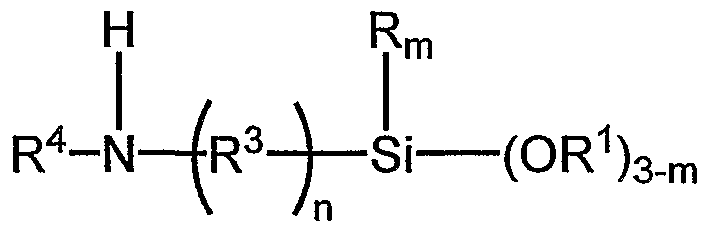
[0027] The isocyanatoalkylpolyalkoxysilanes generally conform to the structure:
Figure imgf000010_0002
where n is 1-3; m is 0-2; R is C1-6 alkyl or C6 aryl, which may optionally be substituted by halo, sulfur or oxygen; R1 is Cι-6 alkyl; and R3 is alkylene. [0028] The hydroxy terminated ABA triblock segment (OH-AB A-OH) may be reacted first with a diisocyanate to provide NCO end-capping and introduce additional urethane linkages into the backbone. This reaction product is then further reacted with an aminoalkylenepolyalkoxysilane, such as N-cyclohexylaminomethyltrimethoxysilane. Such useful materials conform to the structure:
Figure imgf000011_0001
where the variables R, m and n are defined as in structural formula IX.
[0029] The process of preparing the inventive moisture curing compositions can be more easily understood by the following reaction schemes:
Reaction Schemes [0030] Step 1(a):
Formation of NCO-capped pofyfalkylene ether) diol (B block segment using alternative steps 1(a) or lfb)
1 mole HO B OH+ 2 moles OCN— R— NCO ►
O O
II II
OCN— R— H— C— O— B— O— C— NH-R— NC Y Y urethane urethane linkage linkage or
[0031] Step 1(b): 1 mole H2N B NH2 + 2 moles OCN— R— NCO-
O O
II II
OCN— R— NH— C — HN — B— NH— C— NH-R— NCO
Y Y urea urea linkage linkage
[0032] Step 2: Formation of ABA Triblock Segment
O O
2 moles OCN — R — NH C " — O — B— O— C II — NH— R — NCO + 1 mole HO— -A— OH
O O
B _-.rO— C " NH— R NH C ii — O — A — OH
[0033] Step 3:
Addition of Moisture Curing End-Capped Groups Using Alternative Steps 3(c) or 3(d)
Step 3(c)
1 mole HO ABA OH + 2 moles
Figure imgf000012_0001
Rm 9 o Rm
II '
(R10)3.m Si — (CH2)-NH — C— 0-ABA-O-C NH-(CH2)-Si (OR1)3.m n n
Final Moisture Curable Polymer
where R is C1-6 alkyl group or C6 aryl group, which may optionally be substituted with halo, sulfur or oxygen; R1 is C1-6 alkyl group; m is 0-2; and n is 1-3; or
Step 3(d)
HO ABA OH + 2 moles OCN— R'— NCO ►
O O
II II
OCN — R'— NH — C— O-ABA-O-C- -HN R'— NCO
where R is the organic diradical moiety between the diisocyanate groups and its identity depends on the particular diisocyanate chosen for the reaction.
[0034] These reaction products are further reacted with an aminoalkylenepolyalkoxysilane to provide a final moisture curable polymer.
Figure imgf000013_0001
2 moles
Figure imgf000013_0002
Figure imgf000013_0003
Final Moisture Curable Polymer
where R is C1-6 alkyl or C6 aryl, which optionally may be substituted by halo, sulfur or oxygen; R1 is C1-6 alkyl; R3 is alkylene; R4 is alkyl, aryl, alkaryl or arylalkyl; m is 0-2; and n is 1-3; and R is as defined above. [0035] The moisture curable compositions of the present invention may be obtained by adding to 100 parts by weight of the moisture curable triblock polymer prepared in accordance with the process of the present invention:
(a) 0 to 250 parts of inorganic filler;
(b) 0 to 20 parts of an adhesion promoter such as a silane or polysiloxane; and
(c) an effective amount of a moisture curing catalyst.
[0036] The moisture curing catalyst may be present in amounts of about 0.01% to about
5% by weight of the total composition, and desirably in amounts of about 0.05% to about 2.5% by weight. Among the useful moisture cure catalysts are organometals selected from titanium, tin and zirconium compounds. For example, dibutyl tin dilaurate, tetraisopropoxytitanate and tetrabutoxytitanate may be used. Additionally, amines, phosphines and imidazoles may also be used. Among the specific useful compounds are l,8-diazabicyclo[5.4.0] undec-7-ene (DBU) and dimethylaminopyridine. Certain of these catalysts are employed in the synthesis of moisture curable ABA triblock copolymer, as well as formulated into the final moisture curing composition.
[0037] Fillers may also be employed to change the viscosity and flow properties as well as the strength of the final composition. Such fillers include, without limitation, alkali metal carbonates, carbon black, fumed silica, precipitated silica, sulfates, metal silicates, metal oxides and combinations thereof.
[0038] Sillikolloid, available from Hoffmann Mineral, GmbH, clay filler has been found to be particularly useful for enhancing the physical properties of the cured inventive polymers. It has been discovered that the addition of sillikolloid clay filler substantially increased tensile strength, modulus, elongation at break, as well as hardness properties, as further described in the examples to follow.
[0039] Amounts of filler are generally about 5% to about 70% by weight of the total composition. More desirably, fillers may be present in amount of about 10% to about 45%. [0040] Other additives such as plasticizers, diluents, fillers, coloring agents, pigments, viscosity modifiers, thixotropic agents and adhesion promoters may be added in conventional amounts for their intended purposes.
[0041] The invention may be further understood with reference to the following non- limiting examples. Percent weights are per the total composition unless otherwise specified.
EXAMPLES
[0042] The following inventive moisture curing, flexible ABA triblock compositions were prepared in accordance with the present invention, as shown in Table 1.
Table 1 Inventive Compositions
Figure imgf000016_0001
1 Stepanpol PD 110 LV available from Stepan Chemical, Northfield, IL,
2 Stepanpol PD 200 LV available from Stepan Chemical, Northfield, IL
3 Acclaim 2200 available from Bayer Polymers LLC, Pittsburgh, PA
4 Acclaim 4200 available from Bayer Polymers LLC, Pittsburgh, PA
5 Polymeg 2000 available from Lyondell Chemical Co., Houston, TX
6 Tetramethylxylylene diisocyanate
7 Dibutyltin dilaurate
8 Mesamoll L235 available from Bayer AG
9 Irganox 1010 sterically hinered phenolic anti-oxidant, available from Ciba Chemicals
[0043] Each of the inventive compositions in Table 1 above was prepared using the following procedure:
[0044] The polyalkylene ether (B Segment starting material, e.g. Acclaim or Polymeg) was added along with the diisocyanate, antioxidant and catalyst to the reactor. The reaction was permitted to proceed for 2 hours at 80°C under a nitrogen blanket. The NCO content was then determined by titration. To this reaction mixture was added the polyester diol (A Segment) and the mixture was stirred for 2 hours at 80°C. The plasticizer was then added. The mixture was then checked by IR for the disappearance of NCO. Then the moisture cure end capping component was added and stirred for 1.5 hours at 80°C to form the final moisture curing ABA triblock copolymer.
[0045] The resultant polymers, when permitted to moisture cure at ambient temperatures, produced strong, flexible materials.
[0046] The inventive compositions were then formulated with different amounts of filler to observe for changes in physical properties. These compositions are provided below:
Example 6 Table II
Figure imgf000017_0001
[0047] The copolymer and filler were combined in a mixer for 30 minutes at 2000 rpm.
To this was added N-cyclohexylaminomethyltriethoxy silane at 70°C. Mixing was continued for about 30 minutes at about 80°C, at which time HDMZ was added and mixing was continued for 30 minutes under a nitrogen blanket. In this example, no moisture cure catalyst was required to effectuate cure.
[0048] Test samples in the form of sheets were then made. The sheets were about 6" long x 6" wide x 1/8" thick. The sheets were cured for 7 days at ambient conditions and tested for various physical properties. The results are shown below: Test Results* Example 6
Figure imgf000018_0001
*Avg. of 2 samples
Example 7 Table III
Figure imgf000018_0002
*DBU
[0049] Each of Compositions 7 A-7E were cured into test sheets and their physical properties tested after 6 days of cure at ambient conditions.
Test Results
Figure imgf000018_0003
[0050] As shown in the table above, each of the physical properties increase when additional filler is added as compared to the composition without filler. At high levels of filler, the % elongation at break begins to decrease. This is believed to be partially due to substitution of filler for poly(propylene oxide) content (Segment B).
Example 8 Table IV
Figure imgf000019_0001
[0051] After 6 days of cure at ambient conditions, the test sheets were tested for their physical properties.
Test Results Table N
Figure imgf000019_0002
[0052] As shown in the table above, each of the physical properties increase when additional filler is added as compared to the composition without filler. At high levels of filler, the % elongation at break begins to decrease. This is believed to be partially due to substitution of filler for poly ropylene oxide) content (Segment B). [0053] As shown in Figure 1, the tensile strength of inventive compositions 1-5 increased dramatically as the filler content increased. Figure 2 shows the % elongation at break declined as the filler content increased.

Claims

WHAT IS CLAIMED IS;
1. A moisture curable composition comprising a polymer having the formula:
Figure imgf000021_0001
wherein ABA is a polyester/polyether/polyester triblock copolymer;
R is C1-6 alkyl group or C6 aryl group, which may optionally be substituted by halo, sulfur or oxygen;
R1 is C1-6 alkyl group; m is 0-2;
O
II
X is independently at each occurrence a urethane linkage HN — C — O or a urea linkage
Figure imgf000021_0002
wherein R3 is alkylene; R4 is alkyl, aryl, alkaryl or aryalkyl; and p is O or 1.
2. The composition of claim 1 , wherein the polyether (B) block comprises a poly(propylene oxide) block.
3. The composition of claim 1, wherein the polyester (B) block comprises a poly(tetramethylene ether) block.
4. The composition of claim 1 , wherein the polyester (B) block has comprises a molecular weight of about 2,000 to about 4,000.
5. The composition of claim 1 , wherein the polyester (A) blocks comprise a poly (diethylene glycol O-phthalate) block.
6. The composition of claim 1 , wherein the polyester (A) block comprises a molecular weight of about 500 to about 1,000.
7. The composition of claim 1, further including a moisture cure catalyst.
8. The composition of claim 7, wherein the moisture cure catalyst is selected from the group consisting of amines, organometallic compounds, phosphines, imidazoles, and combinations thereof.
9. The composition of claim 7, wherein the moisture curing catalyst is selected from the group consisting of l,8-diazabicyclo[5.4.0] undec-7-ene, dimemylaminopyridine and combinations thereof.
(
10. The composition of claim 1, further including one or more fillers.
11. The composition of claim 10, wherein a filler is selected from the group consisting of alkali metal carbonates, carbon black, fumed silica, precipitated silica, sulfates, metal silicates, metal oxides and combinations thereof.
12. The composition of claim 1 , wherein R and R1 are each a methyl group.
13. A method of preparing a moisture curing composition comprising the steps of:
(a) reacting a NCO capped polyether with a polyester diol having each of two ends terminated with a hydroxy group, wherein the molar ratio of NCO capped polyester prepolymer to polyether diol being equal to or less than 1 :2 to form a block copolymer represented by the structure:
HO A B A O II wherein B is a polyether block and A is a polyester block; and
(b)(i) further reacting the structure formed in step (a) with a molar excess of an isocyanatoalkyl polyalkoxysilane to form a moisture curable composition; or (b)(ii) further reacting the hydroxy terminated polyester/polyether/polyester triblock copolymer (II) with a diisocyanate to provide NCO capping at each end of the triblock copolymer; and further reacting the product of this reaction with an aminoalkylenepolyalkoxysilane to form a moisture curable composition.
14. The method of claim 13, further including the steps of forming the NCO capped polyether comprising reacting a polyether, functionally terminated with either hydroxy groups or amino groups, with a diisocyanate, wherein the molar ratio of diisocyanate functionally terminated polyether is at least about 1 :2.
15. The method of claim 13 , wherein the polyether (B) block has a molecular weight of from about 2,000 to about 4,000.
16. The method of claim 13 , wherein polyester (A) block has a molecular weight of about 500 to about 1,000.
17. The method of claim 13, wherein polyether (B) block is a poly(propylene oxide) block.
18. The method of claim 13, wherein the polyether (B) block is a poly(tetramethylene ether) block.
19. The method of claim 13, wherein the isocyanotooalkyl polyalkoxy silane is selected from the group consisting of isocyanatopropylfrimethoxy silane, isocyanatoethyltrimethoxy silane, isocyanatomethyltriniethoxy silane.
20. The reaction product of
(a) a composition comprising a compound having the formula:
Figure imgf000023_0001
wherein ABA is a polyester/polyether/polyester triblock copolymer;
R is C1-6 alkyl group or C6 group, which may optionally be substituted by a halo, sulfur or oxygen;
R1 is Cι-6 alkyl group; m is 0-2;
O
II
X is independently at each occurrence HN — C — O or
Figure imgf000024_0001
wherein R ,3 is alkylene; R is alkyl, aryl, alkaryl or aryalkyl; and p is O or 1 ; and (b) a moisture cure catalyst.
PCT/US2004/042059 2003-12-15 2004-12-15 Moisture curable high strength, flexible rtv organic copolymer compositions and methods of preparation Ceased WO2005059005A1 (en)

Applications Claiming Priority (2)

Application Number Priority Date Filing Date Title
US10/736,177 2003-12-15
US10/736,177 US7009022B2 (en) 2003-12-15 2003-12-15 Moisture curable high strength, flexible RTV organic copolymer compositions and methods of preparation

Publications (1)

Publication Number Publication Date
WO2005059005A1 true WO2005059005A1 (en) 2005-06-30

Family

ID=34653817

Family Applications (1)

Application Number Title Priority Date Filing Date
PCT/US2004/042059 Ceased WO2005059005A1 (en) 2003-12-15 2004-12-15 Moisture curable high strength, flexible rtv organic copolymer compositions and methods of preparation

Country Status (2)

Country Link
US (1) US7009022B2 (en)
WO (1) WO2005059005A1 (en)

Cited By (3)

* Cited by examiner, † Cited by third party
Publication number Priority date Publication date Assignee Title
WO2009071548A1 (en) * 2007-12-03 2009-06-11 Henkel Ag & Co. Kgaa Curable compound comprising silylated polyurethane
EP3098267B1 (en) 2014-01-23 2018-08-29 Kaneka Corporation Curable composition
US11407997B2 (en) 2017-02-22 2022-08-09 Crispr Therapeutics Ag Materials and methods for treatment of primary hyperoxaluria type 1 (PH1) and other alanine-glyoxylate aminotransferase (AGXT) gene related conditions or disorders

Families Citing this family (11)

* Cited by examiner, † Cited by third party
Publication number Priority date Publication date Assignee Title
DE102004062653A1 (en) * 2004-12-24 2006-07-06 Bayer Materialscience Ag Moisture-curing composition and hot melt adhesive
US8232362B2 (en) * 2005-09-15 2012-07-31 Momentive Performance Materials Inc. Preparation of amino-silane terminated polymer by using organic bismuth catalyst and cured polymer therefrom by using non-tin catalyst
WO2007040232A1 (en) * 2005-10-05 2007-04-12 Asahi Glass Company, Limited Silyl group-containing polymer and method for producing same
DE102005051921A1 (en) * 2005-10-29 2007-05-03 Henkel Kgaa α-Ethoxysilane modified polymers, their preparation and use
WO2007061846A2 (en) * 2005-11-22 2007-05-31 Henkel Corporation Moisture-curable silylated polymers for fast moisture curing compositions
DE102007011511A1 (en) * 2007-03-09 2008-09-11 Henkel Ag & Co. Kgaa One-component assembly adhesive with high initial adhesion
DE102008020980A1 (en) * 2008-04-25 2009-10-29 Henkel Ag & Co. Kgaa Curable compositions containing silylated polyurethanes based on polyether block polymers
TWI575049B (en) * 2011-12-22 2017-03-21 漢高股份有限公司 An ultraviolet-curable and moisture-curable adhesive composition
EP2626317A1 (en) 2012-02-13 2013-08-14 de Schrijver, Aster Pressurized packaging systems for one component adhesives and sealants
CN112608444B (en) * 2020-12-04 2023-05-12 浙江皇马科技股份有限公司 Polyurethane resin, MS sealant and preparation method
CN115246918B (en) * 2021-10-26 2024-04-26 佳化化学科技发展(上海)有限公司 A silane-modified polyurethane resin and its preparation method and use

Citations (3)

* Cited by examiner, † Cited by third party
Publication number Priority date Publication date Assignee Title
US4191713A (en) * 1977-12-29 1980-03-04 Kanegafuchi Kagaku Kogyo Kabushiki Kaisha Room temperature curable composition
GB2154595A (en) * 1984-02-27 1985-09-11 Raychem Ltd Method for preparing organic polymers and copolymers
US6436549B1 (en) * 2001-07-16 2002-08-20 Cyclics Corporation Block copolymers from macrocyclic oligoesters and dihydroxyl-functionalized polymers

Family Cites Families (5)

* Cited by examiner, † Cited by third party
Publication number Priority date Publication date Assignee Title
US3425988A (en) 1965-01-27 1969-02-04 Loctite Corp Polyurethane polyacrylate sealant compositions
US4295909A (en) 1975-02-03 1981-10-20 Loctite Corporation Curable polybutadiene-based resins having improved properties
US4018851A (en) 1975-03-12 1977-04-19 Loctite Corporation Curable poly(alkylene) ether polyol-based grafted resins having improved properties
US4309526A (en) 1975-03-12 1982-01-05 Loctite Corporation Unsaturated curable poly(alkylene)ether polyol-based resins having improved properties
US6756465B1 (en) * 2001-10-19 2004-06-29 Henkel Loctite Corporation Moisture curable compounds and compositions

Patent Citations (3)

* Cited by examiner, † Cited by third party
Publication number Priority date Publication date Assignee Title
US4191713A (en) * 1977-12-29 1980-03-04 Kanegafuchi Kagaku Kogyo Kabushiki Kaisha Room temperature curable composition
GB2154595A (en) * 1984-02-27 1985-09-11 Raychem Ltd Method for preparing organic polymers and copolymers
US6436549B1 (en) * 2001-07-16 2002-08-20 Cyclics Corporation Block copolymers from macrocyclic oligoesters and dihydroxyl-functionalized polymers

Cited By (4)

* Cited by examiner, † Cited by third party
Publication number Priority date Publication date Assignee Title
WO2009071548A1 (en) * 2007-12-03 2009-06-11 Henkel Ag & Co. Kgaa Curable compound comprising silylated polyurethane
EP3098267B1 (en) 2014-01-23 2018-08-29 Kaneka Corporation Curable composition
EP3098267B2 (en) 2014-01-23 2022-05-25 Kaneka Corporation Curable composition
US11407997B2 (en) 2017-02-22 2022-08-09 Crispr Therapeutics Ag Materials and methods for treatment of primary hyperoxaluria type 1 (PH1) and other alanine-glyoxylate aminotransferase (AGXT) gene related conditions or disorders

Also Published As

Publication number Publication date
US20050131188A1 (en) 2005-06-16
US7009022B2 (en) 2006-03-07

Similar Documents

Publication Publication Date Title
US7060760B2 (en) Silane-terminated polydiorganosiloxane urethane copolymer
US7153924B2 (en) Organopolysiloxane/polyurea/polyurethane block copolymers
JP2609253B2 (en) Method for producing moisture-curable polyurethane having alkoxysilane group at the end
EP0931800B1 (en) Process for producing prepolymers which cure to improved sealants, and products formed thereby
JP3449991B2 (en) Curable composition
EP0833830B1 (en) Hydroxy functional alkoxysilane and alkoxysilane functional polyurethane made therefrom
KR101519459B1 (en) Cross-linkable materials based on organyl oxysilane-terminated polymers
US7026424B2 (en) Organopolysiloxane/polyurea/polyurethane block copolymers
TWI444397B (en) Moisture-curable silylated polymer resin composition
US7435787B2 (en) Process for the continuous production of silylated resin
US7009022B2 (en) Moisture curable high strength, flexible RTV organic copolymer compositions and methods of preparation
US6803445B2 (en) Moisture curable polyurethane and/or epoxy resin composition and storage stabilizer contained therein
EP0508313A2 (en) High performance polyurethane coating compositions and processes for making same
KR101088786B1 (en) Siloxane-modified isocyanate alkoxy silane compounds, methods for their preparation, and uses thereof
JP2008514760A (en) In situ chain extended RTV cured polyether
KR101212104B1 (en) Polyorganosiloxane modified polyurethane hybrid compound, preparation method thereof, and the use thereof

Legal Events

Date Code Title Description
AK Designated states

Kind code of ref document: A1

Designated state(s): AE AG AL AM AT AU AZ BA BB BG BR BW BY BZ CA CH CN CO CR CU CZ DE DK DM DZ EC EE EG ES FI GB GD GE GH GM HR HU ID IL IN IS JP KE KG KP KR KZ LC LK LR LS LT LU LV MA MD MG MK MN MW MX MZ NA NI NO NZ OM PG PH PL PT RO RU SC SD SE SG SK SL SY TJ TM TN TR TT TZ UA UG US UZ VC VN YU ZA ZM ZW

AL Designated countries for regional patents

Kind code of ref document: A1

Designated state(s): BW GH GM KE LS MW MZ NA SD SL SZ TZ UG ZM ZW AM AZ BY KG KZ MD RU TJ TM AT BE BG CH CY CZ DE DK EE ES FI FR GB GR HU IE IS IT LT LU MC NL PL PT RO SE SI SK TR BF BJ CF CG CI CM GA GN GQ GW ML MR NE SN TD TG

121 Ep: the epo has been informed by wipo that ep was designated in this application
NENP Non-entry into the national phase

Ref country code: DE

WWW Wipo information: withdrawn in national office

Country of ref document: DE

122 Ep: pct application non-entry in european phase