WO2005019176A1 - Substituted amino-aza-cyclohexanes - Google Patents

Substituted amino-aza-cyclohexanes Download PDF

Info

Publication number
WO2005019176A1
WO2005019176A1 PCT/EP2004/009010 EP2004009010W WO2005019176A1 WO 2005019176 A1 WO2005019176 A1 WO 2005019176A1 EP 2004009010 W EP2004009010 W EP 2004009010W WO 2005019176 A1 WO2005019176 A1 WO 2005019176A1
Authority
WO
WIPO (PCT)
Prior art keywords
mixtures
butyl
piperidin
diastereomers
methyl
Prior art date
Legal status (The legal status is an assumption and is not a legal conclusion. Google has not performed a legal analysis and makes no representation as to the accuracy of the status listed.)
Ceased
Application number
PCT/EP2004/009010
Other languages
French (fr)
Inventor
Christoph Boss
Walter Fischli
Thomas Weller
Solange Meyer
Sylvia Richard-Bildstein
Daniel Bur
Olivier Bezencon
Lubos Remen
Christoph Binkert
Current Assignee (The listed assignees may be inaccurate. Google has not performed a legal analysis and makes no representation or warranty as to the accuracy of the list.)
Actelion Pharmaceuticals Ltd
Original Assignee
Actelion Pharmaceuticals Ltd
Priority date (The priority date is an assumption and is not a legal conclusion. Google has not performed a legal analysis and makes no representation as to the accuracy of the date listed.)
Filing date
Publication date
Application filed by Actelion Pharmaceuticals Ltd filed Critical Actelion Pharmaceuticals Ltd
Publication of WO2005019176A1 publication Critical patent/WO2005019176A1/en
Anticipated expiration legal-status Critical
Ceased legal-status Critical Current

Links

Classifications

    • CCHEMISTRY; METALLURGY
    • C04CEMENTS; CONCRETE; ARTIFICIAL STONE; CERAMICS; REFRACTORIES
    • C04BLIME, MAGNESIA; SLAG; CEMENTS; COMPOSITIONS THEREOF, e.g. MORTARS, CONCRETE OR LIKE BUILDING MATERIALS; ARTIFICIAL STONE; CERAMICS; REFRACTORIES; TREATMENT OF NATURAL STONE
    • C04B35/00Shaped ceramic products characterised by their composition; Ceramics compositions; Processing powders of inorganic compounds preparatory to the manufacturing of ceramic products
    • C04B35/622Forming processes; Processing powders of inorganic compounds preparatory to the manufacturing of ceramic products
    • C04B35/626Preparing or treating the powders individually or as batches ; preparing or treating macroscopic reinforcing agents for ceramic products, e.g. fibres; mechanical aspects section B
    • C04B35/63Preparing or treating the powders individually or as batches ; preparing or treating macroscopic reinforcing agents for ceramic products, e.g. fibres; mechanical aspects section B using additives specially adapted for forming the products, e.g.. binder binders
    • C04B35/632Organic additives
    • AHUMAN NECESSITIES
    • A61MEDICAL OR VETERINARY SCIENCE; HYGIENE
    • A61PSPECIFIC THERAPEUTIC ACTIVITY OF CHEMICAL COMPOUNDS OR MEDICINAL PREPARATIONS
    • A61P33/00Antiparasitic agents
    • A61P33/02Antiprotozoals, e.g. for leishmaniasis, trichomoniasis, toxoplasmosis
    • A61P33/06Antimalarials
    • CCHEMISTRY; METALLURGY
    • C07ORGANIC CHEMISTRY
    • C07DHETEROCYCLIC COMPOUNDS
    • C07D211/00Heterocyclic compounds containing hydrogenated pyridine rings, not condensed with other rings
    • C07D211/04Heterocyclic compounds containing hydrogenated pyridine rings, not condensed with other rings with only hydrogen or carbon atoms directly attached to the ring nitrogen atom
    • C07D211/06Heterocyclic compounds containing hydrogenated pyridine rings, not condensed with other rings with only hydrogen or carbon atoms directly attached to the ring nitrogen atom having no double bonds between ring members or between ring members and non-ring members
    • C07D211/36Heterocyclic compounds containing hydrogenated pyridine rings, not condensed with other rings with only hydrogen or carbon atoms directly attached to the ring nitrogen atom having no double bonds between ring members or between ring members and non-ring members with hetero atoms or with carbon atoms having three bonds to hetero atoms with at the most one bond to halogen, e.g. ester or nitrile radicals, directly attached to ring carbon atoms
    • C07D211/56Nitrogen atoms
    • C07D211/58Nitrogen atoms attached in position 4
    • CCHEMISTRY; METALLURGY
    • C07ORGANIC CHEMISTRY
    • C07DHETEROCYCLIC COMPOUNDS
    • C07D401/00Heterocyclic compounds containing two or more hetero rings, having nitrogen atoms as the only ring hetero atoms, at least one ring being a six-membered ring with only one nitrogen atom
    • C07D401/02Heterocyclic compounds containing two or more hetero rings, having nitrogen atoms as the only ring hetero atoms, at least one ring being a six-membered ring with only one nitrogen atom containing two hetero rings
    • C07D401/06Heterocyclic compounds containing two or more hetero rings, having nitrogen atoms as the only ring hetero atoms, at least one ring being a six-membered ring with only one nitrogen atom containing two hetero rings linked by a carbon chain containing only aliphatic carbon atoms
    • CCHEMISTRY; METALLURGY
    • C07ORGANIC CHEMISTRY
    • C07DHETEROCYCLIC COMPOUNDS
    • C07D401/00Heterocyclic compounds containing two or more hetero rings, having nitrogen atoms as the only ring hetero atoms, at least one ring being a six-membered ring with only one nitrogen atom
    • C07D401/02Heterocyclic compounds containing two or more hetero rings, having nitrogen atoms as the only ring hetero atoms, at least one ring being a six-membered ring with only one nitrogen atom containing two hetero rings
    • C07D401/12Heterocyclic compounds containing two or more hetero rings, having nitrogen atoms as the only ring hetero atoms, at least one ring being a six-membered ring with only one nitrogen atom containing two hetero rings linked by a chain containing hetero atoms as chain links
    • CCHEMISTRY; METALLURGY
    • C07ORGANIC CHEMISTRY
    • C07DHETEROCYCLIC COMPOUNDS
    • C07D409/00Heterocyclic compounds containing two or more hetero rings, at least one ring having sulfur atoms as the only ring hetero atoms
    • C07D409/02Heterocyclic compounds containing two or more hetero rings, at least one ring having sulfur atoms as the only ring hetero atoms containing two hetero rings
    • C07D409/12Heterocyclic compounds containing two or more hetero rings, at least one ring having sulfur atoms as the only ring hetero atoms containing two hetero rings linked by a chain containing hetero atoms as chain links

Definitions

  • the invention relates to novel compounds which are substituted amino- aza-cyclohexane derivatives of the general formula I.
  • the invention also concerns related aspects including processes for the preparation of the compounds, pharmaceutical compositions containing one or more compounds of general formula I and especially their use as inhibitors of the plasmodium falciparum protease plasmepsin II for the treatment or prevention of malaria.
  • these compounds can be regarded as inhibitors of other aspartyl proteases and might, therefore, be useful as inhibitors of plasmepsin I, plasmepsin IV or histo-aspartic protease (HAP) to treat malaria and as inhibitors of Candida albicans secreted aspartyl proteases to treat fungal infections.
  • HAP histo-aspartic protease
  • Malaria is one of the most serious and complex health problems affecting civilization in the 21 st century. The disease affects about 300 million people worldwide, killing 1 to 1.5 million people every year. Malaria is an infectious disease caused by four species of the protozoan parasite Plasmodium, P. falciparum being the most severe of the four. All attempts to develop vaccines against P. falciparum have failed so far. Therefore, therapies and preventive measures against malaria are confined to drugs. However, resistance to many of the currently available antimalarial drugs is spreading rapidly and new drugs are needed.
  • P. falciparum enters the human body by way of bites of the female anophelino mosquito.
  • the plasmodium parasite initially populates the liver, and during later stages of the infectious cycle reproduces in red blood cells. During this stage, the parasite degrades hemoglobin and uses the degradation products as nutrients for growth [1].
  • Hemoglobin degradation is mediated by serine proteases, metalloproteases and aspartic proteases.
  • Aspartic proteases have been shown to be indispensable to parasite growth.
  • a non-selective inhibitor of aspartic proteases, Pepstatin inhibits the growth of P. falciparum in red, blood cells in vitro. The same results have been obtained with analogs of pepstatin [2], [3].
  • the present invention relates to the identification of low molecular weight, non-peptidic inhibitors of the plasmodium falciparum protease plasmepsin II or other related aspartic proteases such as plasmepsin I, plasmepsin IV or Histo-Aspartic-Protease (HAP) to treat and/or prevent malaria.
  • plasmodium falciparum protease plasmepsin II or other related aspartic proteases such as plasmepsin I, plasmepsin IV or Histo-Aspartic-Protease (HAP) to treat and/or prevent malaria.
  • HAP Histo-Aspartic-Protease
  • Plasmepsin inhibitors based on a peptidomimetic or a substrate-analogue approach are described in the following patents: US-05734054 (Pharmacopeia Inc), US-05892038 (Pharmacopeia Inc.), WO-00114331 (University of California, Berkley), WO-02074719 (Johns Hopkins University), and publications: D. Noteberg, E. Hamelink, J. Hulten, M. Wahlgren, L Vrang, B. Samuelsson, A. Hallberg, J. Med. Chem., 2003, 46, 734-746. K. Oscarsson, S. Oscarson, L. Vrang, E. Hamelink, A. Hallberg, B. Samuelsson, Bioorg.
  • Non-peptidomimetic plasmepsin II inhibitors are described in the following patents: WO-00224649 (Actelion Phramaceuticals Ltd.), WO- 00238543 (Actelion Phramaceuticals Ltd.) and WO-09912532 (F. Hoffmann-LaRoche Ltd.).
  • the compounds of general formula I were tested against plasmepsin II, HIV-protease, human cathepsin D, human cathepsin E and human renin in order to determine their biological activity and their selectivity profile.
  • FRET fluorescence resonance energy transfer
  • the assay conditions were selected according to reports in the literature [4 - 7].
  • the FRET assay was performed in white polysorp plates (Fluoronunc, cat n° 437842 A).
  • the assay buffer consisted of 50 mM sodium acetate pH 5, 12,5% glycerol, 0.1% BSA + 392 mM NaCI (for HIV-protease).
  • the reactions were initiated by addition of the enzyme.
  • the assay was incubated at 37°C for 30 min (for human cathepsin E), 40 min (for plasmepsin II and HIV-protease) or 120 min (for human cathepsin D).
  • the reactions were stopped by adding 10% (v/v) of a 1 M solution of Tris-base.
  • Product-accumulation was monitored by measuring the fluorescence at 460 nm.
  • the present invention relates to novel, low molecular weight organic compounds, which are substituted amino-aza-cyclohexanes of the general formula I:
  • X represents -(CH 2 ) n -;
  • Z represents a bond; -(CH 2 ) n -;
  • C represents hydrogen; lower alkyl; lower alkenyl; lower alkynyl; aryl; heteroaryl; cycloalkyl; cycloalkenyl; heterocyclyl; or lower alkyl substituted by hydroxy, carboxy or lower alkoxycarbonyl;
  • n the whole numbers 1 , 2, 3 or 4;
  • D represents -(CH 2 ) n -;
  • R 1 represents hydrogen; methyl; ethyl; propyl; butyl; tert.-butyl; iso-propyl; aryl; heteroaryl;
  • R 3 represents hydrogen; methyl; ethyl; propyl; butyl; -(CH 2 ) m -aryl; -(CH 2 ) m -heteroaryl; -(CH 2 ) m -cycloalkyl;
  • R 4 represents lower alkyl; -(CH 2 ) m -aryl; -(CH 2 )m-heteroaryl; -(CH 2 ) m -cycloaIkyl;
  • R 6 represents aryl, heteroaryl or lower alkyl optionally substituted by OR 1 and/or any of aryl and heteroaryl;
  • n represents the whole numbers 0 (zero), 1 , 2 or 3;
  • enantiomers such as racemates, diastereomers, mixtures of diastereomers, diastereomeric racemates, mixtures of diastereomeric racemates, and the meso-form; as well as pharmaceutically acceptable salts, solvent complexes, morphological forms and prodrugs of any of these compounds.
  • lower alkyl in the definitions of general formula I - if not otherwise stated - the term lower alkyl, alone or in combination with other groups, means saturated, straight and branched chain groups with one to eight carbon atoms, preferably one to five carbon atoms that can be optionally substituted by halogens.
  • lower alkyl groups are methyl, ethyl, n-propyl, iso-propyl, n-butyl, iso-butyl, sec-butyl, tert-butyl, pentyl, hexyl and heptyl.
  • lower alkoxy refers to a R-O group, wherein R is a lower alkyl. Examples of lower alkoxy groups are methoxy, ethoxy, propoxy, iso-propoxy, iso-butoxy, sec-butoxy and tert-butoxy.
  • lower alkenyl alone or in combination with other groups, means straight and branched chain groups comprising an olefinic bond and two to eight carbon atoms, preferably two to five carbon atoms, that can be optionally substituted by halogens.
  • Examples of lower alkenyl are vinyl, propenyl, butenyl or pentenyl.
  • lower alkynyl alone or in combination with other groups, means straight and branched chain groups comprising a triple bond and two to eight carbon atoms, preferably two to five carbon atoms, that can be optionally substituted by halogens.
  • Examples of lower alkynyl are ethynyl, propynyl or butynyl.
  • lower alkylene alone or in combination with other groups, means straight and branched divalent chain groups with one to eight carbon atoms, preferably one to five carbon atoms that can be optionally substituted by halogens.
  • Examples of lower alkylene are ethylene, propylene or butylene.
  • lower alkenylene alone or in combination with other groups, means straight and branched divalent chain groups comprising an olefinic bond and two to eight carbon atoms, preferably two to five carbon atoms, that can be optionally substituted by halogens.
  • Examples of lower alkenylene are vinylene, propenylene and butenylene.
  • lower alkylenedioxy refers to a lower alkylene substituted at each end by an oxygen atom.
  • lower alkylenedioxy groups are preferably methylenedioxy and ethylenedioxy.
  • lower alkylenoxy refers to a lower alkylene substituted at one end by an oxygen atom.
  • lower alkylenoxy groups are preferably ethylenoxy and propylenoxy.
  • halogen means fluorine, chlorine, bromine or iodine, preferably fluorine, chlorine and bromine.
  • cycloalkyl alone or in combination, means a saturated cyclic hydrocarbon ring system with 3 to 7 carbon atoms, e.g. cyclopropyl, cyclobutyl, cyclopentyl, cyclohexyl and cycloheptyl, which can be optionally mono-, di-, or trisubstituted independently by lower alkyl, lower alkenyl, lower alkenylene, lower alkoxy, lower alkylenoxy, lower alkylenedioxy, hydroxy, halogen, -CF 3 , -NR 1 R 2 , -NR 1 C(O)R 4 , -NR 1 S(O) 2 R 4 , -C(O)NR 1 R 2 , lower alkylcarbonyl, -COOR 1 , -SR 1 , -SOR 1 , -SO 2 R 1 , -SO 2 NR 1 R 2 , whereby R1 , R2 and R4 are defined as in formula I
  • cycloalkenyl has analogous meaning to cycloalkyl, except that it is unsaturated (but not aromatic).
  • aryl alone or in combination, relates to the phenyl, the naphthyl or the indanyl group, preferably the phenyl group, which can be optionally mono- , di-, tri-, tetra- or pentasubstituted independently by lower alkyl, lower alkenyl, lower alkinyl, lower alkenylene or lower alkylene forming with the aryl ring a five- or six-membered ring, lower alkoxy, lower alkylenedioxy, lower alkylenoxy, hydroxy, hydroxy-lower alkyl, halogen, cyano, -CF 3 , -OCF 3 , - NR R 2 , -NR 1 C(O)R 4 , -NR 1 S(O) 2 R 4 , -C(O)NR 1 R 2 , -NO 2 , lower alkylcarbonyl, - COOR 1 , -SR 1 , -S(O)R
  • Phenyl groups can also be substituted by phenyl, which latter can be substituted as defined above under phenyl.
  • Preferred substituents are lower alkynyl, lower alkoxy, lower alkyl and 4-methoxy-biphenyl.
  • aryloxy refers to an Ar-O group, wherein Ar is an aryl.
  • An example of aryloxy groups is phenoxy.
  • heterocyclyl alone or in combination, means saturated or unsaturated (but not aromatic) five-, six- or seven-membered rings containing one or two nitrogen, oxygen or sulfur atoms which may be the same or different and which rings can be optionally substituted with lower alkyl, hydroxy, lower alkoxy and halogen.
  • the nitrogen atoms, if present, can be substituted by a COOR 2 group.
  • rings are piperidinyl, morpholinyl, thiomorpholinyl, piperazinyl, tetrahydropyranyl, dihydropyranyl, 1 ,4-dioxanyl, pyrrolidinyl, tetrahydrofuranyl, dihydropyrrolyl, imidazolidinyl, dihydropyrazolyl, dihydroquinolinyl, tetrahydroquinolinyl, tetrahydro- isoquinolinyl.
  • heteroaryl alone or in combination, means six-membered aromatic rings containing one to four nitrogen atoms; benzofused six-membered aromatic rings containing one to three nitrogen atoms; five-membered aromatic rings containing one oxygen, one nitrogen or one sulfur atom; benzofused five-membered aromatic rings containing one oxygen, one nitrogen or one sulfur atom; five-membered aromatic rings containing one oxygen and one nitrogen atom and benzofused derivatives thereof; five- membered aromatic rings containing a sulfur and a nitrogen or an oxygen atom and benzofused derivatives thereof; five-membered aromatic rings containing two nitrogen atoms and benzofused derivatives thereof; five- membered aromatic rings containing three nitrogen atoms and benzofused derivatives thereof, or a tetrazolyl ring.
  • Examples of such ring systems are furanyl, thiophenyl, pyrrolyl, pyridinyl, pyrimidinyl, indolyl, quinolinyl, isoquinolinyl, imidazolyl, triazinyl, thiazinyl, thiazolyl, isothiazolyl, pyridazinyl, pyrazolyl, oxazolyl, isoxazolyl, coumarinyl, benzothiophenyl, quinazolinyl, quinoxalinyl.
  • Such rings may be adequatly substituted with lower alkyl, lower alkenyl, lower alkinyl, lower alkylene, lower alkenylene, lower alkylenedioxy, lower alkyleneoxy, hydroxy-lower alkyl, lower alkoxy, hydroxy, halogen, cyano, -CF 3 , -OCF 3 , -NR 1 R 2 , -N(R 1 )COR 2 , -N(R 1 )SO 2 R 2 , -CONR 1 R 2 , -NO 2 , lower alkylcarbonyl, -COOR 1 , -SR 1 , -S(O)R 1 , -S(O) 2 R 1 , -SO 2 NR 1 R 2 (R1 , R2 and R4 being defined as in formula I above) or by another aryl, another heteroaryl or another heterocyclyl, and the like.
  • heteroaryloxy refers to a Het-O group, wherein Het is a heteroaryl.
  • salts encompasses either salts with inorganic acids or organic acids like hydrochloric or hydrobromic acid, sulfuric acid, phosphoric acid, citric acid, formic acid, acetic acid, maleic acid, tartaric acid, benzoic acid, methanesulfonic acid, p-toluenesulfonic acid, and the like that are non toxic to living organisms or in case the compound of formula I is acidic in nature with an inorganic base like an alkali or earth alkali base, e.g. sodium hydroxide, potassium hydroxide, calcium hydroxide and the like.
  • inorganic acids or organic acids like hydrochloric or hydrobromic acid, sulfuric acid, phosphoric acid, citric acid, formic acid, acetic acid, maleic acid, tartaric acid, benzoic acid, methanesulfonic acid, p-toluenesulfonic acid, and the like that are non toxic to living organisms or in case the compound of formula I is acidic in nature
  • the compounds of the general formula I can contain one or more asymmetric carbon atoms and may be prepared in form of optically pure enantiomers, mixtures of enantiomers such as racemates, diastereomers, mixtures of diastereomers, diastereomeric racemates, mixtures of diastereomeric racemates, and the meso-form and pharmaceutically acceptable salts therof.
  • the present invention encompasses all these forms. Mixtures may be separated in a manner known per se, i.e. by column chromatography, thin layer chromatography, HPLC or crystallization.
  • the compounds of general formula I, and their pharmaceutically acceptable salts may be used as therapeutics e.g. in form of pharmaceutical compositions. They may especially be used in the treatment and/or prophylaxis of malaria and other protozoal diseases.
  • the invention relates to the use of compounds as defined above for the preparation of medicaments for the treatment and/or prophylaxis of diseases, which are associated with the inhibition of plasmepsin II and other, related protozoal aspartic proteases.
  • medicaments may be prepared in a manner known per se by mixing one or more of the compounds of formulae I to VII with inert excipients.
  • the compounds of formula I may also be used in combination with one or more other therapeutically useful substances.
  • the compounds of formula I and their pharmaceutically acceptable acid addition salts can be used as medicaments, e. g. in the form of pharmaceutical preparations for enteral, parenteral, or topical administration. They can be administered, for example, perorally, e. g. in the form of tablets, coated tablets, dragees, hard and soft gelatine capsules, solutions, emulsions or suspensions, rectally, e. g. in the form of suppositories, parenterally, e. g. in the form of injection solutions or infusion solutions, or topically, e. g. in the form of ointments, creams or oils.
  • Suitable carrier materials are not only inorganic carrier materials (excipients), but also organic carrier materials.
  • lactose, corn starch or derivatives thereof, talc, stearic acid or its salts can be used as carrier materials for tablets, coated tablets, dragees and hard gelatine capsules.
  • Suitable carrier materials for soft gelatine capsules are, for example, vegetable oils, waxes, fats and semi-solid and liquid polyols (depending on the nature of the active ingredient no carriers are, however, required in the case of soft gelatine capsules).
  • Suitable carrier materials for the production of solutions and syrups are, for example, water, polyols, sucrose, invert sugar and the like.
  • Suitable carrier materials for injections are, for example, water, alcohols, polyols, glycerols and vegetable oils.
  • Suitable carrier materials for suppositories are, for example, natural or hardened oils, waxes, fats and semi-liquid or liquid polyols.
  • Suitable carrier materials for topical preparations are glycerides, semi-synthetic and synthetic glycerides, hydrogenated oils, liquid waxes, liquid paraffins, liquid fatty alcohols, sterols, polyethylene glycols and cellulose derivatives.
  • Usual stabilizers preservatives, wetting and emulsifying agents, consistency- improving agents, flavour-improving agents, salts for varying the osmotic pressure, buffer substances, solubilizers, colorants and masking agents and antioxidants come into consideration as pharmaceutical adjuvants.
  • the dosage of compounds of formula I can vary within wide limits depending on the disease to be controlled, the age and the individual condition of the patient and the mode of administration, and will, of course, be fitted to the individual requirements in each particular case. For adult patients a daily dosage of about 1 mg to about 1000 mg, especially about 50 mg to about 500 mg, comes into consideration. For children the dosage has to be adapted to the body weight and age.
  • the pharmaceutical preparations conveniently contain about 1 - 500 mg, preferably 5 - 200 mg of a compound of formula I.
  • the compounds of general formula I can be manufactured by the methods given below, by the methods given in the examples of an earlier application filed by the applicant (WO 02/24649) or by analogous methods.
  • Preferred compounds are compounds of the formula II
  • R 1 , R 2 , R 3 , R 6 and D are as defined in general formula I above and optically pure enantiomers, mixtures of enantiomers such as racemates, diastereomers, mixtures of diastereomers, diastereomeric racemates, mixtures of diastereomeric racemates, and the meso-form; as well as pharmaceutically acceptable salts, solvent complexes and morphological forms.
  • a group of especially preferred compounds according to formula II are compounds wherein A, C, X and Z are as defined in general formula I above, and wherein Y represents -(CH 2 )- and optically pure enantiomers, mixtures of enantiomers such as racemates, diastereomers, mixtures of diastereomers, diastereomeric racemates, mixtures of diastereomeric racemates, and the meso-form; as well as pharmaceutically acceptable salts, solvent complexes and morphological forms.
  • Preferred compounds are compounds of the formula III
  • R 5 represents one of the groups R 2 >1 r> rs D 1 / R ' -— D-O-R 1 — -D-N
  • R 1 , R 2 , R 3 , R ⁇ and D are as defined in general formula I above and optically pure enantiomers, mixtures of enantiomers such as racemates, diastereomers, mixtures of diastereomers, diastereomeric racemates, mixtures of diastereomeric racemates, and the meso-form; as well as pharmaceutically acceptable salts, solvent complexes and morphological forms.
  • a group of especially preferred compounds according to formula III are compounds wherein A, C, X and Z are as defined in general formula I above, and wherein Y represents -(CH 2 )- and optically pure enantiomers, mixtures of enantiomers such as racemates, diastereomers, mixtures of diastereomers, diastereomeric racemates, mixtures of diastereomeric racemates, and the meso-form; as well as pharmaceutically acceptable salts, solvent complexes and morphological forms.
  • Preferred compounds are compounds of the formula IV
  • R 5 represents one of the groups R" -R' D-O-R -D-N N R 3
  • R 1 , R 2 , R 3 , R 6 and D are as defined in general formula I above and optically pure enantiomers, mixtures of enantiomers such as racemates, diastereomers, mixtures of diastereomers, diastereomeric racemates, mixtures of diastereomeric racemates, and the meso-form; as well as pharmaceutically acceptable salts, solvent complexes and morphological forms.
  • a group of especially preferred compounds according to formula IV are compounds wherein B, C, X and Z are as defined in general formula I above, and wherein Y represents -(CH 2 )- and optically pure enantiomers, mixtures of enantiomers such as racemates, diastereomers, mixtures of diastereomers, diastereomeric racemates, mixtures of diastereomeric racemates, and the meso-form; as well as pharmaceutically acceptable salts, solvent complexes and morphological forms.
  • Preferred compounds are compounds of the formula V
  • R 5 represents one of the groups R ⁇ ,1 -R ' — D-O-R' -D-N N R 3
  • R 1 , R 2 , R 3 , R 6 and D are as defined in general formula I above and optically pure enantiomers, mixtures of enantiomers such as racemates, diastereomers, mixtures of diastereomers, diastereomeric racemates, mixtures of diastereomeric racemates, and the meso-form; as well as pharmaceutically acceptable salts, solvent complexes and morphological forms.
  • a group of especially preferred compounds according to formula V are compounds wherein B, C, X and Z are as defined in general formula I above, and wherein Y represents -(CH 2 )- and optically pure enantiomers, mixtures of enantiomers such as racemates, diastereomers, mixtures of diastereomers, diastereomeric racemates, mixtures of diastereomeric racemates, and the meso-form; as well as pharmaceutically acceptable salts, solvent complexes and morphological forms.
  • Preferred compounds are compounds of the formula VI
  • R 1 , R 2 , R 3 R 6 and D are as defined in general formula I above and optically pure enantiomers, mixtures of enantiomers such as racemates, diastereomers, mixtures of diastereomers, diastereomeric racemates, mixtures of diastereomeric racemates, and the meso-form; as well as pharmaceutically acceptable salts, solvent complexes and morphological forms.
  • Preferred compounds are compounds of the formula VII
  • R 1 , R 2 , R 3 ,R ⁇ and D are as defined in general formula I above and optically pure enantiomers, mixtures of enantiomers such as racemates, diastereomers, mixtures of diastereomers, diastereomeric racemates, mixtures of diastereomeric racemates, and the meso-form; as well as pharmaceutically acceptable salts, solvent complexes and morphological forms.
  • R 1 is as in claim 1
  • C in formula I represents hydrogen; lower alkyl; lower alkenyl; lower alkynyl; aryl; heteroaryl; cycloalkyl; cycloalkenyl;or heterocyclyl.
  • the group R 6 represents the group in which R 1 is as in claim 1
  • C in formulas ll-VII represents hydrogen; lower alkyl; lower alkenyl; lower alkynyl; aryl; heteroaryl; cycloalkyl; cycloalkenyI;or heterocyclyl.
  • Preferred compounds are: N-[3-(3-Hydroxy-prop-1-ynyl)-benzyl]-N-[1-(3-methyl-butyl)-piperidin-4- yl]-4-pentyl-benzamide; N-[3-(4-Hydroxy-pent-1-ynyl)-benzyl]-N-[1-(3-methyl-butyl)-piperidin-4- yl]-4-pentyl-benzamide; N-[3-(3-Methoxy-prop-1-ynyl)-benzyl]-N-[1-(3-methyl-butyl)-piperidin-4- yl]-4-pentyl-benzamide; N-[3-(3,3-Dimethyl-but-1-ynyl)-benzyl]-N-[1-(3-methyl-butyl)-piperidin-4- yl]-4-pentyl-benzamide; N-[
  • the compounds of the general formula I of the present invention may be prepared according to the procedures and sequences of reactions outlined below. For simplicity and clarity reasons, only parts of the synthetic possibilities which lead to compounds of the formulae I to VII are described. For general methods of the necessary steps see Typical Procedures A to M and / or WO 02/24649 and C. Boss et al; Curr. Med. Chem., 2003, 10, 883- 907.
  • the amine and the aldehyde (1.5 eq.) (which are used as starting materials, are known compounds or the synthesis is described in the Reference Examples), are mixed in anhydrous methanol and refluxed for 4 h. The mixture is cooled to rt and then treated with sodium borohydride (1.5 eq.) and again stirred for 2 h at reflux temperature. The reaction mixture is concentrated in vacuo and water is slowly added followed by extraction with DCM (3x). The combined organic layers were dried over sodium sulfate, filtered and evaporated. The crude compound is purified by column chromatography on silica gel by an appropriate mixture of EtOAc / hexane containing 1% TEA or by recrystallization from a suitable solvent.
  • the arylchloride, the boronic acid (1.5 eq) and potassium phosphate (K3PO4; 3 eq)) were added subsequently to dioxane (5 ml / mmol arylchloride). While heating to 100°C, nitrogen is bubbled through the mixture. Then a solution of 2'-(dimethylamino)-2-biphenylyl-palladium(ll)-chloride dinorbomylphosphine- complex (from Solvias or Fluka 36037; 0.01 eq)) was added to the hot reaction mixture and stirring was continued for 6 to 18 h. The reaction mixture is cooled to rt, water is added and the product extracted with EtOAc.
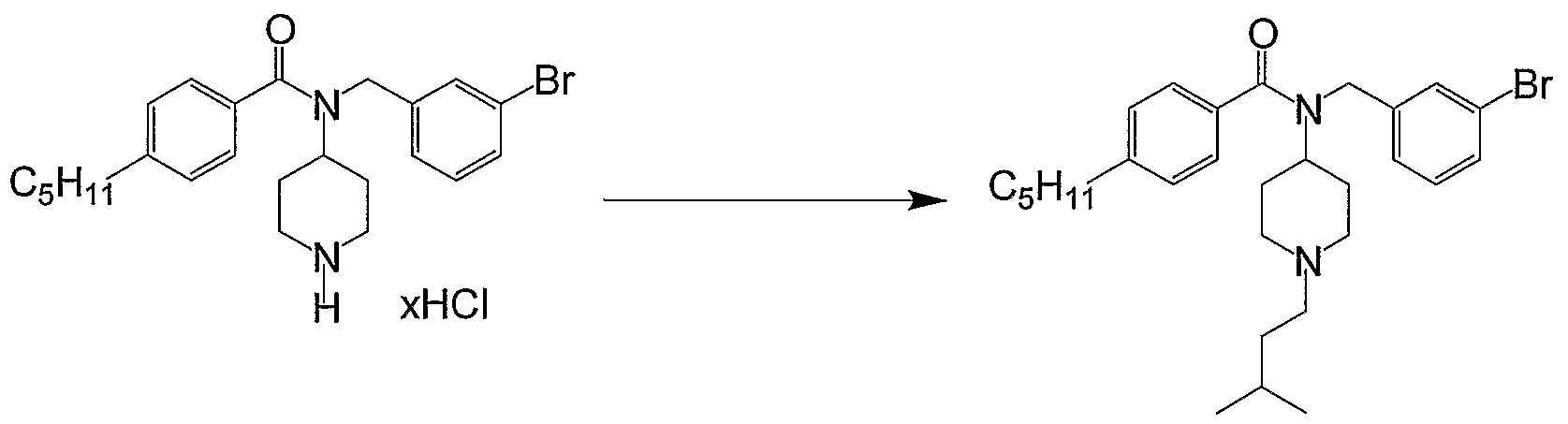
  • N-(3-Bromo-benzyl)-4-pentyl-N-piperidin-4- yl-benzamide hydrochloride (2.17 g) was prepared from 4-[(3-Bromo-benzyl)- (4-pentyl-benzoyl)-amino]-piperidine-1 -carboxylic acid tert-butyl ester (2.5 g).
  • N-(3-Bromo-benzyl)-N-[1-(3-methyl- butyl)-piperidin-4-yl]-4-pentyl-benzamide (2.22 g) was prepared from N-(3- Bromo-benzyl)-4-pentyl-N-piperidin-4-yl-benzamide hydrochloride (2.17 g) and isovaleraldehyde (0.59 g).
  • N-(4-Bromo-benzyl)-4-pentyl-N-piperidin-4- yl-benzamide Hydrochloride (2.05 g) was prepared from 4-[(4-Bromo-benzyl)- (4-pentyl-benzoyI)-amino]-piperidine-1 -carboxylic acid tert-butyl ester (2.5 g).
  • N-(4-Bromo-benzyl)-N-[1-(3-methyl- butyl)-piperidin-4-yl]-4-pentyl-benzamide (1.05 g) was prepared from N-(4- Bromo-benzyl)-4-pentyl-N-piperidin-4-yl-benzamide Hydrochloride (1.61 g) and isovaleraldehyde (0.29 g).
  • Example 11 Prepared as described in WO 02/24649
  • Examples 13 to 18 were prepared in analogy to the preparation described for Example 12.
  • Active ingredients can be formulated according to methods known per se to give pharmaceutical preparations of the following composition:

Landscapes

  • Chemical & Material Sciences (AREA)
  • Organic Chemistry (AREA)
  • Health & Medical Sciences (AREA)
  • Engineering & Computer Science (AREA)
  • Tropical Medicine & Parasitology (AREA)
  • Veterinary Medicine (AREA)
  • Ceramic Engineering (AREA)
  • Manufacturing & Machinery (AREA)
  • Life Sciences & Earth Sciences (AREA)
  • Pharmacology & Pharmacy (AREA)
  • Nuclear Medicine, Radiotherapy & Molecular Imaging (AREA)
  • Animal Behavior & Ethology (AREA)
  • General Health & Medical Sciences (AREA)
  • Public Health (AREA)
  • Medicinal Chemistry (AREA)
  • Inorganic Chemistry (AREA)
  • General Chemical & Material Sciences (AREA)
  • Chemical Kinetics & Catalysis (AREA)
  • Materials Engineering (AREA)
  • Structural Engineering (AREA)
  • Pharmaceuticals Containing Other Organic And Inorganic Compounds (AREA)

Abstract

The invention relates to novel amino-aza-cyclohexane derivatives and related compounds and their use as active ingredients in the preparation of pharmaceutical compositions. The invention also concerns related aspects including processes for the preparation of the compounds, pharmaceutical compositions containing one or more of those compounds and especially their use as inhibitors of plasmepsin II.

Description

SUBSTITUTED AMINO-AZA-CYCLOHEXANES
The invention relates to novel compounds which are substituted amino- aza-cyclohexane derivatives of the general formula I. The invention also concerns related aspects including processes for the preparation of the compounds, pharmaceutical compositions containing one or more compounds of general formula I and especially their use as inhibitors of the plasmodium falciparum protease plasmepsin II for the treatment or prevention of malaria. Furthermore, these compounds can be regarded as inhibitors of other aspartyl proteases and might, therefore, be useful as inhibitors of plasmepsin I, plasmepsin IV or histo-aspartic protease (HAP) to treat malaria and as inhibitors of Candida albicans secreted aspartyl proteases to treat fungal infections.
Background of the invention:
Malaria is one of the most serious and complex health problems affecting humanity in the 21st century. The disease affects about 300 million people worldwide, killing 1 to 1.5 million people every year. Malaria is an infectious disease caused by four species of the protozoan parasite Plasmodium, P. falciparum being the most severe of the four. All attempts to develop vaccines against P. falciparum have failed so far. Therefore, therapies and preventive measures against malaria are confined to drugs. However, resistance to many of the currently available antimalarial drugs is spreading rapidly and new drugs are needed.
P. falciparum enters the human body by way of bites of the female anophelino mosquito. The plasmodium parasite initially populates the liver, and during later stages of the infectious cycle reproduces in red blood cells. During this stage, the parasite degrades hemoglobin and uses the degradation products as nutrients for growth [1]. Hemoglobin degradation is mediated by serine proteases, metalloproteases and aspartic proteases. Aspartic proteases have been shown to be indispensable to parasite growth. A non-selective inhibitor of aspartic proteases, Pepstatin, inhibits the growth of P. falciparum in red, blood cells in vitro. The same results have been obtained with analogs of pepstatin [2], [3]. These results show that inhibition of parasite aspartic proteases interferes with the life cycle of P. falciparum. Consequently, aspartic proteases are targets for antimalarial drug development.
The present invention relates to the identification of low molecular weight, non-peptidic inhibitors of the plasmodium falciparum protease plasmepsin II or other related aspartic proteases such as plasmepsin I, plasmepsin IV or Histo-Aspartic-Protease (HAP) to treat and/or prevent malaria.
Prior Art:
To date several classes of plasmepsin II inhibitors have been described in the literature. To the best of our knowledge, none of these compounds has entered clinical development so far. Research efforts within different structural classes of plasmepsin II inhibitors have recently been summarized and published [C. Boss et al.; Curr. Med. Chem. 2003, 10, 883-907 and references cited there]. Plasmepsin inhibitors based on a peptidomimetic or a substrate-analogue approach are described in the following patents: US-05734054 (Pharmacopeia Inc), US-05892038 (Pharmacopeia Inc.), WO-00114331 (University of California, Berkley), WO-02074719 (Johns Hopkins University), and publications: D. Noteberg, E. Hamelink, J. Hulten, M. Wahlgren, L Vrang, B. Samuelsson, A. Hallberg, J. Med. Chem., 2003, 46, 734-746. K. Oscarsson, S. Oscarson, L. Vrang, E. Hamelink, A. Hallberg, B. Samuelsson, Bioorg. Med. Chem., 2003, 11, 1235-1246. A. Dahlgren, I. Kvarnstrόm, L Vrang, E. Hamelink, A. Hallberg, A. Rosenquist, B. Samuelsson, Bioorg. Med. Chem., 2003, 11, 827-841. Non-peptidomimetic plasmepsin II inhibitors are described in the following patents: WO-00224649 (Actelion Phramaceuticals Ltd.), WO- 00238543 (Actelion Phramaceuticals Ltd.) and WO-09912532 (F. Hoffmann-LaRoche Ltd.). Only three publications were found so far that describe non-peptidomimetic, rationally designed plasmepsin II inhibitors: Carcache, D. A.; Hortner, S. R.; Bertogg A.; Binkert, C; Bur, D.; Marki, H.- P.; Dorn, A.; Diederich, F.; ChemBioChem, 2002, 11, 1137. Carcache, D. A.; Hortner, S. R.; Seiler, P.; Diederich, F.; Dorn, A.; Marki, H.-P.; Binkert, C; Bur, D.; Helv. Chim. Ada, 2003, 86, 2173. Carcache, D. A.; Hortner, S. R.; Bertogg, A.; Diederich, F.; Dorn, A.; Marki, H.-P.; Binkert, C; Bur, D.; Helv. Chim. Ada, 2003, 86, 2192.
The compounds of general formula I were tested against plasmepsin II, HIV-protease, human cathepsin D, human cathepsin E and human renin in order to determine their biological activity and their selectivity profile.
In vitro Assays:
The fluorescence resonance energy transfer (FRET) assay for HIV, plasmepsin II, human cathepsin D and human cathepsin E.
The assay conditions were selected according to reports in the literature [4 - 7]. The FRET assay was performed in white polysorp plates (Fluoronunc, cat n° 437842 A). The assay buffer consisted of 50 mM sodium acetate pH 5, 12,5% glycerol, 0.1% BSA + 392 mM NaCI (for HIV-protease). The incubates per well were composed of: - 160 μl buffer - 10 μl inhibitor (in DMSO) - 10 μl of the corresponding substrate in DMSO (see table A) to a final concentration of 1 μM - 20 μl of enzyme to a final amount of x ng per assay tube (x = 10 ng/assay tube plasmepsin II, x = 100 ng/assay tube HIV-protease, x = 10 ng/assay tube human cathepsin E and x = 20 ng/assay tube human cathepsin D) The reactions were initiated by addition of the enzyme. The assay was incubated at 37°C for 30 min (for human cathepsin E), 40 min (for plasmepsin II and HIV-protease) or 120 min (for human cathepsin D). The reactions were stopped by adding 10% (v/v) of a 1 M solution of Tris-base. Product-accumulation was monitored by measuring the fluorescence at 460 nm.
Auto-fluorescence of all the test substances is determined in assay buffer in the absence of substrate and enzyme and this value was subtracted
Figure imgf000006_0001
from the final signal.
Table A: Summary of the conditions used for the aspartyl proteases fluorescent assays, (at = assay tube)
Activities of the compounds are evident from the following IC50 values on plasmepsin II (PMII) of selected Examples:
Figure imgf000007_0001
References:
1. Goldberg, D. E., Slater, A. F., Beavis, R., Chait, B., Cerami, A., Henderson, G. B.; J. Exp. Med., 1991, 173, 961 - 969.
2. Francis, S. E., Gluzman, I. Y., Oksman, A., Knickerbocker, A., Mueller, R., Bryant, M. L, Sherman, D. R., Russell, D. G., Goldberg, D. E.; Embo. J., 1994, 13, 306 - 317.
3. Moon, R. P., Tyas, L, Certa, U., Rupp, K., Bur, D., Jaquet, H., Matile, H., Loetscher, H., Grueninger-Leitch, F., Kay, J., Dunn, B. M., Berry, C, Ridley, R. G.; Eur. J. Biochem., 1997, 244, 552 - 560.
4. Carroll, C. D., Johnson, T. O., Tao, S., Lauri, G., Orlowski, M., Gluzman, I.Y., Goldberg, D. E., Dolle, R. E., Bioorg Med Chem Lett ; 1998, 8, 3203 - 3206. 5. Peranteau, A. G., Kuzmic, P., Angell, Y., Garcia-Echeverria, C, Rich, D. H., Anal Biochem; 1995, 227(1), 242 - 245.
6. Gulnik, S. V., Suvorov, L. I., Majer, P., Collins, J., Kane, B. P., Johnson, D. G., Erickson, J. W., FEBS Lett; 1997, 473(2), 379 - 384.
7. Robinson, P. S., Lees, W. E., Kay, J., Cook, N. D., Biochem J; 1992, 284 (Pt 2), 407 - 409.
The present invention relates to novel, low molecular weight organic compounds, which are substituted amino-aza-cyclohexanes of the general formula I:
General Formula
Figure imgf000009_0001
wherein
X represents -(CH2)n-;
Y represents -(CH2)n-; -(C=0)-; -(SO2)-; -(C=O)-NH-;
Z represents a bond; -(CH2)n-;
C represents hydrogen; lower alkyl; lower alkenyl; lower alkynyl; aryl; heteroaryl; cycloalkyl; cycloalkenyl; heterocyclyl; or lower alkyl substituted by hydroxy, carboxy or lower alkoxycarbonyl;
n represents the whole numbers 1 , 2, 3 or 4;
A and B represent aryl; heteroaryl; heterocyclyl; cycloalkyl; with the proviso that at least one of A and B represents aryl or heteroaryl substituted by an alkynyl group Q which is represented by the following groups: - alkynyl containing two to six carbon atoms; and
Figure imgf000009_0002
^^D-N-R2 I == R6 R3
wherein D represents -(CH2)n-;
R1 represents hydrogen; methyl; ethyl; propyl; butyl; tert.-butyl; iso-propyl; aryl; heteroaryl;
R2 represents hydrogen; methyl; ethyl; propyl; butyl; tert.-butyl; iso-propyl; -(CH2)m-aryl; -(CH2)m-heteroaryl; -(CH2)m-cycloalkyl; -(C=O)-R4; -(C=O)-NH- R4; -(C=O)-O-R4;
R3 represents hydrogen; methyl; ethyl; propyl; butyl; -(CH2)m-aryl; -(CH2)m-heteroaryl; -(CH2)m-cycloalkyl;
R4 represents lower alkyl; -(CH2)m-aryl; -(CH2)m-heteroaryl; -(CH2)m-cycloaIkyl;
R6 represents aryl, heteroaryl or lower alkyl optionally substituted by OR1 and/or any of aryl and heteroaryl;
m represents the whole numbers 0 (zero), 1 , 2 or 3;
and optically pure enantiomers, mixtures of enantiomers such as racemates, diastereomers, mixtures of diastereomers, diastereomeric racemates, mixtures of diastereomeric racemates, and the meso-form; as well as pharmaceutically acceptable salts, solvent complexes, morphological forms and prodrugs of any of these compounds.
In the definitions of general formula I - if not otherwise stated - the term lower alkyl, alone or in combination with other groups, means saturated, straight and branched chain groups with one to eight carbon atoms, preferably one to five carbon atoms that can be optionally substituted by halogens. Examples of lower alkyl groups are methyl, ethyl, n-propyl, iso-propyl, n-butyl, iso-butyl, sec-butyl, tert-butyl, pentyl, hexyl and heptyl. The term lower alkoxy refers to a R-O group, wherein R is a lower alkyl. Examples of lower alkoxy groups are methoxy, ethoxy, propoxy, iso-propoxy, iso-butoxy, sec-butoxy and tert-butoxy.
The term lower alkenyl, alone or in combination with other groups, means straight and branched chain groups comprising an olefinic bond and two to eight carbon atoms, preferably two to five carbon atoms, that can be optionally substituted by halogens. Examples of lower alkenyl are vinyl, propenyl, butenyl or pentenyl.
The term lower alkynyl, alone or in combination with other groups, means straight and branched chain groups comprising a triple bond and two to eight carbon atoms, preferably two to five carbon atoms, that can be optionally substituted by halogens. Examples of lower alkynyl are ethynyl, propynyl or butynyl.
The term lower alkylene, alone or in combination with other groups, means straight and branched divalent chain groups with one to eight carbon atoms, preferably one to five carbon atoms that can be optionally substituted by halogens. Examples of lower alkylene are ethylene, propylene or butylene.
The term lower alkenylene, alone or in combination with other groups, means straight and branched divalent chain groups comprising an olefinic bond and two to eight carbon atoms, preferably two to five carbon atoms, that can be optionally substituted by halogens. Examples of lower alkenylene are vinylene, propenylene and butenylene.
The term lower alkylenedioxy, refers to a lower alkylene substituted at each end by an oxygen atom. Examples of lower alkylenedioxy groups are preferably methylenedioxy and ethylenedioxy. The term lower alkylenoxy refers to a lower alkylene substituted at one end by an oxygen atom. Examples of lower alkylenoxy groups are preferably ethylenoxy and propylenoxy.
The term halogen means fluorine, chlorine, bromine or iodine, preferably fluorine, chlorine and bromine.
The term cycloalkyl alone or in combination, means a saturated cyclic hydrocarbon ring system with 3 to 7 carbon atoms, e.g. cyclopropyl, cyclobutyl, cyclopentyl, cyclohexyl and cycloheptyl, which can be optionally mono-, di-, or trisubstituted independently by lower alkyl, lower alkenyl, lower alkenylene, lower alkoxy, lower alkylenoxy, lower alkylenedioxy, hydroxy, halogen, -CF3, -NR1R2, -NR1C(O)R4, -NR1S(O)2R4, -C(O)NR1R2, lower alkylcarbonyl, -COOR1, -SR1, -SOR1, -SO2R1, -SO2NR1R2, whereby R1 , R2 and R4 are defined as in formula I above.
The term cycloalkenyl has analogous meaning to cycloalkyl, except that it is unsaturated (but not aromatic).
The term aryl, alone or in combination, relates to the phenyl, the naphthyl or the indanyl group, preferably the phenyl group, which can be optionally mono- , di-, tri-, tetra- or pentasubstituted independently by lower alkyl, lower alkenyl, lower alkinyl, lower alkenylene or lower alkylene forming with the aryl ring a five- or six-membered ring, lower alkoxy, lower alkylenedioxy, lower alkylenoxy, hydroxy, hydroxy-lower alkyl, halogen, cyano, -CF3, -OCF3, - NR R2, -NR1C(O)R4, -NR1S(O)2R4, -C(O)NR1R2, -NO2, lower alkylcarbonyl, - COOR1, -SR1, -S(O)R1, -S(O)2R\ -SO2NR1R2, (R1 , R2 and R4 being defined as in formula I above) or by benzyloxy or phenoxy. Phenyl groups can also be substituted by phenyl, which latter can be substituted as defined above under phenyl. Preferred substituents are lower alkynyl, lower alkoxy, lower alkyl and 4-methoxy-biphenyl. The term aryloxy refers to an Ar-O group, wherein Ar is an aryl. An example of aryloxy groups is phenoxy.
The term heterocyclyl, alone or in combination, means saturated or unsaturated (but not aromatic) five-, six- or seven-membered rings containing one or two nitrogen, oxygen or sulfur atoms which may be the same or different and which rings can be optionally substituted with lower alkyl, hydroxy, lower alkoxy and halogen. The nitrogen atoms, if present, can be substituted by a COOR2 group. Examples of such rings are piperidinyl, morpholinyl, thiomorpholinyl, piperazinyl, tetrahydropyranyl, dihydropyranyl, 1 ,4-dioxanyl, pyrrolidinyl, tetrahydrofuranyl, dihydropyrrolyl, imidazolidinyl, dihydropyrazolyl, dihydroquinolinyl, tetrahydroquinolinyl, tetrahydro- isoquinolinyl.
The term heteroaryl, alone or in combination, means six-membered aromatic rings containing one to four nitrogen atoms; benzofused six-membered aromatic rings containing one to three nitrogen atoms; five-membered aromatic rings containing one oxygen, one nitrogen or one sulfur atom; benzofused five-membered aromatic rings containing one oxygen, one nitrogen or one sulfur atom; five-membered aromatic rings containing one oxygen and one nitrogen atom and benzofused derivatives thereof; five- membered aromatic rings containing a sulfur and a nitrogen or an oxygen atom and benzofused derivatives thereof; five-membered aromatic rings containing two nitrogen atoms and benzofused derivatives thereof; five- membered aromatic rings containing three nitrogen atoms and benzofused derivatives thereof, or a tetrazolyl ring. Examples of such ring systems are furanyl, thiophenyl, pyrrolyl, pyridinyl, pyrimidinyl, indolyl, quinolinyl, isoquinolinyl, imidazolyl, triazinyl, thiazinyl, thiazolyl, isothiazolyl, pyridazinyl, pyrazolyl, oxazolyl, isoxazolyl, coumarinyl, benzothiophenyl, quinazolinyl, quinoxalinyl. Such rings may be adequatly substituted with lower alkyl, lower alkenyl, lower alkinyl, lower alkylene, lower alkenylene, lower alkylenedioxy, lower alkyleneoxy, hydroxy-lower alkyl, lower alkoxy, hydroxy, halogen, cyano, -CF3, -OCF3, -NR1R2, -N(R1)COR2, -N(R1)SO2R2, -CONR1R2, -NO2, lower alkylcarbonyl, -COOR1, -SR1, -S(O)R1, -S(O)2R1, -SO2NR1R2 (R1 , R2 and R4 being defined as in formula I above) or by another aryl, another heteroaryl or another heterocyclyl, and the like.
The term heteroaryloxy refers to a Het-O group, wherein Het is a heteroaryl.
It is understoood that the substituents outlined relative to the expressions cycloalkyl, heterocyclyl, heteroaryl and aryl have been omitted in the definitions of the general formula I and the following formulae II to VII and in claims 1 to 15 for clarity reasons but the definitions in general formula I and the following formulae II to VII and in claims 1 to 15 should be read as if they are included therein.
The expression pharmaceutically acceptable salts encompasses either salts with inorganic acids or organic acids like hydrochloric or hydrobromic acid, sulfuric acid, phosphoric acid, citric acid, formic acid, acetic acid, maleic acid, tartaric acid, benzoic acid, methanesulfonic acid, p-toluenesulfonic acid, and the like that are non toxic to living organisms or in case the compound of formula I is acidic in nature with an inorganic base like an alkali or earth alkali base, e.g. sodium hydroxide, potassium hydroxide, calcium hydroxide and the like.
The compounds of the general formula I can contain one or more asymmetric carbon atoms and may be prepared in form of optically pure enantiomers, mixtures of enantiomers such as racemates, diastereomers, mixtures of diastereomers, diastereomeric racemates, mixtures of diastereomeric racemates, and the meso-form and pharmaceutically acceptable salts therof. The present invention encompasses all these forms. Mixtures may be separated in a manner known per se, i.e. by column chromatography, thin layer chromatography, HPLC or crystallization.
The compounds of general formula I, and their pharmaceutically acceptable salts may be used as therapeutics e.g. in form of pharmaceutical compositions. They may especially be used in the treatment and/or prophylaxis of malaria and other protozoal diseases.
In addition, the invention relates to the use of compounds as defined above for the preparation of medicaments for the treatment and/or prophylaxis of diseases, which are associated with the inhibition of plasmepsin II and other, related protozoal aspartic proteases. These medicaments may be prepared in a manner known per se by mixing one or more of the compounds of formulae I to VII with inert excipients.
The compounds of formula I may also be used in combination with one or more other therapeutically useful substances.
All forms of prodrugs leading to an active component comprised in general formula I are included in the present invention.
The compounds of formula I and their pharmaceutically acceptable acid addition salts can be used as medicaments, e. g. in the form of pharmaceutical preparations for enteral, parenteral, or topical administration. They can be administered, for example, perorally, e. g. in the form of tablets, coated tablets, dragees, hard and soft gelatine capsules, solutions, emulsions or suspensions, rectally, e. g. in the form of suppositories, parenterally, e. g. in the form of injection solutions or infusion solutions, or topically, e. g. in the form of ointments, creams or oils.
The production of pharmaceutical preparations can be effected in a manner which will be familiar to any person skilled in the art by bringing the described compounds of formula I and their pharmaceutically acceptable acid addition salts, optionally in combination with other therapeutically valuable substances, into a galenical administration form together with suitable, non-toxic, inert, therapeutically compatible solid or liquid carrier materials (excipients) and, if desired, usual pharmaceutical adjuvants in a manner known per se. Suitable carrier materials are not only inorganic carrier materials (excipients), but also organic carrier materials. Thus, for example, lactose, corn starch or derivatives thereof, talc, stearic acid or its salts can be used as carrier materials for tablets, coated tablets, dragees and hard gelatine capsules. Suitable carrier materials for soft gelatine capsules are, for example, vegetable oils, waxes, fats and semi-solid and liquid polyols (depending on the nature of the active ingredient no carriers are, however, required in the case of soft gelatine capsules). Suitable carrier materials for the production of solutions and syrups are, for example, water, polyols, sucrose, invert sugar and the like. Suitable carrier materials for injections are, for example, water, alcohols, polyols, glycerols and vegetable oils. Suitable carrier materials for suppositories are, for example, natural or hardened oils, waxes, fats and semi-liquid or liquid polyols. Suitable carrier materials for topical preparations are glycerides, semi-synthetic and synthetic glycerides, hydrogenated oils, liquid waxes, liquid paraffins, liquid fatty alcohols, sterols, polyethylene glycols and cellulose derivatives.
Usual stabilizers, preservatives, wetting and emulsifying agents, consistency- improving agents, flavour-improving agents, salts for varying the osmotic pressure, buffer substances, solubilizers, colorants and masking agents and antioxidants come into consideration as pharmaceutical adjuvants.
The dosage of compounds of formula I can vary within wide limits depending on the disease to be controlled, the age and the individual condition of the patient and the mode of administration, and will, of course, be fitted to the individual requirements in each particular case. For adult patients a daily dosage of about 1 mg to about 1000 mg, especially about 50 mg to about 500 mg, comes into consideration. For children the dosage has to be adapted to the body weight and age.
The pharmaceutical preparations conveniently contain about 1 - 500 mg, preferably 5 - 200 mg of a compound of formula I. The compounds of general formula I can be manufactured by the methods given below, by the methods given in the examples of an earlier application filed by the applicant (WO 02/24649) or by analogous methods.
Preferred compounds are compounds of the formula II
Formula II
Figure imgf000017_0001
wherein A, C, X, Y and Z are as defined in general formula I above and R5 represents one of the groups
Figure imgf000017_0002
wherein R1, R2, R3, R6 and D are as defined in general formula I above and optically pure enantiomers, mixtures of enantiomers such as racemates, diastereomers, mixtures of diastereomers, diastereomeric racemates, mixtures of diastereomeric racemates, and the meso-form; as well as pharmaceutically acceptable salts, solvent complexes and morphological forms. A group of especially preferred compounds according to formula II are compounds wherein A, C, X and Z are as defined in general formula I above, and wherein Y represents -(CH2)- and optically pure enantiomers, mixtures of enantiomers such as racemates, diastereomers, mixtures of diastereomers, diastereomeric racemates, mixtures of diastereomeric racemates, and the meso-form; as well as pharmaceutically acceptable salts, solvent complexes and morphological forms. Another group of especially preferred compounds according to formula II are compounds wherein A, C, X and Z are as defined in general formula I above, and wherein Y represents -(C=O)- and optically pure enantiomers, mixtures of enantiomers such as racemates, diastereomers, mixtures of diastereomers, diastereomeric racemates, mixtures of diastereomeric racemates, and the meso-form; as well as pharmaceutically acceptable salts, solvent complexes and morphological forms. Preferred compounds are compounds of the formula III
Formula
Figure imgf000018_0001
wherein
A, C, X, Y and Z are as defined in general formula I above and R5 represents one of the groups R2 >1 r> rs D1 / R ' -— D-O-R1 — -D-N
Figure imgf000018_0002
wherein R1, R2, R3, Rδand D are as defined in general formula I above and optically pure enantiomers, mixtures of enantiomers such as racemates, diastereomers, mixtures of diastereomers, diastereomeric racemates, mixtures of diastereomeric racemates, and the meso-form; as well as pharmaceutically acceptable salts, solvent complexes and morphological forms. A group of especially preferred compounds according to formula III are compounds wherein A, C, X and Z are as defined in general formula I above, and wherein Y represents -(CH2)- and optically pure enantiomers, mixtures of enantiomers such as racemates, diastereomers, mixtures of diastereomers, diastereomeric racemates, mixtures of diastereomeric racemates, and the meso-form; as well as pharmaceutically acceptable salts, solvent complexes and morphological forms. Another group of especially preferred compounds according to formula III are compounds wherein A, C, X and Z are as defined in general formula I above, and wherein Y represents -(C=O)- and optically pure enantiomers, mixtures of enantiomers such as racemates, diastereomers, mixtures of diastereomers, diastereomeric racemates, mixtures of diastereomeric racemates, and the meso-form; as well as pharmaceutically acceptable salts, solvent complexes and morphological forms.
Preferred compounds are compounds of the formula IV
Figure imgf000020_0001
wherein
B, C, X, Y and Z are as defined in general formula I above and R5 represents one of the groups R" -R' D-O-R -D-N NR3
Figure imgf000020_0002
wherein R1, R2, R3, R6and D are as defined in general formula I above and optically pure enantiomers, mixtures of enantiomers such as racemates, diastereomers, mixtures of diastereomers, diastereomeric racemates, mixtures of diastereomeric racemates, and the meso-form; as well as pharmaceutically acceptable salts, solvent complexes and morphological forms. A group of especially preferred compounds according to formula IV are compounds wherein B, C, X and Z are as defined in general formula I above, and wherein Y represents -(CH2)- and optically pure enantiomers, mixtures of enantiomers such as racemates, diastereomers, mixtures of diastereomers, diastereomeric racemates, mixtures of diastereomeric racemates, and the meso-form; as well as pharmaceutically acceptable salts, solvent complexes and morphological forms. Another group of especially preferred compounds according to formula IV are compounds wherein B, C, X and Z are as defined in general formula I above, and wherein Y represents -(C=O)- and optically pure enantiomers, mixtures of enantiomers such as racemates, diastereomers, mixtures of diastereomers, diastereomeric racemates, mixtures of diastereomeric racemates, and the meso-form; as well as pharmaceutically acceptable salts, solvent complexes and morphological forms.
Preferred compounds are compounds of the formula V
Figure imgf000021_0001
wherein
B, C, X, Y and Z are as defined in general formula I above and R5 represents one of the groups R^ ,1 -R ' — D-O-R' -D-N NR3
Figure imgf000021_0002
wherein R1, R2, R3, R6 and D are as defined in general formula I above and optically pure enantiomers, mixtures of enantiomers such as racemates, diastereomers, mixtures of diastereomers, diastereomeric racemates, mixtures of diastereomeric racemates, and the meso-form; as well as pharmaceutically acceptable salts, solvent complexes and morphological forms. A group of especially preferred compounds according to formula V are compounds wherein B, C, X and Z are as defined in general formula I above, and wherein Y represents -(CH2)- and optically pure enantiomers, mixtures of enantiomers such as racemates, diastereomers, mixtures of diastereomers, diastereomeric racemates, mixtures of diastereomeric racemates, and the meso-form; as well as pharmaceutically acceptable salts, solvent complexes and morphological forms. Another group of especially preferred compounds according to formula V are compounds wherein B, C, X and Z are as defined in general formula I above, and wherein Y represents -(C=O)- and optically pure enantiomers, mixtures of enantiomers such as racemates, diastereomers, mixtures of diastereomers, diastereomeric racemates, mixtures of diastereomeric racemates, and the meso-form; as well as pharmaceutically acceptable salts, solvent complexes and morphological forms. Preferred compounds are compounds of the formula VI
Figure imgf000022_0001
wherein C, X and Z are as defined in general formula I above, the alkyne unit is attached to the phenyl ring at position 3 or position 4, and R5 represents one of the groups
R" R' -D-O-R — D-N V»
Figure imgf000022_0002
wherein R1, R2, R3 R6 and D are as defined in general formula I above and optically pure enantiomers, mixtures of enantiomers such as racemates, diastereomers, mixtures of diastereomers, diastereomeric racemates, mixtures of diastereomeric racemates, and the meso-form; as well as pharmaceutically acceptable salts, solvent complexes and morphological forms. Preferred compounds are compounds of the formula VII
Figure imgf000023_0001
wherein
C, X and Z are as defined in general formula I above, the alkyne unit is attached to the phenyl ring at position 3 or position 4, and R5 represents one of the groups
R2 --R1 --D-0-R1 -— D-N k3
Figure imgf000023_0002
wherein R1, R2, R3,Rδ and D are as defined in general formula I above and optically pure enantiomers, mixtures of enantiomers such as racemates, diastereomers, mixtures of diastereomers, diastereomeric racemates, mixtures of diastereomeric racemates, and the meso-form; as well as pharmaceutically acceptable salts, solvent complexes and morphological forms.
In a subgroup of compounds of formula I the group -Rc represents the group
Figure imgf000023_0003
in which R1 is as in claim 1 , and C in formula I represents hydrogen; lower alkyl; lower alkenyl; lower alkynyl; aryl; heteroaryl; cycloalkyl; cycloalkenyl;or heterocyclyl. In subgroups of compounds of formulas ll-VII the group R6 represents the group
Figure imgf000024_0001
in which R1 is as in claim 1 , and C in formulas ll-VII represents hydrogen; lower alkyl; lower alkenyl; lower alkynyl; aryl; heteroaryl; cycloalkyl; cycloalkenyI;or heterocyclyl.
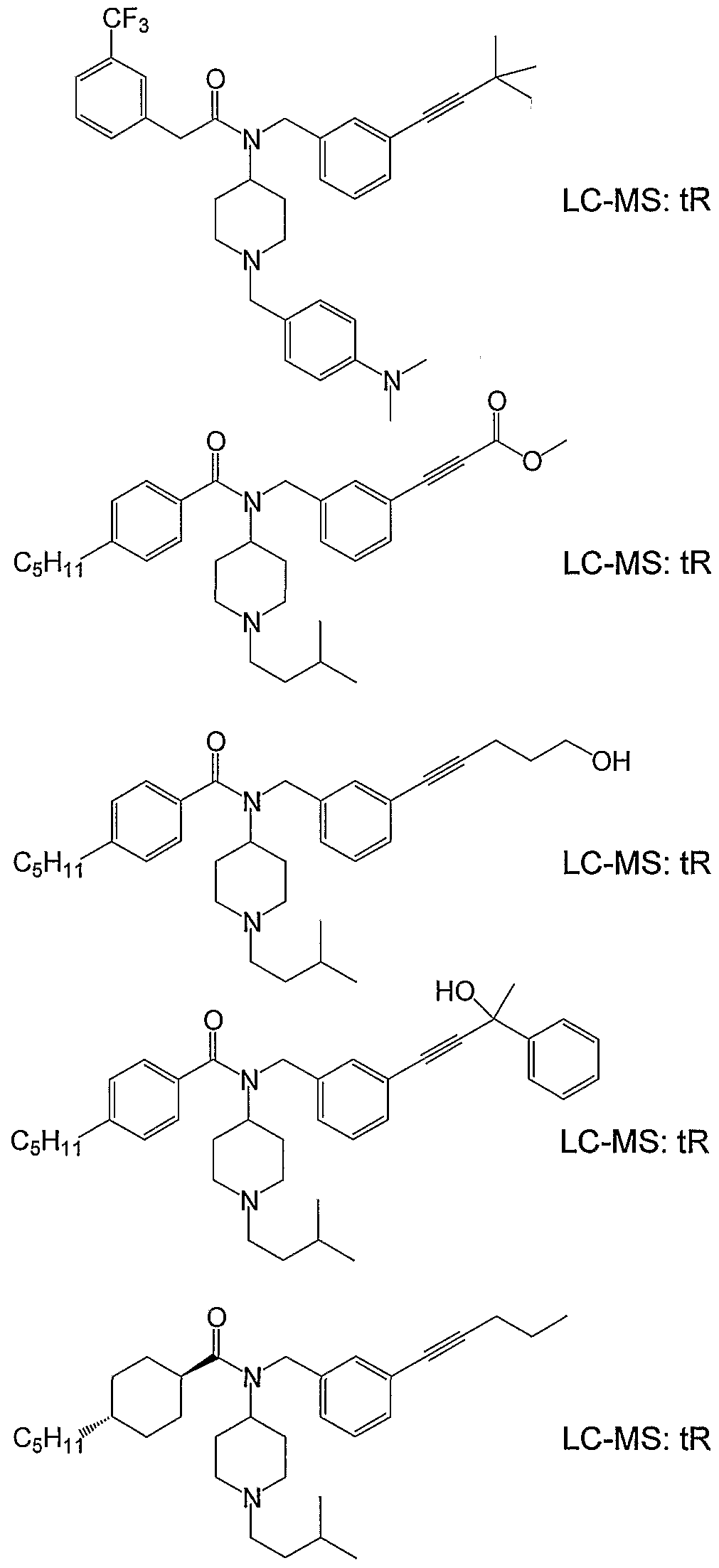
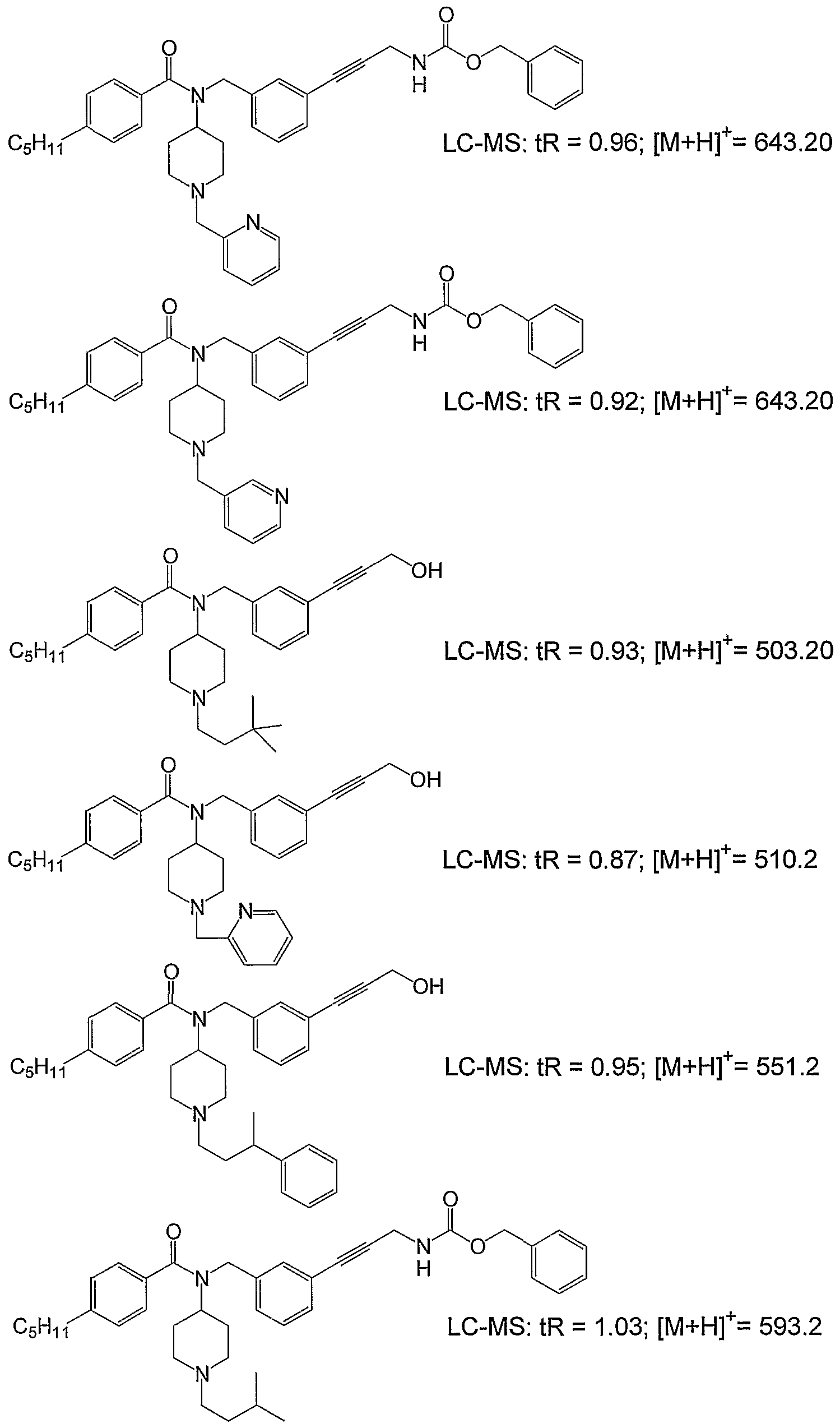
Preferred compounds are: N-[3-(3-Hydroxy-prop-1-ynyl)-benzyl]-N-[1-(3-methyl-butyl)-piperidin-4- yl]-4-pentyl-benzamide; N-[3-(4-Hydroxy-pent-1-ynyl)-benzyl]-N-[1-(3-methyl-butyl)-piperidin-4- yl]-4-pentyl-benzamide; N-[3-(3-Methoxy-prop-1-ynyl)-benzyl]-N-[1-(3-methyl-butyl)-piperidin-4- yl]-4-pentyl-benzamide; N-[3-(3,3-Dimethyl-but-1-ynyl)-benzyl]-N-[1-(3-methyl-butyl)-piperidin-4- yl]-4-pentyl-benzamide; N-[3-(4-Hydroxy-but-1-ynyl)-benzyl]-N-[1-(3-methyl-butyl)-piperidin-4- yl]-4-pentyl-benzamide; N-[1-(3-Methyl-butyl)-piperidin-4-yl]-4-pentyl-N-(3-pent-1-ynyl-benzyl)- benzamide; N-[4-(3-Hydroxy-prop-1-ynyl)-benzyl]-N-[1-(3-methyl-butyl)-piperidin-4- yl]-4-pentyl-benzamide; N-[4-(4-Hydroxy-pent-1-ynyl)-benzyl]-N-[1-(3-methyl-butyl)-piperidin-4- yl]-4-pentyl-benzamide; N-[4-(4-Hydroxy-but-1-ynyl)-benzyl]-N-[1-(3-methyl-butyl)-piperidin-4- yl]-4-pentyl-benzamide; N-[1-(3-Methyl-butyl)-piperidin-4-yl]-4-pentyl-N-(4-pent-1-ynyl-benzyl)- benzamide; N-[4-(3,3-Dimethyl-but-1-ynyl)-benzyl]-N-[1-(3-methyl-butyl)-piperidin-4- yl]-4-pentyl-benzamide; (4-{(4'-Methoxy-biphenyl-4-ylmethyl)-[1-(3-methyl-butyl)-piperidin-4-yl]- carbamoyl}-phenyl)-propynoic acid methyl ester; N-(4'-Methoxy-biphenyl-4-ylmethyl)-N-[1-(3-methyl-butyl)-piperidin-4- yl]-4-pent-1 -ynyl-benzamide; 4-Hex-1-ynyl-N-(4'-methoxy-biphenyl-4-ylmethyl)-N-[1-(3-methyl-butyl)- piperidin-4-yl]-benzamide; 4-(3,3-Dimethyl-but-1-ynyl)-N-(4'-methoxy-biphenyl-4-ylmethyl)-N-[1-(3- methyl-butyl)-piperidin-4-yl]-benzamide; N-(4'-Methoxy-biphenyl-4-ylmethyl)-4-(3-methoxy-prop-1-ynyl)-N-[1-(3- methyl-butyl)-piperidin-4-yl]-benzamide; N-(4'-Methoxy-biphenyI-4-ylmethyl)-N-[1-(3-methyl-butyl)-piperidin-4- yl]-4-phenylethynyl-benzamide; N-(4'-Methoxy-biphenyl-4-ylmethyl)-N-[1-(3-methyl-butyl)-piperidin-4- yl]-4-pyridin-2-ylethynyl-benzamide; 3-Hex-1-ynyl-N-(4'-methoxy-biphenyl-4-ylmethyl)-N-[1-(3-methyl-butyl)- piperidin-4-yl]-benzamide; N-(4'-Methoxy-biphenyl-4-ylmethyl)-N-[1-(3-methyl-butyl)-piperidin-4- yl]-3-phenylethynyl-benzamide; 3-(3,3-Dimethyl-but-1-ynyl)-N-(4'-methoxy-biphenyl-4-ylmethyl)-N-[1-(3- methyl-butyl)-piperidin-4-yl]-benzamide; N-(4'-Methoxy-biphenyl-4-ylmethyl)-N-[1-(3-methyl-butyl)-piperidin-4- yl]-3-pent-1 -ynyl-benzamide; N-(4'-Methoxy-biphenyl-4-ylmethyl)-N-[1-(3-methyl-butyl)-piperidin-4- yl]-3-pyridin-2-ylethynyl-benzamide; N-(4'-Methoxy-biphenyl-4-ylmethyl)-3-(3-methoxy-prop-1-ynyl)-N-[1-(3- methyl-butyl)-piperidin-4-yl]-benzamide; 4-Pentyl-cyclohexanecarboxylic acid [1-(3-methyl-butyl)-piperidin-4-yl]-
(4-pent-1 -ynyl-benzyl)-amide; 4-Pentyl-cyclohexanecarboxylic acid (1 -benzyl-piperidin-4-yl)-(4-pent-1 - ynyl-benzyl)-amide; 4-Pentyl-cyclohexanecarboxylic acid (1 -furan-3-ylmethyl-piperidin-4-yl)- (4-pent-1-ynyl-benzyl)-amide; 4-Pentyl-cyclohexanecarboxylic acid (4-pent-1 -ynyl-benzyl)-(1 -pyridin- 4-ylmethyl-piperidin-4-yl)-amide; 4-Pentyl-cyclohexanecarboxylic acid [1-(1 H-imidazol-4-ylmethyI)- piperidin-4-yl]-(4-pent-1-ynyl-benzyl)-amide; and also compounds represented by the following formulae:
Figure imgf000026_0001
Figure imgf000027_0001
Figure imgf000028_0001
Figure imgf000029_0001
Figure imgf000030_0001
Figure imgf000031_0001
The compounds of the general formula I of the present invention may be prepared according to the procedures and sequences of reactions outlined below. For simplicity and clarity reasons, only parts of the synthetic possibilities which lead to compounds of the formulae I to VII are described. For general methods of the necessary steps see Typical Procedures A to M and / or WO 02/24649 and C. Boss et al; Curr. Med. Chem., 2003, 10, 883- 907.
Scheme 1: Synthesis of compounds of the General Formula I:
Pathway A) Alkyne-Substituent in group A:
Figure imgf000033_0001
The reactions were performed according to the descriptions given in the Typical Procedures. Scheme 1 , for simplicity and clarity reasons, describes only limited structural diversity which is not meant to restrict the invention. Scheme 1 (continued): Synthesis of compounds of the General Formula I:
Pathway B) Alkyne-Substituent in group B:
Figure imgf000034_0001
The reactions were performed according to the descriptions given in the Typical Procedures. Scheme 1 , for simplicity and clarity reasons, describes only limited structural diversity which is not meant to restrict the invention.
Scheme 1 (continued): Synthesis of compounds of the General Formula I:
Pathway C) Alkyne-Substituent in group A and variations of group C by parallel chemistry:
Figure imgf000035_0001
1 b) NaBH4; rt; 30min 12 TBTU; CH3CN 13
Figure imgf000035_0002
The reactions were performed according to the descriptions given in the Typical Procedures. Scheme 1 , for simplicity and clarity reasons, describes only limited structural diversity which is not meant to restrict the invention.
The following examples illustrate the invention but do not limit the scope thereof. All temperatures are stated in °C.
List of abbreviations:
Boc2O di-tert.-butyl-di-carbonat
Boc or boc tert.-butyloxycarbonyl
BSA bovine serum albumine
Cbz benzyloxycarbonyl
DBU 1 ,8-diazabicyclo[5.4.0]undec-7-ene(1 ,5-5)
DCC N,N'-dicyclohexylcarbodiimide
DCM dichloromethane
DIPEA Hϋnig's base
DMF dimethylformamide
DMSO dimethylsulfoxide
EDC N-(3-dimethylaminopropyl)-N'-ethyl-carbodiimide
EtOAc ethyl acetate
HATU O-(7-azabenzotriazol-1-yl)-1 ,1 ,3,3-tetramethyluronium hexafluorophosphate
HBTU 2-(1 H-benzotriazole-1-yl)-1 ,1 ,3,3-tetramethyluronium hexafluorophosphate
HCI hydrogen chloride
HV high vacuum
LAH lithium aluminium hydride
M molar
NMM N-methylmorpholine
PG protecting group
PyBOP Benzotriazole-1-yl-oxy-tris-pyrrolidino-phosphonium hexafluorophosphate
Rt or rt room temperature
TBTU 2-(1H-benzotriazole-1-yl)-1 ,1 ,3,3-tetramethyluronium tetrafluoroborate
TEA triethylamine
TFA trifluoroacetic acid THF tetrahydrofuran tR or tR retention time
General Procedures and Examples:
The following compounds were prepared according to the procedures described for the synthesis of compounds encompassed by the general formulae hereinbefore. All compounds were characterized by 1H-NMR (300MHz) and occasionally by 13C-NMR (75MHz) (Varian Oxford, 300MHz; chemical shifts are given in ppm relative to the solvent used; multiplicities: s = singlet, d = doublet, t = triplet; m = multiplet), by LC-MS: A: 2 min < tR < 10 min; (Waters Micromass; ZMD-platform with ESI-probe with Alliance 2790 HT; Colum: 2x30mm, Gromsil ODS4, 3Dm, 120A; Gradient: 0 - 100% acetonitril in water, 6 min, with 0.05% formic acid, flow: 0.45ml/min; tR is given in min.), B: 0.1 min < tR < 1.5 min; (Finnigan AQA with ESI-probe with HP 110 DAD and HP110 binary pump; column: Develosil RP-AQUEOUS, 5Dm, 4.6 mm x 50 mm; gradient: 5 - 95% acetonitril in water (0.04% TFA), 1 min., 95% acetonitril in water (0.04% TFA) 0.4 min., 4.5 ml/min.), by TLC (TLC-plates from Merck, Silica gel 60 F254) and occasionally by melting point.
a) General Procedures:
(for additional descriptions see also: WO 02/24649 and WO 02/38534)
Typical Procedure A) for the reductive amination:
The amine and the aldehyde (1.5 eq.) (which are used as starting materials, are known compounds or the synthesis is described in the Reference Examples), are mixed in anhydrous methanol and refluxed for 4 h. The mixture is cooled to rt and then treated with sodium borohydride (1.5 eq.) and again stirred for 2 h at reflux temperature. The reaction mixture is concentrated in vacuo and water is slowly added followed by extraction with DCM (3x). The combined organic layers were dried over sodium sulfate, filtered and evaporated. The crude compound is purified by column chromatography on silica gel by an appropriate mixture of EtOAc / hexane containing 1% TEA or by recrystallization from a suitable solvent. Further experimental details on reductive aminations can be found in the literature: A. F. Abdel-Magid et al; J. Org. Chem.; 1996, 61, 3849 - 3862; K. A. Neidigh et al; J. Chem. Soc. Perkin Trans. 1; 1998, 2527 - 2531 ; B. J. Lavey et al; J. Org. Chem.; 1996, 61, 7633 - 7636.
Typical Procedure B) for the acylation (with acid chlorides or sulfony /chlorides) :
To a solution of the secondary amine in anhydrous DCM is added Hϋnig's base (DIPEA; 10 eq) or another suitable base followed by the addition of the carboxylic acid chloride or the sulfonylchloride (1.5 eq.). The reaction mixture is stirred for 4 to 12 h at rt. Then saturated sodium carbonate solution was added and the mixture was exctracted with DCM (3x). The combined organic layers were washed with 1 N HCI and brine, dried over magnesium sulfate, filtered and evaporated. The crude compound is purified by column chromatography on silica gel by an appropriate mixture of EtOAc / hexane or by recrystallization from a suitable solvent to give the pure amide intermediates.
Typical Procedure C) for the reaction with isocyanates:
To a solution of the secondary amine in DCM was added the isocyanate (1.5 eq) and the reaction mixture was stirred at rt for 4 to 12 h. The reaction mixture was directly concentrated in vacuo and the crude material was purified by column chromatography on silica gel by an appropriate mixture of EtOAc / hexane or by recrystallization from a suitable solvent to give the pure urea intermediates.
Typical Procedure D) for the second reductive amination with aldehydes:
To a solution of the secondary amine in DCM was added the aldehyde (1.5 eq) and sodium triacetoxy borohydride (4 eq). Stirring was continued for 6 to 12 h. Water was added and the mixture was extracted with DCM (3x). The combined organic layers were dried over magnesium sulfate, filtered and concentrated in vacuo and the crude material was purified by column chromatography on silica gel by an appropriate mixture of EtOAc / hexane or by recrystallization from a suitable solvent to give the pure tertiary amine intermediates.
Typical Procedure E) for the acylation with carboxylic acids:
To a solution of the secondary amine in acetonitrile was added the respective carboxylic acid (1 eq.) and a coupling reagent like HATU (1.05 eq) (or TBTU or P BOP or HBTU and the like) followed by slow addition of DIPEA (2.1 eq). Stirring was continued for 10 h at rt followed by the addition of EtOAc. The mixture was extracted with 2M HCI-solution, saturated NaHCO3-solution and brine, dried over MgSO4 and evaporated. The crude products were purified by HPLC.
Typical Procedure F) for the Boc-deprotection:
To a solution of the Boc-protected amine in dioxane at rt was added a solution of 4 M HCI in dioxane (commercially available from Aldrich). Stirring was continued for 1 to 5 h. The mixture was evaporated and dried at HV to give the pure HCI salt of the secondary amine, which were used without further purification, [see also: P. J. Kocienski, Protecting Groups, Thieme, 1994; T. W. Greene, P. G. M. Wuts; Protective Groups in Organic Synthesis, John Wiley & sons; 1991.] Typical Procedure G) for the Suzuki coupling with arylbromides:
To a solution of arylbromide in toluene is added the boronic acid (1.1 eq.) in isopropanol and a 2M aqueous solution of potassium carbonate (5 eq.). The mixture is purged with nitrogen for 10 min and tetrakis(triphenylphosphine) palladium (0.03 eq.) is added. After heating under reflux for 6 h, water is added to the cooled reaction mixture and the product is extracted with ethyl acetate. The organic phase is washed with brine and dried over sodium sulfate. The solvent is evaporated to give the crude aldehyde, which is purified by flash chromatography (EtOAc/heptane gradient).
Typical Procedure H) for the Suzuki coupling with arylchlorides:
The arylchloride, the boronic acid (1.5 eq) and potassium phosphate (K3PO4; 3 eq)) were added subsequently to dioxane (5 ml / mmol arylchloride). While heating to 100°C, nitrogen is bubbled through the mixture. Then a solution of 2'-(dimethylamino)-2-biphenylyl-palladium(ll)-chloride dinorbomylphosphine- complex (from Solvias or Fluka 36037; 0.01 eq)) was added to the hot reaction mixture and stirring was continued for 6 to 18 h. The reaction mixture is cooled to rt, water is added and the product extracted with EtOAc. The combined organic layers were dried with magnesium sulfate, filtered and concentrated in vacuo. The crude product is purified by flash chromatography (EtOAc/heptane gradient). [References for Suzι//c/-couplings: A. F. Littke, G. C. Fu, Angew. Chem., 1998, 110, 3586-3587. J. P. Gardner et al., WO 01/90055 to EliLilly and Co. A. Giroux et al, Tetrahedron Lett, 1997, 38, 3841-3844. A. Suzuki, J. Organometallic Chem., 1999, 576, 147-168. A. R. Martin et al, Ada. Chem. Scand, 1993, 47, 221-230. N. Miyaura et al, Chem. Rev, 1995, 95, 2457- 2483. A. F. Littke, G. C. Fu, Angew. Chem., 2002, 114, 4350-4386. J. Hassan et al; Chem. Rev, 2002, 102, 1359-1469.] Typical Procedure I) for the Sonogashira coupling of terminal acetylenes with aryliodides:
Stephan Thorand, Norbert Krause, J. Org. Chem., 1998, 63, 8551-8553. D. Trachsel, Helv. Chim. Ada., 2003, in press.
Typical Procedure K) for the Sonogashira coupling of terminal acetylenes with arylbromides:
G. Reginato, A. Mordini, M. Caracciolo; J. Org. Chem.; 1997, 62, 6187-6192.
Typical Procedure L) for the preparation of alkyl substituted aryl- and heteroaryl units:
A. Fϋrstner, A. Leitner, M. Mendez, H. Krause; J. Am. Chem. Soc; 2002, 124, 13856-13863.
Example 1 :
Figure imgf000042_0001
4-(3-Bromo-benzylamino)-piperidine-1 -carboxylic acid tert-buty\ ester
According to Typical Procedure A, 4-(3-bromo-benzylamino)-piperidine-1- carboxylic acid tert-butyl ester (1.67 g) was prepared from N-Boc-4-amino- piperidine (1.18 g; commercially available from Neosystem) and 3- bromobenzaldehyde (0.88 g). LC-MS: tR : 0.75 min.; [M+H]+ : 371.26.
Figure imgf000042_0002
4-[(3-Bromo-benzyl)-(4-pentyl-benzoyl)-amino]- piperidine-1 -carboxylic acid tert-butyl ester
According to Typical Procedure B, 4-[(3-Bromo-benzyl)-(4-pentyl-benzoyl)- amino]-piperidine-1 -carboxylic acid tert-butyl ester (2.7 g) was prepared form 4-(3-bromo-benzylamino)-piperidine-1 -carboxylic acid tert-butyl ester (2.2 g) and 4-pentyl-benzoylchloride (1.51 g). LC-MS: tR : 1.18 min.; [M+Hf : 545.1.
Figure imgf000043_0001
Λ/-(3-Bromo-benzyl)-4-pentyl-Λ/-piperidin-4-yl-benzamide Hydrochloride
According to Typical Procedure F, N-(3-Bromo-benzyl)-4-pentyl-N-piperidin-4- yl-benzamide hydrochloride (2.17 g) was prepared from 4-[(3-Bromo-benzyl)- (4-pentyl-benzoyl)-amino]-piperidine-1 -carboxylic acid tert-butyl ester (2.5 g). LC-MS: tR : 0.88 min.; [M+H]+ : 443.1.
Figure imgf000043_0002
Λ/-(3-Bromo-benzyl)-Λ/-[1-(3-methyl-butyl)-piperidin-4-yl]-4-pentyl-benzamide
According to the Typical Procedure D, N-(3-Bromo-benzyl)-N-[1-(3-methyl- butyl)-piperidin-4-yl]-4-pentyl-benzamide (2.22 g) was prepared from N-(3- Bromo-benzyl)-4-pentyl-N-piperidin-4-yl-benzamide hydrochloride (2.17 g) and isovaleraldehyde (0.59 g). LC-MS: tR : 0.97 min.; [M+H]+ : 513.2.
Figure imgf000043_0003
Λ/-[3-(3-Hydroxy-prop-1-ynyl)-benzyl]-Λ/-[1-(3-met yl-butyl)- piperidin-4-yl]-4-pentyl-benzamide According to the Typical Procedure K adapted to a parallel chemistry setting, N-[3-(3-Hydroxy-prop-1-ynyl)-benzyl]-N-[1-(3-methyl-butyl)-piperidin-4-yl]-4- pentyl-benzamide (0.02 g) was prepared from N-(3-Bromo-benzyl)-N-[1-(3- methyl-butyl)-piperidin-4-yl]-4-pentyl-benzamide (0.05 g) and propargyl alcohol. LC-MS: tR : 0.92 min.; [M+H]+ : 489.48.
The following Examples 2 to 6 were prepared in analogy to the preparation described for Example 1. No nomenclature is given! This is not a mistake but would be better in addition to the formulae (see also following examples).
Example 2
Example 3
Example 4
Example 5
Example 6
Figure imgf000045_0001
Example 7:
Figure imgf000046_0001
■ 4-(4-Bromo-benzylamino)-piperidine-1 -carboxylic acid tert-butyl ester
According to Typical Procedure A, 4-(4-bromo-benzylamino)-piperidine-1- carboxylic acid tert-butyl ester (9.62 g) was prepared from N-Boc-4-amino- piperidine hydrochloride (5.0 g; commercially available from Neosystem) and 4-bromobenzaldehyde (6.39 g). LC-MS: tR : 0.76 min.; [M+H]+ : 371.13.
Figure imgf000046_0002
4-[(4-Bromo-benzyl)-(4-pentyl-benzoy!)-amino]- piperidine-1 -carboxylic acid tert-butyl ester
According to Typical Procedure B, 4-[(4-Bromo-benzyl)-(4-pentyl-benzoyl)- amino]-piperidine-1 -carboxylic acid tert-butyl ester (3.63 g) was prepared form
4-(4-bromo-benzylamino)-piperidine-1 -carboxylic acid tert-butyl ester (3.0 g) and 4-pentyl-benzoylchloride (2.05 g). LC-MS: tR : 1.16 min.; [M+H]+ : 545.17.
Figure imgf000047_0001
Λ/-(4-Bromo-benzyl)-4-pentyl-Λ/-piperidin-4-yl-benzamide Hydrochloride
According to Typical Procedure F, N-(4-Bromo-benzyl)-4-pentyl-N-piperidin-4- yl-benzamide Hydrochloride (2.05 g) was prepared from 4-[(4-Bromo-benzyl)- (4-pentyl-benzoyI)-amino]-piperidine-1 -carboxylic acid tert-butyl ester (2.5 g). LC-MS: tR : 0.88 min.; [M+H]+ : 443.1.
Figure imgf000047_0002
Λ/-(4-Bromo-benzyl)-/V-[1-(3-methyl-butyl)-piperidin-4-yl]-4-pentyl-benzamide
According to the Typical Procedure D, N-(4-Bromo-benzyl)-N-[1-(3-methyl- butyl)-piperidin-4-yl]-4-pentyl-benzamide (1.05 g) was prepared from N-(4- Bromo-benzyl)-4-pentyl-N-piperidin-4-yl-benzamide Hydrochloride (1.61 g) and isovaleraldehyde (0.29 g). LC-MS: tR : 0.97 min.; [M+H]+ : 515.2.
Figure imgf000047_0003
Λ/-[4-(3-Hydroxy-prop-1-ynyl)-benzyl]-Λ/-[1-(3-methyl-butyl)- piperidin-4-yl]-4-pentyl-benzamide According to the Typical Procedure K adapted to a parallel chemistry setting, N-[4-(3-Hydroxy-prop-1-ynyl)-benzyl]-N-[1-(3-methyl-butyl)-piperidin-4-yl]-4- pentyl-benzamide (0.02 g) was prepared from N-(4-Bromo-benzyl)-N-[1-(3- methyl-butyl)-piperidin-4-yl]-4-pentyl-benzamide (0.05 g) and propargyl alcohol. LC-MS: tR : 0.92 min.; [M+H]+ : 489.51.
The following Examples 8 to 1 1 were prepared in analogy to the preparation described for Example 7.
Example 8
Example 9
Example 10
Example 11
Figure imgf000048_0001
Example 12: Prepared as described in WO 02/24649
Figure imgf000049_0001
Typical Procedure A
Figure imgf000049_0003
Figure imgf000049_0002
LC-MS: tR = 0.83; [M+H]+ = 397.31
Figure imgf000049_0004
LC-MS: tR = 1.13; [M+H]+ = 627.09
Figure imgf000049_0005
LC-MS: tR = 0.85; LC-MS: tR = 0.92;
Figure imgf000049_0006
Example 12 LC-MS: tR = 0.94; [M+H]+ = 553.32 The following Examples 13 to 18 were prepared in analogy to the preparation described for Example 12.
Figure imgf000050_0001
The following Examples 19 to 24 were prepared in analogy to the preparation described for Example 12.
Figure imgf000051_0001
The following Examples 25 to 29 were prepared in analogy to the Typical Procedures and to the procedures described for the preparation of the Examples 1 to 24.
Example 25
Example 26
Example 27
Example 28
Example 29
Figure imgf000052_0001
According to the procedures described above the following examples were prepared: Example 30 = 0.99; [M+H]+= 590.49
Example 31 = 0.98; [M+H]+= 517.5
Example 32 = 0.93; [M+Hf = 517.61
Example 33 = 0.99; [M+H]+= 579.58
Example 34 = 1.06; [M+H]+= 507.47
Figure imgf000053_0001
Example 35 tR = 1.03; [M+H] = 517.37
Example 36 tR = 0.96; [M+H] = 528.40
Example 37 tR = 0.95; [M+H] = 517.40
Example 38 tR = 1.05; [M+H]+= 557.42
Example 39 tR = 1.07; [M+H]+= 521.46
Figure imgf000054_0001
Example 40 tR = 1.03; [M+H]+= 535.2
Example 41 tR = 1.02; [M+H]+= 541.2
Example 42 tR = 0.98; [M+H]+= 536.2
Example 43 tR = 1.02; [M+H]+= 565.2
Example 44 tR = 0.97; [M+H]+= 565.2
Figure imgf000055_0001
Example 45 1.01 ; [M+H]+ = 622.3
Example 46 0.99; [M+H]+= 680.24
Example 47 1.03; [M+H]+= 684.26
Example 48 0.91 ; [M+H]+= 643.20
Example 49 0.90; [M+H] = 632.20
Figure imgf000056_0001
Example 50 [M+H]+= 569.30
Example 51 [M+H] = 510.30
Example 52 [M+H]+= 510.20
Example 53 [M+H]+= 638.28
Example 54 [M+H]+= 642.20
Figure imgf000057_0001
Example 55
Example 56
Example 57
Example 58
Example 59
Example 60
Figure imgf000058_0001
Example A
Active ingredients can be formulated according to methods known per se to give pharmaceutical preparations of the following composition:
1. 500 mg tablets
Active ingredient 500 mg Lactose powder 149 mg Polyvinylpyrrolidone 15 mg Dioctyl sodiumsulphosuccinate 1 mg Na carboxymethylstarch 30 mg Magnesium stearate 5 mα 700 mg 2. 50 mα tablets
Active ingredient 50 mg Lactose powder 50 mg Microcrystalline cellulose 82 mg Na carboxymethylstarch 15 mg
3. 100 mg capsules Active ingredient 100.0 mg Lactose powder 104.7 mg Corn starch 70.0 mg Hydroxypropylmenthyl cellulose 10.0 mg Dioctyl sodiumsulphosuccinate 0.3 mg Talc 12.0 mg Magnesium stearate 3.0 mg 4. 500 mg suppositories
Active ingredient 500 mg Suppository mass ad 2000 mg
5. 100 mg suppository
Active ingredient 100 mg Medium chain triglyceride 300 mg 400 mg

Claims

Claims:
1. Compounds of the general formula I:
General Formula I
Figure imgf000061_0001
wherein
X represents -(CH2)n-;
Y represents -(CH2)n-; -(C=O)-; -(SO2)-; -(C=O)-NH-;
Z represents a bond; -(CH2)n-;
C represents hydrogen; lower alkyl; lower alkenyl; lower alkynyl; aryl; heteroaryl; cycloalkyl; cycloalkenyl; heterocyclyl; or lower alkyl substituted by hydroxy, carboxy or lower alkoxycarbonyl;
n represents the whole numbers 1 , 2, 3 or 4;
A and B represent aryl; heteroaryl; heterocyclyl; cycloalkyl; with the proviso that at least one of A and B represents aryl or heteroaryl substituted by an alkynyl group Q which is represented by the following groups: - alkynyl containing two to six carbon atoms;and
Figure imgf000061_0002
-≡^D-N-R2 R3 -R° wherein
D represents -(CH2)n-;
R1 represents hydrogen; methyl; ethyl; propyl; butyl; tert.-butyl; iso-propyl; aryl; heteroaryl;
R2 represents hydrogen; methyl; ethyl; propyl; butyl; tert.-butyl; iso-propyl; -(CH2)m-aryl; -(CH2)m-heteroaryl; -(CH2)m-cycloalkyl; -(C=O)-R4; -(C=O)-NH- R4; -(C=O)-O-R4;
R3 represents hydrogen; methyl; ethyl; propyl; butyl; -(CH2)m-aryl; -(CH2)m-heteroaryl; -(CH2)m-cycloalkyl;
R4 represents lower alkyl; -(CH2)m-aryl; -(CH2)m-heteroaryl; -(CH2)m-cycloalkyl;
R6 represents aryl, heteroaryl or lower alkyl optionally substituted by OR1 and/or any of aryl and heteroaryl;
m represents the whole numbers 0 (zero), 1 , 2 or 3;
and optically pure enantiomers, mixtures of enantiomers such as racemates, diastereomers, mixtures of diastereomers, diastereomeric racemates, mixtures of diastereomeric racemates, and the meso-form; as well as pharmaceutically acceptable salts, solvent complexes, morphological forms and prodrugs of any of these compounds.
2. Compounds of the formula II
Formula II
Figure imgf000062_0001
wherein
A, C, X, Y and Z are as defined in general formula I above and R5 represents one of the groups R2 - R1 — -D-O-R1 — -D-N NR3
Figure imgf000063_0001
wherein R1, R2, R3, R6 and D are as defined in general formula I above and optically pure enantiomers, mixtures of enantiomers such as racemates, diastereomers, mixtures of diastereomers, diastereomeric racemates, mixtures of diastereomeric racemates, and the meso-form; as well as pharmaceutically acceptable salts, solvent complexes and morphological forms.
3. Compounds according to formula II wherein A, C, X and Z are as defined in general formula I above, and wherein Y represents -(CH2)- and optically pure enantiomers, mixtures of enantiomers such as racemates, diastereomers, mixtures of diastereomers, diastereomeric racemates, mixtures of diastereomeric racemates, ar ttø meso-form; as well as pharmaceutically acceptable salts, solvent complexes and morphological forms.
4. Compounds according to formula II wherein A, C, X and Z are as defined in general formula I above, and wherein Y represents -(C=O)- and optically pure enantiomers, mixtures of enantiomers such as racemates, diastereomers, mixtures of diastereomers, diastereomeric racemates, mixtures of diastereomeric racemates, and the meso-form; as well as pharmaceutically acceptable salts, solvent complexes and morphological forms.
5. Compounds of the formula III:
Formula
Figure imgf000064_0001
wherein
A, C, X, Y and Z are as defined in general formula I above and R5 represents one of the groups
R2 --R1 — -D-O-R1 — -D-N R3
Figure imgf000064_0002
wherein R1, R2, R3, R6and D are as defined in general formula I above and optically pure enantiomers, mixtures of enantiomers such as racemates, diastereomers, mixtures of diastereomers, diastereomeric racemates, mixtures of diastereomeric racemates, and the meso-form; as well as pharmaceutically acceptable salts, solvent complexes and morphological forms.
6. Compounds according to formula III wherein A, C, X and Z are as defined in general formula I above, and wherein Y represents -(CH2)- and optically pure enantiomers, mixtures of enantiomers such as racemates, diastereomers, mixtures of diastereomers, diastereomeric racemates, mixtures of diastereomeric racemates, and the meso-form; as well as pharmaceutically acceptable salts, solvent complexes and morphological forms.
7. Compounds according to formula III wherein A, C, X and Z are as defined in general formula I above, and wherein Y represents -(C=O)- and optically pure enantiomers, mixtures of enantiomers such as racemates, diastereomers, mixtures of diastereomers, diastereomeric racemates, mixtures of diastereomeric racemates, and the meso-form; as well as pharmaceutically acceptable salts, solvent complexes and morphological forms.
8. Compounds of the formula IV
Figure imgf000065_0001
wherein
B, C, X, Y and Z are as defined in general formula I above and R5 represents one of the groups
R2 --R1 --D-0-R1 — -D-N R3
Figure imgf000065_0002
wherein R1, R2, R3, R6and D are as defined in general formula I above and optically pure enantiomers, mixtures of enantiomers such as racemates, diastereomers, mixtures of diastereomers, diastereomeric racemates, mixtures of diastereomeric racemates, and the meso-form; as well as pharmaceutically acceptable salts, solvent complexes and morphological forms.
9. Compounds according to formula IV wherein B, C, X and Z are as defined in general formula I above, and wherein Y represents -(CH2)- and optically pure enantiomers, mixtures of enantiomers such as racemates, diastereomers, mixtures of diastereomers, diastereomeric racemates, mixtures of diastereomeric racemates, and the meso-form; as well as pharmaceutically acceptable salts, solvent complexes and morphological forms.
10. Compounds according to formula IV wherein B, C, X and Z are as defined in general formula I above, and wherein Y represents -(C=O)- and optically pure enantiomers, mixtures of enantiomers such as racemates, diastereomers, mixtures of diastereomers, diastereomeric racemates, mixtures of diastereomeric racemates, and the meso-form; as well as pharmaceutically acceptable salts, solvent complexes and morphological forms.
11. Compounds of the formula V
Figure imgf000066_0001
wherein
B, C, X, Y and Z are as defined in general formula I above and R5 represents one of the groups
Figure imgf000066_0002
wherein R1, R2, R3,R6and D are as defined in general formula I above and optically pure enantiomers, mixtures of enantiomers such as racemates, diastereomers, mixtures of diastereomers, diastereomeric racemates, mixtures of diastereomeric racemates, and the meso-form; as well as pharmaceutically acceptable salts, solvent complexes and morphological forms.
12. Compounds according to formula V wherein B, C, X and Z are as defined in general formula I above, and wherein Y represents -(CH2)- and optically pure enantiomers, mixtures of enantiomers such as racemates, diastereomers, mixtures of diastereomers, diastereomeric racemates, mixtures of diastereomeric racemates, and the meso-form; as well as pharmaceutically acceptable salts, solvent complexes and morphological forms.
13. Compounds according to formula V wherein B, C, X and Z are as defined in general formula I above, and wherein Y represents -(C=O)- and optically pure enantiomers, mixtures of enantiomers such as racemates, diastereomers, mixtures of diastereomers, diastereomeric racemates, mixtures of diastereomeric racemates, and the meso-form; as well as pharmaceutically acceptable salts, solvent complexes and morphological forms.
14. Compounds of the formula VI
Figure imgf000067_0001
wherein C, X and Z are as defined in general formula I above, the alkyne group is attached to the phenyl ring at position 3 or position 4, and R5 represents one of the groups
R" -R ,11 — -D-O-R1 -D-N RJ
Figure imgf000068_0001
wherein R1, R2, R3, R6 and D are as defined in general formula I above and optically pure enantiomers, mixtures of enantiomers such as racemates, diastereomers, mixtures of diastereomers, diastereomeric racemates, mixtures of diastereomeric racemates, and the meso-form; as well as pharmaceutically acceptable salts, solvent complexes and morphological forms.
15. Compounds of the formula VII
Figure imgf000068_0002
wherein
C, X and Z are as defined in general formula I above, the alkyne group is attached to the phenyl ring at position 3 or position 4, and R5 represents one of the groups R" R ' — -D-O-R — D-N R3
Figure imgf000069_0001
wherein R1, R2, R3, R6 and D are as defined in general formula I above and optically pure enantiomers, mixtures of enantiomers such as racemates, diastereomers, mixtures of diastereomers, diastereomeric racemates, mixtures of diastereomeric racemates, and the meso-form; as well as pharmaceutically acceptable salts, solvent complexes and morphological forms.
16. compounds according to any one of claims 1-15, in which the group
-RD
in claim 1 represents the group
Figure imgf000069_0002
in which R1 is as in claim 1; and C in formula I represents hydrogen; lower alkyl; lower alkenyl; lower alkynyl; aryl; heteroaryl; cycloalkyl; cycloalkenyl;or heterocyclyl.
17. A compound according to any one of the claims 1 to 16 selected from the group consisting of:
N-[3-(3-Hydroxy-prop-1-ynyl)-benzyl]-N-[1-(3-methyl-butyl)-piperidin-4- yl]-4-pentyl-benzamide; N-[3-(4-Hydroxy-pent-1 -ynyl)-benzyl]-N-[1 -(3-methyl-butyI)-piperidin-4- yl]-4-pentyl-benzamide; N-[3-(3-Methoxy-prop-1-ynyl)-benzyl]-N-[1-(3-methyl-butyl)-piperidin-4- yl]-4-pentyl-benzamide; N-[3-(3,3-Dimethyl-but-1-ynyl)-benzyl]-N-[1-(3-methyl-butyl)-piperidin-4- yl]-4-pentyl-benzamide; N-[3-(4-Hydroxy-but-1-ynyl)-benzyl]-N-[1-(3-methyl-butyl)-piperidin-4- yl]-4-pentyl-benzamide; N-[1 -(3-Methyl-butyl)-piperidin-4-yl]-4-pentyl-N-(3-pent-1 -ynyl-benzyl)- benzamide; N-[4-(3-Hydroxy-prop-1-ynyl)-benzyl]-N-[1-(3-methyl-butyl)-piperidin-4- yl]-4-pentyl-benzamide; N-[4-(4-Hydroxy-pent-1-ynyl)-benzyl]-N-[1-(3-methyl-butyl)-piperidin-4- yl]-4-pentyl-benzamide; N-[4-(4-Hydroxy-but-1-ynyl)-benzyl]-N-[1-(3-methyl-butyl)-piperidin-4- yl]-4-pentyl-benzamide; N-[1-(3-Methyl-butyl)-piperidin-4-yI]-4-pentyl-N-(4-pent-1-ynyl-benzyl)- benzamide; N-[4-(3,3-Dimethyl-but-1-ynyl)-benzyl]-N-[1-(3-methyl-butyl)-piperidin-4- yl]-4-pentyl-benzamide; (4-{(4'-Methoxy-biphenyl-4-ylmethyl)-[1-(3-methyl-butyl)-piperidin-4-yl]- carbamoyl}-phenyl)-propynoic acid methyl ester; N-(4'-Methoxy-biphenyl-4-ylmethyl)-N-[1-(3-methyl-butyl)-piperidin-4- yl]-4-pent-1 -ynyl-benzamide; 4-Hex-1-ynyl-N-(4'-methoxy-biphenyl-4-ylmethyl)-N-[1-(3-methyl-butyl)- piperidin-4-yl]-benzamide; 4-(3,3-Dimethyl-but-1-ynyl)-N-(4'-methoxy-biphenyl-4-ylmethyl)-N-[1-(3- methyl-butyl)-piperidin-4-yl]-benzamide; N-(4'-Methoxy-biphenyl-4-ylmethyl)-4-(3-methoxy-prop-1 -ynyl)-N-[1 -(3- methyl-butyl)-piperidin-4-yl]-benzamide; N-(4'-Methoxy-biphenyl-4-ylmethyl)-N-[1-(3-methyl-butyl)-piperidin-4- yl]-4-phenylethynyl-benzamide; N-(4'-Methoxy-biphenyl-4-ylmethyl)-N-[1-(3-methyl-butyl)-piperidin-4- yl]-4-pyridin-2-ylethynyl-benzamide; 3-Hex-1-ynyl-N-(4'-methoxy-biphenyl-4-ylmethyl)-N-[1-(3-methyl-butyl)- piperidin-4-yl]-benzamide; N-(4'-Methoxy-biphenyl-4-ylmethyl)-N-[1-(3-methyl-butyl)-piperidin-4- yl]-3-phenylethynyl-benzamide; 3-(3,3-Dimethyl-but-1-ynyl)-N-(4'-methoxy-biphenyl-4-ylmethyl)-N-[1-(3- methyl-butyl)-piperidin-4-yl]-benzamide; N-(4'-Methoxy-biphenyl-4-ylmethyI)-N-[1-(3-methyl-butyl)-piperidin-4- yl]-3-pent-1 -ynyl-benzamide; N-(4'-Methoxy-biphenyl-4-ylmethyl)-N-[1-(3-methyl-butyl)-piperidin-4- yl]-3-pyridin-2-ylethynyl-benzamide; N-(4'-Methoxy-biphenyl-4-ylmethyl)-3-(3-methoxy-prop-1-ynyl)-N-[1-(3- methyl-butyl)-piperidin-4-yl]-benzamide; 4-Pentyl-cyclohexanecarboxylic acid [1 -(3-methyl-butyl)-piperidin-4-yl]- (4-pent-1 -ynyl-benzyl)-amide; 4-Pentyl-cyclohexanecarboxylic acid (1 -benzyl-piperidin-4-yl)-(4-pent-1 - ynyl-benzyl)-amide; 4-Pentyl-cyclohexanecarboxylic acid (1-furan-3-ylmethyl-piperidin-4-yl)-
(4-pent-1 -ynyl-benzyl)-amide; 4-Pentyl-cyclohexanecarboxylic acid (4-pent-1-ynyl-benzyl)-(1-pyridin- 4-ylmethyl-piperidin-4-yl)-amide; 4-Pentyl-cyclohexanecarboxylic acid [1-(1 H-imidazol-4-ylmethyl)- piperidin-4-yl]-(4-pent-1-ynyl-benzyI)-amide.
8. A compound according to claim 1 selected from the group consisting of:
Figure imgf000072_0001
Figure imgf000073_0001
Figure imgf000074_0001
Figure imgf000075_0001
Figure imgf000076_0001
Figure imgf000077_0001
19. Pharmaceutical compositions containing one or more compounds as claimed in any one of claims 1 to 18 and inert excipients.
20. Pharmaceutical compositions according to claim 19 containing one or more compounds as claimed in any one of claims 1 to 18 for treatment of diseases demanding the inhibition of parasitic aspartic proteases.
21. Pharmaceutical compositions according to claim 19 containing one or more compounds as claimed in any one of claims 1 to 18 for treatment of disorders associated with the role of plasmepsin II and which require inhibition of plasmepsin II for treatment.
22. Pharmaceutical compositions according to claim 19 containing one or more compounds as claimed in any one of claims 1 to 18 for treatment or prevention of malaria.
23. Pharmaceutical compositions according to claim 19 containing one or more compounds as claimed in any one of claims 1 to 18 for treatment or prevention of diseases caused by protozoal infection.
24. Pharmaceutical compositions according to claim 19 containing one or more compounds as claimed in any one of claims 1 to 18 which contain aside of one or more compounds of the general formula I a known plasmepsin II inhibitor, a known antimalarial or a known HIV protease inhibitor.
25. Use of pharmaceutical compositions according to any one of claims 19 to 24 for treatment of diseases demanding the inhibition of parasitic aspartic proteases
26. Use of pharmaceutical compositions according to any one of claims 19 to 24 for treatment or prevention of malaria.
27. Use of pharmaceutical compositions according to any one of claims 19 to 24 for treatment or prevention of protozoal infections.
28. Use of pharmaceutical compositions according to any one of claims 19 to 24 for treatment or prevention of diseases in combination with a known plasmepsin II inhibitor, a known antimalarial or a known HIV protease inhibitor or another known anti-HIV treatment.
29. A method of treating a patient suffering from a disease requiring the inhibition of parasitic aspartic proteases by administering a pharmaceutical composition according to any one of claims 19 to 24.
30. A method according to claim 29 by administering a dose of the parasitic aspartic protease inhibitor of the general formula I between 1 mg and 1000 mg per day.
31. A method according to claim 29 by administering a dose of the parasitic aspartic protease inhibitor of the general formula I between 1 mg and 500 mg per day.
32. A method according to claim 29 by administering a dose of the parasitic aspartic protease inhibitor of the general formula I between 5 mg and 200 mg per day.
33. A process for the preparation of a pharmaceutical composition according to any one of the claims 19 to 24, characterized by mixing one or more active ingredients according to claims 1 to 18 with inert excipients in a manner known per se.
34. The use of a compound according to any one of claims 1 to 18 in the preparation of a medicament for the treatment or prevention of malaria or protozoal infections.
35. A compound according to any one of claims 1 to 18 for use in the treatment or prevention of malaria or protozoal infections.
36. The new compounds, intermediates, processes and pharmaceutical compositions as described hereinbefore.
37. A process for the manufacture of the compounds of claim 1 , which comprises a) reacting a compound of formula I, in which the alkynyl group Q is replaced by bromine of iodine , with an alcohol QOH, in which Q is as in claim 1; or b) subjecting a compound of formula I, in which the group -Z-C is replaced by hydrogen, to reductive amination with an aldehyde yielding the group -Z-C; or c) converting a compound of formula I into a pharmaceutically acceptable salt thereof.
38. Compounds of formula I in claim I and their pharmaceutically acceptable salts, whenever prepared by the process according to claim 37 or by an obvious chemical equivalent thereof.
PCT/EP2004/009010 2003-08-25 2004-08-12 Substituted amino-aza-cyclohexanes Ceased WO2005019176A1 (en)

Applications Claiming Priority (2)

Application Number Priority Date Filing Date Title
EP0309380 2003-08-25
EPPCT/EP03/09380 2003-08-25

Publications (1)

Publication Number Publication Date
WO2005019176A1 true WO2005019176A1 (en) 2005-03-03

Family

ID=34203139

Family Applications (1)

Application Number Title Priority Date Filing Date
PCT/EP2004/009010 Ceased WO2005019176A1 (en) 2003-08-25 2004-08-12 Substituted amino-aza-cyclohexanes

Country Status (1)

Country Link
WO (1) WO2005019176A1 (en)

Cited By (4)

* Cited by examiner, † Cited by third party
Publication number Priority date Publication date Assignee Title
WO2006056930A3 (en) * 2004-11-25 2008-01-17 Actelion Pharmaceuticals Ltd Novel 4 -aminopiperidine derivatives as plasmepsin ii inhibitors
US7432281B2 (en) 2003-10-07 2008-10-07 Renovis, Inc. Amide derivatives as ion-channel ligands and pharmaceutical compositions and methods of using the same
US7576099B2 (en) 2005-02-28 2009-08-18 Renovis, Inc. Amide derivatives as ion-channel ligands and pharmaceutical compositions and methods of using the same
JP2016516025A (en) * 2013-03-15 2016-06-02 アクテリオン ファーマシューティカルズ リミテッドActelion Pharmaceuticals Ltd Novel acrylamide derivatives as antimalarials

Citations (2)

* Cited by examiner, † Cited by third party
Publication number Priority date Publication date Assignee Title
WO2002024649A1 (en) * 2000-09-25 2002-03-28 Actelion Pharmaceuticals Ltd Substituted amino-aza-cycloalkanes useful against malaria
WO2004009549A2 (en) * 2002-07-18 2004-01-29 Actelion Pharmaceuticals Ltd Piperidines useful for the treatment of central nervous system disorders

Patent Citations (2)

* Cited by examiner, † Cited by third party
Publication number Priority date Publication date Assignee Title
WO2002024649A1 (en) * 2000-09-25 2002-03-28 Actelion Pharmaceuticals Ltd Substituted amino-aza-cycloalkanes useful against malaria
WO2004009549A2 (en) * 2002-07-18 2004-01-29 Actelion Pharmaceuticals Ltd Piperidines useful for the treatment of central nervous system disorders

Non-Patent Citations (1)

* Cited by examiner, † Cited by third party
Title
BOSS C ET AL: "INHIBITORS OF THE PLASMODIUM FALCIPARUM PARASITE ASPARTIC PROTEASE PLASMEPSIN II AS POTENTIAL ANTIMALARIAL AGENTS", CURRENT MEDICINAL CHEMISTRY, BENTHAM SCIENCE PUBLISHERS BV, BE, vol. 10, no. 11, 2003, pages 883 - 907, XP009036752, ISSN: 0929-8673 *

Cited By (5)

* Cited by examiner, † Cited by third party
Publication number Priority date Publication date Assignee Title
US7432281B2 (en) 2003-10-07 2008-10-07 Renovis, Inc. Amide derivatives as ion-channel ligands and pharmaceutical compositions and methods of using the same
WO2006056930A3 (en) * 2004-11-25 2008-01-17 Actelion Pharmaceuticals Ltd Novel 4 -aminopiperidine derivatives as plasmepsin ii inhibitors
US7576099B2 (en) 2005-02-28 2009-08-18 Renovis, Inc. Amide derivatives as ion-channel ligands and pharmaceutical compositions and methods of using the same
JP2016516025A (en) * 2013-03-15 2016-06-02 アクテリオン ファーマシューティカルズ リミテッドActelion Pharmaceuticals Ltd Novel acrylamide derivatives as antimalarials
US9637473B2 (en) 2013-03-15 2017-05-02 Actelion Pharmaceuticals Ltd. Acrylamide derivatives as antimalarial agents

Similar Documents

Publication Publication Date Title
US20040102431A1 (en) Substituted amino-aza-cycloalkanes useful against malaria
US9469629B2 (en) NK1 antagonists
KR101634656B1 (en) Pyrrolidine derivatives
EP1302463A1 (en) Medicine comprising dicyanopyridine derivative
RU2396257C2 (en) 4-aminopyperidine derivatives
AU2006305538B2 (en) Piperazine derivatives as antimalarial agents
JP5404607B2 (en) Aniline derivative having anti-RNA virus action
EP0344577B1 (en) Butenoic or propenoic acid derivatives
JP3853653B2 (en) Carboxamides, methods for their preparation and their use as pharmaceutical compositions
WO2005019176A1 (en) Substituted amino-aza-cyclohexanes
WO2005058822A1 (en) Substituted amino-cycloalkanes
US20040067927A1 (en) Substituted alkyldiamines
KR101455484B1 (en) Piperazines as antimalarial agents
WO2006056930A2 (en) Novel 4 -aminopiperidine derivatives as plasmepsin ii inhibitors
JP2012509311A (en) Novel bis-amides as antimalarials
MX2007016064A (en) Compositions and methods for viral inhibition.
WO2002083641A2 (en) Amino-aza-cyclohexanes for the treatment of malaria
EP1335899A2 (en) Substituted alkyldiamines as inhibitors of plasmepsin or related proteases
EP1824822A2 (en) Novel 4-aminopiperidine derivatives as plasmepsin ii inhibitors
EP1322612A1 (en) Substituted amino-aza-cycloalkanes useful against malaria
WO2004105738A2 (en) Use of tetrahydropyridine derivatives
WO2002010127A1 (en) Acetamide derivatives and the use thereof as inhibitors of coagulation factors xa and viia
HK1176069A (en) Piperidine derivatives as nk1 antagonists
CZ349899A3 (en) Inhibitors of viral protease

Legal Events

Date Code Title Description
AK Designated states

Kind code of ref document: A1

Designated state(s): AE AG AL AM AT AU AZ BA BB BG BR BW BY BZ CA CH CN CO CR CU CZ DE DK DM DZ EC EE EG ES FI GB GD GE GH GM HR HU ID IL IN IS JP KE KG KP KR KZ LC LK LR LS LT LU LV MA MD MG MK MN MW MX MZ NA NI NO NZ OM PG PH PL PT RO RU SC SD SE SG SK SL SY TJ TM TN TR TT TZ UA UG US UZ VC VN YU ZA ZM ZW

AL Designated countries for regional patents

Kind code of ref document: A1

Designated state(s): BW GH GM KE LS MW MZ NA SD SL SZ TZ UG ZM ZW AM AZ BY KG KZ MD RU TJ TM AT BE BG CH CY CZ DE DK EE ES FI FR GB GR HU IE IT LU MC NL PL PT RO SE SI SK TR BF BJ CF CG CI CM GA GN GQ GW ML MR NE SN TD TG

121 Ep: the epo has been informed by wipo that ep was designated in this application
122 Ep: pct application non-entry in european phase