WO2005019164A2 - Preparation of phenethanolamine derivatives - Google Patents

Preparation of phenethanolamine derivatives Download PDF

Info

Publication number
WO2005019164A2
WO2005019164A2 PCT/EP2004/009354 EP2004009354W WO2005019164A2 WO 2005019164 A2 WO2005019164 A2 WO 2005019164A2 EP 2004009354 W EP2004009354 W EP 2004009354W WO 2005019164 A2 WO2005019164 A2 WO 2005019164A2
Authority
WO
WIPO (PCT)
Prior art keywords
formula
compound
hydrogen
alkyl
iii
Prior art date
Legal status (The legal status is an assumption and is not a legal conclusion. Google has not performed a legal analysis and makes no representation as to the accuracy of the status listed.)
Ceased
Application number
PCT/EP2004/009354
Other languages
French (fr)
Other versions
WO2005019164A3 (en
Inventor
Keith Blake
Current Assignee (The listed assignees may be inaccurate. Google has not performed a legal analysis and makes no representation or warranty as to the accuracy of the list.)
Glaxo Group Ltd
Original Assignee
Glaxo Group Ltd
Priority date (The priority date is an assumption and is not a legal conclusion. Google has not performed a legal analysis and makes no representation as to the accuracy of the date listed.)
Filing date
Publication date
Application filed by Glaxo Group Ltd filed Critical Glaxo Group Ltd
Publication of WO2005019164A2 publication Critical patent/WO2005019164A2/en
Publication of WO2005019164A3 publication Critical patent/WO2005019164A3/en
Anticipated expiration legal-status Critical
Ceased legal-status Critical Current

Links

Classifications

    • CCHEMISTRY; METALLURGY
    • C07ORGANIC CHEMISTRY
    • C07CACYCLIC OR CARBOCYCLIC COMPOUNDS
    • C07C217/00Compounds containing amino and etherified hydroxy groups bound to the same carbon skeleton
    • C07C217/02Compounds containing amino and etherified hydroxy groups bound to the same carbon skeleton having etherified hydroxy groups and amino groups bound to acyclic carbon atoms of the same carbon skeleton
    • C07C217/04Compounds containing amino and etherified hydroxy groups bound to the same carbon skeleton having etherified hydroxy groups and amino groups bound to acyclic carbon atoms of the same carbon skeleton the carbon skeleton being acyclic and saturated
    • C07C217/28Compounds containing amino and etherified hydroxy groups bound to the same carbon skeleton having etherified hydroxy groups and amino groups bound to acyclic carbon atoms of the same carbon skeleton the carbon skeleton being acyclic and saturated having one amino group and at least two singly-bound oxygen atoms, with at least one being part of an etherified hydroxy group, bound to the carbon skeleton, e.g. ethers of polyhydroxy amines
    • CCHEMISTRY; METALLURGY
    • C07ORGANIC CHEMISTRY
    • C07CACYCLIC OR CARBOCYCLIC COMPOUNDS
    • C07C303/00Preparation of esters or amides of sulfuric acids; Preparation of sulfonic acids or of their esters, halides, anhydrides or amides
    • C07C303/36Preparation of esters or amides of sulfuric acids; Preparation of sulfonic acids or of their esters, halides, anhydrides or amides of amides of sulfonic acids
    • C07C303/40Preparation of esters or amides of sulfuric acids; Preparation of sulfonic acids or of their esters, halides, anhydrides or amides of amides of sulfonic acids by reactions not involving the formation of sulfonamide groups
    • CCHEMISTRY; METALLURGY
    • C07ORGANIC CHEMISTRY
    • C07FACYCLIC, CARBOCYCLIC OR HETEROCYCLIC COMPOUNDS CONTAINING ELEMENTS OTHER THAN CARBON, HYDROGEN, HALOGEN, OXYGEN, NITROGEN, SULFUR, SELENIUM OR TELLURIUM
    • C07F7/00Compounds containing elements of Groups 4 or 14 of the Periodic Table
    • C07F7/02Silicon compounds
    • C07F7/08Compounds having one or more C—Si linkages
    • C07F7/18Compounds having one or more C—Si linkages as well as one or more C—O—Si linkages
    • C07F7/1804Compounds having Si-O-C linkages
    • C07F7/1872Preparation; Treatments not provided for in C07F7/20
    • C07F7/1892Preparation; Treatments not provided for in C07F7/20 by reactions not provided for in C07F7/1876 - C07F7/1888

Definitions

  • the present invention is concerned with a novel process for the preparation of phenethanolamine derivatives.
  • Certain phenethanolamine compounds are known in the art as having selective stimulant action at ⁇ 2 -adrenoreceptors and therefore having utility in the treatment of bronchial asthma and related disorders.
  • n is an integer of from 3 to 11 , preferably from 3 to 7; with the proviso that m + n is 5 to 19, preferably 5 to 12;
  • X is -(CH 2 ) P - or C 2- 6 alkenylene; R 6 and R 7 are independently selected from hydrogen, C 1-6 alkyl,
  • R 8 and R 9 are independently selected from hydrogen, C 1-6 alkyl,
  • R 2 and R 3 are independently selected from hydrogen, C 1-6 alkyl, C 1-6 alkoxy, halo, phenyl, and Ci-ehaloalkyl; and R 4 and R 5 are independently selected from hydrogen and C ⁇ alkyl with the proviso that the total number of carbon atoms in R and R is not more than 4.
  • the group R 1 is preferably attached to the meta-position relative to the -0-(CH 2 ) n - link.
  • R 1 preferably represents -S0 2 NR 6 R 7 wherein R 6 and R 7 are independently selected from hydrogen and C ⁇ -6 alkyl, more preferably R 1 is -S0 2 NH 2 .
  • R 4 and R 5 are preferably independently selected from hydrogen and methyl, more preferably R 4 and R 5 are both hydrogen.
  • n is suitably 4, 5, or 6, and n is suitably 3, 4, 5 or 6.
  • m is 5 or 6 and n is 3 or 4, such that m + n is 8, 9 or 10, preferably 9.
  • Particularly preferred compounds of the invention include: 3-(4- ⁇ [6-( ⁇ (2R)-2-hydroxy-2-[4-hydroxy-3-(hydroxymethyl)- phenyl]ethyl ⁇ amino)hexyl]oxy ⁇ butyl)benzenesulfonamide; and 3-(3- ⁇ [7-( ⁇ (2R)-2-hydroxy-2-[4-hydroxy-3-hydroxymethyl)phenyl]ethyl ⁇ - amino)heptyl]oxy ⁇ propyl)benzenesulfonamide.
  • the compounds of formula (I) include all enantiomers and diastereoisomers as well as mixtures thereof in any proportions.
  • Salts and solvates of compounds of formula (I) which are suitable for use in medicine are those wherein the counterion or associated solvent is pharmaceutically acceptable.
  • salts and solvates having non-pharmaceutically acceptable counterions or associated solvents may be used, for example, as intermediates in the preparation of other compounds of formula (I) and their pharmaceutically acceptable salts, solvates, and physiologically functional derivatives.
  • Salts of formula (I) include those formed with both organic and inorganic acids or bases.
  • Pharmaceutically acceptable acid addition salts include those formed from hydrochloric, hydrobromic, sulphuric, citric, tartaric, phosphoric, lactic, pyruvic, acetic, trifluoroacetic, triphenylacetic, sulphamic, sulphanilic, succinic, oxalic, fumaric, maleic, malic, glutamic, aspartic, oxaloacetic, methanesulphonic, ethanesulphonic, arylsulphonic (for example p- toluenesulphonic, benzenesulphonic, naphthalenesulphonic or naphthalenedisulphonic), salicylic, glutaric, gluconic, tncarballylic, cinnamic, substituted cinnamic (for example, phenyl, methyl , methoxy or halo substituted
  • Pharmaceutically acceptable base salts include ammonium salts, alkali metal salts such as those of sodium and potassium, alkaline earth metal salts such as those of calcium and magnesium and salts with organic bases such as dicyclohexyl amine and N-methyl-D-glucamine.
  • Particularly preferred salts of compounds of formula (I) include the cinnamate, 4- methoxycinnamate, 4-methylcinnamate, naphthalenepropenoate and 4-phenylcinnamate salts.
  • physiologically functional derivative is meant a chemical derivative of a compound of formula (I) having the same physiological function as the parent compound of formula (I) for example, by being convertible in the body thereto.
  • physiologically functional derivatives include esters.
  • esters of the compounds of formula (I) may have a hydroxyl group converted to a C 1-6 alkyl, aryl, aryl C 1-6 alkyl, or amino acid ester.
  • the compounds of formula (I) are selective ⁇ 2 -adrenoreceptor agonists.
  • Compounds of formula (I) also have the potential to combine long duration of effect with rapid onset of action.
  • certain compounds have shown an improved therapeutic index in animal models relative to existing long-acting ⁇ 2 -agonist bronchodilators. As such, they may be suitable for once-daily administration.
  • Compounds of formula (I) and their pharmaceutically acceptable salts, solvates, and physiologically functional derivatives have use in the prophylaxis and treatment of clinical conditions for which a selective ⁇ 2 -adrenoreceptor agonist is indicated.
  • Such conditions include diseases associated with reversible airways obstruction such as asthma, chronic obstructive pulmonary diseases (COPD) (e.g. chronic and whez bronchitis, emphysema), respiratory tract infection and upper respiratory tract disease (e.g. rhinitis, including seasonal and allergic rhinitis).
  • COPD chronic obstructive pulmonary diseases
  • rhinitis e.g. chronic and whez bronchitis, emphysema
  • respiratory tract infection e.g. rhinitis, including seasonal and allergic rhinitis.
  • Other conditions which may be treated include premature labour, depression, congestive heart failure, skin diseases (e.g. inflammatory, allergic, psoriatic, and proliferative skin diseases), conditions where lowering peptic acidity is desirable (e.g. peptic and gastric ulceration) and muscle wasting disease.
  • skin diseases e.g. inflammatory, allergic, psoriatic, and proliferative skin diseases
  • conditions where lowering peptic acidity is desirable e.g. peptic and gastric ulceration
  • muscle wasting disease e.g. peptic and gastric ulceration
  • WO 02/066422 describes processes (a) - (d) for preparing compounds of formula (I).
  • the relevant stages of processes (a) and (b) described in WO 02/066422 may be represented schematically, as follows: Process (a):
  • R 1 , R 2 , R 3 , R 4 , R 5 , m and n are as defined hereinabove for formula (I)
  • P 1 , P 2 , P 3 and P 4 each represent hydrogen or a protecting group, as defined in more detail hereinafter
  • L, L 1 and L 2 each represent a leaving group, for example a halo group (typically bromo or iodo) or a sulphonate such as an alkyl sulphonate (typically, methanesulphonate), an arylsulphonate (typically, toluenesulphonate), or a haloalkyl sulphonate (typically, trifluoromethanesulphonate).
  • a halo group typically bromo or iodo
  • a sulphonate such as an alkyl sulphonate (typically, methanesulphonate), an arylsulphonate (typically, toluen
  • Process (d) described in WO 02/066422 proceeds via an intermediate which corresponds to Intermediate 5, but wherein P 3 represents a chiral auxiliary, such as the S-isomer and/or R-isomer of phenyl glycinol or a substituted derivative thereof.
  • P 3 represents a chiral auxiliary, such as the S-isomer and/or R-isomer of phenyl glycinol or a substituted derivative thereof.
  • each of the processes described proceeds at some stage of the synthesis via a reaction between an alkyne (eg. Intermediate 1 or Intermediate 6 described above) and an aryl compound (Intermediate 2 above).
  • This coupling known as the Sonogashira reaction, is conveniently effected in the presence of a catalyst system such as bis (thphenylphosphine) palladium dichloride and a cuprous, Cu(l), species such as cuprous iodide, with an organic base such as a trialkylamine, for example, triethylamine, in a suitable solvent, for example acetonitrile or dimethylformamide.
  • a catalyst system such as bis (thphenylphosphine) palladium dichloride and a cuprous, Cu(l), species such as cuprous iodide
  • an organic base such as a trialkylamine, for example, triethylamine
  • a suitable solvent for example acetonitrile or dimethylformamide.
  • the alkyne intermediate eg. Intermediate 1 (or a variant thereof) has a tendency to form dimers, trimers or higher oligomers, for example of the formula:
  • R C C c ⁇ C
  • R x represents the side chain of the relevant allkyne intermediate eg. Intermediate 1 above.
  • the alkyne intermediate eg. Intermediate 1 (or a variant thereof) must be used in excess in order that the reaction proceeds to completion. This is of course economically undesirable, especially where chiral intermediates are employed. Furthermore the presence of the oligomerised intermediate introduces additional impurities into the reaction mixture. On a laboratory scale chromatography can be utilised to effect purification, but this is not suitable for larger scale preparations.
  • the present invention provides a process for the preparation of a compound of formula (la)
  • n is an integer of from 3 to 11 , preferably from 3 to 7; with the proviso that m + n is 5 to 19, preferably 5 to 12;
  • R 1a is hydrogen or -XS0 2 NR 6 R 7
  • X is -(CH 2 ) P - or C 2-6 alkenylene
  • R 6 and R 7 are independently selected from hydrogen, C 1-6 alkyl,
  • R 8 and R 9 are independently selected from hydrogen, C ⁇ . 6 alkyl, C 3 . 6 cycloalkyl, phenyl, and phenyl (C 1-4 alkyl)-; and p is an integer of from 0 to 6, preferably from 0 to 4;
  • R 2 and R 3 are independently selected from hydrogen, C ⁇ . 6 alkyl, C 1-6 alkoxy, halo, phenyl, and C ⁇ -6 haloalkyl; and R 4 and R 5 are independently selected from hydrogen and C 1-4 alkyl with the proviso that the total number of carbon atoms in R 4 and R 5 is not more than 4,
  • n is as defined for formula (la);
  • R a and R are each independently selected from hydrogen, alkyl, cycloalkyl, or aryloxy or together with the boron atom to which they are attached correspond to a cyclic boron compound such as 9-borabicyclo[3.3.1]nonane; and
  • R is hydrogen or a moiety selected from:
  • R 4 , R 5 and m are as hereinbefore defined for compounds of formula (la) and P , P 2 , P 3 and P 4 each independently represent hydrogen or a protecting group or P 3 represents a chiral auxiliary;
  • L 1 is a leaving group, eg. as defined above;
  • R 1a , R 2 , R 3 and L are as hereinbefore defined.
  • reaction of a compound (II) with a compound (III) may be effected in the presence of a catalyst such as palladium acetate, PdCI 2 , Pd(PPh 3 ) 4 , or Pd(dba) 2 ; and a phosphine such as triphenylphosphine, (di-tert- butylphosphino)biphenyl, tricyclohexylphosphine, t isopropylphosphine, tricyclopentylphosphine, or tri-tert-butylphosphine; and a base such as aqueous potassium or sodium phosphate, potassium or sodium carbonate, or sodium acetate.
  • a catalyst such as palladium acetate, PdCI 2 , Pd(PPh 3 ) 4 , or Pd(dba) 2
  • a phosphine such as triphenylphosphine, (di-tert- butylpho
  • the boron compound of formula (II) may be prepared by reacting an olefin of formula (IV):
  • a boron compound serving to introduce the group -BR a R b , which may be for example a compound of formula (V):
  • R a and R b are as hereinbefore defined; or with a cyclic boron compound such as 9-borabicyclo[3.3.1]nonane.
  • R a and R preferably represent bulky groups.
  • examples of the compound (V) include thexylborane, catchecolborane and disiamylborane.
  • the compound of formula (II) is preferably prepared in situ.
  • a compound of formula (IV) is completely converted into a compound of formula (II).
  • Compounds of formula (IV) may be prepared by standard methods well known to those skilled in the art.
  • a compound of formula (IV) may be prepared from the corresponding dihaloalkane and hydroxyalkene by conventional chemistry, typically in the presence of an inorganic base such as aqueous sodium hydroxide, under phase transfer conditions, in the presence of a salt such as a tetraalkylammonium bromide.
  • a compound of formula (IV) may be prepared by selective mono-bromination of the corresponding diol, e.g.
  • reaction by reaction with aqueous hydrobromic acid in a solvent such as toluene, followed by reaction with an alkenyl halide, e.g. allyl bromide.
  • alkenyl halide e.g. allyl bromide.
  • the reaction may be effected under basic conditions e.g. using aqueous sodium hydroxide and in the presence of a tetraalkylammonium bromide.
  • the present invention provides a process for preparing a compound of formula (la) which comprises the step of reacting an olefin of formula (IV) with a boron compound of formula (V) and, without isolation of the resulting product, further reacting with a compound of formula (III).
  • the process of the present invention avoids the use of an alkyne intermediate, such as Intermediate 1 , 3 or 9 above, and hence avoids the problems associated with such intermediates, in particular formation of dimers or higher oligomers, and those associated with the hydrogenation step, such as the cleavage reaction described hereinabove.
  • an alkyne intermediate such as Intermediate 1 , 3 or 9 above
  • the process of the present invention provides a shorter and cleaner route to intermediate in the synthesis of compounds of formula (la), and ultimately to compounds of formula (la) themselves.
  • the product of the reaction of (II) and (III) may then be subject to one or more further reactions to provide compound of formula (la).
  • R is a moiety (i) wherein at least one of P 1 , P 2 , P 3 or P 4 is a protecting group, or when R is a moiety (ii), it will be appreciated that one or more deprotection steps will be required to obtain a compound of formula (la).
  • Suitable protecting groups may be any conventional protecting group such as those described in "Protective Groups in Organic Synthesis” by Theodora W Greene and Peter G M Wuts, 3rd edition (John Wiley & Sons, 1999).
  • suitable hydroxyl protecting groups represented by P 1 , P 2 and P 4 are esters such as acetate ester, aralkyl groups such as benzyl, diphenylmethyl, or triphenylmethyl, and tetrahydropyranyl.
  • suitable amino protecting groups represented by P 3 include benzyl, ⁇ -methylbenzyl, diphenylmethyl, triphenylmethyl, benzyloxycarbonyl, tert-butoxycarbonyl, and acyl groups such as trichloroacetyl or trifluoroacetyl.
  • protecting groups may include orthogonal protection of groups in the compounds of formula (II) to facilitate the selective removal of one group in the presence of another, thus enabling selective functionalisation of a single amino or hydroxyl function.
  • the -CH(OH) group may be orthogonally protected as -CHOP 4 using, for example, a trialkylsilyl group such as triethylsilyl.
  • a trialkylsilyl group such as triethylsilyl.
  • orthogonal protection strategies available by conventional means as described in Theodora W Greene and Peter G M Wuts (see above).
  • the deprotection to yield a compound of formula (la), may be effected using conventional techniques.
  • P 1 , P 2 , and/or P 3 is an aralkyl group, this may be cleaved by hydrogenolysis in the presence of a metal catalyst (e.g. palladium on charcoal).
  • a metal catalyst e.g. palladium on charcoal
  • P 1 and/or P 2 When P 1 and/or P 2 is tetrahydropyranyl this may be cleaved by hydrolysis under acidic conditions.
  • Acyl groups represented by P 3 may be removed by hydrolysis, for example with a base such as sodium hydroxide, or a group such as tnchloroethoxycarbonyl may be removed by reduction with, for example, zinc and acetic acid.
  • Other deprotection methods may be found in Theodora W Greene and Peter G M Wuts (see above).
  • P 1 and P 2 may together represent a protecting group as in the compound of formula (VI):
  • R a , R 2 , R 3 , R 4 , R 5 , P 3 , P 4 , m, and n are as defined for the compound of formula (la) and R 10 and R 11 are independently selected from hydrogen, C 1-6 alkyl, or aryl or R 10 and R 11 together form a C 3 . 7 cycloalkyl ring. In a preferred aspect, both R 10 and R 11 are methyl.
  • a compound of formula (VI) may be converted to a compound of formula (la) by hydrolysis with dilute aqueous acid, for example acetic acid or hydrochloric acid in a suitable solvent or by transketalisation in an alcohol, for example ethanol, in the presence of a catalyst such as an acid (for example, toluenesulphonic acid or a sulphonic acid ion exchange column such as SCX-2) or a salt (such as pyridinium tosylate) at normal or elevated temperature.
  • a catalyst such as an acid (for example, toluenesulphonic acid or a sulphonic acid ion exchange column such as SCX-2) or a salt (such as pyridinium tosylate) at normal or elevated temperature.
  • P 3 represents a chiral auxilliary it may typically be removed by hydrogenolysis, using for example a palladium or carbon catalyst, or palladium hydroxide (Pearlman's catalyst).
  • the reaction of compounds of formulae (VII) and (VIII) is optionally effected in the presence of an organic base such as a trialkylamine, for example diisopropylethylamine, and in a suitable solvent, for example an alcohol, eg. ethanol, an ester eg.ethyl acetate; or an amide, eg dimethyl formamide.
  • an organic base such as a trialkylamine, for example diisopropylethylamine
  • a suitable solvent for example an alcohol, eg. ethanol, an ester eg.ethyl acetate; or an amide, eg dimethyl formamide.
  • the coupling of a compound of formula (VII) with a compound of formula (IX) may be effected in the presence of a base, such as a metal hydride, for example sodium hydride, an inorganic base such as cesium carbonate, or an alkoxide eg. butoxide, in an a
  • the present invention provides a process for the preparation of a compound of formula (VII):
  • R a , R , R , R , L , m and n are as defined hereinabove;
  • the present invention provides a process for the preparation of a compound of formula (VII) as defined hereinabove which comprises reacting a compound of formula (IV) with a boron compound of formula (V) and without isolation of the product further reacting with a compound of formula (III).
  • the present invention provides a process for the preparation of a compound of formula (XI):
  • the present invention provides a process for the preparation of a compound of formula (XI) which comprises reacting a compound of formula (IV) wherein R represents a moiety (ii) with a compound of formula (V) and without isolation of the product further reacting with a compound of formula (III).
  • the present invention provides a process for the preparation of a compound of formula (XIII):
  • the present invention provides a process for the preparation of a compound of formula (XIII) which comprises reacting a compound of formula (IV) wherein R represents a moiety (i) with a compound of formula (V) and without isolation of the product further reacting with a compound of formula (III).
  • TBAB tetrabutylammonium bromide
  • BBN 9-borabicyclo[3.3.1]nonane
  • bp boiling point
  • ca circa h : hour(s) min : minute(s) All temperatures are given in degrees centigrade.
  • 9-BBN (0.5M in THF) solution 9.4ml was added at room temperature under nitrogen with stirring to 7-bromoheptyl prop-2-enyl ether (1g, 4.3mmol) and left for 3hrs.
  • a solution of potassium phosphate (1.8g) in water (3ml) was added to the clear solution followed by 3-bromobenzenesulfonamide (1g 4.24mmol), Pd(OAc) 2 (10mg) and 2-(di-tert- butylphosphino)biphenyl (25mg).
  • 6-Bromohexylbut-3-enyl ether (0.8g, 3.4mmol) was added to 9-BBN (0.5M in THF) solution (10ml) at room temperature under nitrogen. After 1.5hrs the solution was added to a stirred mixture potassium phosphate (1.8g) in water (3ml) containing 3- bromobenzenesulfonamide (0.8g, 3.4mmol), Pd(OAc) 2 (10mg) and 2-(di-tert- butylphosphino)biphenyl (25mg). The biphasic mixture was stirred at ambient temperature for 60hrs at which point LC showed 23% a/a of the unreacted 3- bromobenzenesulfonamide and 52% of the title compound.
  • 3- ⁇ 4-[(6-Bromohexyl)oxy]butyl ⁇ benzenesulfonamide may be further reacted to give 3-(4- ⁇ [6-( ⁇ (2R)-2-hydroxy-2-[4-hydroxy-3-(hydroxymethyl)- phenyl]ethyl ⁇ amino)hexyl]oxy ⁇ butyl)benzenesulfonamide and salts thereof using for example methods described in WO 02/066422.

Landscapes

  • Chemical & Material Sciences (AREA)
  • Organic Chemistry (AREA)
  • Chemical Kinetics & Catalysis (AREA)
  • Organic Low-Molecular-Weight Compounds And Preparation Thereof (AREA)

Abstract

The present invention relates to a novel process for the preparation of phenethanolamine derivatives, which process comprises the step of reacting a compound of formula RO(CH2)nBRaRb with a compound of formula (II).

Description

Process
The present invention is concerned with a novel process for the preparation of phenethanolamine derivatives.
Certain phenethanolamine compounds are known in the art as having selective stimulant action at β2-adrenoreceptors and therefore having utility in the treatment of bronchial asthma and related disorders.
Thus, for example, International Application WO 02/066422 describes compounds of formula (I):
Figure imgf000002_0001
and salts, solvates, and physiologically functional derivatives thereof, wherein:
m is an integer of from 2 to 8; n is an integer of from 3 to 11 , preferably from 3 to 7; with the proviso that m + n is 5 to 19, preferably 5 to 12;
Figure imgf000002_0002
wherein X is -(CH2)P- or C2-6 alkenylene; R6 and R7 are independently selected from hydrogen, C1-6alkyl,
C3.7cycloalkyl, C(0)NR8R9, phenyl, and phenyl (C1-4alkyl)-, or R6 and R7, together with the nitrogen to which they are bonded, form a 5-, 6-, or 7- membered nitrogen containing ring, and R6 and R7are each optionally substituted by one or two groups selected from halo, Chalky!, Cι.6haloalkyl, C1-6alkoxy, hydroxy-substituted C1-6alkoxy, -C02R8, -S02NR8R9,
-C0NR8R9, -NR8C(0)R9, or a 5-, 6- or 7-membered heterocyclic ring;
R8 and R9are independently selected from hydrogen, C1-6alkyl,
C3.6cycloalkyl, phenyl, and phenyl (C1-4alkyl)-; and p is an integer of from 0 to 6, preferably from 0 to 4;
R2 and R3 are independently selected from hydrogen, C1-6alkyl, C1-6alkoxy, halo, phenyl, and Ci-ehaloalkyl; and R4 and R5 are independently selected from hydrogen and C^alkyl with the proviso that the total number of carbon atoms in R and R is not more than 4.
In the compounds of formula (I) the group R1 is preferably attached to the meta-position relative to the -0-(CH2)n- link.
R1 preferably represents -S02NR6R7 wherein R6 and R7 are independently selected from hydrogen and Cι-6alkyl, more preferably R1 is -S02NH2.
R4 and R5 are preferably independently selected from hydrogen and methyl, more preferably R4 and R5 are both hydrogen.
m is suitably 4, 5, or 6, and n is suitably 3, 4, 5 or 6. Preferably m is 5 or 6 and n is 3 or 4, such that m + n is 8, 9 or 10, preferably 9.
Particularly preferred compounds of the invention include: 3-(4-{[6-({(2R)-2-hydroxy-2-[4-hydroxy-3-(hydroxymethyl)- phenyl]ethyl}amino)hexyl]oxy}butyl)benzenesulfonamide; and 3-(3-{[7-({(2R)-2-hydroxy-2-[4-hydroxy-3-hydroxymethyl)phenyl]ethyl}- amino)heptyl]oxy}propyl)benzenesulfonamide.
and salts, solvates, and physiologically functional derivatives thereof.
The compounds of formula (I) include all enantiomers and diastereoisomers as well as mixtures thereof in any proportions.
Salts and solvates of compounds of formula (I) which are suitable for use in medicine are those wherein the counterion or associated solvent is pharmaceutically acceptable. However, salts and solvates having non-pharmaceutically acceptable counterions or associated solvents may be used, for example, as intermediates in the preparation of other compounds of formula (I) and their pharmaceutically acceptable salts, solvates, and physiologically functional derivatives.
Salts of formula (I) include those formed with both organic and inorganic acids or bases. Pharmaceutically acceptable acid addition salts include those formed from hydrochloric, hydrobromic, sulphuric, citric, tartaric, phosphoric, lactic, pyruvic, acetic, trifluoroacetic, triphenylacetic, sulphamic, sulphanilic, succinic, oxalic, fumaric, maleic, malic, glutamic, aspartic, oxaloacetic, methanesulphonic, ethanesulphonic, arylsulphonic (for example p- toluenesulphonic, benzenesulphonic, naphthalenesulphonic or naphthalenedisulphonic), salicylic, glutaric, gluconic, tncarballylic, cinnamic, substituted cinnamic (for example, phenyl, methyl , methoxy or halo substituted cinnamic, including 4-phenyl, 4-methyl and 4- methoxycinnamic acid), ascorbic, oleic, naphthoic, hydroxynaphthoic (for example 1- or 3- hydroxy-2-naphthoic), naphthaleneacrylic (for example naphthalene-2-acrylic), benzoic, 4-methoxybenzoic, 2- or 4-hydroxybenzoic, 4-chlorobenzoic, 4-phenylbenzoic, benzeneacrylic (for example 1 ,4-benzenediacrylic) and isethionic acids. Pharmaceutically acceptable base salts include ammonium salts, alkali metal salts such as those of sodium and potassium, alkaline earth metal salts such as those of calcium and magnesium and salts with organic bases such as dicyclohexyl amine and N-methyl-D-glucamine.
Particularly preferred salts of compounds of formula (I) include the cinnamate, 4- methoxycinnamate, 4-methylcinnamate, naphthalenepropenoate and 4-phenylcinnamate salts.
By the term "physiologically functional derivative" is meant a chemical derivative of a compound of formula (I) having the same physiological function as the parent compound of formula (I) for example, by being convertible in the body thereto. According to the present invention, examples of physiologically functional derivatives include esters.
Pharmaceutically acceptable esters of the compounds of formula (I) may have a hydroxyl group converted to a C1-6alkyl, aryl, aryl C1-6 alkyl, or amino acid ester.
The compounds of formula (I) are selective β2-adrenoreceptor agonists. Compounds of formula (I) also have the potential to combine long duration of effect with rapid onset of action. Furthermore, certain compounds have shown an improved therapeutic index in animal models relative to existing long-acting β2-agonist bronchodilators. As such, they may be suitable for once-daily administration.
Compounds of formula (I) and their pharmaceutically acceptable salts, solvates, and physiologically functional derivatives have use in the prophylaxis and treatment of clinical conditions for which a selective β2-adrenoreceptor agonist is indicated. Such conditions include diseases associated with reversible airways obstruction such as asthma, chronic obstructive pulmonary diseases (COPD) (e.g. chronic and wheezy bronchitis, emphysema), respiratory tract infection and upper respiratory tract disease (e.g. rhinitis, including seasonal and allergic rhinitis).
Other conditions which may be treated include premature labour, depression, congestive heart failure, skin diseases (e.g. inflammatory, allergic, psoriatic, and proliferative skin diseases), conditions where lowering peptic acidity is desirable (e.g. peptic and gastric ulceration) and muscle wasting disease.
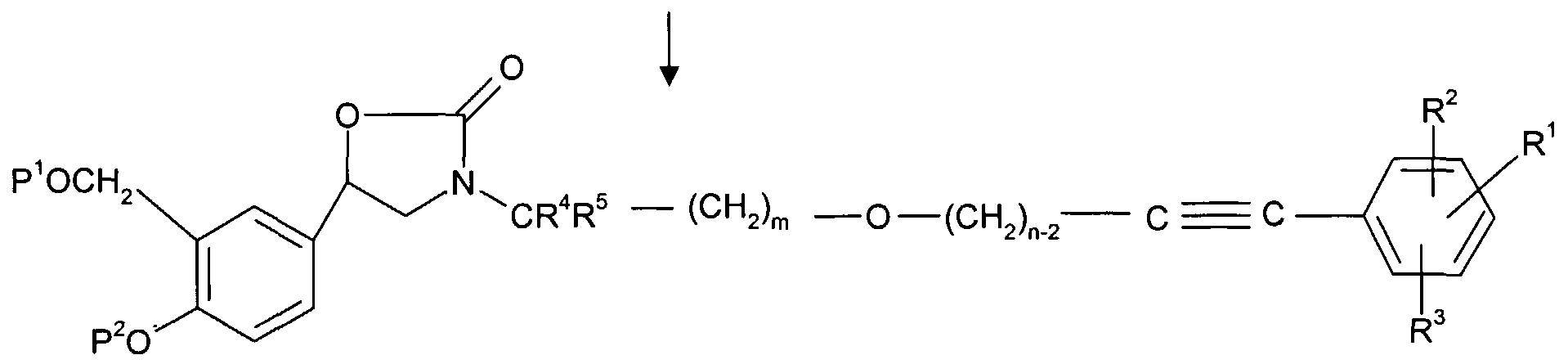
WO 02/066422 describes processes (a) - (d) for preparing compounds of formula (I). The relevant stages of processes (a) and (b) described in WO 02/066422 may be represented schematically, as follows: Process (a):
Figure imgf000005_0001
Intermediate 1 Intermediate 2
Figure imgf000005_0002
Intermediate 3
Figure imgf000005_0003
Intermediate 4
Figure imgf000005_0004
Intermediate 5
Figure imgf000006_0001
(I)
Figure imgf000006_0002
Intermediate 6 Intermediate 2
Figure imgf000006_0003
Intermediate 7 Intermediate 8
Figure imgf000006_0004
Intermediate 9
Figure imgf000006_0005
Figure imgf000007_0001
Intermediate 10 Intermediate 11
Figure imgf000007_0002
Formula (I)
In the above reaction schemes R1, R2, R3, R4, R5, m and n are as defined hereinabove for formula (I), P1, P2, P3 and P4 each represent hydrogen or a protecting group, as defined in more detail hereinafter, and L, L1 and L2 each represent a leaving group, for example a halo group (typically bromo or iodo) or a sulphonate such as an alkyl sulphonate (typically, methanesulphonate), an arylsulphonate (typically, toluenesulphonate), or a haloalkyl sulphonate (typically, trifluoromethanesulphonate).
Process (c) described in WO 02/066422 also proceeds via Intermediate 7 as described above.
Process (d) described in WO 02/066422 proceeds via an intermediate which corresponds to Intermediate 5, but wherein P3 represents a chiral auxiliary, such as the S-isomer and/or R-isomer of phenyl glycinol or a substituted derivative thereof.
Thus, in order to introduce the aryl moiety
Figure imgf000007_0003
each of the processes described proceeds at some stage of the synthesis via a reaction between an alkyne (eg. Intermediate 1 or Intermediate 6 described above) and an aryl compound (Intermediate 2 above). This coupling, known as the Sonogashira reaction, is conveniently effected in the presence of a catalyst system such as bis (thphenylphosphine) palladium dichloride and a cuprous, Cu(l), species such as cuprous iodide, with an organic base such as a trialkylamine, for example, triethylamine, in a suitable solvent, for example acetonitrile or dimethylformamide. The resulting alkyne may then be reduced, either with or without being isolated to convert the triple bond to a single bond. The reduction may be effected by any suitable method such as hydrogenation in the presence of a catalyst, for example, palladium/charcoal or platinum oxide.
However, the Sonogashira coupling and subsequent reduction have certain disadvantages which tend to complicate the overall process.
Thus, under the conditions of the coupling reaction, the alkyne intermediate eg. Intermediate 1 (or a variant thereof) has a tendency to form dimers, trimers or higher oligomers, for example of the formula:
R C= C c ^C R
wherein Rx represents the side chain of the relevant allkyne intermediate eg. Intermediate 1 above.
Therefore, the alkyne intermediate eg. Intermediate 1 (or a variant thereof) must be used in excess in order that the reaction proceeds to completion. This is of course economically undesirable, especially where chiral intermediates are employed. Furthermore the presence of the oligomerised intermediate introduces additional impurities into the reaction mixture. On a laboratory scale chromatography can be utilised to effect purification, but this is not suitable for larger scale preparations.
In addition, hydrogenation of the alkyne intermediate in the routes shown above, eg. Intermediate 3 or Intermediate 9, may in some circumstances also give rise to unwanted by-products. Thus, when n is 3, hydrogenation, for example using a palladium or platinum catalyst may result in cleavage of the chain to give the hydrogenolysis products, namely the corresponding alcohol and aralkyl compounds:
Figure imgf000008_0001
where Ry is the appropriate moiety corresponding to Intermediate 3 or Intermediate 9. We have now found that in the synthesis of compounds of formula (I) use of an alkyne intermediate (and its associated disadvantages) may be avoided by utilising in its place a boron compound of formual (II): RO(CH2)nBRaRb (M )
as defined hereinafter.
In a first aspect therefore the present invention provides a process for the preparation of a compound of formula (la)
Figure imgf000009_0001
or a salt, solvate, or physiologically functional derivatives thereof, wherein:
m is an integer of from 2 to 8; n is an integer of from 3 to 11 , preferably from 3 to 7; with the proviso that m + n is 5 to 19, preferably 5 to 12;
R1a is hydrogen or -XS02NR6R7
wherein X is -(CH2)P- or C2-6 alkenylene;
R6 and R7 are independently selected from hydrogen, C1-6alkyl,
C3.7cycloalkyl, C(0)NR8R9, phenyl, and phenyl (C1-4alkyl)-, or R6 and R7, together with the nitrogen to which they are bonded, form a 5-, 6-, or 7- membered nitrogen containing ring, and R6 and R7are each optionally substituted by one or two groups selected from halo,
C1-6alkyl, Cι.6haloalkyl, Cι-6alkoxy, hydroxy-substituted C1-6alkoxy, -C02R8, -S02NR8R9,
-CONR8R9, -NR8C(0)R9, or a 5-, 6- or 7-membered heterocyclic ring;
R8and R9 are independently selected from hydrogen, Cι.6alkyl, C3.6cycloalkyl, phenyl, and phenyl (C1-4alkyl)-; and p is an integer of from 0 to 6, preferably from 0 to 4;
R2 and R3 are independently selected from hydrogen, Cι.6alkyl, C1-6alkoxy, halo, phenyl, and Cι-6haloalkyl; and R4 and R5 are independently selected from hydrogen and C1-4alkyl with the proviso that the total number of carbon atoms in R4 and R5 is not more than 4,
which process comprises the step of reacting a compound of formula (II):
RO(CH2)nBRaRb (II)
wherein n is as defined for formula (la);
Ra and R are each independently selected from hydrogen, alkyl, cycloalkyl, or aryloxy or together with the boron atom to which they are attached correspond to a cyclic boron compound such as 9-borabicyclo[3.3.1]nonane; and
R is hydrogen or a moiety selected from:
(i)
Figure imgf000010_0001
wherein R4, R5 and m are as hereinbefore defined for compounds of formula (la) and P , P2, P3 and P4 each independently represent hydrogen or a protecting group or P3 represents a chiral auxiliary;
(ϋ)
Figure imgf000010_0002
wherein P , P , R and R and m are as hereinbefore defined; and
(iii)
Figure imgf000010_0003
wherein L1 is a leaving group, eg. as defined above;
with a compound of formula (III)
Figure imgf000011_0001
wherein R1a, R2, R3 and L are as hereinbefore defined.
In the process of the present invention reaction of a compound (II) with a compound (III) may be effected in the presence of a catalyst such as palladium acetate, PdCI2, Pd(PPh3)4, or Pd(dba)2; and a phosphine such as triphenylphosphine, (di-tert- butylphosphino)biphenyl, tricyclohexylphosphine, t isopropylphosphine, tricyclopentylphosphine, or tri-tert-butylphosphine; and a base such as aqueous potassium or sodium phosphate, potassium or sodium carbonate, or sodium acetate.
The boron compound of formula (II) may be prepared by reacting an olefin of formula (IV):
R-0(CH2)n.2CH CH.
(IV)
with a boron compound serving to introduce the group -BRaRb, which may be for example a compound of formula (V):
HBRaRb (V)
wherein Ra and Rb are as hereinbefore defined; or with a cyclic boron compound such as 9-borabicyclo[3.3.1]nonane.
In the compound of formula (V) Ra and R preferably represent bulky groups. Examples of the compound (V) include thexylborane, catchecolborane and disiamylborane.
The compound of formula (II) is preferably prepared in situ.
For optimum efficiency in subsequent stages it is preferred that the compound of formula (IV) is completely converted into a compound of formula (II). Compounds of formula (IV) may be prepared by standard methods well known to those skilled in the art. Thus for example a compound of formula (IV) may be prepared from the corresponding dihaloalkane and hydroxyalkene by conventional chemistry, typically in the presence of an inorganic base such as aqueous sodium hydroxide, under phase transfer conditions, in the presence of a salt such as a tetraalkylammonium bromide. Alternatively a compound of formula (IV) may be prepared by selective mono-bromination of the corresponding diol, e.g. by reaction with aqueous hydrobromic acid in a solvent such as toluene, followed by reaction with an alkenyl halide, e.g. allyl bromide. The reaction may be effected under basic conditions e.g. using aqueous sodium hydroxide and in the presence of a tetraalkylammonium bromide.
In a second aspect the present invention provides a process for preparing a compound of formula (la) which comprises the step of reacting an olefin of formula (IV) with a boron compound of formula (V) and, without isolation of the resulting product, further reacting with a compound of formula (III).
The process of the present invention avoids the use of an alkyne intermediate, such as Intermediate 1 , 3 or 9 above, and hence avoids the problems associated with such intermediates, in particular formation of dimers or higher oligomers, and those associated with the hydrogenation step, such as the cleavage reaction described hereinabove.
The process of the present invention provides a shorter and cleaner route to intermediate in the synthesis of compounds of formula (la), and ultimately to compounds of formula (la) themselves.
Depending on the nature of the group R, the product of the reaction of (II) and (III) may then be subject to one or more further reactions to provide compound of formula (la).
It will be appreciated that when R is a moiety (i) and P , P2, P3 and P4 each represent hydrogen, then the product of the reaction of (II) and (III) will be a compound of formula (la).
When R is a moiety (i) wherein at least one of P1, P2, P3 or P4 is a protecting group, or when R is a moiety (ii), it will be appreciated that one or more deprotection steps will be required to obtain a compound of formula (la).
Suitable protecting groups may be any conventional protecting group such as those described in "Protective Groups in Organic Synthesis" by Theodora W Greene and Peter G M Wuts, 3rd edition (John Wiley & Sons, 1999). Examples of suitable hydroxyl protecting groups represented by P1, P2 and P4 are esters such as acetate ester, aralkyl groups such as benzyl, diphenylmethyl, or triphenylmethyl, and tetrahydropyranyl. Examples of suitable amino protecting groups represented by P3 include benzyl, α-methylbenzyl, diphenylmethyl, triphenylmethyl, benzyloxycarbonyl, tert-butoxycarbonyl, and acyl groups such as trichloroacetyl or trifluoroacetyl.
As will be appreciated by the person skilled in the art, use of such protecting groups may include orthogonal protection of groups in the compounds of formula (II) to facilitate the selective removal of one group in the presence of another, thus enabling selective functionalisation of a single amino or hydroxyl function. For example, the -CH(OH) group may be orthogonally protected as -CHOP4 using, for example, a trialkylsilyl group such as triethylsilyl. A person skilled in the art will also appreciate other orthogonal protection strategies, available by conventional means as described in Theodora W Greene and Peter G M Wuts (see above).
The deprotection to yield a compound of formula (la), may be effected using conventional techniques. Thus, for example, when P1, P2, and/or P3 is an aralkyl group, this may be cleaved by hydrogenolysis in the presence of a metal catalyst (e.g. palladium on charcoal).
When P1 and/or P2 is tetrahydropyranyl this may be cleaved by hydrolysis under acidic conditions. Acyl groups represented by P3 may be removed by hydrolysis, for example with a base such as sodium hydroxide, or a group such as tnchloroethoxycarbonyl may be removed by reduction with, for example, zinc and acetic acid. Other deprotection methods may be found in Theodora W Greene and Peter G M Wuts (see above). In a particular embodiment, P1 and P2 may together represent a protecting group as in the compound of formula (VI):
Figure imgf000013_0001
or a salt or solvate thereof, wherein R a, R2, R3, R4, R5, P3, P4, m, and n are as defined for the compound of formula (la) and R10 and R11 are independently selected from hydrogen, C1-6alkyl, or aryl or R10 and R11 together form a C3.7cycloalkyl ring. In a preferred aspect, both R10 and R11 are methyl.
A compound of formula (VI) may be converted to a compound of formula (la) by hydrolysis with dilute aqueous acid, for example acetic acid or hydrochloric acid in a suitable solvent or by transketalisation in an alcohol, for example ethanol, in the presence of a catalyst such as an acid (for example, toluenesulphonic acid or a sulphonic acid ion exchange column such as SCX-2) or a salt (such as pyridinium tosylate) at normal or elevated temperature.
When P3 represents a chiral auxilliary it may typically be removed by hydrogenolysis, using for example a palladium or carbon catalyst, or palladium hydroxide (Pearlman's catalyst).
It will further be appreciated that where R is a moiety (iii) the reaction of (II) and (III) will initially provide a compound of formula (VII):
Figure imgf000014_0001
which may be reacted with a compound of formula (VIII):
Figure imgf000014_0002
or formula (IX):
Figure imgf000014_0003
wherein P1, P2, P3 and P4 are as defined above, to give a compound corresponding to Intermediate 4 or Intermediate 5 above, followed if necessary by removal of any protecting groups or functions.
The reaction of compounds of formulae (VII) and (VIII) is optionally effected in the presence of an organic base such as a trialkylamine, for example diisopropylethylamine, and in a suitable solvent, for example an alcohol, eg. ethanol, an ester eg.ethyl acetate; or an amide, eg dimethyl formamide. The coupling of a compound of formula (VII) with a compound of formula (IX) may be effected in the presence of a base, such as a metal hydride, for example sodium hydride, an inorganic base such as cesium carbonate, or an alkoxide eg. butoxide, in an aprotic solvent, for example, dimethyl formamide.
Compounds of formulae (VIII) and (IX) may be prepared for example as described in WO 02/066422.
In a third aspect, the present invention provides a process for the preparation of a compound of formula (VII):
Figure imgf000015_0001
which comprises reacting a compound of formula (X):
L1CR4R5(CH2)mO(CH2)nBRaRb
(X)
wherein Ra, R , R , R , L , m and n are as defined hereinabove;
with a compound of formula (III) as defined hereinabove.
In a fourth aspect the present invention provides a process for the preparation of a compound of formula (VII) as defined hereinabove which comprises reacting a compound of formula (IV) with a boron compound of formula (V) and without isolation of the product further reacting with a compound of formula (III).
In a fifth aspect the present invention provides a process for the preparation of a compound of formula (XI):
Figure imgf000016_0001
which comprises reacting a compound of formula (XII):
0(CH2)nBRaRb
Figure imgf000016_0002
(XII)
with a compound of formula (III) as defined hereinablve.
In a sixth aspect the present invention provides a process for the preparation of a compound of formula (XI) which comprises reacting a compound of formula (IV) wherein R represents a moiety (ii) with a compound of formula (V) and without isolation of the product further reacting with a compound of formula (III).
In a seventh aspect the present invention provides a process for the preparation of a compound of formula (XIII):
Figure imgf000016_0003
(XIII)
which comprises reacting a compound of formula (II) wherein R represents a moiety (i) with a compound of formula (III) as defined hereinabove.
In an eighth aspect the present invention provides a process for the preparation of a compound of formula (XIII) which comprises reacting a compound of formula (IV) wherein R represents a moiety (i) with a compound of formula (V) and without isolation of the product further reacting with a compound of formula (III).
For a better understanding of the present invention, the following non-limiting Examples are given by way of illustration.
Synthetic Examples
Throughout the examples, the following abbreviations are used:
LC: Liquid Chromatography
RT : retention time
THF : tetrahydofuran
TBAB: tetrabutylammonium bromide BBN : 9-borabicyclo[3.3.1]nonane bp : boiling point ca : circa h : hour(s) min : minute(s) All temperatures are given in degrees centigrade.
GC system for Example 1 (i) and (ii):
Column 30 M x 0.25mm x 0.5 micron HP-5
Temp Program 50 C for 5 minutes 50 C to 290 C @ 10 C/min. Hold @ 290 C for 5 min.
Flow 25 psi (~ 2.8 ml/min) , split 120ml/min
Injector 150 C
Detector 300 C
Example 1 3-{3-[(7-Bromoheptyl)oxylpropylfbenzenesulfonamide
(i) 7-bromoheptan-1-ol
To a solution of 1 ,7- heptanediol (104g, 0.79 mole) in toluene (1250ml) was added aq. HBr (48%, 105ml). The mixture was stirred vigorously and heated at 90°C for 30hr. A further aliquot of aq HBr (25ml) was added and heating and stirring was continued. After a total reaction time of 3 days, the reaction was cooled to room temperature. The lower, aqueous layer was discarded. The organic layer was washed with aq. NaOH (1 M, 300ml) followed by water (300ml). The turbid organic extract was concentrated to give the title compound as a clear, yellow oil (143g) RT 14.60mins (ii) 7-Bromoheptyl prop-2-enyl ether
A mixture of 7-bromoheptan-1-ol (100g, 0.49mol) and allyl bromide (92g, 0.76mol) was added at ca. 30 °C to a well stirred solution of 25% NaOH (1 L) containing TBAB (8g, 5 mol%). The resulting bi-phasic mixture was stirred at ambient temperature for 7 hrs. The layers were left to settle and the lower aqueous layer then removed. The remaining organic layer was washed with water to give a cloudy yellow oil, which was distilled (0.23 mbar, 80-82 °C) to give the title compound as a clear, colourless oil (94g). RT 16.19mins
(iii) 3-(3-[(7-Bromoheptyl)oxylpropyl}benzenesulfonamide
To a solution of 9-BBN (0.5M in THF, 8.9vol, 1.05equiv) was added 7-bromoheptyl prop- 2-enyl ether (lequiv). Following complete reaction the hydroborated olefin was added to a solution of 3-bromobenzenesulfonamide (lequiv), Pd(OAc)2 (0.01equiv), and triphenylphosphine (0.02equiv) in aqueous sodium phosphate (2.5 , 3.4vol).
The mixture was then heated to ca 60°C until the reaction was complete. The mixture was cooled and the aqueous layer removed. Isopropyl acetate (4vol) was added to the mixture and solvent distilled out at atmospheric pressure (10vols). Petrol (6vol) was then added at 60°C followed by charcoal. Solids were filtered off and the mixture cooled to room temperature. The product was filtered off and washed with petrol/isopropyl acetate (2:1 - 2 vols) and dried in vacuo at 50°C to give an off white solid (ca 1.1 wts - 60 - 70% theory)
Retention time 5.95 min by HPLC (8 min run time)
1 H NMR (CDCI3, 400MHz, ppm)
1.34-1.46 (m, 6H), 1.56-1.60 (m, 2H), 1.83-1.94 (m, 4H), 2.75-2.79 (m, 2H), 3.38-3.43 (m, 6H), 4.95 (s, 2H), 7.40-7.46 (m 2H), 7.74-7.77 (m, 2H)
Example 2 3-{3-r(7-Bromoheptyl)oxylpropyl)benzenesulfonamide
9-BBN (0.5M in THF) solution (9.4ml) was added at room temperature under nitrogen with stirring to 7-bromoheptyl prop-2-enyl ether (1g, 4.3mmol) and left for 3hrs. A solution of potassium phosphate (1.8g) in water (3ml) was added to the clear solution followed by 3-bromobenzenesulfonamide (1g 4.24mmol), Pd(OAc)2 (10mg) and 2-(di-tert- butylphosphino)biphenyl (25mg). The biphasic mixture was stirred at ambient temperature for 1 ,5hrs at which point LC showed <0.5% a/a 3-bromobenzenesulfonamide and >88% a/a title compound. (The reaction mixture was used for experimental isolation methods so a yield of isolated material is not available.) The product of Examples 1 and 2 may be further reacted to give 3-(3-{[7-({(2f?)-2-hydroxy- 2-[4-hydroxy-3-(hydroxymethyl)phenyl]ethyl}amino)heptyl]oxy}propyl)benzenesulfonamide and salts thereof such as the (E)-3-(napthalen-2-yl)-2-propenoate salt, using for example methods described in WO 02/066422
Example 3 3-{4-r(6-Bromohexyl)oxylbutyl)benzenesulfonamide
6-Bromohexylbut-3-enyl ether (0.8g, 3.4mmol) was added to 9-BBN (0.5M in THF) solution (10ml) at room temperature under nitrogen. After 1.5hrs the solution was added to a stirred mixture potassium phosphate (1.8g) in water (3ml) containing 3- bromobenzenesulfonamide (0.8g, 3.4mmol), Pd(OAc)2 (10mg) and 2-(di-tert- butylphosphino)biphenyl (25mg). The biphasic mixture was stirred at ambient temperature for 60hrs at which point LC showed 23% a/a of the unreacted 3- bromobenzenesulfonamide and 52% of the title compound.
3-{4-[(6-Bromohexyl)oxy]butyl}benzenesulfonamide may be further reacted to give 3-(4- {[6-({(2R)-2-hydroxy-2-[4-hydroxy-3-(hydroxymethyl)- phenyl]ethyl}amino)hexyl]oxy}butyl)benzenesulfonamide and salts thereof using for example methods described in WO 02/066422.

Claims

1. A process for the preparation of a compound of formula (la)
Figure imgf000020_0001
or a salt, solvate, or physiologically functional derivative thereof, wherein:
m is an integer of from 2 to 8; n is an integer of from 3 to 11 , preferably from 3 to 7; with the proviso that m + n is 5 to 19, preferably 5 to 12;
R1a is hydrogen or -XS02NR6R7
wherein X is -(CH2)P- or C2.6 alkenylene;
R6 and R7 are independently selected from hydrogen, d-6alkyl,
C3-7cycloalkyl, C(0)NR8R9, phenyl, and phenyl (C^alkyl)-, or R6 and R7, together with the nitrogen to which they are bonded, form a 5-, 6-, or 7- membered nitrogen containing ring, and R6 and R7are each optionally substituted by one or two groups selected from halo,
C1-6alkyl, CLehaloalkyl, C^alkoxy, hydroxy-substituted C1-6alkoxy, -C02R8, -S02NR8R9,
-CONR8R9, -NR8C(0)R9, or a 5-, 6- or 7-membered heterocyclic ring;
R8 and R9 are independently selected from hydrogen, C^alkyl,
C3-6cycloalkyl, phenyl, and phenyl (C1-4alkyl)-; and p is an integer of from 0 to 6, preferably from 0 to 4;
R2 and R3 are independently selected from hydrogen, C1-6alkyl, C ealkoxy, halo, phenyl, and C1-6haloalkyl; and
R4 and R5 are independently selected from hydrogen and C1-4alkyl with the proviso that the total number of carbon atoms in R4 and R5 is not more than 4;
which process comprises the step of reacting a compound of formula (II):
RO(CH2)nBRaR (i i)
wherein n is as defined for formula (la); Ra and Rb are each independently selected from hydrogen, alkyl, cycloalkyl, or aryloxy or together with the boron atom to which they are attached correspond to a cyclic boron compound such as 9-borabicyclo[3.3.1]nonane; and
R is hydrogen or a moiety selected from:
(i)
Figure imgf000021_0001
wherein R , R and m are as hereinbefore defined for compounds of formula (I) and P , P , P3 and P4 each independently represent hydrogen or a protecting group or P3 represents a chiral auxiliary;
(ϋ)
Figure imgf000021_0002
wherein P , P , R and R and m are as hereinbefore defined; and
(iii) L1CR4R5(CH2) -
wherein L1 is a leaving group, eg. a halo group or a sulphonate; and Ra and Rb are each independently selected from hydrogen, alkyl, cycloalkyl or aryloxy;
with a compound of formula (III)
Figure imgf000021_0003
wherein R1a, R2, and R3 are as hereinbefore defined and L is a leaving group, eg. a halo group or a sulphonate.
2. A process according to claim 1 wherein the boron compound of formula (II) is prepared by reacting an olefin of formula (IV):
R-0(CH2)n.2CH = CH2
(IV)
with a boron compound serving to introduce the group -BRaR .
3. A process according to claim 2 wherein said boron compound is a compound of formula (V):
HBRaRD (V)
wherein Ra and Rb are as hereinbefore defined or is a cyclic boron compound such as 9- borabicyclo[3.3.1 ]nonane.
4. A process according to claim 2 or claim 3 which comprises the step of reacting an olefin of formula (IV) with a boron compound of formula (V) and, without isolation of the resulting product, further reacting with a compound of formula (III).
5. A process for the preparation of a compound of formula (VII):
Figure imgf000022_0001
which comprises reacting a compound of formula (X):
L1CR4R5(CH2)mO(CH2)nBRaRb wherein Ra, R , R , R , L , m and n are as defined hereinabove;
with a compound of formula (III) as defined in claim 1.
6. A process for the preparation of a compound of formula (VII) as defined hereinabove which comprises reacting a compound of formula (IV) with a boron compound of formula (V) and without isolation of the product further reacting with a compound of formula (III).
7. A process for the preparation of a compound of formula (XI):
Figure imgf000023_0001
which comprises reacting a compound of formula (XII):
O(CH2)nBRdRϋ
Figure imgf000023_0002
(XII)
with a compound of formula (III) as defined in claim 1.
8. A process for the preparation of a compound of formula (XI) which comprises reacting a compound of formula (IV) wherein R represents a moiety (ii) with a compound of formula (V) and without isolation of the product further reacting with a compound of formula (III).
9. A process for the preparation of a compound of formula (XIII):
Figure imgf000024_0001
which comprises reacting a compound of formula (II) wherein R represents a moiety (i) with a compound of formula (III) as defined in claim 1.
10. A process for the preparation of a compound of formula (XIII) which comprises reacting a compound of formula (IV) wherein R represents a moiety (i) with a compound of formula (V) and without isolation of the product further reacting with a compound of formula (III).
11. A process according to any of claims 1 to 10 wherein in the compound of formula (la) m is 6 and n is 4.
12. A process according to any of claims 1 to 10 wherein in the compound of formula (la) m is 7 and n is 3.
13. A process according to any of claims 1 to 12 wherein in the compound of formula (la) R1 is -SONHR6R7.
14. A process according to claim 13 wherein R6 and R7 each represent hydrogen.
15. A process according to any of claims 1 to 14 wherein in the compound of formula (la) R2 , R3, R4 and R5 each represent hydrogen.
PCT/EP2004/009354 2003-08-22 2004-08-19 Preparation of phenethanolamine derivatives Ceased WO2005019164A2 (en)

Applications Claiming Priority (2)

Application Number Priority Date Filing Date Title
GB0319826A GB0319826D0 (en) 2003-08-22 2003-08-22 Process
GB0319826.4 2003-08-22

Publications (2)

Publication Number Publication Date
WO2005019164A2 true WO2005019164A2 (en) 2005-03-03
WO2005019164A3 WO2005019164A3 (en) 2005-05-12

Family

ID=28460179

Family Applications (1)

Application Number Title Priority Date Filing Date
PCT/EP2004/009354 Ceased WO2005019164A2 (en) 2003-08-22 2004-08-19 Preparation of phenethanolamine derivatives

Country Status (3)

Country Link
GB (1) GB0319826D0 (en)
TW (1) TW200519074A (en)
WO (1) WO2005019164A2 (en)

Family Cites Families (1)

* Cited by examiner, † Cited by third party
Publication number Priority date Publication date Assignee Title
ZW6584A1 (en) * 1983-04-18 1985-04-17 Glaxo Group Ltd Phenethanolamine derivatives

Also Published As

Publication number Publication date
WO2005019164A3 (en) 2005-05-12
GB0319826D0 (en) 2003-09-24
TW200519074A (en) 2005-06-16

Similar Documents

Publication Publication Date Title
US8168784B2 (en) Processes to make apoptosis promoters
US5886239A (en) Method of preparing monofluoromethyl ethers
KR101685186B1 (en) 4 [Preparation of 2 (2-fluorophenoxymethyl) phenyl] piperidine Compound
JP2004524358A (en) Method for producing phenylacetic acid derivative
JPH05213838A (en) Preparation of fluoxetine
CN1168718C (en) The preparation method of 2-(6-substituted pyridin-2-yloxymethyl)phenyl acetate
KR20110010633A (en) Process for preparing 1- (2-halobiphenyl-4-yl) -cyclopropanecarboxylic acid derivative
JP4376061B2 (en) Alkenone production
CA2601873A1 (en) Novel compounds, isomer thereof, or pharmaceutically acceptable salts thereof as vanilloid receptor antagonist; and pharmaceutical compositions containing the same
JP2719600B2 (en) Cyanodienes, halopyridines, intermediates and methods for producing them
US6849762B2 (en) Process for preparing a trifluoroethoxy-substituted benzoic acid
RU2470018C2 (en) New pyrocatechol derivatives
US6444851B1 (en) Process for the preparation of Midodrine
JP7568642B2 (en) Method for preparing substituted 2-[2-(phenyl)ethylamino]alkanamide derivatives
KR101134021B1 (en) Manufacturing method of pitavastatin hemicalcium using novel intermediates
JP5746484B2 (en) Method for synthesizing Cibelestat
JP4509327B2 (en) Process for producing N, N-disubstituted-4-aminocrotonic acid ester
JPH11269151A (en) Preparation of 3-(4(1-h-imidazol-1-yl-methyl)phenyl)-2-propenoic acid and its salt
EP0875499A2 (en) Process for the crystallisation of alkali metal salts of diformylamide
JP2009518380A (en) Preparation of 2-chloroethoxy-acetic acid-N, N-dimethylamide
JPH07242587A (en) Method for producing difluoroacetic acid and difluoroacetic acid amide
JP4239473B2 (en) Process for producing pyridone compounds and intermediates thereof
US20250282716A1 (en) Methods of making ip-receptor agonists
AU6523300A (en) Method for preparing cyclohexane carboxylic acids
JP2000327629A (en) Phenylacetic acid derivative, benzonitrile derivative and production thereof

Legal Events

Date Code Title Description
AK Designated states

Kind code of ref document: A2

Designated state(s): AE AG AL AM AT AU AZ BA BB BG BR BW BY BZ CA CH CN CO CR CU CZ DE DK DM DZ EC EE EG ES FI GB GD GE GH GM HR HU ID IL IN IS JP KE KG KP KR KZ LC LK LR LS LT LU LV MA MD MG MK MN MW MX MZ NA NI NO NZ OM PG PH PL PT RO RU SC SD SE SG SK SL SY TJ TM TN TR TT TZ UA UG US UZ VC VN YU ZA ZM ZW

AL Designated countries for regional patents

Kind code of ref document: A2

Designated state(s): BW GH GM KE LS MW MZ NA SD SL SZ TZ UG ZM ZW AM AZ BY KG KZ MD RU TJ TM AT BE BG CH CY CZ DE DK EE ES FI FR GB GR HU IE IT LU MC NL PL PT RO SE SI SK TR BF BJ CF CG CI CM GA GN GQ GW ML MR NE SN TD TG

121 Ep: the epo has been informed by wipo that ep was designated in this application
122 Ep: pct application non-entry in european phase