WO2005017239A1 - High temperature resistant fiberfill comprising petn fibers - Google Patents

High temperature resistant fiberfill comprising petn fibers Download PDF

Info

Publication number
WO2005017239A1
WO2005017239A1 PCT/US2004/024115 US2004024115W WO2005017239A1 WO 2005017239 A1 WO2005017239 A1 WO 2005017239A1 US 2004024115 W US2004024115 W US 2004024115W WO 2005017239 A1 WO2005017239 A1 WO 2005017239A1
Authority
WO
WIPO (PCT)
Prior art keywords
fibers
petn
poly
ethylene
bulk
Prior art date
Legal status (The legal status is an assumption and is not a legal conclusion. Google has not performed a legal analysis and makes no representation as to the accuracy of the status listed.)
Ceased
Application number
PCT/US2004/024115
Other languages
French (fr)
Inventor
Jill B. Cunningham
Arun Pal Aneja
Current Assignee (The listed assignees may be inaccurate. Google has not performed a legal analysis and makes no representation or warranty as to the accuracy of the list.)
INVISTA TECHNOLOGIES Sarl
Invista Technologies SARL USA
Original Assignee
INVISTA TECHNOLOGIES Sarl
Invista Technologies SARL USA
Priority date (The priority date is an assumption and is not a legal conclusion. Google has not performed a legal analysis and makes no representation as to the accuracy of the date listed.)
Filing date
Publication date
Application filed by INVISTA TECHNOLOGIES Sarl, Invista Technologies SARL USA filed Critical INVISTA TECHNOLOGIES Sarl
Publication of WO2005017239A1 publication Critical patent/WO2005017239A1/en
Anticipated expiration legal-status Critical
Ceased legal-status Critical Current

Links

Classifications

    • DTEXTILES; PAPER
    • D04BRAIDING; LACE-MAKING; KNITTING; TRIMMINGS; NON-WOVEN FABRICS
    • D04HMAKING TEXTILE FABRICS, e.g. FROM FIBRES OR FILAMENTARY MATERIAL; FABRICS MADE BY SUCH PROCESSES OR APPARATUS, e.g. FELTS, NON-WOVEN FABRICS; COTTON-WOOL; WADDING ; NON-WOVEN FABRICS FROM STAPLE FIBRES, FILAMENTS OR YARNS, BONDED WITH AT LEAST ONE WEB-LIKE MATERIAL DURING THEIR CONSOLIDATION
    • D04H1/00Non-woven fabrics formed wholly or mainly of staple fibres or like relatively short fibres
    • D04H1/70Non-woven fabrics formed wholly or mainly of staple fibres or like relatively short fibres characterised by the method of forming fleeces or layers, e.g. reorientation of fibres
    • D04H1/74Non-woven fabrics formed wholly or mainly of staple fibres or like relatively short fibres characterised by the method of forming fleeces or layers, e.g. reorientation of fibres the fibres being orientated, e.g. in parallel (anisotropic fleeces)
    • DTEXTILES; PAPER
    • D01NATURAL OR MAN-MADE THREADS OR FIBRES; SPINNING
    • D01FCHEMICAL FEATURES IN THE MANUFACTURE OF ARTIFICIAL FILAMENTS, THREADS, FIBRES, BRISTLES OR RIBBONS; APPARATUS SPECIALLY ADAPTED FOR THE MANUFACTURE OF CARBON FILAMENTS
    • D01F6/00Monocomponent artificial filaments or the like of synthetic polymers; Manufacture thereof
    • D01F6/78Monocomponent artificial filaments or the like of synthetic polymers; Manufacture thereof from copolycondensation products
    • D01F6/84Monocomponent artificial filaments or the like of synthetic polymers; Manufacture thereof from copolycondensation products from copolyesters
    • DTEXTILES; PAPER
    • D04BRAIDING; LACE-MAKING; KNITTING; TRIMMINGS; NON-WOVEN FABRICS
    • D04HMAKING TEXTILE FABRICS, e.g. FROM FIBRES OR FILAMENTARY MATERIAL; FABRICS MADE BY SUCH PROCESSES OR APPARATUS, e.g. FELTS, NON-WOVEN FABRICS; COTTON-WOOL; WADDING ; NON-WOVEN FABRICS FROM STAPLE FIBRES, FILAMENTS OR YARNS, BONDED WITH AT LEAST ONE WEB-LIKE MATERIAL DURING THEIR CONSOLIDATION
    • D04H1/00Non-woven fabrics formed wholly or mainly of staple fibres or like relatively short fibres
    • D04H1/40Non-woven fabrics formed wholly or mainly of staple fibres or like relatively short fibres from fleeces or layers composed of fibres without existing or potential cohesive properties
    • D04H1/42Non-woven fabrics formed wholly or mainly of staple fibres or like relatively short fibres from fleeces or layers composed of fibres without existing or potential cohesive properties characterised by the use of certain kinds of fibres insofar as this use has no preponderant influence on the consolidation of the fleece
    • D04H1/4326Condensation or reaction polymers
    • D04H1/435Polyesters
    • DTEXTILES; PAPER
    • D04BRAIDING; LACE-MAKING; KNITTING; TRIMMINGS; NON-WOVEN FABRICS
    • D04HMAKING TEXTILE FABRICS, e.g. FROM FIBRES OR FILAMENTARY MATERIAL; FABRICS MADE BY SUCH PROCESSES OR APPARATUS, e.g. FELTS, NON-WOVEN FABRICS; COTTON-WOOL; WADDING ; NON-WOVEN FABRICS FROM STAPLE FIBRES, FILAMENTS OR YARNS, BONDED WITH AT LEAST ONE WEB-LIKE MATERIAL DURING THEIR CONSOLIDATION
    • D04H1/00Non-woven fabrics formed wholly or mainly of staple fibres or like relatively short fibres
    • D04H1/40Non-woven fabrics formed wholly or mainly of staple fibres or like relatively short fibres from fleeces or layers composed of fibres without existing or potential cohesive properties
    • D04H1/42Non-woven fabrics formed wholly or mainly of staple fibres or like relatively short fibres from fleeces or layers composed of fibres without existing or potential cohesive properties characterised by the use of certain kinds of fibres insofar as this use has no preponderant influence on the consolidation of the fleece
    • D04H1/4391Non-woven fabrics formed wholly or mainly of staple fibres or like relatively short fibres from fleeces or layers composed of fibres without existing or potential cohesive properties characterised by the use of certain kinds of fibres insofar as this use has no preponderant influence on the consolidation of the fleece characterised by the shape of the fibres
    • D04H1/43912Non-woven fabrics formed wholly or mainly of staple fibres or like relatively short fibres from fleeces or layers composed of fibres without existing or potential cohesive properties characterised by the use of certain kinds of fibres insofar as this use has no preponderant influence on the consolidation of the fleece characterised by the shape of the fibres fibres with noncircular cross-sections
    • DTEXTILES; PAPER
    • D04BRAIDING; LACE-MAKING; KNITTING; TRIMMINGS; NON-WOVEN FABRICS
    • D04HMAKING TEXTILE FABRICS, e.g. FROM FIBRES OR FILAMENTARY MATERIAL; FABRICS MADE BY SUCH PROCESSES OR APPARATUS, e.g. FELTS, NON-WOVEN FABRICS; COTTON-WOOL; WADDING ; NON-WOVEN FABRICS FROM STAPLE FIBRES, FILAMENTS OR YARNS, BONDED WITH AT LEAST ONE WEB-LIKE MATERIAL DURING THEIR CONSOLIDATION
    • D04H1/00Non-woven fabrics formed wholly or mainly of staple fibres or like relatively short fibres
    • D04H1/40Non-woven fabrics formed wholly or mainly of staple fibres or like relatively short fibres from fleeces or layers composed of fibres without existing or potential cohesive properties
    • D04H1/42Non-woven fabrics formed wholly or mainly of staple fibres or like relatively short fibres from fleeces or layers composed of fibres without existing or potential cohesive properties characterised by the use of certain kinds of fibres insofar as this use has no preponderant influence on the consolidation of the fleece
    • D04H1/4391Non-woven fabrics formed wholly or mainly of staple fibres or like relatively short fibres from fleeces or layers composed of fibres without existing or potential cohesive properties characterised by the use of certain kinds of fibres insofar as this use has no preponderant influence on the consolidation of the fleece characterised by the shape of the fibres
    • D04H1/43914Non-woven fabrics formed wholly or mainly of staple fibres or like relatively short fibres from fleeces or layers composed of fibres without existing or potential cohesive properties characterised by the use of certain kinds of fibres insofar as this use has no preponderant influence on the consolidation of the fleece characterised by the shape of the fibres hollow fibres
    • DTEXTILES; PAPER
    • D04BRAIDING; LACE-MAKING; KNITTING; TRIMMINGS; NON-WOVEN FABRICS
    • D04HMAKING TEXTILE FABRICS, e.g. FROM FIBRES OR FILAMENTARY MATERIAL; FABRICS MADE BY SUCH PROCESSES OR APPARATUS, e.g. FELTS, NON-WOVEN FABRICS; COTTON-WOOL; WADDING ; NON-WOVEN FABRICS FROM STAPLE FIBRES, FILAMENTS OR YARNS, BONDED WITH AT LEAST ONE WEB-LIKE MATERIAL DURING THEIR CONSOLIDATION
    • D04H1/00Non-woven fabrics formed wholly or mainly of staple fibres or like relatively short fibres
    • D04H1/70Non-woven fabrics formed wholly or mainly of staple fibres or like relatively short fibres characterised by the method of forming fleeces or layers, e.g. reorientation of fibres

Definitions

  • the present invention relates to improvements in polyester fiberfill batts, structures and articles made therefrom, and in particular, where the fiberfill comprises a copolymer of polyethylene terephthalate and poly(ethylene napthalate) (PETN). These articles provide superior bulk retention on exposure to high temperature.
  • the fiberfill comprises a copolymer of polyethylene terephthalate and poly(ethylene napthalate) (PETN).
  • the present invention relates to improvements in polyester fiberfill batts, structures and articles made therefrom. These articles provide superior bulk retention on exposure to high temperature.
  • the articles are suitable for both domestic and industrial end uses, such as pillows, sleeping bags, car seats, boil-washable bedding, insulation, quilts, apparel, filters and the like.
  • Japanese patent JP 11335452A discloses fibers from naphthalene dicarboxylic and aromatic diol alkylene oxide having improved fatigue resistance.
  • U.S. patent 20020132960A1 discloses binary and ternary blends by mixing of cellulose esters and aliphatic/aromatic copolyesters to obtain fibers.
  • neither of these references discloses fibers which are made from a copolymer of poly(ethylene terephthalate) and poly(ethylene napthalate), (PETN).
  • PET poly(ethylene napthalate)
  • fibers comprising a copolymer of poly(ethylene terephthalate) and poly(ethylene napthalate), (PETN) can be used to produce articles which provide superior bulk retention on exposure to high temperature.
  • PETN poly(ethylene napthalate),
  • Such fibers have a dpf in the range of 1- 15.
  • the fibers may be of round and hollow, scalloped oval, trilobal or four- hole cross section. These fibers comprise 5 mole % to 20 mole % naphthalate groups and the remainder of the dicarboxylate groups as terephthalate.
  • Such fibers show the property of superior compression performance of initial bulk (BL-i) and residual bulk (BL 2 ) than incumbent homopolymer polyester fiberfill.
  • Fig. 1 shows the property of compression performance of initial bulk, BL-i, performance of batts as a function of concentration and of unit naphthalate group (mole %) and temperature.
  • Fig. 2 shows the property of compression performance of residual bulk, BL 2 , of batts as a function of concentration and of unit napthalate group (mole %) and temperature.
  • the present invention is directed to fibers comprising a copolymer of poly(ethylene terephthalate) and po!y(ethylene napthalate), (PETN).
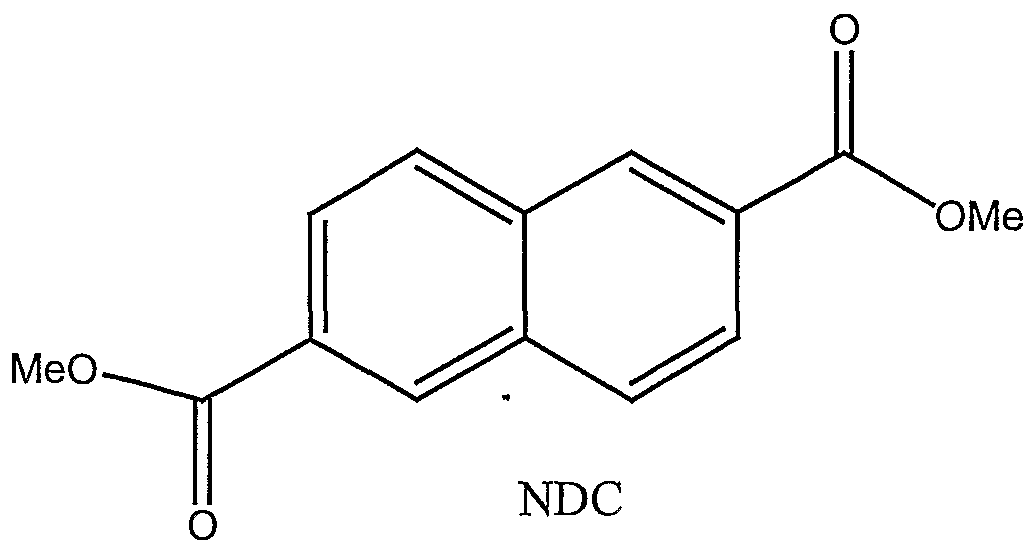
  • Dimethyl terephthalate (DMT) and naphthalene di carboxylate (NDC) are reacted with ethylene glycol (EG) to form such PETN copolymers.
  • DMT is reacted with an excess of EG in the presence of a manganese catalyst.
  • Methanol is distilled from the mixture to give a low molecular weight polyethylene terephthalate (PET) oligomer. Phosphoric acid is then added to this oligomer to deactivate the ester interchange manganese catalyst.
  • Antimony trioxide is added as polycondensation catalyst for the next stage of the reaction.
  • Cobalt acetate is added at this point as a blue color toner for the polymer.
  • the next stage occurs under reduced pressure, and the oligomer chains combine, evolving ethylene glycol.
  • the reaction is complete once the required viscosity of the polymer is achieved.
  • NDC shown below reacts in an analogous manner to DMT.
  • PETN polymers containing 5, 10, 15 and 20 mole % of the acid units as naphthalate may be prepared according to the present invention.
  • PETN5 is taken to mean 5% of the acid units are naphthalate groups, and similar designations can be given for the 10, 15 and 20 % of the acid units being naphthalate groups.
  • the polymer of the present invention is formed into a flake. The flake is then crystallized in a fluid bed to prevent sticking/sintering, then dried and spun into fibers.
  • the fibers of the present invention comprise in the range of 1 mole % to 30 mole % napthalene di-carboxylate and the remainder of the dicarboxylate moieties as terephthalate.
  • the fibers have a denier per filament in the range of 1 - 30.
  • the fibers may have a round, scalloped oval, hollow, trilobal hollow or four-hole cross section.
  • the fibers may be drawn and cut to the desired dpf and cut length.
  • the cut fibers are then converted into clusters.
  • the clusters may comprise a blend of dry PETN fibers of the present invention and slickened PETN fibers of the present invention.
  • the clusters are carded and converted into a batt of either a cross-lapped or a vertical folded configuration.
  • the bulk properties of batts of this invention are determined by compressing the clusters on an Instron tester and determining the height under load. The test, which is hereinafter referred to as the total bulk range measurement (TBRM) test, is described below, in the Test Methods section.
  • TBRM total bulk range measurement
  • the batts of the present invention have an initial bulk, BLi, in the range of 4.2 to 5.1 , and a residual bulk, BL 2 , in the range of 0.47 to 0.50.
  • BL-i improves strongly on the addition of naphthate groups.
  • BLi reduces as temperature increases.
  • BLi is insensitive to time of exposure.
  • BL 2 improves strongly with the addition of naphthalate groups.
  • BL 2 is insensitive to temperature and time of exposure.
  • the optimum concentration for BLi is 10 mole% PEN, while for BL 2 it is 20 mole%.
  • This optimum behavior can be linked to the shrinkage properties of the polymer.
  • the amount of polymer chain mobility is linked to the amount the temperature is above T g .
  • T g increases. Therefore, the polymer chain mobility will decrease for a given temperature above T g with increasing naphthalate content.
  • This reduction in chain mobility could reduce the shrinkage seen in fibers at a given temperature above T g . Therefore, Applicants have found that increasing napthalate content can reduce shrinkage and improve the bulk performance. Alternatively, increasing the level of naphthalate will reduce the crystallinity that is developed in the polymer.
  • TEST METHODS Total bulk range was measured as follows with the TBRM test. This test is carried out by cutting 6-inch (15.25 centimeters) squares from a carded web and adding them to a stack in a cross-lapped manner until their total weight is 20 grams. The entire area is then compressed in an Instron under a load of 50 pounds (22.7 kilograms). The stack height is recorded (after one conditioning cycle under a load of 2 pounds) for heights at loads of 0.001 (for BL-i) and 0.2 (for BL 2 ) pounds per square inch (0.00007 and 0.014 kilograms per square centimeter, respectively) gage.
  • BLi is the initial height, or bulk, and is a measure of filling power
  • BL 2 is the height under load, or residual bulk, and is a measure of support.
  • PETN 10 was prepared as follows. PETN polymers containing 10 mole % of the end units as naphthalate were prepared in the 40-gallon autoclave and crystallized using the fluid bed. Dimethyl terephthalate (DMT) (63 kg), dimethyl 2,6- naphthalene dicarboxylate (8.8 kg), ethylene glycol (42 L) and manganese acetate.4H 2 O (430 ppm, 29.7g) were placed in -a 40-gallon polymerization reactor under nitrogen. -The mixture was heated slowly with stirring and the reflux column mid-point set to 90°C to enable the methanol generated to be evolved from the reaction.
  • DMT dimethyl terephthalate
  • 8.8 kg dimethyl 2,6- naphthalene dicarboxylate
  • ethylene glycol (42 L) and manganese acetate.4H 2 O (430 ppm, 29.7g) were placed in -a 40-gallon polymerization reactor under nitrogen.
  • the column mid-point was set to 220° C and the reaction temperature increased to 230° C. Once a temperature of 230° C was achieved 85% phosphoric acid (250 ppm, 20.6g) in 200 ml ethylene glycol was added and allowed to react in to the mixture for 5 minutes prior to transfer to a second autoclave.
  • Antimony trioxide (400 ppm, 27.8g) cobalt acetate4H 2 O (150 ppm, 10.4 g) in 700 ml ethylene glycol were then added to the reaction mixture. The mixture was heated to 290° C under vacuum and the polymerization continued until a stirrer kW load of 4.4 was achieved at 40 rpm.
  • the polymer was finally cast into water and chipped to yield approximately 57 kg amorphous polymer.
  • the flake was crystallized in a fluid bed to prevent sticking/sintering then dried prior to spinning into fibers.
  • the fluid bed conditions were gradually increased from 40-100° C in 30 min, 110-150° C in 8 hours, 150- 100° C in 1 hour and 100°C to 40° C in 1 hour.
  • the crystallized flake was spun at 280° C into 18 dpf (nominal) fiber and subsequently drawn to 6 dpf (nominal) fiber.
  • the drawn fibers were cut, carded and made into batts. Batts were prepared and
  • PETN 10 fibers show a greater than 25% improvement in BLi and greater than 35% improvement on BL 2 on exposure to high temperature versus control.
  • EXAMPLE 2 3 and 4 PETN5, 15 and 20 copolymers were also prepared in a similar manner to that described above in Example 1.
  • the levels of DMT and NDC were as follows: 66.5 kg of DMT and 4.4 kg of NDC were used; for PETN15, 59.5 kg of DMT and 13.2 kg of NDC were used; and for PETN 20, 56 kg of DMT and 17.6 kg of NDC were used.
  • a mole ratio of 2.1 :1 was used, i.e., 2.1 moles of alcohol were added for every mole of dimethylester.
  • Drawn fibers were produced, cut, carded and made into batts.
  • BLi and BL 2 were measured as described above, and the measurements are shown in Figs. 1 and 2.

Landscapes

  • Engineering & Computer Science (AREA)
  • Textile Engineering (AREA)
  • Chemical & Material Sciences (AREA)
  • Chemical Kinetics & Catalysis (AREA)
  • General Chemical & Material Sciences (AREA)
  • Polyesters Or Polycarbonates (AREA)
  • Artificial Filaments (AREA)

Abstract

The present invention is directed to fibers comprising a copolymer of polyethylene terephthalate and poly(ethylene napthalate) (PETN). These fibers are used in polyester fiberfill batts, structures and articles made therefrom. Such articles provide superior bulk retention on exposure to high temperature.

Description

TITLE OF INVENTION
HIGH TEMPERATURE RESISTANT FIBERFILL COMPRISING PETN FIBERS
BACKGROUND OF THE INVENTION
The present invention relates to improvements in polyester fiberfill batts, structures and articles made therefrom, and in particular, where the fiberfill comprises a copolymer of polyethylene terephthalate and poly(ethylene napthalate) (PETN). These articles provide superior bulk retention on exposure to high temperature.
FIELD OF INVENTION The present invention relates to improvements in polyester fiberfill batts, structures and articles made therefrom. These articles provide superior bulk retention on exposure to high temperature. The articles are suitable for both domestic and industrial end uses, such as pillows, sleeping bags, car seats, boil-washable bedding, insulation, quilts, apparel, filters and the like.
BACKGROUND OF THE INVENTION: Japanese patent JP 11335452A discloses fibers from naphthalene dicarboxylic and aromatic diol alkylene oxide having improved fatigue resistance. U.S. patent 20020132960A1 discloses binary and ternary blends by mixing of cellulose esters and aliphatic/aromatic copolyesters to obtain fibers. However, neither of these references discloses fibers which are made from a copolymer of poly(ethylene terephthalate) and poly(ethylene napthalate), (PETN). In addition, neither of these references discloses filling materials obtained from the fibers produced. Combining a flake of poly(ethylene napthalate) and a flake of poly(ethylene terephthalate) has been done to form articles such as bottles and films. With this process, a blend is produced. However, the compositon of the blend depends on the degree of transesterification which occurs during the extrusion process between the poly(ethylene napthalate) and the poly(ethylene terephthalate). Incorporation of naphthalate groups in to the poly(ethylene terephthalate) improves the strength modulus, heat resistance, gas barrier and UV barrier properties. It is also known in the art that exposure to filling material at high temperature (50-100°C) greatly reduces bulk retention. This is a major deficiency in applications where the material is subject to high temperatures, e.g., car seats and boil-washable bedding for medical end use. In addition the incumbent material such as polyurethane foam can be difficult to recycle.
SUMMARY OF THE INVENTION Applicants have found that fibers comprising a copolymer of poly(ethylene terephthalate) and poly(ethylene napthalate), (PETN) can be used to produce articles which provide superior bulk retention on exposure to high temperature. Preferably, such fibers have a dpf in the range of 1- 15. The fibers may be of round and hollow, scalloped oval, trilobal or four- hole cross section. These fibers comprise 5 mole % to 20 mole % naphthalate groups and the remainder of the dicarboxylate groups as terephthalate. Such fibers show the property of superior compression performance of initial bulk (BL-i) and residual bulk (BL2) than incumbent homopolymer polyester fiberfill. BRIEF DESCRIPTION OF THE DRAWINGS Fig. 1 shows the property of compression performance of initial bulk, BL-i, performance of batts as a function of concentration and of unit naphthalate group (mole %) and temperature. Fig. 2 shows the the property of compression performance of residual bulk, BL2, of batts as a function of concentration and of unit napthalate group (mole %) and temperature.
DETAILED DESCRIPTION OF THE INVENTION The present invention is directed to fibers comprising a copolymer of poly(ethylene terephthalate) and po!y(ethylene napthalate), (PETN). Dimethyl terephthalate (DMT) and naphthalene di carboxylate (NDC) are reacted with ethylene glycol (EG) to form such PETN copolymers. Specifically, DMT is reacted with an excess of EG in the presence of a manganese catalyst. Methanol is distilled from the mixture to give a low molecular weight polyethylene terephthalate (PET) oligomer. Phosphoric acid is then added to this oligomer to deactivate the ester interchange manganese catalyst. Antimony trioxide is added as polycondensation catalyst for the next stage of the reaction. Cobalt acetate is added at this point as a blue color toner for the polymer. The next stage occurs under reduced pressure, and the oligomer chains combine, evolving ethylene glycol. The reaction is complete once the required viscosity of the polymer is achieved.
Figure imgf000004_0001
POLYCONDENSATION
- EG
Figure imgf000004_0002
NDC shown below reacts in an analogous manner to DMT.
Figure imgf000004_0003
PETN polymers containing 5, 10, 15 and 20 mole % of the acid units as naphthalate may be prepared according to the present invention. PETN5 is taken to mean 5% of the acid units are naphthalate groups, and similar designations can be given for the 10, 15 and 20 % of the acid units being naphthalate groups. The polymer of the present invention is formed into a flake. The flake is then crystallized in a fluid bed to prevent sticking/sintering, then dried and spun into fibers. The fibers of the present invention comprise in the range of 1 mole % to 30 mole % napthalene di-carboxylate and the remainder of the dicarboxylate moieties as terephthalate. The fibers have a denier per filament in the range of 1 - 30. The fibers may have a round, scalloped oval, hollow, trilobal hollow or four-hole cross section. The fibers may be drawn and cut to the desired dpf and cut length.
The cut fibers are then converted into clusters. The clusters may comprise a blend of dry PETN fibers of the present invention and slickened PETN fibers of the present invention. The clusters are carded and converted into a batt of either a cross-lapped or a vertical folded configuration. The bulk properties of batts of this invention are determined by compressing the clusters on an Instron tester and determining the height under load. The test, which is hereinafter referred to as the total bulk range measurement (TBRM) test, is described below, in the Test Methods section. Initial bulk, BLi, and a residual bulk, BL2, are measured with this TBRM test. It has been found that preferably, the batts of the present invention have an initial bulk, BLi, in the range of 4.2 to 5.1 , and a residual bulk, BL2, in the range of 0.47 to 0.50. In general, Applicants have found that the use of fibers according to the present invention in batts resulted in the following: BL-i improves strongly on the addition of naphthate groups. BLi reduces as temperature increases. BLi is insensitive to time of exposure. BL2 improves strongly with the addition of naphthalate groups. BL2 is insensitive to temperature and time of exposure. Applicants have found that the optimum concentration for BLi is 10 mole% PEN, while for BL2 it is 20 mole%. This optimum behavior can be linked to the shrinkage properties of the polymer. The amount of polymer chain mobility is linked to the amount the temperature is above Tg. As the level of napthalate in the polymer increases, Tg increases. Therefore, the polymer chain mobility will decrease for a given temperature above Tg with increasing naphthalate content. This reduction in chain mobility could reduce the shrinkage seen in fibers at a given temperature above Tg. Therefore, Applicants have found that increasing napthalate content can reduce shrinkage and improve the bulk performance. Alternatively, increasing the level of naphthalate will reduce the crystallinity that is developed in the polymer. This will reduce the number of pinning points holding the orientated polymer chains in position, so on exposure to heat some of these orientated chains will relax, and the polymer will shrink. In this case increasing the naphthalate level will increase shrinkage and will worsen the bulk properties. With these alternative mechanisms occurring at the same time, one can expect to see a maximum in the bulk performance with increasing naphthalate level. The invention will be described in greater detail with reference to the following examples which1 are intended to illustrate the invention without restricting the scope thereof.
TEST METHODS Total bulk range was measured as follows with the TBRM test. This test is carried out by cutting 6-inch (15.25 centimeters) squares from a carded web and adding them to a stack in a cross-lapped manner until their total weight is 20 grams. The entire area is then compressed in an Instron under a load of 50 pounds (22.7 kilograms). The stack height is recorded (after one conditioning cycle under a load of 2 pounds) for heights at loads of 0.001 (for BL-i) and 0.2 (for BL2) pounds per square inch (0.00007 and 0.014 kilograms per square centimeter, respectively) gage. BLi is the initial height, or bulk, and is a measure of filling power, and BL2 is the height under load, or residual bulk, and is a measure of support.
EXAMPLE 1 PETN 10 was prepared as follows. PETN polymers containing 10 mole % of the end units as naphthalate were prepared in the 40-gallon autoclave and crystallized using the fluid bed. Dimethyl terephthalate (DMT) (63 kg), dimethyl 2,6- naphthalene dicarboxylate (8.8 kg), ethylene glycol (42 L) and manganese acetate.4H2O (430 ppm, 29.7g) were placed in -a 40-gallon polymerization reactor under nitrogen. -The mixture was heated slowly with stirring and the reflux column mid-point set to 90°C to enable the methanol generated to be evolved from the reaction. After 20L of methanol were collected, the column mid-point was set to 220° C and the reaction temperature increased to 230° C. Once a temperature of 230° C was achieved 85% phosphoric acid (250 ppm, 20.6g) in 200 ml ethylene glycol was added and allowed to react in to the mixture for 5 minutes prior to transfer to a second autoclave. Antimony trioxide (400 ppm, 27.8g) cobalt acetate4H2O (150 ppm, 10.4 g) in 700 ml ethylene glycol were then added to the reaction mixture. The mixture was heated to 290° C under vacuum and the polymerization continued until a stirrer kW load of 4.4 was achieved at 40 rpm. The polymer was finally cast into water and chipped to yield approximately 57 kg amorphous polymer. The flake was crystallized in a fluid bed to prevent sticking/sintering then dried prior to spinning into fibers. The fluid bed conditions were gradually increased from 40-100° C in 30 min, 110-150° C in 8 hours, 150- 100° C in 1 hour and 100°C to 40° C in 1 hour. The crystallized flake was spun at 280° C into 18 dpf (nominal) fiber and subsequently drawn to 6 dpf (nominal) fiber. The physical properties were: LVR=16.97, Mod=29.8 gpd, TEN=2.75 g/d, CPI=6.4, CTU=30.8%, BOS=1.2%. The Tg of the flake was 83.4°C relative to 75°C for control homopolymer PET of LRV=21. The drawn fibers were cut, carded and made into batts. Batts were prepared and then exposed to the following conditions:
0 < Naphthalate Conc(mol %) < 20 40° C < Temperature (° C) < 90° C
0 < Time (hours) < 72
The samples were withdrawn from the oven at 8-hour frequency. BL-i, initial bulk, at a load of 0.001 lbs, and BL2, residual bulk at a load of 0.2 lbs, were measured. The results are illustrated in Figs. 1 and 2. The performance of the control (batts made from fibers comprising a homopolymer versus batts made from fibers comprising PETN 10) on exposure to high temperature at various time intervals is indicated below:
Figure imgf000008_0001
Figure imgf000008_0002
Figure imgf000008_0003
The results indicate that PETN 10 fibers show a greater than 25% improvement in BLi and greater than 35% improvement on BL2on exposure to high temperature versus control.
EXAMPLE 2, 3 and 4 PETN5, 15 and 20 copolymers were also prepared in a similar manner to that described above in Example 1. The levels of DMT and NDC were as follows: 66.5 kg of DMT and 4.4 kg of NDC were used; for PETN15, 59.5 kg of DMT and 13.2 kg of NDC were used; and for PETN 20, 56 kg of DMT and 17.6 kg of NDC were used. For all of these polymers, and for the polymers prepared in Example 1 , a mole ratio of 2.1 :1 was used, i.e., 2.1 moles of alcohol were added for every mole of dimethylester. Drawn fibers were produced, cut, carded and made into batts. BLi and BL2were measured as described above, and the measurements are shown in Figs. 1 and 2.

Claims

CLAIMS WHAT IS CLAIMED IS :
1. Fibers comprising a copolymer of poly(ethylene terephthalate) and poly(ethylene napthalate), (PETN).
2. PETN fibers according to claim 1 , wherein the fibers comprise in the range of 1 mole% to 30 mole % naphthalene dicarboxylate and the remainder of the dicarboxylate moieties as terephthalate.
3. PETN fibers according to claim 1 , wherein the fibers have a denier per filament in the range of 1 - 30.
4. PETN fibers according to claim 1 , wherein the fibers have a round, scalloped oval, hollow, trilobal hollow or four-hole cross section.
5. Clusters comprising PETN fibers according to claim 1.
6. Clusters comprising a blend of dry PETN fibers according to claim 1 and slickened PETN fibers according to claim 1.
7. A batt comprising PETN fibers according to claim 1 in either a cross-lapped or vertical folded configuration.
8. The batt according to claim 7, having an initial bulk (BL1) in the range of 4.2 to 5.1.
9. The batt according to claim 7, having a residual bulk (BL2) in the range of 0.47 to 0.50.
10. A process for making fibers compπsing a copolymer of polyethylene terephthalate and poly(ethylene napthalate) (PETN), including reacting dimethyl terephthalate (DMT) and naphthalene dicarboxylate (NDC) with ethylene glycol.
PCT/US2004/024115 2003-08-05 2004-07-27 High temperature resistant fiberfill comprising petn fibers Ceased WO2005017239A1 (en)

Applications Claiming Priority (2)

Application Number Priority Date Filing Date Title
US10/634,427 US20050033012A1 (en) 2003-08-05 2003-08-05 High temperature resistant fiberfill comprising PETN fibers
US10/634,427 2003-08-05

Publications (1)

Publication Number Publication Date
WO2005017239A1 true WO2005017239A1 (en) 2005-02-24

Family

ID=34116032

Family Applications (1)

Application Number Title Priority Date Filing Date
PCT/US2004/024115 Ceased WO2005017239A1 (en) 2003-08-05 2004-07-27 High temperature resistant fiberfill comprising petn fibers

Country Status (2)

Country Link
US (1) US20050033012A1 (en)
WO (1) WO2005017239A1 (en)

Families Citing this family (1)

* Cited by examiner, † Cited by third party
Publication number Priority date Publication date Assignee Title
US20090035502A1 (en) 2007-07-31 2009-02-05 Kulkarni Sanjay Tammaji Polymeric composition suitable for manufacturing pasteurizable containers

Citations (3)

* Cited by examiner, † Cited by third party
Publication number Priority date Publication date Assignee Title
US4281042A (en) * 1979-08-30 1981-07-28 E. I. Du Pont De Nemours And Company Polyester fiberfill blends
JPS61266613A (en) * 1985-05-22 1986-11-26 Teijin Ltd Production of polyester fiber
WO1998000591A1 (en) * 1996-06-28 1998-01-08 Amoco Corporation Polyester fibers containing naphthalate units

Family Cites Families (2)

* Cited by examiner, † Cited by third party
Publication number Priority date Publication date Assignee Title
US6300462B1 (en) * 2000-02-18 2001-10-09 Eastman Chemical Company Process for preparing poly(ethylene-2,6-naphthalene dicarboxylate
US20040242105A1 (en) * 2003-05-30 2004-12-02 Mcguire Sheri L. High loft nonwoven having balanced properties and a method of making same

Patent Citations (3)

* Cited by examiner, † Cited by third party
Publication number Priority date Publication date Assignee Title
US4281042A (en) * 1979-08-30 1981-07-28 E. I. Du Pont De Nemours And Company Polyester fiberfill blends
JPS61266613A (en) * 1985-05-22 1986-11-26 Teijin Ltd Production of polyester fiber
WO1998000591A1 (en) * 1996-06-28 1998-01-08 Amoco Corporation Polyester fibers containing naphthalate units

Non-Patent Citations (2)

* Cited by examiner, † Cited by third party
Title
ANONYMOUS: "Terephthalate-co-naphthalenedicarboxylate copolyesters", RESEARCH DISCLOSURE, KENNETH MASON PUBLICATIONS, HAMPSHIRE, GB, vol. 284, no. 42, December 1987 (1987-12-01), XP007112035, ISSN: 0374-4353 *
PATENT ABSTRACTS OF JAPAN vol. 0111, no. 32 (C - 417) 24 April 1987 (1987-04-24) *

Also Published As

Publication number Publication date
US20050033012A1 (en) 2005-02-10

Similar Documents

Publication Publication Date Title
KR101042436B1 (en) Molded bodies with improved stability
WO2013149157A1 (en) Polyesters and fibers made therefrom
JPH06505040A (en) Novel polyesters and their use in compostable products such as disposable diapers
JP2015518093A (en) Polyester and fiber manufactured from it
IE53619B1 (en) Copolyester binder filaments and fibers
KR101684234B1 (en) Copolymerized Polyester for Low-melting Binder with Excellent Form Stability and Polyester Binder Fiber Using Same
KR20160024184A (en) Copolymerized Polyester for Low-melting Binder with Excellent Heat-Adhesion and Polyester Binder Fiber Using Same
CN112601774A (en) Polyester composition for heat-bondable fibers, heat-bondable conjugate fibers obtained therefrom, and nonwoven fabric
CN117343294A (en) High-flexibility high-barrier polylactic acid copolymer and preparation method and application thereof
WO2005017239A1 (en) High temperature resistant fiberfill comprising petn fibers
KR100476278B1 (en) Polyester binder fiber
KR101831878B1 (en) Polyester fiber using binder Having Advanced Adhesive Strength
KR19990006227A (en) Manufacturing method of flame retardant polyester fiber
CN115260475A (en) High-ultraviolet shielding and strong-blocking biodegradable polyester and preparation method and application thereof
Tan et al. Preparation and biodegradation of copolyesters based on poly (ethylene terephthalate) and poly (ethylene glycol)/oligo (lactic acid) by transesterification
KR20020000640A (en) Thread-forming polyesters and copolyesters and method for producing the same
JPH11323658A (en) Polyester fiber and method for producing the same
KR100289414B1 (en) Copolyester binder fiber
JPH1129629A (en) Copolyester and elastic fiber composed thereof
KR100364002B1 (en) Manufacture of copolyester binder fiber
KR100407035B1 (en) Polyester binder fiber
KR100392891B1 (en) Polyester binder fiber
JPH05202176A (en) Polyether ester-based elastic body
KR102564978B1 (en) Novel Polyester fiber for binder
JP2007119571A (en) Polyetherester elastomer and elastic fiber

Legal Events

Date Code Title Description
AK Designated states

Kind code of ref document: A1

Designated state(s): AE AG AL AM AT AU AZ BA BB BG BR BW BY BZ CA CH CN CO CR CU CZ DE DK DM DZ EC EE EG ES FI GB GD GE GH GM HR HU ID IL IN IS JP KE KG KP KR KZ LC LK LR LS LT LU LV MA MD MG MK MN MW MX MZ NA NI NO NZ OM PG PH PL PT RO RU SC SD SE SG SK SL SY TJ TM TN TR TT TZ UA UG US UZ VC VN YU ZA ZM ZW

AL Designated countries for regional patents

Kind code of ref document: A1

Designated state(s): BW GH GM KE LS MW MZ NA SD SL SZ TZ UG ZM ZW AM AZ BY KG KZ MD RU TJ TM AT BE BG CH CY CZ DE DK EE ES FI FR GB GR HU IE IT LU MC NL PL PT RO SE SI SK TR BF BJ CF CG CI CM GA GN GQ GW ML MR NE SN TD TG

121 Ep: the epo has been informed by wipo that ep was designated in this application
122 Ep: pct application non-entry in european phase