WO2005012265A1 - 8-chloro-2,3-benzodiazepine derivatives - Google Patents
8-chloro-2,3-benzodiazepine derivatives Download PDFInfo
- Publication number
- WO2005012265A1 WO2005012265A1 PCT/HU2004/000082 HU2004000082W WO2005012265A1 WO 2005012265 A1 WO2005012265 A1 WO 2005012265A1 HU 2004000082 W HU2004000082 W HU 2004000082W WO 2005012265 A1 WO2005012265 A1 WO 2005012265A1
- Authority
- WO
- WIPO (PCT)
- Prior art keywords
- general formula
- compounds
- pharmaceutically acceptable
- group
- stands
- Prior art date
- Legal status (The legal status is an assumption and is not a legal conclusion. Google has not performed a legal analysis and makes no representation as to the accuracy of the status listed.)
- Ceased
Links
Classifications
-
- C—CHEMISTRY; METALLURGY
- C07—ORGANIC CHEMISTRY
- C07D—HETEROCYCLIC COMPOUNDS
- C07D243/00—Heterocyclic compounds containing seven-membered rings having two nitrogen atoms as the only ring hetero atoms
- C07D243/02—Heterocyclic compounds containing seven-membered rings having two nitrogen atoms as the only ring hetero atoms having the nitrogen atoms in positions 1 and 2
-
- A—HUMAN NECESSITIES
- A61—MEDICAL OR VETERINARY SCIENCE; HYGIENE
- A61P—SPECIFIC THERAPEUTIC ACTIVITY OF CHEMICAL COMPOUNDS OR MEDICINAL PREPARATIONS
- A61P21/00—Drugs for disorders of the muscular or neuromuscular system
-
- A—HUMAN NECESSITIES
- A61—MEDICAL OR VETERINARY SCIENCE; HYGIENE
- A61P—SPECIFIC THERAPEUTIC ACTIVITY OF CHEMICAL COMPOUNDS OR MEDICINAL PREPARATIONS
- A61P25/00—Drugs for disorders of the nervous system
-
- A—HUMAN NECESSITIES
- A61—MEDICAL OR VETERINARY SCIENCE; HYGIENE
- A61P—SPECIFIC THERAPEUTIC ACTIVITY OF CHEMICAL COMPOUNDS OR MEDICINAL PREPARATIONS
- A61P25/00—Drugs for disorders of the nervous system
- A61P25/02—Drugs for disorders of the nervous system for peripheral neuropathies
-
- A—HUMAN NECESSITIES
- A61—MEDICAL OR VETERINARY SCIENCE; HYGIENE
- A61P—SPECIFIC THERAPEUTIC ACTIVITY OF CHEMICAL COMPOUNDS OR MEDICINAL PREPARATIONS
- A61P25/00—Drugs for disorders of the nervous system
- A61P25/08—Antiepileptics; Anticonvulsants
-
- A—HUMAN NECESSITIES
- A61—MEDICAL OR VETERINARY SCIENCE; HYGIENE
- A61P—SPECIFIC THERAPEUTIC ACTIVITY OF CHEMICAL COMPOUNDS OR MEDICINAL PREPARATIONS
- A61P25/00—Drugs for disorders of the nervous system
- A61P25/14—Drugs for disorders of the nervous system for treating abnormal movements, e.g. chorea, dyskinesia
- A61P25/16—Anti-Parkinson drugs
-
- A—HUMAN NECESSITIES
- A61—MEDICAL OR VETERINARY SCIENCE; HYGIENE
- A61P—SPECIFIC THERAPEUTIC ACTIVITY OF CHEMICAL COMPOUNDS OR MEDICINAL PREPARATIONS
- A61P9/00—Drugs for disorders of the cardiovascular system
- A61P9/10—Drugs for disorders of the cardiovascular system for treating ischaemic or atherosclerotic diseases, e.g. antianginal drugs, coronary vasodilators, drugs for myocardial infarction, retinopathy, cerebrovascula insufficiency, renal arteriosclerosis
Definitions
- the invention relates to new 8-chloro-2,3 -benzodiazepine derivatives possessing AMPA/kainate receptor inhibiting activity, a process for the preparation thereof, pharmaceutical compositions containing said new benzodiazepine derivatives and the use of said compounds for the treatment or prevention of diseases.
- the invention also encompasses new intermediates useful for the preparation of the new 8-chloro-2,3-benzo- diazepine derivatives.
- 2,3-benzodiazepines exert anxiolytic, antidepressant, anticonvulsive, muscle relaxant and neuroprotective activities (e.g. Hungarian patent specifications Nos. 155572, 179018, 191698, 191702, 195788 and 206719, international patent specification No. WO/01422 etc.).
- glutamate receptors of AMPA type play an important role in acute and chronic diseases of the central nervous system; thus, by inhibiting AMPA receptors muscle relaxant, neuroprotective and anticonvulsive effects can be achieved.
- R stands for a lower alkyl group or a group of the general formula -NH-R 1 , wherein R 1 stands for a lower alkyl or a lower cycloalkyl group), and pharmaceutically acceptable acid addition salts thereof.
- the term facedlower alkyl is intended to mean straight chained or branched, saturated alkyl groups having preferably 1 to 6 carbon atom(s), (e.g. methyl, ethyl, n-propyl, isopropyl, n-butyl group etc.)
- lower cycloalkyl refers to cyclic hydrocarbon groups having 3 to 7 carbon atoms (cyclopropyl, cyclobutyl, cyclopentyl or cyclohexyl group etc.)
- pharmaceutically acceptable acid addition salts relates to salts formed with pharmaceutically acceptable acids, which salts possess the biological properties of the corresponding base of general formula (I).
- inorganic or organic acids may be applied (such as hydrogen chloride, hydrogen bromide, sulfuric, phosphoric, nitric, formic, acetic, lactic, malic, tartaric, succinic, citric, maleic, fumaric, toluenesulfonic, benzenesulfonic acids and the like).
- R stands for an -NH-R 1 group, in which formula R 1 represents 1-4 alkyl or 3-6 cycloalkyl, particularly methyl or cyclopropyl, furthermore pharmaceutically acceptable salts of these compounds.
- R stands for a lower alkyl group or a group of the general formula -NH-R 1 , wherein R 1 stands for a lower alkyl or a lower cycloalkyl group) and pharmaceutically acceptable acid addition salts thereof, which comprises a) reducing a compound of the general formula (II),
- a compound of the general formula (II), wherein R is as stated above, is reduced.
- This reaction can be carried out by methods known per se.
- a catalytic hydrogenation is performed.
- catalyst e.g. Raney nickel, palladium applied onto a carrier or platinum may be used.
- hydrogen source hydrogen, hydrazine, hydrazine hydrate, fo ⁇ nic acid, trialkyl ammonium formates or alkali metal formates may serve.
- As reducing agent stannic(II) chloride or sodium dithionite may also be applied.
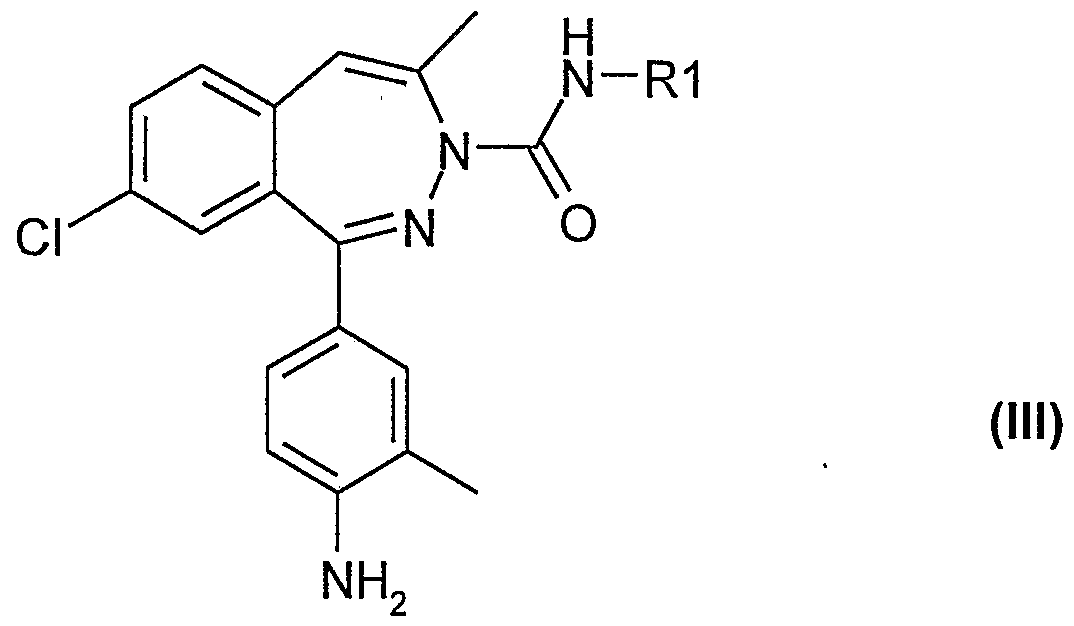
- a compound of the general formula (IV) is reacted with an amine of the general formula (V) to form a compound of the general formula (III) - that is a compound of the general formula (I) containing a -NH-R 1 group in the place of R.
- Y stands for lower alkyl or a leaving group.
- the leaving group is preferably a halogen atom (e.g. bromine or iodine), an aryloxy group (e.g. an optionally substituted phenoxy group, preferably a phenoxy group) or a lower alkoxy group (e.g. methoxy, ethoxy group, etc.).
- the reaction may be performed in a protic solvent (preferably in lower alkanols, particularly in ethanol) or in the excess of the amine of general formula (V).
- a protic solvent preferably in lower alkanols, particularly in ethanol
- the reaction is carried out at a temperature between -20°C and 150°C, preferably between 20°C and 60°C.
- the thus-obtained compounds of the general formula (I) may be converted into pharmaceutically acceptable acid addition salts thereof.
- the salt formation is performed by methods known per se.
- the inorganic or organic acid used for the salt formation is added to a solution of the compound of general formula (I) in an inert organic solvent, or a solution of the acid used for the salt formation in an inert organic solvent is applied.
- the compounds of general formula (II) used as starting substances for the process according to the invention have not so far been described in the literature.
- Y represents a lower alkyl group or a leaving group.
- the leaving group is preferably a halogen atom (e.g. bromine or iodine), an aryloxy group (e.g. an optionally substituted phenoxy group, preferably a phenoxy group) or a lower alkoxy group (e.g. methoxy, ethoxy group etc.).
- the process can be carried out by methods known per se as described in the literature [Houben-Weyl: Methoden der Organischen Chemie, Carbonsaure und Carbonsaure- derivative, Band E5; S. Patai: The chemistry of amides, Interschience Publishers, (1970)].
- a phenoxy group in the place of Y the acylation is preferably carried out with phenyl chloroformate, in the presence of a base (preferably an organic base, such as triethyl amine), at the boiling point of the reaction mixture.
- a base preferably an organic base, such as triethyl amine
- the reaction is preferably carried out with an appropriate carboxylic anhydride (e.g. acetic anhydride or propionic anhydride) at a temperature between 100 °C and 150°C.
- the carboxylic anhydride may also serve as reaction medium, usually there is no need to use another solvent.
- the thus-obtained compound of the general formula (VIII) is then interacted with an amine of the general formula (V).
- the reaction is performed as specified above in connection with the compounds of general formula (IV) with the amines of general formula (V).
- the compounds of the general formula (I) - as it was mentioned above - possess valuable pharmaceutical properties and may be used particularly for the treatment and prevention of central nervous system disorders, which can be treated by the administration of AMPA/kainate receptor inhibitors.
- the following indications are specifically mentioned: epilepsy, diseases involving muscle spasticity, stroke, accidents involving cerebral and spinal lesions, sclerosis multiplex, Guillain-Barre syndrome, motoneuron disease (ALS), Parkinson disease and other neurodegenerative disorders.
- compositions comprising as active ingredient a compound of the general formula (I), wherein R is as stated above, or a pharmaceutically acceptable acid addition salt thereof in admixture with suitable inert solid or liquid carriers and/or auxiliary agents, and if desired, further pharmaceutically active ingredients.
- a process for the preparation of the pharmaceutical compositions specified above which comprises admixing a compound of the general formula (I) or a pharmaceutically acceptable acid addition salt thereof with inert solid or liquid pharmaceutical carriers and/or auxiliary agents and, if desired, with further pharmaceutically active ingredients, and bringing the mixture to galenic form.
- the pharmaceutical compositions according to the invention may be prepared by methods conventionally applied in the pharmacological industry.
- compositions of the present invention may be suitable for oral (e.g. tablets, coated tablets, capsules, pills, solutions, suspensions or emulsions), parenteral (e.g. injection solutions for intravenous, intramuscular or intraperitoneal use), rectal (e.g. suppositories) or local (e.g. ointments) administration.
- parenteral e.g. injection solutions for intravenous, intramuscular or intraperitoneal use
- rectal e.g. suppositories
- local e.g. ointments
- the solid or liquid pharmaceutical compositions may be produced by methods conventionally applied in the pharmaceutical industry.
- the solid pharmaceutical compositions for oral administration may comprise binding agents (such as gelatine, sorbite, polyvinyl pyrrolidone, etc.), carriers (such as lactose, glucose, starch, potassium phosphate), tabletting auxiliaries (e.g. magnesium stearate, talc, polyethylene glycol, silicon dioxide, etc.) and wetting agents (e.g. sodium lauryl sulphate).
- binding agents such as gelatine, sorbite, polyvinyl pyrrolidone, etc.
- carriers such as lactose, glucose, starch, potassium phosphate
- tabletting auxiliaries e.g. magnesium stearate, talc, polyethylene glycol, silicon dioxide, etc.
- wetting agents e.g. sodium lauryl sulphate
- compositions for oral administration may be e.g. solutions, suspensions or liquid emulsions containing e.g. suspending agents (e.g. gelatine, carboxymethyl cellulose, etc.), emulsifying agents (e.g. sorbitan monooleate, etc.), solvents (e.g. water, oils, glycerine, propylene glycol, ethanol) and preservers (e.g. methyl p-hydroxybenzoate, etc.).
- suspending agents e.g. gelatine, carboxymethyl cellulose, etc.
- emulsifying agents e.g. sorbitan monooleate, etc.
- solvents e.g. water, oils, glycerine, propylene glycol, ethanol
- preservers e.g. methyl p-hydroxybenzoate, etc.
- compositions for parenteral administration are generally sterile solutions of the active ingredient in water or in isotonic sodium chloride solution.
- compositions for rectal administration e.g. suppositories
- a basic material e.g. cocoa butter, etc.
- compositions according to the invention may be prepared by methods conventionally applied in the pharmacological industry.
- the compound of general formula (I) or a pharmaceutically acceptable acid addition salt thereof is admixed with inert solid or liquid pharmaceutical carriers and auxiliary agents and the mixture is brought to galenic form.
- Different pharmaceutical formulations and preparations thereof are described e.g. in Remington's Pharmaceutical Sciences, 18 th Edition, Mack Publishing Co., Easton, USA, (1990).
- the pharmaceutical compositions of the present invention usually contain 0,1-95,0% by mass of the compound of general formula (I), a pharmaceutically acceptable acid addition salt or quaternary ammonium derivative thereof.
- the daily dose of the compounds of general formula (I) depends on several factors, e.g. on the activity of the active ingredient, the way of administration, the severity of the disease to be treated, the patient's general condition, age and body weight.
- the oral dose for adults is generally 0,5-1000 mg, preferably 20 to 200 mg/day, which may be administered to the patients in one or more portion(s). In case of emergency a single dose of 10-1000 mg may be administered.
- Glutamate is the most important stimulant neuron transmitter in the central nervous system.
- the effects of glutamate are mediated by receptors of NMD A, AMPA and kainate type connected to the ion channel.
- Non-competitive inhibitors of AMPA/kainate receptors with a 2,3-benzodiazepine structure exhibit a significant muscle relaxant, neuroprotective and anticonvulsive effect, so potentially they can be applied in case of all diseases wherein the inhibition of AMPA/kainate receptors proves to be favourable.
- diseases are e.g. epilepsy, disorders involving muscle spasticity, different neurodegenerative diseases, stroke, etc.
- the first reading of latency was the control value. Then, retinas were incubated for 15 minutes in Ringer solution containing the test compound, and latency of SD was measured again in the presence of the test compound. Following incubation of retinas in drug-free Ringer solution for 60 minutes SD was measured in order to assess the degree of recovery from the drug effect. Prolongation of the latency of spreading depression by 30 seconds or more was regarded as 100% inhibition.
- mice Male NMRI mice weighing 20 to 25 g were treated intraperitoneally with the test compounds administered in a volume of 10 ml/kg. Thirty minutes later an electroshock of 50 Hz, 40 mA, 0.4 seconds was applied through corneal electrodes, and the presence or absence of tonic extensor convulsion of the hind legs was observed in all mice. The reaction was positive if the animals showed tonic extensor convulsions in the -hind legs, the reaction was negative if this response did not occur. The number of animals showing positive reaction was counted in each group. The dose of test substance causing 50% (ED 50 ) inhibition was calculated according to the method of Litchfield and Wilcoxon (1949). References
- the brain was perfused through the left ventricle of the heart with a 4 % solution of 2,3,5-triphenyltetrazolium chloride (TTC).
- TTC 2,3,5-triphenyltetrazolium chloride
- the brains were removed and placed into ice-cold saline for a few min. Then the brains were fixed in 8 % formalin solution for 24 hours.
- the necrotic (non-stained with TTC) brain surface area was measured by means of an image analyser computer system (DigiCell for Windows 4.0). Statistical significance was assessed using ANOVA followed by Duncan's test.
- the compounds of the general formula (I) according to the present invention with 2,3 -benzodiazepine chemical structure can be especially suitable for the treatment of diseases of the brain characterized by neuronal loss, primarily stroke, brain and spinal cord injury, multiple sclerosis, Guillain-Barre syndrome, motoneurone disease (ALS), Parkinson's disease and other neurodegenerative disorders, etc.
- diseases of the brain characterized by neuronal loss, primarily stroke, brain and spinal cord injury, multiple sclerosis, Guillain-Barre syndrome, motoneurone disease (ALS), Parkinson's disease and other neurodegenerative disorders, etc.
- SD spreading depression (in chicken retina): The AMPA receptor agonist S-AMPA induces a slowly progressing change in optical density starting from the edge of the eyecup and spreading over the whole retina. AMPA/kainate receptor antagonist can slow this process down.
- MES maximal electroshock (in mice): electroshock of sufficient current intensity applied through corneal electrodes to mice causes tonic extensor convulsion of the hind legs.
- BWG body weight gain: the difference between body weights on the first and last days of the experiment given as mean ⁇ standard error of the mean.
- the compounds of the present invention can be useful for the treatment of central nervous system disorders in which the pathophysiological role or dysfunction of the glutamatergic system is proven or postulated and the inhibition of AMPA/kainate receptors is advantageous.
- the 2,3- benzodiazepine derivatives of the present invention can be used effectively for the treatment of central nervous system disorders in which administration of the inhibitors of AMPA/kainate receptors is beneficial for reaching or maintaining a therapeutic action.
- the compounds of the general formula (I) can be administered especially in the following therapeutic indications: epilepsy, spastic rigidity, stroke, brain and spinal cord traumas, multiple sclerosis, Guillan-Barre syndrome, motoneuron disease (ALS), Parkinson's disease, and other neurodegenerative disorders.
- ALS motoneuron disease
- Parkinson's disease and other neurodegenerative disorders.
- a process for the treatment of central nervous system disorders by the administration of compounds possessing AMPA/kainate receptor inhibiting activity comprises administering to a patient in need of such treatment a pharmaceutically effective amount of a compound of the general formula (I) or a pharmaceutically acceptable salt thereof.
Landscapes
- Health & Medical Sciences (AREA)
- Chemical & Material Sciences (AREA)
- Organic Chemistry (AREA)
- Engineering & Computer Science (AREA)
- Bioinformatics & Cheminformatics (AREA)
- General Health & Medical Sciences (AREA)
- Veterinary Medicine (AREA)
- Chemical Kinetics & Catalysis (AREA)
- General Chemical & Material Sciences (AREA)
- Medicinal Chemistry (AREA)
- Nuclear Medicine, Radiotherapy & Molecular Imaging (AREA)
- Neurology (AREA)
- Pharmacology & Pharmacy (AREA)
- Life Sciences & Earth Sciences (AREA)
- Animal Behavior & Ethology (AREA)
- Public Health (AREA)
- Neurosurgery (AREA)
- Biomedical Technology (AREA)
- Vascular Medicine (AREA)
- Physical Education & Sports Medicine (AREA)
- Urology & Nephrology (AREA)
- Heart & Thoracic Surgery (AREA)
- Cardiology (AREA)
- Psychology (AREA)
- Orthopedic Medicine & Surgery (AREA)
- Pain & Pain Management (AREA)
- Pharmaceuticals Containing Other Organic And Inorganic Compounds (AREA)
- Plural Heterocyclic Compounds (AREA)
- Organic Low-Molecular-Weight Compounds And Preparation Thereof (AREA)
- Nitrogen Condensed Heterocyclic Rings (AREA)
- Acyclic And Carbocyclic Compounds In Medicinal Compositions (AREA)
- Heterocyclic Carbon Compounds Containing A Hetero Ring Having Nitrogen And Oxygen As The Only Ring Hetero Atoms (AREA)
Abstract
Description




Claims


Priority Applications (13)
| Application Number | Priority Date | Filing Date | Title |
|---|---|---|---|
| SK5021-2006A SK50212006A3 (en) | 2003-08-04 | 2004-07-29 | 8-Chloro-2,3-benzodiazepine derivatives |
| EP04769081A EP1660462B1 (en) | 2003-08-04 | 2004-07-29 | 8-chloro-2,3-benzodiazepine derivatives |
| US10/567,598 US7960375B2 (en) | 2003-08-04 | 2004-07-29 | 8-chloro-2,3-benzodiazepine derivatives |
| CA002534458A CA2534458A1 (en) | 2003-08-04 | 2004-07-29 | 8-chloro-2,3-benzodiazepine derivatives |
| PL04769081T PL1660462T3 (en) | 2003-08-04 | 2004-07-29 | 8-chloro-2,3-benzodiazepine derivatives |
| UAA200602304A UA84159C2 (en) | 2003-08-04 | 2004-07-29 | 8-chloro-2,3-benzodiazepine derivatives |
| SI200431033T SI1660462T1 (en) | 2003-08-04 | 2004-07-29 | 8-chloro-2,3-benzodiazepine derivatives |
| AU2004261491A AU2004261491B2 (en) | 2003-08-04 | 2004-07-29 | 8-chloro-2,3-benzodiazepine derivatives |
| DE602004017878T DE602004017878D1 (en) | 2003-08-04 | 2004-07-29 | 8-CHLORO-2,3-benzodiazepine derivatives |
| EA200600373A EA009373B1 (en) | 2003-08-04 | 2004-07-29 | 8-chloro-2,3-benzodiazepine derivatives |
| DK04769081T DK1660462T3 (en) | 2003-08-04 | 2004-07-29 | 8-chloro-2,3-benzodiazepine |
| JP2006522422A JP4752011B2 (en) | 2003-08-04 | 2004-07-29 | 8-chloro-2,3-benzodiazepine derivatives |
| IL173476A IL173476A (en) | 2003-08-04 | 2006-01-31 | 8-chloro-2,3-benzodiazepine derivatives |
Applications Claiming Priority (2)
| Application Number | Priority Date | Filing Date | Title |
|---|---|---|---|
| HUP0302449 | 2003-08-04 | ||
| HU0302449A HUP0302449A3 (en) | 2003-08-04 | 2003-08-04 | 8-chloro-2,3-benzodiazepine derivatives, pharmaceutical compositions containing them and process for producing them |
Publications (1)
| Publication Number | Publication Date |
|---|---|
| WO2005012265A1 true WO2005012265A1 (en) | 2005-02-10 |
Family
ID=89981556
Family Applications (1)
| Application Number | Title | Priority Date | Filing Date |
|---|---|---|---|
| PCT/HU2004/000082 Ceased WO2005012265A1 (en) | 2003-08-04 | 2004-07-29 | 8-chloro-2,3-benzodiazepine derivatives |
Country Status (23)
| Country | Link |
|---|---|
| US (1) | US7960375B2 (en) |
| EP (1) | EP1660462B1 (en) |
| JP (1) | JP4752011B2 (en) |
| KR (1) | KR20060120578A (en) |
| CN (1) | CN100551915C (en) |
| AT (1) | ATE414695T1 (en) |
| AU (1) | AU2004261491B2 (en) |
| BG (1) | BG109462A (en) |
| CA (1) | CA2534458A1 (en) |
| CZ (1) | CZ2006131A3 (en) |
| DE (1) | DE602004017878D1 (en) |
| DK (1) | DK1660462T3 (en) |
| EA (1) | EA009373B1 (en) |
| ES (1) | ES2317038T3 (en) |
| HU (1) | HUP0302449A3 (en) |
| IL (1) | IL173476A (en) |
| PL (2) | PL379245A1 (en) |
| PT (1) | PT1660462E (en) |
| SI (1) | SI1660462T1 (en) |
| SK (1) | SK50212006A3 (en) |
| UA (1) | UA84159C2 (en) |
| WO (1) | WO2005012265A1 (en) |
| ZA (1) | ZA200601698B (en) |
Citations (1)
| Publication number | Priority date | Publication date | Assignee | Title |
|---|---|---|---|---|
| WO1997028135A1 (en) * | 1996-02-01 | 1997-08-07 | Schering Aktiengesellschaft | 2,3-benzodiazepine derivatives and their use as ampa-receptor inhibitors |
Family Cites Families (7)
| Publication number | Priority date | Publication date | Assignee | Title |
|---|---|---|---|---|
| HU179018B (en) * | 1978-10-19 | 1982-08-28 | Gyogyszerkutato Intezet | Process for producing new 5h-2,3-benzodiazepine derivatives |
| HU191702B (en) | 1984-06-27 | 1987-03-30 | Gyogyszerkutato Intezet | New process for preparing 1-aryl-5 h-2,3-benzodiazepines |
| HU191698B (en) * | 1984-07-27 | 1987-03-30 | Gyogyszerkutato Intezet | Process for producing new 1-aryl-5h-2beta-benzodiazepines |
| HU195788B (en) * | 1986-05-21 | 1988-07-28 | Gyogyszerkutato Intezet | Process for producing 1-/hydroxy-stiryl/-5h-2,3-benzobiazepines and pharmaceutical compositions containing them |
| HU206719B (en) | 1990-12-21 | 1992-12-28 | Gyogyszerkutato Intezet | Process for producing 1-/4-acylamino-phenyl/-7,8-methylenedioxy-5h-2,3-benzodiazepine derivatives, acid addicional salts and pharmaceutical compositions containing them |
| HU9600871D0 (en) * | 1996-04-04 | 1996-05-28 | Gyogyszerkutato Intezet | New 2,3-benzodiazepine derivatives |
| HU225100B1 (en) * | 2000-12-21 | 2006-06-28 | Egyt Gyogyszervegyeszeti Gyar | 2,3-benzodiazepine derivatives, pharmaceutical compositions containing them and their use |
-
2003
- 2003-08-04 HU HU0302449A patent/HUP0302449A3/en unknown
-
2004
- 2004-07-29 PT PT04769081T patent/PT1660462E/en unknown
- 2004-07-29 AT AT04769081T patent/ATE414695T1/en active
- 2004-07-29 SI SI200431033T patent/SI1660462T1/en unknown
- 2004-07-29 AU AU2004261491A patent/AU2004261491B2/en not_active Ceased
- 2004-07-29 EP EP04769081A patent/EP1660462B1/en not_active Expired - Lifetime
- 2004-07-29 CA CA002534458A patent/CA2534458A1/en not_active Abandoned
- 2004-07-29 ZA ZA200601698A patent/ZA200601698B/en unknown
- 2004-07-29 PL PL379245A patent/PL379245A1/en not_active Application Discontinuation
- 2004-07-29 EA EA200600373A patent/EA009373B1/en not_active IP Right Cessation
- 2004-07-29 WO PCT/HU2004/000082 patent/WO2005012265A1/en not_active Ceased
- 2004-07-29 CZ CZ20060131A patent/CZ2006131A3/en unknown
- 2004-07-29 DK DK04769081T patent/DK1660462T3/en active
- 2004-07-29 UA UAA200602304A patent/UA84159C2/en unknown
- 2004-07-29 ES ES04769081T patent/ES2317038T3/en not_active Expired - Lifetime
- 2004-07-29 PL PL04769081T patent/PL1660462T3/en unknown
- 2004-07-29 JP JP2006522422A patent/JP4752011B2/en not_active Expired - Fee Related
- 2004-07-29 SK SK5021-2006A patent/SK50212006A3/en unknown
- 2004-07-29 KR KR1020067002464A patent/KR20060120578A/en not_active Abandoned
- 2004-07-29 CN CNB2004800254093A patent/CN100551915C/en not_active Expired - Fee Related
- 2004-07-29 US US10/567,598 patent/US7960375B2/en not_active Expired - Fee Related
- 2004-07-29 DE DE602004017878T patent/DE602004017878D1/en not_active Expired - Lifetime
-
2006
- 2006-01-31 IL IL173476A patent/IL173476A/en not_active IP Right Cessation
- 2006-03-02 BG BG109462A patent/BG109462A/en unknown
Patent Citations (1)
| Publication number | Priority date | Publication date | Assignee | Title |
|---|---|---|---|---|
| WO1997028135A1 (en) * | 1996-02-01 | 1997-08-07 | Schering Aktiengesellschaft | 2,3-benzodiazepine derivatives and their use as ampa-receptor inhibitors |
Also Published As
| Publication number | Publication date |
|---|---|
| PL1660462T3 (en) | 2009-07-31 |
| EA200600373A1 (en) | 2006-08-25 |
| SK50212006A3 (en) | 2006-08-03 |
| BG109462A (en) | 2006-11-30 |
| IL173476A0 (en) | 2006-06-11 |
| AU2004261491A1 (en) | 2005-02-10 |
| HUP0302449A3 (en) | 2005-06-28 |
| SI1660462T1 (en) | 2009-04-30 |
| HUP0302449A2 (en) | 2005-04-28 |
| JP4752011B2 (en) | 2011-08-17 |
| ES2317038T3 (en) | 2009-04-16 |
| US20080153814A1 (en) | 2008-06-26 |
| US7960375B2 (en) | 2011-06-14 |
| CA2534458A1 (en) | 2005-02-10 |
| CZ2006131A3 (en) | 2006-12-13 |
| KR20060120578A (en) | 2006-11-27 |
| DK1660462T3 (en) | 2009-03-16 |
| HU0302449D0 (en) | 2003-10-28 |
| AU2004261491B2 (en) | 2009-12-17 |
| EA009373B1 (en) | 2007-12-28 |
| CN1871223A (en) | 2006-11-29 |
| EP1660462A1 (en) | 2006-05-31 |
| PL379245A1 (en) | 2006-08-07 |
| IL173476A (en) | 2013-01-31 |
| JP2007501216A (en) | 2007-01-25 |
| CN100551915C (en) | 2009-10-21 |
| PT1660462E (en) | 2009-02-20 |
| UA84159C2 (en) | 2008-09-25 |
| DE602004017878D1 (en) | 2009-01-02 |
| EP1660462B1 (en) | 2008-11-19 |
| ZA200601698B (en) | 2007-05-30 |
| ATE414695T1 (en) | 2008-12-15 |
Similar Documents
| Publication | Publication Date | Title |
|---|---|---|
| RU2102387C1 (en) | Derivatives of n-acyl-2,3-benzodiazepine, or their stereoisomers, or acid additive salts having biological activity connected with affection upon central nervous system and pharmacological active composition on their base | |
| US5519019A (en) | N-acyl-2,3-benzoidazepine derivatives, pharmaceutical compositions containing them and process for preparing same | |
| JP2002513385A (en) | Potassium channel inhibitor | |
| US6200970B1 (en) | 2,3-benzodiazepine derivatives and their use as AMPA-receptor inhibitors | |
| US5639751A (en) | N-acyl-2,3-benzodiazepine derivatives for treating acute and chronic neurodegenerative disorders | |
| US5521174A (en) | N-acyl-2,3-benzodiazepine derivatives and a method of treating spasms of the skeletal musculature therewith | |
| US20070117791A1 (en) | Bicyclic compounds | |
| US6562810B1 (en) | 8-substituted-9H-1,3-dioxolo/4,5-h//2,3/benzodiazepine derivatives, as AMPA/kainate receptor inhibitors | |
| US5716956A (en) | Dihydrophthalazine antagonists of excitatory amino acid receptors | |
| SK282258B6 (en) | 2,3-benzodiazepine derivatives, pharmaceutical composition containing them, process and intermediates for their preparation and their use | |
| KR100386709B1 (en) | New 3-Substituted 3H-2,3-Benzodiazepine Derivatives, Their Preparation and Use as Medicaments | |
| EP1660462B1 (en) | 8-chloro-2,3-benzodiazepine derivatives | |
| HUP0301582A2 (en) | Calcilytic compounds and pharmaceutical compositions containing them | |
| PT1697194E (en) | Lateral acceleration control system | |
| EP1015457B1 (en) | 1,3-dioxolo/4,5-h//2,3/benzodiazepine derivatives as ampa/kainate receptor inhibitors | |
| US6703390B2 (en) | Sulfur containing dihydrophthalazine antagonists of excitatory amino acid receptors | |
| BG66199B1 (en) | 2,3-benzodiazepine derivatives and pharmaceutical compositions containing the same as the active ingredient | |
| MXPA00001487A (en) | 1,3-dioxolo/4,5-h//2,3/benzodiazepine derivatives as ampa/kainate receptor inhibitors |
Legal Events
| Date | Code | Title | Description |
|---|---|---|---|
| WWE | Wipo information: entry into national phase |
Ref document number: 200480025409.3 Country of ref document: CN |
|
| AK | Designated states |
Kind code of ref document: A1 Designated state(s): AE AG AL AM AT AU AZ BA BB BG BR BW BY BZ CA CH CN CO CR CU CZ DE DK DM DZ EC EE EG ES FI GB GD GE GH GM HR HU ID IL IN IS JP KE KG KP KR KZ LC LK LR LS LT LU LV MA MD MG MK MN MW MX MZ NA NI NO NZ OM PG PH PL PT RO RU SC SD SE SG SK SL SY TJ TM TN TR TT TZ UA UG US UZ VC VN YU ZA ZM ZW |
|
| AL | Designated countries for regional patents |
Kind code of ref document: A1 Designated state(s): BW GH GM KE LS MW MZ NA SD SL SZ TZ UG ZM ZW AM AZ BY KG KZ MD RU TJ TM AT BE BG CH CY CZ DE DK EE ES FI FR GB GR HU IE IT LU MC NL PL PT RO SE SI SK TR BF BJ CF CG CI CM GA GN GQ GW ML MR NE SN TD TG |
|
| 121 | Ep: the epo has been informed by wipo that ep was designated in this application | ||
| DPEN | Request for preliminary examination filed prior to expiration of 19th month from priority date (pct application filed from 20040101) | ||
| ENP | Entry into the national phase |
Ref document number: 2534458 Country of ref document: CA |
|
| WWE | Wipo information: entry into national phase |
Ref document number: 173476 Country of ref document: IL |
|
| WWE | Wipo information: entry into national phase |
Ref document number: 2006522422 Country of ref document: JP |
|
| WWE | Wipo information: entry into national phase |
Ref document number: 1020067002464 Country of ref document: KR |
|
| WWE | Wipo information: entry into national phase |
Ref document number: 50212006 Country of ref document: SK |
|
| WWE | Wipo information: entry into national phase |
Ref document number: 2006/01698 Country of ref document: ZA Ref document number: 200601698 Country of ref document: ZA |
|
| WWE | Wipo information: entry into national phase |
Ref document number: 2004261491 Country of ref document: AU Ref document number: PV2006-131 Country of ref document: CZ |
|
| WWE | Wipo information: entry into national phase |
Ref document number: 10946204 Country of ref document: BG |
|
| WWE | Wipo information: entry into national phase |
Ref document number: 2004769081 Country of ref document: EP |
|
| WWE | Wipo information: entry into national phase |
Ref document number: 200600373 Country of ref document: EA |
|
| ENP | Entry into the national phase |
Ref document number: 2004261491 Country of ref document: AU Date of ref document: 20040729 Kind code of ref document: A |
|
| WWP | Wipo information: published in national office |
Ref document number: 2004261491 Country of ref document: AU |
|
| WWP | Wipo information: published in national office |
Ref document number: 2004769081 Country of ref document: EP |
|
| WWP | Wipo information: published in national office |
Ref document number: 1020067002464 Country of ref document: KR |
|
| WWP | Wipo information: published in national office |
Ref document number: PV2006-131 Country of ref document: CZ |
|
| WWE | Wipo information: entry into national phase |
Ref document number: 10567598 Country of ref document: US |