DESCRIPTION CATALYZED ENANTIOSELECTIVE TRANSFORMATION OF ALKENES
CROSS REFERENCE TO RELATED APPLICATIONS This application is based on and claims priority to United States Provisional Application Serial No. 60/477,252, filed June 10, 2003, and United States Provisional Application Serial No. 60/566,267, filed April 29, 2004, both of which are incorporated herein by reference in their entireties. GOVERNMENT INTEREST This invention was made with U.S. Government support under Grant No. GM-59417-03 awarded by the National Institutes of Health. The U.S. Government has certain rights in the invention. TECHNICAL FIELD Enantioselective catalytic reactions that operate directly on unactivated alkenes for the preparation of chiral organic building blocks and new materials. More particularly, a catalyzed enantioselective reaction that operates on an unsaturated hydrocarbon, such as an alkene, to provide an enantiomerically enriched reactive organometallic intermediate, which can be converted to a multifunctional optically active reaction product. ABBREVIATIONS δ = chemical shift acac = acetylacetonate atm = atmospheres binap = 2,2'-bis(diphenylphosphino)-1'1-binaphthyl Bn = benzyl Bu = butyl Bz = benzoyl °C = degrees Celsius C-B = carbon-boron bond calc'd = calculated cat = catecholato CDCI3 = deuterated chloroform cm = centimeters
cod 1 ,5-cyclooctadiene dba dibenzylideneacetone
DDQ dichlorodicyanoquinone dppf 1 ,1 "-bis(diphenylphosphino) ferrocene ee enantiomeric excess
Et ethyl
Et2O diethyl ether
EtOAc ethyl acetate
EtOH ethanol
FAB fast atom bombardment
9 grams
GC gas chromatography
GLC gas-liquid chromatography h hours
HCl hydrogen chloride
HPLC high-pressure liquid chromatography
HRMS high-resolution mass spectrometry
Hz hertz iprOH isopropyl alcohol
IR infrared kg kilograms
Me methyl
MeO methoxyl
MHz megahertz mL milliliters mm millimeters mmol millimole m.p. melting point
MS mass spectroscopy
NaCl sodium chloride
NaHCO3 sodium bicarbonate
Na2CO3 sodium carbonate
Na2SO4 !___ sodium sulfate NaOH = sodium hydroxide nbd = norbornadiene NMR = nuclear magnetic resonance Otf = trifluoromethanesulfonate (triflate) OAc = acetate Pd = palladium Ph = phenyl pin = pinacolato psi = pounds per square inch quinap ~ 1-(2-diphenylphosphino-1- naphthyl)isoquinoline Rh = rhodium SFC = supercritical fluid chromatography TBAF = tetra(n-butylammonium) fluoride TBME = tert-butyldimethyl ether THF = tetrahydrofuran TLC = thin-layer chromatography TMS = trimethylsilane UV — ultraviolet BACKGROUND Catalytic enantioselective reactions that convert simple alkenes to functionalized chiral products represent a long-felt and ongoing need in the art. See Blaser. H. U., et al., Applied Catalysis A: General 2001 , 221, 119. For example, there is a need for a catalytic enantioselective dimetallation reaction which operates on simple alkene substrates. Of further interest is the transformation of reactive organometallic intermediates to functionalized optically active compounds, such as the conversion of boronated adducts to functionalized optically active compounds via cross-coupling reactions, for example a Suzuki coupling reaction. However, there are no reports of Suzuki coupling reactions involving aliphatic 1 ,2-dimetal adducts. Thus, the stereochemical integrity of
the non-reacting carbon-boron bond is uncertain. Therefore, there also is a need in the art for the enantioselective transformation of reactive organometallic intermediates to functionalized optically active compounds. SUMMARY The presently disclosed subject matter describes a method of converting alkenes to functionalized chiral products via a catalytic enantioselective reaction. In some embodiments, the method comprises a catalytic asymmetric alkene dimetalation reaction according to Scheme 1.
Scheme 1 - Catalytic asymmetric alkene dimetalation reaction
In some embodiments, the catalytic asymmetric alkene dimetalation reaction provides a reactive 1 ,2-dimetalated intermediate that can undergo further reaction to provide an optically active 1 ,2-difunctional compound. In some embodiments, the catalytic asymmetric dimetalation reaction comprises a catalytic enantioselective diboration reaction that operates on alkene substrates. In some embodiments, 1 ,2-diboron compounds are reacted, in situ, with aryl halides wherein the less hindered carbon-boron (C-B) bond participates in cross-coupling. The remaining C-B bond is then oxidized in the reaction workup thereby allowing for net asymmetric carbohydroxylation of alkenes in a tandem one-pot diboration/Suzuki coupling/oxidation sequence. This transformation allows catalytic conversion of alkenes to optically active compounds which are not readily accessible by other approaches. Accordingly, in some embodiments, the net catalytic enantioselective carbohydroxylation of alkenes by a tandem single-pot diboration/Suzuki cross-coupling/oxidation process is provided. In some embodiments, the presently disclosed subject matter describes an enantioselective method of synthesizing an optically active compound. In some embodiments, the method comprises forming a
reactive organometallic intermediate by one of: (i) reacting an alkene with a metallic or metalloid reagent in the presence of a chiral catalyst; and (ii) reacting a vinyl metallic substrate with hydrogen in the presence of a chiral catalyst. The method further comprises reacting the reactive organometallic intermediate with a functionalized reagent to yield an optically active compound. In some embodiments, the method comprises the rhodium-catalyzed enantioselective diboration of alkenes. In some embodiments, the method comprises the catalytic asymmetric carbohydroxylation of alkenes by a tandem diboration/Suzuki cross-coupling/oxidation reaction. In some embodiments, the diboration/cross-coupling/oxidation reaction is accelerated by a microwave irradiation process. In some embodiments, the method comprises the selective transformation of chiral 1 ,2-diboron reagents via a homologation reaction. In some embodiments, an alkyne diboration is followed by an asymmetric hydrogenation to provide access to optically active 1 -alkene diboration products. In some embodiments, the method comprises the catalytic asymmetric diboration of prochiral allenes. In some embodiments, the method comprises the catalytic diboration of trisubstiuted alkenes. In some embodiments, the method comprises a single-pot process. Certain objects of the presently disclosed subject matter having been stated hereinabove, which are addressed in whole or in part by the presently disclosed subject matter, other aspects and objects will become evident as the description proceeds when taken in connection with the accompanying Examples as best described herein below. BRIEF DESCRIPTION OF THE DRAWINGS Figure 1 is a chiral GLC (β-dex, Supelco, 140 °C) analysis of diol product: (1 R, 2R)-1-phenyl-propane-1 ,2-diol. The structural formula also is presented. Figure 2 is a chiral GLC (β-dex, Supelco, 110 °C) analysis of diol product: (5R, 6f?)-decane-5, 6-diol. The structural formula also is presented.
Figure 3 is a chiral HPLC (Chiralcel-OJ, Daicel, 6% iPrOH in hexanes, 0.6 mL/min) analysis of diol product: (1 R, 2R)-1 , 2-diphenyl-ethane-l , 2- diol. The structural formula also is presented. Figure 4 is a chiral GLC (β-dex, Supelco, 130 °C) analysis of diol product: (1R)-phenyl-ethane-1 , 2-diol. The structural formula also is presented. Figure 5 is a chiral GLC (β-dex, Supelco, 120 °C) analysis of diol product: (2R)-2-phenyl-propane-1 , 2-diol. The structural formula also is presented. Figure 6 is a chiral HPLC (Chiralcel-OJ, Daicel, 7.5% iPrOH in hexanes, 1 mL/min)) analysis of diol product: (1R, 2S)-indan-1 , 2-diol. The structural formula also is presented. Figure 7 is a chiral HPLC (Chiralcel-OJ, Daicel, 7.5% iPrOH in hexanes, 0.5 mL/min) analysis of diol product: (1 S, 2R)-1 ,2,3,4-Tetrahydro- naphthalene-1 , 2-diol. The structural formula also is presented. Figure 8 is a chiral HPLC (Chiralcel-OD, Daicel, 10% iPrOH in hexanes, 1 mL/min) analysis of diol product: (1 R, 2S)-2-Methyl-indan-1 ,2- diol. The structural formula also is presented. Figure 9 is a chiral GLC (β-dex, Supelco, 140 °C) analysis of diol product: (1 S, 2R)-1-phenyl-propane-1 , 2-diol. The structural formula also is presented. Figure 10 is a chiral GLC (β-dex, Supelco, 160 °C) analysis of diol product: (1R, 2R)-1-(4-Methoxy-phenyl)-propane-1 , 2-diol. The structural formula also is presented. Figure 11 is a chiral GLC (β-dex, Supelco, 120 °C) analysis of diol product: (R)-1-Cyclohexyl-ethane-1 , 2-diol. The structural formula also is presented. Figure 12 is a chiral GLC (β-dex, Supelco, 120 °C) analysis of diol product: (R)-decane-l , 2-diol. The structural formula also is presented. Figure 13 is a chiral GLC (β-dex, Supelco, 120 °C) analysis of diol product: (R)-3,3-Dimethyl-butane-1 , 2-diol. The structural formula also is presented.
Figure 14 is a chiral GLC (β-dex, Supelco, 110 °C) analysis of diol product: (R)-3,3-Dimethyl-heptane-1 , 2-diol. The structural formula also is presented. Figure 15 is an SFC (OD-H, 150 psi, 50 °C, flow = 3 mL/min, 1 % MeOH) analysis of diol product: (R)-3,3-Dimethyl-4-p-tolyl-butane-1 , 2-diol. The structural formula also is presented. Figure 16 is a chiral GLC (β-dex, Supelco, 100 °C) analysis of alcohol product: (S)-3,3-Dimethyl-1-phenyl-butan-2-ol. The structural formula also is presented. Figure 17 is a chiral HPLC (Chiralcel-OD, Daicel, 5.0% iPrOH in hexanes, 1.0 mL/min) analysis of alcohol product: (S)-4-Benzyloxy-3,3- dimethyl-1-pyridin-3-yl-butan-2-ol. The structural formula also is presented. Figure 18 is a chiral GLC (β-dex, Supelco, 130 °C) analysis of alcohol product: (S)-1-(3-Methoxy-phenyl)-3,3-dimethyl-butan-2-ol. The structural formula also is presented. Figure 19 is an SFC (OD-H, 150 psi, 50 °C, flow = 3 mL/min, 1 % MeOH) analysis of alcohol product: (S)-3,3-Dimethyl-1-napthalen-2-yl-l- butan-2-ol. The structural formula also is presented. Figure 20 is an SFC (OD-H, 150 psi, 50 °C, flow = 3 mL/min, 0% MeOH) analysis of alcohol product: (S)-3,3-Dimethyl-1-(4-nitroso-phenyl)- butan-2-ol. The structural formula also is presented. Figure 21 is an SFC (OD-H, 150 psi, 50 °C, flow = 3.5 mL/min, 3% MeOH) analysis of alcohol product: (S)-3,3-Dimethyl-1-pyridin-4-yl-4-p-tolyl- butan-2-ol. The structural formula also is presented. Figure 22 is an SFC (OD-H, 150 psi, 50 °C, flow = 4 mL/min, 2% MeOH) analysis of alcohol product: (R)-4-(2-Hydroxy-3,3-dimethyl-4-p-tolyl- butyl)-benzaldhyde. The structural formula also is presented. Figure 23 is an SFC (AD-H, 150 psi, 50 °C, flow = 2 mL/min, 1 % MeOH) analysis of ether product: (R)-2-(1 ,1-Dimethyl-2-p-tolyl-ethyl)-2,3- dihydrobenzo-furan. The structural formula also is presented.
DETAILED DESCRIPTION The presently disclosed subject matter will now be described more fully hereinafter with reference to the accompanying Examples, in which preferred embodiments are shown. The presently disclosed subject matter can, however, be embodied in different forms and should not be construed as limited to the embodiments set forth herein. Rather, these embodiments are provided so that this disclosure will be thorough and complete, and will fully convey the scope of the embodiments to those skilled in the art. Unless otherwise defined, all technical and scientific terms used herein have the same meaning as commonly understood by one of ordinary skill in the art to which this presently described subject matter belongs. All publications, patent applications, patents, and other references mentioned herein are incorporated by reference in their entirety. Throughout the specification and claims, a given chemical formula or name shall encompass all optical and stereoisomers, as well as racemic mixtures where such isomers and mixtures exist. In some embodiments, the method comprises a catalytic asymmetric alkene dimetalation reaction according to Scheme 1.
Scheme 1 - Catalytic asymmetric alkene dimetalation reaction In some embodiments, the method comprises an enantioselective method of synthesizing an optically active compound, the method comprising forming a reactive organometallic intermediate by one of (1 ) reacting an alkene with a metallic or metalloid reagent in the presence of a chiral catalyst; and (2) reacting a vinyl monometallic of vinyl dimetallic substrate with hydrogen in the presence of a chiral catalyst according to Scheme 2.
M M catalyst catalyst
(1) PV^ M-M M M + H, (2a) catalyst
Scheme 2 - Formation of a reactive organometallic intermediate via (1) a catalytic asymmetric alkene dimetalation reaction and (2) a catalytic hydrogenation of a vinyl dimetallic substrate (2a) or a vinyl monometallic substrate (2b). In some embodiments, the reactive organometallic intermediate can undergo further reaction with a functionalized reagent to provide an optically active multifunctional compound. Referring now to Scheme 3, in some embodiments, the optically active multifunctional compound is selected from the group consisting of 1 ,2-diols, 1 ,2-diamines, 1 ,2-diacids, 1 ,2- dihalogenated compounds, 1 ,2-dialkylated compounds, aryl-substituted alcohols, aryl-substituted amines, vinyl-substituted alcohols, a hydroxylated ketone, aldehyde, or ester, and a substituted 2,3-dihydrobenzofuran.
Scheme 3 - Reaction of a reactive organometallic reagent to provide an optically active multifunctional compound.
Thus, in some embodiments, the presently disclosed subject matter provides an enantioselective method of synthesizing an optically active compound. In some embodiments, the method comprises: (a) forming a reactive organometallic intermediate by one of: (i) reacting an alkene with a metallic or metalloid reagent in the presence of a chiral catalyst; and (ii) reacting a vinyl metallic substrate with hydrogen in the presence of a chiral catalyst; and (b) reacting the reactive organometallic intermediate with a functionalized reagent to yield an optically active compound. In some embodiments, the reactive organometallic intermediate is formed by reacting an alkene with a metallic or metalloid reagent in the presence of a chiral catalyst. In some embodiments, the alkene comprises an aliphatic alkene. In some embodiments, the alkene comprises a 1- alkene. In some embodiments, the 1 -alkene is selected from the group consisting of 3,3-dimethyl-but-1-ene, 3,3-dimethyl-hept-1-ene, 1-(2,2- dimethyl-but-3-enyl)-4-methylbenzene, (2,2-dimethyl-but-3-enyloxy)benzene, vinyl cyclohexane, 1-decene, and styrene. In some embodiments, the alkene comprises a fraπs-alkene. In some embodiments, the alkene is a substituted alkene. In some embodiments, the substituted alkene comprises a trisubstituted alkene. In some embodiments, the substituted alkene comprises an aromatic-substituted alkene. In some embodiments, the aromatic-substituted alkene comprises a styrene. In some embodiments, the alkene is selected from the group consisting of trans-β- methylstyrene, 4-methoxy- ?-methylstyrene, 1 ,2-diphenylethene (trans- stilbene), tra/7s-5-decene, 2-methyl-1 H-indene, 1 H-indene, 1 ,2- dihydronaphthalene, c/'s- ?-methylsytrene, styrene, and σmethylsytrene. In some embodiments, the alkene comprises a prochiral allene. In some embodiments, the metallic or metalloid reagent comprises a dimetallic or dimetalloid reagent. In some embodiments, the dimetallic or dimetalloid reagent comprises a diboron reagent. In some embodiments,
the diboron reagent is bis(catecholato)diboron (B2(cat)2), which is represented by the following formula:
In some embodiments, the diboron reagent is bis(pinacolato) diboron (B2(pin)2), which is represented by the following formula:

In some embodiments, the organometallic intermediate comprises a diboronated adduct. In some embodiments, the diboronated adduct comprises a 1 ,2-diboronated adduct. In some embodiments, the chiral catalyst comprises a metal chiral catalyst. In some embodiments, the chiral catalyst comprises a transition metal complex. In some embodiments, the transition metal complex comprises a Group 9 or Group 10 transitional metal and a ligand. In some embodiments, the transition metal is selected from the group consisting of rhodium, iridium, cobalt, palladium, and platinum. In some embodiments, the chiral catalyst comprises rhodium. In some embodiments, the transition metal complex is a rhodium(l) complex. In some embodiments, the ligand is selected from the group consisting of a chiral monodentate, bidentate and tridentate ligand. In some embodiments, the ligand comprises an atom donor selected from the group consisting of nitrogen, phosphorous, and sulfur. In some embodiments, the chiral catalyst is
(S)-quinap/[(cod)2Rh]BF4, wherein "quinap" represents 1-(2- diphenylphosphino-1-naphthyl)isoquinoline and "cod" represents 1 ,5-cyclooctadiene. In some embodiments, the chiral catalyst is (S)-quinap/(bicyclo[2.2.1]hepta-2,5-diene)-(2,4-pentanedionato)-rhodium(l). In some embodiments, wherein the alkene comprises a prochiral allene, the chiral catalyst comprises a palladium catalyst. In some embodiments, the
palladium catalyst comprises a chiral monodentate ligand. In some embodiments, the palladium catalyst is Pd2(dibenzylideneacetone)3. In some embodiments, the reactive organometallic intermediate is formed by reacting a vinyl metallic substrate with hydrogen in the presence of a chiral catalyst in a hydrogenation reaction. In some embodiments, the chiral catalyst of the hydrogenation reaction comprises a rhodium chiral diphosphine ligand. In some embodiments, the chiral catalyst of the hydrogenation reaction is a compound of the following structure:
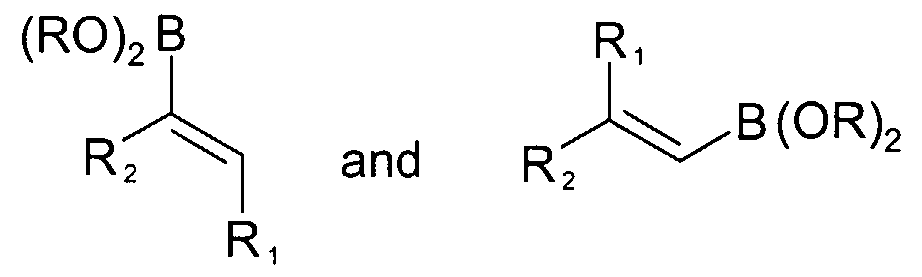
In some embodiments, the vinyl metallic substrate of the hydrogenation reaction is selected from one of a vinyl monometallic compound and a vinyl dimetallic compound. In some embodiments, the vinyl metallic substrate comprises a vinyl monometallic substrate. In some embodiments, the vinyl metallic substrate comprises a vinyl dimetallic substrate. In some embodiments, the vinyl monometallic substrate comprises a compound selected from one of:
wherein Ri and R
2 are independently selected from the group consisting of H, alkyl, substituted alkyl, alkenyl, substituted alkenyl, aryl, and substituted aryl; and M comprises a metal or metalloid selected from the group consisting of boron, silicon, tin, and germanium. In some embodiments, M can be further substituted by a functional group, such as H, an alkyl group substituent as defined herein, an aryl group as defined herein, or a
functionalized group as listed herein with respect to a functional reagent. In some embodiments, Ri and/or R
2 is aryl or substituted aryl and M is boron. In some embodiments, the vinyl monometallic substrate comprises a compound selected from one of:
wherein R, Ri, and R
2 are independently selected from the group consisting of H, alkyl, substituted alkyl, alkenyl, substituted alkenyl, aryl, and substituted aryl. In some embodiments, the vinyl dimetallic substrate comprises a compound of the formula:
wherein R is selected from the group consisting of H, alkyl, substituted alkyl, alkenyl, substituted alkenyl, aryl, and substituted aryl; and M comprises a metal or metalloid selected from the group consisting of boron, silicon, tin, and germanium. In some embodiments, M can be further substituted by a functional group, such as H, an alkyl group substituent as defined herein, an aryl group as defined herein, or a functional group as listed herein with respect to a functionalized reagent. In some embodiments, R is aryl or substituted aryl and M is boron or a substituted boron. In some embodiments, the vinyl dimetallic compound comprises a vinyl diboron compound of the formula:
In some embodiments, the reactive organometallic intermediate is selected from one of a chiral organomonometallic intermediate and a chiral
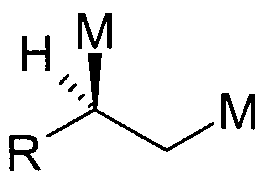
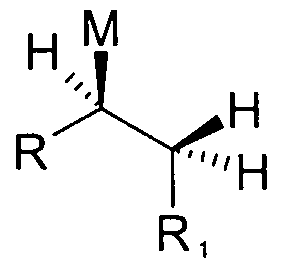
organodimetallic intermediate. In some embodiments, the chiral organomonometallic reagent comprises a compound of the formula:
wherein R and Ri are independently selected from the group consisting of H, alkyl, substituted alkyl, alkenyl, substituted alkenyl, aryl, and substituted aryl; and M comprises a metal or metalloid selected from the group consisting of boron, silicon, tin, and germanium. In some embodiments, R and/or Ri comprises aryl or substituted aryl and M is boron or a substituted boron. In some embodiments, the chiral organodimetallic reagent comprises a compound of the formula:
wherein R is selected from the group consisting of H, alkyl, substituted alkyl, alkenyl, substituted alkenyl, aryl, and substituted aryl; and M comprises a metal or metalloid selected from the group consisting of boron, silicon, tin, and germanium. In some embodiments, R comprises aryl or substituted aryl and M is boron or a substituted boron. In some embodiments, the chiral organodimetallic intermediate comprises a compound of the formula:

In some embodiments, the step of reacting the reactive organometallic intermediate with a functionalized reagent to yield an optically active compound (step(b) as provided hereinabove) is selected from the group of reactions consisting of oxidation, homologation/oxidation,
cross-coupling, transesterification, amination, sulfuration, and phosphinylation reactions, and combinations thereof. In some embodiments, the reaction of step (b) comprises an oxidation reaction. In some embodiments, the oxidation reaction is performed by treating the organometallic intermediate with an oxidizing agent. In some, embodiments, the oxidizing agent is hydrogen peroxide. In some embodiments, the oxidation reaction is carried out in the presence of an alkaline reagent. In some embodiments, the alkaline reagent is sodium hydroxide. In some embodiments, the oxidizing agent comprises an alkyl amine N-oxide. In some embodiments, the alkyl amine N-oxide comprises trimethylamine N-oxide. In some embodiments, the oxidation reaction further comprises BCI
3 and BnN
3 reagents to form an amine reaction product. In some embodiments, the reaction of step (b) comprises a transesterfication reaction. In some embodiments, the transesterification reaction is performed by treating the organometallic intermediate with a diol to form a diester. In some embodiments, the diol is pinacol (2,3-dimethyl- 2,3-butanediol). In some embodiments, the diester is a pinacol ester. In some embodiments, the reaction of step (b) is a homologation reaction. In some embodiments, the homologation reaction comprises: (a) reacting the organometallic intermediate with a diol to form a diester; (b) reacting the diester with halogenated alkyl metal complex to form a second organometallic intermediate; and (c) treating the second organometallic intermediate with an oxidizing agent to form a bis(hydroxymethylation) adduct. In some embodiments, the diol is pinacol. In some embodiments, the diester is a pinacol ester. In some embodiments, the halogenated alkyl metal complex is chloromethyl lithium. In some embodiments, the homologation reaction further comprises adding trimethylsilyl diazomethane (TMSCHN
2) and then an oxidizing agent to the reaction product to form an σ-silyl alcohol. In some embodiments, the
reaction further comprises one of (1 ) desilylating the σ-silyl alcohol to provide a 1 ,3-diol and (2) treating the σ-silyl alcohol with ozone to provide a ^-hydroxy acid. In some embodiments, the reaction of step (b) comprises a cross- coupling reaction. In some embodiments, the cross-coupling reaction comprises a coupling partner and a catalyst. In some embodiments, the coupling partner is selected from one of an aryl halide and an aryl triflate. In some embodiments, the coupling partner comprises an aryl halide. In some embodiments, the aryl halide is selected from the group consisting of 2- bromonaphthalene, 1 -bromo-4-nitrobenzene, 1 -bromo-3-methoxybenzene, 3-bromopyridine, 4-bromopyridine hydrochloride, and 4- bromobenzaldehyde. In some embodiments, the coupling partner comprises an aryl triflate. In some embodiments, the aryl triflate is trifluoromethanesulfonic acid phenyl ester (phenyl triflate). In some embodiments, the catalyst comprises a palladium catalyst. In some embodiments, the palladium catalyst comprises (dppf)PdCI
2, wherein "dppf represents 1 , 1 '-bis(diphenylphosphino) ferrocene. In some embodiments, the cross-coupling reaction is performed in the presence of microwave irradiation. In some embodiments, the cross- coupling reaction is followed by an oxidation reaction. In some embodiments, the cross-coupling reaction further comprises a single-pot process. In some embodiments, the functionalized reagent transfers a functional group selected from the group consisting of -OH, -O, -CH
2OH, - CO
2OH, C, NR
2, SR, P(III)R, P(V)R and combinations thereof, wherein R is selected from the group consisting of H, alkyl, and substituted alkyl. In some embodiments, the optically active compound is selected from the group consisting of 1 ,2-diols, 1 ,2-diamines, 1 ,2-diacids, 1 ,2- dihalogenated compounds, 1 ,2-dialkylated compounds, aryl-substituted alcohols, aryl-substituted amines, vinyl-substituted alcohols, a hydroxylated ketone, aldehyde, or ester; and a substituted 2,3-dihydrobenzofuran.
In some embodiments, the optically active compound is selected from the group consisting of (7R, 2R)-1-phenyl-propane-1 , 2-diol, (5R, 6R)- decane-5,6-diol, (1R, 2R)-1 ,2-diphenyl-ethane-1 , 2-diol, (7R)-phenyl-ethane- 1 , 2-diol, (2R)-2-phenyl-propane-1 , 2-diol, (1R, 2S)-indan-1 , 2-diol, {1S, 2R)-1 , 2, 3, 4-tetrahydro-naphthalene-1 , 2-diol, (1R, 2S)-2-methyl-indan-1 , 2-diol, (1S, 2R)-1-phenyl-propane-1 , 2-diol, (1R, 2R)-1-(4-methoxy-phenyl)- propane-1 , 2-diol, (1S, 2R)-di(pinacolatoboryl)-1-phenyl-propane, and {2R, 3R)-2-methyl-3-phenyl-butane-1 ,4-diol; (R)-1 -Cyclohexyl-ethane-1 ,2-diol; (R)-decane-l ,2-diol; (R)-4-Benzyloxy-3,3-dimethyl-butane-1 ,2-diol; (R)-3,3- Dimethyl-butane-1 , 2-diol; (1 R)-phenyl-ethane-1 , 2-diol; (R)-3,3-Dimethyl- heptane-1 ,2-diol; (R)-3,3-Dimethyl-4-p-tolyl-butane-1 ,2-diol; (S)-3,3- Dimethyl-1 -phenyl-butan-2-ol; (S)-4-Benzyloxy-3,3-dimethyl-1 -pyridin-3-yl- butan-2-ol; (S)-1 -(3-Methoxy-phenyl)-3,3-dimethyl-butan-2-ol; (S)-3,3- Dimethyl-1-napthalen-2-yl-l-butan-2-ol; (S)-3,3-Dimethyl-1-(4-nitroso- phenyl)-butan-2-ol; (S)-3,3-Dimethyl-1 -pyridin-4-yl-4-p-tolyl-butan-2-ol; (R)-4- (2-Hydroxy-3,3-dimethyl-4-p-tolyl-butyl)-benzaldhyde; (R)-1-(2-Chloro- phenyl)-3,3-dimethyl-4-p-tolyl-butan-2-ol; (R)-2-(1 ,1-Dimethyl-2-p-tolyl-ethyl)- 2,3-dihydrobenzo-furan. In some embodiments, the method is carried out at about room temperature. In some embodiments, the optically active compound has an enantiopurity of greater than 50%. In some embodiments, the optically active compound has an enantiopurity of greater than 75%. In some embodiments, the optically active compound has an enantiopurity of greater than 90%. In some embodiments, the optically active compound has an enantiopurity of greater than 95%.
Definitions Unless otherwise defined, all technical and scientific terms used herein have the same meaning as commonly understood by one of ordinary skill in the art to which this presently described subject matter belongs.
As used herein the term "alkyl" refers to Cι-2o inclusive, linear {i.e., "straight-chain"), branched, or cyclic, saturated or at least partially and in some cases fully unsaturated (i.e., alkenyl and alkynyl) hydrocarbon chains, including for example, methyl, ethyl, propyl, isopropyl, butyl, isobutyl, tert- butyl, pentyl, hexyl, octyl, ethenyl, propenyl, butenyl, pentenyl, hexenyl, octenyl, butadienyl, propynyl, butynyl, pentynyl, hexynyl, heptynyl, and allenyl groups. Accordingly, the term "alkene" refers to a branched or unbranched hydrocarbon having one or more carbon-carbon double bonds. A simple alkene comprises the general formula CnH2n. Branched or unbranched hydrocarbons having more than one double bond are referred to as alkadienes, alkatrienes, and the like. The term "vinyl" refers to the (-CH=CH-) group and derivatives formed by substitution. In some embodiments of the presently disclosed subject matter, the vinyl group comprises the (CH2=CH-) group. The vinyl group can optionally be substituted with at least one metal or metalloid atom, in which case the vinyl group is referred to as a vinyl metallic substrate. In some embodiments of the presently disclosed subject matter, the vinyl group comprises one metal or metalloid atom and is referred to as a vinyl monometallic substrate. In some embodiments, the vinyl monometallic substrate comprises the formula:
In some embodiments, M can be further substituted by a functional group, such as H, an alkyl group substituent as defined herein, an aryl group as defined herein, or a functional group as listed herein with respect to a functional reagent. In some embodiments, of the presently disclosed subject matter, the vinyl group comprises two metal or metalloid atoms and is referred to as a vinyl dimetallic substrate. In some embodiments, the vinyl dimetallic substrate comprises a compound of the formula:
In some embodiments, M can be further substituted by a functional group, such as H, an alkyl group substituent as defined herein, an aryl group as defined herein, or a functional group as listed herein with respect to a functional reagent. The term "allene" refers to a hydrocarbon and derivatives formed by substitution comprising the group >C=C=C<, in which three carbon atoms are linked by two adjacent double bonds. The outer carbon atoms are each linked to two other atoms or groups by single bonds. For example, propadiene (CH2=C=CH2) is the simplest allene. The term "alkyne" refers to a hydrocarbon and derivatives formed by substitution having a carbon-carbon triple bond. The term "branched" refers to an alkyl group in which a lower alkyl group, such as methyl, ethyl or propyl, is attached to a linear alkyl chain. "Lower alkyl" refers to an alkyl group having 1 to about 8 carbon atoms (i.e., a C1-8 alkyl), e.g., 1 , 2, 3, 4, 5, 6, 7, or 8 carbon atoms. "Higher alkyl" refers to an alkyl group having about 10 to about 20 carbon atoms, e.g., 10, 11 , 12, 13, 14, 15, 16, 17, 18, 19, or 20 carbon atoms. In certain embodiments, "alkyl" refers, in particular, to Cι-β straight-chain alkyls. In other embodiments, "alkyl" refers, in particular, to Cι-s branched-chain alkyls. Alkyl groups can optionally be substituted with one or more alkyl group substituents, which can be the same or different. The term "alkyl group substituent" includes but is not limited to alkyl, halo, arylamino, acyl, hydroxyl, aryloxyl, alkoxyl, alkylthio, arylthio, aralkyloxyl, aralkylthio, carboxyl, alkoxycarbonyl, oxo, and cycloalkyl. There can be optionally inserted along the alkyl chain one or more oxygen, sulfur or substituted or unsubstituted nitrogen atoms, wherein the nitrogen substituent is hydrogen, lower alkyl (also referred to herein as "alkylaminoalkyl"), or aryl. Alkyl groups can further be joined to form a cycloalkyl group or a cycloheteroalkyl group. "Cyclic" and "cycloalkyl" refer to a non-aromatic mono- or multicyclic ring system of about 3 to about 10 carbon atoms, e.g.,
3, 4, 5, 6, 7, 8, 9, or 10 carbon atoms. The cycloalkyl group can be optionally partially unsaturated. The cycloalkyl group also can be optionally substituted with an alkyl group substituent as defined herein, oxo, and/or alkylene. There can be optionally inserted along the cyclic alkyl chain one or more oxygen, sulfur or substituted or unsubstituted nitrogen atoms, wherein the nitrogen substituent is hydrogen, alkyl (e.g., lower alkyl), or aryl, thus providing a cycloheteroalkyl group. Representative monocyclic cycloalkyl rings include cyclopentyl, cyclohexyl, and cycloheptyl. Multicyclic cycloalkyl rings include adamantyl, octahydronaphthyl, decalin, camphor, camphane, and noradamantyl. Representative cycloheteroalkyl groups include piperidine and morpholine. The term "aryl" is used herein to refer to an aromatic substituent that can be a single aromatic ring, or multiple aromatic rings that are fused together, linked covalently, or linked to a common group, such as, but not limited to, a methylene or ethylene moiety. The common linking group also can be a carbonyl, as in benzophenone, or oxygen, as in diphenylether, or nitrogen, as in diphenylamine. The aromatic ring(s) can comprise phenyl, naphthyl, biphenyl, diphenylether, diphenylamine and benzophenone, among others. In particular embodiments, the term "aryl" means a cyclic aromatic comprising about 5 to about 10 carbon atoms, e.g., 5, 6, 7, 8, 9, or 10 carbon atoms, and including 5- and 6-membered hydrocarbon and heterocyclic aromatic rings. The aryl group can be optionally substituted with one or more aryl group substituents, which can be the same or different, wherein "aryl group substituent" includes alkyl, aryl, aralkyl, hydroxyl, alkoxyl, aryloxyl, aralkyloxyl, carboxyl, acyl, halo, nitro, alkoxycarbonyl, aryloxycarbonyl, aralkoxycarbonyl, acyloxyl, acylamino, aroylamino, carbamoyl, alkylcarbamoyl, dialkylcarbamoyl, arylthio, alkylthio, alkylene, and -NR'R", wherein R' and R" can each be independently hydrogen, alkyl, aryl, and aralkyl. The term "aryl" specifically encompasses heterocyclic aromatic compounds, or as used herein, "heteroaryl" groups. Heteroaryl groups are
formed by replacing one or more methine (-C=) and/or vinyl (-CH=CH-) groups by trivalent or divalent heteroatoms in such a way to maintain the continuous tt-electron system characteristic of aromatic systems. Specific examples of heteroaryl groups include, but are not limited to, furan, thiophene, pyrrole, pyran, pyridine, imidazole, benzimidazole, isothiazole, isoxazole, pyrazole, pyrazine, triazine, pyrimidine, quinoline, isoquinoline, indole, carbazole, and the like. As used herein, the terms "substituted alkyl" and "substituted aryl" include alkyl and aryl groups, as defined herein, in which one or more atoms or functional groups of the aryl or alkyl group are replaced with another atom or functional group, including for example, halogen, aryl, alkyl, alkoxyl, hydroxyl, nitro, amino, alkylamino, dialkylamino, sulfate, and mercapto. "Alkylene" refers to a straight or branched bivalent aliphatic hydrocarbon group having from 1 to about 20 carbon atoms, e.g., 1 , 2, 3, 4, 5, 6, 7, 8, 9, 10, 11 , 12, 13, 14, 15, 16, 17, 18, 19, or 20 carbon atoms. The alkylene group can be straight, branched or cyclic. The alkylene group can be also optionally unsaturated and/or substituted with one or more "alkyl group substituents." There can be optionally inserted along the alkylene group one or more oxygen, sulfur or substituted or unsubstituted nitrogen atoms (also referred to herein as "alkylaminoalkyl"), wherein the nitrogen substituent is alkyl as previously described. Exemplary alkylene groups include, but are not limited to, methylene (-CH2-); ethylene (-CH2-CH2-); propylene (-(CH2)3-); cyclohexylene (-C6H10-); -CH=CH-CH=CH-; -CH=CH- CH2-; -(CH2)q-N(R)-(CH2)r, wherein each of q and r is independently an integer from 0 to about 20, e.g., 0, 1 , 2, 3, 4, 5, 6, 7, 8, 9, 10, 11 , 12, 13, 14, 15, 16, 17, 18, 19, or 20, and R is hydrogen or lower alkyl; methylenedioxyl (-O-CH2-O-); and ethylenedioxyl (-O-(CH2)2-O-). An alkylene group can have about 2 to about 3 carbon atoms and can further have 6-20 carbons. As used herein, the term "acyl" refers to an organic acid group wherein the -OH of the carboxyl group has been replaced with another substituent (i.e., as represented by RCO-, wherein R is an alkyl or an aryl group as defined herein). As such, the term "acyl" specifically includes
arylacyl groups, such as an acetylfuran and a phenacyl group. Specific examples of acyl groups include acetyl and benzoyl. "Alkoxyl" or "alkoxyalkyl" refer to an alkyl-O- group wherein alkyl is as previously described. The term "alkoxyl" as used herein can refer to Cι.2o inclusive, linear, branched, or cyclic, saturated or unsaturated oxo- hydrocarbon chains, including, for example, methoxyl, ethoxyl, propoxyl, isopropoxyl, butoxyl, t-butoxyl, and pentoxyl. "Aryloxyl" refers to an aryl-O- group wherein the aryl group is as previously described. The term "aryloxyl" as used herein can refer to phenyloxyl or hexyloxyl, and alkyl, halo, or alkoxyl substituted phenyloxyl or hexyloxyl. "Aralkyl" refers to an aryl-alkyl- group wherein aryl and alkyl are as previously described. Exemplary aralkyl groups include benzyl, phenylethyl, and naphthylmethyl. "Aralkyloxyl" refers to an aralkyl-O- group wherein the aralkyl group is as previously described. An exemplary aralkyloxyl group is benzyloxyl. "Dialkylamino" refers to an -NRR' group wherein each of R and R' is independently an alkyl group as previously described. Exemplary alkylamino groups include ethylmethylamino, dimethylamino, and diethylamino. "Alkoxycarbonyl" refers to an alkyl-O-CO- group. Exemplary alkoxycarbonyl groups include methoxycarbonyl, ethoxycarbonyl, butyloxycarbonyl, and t-butyloxycarbonyl. "Aryloxycarbonyl" refers to an aryl-O-CO-group. Exemplary aryloxycarbonyl groups include phenoxy- and naphthoxy-carbonyl. "Aralkoxycarbonyl" refers to an aralkyl-O-CO- group. An exemplary aralkoxycarbonyl group is benzyloxycarbonyl. "Carbamoyl" refers to an H2N-CO- group. "Alkylcarbamoyl" refers to a R'RN-CO- group wherein one of R and R' is hydrogen and the other of R and R' is alkyl as previously described. "Dialkylcarbamoyl" refers to a R'RN-CO- group wherein each of R and R' is independently alkyl as previously described.
"Acyloxyl" refers to an acyl-O- group wherein acyl is as previously described. "Acylamino" refers to an acyl-NH- group wherein acyl is as previously described. "Aroylamino" refers to an aroyl-NH- group wherein aroyl is as previously described. The term "amino" refers to the -NH2 group. The term "carbonyl" refers to the -(C=O)- group. The term "carboxyl" refers to the -COOH group. The terms "halo", "halide", or "halogen" as used herein refer to fluoro, chloro, bromo, and iodo groups. The term "hydroxyl" refers to the -OH group. The term "hydroxyalkyl" refers to an alkyl group substituted with an - OH group. The term "mercapto" refers to the -SH group. The term "oxo" refers to a compound described previously herein wherein a carbon atom is replaced by an oxygen atom. The term "nitro" refers to the -NO2 group. The term "thio" refers to a compound described previously herein wherein a carbon or oxygen atom is replaced by a sulfur atom. The term "sulfate" refers to the -SO group. The term "metal alkyl" refers to a compound of the general formula MRn, wherein M is a metal or metalloid atom, including, but not limited to aluminum, boron, magnesium, zinc, gallium, indium, antimony and related metals and metalloids, R is an alkyl group as defined herein, and n is an integer. The term "metallic" refers to a molecule comprising a metal or a metalloid atom. As used herein, a "monometallic" compound comprises one metal or metalloid atom; a "dimetallic" compound comprises two metal or metalloid atoms. The term "metalloid" refers to a non-metallic element which possesses at least one, and optionally, at least some properties of a metal.
Metalloids include nonmetals, such as boron, silicon, arsenic, selenium, carbon, phosphorous, and the like. The term "organometallic" refers to a molecule having a bond or bonds between one or more metal or metalloid atoms and one or more carbon atoms. In some embodiments, the metal or metalloid atom is a transition metal or a metalloid, such as boron, silicon, arsenic and selenium. When the term "independently selected" is used, the substituents being referred to (e.g., R groups, such as groups Ri and R2, or groups X and Y), can be identical or different. For example, both Ri and R2 can be substituted alkyls, or Ri can be hydrogen and R2 can be a substituted alkyl, etc. A named "R", "R',n "X," "Y," "Y"', "A," "A"', "B," "L," or "Z" group will generally have the structure that is recognized in the art as corresponding to a group having that name, unless specified otherwise herein. For the purposes of illustration, certain representative "R," "X," "Y", and "A" groups as set forth above are defined below. These definitions are intended to supplement and illustrate, not preclude, the definitions that would be apparent to one of ordinary skill in the art upon review of the present disclosure. The term "aprotic solvent" refers to a solvent molecule which can neither accept nor donate a proton. Typical aprotic solvents include, but are not limited to, acetone, acetonitrile, benzene, butanone, butyronitrile, carbon tetrachloride, chlorobenzene, chloroform, 1 ,2-dichloroethane, dichloromethane, diethyl ether, dimethylacetamide, Λ/,Λ/-dimethylformamide (DMF), dimethylsulfoxide (DMSO), 1 ,4-dioxane, ethyl acetate, ethylene glycol dimethyl ether, hexane, Λ/-methylpyrrolidone, pyridine, tetra hydrofu ran (THF), and toluene. Certain aprotic solvents are polar solvents. Examples of polar aprotic solvents include, but are not limited to, acetone, acetonitrile, butanone, Λ/,Λ/-dimethylformamide, and dimethylsulfoxide. Certain aprotic solvents are non-polar solvents. Examples of nonpolar, aprotic solvents include, but are not limited to, diethyl ether, aliphatic hydrocarbons, such as
hexane, aromatic hydrocarbons, such as benzene and toluene, and symmetrical halogenated hydrocarbons, such as carbon tetrachloride. The term "protic solvent" refers to a solvent molecule which contains a hydrogen atom bonded to an electronegative atom, such as an oxygen atom or a nitrogen atom. Typical protic solvents include, but are not limited to, carboxylic acids, such as acetic acid, alcohols, such as methanol and ethanol, amines, amides, and water. The term "reflux" and grammatical derivations thereof refer to boiling a liquid, such as a solvent, in a container, such as a reaction flask, with which a condenser is associated, thereby facilitating continuous boiling without loss of liquid, due to the condensation of vapors on the interior walls of the condenser. The term "pharmacophore" is defined as the three-dimensional arrangement of the features, such as functional groups, of a molecule required for the molecule to exert a particular biological effect, e.g., a drug- receptor interaction. The term "stereoisomer" refers to molecules that are made up of the same atoms connected by the same sequence of bonds, but have different three dimensional structures. The term stereoisomer includes enantiomers, i.e., mirror image stereoisomers, cis-trans isomers, and diastereomers. The term "chiral" refers to the stereochemical property of a molecule of being non-superimposible on its mirror image. A chiral molecule has no symmetry elements of the second kind, e.g., a mirror plane, a center of inversion, and a rotation-reflection axis. The term "achiral" refers to the stereochemical property of a molecule of being superimposible on its mirror image. Achiral molecules possess either a plane, center, or alternating axis of symmetry. The term "prochiral" refers to a stereochemical property of an achiral molecule which is capable of becoming chiral by replacing an existing atom or achiral group by a different one.
The two forms of a chiral molecule are known as enantiomers. A collection containing equal amounts of the two enantiomeric forms of a chiral molecule is referred to as a racemic mixture or racemate. The term "diastereomer" refers to non-enantiomeric isomers which arise when more than one stereocenter is present in a molecule. A collection of molecules containing only one enantiomeric form of a chiral molecule is referred to as enantiopure, enantiomerically pure, or optically pure. A mixture containing predominantly one enantiomer is referred to as enantiomerically enriched or enantioenriched. Enantiopurity is usually reported in terms of "enantiomeric excess" (e.e.), which is determined as: %e.e. = (major - minor) *100/(major + minor) wherein the term "major" refers to the more abundant enantiomer and the term "minor" refers to the less abundant enantiomer. For example, in some embodiments of the presently disclosed subject matter, an optically active compound can have an enantiopurity of greater than 50%; of greater than 75%; of greater than 90%; or of greater than 95%.
Examples The following Examples have been included to illustrate modes of the presently disclosed subject matter. In light of the present disclosure and the general level of skill in the art, those of skill can appreciate that the following Examples are intended to be exemplary only and that numerous changes, modifications, and alterations can be employed without departing from the scope of the presently disclosed subject matter.
General Experimental Procedures. 1H NMR spectra were recorded on a Bruker DRX (400 MHz or 300 MHz) NMR spectrometer. Chemical shifts are reported in ppm from tetramethylsilane with the solvent resonance as the internal standard (CDCI3: 7.24 ppm). Data are reported as follows: chemical shift, integration, multiplicity (s = singlet, d = doublet, t = triplet, q = quartet, br = broad, m = multiplet), coupling constants (Hz) and assignment.
13C NMR were recorded on a Bruker DRX 400 (100 MHz) spectrometer with complete proton decoupling. Chemical shifts are reported in ppm from tetramethylsilane with the solvent as the internal standard (CDCI3: 77.0 ppm). High resolution mass spectrometry was performed by the University of Minnesota Mass Spectrometry Service Laboratory (Minneapolis, Minnesota, United States of America). Infrared (IR) spectra were obtained using an ASI ReactlR 1000 spectrometer (Mettler Toledo - ASI Applied Systems, Inc., Millersville, Maryland, United States of America). Liquid chromatography was performed using forced flow (flash chromatography) on silica gel (SiO2, 32 to 63 μm) purchased from Scientific Adsorbents, Inc. (Atlanta, Georgia, United States of America). Thin layer chromatography (TLC) was performed on EM Science (Gibbstown, New Jersey, United States of America) 0.25-mm silica gel 60 plates. Visualization was achieved UV light or phosphomolybdic acid in ethanol followed by heating. Analytical gas-liquid chromatography (GLC) was performed on a Hewlett-Packard (Palo Alto, California, United States of America) 6890 Series chromatograph equipped with a CTC Analysis Combi Pal autosampler by Leap Technologies (Carrboro, North Carolina, United States of America), a split mode capillary injection system, a flame ionization detector and a Supelco β-dex 120 column with helium as the carrier gas. Analytical high performance liquid chromatography (HPLC) was performed on a Shimadzu (Columbia, Maryland, United States of America) liquid chromatograph equipped with a UV detector and either a Chiralcel OJ or a Chiralcel OD column (Daicel Chemical Industries, Ltd., Osaka, Japan). Analytical supercritical fluid chromatography (SFC) was performed on a Berger Instruments (Newark, Delaware, United States of America) supercritical fluid chromatograph equipped with an Alcott Chromatograph (Norcross, Georgia, United States of America) autosampler and a Knauer UV detector (Advance Scientific Instruments, Berlin, Germany). Microwave promoted reactions were performed with a CEM Corporation (Matthews,
North Carolina, United States of America) Discover reaction microwave equipped with a pressure sensing device. All reactions were conducted in oven and flame dried glassware under an inert atmosphere of argon. Alkene starting materials were all commercially available, except for (2,2-Dimethyl-but-3-enyloxymethyl)- benzene which was generated by a methylene Wittig reaction on the corresponding aldehyde. The ligand [(nbd)Rh(acac)], wherein "nbd" represents norbomadiene and "acac" represents acetylacetonate, was purchased from Aldrich Chemical Company (Milwaukee, Wisconsin, United States of America) or generated from [(nbd)RhCI]2 by reaction with sodium acetylacetone in toluene at 40 °C (Burke, J. M.. et al.. J. Organomet. Chem. 2002, 649, 199.) Bis(catecholato)diboron, (dppf)PdCI2-CH2CI2, cesium carbonate, anhydrous THF, palladium(ll) acetate [Pd(OAc)2], and all coupling partners were purchased from Aldrich Chemical Company. Both enantiomers of quinap were purchased from Strem Chemicals, Inc. (Newburyport, Massachusetts, United States of America) or Acros Chemical Company (Pittsburgh, Pennsylvania, United States of America). 2-(Di-t- butylphosphino)biphenyl was purchased from Strem Chemicals, Inc. All reagents were used as received.
Representative Procedures for Catalytic, Enantioselective Diboration Reaction
(5R. 6R)-decane-5. 6-diol An oven-dried 20 mL vial equipped with a stir-bar was charged with 7.4 mg (0.025 mmol) of (bicyclo[2.2.1]hepta-2,5-diene)-(2,4- pentanedionato)-rhodium(l), 11.1 mg (0.025 mmol) of (S)-quinap, and 1.0 mL of THF under an inert atmosphere of argon in a dry-box. The resultant yellow solution was stirred for 5 minutes. After this time, 132 mg (0.55 mmol) of bis(catecholato)diboron was added to the solution under argon. The solution turned immediately from yellow to dark brownish-red. The solution was allowed to stir for 5 minutes. After this time, 71 mg (0.50 mmol) of trans-5-decene was added to the solution under argon. The vial was
sealed with a screw-cap and removed from the dry box, where the solution was allowed to stir for 15 hours at ambient temperature. After this time, 1 mL of THF was added to the solution, followed by dropwise addition of 0.800 mL of 3 M NaOH and then 0.800 mL of 30% H2O2 dropwise (for hazards associated with H2O2 see, Encyclopedia of Reagents for Organic synthesis, L.A. Paquette, Ed. John Wiley and Sons, New York, 1995, Volume 4, 2731 ). The solution was allowed to stir at ambient temperature for 3 hours. The solution was then quenched with 1 mL of saturated aqueous Na2S2O3 and 10 mL of 1 M NaOH. The mixture was extracted with ethyl acetate (3 x 25 mL) and the combined organic layers were washed with brine (1 x 10 mL). The organic layers were then dried over anhydrous MgSO , filtered, and the solvent removed by rotary evaporation. The crude material was purified by silica gel chromatography (2:1 hexanes:ethyl acetate) to provide 71 mg (81 %) of pure (5R, 6R)-decane-5, 6-diol. (R)-3.3-dimethyl-heptane-1.2-diol An oven-dried 20 mL vial equipped with a stir-bar was charged with 5.8 mg (0.020 mmol) of (bicyclo[2.2.1]hepta-2,5-diene)-(2,4- pentanedionato)-rhodium(l), 8.7 mg (0.020 mmol) of (S)-quinap, and 1.6 mL of THF under an inert atmosphere of argon in a dry-box. The resultant yellow solution was stirred for 5 minutes. After this time, 141 mg (0.59 mmol) of bis(catecholato)diboron was added to the solution under argon. The solution turned immediately from yellow to dark brownish-red. The solution was allowed to stir for 5 minutes. After this time, 50 mg (0.39 mmol) of 3,3-dimethyl-1-heptene was added to the solution under argon. The vial was sealed with a screw-cap and removed from the dry box, where the solution was allowed to stir for 6 hours at ambient temperature. After this time, 1.25 mL of 3 M NaOH and then 0.800 mL of 30% H2O2 (dropwise with caution) were added under nitrogen. The solution was allowed to stir at ambient temperature for 6 hours. The solution was then quenched with 2 mL of saturated aqueous Na2S2O3 and 10 mL of 1 M NaOH. The mixture was extracted with ethyl acetate (3 x 25 mL) and the combined organic layers were washed with brine (1 x 10 mL). The organic layers were then
dried over anhydrous MgSO , filtered, and the solvent removed by rotary evaporation. The crude material was purified by silica gel chromatography (2:1 hexanes:ethyl acetate) to provide 52 mg (82%) of pure (R)-3,3-dimethyl- heptane-1 ,2-diol.
Representative Procedure for Large-Scale Catalytic, Enantioselective Diboration Reaction An oven-dried 50 mL round-bottom flask equipped with a stir-bar was charged with 11.9 mg (0.041 mmol) of (bicyclo[2.2.1]hepta-2,5-diene)-(2,4- pentanedionato)-rhodium(l), 17.8 mg (0.041 mmol) of (S)-quinap, and 2.0 mL of THF under an inert atmosphere of argon in a dry-box. The resultant yellow solution was stirred for 5 minutes. After this time, 2.12 g (8.90 mmol) of bis(catecholato)diboron was added to the solution under argon. The solution turned immediately from yellow to dark brownish red. The suspension was allowed to stir for 5 minutes. After this time, 1.14 g (8.09 mmol) of trat7s-5-decene was added to the solution under argon. The vial was sealed with a screw-cap and removed from the dry box, where the solution was allowed to stir for 4 hours at ambient temperature. At this time, an additional 2 mL of THF was added and the solution was allowed to stir at ambient temperature for 12 hours. After this time, 16 mL of THF was added to the solution, followed by 27 mL of 3 M NaOH dropwise and then 27 mL of 30% H2O2 dropwise with caution. The solution was allowed to stir at ambient temperature for 3 hours. The solution was then quenched with 15 mL of saturated aqueous Na2S2O3 and 50 mL of 1 M NaOH. The mixture was extracted with ethyl acetate (3 x 150 mL) and the combined organic layers were washed with 1 M NaOH (1 x 50 mL), water (1 x 50 mL) and brine (1 x 50 mL). The organic layers were then dried over anhydrous MgSO4, filtered, and the solvent removed by rotary evaporation. The crude material was purified by silica gel chromatography (2:1 hexanes:ethyl acetate) to provide 968 mg (69%) of pure (5R, 6R)-decane-5, 6-diol.
Representative Procedure for Catalytic, Enantioselective Diboration/Suzuki Cross-Coupling/Oxidation Reaction. An oven-dried 20 mL vial equipped with a stir-bar was charged with 3.7 mg (0.013 mmol) of (bicyclo[2.2.1]hepta-2,5-diene)-(2,4- pentanedionato)-rhodium(l), 5.5 mg (0.013 mmol) of (S)-quinap, and 1.0 mL of THF under an inert atmosphere of argon in a dry-box. The resultant yellow solution was stirred for 5 minutes. After this time, 89 mg (0.38 mmol) of bis(catecholato)diboron was added to the solution under argon. The solution turned immediately from yellow to dark brownish-red. The solution was allowed to stir for 5 minutes. After this time, 34 μL (0.25 mmol) of 3,3- dimethyl-1-butene was transferred to the solution under argon. The vial was sealed with a screw-cap and removed from the dry box, where the solution was allowed to stir for 6 hours at ambient temperature. After this time, the reaction mixture was diluted with 1.5 mL of THF. To the reaction flask was weighed 20 mg (0.025 mmol) of
[1 ,1.-bis(diphenylphosphino)ferrocene]dichloropalladium(ll)-CH2CI2, 244 mg (0.75 mmol) of cesium carbonate, and 94 mg (0.5 mmol) of 3-bromoanisole. The resulting suspension was stirred for 30 seconds, and 250 μL of deoxygenated water was added. The reaction vial was sealed and heated to 80°C for 18 hours. After this time, 0.800 mL of 3 M NaOH was added, and the mixture was cooled to 0°C. Under nitrogen, 0.500 mL of 30% H2O2 as transferred (dropwise with caution). The solution was allowed to stir at ambient temperature for 6 hours. The solution was then quenched with 2 mL of saturated aqueous Na2S2O3 and 10 mL of 1 M NaOH. The mixture was extracted with ethyl acetate (3 x 25 mL) and the combined organic layers were washed with brine (1 x 10 mL). The organic layers were then dried over anhydrous MgSO4, filtered, and the solvent removed by rotary evaporation. The crude material was purified by silica gel chromatography (8:1 hexanes:ethyl acetate) to provide 40 mg (77%) of pure (S)-1-(3- methoxy-phenyl)-3,3-dimethyl-butan-2-ol.
Representative Procedure for Catalytic, Enantioselective Diboration/Microwave Suzuki Cross-Coupling/Oxidation Reaction. Diboration was conducted using the standard procedure listed above. To the microwave reaction vessel was weighed 20 mg (0.025 mmol) of [1 ,1.-bis(diphenylphosphino)ferrocene]dichloropalladium(ll)-CH2CI2 and 244 mg (0.75 mmol) of cesium carbonate. The diboration solution was diluted with 1.5 mL of dry THF and transferred to the microwave reaction vessel. Phenyl triflate (113 mg, 0.5 mmol) was weighed into the vessel and the suspension was stirred briefly. The vessel was sealed under argon. Microwave activation was conducted for 1 hour at 50 W and 80 °C. The mixture was cooled to room temperature and subjected to the same oxidation and isolation condition as reported above. The crude material was purified by silica gel chromatography (10:1 hexanes:ethyl acetate) to provide 31 mg (70%) of pure (R)-3,3-dimethyl-1-phenyl-butan-2-ol.
Representative Procedure for Etherification Reaction. An oven-dried 5 mL vial equipped with a stir-bar was charged with 38 mg (0.125 mmol) of (R)-1-(2-Chloro-phenyl)-3,3-dimethyl-4-p-tolyl-butan-2- ol, 2.8 mg (0.0125 mmol) of palladium (II) acetate, 4.5 mg (0.015 mmol) of (2-(Di-t-butylphosphino)biphenyl, 61 mg (0.188 mmol) of Cs2CO3, and 0.25 mL of THF under an inert atmosphere of argon in a dry-box. The vial was sealed with a screw-cap and removed from the dry box. The resultant orange solution was placed in an 80 °C oil bath whereupon the mixture slowly turned dark brown over approximately 5 min. The solution was stirred for 28 hours. After cooling to room temperature, the mixture was diluted with pentane, filtered through a celite pad, and concentrated to yield a dark orange oil. The crude material was purified by silica gel chromatography (20:1 hexanes:ethyl acetate) to provide 32 mg (96%) of pure (R)-2-(1 ,1- Dimethyl-2-p-tolyl-ethyl)-2,3-dihydro-benzofuran.
Representative Procedure for Enantioselective Hydrogenation of Alkenes A mono or diboronated alkene undergoes enantioselective hydrogenation in the presence of a chiral catalyst under 15 atm of pressure according to the first step of Scheme 4 to provide a diboronated adduct. The diboronated adduct is further reacted with hydrogen peroxide to provide (R)-1-phenyl-1 ,2-ethanediol at 86% yield and 93% enantiometic excess (ee).
Scheme 4 - Enantioselective Hydrogenation of Vinyldiboron Substrates
(1R, 2R)-1-phenyl-propane-1 ,2-diol. IR (neat): 3384 (br, s), 1455 (s), 1038 (s) cm"1; 1H NMR: δ 7.25-7.42 (5H, m, aromatic), 4.36 (1H, d, J = 7.6 Hz, ArCHOH), 3.85 (1 H, qd, J = 7.2 Hz, 6.4 Hz, CH3CHOH), 2.44 (2H, broad s, OH), 1.05 (3H, d, J = 6.4 Hz, CH3); 13C NMR: δ 141.0, 128.5, 128.2, 126.8, 79.5, 72.2, 18.8. HRMS (FAB) Calc'd for C9H12O2 (M + NH4)+: 170.1181 Found (M + NH4)+: 170.1177.
Proof of Stereochemistry. Stereochemical ratios were determined in comparison to authentic racemic materials prepared by osmium tetraoxide dihydroxylation. Relative stereochemistry determined in comparison to 1H
NMR reported for the syn diol (Norrbv. P-O.. et al., J. Am. Chem. Soc. 1996, 118, 35. Absolute stereochemistry established in comparison to authentic 1 R, 2R isomer prepared via a Sharpless asymmetric dihydroxylation (Norrbv, P-O., et al.. J. Am. Chem. Soc. 1996, 118, 35). For the chiral GLC analysis see Figure 1.
(5R, 6R)-decane-5, 6-diol. IR (neat): 3477 (br, s), 1640 (s) cm"1; 1H NMR: δ 3.39 (2H, br s, CH2CHOH), 1.92 (2H, br s, OH), 1.54-1.25 (12H, m, -CH2-), 0.89 (6H, t, J = 7.0 Hz, CH3); 13C NMR: δ 74.5, 33.3, 27.8, 22.7, 14.0. HRMS (FAB) Calc'd for C10H22O2 (M + NH4)+: 192.1964 Found (M + NH4)+: 192.1958.
Proof of Stereochemistry. Stereochemical ratios were determined in comparison to authentic racemic materials prepared by osmium tetraoxide dihydroxylation. Relative stereochemistry determined in comparison to 1H NMR reported for the syn diol (Choudarv. B. M.. et al.. J. Am. Chem. Soc. 2002, 124, 5341 ). Absolute stereochemistry established in comparison to authentic 1 R, 2R isomer prepared via a Sharpless asymmetric dihydroxylation (Sharpless, K. B.. et al.. J. Org. 1992, 57, 2768. For the chiral GLC analysis see Figure 2.
(1R, 2R)Λ , 2-diphenyl-ethane-1, 2-diol. IR (neat): 3475 (br, s), 1640 (s) cm
"1;
1H NMR: δ 7.24-7.12 (6H, m, Ph), 7.11-7.01 (4H, m Ph), 4.67 (2H, s, PhCHOH), 2.95 (2H, br s, OH);
13C NMR: δ 139.8, 128.1 , 127.9, 126.9, 79.1. HRMS (FAB) Calc'd for Cι
4Hι
4O
2 (M + NH
4)
+: 232.1338 Found (M + NH
4)
+: 232.1337.
Proof of Stereochemistry. Stereochemical ratios were determined in comparison to authentic racemic materials prepared by osmium tetraoxide dihydroxylation. Relative stereochemistry determined in comparison to 1H NMR reported for the syn diol (Wang, Z.-M. and Sharpless. K. B.. J. Org. Chem. 1994, 59, 8302). Absolute stereochemistry established in comparison to commercially available authentic 1S, 2S isomer. For the chiral GLC analysis see Figure 3.
(7R)-phenyl-ethane-1, 2-diol. IR (neat): 3369 (br, s), 2925 (m), 1453 (s), 1071 (s), 1027 (s) cm"1; 1H NMR: δ 7.41-7.26 (5H, m, Ph), 4.81 (1 H, dd, J = 8.0 Hz, 3.6 Hz, PhCHOH), 3.75 (1 H, dd, J = 10.8 Hz, 3.6 Hz, CHaHbOH), 3.65 (1 H, dd, J = 10.8 Hz, 8.0 Hz, CHaHbOH), 2.25 (2H, br s, OH); 13C NMR: δ 140.5, 128.6, 128.0, 126.1 , 74.7, 68.1. HRMS (FAB) Calc'd for C8H10O2 (M + NH4)+: 156.1025 Found (M + NH4)+: 156.1026.
Proof of Stereochemistry. Stereochemical ratios were determined in comparison to authentic racemic materials prepared by osmium tetraoxide dihydroxylation. Relative stereochemistry determined in comparison to 1H NMR reported for the syn diol (Choudary, B. M., et al., J. Am. Chem. Soc. 2002, 124, 5341 ). Absolute stereochemistry established in comparison to authentic 1 R isomer prepared via a Sharpless asymmetric dihydroxylation (Sharpless, K. B.. et al. J. Org. 1992, 57, 2768; (Becker, H.. et al.. J. Org. Chem. 1995, 60, 3940)). For the chiral GLC analysis see Figure 4.
(2R)-2-phenyl-propane-1, 2-diol. IR (neat): 3375 (br, s), 2927 (m), 1447 (s), 1044 (s) cm"1; 1H NMR: δ 7.43 (2H, m, Ph), 7.36 (2H, m, Ph), 7.26 (1H, m, Ph), 3.77 (1H, d, J = 11.2 Hz, CHaHbOH), 3.61 (1H, d, J = 11.2 Hz, CHaHbOH), 2.60 (1H, br s, OH), 1.86 (1H, br s, OH), 1.51 (3H, s, CH3); 13C NMR: δ 145.0, 128.4, 127.2, 125.1, 74.8, 71.1, 26.1. HRMS (FAB) Calc'd for C9Hι2O2 (M + NH4)+: 170.1181 Found (M + NH4)+: 170.1182.
Proof of Stereochemistry. Stereochemical ratios were determined in comparison to authentic racemic materials prepared by osmium tetraoxide dihydroxylation. Relative stereochemistry determined in comparison to 1H NMR reported for the syn diol (Choudary, B. M., et al.. J. Am. Chem. Soc. 2002, 124, 5341 ). Absolute stereochemistry established in comparison to authentic 1 R isomer prepared via a Sharpless asymmetric dihydroxylation (Sharpless. K. B.. et al., J. Org. 1992, 57, 2768). For the chiral GLC analysis see Figure 5.
(1R, 2S)-indan-1 , 2-diol. IR (neat): 3354 (br, s), 2952 (m), 2929 (s) cm"1; 1H NMR: δ 7.4 (1 H, m), 7.2-7.3 (3H, m), 5.00 (1 H, dd, J = 5.6 OH Hz, 5.6 Hz, CCHOH), 4.51 (1 H, br m, CHOHCH2), 3.12 (1 H, dd, J = 16.4 Hz, 5.6 Hz, CHaHb), 2.95 (1 H, dd, J = 16.4 Hz, 4.4 Hz, CHaHb), 2.42 (1 H, d, J = 5.6 Hz, OH), 2.34 (1 H, d, J = 4.4 Hz, OH); 13C NMR: δ 141.9, 140.1 , 128.8, 127.2, 125.4, 125.0, 75.9, 73.4, 38.6. HRMS (FAB) Calc'd for C9Hι0O2 (M + NH4)+: 168.1025 Found (M + NH4)+: 168.1026.
Proof of Stereochemistry. Stereochemical ratios were determined in comparison to authentic racemic materials prepared by osmium tetraoxide dihydroxylation. Relative stereochemistry determined in comparison to 1H
NMR reported for the syn diol (Takeshita, H.. et al.. J. Org. Chem. 1978, 43, 3080). Absolute stereochemistry established in comparison to authentic 1 R, 2S isomer prepared via a Sharpless asymmetric dihydroxylation (Becker, H., et al.. J. Org. Chem. 1995, 60, 3940). For the chiral HPLC analysis see Figure 6.
(1S, 2R)-1,2,3,4-Tetrahydro-naphthalene-1 ,2-diol. IR (neat): 3479 (br, s), 3054 (s), 2254 (m), 1646 (br, m) cm"1; 1H NMR: δ 7.4 (1 H, m), 7.2-7.3 (2H, m), 7.1 (1 H, m), 4.68 (1 H, d, J = 3.2 Hz, CCHOH), 4.00 (1 H, ddd, J = 10.0 Hz, 3.6 Hz, 3.2 Hz, CHOHCH2), 2.95 (1 H, dt, J = 17.2 Hz, 5.6 Hz, CCHaHb), 2.77 (1 H, ddd, J = 17.2 Hz, 9.2 Hz, 6.0 Hz, CCHaHb), 2.34 (2H, br s, OH), 1.97-2.08 (1 H, m, COHCH2), 1.86-1.95 (1 H, m, COHCH2); 13C NMR: δ 136.3, 136.2, 129.9, 128.6, 128.2, 126.4, 69.9, 69.5, 26.9, 26.2. HRMS (FAB) Calc'd for Cι0Hι2O2 (M + NH4)+: 182.1181 Found (M + NH4)+: 182.1175. OH
Proof of Stereochemistry. Stereochemical ratios were determined in comparison to authentic racemic materials prepared by osmium tetraoxide dihydroxylation. Relative stereochemistry determined in comparison to 1H NMR reported for the syn diol (Orsini, F.. et al.. Tetrahedron Asymmetry 2002, 13, 253). Absolute stereochemistry established in comparison to authentic 1 R, 2S isomer prepared via a Sharpless asymmetric dihydroxylation (Becker. H., et al.. J. Org. Chem. 1995, 60, 3940). For the chiral HPLC analysis see Figure 7.
(1R, 2S)-2-Methyl-indan-1 ,2-diol. IR (neat): 3386 (br, s), 2960 (m), 2927 (s), 2856 (m) cm"1; 1H NMR: δ 7.4 (1 H, m), 7.15-7.3 (3H, m), 4.70 (1 H, d, J = 6.4 Hz, CCHOH), 3.04 (1 H, d, J = 16.0 Hz, CHaHb), 2.94 (1 H, d, J = 16.0 Hz, CHaHb), 2.45 (1 H, d, J = 6.4 Hz, CHOH), 2.25 (3H, s, CCH3OH), 1.47 (1 H, s,
CCH3); 13C NMR: δ 142.8, 139.9, 128.6, 127.1 , 125.3, 125.0, 80.6, 79.8, 44.7, 24.7. HRMS (FAB) Calc'd for C10H12O2 (M + NH4)+: 182.1181 Found (M + NH4)+: 182.1175.
Proof of Stereochemistry. Stereochemical ratios were determined, in comparison to authentic racemic materials prepared by osmium tetraoxide dihydroxylation. Relative stereochemistry determined in analogy to all other syn diols produced by dihydroxylation method. Absolute stereochemistry established in comparison to authentic 1 R, 2S isomer prepared via a Sharpless asymmetric dihydroxylation (report of analogous compound: Barboni, L, et al.. Tetrahedron Lett. 1998, 39, 7177). For the chiral HPLC analysis see Figure 8.
(1S, 2R)-1-phenyl-propane-1 ,2-diol. IR (neat): 3384 (br, s), 1455 (s), 1038 (s) cm"1; 1H NMR: δ 7.25-7.38 (5H, m, aromatic), 4.66 (1 H, d, J = 4.0 Hz , ArCHOH), 4.00 (1 H, qd, J = 6.4 Hz, 4.0 Hz CH3CHOH), 2.40 (1 H, br s, OH), 1.90 (1 H, br s, OH), 1.07 (3H, d, J = 6.4 Hz, CH3); 13C NMR: δ 140.7, 128.3, 127.8, 126.6, 77.5, 71.2, 17.3. HRMS (FAB) Calc'd for C9Hι2O2 (M + NH4)+: 170.1181 Found (M + NH4)+: 170.1181. OH
Proof of Stereochemistry. Stereochemical ratios were determined in comparison to authentic racemic materials prepared by osmium tetraoxide dihydroxylation. Relative stereochemistry determined in comparison to 1H NMR reported for the syn diol (Fronza. G.. et al.. J. Org. Chem. 1991 , 56, 6019). Absolute stereochemistry established in comparison to authentic 1 R, 2S isomer prepared via a Sharpless asymmetric dihydroxylation (Becker. H..
et al.. J. Org. Chem. 1995, 60, 3940). For the chiral GLC analysis see Figure 9.
(1R, 2R)-1-(4-Methoxy-phenyl)-propane-1 ,2-diol. IR (neat): 3452 (br, s), 1638 (br, m), 1515 (m) cm"1; 1H NMR: δ 7.23 (2H, m, aromatic), 6.86 (2H, m, aromatic), 4.29 (1 H, d, J = 7.6 Hz , ArCHOH), 3.75-3.86 (1 H, m, CH3CHOH), 3.79 (3H, s, OCH3), 2.59 (1 H, broad s, OH), 2.54 (1 H, s, OH), 1.01 (3H, d, J = 6.4 Hz, CH3); 13C NMR: δ 159.4, 133.1 , 128.0, 113.9, 79.1 , 72.2, 55.3, 18.7. HRMS (FAB) Calc'd for C10H14O3 (M + NH4)+: 200.1287 Found (M + NH4)+: 200.1282.
Proof of Stereochemistry. Stereochemical ratios were determined in comparison to authentic racemic materials prepared by osmium tetraoxide dihydroxylation. Relative stereochemistry determined in comparison to 1H NMR reported for the syn diol (Mohan. R. S., et al.. J. Org. Chem. 1993, 58, 2663). Absolute stereochemistry established in comparison to authentic 1 R, 2R isomer prepared via Sharpless asymmetric dihydroxylation (analogous to β-Methylstryene: Norrbv, P-O.. et al.. J. Am. Chem. Soc. 1996, 118, 35). For the chiral HPLC analysis see Figure 10.
(1S, 2R)-di(pinacolatoboryl) 1-phenyl-propane. 1H NMR: δ 7.0-7.25 (5H, m, aromatic), 2.20 (1H, d, J = 12.0 Hz , ArCHB), 1.45-1.57 (1 H, m, CH3CHB), 1.24 (12H, s, OCCH3), 1.15 (6H, s, OCCH3), 1.14 (6H, s, OCCH3), 0.73 (3H, d, J = 7.6 Hz, CH3); 13C NMR: δ 142.9, 128.9, 128.0, 124.9, 83.1 , 83.0, 25.0, 24.9, 24.8, 24.5, 24.2, 14.5.
(2R, 3R)-2-Methyl-3-phenyl-butane-1,4-diol. 1H NMR: δ 7.1-7.35 CH3 (5H, m), 3.89 (1 H, dd, J = 10.8 Hz, 6.4 Hz, ArCHCHaHbOH), 3.85 (1 H, dd, J = 10.8 Hz, 5.6 Hz, ArCHCHaHbOH), 3.70 (1 H, dd, J = 11.2 Hz, 4.4 Hz, CH3CHCHaCHbOH), 3.58 (1 H, dd, J = 11.2 Hz, 6.4 Hz, OH CH3CHCHaCHbOH), 2.71 (1 H, dt, J = 8.8 Hz, 6.4 Hz, ArCH), 2.62 (2H, br s, OH), 1.97-2.10 (1 H, br m, CHCH3), 0.74 (3H, d, J = 6.8 Hz, CH3); 13C NMR: δ 141.8, 128.5, 128.3, 126.6, 66.7, 65.8, 52.0, 38.6, 15.8. HRMS (FAB) Calc'd for CnH16O2 (M + NH4)+: 198.1494 Found (M + NH4)+: 198.1493.
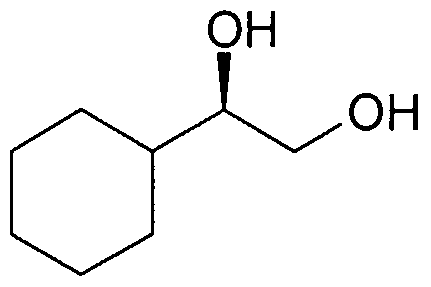
(R)-1-Cyclohexyl-ethane-1 ,2-diol. IR (neat): 3452 (br, s) cm"1; 1H NMR: δ 3.68 (1 H, d, J = 9.6 Hz, CHCHOH), 3.51 (1 H, m, CH2OH), 3.42 (1 H, m, CH2OH), 2.18 (2H, broad s, OH), 1.84 (1 H, d, J = 12.4 Hz, C6Hn), 1.73 (2H, m, C6Hιι), 1.63 (2H, m, C6Hn), 0.9-1.5 (6H, m, C6Hn); 13C NMR: δ 76.5, 64.8, 40.7, 28.9, 28.6, 26.3, 26.0, 25.9. HRMS (FAB) Calc'd for C8Hι6O2 (M + Na)+: 167.1043. Found (M + Na)+: 167.1044.
Proof of Stereochemistry. Stereochemical ratios were determined in comparison to authentic racemic materials prepared by osmium tetraoxide
catalyzed dihydroxylation. Absolute stereochemistry established in comparison to authentic (R) isomer prepared via a Sharpless asymmetric dihydroxylation (Becker, H.. et al.. J. Org. Chem. 1995, 60, 3940). For the chiral GLC analysis see Figure 11.
(R)-decane-l ,2-diol. IR (neat): 3444 (br, s) cm"1; 1H NMR: cf 3.68 (1 H, m, CH2CHOH), 3.64 (1 H, dd, J = 10.8 Hz, 2.8 Hz, CHaHbOH), 3.41 (1 H, dd, J = 10.8 Hz, 7.6 Hz, CHaHbOH), 2.06 (2H, br s, OH), 1.5-1.35 (3H, m, -CH2-), 1.35-1.15 (11 H, m, -CH2-), 0.86 (3H, t, J = 7.0 Hz, CH3); 13C NMR: δ 72.3, 66.8, 33.2, 31.8, 29.6, 29.5, 29.2, 25.5, 22.6, 14.1. HRMS (FAB) Calc'd for Ci0H22O2 (M + Na)+: 197.1512. Found (M + Na)+: 197.1509.
Proof of Stereochemistry. Stereochemical ratios were determined in comparison to authentic racemic materials prepared by osmium tetraoxide catalyzed dihydroxylation. Absolute stereochemistry established in comparison to authentic (R) isomer prepared via a Sharpless asymmetric dihydroxylation (Becker, H.. et al.. J. Org. Chem. 1995, 60, 3940). For the chiral GLC analysis see Figure 12.
(R)-4-Benzyloxy-3,3-dimethyl-butane-1 ,2-diol. IR (neat): 3467 (br, s) cm
"1;
1H NMR: δ 7.36-7.25 (5H, m, aromatic), 4.51 (1 H, d, J = 11.8 Hz, CH
aH
bPh), 4.48 (1 H, d, J = 11.8 Hz, CH
aH
bPh), 3.64-3.48 (3H, m, CHOHCH
2OH), 3.37 (1 H, br s, OH), 3.32 (1 H, d, J = 20.8 Hz, OCH
aH
bC), 3.29 (1 H, d, J = 20.8 Hz, OCH
aH
bC), 2.68 (1 H, br s, OH), 0.94 (3H, s, CCH
3), 0.92 (3H, s, CCH
3);
13C NMR: δ 137.5, 128.5, 127.9, 127.6, 78.4, 78.3, 73.6, 62.9, 37.4, 23.0, 20.6. HRMS (FAB) Calc'd for C
13H
20O
3 (M + Na)
+: 247.1305 Found (M + Na)
+: 247.1303.
Proof of Stereochemistry. Stereochemical ratios could not be accurately determined for this diol product; however, selectivity can be inferred from the corresponding carbohydroxylation product.
(R)-3,3-Dimethyl-butane-1,2-diol. IR (neat): 3438 (br, s) cm"1; 1H NMR: δ 3.73 (1 H, dd, J = 10.8 Hz, 2.8 Hz, CHOH), 3.47 (1 H, dd, J = 10.8 Hz, 9.2 Hz, CHaHbOH), 3.37 (1 H, dd, J = 9.2 Hz, 2.8 Hz, CHaHbOH), 2.14 (1 H, br s, OH), 1.93 (1 H, br s, OH), 0.91 (9H, s, C(CH3)3); 13C NMR: δ 79.7, 63.2, 33.5, 25.8. HRMS (FAB) Calc'd for C6Hι4O2 (M + Na)+: 141.0886 Found (M + Na)+: 141.0885.
Proof of Stereochemistry. Stereochemical ratios were determined in comparison to authentic racemic materials prepared by osmium tetraoxide catalyzed dihydroxylation. Absolute stereochemistry established in comparison to authentic (R) isomer prepared via a Sharpless asymmetric dihydroxylation (Becker. H.. et al.. J. Org. Chem. 1995, 60, 3940). For the chiral GLC analysis see Figure 13.
(R)-3,3-Dimethyl-heptane-1,2-diol. IR (neat): 3444 (br, s) cm
"1;
1H NMR: δ 3.71 (1 H, dd, J = 10.4 Hz, 2.0 Hz, CHOH), 3.48 (1 H, dd, J = 20.0 Hz, 10.4 Hz, CH
aH
bOH), 3.43 (1 H, dd, J = 20.0 Hz, 2.0 Hz, CH
aH
bOH), 2.10 (2H, br s, OH), 0.88 (3H, t, J = 7.0 Hz, CH
2CH
3), 0.87 (3H, s, CCH
3), 0.84 (3H, s, CCH
3);
13C NMR: δ 78.6, 63.0, 38.9, 36.0, 25.8, 23.6, 26.1 , 22.9, 14.1. HRMS (FAB) Calc'd for C
9H
20O
2 (M + Na)
+: 183.1356. Found (M + Na)
+: 183.1356.
Proof of Stereochemistry. Stereochemical ratios were determined in comparison to authentic racemic materials prepared by osmium tetraoxide catalyzed dihydroxylation. Absolute stereochemistry established in comparison to authentic (R) isomer (assignment made based on Sharpless stereochemical model) prepared via a Sharpless asymmetric dihydroxylation. For the chiral GLC analysis see Figure 14.
(R)-3,3-Dimethyl-4-p-tolyl-butane-1 ,2-diol. IR (neat): 3477 (br, s), 2987 (s),
3054 (s), 1277 (s) cm"1; 1H NMR: δ 7.07 (2H, d, J = 8.6 Hz, aromatic), 7.04
(2H, d, J = 8.6 Hz, aromatic), 3.75 (1 H, ddd, J = 10.7 Hz, 6.8 Hz, 3.0 Hz,
CHaHbOH), 3.55 (1 H, ddd, J = 10.7 Hz, 9.4 Hz, 4.5 Hz, CHaHbOH), 3.42 (1 H, ddd, J = 9.4 Hz, 4.0 Hz, 3.0 Hz, CHOH), 2.71 (1 H, d, J = 13.1 Hz, benzylic-
CHaHb), 2.44 (1 H, d, J = 13.1 Hz, benzylic-CHaHb), 2.30 (3H, s, PhCH3),
2.14 (1 H, d, J = 4.0 Hz, CHOH), 1.72 (1 H, dd, J = 6.8 Hz, 4.5 Hz, CH2OH),
0.89 (3H, s, CCH3), 0.82 (3H, s, CCH3); 13C NMR: δ 135.5, 135.2, 130.6,
128.6, 77.7, 63.1 , 44.8, 37.3, 23.3, 22.5, 21.0. HRMS (FAB) Calc'd for
Cι3H20O2 (M + Na)+: 231.1356. Found (M + Na)+: 231.1353.
Proof of Stereochemistry. Stereochemical ratios were determined by comparing to authentic racemic materials prepared by osmium tetraoxide catalyzed dihydroxylation. Absolute stereochemistry was established in comparison to authentic (R) isomer prepared via a Sharpless asymmetric dihydroxylation. (Becker. H.. et al.. J. Org. Chem. 1995, 60, 3040). For the SFC analysis see Figure 15.
(S)-3,3-Dimethyl-1-phenyl-butan-2-ol. IR (neat): 3489 (br, s), 1495 (w) cm" 1; 1H NMR: δ 7.35-7.20 (5H, m, aromatic), 3.42 (1 H, dd, J = 10.4 Hz, 2.0 Hz,
CHOH), 2.90 (1 H, dd, J = 13.6 Hz, 2.0 Hz, CHaHbPh), 2.46 (1 H, dd, J = 13.6 Hz, 10.4 Hz, CHaHbPh), 1.44 (1 H, br s, OH) 0.99 (9H, s, C(CH3)3); 13C NMR: δ 139.9, 129.3, 128.6, 126.3, 80.6, 38.4, 34.8, 25.9. HRMS (FAB) Calc'd for Cι2Hι8O M + Na)+: 201.1250. Found (M + Na)+: 201.1250.
Proof of Stereochemistry. Stereochemical ratios were determined in comparison to authentic enantioenriched material prepared via Dess-Martin periodinane oxidation followed by sodium borohydride reduction of enantiopure carbohydroxylation product. Absolute stereochemistry established by analogy to the corresponding diol product. For the chiral GLC analysis see Figure 16.
(S)-4-Benzyloxy-3,3-dimethyl-1-pyridin-3-yl-butan-2-ol. IR (neat): 3479 (br, s), 1270 (m) cm"1; 1H NMR: δ 8.44 (1 H, d, J = 1.6 Hz, pyridyl), 8.41 (1 H, dd, J = 4.8 Hz, 1.6 Hz, pyridyl), 7.58 (1 H, dt, J = 7.6 Hz, 1.6 Hz, pyridyl), 7.35-7.25 (5H, m, aromatic), 7.19 (1 H, dd, J = 7.6 Hz, 4.8 Hz, pyridyl), 4.50 (1 H, d, J = 19.2 Hz, CHaHbPh), 4.47 (1 H, d, J = 19.2 Hz, CHaHbPh), 3.65 (1 H, dd, J = 10.4 Hz, 2.0 Hz, CHOH), 3.42 (1 H, d, J = 4.8 Hz, OCHaHbC), 3.33 (1 H, d, J = 4.8 Hz, OCHaHbC), 2.77 (1 H, dd, J = 13.8 Hz, 2.0 Hz, CHaHb (Pyr)), 2.50 (1 H, dd, J = 13.8 Hz, 10.4 Hz, CHaHb (Pyr)), 1.01 (3H, s, CCH3), 0.99 (3H, s, CCH3); 13C NMR: δ 150.5, 147.3, 137.7, 137.0, 135.8, 128.4, 127.8, 127.6, 123.1 , 79.5, 79.0, 73.6, 38.5, 35.4, 22.8, 19.7. HRMS (FAB) Calc'd for C 8H23NO2 (M + Na)+: 308.1621 Found (M + Na)+: 308.1614.
Proof of Stereochemistry. Stereochemical ratios were determined in comparison to authentic enantioenriched material prepared via Dess-Martin
periodinane oxidation followed by sodium borohydride reduction. Incomplete oxidation of the enantiopure carbohydroxylation product led to the enatioenriched material used for analysis. Absolute stereochemistry established by analogy to structurally similar diol product obtained by the diboration/oxidation procedure. For the chiral HPLC analysis see Figure 17.
(S)-1-(3-Methoxy-phenyl)-3,3-dimethyl-butan-2-ol. IR (neat): 3464 (br, s), 1490 (w), 1272 (m) cm"1; 1H NMR: δ 7.25-7.18 (1 H, m, aromatic), 6.83-6.75 (3H, m, aromatic), 3.79 (3H, s, OCH3), 3.42 (1 H, d, J = 10.4 Hz, CHOH), 2.87 (1 H, d, J = 13.6 Hz, CHaHbAr), 2.43 (1 H, dd, J = 13.6 Hz, 10.4 Hz, CHaHbAr), 1.50 (1 H, br s, OH) 0.99 (9H, s, C(CH3)3); 13C NMR: δ 159.8, 141.5, 129.5, 121.6, 114.9, 111.7, 80.5, 55.1 , 38.4, 34.8, 25.8. HRMS (FAB) Calc'd for Cι3H20O2 (M + Na)+: 231.1356 Found (M + Na)+: 231.1361.
Proof of Stereochemistry. Stereochemical ratios were determined in comparison to alcohol obtained by mixing carbohydroxylation products produced by opposite enantiomers of quinap. Absolute stereochemistry established by analogy to the corresponding diol product. For the chiral GLC analysis see Figure 18.
(S)-3,3-Dimethyl-1-napthalen-2-yl-l-butan-2-ol (Obtained with R-quinap as ligand). IR (neat): 3465 (br, s), 3050 (s), 1273 (s) cm
"1;
1H NMR: δ 7.76-7.82 (3H, m, aromatic), 7.68 (1 H, s, aromatic), 7.40-7.47 (2H, m, aromatic), 7.36 (1 H, dd, J = 9.0 Hz, 1.7 Hz, aromatic), 3.53 (1 H, ddd, J = 10.8 Hz, 3.4 Hz, 2.0 Hz, CHOH), 3.07 (1 H, dd, J = 13.6 Hz, 2.0 Hz, CH
aH
b), 2.63 (1 H, dd, J = 13.6 Hz, 10.8 Hz, CH
aH
b), 1.46 (1 H, d, 3.4 Hz, COH), 1.03 (9H, s, C(CH
3)
3);
13C NMR: δ 137.8, 134.0, 132.6, 128.7, 128.2, 128.1 , 128.0, 127.9, 126.5, 125.8, 80.8, 39.0, 35.3, 26.3. HRMS (FAB) Calc'd for Cι
6H
20O (M + Na)
+: 251.1407. Found (M + Na)
+: 251.1408.
Proof of Stereochemistry. Stereochemical ratios were determined in comparison to authentic mixture of enantiomers prepared via Dess-Martin oxidation followed by sodium borohydride reduction of enantioenriched carbohydroxylation product. Absolute stereochemistry established by analogy to the corresponding diol product. For the SFC analysis see Figure 19.
(S)-3,3-Dimethyl-1-(4-nitroso-phenyl)-butan-2-ol (Obtained OH with R- quinap as ligand). IR (neat): 3458 (br, s), 3056 (s), 2989 (s), 1520 (s), 1349 (s), 1272 (s) cm"1; 1H NMR: δ 8.15 (2H, d, J = 8.7 Hz, aromatic), 7.40 (2H, d, J = 8.7 Hz, aromatic), 3.44 (1 H, ddd, J = 10.6 Hz, 4.5 Hz, 2.0 Hz, CHOH), 2.95 (1 H, dd, J = 13.7 Hz, 1.3 Hz, PhCHaHb), 2.61 (1 H, dd, J = 13.7 Hz, 10.6 Hz, PhCHaHb), 1.40 (1 H, d, J = 4.5 Hz, COH), 0.99 (9H, s, C(CH3)3; 13C NMR: δ 148.8, 146.9, 130.5, 123.9, 80.8, 38.5, 35.5, 26.0. HRMS (FAB) Calc'd for Cι2Hι7O3 (M + Na)+: 246.1101. Found (M + Na)+: 246.1106.
Proof of Stereochemistry. Stereochemical ratios were determined by SFC analysis in comparison to enantiomer mixtures. Enantiomer mixtures were obtained by mixing carbohydroxylation products obtained from reactions using opposite enantiomers of quinap. Absolute stereochemistry established by analogy to the corresponding diol product. For the SFC analysis see Figure 20.
(S)-3,3-Dimethyl-1-pyridin-4-yl-4-p-tolyl-butan-2-ol (Obtained with R- quinap as ligand). IR (neat): 3477 (br, s), 3056 (s) 2989 (s), 1272 (s) cm"1;
1H NMR: δ 8.48 (2H, d, J = 5.9 Hz , pyridyl), 7.14 (2H, d, J = 5.9 Hz , pyridyl), 7.08 (2H, d, J = 8.5 Hz, aromatic), 7.05 (2H, d, J = 8.5 Hz, aromatic), 3.49 (1 H, br d, J = 10.6 Hz, CHOH), 2.89 (1 H, dd, J = 13.6 Hz, 1.7 Hz, CHOHCHaHb), 2.75 (1 H, d, J =13.1 Hz, benzylic-CHaHb), 2.56 (1 H, dd J = 13.6 Hz, 10.6 Hz, CHOHCHaHb), 2.54 (1 H, d, J =13.1 Hz, benzylic- CHaHb) 2.31 (3H, s, PhCH3), 0.97 (3H, s, CCH3), 0.92 (3H, s, CCH3); 13C NMR: δ 149.6, 149.5, 135.5, 135.4, 130.6, 128.5, 124.9, 78.0, 44.4, 38.9, 37.7, 23.6, 22.4, 21.0. HRMS (FAB) Calc'd for C18H23NO (M + Na)+: 270.1852. Found (M + Na)+: 270.1856.
Proof of Stereochemistry. Stereochemical ratios were determined by SFC analysis in comparison to enantiomer mixtures. Enantiomer mixtures were obtained by mixing carbohydroxylation products obtained from reactions using opposite enantiomers of quinap. Absolute stereochemistry established by analogy to the corresponding diol product. For the SFC analysis see Figure 21.
(R)-4-(2-Hydroxy-3,3-dimethyl-4-p-tolyl-butyl)-benzaldhyde. IR (neat): 3487 (br, s), 3056 (s), 2989 (s), 1696 (s), 1272 (s) cm
"1;
1H NMR: δ 9.97 (1 H, s, PhCOH), 7.81 (2H, d, J = 8.1 Hz, formylphenyl), 7.38 (2H, d, J = 8.1 Hz, formylphenyl), 7.08 (2H, d, J = 8.9 Hz, aromatic), 7.05 (2H, d, J = 8.9 Hz, aromatic), 3.51 (1 H, m, CHCOH), 2.99 (1 H, dd, J = 13.5 Hz, 1.5 Hz, CHOHCH
aH
b), 2.75 (1 H, d, J = 13.1 Hz, benzylic-CH
aH
b), 2.65 (1 H, dd, J = 13.5 Hz, 10.8 Hz, CHOHCH
aH
b), 2.55 (1 H, d, J =13.1 Hz, benzylic-CH
aH
b), 1.40 (1 H, d, J = 4.3 Hz, CCCH
2OH), 0.98 (3H, s, CCH
3), 0.93 (3H, s, CCH
3);
13C NMR: δ 191.9, 147.6, 135.5, 135.3, 134.8, 130.6, 130.1 , 130.0, 128.6, 78.6, 44.4, 38.8, 38.4, 23.5, 22.4, 21.0. HRMS (FAB) Calc'd for C
20H
24O
2 (M + Na)
+: 319.1669. Found (M + Na)
+: 319.1667.
Proof of Stereochemistry. Stereochemical ratios were determined by SFC analysis in comparison to enantiomer mixtures. Enantiomer mixtures were obtained by mixing carbohydroxylation products obtained from reactions using opposite enantiomers of quinap. Absolute stereochemistry established by analogy to the corresponding diol product. For the SFC analysis see Figure 22.
(/?)-1-(2-Chloro-phenyl)-3,3-dimethyl-4-p-tolyl-butan-2-ol. IR (neat): 3487 (br, s), 3056 (s), 989 (s), 1272 (s) cm"1; 1H NMR: δ 7.36 (1 H, d, J = 7.5 Hz, aromatic), 7.28 (1H, d, J = 6.9 Hz, aromatic), 7.24 (1H, d, aromatic), 7.14- 7.25 (2H, m, aromatic), 3.59 (1 H, m, CIOOHCIHOH), 3.17 (1 H, d, J = 13.6 Hz, CI-PhCHaHb), 2.76 (1 H, d, J = 13.0 Hz, benzylic-CHaHb), 2.67 (1 H, m, J =13.6 Hz, CI-PhCHaHb), 2.59 (1H, d, J =13.0 Hz, benzylic-CHaHb), 2.32 (3H, s, PhCH3), 1.47-1.49 (1 H, m, CHOH) 0.99 (3H, s, CCH3), 0.94 (3H, s, CCH3); 13C NMR: δ 137.5, 135.6, 135.3, 134.3, 131.9, 130.7, 129.6, 128.5, 127.8, 126.7, 77.5, 44.0, 39.0, 35.9, 23.3, 22.1 , 21.0. HRMS (FAB) Calc'd for Cι9H23CIO M + Na)+: 325.1330. Found (M + Na)+: 325.1325.
(R)-2-(1 ,1 -Dimethyl-2-p-tolyl-ethyl)-2,3-dihydrobenzo-furan. IR (neat): 3494 (br, s), 3056 (s), 2989 (s) cm"1; 1H NMR: δ 7.05-7.15 (6H, m, aromatic), 6.77-6.82 (2H, m, aromatic), 4.48 (1 H, t, CHCCH2O), 3.03 (1 H, dd, J = 15.8 Hz, 9.1 Hz, CHOCHaHb), 3.09 (1 H, dd, J = 15.8 Hz, 9.5 Hz, CHOCHaHb), 2.74 (1 H, d, J = 13.1 Hz, benzylic-CHaHb), 2.56 (1 H, d, J =13.1 Hz, benzylic- CHaHb), 2.31 (3H, s, PhCH3), 0.93 (3H, s, CCH3), 0.84 (3H, s, CCH3); 3C
NMR: δ 160.1 , 135.5, 135.0, 130.7, 128.5, 127.8, 127.1 , 124.7, 119.9, 109.0, 88.7, 44.3, 38.0, 30.6, 22.1 , 21.8, 21.0. HRMS (FAB) Calc'd for Cι9H22O (M + Na)+: 289.1563. Found (M + Na)+: 289.1566.
Proof of Stereochemistry. Stereochemical ratios were determined in comparison to furan obtained by mixing reaction products produced by opposite enantiomers of quinap. Absolute stereochemistry established by analogy to the corresponding diol product. For the SFC analysis see Figure 23.
Results of Examples
A Rhodium-Catalyzed Enantioselective Diboration of Simple Alkenes. In some embodiments, the presently disclosed subject matter describes the use of chiral group 9 transition metal complexes for the catalytic diboration of .rans-yrS-methylstyrene. As shown in Scheme 5, two catalysts that exhibited enantioselection in the transformation were [(S)- binapRh(cod)]BF4, wherein binap represents 2,2'-bis(diphenylphosphino)- 1 '1 -binaphthyl, and (S)-quinap/[(cod)2Rh]BF4. See Havashi. T.. et al.. J. Am. Chem. Soc. 1989, 111, 3426 and Doucet. H.. et al.. Chem. Eur. J. 1999, 5, 1320.
Scheme 5 - Catalytic diboration of frans- ?-methylstyrene At 5 mol% catalyst loading in THF solvent at room temperature, both of these catalysts facilitated addition of bis(catecholatodiboron) (1 ) to trans- ?-methylstyrene and, after oxidative workup, the derived 1 ,2-diols were isolated with significant levels of enantioenrichment. While the catalyst with binap as the chiral ancillary ligand provided a 1.5:1 mixture of syn.anti
diastereomers, the quinap-derived catalyst provided significantly higher diastereo- and enantioselection. Under increased reaction concentration and alternate Rh salt, 5 mol% of commercial (S)-quinap and 5 mol% of commercial (norbornadiene)Rh(acac), were complexed for 5 minutes and then treated with commercially available unpurified bis(catecholato)diboron. After addition of substrate, the reactions were allowed to proceed for 24 hours at room temperature. In situ NMR analysis of reaction progress, indicated that reaction with some substrates is complete after 4 hours. Upon treatment with alkaline hydrogen peroxide the resulting 1 ,2-diols were isolated. Table 1 shows the outcome with a series of prochiral alkene substrates. The reaction appears to be general for trans alkenes and, unlike the Rh-quinap catalyzed hydroboration reaction, does not require the presence of an aromatic group for high reactivity or enantioselectivity (entry 4). The reaction with indene (entry 6) provides the derived syn-1 ,2-diol in high optical purity, however, the diboration of cis alkenes does not appear to be as general as with the trans substrate geometry. Surprisingly, dihydronaphthalene and c7s- ?-methylstyrene provide the opposite configuration of product relative to indene (see entries 7 and 8). While the sole trisubstituted alkene in Table 1 reacts in a highly selective fashion, monosubstituted and 1 ,1-disubstituted alkenes can employ additional chiral ancillary ligand structures for effective enantiocontrol, in some embodiments.
Table 1. Rh-Catalyzed Enantioselective Diboration/Oxidation of Alkenes.3 entry substrate product % yieldc % ee
OH Ph"^ 68 33 OH Ph
' Me OH Me 10 '^
/OH 67 46 Ph Ph
Conditions: 5 mol% (S)-quinap, 5 mol% (nbd)Rh(acac), 1 equiv. B2(cat)2, THF, room temp., 12 hours. Oxidative work up with H2O2. isolated yield of
purified material. Generally remainder of mass balance is unconverted starting material. In some embodiments, reactions with decreased catalyst loading were explored. As shown in Scheme 6, the diboration of tratιs-5-decene on one gram scale, proceeds in the presence of 0.5 mol% of catalyst and provides similar yields and levels of stereoselection as described in Table 1.
.raπs-5-decene ti
Scheme 6 - Diboration of frans-5-decene with decreased catalyst loading Further experiments revealed that the 1 ,2-bis(catechol) esters formed in the asymmetric diboration reaction readily undergo transesterification to the bis(pinacol) ester by direct treatment of the crude reaction mixture with 2,3-dimethyl-2,3-butanediol (pinacol) (see Scheme 7).
H
Scheme 7 - Transesterification of 1 ,2-bis(catechol) esters In addition to this reaction and simple oxidation to the 1 , 2-diol, the 1 ,2-diboron adducts were discovered to participate in Matteson homologation through the intermediacy of the pinacol ester. See Sadhu. K. M., et al., Organometallics 1985, 4, 1687 (describing the Matteson
homologation). In this reaction, the diboron intermediate is subjected to chloromethyl lithium and then oxidative workup, thereby providing the derived bis(hydroxymethylation) adduct.
B_, Catalytic Asymmetric Carbohydroxylation of Alkenes by a Tandem Diboration/Suzuki Cross-Couplinq/Oxidation Reaction. As shown in Scheme 8, aliphatic alkenes can undergo efficient diboration in a highly selective fashion and provide, after oxidative workup, the derived 1 , 2-diol in high enantiopurity.
Scheme 8 - Diboration of aliphatic alkenes and subsequent oxidation to form a 1, 2-diol To explore the Suzuki cross-coupling reaction, the same 1 ,2-diboron intermediate was subjected to in situ cross-coupling. In this experiment, the diboration reaction mixture was diluted with THF/H2O and then 10 mol% (dppf)PdCI2, four equivalents of Cs2CO3, and two equivalents of 4- bromopyridine hydrochloride were added. See Gray. M„ et al., Tetrahedron Lett. 2000, 41, 6237; Molander, G. A., et al.. Org. Lett. 2001 , 3, 393; Molander. G. A., et al.. Tetrahedron 2002, 58, 1465. For other Suzuki reactions with alkylboronic acids, see Ag(l) acceleration: Occhiato, E. G.. et aL, J. Org. Chem. 2001, 66, 2459; Zou. G.. et al.. Tetrahedron Lett. 2001 , 42, 7213. Fluoride acceleration: Wright. S. W.. et al.. J. Org. Chem. 1994, 59, 6095. Palladacycle catalysts: Botella, L.. et al.. J. Organomet. Chem.
2003, 663, 46. The reaction was stirred at 80 °C for 18 hours, cooled to room temperature, and treated with alkaline H2O2. Upon purification, the carbohydroxylation adduct was isolated in 58% yield and in an identical level of selectivity as the simple oxidation adduct. That is, the configuration of secondary C-B was unaltered during the cross-coupling process. To explore the potential generality of the tandem diboration/Suzuki coupling reaction, diboration of other 1 -alkene substrates were examined. As shown in Table 2, encumbered σ-olefins generally provide excellent levels of enantioselection although the level of induction tends to decrease with diminished steric bulk adjacent to the reacting site. It also appears that while both aromatic and aliphatic alkenes react to form diols of the same configuration, aliphatic alkenes react with higher selectivity than similarly sized aromatic olefins (cf. entries 5 and 7).
Table 2. Enantioselective Diboration/Oxidation of 1 -Alkenes' entry substrate product % yieldb % ee OH 1 .-butyl""^ 47 94 t-butyl' -OH
Conditions: 5 mol% (S)-quinap, 5 mol% (nbd)Rh(acac), 1.5 equiv. B2(cat)2, THF, room temp., 6 h. Oxidative work up with NaOH/H2O2. isolated yield of purified material. cThis number was determined based on the enantiopurity of corresponding diboration/cross-coupling adduct. Having established the level of enantioselection in the diboration of 1 -alkenes and therefore the level of selectivity one can expect in carbohydroxylation adducts, the scope of the single-pot cross coupling process was examined. As shown in Table 3, both aryl halides and aryl triflates can provide acceptable yields of tandem reaction product.
Heterocycles are accommodated in the reaction and, notably, pyridines and aldehydes are unaltered during the oxidation. Table 3. Single-Pot Asymmetric Diboration/Suzuki Coupling9 entry alkene coupling partner product % yield % ee
Conditions: 5 mol% (S)-quinap, 5 mol% (nbd)Rh(acac), 1.5 equiv. B2(cat)2, THF, room temp., 6 h; then 3 equiv. Cs2CO3, 2 equiv. arylhalide, 10 mol % (dppf)PdCI2, THF/H2O, 80 °C, 15 h. Oxidative work up with H2O2/NaOH 6 hours. "Suzuki coupling at 50 °C for 24 h.
C. Microwave irradiation acceleration of diboration/cross- coupling/oxidation reaction Many organic transformations are accelerated by microwave reaction conditions. For a review on utility of microwave heating, see Lϊndstrom, P.. et al.. Tetrahedron 2001 , 57, 9225. To determine whether the diboration/cross-coupling/oxidation reaction sequence could be accelerated by microwave irradiation during the alkyl Suzuki coupling step, this transformation was examined in further detail (Scheme 9).
Scheme 9 - Diboration/cross-coupling/oxidation reaction accelerated by microwave irradiation during the alkyl Suzuki coupling step
After diboration for six hours, the abovementioned cross-coupling reagents were added and the reaction subject to microwave at 50 W and 80 °C for 1 h. Oxidation provided the carbohydroxylation adduct in 70% yield and 93% ee demonstrating that microwave irradiation accelerates the alkyl boronic acid Suzuki coupling without racemization of the adjacent C-B bond. The example in Scheme 10 demonstrates that the tandem diboration/cross-coupling/oxidation sequence can be used to prepare versatile intermediates in a concise fashion.
Scheme 10 - Tandem diboration/cross-coupling/oxidation reaction (a) 5 mol% (S)-quinap, 5 mol% (nbd)Rh(acac), 1 equiv. B2(cat)2, THF, room temp., 6 h; then 3 equiv. Cs2CO3, 2 equiv. bromochlorobenzene, 10 mol % (dppf)PdCI2, THF/H2O 80 °C, 18 h. Oxidative work up with H2O2/NaOH 6 h. (b) 10 mol% Pd(OAc)2, 12 mol% (.-Bu)2P(2-biphenyl), 1.5 equiv. Cs2CO3, 80 °C, 28 h.
Engaging bromochlorobenzene in the tandem reaction sequence through a catalytic intramolecular etherification step provides intermediate 1 in 50% isolated yield. See Palucki, M.. et al.. J. Am. Chem. Soc. 1996, 778, 10333; Mann. G., et al., J. Am. Chem. Soc. 1996, 778, 13109; Kuwabe. S.. et al.. J. Am. Chem. Soc. 2001 , 723, 12202. Using the Buchwald ligand to preserve substrate configuration, provides benzofuran 2 in 87% ee and 90% yield, making the optically active heterocycle available from the simple alkene in a concise two-pot reaction sequence. See Kuwabe, S., et al.. J. Am. Chem. Soc. 2001 , 723, 12202.
D. Selective Transformations of Chiral 1 ,2-Diboron Reagents The asymmetric diboration of 1 -alkenes and subsequent conversion of the chiral diboron intermediate into chiral 1 ,3-diols and σ-hydroxyacids has been accomplished according to Scheme 11. More particularly, the Rh- catalyzed diboration of alkenes has been found to proceed in an efficient fashion in the presence of a simple achiral phosphine-oxazoline ligand structure and, notably, the less hindered C-B bond in the product participates in a homologation reaction with TMSCHN
2 (Scheme 11 ).
iMe
3
Scheme 11 - Selective transformation of chiral 1,2-diboron reagents via a homologation reaction The intermediates are isolated as a 1 :1 mixture of diastereomeric σ-silyl alcohols (i.e. 1 , Scheme 11 ), which can be desilylated with TBAF to give the derived 1 ,3-diol or treated with ozone to furnish the ?-hydroxy acid. In addition to selective homologation, trimethylamine N-oxide oxidation of a secondary benzylic C-B bond has been found to occur at a faster rate than oxidation of a primary C-B bond (Scheme 12).
70% by NMR Scheme 12 - Oxidation of a benzylic C-B bond with trimethylamine N- oxide
E. Access to Optically Active 1 -Alkene Diboration Products Alkyne diboration followed by an asymmetric hydrogenation also was explored. An example of this strategy is shown in Scheme 13, where asymmetric hydrogenation provides access to styrene diboration products in a highly enantioselective fashion for the first time.
2%
then NaOH, H
20
2 86% yield 92% ee
Scheme 13 - Alkyne diboration followed by asymmetric hydrogenation Catalytic Asymmetric Diboration of Prochiral Allenes The catalytic asymmetric diboration of prochiral allenes also was explored. As shown in Scheme 14, the palladium-catalyzed diboration of allenes occurs in a highly enantioselective fashion with an appropriate phosphoramidite ligand.
Scheme 14 - Catalytic asymmetric diboration of prochiral allenes As shown in equations 1-3 of Scheme 15, the transformations available to allene diboration adducts appear to be useful. First, these experiments suggest that a high level of chirality transfer can be engendered
in allylation reactions involving the allene diboration adduct (Eq. 1 ). As shown in equation 2, anhydrous oxidation (required since aqueous oxidation leads to protonation of the allylboronate) followed by aqueous work-up allows access to the derived σ-hydroxyketone. If care is taken to avoid epimerization during the reaction work-up, a single region isomer of σ- hydroxyketone may be isolated in high enantioselection. Notably, the reaction conditions for this transformation suggest that an intermediate chiral boron enolate can be available for additional transformations. A third experiment indicates that selective oxidation of the allylic C-B bond is faster than oxidation of the vinyl C-B bond and selective oxidation may allow for the production of non-racemic substrates for Suzuki couplings, Petasis reactions and Hayashi conjugate addition reactions.
Scheme 15 - Catalytic asymmetric diboration of prochiral allenes
G. Catalytic Diboration of Trisubstituted Alkenes The Rh-catalyzed asymmetric diboration of trisubstituted alkenes also was explored. While these substrates react in an enantioselective fashion
with quinap itself as a ligand (91 % ee), the reaction yields in diboration with trisubstituted olefins is generally low (9% with 5% catalyst). Increasing the basicity of the quinap phosphine substituent leads to higher yields in diboration of trisubstituted alkenes. When 10 mol% of a methoxy- substituted quinap ligand is used, a 42% yield of diboration product can be obtained.
Scheme 16 - Catalytic diboration of trisubstituted alkenes
It will be understood that various details of the presently disclosed subject matter can be changed without departing from the scope of the presently disclosed subject matter. Furthermore, the foregoing description is for the purpose of illustration only, and not for the purpose of limitation.