WO2005000863A2 - 6, 11-4c-bicyclic 9a-azalide derivatives - Google Patents
6, 11-4c-bicyclic 9a-azalide derivatives Download PDFInfo
- Publication number
- WO2005000863A2 WO2005000863A2 PCT/US2004/015806 US2004015806W WO2005000863A2 WO 2005000863 A2 WO2005000863 A2 WO 2005000863A2 US 2004015806 W US2004015806 W US 2004015806W WO 2005000863 A2 WO2005000863 A2 WO 2005000863A2
- Authority
- WO
- WIPO (PCT)
- Prior art keywords
- compound
- previously defined
- aryl
- nhc
- heteroaryl
- Prior art date
- Legal status (The legal status is an assumption and is not a legal conclusion. Google has not performed a legal analysis and makes no representation as to the accuracy of the status listed.)
- Ceased
Links
- 0 BC(CO)=C(CO[C@]([C@@](C)N(*)C[C@](C)C[C@@](C)(*)[C@@]([C@@](C)[C@]([C@@]1C)O*)O[C@@]([C@]2O*)O[C@](C)C[C@@]2N(C)C)C(C)(C)[C@@](C)OC1=O)C1CC1 Chemical compound BC(CO)=C(CO[C@]([C@@](C)N(*)C[C@](C)C[C@@](C)(*)[C@@]([C@@](C)[C@]([C@@]1C)O*)O[C@@]([C@]2O*)O[C@](C)C[C@@]2N(C)C)C(C)(C)[C@@](C)OC1=O)C1CC1 0.000 description 4
- QZUFMYAZMWSJJP-YYDPCCRISA-N CC([C@@H]([C@@](C)(C1)OC)[O](C(c2ccccc2)=O)#C)O[C@H]1OC Chemical compound CC([C@@H]([C@@](C)(C1)OC)[O](C(c2ccccc2)=O)#C)O[C@H]1OC QZUFMYAZMWSJJP-YYDPCCRISA-N 0.000 description 1
- CRLGPBLPRLPEBF-ZGMNHVEMSA-N C[C@@H]([C@@H]([C@@](C)(C1)OC)OC(c2ccccc2)=O)O[C@H]1OC Chemical compound C[C@@H]([C@@H]([C@@](C)(C1)OC)OC(c2ccccc2)=O)O[C@H]1OC CRLGPBLPRLPEBF-ZGMNHVEMSA-N 0.000 description 1
- JOLBKJPOGRQABG-PWXKEOIMSA-N C[C@@H]([C@@H]([C@@](C)(C1)OC)[O](C(c2ccccc2)=O)=C)O[C@H]1OC Chemical compound C[C@@H]([C@@H]([C@@](C)(C1)OC)[O](C(c2ccccc2)=O)=C)O[C@H]1OC JOLBKJPOGRQABG-PWXKEOIMSA-N 0.000 description 1
Classifications
-
- C—CHEMISTRY; METALLURGY
- C07—ORGANIC CHEMISTRY
- C07H—SUGARS; DERIVATIVES THEREOF; NUCLEOSIDES; NUCLEOTIDES; NUCLEIC ACIDS
- C07H17/00—Compounds containing heterocyclic radicals directly attached to hetero atoms of saccharide radicals
- C07H17/04—Heterocyclic radicals containing only oxygen as ring hetero atoms
- C07H17/08—Hetero rings containing eight or more ring members, e.g. erythromycins
-
- A—HUMAN NECESSITIES
- A61—MEDICAL OR VETERINARY SCIENCE; HYGIENE
- A61P—SPECIFIC THERAPEUTIC ACTIVITY OF CHEMICAL COMPOUNDS OR MEDICINAL PREPARATIONS
- A61P31/00—Antiinfectives, i.e. antibiotics, antiseptics, chemotherapeutics
- A61P31/04—Antibacterial agents
Definitions
- the present invention relates to novel semisynthetic macrolides having antibacterial activity and useful in the treatment and prevention of bacterial infections. More particularly, the invention relates to 6,11-4C-bicyclic 9a-azalide derivatives, compositions comprising such compounds, methods for using the same, and processes by which to make such compounds.
- Macrolide antibacterial agents are widely used to treat and prevent bacterial infections.
- the discovery of bacterial strains which have resistance or insufficient susceptibility to macrolide antibacterial agents has promoted the development of compounds with modified or improved profiles of antibiotic activity.
- One such class of compounds is azalides, which includes azithromycin, described in United States Patents 4,474,768 and 4,517,359.
- Azalides are macrolide antibacterial agents with a ring structure similar to the erythronolide A or B, however azalides possess a substituted or unsubstituted nitrogen moiety at the 9a position as illustrated in the following structure:
- PCT Application WO98/56801 published December 17, 1998 discloses a series of 9a-(N-(alkyl))-azalide erythromycin A derivatives and a series of 9a-(N- (alkyl))-azalide 6-O-methylerythromycin A derivatives;
- PCT Application WO98/56802 published December 17, 1998 discloses a series of 9a-(N-(H))-azalide erythromycin A derivatives and a series of 9a-(N-(H))- azalide 6-O-methylerythromycin A derivatives;
- U. S. Pat. No. 5,686,587 discloses a synthesis of azithromycin comprising introducing a 9a-(N(H))-moiety to erythromycin A by oxime formation, Beckmann rearrangement, reduction, and methylation.
- the present invention provides a novel class of 6,11-4C-bicyclic 9a-azalide compounds, or a pharmaceutically-acceptable salt, ester, or prodrug thereof, pharmaceutical compositions comprising at least one compound of the present invention, methods of treating a bacterial infection in a subject by administering said pharmaceutical compositions, and processes of making the compounds of the present invention.
- Ri is selected from: a. -CrC 6 alkyl, optionally substituted with one or more substituents selected from halogen, aryl, substituted aryl, heteroaryl, or substituted heteroar l; b. -C 2 -C 6 alkenyl, optionally substituted with one or more substituents selected from halogen, aryl, substituted aryl, heteroaryl, or substituted heteroaryl; or c. -C 2 -C 6 alkynyl, optionally substituted with one or more substituents selected from halogen, aryl, substituted aryl, heteroaryl, or substituted heteroaryl;
- R 2 wherein R 2 is selected from: a. aryl; b. heteroaryl; c. substituted aryl; d. substituted heteroaryl; e. heterocycloalkyl; or f. substituted heterocycloalkyl;
- V is absent, O or S
- R 3 is H, Ri or R 2 ; where Ri and R 2 are as previously defined; or
- Rn and R ⁇ 2 are each independently selected from: a. hydrogen; b. -CrC 6 -alkyl, optionally substituted with one or more substituents selected from halogen, aryl, substituted aryl, heteroaryl, or substituted heteroaryl; c. -C 2 -C 6 -alkenyl, optionally substituted with one or more substituents selected from halogen, aryl, substituted aryl, heteroaryl, or substituted heteroaryl; d.
- n and R 2 are as previously defined;
- R 6 is selected from : a. hydrogen; b. -C ⁇ -Ci 2 -alkyl containing 0, 1 , 2, or 3 heteroatoms selected from O, S or N, optionally substituted with one, two, or three substituents independently selected from aryl, substituted aryl, heteroaryl, or substituted heteroaryl; c. aryl; d. substituted aryl; e. heteroaryl; f. substituted heteroaryl; g. heterocycloalkyl; or h. substituted heterocycloalkyl;
- R 4 and R 5 are each independently R 6 , where R 6 is as previously defined, or in the alternative R 4 and R 5 , together with the atom to which they are attached, form a heterocycloalkyl or substituted heterocycloalkyl moiety;
- substituted heterocycloalkyl 10.-NHC(O)R 6 , where R 6 is as previously defined; 11.-NHC(O)OR 7 , where R 7 is selected from: a. -C ⁇ -Ci 2 -alkyl containing 0, 1 , 2, or 3 heteroatoms selected from O, S or N, optionally substituted with one, two, or three substituents independently selected from aryl, substituted aryl, heteroaryl, or substituted heteroaryl; b. aryl; c. substituted aryl; d. heteroaryl; e. substituted heteroaryl; f. heterocycloalkyl; or g.
- X is hydrogen; Y is
- R 3 " is hydrogen or methyl
- R 4 " is hydrogen or R p , where R p is as previously defined; or (h) in the alternative, X and Y combined together are oxo;
- R 2 ' is hydrogen or R p , where R P ⁇ is as previously defined.
- compositions comprising a therapeutically effective amount of a compound of the invention in combination with a pharmaceutically acceptable carrier or excipient.
- methods of treating antibacterial infections with said pharmaceutical compositions are also disclosed.
- a first embodiment of the present invention is a compound of formula I as illustrated above, or a pharmaceutically acceptable salt, ester or prodrug thereof.
- Preferred subgenera of compounds of the present invention are:
- Representative compounds according to the invention are those selected from:
- a further embodiment of the present invention includes pharmaceutical compositions comprising any single compound delineated herein, or a pharmaceutically acceptable salt, ester, or prodrug thereof, with a pharmaceutically acceptable carrier or excipient.
- Yet another embodiment of the present invention is a pharmaceutical composition
- a pharmaceutical composition comprising a combination of two or more compounds delineated herein, or a pharmaceutically acceptable salt, ester, or prodrug thereof, with a pharmaceutically acceptable carrier or excipient.
- composition comprising any single compound delineated herein in combination with one or more antibiotics known in the art, or a pharmaceutically acceptable salt, ester, or prodrug thereof, with a pharmaceutically acceptable carrier or excipient.
- the present invention contemplates processes of making any compound delineated herein via any synthetic method delineated herein.
- C C 3 alkyl refers to saturated, straight- or branched-chain hydrocarbon radicals containing between one and three, one and twelve, or one and six carbon atoms, respectively.
- C ⁇ -C 3 alkyl radicals include methyl, ethyl, propyl and isopropyl radicals
- examples of C ⁇ -C 6 alkyl radicals include, but are not limited to, methyl, ethyl, propyl, isopropyl, n-butyl, tetf-butyl, neopentyl and n-hexyl radicals
- examples of C C ⁇ 2 alkyl radicals include, but are not limited to, ethyl, propyl, isopropyl, n-hexyl, octyl, decyl, dodecyl radicals.
- substituted alkyl refers to a "C 2 -C ⁇ 2 alkyl” or "d- C 6 alkyl” group as previously defined, substituted by independent replacement or one, two, or three of the hydrogen atoms thereon with substituents including, but not limited to, -F, -CI, -Br, -I, -OH, protected hydroxy, -N0 2 , -CN, -C ⁇ -C- ⁇ 2 -alkyl optionally substituted with halogen, C 2 -Ci 2 -alkenyl optionally substituted with halogen, -C 2 -C- ⁇ - alkynyl optionally substituted with halogen, -NH 2 , protected amino, -NH -CrC-i 2 -alkyl, -NH -C 2 -C 12 -alkenyl, -NH -C 2 -C ⁇ 2 -alkenyl, -NH -C
- C 2 -C ⁇ alkenyl or "C 2 -C ⁇ alkenyl,” as used herein, denote a monovalent group derived from a hydrocarbon moiety containing from two to twelve or two to six carbon atoms having at least one carbon-carbon double bond by the removal of a single hydrogen atom.
- Alkenyl groups include, but are not limited to, for example, ethenyl, propenyl, butenyl, 1-methyl-2-buten-1-yl, and the like.
- substituted alkenyl refers to a "C 2 -C12 alkenyl” or "C -C 6 alkenyl” group as previously defined, substituted by independent replacement or one, two, or three of the hydrogen atoms thereon with substituents including, but not limited to, -F, -CI, -Br, -I, -OH, protected hydroxy, -NO 2 , -CN, -CrC ⁇ 2 -alkyl optionally substituted with halogen, C 2 -C ⁇ 2 -alkenyl optionally substituted with halogen, -C 2 -C 12 -alkynyl optionally substituted with halogen, -NH 2 , protected amino, - NH -C Ci 2 -alkyl, -NH -C 2 -C 12 -alkenyl, -NH -C 2 -C 12 -alkenyl, -NH -C 3 -C
- C 2 -C ⁇ 2 alkynyl or "C 2 -C 6 alkynyl,” as used herein, denote a monovalent group derived from a hydrocarbon moiety containing from two to twelve or two to six carbon atoms having at least one carbon-carbon triple bond by the removal of a single hydrogen atom.
- Representative alkynyl groups include, but are not limited to, for example, ethynyl, 1 -propynyl, 1-butynyl, and the like.
- substituted alkynyl refers to a "C 2 -C ⁇ 2 alkynyl” or "C 2 -C ⁇ alkynyl” group as previously defined, substituted by independent replacement or one, two, or three of the hydrogen atoms thereon with substituents including, but not limited to, -F, -CI, -Br, -I, -OH, protected hydroxy, -N0 2 , -CN, -C C 12 -alkyl optionally substituted with halogen, C 2 -C ⁇ 2 -alkenyl optionally substituted with halogen, -C 2 -C ⁇ 2 -alkynyl optionally substituted with halogen, -NH 2 , protected amino, - NH -C C ⁇ 2 -alkyl, -NH -C 2 -C 12 -alkenyl, -NH -C 2 -C ⁇ 2 -alkenyl, -NH -C 2 -C ⁇ 2 -
- C-i-C ⁇ alkoxy refers to a CrC 6 alkyl group, as previously defined, attached to the parent molecular moiety through an oxygen atom.
- CrC 6 -alkoxy include, but are not limited to, methoxy, ethoxy, propoxy, isopropoxy, n-butoxy, tert-butoxy, neopentoxy and n-hexoxy.
- halo and halogen, as used herein, refer to an atom selected from fluorine, chlorine, bromine and iodine.
- aryl refers to a mono- or bicyclic carbocyclic ring system having one or two aromatic rings including, but not limited to, phenyl, naphthyl, tetrahydronaphthyl, indanyl, idenyl and the like.
- substituted aryl refers to an aryl group, as previously defined, substituted by independent replacement or one, two, or three of the hydrogen atoms thereon with substituents including, but not limited to, -F, -CI, - Br, -I, -OH, protected hydroxy, -N0 2 , -CN, -C ⁇ -C ⁇ 2 -alkyl optionally substituted with halogen, C 2 -C ⁇ 2 -alkenyl optionally substituted with halogen, -C 2 -Ci 2 -alkynyl optionally substituted with halogen, -NH ) protected amino, -NH -C ⁇ -C ⁇ -alkyl, -NH - C 2 -C 12 -alkenyl, -NH -C 2 -C ⁇ 2 -alkenyl, -NH -C 3 -C 12 -cycloalkyl, -NH -aryl, -
- arylalkyl refers to a C ⁇ -C 3 alkyl or CrC 6 alkyl residue attached to an aryl ring. Examples include, but are not limited to, benzyl, phenethyl and the like.
- substituted arylalkyl refers to an arylalkyl group, as previously defined, substituted by independent replacement or one, two, or three of the hydrogen atoms thereon with substituents including, but not limited to, but not limited to, -F, -CI, -Br, -I, -OH, protected hydroxy, -N0 2 , -CN, -CrCi 2 -alkyl optionally substituted with halogen, C 2 -C ⁇ 2 -alkenyl optionally substituted with halogen, -C 2 -C-
- heteroaryl refers to a mono-, bi-, or tri-cyclic aromatic radical or ring having from five to ten ring atoms of which one ring atom is selected from S, O and N; zero, one or two ring atoms are additional heteroatoms independently selected from S, O and N; and the remaining ring atoms are carbon, wherein any N or S contained within the ring may be optionally oxidized.
- Heteroaryl includes, but is not limited to, pyridinyl, pyrazinyl, pyrimidinyl, pyrrolyl, pyrazolyl, imidazolyl, thiazolyl, oxazolyl, isooxazolyl, thiadiazolyl, oxadiazolyl, thiophenyl, furanyl, quinolinyl, isoquinolinyl, benzimidazolyl, benzooxazolyl, quinoxalinyl, and the like.
- substituted heteroaryl refers to a heteroaryl group as previously defined, substituted by independent replacement or one, two, or three of the hydrogen atoms thereon with substituents including, but not limited to, -F, -CI, -Br, -I, -OH, protected hydroxy, -N0 2 , -CN, -C C ⁇ 2 -alkyl optionally substituted with halogen, C 2 -C ⁇ 2 -alkenyl optionally substituted with halogen, -C 2 -C ⁇ 2 -alkynyl optionally substituted with halogen, -NH 2 , protected amino, -NH -CrC- ⁇ 2 -alkyl, -NH - C 2 -C ⁇ 2 -alkenyl, -NH -C 2 -C ⁇ 2 -alkenyl, -NH -C 3 -C ⁇ 2 -cycloalkyl, -NH -aryl
- C 3 -Ci 2 -cycloalkyl denotes a monovalent group derived from a monocyclic or bicyclic saturated carbocyclic ring compound by the removal of a single hydrogen atom. Examples include, but not limited to, cyclopropyl, cyclobutyl, cyclopentyl, cyclohexyl, bicyclo [2.2.1] heptyl, and bicyclo [2.2.2] octyl.
- substituted C 3 -C- ⁇ 2 -cycloalkyl refers to a C 3 -C 12 - cycloalkyl group as previously defined, substituted by independent replacement or one, two, or three of the hydrogen atoms thereon with substituents including, but not limited to, -F, -CI, -Br, -I, -OH, protected hydroxy, -N0 2 , -CN, -C ⁇ -C ⁇ 2 -alkyl optionally substituted with halogen, C 2 -C ⁇ 2 -alkenyl optionally substituted with halogen, -C 2 -Ci 2 - alkynyl optionally substituted with halogen, -NH 2 , protected amino, -NH -C ⁇ -C ⁇ 2 -alkyl, -NH -C 2 -C 12 -alkenyl, -NH -C 2 -C 12 -alkenyl, -NH -C 2 -C 12 -alken
- C 3 -C 12 -cycloalkenyl denotes a monocyclic or bicyclic carbocyclic ring compound where each 5-membered ring has 0 to 1 double bonds and each 6-membered ring has 0 to 2 double bonds. Examples include, but not limited to, cyclopentenyl, cyclohexenyl, bicyclo [2.2.1] heptenyl, and bicyclo [2.2.2] octenyl.
- heterocycloalkyl refers to a non-aromatic 5-, 6- or 7-membered ring or a bi- or tri-cyclic group fused system, where (i) each ring contains between one and three heteroatoms independently selected from oxygen, sulfur and nitrogen, (ii) each 5-membered ring has 0 to 1 double bonds and each 6- membered ring has 0 to 2 double bonds, (iii) the nitrogen and sulfur heteroatoms may optionally be oxidized, (iv) the nitrogen heteroatom may optionally be quatemized, and (iv) any of the above rings may be fused to a benzene ring.
- heterocycloalkyl groups include, but are not limited to, [1 ,3]dioxolane, pyrrolidinyl, pyrazolinyl, pyrazolidinyl, imidazolinyl, imidazolidinyl, piperidinyl, piperazinyl, oxazolidinyl, isoxazolidinyl, morpholinyl, thiazolidinyl, isothiazolidinyl, and tetrahydrofuryl.
- substituted heterocycloalkyl refers to a heterocycloalkyl group, as previously defined, substituted by independent replacement or one, two, or three of the hydrogen atoms thereon with substituents including, but not limited to, -F, -CI, -Br, -I, -OH, protected hydroxy, -N0 2 , -CN, -Cr C 12 -alkyl optionally substituted with halogen, C 2 -C-
- heteroarylalkyl refers to a CrC 3 alkyl or d-C 6 alkyl residue residue attached to a heteroaryl ring. Examples include, but are not limited to, pyridinylmethyl, pyrimidinylethyl and the like.
- substituted heteroarylalkyl refers to a heteroarylalkyl group, as previously defined, substituted by independent replacement or one, two, or three of the hydrogen atoms thereon with substituents including, but not limited to, -F, -CI, -Br, -I, -OH, protected hydroxy, -N0 2 , -CN, -C ⁇ -d 2 -alkyl optionally substituted with halogen, C 2 -C ⁇ 2 -alkenyl optionally substituted with halogen, -C 2 -C 12 -alkynyl optionally substituted with halogen, -NH 2 , protected amino, - NH -C C 12 -alkyl, -NH -C 2 -C ⁇ 2 -alkenyl, -NH -C 2 -C 12 -alkenyl, -NH -C 3 -C ⁇ 2 -cycloalkyl, -
- Ci-C ⁇ alkoxy refers to a Ci-C ⁇ alkyl group, as previously defined, attached to the parent molecular moiety through an oxygen atom.
- Examples of C-i-C ⁇ -alkoxy include, but are not limited to, methoxy, ethoxy, propoxy, isopropoxy, n-butoxy, terf-butoxy, neopentoxy and n-hexoxy.
- C ⁇ -C3-alkyl-amino refers to one or two C1-C3- alkyl groups, as previously defined, attached to the parent molecular moiety through a nitrogen atom.
- Examples of C-i-C3-alkyl-amino include, but are not limited to, methylamino, dimethylamino, ethylamino, diethylamino, and propylamino.
- alkylamino refers to a group having the structure -NH(C ⁇ -Ci 2 alkyl) where d-C 12 alkyl is as previously defined.
- dialkylamino refers to a group having the structure -N(C ⁇ -C ⁇ 2 alkyl) (C Ci2 alkyl), where C 1 -C 12 alkyl is as previously defined. Examples of dialkylamino are, but not limited to, dimethylamino, diethylamino, methylethylamino, piperidino, and the like.
- alkoxycarbonyl represents an ester group, i.e., an alkoxy group, attached to the parent molecular moiety through a carbonyl group such as methoxycarbonyl, ethoxycarbonyl, and the like.
- carboxydehyde refers to a group of formula - CHO.
- carboxamide refers to a group of formula - C(0)NH(C ⁇ -Ci2 alkyl) or - C(0)N(C ⁇ -C 12 alkyl) (d-C 12 alkyl), -C(0)NH 2 , and the like.
- hydroxy protecting group refers to a labile chemical moiety which is known in the art to protect a hydroxyl group against undesired reactions during synthetic procedures. After said synthetic procedure(s) the hydroxy protecting group as described herein may be selectively removed. Hydroxy protecting groups as known in the are described generally in T.H. Greene and P.G. M. Wuts, Protective Groups in Organic Synthesis, 3rd edition, John Wiley & Sons, New York (1999). Examples of hydroxy protecting groups include, but are not limited to, methylthiomethyl, te/if-butyl-dimethylsilyl, terf-butyldiphenylsilyl, acyl substituted with an aromatic group and the like.
- protected hydroxy refers to a hydroxy group protected with a hydroxy protecting group, as defined above, including benzoyl, acetyl, trimethylsilyl, triethylsilyl, methoxymethyl groups, for example.
- amino protecting group refers to a labile chemical moiety which is known in the art to protect an amino group against undesired reactions during synthetic procedures. After said synthetic procedure(s) the amino protecting group as described herein may be selectively removed.
- Amino protecting groups as known in the are described generally in T.H. Greene and P.G. M. Wuts, Protective Groups in Organic Synthesis. 3rd edition, John Wiley & Sons, New York (1999). Examples of amino protecting groups include, but are not limited to, t- butoxycarbonyl, 9-fluorenylmethoxycarbonyl, benzyloxycarbonyl, and the like.
- protected amino refers to an amino group protected with an amino protecting group as defined above.
- aprotic solvent refers to a solvent that is relatively inert to proton activity, i.e., not acting as a proton-donor.
- examples include, but are not limited to, hydrocarbons, such as hexane and toluene, for example, halogenated hydrocarbons, such as, for example, methylene chloride, ethylene chloride, chloroform, and the like, heterocyclic compounds, such as, for example, tetrahydrofuran and N-methylpyrrolidinone, and ethers such as diethyl ether, bis- methoxymethyl ether.
- protogenic organic solvent refers to a solvent that tends to provide protons, such as an alcohol, for example, methanol, ethanol, propanol, isopropanol, butanol, t-butanol, and the like.
- solvents are well known to those skilled in the art, and it will be obvious to those skilled in the art that individual solvents or mixtures thereof may be preferred for specific compounds and reaction conditions, depending upon such factors as the solubility of reagents, reactivity of reagents and preferred temperature ranges, for example. Further discussions of protogenic solvents may be found in organic chemistry textbooks or in specialized monographs, for example: Organic Solvents Physical Properties and Methods of Purification. 4th ed., edited by John A. Riddick etal., Vol. II, in the Technigues of Chemistry Series. John Wiley & Sons, NY, 1986.
- an effective amount refers to an amount of a compound which confers a therapeutic effect on the treated subject.
- the therapeutic effect may be objective (i.e., measurable by some test or marker) or subjective (i.e., subject gives an indication of or feels an effect).
- An effective amount of the compound described above may range from about 0.1 mg/Kg to about 500 mg/Kg, preferably from about 1 to about 50 mg/Kg. Effective doses will also vary depending on route of administration, as well as the possibility of co-usage with other agents.
- stable refers to compounds which possess stability sufficient to allow manufacture and which maintains the integrity of the compound for a sufficient period of time to be useful for the purposes detailed herein (e.g., therapeutic or prophylactic administration to a subject).
- the synthesized compounds can be separated from a reaction mixture and further purified by a method such as column chromatography, high pressure liquid chromatography, or recrystallization.
- a method such as column chromatography, high pressure liquid chromatography, or recrystallization.
- further methods of synthesizing the compounds of the formulae herein will be evident to those of ordinary skill in the art. Additionally, the various synthetic steps may be performed in an alternate sequence or order to give the desired compounds.
- Synthetic chemistry transformations and protecting group methodologies (protection and deprotection) useful in synthesizing the compounds described herein are known in the art and include, for example, those such as described in R. Larock, Comprehensive Organic Transformations, VCH Publishers (1989); T.W. Greene and P.G.M. Wuts, Protective Groups in Organic Synthesis, 2d.
- subject refers to an animal.
- the animal is a mammal. More preferably the mammal is a human.
- a subject also refers to, for example, dogs, cats, horses, cows, pigs, guinea pigs, fish, birds and the like.
- the compounds of this invention may be modified by appending appropriate functionalities to enhance selective biological properties.
- modifications are known in the art and may include those which increase biological penetration into a given biological system (e.g., blood, lymphatic system, central nervous system), increase oral availability, increase solubility to allow administration by injection, alter metabolism and alter rate of excretion.
- the present invention is intended to include all isotopes of atoms occurring in the present compounds.
- Isotopes include those atoms having the same atomic number but different mass numbers.
- isotopes of hydrogen include tritium and deuterium.
- isotopes of carbon include C-13 and C-14.
- the compounds described herein contain one or more asymmetric centers and thus give rise to enantiomers, diastereomers, and other stereoisomeric forms that may be defined, in terms of absolute stereochemistry, as (R)- or (S)- , or as (D)- or (L)- for amino acids.
- the present invention is meant to include all such possible isomers, as well as their racemic and optically pure forms.
- Optical isomers may be prepared from their respective optically active precursors by the procedures described above, or by resolving the racemic mixtures. The resolution can be carried out in the presence of a resolving agent, by chromatography or by repeated crystallization or by some combination of these techniques which are known to those skilled in the art.
- any carbon-carbon double bond appearing herein is selected for convenience only and is not intended to designate a particular configuration unless > the text so states; thus a carbon-carbon double bond or carbon-heteroatom double bond depicted arbitrarily herein as trans may be cis, trans, or a mixture of the two in any proportion.
- the term "pharmaceutically acceptable salt” refers to those salts which are, within the scope of sound medical judgment, suitable for use in contact with the tissues of humans and lower animals without undue toxicity, irritation, allergic response and the like, and are commensurate with a reasonable benefit/risk ratio.
- Pharmaceutically acceptable salts are well known in the art. For example, S. M. Berge, et al. describes pharmaceutically acceptable salts in detail in J. Pharmaceutical Sciences, 66: 1-19 (1977).
- the salts can be prepared in situ during the final isolation and purification of the compounds of the invention, or separately by reacting the free base function with a suitable organic acid.
- nontoxic acid addition salts are salts of an amino group formed with inorganic acids such as hydrochloric acid, hydrobromic acid, phosphoric acid, sulfuric acid and perchloric acid or with organic acids such as acetic acid, maleic acid, tartaric acid, citric acid, succinic acid or malonic acid or by using other methods used in the art such as ion exchange.
- salts include, but are not limited to, adipate, alginate, ascorbate, aspartate, benzenesulfonate, benzoate, bisulfate, borate, butyrate, camphorate, camphorsulfonate, citrate, cyclopentanepropionate, digluconate, dodecylsulfate, ethanesulfonate, formate, fumarate, glucoheptonate, glycerophosphate, gluconate, hemisulfate, heptanoate, hexanoate, hydroiodide, 2- hydroxy-ethanesulfonate, lactobionate, lactate, laurate, lauryl sulfate, malate, maleate, malonate, methanesulfonate, 2-naphthalenesulfonate, nicotinate, nitrate, oleate, oxalate, palmitate, pam
- alkali or alkaline earth metal salts include sodium, lithium, potassium, calcium, magnesium, and the like.
- Further pharmaceutically acceptable salts include, when appropriate, nontoxic ammonium, quaternary ammonium, and amine cations formed using counterions such as halide, hydroxide, carboxylate, sulfate, phosphate, nitrate, alkyl having from 1 to 6 carbon atoms, sulfonate and aryl sulfonate.
- the compounds of this invention including the compounds of formulae described herein, are defined to include pharmaceutically acceptable derivatives or prodrugs thereof.
- a "pharmaceutically acceptable derivative or prodrug” means any pharmaceutically acceptable salt, ester, salt of an ester, or other derivative of a compound of this invention which, upon administration to a recipient, is capable of providing (directly or indirectly) a compound of this invention.
- compositions of this invention comprise a combination of a compound of the formulae described herein and one or more additional therapeutic or prophylactic agents
- both the compound and the additional agent should be present at dosage levels of between about 1 to 100%, and more preferably between about 5 to 95% of the dosage normally administered in a monotherapy regimen.
- the additional agents may be administered separately, as part of a multiple dose regimen, from the compounds of this invention. Alternatively, those agents may be part of a single dosage form, mixed together with the compounds of this invention in a single composition.
- bacterial infection(s) or "protozoa infections”; includes, but is not limited to, bacterial infections and protozoa infections that occur in mammals, fish and birds as well as disorders related to bacterial infections and protozoa infections that may be treated or prevented by administering antibiotics such as the compounds of the present invention.
- Such bacterial infections and protozoa infections and disorders related to such infections include, but are not limited to, the following: pneumonia, otitis media, sinusitus, bronchitis, tonsillitis, and mastoiditis related to infection by Streptococcus pneumoniae, Haemophilus influenzae, Moraxella catarrhalis, Staphylococcus aureus, or Peptostreptococcus spp.
- Pseudomonas spp. pharynigitis, rheumatic fever, and glomerulonephritis related to infection by Streptococcus pyogenes, Groups C and G streptococci, Clostridium diptheriae, or Actinobacillus haemolyticum
- respiratory tract infections related to infection by Mycoplasma pneumoniae, Legionella pneumophila, Streptococcus pneumoniae, Haemophilus influenzae, or Chlamydia pneumoniae
- saprophyticus or Enterococcus spp. saprophyticus or Enterococcus spp.; urethritis and cervicitis; and sexually transmitted diseases related to infection by Chlamydia trachomatis, Haemophilus ducreyi, Treponema pallidum, Ureaplasma urealyticum, or Nesseria gonorrheae; toxin diseases related to infection by S. aureus (food poisoning and Toxic shock syndrome), or Groups A, S.
- MAC Mycobacterium avium complex *
- gastroenteritis related to infection by Campylobacter jejuni
- intestinal protozoa related to infection by Cryptosporidium spp.
- odontogenic infection related to infection by viridans streptococci
- persistent cough related to infection by Bordetella pertussis
- gas gangrene related to infection by Clostridium perfringens or Bacteroides spp.
- Skin infection by S. aureus, Propionibacterium acne atherosclerosis related to infection by Helicobacter pylori or Chlamydia pneumoniae; or the like.
- Bacterial infections and protozoa infections and disorders related to such infections that may be treated or prevented in animals include, but are not limited to, the following: bovine respiratory disease related to infection by P. haemolytica., P. multocida, Mycoplasma bovis, or Bordetella spp.; cow enteric disease related to infection by E. coli or protozoa (i.e., coccidia, cryptosporidia, etc.), dairy cow mastitis related to infection by S. aureus, S. uberis, S. agalactiae, S.
- dysgalactiae Klebsiella spp., Corynebacterium, or Enterococcus spp.
- swine respiratory disease related to infection by A. pleuropneumoniae., P. multocida, or Mycoplasma spp.
- swine enteric disease related to infection by E. coli, Lawsonia intracellularis, Salmonella spp., or Serpulina hyodyisinteriae
- cow footrot related to infection by Fusobacterium spp.
- cow metritis related to infection by E.
- cow hairy warts related to Infection by Fusobacterium necrophorum or Bacteroides nodosus cow pink-eye related to infection by Moraxella bovis, cow premature abortion related to infection by protozoa (i.e. neosporium); urinary tract infection in dogs and cats related to infection by E. coli; skin and soft tissue infections in dogs and cats related to infection by S. epidermidis, S. intermedius, coagulase neg. Staphylococcus or P.
- Alcaligenes spp. Bacteroides spp., Clostridium spp., Enterobacter spp., Eubacterium spp., Peptostreptococcus spp., Porphfyromonas spp., Campylobacter spp., Actinomyces spp., Erysipelothrix spp., Rhodococcus spp., Trypanosoma spp., Plas, odium spp., Babesia spp., Toxoplasma spp., Pneumocystis spp., Leishmania spp., and Trichomonas spp.
- Susceptibility tests can be used to quantitatively measure the in vitro activity of an antimicrobial agent against a given bacterial isolate.
- Compounds were tested for in vitro antibacterial activity by a micro-dilution method.
- Minimal Inhibitory Concentration (MIC) was determined in 96 well microtiter plates utilizing the appropriate Mueller Hinton Broth medium (CAMHB) for the observed bacterial isolates.
- Antimicrobial agents were serially diluted (2-fold) in DMSO to produce a concentration range from about 64 ⁇ g/ml to about 0.03 ⁇ g/ml. The diluted compounds (2 ⁇ l/well) were then transferred into sterile, uninoculated CAMHB (0.2 mL) by use of a 96 fixed tip-pipetting station.
- the inoculum for each bacterial strain was standardized to 5 x 10 5 CFU/mL by optical comparison to a 0.5 McFarland turbidity standard.
- the plates were inoculated with 10 ⁇ l/well of adjusted bacterial inoculum.
- the 96 well plates were covered and incubated at 35 +/- 2 ° C for 24 hours in ambient air environment. Following incubation, plate wells were visually examined by Optical Density measurement for the presence of growth (turbidity). The lowest concentration of an antimicrobial agent at which no visible growth occurs was defined as the MIC.
- the compounds of the invention generally demonstrated an MIC in the range from about 64 ⁇ g/ml to about 0.03 ⁇ g/ml.
- compositions of the present invention comprise a therapeutically effective amount of a compound of the present invention formulated together with one or more pharmaceutically acceptable carriers or excipients.
- the term "pharmaceutically acceptable carrier or excipient” means a non-toxic, inert solid, semi-solid or liquid filler, diluent, encapsulating material or formulation auxiliary of any type.
- materials which can serve as pharmaceutically acceptable carriers are sugars such as lactose, glucose and sucrose; starches such as corn starch and potato starch; cellulose and its derivatives such as sodium carboxymethyl cellulose, ethyl cellulose and cellulose acetate; powdered tragacanth; malt; gelatin; talc; excipients such as cocoa butter and suppository waxes; oils such as peanut oil, cottonseed oil, safflower oil, sesame oil, olive oil, corn oil and soybean oil; glycols such as propylene glycol; esters such as ethyl oleate and ethyl laurate; agar; buffering agents such as magnesium hydroxide and aluminun hydroxide; algin
- compositions of this invention may be administered orally, parenterally, by inhalation spray, topically, rectally, nasally, buccally, vaginally or via an implanted reservoir, preferably by oral administration or administration by injection.
- the pharmaceutical compositions of this invention may contain any conventional non-toxic pharmaceutically-acceptable carriers, adjuvants or vehicles.
- the pH of the formulation may be adjusted with pharmaceutically acceptable acids, bases or buffers to enhance the stability of the formulated compound or its delivery form.
- parenteral as used herein includes subcutaneous, intracutaneous, intravenous, intramuscular, intraarticular, intraarterial, intrasynovial, intrasternal, intrathecal, intralesional and intracranial injection or infusion techniques.
- Liquid dosage forms for oral administration include pharmaceutically acceptable emulsions, microemulsions, solutions, suspensions, syrups and elixirs.
- the liquid dosage forms may contain inert diluents commonly used in the art such as, for example, water or other solvents, solubilizing agents and emulsifiers such as ethyl alcohol, isopropyl alcohol, ethyl carbonate, ethyl acetate, benzyl alcohol, benzyl benzoate, propylene glycol, 1 ,3- butylene glycol, dimethylformamide, oils (in particular, cottonseed, groundnut, corn, germ, olive, castor, and sesame oils), glycerol, tetrahydrofurfuryl alcohol, polyethylene glycols and fatty acid esters of sorbitan, and mixtures thereof.
- the oral compositions can also include adjuvants such as wetting agents,
- Injectable preparations for example, sterile injectable aqueous or oleaginous suspensions, may be formulated according to the known art using suitable dispersing or wetting agents and suspending agents.
- the sterile injectable preparation may also be a sterile injectable solution, suspension or emulsion in a nontoxic parenterally acceptable diluent or solvent, for example, as a solution in 1 ,3- butanediol.
- the acceptable vehicles and solvents that may be employed are water, Ringer's solution, U.S. P. and isotonic sodium chloride solution.
- sterile, fixed oils are conventionally employed as a solvent or suspending medium.
- any bland fixed oil can be employed including synthetic mono- or diglycerides.
- fatty acids such as oleic acid are used in the preparation of injectables.
- the injectable formulations can be sterilized, for example, by filtration through a bacterial-retaining filter, or by incorporating sterilizing agents in the form of sterile solid compositions which can be dissolved or dispersed in sterile water or other sterile injectable medium prior to use.
- the rate of drug release can be controlled.
- biodegradable polymers include poly(orthoesters) and poly(anhydrides).
- Depot injectable formulations are also prepared by entrapping the drug in liposomes or microemulsions that are compatible with body tissues.
- compositions for rectal or vaginal administration are preferably suppositories which can be prepared by mixing the compounds of this invention with suitable non- irritating excipients or carriers such as cocoa butter, polyethylene glycol or a suppository wax which are solid at ambient temperature but liquid at body temperature and therefore melt in the rectum or vaginal cavity and release the active compound.
- suitable non- irritating excipients or carriers such as cocoa butter, polyethylene glycol or a suppository wax which are solid at ambient temperature but liquid at body temperature and therefore melt in the rectum or vaginal cavity and release the active compound.
- Solid dosage forms for oral administration include capsules, tablets, pills, powders, and granules.
- the active compound is mixed with at least one inert, pharmaceutically acceptable excipient or carrier such as sodium citrate or dicalcium phosphate and/or: a) fillers or extenders such as starches, lactose, sucrose, glucose, mannitol, and silicic acid, b) binders such as, for example, carboxymethylcellulose, alginates, gelatin, polyvinylpyrrolidinone, sucrose, and acacia, c) humectants such as glycerol, d) disintegrating agents such as agar- agar, calcium carbonate, potato or tapioca starch, alginic acid, certain silicates, and sodium carbonate, e) solution retarding agents such as paraffin, f) absorption accelerators such as quaternary ammonium compounds, g) wetting agents such as, for example, cetyl alcohol and
- the dosage form may also comprise buffering agents.
- Solid compositions of a similar type may also be employed as fillers in soft and hard-filled gelatin capsules using such excipients as lactose or milk sugar as well as high molecular weight polyethylene glycols and the like.
- the solid dosage forms of tablets, dragees, capsules, pills, and granules can be prepared with coatings and shells such as enteric coatings and other coatings well known in the pharmaceutical formulating art. They may optionally contain opacifying agents and can also be of a composition that they release the active ingredient(s) only, or preferentially, in a certain part of the intestinal tract, optionally, in a delayed manner. Examples of embedding compositions that can be used include polymeric substances and waxes.
- Dosage forms for topical or transdermal administration of a compound of this invention include ointments, pastes, creams, lotions, gels, powders, solutions, sprays, inhalants or patches.
- the active component is admixed under sterile conditions with a pharmaceutically acceptable carrier and any needed preservatives or buffers as may be required.
- Ophthalmic formulation, ear drops, eye ointments, powders and solutions are also contemplated as being within the scope of this invention.
- the ointments, pastes, creams and gels may contain, in addition to an active compound of this invention, excipients such as animal and vegetable fats, oils, waxes, paraffins, starch, tragacanth, cellulose derivatives, polyethylene glycols, silicones, bentonites, silicic acid, talc and zinc oxide, or mixtures thereof.
- excipients such as animal and vegetable fats, oils, waxes, paraffins, starch, tragacanth, cellulose derivatives, polyethylene glycols, silicones, bentonites, silicic acid, talc and zinc oxide, or mixtures thereof.
- Powders and sprays can contain, in addition to the compounds of this invention, excipients such as lactose, talc, silicic acid, aluminum hydroxide, calcium silicates and polyamide powder, or mixtures of these substances.
- Sprays can additionally contain customary propellants such as chlorofluorohydrocarbons.
- Transdermal patches have the added advantage of providing controlled delivery of a compound to the body.
- dosage forms can be made by dissolving or dispensing the compound in the proper medium.
- Absorption enhancers can also be used to increase the flux of the compound across the skin.
- the rate can be controlled by either providing a rate controlling membrane or by dispersing the compound in a polymer matrix or gel.
- bacterial infections are treated or prevented in a patient such as a human or other animals by administering to the patient a therapeutically effective amount of a compound of the invention, in such amounts and for such time as is necessary to achieve the desired result.
- a “therapeutically effective amount” of a compound of the invention is meant a sufficient amount of the compound to treat or prevent bacterial infections, at a reasonable benefit/risk ratio applicable to any medical treatment. It will be understood, however, that the total daily usage of the compounds and compositions of the present invention will be decided by the attending physician within the scope of sound medical judgment.
- the specific therapeutically effective dose level for any particular patient will depend upon a variety of factors including the disorder being treated and the severity of the disorder; the activity of the specific compound employed; the specific composition employed; the age, body weight, general health, sex and diet of the patient; the time of administration, route of administration, and rate of excretion of the specific compound employed; the duration of the treatment; drugs used in combination or contemporaneously with the specific compound employed; and like factors well known in the medical arts.
- the total daily dose of the compounds of this invention administered to a human or other animal in single or in divided doses can be in amounts, for example, from 0.01 to 50 mg/kg body weight or more usually from 0.1 to 25 mg/kg body weight.
- Single dose compositions may contain such amounts or submultiples thereof to make up the daily dose.
- treatment regimens according to the present invention comprise administration to a patient in need of such treatment from about 10 mg to about 1000 mg of the compound(s) of this invention per day in single or multiple doses.
- the compounds of the formulae described herein can, for example, be administered by injection, intravenously, intraarterially, subdermally, intraperitoneally, intramuscularly, or subcutaneously; or orally, buccally, nasally, transmucosally, topically, in an ophthalmic preparation, or by inhalation, with a dosage ranging from about 0.5 to about 100 mg/kg of body weight, alternatively dosages between 1 mg and 1000 mg/dose, every 4 to 120 hours, or according to the requirements of the particular drug.
- the methods herein contemplate administration of an effective amount of compound or compound composition to achieve the desired or stated effect.
- the pharmaceutical compositions of this invention will be administered from about 1 to about 6 times per day or alternatively, as a continuous infusion.
- Such administration can be used as a chronic or acute therapy.
- the amount of active ingredient that may be combined with the carrier materials to produce a single dosage form will vary depending upon the host treated and the particular mode of administration.
- a typical preparation will contain from about 5% to about 95% active compound (w/w).
- such preparations may contain from about 20% to about 80% active compound.
- a maintenance dose of a compound, composition or combination of this invention may be administered, if necessary. Subsequently, the dosage or frequency of administration, or both, may be reduced, as a function of the symptoms, to a level at which the improved condition is retained when the symptoms have been alleviated to the desired level. Patients may, however, require intermittent treatment on a long-term basis upon any recurrence of disease symptoms.
- the pharmaceutical compositions of this invention can be administered orally to fish by blending said pharmaceutical compositions into fish feed or said pharmaceutical compositions may be dissolved in water in which infected fish are placed, a method commonly referred to as a medicated bath.
- the dosage for the treatment of fish differs depending upon the purpose of administration (prevention or cure of disease) and type of administration, size and extent of infection of the fish to be treated. Generally, a dosage of 5 - 1000 mg, preferably 20 - 100 mg, per kg of body weight of fish may be administered per day, either at one time or divided into several times. It will be recognized that the above-specified dosage is only a general range which may be reduced or increased depending upon the age, body weight, condition of disease, etc. of the fish.
- CDI for carbonyldiimidazole
- dba for dibenzylidene acetone
- DPPA for diphenylphosphoryl azide
- dppb for diphenylphosphino butane
- a preferred intermediate for the preparation of compounds represented by formula I is a compound represented by the formula la:
- R 8° is a. hydrogen, b. -CH 2 0(CH 2 ) 2 OCH 3 , c. -CH 2 0(CH 2 0) n CH 3 ⁇ where n is as previously defined; d. -C ⁇ -C ⁇ 2 alkyl, optionally substituted with one or more substituents selected from aryl, substituted aryl, heteroaryl and substituted heteroaryl; e. -C3-C12 cycloalkyl; f. -C(O)- d-C ⁇ 2 alkyl; g. -C(0)-C 3 -C 12 cycloalkyl; h. -C(0)-R ⁇ , where R ⁇ is as previously defined; or i.
- R a , R and R c are each independently selected from C C ⁇ 2 alkyl, aryl and substituted aryl; and 2) L, R 2 ', and R 4 " are as previously defined.
- a second preferred intermediate for the preparation of compounds represented by formula I is a compound represented by the formula lb
- a process of the invention involves preparing a compound of formula (1.-4) by reacting a compound of formula (1-2) with a suitable alkylating agent.
- the 9-keto group of erythromycins can be initially converted into an oxime by methods described in U.S. Patent 4,990,602, followed by the protection of the 2'- and 4"-hydroxyl and, if desired, the oxime groups of the erythromycin derivatives to obtain the compounds of formula (1-2).
- Typical hydroxyl protecting reagents include, but are not limited to, acetylating agents, silylating agents, acid anhydrides, and the like.
- hydroxyl protecting reagents are, for example, acetyl chloride, acetic anhydride, benzoyl chloride, benzoic anhydride, benzyl chloroformate, hexamethyldisilazane, and trialkylsilyl chlorides.
- aprotic solvents are dichloromethane, chloroform, tetrahydrofuran, N-methylpyrrolidinone, dimethylsulfoxide, N,N-dimethylformamide, N,N -dimethylacetamide, hexamethylphosphoric triamide, a mixture thereof or a mixture of one of these solvents with ether, tetrahydrofuran, 1 ,2-dimethoxyethane, 1 ,2-dichloroethane, acetonitrile, ethyl acetate, acetone and the like.
- Aprotic solvents do not adversely affect the reaction.
- the solvent is selected from dichloromethane, chloroform, N,N -dimethylformamide, tetrahydrofuran, N- methylpyrrolidinone or mixtures thereof.
- dichloromethane chloroform
- N,N -dimethylformamide tetrahydrofuran
- N- methylpyrrolidinone N- methylpyrrolidinone
- R 2 ' and/or R 4 " can be, for example, acetyl, benzoyl, trimethylsilyl, and the like.
- Preferred protecting groups include acetyl, benzoyl, and trimethylsilyl.
- the erythromycin derivative of formula (1-2) is then reacted with an alkylating agent of the formula:
- R 12 -OC(0)0-CH 2 C(A) C(B)CH 2 -OC(0)-OR 12 (l-3), wherein R 12 is C C 12 - alkyl and Rn is as previously defined.
- palladium (II) catalysts are expected to work in this process.
- Some palladium (II) catalysts such as palladium (II) acetate, which is converted into a palladium (0) species in-situ by the actions of a phosphine, will work as well. See, for example, Beller et al. Angew. Chem. Int. Ed. Engl., 1995, 34 (17), 1848.
- the palladium catalyst can be selected from, but not limited to, palladium (II) acetate, tetrakis(triphenylphospine)palladium (0), tris(dibenzylideneacetone)dipalladium, tetradibenzylideneacetone)dipa!ladium and the like. Palladium on carbon and palladium (II) halide catalysts are less preferred than other palladium catalysts for this process.
- Suitable phosphines include, but are not limited to, triphenylphosphine, bis(diphenylphosphino)methane, bis(diphenylphosphino)ethane, bis(diphenylphosphino)propane, 1 ,4-bis(diphenylphosphino)butane, bis(diphenylphosphino)pentane, and tri-o-tolyl-phosphine, and the like.
- the reaction is carried out in an aprotic solvent, preferably at elevated temperature, preferably at or above 50 °C.
- Suitable aprotic solvents include, but are not limited to, tetrahydrofuran, N,N-dimethylformamide, dimethyl sulfoxide, N-methyl-2-pyrroIidone, hexamethylphosphoric triamide, 1 ,2-dimethoxyethane, methyl-tert-butyl ether, heptane, acetonitrile, isopropyl acetate and ethyl acetate.
- the most preferred solvents are tetrahydrofuran or toluene.
- the alkylating agents have the formula (1-3) as previously described.
- the preferred alkylating agents are those wherein R ⁇ 2 is tert-butyl, isopropyl or isobutyl.
- the alkylating reagents are prepared by reaction of a diol with a wide variety of compounds for incorporating the di-carbonate moiety.
- the compounds include, but are not limited to, terf-butyl chloroformate, di-t ⁇ rt-butyl dicarbonate, and 1 -(fert-butoxycarbonyl)imidazole and the reaction is carried out in the presence of an organic or an inorganic base.
- the temperature of the reaction varies from about -30 °C to approximately 30 °C.
- the alkylating reagent is di-terf-butyl dicarbonate.
- An alternative method of converting the alcohol into the carbonate involves treating the alcohol with phosgene or triphosgene to prepare the chloroformate derivative of the diol.
- the di-chloroformate derivative is then converted into the dicarbonate by the methods described in Cotarca, L., Delogu, P., Nardelli, A., Sunijic, V, Synthesis, 1996, 553.
- the reaction can be carried out in a variety of organic solvents such as dichloromethane, toluene, diethyl ether, ethyl acetate and chloroform in the presence of a base.
- Suitable bases include, but are not limited to, sodium hydroxide, potassium hydroxide, ammonium hydroxide, sodium carbonate, potassium carbonate, ammonium carbonate, DMAP, pyridine, triethylamine and the like.
- the temperature can vary from 0°C to approximately 60°C. The reaction runs to completion in 3 to 5 hours.
- Another process of the invention involves the removal of the cladinose moiety of the compounds of formula I.
- the cladinose moiety of the macrolide compound .- 4) is removed either by mild acid hydrolysis or by enzymatic hydrolysis to afford compounds of formula (2-1) in Scheme 2.
- Representative acids include, but are not limited to, dilute hydrochloric acid, sulfuric acid, perchloric acid, chloroacetic acid, dichloroacetic acid or trifluoroacetic acid.
- Suitable solvents for the reaction include, but are not limited to, methanol, ethanol, isopropanol, butanol, water and mixtures there of. Reaction times are typically 0.5 to 24 hours.
- the reaction temperature is preferably 0 to 80°C.
- the compound of formula (2-1) where R 2 ' is Ac can be converted into the compound of formula (3-1) and (3-3) by Beckmann rearrangement.
- the compound of formula (2-1) is treated with oxime activating agents and subsequently quenched by addition of alcohol of formula (R'OH, where R' is as previously defined) to provide the compounds of formula (3-1).
- Representative oxime activating agents include, but are not limited to, sulfonic anhydrides and sulfonyl halides such as p- toluenesulfonic anhydride, methanesulfonic anhydride, p-toluenesulfonyl chloride, methanesulfonyl chloride, p-bromosulfonyl chloride, optionally in the presence of a base such as, but not limited to, pyridine, triethyl amine, diisopropylethyl amine, NaHC0 3 , Na 2 C0 3 , KHC0 3 and K C0 3 .
- a base such as, but not limited to, pyridine, triethyl amine, diisopropylethyl amine, NaHC0 3 , Na 2 C0 3 , KHC0 3 and K C0 3 .
- Reduction of compounds of formula (3-1) to compounds of formula (3-2) can be achieved by treatment of the former with reducing agents including, but not limited to, borane in THF, borane dimethylsulfide, sodium cyanoborohydride, sodium borohydride optionally in the presence of an acid such as TiCI , C0CI2, AICI 3 , methanesulfonic acid, or acetic acid.
- Solvents which are applicable include, but are not limited to, tetrahydrofuran, 1 ,4-dioxane, 1 ,2-dimethoxyethane, isopropanol, ethanol, butanol, acetonitrile, diethyl ether, dichloromethane, water and mixtures thereof.
- reaction temperature is -78°C to 30°C.
- compounds of formula (2-1) are treated with p-toluenesulfonic anhydride and triethylamine in methylene chloride and subsequently quenched with methanol to provide compounds of formula (3-1).
- Compounds of formula (3-1) are then treated with NaBH 4 in methanol to provide the compounds of formula (3-2).
- the compounds of formula (3-3) were synthesized via treatment of compounds of formula (2-1) with p-toluenesulfonyl chloride and NaHC0 3 in acetone and water.
- Compounds of formula (3-2) can be converted to compounds of formula (4-1) by treatment of the former with alkylating agent Q-X 1 , wherein X1 is a halo leaving group, in the presence of base.
- An alternative means of converting compounds of formula (3-2) to compounds of formula (4-1) is treatment of the compounds of formula (3-2) with an aldehyde Q-CHO in the presence of acetic acid and excess NaCNBH 3 to provide compounds of formula (4-1) where Q is -CH 2 R 2 , wherein R 2 is as previously defined.
- solvents include, but are not limited to, acetonitrile, diethylether, dichloromethane, chloroform, ethyl acetate, THF, dioxane or mixtures thereof.
- the reaction generally proceeds at from -20°C to 80°C for 30 minutes to 18 hours.
- Q-CHO is reacted with (3-2) in chloroform at 80°C.
- Conversion of compounds of formula (4-1) to compounds of formula (5-1) can be accomplished by oxidation of the 3-hydroxy group to a 3-oxo group using Dess- Martin periodinane (for further details concerning the Dess-Martin oxidation see D. B. Dess, J. C. Martin, J. Org. Chem. 48, 4155 (1983)), a Corey-Kim reaction with N- chlorosuccinimide-dimethylsulfide (for further details concerning the Corey-Kim oxidation reaction see E. J. Corey, C. U. Kim, J. Am. Chem. Soc.
- Scheme 6 illustrates a procedure for the acylation of the C-3 hydroxy group of compounds of formula (6-1).
- Typical acylating agents include, but are not limited to, acid halides, acid anhydrides, free acids and chloroformates.
- Typical bases include, but are not limited to, pyridine, DMAP, triethylamine, diisopropyl ethylamine, N-methyl morpholine, N-methyl pyrrolidine, 2, 6-lutidine, 1 , 8-diazabicyclo[5.4.0]undec-7-ene. (See, T.W. Greene and P.G.M. Wuts in Protective Groups in Organic Synthesis 3 rd ed., John Wiley & Son, Inc, 1999, and references therein).
- the C-3 hydroxy group may be further derivatized to form, for example, ethers, esters, sulfonates, and the like, using methods well known in the art (see, for example, J. March, Advanced Organic Chemistry 4 th ed., Wiley & Son, Inc., 1992, and the references therein).
- Formation of the xanthate can be accomplished, for example, by reaction of the alcohol (6-1) with, for example, but not limited to, carbondisulfide followed by methyliodide, or a dithiocarbonyl imidazole etc.
- the thiocarbonate can be prepared by the reaction of the alcohol with for example, but not limited to, thiocarbonyldimidazole followed by methanol, ethanol or the like, or a thiochloroformate etc.
- thiocarbonate can be prepared by the reaction of the alcohol with for example, but not limited to, thiocarbonyldimidazole followed by methanol, ethanol or the like, or a thiochloroformate etc.
- the thiocarbonate or xanthate of formula (7-1) is converted to compound (7-2).
- this is done under radical conditions using, for example, a silyl hydride such as SiH(TMS) 3 , SiH 2 Ph 2 or the like, a tin hydride such as Bu 3 SnH, Ph 3 SnH or the like, and a radical initiator such as AIBN or f-butyl peroxide.
- a silyl hydride such as SiH(TMS) 3 , SiH 2 Ph 2 or the like
- a tin hydride such as Bu 3 SnH, Ph 3 SnH or the like
- a radical initiator such as AIBN or f-butyl peroxide.
- AIBN f-butyl peroxide
- Compounds according to the formula (8-1) may be prepared from compounds of formula (6-1) by selective hydrogenation methods known in the art, for example, but not limited to, metal hydrides, such as, borane, or hydrogen in the presence of a catalyst, such as, palladium-on-charcoal, platinum metal or oxide, Wilkinson's catalyst and the like (see, Rylander, Hydrogenation Methods; Academic Press: New York, 1985; J. March, Advanced Organic Chemistry 4 th ed., Wiley & Son, Inc., 1992; and the references therein).
- metal hydrides such as, borane
- a catalyst such as, palladium-on-charcoal, platinum metal or oxide, Wilkinson's catalyst and the like
- Compounds (9-2, 9-3 and 9-4, where R is R 3 as previously defined and R p and R 2 ' are as previously defined) can be prepared by the well-established 1 , 3-dipolar cycloaddition reactions, such as, but not limited to, reaction of compound (9-1) and an oxime in the presence of NCS in an aprotic solvent such as ethyl acetate, methylene chloride, THF, or the like, to form compound (9-1) (see (a) Tufariello, Joseph J. Nitrones in 1 ,3 [One hreeJ-Dipolar Cycloaddlt. Chem. (1984), 2, 83-168. (b) Huisgen, Rolf.
- 1 ,3-Dipolar cycloaddition reactants useful in forming cycloaddition products with compounds of the present invention include, but are not limited to, diazoalkane, nitrous oxide, nitrile imine, nitrile ylide, nitrile oxide, etc. (see, Padwa 1 ,3-Dipolar Cycloaddition Chemistry, 2 vols.; Wiley: New York, 1984, and J. March, Advanced Organic Chemistry, 4 th edition; Wiley: New York, 1992, and the references therein).
- Scheme 10 See, Padwa 1 ,3-Dipolar Cycloaddition Chemistry, 2 vols.; Wiley: New York, 1984, and J. March, Advanced Organic Chemistry, 4 th edition; Wiley: New York, 1992, and the references therein).
- Aziridines such as compound (10-2) can be obtained from, for example, but not limited to, the reaction of compound (9-1) with iodine in the presence of a primary amine in an aprotic solvent such as methylene chloride, THF, and the like.
- Lactones such as compound (10-3) can be obtained by a variety of reactions such as but not limited to, reaction with: manganese (III) acetate in the presence of acetic acid, lead tetraacetate, ⁇ -bromocarboxylic acids in the presence of benzoyl peroxide etc. (see, Larock Comprehensive Organic Transformation; VCH: New York, 1989; J. March, Advanced Organic Chemistry, 4 th edition; Wiley: New York, 1992, and the references therein).
- Compound (11-1) is prepared by osmium tetraoxide (Os0 ) catalyzed dihydroxylation of the double bond.
- Os0 osmium tetraoxide
- compound (6-1) is treated with about 1 to about 3 equivalents of NMO in a solvent like t-butanol or acetone, with or without water, in the presence of about 1 to about 10% of Os0 4 .
- Compound (11 -2) can then be obtained from compound (11 -3) through standard acylation or alkylation of the diol, where R 7 and R 3 are independently selected from R 3 and where R 3 is as previously defined herein.
- Compound (11 -3) is prepared by epoxidation of the double bond with reagents such as, but not limited to, peracids, e.g. m-CPBA, hydrogen peroxide, t- BuOOH etc. (see (a) Chem. Rev. 1989, 89, 431 ; (b) Chem. Rev. 1992, 92, 873, and references therein).
- reagents such as, but not limited to, peracids, e.g. m-CPBA, hydrogen peroxide, t- BuOOH etc.
- borane reagent for example, B 2 H 6 -THF, 9-BBN (9-borabicyclo[3.3.1]nonane), and the like, (optionally complexed with THF, dimethylsulfide, phosphines, tertiary amines and the like) and followed by treatment with hydrogen peroxide and NaOH.
- Compounds of formula (12-2) can be reacted with appropriate substituted hydroxylamines of the general formula RONH 2 where R is preferably R 3 , where R 3 is as previously defined, in a protic solvent under acidic or basic conditions to give compounds of the formula (12-3).
- Representative acids include, but are not limited to, hydrochloric acid, phosphoric acid, sulfuric acid, p- toluenesulfonic acid, etc.
- Representative bases include, for example, triethylamine, pyridine, diisopropylethyl amine, 1 ,5-lutidine, and the like.
- Appropriate solvents include, but are not limited to, methanol, ethanol, water, tetrahydrofuran, 1 ,2- dimethoxyethane and ethyl acetate.
- compounds of the formula (12-2), where the ketone is on the 6,11 -4- carbon bridge may be further derivatized, for example, but not limited to, conversion to the corresponding amines by reductive amination, reaction with hydrazines to form the corresponding hydrazones, conversion to substituted alkenes by Wittig reaction, alkylation with Grignard reagent etc., by standard methods known in the art described in references incorporated herein.
- Scheme 13 illustrates the procedure by which compounds of formula (5-1), wherein A, B, Q, and R 2 ' are as previously defined, may be converted to compounds of formula (13-1), wherein Q, W, Z, and R 2 ' are as previously defined, by treatment with a halogenating reagent.
- This reagent acts to replace a hydrogen atom with a halogen atom at the C-2 position of the ketolide.
- Various halogenating reagents may be suitable for this procedure.
- Fluorinating reagents include, but are not limited to, N- fluorobenzenesulfonimide in the presence of base, 10% F2 in formic acid, 3,5- dichloro-1-fluoropyridinium tetrafluoroborate, 3,5-dichloro-1-fluoropyridinium triflate, (CFsS02)2NF, N-fluoro-N-methyl-p-toluenesulfonamide in the presence of base, N- fluoropyridinium triflate, N-fluoroperfluoropiperidine in the presence of base.
- Chlorinating reagents include, but are not limited to, hexachloroethane in the presence of base, CF3CF 2 CH2lCl2, SO2CI2, SOCI 2 , CF 3 S0 2 CI in the presence of base, CI2, NaOCI in the presence of acetic acid.
- Brominating reagents include, but are not limited to, Br2 # pyridine»HBr, Br2/acetic acid, ⁇ /-bromosuccinimide in the presence of base, LDA/BrCH2CH2Br, or LDA/CBr 4 .
- a suitable iodinating reagent is N-lodosuccinimide in the presence of base, or I2, for example.
- Suitable bases for the halogenating reactions requiring them are compounds such as alkali metal hydrides, such as NaH and KH, or amine bases, such as LDA or triethylamine, for example. Different reagents may require different type of base, but this is well known within the art.
- a preferred halogenating reagent is N-fluorobenzenesulfonimide in the presence of sodium hydride.
- Suitable solvents are dimethylformamide, dimethyl sulfoxide, pyrrolidinone and the like.
- ketolide compounds delineated herein may be halogenated at the 2-carbon if so desired.
- Step 1b Compound of formula (1-3)
- erythromycin oxime 2', 4", 9-tribenzoate from Step 1a 5.31 g, 5 mmol
- step 1d To a solution of the compound from step 1d (101mg, 0.1 mmol) in CH 2 CI 2 (5ml) at -10°C is added p-toluenesulfonic anhydride (43 mg, 0.13 mmol, 1.3 eq) is added to a solution of compound of step 1d (101 mg, 0.1 mmol) and anhydrous Et 3 N (21 ⁇ l, 0.15 mmol). The resulting mixture is stirred at -10°C for 40 min. Anhydrous MeOH (4 mL) is added to the reaction mixture at - 10°C and the reaction mixture is slowly warmed up and stirred at 20°C for 1h.
- p-toluenesulfonic anhydride 43 mg, 0.13 mmol, 1.3 eq
- Et 3 N 21 ⁇ l, 0.15 mmol
- the title compound is prepared with the title compound of Example 6 via the Dess-Martin oxidation conditions described in Example 4.
- Q CHpPh
- Y OH
- L ⁇ CHpCH 3
- FV H.
- a solution of the compound of Example 3 in MeOH is treated with benzaldehyde, excess NaCNBH 3 , and acetic acid at room temperature.
- the reaction mixture is stirred at room temperature for 4-8 hours and subsequently cooled to 0°C.
- the solution is then neutralized with aqueous NaHC0 3 , extracted with methylene chloride, and the organic phase is dried over Na 2 S0 4 .
- the solvents are removed in vacuo and the residue is purified via column chromatography on silica gel to provide the title compound.
- Example 8 The title compound is prepared with the title compound of Example 8 via the Dess-Martin oxidation conditions described in Example 4.
- Q CHp(2-pyridyl)
- Y OH
- L CHpCHg
- FV H.
- the title compound is prepared via the procedure set forth in Example 8 with the title compound of Example 3 and 2-pyridine carboxaldehyde.
- the title compound is prepared with the title compound of Example 10 via the Dess-Martin oxidation conditions described in Example 4.
- the title compound is prepared via the procedure set forth in Example 8 with the title compound of Example 3 and 3-quinoline carboxaldehyde.
- the title compound is prepared with the title compound of Example 12 via the Dess-Martin oxidation conditions described in Example 4.
- Example 8 The title compound is prepared via the procedure set forth in Example 8 with the title compound of Example 3 and cinnamaldehyde.
- the title compound is prepared with the title compound of Example 14 via the Dess-Martin oxidation conditions described in Example 4.
- the title compound is prepared via the procedure set forth in Example 8 with the title compound of Example 3 and 3-(2-pyridyl)acrolein.
- the title compound is prepared with the title compound of Example 16 via the Dess-Martin oxidation conditions described in Example 4.
- the title compound is prepared via the procedure set forth in Example 8 with the title compound of Example 3 2 and 3-(3-quinolyl)propynaldehyde.
- the title compound is prepared with the title compound of Example 18 via the Dess-Martin oxidation conditions described in Example 4.
Landscapes
- Chemical & Material Sciences (AREA)
- Health & Medical Sciences (AREA)
- Organic Chemistry (AREA)
- Life Sciences & Earth Sciences (AREA)
- General Health & Medical Sciences (AREA)
- Engineering & Computer Science (AREA)
- Biochemistry (AREA)
- Biotechnology (AREA)
- Genetics & Genomics (AREA)
- Molecular Biology (AREA)
- Communicable Diseases (AREA)
- Oncology (AREA)
- Chemical Kinetics & Catalysis (AREA)
- General Chemical & Material Sciences (AREA)
- Medicinal Chemistry (AREA)
- Nuclear Medicine, Radiotherapy & Molecular Imaging (AREA)
- Pharmacology & Pharmacy (AREA)
- Animal Behavior & Ethology (AREA)
- Public Health (AREA)
- Veterinary Medicine (AREA)
- Pharmaceuticals Containing Other Organic And Inorganic Compounds (AREA)
Abstract
The present invention discloses compounds of formula (I), or pharmaceutically acceptables salts, esters, or prodrugs thereof, which exhibit antibacterial properties. The present invention further relates to pharmaceutical compositions comprising the aforementioned compounds for administration to a subject in need of antibiotic treatment. The invention also relates to methods of treating a bacterial infection in a subject by administering a pharmaceutical composition comprising the compounds of the present invention. The invention further includes process by which to make the compounds of the present invention.
Description
6,11-4C-BICYCLIC 9A-AZALIDE DERIVATIVES
TECHNICAL FIELD
The present invention relates to novel semisynthetic macrolides having antibacterial activity and useful in the treatment and prevention of bacterial infections. More particularly, the invention relates to 6,11-4C-bicyclic 9a-azalide derivatives, compositions comprising such compounds, methods for using the same, and processes by which to make such compounds.
BACKGROUND OF THE INVENTION
Macrolide antibacterial agents are widely used to treat and prevent bacterial infections. However, the discovery of bacterial strains which have resistance or insufficient susceptibility to macrolide antibacterial agents has promoted the development of compounds with modified or improved profiles of antibiotic activity. One such class of compounds is azalides, which includes azithromycin, described in United States Patents 4,474,768 and 4,517,359. Azalides are macrolide antibacterial agents with a ring structure similar to the erythronolide A or B, however azalides possess a substituted or unsubstituted nitrogen moiety at the 9a position as illustrated in the following structure:

PCT Application WO98/56801 , published December 17, 1998 discloses a series of 9a-(N-(alkyl))-azalide erythromycin A derivatives and a series of 9a-(N- (alkyl))-azalide 6-O-methylerythromycin A derivatives;
PCT Application WO98/56802, published December 17, 1998 discloses a series of 9a-(N-(H))-azalide erythromycin A derivatives and a series of 9a-(N-(H))- azalide 6-O-methylerythromycin A derivatives;
PCT Application WO99/00124, published January 7, 1999 discloses a series of 9a-(N-(Rn))-azalide 3-thioxoerythromycin A derivatives and a series of 9a-(N-(Rn))- azalide 6-O-methyl 3-oxoerythromycin A derivatives, wherein Rn is an optionally substituted alkyl or heteroalkyl;
PCT Application WO99/00125, published January 7, 1999 discloses a series of 9a-(N-(Rn))-azalide 3-oxoerythromycin A derivatives and a series of 9a-(N-(Rn))- azalide 6-O-methyl 3-oxoerythromycin A derivatives, wherein Rn is an optionally substituted alkyl or heteroalkyl; and
U. S. Pat. No. 5,686,587 discloses a synthesis of azithromycin comprising introducing a 9a-(N(H))-moiety to erythromycin A by oxime formation, Beckmann rearrangement, reduction, and methylation.
SUMMARY OF THE INVENTION
The present invention provides a novel class of 6,11-4C-bicyclic 9a-azalide compounds, or a pharmaceutically-acceptable salt, ester, or prodrug thereof, pharmaceutical compositions comprising at least one compound of the present
invention, methods of treating a bacterial infection in a subject by administering said pharmaceutical compositions, and processes of making the compounds of the present invention.
In one embodiment of the present invention there are disclosed compounds of formula

as well as the pharmaceutically acceptable salts, esters and prodrugs thereof, wherein:
W is
(a) -CH2-C(A)=C(B)-CH2-, wherein, A and B are independently selected from:
1. hydrogen;
2. deuterium;
3. halogen;
4. R-i, wherein Ri is selected from: a. -CrC6 alkyl, optionally substituted with one or more substituents selected from halogen, aryl, substituted aryl, heteroaryl, or substituted heteroar l; b. -C2-C6 alkenyl, optionally substituted with one or more substituents selected from halogen, aryl, substituted aryl, heteroaryl, or substituted heteroaryl; or c. -C2-C6 alkynyl, optionally substituted with one or more substituents selected from halogen, aryl, substituted aryl, heteroaryl, or substituted heteroaryl;
5. R2, wherein R2 is selected from:
a. aryl; b. heteroaryl; c. substituted aryl; d. substituted heteroaryl; e. heterocycloalkyl; or f. substituted heterocycloalkyl;
6. -(C1-C3-alkyl)-M-(Cι-C3-alkyl)-R2, wherein M = -O-, -NH-, -N(CH3)-, -NHC(O)- or -S(O)n-, wherein n = 0, 1 or 2, and R2 is as previously defined;
7. -(CrC3-alkyl)-M-R2, wherein M and R2 are as previously defined;
8. -C(O)-V-R3l wherein V is absent, O or S, and R3 is H, Ri or R2; where Ri and R2 are as previously defined; or
9. -C(O)-NRnR1 , wherein Rn and Rι2 are each independently selected from: a. hydrogen; b. -CrC6-alkyl, optionally substituted with one or more substituents selected from halogen, aryl, substituted aryl, heteroaryl, or substituted heteroaryl; c. -C2-C6-alkenyl, optionally substituted with one or more substituents selected from halogen, aryl, substituted aryl, heteroaryl, or substituted heteroaryl; d. -C2-C6-alkynyl, optionally substituted with one or more substituents selected from halogen, aryl, substituted aryl, heteroaryl, or substituted heteroaryl; or in the alternative, Rn and Retaken together with the nitrogen atom to which they are connected form a 3- to 7-membered ring which may optionally contain one or more double bonds and one or more heterof unctions selected from -O-, -NH-, - N(CrC6-alkyl)-, -N(R2)-, -S(0)n-, wherein n and R2 are as previously defined;
(b) -CH2-CH(A)-C(B)=CH-, wherein A and B are as previously defined;
(c) -CH2-CH(E)-CH(G)-CH2-, wherein E and G are independently selected from
1. A, wherein A is as previously defined;
2. -OH;
3. -ORp, wherein Rp is a hydroxy protecting group;
4. -O-Rg, wherein R9 is Ri or R , and wherein R^ and R2 are as previously defined;
5. -S(O)nRg, wherein n and R9 are as previously defined;
6. -NHC(O)R3, wherein R3 is as previously defined;
7. -NHC(O)NRι-|R3, wherein Rn and R3 are as previously defined;
8. -NHS(O)2R9, wherein R9 is as previously defined;
9. -NHRι3, wherein R13 is an amino protecting group; or 10.-NRnRι2, wherein Rn and R-ι2 are as previously defined;
(d)
 wherein -J- is selected from -O-; -O-C(O)- CH(R7)-; -N(R7)-; -O-C(O)-N(R7)-; -O-C(O)-O-; -N(R7)-N=N-; -C(R7)=N-O-; or -CH(R )-N(R8)-O-; wherein R7 and R8 are independently selected from R3, wherein R3 is as previously defined; or, in the alternative, -J- is taken with the two carbon atoms to which it is attached to form a cyclic moiety selected from a. C3-Cι2 cycloalkyl; b. C3-Cι2 cycloalkenyl; or c. heterocycloalkyl; or
(e) -CH2-C(R4)(R5)-CH2-CH2-, wherein R4 and R5 taken together with the carbon atom to which they are attached are selected from:
1. C=O;
2. C(ORι)2, wherein R^ is as previously defined;
3. C(SR )2) wherein Ri is as previously defined;
4. C(ORι2)(OR-ι3), where R12 and R13 taken together are -(CH2)m- and where m is 2 or 3;
5. C(SRι2)(SR-ι3), where R12 and Rι3 taken together are -(CH2)m- , where m is as previously defined;
6. C=CHR3, wherein R3 is as previously defined;
7. C=N-O-R3) wherein R3 is as previously defined;
8. C=NNHR3, wherein R3 is as previously defined;
9. C=NNHC(O)R3, wherein R3 is as previously defined; 10.C=NNHC(O)NRnR3, wherein Rn and R3 are as previously defined; 11.C=NNHS(O)2R9, wherein R9 is as previously defined; 12.C=NNHR13, wherein R13 is as previously defined; or 13.C=NR9, wherein R9 is as previously defined; L is
(a) -CH3;
(b) -CH2CH3;
(c) -CH(OH)CH3;
(d) -C-ι-C6 alkyl, optionally substituted with one or more substituents selected from aryl, substituted aryl, heteroaryl, or substituted heteroaryl;
(e) -C -C6 alkenyl, optionally substituted with one or more substituents selected from aryl, substituted aryl, heteroaryl, or substituted heteroaryl; or
(f) -C2-C6 alkynyl, optionally substituted with one or more substituents selected from aryl, substituted aryl, heteroaryl, or substituted heteroaryl;
D is -N(Q)CH2-, -N(R')C(O)-, or -N=C(OR')-, wherein R' is Rn as previously defined;
Q is
(a) hydrogen;
(b) -Cι-C-ι2-alkyl, C2-Cι2-alkenyl, or C2-Cι2-alkynyl, all optionally substituted with one, two or three substituents independently selected from:
1. halogen;
2. -ORβ, wherein R6 is selected from : a. hydrogen; b. -Cι-Ci2-alkyl containing 0, 1 , 2, or 3 heteroatoms selected from O, S or N, optionally substituted with one, two, or three substituents independently selected from aryl, substituted aryl, heteroaryl, or substituted heteroaryl; c. aryl; d. substituted aryl; e. heteroaryl; f. substituted heteroaryl;
g. heterocycloalkyl; or h. substituted heterocycloalkyl;
3. -NR R5, where R4 and R5 are each independently R6, where R6 is as previously defined, or in the alternative R4 and R5, together with the atom to which they are attached, form a heterocycloalkyl or substituted heterocycloalkyl moiety;
4. =N-O-R6l where R6 is as previously defined;
5. -R-i, where Ri is as previously defined;
6. -C3-Cι2-cycloalkyl;
7. substituted -C3-Cι2-cycloalkyl;
8. heterocycloalkyl;
9. substituted heterocycloalkyl; 10.-NHC(O)R6, where R6 is as previously defined; 11.-NHC(O)OR7, where R7 is selected from: a. -Cι-Ci2-alkyl containing 0, 1 , 2, or 3 heteroatoms selected from O, S or N, optionally substituted with one, two, or three substituents independently selected from aryl, substituted aryl, heteroaryl, or substituted heteroaryl; b. aryl; c. substituted aryl; d. heteroaryl; e. substituted heteroaryl; f. heterocycloalkyl; or g. substituted heterocycloalkyl; 12.-NHC(0)NR4R5, where R4 and R5 are as previously defined; 13.-OC(O)NR4R5, where R and R5 are as previously defined; 14.-OC(O)R7, where R is as previously defined; 15.-OC(O)OR , where R7 is as previously defined; 16.-OC(O)NR4R5, where R4 and R5 are as previously defined, 17.-C(O)R6, where R6 is as previously defined, 18.-CO2R6, where R6 is as previously defined, or 19.-C(O)NR4R5, where R4 and R5 are as previously defined;
X is hydrogen;
Y is
(a) hydrogen;
(b) -OH;
(c) -ORp, where Rp is as previously defined;
(d) -ORy, where Ry is Ri and R2 as previously defined;
(e) -OC(0)Ry, where Ry is R1 and R2 as previously defined;
(f) -OC(0)NHRy, where Ry is Ri and R2 as previously defined;
(g) -S(O)nRy, where n is previously defined and Ry is Ri and R2 as previously defined;

Z is
(a) hydrogen;
(b) methyl; or
(c) halogen; and
R2' is hydrogen or Rp, where RPι is as previously defined.
In another embodiment of the present invention there are disclosed pharmaceutical compositions comprising a therapeutically effective amount of a compound of the invention in combination with a pharmaceutically acceptable carrier or excipient. In yet another embodiment of the invention are methods of treating antibacterial infections with said pharmaceutical compositions. Suitable carriers and methods of formulation are also disclosed.
In a further aspect of the present invention there are provided processes for the preparation of 6,11-4C-bicyclic 9a-azalide derivatives of formula (I).
DETAILED DESCRIPTION OF THE INVENTION
A first embodiment of the present invention is a compound of formula I as illustrated above, or a pharmaceutically acceptable salt, ester or prodrug thereof.
Preferred subgenera of compounds of the present invention are:
A compound of the formula II:

(ii)
wherein Q, W, X, Y, Z and R2' are as previously defined; A compound of formula III:

wherein W, Q, R2', and R " are as previously defined; A compound of formula IV:

(IV) wherein W, Q, Z and R2' are as previously defined;
A compound of formula V:

(V) wherein W, X, Y, Z, R', and R2' are as previously defined; A compound of formula VI:

(VI) wherein W, X, Y, R', and R2' are as previously defined; A compound of formula VII:

(VII) wherein A, B, D, X, Y, Z, and R2' are as previously defined; A compound of formula VIII:

(VIII)
wherein A, B, D, X, Y, Z, and R2' are as previously defined; A compound of formula IX:

(IX) wherein A, B, D, X, Y, Z, and R2' are as previously defined; A compound of formula X:

(X) wherein D, J, X, Y, Z, and R2' are as previously defined; or
A compound of formula XI:

(XI) wherein D, E, G, X, Y, Z, and R2' are as previously defined.
Representative compounds according to the invention are those selected from:
Compound of formula I, wherein W is -CH2CH=CHCH2- D = -N=CH(OMe)-, X =
Z = H, Y
 L = CH2CH3, and R2' = Bz;
Compound of formula I, wherein W is -CH2CH=CHCH2- D = -NHCH2- X = Z =
L = CH2CH3, and R2' = Bz;
Compound of formula I, wherein W is -CH2CH=CHCH2- D = -NHCH2- X = Z =
H, Y =
 L = CH2CH3) and R2' = Bz;
Compound of formula I, wherein W is
 D = -NHCH2- X = Z =
H, Y =
 L = CH2CH3, and FV = H;
Compound of formula I, wherein W is -CH2CH=CHCH2-„ D = -NHCH2- X = Z =
H. Y = OH, L = CH2CH3, and R2' = H; Compound of formula I, wherein W is -CH2CH=CHCH2- D = -NHCH2- X and Y are taken together with the carbon to which they are attached are C=O, L =
CH2CH3l and R2' = H; A compound of formula I, wherein W is -CH2CH=CHCH2- D = -NHC(O)- X = Z

A compound of formula I, wherein W is -CH2CH=CHCH2- D = -N(Q)CH2-, Q =
CH3, X = Z = H, Y = OH, L = CH2CH3, R2' = H; A compound of formula I, wherein W is -CH2CH=CHCH2- D = -N(Q)CH2-, Q =
CH3) Z = H, X and Y taken together are oxo, L = CH2CH3, R2' = H; A compound of formula I, wherein W is -CH2CH=CHCH2-„ D = -N(Q)CH2- Q =
CH2Ph, Z = X = H, Y = OH, L = CH2CH3l FV = H;
A compound of formula I, wherein W is -CH2CH=CHCH2- D = -N(Q)CH2- Q =
CH2Ph, Z = H, X and Y are taken together are oxo, L = CH2CH3, R2' = H; A compound of formula I, wherein W is -CH2CH=CHCH2- D = -N(Q)CH2- Q =
CH2(2-pyridyl), Z = X = H, Y = OH, L = CH2CH3, FV = H; A compound of formula I, W is -CH2CH=CHCH2- D = -N(Q)CH2- Q = CH2(2- pyridyl), Z = H, X and Y taken together are oxo, L = CH2CH3, R2' = H; A compound of formula I, wherein W is -CH2CH=CHCH2- D = -N(Q)CH2- Q =
CH2(3-quinolyl), Z = H, X and Y taken together are oxo, L = CH2CH3, R2' = H; A compound of formula I, wherein W is -CH2CH=CHCH2- D = -N(Q)CH2- Q =
CH2(3-quinolyl), Z = H, X and Y taken together are oxo, L = CH2CH3, R2' = H; A compound of formula I, wherein W is -CH2CH=CHCH2- D = -N(Q)CH2- Q =
CH2(CH=CH)Ph, Z = X = H, Y = OH, L = CH2CH3, FV = H; A compound of formula I, wherein W is ~CH2CH=CHCH2- D = -N(Q)CH2- Q =
CH2(CH=CH)Ph, Z = H, X and Y taken together are oxo, L = CH2CH3, FV = H; A compound of formula I, wherein W is -CH2CH=CHCH2-,D = -N(Q)CH - Q =
CH2CH=CH(2-pyridyl), Z = X = H, Y = OH, L = CH2CH3, R2' = H; A compound of formula I, wherein A and B taken together with the carbon atom to which they are attached = C=CH2, D = -N(Q)CH2- Q = CH2CH=CH(2- pyridyl), Z = H, X and Y taken together are oxo, L = CH2CH3, R2' = H; A compound of formula I, wherein W is -CH2CH=CHCH2- D = -N(Q)CH2- Q =
CH2C≡C(3-quinolyl), Z = X = H, Y = OH, L = CH2CH3, FV = H; or A compound of formula I, wherein W = -CH2CH=CHCH2- D = -N(Q)CH2- Q =
CH2C≡C(3-quinolyl), Z = H, X and Y taken together are oxo, L = CH2CH3, R2'
= H.
A further embodiment of the present invention includes pharmaceutical compositions comprising any single compound delineated herein, or a pharmaceutically acceptable salt, ester, or prodrug thereof, with a pharmaceutically acceptable carrier or excipient.
Yet another embodiment of the present invention is a pharmaceutical composition comprising a combination of two or more compounds delineated herein,
or a pharmaceutically acceptable salt, ester, or prodrug thereof, with a pharmaceutically acceptable carrier or excipient.
Yet a further embodiment of the present invention is a pharmaceutical composition comprising any single compound delineated herein in combination with one or more antibiotics known in the art, or a pharmaceutically acceptable salt, ester, or prodrug thereof, with a pharmaceutically acceptable carrier or excipient.
In addition, the present invention contemplates processes of making any compound delineated herein via any synthetic method delineated herein.
Definitions
Listed below are definitions of various terms used to describe this invention. These definitions apply to the terms as they are used throughout this specification and claims, unless otherwise limited in specific instances, either individually or as part of a larger group.
The terms "C C3 alkyl," "CrC6 alkyl," or "C Cι2 alkyl," as used herein, refer to saturated, straight- or branched-chain hydrocarbon radicals containing between one and three, one and twelve, or one and six carbon atoms, respectively. Examples of Cι-C3 alkyl radicals include methyl, ethyl, propyl and isopropyl radicals; examples of Cι-C6 alkyl radicals include, but are not limited to, methyl, ethyl, propyl, isopropyl, n-butyl, tetf-butyl, neopentyl and n-hexyl radicals; and examples of C Cι2 alkyl radicals include, but are not limited to, ethyl, propyl, isopropyl, n-hexyl, octyl, decyl, dodecyl radicals.
The term "substituted alkyl," as used herein, refers to a "C2-Cι2 alkyl" or "d- C6 alkyl" group as previously defined, substituted by independent replacement or one, two, or three of the hydrogen atoms thereon with substituents including, but not limited to, -F, -CI, -Br, -I, -OH, protected hydroxy, -N02, -CN, -Cι-C-ι2-alkyl optionally substituted with halogen, C2-Ci2-alkenyl optionally substituted with halogen, -C2-C-ι - alkynyl optionally substituted with halogen, -NH2, protected amino, -NH -CrC-i2-alkyl, -NH -C2-C12-alkenyl, -NH -C2-Cι2-alkenyl, -NH -C3-Cι2-cycloalkyl, -NH -aryl, -NH - heteroaryl, -NH -heterocycloalkyl, -dialkylamino, -diarylamino, -diheteroarylamino, -
O-C C12-alkyl, -O-C2-Cι2-alkenyl, -O-C2-C12-aIkenyl, -O-C3-C12-cycloalkyl, -O-aryl, - O-heteroaryl, -O-heterocycloalkyl, -C(O)- C C12-alkyl, -C(O)- C2-Cι2-alkenyl, -C(O)- C2-C12-alkenyl, -C(O)-C3-Cι2-cycloalkyl, -C(O)-aryl, -C(O)-heteroaryl, -C(O)- heterocycloalkyl, -CONH2, -CONH- CrCi2-alkyl, -CONH- C2-C12-alkenyl, -CONH- C2-C12-alkenyl, -CONH-C3-Cι2-cycloalkyl, -CONH-aryl, -CONH-heteroaryl, -CONH- heterocycloalkyl, -OCO2- CrCι2-alkyl, -OCO2- C2-C12-alkenyl, -OCO2- C2-C12- alkenyl, -OCO2-C3-Cι2-cycloalkyl, -OCO2-aryl, -OCO2-heteroaryl, -OCO2- heterocycloalkyl, -OCONH2, -OCONH- C C12-alkyl, -OCONH- C2-C12-alkenyl, - OCONH- C2-Cι2-alkenyl, -OCONH- C3-C12-cycloalkyl, -OCONH- aryl, -OCONH- heteroaryl, -OCONH- heterocycloalkyl, -NHC(O)- Cι-Cι2-alkyl, -NHC(O)-C2-C12- alkenyl, -NHC(O)-C2-C12-alkenyl, -NHC(O)-C3-Cι2-cycloalkyl, -NHC(O)-aryl, - NHC(O)-heteroaryl, -NHC(O)-heterocycloalkyl, -NHCO2- C C12-alkyl, -NHCO2- C2- C12-alkenyl, -NHCO2- C2-Cι2-alkenyl, -NHCO2- C3-C12-cycloalkyl, -NHCO2- aryl, - NHCO2- heteroaryl, -NHCO2- heterocycloalkyl, -NHC(O)NH2, NHC(O)NH- C C12- alkyl, -NHC(O)NH-C2-Cι2-alkenyl, -NHC(O)NH-C2-Cι2-alkenyl, -NHC(O)NH-C3-Cι - cycloalkyl, -NHC(O)NH-aryl, -NHC(O)NH-heteroaryl, -NHC(O)NH-heterocycloalkyl, NHC(S)NH2, NHC(S)NH- CrC12-alkyl, -NHC(S)NH-C2-Cι2-alkenyl, -NHC(S)NH-C2- C12-alkenyl, -NHC(S)NH-C3-C12-cycloalkyl, -NHC(S)NH-aryl, -NHC(S)NH-heteroaryl, -NHC(S)NH-heterocycloalkyl, -NHC(NH)NH2, NHC(NH)NH- C C12-alkyl, - NHC(NH)NH-C2-Cι2-alkenyl, -NHC(NH)NH-C2-C12-alkenyl, -NHC(NH)NH-C3-Cι2- cycloalkyl, -NHC(NH)NH-aryl, -NHC(NH)NH-heteroaryl, -NHC(NH)NH- heterocycloalkyl, NHC(NH)-C Cι2-alkyl, -NHC(NH)-C2-C12-alkenyl, -NHC(NH)-C2- C12-alkenyl, -NHC(NH)-C3-Cι2-cycloalkyl, -NHC(NH)-aryl, -NHC(NH)-heteroaryl, - NHC(NH)-heterocycloalkyl, -C(NH)NH-C C12-alkyl, -C(NH)NH-C2-Cι2-alkenyl, - C(NH)NH-C2-C12-alkenyl, -C(NH)NH-C3-C12-cycloalkyl, -C(NH)NH-aryl, -C(NH)NH- heteroaryl, -C(NH)NH-heterocycloalkyl, -S(O)-C Ci2-alkyl, - S(O)-C2-Cι2-alkenyl, - S(0)-C2-Cι2-alkenyl, - S(O)-C3-Cι2-cycloalkyl, - S(O)-aryl, - S(0)-heteroaryl, - S(O)- heterocycloalkyl -SO2NH2, -SO2NH- C C12-alkyl, -S02NH- C2-C12-alkenyl, -SO2NH- C2-C12-alkenyl, -SO2NH- C3-C12-cycloalkyl, -SO2NH- aryl, -SO2NH- heteroaryl, - S02NH- heterocycloalkyl, -NHSO2-Cι-Cι2-alkyl, -NHSO2-C2-C12-alkenyl, - NHSO2- C2-Cι2-alkenyl, -NHS02-C3-Cι2-cycloalkyl, -NHSO2-aryl, -NHS02-heteroaryl, - NHSO2-heterocycloalkyl, -CH2NH2, -CH2SO2CH3l -aryl, -arylalkyl, -heteroaryl, - heteroarylalkyl, -heterocycloalkyl, -C3-Cι2-cycloalkyl, -methoxymethoxy, -
methoxyethoxy, -SH, -S-C Cι2-alkyl, -S-C2-Cι2-alkenyl, -S-C2-C12-alkenyl, -S-C3- Cι2-cycloalkyl, -S-aryl, -S-heteroaryl, -S-heterocycloalkyl, or methylthiomethyl.
The terms "C2-Cι alkenyl" or "C2-Cβ alkenyl," as used herein, denote a monovalent group derived from a hydrocarbon moiety containing from two to twelve or two to six carbon atoms having at least one carbon-carbon double bond by the removal of a single hydrogen atom. Alkenyl groups include, but are not limited to, for example, ethenyl, propenyl, butenyl, 1-methyl-2-buten-1-yl, and the like.
The term "substituted alkenyl," as used herein, refers to a "C2-C12 alkenyl" or "C -C6 alkenyl" group as previously defined, substituted by independent replacement or one, two, or three of the hydrogen atoms thereon with substituents including, but not limited to, -F, -CI, -Br, -I, -OH, protected hydroxy, -NO2, -CN, -CrCι2-alkyl optionally substituted with halogen, C2-Cι2-alkenyl optionally substituted with halogen, -C2-C12-alkynyl optionally substituted with halogen, -NH2, protected amino, - NH -C Ci2-alkyl, -NH -C2-C12-alkenyl, -NH -C2-C12-alkenyl, -NH -C3-C12-cycloalkyl, - NH -aryl, -NH -heteroaryl, -NH -heterocycloalkyl, -dialkylamino, -diarylamino, - diheteroarylamino, -O-C-|-Cι2-alkyl, -O-C2-Cι2-alkenyl, -O-C2-C-ι2-alkenyl, -O-C3-C12- cycloalkyl, -O-aryl, -O-heteroaryl, -O-heterocycloalkyl, -C(O)- CrCι2-alkyl, -C(O)- C2- C12-alkenyl, -C(O)- C2-Cι2-alkenyl, -C(0)-C3-C12-cycloalkyl, -C(0)-aryl, -C(O)- heteroaryl, -C(0)-heterocycloalkyl, -CONH2, -CONH- C C12-alkyl, -CONH- C2-C12- alkenyl, -CONH- C2-Cι2-alkenyl, -CONH-C3-C12-cycloalkyl, -CONH-aryl, -CONH- heteroaryl, -CONH-heterocycloalkyl, -OC02- C Cι2-alkyl, -OC02- C2-C12-alkenyl, - OC02- C2-C12-alkenyl, -OC02-C3-C12-cycloalkyl, -OC02-aryl, -OC02-heteroaryl, - OC02-heterocycloalkyl, -OCONH2, -OCONH- CrCι2-alkyl, -OCONH- C2-C12-alkenyl, -OCONH- C2-C12-alkenyl, -OCONH- C3-C12-cycloalkyl, -OCONH- aryl, -OCONH- heteroaryl, -OCONH- heterocycloalkyl, -NHC(O)- C C12-alkyl, -NHC(0)-C2-C12- alkenyl, -NHC(0)-C2-C12-alkenyl, -NHC(0)-C3-Cι2-cycloalkyl, -NHC(0)-aryl, - NHC(0)-heteroaryl, -NHC(0)-heterocycloalkyl, -NHC02- C Cι2-alkyl, -NHC02- C2- C12-alkenyl, -NHC02- C2-Cι2-alkenyl, -NHC02- C3-Cι2-cycloalkyl, -NHC02- aryl, - NHC02- heteroaryl, -NHC02- heterocycloalkyl, -NHC(0)NH2, NHC(0)NH- C C12- alkyl, -NHC(0)NH-C2-C12-alkenyl, -NHC(0)NH-C2-C12-alkenyl, -NHC(0)NH-C3-Ci2- cycloalkyl, -NHC(0)NH-aryl, -NHC(0)NH-heteroaryl, -NHC(0)NH-heterocycloalkyl, NHC(S)NH2, NHC(S)NH- C C12-alkyl, -NHC(S)NH-C2-C12-alkenyl, -NHC(S)NH-C2-
Ci2-alkenyl. -NHC(S)NH-C3-C12-cycloalkyl, -NHC(S)NH-aryl, -NHC(S)NH-heteroaryl, -NHC(S)NH-heterocycloalkyl, -NHC(NH)NH2, NHC(NH)NH- CrC12-alkyl, -
NHC(NH)NH-C2-C12-alkenyl, -NHC(NH)NH-C2-Cι2-alkenyl, -NHC(NH)NH-C3-Ci2- cycloalkyl, -NHC(NH)NH-aryl, -NHC(NH)NH-heteroaryl, -NHC(NH)NH- heterocycloalkyl, NHC(NH)-C Ci2-alkyl, -NHC(NH)-C2-C12-alkenyl, -NHC(NH)-C2- C12-alkenyl, -NHC(NH)-C3-C12-cycloalkyl, -NHC(NH)-aryl, -NHC(NH)-heteroaryl, - NHC(NH)-heterocycloalkyl, -C(NH)NH-C C12-alkyl, -C(NH)NH-C2-C12-alkenyl, - C(NH)NH-C2-C12-alkenyl, -C(NH)NH-C3-C12-cycloalkyl, -C(NH)NH-aryl, -C(NH)NH- heteroaryl, -C(NH)NH-heterocycloalkyl, -S(0)-Cι-C12-aIkyl, - S(0)-C2-C12-alkenyl, - S(0)-C2-C12-alkenyl, - S(0)-C3-C12-cycloalkyl, - S(0)-aryl, - S(0)-heteroaryl, - S(O)- heterocycloalkyl -S02NH2, -S02NH- C C12-alkyl, -S02NH- C2-C12-alkenyl, -S02NH- C2-C12-alkenyl, -S02NH- C3-C1 -cycloalkyl( -S02NH- aryl, -S02NH- heteroaryl, - S02NH- heterocycloalkyl, -NHS02-Cι-C12-alkyl, -NHSθ2-C2-C12-alkenyl, - NHS02- C2-C12-alkenyl, -NHS02-C3-Cι2-cycloalkyl, -NHS02-aryl, -NHS02-heteroaryl, - NHS02-heterocycloalkyl, -CH2NH2, -CH2S02CH3, -aryl, -arylalkyl, -heteroaryl, - heteroarylalkyl, -heterocycloalkyl, -C -Cι -cycloalkyl, -methoxymethoxy, - methoxyethoxy, -SH, -S-C Cι2-alkyl, -S-C2-C12-alkenyl, -S-C2-Cι2-alkenyl, -S-C3- C 2-cycloalkyl, -S-aryl, -S-heteroaryl, -S-heterocycloalkyl, or methylthiomethyl.
The terms "C2-Cι2 alkynyl" or "C2-C6 alkynyl," as used herein, denote a monovalent group derived from a hydrocarbon moiety containing from two to twelve or two to six carbon atoms having at least one carbon-carbon triple bond by the removal of a single hydrogen atom. Representative alkynyl groups include, but are not limited to, for example, ethynyl, 1 -propynyl, 1-butynyl, and the like.
The term "substituted alkynyl," as used herein, refers to a "C2-Cι2 alkynyl" or "C2-Cβ alkynyl" group as previously defined, substituted by independent replacement or one, two, or three of the hydrogen atoms thereon with substituents including, but not limited to, -F, -CI, -Br, -I, -OH, protected hydroxy, -N02, -CN, -C C12-alkyl optionally substituted with halogen, C2-Cι2-alkenyl optionally substituted with halogen, -C2-Cι2-alkynyl optionally substituted with halogen, -NH2, protected amino, - NH -C Cι2-alkyl, -NH -C2-C12-alkenyl, -NH -C2-Cι2-alkenyl, -NH -C3-C12-cycloalkyl, - NH -aryl, -NH -heteroaryl, -NH -heterocycloalkyl, -dialkylamino, -diarylamino, - diheteroarylamino, -0-C-ι-Cι2-alkyl, -0-C2-Ci2-alkenyl, -0-C2-Ci2-alkenyl, -O-C3-C-12-
cycloalkyl, -O-aryl, -O-heteroaryl, -O-heterocycloalkyl, -C(O)- d-Cι2-alkyl, -C(O)- C2- Ci2-alkenyl, -C(O)- C2-C12-alkenyl, -C(0)-C3-C12-cycloalkyl, -C(0)-aryl, -C(O)- heteroaryl, -C(0)-heterocycloalkyl, -CONH2, -CONH- C Cι2-alkyl, -CONH- C2-C12- alkenyl, -CONH- C2-C12-alkenyl, -CONH-C3-C12-cycloalkyl, -CONH-aryl, -CONH- heteroaryl, -CONH-heterocycloalkyl, -OC0 - CrC12-alkyl, -OC02- C2-Cι2-alkenyl, - OC02- C2-Ci2-alkenyl, -OC02-C3-Cι2-cycloalkyl, -OC02-aryl, -OC02-heteroaryl, - OC02-heterocycIoalkyl, -OCONH2, -OCONH- C C12-alkyl, -OCONH- C2-Cι2-aIkenyl, -OCONH- C2-C12-alkenyl, -OCONH- C3-Cι2-cycloalkyl, -OCONH- aryl, -OCONH- heteroaryl, -OCONH- heterocycloalkyl, -NHC(O)- CrC12-alkyl, -NHC(0)-C2-Cι2- alkenyl, -NHC(0)-C2-C12-alkenyl, -NHC(0)-C3-Cι2-cycIoalkyl, -NHC(0)-aryl, - NHC(0)-heteroaryl, -NHC(0)-heterocycloalkyl, -NHC02- C C12-alkyl, -NHC02- C2- Cι2-alkenyl, -NHC02- C2-C12-alkenyl, -NHC02- C3-C12-cycloalkyl, -NHC02- aryl, - NHCO2- heteroaryl, -NHC02- heterocycloalkyl, -NHC(0)NH2, NHC(0)NH- C C12- alkyl, -NHC(0)NH-C2-Ci2-alkenyl, -NHC(0)NH-C2-C12-alkenyl, -NHC(0)NH-C3-C12- cycloalkyl, -NHC(0)NH-aryl, -NHC(0)NH-heteroaryl, -NHC(0)NH-heterocycloalkyl, NHC(S)NH2, NHC(S)NH- C Cι2-alkyl, -NHC(S)NH-C2-C12-alkenyl, -NHC(S)NH-C2- Ci2-alkenyl, -NHC(S)NH-C3-C12-cycloalkyl, -NHC(S)NH-aryl, -NHC(S)NH-heteroaryl, -NHC(S)NH-heterocycloalkyl, -NHC(NH)NH2, NHC(NH)NH- CrC12-alkyl, - NHC(NH)NH-C2-C12-alkenyl, -NHC(NH)NH-C2-C12-alkenyl, -NHC(NH)NH-C3-C12- cycloalkyl, -NHC(NH)NH-aryl, -NHC(NH)NH-heteroaryl, -NHC(NH)NH- heterocycloalkyl, NHC(NH)-C C12-alkyl, -NHC(NH)-C2-C12-alkenyl, -NHC(NH)-C2- Ci2-alkenyl, -NHC(NH)-C3-C12-cycloalkyl, -NHC(NH)-aryl, -NHC(NH)-heteroaryl, - NHC(NH)-heterocycloalkyl, -C(NH)NH-C C12-alkyl, -C(NH)NH-C2-C12-alkenyl, - C(NH)NH-C2-C12-alkenyl, -C(NH)NH-C3-Cι2-cycloalkyl, -C(NH)NH-aryl, -C(NH)NH- heteroaryl, -C(NH)NH-heterocycloalkyl, -S(0)-C Ci2-alkyl, - S(0)-C2-Cι2-alkenyl, - S(0)-C2-C12-alkenyl, - S(0)-C3-Ci2-cycloalkyl, - S(0)-aryl, - S(0)-heteroaryl, - S(O)- heterocycloalkyl -S02NH2, -S02NH- C C12-alkyl, -S02NH- C2-C12-alkenyl, -S02NH- C2-C12-alkenyl, -S02NH- C3-C12-cycloalkyl, -S02NH- aryl, -S02NH- heteroaryl, - S02NH- heterocycloalkyl, -NHS02-C C12-alkyl, -NHS02-C2-Ci2-alkenyl, - NHS02- C2-C12-alkenyl, -NHSθ2-C3-C12-cycloalkyl, -NHS02-aryl, -NHS02-heteroaryl, - NHS02-heterocycloalkyl, -CH2NH25 -CH2S02CH3, -aryl, -arylalkyl, -heteroaryl, - heteroarylalkyl, -heterocycloalkyl, -C3-Ci2-cycloalkyl, -methoxymethoxy, - methoxyethoxy, -SH, -S-C Cι2-alkyl, -S-C2-Cι2-alkenyl, -S-C2-C12-alkenyl, -S-C3- Cι2-cycloalkyl, -S-aryl, -S-heteroaryl, -S-heterocycloalkyl, or methylthiomethyl.
The term "C-i-Cβ alkoxy," as used herein, refers to a CrC6 alkyl group, as previously defined, attached to the parent molecular moiety through an oxygen atom. Examples of CrC6-alkoxy include, but are not limited to, methoxy, ethoxy, propoxy, isopropoxy, n-butoxy, tert-butoxy, neopentoxy and n-hexoxy.
The terms "halo" and "halogen," as used herein, refer to an atom selected from fluorine, chlorine, bromine and iodine.
The term "aryl," as used herein, refers to a mono- or bicyclic carbocyclic ring system having one or two aromatic rings including, but not limited to, phenyl, naphthyl, tetrahydronaphthyl, indanyl, idenyl and the like.
The term "substituted aryl," as used herein, refers to an aryl group, as previously defined, substituted by independent replacement or one, two, or three of the hydrogen atoms thereon with substituents including, but not limited to, -F, -CI, - Br, -I, -OH, protected hydroxy, -N02, -CN, -Cι-Cι2-alkyl optionally substituted with halogen, C2-Cι2-alkenyl optionally substituted with halogen, -C2-Ci2-alkynyl optionally substituted with halogen, -NH ) protected amino, -NH -Cι-Cι -alkyl, -NH - C2-C12-alkenyl, -NH -C2-Cι2-alkenyl, -NH -C3-C12-cycloalkyl, -NH -aryl, -NH - heteroaryl, -NH -heterocycloalkyl, -dialkylamino, -diarylamino, -diheteroarylamino, - 0-C Ci2-alkyl, -0-C2-Ci2-alkenyl, -0-C2-Ci2-alkenyl, -0-C3-C-ι2-cycloalkyl, -O-aryl, - O-heteroaryl, -O-heterocycloalkyl, -C(O)- C C12-alkyl, -C(O)- C2-C12-alkenyl, -C(O)- C2-C12-alkenyl, -C(0)-C3-C12-cycloalkyl, -C(0)-aryl, -C(0)-heteroaryl, -C(O)- heterocycloalkyl, -CONH2, -CONH- C Cι2-alkyl, -CONH- C2-Cι2-alkenyl, -CONH- C2-Cι2-alkenyl, -CONH-C3-Cι2-cycloalkyl, -CONH-aryl, -CONH-heteroaryl, -CONH- heterocycloalkyl, -OC02- C Cι2-alkyl, -OC02- C2-Cι2-alkenyl, -OC02- C2-Cι2- alkenyl, -OC02-C3-Cι2-cycloalkyl, -OC02-aryl, -OC02-heteroaryl, -OC02- heterocycloalkyl, -OCONH2, -OCONH- Cι-Ci2-alkyl, -OCONH- C2-C12-alkenyl, - OCONH- C2-C12-alkenyl, -OCONH- C3-C12-cycloalkyl, -OCONH- aryl, -OCONH- heteroaryl, -OCONH- heterocycloalkyl, -NHC(O)- C Cι2-alkyl, -NHC(0)-C2-C12- alkenyl, -NHC(0)-C2-Cι2-alkenyl, -NHC(0)-C3-C12-cycloalkyl, -NHC(0)-aryl, - NHC(0)-heteroaryl, -NHC(0)-heterocycloalkyl, -NHC02- C C12-alkyl, -NHC02- C2- C12-alkenyl, -NHC02- C2-Cι2-alkenyl, -NHC02- C3-Cι2-cycloalkyl, -NHC02- aryl, -
NHCOg- heteroaryl, -NHC02- heterocycloalkyl, -NHC(0)NH2, NHC(0)NH- C1-C12- alkyl, -NHC(0)NH-C2-C12-alkenyl, -NHC(0)NH-C2-C12-alkenyl, -NHC(0)NH-C3-C12- cycloalkyl, -NHC(0)NH-aryl, -NHC(0)NH-heteroaryl, -NHC(0)NH-heterocycloalkyl, NHC(S)NH2, NHC(S)NH- d-C12-alkyl, -NHC(S)NH-C2-Cι2-alkenyl, -NHC(S)NH-C2- C12-alkenyl, -NHC(S)NH-C3-C12-cycloalkyl, -NHC(S)NH-aryl, -NHC(S)NH-heteroaryl, -NHC(S)NH-heterocycloalkyl, -NHC(NH)NH2, NHC(NH)NH- CrC12-alkyl, - NHC(NH)NH-C2-C12-alkenyl, -NHC(NH)NH-C2-C12-alkenyl, -NHC(NH)NH-C3-C12- cycloalkyl, -NHC(NH)NH-aryl, -NHC(NH)NH-heteroaryl, -NHC(NH)NH- heterocycloalkyl, NHC(NH)-Cι-Cι2-alkyl, -NHC(NH)-C2-C12-alkenyl, -NHC(NH)-C2- Cι2-alkenyl, -NHC(NH)-C3-Cι2-cycloalkyl, -NHC(NH)-aryl, -NHC(NH)-heteroaryl, - NHC(NH)-heterocycloalkyl, -C(NH)NH-C C12-alkyl, -C(NH)NH-C2-Cι2-alkenyl, - C(NH)NH-C2-Cι2-alkenyl, -C(NH)NH-C3-C12-cycloalkyl, -C(NH)NH-aryl, -C(NH)NH- heteroaryl, -C(NH)NH-heterocycloalkyl, -S(0)-C Cι2-alkyl, - S(0)-C2-C12-alkenyl, - S(0)-C2-Ci2-alkenyl, - S(0)-C3-C12-cycloalkyl, - S(0)-aryl, - S(0)-heteroaryl, - S(O)- heterocycloalkyl -S02NH2, -S02NH- CrCi2-alkyl, -S02NH- C2-C12-alkenyl, -S02NH- C2-Ci2-alkenyl, -S02NH- C3-C12-cycloalkyl, -S02NH- aryl, -S02NH- heteroaryl, - S02NH- heterocycloalkyl, -NHS02-Cι-C12-alkyl, -NHS02-C2-C12-alkenyl, - NHS02- C -C12-alkenyl, -NHS0 -C3-C12-cycloalkyl, -NHS02-aryl, -NHS02-heteroaryl, - NHS02-heterocycloalkyl, -CH2NH2, -CH2S02CH3, -aryl, -arylalkyl, -heteroaryl, - heteroarylalkyl, -heterocycloalkyl, -C3-Cι2-cycloalkyl, -methoxymethoxy, - methoxyethoxy, -SH, -S-C Cι2-alkyl, -S-C2-C12-alkenyl, -S-C2-Cι2-alkenyl, -S-C3- Cι2-cycloalkyl, -S-aryl, -S-heteroaryl, -S-heterocycloalkyl, or methylthiomethyl.
The term "arylalkyl," as used herein, refers to a Cι-C3 alkyl or CrC6 alkyl residue attached to an aryl ring. Examples include, but are not limited to, benzyl, phenethyl and the like.
The term "substituted arylalkyl," as used herein, refers to an arylalkyl group, as previously defined, substituted by independent replacement or one, two, or three of the hydrogen atoms thereon with substituents including, but not limited to, but not limited to, -F, -CI, -Br, -I, -OH, protected hydroxy, -N02, -CN, -CrCi2-alkyl optionally substituted with halogen, C2-Cι2-alkenyl optionally substituted with halogen, -C2-C-|2- alkynyl optionally substituted with halogen, -NH2, protected amino, -NH -CrCi2-alkyl, -NH -C2-C12-alkenyl, -NH -C2-Cι2-alkenyl, -NH -C3-C12-cycloalkyl, -NH -aryl, -NH -
heteroaryl, -NH -heterocycloalkyl, -dialkylamino, -diarylamino, -diheteroarylamino, - 0-Cι-Ci2-alkyl, -0-C2-C12-alkenyl, -0-C2-C12-alkenyl, -0-C3-C12-cycloalkyl, -O-aryl, - O-heteroaryl, -O-heterocycloalkyl, -C(O)- C C12-alkyl, -C(O)- C2-C12-alkenyI, -C(O)- C2-C12-alkenyl, -C(0)-C3-C12-cycloalkyl, -C(0)-aryl, -C(0)-heteroaryl, -C(O)- heterocycloalkyl, -CONH2) -CONH- C C12-aIkyl, -CONH- C2-C12-alkenyl, -CONH- C2-C12-alkenyl, -CONH-C3-C12-cycloalkyl, -CONH-aryl, -CONH-heteroaryl, -CONH- heterocycloalkyl, -OC02- C Cι2-alkyl, -OC02- C2-Cι2-alkenyl, -OC02- C2-C12- alkenyl, -OC02-C3-C12-cycloalkyl, -OC02-aryl, -OC02-heteroaryl, -OC02- heterocycloalkyl, -OCONH2, -OCONH- C Cι2-alkyl, -OCONH- C2-Cι2-aIkenyl, - OCONH- C2-C12-alkenyl, -OCONH- C3-C12-cycloalkyl, -OCONH- aryl, -OCONH- heteroaryl, -OCONH- heterocycloalkyl, -NHC(O)- CrCi2-alkyl, -NHC(0)-C2-Cι2- alkenyl, -NHC(0)-C2-C12-alkenyl, -NHC(0)-C3-C12-cycloalkyl, -NHC(0)-aryl, - NHC(0)-heteroaryl, -NHC(0)-heterocycloalkyl, -NHC02- d-C^-alkyl, -NHC02- C2- C12-alkenyl, -NHC02- C2-Cι2-alkenyl, -NHC02- C3-Cι2-cycloaIkyl, -NHC02- aryl, - NHCO2- heteroaryl, -NHC02- heterocycloalkyl, -NHC(0)NH2, NHC(0)NH- C C12- alkyl, -NHC(0)NH-C2-C12-alkenyl, -NHC(0)NH-C2-C12-alkenyl, -NHC(0)NH-C3-C12- cycloalkyl, -NHC(0)NH-aryI, -NHC(0)NH-heteroaryl, -NHC(0)NH-heterocycloalkyl, NHC(S)NH2, NHC(S)NH- C Cι2-alkyl, -NHC(S)NH-C2-Cι2-alkenyl, -NHC(S)NH-C2- C12-alkenyl, -NHC(S)NH-C3-C12-cycloalkyl, -NHC(S)NH-aryl, -NHC(S)NH-heteroaryl, -NHC(S)NH-heterocycloalkyl, -NHC(NH)NH2, NHC(NH)NH- C C12-alkyl, - NHC(NH)NH-C2-C12-alkenylJ -NHC(NH)NH-C2-C12-alkenyl, -NHC(NH)NH-C3-C12- cycloalkyl, -NHC(NH)NH-aryl, -NHC(NH)NH-heteroaryl, -NHC(NH)NH- heterocycloalkyl, NHC(NH)-CrC12-alkyl, -NHC(NH)-C2-C12-alkenyl, -NHC(NH)-C2- Cι2-alkenyl, -NHC(NH)-C3-C12-cycloalkyl, -NHC(NH)-aryl, -NHC(NH)-heteroaryl, - NHC(NH)-heterocycloalkyl, -C(NH)NH-CrC12-alkyl, -C(NH)NH-C2-C12-alkenyl, - C(NH)NH-C2-C12-alkenyl, -C(NH)NH-C3-Cι2-cycloalkyl, -C(NH)NH-aryl, -C(NH)NH- heteroaryl, -C(NH)NH-heterocycloalkyl, -S(0)-C Ci2-alkyl, - S(0)-C2-C12-alkenyl, - S(0)-C2-Cι2-alkenyl, - S(0)-C3-Ci2-cycloalkyl, - S(0)-aryl, - S(0)-heteroaryl, - S(O)- heterocycloalkyl -S02NH2( -S02NH- C C12-alkyl, -S02NH- C2-Cι2-alkenyl, -S02NH- C2-Cι2-alkenyl, -S02NH- C3-Cι2-cycloalkyl, -S02NH- aryl, -S02NH- heteroaryl, - S02NH- heterocycloalkyl, -NHS02-Cι-Ci2-alkyl( -NHS02-C2-Ci2-alkenyl, - NHS02- C2-Cι2-alkenyl, -NHS02-C3-Cι2-cycloalkyl, -NHS02-aryl, -NHS02-heteroaryl, - NHS02-heterocycloalkyl, -CH2NH2, -CH2S02CH3, -aryl, -arylalkyl, -heteroaryl, - heteroarylalkyl, -heterocycloalkyl, -C3-Cι2-cycloalkyl, -methoxymethoxy, -
methoxyethoxy, -SH, -S-C Cι2-alkyl, -S-C2-Cι2-alkenyl, -S-C2-C12-alkenyl, -S-C3- Cι2-cycloalkyl, -S-aryl, -S-heteroaryl, -S-heterocycloalkyl, or methylthiomethyl.
The term "heteroaryl," as used herein, refers to a mono-, bi-, or tri-cyclic aromatic radical or ring having from five to ten ring atoms of which one ring atom is selected from S, O and N; zero, one or two ring atoms are additional heteroatoms independently selected from S, O and N; and the remaining ring atoms are carbon, wherein any N or S contained within the ring may be optionally oxidized. Heteroaryl includes, but is not limited to, pyridinyl, pyrazinyl, pyrimidinyl, pyrrolyl, pyrazolyl, imidazolyl, thiazolyl, oxazolyl, isooxazolyl, thiadiazolyl, oxadiazolyl, thiophenyl, furanyl, quinolinyl, isoquinolinyl, benzimidazolyl, benzooxazolyl, quinoxalinyl, and the like.
The term "substituted heteroaryl," as used herein, refers to a heteroaryl group as previously defined, substituted by independent replacement or one, two, or three of the hydrogen atoms thereon with substituents including, but not limited to, -F, -CI, -Br, -I, -OH, protected hydroxy, -N02, -CN, -C Cι2-alkyl optionally substituted with halogen, C2-Cι2-alkenyl optionally substituted with halogen, -C2-Cι2-alkynyl optionally substituted with halogen, -NH2, protected amino, -NH -CrC-ι2-alkyl, -NH - C2-Cι2-alkenyl, -NH -C2-Cι2-alkenyl, -NH -C3-Cι2-cycloalkyl, -NH -aryl, -NH - heteroaryl, -NH -heterocycloalkyl, -dialkylamino, -diarylamino, -diheteroarylamino, - 0-C Ci2-alkyl, -0-C2-Ci2-alkenyl, -0-C2-Ci2-alkenyl, -0-C3-Ci2-cycloalkyl, -O-aryl, - O-heteroaryl, -O-heterocycloalkyl, -C(O)- C Cι2-alkyl, -C(O)- C2-C12-alkenyl, -C(0)- C2-Ci2-alkenyl, -C(0)-C3-C 2-cycloalkyl, -C(0)-aryl, -C(0)-heteroaryl, -C(O)- heterocycloalkyl, -CONH2, -CONH- C C12-alkyl, -CONH- C2-Cι2-alkenyl, -CONH- C2-Cι2-alkenyl, -CONH-C3-Cι2-cycloalkyl, -CONH-aryl, -CONH-heteroaryl, -CONH- heterocycloalkyl, -OC02- Cι-C12-alkyl, -OC02- C2-C12-alkenyl, -OC02- C2-C12- alkenyl, -OC02-C3-C12-cycloalkyl, -OC02-aryl, -OC02-heteroaryl, -OC02- heterocycloalkyl, -OCONH2, -OCONH- C C12-alkyl, -OCONH- C2-Cι2-alkenyl, - OCONH- C2-C12-alkenyl, -OCONH- C3-C12-cycloalkyl, -OCONH- aryl, -OCONH- heteroaryl, -OCONH- heterocycloalkyl, -NHC(O)- C Cι2-alkyl, -NHC(0)-C2-Cι2- alkenyl, -NHC(0)-C2-Ci2-alkenyl, -NHC(0)-C3-C 2-cycloalkyl, -NHC(0)-aryl, - NHC(0)-heteroaryl, -NHC(0)-heterocycloalkyl, -NHC02- C C12-alkyl, -NHC02- C2- Ci2-alkenyl, -NHC02- C2-C12-alkenyl, -NHC02- C3-C12-cycloalkyl, -NHC02- aryl, -
NHC02- heteroaryl, -NHC02- heterocycloalkyl, -NHC(0)NH2, NHC(0)NH- C1-C12- alkyl, -NHC(0)NH-C2-C12-alkenyl, -NHC(0)NH-C2-C12-alkenyl, -NHC(0)NH-C3-C12- cycloalkyl, -NHC(0)NH-aryl, -NHC(0)NH-heteroaryl, -NHC(0)NH-heterocycloalkyl, NHC(S)NH2, NHC(S)NH- CrC12-alkyl, -NHC(S)NH-C2-C12-alkenyl, -NHC(S)NH-C2- Cι2-alkenyl, -NHC(S)NH-C3-Cι2-cycloalkyl, -NHC(S)NH-aryl, -NHC(S)NH-heteroaryl, -NHC(S)NH-heterocycloalkyl, -NHC(NH)NH2, NHC(NH)NH- C C12-alkyl, - NHC(NH)NH-C2-C12-alkenyl, -NHC(NH)NH-C2-C12-alkenyl, -NHC(NH)NH-C3-C12- cycloalkyl, -NHC(NH)NH-aryl, -NHC(NH)NH-heteroaryl, -NHC(NH)NH- heterocycloalkyl, NHC(NH)-C Cι2-alkyl, -NHC(NH)-C2-C12-alkenyl, -NHC(NH)-C2- Cι2-alkenyl, -NHC(NH)-C3-C12-cycloalkyl, -NHC(NH)-aryl, -NHC(NH)-heteroaryl, - NHC(NH)-heterocycloalkyl, -C(NH)NH-C Cι2-alkyl, -C(NH)NH-C2-Cι2-alkenyl, - C(NH)NH-C2-C12-alkenyl, -C(NH)NH-C3-C12-cycloalkyl, -C(NH)NH-aryl, -C(NH)NH- heteroaryl, -C(NH)NH-heterocycloalkyl, -S(0)-C Ci2-alkyl, - S(0)-C2-Cι2-alkenyl, - S(0)-C2-C12-alkenyl, - S(0)-C3-Ci2-cycloalkyl, - S(0)-aryl, - S(0)-heteroaryl, - S(O)- heterocycloalkyl -S02NH2, -S02NH- C C12-alkyl, -S02NH- C2-C12-alkenyl, -S02NH- C2-Cι2-alkenyl, -S02NH- C3-Cι2-cycloalkyl, -SO2NH- aryl, -S02NH- heteroaryl, - SO2NH- heterocycloalkyl, -NHS02-C Ci2-alkyl, -NHS02-C2-C12-alkenyl, - NHS02- C2-C12-alkenyl, -NHS02-C3-Cι2-cycloalkyl, -NHS02-aryl, -NHS02-heteroaryl, - NHS02-heterocycloalkyl, -CH2NH2, -CH2S02CH3, -aryl, -arylalkyl, -heteroaryl, - heteroarylalkyl, -heterocycloalkyl, -C3-Cι2-cycloalkyl, -methoxymethoxy, - methoxyethoxy, -SH, -S-C Cι2-alkyl, -S-C2-C12-alkenyl, -S-C2-Cι2-alkenyl, -S-C3- Ci2-cycloalkyl, -S-aryl, -S-heteroaryl, -S-heterocycloalkyl, or methylthiomethyl.
The term "C3-Ci2-cycloalkyl," as used herein, denotes a monovalent group derived from a monocyclic or bicyclic saturated carbocyclic ring compound by the removal of a single hydrogen atom. Examples include, but not limited to, cyclopropyl, cyclobutyl, cyclopentyl, cyclohexyl, bicyclo [2.2.1] heptyl, and bicyclo [2.2.2] octyl.
The term "substituted C3-C-ι2-cycloalkyl," as used herein, refers to a C3-C12- cycloalkyl group as previously defined, substituted by independent replacement or one, two, or three of the hydrogen atoms thereon with substituents including, but not limited to, -F, -CI, -Br, -I, -OH, protected hydroxy, -N02, -CN, -Cι-Cι2-alkyl optionally substituted with halogen, C2-Cι2-alkenyl optionally substituted with halogen, -C2-Ci2-
alkynyl optionally substituted with halogen, -NH2, protected amino, -NH -Cι-Cι2-alkyl, -NH -C2-C12-alkenyl, -NH -C2-C12-alkenyl, -NH -C3-C12-cycloalkyl, -NH -aryl, -NH - heteroaryl, -NH -heterocycloalkyl, -dialkylamino, -diarylamino, -diheteroarylamino, - 0-C C 2-alkyl, -0-C2-Ci2-alkenyl, -0-C2-Ci2-alkenyl, -0-C3-Ci2-cycloalkyl, -O-aryl, - O-heteroaryl, -O-heterocycloalkyl, -C(O)- C Cι2-alkyl, -C(O)- C2-Cι2-alkenyl, -C(O)- C2-C12-alkenyl, -C(0)-C3-C12-cycloalkyl, -C(0)-aryl, -C(0)-heteroaryl, -C(O)- heterocycloalkyl, -CONH2, -CONH- CrCι2-alkyl, -CONH- C2-Cι2-alkenyl, -CONH- C2-C12-alkenyl, -CONH-C3-C12-cycloalkyl, -CONH-aryl, -CONH-heteroaryl, -CONH- heterocycloalkyl, -OC02- Cι-C12-alkyl, -OC02- C2-C12-alkenyl, -OC02- C2-C12- alkenyl, -OC02-C3-C 2-cycloalkyl, -OC02-aryl, -OC02-heteroaryl, -OC02- heterocycloalkyl, -OCONH2, -OCONH- d-C^-alkyl, -OCONH- C2-C12-alkenyl, - OCONH- C2-C12-alkenyl, -OCONH- C3-Cι2-cycloalkyl, -OCONH- aryl, -OCONH- heteroaryl, -OCONH- heterocycloalkyl, -NHC(O)- d-C12-alkyl, -NHC(0)-C2-C12- alkenyl, -NHC(0)-C2-Ci2-alkenyl, -NHC(0)-C3-Cι2-cycloalkyl, -NHC(0)-aryl, - NHC(0)-heteroaryl, -NHC(0)-heterocycloalkyl, -NHC02- C Cι2-alkyl, -NHC02- C2- Ci2-alkenyl, -NHC02- C2-C12-alkenyl, -NHC02- C3-C12-cycloalkyl, -NHC02- aryl, - NHC02- heteroaryl, -NHC02- heterocycloalkyl, -NHC(0)NH2, NHC(0)NH- d-C 2- alkyl, -NHC(0)NH-C2-C12-alkenyl, -NHC(0)NH-C2-C12-alkenyl, -NHC(0)NH-C3-C12- cycloalkyl, -NHC(0)NH-aryl, -NHC(0)NH-heteroaryl, -NHC(0)NH-heterocycloalkyl, NHC(S)NH2, NHC(S)NH- C C12-alkyl, -NHC(S)NH-C2-Cι2-alkenyl, -NHC(S)NH-C2- Cι2-alkenyl, -NHC(S)NH-C3-C12-cycloalkyl, -NHC(S)NH-aryl, -NHC(S)NH-heteroaryl, -NHC(S)NH-heterocycloalkyl, -NHC(NH)NH2, NHC(NH)NH- CrC12-alkyl, - NHC(NH)NH-C2-C12-alkenyl, -NHC(NH)NH-C2-Cι2-alkenyl, -NHC(NH)NH-C3-Ci2- cycloalkyl, -NHC(NH)NH-aryl, -NHC(NH)NH-heteroaryl, -NHC(NH)NH- heterocycloalkyl, NHC(NH)-C Cι2-alkyl, -NHC(NH)-C2-C12-alkenyl, -NHC(NH)-C2- C12-alkenyl, -NHC(NH)-C3-Cι2-cycloalkyl, -NHC(NH)-aryl, -NHC(NH)-heteroaryl, - NHC(NH)-heterocycloalkyl, -C(NH)NH-C C12-alkyl, -C(NH)NH-C2-C12-alkenyl, - C(NH)NH-C2-C12-alkenyl, -C(NH)NH-C3-C12-cycloalkyl, -C(NH)NH-aryl, -C(NH)NH- heteroaryl, -C(NH)NH-heterocycloalkyl, -S(0)-C Cι2-alkyl, - S(0)-C2-C12-alkenyl, - S(0)-C2-C12-alkenyl, - S(0)-C3-Ci2-cycloalkyl, - S(0)-aryl, - S(0)-heteroaryl, - S(O)- heterocycloalkyl -S02NH2, -S02NH- C Cι2-alkyl, -S02NH- C2-Ci2-alkenyl, -S02NH- C2-C12-alkenyl, -S02NH- C3-Cι2-cycloalkyl, -S02NH- aryl, -S02NH- heteroaryl, - S02NH- heterocycloalkyl, -NHS02-Ci-C12-alkyl, -NHS02-C2-Cι2-alkenyl, - NHS02- C2-Cι2-alkenyl, -NHS02-C3-C12-cycloalkyl, -NHS02-aryl, -NHS02-heteroaryl, -
NHS02-heterocycloalkyl, -CH2NH2, -CH2S02CH3, -aryl, -arylalkyl, -heteroaryl, - heteroarylalkyl, -heterocycloalkyl, -C3-Cι2-cycloalkyl, -methoxymethoxy, - methoxyethoxy, -SH, -S-C Cι2-alkyl, -S-C2-Cι2-alkenyl, -S-C2-Cι2-alkenyl, -S-C3- Cι2-cycloalkyl, -S-aryl, -S-heteroaryl, -S-heterocycloalkyl, or methylthiomethyl.
The term "C3-C12-cycloalkenyl," as used herein, denotes a monocyclic or bicyclic carbocyclic ring compound where each 5-membered ring has 0 to 1 double bonds and each 6-membered ring has 0 to 2 double bonds. Examples include, but not limited to, cyclopentenyl, cyclohexenyl, bicyclo [2.2.1] heptenyl, and bicyclo [2.2.2] octenyl.
The term "heterocycloalkyl," as used herein, refers to a non-aromatic 5-, 6- or 7-membered ring or a bi- or tri-cyclic group fused system, where (i) each ring contains between one and three heteroatoms independently selected from oxygen, sulfur and nitrogen, (ii) each 5-membered ring has 0 to 1 double bonds and each 6- membered ring has 0 to 2 double bonds, (iii) the nitrogen and sulfur heteroatoms may optionally be oxidized, (iv) the nitrogen heteroatom may optionally be quatemized, and (iv) any of the above rings may be fused to a benzene ring. Representative heterocycloalkyl groups include, but are not limited to, [1 ,3]dioxolane, pyrrolidinyl, pyrazolinyl, pyrazolidinyl, imidazolinyl, imidazolidinyl, piperidinyl, piperazinyl, oxazolidinyl, isoxazolidinyl, morpholinyl, thiazolidinyl, isothiazolidinyl, and tetrahydrofuryl.
The term "substituted heterocycloalkyl," as used herein, refers to a heterocycloalkyl group, as previously defined, substituted by independent replacement or one, two, or three of the hydrogen atoms thereon with substituents including, but not limited to, -F, -CI, -Br, -I, -OH, protected hydroxy, -N02, -CN, -Cr C12-alkyl optionally substituted with halogen, C2-C-| -alkenyl optionally substituted with halogen, -C2-C12-alkynyl optionally substituted with halogen, -NH2, protected amino, -NH -C C12-alkyl, -NH -C2-C12-alkenyl, -NH -C -C-i2-alkenyl, -NH -C3-C12- cycloalkyl, -NH -aryl, -NH -heteroaryl, -NH -heterocycloalkyl, -dialkylamino, - diarylamino, -diheteroarylamino, -0-CrCi2-alkyl, -0-C2-Ci2-alkenyl, -O-C2-C12- alkenyl, -0-C3-Ci2-cycloalkyl, -O-aryl, -O-heteroaryl, -O-heterocycloalkyl, -C(O)- Cr C12-alkyl, -C(O)- C2-C12-alkenyl, -C(O)- C2-Cι2-alkenyl, -C(0)-C3-C12-cycloalkyl, -
C(0)-aryl, -C(0)-heteroaryl, -C(0)-heterocycloalkyl, -CONH2, -CONH- C C12-alkyl, - CONH- C2-Cι2-alkenyl, -CONH- C2-C12-alkenyl, -CONH-C3-C12-cycloalkyl, -CONH- aryl, -CONH-heteroaryl, -CONH-heterocycloalkyl, -OC0 - Cι-Cι2-alkyl, -OC02- C2- Ci2-alkenyl, -OC02- C2-C12-alkenyl, -OC02-C3-C12-cycloalkyl, -OC02-aryl, -OC02- heteroaryl, -OC02-heterocycloalkyl, -OCONH2, -OCONH- C Cι2-alkyl, -OCONH- C2- C12-alkenyl, -OCONH- C2-Cι2-alkenyl, -OCONH- C3-Cι2-cycloalkyl, -OCONH- aryl, - OCONH- heteroaryl, -OCONH- heterocycloalkyl, -NHC(O)- Cι-C12-alkyl, -NHC(O)- C2-C12-alkenyl, -NHC(0)-C2-Cι2-alkenyl, -NHC(0)-C3-C 2-cycloalkyl, -NHC(0)-aryl, - NHC(0)-heteroaryl, -NHC(0)-heterocycloalkyl, -NHC02- Cι-C12-alkyl, -NHC02- C2- Ci2-alkenyl, -NHC02- C2-Cι2-alkenyl, -NHC02- C3-Cι2-cycloalkyl, -NHC02- aryl, - NHC02- heteroaryl, -NHC02- heterocycloalkyl, -NHC(0)NH2, NHC(0)NH- d-d2- alkyl, -NHC(0)NH-C2-C12-alkenyl, -NHC(0)NH-C2-C12-alkenyl, -NHC(0)NH-C3-Ci2- cycloalkyl, -NHC(0)NH-aryl, -NHC(0)NH-heteroaryl, -NHC(0)NH-heterocycloalkyl, NHC(S)NH2, NHC(S)NH- d-d≥-alkyl, -NHC(S)NH-C2-C12-alkenyl, -NHC(S)NH-C2- C12-alkenyl, -NHC(S)NH-C3-C12-cycloalkyl, -NHC(S)NH-aryl, -NHC(S)NH-heteroaryl, -NHC(S)NH-heterocycloalkyl, -NHC(NH)NH2l NHC(NH)NH- d-C12-alkyl, - NHC(NH)NH-C2-Cι2-alkenyl, -NHC(NH)NH-C2-C12-alkenyl, -NHC(NH)NH-C3-C12- cycloalkyl, -NHC(NH)NH-aryl, -NHC(NH)NH-heteroaryl, -NHC(NH)NH- heterocycloalkyl, NHC(NH)-C d2-alkyl, -NHC(NH)-C2-C12-alkenyl, -NHC(NH)-C2- ds-alkenyl, -NHC(NH)-C3-Ci2-cycloalkyl, -NHC(NH)-aryl, -NHC(NH)-heteroaryl, - NHC(NH)-heterocycloalkyl, -C(NH)NH-C C12-alkyl, -C(NH)NH-C2-C 2-alkenyl, - C(NH)NH-C2-C12-alkenyl, -C(NH)NH-C3-C12-cycloalkyl, -C(NH)NH-aryl, -C(NH)NH- heteroaryl, -C(NH)NH-heterocycloalkyl, -S(0)-C Cι2-alkyl, - S(0)-C2-d2-alkenyl, - S(0)-C2-C12-alkenyl, - S(0)-C3-C12-cycloalkyl, - S(0)-aryl, - S(0)-heteroaryl, - S(O)- heterocycloalkyl -S02NH2, -S02NH- Cι-Cι2-alkyl, -S02NH- C2-C12-alkenyl, -S02NH- C2-Ci2-alkenyl, -S02NH- C3-C12-cycloalkyl, -S02NH- aryl, -S02NH- heteroaryl, - S02NH- heterocycloalkyl, -NHS02-C C12-alkyl, -NHSθ2-C2-C12-alkenyl, - NHS02- C2-Ci2-alkenyl, -NHS02-C3-C12-cycloalkyl, -NHS02-aryl, -NHS02-heteroaryl, - NHS02-heterocycloalkyl, -CH2NH2, -CH2S02CH3, -aryl, -arylalkyl, -heteroaryl, - heteroarylalkyl, -heterocycloalkyl, -C3-Cι2-cycloalkyl, -methoxymethoxy, - methoxyethoxy, -SH, -S-C C12-alkyl, -S-C2-C12-alkenyl, -S-C2-Cι2-alkenyl, -S-C3- Ci2-cycloalkyl, -S-aryl, -S-heteroaryl, -S-heterocycloalkyl, or methylthiomethyl.
The term "heteroarylalkyl," as used herein, refers to a CrC3 alkyl or d-C6 alkyl residue residue attached to a heteroaryl ring. Examples include, but are not limited to, pyridinylmethyl, pyrimidinylethyl and the like.
The term "substituted heteroarylalkyl," as used herein, refers to a heteroarylalkyl group, as previously defined, substituted by independent replacement or one, two, or three of the hydrogen atoms thereon with substituents including, but not limited to, -F, -CI, -Br, -I, -OH, protected hydroxy, -N02, -CN, -Cι-d2-alkyl optionally substituted with halogen, C2-Cι2-alkenyl optionally substituted with halogen, -C2-C12-alkynyl optionally substituted with halogen, -NH2, protected amino, - NH -C C12-alkyl, -NH -C2-Cι2-alkenyl, -NH -C2-C12-alkenyl, -NH -C3-Cι2-cycloalkyl, - NH -aryl, -NH -heteroaryl, -NH -heterocycloalkyl, -dialkylamino, -diarylamino, - diheteroarylamino, -0-CrC12-alkyl, -0-C2-Ci2-alkenyl, -0-C2-C12-alkenyl, -0-C3-C12- cycloalkyl, -O-aryl, -O-heteroaryl, -O-heterocycloalkyl, -C(O)- C Ci2-alkyl, -C(O)- C2- Cι2-alkenyl, -C(O)- C2-C12-alkenyl, -C(0)-C3-Cι2-cycloalkyl, -C(0)-aryl, -C(O)- heteroaryl, -C(0)-heterocycloalkyl, -CONH2, -CONH- d-Cι2-alkyl, -CONH- C2-C12- alkenyl, -CONH- C2-C12-alkenyl, -CONH-C3-C12-cycloalkyl, -CONH-aryl, -CONH- heteroaryl, -CONH-heterocycloalkyl, -OC02- C Cι2-alkyl, -OC02- C2-C12-alkenyl, - OC02- C2-C12-alkenyl, -OC02-C3-Cι2-cycloalkyl, -OC02-aryl, -OC02-heteroaryl, - OC02-heterocycloalkyl, -OCONH2, -OCONH- Cι-C12-alkyl, -OCONH- C2-C12-alkenyl, -OCONH- C2-C12-alkenyl, -OCONH- C3-Cι2-cycloalkyl, -OCONH- aryl, -OCONH- heteroaryl, -OCONH- heterocycloalkyl, -NHC(O)- C Cι2-alkyl, -NHC(0)-C2-Cι2- alkenyl, -NHC(0)-C2-C12-alkenyl, -NHC(0)-C3-Cι2-cycloalkyl, -NHC(0)-aryl, - NHC(0)-heteroaryl, -NHC(0)-heterocycloalkyl, -NHC02- C Cι2-alkyl, -NHC02- C2- Cι2-alkenyl, -NHC02- C2-Cι2-alkenyl, -NHC02- C3-Ci2-cycloalkyl, -NHC02- aryl, - NHC02- heteroaryl, -NHC02- heterocycloalkyl, -NHC(0)NH2, NHC(0)NH- C Ci2- alkyl, -NHC(0)NH-C2-C12-alkenyl, -NHC(0)NH-C2-Cι2-alkenyl, -NHC(0)NH-C3-C12- cycloalkyl, -NHC(0)NH-aryl, -NHC(0)NH-heteroaryl, -NHC(0)NH-heterocycloalkyl, NHC(S)NH2, NHC(S)NH- d-d2-alkyl, -NHC(S)NH-C2-C12-alkenyl, -NHC(S)NH-C2- Cι2-alkenyl, -NHC(S)NH-C3-Cι2-cycloalkyl, -NHC(S)NH-aryl, -NHC(S)NH-heteroaryl, -NHC(S)NH-heterocycloalkyl, -NHC(NH)NH2, NHC(NH)NH- d-C12-alkyl, - NHC(NH)NH-C2-Ci2-alkenyl, -NHC(NH)NH-C2-C 2-alkenyl, -NHC(NH)NH-C3-Cι2- cycloalkyl, -NHC(NH)NH-aryl, -NHC(NH)NH-heteroaryl, -NHC(NH)NH- heterocycloalkyl, NHC(NH)-Cι-C12-alkyl, -NHC(NH)-C2-C12-alkenyl, -NHC(NH)-C2-
Cι2-alkenyl, -NHC(NH)-C3-Ci2-cycloalkyl, -NHC(NH)-aryl, -NHC(NH)-heteroaryl, - NHC(NH)-heterocycloalkyl, -C(NH)NH-Cι-C12-alkyl, -C(NH)NH-C2-Cι2-alkenyl, - C(NH)NH-C2-C12-alkenyl, -C(NH)NH-C3-Ci2-cycloalkyl, -C(NH)NH-aryl, -C(NH)NH- heteroaryl, -C(NH)NH-heterocycloalkyl, -S(0)-d-Ci2-alkyl, - S(0)-C2-C12-alkenyl, - S(0)-C2-C12-alkenyl, - S(0)-C3-Ci2-cycloalkyl, - S(0)-aryl, - S(0)-heteroaryl, - S(O)- heterocycloalkyl -S02NH2, -S02NH- d-C12-alkyl, -S02NH- C2-Cι2-alkenyl, -S02NH- C2-Ci2-alkenyl, -S02NH- C3-C12-cycloalkyl, -S02NH- aryl, -S02NH- heteroaryl, - S02NH- heterocycloalkyl, -NHS02-C C12-alkyl, -NHS02-C2-d2-alkenyl, - NHS02- C2-C12-alkenyl, -NHS02-C3-C12-cycloalkyl, -NHS02-aryl, -NHS02-heteroaryl, - NHS02-heterocycloalkyl, -CH2NH2, -CH2Sθ2CH3, -aryl, -arylalkyl, -heteroaryl, - heteroarylalkyl, -heterocycloalkyl, -C3-Cι2-cycloalkyl, -methoxymethoxy, - methoxyethoxy, -SH, -S-d-Cι2-alkyl, -S-C2-C12-alkenyl, -S-C2-Cι2-alkenyl, -S-C3- Ci2-cycloalkyl, -S-aryl, -S-heteroaryl, -S-heterocycloalkyl, or methylthiomethyl.
The term "Ci-Cβ alkoxy," as used herein, refers to a Ci-Cβ alkyl group, as previously defined, attached to the parent molecular moiety through an oxygen atom. Examples of C-i-Cβ-alkoxy include, but are not limited to, methoxy, ethoxy, propoxy, isopropoxy, n-butoxy, terf-butoxy, neopentoxy and n-hexoxy.
The term "Cι-C3-alkyl-amino," as used herein, refers to one or two C1-C3- alkyl groups, as previously defined, attached to the parent molecular moiety through a nitrogen atom. Examples of C-i-C3-alkyl-amino include, but are not limited to, methylamino, dimethylamino, ethylamino, diethylamino, and propylamino.
The term "alkylamino" refers to a group having the structure -NH(Cι-Ci2 alkyl) where d-C12 alkyl is as previously defined.
The term "dialkylamino" refers to a group having the structure -N(Cι-Cι2 alkyl) (C Ci2 alkyl), where C1-C12 alkyl is as previously defined. Examples of dialkylamino are, but not limited to, dimethylamino, diethylamino, methylethylamino, piperidino, and the like.
The term "alkoxycarbonyl" represents an ester group, i.e., an alkoxy group, attached to the parent molecular moiety through a carbonyl group such as methoxycarbonyl, ethoxycarbonyl, and the like.
The term "carboxaldehyde," as used herein, refers to a group of formula - CHO.
The term "carboxy," as used herein, refers to a group of formula -COOH.
The term "carboxamide," as used herein, refers to a group of formula - C(0)NH(Cι-Ci2 alkyl) or - C(0)N(Cι-C12 alkyl) (d-C12 alkyl), -C(0)NH2, and the like.
The term "hydroxy protecting group," as used herein, refers to a labile chemical moiety which is known in the art to protect a hydroxyl group against undesired reactions during synthetic procedures. After said synthetic procedure(s) the hydroxy protecting group as described herein may be selectively removed. Hydroxy protecting groups as known in the are described generally in T.H. Greene and P.G. M. Wuts, Protective Groups in Organic Synthesis, 3rd edition, John Wiley & Sons, New York (1999). Examples of hydroxy protecting groups include, but are not limited to, methylthiomethyl, te/if-butyl-dimethylsilyl, terf-butyldiphenylsilyl, acyl substituted with an aromatic group and the like.
The term "protected hydroxy," as used herein, refers to a hydroxy group protected with a hydroxy protecting group, as defined above, including benzoyl, acetyl, trimethylsilyl, triethylsilyl, methoxymethyl groups, for example.
The term "amino protecting group," as used herein, refers to a labile chemical moiety which is known in the art to protect an amino group against undesired reactions during synthetic procedures. After said synthetic procedure(s) the amino protecting group as described herein may be selectively removed. Amino protecting groups as known in the are described generally in T.H. Greene and P.G. M. Wuts, Protective Groups in Organic Synthesis. 3rd edition, John Wiley & Sons, New York (1999). Examples of amino protecting groups include, but are not limited to, t- butoxycarbonyl, 9-fluorenylmethoxycarbonyl, benzyloxycarbonyl, and the like.
The term "protected amino," as used herein, refers to an amino group protected with an amino protecting group as defined above.
The term "aprotic solvent," as used herein, refers to a solvent that is relatively inert to proton activity, i.e., not acting as a proton-donor. Examples include, but are not limited to, hydrocarbons, such as hexane and toluene, for example, halogenated hydrocarbons, such as, for example, methylene chloride, ethylene chloride, chloroform, and the like, heterocyclic compounds, such as, for example, tetrahydrofuran and N-methylpyrrolidinone, and ethers such as diethyl ether, bis- methoxymethyl ether. Such compounds are well known to those skilled in the art, and it will be obvious to those skilled in the art that individual solvents or mixtures thereof may be preferred for specific compounds and reaction conditions, depending upon such factors as the solubility of reagents, reactivity of reagents and preferred temperature ranges, for example. Further discussions of aprotic solvents may be found in organic chemistry textbooks or in specialized monographs, for example: Organic Solvents Physical Properties and Methods of Purification, 4th ed., edited by John A. Riddick et al., Vol. II, in the Technigues of Chemistry Series, John Wiley & Sons, NY, 1986.
The term "protogenic organic solvent," as used herein, refers to a solvent that tends to provide protons, such as an alcohol, for example, methanol, ethanol, propanol, isopropanol, butanol, t-butanol, and the like. Such solvents are well known to those skilled in the art, and it will be obvious to those skilled in the art that individual solvents or mixtures thereof may be preferred for specific compounds and reaction conditions, depending upon such factors as the solubility of reagents, reactivity of reagents and preferred temperature ranges, for example. Further discussions of protogenic solvents may be found in organic chemistry textbooks or in specialized monographs, for example: Organic Solvents Physical Properties and Methods of Purification. 4th ed., edited by John A. Riddick etal., Vol. II, in the Technigues of Chemistry Series. John Wiley & Sons, NY, 1986.
"An effective amount," as used herein, refers to an amount of a compound which confers a therapeutic effect on the treated subject. The therapeutic effect may
be objective (i.e., measurable by some test or marker) or subjective (i.e., subject gives an indication of or feels an effect). An effective amount of the compound described above may range from about 0.1 mg/Kg to about 500 mg/Kg, preferably from about 1 to about 50 mg/Kg. Effective doses will also vary depending on route of administration, as well as the possibility of co-usage with other agents.
Combinations of substituents and variables envisioned by this invention are only those that result in the formation of stable compounds. The term "stable", as used herein, refers to compounds which possess stability sufficient to allow manufacture and which maintains the integrity of the compound for a sufficient period of time to be useful for the purposes detailed herein (e.g., therapeutic or prophylactic administration to a subject).
The synthesized compounds can be separated from a reaction mixture and further purified by a method such as column chromatography, high pressure liquid chromatography, or recrystallization. As can be appreciated by the skilled artisan, further methods of synthesizing the compounds of the formulae herein will be evident to those of ordinary skill in the art. Additionally, the various synthetic steps may be performed in an alternate sequence or order to give the desired compounds. Synthetic chemistry transformations and protecting group methodologies (protection and deprotection) useful in synthesizing the compounds described herein are known in the art and include, for example, those such as described in R. Larock, Comprehensive Organic Transformations, VCH Publishers (1989); T.W. Greene and P.G.M. Wuts, Protective Groups in Organic Synthesis, 2d. Ed., John Wiley and Sons (1991); L. Fieser and M. Fieser, Fieser and Fieser's Reagents for Organic Synthesis, John Wiley and Sons (1994); and L. Paquette, ed., Encyclopedia of Reagents for Organic Synthesis. John Wiley and Sons (1995), and subsequent editions thereof.
The term "subject" as used herein refers to an animal. Preferably the animal is a mammal. More preferably the mammal is a human. A subject also refers to, for example, dogs, cats, horses, cows, pigs, guinea pigs, fish, birds and the like.
The compounds of this invention may be modified by appending appropriate functionalities to enhance selective biological properties. Such modifications are
known in the art and may include those which increase biological penetration into a given biological system (e.g., blood, lymphatic system, central nervous system), increase oral availability, increase solubility to allow administration by injection, alter metabolism and alter rate of excretion.
The present invention is intended to include all isotopes of atoms occurring in the present compounds. Isotopes include those atoms having the same atomic number but different mass numbers. By way of general example and without limitation, isotopes of hydrogen include tritium and deuterium. Isotopes of carbon include C-13 and C-14.
The compounds described herein contain one or more asymmetric centers and thus give rise to enantiomers, diastereomers, and other stereoisomeric forms that may be defined, in terms of absolute stereochemistry, as (R)- or (S)- , or as (D)- or (L)- for amino acids. The present invention is meant to include all such possible isomers, as well as their racemic and optically pure forms. Optical isomers may be prepared from their respective optically active precursors by the procedures described above, or by resolving the racemic mixtures. The resolution can be carried out in the presence of a resolving agent, by chromatography or by repeated crystallization or by some combination of these techniques which are known to those skilled in the art. Further details regarding resolutions can be found in Jacques, et al., Enantiomers. Racemates, and Resolutions (John Wiley & Sons, 1981). When the compounds described herein contain olefinic double bonds, other unsaturation, or other centers of geometric asymmetry, and unless specified otherwise, it is intended that the compounds include both E and Z geometric isomers or cis- and trans- isomers. Likewise, all tautomeric forms are also intended to be included. The configuration of any carbon-carbon double bond appearing herein is selected for convenience only and is not intended to designate a particular configuration unless > the text so states; thus a carbon-carbon double bond or carbon-heteroatom double bond depicted arbitrarily herein as trans may be cis, trans, or a mixture of the two in any proportion.
As used herein, the term "pharmaceutically acceptable salt" refers to those salts which are, within the scope of sound medical judgment, suitable for use in
contact with the tissues of humans and lower animals without undue toxicity, irritation, allergic response and the like, and are commensurate with a reasonable benefit/risk ratio. Pharmaceutically acceptable salts are well known in the art. For example, S. M. Berge, et al. describes pharmaceutically acceptable salts in detail in J. Pharmaceutical Sciences, 66: 1-19 (1977). The salts can be prepared in situ during the final isolation and purification of the compounds of the invention, or separately by reacting the free base function with a suitable organic acid. Examples of pharmaceutically acceptable include, but are not limited to, nontoxic acid addition salts are salts of an amino group formed with inorganic acids such as hydrochloric acid, hydrobromic acid, phosphoric acid, sulfuric acid and perchloric acid or with organic acids such as acetic acid, maleic acid, tartaric acid, citric acid, succinic acid or malonic acid or by using other methods used in the art such as ion exchange. Other pharmaceutically acceptable salts include, but are not limited to, adipate, alginate, ascorbate, aspartate, benzenesulfonate, benzoate, bisulfate, borate, butyrate, camphorate, camphorsulfonate, citrate, cyclopentanepropionate, digluconate, dodecylsulfate, ethanesulfonate, formate, fumarate, glucoheptonate, glycerophosphate, gluconate, hemisulfate, heptanoate, hexanoate, hydroiodide, 2- hydroxy-ethanesulfonate, lactobionate, lactate, laurate, lauryl sulfate, malate, maleate, malonate, methanesulfonate, 2-naphthalenesulfonate, nicotinate, nitrate, oleate, oxalate, palmitate, pamoate, pectinate, persulfate, 3-phenylpropionate, phosphate, picrate, pivalate, propionate, stearate, succinate, sulfate, tartrate, thiocyanate, p-toluenesulfonate, undecanoate, valerate salts, and the like. Representative alkali or alkaline earth metal salts include sodium, lithium, potassium, calcium, magnesium, and the like. Further pharmaceutically acceptable salts include, when appropriate, nontoxic ammonium, quaternary ammonium, and amine cations formed using counterions such as halide, hydroxide, carboxylate, sulfate, phosphate, nitrate, alkyl having from 1 to 6 carbon atoms, sulfonate and aryl sulfonate.
As used herein, the compounds of this invention, including the compounds of formulae described herein, are defined to include pharmaceutically acceptable derivatives or prodrugs thereof. A "pharmaceutically acceptable derivative or prodrug" means any pharmaceutically acceptable salt, ester, salt of an ester, or other
derivative of a compound of this invention which, upon administration to a recipient, is capable of providing (directly or indirectly) a compound of this invention.
When the compositions of this invention comprise a combination of a compound of the formulae described herein and one or more additional therapeutic or prophylactic agents, both the compound and the additional agent should be present at dosage levels of between about 1 to 100%, and more preferably between about 5 to 95% of the dosage normally administered in a monotherapy regimen. The additional agents may be administered separately, as part of a multiple dose regimen, from the compounds of this invention. Alternatively, those agents may be part of a single dosage form, mixed together with the compounds of this invention in a single composition.
As used herein, unless otherwise indicated, the term "bacterial infection(s)" or "protozoa infections"; includes, but is not limited to, bacterial infections and protozoa infections that occur in mammals, fish and birds as well as disorders related to bacterial infections and protozoa infections that may be treated or prevented by administering antibiotics such as the compounds of the present invention. Such bacterial infections and protozoa infections and disorders related to such infections include, but are not limited to, the following: pneumonia, otitis media, sinusitus, bronchitis, tonsillitis, and mastoiditis related to infection by Streptococcus pneumoniae, Haemophilus influenzae, Moraxella catarrhalis, Staphylococcus aureus, or Peptostreptococcus spp. Pseudomonas spp.; pharynigitis, rheumatic fever, and glomerulonephritis related to infection by Streptococcus pyogenes, Groups C and G streptococci, Clostridium diptheriae, or Actinobacillus haemolyticum; respiratory tract infections related to infection by Mycoplasma pneumoniae, Legionella pneumophila, Streptococcus pneumoniae, Haemophilus influenzae, or Chlamydia pneumoniae; uncomplicated skin and soft tissue infections, abscesses and osteomyelitis, and puerperal fever related to infection by Staphylococcus aureus, coagulase-positive staphylococci (i.e., S. epidermidis, S. hemolyticus, etc.), S. pyogenes, S. agalactiae, Streptococcal groups C-F (minute- colony streptococci), viridans streptococci, Corynebacterium spp., Clostridium spp., or Bartonella henselae; uncomplicated acute urinary tract infections related to infection by S. saprophyticus or Enterococcus spp.; urethritis and cervicitis; and
sexually transmitted diseases related to infection by Chlamydia trachomatis, Haemophilus ducreyi, Treponema pallidum, Ureaplasma urealyticum, or Nesseria gonorrheae; toxin diseases related to infection by S. aureus (food poisoning and Toxic shock syndrome), or Groups A, S. and C streptococci; ulcers related to infection by Helicobacter pylori; systemic febrile syndromes related to infection by Borrelia recurrentis; Lyme disease related to infection by Borrelia burgdorferi; conjunctivitis, keratitis, and dacrocystitis related to infection by C. trachomatis, N. gonorrhoeae, S. aureus, S. pneumoniae, S. pyogenes, H. influenzae, or Listeria spp.; disseminated Mycobacterium avium complex* (MAC) disease related to infection by Mycobacterium avium, or Mycobacterium intracellulare; gastroenteritis related to infection by Campylobacter jejuni; intestinal protozoa related to infection by Cryptosporidium spp. odontogenic infection related to infection by viridans streptococci; persistent cough related to infection by Bordetella pertussis; gas gangrene related to infection by Clostridium perfringens or Bacteroides spp.; Skin infection by S. aureus, Propionibacterium acne; atherosclerosis related to infection by Helicobacter pylori or Chlamydia pneumoniae; or the like.
Bacterial infections and protozoa infections and disorders related to such infections that may be treated or prevented in animals include, but are not limited to, the following: bovine respiratory disease related to infection by P. haemolytica., P. multocida, Mycoplasma bovis, or Bordetella spp.; cow enteric disease related to infection by E. coli or protozoa (i.e., coccidia, cryptosporidia, etc.), dairy cow mastitis related to infection by S. aureus, S. uberis, S. agalactiae, S. dysgalactiae, Klebsiella spp., Corynebacterium, or Enterococcus spp.; swine respiratory disease related to infection by A. pleuropneumoniae., P. multocida, or Mycoplasma spp.; swine enteric disease related to infection by E. coli, Lawsonia intracellularis, Salmonella spp., or Serpulina hyodyisinteriae; cow footrot related to infection by Fusobacterium spp.; cow metritis related to infection by E. coli; cow hairy warts related to Infection by Fusobacterium necrophorum or Bacteroides nodosus; cow pink-eye related to infection by Moraxella bovis, cow premature abortion related to infection by protozoa (i.e. neosporium); urinary tract infection in dogs and cats related to infection by E. coli; skin and soft tissue infections in dogs and cats related to infection by S. epidermidis, S. intermedius, coagulase neg. Staphylococcus or P. multocida; and dental or mouth infections in dogs and oats related to infection by Alcaligenes spp.,
Bacteroides spp., Clostridium spp., Enterobacter spp., Eubacterium spp., Peptostreptococcus spp., Porphfyromonas spp., Campylobacter spp., Actinomyces spp., Erysipelothrix spp., Rhodococcus spp., Trypanosoma spp., Plas, odium spp., Babesia spp., Toxoplasma spp., Pneumocystis spp., Leishmania spp., and Trichomonas spp. or Prevotella spp. Other bacterial infections and protozoa infections and disorders related to such infections that may be treated or prevented in accord with the method of the present invention are referred to in J. P. Sanford at al.,"The Sanford Guide To Antimicrobial Therapy," 26th Edition, (Antimicrobial Therapy, Inc., 1996).
Antibacterial Activity
Susceptibility tests can be used to quantitatively measure the in vitro activity of an antimicrobial agent against a given bacterial isolate. Compounds were tested for in vitro antibacterial activity by a micro-dilution method. Minimal Inhibitory Concentration (MIC) was determined in 96 well microtiter plates utilizing the appropriate Mueller Hinton Broth medium (CAMHB) for the observed bacterial isolates. Antimicrobial agents were serially diluted (2-fold) in DMSO to produce a concentration range from about 64 μg/ml to about 0.03 μg/ml. The diluted compounds (2 μl/well) were then transferred into sterile, uninoculated CAMHB (0.2 mL) by use of a 96 fixed tip-pipetting station. The inoculum for each bacterial strain was standardized to 5 x 10⁵ CFU/mL by optical comparison to a 0.5 McFarland turbidity standard. The plates were inoculated with 10 μl/well of adjusted bacterial inoculum. The 96 well plates were covered and incubated at 35 +/- 2°C for 24 hours in ambient air environment. Following incubation, plate wells were visually examined by Optical Density measurement for the presence of growth (turbidity). The lowest concentration of an antimicrobial agent at which no visible growth occurs was defined as the MIC. The compounds of the invention generally demonstrated an MIC in the range from about 64 μg/ml to about 0.03 μg/ml.
All in vitro testing follows the guidelines described in the Approved Standards M7-A4 protocol, published by the National Committee for Clinical Laboratory Standards (NCCLS).
Pharmaceutical Compositions.
The pharmaceutical compositions of the present invention comprise a therapeutically effective amount of a compound of the present invention formulated together with one or more pharmaceutically acceptable carriers or excipients.
As used herein, the term "pharmaceutically acceptable carrier or excipient" means a non-toxic, inert solid, semi-solid or liquid filler, diluent, encapsulating material or formulation auxiliary of any type. Some examples of materials which can serve as pharmaceutically acceptable carriers are sugars such as lactose, glucose and sucrose; starches such as corn starch and potato starch; cellulose and its derivatives such as sodium carboxymethyl cellulose, ethyl cellulose and cellulose acetate; powdered tragacanth; malt; gelatin; talc; excipients such as cocoa butter and suppository waxes; oils such as peanut oil, cottonseed oil, safflower oil, sesame oil, olive oil, corn oil and soybean oil; glycols such as propylene glycol; esters such as ethyl oleate and ethyl laurate; agar; buffering agents such as magnesium hydroxide and aluminun hydroxide; alginic acid; pyrogen-free water; isotonic saline; Ringer's solution; ethyl alcohol, and phosphate buffer solutions, as well as other nontoxic compatible lubricants such as sodium lauryl sulfate and magnesium stearate, as well as coloring agents, releasing agents, coating agents, sweetening, flavoring and perfuming agents, preservatives and antioxidants can also be present in the composition, according to the judgment of the formulator.
The pharmaceutical compositions of this invention may be administered orally, parenterally, by inhalation spray, topically, rectally, nasally, buccally, vaginally or via an implanted reservoir, preferably by oral administration or administration by injection. The pharmaceutical compositions of this invention may contain any conventional non-toxic pharmaceutically-acceptable carriers, adjuvants or vehicles. In some cases, the pH of the formulation may be adjusted with pharmaceutically acceptable acids, bases or buffers to enhance the stability of the formulated compound or its delivery form. The term parenteral as used herein includes subcutaneous, intracutaneous, intravenous, intramuscular, intraarticular, intraarterial, intrasynovial, intrasternal, intrathecal, intralesional and intracranial injection or infusion techniques.
Liquid dosage forms for oral administration include pharmaceutically acceptable emulsions, microemulsions, solutions, suspensions, syrups and elixirs. In addition to the active compounds, the liquid dosage forms may contain inert diluents commonly used in the art such as, for example, water or other solvents, solubilizing agents and emulsifiers such as ethyl alcohol, isopropyl alcohol, ethyl carbonate, ethyl acetate, benzyl alcohol, benzyl benzoate, propylene glycol, 1 ,3- butylene glycol, dimethylformamide, oils (in particular, cottonseed, groundnut, corn, germ, olive, castor, and sesame oils), glycerol, tetrahydrofurfuryl alcohol, polyethylene glycols and fatty acid esters of sorbitan, and mixtures thereof. Besides inert diluents, the oral compositions can also include adjuvants such as wetting agents, emulsifying and suspending agents, sweetening, flavoring, and perfuming agents.
Injectable preparations, for example, sterile injectable aqueous or oleaginous suspensions, may be formulated according to the known art using suitable dispersing or wetting agents and suspending agents. The sterile injectable preparation may also be a sterile injectable solution, suspension or emulsion in a nontoxic parenterally acceptable diluent or solvent, for example, as a solution in 1 ,3- butanediol. Among the acceptable vehicles and solvents that may be employed are water, Ringer's solution, U.S. P. and isotonic sodium chloride solution. In addition, sterile, fixed oils are conventionally employed as a solvent or suspending medium. For this purpose any bland fixed oil can be employed including synthetic mono- or diglycerides. In addition, fatty acids such as oleic acid are used in the preparation of injectables.
The injectable formulations can be sterilized, for example, by filtration through a bacterial-retaining filter, or by incorporating sterilizing agents in the form of sterile solid compositions which can be dissolved or dispersed in sterile water or other sterile injectable medium prior to use.
In order to prolong the effect of a drug, it is often desirable to slow the absorption of the drug from subcutaneous or intramuscular injection. This may be accomplished by the use of a liquid suspension of crystalline or amorphous material with poor water solubility. The rate of absorption of the drug then depends upon its
rate of dissolution, which, in turn, may depend upon crystal size and crystalline form. Alternatively, delayed absorption of a parenterally administered drug form is accomplished by dissolving or suspending the drug in an oil vehicle. Injectable depot forms are made by forming microencapsule matrices of the drug in biodegradable polymers such as polylactide-polyglycolide. Depending upon the ratio of drug to polymer and the nature of the particular polymer employed, the rate of drug release can be controlled. Examples of other biodegradable polymers include poly(orthoesters) and poly(anhydrides). Depot injectable formulations are also prepared by entrapping the drug in liposomes or microemulsions that are compatible with body tissues.
Compositions for rectal or vaginal administration are preferably suppositories which can be prepared by mixing the compounds of this invention with suitable non- irritating excipients or carriers such as cocoa butter, polyethylene glycol or a suppository wax which are solid at ambient temperature but liquid at body temperature and therefore melt in the rectum or vaginal cavity and release the active compound.
Solid dosage forms for oral administration include capsules, tablets, pills, powders, and granules. In such solid dosage forms, the active compound is mixed with at least one inert, pharmaceutically acceptable excipient or carrier such as sodium citrate or dicalcium phosphate and/or: a) fillers or extenders such as starches, lactose, sucrose, glucose, mannitol, and silicic acid, b) binders such as, for example, carboxymethylcellulose, alginates, gelatin, polyvinylpyrrolidinone, sucrose, and acacia, c) humectants such as glycerol, d) disintegrating agents such as agar- agar, calcium carbonate, potato or tapioca starch, alginic acid, certain silicates, and sodium carbonate, e) solution retarding agents such as paraffin, f) absorption accelerators such as quaternary ammonium compounds, g) wetting agents such as, for example, cetyl alcohol and glycerol monostearate, h) absorbents such as kaolin and bentonite clay, and i) lubricants such as talc, calcium stearate, magnesium stearate, solid polyethylene glycols, sodium lauryl sulfate, and mixtures thereof. In the case of capsules, tablets and pills, the dosage form may also comprise buffering agents.
Solid compositions of a similar type may also be employed as fillers in soft and hard-filled gelatin capsules using such excipients as lactose or milk sugar as well as high molecular weight polyethylene glycols and the like.
The solid dosage forms of tablets, dragees, capsules, pills, and granules can be prepared with coatings and shells such as enteric coatings and other coatings well known in the pharmaceutical formulating art. They may optionally contain opacifying agents and can also be of a composition that they release the active ingredient(s) only, or preferentially, in a certain part of the intestinal tract, optionally, in a delayed manner. Examples of embedding compositions that can be used include polymeric substances and waxes.
Dosage forms for topical or transdermal administration of a compound of this invention include ointments, pastes, creams, lotions, gels, powders, solutions, sprays, inhalants or patches. The active component is admixed under sterile conditions with a pharmaceutically acceptable carrier and any needed preservatives or buffers as may be required. Ophthalmic formulation, ear drops, eye ointments, powders and solutions are also contemplated as being within the scope of this invention.
The ointments, pastes, creams and gels may contain, in addition to an active compound of this invention, excipients such as animal and vegetable fats, oils, waxes, paraffins, starch, tragacanth, cellulose derivatives, polyethylene glycols, silicones, bentonites, silicic acid, talc and zinc oxide, or mixtures thereof.
Powders and sprays can contain, in addition to the compounds of this invention, excipients such as lactose, talc, silicic acid, aluminum hydroxide, calcium silicates and polyamide powder, or mixtures of these substances. Sprays can additionally contain customary propellants such as chlorofluorohydrocarbons.
Transdermal patches have the added advantage of providing controlled delivery of a compound to the body. Such dosage forms can be made by dissolving or dispensing the compound in the proper medium. Absorption enhancers can also be used to increase the flux of the compound across the skin. The rate can be
controlled by either providing a rate controlling membrane or by dispersing the compound in a polymer matrix or gel.
According to the methods of treatment of the present invention, bacterial infections are treated or prevented in a patient such as a human or other animals by administering to the patient a therapeutically effective amount of a compound of the invention, in such amounts and for such time as is necessary to achieve the desired result.
By a "therapeutically effective amount" of a compound of the invention is meant a sufficient amount of the compound to treat or prevent bacterial infections, at a reasonable benefit/risk ratio applicable to any medical treatment. It will be understood, however, that the total daily usage of the compounds and compositions of the present invention will be decided by the attending physician within the scope of sound medical judgment. The specific therapeutically effective dose level for any particular patient will depend upon a variety of factors including the disorder being treated and the severity of the disorder; the activity of the specific compound employed; the specific composition employed; the age, body weight, general health, sex and diet of the patient; the time of administration, route of administration, and rate of excretion of the specific compound employed; the duration of the treatment; drugs used in combination or contemporaneously with the specific compound employed; and like factors well known in the medical arts.
The total daily dose of the compounds of this invention administered to a human or other animal in single or in divided doses can be in amounts, for example, from 0.01 to 50 mg/kg body weight or more usually from 0.1 to 25 mg/kg body weight. Single dose compositions may contain such amounts or submultiples thereof to make up the daily dose. In general, treatment regimens according to the present invention comprise administration to a patient in need of such treatment from about 10 mg to about 1000 mg of the compound(s) of this invention per day in single or multiple doses.
The compounds of the formulae described herein can, for example, be administered by injection, intravenously, intraarterially, subdermally, intraperitoneally,
intramuscularly, or subcutaneously; or orally, buccally, nasally, transmucosally, topically, in an ophthalmic preparation, or by inhalation, with a dosage ranging from about 0.5 to about 100 mg/kg of body weight, alternatively dosages between 1 mg and 1000 mg/dose, every 4 to 120 hours, or according to the requirements of the particular drug. The methods herein contemplate administration of an effective amount of compound or compound composition to achieve the desired or stated effect. Typically, the pharmaceutical compositions of this invention will be administered from about 1 to about 6 times per day or alternatively, as a continuous infusion. Such administration can be used as a chronic or acute therapy. The amount of active ingredient that may be combined with the carrier materials to produce a single dosage form will vary depending upon the host treated and the particular mode of administration. A typical preparation will contain from about 5% to about 95% active compound (w/w). Alternatively, such preparations may contain from about 20% to about 80% active compound.
Lower or higher doses than those recited above may be required. Specific dosage and treatment regimens for any particular patient will depend upon a variety of factors, including the activity of the specific compound employed, the age, body weight, general health status, sex, diet, time of administration, rate of excretion, drug combination, the severity and course of the disease, condition or symptoms, the patient's disposition to the disease, condition or symptoms, and the judgment of the treating physician.
Upon improvement of a patient's condition, a maintenance dose of a compound, composition or combination of this invention may be administered, if necessary. Subsequently, the dosage or frequency of administration, or both, may be reduced, as a function of the symptoms, to a level at which the improved condition is retained when the symptoms have been alleviated to the desired level. Patients may, however, require intermittent treatment on a long-term basis upon any recurrence of disease symptoms.
The pharmaceutical compositions of this invention can be administered orally to fish by blending said pharmaceutical compositions into fish feed or said pharmaceutical compositions may be dissolved in water in which infected fish are
placed, a method commonly referred to as a medicated bath. The dosage for the treatment of fish differs depending upon the purpose of administration (prevention or cure of disease) and type of administration, size and extent of infection of the fish to be treated. Generally, a dosage of 5 - 1000 mg, preferably 20 - 100 mg, per kg of body weight of fish may be administered per day, either at one time or divided into several times. It will be recognized that the above-specified dosage is only a general range which may be reduced or increased depending upon the age, body weight, condition of disease, etc. of the fish.
Unless otherwise defined, all technical and scientific terms used herein are accorded the meaning commonly known to one with ordinary skill in the art. All publications, patents, published patent applications, and other references mentioned herein are hereby incorporated by reference in their entirety.
Abbreviations
Abbreviations which may appear in the following synthetic schemes and examples are:
Ac for acetyl;
AIBN for azobisisobutyronitrile;
9-BBN for 9-borabicyclo[3.3.1]nonane;
Boc for te/f-butoxycarbonyl;
Bu3SnH for tributyltin hydride;
Bz for benzyl;
CDI for carbonyldiimidazole; dba for dibenzylidene acetone;
DBU for 1 ,8-diazabicyclo[5.4.0]undec-7-ene;
DEAD for diethylazodicarboxylate;
Dess-Martin periodinane for 1 ,1 ,1-tris(acetyloxy)-1 ,1 -dihydro-1 ,2-benziodoxol-
3-(1 H)-one; DMAP for dimethylaminopyridine; DMF for dimethyl formamide;
DMSO for dimethyl sulfoxide;
DPPA for diphenylphosphoryl azide; dppb for diphenylphosphino butane;
EtOAc for ethyl acetate; iPrOH for isopropanol;
NaHMDS for sodium bis(trimethylsilyl)amide;
NMO for N-methylmorpholine N-oxide;
MeOH for methanol;
MOM for methoxymethyl;
PDC for pyridinium dichromate;
Ph for phenyl;
POPd for dihydrogen dichlorobis(di-tert-butylphosphino)palladium(ll);
TBAHS for tetrabutyl ammonium hydrogen sulfate;
TBS for terf-butyl dimethylsilyl;
TEA for triethylamine;
THF for tetrahydrofuran;
TMS for trimethyl silyl;
TPAP for tetra-n-propyl ammonium perruthenate;
TPP for triphenylphosphine; and
Tris for Tris(hydroxymethyl)aminomethane.
Synthetic Methods
The compounds and processes of the present invention will be better understood in connection with the following synthetic schemes that illustrate the methods by which the compounds of the invention may be prepared.
A preferred intermediate for the preparation of compounds represented by formula I is a compound represented by the formula la:

wherein
1) R 8° is a. hydrogen, b. -CH20(CH2)2OCH3 , c. -CH20(CH20)nCH3ι where n is as previously defined; d. -Cι-Cι2 alkyl, optionally substituted with one or more substituents selected from aryl, substituted aryl, heteroaryl and substituted heteroaryl; e. -C3-C12 cycloalkyl; f. -C(O)- d-Cι2 alkyl; g. -C(0)-C3-C12 cycloalkyl; h. -C(0)-Rι, where R^ is as previously defined; or i. -Si(Ra)(Rb)(Rc). wherein Ra, R and Rc are each independently selected from C Cι2 alkyl, aryl and substituted aryl; and 2) L, R2', and R4" are as previously defined.
A second preferred intermediate for the preparation of compounds represented by formula I is a compound represented by the formula lb

Scheme 1

A process of the invention, as illustrated in Scheme 1, involves preparing a compound of formula (1.-4) by reacting a compound of formula (1-2) with a suitable alkylating agent.
In accordance with Scheme 1, the 9-keto group of erythromycins can be initially converted into an oxime by methods described in U.S. Patent 4,990,602, followed by the protection of the 2'- and 4"-hydroxyl and, if desired, the oxime groups of the erythromycin derivatives to obtain the compounds of formula (1-2).
The preparation of protected erythromycins is also described in U.S. Patents 4,990,602; 4,331 ,803; 4,680,386, 4,670,549, European Patent Application No. EP 260,938.
The 2'- and 4"-hydroxyl groups are protected by reaction with suitable hydroxyl protecting reagents in an aprotic solvent. Typical hydroxyl protecting reagents include, but are not limited to, acetylating agents, silylating agents, acid anhydrides, and the like. Examples of hydroxyl protecting reagents are, for example, acetyl chloride, acetic anhydride, benzoyl chloride, benzoic anhydride, benzyl chloroformate, hexamethyldisilazane, and trialkylsilyl chlorides.
Examples of aprotic solvents are dichloromethane, chloroform, tetrahydrofuran, N-methylpyrrolidinone, dimethylsulfoxide, N,N-dimethylformamide, N,N -dimethylacetamide, hexamethylphosphoric triamide, a mixture thereof or a mixture of one of these solvents with ether, tetrahydrofuran, 1 ,2-dimethoxyethane, 1 ,2-dichloroethane, acetonitrile, ethyl acetate, acetone and the like. Aprotic solvents do not adversely affect the reaction. Preferably, the solvent is selected from dichloromethane, chloroform, N,N -dimethylformamide, tetrahydrofuran, N- methylpyrrolidinone or mixtures thereof. A more thorough discussion of solvents and conditions for protecting the hydroxyl group can be found in T.W. Greene and P.G.M. Wuts, Protective Groups in Organic Synthesis, 3rd ed., John Wiley & Son, Inc, 1999.
Protection of 2'- and 4"-hydroxyl groups may be accomplished sequentially or simultaneously to provide compound (1-2) where R2' and/or R4" can be, for example, acetyl, benzoyl, trimethylsilyl, and the like. Preferred protecting groups include acetyl, benzoyl, and trimethylsilyl. A particularly preferred group for protecting the hydroxyl and oxime groups is the benzyl protecting group, wherein R2' = R " = Rs = Bz.
Benzoylation of the R ' and R4" and R8 hydroxy groups can be achieved through treatment with benzoic anhydride in THF in the presence of triethylamine and DMAP.
The erythromycin derivative of formula (1-2) is then reacted with an alkylating agent of the formula:
R12-OC(0)0-CH2C(A)=C(B)CH2-OC(0)-OR12 (l-3), wherein R12 is C C12- alkyl and Rn is as previously defined.
Most palladium (0) catalysts are expected to work in this process. Some palladium (II) catalysts, such as palladium (II) acetate, which is converted into a palladium (0) species in-situ by the actions of a phosphine, will work as well. See, for example, Beller et al. Angew. Chem. Int. Ed. Engl., 1995, 34 (17), 1848. The palladium catalyst can be selected from, but not limited to, palladium (II) acetate, tetrakis(triphenylphospine)palladium (0), tris(dibenzylideneacetone)dipalladium, tetradibenzylideneacetone)dipa!ladium and the like. Palladium on carbon and palladium (II) halide catalysts are less preferred than other palladium catalysts for this process.
Suitable phosphines include, but are not limited to, triphenylphosphine, bis(diphenylphosphino)methane, bis(diphenylphosphino)ethane, bis(diphenylphosphino)propane, 1 ,4-bis(diphenylphosphino)butane, bis(diphenylphosphino)pentane, and tri-o-tolyl-phosphine, and the like. The reaction is carried out in an aprotic solvent, preferably at elevated temperature, preferably at or above 50 °C. Suitable aprotic solvents include, but are not limited to, tetrahydrofuran, N,N-dimethylformamide, dimethyl sulfoxide, N-methyl-2-pyrroIidone, hexamethylphosphoric triamide, 1 ,2-dimethoxyethane, methyl-tert-butyl ether, heptane, acetonitrile, isopropyl acetate and ethyl acetate. The most preferred solvents are tetrahydrofuran or toluene.
Generally, the alkylating agents have the formula (1-3) as previously described. The preferred alkylating agents are those wherein Rι2 is tert-butyl, isopropyl or isobutyl. The alkylating reagents are prepared by reaction of a diol with a wide variety of compounds for incorporating the di-carbonate moiety. The
compounds include, but are not limited to, terf-butyl chloroformate, di-tørt-butyl dicarbonate, and 1 -(fert-butoxycarbonyl)imidazole and the reaction is carried out in the presence of an organic or an inorganic base. The temperature of the reaction varies from about -30 °C to approximately 30 °C. Preferably the alkylating reagent is di-terf-butyl dicarbonate.
An alternative method of converting the alcohol into the carbonate involves treating the alcohol with phosgene or triphosgene to prepare the chloroformate derivative of the diol. The di-chloroformate derivative is then converted into the dicarbonate by the methods described in Cotarca, L., Delogu, P., Nardelli, A., Sunijic, V, Synthesis, 1996, 553. The reaction can be carried out in a variety of organic solvents such as dichloromethane, toluene, diethyl ether, ethyl acetate and chloroform in the presence of a base. Examples of suitable bases include, but are not limited to, sodium hydroxide, potassium hydroxide, ammonium hydroxide, sodium carbonate, potassium carbonate, ammonium carbonate, DMAP, pyridine, triethylamine and the like. The temperature can vary from 0°C to approximately 60°C. The reaction runs to completion in 3 to 5 hours.
Scheme 2

Another process of the invention involves the removal of the cladinose moiety of the compounds of formula I. The cladinose moiety of the macrolide compound .- 4) is removed either by mild acid hydrolysis or by enzymatic hydrolysis to afford compounds of formula (2-1) in Scheme 2. Representative acids include, but are not limited to, dilute hydrochloric acid, sulfuric acid, perchloric acid, chloroacetic acid, dichloroacetic acid or trifluoroacetic acid. Suitable solvents for the reaction include,
but are not limited to, methanol, ethanol, isopropanol, butanol, water and mixtures there of. Reaction times are typically 0.5 to 24 hours. The reaction temperature is preferably 0 to 80°C.
Scheme 3

(2-1)
Q-l)

(3-3)
(3-2)
The compound of formula (2-1) where R2' is Ac can be converted into the compound of formula (3-1) and (3-3) by Beckmann rearrangement. Thus, the compound of formula (2-1) is treated with oxime activating agents and subsequently quenched by addition of alcohol of formula (R'OH, where R' is as previously defined) to provide the compounds of formula (3-1). Representative oxime activating agents include, but are not limited to, sulfonic anhydrides and sulfonyl halides such as p- toluenesulfonic anhydride, methanesulfonic anhydride, p-toluenesulfonyl chloride, methanesulfonyl chloride, p-bromosulfonyl chloride, optionally in the presence of a base such as, but not limited to, pyridine, triethyl amine, diisopropylethyl amine, NaHC03, Na2C03, KHC03 and K C03. For further details concerning the Beckmann rearrangement see L. G. Donaruma, W. Z. Heldt, Org. React. 11, 1 -156
(1960); R. E. Gawley, ibid. 35, 1 -420 (1988); C. G. McCarty in The Chemistry of the Carbon-Nitrogen Double Bond, S. Patai, Ed. (Interscience, New York, 1970) pp 408- 439; J. R. Hauske, Comp. Org. Syn. 1, 98-100 (1991); K. Maruoka, H. Yamamoto, ibid. 6, 763-775; D. Craig, ibid. 7, 689-702.
Reduction of compounds of formula (3-1) to compounds of formula (3-2) can be achieved by treatment of the former with reducing agents including, but not limited to, borane in THF, borane dimethylsulfide, sodium cyanoborohydride, sodium borohydride optionally in the presence of an acid such as TiCI , C0CI2, AICI3, methanesulfonic acid, or acetic acid. Solvents which are applicable include, but are not limited to, tetrahydrofuran, 1 ,4-dioxane, 1 ,2-dimethoxyethane, isopropanol, ethanol, butanol, acetonitrile, diethyl ether, dichloromethane, water and mixtures thereof. The reaction temperature is -78°C to 30°C. In a particularly preferred embodiment, compounds of formula (2-1) are treated with p-toluenesulfonic anhydride and triethylamine in methylene chloride and subsequently quenched with methanol to provide compounds of formula (3-1). Compounds of formula (3-1) are then treated with NaBH4 in methanol to provide the compounds of formula (3-2). The compounds of formula (3-3) were synthesized via treatment of compounds of formula (2-1) with p-toluenesulfonyl chloride and NaHC03 in acetone and water.
Scheme 4

(3-2) (4-1)
Compounds of formula (3-2) can be converted to compounds of formula (4-1) by treatment of the former with alkylating agent Q-X1, wherein X1 is a halo leaving group, in the presence of base. An alternative means of converting compounds of formula (3-2) to compounds of formula (4-1) is treatment of the compounds of formula (3-2) with an aldehyde Q-CHO in the presence of acetic acid and excess
NaCNBH3 to provide compounds of formula (4-1) where Q is -CH2R2, wherein R2 is as previously defined. Examples of solvents include, but are not limited to, acetonitrile, diethylether, dichloromethane, chloroform, ethyl acetate, THF, dioxane or mixtures thereof. The reaction generally proceeds at from -20°C to 80°C for 30 minutes to 18 hours. In a particularly preferred embodiment, Q-CHO is reacted with (3-2) in chloroform at 80°C.

(4-1) (5-D
Conversion of compounds of formula (4-1) to compounds of formula (5-1) can be accomplished by oxidation of the 3-hydroxy group to a 3-oxo group using Dess- Martin periodinane (for further details concerning the Dess-Martin oxidation see D. B. Dess, J. C. Martin, J. Org. Chem. 48, 4155 (1983)), a Corey-Kim reaction with N- chlorosuccinimide-dimethylsulfide (for further details concerning the Corey-Kim oxidation reaction see E. J. Corey, C. U. Kim, J. Am. Chem. Soc. 94, 7586 (1972)), or a Moffat oxidation with a carbodiimide-DMSO complex in the presence of pyridinium trifluoroacetate, TPAP, PDC, and the like (for further details concerning the Moffat oxidation see J. G. Moffatt, "Sulfoxide-Carbodiimide and Related Oxidations" in Oxidation vol. 2, R. L. Augustine, D. J. Trecker, Eds. (Dekker, New York, 1971) pp 1-64; T. T. Tidwell, Org. React. 39, 297-572 passim (1990); and T. V. Lee, Comp. Org. Syn. 7, 291-303 passim (1991)). In a preferred embodiment, compounds of formula (4-1) are treated with Dess-Martin periodinane in dichloromethane at about 0°C to about 25°C for approximately 0.5 to 4 hours to produce compounds of formula (5-1).
Scheme 6

(6-1) (6-2)
Scheme 6 illustrates a procedure for the acylation of the C-3 hydroxy group of compounds of formula (6-1). The C-3 hydroxy group is acylated under basic conditions using a suitable acylating agent to introduce the acyl group of the formula -C(0)-T-R2, where T is O, N, S or -(CH2)t, where t = 0 to 4 and R2 is as previously described, in an aprotic solvent as previously described for acylating compounds of formula (3-2). Typical acylating agents include, but are not limited to, acid halides, acid anhydrides, free acids and chloroformates. Typical bases include, but are not limited to, pyridine, DMAP, triethylamine, diisopropyl ethylamine, N-methyl morpholine, N-methyl pyrrolidine, 2, 6-lutidine, 1 , 8-diazabicyclo[5.4.0]undec-7-ene. (See, T.W. Greene and P.G.M. Wuts in Protective Groups in Organic Synthesis 3rd ed., John Wiley & Son, Inc, 1999, and references therein).
Alternately, in compounds of formula (6-1) the C-3 hydroxy group may be further derivatized to form, for example, ethers, esters, sulfonates, and the like, using methods well known in the art (see, for example, J. March, Advanced Organic Chemistry 4th ed., Wiley & Son, Inc., 1992, and the references therein).
Scheme 7

(7-2) Another method of the present invention, as illustrated in Scheme 7, involves synthesis of the C-3 deoxygenated macrolide (7-2) which can be accomplished via the two step procedure shown above. In the first step, the xanthate or thiocarbonate of formula (7-1) is formed by the reaction of alcohol of formula (6-1) with the appropriate thiocarbonyl compound. These reactions are typically run in a polar aprotic solvent, preferably tetrahydrofuran, acetonitrile, N,N-dimethylformamide, and the like. Formation of the xanthate can be accomplished, for example, by reaction of the alcohol (6-1) with, for example, but not limited to, carbondisulfide followed by methyliodide, or a dithiocarbonyl imidazole etc. The thiocarbonate can be prepared by the reaction of the alcohol with for example, but not limited to, thiocarbonyldimidazole followed by methanol, ethanol or the like, or a thiochloroformate etc. One skilled in the art will appreciate that other reagents and conditions exist to perform these transformations and that the examples above are for illustrative purposes only and do not limit the scope of this invention.
In the second step, the thiocarbonate or xanthate of formula (7-1) is converted to compound (7-2). Most typically this is done under radical conditions using, for example, a silyl hydride such as SiH(TMS)3, SiH2Ph2 or the like, a tin hydride such as Bu3SnH, Ph3SnH or the like, and a radical initiator such as AIBN or f-butyl peroxide. The preferred solvent is toluene.
Scheme 8

(6-1 ) (8-1)
Compounds according to the formula (8-1) may be prepared from compounds of formula (6-1) by selective hydrogenation methods known in the art, for example, but not limited to, metal hydrides, such as, borane, or hydrogen in the presence of a catalyst, such as, palladium-on-charcoal, platinum metal or oxide, Wilkinson's catalyst and the like (see, Rylander, Hydrogenation Methods; Academic Press: New York, 1985; J. March, Advanced Organic Chemistry 4th ed., Wiley & Son, Inc., 1992; and the references therein).
Scheme 9

(9-3)
Compounds (9-2, 9-3 and 9-4, where R is R3 as previously defined and Rp and R2' are as previously defined) can be prepared by the well-established 1 , 3-dipolar cycloaddition reactions, such as, but not limited to, reaction of compound (9-1) and an oxime in the presence of NCS in an aprotic solvent such as ethyl acetate, methylene chloride, THF, or the like, to form compound (9-1) (see (a) Tufariello, Joseph J. Nitrones in 1 ,3 [One hreeJ-Dipolar Cycloaddlt. Chem. (1984), 2, 83-168. (b) Huisgen, Rolf. 1 ,3-Dipolar cycloaddition - introduction, survey, mechanism in 1,3 [One, ThreeJ-Dipolar Cycloaddlt. Chem. (1984), 1 , 1-176, and the references therein). Compounds (9-2) and (9-3) can be prepared similarly by reacting compound (9-1) with an azide or a nitrone respectively.
Other 1 ,3-Dipolar cycloaddition reactants useful in forming cycloaddition products with compounds of the present invention such as compound (9-1) include, but are not limited to, diazoalkane, nitrous oxide, nitrile imine, nitrile ylide, nitrile oxide, etc. (see, Padwa 1 ,3-Dipolar Cycloaddition Chemistry, 2 vols.; Wiley: New York, 1984, and J. March, Advanced Organic Chemistry, 4th edition; Wiley: New York, 1992, and the references therein).
Scheme 10

QO-3)
Compound (10-1) is prepared by Diels-Alder reactions, where Ry and Rz independently may be selected from CHO, COOH, COOR, COR, COAr, CN, N02, Ar, CH2OH, CH2CI, CH2NH2, CH2CN, CH2COOH, halogen, -C=C-, R and the like, R being R3 as previously defined herein (see (a) Danishefsky, Samuel. Cycloaddition and cyclocondensation reactions of highly functionalized dienes: applications to organic synthesis in Chemtracts: Org. Chem. (1989), 2 (5), 273-97, (b) Larock Comprehensive Organic Transformation; VCH: New York, 1989, 263-272, and the references therein).
Aziridines such as compound (10-2) can be obtained from, for example, but not limited to, the reaction of compound (9-1) with iodine in the presence of a primary amine in an aprotic solvent such as methylene chloride, THF, and the like.
Lactones such as compound (10-3) can be obtained by a variety of reactions such as but not limited to, reaction with: manganese (III) acetate in the presence of acetic acid, lead tetraacetate, α-bromocarboxylic acids in the presence of benzoyl
peroxide etc. (see, Larock Comprehensive Organic Transformation; VCH: New York, 1989; J. March, Advanced Organic Chemistry, 4th edition; Wiley: New York, 1992, and the references therein).
Scheme 11

(9-1)
01-1)
epoxidation

01-3) (11.2)
Compound (11-1) is prepared by osmium tetraoxide (Os0 ) catalyzed dihydroxylation of the double bond. In a typical procedure, compound (6-1) is treated with about 1 to about 3 equivalents of NMO in a solvent like t-butanol or acetone, with or without water, in the presence of about 1 to about 10% of Os04. Compound (11 -2) can then be obtained from compound (11 -3) through standard acylation or alkylation of the diol, where R7 and R3 are independently selected from R3 and where R3 is as previously defined herein.
Compound (11 -3) is prepared by epoxidation of the double bond with reagents such as, but not limited to, peracids, e.g. m-CPBA, hydrogen peroxide, t- BuOOH etc. (see (a) Chem. Rev. 1989, 89, 431 ; (b) Chem. Rev. 1992, 92, 873, and references therein).
Scheme 12

(12-3) (12-2)
Compounds of formula (9-1) can be converted to compounds of formula (12-
1) by, for example, but not limited to, hydroboration with a borane reagent, for example, B2H6-THF, 9-BBN (9-borabicyclo[3.3.1]nonane), and the like, (optionally complexed with THF, dimethylsulfide, phosphines, tertiary amines and the like) and followed by treatment with hydrogen peroxide and NaOH.
Compounds of formula (12-1) may be oxidized to compounds of formula (12-
2) with a suitable oxidizing agent. Compounds of formula (12-2) can be reacted with appropriate substituted hydroxylamines of the general formula RONH2 where R is preferably R3, where R3 is as previously defined, in a protic solvent under acidic or basic conditions to give compounds of the formula (12-3). Representative acids include, but are not limited to, hydrochloric acid, phosphoric acid, sulfuric acid, p- toluenesulfonic acid, etc. Representative bases include, for example, triethylamine, pyridine, diisopropylethyl amine, 1 ,5-lutidine, and the like. Appropriate solvents include, but are not limited to, methanol, ethanol, water, tetrahydrofuran, 1 ,2- dimethoxyethane and ethyl acetate.
Also, compounds of the formula (12-2), where the ketone is on the 6,11 -4- carbon bridge, may be further derivatized, for example, but not limited to, conversion to the corresponding amines by reductive amination, reaction with hydrazines to form the corresponding hydrazones, conversion to substituted alkenes by Wittig reaction, alkylation with Grignard reagent etc., by standard methods known in the art described in references incorporated herein.
Scheme 13

Scheme 13 illustrates the procedure by which compounds of formula (5-1), wherein A, B, Q, and R2' are as previously defined, may be converted to compounds of formula (13-1), wherein Q, W, Z, and R2' are as previously defined, by treatment with a halogenating reagent. This reagent acts to replace a hydrogen atom with a halogen atom at the C-2 position of the ketolide. Various halogenating reagents may be suitable for this procedure.
Fluorinating reagents include, but are not limited to, N- fluorobenzenesulfonimide in the presence of base, 10% F2 in formic acid, 3,5- dichloro-1-fluoropyridinium tetrafluoroborate, 3,5-dichloro-1-fluoropyridinium triflate, (CFsS02)2NF, N-fluoro-N-methyl-p-toluenesulfonamide in the presence of base, N- fluoropyridinium triflate, N-fluoroperfluoropiperidine in the presence of base.
Chlorinating reagents include, but are not limited to, hexachloroethane in the presence of base, CF3CF2CH2lCl2, SO2CI2, SOCI2, CF3S02CI in the presence of base, CI2, NaOCI in the presence of acetic acid.
Brominating reagents include, but are not limited to, Br2#pyridine»HBr, Br2/acetic acid, Λ/-bromosuccinimide in the presence of base, LDA/BrCH2CH2Br, or LDA/CBr4.
A suitable iodinating reagent is N-lodosuccinimide in the presence of base, or I2, for example.
Suitable bases for the halogenating reactions requiring them are compounds such as alkali metal hydrides, such as NaH and KH, or amine bases, such as LDA or triethylamine, for example. Different reagents may require different type of base, but this is well known within the art.
A preferred halogenating reagent is N-fluorobenzenesulfonimide in the presence of sodium hydride.
Suitable solvents are dimethylformamide, dimethyl sulfoxide, pyrrolidinone and the like.
It will be appreciated by one skilled in the art that all ketolide compounds delineated herein may be halogenated at the 2-carbon if so desired.
All references cited herein, whether in print, electronic, computer readable storage media or other form, are expressly incorporated by reference in their entirety, including but not limited to, abstracts, articles, journals, publications, texts, treatises, internet web sites, databases, patents, and patent publications.
Examples
The compounds and processes of the present invention will be better understood in connection with the following examples, which are intended as an illustration only and not limiting of the scope of the invention. Various changes and modifications to the disclosed embodiments will be apparent to those skilled in the art and such changes and modifications including, without limitation, those relating to the chemical structures, substituents, derivatives, formulations and/or methods of the
invention may be made without departing from the spirit of the invention and the scope of the appended claims.
Example 1.


Step 1 a: A compound of formula (1-2), wherein R8 = R2' = R = Bz.
To a solution of erythrmycin A oxime (27.5g, 36.7 mmol), benzoic anhydride
(34.9g, 154 mmol) in 200 ml THF is added triethylamine (22.5 ml, 161.6 mmol) and DMAP (4.49g, 36.7 mmol) at room temperature and stirred for 24 hours. The reaction mixture is condensed to about 100 ml. Then ethyl acetate
(300 ml) is added, and the resulting organic phase is washed with saturated
NaHC03 (300 mlX3) and brine (300 mlX1). The organic phase is dried over anhydrous Na2S0 and the solvent is removed in vacuo to give the title compound (90g).
MS (ESI) m/z 1062.27 (M+H)+
Step 1b: Compound of formula (1-3)
To a solution of (9.25g, 105 mmol) and di-te/t-butyl dicarbonate (60 g, 275 mmol) in 150 ml of dichloromethane is added 6N NaOH (140 ml) and tetrabutylammonia hydrogensulfate (3.4 g, 10 mmol). The mixture is stirred at room temperature overnight. The organic layer is separated, washed with NaHC03 (200 ml x 3) and brine(200 ml), dried over anhydrous MgS0 , concentrated and dried over vacuum to give the title compound 1H NMR (CDCI3): 5.65(t, 2H); 4.54(d, 4H); 1.18(s, 18H). 13C NMR(CDCI3): δ 153.3, 128.1 , 82.4, 62.4, 27.8.
Step 1c: Compound of formula (1-4), wherein R8 = R2' = R " = Bz. To a solution of erythromycin oxime 2', 4", 9-tribenzoate from Step 1a (5.31 g, 5 mmol), the compound from step 1 b (4.33 g, 15 mmol) and dppb (213 mg, 0.5 mmol) in THF (40 ml), is added Pd2(dba)3 (229 mg, 0.25 mmol) under
nitrogen. The mixture is refluxed for 1.5 hours and diluted with ethyl acetate (150 ml), washed with saturated NaHC03 (200 mlX2) and brine (200 ml), and dried over anhydrous Na2S0 . The solvent is removed in vacuo, and the residue is purified by flash chromatography (Si02 hexane:acetone/2: 1) to give the title compound (5.0 g). MS (ESI) m/z 1113.82 (M+H)+
Step 1d: A compound of formula (1-4), wherein R8= OH and R2' = R4" = Bz. To a solution of compound from step 1c (5.0 g, 4.5 mmol) in 40 ml isopropanol is added 1 M NaOH (5 ml) at 0°C. The mixture is stirred at that temperature for 30 minutes and then is quenched by addition of saturated NaHC03 (50 ml). The mixture is extracted with ethyl acetate (60 mlX1) and dried over anhydrous Na2S04. The solvent is removed in vacuo, and the residue is purified via flash chromatography (Si02, hexane/acetone = 4/1) to give the title compound (3.0 g). MS (ESI) m/z 1009.86(M+H)+.
13C NMR(CDCI3): δ 176.4, 171.8, 166.5, 165.7, 165.5, 138.2, 133.6, 132.8, 131.1 , 131.0, 130.2, 130.0, 128.6, 128.5, 100.8, 96.4, 80.5, 79.7, 79.3, 78.5, 77.5, 75.6, 73.3, 72.8, 71.7, 71.0, 68.0, 64.0, 63.6, 62.7, 60.6, 50.0, 45.2, 41.2, 39.7, 35.6, 35.4, 34.7, 32.2, 27.2, 23.0, 21.6, 21.5, 21.3, 20.8, 20.7, 18.5, 18.2, 15.8, 15.5, 14.4, 11.3, 9.8.

Bz. To a solution of the compound from step 1d (101mg, 0.1 mmol) in CH2CI2 (5ml) at -10°C is added p-toluenesulfonic anhydride (43 mg, 0.13 mmol, 1.3 eq) is added to a solution of compound of step 1d (101 mg, 0.1 mmol) and anhydrous Et3N (21 μl, 0.15 mmol). The resulting mixture is stirred at -10°C for 40 min. Anhydrous MeOH (4 mL) is added to the reaction mixture at - 10°C and the reaction mixture is slowly warmed up and stirred at 20°C for 1h.
The reaction mixture is diluted with CH2CI2 (20 mL), washed with saturated NaHC03 (3 x 20 mL) and brine (20 mL), and dried over Na2S04. The solvent is removed in vacuo, and the residue is purified via flash chromatography (Si02, hexane/acetone = 4/1) to give the title compound (100 mg). MS (ESI) m/z 1023.14 (M+H)+
Example 2.


A solution of compound from step 1e (100 mg, 0.1 mmol) in 5 ml methanol is added NaBH4 (17 mg, 0.5 mmol) at room temperature. The resulting mixture is stirred at room temperature for 2 hours. Subsequently, Tri(hydroxymethyl)aminomethane (5% in water) (20 ml) is added and stirred vigorously for 1 hour and the mixture is extracted with ethyl acetate (30 ml). The organic phase is dried over Na S0 and concentrated. The residue is purified on silica gel to give the title compound (90 mg). MS (ESI) m/z 995.40 (M+H)+

A solution of compound of example 1 (90 mg) in 10 ml methanol is refluxed for 3 hours. The solvent is removed and the residue is purified by flash chromatography (Si02, 2M ammonia in methanol:CH2CI2 = 5:95) to give the title compound (80 mg). MS (ESI) m/z 891.44 (M+H)+
13C NMR(CDCI3): δ 177.2, 165.3, 133.8, 132.2, 131.5, 129.1 , 128.7, 127.3, 101.9, 94.0, 79.6, 78.6, 78.4, 78.3, 76.2, 72.6, 72.0, 71.7, 70.1 , 69.8, 67.2, 64.7, 62.3, 60.8, 57.2, 48.6, 45.1 , 43.0, 40.9, 39.4, 33.9, 28.1 , 27.9, 21.2, 21.1 , 20.7, 20.4, 20.3, 17.3, 17.2, 14.3, 10.3, 8.1.
Example 3. Compound of formula I, wherein W is -CHpCH=CHCH?- , D = -NHCHP-. X = Z = H, Y = OH. L = CHpCh and Rp' = H.
To a solution of the compound from step 1c (18 mg, 0.02 mmol) in 1 ml ethanol is added 2M HCI (1 ml). The mixture is heated to 60°C and stirred for 3 hours after which to the mixture is added saturated Na2C03 (10 ml). The resulting mixture is then extracted with ethyl acetate (10 ml), washed with brine (10 mlx2), dried over anhydrous Na2S0 , and concentrated in vacuo. The residue is purified by flash chromatography (Si02, 2M ammonia in methanol : CH2CI2 = 5:95) to give the title compound (12 mg). MS (ESI) m/z 629.37(M+H)+.
13C NMR(CDCI3): δ 174.5, 127.2, 98.2, 89.4, 86.2, 79.5, 75.4, 74.5, 72.1 , 71.6, 69.5, 61.6, 54.5, 52.7, 47.5, 42.3, 40.9, 39.2, 32.1 , 29.3, 27.0, 20.9, 20.5, 19.5, 18.5, 17.3, 16.8, 9.8, 9.2.
Example 4. Compound of formula I, wherein W is -CHpCH=CHCHp- D = -NHCHp-, X and Y are taken together with the carbon to which they are attached are C=Q. L = CHgCHg, and IV = H.
To a solution of compound of example 2 (12 mg) in 5 ml dichloromethane is added acetic acid (20 μl) and Dess-Martin reagent (15 mg) at room
temperature. The mixture is stirred at room temperature for 30 minutes and Na2S 03 (20 mg) is added. After stirring for 1 hour, to the mixture is added saturated NaHC03 (10 ml). The resulting reaction mixture is then extracted with dichloromethane (10 ml), dried over anhydrous Na S0 . The solvent is removed and the residue is purified by flash chromatography (Si02, 2M ammonia in methanol:CH2CI2 = 5:95) to give the title compound (8 mg). MS (ESI) m/z 627.31 (M+H)+
13C NMR(CDCI3): δ 211.1 , 171.6, 125.8, 97.6, 89.2, 85.6, 79.6, 74.5, 71.5, 70.3, 68.9, 61.2, 55.4, 52.3, 50.6, 46.8, 40.2, 39.8, 38.9, 32.1 , 26.5, 21.1 , 20.8, 19.5, 18.9, 18.2, 17.5, 9.6, 9.2.
Example 5.


Step 5a: A compound of formula (1-2), wherein Rp' = R " = Rg = Ac.
To a solution of erythromycin A oxime (74.9 g, 0.1 mol) in 400 ml THF is added acetic anhydride (35.9 ml, 0.38 mol), triethylamine (55.7 ml, 0.4 mol) and DMAP (3.7 g, 0.03 mol) at room temperature. The mixture is stirred at room temperature for 16 hours, condensed to -200 ml, and diluted with 300 ml of ethyl acetate. The resulting mixture is then washed with NaHC03 (Sat.) (500 ml x 4) and brine (500 ml), and dried on anhydrous Na S0 . The solvent is evaporated in vacuo and the residue is recrystallized from ethyl acetate to give title compound (78g). MS (ESI) m/z 875.46 (M+H)+.
13C NMR(CDCI3): δ 178.5, 175.4, 170.6, 170.2, 168.2,100.2, 96.1 , 83.3, 79.3, 78.7, 75.2, 74.5, 72.9, 70.0, 67.6, 63.4, 63.2, 60.6, 49.5, 44.7, 40.9, 35.4, 31.8, 28.5, 22.8, 21.7,21.6, 21.5, 21.3, 21.2, 21.1 , 19.9, 18.6, 18.4, 16.7, 14.9, 14.4, 14.3, 10.8, 9.2.
Step 5b: A compound of formula (1-4), wherein A = B = H, and Rp' = R " =
Rg = Ac.
To a solution of erythromycin oxime 2', 4", 9-triacetate from Step 5a (4.38 g, 5 mmol) , the compound from step 1 b (4.33 g, 15 mmol) and dppb (213 mg, 0.5 mmol) in THF (40 ml), is added Pd2(dba)3 (229 mg, 0.25 mmol) under nitrogen. The mixture is refluxed for 1.5 hours and diluted with ethyl acetate (150 ml). The resulting mixture is then washed with saturated NaHC03 (200 mlX2) and brine (200 ml), and dried over anhydrous Na2S04. The solvent is removed in vacuo, and the residue is purified by flash chromatography (Siθ2 hexane:acetone/2:1) to give the title compound (4.0 g)/ MS (ESI) m/z 927.54 (M+H)+
Step 5c: A compound of formula (1-4), wherein A = B = H, and Rp' = R4" =
Ac, and Rg = H.
To a solution of compound from step 5b (456 mg, 0.46 mmol) in THF (5ml) and isopropanol (5ml) at 0°C is added 1 N LiOH (2.5 ml). The reaction mixture is stirred at 0°C for 30 minutes and quenched with saturated NaHC03 (10 ml). The resulting reaction mixture is then extracted with ethyl acetate (15 ml) and the organic layer is dried over anhydrous Na S04. The solvent is removed in vacuo, and the residue is purified by flash chromatography (Si0 hexane:acetone/1 : 1) to give the title compound (433 mg). MS (ESI) m/z 885.29 (M+H)+.
13C NMR(CDCI3): δ 176.3, 170.7, 170.2, 165.3, 138.4, 130.4, 100.4, 96.5, 79.8, 79.3, 78.8, 78.3, 75.6, 74.5, 73.0, 72.0, 67.7, 63.3, 63.0, 60.5, 49.6, 45.2, 40.8, 39.6, 35.4, 35.1 , 34.9, 31.1 , 27.1 , 22.9, 21.6, 21.2, 21.1 , 21.0, 20.8, 20.4, 18.1 , 15.2, 14.3, 11.1 , 9.3.
Step 5d: A compound of formula I, wherein W is -CHpCH=CHCHp- D =

To a solution of the compound from step 5c (120 mg, 0.13 mmol) in acetone is added a solution of TsCI (49 mg, 0.27 mmol) in 0.4 ml acetone and a solution of NaHC03 (44 mg, 0.52 mmol) in 1.4 ml water at 0°C. The reaction mixture is stirred at 0°C for 2 hours and then warmed to room temperature overnight. The reaction mixture is then diluted with 15 ml methylene chloride, washed with brine (20 mlX2), and dried over Na2S0 . The solvent is subsequently removed in vacuo and the residue is purified by flash chromatography (Si0 , hexane/acetone = 1/1) to give the title compound (70 mg). MS (ESI) m/z 885.44(M+H)+
13C NMR(CDCI3): δ 178.9, 176.8, 170.8, 170.2, 135.7, 131.9, 100.6, 94.5, 79.9, 79.1 , 78.7, 78.5, 76.3, 75.1 , 74.3, 73.1 , 72.0, 70.8, 67.6, 63.4, 62.9, 61.5, 49.6, 45.7, 45.5, 42.5, 40.9, 39.5, 37.2, 35.1 , 31.7,
31.1 , 29.4, 22.0, 21.7, 21.6, 21.5, 21.4, 21.1 , 20.9, 18.3, 15.1 , 14.5, 11.3, 9.3.
Step 5e: Title compound:
A solution of compound of example 5d (60 mg) in 5 ml methanol is refluxed for 3 hours. The solvent is removed and the residue is purified by flash chromatography (Siθ2, 2M ammonia in methanol : CH2CI2 = 5:95) to give the title compound (50 mg). MS (ESI) m/z 843.32(M+H)+
Example 6.
 -N(Q)CHP- Q = CHs, X = Z = H. Y = OH. L = CHpCHg, Rp' = H.
To a solution of the compound of Example 3 (63 mg, 0.1 mmol) in 10 ml methanol is added formaldehyde (37% in water) (100 μl), acetic acid (100 μl) and NaCNBH3 (50 mg) at room temperature. The mixture is stirred at room temperature for 4 hours after which is added 5% Tris (30 ml). After stirring vigorously for 1 hour, the mixture is extracted with ethyl acetate (40 ml) and dried over anhydrous Na2S0 . The solvent is removed in vacuo and the residue is purified by flash chromatography (Si02, 2M ammonia in methanol : CH2CI2 = 5:95) to give the title compound (60 mg).
Example 7. A compound of formula I. wherein W is -CHpCH=CHCHp- D = -N(Q)CHP- Q = CHg, Z = H. X and Y taken together are oxo. L = CHpCHg, Rp' = H.
The title compound is prepared with the title compound of Example 6 via the Dess-Martin oxidation conditions described in Example 4.
Example 8. A compound of formula I, wherein W is -CHpCH=CHCHp-,, D = -N(Q)CHP-. Q = CHpPh, Z = X = H, Y = OH, L ■= CHpCH3, FV = H. A solution of the compound of Example 3 in MeOH is treated with benzaldehyde, excess NaCNBH3, and acetic acid at room temperature. The reaction mixture is stirred at room temperature for 4-8 hours and subsequently cooled to 0°C. The solution is then neutralized with aqueous
NaHC03, extracted with methylene chloride, and the organic phase is dried over Na2S04. The solvents are removed in vacuo and the residue is purified via column chromatography on silica gel to provide the title compound.
Example 9. A compound of formula I, wherein W is -CHpCH=CHCHp-, D = -N(Q)CHp- Q = CHpPh, Z = H, X and Y are taken together are oxo, L = CHpCHg, Rp = H.
The title compound is prepared with the title compound of Example 8 via the Dess-Martin oxidation conditions described in Example 4.
Example 10. A compound of formula I, wherein W is -CHpCH=CHCHp-, D = -N(Q)CHP-. Q = CHp(2-pyridyl), Z = X = H, Y = OH, L = CHpCHg, FV = H.
The title compound is prepared via the procedure set forth in Example 8 with the title compound of Example 3 and 2-pyridine carboxaldehyde.
Example 11. A compound of formula I. W is -CHpCH=CHCHp- D = -N(Q)CHp- Q = CHp(2-pyridyl), Z = H, X and Y taken together are oxo, L = CHpCHg, FV = i±
The title compound is prepared with the title compound of Example 10 via the Dess-Martin oxidation conditions described in Example 4.
Example 12. A compound of formula I, wherein W is -CHpCH=CHCHp- D = -N(Q)CHp- Q = CHp(3-Quinolyl), Z = H, X and Y taken together are oxo, L = CHpCHg, Rp = H.
The title compound is prepared via the procedure set forth in Example 8 with the title compound of Example 3 and 3-quinoline carboxaldehyde.
Example 13.
 -N(Q)CHp- Q = CHp(3-guinolyl), Z = H, X and Y taken together are oxo, L = CHpCHg, Rp = H.
The title compound is prepared with the title compound of Example 12 via the Dess-Martin oxidation conditions described in Example 4.
-N(Q)CHp- Q = CHp(3-guinolyl), Z = H, X and Y taken together are oxo, L = CHpCHg, Rp = H.
The title compound is prepared with the title compound of Example 12 via the Dess-Martin oxidation conditions described in Example 4.
Example 14. A compound of formula I, wherein W is -CHpCH=CHCHp- D =

The title compound is prepared via the procedure set forth in Example 8 with the title compound of Example 3 and cinnamaldehyde.
Example 15. A compound of formula I, wherein W is -CHpCH=CHCHp- D = -N(Q)CHP- Q = CHp(CH=CH)Ph, Z = H, X and Y taken together are oxo, L = CHpCHg, Rp = H.
The title compound is prepared with the title compound of Example 14 via the Dess-Martin oxidation conditions described in Example 4.
Example 16. A compound of formula I, wherein W is -CH?CH=CHCHg-,D =

The title compound is prepared via the procedure set forth in Example 8 with the title compound of Example 3 and 3-(2-pyridyl)acrolein.
Example 17. A compound of formula I, wherein A and B taken together with the carbon atom to which they are attached = C=CHp, D = -N(Q)CHp-, Q = CHpCH=CH(2-pyridyl), Z = H, X and Y taken together are oxo, L = CHpCHg,
The title compound is prepared with the title compound of Example 16 via the Dess-Martin oxidation conditions described in Example 4.
Example 18. A compound of formula I, wherein W is -CHpCH=CHCHp-, D = -N(Q)CHp- Q = CHpC≡CO-guinolyl), Z = X = H, Y = OH, L = CHgCHs, FV = H.
The title compound is prepared via the procedure set forth in Example 8 with the title compound of Example 3 2 and 3-(3-quinolyl)propynaldehyde.
Example 19. A compound of formula I, wherein W = -CHpCH=CHCHp- D = -N(Q)CHp- Q = CHpC≡CO-guinolyl), Z = H, X and Y taken together are oxo, L = CHpCHg, Rp = H.
The title compound is prepared with the title compound of Example 18 via the Dess-Martin oxidation conditions described in Example 4.
Although the invention has been described with respect to various preferred embodiments, it is not intended to be limited thereto, but rather those skilled in the art will recognize that variations and modifications may be made therein which are within the spirit of the invention and the scope of the appended claims.
Claims
1. A compound of formula I, or a pharmaceutically acceptable salt, ester, or prodrug thereof:

wherein: W is
(a) -CH2-C(A)=C(B)-CH2-, wherein, A and B are independently selected from:
1. hydrogen;
2. deuterium;
3. halogen;
4. Ri, wherein Ri is selected from: a. -C C6 alkyl, optionally substituted with one or more substituents selected from halogen, aryl, substituted aryl, heteroaryl, or substituted heteroaryl; b. -C2-C6 alkenyl, optionally substituted with one or more substituents selected from halogen, aryl, substituted aryl, heteroaryl, or substituted heteroaryl; or c. -C2-Cβ alkynyl, optionally substituted with one or more substituents selected from halogen, aryl, substituted aryl, heteroaryl, or substituted heteroaryl;
5. R2, wherein R2 is selected from: a. aryl; b. heteroaryl; c. substituted aryl; d. substituted heteroaryl; e. heterocycloalkyl; or f. substituted heterocycloalkyl;
6. -(C1-C3-alkyl)-M-(CrC3-alkyl)-R2, wherein M = -0-, -NH-, -N(CH3)-, -NHC(O)- or -S(0)n-, wherein n = 0, 1 or 2, and R2 is as previously defined;
7. -(C1-C3-alkyl)-M-R2, wherein M and R2 are as previously defined;
8. -C(0)-V-R3, wherein V is absent, O or S, and R3 is H, R. or R2; where Ri and R are as previously defined; or
9. -C(0)-NRnRi2, wherein Rn and R12 are each independently selected from: a. hydrogen; b. -CrC6-alkyl, optionally substituted with one or more substituents selected from halogen, aryl, substituted aryl, heteroaryl, or substituted heteroaryl; c. -C2-C6-alkenyl, optionally substituted with one or more substituents selected from halogen, aryl, substituted aryl, heteroaryl, or substituted heteroaryl; d. -C2-C6-alkynyl, optionally substituted with one or more substituents selected from halogen, aryl, substituted aryl, heteroaryl, or substituted heteroaryl; or in the alternative, Rn and Retaken together with the nitrogen atom to which they are connected form a 3- to 7-membered ring which may optionally contain one or more double bonds and one or more heterofunctions selected from -0-, -NH-, - N(CrC6-alkyl)-, -N(R2)-, -S(0)n-, wherein n and R2 are as previously defined;
(b) -CH2-CH(A)-C(B)=CH-, wherein A and B are as previously defined;
(c) -CH2-CH(E)-CH(G)-CH2-, wherein E and G are independently selected from
1. A, wherein A is as previously defined;
2. -OH;
3. -ORp, wherein Rp is a hydroxy protecting group;
4. -O-Rg, wherein Rg is R-i or R2, and wherein Ri and R2 are as previously defined;
5. -S(0)nRg, wherein n and Rg are as previously defined;
6. -NHC(0)R3, wherein R3 is as previously defined;
7. -NHC(0)NRnR3, wherein Rn and R3 are as previously defined;
8. -NHS(0)2Rg, wherein Rg is as previously defined;
9. -NHR-I3, wherein R13 is an amino protecting group; or 10.-NRnR-i2, wherein Rn and R-| are as previously defined;
(d)
 , wherein -J- is selected from -0-; -O-C(O)- CH(R7)-; -N(R7)-; -0-C(0)-N(R7)-; -0-C(0)-0-; -N(R7)-N=N-; -C(R7)=N-0-; or -CH(R7)-N(R8)-0-; wherein R7 and R8 are independently selected from R3, wherein R3 is as previously defined; or, in the alternative, -J- is taken with the two carbon atoms to which it is attached to form a cyclic moiety selected from a. C3-C12 cycloalkyl; b. C3-C12 cycloalkenyl; or c. heterocycloalkyl; or
(e) -CH2-C(R4)(R5)-CH2-CH2-, wherein R4 and R5 taken together with the carbon atom to which they are attached are selected from:
1. C=0;
2. C(OR-i)2, wherein Ri is as previously defined;
3. C(SRι)2, wherein Ri is as previously defined;
4. C(ORι2)(ORι3), where Rι2 and R13 taken together are -(CH2)m-, and where m is 2 or 3;
5. C(SRι2)(SR-ι3), where R1 and R-ι3 taken together are -(CH2)m- , where m is as previously defined;
6. C=CHR3, wherein R3 is as previously defined;
7. C=N-0-R3, wherein R3 is as previously defined;
8. C=NNHR3, wherein R3 is as previously defined;
9. C=NNHC(0)R3, wherein R3 is as previously defined;
10.C=NNHC(O)NRιιR3, wherein Rn and R3 are as previously defined;
11.C=NNHS(0)2Rg, wherein Rg is as previously defined;
12.C=NNHR13, wherein R13 is as previously defined; or
13. C=NRΘι wherein Rg is as previously defined;
L is
(a) -CH3;
(b) -CH2CH3;
(c) -CH(OH)CH3;
(d) -CrC6 alkyl, optionally substituted with one or more substituents selected from aryl, substituted aryl, heteroaryl, or substituted heteroaryl;
(e) -C2-C6 alkenyl, optionally substituted with one or more substituents selected from aryl, substituted aryl, heteroaryl, or substituted heteroaryl; or
(f) -C2-C6 alkynyl, optionally substituted with one or more substituents selected from aryl, substituted aryl, heteroaryl, or substituted heteroaryl;
D is -N(Q)CH2-, -N(R')C(0)-, or -N=C(OR')-, wherein R' is Rn as previously defined;
Q is
(a) hydrogen;
(b) -Cι-C-ι2-alkyl, C2-C-ι2-alkenyl, or C2-Cι2-alkynyl, all optionally substituted with one, two or three substituents independently selected from:
1. halogen;
2. -ORβ, wherein R6 is selected from : a. hydrogen; b. -Cι-C-ι2-alkyl containing 0, 1 , 2, or 3 heteroatoms selected from O, S or N, optionally substituted with one, two, or three substituents independently selected from aryl, substituted aryl, heteroaryl, or substituted heteroaryl; c. aryl; d. substituted aryl; e. heteroaryl; f. substituted heteroaryl; g. heterocycloalkyl; or h. substituted heterocycloalkyl;
3. -NR R5, where R and R5 are each independently R6, where R6 is as previously defined, or in the alternative R and R5, together with the atom to which they are attached, form a heterocycloalkyl or substituted heterocycloalkyl moiety;
4. =N-0-Rβ, where R6 is as previously defined;
5. -R-i, where R-i is as previously defined;
6. -C3-C8-cycloalkyl;
7. substituted -C3-C8-cycloalkyl;
8. heterocycloalkyl;
9. substituted heterocycloalkyl; 10.-NHC(O)R6, where R6 is as previously defined; 11.-NHC(0)OR7, where R7 is selected from: a. -C-ι-Cι2-alkyl containing 0, 1 , 2, or 3 heteroatoms selected from O, S or N, optionally substituted with one, two, or three substituents independently selected from aryl, substituted aryl, heteroaryl, or substituted heteroaryl; b. aryl; c. substituted aryl; d. heteroaryl; e. substituted heteroaryl; f. heterocycloalkyl; or g. substituted heterocycloalkyl; 12.-NHC(0)NR4R5, where R4and R5 are as previously defined; 13.-OC(0)NR4R5, where R and R5 are as previously defined; 14.-OC(0)R7, where R7 is as previously defined; 15.-OC(0)OR7, where R7 is as previously defined; 16.-OC(0)NR4R5, where R4 and R5 are as previously defined,
17.-C(0)R6, where R6 is as previously defined,
18.-C02R6, where R6 is as previously defined, or 19.-C(0)NR R5, where R4 and R5 are as previously defined;
X is hydrogen; Y is
(a) hydrogen;
(b) -OH;
(c) -ORp, where Rp is as previously defined;
(d) -ORy, where Ry is Ri and R2 as previously defined;
(e) -OC(0)Ry, where Ry is R-[ and R2 as previously defined;
(f) -OC(0)NHRy, where Ry is Ri and R2 as previously defined;
(g) -S(0)nRy, where n is previously defined and Ry is Ri and R2 as previously defined;
(h) -

Z is
(a) hydrogen;
(b) methyl; or
(c) halogen; and
R2' is hydrogen or Rp, where RPι is as previously defined.
2. A compound according to claim 1 represented by formula II:

(") , wherein Q, W, X, Y, Z, and R ' are as defined in claim 1. 3. A compound according to claim 1 represented by formula III:

4. A compound according to claim 1 represented by formula IV:

(IV) wherein Q, W, Z, and R2' are as defined in claim 1
5. A compound of claim 1 selected from:
Compound of formula I, wherein W is -CH2CH=CHCH2- D = -N=CH(OMe)-, X
Z = H, Y =
 L = CH2CH3, and R2' = Bz;
Compound of formula I, wherein W is -CH2CH=CHCH2- D = -NHCH2- X = Z
H, Y =
 L = CH2CH3, and R2' = Bz;
Compound of formula I, wherein W is -CH2CH=CHCH2- D = -NHCH2- X = Z
H, Y
 L = CH2CH3, and R2' = H;
Compound of formula I, wherein W is -CH2CH=CHCH2-,, D = -NHCH2- X = Z =
H, Y = OH, L = CH2CH3, and FV = H; Compound of formula I, wherein W is -CH2CH=CHCH2- D = -NHCH2- X and Y are taken together with the carbon to which they are attached are C=0, L =
CH2CH3, and FV = H; A compound of formula I, wherein W is -CH2CH=CHCH2- D = -NHC(O)-, X = Z

A compound of formula I, wherein W is -CH2CH=CHCH2- D = -N(Q)CH2- Q =
CH3, X = Z = H, Y = OH, L = CH2CH3, R2' = H; A compound of formula I, wherein W is -CH2CH=CHCH2- D = -N(Q)CH2- Q =
CH3, Z = H, X and Y taken together are oxo, L = CH2CH3, FV = H; A compound of formula I, wherein W is -CH2CH=CHCH2-„ D = -N(Q)CH2- Q =
CH2Ph, Z = X = H, Y = OH, L = CH2CH3, R2' = H;
A compound of formula I, wherein W is -CH2CH=CHCH2- D = -N(Q)CH2- Q =
CH2Ph, Z = H, X and Y are taken together are oxo, L = CH2CH3, FV = H; A compound of formula I, wherein W is -CH2CH=CHCH2- D = -N(Q)CH2- Q =
CH2(2-pyridyl), Z = X = H, Y = OH, L = CH2CH3, FV = H; A compound of formula I, W is -CH2CH=CHCH2- D = -N(Q)CH2- Q = CH2(2- pyridyl), Z = H, X and Y taken together are oxo, L = CH2CH3, R2' = H; A compound of formula I, wherein W is -CH2CH=CHCH2- D = -N(Q)CH2- Q =
CH2(3-quinolyl), Z = H, X and Y taken together are oxo, L = CH2CH3, R2' = H; A compound of formula I, wherein W is -CH2CH=CHCH2- D = -N(Q)CH2- Q =
CH2(3-quinolyl), Z = H, X and Y taken together are oxo, L = CH2CH3l R2' = H; A compound of formula I, wherein W is -CH2CH=CHCH2- D = -N(Q)CH2- Q =
CH2(CH=CH)Ph, Z = X = H, Y = OH, L = CH2CH3, FV = H; A compound of formula I, wherein W is -CH2CH=CHCH2- D = -N(Q)CH2-, Q =
CH2(CH=CH)Ph, Z = H, X and Y taken together are oxo, L = CH2CH3, R2' = H; A compound of formula I, wherein W is -CH2CH=CHCH2- D = -N(Q)CH2- Q =
CH2CH=CH(2-pyridyl), Z = X = H, Y = OH, L = CH2CH3, FV = H; A compound of formula I, wherein A and B taken together with the carbon atom to which they are attached = C=CH2, D = -N(Q)CH2- Q = CH2CH=CH(2- pyridyl), Z = H, X and Y taken together are oxo, L = CH2CH3, R2' = H; A compound of formula I, wherein W is -CH2CH=CHCH2- D = -N(Q)CH - Q =
CH2C≡C(3-quinolyl), Z = X = H, Y = OH, L = CH2CH3, R2' = H; or A compound of formula I, wherein W = -CH2CH=CHCH2- D = -N(Q)CH2- Q =
CH2C≡C(3-quinolyl), Z = H, X and Y taken together are oxo, L = CH2CH3, R2'
= H.
6. A pharmaceutical composition comprising a therapeutically effective amount of a compound of claim 1 or a pharmaceutically acceptable salt, ester or prodrug thereof, in combination with a pharmaceutically acceptable carrier.
7. A method for controlling a bacterial infection in a subject, comprising administering to said subject a therapeutically effective amount of a pharmaceutical composition according to claim 6.
rocess for the preparation of a compound of formula:

(II) wherein L, Q, W, X, Y, Z and R2' are as defined in claim 1 , comprising the steps of: (1) reacting a compound of the formula:
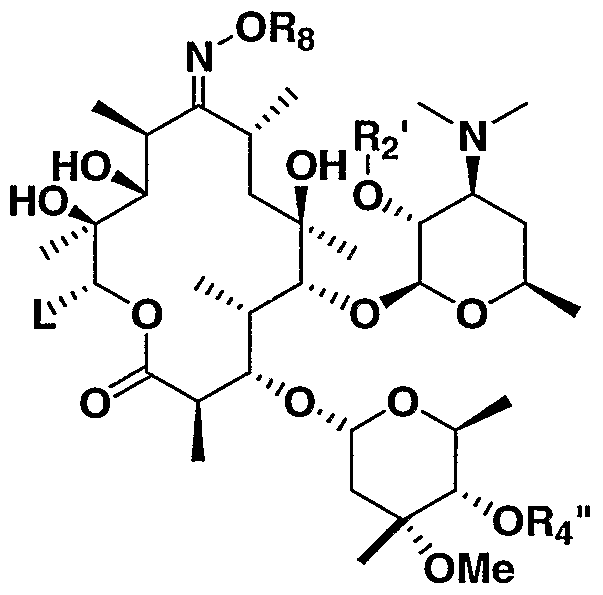
wherein R8 is a. Hydrogen; b. -CH20(CH2)2θCH3; c. -CH20(CH20)nCH3, where n is as previously defined; d. -C Cι2 alkyl, optionally substituted with one or more substituents selected from aryl, substituted aryl, heteroaryl and substituted heteroaryl; e. -C3-C12 cycloalkyl; f. -C(O)- C1-C12 alkyl; g. -C(0)-C3-C12 cycloalkyl; h. -C(0)-R-i, where Ri is as previously defined; or
i. -Si(Ra)(Rb)(Rc), wherein Ra, Rb and Rc are each independently selected from C1-C-12 alkyl, aryl, or substituted aryl; and L, R2', and R4" are as defined in claim 1 ;
with
 , wherein A and B are as defined in claim 1 , in the presence of a phosphine ligand and Pd(0) catalyst under reflux conditions to prepare a compound of the formula:

(2) reacting the compound prepared in step (1) with a mild acid to prepare a compound of the formula:

(3) reacting the compound prepared in step (2) with an oxime activating agent and quenching with methanol to prepare a compound of the formula:
 wherein A, B, L, R', and R2' are as defined claim 1 ;
(4) reacting the compound prepared in step (3) with a reducing agent to prepare compound of the formula:

(5) reacting the compound prepared in step (4) with an alkylating agent, preferably an alykyl halide in the presence of a base, or with an aldehyde via reductive amination in the presence of NaCNBH3 to prepare a compound of the formula:

(6) oxidizing the hydroxyl in the 3 position of the compound prepared in step (5) via Dess-Martin oxidation, Corey-Kim oxidation, or a Moffat oxidation to prepare a compound of the formula:
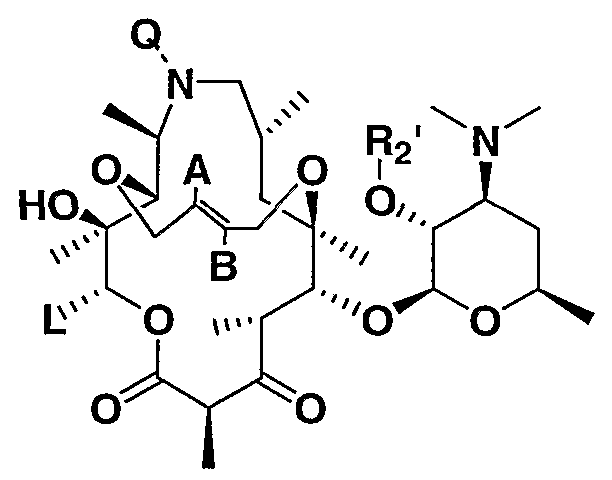 wherein A, B, L, Q, and R2' are as defined claim 1.
Applications Claiming Priority (2)
| Application Number | Priority Date | Filing Date | Title |
|---|---|---|---|
| US10/464,188 | 2003-06-18 | ||
| US10/464,188 US6764998B1 (en) | 2003-06-18 | 2003-06-18 | 6,11-4C-bicyclic 9a-azalide derivatives |
Publications (2)
| Publication Number | Publication Date |
|---|---|
| WO2005000863A2 true WO2005000863A2 (en) | 2005-01-06 |
| WO2005000863A3 WO2005000863A3 (en) | 2005-03-10 |
Family
ID=32682544
Family Applications (1)
| Application Number | Title | Priority Date | Filing Date |
|---|---|---|---|
| PCT/US2004/015806 Ceased WO2005000863A2 (en) | 2003-06-18 | 2004-05-19 | 6, 11-4c-bicyclic 9a-azalide derivatives |
Country Status (2)
| Country | Link |
|---|---|
| US (2) | US6764998B1 (en) |
| WO (1) | WO2005000863A2 (en) |
Cited By (2)
| Publication number | Priority date | Publication date | Assignee | Title |
|---|---|---|---|---|
| US7271155B2 (en) | 2005-01-07 | 2007-09-18 | Enanta Pharmaceuticals, Inc. | 9A, 11-2C-bicyclic 9a-azalide derivatives |
| US7402568B2 (en) | 2004-09-29 | 2008-07-22 | Enanta Pharmaceuticals, Inc. | Bicyclic 9a-azalide derivatives |
Families Citing this family (22)
| Publication number | Priority date | Publication date | Assignee | Title |
|---|---|---|---|---|
| US6841664B2 (en) * | 2002-07-25 | 2005-01-11 | Enanra Pharmaceuticals, Inc. | 6,11-4-carbon bridged ketolides |
| US7910558B2 (en) * | 2002-05-13 | 2011-03-22 | Enanta Pharmaceuticals, Inc. | Bridged macrocyclic compounds and processes for the preparation thereof |
| US7273853B2 (en) * | 2002-05-13 | 2007-09-25 | Enanta Pharmaceuticals, Inc. | 6-11 bicyclic ketolide derivatives |
| US7135573B2 (en) * | 2002-05-13 | 2006-11-14 | Enanta Pharmaceuticals, Inc. | Processes for the preparation of O-(6-Pyrazol-1-yl-pyridin-3-ylmethyl)-hydroxylamine |
| WO2005030227A1 (en) * | 2003-09-23 | 2005-04-07 | Enanta Pharmaceuticals, Inc. | 9a, 11-3C-BICYCLIC 9a-AZALIDE DERIVATIVES |
| US7414030B2 (en) * | 2004-01-07 | 2008-08-19 | Enanta Pharmaceuticals, Inc. | 6-11 Bicyclic erythromycin derivatives |
| WO2005070113A2 (en) * | 2004-01-09 | 2005-08-04 | Enanta Pharmaceuticals, Inc. | 9n-substituted 6-11 bicyclic erythromycin derivatives |
| US7384921B2 (en) * | 2004-02-20 | 2008-06-10 | Enanta Pharmaceuticals, Inc. | Polymorphic forms of 6-11 bicyclic ketolide derivatives |
| US20060058247A1 (en) * | 2004-09-16 | 2006-03-16 | Yujiro Hata | Methods and compositions for treating cystic fibrosis |
| US7212488B2 (en) * | 2005-03-21 | 2007-05-01 | Hewlett-Packard Development Company, L.P. | Method and device enabling capacitive probe-based data storage readout |
| US7384922B2 (en) * | 2005-05-04 | 2008-06-10 | Enanta Pharmaceuticals, Inc. | 6-11 bridged oxime erythromycin derivatives |
| US7563877B2 (en) * | 2006-03-02 | 2009-07-21 | Enanta Pharmaceuticals, Inc. | Processes for the preparation of 0-(2-aminobenzo[d]oxazol-5-yl)methyl hydroxylamine for the synthesis of 6,11-bicyclic erythromycin derivative EDP-182 |
| US20070231368A1 (en) * | 2006-03-30 | 2007-10-04 | Enanta Pharmaceuticals, Inc. | Pharmaceutical formulations of 6-11 bicyclic macrolide derivative known as edp-182 and methods for preparation thereof |
| US20070259822A1 (en) * | 2006-05-04 | 2007-11-08 | Yat Sun Or | 8a,11-bicyclic 8a-azalide derivatives |
| JP2009539866A (en) * | 2006-06-05 | 2009-11-19 | オースペックス・ファーマシューティカルズ・インコーポレイテッド | Preparation and utility of substituted erythromycin analogues |
| US20090053673A1 (en) * | 2007-08-23 | 2009-02-26 | Zimmer, Inc. | Method for localized treatment of periodontal tissue |
| US8273720B2 (en) * | 2007-09-17 | 2012-09-25 | Enanta Pharmaceuticals, Inc. | 6,11-bicyclolides: bridged biaryl macrolide derivatives |
| US8354383B2 (en) * | 2007-09-17 | 2013-01-15 | Enanta Pharmaceuticals, Inc. | 6,11-bridged biaryl macrolides |
| EP2203435B1 (en) * | 2007-09-17 | 2018-07-18 | Enanta Pharmaceuticals, Inc. | 6, 11-bridged biaryl macrolides |
| US20090131343A1 (en) * | 2007-11-15 | 2009-05-21 | Ly Tam Phan | Use of bridged macrolides or tylosin derivatives in treating inflammatory bowel diseases |
| TW200946109A (en) | 2008-05-09 | 2009-11-16 | Enanta Pharm Inc | Anti-bacterial activity of 9-hydroxy derivatives 6, 11-bicyclolides |
| WO2018201076A2 (en) * | 2017-04-28 | 2018-11-01 | Macrolide Pharmaceuticals Inc. | Macrolides with modified desosamine sugars and uses thereof |
Family Cites Families (12)
| Publication number | Priority date | Publication date | Assignee | Title |
|---|---|---|---|---|
| KR960000434B1 (en) | 1986-12-17 | 1996-01-06 | 다이쇼 세이야꾸 가부시끼가이샤 | Erythromycin A derivatives and preparation method thereof |
| IL99995A (en) | 1990-11-21 | 1997-11-20 | Roussel Uclaf | Erythromycin derivatives, their preparation and pharmaceutical compositions containing them |
| EP0559896B1 (en) | 1990-11-28 | 1997-08-27 | Taisho Pharmaceutical Co. Ltd | 6-o-methylerythromycin a derivative |
| ATE135707T1 (en) | 1992-04-22 | 1996-04-15 | Taisho Pharmaceutical Co Ltd | 5-0-DESOSAMINYLERYTHRONOLIDE A DERIVATIVES |
| US5527780A (en) | 1992-11-05 | 1996-06-18 | Roussel Uclaf | Erythromycin derivatives |
| FR2738571B1 (en) | 1995-09-11 | 1997-10-17 | Roussel Uclaf | NOVEL DERIVATIVES OF 5-0-DESOSAMINYL 6-0-METHYL- ERYTHRONOLIDE A, THEIR PREPARATION PROCESS AND THEIR APPLICATION TO THE PREPARATION OF BIOLOGICALLY ACTIVE PRODUCTS |
| UA51730C2 (en) | 1996-09-04 | 2002-12-16 | Ебботт Лабораторіз | 6-0-substituted ketolides having antibacterial activity |
| US6124269A (en) | 1997-10-29 | 2000-09-26 | Abbott Laboratories | 2-Halo-6-O-substituted ketolide derivatives |
| US6046171A (en) * | 1997-10-29 | 2000-04-04 | Abbott Laboratories | 6,11-bridged erythromycin derivatives |
| CA2370743A1 (en) | 1999-04-16 | 2000-10-26 | Dennis Hlasta | Ketolide antibacterials |
| DK1206476T3 (en) | 1999-08-24 | 2006-05-15 | Abbott Lab | 9a-azalides with antibacterial action |
| GB0127349D0 (en) | 2001-11-14 | 2002-01-02 | Glaxo Group Ltd | Macrolides |
-
2003
- 2003-06-18 US US10/464,188 patent/US6764998B1/en not_active Expired - Fee Related
-
2004
- 2004-05-07 US US10/840,949 patent/US20050014707A1/en not_active Abandoned
- 2004-05-19 WO PCT/US2004/015806 patent/WO2005000863A2/en not_active Ceased
Cited By (2)
| Publication number | Priority date | Publication date | Assignee | Title |
|---|---|---|---|---|
| US7402568B2 (en) | 2004-09-29 | 2008-07-22 | Enanta Pharmaceuticals, Inc. | Bicyclic 9a-azalide derivatives |
| US7271155B2 (en) | 2005-01-07 | 2007-09-18 | Enanta Pharmaceuticals, Inc. | 9A, 11-2C-bicyclic 9a-azalide derivatives |
Also Published As
| Publication number | Publication date |
|---|---|
| US20050014707A1 (en) | 2005-01-20 |
| US6764998B1 (en) | 2004-07-20 |
| WO2005000863A3 (en) | 2005-03-10 |
Similar Documents
| Publication | Publication Date | Title |
|---|---|---|
| US6764998B1 (en) | 6,11-4C-bicyclic 9a-azalide derivatives | |
| WO2005061525A1 (en) | 6-11 bicyclic ketolide derivatives | |
| US6645941B1 (en) | 6,11-3C-bicyclic 9a-azalide derivatives | |
| EP1509538A1 (en) | 6,11 bicyclic erythromycin derivatives | |
| EP1506214B1 (en) | 6-11 bicyclic ketolide derivatives | |
| AU2003239403A2 (en) | 6-11 bicyclic ketolide derivatives | |
| WO2003095466A1 (en) | 6,11 bicyclic erythromycin derivatives | |
| WO2005070113A2 (en) | 9n-substituted 6-11 bicyclic erythromycin derivatives | |
| US7402568B2 (en) | Bicyclic 9a-azalide derivatives | |
| US7276487B2 (en) | 9a, 11-3C-bicyclic 9a-azalide derivatives | |
| WO2005067564A2 (en) | 6-11 bicyclic erythromycin derivatives | |
| US7291602B2 (en) | 11,12-lactone bicyclolides | |
| US7271155B2 (en) | 9A, 11-2C-bicyclic 9a-azalide derivatives | |
| US7312201B2 (en) | Tetracyclic bicyclolides | |
| WO2008014221A2 (en) | Bridged carbamate macrolides | |
| WO2007044927A2 (en) | 6, 11-bridged tricyclic macrolides | |
| US20070259822A1 (en) | 8a,11-bicyclic 8a-azalide derivatives | |
| WO2008019240A2 (en) | 3, 6-bridged tylosin derivatives | |
| WO2008061189A1 (en) | C-9 alkenylidine bridged macrolides | |
| US7407942B2 (en) | 3,6-bridged 9,12-oxolides | |
| WO2004108746A2 (en) | 11-12 bicyclic erythromycin derivatives | |
| WO2005067919A1 (en) | 11-csubsituted erythromycin derivatives | |
| US6790835B1 (en) | Bicyclic macrolide derivatives | |
| WO2006119384A1 (en) | Spirocyclic bicyclolides | |
| WO2009137737A2 (en) | Anti-bacterial activity of 9-hydroxy derivatives of 6, 11-bicyclolides |
Legal Events
| Date | Code | Title | Description |
|---|---|---|---|
| AK | Designated states |
Kind code of ref document: A2 Designated state(s): AE AG AL AM AT AU AZ BA BB BG BR BW BY BZ CA CH CN CO CR CU CZ DE DK DM DZ EC EE EG ES FI GB GD GE GH GM HR HU ID IL IN IS JP KE KG KP KR KZ LC LK LR LS LT LU LV MA MD MG MK MN MW MX MZ NA NI NO NZ OM PG PH PL PT RO RU SC SD SE SG SK SL SY TJ TM TN TR TT TZ UA UG US UZ VC VN YU ZA ZM ZW |
|
| AL | Designated countries for regional patents |
Kind code of ref document: A2 Designated state(s): GM KE LS MW MZ NA SD SL SZ TZ UG ZM ZW AM AZ BY KG KZ MD RU TJ TM AT BE BG CH CY CZ DE DK EE ES FI FR GB GR HU IE IT LU MC NL PL PT RO SE SI SK TR BF BJ CF CG CI CM GA GN GQ GW ML MR NE SN TD TG |
|
| 121 | Ep: the epo has been informed by wipo that ep was designated in this application | ||
| 122 | Ep: pct application non-entry in european phase |