METHOD OF PRODUCING PURE AMTOITES AND OLIGONUCLEOTIDES
CROSS REFERENCE TO RELATED APPLICATIONS
This application claims priority benefit of U.S. Provisional Application Ser. No. 60/478,398, filed June 13, 2003, the entire content of which is incorporated herein by reference.
FIELD OF THE INVENTION
[1] The present invention relates to oligonucleotide synthesis. In particular, the present invention provides methods for making high quality phosphoramidites and oligonucleotides derived therefrom.
BACKGROUND OF THE INVENTION
[2] Oligonucleotides have been used in various biological and biochemical applications. They have been used as primers and probes for the polymerase chain reaction (PCR), as antisense agents used in target validation, drug discovery and development, as ribo2ymes, as aptamers, and as general stimulators of the immune system. As the popularity of oligonucleotides has increased, the need for producing greater sized batches, and greater numbers of small-sized batches, has increased at pace. Additionally, there has been an increasing emphasis on reducing the costs of oligonucleotide synthesis, and on improving the purity and increasing the yield of oligonucleotide products.
[3] A number of innovations have been introduced to the art of oligonucleotide synthesis. Amongst these innovations have been the development of excellent orthogonal protecting groups, activators, reagents, and synthetic conditions. The oligonucleotides themselves have been subject to a variety of modifications and improvements. Amongst these are chemistries that improve the affinity of an oligonucleotide for a specific target, that improve the stability of an oligonucleotide in vivo, that enhance the pharmacokinetic (PK) and toxicological (Tox) properties of an oligonucleotide, etc. These novel chemistries generally involve a chemical modification to one or more ofthe constituent parts ofthe oligonucleotide.
[4] The term "oligonucleotide" thus embraces a class of compounds that include naturally- occurring, as well as modified, oligonucleotides. Both naturally-occurring and modified oligonucleotides have proven useful in a variety of settings, and both may be made by similar processes, with appropriate modifications made to account for the specific modifications adopted. A naturally occurring oligonucleotide, i.e. a short strand of DNA or RNA may be
envisioned as being a member of the following generic formulas, denominated oligo-RNA and oligo-DNA, respectively, below:
Naturally-Occurring Oligonucleotides
, wherein m is an integer of from 1 to about 100, and Bx is one of the naturally occurring nucleobases.
[5] Physiologic pH, an oligonucleotide occurs as the anion, as the phosphate easily dissociates at neutral pH, and an oligonucleotide will generally occur in solid phase, whether amorphous or crystalline, as a salt. Thus, unless otherwise modified, the term "oligonucleotide" encompasses each ofthe anionic, salt and free acid forms above.
[6] In essence, a naturally occurring oligonucleotide may be thought of as being an oligomer of m monomeric subunits represented by the following nucleotides:
Naturally-Occurring Nucleotide Monomers
ribonucleotide deoxyribonucleotide wherein each Bx is a nucleobase, wherein the last residue is a nucleoside (i.e. a nucleotide without Hie 3 '-phosphate group).
[7] As mentioned above, various chemistry modifications have been made to oligonucleotides, in order to improve their affinity, stability, PK, Tox, and other properties. In general, the term oligonucleotide, as now used in the art, encompasses inter alia compounds of the formula:
Oligonucletoides (General)
wherein m is an integer from 1 to about 100, each G
\ is 0 or S, each G
2 is OH or SH, each G
3 is O, S, CH
2, or NH, each G
5 is a divalent moiety such as O, S, CH
2, CFH, CF
2, -CH=CH-, etc., each R
2' is H, OH, O-rg, wherein rg is a removable protecting group, a 2'-substituent, or together with R
4' forms a bridge, each R
3' is H, a substituent, or together with R
4' forms a bridge, each R
t' is H, a substitutent, together with R
2' forms a bridge, together with R forms a bridge, or together with R
5' forms a bridge, each q is 0 or 1, each R
5' is H, a substituent, or together with R
t' forms a bridge, each G
6 is O, S, CH
2 or NH, and each G
7 is H, P0
3H
2, or a conjugate group, and each Bx is a protected or unprotected, naturally occurring or non-naturally occurring nucleobase, as described herein (i.e. naturally occurring or modified).
[8] The standard synthetic methods for oligonucleotides include the solid phase methods first described by Caruthers et al. (See, for example, US Patent No. 5,750,666, incorporated herein by reference, especially columns 3-58, wherein starting materials and general methods of making oligonucleotides, and especially phosphorothioate oligonucleotides, are disclosed, which parts are specifically incorporated herein by reference.) These methods were later improved upon by Kδster et al. (See, for example, US Patent No. RE 34,069, which is incorporated herein
by reference, especially columns , wherein are disclosed, which parts are specifically incoφorated herein by reference.) These methods have further been improved upon by various inventors, as discussed in more detail below. Methods of synthesizing RNA are disclosed in, inter alia, US Patent Nos. 6,111,086, 6,008,400, and 5,889,136, each of which is incorporated herein in its entirety. Especially relevant are columns 7-20 of US 6,008,400, which are expressly incoφorated herein by reference.
[9] The general process for manufacture of an oligonucleotide by the Kδster et al. method may be described as follows:
[10] First, a primer support is prepared by covalently linking a suitable nucleoside to a support (SS) through a linker. Such a primer support is as follows:
Primer Support (Generaf)
wherein SS is the support, LL is a linking group that links the nucleoside to the support via G
3. The linking group is generally a di-functional group, covalently binds the ultimate 3 '-nucleoside (and thus the nascent oligonucleotide) to the solid support during synthesis, but which is cleaved under conditions orthogonal to the conditions under which the 5 '-protecting group, and if applicable any 2'-protecting group, are removed. T' is a removable protecting group, and the remaining variables have already been defined, and are described in more detail herein. Suitable primer supports may be acquired from Amersham Biosciences under the brand name Primer Support 200™. The primer support may then be swelled in a suitable solvent, e.g. acetonitrile, and introduced into a column of a suitable solid phase synthesis instrument, such as one of the synthesizers available form Amersham Biosciences, such as an AKTAoligopilot™, or OligoProcess™ brand DNA/RNA synthesizer.
[11] Synthesis is carried out from 3'- to 5 '-end of the oligomer. In each cycle, the following steps are carried out: (1) removal of T', (2) coupling, (3) oxidation, (4) capping. Each of the steps (l)-(4) may be, and generally is, followed by one or more wash steps, whereby a clean solvent is introduced to the column to wash soluble materials from the column, push reagents and/or activators through the column, or both. The steps (l)-(4) are depicted below:
Oligo Synthesis Cycle - Step 1
[12] In general, T' is selected to be removable under conditions orthogonal to those used to cleave the oligonucleotide from the solid support at the end of synthesis, as well as those used to remove other protecting groups used during synthesis. An art-recognized protecting group for oligonucleotide synthesis is DMT (4,4'-dimethoxytrityl). The DMT group is especially useful as it is removable under weakly acid conditions. Thus, an acceptable removal reagent is 3% DCA in a suitable solvent, such as acetonitrile. The wash solvent, if used, may conveniently be acetonitrile.
[13] The support may be controlled pore glass or a polymeric bead support. Some polymeric supports are disclosed in the following patents: US 6,016,895; US 6,043,353; US 5,391,667 and US 6,300,486, each of which is specifically incoφorated herein by reference.
Oligo Synthesis Cycle -- Step 2
wherein pg is a phosphorus protecting group, such as a cyanoethyl group. See, Koster et al., supra, for information on manufacturing ofthe amidite:
Amidite (General)
wherein NR
NiR
N2 is an amine leaving group, such as diisopropyl amino, and for teaching of suitable activator (e.g. tetrazole). Other suitable amidites, and methods of manufacturing amidites, are set forth in the following patents: US 6,133,438; US 5,646,265; US 6,124,450; US 5,847,106; US 6,001,982; US 5,705,621; US 5,955,600; US 6,160,152; US 6,335,439; US 6,274,725; US 6,329,519, each of which is specifically incoφorated herein by reference, especially as they relate to manufacture of amidites. Suitable activators are set forth in the Caruther et al. patent and in the Kδster et al. patent. Especially suitable activators are set forth in
the following patents: US 6,031,092 and US 6,476,216, each of which is expressly incoφorated herein by reference.
[14] The next step ofthe synthesis cycle is oxidation, which indicates that the P(III) species is oxidized to a P(V) oxidation state with a suitable oxidant:
Oligo Synthesis Cycle - Step 3
[15] The oxidant is an oxidizing agent suitable for introducing Gi. In the case where Gi is oxygen, a suitable oxidant is set forth in die Caruthers et al. patent, above. In cases where G2 is sulfur, the oxidant may also be referred to as a filiation agent or a sulfur-transfer reagent. Suitable thiation agents include the so-called Beaucage reagent, 3H-l,2-benzothiol, phenylacetyl disulfide (also referred to as PADS; see, for example the patents: US 6,114,519 and 6,242,591, each of which is incoφorated herein by reference) and thiouram disulfϊdes (e.g. N,N,N',N'- tetramethylthiouram disulfide, disclosed by US patent No. 5,166,387). The wash may be a suitable solvent, such as acetonitrile.
[16] The oxidation step is followed by a capping step, which although not illustrated herein, is an important step for synthesis, as it causes free 5' -OH groups, which did not undergo coupling in step 1, to be blocked from being coupled in subsequent synthetic cycles. Suitable capping reagents are set forth in Caruthers et al., Kδster et al., and other patents described herein. Suitable capping reagents include a combination of acetic anhydride and N-methylimidazole.
[17] Synthetic cycle steps (l)-(4) are repeated (if so desired) n-1 times to produce a support- bound oligonucleotide:
Support-Bound Oligonucleotide
wherein each ofthe variables is as herein defined.
[18] In general, the protecting group pg may be removed by a method as described by Caruthers et al. or Kδster et al., supra. Where pg is a cyanoethyl group, the methodology of Kόster et al., e.g. reaction with a basic solution, is generally suitable for removal of the phosphorus protecting group. In some cases it is desirable to avoid formation of adducts such as the NI -cyanoethyl thymidine group. In these cases, it is desirable to include in the reagent a tertiary amine, such as frieuiylamine (TEA) as taught in US Patent No. US 6,465,628, which is expressly incoφorated herein by reference. In general, where the nucleobases are protected, they are deprotected under basic conditions. The deprotected oligonucleotide is cleaved from the support to give the following 5 '-protected oligonucleotide:
Free 5'-Protected Oligonucleotide
, which may then be purified by reverse phase liquid chromatography, deprotected at the 5 '-end in acetic acid, desalted, lyophilized or otherwise dried, and stored in an inert atmosphere until needed. Optionally, the G3H group may be derivatized with a conjugate group. The resulting oligonucleotide may be visualized as having the formula:
Oligonucleotide
[19] While many improvements have been made in the quality and costs of oligonucleotide synthesis, there still remain a number of improvements to be made. For instance, the purity of amidite starting material (phosphoramidites) is a limiting factor, not only in oligonucleotide product purity, but also overall yield, and potentially biological efficacy and or toxicity. Accordingly, it is essential to obtain amidite starting material that will provide as pure an oligonucleotide as possible. While strides have been made in providing purified amidites, there
remain problems associated with providing amidite starting material that is suitable for oligonucleotide synthesis.
[20] On such problem is that, as amidite purity increases, so does its cost. It is possible, in theory, to produce an amidite of purity approach 100%. However, as purity asymptotically approaches 100%, the associated costs of purification also escalate. Indeed, two factors cause those costs to escalate well out of proportion to the gains in amidite purity. One factor is that, as purity increases, the amount of effort needed to extract an additional fractional percentage of impurity increases. A second factor is that with each stage of purification, there will be loss of amidite product. These two factors result in a cost-benefit curve that favors some optimum purity somewhat short of 100%. Nonetheless, it is still theoretically desirable to use the absolute highest purity amidite starting material to produce oligonucleotides.
[21] There is thus a need for a method of obtaining and characterizing amidite starting materials that are of purity suitable for oligonucleotide synthesis, while taking into account the increasing cost of each added degree of purification.
BRIEF DESCRIPTION OF THE DRAWINGS
Figures la-n show exemplary syntheses of representative amidite sample impurities useful in the methods ofthe invention.
SUMMARY OF THE INVENTION
In one aspect, the present invention provides methods of characterizing an amidite sample, the method comprising: identifying at least one critical impurity and a critical impurity signal representative of each of said critical impurities; obtaining an amidite sample signal from an amidite sample comprising a critical impurity signal component representative of said critical impurity in the amidite sample; comparing the critical impurity signal and the critical impurity signal component to determine the amount of said critical impurity in said amidite sample; and either rejecting said amidite sample if the amount of the critical impurity is greater than a predetermined critical impurity threshold, or
[22] accepting said amidite sample as an amidite starting material if the amount of the critical impurity is less than or equal to said predetermined critical impurity threshold.
In a further aspect, the present invention provides methods of characterizing an amidite sample, the methods comprising: identifying at least one non-critical impurity and a non-critical impurity signal representative of each of said non-critical impurities; obtaining an amidite sample signal from an amidite sample comprising a non-critical impurity signal component representative of said non-critical impurity in the amidite sample; comparing the non-critical impurity signal and the non-critical impurity signal component to determine the amount of said non-critical impurity in said amidite sample; and either rejecting said amidite sample if the amount of the non-critical impurity is greater than a predetermined non-critical impurity threshold, or
[23] accepting said amidite sample as an amidite starting material if the amount of the non- critical impurity is less than or equal to said predetermined non-critical impurity threshold.
In a further aspect, the present invention provides methods of characterizing an amidite sample, the methods comprising: identifying' y critical impurities and y critical impurity signals representative of each of the v critical impurities, wherein y is an integer of 2 or more; obtaining an amidite sample signal from an amidite sample comprising y critical impurity signal components representative of the quantity of each of the y critical impurities in the amidite sample; comparing the y critical impurity signals and the y critical impurity signal components to determine a quantity of each of they critical impurities in said amidite sample; summing the quantities of each of y critical impurities in the amidite sample to obtain a sum 7; rejecting said amidite sample if one or more of quantities of y critical impurities is greater than a predetermined critical impurity threshold, or rejecting said amidite sample if the sum Y is greater than a predetermined critical impurity sum threshold; and otherwise accepting said amidite sample as an amidite starting material. In some embodiments, the foregoing method further comprises: identifying x non-critical impurities and x non-critical impurity signals representative of each of the x non-critical impurities (wherein x is an integer of 2 or more);
obtaining an amidite sample signal from an amidite sample comprising x non-critical impurity signal components representative of the quantity of each of the x non-critical impurities in the amidite sample; comparing the x non-critical impurity signals and the x non-critical impurity signal components to determine a quantity of each of the x non-critical impurities in said amidite sample; summing the quantities of each of x non-critical impurities in the amidite sample to obtain a sum X; rejecting said amidite sample if one or more of quantities of x non-critical impurities is greater than a predetermined non-critical impurity threshold, or rejecting said amidite sample if the sum X is greater than a predetermined non-critical impurity sum threshold; and otherwise accepting said amidite sample as an amidite starting material.
In a further aspect, the present invention provides methods of characterizing an amidite sample, the methods comprising: identifying x non-critical impurities and x non-critical impurity signals representative of each of Hie x non-critical impurities, wherein x is an integer of 2 or more; obtaining an amidite sample signal from an amidite sample comprising x non-critical impurity signal components representative of the quantity of each ofthe x non-critical impurities in the amidite sample; comparing the x non-critical impurity signals and the x non-critical impurity signal components to determine a quantity of each of the x non-critical impurities in said amidite sample; summing the quantities of each of x non-critical impurities in the amidite sample to obtain a sum ; rejecting said amidite sample if one or more of quantities of x non-critical impurities is greater than a predetermined non-critical impurity threshold, or rejecting said amidite sample if the sum X is greater than a predetermined non-critical impurity sum threshold; and otherwise
[24] accepting said amidite sample as an amidite starting material.
In a further aspect, the present invention provides methods of making an oligonucleotide, the methods comprising:
providing the amidite starting material accepted any ofthe foregoing methods; and conducting at least one synthetic cycle in which said nucleoside amidite is coupled to a moiety, optionally in the presence of a suitable activator or solvent, under conditions suitable to form a phosphate diester intermediate.
In some embodiments of the foregoing methods, the amidite sample comprises a compound of formula (I):
B
x is a naturally occurring or non-naturally occurring, protected or unprotected nucleobase which is optionally radiolabeled;
each G
2 is independently selected from OH or SH; each G
3 is independently selected from -0-, -S-, -CH
2-, or -NH-; each G5 is independently selected from a divalent moiety; each G
β moiety is independently selected from -0-, -S-, -CH
2-, or -NH-; each R
2' is independently selected from hydrogen, OH, O-rg (wherein rg is a removable protecting group), a 2 '-substituent, or taken together with R
4' to form a bridge; each R
3' is independently selected from hydrogen, a substituent, taken together with
t' to form a bridge; each R
4' is independently selected from hydrogen, a substituent, or taken together with R
2' to form a bridge, taken together with R
3' to form a bridge, or taken together with R
5' to form a bridge;
each R
5' is independently selected from hydrogen, a substituent, or taken together with R
4' to form a bridge; each R
Nι and R
N2 is independently selected from a straight or branched chain alkyl having from 1 to 10 carbon atoms, or taken together with the nitrogen atom to which they are attached to fonn a heterocycloalkyl or a heterocycloalkenyl ring; each q is 0 or 1 ;
T' is a removable protecting group; and pg is a phosphorous protecting group.
In some further embodiments ofthe foregoing methods, critical impurity is selected from compounds of formulas:
In some such embodiments, rg for formulas (e), (j), (k), (1), (o), (q), and (r), is DMT. In some further embodiments, for formulas (e) and (o), pg is selected from: methyl, ethyl, cyanoethyl, or 2-cyanopropyl. In some such embodiments, pg is cyanoethyl. In some further embodiments, for formulas (e), (j), (k), (1), (o), (q), and (r), -NRNIRN2 is an amine leaving group. In still further embodiments, for formulas ((e), (j), (k), (1), (o), (q), and (r), each of RM and RN2 is independently selected from Cι-C6 straight-chained or branched alkyl, or R and RN2 taken together with the nitrogen atom to which they are attached form a heterocycloalkyl or a heterocycloalkenyl ring. In some such embodiments, each of RNι and RN2 is isopropyl.
In some embodiments of the foregoing methods, the critical impurity signal, the amidite sample signal, and the critical signal component are obtained by nuclear magnetic resonance spectroscopy, liquid chromatography, mass spectrometry, high pressure liquid chromatography, or liquid chromatography/mass spectrometry.
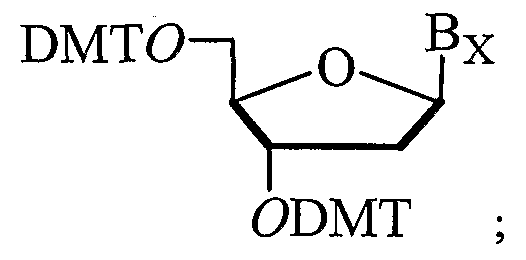
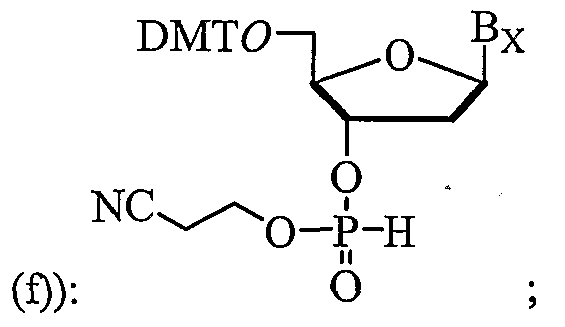
In some embodiments of the foregoing methods, the non-critical impurity is selected from a compound of formulas:
In some such embodiments, for formulas (a), (b), (c), (d), (f), (g), (h), (i), (m), (n), and (p), rg is DMT. In some further such embodiments, for fonnulas (d), (f), (h), (i), (m), and (n), pg is selected from methyl, ethyl, cyanoethyl, or 2-cyanopropyl. In some further such embodiments, pg is cyanoethyl.
[25] In some embodiments, for formulas (a), (b), (c), (d), (f), (g), (h), (i), (m), and (p), -NRNι_ RN2 is an amine leaving group. In some further embodiments, for formulas (a), (b), (c), (d), (f), (g), (h), (i), (m), and (p), each RNι and RN2 is independently selected from Cι-C10 straight-chained or branched alkyl, or RNι and RN2 taken together with the nitrogen atom to which they are attached form a heterocycloalkyl or a heterocycloalkenyl ring. In some further such embodiments, RNI and Rrø are isopropyl.
[26] The present invention also provides methods of making oligonucleotides, the methods comprising providing an amidite sample that has been accepted according to the foregoing procedure, and conducting at least one cycle in which said amidite is coupled to a moiety, optionally in the presence of a suitable activator and/or solvent, and under conditions suitable to form a phosphite diester intermediate:
wherein n is 0 or an integer and the other variables are as defined above. In some embodiments, the moiety to which the amidite is coupled is the moiety (H*G
6-) in the formula:
wherein the constituent variables are as defined herein.
The present invention also provides novel compounds ofthe following formulae (a) - (r). Such compounds may be used as authentic compounds for identifying critical or non-critical impurity signals representative of an amount of a critical or non-critical impurity, and said critical or non-critical impurity signal representative of an amount of a critical or non-critical impurity may be used in the methods outlined above.
[27] In some embodiments of the invention, compounds of formulae (a), (b), (c), (d), (f), (g), (h), (i), (m), (n), and (p), are non-critical impurities useful in the methods of the present invention.
[28] In some further embodiments of the invention, compounds of formulae (), (j), (k), (1), (o), (q), and (r), are critical impurities useful in the methods ofthe present invention.
[29] The present invention also provides an amidite starting material that has been validated by one ofthe methods set forth hereinabove.
The present invention also provides methods of determining which impurities in an amidite sample are critical and non-critical impurities.
[30] The present invention also provides methods of discriminating between amidite samples that are acceptable and non-acceptable for oligonucleotides synthesis.
[31] The present invention also provides methods for of oligonucleotide synthesis, the method comprising validating an amidite starting material according to one of the foregoing methods, and carrying out one or more synthesis cycles comprising coupling, oxidizing and capping.
[32] One advantage to the present invention is that it provides a method to discriminate between critical and non-critical amidite impurities. The present invention provides further advantages. For example, the present invention provides standards for determining the amount of critical impurities in an amidite sample, and standards for determining the amount of non- critical impurities in an amidite sample.
[33] Another advantage of the present invention is that it provides methods of obtaining critical impurity signals that are representative ofthe amounts of critical impurities in an amidite sample. A further advantage of the present invention is that it provides methods of obtaining non-critical impurity signals that are representative ofthe amounts of non-critical impurities in an amidite signal.
[34] In some embodiments of the present invention, values representative of critical impurity signals may be stored in a computer-readable format and may be compared to an amidite sample signal by a computer.
[35] In some embodiments of the present invention, values representative of non-critical impurity signals may be stored in a computer-readable format and may be compared to an amidite sample signal by a computer.
[36] In some embodiments according to the present invention, acceptance or rejection criteria may be stored in a computer-readable format. In certain embodiments, a computer may compare an amidite sample signal to said acceptance and/or rejection criteria, and may provide a human- readable indicator of an amidite sample's acceptance or rejection.
[37] The present invention thus provides novel compounds, methods of obtaining and using both critical and non-critical impurity signals, methods of using those critical and non-critical impurity signals to make decisions regarding amidite starting material suitability for oligonucleotide synthesis, and methods of carrying out oligonucleotide synthesis using the product of such decisions.
[38] Other uses and advantages of the present invention will become apparent to the artisan upon consideration ofthe foregoing specification and claims.
DETAILED DESCRIPTION OF THE INVENTION
[39] The present invention is concerned with the art of oligonucleotide synthesis, and in particular with providing starting materials of excellent purity, the use of which will provide oligonucleotides having excellent purity. The invention provides, in particular, methods of identifying amidite starting materials having purity profiles suitable for synthesizing oligonucleotides having excellent purity, and in some embodiments purity sufficient to qualify the oligonucleotides for inclusion in drug preparations.
[40] In one aspect, the present invention provides a method for determining whether an amidite sample is a suitable starting material for oligonucleotide synthesis. As used herein, an amidite sample is a composition of matter comprising a phosphoramidite. In some embodiments, the phosphoramidite is embraced by formula (I):
[41] The variables set forth in formula I are as defined above, and as further described below. The amidite sample also may comprise at least one impurity, which, when present in the sample, is said to have an impurity concentration (expressed in suitable units, e.g. ppm, percent (w/w), etc.). The method according to the present invention comprises identifying said impurity, identifying at least one impurity signal that is representative of the impurity concentration in the sample, detecting said impurity signal in said amidite sample, detennining from the impurity signal the impurity concentration, comparing the quantity of impurity with a predetermined impurity threshold, rejecting the amidite sample if the quantity of impurity exceeds the predetermined impurity threshold, or accepting the amidite sample as an amidite starting material if the quantity ofthe identified impurity does not exceed the impurity threshold.
[42] The impurity may be further classified as either a critical impurity or a non-critical impurity. A critical impurity is an impurity that reacts with a nascent oligonucleotide chain during synthesis, and which permits further chain extension upon reaction. Certain critical impurities react with the 5' -OH ofthe nascent oligonucleotide chain, and themselves are capable
of reacting with an amidite, thereby giving rise to oligonucleotides having incoφorated therein the impurity as a constituent part. Other critical impurities react with the nascent oligonucleotide chain at positions other than the 5' -OH, and are incoφorated into the oligonucleotide as adducts. Some critical impurities give rise to branchmers. Other critical impurities give rise to adducts. Exemplary critical impurities will be illustrated in more detail below.
[43] Non-critical impurities are impurities that are either inert with respect to the nascent oligonucleotide chain or non-inert. Inert non-critical impurities are those impurities that do not react with the nascent oligonucleotide. Non-inert non-critical impurities are those impurities that react with the oligonucleotide chain but result in the termination of the oligonucleotide sequence, and thus are similar in chemical behavior to capping. In the context of this invention, then, a non-inert non-critical impurity may be referred to as a capping impurity.
[44] Impurities, whether critical or non-critical, may arise out of one or more of the process steps used to make the amidite sample, or may result from degradation of amidite. For example, amidites having the following fonnulae:
T Amidite dG Amidite
have been prepared and their degradation products after incubation in acetonitrile have been characterized. See Scheme 1, below:
Scheme 1
CE phosphonoamidate H-phosphonate , wherein Bx is one ofthe moieties:
T CE phosphonoamidate dG CE phosphonoamidate
dC CE phosphonoamidate dA ACE phosphonoamidate
[45] The corresponding T, dG, dC and dA CE-ZZ-phosphonates and ϋf-phosphonates have also been prepared.
[46] The impurity signal may be a signal that is representative of the concentration of the impurity in an amidite sample. Suitable signals may include an absoφtion signal, a fluorescence signal, a phosphorescence signal, a mass spectrometry signal, etc. An absoφtion signal includes ultraviolet light absoφtion signal, a nuclear magnetic resonance signal, a visible light absoφtion signal, etc. Such a signal may be gathered by, for example, an HPLC instrument with an absoφtion detector, e.g. an ultraviolet detector. A mass spectrometry signal may include an HPLC-mass spectrometry signal.
[47] In the context of the present invention, the impurity signal may vary linearly, log- linearly, log-log, or otherwise with respect to the impurity concentration.
[48] In some specific embodiments according to the present invention, an authentic impurity may be prepared and subjected to HPLC, whereby there is produced an impurity signal, the
impurity signal comprising an HPLC retention time and a detector signal strength that varies in a consistent relationship to the amount of authentic impurity applied to the HPLC column. Thus, an impurity signal may be multidimensional, comprising a first signal component representing the identity of the impurity (in the case of HPLC, retention time; in the case of mass- spectrometry, m/z) and a second signal component representative of impurity concentration (in the case of HPLC, UV absorbance; in the case of mass-spectrometry, electrode signal strength). The signal component that is representative of impurity identity may be thought of as a qualitative component, while the signal component that is representative of the impurity's concentration in the sample may be thought of as a quantitative component.
[49] Once the relationship is established between an impurity's concentration and the qualitative component of the impurity signal, an amidite sample may be subjected to the same testing method to determine whether the impurity is present in the sample (a qualitative determination) and if so, at what concentration (quantitative deteπnination). For example in HPLC, an amidite sample is applied to a column and the retention times and areas of at least two peaks (one representing the amidite and one representing the impurity) are recorded. The retention times are used to identify the signals relating to the amidite and the impurity, while the relative areas of the elution peaks of the amidite and impurity are used to determine the concentration of impurity relative to the amidite sample. In this simple example, impurity concentration, expressed as % impurity, is:
% impurity = 100 % x (A; / (A; + AA)), where A; is the area under the impurity's elution peak and AA is the area under the amidite's elution peak. The concentration of the impurity in the amidite sample is then compared to a predetermined impurity limit. An amidite sample having an impurity concentration greater than the impurity limit is classified as rejected. A rejected amidite sample may be destroyed, recycled, further purified, or otherwise disposed of, but not used in oligonucleotide synthesis. An amidite sample in which no impurity's concentration exceeds its predetermined impurity limit is then classified as amidite starting material, which may be used as a starting material for making oligonucleotide.
[50] Where n impurities are known to potentially be present in an amidite sample, a signal may be identified for each of the n impurities. The concentration for impurity X is then calculated as:
%X = l0Q% x Ax l(AA + ∑ Aι) ,
wherein Ax is the area ofthe peak corresponding to impurity X, where is an integer from 1 to n, AA is the area ofthe peak corresponding to the amidite, and each A; is the area ofthe z'th impurity
peak, wherein i is an integer from 1 to n. In such case, a predetermined impurity limit is selected for each impurity. If any impurity concentration exceeds its predetermined impurity threshold, the amidite sample is rejected. If each impurity concentration is less than or equal to its impurity threshold, the amidite sample is classified as an amidite starting material, which may be used in oligonucleotide synthesis. ,
[51] As used herein, unless otherwise modified, the tenn "amidite sample" refers to a composition of matter, which contains a phosphoramidite, preferably of formula I, and optionally a detectable amount of at least one impurity. An amidite sample may further be classified as an "amidite starting material" or as "rejected," as described in more detail herein.
[52] As used herein, unless otherwise modified, the term "amidite starting material" refers to a composition of matter, which contains a phosphoramidite, preferably of formula I and optionally a detectable amount of at least one impurity, and which has been classified as "amidite starting material" according to a method of the present invention. In many cases, more than one impurity will be present in the "amidite starting material." Thus, an amidite starting material is an amidite sample that has been subjected to testing as described herein, and has been determined to contain no more than the impurity threshold of each impurity tested for.
[53] As used herein, unless otherwise modified, the term "rejected amidite sample" or simply "rejected amidite," refers to an amidite sample that has been subjected to testing by the inventive method described herein, and has been found to contain at least one impurity at a concentration greater than its impurity threshold. It should be noted that if there are n identified impurities potentially in an amidite sample, there will potentially be n signals corresponding to the n impurities. There also may be a signal relating to the amidite itself.
[54] As used herein, unless otherwise modified, the tenn "signal" refers to a voltage, UV absorbance, current, or other value, whether analog or digital, that represents some characteristic of an impurity or amidite. As described above, a signal may comprise more than one component, e.g. a qualitative component and a quantitative component. For example, as pointed out above, an HPLC chromatogram comprises a time component (retention time), useful for identifying the signal relating to an impurity or amidite, and an absorbance component (UV absorbance), useful for determining the amount of impurity or amidite in the sample.
[55] The term impurity includes any compound other than amidite or solvent, if any, whether actually present in the amidite sample or not, and whether identified or not. A potential impurity is an impurity that has been hypothesized to be present in an amidite sample, whether actually present or not. An unidentified impurity is an impurity whose structure is not known, but which is detected in the amidite sample. In some cases, a group of impurities may be collected into an "unidentified impurity" classification. A known impurity is an impurity whose structure is
known. In accordance with the present invention, a known impurity in an amidite sample can be identified and its quantity measured by obtaining its characteristic signal from both a reference (authentic compound) and the amidite sample.
[56] Known impurities may be further subdivided into critical impurities and non-critical impurities, as described herein.
[57] Detection of an impurity in an amidite sample may be conducted using a suitable analytical method, such as HPLC, Mass-Spectrometry, GC-Mass Spec, etc. The artisan will recognize that a method capable of unambiguously identifying and quantifying an impurity in an amidite sample will be suitable for the disclosed methodology.
[58] As used herein, the term oligonucleotide has the meaning of an oligomer having m subunits embraced within the brackets [ ] of the formula:
Oligonucleotide
wherein the other variables are defined above, and are described in more detail hereinafter. It is to be understood that, although the oligonucleotide to be made is depicted in a single stranded conformation, it is common for oligonucleotides to be used in a double stranded conformation. For example, in the antisense method referred-to commonly as siRNA, two strands of RNA or RNA-like oligonucleotide are prepared and annealed together, often with a two-nucleotide overlap at the ends. Thus, the present invention contemplates manufacture of both single- and double-stranded oligonucleotides.
Nucleobases
[59] The nucleobases Bx may be the same or different, and include naturally occurring nucleobases adenine (A), guanine (G), ymine (T), uracil (U) and cytosine (C), as well as
modified nucleobases. Modified nucleobases include heterocyclic moieties that are structurally related to the naturally-occurring nucleobases, but which have been chemically modified to impart some property to the modified nucleobase that is not possessed by naturally-occurring nucleobases. The term "nucleobase," as used herein, is intended to by synonymous with "nucleic acid base or mimetic thereof." In general, a nucleobase is any substructure that contains one or more atoms or groups of atoms capable of hydrogen bonding to abase of an oligonucleotide.
[60] As used herein, "unmodified" or "natural" nucleobases include the purine bases adenine (A) and guanine (G), and the pyrimidine bases thymine (T), cytosine (C) and uracil (U). Modified nucleobases include other synthetic and natural nucleobases such as 5-methylcytosine (5-me-C), 5-hydroxymethyl cytosine, xanthine, hypoxanthine, 2-aminoadenine, 6-methyl and other alkyl derivatives of adenine and guanine, 2-propyl and other alkyl derivatives of adenine and guanine, 2-thiouracil, 2-thiothymine and 2-thiocytosine, 5-halouracil and cytosine, 5- propynyl (-C≡C-CH3) uracil and cytosine and other alkynyl derivatives of pyrimidine bases, 6- azo uracil, cytosine and thymine, 5-uracil (pseudouracil), 4-thiouracil, 8-halo, 8-amino, 8-thiol, 8-thioalkyl, 8-hydroxyl and other 8-substituted adenines and guanines, 5-halo particularly 5- bromo, 5-trifluorometlιyl and other 5-substituted uracils and cytosines, 7-methylguanine and 7- methyladenine, 2-F-adenine, 2-amino-adenine, 8-azaguanine and 8-azaadenine, 7-deazaguanine and 7-deazaadenine and 3<deazaguanine and 3-deazaadenine. Further modified nucleobases include tricyclic pyrimidines such as phenoxazine cytidine(lH-pyrimido[5,4-b][l,4]benzoxazin- 2(3H)-one), phenothiazine cytidine (lH-pyrimido[5,4-b][l,4]benzothiazin-2(3H)-one), G-clamps such as a substituted phenoxazine cytidine (e.g. 9-(2-am oe1hoxy)-H-pyrimido[5,4- b][l,4]benzoxazin-2(3H)-one), carbazole cytidine (2H-pyrimido[4,5-b]indol-2-one), pyridoindole cytidine (H-pyrido[3^2 ,5]pyrrolo[2,3-d]pyrimidin-2-one). Modified nucleobases may also include those in which the purine or pyrimidine base is replaced with other heterocycles, for example 7-deaza-adenine, 7-deazaguanosine, 2-aminopyridine and 2-pyridone. Further nucleobases include those disclosed in United States Patent No. 3,687,808, those disclosed in The Concise Encyclopedia Of Polymer Science And Engineering, pages 858-859, Kroschwitz, J.I., ed. John Wiley & Sons, 1990, those disclosed by Englisch et al., Angewandte Chemie, International Edition, 1991, 30, 613, and those disclosed by Sanghvi, Y.S., Chapter 15, Antisense Research and Applications, pages 289-302, Crooke, S.T. and Lebleu, B. , ed., CRC Press, 1993.
[61] Certain of these nucleobases are particularly useful for increasing the binding affinity of the oligomeric compounds of the invention. These include 5-substituted pyrimidines, 6- azapyrimidines and N-2, N-6 and 0-6 substituted purines, including 2-aminopropyladenine, 5- propynyluracil and 5-propynylcytosine. 5-methylcytosine substitutions have been shown to increase nucleic acid duplex stability by 0.6-1.2°C (Sanghvi, Y.S., Crooke, S.T. and Lebleu, B.,
eds., Antisense Research and Applications, CRC Press, Boca Raton, 1993, pp. 276-278) and are presently preferred base substitutions, even more particularly when combined with 2'-0- methoxyethyl sugar modifications.
[62] Representative United States patents that teach the preparation of certain of the above noted modified nucleobases as well as other modified nucleobases include, but are not limited to, the above noted U.S. 3,687,808, as well as U.S.: 4,845,205; 5,130,302; 5,134,066; 5,175,273; 5,367,066; 5,432,272; 5,457,187; 5,459,255; 5,484,908; 5,502,177; 5,525,711; 5,552,540; 5,587,469; 5,594,121, 5,596,091; 5,614,617; 5,645,985; 5,830,653; 5,763,588; 6,005,096; and 5,681,941, certain of which are commonly owned with the instant application, and each of which is herein incoφorated by reference, and United States patent 5,750,692, which is commonly owned with the instant application and also herein incoφorated by reference.
[63] Additional modifications may also be made at other positions on the oligonucleotide, particularly the 3' position of the sugar on the 3' terminal nucleotide and the 5' position of 5' terminal nucleotide. For example, one additional modification of the ligand conjugated oligonucleotides of the present invention involves chemically linking to the oligonucleotide one or more additional non-ligand moieties or conjugates which enhance the activity, cellular distribution or cellular uptake of the oligonucleotide. Such moieties include but are not limited to lipid moieties such as a cholesterol moiety (Letsinger et al., Proc. Natl. Acad. Sci. USA, 1989, 86, 6553), cholic acid (Manoharan et al., Bioorg. Med. Chem. Lett., 1994, 4, 1053), a thioether, e.g., hexyl-S-tritylthiol (Manoharan et al., Ann. N.Y. Acad. Sci., 1992, 660, 306; Manoharan et al., Bioorg. Med. Chem. Let., 1993, 3, 2765), a thiocholesterol (Oberhauser et al., Nucl. Acids Res., 1992, 20, 533), an aliphatic chain, e.g., dodecandiol or undecyl residues (Saison-Behmoaras et al., EMBO J., 1991, 10, 111; Kabanov et al., FEBS Lett, 1990, 259, 327; Svinarchuk et al., Biochimie, 1993, 75, 49), a phospholipid, e.g., di-hexadecyl-rac-glycerol or triemylammonium l,2-di-0-hexadecyl-rac-glycero-3-H-phosphonate (Manoharan et al., Tetrahedron Lett., 1995, 36, 3651; Shea et al., Nucl. Acids Res., 1990, 18, 3777), a polyamine or a polyethylene glycol chain (Manoharan et al., Nucleosides & Nucleotides, 1995, 14, 969), or adamantane acetic acid (Manoharan et al., Tetrahedron Lett., 1995, 36, 3651), a palmityl moiety (Mislira et al., Biochim. Biophys. Acta, 1995, 1264, 229), or an octadecylainine or hexylamino-carbonyl-oxycholesterol moiety (Crooke et al., J. Pharmacol. Exp. Ther., 1996, 277, 923).
[64] Representative United States patents that teach the preparation of such oligonucleotide conjugates include, but are not limited to, U.S. Patents Nos. 4,828,979; 4,948,882; 5,218,105 5,525,465; 5,541,313; 5,545,730; 5,552,538; 5,578,717, 5,580,731; 5,580,731; 5,591,584: 5,109,124; 5,118,802; 5,138,045; 5,414,077; 5,486,603; 5,512,439; 5,578,718; 5,608,046 4,587,044; 4,605,735; 4,667,025; 4,762,779; 4,789,737; 4,824,941; 4,835,263; 4,876,335 4,904,582; 4,958,013; 5,082,830; 5,112,963; 5,214,136; 5,082,830; 5,112,963; 5,214,136;
5,245,022; 5,254,469; 5,258,506; 5,262,536; 5,272,250; 5,292,873; 5,317,098; 5,371,241, 5,391,723; 5,416,203, 5,451,463; 5,510,475; 5,512,667; 5,514,785; 5,565,552; 5,567,810; 5,574,142; 5,585,481; 5,587,371; 5,595,726; 5,597,696; 5,599,923; 5,599,928 and 5,688,941, certain of which are commonly owned, and each of which is herein incoφorated by reference.
[65] In some embodiments ofthe invention, oligomeric compounds, e.g. oligonucleotides, are prepared having polycyclic heterocyclic compounds in place of one or more heterocyclic base moieties. A number of fricyclic heterocyclic compounds have been previously reported. These compounds are routinely used in antisense applications to increase the binding properties of the modified strand to a target strand. The most studied modifications are targeted to guanosines hence they have been termed G-clamps or cytidine analogs. Many of these polycyclic heterocyclic compounds have the general formula:
[66] Representative cytosine analogs that make 3 hydrogen bonds with a guanosine in a second strand include l,3-diazaphenoxazine-2-one (Rio = O, Rπ - ι4= H) [Kurchavov, et al, Nncleosides and Nucleotides, 1997, 16, 1837-1846], l,3-diazaphenothiazine"-2-one (Rι0= S, Ru - R14= H), [Lin, K.-Y.; Jones, R. J.; Matteucci, M. J. Am. Chem. Soc. 1995, 117, 3873-3874] and 6,7,8,9-tetrafluoro-l,3-diazaphenoxazine-2-one (Rι0 = O, Ru - RM = F) [Wang, J.; Lin, K.-Y., Matteucci, M. Tetrahedron Lett. 1998, 39, 8385-8388]. Incoφorated into oligonucleotides these base modifications were shown to hybridize with complementary guanine and the latter was also shown to hybridize with adenine and to enhance helical thermal stability by extended stacking interactions (also see U.S. Patent Application entitled "Modified Peptide Nucleic Acids" filed May 24, 2002, Serial number 10/155,920; and U.S. Patent Application entitled "Nuclease Resistant Chimeric Oligonucleotides" filed May 24, 2002, Serial number 10/013,295, both of which are commonly owned with this application and are herein incoφorated by reference in their entirety).
[67] Further helix-stabilizing properties have been observed when a cytosine analog/substitute has an aminoethoxy moiety attached to the rigid l,3-diazaphenoxazine-2-one scaffold (Rιo = O, R„ = -0-(CH
2)
2-NH
2,
) [Lin, K.-Y.; Matteucci, M. J. Am. Chem. Soc. 1998, 120, 8531- 8532]. Binding studies demonstrated that a single incoφoration could enhance the binding affinity of a model oligonucleotide to its complementary target DNA or RNA with a ΔT
m of up to
18° relative to 5-methyl cytosine (dC5
me), which is the highest known affinity enhancement for a single modification, yet. On the other hand, the gain in helical stability does not compromise the specificity of the oligonucleotides. The T
m data indicate an even greater discrimination between the perfect match and mismatched sequences compared to dC5
me. It was suggested that the tethered amino group serves as an additional hydrogen bond donor to interact with the Hoogsteen face, namely the 06, of a complementary guanine thereby forming 4 hydrogen bonds. This means that the increased affinity of G-clamp is mediated by the combination of extended base stacking and additional specific hydrogen bonding.
[68] Further tricyclic heterocyclic compounds and methods of using them that are amenable to the present invention are disclosed in United States Patent Serial Number 6,028,183, which issued on May 22, 2000, and United States Patent Serial Number 6,007,992, which issued on December 28, 1999, the contents of both are commonly assigned with this application and are incoiporated herein in their entirety. Such compounds include those having the fonnula:
[69] Wherein Ru includes (CH3)2N-(CH2)2-0-; H2N-(CH2)3-; Ph-CH2-0-C(=0)-N(H)-(CH2)3- ; H2N-; Fluorenyl-CH2-0-C(=0)-N(H)-(CH2)3-; Phtlialimidyl-CH2-0-C(=0)-N(H)-(CH2)3-; Ph- CH2-0-C(=0)-N(H)-(CH2)2-0-; Ph-CH2-0-C(=0)-N(H)-(CH2)3-0-; (CH3)2N-N(H)-(CH2)2-0-; Fluorenyl-CH2-0-C(=0)-N(H)-(CH2)2-0-; Fluorenyl-CH2-0-C(=0)-N(H)-(CH2)3-0-; H2N- (CH2)2-0-CH2-; N3-(CH2)2-0-CH2-; H2N-(CH2)2-0-, and NH2C(=NH)NH-.
[70] Also disclosed are tricyclic heterocyclic compounds ofthe formula:
Rio
a is O, S orN-CH
3; Rn
a is A(Z)
xl, wherein A is a spacer and Z independently is a label bonding group bonding group optionally bonded to a detectable label, but Rn
a is not amine, protected amine, nitro or cyano; XI is 1, 2 or 3; and R
b is independently -CH=, -N=, -C(Cι
-8 alkyl)= or -C(halogen)=, but no adjacent R are both -N=, or two adjacent R
b are taken together to form a ring having the structure:
where R
c is independently -CH=, -N=, -C(Cι
-8 alkyl)= or -C(halogen)=, but no adjacent R
b are both -N=.
[71] The enhanced binding affinity of the phenoxazine derivatives together with their uncompromised sequence specificity makes them valuable nucleobase analogs for the development of more potent antisense-based drugs. In fact, promising data have been derived from in vitro experiments demonstrating that heptanucleotides containing phenoxazine substitutions are capable to activate RNaseH, enhance cellular uptake and exhibit an increased antisense activity [Lin, K.-Y.; Matteucci, M. J. Am. Chem. Soc. 1998, 120, 8531-8532]. The activity enhancement was even more pronounced in case of G-clamp, as a single substitution was shown to significantly improve the in vitro potency of a 2θmer 2'-deoxyphosphorothioate oligonucleotides [Flanagan, W. M.; Wolf, J.J.; Olson, P.; Grant, D.; Lin, K.-Y.; Wagner, R. W.; Matteucci, M. Proc. Natl. Acad. Sci. USA, 1999, 96, 3513-3518]. Nevertheless, to optimize oligonucleotide design and to better understand the impact of these heterocyclic modifications on the biological activity, it is important to evaluate their effect on the nuclease stability of the oligomers.
[72] Further tricyclic and tetracyclic heteroaryl compounds amenable to the present invention include those having the fonnulas:
wherein Rι
4 is N0
2 or both R
M and Rι
2 are independently -CH
3. The synthesis of these compounds is dicslosed in United States Patent Serial Number 5,434,257, which issued on July 18, 1995, United States Patent Serial Number 5,502,177, which issued on March 26, 1996, and United States Patent Serial Number 5,646, 269, which issued on July 8, 1997, the contents of which are commonly assigned with this application and are incoφorated herein in their entirety.
[73] Further tricyclic heterocyclic compounds amenable to the present invention also disclosed in the "257, 177 and 269" Patents include those having the formula:
wherein a and b are independently 0 or 1 with the total of a and b being 0 or 1; A is N, C or CH; X is S, O, C=0, NH or NCH
2, R
6; Y is C=0; Z is taken together with A to form an aryl or heteroaryl ring structure comprising 5 or 6 ring atoms wherein the heteroaryl ring comprises a single O ring heteroatom, a single N ring heteroatom, a single S ring heteroatom, a single O and a single N ring heteroatom separated by a carbon atom, a single S and a single N ring heteroatom separated by a C atom, 2 N ring heteroatoms separated by a carbon atom, or 3 N ring heteroatoms at least 2 of which are separated by a carbon atom, and wherein the aryl or heteroaryl ring carbon atoms are unsubstituted with other than H or at least 1 nonbridging ring carbon atom is fubstituted with R
20 or =0; or Z is taken together with A to fonn an aryl ring structure comprising 6 ring atoms wherein the aryl ring carbon atoms are unsubstituted with other than H or at least 1 nonbridging ring carbon atom is substituted with R
6 or =0; R
6 is independently H, C
1-6 alkyl, C
2.
6 alkenyl, C
2-6 alkynyl, N0
2, N(R
3)
2, CN or halo, or an R
δ is taken together with an adjacent Z group R
6 to complete a phenyl ring; R
20 is , independently, H, Cι.
6 alkyl, C
2.
6 alkyl, C
2.
s alkenyl, C
2.
6 alkynyl, N0
2, N(R
21)
2, CN, or halo, or an R
20 is taken together with an adjacent R
20 to complete a ring containing 5 or 6 ring atoms, and tautomers, solvates and salts thereof; R
21 is, independently, H or a protecting group; R
3 is a protecting group or H; and tautomers, solvates and salts thereof.
[74] More specific examples of bases included in the "257, 177 and 269" Patents are compounds ofthe formula:
wherein each R
16, is, independently, selected from hydrogen and various substituent groups. Further polycyclic base moieties having the formula:
wherein: Aβ is O or S; A
7 is CH
2, N-CH
3, 0 or S; each A
8 and A
9 is hydrogen or one of A
8 and A
9 is hydrogen and the other of A
8 and A
9 is selected from the group consisting of:
wherein: G is -CN, -OA
10, -SA
10, -N(H)A
10, -ON(H)A
I0 or -C(=NH)N(H)A
10; Qi is H, -NHA
10, - C(=O)N(H)A
10, -C(=S)N(H)Aιo or -C(=NH)N(H)Aι
0; each Q
2 is, independently, H or Pg; A
10 is H, Pg, substituted or unsubstituted C,-C
10 alkyl, acetyl, benzyl, -(CH
2)
p3NH
2, -(CH
2)
p3N(H)Pg, a D or L α-amino acid, or a peptide derived from D, L or racemic α-amino acids; Pg is a nitrogen, oxygen or thiol protecting group; each pi is, independently, from 2 to about 6; p2 is from 1 to about 3; and p3 is from 1 to about 4; are disclosed in Unites States Patent Application Serial number 09/996,292 filed November 28, 2001, which is commonly owned with the instant application, and is herein incoφorated by reference.
Sugars and Sugar Substituents [75] The sugar moiety:
wherein each dashed line ( — ) indicates a point of attachment to an adjacent phosphorus atom, represents the sugar portion of a general nucleoside or nucleotide as embraced by the present invention.
[76] Suitable 2 '-substituents corresponding to R'2 include: OH, F, O-alkyl (e.g. O-methyl), S- alkyl, N-alkyl, O-alkenyl, S-alkenyl, N-alkenyl; O-alkynyl, S-alkynyl, N-alkynyl; O-alkyl-O- alkyl, wherein the alkyl, alkenyl and alkynyl may be substituted or unsubstituted Ct to Cι0 alkyl or C2 to Cio alkenyl or alkynyl, respectively. Particularly preferred are 0[(CH2)gO]hCH3, 0(CH2)gOCH3, 0(CH2)gNH2, 0(CH2)gCH3, 0(CH2)gONH2, and 0(CH2)gON[(CH2)gCH3]2, where g and h are from 1 to about 10. Other preferred oligonucleotides comprise one of the following at the 2' position: Ci to Cio lower alkyl, substituted lower alkyl, alkenyl, alkynyl, alkaryl, aralkyl, O-alkaryl or O-aralkyl, SH, SCH3, OCN, CI, Br, CN, CF3, OCF3, SOCH3, S02CH3, ON02, N02, N3, NH2, heterocycloalkyl, heterocycloalkaryl, anώioalkylamino, polyalkylamino, substituted silyl, an RNA cleaving group, a reporter group, an intercalator, a group for improving the pharmacokinetic properties of an oligonucleotide, or a group for improving the
pharmacodynamic properties of an oligonucleotide, and other substituents having similar properties. A preferred 2'-modification includes 2'-methoxyethoxy (2'-O-CH2CH20CH3, also known as 2'-0-(2-methoxyethyl) or 2'-MOE) (Martin et al, Helv. Chim. Acta, 1995, 78, 486- 504). A further preferred modification includes 2'-dfmethylaminooxyethoxy, i.e., a 0(CH2)2ON(CH3)2 group, also known as 2'-DMAOE, as described in examples hereinbelow, and 2'-dime ylaminoethoxyethoxy (also known in the art as 2'-0-dimethyl-amino-ethoxy-ethyl or 2'- DMAEOE), i.e., 2'-0-CH2-0-CH2-N(CH3)2, also described in examples hereinbelow.
[77] Other preferred modifications include 2'-methoxy (2'-0-CH3), 2'-aminopropoxy (2 - OCH2CH2CH2NH2), 2'-allyl (2'-CH2-CH=CH2), 2'-0-allyl (2'-0-CH2-CH=CH2) and 2'-fluoro ( - F). The 2'-modification may be in the arabino (up) position or ribo (down) position. A preferred 2'-arabino modification is 2'-F. Similar modifications may also be made at other positions on the oligonucleotide, particularly the 3' position of the sugar on the 3' terminal nucleotide or in 2'-5' linked oligonucleotides and the 5' position of 5' terminal nucleotide.
[78] Further representative substituent groups include groups of formula Ia or IIa:
wherein: R
b is O, S or NH; i is a single bond, O or C(=0); R
e is Ci-Cio alkyl, N(R
k)(R
m), N(R
k)(R
n), N=C(R
p)(R
q), N=C(R
p)(R
r) or has formula III
a;
IIIa [79] Each R
s, R
t, R
u and R
v is, independently, hydrogen, C(0)R
w, substituted or unsubstituted Ci-Cio alkyl, substituted or unsubstituted C
2-Cι
0 alkenyl, substituted or unsubstituted C
2-Cι
0 alkynyl, alkylsulfonyl, arylsulfonyl, a chemical functional group or a conjugate group, wherein the substituent groups are selected from hydroxyl, amino, alkoxy, carboxy, benzyl, phenyl, nitro, thiol, thioalkoxy, halogen, alkyl, aryl, alkenyl and alkynyl; or optionally, R
u and R
v, together form a phthalimido moiety with the nitrogen atom to which they are attached; each R
w is, independently, substituted or unsubstituted -Cio alkyl, trifluoromethyl, cyanoethyloxy, methoxy, ethoxy, t-butoxy, allyloxy, 9-fluorenylmethoxy, 2-(trimethylsilyl)-ethoxy, 2,2,2- trichloroetl oxy, benzyloxy, butyryl, iso-butyryl, phenyl or aryl; R
k is hydrogen, a nitrogen protecting group or -R
x-R
y; R
p is hydrogen, a nitrogen protecting group or -R
x-R
y; R
x is a bond or
a linking moiety; R
y is a chemical functional group, a conjugate group or a solid support medium; each R
m and R„ is, independently, H, a nitrogen protecting group, substituted or unsubstituted C Cι
0 alkyl, substituted or unsubstituted C
2-Cι
0 alkenyl, substituted or unsubstituted C
2-Cι
0 alkynyl, wherein the substituent groups are selected from hydroxyl, amino, alkoxy, carboxy, benzyl, phenyl, nitro, thiol, thioalkoxy, halogen, alkyl, aryl, alkenyl, alkynyl; NH
3 +, N(R
U)(R
V), guanidino and acyl where said acyl is an acid amide or an ester; or R
m and R
n, together, are a nitrogen protecting group, are joined in a ring structure that optionally includes an additional heteroatom selected from N and 0 or are a chemical functional group; R
; is 0R
2, SR
Z, or N(R
Z)
2; each R
z is, independently, H, C C
8 alkyl, C
rC
8 haloalkyl, C(=NH)N(H)R
U, C(=0)N(H)R
u or OC(=0)N(H)R
u; R
f, R
g and R
h comprise a ring system having from about 4 to about 7 carbon atoms or having from about 3 to about 6 carbon atoms and 1 or 2 heteroatoms wherein said heteroatoms are selected from oxygen, nitrogen and sulfur and wherein said ring system is aliphatic, unsaturated aliphatic, aromatic, or saturated or unsaturated heterocyclic;
[80] Rj is alkyl or haloalkyl having 1 to about 10 carbon atoms, alkenyl having 2 to about 10 carbon atoms, alkynyl having 2 to about 10 carbon atoms, aryl having 6 to about 14 carbon atoms, N(Rk)(Rm) ORk, halo, SRk or CN; ma is 1 to about 10; each mb is, independently, 0 or 1; mc is 0 or an integer from 1 to 10; md is an integer from 1 to 10; me is from 0, 1 or 2; and provided that when mc is 0, md is greater than 1.
[81] Representative substituents groups of Formula I are disclosed in United States Patent No. US 6,172,209. Representative cyclic substituent groups of Formula II are disclosed in United States Patent No. US 6,271,358.
[82] Particularly useful sugar substituent groups include 0[(CH2)gO]hCH3, 0(CH2)gOCH3, 0(CH2)gNH2> 0(CH2)gCH3, 0(CH2)gONH2, and 0(CH2)gON[(CH2)gCH3)]2, where g and h are from 1 to about 10.
[83] Some particularly useful oligomeric compounds of the invention contain at least one nucleoside having one of the following substituent groups: to Cio lower alkyl, substituted lower alkyl, alkaryl, aralkyl, O-alkaryl or O-aralkyl, SH, SCH3, OCN, CI, Br, CN, CF3, OCF3> SOCH3; S02CH3ι ON02ι N02> N3, NH2> heterocycloalkyl, heterocycloalkaryl, aminoalkylamino, polyalkylamino, substituted silyl, an RNA cleaving group, a reporter group, an intercalator, a group for improving the pharmacokinetic properties of an oligomeric compound, or a group for improving the pharmacodynamic properties of an oligomeric compound, and other substituents having similar properties. A preferred modification includes 2'-methoxyethoxy [2'-0- CH2CH2OCH3, also known as 2'-0-(2-methoxyethyl) or 2'-MOE] (Martin et al., Helv. Chim. Acta, 1995, 78, 486), i.e., an alkoxyalkoxy group. A further preferred modification is 2'- dimethylaminooxyethoxy, i.e., a 0(CH2)2ON(CH3)2 group, also known as 2'-DMAOE.
Representative aminooxy substituent groups are described in co-owned United States Patent Application serial number 09/344,260, filed June 25, 1999, entitled "Aminooxy-Functionalized Oligomers"; and United States Patent Application serial number 09/370,541, filed August 9, 1999, entitled "Aminooxy-Functionalized Oligomers and Methods for Making Same;" hereby incoφorated by reference in their entirety.
[84] Other particularly advantageous 2 '-modifications include 2'-methoxy (2'-0-CH3), 2'- a inopropoxy (2'-OCH2CH2CH2NH2) and 2'-fluoro (2'-F). Similar modifications may also be made at other positions on nucleosides and oligomers, particularly the 3' position ofthe sugar on the 3' terminal nucleoside or at a 3'-position of a nucleoside that has a linkage from the 2'- position such as a 2'-5' linked oligomer and at the 5' position of a 5' terminal nucleoside. Oligomers may also have sugar mimetics such as cyclobutyl moieties in place of the pentofuranosyl sugar. Representative United States patents that teach the preparation of such modified sugars structures include, but are not limited to, U.S. Patents 4,981,957; 5,118,800; 5?319,080; 5,359,044; 5,393,878; 5,446,137; 5,466,786; 5,514,785; 5,519,134; 5,567,811; 5,576,427; 5,591,722; 5,597,909; 5,610,300; 5,627,0531 5,639,873; 5,646,265; 5,658,873; 5,670,633; and 5,700,920, certain of which are commonly owned, and each of which is herein incoφorated by reference, and commonly owned United States patent application 08/468,037, filed on June 5, 1995, also herein incoφorated by reference.
[85] Representative guanidino substituent groups that are shown in formula III and IV are disclosed in co-owned United States Patent Application 09/349,040, entitled "Functionalized Oligomers", filed July 7, 1999, issue fee paid on 10/23/2002.
[86] Representative acetamido substituent groups are disclosed in United States Patent 6,147,200 which is hereby incoφorated by reference in its entirety. Representative dimethylaminoethyloxyethyl substituent groups are disclosed in International Patent Application PCT/US99/17895, entitled "2'-0-Dimethylaminoethyloxyethyl-Modified Oligonucleotides", filed August 6, 1999, hereby incoφorated by reference in its entirety. For those nucleosides that include a pentofuranosyl sugar, the phosphate group can be linked to either the 2', 3' or 5' hydroxyl moiety ofthe sugar. In forming oligonucleotides, the phosphate groups covalently link adjacent nucleosides to one another to form a linear polymeric compound. The respective ends of this linear polymeric structure can be joined to form a circular structure by hybridization or by formation of a covalent bond, however, open linear structures are generally preferred. Within the oligonucleotide structure, the phosphate groups are commonly referred to as forming the internucleoside linkages ofthe oligonucleotide. The normal internucleoside linkage of RNA and DNA is a 3' to 5' phosphodiester linkage.
[87] While the present invention may be adapted to produce oligonucleotides for any desired end use (e.g. as probes for us in the polymerase chain reaction), one preferred use of the oligonucleotides is in antisense therapeutics. One mode of action that is often employed in antisense therapeutics is the so-called RNAse H mechanism, whereby a strand of DNA is introduced into a cell, where the DNA hybridizes to a strand of RNA. The DNA-RNA hybrid is recognized by an endonuclease, RNAse H, which cleaves the RNA strand. In normal cases, the RNA strand is messenger RNA (mRNA), which, after it has been cleaved, cannot be translated into the corresponding peptide or protein sequence in the ribosomes. In this way, DNA may be employed as an agent for modulating the expression of certain genes.
[88] It has been found that by incoφorating short stretches of DNA into an oligonucleotide, the RNAse H mechanism can be effectively used to modulate expression of target peptides or proteins. In some embodiments of the invention, an oligonucleotide incoφorating a stretch of DNA and a stretch of RNA or 2'-modified RNA can be used to effectively modulate gene expression. In preferred embodiments, the oligonucleotide comprises a stretch of DNA flanked by two stretches of 2 '-modified RNA. Preferred 2 '-modifications include 2'-MOE as described herein.
[89] The ribosyl sugar moiety has also been extensively studied to evaluate the effect its modification has on the properties of oligonucleotides relative to unmodified oligonucleotides. The 2'-position ofthe sugar moiety is one ofthe most studied sites for modification. Certain 2'- substituent groups have been shown to increase the lipohpilicity and enhance properties such as binding affinity to target RNA, chemical stability and nuclease resistance of oligonucleotides. Many of the modifications at the 2 '-position that show enhanced binding affinity also force the sugar ring into the C3-endo conformation.
[90] RNA exists in what has been termed "A Form" geometry while DNA exists in "B Form" geometry. In general, RNA:RNA duplexes are more stable, or have higher melting temperatures (Tm) than DNA:DNA duplexes (Sanger et al, Principles of Nucleic Acid Structure, 1984, Springer-Verlag; New York, NY.; Lesnik et al, Biochemistry, 1995, 34, 10807-10815; Conte et al, Nucleic Acids Res., 1997, 25, 2627-2634). The increased stability of RNA has been attributed to several structural features, most notably the improved base stacking interactions that result from an A-form geometry (Searle et al, Nucleic Acids Res., 1993, 21, 2051-2056). The presence of the 2' hydroxyl in RNA biases the sugar toward a C3' endo pucker, i.e., also designated as Northern pucker, which causes the duplex to favor the A-form geometry. On the other hand, deoxy nucleic acids prefer a C2' endo sugar pucker, i.e., also known as Southern pucker, which is thought to impart a less stable B-form geometry (Sanger, W. (1984) Principles of Nucleic Acid Structure, Springer-Verlag, New York, NY). In addition, the 2' hydroxyl groups
of RNA can form a network of water mediated hydrogen bonds that help stabilize the RNA duplex (Egli et al, Biochemistry, 1996, 35, 8489-8494).
[91] DNA:RNA hybrid duplexes, however, are usually less stable uian pure RNA:RNA duplexes, and depending on their sequence may be either more or less stable than DNA:DNA duplexes (Searle et al, Nucleic Acids Res., 1993, 21, 2051-2056). The structure of a hybrid duplex is intermediate between A- and B-form geometries, which may result in poor stacking interactions (Lane et al, Eur. J. Biochem., 1993, 215, 297-306; Fedoroff et al, J. Mol. Biol, 1993, 233, 509-523; Gonzalez et al, Biochemistry, 1995, 34, 4969-4982; Horton et al, J. Mol. Biol, 1996, 264, 521-533). The stability of a DNA:RNA hybrid is central to antisense therapies as the mechanism requires the binding of a modified DNA strand to a mRNA strand. To effectively inhibit the mRNA, the antisense DNA should have a very high binding affinity with the mRNA. Otherwise the desired interaction between the DNA and target mRNA strand will occur infrequently, thereby decreasing the efficacy ofthe antisense oligonucleotide.
[92] Various synthetic modifications have been proposed to increase nuclease resistance, or to enhance the affinity of the antisense strand for its target mRNA (Crooke et al, Med. Res. Rev., 1996, 16, 319-344; De Mesmaeker et al, Acc. Chem. Res., 1995, 28, 366-374). A variety of modified phosphorus-containing linkages have been studied as replacements for the natural, readily cleaved phosphodiester linkage in oligonucleotides. In general, most of them, such as the phosphorothioate, phosphoramidates, phosphonates and phosphorodithioates all result in oligonucleotides with reduced binding to complementary targets and decreased hybrid stability.
[93] RNA exists in what has been termed "A Form" geometry while DNA exists in "B Form" geometry. In general, RNA:RNA duplexes are more stable, or have higher melting temperatures (Tm) than DNA:DNA duplexes (Sanger et al, Principles of Nucleic Acid Structure, 1984, Springer-Verlag; New York, NY.; Lesnik et al, Biochemistry, 1995, 34, 10807-10815; Conte et al, Nucleic Acids Res., 1997, 25, 2627-2634). The increased stability of RNA has been attributed to several structural features, most notably the improved base stacking interactions that result from an A-form geometry (Searle et al, Nucleic Acids Res., 1993, 21, 2051-2056). The presence of the 2= hydroxyl in RNA biases the sugar toward a C3= endo pucker, ie., also designated as Northern pucker, which causes the duplex to favor the A-form geometry. On the other hand, deoxy nucleic acids prefer a C2' endo sugar pucker, i.e., also known as Southern pucker, which is thought to impart a less stable B-form geometry (Sanger, W. (1984) Principles of Nucleic Acid Structure, Springer-Verlag, New York, NY). In addition, the 2= hydroxyl groups of RNA can form a network of water mediated hydrogen bonds that help stabilize the RNA duplex (Egli et al, Biochemistry, 1996, 35, 8489-8494).
[94] DNA:RNA hybrid duplexes, however, are usually less stable than pure RNA:RNA duplexes and, depending on their sequence, may be eiflier more or less stable than DNA:DNA duplexes (Searle et al, Nucleic Acids Res., 1993, 21, 2051-2056). The structure of a hybrid duplex is intermediate between A- and B-form geometries, which may result in poor stacking interactions (Lane et al, Eur. J. Biochem., 1993, 215, 297-306; Fedoroff et al, J. Mol. Biol, 1993, 233, 509-523; Gonzalez et al, Biochemistry, 1995, 34, 4969-4982; Horton et al, J. Mol. 'Biol, 1996, 264, 521-533). The stability of a DNA:RNA hybrid a significant aspect of antisense therapies, as the proposed mechanism requires the binding of a modified DNA strand to a mRNA strand. Ideally, the antisense DNA should have a very high binding affinity with the mRNA. Otherwise, the desired interaction between the DNA and target mRNA strand will occur infrequently, thereby decreasing the efficacy ofthe antisense oligonucleotide.
[95] One synthetic 2'-modification that imparts increased nuclease resistance and a very high binding affinity to nucleotides is the 2=-methoxyethoxy (MOE, 2'-OCH2CH2OCH3) side chain (Baker et al, J. Biol. Chem., 1997, 272, 11944-12000; Freier et al, Nucleic Acids Res., 1997, 25, AA29-A A3). One of the immediate advantages of the MOE substitution is the improvement in binding affinity, which is greater than many similar 2' modifications such as 0-methyl, 0-propyl, and O-aminopropyl (Freier and Altmann, Nucleic Acids Research, (1997) 25:4429-4443). 2—0- Methoxyethyl-substituted oligonucleotides also have been shown to be antisense inhibitors of gene expression with promising features for in vivo use (Martin, P., Helv. Chim. Acta, 1995, 78, 486-504; Altmann et al, Chimia, 1996, 50, 168-176; Altmann et al, Biochem. Soc. Trans., 1996, 24, 630-637; and Altmann et al, Nucleosides Nucleotides, 1997, 16, 917-926). Relative to DNA, they display improved RNA affinity and higher nuclease resistance. Chimeric oligonucleotides with 2=-0-methoxyethyl-ribonucleoside wings and a central DNA-phosphorothioate window also have been shown to effectively reduce the growth of tumors in animal models at low doses. MOE substituted oligonucleotides have shown outstanding promise as antisense agents in several disease states. One such MOE substituted oligonucleotide is presently being investigated in clinical trials for the treatment of CMV retinitis.
[96] LNAs (oligonucleotides wherein the 2' and 4' positions are connected by a bridge) also form duplexes with complementary DNA, RNA or LNA with high thermal affinities. Circular dichroism (CD) spectra show that duplexes involving fully modified LNA (esp. LNA:RNA) structurally resemble an A-form RNA:RNA duplex. Nuclear magnetic resonance (NMR) examination of an LNA:DNA duplex confirmed the 3'-endo conformation of an LNA monomer. Recognition of double-stranded DNA has also been demonstrated suggesting strand invasion by LNA. Studies of mismatched sequences show that LNAs obey the Watson-Crick base pairing rules with generally improved selectivity compared to the corresponding unmodified reference strands.
[97] LNAs in which the 2'-hydroxyl group is linked to the 4' carbon atom of the sugar ring thereby forming a 2'-C,4'-C-oxymethylene linkage thereby forming a bicyclic sugar moiety. The linkage may be a methelyne (-CH2-)n group bridging the 2' oxygen atom and the 4' carbon atom wherein n is 1 or 2 (Singh et al, Chem. Commun., 1998, 4, 455-456). LNA and LNA analogs display very high duplex thermal stabilities with complementary DNA and RNA (Tm = +3 to +10 C), stability towards 3'-exonucleolytic degradation and good solubility properties. Other preferred bridge groups include the 2'-deoxy-2'-CH2OCH2-4' bridge.
Alternative Linkers
[98] In addition to phosphate diester and phosphorothioate diester linkages, other linkers are known in the art. While the primary concern of the present invention has to do with phosphate diester and phosphorothioate diester oligonucleotides, chimeric compounds having more than one type of linkage, as well as oligomers having non-phosphate/phosphorothioate diester linkages as described in further detail below, are also contemplated in whole or in part within the context ofthe present invention.
[99] Exemplary non-phosphate/phosphorothioate diester linkages contemplated within the skill of the art include: phosphorodithioates, phosphotriesters, aminoalkylphosphotriesters, methyl and other alkyl phosphonates including 3 '-alkylene phosphonates, 5 '-alkylene phosphonates and chiral phosphonates, phosphinates, phosphoramidates including 3 '-amino phosphoramidate and aminoalkylphosphorainidates, thionophosphoramidates, thionoalkylphos- phonates, thionoalkylphosphotriesters, selenophosphates and boranophosphates. Additional linkages include: thiodiester (-O-C(O)-S-), thionocarbamate (-0-C(0)(NJ)-S-), siloxane (-0- Si(J)2-0-), carbamate (-O-C(O)-NH- and -NH-C(O)-O-), sulfamate (-0-S(0)(0)-N- and -N- S(0)(0)-N-, moφholino sulfamide (-0-S(0)(N(moφholino)-), sulfonamide (-0-S02-NH-), sulfide (-CH2-S-CH2-), sulfonate (-0-S02-CH2-), N,N'-dimethylhydrazine (-CH2-N(CH3)- N(CH3)-), thioformacetal (-S-CH2-0-), formacetal (-0-CH2-0-), thioketal (-S-C(J)2-0-), ketal (- 0-C(J)2-0-), amine (-NH-CH2-CH2-), hydroxylamine (-CH2-N(J)-0-), hydroxylimine (-CH=N- 0-), and hydrazinyl (-CH2-N(H)-N(H».
[100] In each of the foregoing substructures relating to internucleoside linkages, J denotes a substituent group which is commonly hydrogen or an alkyl group or a more complicated group that varies from one type of linkage to another.
[101] In addition to linking groups as described above that involve the modification or substitution of the -0-P-O- atoms of a naturally occurring linkage, included within the scope of the present invention are linking groups that include modification of the 5'-methylene group as well as one or more of the -0-P-O- atoms. Linkages of this type are well documented in the
prior art and include without limitation the following: amides (-CH2-CH2-N(H)-C(0)) and -CH2- 0-N=CH-;and alkylphosphorus (-C(J)2-P(=0)(OJ)-C(J)2-C(J)2-). J is as described above.
Oligonucleotide Synthesis [102] Oligonucleotides are generally prepared, as described above, on a support medium, e.g. a solid support medium. In general a first synthon (e.g. a monomer, such as a nucleoside) is first attached to a support medium, and the oligonucleotide is then synthesized by sequentially coupling monomers to the support-bound synthon. This iterative elongation eventually results in a final oligomeric compound or other polymer such as a polypeptide. Suitable support media can be soluble or insoluble, or may possess variable solubility in different solvents to allow the growing support bound polymer to be either in or out of solution as desired. Traditional support media such as solid supports are for the most part insoluble and are routinely placed in reaction vessels while reagents and solvents react with and/or wash the growing chain until the oligomer has reached the target length, after which it is cleaved from the support and, if necessary further worked up to produce the final polymeric compound. More recent approaches have introduced soluble supports including soluble polymer supports to allow precipitating and dissolving the iteratively synthesized product at desired points in the synthesis (Gravert et al., Chem. Rev., 1997, 97, 489-510).
[103] The term support media is intended to include all forms of support known to the art skilled for the synthesis of oligomeric compounds and related compounds such as peptides. Some representative support media that are amenable to the methods of the present invention include but are not limited to the following: controlled pore glass (CPG); oxalyl-controlled pore glass (see, e.g., Alul, et al., Nucleic Acids Research 1991, 19, 1527); silica-containing particles, such as porous glass beads and silica gel such as that formed by the reaction of trichloro-[3-(4- chloromethyl)phenyl]propylsilane and porous glass beads (see Parr and Grohmann, Angew. Chem. Internal Ed. 1972, 11, 314, sold under the trademark "PORASIL E" by Waters Associates, Framingham, Mass., USA); the mono ester of 1,4-dihydroxymethylbenzene and silica (see Bayer and Jung, Tetrahedron Lett, 1970, 4503, sold under the trademark "BIOPAK" by Waters Associates); TENTAGEL (see, e.g., Wright, et al., Tetrahedron Letters 1993, 34, 3373); cross-linked styrene/divinylbenzene copolymer beaded matrix or POROS, a copolymer of polystyrene/divinylbenzene (available from Perceptive Biosystems); soluble support media, polyethylene glycol PEG's (see Bonora et al., Organic Process Research & Development, 2000, 4, 225-231).
[104] Further support media amenable to the present invention include without limitation PEPS support a polyethylene (PE) film with pendant long-chain polystyrene (PS) grafts (molecular weight on the order of 10δ, (see Berg, et al, J. Am. Chem. Soc, 1989, 111, 8024 and International Patent Application WO 90/02749),). The loading capacity of the film is as high as
that of a beaded matrix with the additional flexibility to accomodate multiple syntheses simultaneously. The PEPS film may be fashioned in the form of discrete, labeled sheets, each serving as an individual compartment. During all the identical steps of the synthetic cycles, the sheets are kept together in a single reaction vessel to permit concurrent preparation of a multitude of peptides at a rate close to that of a single peptide by conventional methods. Also, experiments with other geometries of the PEPS polymer such as, for example, non-woven felt, knitted net, sticks or microwellplates have not indicated any limitations of the synthetic efficacy.
[105] Further support media amenable to the present invention include without limitation particles based upon copolymers of dimethylacrylamide cross-linked with N,N'- bisacryloylethylenediamine, including a known amount of N-tertbutoxycarbonyl-beta-alanyl-JV- acryloylhexametliylenediamine. Several spacer molecules are typically added via the beta alanyl group, followed thereafter by the amino acid residue subunits. Also, the beta alanyl-containing monomer can be replaced with an acryloyl safcosine monomer during polymerization to form resin beads. The polymerization is followed by reaction of the beads with emylenediamine to form resin particles that contain primary amines as the covalently linked functionality. The polyacrylamide-based supports are relatively more hydrophilic than are the polystyrene-based supports and are usually used with polar aprotic solvents including dimethylformamide, dimethylacetamide, N-methylpyrrolidone and the like (see Atherton, et al, J. Am. Chem. Soc, 1975, 97, 6584, Bioorg. Chem. 1979, 8, 351, and J. C. S. Perkin 1538 (1981)).
[106] Further support media amenable to the present invention include without limitation a composite of a resin and another material that is also substantially inert to the organic synthesis reaction conditions employed. One exemplary composite (see Scott, et al, J. Chrom. Sci., 1971, 9, 577) utilizes glass particles coated with a hydrophobic, cross-linked styrene polymer containing reactive chloromethyl groups, and is supplied by Northgate Laboratories, Inc., of Hamden, Conn., USA. Another exemplary composite contains a core of fluorinated ethylene polymer onto which has been grafted polystyrene (see Kent and Merrifield, Israel J. Chem. 1978, 17, 243 and van Rietschoten in Peptides 1974, Y. Wolman, Ed., Wiley and Sons, New York, 1975, pp. 113-116). Contiguous solid supports other than PEPS, such as cotton sheets (Lebl and Eichler, Peptide Res. 1989, 2, 232) and hydroxypropylacrylate-coated polypropylene membranes (Daniels, et al, Tetrahedron Lett. 1989, 4345). Acrylic acid-grafted polyethylene-rods and 96- microtiter wells to immobilize the growing peptide chains and to perform the compartmentalized synthesis. (Geysen, et al, Proc. Natl. Acad. Sci. USA, 1984, 81, 3998). A "tea bag" containing traditionally-used polymer beads. (Houghten, Proc. Natl. Acad. Sci. USA, 1985, 82, 5131). Simultaneous use of two different supports with different densities (Tregear, Chemistry and Biology of Peptides, J. Meienhofer, ed., Ann Arbor Sci. Publ., Ann Arbor, 1972 pp. 175-178). Combining of reaction vessels via a manifold (Gorman, Anal. Biochem., 1984, 136, 397).
Multicolumn solid-phase synthesis (e.g., Krchnak, et al, Int. J. Peptide Protein Res., 1989, 33, 209), and Holm and Meldal, in "Proceedings ofthe 20th European Peptide Symposium", G. Jung and E. Bayer, eds., Walter de Gruyter & Co., Berlin, 1989 pp. 208-210). Cellulose paper (Eichler, et al, Collect. Czech. Chem. Commun., 1989, 54, 1746). Support mediated synthesis of peptides have also been reported (see, Synthetic Peptides: A User's Guide, Gregory A. Grant, Ed. Oxford University Press 1992; US-A-4,415,732; 4,458,066; 4,500,707; 4,668,777; 4,973,679; 5,132,418; 4,725,677 and Re-34,069.)
[107] Support bound oligonucleotide synthesis relies on sequential addition of nucleotides to one end of a growing chain. Typically, a first nucleoside (having protecting groups on any exocyclic amine functionalities present) is attached to an appropriate glass bead support and activated phosphite compounds (typically nucleotide phosphoramidites, also bearing appropriate protecting groups) are added stepwise to elongate the growing oligonucleotide. Additional methods for solid-phase synthesis may be found in Caruthers U.S. Patents Nos. 4,415,732; 4,458,066; 4,500,707; 4,668,777; 4,973,679; and 5,132,418; and Koster U.S. Patents Nos. 4,725,677 and Re. 34,069.
[108] Commercially available equipment routinely used for the support media based synthesis of oligomeric compounds and related compounds is sold by several vendors including, for example, Applied Biosystems (Foster City, CA). Any other means for such synthesis known in the art may additionally or alternatively be employed. Suitable solid phase techniques, including automated synthesis techniques, are described in F. Eckstein (ed.), Oligonucleotides and Analogues, a Practical Approach, Oxford University Press, New York (1991).
[109] In general, the phosphorus protecting group (pg) is an alkoxy or alkylthio group or O or S having a /S-eliminable group of the formula -CH2CH2-GW, wherein Gw is an electron- withdrawing group. Suitable examples of pg that are amenable to use in connection with the present invention include those set forth in the Caruthers U.S. Patents Nos. 4,415,732; 4,458,066; 4,500,707; 4,668,777; 4,973,679; and 5,132,418; and Kδster U.S. Patents Nos. 4,725,677 and Re. 34,069. In general the alkyl or cyanoethyl withdrawing groups are preferred, as commercially available phosphoramidites generally incoφorate either the methyl or cyanoethyl phosphorus protecting group.
[110] The method for removal of pg depends upon the specific pg to be removed. The β- eliminable groups, such as those disclosed in the Kδster et al. patents, are generally removed in a weak base solution, whereby an acidic /3-hydrogen is extracted and the -CH2CH2-GW group is eliminated by rearrangement to form the corresponding acrylo-compound CH2=CH-GW. In contrast, an alkyl group is generally removed by nucleophilic attack on the α-carbon of the alkyl group. Such PGs are described in the Caruthers et al. patents, as cited herein.
[111] The person skilled in the art will recognize that oxidation of P(III) to P(V) can be carried out by a variety of reagents. Furthermore, the person skilled in the art will recognize that the P(V) species can exist as phosphate triesters, phosphorothioate diesters, or phosphorodithioate diesters. Each type of P(V) linkage has uses and advantages, as described herein. Thus, the term "oxidizing agent" should be understood broadly as being any reagent capable of transforming a P(III) species (e.g. a phosphite) into a P(V) species. Thus the term "oxidizing agent" includes "sulfurizing agent," which is also considered to have the same meaning as "thiation reagent." Oxidation, unless otherwise modified, indicates introduction of oxygen or sulfur, with a concomitant increase in P oxidation state from III to V. Where it is important to indicate that an oxidizing agent introduces an oxygen into a P(III) species to make a P(V) species, the oxidizing agent will be referred to herein is "an oxygen-introducing oxidizing reagent."
[112] Oxidizing reagents for making phosphate diester linkages (i.e. oxygen-introducing oxidizing reagents) under the phosphoramidite protocol have been described by e.g. Caruthers et al. and Kόster et al., as cited herein. Examples of sulfurization reagents which have been used to synthesize oligonucleotides containing phosphorothioate bonds include elemental sulfur, dibenzoyltetrasulfide, 3-H-l,2-benzidithiol-3-one 1,1-dioxide (also known as Beaucage reagent), tetraethylthiuram disulfide (TETD), and bis(0,0-diisopropoxy phosphinothioyl) disulfide (known as Stec reagent). Oxidizing reagents for making phosphorothioate diester linkages include phenylacetyldisulfϊde (PADS), as described by Cole et al. in U.S. Patent No. 6,242,591. In some embodiments of the invention, the phosphorothioate diester and phosphate diester linkages may alternate between sugar subunits. In other embodiments of the present invention, phosphorothioate linkages alone may be employed. In some embodiments, the thiation reagent may be a dithiuram disulfides. See US 5,166,387 for disclosure of some suitable dithiuram disulfides. It has been suφrisingly found that one dithiuram disulfide may be used together with a standard capping reagent, so that capping and oxidation may be conducted in the same step. This is in contrast to standard oxidative reagents, such as Beaucage reagent, which require that capping and oxidation take place in separate steps, generally including a column wash between steps.
[113] The 5'-protecting group bg or T' is a protecting group that is orthogonal to the protecting groups used to protect the nucleobases, and is also orthogonal, where appropriate to 2'-0- protecting groups, as well as to the 3 '-linker to the solid support. In some embodiments of the invention, the 5 '-protecting group is acid labile. In some embodiments according to the invention, the 5'-protecting group is selected from an optionally substituted trityl group and an optionally substituted pixyl group. In some embodiments, the pixyl group is substituted with one or more substituents selected from alkyl, alkoxy, halo, alkenyl and alkynyl groups. In some embodiments, the trityl groups are substituted with from about 1 to about 3 alkoxy groups,
specifically about 1 to about 3 methoxy groups. In particular embodiments of the invention, the trityl groups are substituted with 1 or 2 methoxy groups at the 4- and (if applicable) 4'- positions. A particularly acceptable trityl group is 4,4'-dunethoxytrityl (DMT or DMTr).
[114] In t e context of the present invention, the term "reagent push" has the meaning of a volume of solvent that is substantially free of any active compound (i.e. reagent, activator, byproduct, or other substance other than solvent), which volume of solvent is introduced to the column for the puφose, and with the effect, of pushing a reagent solution onto and tlirough the column ahead of a subsequent reagent solution. A reagent push need not be an entire column volume, although in some cases it may include one or more column volumes. In some embodiments, a reagent push comprises at least the minimum volume necessary to substantially clear reagent, by-products and/or activator from a cross-section ofthe column immediately ahead of the front formed by the reagent solution used for the immediately subsequent synthetic step. An active compound, whether a reagent, by-product or activator, is considered substantially cleared if the concentration of the compound in a cross-section of the column at which the following reagent solution front is located, is low enough that it does not substantially affect the activity of the following reagent solution. The person skilled in the art will recognize that this the volume of solvent required for a "reagent push" will vary depending upon the solvent, the solubility in the solvent of the reagents, activators, by-products, etc., that are on the column, the amounts of reagents, activators, by-products, etc. that are to be cleared from the column, etc. It is considered within the skill of the artisan to select an appropriate volume for each reagent push, especially with an eye toward the Examples, below.
[115] As used herein, unless "column wash" is otherwise modified, it has the same meaning as
"reagent push." In some embodiments of the invention, column wash may imply that at least one column volume is permitted to pass through the column before the subsequent reagent i , solution is applied to the column. Where a column volume (CV) of the column wash is specified, this indicates that a volume of solvent equivalent to the interior volume of the unpacked column is used for the column wash.
[116] In the context of the present invention, a wash solvent is a solvent containing substantially no active compound that is applied to a column between synthetic steps. A "wash step" is a step in which a wash solvent is applied to the column. Both "reagent push" and "column wash" are included within this definition of "wash step".
[117] A wash solvent may be a pure chemical compound or a mixture of chemical compounds, the solvent being capable of dissolving an active compound.
[118] In some embodiments according to the present invention, a wash solvent used in one of the wash steps may comprise some percentage of acetonitrile, not to exceed 50% v/v.
[119] The sequence of capping and oxidation steps may be reversed, if desired. That is, capping may precede or follow oxidation. Also, with selection of a suitable thiation reagent, the oxidation and capping steps may be combined into a single step. For example, it has been suφrisingly found that capping with acetic anhydride may be conducted in the presence of N,N'- dimethyldithiuram disulfide.
[120] Various solvents may be used in the oxidation reaction. Suitable solvents are identified in the Caruthers et al. and Kδster et al. patents, cited herein. The Cole et al. patent describes acetonitrile as a solvent for phenylacetyldisulfide. Other suitable solvents include toluene, xanthenes, dichloromethane, etc.
[121] Reagents for cleaving an oligonucleotide from a support are set forth, for example, in the Caruthers et al. and Kδster et al. patents, as cited herein. It is considered good practice to cleave oligonucleotide containing thymidine (T) nucleotides in the presence of an alkylated amine, such as triethylamine, when the phosphorus protecting group is 0-CH2CH2CN, because this is now known to avoid the creation if cyano-ethylated thymidine nucleotides (CNET). Avoidance of CNET adducts is described in general in US Patent No. 6,465,628, which is incoφorated herein by reference, and especially the Examples in columns 20-30, which are specifically incoφorated by reference.
[122] The oligonucleotide may be worked up by standard procedures known in the art, for example by size exclusion chromatography, high performance liquid chromatography (e.g. reverse-phase HPLC), differential precipitation, etc. In some embodiments according to the present invention, the oligonucleotide is cleaved from a solid support while the 5' -OH protecting group is still on the ultimate nucleoside. This so-called DMT-on (or trityl-on) oligonucleotide is then subjected to chromatography, after which the DMT group is removed by treatment in an organic acid, after which the oligonucleotide is de-salted and further purified to form a final product.
[123] The 5 '-hydroxyl protecting groups may be any groups that are selectively removed under suitable conditions. In particular, the 4,4'-dimethoxytriphenylmethyl (DMT) group is a favored group for protecting at the 5'-position, because it is readily cleaved under acidic conditions (e.g. in the presence of dichlroacetic acid (DCA), trichloroacetic acid (TCA), or acetic acid. Removal of DMT from the support-bound oligonucleotide is generally performed with DCA (e.g. about 3 to about 10 percent DCA (v/v) in a suitable solvent. Removal of oligonucleotide after cleavage from the support is generally performed with acetic acid.
[124] As described herein, oligonucleotides can be prepared as chimeras with other oligomeric moieties. In the context of this invention, the term "oligomeric compound" refers to a polymeric structure capable of hybridizing a region of a nucleic acid molecule, and an "oligomeric moiety"
a portion of such an oligomeric compound. Oligomeric compounds include oligonucleotides, oligonucleosides, oligonucleotide analogs, modified oligonucleotides and oligonucleotide mimetics. Oligomeric compounds can be linear or circular, and may include branching. They can be single stranded or double stranded, and when double stranded, may include overhangs. In general an oligomeric compound comprises a backbone of linked monomeric subunits where each linked monomeric subunit is directly or indirectly attached to a heterocyclic base moiety. The linkages joining the monomeric subunits, the monomeric subunits and the heterocyclic base moieties can be variable in structure giving rise to a plurality of motifs for the resulting oligomeric compounds including hemimers, gapmers and chimeras. As is known in the art, a nucleoside is a base-sugar combination. The base portion of the nucleoside is normally a heterocyclic base moiety. The two most common classes of such heterocyclic bases are purines and pyrimidines. In the context of this invention, the term " oligonucleoside" refers to nucleosides that are joined by internucleoside linkages that do not have phosphorus atoms. Internucleoside linkages of this type include short chain alkyl, cycloalkyl, mixed heteroatom alkyl, mixed heteroatom cycloalkyl, one or more short chain heteroatomic and one or more short chain heterocyclic. These internucleoside linkages include but are not limited to siloxane, sulfide, sulfoxide, sulfone, acetyl, formacetyl, thioformacetyl, methylene formacetyl, thioformacetyl, alkeneyl, sulfamate; methyleneirnino, methylenehydrazino, sulfonate, sulfonamide, amide and others having mixed N, O, S and CH2 component parts.
[125] Synthetic schemes for the synthesis of the substitute internucleoside linkages described above are disclosed in: U.S. Patent Nos. 5,466,677; 5,034,506; 5,124,047; 5,278,302; 5,321,131; 5,519,126; 4,469,863; 5,455,233; 5,214,134; 5,470,967; 5,434,257. Additional background information relating to internucleoside linkages can be found in: WO 91/08213; WO 90/15065; WO 91/15500; WO 92/20822; WO 92/20823; WO 91/15500; WO 89/12060; EP 216860; PCT/US 92/04294; PCT/US 90/03138; PCT/US 91/06855; PCT/US 92/03385; PCT/US 91/03680; U.S. Application Nos. 07/990,848; 07,892,902; 07/806,710; 07/763,130; 07/690,786; Stirchak, E.P., et al., Nucleic Acid Res., 1989, 17, 6129-6141; Hewitt, J.M., et al, 1992, 11, 1661-1666; Sood, A., et al, J. Am. Chem. Soc, 1990, 112, 9000-9001; Vaseur, J.J. et al, J. Amer. Chem. Soc, 1992, 114, 4006-4007; Musichi, B., et al., J. Org. Chem., 1990, 55, 4231- 4233; Reynolds, R.C., et al., J. Org. Chem., 1992, 57, 2983-2985; Mertes, M.P., et al., J. Med. Chem., 1969, 12, 154-157; Mungall, W.S., et al., J. Org. Chem., 1977, 42, 703-706; Stirchak, E.P., et al., J. Org. Chem., 1987, 52, 4202-4206; Coull, J.M., et al., Tet. Lett., 1987, 28, 745; and Wang, H., et al., Tet. Lett, 1991, 32, 7385-7388.
[126] Phosphoramidites used in the synthesis of oligonucleotides are available from a variety of commercial sources (included are: Glen Research, Sterling, Virginia; Amersham Pharmacia Biotech Inc., Piscataway, New Jersey; Cruachem Inc., Aston, Pennsylvania; Chemgenes
Coφoration, Waltham, Massachusetts; Proligo LLC, Boulder, Colorado; PE Biosystems, Foster City California; Beckman Coulter Inc., Fullerton, California). These commercial sources sell high purity phosphoramidites generally having a purity of better than 98%. Those not offering an across the board purity for all amidites sold will in most cases include an assay with each lot purchased giving at least the purity of the particular phosphoramidite purchased. Commercially available phosphoramidites are prepared for the most part for automated DNA synthesis and as such are prepared for immediate use for synthesizing desired sequences of oligonucleotides. Phosphoramidites may be prepared by methods disclosed by e.g. Caruthers et al. (US 4,415,732; 4,458,066; 4,500,707; 4,668,777; 4,973,679; and 5,132,418) and Kόster et al. (US RE 34,069).
[127] Double stranded oligonucleotides, such as double-stranded RNA, may be manufactured according to methods according to the present invention, as described herein. In the case of RNA synthesis, it is necessary to protect the 2' -OH of the amidite reagent with a suitable removable protecting groups. Suitable protecting groups for 2' -OH are described in US Patent Nos. 6,008,400, 6,111,086 and 5,889,136. A particularly suitable 2'-protecting group for RNA synthesis is the ACE protecting group as described in US 6,111,086. In some embodiments, it is considered advantageous to use a different 5 '-protecting group for amidites used in RNA synthesis. Suitable 5 '-protecting groups are set forth in US 6,008,400. A particularly suitable 5'- protecting group is the trimethylsilyloxy (TMSO) group as taught in US 6,008,400. See especially example 1, columns 10-13. The separate strands of the double stranded RNA may be separately synthesized and then annealed to form the double stranded (duplex) oligonucleotide.
Oligonucleotide Use
[128] Exemplary preferred antisense compounds include DNA or RNA sequences that comprise at least the 8 consecutive nucleobases from the 5 '-terminus of one of the illustrative preferred antisense compounds (the remaining nucleobases being a consecutive stretch of the same DNA or RNA beginning immediately upstream of the 5 '-terminus of the antisense compound which is specifically hybridizable to the target nucleic acid and continuing until the DNA or RNA contains about 8 to about 80 nucleobases). Similarly preferred antisense compounds are represented by DNA or RNA sequences that comprise at least the 8 consecutive nucleobases from the 3 '-terminus of one of the illustrative preferred antisense compounds (the remaining nucleobases being a consecutive stretch of the same DNA or RNA beginning immediately downstream of the 3 '-terminus of the antisense compound which is specifically hybridizable to the target nucleic acid and continuing until the DNA or RNA contains about 8 to about 80 nucleobases). One having skill in the art, once armed with the empirically-derived
preferred antisense compounds illustrated herein will be able, without undue experimentation, to identify further preferred antisense compounds.
[129] Antisense and other compounds of the invention, which hybridize to the target and inhibit expression of the target, are identified through experimentation, and representative sequences of these compounds are herein identified as preferred embodiments of the invention. While specific sequences of the antisense compounds are set forth herein, one of skill in the art will recognize that these serve to illustrate and describe particular embodiments within the scope of the present invention. Additional preferred antisense compounds may be identified by one having ordinary skill.
[130] Specific examples of preferred antisense compounds useful in this invention include oligonucleotides containing modified backbones or non-natural internucleoside linkages. As defined in this specification, oligonucleotides having modified backbones include those that retain a phosphorus atom in the backbone and those that do not have a phosphorus atom in the backbone. For the puφoses of this specification, and as sometimes referenced in the art, modified oligonucleotides that do not have a phosphorus atom in their internucleoside backbone can also be considered to be oligonucleosides.
RNAse H-Dependent Antisense
[131] One method for inhibiting specific gene expression involves using oligonucleotides or oligonucleotide analogs as "antisense" agents. Antisense technology involves directing oligonucleotides, or analogs thereof, to a specific, target messenger RNA (mRNA) sequence. The interaction of exogenous "antisense" molecules and endogenous mRNA modulates transcription by a variety of pathways. Such pathways include transcription arrest, RNAse H recruitment, and RNAi (e.g. siRNA). Antisense technology permits modulation of specific protein activity in a relatively predictable manner.
EXAMPLES
[132] The present invention may be further understood with reference to the following, no- limiting, illustrative examples, which may be carried out by methods generally described hereinabove.
[133] All impurities described herein were categorized as non-critical or critical based upon the products formed in the test reactions described herein.
[134] The designation of "non-critical," as used herein, means that the impurity in question is either inert or reactive under the test reaction conditions having no direct impact upon the quality ofthe oligonucleotide product.
[135] The designation of "critical", as used herein, means that the impurity in question is reactive under the test reaction conditions and does have a direct impact upon the quality of the oligonucleotide product.
[136] Representative syntheses of certain impurities useful in the present invention are disclosed in U.S. Provisional Application Ser. No. 60/488,707, filed July 18, 2003, which is incoφorated herein by reference in its entirety.
[137] The following classes of impurities, useful in the present invention, were tested via the methods delineated herein to determine whether each impurity is a non-critical or critical impurity:
Class I. Base-protected 5 '-O-DMT nucleoside (compounds of formula (a)):
Class II. Base-protected 3 '-0-DMT nucleoside (compounds of formula (b)):
Class III. Base-protected 3'-C, 5'-0-bis-DMT nucleoside (compounds of formula (c)):
Class IV. Base-protected 5'-0-DMT-nucleoside-3'-0-biscyanoethyl phosphate (compounds of formula (d)):
Class V. Base-protected 3'-0-DMT-5'-6>-phosphoramidite (compounds of formula (e)):
Class VI. Base-protected 5'-<9-DMT-3'-0-cyanoethyl- H-phosphonate (compounds of formula
Class Vπ. Base-protected 5'-0-DMT-3'-0-H-phosphonoamidate (compounds of formula (g)):
Class Vπi. Base-protected 5'-0-DMT-3'-0-phosphoramidate (compounds of formula (h)):
Class IX. Base-protected 5'-0-DMT-3'-(9-cyanoethyl phosphonoamidate (compounds of
Class X. Base-protected 5'-0-DMT-3'-0-cyanoethyl (phosphoramiditoethyl) phosphate (compounds of formula (j)):
Class XI. Base-protected 5'-0-DMT-3'-0-(phosphoramiditoethyl) phosphoramidite (compounds of formula (k)):
Class XII. Base-protected bis(5'-0-DMT nucleoside) amidite (compounds of formula (1)):
Class XIII. Base-protected bis(5'-DMT nucleoside) cyanoethyl phosphite (compounds of formula (m)):
Class XrV. Base-protected 5 '-DMT-3'-0-(0-cyanoethyl-Λ'
'-methyl-N-isopropyl phosphor amidite (compounds of formula (n)):
Class XV. α-Phosphoramidite (compounds of fonnula (o)):
Class XVI. Base-protected 5'-O-DMT-3'-0-(methyl) phosphoramidite (compounds of formula
(P)):
Class XVπ. Cyanoethyl-T phosphoramidite (compounds of formula (q)):
Class XVIII. Bis(base-protected 5'-0-DMT-3'-0-(phosphoramiditoethyl)
phosphoramidite (compounds of formula (r)):
Testing Conditions
[138] Non-phosphorous containing impurities (Classes I - III) were subjected to the following test reaction conditions and the resulting products were analyzed by LC/MS: To a solution of phosphoramidite (100 μL, 0.2 M in acetonitrile) containing 10 mol-% of the corresponding impurity (classes I to in) add liϊ-tetrazole in acetonitrile (0.45 M, 150μL). After 5 min add water (50 μL) to hydrolyze unreacted phosphoramidite. For LC/MS sample preparation, an aliquot of this solution (20 μL) was removed and to which was added a solution (980 μL) of internal standard (triphenylphosphine oxide).
Scheme 2
[139] Non-phosphorous containing impurities (Classes I - III) were subjected to the following test reaction Impurity Classes I to III comprise structures without phosphorus groups. Therefore, li7-tetrazole activated coupling of those impurities to free hydroxyl groups (e.g. free hydroxyl groups of the growing chain of support-bound oligonucleotide) was not considered to be a reaction likely to occur. It seemed more likely however, that upon activation of the phosphoramidite with 1/Y-tetrazole, impurities with free hydroxyl groups (classes I and II) might react with the phosphoramidite to form phosphite triester species (A, B, Scheme 2). In order to
demonstrate the reactivity mixtures of amidite and corresponding impurity (Class I to ni, molar ratio 10:1) in acetonitrile in the presence of an internal standard (triphenylphosphin oxide) were prepared and analyzed the mixture by LC/MS. In a second experiment the same mixture of amidite and impurity (molar ratio 10:1) was prepared with l T'-tetrazole and analyzed by LC/MS.
[140] The following are the test reaction conditions to which phosphorous-containing , impurities Classes IV-XVIII were subjected (see Scheme 3): Two 31P NMR spectra were recorded. The first spectrum characterizes the impurity. Dissolve authentic impurity (50 mg, class IV to XVIII) in a solution of internal standard triphenylphosphine oxide (10 mg/ml, d3-acetonitrile), run 31P NMR (256 scans). The second NMR spectrum demonstrates the reactivity and characterizes the reaction products of the impurity with ethanol in the presence of lH-tetrazole. Into the same NMR tube that was used for the first NMR spectrum, add a solution of lH-tetrazole (0.45 M)/ethanol (10 mg/mL) in d3- acetonitrile, mix well. Run 31P NMR. Compare 1st and 2nd NMR spectrum.
Scheme 3
Coupling reaction in solid-phase synthes is
lfftetrazole solid-support hound phosphite triester dusopropylammonium (or impurity) tetrazolide
Test reaction in NMR tube
phosphoramidite etlianol l/Z-tetrazole phosphite triester dusopropylammonium tetrazolide
Standard Phosphoramidites
Table A.31P NMR data of phosphoramidites with and without activate r/ethanol.
[141] The initial experiments employed standard phosphoramidites to evaluate the test procedure. As shown in table A, phosphoramidites have two 31P-NMR resonances due to the chirality of the P center near 149 ppm. Resonances in the 145 to 150 ppm region of the spectmm are characteristic of phosphoramidite structures. Upon treatment with 1H- tetrazole and ethanol the amidite resonances disappear and a new set of resonances appears at ca 140 ppm. The chemical shift ofthe newly formed product is consistent with the formation of a phosphite triester, confirming the known reactivity of the phosphoramidites with free hydroxyl groups in the presence of lH-tetrazole.
[142] Similar to the experiment described above the reactivity of impurity classes IV to XVIII was evaluated.
[143] All test reactions delineated herein perfoπned on 2'-deoxy amidites may be repeated with 2'-0-substituted amidites, e.g. 2'-0-methyl, 2'-0-methoxyeuτyl (MOE) or -O- aminopropyl amidites, as well as 2'-deoxy-2'-ara-fluoro amidites. In specific examples, the test reactions delineated herein may be conducted with 2'-0- methoxyethyl amidites. In other specific examples, the test reactions delineated herein may be perfoπned with 2'-0-methyl amidites. ι [144] The test reaction conditions previously described herein yielded the following results:
Class I. Base-protected 5 '-Q-DMT nucleoside (compounds of formula (a)):
Table 1. LC/MS analysis of Lff-tetrazole activated reaction of impurity Class I with the corresponding phosphoramidite. (The retention times of interest are printed in bold phase.)
AmiditeVlmpurity major peaks, Prop. structureb Exact Mass [M-H]" Reactivity I LhrmL) _(tR [min]) calcd. found
dA (20.9, 22.8)/(4.26) (22.2) A, C79H72NuOι3P 1412.5 1412.6
(+) dC (24.1, 26.9)/(5.85) (31.7) A, C77H72N70,5P 1364.5 1364.4
(+) dG (17.0, 18.7)/(3.21) (15.4) A, C73H76NnOι5P 1376.5
(+) T α8.3. 20.6)/(3.50) (16.6) A. CffH^NsO, J 1186.4 1186.3
I±λ atwo diastereomers b 'structures ofthe proposed reaction products are shown in scheme 3. (Hydrolysis products of the phosphoramidites are not shown.)
LC/MS analysis (Table 1) showed that impurities Class I react upon activation with l-ff-tetrazole with phosphoramidite to form reaction products with molecular masses consistent with the masses of the corresponding phosphite triester A. (Scheme 2) Consistent with the proposed structure A of die reaction product we observe only one peak in the chromatogram. The reaction product is identical to impurity Class XIII. The presence of impurities Class I reduces the actual
concentration of phosphoramidite, if not corrected for impurity profile. In addition, impurities I are reactants under the coupling conditions during oligonucleotide synthesis. The free hydroxyl group of I efficiently competes witii the hydroxyl groups of the solid-phase bound oligonucleotide for phosphoramidites upon activation with liJ-tetrazole to form phosphite triester species A, thus leading to a stochiometric decrease of phosphoramidite excess. With no active group suitable for coupling with the support-bound oligonucleotide under the conditions of phosphoramidite coupling no impact on oligonucleotide quality is expected by the presence of Class I impurities. Class I impurities are starting materials for the phopshitylation yielding the corresponding phosphoramidite. Incomplete reaction in the phosphitylating reaction may lead to contamination of phosphoramidites with Class I impurities. Classification: non-critical
Class II. Base-protected 3' -O-DMT nucleoside (a compound of formula fbϊ):
Table 2. LC/MS analysis of l/ϊ-tetrazole activated reaction of impurity Class II with the corresponding phosphoramidite. (The retention times of interest are printed in bold phase.)
Amiditea/Impurity major peaks, Prop, structure0 Exact Mass [M-H]" Reactivity
{tR[mmJJ (tR [min]) calcd. found dA (21.2, 23.1)/(5.96) (23.4 split) B, C79H72Nu013P 1412.5 1412.5 (+) dC (24.2, 27.0)/(5.98) (26.8, 28.1) B, C77H72N7Oι5P 1364.5 1364.4, 1364.4 (+) dG (17.1, 18.8)/(4.63) (18.7, 19.9) B, C73H76NnOι5P 1376.5 1376.5, 1376.4 (+)
T (18.4.20.8)/(3.92) (14.7. 16.3) B. C^H^NsO^P 1186.4 1186.3. 1186.3 (+) "two diastereomers
"structures ofthe proposed reaction products are shown in the following scheme. (Hydrolysis products ofthe phosphoramidites are not shown)
LC/MS analysis (Table 2) showed that impurities Class II react upon activation with 1H- tetrazole with phosphoramidite to form reaction products with molecular masses consistent with the masses of the corresponding phosphite triester B. (Scheme 2) Consistent with the proposed structure B of the reaction product we observe two peaks in the chromatogram due to the chirality at the P center. The presence of impurities Class II reduces the actual concentration of phosphoramidite, if not corrected for impurity profile. In addition, impurities II are reactants under the coupling conditions during oligonucleotide synthesis. Due to the free hydroxyl groups II efficiently competes with the hydroxyl groups of the solid-phase bound oligonucleotide for phosphoramidites upon activation with lH-tetrazole to form phosphite triester species B, thus leading to a
stochiometric decrease of phosphoramidite excess. With no active group suitable for coupling with the support-bound oligonucleotide under the conditions of phosphoramidite coupling no impact on oligonucleotide quality is expected. Class II impurities are side products of the tritylation process of nucleosides which are carried over to the phosphitylation reaction. Failure to phosphitylate leads to contamination of phosphoramidtes with Class II impurities. Classification: non-critical
Class III. Base-protected 3'-0. 5 '-O-bis-DMT nucleoside (compounds of formula fcY):
Table 3. LC/MS analysis of Iff-tetrazole activated reaction of impurity Class in with the corresponding phosphoramidite. (The retention times of interest are printed in bold phase.)
Amiditea/Impurity mmaajjoorr ] peaks, Prop, structure Exact Mass [M-H]"
Reactivity
(tRrminl) OR [mil calcd. found
dA (20.7, 22.5)/(28.3) (28.3) Class III (dA, unchanged)
(-) dC (23.9, 26.8)/(31.0) (31.8) Class III (dC, unchanged)
(-) dG (17.3, 19.0)/(23.9) (23.8) Class III (dG, unchanged)
(-)
T (18.0, 20.3)/(25.3) (25.4) Class III (T, unchanged)
Θ atwo diastereomers
LC/MS analysis showed that impurities Class III do not react with phosphoramidite upon activation with lH-tetrazole. (Scheme 2) The presence of impurities Class III reduces the actual concentration of phosphoramidite, if not corrected for impurity profile. With both 3' and 5' hydroxyl groups being protected with DMT groups Class TTT impurities are not reactive under the coupling conditions, therefore the amidite excess will not be reduced any further upon activation. Due to the lack of groups reactive under the conditions of phosphoramidite coupling no impact on oligonucleotide quality is expected. Class III impurities are side products of the tritylation process of nucleosides
which are carried over to the phosphitylation reaction. Since all reactive groups are protected there is no modification ofthe molecule in the phosphitylating reaction. Classification: non-critical.
Class IV. Base-protected 5'-0-DMT-nucleoside-3'-0-biscvanoethyl phosphate (a compound of formula (d)):
Table 4.31P NMR data of Class TV impurities with and without activator/ethanol
The presence of impurities Class IV reduces the actual concentration of phosphoramidite, if not corrected for impurity profile. 31P NMR analysis (Table 4) of Class IV impurities does not provide evidence of reactivity under the coupling conditions. Therefore, no impact on oligonucleotide quality is expected. Bis(cyanoethyl)P(N'Pr2) contamination in the phosphitylation reagent could lead to formation of Class IV impurity. Classification: non-critical.
Class V. Base-protected 3'-0-DMT-5'-0-phosphoramidite (compounds of formula (e))
Table 5. 31 P NMR data of Class V impurities with and without activator/ethanol.
Scheme 4
The presence of impurities Class V reduces the actual concentration of phosphoramidite, if not corrected for impurity profile. Class V impurities have two resonances near 150 ppm. (Table 5) Upon treatment with lH-tetrazole and ethanol the amidite resonances disappear and a new set of resonances appears at ca 140 ppm. The chemical shift ofthe newly formed product is consistent with the formation of a phosphite triester, confirming the reactivity ofthe Class V impurities with free hydroxyl groups. During solid-phase synthesis Class V impurities compete with phosphoramidites for free 5 '-hydroxy groups of the solid- support bound oligonucleotide. As depicted in Scheme 4, the reaction product is a 5' to 5' linked (instead of 5' to 3') phosphite triester which will be sulfurized to form a phosphorothioate triester. This intermediate will be deprotected in the next deblock step and extended to form a 3 ' to 3 ' linkage. The molecular mass of the modified oligonucleotide will be identical to the target oligonucleotide. Class V impurities arise from carry-over of a side-product of the tritylation process (Class II) to the phosphitylation process. Classification: critical.
Class VI. Base-protected 5'-0-DMT-3'-Q-cvanoethyl- H-phosphonate (compounds of formula ffll Table 6.
31P NMR data of Class VI impurities with and without activator/ethanol.
The presence of impurities Class VI reduces the actual concentration of phosphoramidite, if not corrected for impurity profile. 31P NMR analysis (Table 6) of Class VI impurities does not provide evidence of reactivity under the coupling conditions. Therefore, no impact on oligonucleotide quality is expected. Class VI impurities are hydrolysis products of phosphoramidites which may form during work-up of the phosphitylation reaction. Classification: non-critical
Class Vπ. Base-protected 5'-0-DMT-3'-0-H-phosphonoamidate (compounds of formula (s)) Table 7. 31P NMR data of Class VII impurities with and without activator/ethanol.
The presence of impurities Class VTI reduces the actual concentration of phosphoramidite, if not corrected for impurity profile. 31P NMR analysis (Table 7) of Class VTI impurities does not provide evidence of reactivity under the coupling conditions. Therefore, no impact on oligonucleotide quality is expected. Class VTI impurities are elimination products of phosphoramidites which may form during work-up ofthe phosphitylation reaction. Classification: non-critical
Class Vπi. Base-protected 5'-( -DMT-3'-0-phosphoramidate (compounds of formula (hS)
Table 8. 31P NMR data of Class VIII impurities with and without activator/ethanol.
The presence of impurities Class πi reduces the actual concentration of phosphoramidite, if not corrected for impurity profile. 31P NMR analysis (Table 9) of Class VHI impurities does not provide evidence of reactivity under the coupling conditions. Therefore, no impact on oligonucleotide quality is expected. Class Viπ impurities are oxidation products of phosphoramidites which may form during work-up ofthe phosphitylation reaction. Classification: non-critical
Class IX. Base-protected 5'-0-DMT-3'-O-cvanoethyl phosphonoamidate (compounds of formula (ϊ) Table 9. 31P NMR data of Class IX impurities with and without activator/ethanol.
The presence of impurities Class IX reduces the actual concentration of phosphoramidite, if not corrected for impurity profile. 31P NMR analysis (Table 9) of Class IX impurities does not provide evidence of reactivity under the coupling conditions. Therefore, no impact on oligonucleotide quality is expected. Class IX impurities are degradation products of phosphoramidites which may form during work-up of the phosphitylation reaction. Classification: non-critical
Class X. Base-protected 5'-Q-DMT-3'-( -cvanoethyl (phosphoramiditoethvf) phosphate (compounds of formula f jϊ) ,
Table 10.31P NMR data of Class X impurities with and without activator/ethanol.
Class X impurities have resonances near 140 ppm and near 149 ppm. (Table 10) Upon treatment with lH-tetrazole and ethanol the amidite resonances near 149 ppm disappear and resonances near 140 ppm become more intense. The chemical shift of the newly formed product is consistent with the formation of a phosphite triester, confirming the reactivity of the Class X impurities. During solid-phase synthesis Class X impurities compete with phosphoramidites for free 5 '-hydroxy groups. The reaction product are phosphite triester with an extended linkage which will be sulfurized to form a phosphorothioate triester. This intermediate will be deprotected in the next deblock step and extended. The molecular mass of the modified oligonucleotide will be 139 amu higher than the target oligonucleotide. (Scheme 5) The presence of Class X impurities may be due to ethylene glycol contamination in the 2-cyanoethanol that is used in the production of phosphitylation reagent. Derivatization of ethylene glycol would lead to a phosphitylating compound contaminating the standard phosphitylating reagent. Phosphitylation with this contaminated reagent leads to formation of Class X impurities. Classification: critical
Class XI. Base-protected 5'-0-DMT-3'-0-(phosphoramiditoethyl') phosphoramidite (compounds of formula CkY)
Table 11.
31P NMR data of Class XI impurities with and without activator/ethanol.
a used lock signal for CDC1
3 Class XI impurities have resonances near 149 ppm. (Table 11) Upon treatment with lH-tetrazole and ethanol the amidite resonances near 149 ppm disappear and resonances near 140 ppm appear. The chemical shift of the newly formed product is consistent with the formation of a phosphite triester, confirming the reactivity of the Class XI impurities. During solid-phase synthesis Class XI impurities compete with phosphoramidites for free 5 '-hydroxy groups similarly to Class X impurities. Class XI impurities have two potential sites for reaction leading to different reaction products. The intermediates will be sulfurized and extended in the next coupling step. The origin of Class XI impurities may be traced back to ethylene glycol contamination in the 2-cyanoethanol that is used in the production of phosphitylation reagent. Derivatization of ethylene glycol would lead to a phosphitylating compound contaminating the standard phosphitylating reagent. Phosphitylation with this contaminated reagent would then lead to formation of Class XI impurities. Classification: critical
Class Xπ. Base-protected bis(5'-Q-DMT nucleoside) amidite (compounds of formula (lϊl Table 12. 31P NMR data of Class Xπ impurities with and without activator/ethanol.
Class XH impurities have one resonance between 146 to 149 ppm. (Table 12) Upon treatment with 1H- tetrazole and ethanol the amidite resonance disappears and a new set of resonances appears at ca 140 ppm. The chemical shift of the newly formed product is consistent with the formation of a phosphite triester, confirming the reactivity of the Class XII impurities. During solid-phase synthesis Class XH impurities compete with phosphoramidites for free 5 '-hydroxy groups. The reaction product is a
phosphite triester with two 5'-0-DMT protected nucleosides. After sulfurization this intermediate will be deprotected in the next deblock step and extended to form two oligonucleotide strands ('branching'). Depending on the nucleotide position where a class XTI impurity couples 'branchmers ' of various sizes may be formed. The presence of Class XH impurities may be due to reactive impurities in the phosphitylating reagent. For example, ClP(NiPr2)2 could react with a protected nucleoside first to form a (Nuc)P(NiPr2)2 species which could upon activation react with a protected nucleoside to form Xπ. Classification: critical
Scheme 6
1. liϊ-tetrazole
2. sulfurization complete synthesis
'branchmers'
Class XII
Class Xπi. Base-protected bis(5' -DMT nucleoside) cvanoethyl phosphite (compounds of formula (m) Table 13. 31P NMR data of Class XTH impurities with and without activator/ethanol.
The presence of impurities Class XIII reduces the actual concentration of phosphoramidite, if not corrected for impurity profile. 31P NMR analysis (Table 13) of Class XIH impurities does not provide evidence' of reactivity under the coupling conditions. Therefore, no impact on oligonucleotide quality is expected. Class XHI could possibly form during the phosphitylation of the protected nucleosides if the reaction product (standard phosphoramidite) is activated a second time under the reaction conditions and reacts with a second protected nucleoside. Classification: non-critical
Class XTV. Base-protected 5'-DMT-3'-0-fO-cvanoethvl-N-methvl-N-isoproPvl phosphor amidite
(compounds of formula (n))
Table 14.31P NMR data of Class XTV impurities with and without activator/ethanol.
Class XIV impurities have two resonances near 148 ppm. (Table 14) Upon treatment with lH-tetrazole and ethanol the amidite resonances disappear and a new set of resonances appears at ca 140 ppm. The chemical shift of the newly formed product is consistent with the formation of a phosphite triester, confirming the reactivity ofthe Class XTV impurities. During solid-phase synthesis Class XIV impurities compete with phosphoramidites for free 5 '-hydroxy groups. The oligonucleotide reaction product is identical to the phosphite triester which is formed from the standard amidite. The oligonucleotide that is formed by Class XTV impurities is identical with the target oligonucleotide. The modified amino group is washed off the column. Class XIV impurities are reactive but have no impact on oligonucleotide quality. The origin of Class XTV impurities may be due to methyl isopropyl amine contamination in the diisopropylamine that is used in the production of phosphitylation reagent. Phosphitylation with this contaminated reagent would then lead to formation of Class XIV impurities.
S
Classification:, non-critical
Class XV. α-Phosphoramidite (compounds of formula fo))
Table 15.31P NMR data of Class XV impurities with and without activator/ethanol.
The presence of impurities Class XV reduces the actual concentration of phosphoramidite, if not corrected for impurity profile. Class XV impurities have two resonances near 149.5 ppm. (Table 15) Upon treatment with lH-tetrazole and ethanol the amidite resonances disappear and a new set of resonances appears at ca 140 ppm. The chemical shift ofthe newly formed product is consistent with the formation of a phosphite triester, confirming the reactivity of the Class XV impurities with free hydroxyl groups. During solid-phase synthesis Class XV impurities compete with phosphoramidites for free 5'- hydroxy groups of the solid-support bound oligonucleotide. The molecular mass of the modified oligonucleotide will be identical to the target oligonucleotide and cannot be distinguished based on its molecular weight by mass specfroscopy. Class XV impurities may arise from carry-over of a side-product (α-anomer) formed during chemical synthesis of nucleosides. Classification: critical
S
Class XVI. Base-protected 5'-0-DMT-3'-0-fmethvl) phosphoramidite (compounds of formula (p
Table 16. P NMR data of Class XVI impurities with and without activator/ethanol.
The presence of impurities Class XVT reduces the actual concentration of phosphoramidite, if not corrected for impurity profile. Class XVI impurities have two resonances near 150 ppm. (Table 16) Upon treatment with IH-tefrazole and ethanol the amidite resonances disappear and a new set of resonances
appears at ca 141 ppm. The chemical shift ofthe newly formed product is consistent with the formation of a phosphite triester, confirming the reactivity of the Class XVT impurities with free hydroxyl groups. During solid-phase synthesis Class XVI impurities compete with phosphoramidites for free 5 '-hydroxy groups of the solid-support bound oligonucleotide. It has been shown (V. Ravikumar et al. at Isis) that the use of XVI in the synthesis of oligonucleotides leads to increased formation of phosphodiester species through O to S migration. Also, alkylation of nucleobases was reported. A more detailed study is currently in progress. Class XVI impurities may arise from methanol contamination during the synthesis ofthe phosphitylating reagent. Classification: critical
Class XVπ. Cyanoethyl-T phosphoramidite (compounds of formula (q )
Table 17. 31P NMR data of Class XVπ impurities with and without activator/ethanol.
The presence of impurities Class XVH reduces the actual concentration of phosphoramidite, if not corrected for impurity profile. Class XVπ impurity has two resonances near 149 ppm. (Table 17) Upon treatment with lH-tetrazole and ethanol the amidite resonances disappear and a new set of resonances appears at ca 140 ppm. The chemical shift ofthe newly formed product is consistent with the formation of a phosphite triester, confirming the reactivity of the Class XVΗ impurities with free hydroxyl groups. During solid-phase synthesis Class XVH impurities compete with T phosphoramidite for free 5 '-hydroxy groups of the solid-support bound oligonucleotide. The molecular mass of the modified oligonucleotide will be 53 amu larger than the target oligonucleotide (for one incorpoaration). Classification: critical
Class XViπ. Bisfbase-protected 5'-0-DMT-3'-Q-(phosphoramiditoethyD phosphoramidite (compounds of formula (rϊl
Table 18. 31P NMR data of Class XVHI impurities with and without activator/ethanol.

Class XVTπ impurities have multiple resonances near 149 ppm due to the presence of 4 possible stereoisomers with two phosphoramidites each. (Table 20) Upon treatment with IH-tefrazole and ethanol the amidite resonances near 149 ppm disappear and resonances near 140.5 ppm appear. The chemical shift ofthe newly formed product is consistent with the formation of phosphite triester groups, confirming the reactivity of the Class XVTΗ impurities. During solid-phase synthesis Class XVBD impurities compete with phosphoramidites for free 5 '-hydroxy groups similarly to Class X impurities. Class XVΗI impurities have two potential sites for reaction leading to different reaction products. The intermediates will be sulfurized and extended in the next coupling step. The origin of Class XVIΗ impurities may be fraced back to ethylene glycol contamination in the 2-cyanoethanol that is used in the production of phosphitylation reagent. Derivatization of ethylene glycol would lead to a phosphitylating compound contaminating the standard phosphitylating reagent. Phosphitylation with this contaminated reagent would then lead to formation of Class XVϋl impurities. Classification: critical
[145] Once impurities have been identified and their representative signals determined, one may synthesize oligonucleotides with amidite samples containing each of the impurities in known quantities. The effect of each impurity on oligonucleotide synthesis may then be estimated, and from those data, one may set the impurity threshold for each impurity. For example, an impurity threshold may be set in the range of about 1 to about 10,000 ppm, e.g. in the range of abut 1 to about 1000 ppm, and in some cases in the range of about 1 to about 100 ppm. Each impurity threshold may be different, depending upon the degree to which it affects the integrity of the final oligonucleotide product (which is determined by experimentation). For example, the impurity threshold for a critical impurity may be set in the range of about 1 to about 1000 ppm, and in particular from about 1 to about 100 ppm. In some cases, a critical impurity threshold of 1, 10, 20, 30, 50, 80 or 100 ppm may be set. A non-critical impurity threshold may be set in the range of about 1 to about 10,000 ppm, e.g. in the range of about 1 to about 1000 ppm, of about 1 to about 100 ppm, etc. Some specific non-critical impurity thresholds may include 10, 50, 100, 200, 300, 500, 800 or 1000 ppm. In the context ofthe present invention, ppm may be replaced by another equivalent measure of concentration, e.g. wt %. The conversion of wt% to ppm and vice versa is well known to the artisan.
[146] Each reference cited in the present application, including but not limited to printed publications, patents and patent applications, is incorporated herein by reference in its entirety.