WO2004106334A2 - Process for the preparation of 1,5-naphthyridine-3-carboxy amides by direct ester amidation - Google Patents
Process for the preparation of 1,5-naphthyridine-3-carboxy amides by direct ester amidation Download PDFInfo
- Publication number
- WO2004106334A2 WO2004106334A2 PCT/IB2004/001715 IB2004001715W WO2004106334A2 WO 2004106334 A2 WO2004106334 A2 WO 2004106334A2 IB 2004001715 W IB2004001715 W IB 2004001715W WO 2004106334 A2 WO2004106334 A2 WO 2004106334A2
- Authority
- WO
- WIPO (PCT)
- Prior art keywords
- formula
- alkyl
- group
- carbon atoms
- defined above
- Prior art date
- Legal status (The legal status is an assumption and is not a legal conclusion. Google has not performed a legal analysis and makes no representation as to the accuracy of the status listed.)
- Ceased
Links
- 0 **Oc(cc1)nc2c1NC=C(C(N*)=O)C2=O Chemical compound **Oc(cc1)nc2c1NC=C(C(N*)=O)C2=O 0.000 description 4
- NJTBDXYFOFINME-UHFFFAOYSA-N Cc1c2[O](C)C=NCOc2ccc1NC Chemical compound Cc1c2[O](C)C=NCOc2ccc1NC NJTBDXYFOFINME-UHFFFAOYSA-N 0.000 description 1
Classifications
-
- C—CHEMISTRY; METALLURGY
- C07—ORGANIC CHEMISTRY
- C07D—HETEROCYCLIC COMPOUNDS
- C07D471/00—Heterocyclic compounds containing nitrogen atoms as the only ring hetero atoms in the condensed system, at least one ring being a six-membered ring with one nitrogen atom, not provided for by groups C07D451/00 - C07D463/00
- C07D471/02—Heterocyclic compounds containing nitrogen atoms as the only ring hetero atoms in the condensed system, at least one ring being a six-membered ring with one nitrogen atom, not provided for by groups C07D451/00 - C07D463/00 in which the condensed system contains two hetero rings
- C07D471/04—Ortho-condensed systems
Definitions
- This invention relates to a new route for the preparation and purification of substituted 1 ,5-naphthyridine-3-carboxyamides and the pharmaceutically acceptable non-toxic salts thereof.
- These compounds are highly selective agonists, antagonists or inverse agonists for GABAa brain receptors or prodrugs of agonists, antagonists or inverse agonists for GABAa brain receptors. These compounds are useful in the diagnosis and treatment of anxiety, Down Syndrome, sleep, cognitive and seizure disorders, and overdose with benzodiazepine drugs and for enhancement of alertness.
- the present invention provides a process of preparing a compound of the following formula III
- X is hydrogen, halogen, -OR ⁇ C C 6 alkyl optionally substituted with up to three groups selected independently from halogen and hydroxy, or -NR 2 R 3 ; phenyl, naphthyl, 1- (5,6,7, 8-tetrahydro)naphthyl or 4-(1 ,2-dihydro)indenyl, pyridinyl, pyrimidyl, isoquinolinyl, 1 ,2,3,4-tetrahydroisoquinolinyl, benzofuranyl, benzothienyl, each of which is optionally substituted with up to three groups selected from halogen, C C 6 alkyl, C C 4 alkoxy, C C 6 alkylthio, hydroxy, amino, mono or di(C 1 -C 6 )alkylamino, cyano, nitro, trifluoromethyl or trifluoromethoxy; or a carbocyclic group ("the X carbocyclic group
- R 1 and R 4 are independently hydrogen, lower alkyl having 1-6 carbon atoms, or cycloalkyl having 3-7 carbon atoms, where each alkyl may be optionally substituted with - OR 4 , or -NR 5 R 6 ;
- R 5 and R 6 are independently the same or different and represent hydrogen, lower alkyl optionally mono- or disubstituted with alkoxy, aryl, halogen, or mono- or di-lower alkyl; aryl or aryl(C- ⁇ -C 6 )alkyl where each aryl is optionally substituted with up to three groups selected from halogen, hydroxy, Ci -C 6 alkyl, Ci -C 6 alkoxy, or mono- or di (C-i -C 6 ) alkylamino; cycloalkyl having 3-7 carbon atoms optionally mono or disubstituted with halogen, alkoxy, or mono- or di-lower alkyl; or -S0 2 R 8 ;
- R 7 is hydrogen, lower alkyl having 1-6 carbon atoms, or cycloalkyl having 3-7 carbon atoms; and R 8 is lower alkyl having 1-6 carbon atoms, cycloalkyl having 3-7 carbon atoms, or optionally substituted phenyl; which comprises treating a compound of the formula II
- R is (C 1 -C 6 )alkyl with a primary amine of the formula I H 2 N-Y wherein Y is as defined above.
- X or Y may be -NR 2 R 3 which is a heterocyclic group such as, for example, piperidine in the case where R 2 and R 3 together form a C 5 -alkylene group.
- R 2 and R 3 together may represent an alkylene or alkenylene group optionally containing up to two heteroatoms selected from nitrogen and oxygen.
- the resulting groups include imidazolyl, pyrrolidinyl, morpholinyl, piperazinyl, and piperidinyl.
- the -NR 5 R 6 group in formula I above can also represent a heterocyclic group such as, for example, piperidine in the case where R 5 and R 6 together form a C 5 - alkylene group.
- R 5 and Re together may represent an alkylene or alkenylene group optionally containing up to two heteroatoms selected from nitrogen and oxygen.
- the resulting groups include imidazolyl, pyrrolidinyl, morpholinyl, piperazinyl, and piperidinyl.
- Preferred compounds of formulas II and III are those where X represents (Ci -C 6 ) alkoxy, more preferably (C, -C 3 )alkoxy. Particularly preferred compounds of formulas II and III include methoxy or ethoxy as the X group.
- Y is lower alkyl, e.g., methyl or ethyl, substituted with phenyl, pyridyl, or pyrimidinyl.
- a more preferred Y group is benzyl optionally substituted with halogen, (Ci - C 6 )alkyl, (C, -C 6 )alkoxy, amino, or mono- or di(C ⁇ -C 6 ) alkyl.
- R 2 and R 3 in Formulas I - III represent optionally substituted aryl or aryl(Ci -
- the aryl group is preferably phenyl, pyridyl, or pyrimidinyl and the alkyl groups are preferably methyl and ethyl. More preferred are benzyl and phenyl. Particularly preferred is benzyl.
- the alkyl group is preferably optionally substituted methyl, ethyl, or propyl. More preferred are perhalomethyl and trihaloethyl. Preferred halogens are fluorine. Particularly preferred is 2,2,2-trifluoroethyl.
- X in formulas II and III may be an optionally substituted phenyl, naphthyl, 1-(5, 6,7,8- tetrahydro)naphthyl, 4-(1 ,2-dihydro)indenyl, pyridinyl, pyrimidyl, isoquinolinyl, benzofuranyl, or benzothienyl group, or preferably a 1 ,2,3,4-tetrahydroisoquinolinyl group.
- the process of the present invention encompasses the preparation of compounds of the formula IIIA
- G is lower alkylene having 1-6 carbon atoms, or a cyclic group of the formula
- n 0, 1 , or 2
- m is an integer of from 1 to 5, with the proviso that the sum of n+m is not less than 1 or greater than 5
- R t is hydrogen, lower alkyl, or (C 3 -C 7 )cycloalkyl, where the alkyl or cycloalkyl is optionally substituted with halogen, lower alkoxy, or mono- or di(C ! -C 6 )alkylamino;
- R 2 and R 3 independently represent hydrogen, lower alkyl having 1-6 carbon atoms, cycloalkyl having 3-7 carbon atoms, ⁇ S0 2 R 8 where R 8 is (C, - C 6 )alkyl, (C 3 -C 7 )cycloalkyl, or optionally substituted phenyl, or R 2 and R 3 together with the nitrogen atom to which they are attached form a heterocyclic moiety such as imidazolyl, pyrrolidinyl, morpholinyl, piperazinyl, or piperidinyl; (iv) a group of the formula:
- R 4 ( -N G where R 2 is as defined above for iii; R 4 is hydrogen, lower alkyl having 1-6 carbon atoms, or cycloalkyl having 3-7 carbon atoms, and may be optionally substituted with one or more (Ci -
- G is as defined above for ii;
- R 2 and G are as defined above for iv and ii, respectively, and R 5 and R 6 independently represent hydrogen, lower alkyl having 1-6 carbon atoms, cycloalkyl having 3-7 carbon atoms, -S0 2 R 8 where R 8 is (d -C 6 )alkyl, (C 3 -C 7 )cycloalkyl, or optionally substituted phenyl, or R 5 and R 6 together with the nitrogen atom to which they are attached form a heterocyclic moiety such as imidazolyl, pyrrolidinyl, morpholinyl, piperazinyl, or piperidinyl; (vi) a group of the formula:
- Y is (viii) lower alkyl having 1 -8 carbon atoms or cycloalkyl. having 3-7 carbon atoms, any of which may be optionally substituted with one or more hydroxy, halogen, (Ci -C 6 )alkoxy, alkoxyalkoxy where each alkoxy is (Ci -C 6 )alkoxy, (d -C 6 ) alkylthio, (C 3 -C 7 )cycloalkylthio, aryl, heteroaryl, or mono- or di(Ci -C 6 )alkylamino groups;
- K is lower alkylene having 1-6 carbon atoms optionally substituted with (Ci -C 6 )alkyl or alkylene, or a cyclic group of the formula
- K' independently represents hydrogen or (d -C 6 ) alkyl or alkylene, n is 0, 1 , or 2, and m is an integer of from 1 to 5, with the proviso that the sum of n+m is not less than 1 or greater than 5; and R 9 is hydrogen, lower alkyl, or (C 3 -C 7 )cycloalkyl, where the alkyl or cycloalkyl is optionally substituted with halogen, lower alkoxy, or mono- or dialkylamino; (x) a group of the formula:
- V ⁇ OR 13 where K is as defined above for ix, and R 13 is hydrogen, lower alkyl having 1-6 carbon atoms, or cycloalkyl having 3-7 carbon atoms, where the alkyl and cycloalkyl groups are optionally substituted with one or more (d - C 6 )alkoxy or mono- or di(C ⁇ -C 6 )alkylamino groups; and (xii) a group of the formula:
- R 1 and R 15 independently represent hydrogen, lower alkyl having 1-6 carbon atoms, cycloalkyl having 3-7 carbon atoms, -S0 2 R 8 where R 8 is as defined above, or R 14 and R 13 together with the nitrogen atom to which they are attached form a heterocyclic moiety such as imidazolyl, pyrrolidinyl, morpholinyl, piperazinyl, or piperidinyl;
- R 10 and R 10 • are the same or different and are selected from hydrogen, (Ci -C 6 )alkyl, halogen, hydroxy, lower alkoxy having 1-6 carbon atoms, or cycloalkoxy having 3-7 carbon atoms;
- Ru, R ⁇ r , and R 2 are the same or different and are selected from hydrogen, Ci -C 6 alkyl, halogen, hydroxy, -OR 4 , -CR 7 (R 9 )NR 5 R 6 , -CRg(R 16 ) OR 4 , or Ru and R 12 taken together with the atoms to which they are attached form a (hetero)cyclic ring; and
- R 16 is hydrogen, lower alkyl having 1-6 carbon atoms, or cycloalkyl having 3-7 carbon atoms;
- K is as defined above for ix; R 10 and R ⁇ are as defined above for xv, and R 17 is hydrogen, lower alkyl, or (C 3 -C 7 )cycloalkyl, where the alkyl or cycloalkyl is optionally substituted with halogen, lower alkoxy, or mono- or di(d -C 6 )alkylamino; (xviii) a group of the formula:
- R 18 represents hydrogen, amino, mono-, or di(d -C 6 )alkylamino, or Ci -C 6 alkyl optionally substituted with a R 19 where R 9 represents:
- V and V are independently CH or nitrogen;
- A" is d -C 6 alkylene;
- R 20 is phenyl, pyridyl, or pyrimidinyl, each of which is optionally mono-, di-, or trisubstituted independently with halogen, hydroxy, d -C 6 alkoxy, amino, or mono- or di(d - C 6 )alkylamino.
- Specific compounds made by the process of the invention include those having pyrimidinyl(d -C 6 )alkyl Y groups, wherein Y is more specifically 2- and 4-pyrimidinylmethyl, or having pyridyl(d -C 6 )alkyl Y groups, wherein Y is more specifically 2- and 4-pyridylmethyl.
- Specific benzyl Y groups are those where R 18 is amino or a substituted methyl or ethyl group. More specific R 18 substituents are piperazin-1-yl or piperidin-1 -yl substituted at the 4-position with a halogenated benzyl group. Other specific benzyl Y groups are 4-[1-[4-(4-Fluorobenzyl)piperazinyl] methyl]benzyl and 4-[1-[4-(4-Fluorobenzyl)piperidinyl]methyl]benzyl.
- X groups in formulas IIIA and IIA are various quinolinyl, isoquinolinyl, tetrahydroquinolinyl, or tetrahydroisoquinolinyl groups, e.g., groups of the formulas:
- R 2 , R 3 , and Y are defined above.
- R 2 , R 8 , and Y are defined above.
- R 1 t G and Y are defined above.
- R 2 , R 3 , G, and Y are defined above.
- R 2 , R , G, and Y are defined above.
- R 2 , R 5 , R 6 , G, and Y are defined above.
- R 2 , G, and Y are defined above.
- R 10 , R ⁇ 7 are the same or different and may be selected from hydrogen, (d -C 6 )alkyl, halogen, hydroxy, lower alkoxy having 1-6 carbon atoms, or cycloalkoxy having 3-7 carbon atoms;
- Ru, Rn , and R 12 are the same or different and may be selected from hydrogen, (d - C 6 )alkyl, halogen, hydroxy, -OR,, -CR 7 (R 9 )NR 5 R 6 , -CR 7 (RgJOFt, ; or Ru and R 12 taken together with the atoms to which they are attached form a
- R 9 is as defined above.
- A is d -C 6 alkylene
- R a is phenyl optionally mono-, di-, or t ⁇ substituted with halogen, lower alkyl, lower alkoxy, or mono- or d ⁇ -C -C 6 alkylamino, or mono- or d ⁇ -d -C ⁇ alkylammo lower alkyl
- R b is lower alkyl or lower cycloalkyl
- A is d -C 6 alkylene
- R a and R a are independently phenyl groups optionally mono-, di-, or t ⁇ substituted with halogen, lower alkyl, lower alkoxy, or mono- or d ⁇ -d -C ⁇ alkylamino, or mono- or d ⁇ -d -C 6 alkylamino lower alkyl
- R c is hydrogen or lower alkyl
- Specific compounds of Formula XXX made in accord with the invention are those where A is methylene, R a and R a are independently phenyl optionally substituted with methyl or ethyl, and R c is lower alkyl
- Other specific compounds of Formula XXX are those where A is methylene, R a is phenyl substituted in the para position with lower alkyl, R a is phenyl, and R c is d -C 3 alkyl.
- A is Ci -C 6 alkylene; R d and R e are independently lower alkyl groups.
- Specific compounds of Formula XXXI made in accord with the invention are those where A is C 2 -C 4 alkylene.
- Other specific compounds of Formula XXXI are those where A is C 2 -C alkylene, R d is Ci -C 3 alkyl, and R e is C 2 -C 4 alkyl.
- A is d -C 6 alkylene; R is lower alkyl; and R f is a group of the formula:
- E oxygen or nitrogen
- M is d -C 3 alkylene or nitrogen
- Specific compounds of Formula XXXII made in accord with the invention are those where A is Ci -C 3 alkylene.
- Other specific compounds of Formula XXXII are those where A is C 2 -C 4 alkylene, R d is d -C 3 alkyl, and R e is C 2 -C 4 alkyl.
- Yet other specific compounds of Formula XXXII are those where A is C 2 -C alkylene, R d is Ci -C 3 alkyl, R e is C 2 -C 4 alkyl, and E is nitrogen and M is methylene, E is oxygen and M is methylene or ethylene, or E and M are both nitrogen.
- R f furanyl, tetrahydrofuranyl, or imidazolyl.
- A is Ci -C 6 alkylene;
- R d is lower alkyl optionally substituted with amino or mono- or di(d -C 6 )alkylamino;
- R a ' is phenyl optionally mono-, di-, or trisubstituted with halogen, lower alkyl, lower alkoxy, or mono- or di-d -C 6 alkylamino, or mono- or di-Ci -d alkylamino lower alkyl.
- A is Ci -C 6 alkylene; R is lower alkyl; and R a is phenyl, pyridyl, imidazolyl, pyrimidinyl, or pyrrolyl, each of which is optionally substituted with up to two groups selected from halogen, lower alkyl, lower alkoxy, mono- or di(C ⁇ -C 6 )alkylamino, or mono- or di-Ci -C 6 alkylamino lower alkyl.
- A is Ci -C 6 alkylene; and R d and R e are independently lower alkyl groups.
- Specific compounds of Formula XXXIV are those where A is Ci -C 3 alkylene.
- Other specific compounds of Formula XXXIV are those where A is Ci -C 3 alkylene, R d is Ci -C 3 alkyl, and R e is Ci -C 3 alkyl.
- D is nitrogen or CH; D' is nitrogen or oxygen; A is Ci -C 6 alkylene; and R a is phenyl, pyridyl, or thiazolyl, each of which is optionally mono-, di-, or trisubstituted with halogen, lower alkyl, lower alkoxy, or mono- or di-Ci -C 6 alkylamino, or mono- or di-Ci -C 6 alkylamino lower alkyl.
- Specific compounds of Formula XXXV are those where A is Ci -C 3 alkylene, R a is phenyl optionally substituted with lower alkyl or halogen, and D is nitrogen.
- Other specific compounds of Formula XXXV are where A is methylene, R a is phenyl optionally substituted with lower alkyl or halogen, D is nitrogen, and D' is oxygen.
- A is Ci -C 6 alkylene; and R a is hydrogen; R a is thienyl or phenyl, each of which is optionally mono-, di-, or trisubstituted with halogen, lower alkyl, lower alkoxy, or mono- or di- Ci -C 6 alkylamino, or mono- or di-Ci -C 6 , alkylamino lower alkyl.
- Specific compounds of Formula XXXVI are those where A is Ci -C 3 alkylene, and R a is phenyl optionally substituted with lower alkyl or halogen.
- Other specific compounds of Formula XXXVI are where A is methylene, R a is phenyl optionally substituted with lower alkyl, lower alkoxy or halogen.
- A is Ci -C 6 alkylene; and R d is lower alkyl; A' represents oxygen or methylene; and r is an integer of from 1-3.
- Specific compounds of Formula XXXVII are those where A is Ci -C 3 alkylene.
- Other specific compounds of Formula XXXVII are those where A is Ci -C 3 alkylene, and R d is Ci -C 3 alkyl.
- A is Ci -C 6 alkylene; and R h and R h are independently hydrogen or lower alkyl, where each alkyl is optionally substituted with lower alkoxy; A' represents oxygen or methylene; and r is an integer of from 1-3.
- Specific compounds of Formula XXXVIIa are those where A is Ci -C 3 alkylene.
- Other specific compounds of Formula XXXVIIa are those where A is Ci -C 3 alkylene, and R h is Ci - C 3 alkyl.
- A is Ci -C 6 alkylene; R g is lower alkoxy lower alkyl; and R a ' is phenyl optionally mono-, di-, or trisubstituted with halogen, lower alkyl, lower alkoxy, or mono- or di-Ci -C 6 alkylamino, or mono- or di-Ci - C 6 alkylamino lower alkyl.
- R j is halogen or lower alkoxy; and R k is lower alkyl or cycloalkyl each of which is optionally substituted with hydroxy, lower alkyl, or lower alkoxy; or R k is phenyl (Ci -C 6 ) alkyl where the phenyl group is optionally mono-, di-, or trisubstituted with halogen, lower alkyl, lower alkoxy, or mono- or di-Ci - C 6 alkylamino, or mono- or di-Ci -C 6 alkylamino lower alkyl.
- A is Ci -C e alkylene
- is lower alkoxy, benzyloxy, lower alkoxy lower alkoxy, amino, or mono- or di-(C ⁇ -C 6 )alkylamino
- R m is pyranyl, dihydropyranyl, tetrahydropyranyl, or hexahydropyranyl, pyridine, dihydropyridine, tetrahydropyridine, or piperidine.
- A is Ci -C 6 alkylene
- R n is lower alkoxy, benzyl, or a group of the formula:
- D is nitrogen or CH; and D' is nitrogen or oxygen; and R 0 is pyranyl, 2- or 3-thienyl; or R 0 is 2-, 4-, or 5-thiazolyl or 2-, 4-, or 5-imidazolyl, each of which may be optionally substituted with lower alkyl.
- A is Ci -C 6 alkylene
- R h and R h ' are independently hydrogen or lower alkyl, where each lower alkyl is optionally substituted with lower alkoxy
- R a ' is phenyl optionally mono-, di-, or trisubstituted with halogen, lower alkyl, lower alkoxy, or mono- or di-Ci -C 6 alkylamino, or mono- or di-Ci -C 6 alkylamino lower alkyl
- R a ' is thienyl optionally substituted with lower alkyl.
- A is Ci -C 6 alkylene; D is nitrogen or CH; D' is nitrogen or oxygen; and R p is lower alkyl or lower alkyl optionally substituted with lower alkoxy.
- A is Ci -C 6 alkylene;
- X is defined as above for Formula IV; and
- R i8 is (i) amino or mono- or di(C ⁇ -C 6 )alkylamino; or
- V and V are independently CH or nitrogen;
- A" is Ci -C 6 alkylene; and R 20 is phenyl, pyridyl, or pyrimidinyl, each of which is optionally mono-, di-, or trisubstituted independently with halogen, hydroxy, Ci -C 6 alkoxy, amino, or mono- or di(C ⁇ -C 6 )alkylamino.
- Specific compounds of Formula XXXXIV are those where V is nitrogen and X is Ci - C 6 alkoxy or Ci -C 6 alkyl optionally substituted with up to three halogen atoms.
- Other specific compounds of XXXXIV are those where V and V are nitrogen; X is Ci - C 3 alkoxy or d -C 3 alkyl optionally substituted with up to three halogen atoms; A" is methylene or ethylene; and R 20 is halogenated phenyl.
- a specific R 20 group is 4-fluorophenyl.
- Yet other specific compounds of XXXXIV are those where X is 2,2,2-trifluoroethyl; V and V are nitrogen; R 20 is halogenated phenyl; and A and A" are methylene or ethylene.
- compounds of Formulas II and III may contain one or more asymmetric carbon atoms, so that the compounds can exist in different stereoisomeric forms.
- These compounds can be, for example, racemates or optically active forms.
- the single enantiomers, i.e., optically active forms can be obtained by asymmetric synthesis or by resolution of the racemates. Resolution of the racemates can be accomplished, for example, by conventional methods such as crystallization in the presence of a resolving agent, or chromatography, using, for example a chiral HPLC column.
- Representative compounds which are encompassed by Formula III, and may be prepared by the process of the present invention include, but are not limited to, the compounds in Table I and their pharmaceutically acceptable acid and base addition salts.
- the free base can be obtained by basifying a solution of the acid salt.
- an addition salt, particularly a pharmaceutically acceptable addition salt may be produced by dissolving the free base in a suitable organic solvent and treating the solution with an acid, in accordance with conventional procedures for preparing acid addition salts from base compounds.
- Non-toxic pharmaceutical salts include salts of acids such as hydrochloric, phosphoric, hydrobromic, sulfuric, sulfinic, formic, toluenesulfonic, methanesulfonic, nitric, benzoic, citric, tartaric, maleic, hydroiodic, alkanoic such as acetic, HOOC-(CH 2 )n-COOH where n is 0-4, and the like.
- Non-toxic pharmaceutical base addition salts include salts of bases such as sodium, potassium, calcium, ammonium, and the like. Those skilled in the art will recognize a wide variety of non-toxic pharmaceutically acceptable addition salts.
- the process of the present invention also encompasses the acylated prodrugs of the compounds of Formula III.
- acylated prodrugs of the compounds of Formula III Those skilled in the art will recognize various synthetic methodologies which may be employed to prepare non-toxic pharmaceutically acceptable addition salts and acylated prodrugs of the compounds encompassed by Formula III.
- lower alkyl in the present invention is meant straight or branched chain alkyl groups having 1-6 carbon atoms, such as, for example, methyl, ethyl, propyl, isopropyl, n- butyl, sec-butyl, tert-butyl, pentyl, 2-pentyl, isopentyl, neopentyl, hexyl, 2-hexyl, 3-hexyl, and 3-methylpentyl.
- cycloalkyl in the present invention is meant cycloalkyl groups having 3-7 atoms such as, for example cyclopropyl, cyclobutyl, cyclopentyl, cyclohexyl, and cycloheptyl.
- aryl an aromatic carbocyclic group having a single ring (e.g., phenyl), multiple rings (e.g., biphenyl), or multiple condensed rings in which at least one is aromatic,
- lower alkoxy in the present invention is meant straight or branched chain alkoxy groups having 1-6 carbon " atoms, such as, for example, methoxy, ethoxy, propoxy, isopropoxy, n-butoxy, sec-butoxy, tert-butoxy, pentoxy, 2-pentyl, isopentoxy, neopentoxy, hexoxy, 2-hexoxy, 3-hexoxy, and 3-methylpentoxy.
- cycloalkoxy in the present invention is meant cycloalkylalkoxy groups having 3-7 carbon atoms where cycloalkyl is defined above.
- halogen in the present invention is meant fluorine, bromine, chlorine, and iodine.
- heteroaryl in the present invention is meant one or more aromatic ring systems of 5-, 6-, or 7-membered rings containing at least one and up to four hetero atoms selected from nitrogen, oxygen, or sulfur.
- heteroaryl groups include, for example, thienyl, furanyl, thiazolyl, imidazolyl, (is)oxazolyl, pyridyl, pyrimidinyl, (iso)quinolinyl, naphthyridinyl, benzimidazolyl, and benzoxazolyl.
- heteroaryl groups are the following:
- Q is nitrogen or -CR 9 ; T is -NR 7 , oxygen, or sulfur; and R 9 , R ⁇ 0 , R 10 ' ⁇ Rn, Rn ', R 12 are as defined above.
- X represents the Y carbocyclic group.
- X is a carbocyclic group, such moiety or group includes both aromatic heterocycles (heteroaryl), unsaturated heterocylic ring systems, and saturated heterocyclic ring systems. Examples of such groups are imidazolyl, pyrrolidinyl, morpholinyl, piperazinyl, or piperidinyl.
- Specific X carbocyclic groups are linked to the parent naphthyridine moiety by a nitrogen atom in the X carbocyclic group.
- pyrrolidinyl is the X carbocyclic group, it is specifically a 1 -pyrrolidinyl group of the formula:
- Y is a carbocyclic group
- such moiety or group includes both aromatic heterocycles (heteroaryl groups), unsaturated heterocylic ring systems, and saturated heterocyclic ring systems
- examples of such groups are imidazolyl, pyrrolidinyl, morpholinyl, piperazinyl, or piperidinyl
- Specific Y carbocyclic groups are linked to the parent naphthyridine carboxamide group by a nitrogen atom in the Y carbocyclic group
- piperidinyl is the Y carbocyclic group, it is specifically a 1 -piperidinyl group of the formula
- phenyl groups that are unsubstituted or substituted with up to 3 groups selected independently from halogen, hydroxy, lower alkyl, lower alkoxy, t ⁇ fluoromethyl, and mono- or di-lower alkylamino Representative compounds that may be prepared by the process of the present invention are shown below in Table 1
- the ester having structure II is treated with a primary amine, preferably an excess of primary amine, and heated to form carboxyamide III directly.
- Scheme 1 may be carried out without a solvent other than the amine but the use of a solvent, especially a polar solvent, is preferred.
- Preferred solvents include amide solvents such as dimethylacetamide (DMAc), dimethylformamide (DMF) or N-methylpyrollidone (NMP), or a sulfoxide solvent, such as dimethylsulfo ⁇ ide (DMSO).
- Scheme 1 is carried out by heating the ester of formula II from about 90° C to approximately the reflux temperature of the solvent, preferably to about 150° C, more preferably to about 105° C to about 110° C for about 1 hour to about 24 hours, with about 14 hours preferred.
- the process of Scheme 1 is preferably carried out under an inert atmosphere such as nitrogen or argon although this is not essential.
- the solution is cooled to about 5°C to about 35°C, with about 22°C preferred.
- the solution is then poured into water and the precipitated solid washed filtered and dried and optionally recrystallized. In a preferred variation, the reaction mixture is filtered and the residue is washed with solvent with the washings added to the filtrate.
- a slurry of 6-ethoxy-4-oxo-1 ,4-dihydro-1 ,5-naphthyridine-3-carboxylic acid ethyl ester (10 g, 0.038 M) and 50 ml dimethylsulfoxide (DMSO) were heated to 105° - 1 10° C.
- Benzylamine (12.5 g, 0.12 M - 15.0 g, 0.14 M) was added to the heated slurry.
- the addition flask was rinsed with 5 ml DMSO which was also added to the slurry.
- the heated reaction mixture was stirred for 2 - 6 hours and then cooled to room temperature.
- the reaction mixture was filtered and the residue rinsed with 5 ml DMSO.
- Acetone (25 mL) and water 25 mL were added to the filtrate while maintaining it at a temperature below 35° C.
- the acidity of the mixture was adjusted to pH 3 with 6 - 8 mL of concentrated HCI.
- the slurry was diluted with 23 mL water and cooled to about 5° C.
- the product was collected by filtration and washed with 100 mL water and then dried under vacuum at about 70°C to give an average of 12 g (97.4 % yield) of the title compound.
- the product was recrystallized by dissolving the solid in 120 mL acetic acid at temperatures greater than 90°C and filtering the resultant solution.
- the product was recrystallized by dissolving the solid in 89 mL acetic acid at temperatures greater than 90°C and filtering the resultant solution.
- the filtrate was cooled to about 55°C and then diluted with 22 mL of water having a temperature of approximately 50°C.
- the filtrate was slowly cooled to about 3°C.
- the product was collected by filtration and washed with 53 mL water and dried under vacuum at about 70°C to recover 6.3 g (70.8 % recovery) for an average overall yield of 51 %.
- the product was milled through a 0.05 round hole screen.
Landscapes
- Chemical & Material Sciences (AREA)
- Organic Chemistry (AREA)
- Pharmaceuticals Containing Other Organic And Inorganic Compounds (AREA)
- Nitrogen Condensed Heterocyclic Rings (AREA)
Abstract
A new route for the preparation of substituted 1,5-naphthyridine-3-carboxyamides, useful in the diagnosis and treatment of anxiety, Downs Syndrome, sleep, cognitive and seizure disorders, and overdose with benzodiazepine drugs and for enhancement of alertness, is provided. These compounds may be readily prepared by heating the corresponding 1,5-naphthyridine-3-carboxylic acid ester with a primary amine in a polar solvent such as dimethylformamide or dimethylsulfoxide.
Description
PROCESS FOR THE PREPARATION OF 1.5-NAPHTHYRIDINE-3-CARBOXYA IDES BY
DIRECT ESTER AMIDATION BACKGROUND OF THE INVENTION
This invention relates to a new route for the preparation and purification of substituted 1 ,5-naphthyridine-3-carboxyamides and the pharmaceutically acceptable non-toxic salts thereof. These compounds are highly selective agonists, antagonists or inverse agonists for GABAa brain receptors or prodrugs of agonists, antagonists or inverse agonists for GABAa brain receptors. These compounds are useful in the diagnosis and treatment of anxiety, Down Syndrome, sleep, cognitive and seizure disorders, and overdose with benzodiazepine drugs and for enhancement of alertness.
The substituted 1 ,5-naphthyridine-3-carboxyamides that are prepared in accord with the process of the present invention are disclosed in US Patent No. 6,143,760 and PCT International Publication No. WO99/10347 A1 , each of which is incorporated herein by reference in its entirety. SUMMARY OF THE INVENTION
The present invention provides a process of preparing a compound of the following formula III

R1 and R4 are independently hydrogen, lower alkyl having 1-6 carbon atoms, or cycloalkyl having 3-7 carbon atoms, where each alkyl may be optionally substituted with - OR4, or -NR5R6;
R2. 3. R5 and R6 are independently the same or different and represent hydrogen, lower alkyl optionally mono- or disubstituted with alkoxy, aryl, halogen, or mono- or di-lower alkyl; aryl or aryl(C-ι -C6)alkyl where each aryl is optionally substituted with up to three groups selected from halogen, hydroxy, Ci -C6 alkyl, Ci -C6 alkoxy, or mono- or di (C-i -C6) alkylamino; cycloalkyl having 3-7 carbon atoms optionally mono or disubstituted with halogen, alkoxy, or mono- or di-lower alkyl; or -S02R8;
R7 is hydrogen, lower alkyl having 1-6 carbon atoms, or cycloalkyl having 3-7 carbon atoms; and R8 is lower alkyl having 1-6 carbon atoms, cycloalkyl having 3-7 carbon atoms, or optionally substituted phenyl; which comprises treating a compound of the formula II

The compounds which may be prepared by the process of the present invention can be described by general formulas I - III set forth above. In a further embodiment of the process of the present invention, in any of the aforesaid general formulas I - IV, X or Y may be -NR2R3 which is a heterocyclic group such as, for example, piperidine in the case where R2 and R3 together form a C5 -alkylene group. Further, R2 and R3 together may represent an alkylene or alkenylene group optionally containing up to two heteroatoms selected from nitrogen and oxygen. The resulting groups include imidazolyl, pyrrolidinyl, morpholinyl, piperazinyl, and piperidinyl. Similarly, the -NR5R6 group in formula I above can also represent a heterocyclic group such as, for example, piperidine in the case where R5 and R6 together form a C5 - alkylene group. Further, R5 and Re together may represent an alkylene or alkenylene group
optionally containing up to two heteroatoms selected from nitrogen and oxygen. The resulting groups include imidazolyl, pyrrolidinyl, morpholinyl, piperazinyl, and piperidinyl.
Preferred compounds of formulas II and III are those where X represents (Ci -C6) alkoxy, more preferably (C, -C3)alkoxy. Particularly preferred compounds of formulas II and III include methoxy or ethoxy as the X group.
For the process of the present invention other preferred compounds of formulas I - III include those where the Y is lower alkyl, e.g., methyl or ethyl, substituted with phenyl, pyridyl, or pyrimidinyl. A more preferred Y group is benzyl optionally substituted with halogen, (Ci - C6)alkyl, (C, -C6)alkoxy, amino, or mono- or di(Cι -C6) alkyl. Where R2 and R3 in Formulas I - III represent optionally substituted aryl or aryl(Ci -
C6)alkyl, the aryl group is preferably phenyl, pyridyl, or pyrimidinyl and the alkyl groups are preferably methyl and ethyl. More preferred are benzyl and phenyl. Particularly preferred is benzyl.
Where X is optionally substituted Ci -C6 alkyl, the alkyl group is preferably optionally substituted methyl, ethyl, or propyl. More preferred are perhalomethyl and trihaloethyl. Preferred halogens are fluorine. Particularly preferred is 2,2,2-trifluoroethyl.
X in formulas II and III may be an optionally substituted phenyl, naphthyl, 1-(5, 6,7,8- tetrahydro)naphthyl, 4-(1 ,2-dihydro)indenyl, pyridinyl, pyrimidyl, isoquinolinyl, benzofuranyl, or benzothienyl group, or preferably a 1 ,2,3,4-tetrahydroisoquinolinyl group. In addition to the compounds of formula III the process of the present invention encompasses the preparation of compounds of the formula IIIA


IA
H2N-Y wherein substituent group X and substituent group Y when present either together or separately in any of the aforesaid general formulas IIA or IIIA are defined as follows:
X is:
(i) hydrogen, halogen, mono- or dialkylamino, alkoxy,
(ii) a group of the formula:

(CH2
\
(CH2)«
where n is 0, 1 , or 2, and m is an integer of from 1 to 5, with the proviso that the sum of n+m is not less than 1 or greater than 5; and Rt is hydrogen, lower alkyl, or (C3 -C7)cycloalkyl, where the alkyl or cycloalkyl is optionally substituted with halogen, lower alkoxy, or mono- or di(C! -C6)alkylamino;
(iii) a group of the formula:
R3R2N ^O.
G ^
where G is as defined above for ii; and R2 and R3 independently represent hydrogen, lower alkyl having 1-6 carbon atoms, cycloalkyl having 3-7 carbon atoms, ~S02 R8 where R8 is (C, - C6)alkyl, (C3 -C7)cycloalkyl, or optionally substituted phenyl, or R2 and R3 together with the nitrogen atom to which they are attached form a heterocyclic moiety such as imidazolyl, pyrrolidinyl, morpholinyl, piperazinyl, or piperidinyl; (iv) a group of the formula:
R2
R4( -N G where R2 is as defined above for iii; R4 is hydrogen, lower alkyl having 1-6 carbon atoms, or cycloalkyl having 3-7 carbon atoms, and may be optionally substituted with one or more (Ci -
C6)alkoxy or mono- or di(C1 -C6)alkylamino groups; and
G is as defined above for ii;
(v) a group of the formula:
β sN. .N v, G
where R2 and G are as defined above for iv and ii, respectively, and R5 and R6 independently represent hydrogen, lower alkyl having 1-6 carbon atoms, cycloalkyl having 3-7 carbon atoms, -S02 R8 where R8 is (d -C6)alkyl, (C3 -C7)cycloalkyl, or optionally substituted phenyl, or R5 and R6 together with the nitrogen atom to which they are attached form a heterocyclic moiety such as imidazolyl, pyrrolidinyl, morpholinyl, piperazinyl, or piperidinyl; (vi) a group of the formula:
O .N.
^G^ where G is as defined above for ii; or (vϋ) a group of the formula:
^-G R2N :N.
where each G is as defined above for ii; and
Y is (viii) lower alkyl having 1 -8 carbon atoms or cycloalkyl. having 3-7 carbon atoms, any of which may be optionally substituted with one or more hydroxy, halogen, (Ci -C6)alkoxy, alkoxyalkoxy where each alkoxy is (Ci -C6)alkoxy, (d -C6) alkylthio, (C3 -C7)cycloalkylthio, aryl, heteroaryl, or mono- or di(Ci -C6)alkylamino groups;
(ix) a group of the formula:
OR9 where K is lower alkylene having 1-6 carbon atoms optionally substituted with (Ci -C6)alkyl or alkylene, or a cyclic group of the formula


. K,
"V ^OR13 where K is as defined above for ix, and R13 is hydrogen, lower alkyl having 1-6 carbon atoms, or cycloalkyl having 3-7 carbon atoms, where the alkyl and cycloalkyl groups are optionally substituted with one or more (d - C6)alkoxy or mono- or di(Cι -C6)alkylamino groups; and (xii) a group of the formula:
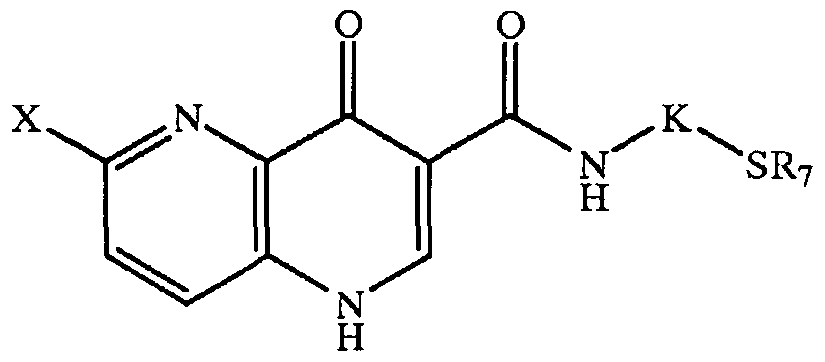
SR7 where K is as defined above for ix, and R.7 is hydrogen, lower alkyl having 1-6 carbon atoms, or cycloalkyl having 3-7 carbon atoms; and (xiii) a group of the formula:
NR,4Ri5 where K is as defined above for ix; and R1 and R15 independently represent hydrogen, lower alkyl having 1-6 carbon atoms, cycloalkyl having 3-7 carbon atoms, -S02 R8 where R8 is as defined above, or R14 and R13 together with the nitrogen atom to which they are attached form a heterocyclic moiety such as imidazolyl, pyrrolidinyl, morpholinyl, piperazinyl, or piperidinyl;
(xiv) a group of the formula:


w where K is as defined above for ix; and W is heteroaryl; (xvii) a group of the formula:


(xxii) pyrimidinyl(d -C6)alkyl or pyridyl(d -C6)alkyl; or (xxiii) a group of the formula:


R20 is phenyl, pyridyl, or pyrimidinyl, each of which is optionally mono-, di-, or trisubstituted independently with halogen, hydroxy, d -C6 alkoxy, amino, or mono- or di(d - C6)alkylamino.
Specific compounds made by the process of the invention include those having pyrimidinyl(d -C6)alkyl Y groups, wherein Y is more specifically 2- and 4-pyrimidinylmethyl, or having pyridyl(d -C6)alkyl Y groups, wherein Y is more specifically 2- and 4-pyridylmethyl.
Specific benzyl Y groups are those where R18 is amino or a substituted methyl or ethyl group. More specific R18 substituents are piperazin-1-yl or piperidin-1 -yl substituted at the 4-position with a halogenated benzyl group. Other specific benzyl Y groups are 4-[1-[4-(4-Fluorobenzyl)piperazinyl] methyl]benzyl and 4-[1-[4-(4-Fluorobenzyl)piperidinyl]methyl]benzyl.
Specific "X" groups in formulas IIIA and IIA are various quinolinyl, isoquinolinyl, tetrahydroquinolinyl, or tetrahydroisoquinolinyl groups, e.g., groups of the formulas:

The following formulae represent specific compounds prepared by the process of the present invention:
IV

wherein Y is defined above.
V

wherein Z represents halogen and Y is as defined above.
VI

VII

VIII

IX


XI

XII

XIII

XIV

XV

XVI

XVII

XVIII

XIX
-13-
XX


Ru, Rn , and R12 are the same or different and may be selected from hydrogen, (d - C6)alkyl, halogen, hydroxy, -OR,, -CR7 (R9)NR5 R6, -CR7 (RgJOFt, ; or Ru and R12 taken together with the atoms to which they are attached form a
(hetero)cyclic ring; and
R9 is as defined above.

XXIV

XXV


XXVII

XXVIII

Specific compounds prepared by the process of the present invention are encompassed by the following formula
XXIX

Other specific compounds of Formula XXIX made in accord with the invention are those wherein A is methylene, Ra is phenyl optionally substituted with methyl or ethyl, and Rb is lower alkyl Still other specific compounds of Formula XXIX are those wherein A is methylene, Ra is phenyl and Rb is d -C3 alkyl
XXX

Specific compounds of Formula XXX made in accord with the invention are those where A is methylene, Ra and Ra are independently phenyl optionally substituted with methyl or ethyl, and Rc is lower alkyl Other specific compounds of Formula XXX are those where A
is methylene, Ra is phenyl substituted in the para position with lower alkyl, Ra is phenyl, and Rc is d -C3 alkyl.
XXXI

Specific compounds of Formula XXXI made in accord with the invention are those where A is C2 -C4 alkylene. Other specific compounds of Formula XXXI are those where A is C2 -C alkylene, Rd is Ci -C3 alkyl, and Re is C2 -C4 alkyl.
XXXII


Specific compounds of Formula XXXII made in accord with the invention are those where A is Ci -C3 alkylene. Other specific compounds of Formula XXXII are those where A is C2 -C4 alkylene, Rd is d -C3 alkyl, and Re is C2 -C4 alkyl. Yet other specific compounds of Formula XXXII are those where A is C2 -C alkylene, Rd is Ci -C3 alkyl, Re is C2 -C4 alkyl, and E is nitrogen and M is methylene, E is oxygen and M is methylene or ethylene, or E and M are both nitrogen. Further specific compounds of Formula XXXII are those where Rf is furanyl, tetrahydrofuranyl, or imidazolyl.
 wherein A is Ci -C6 alkylene; Rd is lower alkyl optionally substituted with amino or mono- or di(d -C6)alkylamino; and Ra ' is phenyl optionally mono-, di-, or trisubstituted with halogen, lower alkyl, lower alkoxy, or mono- or di-d -C6 alkylamino, or mono- or di-Ci -d alkylamino lower alkyl.
Other specific compounds of Formula XXXIII are those where A is Ci -C3 alkylene, Ra is phenyl optionally substituted with methyl or ethyl, and Rd is Ci -C3 alkyl. Still other specific compounds of Formula XXXIII are where A is methylene, Ra is phenyl optionally substituted with methyl or ethyl, and Rd is C3 -C6 alkyl. Other specific compounds of Formula XXXIII are those where Ra is phenyl substituted with mono- or di- (Ci -C6) alkylamino lower alkyl.
XXXI I la

Other specific compounds of Formula XXXIIIa are those where Ra is imidazolyl and Rd is Ci -C3 alkyl. Still other preferred compounds of Formula XXXIIIa are where A is methylene, Ra- is imidazolyl, and Rd is C3 -C6 alkyl.
XXXIV

XXXV

Specific compounds of Formula XXXV are those where A is Ci -C3 alkylene, Ra is phenyl optionally substituted with lower alkyl or halogen, and D is nitrogen. Other specific compounds of Formula XXXV are where A is methylene, Ra is phenyl optionally substituted with lower alkyl or halogen, D is nitrogen, and D' is oxygen.
XXXVI
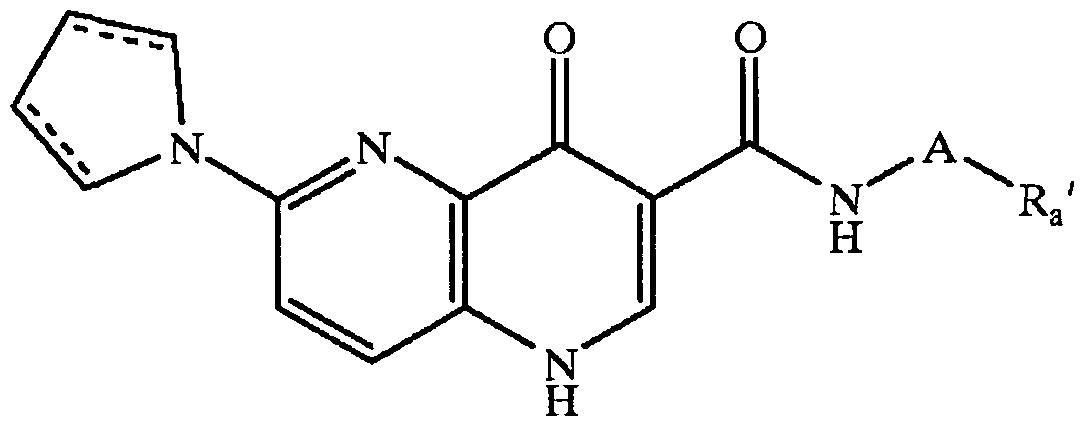
Specific compounds of Formula XXXVI are those where A is Ci -C3 alkylene, and Ra is phenyl optionally substituted with lower alkyl or halogen. Other specific compounds of Formula XXXVI are where A is methylene, Ra is phenyl optionally substituted with lower alkyl, lower alkoxy or halogen.
 wherein A is Ci -C6 alkylene; and Rd is lower alkyl; A' represents oxygen or methylene; and r is an integer of from 1-3.
Specific compounds of Formula XXXVII are those where A is Ci -C3 alkylene. Other specific compounds of Formula XXXVII are those where A is Ci -C3 alkylene, and Rd is Ci -C3 alkyl.
XXXVI la

Specific compounds of Formula XXXVIIa are those where A is Ci -C3 alkylene. Other specific compounds of Formula XXXVIIa are those where A is Ci -C3 alkylene, and Rh is Ci - C3 alkyl.
XXXVIII


Specific compounds of Formula XXXX are those where R| is lower alkoxy and Rm is tetrahydropyranyl.
XXXXI


XXXXII

XXXXIII

XXXXIV

(ii) (ii) lower alkyl optionally substituted with

Specific compounds of Formula XXXXIV are those where V is nitrogen and X is Ci - C6 alkoxy or Ci -C6 alkyl optionally substituted with up to three halogen atoms. Other specific compounds of XXXXIV are those where V and V are nitrogen; X is Ci - C3 alkoxy or d -C3 alkyl optionally substituted with up to three halogen atoms; A" is methylene or ethylene; and R20 is halogenated phenyl. A specific R20 group is 4-fluorophenyl. Yet other specific compounds of XXXXIV are those where X is 2,2,2-trifluoroethyl; V and V are nitrogen; R20 is halogenated phenyl; and A and A" are methylene or ethylene.
In certain situations, compounds of Formulas II and III may contain one or more asymmetric carbon atoms, so that the compounds can exist in different stereoisomeric forms. These compounds can be, for example, racemates or optically active forms. In these situations, the single enantiomers, i.e., optically active forms, can be obtained by asymmetric synthesis or by resolution of the racemates. Resolution of the racemates can be accomplished, for example, by conventional methods such as crystallization in the presence of a resolving agent, or chromatography, using, for example a chiral HPLC column.
Representative compounds which are encompassed by Formula III, and may be prepared by the process of the present invention include, but are not limited to, the compounds in Table I and their pharmaceutically acceptable acid and base addition salts. In addition, if the compound of the invention is obtained as an acid addition salt, the free base can be obtained by basifying a solution of the acid salt. Conversely, if the product is a free base, an addition salt, particularly a pharmaceutically acceptable addition salt, may be produced by dissolving the free base in a suitable organic solvent and treating the solution with an acid, in accordance with conventional procedures for preparing acid addition salts from base compounds.
Non-toxic pharmaceutical salts include salts of acids such as hydrochloric, phosphoric, hydrobromic, sulfuric, sulfinic, formic, toluenesulfonic, methanesulfonic, nitric, benzoic, citric, tartaric, maleic, hydroiodic, alkanoic such as acetic, HOOC-(CH2)n-COOH where n is 0-4, and the like. Non-toxic pharmaceutical base addition salts include salts of bases such as sodium, potassium, calcium, ammonium, and the like. Those skilled in the art will recognize a wide variety of non-toxic pharmaceutically acceptable addition salts.
The process of the present invention also encompasses the acylated prodrugs of the compounds of Formula III. Those skilled in the art will recognize various synthetic methodologies which may be employed to prepare non-toxic pharmaceutically acceptable addition salts and acylated prodrugs of the compounds encompassed by Formula III.
By lower alkyl in the present invention is meant straight or branched chain alkyl groups having 1-6 carbon atoms, such as, for example, methyl, ethyl, propyl, isopropyl, n- butyl, sec-butyl, tert-butyl, pentyl, 2-pentyl, isopentyl, neopentyl, hexyl, 2-hexyl, 3-hexyl, and 3-methylpentyl. By cycloalkyl in the present invention is meant cycloalkyl groups having 3-7 atoms such as, for example cyclopropyl, cyclobutyl, cyclopentyl, cyclohexyl, and cycloheptyl.
By aryl is meant an aromatic carbocyclic group having a single ring (e.g., phenyl), multiple rings (e.g., biphenyl), or multiple condensed rings in which at least one is aromatic,
(e.g., 1 ,2,3,4-tetrahydronaphthyl, naphthyl, anthryl, or phenanthryl), which is optionally mono-, di-, or trisubstituted with, e.g., halogen, lower alkyl, lower alkoxy, lower alkylthio, trifluoromethyl, lower acyloxy, aryl, heteroaryl, and hydroxy.
By lower alkoxy in the present invention is meant straight or branched chain alkoxy groups having 1-6 carbon "atoms, such as, for example, methoxy, ethoxy, propoxy, isopropoxy, n-butoxy, sec-butoxy, tert-butoxy, pentoxy, 2-pentyl, isopentoxy, neopentoxy, hexoxy, 2-hexoxy, 3-hexoxy, and 3-methylpentoxy.
By cycloalkoxy in the present invention is meant cycloalkylalkoxy groups having 3-7 carbon atoms where cycloalkyl is defined above.
By halogen in the present invention is meant fluorine, bromine, chlorine, and iodine.
By heteroaryl (aromatic heterocycle) in the present invention is meant one or more aromatic ring systems of 5-, 6-, or 7-membered rings containing at least one and up to four hetero atoms selected from nitrogen, oxygen, or sulfur. Such heteroaryl groups include, for example, thienyl, furanyl, thiazolyl, imidazolyl, (is)oxazolyl, pyridyl, pyrimidinyl, (iso)quinolinyl, naphthyridinyl, benzimidazolyl, and benzoxazolyl.
Specific examples of heteroaryl groups are the following:

Where Y represents a carbocyclic group, it is attached to the amide nitrogen by a single bond. The result is an amide of the formula:


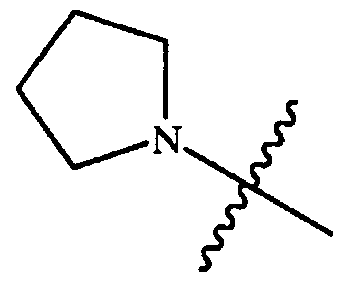
Where Y is a carbocyclic group, such moiety or group includes both aromatic heterocycles (heteroaryl groups), unsaturated heterocylic ring systems, and saturated heterocyclic ring systems Examples of such groups are imidazolyl, pyrrolidinyl, morpholinyl, piperazinyl, or piperidinyl Specific Y carbocyclic groups are linked to the parent naphthyridine carboxamide group by a nitrogen atom in the Y carbocyclic group Thus, for example, when piperidinyl is the Y carbocyclic group, it is specifically a 1 -piperidinyl group of the formula

By "optionally substituted phenyl" as used herein is meant phenyl groups that are unsubstituted or substituted with up to 3 groups selected independently from halogen, hydroxy, lower alkyl, lower alkoxy, tπfluoromethyl, and mono- or di-lower alkylamino Representative compounds that may be prepared by the process of the present invention are shown below in Table 1
TABLE 1

1. C6H5CH2NH- — CH CH CH2CH3
2 p-CH3C6H4S02N(CH3)- -CH2C6H5
3 CH3CH20-- -CH2CH2CH2OCH(GH3)2

5. CH3O- -CH2CH2SCH2CH3

7. 0(CH2CH2)2N-- -CH2C6H4F-o
8. (CH2CH2CH2CH2)N- -CH2C6H4OCH3-p

10. CH3CH2O- --CH2C6H4CH2NHCH3-p
11. CH3CH2O- --CH2CeH5
DETAILED DESCRIPTION OF THE INVENTION
The process of the present invention and the preparation of the compounds of the present invention are illustrated in Scheme 1. The preparation of the compound of Formula III from the compound of Formula II is described in Scheme 1 and the discussion that follows, wherein, unless otherwise indicated, X and Y are as defined above.
SCHEME 1

Overall the synthetic sequence of the scheme involves a single step which is direct reaction of the ester having structure II with primary amine I to form the carboxyamide having structure III.
In Scheme 1 the ester having structure II is treated with a primary amine, preferably an excess of primary amine, and heated to form carboxyamide III directly. Scheme 1 may be carried out without a solvent other than the amine but the use of a solvent, especially a polar solvent, is preferred. Preferred solvents include amide solvents such as dimethylacetamide (DMAc), dimethylformamide (DMF) or N-methylpyrollidone (NMP), or a sulfoxide solvent, such as dimethylsulfoκide (DMSO). Scheme 1 is carried out by heating the ester of formula II
from about 90° C to approximately the reflux temperature of the solvent, preferably to about 150° C, more preferably to about 105° C to about 110° C for about 1 hour to about 24 hours, with about 14 hours preferred. The process of Scheme 1 is preferably carried out under an inert atmosphere such as nitrogen or argon although this is not essential. The solution is cooled to about 5°C to about 35°C, with about 22°C preferred. The solution is then poured into water and the precipitated solid washed filtered and dried and optionally recrystallized. In a preferred variation, the reaction mixture is filtered and the residue is washed with solvent with the washings added to the filtrate. While maintaining the filtrate below about 35° C equal quantities of acetone and water are added and the mixture is acidified to about pH 3 with an acid, preferably HCI to form a slurry which is then filtered dried and optionally recrystallized. Other variants on this general procedure will be evident to those skilled in the art.
The present invention is illustrated by the following examples, but it is not limited to the details thereof.
EXAMPLE 1 N-benzyl-6-ethoxy-4-oxo-1 ,4-dihydro-1.5-naphthyridine-3-carboxamide
A mixture of 6-ethoxy-4-oxo-1 ,4-dihydro-1 ,5-naphthyridine-3-carboxylic acid ethyl ester (0.964 g, 4.1 mM) and benzylamine (1.97 g, about 5 equivalents) in 10 mL of DMAc was heated at 150°C overnight. The clear solution was cooled to room temperature and poured into 50 mL water. The precipitated solid was filtered and dried. HPLC showed about 9% of the title product was present with the remainder unreacted starting material.
EXAMPLE 2 N-benzyl-6-ethoxy-4-oxo-1 ,4-dihvdro-1 ,5-naphthyridine-3-carboxamide - DMSO Solvent
A slurry of 6-ethoxy-4-oxo-1 ,4-dihydro-1 ,5-naphthyridine-3-carboxylic acid ethyl ester (10 g, 0.038 M) and 50 ml dimethylsulfoxide (DMSO) were heated to 105° - 1 10° C. Benzylamine (12.5 g, 0.12 M - 15.0 g, 0.14 M) was added to the heated slurry. The addition flask was rinsed with 5 ml DMSO which was also added to the slurry. The heated reaction mixture was stirred for 2 - 6 hours and then cooled to room temperature. The reaction mixture was filtered and the residue rinsed with 5 ml DMSO. Acetone (25 mL) and water 25 mL were added to the filtrate while maintaining it at a temperature below 35° C. The acidity of the mixture was adjusted to pH 3 with 6 - 8 mL of concentrated HCI. The slurry was diluted with 23 mL water and cooled to about 5° C. The product was collected by filtration and washed with 100 mL water and then dried under vacuum at about 70°C to give an average of 12 g (97.4 % yield) of the title compound. The product was recrystallized by dissolving the solid in 120 mL acetic acid at temperatures greater than 90°C and filtering the resultant solution. The filtrate was cooled to about 60°C and then diluted with 32-50 mL of water having a temperature of approximately
55°C. The filtrate was slowly cooled to about 3°C. The product was collected and washed with 60 mL water and dried under vacuum at about 70°C to recover an average of 8.35 g (69.6 % recovery) for an average overall yield of 67.5%. The product was milled through a 0.05 round hole screen. EXAMPLE 3
N-benzyl-6-ethoxy-4-oxo-1 ,4-dihvdro-1 ,5-naphthyridine-3-carboxamide - DMF Solvent
A slurry of 6-ethoxy-4-oxo-1 ,4-dihydro-1 ,5-naphthyridine-3-carboxylic acid ethyl ester (10 g, 0.038 M) and 50 ml dimethylformamide (DMF) were heated to 105° - 1 10° C. Benzylamine (17 g, 0.16 M) was added to the heated slurry. The addition flask was rinsed with 5 ml DMSO which was also added to the slurry. The heated reaction mixture was stirred at least 14 hours and then cooled to about 40°C. The reaction mixture was filtered and the residue rinsed with 5 ml DMF. Water (120 mL) was added to the filtrate while maintaining it at a temperature below 45° C. The acidity of the mixture was adjusted to pH 4 with about 15 mL of concentrated HCI. The mixture was cooled to about 5° C. The product was collected by filtration and washed with 40 mL water and then dried under vacuum at about 70°C to give 8.9 g (72.2 % yield) of the title compound.
The product was recrystallized by dissolving the solid in 89 mL acetic acid at temperatures greater than 90°C and filtering the resultant solution. The filtrate was cooled to about 55°C and then diluted with 22 mL of water having a temperature of approximately 50°C. The filtrate was slowly cooled to about 3°C. The product was collected by filtration and washed with 53 mL water and dried under vacuum at about 70°C to recover 6.3 g (70.8 % recovery) for an average overall yield of 51 %. The product was milled through a 0.05 round hole screen.
Claims
CLAIMS process of preparing a compound of the formula
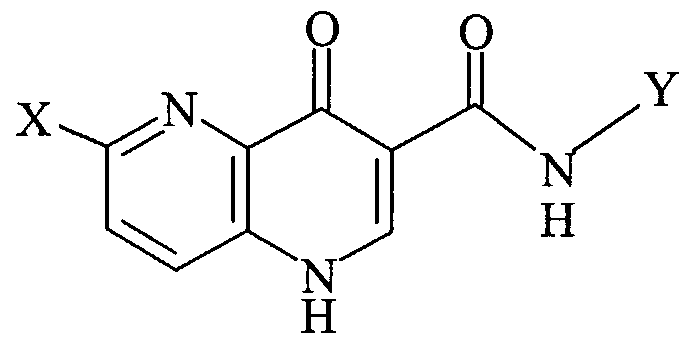
Y is lower alkyl having 1-8 carbon atoms optionally substituted with up to two groups selected from halogen, alkoxy, mono- or dialkylamino, sulfonamide, azacycloalkyl, cycloalkylthio, alkylthio, phenylthio, a heterocyclic group, -OR4, -NR5R6, SR7, or aryl; or a carbocyclic group having from 3-7 members atoms, where up to three of which members are optionally hetero atoms selected from oxygen and nitrogen and where any member of the Y carbocyclic group is optionally substituted with halogen, -OR4, -NR5R6, SR7, aryl or a heterocyclic group;
Ri and R4 are independently hydrogen, lower alkyl having 1-6 carbon atoms, or cycloalkyl having 3-7 carbon atoms, where each alkyl may be optionally substituted with - OR4, or -NR5R6;
R2. 3. R5 and R6 are independently the same or different and represent hydrogen, lower alkyl optionally mono- or disubstituted with alkoxy, aryl, halogen, or mono- or di-lower alkyl; aryl or aryl(Cι -C6)alkyl where each aryl is optionally substituted with up to three groups selected from halogen, hydroxy, Ci -C6 alkyl, d -C6 alkoxy, or mono- or di (Ci -C6) alkylamino; cycloalkyl having 3-7 carbon atoms optionally mono or disubstituted with halogen, alkoxy, or mono- or di-lower alkyl; or -S02R8;
R7 is hydrogen, lower alkyl having 1-6 carbon atoms, or cycloalkyl having 3-7 carbon atoms; and R8 is lower alkyl having 1-6 carbon atoms, cycloalkyl having 3-7 carbon atoms, or optionally substituted phenyl; said process comprising the step of heating a compound of the formula II

2. The process of claim 1 wherein the compound of formula III is prepared by heating the compound of formula II in the presence of an excess of the amine of formula I.
3. The process of claim 2 wherein the compound of formula III is prepared by heating the compound of formula II in the presence of an excess of the amine of formula I in a polar solvent.
4. The process of claim 3 wherein the compound of formula III is prepared by heating the compound of formula II in the presence of an excess of the amine of formula I in a polar solvent selected from amide solvents and sulfoxide solvents.
5. The process of claim 4 wherein the compound of formula III is prepared by heating the compound of formula II in the presence of an excess of the amine of formula I in a polar solvent selected from dimethylformamide, dimethylacetamide, N-methylpyrollidone or dimethylsulfoxide.
6. The process of claim 5 wherein the compound of formula III is prepared by heating the compound of formula II in the presence of an excess of the amine of formula I at a temperature of about 90°C to about 150°C.
7. A process of preparing a compound of the formula IIIA


< >
(CH2)m
where n is 0, 1 , or 2, and m is an integer of from 1 to 5, with the proviso that the sum of n+m is not less than 1 or greater than 5; and Ri is hydrogen, lower alkyl, or (C3 -C7)cycloalkyl, where the alkyl or cycloalkyl is optionally substituted with halogen, lower alkoxy, or mono- or di(Cι -C6)alkylamino;
(iii) a group of the formula:
3R2 . ^O.
G ^
where G is as defined above for ii; and R2 and R3 independently represent hydrogen, lower alkyl having 1-6 carbon atoms, cycloalkyl having 3-7 carbon atoms, ~S02 R8 where R8 is (Ci - C6)alkyl, (C3 -C7)cycloalkyl, or optionally substituted phenyl, or R2 and R3 together with the nitrogen atom to which they are attached form a heterocyclic moiety selected from imidazolyl, pyrrolidinyl, morpholinyl, piperazinyl, or piperidinyl; (iv) a group of the formula:

I2
where R2 and G are as defined above for iv and ii, respectively, and R5 and R6 independently represent hydrogen, lower alkyl having 1-6 carbon atoms, cycloalkyl having 3-7 carbon atoms, -SOz R8 where R8 is (d -C6)alkyl, (C3 -C7)cycloalkyl, or optionally substituted phenyl, or R5 and R6 together with the nitrogen atom to which they are attached form a heterocyclic moiety; (vi) a group of the formula:
O .N.
where G is as defined above for ii; or (vii) a group of the formula:

"^ OR9 where K is lower alkylene having 1-6 carbon atoms optionally substituted with (Ci -C6)alkyl or alkylene, or a cyclic group of the formula
K'
(CHjJm
(CH^/i where K' independently represents hydrogen or (Ci -C6) alkyl or alkylene, n is 0, 1 , or 2, and m is an integer of from 1 to 5, with the proviso that the sum of n+m is not less than 1 or greater than 5; and R9 is hydrogen, lower alkyl, or (C3 -C7)cycloalkyl, where the alkyl or cycloalkyl is optionally substituted with halogen, lower alkoxy, or mono- or dialkylamino; (x) a group of the formula:

*o' OR 13 where K is as defined above for ix, and R13 is hydrogen, lower alkyl having 1-6 carbon atoms, or cycloalkyl having 3-7 carbon atoms, where the alkyl and cycloalkyl groups are optionally substituted with one or more (Ci -C6)alkoxy or mono- or di(Cι -C6)alkylamino groups; and (xii) a group of the formula: K SR7 where K is as defined above for ix, and R7 is hydrogen, lower alkyl having 1-6 carbon atoms, or cycloalkyl having 3-7 carbon atoms; and (xiii) a group of the formula:
^ NR„R15 where K is as defined above for ix; and Ri4 and Rι5 independently represent hydrogen, lower alkyl having 1-6 carbon atoms, cycloalkyl having 3-7 carbon atoms, -S02 R8 where R8 is as defined above, or Ri4 and Ri3 together with the nitrogen atom to which they are attached form a heterocyclic moiety; (xiv) a group of the formula:
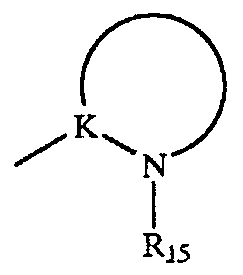

K„
W where K is as defined above for ix; and W is heteroaryl; (xvii) a group of the formula:


(xxi) a group of the formula:

(xxii) pyrimidiny d -C6)alkyl or pyridyl(d -C6)alkyl; or (xxiii) a group of the formula:  where Rι8 represents hydrogen, amino, mono-, or di(Cι -C6)alkylamino, or Ci -C6 alkyl optionally substituted with a Rι9 where R19 represents:

R20 is phenyl, pyridyl, or pyrimidinyl, each of which is optionally mono-, di-, or trisubstituted independently with halogen, hydroxy, Ci -C6 alkoxy, amino, or mono- or di(Cι - C6)alkylamino; which comprises treating a compound of the formula which comprises heating a compound of the formula IIA

8. The process of claim 7 wherein the compound of formula IIIA is prepared by heating the compound of formula IIA in the presence of an excess of the amine of formula IA.
9. The process of claim 8 wherein the compound of formula IIIA is prepared by heating the compound of formula IIA in the presence of an excess of the amine of formula IA in a polar solvent.
10. The process of claim 9 wherein the compound of formula IIIA is prepared by heating the compound of formula IIA in the presence of an excess of the amine of formula IA in a polar solvent selected from amide solvents and sulfoxide solvents.
11. The process of claim 10 wherein the compound of formula IIIA is prepared by heating the compound of formula IIA in the presence of an excess of the amine of formula IA in a polar solvent selected from dimethylformamide, dimethylacetamide, N-methylpyrollidone or dimethylsulfoxide.
12. The process of claim 11 wherein the compound of formula IIIA is prepared by heating the compound of formula IIA in the presence of an excess of the amine of formula IA at a temperature of about 90°C to about 150°C.
Applications Claiming Priority (2)
| Application Number | Priority Date | Filing Date | Title |
|---|---|---|---|
| US47373103P | 2003-05-28 | 2003-05-28 | |
| US60/473,731 | 2003-05-28 |
Publications (2)
| Publication Number | Publication Date |
|---|---|
| WO2004106334A2 true WO2004106334A2 (en) | 2004-12-09 |
| WO2004106334A3 WO2004106334A3 (en) | 2005-01-20 |
Family
ID=33490638
Family Applications (1)
| Application Number | Title | Priority Date | Filing Date |
|---|---|---|---|
| PCT/IB2004/001715 Ceased WO2004106334A2 (en) | 2003-05-28 | 2004-05-17 | Process for the preparation of 1,5-naphthyridine-3-carboxy amides by direct ester amidation |
Country Status (2)
| Country | Link |
|---|---|
| US (1) | US20050038065A1 (en) |
| WO (1) | WO2004106334A2 (en) |
Family Cites Families (5)
| Publication number | Priority date | Publication date | Assignee | Title |
|---|---|---|---|---|
| DE4227747A1 (en) * | 1992-08-21 | 1994-02-24 | Basf Ag | Heteroaromatically condensed hydroxypyridonecarboxamides, their preparation and use |
| US6143760A (en) * | 1997-08-25 | 2000-11-07 | Neurogen Corporation | Substituted 4-oxo-napthyridine-3-carboxamides: GABA brain receptor ligands |
| KR20010023313A (en) * | 1997-08-25 | 2001-03-26 | 해피 페너 ; 해리 에이치. 페너 2세 | Substituted 4-oxo-napthyridine-3-carboxamides as gaba brain receptor ligands |
| KR20030013378A (en) * | 2000-03-21 | 2003-02-14 | 파마시아 앤드 업존 캄파니 | 4-Hydroxy-1,8-Naphthyridine-3-Carboxamides as Antiviral Agents |
| US6730682B2 (en) * | 2000-07-12 | 2004-05-04 | Pharmacia & Upjohn Company | Heterocycle carboxamides as antiviral agents |
-
2004
- 2004-05-17 WO PCT/IB2004/001715 patent/WO2004106334A2/en not_active Ceased
- 2004-05-28 US US10/856,161 patent/US20050038065A1/en not_active Abandoned
Also Published As
| Publication number | Publication date |
|---|---|
| WO2004106334A3 (en) | 2005-01-20 |
| US20050038065A1 (en) | 2005-02-17 |
Similar Documents
| Publication | Publication Date | Title |
|---|---|---|
| JP2895961B2 (en) | Pyrrolopyrimidines as CRF antagonists | |
| AU645504B2 (en) | Bicyclic pyrimidine derivative, method of producing the same, and pharmaceutical preparation containing the same as active ingredient | |
| KR100457759B1 (en) | Substituted 6,6-Hetero-Bicyclic Derivatives | |
| US4382938A (en) | Imidazo[1,2-a] pyridine derivatives and their application as pharmaceuticals | |
| DE60315615T2 (en) | TRICYCLIC COMPOUNDS BASED ON THIOPHES AND MEDICAMENTS COMPRISING THEM | |
| US20040010007A1 (en) | Ether substituted imidazopyridines | |
| JPH02502462A (en) | Compound | |
| WO2005066170A1 (en) | Arylalkenyl and arylalkynyl substituted imidazoquinolines | |
| US4808594A (en) | Imidopyridines useful in therapy | |
| CZ219895A3 (en) | The use of substituted derivatives of 4-phenyl-6-aminonicotinic acid as medicaments | |
| FI81340C (en) | Process for the preparation of novel therapeutically useful oxindolka rboxamide derivatives | |
| FI88797B (en) | PROCEDURE FOR THE FRAMEWORK OF THERAPEUTIC ANVAENDBARA 2- (IMIDAZOPYRIDYL- AND IMIDAZOPYRIMIDYL) ALCOXIMETHYL-4-PHENYL-5-CARBAMOYL-6-METHYL-1,4-DIHYDROPYRIDINE | |
| KR20010023313A (en) | Substituted 4-oxo-napthyridine-3-carboxamides as gaba brain receptor ligands | |
| JPH0311067A (en) | Excitatory amino acid antagonist | |
| AU646485B2 (en) | Indolonaphthyridines, their production and use | |
| CN120136869A (en) | Tricyclic fused heterocyclic PDE3/4 dual inhibitors and preparation method and application thereof | |
| Rodríguez et al. | Synthesis and theoretical calculations of novel 5‐aryl substituted 2, 4, 7‐trioxo and 4, 7‐dioxo‐2‐thioxopyrido [2, 3‐d] pyrimidines | |
| WO2004106334A2 (en) | Process for the preparation of 1,5-naphthyridine-3-carboxy amides by direct ester amidation | |
| JPH0635458B2 (en) | Pyridonecarboxylic acid derivatives, their esters and their salts | |
| JPH06503814A (en) | Substituted tricyclic compounds | |
| WO2024035757A2 (en) | Tryptamines and methods of treating mood disorders | |
| CN117500787A (en) | Novel prodrugs and conjugates of dimochromic amine | |
| CA1133483A (en) | Hexahydro-trans-pyridoindole neuroleptic agents | |
| JP2875605B2 (en) | 3-exomethylenepyrrolo [2,1-b] thiazole derivatives | |
| WO2004106336A1 (en) | Process for the preparation and purification of 1,5-naphthyridine-3-carboxyamides |
Legal Events
| Date | Code | Title | Description |
|---|---|---|---|
| AK | Designated states |
Kind code of ref document: A2 Designated state(s): AE AG AL AM AT AU AZ BA BB BG BR BW BY BZ CA CH CN CO CR CU CZ DE DK DM DZ EC EE EG ES FI GB GD GE GH GM HR HU ID IL IN IS JP KE KG KP KR KZ LC LK LR LS LT LU LV MA MD MG MK MN MW MX MZ NA NI NO NZ OM PG PH PL PT RO RU SC SD SE SG SK SL SY TJ TM TN TR TT TZ UA UG US UZ VC VN YU ZA ZM ZW |
|
| AL | Designated countries for regional patents |
Kind code of ref document: A2 Designated state(s): GM KE LS MW MZ NA SD SL SZ TZ UG ZM ZW AM AZ BY KG KZ MD RU TJ TM AT BE BG CH CY CZ DE DK EE ES FI FR GB GR HU IE IT LU MC NL PL PT RO SE SI SK TR BF BJ CF CG CI CM GA GN GQ GW ML MR NE SN TD TG |
|
| DPEN | Request for preliminary examination filed prior to expiration of 19th month from priority date (pct application filed from 20040101) | ||
| 121 | Ep: the epo has been informed by wipo that ep was designated in this application | ||
| 122 | Ep: pct application non-entry in european phase |