WO2004103356A2 - Treatment of emotional dysregulation - Google Patents
Treatment of emotional dysregulation Download PDFInfo
- Publication number
- WO2004103356A2 WO2004103356A2 PCT/US2004/013005 US2004013005W WO2004103356A2 WO 2004103356 A2 WO2004103356 A2 WO 2004103356A2 US 2004013005 W US2004013005 W US 2004013005W WO 2004103356 A2 WO2004103356 A2 WO 2004103356A2
- Authority
- WO
- WIPO (PCT)
- Prior art keywords
- alkyl
- phenyl
- mmol
- methyl
- halo
- Prior art date
- Legal status (The legal status is an assumption and is not a legal conclusion. Google has not performed a legal analysis and makes no representation as to the accuracy of the status listed.)
- Ceased
Links
- 0 N#C*1OCCN(Cc2ccccc2)C1 Chemical compound N#C*1OCCN(Cc2ccccc2)C1 0.000 description 8
- ZJJXUEPWFIWWJV-RDJZCZTQSA-N FC(c1ccccc1S[C@H]([C@H]1OCCNC1)c1ccccc1)(F)F Chemical compound FC(c1ccccc1S[C@H]([C@H]1OCCNC1)c1ccccc1)(F)F ZJJXUEPWFIWWJV-RDJZCZTQSA-N 0.000 description 2
- VUIUUPMMRIZOPM-UHFFFAOYSA-N O=C(C1OCCN(Cc2ccccc2)C1)c1ccccc1 Chemical compound O=C(C1OCCN(Cc2ccccc2)C1)c1ccccc1 VUIUUPMMRIZOPM-UHFFFAOYSA-N 0.000 description 2
- WMUZKVNYNLRIEN-ZWKOTPCHSA-N Br[C@@H]([C@H]1OCCN(Cc2ccccc2)C1)c1ccccc1 Chemical compound Br[C@@H]([C@H]1OCCN(Cc2ccccc2)C1)c1ccccc1 WMUZKVNYNLRIEN-ZWKOTPCHSA-N 0.000 description 1
- SBNTVEFOIFNKTF-UHFFFAOYSA-N CC(CCN(CCOC)Cc1ccccc1)=O Chemical compound CC(CCN(CCOC)Cc1ccccc1)=O SBNTVEFOIFNKTF-UHFFFAOYSA-N 0.000 description 1
- IEZXZJWWTCEBGE-PMCHYTPCSA-N COc1c(CC([C@H]2OCCN(Cc3ccccc3)C2)(c2cc(F)ccc2)O)cccc1 Chemical compound COc1c(CC([C@H]2OCCN(Cc3ccccc3)C2)(c2cc(F)ccc2)O)cccc1 IEZXZJWWTCEBGE-PMCHYTPCSA-N 0.000 description 1
- GRQKZUXJGKCHMX-ZEQRLZLVSA-N C[C@]1([C@H](c2ccccc2)Sc(cccc2)c2-c2ccccc2)OCCNC1 Chemical compound C[C@]1([C@H](c2ccccc2)Sc(cccc2)c2-c2ccccc2)OCCNC1 GRQKZUXJGKCHMX-ZEQRLZLVSA-N 0.000 description 1
- VUIUUPMMRIZOPM-KRWDZBQOSA-N O=C([C@H]1OCCN(Cc2ccccc2)C1)c1ccccc1 Chemical compound O=C([C@H]1OCCN(Cc2ccccc2)C1)c1ccccc1 VUIUUPMMRIZOPM-KRWDZBQOSA-N 0.000 description 1
Classifications
-
- A—HUMAN NECESSITIES
- A61—MEDICAL OR VETERINARY SCIENCE; HYGIENE
- A61K—PREPARATIONS FOR MEDICAL, DENTAL OR TOILETRY PURPOSES
- A61K31/00—Medicinal preparations containing organic active ingredients
- A61K31/13—Amines
- A61K31/135—Amines having aromatic rings, e.g. ketamine, nortriptyline
- A61K31/138—Aryloxyalkylamines, e.g. propranolol, tamoxifen, phenoxybenzamine
-
- A—HUMAN NECESSITIES
- A61—MEDICAL OR VETERINARY SCIENCE; HYGIENE
- A61K—PREPARATIONS FOR MEDICAL, DENTAL OR TOILETRY PURPOSES
- A61K31/00—Medicinal preparations containing organic active ingredients
- A61K31/33—Heterocyclic compounds
- A61K31/395—Heterocyclic compounds having nitrogen as a ring hetero atom, e.g. guanethidine or rifamycins
- A61K31/435—Heterocyclic compounds having nitrogen as a ring hetero atom, e.g. guanethidine or rifamycins having six-membered rings with one nitrogen as the only ring hetero atom
- A61K31/47—Quinolines; Isoquinolines
- A61K31/4704—2-Quinolinones, e.g. carbostyril
-
- A—HUMAN NECESSITIES
- A61—MEDICAL OR VETERINARY SCIENCE; HYGIENE
- A61K—PREPARATIONS FOR MEDICAL, DENTAL OR TOILETRY PURPOSES
- A61K31/00—Medicinal preparations containing organic active ingredients
- A61K31/33—Heterocyclic compounds
- A61K31/395—Heterocyclic compounds having nitrogen as a ring hetero atom, e.g. guanethidine or rifamycins
- A61K31/535—Heterocyclic compounds having nitrogen as a ring hetero atom, e.g. guanethidine or rifamycins having six-membered rings with at least one nitrogen and one oxygen as the ring hetero atoms, e.g. 1,2-oxazines
- A61K31/5375—1,4-Oxazines, e.g. morpholine
-
- A—HUMAN NECESSITIES
- A61—MEDICAL OR VETERINARY SCIENCE; HYGIENE
- A61P—SPECIFIC THERAPEUTIC ACTIVITY OF CHEMICAL COMPOUNDS OR MEDICINAL PREPARATIONS
- A61P25/00—Drugs for disorders of the nervous system
Definitions
- the present invention relates to the fields of pharmaceutical chemistry and central nervous system medicine. More specifically, the present invention relates to methods of treating the symptoms of emotional dysregulation, which can occur in association with a number of psychiatric disorders.
- Emotional dysregulation is defined as: (1) a low threshold, or high sensitivity/vulnerability to emotional stimuli; (2) a high amplitude of emotional response; and (3) a slow return to baseline.
- the disorder is the combination of an emotional response system that is over-sensitive and over-reactive, with an inability to modulate the resulting strong emotions and reactions associated with them. People with this disorder exhibit emotional vulnerability, i.e., are readily and markedly distressed by relatively benign events, and maladaptive and inadequate emotional modulation strategies, i.e., are unable to inhibit inappropriate behavior related to strong negative or positive emotions, and to act in a way that is mood-dependent when necessary.
- Such people are also unable to self-soothe heightened physiological arousal that the strong emotion has induced, and are unable to refocus attention in the presence of strong emotion.
- Emotional dysregulation can disrupt a person's functioning, making it hard to work successfully, attend school, etc., and can affect interpersonal relationships.
- this disorder can lead people to engage in impulsive behavior, such as binge eating, substance abuse, and spending money unwisely, as a way of dealing with their feelings. Some sufferers say things they later regret; some harm themselves, and mink about suicide and even attempt it.
- the impulsive behavior can bring temporary relief, but usually makes the person feel worse later.
- DBT Dialectical behavior therapy
- the symptoms of emotional dysregulation can be observed in connection with a number of other psychiatric disorders. It is also possible that the symptoms of emotional dysregulation can occur independently of other disorders.
- ADHD attention-deficit hyperactivity disorder
- Borderline personality disorder is a serious mental illness characterized by pervasive instability in moods, interpersonal relationships, self-image, and behavior in which patients suffer from a disorder of emotion regulation. Although less well known than schizophrenia or bipolar disorder, BPD occurs more commonly, and affects two percent of adults, mostly young women (Swartz et al. (1990) Journal of Personality Disorders 4(3):257-272). Afflicted patients often require extensive mental health services, and account for 20 percent of psychiatric hospitalizations.
- Symptoms of BPD include intense bouts of anger, depression and anxiety that may last only hours, or at most a day (Zanarini et al. (1998) Harvard Review of Psychiatry 6(4):201-207). These may be associated with episodes of impulsive aggression, self-injury, and drug or alcohol abuse. Other impulsive behaviors include excessive spending, binge eating, and risky sex.
- Treatments include group and individual psychotherapy, and a psychosocial treatment termed dialectical behavior therapy (DBT).
- Pharmacological treatments include antidepressant drugs and mood stabilizers for depressed and/or labile mood, and antipsychotic drugs for distortions in thinking (Siever et al. (2000) Cerebrum, The Dana Forum on Brain Science 2(4)).
- Serotonin, norepinephrine and acetylcholine are among the chemical messengers in these circuits that play a role in the regulation of emotions, including sadness, anger, anxiety and irritability.
- Drugs that enhance brain serotonin function may improve emotional symptoms in BPD.
- mood-stabilizing drugs that are known to enhance the activity of GAB A, the brain's major inhibitory neurotransmitter, may help people who experience BPD-like mood swings. Emotional Dysregulation in Bipolar Disorder
- bipolar disorder also known as manic-depressive illness, causes extreme shifts in mood, energy, and functioning in afflicted patients.
- the disease affects men and women equally, and includes recurring cycles or episodes of depression, mania, or "mixed" manic and depressive symptoms, and may become more frequent, often disrupting work, school, family, and social life.
- Psychotic symptoms associated with bipolar disorder typically reflect the extreme mood state at the time.
- Pharmaceutical treatments include lithium and anticonvulsant medications such as valproate and carbamazepine. Research suggests that different combinations of lithium and anticonvulsants may be helpful. During depressive episodes, additional treatment with antidepressant medication is recommended.
- lithium or anticonvulsant mood stabilizers are prescribed along with an antidepressant to protect against a switch into mania or rapid cycling.
- newer atypical antipsychotic drugs such as clozapine or olanzapine may help relieve severe or refractory symptoms of bipolar disorder and prevent recurrences of mania.
- Research is ongoing to establish the safety and efficacy of atypical antipsychotics as long-term treatments for this disorder.
- Schizophrenia a chronic, severe, and disabling disease, affects approximately one percent ofthe U.S. population, i.e., more than 2 million Americans. It affects men and women with equal frequency, and may involve an imbalance in the neurotransmitters dopamine and glutamate. Symptoms include hearing internal voices not heard by others, or believing that other people are reading their minds, controlling their thoughts, or plotting to harm them. Early signs often appear as confusing, or even shocking, changes in behavior. "Psychosis,” a common condition in schizophrenia, is a state of mental impairment marked by hallucinations, which are disturbances of sensory perception, and/or delusions, which are false yet strongly held personal beliefs that result from an inability to separate real from unreal experiences.
- Schizophrenics sometimes exhibit prolonged extremes of elated or depressed mood, making it difficult to distinguish this mental disorder from others such as a manic-depressive (or bipolar) disorder or major depressive disorder. Such patients whose symptoms cannot be clearly categorized are sometimes diagnosed as having a "schizoaffective disorder.”
- Typical symptoms include distorted perceptions of reality, hallucinations and illusions, delusions, disordered thinking, and severe reduction in emotional expressiveness (a "blunted” or “flat” affect).
- Features ofthe latter include a lack of normal emotion, monotonous voice, diminished facial expressions, extreme apathy, social withdrawal, and lack of motivation and interest in or enjoyment of life.
- Pharmaceutical therapeutics for the treatment of schizophrenia include older antipsychotic medications such as haloperidol (Haldol®) and chlorpromazine (Thorazine®), and new "atypical antipsychotics” such as clozapine (Clozaril®), risperidone (Risperdal®), quetiapine (Seroquel®), and olanzapine (Zyprexa®).
- antipsychotics may not be helpful with other symptoms, such as reduced motivation and emotional expressiveness.
- the older antipsychotics may even produce side effects that resemble the more difficult to treat symptoms.
- Emotional Dysregulation in Intermittent Explosive Disorder While the prevalence of intermittent explosive disorder is unknown and considered to be rare, it may be more common than generally realized, and may be an important cause of violent behavior. Diagnostic criteria for intermittent explosive disorder include the occurrence of discrete episodes of failure to resist aggressive impulses that result in serious assaultive acts or destruction of property; the degree of aggressiveness expressed during an episode is grossly out of proportion to any provocation or precipitating psychosocial stressor.
- a diagnosis of intermittent explosive disorder is made only after other mental disorders that might account for episodes of aggressive behavior have been ruled out, such as antisocial personality disorder, borderline personality disorder, a psychotic disorder, a manic episode, conduct disorder, or attention-deficit/hyperactivity disorder, and the aggressive episodes are not due to the direct physiologic effects of a substance (e.g., a drug of abuse, a medication) or a general medical condition, for example, head trauma or Alzheimer's disease (The DSM-IV (Diagnostic and Statistical Manual of Mental Disorders, Fourth Edition ((1994) American Psychiatric Association, Washington, DC, page 610). The disorder is more common in men than women.
- CSF cerebrospinal fluid
- 5-hydroxyindoleacetic acid 5-HIAA
- compositions for intermittent explosive disorder include antidepressants, such as tricyclic antidepressants, serotonin reuptake inhibitors (SRIs), as well as mood stabilizers such as lithium, carbamazepine, and divalproex (McElroy-et al. (1998) J. Clin. Psychiatry 59:203-210; J.R. Lion (1992) Psychiatr. Ann. 22:64-66; McElroy et al. (1996) Compr. Psychiatry 37:229-240; Cutler et al. (1978) Am. J. Psychiatry 135:753-754).
- antidepressants such as tricyclic antidepressants, serotonin reuptake inhibitors (SRIs), as well as mood stabilizers such as lithium, carbamazepine, and divalproex
- the present invention provides a method of treating emotional dysregulation, comprising administering to a patient in need of such treatment an effective amount of a selective norepinephrine reuptake inhibitor.
- the selective norepinephrine reuptake inhibitor can be, but is not limited to, any ofthe compounds disclosed herein.
- the present invention provides the use of a selective norepinephrine reuptake inhibitor, such as any ofthe compounds disclosed herein, or other selective norepinephrine reuptake inhibitors, for the manufacture of a medicament for the treatment of emotional dysregulation.
- a selective norepinephrine reuptake inhibitor such as any ofthe compounds disclosed herein, or other selective norepinephrine reuptake inhibitors
- norepinephrine reuptake inhibitors are selective norepinephrine reuptake inhibitors, and no doubt many more will be identified in the future.
- Practice ofthe present invention encompasses the use of norepinehprine reuptake inhibitors that exhibit 50% effective concentrations of about 1000 nM or less in the protocol described by Wong et al. (1985) Drug Development Research, 6:397.
- Preferred norepinephrine reuptake inhibitors useful in the methods ofthe present invention are those that are selective for the inhibition of norepinephrine reuptake relative to their ability to act as direct agonists or antagonists at other receptors.
- the compounds useful in the methods ofthe present invention are selective for the inhibition of norepinephrine reuptake relative to direct agonist or antagonist activity at other receptors by a factor of at least ten, and even more preferably by a factor of at least one hundred.
- Norepinephrine reuptake inhibitors useful in the methods ofthe present invention include, but are not limited to:
- Atomoxetine (formerly known as tomoxetine), (R)-(-)-N-methyl-3-(2-methyl- phenoxy)-3-phenylpropylamine, is usually administered as the hydrochloride salt. Atomoxetine was first disclosed in U.S. Patent No. 4,314,081. The term “atomoxetine” will be used here to refer to any acid addition salt or the free base ofthe molecule. See, for example, Gehlert et al. (1993) Neuroscience Letters 157:203-206, for a discussion of atomoxetine's activity as a norepinephrine reuptake inhibitor;
- Reboxetine (EdronaxTM; ProliftTM; VestraTM; NoreboxTM), 2-
- Reboxetine is a selective norepinephrine reuptake inhibitor.
- the term "reboxetine” as used herein refers to any acid addition salt or the free base ofthe molecule existing as the racemate or either enantiomer, i.e., (S,S)-reboxetine or (R,R)-reboxetine.
- (S, " S)-reboxetine as a preferred selective norepinephrine reuptake inhibitor is disclosed in PCT International Publication No. WO 01/01973.
- X is C]-C 4 alkylthio
- Y is -C 2 alkyl or a pharmaceutically acceptable salt thereof.
- the compounds of formula I have been described in U.S. Patent No. 5,281,624, and in Gehlert et al. (1995) Life Sciences, 55(22):1915-1920. These compounds are disclosed as being inhibitors of norepinephrine reuptake in the brain. It should be noted that these compounds exist as stereoisomers, and accordingly include not only the racemates, but also the isolated individual isomers as well as mixtures ofthe individual isomers.
- the compounds of formula I include the following exemplary species:
- R is H
- Ar is a phenyl group
- X is a phenyl group
- R' is H or C ⁇ -C4 alkyl; each R ! is independently H or C1-C4 alkyl; and pharmaceutically acceptable salts thereof.
- the group Ar can be substituted or unsubstituted phenyl.
- Ar can be unsubstituted phenyl or, preferably phenyl substituted with 1, 2, 3, 4 or 5 substituents, preferably with 1 or 2, for example 1, substituent.
- the substituted phenyl group is preferably substituted in the 2- position. Suitable substituents include C1-C4 alkyl,
- the group X can be substituted or unsubstituted phenyl.
- X can be phenyl substituted with 1, 2, 3, 4 or 5 substituents, preferably with 1 substituent.
- Suitable substituents include C 1 -C4 alkyl, O(C ⁇ -C4 alkyl), and halo.
- Ci -C4 alkyl as used herein includes straight and branched chain alkyl groups of
- C1-C2 alkyl groups are preferred. Suitable substituents include halo.
- C1-C4 alkyl includes haloalkyl.
- Halo includes F, CI, Br and I, and is preferably F or C
- a particularly preferred substituted C1-C4 alkyl group for the group Ar is trifluoromethyl.
- a preferred group of compounds according to the present invention is represented by the formula (III):
- R2 and R3 are each independently selected from H, Ci -C4 alkyl, O(C ⁇ -C4 alkyl), S(C]-C4 alkyl), halo and phenyl; and R4 is selected from H and C1-C4 alkyl; and pharmaceutically acceptable salts thereof.
- R2 is preferably Ci -C3 alkyl, O(C ⁇ -C3 alkyl), F or Ph.
- R3 is preferably H.
- R4 is preferably H.
- R5 is a protecting group, e.g. benzyl
- X, R' and R 1 are as formula II above and Y is a leaving group, with an aryl thiol.
- suitable leaving groups include halo and mesylate, but the nature ofthe leaving group is not critical.
- Rx is H
- Ry is H or C ⁇ -C 4 alkyl; each Rz is independently H or Cj-C 4 alkyl; X represents O; Y represents OH or OR;
- R is C ⁇ -C 4 alkyl
- Aq and Ar2 are each independently selected from the group consisting of phenyl, and substituted phenyl; and pharmaceutically acceptable salts thereof.
- the group can be substituted or unsubstituted phenyl.
- Arj can be unsubstituted phenyl or, preferably phenyl substituted with 1, 2, 3, 4 or 5 substituents, preferably with 1 or 2, for example 1 , substituent.
- the substituted phenyl group is preferably substituted in the 2- position.
- Suitable substituents include Ci -C4 alkyl, O(C ⁇ -C4 alkyl), S(C ⁇ -C4 alkyl), halo, and phenyl, optionally substituted with, for example, halo, C1-C4 alkyl, or O(C ⁇ -C4 alkyl).
- the group Ar can be substituted or unsubstituted phenyl.
- Ar 2 can be phenyl substituted with 1, 2, 3, 4 or 5 substituents, preferably with 1 substituent.
- Suitable substituents include Ci -C4 alkyl, O(C ⁇ -C4 alkyl), and especially, halo.
- Ci -C4 alkyl as used herein includes straight and branched chain alkyl groups of
- Ci -C2 alkyl groups are preferred. Suitable substituents include halo. Thus the term "Ci -C4 alkyl” includes haloalkyl. A particularly preferred substituted Ci -C4 alkyl -group is trifluoromethyl.
- Halo includes F, CI, Br and I, and is preferably F or CI.
- a preferred group of compounds according to the present invention is represented by the formula (VI):
- R1 and R2 are each independently selected from H, C1-C4 alkyl, O(C ⁇ -
- C4 alkyl C4 alkyl), S(C ⁇ -C4 alkyl), halo and phenyl; and R3 is selected from H, C1-C4 alkyl and halo; and pharmaceutically acceptable salts thereof.
- R ⁇ is preferably C1-C3 alkyl, O(C ⁇ -C3 alkyl), F or Ph.
- R2 is preferably H.
- R3 is preferably H.
- the compounds of formulas (V) and (VI) are also selective inhibitors of norepinephrine reuptake. In addition, they are acid stable. Advantageously, they have a reduced interation with the liver enzyme CYP2D6.
- -X- is -C(R .4R ⁇ > 5x , -O- or -S-; n is 2 or 3; R ] is H or C 1 -C4 alkyl;
- R 3 is H, halo, -C alkyl, O(C!-C 4 alkyl), nitrile, phenyl or substituted phenyl;
- R 4 and R 5 are each independently selected from H or Cj-C 4 alkyl; Ar- is selected from the group consisting of
- R ,2a is H, halo, methyl or ethyl
- R is H, halo or methyl
- R 2c is H, halo, methyl, trifluoromethyl, nitrile, or methoxy
- R 2d is H, halo, methyl or ethyl
- R 2e is H, halo, methyl, trifluoromethyl, nitrile, or methoxy
- R 2f is H, or fluoro
- -Y- is -O-, -S- or-N(R 6 )-;
- R is H or methyl and pharmaceutically acceptable salts thereof.
- the term "Ci -C4 alkyl” as used herein includes straight and branched chain alkyl groups of 1, 2, 3 or 4 carbon atoms.
- C1-C4 alkyl includes methyl, ethyl, n-propyl, isopropyl, n-butyl, isobutyl, sec-butyl and tert-butyl.
- Ci -C2 alkyl groups are preferred.
- a particularly preferred C1-C4 alkyl group is methyl or ethyl.
- halo includes F, CI, Br and I, and is preferably F or CI.
- substituted phenyl means phenyl substituted with 1, 2, 3, 4 or 5 substituents, preferably with 1 or 2, for example 1, substituent.
- Suitable substituents include C1-C4 alkyl, O(C ⁇ -C4 a lky0 > S(C ⁇ -C4 alkyl), halo, and phenyl optionally substituted with, for example, C1-C4 alkyl, O(Cj-C4 alkyl), S(C]-C4 alkyl), or halo.
- O(C ⁇ -C alkyl) or "S(C ⁇ -C4 alkyl)" mean a Ci -C4 alkyl group as defined above linked to the point of substitution via an oxygen or a sulphur atom.
- An O(C ⁇ -C4 alkyl) or S(C ⁇ -C4 alkyl) group includes for example methoxy, ethoxy, thiomethyl or thioethyl.
- Another group of preferred compounds ofthe invention are compounds wherein Ar is (ii) and -Y- is -S-. More preferably Ar is 2-thiophenyl or 3-thiophenyl.
- R' is H or C ⁇ -C 4 alkyl
- R 3 is H, halo, phenyl or substituted phenyl
- R 2a is H, halo, methyl or ethyl
- R is H, halo or methyl; and pharmaceutically acceptable salts thereof.
- n 3
- R ] is H, methyl, ethyl or n-propyl. It is also preferred that R 3 is H or halo. While all compounds exhibiting norepinephrine reuptake inhibition are useful for the methods ofthe present invention, certain are preferred. It is preferred that the norepinephrine reuptake inhibitor is selective for the reuptake of norepinephrine over the reuptake of other neurotransmitters. It is also preferred that the norepinephrine reuptake inhibitor does not exhibit signigicant direct agonist or antagonist activity at other receptors.
- the norepinephrine reuptake inhibitor be selected from atomoxetine, reboxetine, (S,S)-reboxetine, (R)-N-methyl-3-(2-methyl-thiophenoxy)- 3-phenylpropylamine, benzyl morpholine derivatives of formulae II, III, V, and VI, and quinolone derivatives of formulae VII, Vila, and VIII .
- atomoxetine hydrochloride for the methods ofthe present invention is the most preferred embodiment ofthe present invention.
- the present invention encompasses pharmaceutical compositions comprising the compounds disclosed herein, or pharmaceutically acceptable salts thereof, together with a pharmaceutically acceptable carrier, diluent, or excipient.
- Many ofthe compounds used in this invention are amines, and accordingly react with any of a number of inorganic and organic acids to form pharmaceutically acceptable acid addition salts. Since some of the free amines ofthe compounds of this invention are typically oils at room temperature, it is preferable to convert the free amines to their pharmaceutically acceptable acid addition salts for ease of handling and administration, since the latter are routinely solid at room temperature.
- Acids commonly employed to form such salts are inorganic acids such as hydrochloric acid, hydrobromic acid, hydroiodic acid, sulfuric acid, phosphoric acid, and the like, and organic acids, such as r toluenesulfonic acid, methanesulfonic acid, oxalic acid, £-bromophenylsulfonic acid, carbonic acid, succinic acid, citric acid, benzoic acid, acetic acid and the like.
- inorganic acids such as hydrochloric acid, hydrobromic acid, hydroiodic acid, sulfuric acid, phosphoric acid, and the like
- organic acids such as r toluenesulfonic acid, methanesulfonic acid, oxalic acid, £-bromophenylsulfonic acid, carbonic acid, succinic acid, citric acid, benzoic acid, acetic acid and the like.
- salts thus are the sulfate, pyrosulfate, bisulfate, sulfite, bisulfite, phosphate, monohydrogenphosphate, dihydrogenphosphate, metaphosphate, pyrophosphate, chloride, bromide, iodide, acetate, propionate, decanoate, caprylate, acrylate, formate, isobutyrate, caproate, heptanoate, propiolate, oxalate, malonate, succinate, suberate, sebacate, fumarate, maleate, butyne-l,4-dioate, hexyne- 1,6-dioate, benzoate, chlorobenzoate, methylbenzoate, dinitrobenzoate, hydroxybenzoate, methoxybenzoate, phthalate, sulfonate, xylenesulfonate, phenylacetate, phenylpropionate, phen
- salts ofthe compounds of formulae II, III, V, VI, VII, Vila, and VIII include acid addition salts, including salts formed with inorganic acids, for example hydrochloric, hydrobromic, nitric, sulphuric or phosphoric acids, or with organic acids, such as organic carboxylic or organic sulphonic acids, for example, acetoxybenzoic, citric, glycolic, o- mandelic-1, mandelic-dl, mandelic d, maleic, mesotartaric monohydrate, hydroxymaleic, fumaric, lactobionic, malic, methanesulphonic, napsylic, naphtalenedisulfonic, naphtoic, oxalic, palmitic, phenylacetic, propionic, pyridyl hydroxy pyruvic, salicylic, stearic, succinic, sulphanilic,, tartaric, 2-hydroxyethane sulphonic, toluene-p
- salts can serve as intermediates in the purification of compounds, or in the preparation of other, for example pharmaceutically acceptable, acid addition salts, or are useful for identification, characterization, or purification.
- the present invention encompasses the administration of a composition that exhibits selective norepinephrine reuptake inhibitor activity.
- the composition can comprise one or more agents that, individually or together, selectively inhibit norepinephrine reuptake.
- the dosages ofthe drugs used in the methods ofthe present invention must, in the final analysis, be set by the physician in charge ofthe case using knowledge ofthe dmgs, the properties ofthe drugs alone or in combination as determined in clinical trials, and the characteristics ofthe patient including diseases other than that for which the physician is treating the patient.
- General outlines ofthe dosages, and some preferred dosages, are as follows:
- Racemic reboxetine can be administered to an individual in an amount in the range of from about 2 to about 20 mg per patient per day, more preferably from about 4 to about 10 mg/day, and even more preferably from about 6 to about 10 mg/day. Depending on the formulation, the total daily dosage can be administered in smaller amounts up to two times per day.
- a preferred adult daily dose of optically pure (S,S) reboxetine can be in the range of from about 0.1 mg to about 10 mg, more preferably from about 0.5 mg to about 8 to 10 mg, per patient per day.
- the effective daily dose of reboxetine for a child is smaller, typically in the range of from about 0.1 mg to about 4 to about 5 mg/day.
- Treatments using compositions containing optically pure (S,S)-reboxetine are about 5 to about 8.5 times more effective in inhibiting the reuptake of norepinephrine than compositions containing a racemic mixture of (R,R)- and (S,S)- reboxetine, and therefore lower doses can be employed.
- PCT International Publication No. WO 01/01973 contains additional details concerning the dosing of (S,S) reboxetine.
- Compounds of formula I from about 0.01 mg/kg to about 20 mg/kg; preferred daily doses are from about 0.05 mg/kg to 10 mg/kg; more preferably from about 0.1 mg/kg to about 5 mg/kg;
- Compounds of formulae II and III from about 5 to about 500 mg, more preferably from about 25 to about 300 mg, ofthe active ingredient per patient per day.
- Compounds of formulae V and VI from about 5 to about 500 mg, more preferably from about 25 to about 300 mg, ofthe active ingredient per patient per day.
- Compounds of formulae VII, Vila, and VIII from about 5 to about 500 mg, more preferably from about 25 to about 300 mg, ofthe active ingredient per patient per day.
- the compounds disclosed herein can be administered by various routes, for example systemically via oral (including buccal or sublingual), topical (including buccal, sublingual, or transdermal), parenteral (including subcutaneous, intramuscular, intravenous, or intradermal administration), intra-pulmonary, vaginal, rectal, intranasal, ophthalmic, or intraperitoneal administration, or by an implantable extended release device. Oral administration is preferred.
- the route of administration can be varied in any way, limited by the physical properties ofthe drugs, the convenience ofthe patient and the caregiver, and other relevant circumstances (Remington's Pharmaceutical Sciences (1990) 18th Edition, Mack Publishing Co.).
- the pharmaceutical compositions are prepared in a manner well known in the pharmaceutical art.
- the carrier or excipient can be a solid, semi-solid, or liquid material that can serve as a vehicle or medium for ⁇ the active ingredient. Suitable carriers or excipients are well known in the art.
- the pharmaceutical composition can be adapted for oral, inhalation, parenteral, or topical use and can be administered to the patient in the form of tablets, capsules, aerosols, inhalants, suppositories, solutions, suspensions, or the like.
- the compounds ofthe present invention can be administered orally, for example, with an inert diluent or capsules or compressed into tablets.
- the compounds can be incorporated with excipients and used in the form of tablets, troches, capsules, elixirs, suspensions, syrups, wafers, chewing gums and the like.
- These preparations should contain at least 4% ofthe compound ofthe present invention, the active ingredient, but can be varied depending upon the particular form and can conveniently be between 4% to about 70% ofthe weight ofthe unit.
- the amount ofthe compound present in compositions is such that a suitable dosage will be obtained.
- Preferred compositions and preparations according to the present invention can be determined by a person skilled in the art.
- the tablets, pills, capsules, troches, and the like can also contain one or more of the following adjuvants: binders such as microcrystaUine cellulose, gum tragacanth >r gelatin; excipients such as starch or lactose, disintegrating agents such as alginic acid, Primogel, corn starch and the like; lubricants such as magnesium stearate or Sterotex; glidants such as colloidal silicon dioxide; and sweetening agents such as sucrose or saccharin can be added or a flavoring agent such as peppermint, methyl salicylate or orange flavoring.
- binders such as microcrystaUine cellulose, gum tragacanth >r gelatin
- excipients such as starch or lactose, disintegrating agents such as alginic acid, Primogel, corn starch and the like
- lubricants such as magnesium stearate or Sterotex
- glidants such as colloidal silicon dioxide
- sweetening agents such as
- the dosage unit form When the dosage unit form is a capsule, it can contain, in addition to materials ofthe above type, a liquid carrier such as polyethylene glycol or a fatty oil.
- a liquid carrier such as polyethylene glycol or a fatty oil.
- Other dosage unit forms can contain other various materials that modify the physical form ofthe dosage unit, for example, as coatings.
- tablets or pills can be coated with sugar, shellac, or other coating agents.
- a syrup can contain, in addition to the present compounds, sucrose as a sweetening agent and certain preservatives, dyes and colorings and flavors. Materials used in preparing these various compositions should be pharmaceutically pure and non-toxic in the amounts used.
- a formulation useful for the administration of R-(-)-N-methyl 3-((2- methylphenyl)oxy)-3 -phenyl- 1-aminopropane hydrochloride comprises a dry mixture of R-(-)-N-methyl 3 -((2 -methylphenyl)oxy)-3 -phenyl- 1-aminopropane hydrochloride with a diluent and lubricant.
- a starch such as pregelatinized com starch, is a suitable diluent and a silicone oil, such as dimethicone, a suitable lubricant for use in hard gelatin capsules.
- Suitable formulations are prepared containing about 0.4 to 26% R- (-)-N-methyl 3-((2-methylphen-yl)oxy)-3-phenyl- 1-aminopropane hydrochloride, about 73 to 99%o starch, and about 0.2 to 1.0% silicone oil.
- Tables 1 and 2 illustrate particularly preferred formulations :
- the compounds ofthe present invention can be incorporated into a solution or suspension.
- These preparations typically contain at least 0.1 % of a compound ofthe invention, but can be varied to be between 0.1 and about 90% ofthe weight thereof.
- the amount ofthe compound of formula I present in such compositions is such that a suitable dosage will be obtained.
- the solutions or suspensions can also include one or more ofthe following adjuvants: sterile diluents such as water for injection, saline solution, fixed oils, polyethylene glycols, glycerine, propylene glycol or other synthetic solvents; antibacterial agents such as benzyl alcohol or methyl paraben; antioxidants such as ascorbic acid or sodium bisulfite; chelating agents such as ethylene diaminetetraacetic acid; buffers such as acetates, citrates or phosphates and agents for the adjustment of tonicity such as sodium chloride or dextrose.
- the parenteral preparation can be enclosed in ampoules, disposable syringes or multiple dose vials made of glass or plastic. Preferred compositions and preparations are able to be determined by one skilled in the art.
- the compounds ofthe present invention can also be administered topically, and when done so the carrier can suitably comprise a solution, ointment, or gel base.
- the base for example, can comprise one or more ofthe following: petrolatum, lanolin, polyethylene glycols, bees wax, mineral oil, diluents such as water and alcohol, and emulsifiers, and stabilizers.
- Topical formulations can contain a concentration ofthe compound, or its pharmaceutical salt, from about 0.1 to about 10% w/v (weight per unit volume).
- compositions are preferably formulated in a dosage unit form, i.e., physically discrete units suitable as unitary doses for human subjects and other mammals, each unit containing a predetermined quantity of active material calculated to produce the desired therapeutic effect, in association with a suitable pharmaceutical carrier, diluent, or excipient.
- WRAADDS Wender-Reimherr Adult Attention Deficit Disorder Scale
- the following examples are provided to illustrate various aspects ofthe present invention, and should not be construed to be limiting thereof in any way.
- the amino alcohol 3 a can be obtained by reaction of N-benzyl-cyanomorpholine 1 with a Grignard reagent, followed by acid hydrolysis to give racemic phenyl ketone 3 which can be separated on chiral HPLC. (2S)-Phenyl ketone 3a can then be reduced with DIP-Cl to give 4a in high diastereomeric excess.
- the amino alcohol 4a is converted into benzyl bromide 5a, to give the desired N-substituted aryl thio morpholines after displacement with the requisite aryl thiol. Deprotection ofthe tertiary amine gives the final products.
- Amino alcohol pair 4a,4b can be converted to bromide 5a,5b and further to racemic aryl thio morpholines as outlined in Scheme 4.
- Amino alcohol pair 4c,4d can be converted into the corresponding mesylate. Displacement with the requisite thiol, followed by removal ofthe nitrogen protecting group furnishes aryl thiol morpholines as racemic mixtures of two diastereomers.
- the racemic aryl thiol morpholines can be separated into enantiomerically pure products using chiral HPLC technology.
- Aryl-substituted morpholines 33, 35, 37 can be obtained from morpholinone 2 as outlined in Scheme 5:
- R meta-F
- N-Benzylmorpholinone (1.0 eq) and the requisite aldehyde (1.1 eq) were dissolved in anhydrous tetrahydrofuran (25 ml) under nitrogen and the reaction cooled to -78°C. Then, lithium diisopropylamide (1.1 eq of a 2M solution in heptane/tetrahydrofuran ethylbenzene) was added over approximately 20 minutes, whilst maintaining the reaction temperature below -78°C. The resulting yellow solution was stirred at -78°C for 1 hour and then allowed to warm to room temperature. The reaction was quenched with saturated ammonium chloride solution (25 ml) and extracted into ethyl acetate.
- a 31 double jacket reactor was charged with 1 (135.05 g; leq) (King, F.K.;
- the organic layers are filtrated on a bed of Celite 512 after adding some Celite to the layers themselves.
- the filtrated organic phase was dried over magnesium sulphate and evaporated to dryness.
- the ketone crystallizes readily on standing (132.4 g; 70%).
- Celite 512 160 g was added to the suspension which was then filtrated through a bed of Celite.
- the aqueous layer was separated and extracted with methylene chloride.
- the combined organic phases were dried over magnesium sulphate and evaporated to dryness to provide 35.8 g of 3a,3b enriched with unreacted nitrile.
- Compound 3a was obtained after separation using chiral HPLC on a Daicel chiralpak AD 20 ⁇ m column with 100% Ethanol / 0.3% DMEA as eluent at a flow rate of 150ml/min and UV-detection at 300nm.
- triphenylphosphine dibromide 14.04 g, 33.26 mmol
- the reaction mixture was heated at 60°C overnight. The mixture was allowed to cool to room temperature then washed with saturated aqueous sodium carbonate solution, dried over sodium sulphate and concentrated in vacuo.
- the solution was stirred at 0°C for 2 hours then at reflux for 1.5 hours, cooled, diluted with diethyl ether and washed with aqueous saturated sodium bicarbonate.
- the organic phase was extracted with 2N hydrochloric acid and the aqueous made basic by addition of solid sodium bicarbonate and extracted with diethyl ether.
- the organic phase was dried over magnesium sulphate, filtered and evaporated to a brown oil.
- Compound 8 was obtained from 5a (4.00 g, 11.55 mmol), 2-trifluoromethyl thiophenol (2.47 g, 13.86 mmol, 1.2 eq) and caesium carbonate (4.95 g, 15.24 mmol, 1.1 eq) in dimethylformamide (60 ml) as a brown oil following a modification of General Procedure 1 in which the reaction was carried out over 1 hour (6.04 g).
- Compound 9 (Example 1) was obtained from 8 (5.25 g, 11.84 mmol), solid supported Hunig's base (Argonaut, 3.56 mmol/g, 6.64 g, 23.67 mmol, 2 eq) and ⁇ - chloroethyl chloroformate (3.83 ml, 35.51 mmol, 3 eq) in anhydrous dichloromethane (75 ml) following General Procedure 2. After evaporation of solvents a light brown solid (5.60 g) was obtained which was recrystallised from iso-propanol. The solid was suspended in ethyl acetate and washed with an aqueous solution of sodium hydroxide (50 ml of a IM solution).
- Compound 10 was obtained from 5a (4.0 g, 11.55 mmol), 2-methylsulphenyl- thiophenol (2.17 g, 13.86 mmol, 1.2 eq) and caesium carbonate (4.42 g, 13.63 mmol, 1.18 eq) in dimethylformamide (35 ml) following a modification of General Procedure 1 in which the mixture was heated at 50°C for 1.5 hours, allowed to cool to room temperature, taken up in methanol and treated with SCX-2 (100 g). The SCX-2 was washed with methanol.
- Compound 11 (Example 2) was obtained from 10 (4.02 g, 9.53 mmol), solid supported H ⁇ nig's base (Argonaut, 3.56 mmol/g, 5.02 g, 17.87 mmol, 2 eq) and - chloroethyl chloroformate (3.09 ml, 28.6 mmol, 3 eq) in anhydrous dichloromethane (75 ml) following General Procedure 2. The mixture was heated at 40°C for 1.5 hours then left to stir at room temperature overnight. The reaction mixture was filtered and concentrated in vacuo to give a pale orange liquid. This was taken up in methanol (70 ml) and heated at 40°C for 2 hours.
- Compound 12 was obtained from 5a (4.04 g, 11.66 mmol), 2-isopropylsu ⁇ phenyl- thiophenol (2.35 ml, 14 mmol, 1.2 eq) and caesium carbonate (4.56 g, 14 mmol, 1.2 eq) in dimethylformamide (35 ml) following a modification of General Procedure 1 in which the mixture was heated at 90°C for 20 minutes, allowed to cool to room temperature, taken up in ethyl acetate (50 ml), washed with water and brine, dried over sodium sulphate, filtered and reduced in vacuo to give a yellow oil which was purified by SCX chromatography (eluent: ammonia/methanol 1/1 [v/v]).
- Compound 13 (Example 3) was obtained from 12 (4.44 g, 10.65 mmol), solid supported H ⁇ nig's base (Argonaut, 3.56 mmol/g, 6.05 g, 21.54 mmol, 2 eq) and ⁇ - chloroethyl chloroformate (3.30 ml, 32.0 mmol, 3 eq) in anhydrous dichloromethane (50 ml) following General Procedure 2. The mixture was heated at 40°C for 1.5 hours then left to stir at room temperature overnight. The reaction mixture was filtered and concentrated in vacuo to give a pale yellow liquid. This was taken up in methanol (50 ml) and heated at 60°C for 1.5 hours.
- Compound 14 was obtained from 5a (2.16 g, 6.24 mmol), 2 -phenyl sulphenyl- thiophenol (2.35 ml, 14 mmol, 1.2 eq) and caesium carbonate (2.43 g, 7.5 mmol, 1.2 eq) in dimethylformamide (50 ml) following a modification of General Procedure 1 in which the mixture was heated at 90°C for 20 minutes, allowed to cool to room temperature, taken up in ethyl acetate (50 ml), washed with water and brine, dried over sodium sulphate, filtered and reduced in vacuo to give a yellow oil.
- Compound 15 (Example 4) was obtained from 14 (2.95 g, 6.54 mmol), solid supported H ⁇ nig's base (Argonaut, 3.56 mmol/g, 13.06 g, 21.54 mmol, 2 eq) and ⁇ - chloroethyl chloroformate (2.0 ml, 19.6 mmol, 3 eq) in anhydrous dichloromethane (50 ml) following General Procedure 2. The reaction mixture was concentrated in vacuo to give a pale yellow liquid. This was taken up in methanol (70 ml) and heated at 40°C for 2 hours.
- Compound 17 (Example 5) was obtained from 16a,16b (0.72 g, 0.18 mmol), solid supported Hunig's base (Argonaut, 3.56 mmol/g, 2.0 g, 0.56 mmol, 3 eq) and ⁇ - chloroethyl chloroformate (0.62 ml, 0.56 mmol, 3 eq) in anhydrous dichloromethane (5 ml) following General Procedure 2 as a viscous yellow oil (0.O46 g, 82%) from which 17 was obtained as a single isomer after separation by chiral HPLC (0.016 g); Chiral LC (AD): 10.83 min.
- Compound 19 (Example 6) was obtained from 18a,18b (0.18 g, 0.52 mmol), solid supported H ⁇ nig's base (Argonaut, 3.56 mmol/g, 3.7 g, 1.04 mmol, 2 eq) and ⁇ - chloroethyl chloroformate (0.34 ml, 3.12 mmol, 3 eq) in anhydrous dichloromethane (5 ml) following General Procedure 2 as a viscous yellow oil (0.21 g, 86%) from which 19 was obtained after separation by chiral HPLC on chiral OD semi-preparative column; chiral LC (OD): 15.95 min.
- Compound 21 (Example 7) was obtained from 20a,20b (0.1 g, 0.25 mmol), solid supported Himig's base (Argonaut, 3.56 mmol/g, 1.78 g, 0.5 mmol, 2 eq) and - chloroethyl chloroformate (0.16 ml, 1.5 mmol, 3 eq) in anhydrous dichloromethane (5 ml) following General Procedure 2 as a viscous yellow oil ⁇ 0.06 g, 77%) from which 21 was obtained after separation by chiral HPLC on a Chiralcel OJ semi-preparative column. Chiral LC: 11.45 min.
- Compound 23 (Example 8) was obtained from 22a,22b (0.56 g, 1.3 mmol), solid supported H ⁇ nig's base (Argonaut, 3.56 mmol/g, 0.73 g, 2.6 mmol, 2 eq) and ⁇ - chloroethyl chloroformate (0.16 ml, 1.5 mmol, 3 eq) in anhydrous dichloromethane (5 ml) following General Procedure 2 as a viscous yellow oil (0.41 g, 93%) after separation using chiral HPLC on a OD semi-preparative column. Chiral LC (OD): 12.51 min.
- Compound 25 (Example 9) was obtained from 24a,24b (0.06 g, 0.13 mmol), solid supported H ⁇ nig's base (Argonaut, 3.56 mmol/g, 0.073 g, 0.026 mmol, 2 eq) and ⁇ - chloroethyl chloroformate (0.04 ml, 0.39mmol, 3 eq) in anhydrous dichloromethane (5 ml) following General Procedure 2 as a viscous yellow oil (0.021 g, 44%) from which 25 was obtained after separation using chiral HPLC on a OD semi-preparative column. Chiral LC (OJ): 12.60 min.
- Compound 33 (Example 13) was obtained from 32a,32b (0.28 g, 0.615 mmol), solid supported H nig's base (Argonaut, 3.56 mmol/g, 0.19 g, 0.68 mmol, 1.1 eq) and ⁇ - chloroethyl chloroformate (0.07 ml, 0.68 mmol, 1.1 eq) in anhydrous dichloromethane (5 ml) following General Procedure 2 as a colourless oil (0.22 g, 95%) from which 33 was obtained after chiral chromatography on a Chiralcel OJ semi-preparative column. Chiral LC (OJ): 13.33 min.
- Compound 35 (Example 14) was obtained from 34a,34b (0.41 g, 0.86 mmol), solid supported H ⁇ nig's base (Argonaut, 3.56 mmol/g, 0.27 g, 0.94 mmol, 1.1 eq) and ⁇ - chloroethyl chloroformate (0.10 ml, 0.94 mmol, 1.1 eq) in anhydrous dichloromethane (5 ml) following General Procedure 2 as a colourless oil (0.28 g, 84% yield) from which 35 was obtained after separation using chiral HPLC on a ChiralPak-AD OJ semi- preparative column; MW 387.85; C ⁇ 8 H ]7 ClF 3 NOS; LCMS (12 minute method): m/z 372 [M+H]+ @ Rt 5.2 min.
- Compound 37 (Example 15) was obtained from 36a,36b (0.43 g, 1.02 mmol), solid supported H ⁇ nig's base (Argonaut, 3.56 mmol/g, 0.37 g, 1.12 mmol, 1.1 eq) and ⁇ - chloroethyl chloroformate (1.08 ml, 10.12 mmol, 10 eq) in anhydrous dichloromethane (5 ml) following General Procedure 2 as a colourless oil (0.34 g, 99%) after separation by chiral HPLC on a ChiralPak-AD semi -preparative column. Chiral LC: 12.86 min.
- the compounds ofthe invention are norepinephrine reuptake inhibitors, and possess excellent activity in, for example, a scintillation proximity assay (e.g. J. Gobel, D.L. Saussy and A. Goetz (1999) J. Pharmacol. Toxicolo. 42, 237-244).
- a scintillation proximity assay e.g. J. Gobel, D.L. Saussy and A. Goetz (1999) J. Pharmacol. Toxicolo. 42, 237-244
- Example 16 In Vitro Determination ofthe Interaction of Compounds with CYP2D6 in Human Hepatic Microsomes Principle: The interaction of compounds with CYP2D6 was evaluated by the measurement ofthe inhibition ofthe bufuralol 1 '-hydroxylase activity by the compounds.
- Bufuralol 1 -hydroxylase activity is determined by using 0.5 mg/ml human liver microsomal protein (human biologies), 10 ⁇ mol/L bufuralol, in 0.1 M sodium phosphate buffer pH 7.4, incubated for 5 min at 37°C in the presence of 2 mM ⁇ NADPH, with 0, 5 or 25 ⁇ M ofthe test compound (inhibitor). The compound was dissolved in acetonitrile, such that the final concentration of acetonitrile in the incubation was 0.5%. The total reaction volume was 100 ⁇ l. The reaction was terminated by addition of 75 ⁇ l of methanol followed by centrifugation.40 ⁇ l of the supernatant was analysed by HPLC.
- a Beckman Ultrasphere C 18 column (5 ⁇ m, 250 x 4.6 mm) was used, with a 13 minute gradient from 100% of solvent A (0.02 M potassium dihydrogen phosphate buffer pH 3/methanol (65/35)) to 100 % of solvent B (0.02 M potassium dihydrogen phosphate buffer pH 3/methanol (20/80)), according to the following gradient.
- the ran time was 20 minutes. Formation of 1 '-hydroxybufuralol was detected by fluorimetric detection with extinction at ⁇ 252 nm and emission at ⁇ 302 nm.
- the percent of inhibition is calculated as follows:
- the IC 50 is calculated from the percent inhibition as -follows (assuming competitive
- the IC 50 estimation is assumed valid if inhibition is between 20% and 80% (Moody et al. (1999) Xenobiotica 29(1): 53-75).
- the anisotropic displacement factor exponent takes the form: -2 pi ⁇ 2 [ h ⁇ 2 a* ⁇ 2 U11 + ... + 2 h k a* b* U12 ]
- racemic intermediates of type 1 can be obtained as outlined in Scheme 8 by condensation of a N-benzyl cyanomorpholii e 5 (J. Med. Chem. 1993, 36, pp 683 - 689) with a suitable aryl organometallic reagent followed by acid hydrolysis. Chiral HPLC separations ofthe racemic N-benzyl-aryl-ketomorpholine of type 1 gives the required single enantiomers, i.e., the (2S)- N-benzyl-aryl-ketomorpholine of type 6 (Scheme 8).
- the intermediates 3 can be further elaborated using for example organometallic type couplings between an ortho bromide derivative of type 8 and an arylboronic acid as shown in Scheme 10.
- An alternative route for the preparation ofthe compounds of this invention is method B (see Scheme 7).
- Formation ofthe intermediate epoxides of type 2 from racemic N-benzyl -ketomorpholines of type 1, can be done using for example trimethyl sulfoxonium iodide and a suitable base, for example sodium hydride.
- Condensation of 2 with a commercially available aryl organometallic, or an aryl organometallic prepared from the corresponding halo aryl derivative gives the intermediates of type 3, as mixtures of diastereoisomers.
- Final deprotections can be done as described above (see scheme 3).
- Final compounds made using method B can be purified using chiral HPLC.
- N-benzylethanolamine (172.2 g ; 1 equiv.). 2-Chloroacrylonitrile (100 g; 1 equiv.) was added dropwise over 2 minutes. The temperature was maintained between 23 °C and 29 °C by means ofthe ice bath and subsequently a water bath at 15 °C. N- Benzylethanolamine was still detected on TLC after 4.5 h stining. After one night stirring at room temperature (water bath), no N-benzylethanolamine was detectable by 1H RM ⁇ . The mixture was dissolved in tetrahydrofuran and transferred to a 2 L reactor cooled to -5 °C by ice/ ⁇ aCl bath.
- Neat (5-Fluoro-2-methoxy-phenyl)-methanol (19.587g, 1 equiv.) was added to neat SOCl (42.2 mL, 4.6 equiv.) at -78°C under a nitrogen atmosphere and the solution was then allowed to warm to room temperature and stirred until evolution of gas had ceased.
- An equivalent volume of anhydrous toluene was added to the flask and the solution heated to 60°C. On cooling the reaction solution was poured onto ice water. The toluene layer was separated and dried (MgSO 4 ) and the solvent removed under reduced pressure.
- Solid magnesium turnings (9.5 g, 28 equiv.) under nitrogen atmosphere at room temperature were stirred vigorously with a magnetic stirring bar overnight. The magnesium was then covered with dry diethyl ether and to the suspension was added 1,2- dibromoethane (50 ⁇ L). A cold bath was then applied followed by dropwise addition of l-Bromomethyl-2-methoxy-benzene (18.18 g, 5 equiv.) in diethyl ether (71 mL) at a which maintained the temperature at up to 15 °C. The resulting black suspension was stirred at room temperature for 30 minutes and cooled down at -20 °C.
- the active enantiomer was obtained after a further preparative chiral HPLC separation.
- the active enantiomer, a white solid, was next taken up in ethanol and hydrogen chloride was added (large excess of 2M solution in diethyl ether) and the mixture was stined until it became a clear solution. Then all the volatiles were evaporated in vacuo, to give 447mg ofthe title compound as white solid.
- the aqueous solution was extracted with diethyl ether, the organic phase dried with MgSO 4 , and evaporated in vacuo.
- the crude material was purified using a column chromatography on silica gel eluting with a mixture of ethyl acetate/heptane (20/80) to give 825 mg ofthe title compound as a colourless oil (78 %), mixture of two diastereoisomers.
- the pharmacological profile ofthe present compounds can be demonstrated as follows.
- the compounds ofthe invention are norepinephrine reuptake inhibitors, and possess excellent activity in, for example; a scintillation proximity assay (e.g. J. Gobel, D.L. Saussy and A. Goetz (1999) J. Pharmacol. Toxicolo. 42:237-244).
- a scintillation proximity assay e.g. J. Gobel, D.L. Saussy and A. Goetz (1999) J. Pharmacol. Toxicolo. 42:237-244
- 3 H- nisoxetine binding to norepinephrine re-uptake sites in a cell line transfected with human norepinephrine transporter binding has been used to determine the affinity of ligands at the norepinephrine transporter.
- the acid stability of a compound according to the present invention was determined as a solution in buffer at 6 different pH values (HC1 0.1N, pH 2, pH 4, pH 6, pH 7, and pH 8) at 40°C over a time course of 72 hours. Samples were taken at the beginning ofthe study and after 3, 6 and 24 hours and analysed by capillary electrophoresis. The original sample used in this study contained 0.8% ofthe undesired epimer as internal standard. The samples taken at the different time points during the study did not show any significant change in the percentage ofthe undesired epimer. This confirms that the compound is chemically and configurationally stable under acidic conditions.
- the interaction of compounds with CYP2D6 was evaluated by the measurement ofthe inhibition ofthe bufuralol 1 '-hydroxylase activity by the compounds.
- Bufuralol 1 -hydroxylase activity is determined by using 0.5 mg/ml human liver microsomal protein (human biologies), 10 ⁇ mol/L bufuralol, in 0.1 M sodium phosphate buffer pH 7.4, incubated for 5 min at 37°C in the presence of 2 mM ⁇ NADPH, with 0, 5 or 25 ⁇ M ofthe test compound (inhibitor). The compound was dissolved in acetonitrile, such that the final concentration of acetonitrile in the incubation was 0.5%. The total reaction volume was 100 ⁇ l. The reaction was terminated by addition of 75 ⁇ l of methanol followed by centrifugation. 40 ⁇ l ofthe supernatant was analysed by HPLC.
- the percent of inhibition is calculated as follows: 100 xl'-hydroxybufuralol area formed with inhibitor l'-hydroxybufuralol area formed without inhibitor
- the IC 50 is calculated from the percent inhibition as follows (assuming competitive inhibition): Com P ound Conce n t r a t ion x( l00 - Pe rce n t o f i nh ib i tio n)
- the IC 50 estimation is assumed valid if inhibition is between 20% and 80%
- Quinolin-2-one (1) or its conesponding 4-oxo and 4-thio derivatives can be N- arylated using modified conditions to those reported by Buchwald ⁇ (2001) J. Am. Chem. Soc, 123:7727).
- the quinolin-2-one (1) is reacted with 3 equivalents of Ar- Br wherein Ar is (i) and R 2c is H, 0.2 equivalents of trans-cyclohexanediamine, 0.2 equivalent of copper iodide (Cul), 2.1 equivalents of potassium carbonate (K 2 CO 3 ), in an organic solvent such as 1 ,4-dioxane at a temperature of 125°C overnight.
- N- arylated quinolin-2-one (2) can be alkylated by treatment with a strong base such as lithium hexamethyldisilazide (LiHMDS) at temperatures of -78°C in a suitable organic solvent such as tetrahydrofuran (THF), followed by the addition of an alkyl halide such as alkyl iodide to give the corresponding 3-alkylated-N-arylated quinolin-2-one derivative (3).
- a strong base such as lithium hexamethyldisilazide (LiHMDS)
- THF tetrahydrofuran
- alkylating agents such as 1- bromo-2-chloroethane, or a 1,3-dihalopropane, such as l-bromo-3-chloropropane, as alkylating agents provides (4) or (5) wherein n is 2 or 3 respectively.
- halo analogues were chosen as ideal precursors to the desired amine products.
- treatment of (4) or (5) with aqueous methylamine, in the presence of a catalytic amount of a suitable iodide, such as potassium iodide (Kl), in ethanol at 100°C provided the racemic amine products (6) and (7) respectively, in moderate yields.
- Kl potassium iodide
- Quinolin-2-ones (2) and (3) can be alkylated using the aforementioned alkylating procedure using an allyl halide e.g. allyl bromide as the alkylating agent to give the conesponding 3-allyl-N-arylated-quinolin-2-ones (lla-g).
- Said allyl analogues could then be converted to the corresponding primary alcohols (12a-g) by a hydroboration procedure involving a suitable borane, such as 9-BBN in a suitable solvent such as THF.
- the alcohols were cleanly converted into their mesylates, by reaction of a mesyl halide such as mesyl chloride in the presence of a suitable base such as triethylamine in a suitable solvent such as THF at a suitable temperature such as 0°C to room temperature.
- the resulting mesylates are used directly in the animation step described above in method A to provide good yields ofthe final racemic targets (13a-g).
- Quinolin-2-one (1) can be protected using a suitable amide-protecting group as those described in T.W. Greene (1991) Protective Groups in Organic Synthesis, John Wiley and Sons, New York, N.Y., hereafter refened to as "Greene”.
- quinolin-2-one (1) can be protected with a 4-methoxybenzyl group.
- the protection reaction can be canied out for example using a suitable base, such as sodium hydride in a suitable solvent, such as dimethylformamide, followed by reaction with a 4- methoxybenzyl halide, such as 4-methoxybenzyl chloride, to give the corresponding N- protected derivative (14) in good yield.
- mesylation and amination sequence described in Method B provided both amines (18a-b).
- Deprotection of protected quinolin-2-one could be achieved using any suitable deprotection conditions as those shown in Greene.
- the 4-methoxybenzyl group could be cleaved cleanly using trifluoroacetic acid and anisole at 65°C.
- the resultant product could be selectively protected on the secondary amine with a suitable nitrogen protecting group as those described in Greene.
- the secondary amine can be protected with a Boc group.
- the reaction can be carried out with Boc anhydride in a suitable solvent such as THF to provide multi gram quantities of (19a-b).
- Reaction of (19a-b) with various aryl bromides using the previously described N- arylation conditions, deprotection using suitable deprotecting conditions such as those described in Greene gave a range of final racemic targets (21a-q or 22a-b).
- THF trifluoroacetic acid
- DCM dichoromethane
- Rl, R ⁇ , X, n and Ar have the values defined for formula (VII) above and L is a suitable leaving group such as for example chloride, bromide, iodide or mesylate.
- the reaction can be carried out as described above, by reacting a compound of formula (IX) with methylamine for example in the form of aqueous methylamine, optionally in the presence of a catalytic amount of a suitable iodide, such as potassium iodide (Kl), in ethanol at 100°C provided the racemic amine products (6) and (7) respectively, in moderate yields.
- a suitable iodide such as potassium iodide (Kl)
- the present invention provides a further process for the preparation of a compound of formula (VII) comprising the N-deprotection of a compound of formula (X):
- Rl, R3, X, n and Ar have the values defined for formula (VII) above and P is a suitable nitrogen protecting group such as those described in Greene, for example a Boc group.
- P is a suitable nitrogen protecting group such as those described in Greene, for example a Boc group.
- the reaction is carried out using suitable deprotecting conditions such as those described in Greene according to the nature ofthe nitrogen-protecting group used (P).
- suitable deprotecting conditions such as those described in Greene according to the nature ofthe nitrogen-protecting group used (P).
- TFA trifluoroacetic acid
- DCM dichoromethane
- Compounds ofthe present invention are norepinephrine reuptake inhibitors and are selective over other neurotransmitters, such as dopamine or serotonin, that is their binding affinity at the norepinephrine transporter is higher than their affinity for other transporters or other receptors. In addition, they are acid stable.
- neurotransmitters such as dopamine or serotonin
- Example 34 3-Ethyl-3-(3-methylamino-propyl)-l-phenyl-3,4-dihvdro-i ⁇ -quinolin-2-one (7b) This was prepared in an identical manner to (6a) using crude (5b) (528 mg) to give the crude product (105 mg), which was purified by preparative LCMS. The purified racemate was then separated into its individual enantiomers using chiral HPLC.
- Example 37 3-(3-MethvIamino-propyl -3-propyl-l- ⁇ -tolvI-3,4-dihvdro-Jiy-quinolin-2-one (13c) This was prepared from (3e) (840 mg, 2.6 mmol) using the same synthetic sequence described in method B (3d to 13b) to give 393 mg ofthe racemate. The racemate was separated into its individual enantiomers using chiral HPLC and each enantiomer was converted into its D-tartrate salt as described for (13b).
- a 5 litre flange-neck flask equipped with an air stirrer and paddle, thermometer, nitrogen bubbler and pressure equalising dropping funnel was charged with sodium hydride (25.5g, 60% oil dispersion, 0.637 mol) and 40-60 pet. ether (100 ml). The mixture was stined briefly and then allowed to settle under nitrogen. After decanting the supernatant liquid, the vessel was charged with dimethylformamide (2 litres). The well stined suspension was cooled to 7-8°C using an external ice-bath. Then a soln of 3,4- dihydro-lH-quinolin-2-one (la) (73.6g, 0.5 mole) in anhydrous dimethylformamide (500 ml) was added dropwise over 25 min.
- sodium hydride 25.5g, 60% oil dispersion, 0.637 mol
- 40-60 pet. ether 100 ml
- the mixture was stined briefly and then allowed to settle under nitrogen. After decanting the supernatant liquid,
- the reaction mixture was warmed to rt and then refluxed for 90 min.
- the reaction mixture was cooled to rt, poured into ethyl acetate and water and extracted.
- the organic layer was separated, dried over MgSO 4 and concentrated.
- the crude product was purified using automated chromatography (silica) (0 to 80% ethyl acetate ⁇ cyclohexane gradient) to provide the product as a clear oil (21.3 g, 84%).
- the crude mesylate (22 g, 99%) was dissolved in ethanol (500 mL) and aqueous 40% methylamine (200 mL) and heated at 65°C under nitrogen for 2 h. The reaction mixture was cooled, concentrated and then extracted with ethyl acetate (300 mL). The organic layer was washed with water, brine, dried over MgSO and oncentrated to give the crude product (17.8 g, 96%).
- reaction mixture was poured into ethyl acetate (400 mL) and water (200 mL) and extracted. The organic layer was separated, dried over MgSO and concentrated to give the product as a yellow solid (12.26 g, 100%). This material was used without further purification.
- Example 42 3-(3-Methylamino-propyl)-l-p-tolyl-3,4-dihvdro-J.H-quinolin-2-one (21a)
- (19a) 100 mg. 0.31 mmol
- K 2 CO 3 92 mg, 0.66 mmol
- tr ⁇ «s-cyclohexane-l,2-diamine (8 ⁇ L, 0.06 mmol)
- 4-bromotoluene (162 mg, 0.94 mmol) in 1,4-dioxane (0.5 mL) was heated under a nitrogen atmosphere at 125°C for 5 min to deoxygenate the reaction mixture.
- the reaction mixture was left to stir at room temperature for 90 min, concentrated under vacuo poured into ethyl acetate (50 mL) and aq. NaHCO 3 (20 mL) and extracted. The organic layer was separated, dried over MgSO 4 , concentrated and the crude product was purified by SCX-2 to provide the racemate (40 mg, 75%). The racemate was separated into its individual enantiomers using chiral HPLC.
- Example 54 l-f3.5-Difluorophenyl)-3-methyl-3-/3-methylamino-propyl)-3.,4-dihvdro-i ⁇ r- quinolin-2-one (21D) This was prepared from (19b) (100 mg, 0.30 mmol) using the same two-step procedure described for (21a) to provide the crude product, which was purified by SCX-2 to give the racemate (95 mg).
- Example 56 6-Chloro-l-(4-chlorophenyl -3-(3-methylamino-propyl)-3.4-dihvdro-JJ?-quinolin-2- one (210) This was prepared from (20a) (160 mg, 0.45 mmol) using the same two-step procedure described for (21a) to provide the crude product, which was purified by preparative LCMS to give the racemate (52 mg).
- Example 58 6-Chloro-l-(4-chlorophenyl)-3-methyl-3-(3-methylamino-propyl)-3,4-dihvdro-7jH- quinolin-2-one (21q) This was prepared from (20b) (490 mg, 1.34 mmol) using the same methods described for (21a) to provide the racemate (425 mg).
- Step (ii) The product from Step (i) (100 mg, 0.23 mmol), phenylboronic acid (85 mg, 0.70 mmol, 3 eq.), K 2 CO 3 (138 mg, 1 mmol, 4.3 eq.) and Pd(PPh 3 ) 4 (11 mg, 0.009 mmol, 0.04 eq.) were suspended in ethanol (1 mL) and water (0.6 mL).
- Example 61 3-Methyl-3-(3-methylamino-propyl)-6-phenyl-l-p-tolyl-3,4-dihydro-l ⁇ -quinolin-2- one (24) This was prepared from the above Boc protected precursor (95 mg, 0.23 mmol) using the same two-step procedure described for Method C (19a to 21a) to provide the crude product, which was purified by SCX-2 to give the racemate (53 mg).
- the compounds ofthe invention are norepinephrine reuptake inhibitors, and possess excellent activity in, for example, a scintillation proximity assay (e.g. J. Gobel, D.L. Saussy and A. Goetz (1999) J. Pharmacol. Toxicolo. 42:237-244).
- a scintillation proximity assay e.g. J. Gobel, D.L. Saussy and A. Goetz (1999) J. Pharmacol. Toxicolo. 42:237-244
- 3 H- nisoxetine binding to norepinephrine re-uptake sites in a cell line transfected with human norepinephrine transporter binding has been used to determine the affinity of ligands at the norepinephrine transporter.
- the acid stability of a compound according to the present invention was determined as a solution in buffer at 6 different pH values (HC1 0.1N, pH 2, pH 4, pH 6, pH 7, and pH 8) at 40°C over a time course of 72 hours. Samples were taken at the beginning ofthe study and after 3, 6 and 24 hours and analysed by capillary electrophoresis. The original sample used in this study contained 0.8% ofthe undesired epimer as internal standard. The samples taken at the different time points during the study did not show any significant change in the percentage ofthe undesired epimer. This confirms that the compound is chemically and configurationally stable under acidic conditions.
- Example 62 In Vitro Determination ofthe Interaction of Compounds with CYP2D6 in Human Hepatic Microsomes
- the interaction of compounds with CYP2D6 was evaluated by the measurement of the inhibition of the bufurolol 1 -hydroxylase activity by the compounds.
- Bufuralol 1 -hydroxylase activity is determined by using 0.5 mg/ml human liver microsomal protein (human biologies), 10 ⁇ mol/L bufuralol, in 0.1 M sodium phosphate buffer pH 7.4, incubated for 5 min at 37°C in the presence of 2 mM ⁇ -NADPH, with 0, 5 or 25 ⁇ M ofthe test compound (inhibitor). The compound was dissolved in acetonitrile, such that the final concentration of acetonitrile in the incubation was 0.5%. The total reaction volume was 100 ⁇ l. The reaction was terminated by addition of 75 ⁇ l of methanol followed by centrifugation. 40 ⁇ l ofthe supernatant was analysed by HPLC.
- a Beckman Ultrasphere C 18 column (5 ⁇ m, 250 x 4.6 mm) was used, with a 13 minute gradient from 100% of solvent A (0.02 M potassium dihydrogen phosphate buffer pH 3/methanol (65/35)) to 100 % of solvent B (0.02 M potassium dihydrogen phosphate buffer pH 3/methanol (20/80)), according to the following gradient.
- the run time was 20 minutes. Formation of l'-hydroxybufuralol was detected by fluorimetric detection with extinction at ⁇ 252 nm and emission at ⁇ 302 nm.
- the percent of inhibition is calculated as follows:
- the IC 50 is calculated from the percent inhibition as follows (assuming
- the IC 50 estimation is assumed valid if inhibition is between 20% and 80% (Moody et al. (1999) Xenobiotica 29(1): 53-75).
- Comorbid psychiatric diagnoses were assessed by clinical interview and by the Structured Clinical Interview for DSM-IV (SCID; First et al. (2000) Structured Clinical Interview for DSM-IV Axis I Disorders, Research Version. New York: Biometrics Research, New York State Psychiatric Institute). Patients who met diagnostic criteria for any current Axis I diagnosis except ADHD were excluded from the study. Patients with serious medical illness and those who mej: DSM-IV criteria for alcohol dependence were excluded. Patients with a lifetime diagnosis of bipolar or psychotic disorders were also excluded. A history of episodic recreational drug use did not exclude patients, but patients actively using drugs of abuse at the time of study entry were excluded.
- Urine screening for drugs of abuse was performed at the initial visit and could be repeated at any time during the trial at the investigator's discretion. Following an initial one- week medication washout and evaluation period, patients entered a two-week placebo lead-in phase (modified double blind, because efficacy raters were blind to the protocol, but others at the investigative sites were not). Patients who maintained the initial severity criteria required for study entry were randomized to receive atomoxetine or placebo for a 10-week period, during which visits were biweekly. Patients were randomized according to computer-generated treatment codes obtained from an interactive voice-response system. Study drug materials for both treatment groups were identical in appearance. Adherence was assessed by pill countings and history.
- CAARS Conners' Adult ADHD Rating Scale
- WRAADDS WRAADDS
- the primary outcome measure was the sum ofthe inattention and hyperactivity/impulsivity subscales ofthe investigator-rated CAARS, for which psychometric data have been reported (Conners et al.
- CAARS Conners 'Adult ADHD Rating Scales
- Each of the 18 items of these subscales corresponds to one ofthe 18 DSM-IV symptoms for ADHD, and is rated on a four point scale.
- clinicians also rated a Clinician Global Impression of Severity Scale (CGI-S) (Guy (1976) ECDEU Assessment Manual for Psychopharmacology, revised, Bethesda, MD: United States Department of Health, Education, and Welfare).
- CGI-S Clinician Global Impression of Severity Scale
- Efficacy raters for the primary outcome measure were blind to all details ofthe study design, including severity criteria for entry, dose titration, and timing ofthe initiation of therapy, and were not allowed to evaluate or ask about adverse events.
- CAARS and Wender-Reimherr Adult Attention Deficit Disorder Scale WRAADDS (Wender et al. (1985) Am. J. Psychiatry 142:547-552) data were collected.
- Anxiety and depressive symptoms were assessed with the Hamilton Anxiety Rating Scale (HAM-A) and Hamilton Depression Rating Scales, 17-item version (HAMD-17), respectively (M.A. Hamilton (1960) J. Neurol. Neurosurg. Psychiatry 23:56-62).
- Results were analyzed using a last observation carried forward approach in a repeated measures ANOVA.
- Outcome measures included the Total CAARS, as well as its Inattentive and Hyperactive/Impulsive subscales, and the Total WRAADDS, as well as its subscales.
- the HAMD-17 and the HAM-A were also treated as outcome measures to assess the possibility that changes in symptoms of depression or anxiety could account for the impact of emotional dysregulation. All tests used a two-sided significance level of 0.05. The score separating patients who did or did not show emotional dysregulation on the three emotional factors ofthe WRAADDS was chosen by regressing the post- treatment on the pretreatment scores of the ⁇ two therapy groups (atomoxetine and placebo).
- ADHD Subtype .001 Combined 356 (66%) 117 (82%) 184 (61%) Inattention 167 (31 %) 24 (17%) 110 (36%) Hyperactive/Impulsive 13 (2%) 2 (1%) 9 (3%)
- the two groups did not differ in gender, age, or history of prior treatment for ADHD. However, they did differ in ADHD subtype, with emotionally dysregulated patients having a larger percent of combined ADHD. Patients who did not display emotional dysregulation were more likely to receive a diagnosis of inattentive ADHD.
- treatment placebo vs. atomoxetine
- Table 10 Efficacy Outcome for the WRAADDS, CAARS, CGI-Severity, HAMD-17 and HAM-A: (Mean (SD) Change From Baseline to Endpoint) for Patients Experiencing Emotional Dysregulation.
Landscapes
- Health & Medical Sciences (AREA)
- Chemical & Material Sciences (AREA)
- Medicinal Chemistry (AREA)
- Pharmacology & Pharmacy (AREA)
- Life Sciences & Earth Sciences (AREA)
- Animal Behavior & Ethology (AREA)
- General Health & Medical Sciences (AREA)
- Public Health (AREA)
- Veterinary Medicine (AREA)
- Epidemiology (AREA)
- Engineering & Computer Science (AREA)
- Bioinformatics & Cheminformatics (AREA)
- Biomedical Technology (AREA)
- Neurology (AREA)
- Neurosurgery (AREA)
- Chemical Kinetics & Catalysis (AREA)
- General Chemical & Material Sciences (AREA)
- Nuclear Medicine, Radiotherapy & Molecular Imaging (AREA)
- Organic Chemistry (AREA)
- Pharmaceuticals Containing Other Organic And Inorganic Compounds (AREA)
- Medicines That Contain Protein Lipid Enzymes And Other Medicines (AREA)
Abstract
Provided is a method of treating emotional dysregulation comprising administering to a patient in need of such treatment a selective norepinephrine reuptake inhibitor.
Description
TREATMENT OF EMOTIONAL DYSREGULATION
BACKGROUND OF THE INVENTION
Field ofthe Invention
The present invention relates to the fields of pharmaceutical chemistry and central nervous system medicine. More specifically, the present invention relates to methods of treating the symptoms of emotional dysregulation, which can occur in association with a number of psychiatric disorders.
Description of Related Art
Emotional Dysregulation
Emotional dysregulation is defined as: (1) a low threshold, or high sensitivity/vulnerability to emotional stimuli; (2) a high amplitude of emotional response; and (3) a slow return to baseline. The disorder is the combination of an emotional response system that is over-sensitive and over-reactive, with an inability to modulate the resulting strong emotions and reactions associated with them. People with this disorder exhibit emotional vulnerability, i.e., are readily and markedly distressed by relatively benign events, and maladaptive and inadequate emotional modulation strategies, i.e., are unable to inhibit inappropriate behavior related to strong negative or positive emotions, and to act in a way that is mood-dependent when necessary. Such people are also unable to self-soothe heightened physiological arousal that the strong emotion has induced, and are unable to refocus attention in the presence of strong emotion. Emotional dysregulation can disrupt a person's functioning, making it hard to work successfully, attend school, etc., and can affect interpersonal relationships. Furthermore, this disorder can lead people to engage in impulsive behavior, such as binge eating, substance abuse, and spending money unwisely, as a way of dealing with their feelings. Some sufferers say things they later regret; some harm themselves, and mink about suicide and even attempt it. The impulsive behavior can bring temporary relief, but usually makes the person feel worse later.
Dialectical behavior therapy (DBT), consisting primarily of teaching patients skills needed to better respond to their emotions, is currently being evaluated as a treatment for emotional dysregulation. Preliminary results suggests that DBT can be effective in reducing self-harm behavior, anger, and the amount of hospitalization needed in some people with emotional dysregulation. Better overall levels of functioning and social adjustment after one year of treatment have been observed.
As described below, the symptoms of emotional dysregulation can be observed in connection with a number of other psychiatric disorders. It is also possible that the symptoms of emotional dysregulation can occur independently of other disorders.
Emotional Dysregulation in ADHD
Descriptions of conditions similar to attention-deficit hyperactivity disorder (ADHD) can be found in the medical literature for over one hundred years. In 1902, George Still (Lancet 1:1008-1012, 1077-1082, 1163-1168) described children in his clinical practice as "excessively emotional" or "passionate." In 1922, L.B. Hoffman
(Johns Hopkins Hospital Bulletin 33:372-375) described a severe ADHD-like condition in children, including significant conduct problems and difficulties with anger as a sequela of encephalitis resulting from the worldwide influenza pandemic at the end of World War One. Over time, the diagnosis of ADHD has undergone substantial evolution, particularly in terms ofthe symptoms included within the diagnosis. In his 1971 book entitled Minimal Brain Dysfunction in Children (Wiley-Interscience, New York), Paul Wender provided a precise and clinically understandable description of what is now known as ADHD, focusing on its connected conduct, personality, and emotional symptoms. In addition to hyperactivity, impulsiveness and attentional problems, he noted the presence of mood lability, altered reactivity, temper, and aggressiveness.
With the adoption ofthe DSM-III in the early 1980's, the concept of Minimal Brain Dysfunction was substantially narrowed and transformed into "attention deficit disorder" (ADD). The broader range of symptoms noted in MBD patients was marginalized and relegated to the status of "related features" in the Diagnostic and Statistical Manual. Many authorities have proposed that the conduct and emotional
symptoms frequently found in ADHD are caused by comorbid clinical conditions. Consequently, they have seldom been the focus of measurement in patients with ADHD before or after treatment in either children or adults.
Adult studies of ADHD conducted in Utah have been based on a more general formulation of ADHD, including many ofthe symptoms that were part ofthe earlier definition of MBD. These symptoms were critical in the Utah Criteria for the diagnosis of ADHD in adults. Parents of ADHD adults were asked if they remembered characteristics of their now adult ADHD children. Many acknowledged past problems. At the same time, patients and their spouses were asked about current symptoms. The factors within the Utah Criteria were subsequently developed by noting the symptoms commonly seen in this population. While four ofthe symptoms fit within the DSM rubric (attention difficulties, hyperactivity/restlessness, disorganization, and impulsivity), the other three were emotional in nature (temper, affective lability, and emotional over- reactivity), and are not part ofthe diagnostic criteria for ADHD. To assist in the assessment ofthe Utah Criteria, a rating instrument was developed based on all ofthe Utah criteria, the Wender-Reimherr Adult Attention Deficit Disorder Rating Scale (WRAADDS).
The WRAADDS has been used successfully in the past (Wender et al. (1985) American Journal of Psychiatry 142:547-552; Wender and Reimherr (1990) American Journal of Psychiatry, 147:1018-1020); Hedges et al. (1995) Psychopharmacology
Bulletin 31 :779-783). While these studies indicated that the seven factors are correlated and improved together, they did not include other measures of ADHD. As a result its external validity could not be validated.
Some researchers, for example Biederman et al. {(1993) American Journal of Psychiatry 150: 1792-1798) and Farone et al. (2000) Biological Psychiatry 48:9-20), have suggested that emotional symptoms encountered in ADHD are at least in part a result of comorbid anxiety and/or depression diagnoses. In addition, the recently released publications presenting the Multimodal Treatment Study of Children With Attention- Deficit/Hyperactivity Disorder (MTA-NIMH (1999) Arch. Gen. Psychiatry 56:1073- 1086) reported that approximately 50% ofthe children included in the study qualified for an anxiety and/or mood disorder diagnosis (Jensen et al. (2001) Journal of the American
Academy of Child Adolescent Psychiatry 40:147-58). There have also been studies of adult ADHD that included significant numbers of adult patients with depression or anxiety diagnoses (Wood et al. (1916) Archives of General Psychiatry 33:1453-1460; Wilens et al. (1999) Journal of Clinical Psychopharmacology. 19:257:264; Wilens et al. (2001) American Journal of Psychiatry. 158:282-288). Although the factors within the WRAADDS do not replicate traditional symptoms of anxiety and depression, it is possible that it measures symptoms produced by these disorders in patients with ADHD.
Emotional Dysregulation in Borderline Personality Disorder Borderline personality disorder (BPD) is a serious mental illness characterized by pervasive instability in moods, interpersonal relationships, self-image, and behavior in which patients suffer from a disorder of emotion regulation. Although less well known than schizophrenia or bipolar disorder, BPD occurs more commonly, and affects two percent of adults, mostly young women (Swartz et al. (1990) Journal of Personality Disorders 4(3):257-272). Afflicted patients often require extensive mental health services, and account for 20 percent of psychiatric hospitalizations.
Symptoms of BPD include intense bouts of anger, depression and anxiety that may last only hours, or at most a day (Zanarini et al. (1998) Harvard Review of Psychiatry 6(4):201-207). These may be associated with episodes of impulsive aggression, self-injury, and drug or alcohol abuse. Other impulsive behaviors include excessive spending, binge eating, and risky sex.
Treatments include group and individual psychotherapy, and a psychosocial treatment termed dialectical behavior therapy (DBT). Pharmacological treatments include antidepressant drugs and mood stabilizers for depressed and/or labile mood, and antipsychotic drugs for distortions in thinking (Siever et al. (2000) Cerebrum, The Dana Forum on Brain Science 2(4)). Serotonin, norepinephrine and acetylcholine are among the chemical messengers in these circuits that play a role in the regulation of emotions, including sadness, anger, anxiety and irritability. Drugs that enhance brain serotonin function may improve emotional symptoms in BPD. Likewise, mood-stabilizing drugs that are known to enhance the activity of GAB A, the brain's major inhibitory neurotransmitter, may help people who experience BPD-like mood swings.
Emotional Dysregulation in Bipolar Disorder
Affecting approximately 2.3 million adult Americans (about 1.2 percent ofthe population), bipolar disorder, also known as manic-depressive illness, causes extreme shifts in mood, energy, and functioning in afflicted patients. The disease affects men and women equally, and includes recurring cycles or episodes of depression, mania, or "mixed" manic and depressive symptoms, and may become more frequent, often disrupting work, school, family, and social life. Psychotic symptoms associated with bipolar disorder typically reflect the extreme mood state at the time. Pharmaceutical treatments include lithium and anticonvulsant medications such as valproate and carbamazepine. Research suggests that different combinations of lithium and anticonvulsants may be helpful. During depressive episodes, additional treatment with antidepressant medication is recommended. Typically, lithium or anticonvulsant mood stabilizers are prescribed along with an antidepressant to protect against a switch into mania or rapid cycling. In some cases, newer atypical antipsychotic drugs such as clozapine or olanzapine may help relieve severe or refractory symptoms of bipolar disorder and prevent recurrences of mania. Research is ongoing to establish the safety and efficacy of atypical antipsychotics as long-term treatments for this disorder.
Emotional Dysregulation in Schizophrenia and Schizoaffective Disorder
Schizophrenia, a chronic, severe, and disabling disease, affects approximately one percent ofthe U.S. population, i.e., more than 2 million Americans. It affects men and women with equal frequency, and may involve an imbalance in the neurotransmitters dopamine and glutamate. Symptoms include hearing internal voices not heard by others, or believing that other people are reading their minds, controlling their thoughts, or plotting to harm them. Early signs often appear as confusing, or even shocking, changes in behavior. "Psychosis," a common condition in schizophrenia, is a state of mental impairment marked by hallucinations, which are disturbances of sensory perception, and/or delusions, which are false yet strongly held personal beliefs that result from an inability to separate real from unreal experiences. Less obvious symptoms, such as social isolation or withdrawal, or unusual speech, thinking, or behavior, may precede, be seen
along with, or follow the psychotic symptoms. Schizophrenics sometimes exhibit prolonged extremes of elated or depressed mood, making it difficult to distinguish this mental disorder from others such as a manic-depressive (or bipolar) disorder or major depressive disorder. Such patients whose symptoms cannot be clearly categorized are sometimes diagnosed as having a "schizoaffective disorder."
Typical symptoms include distorted perceptions of reality, hallucinations and illusions, delusions, disordered thinking, and severe reduction in emotional expressiveness (a "blunted" or "flat" affect). Features ofthe latter include a lack of normal emotion, monotonous voice, diminished facial expressions, extreme apathy, social withdrawal, and lack of motivation and interest in or enjoyment of life.
Pharmaceutical therapeutics for the treatment of schizophrenia include older antipsychotic medications such as haloperidol (Haldol®) and chlorpromazine (Thorazine®), and new "atypical antipsychotics" such as clozapine (Clozaril®), risperidone (Risperdal®), quetiapine (Seroquel®), and olanzapine (Zyprexa®). Although often very effective in treating certain symptoms of schizophrenia, particularly hallucinations and delusions, antipsychotics may not be helpful with other symptoms, such as reduced motivation and emotional expressiveness. In fact, the older antipsychotics may even produce side effects that resemble the more difficult to treat symptoms.
Emotional Dysregulation in Intermittent Explosive Disorder While the prevalence of intermittent explosive disorder is unknown and considered to be rare, it may be more common than generally realized, and may be an important cause of violent behavior. Diagnostic criteria for intermittent explosive disorder include the occurrence of discrete episodes of failure to resist aggressive impulses that result in serious assaultive acts or destruction of property; the degree of aggressiveness expressed during an episode is grossly out of proportion to any provocation or precipitating psychosocial stressor. A diagnosis of intermittent explosive disorder is made only after other mental disorders that might account for episodes of aggressive behavior have been ruled out, such as antisocial personality disorder, borderline personality disorder, a psychotic disorder, a manic episode, conduct disorder,
or attention-deficit/hyperactivity disorder, and the aggressive episodes are not due to the direct physiologic effects of a substance (e.g., a drug of abuse, a medication) or a general medical condition, for example, head trauma or Alzheimer's disease (The DSM-IV (Diagnostic and Statistical Manual of Mental Disorders, Fourth Edition ((1994) American Psychiatric Association, Washington, DC, page 610). The disorder is more common in men than women.
Low concentrations of cerebrospinal fluid (CSF) 5-hydroxyindoleacetic acid (5-HIAA), a serotonin metabolite, appear to be related to aggressive behavior (Brown et al. (1990) J. Clin. Psychiatry, 51(4, Suppl):31-41; Virkkunen et al. (1994) Arch. Gen. Psychiatry 51 :20-27; Virkkunen et al. (1989) Arch. Gen. Psychiatry 46:604-606), suggesting that abnormalities in central serotonergic function may be associated with the inability to control aggressive and/or violent behavior. Linnoila et al. ((1983) Life Sci. 33:2609-2614) observed a relatively low CSF 5-HIAA concentration in impulsive violent offenders but not in those who premeditated their violent acts, leading the authors to conclude that a low concentration of CSF 5-HIAA may be a marker of impulsivity rather than violence.
Pharmaceutical treatments for intermittent explosive disorder include antidepressants, such as tricyclic antidepressants, serotonin reuptake inhibitors (SRIs), as well as mood stabilizers such as lithium, carbamazepine, and divalproex (McElroy-et al. (1998) J. Clin. Psychiatry 59:203-210; J.R. Lion (1992) Psychiatr. Ann. 22:64-66; McElroy et al. (1996) Compr. Psychiatry 37:229-240; Cutler et al. (1978) Am. J. Psychiatry 135:753-754).
In view ofthe occurrence of symptoms of emotional dysregulation in connection with a number of common psychiatric disorders, there is a need in the art for additional treatments that are both safe and effective.
SUMMARY OF THE INVENTION
Accordingly, in a first aspect, the present invention provides a method of treating emotional dysregulation, comprising administering to a patient in need of such treatment an effective amount of a selective norepinephrine reuptake inhibitor. The selective norepinephrine reuptake inhibitor can be, but is not limited to, any ofthe compounds disclosed herein.
In another aspect, the present invention provides the use of a selective norepinephrine reuptake inhibitor, such as any ofthe compounds disclosed herein, or other selective norepinephrine reuptake inhibitors, for the manufacture of a medicament for the treatment of emotional dysregulation.
Further scope ofthe applicability ofthe present invention will become apparent from the detailed description provided below. However, it should be understood that the detailed description and specific examples, while indicating preferred embodiments ofthe present invention, are given by way of illustration only since various changes and modifications within the spirit and scope ofthe invention will become apparent to those skilled in the art from this detailed description.
DETAILED DESCRIPTION OF THE INVENTION The following detailed description ofthe invention is provided to aid those skilled in the in practicing the present invention. Even so, the following detailed description should not be construed to unduly limit the present invention as modifications and variations in the embodiments discussed herein can be made by those of ordinary skill in the art without departing from the spirit or scope ofthe present inventive discovery. The contents of each ofthe references cited herein are herein incorporated by reference in their entirety.
Norepinephrine Reuptake Inhibitors Useful in the Present Invention
Many compounds, including those discussed at length below, are selective norepinephrine reuptake inhibitors, and no doubt many more will be identified in the future. Practice ofthe present invention encompasses the use of norepinehprine reuptake
inhibitors that exhibit 50% effective concentrations of about 1000 nM or less in the protocol described by Wong et al. (1985) Drug Development Research, 6:397. Preferred norepinephrine reuptake inhibitors useful in the methods ofthe present invention are those that are selective for the inhibition of norepinephrine reuptake relative to their ability to act as direct agonists or antagonists at other receptors. Preferably, the compounds useful in the methods ofthe present invention are selective for the inhibition of norepinephrine reuptake relative to direct agonist or antagonist activity at other receptors by a factor of at least ten, and even more preferably by a factor of at least one hundred. Norepinephrine reuptake inhibitors useful in the methods ofthe present invention include, but are not limited to:
1. Atomoxetine (formerly known as tomoxetine), (R)-(-)-N-methyl-3-(2-methyl- phenoxy)-3-phenylpropylamine, is usually administered as the hydrochloride salt. Atomoxetine was first disclosed in U.S. Patent No. 4,314,081. The term "atomoxetine" will be used here to refer to any acid addition salt or the free base ofthe molecule. See, for example, Gehlert et al. (1993) Neuroscience Letters 157:203-206, for a discussion of atomoxetine's activity as a norepinephrine reuptake inhibitor;
2. Reboxetine (Edronax™; Prolift™; Vestra™; Norebox™), 2-|α-(2- ethoxy)phenoxy-benzyl]morpholme, first disclosed in U.S. Patent 4,229,449 for the treatment of depression, is usually administered as the racemate. Reboxetine is a selective norepinephrine reuptake inhibitor. The term "reboxetine" as used herein refers to any acid addition salt or the free base ofthe molecule existing as the racemate or either enantiomer, i.e., (S,S)-reboxetine or (R,R)-reboxetine. The use of (S,"S)-reboxetine as a preferred selective norepinephrine reuptake inhibitor is disclosed in PCT International Publication No. WO 01/01973.
3. Compounds of formula I:

wherein X is C]-C4 alkylthio, and Y is -C2 alkyl or a pharmaceutically acceptable salt thereof. The compounds of formula I have been described in U.S. Patent No. 5,281,624, and in Gehlert et al. (1995) Life Sciences, 55(22):1915-1920. These compounds are disclosed as being inhibitors of norepinephrine reuptake in the brain. It should be noted that these compounds exist as stereoisomers, and accordingly include not only the racemates, but also the isolated individual isomers as well as mixtures ofthe individual isomers. For example, the compounds of formula I include the following exemplary species:
N-ethyl-3-phenyl-3-(2-methylthiophenoxy)propyl-amine benzoate; (R)-N-methyl-3 -phenyl-3 -(2-propylthiophenoxy)-propylamine hydrochloride;
(S)-N-ethyl-3-phenyl-3-(2-butylthiophenoxy)propyl-amine; N-methyl-3-phenyl-3-(2-ethylthiophenoxy)propyl-amine malonate; (S)-N-methyl-3-phenyl-3-(2-tert-butylthiophenoxy)-propylamine naphthalene-2-sulfonate; and (R)-N-methyl-3-(2-methylthiophenoxy)-3-phenyl-propylamine.
4. Benzyl morpholine derivatives of formula {II) :

di)
wherein:
R is H;
Ar is a phenyl group;
X is a phenyl group;
R' is H or Cι-C4 alkyl; each R! is independently H or C1-C4 alkyl; and pharmaceutically acceptable salts thereof.
The group Ar can be substituted or unsubstituted phenyl. For example, Ar can be unsubstituted phenyl or, preferably phenyl substituted with 1, 2, 3, 4 or 5 substituents, preferably with 1 or 2, for example 1, substituent. The substituted phenyl group is preferably substituted in the 2- position. Suitable substituents include C1-C4 alkyl,
O(Ci-C4 alkyl), S(C}-C4 alkyl), halo, and phenyl optionally substituted with, for example, halo, C1-C4 alkyl, or O(Cι -C4 alkyl).
The group X can be substituted or unsubstituted phenyl. For example, X can be phenyl substituted with 1, 2, 3, 4 or 5 substituents, preferably with 1 substituent. Suitable substituents include C 1 -C4 alkyl, O(C \ -C4 alkyl), and halo.
"Ci -C4 alkyl" as used herein includes straight and branched chain alkyl groups of
1, 2, 3 or 4 carbon atoms, and can be unsubstituted or substituted. C1-C2 alkyl groups are preferred. Suitable substituents include halo. Thus the term "C1-C4 alkyl" includes haloalkyl. "Halo" includes F, CI, Br and I, and is preferably F or C
A particularly preferred substituted C1-C4 alkyl group for the group Ar is trifluoromethyl.
A preferred group of compounds according to the present invention is represented by the formula (III):

R2 and R3 are each independently selected from H, Ci -C4 alkyl, O(Cι -C4 alkyl), S(C]-C4 alkyl), halo and phenyl; and R4 is selected from H and C1-C4 alkyl; and pharmaceutically acceptable salts thereof.
R2 is preferably Ci -C3 alkyl, O(Cι -C3 alkyl), F or Ph. R3 is preferably H. R4 is preferably H.
Compounds of formulae (II) and (III) of the present invention can be prepared by reacting a compound of the formula IV:

(IV) where R5 is a protecting group, e.g. benzyl, and X, R' and R1 are as formula II above and Y is a leaving group, with an aryl thiol. Examples of suitable leaving groups include halo and mesylate, but the nature ofthe leaving group is not critical.
5. Benzyl morpholine derivatives of formula V:

Rx is H;
Ry is H or Cι-C4 alkyl; each Rz is independently H or Cj-C4 alkyl; X represents O; Y represents OH or OR;
R is Cι-C4 alkyl; and Aq and Ar2 are each independently selected from the group consisting of phenyl, and substituted phenyl; and pharmaceutically acceptable salts thereof.
The group
 can be substituted or unsubstituted phenyl. For example, Arj can be unsubstituted phenyl or, preferably phenyl substituted with 1, 2, 3, 4 or 5 substituents, preferably with 1 or 2, for example 1 , substituent. When monosubstituted, the substituted phenyl group is preferably substituted in the 2- position. Suitable substituents include Ci -C4 alkyl, O(Cι-C4 alkyl), S(Cι -C4 alkyl), halo, and phenyl, optionally substituted with, for example, halo, C1-C4 alkyl, or O(Cι -C4 alkyl). The group Ar can be substituted or unsubstituted phenyl. For example, Ar2 can be phenyl substituted with 1, 2, 3, 4 or 5 substituents, preferably with 1 substituent. Suitable substituents include Ci -C4 alkyl, O(Cι -C4 alkyl), and especially, halo.
"Ci -C4 alkyl" as used herein includes straight and branched chain alkyl groups of
1, 2, 3 or 4 carbon atoms, and can be unsubstituted or substituted. Ci -C2 alkyl groups are
preferred. Suitable substituents include halo. Thus the term "Ci -C4 alkyl" includes haloalkyl. A particularly preferred substituted Ci -C4 alkyl -group is trifluoromethyl.
"Halo" includes F, CI, Br and I, and is preferably F or CI.
A preferred group of compounds according to the present invention is represented by the formula (VI):

(VI) wherein R1 and R2 are each independently selected from H, C1-C4 alkyl, O(Cι -
C4 alkyl), S(Cι -C4 alkyl), halo and phenyl; and R3 is selected from H, C1-C4 alkyl and halo; and pharmaceutically acceptable salts thereof.
R\ is preferably C1-C3 alkyl, O(Cι -C3 alkyl), F or Ph. R2 is preferably H. R3 is preferably H.
The compounds of formulas (V) and (VI) are also selective inhibitors of norepinephrine reuptake. In addition, they are acid stable. Advantageously, they have a reduced interation with the liver enzyme CYP2D6.
6. Quinolone derivatives of formula (VII):

-X- is -C(R .4Rτ> 5x , -O- or -S-; n is 2 or 3;
R]is H or C1-C4 alkyl;
R3 is H, halo, -C alkyl, O(C!-C4 alkyl), nitrile, phenyl or substituted phenyl;
R4 and R5 are each independently selected from H or Cj-C4 alkyl; Ar- is selected from the group consisting of

in which:
R ,2a is H, halo, methyl or ethyl;
R is H, halo or methyl;
R2c is H, halo, methyl, trifluoromethyl, nitrile, or methoxy;
R2d is H, halo, methyl or ethyl;
R2e is H, halo, methyl, trifluoromethyl, nitrile, or methoxy;
R2f is H, or fluoro;
-Y- is -O-, -S- or-N(R6)-; and
R is H or methyl and pharmaceutically acceptable salts thereof. The term "Ci -C4 alkyl" as used herein includes straight and branched chain alkyl groups of 1, 2, 3 or 4 carbon atoms. Thus the term "C1-C4 alkyl" includes methyl, ethyl, n-propyl, isopropyl, n-butyl, isobutyl, sec-butyl and tert-butyl. Ci -C2 alkyl groups are preferred. A particularly preferred C1-C4 alkyl group is methyl or ethyl.
The term "halo" includes F, CI, Br and I, and is preferably F or CI.
The term "substituted phenyl" means phenyl substituted with 1, 2, 3, 4 or 5 substituents, preferably with 1 or 2, for example 1, substituent. Suitable substituents include C1-C4 alkyl, O(Cι -C4 alky0> S(Cι -C4 alkyl), halo, and phenyl optionally substituted with, for example, C1-C4 alkyl, O(Cj-C4 alkyl), S(C]-C4 alkyl), or halo.
The terms "O(Cι -C alkyl)" or "S(Cι -C4 alkyl)" mean a Ci -C4 alkyl group as defined above linked to the point of substitution via an oxygen or a sulphur atom. An O(Cι-C4 alkyl) or S(Cι-C4 alkyl) group includes for example methoxy, ethoxy, thiomethyl or thioethyl.
It will be appreciated that compounds of formula (VII), (Vila), and (VIII) possess asymmetric carbon atoms, and that in the present invention specific individual stereoisomers are preferred.
A preferred group of compounds according to the present invention is represented by the formula (Vila)

(Vila) wherein -X-, n, R1 , R3 and Ar have the values as defined for formula (VII) above. All the compounds of formulae (VII) and (Vila) are embodiments ofthe present invention, but compounds wherein -X- is -C(R4R5)- are preferred. Even more preferred are compounds wherein -X- is -C(R4R5)- and R4 and R5 are both H or R4 and R5 are both the same Cj-C4 alkyl.
As mentioned above, all the compounds of formulae (VII) and (Vila) above are embodiments ofthe present invention, but compounds wherein Ar is (i) are also preferred. Preferably Ar is (i) and R2c is H. Even more preferred are compounds wherein Ar is (i), R2c is H, and (a) R2a is H or methyl, R2b is H and R2f is H or (b) R2a is H, R2b is halo, preferably fluoro or chloro and R is H or fluoro.
Another group of preferred compounds ofthe invention are compounds wherein Ar is (ii) and -Y- is -S-. More preferably Ar is 2-thiophenyl or 3-thiophenyl.
A further preferred group of compounds according to the present invention is represented by the formula (VIII)

(VIII) wherein: n is 2 or 3;
R'is H or Cι-C4 alkyl;
R3 is H, halo, phenyl or substituted phenyl;
R2a is H, halo, methyl or ethyl;
R is H, halo or methyl; and pharmaceutically acceptable salts thereof.
It will be appreciated that all the compounds of formulae (VII), (Vila), and (VHI) are embodiments ofthe present invention, but certain compounds are preferred. Preferably n is 3.
Also preferably R]is H, methyl, ethyl or n-propyl. It is also preferred that R3 is H or halo. While all compounds exhibiting norepinephrine reuptake inhibition are useful for the methods ofthe present invention, certain are preferred. It is preferred that the norepinephrine reuptake inhibitor is selective for the reuptake of norepinephrine over the reuptake of other neurotransmitters. It is also preferred that the norepinephrine reuptake inhibitor does not exhibit signigicant direct agonist or antagonist activity at other receptors. It is especially preferred that the norepinephrine reuptake inhibitor be selected from atomoxetine, reboxetine, (S,S)-reboxetine, (R)-N-methyl-3-(2-methyl-thiophenoxy)- 3-phenylpropylamine, benzyl morpholine derivatives of formulae II, III, V, and VI, and quinolone derivatives of formulae VII, Vila, and VIII . The use of atomoxetine
hydrochloride for the methods ofthe present invention is the most preferred embodiment ofthe present invention.
The present invention encompasses pharmaceutical compositions comprising the compounds disclosed herein, or pharmaceutically acceptable salts thereof, together with a pharmaceutically acceptable carrier, diluent, or excipient.
It will be understood by the skilled reader that most or all ofthe compounds used in the present invention are capable of forming salts, and that the salt forms of pharmaceuticals are commonly used, often because they are more readily crystallized and purified than are the free bases. In all cases, the use ofthe pharmaceuticals described above as salts is contemplated in the description herein, and often is preferred, and the pharmaceutically acceptable salts of all ofthe compounds are included in the names of them.
Many ofthe compounds used in this invention are amines, and accordingly react with any of a number of inorganic and organic acids to form pharmaceutically acceptable acid addition salts. Since some of the free amines ofthe compounds of this invention are typically oils at room temperature, it is preferable to convert the free amines to their pharmaceutically acceptable acid addition salts for ease of handling and administration, since the latter are routinely solid at room temperature. Acids commonly employed to form such salts are inorganic acids such as hydrochloric acid, hydrobromic acid, hydroiodic acid, sulfuric acid, phosphoric acid, and the like, and organic acids, such as r toluenesulfonic acid, methanesulfonic acid, oxalic acid, £-bromophenylsulfonic acid, carbonic acid, succinic acid, citric acid, benzoic acid, acetic acid and the like. Examples of such pharmaceutically acceptable salts thus are the sulfate, pyrosulfate, bisulfate, sulfite, bisulfite, phosphate, monohydrogenphosphate, dihydrogenphosphate, metaphosphate, pyrophosphate, chloride, bromide, iodide, acetate, propionate, decanoate, caprylate, acrylate, formate, isobutyrate, caproate, heptanoate, propiolate, oxalate, malonate, succinate, suberate, sebacate, fumarate, maleate, butyne-l,4-dioate, hexyne- 1,6-dioate, benzoate, chlorobenzoate, methylbenzoate, dinitrobenzoate, hydroxybenzoate, methoxybenzoate, phthalate, sulfonate, xylenesulfonate, phenylacetate, phenylpropionate, phenylbutyrate, citrate, lactate, b-hydroxybutyrate, glycollate, tartrate, methanesulfonate, propanesulfonate, naphthalene- 1 -sulfonate, naphthalene-2 -sulfonate, mandelate and the
like. Preferred pharmaceutically acceptable salts are those formed with hydrochloric acid.
Pharmaceutically acceptable salts ofthe compounds of formulae II, III, V, VI, VII, Vila, and VIII include acid addition salts, including salts formed with inorganic acids, for example hydrochloric, hydrobromic, nitric, sulphuric or phosphoric acids, or with organic acids, such as organic carboxylic or organic sulphonic acids, for example, acetoxybenzoic, citric, glycolic, o- mandelic-1, mandelic-dl, mandelic d, maleic, mesotartaric monohydrate, hydroxymaleic, fumaric, lactobionic, malic, methanesulphonic, napsylic, naphtalenedisulfonic, naphtoic, oxalic, palmitic, phenylacetic, propionic, pyridyl hydroxy pyruvic, salicylic, stearic, succinic, sulphanilic,, tartaric, 2-hydroxyethane sulphonic, toluene-p-sulphonic, and xinafoic acids.
In addition to the pharmaceutically acceptable salts, other salts can serve as intermediates in the purification of compounds, or in the preparation of other, for example pharmaceutically acceptable, acid addition salts, or are useful for identification, characterization, or purification.
The present invention encompasses the administration of a composition that exhibits selective norepinephrine reuptake inhibitor activity. The composition can comprise one or more agents that, individually or together, selectively inhibit norepinephrine reuptake.
Dosages
The dosages ofthe drugs used in the methods ofthe present invention must, in the final analysis, be set by the physician in charge ofthe case using knowledge ofthe dmgs, the properties ofthe drugs alone or in combination as determined in clinical trials, and the characteristics ofthe patient including diseases other than that for which the physician is treating the patient. General outlines ofthe dosages, and some preferred dosages, are as follows:
Atomoxetine:
In adults and older adolescents: from about 5 mg/day to about 200 mg/day; preferably in the range from about 60 to about 150 mg/day; more preferably
from about 60 to about 130 mg/day; and still more preferably from about 50 to about 120 mg/day;
In children and younger adolescents: from about 0.2 to about 3.0 mg/kg/day; preferably in the range from about 0.5 to about 1.8 mg/kg/day; Reboxetine: Racemic reboxetine can be administered to an individual in an amount in the range of from about 2 to about 20 mg per patient per day, more preferably from about 4 to about 10 mg/day, and even more preferably from about 6 to about 10 mg/day. Depending on the formulation, the total daily dosage can be administered in smaller amounts up to two times per day. A preferred adult daily dose of optically pure (S,S) reboxetine can be in the range of from about 0.1 mg to about 10 mg, more preferably from about 0.5 mg to about 8 to 10 mg, per patient per day. The effective daily dose of reboxetine for a child is smaller, typically in the range of from about 0.1 mg to about 4 to about 5 mg/day. Treatments using compositions containing optically pure (S,S)-reboxetine are about 5 to about 8.5 times more effective in inhibiting the reuptake of norepinephrine than compositions containing a racemic mixture of (R,R)- and (S,S)- reboxetine, and therefore lower doses can be employed. PCT International Publication No. WO 01/01973 contains additional details concerning the dosing of (S,S) reboxetine.
Compounds of formula I: from about 0.01 mg/kg to about 20 mg/kg; preferred daily doses are from about 0.05 mg/kg to 10 mg/kg; more preferably from about 0.1 mg/kg to about 5 mg/kg;
Compounds of formulae II and III: from about 5 to about 500 mg, more preferably from about 25 to about 300 mg, ofthe active ingredient per patient per day.
Compounds of formulae V and VI: from about 5 to about 500 mg, more preferably from about 25 to about 300 mg, ofthe active ingredient per patient per day. Compounds of formulae VII, Vila, and VIII: from about 5 to about 500 mg, more preferably from about 25 to about 300 mg, ofthe active ingredient per patient per day.
Administration
The compounds disclosed herein can be administered by various routes, for example systemically via oral (including buccal or sublingual), topical (including buccal, sublingual, or transdermal), parenteral (including subcutaneous, intramuscular,
intravenous, or intradermal administration), intra-pulmonary, vaginal, rectal, intranasal, ophthalmic, or intraperitoneal administration, or by an implantable extended release device. Oral administration is preferred. The route of administration can be varied in any way, limited by the physical properties ofthe drugs, the convenience ofthe patient and the caregiver, and other relevant circumstances (Remington's Pharmaceutical Sciences (1990) 18th Edition, Mack Publishing Co.).
The pharmaceutical compositions are prepared in a manner well known in the pharmaceutical art. The carrier or excipient can be a solid, semi-solid, or liquid material that can serve as a vehicle or medium for^the active ingredient. Suitable carriers or excipients are well known in the art. The pharmaceutical composition can be adapted for oral, inhalation, parenteral, or topical use and can be administered to the patient in the form of tablets, capsules, aerosols, inhalants, suppositories, solutions, suspensions, or the like.
The compounds ofthe present invention can be administered orally, for example, with an inert diluent or capsules or compressed into tablets. For the purpose of oral therapeutic administration, the compounds can be incorporated with excipients and used in the form of tablets, troches, capsules, elixirs, suspensions, syrups, wafers, chewing gums and the like. These preparations should contain at least 4% ofthe compound ofthe present invention, the active ingredient, but can be varied depending upon the particular form and can conveniently be between 4% to about 70% ofthe weight ofthe unit. The amount ofthe compound present in compositions is such that a suitable dosage will be obtained. Preferred compositions and preparations according to the present invention can be determined by a person skilled in the art.
The tablets, pills, capsules, troches, and the like can also contain one or more of the following adjuvants: binders such as microcrystaUine cellulose, gum tragacanth >r gelatin; excipients such as starch or lactose, disintegrating agents such as alginic acid, Primogel, corn starch and the like; lubricants such as magnesium stearate or Sterotex; glidants such as colloidal silicon dioxide; and sweetening agents such as sucrose or saccharin can be added or a flavoring agent such as peppermint, methyl salicylate or orange flavoring. When the dosage unit form is a capsule, it can contain, in addition to materials ofthe above type, a liquid carrier such as polyethylene glycol or a fatty oil.
Other dosage unit forms can contain other various materials that modify the physical form ofthe dosage unit, for example, as coatings. Thus, tablets or pills can be coated with sugar, shellac, or other coating agents. A syrup can contain, in addition to the present compounds, sucrose as a sweetening agent and certain preservatives, dyes and colorings and flavors. Materials used in preparing these various compositions should be pharmaceutically pure and non-toxic in the amounts used.
A formulation useful for the administration of R-(-)-N-methyl 3-((2- methylphenyl)oxy)-3 -phenyl- 1-aminopropane hydrochloride (atomoxetine) comprises a dry mixture of R-(-)-N-methyl 3 -((2 -methylphenyl)oxy)-3 -phenyl- 1-aminopropane hydrochloride with a diluent and lubricant. A starch, such as pregelatinized com starch, is a suitable diluent and a silicone oil, such as dimethicone, a suitable lubricant for use in hard gelatin capsules. Suitable formulations are prepared containing about 0.4 to 26% R- (-)-N-methyl 3-((2-methylphen-yl)oxy)-3-phenyl- 1-aminopropane hydrochloride, about 73 to 99%o starch, and about 0.2 to 1.0% silicone oil. Tables 1 and 2 illustrate particularly preferred formulations :
Table 1

Table 2

The compounds ofthe present invention can also be administered topically, and when done so the carrier can suitably comprise a solution, ointment, or gel base. The base, for example, can comprise one or more ofthe following: petrolatum, lanolin, polyethylene glycols, bees wax, mineral oil, diluents such as water and alcohol, and emulsifiers, and stabilizers. Topical formulations can contain a concentration ofthe compound, or its pharmaceutical salt, from about 0.1 to about 10% w/v (weight per unit volume).
The compositions are preferably formulated in a dosage unit form, i.e., physically discrete units suitable as unitary doses for human subjects and other mammals, each unit containing a predetermined quantity of active material calculated to produce the desired therapeutic effect, in association with a suitable pharmaceutical carrier, diluent, or excipient.
Emotional Dysregulation in ADHD and Design ofthe Present Study The Wender-Reimherr Adult Attention Deficit Disorder Scale (WRAADDS) contains three items that could be considered signs of emotional dysregulation: temper,
affective lability, and emotional over-reactivity. Previously published data were reexamined to assess: 1) the pervasiveness of these symptoms; 2) whether their response to atomoxetine parallels the response of other ADHD symptoms; and 3) whether comorbid symptoms account for emotional dysregulation. The study described herein was designed to address the following questions:
1) Whether in an adult population with carefully diagnosed ADHD and without significant comorbidity, there is a sizable percent of patients exhibiting emotional dysregulation;
2) Whether the symptoms of emotional dysregulation respond to treatment in parallel with traditional ADHD symptoms; and
3) Whether comorbid symptoms of depression and/or anxiety account for emotional dysregulation.
This study addresses the limitations of past studies in two significant ways: 1) The primary measure in the parent study was an adaptation ofthe CAARS. (This investigator - administered format addresses the DSM-IV, ADHD criteria using adult oriented probes and examples, making it more appropriate for adults.) Thus the CAARS can be used as an independent validity measure ofthe emotional items in the WRAADDS. 2) Both current affective disorders and anxiety disorders were exclusionary criteria in this study. Further the use of HAMD-17 and HAM-A tests at admission and exit permit assessing whether the emotional items in the WRAADDS measured these illnesses rather than ADHD.
The placebo-controlled, double-blind study was conducted concurrently at 31 outpatient sites. Patients met DSM-IV criteria for ADHD, confirmed using the Conners' Adult ADHD Diagnostic Interview. Outcome was assessed using the Conners' Adult ADHD Rating Scale (CAARS) and the WRAADDS. Emotional dysregulation was operationally defined as the sum of >7 on the three scales.
Emotional dysregulation affected 31% ofthe population. There was a significant interaction between treatment and emotional dysregulation on improvement ofthe CAARS (p=.031). Emotional dysregulation displayed a treatment effect (p<.001) similar to the CAARS.
Patient outcome was related to emotional dysregulation as defined using the WRAADDS. These emotional symptoms showed treatment effects that were statistically significant and similar in size to the traditional signs of hyperactivity/impulsivity and inattention. Comorbid symptoms do not account for emotional dysregulation. The following examples are provided to illustrate various aspects ofthe present invention, and should not be construed to be limiting thereof in any way.
Preparation of Compounds (ID and (III)
Compounds of formulae (II) and (III) ofthe present invention can be prepared by conventional organic chemistry techniques from N-benzyl-cyanomorpholine 1 (Route A) or N-benzyl-morpholinone 2 (Route B) as outlined in Scheme 1 below:


Scheme 1
More detail of Route A is given in Scheme 2:

Scheme 2
The amino alcohol 3 a can be obtained by reaction of N-benzyl-cyanomorpholine 1 with a Grignard reagent, followed by acid hydrolysis to give racemic phenyl ketone 3 which can be separated on chiral HPLC. (2S)-Phenyl ketone 3a can then be reduced with DIP-Cl to give 4a in high diastereomeric excess. The amino alcohol 4a is converted into benzyl bromide 5a, to give the desired N-substituted aryl thio morpholines after displacement with the requisite aryl thiol. Deprotection ofthe tertiary amine gives the final products.
Detail of route B is given in Scheme 3:

Scheme 3
Treatment of N-benzyl morpholinone 2 with a strong base such as lithium diisopropylamide at low temperature followed by addition of benzaldehyde gives aldol adducts 6a-6d as a 2:1 mixture of diastereomer pairs 6a, 6b and 6c,6d, which can be separated using conventional chromatographic techniques. Reduction with a borane reagent at elevated temperatures gives diasteremeric amino alcohol pairs 4a,4b and 4c,4d respectively.
Amino alcohol pair 4a,4b can be converted to bromide 5a,5b and further to racemic aryl thio morpholines as outlined in Scheme 4. Amino alcohol pair 4c,4d can be converted into the corresponding mesylate. Displacement with the requisite thiol, followed by removal ofthe nitrogen protecting group furnishes aryl thiol morpholines as racemic mixtures of two diastereomers. The racemic aryl thiol morpholines can be separated into enantiomerically pure products using chiral HPLC technology.

9: 2S,2'S): R1 = ortho-CP3


Aryl-substituted morpholines 33, 35, 37 can be obtained from morpholinone 2 as outlined in Scheme 5:

32a,324b: R = meta-F, R' = CF3 33: R = meta-F, R" = CF3 34a,34b: R = para-CI, R' = CF3 35: R = para-CI, R' = CF3 36a,36b: R = ortho-F, R' = CI 37: R = ortho-F, R' = CI
Scheme 5
An alternative route to 9 is outlined in Scheme 6. This route makes use of a chiral auxiliary and gives 9 in enantiomerically pure form.

51 52 9: (2S,2'S): R1 = ortho-CF3 Scheme 6
It will be appreciated that compounds of formula II and formula III possess asymmetric carbon atoms, and that the present invention is directed specifically to individual stereoisomers. The particular stereochemistry ofthe present compounds is essential to the pharmacological profile ofthe compounds. The following examples illustrate benzyl morpholine compounds of formula (II) ofthe present invention and methods for their preparation.
Stereochemical Conventions
The absolute stereochemistry ofthe following compound according to the present invention was determined as (2S,2 'S) using X-ray crystallography.

X-ray crystallographic data for the above compound is listed in Tables 3-8 herein. All ofthe Examples herein were obtained as single isomers either through the use of chirally pure starting material or chiral separation methods, such as HPLC.
General Synthetic Procedures for the Preparation of Examples 1-15
General Procedure 1: Preparation of racemic N-substituted aryl thiols To a solution of 5a,5b (0.02 g, 0.52 mmol) and the requisite aryl thiol (1.1 eq) in anhydrous dimethylformamide (1 ml) at room temperature under nitrogen was added cesium carbonate (1.1 eq, 0.19 g, 0.57 mmol). The reaction mixture was heated to 95°C for 2 hours. The reaction mixture was allowed to cool to room temperature, diluted with ethyl acetate, then washed sequentially with water, brine, dried over magnesium sulphate and finally concentrated in vacuo.
General Procedure 2: Deprotection of N-substituted aryl thiols
To a solution ofthe requisite N-benzyl aryl thiol in anhydrous dichloromethane (5ml) was added solid supported Hunig's base (Argonaut, 3.56 mmol/g, 2 eq) and α- chloroethyl chloroformate (3 to 10 eq) at room temperature under nitrogen. The reaction mixture was heated to 40°C and followed by LCMS analysis. After completion the reaction mixture was filtered, and the resin washed with dichloromethane. The combined organic phases were concentrated in vacuo) Methanol (HPLC grade, 25 ml) was added and the solution heated to 60°C for 1.5 to 4 hours. After complete consumption of starting material the methanol solution was evaporated to give a solid which was further purified as detailed for individual compounds.
General Procedure 3: Conversion of amines into hydrochloride salts
To a solution ofthe requisite amine in dry diethyl ether (1 ml) was added hydrochloric acid (500 μl of a 1M solution in diethyl ether). A white precipitate immediately formed. The suspension was then sonicated for 5 minutes. Ether was blown off with a stream of nitrogen and the samples were dried under high vacuum for several hours to give the hydrochloride salts in near quantitative yield as white solids.
General Procedure 4: Aldoladdition with substituted benzaldehydes
Preparation of 38a,38b: 39a.39b: 40a,40b
N-Benzylmorpholinone (1.0 eq) and the requisite aldehyde (1.1 eq) were dissolved in anhydrous tetrahydrofuran (25 ml) under nitrogen and the reaction cooled to -78°C. Then, lithium diisopropylamide (1.1 eq of a 2M solution in heptane/tetrahydrofuran ethylbenzene) was added over approximately 20 minutes, whilst maintaining the reaction temperature below -78°C. The resulting yellow solution was stirred at -78°C for 1 hour and then allowed to warm to room temperature. The reaction was quenched with saturated ammonium chloride solution (25 ml) and extracted into ethyl acetate. The combined organic layers were dried with magnesium sulphate, filtered and concentrated in vacuo, to give a yellow oil which was purified by column chromatography on silica gel (eluent: ethyl acetate/hexane 70/100 [v/v]).
General Procedure 5: Reduction of substituted aldol adducts
Preparation of 41a.41b: 42a.42b: 43a.43b
To a solution ofthe requisite amide 38a,38b, 39a,39b or 40a,40b (1.1 mmol) in anhydrous tetrahydrofuran under nitrogen at room temperature was slowly added borane in (4 eq of a IM solution in tetrahydrofuran). The solution was stirred at 60°C for 2 hours. The reaction was cooled to room temperature; dry methanol (excess) was slowly added, followed by aqueous hydrochloric acid solution (IM, excess). The reaction mixture was heated to 60°C for 1 hour and quenched with aqueous potassium carbonate solution (IM, excess) and extracted with diethyl ether. The combined organic layers were washed with brine, dried with magnesium sulphate, filtered and concentrated in vacuo yielding a yellow oil which was purified by column chromatography on silica gel (eluent: ethyl acetate/hexane 10/100 [v/v]).
Preparation of intermediates for the synthesis of Examples 1-15 4-Benzylmorpholin-3-one (2)

A solution of N-benzyl-N-(2-hydroxyethyl) chloroacetamide (627.7 g, 2.76 mol) in tert-butanol (0.9 1) was stirred under nitrogen while wanning to 25-30°C. Potassium tert-butoxide (2.897 1 of a IM solution in tert-butanol, 2.90 mol, 1.05 eq) was added over 2 hours. The reaction mixture was then stirred at room temperature for 90 minutes. Ice-
cold water (6 1) was added and the resultant cloudy solution extracted with ethyl acetate. The combined organic layers were washed with brine, dried over magnesium sulphate and evaporated in vacuo to give a light brown oil (441 g, 84%), which was used in the next stage without further purification; MW 191.23; CπHι3NO2; 1H NMR (CDC13): 7.29-7.40 (5H, m), 4.67 (2H, s), 4.28 (2H, s), 3.87 (2H, t, 5 Hz), 3.31 (2H, t, 5 Hz); LCMS: (12 min method) m/z 192 [M+H]+ @ Rt 1.00 min.
(2S)-(4-Benzyl-morpholin-2-yI)-phenyl-methanone (3a) and (2R)-(4-Benzyl- morpholin-2-yl)-phenyl-methanone (3b) preparation via Route A in Scheme 1

A 31 double jacket reactor was charged with 1 (135.05 g; leq) (King, F.K.;
Hadley, M.S.; Joiner, K.T.; Martin, R.T.; Sanger, G.J.; Smith, D.M.; Smith, G.E.; Smith,
P.; Turner, D.H.; Watts, E.A., J. Med. Chem. 1993, 36(6), 683.) and dry diethyl ether (1.4
1). When Tj=0°C and Tm=l°C phenyl magnesium chloride (2M sol. in tetrahydrofuran, 360 ml, 1.08 equiv) was added dropwise over lhour. Tm rose to 4°C and came back to 2°C at the end ofthe addition. Tm was progressively raised to 17.5°C within 45 minutes and the mixture stirred at this temperature for another 45 minutes. The reactor was cooled down to Tm=2°C and Tj=0°C (75 minutes) and hydrochloric acid (700ml of 5N solution) was added in two portions. Tm rose to 33°C. After some minutes, the hydrochloride salt ofthe ketone crystallised. When TπATj^room temperature, the triphasic suspension was filtrated. The organic layer ofthe mother liquors, which contains impurities, was eliminated. The filtration cake was then washed with methylene chloride (700 ml). This liquor was charged in the reactor with the acid aqueous layer. Treatment ofthe hydrochloride salt: After drying under vacuum, 164.4 g ofthe hydrochloride contaminated with MgCl2 were suspended in a biphasic mixture of water/methylenchloride (500 ml/800 ml). The suspension was basified with aqueous sodium hydroxide (75 ml of a 30% solution) under ice bath cooling. Mg(OH)2
precipitated and the aqueous layer was extracted with methylene chloride. The organic layers are filtrated on a bed of Celite 512 after adding some Celite to the layers themselves. The filtrated organic phase was dried over magnesium sulphate and evaporated to dryness. The ketone crystallizes readily on standing (132.4 g; 70%). Treatment ofthe mother liquors: The combined organic phases were washed with aqueous sodium hydroxide (750ml of a 2N solution). Celite 512 (160 g) was added to the suspension which was then filtrated through a bed of Celite. The aqueous layer was separated and extracted with methylene chloride. The combined organic phases were dried over magnesium sulphate and evaporated to dryness to provide 35.8 g of 3a,3b enriched with unreacted nitrile. Compound 3a was obtained after separation using chiral HPLC on a Daicel chiralpak AD 20μm column with 100% Ethanol / 0.3% DMEA as eluent at a flow rate of 150ml/min and UV-detection at 300nm.
(S)-Phenyl[(2S)-4-(phenylmethyl)morpholin-2-yl]methanol (4a)

To a stirred solution of [(-)-.9-chlorodisopinocampheylborane] (45 g, 140 mmol) in dry tetrahydrofuran (300 ml) under nitrogen was added 3a (7.97 g, 28.4 mmol) in one portion. The reaction mixture was stirred at room temperature for 18 hours. The mixture was evaporated in vacuo and extracted from 2M aqueous sodium hydroxide solution into ethyl acetate. The combined organic extracts were washed with brine, dried, filtered and evaporated. The crude product was taken up in chloroform/methanol (1 :1 [v/v]) and absorbed onto 150g SCX-2 ion exchange resin. After elution of borane residues with methanol the product was eluted with 2M ammonia in methanol. Removal of solvent in vacuo yielded the product as yellow oil. This was further purified by flash chromatography (eluent: ethyl acetate/isohexane 80/20 [v/v]). After removal of solvents, the product crystallised on standing (6\73g, 84%); MW 283.37; -C18H21NO2; 1H NMR
(CDCI3): 7.32-7.45 (10H, m), 4.67 (IH, d, 7 Hz), 4.03 (IH, dt, 11 Hz and 2 Hz), 3.86- 3.73 (2H, m), 3.64 (IH, d, 13 Hz), 3.39 (IH, d, 13 Hz), 3.30 (IH, br, s), 2.68 (IH, d, 12 Hz), 2.56 (IH, d, 10 Hz), 2.28-2.15 (2H, m); LCMS: m/z 284 [M+H]+.@ Rt 0.95 min.
(2S)-2-[(R)-bromo(phenyl)methyl]-4-(phenylmethyI)morpholine (5a)

To a solution of 4a (4.71 g, 16.6 mmol) in anhydrous chloroform (200 ml) under nitrogen was added triphenylphosphine dibromide (14.04 g, 33.26 mmol). The reaction mixture was heated at 60°C overnight. The mixture was allowed to cool to room temperature then washed with saturated aqueous sodium carbonate solution, dried over sodium sulphate and concentrated in vacuo. The resulting residue was purified by flash chromatography on silica (eluent: ethyl acetate/isohexane gradient 10/90 to 30/70 [v/v]) to give 5a as a white solid (4.63 g, 81%); MW 346.27; C]8H20BrNO; 1H NMR (CDCI3): 7.14-7.39 (10H, m), 4.83 (IH, d, 7 Hz), 4.01 (IH, br, t, 8 Hz), 3.73 (IH, br, d, 11 Hz), 3.60-3.48 (2H, m), 3.39 (IH, d, 12 Hz), 3.20 (IH, d, 11 Hz), 2.50 (IH, d, 10 Hz), 2.07 (2H, t, 10 Hz); LCMS: (6 min method) m/z 346 [M]+ @ Rt 2.51 min.
(2S)-2-[(S)-Hydroxy(phenyl)methyl]-4-(phenylmethyl)morpholin-3-one (6a) and (2S)-2-[(R)-Hydroxy(phenyl)methyl]-4-(phenylmethyl)morpholin-3-one(6b) and (2R)-2-[(S)-Hydroxy(phenyl)methyl]-4-(phenylmethyl)morpholin-3-one (6c) and (2R)-2-[(R)-Hydroxy(phenyl)methyl]-4-(phenylmethyI)morpholin-3-one (6d)

10/90 to 20/80 gradient [v/v]) 6a,6b was obtained as light red crystals (2.46 g, 32%); MW 297.36; C18Hι9NO3; 1H NMR (CDC13): 7.36-7.41 (2H, m), 7.16-7.31 (6H, m), 6.86-6.91 (2H, m), 5.14 (IH, d, J 3 Hz), 4.71 (IH ,d, 14 Hz), 4.48 (IH, d, J 3 Hz), 4.25 (IH, d, 14 Hz), 4.20 (IH, br, s), 3.89 (IH, ddd, 12 Hz, 3 Hz, 2 Hz), 3.67 (IH, dt, 11 Hz, 3 Hz), 3.16 (IH, dt, 12 Hz and 4 Hz), 2.86 (IH, br, d, 12 Hz); LCMS: m/z 298 [M+H]+<@ Rt 1.24 min. 6c, 6d was isolated as a brown solid (1.42 g) contaminated with 2. Trituration with ethyl acetate afforded pure 6c,6d as a white solid (0.484 g, 6%); MW 297.36; C18H19NO3; Η NMR (CDC13): 7.55-7.61 (2H, m), 7.36-7.50 (6H, m), 7.25-7.31 (2H, m), 5.21 (IH, d, 2 Hz), 5.09 (IH, d, J 7 Hz and 2 Hz), 4.73 (2H, s), 4.37 (IH, d, J 8 Hz), 4.01 (IH, ddd, 12 Hz, 3 Hz, 2 Hz), 3.77 (IH, dt, 11 Hz, 4 Hz), 3.50 (IH, dt, 12 Hz, 4 Hz), 3.16 (IH, br, d, 12 Hz); LCMS: m/z 298 [M+H]+ @ Rt 1.24 min.
(S)-Phenyl[(2S)-4-(phenylmethyl)morpholin-2-yl]methanol (4a) and (R)-PhenylI(2R)-4-(phenylmethyl)morpholin-2-yl]methanol (4b)

To a solution of 6a,6b (0.033 g, 1.1 mmol) in anhydrous THF (5 ml) under nitrogen at room temperature was slowly added borane (4 eq, 4.4 ml of a IM solution in tetrahydrofuran, 4.4 mmol). The solution was stirred at 60°C for 2 hours. After cooling down to room temperature, dry methanol (2 ml) was slowly added to quench excess borane reagent. After addition of aqueous hydrochloric acid solution (2 ml of a IM solution) the reaction mixture was heated to 60°C for 1 hour. The organic solvents were evaporated in vacuo and the concentrated solution was poured onto aqueous potassium carbonate solution (10 ml of a IM solution) and extracted with diethyl ether (2 x 20 ml). The combined organic layers were washed with brine, water, dried over magnesium sulphate and concentrated in vacuo. Purification by flash column chromatography (eluent: hexane/ethyl acetate/triethylamine 90/9/1 [v/v/v]) gave a viscous oil (0.19 g, 60%); MW 283.37; C18H2]NO2; 1H NMR (CDC13): 7.45-7.32 (10H, m), 4.67 (IH, d, 7 Hz), 4.03 (IH, dt, 11 Hz, 2.7 Hz), 3.86-3.73 (2H, m), 3.64 (IH, d, 13 Hz), 3.39 (IH, d, 13 Hz), 3.30 (IH, br, s), 2.68 (IH, d, 13 Hz), 2.56 (IH, d, 11 Hz), 2.28-2.15 (2H, m); LCMS: m/z 284 [M+H]+ @ Rt 0.95 min.
(R)-[(2S)-4-Benzylmorpholinyl](phenyι)methanol (4c) and (S)-[(2R)-4-Benzylmorpholinyl](phenyl)methanol (4d)

(2S)-2-[(R)-Bromo(phenyl)methyl]-4-(phenylmethyl)morpholine (5a) and (2R)-2-[(S)-Bbromo(phenyl)methyl]-4-(phenylmethyl)morpholine (5b)

To a solution of 4a,4b (10.27 g, 36.29 mmol) in anhydrous dichloromethane (150 ml) under nitrogen at room temperature was added freshly recrystallised triphenylphosphine (13.32 g, 50.80 mmol, 1.4 eq) followed by carbon tetrabromide (16.85 g, 50.8 mmol, 1.4 eq) as a solution in anhydrous dichloromethane (50 ml). After 15 minutes the reaction mixture was diluted with dichloromethane (100 ml) and washed with saturated aqueous solution of sodium hydrogencarbonate, brine, dried over magnesium sulphate and concentrated in vacuo to give an orange oil (42.0 g). To the orange oil was added diethyl ether (200 ml) and the resulting suspension was sonicated for 30 minutes. The solvent was decanted and the process repeated with a further portion of diethyl ether. The combined organic extracts were concentrated in vacuo to yield an orange solid (22.0 g) which was purified by flash column chromatography (eluent: ethyl acetate/hexane/triethylamine 10/89.5/0.5 [v/v/v]) 5a,5b was otained as a white -solid (7.20 g, 57%). Alternative Work-up: The reaction mixture was poured onto a silica (160 g) filtration pad which was washed with dichloromethane (14 x 250 ml). After removal of solvents in vacuo and purification by flash column chromatography (eluent: ethyl acetate/hexane/triethylamine gradient 5/94.5/0.5 to 10/89.5/0.5 {v/v/v]) to give a white
solid (6.05 g, 48%); MW 346.27; C18H20BrNO; 1H NMR (CDC13): 7.14-7.39 (10H, m), 4.83 (IH, d, 7 Hz), 4.01 (IH, br, t, 8 Hz), 3.73 (IH, br, d, 11 Hz), 3.48-3.60 (2H, m), 3.39 (IH, d, 12 Hz), 3.20 (IH, d, 11 Hz), 2.50 (IH, d, 10 Hz), 2.07 (2H, t, 11 Hz); LCMS: m/z 348/346 [M+H]+ @ Rt 1.20 min.
4-[(lR)-l-Phenylethyl]morphoIine-(2S)-carbonitrile (47a) and
4-[(lR)-l-Phenylethyl]morpholine-(2R)-carbonitrile (47b)

(10ml) was added at room temperature 2-chloroacrylonitrile (0.80 ml, 10.0 mmol) with stirring. The mixture was stined at room temperature for 4.5 days when additional 2- chloroacrylonitrile (0.8 ml, 10.0 mmol) was added. After stining another 3.5 days, the reaction mixture was concentrated in vacuo to give al oil. The oil was dissolved in dry tetrahydrofurane (30 ml), cooled under nitrogen to 0°C and potassium tert-butoxide (1.23 g, 11.0 mmol) added. The solution was stirred at 0°C for 2 hours then at reflux for 1.5 hours, cooled, diluted with diethyl ether and washed with aqueous saturated sodium bicarbonate. The organic phase was extracted with 2N hydrochloric acid and the aqueous made basic by addition of solid sodium bicarbonate and extracted with diethyl ether. The organic phase was dried over magnesium sulphate, filtered and evaporated to a brown oil. The cmde product was purified by flash chromatography (eluent: ethyl acetate/hexane gradient 100% ethyl acetate to 50/50 [v/v]) to give 47a,47b as a colourless oil (0.58g, 27%%); MW 216.29; Cι3H]6N2O; 1H NMR (CDC13) 7.25-7.38 (5H, m), 4.6 (IH, dd), 4.54 (IH, dd), 3.91-4.06 (2H, m), 3.66-3.82 (2H, m), 3.39-3.49 (2H, m), 2.30 -2. 39 (4H, m), 1.39 (3H, d). m/z [M+H 217.
PhenyI{(2S)-4-[(lR)-l-phenylethyl]morpholin-2-yl}methanone (48a) and
PhenyI{(2R)-4-[(lR)-l-phenylethyl]morpholin-2-yl}methanone (48b)

To a stirred solution of 47a,47b (0.57 g, 2.64 mmol) in dry tetrahydrofurane (10 ml) at 0°C under nitrogen was added a solution of phenylmagnesium chloride in tetrahydrofurane (2.0 M, 2.67 ml) dropwise over 2 minutes. The pale yellow solution was stirred at 0°C for 30 minutes and then allowed to warm to room temperature. After 2 hours the mixture was cooled, quenched with 2M hydrochloric acid and was stirred vigorously for 1 hour at room temperature. After addition of water and extraction with ethyl acetate, the combined organic layers were washed with brine, dried over magnesium sulphate, filtered and evaporated to give an oil (0.63 g). After purification by column chromatography (eluent: ethyl acetate/hexane gradient 0/100 to 20/80 [v/v]) 48a was obtained as an oil (0.15 g, 19%%); MW 295.38; C19H2ιNO2; 1H NMR (CDC13) 8.00 (2H, d), 7.60 (IH, t), 7.50 (2H, t), 7.20-7.35 (5H, m), 4.96 (IH, d), 3.93-4.00 (IH, m), 3.70- 3.80 (IH, m), 3.41 (IH, q), 3.25 (IH, br, d), 2.59 (IH, br, d), 2.13 -2. 36 (2H, m), 1.38 (3H, d). m/z [M+H]+ 296 followed by 48b as an oil (0.27 g, 35%%) JH NMR (CDC13) 7.90 (2H, d), 7.54 (IH, t), 7.45 (2H, t), 7.20-7.38 (5H, m), 4.85 (IH, d), 4.05-4.12 (IH, m), 3.80-3.92 (IH, m), 3.43 (IH, q), 2.86-3.00 (2H, m), 2.29-2.40 (IH, m), 2.21 (IH, t), 1.38 (3H, d). m/z [M+H]+ 296.
(R)-Phenyl{(2S)-4-[(lR)-l-phenylethyl]morpholin-2-yl}methanol (50)

(R)-Phenyl{(2S)-4-[(lR)-l-phenylethyl]morpholin-2-yl} methyl methanesulphonate
(51)

(2S)-4-[(lR)-l-Phenylethyl]-2-((S)-phenyl{[2- (trifluoromethyl)phenyl]thio}methyI)morpholine (52)

A mixture of 51 (0.035 g, 0.093 mmol), potassium carbonate (0.026 g, 0.19 mmol) and 2-trifluoromethylbenzenethiol (0.084 g, 0.47 mmol) in dry, degassed dimethylformamide (0.5 ml) was stined under nitrogen at room temperature for 3 days. The reaction mixture was diluted with water and extracted with diethyl ether. The extracts was washed with water and brine, dried over magnesium sulphate, filtered and evaporated to give a colourless oil (0.03 g, 71%). Purification by flash column chromatography (eluent: ethyl acetate/heptane 20/80 [v/v]) gave 52 as a colourless oil (0.03 g, 71%); MW 457.56; C26H26F3NOS 1H NMR (CDC13) 7.53 (IH, d), 7.10-7.28 (13H, m), 4.39 (IH, d), 3.85-4.04 (2H, m), 3.8 (IH, td), 3.35 (IH, q), 2.70 (IH, d), 2.40 (IH, d), 2.30 (IH, td), 2.10-2.20 (IH, m), 1.29 (3H, d). m/z [M+H]+458.
Example 1 (2S)-2-((S)-PhenylU2-(trifluoromethvnphenyll thiolmethyl) mornholine (9) (5)-Phenyl[(2S)-4-(phenyImethyl)morpholin-2-yI]methyl 2-trifluoromethyl)phenyl sulfide (8)

Compound 8 was obtained from 5a (4.00 g, 11.55 mmol), 2-trifluoromethyl thiophenol (2.47 g, 13.86 mmol, 1.2 eq) and caesium carbonate (4.95 g, 15.24 mmol, 1.1 eq) in dimethylformamide (60 ml) as a brown oil following a modification of General Procedure 1 in which the reaction was carried out over 1 hour (6.04 g). The oil was purified by flash column chromatography (eluent: hexane/ethyl acetate gradient 100 to 90/10 [v/v]) to give a yellow oil (4.83 g, 94%); MW 443.54; C25H24F3NOS; ]H NMR (CDC13): 7.60 (IH, dd, 7 Hz, 1 Hz), 7.17-7.39 (13H, m), 4.50 (IH, d, 7 Hz), 3.97-4.12 (2H, m), 3.73 (IH, dt, 10 Hz, 2 Hz), 3.59 (IH, d, 13 Hz), 3.37 (IH, d, 13 Hz), 2.57-2.68 (2H, m); 2.18-2.38 (2H, m); LCMS (2.5 minute method): m/z 445 [M+H]+.@ Rt 1.50 min.
(2S)-2-((S)-Phenyl{[2-(trifluoromethyl)phenyl]thio}methyl)morpholine (9)

Compound 9 (Example 1) was obtained from 8 (5.25 g, 11.84 mmol), solid supported Hunig's base (Argonaut, 3.56 mmol/g, 6.64 g, 23.67 mmol, 2 eq) and α- chloroethyl chloroformate (3.83 ml, 35.51 mmol, 3 eq) in anhydrous dichloromethane (75 ml) following General Procedure 2. After evaporation of solvents a light brown solid
(5.60 g) was obtained which was recrystallised from iso-propanol. The solid was suspended in ethyl acetate and washed with an aqueous solution of sodium hydroxide (50 ml of a IM solution). The organic layer was washed with brine, dried over magnesium sulphate and concentrated in vacuo to yield the free amine as a colourless oil (3.10 g, 74%); MW 353.41; C18H18F3NOS; Η NMR (CDC13): 7.46 (IH, d, 8 Hz), 7.24 (IH, d, 7 Hz), 7.05-7.2 (7H, m), 4.28 (IH, d, 8 Hz), 3.92 (IH, d, 11 Hz), 3.80 (IH, q, 7 Hz), 3.58 (IH, dt, 2 Hz and 11 Hz), 2.69-2.87 (2H, m), 2.59 (2H, d, 6 Hz), 2.13-1.90 (IH, br s); LCMS (10 minute method): m z 354 [M+H]+ @ Rt 5.26 min. The hydrochloride salt of 9 was obtained following General Procedure 3.
An alternative method for the preparation of compound 9 (Example 1), according to Scheme 6, is as follows:
To a suspension of polymer supported Hunig's base (0.11 g, 0.40 mmol) and 52 (0.03 g, 0.066 mmol) in dry dichloromethane (1 ml) was added α-chloroethyl chloroformate (0.09 g, 0.066 mmol) at room temperature under nitrogen. The mixture was stirred at room temperature over the weekend then filtered and concentrated in vacuo. This was taken up in methanol, heated at 70°C for 2 hours, cooled, and purified by SCX chromatography (eluent: ammonia/methanol 1/1 [v/v]) to give 9 as a colourless oil (O.01 g, 43%). The spectroscopic data for 9 obtained by the route outlined here was identical to the data for 9 obtained as described above.
Example 2 (2S)-2-((S)-PhenvHr2-(thiomethvnphenyllthio)methyl) morpholine (11^ (2S)-2-[(S)-{[2-(methylthio)phenyl]thio}(phenyl)methyl]-4- (phenylmethyl)morpholine (10)

Compound 10 was obtained from 5a (4.0 g, 11.55 mmol), 2-methylsulphenyl- thiophenol (2.17 g, 13.86 mmol, 1.2 eq) and caesium carbonate (4.42 g, 13.63 mmol, 1.18 eq) in dimethylformamide (35 ml) following a modification of General Procedure 1 in which the mixture was heated at 50°C for 1.5 hours, allowed to cool to room temperature, taken up in methanol and treated with SCX-2 (100 g). The SCX-2 was washed with methanol. 10 was obtained as a white solid (4.92 g) after SCX chromatography (eluent: ammonia/methanol 1/1 [v/v]) and removal of solvents in vacuo. Purification by flash column chromatography (eluent: ethyl acetate/isohexane gradient 10/90 to 30/70 [v/v]) gave 10 as a white solid (4.04 g, 83%); MW 421.63; C27H27NOS2; 1H NMR (CDC13): 7.03-7.15 (6H, m), 6.93-6.99 (2H, m), 6.74 (IH, td, 7 Hz, 1 Hz), 4.31 (IH, d, 8 Hz), 3.95 (IH, br, d, 12 Hz), 3.83 (IH, td, 8 Hz, 3.8 Hz), 3.59 (IH, td, 11 Hz and 3 Hz), 2.82 (IH, td, 12 Hz and Hz), 2.61-2.75 (3H, m), 2.35 (3H, s), 1.73 (IH, br, s); LCMS (6 minute method): m/z 422 [M+H]+ @ Rt 3.36 min.
(25)-2-((S)-Phenyl{[2-(trifluoromethyl)phenyl]thio}methyl)morpholine (ll)

Example 3 (2S)-2-r(S)-{[2-(l-methylethvnphenyllthio](phenvnmethylmorpholine (13 (2S)-2-[(S)-{l2-(l-methylethyl)phenyl]thio}(phenyl)methyl]-4- (phenylmethyl)morpholine (12)

Compound 12 was obtained from 5a (4.04 g, 11.66 mmol), 2-isopropylsuϊphenyl- thiophenol (2.35 ml, 14 mmol, 1.2 eq) and caesium carbonate (4.56 g, 14 mmol, 1.2 eq) in dimethylformamide (35 ml) following a modification of General Procedure 1 in which the mixture was heated at 90°C for 20 minutes, allowed to cool to room temperature, taken up in ethyl acetate (50 ml), washed with water and brine, dried over sodium sulphate, filtered and reduced in vacuo to give a yellow oil which was purified by SCX chromatography (eluent: ammonia/methanol 1/1 [v/v]). Removal of solvents in vacuo gave 12 as a white solid (4.45, 91%); MW 417.62; C27H31NOS; 1H NMR(CDC13): 7.14- 7.26 (7H, m), 7.03-7.1 (6H, m), 6.86-6.92 (IH, m), 4.10 (IH, d, 8 Hz), 3.88-3.94 (2H, m), 3.62 (IH, td, 11 Hz, 2 Hz), 3.37-3.47 (2H, m), 3.22 (IH, d, 13 Hz), 2.50 (2H, d, 11 Hz), 2.12-2.29 (2H, m), 1.05 (3H, d, 7 Hz), 0.92 (3H, d, 7 Hz); LCMS (6 minute method): m/z 418 [M+H]+ @ Rt 3.72 min.
(2S)-2-[(S)-{[2-(l-methylethyl)phenyl]thio}(phenyl)methyl]morphoIine (13)

Compound 13 (Example 3) was obtained from 12 (4.44 g, 10.65 mmol), solid supported Hϋnig's base (Argonaut, 3.56 mmol/g, 6.05 g, 21.54 mmol, 2 eq) and α- chloroethyl chloroformate (3.30 ml, 32.0 mmol, 3 eq) in anhydrous dichloromethane (50 ml) following General Procedure 2. The mixture was heated at 40°C for 1.5 hours then left to stir at room temperature overnight. The reaction mixture was filtered and concentrated in vacuo to give a pale yellow liquid. This was taken up in methanol (50 ml) and heated at 60°C for 1.5 hours. The reaction mixture was allowed to cool to room temperature and purified by SCX chromatography (eluent: ammonia/methanol 1/1 [v/v]) to give 13 as a pale yellow oil; MW 327.49; C20H25NOS; 1H NMR (CDC13): 7.22 (IH, d, 8 Hz), 7.03-7.13 (7H, m), 6.87-6.92 (IH, m), 4.04 (IH, d, 8 Hz), 3.94-3.99 (IH, m), 3.79 (IH, td, 9 Hz, 3 Hz), 3.61 (IH, td, 11 Hz, 3 Hz), 3.41 (IH, sept, 7 Hz), 2.82 (IH, td, 12 Hz and 3 Hz), 2.72 (IH, br, d, 12 Hz), 2.52-2.63 (2H, m), 1.70 (IH, br, s), 1.05 (3H, d, 7 Hz), 0.91 (3H, d, 7 Hz). Compound 13 was converted into its hydrochloride salt following a modification of General Procedure 3 in which the pale yellow oil was taken up in ether (50 ml), and filtered. Addition of hydrogen chloride in dry diethyl ether (19 ml of a IM solution in diethyl ether) gave a white precipitate to which further diethyl ether (50 ml) was added. The reaction mixture was concentrated and the residue washed with diethyl ether to give a white solid (2.76 g, 69% overall yield from 5a); MW 363.95;
C20H25NOS.HCI; 1H NMR (CDCI3): 9.91 (2H, br, s), 7.05-7.22 (7H, m), 6.91-6.96 (2H, m), 4.23-4.31 (IH, ), 4.08-3.90 (3H, m), 3.31-3.41 (IH, m), 3.04-3.21 (2H, br, m), 2.91- 2.99 (2H, br, m), 1.06 (3H, d, 7 Hz), 0.93 (3H, d, 7 Hz); LCMS (10 minute method): m/z 327 [M-HC1]+ @ Rt 5.7 min.
Example 4 (2S)-2-r(S)-(fl,l'-Biphenyll-2-ylthio)(phenvI)methvIlmorpholine (15^ (2S)-2-[(S)-([l,l'-Biphenyl]-2-ylthio)(phenyl)methyl]-4-(phenylmethyl)morpholine (14)

Compound 14 was obtained from 5a (2.16 g, 6.24 mmol), 2 -phenyl sulphenyl- thiophenol (2.35 ml, 14 mmol, 1.2 eq) and caesium carbonate (2.43 g, 7.5 mmol, 1.2 eq) in dimethylformamide (50 ml) following a modification of General Procedure 1 in which the mixture was heated at 90°C for 20 minutes, allowed to cool to room temperature, taken up in ethyl acetate (50 ml), washed with water and brine, dried over sodium sulphate, filtered and reduced in vacuo to give a yellow oil. Purification by SCX- chromatography (eluent: ammonia/methanol 1/1 [v/v]) followed by evaporation in vacuo gave 14 as a white solid (0.59 g, 90%); MW 451.64; C30H29NOS; 1H NMR(CDC13): 6.93-7.34 (19H, m), 3.92 (IH, br, d, 6 Hz), 3.63-3.76 (2H, m), 3.45 (IH, t, 10 Hz), 3.33 (IH, d, 13 Hz), 3.17 (IH, d, 12 Hz), 2.39 (IH, d, 12 Hz), 2.20 (IH, d, 11 Hz), 1.97-2.07 (IH, m), 1.82-1.92 (IH, m); LCMS (6 minute method): m/z 452 [M+H]+.@ Rt 3.69 min.
(2S)-2-[(S)-([l,l'-Biphenyl]-2-ylthio)(phenyl)methyl]morpholine (15)

Example 5 f2Sl)-2-r(S)-[(2-Fluorophenyl)thiol(phenvnmethyllmorpholine 7) (2S)-2-[(S)-[(2-Fluorophenyl)thio](phenyl)methyl]-4-phenylmethyI)morpholine (16a) and
(2R)-2-[(R)-[(2-Fluorophenyl)thio](phenyl)methyl]-4-phenylmethyl)morpholine (16b)

Compounds 16a,16b were obtained from 5a,5b (0.114 g, 0.33 mmol), 2- fluorothiophenol (0.045 g, 0.36 mmol, 1.2 eq) and caesium carbonate (0.12 g, 0.36 mmol, 1.2 eq) in dimethylformamide (50 ml) following General Procedure 1 as a pale yellow oil (0.14 g, 65%); MW 393.53; C24H24FNOS; ]H NMR (CDC13): 7.12-7.36 (12H, m), 6.87-6.99 (2H, m), 4.48 (IH, d, 8 Hz), 4.00-4.11 (2H, m), 3.77 (IH, td, 11 Hz, 2 Hz), 3.60 (IH, d, 13 Hz), 3.37 (IH, d, 13 Hz); 2.63 (2H, t, 10 Hz), 2.16-2.31 (2H, m); LCMS (2.5 minute method): m/z 394 [M+H]+ @ Rt 1.41 min.
(25)-2-[(S)-[(2-Fluorophenyl)thio](phenyl)methyI]morpholine (17)

Compound 17 (Example 5) was obtained from 16a,16b (0.72 g, 0.18 mmol), solid supported Hunig's base (Argonaut, 3.56 mmol/g, 2.0 g, 0.56 mmol, 3 eq) and α- chloroethyl chloroformate (0.62 ml, 0.56 mmol, 3 eq) in anhydrous dichloromethane (5 ml) following General Procedure 2 as a viscous yellow oil (0.O46 g, 82%) from which 17 was obtained as a single isomer after separation by chiral HPLC (0.016 g); Chiral LC (AD): 10.83 min. LC purity = 91% (UV254nm) / 98% (ELS); LCMS (10 minute method): m/z 304 [M+H]+ @ Rt 5.82 min; HPLC purity = 84% (UV215nm) / 98% (ELS); MW 303.41; C H18FNOS; 1H NMR (CDCI3): 7.13-7.00 (7H, m), 6.87-6.76 (2H, m), 4.29 (IH, d, 9 Hz), 3.98-3.93, (IH, m), 3.78 (IH, td, 9 Hz and 4 Hz), 3.60 (IH, td, 11 Hz and 3 Hz), 2.82 (IH, td, 12 Hz, 3 Hz), 2.76-2.70 (IH, m), 2.57-2.53, (2H, m), NH
signal not observed; LCMS (10 minute method): m/z 304 [M+H]+ @ Rt 5.84 min; HPLC purity = 100%% (ELS). Compound 17 was converted into its hydrochloride salt following General Procedure 3.
Example 6
(2S)-2-[(S)-K2-Ethylphenv hiol(phenvnmethyllmorpholine (19) (2S)-2-[(S)-[(2-Ethylphenyl)thio](phenyl)methyl]-4-(phenylmethyl)morpholine (18a) and (2R)-2-[(R)-[(2-Ethylphenyl)thio](phenyl)methyl]-4-(phenylmethyI)morpholine (18b)

Compounds 18a,18b were obtained from 5a,5b (0.2 g, 0.58 mmol), 2-ethyl- thiophenol (0.16 g, 1.16 mmol, 2 eq) and caesium carbonate (0.23 g, 0.7 mmol, 1.2 eq) in dimethylformamide (5 ml) following modification of General Procedure 1 in which the reaction mixture was heated to 95°C for 2 hours. After purification by flash column chromatography (eluent: ethyl acetate/hexane 9/1 [v/v]) 18a,18b was obtained as a white solid (0.15 g, 65%%); MW 403.59; C26H29NOS; 1H NMR (CDC13): 6.96-7.40 (14H, m), 4.22 (IH, d, 7 Hz), 3.96-4.01 (2H, m), 3.72 (IH, td, 11 Hz and 2 Hz), 3.52 (IH, d, 13 Hz), 3.32 (IH, d, 13 Hz), 2.68 (2H, q, 8 Hz), 2.59 (2H, br d, 12 Hz), 2.06-2.21 (2H, m), 1.12 (3H, t, 7 Hz); LCMS (2.5 minute method) m/z 404 [M+H]+ @ Rt 1.49 min.
(2S)-2-[(S)-[(2-Ethylphenyl)thiol(phenyl)methyl]morpholine (19)

Compound 19 (Example 6) was obtained from 18a,18b (0.18 g, 0.52 mmol), solid supported Hϋnig's base (Argonaut, 3.56 mmol/g, 3.7 g, 1.04 mmol, 2 eq) and α- chloroethyl chloroformate (0.34 ml, 3.12 mmol, 3 eq) in anhydrous dichloromethane (5 ml) following General Procedure 2 as a viscous yellow oil (0.21 g, 86%) from which 19 was obtained after separation by chiral HPLC on chiral OD semi-preparative column; chiral LC (OD): 15.95 min. LC purity = 100% (UV254nm) / 100% (ELS); MW 313.47; C19H23NOS; 1H NMR (CDC13): 7.17 (IH, d, 8 Hz), 7.12-7.05 (5H, m), 7.01 (2H, d, 4 Hz), 6.87-6.93 (IH, m), 4.07 (IH, d, 8 Hz), 3.92-3.97 (IH, m), 3.74-3.80 (IH, m), 3.59 (IH, td, 11 Hz, 3 Hz), 2.80 (IH, td, 12 Hz and 3 Hz), 2.71 (IH, br, d, 12 Hz), 2.-63-2.54 (4H, m), 1.64 (IH, br, s), 1.04 (3H, t, 8 Hz); LCMS (10 minute method): m/z 314 [M+H]+ @ Rt 5.92 min. 19 was converted into its hydrochloride salt following General Procedure 3; MW 349.93; C19H 3NOS.HCl; 1H NMR(CDC13): 10.10 (2H, br, s), 7.13-7.28 (8H, m), 7.02-7.08 (IH, m), 4.36 (IH, br, s), 4.01-4.17 (3H, br, m), 3.16-3.31 (2H, br, m), 2.92- 3.09 (2H, br, m), 2.71 (2H, q, 8 Hz), 1.15 (3H, t, 7 Hz).
Example 7 (2S)-2-r(S)-{[2-(Methyloxy)phenyllthio](phenyl)methvnmorpholine (21) (2S)-2-[(5)-{[2-(Methyloxy)phenyl]thio}(phenyl)methyl]-4- (phenylmethyl)morpholine (20a) and
(2R)-2-[(R)-{[2-(MethyIoxy)phenyI]thio}(phenyl)methyl]-4- (phenylmethyl)morpholine (20b)

Compounds 20a,20b were obtained from 5a,5b (0.18 g, 0.52 mmol), 2-methoxy thiophenol (0.074 ml, 0.57 mmol, 1.2 eq) and caesium carbonate (0.17 g, 0.52 mmol, 1.2 eq) in dimethylformamide (5 ml) following modification of General Procedure 1 in which the reaction was heated at 95°C for 2.5 hours. After purification by flash column chromatography (eluent: ethyl acetate hexane gradient 15/85 to 25/75 [v/v]) 20a,20b was obtained as a viscous yellow oil (0.17 g, 83%); MW 405.56; C25H27NO2S; 1H NMR (CDCI3): 7.01-7.26 (12H, m), 6.58-6.63 (2H, m), 4.39 (IH, d, 7 Hz), 3.86-3.91 (2H, m), 3.71 (3H, s), 3.56-3.62 (IH, m), 3.42 (IH, d, 11 Hz); 3.21 (IH, d, 11 Hz), 2.46-2.52 (2H, m), 2.01-2.11 (2H, m); LCMS (10 minute method): m/z 406 {M+H]+ @ Rτ 6.09 min.
(25)-2-[(S)-{[2-(Methyloxy)phenyl]thio}(phenyl)methyl]morpholine (21)

Compound 21 (Example 7) was obtained from 20a,20b (0.1 g, 0.25 mmol), solid supported Himig's base (Argonaut, 3.56 mmol/g, 1.78 g, 0.5 mmol, 2 eq) and - chloroethyl chloroformate (0.16 ml, 1.5 mmol, 3 eq) in anhydrous dichloromethane (5 ml) following General Procedure 2 as a viscous yellow oil {0.06 g, 77%) from which 21 was obtained after separation by chiral HPLC on a Chiralcel OJ semi-preparative column. Chiral LC: 11.45 min. LC purity = 100%; MW 315.44; C,8H2lNO2S; 1H NMR(CDC13): 7.14-7.34 (7H, m), 6.74-6.84 (2H, m), 4.50 (IH, d, 8 Hz), 4.10 (IH, d, 11 Hz), 3.85-4.00
(4H, m), 3.74 (IH, dt, 1 Hz, 11 Hz), 2.82-3.02 (2H, m), 2.66-3.02 (3H, m); LCMS (10 minute method): m/z 316 [M+H]+ @ Rt 4.87 min. 21 was converted its hydrochloride salt following General Procedure 3.
Example 8
(2ty)-2-[(S)-({2-r(l-MethylethvnoxylphenylUhio)(phenvnmethyllmorpholine (23) (2S)-2-[(S)-({2-[(l-MethyIethyl)oxy]phenyl}thio)(phenyl)methyl]-4- (phenylmethyl)morpholine (22a) and (2R)-2-[(R)-({2-[(l-Methylethyl)oxy]phenyl}thio)(phenyl)methyl]-4- (phenylmethyl)morpholine (22b)

Compounds 22a,22b were obtained from 5a,5b ,(0.57 g, 1.7 mmol), 2- isopropoxy-thiophenol (0.94 g, 5.61 mmol) and caesium carbonate (2.18 g, 6.72 mmol, 1.2 eq) in dimethylformamide (15 ml) following modification of General Procedure 1 in which the reaction mixture was heated to 95°C for 3 hours. After purification by SCX chromatography (eluent: ammonia/methanol 1/1 [v/v]) 22a,22b was obtained as a dark yellow oil (0.56 g, 76%%); MW 433.62; C27H3iNO2S; !H NMR (CDC13): 7.01-7.24 (7H, m), 6.94-7.09 (5H, m), 6.64 (IH, d, 8 Hz), 6.56 (IH, td, 8 Hz, 1 Hz), 4.42-4.51 (2H, m), 3.83-3.92 (2H, m), 3.56 (IH, td, 11 Hz and 3 Hz), 3.42 (IH, d, 13 Hz), 3.24 (IH, d, 13
Hz), 2.52 (IH, d, 11 Hz), 2.46 (IH, d, 11 Hz), 2.05-2.17 (2H, m), 1.29 (3H, d, 6 Hz), 1.27 (3H, d, 6 Hz); LCMS (2.5 minute method): m/z 434 [M+H]+ @ Rτ 1.44 min.
(25)-2-[(S)-({2-[(l-MethyIethyI)oxy]phenyl}thio)(phenyl)methyl]morpholine (23)

Compound 23 (Example 8) was obtained from 22a,22b (0.56 g, 1.3 mmol), solid supported Hύnig's base (Argonaut, 3.56 mmol/g, 0.73 g, 2.6 mmol, 2 eq) and α- chloroethyl chloroformate (0.16 ml, 1.5 mmol, 3 eq) in anhydrous dichloromethane (5 ml) following General Procedure 2 as a viscous yellow oil (0.41 g, 93%) after separation using chiral HPLC on a OD semi-preparative column. Chiral LC (OD): 12.51 min. LC purity = 100% (UV254nm) / 100% (ELS); MW 343.49; C20H25NO2S; 1H NMR (CDC13): 7.13-7.20 (IH, m), 6.96-7.12 (6H, m), 6.67 (IH, d, 8 Hz), 6.59 (IH, td, 7 Hz, 1 Hz), 4.48 (IH, sept., 6 Hz), 4.38 (IH, d, 7 Hz), 3.90-3.95 (IH, m), 3.73 (IH, td, 8 Hz, 4 Hz), 3.54 (IH, td, 11 Hz and 3 Hz), 2.79 (IH, td, 12 Hz and 3 Hz), 2.62-2.72 (3H, m), 1.55 (IH, br, s), 1.32 (3H, d, 6 Hz), 1.29 (3H, d, 6 Hz); LCMS (10 minute method): m/z 344 {M+H]+ @ Rt 6.19 min; HPLC purity = 92% (UV215nm). 23 was converted into its hydrochloride salt following General Procedure 3; MW 379.95; C20H25NO2S.HC1; 1H NMR (CDC13): 9.81-10.04 (2H, br, m), 7.03-7.25 (7H, m), 6.71 (IH, d, 8 Hz), 6.63 (IH, t, 7 Hz), 4.51 (IH, sept, 6 Hz), 4.31 (IH, d, 6 Hz), 4.15-4.23 (IH, m), 3.83-4.03 (2H, m), 3.05-3.F8 (2H, m), 2.80-3.03 (2H, m), 1.31 (3H, d, 6 Hz), 1.29 (3H, d, 6 Hz).
Example 9 2-WSV(2SVMorpholin-2-vIfphenvnmethyllthio|phenyl trifluoromethyl ether (25) (2S)-4-(Phenylmethyl)-2-[(S)-phenyl({2- [(trifluoromethyι)oxy]phenyl}thio)methyl]morphoIine (24a) and
(2S)-4-(PhenylmethyI)-2-[(S)-phenyI({2- [(trifluoromethyι)oxy]phenyl}thio)methyl]morpholine (24b)

Compounds 24a,24b were obtained from 5a,5b (0.011 g, 0.33 mmol), 2- trifluoromethoxythiophenol (1.2 eq, 0.077g, 0.39 mmol) and caesium carbonate (0.15 g, 0.47 mmol, 1.2 eq) in dimethylformamide (15 ml) following modification of General Procedure 1 in which the reaction was heated at 95°C for 1.5 hours. The reaction mixture was allowed to cool to room temperature, diluted with ethyl acetate (20 ml), washed sequentially with water and brine, dried over sodium sulphate and finally concentrated in vacuo to give a pale yellow oil (0.14 g, 92%); MW 459.53; C25H24F3NO2S; !H NMR (CDC13): 7.13-7.41 (13H, m), 7.08-7.13 (IH, m), 4.51 (IH, d, 8 Hz), 3.99-4.07 (2H, m), 3.73 (IH, td, 9 Hz, 2.5 Hz), 3.57 (IH, d, 13 Hz), 3.37 (IH, d, 13 Hz); 2.57-2.66 (2H, m), 2.20-2.31 (2H, m); LCMS (10 minute method): m/z 460 [M+H]+ @ Rt 6.69 min.
2-{[(S)-(2S)-Morpholin-2-yI(phenyl)methyl]thio}phenyl trifluoromethyl ether (25)

Compound 25 (Example 9) was obtained from 24a,24b (0.06 g, 0.13 mmol), solid supported Hϋnig's base (Argonaut, 3.56 mmol/g, 0.073 g, 0.026 mmol, 2 eq) and α- chloroethyl chloroformate (0.04 ml, 0.39mmol, 3 eq) in anhydrous dichloromethane (5 ml) following General Procedure 2 as a viscous yellow oil (0.021 g, 44%) from which 25 was obtained after separation using chiral HPLC on a OD semi-preparative column. Chiral LC (OJ): 12.60 min. LC purity = 98% (UV254„m) / 100% (ELS); MW 369.41; Cι8H,8F3NO2S; Η NMR (CDC13): 7.02-7.21 (8H, m), 6.91-6.96 (IH, ), 4.28 (IH, d, 8 Hz), 3.93 (IH, br, d 11 Hz), 3.75-3.81 (IH, m), 3.60 (IH, td, 11 Hz and 3 Hz), 2.71-2.86 (2H, m), 2.61 (2H, d, 6 Hz), 1.90 (IH br, s); LCMS (10 minute method): m/z 370 [M+H]+ @ R, 5.86 min.
Example 10 (2S)-2-[(S -[(2-Methylphenv hio phenvnmethyllmorpholine (27 (2S)-2-[(S)-[(2-Methylphenyl)thio](phenyl)methyl]-4-(phenylmethyl)morpholine (26a) and
(2R)-2-[(R)-[(2-Methylphenyl)thio](phenyl)methyl]-4-(phenylmethyl)morpholine (26b)


Compound 27 (Example 10) was obtained from 26a,26b{0.04 g, 0.12 mmol), solid supported Hύnig's base (Argonaut, 3.56 mmol/g, 0.89 g, 0.24 mmol, 2 eq) and α- chloroethyl chloroformate (0.04 ml, 0.36mmol, 3 eq) in anhydrous dichloromethane (5 ml) following General Procedure 2 as a viscous yellow oil {0.03 g, 75%) from which 27 was obtained after chiral separation. Chiral LC (OJ): 15.84 min. LC purity = 98.57% (UV25 nm); MW 299.44; C]8H2ιNOS; !H NMR (CDC13): 6.86-7.21 (9H, m), 4.08 (IH, d, 7 Hz), 3.75 (IH, br s), 3.58 (IH, br s), 2.34-3.1 (4H, m), 2.20 (3H, s); 1.41-2.04 (2H, m); LCMS (10 minute method): m/z 300 [M+H]+ @ Rτ 5.08 min. 27 was converted into its hydrochloride salt following General Procedure 3.
Example 11 (2S)-2- S)-Phenvir(2-propylphenv hiolmethyllmorpholine 29
(S)-Phenyl[(2S)-4-(phenylmethyl)morpholin-2-yl]methyl-2-propylphenylsulfide (28a) and

Compounds 28a,28b were obtained from 5a (0.53 g, 1.50 mmol), 2-π-propyl thiophenol (0.025 g, 1.65 mmol) and caesium carbonate (0.59 g, 1.8 mmol, 1.2 eq) in dimethylformamide (5 ml) following a modification of General Procedure 1 in which
the reaction was heated at 95°C for 3 hours. After purification by SCX column chromatography (eluent: ammonia/methanol 1/1 [v/v]) 28a,28b was obtained as a dark yellow oil (0.56 g, 90%%); MW 417.62; C27H31NOS; 1H NMR (CDC13): 7.23-7.12 (6H, m), 7.06-7.11 (5H, m), 6.97-6.99 (2H, m), 6.87-6.92 (IH, m), 4.13 (IH, d, 8 Hz), 3.86- 3.94 (2H, m), 3.61 (IH, td, 11 Hz, 2 Hz), 3.44 (IH, d, 13 Hz), 3.23 (IH, d, 13 Hz), 2.46- 2.59 (4H, m), 2.01-2.14 (2H, m), 1.34-1.52 (2H, m), 0.83 (3H, t, 7 Hz); LCMS (2.5 minute method): m/z 418 [M+H]+ @ Rt 1.55 min.
(25)-2-{(S)-PhenyI[(2-propylphenyl)thio]methyl}morpholine (29)

Compound 29 (Example 11) was obtained from 28a,28b (0.56 g, 1.35 mmol), solid supported Hunig's base (Argonaut, 3.56 mmol/g, 0.75 g, 2.7 mmol, 2 eq) and α- chloroethyl chloroformate (0.44 ml, 4.05 mmol, 3 eq) in anhydrous dichloromethane (5 ml) following General Procedure 2 as a viscous yellow oil (0.41 g, 93%); MW 327.49; C2oH25NOS; 1H NMR (CDC13): 7.17 (IH, br, d, 7 Hz), 7.07-7.12 (5H, m), 6.96-7.00 (2H, m), 6.88-6.93 (IH, m), 4.07 (IH, d, 8 Hz), 3.93-3.98 (IH, m), 3.74-3.80 (IH, m), 3.60 (IH, td, 11 Hz, 3 Hz), 2.81 (IH, td, 12 Hz and 3 Hz), 2.72 (IH, br, d, 12 Hz), 2.48-2,62 (4H, ), 1.36-1.59 (3H, ), 0.83 (3H, t, 7 Hz); LCMS (2.5 minute method): m/z 328 [M+H]+ @ Rt 1.40 min (single major peak).
Example 12 Methyl 2-{ffS)-(2S)-morpholin-2-vIfphenynmethyllthiolbenzoate (31) Methyl-2-({(S)-phenyl[(2S)-4-(phenyImethyl)morphoIin-2-yl]methyl}thio)benzoate (30a) and
Methyl-2-({(R)-phenyl[(2R)-4-(phenylmethyl)morpholin-2-yl]methyl}thio)benzoate (30b)

Compounds 30a,30b were obtained from 5a,5b (0.5 g, 1.45 mmol), methyl thiosalicylate (0.49 g, 2.89 mmol) and potassium carbonate (0.21 g, 1.52 mmol) in dry tetrahydrofurane (5 ml) following modification of General Procedure 1 in which the solvents were degassed and purged with nitrogen before the addition of methyl thiosalicylate. The reaction mixture was stined at room temperature for 18 hours after which time the reaction mixture was poured onto water and extracted twice with diethyl ether. The organic layers were washed with water, dried and evaporated in vacuo. After purification by SCX column chromatography (eluent: ammonia/methanol 1/1 [v/v]) 30a,30b was obtained as a colourless solid (0.18 g, 29%%); MW 433.57; C26H27NO3S; 1H NMR (CDC13): 8.65-8.85 (IH, m), 6.95-7.45 (13H, m), 4.45 (IH, d, 8 Hz), 3.85-4.05 (IH, m), 3.8 (3H, s), 3.65 (IH, dt, 1 Hz and 7 Hz), 3.55 (IH, d, 11 Hz), 3.25 (IH, d, 11 Hz), 2.5-2.6 (2H, m); 2.0-2.15 (2H, m); FIA: m/z 462 [M+H]+.
Methyl 2-{ [(S)-(2S)-morpholin-2-yl(phenyl)methyl]thio}benzoate (31)

Compound 31 (Example 12) was obtained from 30a,30b (0.2 g, 0.46 mmol), solid supported Hϋnig's base (Argonaut, 3.56 mmol/g, 0.08 g, 2.77 mmol, 6 eq) and α- chloroethyl chloroformate (0.5 ml, 4.62 mmol, 10 eq) in anhydrous dichloromethane (5 ml) following General Procedure 2 as a white solid (0.16 g, 91%) from which 31 was obtained after separation using chiral HPLC on chiral OJ semi-preparative column. Chiral LC (OJ): 12.32 min. LC purity = 100% (UV254nm); MW 343.45. 31 was converted into its hydrochloride salt following General Procedure 3; 1H NMR (d6-DMSO): 9.30-9.5 (IH, m), 7.75-7.80 (IH, m), 7.1-7.55 (8H, m), 4.82 (IH, d, 8 Hz), 3.95-4.15 (2H, m), 3.65.3.9 (3H, m), 3.55 (3H, s), 2.80-3.25 (2H, m).
Example 13 (2S)-2-((S)-(3-Fluorophenyl ι2-(trifluoromethvnphenyllthio methyl) morpholine (33)
(2S)-2-((S)-(3-Fluorophenyl){[2-(trifluoromethyl)phenyl]thio}methyl)-4- (phenylmethyl)morpholine (32a) and
(2R)-2-((R)-(3-Fluorophenyl){[2-(trifluoromethyl)phenyl]thio}methyl)-4- (phenylmethyl)morpholine (32b)

(2S)-2-((S)-(3-Fluorophenyl){[2-(trifluoromethyl)phenyl]thio}methyl)morpholine
(33)

Example 14 (2S)-2-((S -(4-ChlorophenvnU2-ftrifluoromethvnphenyllthiolmethv morpholine
{351 (2S)-2-((S)-(4-Chlorophenyl){[2-(trifluoromethyl)phenyl]thio}methyl)-4- (phenylmethyl) orpholine (34a) and
(2R)-2-((R)-(4-ChIorophenyl){[2-(trifluoromethyl)phenyl]thio}methyl)-4- (phenylmethyl)morpholine (34b)

1.06 mmol, 1.1 eq), cesium carbonate (0.33 g, 1.0 mmol, 1.1 eq), and 2-trifluoromethyl benzene thiol (0.19 g, 1.06 mmol, 1.1 eq) following a modification of General Procedure 1 in which the reaction was stined at room temperature for 1.5 hours as a white solid after column chromatography (eluent: gradient hexane/ethyl acetate 10/90 to 25/75 [v/v]) (0.409g, 80%); MW 477.98; C25H23F3ClNOS; 1H NMR (CDC13 ) 7.1-7.65
(13H, m), 4.45 (IH, d, 8 Hz), 3.85-4.0 (2H, m), 3.55 (IH, m), 3.3 (IH, d 12 Hz), 3.3 (IH, d 12 Hz), 2.45-2.65 (2H, br), ), 2.1-2.3 (2H, br, m); FIA: m/z 41% [M+H]+.
(2S)-2-((S)-(4-Chlorophenyl){[2-(trifluoromethyl)phenyl]thio}methyl)morpholine (35)

Example 15 (2S)-2-((S)-(2-Fluorophenyl){J2-fmethvIoxy)phenyllthio}methyl)morpholine (37) (2S)-2-((S)-(2-Fluorophenyl){[2-(methyloxy)phenyl]thio}methyl)-4- (phenylmethyl)morpholine (36a) and
(2R)-2-((R)-(2-Fluorophenyl){[2-(methyloxy)phenyl]thio}methyI)-4- (phenylmethyl)morpholine (36b)

Compounds 36a, 36b were obtained from 7a,7b (0.45 g, 1.17 mmol), cesium carbonate (0.42 g, 1.29 mmol, 1.1 eq), and 2-methoxy-thiophenol (0.82 g, 5.87 mmol) following a modification of General Procedure 1 in which the reaction mixture was heated to 95°C for 2 hours and then stfrred at room temperature for 18 hours. After purification by flash column chromatography {eluent: heptane/ethyl acetate 80/20 [v/v]) 18,18b was obtained as a colourless oil {0.36 g, 72%%); MW 423.55; C25H26FNOS; 1H NMR (CDCI3): 6.65-7.5 (13H, m), 4.9 (IH, d, 7 Hz), 3.9-4.05 (2H, m), 3.8 (3H, s), 3.6
(IH, dt, 8 Hz and 1 Hz), 3.45 (IH, d, 13 Hz), 3.15 (IH, d, 13 Hz), 2.60 (2H, t, 8 Hz), 2.05-2.2 (2H, m); FIA: m/z 424 [M+H]+.
(2S)-2-((S)-(2-Fluorophenyl){[2-(methyloxy)phenyl]thio}methyI)morpholine (37)

Compound 37 (Example 15) was obtained from 36a,36b (0.43 g, 1.02 mmol), solid supported Hύnig's base (Argonaut, 3.56 mmol/g, 0.37 g, 1.12 mmol, 1.1 eq) and α- chloroethyl chloroformate (1.08 ml, 10.12 mmol, 10 eq) in anhydrous dichloromethane (5 ml) following General Procedure 2 as a colourless oil (0.34 g, 99%) after separation by chiral HPLC on a ChiralPak-AD semi -preparative column. Chiral LC: 12.86 min. LC purity = 99.1 (UV254„m); MW 369.89; Cι8H20FNOS; FIA: m/z 334 [M+H]+. 37 was converted into its hydrochloride salt following General Procedure 3; MW 333.43; C]8H20FNOS; 1H NMR (CDC13): 7.2-7.3 (IH, m), 6.85-7.2 (8H, m), 4.85 (IH, d, 8 Hz), 3.95-4.15 (2H, m), 3.85.3.9 (3H, m), 3.7 (IH, dt, 1 Hz and 7 Hz), 2.6-3.0 (4H, m). The pharmacological profile of the present compounds can be demonstrated as follows.
Scintillation proximity assays for determining the affinity of test ligands at the norepinephrine transporter The compounds ofthe invention are norepinephrine reuptake inhibitors, and possess excellent activity in, for example, a scintillation proximity assay (e.g. J. Gobel, D.L. Saussy and A. Goetz (1999) J. Pharmacol. Toxicolo. 42, 237-244). Thus 3H- nisoxetine binding to norepinephrine re-uptake sites in a cell line transfected with human norepinephrine transporter binding has been used to determine the affinity of ligands at the norepinephrine transporter.
Example 16 In Vitro Determination ofthe Interaction of Compounds with CYP2D6 in Human Hepatic Microsomes Principle: The interaction of compounds with CYP2D6 was evaluated by the measurement ofthe inhibition ofthe bufuralol 1 '-hydroxylase activity by the compounds.
Assay description:
Bufuralol 1 -hydroxylase activity is determined by using 0.5 mg/ml human liver microsomal protein (human biologies), 10 μmol/L bufuralol, in 0.1 M sodium phosphate buffer pH 7.4, incubated for 5 min at 37°C in the presence of 2 mM βNADPH, with 0, 5 or 25 μM ofthe test compound (inhibitor). The compound was dissolved in acetonitrile, such that the final concentration of acetonitrile in the incubation was 0.5%. The total reaction volume was 100 μl. The reaction was terminated by addition of 75 μl of methanol followed by centrifugation.40 μl of the supernatant was analysed by HPLC.
Analysis conditions:
A Beckman Ultrasphere C18 column (5 μm, 250 x 4.6 mm) was used, with a 13 minute gradient from 100% of solvent A (0.02 M potassium dihydrogen phosphate buffer pH 3/methanol (65/35)) to 100 % of solvent B (0.02 M potassium dihydrogen phosphate buffer pH 3/methanol (20/80)), according to the following gradient. The ran time was 20 minutes. Formation of 1 '-hydroxybufuralol was detected by fluorimetric detection with extinction at λ 252 nm and emission at λ 302 nm.
Time (min) Solvent A (%) Solvent B (%)
0 100 0
8 0 100
12 0 100
13 100 0
Calculation ofthe results:
The percent of inhibition is calculated as follows:
100 x 1 '-hydroxybufuralol area formed with inhibitor l'-hydroxybufuralol area formed without inhibitor
The IC50 is calculated from the percent inhibition as -follows (assuming competitive
" h'h't' V Compound Concentration x( l00- Percent of inhibition)
Percent of inhibition
The IC50 estimation is assumed valid if inhibition is between 20% and 80% (Moody et al. (1999) Xenobiotica 29(1): 53-75).
X-RAY CRYSTALLOGRAPHIC DATA FOR THE COMPOUND OF EXAMPLE 1
Table 3. Crystal data and structure refinement for 2003xf.
Identification code 2003xf Empirical formula C18 H19 CI F3 N O S Formula weight 389.85 Temperature 107(2) K Wavelength 0.71073 A Crystal system, space group Monoclinic, P2(1) Unit cell dimensions a = '9.984(2) A alpha = 90 deg. b = 5.6484(13) A beta = 100.867(4) deg. c = 15.931(4) A gamma = 90 deg.
Volume 882.4(4) AΛ3 Z, Calculated density 2, 1.467 Mg/mΛ3
Absorption coefficient 0.371 mmΛ-1
F(000) 404
Crystal size .06 x .08 x .18 mm
Theta range for data collection 1.30 to 28.20 deg. Limiting indices 11<=h<=l3, -7<=k<=7, -20<=l<=19
Reflections collected / unique 5986 / 3378{R{int) = 0.0661]
Completeness to theta = 28.20 92.9 %
Absorption correction None
Refinement method Full-matrix least-squares on FΛ2 Data / restraints / parameters 3378 / 1 / 234
Goodness-of-fit on FΛ2 0.846
Final R indices [l>2sigma(l)] R1 = 0.0488, wR2 = 0.0908
R indices (all data) R1 = 0.1227, WR2 = 0.1101
Absolute structure parameter 0.11(10) Largest diff. peak and hole 0.548 and -0.444 e.AΛ-3
X-RAY CRYSTALLOGRAPHIC DATA FOR THE COMPOUND OF EXAMPLE 1
Table 4. Atomic coordinates ( x 10Λ4) and equivalent isotropic displacement parameters (AΛ2 x 10Λ3) for 2003xf. U(eq) is defined as one third of the trace of the orthogonalized Uij tensor.
X y z U(eq)
S(8) 8641(1) 5291(2) 2641(1) 35(1) 0(1) 10279(3) 2645(5) 4200(2) 24(1)
C(7) 9992(5) 3088(8) 2678(3) 25(1)
F(3) 5136(4) 4842(7) 443(2) 65(1)
N(4) 13055(4) 1352(9) 4386(3) 21(1)
C(5) 12147(4) 1431(8) 3536(3) 22(1) F(2) 7264(4) 4253(5) 644(2) 51(1)
C(20) 10490(5) 1794(8) 1263(3) 31(1) F(1) 6497(4) 7227(5) 1228(2) 48(1)
C(15) 10669(5) 3416(8) 1925(3) 24(1)
C(6) 11008(5) 3187(8) 3525(3) 24(1) C(16) 11472(5) 5394(10) 1846(3) 32(1)
C(10) 6184(5) 3389(9) 1805(3) 26(1)
C(13) 5978(5) 382(11) 3117(4) 40(1)
C(9) 7190(5) 3438(9) 2506(3) 30(1)
C(3) 12283(5) 976(8) 5085(3) 27(1) C(12) 4992(5) 364(10) 2423(3) 31(1)
C(2) 11168(5) 2787(9) 5010(3) 28(1)
C(21) 6253(6) 4934(11) 1033(4) 41(2)
C(18) 11846(5) 4080(10) 494(3) 33(1)
C(17) 12048(5) 5721(9) 1131(4) 36(1) C(19) 11078(5) 2138(9) 552(4) 35(1)
C(11) 5062(5) 1943(9) 1738(4) 42(2)
C(14) 7065(6) 1852(10) 3160(4) 43(2)
Cl(1) 4131(1) 6360(2) 4214(1) 30(1)
X-RAY CRYSTALLOGRAPHIC DATA FOR THE COMPOUND OF EXAMPLE 1
Table 5. Bond lengths [A] and angles [deg] for 2003xf.
S(8)-C(9) 1.767(5)
S(8)-C(7) 1.828(5)
0(1)-C(2) 1.424(5)
0(1)-C(6) 1.440(5)
C(7)-C(15) 1.495(6)
C(7)-C(6) 1.528(6)
F(3)-C(21) 1.318(6)
N(4)-C(5) 1.481(5)
N(4)-C(3) 1.484(6)
C(5)-C(6) 1.507(8)
F(2)-C(21) 1.337(6)
C(20)-C(19) 1.385(7)
C(20)-C(15) 1.383(6)
F(1)-C(21) 1.343(6)
C(15)-C(16) 1.395(6)
C(16)-C(17) 1.382(7)
C(10)-C(9) 1.354(6)
C(10)-C(11) 1.374(7)
C(10)-C(21) 1.520(8)
C(13)-C(12) 1.334(6)
C(13)-C(14) 1.358(7)
C(9)-C(14) 1.397(7)
C(3)-C(2) 1.500(6)
C(12)-C(11) 1.421(7)
C(18)-C(19) 1.351(7)
C(18)-C(17) 1.360(7)
C(9)-S(8)-C(7) 100.6(2)
C(2)-0(1)-C(6) 110.4(4)
C(15)-C(7)-C(6) 112.3(4)
C(15)-C(7)-S(8) 109.4(3)
C(6)-C(7)-S(8) 111.5(3)
C(5)-N(4)-C(3) 112.0(4)
N(4)-C(5)-C(6) 11.2(4)
C(19)-C(20)-C(15) 121.2(5)
C(20)-C(15)-C(16) 117.1(5)
C(20)-C(15)-C(7) 121.1(5)
C(16)-C(15)-C(7) 121.8(5)
0(1)-C(6)-C(5) 109.7(4)
0(1)-C(6)-C(7) 107.9(4)
C(5)-C(6)-C(7) 111.1(4)
C(17)-C(16)-C(15) 121.2(5)
C(9)-C(10)-C(11) 122.9(5)
C(9)-C(10)-C(21) 121.0(5)
C(11)-C(10)-C(21) 116.0(5)
C(12)-C(13)-C(14) 120.3(6)
C(10)-C(9)-C(14) 116.4(5)
C(10)-C(9)-S(8) 125.2(4)
C(14)-C(9)-S(8) 118.4(4)
N(4)-C(3)-C(2) 1€9.0(4)
C(13)-C(12)-C(11) 119.7(5)
0(1)-C(2)-C(3) 111.1(4)
F(3)-C(21)-F(1) 107.1(5)
F(3)-C(21)-F(2) 105.6(5)
F(1)-C(21)-F(2) 105.4(5)
F(3)-C(21)-C(10) 113.2(5)
F(1)-C(21)-C(10) 113.6(5)
F(2)-C(21)-C(10) 111.4(5)
C(19)-C(18)-C(17) 120.6(5)
C(18)-C(17)-C(16) 119.8(5)
C(18)-C(19)-C(20) 120.2(5)
C(10)-C(11)-C(12) 118.1(5)
C(13)-C(14)-C(9) 122.5(5)
Symmetry transformations used to generate equivalent atoms:
X-RAY CRYSTALLOGRAPHIC DATA FOR THE COMPOUND OF EXAMPLE 1
Table 6. Anisotropic displacement parameters (AΛ2 x 10Λ3) for 2003xf.
The anisotropic displacement factor exponent takes the form: -2 piΛ2 [ hΛ2 a*Λ2 U11 + ... + 2 h k a* b* U12 ]
U11 U22 U33 U23 U13 U12
S(8) -1(1) -1(1) 4(1)
0(1) 3(2) ' 0(2) -2(2)
C(7) -3(2) -8(3) 0(2)
F(3) 15(2) -16(2) -13(2)
N(4) 3(2) 3(2) -3(3)
C(5) -4(2) 2(2) 2(3)
F(2) 5(2) 29(2) 3(2)
C(20) -12(3) -5(3) -1(2)
F(1) 5(2) 5(2) 5(2)
C(15) 2(3) -3(2) 5(2)
C(6) -1(2) 11(3) 1(2)
C(16) -3(3) 1(3) -7(3)
C(10) 2(3) 8(3) 4(3)
C(13) 3(3) 7(3) 0(3)
C(9) -8(3) 2(3) 7(3)
C(3) 10(2) 5(2) 0(2)
C(12) -1(3) 8(3) -7(3)
C(2) -2(3) 3(3) 4(2)
C(21) -16(3) -1(3) 10(3)
C(18) -1(3) 3(3) 11 (3)
C(17) 0(3) 9(3) -6(2)
C(19) -9(3) 2(3) 6(3)
C(11) -18(3) -3(3) 8(3)
C(14) 16(3) -1(3) -4(3)
Cl(1)
 1(1) -1(1) -1(1)
X-RAY CRYSTALLOGRAPHIC DATA FOR THE COMPOUND OF EXAMPLE 1
1(1) -1(1) -1(1)
X-RAY CRYSTALLOGRAPHIC DATA FOR THE COMPOUND OF EXAMPLE 1
Table 7. Hydrogen coordinates ( x 10Λ4) and isotropic displacement parameters (AΛ2 x 10Λ3) for 2003xf.
X y z U(eq)
H(7A) 9558 1486 2630 30
H(5A) 11757 -162 3392 26
H(5B) 12685 1877 3099 26
H(20A) 9954 420 1297 37
H(6A) 11398 4819 3611 29
H(16A) 11626 6536 2292 38
H(13A) 5919 -637 3583 48
H(3A) 12902 1128 5645 33
H(3B) 11886 -636 5043 33
H(12A) 4246 -700 2387 37
H(2A) 10639 2529 5468 34
H(2B) 11575 4389 5085 34
H(18A) 12248 4302 5 40
H(17A) 12584 7087 1084 43
H(19A) 10941 1005 103 42
H(11A) 4354 1998 1248 50
H(14A) 7767 1799 3653 52
H(4B) 13680(60) 2600(100) 4430(30) 53(19)
H(4A) 13580(50) 230(90) 4400(30) 29(17)
X-RAY CRYSTALLOGRAPHIC DATA FOR THE COMPOUND OF EXAMPLE 1
Table 8. Torsion angles [deg] for 2003xf.
C(9)-S(8)-C(7)-C(15) 115.5(4)
C(9)-S(8)-C(7)-C(6) -119.7(4)
C(3)-N(4)-C(5)-C(6) 52.2(6)
C(19)-C(20)-C(15)-C(16) -0.4
C(19)-C(20)-C(15)-C(7) 177.8(4) C(6)-C(7)-C(15)-C(20) 126.4(5)
S(8)-C(7)-C(15)-C(20) -109.2(4)
C(6)-C(7)-C(15)-C(16) -55.5(6)
S(8)-C(7)-C(15)-C(16) 68.9(5)
C(2)-0(1)-C(6)-C(5) 60.7(5) C(2)-0(1)-C(6)-C(7) -178.1(4)
N(4)-C(5)-C(6)-0(1) -55.1(5)
N(4)-C(5)-C(6)-C(7) -174.3(4)
C(15)-C(7)-C(6)-0(1) -175.0(4)
S(8)-C(7)-C(6)-0(1) 61.9(4) C(15)-C(7)-C(6)-C(5) -54.7(5)
S(8)-C(7)-C(6)-C(5) -177.8(3)
C(20)-C(15)-C(16)-C(17) 0.7(7)
C(7)-C(15)-C(16)-C(17) -177.4(5)
C(11)-C(10)-C(9)-C(14) 2.6(8) C(21)-C(10)-C(9)-C(14) -176.4(5) .
C(11)-C(10)-C(9)-S(8) -178.8(4)
C(21)-C(10)-C(9)-S(8) 2.2(7)
C(7)-S(8)-C(9)-C(10) -114.6(5)
C(7)-S(8)-C(9)-C(14) 64.0(5) C(5)-N(4)-C(3)-C(2) -52.6(6)
C(14)-C(13)-C(12)-C(11) -1.9(8)
C(6)-0(1)-C(2)-C(3) -63.3(5)
N(4)-C(3)-C(2)-0(1) 58.2(5)
C(9)-C(10)-C(21)-F(3) -173.8(5) C(11)-C(10)-C(21)-F(3) 7.1 (7)
C(9)-C(10)-C(21)-F(1) -51.3(7)
C(11)-C(10)-C(21)-F(1) 129.6(5)
C(9)-C(10)-C(21)-F(2) 67.4(7)
C(11)-C(10)-C(21)-F(2) -111.6(5)
C(19)-C(18)-C(17)-C(16) 0.5(8)
C(15)-C(16)-C(17)-C(18) -0.7(8)
C(17)-C(18)-C(19)-C(20) -0.2(8)
C(15)-C(20)-C(19)-C(18) 0.1(8)
C(9)-C(10)-C(11)-C(12) -2.7(8)
C(21)-C(10)-C(11)-C(12) 176.3(5)
C(13)-C(12)-C(11)-C(10) 2.3(8)
C(12)-C(13)-C(14)-C(9) 1.9(8)
C(10)-C(9)-C(14)-C(13) -2.1(8)
S(8)-C(9)-C(14)-C(13) 179.2(4)
Symmetry transformations used to generate equivalent atoms
Preparation of Compounds CV) and (VI)
The compounds of formulae (V) and (VI) can be prepared according to the following methods.
A general scheme outlining the synthetic routes to compounds of the present invention is shown below (Scheme 7).


Method B

The racemic intermediates of type 1 can be obtained as outlined in Scheme 8 by condensation of a N-benzyl cyanomorpholii e 5 (J. Med. Chem. 1993, 36, pp 683 - 689) with a suitable aryl organometallic reagent followed by acid hydrolysis. Chiral HPLC separations ofthe racemic N-benzyl-aryl-ketomorpholine of type 1 gives the required single enantiomers, i.e., the (2S)- N-benzyl-aryl-ketomorpholine of type 6 (Scheme 8).
CHIRAL HPLC separation


5 1 6
Scheme 8
Condensation of a chiral (2S)-N-benzyl-aryl-ketomorpholine of type 6 with a commercially available benzylic magnesium halide or a benzylic magnesium halide prepared using standard Grignard techniques from the corresponding halo-benzylic derivative gives a tertiary alcohols of type 3 without any observed epimerisation ofthe existing asymmetric center (ee's/de's determinations can be carried out using chiral HPLC) and with very high overall diastereoisomeric excesses (see Scheme 9). The final compounds of type 4 can be obtained after cleavage ofthe N-benzyl protecting group on a compound of type 3. The deprotection can be done using catalytic palladium hydrogenolysis, or carbamate exchange with ACE-C1 (1 -Chloroethyl chloroformate), giving intermediates of type 7, followed by methanolysis as shown in Scheme 9.

Scheme 9
The intermediates 3 can be further elaborated using for example organometallic type couplings between an ortho bromide derivative of type 8 and an arylboronic acid as shown in Scheme 10.

Scheme 10
An alternative route for the preparation ofthe compounds of this invention is method B (see Scheme 7). Formation ofthe intermediate epoxides of type 2 from racemic N-benzyl -ketomorpholines of type 1, can be done using for example trimethyl sulfoxonium iodide and a suitable base, for example sodium hydride. Condensation of 2 with a commercially available aryl organometallic, or an aryl organometallic prepared from the corresponding halo aryl derivative, gives the intermediates of type 3, as mixtures
of diastereoisomers. Final deprotections can be done as described above (see scheme 3). Final compounds made using method B can be purified using chiral HPLC.
It will be appreciated that compounds of formula V and formula VI possess asymmetric carbon atoms, and that in the present invention specific individual stereoisomers are prefen-ed.
The following examples illustrate compounds ofthe present invention and methods for their preparation.
Stereochemical conventions The absolute stereochemistry ofthe compound below was determined using x-ray crystallography.

All fmal compounds were obtained as single isomers either through the use of chirally pure starting materials or chiral separation methods, such as chiral HPLC. Synthesis of Intermediates
Preparation of (4-Benzyl-morpholin-2-yl)-phenyl-methanone a) 4-BenzyI-morpholine-2-carbonitrile

N-benzylethanolamine (172.2 g ; 1 equiv.). 2-Chloroacrylonitrile (100 g; 1 equiv.) was added dropwise over 2 minutes. The temperature was maintained between 23 °C and 29 °C by means ofthe ice bath and subsequently a water bath at 15 °C. N-
Benzylethanolamine was still detected on TLC after 4.5 h stining. After one night stirring at room temperature (water bath), no N-benzylethanolamine was detectable by 1H RMΝ. The mixture was dissolved in tetrahydrofuran and transferred to a 2 L reactor cooled to -5 °C by ice/ΝaCl bath. The total volume of tetrahydrofuran was 1.35 L. Potassium tert- butoxyde (148 g; 1.1 equiv.) was added by portions in 1 hour, keeping the reaction temperature at 0±2 °C. After 1 hour post-stirring at 0 °C, the mixture was quenched with saturated ΝaHCO3 (500 mL). The aqueous layer was extracted with diethyl ether (500 mL). Organic layers were dried on MgSO4 and evaporated to dryness. The title compound (149.8 g; 65%) was obtained after percolation ofthe 250 g dry residue on 1 kg of SiO , eluting with the following gradient:
5% AcOEt - 95% n-heptane 2.5 L
10% AcOEt - 90% n-heptane 2 L
15% AcOEt - 85% n-heptane 2 L
20% AcOEt - 80%) n-heptane 5 L
b) (2S)-(4-Benzyl-morpholin-2-yl)-phenyl-methanone.

(135.05 g; leq) and dry diethyl ether (1.4 1). When Tj=0°C and Tm=l°C, phenyl magnesium chloride (2M sol. in tetrahydrofuran, 360 ml, 1.08 equiv) was added dropwise over Ihour. Tm rose to 4°C and came back to 2°C at the end ofthe addition. Tm was progressively raised to 17.5°C over 45 minutes and the mixture stirred at this temperature for another 45 minutes. The reactor was cooled down to Tm=2°C and Tj=0°C (75 minutes) and hydrochloric acid (700ml of 5N solution) was added in two portions. Tm rose to 33°C. After some minutes, the hydrochloride salt ofthe ketone crystallised. When
Tm=Tj=room temperature, the triphasic suspension was filtrated. The organic layer ofthe mother liquors was eliminated. The filtration cake was then washed with methylene chloride (700 ml). This liquor was charged in the reactor with the acid aqueous layer. Treatment ofthe hydrochloride salt: After drying under vacuum, 164.4 g ofthe hydrochloride contaminated with MgCl2 were suspended in a biphasic mixture of water/methylenchloride (500 ml/800 ml). The suspension was basified with aqueous sodium hydroxide (75 ml of a 30% solution) under ice bath cooling. Mg(OH)2 precipitated and the aqueous layer was extracted with methylene chloride. The organic layers were filtrated on a bed of Celite 512 after addition of Celite. The filtrated organic phase was dried over magnesium sulphate and evaporated to dryness. The ketone crystallized readily on standing (132.4 g; 70%). Treatment ofthe mother liquors: The combined organic phases were washed with aqueous sodium hydroxide (750ml of a 2N solution). Celite 512 (160 g) was added to the suspension which was then filtrated through a bed of Celite. The aqueous layer was separated and extracted with methylene chloride. The combined organic phases were dried over magnesium sulphate and evaporated to dryness to provide 35.8 g of the title compound enriched with unreacted nitrile. Chiral compound was obtained after separation using chiral HPLC on a Daicel chiralpak AD 20μm column with 100% Ethanol / 0.3% DMEA as eluent at a flow rate of 150ml/min and UV-detection at 300nm.
Preparation of 2-ChloromethyI-4-fluoro-l-methoxy-benzene. a) (5-Fluoro-2-methoxy-phenyι)-methanol.

The solution was allowed to warm to room temperature and after 30 minutes the reaction solvent was removed under reduced pressure and replaced with dichloromethane. This solution was poured onto ice water and further extracted with dichloromethane. The
organics fractions were collected and dried (MgSO4) and the solvent removed under reduced pressure to give the title compound as an oil (9.794g, 87%)..1H NMR (300MHz, CDC13): 52.58 (m, IH), 3.81 (s, 3H), 4.63 (d, 2H, J= 6.3 Hz), 6.78 (dd, IH, J= 8.9 and 4.3 Hz), 6.94 (td, IH, J= 8.5 and 3.1Hz), 7.04 (dd, IH, J= 8.7 and 3.1Hz).
b) 2-ChloromethyI-4-fluoro-l-methoxy-benzene.

Neat (5-Fluoro-2-methoxy-phenyl)-methanol (19.587g, 1 equiv.) was added to neat SOCl (42.2 mL, 4.6 equiv.) at -78°C under a nitrogen atmosphere and the solution was then allowed to warm to room temperature and stirred until evolution of gas had ceased. An equivalent volume of anhydrous toluene was added to the flask and the solution heated to 60°C. On cooling the reaction solution was poured onto ice water. The toluene layer was separated and dried (MgSO4) and the solvent removed under reduced pressure. The crude material was sublimed (60-80°C/0.05 mBarr) to give the title compound as a white solid (13.40 g, 61%). ]H NMR (300MHz, CDC13): 53.87 (s, 3H), 4.60 (s, 2H), 6.79-7.20 (m, 3H).
Preparation of l-Chloromethyl-2-isopropoxy-benzene. a) (2-Isopropoxy-phenyl)-methanol.

A mixture of 2-hydroxybenzyl alcohol (21.04g, 1 equiv.), 2-isopropyl iodide (32.3 mL, 1.9 equiv.) and K2CO3 (71.42g, 3 equiv.) in ethanol was refluxed for 3 hours. On cooling the reaction mixture was filtered and the solvent removed under reduced pressure and replaced with dichloromethane, and then filtered and the solvent removed to give the
title compound as an oil (27.75 lg, 99%). 1H NMR (300MHz, CDC13): S 1.37 (d, 6H, J = 6.0Hz), 3.55 (bs, IH), 4.50-4.70 (m, 3H), 6.78-6.90 (m, 2H), 7.15-7.25 (m, 2H).
b) l-Chloromethyl-2-isopropoxy-benzene.

The title compound was prepared using the general procedure outlined above for the preparation of 2-Chloromethyl-4-fluoro-l-methoxy-benzene followed by the following treatment:
The crude reaction material was chromatographed on silica gel and eluted 1 :9 ethyl acetate/heptane prior to distillation (40-60 °C/0.05 mBar). ]H NMR (300MHz, CDC13): 6 1.37 (d, 6H, J = 6.0Hz), 4.50-4.70 (m, 3H), 6.80-7,00 (m, 2H), 7.23-7.30 (m, 2H).
Example 17 Preparation of (S, R)-2-(2-Methoxy-phenyl)-l-morphoIin-2-yl-l-phenyl-ethanol hydrochloride
a) l-(4-Benzyl-morphoIin-2-yl)-2-(2-methoxy-phenyl)-l-phenyI-ethanol.

b) 2-(2-Methoxy-phenyl)-l-morpholin-2-yl-l-phenyl-ethanol hydrochloride.

a) l-(4-Benzyl-morpholin-2-yl)-2-(2-ethoxy-phenyl)-l -phenyl-ethanol.

The procedure for the synthesis of example la, l-(4-Benzyl-morpholin-2-yl)-2-(2- methoxy-phenyl)-l -phenyl-ethanol, was followed using commercially available 2- ethoxybenzylmagnesium bromide (from Rieke-Metals) as starting material and making non-critical variations, to yield the title compound. FIA [M+H]+=418.
b) 2-(2-Ethoxy-phenyl)-l-morpholin-2-yl-l-phenyl-ethanol hydrochloride.

CIH The procedure for the synthesis of example lb, 2-(2-Methoxy-phenyl)-l-morpholin- 2-yl- 1 -phenyl-ethanol hydrochloride was followed making non-critical variations, to yield the title compound. 1H NMR (300MHz, DMSO D6) δ: 1.11 (t, 3H, J=6.97Hz), 2.43-2.56
(m, IH), 2.81-2.96 (m, 2H), 3.17-3.27 (m, 3H), 3.55-3.67 (m, 2H), 3.84-3.92 (m, IH),
4.05-4.20 (m, 2H), 6.68-6.74 (m, 2H), 7.01-7.18 (m, 8H), 8.92 (bs, 2H) ppm. LCMS (12 minute method) [M+H]+=328 @ Rt 4.57 min. single major peak.
Example 19 Preparation of (S, R) 2-(2-Isopropoxy-phenyl)-l-morpholin-2-yl-l -phenyl-ethanol hydrochloride
a) l-(4-Benzyl-morphoIin-2-yl)-2-(2-isopropoxy-phenyl)-l-phenyl-ethanoI.

Solid magnesium turnings (4.6 g, 48 equiv.) under nitrogen atmosphere at room temperature were stirred vigorously with a magnetic stirring bar overnight. The magnesium was then covered with dry tetrahydrofuran. A cold bath was then applied followed by dropwise addition of l-chloromethyl-2-isopropoxy-benzene (3.0 g, 4 equiv.) in tetrahydrofuran (40 mL). During slow addition ofthe electrophile no exotherm was observed so on completion of addition 3 crystals of Iodine were added to promote initiation ofthe reaction. After this addition the reaction temperature was allowed to spike to 50 °C then cooled rapidly to 8 °C before being left to warm to room temperature for one hour. The resulting black suspension was cooled down to -10 °C and a solution of (4- Benzyl-morpholin-2-yl)-phenyl-methanone (1.2 g, 1 equiv.) in tetrahydrofuran (10 mL) was then added dropwise. The reaction mixture was left to warm to room temperature over thirty minutes and then quenched by addition of aqueous saturated solution of
NaHCO3 (50 mL) prior to filtration through Celite. The aqueous solution was extracted with diethyl ether, the organic phase dried with MgSO4, evaporated in vacuo to give 3 g of a yellow amoφhous solid. The compound was taken without further purification in the next step. LCMS (6 minutes method) [M+H]+=432 @ Rt 3.25 min. major peak.
b) 2-(2-Isopropoxy-phenyl)-l-morpholin-2-yl-l-phenyl-ethanoI hydrochloride.
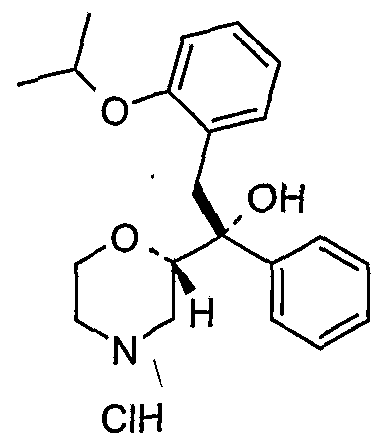
The procedure for the synthesis of example lb, 2-(2-Methoxy-ρhenyl)-l- moφholin-2-yl-l -phenyl-ethanol hydrochloride was followed making non-critical variations, to yield the title compound. Η NMR (300MHz, MeOH D3) δ: 1.12-1.16 (m, 6H), 2.51-2.55 (m, IH), 2.89-3.14 (m, 4H), 3.56-3.60 (m, IH), 3.82-3.92 (m, IH), 3.99- 4.03 (m, IH), 4.17-4.22 ( , IH), 4.36-4.44 (m, IH), 6.50-6.55 (m, IH), 6.66-6.73 (m, 2H), 6.92-6.98 (m, IH), 7.07-7.20 (m, 5H) ppm. LCMS (12 minutes method) [M+H]+= 342 @ Rt 4.90 min. major peak.
Example 20
Preparation of (S, R) l-(3-Fluoro-phenyl)-2-f2-methoxy-phenyl)-l-morpholin-2-yl- ethanol hydrochloride a) l-(4-Benzyl-morpholin-2-yl)-l-(3-fluoro-phenyl)-2-(2-methoxy-phenyι)- ethanol.

A magnetically stirred 0.25M tetrahydrofuran solution of commercially available
2-methoxybenzylmagnesium bromide (from Rieke-Metals) {80ml, 3equiv.) under nitrogen atmosphere was cooled to -10°C and to this was added neat (4-Benzyl- moφholin-2-yl)-l-(3-fluoro-phenyl)-methanone (2.1g, lequiv.). The solution was allowed to warm to room temperature and reaction progress followed using mass
spectrometry. After 1.5 hours 2-methoxybenzylmagnesium bromide solution (14ml, 0.5equiv.) was again added to the reaction and after a further 0.5 hours an aqueous saturated solution of NaHCO3 (50 mL) was added to halt the reaction. The aqueous solution was extracted with diethyl ether, the organic phase dried with MgSO4, evaporated in vacuo to give 2.8 g of a yellow amoφhous solid. The compound was taken without further purification in the next step. LCMS (6 minutes method) [M+H]+=422 @ Rt 3.03 and 2.86 min. major peaks.
b) (S, R )-l-(3-Fluόro-phenyl)-2-(2-methoxy-phenyl)-l-morpholin-2-yl-ethanol hydrochloride.

CIH To a solution of l-(4-Benzyl-moφholin-2-yl)-l-(3-fluoro-ρhenyl)-2-(2-methoxy- phenyl)-ethanol (2.8 g, 1 equiv.) in ethyl acetate (100 mL) at room temperature under nitrogen atmosphere was added ammonium formate (4.3 g, 10 equiv.) followed by addition of palladium on charcoal (10 %, 2.7g.). The reaction mixture was heated to reflux for 1 hour, cooled to room temperature and then filtered through Celite. All volatiles were evaporated under vacuum, and the resulting solid was purified via preparative HPLC to give the desired diastereoisomers. The active enantiomer was obtained after a further preparative chiral HPLC separation. The active enantiomer, a white solid, was next taken up in ethanol and hydrogen chloride was added (large excess of 2M solution in diethyl ether) and the mixture was stined until it became a clear solution. Then all the volatiles were evaporated in vacuo, to give 447mg ofthe title compound as white solid. ]H NMR (300MHz, DMSO D6) 5: 2.49-2.53 {m, IH), 2.80- 2.93 (m, 2H), 3.12-3.33 (m, 4H), 3.41 (s, 3H), 3.85-3.92 (m, IH), 4.07-4.20 (m, 2H), 6.70-6.75 (m, 2H), 6.92-7.10 (m, 5H), 7.20-7.27 (m, IH), 9.08 (bs, 2H). LCMS (12 minutes method) [M+H]+=332. Rt 4.1 lmin.
Example 21 Preparation of (S, R) l-Morpholin-2-yl-l-phenyl-2- 2-trifluoromethoxy-phenyl - ethanol hydrochloride
a) l-(4-Benzyl-morpholin-2-yl)-l-phenyl-2-(2-trifluoromethoxy-phenyl)-ethanol.

The procedure for the synthesis of example la, l-(4-Benzyl-moφholin-2-yl)-2-(2- methoxy-phenyl)- 1 -phenyl-ethanol, was followed using 2-(trifluoromethoxy)benzyl bromide (from Fluorochem) as starting material and making non-critical variations, to yield the title compound. FIA [M+H]+=458.
b) (S, R) l-MorphoIin-2-yl-l-phenyl-2-(2-trifluoromethoxy-phenyl)-ethanol hydrochloride.

To a solution of l-(4-Benzyl-moφholin-2-yl)-l-phenyl-2-(2-trifluoromethoxy- phenyl)-ethanol (7 g, 1 equiv.) in dry 1,2-dichloroethane (40 mL) at 0 °C under nitrogen atmosphere was added ACE-Cl (20.33 g, 10 equiv.). The r-eaction mixture was left to warm to room temperature for 48 hours. All volatiles were evaporated under vacuum, and the resulting solid was taken-up with methanol (50 L) and stined at room temperature overnight. The solution was filtered through acid ion exchange column and the required
fractions evaporated to dryness. The resulting solid was taken up with acetonitrile and the insoluble material filtered off. The mother liquor was concentrated in vacuo and purified via preparative HPLC. Both fractions were mix«d (from slurry and from HPLC) and taken up in ethanol. Hydrogen chloride was added (large excess of 2M solution in diethyl ether) and the mixture stirred. Then all the volatiles were evaporated in vacuo, to give 1.9 g ofthe title compound as a white solid (33 %). 1H NMR (300MHz, DMSO D6) 5: 2.45- 2.50 (m, IH), 2.81-2.97 (m, 2H), 3.18-3.30 (m, 3H), 3.89-3.97 {m, IH), 4.15-4.18 (m, 2H), 7.02-7.29 (m, 9H), 9.18 (bs, 2H). LCMS (12 minutes method) (M+H]+=368 @ Rt 4.88 min. single major peak.
Example 22 Preparation of (S, R) 2-Biphenyl-2-yI-l-morpholin-2-yl-l-phenyl-ethanol hydrochloride
a) l-(4-Benzyl-morpholin-2-yl)-2-biphenyl-2-yI-l-phenyl-ethanol.

l-(4-Benzyl-moφholin-2-yl)-2-(2-bromo-phenyl)-l -phenyl-ethanol ( .50 g, 1.0 equiv.) and boronic acid (0.402 g, 3.0 equiv.) were suspended in a mixture ethanol/water (2/1 , 7.5 mL) and Pd(Ph3)4 (0.022 g, 0.04 equiv.), then K2CO3 (0.654 g, 4.30 equiv.) were added. The mixture was heated to 80°C under nitrogen atmosphere. After 16 hours, the reaction was cooled down to room temperature and filtered through Celite, then extracted with ethyl acetate. The organic layers were combined, dried with MgSO , filtered and concentrated in vacuo yielding a yellow oil, which was purified by column chromatography on silica gel (10% EtOAc:Hexane) to give 0.491g (98%) ofthe title compound as a white solid.
b) (S, R) 2-Biphenyl-2-yl-l-morpholin-2-yl-l-phenyl-ethanoI hydrochloride.

CIH
The procedure for the synthesis of example 1 , 2-(2 -methoxy-phenyl)- 1 - moφholin-2-yl-l -phenyl-ethanol hydrochloride, was followed making non-critical variations, to yield the title compound.1H NMR (300MHz, DMSO D6) B: 2.16-2.20 (m, IH), 2.54-2.62 (m, IH), 2.67-2.76 (m, IH), 2.85-2.89 (m, IH), 3.24 (s, 2H), 3.61-3.69 (m, 2H), 3.93-3.98 (m, IH), 5.14 (bs, IH), 6.80-6.92 (m, 5H), 7.04-7.17 (m, 5H), 7.27-7.30 (m, 3H), 7.36-7.39 (m, IH). LCMS (12 minutes method) [M+H]+=360-@ Rt 5.15 min. single major peak.
Example 23 Preparation of (S, R) 2-(2-Chloro-phenvD-l-morpholin-2-yl-l -phenyl-ethanol hydrochloride
a) l-(4-Benzyl-morpholin-2-yl)-2-(2-chloro-phenyl)-l -phenyl-ethanol.

The procedure for the synthesis of example la, l-(4-Benzyl-moφholin-2-yl)-2-(2- methoxy-phenyl)-! -phenyl-ethanol, was followed using 2-cholobenzyl chloride (from
Aldrich) as starting material and making non-critical variations, to yield the title compound. FIA [M+H]+=408 and 410.
b) (S, R) 2-(2-Chloro-phenyl)-l-morpholin-2-yl-l-phenyI-ethanol hydrochloride

The procedure for the synthesis of example 5b, (S, R) 1 -Mθφholin-2-yl-l -phenyl - 2-(2-trifluorornethoxy-phenyl)-ethanol hydrochloride, was followed making non-critical variations, to yield the title comρound.]H NMR (300MHz, DMSO D6) S: 2.45-2.54 (m, IH), 2.84-2.93 (m, 2H), 3.17-3.22 (m, IH), 3.33-3.38 (m, 3H), 3.89-3.97 (m, IH), 4.14- 4.18 (m, 2H), 7.06-7.11 (m, 2H), 7.15-7.26 (m, 7H), 9.24 (bs, 2H) ppm. LCMS (12 minutes method) [M+H]+=318-320 Rt 4.36 min. single peak.
Example 24 Preparation of (S, R 2-(5-Fluoro-2-methoxy-phenyl)-l-morpholin-2-yl-l-phenyl- ethanol hydrochloride
a) l-(4-Benzyl-morpholin-2-yl)-2-(5-fluoro-2-methoxy-phenyI)-l-phenyl- ethanol.


Example 25 Preparation of (S, R) l-MorphoIin-2-yl-l-phenyl-2-(2-trifluoromethvIsulfanyl- phenyD-ethanoI acetate
a) l-(4-Benzyl-morpholin-2-yl)-l-phenyl-2-(2-trifluoromethylsulfanyl-phenyι)- ethanol.

The procedure for the synthesis of example la, l-(4-benzyl-moιpholin-2-yl)-2-(2- methoxy-phenyl)- 1 -phenyl-ethanol, was followed using l-bromomethyl-2- trifluoromethylsulfanyl-benzene as starting material and making non-critical variations, to yield the title compound. 1H NMR (300MHz, CDC13) 5: 2.05-2.33 (m, 3H), 2.49-2.65 (m,
IH), 3.10-3.35 (m, 2H), 3.43-3.55 (m, IH), 3.67-3.89 (m, 2H), 3.91-4.08 (m, 2H), 4.09- 4.22 (m, IH), 6.91-7.05 (m, IH), 7.10-7.42 (m, 7H), 7.50-7.63 (m, lH) ppm.
b) (S, R) l-Morpholin-2-yl-l-phenyl-2-(2-trifluoromethylsulfanyl-phenyI)- ethanol acetate

To a solution of l-(4-benzyl-moφholin-2-yl)-l -phenyl -2-(2- trifluoromethylsulfanyl-phenyl)-ethanol (218 mg g, 1 equiv.) and solid supported Hunig's base (from Argonaut, 1 g, 5 equiv.) in dry tetrahydrofuran (4 mL) at 0 °C under nitrogen atmosphere was added ACE-Cl (502 μL, 10 equiv.). The reaction mixture was left to warm to room temperature for 48 hours. All volatiles were evaporated under vacuum, and the resulting solid was taken-up with methanol (50 mL) and stirred at room temperature overnight. The solution was filtered through acid ion exchange column and the required fractions evaporated to dryness. The resulting solid was purified via preparative HPLC to give 62 mg ofthe title compound as a colourless oil. 1H NMR (300MHz, CDC13) δ: 2.01 (s, 3H), 2.43-2.47 (m, IH), 2.63-2.70 (m, IH), 2.81-2.94 (m, 2H), 3.24 (d, IH, J=13.57Hz), 3.85-3.96 (m, 2H), 4.01-4.05 (m, IH), 4.09-4.13 (m, IH), 4.45 (bs, 4H), 6.90-6.93 (m, IH), 7,13-7.26 (m, 7H), 7.55-7.58 (m, IH) ppm. LCMS (12 minute method) [M+H]+=384 @ Rt 5.13 min. single peak.
Example 26 Preparation of (S, R l-Morpholin-2-yl-l-phenyl-2-(2-trifluoromethyl-phenyl - eth nol
a) 4-Benzyl-2-(2-phenyl-oxiranyj)-morpholine.

To a mixture of trimethylsulfoxonium iodide (783 mg, 1 equiv.) and sodium hydride (142 mg, 1 equiv.) in dimethylformamide (17 mL) at 0 °C under nitrogen atmosphere was added dimethylsulfoxide (251 μL, 1 equiv.) and the resulting suspension was stined for 30 minutes. A solution of (4-Benzyl-moφholin-2-yl)-phenyl-methanone (1 g, 1 equiv.) in dimethylformamide (10 mL) was then added dropwise. Stining was continued for 30 minutes and the reaction was stopped by addition of water (50 mL). The aqueous solution was extracted with diethyl ether, the organic phase dried with MgSO4, and evaporated in vacuo. The crude material was purified using a column chromatography on silica gel eluting with a mixture of ethyl acetate/heptane (20/80) to give 825 mg ofthe title compound as a colourless oil (78 %), mixture of two diastereoisomers.
b) l-(4-Benzyl-morpholin-2-yl)-l-phenyl-2-(2-trifluoromethyl-phenyl)-ethanol.

To a suspension of magnesium turnings in tetrahydrofuran (2mL) at room temperature under nitrogen atmosphere was added a solution l-Bromo-2-trifluoromethyl- benzene (7.6g, 5equiv.) in tetrahydrofuran (32 mL) and the mixture was stined for an hour. The solution was cooled to -78 °C and copper iodide (646 mg) was added followed by dropwise addition of a solution of 4-Benzyl-2-(2-phenyl-oxiranyl)-moφholine (2g, 1 equiv.) in tetrahydrofuran (10 mL). The resulting mixture was wanned to room temperature over 2 hours and then treated with water (10 mL). The solution was extracted
with diethyl ether, the organic phase dried with MgSO4, and evaporated in vacuo. The crude material was purified using a column chromatography on silica gel eluting with a mixture of ethyl acetate/heptane (10/90) to give 352 mg ofthe title compound as a colourless oil (12 %). LCMS (6 minutes method) .[M+H]+=442 @ Rt 3.05 min. major peak.
c) (S, R) l-Morpholin-2-yl-l-phenyl-2-(2-trifluoromethyl-phenyl)-ethanol

To a solution of l-(4-Benzyl-moφholin-2-yl)-l -phenyl -2-(2-trifluoromethyl- phenyl)-ethanol (352 mg, 1 equiv.) in ethanol (15 mL) at room temperature under nitrogen atmosphere was added ammonium formate (507 mg g, 10 equiv.) followed by addition of palladium on charcoal (10 %, 355 mg.). The reaction mixture was heated to reflux for 1 hour, cooled to room temperature and then filtered through Celite. All volatiles were evaporated under vacuum to give 265 mg ofthe title compound as white solid (94 %). The enantiomeric mixture was resolved using chiral HPLC, to give the title compound as a single enantiomer. 1H NMR (300MHz, CDC13) δ: 1.62 (bs, 4H), 2.25-2.30 (m, IH), 2.56-2.64 (m, IH), 2.75-2.87 (m, 2H), 3.18 (d, IH, J=14.88Hz), 3.71-3.81 (m, 2H), 3.89 (d, IH, J=14.88Hz), 4.02-4.05 (m, IH), 6.83-6.86 (m, IH), 7.09-7.34 (m, 7H), 7.53-7.55 (m, IH) ppm. LCMS (12 minute method) [M+H]A352 @ Rt 4.73 min. single peak.
Example 27 Preparation of (S, R 2-(2-Chloro-phenyl)-l-(3-fluoro-phenyl)-l-morpholin-2-yl- ethanol hydrochloride
a) l-(4-BenzyI-morpholin-2-yl)-2-(2-chloro-phenyI)-l-(3-fluoro-phenyl)-ethanol.

The procedure for the synthesis of 4a, l-(4-Benzyl-moφholin-2-yl)-l-(3-fluoro- phenyl)-2-(2-methoxy-phenyl)-ethanol was followed using 2-chorobenzyl chloride as starting material, and making non-critical, variations, to yield the title compound which was taken without further purification in the next step. LCMS (6 minutes method) [M+H]+=426 @ Rt 2.85 min. major peak.
b) (S, R) 2-(2-Chloro-phenyl)-l-(3-fluoro-phenyl)-l-morpholin-2-yl-ethanol hydrochloride

To a solution of l-(4-Benzyl-moφholine-2-yl)-2-(2-chloro-phenyl)-l-(3-fluoro- phenyl)-ethanol. (3.2g, 1 equiv.) in dry 1 ,2-dichloroethane (40 mL) under nitrogen atmosphere was added ACE-Cl (20.33 g, 5 equiv.). The reaction mixture was stirred at room temperature overnight then refluxed until completion. All volatiles were evaporated under vacuum, and the resulting residue redissolved in acetonitrile. This solution was filtered through an ion exchange column and the filtrate taken-up with methanol (50 mL) and refluxed for 3h. The solution was again filtered through acid ion exchange column and the required fractions evaporated to dryness. The resulting solid was next purified via preparative HPLC followed by chiral HPLC. The purified active enantiomer was taken up in ethanol and hydrogen chloride was added (large excess of 2M solution in diethyl ether) and the mixture stirred. Then all the volatiles were evaporated in vacuo, to give 519mg of the title compound as a white solid (18 %). 1H MR (300MHz, DMSO D6) δ: 2.43-2.54
(m, IH), 2.81-2.95 (m, 2H), 3.16-3.23 (m, IH), 3.30-3.44 (m, 2H), 3.54 (bs, IH), 3.92- 4.00 (m, IH), 4.15-4.23 (m, 2H), 6.96-7.29 (m, 8H), 9.32-9.45 (m, 2H).LCMS (12minute method) [M+H]+=336.
Example 28
Preparation of (S, R l-Morpholin-2-vI-l-phenyl-2-o-toIvI-ethanoI hydrochloride
a) l-(4-Benzyl-morpholin-2-yl)-l-phenyl-2-ø-toIyl-ethanol.

b) (S, R) l-Morpholin-2-yl-l-phenyl-2-o-tolyl-ethanol hydrochloride

The procedure for the synthesis of example lb, 2-(2-methoxy-phenyl)-l- moφholin-2-yl-l -phenyl-ethanol hydrochloride was followed making non-critical variations, to yield the title compound. 1H NMR (300MHz, DMSO D6) 8: 1.62 (s, 3H), 2.40-2.58 (m, IH), 2.78-3.01 (m, 2H), 3.03-3.09 (m, IH), 3.15-3.31 (m, 2H), 3.90-4.05
(m, IH), 4.15-4.25 (m, 2H), 6.89-7.28 (m, 9H), 9.21-9.55 (m, 2H). LCMS [M+H]+=298 single peak.
The pharmacological profile ofthe present compounds can be demonstrated as follows.
Scintillation proximity assays for determining the affinity of test ligands at the norepinephrine transporter
The compounds ofthe invention are norepinephrine reuptake inhibitors, and possess excellent activity in, for example; a scintillation proximity assay (e.g. J. Gobel, D.L. Saussy and A. Goetz (1999) J. Pharmacol. Toxicolo. 42:237-244). Thus 3H- nisoxetine binding to norepinephrine re-uptake sites in a cell line transfected with human norepinephrine transporter binding has been used to determine the affinity of ligands at the norepinephrine transporter.
Acid Stability
The acid stability of a compound according to the present invention was determined as a solution in buffer at 6 different pH values (HC1 0.1N, pH 2, pH 4, pH 6, pH 7, and pH 8) at 40°C over a time course of 72 hours. Samples were taken at the beginning ofthe study and after 3, 6 and 24 hours and analysed by capillary electrophoresis. The original sample used in this study contained 0.8% ofthe undesired epimer as internal standard. The samples taken at the different time points during the study did not show any significant change in the percentage ofthe undesired epimer. This confirms that the compound is chemically and configurationally stable under acidic conditions.
Example 29 In Vitro Determination of the Interaction of Compounds with CYP2D6 in Human Hepatic Microsomes
Principle:
The interaction of compounds with CYP2D6 was evaluated by the measurement ofthe inhibition ofthe bufuralol 1 '-hydroxylase activity by the compounds.
Assay description:
Bufuralol 1 -hydroxylase activity is determined by using 0.5 mg/ml human liver microsomal protein (human biologies), 10 μmol/L bufuralol, in 0.1 M sodium phosphate buffer pH 7.4, incubated for 5 min at 37°C in the presence of 2 mM βNADPH, with 0, 5 or 25 μM ofthe test compound (inhibitor). The compound was dissolved in acetonitrile, such that the final concentration of acetonitrile in the incubation was 0.5%. The total reaction volume was 100 μl. The reaction was terminated by addition of 75 μl of methanol followed by centrifugation. 40 μl ofthe supernatant was analysed by HPLC.
Analysis conditions: A Beckman Ultrasphere Cι8 column (5 μm, 250 x 4.6 mm) was used, with a 13 minute gradient from 100% of solvent A (0.02 M potassium dihydrogen phosphate buffer pH 3/methanol (65/35)) to 100 % of solvent B (0.02 M potassium dihydrogen phosphate buffer pH 3/methanol (20/80)), according to the following gradient. The run time was 20 minutes. Formation of l'-hydroxybufuralol was detected by fluorimetric detection with extinction at λ 252 nm and emission at λ 302 nm.
Time (min) Solv( ;nt A (%) Solvent B (%)
0 100 0
8 0 100
12 0 100
13 100 0
Calculation ofthe results:
The percent of inhibition is calculated as follows:
100 xl'-hydroxybufuralol area formed with inhibitor l'-hydroxybufuralol area formed without inhibitor
The IC50 is calculated from the percent inhibition as follows (assuming competitive inhibition): ComPound Concentration x( l00- Percent of inhibition)
Percent of inhibition
The IC50 estimation is assumed valid if inhibition is between 20% and 80%
(Moody et al. (1999) Xenobiotica 29(1): 53-75).
Preparation of Compounds (VII). (Vila), and (VHP
Compounds of formulae (VII), (Vila), and (VIII) ofthe present invention can be prepared using the following methods. General schemes outlining the synthetic routes used to prepare racemic products are given below. All active racemates were separated into single enantiomers using chiral HPLC and in most cases the enantiomers were converted into D-tartrate salts.
Compounds of formula (VII) wherein Ar is (i) and R2c is H can be prepared as shown in method A below.

Scheme 11
Quinolin-2-one (1) or its conesponding 4-oxo and 4-thio derivatives can be N- arylated using modified conditions to those reported by Buchwald {(2001) J. Am. Chem. Soc, 123:7727). For example the quinolin-2-one (1) is reacted with 3 equivalents of Ar- Br wherein Ar is (i) and R2c is H, 0.2 equivalents of trans-cyclohexanediamine, 0.2 equivalent of copper iodide (Cul), 2.1 equivalents of potassium carbonate (K2CO3), in an organic solvent such as 1 ,4-dioxane at a temperature of 125°C overnight. The resulting N- arylated quinolin-2-one (2) can be alkylated by treatment with a strong base such as lithium hexamethyldisilazide (LiHMDS) at temperatures of -78°C in a suitable organic solvent such as tetrahydrofuran (THF), followed by the addition of an alkyl halide such as alkyl iodide to give the corresponding 3-alkylated-N-arylated quinolin-2-one derivative
(3). Using the same alkylating conditions above with a 1,2-dihaloethane, such as 1- bromo-2-chloroethane, or a 1,3-dihalopropane, such as l-bromo-3-chloropropane, as alkylating agents provides (4) or (5) wherein n is 2 or 3 respectively. These halo analogues were chosen as ideal precursors to the desired amine products. For instance, treatment of (4) or (5) with aqueous methylamine, in the presence of a catalytic amount of a suitable iodide, such as potassium iodide (Kl), in ethanol at 100°C provided the racemic amine products (6) and (7) respectively, in moderate yields.
Compounds of formula (VII) wherein Ar is (i), R2c is H and n is 3 can be prepared using alternative method B.

Scheme 12
Quinolin-2-ones (2) and (3) can be alkylated using the aforementioned alkylating procedure using an allyl halide e.g. allyl bromide as the alkylating agent to give the conesponding 3-allyl-N-arylated-quinolin-2-ones (lla-g). Said allyl analogues could then
be converted to the corresponding primary alcohols (12a-g) by a hydroboration procedure involving a suitable borane, such as 9-BBN in a suitable solvent such as THF. Oxidative work up using for example reaction conditions such as aqueous hydrogen peroxide in a solvent such as ethanol, in the presence of a suitable base, such as sodium hydroxide, gave moderate to good yields of alcohol products after column ehromatography purification. The alcohols were cleanly converted into their mesylates, by reaction of a mesyl halide such as mesyl chloride in the presence of a suitable base such as triethylamine in a suitable solvent such as THF at a suitable temperature such as 0°C to room temperature. The resulting mesylates are used directly in the animation step described above in method A to provide good yields ofthe final racemic targets (13a-g). In order to prepare a range of N-arylated analogues advanced intermediates were prepared that could undergo N-arylations with a range of substituted aryl halides, such as aryl bromides or iodides, 2 and 3-halothiophenes, 2 and 3-halofurans or 2 and 3- halopyrroles (Method C). The synthetic route used to prepare intermediates (19a-b) is shown below (Scheme 13).

Scheme 13
Compounds of formula (VII) wherein n is 3 can be prepared as shown in method C. This method is particularly suitable for compounds wherein Ar is (i) and R2c is H or Ar is (ii), wherein -Y- is -S-.
Quinolin-2-one (1) can be protected using a suitable amide-protecting group as those described in T.W. Greene (1991) Protective Groups in Organic Synthesis, John Wiley and Sons, New York, N.Y., hereafter refened to as "Greene". For example quinolin-2-one (1) can be protected with a 4-methoxybenzyl group. The protection reaction can be canied out for example using a suitable base, such as sodium hydride in a suitable solvent, such as dimethylformamide, followed by reaction with a 4-
methoxybenzyl halide, such as 4-methoxybenzyl chloride, to give the corresponding N- protected derivative (14) in good yield. This intermediate can be converted directly to the allyl analogue (16a), wherein R1 = H, in a manner described earlier or converted into the alkyl analogue (15) which can be subsequently alkylated with a allyl halide to give the allyl analogue (16b), wherein R1 is Cj-C alkyl. Using the same hydroboration, mesylation and amination sequence described in Method B provided both amines (18a-b). Deprotection of protected quinolin-2-one could be achieved using any suitable deprotection conditions as those shown in Greene. For example, the 4-methoxybenzyl group could be cleaved cleanly using trifluoroacetic acid and anisole at 65°C. The resultant product could be selectively protected on the secondary amine with a suitable nitrogen protecting group as those described in Greene. For example, the secondary amine can be protected with a Boc group. The reaction can be carried out with Boc anhydride in a suitable solvent such as THF to provide multi gram quantities of (19a-b). Reaction of (19a-b) with various aryl bromides using the previously described N- arylation conditions, deprotection using suitable deprotecting conditions such as those described in Greene gave a range of final racemic targets (21a-q or 22a-b). For example, for compounds protected with a Boc group they can be deprotected in the presence of trifluoroacetic acid (TFA) in a suitable organic solvent such as dichoromethane (DCM). Intermediates (19 a-b) wherein R3 is a halo group, for example chloro or bromo, can be used to provide compounds of formula (VII) wherein R3 is a phenyl group, such as compound (24), via a Suzuki coupling, see Scheme 14 below.
Method D

24
Scheme 14
Intermediates (19a-b), wherein R3 is for example bromo can be N-protected with a suitable amide protecting group for example 4-methoxybenzyl as described in method C above and then coupled with phenylboronic acid under Suzuki conditions to provide the phenyl analogues (23). Deprotection ofthe 4-methoxybenzyl group with TFA, followed by protection ofthe resulting secondary amine with a suitable nitrogen protecting group such as Boc followed by subsequent N-arylation and Boc deprotection using the previously described methodology gave the final target (24).
It will be appreciated that compounds of formula (Vila) wherein R3 is bromo or chloro can be prepared as shown in methods A to D above starting from the corresponding haloquinolin-2-ones. Alternatively, they can be prepared from the corresponding quinolin-2-one (la) wherein R is hydrogen as mentioned above including an extra step comprising the halogenation of a suitable intermediate at some stage ofthe synthesis. For example quinolin-2-one (la) in method B can be halogenated using N- chlorosuccinimide in a suitable solvent such as DMF at a suitable temperature such as room temperature to give the corresponding 6-chloro-quinolin-2-one (lc) wherein R3 is CI.
Alternatively intermediates (19 a-b) wherein R is H in method C can be halogenated in the presence of N-chloro and N-bromosuccinimide in a suitable solvent such as DMF to give the corresponding 6-chloro and 6-bromoquinolin-2-ones (20a-c).

H 20a-c
It will be appreciated that methods A to D above relate to methods for the preparation of compounds of formula (VII) wherein Ar is (i) and R2c is hydrogen. Compounds of formula (VII) wherein Ar is (i) and R2c can be other than hydrogen, can be prepared using any ofthe general methods mentioned above, starting from the corresponding N-arylated quinolin-2-one (27). A general method for preparing said intermediates is illustrated in Scheme 15. Commercially available 3-(2-Bromo-phenyl)- propionic acids (25) can be converted to amide (26) using standard amide coupling conditions and converted to the N-arylated quinolin-2-ones (27) by an intramolecular, palladium catalysed cyclisation according to the method of Buchwald et al. ((1996) Tetrahedron 52:7525).

25 26

Scheme 15
The present invention provides a process for the preparation of a compound of formula (VII) comprising reacting methylamine with a compound of formula

The present invention provides a further process for the preparation of a compound of formula (VII) comprising the N-deprotection of a compound of formula (X):
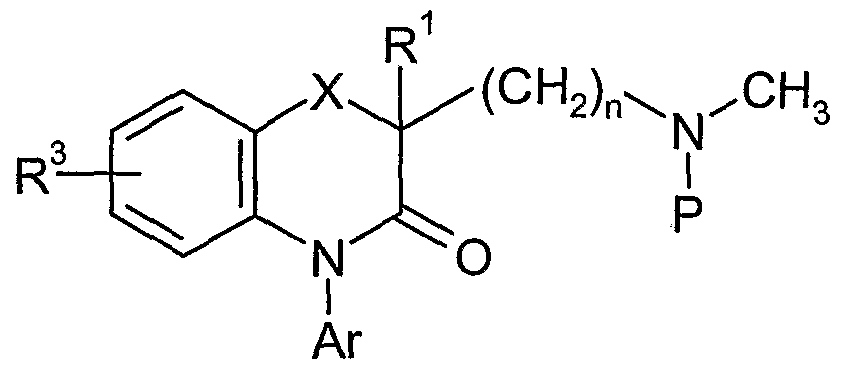
(X) wherein Rl, R3, X, n and Ar have the values defined for formula (VII) above and P is a suitable nitrogen protecting group such as those described in Greene, for example a Boc group. The reaction is carried out using suitable deprotecting conditions such as those described in Greene according to the nature ofthe nitrogen-protecting group used (P). For example, for compounds protected with a Boc group they can be deprotected in the presence of trifluoroacetic acid (TFA) in a suitable organic solvent such as dichoromethane (DCM).
Compounds ofthe present invention are norepinephrine reuptake inhibitors and are selective over other neurotransmitters, such as dopamine or serotonin, that is their binding affinity at the norepinephrine transporter is higher than their affinity for other transporters or other receptors. In addition, they are acid stable. The following examples illustrate particular embodiments of compounds (VII),
(Vila), and (VIII) of the present invention and methods for their preparation.
Method A Preparation of Intermediates
l-Phenyl-3,4-dihydro-iJff-quinolin-2-one (2a)
A stirred mixture of 3,4-Dihydro-7H-quinolin-2-one (la) (1.47 g. 10 mmol), K CO3 (2.9 g, 21 mmol), trαπs-cyclohexane-l^-diamine (240 μL, 2 mmol) and bromobenzene (3.16 mL, 30 mmol) in 1,4-dioxane (10 mL) was heated under a nitrogen atmosphere at 125°C for 5 min to deoxygenate the reaction mixture. Copper (I) iodide (380 mg, 2 mmol) was added in one portion and the reaction mixture was refluxed overnight at 125°C. After cooling to rt, the reaction mixture was poured into ethyl acetate (100 mL) and extracted with water. The organic layer was separated, dried over MgSO4 and concentrated. Treatment ofthe residue with ether (100 mL) and cooling (ice bath) gave the product as a white solid after filtration (1.77 g, 79%).
6-Fluoro-l-/7-tolyl-3,4-dihydro-liϊ-quinolin-2-one (2b) This was prepared using the method described for (2a) using 6-Fluoro-3,4- dihydro-7H-quinolin-2-one (lb) (617 mg, 3.7 mmol) and 4-bromotoluene (1.91 g, 11 mmol) to give the crude product, which was purified using automated chromatography (silica) (0 to 60% ethyl acetate\cyclohexane gradient) to provide the product as a light brown solid (880 mg, 92%).
3-Methyl-l-phenyI-3,4-dihydro-iJΗ-quinoIin-2-one (3a)
To a soln of (2a) (892 mg, 4 mmol) in anhydrous TΗF (40 mL) at -78°C under nitrogen was added LiΗMDS (4.4 mL, IM soln in hexanes, 4.4 mmol) dropwise over 10
min. The reaction mixture was left at -78°C for 30 min and then a solution of methyl iodide (298 μL, 4.8 mmol) in THF (1 mL) was added dropwise. The reaction mixture was warmed slowly to rt, quenched with water (2 mL) and extracted with ethyl acetate (100 mL). The organic layer was separated, dried over MgSO4 and concentrated. The residue was purified by column chromatograpy (silica, gradient 100% hexane to ethyl acetate\hexane 3:10) giving the product as an oil (667 mg, 70%).
3-Ethyl-l-phenyl-3,4-dihydro-2#-quinolin-2-one (3b)
This was prepared in a similar manner to (3a) on a 1.5 mmol scale using 1 - iodoethane (125 μL, 1.1 eq.) as the alkylating agent. The crude product (378 mg) was used directly in the next step.
3-(3-Chloro-propyI)-l-phenyl-3,4-dihydro-IJϊ-quinolin-2-one{4a)
To a soln of (2a) (892 mg, 4 mmol) in anhydrous THF (40 mL) at -78°C under nitrogen was added LiHMDS (4.4 mL, IM soln in hexanes, 4.4 mmol) dropwise over 10 min. The reaction mixture was left at -78°C for 30 min and then a solution of l-bromo-3- chloropropane (405 μL, 4.4 mmol) in THF (1 mL) was added dropwise. The reaction mixture was warmed slowly to rt, quenched with water (2 mL) and extracted with ethyl acetate (100 mL). The organic layer was separated, dried over MgSO4 and concentrated. The crude product (1.2 g) was used directly in the next step.
3-(3-Chloro-propyl)-6-fluoro-l-/ oIyI-3,4-dihydro~ii/-quinoIin-2-one (4b)
This was prepared from (2b) (300 mg, 1.17 mmol) using the method described for (4a) using l-bromo-3-chloropropane (140 μL, 1.4 mmol) as the alkylating agent. The crude product (399 mg) was used directly in the next step.
3-(2-Chloro-ethyl)-l-phenyl-3,4-dihydro-iJ3r-quinolin-2-one (4c)
This was prepared from (2a) (892 mg, 4.0 mmol) using the method described for (4a) using 1 -bromo-2-chloroethane (365 μL, 4.4 mmol) as the alkylating agent. The crude product (1 g) was used directly in the next step.
3-(3-Chloro-propyl)-3-methyl-l-phenyl-3,4-dihydro-2iϊ-quinolin-2-one {5a)
This was prepared from (3a) (462 mg, 1.95 mmol) using the method described for (4a) using l-bromo-3-chloropropane (270 μL, 2.7 mmol) as the alkylating agent. The crude product (650 mg) was used directly in the next step.
3-(3-Chloro-propyl)-3-ethyI-l-phenyI-3,4-dihydro-i/T-quinolin-2-one (5b)
This was prepared from (3b) (378 mg, 1.5 mmol) using the method described for (4a) using l-bromo-3-chloropropane (179 μL, 1.8 mmol) as the alkylating agent. The crude product (528 mg) was used directly in the next step.
Example 30 3-(3-Methylamino-propyl -phenyl-3,4-dihvdro-i/y-quinolin-2-one,(6a
A soln of (4a) (1.2 g, 4 mmol), potassium iodide (200 mg, 1.2 mmol) and aqueous 40% methylamine (12 mL) in ethanol (30 mL) was refluxed at 100°C under nitrogen for 3 h. The reaction mixture was cooled, poured into water and extracted with ethyl acetate (100 mL). The organic layer was separated, dried over MgSO4 and concentrated. The product was purified by preparative LCMS to give 500 mg ofthe racemate. The racemate was separated into its individual enantiomers using chiral HPLC. 1H NMR (300 MHz, CDC13) (racemate & isomer) δ 1.5-1.73 (m, 4H), 1.88-1.97 (m, IH), 2.43 (s, 3H), 2.62 (t, J- 6.69 Hz, 2H), 2.70-2.79 (m, IH), 2.84-2.92 (m, IH), 3.15-(dd, J= 15.45, 5.28 Hz, IH),
6.33 (d, J= 7.73 Hz, IH), 6.95-7.06 (m, 2H), 7.19-7.22 (m, 3H), 7.38-7.43 (m, IH), 7.47- 7.52 (m, 2H). LCMS (12 minute method) [M+H]+ = 295 @ Rt 4.0 min (100%).
Example 31 6-Fluoro-3-(3-methylamino-propyl)-l-p-tolyl-3,4-dihvdro-ijy-quinolin-2-one (6b) This was prepared in an identical manner to (6a) using crude (4b) (399 mg) to give the crude product, which was purified by preparative LCMS to give the product (35 mg). 1H NMR (300 MHz, CDC13) (racemate) δ 1.40-1.70 (m, 3H), 1.75-1.90 (m, 4H),
2.34 (s, 3H), 2.36 (s, 3H), 2.50-2.83 (m, 2H), 3.01-3.08 (m, IH), 6.21-6.26 (m, IH), 6.62- 6.68 (m, IH), 6.82-6.86 (m, IH), 6.99 (d, J= 8.1 Hz, 2H), 7.22 (d, J= 8.1 Hz, 2H). LCMS
(12 minute method) [M+H]+ = 327-@ Rt 4.8 min (100%).
Example 32 3-(2-MethyIamino-ethvI)-l-phenyl-3.4-dihvdro-lH-quinolin-2-one (6c)
This was prepared in an identical manner to (6a) using crude (4c) (lg) to give the racemate (80 mg). The racemate was separated into its individual enantiomers using chiral HPLC. 1H NMR (300 MHz, CDC13) (racemate & isomer) δppm 1.64-1.76 (m, IH), 1.79 (br, IH), 2.03-2.18 (m, IH), 2.44 (s, 3Η), 2.71-2.82 (m, 2H), 2.82-2.94 (m, 2H), 3.09-3.21 (m, IH), 6.33 (dd, J= 7.91, 1.32 Hz, IH), 6.94-7.07 (m, 2H), 7.18-7.24 (m, 3H),
7.37-7.44 (m, IH), 7.47-7.54 (m, 2H). LCMS (12 minute method) [M+H]+ = 281 <@Rt 3.82 min (100%).
Example 33 3-MethvI-3-(3-methylamino-propyl)-l-phenyl-3,4-dihvdro-iJg-quinolin-2-one (7a)
This was prepared in an identical manner to (6a) using crude (5a) (650 mg) to give the crude product (198 mg), which was purified by preparative LCMS. The purified racemate was then separated into its individual enantiomers using chiral HPLC. 1H NMR (300 MHz, CDC13) (isomer) δ ppm 1.27 (s, 3H), 1.43 (br, IH), 1.53-1.66 (m, 4H), 2.39 (s, 3H), 2.54 (t, J= 6.12 Hz, 2H), 2.91 (d, J= 15.64 Hz, IH), 2.98 (d, J= 15.64 Hz, IH), 6.28 (dd, J= 7.91, 1.32 Hz, IH), 6.97 (td, J= 7.21, 1.41 Hz, IH), 7.03 (td, J= 7.68, 1.98 Hz, IH), 7.14-7.22 (m, 3H), 7.36-7.44 (m, IH), 7.46-7.53 (m, 2H). LCMS (12 minute method) [M+H]+ = 309 @Rt 4.21 min (100%).
Example 34 3-Ethyl-3-(3-methylamino-propyl)-l-phenyl-3,4-dihvdro-i ι -quinolin-2-one (7b) This was prepared in an identical manner to (6a) using crude (5b) (528 mg) to give the crude product (105 mg), which was purified by preparative LCMS. The purified racemate was then separated into its individual enantiomers using chiral HPLC. ]H NMR (300 MHz, CDC13) (racemate) δ 0.93 (t, J= 7.53 Hz, 3H), 1.56-1.75 (m, 6H), 1.91 (bs, IH), 2.41 (s, 3H), 2.55-2.60 (m, 2H), 2.91 (d, J= 15.82, IH), 3.02 (d, J= 15.82, IH), 6.25-6.28 (m, IH), 6.94-7.05 (m, 2H), 7.16-7.19 (m, 3H), 7.38-7.43 (m, IH), 7.4- 7.52 (m, 2H). 1H NMR (300 MHz, MeOD-d4) (isomer D-tartrate salt) δ 0.85 (t, J= 7.53
Hz, 3H), 1.45-1.75 (m, 6H), 2.57 (s, 2H), 2.83-2.89 (m, 2H), 3.01-3.06 (d, J= 16.01, IH), 4.32 (s, 2H), 6.11-6.14 (m, IH), 6.89-6.97 (m, 2H), 7.09 (d, J= 7.16 Hz, 2H), 7.15-7.18 (m, IH), 7.37 (t, J= 7.35 Hz, IH), 7.46 (t, J= 7.35 Hz, 2H). LCMS (12 minute method) [M+H = 323 @ Rt 4.9 min (98%).
Method B
Preparation of Intermediates
l-/>-Tolyl-3,4-dihydro-i#-quinolin-2-one (2c)
A stirred mixture of 3,4-Dihydro-7H-quinolin-2-one (la) (4.41 g. 30 mmol), K2CO3 (8.7 g, 63 mmol), tra«5-cyclohexane-l,2-diamine (720 μL, 2 mmol) and 4- bromotoluene (15.4 g, 90 mmol) in 1,4-dioxane (30 mL) was heated under a nitrogen atmosphere at 125°C for 5 min to deoxygenate the reaction mixture. Copper (I) iodide (1.14 g, 2 mmol) was added in one portion and the reaction mixture was refluxed overnight at 125°C. After cooling to rt, the reaction mixture was filtered through celite, poured into ethyl acetate (100 mL) and extracted with water. The organic layer was separated, dried over MgSO and concentrated. Treatment ofthe residue with ether (200 mL) and cooling (ice bath) gave the product as a white solid after filtration (6.2 g, 87%).
l-Phenyl-3-propyl-3,4-dihydro-2Hr-quinolin-2-one (3c)
This was prepared from (2a) (669 mg, 3 mmol) and 1-iodopropane (352 μl, 1.2 eq.) as the alkylating agent. The crude product (780 mg) was used directly in the next step.
3-EthyI-l-/>-tolyl-3,4-dihydro-l -quinolin-2-one (3d)
This was prepared from (2c) (711 mg, 3 mmol) and 1 -iodoethane (265 μl, 1.2 eq.) as the alkylating agent. The crude product (800 mg) was used directly in the next step.
3-Propyl-l-p-tolyl-3,4-dihydro-7H-quinolin-2-one (3e)
This was prepared from (2c) (711 mg, 3 mmol) and 1 -iodopropane (352 μl, 1.2 eq.) as the alkylating agent. The crude product (840 mg) was used directly in the next step.
3-Butyl-l-/ tolyl-3,4-dihydro-217-quinoIin-2-one (3f)
This was prepared from (2c) (711 mg, 3 mmol) and 1-iodobutane (354 μl, 1.1 eq.) as the alkylating agent. The crude product (790 mg) was used directly in the next step.
3-Isopropyl-l-/ tolyl-3,4-dihydro-iiy-quinolin-2-one (3g)
This was prepared from (2c) (711 mg, 3 mmol) and 2-iodopropane (330 μl, 1.1 eq.) as the alkylating agent. The crude product (806 mg) was used directly in the next step.
3-Allyl-3-ethyl-l-/ tolyl-3,4-dihydro-lJΪ-quinolin-2-one (1 lb)
To a soln of (3d) (800 mg, 2.7 mmol) in anhydrous THF (30 mL) at-78°C under nitrogen was added LiHMDS (3 mL, IM soln in hexanes, 3 mmol) dropwise over 10 min. The reaction mixture was left at -78°C for 30 min and then a solution of allyl bromide (280 μL, 3.2 mmol) in THF (1 mL) was added dropwise. The reaction mixture was warmed slowly to rt, quenched with water (2 mL) and extracted with ethyl acetate (100 mL). The organic layer was separated, dried over MgSO4 and concentrated. The crude product (920 mg) was used directly in the next step.
3-Ethyl-3-(3-hydroxypropyl)-l-Jρ-tolyl-3,4-dihydro-2JfiT-quinolin-2-one (12b) To a soln of (lib) (732 mg, 2.4 mmol) in anhydrous THF (25 mL) at 0°C under nitrogen was added 9-BBN (12 mL, 0.5M soln in THF, 6 mmol, 2.5 eq.) dropwise over 10 min. The reaction mixture was warmed to rt and left to stir overnight. The resultant yellow soln was cooled to 0°C and then quenched carefully with ethanol (3 mL), followed by aq. NaOH (1.8 mL, 3N soln). Finally, aq. H O (1.8 mL, 37% soln) was added dropwise maintaining the internal reaction mixture temp between 5 and 10 °C. The reaction mixture was warmed to rt and then refluxed for 90 min. The reaction mixture
was cooled to rt, poured into ethyl acetate and water and extracted. The organic layer was separated, dried over MgSO4 and concentrated. The crude product was purified using automated chromatography (silica) (0 to 60% ethyl acetate\cyclohexane gradient) to provide (12b) as a clear oil (540 mg, 70%).
Example 35 3-EthyI-3-(3-methylamino-propyl)-l-p-tolyl-3.,4-dihvdro-Jff-quinolin-2-one (13b) To a soln of (12b) (540 mg, 1.67 mmol) and triethylamine (350 μL, 2.5 mmol) in anhydrous THF (20 mL) at 0°C under nitrogen was added dropwise a soln of methanesulfonyl chloride (142 μL, 1.8 mmol) in THF (1 mL). The reaction mixture was warmed to rt and stirred for 3 h. The reaction mixture was poured into ethyl acetate and water and extracted. The organic layer was separated, dried over MgSO4 and concentrated. The crude mesylate (670 mg, 100%) was dissolved in ethanol (10 mL) and aqueous 40% methylamine (5 mL) and heated at 65°C under nitrogen for 2 h. The reaction mixture was cooled, poured into water and extracted with ethyl acetate (100 mL). The organic layer was separated, dried over MgSO and concentrated. The product was purified by SCX-2 to give 384 mg ofthe racemate. The racemate was separated into its individual enantiomers using chiral HPLC. Each enantiomer was dissolved in CH2C12 (2 mL) and treated with 1 equivalent of D-tartaric acid dissolved in a minimum volume of warm methanol. The resultant soln was concentrated and the solid was dried under vacuo to provide the D-tartrate salt ofthe amine. 1H NMR (300 MHz, CDC13) (racemate) δ 0.92 (t, J= 7.44 Hz, 3H), 1.49-1.75 (m, 6H), 1.81 (br, IH), 2.40 (s, 6H), 2.57 (t, J= 6.59 Hz, 2H), 2.89 (d, J= 15.82 Hz, IH), 3.00 (d, J= 15.82 Hz, IH), 6.29 (d, J= 7.91 Hz, IH), 6.92- 7.08 (m, 4H), 7.16 (d, J= 7.16 Hz, IH), 7.29 (d, J= 7.91 Hz, 2H). 1H NMR (300 MHz, MeOD-d4) (isomer D-tartrate salt) δ 0.93 (t, J= 7.44 Hz, 3H), 1.54-1.84 (m, 6H), 2.42 (s, 3H), 2.66 (s, 3H), 2.91-3.00 (m, 3H), 3.11 (d, J= 15.83 Hz, 1H), 4.41 (s, 2H),6.22-6.27 (m, IH), 6.80-7.07 (m, 4H), 7.21-7.27 (m, IH), 7.36 (d, J= 7.91 Hz, 2H). LCMS (12 minute method) [M+H]+ = 337 @Rt 5.21 min (100%).
Example 36 3-(3-Methylamino-propyl)-l-phenyl-3-propyl-3,4-dihvdro-lg-quinolin-2-one (13a
This was prepared from (3c) (780 mg, 2.9 mmol) using the same synthetic sequence described in method B (3d to 13b) to give 233 mg ofthe racemate. The racemate was separated into its individual enantiomers using chiral HPLC and each enantiomer was converted into its D-tartrate salt as described for (13b). ]H NMR (300 MHz, CDC13) (racemate) δ 0.88 (t, J= 7.16 Hz, 3H), 1.26-1.48 (m, 2H), 1.50-1.78 (m, 7H), 2.40 (s, 3H), 2.56 (t, J= 6.59 Hz, 2H), 2.92 (d, J= 15.83 Hz, IH), 3.01 (d, J= 15.83 Hz, IH), 6.25-6.28 (m, IH), 6.94-7.05 (m, 2H), 7.16-7.19 (m, 3H), 7.37-7.42 (m, IH),
7.47-7.52 (m, 2H). 1H NMR (300 MHz, MeOD-d4) (isomer D-tartrate salt) δ 0.77-0.82 (t, J= 7.06 Hz, 3H), 1.24-1.35 (m, 2H), 1.44-1.51 (m, 2H), 1.69 (bs, 3H), 2.56 (s, 3H), 2.84- 2.89 (m, 3H), 3.01-3.06 (d, J= 15.83 Hz, IH), 3.20-3.22 (q, J=1.55 Hz, 2H), 4.30 (s, 2H), 6.11-6.14 (dd, J= 7.72, 2.26 Hz, IH), 6.89-6.97 (m, 2H), 7.07-7.10 (m, 2H), 7.14-7.17 (m, IH), 7.34-7.39 (t, J= 7.35 Hz, IH), 7.43-7.48 (t, J= 7.35 Hz, 2H). LCMS (12 minute method) [M+H]+ = 337 @ Rt 5.2 min (100%).
Example 37 3-(3-MethvIamino-propyl -3-propyl-l-ρ-tolvI-3,4-dihvdro-Jiy-quinolin-2-one (13c This was prepared from (3e) (840 mg, 2.6 mmol) using the same synthetic sequence described in method B (3d to 13b) to give 393 mg ofthe racemate. The racemate was separated into its individual enantiomers using chiral HPLC and each enantiomer was converted into its D-tartrate salt as described for (13b). Η NMR (300 MHz, CDCI3) (racemate) δ 0.88 (t, J= 7.16 Hz, 3H), 1.20-1.75 (m, 1 IH), 2.39 (s, 3H), 2.40 (s, 3H), 2.90 (d, J= 15.64 Hz, IH), 2.99 (d, J= 15.64 Hz, IH), 6.29 (d, J= 7.72 Hz, IH), 6.93-7.07 (m, 4H), 7.14-7.16 (m, IH), 7.25-7.31 (m, 2H). 1H NMR (300 MHz, MeOD-d4) (isomer D-tartrate salt) δ 0.91 (t, J= 7.06 Hz, 3H), 1.28-1.85 (m, 8H), 2.44 (s, 3H), 2.68 (s, 3H), 2.94-2.99 (m, 3H), 3.14 (d, J= 15.82 Hz, IH), 4.41 (s, 2H), 6.25-6.28 (m, IH), 7.02-7.07 (m, 4H), 7.25-7.28 (m, IH), 7.38 (d, J= 7.91 Hz, 2H). LCMS (12 minute method) [M+H]+ = 351 @ Rt 5.6 min (100%).
Example 38 3-Butyl-3-(3-methylamino-propyl -l-p-tolvI-3.4-dihvdro-Jg-αuinolin-2-one (13d)
This was prepared from (3f) (790 mg, 2.7 mmol) using the same synthetic sequence described in method B (3d to 13b) to give 334 mg ofthe racemate. The racemate was separated into its individual enantiomers using chiral HPLC and each enantiomer was converted into its D-tartrate salt as described for (13b). 1H NMR (300 MHz, CDC13) (racemate) δ 0.87 (t, J= 6.97 Hz, 3H), 1.20-1.40 (m, 4H), 1.55-1.74 (m, 6H), 2.40 (s, 3H), 2.40 (s, 3H), 2.55 (t, J= 6.78 Hz, 3H), 2.91 (d, J= 15.63 Hz, IH), 2.99 (d, J= 15.63 Hz, IH), 6.28-6.31 (m, IH), 6.93-7.00 (m, 2H), 7.02-7.06 (m, 2H), 7.14-7.16 (m, IH), 7.29 (d, J= 8.07 Hz, 2H). ]H NMR (300 MHz, MeOD-d4) (isomer D-tartrate salt) δ 0.90 (t, J= 6.97 Hz, 3H), 1.20-1.85 (m, 10H), 2.44 (s, 3H), 2.68 (s, 3H), 2.94-2.99 (m, 3H), 3.14 (d, J= 15.82 Hz, IH), 4.42 (s, 2H), 6.25-6.28 (m, IH), 7.00-7.07 (m, 4H), 7.25-7.28 (m, IH), 7.38 (d, J= 7.91 Hz, 2H). LCMS (12 minute method) [M+H]+ = 365 @ Rt 5.9 min (100%).
Example 39 3-Isopropyl-3-f3-methylamino-propyl)-l-g-tolyl-3,4-dihydro-i/ -quinolin-2-one (13e)
This was prepared from (3g) (806 mg, 2.89 mmol) using the same synthetic sequence described in method B (3d to 13b) to give 307 mg ofthe racemate. ]H NMR (300 MHz, CDC13) (racemate) δ ppm 0.92 (dd, J= 8.95, 6.88 Hz, 6H), 1.39-1.88 (m, 5H), 2.12-2.23 (m, IH), 2.39 (s, 3H), 2.40 (s, 3H), 2.56 (t, J= 6.78 Hz, 2H), 2.94 (d, J= 15.92 Hz, IH), 3.00 (d, J= 15.92 Hz, IH), 6.28 (dd, J= 7.82, 1.04 Hz, IH), 6.92-7.06 (m, 4H), 7.16 (dd, J= 6.97, 1.13 Hz, IH), 7.29 (d, J= 7.91 Hz, 2H). LCMS (12 minute method) [M+H]+ = 351 @Rt 5.55 min (100%).
Example 40 6-Chloro-3-ethyI-3-(3-methylamino-propyIVl-i7-tolyl-3,4-dihvdro-JJ?-quinolin-2-one
This was prepared from (lc) using the same synthetic sequence described in method B to give 205 mg ofthe racemate. The racemate was separated into its individual enantiomers using chiral HPLC and each enantiomer was converted into its D-tartrate salt as described for (13b). 1H NMR (300 MHz, CDC13) (racemate) δ ppm 0.91 (t, J= 7.44 Hz, 3H), 1.50-1.75 (m, 6H), 2.15 (br, IH), 2.40 (s, 3H), 2.41 (s, 3H), 2.55-2.64 (m, 2H), 2.85 (d, J= 16.01 Hz, IH), 2.97 (d, J= 16.01 Hz, IH), 6.23 (d, J= 8.85 Hz, IH), 6.97 (dd, J= 8.67, 2.45 Hz, IH), 7.02 (d, J= 8.29 Hz, 2H), 7.14 (d, J= 2.26 Hz, IH), 7.29 (d, J= 8.10 Hz, 2H). 1H NMR (300 MHz, MeOD-d4) (isomer, D-tartrate salt) δ ppm 0.84 (t, J= 7.35 Hz, 3H), 1.40-1.75 (m, 6H), 2.32 (s, 3H), 2.57 (s, 3H), 2.80-2.92 (m, 3H), 3.01 (d, J= 16.20 Hz, IH), 4.31 (s, 2H), 6.13 (d, J= 8.67 Hz, IH), 6.92-6.98 (m, 3H), 7.19 (d, J= 2.26 Hz, IH), 7.26 (d, J= 7.91 Hz, 2H). LCMS (12 minute method) (M+H]+ = 371/373 @Rt 5.75 min (100%).
Example 41 6-Chloro-l-(4-chloro-phenyl)-3-ethyl-3-(3-methylamino-propyl)-3,4-dihydro-JHr- quinoIin-2-one (13g)
This was prepared from (lc) using the same synthetic sequence described in method B to give 222 mg ofthe racemate, which was purified by preparative LCMS. 1H NMR (300 MHz, CDC13) (racemate) δ ppm 0.84 (t, J= 7.44 Hz, 3H), 1.40-1.70 (m, 6H), 2.35 (br, 4H), 2.49-2.56 (m, 2H), 2.80 (d, J= 16.01 Hz, IH), 2.90 (d, J= 16.01 Hz, IH), 6.14 (d, J= 8.67 Hz, IH), 6.93 (dd, J= 8.67, 2.26 Hz, IH), 7.04 (ddd, J= 9.04, 2.83, 2.45
Hz, 2H), 7.09 (d, J- 2.26 Hz, IH), 7.36-7.43 (m, 2H). LCMS (12 minute method) [M+H]+ = 391/393 @Rt 5.67 min (92%).
Method C
Preparation of intermediates
l-(4-Methoxy-benzyl)-3,4-dihydro-ii/-quinolin-2-one (14)
A 5 litre flange-neck flask equipped with an air stirrer and paddle, thermometer, nitrogen bubbler and pressure equalising dropping funnel was charged with sodium hydride (25.5g, 60% oil dispersion, 0.637 mol) and 40-60 pet. ether (100 ml). The mixture was stined briefly and then allowed to settle under nitrogen. After decanting the supernatant liquid, the vessel was charged with dimethylformamide (2 litres). The well stined suspension was cooled to 7-8°C using an external ice-bath. Then a soln of 3,4- dihydro-lH-quinolin-2-one (la) (73.6g, 0.5 mole) in anhydrous dimethylformamide (500 ml) was added dropwise over 25 min. The mixture was stirred at 7-8°C for 30 min. then 4-methoxybenzyl chloride (102 g, 0.65 mole, 1.3 eq.) was added over 10 min. The reaction mixture was left to stir for 2 h. at <10°C then allowed to warm-up to room temperature and stirred overnight. The stirred reaction mixture was quenched with ice/water (2.5 litres) and cooled to 15 °C using an external ice-bath. The white solid was isolated by filtration and washed with water. After drying in vacuo at 40°C overnight the product was obtained (113.4g, 85%).
l-(4-Methoxy-benzyl)-3-methyl-3,4-dihydro-ii?-quinolin-2-one (15)
To a soln of (14) (20 g, 75 mmol) in anhydrous THF (400 mL) at -78°C under nitrogen was added LiHMDS (78.6 mL, IM soln in hexanes, 78.6 mmol) dropwise over 10 min. The reaction mixture was left at -78°C for 30 min and then a solution of methyl iodide (5.13 mL, 83 mmol) in THF (5 mL) was added dropwise. The reaction mixture was warmed slowly to rt, quenched with water (50 mL) and extracted with ethyl acetate (400 mL). The organic layer was separated, dried over MgSO4 and concentrated to give the product as a yellow solid (21 g, 100%) that was used directly in the next step.
3-AIlyl-l-(4-methoxy-benzyl)-3-methyl-3,4-dihydro-2 -quinolin-2-one (16b)
To a soln of (15) (20.5 g, 73 mmol) in anhydrous THF (400 mL) at -78°C under nitrogen was added LiHMDS (80 mL, IM soln in hexanes, 80 mmol) dropwise over 10 min. The reaction mixture was left at -78°C for 30 min and then a solution of allyl bromide (7.6 mL, 87 mmol) in THF (5 mL) was added dropwise. The reaction mixture was warmed slowly to rt, quenched with water (100 mL) and extracted with ethyl acetate (400 mL). The organic layer was separated, dried over MgSO4 and concentrated to give the product as an orange oil (23.9 g, 100%) that was used directly in the next step.
3-(3-Hydroxy-propyl)-l-(4-methoxy-benzyl)-3-methyI-3,4,4a,8a-tetrahydro-71f- quinolin-2-one (17b)
To a soln of (16b) (23.9 g, 74 mmol) in anhydrous THF (400 mL) at 0°C under nitrogen was added 9-BBN (370 mL, 0.5M soln in THF, 185 mmol, 2.5 eq.) dropwise over 10 min. The reaction mixture was warmed to rt and left to stir overnight. The resultant yellow soln was cooled to 0°C and then quenched carefully with ethanol (95 mL), followed by aq. NaOH (60 mL, 3N soln). Finally, aq. H2O2 (60 mL, 37% soln) was added dropwise maintaining the internal reaction mixture temp between 5 and 10 °C. The reaction mixture was warmed to rt and then refluxed for 90 min. The reaction mixture was cooled to rt, poured into ethyl acetate and water and extracted. The organic layer was separated, dried over MgSO4 and concentrated. The crude product was purified using automated chromatography (silica) (0 to 80% ethyl acetate\cyclohexane gradient) to provide the product as a clear oil (21.3 g, 84%).
l-(4-Methoxy-benzyl)-3-methyl-3-(3-methylamino-propyl)-3,4,4a,8a-tetrahydro-72ϊ- quinolin-2-one (18b)
To a soln of (17b) (18 g, 53 mmol) and triethylamine (11.1 mL, 79 mmol) in anhydrous THF (450 mL) at 0°C under nitrogen was added dropwise a soln of methanesulfonyl chloride (4.52 mL, 58 mmol) in THF (50 mL). The reaction mixture was warmed to rt and stirred for 3 h. The reaction mixture was poured into ethyl acetate and water and extracted. The organic layer was separated, dried over MgSO4 and concentrated. The crude mesylate (22 g, 99%) was dissolved in ethanol (500 mL) and
aqueous 40% methylamine (200 mL) and heated at 65°C under nitrogen for 2 h. The reaction mixture was cooled, concentrated and then extracted with ethyl acetate (300 mL). The organic layer was washed with water, brine, dried over MgSO and oncentrated to give the crude product (17.8 g, 96%).
Methyl-[3-(3-methyl-2-oxo-l,2,3,4,4a,8a-hexahydro-quinolin-3-yI)-propyl]-carbamic acid tert-butyl ester (19b)
A mixture of (18b) (17.8 g, 50.5 mmol) and anisole (5.5 mL, 50.5 mmol) in trifluoroacetic acid (250 mL) was heated at 65°C under nitrogen for 2 h. The reaction mixture was concentrated under vacuo and the residue was dissolved in methanol (10 mL). The methanol soln was applied to an SCX-2 column (300 g, pre-washed with methanol) and the column washed with methanol (approx 1 litre) until the soln became colourless. The product was eluted with 2N NH3 in methanol (500 mL) and the basic soln was concentrated to provide 3-Methyl-3-(3-methylamino-propyl)-3,4-dihydro-lH- quinolin-2-one (9 g, 77%). To a soln of this amine (8.6 g, 37 mmol) in anhydrous THF (350 mL) at 0°C was added a soln of di-tert-butyl dicarbonate (8.34 g, 97%, 50.5 mmol) in THF (20 mL) dropwise. The reaction mixture was warmed to rt and stined for 3 h. The reaction mixture was poured into ethyl acetate (400 mL) and water (200 mL) and extracted. The organic layer was separated, dried over MgSO and concentrated to give the product as a yellow solid (12.26 g, 100%). This material was used without further purification.
MethyI-[3-(2-oxo-l,2,3,4-tetrahydro-quinolin-3-yI)-propyl]-carbamic acid tert-butyl ester (19a) This was prepared from (14) using the same synthetic sequence described in method C.
[3-(6-Chloro-l,2,3,4-tetrahydro-quinolin-3-yl)-propyl]-methyl-carbamic acid tert- butyl ester (20a) To a soln of (19a) (2.75 g, 8.6 mmol) in anhydrous DMF (25 mL) atO°C was added dropwise a soln of N-chlorosuccinimide (1.17 g, 8.7 mmol) in anhydrous DMF (3
mL). The reaction mixture was warmed to rt, stirred overnight and then poured into ethyl acetate (100 mL) and water (50 mL) and extracted. The organic layer was separated, dried over MgSO4 and concentrated to provide the product as a yellow oil 3 g, 98%) that was used without further purification.
Example 42 3-(3-Methylamino-propyl)-l-p-tolyl-3,4-dihvdro-J.H-quinolin-2-one (21a) A stirred mixture of (19a) (100 mg. 0.31 mmol), K2CO3 (92 mg, 0.66 mmol), trα«s-cyclohexane-l,2-diamine (8 μL, 0.06 mmol) and 4-bromotoluene (162 mg, 0.94 mmol) in 1,4-dioxane (0.5 mL) was heated under a nitrogen atmosphere at 125°C for 5 min to deoxygenate the reaction mixture. Copper (I) iodide (12 mg, 0.06 mmol) was added in one portion and the reaction mixture was refluxed overnight at 125°C. After cooling to rt, the reaction mixture was poured into ethyl acetate (100 mL) and extracted with water. The organic layer was separated, dried over MgSO4 and concentrated. The crude product was purified using automated chromatography (silica) (0 to 80% ethyl acetate\cyclohexane gradient) to provide the Boc protected product (70 mg, 54%). To a soln of this material (70 mg, 0.17 mol) in DCM (2 L), was added trifluoroacetic acid (197 μL, 2.55 mmol, 15 eq.). The reaction mixture was left to stir at room temperature for 90 min, concentrated under vacuo poured into ethyl acetate (50 mL) and aq. NaHCO3 (20 mL) and extracted. The organic layer was separated, dried over MgSO4, concentrated and the crude product was purified by SCX-2 to provide the racemate (40 mg, 75%). The racemate was separated into its individual enantiomers using chiral HPLC. ]H NMR (300 MHz, CDC13) (racemate) δ 1.49-1.77 (m, 3H), 1.86-1.96 (m, IH), 2.34 (bs, IH), 2.40 (s, 3H), 2.43 (s, 3H), 2.61-2.66 (t, J= 6.88 Hz, 2H), 2.68-2.78 (m, IH), 2.83-2.90 (m, IH), 3.09-3.17 (m, IH), r6.36 (dd, J= 7.7 Hz, 1.0 Hz, IH), 6.94-7.03 (m, 2H), 7.08 (d, J= 8.2 Hz, 2H), 7.13-7.17 (m, IH), 7.29 (d, J= 8.1 Hz, 2H); 1H NMR (300 MHz, MeOD-d4) (isomer, D-tartrate salt) δ 1.64 (bs, IH), 1.89 (bs, 3H), 2.41(s, 3H), 2.70 (s, 3H), 2.75-2.87 (m, IH), 2.91-3.06 (m, 3H), 3.20 (dd, J= 5.9, 15.26 Hz, IH), 4.45 (s, 2H), 6.32-6.35 (m, IH), 7.00-7.12 (m, 4H), 7.28-7.30 (m, IH), 7.37 (d, J= 8.1 Hz, 2H). LCMS (12 minute method) [M+H]+ = 309 @ Rt 4.7 min (100%).
Example 43 6-Chloro-3-(3-methylamino-propyl)-l-p-tolyl-3.,4-dihvdro-iff-quinolin-2-one (21n)
This was prepared from (20a) (132 mg, 0.29 mmol) using the same methods described for (21a) to provide the racemate (86 mg). 1H NMR (300 MHz, CDC13) (racemate & isomer) δ 1.50-1.57 (m, IH), 1.62-1.90 (m, 3H), 2.34 (s, 3H), 2.41 (s, 3H), 2.63-2.82 (m, 5H), 3.00-3.07 (m, IH), 6.22 (d, J= 8.6 Hz, IH), 6.92 (dd, J= 2.45, 8.66 Hz, IH), 6.99 (d, J= 8.1 Hz, 2H), 7.11 (d, J= 2.25 Hz, IH), 7.23 (d, J= 8.1 Hz, 2H). LCMS (12 minute method) [M+H]+ = 343/345 @ Rt 5.2 min (96%).
Example 44 l-(3-Fluorophenyl)-3-(3-methylamino-propyl -3,4-dihvdro-iJjr-quinolin-2-one (21b)
This was prepared from (19a) (200 mg, 0.63 mmol) using the same two-step procedure described for (21a) to provide the racemate (83 mg). 1H NMR (300 MHz, CDCI3) (racemate) δ 1.60-1.70 (m, IH), 1.92 (br, 3H), 2.64 (bs, 3H), 2.72-2.74 (m, IH), 2.86-3.09 (m, 4H), 6.35 (dd, J= 7.72, 1.510 Hz, IH), 6.94-7.23 (m, 6H), 7.43-7.51 (m, IH). LCMS (12 minute method) [M+H]+ = 313 @ Rt 4.4 min (100%).
Example 45 l-(4-Chlorophenyl)-3-(3-methylamino-propyl)-3,4-dihvdro-JJg-quinolin-2-one (21c) This was prepared from (19a) (122 mg, 0.38 mmol) using the same two-step procedure described for (21a) to provide the crude product, which was purified by SCX-2 to give the racemate (70 mg). ]H NMR (300 MHz, CDCI3) (racemate) δ. 1.49-1.73 (m, 3H), 1.89 (m, 2H), 2.43 (s, 3H), 2.62 (t, J= 6.79, 7.15 Hz, 2H), 2.68-2.78 (m, IH), 2.83- 2.93 (m, IH), 3.14 (dd, J= 15.43, 5.37 Hz, IH), 6.34 (dd, J= 7.73, 1.14 Hz, IH), 6.96-7.09 (m, 2H), 7.14-7.21 (m, 3H), 7.45-7.48 (m, 2H). LCMS (12 minute method) [M+H]+ = 329/331 @ Rt 5.1 min (90%).
Example 46 l-(3.4-Dichlorophenyl)-3-(3-methylamino-propyI)-3.4-dihvdro-iff-quinolin-2-one
£21d)
This was prepared from (19a) (150 mg, 0.47 mmol) using the same two-step procedure described for (21a) to provide the crude product, which was purified by SCX-2 to give the racemate (111 mg). 1H NMR (300 MHz, CDC13) (racemate) δ 1.49-1.75 (m, 3H), 1.83 (bs, IH), 1.85-1.97 (m, IH), 2.43 (s, 3H), 2.63 (t, J= 13.56, 6.59 Hz, 2H), 2.68- 2.77 (m, IH), 2.83-2.94 (m, IH), 3.13 (dd, J= 15.45, 5.28 Hz, IH), 6.36 (dd, J= 7.73, 0.93 Hz, IH), 6.99-7.11 (m, 3H), 7.20-7.21 (m, IH), 7.35 (d, J= 2.26 Hz, IH), 7.57 (d, J= 8.48 Hz, IH). LCMS (12 minute method) [M+H]+ = 363/365 @Rt 5.4 min (92%).
Example 47 l-(3-Chlorophenyl)-3-(3-methylamino-propyl)-3,4-dihvdro-i.H-quinolin-2-one{21e)
This was prepared from (19a) (200 mg, 0.63 mmol) using the same two-step procedure described for (21a) to provide the crude product, which was purified by SCX-2 to give the racemate (138 mg). 1H NMR (300 MHz, CDC13) (racemate) δ 1.50-1.77 (m, 3H), 1.89-1.96 (m, 2H), 2.44 (s, 3H), 2.64 (t, J= 6.89 Hz, 2H), 2.69-2.78 (m, IH), 2.84- 2.93 (m, IH,), 3.10-3.17 (m, IH), 6.33-6.36 (m, IH), 6.97-7.10 (m, 2H), 7.11-7.15 (m, IH), 7.21-7.24 (m, 2H), 7.37-7.47 (m, 2H). LCMS (12 minute method) [M+H]+ = 329/331 @ Rt 5.01 min (90%).
Example 48 l-(4-Fluorophenyl)-3-(3-methylamino-propyl)-3,4-dihvdro-iJHr-quinolin-2-one (21f)
This was prepared from (19a) (200 mg, 0.63 mmol) using the same two-step procedure described for (21a) to provide the crude product, which was purified by "SCX-2 to give the racemate (48 mg). 1H NMR (300 MHz, CDC13) (racemate) δ 1.26-1.28 (m, IH), 1.92 (m, 2H), 2.63 (bs, IH), 2.72 (m, IH), 2.85-3.08 (m, 2H), 3.48-3.51 (m, 5H), 6.32-6.34 (d, J= 7.91 Hz, IH), 7.01-7.70 (m, 2H), 7.16-7.19 (d, J= 7.16 Hz, 5H), 9.46 (bs, IH). LCMS (12 minute method) [M+H]+ = 313 @ Rt 4.5 min (100%).
Example 49 l-f4-Ethylphenyl -3-(3-methylamino-propyl)-3,4-dihydro-if-r-quinolin-2-one (21g)
This was prepared from (19a) (148 mg, 0.46 mmol) using the same two-step procedure described for (21a) to provide the racemate (61 mg). 1H NMR (300 MHz, CDC13) (racemate) δ 1.25-1.30 (m, 1H),1.52-I.67(m, IH), 1.69-1.80 (m, 2H), 1.87-1.98 (m, IH), 2.46 (s, 3H), 2.67-2.92 (m, 9H), 3.11-3.16 (m, IH), 6.34-6.37 (m, IH), 6.94-7.06 (m, 2H), 7.09-7.11 (d, J= 8.1 Hz, 2H), 7.17-7.20 (d, J= 7.35 Hz, IH), 7.30-7.33 (d, J= 8.28 Hz, 2H). LCMS (12 minute method) [M+H]+ = 323 @ Rt 5.4 min (98%).
Example 50
3-Methyl-3-(3-methylamino-propyl)-l-p-tolyl-3,4-dihvdro-lH-quinolin-2-one (21h)
This was prepared from (19b) (806 mg, 2.89 mmol) using the same methods described for (21a) to provide the racemate. The racemate was separated into its individual enantiomers using chiral HPLC. 1H NMR (300 MHz, CDC13) (racemate & isomer) δ 1.24 (s, 3H), 1.60-1.65 (m, 4H), 2.40 (s, 3H), 2.43 (s, 3H), 2.60-2.65 (m, 2H), 2.87 (d, J= 15.73 Hz, IH), 2.98 (d, J= 15.73 Hz, IH), 3.46 {br, IH), 6.30 (dd, J- 7.91, 1.13 Hz, IH), 6.90-7.05 (m, 2H), 7.05 (d, J= 8.29 Hz, 2H), 7.10-7.20 (m, IH), 7.29 (d, J=
7.91 Hz, 2H). LCMS (12 minute method) [M+H]+ = 323 @Rt 5.06 min (100%).
Example 51 l^-ChlorophenyD-S-methyl-S-fS-methylamino-propyD-S^-dihydro-iff-quinolin^- one (2 If)
This was prepared from (19b) (100 mg, 0.30 mmol) using the same methods described for (21a) to provide the racemate (97 mg). IH NMR (300 MHz, CDCI3) (racemate) δ ppm 1.25 (s, 3H), 1.55-1.65 (m, 4H), 2.41 (s, 3H), 2.58 (m, 2H), 2.89 (d, J= 15.82 Hz, IH), 2.98 (d, J= 15.82 Hz, IH), 3.12 (br, IH), 6.29 (dd, J= 7.91, 0.94 Hz, IH) , 6.95-7.10 (m, 2H) , 7.14 (d, J= 8.67 Hz, 2H), 7.15 (m, IH), 7.45 (d, J= 8.67 Hz, 2H).
LCMS (12 minute method) [M+H]+ = 343/345 ,@Rt 5.09 min (100%).
Example 52 l-O^-DifluorophenylVS-methyl-S-fS-methylamino-propy -S^-dihvdro-i r- quinolin-2-one (21j
This was prepared from (19b) (100 mg, 0.30 mmol) using the same two-step procedure described for (21a) to provide the crude product, which was purified by SCX-2 to give the racemate (100 mg). 1H NMR (300 MHz, CDC13) (racemate) δppm 1.25 (s, 3H), 1.55-1.65 (m, 4H), 2.41 (s, 3H), 2.50-2.60 (m, 2H), 2.89 (d, J= 15.45 Hz, IH), 2.90 (s, IH), 2.98 (d, J= 15.45 Hz, IH), 6.30 (dd, J= 7.91, 1.13 Hz, IH), 6.90-7.10 (m, 4H),
7.18 (dd, J= 7.16, 1.32 Hz, IH), 7.22-7.35 (m, IH). LCMS (12 minute method) [M+H]+ = 345 @Rt 4.85 min (97%).
Example 53 3-Methyl-3-(3-methylamino-propyl)-l-/M-tolyl-3,4-dihydro-iH-quinolin-2-one (21k)
This was prepared from (19b) (100 mg, 0.30 mmol) using the same two-step procedure described for (21a) to provide the crude product, which was purified by SCX-2 to give the racemate (90 mg). 1H NMR (300 MHz, CDC13) {racemate) δ ppm 1.26 (s, 3H), 1.50-1.70 (m, 4H), 1.75 (s, IH), 2.38 (s, 3H), 2.39 (s, 3H), 2.50-2.60 (m, 2H), 2.89 (d, J= 15.64 Hz, IH), 2.98 (d, J= 15.64 Hz, IH), 6.30 (dd, J= 7.82, 1.04 Hz, IH), 6.90-7.07 (m, 4H) , 7.18 (dd, J= 13.66, 7.63 Hz, 2H), 7.37 (t, J= 7.63 Hz, IH). LCMS (12 minute method) [M+H]+ = 323 @Rt 5.09 min (98%>).
Example 54 l-f3.5-Difluorophenyl)-3-methyl-3-/3-methylamino-propyl)-3.,4-dihvdro-i^r- quinolin-2-one (21D This was prepared from (19b) (100 mg, 0.30 mmol) using the same two-step procedure described for (21a) to provide the crude product, which was purified by SCX-2 to give the racemate (95 mg). Η NMR (300 MHz, CDC13) (racemate) δ ppm 1.26 (s, 3H), 1.50-1.65 (m, 4H), 2.40 (s, 3H), 2.50-2.60 (m, 2H), 2.82 (br, IH), 2.89 (d, J= 15.82 Hz, IH), 2.97 (d, J= 15.82 Hz, IH), 6.34 (dd, J= 8.01, 1.04 Hz, IH), 6.74-6.83 (m, 2H), 6.83- 6.92 (m, IH), 6.97-7.13 (m, 2H), 7.19 (dd, J= 7.06, 1.22 Hz, IH). LCMS (12 minute method) [M+H]+ = 345 @ Rt 4.87 min, (97%).
Example 55 6-Chloro-3-(3-methylamino-ρropyl)-l-phenyl-3<4-dihvdro-lH-quinolin-2-one (21m)
This was prepared from (20a) (285 mg, 0.8 mmol) using the same two-step procedure described for (21a) to provide the crude product, which was purified by preparative LCMS to give the racemate (62 mg). 1H NMR (300 MHz, CDC13) (racemate) δ 1.49-1.76 (m, 3H), 1.86-1.95 (m, IH), 2.33 (bs, IH), 2.44 (s, 3H), 2.61-2.95 (m, 4H), 3.09-3.16 (m, IH), 6.24-6.27 (d, J= 8.67 Hz, IH), 6.99 (dd, J= 8.67, 2.26 Hz, IH), 7.17- 7.19 (m, 3H), 7.39-7.44 (m, IH), 7.47-7.52 (m, 2H). LCMS (12 minute method) [M+H]+ = 329/331 @ Rt 5.04 min (93%).
Example 56 6-Chloro-l-(4-chlorophenyl -3-(3-methylamino-propyl)-3.4-dihvdro-JJ?-quinolin-2- one (210) This was prepared from (20a) (160 mg, 0.45 mmol) using the same two-step procedure described for (21a) to provide the crude product, which was purified by preparative LCMS to give the racemate (52 mg). 1H NMR (300 MHz, CDCI3) (racemate) δ 1.57-1.67 (m, IH), 1.73-1.75 (m, 2H), 1.87-1.9 (m, IH), 2.47 (s, 2H), 2.64 (s, IH), 2.68-2.73 (m, 2H), 2.81-2.89 (m, IH), 3.07-3.13 ( , 3H), 6.27 (d, J= 8.48 Hz, IH), 7.02 (d, J= 8.48 Hz, IH), 7.14 (d, J= 8.29 Hz, 2H), 7.19 (s, IH), 7.47 (d, J= 8.29 Hz, 2H). LCMS (12 minute method) [M+H]+ = 363/365 @ Rt 5.4 min (72%).
Example 57 6-Chloro-3-methyl-3-(3-methylamino-propyl)-l-g-tolyl-3.4-dihvdro-iHr-quinolin-2- one (21p
This was prepared from (20b) (490 mg, 1.34 mmol) using the same methods described for (21a ) to provide the racemate (470 mg). The racemate was separated into its individual enantiomers using chiral HPLC. 1H NMR (300 MHz, CDC13) (racemate) δ 1.25 (s, 3H), 1.50-1.65 (m, 4H), 2.39 (s, 3H), 2.40 (s, 3H), 2.50-2.60 (m, 3H), 2.86 (d, J= 16.01 Hz, IH), 2.94 (d, J= 16.01 Hz, IH), 6.24 (d, J= 8.67 Hz, IH), 6.97 (dd, J= 8.76, 2.35 Hz, IH), 7.03 (d, J= 8.10 Hz, 2H), 7.14 (d, J= 2.26 Hz, IH), 7.29 (d, J= 7.91 Hz,
2H); 1H NMR (300 MHz, MeOD-d4) (isomer hemi-D-tartrate salt) δ 1.15 (s, 3H), 1.50- 1.75 (m, 4H), 2.32 (s, 3H), 2.51 (s, 3H), 2.78 (br, 2H), 2.84 (d, J= 16.20 Hz, IH), 2.98 (m, IH), 3.15-3.25 (m, 2H), 4.22 (s, IH), 6.14 (d, J- 8.85 Hz, IH), 6.90-6.70 (m, 3H), 7.19
(d, J= 2.26 Hz, IH), 7.25 (d, J= 7.91 Hz, 2H). LCMS (12 minute method) [M+H]+ = 357/359 @Rt 5.43 min (100%).
Example 58 6-Chloro-l-(4-chlorophenyl)-3-methyl-3-(3-methylamino-propyl)-3,4-dihvdro-7jH- quinolin-2-one (21q) This was prepared from (20b) (490 mg, 1.34 mmol) using the same methods described for (21a) to provide the racemate (425 mg). 1H NMR (300 MHz, CDC13) (racemate) δ ppm 1.25 (s, 3H), 1.50-1.65 (m, 4H), 2.39 (s, 3H), 2.40 (br, IH), 2.50-2.60 (m, 2H), 2.87 (d, J= 16.20 Hz, IH), 2.95 (d, J= 16.20 Hz, IH), 6.23 (d, J= 8.85 Hz, IH), 7.00 (dd, J= 8.57, 2.35 Hz, IH), 7.05-7.20 (m, 3H), 7.40-7.50 (m, 2H). LCMS (12 minute method) [M+H]+ = 377/379 @Rt 5.26 min (94%).
Example 59 3-Methyl-3-(3-methylamino-propyl)-l-thiophen-2-yl-3,4-dihvdro-lH-quinolin-2-one
/22a) This was prepared from (19b) (200 mg, 0.60 mmol) using the same two-step procedure described for (21a) to provide the crude product, which was purified by SCX-2 to give the racemate (125 mg). !H NMR (300 MHz, CDC13) (racemate) δ ppm 1.25 (s, 3H), 1.50-1.65 (m, 4H), 2.39 (s, 3H), 2.50-2.60 (br, 2H), 2.88 (d, J= 16.20 Hz, IH), 2.97 (d, J= 16.20 Hz, IH), 3.17 (br, IH), 6.58 (dd, J= 8.01, 0.85 Hz, IH), 6.89 (dd, J= 3.58, 1.32 Hz, IH), 6.95-7.15 (m, 3H), 7.16 (d, J= 7.16 Hz, IH), 7.32 (dd, J= 5.65, 1.32 Hz,
IH). LCMS (12 minute method) [M+H]+ = 315 @Rt 4.35 min (98%).
Example 60 3-Methyl-3-(3-methylamino-propyl -l-thiophen-3-yl-3,4-dihvdro-lH-quinolin-2-one
(22b) This was prepared from (19b) (200 mg, 0.60 mmol) using the same two-step procedure described for (21a) to provide the crude product, which was purified by SCX- 2-2 to give the racemate (128 mg). 1H NMR (300 MHz, CDC13) δ 1.24 (s, 3H), 1.50-1.65 ( , 4H), 2.40 (s, 3H), 2.50-2.60 (m, 2H), 2.87 (d, J= 15.82 Hz, IH), 2.96 (d, J= 15.82 Hz, IH), 3.07 (br, IH), 6.45 (dd, J= 8.10, 0.94 Hz, IH), 6.92 (dd, J= 5.09, 1.32 Hz, IH), 6.98 (td, J= 7.35, 1.13 Hz, IH), 7.07 (td, J= 7.77, 1.60 Hz, IH), 7.16 (d, J= 7.35 Hz, IH), 7.22 (dd, J= 3.20, 1.32 Hz, IH), 7.41 (dd, J= 5.09, 3.20 Hz, IH). LCMS (12 minute method)
[M+H]+ = 315 @Rt 4.29 min (100%).
Method D
Preparation of intermediates
{3-[l-(4-Methoxy-benzyl)-3-methyl-2-oxo-6-phenyI-l,2,3,4-tetrahydro-quinolin-3- yl]-propyI}-methyl-carbamic acid tert-butyl ester (23) Step (i)
Sodium hydride (340 mg, 60% dispersion in mineral oil, 8.55 mmol, 1.3 eq.) was added portionwise to a soln of (20c) (2.7 g. 6.57 mmol) in DMF (40 mL) at 0°C. The reaction mixture was left for 30 min at this temperature and then 4-methoxybenzyl chloride (1.16 mL, 8.55 mmol, 1.3 eq.) in DMF (1 mL) was added dropwise over 10 min. The reaction mixture was warmed to rt slowly and after 1 h was poured into ethyl acetate (200 mL) and extracted with water (3 x 50 mL). The organic layer was separated, dried over MgSO and concentrated under vacuo. The crude product was purified using automated chromatography (silica) (0 to 80% ethyl acetate\cyclohexane gradient) to provide the 4-methoxybenzyl protected 6-bromo precursor (2.2 g, 63%). Step (ii)
The product from Step (i) (100 mg, 0.23 mmol), phenylboronic acid (85 mg, 0.70 mmol, 3 eq.), K2CO3 (138 mg, 1 mmol, 4.3 eq.) and Pd(PPh3)4 (11 mg, 0.009 mmol, 0.04 eq.) were suspended in ethanol (1 mL) and water (0.6 mL). The reaction mixture was heated at 80°C overnight, cooled to rt and filtered through celite. The filtrate was poured into ethyl acetate (100 mL) and water (50 mL) and extracted. The organic layer was separated, dried over MgSO4 and concentrated to provide the product (23) (120 mg, 98%) that was used without further purification. \
Methyl-[3-(3-methyl-2-oxo-6-phenyl-l,2,3,4-tetrahydro-quinolin-3-yl)-propyl]- carbamic acid tert-butyl ester Step (iii) & (iv)
A mixture of (23) (120 mg, 0.23 mmol) and anisole (25 μL, 0.23 mmol) in trifluoroacetic acid (2.3 mL) was heated at 65°C under nitrogen for 4 h. The reaction mixture was concentrated under vacuo and the residue was dissolved in methanol (2 mL). The methanol soln was applied to an SCX-2 column (5g) and the column washed with methanol (50 mL). The product was eluted with 2N Et3 in methanol (50 mL) and the basic soln was concentrated to provide 3-Methyl-3-(3-methylamino-propyl)-6-phenyl- 3,4-dihydro-iH-quinolin-2-one (72 mg, 100%). To a soln of this amine (72 mg, 0.23 mmol) in anhydrous TΗF (2 mL) at 0°C was added di-tert-butyl dicarbonate (53 mg, 97%), 0.24 mmol) in one portion. The reaction mixture was warmed to rt and stirred for 3 h. The reaction mixture was poured into ethyl acetate (25 mL) and water (10 mL) and extracted. The organic layer was separated, dried over MgSO and concentrated to give the Boc protected precursor (95 mg, 100%). This material was used without further purification.
Example 61 3-Methyl-3-(3-methylamino-propyl)-6-phenyl-l-p-tolyl-3,4-dihydro-lΗ-quinolin-2- one (24) This was prepared from the above Boc protected precursor (95 mg, 0.23 mmol) using the same two-step procedure described for Method C (19a to 21a) to provide the crude product, which was purified by SCX-2 to give the racemate (53 mg). ]H NMR (300
MHz, CDC13) (racemate) δ 1.29 (s, 3H), 1.50-1.70 (m, 4H), 2.42 (s, 6H), 2.55-2.65 (m, 2H), 2.94 (d, J= 15.64 Hz, IH), 3.04 (d, J= 15.64 Hz, IH), 3.18 (br, IH), 6.38 (d, J= 8.29 Hz, IH), 7.09 (d, J= 8.10 Hz, 2H), 7.29 (m, 4H), 7.41 (m, 3H), 7.54 (m, 2H). LCMS (12 minute method) [M+H]+ = 399 @Rt 6.06 min (100%). The pharmacological profile ofthe present compounds can be demonstrated as follows.
Scintillation proximity assays for determining the affinity of test ligands at the norepinephrine transporter The compounds ofthe invention are norepinephrine reuptake inhibitors, and possess excellent activity in, for example, a scintillation proximity assay (e.g. J. Gobel, D.L. Saussy and A. Goetz (1999) J. Pharmacol. Toxicolo. 42:237-244). Thus 3H- nisoxetine binding to norepinephrine re-uptake sites in a cell line transfected with human norepinephrine transporter binding has been used to determine the affinity of ligands at the norepinephrine transporter.
Acid Stability
The acid stability of a compound according to the present invention was determined as a solution in buffer at 6 different pH values (HC1 0.1N, pH 2, pH 4, pH 6, pH 7, and pH 8) at 40°C over a time course of 72 hours. Samples were taken at the beginning ofthe study and after 3, 6 and 24 hours and analysed by capillary electrophoresis. The original sample used in this study contained 0.8% ofthe undesired epimer as internal standard. The samples taken at the different time points during the study did not show any significant change in the percentage ofthe undesired epimer. This confirms that the compound is chemically and configurationally stable under acidic conditions.
Example 62 In Vitro Determination ofthe Interaction of Compounds with CYP2D6 in Human Hepatic Microsomes
Compounds ofthe formulae VII, Vila, and VIII preferably do not interact with
CYP2D6.
Principle:
The interaction of compounds with CYP2D6 was evaluated by the measurement of the inhibition of the bufurolol 1 -hydroxylase activity by the compounds.
Assay description:
Bufuralol 1 -hydroxylase activity is determined by using 0.5 mg/ml human liver microsomal protein (human biologies), 10 μmol/L bufuralol, in 0.1 M sodium phosphate buffer pH 7.4, incubated for 5 min at 37°C in the presence of 2 mM β-NADPH, with 0, 5 or 25 μM ofthe test compound (inhibitor). The compound was dissolved in acetonitrile, such that the final concentration of acetonitrile in the incubation was 0.5%. The total reaction volume was 100 μl. The reaction was terminated by addition of 75 μl of methanol followed by centrifugation. 40 μl ofthe supernatant was analysed by HPLC.
Analysis conditions:
A Beckman Ultrasphere C18 column (5 μm, 250 x 4.6 mm) was used, with a 13 minute gradient from 100% of solvent A (0.02 M potassium dihydrogen phosphate buffer pH 3/methanol (65/35)) to 100 % of solvent B (0.02 M potassium dihydrogen phosphate buffer pH 3/methanol (20/80)), according to the following gradient. The run time was 20 minutes. Formation of l'-hydroxybufuralol was detected by fluorimetric detection with extinction at λ 252 nm and emission at λ 302 nm.
Time (min) Solvent A (%) Solvent B (%)
0 100 0
8 0 100
12 0 100
13 100 0
Calculation ofthe results:
The percent of inhibition is calculated as follows:
100 xr-hydrox bufuralol area formed with inhibitor
100 l'-hydroxybufuralol area formed without inhibitor
The IC50 is calculated from the percent inhibition as follows (assuming
5 c compe Jt.i-Jt.i-ve i ■nh i i -1bi •_ti•on) \: Compound Concentration x( ^l —00 r-÷ P; ercent of inhibition) -
Percent of inhibition
The IC50 estimation is assumed valid if inhibition is between 20% and 80% (Moody et al. (1999) Xenobiotica 29(1): 53-75).
0 Example 63
Effect of Atomoxetine on Emotional Dysregulation in Adult ADHD
The impact of emotional dysregulation was evaluated using data from two identical randomized, double-blind, placebo-controlled studies conducted concurrently at 5 31 outpatient sites in North America involving 451 patients. The studies were conducted to assess the efficacy of atomoxetine in adults with ADHD, and were designed with sufficient power to be examined separately. For puφoses of this analysis, the data from the two studies have been combined, and are presented as one data set. A complete description ofthe study can be found in Michelson et al. (2003) Atomoxetine in Adults 0 with ADHD: Two Randomized, Placebo-Controlled Studies, Biological Psychiatry 53:112-120.
Adults met DSM-IV -TR (American Psychiatric Association 2000) criteria for ADHD as assessed by clinical interview and confirmed by the Conners' Adult ADHD Diagnostic Interview for DSM-IV (CAAR-D; Conners et al. (1999) Conners 'Adult 5 ADHD Rating Scales (CAARS), North Tonawanda: Multi-Health Systems Inc.). Subjects were recruited from clinics, by local advertisement, and via a central solicitation program. Patients were required to have at least moderate symptom severity, and the diagnosis had to be conoborated by a second reporter for either current symptoms {by a significant
other) or childhood symptoms (by a parent or older sibling). If the second reporter's rating did not corroborate the patient's report, the patient was ineligible to participate in the study.
Comorbid psychiatric diagnoses were assessed by clinical interview and by the Structured Clinical Interview for DSM-IV (SCID; First et al. (2000) Structured Clinical Interview for DSM-IV Axis I Disorders, Research Version. New York: Biometrics Research, New York State Psychiatric Institute). Patients who met diagnostic criteria for any current Axis I diagnosis except ADHD were excluded from the study. Patients with serious medical illness and those who mej: DSM-IV criteria for alcohol dependence were excluded. Patients with a lifetime diagnosis of bipolar or psychotic disorders were also excluded. A history of episodic recreational drug use did not exclude patients, but patients actively using drugs of abuse at the time of study entry were excluded. Urine screening for drugs of abuse was performed at the initial visit and could be repeated at any time during the trial at the investigator's discretion. Following an initial one- week medication washout and evaluation period, patients entered a two-week placebo lead-in phase (modified double blind, because efficacy raters were blind to the protocol, but others at the investigative sites were not). Patients who maintained the initial severity criteria required for study entry were randomized to receive atomoxetine or placebo for a 10-week period, during which visits were biweekly. Patients were randomized according to computer-generated treatment codes obtained from an interactive voice-response system. Study drug materials for both treatment groups were identical in appearance. Adherence was assessed by pill countings and history.
Each site's institutional review board evaluated and approved the study protocol. After description of the procedures and puφose of the study and prior to the administration of any study procedure or dispensing of study medication, written informed consent was obtained from each patient. The study was conducted in accordance with the ethical standards of each ofthe investigative sites' institutional review boards and with the Declaration of Helsinki 1975, as revised in 2000. The Conners' Adult ADHD Rating Scale (CAARS) and the WRAADDS were collected at baseline and study termination to assess outcome. The primary outcome
measure was the sum ofthe inattention and hyperactivity/impulsivity subscales ofthe investigator-rated CAARS, for which psychometric data have been reported (Conners et al. (1999) Conners 'Adult ADHD Rating Scales (CAARS), North Tonawanda: Multi- Health Systems Inc.). Each of the 18 items of these subscales corresponds to one ofthe 18 DSM-IV symptoms for ADHD, and is rated on a four point scale. At each visit, clinicians also rated a Clinician Global Impression of Severity Scale (CGI-S) (Guy (1976) ECDEU Assessment Manual for Psychopharmacology, revised, Bethesda, MD: United States Department of Health, Education, and Welfare). Prior to starting the study, efficacy raters were required to attend a training session using observed interviews and group discussion to standardize rating practices for the CAARS. Efficacy raters for the primary outcome measure were blind to all details ofthe study design, including severity criteria for entry, dose titration, and timing ofthe initiation of therapy, and were not allowed to evaluate or ask about adverse events. At baseline and endpoint, CAARS and Wender-Reimherr Adult Attention Deficit Disorder Scale (WRAADDS) (Wender et al. (1985) Am. J. Psychiatry 142:547-552) data were collected. Anxiety and depressive symptoms were assessed with the Hamilton Anxiety Rating Scale (HAM-A) and Hamilton Depression Rating Scales, 17-item version (HAMD-17), respectively (M.A. Hamilton (1960) J. Neurol. Neurosurg. Psychiatry 23:56-62). Changes in social and occupational functioning were assessed using the Sheehan Disability scale. Atomoxetine was administered in evenly divided doses in the morning and late afternoon-early evening beginning at a total daily dosage of 60 mg. Patients with residual ADHD symptoms had their dosage increased to 90 mg/day after two weeks, and to 120 mg/day after four weeks. If tolerability problems developed, dosage could be decreased to the last tolerated dosage or an increase omitted. Safety and tolerability were assessed at each visit by open-ended questioning for adverse events and by monitoring of vital signs and laboratory data.
Statistical Methods
Results were analyzed using a last observation carried forward approach in a repeated measures ANOVA. Outcome measures included the Total CAARS, as well as its Inattentive and Hyperactive/Impulsive subscales, and the Total WRAADDS, as well as
its subscales. The HAMD-17 and the HAM-A were also treated as outcome measures to assess the possibility that changes in symptoms of depression or anxiety could account for the impact of emotional dysregulation. All tests used a two-sided significance level of 0.05. The score separating patients who did or did not show emotional dysregulation on the three emotional factors ofthe WRAADDS was chosen by regressing the post- treatment on the pretreatment scores of the\two therapy groups (atomoxetine and placebo). We identified the point at which these regression lines crossed and used the Johnson-Naman technique to set confidence limits. Total scores of seven or higher on the three emotional subscales ofthe WRAADDS (temper, emotional over-reactivity, and affective lability) were chosen as indicative of emotional dysregulation.
Results
In the original study, 515 patients met criteria and furnished CAARS outcome data in the double-blind period. However, 71 of these patients did not furnish
WRAADDS data in the double-blind period. As a result, this study uses data from 444 patients.
Michelson et al. ((2003) Biological Psychiatry 53:112-120) found that atomoxetine was effective in the treatment of Adult ADHD using the WRAADDS the CAARS or Clinical Global Severity as the outcome measure. The large subgroup of patients used in this reanalysis replicates those findings. In this group, patients on atomoxetine improved 10.3 ± 10.5 (30%) on the total CAARS compared to 6.6 + 9.5 (18%») for patients on placebo, a difference that was significant at p=.000. Similarly, patients on atomoxetine improved 5.0 ± 6.3 (27%) on the total WRAADDS compared to 2.9 ± 5.3 (15%) for patients on placebo, a difference that was significant at p=.000.
Finally, patients on atomoxetine improved 0.9 ± 1.2 (17%) on the CGI-S compared to 0.5 ± 1.0 (11 %) for patients on placebo, a difference that was significant at p=.002.
Of these 444 patients, 142 met criteria for emotional dysregulation. This group showed some differences from the larger population. As shown in Table 9, they averaged 38.9 ± 6.7 on the Total CAARS compared to 34.9 ± 7.4 for the rest ofthe population
(p=.001). This difference in baseline scores was significant for both the inattentive subscale (p=.000) and the hyperactive/impulsive subscale (p=.000) ofthe CAARS. Patients who met criteria for emotional dysregulation averaged 4.9 ± 0.7 on the CGI-S compared to 4.6 ± 0.7 for the rest ofthe population, a difference that was significant (p=.001). Since the scales used to define emotional dysregulation made up three ofthe four subscales ofthe WRAADDS, these two groups were inherently different on the scale. Table 9: Characteristics of All Enrolled Patients and the Cohort Used in this Reanalysis
All Randomized Emotional Not Emotional Patients DvsregulatedDvsreeulated D Value
Number 536 142 302
Male Number (percent) 348 (65%) 84 (59%) 206 (68%) ns Age - mean (SD) 41.211 1.2 40.4+10.2 42.0+11.6 ns
ADHD Subtype .001 Combined 356 (66%) 117 (82%) 184 (61%) Inattention 167 (31 %) 24 (17%) 110 (36%) Hyperactive/Impulsive 13 (2%) 2 (1%) 9 (3%)
Previous Stimulant Exposure 43 (8%) 6 (4%) 27 (9%) ns
HAMD-17 5.1+3.6 6.0+4.1 4.8+3.4 .001
HAM-A 7.0±4.9 9.2+5.6 6.1+4.4 .001
Baseline CAARS (Total) 34.0+7.4 38.9+6.7 34.9+7.4 .001
Inattention 19.0+4.7 21.0+3.6 19.7+3.9 .001
Hyper/impulsive 14.9+5.4 17.9+4.7 15.1±5.4 .001
Baseline WRAADDS (Total) 17.2+5.0 22.2±2.6 14.6+0.7 na 3 emotional 5.3±2.9 8.6±1.5 3.6±1.8 na attention/disorgan 6.7+1.3 7.2+0.9 6.3+1.4 na hyper+impulsive 5.3+1.8 6.3+1.3 4.7+1.8 na Baseline CGI-S 4.7±0.7 4.9±0.7 4.6+0.7 .001
1) p Values are a comparison of patients who display emotional dysregulation with those who do not display emotional dysregulation
As shown in Table 9, the two groups did not differ in gender, age, or history of prior treatment for ADHD. However, they did differ in ADHD subtype, with emotionally dysregulated patients having a larger percent of combined ADHD. Patients who did not display emotional dysregulation were more likely to receive a diagnosis of inattentive ADHD.
When improvement on the CAARS was reanalyzed with treatment (placebo vs. atomoxetine) and emotional dysregulation as between subjects variables, the interaction of these two variables was significant though modest (p=.031). Patients displaying emotional dysregulation experienced the greater treatment effect. Under placebo conditions, emotionally dysregulated patients improved 7.7 + 9.4 (20%) points, compared to 9.5 ± 10.8 (28%) points for the rest ofthe population. Under atomoxetine conditions, the emotionally dysregulated patients improved 14.3 + 13.5 (37%) points compared to an improvement of 11.9 ± 11.3 (33%) points for the rest ofthe population. Neither of these differences was statistically significant by itself, indicating that the interaction effect between treatment and emotional dysregulation relied on both the lower placebo response and the higher atomoxetine response.
For the 142 patients who were experiencing emotional dysregulation, there were similar treatment effects for all measures of ADHD. For the CAARS (which does not include measures of emotional dysregulation), patients on atomoxetine improved 14.3 ± 13.5 (37%), and those on placebo improved 7.7 + 9.4 (20%), significant at p=.002. As shown in Table 10, this treatment effect is evident for both the Inattentive and Hyperactive/Impulsive subscales.
Table 10: Efficacy Outcome for the WRAADDS, CAARS, CGI-Severity, HAMD-17 and HAM-A: (Mean (SD) Change From Baseline to Endpoint) for Patients Experiencing Emotional Dysregulation.
Placebo Atomoxetine F p Value
CAARS Total-ADHD -7.7(9.4) -14.3(13.5) 10.24 .002
Inattentive -3.6(5.0) -7.4(7.4) 12.47 .001
Hyperactivity/impulsivity -4.1(5.3) -6.6(6.7) 5.78 .018
Total WRAADDS -3.7(5.6) -7.5(7.0) 12.53 .001
Emotional Factors -1.7(2.8) -3.7(3.3) 15.30 .000
Inattention Factors -.9(1.9) -2.0(2.4) 8.59 .004
Hyperactivity Factors -1.1(1.8) -1.9(2.2) 5.03 .026
CGI-Severity -.5(1.0) -1.0(1.3) 7.22 .008
HAMD-17 -1.5(3.7) -0.4(4.2) 2.79 .10
HAM-A -1.9(6.1) -1.8(4.5) 0.01 .92
For the CGI-Severity, patients on atomoxetine improved 1.0 + 1.3 (20%), and those on placebo improved 0.5 + 1.0 (10%), a difference significant at p=.008.
For our measure of emotional dysfunction (the three emotional factors in the WRAADDS), patients on atomoxetine improved 3.7 ± 3.3 (42%), and those on placebo improved 1.7 ± 2.8 (19%>), a difference significant at p=.001. Combining the symptoms of Attentional Difficulties and Disorganization, we find that patients on atomoxetine improved 2.0 + 2.4 (28%), and those on placebo improved 0.9 + 1.9 (14%), a difference significant at p=.001. Combining the symptoms of Hyperactivity/Restlessness and
Impulsivity, we find that patients on atomoxetine improved 1.9 ± 2.2 {30%), and those on placebo improved 1.1 + 1.8 (18%), a difference significant at p=.026.
The impact of emotional dysregulation upon CAARS, CGI-S, and WRAADDS scores cannot be accounted for by changes in depression or anxiety. Although baseline measures of depression and anxiety were higher for the emotionally dysregulated patients, they were never-the-less low, subsequent improvement was limited, and there was no
\ treatment effect. For the HAMD-17, patients on atomoxetine improved 0.4 (7%) and those on placebo improved 1.5 (22%), indicating a nonsignificant treatment effect (p=.10) in favor ofthe placebo condition. For the HAM-A, patients on atomoxetine improved 1.9
(20%), and those on placebo improved 1.8 (20%), indicating a nonsignificant treatment effect (p=.92).
Conclusions
One third of patients in this study had substantial elevations on the three WRAADDS factors that could be a measure of emotional dysregulation. At baseline, this population had slightly higher CAARS scores for the inattentive and hyperactive/impulsive subscales as well as the total CAARS. This difference was also apparent in the CGI-S, with emotionally dysregulated patients exhibiting slightly more impairment. Finally, they were somewhat more likely to have a combined ADHD diagnosis.
Patients exhibiting emotional dysregulation displayed as much or more medication effect than the rest ofthe population. When the CAARS was used as an outcome measure, we found that emotional dysregulation interacted with treatment *such that emotionally dysregulated patients exhibited a greater treatment effect than the rest of the population. Apparently, emotional dysregulation is a significant predictor of treatment response. Given that the CAARS has no questions addressing emotional dysregulation, this gives strong external support to the belief that emotional dysregulation can be an important part of ADHD. The fact that we used a repeated measures ANOVA minimizes the possibility that the difference was due to a difference in baseline scores.
The increased medication effect was due to both a decrease in the placebo response rate and an increase in the atomoxetine response rate. Highly emotional patients might be expected to exhibit higher rates of improvement under both treatment conditions. We found that emotionally dysregulated patients showed less improvement on placebo than the rest ofthe population (though at a nonsignificant level). Thus, it is not likely that our findings can be attributed to a "hysteria like" attribute.
The identified population showed significant improvement in all measures of ADHD improvement: 1) the total CAARS and its subscales of Inattentive and Hyperactive/Impulsive; 2) the CGI-S; and 3) the total WRAADDS, as well as groupings of its subscales (Attentional difficulties + Disorganization, Hyperactivity/Restlessness + Impulsivity, and the three emotional factors, Temper + Affective Lability + Emotional Over-Reactivity). Also, the patients with emotional dysregulation showed a similar degree of treatment effect for each of these measures. Apparently, atomoxetine affected emotional dysregulation to the same degree as it affected problems with inattention and hyperactivity/impulsivity.
There is no evidence that emotional dysregulation was connected to depression or anxiety in a clinically important manner. Patients with current affective or anxiety diagnoses were excluded from the study. While baseline HAMD-17 and HAM-A scores were higher for the patients with emotional dysregulation than the rest ofthe population, the scores were never-the-less low by clinical standards. The most telling statistic was the lack of a treatment effect on either scale for the emotionally dysregulated patients. In fact, patients on placebo showed a numerically gieater improvement in HAMD-17 scores than did patients on atomoxetine. (A similar finding was reported in the parent Michelson study).
Emotional dysregulation, which can be measured using the WRAADDS, is a commonly ignored symptom of ADHD. The WRAADDS proved successful in predicting treatment response for the other symptoms of ADHD as measured using an unrelated measure of ADHD (CAARS). Emotional dysregulation shows a treatment response similar to the other symptoms of ADHD in adults. Emotional dysregulation does not
appear to be a measure of anxiety or depression, and its improvement was not associated with improvements in these scales.
The invention being thus described, it is obvious that the same can be varied in many ways. Such variations are not to be regarded as a departure from the spirit and scope ofthe present invention, and all such modifications as would be obvious to one skilled in the art are intended to be included within the scope ofthe following claims.
Claims
1. A method of treating emotional dysregulation, comprising administering to a patient in need of such treatment an effective amount of a selective norepinephrine reuptake inhibitor selected from the group consisting of: atomoxetine or a pharmaceutically acceptable salt thereof; racemic reboxetine or a pharmaceutically acceptable salt thereof;
(S,S) reboxetine or a pharmaceutically acceptable salt thereof; a compound of formula I:
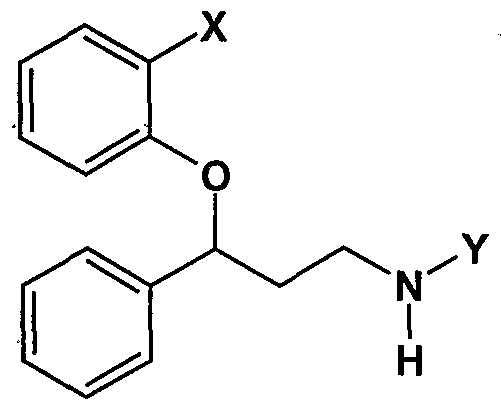
(i) wherein X is Cj-C4 alkylthio, and Y is C1-C alkyl, or a pharmaceutically acceptable salt thereof;
a compound of formula II: r

(II)
wherein:
R is H, Ar is a phenyl group,
X is a phenyl group,
R' is H or Ci-C^ alkyl, each R1 is independently H or Ci -C4 alkyl, or a pharmaceutically acceptable salt thereof;
a compound of formula (III):

R2 and R3 are each independently selected from H, Ci -C4 alkyl,
O(Cι -C4 alkyl), S(Cι -C4 alkyl), halo, and phenyl, and
R4 is selected from H and C1 -C4 alkyl, or a pharmaceutically acceptable salt thereof; a compound of formula V:

Ry is H or Cι-C4 alkyl, each Rz is independently H or Cj-C alkyl,
X represents O,
Y represents OH or OR,
R is C]-C4 alkyl, and
Ar i and Ar2 are each independently selected from the group consisting of phenyl and substituted phenyl, or a pharmaceutically acceptable salt thereof;
a compound of formula (VI):

(VI) wherein Ri and R2 are each independently selected from H, Ci -C4 alkyl,
O(Cι -C4 alkyl), S(Cι -C4 alkyl), halo, and phenyl, and R3 is selected from H, C1-C4 alkyl and halo, or a pharmaceutically acceptable salt thereof;
a compound of formula (VII):

R!is H or Cι-C4 alkyl,
R3 is H, halo, C]-C4 alkyl, O(C!-C4 alkyl), nitrile, phenyl, or substituted phenyl,
R4 and R5 are each independently selected from H or Cj-C4 alkyl, Ar- is selected from the group consisting of

in which:
R2a is H, halo, methyl, or ethyl,
R is H, halo, or methyl,
R2c is H, halo, methyl, trifluoromethyl, nitrile, or methoxy,
R2d is H, halo, methyl, or ethyl,
R2e is H, halo, methyl, trifluoromethyl, nitrile, or methoxy,
R2f is H or fluoro,
-Y- is -O-, -S- or-N(R6)-, and
R6 is H or methyl, or a pharmaceutically acceptable salt thereof;
a compound of formula (Vila):

(VII) above; or a pharmaceutically acceptable salt thereof; and
a compound of formula (VIII):

(VIII) wherein: n is 2 or 3,
R]is H or Cι-C4 alkyl, R3 is H, halo, phenyl, or substituted phenyl, R2a is H, halo, methyl, or ethyl, R2 is H, halo, or methyl, or a pharmaceutically acceptable salt thereof.
2. The method of claim 1, wherein said selective norepinehprine reuptake inhibitor is atomoxetine hydrochloride.
3. The method of claim 1 or 2, wherein symptoms of said emotional dysregulation occur in conjunction with attention deficit hyperactivity disorder, borderline personality disorder, bipolar disorder, schizophrenia, schizoaffective disorder, or intermittent explosive disorder.
4. The method of claim 1 or 2, wherein symptoms of said emotional dysregulation occur independently of any other disorder.
5. Use of a selective norepinephrine reuptake inhibitor selected from the group consisting of: atomoxetine or a pharmaceutically acceptable salt thereof; racemic reboxetine or a pharmaceutically acceptable salt thereof; (S,S) reboxetine or a pharmaceutically acceptable salt thereof; a compound of formula I:

(I) wherein X is Cj-C4 alkylthio, and Y is C]-C alkyl, or a pharmaceutically acceptable salt thereof;
a compound of formula II: r

(II) wherein:
RisH,
Ar is a phenyl group,
X is a phenyl group,
R'isHorCι-C4alkyL each R1 is independently H or Ci -C4 alkyl, or a pharmaceutically acceptable salt thereof;
a compound of formula (III):

R2 and R3 are each independently selected from H, C] -C4 alkyl,
O(Cι -C4 alkyl), S(Cι -C4 alkyl), halo, and phenyl, and
R4 is selected from H and C1-C4 alkyl, or a pharmaceutically acceptable salt thereof;
a compound of formula V:

(V) wherein: R is H,
Ry is H or Ci- alkyl, each Rz is independently H or C]-C4 alkyl, X represents O, Y represents OH or OR, R is C]-C4 alkyl, and Ari and Ar2 are each independently selected from the group consisting of phenyl and substituted phenyl, or a pharmaceutically acceptable salt thereof;
a compound of formula (VI):

(VI) wherein Ri and R2 are each independently selected from H, Ci -C4 alkyl,
O(Cι -C4 alkyl), S(Cι -C4 alkyl), halo, and phenyl, and R3 is selected from H, Ci -C4 alkyl and halo, or a pharmaceutically acceptable salt thereof;
a compound of formula (VII):
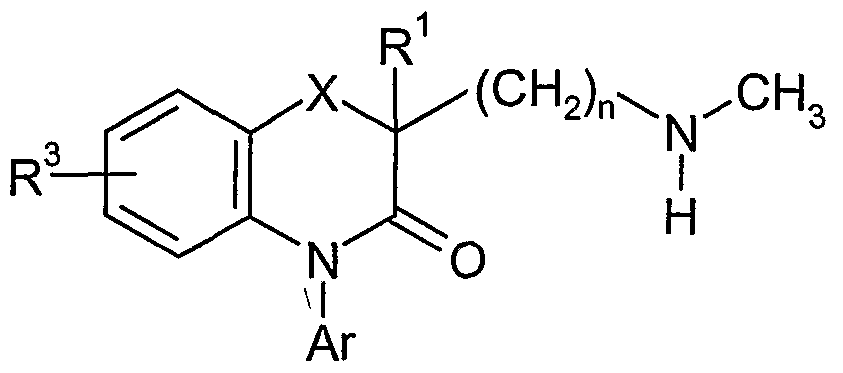
(VII) wherein:
-X- is -C(R » 4TTT« 5)N-, -O- or-S-, n is 2 or 3,
R!is H or Cι-C4 alkyl,
R3 is H, halo, Cj-C alkyl, O(CrC4 alkyl), nitrile, phenyl, or substituted phenyl,
R4 and R5 are each independently selected from H or Cj-C4 alkyl, Ar- is selected from the group consisting of
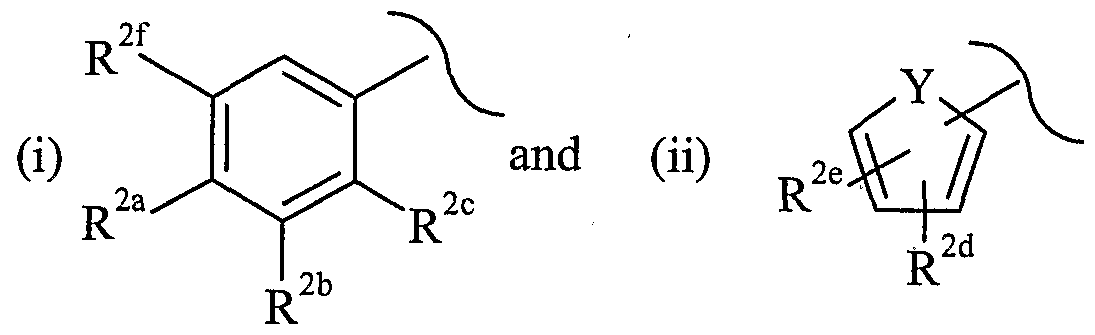
in which:
R >2a is H, halo, methyl, or ethyl,
R is H, halo, or methyl,
R2c is H, halo, methyl, trifluoromethyl, nitrile, or methoxy,
R2d is H, halo, methyl, or ethyl,
R2e is H, halo, methyl, trifluoromethyl, nitrile, or methoxy,
R2f is H or fluoro,
-Y- is -O-, -S- or-N(R6)-, and
R6 is H or methyl, or a pharmaceutically acceptable salt thereof;
a compound of formula (Vila):

(VII) above; or a pharmaceutically acceptable salt thereof; and
a compound of formula (VIII):

(VIII) wherein: n is 2 or 3,
R'is H or Cι-C4 alkyl, R3 is H, halo, phenyl, or substituted phenyl, R2a is H, halo, methyl, or ethyl, R2b is H, halo, or methyl, or a pharmaceutically acceptable salt thereof, for the manufacture of a medicament for the treatment of emotional dysregulation.
6. The use according to claim 5, wherein said selective norepinehprine reuptake inhibitor is atomoxetine hydrochloride.
Applications Claiming Priority (2)
| Application Number | Priority Date | Filing Date | Title |
|---|---|---|---|
| US47075203P | 2003-05-15 | 2003-05-15 | |
| US60/470,752 | 2003-05-15 |
Publications (2)
| Publication Number | Publication Date |
|---|---|
| WO2004103356A2 true WO2004103356A2 (en) | 2004-12-02 |
| WO2004103356A3 WO2004103356A3 (en) | 2005-03-31 |
Family
ID=33476747
Family Applications (1)
| Application Number | Title | Priority Date | Filing Date |
|---|---|---|---|
| PCT/US2004/013005 Ceased WO2004103356A2 (en) | 2003-05-15 | 2004-05-11 | Treatment of emotional dysregulation |
Country Status (1)
| Country | Link |
|---|---|
| WO (1) | WO2004103356A2 (en) |
Cited By (1)
| Publication number | Priority date | Publication date | Assignee | Title |
|---|---|---|---|---|
| CN113358773A (en) * | 2021-05-21 | 2021-09-07 | 健民药业集团股份有限公司 | Reversed phase liquid chromatography method for detecting atomoxetine hydrochloride enantiomer |
Family Cites Families (3)
| Publication number | Priority date | Publication date | Assignee | Title |
|---|---|---|---|---|
| US5658590A (en) * | 1995-01-11 | 1997-08-19 | Eli Lilly And Company | Treatment of attention-deficit/hyperactivity disorder |
| AU709704B2 (en) * | 1995-07-24 | 1999-09-02 | Eli Lilly And Company | Treatment of attention-deficit/hyperactivity disorder |
| EP1395253A2 (en) * | 2000-11-15 | 2004-03-10 | Eli Lilly And Company | Treatment of anxiety disorders |
-
2004
- 2004-05-11 WO PCT/US2004/013005 patent/WO2004103356A2/en not_active Ceased
Cited By (2)
| Publication number | Priority date | Publication date | Assignee | Title |
|---|---|---|---|---|
| CN113358773A (en) * | 2021-05-21 | 2021-09-07 | 健民药业集团股份有限公司 | Reversed phase liquid chromatography method for detecting atomoxetine hydrochloride enantiomer |
| CN113358773B (en) * | 2021-05-21 | 2022-09-13 | 健民药业集团股份有限公司 | Reversed phase liquid chromatography method for detecting atomoxetine hydrochloride enantiomer |
Also Published As
| Publication number | Publication date |
|---|---|
| WO2004103356A3 (en) | 2005-03-31 |
Similar Documents
| Publication | Publication Date | Title |
|---|---|---|
| ES2288012T3 (en) | USE OF MORPHOLINOL FOR THE TREATMENT OF SEXUAL DISSEMINATION. | |
| SK19382001A3 (en) | Highly selective norepinephrine reuptake inhibitors and methods of using the same | |
| WO2009128537A1 (en) | Heterocyclic compound | |
| UA125873C2 (en) | METHOD OF TREATMENT OF DEPRESSION USING OREXIN-2 RECEPTOR ANTAGONISTS | |
| US20230150936A1 (en) | Analogs of n,n,n-trimethyl-4-phosphoryloxytryptamine | |
| US12527799B2 (en) | Treatment of autism spectrum disorders, obsessive-compulsive disorder and anxiety disorders | |
| AU2016349089A1 (en) | Pyrimidine derivative and use thereof | |
| US20070015786A1 (en) | Treatment of hot flashes, impulse control disorders and personality change due to a general medical condition | |
| AU2023231493A1 (en) | Pure forms of crystalline aticaprant | |
| WO2004017977A2 (en) | 2- (phenoxymethyl)- and 2- (phenylthiomethyl)-morpholine derivatives for use as selective norepinephrine reuptake inhibitors | |
| JP2014511897A (en) | Dibenzothiazepine derivatives and their use in the treatment of CNS disorders | |
| AU2012250776A1 (en) | Pentylenetetrazole derivatives | |
| US6855820B2 (en) | Pharmaceutically active morpholinol | |
| RU2005101345A (en) | New tetracyclic arylcarbonylindoles with affinity for serotonin receptors, suitable as drugs, a method for their preparation and pharmaceutical compositions based on them | |
| CN121335888A (en) | (S)-Tiazoprine and its use in the treatment of disorders and conditions associated with peroxisome proliferator-activated receptors. | |
| US20190185438A1 (en) | Salts and polymorphs of esreboxetine | |
| US20060241188A1 (en) | Treatment of pervasive developemental disorders with norepinephrine reuptake inhibitors | |
| US20070105960A1 (en) | Treatment of learning disabilities and motor skills disorder with norepinephrine reuptake inhibitors | |
| US7294623B2 (en) | Benzyl morpholine derivatives | |
| US20070032554A1 (en) | Treatment of stuttering and other communication disorders with norepinephrine reuptake inhibitors | |
| CN101402633A (en) | Benzamide derivatives, preparation method and medical uses thereof | |
| CA3183547A1 (en) | Inhibitors of acid sphingomyelinase for preventing and treating the covid-19 disease | |
| US20260078102A1 (en) | Substituted n-propylamine fused heterocyclic mescaline derivatives | |
| WO2005053663A2 (en) | Norepinephrine reuptake inhibitors useful for treatment of cognitive failure | |
| KR20010108167A (en) | Tetrahydro isoquinolinealkanol derivatives and pharmaceutical compositions containing same |
Legal Events
| Date | Code | Title | Description |
|---|---|---|---|
| AK | Designated states |
Kind code of ref document: A2 Designated state(s): AE AG AL AM AT AU AZ BA BB BG BR BW BY BZ CA CH CN CO CR CU CZ DE DK DM DZ EC EE EG ES FI GB GD GE GH GM HR HU ID IL IN IS JP KE KG KP KR KZ LC LK LR LS LT LU LV MA MD MG MK MN MW MX MZ NA NI NO NZ OM PG PH PL PT RO RU SC SD SE SG SK SL SY TJ TM TN TR TT TZ UA UG US UZ VC VN YU ZA ZM ZW |
|
| AL | Designated countries for regional patents |
Kind code of ref document: A2 Designated state(s): GM KE LS MW MZ NA SD SL SZ TZ UG ZM ZW AM AZ BY KG KZ MD RU TJ TM AT BE BG CH CY CZ DE DK EE ES FI FR GB GR HU IE IT LU MC NL PL PT RO SE SI SK TR BF BJ CF CG CI CM GA GN GQ GW ML MR NE SN TD TG |
|
| 121 | Ep: the epo has been informed by wipo that ep was designated in this application | ||
| 122 | Ep: pct application non-entry in european phase |