WO2004102185A1 - Indicator - Google Patents
Indicator Download PDFInfo
- Publication number
- WO2004102185A1 WO2004102185A1 PCT/FI2004/000166 FI2004000166W WO2004102185A1 WO 2004102185 A1 WO2004102185 A1 WO 2004102185A1 FI 2004000166 W FI2004000166 W FI 2004000166W WO 2004102185 A1 WO2004102185 A1 WO 2004102185A1
- Authority
- WO
- WIPO (PCT)
- Prior art keywords
- indicator
- colour
- change
- package
- indicators
- Prior art date
- Legal status (The legal status is an assumption and is not a legal conclusion. Google has not performed a legal analysis and makes no representation as to the accuracy of the status listed.)
- Ceased
Links
Classifications
-
- G—PHYSICS
- G01—MEASURING; TESTING
- G01N—INVESTIGATING OR ANALYSING MATERIALS BY DETERMINING THEIR CHEMICAL OR PHYSICAL PROPERTIES
- G01N31/00—Investigating or analysing non-biological materials by the use of the chemical methods specified in the subgroup; Apparatus specially adapted for such methods
- G01N31/22—Investigating or analysing non-biological materials by the use of the chemical methods specified in the subgroup; Apparatus specially adapted for such methods using chemical indicators
- G01N31/223—Investigating or analysing non-biological materials by the use of the chemical methods specified in the subgroup; Apparatus specially adapted for such methods using chemical indicators for investigating presence of specific gases or aerosols
-
- G—PHYSICS
- G01—MEASURING; TESTING
- G01N—INVESTIGATING OR ANALYSING MATERIALS BY DETERMINING THEIR CHEMICAL OR PHYSICAL PROPERTIES
- G01N33/00—Investigating or analysing materials by specific methods not covered by groups G01N1/00 - G01N31/00
- G01N33/02—Food
Definitions
- the present invention relates to an indicator which reacts with at least one gaseous compound in such a way that the colour of the indicator is changed.
- Publication WO 98/21120 discloses a myoglobin indicator reacting to hydrogen sulphide.
- Publication JP 2001238696 discloses an indicator intended for detecting Salmonella bacteria in eggs.
- the indicator is formed by adsorbing a silver, copper or mercury ion by a fibre substance.
- the indicator will react to gaseous compounds emitted from the egg by a change in the colour.
- the indicator according to the invention is characterized in that the indicator is a layer formed on a substrate comprising metallic silver and/or metallic copper.
- the indicator according to the invention has, for example, the following advantages:
- the colour change in the indicator is visible to the eyes, no special equipment will be needed for monitoring it.
- automatic monitoring devices for analysing the change in the colour.
- an abrupt, visually detectable change takes place in the colour of the indicator.
- the change in the colour can be adjusted to a given concentration.
- it was observed that the change in the colour can be made to take place in a reproducible way; in other words, the indicator can be made very reliable.
- the indicator according to the invention is arranged to react to gaseous substances, particularly hydrogen sulphide.
- the indicator can be used to indicate a gas concentration which presents odour problems to the environment or a hazard for persons working in the facilities.
- the indicator can be utilized in the maintenance of industrial plants, wherein an increase in gas concentrations can be used to trace, for example, a leak in the process equipment.
- the indicator can also be used to monitor the concentration of hydrogen sulphide in facilities where it would be harmful to expose equipment, particularly electrical devices, to cold corrosion.
- Uses of the indicator include, for example, water treatment plants (particularly biological sewage treatment plants), sewer systems, dumping areas, and equipment facilities in the processing industry.
- the indicator can also be used for controlling the purity of air in houses and places of work.
- the indicator can be set to indicate, for example, maximum hydrogen sulphide concentrations given by various guidelines:
- the indicator according to the invention can be used, for example, as an indicator of shelf life, wherein in small quantities of substances indicating decaying, an abrupt change takes place in the colour of the indicator, wherein the indicator can be monitored, for example, in a retail shop or under household conditions.
- the indicator reacts chemically with substances evaporated from the decaying product in such a way that the colour of the indicator is changed.
- the change in the colour of the indicator takes place in a reliable (reproducible) way in relation to the quantity of the substances indicating decaying of the decayable product.
- the indicator accord- ing to the invention can also be applied to other uses, made in the same way and reacting to the same gases.
- indicators made as such by the same principle must be adjusted, in their parameters, to the use; for example, the gas concentration in which the change in the colour of the indicator takes place, must be adjusted in view of the requirements of the use.
- the shelf life indicator can be manufactured on a separate substrate to be easily attached to a package, such as a self-adhesive label, or the manufacture of the shelf life indicator can be directly integrated in the manufacture of the food packages; in other words, the indicator can be made in connection with the manufacture of the package material and, for example, any separate steps to attach the shelf life indicator in connection with the packing will not be needed.
- Metallic silver has been approved for use in connection with foodstuffs, also in direct contact. Moreover, there is a long experience of the use of metallic silver with foodstuffs; it has been used in cutlery and serving dishes for a long time.
- the indicator according to the invention is used particularly in uses requiring an indicator reacting to volatile sulphur compounds.
- the indicator according to the invention can be used as a shelf life indicator in food packages intended for the packing of foodstuffs which, when decaying, produce chemical compounds, for example sulphur compounds, such as hydrogen sulphide, dimethyl sulphide and/or dimethyl disulphide.
- chemical compounds for example sulphur compounds, such as hydrogen sulphide, dimethyl sulphide and/or dimethyl disulphide.
- the composition of the chemical compounds volatilizing from decaying food depends on the food in question. Sulphur compounds are produced particularly in the decaying of poultry meat, such as chicken or turkey.
- the chemical compound may also be other than a sulphur compound, as long as it reacts with metallic silver and/or copper, causing a change in the colour.
- the food may be packed without a shielding gas, the package may contain a shielding gas, such as a nitrogen or carbon dioxide shielding gas or a shielding gas containing both of said shielding gases, or the product may be packed in a vacuum.
- the shelf life indicator is inside the package, that is, in a space where it can react with the sulphur compound emitted from the decaying food.
- the shelf life indicator comprises a metal which is selected from the group of transition elements and is preferably of metallic silver and/or copper. When the metal reacts with hydrogen sulphide, sulphides are produced.
- the chemical reaction with the sulphur compound results in a relatively abrupt change in the colour of the shelf life indicator, which correlates well with the quantity of the sulphur compound emitted into the package, such as hydrogen sulphide, dimethyl sulphide and/or dimethyl disulphide.
- the indicator is made either by applying a metal layer on a suitable non-metal substrate or by printing it on a suitable printing base, for example by the screen printing or the flexographic printing technique.
- the printing base can be, for example, paper, board, or plastic.
- the printing paste comprises at least an adhesive and metal particles with an average diameter of preferably less than 10 ⁇ m.
- the printing paste contains metal particles 70 to 90 percent of the dry substance of the printing paste.
- Suitable adhesives to be used in flex- ographic printing include, for example, shellac, cellulose nitrate, ethyl cellulose, cellulose acetate propionate (CAP), polyamide resins, acrylic and methacrylic resins, ketone resins, polyvinyl acetate, and polyvinyl chloride.
- Suitable adhesives to be used in screen printing include, for example, acrylic, polyurethane and vinyl resins.
- a metal coating When a metal coating is applied on a non-metallic substrate, for example by vapour deposition or sputtering, it can be made very thin, normally with a layer thickness of 1 to 10 nm.
- An advantageous layer thickness is 1 to 5 nm.
- the metal layer to be applied either by printing, sputtering or vapour deposition can be made, for example, on a transparent plastic film to be used as the top of a food package, wherein the shelf life indicator remains inside the food package but can be observed from the outside of the package.
- the metal layer covers the plastic film for only a given part; that is, the indicator may be relatively small in size when compared with a plastic film top.
- the colour of the thin metal layer is changed throughout, wherein said embodiment is very handy. For example, in a silver layer with the thickness of 1 nm, a distinct change was observed in the colour by the effect of hydrogen sulphide in the concentration of 0.016 mg/l (silver film applied on a polyester or polycarbonate film).
- the sensitivity of the shelf life indicator can be adjusted e.g. by changing the thickness of the metal layer. As the layer thickness is increased, the change in the colour takes place in a higher gas concentration. The sensitivity of the indicator is also affected by the quality of the material onto whose surface the indicator layer is applied.
- Figure 1 is a graphic representation of the values of table 3.
- Example 1 Example 1.
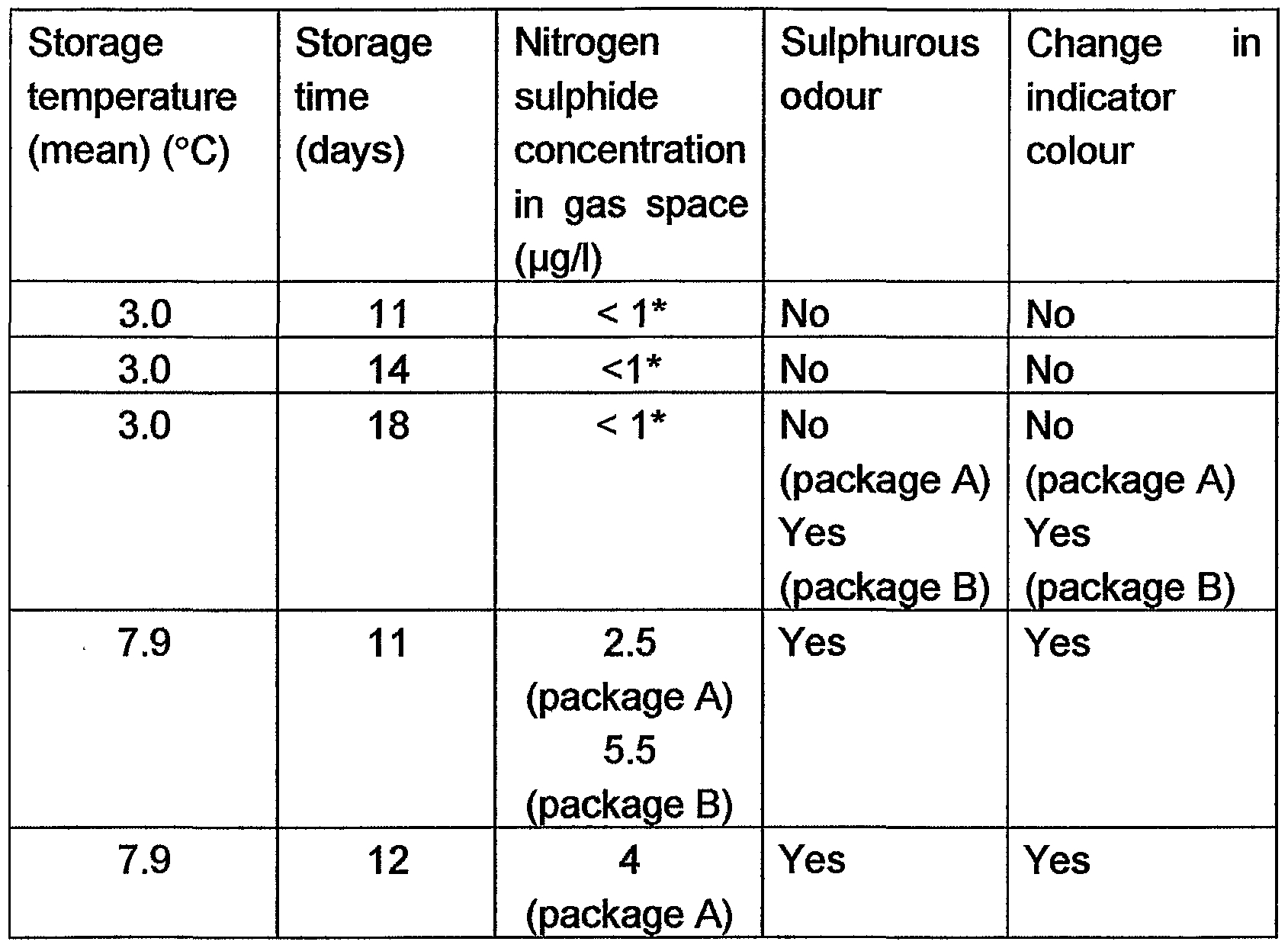
- Chicken fillet slices (about 115 + 5 g) were packed in 210 ml box packages (material HDPE) with a shielding gas (80 % C0 2 / 20 % N 2 ) and stored at a constant temperature of +5.5°C and +8°C.
- a 5 ml gas sample was taken with a gas-tight syringe from the gas space of the packages and injected into a head-space flask (volume 22 ml) sealed in a gas-tight manner in a clean room.
- the nitrogen sulphide concentrations in the gas space were determined by gas chromatography by using a sulphur selective detector.
- the nitrogen sulphide concentration of the gas space increased as a function of the storage time and temperature (table 1) and represented the shelf life of the chicken slices.
- the number of parallel tests was 2. Example 2.
- Table 3 shows, as a function of time, the change in the colour of shelf life indicators made by flexographic printing and placed in the gas spaces of turkey packages stored at different temperatures.
- the shielding gas used in the food packages was carbon dioxide.
- the values of table 3 are shown graphically in Fig. 1.
- the indicator samples were: 1. PET 1 nm, 2. PET 2 nm, 3. PP 1 nm, and 4. PP 2 nm.
- the indicators were attached to the inside of the top film in 600 ml packages, and the boxes were packed by rinsing with a shielding gas.
- the composition of the shielding gas was 9.5 % of 0 2 , 90.5 % of COz 100 ppm nitrogen sulphide was added into the packages, according to table 7.
- the changes in the colour of the different indicators were compared.
- the colour of the indicators was evaluated visually. In particular, the aim was to compare different indicator materials with each other.
- the indicators 1 and 2 made of a PET film were the fastest ones to react of the indica- tors tested.
- the 1 nm indicator 3 made of a PP film was slightly slower than these to react.
- the indicator 4 (PP / 2 nm) had the slowest reaction.
- differences could be found primarily in the lowest test concentration (0.1 ⁇ g/l) of nitrogen sulphide. The difference was manifested in the size of the reaction area in the indicator. The largest reaction areas were found for the indicators 1 , 2 and 3. The reaction area of indicator 4 was clearly smaller. In the other tested concentrations of nitrogen sulphide, the reaction of the indicators was virtually complete after the reaction of 2 days.
- the invention is not restricted to the description above, but it may vary within the scope of the claims.
- the examples presented only discuss metallic silver which is a particularly advantageous choice of metal, but the metal can also be copper or a mixture of silver and copper, or a layered structure.
Landscapes
- Life Sciences & Earth Sciences (AREA)
- Chemical & Material Sciences (AREA)
- Health & Medical Sciences (AREA)
- Biochemistry (AREA)
- General Physics & Mathematics (AREA)
- Pathology (AREA)
- Physics & Mathematics (AREA)
- Analytical Chemistry (AREA)
- Immunology (AREA)
- General Health & Medical Sciences (AREA)
- Food Science & Technology (AREA)
- Engineering & Computer Science (AREA)
- Dispersion Chemistry (AREA)
- Biophysics (AREA)
- Molecular Biology (AREA)
- Medicinal Chemistry (AREA)
- Investigating Or Analyzing Non-Biological Materials By The Use Of Chemical Means (AREA)
- Investigating Or Analysing Materials By The Use Of Chemical Reactions (AREA)
- Packages (AREA)
Abstract
Description




Claims
Priority Applications (3)
| Application Number | Priority Date | Filing Date | Title |
|---|---|---|---|
| DE112004000841T DE112004000841T5 (en) | 2003-05-16 | 2004-03-25 | indicator |
| US10/557,002 US7785894B2 (en) | 2003-05-16 | 2004-03-25 | Package for enclosing food |
| GB0523668A GB2417079B (en) | 2003-05-16 | 2004-03-25 | Method for detecting the presence of a gaseous sulphur-containing compound |
Applications Claiming Priority (2)
| Application Number | Priority Date | Filing Date | Title |
|---|---|---|---|
| FI20030743A FI117355B (en) | 2003-05-16 | 2003-05-16 | freshness Indicator |
| FI20030743 | 2003-05-16 |
Publications (1)
| Publication Number | Publication Date |
|---|---|
| WO2004102185A1 true WO2004102185A1 (en) | 2004-11-25 |
Family
ID=8566128
Family Applications (1)
| Application Number | Title | Priority Date | Filing Date |
|---|---|---|---|
| PCT/FI2004/000166 Ceased WO2004102185A1 (en) | 2003-05-16 | 2004-03-25 | Indicator |
Country Status (5)
| Country | Link |
|---|---|
| US (1) | US7785894B2 (en) |
| DE (1) | DE112004000841T5 (en) |
| FI (1) | FI117355B (en) |
| GB (1) | GB2417079B (en) |
| WO (1) | WO2004102185A1 (en) |
Cited By (4)
| Publication number | Priority date | Publication date | Assignee | Title |
|---|---|---|---|---|
| GB2437546A (en) * | 2006-04-26 | 2007-10-31 | Francoise D Offay-Smith | Food container with visual and physical spoilage indicator |
| WO2011144652A3 (en) * | 2010-05-18 | 2012-01-12 | Delta Dansk Elektronik, Lys & Akustik | Method for depositing sensor material on a substrate |
| JP2012120193A (en) * | 2005-06-07 | 2012-06-21 | Qualcomm Inc | Reception of h-arq transmissions with interference cancellation in a quasi-orthogonal communication system |
| ES2589811A1 (en) * | 2015-05-12 | 2016-11-16 | Fundación Centro De Innovación Y Demostración Tecnología | Intelligent container deterioration detector of fresh food (Machine-translation by Google Translate, not legally binding) |
Families Citing this family (10)
| Publication number | Priority date | Publication date | Assignee | Title |
|---|---|---|---|---|
| US8267576B2 (en) | 2004-11-08 | 2012-09-18 | Freshpoint Holdings Sa | Time-temperature indicating device |
| US20090269444A1 (en) * | 2008-04-28 | 2009-10-29 | Fres-Co System Usa, Inc. | Flexible package with shelf-life indicating card window and method of packaging a product in a flexible package |
| US9121827B2 (en) * | 2011-06-30 | 2015-09-01 | Mocon, Inc. | Method of contemporaneously monitoring changes in analyte concentration in a plurality of samples on individual schedules |
| ES2540786B1 (en) * | 2014-01-10 | 2016-05-13 | Chimigraf Ibérica, S.L. | Food freshness indicator ink and procedure for manufacturing food freshness indicator ink |
| DE102015217471A1 (en) * | 2015-09-14 | 2017-03-16 | Robert Bosch Gmbh | Food packaging arrangement |
| KR101972654B1 (en) * | 2017-06-20 | 2019-04-25 | 연세대학교 원주산학협력단 | Food freshness indicator using cellulose nanocrystal-silver nanoparticle film and manufacturing method thereof |
| US10392515B2 (en) | 2017-08-25 | 2019-08-27 | Ppg Industries Ohio, Inc. | Metal cans coated with shellac-containing coatings |
| US11002718B2 (en) * | 2018-05-29 | 2021-05-11 | Palo Alto Research Center Incorporated | Gas sensor |
| CN109856196B (en) * | 2018-12-04 | 2020-08-04 | 中国农业大学 | Device and method for monitoring freshness of chilled meat |
| CN122042755A (en) * | 2024-11-14 | 2026-05-15 | 中国石油天然气股份有限公司 | Method and device for detecting concentration of hydrogen sulfide in natural gas |
Citations (3)
| Publication number | Priority date | Publication date | Assignee | Title |
|---|---|---|---|---|
| US2626855A (en) * | 1950-06-26 | 1953-01-27 | Wilfred C Hand | Seafood spoilage indicating system |
| US4746616A (en) * | 1986-07-16 | 1988-05-24 | The Board Of Regents Of The University Of Washington | Method of treating a consumable product and packaging for consumable products to indicate the presence of contamination |
| WO1998021120A1 (en) * | 1996-11-08 | 1998-05-22 | Valtion Teknillinen Tutkimuskeskus | Package for decayable foodstuffs |
Family Cites Families (6)
| Publication number | Priority date | Publication date | Assignee | Title |
|---|---|---|---|---|
| US5407829A (en) | 1990-03-27 | 1995-04-18 | Avl Medical Instruments Ag | Method for quality control of packaged organic substances and packaging material for use with this method |
| US5753285A (en) | 1995-02-16 | 1998-05-19 | Horan; Thomas J. | Method for determining bacteria contamination in food package |
| US6149952A (en) | 1998-05-15 | 2000-11-21 | Herbert W. Stoltenberg | Method for determining deleterious bacterial growth in packaged food utilizing hydrophilic polymers |
| JP2000056793A (en) | 1998-08-12 | 2000-02-25 | Fuji Xerox Co Ltd | Voice recognition device |
| GB9818766D0 (en) * | 1998-08-28 | 1998-10-21 | Johnson Matthey Plc | Improvements in sensors |
| FI20012243A7 (en) | 2001-11-19 | 2003-05-20 | Valtion Teknillinen Tutkimuskeskus | Food and pharmaceutical packaging freshness sensor based on RF remote reading technology |
-
2003
- 2003-05-16 FI FI20030743A patent/FI117355B/en not_active IP Right Cessation
-
2004
- 2004-03-25 DE DE112004000841T patent/DE112004000841T5/en not_active Ceased
- 2004-03-25 GB GB0523668A patent/GB2417079B/en not_active Expired - Fee Related
- 2004-03-25 US US10/557,002 patent/US7785894B2/en not_active Expired - Fee Related
- 2004-03-25 WO PCT/FI2004/000166 patent/WO2004102185A1/en not_active Ceased
Patent Citations (3)
| Publication number | Priority date | Publication date | Assignee | Title |
|---|---|---|---|---|
| US2626855A (en) * | 1950-06-26 | 1953-01-27 | Wilfred C Hand | Seafood spoilage indicating system |
| US4746616A (en) * | 1986-07-16 | 1988-05-24 | The Board Of Regents Of The University Of Washington | Method of treating a consumable product and packaging for consumable products to indicate the presence of contamination |
| WO1998021120A1 (en) * | 1996-11-08 | 1998-05-22 | Valtion Teknillinen Tutkimuskeskus | Package for decayable foodstuffs |
Cited By (4)
| Publication number | Priority date | Publication date | Assignee | Title |
|---|---|---|---|---|
| JP2012120193A (en) * | 2005-06-07 | 2012-06-21 | Qualcomm Inc | Reception of h-arq transmissions with interference cancellation in a quasi-orthogonal communication system |
| GB2437546A (en) * | 2006-04-26 | 2007-10-31 | Francoise D Offay-Smith | Food container with visual and physical spoilage indicator |
| WO2011144652A3 (en) * | 2010-05-18 | 2012-01-12 | Delta Dansk Elektronik, Lys & Akustik | Method for depositing sensor material on a substrate |
| ES2589811A1 (en) * | 2015-05-12 | 2016-11-16 | Fundación Centro De Innovación Y Demostración Tecnología | Intelligent container deterioration detector of fresh food (Machine-translation by Google Translate, not legally binding) |
Also Published As
| Publication number | Publication date |
|---|---|
| GB0523668D0 (en) | 2005-12-28 |
| GB2417079A (en) | 2006-02-15 |
| DE112004000841T5 (en) | 2006-03-30 |
| FI117355B (en) | 2006-09-15 |
| GB2417079B (en) | 2007-08-15 |
| US7785894B2 (en) | 2010-08-31 |
| US20070087443A1 (en) | 2007-04-19 |
| FI20030743A0 (en) | 2003-05-16 |
| FI20030743L (en) | 2004-11-17 |
Similar Documents
| Publication | Publication Date | Title |
|---|---|---|
| US7785894B2 (en) | Package for enclosing food | |
| Chen et al. | La-Ce-MOF nanocomposite coated quartz crystal microbalance gas sensor for the detection of amine gases and formaldehyde | |
| Sukhavattanakul et al. | Influence of hydrogen sulfide gas concentrations on LOD and LOQ of thermal spray coated hybrid-bacterial cellulose film for intelligent meat label | |
| US4145186A (en) | Sterilization detection device and method | |
| CN107037044B (en) | Chemical sensing hydrogels for biogenic amine detection | |
| EP0425587A1 (en) | Process for determining biological activities in a sample and a device for implementing it. | |
| WO2006032025A1 (en) | Food quality indicator | |
| CA2691757A1 (en) | Indicator system for determining analyte concentration | |
| JPH04215929A (en) | Method to inspection quality of packaged organic substance and packaging material to perform this method | |
| JP2017509731A (en) | Food freshness indicator ink and method for producing food freshness indicator ink | |
| Rapp et al. | Controls on redox-sensitive trace metals in the Mauritanian oxygen minimum zone | |
| US4678640A (en) | Indicator for detecting residual ethylene oxide | |
| US20090137054A1 (en) | Hydrogen sulfide indicating pigments | |
| Quevauviller et al. | Quality assurance and quality control for environmental monitoring | |
| Heydorn et al. | Gains or losses of ultratrace elements in polyethylene containers | |
| EP1108209B1 (en) | Sensing gaseous substances using metal complexes | |
| US4731333A (en) | Method for detecting gaseous hydrides | |
| SE504068C2 (en) | Ways to increase the shelf life of a device to indicate carbon dioxide and packaging containing the device | |
| US6145468A (en) | Silver indicator methods and test kit | |
| GB1600618A (en) | Colorimetric detection of carbon monoxide in a given environment | |
| Kuhns et al. | Boron Hydride Monitoring Devices | |
| US5106647A (en) | Method to manufacture gas monitoring test strips | |
| Higueras et al. | Optimizing headspace analysis to assess the suitability of fused deposition modeling materials used in Cultural Heritage | |
| Magro et al. | Volatile Organic Compound Monitoring during Extreme Wildfires | |
| JP2962095B2 (en) | A method to determine the approximate amount of nitrogen oxides contained in the environment |
Legal Events
| Date | Code | Title | Description |
|---|---|---|---|
| AK | Designated states |
Kind code of ref document: A1 Designated state(s): AE AG AL AM AT AU AZ BA BB BG BR BW BY BZ CA CH CN CO CR CU CZ DE DK DM DZ EC EE EG ES FI GB GD GE GH GM HR HU ID IL IN IS JP KE KG KP KR KZ LC LK LR LS LT LU LV MA MD MG MK MN MW MX MZ NA NI NO NZ OM PG PH PL PT RO RU SC SD SE SG SK SL SY TJ TM TN TR TT TZ UA UG US UZ VC VN YU ZA ZM ZW |
|
| AL | Designated countries for regional patents |
Kind code of ref document: A1 Designated state(s): BW GH GM KE LS MW MZ SD SL SZ TZ UG ZM ZW AM AZ BY KG KZ MD RU TJ TM AT BE BG CH CY CZ DE DK EE ES FI FR GB GR HU IE IT LU MC NL PL PT RO SE SI SK TR BF BJ CF CG CI CM GA GN GQ GW ML MR NE SN TD TG |
|
| 121 | Ep: the epo has been informed by wipo that ep was designated in this application | ||
| WWE | Wipo information: entry into national phase |
Ref document number: 0523668.2 Country of ref document: GB Ref document number: 0523668 Country of ref document: GB |
|
| 122 | Ep: pct application non-entry in european phase | ||
| WWE | Wipo information: entry into national phase |
Ref document number: 2007087443 Country of ref document: US Ref document number: 10557002 Country of ref document: US |
|
| WWP | Wipo information: published in national office |
Ref document number: 10557002 Country of ref document: US |