NEW CALIX ARENE COMPOUNDS, THEIR PROCESS OF PREPARATION AND THEIR USE, PARTICULARLY AS ENZYMATIC
MIMES
The present invention relates to new calix arene compounds, their process of preparation and their use, particularly as enzymatic mimes.
Calix[4]arenes have been extensively studied for host-guest chemistry. However, because of their small size, they have mostly been used as a platform for the preorganization of a binding site. The larger calix[6]arenes appear more suitable to play the role of a molecular receptor, yet their higher conformational flexibility, due to facile ring inversion, represents an obstacle (C. D. Gutsche, Calixarenes Revisited, Monographs in Supramolecular Chemistry, 1998, J. F. Stoddart, Ed. The Royal Society of Chemistry, Cambridge, U.K.). It has been recently shown that rigidification of the calix[6] arene core could be achieved through the use of coordination chemistry
(Blanchard, S. et al. Angew. Chem. Int. Ed. Engl. (1998) 37, 2732-2735; Seneque, O. et al. J. Am. Chem. Soc. (2000) 122, 6183-6189; Le Clainche, L. et al. C. R. Acad. Sci. Paris, Serie He: Chem. (2000) 3, 811-819; Rondelez, Y. et al. Chem. Eur. J. (2000) 6, 4218-4226; Le Clainche, L. et al. Inorg. Chem. (2000) 39, 3436-3437; Rondelez, Y. et al. J. Am. Chem. Soc. (2002) 124, 1334-1340).
Indeed, the binding of a metal ion to three amino groups that are covalently linked to the calix[6] arene small rim, can constrain the macrocycle into a cone conformation. The so-called funnel complexes present a biomimetic environment for Cu or Zn, which can coordinate a neutral guest inside the hydrophobic cavity, (Seneque, O. et al. Chem. Commun. (2001) 984-985; Seneque, O. et al. J. Am. Chem. Soc. (2001) 123, 8442-8443;
Rondelez, Y. et al. Angew. Chem. Int. Ed. Engl. (2002), 41, 1044-1046).
If the synthesis of calix[4](aza)crowns has already been explored (Bitter, I. et al. Tetrahedron (1997) 53, 9799-9812; Tuntulani, T. et al. Tetrahedron Lett. (1997) 38, 3985-3988; Oueslati, I. et al. Tetrahedron Lett. (2000) 41, 8263-8267; Balazs, B. et al. Eur. J. Org. Chem. (2001) 61-71; Abidi, R. et al. Tetrahedron Lett. (2001) 42, 1685-
1689; Tuntulani, T. et al. Tetrahedron Lett. (2001) 42, 5541-5544 ; He, Y. et al. Tetrahedron Lett. (2002) 43, 6249-6253), only two recent examples of calix[6]arenes including diamide bridges have been reported (Chen, Y. et al. Tetrahedron Lett. (2000) 41, 9079-9082; Chen, Y.-K. et al. Org. Lett. (2000) 2, 743-745).
Furthermore, calix[6]arenes capped with a tripodal bridge are still rare (Grynszpan, F. et al. J. Chem. Soc, Chem. Commun. (1993) 13-16; Takeshita, M. et al. J. Org. Chem. (1994) 59, 4032-4034; Araki, K. et al. Chem. Lett. (1994) 1251-1254; Jansenn, R. G. et al., Tetrahedron Lett. (1994) 35, 6555-6558; Otsuka, H. J Org. Chem. (1995) 60, 4862-4867; Nam, K. C. et al. J. Org. Chem. (1997) 62, 6441-6443; Chen, Y.-
Y. et al. Tetrahedron (1998) 54, 15183-15188; Li, J.-S. et al. Eur. J. Org. Chem. (2000) 485-490; Zhang, Y. et al. Tetrahedron (2001) 57, 4161-4165).
The aim of the present invention is to provide new compounds calix[6](aza)crown, and their process of preparation. The aim of the present invention is to describe the synthesis of the first C v- syrnmetrical calix[6](aza)crown, where the small rim is capped with the tris(2- aminoethyl)amine tripodal unit.
Such caped calix[6](aza)crown compounds present the following advantages:
A metal ion is not required anymore to constrain the calixarene in a cone conformation. The covalent aza-links at the small rim prevent the cone-cone inversion of the calixarene structure and maintain it in a conformation suitable for playing the role of a good and selective host for organic guests. The aza crown can bind a protic guest through hydrogen bonding for example but also a cationic species such as a metal ion. The coordinated metal is then strongly complexed by the aza crown and is highly resistant to decoordinating processes. Coordination of an organic molecule or inorganic ligand such as an anion will be highly controlled by the design of the calixarene host, thanks to its caping at the small rim. Finally, these compounds can be transformed into water-soluble hosts that will display selective coordinating abilities of small molecules or ions in biological media.
The present invention relates to compounds of the following formula (I):
- R and R1} identical or different, represent: H, a halogen atom such as F, CI, Br, I, an ester or a thioester group of 2 to 20 carbon atoms, a carboxylic group, an amide or a thioamide group, a sulfonamide group, SO3 ", a phosphate, a carboxylate, N02, or a primary, secondary or tertiary amine group and its derivatives such as a ketimine, an ammonium, a carbamate, a thiocarbamate, and an alkyl group of 1 to 20 carbon atoms, said alkyl group being possibly substituted with one of the functional groups as defined above;
- R3 represents: H, an alkyl group or an alkyl chain of 1 to 20 carbon atoms possibly substituted by any other functional group, such as defined for R and Rl3 and is particularly a methyl group;
- X represents:
* a nitrogen atom, an ammonium N
+R
5, or CR
5 group, with R
5 representing an H, N0
2, OH or an alkyl group being possibly substituted with a halogen atom, an ester, a carboxylic group, an amide or a thioamide group, a sulfonamide group, SO
3 ", a phosphate, a carboxylate, N0
2, a primary, secondary or tertiary amine group, a nitrilo, an alcohol, an ether, a thiol, a thiothex derivative; and being preferably a methyl group;
* or X represents a group of formula (A) :
or a corresponding ammonium salt of said formula (A), wherein at least one of the three nitrogen atoms bears a R
6 substituent, R
6 having the same definition as R
5; Ai, A
2 and A represent:
* an alkyloxy group of formula -O-(CH2)p-, possibly substituted on one of the methylene carbons by a group having the same definition than R5, wherein p represents an integer varying from 1 to 3, when X represents a group of formula (A), or a corresponding arnmonium salt of said formula (A), wherein at least one of the three nitrogen atoms bears a 5 substituent, e having the same definition as R5;
* or a group of formula : -O-(CH2)n-NR2-(CH2)m- or -0-(CH2)n-N R2R4-(CH2)m- when X represents a nitrogen atom, an ammonium N+R5 or CR5 group as mentioned above, wherein m and n are integers varying from 1 to 3, and R and R4, identical or different, represent: H, an alkyl group of 1 to 20 carbon atoms, an ester or a thioester of 2 to 20 carbon atoms, a carboxylic acid of 1 to 20 carbon atoms, an amide or a thioamide of 1 to 20 carbon atoms, a sulfonamide of 1 to 20 carbon atoms, SO3 ", a phosphate, a phosphine, a phosphonamide, a carboxylate, an hydroxy and its derivative such an ether- oxyde, or an amine of 1 to 20 carbon atoms and its derivatives such as a ketimine, an arnmonium, a carbamate, a thiocarbamate.
The present invention consists in a calix[6]arene capped with a C3v- symmetrical azacrown bridge. Such a rigidifϊed ligand should possess a reinforced complexation ability since the cap should prevent decomplexation processes by protecting the metal ion from the external medium, while maintaining a large degree of flexibility essential for the system in order to act as a biomimetic receptor.
The present invention also relates to compounds having the following formula (II):
wherein R, Ri, R
3 and p are such as defined above.
The present invention also relates to compounds having the following formula
wherein R, Ri, R3, Re and p are such as defined above.
According to an advantageous embodiment, the compounds of the invention are characterised in that R and Ri are tBu groups and R3 represents a methyl group, and in that p is equal to 2.
The present invention also relates to compounds having the following formula
wherein m, n, R, Rls R2 and R are such as defined above, and wherein X represents a nitrogen atom, an ammonium N+R5, or CR5 group, R5 being such as defined above.
The present invention also relates to compounds having the following formula
(Ilia):
wherein m, n, R, Ri, R2, R3, and R5 are such as defined above.
The present invention also relates to compounds having the following formula
(Illb):
wherein m, n, R, Ri, R2, R3 and R4 are such as defined above.
The present invention also relates to compounds having the following formula
(LTIc):
wherein m, n, R, Ri, R2, R3 and R5 are such as defined above.
According to an advantageous embodiment, the compounds of die invention are characterised in that R3 represents a methyl group and R2, R4 and R5 represent a hydrogen atom. ,
According to an advantageous embodiment, the compounds of the invention are characterized in that R and Ri represent tBu groups.
According to an advantageous embodiment, the compounds of the invention are characterised in that R represents S03Na and R represents NO2.
The present invention also relates to compounds such as defined above, characterised in that they are linked to:
- a function liable to bind, if necessary via a binding site, to molecules, such as antibodies, haptens or peptides, which are able to bind specifically with epitopes located at the surface of the cells of the organism, or to chemical or biological compounds located at the surface of a solid carrier, or
- a group carrying a function linked, if necessary via a binding site, to molecules as defined above.
The present invention also relates to complexes between a compound such as defined above, and an element chosen among: - a metal, such as zinc, cadmium, mercury, copper, silver, gold, iron, cobalt, cesium;
- an actinide such as uranium, americium, plutonium or a lanthanide such as lanthanum, europium, gadolinium, ytterbium;
- a radioelement, more particularly chosen among , β or γ emitter radiometals, such as Tc, Re;
- a cationic guest such as an ammonium;
- an anionic guest such as a phosphate, a phosphonate, a sulfonate, a sulfate, a carboxylate, CN", F~, CI", Bf~, I"; said complexes resulting from the insertion of said element into the calix arene group and from interactions between said element and the coordination sites Ai, A2, A3, and X, of the calix arene group of said compound.
The above-mentioned interactions between said element and the coordination sites Ai, A2, A3, and X, of the calix arene group of said compound are preferably ionic interactions. The present invention also relates to pharmaceutical compositions comprising a compound such as defined above, or a complex such as defined above, in association with a pharmaceutically acceptable carrier.
The present invention also relates to the use of compounds such as defined above:
- for the preparation of selective metal extractants such as radioactive or precious metals;
- for the preparation of catalysts to be used in chemistry in aqueous or organic medium, and more particularly for the preparation of complexes between a compound such as defined above, and a metal active as a catalyst;
- for the in vitro detoxification after intoxication by heavy metals or drugs; - for the preparation of pharmaceutical composition useful for the detoxification after intoxication by heavy metals or drugs;
- as depolluting agents in aquatic media, captors of molecules in gas phase, ligands in medical imaging, biological probes, carriers of therapeutic molecules,
stationary phases for gas chromatography, or stabilizers of compounds sensitive to the presence of metals.
The present invention also relates to the use of a complex such as defined above, between a compound such as defined above and a radioelement for the manufacture of a medicament for radioimmunotherapy, in particular for the treatment of cancers, or for the treatment against metastase proliferation.
The present invention also relates to a process of preparation of compounds such as defined above, characterized in that it comprises the following steps:
- a selective 1,3,5-trialkylation with alkyl halide R3Y, R3 being such as defined above and Y representing a leaving group, and particularly a halogen atom, such as CI, Br and I, of compound 2 of following formula:
to obtain compound 2a having the following formula:
- the treatment of above-mentioned compound 2a with AICI3, and, if R is different from H in the compound of formula (I) to be obtained, the subsequent treatment with an electrophile chemically equivalent to R+, in order to obtain compound 2b having the following formula:
- the treatment of compound 2b such as obtained previously with AICI
3, followed by the treatment with RiZ, Z being a halogen atom and Ri being such as defined above, in order to obtain compound 2c having the following formula:
a) for the preparation of compounds of formula (II) or (Ha)
- the conversion by alkylation, particularly with compound of formula of compound 2c into the triamide derivative 11 having the
following formula:
R, Ri, R3 and p being such as defined above,
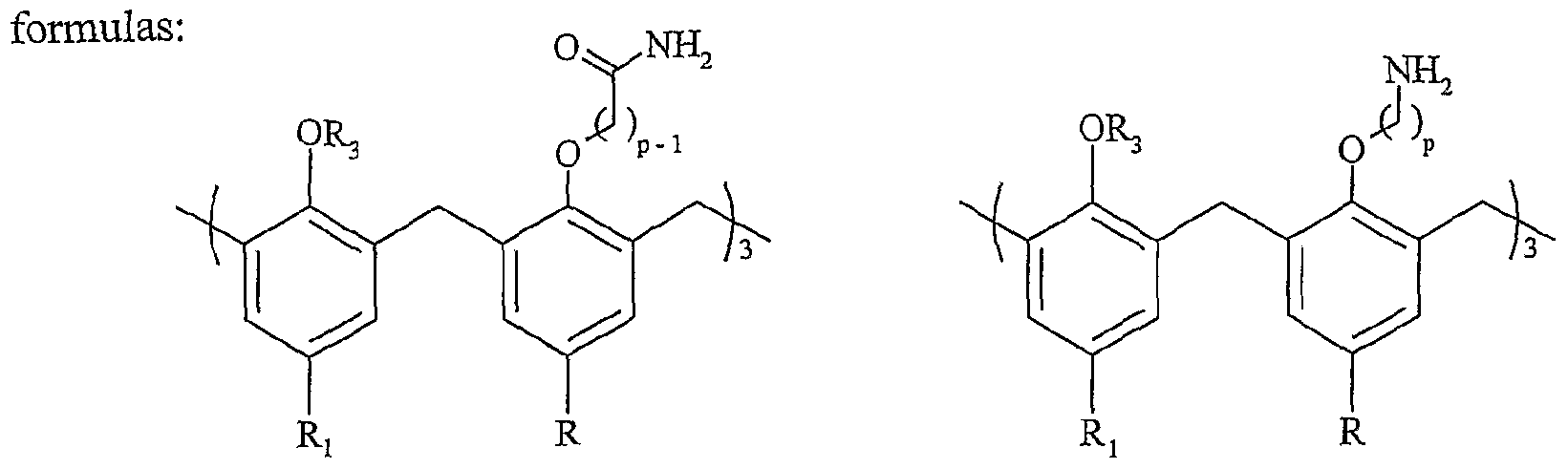
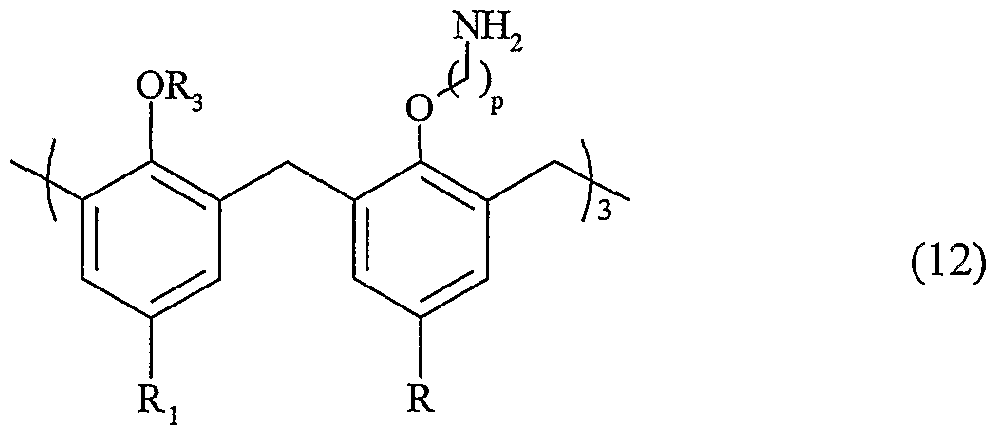
- the reduction of the above-mentioned compound 11 with BH3, in order to obtain the following compound 12:
- the reaction with the triamine of formula (12) such as mentioned above with formaldehyde, in order to obtain the compound of formula (II) such as defined above, and
- possibly the alkylation of compound of formula (II) with R6Y, Y being a leaving group, and particularly a halogen atom and R6 being such as defined above, in order to obtain compound of formula (Ha) such as defined above.
b) for the preparation of compounds of formula (III), (Ilia), (Illb) or (IIIc)
- the conversion by alkylation, particularly with compound of formula Br-(CH2)n-ι-COOEt, of compound 2c into the triester derivative 3 having the following formula:
- the reduction by LiAlH of the above-mentioned compound 3, in order to obtain the following comp
- the addition of TsCl to compound 4 such as obtained previously, in order to obtain compound 5 having the following formula:
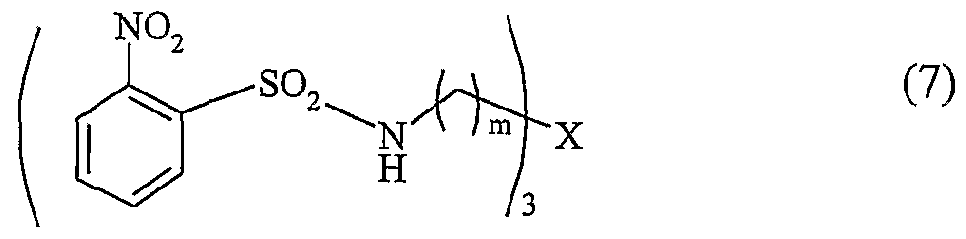
- a reaction of trialkylation of compound 5, such as obtained previously, with compound 7 having the following formula:
X being such as defined above, and m being such as defined above, in order to obtain compound 6 having the following formula:
compound 7 being obtained according to the reaction of compound having the
- the deprotection of the amino groups of compound 6 such as obtained previously with thiophenol, in order to obtain compound of formula (III) such as defined above with R2 representing H, having the following formula:
- and possibly the alkylation of compound of formula (III) such as obtained previously with R4Y, Y representing a leaving group, and particularly a halogen atom and R4 being such as defined above, in order to obtain compound of formula (Illb) such as defined above, or possibly the alkylation of compound of formula (III) such as obtained previously with R5Y, Y representing a leaving group, and particularly a
halogen atom and R5 being such as defined above, in order to obtain compound of formula (IIIc) such as defined above,
- and possibly the alkylation of compound (Illb) such as obtained previously with R5Y, Y representing a leaving group, and particularly a halogen atom and R5 being such as defined above, or the alkylation of compound (IIIc) such as obtained previously with R4Y, Y representing a leaving group, and particularly a halogen atom and F^ being such as defined above, in order to obtain compound of formula (Ilia) such as defined above.
The process of preparation of compounds of formula (2b) from compounds of formula (2a) comprises eventually a step of treatment with an electrophile, which can be:
- a step of treatment with RZ, wherein R is such as defined above and is different from H and Z is a halogen atom, RZ being preferably HSO3Cl or HNO3, or
- a step of treatment with N-bromosuccinimide (wherein R = Br), or
- a reaction of compound (2a) with an acyl- or an allylchloride (wherein R is an acyl or an allyl group), followed by a thermic rearrangement, or
- a step of condensation of compound of formula (2a) with an aldehyde in the presence of an amine.
The process of preparation of compounds of formula (2c) from compounds of formula (2b) comprises the following steps:
- a step of protection of the OH function by the reaction of compound of formula (2b) with a protecting group such as PCI, where P can be an acyl or a benzoyl group such as MeCO or PhCO, in order to obtain the following compound of formula (2-b-l):
- a step of treatment of the compound such as obtained previously of formula (2-b-l) with AICI3 in order to obtain the following compound of formula (2-b-2):
- a step of treatment of compound of formula (2-b-2) with Rj.Z, Z being a halogen atom and Rj. being such as defmed above, and a step of selective trialkylation with alkyl halide R
3Y, R
3 and Y being such as defined above, in order to obtain compound (2-b-3) of following formula:
- a step of deprotection by basic hydrolysis of compound of formula (2-b-3) in order to obtain compound of formula (2-c) such as defined previously.
The pres wing formula
wherein
which can be obtained by the reaction of compound of the following formula
with picric acid in presence of CDC1
3, according to the following reaction
The present invention also relates to compounds having one of the following
wherein R, Ri, R3 and p are such as defined above, said compounds being liable to be used as synthesis intermediaries for the preparation of compounds of formula (II) such as defined above, provided that the compounds wherein R and Ri represent tBu, R3 represents a methyl group and p is 2, are excluded.
The present invention also relates to a process of preparation of water-soluble compounds, characterized in that it comprises the following steps:
- a reaction of nitration or sulfonation of a compound of formula (I) such as defined above, or of a compound of the following formula:
- x and y are integers different from 0, x + y varying from 4 to 8,
- R, Ri and R3 are such as defined for formula (I), R and Ri being different from SO3 " and O2,
- W represents an alkyl group comprising 1 to 5 carbon atoms, said alkyl group being substituted with a protonable element chosen among:
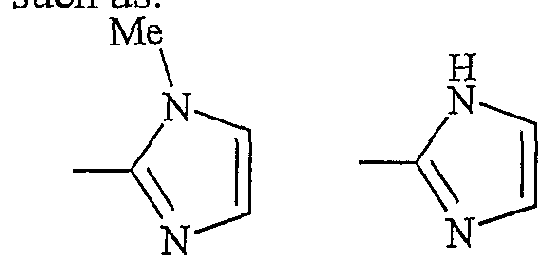
* a heterocycle such as
or pyridine, or benzimidazole, * a primary, secondary or tertiary amine group, particularly NH
2 or NMe ,
* a -CO-R
7 or -CS-R
7 group wherein R
7 represents a primary, secondary or tertiary amine group, particularly a NH
2 group, or heterocycles, particularly such as_
N , or a -OR
8 group, wherein R
8 represents H or an alkyl group comprising from 1 to 10 carbon atoms, or
* a -OR8 or -SRg group, wherein R8 is such as defined above, in order to obtain respectively a compound having one of the following formulas:
(I-a) (I-h)
wherein Ai, A2, A3, R, R3 and X being such as defined above,
(I'-a) (I'-b)
Y representing OH, or an alkoxy group, or a primary or secondary amine group, or a halogen atom or a thioalkyl group,
- and optionally a reaction of sulfonation or nitration of compound of one of the formulas (I-a), (I-b), (I' -a) or (P-b), such as obtained previously, in order to obtain respectively a compound having one of the following formulas:
(I'-c) (I'-d)
The present invention also relates to a process of preparation of water-soluble compounds, characterized in that it comprises the following steps:
- a reaction of nitration or sulfonation of a compound of formula (I) such as defined above, or of a compound of the following formula:
- q is an integer varying from 2 to 4, and
- R, Ri, R3 and W are such as defined above, in order to obtain respectively a compound having one of the following formulas:
(I-a) (I-b) wherein Ai, A2, A3, R, R3 and X being such as defined above,
(I-bis-a) (I-bis-b) Y being such as defined previously,
- and optionally a reaction of sulfonation or nitration of compound of one of the formulas (I-a), (I-b), (I-bis-a) or (I-bis-b), such as obtained previously,
in order to obtain respectively a compound having one of the following formulas:
(I-c) (I-d)
(I-bis-c) (I-bis-d)
According to an advantageous embodiment, the process of the invention is a process wherein the reaction of sulfonation is carried out with the chlorosulfonic acid, and the reaction of nitration is carried out with the nitric acid.
According to an advantageous embodiment, the process of the invention is characterized in that it comprises the possible step of transformation of the functions NO and SO2Y, in one of the following respective functions:
- amine, ammonium, amide, thioamide,
- sulfonate, sulfonamide, sulfonic ester, sulfothioester.
A catalytic hydrogenation is carried out with the NO2 function in order to obtain a NH2 function, which can then alkylated in order to obtain a primary, secondary or tertiary amine group, or an ammonium group.
The function N02 is treated with an acyl chloride or a sulfonyl chloride, in order to obtain a sulfonamide function, or is treated with a thioacid chloride in order to obtain a thioamide function.
The transformation of the SO2Y group into a sulfonamide function is carried out by the reaction with an amine; the transformation of the SO2Y group into a sulfothioester function is carried out by the reaction with a thiol and the transformation of the SO2Y group into a sulfonic ester function is carried out by the reaction with an alcohol.
According to an advantageous embodiment, the process of the invention is characterized in that it comprises the following steps:
— a reaction of nitration of a compound of formula (I) such as defined above, or of a compound of formula (I') or (I-bis) such as defined above, in order to obtain a compound having the respective formulas (I-a) or (F-a) or (I- bis-a) such as defined above,
— and a reaction of sulfonation of the compound such as obtained previously of formula (I-a) or (I'-a) or (I-bis-a), in order to obtain a compound having the respective formulas (I-c) or (I'-c) or (I- bis-c), such as defined above.
According to an advantageous embodiment, the process of the invention is characterized in that R and Ri represent tBu groups.
The present invention also relates to compounds having one of the following formulas:
(I'-a) (I'-b)
wherein:
- R and R3 are such as defined above for formula (I), R being different from NO2 and SO3 ",
- x and y are integers different from 0, x + y varying from 4 to 8,
- W represents an alkyl group comprising 1 to 5 carbon atoms, said alkyl group being substituted with a protonable element chosen among: a heterocycle such as:
or pyridine, or benzimidazole,
* a primary, secondary or tertiary amine group, particularly NH2 or NMe2,
* a -CO-R7 or -CS-R7 group wherein R7 represents a primary, secondary or tertiary amine group, particularly a NH group, or heterocycles, particularly such as— N , or a -OR8 group, wherein R8 represents H or an alkyl group comprising from 1 to 10 carbon atoms, or * a -OR8 or -SR8 group, wherein R8 is such as defined above, - Y represents OH, or an alkoxy group, or a primary or secondary amine group, or a halogen atom or a thioalkyl group.
The present invention also relates to compounds having one of the following formulas:
(I-bis-a) (I-bis-b) wherein:
- q is an integer varying from 2 to 4,
- R, R , W and Y are such as defined above, These compounds are new water-soluble compounds.
Preferred compounds according to the invention have one of the following formulas:
(I-bis-c) (I-bis-d) wherein R3, q, W and Y are such as defined above.
According to an advantageous embodiment, the compounds of the invention are characterized in that R3 represents a methyl group.
DESCRIPTION OF THE FIGURES
Figure 1. lH NMR spectrum of compound 5-a in CDC13 at 298K.
Figure 2. H NMR spectrum of compounds 6-a in CDC13 at 298K.
Figure 3-a. lE NMR spectrum of compound 7-a in CDC13 at 298K. Figure 3-b. JH NMR spectrum of compound 8-a in CDC13 at 298K. +: residual water or solvent peaks (CHC13 and CH3CN; this latter was present in elemental analysis characterization of compound 8-a).
Figure 4-a. !Η NMR spectrum of compound 10-a in CDC13 at 298K. Figure 4-b. !H NMR spectrum of complex 10-a MeNH3 +Cl" in CDC13 at 298K. Solvent, water and reference are labelled S, W and R, respectively.
EXAMPLES
I - Synthesis of compound 8-a
Compound 8-a is a compound of formula (III) wherein m =: n = 2, R = Rι = tBu, R2 = H, X = N and R3 = Me.
A classical route for the synthesis of azacrowns consists in the use of a poly- toluenesulfonamide salt for the alkylation reaction (Macrocycle Synthesis, a Practical Approach, Ed. D. Parker, Oxford University Press, 1996). Thus, in order to obtain the desired triply bridged calix [6] arene, the present inventors chose to attempt the tris- alkylation reaction between the triariion of a tris-arylsulfonamide derivative of tris(2- aminoethyl)amine (tren) 1-a and a tris-tosylcalix[6]arene derivative. For this purpose, we first prepared the tris-protected tren 2-a. by the reaction between tren 1-a and 3.4 equivalents of 2-nitrobenzenesulfonyl chloride in the presence of triethylamine (76 % yield) (Scheme 1). The 2-mtrobenzenesulfonyl protected group [(o)NO2Bs] was chosen instead of the more classical tosyl one since it can be removed under milder conditions. It is noteworthy that compound 2-a is an amorphous and hygroscopic solid that could
not be recrystaUized, consequently it was only purified by flash chromatography on silica gel.
1-a 2-a tren
Scheme 1. i) (o)NO2BsCl, TEA, THF, 0 °C then rt, 76 %.
The required tris-tosyl calix[6] arene was prepared from the known X6H3Me3 3-a (Scheme 2)(Janssen, R. G. et al. Synthesis (1993) 380-385) [obtained by selective 1,3,5- trimethylation of p-tBu-calix[6] arene (XeH6)(Gutsche, C. D. et al. Org. Syn. (1990) 68, 238-242] in an efficient three step sequence (54 % overall yield). First, XeH3Me3 3-a was converted into the triester derivative 4-a by alkylation with an excess of ethylbromoacetate in the presence of NaH in 77 % yield (Takeshita, M. et al. Chem. Lett. (1994) 1349). A subsequent reduction by LAH afforded the tris-hydroxy derivative
5-a in 82 % yield. The latter was reacted at low temperature with an excess of TsCl in a mixture of anhydrous pyridine and chloroform giving the tris-tosyl calix[6]arene 6-a in 86 % yield (Scheme 2). This reaction necessitated a careful respect to the reaction conditions (essentially the low temperature and reaction time), otherwise unidentified calixarene-type by-products were formed, lowering the yield. The 1H NMR spectra of compounds 4-a (not shown), 5-a (Figure 1) and 6-a (Figure 2), recorded at 298 K in CDCI3, are characteristic of a major flattened cone conformation of Csv symmetry (The 1H NMR spectrum of 6-a revealed the presence of minor conformational isomers). The high-field shift of the methoxy protons of compounds 4-a and 6-a (δoMe = 2.27 and 2.07, respectively) indicates that these groups are included inside the cavity, projecting the bulky ethyl ester or tosyl groups outside. In the case of calix[6]arene 5-a, the methoxy groups present a quasi-normal resonance (δovie = 3.47) suggesting that they are involved in an intramolecular hydrogen bonding network with the hydroxylated arms. This was confirmed by the high-field shift observed for these groups (δo e = 3.01) when a protic solvent (CD3OD) was added. It is also noteworthy that, in contrast to compounds 4-a and 5-a, sharps signals are observed for the ArCHiAr methylene protons of tris-tosyl calix[6]arene 6-a (two doublets at 3.29 and 4.40 ppm). It shows
that, with these bulky tosyl arms, the cone-cone interconversion of 6-a is slower than the NMR time scale.
Key-step formation of the triply bridged calix[6] arene was conducted under standard conditions, reacting 6-a and 2-a in the presence of Cs2CO3 as a base in DMF. After flash chromatography on silica gel, the expected capped calix[6]arene 7-a was isolated in 31 % yield. Finally, deprotection of the amino groups was performed by SNAr substitution of the (o)NO2Bs groups by thiophenate, giving rise to the desired calix[6]azacrown 8-a (X6Me3tren) with a 75 % yield (Scheme 2).
Scheme 2. i) Ethylbromoacetate, NaH, THF, reflux, 77 %. ii) LAH, ether, reflux, 82 %. iii) TsCl, Pyridine, CHCh, -20 °C, 86 %., iv) 2, Cs2Cq3, DMF, rt then 90 °C, 31 %. v) PhSH, Na2CO3, DMF, 50 °C, 75 %.
The 1H NMR spectra of capped calixarenes 7-a and 8-a are displayed Figures 3-a and 3-b. Their profiles are remarkably simple attesting to a major C3v-symmetrical rigid cone conformation. Evidence for the rigidification of the cone conformation due to the capping is given by the sharp and weU-defmed signals corresponding to the ArCH2Ar methylene protons. Some unusual features however are specifically observed for compound 8-a. Its methoxy groups are less high-field shifted than for compound 7-a (δoMe = 3.05 instead of 2.40 ppm), suggesting that they are more distant from the C3 axis. The very small difference of resonance between the two tBu signals of 8-a
(ΔδtBu ^ 0.02 ppm) also indicates that all tBu groups have similar orientations. This stands in contrast to the classical alternate in and out positions adopted by the tBu groups of calixarenes with the same symmetry (Seneque, O. et al. Eur. J. Inorg. Chem. (2001) 2597-2604)(for example, ΔδtBu = 0.51, 0.37, 0.63 and 0.47 ppm for calixarenes 4-a, 5-a, 6-a and 7-a, respectively). This shows that the skeleton of calix[6]azacrown
8-a has a more straight and regular cone conformation. As in the case of compound 5-a, these features might well be due to the establishment of hydrogen bonds between the anisole units and their neighboring phenoxy protic substituents, namely the tren-NH groups in the case of 8-a. Indeed, addition of CD3OD induced a split of tire tBu resonances attesting to a conformational change. Finally, a variable temperature ]H
NMR study showed some broadening of the spectra at low temperature. However, the axial and equatorial ArCH2Ar methylene protons were differentiated over the whole temperature range (240-330 K), indicating that the cone-cone inversion did not occur on the NMR time scale.
Ln conclusion, the present invention describes the synthesis of the first C3v- symmetrical calix[6](aza)crown 8-a. A 1H NMR study has shown that the alternate 1,3,5-azabridge at the small rim rigidities the whole edifice preventing ring inversion and constraining the calixarene core in a straight cone conformation.
Experimental Section
General Procedures. THF and ether were distilled over sodium benzophenone under argon. Pyridine was distilled over KOH under argon. , Chloroform was distilled over P2O5 under argon. DMF was distilled over MgSO4 and stored over 4 A0 molecular sieves under argon. TsCl was recristallized (dichloromethane/pentane) before use. lK and 13C NMR spectra were recorded respectively at 200 and 50 MHz. Thin-layer chromatographies (TLC) were performed with aluminum plates (0.20 mm) precoated with fluorescent silica gel. Reaction components were then visualized under UV light and dipped in a Dragendorff solution. Silica gel (230-400 mesh) was used for flash chromatography separations. All reactions were performed under an inert atmosphere. Elemental analyses were performed at the Laboratoire de Microanalyse Organique, IRCOF, France.
N,N,,N"-tri-2-nitrobenzenesuIfonyl-2,2',2"-nitriIotriethylamine 2-a. At 0 °C, trietliylamine (TEA)(3.9 mL, 27.75 mmol) was added to a solution of tren 1-a (1.0 mL, 6.68 mmol) in 20 mL of anhydrous THF. (o)NO2BsCl (5.03 g, 22.7 mmol) was added by small portions over the course of 20 min time and then the reaction mixture was stirred for 16 h at room temperature. After removal of the solvent under reduced pressure, addition of water and extraction with dichloromethane, the resulting crude residue was purified by flash chromatography yielding 2-a (3.56 g, 76 %) as an amorphous yellow solid that could not be recrystaUized. mp: 85-88 °C (decomp.). IR (CHC13): v 3340, 1542, 1362 cm"1. 1H NMR (CDC13) δ 2.63 (t, J= 5.5 Hz, 6H), 3.10 (q, J = 5.5 Hz, 6H), 5.76 (t, J = 5.5 Hz, 3H), 7.69-1.87 (m, 9H), 8.04-8.13 (m, 3H). 13C
NMR (CDC13) δ 41.77, 54.78, 125.7, 131.0, 133.1, 133.2, 133.9, 148.2. MS (FAB) m z 702.4 (M-H+, calcd 702.1).
5,ll,17,23,29,35-Hexa-te^-butyl-37,39,41-trimethoxy-38540,42-tris(2- hydroxy-ethoxy)calix[6] arene 5-a. To a solution of 4-a (4.15 g, 3.26 mmol) in 350 mL of anhydrous Et2O was added LAH (1.43 g, 37.6 mmol) at -4 °C. After 16 h of refluxing, the reaction mixture was cooled to 0 °C and 50 mL of an aqueous solution of HC1 (4 M) was added slowly. After dichloromethane (500 mL) extraction, the organic layer was washed twice with 50 mL of an aqueous solution of HC1 (4 M). The solvent was removed under reduced pressure and the resulting residue was dissolved in 200 mL of chloroform. The insoluble material was removed by filtration and the chloroform was removed under reduced pressure giving a white solid which was purified by recristallization in ethanol. Thus, pure compound 5-a (3.06 g, 82%) was obtained as a white solid, mp: 227 °C (decomp.). LR (CHC13): v 3660 to 3120, 1480 cm"1. *H NMR (CDC13) δ 0.91 (s, 27H), 1.28 (s, 27H), 3.30 (sl5 6H), 3.43 (s,,?6H), 3.47 (s, 9H), 3.92 (s,, 12H), 6.65 (s, 6H), 7.13 (s, 6H). 13C NMR (CDC13) 30.90, 31.36, 31.64, 34.12, 34.15,
34.31, 60.33, 61.73, 75.23, 124.4, 127.2, 133.1, 133.2, 145.8, 146.2, 153.2, 153.4. Anal. Calcd for C75Hio2O93 2 EtOH: C, 76.54; H, 9.27. Found: C, 76.74; H, 9.04.
5,ll,17,23,29,35-Hexa-te^-butyl-37s39J41-trimethoxy-38,40,42-tris(2- tosylethoxy)calix[6]arene 6-a. TsCl (0.997 g, 5.23 mmol) was added to a solution of 5-a (1.00 g, 0.87 mmol) in 1 mL of anhydrous CHC13 then, at -10 °C, anhydrous pyridine (3.0 mL, 36.79 mol) was slowly added under vigorous stirring. The flask containing the reaction mixture was placed in a f eezer at -20 °C for 16 h. The solvents were removed under high vacuum and 10 mL of ethanol were added to the crude
residue. The resulting solid was isolated by filtration and washed twice with cold ethanol yielding compound 6-a (1.20 g, 86 %) as a white solid, mp: 153-154 °C. TR (CHC13): v 1598, 1482, 1361, 1175 cm4. 1H NMR (CDC13) δ 0.74 (s, 27H), 1.37 (s, 27H), 2.07 (s, 9H), 2.37 (s, 9H), 3.29 (d, J= 15.6 Hz, 6H), 4.11 (t, J= 4.7 Hz, 6H), 4.40 (d, J= 14.9 Hz, 6H), 4.42 (t, J= 4.7 Hz, 6H), 6.58 (s, 6H), 7.21 (s, 6H), 7.28 (d, J= 7.8
Hz, 6H), 7.82 (d, J= 7.8 Hz, 6H). 13C NMR (CDC13) 21.77, 29.67, 31.18, 31.76, 34.06, 34.36, 60.05, 68.97, 70.16, 123.7, 128.1, 130.1, 132.9, 133.5, 145.2, 146.0, 146.3, 151.1, 154.4. Anal. Calcd for C9eHi2oOι5S3, 2 H2O: C, 70.04; H, 7.59. Found: C, 70.37; H, 7.22. Capped calix[6]arene 7-a. Cs2CO3 (0.815 g, 2.50 mmol) was added to a solution of 6-a (1.152 g, 0.715 mmol) in 25 mL of anhydrous DMF at room temperature. The reaction mixture was vigorously stirred and a solution of 2-a (0.506 g, 0.721 mmol) in 25 mL of anhydrous DMF was slowly added (for lh) at room temperature. After 2 h at room temperature the reaction mixture was heated at 90 °C for 16 h. The DMF was removed under reduced pressure and 50 mL of water were added. After dichloromethane extraction and concentration, a flash chromatography (dichloromethane/EtOAc, 99:1 then 98:2) afforded 7-a (0.398 g, 31 %) as a yellow solid. An analytical sample was obtained by recristallization in a mixture of EtOH/CHCh. mp: 264 °C (decomp.), IR (CHC13): v 1546, 1481, 1372, 1167 cm-1. lH NMR (CDCI3) δ 0.87 (s, 27H), 1.34 (s, 27H), 2.40 (s, 9H), 2.88-3.05 (m, 6H), 3.06 (d, J
= 14.1 Hz, 6H), 3.89-4.10 (m, 12H), 4.11-4.20 (in, 6H), 4.37 (d, J= 14.1 Hz, 6H), 6.88 (s, 6H), 7.20 (s, 6H), 7.22-7.50 (m, 9H), 8.27 (d, J = 7.8 Hz, 3H). 13C NMR (CDCI3) 28.73, 31.08, 31.76, 34.22, 34.37, 48.67, 49.10, 54.69, 61.20, 73.48, 115.4, 123.8, 124.0, 127.7, 131.3, 132.4, 133.1, 133.3, 133.6, 133.9, 146.3, 146.5, 147.8, 150.0, 154.5. Anal. Calcd for C99Hι23N7Oι8S3, H2O: C, 65.58; H, 6.95; N, 5.41. Found: C,
65.82; H, 7.18; N, 5.88.
XgMe3tren 8-a. Na2CO3 (0.604 g, 5.70 mmol) was added to a solution of 7-a (0.641 g, 0.357 mmol) in 30 mL of anhydrous DMF at room temperature. The reaction mixture was vigorously stirred and thiophenol (0.293 mL, 2.85 mmol) was added leading to a greenish coloration. After 24 h at 50 °C, the DMF was removed under reduced pressure and 50 mL of an aqueous solution of NaOH (1M) were added. After dichloromethane extraction and concentration, the resulting residue was dissolved in 3 mL of dichloromethane and 5 mL of acetonitrile were added. The resulting precipitate
was isolated by suction filtration and washed twice with acetonitrile giving 8-a (0.330 g, 75 %) as a white solid, mp: 251-252 °C (decomp.). IR (CHC13): v 3660 to 3110, 1480 cm'1. 1H NMR (CDC13) δ 1.06 (s, 27H), 1.08 (s, 27H), 2.58 (m, 6H), 2.82 (m, 6H), 2.92 (m, 6H), 3.05 (s, 9H), 3.41 (d, J = 14.9 Hz, 6H), 3.92 ( , 6H), 4.49 (d, J = 14.9 Hz, 6H), 6.93 (s, 6H), 7.04 (s, 6H). 13C NMR (CDC13) 30.08, 31.44, 31.49, 34.17, 34.24, 48.80, 49.79, 55.25, 61.00, 73.54, 125.6, 126.2, 133.2, 133.4, 145.7, 145.9, 152.4, 154.2. Anal. Calcd for CgιHn4N4O6, 2.5 H2O, 0.5 CH3CN: C, 75.45; H, 9.30; N, 4.83. Found: C, 75.34; H, 9.17; N, 4.78.
The compounds of formula 8-a can then react with picric acid in presence of CDCI3, according to the following reaction scheme:
The procedure is as follows: to tetramine (2.5 mg, 0.002 mmol) in 0.7 mL of CDCI3 was added 0.24 mL (0.008 mmol) of a CDC13 solution (0.0338 mol.l"1) of picric acid. The 1H NMR spectra of the resulting solution was compatible with the formation of a tetrammonium salt.
1H NMR (CDCI3) δ 0.81 (s, 27H), 1.17 (s, 27H), 2.93 (s, 9H), 3.35 (s, 6H), 3.48 (d, J = 14.9 Hz, 6H), 3.58 (s, 6H), 3.89 (s, 6H), 4.20 (d, J = 14.1 Hz, 6H), 4.34 (s, 6H), 6.66 (s, 6H), 7.12 (s, 6H), 8.97 (s, 8H).
Process of preparation of compound of formula (III) wherein X = N, m = n :
Calixtren
This compound is prepared from compound 8-a (Calixtren).
Experimental section
Under an inert atmosphere, butyraldehyde (0.020 mL, 0.099 mmol) was added to a solution of calixtren (8-a)(20.5 mg, 0.017 mmol) in 1 mL of anhydrous dichloromethane. After lh at room temperature, the reaction mixture was cooled at 0°C and NaBH(OAc)3 (54 mg, 0.255 mmol) was added. After 15 h at room temperature, 5 mL of dichloromethane and then 5 mL of a saturated aqueous solution of NaHCO3 were added. The reaction mixture was stirred 15 min and the aqueous layer was extracted twice with 10 mL of dichloromethane. The dichloromethane was removed under reduced pressure and 1 mL of ethanol was added to the crude residue. The resulting white solid was isolated by centrifugation and the washing process was repeated one more time. Thus 21.5 mg (90 % yield) of the final product as a white solid were obtained.
1H NMR (200 MHz, CDC13) δ 0.79 (s, 27H), 0.91 (t, J= 7.0 Hz, 9H), 1.21-1.58 (m, 12H), 1.40 (s, 27H), 2.30 (s, 9H), 2.55-2.72 (m, 6H), 2.62 (t, J= 8.1 Hz, 6H), 2.80- 2.92 ( , 6H), 3.15 (t, J= 6.3 Hz, 6H), 3.37 (d, J= 15.6 Hz, 6H), 4.21 (t, J= 5.5 Hz, 6H), 4.64 (d, J= 14.9 Hz, 6H), 6.73 (s, 6H), 7.29 (s, 6H),
π - Synthesis of compound 10-a (R = Ri = tBu, R3 = Me)
Compound 10-a is a compound of formula (II) wherein p = 2, R3 = Me and R = Rι = tBu.
Compound 10-a was synthesized in 2 steps with a yield of 85 % from calix[6]arene 11-a, which is itself obtained in two steps according to a process described in literature (Janssen, R. G. et al. Synthesis (1993) 380-385) from p-tBix- calix[6]arene 2-a:
2-a 11-a
i) Lit. (Janssen, R. G. et al. Synthesis (1993) 380-385) ii) Bromoacetamide, NaH, THF, reflux, 91%. iii) BH3/THF, reflux then EtOH, reflux, 95%. iv) HCHO aq., CDC13, 0°C then rt, 89%.
Experimental section
5,ll,17,23,29,35-Hexa-^^-butyI-37,39,41-trimethoxy-38,40,42- tris(carbamoylmethoxy)caIix[6]arene 11-a. A solution of 2 (2.435 g, 2.40 mmol) in 20 mL of anhydrous THF was added to a solution of NaH (60% in oil, 0.335 g, 8.37 mmol) in 80 mL of anhydrous THF. The reaction mixture was stirred for 20 min at room temperature and a solution of bromoacetamide (2.005 g, 14.5 mmol) in 10 mL of
anhydrous THF was introduced. After 24 h of refluxing, the solvent was removed under reduced pressure and the resulting residue was dissolved in dichloromethane and washed with 25 mL of an aqueous HCl solution (IM). After dichloromethane extraction and solvent evaporation, the resulting crude compound was purified by flash clrromatography (acetone/dichloromethane; 3:7) giving pure XeMe3Amide3 11-a (2.59 g, 91%) as a white solid, mp: 201 °C (decomp.). IR (CHCh): v 1673 cm"1. H NMR (CDC13) δ 0.94 (s, 27 H, tBu), 1.30 (s, 27H, tBu), 3.60 (si, 9H, OCH3), 3.86 (sh 18H, ArCH^Ar, OCH2), 5.09 (s1; 6Η, NH2), 6.55 (s, 6H, ArH), 7.17 (s, 6Η, ArH). 13C NMR (CDC13) δ 31.2, 31,5, 34.0, 34.3, 59.7, 71.5, 124.4, 127.6, 132.9, 146.0, 147.2, 152.1, 153.2, 171.0. Anal. Calcd for C75H99N3O9, 2 H2O: C, 73.68; H, 8.49; N, 3.44. Found: C,
73.71; H, 8.17; N, 3.52.
5,ll,17,23,29,35-Hexa-^rt-butyI-37,39,41-trimethoxy-38,40,42-tris(2-amino- ethoxy)calix[6]arene 12-a. A solution of BH3/THF (78.0 mL, IM) is slowly added to triamide 11-a (3.18 g, 2.70 mol) and the medium is heated under reflux for 24h.
Ethanol is added slowly at 0°C until the release of gas ends. After evaporation of the solvent under reduced pressure, 108 mL of ethanol are added to the residue and the reaction medium is heated under reflux for 48h. After evaporation of the ethanol under reduced pressure, the solid residue is vacuum-dried at 50°C for 48h to give triamine 12- a pure (2.92 g, 95 %) as a white solid. FP: 180 °C (decomp.). RMN ]H (CDCl3) δ 1.00
(s, 27 H, tBu), 1.22 (s, 27H, tBu), 2.66 (s,, 9H, OCH , 2.90 (sh 6Η, CH2N), 3.66 (si, 6Η, CH20), 3.94 (s,, 12H, ArCH2Ar), 6.84 (s, 6Η, ArH), 7.09 (s, 6Η, ArH). RMN 13C (CDC13) δ 29.9, 31.1, 31.5, 34.0, 34.2, 60.3, 61.4, 133.0, 133.2, 145.8, 146.0. IR (CΗC13): v 2960, 1480, 1203 cm"1. Compound 10-a. An aqueous solution (30%) of formaldehyde (0.050 mL, 0.54 mmol) is added at 0°C to a solution of triamine 12-a (66 mg, 0.057 mmol) in 1 mL of CDC13. The temperature of the reaction is allowed to increase slowly until room temperature and the evolution of the reaction is followed by !H RMN. After 50 min, 1 mL water is added, the organic phase is separated and the aqueous phase is extracted with chloroform. The organic phases are sampled, the solvent is evaporated under reduced pression and the obtained residue is recrystallised in a mixture CHCl /acetonitrile to give the compound 10-a pure (60 mg, 89%) as a white solid. RMN lΕL (CDCI3) δ 0.73 (s, 27 H, tBu), 1.37 (s, 27H, tBu), 2.66 (si, CH2N), 3.22 (si,
6H, CH2O), 3.38 (d, J= 16 Ηz, 6Η, Ar-α-CHeq), 3.75 (s, 9Η, OCH3), 3.78 (d, J~ 10 Ηz, 3Η, NCH2N), 4.04 (d, J = 12 Ηz, 3Η, NCH2N), 4.59 (d, J = 16 Ηz, 6Η, Ar-oc- CHax), 6.53 (s, 6Η, ArH), 7.26 (s, 6Η, ArH). 13C NMR (CDC13) δ 29.70, 31.17, 31.64, 33.88, 34.16, 52.95, 60.18, 69.56, 70.34, 122.9, 127.9, 132.7, 132.8, 145.0, 145,2, 152.5, 155.1. IR (CΗC13): v 3018 cm"1.
Ill - Properties of the compounds of the invention
These new compounds can be used as ligands to coordinate a metal ion. They also have host-guest properties (neutral or charged molecules recognition).
With the aim of building biomimetic artificial receptors, the host-guest chemistry of calixarenes toward ammonium cations has been extensively studied the past decade (C. D. Gutsche, Calixarenes Revisited, Monographs in Supramolecular Chemistry, 1998, J. F. Stoddart, Ed. The Royal Society of Chemistry, Cambridge, U.K.). However, on one hand, the hydrophobic cavity of calix[4]arenes is too small for the inclusion of guest ammoniums and these macrocyles have only been used as a platform for die preorganization of a binding site (Tuntulani, T. et al. Tetrahedron, 2002, 58, 10277- 10285). On the other hand, larger calixarenes have been scarcely studied since, in order to act as efficient receptors, their flexibility have to be restricted. Indeed, the importance of the rigidification of the calixarene core in the recognition process of ammoniums has already been pointed out (Takeshita, M. et al. J. Org. Chem. 1994, 59, 4032-4034; Casnati, A. et al. Tetrahedron (1995) 51, 591-598; Chen, Y. et al. Tetrahedron (1998) 54, 15183-15188; Sansone, F. et al. Tet. Lett. (1999) 40, 4741-4744; Arduini, A. et al. Eur. J. Org. Chem. (2000) 2325-2334; Chen, Y. et al. Chem. Lett. (2000) 484-485; Li,
J.-S. et al. Eur. J. Org. Chem. (2000) 485-490). Thus, the goal of the invention is to design new receptors based on a calix[6]arene core larger enough for the inclusion of small molecules and possessing a cage structure through rigidification by an aza-crown cap. It was observed that the tripodal aza-crown cap prevents ring inversion, constraining the calixarene core in a straight cone conformation ideal for host-guest chemistry. The new compounds of the invention C3V-syrnmetrical calix[6](aza)crown are useful for the complexation of ammoniums through cation-π interactions.
Host behavior of receptor 10-a toward ammoniums. 1H NMR complexation studies were carried out at room temperature by introducing excess of solid ammoniums chloride (RNH3 +C1") in a solution of 10-a in CDC13. Thus, addition of MeNH3 +Cι~ to receptor 10-a led to a new C3v-symmetrical compound including one equivalent of the cationic ammonium species in die hydrophobic cavity. Indeed, besides free MeNH3 +Cl", a sharp quadruplet corresponding to the methyl group of the ammonium included in the heart of the cavity was detected at -0.25 ppm while the NH3 + resonance was observed at ca. 4.9 ppm (Figure 4-b). This first result shows the remarkable affinity of the receptor 10-a towards cationic arnmonium species since at room temperature the complexation- decomplexation process is slower than the NMR time scale. Similar complexation experiments were conducted with other ammoniums and the results are summarized in Scheme 4. When separated signals were observed at 298 K in CDCI3 for the included and free ammoniums, the ammoniums was considered as a good guest.
10-a Complex 10-a-RNH3 +CT
Wιth RNH3 + =
Good guests No complexation detected
Scheme 4. JH NMR complexation study between 10-a and various ammoniums RNH3 +C1". The observed Δδ shifts are indicated in brackets next to the corresponding atoms [Δδ = δ(complexed ammonium) - δ(free ammonium); peaks overlapping caused sometimes an absence of a precise determination].
In all cases, complexation of a given ammonium species led to NMR spectra with similar profiles for the calixarene core suggesting that its conformation should not
deeply change upon the nature of the guest. Indeed, a downfield shift of the CH2N and CH2O resonances belonging to the arms and an important upfield shift of one of the two signals corresponding to the NCH2N protons was observed in all cases (see Figures 4-a and 4-b for an example).
The upfield shifts measured for the proton resonances of the included ammoniums can indicate its spatial position in the aromatic cavity. Thus, the protons at the α-and β- position of the nitrogen atom display the higher shift values suggesting that they sit in the centre of the cavity. These data are compatible with the establishment of π-cationic interactions between the aromatic ring and the positively charged nitrogen atom.
Complexation studies between 10-a and ammonium chlorides. Excess of the ammonium chlorides were added in an NMR tube containing 10-a in CDC13. Sonification was used when the ammonium chloride revealed extremely insoluble in CDCI3. :Η NMR spectra were recorded at room temperature.
Complexation of neutral molecules by (8-a).Zn2+
The formation of a mononuclear complex of Zn-hydroxo 13 type was demonstrated by 1H RMN when the ligand 8-a is in presence of Zn2+ ions. Contrary to what is usually obtained with the already known similar complexes, no formation of polynuclear complexes was observed when ZnCl2 was used for the complexation. This shows that the presence of an aza-crown cap protects the metal ion from the external medium and constrains it in a mononuclear environment.
The complex 13 is in equihbrium with its acid form 14 and the equilibrium can be moved according to the pΗ. Thus, the addition of an acid such as trifluoroacetic acid (TFA) moves the equilibrium towards species 14 and the subsequent addition of a base such as triethylamine (TEA) moves again the equilibrium towards the initial form 13.
The presence of neutral molecules (L) into the hydrophobic cavity was studied by 1H RMN. In fact, the addition of small neutral molecules (examples: alcohols, amines I, aldehydes, imidazoles, nitriles, etc..) to the complexes 13 or 14 leads to their coordination with the metal ion in the centre of the cavity.
Furthermore, it was demonstrated that the addition of a strong base (rcBi iOΗ) or of a strong acid (TFA) on complex 13 does not imply the decomplexation of the metal contrary to what was observed with the similar complexes that are known until now.
The addition of a carboxylate RCOO(_) to the complex 13 leads to the formation of a new complex 15 in equilibrium. The carboxylate anion inside the cavity coordinates on a divalent way the metal ion. This new complex 15 does not act any more as a receptor for neutral guest molecules (L). However, the addition of guest molecules L to the complex 15 can move the equilibrium towards the formation of the complex 13.
It has also been shown that the addition of benzylic alcohol (PhCH2OH) on complex 13 leaded to its coordination inside the cavity (complex 16).
15 16
The complexes 13 and 16 are particularly interesting as they can be used in catalysis. Thus, these complexes are very good biomimetic models for enzymes such as peptidases or esterases. These complexes can be used for the catalysis of hydrolysis reactions or of enantioselective transfer of hydrides.
Complexation of cations
The interaction of ligands 8-a and 10-a with ammonium cations was shown by [H RMN.
It was shown that the ligand 10-a can complex ammoniums derived from amine I such as MeNH3 +, PrNH3+, BuNH3+, but also derived from amine II such as Me2NH2 +, but also derived from amine III such as MesNH1" or bis-ammoniums such as Hs^CH^^NHs4". In each case, the ligand affinity for the ammoniums is very high as the JH RMN analysis shows two distinct signals for the free from of the ammonium and for its form as a complex.
Complexation of anions
The nitrogen atomes of the cap of the ligands of the invention can readily protonated or alkylated (by Mel) to obtain the corresponding arnmoniums. These polyammoniums are very good candidates for the anion complexation.
IV - Process of preparation of water-soluble compounds
In the past few years, some novel supramolecular coordination chemistry based on the assembly of a transition metal ion has been developed with a calix[6]arene-based tris-imidazolyl ligand that acts as a funnel for a neutral guest molecule interacting with the metal centre. Recently, it was shown that these biomimetic organo-soluble systems could be transposed in water thanks to the selective introduction of three sulfonate groups on the large rim of the calixarene structure. The disymetrisation of the large rim
was achieved at the level of a calixarene presenting mixed phenol/anisol units in alternate position. After the selective removal of three tBu groups with A1C13, the free positions needed to be protected by bromine substituents since the sulfonation step with H2SO4 is known to be a non selective process. Indeed, the only selective ipso reaction reported so far is nitration of partially O-alkylated calixarenes that preferentially react in para position of the phenol units. The present inventors have described the first examples of selective ipso reactions that allow the disymetrisation of the large rim of a fully O-alkylated calixarene. The methodology is of wide utility as it allows the direct replacement of tBu groups by either sulfonato or nitro substituents in specific positions of the calixarene structure. This opens the route for a new range of water soluble derivatives bearing ammonium, sulfonate or sulfonamide groups.
Scheme 5. Selective Functionalization of Calix[6]arenes at the Large Rim. Conditions: i) H2SO4, then aq. NaOH; ii) HSO3CI, CH2C12, reflux; then aq. NaOH; iii) HSO3CI, CH2C12, RT; then aq. NaOH; (iv) HNO3/HOAc, CH2C12, RT.
Since sulfuric and nitric acids are the only two reagents that are known to be efficient for the ipso reaction on tBu-calixarenes, they were tested on the tris-imidazole based ligand J. Indeed, when J was heated in cone. H SO at 60 °C, ipso sulfonation took place on all phenolic units. The corresponding hexa-sulfonated product j(S03Na)6 was isolated after a basic treatment with aq. NaOH (Scheme 5). Shortening the reaction time or lowering the temperature did not allow to isolate any intermediate that would be only partially sulfonated. The new hexa-anionic ligand j(S03Na)6 was highly soluble in water and its 1H-NMR spectrum in D2O attested to a major cone conformation as its organo-soluble parent J.
In strong contrast, reacting J with nitric acid in excess leads to its partial ipso nitration. When the reaction was initiated at 0°C in a 1:1 (v/v) mixture of fuming HNO3 and glacial AcOH in dry CH2C12, then continued at room temperature for 1 hour, a tris- nitrated compound (J(N02:)3 ) was isolated in 80% yield (Scheme 5). On the other hand, increasing either the reaction time, the temperature or the concentration of the reagents did not allow to isolate the corresponding hexa-nitrated product. Such harsher experimental conditions actually lead to the decomposition of the compounds.
The JH NMR spectrum of J^02^ in CDC13 displayed a very simple profile with a unique resonance for the t-Bu substituents that integrated for 27 protons. The formation of this C"3v symmetrical compound must thus result from the selective ipso nitration on alternate position at the lower rim of the calixarene. Due to the relative broadness of the peaks, probably related to some conformational fluxionality, the exact position of the remaining t-Bu groups could not be determined by NMR C-H correlaton experiments directly run on j^02)3. in order to rigidify the calixarene structure, the corresponding zinc complex [J(N02)3.Zn](ClO4)2 was prepared by reacting 1 equivalent of Zn(ClO4)2.6H2O with 3^02 in THF. The !H NMR spectrum of the Zn complex, recorded in CD3CN, displayed very well defmed and narrow resonances, in agreement with the formation of a tetrahedral dicationic species with an average 3V symmetry (Scheme 6). We have previously shown with this family of complexes that the phenolic units necessarily adopt an alternate in and out position, projecting their 0-substituent in opposite direction. The normal chemical shifts for the t-Bu and methoxy groups (S = 1.43 and 3.78 ppm, respectively) observed for complex [J(N02)3.Zn](ClO )2 indicates that they all are situated in out-position relatively to the calixarene cavity. This suggests
that the methoxy and t-Bu groups are not linked to the same phenol units. This was indeed confirmed by HMQC and HMBC NMR experiments, which allowed the assignment of each proton and carbon of the complex. Hence, it was possible to deduce that nitration selectively proceeded in para position of the three anisole units.
Willing to test other acidic reagents for a possible selective functionalization at the lower rim of the calixarene, the reaction was tried with HSO3CI, in spite of the fact that there is no example of ipso reaction on calixarenes with this reagent reported so-far. Indeed this reagent is smoother than H2SO , and selective chlorosulfonation with partially O-alkylated calixarenes has been reported. When J was treated with HSO3CI in dry CH2C12 at room temperature, selective ipso chlorosulfonation took place at the t-Bu groups situated in para position to the methoxy substituents (Scheme 5). Because the resulting chlorosulfonyl derivative J( 2C underwent irreversible (and unidentified) decomposition processes within a few hours, it was directly hydrolyzed by aq. NaOH to the corresponding tri-sulfonate j(S03Na)3. The characterization of the compound was carried out in the exact same way as for the tris-nitrated product. The ]H NMR profile mdicated that the ipso reaction took place in alternate phenolic positions. The [H NMR analysis of the corresponding Zn complex confirmed that, as in the case of the nitration, the anisol units were those who underwent the substitution process. In contrast with the ipso nitration process however, er-chlorosulfonation could be carried out on the same starting material J, provided that slightly harsher conditions were employed. When J was reacted with HSO3CI under reflux of CH2C12 instead of room temperature, the hexa-sulfonate product j^S03Na)6 was obtained after NaOH hydrolysis.
As far as we know, such a selectivity for an ipso substitution at the large rim of the calixarene has been reported. In order to gain some insights on the reasons that drive the electrophilic reagent to preferentially attack the anisol groups than the imidazolyl- substituted phenoxyl units, the reaction of nitration was tested on calix[6]arenes other than J, bearing various substituents instead of the imidazole groups (Scheme 6). Therefore, we synthetized calix[6]arenes fUnctionalized in alternate position by methoxy groups (as in J) and primary amines (J-2), tertiary amines (J-3), amides (J-4 and J-5), acids (J-6), esters (J-7), alcohols (J-8) or alkyl groups of similar bulkiness (J-9). All these compounds were submitted to the exact same experimental procedure as that described for the selective nitration of J (Scheme 6, Table 1). The results are collected in Table 1.
J and J-2 to J-6 .T™ and J-!™ to J-6™
Scheme 6. Selective nitration of calix[6]arenes bearing various W substituants
Table 1. Nitration of calix[6]arenes J and J-2 to J-9 in CH2C12
Starting Material W Product yield pKas
J CH2(Me-Im) j(N02)3 80 ImH7lm : 7
J-2 j_2(N02)3
CH2CH2NH2 55 -NH3 +/ -NH2 : 10-11
J-3 CH2CH2NMe2 j_3(N02)3 96 -NMe2H+/ -NMe2 : 10-11
J-4 j_4(N02)3
CH2C(0)N(CH2)4 56 -C(OH+)NR2/ -C(0)NR2 : -1
J-5 CH2CONH2 j_5(N02)3 62 -C(0H+)NR2/ -C(0)NR2 : -1
J-6 CH2C02H j.6(N02)3 82 -C(OH+)OH/ -C02H : -6
J-7 CH2C02Et j_7(N02)n * -C(0H+)0R/ -C02R : -6.5
J-8 CH2CH2OH j_ o(N02)n * -CH20H2 + / -CH2OH : -2
J-9 CH2CH(CH3)2 j_9(N02)6 60 -
* A complicated mixture of polynitrated products was observed by NMR spectroscopy.
§ For HNO3 / NO3 ", pKa = - 1.4.
For compounds J-2 to J-6, selective tris-nitration proceeded as above described for J and calixarenes J^02 3 to 3-6^02) were isolated in 55-96% yield. The almost quantitative yield obtained with J-3 attests to the high regioselectivity of the ipso substitution. The relatively moderate yields for J-2, J-4 and J-5 may be attributable to competitive degradation processes of the nitrogenous arms since no other product could be isolated. In strong contrast with these results, compound J-9 yielded the hexa- nitrated calixarene J-9(N02)6 as the sole isolable reaction product in 60% yield (Table 1). This last result is in accordance with those previously reported in the literature related to
calixarenes (Mogck, O. et al., J Am. Chem. Soc. (1997) 119, 5706-5712; Jakobi, R. A. et al. New J. Chem. (1996) 20, 493-501; Verboom, W. et al., J Org. Chem. (1992) 57, 1313-1316). Compounds J-7 and j-8 represent intermediate cases: a mixture of poly- nitrated products was obtained. Although for J-7, the tris-nitrated could clearly be identified by NMR and mass spectrometry out of the crude reaction mixture, it could not be isolated properly.
Obviously, the nature of Ri groups plays a key role in directing the nitration positions. A possible explanation might well be related to the presence of a protonable site in γ-position of the phenolic oxygen atom. Indeed, for compounds J and j-l to J-3, due to their basic character, all nitrogeneous arms must be protonated under the strongly acidic reaction conditions. This protonated nitrogen group is in an ideal position for hydrogen-bonding to the phenolic oxygen atom, thereby deactivating the whole aromatic cycle towards electrophilic attack by removing electron density. Likewise, for compounds J-4 to J-8, a protonable oxygen atom is situated in γ-position. According to their pKa relative to nitric acid (see Table 1), compounds j-6 to J-8 are not eficiently protonated by nitric acid, whereas the amides J-4 and J-5 are. Therefore, these two latter are cleanly and selectively tris-nitrated, which is not the case for the ester J-7. The much higher acidity of the carboxylic proton in J-6, compared to that of the hydroxyl of alcohol J-8, can explain as well the selectivity of the substitution for j-6 and not for J-8. In the case of J-9, such a deactivation process does not exist and the nitration proceeds on all phenol groups without discrimination.
Interestingly, the reaction was tested on a compound JH3 where the three tBu groups in para position of the amino arms have been removed (Scheme 7). The nitration remained selective and the tris-nitrated compound j113^02)3 (resulting from three ipso reactions was isolated with a relatively good yield (60%). This means that the deactivation process due to the protonation of the imidazole groups overpasses the fact that the free para position should be more reactive than the others.
Finally, the same experimental procedure applied to the calix[4] arene J-10 analogue to J yielded the corresponding
with an excellent yield (80%).
10(NO2)2
10
Scheme 7. Selective ipso-substitution of calixarene J ■H3 and J-10.
This explanation is consistent with the selectivity observed for the ipso chlorosulfonation with HSO3Cl at room temperature, which also involves strong acidic conditions leading to the protonation of the imidazole groups. For this process however, the reagent (HSO3Cl) does not present the oxidizing character of HNO3 and increasing the temperature did not yield to the decomposition of the calixarene but rather allow the process to occur on the three other positions to provide j(S03N )6. This opened the possibility of a sequential combination of both reactions: selective nitration of J followed by chlorosulfonation yielded a mixed compound j^02)3^03^)3 where all t-Bu groups have been removed and selectively replaced by nitro and sulfonato fontionalities in alternate position.
In conclusion, new synthetic routes leading to the selective functionalization of the large rim of calix[6]arenes are described. These allowed the direct introduction of three nitro and/or three sulfonato groups in alternate position. Such a selectivity is unprecedented and is related to the nature of the substituents R borne by the phenolic units of the calixarene. Indeed, the presence of a protonable hetero-atom in R deactivates the corresponding phenolic unit toward electrophilic substitution. It is also noteworthy to mention that this is the first time that ipso chlorosulfonation is reported. These new routes are also remarkable because they open synthetic perspectives for selectively funtionalized calix[6]arenes, Indeed the nitro groups can be easily reduced leading to amino and amido derivatives. The procedure described for the chlorosulfonation can also be used for the synthesis of sulfonamide derivatives.
Experimental
General methods: The following solvents were distilled and stored under argon: THF, from sodium benzophenone ketyl; CH2C12, from CaH2; DMF, from CaH2. Melting points were determined with a Gallenkamp apparatus and are uncorrected. IR spectra were obtained with a Perkin Elmer Spectrum One apparatus. 1H NMR and 13C NMR spectra were recorded on a Bruker AM-250 spectrometer at 300K (except when specified in the text). HMBC, HMQC experiments were performed on a Bruker AM- 500 spectrometer. Electrospray mass spectra (ESMS) were recorded with a Thermo Finnigan LCG™ Duo system by direct sample introductions. Elemental analyses were carried out by the Service de Microanalyse, I.C.S.N., Gif-sur-Yvette.
J (Seneque, O. et al., Journal of the American Chemical Society (2000) 122, 6183-6189), J-2 (compound 12-a such as defined previously), J-3 (Seneque, O. et al., European Journal of Inorganic Chemistry (2001) 10, 2597-2604), J-5 (compound 11-a such as defined previously) and J-6 (Casnati, A. et al, J. Chem. Soc. Chem. Commun. (1991) 1413-1414; van Duynhoven, J. P. M. et al., J. Am. Chem. Soc. (1994) 116,
5814-5822; Araki, K. et al., Chem. Lett. (1994) 1251-1254) were prepared.
5,17,29,ll523,35-Hexa-t^-butyl-38,40,42-trimethoxy-37,39,41-tris[(l-pyrroli- dinecarbonyl)-methoxy]calix[6]arene (J-4): (COCl)2 (1 mL, 11.45 mrnols, 27.2 eq.). was added to a solution of J-6 (500 mg, 0.42 mmol) in anhydrous CH2C12 (40 mL) under argon. After 4 h at reflux, the mixture was evaporated under vacuum to dryness.
The resulting crude product was dissolved in anhydrous benzene (40 L), cooled to 0°C and a solution of pyrrolidine (117 μL, 1.39 mmol, 3.3 eq.) and Et3N (538 μL, 3.78 mmols, 9 eq.) in benzene (40 mL) was added dropwise. After 24 h at room temperature, the organic layer was washed with water (2 x 50 mL), dried (MgSO ) and evaporated to dryness. The crude product was purified by crystallization (CHCl3 MeOH) to yield J-4 as a colourless solid (567.8 mg, 100%). Mp: 257-259 °C. ]H NMR (250 MHz, CDC13): δ 7.21 (s, 6H, Ar), 6.61 (s, 6H, Ar), 4.55 (s, 6H, OCH2CO), 4.46 (d, 6H, J = 8.9 Hz, AxCH2Ar), 3.74 (m, 6Η, NCH2), 3.68 (m, 6H, NCH2), 3.43 (d, 6H, J = 8.9 Hz, ArCH2Ar), 2.19 (s, 9Η, OCH3), 1.91 (m, 6H, CH2), 1.87 (m, 6H, CH2), 1.37 (s, 27H, t- Bu), 0.76 (s, 27H, t-Bu). Anal, calcd for J-4.2H2O (C87Hι2ιN3On, 1383.90): C 75.45, H
8.81, N 3.03; Found: C 75.54, H 8.31, N 2.78.
5,ll,17,23,29,35-Hexa-tert-butyl-38,40,42-trimethoxy-37,39,41-tris[(l-methyl) propyloxy]-calix[6]arene (J-5): A solution of 1,3,5-trimethoxy-jσ-ter-t-butyl calix[6]arene (Janssen, R. G. et al., Synthesis (1993) 380-386)(155 mg, 0.15 mmol) in
anhydrous THF (3 mL) was added under argon to a mixture of NaH (60%, 177 mg, 4.5 mmols, 30 eq., washed with pentane prior to use), in THF (3 mL) and DMF (1.5 mL). After 15 min. at rt., (CH3)2CHCH2I (170 μL, 1.48 mmol, 10 eq.) was added. After 7 days at reflux, the usual workup with CH2Cl2 H2O gave the crude product that was filtered over silica gel using EtOAc/cyclohexane (3:7) to give J-5 as a colourless solid
(152 mg, 92%). Mp: 191-193 °C. 1H NMR (250 MHz, CDC13): δ 7.26 (s, 6H, Ar), 6.67 (s, 6H, Ar), 4.49 (bs, 6H, ArCH2Ar), 3.62 (d, 6Η, J = 6.4 Hz, OCH2), 3.50 (bs, 6H, ArCH2Ar), 2.27 (s, 9Η, OCH3), 2.18 [m, 3H, CH(CH3)2], 1.37 (s, 27H, t-Bu), 1.09 [d, 18H, J = 6.7 Hz, CH(CH3)2], 0.82 (s, 27Η, t-Bu). Anal, calcd for J-5.2H2O (C8iHn8O8, 1219.80): C 79.82, H 9.75; Found: C 79.79, H 9.75.
5,17,29-Tri-tert-butyl-38,40,42-trimethoxy-37,39,41-tris[(l-methyl-2-imidazo- lyl)rnethoxy]calix[6]arene (JH3): A solution of 5,17,29-tri-tert-butyl-37,39,41-tri- hydroxy-38,40,42-trimethoxycalix[6]arene [van Duynhoven, 1994 #37] (300 mg, 0.35 mmol) was added under argon to a mixture of NaH (60% in oil, 420 mg, 10 mmol, 30 eq., washed with pentane prior to use), in THF (12 mL) and DMF (3 mL). After 15 min. at rt., 2-chloromethyl-l -methyl- lH-imidazole hydrochloride (360 mg, 2.1 mol, 6 eq) was added. After 16 h at reflux, the usual work-up with CΗ2Cl2/Η20 gave the crude product that was filtered over silica gel using CH2Cl2/MeOH (9:1) to give JH3 as a colourless solid (347 mg, 88%). For elemental analysis purpose, further purification was achieved by recristallisation from acetonitrile. !H NMR (200 MHz, CDC13): δ 7.11 (s,
6H, Ar), 7.00 (s, 3H, Im), 6.87 (s, 3H, Im), 6.68 (bs, 9H, Ar), 4.90 (bs, 6H, OCH2Im), 3.84 (bs, 12Η, ArCH2Ar), 3.61 (bs, 9Η, NCH3), 2.69 (s, 9H, OCH3), 1.27 (s, 27H, tBu). Anal, calcd for JH3.H2O (C72H86N6O7, 1146.66): C 75.36, H 7.55, N 7.32; Found: C 75.26, H, 7.46, N, 7.37. Typical procedure for selective nitration: A mixture of fuming nitric acid (4.7 mL, 117 mmol) and glacial acetic acid (4.7 mL) was added dropwise under argon to a solution of hexa-tert-butylcalix[6] arene derivative (0.77 mmol) in anhydrous CH2C12 (78 mL) cooled to 0°C. The temperature was then allowed to rise to 25°C and the colour of the solution quickly changed from violet to orange-yellow. After 1 h at rt., the mixture was carefully poured to aq. 2.5 % ammonia (200 ml) and the organic layer was washed with water (2 x 80 mL), dried (Na2SO ) and evaporated to dryness. Compounds J^3 and J^02)3 to J-7(N02)3 and J-9(N02)6 were prepared according to this procedure.
5,17,29-Trinitro-ll,23,35-tri-te/'t-butyl-38,40,42-trimethoxy-37,39,41-tris[(l- methyl-2-imidazolyl)methoxy]caIix[6] arene [J^0233]: from J (1 g, 0.77 mmol); the
crude product was filtered over silica gel using MeOH/CH2Cl2/conc. aq. NH3 (5:95:0.25) as eluant to give J^02^ as a pale-yellow solid (779 mg, 80%). IR: v(NO2) = 1518 cm - Mp (EtOAc/C5Hi2): 273-274 °C. Ti NMR (250 MHz, CDC13, 330K): £7.72 (s, 6H, Ar), 6.95 (s, 6H, Ar), 6.87 (s, 3H, Im), 6.70 (s, 3H, Im), 4.71 (s, 6H, CH2Im), 3.79 (s, 12Η, ArCH2Ar), 3.23 (s, 9Η, OCH3), 3.16 (s, 9H, NCH3), 1.13 (s, 27H, t-Bu).
Anal, calcd (C72H83N9Oι3, 1281.61): C 67.43, H 6.52, N 9.83; Found: C 67.46, H 6.39, N 9.32.
[J(N02)3.Zn](ClO4)2: Zn(ClO4)2.6H2O (28 mg, 0.075 mmol) was added to a solution of J^02^ (100 mg, 0.078 mmol) in THF (2 mL) under Ar. After 10 min., pentane was added, and the precipitate was filtered off and dried under vacuum (104 mg, 90 %). lΗ. NMR (250 MHz, CD3CN): £7.50 (s, 6H, Ar), 7.46 (s, 3H, Im), 7.09 (s, 6H, Ar), 6.96 (s, 3H, Im), 5.04 (s, 6H, CH2Im), 4.05 (d, 6Η, JAB = 16.1 Hz, ArCH2Ar), 3.78 (s, 9Η, OCH3), 3.67 (d, 6H, ArCH2Ar), 3.62 (s, 9Η, NCH3), 1.43 (s, 27H, t-Bu). Anal, calcd for [J(N02)3.Zn](ClO4)2.4H2O (C72H89Cl2N9O24Zn, 1597.47): C 54.02, H 5.60, N 7.87; Found: C 53.63, H 5.33, N 7.61.
5,17,29-Trinitro-l 1 ,23,35-tri-tort-butyl-38,40,42-trimethoxy-37,39,41-tris [(2- amino)ethoxy]calix[6] arene [J-2(N02)3]: from J-2 (100 mg, 0.087 mmol). All direct attempts to purify directly this compound failed. However, its purification could be achieved at the level of its (NH-Boc)3-protected derivative. Derivatization of crude 3-2^°2)3 by (Boc)2O: (Boc)2O (86 mg) and Et3N (0.2 mL) were added to a solution of the crude nitrated product in CH2C12 (0.6 mL) and MeOH (1 mL). After 18 h at room temperature, H2O (20 ml) was added and the mixture was extracted with CH2C12 (2 x 20 mL). The organic layer was dried (Na2SO4), evaporated to dryness, and purified by chromatography on silica gel (1:3 EtOAc/cyclohexane) to give Boc-protected j^^02^ as a colourless solid (67 mg, 55% from 2). ESMS: m/z 1434 [M + Naf. Anal, calcd for Boc-J^^^O (C78HιosNeO21, 1464.76): C 63.92, H 7.43, N 5.74; Found: C 63.74, H 7.15, N 5.48.
Boc deprotection : TFA (0.1 mL) was added to a solution of Boc-J-2(N02)3 (30 mg) in CHCI3 (0.9 mL). After 1 h at room temperature, NaOH (1 M, 1 mL) was added and the mixture was extracted with CH2C12 (2 x 5 mL). The organic layer was dried
(Na2SO4) and evaporated to dryness to yield pure J-2(N02)3.CF3COOH as a yellow solid. The yield was quantitative. Mp: 246-248 °C. IR: v(NO2) = 1522 cm"1; lE NMR (250 MHz, CDCI3 + NaOD): £ 7.68 (s, 6H, Ar), 7.08 (s, 6H, Ar), 3.97 (s, 12H, ArCH2Ar),
3.53 (s, 9H, OMe), 3.40 (t, 6H, J= 4.8 Hz, OCH2), 2.52 (t, 6H, NCH2), 2.13 (bs, 6H, NH2), 1.28 (s, 27H, t-Bu). Anal, calcd for J-2(N02)3.CF3COOH (C65H79F3N6Oι4, 1225.35): C 63.71, H 6.50, N 6.86; Found: 63.87, H 6.69, N 6.56.
5,17,29-Trinitro-ll,23,35-tri-te^-butyl-38,40,42-trimethoxy-37,39,41-tris [(N,N-dimethylamino)ethoxy]calix[6]arene [J-S^02^]: from J-3 (102 mg, 0.083 mmol); the crude product was filtered over silica gel (10:90 MeOH/CH2Cl2) to give j_3(Nθ2)3 ^ a pur6j pale.yellow solid (95 mgj 96o/o)_ Mp: I49_i5i °c. JR.: v(NO2) =
1520 cm"1; !H NMR (250 MHz, CDC13): δ 8.04 (s, 6H, Ar), 6.77 (s, 6H, Ar), 4.00 (s, 12H, ArCH2Ar), 3.87 (t, 6Η, J= 6.3 Hz, OCH2), 2.80 (s, 9H, OMe), 2.70 (t, 6H, NCH2), 2.27 (s, 18H, NMe2), 1.00 (s, 27H, t-Bu). Anal, calcd for 3- 2^B.2 (CegH^NeOn,
1212.67): C 68.29, H 7.64, N 6.93; Found: C 68.06, H 7.61, N 6.81.
5,17,29-Trinitro-ll,23,35-tri-te^-butyl-38,40,42-trimethoxy-37,39,41-tris[(l- pyrrolidinecarbonyl)methoxy]calix[6]arene
from J-4 (55 mg, 0.041 mmol); the crude product was purified by chromatography on silica gel using MeOH/CH
2Cl
2/conc. aq. NH
3 (5:95:0.25) as eluant to yield J-4
(N02)3 as a pale-yellow solid (30 mg, 56%). Mp (CH3CN): 191-194 °C. LR: v(NO
2)= 1521 cm
"1;
lK NMR (250 MHz, CDCI3, 330K): δ 8.04 (s, 6H, Ar), 6.76 (s, 6H, Ar), 4.49 (s, 6H, OCH
2CO), 4.07 (brs, 12H, ArCH
2Ar), 3.51 (s, 12Η, NCH
2), 2.99 (s, 9H, OMe), 1.86 (m, 12H, CH
2), 0.95 (s, 27H, t-Bu). Anal, calcd for 3-A^
02^ Α
2 (C
75H
92N
6Oi
6, 1332.66): C 67.55, H 6.95, N 6.30; Found: C 67.26, H 6.81, N 6.26,
5,17,29-Trinitro-ll,23,35-tri-fert-butyl-38,40,42-trimethoxy-37,39,41- tris(carbamoylmethoxy)calix[6] rene [J-S^02-13]: from J-5 (52 mg, 0.044 mmol); the crude product was purified by chromatography on silica gel using MeOH/CH2Cl2/conc. aq. NH3 (5:95:0.25) as eluant to yield J-5^02^ as a yellow'solid (32 mg, 62%). Mp: 219-221 °C. lR NMR (250 MHz, CDC13): δ 7.51 (s, 6H, Ar), 7.21 (s, 6H, Ar), 4.10 (bs,
18H, OCH2CO + ArCH2Ar), 3.61 (s, 9Η, OMe), 1.32 (s, 27H, t-Bu). Anal, calcd for j_5 (N02)3 CH30H (C64H76N6O16J 1185.32): C 64.85, H 6.46, N 7.09; Found: C 64.93, H 6.74, N 6.59.
5,17,29-Trinitro-ll,23,35-tri-tert-butyl-38540,42-trimethoxy-37,39,41-tris (carbomethoxy)calix[6] arene [J-β^02^]: from J-6 (48 mg, 0.040 mmol), with slightly modification of the workup: after 1 h at room temperature, CH2C12 (10 mL) was added to the reaction mixture and the organic layer was washed with water (2 x 5 mL), dried (Na2SO4) and evaporated to dryness. The crude product is precipitated with a mixture of
Et2O/ρentane (50:50) to yield J-δ^02)3 as a pale-yellow solid (45 mg, 82%). Mp (Et2O/pentane): 215-217 °C. ]H NMR (250 MHz, CDC13): δ 7.28 (s, 6H, Ar), 7.22 (s, 6H, Ar), 4.09 (bs, 12H, ArCH2Ar), 3.82 (s, 9Η, OMe), 3.78 (s, 6H, OCH2CO), 1.39 (s, 27H, t-Bu). Anal, calcd for J-δ^∞^HaO (C53H77N3022, 1228.29): C 61.60, H 6.32, N 3.42; Found: C 61.56, H 5.94, N 3.68.
5,17,29-Trinitro-ll,23,35-tri-te^-buιyl-38,40,42-trimethoxy-37,39,41- tris(ethoxycarbonylmethoxy)calix[6]arene [J-7(N02)3]: from J-7 (54 mg, 0.042 mmol); the crude product was purified by chromatography on silica gel using EtOAc/CH2Cl2 (5:95) as eluant to yield J-7(N02)3 (42 mg). Its purity determined by JH NMR spectroscopy was 80% (yield: 62%). ESMS: m/z 1240 [M+H]+. !H NMR (250 MHz,
CDC13): δ 8.01 (s, 6H, Ar), 6.74 (s, 6H, Ar), 4.71 (s, 6H, OCH2CO), 4.20 (q, 6H, J = 7.1 Hz, OCH2CH3), 4.06 (bs, 12H, ArCH2Ar), 3.05 (s, 9Η, OMe), 1.25 (t, 9H, , J= 7.1 Hz, OCH2CH3), 0.96 (s, 27Η, t-Bu).
5,ll,17,23,29,35-Hexanitro-38,40,42-trimethoxy-37,39,41-tris[(2-methyl)pro- pyloxy]calix[6]arene [J-9(N02)6]: from J-9 (54 mg, 0.04 mmol); the crude product was purified by chromatography on silica gel (2:98 EtOAc/CH2Cl2) to give J-^02)6 as a colourless powder (31 mg, 60%). Mp: >300 °C. IR: v(NO2) = 1522 cm"1; ]H NMR (250 MHz, CDCI3): δ 7.82 (s, 6H, Ar), 7.59 (s, 6H, Ar), 4.08 (s, 12H, ArCH2Ar), 3.74 (s, 9Η, OMe), 3.63 (d, 6H, J= 6.5 Hz, OCH2), 2.06 (m, 3H, CHMe2), 0.89 (d, 18Η, J= 6.5 Hz, CH e2). Anal, calcd for J-9 02 6 (C57H62NeO19, 1134.41): C 60.31, H 5.51, N 7.40;
Found: C 59.98, H 5.25, N 7.41.
5,17-Dinitro-ll,23-di-teft-butyl-26,28-dimethoxy-25,27-di[(l-methyI-2-imida- zolyl)methoxy]calix[6] arene [J-IO^02^]: from J-10 (50 mg, 0.058 mmol); the crude product was filtered over silica gel using MeOH/CH2Cl2/coric. aq. NH3 (5:95:0.25) as eluant to yield J-IO^02-*2 as a yellow solid (40 mg, 80%). The analysis sample was obtained by precipitation in EtOAc/cyclohexane. Mp (EtOAc/cyclohexane): 238-241 °C. 1H NMR (250 MHz, CDC13, 340K): δ 7.72 (s, 4H, Ar), 7.08 (s, 2H, Im), 6.95 (s, 2H, Im), 6.76 (s, 4H, Ar), 4.87 (s, 4H, CH2Im), 3.84 (d, 4Η, J = 13.6 Hz, ArCH2Ar), 3.45 (bs, 13Η, OMe + NMe + ArCH2Ar), 1.10 (s, 27Η, t-Bu). Anal, calcd for J-10°*O2) .0.5EtOAc (912.46): C 67.83, H 6.92, N 9.31; Found: C 67.35, H 6.59, N
9.19.
5,17,29-Trinitro-38,40,42-trimethoxy-37,39,41-tris[(l-methyl-2-imidazolyl) methoxy] calix[6] rene [j∞^0 )3]; om jH3 (68 mg, 0.06 mmol); the crude product
was filtered over silica gel using MeOH/CH2Cl2/conc. aq. NH3 (3:97:0.25) to give jH3(N02)3 ag a yeιιow sohfi (7 mg, 60%). The analysis sample was obtained by precipitation in CH3CN. Mp (CH3CN): 226-228 °C. ESMS: m/z 1096 [M+H]+. 1H NMR (250 MHz, CDC13, 340K): δ 7.73 (s, 6H, Ar), 6.93 (d, 3H, J= 1 Hz, Im), 6.87 (d, 6H, J = 7.4 Hz, Ar), 6.75 (m, 6H, Ar + Im), 4.76 (s, 6H, CH2Im), 3.82 (s, 12Η,
ArCH2Ar), 3.45 (s, 9Η, OMe), 3.17 (s, 9H, NMe). Anal, calcd for JH3(N02)3.H2O (1113.42): C 64.68, H 5.34, N 11.31; Found: C 64.51, H 5.31, N 11.35.
5,17,29-Tris-sulfonato-ll,23,35-tri-te 't-butyl-38,40,42-trimethoxy-37,39,41- tris[(l-methyl-2-imidazolyl)methoxy]calix[6], tris-sodium salt [jCS03Na)3]: To a solution of J (54 mg, 42 μmol) in anhydrous CH2C12 (1 mL) cooled to -10°C
(NaCl/Ice bath) was added slowly HSO3Cl (0.2 mL, 1.5 mmol). The temperature was allowed to rise to 20°C and the course of the reaction monitored through the evolution of gas. After 2 h, the bubbling rate had largely decreased, and the reaction was carefully quenched with ice. The inhomogeneous organic layer was separated, washed with water and evaporated to dryness. The brownish solid so obtained was dissolved in 1.5 mL of a
1:1 acetone/water mixture, and a NaOH solution (30%, 25 μL) was added, inducing solubilization. After 4 days, the white precipitate was separated, washed with acetone and dried (40 mg, 70%). JH NMR (250 MHz, DMSO) : δ (s, 6H, Ar), (s, 6H, Ar), (s, 3H, Im), (s, 3H, Im), (s, 6H, CH2Im), (d, j = 18 Ηz, 6Η, ArCH2Ar), (s, 9Η, NCH3), (d, J = 18 Hz, 6H, ArCH2Ar), (s, 9Η, OCH3), s, 27H, tBu)
5,ll,17,23,29,35-Hexa-sulfonato-38,40,42-trimethoxy-37,39,41-tris[(l-methyl- 2-imidazolyl)methoxy]calix[6] arene, hexa-sodium salt [j(S03Na)6]:
- Procedure A: H2SO
- Procedure B: ,; To a solution of J (50mg, 40 mol) in anhydrous CH2C12 (1 mL) was added slowly
HSO3Cl (0.2 mL, 1.5 mmol). The mixture was heated to reflux for 3 hours, then cooled and carefully quenched with ice. The grayish precipitate was recovered by filtration, dried and dissolved in DMSO (1 mL). NaOH, (30 %, 50 μL) was added, and the resulting solution heated to 80 °C for 3 days. Precipitation with CH C12 yielded an oil that was washed with EtOH, then dissolved in water and passed through an ion exchange resin (sephadex-H ). The resulting solution was evaporated, then once again dissolved in water and the pH adjusted to 9 with a NaOH solution. Concentration under vacuum, followed by precipitation with EtOH, finally yields a slightly brown product (30 mg, 50%) with the spectroscopic properties described previously.
1H NMR (250 MHz, DMSO) : 8 7.53 (s, 6H, Ar), 7.24 (s, 6H, Ar), 7.22 (s, 3H, Im), 6.90 (s, 3H, Im), 5.00 (s, 6H, CH2Im), 4.39 (d, J= 14.4 Ηz, 6Η, ArCH2Ar), 3.72 (s, 9Η, NCH3), 3.11 (d, J= 14.4 Hz, 6H, ArCH2Ar), 2.65 (s, 9Η, OCH3).
5,17,29-tris-nitro-ll,23,35-tris-sulfonato-37,39,41-trimethoxy-38,40,42-tris [(l-methyl-2-imidazolyl)methoxy]calix[6]arene, tris-sodium salt: [j(N03)3(S03Na)3]
- Procedure A: H2SO4
- Procedure B: j(N03)3 (900 mgj 0 70 mmoV) wag dissolved in CH2C12 (11 mL), and HS03C1 (2 mL) was added dropwise at 0°C The mixture is brought to reflux for 2 hours, cooled, and poured carefully on 50 g of ice. A beige precipitate is recovered by filtration. This precipitate is dissolved into DMSO (15 mL), and tris-(hydroxymethyl)methylamine (1 g) is added, and the mixture thus obtained is heated at 80°C for 12 h. At the end of the reaction, the product is precipitated with CH2C12, then purified by dissolution in a basic medium and precipitated again at pH 4. This sequence, done twice, provides 600 mg of a yellow product. Yield: 61 %. P. F. > 260 (decomp.). 1H RMN (250 MHz, D2O, 350K): δ = 3.42 (s, 9H, OCH3), 4.13 (s, 9H, NCH3), 4.50 (s, 12H, ArCH2Ar), 5.36 (s, 6H, Im- αCH2), 6.70 (s, 6H, Im), 7.72 (s, 6H, HIrn+HIm), 8.30 (s, 12H, ArH+ArH). FTIR (ATR): v = 3440 (H2O), 2970, 1738, 1522, 1346, 1216 (SO3 "), 1104, 1041 (SO3 ") cm"1.
5,ll,17,23,29,35-Hexa[bis(2-(tert-butyldimethylsilyloxy)ethyl)aminosulfonyl]- 37,39,41-trimethoxy-38,40,42-tris[(l-methyl-2-imidazolyl)methoxy]-calix[6]arene
^ JS02DEATBDMS6Λ .
J (370 mg, 0.27 mmol) was dissolved in anhydrous CH2C12 (5mL) and the solution cooled in a NaCl/Ice bath. HSO3CI (1 mL) was then added at a slow rate and the mixture heated to reflux. After one hour, the reaction was cooled and carefully quenched with ice. The inhomogeneous organic layer was separated, washed with water and dried without heating. The brownish solid so obtained was dissolved in SO2Cl2, and the mixture heated to reflux for 4 hours. SO2Cl2 was then removed under vacuum, using a garde filed with IM NaOH and the resulting material was suspended in toluene and once again dried under vacuum. The material was suspended in CH2C12 cooled in ice and a mixture of triethylamine (580 μL, 3.6 mmol, 16 eq.) and HN(ETOTBDMS)2 (490 mg, 1.47 mmol, 6.6 eq.) was added, dropwise, causing dissolution. After 12 hours of stirring, CH2C12 is added and the solution was washed twice with water, then evaporated to dryness. The crude product was purified by flash chromatography on SiO2, using
CH2Cl2/MeOH 97/3 as an eluant. 135 mg of a white product were obtained. Yield 18 %. 1H NMR (250 MHz, CD3CN, 300K): δ = 0.05 (s, 72H, CH3), 0.90 (s, 108H, C(CH3)3), 2.95 (br, 6H; Ar-CH2), 3.16 (br t, 12H, NCH2), 3.30 (br t,12H, NCH2), 3.41 (br t,12H, OCH2), 3.72 (m, 30H, OCH3 and NCH3 and OCH2), 4.0 (br, 6H; Ar-CH2), 4.87 (s, 6H; Im- CH2), 6.83 (s, 3H; Him), 6.93 (s, 3H; Hi™), 7.31 (br s, 6H; HAT), 7.47 (br s, 6H;
HAΓ); A better defined spectrum can be obtained by adding zinc perchlorate in the CD3CN solution: 1H NMR ([(Y-SO2DEATBDMS)6Me3Irrιme3Zn.CD3CN](ClO4)2, 250 MHz, CD3CN, 340K): δ = 0.03 (s, 36H, Si(CH3)2), 0.13 (s, 36H, Si(CH3)2), 0.89 (s, 54H, C(CH3)3), 0.96 (s, 54H, C(CH3)3), 3.15 (t, J = 5.8 Hz, 12H, NCH2), 3.31 (d, J = 15.7 Hz, 6H; Ar-CH2),3.42 (t, J = 6.2 Hz, 12H, NCH2), 3.63 (t, J = 5.8 Hz, 12H, OCH2),
3.84 and 3.87 (two s, 18H, OCH
3 and NCH
3), 3.87 (t, J = 6.2 Hz, 12H, OCH
2), 4.12 (d, J = 15.7 Hz, 6H; Ar-CH
2), 5.12 (s, 6H; Im-αCH
2), 6.80 (s, 6H; H
AT), 7.03 (d, J = 1.5 Hz, 3H; H
fa), 7.54 (d, J = 1.5 Hz, 3H; H^), 7.91 (s, 6H; HA
T). CCM: CH Cl
2 MeOH 95/3 Rf= 0,2. 5,17,29-tris[bis(2-(tert-butyldimethyIsilyloxy)ethyl)aminosulfonyl]-ll,23,35- tris-tert-butyl-37,39,41-trimethoxy-38,40,42-tris[(l-methyl-2-imidazolyl)methoxy] calix[6]arene
.
J (620 mg, 0.48 mmol) was dissolved in anhydrous CH2C12 (6mL) and the solution cooled in a NaCl Ice bath. HSO Cl (1 mL) was then added at a slow rate, the mixture heated to room temperature and the course of the reaction monitored through the evolution of gas. After two hours, the bubbling rate had largely decreased, and the reaction was carefully quenched with ice. The inhomogeneous organic layer was separated, washed with water and dried without heating. The brownish solid so obtained was dissolved in SO2Cl2, and the mixture heated under reflux for 4 hours. SO2Cl2 was then removed under vacuum, using a garde filed with IM NaOH and the resulting material was suspended in toluene and once again dried under vacuum. The material was suspended in CH2C12, cooled in ice and a mixture of triethylamine (740 μL, 7.4 mmol, 15 eq.) and HN(ETOTBDMS)2 (820 g, 2.46 mmol, 5 eq.) was added, dropwise, causing dissolution. After 48 hours of stirring, CH2C12 was added and the solution washed twice with water, then evaporated to dryness. The crude product was purified by flash chromatography on Si02, using CH2Cl2/MeOH 95/5 as an eluant. 400 mg of a white product were obtained. Yield 42 %. !H NMR (250 MHz, CD3CN, 300K): δ = 0.08 (s, 72H, CH3), 0.90 (br s, 135H, SiC(CH3)3 and ArC(CH3)3), , 3.27 (br t, 12H,
NCH2), 3.45 (br d, 6H; Ar-CH2), 3.76 (m, 30H, OCH3 and NCH3 and OCH2), 4.35 (br d, 6H; Ar-CH2), 4.96 (s, 6H; Im- CH2), 6.66 (br s, 6H; HAT), 6.90 (s, 3H; Him), 7.02 (s, 3H; Him), 7.75 (br s, 6H; H T); A better defined spectrum can be obtained by adding zinc perchlorate in the CD3CN solution : 1H NMR ([(Y- SO2DEATBDMS)3Me3X3J-mme3Zn.CD3CN](ClO4)2, 250 MHz, CD3CN, 300K): δ =
0.01 (s, 36H, Si(CH3)2), 0.86 (s, 54H, C(CH3)3), 3.00 (t, J = 5.8 Hz, 12H, NCH2), 3.3 (br, 6H; Ar-CH2),3.57 (t, J = 6.2 Hz, 12H, OCH2), 3.66 and 3.69 (two s, 18H, OCH3 and NCH3), 4.1 (d, J = 15.5 Hz, 6H; Ar-CH2), 5.19 (s, 6H; Im-αCH2), 6.78 (s, 6H; HAT), 6.98 (d, J = 1.5 Hz, 3H; Hrm), 7.43 (s, 6H; HAΓ), 7.48 (d, J = 1.5 Hz, 3H; Hιm). 13C NMR ([(Y-SO2DEATBDMS)3Me3X3hnme3Zn.CH3CN](ClO4)2, 72.5 MHz, CD3CN, 300 K): δ = -5.0 (SiCH3), 18.8 (SiC), 26.4 (SiC(CH3)3), 30.3 (Ar-CH2), 31.9 (Ar-C(CH3)3), 33.6 (NCH3), 34.8 (Ar-C(CH3)3), 53.4 (NCH2), 61.1 (OCH3), 63.4 (OCH2), 67.4 (Im-CH2), 123.5, (CimH) 124.7 (CArH), 128.4 (CirnH), 130.8 (CarH), 134.6 (CATCH2), 136.5 (CATCH2), 144.7 (Clm) 147.3 (CAT), 152.3 (CAr), 155.1 (CAT), 161.2 (CAT). CCM: CH2Cl2/MeOH 95:5 Rf= 0,3.
j(N02)3S02DEATBDMS3
TBDMS deprotection
The sililated products were suspended in a 9/1 TF A/water mixture and stirred a room temperature overnight. The solvents were then evaporated and toluene was added and evaporated twice, giving a brownish oil. The products were then neutralized and purified.
5,ll,17,23,29,35-Hexa[bis(2-hydroxyethyl)aminosulfonyl]-37,39,41-tri methoxy-38,40,42-tris[(l-methyI-2-imidazolyl)methoxy]-caJix[6]arene (JSO2DEA6) : The crude material was neutralized to the free base by precipitation from an
EtOH/Et3N mixture, and dried, yielding 80mg. Yield: 65%. lR NMR (250 MHz, CD3OD, 300K): δ = 2.90 (br, 6H; Ar-CH2), 3.08 (t, J = 5.4 Hz, 12H, NCH2), 3.15 (t, J = 5.1 Hz, 12H, NCH2), 3.26 (s, 9H, OCH3), 3.67 (s, 9H, NCH3), 3.74 (t, J = 5.4 Hz, 12H, OCH2), 3.82 (t, J = 5.1 Hz, 12H, OCH2), 4.10 (br, 6H; Ar-CH2), 5.03 (s, 6H; jm-αCH2), 6.93 (s, 3H; HIm), 7.14 (s, 3H; Hrm), 7.30 (br s, 6H; HAT), 7.55 (br s, 6H; HAr). ESI-MS
(H
2O/CH
3CN): m/z (%): 815.88 (100), calculated for [M+2H]
2+ : 815.86 ; 1630.75 (71), calculated for [M+H]
+ : 1630.72.
5,17,29-Tris[bis(2-hydroxyethyl)aminosulfonyI]-ll,23,35-tris-tert-butyl-37, 39,41-trimethoxy-38,40,42-tris[(l-methyl-2-imidazolyl)methoxy]calix[6] arene
The crude material was dissolved in H2O/acetone 10/1 (30 mL) and precipitated by addition of Et3N, then purified by trituration in THF, yielding 100 mg of a white powder. Yield: 47%. !H NMR (250 MHz, CD3CN, 300K): δ = 0.91 (br s, 27H, tBu), 2.6 (br, 9H, OCH3), 3.0-4.4 (br, 12H; Ar-CH2), 3.22 (m, 12H, NCH2), 3.57 (m, 21H, NCH2+NCH3), 4.88 (br s, 6H; Im-αCH2), 6.74 (br s, 6H; HAT), 6.94 (br s, 3H; HIm), 7.04 (s, 3H; Hιm), 7.68 (br s, 6H; HAT). IRTF (ATR): v = 2952, 1738, 1335 (sulfonamide), 1146 (sulfonamide), 990 cm"1. ESI-MS (H2O/CH3CN): m/z (%): 982.32 (100), calculated for [M+2H]2+: 982,31 ; 1963.67 (22), calculated for [M+H]+: 1963.62.
(JS02DEA6).Zn(ClO4)2 :
1H NMR (250 MHz, CD3CN, 300K): δ = (br, 6H; Ar-CH2), 2.93 (t, J= 5.2 Hz, 12H, NCH2), 3.38 (t, J = 5.5 Hz, 12H, NCH2), 3.51 (m, 12H, OCH2), 3.67 and 3.69 (two s, 9H and 9H, NCH3 and OCH3) 3.72 (m, 12H, OCH2), 4.15 (br, 6H; Ar-CH2), 5.29 (s,
6H; Im-αCH2), 6.87 (s, 6H; H^), 7.00 (d, J = 1.5 Hz, 3H; Hlrn), 7.51 (s, J = 1.5 Hz, 3H; Him), 7.98 (s, 6H; HAT); FTJR (ATR) v = 1585, 1448, 1328 (sulfonamide), 1142 (sulfonamide), 1102 (ClO4 ") 991, cm"1.
(JS02DEA3).Zn(ClO4)2) : 1H NMR (250 MHz, CD3CN, 300K): δ = 1.40 (s, 27H, C(CH3)3), 2.88 (t, J = 5.0
Hz, 12H, NCH2), 3.25 (br, 6H; Ar-CH2), 3.51 (m, 12H, OCH2), 3.68 and 3.70 (two s, 9H and 9H, NCH3 and OCH3), 4.08 (br d, J = 13.5 Hz, 6H, Ar-CH2), 5.22 (s, 6H; Im- αCH2), 6.84 (s, 6H; HAT), 6.99 (d, J = 1.5 Hz, 3H; HIm), 7.48 (s, 6H; HAT), 7.49 (s, J = 1.6 Hz, 3H; HIm). '
The present inventors have also synthesized a compound J-ll having the formula of compound J wherein W is a -CH2CH2CH2NMe2 group.
5,ll,17,23,29,35-Hexa-fert-butyl-38,40,42-trimethoxy-37,39,41-tris[(N5N-di methylamino)propyloxy]calix[6] rene (J-ll): NaH (60% in oil, 118 mg, 2,95 mmol, 30 eq., washed with pentane prior to use) was added under argon to a solution of 1,3,5- trimethoxy-/?-tert-butylcalix[6]arene (Janssen, R.G. et al., Synthesis (1993) 380-386) (100 mg, 0.1 mmol) in THF (4 mL) and DMF (1 mL). After 30 min. at room temperature, 3-(N,N-dimethylamino)propyl chloride hydrochloride (155 mg, 1 mol, 10
eq) was added. After 16 h at reflux, the usual work-up with CH2Cl2/H2O gave the crude product that was recristallized (CH2C12/CH3CN) to give J-ll as colorless crystals (95 mg, 76%). Mp(CH2Cl2/CH3CN): *H NMR (250 MHz, CDC13): δ 7.26 (s, 6H, Ar), 6.64 (s, 6H, Ar), 4.55 (d, 6H, JAB = 14.8 Hz, ArCH2Ar), 3.92 (m, 6Η, OCH2), 3.40 (d, 6H, JAB = 14.8 Hz, ArCH2Ar), 2.53 (m, 6Η, NCH2), 2.26 (s, 18H, N(CH3)2), 2.21 (s, 9H,
OCH3), 2.03 (m, 6H, CH2), 1.38 (s, 27H, tBu), 0.78 (s, 27H, tBu).
5,17,29-Trinitro-ll,23,35-tri-fert-butyl-38,40,42-trimethoxy-37,39,41-tris [(iV^V-dimethylamino)propyloxy]calix[6]arene [j-ll^0^3]: from J-ll (37 mg, 0.03 mmol); the crude product was precipitated from CH3CN/Et2O to yield j-ll^02^ as a yellow solid (30 mg, 83%). 1H NMR (250 MHz, CDC13): δ 8.06 (s, 6H, Ar), 6.74 (s,
6H, Ar), 4.08 (brs, 12H, ArCH2Ar), 3.93 (m, 6Η, OCH2), 2.73 (s, 9H, OMe), 2.59 (m, 6H, NCH2), 2.30 (s, 18H, N(CH3)2), 2.06 (m, 6H, CH2), 0.96 (s, 27H, tBu).