WO2004072095A2 - Cyclized peptides as exotoxin antagonists - Google Patents
Cyclized peptides as exotoxin antagonists Download PDFInfo
- Publication number
- WO2004072095A2 WO2004072095A2 PCT/IL2004/000141 IL2004000141W WO2004072095A2 WO 2004072095 A2 WO2004072095 A2 WO 2004072095A2 IL 2004000141 W IL2004000141 W IL 2004000141W WO 2004072095 A2 WO2004072095 A2 WO 2004072095A2
- Authority
- WO
- WIPO (PCT)
- Prior art keywords
- peptide
- cychzed
- salts
- xoo
- derivatives
- Prior art date
- Legal status (The legal status is an assumption and is not a legal conclusion. Google has not performed a legal analysis and makes no representation as to the accuracy of the status listed.)
- Ceased
Links
Classifications
-
- C—CHEMISTRY; METALLURGY
- C07—ORGANIC CHEMISTRY
- C07K—PEPTIDES
- C07K7/00—Peptides having 5 to 20 amino acids in a fully defined sequence; Derivatives thereof
- C07K7/50—Cyclic peptides containing at least one abnormal peptide link
- C07K7/54—Cyclic peptides containing at least one abnormal peptide link with at least one abnormal peptide link in the ring
- C07K7/56—Cyclic peptides containing at least one abnormal peptide link with at least one abnormal peptide link in the ring the cyclisation not occurring through 2,4-diamino-butanoic acid
-
- C—CHEMISTRY; METALLURGY
- C07—ORGANIC CHEMISTRY
- C07K—PEPTIDES
- C07K14/00—Peptides having more than 20 amino acids; Gastrins; Somatostatins; Melanotropins; Derivatives thereof
- C07K14/195—Peptides having more than 20 amino acids; Gastrins; Somatostatins; Melanotropins; Derivatives thereof from bacteria
- C07K14/305—Peptides having more than 20 amino acids; Gastrins; Somatostatins; Melanotropins; Derivatives thereof from bacteria from Micrococcaceae (F)
- C07K14/31—Peptides having more than 20 amino acids; Gastrins; Somatostatins; Melanotropins; Derivatives thereof from bacteria from Micrococcaceae (F) from Staphylococcus (G)
-
- A—HUMAN NECESSITIES
- A61—MEDICAL OR VETERINARY SCIENCE; HYGIENE
- A61K—PREPARATIONS FOR MEDICAL, DENTAL OR TOILETRY PURPOSES
- A61K38/00—Medicinal preparations containing peptides
-
- A—HUMAN NECESSITIES
- A61—MEDICAL OR VETERINARY SCIENCE; HYGIENE
- A61K—PREPARATIONS FOR MEDICAL, DENTAL OR TOILETRY PURPOSES
- A61K39/00—Medicinal preparations containing antigens or antibodies
Definitions
- the present invention relates to peptides comprising eight to twelve amino acids cyclized by backbone to backbone or backbone to side chain bridges, enabling the treatment and prevention of severe effects of bacterial pyrogenic exotoxins.
- toxins Pyrogenic exotoxins, known also as superantigenic. toxins, produced by Staphylococcus aureus and Streptococcus 3 pyogenes, cause severe human poisoning. These toxins bind directly to the MHC class II molecule and the T- cell receptor, at different sites than conventional antigens, thus activating T- cells in amounts larger by two orders than conventional antigens.
- SEB is the most prominent, having been recognized as a leading cause of toxic shock syndrome accompanying surgical or injurious wound infections, as well as viral infections of the respiratory tract of influenza patients.
- Toxic shock syndrome in its most severe form, causes shock and death [Murray et al.: ASM News 61 (1995) 29]. More generally, members of the staphylococcal exotoxin family, including SEA to SEE and toxic shock (TS) syndrome toxin 1 (TSST-1), have been implicated in food poisoning, toxic shock syndrome, in atopic dermatitis [Schlievert: Infect. Dis. 167 (1993) 997] and in Kawasaki's syndrome [Bohach et al., Crit. Rev. Microbiol. 17 (1990) 251]. However, life threatening TS-like syndrome may result from exposure to these toxins through a nonenteric route, such as inhalation.
- the dose estimated to be lethal for 50% of the human population is 0.02 ⁇ g/kg, and the dose estimated to incapacitate 50% of the exposed human population is 0.0004 ⁇ g/kg [Ulrich et al. in Medical Aspects of Chemical and Biological Warfare, Published by the Office of The Surgeon General, Department of the Army, USA, Washington (1997) pp 621-30].
- SEB and related exotoxins are thought to be related to the capacity of these molecules to stimulate the rapid and excessive production of cytokines, especially of IL-2, IFN- ⁇ and tumor necrosis factors (TNFs) [Schad et al., EMBO J. 14 (1995) 3292] leading to the toxic shock.
- cytokines especially of IL-2, IFN- ⁇ and tumor necrosis factors (TNFs) [Schad et al., EMBO J. 14 (1995) 3292] leading to the toxic shock.
- TNFs tumor necrosis factors
- WO 98/29444 discloses a peptide, homologous to SEB fragment 150-161, that elicits protective immunity against TS induced by a pyrogenic exotoxin. However, relatively high amounts of said peptide are necessary to make up for the limited halflife in vivo expected for a linear peptide.
- the inventors have designed a series of SEB antagonists based on cyclized ohgopeptides comprising a homolog of SEB 153-158 hexapeptide which blocks the action of pyrogenic exotoxins on the human immune response in vitro, severely inhibiting toxin-mediated induction of IL-2 and IFN- ⁇ mRNA.
- Xoo is any standard amino acid (AA) or a deletion
- Xaa is any standard AA
- Xhh is a nonpolar AA selected from Ala, Val, Leu, He, and Phe
- Z is a Hnker connecting two Gly residues through side chains or N-atoms of said Gly residues, which hnker has a length from 5 to 21 atoms and is optionally substituted with one alkylamino group.
- a part of the invention is an analog of said cyclized peptide obtained by one AA replacement with another standard AA or with a modified AA, as well as derivatives of said peptide or its analog obtained by their esterification, amidation, acylation, and alkylation, preferably at free amino or free carboxy groups. Also a part of the invention is a salt of said peptide or its analog or derivative.
- said hnker Z has the following structure:
- Ri is a group selected from -NH-CO- and -CO-NH-
- R 2 is either the same as Rl, or represents bond when 1 is zero
- R3 is selected from hydrogen
- k is an integer from 0 to 6
- 1 is an integer from 0 to 3
- m is an integer from 2 to 7
- j is an integer from 0 to 5.
- the cyclized peptide has formula II:
- the cyclized peptide comprising backbone to side chain cyclization, has formula III:
- R 2 is either the same as RI, or represents bond when 1 is zero.
- the cyclized peptide, comprising backbone to backbone cychzation has formula TV
- the cyclized peptide, comprising backbone to backbone cychzation has formula V, wherein the symbols have the same meaning as described above.
- the peptide of this invention has preferably more positive charges, under usual physiological conditions, within group R3 and first five amino acids, preferably in the form of two or three free amino groups.
- R3 is -(CH 2 )j-NH2 when only one or two Lys residues are present in the first five amino acids in the sequence. If Lys in a peptide analog of the invention, at position 4 of formula la or position 3 of formula lb, is replaced, the preferred AA at position 5 is Lys.
- the cyclic peptide has Tyr at position 1, or they have Tyr-Asn at positions 1-2. In other preferred embodiments, AA at positions 1-2 are deleted.
- the cyclic peptide has Asp at position 12, or it has Leu-Asp at positions 11-12.
- AA at positions 11-12 are deleted.
- AA at positions 6 and 8 are independently selected from Val and Ala.
- Said Hnker connecting said two Gly residues in the cychc peptide of this invention has preferably a length from 8 to 16 atoms. StiU more preferably, said Hnker has a length from 10 to 14 atoms.
- Preferred derivatives of the peptide of this invention comprise an acetylated amino group, and an amidated carboxyl group.
- Preferred analogs of the peptides of this invention comprise modified amino acids, including D-amino acids, racemates, isomers, etc.
- the invention also relates to the use of cyclized peptides of formulae I to V, as described above, in antagonizing toxin-mediated activation of T- lymphocytes, wherein the toxin is a pyrogenic bacterial exotoxin, and in eHciting protective immunity against toxic shock induced by a pyrogenic exotoxin or by a mixture of pyrogenic exotoxins derived preferably from Staphylococcus aureus or Streptococcus pyogenes.
- the invention further relates to the use of said cycHzed peptides, analogs, derivatives, or salts thereof, in the preparation of a medicament, preferably a medicament for reducing harmful effects of bacterial pyrogenic exotoxins or their analogs.
- the use of this invention comprises inhibiting pyrogenic exotoxin-mediated activation of T-lymphocytes, and eHciting protective immunity against a toxic shock induced by a pyrogenic exotoxin.
- a cycHzed peptide of a formula selected from I to N, or an analog, derivative, or salt thereof is used in the preparation of a medicament for the treatment of incapacitation induced by one or more pyrogenic exotoxins.
- the invention further relates to the use of said cycHzed peptides, derivatives and salts in the preparation of a vaccine for protecting against toxic effects of a pyrogenic exotoxin.
- this invention is directed to a cycHzed peptide comprising a hexapeptide having sequence Lys-Xaa ⁇ -Xaa 2 -Thr-Xaa3-Gln, SEQ ID NO.
- Xaai is any standard AA
- Xaa 2 and Xaa3 are nonpolar AAs independently selected from Ala, Val, Leu, lie, and Phe, or to a homolog thereof obtained by replacing one AA in said sequence by another standard AA, which replacement does not result is any loss of activity, or to their pharmaceuticaUy acceptable salts, for use in antagonizing exotoxin-mediated activation of T-lymphocytes, and in eHciting protective immunity against toxic shock induced by one or more pyrogenic exotoxins.
- compositions comprising at least one cycHzed peptide of formulae I to V, homologs, derivatives or salts thereof, for reducing the toxic effect of a bacterial exotoxin or a mixture of bacterial exotoxins.
- the composition inhibits pyrogenic exotoxin-mediated activation of T-lymphocytes and protects against toxic shock induced by a pyrogenic exotoxin or by a mixture of pyrogenic exotoxins.
- the composition may further comprise pharmaceuticaUy acceptable carrier, diluent, adjuvant and/or excipient.
- the immunogenic composition of the invention eHcits protective immunity against a toxic shock induced by a pyrogenic exotoxin.
- the invention also provides a composition for treating the incapacitation induced by one or more pyrogenic exotoxins, wherein said composition comprises a cyclized peptide, derivatives and salts thereof, of one of formulae I to V.
- a composition for reducing the harmful effects of pyrogenic exotoxins comprises a mixture of more different cyclized peptides that have structures I to V..
- the invention is further directed to a method for preventing, treating, or reducing the harmful effects of a bacterial exotoxin or a mixture of bacterial exotoxins in a mammal, comprising administering to said mammal an effective amount of at least one cycHzed peptide of formulae I to V, or a derivative or salt thereof.
- This method enables inhibiting the pyrogenic exotoxin-mediated activation of T-lymphocytes and protecting against toxic shock induced by a pyrogenic exotoxin or by a mixture of pyrogenic exotoxins in a patient, and comprises administering to the patient an inhibitory effective amount of at least one cycHzed peptide, having a formula selected from I to V, or its derivative or salt.
- the method enables the eHcitation of protective immunity against a toxic shock induced by a pyrogenic exotoxin in a patient in need of such treatment.
- a method for preventing or treating incapacitation induced by at least one pyrogenic exotoxin comprising administering to a patient in need of such treatment a therapeutically effective dose of at least one cycHzed peptide of formula selected from formulae I to V, a derivative or salt thereof, or of a composition comprising the same.
- said dose may contain a mixture of at least two cychc peptides having structures as described by any one of formulae I to V.
- the effective dose may be administered repeatedly, at predetermined periods of time.
- Said incapacitation may be a result of an accidental exposure to a bacterial toxin at various situations, such as food poisoning, work, combat, or a terrorist attack.
- the invention provides also a vaccine for protecting against toxic effects of a pyrogenic exotoxin or a mixture of pyrogenic exotoxins comprising as active ingredient an immunologicaUy effective amount of at least one peptide of a formula selected from formulae I to V, or derivative or salt thereof.
- the vaccine confers immunity against toxic shock induced , by a pyrogenic exotoxin or by a mixture of pyrogenic exotoxins, and comprises as active ingredient an immunologicaUy effective amount of said at least one peptide or derivative or salt, and optionally an immunization adjuvant.
- the vaccine of the invention enhances the production of antibodies that block T-ceU activation.
- the invention also relates to antibodies directed against a cycHzed peptide of a formula selected from formulae I to V, or its analog or derivative, which blocks T-ceU activation.
- An antiserum containing antibodies directed against said cycHzed peptide or analog is also related to by this invention.
- the antiserum may be obtained from a domestic animal.
- the antiserum is capable of aUeviating harmful effects and toxic shock induced by a pyrogenic exotoxin or by a mixture of pyrogenic exotoxins.
- the invention provides a method for assessing the efficacy of a vaccine, which vaccine comprises at least one peptide of a formula selected from I to V, for conferring immunity against one or more pyrogenic bacterial toxins comprising determining the ability of serum from an immunized individual to antagonize toxin-mediated activation of T-ceUs.
- This method enables to determine the ability of serum from an immunized individual to antagonize toxin-mediated activation of T-ceUs by measuring the inhibition of expression of pyrogenic toxin-induced mRNA encoded by the IL-2 or IFN- ⁇ genes.
- a part of the invention is a kit for assessing the efficacy of a vaccine for conferring immunity against one or more pyrogenic toxins comprising determining the ability of serum from an immunized individual to antagonize toxin-mediated activation of T-ceUs by said method.
- Fig. 1. shows schemes of synthesis of Fmoc-Gly(Nn)Boc-OH and and Fmoc-
- FIG. 2. shows major synthetic steps in the synthesis of Hbrary SEB-1;
- Fig. 3. is a schematic structure of Hbrary SEB-1.
- "FG" are groups NH or CO;
- Fig. 4. demonstrates the activities of SEB-1 Hbrary peptides as compared with the activity of pl2A. Scores were calculated from multiple determinations of the inhibition power of the peptides, based on measurements of mRNA levels for IL-2 and IFN- ⁇ cytokines induced by SEB exotoxin. Library peptides were measured at 70 ⁇ M, pl2 control at 700 ⁇ M; Fig. 5.
- FIG. 6 shows the structure of peptides of library SEB-2, 5A being schematic structure of the Hbrary, "FG" are alternating groups CO or NH, dotted Hnes represent various cychzation possibilities, 5B, 5C, and 5D being detailed structures of the peptides; Fig. 6. shows major synthetic steps in the synthesis of Hbrary SEB-2; Fig. 7. demonstrates the activities of SEB-2 Hbrary peptides as compared with the activity of pl2A. Scores were calculated from multiple determinations of the inhibition power of the peptides, based on measurements of mRNA levels for IL-2 and IFN- ⁇ cytokines induced by SEB exotoxin. AU peptides were measured at 700 ⁇ M; and Fig. 8. illustrates three-dimensional structure of SEB toxin as determined by X-ray, 8A showing the site comprising residues SEB(150-161), and 8B showing the whole structure of SEB.
- a peptide comprising amino acid sequence substantiaUy homologous to a SEB fragment, particularly fragment pSEB(150-161) having the sequence Thr-Asn-Lys-Lys-Lys-Val-Thr-Ala-Gln-Glu-Leu-Asp (SEQ ID NO 2, the amino acids of which are also numbered 1-12), is capable of blocking the activation of IL-2 and IFN- ⁇ gene expression by a pyrogenic exotoxin and of eHciting protective ' immunity against toxic shock induced by a pyrogenic exotoxin, and several homologs, including peptide pl2, having Tyr instead Thr at position 1, are provided as good candidates for use in the blocking of the activation of IL-2 and IFN- ⁇ gene expression by a pyrogenic exotoxin and in the preparation of vaccines.
- homologs are linear peptides, and it is known that Hnear peptides, especially shorter ones, are not too stable in vivo, mainly due to the action of exopeptidases.
- more possibilities may be considered, including ohgomerization of the peptide, modification of some of amino acids involved in the sequence, cycHzations, etc.
- two D-Ala amino acids were attached at both ends of the Hnear peptide, forming peptide pl2A.
- cychzation of peptide pl2 was employed.
- a random cychzation may be expected to increase the stabihty of a peptide, but it can also be expected to introduce a structural constraint preventing the peptide molecule from adjusting its tertiary structure to its molecular partners during interactions important for the desired biological activity, resulting in a loss of activity.
- Two peptide Hbraries were synthetized comprising a side chain to side chain, backbone to backbone or a backbone to side chain bridge.
- the amino acids (AAs) at positions 3, 4, or 10 were replaced by N-( ⁇ - aminoalkyl)glycine (denoted GlyN) or N- ( ⁇ -carboxy alky 1) gly cine (denoted GlyC), and the ring comprising either AAs 3 and 10, or AAs 4 and 10, was closed by creating one or two peptide bonds; in the case of two peptide bonds, a Hnker was incorporated in said ring, comprising an ⁇ -amino-alkanoic acid.
- the first two or the last two AA of the pl2 sequence were deleted.
- the biological activity of the peptides was characterized by measuring their power to inhibit the superantigenic activity of SEB toxin. Capabilities of the cycHzed peptides and pl2A Hne arc control to lower the formation of mRNA for IL-2 and IFN- ⁇ , which mRNA formation is induced by SEB in peripheral blood mononuclear cells, were determined in vitro.
- a peptide Hbrary was synthetized comprising a bridge between positions 3 and 10, either through side chain (Lys at position 3, denoted Lys3 hereinafter) to side chain (GlulO) or through backbone (GlyN3) to side chain (GlulO).
- Lys3 side chain
- GlyN3 backbone
- R 2 is either NH-CO when 1 is 1 to 3, or R 2 is a bond when 1 is zero, and k is either of 2, 3, 4, and 6.
- SEB1 to SEB20 Of 20 different peptides in the first Hbrary, denoted SEB1 to SEB20, fourteen either reached or surpassed the activity of the Hnear pl2A protein. As iUustrated in Figure 4, several cycHzed peptides, including SEB11, SEB13, SEB18, and SEB19, have much higher activity than peptide pl2, even if used in 10 times lower concentration.
- a peptide Hbrary was synthetized comprising a bridge between positions 3 and 10 or between positions 4 and 10.
- the bridge connected backbone (GlyN3) to side chain (GlulO), or the backbone (GlyN3 or GlyC3) to backbone (GlyCIO or GlyNIO).
- Peptides of the foUowing three structures were obtained:
- R 3 is selected from hydrogen and -(CH 2 )j-NH 2 , k is 2 or 3, m is either of 2, 3, 4, and 6, and 1 is 1; and NH CO
- k is 4 or 6.
- SEB21 to SEB34 14 different peptides in the second Hbrary, denoted SEB21 to SEB34, ten reached or surpassed the activity of the Hnear pl2 protein. As illustrated in Figure 7, several cyclized peptides, including SEB32, and SEB33, have much higher activity than peptide p 12A.
- the cychc peptidomimetics of this invention were synthetized mostly by techniques known in the art, comprising SPPS and SMPS, and closing the ring by the formation of intramolecular peptidic bond(s).
- the sequence of AA was designed to be homologous to pSEB(150-161).
- the results show that cycHc peptides based on pSEB(150-161) with a bridge between position 159 and 152 or 153 act as strong SEB antagonists, even superior to the linear analogs.
- the bridge preferably connects positions 152 and 159.
- the positive charge near positions 152-154 seems to be important for the antagonist activity of the peptide, and introducing an additional positive charge next to Lysl53 and Lysl54 enhances the antagonist activity.
- Two terminal amino acids are not essential for the activity, even if keeping them seems to be preferred in many cases.
- the peptides may be synthetized otherwise than in the shown examples.
- Xaai is any standard AA
- Xaa 2 and Xaa3 are nonpolar AAs independently selected from Ala, Val, Leu, He, and Phe) or its homolog not containing more than one replacement, turns out to be essential for the abihty of a cyclized peptide of this invention to inhibit exotoxin-triggered cytokine expression in blood T-ceUs, the cycle in said cycHzed peptide having preferably a length from 30 to 39 atoms, with preferably. 8 to 16 atoms being a part of the Hnker.
- Linker Z comprises side chains or N-atoms of said Hnked Xxx residue and said Gly residue, and has a length from 5 to 21 atoms and is optionaUy substituted with an alkylamino group.
- a cycHzed peptide of this invention or its analog may comprise carboxyl groups that are esterified or amidated, and amino groups that are acylated or alkylated, and can be otherwise modified, wherein such derivatives and their salts are active exotoxin antagonists.
- Preferred antagonists of pyrogenic exotoxins according to this invention have the following structure:
- Xhh AAs are independently selected from Ala and Val
- k is an integer from 2 to 6
- 1 is an integer from 0 to 3
- m is 2.
- Preparative and semi-preparative separations columns were Vydac Protein & Peptide C18 25 cm long and 25 or 10 mm inner diameter respectively.
- MobUe phase solvents were triple distilled water (TDW) and acetonitrile with 0.1% TFA.
- MobUe phase rate was 1 ml/min for analytical runs, 4.5 ml/min for semi-preparative runs and 9 ml/min for preparative runs.
- MS mass spectrometry
- HNMR assays were conducted on an AMX-300 Brucker NMR at 295°k at the Margaret Thatcher NMR lab of the organic chemistry department of the Hebrew University.
- An 8452A diode array spectrophotometer by Hewlett Packard was used for Fmoc-piperidine complex absorption determination.
- TLC analyses were performed on F254 siHca plates suppHed by Merck.
- the IL-2 probe 600 nucleotides long, was transcribed of the T3 promotor complementary to the third exon and part of the third intron giving a 117 nucleotides sequence protected by mRNA.
- These RNA antisense probes were detected by a UV/Vis detector at 630 nm.
- Boc-NH-CH2-CO-AUyl (5) To a mixture of Boc-Gly-OH (8.75 g, 0.05 mole, 1 eq.) and allyl bromide (100 ml, 1.1 mole, 24 eq.) was added 0.034 mole DIEA untU a clear solution was obtained. This solution was refluxed in a silicon oU bath for three hours. Then it was dUuted with 200 ml ethyl acetate, washed from excess base and aUyl bromide with 0.1N HCl (3 x 100 ml), saturated NaHC0 3 (4 x 100 ml) and NaCl (3 x 100 ml). Product was dried over MgS0 4 and evaporated to dryness to obtain a yeUow oU. NH2-CH2-CO-AUyl (6)
- Glv(Cl)AUyl-OH (7) This was prepared by reductive alkylation. To a solution of (6) (0.004 mole, 1 eq.) in 50 ml MeOH glyoxyhc acid (0.373 g, 1.1 eq.) was added portion-wise. After 5 minutes NaCNBH 3 (0.082 g, 0.013 mole, 0.3 eq.) was added and the reaction mixture was stirred for 16 hours, then it was evaporated to dryness.
- SMPS divinylbenzene cross-Hnked polypropylene resin of two types, both giving a carboxamide end.
- SMPS "tea bags" were prepared of a polypropylene sheet, 4.5x5 cm for 200 mg dry resin or 5x5 cm for larger resin quantities. Bags were marked ad three sides of them were sealed. Then resin was introduced to the bags, they were weighed, sealed at the forth side and cut with scissors to avoid rough edges. Bags were shaken in polypropylene boxes of various sizes according to bags size and number. Solvent volume of each reaction was about 10-15 ml/bag.
- Bags containing peptide on resin or MCH resin were pre-dried in dessicator overnight and then introduced into a hydrogenation vessel.
- the vessel was flushed with argon.
- N j N'-dimethyl barbituric acid (7.5 eqJg resin) was dissolved in DCM.
- Ar was bubbled through the solution and then it was transferred to the hydrogenation vessel under Ar, foUowed by the addition of dry catalyst complex Pd(PPh3)4 (0.1 eq.) again under Ar.
- Reaction vessel was sealed with a rubber cap and parafilm, wrapped with aluminum foU and shaken for 3 hours [Unverzagt et al.: Bioorg. Med. Che. 2 (1994) 1189-1201].
- Cyclic anhydride (10 eq.) and DMAP (1 eq.) were dissolved in NMP (10 ml minimum) in a 50 ml plastic tube. Then DIEA (10 eq.) was added and solution was shaken for 30 minutes for pre-activation, added to synthesis vessel and all was shaken for 1 hour.
- Dicarboxyhc acid (10 eq.) and DMAP (1 eq.) were dissolved in NMP (10 ml minimum) in a 50 ml plastic tube. Then DIC (10 eq.) was added and solution was shaken for 30 minutes for pre-activation, added to synthesis vessel and all was shaken for 1 hour.
- DistUled acetaldehyde (4 eq.) or m-anisaldehyde were dissolved in NMP:MeOH (1:1) with 1% acetic acid in the reaction vessel. 5 minutes later NaCNBH3 (4 eq.) was added. Peptides were left to shake in this reaction mixture for 3 hours.
- Tubes were shaken usually for 30 minutes at 0°C foUowed by 2 hours at room temperature. Crude peptides after cleavage were filtered through cotton or Altech plastic filtered columns. Most TFA was evaporated by strong bubbhng of N 2 to a final volume of 2-3 ml. Then ice cooled ether was added. The obtained precipitates were vortexed and then centrifuged for 5 minutes. Etheric phases were decanted. This washing was repeated 2-4 times. The peptides were then dried and dissolved in TDW:acetonitrile (1:1) with 0.1% TFA, filtered through HPLC filters, frozen in Hquid nitrogen and lyophiHzed.
- AUyl alcohol (10 eq.) and DMAP (1 eq.) were dissolved in DCM (10 ml minimum) in a 50 ml plastic tube. Then DIG (10 eq.) was added and solution was shaken for 30 minutes for pre-activation, added to synthesis vessel and all was shaken for 1 hour.
- N-backbone cychzation buUding units based on Gly(Nn) or
- Gly(Cn) were used (n stands for the length of methylene chain).
- n stands for the length of methylene chain).
- ChloranU test was performed as foUows: Two drops of a saturated solution of chloranU in toluene and two drops of 10% acetaldehyde in DMF or acetone are added to a smaU amount of resin. This is shaked for 1-5 minutes. A positive answer is when the polymer is colored green [Christensen: Acta Chem. Scan. B, 33 (1979) 763]
- Fmoc-piperidine assay was performed as foUows: 3-5 mg of dry peptide-resin were weighed (required accuracy: 0.1 mg) foUowed by Fmoc removal for 30 minutes. Reaction mixture was filtered and the filtrate was dUuted to exactly 50ml with DMF. Absorption at 301 nm was measured in a spectrophotometer and compared to blank. The substitution degree of Fmoc-AA-resin was determined according to equation
- Glul59 forms another hydrogen bond through its oxygen atom OD2 with
- FIG. 3 shows a schematic structure of Hbrary SEB-1. "FG" are groups NH or CO. Table 1 describes the structures of the peptides of Hbrary SEB-1, relating to symbols in Figure 3.
- Library SEB-1 was prepared by the combination of the SPPS and the "tea bags" SMPS methodologies on 5 g MBHA resin whUe forming the buUding units on resin during the peptide synthesis as described above. At least three different orthogonal protecting groups had to be used. Fmoc was used for protection of N ⁇ of aU residues, except for the residues used as Hnkers, where AUoc group was used. Boc protecting group for protecting the functional groups at the ends of the alkyl arms of buUding units and on the Lysl52 amine, and the AUyl group to protect the side chain of Glul59, and Z, Bzl and Trt were used for the protection of other amino acids side chains (Figure 2).
- the coupling reagent used was PyBrOP, the first nine coupHng steps were conducted in one vessel, since being identical in all the peptides.
- an Fmoc-piperidine test was performed, foUowed by a quantitative amino acid analysis of the growing sequence in order to estimate the progress of the synthesis.
- the yield obtained from the Fmoc-piperidine test was approximately 37% (meaning an average of 85% yield of each coupling), but the amino acid analysis gave an estimate of around 60% yield.
- the soHd phase was washed, dried and weighed 7.76 g.
- the yield was 58%.
- the resin carryin the growing peptide was divided, into 24 polypropylene bags; about 370 mg per bag for the 20 bags containing the Hbrary peptides, and about 90 mg per each control bag.
- SMPS mode was used.
- Gly(Nn)Boc buUding units were prepared directly on the soHd phase using bromoacetyl bromide [Friedler (1998) Ibid]. After acetylation of the amine end, the Boc protecting group was selectively cleaved using in situ formed SiCl3 ⁇ (described above).
- SEB-1 library cyclic peptides antagonize cytokine induction by SEB.
- the biological activity of aU Hbrary peptides was determined according to the methodology developed by two of the present inventors (WO 98/29444). Inhibition of the superantigenic activity by the Hbrary peptides of the invention was determined as indicated in experimental procedures. Briefly, mRNA quantities of IFN- ⁇ and IL-2 cytokines were determined by quantitative dot blotting on Thl cells obtained from healthy donors, at three time points (0, 3h and 6h) foUowing incubation with SEB, with and without the peptides.
- Peptide pl2A (dA-YNKKKATVQELD-dA, where dA denotes D- Ala, SEQ ID NO. 3) served as a Hnear reference peptide.
- the concentrations used for the " cyclic peptides were 70 ⁇ M whUe the Hnear pl2 was assayed at a ten times higher concentration (700 ⁇ M), the SEB superantigen concentration was 100 ng/ml. All peptides exhibited inhibitory activity to some extent.
- this biological assay was conducted on blood obtained from 40 different donors, and each peptide was checked in at least 12 repeated tests.
- the mean antagonist score from multiple assays was calculated for each peptide of the SEB-1 library for IL-2 mRNA and for and IFN- ⁇ RNA. Scoring was done by a point system: ⁇ 50% inhibition (0 points); >50% inhibition at either 3 or 6 h time point of the above assay (1 point); >50% inhibition at 3 and 6 h (5 points); and >75% inhibition at 3 or 6 h (10 points).
- FIG. 5A shows a schematic structure of Hbrary SEB-2, the arrows being the sites of linking. "FG" are groups NH or CO. Table 3 describes the structures of the peptides of Hbrary SEB-2, relating to symbols in Figure 5A.
- the SEB-2 peptides were prepared according to the standard procedures in "tea bags", while using previously prepared buUding units, on a Rink-Amide MBHA resin (loading: 0.55 meq/g). Each bag contained 250 mg of resin.
- the protection of side chains that did not participate in the cychzation was achieved by using "permanent” protecting groups that were TFA sensitive, such as tBu, Boc and Trt.
- the residues undergoing cychzation were protected by "semi-permanent" protecting groups of AUyl and AUoc.
- residues 152 and 159 were bridged by coupHng AUoc-AA-OH amino acids to the amine of the side chain or alkyl arm of residue 152. This coupling was conducted after completion of the main sequence.
- the AUoc-Gly-OH amino acids were coupled to the amine of the alkylene arm of residue 159 ( Figure 6).
- the buUding units used at this position were Fmoc-Gly(Cm)AUyl-OH, Fmoc-Gly(Nn)AUoc-OH and F oc- Gly(CH[(CH 2 ) 4 NH-Boc]CO 2 -AUyl)-OH.
- Peptides were cleaved off the sohd support by a standard TFA cocktail.
- the desired products were obtained as main products and their purity at the crude stage was higher than that of the SEB-1 Hbrary, 25-85%.
- peptide SEB32 was 47% pure and weighed 15 mg.
- AU peptides underwent further preparative HPLC purification. Their final purity was determined by analytical HPLC on RP-C18 column. Pure peptides were characterized by ESI-MS, HPLC and amino acid analysis.
- AU SEB-2 peptides, except SEB32 have a +2 electrical charge thus most of them show a major MS peak at MW/2, as in the previous Hbrary. The yields of the final products are lower compared to SEB-1, but their purities are higher.
- Peptides of the SEB-2 library were subjected to the same biological assays as the peptides of SEB-1, foUowed by the same data analysis procedure. The difference was a ten-times raise of their concentration, reaching that for the control peptide, i.e. 700 ⁇ M. Scoring for SEB-2 peptides is shown in Figure 7. More peptides than in SEB-1 had lower activity than control peptide pl2A. Nevertheless, several peptides had higher activity than pl2A, SEB32 being superior.
Landscapes
- Chemical & Material Sciences (AREA)
- Organic Chemistry (AREA)
- Health & Medical Sciences (AREA)
- Genetics & Genomics (AREA)
- Biophysics (AREA)
- General Health & Medical Sciences (AREA)
- Biochemistry (AREA)
- Medicinal Chemistry (AREA)
- Molecular Biology (AREA)
- Proteomics, Peptides & Aminoacids (AREA)
- Life Sciences & Earth Sciences (AREA)
- Gastroenterology & Hepatology (AREA)
- Peptides Or Proteins (AREA)
- Medicines That Contain Protein Lipid Enzymes And Other Medicines (AREA)
Abstract
tThe invention relates to peptides comprising eight to twelve amino acids, cyclized by backbone-to-backbone or backbone-to-side chain bridge, and is further directed to the use of the peptides for treating and preventing severe effects of bacterial pyrogenic exotoxins, including incapacitation induced by exposure to the exotoxins. The peptides antagonize exotoxin-mediated activation of T-lymphocytes, and elicit protective immunity against toxic shock induced by one or more pyrogenic exotoxins.
Description
CYCLIZED PEPTIDES AS EXOTOXIN ANTAGONISTS
Field of the Invention
The present invention relates to peptides comprising eight to twelve amino acids cyclized by backbone to backbone or backbone to side chain bridges, enabling the treatment and prevention of severe effects of bacterial pyrogenic exotoxins.
Background of the Invention Pyrogenic exotoxins, known also as superantigenic. toxins, produced by Staphylococcus aureus and Streptococcus3 pyogenes, cause severe human poisoning. These toxins bind directly to the MHC class II molecule and the T- cell receptor, at different sites than conventional antigens, thus activating T- cells in amounts larger by two orders than conventional antigens. Among the major serological types within the family of Staphylococcus aureus exotoxins, SEB is the most prominent, having been recognized as a leading cause of toxic shock syndrome accompanying surgical or injurious wound infections, as well as viral infections of the respiratory tract of influenza patients. Toxic shock syndrome, in its most severe form, causes shock and death [Murray et al.: ASM News 61 (1995) 29]. More generally, members of the staphylococcal exotoxin family, including SEA to SEE and toxic shock (TS) syndrome toxin 1 (TSST-1), have been implicated in food poisoning, toxic shock syndrome, in atopic dermatitis [Schlievert: Infect. Dis. 167 (1993) 997] and in Kawasaki's syndrome [Bohach et al., Crit. Rev. Microbiol. 17 (1990) 251]. However, life threatening TS-like syndrome may result from exposure to these toxins through a nonenteric route, such as inhalation. The incapacitating consequences of an exposure to the agents, such as SEB, during a war or a terrorist attack, are of great concern in the context of biological warfare. The dose estimated to be lethal for 50% of the human population is 0.02 μg/kg, and the dose estimated to incapacitate 50% of the exposed human population is 0.0004 μg/kg [Ulrich et al. in Medical Aspects of Chemical and Biological
Warfare, Published by the Office of The Surgeon General, Department of the Army, USA, Washington (1997) pp 621-30].
The toxicity of SEB and related exotoxins is thought to be related to the capacity of these molecules to stimulate the rapid and excessive production of cytokines, especially of IL-2, IFN-γ and tumor necrosis factors (TNFs) [Schad et al., EMBO J. 14 (1995) 3292] leading to the toxic shock.
The incapacitating and potentially lethal effects of the mentioned superantigens in humans,, whether exerted on civilians or on military personnel, create a need for prophylaxis against the toxins, for treatment of toxin-exposed individuals, and for a safe vaccine against the toxin. Despite the urgency of this need, methods of protection or treatment have been lacking. The developments of efficient protective means, using an animal model, is further complicated by the fact that the sensitivity to staphylococcal toxins in humans is usually higher than in animals, e.g. the human sensitivity exceeds that of mice by a factor of 100. Attempts to use fragments of SEB protein, about 30 amino acids long, for generating antisera in rabbits were not successful, whether comprising amino acids 113-144, 130- 160, 151-180, or 171-200 of the SEB protein molecule [Jett et al., Infect.
Immun. 62 (1994) 3408].
As mentioned above, both S. aureus and S. pyogenes produce a variety of toxin families. In staphylococcal food poisonings and, more seriously, in biological warfare or in toxic shock caused by S. pyogenes, mixtures of toxins can be involved whose composition cannot be anticipated. An attack by crude natural mixtures of toxins, which are readily attainable in cultures of S. aureus, would be frightening. Clearly, this complexity demands the development of broad-spectrum antagonists of pyrogenic exotoxins as well as broad-spectrum vaccines.
There exists, therefore, a long-felt need to design a SEB vaccine that is free of sensitizing potential, yet is capable of protecting test animals or humans against lethal doses of toxin. Still more precious would be a vaccine with a wider protective spectrum in the SE toxin family, including, for example, SEA, SEC, TSST-1, SPEA, etc.
WO 98/29444 discloses a peptide, homologous to SEB fragment 150-161, that elicits protective immunity against TS induced by a pyrogenic exotoxin. However, relatively high amounts of said peptide are necessary to make up for the limited halflife in vivo expected for a linear peptide.
It is therefore an object of this invention to provide a more stable antagonist against pyrogenic exotoxins, for use in immediate treatment, or short term prevention and rapid prophylaxis, of acute toxic shock and of the harmful effects of such toxins which may be due to, for example, accidental food poisoning, and for a vaccine for immunization against intoxication by pyrogenic exotoxins for long term protection thereagainst.
The inventors have designed a series of SEB antagonists based on cyclized ohgopeptides comprising a homolog of SEB 153-158 hexapeptide which blocks the action of pyrogenic exotoxins on the human immune response in vitro, severely inhibiting toxin-mediated induction of IL-2 and IFN-γ mRNA.
Summary of the Invention This invention provides a cyclized peptide having formula la or lb:

Xoo-Xoo-Gly-Lys-Xaa-Xhh-Thr-Xhh-Gln-Gly-Xoo-Xoo
1 2 3 4 5 6 7 . 8 9 10 11 12
Z lb
Xoo-Xoo-Lys-Gly-Xaa-Xhh-Thr-Xhh-Gln-Gly-Xoo-Xoo
1 2 3 4 5 6 7 8 9 10 11 12
wherein Xoo is any standard amino acid (AA) or a deletion, Xaa is any standard AA, Xhh is a nonpolar AA selected from Ala, Val, Leu, He, and Phe, and wherein Z is a Hnker connecting two Gly residues through side chains or N-atoms of said Gly residues, which hnker has a length from 5 to 21 atoms and is optionally substituted with one alkylamino group. A part of the invention is an analog of said cyclized peptide obtained by one AA replacement with another standard AA or with a modified AA, as well as derivatives of said peptide or its analog obtained by their esterification, amidation, acylation, and alkylation, preferably at free amino or free carboxy groups. Also a part of the invention is a salt of said peptide or its analog or derivative.
In a preferred cyclized peptide according to this invention, said hnker Z has the following structure:
Rx (CHJ I R2
(CH2)k
(CH2)π
CHR3
I
wherein Ri is a group selected from -NH-CO- and -CO-NH-, R2 is either the same as Rl, or represents bond when 1 is zero, R3 is selected from hydrogen, -NH2, and -(CH2)j-NH2, k is an integer from 0 to 6, 1 is an integer from 0 to 3, m is an integer from 2 to 7, and j is an integer from 0 to 5.
In a preferred embodiment of this invention, the cyclized peptide has formula II:

Xoo-Xoo-Gly-Lys-Lys-Xhh-Thr-Xhh-Gln-Gly-Xoo-Xoo
wherein Xoo, Xhh, Ri, R2, R3, k, 1, m, and j have the same meaning as above.
In another preferred embodiment of this invention, the cyclized peptide, comprising backbone to side chain cyclization, has formula III:
m
(

Xoo-Xoo-N-CH2-CO-Lys-Lys-Xhh-Thr-Xhh-Gln-NH-CH-CO-Xoo-Xoo
wherein Xoo, Xhh, R3, k, 1, and m have the meaning as defined above, and R2 is either the same as RI, or represents bond when 1 is zero.
In another preferred embodiment of the invention, the cyclized peptide, comprising backbone to backbone cychzation, has formula TV, and in still another preferred embodiment of the invention, the cyclized peptide, comprising backbone to backbone cychzation, has formula V, wherein the symbols have the same meaning as described above.
NH-CO (CH2)ι R2
TV
(CH2)k

Xoo-Xoo-N-CH2-CO-Lys-Lys-Xhh-Thr-Xhh-Gln- N-CH2-CO-Xoo-Xoo
V
Xoo-Xo
 -CO-Xoo-Xoo
Derivatives and salts of the peptides having the above formulae are a part of the invention.
The peptide of this invention has preferably more positive charges, under usual physiological conditions, within group R3 and first five amino acids, preferably in the form of two or three free amino groups. In a preferred embodiment, R3 is -(CH2)j-NH2 when only one or two Lys residues are present in the first five amino acids in the sequence. If Lys in a peptide analog of the invention, at position 4 of formula la or position 3 of formula lb, is replaced, the preferred AA at position 5 is Lys. In a preferred embodiment of this invention, the cyclic peptide has Tyr at position 1, or they have Tyr-Asn at positions 1-2. In other preferred embodiments, AA at positions 1-2 are deleted. In a further preferred embodiment of this invention, the cyclic peptide has Asp at position 12, or it has Leu-Asp at positions 11-12. In a still further preferred embodiment AA at positions 11-12 are deleted. In a
preferred embodiment of the invention, AA at positions 6 and 8 are independently selected from Val and Ala.
Said Hnker connecting said two Gly residues in the cychc peptide of this invention has preferably a length from 8 to 16 atoms. StiU more preferably, said Hnker has a length from 10 to 14 atoms. Preferred derivatives of the peptide of this invention comprise an acetylated amino group, and an amidated carboxyl group. Preferred analogs of the peptides of this invention comprise modified amino acids, including D-amino acids, racemates, isomers, etc.
The invention also relates to the use of cyclized peptides of formulae I to V, as described above, in antagonizing toxin-mediated activation of T- lymphocytes, wherein the toxin is a pyrogenic bacterial exotoxin, and in eHciting protective immunity against toxic shock induced by a pyrogenic exotoxin or by a mixture of pyrogenic exotoxins derived preferably from Staphylococcus aureus or Streptococcus pyogenes. -The invention further relates to the use of said cycHzed peptides, analogs, derivatives, or salts thereof, in the preparation of a medicament, preferably a medicament for reducing harmful effects of bacterial pyrogenic exotoxins or their analogs. The use of this invention comprises inhibiting pyrogenic exotoxin-mediated activation of T-lymphocytes, and eHciting protective immunity against a toxic shock induced by a pyrogenic exotoxin. In a preferred embodiment of this invention, a cycHzed peptide of a formula selected from I to N, or an analog, derivative, or salt thereof is used in the preparation of a medicament for the treatment of incapacitation induced by one or more pyrogenic exotoxins. The invention further relates to the use of said cycHzed peptides, derivatives and salts in the preparation of a vaccine for protecting against toxic effects of a pyrogenic exotoxin.
In another aspect, this invention is directed to a cycHzed peptide comprising a hexapeptide having sequence Lys-Xaaι-Xaa2-Thr-Xaa3-Gln, SEQ ID NO. 1, wherein Xaai is any standard AA, and Xaa2 and Xaa3 are nonpolar AAs independently selected from Ala, Val, Leu, lie, and Phe, or to a homolog thereof obtained by replacing one AA in said sequence by another standard AA, which replacement does not result is any loss of activity, or to their pharmaceuticaUy acceptable salts, for use in antagonizing exotoxin-mediated activation of T-lymphocytes, and in eHciting protective immunity against toxic shock induced by one or more pyrogenic exotoxins.
Also provided by this invention is a composition comprising at least one cycHzed peptide of formulae I to V, homologs, derivatives or salts thereof, for reducing the toxic effect of a bacterial exotoxin or a mixture of bacterial exotoxins. The composition inhibits pyrogenic exotoxin-mediated activation of T-lymphocytes and protects against toxic shock induced by a pyrogenic exotoxin or by a mixture of pyrogenic exotoxins. The composition may further comprise pharmaceuticaUy acceptable carrier, diluent, adjuvant and/or excipient. The immunogenic composition of the invention eHcits protective immunity against a toxic shock induced by a pyrogenic exotoxin. The invention also provides a composition for treating the incapacitation induced by one or more pyrogenic exotoxins, wherein said composition comprises a cyclized peptide, derivatives and salts thereof, of one of formulae I to V. In a preferred embodiment of this invention, a composition for reducing the harmful effects of pyrogenic exotoxins comprises a mixture of more different cyclized peptides that have structures I to V..
The invention is further directed to a method for preventing, treating, or reducing the harmful effects of a bacterial exotoxin or a mixture of bacterial exotoxins in a mammal, comprising administering to said mammal an effective amount of at least one cycHzed peptide of formulae I to V, or a derivative or salt thereof. This method enables inhibiting the pyrogenic
exotoxin-mediated activation of T-lymphocytes and protecting against toxic shock induced by a pyrogenic exotoxin or by a mixture of pyrogenic exotoxins in a patient, and comprises administering to the patient an inhibitory effective amount of at least one cycHzed peptide, having a formula selected from I to V, or its derivative or salt. The method enables the eHcitation of protective immunity against a toxic shock induced by a pyrogenic exotoxin in a patient in need of such treatment.
In a very important aspect of this invention, a method is provided for preventing or treating incapacitation induced by at least one pyrogenic exotoxin comprising administering to a patient in need of such treatment a therapeutically effective dose of at least one cycHzed peptide of formula selected from formulae I to V, a derivative or salt thereof, or of a composition comprising the same. In a preferred embodiment of the invention, said dose may contain a mixture of at least two cychc peptides having structures as described by any one of formulae I to V. The effective dose may be administered repeatedly, at predetermined periods of time. Said incapacitation may be a result of an accidental exposure to a bacterial toxin at various situations, such as food poisoning, work, combat, or a terrorist attack.
The invention provides also a vaccine for protecting against toxic effects of a pyrogenic exotoxin or a mixture of pyrogenic exotoxins comprising as active ingredient an immunologicaUy effective amount of at least one peptide of a formula selected from formulae I to V, or derivative or salt thereof. The vaccine confers immunity against toxic shock induced , by a pyrogenic exotoxin or by a mixture of pyrogenic exotoxins, and comprises as active ingredient an immunologicaUy effective amount of said at least one peptide or derivative or salt, and optionally an immunization adjuvant. The vaccine of the invention enhances the production of antibodies that block T-ceU activation.
The invention also relates to antibodies directed against a cycHzed peptide of a formula selected from formulae I to V, or its analog or derivative, which blocks T-ceU activation. An antiserum containing antibodies directed against said cycHzed peptide or analog is also related to by this invention. The antiserum may be obtained from a domestic animal. The antiserum is capable of aUeviating harmful effects and toxic shock induced by a pyrogenic exotoxin or by a mixture of pyrogenic exotoxins.
The invention provides a method for assessing the efficacy of a vaccine, which vaccine comprises at least one peptide of a formula selected from I to V, for conferring immunity against one or more pyrogenic bacterial toxins comprising determining the ability of serum from an immunized individual to antagonize toxin-mediated activation of T-ceUs. This method enables to determine the ability of serum from an immunized individual to antagonize toxin-mediated activation of T-ceUs by measuring the inhibition of expression of pyrogenic toxin-induced mRNA encoded by the IL-2 or IFN-γ genes. A part of the invention is a kit for assessing the efficacy of a vaccine for conferring immunity against one or more pyrogenic toxins comprising determining the ability of serum from an immunized individual to antagonize toxin-mediated activation of T-ceUs by said method.
Brief Description of the Drawings
The above and other characteristics and advantages of the invention will be more readily apparent through the foUowing examples, and with reference to the appended drawings, wherein:
Fig. 1. shows schemes of synthesis of Fmoc-Gly(Nn)Boc-OH and and Fmoc-
Gly(Nn)AUoc-OH building units; Fig. 2. shows major synthetic steps in the synthesis of Hbrary SEB-1; Fig. 3. is a schematic structure of Hbrary SEB-1. "FG" are groups NH or CO; Fig. 4. demonstrates the activities of SEB-1 Hbrary peptides as compared with the activity of pl2A. Scores were calculated from multiple
determinations of the inhibition power of the peptides, based on measurements of mRNA levels for IL-2 and IFN-γ cytokines induced by SEB exotoxin. Library peptides were measured at 70μM, pl2 control at 700μM; Fig. 5. shows the structure of peptides of library SEB-2, 5A being schematic structure of the Hbrary, "FG" are alternating groups CO or NH, dotted Hnes represent various cychzation possibilities, 5B, 5C, and 5D being detailed structures of the peptides; Fig. 6. shows major synthetic steps in the synthesis of Hbrary SEB-2; Fig. 7. demonstrates the activities of SEB-2 Hbrary peptides as compared with the activity of pl2A. Scores were calculated from multiple determinations of the inhibition power of the peptides, based on measurements of mRNA levels for IL-2 and IFN-γ cytokines induced by SEB exotoxin. AU peptides were measured at 700μM; and Fig. 8. illustrates three-dimensional structure of SEB toxin as determined by X-ray, 8A showing the site comprising residues SEB(150-161), and 8B showing the whole structure of SEB.
Detailed Description of the Invention It was shown, in WO 98/29444, coauthored by two of the present inventors, that a peptide comprising amino acid sequence substantiaUy homologous to a SEB fragment, particularly fragment pSEB(150-161) having the sequence Thr-Asn-Lys-Lys-Lys-Val-Thr-Ala-Gln-Glu-Leu-Asp (SEQ ID NO 2, the amino acids of which are also numbered 1-12), is capable of blocking the activation of IL-2 and IFN-γ gene expression by a pyrogenic exotoxin and of eHciting protective ' immunity against toxic shock induced by a pyrogenic exotoxin, and several homologs, including peptide pl2, having Tyr instead Thr at position 1, are provided as good candidates for use in the blocking of the activation of IL-2 and IFN-γ gene expression by a pyrogenic exotoxin and in the preparation of vaccines. However the homologs are linear peptides, and it is known that Hnear peptides, especially shorter ones, are not too
stable in vivo, mainly due to the action of exopeptidases. When trying to solve this problem, more possibilities may be considered, including ohgomerization of the peptide, modification of some of amino acids involved in the sequence, cycHzations, etc. In WO 98/29444, two D-Ala amino acids were attached at both ends of the Hnear peptide, forming peptide pl2A. In this invention, cychzation of peptide pl2 was employed. A random cychzation may be expected to increase the stabihty of a peptide, but it can also be expected to introduce a structural constraint preventing the peptide molecule from adjusting its tertiary structure to its molecular partners during interactions important for the desired biological activity, resulting in a loss of activity.
Two Hbraries of peptides comprising side chain to side chain, backbone to side chain, and backbone to backbone cycHzations of peptide pl2 were prepared by the inventors. Since pl2 and its homologs, as mentioned above, were good candidates for use as active antagonists of exotoxins, preserving a substantial part of their activity during the cychzation process was a desired objective. Surprisingly, some of cycHzed peptides not only reached the activity of the Hnear form, but even surpassed that activity by tenfold. When considering which two amino acids (AA) in the peptide should be selected as the points for linking, the inventors also referred to their studies of the crystallographic structure of pl2. The study suggested that Lys 152 and Glu 159 of pl2 participated in intramolecular interactions. Therefore the inventors presumed that the two residues might be less important for intermolecular interactions. However, the inventors do not wish to be Hmited by any particular theory, since the above rationale may explain the preservation of the" original activity, but the explanation of the observed sharp activity increase would probably require to include additional factors.
Two peptide Hbraries were synthetized comprising a side chain to side chain, backbone to backbone or a backbone to side chain bridge. In some cases, the
amino acids (AAs) at positions 3, 4, or 10 were replaced by N-(ω- aminoalkyl)glycine (denoted GlyN) or N- (ω-carboxy alky 1) gly cine (denoted GlyC), and the ring comprising either AAs 3 and 10, or AAs 4 and 10, was closed by creating one or two peptide bonds; in the case of two peptide bonds, a Hnker was incorporated in said ring, comprising an ω-amino-alkanoic acid. In some cases, the first two or the last two AA of the pl2 sequence were deleted. The biological activity of the peptides was characterized by measuring their power to inhibit the superantigenic activity of SEB toxin. Capabilities of the cycHzed peptides and pl2A Hne arc control to lower the formation of mRNA for IL-2 and IFN-γ, which mRNA formation is induced by SEB in peripheral blood mononuclear cells, were determined in vitro.
In the first series of experiments, a peptide Hbrary was synthetized comprising a bridge between positions 3 and 10, either through side chain (Lys at position 3, denoted Lys3 hereinafter) to side chain (GlulO) or through backbone (GlyN3) to side chain (GlulO). Peptides of the foUowing structures were obtained:
NH-CO (CH2)ι . R2

CH3CO-Tyr-Asn-N-CH2-CO-Lys-Lys-Ala-Thr-Val-Gln-NH-CH-CO-Leu-Asp-NH2
wherein 1 is either of 0, 1, 2, and 3, R2 is either NH-CO when 1 is 1 to 3, or R2 is a bond when 1 is zero, and k is either of 2, 3, 4, and 6.
Of 20 different peptides in the first Hbrary, denoted SEB1 to SEB20, fourteen either reached or surpassed the activity of the Hnear pl2A protein. As
iUustrated in Figure 4, several cycHzed peptides, including SEB11, SEB13, SEB18, and SEB19, have much higher activity than peptide pl2, even if used in 10 times lower concentration.
In the second series of experiments, a peptide Hbrary was synthetized comprising a bridge between positions 3 and 10 or between positions 4 and 10. The bridge connected backbone (GlyN3) to side chain (GlulO), or the backbone (GlyN3 or GlyC3) to backbone (GlyCIO or GlyNIO). Peptides of the foUowing three structures were obtained:
NH CO

CH3CO-Tyr-Asn-N-CH2-CO-Lys-Lys-Ala-Thr-Val-Gln- N-CH2-Xaa-Xaa-NH2
wherein k is 6, m is 2 or 3, and Xaa is a standard amino acid;

CH3CO-Xoo-Xoo-N-CH2-CO-Lys-Lys-Ala-Thr-Val-Gln-N-CH2-CO-Leu-Asp-NH2
wherein R3 is selected from hydrogen and -(CH2)j-NH2, k is 2 or 3, m is either of 2, 3, 4, and 6, and 1 is 1; and
NH CO
(CH2)k (CH2)2
CH3CO-Tyr-Asn-Lys-N-CH2-CO-Lys-Ala-Thr-Val-Gln-NH-CH-CO-Xaa-Xaa-NH2
wherein k is 4 or 6.
Of 14 different peptides in the second Hbrary, denoted SEB21 to SEB34, ten reached or surpassed the activity of the Hnear pl2 protein. As illustrated in Figure 7, several cyclized peptides, including SEB32, and SEB33, have much higher activity than peptide p 12A.
The cychc peptidomimetics of this invention were synthetized mostly by techniques known in the art, comprising SPPS and SMPS, and closing the ring by the formation of intramolecular peptidic bond(s). The sequence of AA was designed to be homologous to pSEB(150-161). The results show that cycHc peptides based on pSEB(150-161) with a bridge between position 159 and 152 or 153 act as strong SEB antagonists, even superior to the linear analogs. The bridge preferably connects positions 152 and 159. The positive charge near positions 152-154 seems to be important for the antagonist activity of the peptide, and introducing an additional positive charge next to Lysl53 and Lysl54 enhances the antagonist activity. Two terminal amino acids are not essential for the activity, even if keeping them seems to be preferred in many cases. Of course, the peptides may be synthetized otherwise than in the shown examples.
When considering the abiHty of superantigen antagonists to protect against exotoxin shock [e.g., Arad et al.: Nature Medicine 6, (2000) 414], and when taking into consideration homologies among pyrogenic exotoxins at positions corresponding to SEB(150-161), as can be observed in nearly thirty pubHshed
sequences of the toxins of <S. pyogenes and S. aureus, and when further bearing in mind the above observed preferred properties of the cycHzed peptide, it can be noted that, after employing Aspl59 and Lysl52 or Lysl53 in the bridge formation, a hexapeptide Lys-Xaaι-Xaa2-Thr-Xaa3-Gln (SEQ ID NO. 1, wherein Xaai is any standard AA, and Xaa2 and Xaa3 are nonpolar AAs independently selected from Ala, Val, Leu, He, and Phe) or its homolog not containing more than one replacement, turns out to be essential for the abihty of a cyclized peptide of this invention to inhibit exotoxin-triggered cytokine expression in blood T-ceUs, the cycle in said cycHzed peptide having preferably a length from 30 to 39 atoms, with preferably. 8 to 16 atoms being a part of the Hnker.
The general structure of a cycHzed antagonistic peptide of this invention can thus be described as the foUowing structure:
Z
Xoo-Xoo-Xxx-Xxx-Xaa-Xhh-Thr-Xhh-Gln-Gly-Xoo-Xoo
1 2 3 4 5 6 7 8 9 10 11 12
or analog thereof obtained by one AA replacement with another standard AA or with a modified AA; wherein Xoo is any standard AA or a deletion, Xaa is any standard AA, Xhh is a nonpolar AA selected from Ala, Val, Leu, He, and Phe, and Z is a Hnker connecting Gly 10 with one of residues Xxx at position 3 or 4, wherein the other - nonlinked - residue Xxx is Lys. Linker Z comprises side chains or N-atoms of said Hnked Xxx residue and said Gly residue, and has a length from 5 to 21 atoms and is optionaUy substituted with an alkylamino group. A cycHzed peptide of this invention or its analog may comprise carboxyl groups that are esterified or amidated, and amino groups
that are acylated or alkylated, and can be otherwise modified, wherein such derivatives and their salts are active exotoxin antagonists.
Preferred antagonists of pyrogenic exotoxins according to this invention have the following structure:
NH-CO — (CHs i NH-CO
(CH2)k (CHa)*
Tyr-Asn-Gly-Lys-Lys-Xhh-Thr-Xhh-Gln-Gly-Leu-Asp
wherein two Xhh AAs are independently selected from Ala and Val, k is an integer from 2 to 6, 1 is an integer from 0 to 3, m is 2.
Examples
Chemicals and instruments
Protected amino acids, couphng reagents and resins for peptide synthesis were purchased from NovaBiochem, Bachem and Aldrich, except for
Allyl AUoc protected amino acids, which were purchased from Neosystem.
TFA, HF, TIS, DIEA and organic synthesis reagents were purchased from
Sigma-Aldrich and Merck. Protease inhibitors and phosphatases, bovine serum albumin (BSA), FCS and DMEM mediums were purchased from Beit Ha'emek . Biological Industries Inc. SEB protein was suppHed by the
Toxicology Department of the United States Army Medical Research
Institute of Infectious Diseases, Frederick, MD. NMP, DCM, DMF and HPLC grade acetonitrile were purchased from J.T. Baker or BioLab Inc. Other solvents for organic synthesis were purchased from Frutarom, and other chemicals from Sigma-Aldrich. Acetic aldehyde was distilled under
atmospheric pressure before use. Some building units carrying an Ally! (Fmoc-Gly(Cm)AUyl-OH m=2,3) or AUoc (Fmoc-Gly(Nn)AUoc-OH n=2,3)~were suppHed by Peptor Inc.
Separately prepared sequences were synthesized in an SPPS specific vessel. Most peptides were prepared by SMPS in polypropylene bags, which were shaken in polyethylene boxes. Peptide cleavage by HF was performed when MBHA resin was used with a KEL-F special system designed for the simultaneous cleavage of 10 peptides. Analytical and preparative RP-HPLC chromatography was performed on two Merck-Hitachi systems at 215 nm, on Model 665A and on Model LaChrom. Analytical separation columns were LiChroCart RP-18 by Merck and Vydac, 25 cm long and 5 mm inner diameter. Preparative and semi-preparative separations columns were Vydac Protein & Peptide C18 25 cm long and 25 or 10 mm inner diameter respectively. MobUe phase solvents were triple distilled water (TDW) and acetonitrile with 0.1% TFA. MobUe phase rate was 1 ml/min for analytical runs, 4.5 ml/min for semi-preparative runs and 9 ml/min for preparative runs. Most mass spectrometry (MS) measurements were conducted at the inter-division instruments lab at the medicine faculty of the Hebrew university, on a ThermoQuest LC-QDU0 Ion Trap MS by Finnigan. MobUe phase was a TDW:MeOH:AcOH (49:49:2) mixture. HNMR assays were conducted on an AMX-300 Brucker NMR at 295°k at the Margaret Thatcher NMR lab of the organic chemistry department of the Hebrew University. An 8452A diode array spectrophotometer by Hewlett Packard was used for Fmoc-piperidine complex absorption determination. TLC analyses were performed on F254 siHca plates suppHed by Merck.
Amino acid analysis was performed at the Life Science Institute of the Hebrew University. Peptides were hydrolyzed for 24 hours in HC1 on a Knauer protein hydrolyzer. Hydrolysis products were reacted with F oc- chloride. Determination of the amino acids was done on RP-8 column equipped HPLC with a fluorescence detector (λex=263 nm, λem=313 nm).
Determination of resin loading was performed in the same manner, from a known dry peptide-resin amount compared with known standard volume and concentration.
Inhibition of SEB-induced mRNA (IFNγ and IL-2) formation by the peptides
In these assays human PBMC ceUs from healthy donors were used [Arad (2000) Ibid]. The ceUs were separated from Buffy-coat, purified, divided into 4xl06 cells/ml aliquots and incubated in PRMI. Buffer used: 2% fetal calf serum, 2 mM Gin, non-specific amino acids, 10 mM HEPES, 10 mM sodium pyruvate, 5xl0 5M 2-mercaptoethanol, pH=7.2, 100 units/ml penicUHn, 100 μg/ml streptomycin, 5 μg/ml nystatin. 100 ng/ml SEB was introduced with or without the assayed peptides. Total RNA was extracted and seriaUy dUuted. AU concentrations were blotted onto a nitroceUulose filter. IL-2 and IFNγ specific RNA amounts were determined by blot hybridization with IL-2 and IFNγ RNA antisense probes detected by 32P. The IL-2 probe, 600 nucleotides long, was transcribed of the T3 promotor complementary to the third exon and part of the third intron giving a 117 nucleotides sequence protected by mRNA. The IFNγ probe, 274 nucleotides long, was transcribed of the T7 promotor complementary to the third exon and part of the third intron giving a 183 nucleotides sequence protected by mRNA. These RNA antisense probes were detected by a UV/Vis detector at 630 nm.
Preparation of building blocks and intermediates for the peptide synthesis
Mono-Boc-alkylenediamine (1)
This was prepared as described [MuUer et al.: J.Org.Chem 62 (1997) 411].
l-Boc-6-AUoc-hexylenediamine (4) To an ice cooled mixture of (1) (17 g, 1 eq.) in 4N KOH (pH=14) was added aUyl chloroformate (5.8 ml, 1.1 eq.). The obtained white sohd was filtered and
dissolved in 10 ml DCM. This organic phase was washed with 4N KOH (4 x 20 ml) in order to get rid of starting material, TDW (1 x 20 ml), dried over Na2S04 and evaporated to dryness.
Nα-Fmoc-Nα-rω-(Boc-amino)alkyl1Glv (Fmoc-Glv(Nn)Boc-OH) (2)
This was synthesized using reductive alkylation and in situ Fmocylation. To a solution of (1) (0.05 mole, 1 eq.) in 80 ml MeOH was added NaCNBH3
(0.015 mole, 0.3 eq.) and the reaction mixture was cooled. Then glyoxyhc acid
(0.055 mole, 1.1 eq.) was added portion-wise. After 2.5 hours the solvent was evaporated to dryness and to the obtained foam was added a solution of EtβN (0.1-0.2 mole, 2-4 eq.) in 125 ml TDW. To this suspension was added a solution of Fmoc-Osu (0.05 mole, 1 eq.) in acetonitrUe and the reaction mixture was left to stir for another 4 hours in room temperature. Quenching was done by addition of 120 ml TDW. The aqueous reaction mixture was washed with petroleum ether (3 x 100 ml), petroleum ether:ether (7:3) (3 x 100 ml) and acidified under cooling with IN HC1 (about 70 ml) to pH=2. The product was extracted to ethyl acetate (3 x 100 ml) and the organic phase was washed with TDW (3 x 50 ml), dried over MgS04 and evaporated to dryness. Products were obtained as white sohds. Material (2) was prepared for ω being 2, 3, 4, and 6.
Fmoc-Glv(Nn)AUoc-OH (3)
This was achieved by replacing Boc with Alloc. To product (2) (3.38 g, 0.0072 mole for n=4; 3.06 g, 0.0062 mole for n=6) was added 10 ml DCM:TFA (1:1) mixture. The resulting yellow reaction mixture was stirred for 90 min. Then solvents were evaporated in vacuo and the product was triturated with diethyl ether (2 x 100 ml). The obtained oU was dissolved in 30 ml TDW:acetonitrUe (2:1) and the mixture was basified to pH=9 with powdered Na2Cθ3. To this solution was added a solution of aUyl chloroformate (1.1 eq.) in DCM and the reaction mixture was stirred for 1 hour whUe keeping the pH basic. Product was then acidified to pH=l with saturated KHS0 and
extracted to ethyl acetate (3 x 40 ml), dried over MgS04 and evaporated to dryness.
Fmoc-Glv(N6 Alloc-OH (3) This was synthesized using reductive alkylation and in situ Fmocylation. To product (4), l-Boc-6-AUoc-hexylenediamine, (15 g) was added 20 ml DCM:TFA (1:1) mixture. The reaction mixture was stirred for 60 min. Then solvents were evaporated in vacuo and the obtained oil was triturated with diethyl ether (3 x 50 ml) and basified to pH=9 with KOH. This crude product was used for preparation of the desired building unit according to the procedure used for the preparation of material (2).
AUoc-NH-(CH2)n-OH
Amino acid (0.1 mole) (n=l,2,3) was dissolved in 25 ml 4M NaOH whUe stirring. The solution was cooled in an ice bath and to it was added a mixture of allyl chloroformate (13.8 ml, 0.13 mole, 1.3 eq.), 5 ml isopropanol and 20 ml 4M NaOH. The reaction mixture was stirred in room temperature for 1 hour. TLC system: chloroform:MeOH (4:1). Quenching was performed by the addition of 40 ml water foUowed by washing of the reaction mixture with petroleum ether (3 x 30 ml), cooHng and acidifying with concentrated HCl to pH=l. Product was extracted to ethyl acetate (3 x 45 ml), dried over MgSO4 and evaporated to dryness.
Boc-NH-CH2-CO-AUyl (5) To a mixture of Boc-Gly-OH (8.75 g, 0.05 mole, 1 eq.) and allyl bromide (100 ml, 1.1 mole, 24 eq.) was added 0.034 mole DIEA untU a clear solution was obtained. This solution was refluxed in a silicon oU bath for three hours. Then it was dUuted with 200 ml ethyl acetate, washed from excess base and aUyl bromide with 0.1N HCl (3 x 100 ml), saturated NaHC03 (4 x 100 ml) and NaCl (3 x 100 ml). Product was dried over MgS04 and evaporated to dryness to obtain a yeUow oU.
NH2-CH2-CO-AUyl (6)
Product (5) (8.44 g, 0.039 mole) was dissolved in 120 ml mixture of DCM:TFA (1:1) and was left for 1 hour whUe shaking occasionally. Then it was evaporated, triturated twice with diethyl ether (2 x 100 ml) and dissolved in 100 ml chloroform. The solution was basified by EtβN to pH=8 and then washed with water (5 x 100 ml), dried over Na2SO4 and evaporated to dryness.
Glv(Cl)AUyl-OH (7) This was prepared by reductive alkylation. To a solution of (6) (0.004 mole, 1 eq.) in 50 ml MeOH glyoxyhc acid (0.373 g, 1.1 eq.) was added portion-wise. After 5 minutes NaCNBH3 (0.082 g, 0.013 mole, 0.3 eq.) was added and the reaction mixture was stirred for 16 hours, then it was evaporated to dryness.
Peptide synthesis
General SPPS techniques
Peptides were synthesized by SMPS or SMPS methods on a divinylbenzene cross-Hnked polypropylene resin of two types, both giving a carboxamide end. SMPS "tea bags" were prepared of a polypropylene sheet, 4.5x5 cm for 200 mg dry resin or 5x5 cm for larger resin quantities. Bags were marked ad three sides of them were sealed. Then resin was introduced to the bags, they were weighed, sealed at the forth side and cut with scissors to avoid rough edges. Bags were shaken in polypropylene boxes of various sizes according to bags size and number. Solvent volume of each reaction was about 10-15 ml/bag. Peptides of Hbrary SEB-1 were synthesized on MBHA resin (loading: 0.55-0.59 mmole/g) Other sequences were constructed on Rink-amide MBHA resin (loading: 0.55-0.60 mmole/g). Prior to synthesis bags resin was swoUen by a two hours shaking in NMP. Synthesis direction was from the carboxyl end to the amine end using Fmoc or Boc/Fmoc chemistry. AU reactions were conducted in room temperature in DCM, NMP, NMP:MeOH 1:1 or DMF. At the end of each synthetic step resin was washed foUowed by free amines
assaying, in order to quahtatively determine the success of that step. These assays are detaUed herein. A positive answer (showing free amines presence) is expected following cleavage of amine protecting groups and reductive alkylation. A negative answer, showing absence of free amines, is expected foUowing couplings, acylations and cycHzations. Neutrahzation of the MBHA resin was done by shaking it twice in 5% DIEA in NMP, 5 minutes each time.
Coupling of amino acids to each other or to the soHd phase The following techniques were employed. i) An amino acid or Nα blocked buUding unit (3 eq.) and coupHng reagent (TBTU, PyBOP or P BrOP, 3 eq.) were dissolved in DMF or NMP (10 ml minimum) in a 50 ml plastic tube. Then DIEA (7 eq.) was added and the tube was shaken for 10 minutes for pre-activation. Then this was added to the synthesis vessel and aU was shaken for 2 hours. Whenever chloranU or Kaiser tests were positive the coupling was repeated [Gazal et al.: J. Pept. Res. 58 (2001) 527]. n) An amino acid or Nα blocked buUding unit (5 eq.) and coupHng reagent (BTC, 1.65 eq.) were added to dry DCM (10 ml minimum) in a 50 ml plastic tube. Then 2,4,6-coUidine (14 eq.) was added and a clear solution was obtained. After a few seconds pH was tested and when lower than 8 more base was added. Then this was added to the synthesis vessel and aU was shaken for 1 hour. Whenever chloranU or Kaiser tests were positive the coupHng was repeated. Hi) For the coupHng of Fmoc-Asn(Trt)-OH to building units, amino acid (5 eq.) and HOBt (5 eq.) were dissolved in dry DMF (10 ml minimum) in a 50 ml plastic tube for 5 minutes untU complete dissolution. Then DIC (8 eq.) was added under inert atmosphere and the solution was shaken for 30 minutes for pre-activation. After that this solution was added to the synthesis vessel under inert atmosphere and aU was shaken for 1 hour.
Washings
Most synthetic steps were foUowed by washings (2 minutes each) of this order: 5 x NMP foUowed by 2 x DCM. BTC couphngs were foUowed by washings of a different order: 2 x DCM, 3 x NMP, 2 x DCM. Removal of aUyl/alloc (method H) groups was foUowed by these washings: 4 x DCM, 2 x DMF, 2 x NMP, 2 x 5% DIEA in NMP and 2 x DCM. SiClsI Boc removal was followed by this: 2 x DCM:acetonitrUe (1:1), 2 x NMP, 2 x 5% DIEA in NMP and 2 x NMP. At the end of the whole synthetic procedure, the last washings were foUowed by 3 x DCM and 1 x MeOH.
Fmoc Removal
Reaction was performed in a fresh solution of 20% piperidine in DMF or NMP 2 x 30 minutes. ChloranU and Kaiser tests were almost negative after Fmoc removal from Asp and Glu.
Free active sites capping and amine acetylation
Shaking in 0.5M acetic anhydride and 0.125 M DIEA in NMP for 30 minutes was used [Gazal et al. (2001), Ibid].
Boc removal and neutralization
This was done in two different methods: i) Shaking in TFA:DCM (1:1) twice (1 x 5 min, 1 x 30 min) foUowed by neutrahzation with 5% DIEA in NMP. ii) 10 minutes shaking in room temperature in freshly prepared SiC^I solution transferred to reaction vessel via an argon washed needle. The solution was prepared by mixing Nal (10 eq.) and SiCl4 (10 eq.) in DCM:acetonitrUe (1:1) in room temperature.
AUyl/AUoc removal
Bags containing peptide on resin or MCH resin were pre-dried in dessicator overnight and then introduced into a hydrogenation vessel. The vessel was flushed with argon. NjN'-dimethyl barbituric acid (7.5 eqJg resin) was
dissolved in DCM. Ar was bubbled through the solution and then it was transferred to the hydrogenation vessel under Ar, foUowed by the addition of dry catalyst complex Pd(PPh3)4 (0.1 eq.) again under Ar. Reaction vessel was sealed with a rubber cap and parafilm, wrapped with aluminum foU and shaken for 3 hours [Unverzagt et al.: Bioorg. Med. Che. 2 (1994) 1189-1201].
Cyclic anhydride coupling to the amine end
Cyclic anhydride (10 eq.) and DMAP (1 eq.) were dissolved in NMP (10 ml minimum) in a 50 ml plastic tube. Then DIEA (10 eq.) was added and solution was shaken for 30 minutes for pre-activation, added to synthesis vessel and all was shaken for 1 hour.
Dicarboxylic acids coupling to the amine end
Dicarboxyhc acid (10 eq.) and DMAP (1 eq.) were dissolved in NMP (10 ml minimum) in a 50 ml plastic tube. Then DIC (10 eq.) was added and solution was shaken for 30 minutes for pre-activation, added to synthesis vessel and all was shaken for 1 hour.
Cychzation via lactam bond First cychzation: PyBOP (10 eq.) was dissolved in dry NMP in a 50 ml plastic tube. Then added to synthesis vessel foUowed by addition of DIEA (10 eq.). Peptides were shaken in this solution for 2 hours. For the second and third cycHzations, reagents amounts were halved.
Amine end reductive alkylation
DistUled acetaldehyde (4 eq.) or m-anisaldehyde were dissolved in NMP:MeOH (1:1) with 1% acetic acid in the reaction vessel. 5 minutes later NaCNBH3 (4 eq.) was added. Peptides were left to shake in this reaction mixture for 3 hours.
On-resin preparation of Glv buUding units
This was conducted according to Friedler et al. [Biochemistry 37 (1998) 5416].
Cleavage of peptides off the soHd phase When using dry HF, dried resin bound peptides and anisole (total concentration of 5%) were introduced into an HF specific teflon system by Japan Peptide Institute. To this was added Hquid HF (10 ml/300-400 mg resin) at -2 to 0°C. After 2 hours HF was evaporated. Peptides were dissolved in 4 ml TFA. Workup was as described herein. When using TFA, a cooled mixture of TFA:TDW:triisopropylsUane (95:2.5:2.5) was added to 50 ml plastic tubes with resin bound peptide (5-10 ml/tube). Tubes were shaken usually for 30 minutes at 0°C foUowed by 2 hours at room temperature. Crude peptides after cleavage were filtered through cotton or Altech plastic filtered columns. Most TFA was evaporated by strong bubbhng of N2 to a final volume of 2-3 ml. Then ice cooled ether was added. The obtained precipitates were vortexed and then centrifuged for 5 minutes. Etheric phases were decanted. This washing was repeated 2-4 times. The peptides were then dried and dissolved in TDW:acetonitrile (1:1) with 0.1% TFA, filtered through HPLC filters, frozen in Hquid nitrogen and lyophiHzed.
On-resin aUylation of free carboxylic acid
AUyl alcohol (10 eq.) and DMAP (1 eq.) were dissolved in DCM (10 ml minimum) in a 50 ml plastic tube. Then DIG (10 eq.) was added and solution was shaken for 30 minutes for pre-activation, added to synthesis vessel and all was shaken for 1 hour.
Synthesis of backbone cychzation amine building units
In this work, N-backbone cychzation buUding units based on Gly(Nn) or
Gly(Cn) were used (n stands for the length of methylene chain). For instance, a simple synthetic procedure was introduced for the synthesis of buUding units of the type Fmoc-Gly(Nn)Boc-OH and Fmoc-Gly(Nn)AUoc-OH, also
synthesized was Fmoc-Gly(N6)AUoc-OH buUding unit (Figure 1). Thus, in this work, glycine building units were synthesized consisting of an alkyl arm of various lengths connected to the backbone nitrogen and carrying a Boc (n=2,3,4,6) or Alloc (n=4,6) protected amine group.
SEB proteinomimetics
Analysis of the protein three-dimensional structures was performed (Figure
8).
Free amine detection
Qualitative free amine determination tests were conducted after each synthetic step (or Kaiser or chloranU). When these reflected the step was not successful it was repeated under the same or other conditions.
Kaiser test was performed as foUows: Two drops of the foUowing solutions were added to a borosihcate tube with a smaU amount of resin: phenol in ethanol, KCN buffer in piperidine, and ninhydrin in ethanol. This was heated to 110°C for a few minutes. A positive answer is when both polymer and solution become deep purple after one minute. For a negative result it is necessary to wait 3 minutes [Kaiser et al.: Anal. Biochem. 34 (1970) 595].
ChloranU test was performed as foUows: Two drops of a saturated solution of chloranU in toluene and two drops of 10% acetaldehyde in DMF or acetone are added to a smaU amount of resin. This is shaked for 1-5 minutes. A positive answer is when the polymer is colored green [Christensen: Acta Chem. Scan. B, 33 (1979) 763]
Fmoc-piperidine assay was performed as foUows: 3-5 mg of dry peptide-resin were weighed (required accuracy: 0.1 mg) foUowed by Fmoc removal for 30 minutes. Reaction mixture was filtered and the filtrate was dUuted to exactly 50ml with DMF. Absorption at 301 nm was measured in a spectrophotometer
and compared to blank. The substitution degree of Fmoc-AA-resin was determined according to equation
A3Ql • V[ml]
C =
7800 * m[g] where A is the average absorbance of 3 measurements, V is the solution volume (50 ml) and m is the polymer weight jMelenhofer: Int. J. Peptide Protein Res. 23 (1984) 203].
Design of cyclic SEB antagonists based on the sequence of SEB(150-161)
Before designing cyclized fragments homologous to SEB, the three- dimensional structure of SEB was analyzed by crystaUography. It was found that residue Lys 152 forms two intra-molecular hydrogen bonds, one with
Ser245 carbonyl group and the other via a salt bridge with 0D1 of Glul59 carboxylic group. This salt bridge is located deep within the SEB molecule.
The atoms (Nε and Om) are 2.71A apart. Therefore the inventors assumed that residues Lysl52 and Glul59 contribute more to the peptides conformation rather than to its interactions with other proteins. Residue
Glul59 forms another hydrogen bond through its oxygen atom OD2 with
ThrlδO Oγ. In addition its Oα atom is proximal to Nα atoms of both Tyrl62 and Leul63, still more strengthening the above assumption (regarding this role of said residues) and the decision to use these residues in the cychzation.
Examples 1 - 20
In order to conduct backbone cycHzations, appropriate buUding units were incorporated into the sequence, replacing the residue at position 152 with Gly buUding units having alkyl arms of varying length. A suitable linker was further introduced. This way a Hbrary composed of 16 backbone to side chain cyclic peptides, and 4 side chain to side chain — classical - cychc peptides. Cychzation was formed between positions 3 and 10 of pl2 (152 and 159 of the SEB sequence). The peptides comprise a lactam bridge constructed in two
ways: via a single amide bond formed directly between the two functional groups of the appropriate residues or by the insertion of a Hnker, comprising one α, β, or γ amino acid. Using this method is another way of controUing the ring size. Thus, 12 peptides possess a new mode of cychzation: backbone to side chain cychzation through a Hnker. Free carboxy He and amine groups were capped by amidation and acetylation, respectively. This Hbrary was designed to scan both ring size and cychzation mode. Figure 3 shows a schematic structure of Hbrary SEB-1. "FG" are groups NH or CO. Table 1 describes the structures of the peptides of Hbrary SEB-1, relating to symbols in Figure 3.
Tab. 1 Structures of the peptides of SEB-1 Hbrary, relating to symbols in Figure 3.

The coupling reagent used was PyBrOP, the first nine coupHng steps were conducted in one vessel, since being identical in all the peptides. After the coupHng of Thrl56, i.e. after six couplings, an Fmoc-piperidine test was performed, foUowed by a quantitative amino acid analysis of the growing sequence in order to estimate the progress of the synthesis. The yield obtained from the Fmoc-piperidine test was approximately 37% (meaning an average of 85% yield of each coupling), but the amino acid analysis gave an estimate of around 60% yield. After the coupHng of Fmoc-Lys(Z)-OH at position 153 the soHd phase was washed, dried and weighed 7.76 g. Thus, according to weight gain after nine couplings the yield was 58%. At this point, the resin carryin the growing peptide was divided, into 24 polypropylene bags; about 370 mg per bag for the 20 bags containing the Hbrary peptides, and about 90 mg per each control bag. This way from the tenth coupHng on, SMPS mode was used. Gly(Nn)Boc buUding units were prepared directly on the soHd phase using bromoacetyl bromide [Friedler (1998) Ibid]. After acetylation of the amine end, the Boc protecting group was selectively cleaved using in situ formed SiCl3Ϊ (described above). This method was chosen rather than the standard TFA method in order to avoid harming the Trt protecting group of Asn and Gin residues. For peptides in which a Hnker was to be introduced, the now exposed primary amine was coupled to one of the Hnker amino acids protected beforehand by AUoc on their Nα atom.
AUoc and AUyl groups were cleaved simultaneously using Pd(PPh3)4/NDMBA. Cychzation between the Hnker Nα atoms and side chains or alkylene arms in position 159 was repeated three times in standard coupHng conditions using PyBOP (Figure 2). FoUowing these synthetic steps peptides were cleaved off the soHd phase by HF, and their purity was determined by HPLC on an RP-C18 analytical column. The peptides purity ranged from 25-40%. The synthesis of this library was quite complex, but the desired peptides were obtained at reasonable quantities. FoUowing ESI-MS characterization, the peptides were purified by preparative HPLC and were again characterized by analytical HPLC, amino acid analysis and ESI-MS. Since the charge of each of the peptides under acidic conditions is +2, the major MS peaks corresponded to MW/2. The synthesis results are detailed in table 1. Amino acid analysis also confirmed the supposed structures (not shown).
Tab. 2 Results of the sythesis of SEB-1 Hbrary
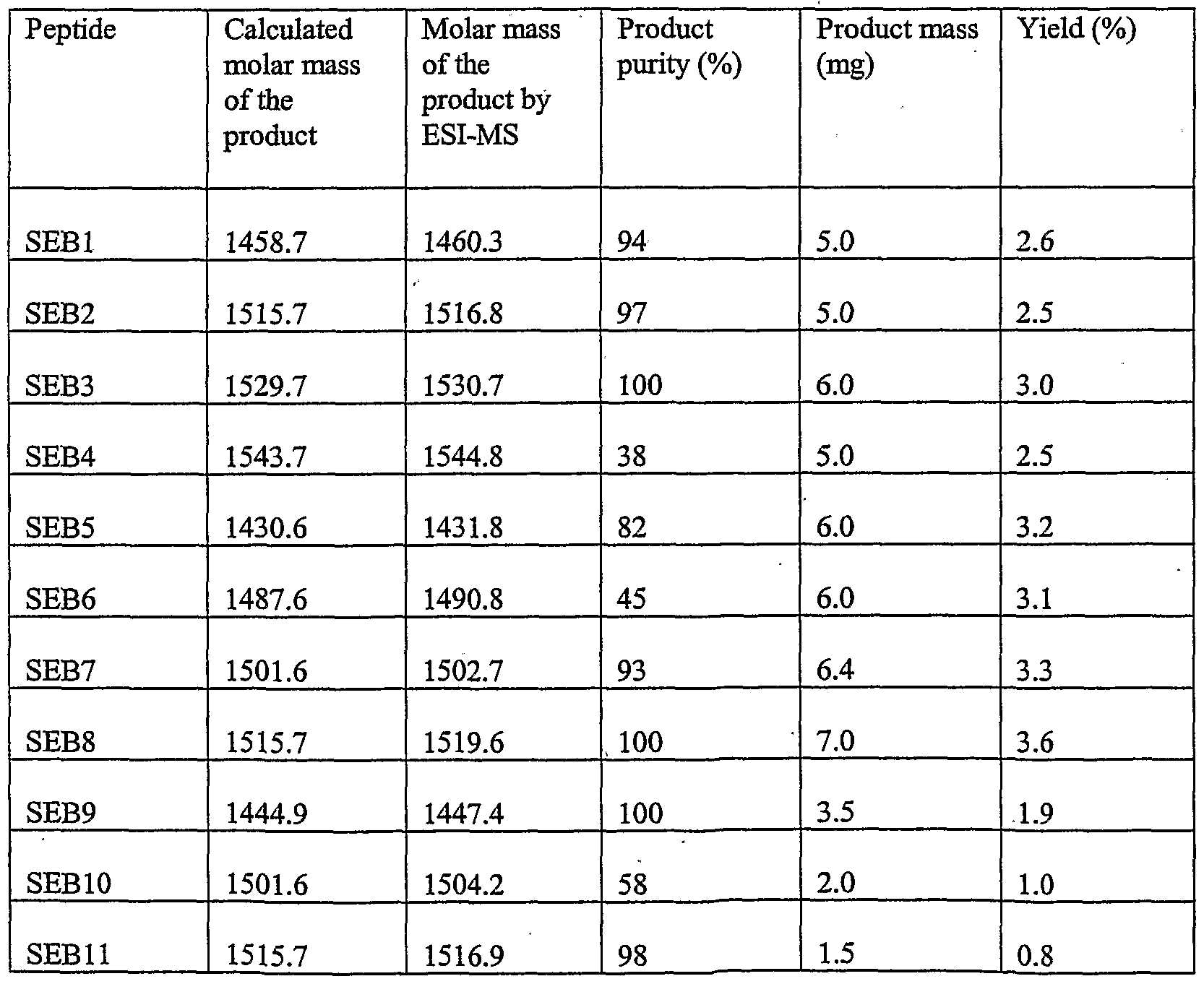

SEB-1 library cyclic peptides antagonize cytokine induction by SEB. The biological activity of aU Hbrary peptides was determined according to the methodology developed by two of the present inventors (WO 98/29444). Inhibition of the superantigenic activity by the Hbrary peptides of the invention was determined as indicated in experimental procedures. Briefly, mRNA quantities of IFN-γ and IL-2 cytokines were determined by quantitative dot blotting on Thl cells obtained from healthy donors, at three time points (0, 3h and 6h) foUowing incubation with SEB, with and without the peptides. Peptide pl2A (dA-YNKKKATVQELD-dA, where dA denotes D- Ala, SEQ ID NO. 3) served as a Hnear reference peptide. The lower the cytokines quantity the higher the peptides inhibitory activity, since the release of these cytokines imphes a successful antigenic mode of action. The concentrations used for the" cyclic peptides were 70 μM whUe the Hnear pl2 was assayed at a ten times higher concentration (700 μM), the SEB superantigen concentration was 100 ng/ml. All peptides exhibited inhibitory activity to some extent. It should be noted that this biological assay was conducted on blood obtained from 40 different donors, and each peptide was checked in at least 12 repeated tests. The mean antagonist score from multiple assays was calculated for each peptide of the SEB-1 library for IL-2 mRNA and for and IFN-γ RNA. Scoring was done by a point system: <50%
inhibition (0 points); >50% inhibition at either 3 or 6 h time point of the above assay (1 point); >50% inhibition at 3 and 6 h (5 points); and >75% inhibition at 3 or 6 h (10 points).
The results (Figure 4) indicate that at least about 15 peptides of 20 in the SEB-1 Hbrary reach, or even surpass, the antagonistic behavior of peptide pl2. It should be born in mind that aU the peptides were checked at the concentration 10 times lower than the control peptide pl2, which itself is good antagonist. Among superior active cychc peptides in the SEB-1 series were SEB 11, SEB13, SEB18, and SEB19.
Examples 21 - 34
On further mimicking the structure of SEB(150-161), library SEB-2 was designed, with the cychzation comprising residue 159 and one of residues 152 and 153. The cychzation site passed from position 152 to position 153 in three peptides, backbone to backbone cychzation was used in 11 peptides, and a new structural element was introduced in 1 peptide, Gly(CH[(CH2)4NH2] which bears another positive charge near the amino end of the peptide. Further, the direction of the amide bond in the Hnker was switched in 7 peptides. Figure 5A shows a schematic structure of Hbrary SEB-2, the arrows being the sites of linking. "FG" are groups NH or CO. Table 3 describes the structures of the peptides of Hbrary SEB-2, relating to symbols in Figure 5A.
Tab. 3 Structures of the peptides of SEB-2 Hbrary, relating to symbols in Figure 5A.

The SEB-2 peptides were prepared according to the standard procedures in "tea bags", while using previously prepared buUding units, on a Rink-Amide MBHA resin (loading: 0.55 meq/g). Each bag contained 250 mg of resin. The protection of side chains that did not participate in the cychzation was achieved by using "permanent" protecting groups that were TFA sensitive, such as tBu, Boc and Trt. The residues undergoing cychzation were protected by "semi-permanent" protecting groups of AUyl and AUoc. The same as in SEB-1 library, residues 152 and 159 were bridged by coupHng AUoc-AA-OH amino acids to the amine of the side chain or alkyl arm of residue 152. This coupling was conducted after completion of the main sequence. In Hbrary SEB-2, the AUoc-Gly-OH amino acids were coupled to the amine of the alkylene arm of residue 159 (Figure 6). The buUding units used at this position were Fmoc-Gly(Cm)AUyl-OH, Fmoc-Gly(Nn)AUoc-OH and F oc- Gly(CH[(CH2)4NH-Boc]CO2-AUyl)-OH. After the coupHng of Fmoc-Ala-OH in
position 155, the AUoc group off the alkylene arm of the 159 positioned buUding units was cleaved. Then, AUoc-Gly-OH was coupled to the now exposed functional group, foUowed by continued buUding of the main sequence. This way, the direction of the bridge amide bond could be changed. After removal of the Allyl and AUoc groups from residue 152 and the bridge, cychzation was performed in the standard manner (Figure 6). The couplings of the various amino acids were conducted in standard PyBrOP procedure, except for the Asn which was coupled in the same manner as used in Hbrary SEB-1. In case of peptide SEB32, the cleavage of the Fmoc protecting group of the building unit at the amine end was performed only after peptide cychzation.
Peptides were cleaved off the sohd support by a standard TFA cocktail. The desired products were obtained as main products and their purity at the crude stage was higher than that of the SEB-1 Hbrary, 25-85%. For instance, peptide SEB32 was 47% pure and weighed 15 mg. AU peptides underwent further preparative HPLC purification. Their final purity was determined by analytical HPLC on RP-C18 column. Pure peptides were characterized by ESI-MS, HPLC and amino acid analysis. AU SEB-2 peptides, except SEB32, have a +2 electrical charge thus most of them show a major MS peak at MW/2, as in the previous Hbrary. The yields of the final products are lower compared to SEB-1, but their purities are higher.
Tab. 4 Results of the sythesis of SEB-2 library


Peptides of the SEB-2 library were subjected to the same biological assays as the peptides of SEB-1, foUowed by the same data analysis procedure. The difference was a ten-times raise of their concentration, reaching that for the control peptide, i.e. 700 μM. Scoring for SEB-2 peptides is shown in Figure 7. More peptides than in SEB-1 had lower activity than control peptide pl2A. Nevertheless, several peptides had higher activity than pl2A, SEB32 being superior.
WhUe the invention has been described using some specific examples, many modifications and variations are possible. It is therefore understood that the invention is not intended to be Hmited in any way, other than by the scope of the appended claims.
Claims
A cycHzed peptide having formula la or lb:

Xoo-Xoo-Gly-Lys-Xaa-Xhh-Thr-Xhh-Gln-Gly-Xoo-Xoo
1 2 3 4 5 6 7 8 9 10 11 12
lb
Xoo-Xoo-Lys-G y-Xaa-Xhh-Thr-Xhh-Gln-Gly-Xoo-Xoo
1 2 3 4 5 6 7 8 9 10 11 12
wherein Xoo is any standard amino acid (AA) or a deletion, Xaa is any standard AA; Xhh is a nonpolar AA selected from Ala, Val, Leu, lie, and
Phe; and wherein Z is a Hnker connecting the two Gly residues, comprising side chains or N-atoms of said Gly residues, which Hnker has a length from 5 to 21 atoms and is optionaUy substituted with an alkylamino group; and an analog thereof obtained by one AA replacement with another standard AA or with a modified AA; and a derivative of said peptide or its analog obtained by their esterification, amidation, acylation, and alkylation; and a salt of said peptide or its analog or its derivative.
2. A cycHzed peptide, analogs, derivatives and salts thereof, according to claim 1, wherein said Hnker Z has the foUowing structure: Ri (CH2)ι R2
(CH2)
(CH2) m CHRs
wherein Ri is a group selected from -NH-CO- and -CO-NH-; R2 is either the same as Ri, or represents bond when 1 is zero; R3 is selected from hydrogen, -NH2, and -(CH2)j-NH2; k is an integer from 0 to 6; 1 is an integer from 0 to 3; m is an integer from 2 to 7; and j is an integer from 0 to 5.
3. A cyclized peptide according to claim 1, having formula II:
R (CH2)ι - R2
(CH2)k II

CHR3
Xoo-Xoo-Gly-Lys-Lys-Xhh-Thr-Xhh-Gln-Gly-Xoo-Xoo
and derivatives and salts thereof; wherein Xoo is any standard AA or a deletion; Xhh is a nonpolar AA selected from Ala, Val, Leu, He, and Phe; Ri is a group selected from -NH-CO- and -CO-NH-; R2 is either the same as Ri, or represents bond when 1 is zero; R3 is selected from hydrogen and -(CH2)j-NH2; k is an integer from 0 to 6; 1 is an integer from 0 to 3; m is an integer from 2 to 7; and j is an integer from 0 to 5.
A cycHzed peptide according to claim 3, comprising backbone to side chain cychzation, having formula III:
m
Xoo-Xo
 -Xoo-Xoo
and derivatives and salts thereof, wherein Xoo, Xhh, R3, k, 1, and m have the meaning as defined above, and R2 is either the same as RI, or represents bond when 1 is zero.
5. A cycHzed peptide according to claim 3, comprising backbone to backbone cychzation, having formula TV:
NH-CO (CH2)ι . R2
IV
(CH2)k
(CHaJi

Xoo-Xoo-N-CH2-CO-Lys-Lys-Xhh-Thr-Xhh-Gln- N-CH2-CO-Xoo-Xoo
. and derivatives and salts thereof, wherein Xoo, Xhh, R3, k, 1, and m have the meaning as defined above, and R2 is either the same as Ri, or represents bond when 1 is zero.
6. A cycHzed peptide according to claim 3, comprising backbone to backbone cychzation, having formula V:
CO-NH (CH2)ι R2
V
(CH2)k
(CH2)π
CHRs
Xoo-Xoo-N-CH2-CO-Lys-Lys-Xhh-Thr-Xhh-Gln- N-CH2-CO-Xoo-Xoo
and derivatives and salts thereof, wherein Xoo, Xhh, R3, k, 1, and m have the meaning as defined above, and R2 is either the same as Ri, or represents bond when 1 is zero.
7. A cycHzed peptide, derivatives and salts thereof, according to claim 2, wherein AA at positions 1-5 and group R3 comprise together at least two free amino groups.
8. A cycHzed peptide, derivatives and salts thereof, according to claim 2, wherein R3 is -(CH2)j-NH , and wherein j is an integer from 0 to 5.
9. A cycHzed peptide, derivatives and salts thereof, according to any one of claims 1 to 2, wherein AA at position 5 is Lys.
10. A cycHzed peptide, derivatives and salts thereof, according to any one of claims 1 to 6, wherein AA at position 1 is Tyr.
11. A cycHzed peptide, derivatives and salts thereof, according to any one of claims 1 to 6, wherein AA at positions 1-2 are Tyr- Asn.
12. A cycHzed peptide, derivatives and salts thereof, according to any one of claims 1 to 6, wherein AA at positions 1-2 are deleted.
13. A cycHzed peptide, derivatives and salts thereof, according to any one of claims 1 to 6, wherein AA at position 12 is Asp.
14. A cycHzed peptide, derivatives and salts thereof, according to any one of claims 1 to 6, wherein AA at positions 11-12 are Leu- Asp.
15. A cyclized peptide, derivatives and salts thereof, according to any one of claims 1 to 6, wherein AA at positions 11-12 are deleted.
16. A cycHzed peptide, derivatives and salts thereof, according to any one of claims 1 to 6, wherein AA at positions 6 and 8 are independently selected from Val and Ala.
17. A cycHzed peptide, derivatives and salts thereof, according to any one of claims 1 to 16, wherein said Hnker connecting said two Gly residues has a length from 8 to 16 atoms.
18. A cycHzed peptide, derivatives and salts thereof, according to any one of claims 1 to 16, wherein said Hnker connecting said two Gly residues has a length from 10 to 14 atoms.
19. A cycHzed peptide, derivatives and salts thereof, according to any one of claims 1 to 18, acetylated at a free amino group, and amidated at a free carboxyl group.
20. A cycHzed peptide, derivatives and salts thereof, according to any one of claims 1 to 19, wherein said modified amino acid comprises a D-amino acid.
21. A cycHzed peptide comprising a hexapeptide having sequence Lys-Xaai- Xaa2-Thr-Xaa3-Gln (SEQ ID NO. 1, wherein Xaai is any standard AA,
and Xaa2 and Xaa3 are nonpolar AAs independently selected from Ala, Val, Leu, He, and Phe); derivative thereof obtained by acylation, amidation, methylation, and esterification; a homolog thereof obtained by replacing one AA in said sequence by another standard AA; and their salt; for use in antagonizing exotoxin-mediated activation of T- lymphocytes, and in eliciting protective immunity against toxic shock induced by one or more pyrogenic exotoxins.
22. A cycHzed peptide, derivatives and salts thereof, according to any one of claims 1 to 20, for use in antagonizing toxin-mediated activation of T- lymphocytes, wherein the toxin is a pyrogenic bacterial exotoxin.
23. A cyclized peptide, derivatives and salts thereof, according to any one of claims 1 to 20, for use in eHciting protective immunity against toxic shock induced by a pyrogenic exotoxin or by a mixture of pyrogenic exotoxins.
24. A cyclized peptide, derivatives and salts thereof, according to claims 22 and 23, wherein said exotoxins are derived from Staphylococcus aureus or Streptococcus pyogenes.
25. A composition comprising at least one cycHzed peptide, derivative and salt thereof, according to claims 1 to 20, for reducing the toxic effect of a bacterial exotoxin or a mixture of bacterial exotoxins.
26. A composition which inhibits pyrogenic exotoxin-mediated activation of T-lymphocytes and protects against toxic shock induced by a pyrogenic exotoxin or by a mixture of pyrogenic exotoxins, comprising a cycHzed peptide, derivatives and salts thereof, according to any one of claims 1 to 20, and optionaUy further comprising pharmaceuticaUy acceptable carrier, diluent, adjuvant and/or excipient.
27. An immunogenic composition for eHciting protective immunity against a toxic shock induced by a pyrogenic exotoxin comprising a cycHzed peptide, derivatives and salts thereof, according to any one of claims 1 to 20, and optionally further comprising pharmaceuticaUy acceptable carrier, diluent, adjuvant and/or excipient.
28. A pharmaceutical composition for the treatment of incapacitation induced by one or more pyrogenic exotoxins comprising a cycHzed peptide, derivatives and salts thereof, as defined in any one of claims 1 to 20, and optionaUy further comprising pharmaceutically acceptable carrier, dUuent, adjuvant and/or excipient.
29. A pharmaceutical composition according to any one of claims 25 to 28, comprising a mixture of different cycHzed peptides as defined in any one of claims 1 to 20, or derivatives and salts thereof.
30. A method for preventing, treating, or reducing the harmful effects of a bacterial exotoxin or a mixture of bacterial exotoxins in a mammal, comprising administering to said mammal an effective amount of at least one cyclized peptide, derivative and salts thereof, according to claims 1 to 20.
31. A method of inhibiting pyrogenic exotoxin-mediated activation of T- lymphocytes and protecting against toxic shock induced by a pyrogenic exotoxin or by a mixture of pyrogenic exotoxins in a patient in need of such treatment comprising administering to said patient an inhibitory effective amount of at least one cycHzed peptide, derivatives and salts thereof, according to any one of claims 1 to 20.
32. A method of eHciting protective immunity against a toxic shock induced by a pyrogenic exotoxin in a patient in need of such treatment
comprising administering to said patient at least one cycHzed peptide, derivatives and salts thereof, according to any one of claims 1 to 20.
33. A method of preventing or treating incapacitation induced by at least one pyrogenic exotoxin comprising administering to a patient in need of such treatment a therapeuticaUy effective dose of at least one cycHzed peptide, derivatives and salts thereof, according to any one of claims 1 . to 20, or of a composition comprising the same.
34. A method according to claim 33, wherein said incapacitation is a result of an accidental exposure to a bacterial toxin at situations comprising food poisoning, work environment, combat, or a terrorist attack.
35. A method according to any one of claims 30 to 34, comprising administering a mixture of cycHzed peptide of any one of claims 1 to 20, or derivatives and salts thereof.
36. The method of claim 34, wherein said effective dose is administered to said patient repeatedly, at predetermined periods of time.
37. Use of a cycHzed peptide, analog, derivative, or salt thereof, according to any one of claims 1 to 20, in the preparation of a medicament.
38. Use of a cycHzed peptide, analog, derivative, or salt thereof, according to any one of claims 1 to 20, in the preparation of a medicament for reducing harmful effects of bacterial pyrogenic exotoxins or their analogs.
39. Use of a cycHzed peptide, analog, derivative, or salt thereof, according to any one of claims 1 to 20, in the preparation of a medicament for inhibiting pyrogenic exotoxin-mediated activation of T-lymphocytes.
40. Use of a cyclized peptide, analog, derivative, or salt thereof, according to any one of claims 1 to 20, in the preparation of a medicament for eliciting protective immunity against a toxic shock induced by a pyrogenic exotoxin.
41. Use of a cyclized peptide, analog, derivative, or salt thereof, according to any one of claims 1 to 20, in the preparation of a medicament for the treatment of incapacitation induced by one or more pyrogenic exotoxins.
42. A vaccine for protecting against toxic effects of a pyrogenic exotoxin or a mixture of pyrogenic exotoxins comprising as active ingredient an immunologicaUy effective amount of at least one peptide or derivative thereof according to any one of claims 1 to 20.
43. A vaccine for conferring immunity against toxic shock induced by a pyrogenic exotoxin or by a mixture of pyrogenic exotoxins comprising as active ingredient an immunologicaUy effective amount of at least one peptide or derivative thereof according to any one of claims 1 to 20.
44. A vaccine according to claim 43 further comprising an immunization adjuvant.
45. A vaccine according to claim 43 for enhancing production of antibodies that block T-cell activation.
46. Use of a cyclized peptide of any one of claims 1 to 20, or derivatives and salts thereof in the preparation of a vaccine according to claim 42 or 43.
47. Antibodies directed against a cyclized peptide of any one of claims 1 to 20 or its derivative, which block T-cell activation.
48. An antiserum containing antibodies directed against a cycHzed peptide of any one of claims 1 to 20 or its derivative.
49. An antiserum according to claim .48 which is a domestic animal antiseruro..
50. An antiserum according to claim 48 capable of alleviating harmful effects and toxic shock induced by a pyrogenic exotoxin or by a mixture of pyrogenic exotoxins.
51. A method for assessing the efficacy of a vaccine for conferring immunity against one or more pyrogenic bacterial toxins comprising determining the abUity of serum from an immunized individual to antagonize toxin- mediated activation of T-ceUs.
52. A method according to claim 51 wherein the abUity of serum from an immunized individual to antagonize toxin-mediated activation of T-ceUs is determined by measuring the inhibition of expression of pyrogenic toxin-induced mRNA encoded by the IL-2 or IFN-γ genes.
53. A kit for assessing the efficacy of a vaccine for conferring immunity against one or more pyrogenic toxins comprising determining the abiHty of serum from an immunized individual to antagonize toxin-mediated activation of T-ceUs by the method of claim 51.
Applications Claiming Priority (2)
| Application Number | Priority Date | Filing Date | Title |
|---|---|---|---|
| US44651903P | 2003-02-12 | 2003-02-12 | |
| US60/446,519 | 2003-02-12 |
Publications (2)
| Publication Number | Publication Date |
|---|---|
| WO2004072095A2 true WO2004072095A2 (en) | 2004-08-26 |
| WO2004072095A3 WO2004072095A3 (en) | 2004-11-25 |
Family
ID=32869524
Family Applications (1)
| Application Number | Title | Priority Date | Filing Date |
|---|---|---|---|
| PCT/IL2004/000141 Ceased WO2004072095A2 (en) | 2003-02-12 | 2004-02-12 | Cyclized peptides as exotoxin antagonists |
Country Status (1)
| Country | Link |
|---|---|
| WO (1) | WO2004072095A2 (en) |
Cited By (3)
| Publication number | Priority date | Publication date | Assignee | Title |
|---|---|---|---|---|
| WO2019170160A1 (en) * | 2018-03-09 | 2019-09-12 | 韩苏 | Polypeptide compound, preparation method, and application thereof |
| CN117229176A (en) * | 2022-06-06 | 2023-12-15 | 成都圣诺生物制药有限公司 | A new amino acid derivative and its application in the preparation of cyclic peptides |
| CN117229184A (en) * | 2022-06-07 | 2023-12-15 | 成都圣诺生物制药有限公司 | A new cysteine derivative and its application in the preparation of cyclic peptides |
Family Cites Families (2)
| Publication number | Priority date | Publication date | Assignee | Title |
|---|---|---|---|---|
| IL119938A (en) * | 1996-12-30 | 2005-08-31 | Yissum Res Dev Co | Peptides capable of eliciting protective immunity against toxic shock induced by pyrogenic exotoxins or of antagonizing toxin-mediated activation of t cells |
| DE10116042A1 (en) * | 2001-03-30 | 2002-10-24 | Fresenius Hemocare Gmbh | Exotoxin ligand |
-
2004
- 2004-02-12 WO PCT/IL2004/000141 patent/WO2004072095A2/en not_active Ceased
Cited By (6)
| Publication number | Priority date | Publication date | Assignee | Title |
|---|---|---|---|---|
| WO2019170160A1 (en) * | 2018-03-09 | 2019-09-12 | 韩苏 | Polypeptide compound, preparation method, and application thereof |
| CN110237231A (en) * | 2018-03-09 | 2019-09-17 | 韩苏 | Application of the polypeptide compound in preparation antibacterials |
| CN111819187A (en) * | 2018-03-09 | 2020-10-23 | 韩苏 | Polypeptide compound and preparation method and application thereof |
| CN111819187B (en) * | 2018-03-09 | 2023-05-26 | 韩苏 | Polypeptide compound and its preparation method and application |
| CN117229176A (en) * | 2022-06-06 | 2023-12-15 | 成都圣诺生物制药有限公司 | A new amino acid derivative and its application in the preparation of cyclic peptides |
| CN117229184A (en) * | 2022-06-07 | 2023-12-15 | 成都圣诺生物制药有限公司 | A new cysteine derivative and its application in the preparation of cyclic peptides |
Also Published As
| Publication number | Publication date |
|---|---|
| WO2004072095A3 (en) | 2004-11-25 |
Similar Documents
| Publication | Publication Date | Title |
|---|---|---|
| AU704502B2 (en) | Non-dendritic backbone peptide carrier | |
| AU2024200512A1 (en) | Stabilized peptide-mediated targeted protein degradation | |
| KR100451522B1 (en) | Peptide derivatives | |
| CA3231587A1 (en) | Antiviral structurally-stapled sars-cov-2 peptide- cholesterol conjugates and uses thereof | |
| US7189398B2 (en) | Broad spectrum pyrogenic exotoxins antagonists and vaccines | |
| CA3214455A1 (en) | Peptide and peptide-containing composition | |
| KR19990087123A (en) | Peptide derivative | |
| EP4410816A1 (en) | Peptide | |
| JP2008528480A (en) | HIV-1 gp41 fusion peptide for immunomodulation | |
| EP3210995A1 (en) | Hemagglutinin-binding peptide | |
| US6180771B1 (en) | Nucleic acids encoding a house dust mite allergen, Der p III, and uses therefor | |
| AU2003219489B2 (en) | Broad-Spectrum in-vivo effective superantigen toxin antagonists based on the interaction between CD28 and the superantigen and uses thereof | |
| CA3228449A1 (en) | Human transferrin receptor binding peptide | |
| US20260041753A1 (en) | Respiratory syncytial virus surface glycoprotein peptides, conjugates, and uses thereof | |
| US20250288658A1 (en) | Ebolavirus surface glycoprotein peptides, conjugates, and uses thereof | |
| EP4676938A2 (en) | Hendra virus and nipah virus surface glycoprotein peptides, conjugates, and uses thereof | |
| Parlak | Peptide-based drug systems |
Legal Events
| Date | Code | Title | Description |
|---|---|---|---|
| AK | Designated states |
Kind code of ref document: A2 Designated state(s): AE AG AL AM AT AU AZ BA BB BG BR BW BY BZ CA CH CN CO CR CU CZ DE DK DM DZ EC EE EG ES FI GB GD GE GH GM HR HU ID IL IN IS JP KE KG KP KR KZ LC LK LR LS LT LU LV MA MD MG MK MN MW MX MZ NA NI NO NZ OM PG PH PL PT RO RU SC SD SE SG SK SL SY TJ TM TN TR TT TZ UA UG US UZ VC VN YU ZA ZM ZW |
|
| AL | Designated countries for regional patents |
Kind code of ref document: A2 Designated state(s): BW GH GM KE LS MW MZ SD SL SZ TZ UG ZM ZW AM AZ BY KG KZ MD RU TJ TM AT BE BG CH CY CZ DE DK EE ES FI FR GB GR HU IE IT LU MC NL PT RO SE SI SK TR BF BJ CF CG CI CM GA GN GQ GW ML MR NE SN TD TG |
|
| 121 | Ep: the epo has been informed by wipo that ep was designated in this application | ||
| 122 | Ep: pct application non-entry in european phase |