Ligandsfor the Peroxisome Proliferator-Activated Receptor, and Methods of Use Thereof
Background of the Invention Peroxisome Proliferator-Activated Receptors
The peroxisome proliferator-activated receptor (PPAR) is a member of the nuclear receptor superfamily, and consists of three isoforms, PPAR α, β/δ and γ; there are two splice variants of PPARγ, denoted as PPARγl and PPARγ2. Neve, B. P.; Fruchart, J.;
Staels, B., Biochem Pharmacol 2000, 60, 1245-1250; Clarke, S. D.; Thuillier, P.; Baillie, R. A.; Sha, X., Am J Clin Nutr 1999, 70, 566-571; Sundvold, H.; Brzozowska, A.; Lien, S.,
Biochem Biophys Res Commun 1991, 239, 857-861. PPARs are lipid-regulated transcription factors that are activated by agents known to produce peroxisome proliferation, and regulate the expression of genes involved primarily in the oxidation and synthesis of lipids. PPARγ is expressed predominantly in adipose tissue and the intestine, but also in the mammary gland, endothelial cells, smooth muscle and macrophages; in human adipose tissue, PPARγl is more highly expressed than PPARγ2. Braissant, O.;
Foufelle, F.; Scotto, C; Dauca, M.; Wahli, W., Endocrinology 1996, 137, 354-366;
Braissant, O.; W ahli, W ., Endocrinology 1998, 139, 2748-2754; M ansen, A .; Guardiola-
Diaz, H.; Rafter, J.; Branting, C; Gustafsson, J. A., Biochem Biophys Res Commun 1996, 222, 844-851; Tontonoz, P.; Nagy, L.; Alvarez, J. G.; Thomazy, V. A.; Evans, R. M., Cell
1998, 93, 241-252; Fajas, L.; Auboeuf, D.; Raspe, E.; Schoonjans, K.; Lefebvre, A. M. et al., J Biol Chem 1997, 272, 18779-18789.
PPARγ is the major isoform expressed in the mammary gland as well as in primary and metastatic breast cancer and breast cancer cell lines, and PPARγ2 is the predominant variant in these tissues. Elstner, E.; Muller, C; Koshizuka, K.; Williamson, E. A.; Park, D. et al., Proc Natl Acad Sci USA 1998, 95, 8806-8811; Mehta, R. G.; Williamson, E.; Patel,
M. K.; Koeffler, H. P., J Natl Cancer Inst 2000, 92, 418-423; Mueller, E.; Sarraf, P.;
Tontonoz, P.; Evans, R. M.; Martin, K. J. et al, Mol Cell 1998, 1, 465-470; Gi ble, j. M.;
Pighetti, G. M.; Lemer, M. R.; Wu, X.; Lightfoot, S. A. et al., Biochem Biophys Res Commun 1998, 253, 813-817. Expression of PPARγ disappears in the lactating mouse mammary gland as well as in DMBA-induced rat mammary tumors. Gimble, J. M.;
Pighetti, G. M.; Lemer, M. R.; Wu, X.; Lightfoot, S. A. et al., Biochem Biophys Res
Commun 1998, 253, 813-817. PPARγ agonists have antidiabetic activity in type II diabetes by enhancing glucose and fatty acid metabolism in peripheral tissues such as muscle. Beger, J.; Moller, D.E. Annu RevMed l l, 53, 409-435.
PPARs contains the structural features characteristic of nuclear hormone receptors, including a DNA-binding domain (DBD) containing two zinc fingers, a ligand-binding domain (LBD) containing a large hydrophobic pocket as well as a ligand-dependent transactivation region (AF-2) at the C-terminus and a lesser characterized, putative N- terminal transactivation domain (AF-1). PPAR isoforms share a common domain structure and molecular mechanism of action. Human PPARδ, PPARα, and PPARγ contain a conserved domain structure with a DNA binding domain (DBD) and ligand-binding domain (LBD). PPARγi and PPARγ2 are distinguished by 30 extra amino acids at the N terminus of PPARγ2 (from Rosen & Spiegelman, J. Biol. Chem. 276:37731, 2001). The PPAR functions as a heterodimeric transcription factor with members of the retinoid X receptor (RXR) transcription factor family, and requires high-affinity binding of PPAR- and RXR- specific ligands to their respective receptors to engage transcription. Mukherjee, R.; Jow, L.; Croston, G. E.; Patemiti, J. R., Jr., JBiol Chem 1997, 272, 8071-8076. The PPAR/RXR heterodimer binds to the PPAR response element (AGGTCANAGGTCA). The interaction of PPAR:RXR with the transcriptional machinery occurs through interaction with either coactivators, such as C/EBP, SRC-1 (steroid receptor coactivator protein 1) and DRIP205 or the corepressors SMRT, and even PPARα itself, which acts in a dominant-negative fashion with RXRα. Nanbu-Wakao, R.; Fujitani, Y.; Masuho, Y.; Muramatu, M.; Wakao, H., Mol Endocrinol 2000, 14, 307-316; Yang, W.; Rachez, C; Freedman, L. P., Mol Cell Biol 2000, 20, 8008-8017; DiRenzo, J.; Soderstrom, M.; Kurokawa, R.; Ogliastro, M. H.; Ricote, M. et al., Mol Cell Biol 1997, 17, 2166-2176; Nagy, L.; Kao, H. Y.; Love, J. D.; Li, C; Banayo, E. et al., Genes Dev 1999, 13, 3209-3216; Jow, L.; Mukherjee, R., JBiol Chem 1995, 270, 3836-3840. These interactions provide the switch for controlling complex programs of gene expression in target tissues. Yang, W.; Rachez, C; Freedman, L. P., Mol Cell Biol 2000, 20, 8008-8017.
Several mutations and polymoφhisms in PPARγ have been identified, such as Lys319X and Gln286Pro in sporadic colon cancer that were associated with loss of DNA binding and ligand-dependent transcription by the PPARγ agonists troglitazone (TGZ) and 15-deoxy-Δ12'I4-prostaglandin J2 (PGJ2). Sarraf, P.; Mueller, E.; Smith, W. M.; Wright, H.
M.; Kum, J. B. et al., Mol Cell 1999, 3, 799-804. Similar results were found for PPARγ2 polymoφhism Proll2Ala; in contrast, polymoφhism Serll4Ala resulted in increased transactivation activity by presumably blocking the inhibitory effect of Serl l4 phosphorylation by MAP kinases. Deeb, S. S.; Fajas, L.; Nemoto, M.; Pihlajamaki, J.; Mykkanen, L. et al., Nat Genet 1998, 20, 284-287; Ristow, M.; Muller-Wieland, D.; Pfeiffer, A.; Krone, W.; Kahn, C. R., N Engl J Med 1998, 339, 953-959; Shao, D.; Lazar, M. A., JBiol Chem 1997, 272, 21473-21478. Recently, the t(2;3)(ql3;p25) translocation associated with thyroid follicular carcinoma was found to encode the PAX8-PPARγl fusion protein. Kroll, T. G.; Sarraf, P.; Pecciarini, L.; Chen, C. J.; Mueller, E. et al., Science 2000, 289, 1 357-1360. T his chimeric PPAR acted in a d ominant-negative m anner to suppress PPARγl ligand-mediated transactivation, supporting the hypothesis that the wild-type PPARγ acts as a tumor suppressor. PPARγLigands as Antitumor and Chemopreventive Therapy
PPARγ ligands have been shown to have chemopreventive and antitumor effects in a number of animal model systems. Kopelovich, L.; Ray, J. R.; Glazer, R. I.; Crowell, J. A., Mol Cancer Ther 2002, 1, 357-363; Rosen, E. D.; Spiegelman, B. M., JBiol Chem 2001, 276, 37731-37734. Either TGZ or the RAR ligand, all-trans retinoic acid, prevented DMBA-induced preneoplastic lesions in mammary gland organ cultures. Significantly, the selective RXR ligand, LG10068, although ineffective alone, acted synergistically with TGZ to inhibit these lesions. Mehta, R. G.; Williamson, E.; Patel, M. K.; Koeffler, H. P., JNatl Cancer Inst 2000, 92, 418-423. This result suggests that the therapeutic use of a cocktail of ligands for each heteromeric partner may be more effective than use of the individual ligands. TGZ and the PPARα agonist, WY14643, were effective chemopreventive agents against D MBA-mediated r at mammary tumorigenesis, and the PPARγ agonist, GW7845, which is 1000-fold more potent than TGZ, markedly reduced nitroso-methyl-urea-mediated mammary tumorigenesis. Pighetti, G. M.; Νovosad, W.; Nicholson, C; Hitt, D. C. Hansens, C. et al., Anticancer Res 2001, 21, 825-829; DeLuca, J. G.; Doebber, T. W. Kelly, L. J.; Kemp, R. K.; Molon-Noblot, S. et al., Mol Pharmacol 2000, 58, 470-476 Cobb, J. E.; Blanchard, S. G.; Boswell, E. G.; Brown, K. K.; Charifson, P. S. et al, J Med Chem 1998, 41, 5055-5069; Suh, N.; Wang, Y.; Williams, C. R.; Risingsong, R.; Gilmer, T. et al.; Cancer Res 1999, 59, 5671-5673.
The effectiveness has been demonstrated of PPARγ agonists as anticancer agents in
breast, prostate, stomach, lung, colon and pancreatic tumor cell lines. Elstner, E.; Muller, C; Koshizuka, K.; Williamson, E. A.; Park, D. et al. Ligands for peroxisome proliferator- activated receptorgamma and retinoic acid receptor inhibit growth and induce apoptosis of human breast cancer cells in vitro and in BNX mice. Proc Natl Acad Sci U S A 1998, 95, 8806-8811 ; Mueller, E.; Sarraf, P.; Tontonoz, P.; Evans, R. M.; Martin, K. J. et al. Terminal differentiation of human breast cancer through PPAR gamma. Mol Cell 1998, 1, 465-470; Clay, C. E.; Namen, A. M.; Atsumi, G.; Willingham, M. C; High, K. P. et al. Influence of J series prostaglandins on apoptosis and tumorigenesis of breast cancer cells. Carcinogenesis 1999, 20, 1905-1911; Tsubouchi, Y.; Sano, H.; Kawahito, Y.; Mukai, S.; Yamada, R. et al., Biochem Biophys Res Commun 2000, 270, 400-405; Tontonoz, P.; Singer, S.; Forman, B. M.; Sarraf, P.; Fletcher, J. A. et al.; Proc Natl Acad Sci U S A 1997, 94, 237-241; Kubota, T.; Koshizuka, K.; Williamson, E. A.; Asou, H.; Said, J. W. et al., Cancer Res 1998, 58, 3344-3352; Itami, A.; Watanabe, G.; Shimada, Y.; Hashimoto, Y.; Kawamura, J. et al., IntJ Cancer 2001, 94, 370-376; Koga, H.; Sakisaka, S.; Harada, M.; Takagi, T.; Hanada, S. et al., Hepatology 2001, 33, 1087-1097; Hisatake, J. I; Ikezoe, T.; Carey, M.; Holden, S.; Tomoyasu, S. et al., Cancer Res 2000, 60, 5494-5498; Takahashi, N.; Okumura, T.; Motomura, W.; Fujimoto, Y.; Kawabata, I. et al., FEBS Lett 1999, 455, 135-139; Motomura, W.; Okumura, T.; Takaliashi, N.; Obara, T.; Kohgo, Y., Cancer Res 2000, 60, 5558-5564; Mueller, E.; Smith, M.; Sarraf, P.; Kroll, T.; Aiyer, A. et al., Proc Natl Acad Sci USA 2000, 97, 10990-10995.
' TGZ and all-trα/zs-retinoic acid acted synergistically to inhibit the proliferation of
MCF-7 breast cancer cells in vitro, as well as MCF-7 xenografts in nude mice, by reducing the levels of Bcl-2 and inducing apoptosis. Elstner, E.; Muller, C; Koshizuka, K.; Williamson, E. A .; P ark, D . et al., Proc Natl A cad Sci U S A 1998, 95, 8806-8811. I n PANC-1 pancreatic carcinoma cells, TGZ and 9-cw-retinoic acid were additive in causing GI cell cycle arrest resulting from reduced expression of cyclin Dl and HB-EGF due to inhibition of the transcriptional activities of AP-1 and Ets. Kitamura, S .; Miyazaki, Y .; Hiraoka, S.; Nagasawa, Y.; Toyota, M. et al, Int J Cancer 2001, 94, 335-342. The antitumor activity of TGZ may also be due, at least i part, to inhibition of aromatase activity and estrogen biosynthesis in mammary gland adipose stromal tissue, which would increase TGZ's effectiveness against estrogen receptor-positive breast cancer. Rubin, G. L.; Zhao, Y; Kalus, A. M.; Simpson, E. R., Cancer Res 2000, 60, 1604-1608. Therefore,
PPARγ activation by selective ligands will likely lead to reduced tumor incidence, tumor growth and progression.
Moreover, PPARγ agonists are effective anti-inflammatory drags by directly associating with and inhibiting NFKB; thus, these drugs may be efficacious in treating precancerous conditions, such as colitis. Ricote, M.; Li, A. C; Willson, T. M.; Kelly, C. J.; Glass, C. K., Nature 1998, 391, 79-82; Jiang, C; Ting, A. T.; Seed, B., Nature 1998, 391, 82-86; Patel, L.; Pass, I.; Coxon, P.; Downes, C. P.; Smith, S. A. et al.,Cwrr Biol 2001, 11, 764-768; Chung, S. W.; Kang, B. Y.; Kim, S. H.; Pak, Y. K.; Cho, D. et al., JBiol Chem 2000, 275, 32681-32687; Tamura, M.; Gu, J.; Takino, T.; Yamada, K. M., Cancer Res 1999, 59, 442-449; Su, C. G.; Wen, X.; Bailey, S. T.; Jiang, W.; Rangwala, S. M. et al., J Clin Invest 1999, 104, 383-389.
A molecular basis for the antiproliferative and chemopreventive activity of PPARγ is suggested b y s everal s tudies. P P ARγ w as found t o a ctivate t ranscription o f t he P TEN tumor suppressor gene in MCF-7 breast cancer cells and Caco-2 colon cancer cells by binding to two PPAR response elements in the PTEN promoter. Patel, L.; Pass, L; Coxon, P.; Downes, C. P.; Smith, S. A. et al., Curr Biol 2001, 11, 764-768. Because PTEN is a 3- phosphoinositide phosphatase, which negatively regulates cell survival, it would be expected that PPARγ activation would induce or sensitize cells to apoptosis. Di Cristofano, A.; Pandolfi, P. P., Cell 2000, 100, 387-390. PPARγ agonists also inhibit transit through the Gl/S cell cycle. TGZ increased the levels of the cyclin-dependent protein kinase inhibitor, p27Kφl, in pancreatic and liver carcinoma cells. Itami, A.; Watanabe, G.; Shimada, Y.; Hashimoto, Y.; Kawamura, J. et al., hit J Cancer 2001, 94, 370-376; Koga, H.; S akisaka, S .; H arada, M .; T akagi, T .; H anada, S . et al., Hepatology 2001, 33, 1087- 1097; Motomura, W.; Okumura, T.; Takahashi, N.; Obara, T.; Kohgo, Y., Cancer Res 2000, 60, 5558-5564. Cyclin Dl expression is upregulated by NFKB, and therefore, inhibition of NFKB by PPARγ agonists may be an additional point of intervention for inhibiting the cell cycle. Henry, D. O.; Moskalenko, S. A.; Kaur, K. J.; Fu, M.; Pestell, R. G. et al., Mol Cell Biol 2000, 20, 8084-8092; Chung, S. W.; Kang, B. Y.; Kim, S. H.; Pak, Y. K.; Cho, D. et al., J Biol Chem 2000, 275, 32681-32687. Because reduction in p27 and dysregulation of cyclins Dl and E is a common feature of many human cancers, the ability of PPARγ agonists to downregulate the Gl/S cell cycle and negatively regulate survival, establishes a rational basis for their use as anticancer and chemopreventive drugs. Loda, M.; Cukor, B.;
Tam, S. W.; Lavin, P.; Fiorentino, M. et al., Nat Med 1997, 3, 231-234; Tan, P.; Cady, B.; Wanner, M.; Worland, P.; Cukor, B. et al, Cancer Res 1997, 57, 1259-1263; Esposito, N.; Baldi, A.; De Luca, A.; Groger, A. M.; Loda, M. et al., Cancer Res 1997, 57, 3381-3385; Sherr, C. J., Science 1996, 274, 1672-1677. PPAR Lisands
Figure 2 depicts a number of compounds that show some activity at one or more of the PPARs. Willson, T. M.; Brown, P. J.; Stembach, D. D.; Henke, B. R., J Med Chem
2000, 43, 527-550. The antidiabetic agents known as the thiazolidinediones or glitazones were the first high affinity PPARγ agonists to have been described, although they were not originally developed as PPARγ ligands. Lehmann, J. M.; Moore, L. B.; Smith-Oliver, T. A.; Wilkison, W. O.; Willson, T. M. et al, JBiol Chem 1995, 270, 12953-12956; Kliewer, S. A.; Umesono, K.; Νoonan, D. J.; Heyman, R. A.; Evans, R. M., Nature 1992, 358, 771- 774; Kliewer, S . A.; Lenhard, J. M .; Willson, T . M.; Patel, I.; Morris, D. C. et al, Cell 1995, 83, 813-819. α-Alkoxy-β-phenylpropanoic acids such as SB 213068 have been reported to possess dual PPARα/γ activity. Buckle, D. R.; Cantello, B. C. C; Cawthome, M. A.; Coyle, P. J.; Dean, D. K. et al., Bioorganic & Medicinal Chemistry Letters 1996, 6, 2121-2126. A series of tyrosine-based PPARγ agonists, such as GW1929, were the first antidiabetic drags to be optimized based on their activity for human PPARγ. Henke, B. R.; Blanchard, S. G.; Brackeen, M. F.; Brown, K. K.; Cobb, J. E. et al, J Med Chem 1998, 41, 5020-5036. GW0072 is a PPARγ agonist that was identified in PPAR transactivation and adipocyte differentiation assays; however, it acts as a p artial agonist b ecause it does not contact the AF-2 helix of PPARγ. Binding of a PPAR ligand directly to the C-terminal AF-2 α-helical region appears to stabilize the charge clamp on the surface of the receptor, which is important for the recruitment of coactivator proteins to the receptor complex. GW9578, a ureido-thioisobutyric acid analog, has been identified as a PPARγ subtype-selective agonist. Brown, P. J.; Winegar, D. A.; Plunket, K. D.; Moore, L. B.; Lewis, M. C. et al., J Med Chem 1999, 42, 3785-3788.
Combinatorial chemistry and structure-based drag design have led to the identification of the subtype-selective PPARδ agonist GW501516. Oliver, W. R., Jr.; Shenk, J. L.; Snaith, M. R.; Russell, C. S.; Plunket, K. D. et al., Proc Natl Acad Sci US A
2001, 98, 5306-5311. Recently, the ligand LG100754 has been found to exhibit little intrinsic transcriptional activity; rather, it appears to enhance the potency of PPAR ligands
for PPARγ-RXR. Forman, B. M., JBiol Chem 2002, 277, 12503-12506. Finally, a number of naturally-occurring fatty acids and eicosanoid derivatives have been identified that bind and activate PPARγ at micromolar concentrations; and PGJ2 represents a prostaglandin that is widely used as a PPARγ agonist. Yu, K.; Bayona, W.; Kallen, C. B.; Harding, H. P.; Ravera, C. P. et al, JBiol Chem 1995, 270, 23975-23983; Kliewer, S. A.; Lenhard, J. M.; Willson, T. M.; Patel, I.; Morris, D. C. et al., Cell 1995, 83, 813-819.
Summary of the Invention
One aspect of the present invention relates to compounds with activity at a PPAR subtype. Another aspect of the invention relates to a method of identifying ligands using x- ray stmctural information for the PPARs. In certain embodiments, this method comprises using one or more of various molecular modeling approaches to identify candidate ligands selected from the group consisting of: 1) in silico screening of available chemical databases; 2) de novo/rational drag design in which a ligand will be created computationally in stages; and 3) design and in silico screening of virtual combinatorial libraries, hi certain embodiments of the aforementioned method, a ligand is also assayed for PPAR i soform selectivity; ligands found to possess the desired specificity are then screened for their ability to block the growth of various human cancer cell lines. hi certain embodiments, the present invention relates to a method, comprising:
1) identifying a novel PPARγ ligand using de novo drag design, combinatorial library generation, or virtual screening of chemical databases; chemically synthesizing the ligand;
2) assaying the ligand for PPAR selectivity and activity; based on the results of the assay and with the aid of molecular modeling; optionally conducting one or more additional rounds of chemical modification to optimize activity and/or selectivity; and 3) screening a ligand with an EC50 <1 μM in an assay for its ability to block cell proliferation in human cancer cell lines.
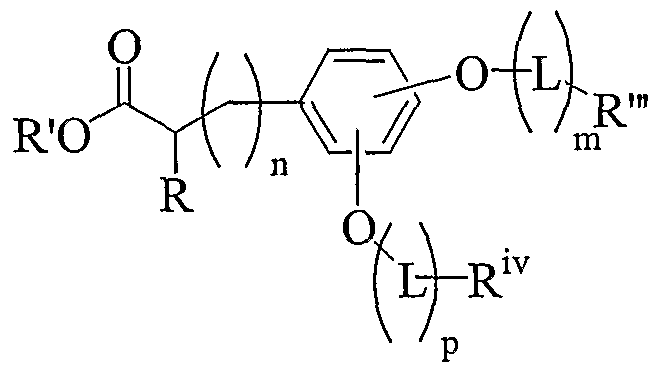
hi certain embodiments, the present invention relates to a compound of formula I:
I wherein R' is H, Cι-C6 alkyl, C -Cι0 aryl, or an alkali metal cation;
R is H, Cι-C6 alkyl, aryl, C C6 alkoxyl, C4-Cι0 aryloxyl, -NHCO(Cι-C6 alkyl), - NHCO(C4-Cι0 aryl), -NHSO2(Cι-C6 alkyl), or -NHSO2(C4-C10 aryl);
Ar is a 5-10 membered aryl or heteroaryl ring, wherein the heteroaryl ring contains 1 to 3 heteroatoms selected from the group consisting of O, S, and N; R" is -(L)„X;
L, independently for each occurrence, is -CH2-, O, N, or S;
X is Cι-C6 alkoxyl, C4-Cι0 aryloxyl, -CO2(d-C6 alkyl), -CO2(C4-Cι0 aryl), -
C(O)NH(d-C
6 alkyl), -C(O)NH(C
4-C
10 aryl),
R'" is H, Cι-C
6 alkyl, C
4-C
10 aryl, -SO
2(C C
6 alkyl), -SO
2(C
4-Cιo aryl), -C(O)(C
r
C6 alkyl), or -C(O)(C4-Cι0 aryl); m is an integer from 0 to 5 inclusive; n is an integer from 0 to 6 inclusive; and p is an integer from 0 to 6.
In certain embodiments, the present invention relates to a compound of formula I and the attendant definitions, wherein R' is H. hi certain embodiments, the present invention relates to a compound of formula 1 and the attendant definitions, wherein Ar is selected from the group consisting of phenyl, thiophenyl, and pyrrolyl.
In certain embodiments, the present invention relates to a compound of formula I and the attendant definitions, wherein p is 1.
In certain embodiments, the present invention relates to a compound of formula I and the attendant definitions, wherein m is 1. In certain embodiments, the present invention relates to a compound of formula I and the attendant definitions, wherein L is -CH2- and n is 1, 2, 3, or 4. hi certain embodiments, the present invention relates to a compound of formula I and the attendant definitions, wherein X is -OCH3 or -CO2CH .
In certain embodiments, the present invention relates to a compound of formula I and the attendant definitions, wherein R is selected from the group consisting of - OCH2CH3, -NHCOCH3, and -NHSO2CH3.
In certain embodiments, the present invention relates to a compound of formula I and the attendant definitions, wherein R' is H; p is 1 ; m is 1 ; Ar is phenyl; R is -OCH2CH3; L is -CH2-; n is 4; and X is -OCH3. In certain embodiments, the present invention relates to a compound of formula I and the attendant definitions, wherein R' is H; p is 1; m is 1; Ar is phenyl; R is -NHCOCH3; L is -CH2-; n is 4; and X is -OCH3.
In certain embodiments, the present invention relates to a compound of formula I and the attendant definitions, wherein R' is H; p is 1; m is 1; Ar is phenyl; R is -OCH2CH3; L is -CH2-; n is 3; and X is -OCH3.
In certain embodiments, the present invention relates to a compound of formula I and the attendant definitions, wherein R' is H; p is 1; m is 1; Ar is phenyl; R is -OCH2CH3; L is -CH2-; n is 2; and X is -CO2CH3.
In certain embodiments, the present invention relates to a compound of formula I and the attendant definitions, wherein R' is H; p is 1; m is 1; Ar is phenyl; R is - NHSO2CH3; L is -CH2-; n is 2; and X is -CO2CH3.
In certain embodiments, the present invention relates to a compound of formula I and the attendant definitions, wherein R' is H; p is 1; m is 1; Ar is thiophenyl; R is - OCH2CH3; L is -CH2-; n is 4; and X is -OCH3. In certain embodiments, the present invention relates to a compound of formula I and the attendant definitions, wherein R' is H; p is 1; m is 1; Ar is pyrrolyl; R is - OCH2CH3; L is -CH2-; n is 4; and X is -OCH3.
In certain embodiments, the present invention relates to a compound of formula I and the attendant definitions, wherein R' is H; p is 1; m is 1; Ar is thiophenyl; R is OCH2CH3; L is -CH2-; n is 2; and X is -OCH3. hi certain embodiments, the present invention relates to a compound of formula I and the attendant definitions, wherein R' is H; p is 1; m is 1; Ar is pyrrolyl; R is - OCH2CH3; L is -CH2-; n is 2; and L is -OCH3.
In certain embodiments, the present invention relates to a compound of formula I and the attendant definitions, wherein R' is H; p is 1; m is 1; Ar is thiophenyl; R is - OCH2CH3; L is -CH2-; n is 1; and X is -OCH3.
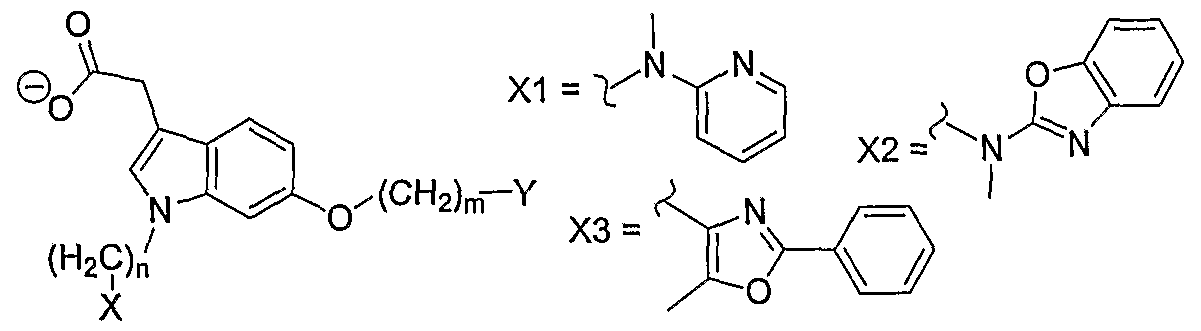
In certain embodiments, the present invention relates to a compound of formula II:
II wherein
R' is H, Cι-C6 alkyl, C4-Cιo aryl, or an alkali metal cation;
R is H, Cι-C6 alkyl, C -C10 aryl, -CO(Cι-C6 alkyl), -CO(C4-C10 aryl), -CO(aralkyl), ■ CO(aryl(C2-C6 alkenyl)), -CO(d-C6 alkyl)C(O)aryl, -CO(C2-C6 alkenyl)C(O)aryl, -CO(C2- C6 alkenyl)alkyl, -CO2(Cι-C6 alkyl)Oaralkyl, -SO2(Cι-C6 alkyl), -SO2(C4-Cι0 aryl), - CO2(aralkyl), -CO2C(d-C6 alkyl)3, aralkyl, or -C(C C6 alkyl)=CHC(O)aryl;
W is CH or N;
X is CH orN;
Y is CH orN;
Z is a bond, O, S, or NR; L, independently for each occurrence, is -CH2-, O, N, or S; n independently for each occurrence, is an integer from 1 to 6 inclusive; m is an integer from 0 to 2 inclusive; and p is an integer from 1 to 6 inclusive.
In certain embodiments, the present invention relates to a compound of formula II and the attendant definitions, wherein R' is H. h certain embodiments, the present invention relates to a compound of formula II and the attendant definitions, wherein n is 1. h certain embodiments, the present invention relates to a compound of formula II and the attendant definitions, wherein L is -CH - and p is 3, 4, 5 or 6.
In certain embodiments, the present invention relates to a compound of formula II and the attendant definitions, wherein m is 0.
In certain embodiments, the present invention relates to a compound of formula II and the attendant definitions, wherein Z is O. hi certain embodiments, the present invention relates to a compound of formula II and the attendant definitions, wherein X is N.
In certain embodiments, the present invention relates to a compound of formula II and the attendant definitions, wherein Y is CH. In certain embodiments, the present invention relates to a compound of formula II and the attendant definitions, wherein Y is N.
In certain embodiments, the present invention relates to a compound of formula II and the attendant definitions, wherein R is selected from the group consisting of H, CH3, - SO2CH3, -SO2Ph, -COCH3, -COPh, -CO2CH2Ph, -CO2C(CH3)3, -CH2Ph, -CH2CH2Ph, - CH2CH2CH2Ph, and -C(Me)=CHCOPh.
In certain embodiments, the present invention relates to a compound of formula II and the attendant definitions, wherein R' is H, m is 0, n is 1, X is N, L is -CH2-, p is 5, Y is CH, and R is -CH3.
In certain embodiments, the present invention relates to a compound of formula II and the attendant definitions, wherein R' is H, m is 0, n is 1, X is N, L is -CH2-, p is 5, Y is CH, and R is -SO2CH3. hi certain embodiments, the present invention relates to a compound of formula II and the attendant definitions, wherein R' is H, m is 0, n is 1, X is N, L is -CH2-, p is 3, Y is N, and R is -CH3. hi certain embodiments, the present invention relates to a compound of formula II and the attendant definitions, wherein R' is H, m is 0, n is 1, X is N, L is -CH2-, p is 3, Y is N, and R is -SO2CH3.
In certain embodiments, the present invention relates to a compound of formula II and the attendant definitions, wherein R' is H, m is 0, n is 1, X is N, L is -CH2-, p is 3, Y is N, and R is -SO2Ph.
In certain embodiments, the present invention relates to a compound of formula II and the attendant definitions, wherein R' is H, m is 0, n is 1, X is N, L is -CH2-, p is 3, Y is N, and R is -COCH3. hi certain embodiments, the present invention relates to a compound of formula II and the attendant definitions, wherein R' is H, m is 0, n is 1, X is N, Y is CH, L is -CH2-, p is 3, and R is -CO2CH2Ph. In certain embodiments, the present invention relates to a compound of formula II and the attendant definitions, wherein R' is H, m is 0, n is 1, X is N, Y is CH, L is -CH2-, p is 3, and R is -CO2C(CH3)3.
In certain embodiments, the present invention relates to a compound of formula II and the attendant definitions, wherein R' is H, m is 0, n is 1, X is N, Y is CH, L is -CH2-, p is 3, and R is H.
In certain embodiments, the present invention relates to a compound of formula II and the attendant definitions, wherein R' is H, m is 0, n is 1, X is N, Y is CH, L is -CH2-, p is 4, and R is -SO2CH3. hi certain embodiments, the present invention relates to a compound of formula II and the attendant definitions, wherein R' is H, m is 0, n is 1, X is N, Y is CH, L is -CH2-, p is 4, and R is -CO2C(CH3)3.
In certain embodiments, the present invention relates to a compound of formula II and the attendant definitions, wherein R' is H, m is 0, n is 1, X is N, Y is CH, L is -CH2-, p is 4, and R is H. hi certain embodiments, the present invention relates to a compound of formula II and the attendant definitions, wherein R' is H, m is 0, n is 1, X is N, Y is CH, L is -CH2-, p is 5, and R is -CO2C(CH3)3. h certain embodiments, the present invention relates to a compound of formula II and the attendant definitions, wherein R' is H, m is 0, n is 1, X is N, Y is CH, L is -CH2-, p is 5, and R is -CH2Ph. hi certain embodiments, the present invention relates to a compound of formula II and the attendant definitions, wherein R' is H, m is 0, n is 1, X is N, Y is CH, L is -CH -, p
is 5, and R is -CH2CH2Ph. hi certain embodiments, the present invention relates to a compound of formula II and the attendant definitions, wherein R' is H, m is 0, n is 1, X is N, Y is CH, L is -CH2-, p is 5, and R is -CH2CH2CH2Ph. In certain embodiments, the present invention relates to a compound of formula II and the attendant definitions, wherein R' is H, m is 0, n is 1, X is N, Y is CH, L is -CH2-, p is 5, and R is H.
In certain embodiments, the present invention relates to a compound of formula II and the attendant definitions, wherein R' is H, m is 2, n is 1, X is N, Y is CH, L is -CH2-, p is 5, and R is -CO2C(CH3)3.
In certain embodiments, the present invention relates to a compound of formula II and the attendant definitions, wherein R' is H, m is 0, n is 1, X is N, Y is CH, L is -CH -, p is 5, and R is -COPh.
In certain embodiments, the present invention relates to a compound of formula II and the attendant definitions, wherein R' is H, m is 0, n is 1, X is N, Y is CH, L is -CH2-, p is 5, and R is -CO2CH2Ph. h certain embodiments, the present invention relates to a compound of formula II and the attendant definitions, wherein R' is H, m is 0, n is 1, X is N, Y is CH, L is -CH2-, p is 5, and R is -C(CH3)=CHCOPh. In certain embodiments, the present invention relates to a compound of formula II and the attendant definitions, wherein R' is H, m is 0, n is 1, X is N, Y is CH, L is -CH2-, p is 6, and R is -CO2C(CH3)3. hi certain embodiments, the present invention relates to a compound of formula II and the attendant definitions, wherein R' is H, m is 0, n is 1, X is N, Y is CH, W is CH, L is -CH2-, p is 5, and R is -CO(aralkyl).
In certain embodiments, the present invention relates to a compound of formula II and the attendant definitions, wherein R' is H, m is 0, n is 1, X is N, Y is CH, W is CH, L is -CH2-, p is 5, and R is -COCH2(4-fluoroρhenyl). hi certain embodiments, the present invention relates to a compound of formula II and the attendant definitions, wherein Z is O, R' is H, m is 0, n is 1, X is N, Y is CH, W is CH, L is -CH2-, p is 5, and R is -CO(aralkyl).
In certain embodiments, the present invention relates to a compound of formula II
and the attendant definitions, wherein R' is H, m is 0, n is 1, X is N, Y is CH, W is CH, L is -CH2-, p is 5, and R is -COCH2CH2Ph.
In certain embodiments, the present invention relates to a compound of formula II and the attendant definitions, wherein R' is H, m is 0, n is 1, X is N, Y is CH, W is CH, L is -CH2-, p is 5, and R is -CO(aryl(C2-C6 alkenyl)).
In certain embodiments, the present invention relates to a compound of formula II and the attendant definitions, wherein R' is H, m is 0, n is 1, X is N, Y is CH, W is CH, L is -CH2-, p is 5, and R is -COCH=CHPh. hi certain embodiments, the present invention relates to a compound of formula II and the attendant definitions, wherein Z is O, R' is H, m is 0, n is 1, X is N, Y is CH, W is CH, L is -CH2-, p is 5, and R is -CO(aryl(C2-C6 alkenyl)).
In certain embodiments, the present invention relates to a compound of formula II and the attendant definitions, wherein R' is H, m is 0, n is 1, X is N, Y is CH, W is CH, L is -CH2-, p is 5, and R is -CO(Cι-C6 alkyl)C(O)aryl. In certain embodiments, the present invention relates to a compound of formula II and the attendant definitions, wherein R' is H, m is 0, n is 1, X is N, Y is CH, W is CH, L is -CH2-, p is 5, and R is -COCH2CH2C(O)aryl. hi certain embodiments, the present invention relates to a compound of formula II and the attendant definitions, wherein R' is H, m is 0, n is 1, X is N, Y is CH, W is CH, L is -CH2-, p is 5, and R is -COCH2CH2C(O)Ph.
In certain embodiments, the present invention relates to a compound of formula II and the attendant definitions, wherein Z is O, R' is H, m is 0, n is 1, X is N, Y is CH, W is CH, L is -CH2-, p is 5, and R is -CO(Cι-C6 alkyl)C(O)aryl.
In certain embodiments, the present invention relates to a compound of formula II and the attendant definitions, wherein Z is O, R' is H, m is 0, n is 1, X is N, Y is CH, W is CH, L is -CH2-, p is 5, and R is -COCH2CH2C(O)aryl. hi certain embodiments, the present invention relates to a compound of formula II and the attendant definitions, wherein R' is H, m is 0, n is 1, X is N, Y is CH, W is CH, L is -CH2-, p is 5, and R is -CO(C2-C6 alkenyl)C(O)aryl. hi certain embodiments, the present invention relates to a compound of formula II and the attendant definitions, wherein R' is H, m is 0, n is 1, X is N, Y is CH, W is CH, L is -CH2-, p is 5, and R is -COCH=CHC(O)aryl.
In certain embodiments, the present invention relates to a compound of formula II and the attendant definitions, wherein R' is H, m is 0, n is 1, X is N, Y is CH, W is CH, L is -CH2-, p is 5, and R is -COCH=CHC(O)Ph. hi certain embodiments, the present invention relates to a compound of formula II and the attendant defimtions, wherein Z is O, R' is H, m is 0, n is 1 , X is N, Y is CH, W is CH, L is -CH2-, p is 5, and R is -CO(C2-C6 alkenyl)C(O)aryl. hi certain embodiments, the present invention relates to a compound of formula II and the attendant definitions, wherein Z is O, R' is H, m is 0, n is 1, X is N, Y is CH, W is CH, L is -CH2-, p is 5, and R is -COCH=CHC(O)aryl. hi certain embodiments, the present invention relates to a compound of formula II and the attendant definitions, wherein R' is H, m is 0, n is 1, X is N, Y is CH, W is CH, L is -CH2-, p is 5, and R is -CO(CH2)4CH3. hi certain embodiments, the present invention relates to a compound of formula II and the attendant definitions, wherein R' is H, m is 0, n is 1, X is N, Y is CH, W is CH, L is -CH2-, p is 5, and R is -CO(C2-C6 alkenyl)alkyl.
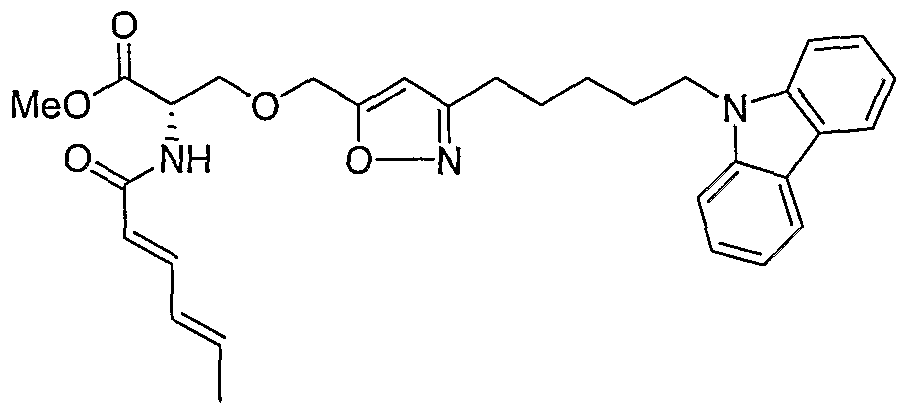
In certain embodiments, the present invention relates to a compound of formula II and the attendant definitions, wherein R' is H, m is 0, n is 1, X is N, Y is CH, W is CH, L is -CH2-, p is 5, and R is -COCH=CHCH=CHCH3. h certain embodiments, the present invention relates to a compound of formula II and the attendant definitions, wherein Z is O, R' is H, m is 0, n is 1, X is N, Y is CH, W is CH, L is -CH2-, p is 5, and R is -CO(C2-C6 alkenyl)alkyl.
In certain embodiments, the present invention relates to a compound of formula II and the attendant definitions, wherein R' is H, m is 0, n is 1, X is N, Y is CH, W is CH, L is -CH2-, p is 5, and R is -CO2C(CH3)3. hi certain embodiments, the present invention relates to a compound of foπnula II and the attendant definitions, wherein R' is H, m is 0, n is 1, X is N, Y is CH, W is CH, L is -CH2-, p is 5, and R is -CO2(aralkyl).
In certain embodiments, the present invention relates to a compound of formula II and the attendant definitions, wherein R' is H, m is 0, n is 1, X is N, Y is CH, W is CH, L is -CH2-, p is 5, and R is -CO2CH2-(2-choroρhenyl).
In certain embodiments, the present invention relates to a compound of formula II and the attendant definitions, wherein Z is O, R' is H, m is 0, n is 1, X is N, Y is CH, W is
CH, L is -CEfe-, p is 5, and R is -CO2(aralkyl).
In certain embodiments, the present invention relates to a compound of formula II and the attendant definitions, wherein R' is H, m is 0, n is 1, X is N, Y is CH, W is CH, L is -CH2-, p is 5, and R is -CO2CH2-(4-nitroρhenyl) or -CO2CH2-(2-nitroρhenyl). hi certain embodiments, the present invention relates to a compound of formula II and the attendant definitions, wherein R' is H, m is 0, n is 1, X is N, Y is CH, W is CH, L is -CH2-, p is 5, and R is -CO2CH2-(2-nitro-4,5-dimethoxyphenyl). hi certain embodiments, the present invention relates to a compound of formula III:
R' is H, Cι-C6 alkyl, C4-Cιo aryl, or an alkali metal cation; R is H orNHR";
R" is H, d-C6 alkyl, C4-Cι0 aryl, -SO2(d-C6 alkyl), -SO2(C4-d0 aryl), -C(O)(Cι-C6 alkyl), or -C(O)(C4-C10 aryl);
R' ' ' and R
1V, independently, are
Y is -CF3 or -(Ci-Ce alkyl)-O-(Cι-C6 alkyl);
R"' is H, Cι-C6 alkyl, C4-Cιo aryl, -SO2(Cι-C6 alkyl), -SO2(C4-Cι0 aryl), C(O)(Cι-C6 alkyl), or -C(O)(C4-Cι0 aryl); and q is an integer from 0 to 5 inclusive; L, independently for each occurrence, is -CH2-, O, N, or S. n is an integer from 0 to 5 inclusive; m is, independently for each occurrence, an integer from 0 to 6 inclusive; and
p is an integer from 1 to 5 inclusive.
h certain embodiments, the present invention relates to a compound of formula III and the attendant definitions, wherein R' is H. In certain embodiments, the present invention relates to a compound of formula III and the attendant definitions, wherein R is H. hi certain embodiments, the present invention relates to a compound of formula III and the attendant definitions, wherein R is NHR".
In certain embodiments, the present invention relates to a compound of formula III and the attendant definitions, wherein n is 1.
In certain embodiments, the present invention relates to a compound of formula III and the attendant definitions, wherein L is -CH2-. h certain embodiments, the present invention relates to a compound of formula III and the attendant definitions, wherein m is 0, 2, 3, or 4. In certain embodiments, the present invention relates to a compound of formula III and the attendant definitions, wherein p is 2, 3, or 4.
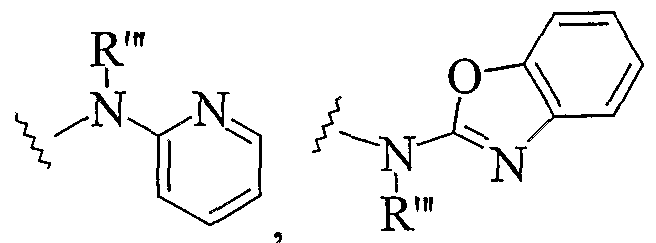
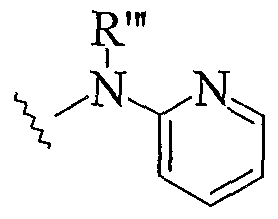
In certain embodiments, the present invention relates to a compound of formula III and the attendant definitions, wherein R'" is Ph, / -C6H4CF3,/?-C6H4CH2CH2OCH3, or
In certain embodiments, the present invention relates to a compound of formula III and the attendant definitions, wherein R
1V is -Ph, /?-C
6H
4CF
3, or
jp-C
6H
4CH
2CH OCH
3.
In certain embodiments, the present invention relates to a compound of formula III and the attendant definitions, wherein R' is H, R is H, n is 1, m is 0, L is -CH2-, p is 2, R'" is Ph, and Riv is Ph. In certain embodiments, the present invention relates to a compound of formula III and the attendant definitions, wherein R' is H, R is H, n is 1, m is 0, L is -CH2-, p is 2, R'" is/7-C6H4CF3, and Riv is Ph.
In certain embodiments, the present invention relates to a compound of formula III and the attendant definitions, wherein R' is H, R is H, n is 1, m is 0, L is -CH2-, p is 2, R'" is -C6H4CH2CH2OCH3, and Riv is -Ce^CFs.
hi certain embodiments, the present invention relates to a compound of formula III and the attendant definitions, wherein R' is H, R is H, n is 1, m is 0, L is -CH2-, p is 2, R'" is/?-C6H4CH2CH2OCH3, and Riv is o-C6H4CF3.
In certain embodiments, the present invention relates to a compound of formula III and the attendant definitions, wherein R' is H, R is H, n is 1 , m is 0, L is -CH -, p is 3, R" ' is Ph, and iv is Ph.
In certain embodiments, the present invention relates to a compound of formula III and the attendant definitions, wherein R' is H, R is H, n is 1, m is 3, L is -CH2-, p is 2, R'"
is
, wherein R" is -CH
3, and R
iv is Ph. In certain embodiments, the present invention relates to a compound of formula III and the attendant definitions, wherein R' is H, R is NHR", R" is -CH
3, n is 1, p is 4, L is - CH
2-, m is 4, R'" is -C
6H
4CF
3, and R
iv is/?-C
6H
4CF
3.
In certain embodiments, the present invention relates to a compound of formula III and the attendant definitions, wherein R' is H, R is NHR", R" is -CH3, n is 1, p is 3, L is - CH2-, m is 3, R" ' is jp-C6H4CF3, and Riv is /J-C6H4CF3.
In certain embodiments, the present invention relates to a compound of formula III and the attendant definitions, wherein R' is H, R is NHR", R" is -SO2CH3, n is 1, p is 3, L i -CH2-, m is 3, R'" is/?-C6H4CF3, and Riv is / C6H4CF3.
In certain embodiments, the present invention relates to a compound of formula III and the attendant definitions, wherein R' is H, R is NHR", R" is -CH3, n is 1 , p is 2, L is - CH2-, m is 2, R'" is/ C6H4CF3, and Riv is^-C6H4CF3.
In certain embodiments, the present invention relates to a compound of formula IV:
IV wherein
R' is H, Ci-Cg alkyl, C4-Cι0 aryl, or an alkali metal cation;
R is H, C4-Cιo aryl, -SO2(d-C6 alkyl), -SO2(C4-C10 aryl), -C(O)(d-C6 alkyl), -
C(O)(C
4-Cιo aryl), -CO
2(Cι-C
6 alkyl), -CO
2(C
4-do aryl),
Y is O, S, orNR;
R" is H, C
4-C
10 aryl,
,
m" ° ~ , or
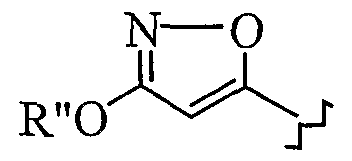
R"' is H, Cι-C6 alkyl, C4-Cιo aryl, -SO2(d-C6 alkyl), -SO2(C4-Cι0 aryl), -C(O)(Cι- C6 alkyl), or -C(O)(C4-Cι0 aryl);
L, independently for each occurrence, is -CH -, O, N, or S; n is an integer from 0 to 6 inclusive; m is an integer from 1 to 6 inclusive; and p is an integer from 0 to 6 inclusive.
hi certain embodiments, the present invention relates to a compound of foπnula IV and the attendant definitions, wherein R' is H.
In certain embodiments, the present invention relates to a compound of formula IV and the attendant definitions, wherein L is -CH2-.
In certain embodiments, the present invention relates to a compound of foπnula IV and the attendant definitions, wherein n is 3. hi certain embodiments, the present invention relates to a compound of formula IV and the attendant definitions, wherein m is 2. certain embodiments, the present invention relates to a compound of formula IV and the attendant definitions, wherein p is 1.
In certain embodiments, the present invention relates to a compound of formula IV and the attendant definitions, wherein R is Ph.
In certain embodiments, the present invention relates to a compound of formula IV and the attendant definitions, wherein Y is O. h certain embodiments, the present invention relates to a compound of formula IV and the attendant definitions, wherein R" is Ph. h certain embodiments, the present invention relates to a compound of formula IV
and the attendant definitions, wherein R" is
.
In certain embodiments, the present invention relates to a compound of formula IV
and the attendant definitions, wherein R" is
In certain embodiments, the present invention relates to a compound of foπnula IV
and the attendant definitions, wherein R" is
hi certain embodiments, the present invention relates to a compound of formula IV and the attendant definitions, wherein R" is 2-naphtyl. In certain embodiments, the present invention relates to a compound of formula IV and the attendant definitions, wherein R' is H, n is 3, m is 2, p is 1, L is -CH
2-, R is Ph, Y is O, and R" is Ph.
In certain embodiments, the present invention relates to a compound of formula IV and the attendant definitions, wherein R' is H, n is 3, m is 2, p is 1, L is -CH2-, R is Ph, Y is
hi certain embodiments, the present invention relates to a compound of formula IV and the attendant definitions, wherein R' is H, n is 3, m is 2, p is 1, L is -CH
2-, R is Ph, Y is
O, and R" is
In certain embodiments, the present invention relates to a compound of formula IV and the attendant definitions, wherein R' is H, n is 3, m is 2, p is 1, L is -CH2-, R is Ph, Y is
hi certain embodiments, the present invention relates to a compound of formula IV and the attendant definitions, wherein R' is H, n is 3, m is 2, p is 1, L is -CH
2-, R is Ph, Y is O, and R" is 2-naphtyl. hi certain embodiments, the present invention relates to a compound of formula V:
wherein
R' is H, Cι-C6 alkyl, C4-Cιo aryl, -SO2(Cι-C6 alkyl), -SO2(C4-d0 aryl), -C(O)(Cι-C6 alkyl), or -C(O)(C4-C10 aryl); R" is H, Cι-C6 alkyl, C4-Cι0 aryl, or an alkali metal cation;
L, independently for each occurrence, is -CH2-, O, N, or S;
R'" is H, Cι-C6 alkyl, C4-C10 aryl, -SO2(d-C6 alkyl), -SO2(C4-Cιo aryl), -C(O)(Cι- C6 alkyl), or -C(O)(C4-Cι0 aryl); m is an integer from 1 to 6 inclusive; and n is an integer from 1 to 6 inclusive. In certain embodiments, the present invention relates to a compound of formula V
and the attendant definitions, wherein R" is H.
In certain embodiments, the present invention relates to a compound of formula V and the attendant definitions, wherein R' is -CH3. h certain embodiments, the present invention relates to a compound of formula V and the attendant definitions, wherein n is 1.
In certain embodiments, the present invention relates to a compound of formula V
and the attendant definitions, wherein R is
hi certain embodiments, the present invention relates to a compound of formula V
and the attendant definitions, wherein R is OR" In certain embodiments, the present invention relates to a compound of formula V
and the attendant definitions, wherein R is
In certain embodiments, the present invention relates to a compound of foπnula V and the attendant definitions, wherein L is -CH2-.
In certain embodiments, the present invention relates to a compound of formula V and the attendant definitions, wherein m is 3. hi certain embodiments, the present invention relates to a compound of formula V
and the attendant definitions, wherein X is
In certain embodiments, the present invention relates to a compound of formula V
and the attendant definitions, wherein R" is H, n is 1, R' is -CH
3, R is
, L is
-CH
2-, m is 3, X is
, and R" ' is -CH
3.
In certain embodiments, the present invention relates to a compound of formula V
and the attendant definitions, wherein R" is H, n is 1 , R' is -CH
3, R is
, L is -
CH
2-, m is 3, X is
, and R'" is -CH
3. hi certain embodiments, the present invention relates to a compound of formula V
and the attendant definitions, wherein R" is H, n is 1, R' is -CH
3, R is
, L is
CH
2-, m is 3, X is
R' " is -CH
3.
In certain embodiments, the present invention relates to a compound of formula VI:
VI wherein
R' is H, Ci-Cg alkyl, C -Cι0 aryl, or an alkali metal cation;
R is H, Cι-C6 alkyl, C4-Cιo aryl, -CO(Cι-C6 alkyl), -CO(C4-Cι0 aryl), -CO(aralkyl), • CO(aryl(C2-C6 alkenyl)), -CO(Cι-C6 alkyl)C(O)aryl, -CO(C2-C6 alkenyl)C(O)aryl, -CO(C2- C6 alkenyl)alkyl, -CO2(d-C6 alkyl)Oaralkyl, -SO2(d-C6 alkyl), -SO2(C4-C10 aryl), - CO2(aralkyl), -CO2C(Cι-C6 alkyl)3, aralkyl, or -C(Cι-C6 alkyl)=CHC(O)aryl; Z is a bond, O, S, orNR;
L, independently for each occuπence, is -CH2-, O, N, or S; n independently for each occurrence, is an integer from 1 to 6 inclusive; and p is an integer from 1 to 6 inclusive.
h certain embodiments, the present invention relates to a compound of formula VI and the attendant definitions, wherein Z is O.
In certain embodiments, the present invention relates to a compound of formula VI and the attendant definitions, wherein R' is H.
In certain embodiments, the present invention relates to a compound of formula VI and the attendant definitions, wherein n is 1. In certain embodiments, the present invention relates to a compound of formula VI and the attendant definitions, wherein L is -CH2- and p is 4, 5 or 6. h certain embodiments, the present invention relates to a compound of formula VI and the attendant definitions, wherein R is selected from the group consisting of H, CH3, - SO2CH3, -SO2Ph, -COCH3, -COPh, -CO2CH2Ph, -CO2C(CH3)3, -CH2Ph, -CH2CH2Ph, - CH2CH2CH2Ph, and -C(Me)=CHCOPh.
In certain embodiments, the present invention relates to a compound of formula VI and the attendant definitions, wherein Z is O, and R is selected from the group consisting of -COCH3, -COPh, -CO2CH2Ph, -CO2C(CH3)3, -CH2Ph, -CH2CH2Ph, -CH2CH2CH2Ph, and - C(Me)=CHCOPh. In certain embodiments, the present invention relates to a compound of foπnula VI and the attendant definitions, wherein R' is H, n is 1, L is -CH2-, and p is 5. hi certain embodiments, the present invention relates to a compound of formula VI and the attendant definitions, wherein Z is O, R' is H, n is 1, L is -CH2-, p is 5, and R is - CO2CH2Ph. hi certain embodiments, the present invention relates to a compound of formula VII:
VII wherein
R is H, Ci-Cβ alkyl, C4-Cι0 aryl, -CO(Cι-C6 alkyl), -CO(C4-Cιo aryl), -CO(aralkyl), - CO(aryl(C2-C6 alkenyl)), -CO(d-C6 alkyl)C(O)aryl, -CO(C2-C6 alkenyl)C(O)aryl, -CO(C2- C6 alkenyl)alkyl, -CO2(Cι-C6 alkyl)Oaralkyl, -SO2(d-C6 alkyl), -SO2(C4-Cιo aryl), - CO2(aralkyl), -CO2C(Cι-C6 alkyl)3, aralkyl, or -C(Cι-C6 alkyl)=CHC(O)aryl; R is H, Cι-C6 alkyl, C4-Cι0 aryl, or an alkali metal cation; R2 is H, alkyl, aryl, or aralkyl; R3 is H, alkyl, aryl, or aralkyl;
R4 is aryl or aralkyl; Z is a bond, O, S, or NR;
L, independently for each occuπence, is -CH2-, O, N, or S; n independently for each occuπence, is an integer from 1 to 6 inclusive; and p is an integer from 1 to 6 inclusive.
In certain embodiments, the present invention relates to a compound of formula VII and the attendant definitions, wherein Z is O.
In certain embodiments, the present invention relates to a compound of formula VII and the attendant definitions, wherein R1 is H.
In certain embodiments, the present invention relates to a compound of formula VII and the attendant definitions, wherein n is 1.
In certain embodiments, the present invention relates to a compound of formula VII and the attendant definitions, wherein L is -CH2- and p is 3, 4, or 5. In certain embodiments, the present invention relates to a compound of formula VII and the attendant definitions, wherein R is selected from the group consisting of H, CH3, - SO2CH3, -SO2Ph, -COCH3, -COPh, -CO2CH2Ph, -CO2C(CH3)3, -CH2Ph, -CH2CH2Ph, - CH2CH2CH2Ph, and -C(Me)=€HCOPh. hi certain embodiments, the present invention relates to a compound of formula VII and the attendant definitions, wherein Z is O, and R is selected from the group consisting of -COCH3, -COPh, -CO2CH2Ph, -CO2C(CH3)3, -CH2Ph, -CH2CH2Ph, -CH2CH2CH2Ph, and - C(Me)=CHCOPh. hi certain embodiments, the present invention relates to a compound of formula VII and the attendant definitions, wherein R1 is H, n is 1, L is -CH2-, p is 4, and R is - CO2CH2Ph. hi certain embodiments, the present invention relates to a compound of formula VII and the attendant definitions, wherein R2 is alkyl and R3 is H. hi certain embodiments, the present invention relates to a compound of formula VII and the attendant definitions, wherein R2 is alkyl and R3 is H, and R4 is aryl. In certain embodiments, the present invention relates to a compound of foπnula VII and the attendant definitions, wherein R2 is alkyl and R3 is H, and R4 is phenyl or halophenyl.
h certain embodiments, the present invention relates to a compound of formula VII
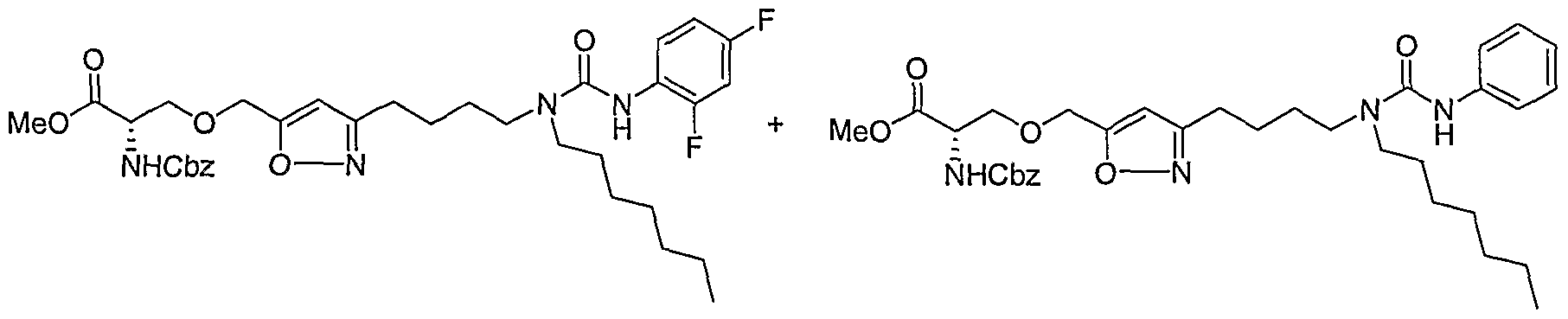
1 and the attendant definitions, wherein R is H, n is 1, L is -CH2-, p is 4, R is -CO2CH2Ph, R is alkyl and R3 is H, and R4 is aryl. hi certain embodiments, the present invention relates to a compound of formula VII and the attendant definitions, wherein Z is O, R1 is H, n is 1, L is -CH2-, p is 4, R is - CO2CH2Ph, R2 is heptyl, R3 is H, and R4 is 2,4-difluorophenyl. hi certain embodiments, the present invention relates to a compound of formula VII and the attendant definitions, wherein Z is O, R1 is H, n is 1, L is -CH2-, p is 4, R is - CO2CH2Ph, R2 is heptyl, R3 is H, and R4 is phenyl. hi certain embodiments, the present invention relates to a compound of formula
VIII:
VIII wherein R is H or Ci-Cβ alkyl;
R1 is H, Ci-Cg alkyl, C -Cι0 aryl, or an alkali metal cation;
L, independently for each occuπence, is -CH2-, O, N, or S. n independently for each occurrence, is an integer from 1 to 6 inclusive; p is an integer from 1 to 6 inclusive; and R2 is
wherein R3 is H or alkyl; R4 is H or alkyl; and R5 is aryl.
In certain embodiments, the present invention relates to a compound of formula
VTII and the attendant definitions, wherein R1 is H.
In certain embodiments, the present invention relates to a compound of formula VIII and the attendant definitions, wherein n is 1.
In certain embodiments, the present invention relates to a compound of foπnula VIII and the attendant definitions, wherein L is -CH2- and p is 3, 4, or 5.
In certain embodiments, the present invention relates to a compound of formula VIII and the attendant definitions, wherein R is methyl. hi certain embodiments, the present invention relates to a compound of formula VIII and the attendant definitions, wherein R1 is H, R is methyl, n is 1, L is -CH2-,
hi certain embodiments, the present invention relates to a compound of foπnula VIII and the attendant definitions, wherein R1 is H, R is methyl, n is 1, L is -CH2-, p is 5,
hi certain embodiments, the present invention relates to a compound of formula VIII and the attendant definitions, wherein R1 is H, R is methyl, n is 1, L is -CH2-, p is 4,
hi certain embodiments, the present invention relates to a compound of formula
VIII and the attendant definitions, wherein R1 is H, R is methyl, n is 1, L is -CH2-, p is 4,
R
2 is
R
3 is heptyl, R
4 is H, and R
5 is 2,4-difluorophenyl. In certain embodiments, the present invention relates to a compound of formula I,
II, III, IV, V, VI, VII, or VIII, wherein said compound is a single stereoisomer. hi certain embodiments, the present invention relates to a pharmaceutical composition, comprising a compound of formula I, II, III, IV, V, VI, VII, or VIII; and a pharmaceutically acceptable excipient.
hi certain embodiments, the present invention relates to a method of modulating a PPAR comprising contacting the PPAR with a compound of formula I, II, III, IV, V, VI, VII, or VIII.
In certain embodiments, the present invention relates to a method of treating a mammal afflicted with cancer comprising administering to the mammal a therapeutically effective amount of a compound of formula I, II, III, IV, V, VI, VII, or VIII.
In certain embodiments, the present invention relates to a method of treating a mammal afflicted with breast cancer comprising administering to the mammal a therapeutically effective amount of a compound of formula I, II, III, IV, V, VI, VII, or VIII.
In certain embodiments, the present invention relates to a method of treating a mammal afflicted with prostate cancer comprising administering to the mammal a therapeutically effective amount of a compound of formula I, II, III, IV, V, VI, VII, or VIII. In certain embodiments, the present invention relates to a method of treating a mammal afflicted with stomach cancer comprising administering to the mammal a therapeutically effective amount of a compound of formula I, II, III, IV, V, VI, VII, or VIII. ha certain embodiments, the present invention relates to a method of treating a mammal afflicted with lung cancer comprising administering to the mammal a therapeutically effective amount of a compound of formula I, II, III, IV, V, VI, VII, or VIII.
In certain embodiments, the present invention relates to a method of treating a mammal afflicted with colon cancer comprising administering to the mammal a therapeutically effective amount of a compound of formula I, II, III, IV, V, VI, VII, or VIII. hi certain embodiments, the present invention relates to a method of treating a mammal afflicted with pancreatic cancer comprising administering to the mammal a therapeutically effective amount of a compound of formula I, II, III, IV, V, VI, VII, or VIII.
In certain embodiments, the present invention relates to a method of treating a mammal afflicted with an inflammatory condition or disease, comprising administering to
the mammal a therapeutically effective amount of a compound of formula I, II, III, IV, V, VI, VII, or VIII.
In certain embodiments, the present invention relates to a method of treating a mammal afflicted with non-insulin-dependent (type IT) diabetes, comprising administering to the mammal a therapeutically effective amount of a compound of formula I, II, III, IV, V, VI, VII, or VIII.
In certain embodiments, the present invention relates to a method of treating a mammal afflicted with a dyslipidemia, comprising administering to the mammal a therapeutically effective amount of a compound of formula I, II, III, IV, V, VI, VII, or VIII.
In certain embodiments, the present invention relates to a method of identifying a compound having PPAR selectivity and activity, comprising de novo drag design, combinatorial library generation, or virtual screening of chemical databases. hi another embodiment, the method of identifying compounds having PPAR selectivity and activity further comprises synthesizing a chemical compound originating from the de novo design approach. hi another embodiment, the method of identifying compounds having PPAR selectivity and activity further comprises conducting a round of chemical modification to enhance activity and/or selectivity based on assays for PPAR selectivity and activity. In another embodiment, the method of identifying compounds having PPAR selectivity and activity further comprises screening a compound for its ability to block cell proliferation in human cancer cell lines.
In another embodiment, the method of identifying compounds having PPAR selectivity and activity optionally comprises further modifying a ligand to enhance its cell permeability.
In certain embodiments, the present invention relates to a method of modulating a PPAR, comprising contacting the PPAR with a compound of foπnula I, II, III, IV, or V.
In certain embodiments, the present invention relates to a method of treating a mammal afflicted with cancer, comprising administering to the mammal a therapeutically effective amount of a compound of foπnula I, II, III, IV, or V.
In certain embodiments, the present invention relates to a method of treating a mammal afflicted with breast cancer, comprising administering to the mammal a
therapeutically effective amount of a compound of foπnula I, II, III, IV, or V.
In certain embodiments, the present invention relates to a method of treating a mammal afflicted with prostate cancer, comprising administering to the mammal a therapeutically effective amount of a compound of formula I, II, III, IV, or V. In certain embodiments, the present invention relates to a method of treating a mammal afflicted with stomach cancer, comprising administering to the mammal a therapeutically effective amount of a compound of foπnula I, II, III, IV, or V.
In certain embodiments, the present invention relates to a method of treating a mammal afflicted with lung cancer, comprising administering to the mammal a therapeutically effective amount of a compound of formula I, II, III, IV, or V.
In certain embodiments, the present invention relates to a method of treating a mammal afflicted with colon cancer, comprising administering to the mammal a therapeutically effective amount of a compound of formula I, II, III, IV, or V.
In certain embodiments, the present invention relates to a method of treating a mammal afflicted with pancreatic cancer, comprising administering to the mammal a therapeutically effective amount of a compound of formula I, II, III, IV, or V. hi certain embodiments, the present invention relates to a method of treating a mammal afflicted with an inflammatory condition or disease, comprising administering to the mammal a therapeutically effective amount of a compound of formula I, II, III, IV, or V.
In certain embodiments, the present invention relates to a method of treating a mammal afflicted with non-insulin-dependent (type II) diabetes, comprising administering to the mammal a therapeutically effective amount of a compound of formula I, II, III, IV, or . hi certain embodiments, the present invention relates to a method of treating a mammal afflicted with a dyslipidemia, comprising administering to the mammal a therapeutically effective amount of a compound of formula I, II, III, IV, or V.
Brief Description of the Figures Figure 1 depicts eight compounds that are active at a PPAR. Figure 2 depicts five compounds that are active at PPARγ.
Figure 3 depicts a 3D search strategy using the 3D UNITY database module in Sybyl.
Figure 4 depicts a 3D search strategy using the 3D UNITY database module in Sybyl.
Figure 5 depicts four classes of PPAR agonists designed using a de wovo/rational design method of the present invention. Figure 6 depicts a combinatorial library based on a 2,4-dihydroxyphenylalkanoic acid core.
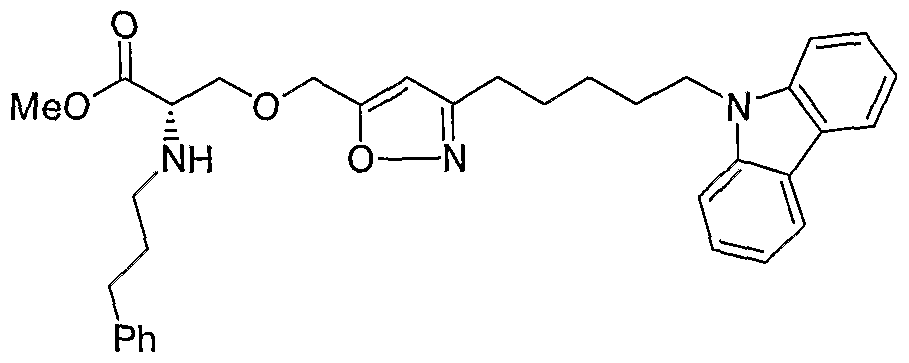
Figure 7 depicts an isoxazolyl-based ligand of the present invention, wherein sectors are labeled "core" and "sidechain"; these terms are also used in reference to the combinatorial libraries of the present invention. Figure 8 depicts various combinatorial libraries of the present invention.
Figure 9 depicts a method for the optimization of sidechains of compounds of the present invention and for the discovery of additional compounds of the present invention.
Figure 10 depicts a number of modifications that may be made to a compound of the present invention. Figure 11 depicts graphically the agonist activities of 11 isoxazolyl-based ligands,
ZW-40 to ZW-50 at PPARα. The Figure also depicts graphically the agonist activity of the known PPARα ligand, WY14643.
Figure 12 depicts graphically the agonist activities of six isoxazolyl-based ligands, ZW-41, and ZW-50 to ZW-55 at PPARα. The Figure also depicts graphically the agonist activities of three known PPAR ligands, WY14643 (PPARα), GW7845 (PPARγ) and L165041 (PPARδ), and one RXR ligand, LG101305.
Figure 13 depicts graphically the agonist activities of 11 isoxazolyl-based ligands, ZW-40 to ZW-50 at PPARγ. The Figure also depicts graphically the agonist activity of the known PPARγ ligand, GW7845. Figure 14 depicts graphically the agonist activities of six isoxazolyl-based ligands,
ZW-41, and ZW-51 to ZW-55 at PPARγ. The Figure depicts graphically the agonist activities of three known PPAR ligands, WY14643 (PPARα), GW7845 (PPARγ) and L165041 (PPARδ), and one RXR ligand, LG101305.
Figure 15 depicts graphically the agonist activity dose-response of three isoxazolyl- based ligands, ZW-41, ZW-53 and ZW-55 at PPARα. The Figure also depicts graphically the agonist activity of the known PPARα ligand, WY14643.
Figure 16 depicts graphically the agonist activity dose-response of WY14643, ZW-
53 and ZW-64 at PPARα.
Detailed Description of the Invention
The peroxisome proliferator-activated receptor (PPAR) subfamily of nuclear receptors are ligand-dependent transcription factors that regulate the expression o f genes involved in lipid, glucose and energy homeostasis. Recent evidence indicates that pharmacological activation of PPARγ and inhibition of PPARδ has chemopreventive and antitumor effects. PPARγ agonists induce differentiation, inhibit the growth of established tumor cells in vitro and in vivo, and have chemopreventive effects in animal models. PPARγ suppresses Bcl-2 expression in prostate and colon cancers, activates the p27 p and p21C l inliibitors of cyclin A, D and E-dependent protein kinase2 and transactivates the tumor suppressor gene, PTEN. PPAR ligands also have additional advantageous biological properties. PPARα and PPARγ activation produce antiinflammatory and differentiating activity and protect against the oxidative damage associated with aging, h contrast, the upregulation of PPARδ may be a contributing factor in colorectal carcinogenesis since its expression is induced by an activated β-catenin/TCF pathway resulting from loss-of- function mutations in the APC tumor suppressor gene, a risk factor associated with colon cancer.
Because of the association between PPARγ activation and the inhibition of cancer progression, unique ligands that target this receptor should constitute a novel strategy for the development of anticancer agents that function at the transcriptional level. Classes of agents that act primarily as ligands for PPARγ include the thiazolidinediones, α-alkoxy-β- phenylpropanoic acids, and tyrosine-based agonists. Such a gents have been investigated primarily for their antihyperglycemic and antihyperlipidemic activity, and the thiazolidenediones pioglitazone and rosiglitazone are presently used for the treatment of non-insulin-dependent diabetes. At the stmctural level, the PPARγ binding pocket is sufficiently large that it is able to accommodate ligands of diverse stmcture. Definitions
For convenience, certain terms employed in the specification, examples, and appended claims are collected here. The articles "a" and "an" are used herein to refer to one or to more than one (i.e., to at least one) of the grammatical object of the article. By way of example, "an element" means one element or more than one element.
The term "ED50" means the dose of a drag which produces 50% of its maximum response o r effect. Alternatively, the dose which produces a pre-determined response in 50% of test subjects or preparations.
The term "LD5o" means the dose of a drag which is lethal in 50% of test subjects. The term "therapeutic index" r efers t o t he t herapeutic i ndex o f a d rag d efined a s
LD50/ED50.
The term "structure-activity relationship (SAR)" refers to the way in which altering the molecular structure of drugs alters their interaction with a receptor, enzyme, etc.
The term "agonist" refers to a compound that mimics the action of natural transmitter o r, when the natural transmitter is not known, causes changes at the receptor complex in the absence of other receptor ligands.
The term "antagonist" refers to a compound that binds to a receptor site, but does not cause any physiological changes unless another receptor ligand is present.
The term "inverse agonist" refers to a compound that binds to a constitutively active receptor site and reduces its physiological function.
The term "competitive antagonist" refers to a compound that binds to a receptor site; its effects can be overcome by increased concentration of the agonist.
The term "partial agonist" refers to a compound that binds to a receptor site but does not produce the maximal effect regardless of its concentration. The term "ligand" refers to a compound that binds at the receptor site.
The term "heteroatom" as used herein means an atom of any element other than carbon or hydrogen. Prefeπed heteroatoms are boron, nitrogen, oxygen, phosphorus, sulfur and selenium.
The term "alkyl" refers to the radical of saturated aliphatic groups, including straight-chain alkyl groups, branched-chain alkyl groups, cycloalkyl (alicyclic) groups, alkyl substituted cycloalkyl groups, and cycloalkyl substituted alkyl groups, h preferred embodiments, a straight chain or branched chain alkyl has 30 or fewer carbon atoms in its backbone (e.g., C J-C30 for straight chain, C3-C30 for branched chain), and more preferably
20 or fewer. L ikewise, prefeπed cycloalkyls have from 3 -10 carbon atoms in their ring structure, and more preferably have 5, 6 or 7 carbons in the ring structure.
Unless the number of carbons is otherwise specified, "lower alkyl" as used herein means an alkyl group, as defined above, but having from one to ten carbons, more
preferably from one to six carbon atoms in its backbone structure. Likewise, "lower alkenyl" and "lower alkynyl" have similar chain lengths. Prefeπed alkyl groups are lower alkyls. In prefeπed embodiments, a substituent designated herein as alkyl is a lower alkyl.
The term "aralkyl", as used herein, refers to an alkyl group substituted with an aryl group (e.g., an aromatic or heteroaromatic group).
The terms "alkenyl" and "alkynyl" refer to unsaturated aliphatic groups analogous in length and possible substitution to the alkyls described above, but that contain at least one double or triple bond respectively.
The term "aryl" as used herein includes 5-, 6- and 7-membered single-ring aromatic groups that may include from zero to four heteroatoms, for example, benzene, pyrrole, furan, thiophene, imidazole, oxazole, thiazole, triazole, pyrazole, pyridine, pyrazine, pyridazine and pyrimidine, and the like. Those aryl groups having heteroatoms in the ring structure may also be refeπed to as "aryl heterocycles" or "heteroaromatics." The aromatic ring can be substituted at one or more ring positions with such substituents as described above, for example, halogen, azide, alkyl, aralkyl, alkenyl, alkynyl, cycloalkyl, hydroxyl, aikoxyl, amino, nitro, sulfhydryl, imino, amido, phosphonate, phosphinate, carbonyl, carboxyl, silyl, ether, alkylthio, sulfonyl, sulfonamido, ketone, aldehyde, ester, heterocyclyl, aromatic or heteroaromatic moieties, -CF3, -CN, or the like. The term "aryl" also includes polycyclic ring systems having two or more cyclic rings in which two or more carbons are common to two adjoining rings (the rings are "fused rings") wherein at least one of the rings is aromatic, e.g., the other cyclic rings can be cycloalkyls, cycloalkenyls, cycloalkynyls, aryls and/or heterocyclyls.
The terms ortho, meta sad para apply to 1,2-, 1,3- and 1,4-disubstituted benzenes, respectively. For example, the names 1,2-dimethylbenzene and ort/?o-dimethylbenzene are synonymous.
The terms "heterocyclyl" or "heterocyclic group" refer to 3- to 10-membered ring structures, more preferably 3- to 7-membered rings, whose ring structures include one to four heteroatoms. Heterocycles can also be polycycles. Heterocyclyl groups include, for example, azetidine, azepine, thiophene, thianthrene, furan, pyran, isobenzofuran, chromene, xanthene, phenoxathiin, pyrrole, imidazole, pyrazole, isothiazole, isoxazole, pyridine, pyrazine, pyrimidine, pyridazine, indolizine, isoindole, indole, indazole, purine, quinolizine, isoquinoline, quinoline, phthalazine, naphthyridine, quinoxaline, quinazoline, cinnoline,
pteridine, carbazole, carboline, phenanthridine, acridine, pyrimidine, phenanthroline, phenazine, phenarsazine, phenothiazine, furazan, phenoxazine, pyπolidine, oxolane, thiolane, oxazole, piperidine, piperazine, moφholine, lactones, lactams such as azetidinones and pyπolidinones, sultams, sultones, and the like. The heterocyclic ring can be substituted at one or more positions with such substituents as described above, as for example, halogen, alkyl, aralkyl, alkenyl, alkynyl, cycloalkyl, hydroxyl, amino, nitro, sulfhydryl, imino, amido, phosphonate, phosphinate, carbonyl, carboxyl, silyl, ether, alkylthio, sulfonyl, ketone, aldehyde, ester, a heterocyclyl, an aromatic or heteroaromatic moiety, -CF3, -CN, or the like. The terms "polycyclyl" or "polycyclic group" refer to two or more rings (e.g., cycloalkyls, cycloalkenyls, cycloalkynyls, aryls and/or heterocyclyls) in which two or more carbons are common to two adjoining rings, e.g., the rings are "fused rings". Rings that are joined through non-adjacent atoms are termed "bridged" rings. E ach o f the rings o f the polycycle can be substituted with such substituents as described above, as for example, halogen, alkyl, aralkyl, alkenyl, alkynyl, cycloalkyl, hydroxyl, amino, nitro, sulfhydryl, imino, amido, phosphonate, phosphinate, carbonyl, carboxyl, silyl, ether, alkylthio, sulfonyl, ketone, aldehyde, ester, a heterocyclyl, an aromatic or heteroaromatic moiety, -CF3, -CN, or the like.
The term "carbocycle", as used herein, refers to an aromatic or non-aromatic ring in which each atom of the ring is carbon.
As used herein, the term "nitro" means -NO2; the term "halogen" designates -F, -Cl, -Br or -I; the term "sulfhydryl" means -SH; the term "hydroxyl" means -OH; and the term "sulfonyl" means -SO2-.
The terms "amine" and "amino" are art-recognized and refer to both unsubstituted and substituted amines, e.g., a moiety that can be represented by the general formula:
D R Λ ' 10
/ 10 I + N — R10
\R or I 9 R9 wherein R9, Rjo and R' JO each independently represent a group permitted by the rales of valence.
The term "acylamino" is art-recognized and refers to a moiety that can be represented by the general foπnula:
wherein R
9 is as defined above, and R'x
j represents a hydrogen, an alkyl, an alkenyl or
-(CH2) -R8, where m and Rg are as defined above.
The term "amido" is art recognized as an amino-substituted carbonyl and includes a moiety that can be represented by the general formula:
O
R/
K10 wherein R9, RJQ are as defined above. Prefeπed embodiments of the amide will not include imides which may be unstable.
The term "alkylthio" refers to an alkyl group, as defined above, having a sulfur radical attached thereto, h prefeπed embodiments, the "alkylthio" moiety is represented by one of -S-alkyl, -S-alkenyl, -S-alkynyl, and -S-(CH2)m-Rg5 wherein m and Rg are defined above. Representative alkylthio groups include methylthio, ethyl thio, and the like.
The temi "carbonyl" is art recognized and includes such moieties as can be represented by the general formula:
O O "— XRl1 , or -X-JLR^ wherein X is a bond or represents an oxygen or a sulfur, and Rj represents a hydrogen, an alkyl, an alkenyl, -(CH2)m-R8 or a pharmaceutically acceptable salt, R'J J represents a hydrogen, an alkyl, an alkenyl or -(CH2)m-Rs, where m and R§ are as defined above. Where X is an oxygen and Rj j or R'J J is not hydrogen, the formula represents an "ester". Where X is an oxygen, and Rj \ is as defined above, the moiety is refeπed to herein as a carboxyl group, and particularly when RJ J is a hydrogen, the formula represents a "carboxylic acid". Where X is an oxygen, and R'J J is hydrogen, the foπnula represents a "formate". In general, where the oxygen atom of the above formula is replaced by sulfur, the formula represents a "thiolcarbonyl" group. Where X is a sulfur and Rj 1 or ' \ is not hydrogen, the formula represents a "thiolester." Where X is a sulfur and Rj j is hydrogen,
the formula represents a "thiolcarboxylic acid." Where X is a sulfur and RJ J' is hydrogen, the formula represents a "thiolformate." On the other hand, where X is a bond, and Rj \ is not hydrogen, the above formula represents a "ketone" group. Where X is a bond, and Ri \ is hydrogen, the above formula represents an "aldehyde" group. The terms "alkoxyl" or "alkoxy" as used herein refers to an alkyl group, as defined above, having an oxygen radical attached thereto. Representative alkoxyl groups include methoxy, ethoxy, propyloxy, tert-butoxy and the like. An "ether" is two hydrocarbons covalently linked by an oxygen. Accordingly, the substituent of an alkyl that renders that alkyl an ether is or resembles an alkoxyl, such as can be represented by one of -O-alkyl, -O- alkenyl, -O-alkynyl, -O-(CH2)m-Rg, where m and Rg are described above.
The abbreviations Me, Et, Ph, Tf, Nf, Ts, Ms represent methyl, ethyl, phenyl, trifluoromethanesulfonyl, nonafluorobutanesulfonyl, /7-toluenesulfonyl and methanesulfonyl, respectively. A more comprehensive list of the abbreviations utilized by organic chemists of ordinary skill in the art appears in the first issue of each volume of the Journal of Organic Chemistry; this list is typically presented in a table entitled Standard
List of Abbreviations. The abbreviations contained in said list, and all abbreviations utilized by organic chemists of ordinary skill in the art are hereby incoφorated by reference.
Analogous substitutions can be made to alkenyl and alkynyl groups to produce, for example, aminoalkenyls, aminoalkynyls, amidoalkenyls, amidoalkynyls, iminoalkenyls, iminoalkynyls, thioalkenyls, thioalkynyls, carbonyl-substituted alkenyls or alkynyls.
As used herein, the definition of each expression, e.g. alkyl, m, n, etc., when it occurs more than once in any structure, is intended to be independent of its definition elsewhere in the same structure.
It will be understood that "substitution" or "substituted with" includes the implicit proviso that such substitution is in accordance with permitted valence of the substituted atom and the substituent, and that the substitution results in a stable compound, e.g., which does not spontaneously undergo transformation such as by rearrangement, cyclization, elimination, etc.
As used herein, the term "substituted" is contemplated to include all permissible substituents of organic compounds. In a broad aspect, the permissible substituents include acyclic and cyclic, branched and unbranched, carbocyclic and heterocyclic, aromatic and nonaromatic substituents of organic compounds. Illustrative substituents include, for
example, those described herein above. The permissible substituents can be one or more and the same or different for appropriate organic compounds. For pmposes of this invention, the heteroatoms such as nitrogen may have hydrogen substituents and/or any permissible substituents of organic compounds described herein which satisfy the valences of the heteroatoms. This invention is not intended to be limited in any manner by the permissible substituents of organic compounds.
The phrase "protecting group" as used herein means temporary substituents which protect a potentially reactive functional group from undesired chemical transformations. Examples of such protecting groups include esters of carboxylic acids, silyl ethers of alcohols, and acetals and ketals of aldehydes and ketones, respectively. The field of protecting group chemistry has been reviewed (Greene, T.W.; Wuts, P.G.M. Protective Groups in Organic Synthesis, 2nd ed.; Wiley: New York, 1991).
Certain compounds of the present invention may exist in particular geometric or stereoisomeric forms. The present invention contemplates all such compounds, including cis- and trα/zj-isomers, R- and S-enantiomers, diastereomers, (D)-isomers, (L)-isomers, the racemic mixtures thereof, and other mixtures thereof, as falling within the scope of the invention. Additional asymmetric carbon atoms may be present in a substituent such as an alkyl group. All such isomers, as well as mixtures thereof, are intended to be included in this invention. If, for instance, a particular enantiomer of a compound of the present invention is desired, it may be prepared by asymmetric synthesis, it may be isolated using chiral chromatography methods, or by derivation with a chiral auxiliary, where the resulting diastereomeric mixture is separated and the auxiliary group cleaved to provide the pure desired enantiomers. Alternatively, where the molecule contains a basic functional group, such as amino, or an acidic functional group, such as carboxyl, diastereomeric salts are formed with an appropriate optically-active acid or base, followed by resolution of the diastereomers thus formed by fractional crystallization or chromatographic means well known in the art, and subsequent recovery of the pure enantiomers.
Contemplated equivalents of the compounds described above include compounds which o therwise c oπespond thereto, and which h ave the s ame general properties thereof (e.g., functioning as analgesics), wherein one or more simple variations of substituents are made which do not adversely affect the efficacy of the compound in binding to opioid
receptors, h general, the compounds of the present invention may be prepared by the methods illustrated in the general reaction schemes as, for example, described below, or by modifications thereof, using readily available starting materials, reagents and conventional synthesis procedures. In these reactions, it is also possible to make use of variants which are in themselves known, but are not mentioned here.
For puφoses of this invention, the chemical elements are identified in accordance with the Periodic Table of the Elements, CAS version, Handbook of Chemistry and Physics, 67th Ed., 1986-87, inside cover. PPAR Structural Information One aspect of the present invention relates to generating new PPARγ ligands using the stmctural information available from the x-ray structure of the PPARγ ligand-binding domain in complexed with rosiglitazone. The ligand-binding site in apo-PPARγ is relatively large (-1300 A3) and Y-shaped extending from the C-terminal α-helix (known as AF-2) to the β-sheet between helices 3 and 6. Rosiglitazone binds in a U-shaped conformation, and occupies only 40% of the ligand-binding site. It engages in a number of specific H-bond interactions with His449, Tyr473, His323, Ser289 and Gin286. Because of the size o f t he 1 igand-binding p ocket, P PARγ i s c apable o f b inding a number of structurally diverse ligands including the thiazolidinediones, α-alkoxy-β-phenylpropanoic acids, and tyrosine-based agonists. The size of this binding pocket also strongly suggests that it should be possible to design or identify new ligands with altered binding characteristics and modified receptor pharmacology.
The overall structure of the ligand-binding domain of PPARδ is similar to that of PPARγ. However, the ligand-binding pockets of PPARα and PPARγ are significantly larger than the PPARδ binding pocket, for the latter shows a narrowing of the pocket adjacent to the AF-2 helix. The shape of the pocket differs somewhat due to the differences in the residues lining the ligand-binding site. The TZDs and the L-tyrosine-based agonists show little if any binding to PPARδ, for their acidic head groups appear to be too large to fit within the narrow PPARδ pocket. Most of the ligands for PPARδ are either of low affinity or lack selectivity, but recently the compound GW501516 was identified as a selective PPARδ agonist. Oliver, W. R., Jr.; Shenk, J. L.; Snaith, M. R.; Russell, C. S.; Plunket, K. D. et al., Proc Natl Acad Sci USA 2001, 98, 5306-5311.
As noted, the ligand-binding pockets of PPARα and PPARγ are close in size and
shape in comparison to PPARδ. The substitution of a single amino acid, Tyr314 in PPARα for His323 in PPARγ appears to be the major determinant of selectivity between these two subtypes based upon a comparison of x-ray complexes. Xu, H. E.; Lambert, M. H.; Montana, V. G.; Plunket, K. D.; Moore, L. B. et al., Proc Natl Acad Sci U S A 2001, 98, 13919-13924. Point mutation studies support the idea that these single amino acids are in fact responsible for deteπnining the subtype selectivity of farglitazar (GW262570), which is 1000-fold selective for PPARγ over PPARα. The PPARα pocket is also more lipophilic and less solvent exposed than the PPARδ and PPARγ pockets.
With the wealth of x-ray information available for the PPARs, it is possible to use this together with molecular modeling methods to effect the design of new PPAR ligands. It is worth noting that a number of successful examples of structure-based drug design have been reported; for example, the discovery of an HIV-1 integrase inhibitor, FKBP-12 ligand, Factor Xa inhibitor, COX-2 inhibitor, and DNA gyrase inhibitor. Nicklaus, M. C; Neamati, N.; Hong, H.; Mazumder, A.; Sunder, S. et al., J Med Chem 1997, 40, 920-929; Babine, R. E.; Bleckman, T. M.; Kissinger, C. R.; Showalter, R.; Pelletier, L. A. et al., Bioorganic & Medicinal Chemistry Letters 1995, 5, 1719-1724; Maduskuie, T. P., Jr.; McNamara, K. J.; Ru, Y.; Knabb, R. M.; Stouten, P. F., J Med Chem 1998, 41, 53-62; Stewart, K. D.; Loren, S.; Frey, L.; Otis, E.; Klinghofer, V. et al., Bioorg Med Chem Lett 1998, 8, 529-534; Boeh , H. J.; Boehringer, M.; Bur, D.; Gmuender, H.; Huber, W. et al., J Med Chem 2000, 43, 2664-2674.
Overview of Structure-Based Drug Design hi most cases, the methods for structure-based drug design are based on computational descriptions of a binding site — for example, the coordinates of atoms or pharmacophores ~ as well as techniques to search for the configurational and conformational space of a candidate molecule in the binding site to evaluate potential energy and/or scoring of binding affinity. The modeling methods that are used can be classified into three general categories: 3D database search; de novo drug design; and virtual combinatorial library approach. Desjarlais, R. L., Practical Application of Computer-aided Drug Design; Marcel Dekker: New York, 1997; pp 73-104; Good, A. C. M. J. S., Reviews in Computational Chemistry; NCH Publishers: New York, 1996; pp 67- 117; Murcko, M. A., Practical Application of Computer-aided Drug Design; Marcel Dekker: New York, 1997; pp 304-354.
In the case of the 3D database search, programs such as DOCK, Catalyst, and UNITY take a molecule from a known compound database and attempt to position it in the active site of a receptor or pharmacophore model. Kuntz, I. D.; Blaney, J. M.; Oatley, S. J.; Langridge, R.; Ferrin, T. E., J Mol Biol 1982, 161, 269-288; Catalyst Catalyst; Accelrys Inc.: San Diego; Sybyl SYBYL®; 6.8 ed.; Tripos Inc.: St. Louis; Unity UNITY®; 4.3 ed.; Tripos Inc.: St. Louis. The three-dimensional database search is widely accepted, as the target compounds are either found in commercial catalogs or are available synthetically. However, it is important to take note of some limitations that are inherent in most 3D database search programs: (1) the number of conformations calculated for each ligand is often insufficient; (2) the pharmacophore model used for the 3D query is usually simplified to speed up the search; (3) some functional groups exist in their ionic form under physiological conditions (pH 7.4), whereas the 3D database search programs often use the neutral forms of the ligands studied; and (4) novel structures cannot be obtained in cases where commercial or public databases (e.g., ACD or NCI) are employed. On the other hand, de novo design programs, such as LeapFrog, CONCERTS, PRO-
LIGAND, and LUDI, sequentially build up structures that are predicted to fit the active site of the receptor. Leapfrog Leapfrog; 6.8 ed.; Tripos Inc.: St. Louis; Pearlman, D. A.; Murcko, M. A., J Med Chem 1996, 39, 1651-1663; Clark, D. E.; Frenkel, D.; Levy, S. A.; Li, J.; Murray, C. W. et al., J Comput Aided Mol Des 1995, 9, 13-32; Ludi Ludi; Accelrys Inc.: San Diego, hi the case of de novo design, consideration of a ligand's conformations and the ionic state of its functional groups are not critical problems, because the de novo design programs generate functional groups in suitable forms and suitable conformations to interact with the protein surface. A further advantage of the de novo design programs is that they can generate ligands that are comprised of novel skeletons. However, such programs may suggest ligands that are difficult to build synthetically or that are unstable, and thus it is necessary for the chemist to evaluate candidate compounds for their synthetic accessibility, and thereby to guide the de novo design process. Also, for compounds having too many rotatable bonds, these programs may create structures which when redocked to the recognition site, fail to show appropriate binding. A ccordingly, these programs are b est combined with a chemist's own knowledge and creativity, thereby leading to a more rational drag design approach. Novel structures can also be generated solely through the chemist's visual inspection of the binding site coupled with a structural knowledge of
existing ligands or the structure of ligands discovered through the 3D database search. The modeling programs, such as Autodock, D OCK, FlexX, or GOLD, are then used to dock these newly conceived ligands to the binding site, and stmctural modifications are made in silico in order to improve their fit. Goodsell, D. S.; Olson, A. J., Proteins 1990, 8, 195-202; Morris, G. M .; Goodsell, D . S .; Halliday, R. S .; Huey, R.; Hart, W. E. et al; J Comput Chem 1998, 19, 1639-1662; Kuntz, I. D.; Blaney, J. M.; Oatley, S. J.; Langridge, R.; Ferrin, T. E., J Mol Biol 1982, 161, 269-288; Rarey, M.; Kramer, B.; Lengauer, T.; Klebe, G., J Mol Biol 1996, 261, 470-489; Rarey, M.; Kramer, B.; Lengauer, T., Bioinformatics 1999, 15, 243-250; Jones, G; Willett, P.; Glen, R. C; J Mol Biol 1995, 245, 43-53; Jones, G.; Willett, P.; Glen, R. C; Leach, A. R.; Taylor, R., JMol Biol 1997, 267, 727-748.
We refer to this approach as de πovo/rational drag design. Estimation of how well the 1 igands a re d ocked i n t he b inding s ite c an b e p erformed by variety of single scoring methods, e.g., FlexX, PMF, GOLD, Chemscore or DOCK, although, it has been reported that a consensus of several independent functions o utperforms a s ingle s coring function. FlexX FlexX; 6.8 ed.; Tripos Inc.: St. Louis; Muegge, I.; Martin, Y. C, J Med Chem 1999, 42, 791-804; Jones, G.; Willett, P.; Glen, R. C, JMol Biol 1995, 245, 43-53; Jones, G.; Willett, P.; Glen, R. C; Leach, A. R.; Taylor, R., JMol Biol 1997, 267, 727-748; Eldridge, M. D.; Muπay, C. W.; Auton, T. R.; Paolini, G. N.; Mee, R. P., J Comput Aided Mol Des 1997, 11, 425-445; Kuntz, I. D.; Blaney, J. M.; Oatley, S. J.; Langridge, R.; Ferrin, T. E., J Mol Biol 1982, 161, 269-288; Bissantz, C; Folkers, G; Rognan, D., J Med Chem 2000, 43, 4759-4767; Clark, R. D.; Strizhev, A.; Leonard, J. M.; Blake, J. F.; Matthew, J. B., JMol Graph Model 2002, 20, 281-295. In order to prioritize ligands for synthesis or further improvement, they should be ranked using either single scoring function values or scores produced by more sophisticated ranking procedures, such as "rank-by-rank", "rank-by- number" or "rank-by- vote". Wang, R.; Wang, S., J Chem Inf Comput Sci 2001, 41, 1422- 1426.
Among other structure-based design tools available to medicinal chemists, the virtual combinatorial chemistry approach is probably one of the most powerful methods for exploring chemical space. Unfortunately, despite the increasing throughput of parallel synthesis and screening technologies, the number of compounds that can be synthesized is far too large to permit their in vitro screening. A common solution to this problem is to "virtualize" the combinatorial libraries and to apply appropriate selection procedures to
limit compounds for chemical synthesis and biological testing, hi general, the virtual combinatorial library approach consists of two major phases; during the first phase, virtual reactant-based or product-based virtual combinatorial libraries are generated using programs such as Legion, Analog Builder, or CombiLibMaker. Legion Legion; 6.8 ed.; Tripos Inc.: St. Louis; Builder, A. Analog Builder; Accelrys Inc.: San Diego; CombiLibMaker CombiLibMaker; 6.8 ed.; Tripos hie: St. Louis. D uring the second phase, the resulting databases of combinatorially generated chemical structures are subjected to docking and scoring using the methods of in silico screening developed for the docking and scoring of 3D databases and ligands designed using de novo methods. It should be noted that these methods can be used for both lead optimization and generation of new leads for further drug design, since the combinatorial library generators can create libraries varying either the sidechains or the core structure of a potential ligand.
The increased computational ability of modem computers and successes in parallel computational m ethods allows one to dock and score thousands of c ompounds in hours, leading to the gradual replacement of de novo methods, such as Ludi and LeapFrog, with combinatorial or de n ovo combinatorial methods o f drag design. A number o f attempts have b een made to combine the p ower of de novo and virtual combinatorial methods of drug design. For instance, the combinatorial small molecule algorithm, CombiSMOG, grows a ligand from a small starting fragment in a stepwise manner by replacing all possible variation groups in the growing fragment with a number of predefined fragments while simultaneously evaluating the attached group for favorable or unfavorable interactions. DeWitte, R. S.; Shakhnovich, E., Abstr Pap Am Chem S 1997, 214, 6-Comp; Grzybowski, B. A.; Ishchenko, A. V.; Kim, C. Y.; Topalov, G.; Chapman, R. et al, P Natl Acad Sci USA 2002, 99, 1270-1273. The best candidates and a small number of "poor" ligands enter the next iteration. As in all de novo methods, evaluation of the resulting ligands by a chemist is essential to ensure their synthetic feasibility and chemical stability.
Another method that allows rapid virtual combinatorial screening and incoφorates some elements of de novo design is CombiFlexX. CombiFlexX CombiFlexX; 6.8 ed.; Tripos hie: St. Louis, hi this approach, the core molecule is positioned and held fixed in the binding site while each newly added substituent is independently attached, flexibly docked using FlexX, and scored using CScore. FlexX FlexX; 6.8 ed.; Tripos Inc.: St. Louis; CScore CScore; 6.8 ed.; Tripos Inc.: St. Louis. The method is based on the assumption that
the score of a whole molecule can be represented as a sum of the scores of the core structure and the added substituents. As a result, docking the whole combinatorial library using CombiFlexX is orders of magnitude faster than docking the same set of ligands using common docking programs such as Dock and FlexX. Moreover, in this method, synthetic feasibility is easily controlled during the design phase of the combinatorial library.
In preliminary molecular modeling studies, the 3D structure of PPARγ (PDB : 1K74) in the Protein Data Bank was used. The SitelD module in Sybyl was then applied to map the space in the binding cavity that is available to a ligand. The surface identified by SitelD was mapped by electrostatic, lipophilic, and H-bonding potentials using the MOLCAD module in Sybyl. The resulting models were then used for building the 3D query and for the de novσ/rational design of new ligands. To simplify further descriptions of ligand-binding, the binding site of PPARγ was separated into six hypothetical binding pockets that are marked LI, Ul, M, U2, L2, and U3.
Optimization of docking, scoring, and ranking procedures for PPAR ligands
To verify the docking accuracy of the FlexX module in Sybyl, five known ligands (see Figure 3) shown in Table 1 were docked into PPARγ using the FlexX module (Sybyl) and scored using the CScore module (Sybyl). The structures of the resulting docked compounds were compared to the coπesponding x-ray structures, if available, of these ligands co-crystallized in the LBD of PPARγ. In general, FlexX itself and the scoring functions implemented in CScore (FlexX, DOCK, PMF, Chemscore, Gold) performed well and were able to reproduce the position of the ligand within the binding site of PPARγ. Of critical importance is the determination of the scoring function that should be used for ranking potential hits. For our work, a scoring method similar to that used by Rognan et al. was chosen. Ligand docking is performed using FlexX and the resulting best 30 poses selected by FlexX are stored for further analysis. Bissantz, C; Folkers, G.; Rognan, D., J Med Chem 2000, 43, 4759-4767. Since, the consensus of several independent functions generally outperforms a single scoring function, FlexX, PMF, Gold, Chemscore and DOCK scores with a consensus score of 3 were used to select the best pose for each ligand and to rank the ligands in hit lists. Bissantz, C; Folkers, G.; Rognan, D.; J Med Chem 2000, 43, 4759-4767; Clark, R. D.; Strizhev, A.; Leonard, j. M.; Blake, j. F.; Matthew, j. B.; JMol Graph Model 2002, 20, 281-295.
Table 1. In silico and in vitro screening results of known PPARγ agonists. pECso of in vitro activation of PPARγ, scores, and ranks used to detennine the best scoring model for scoring new PPARγ agonists.
Compound pEC 0 in vitro in silico rank Score rank
Chem Chem
DOCK PMF GOLD FlexX DOCK PMF GOLD FlexX
-score -score
Ligand 3q ~ 6.7™ " 5 4 """""" ~~ 4 3 " " 4" ~~ 4/5 ' AΪ7(f"' - — —
-252""" " ""-47 ~-2Ϊ" "
Rosiglita" ""6.80 4 ' " "
5 5 5 4/5 -147 -53 -223 -37 -21 zone
Ligand 3p ~ 7.96" " 3 "" "" 3" """ "1 4 " i" " " 3 "A172 "" -— y- "-229" "-48" "~2~2~
' ~GΪ262?7 ~ 1.94 "" ~2 ~ ' 1 2 " " " "2 1 "" ϊ " -238 -115 '-312 "" -65 -32
GW40954? 9.55 2 "l " "" 1 " 2 ~~ 2 "-226 "-I20" "-335 " -56 " -29 "
Correlation coefficients between scores and pECsos -.906 -.906 -.873 -.815 -.880
All scoring functions showed relatively high correlation coefficients between scores and pEC5o. Although all functions made eπors in their relative ranking of ligands, the PMF fiinction performed better than the other functions, as it made only one rather insignificant eπor, switching the ranking of the moderately active ligand, rosiglitazone, with that of 3q. Based on these findings, the PMF scoring function shows the best docking and scoring accuracy and was used in further studies. All functions successfully identified Gi262570 and GW409544 as the two best ligands, whereas, 3p, 3q and rosiglitazone were identified as the least active, suggesting that all functions are able to choose between active and moderately active ligands. Detailed results of in silico screening using the PMF score and a consensus of three or more scoring functions are shown in Table 2. The RMS difference between the docked and x-ray poses are within the absolute value of the eπor of the X-ray experiments.
Table 2. RMS deviation (non hydrogen atoms) of PPARγ agonists docked by FlexX (best PMF score, consensus of 3 or more) from the X-ray pose and identification of pockets occupied by the ligands.
Structure Pockets occupied Comments
GW409544 LI, U1, M, L2, U2 PDB 1K74, RMS = 2.23 A, x-ray resolution 2.3 A
Rosiglitazone" ~~ L ϊ~, Ul , M, L2," U2 "" PDB 2PRG, RMS = 1.85 A, x-ray resolution 2.3 A
Gi262570 LI , Ul , M, L2, U2 PDB 1FM6, RMS = 1.45 A, x-ray resolution 2.3 A
3D Search for compounds containing COOH and two 5- or 6-membered aromatic or heteroaromatic rings
As discussed, potent PPAR agonists bind to the LI, Ul, M, and L2 regions or to the
Ul, M, and L2 regions and contain a polar group, such as a carboxyl or thiazolidinedione group, that is able to form strong interactions with the polar region of Ul. Based on this binding mode, an approximate pharmacophore model was constructed, comprising: 1) a polar group that is able to bind to the polar binding site of Ul; and 2) at least two rigid groups, such as an aromatic ring, in order to provide proper orientation of the polar group in the binding site while reducing entropy. The latter requirement is important as it h as a marked effect on the binding energy. Visual analysis of the binding site and sample docking experiments showed that ligands with a carboxyl group in Ul and aryl groups in regions LI and M fit well, and that the positions of the sample ligands resemble the positions of the highly active tyrosine-based compounds.
To perform a 3D search of the NCI database, the 3D UNITY database module in Sybyl was used, h the first stage, the NCI 3D-database of 127K "open" compounds was searched using the query shown in Figure 4A. As an additional restriction for this search, a slightly modified version of Lipinsky's "rale of 5" was applied; specifically, a compound was considered to be a hit only if its molecular weight was more than 199 and less than 650. A total of 19,356 hits were obtained. Next, distance restrictions were introduced (Figure 4B) and the resulting hit list was searched again. At this stage, only one conformation for each compound stored in the 3D NCI database was used. This search resulted in a total of 7,895 hits. The resulting hit list was further subjected to a flexible 3D search using the pharmacophore model shown in Figure 4C. During this procedure up to 10 conformations were generated for each of 7,895 compounds obtained in the previous step. A total of 704
hits were obtained after this step. The resulting 704 ligands were docked into PPARγ and scored as described above.
3D Search for compounds containing an SO?N group and two 5- or 6-membered aromatic or heteroaromatic rings
Among the hits found from the previous search, several ligands containing a sulfonamide group p refeπed t o b ind t o the p olar b inding p ocket u sing this group, rather than an attached carboxyl group. In general, compounds bearing a sulfonamide group show high FlexX and PMF scores suggesting this group as a possible candidate for the 3D database search. A new query containing a sulfonamide group in place of the carboxyl group was generated (Figure 5). A 2D search using the query shown in Figure 5 A afforded 4,807 compounds that were subjected to a 3D search using the query shown in Figure 5B. A total of 10 conformations were searched for each of the 4,807 compounds. This step produced 953 compounds that were docked to PPARγ and scored as described above. The best 39 ligands were considered for further analysis.
The compounds obtained from the two 3D searches were combined, and ligands containing chemical groups potentially unstable to the assay conditions were removed. The top ten ligands are shown in Table 3. Most of the ligands identified by this 3D database search showed PMF scores comparable to or better than those of the known ligands based on a comparison of the data in Table 1 with the data in Table 3.
Table 3. Top 10 potential PPARγ agonists identified by 3D database search and in silico screening in NCI database.
De novo/rational design of PPAR agonists containing new scaffolds and their in silico screening results
Our de novo/rational design efforts were based in part on the SAR available for the known ligands. The ligand-binding cavity was divided into six hypothetical regions Ul, LI, M, U2, L2, and U3, and the importance of each o f these was determined. T he binding modes of the ligands were analyzed within each of the three PPAR isoforms.
The region Ul of PPARγ is polar and is comprised of tyrosine residues Tyr,327,473 histidine residues His,323'449 and serine residue Ser.289 The vast majority of PPAR agonists contain a polar carboxyl polar group that interacts with the pocket Ul . The region LI is lipophilic, and it is able to accommodate relatively large substituents such as a diphenylketone group. The bottom of the LI region consists of three phenylalanine residues
Phe ' ' and is able to participate in π-π interactions with complementary groups present in the ligands. According to Cobb et al., the LI region in PPARγ is the "potency enhancement region." Cobb, J. E.; Blanchard, S. G.; Boswell, E. G.; Brown, K. K.; Charifson, P. S. et al., J Med Chem 1998, 41, 5055-5069. Therefore, the presence of functional groups in a ligand that can interact favorably with LI is desirable. Binding to the regions LI and Ul that are close to AF2 helix was found to be more important than binding to the regions L2, U2, and U3. For instance, ligand GW0072 occupies pockets L2, U2, and U3 and exhibits only partial agonistic properties, whereas, ligands occupying the LI, Ul, M, U2, and L2 pockets or only the Ul, M, U2, and L2 pockets show full agonistic effects. Willson, T. M.; Brown, P. J.; Sternbach, D. D.; Henke, B. R., J Med Chem 2000, 43, 527- 550. Based on this description, four new classes of potential PPAR agonists were constructed using Leapfrog (Sybyl) and our chemical knowledge.
The results for a representative set of ligands selected from the entire set of ligands for each core stmcture are shown in Table 4. h general, the poses of the newly designed ligands resemble the poses of the known ligands co-crystallized with PPARγ. The biaryl-, isoxazolyl-, and triheterocyclic-based ligands shown in Figure 6 were designed to bind to regions Ul, M, U2, and L2 or U3, although some are also able to bind to the potency enhancement region LI if they contain a substituent that is long enough to reach the phenylalanine residues Phe ' ' . In general, the interaction mode of such ligands with LI resembles that of the known tyrosine-based ligands where a lipophilic substituent connected to the N-atom of tyrosine occupies region LI . It was hypothesized that this region could be reached by sidechains connected to structural elements other than the N- atom of tyrosine. Based on this idea, 2,4-dihydroxyphenylalkanoic acid, 3-(2,4- dihydroxyphenyl)alanine, and 6-hydroxyindole-3 -acetic acid were proposed as potential core structures. The data provided in Table 4 show that our hypothesis may be correct, as some of these ligands are able to bind to the LI pocket, and on the average, those ligands binding to LI have higher PMF scores than those without substituents in LI. The top 5-10
ligands for each core structure identified by the de novo/rational design approach showed PMF scores comparable to those of the known ligands (Table 1), suggesting that these cores have the appropriate structural organization required for PPAR binding.
Table 4. Results of the in silico screening of the best ligands designed using de novo/rational drag design approach.
Cmpd Substituents PMF Pockets score occupied
Biaryl-based ligands
1 n = 4, X = OCH3,Y = H, R = OCH2CH3 -72 U1,M,U2,U3 l" """ " n = 4, X = OCH3, YA H,"R = NHCOCH3 "" -74 U1,M,U2,U3
.__.
3" " " n = 37x = OCH3) "Y = H,""R = OEt U1,M,U2,U3
4 ~~ n = 2, X = C0
2CH
3, Y = H, R = OEt
" -86
" " """ UΪ, M, U2,
""U3
" ~~Ά n = 2, X= C
2CH
3, Y = H,~R
Biarvl-based liεands
6 n = 4,X = S -78 U1,M,U2,L2
7 n =
~
" """ -70 U1,M,U2,U3
8" ~" n = 2, X = S -76 " "UΪ,"M,U2,"U3"
9 n = 2,X = N -80 U1,M,U2,U3
10 n=l,X = S " -76 U1,M,U2,U3
Triheterocyclic ligands
11 -67 L1.U1.M
13
' -
"82 LITUΪTM
"
azolyl-serine/cysteine-based ligands
14 n=5, =0,X = CH)R=CH3 -82 U1,M,U2,U3
16 n = 3,m=0,X = N,R=CH
3 -89
"" """" "Ul
", M7U2
"
"is" ~n ="3~m"= θ7x = N, R = S02Ph " 106 Ll,Ul7M,U2
"19" "n = 37m = 0, X = N, R = COCH3 " Ϊ63" " "U1,_M, U2 2
,4-Dihydroxyphenylalkanoic acid-based ligands
20 n = 2,m=0,p = 3,X = Ph,Y = Ph 104 U1,M,U2,L2
~2Ϊ~ """ n ="2, m = θ", p"=2, X^p-CF3 ~Ph,Ϋ~= Ph" Ϊ05 " I,UI7M","U-Γ
"22 n = 2, m=d","p~= 2^X = Ph, Y = Ph 104""" Ll",U"ϊ» M," Ui"
23 n = 2, m= 0, p = 2, X =p-PhCH2CH2OCH3, LΪ7U1, M"U27
-103 Y=/?-PhCF3 IB
24 n = 2, m = 0, p = 2, X =p-PhCH2CH2OCH3, L1,U1,M,U2,
-106 Y = o-PhCF3 U3
3-(2,4-Dihydroxyphenyl)alanine-based ligands
26 n = 41m=4,R=CH3 -53 L1,U1,M,U2,U3
"27" n = 3,m=3,R=CH3 "-75" Li,"UΪ,"M,U27U3 _ n~= 3 m = A§T= S02CH3 "" -111 L1,U1,M,U2,L2
29 n = 2,m=2,R=CH
3 -43
"™UTMTU2 U3
"
6-Hydroxyindole-3-acetic acid-based ligands
3ϊ " "" " "" "" ~ " "" """ "" "LIΓUI M, U2, n= 3,m=2,X= Ph,Y= Xl -122
L2
32 " ~ " ~"~ " LlTUF,M,U2," n= 3,m=2,X= Ph,Y=X2 -110
L2
33 L1,U1,M,U2, n= 3,m=2,X = Ph,Y= X3 -119
L2
34 " n"="3) "m = 2, X = PhrY = 2-naphtyl " " -Tof " Ll","ui,"M; " U2,
L2
Design and in silico screening of a combinatorial librai based on the 2,4- dihydroxyphenylalkanoic acid core
A combinatorial library based on the 2,4-dihydroxyphenylalkanoic acid core and the modifications shown in Figure 7 was generated using the Legion module in Sybyl. A total of 660 ligands was generated. The resulting Sybyl database was translated to the UNITY database, and 3D structures were generated using Concord. Next, the library was docked to PPARγ, scored and ranked using the procedure described in Section C-l. The top ten ligands generated by this method are shown in Table 5. Despite the fact this combinatorial library is limited in number, this method was able to produce ligands exhibiting PMF scores better than those of the original 6-hydroxyindole-3-acetic acid-based ligands designed using the de novo/rational approach (Table 4) and the best tyrosine-based ligands Gi262570 (-115) and GW409544 (-120) (Table 1).
Table 5. Top 10 2,4-dihydroxyphenylalkanoic acid-based PPARγ agonists identified by the combinatorial library approach.
Chemistry
Synthetic work has been carried out on a class of rationally designed ligands. The method of synthesis for this isoxazolyl bearing serine analog is shown in Scheme 1. As disclosed in the Exemplification section, the present approach has been used to produce a focused library of stractures bearing diverse N-substituents and terminal heterocychc groups.
Scheme 1
ll)
Preliminary biological screening
The first 40 compounds found during the database search were requested from NCI/NIH Developmental Therapeutics Program. In fact, of the 40 compounds requested, 17 compounds were available and were screened using the procedure described herein. One of 17 compounds identified in the 3D database search exhibited PPARγ activity that was approximately 25% of the activity of GW7845. The same procedure was used to test test the isoxazolyl-based compounds described in Example 21 synthesized, in part, as in Scheme 1. The initial series of isoxazolyl-serine/cysteine-based compounds, ZW40 to ZW-
50, were screened for PPAR agonist activity at 5 μM concentration. ZW-41 (Figure 11) and ZW-53 and ZW-55 (Figure 12) activity equal to or greater than the PPARα standard, WY14643. The same series of ligands ZW-51 -ZW-55 did not exhibit significant PPARγ agonist activity at 5 μM concentration (Figure 13 and Figure 14). These data identify the isoxazolyl-serine/cysteine-based series of compounds as a new class of PPARα agonists.
Summary of the preliminary results
1. The results of virtual screening are consistent with the in vitro results for known ligands. The in silico experiments are able to reproduce the position of ligands within the binding cavity (docking accuracy). The virtual screening ranks ligands coπectly and the PMF scores of known ligands coπelate well with their pECso (scoring accuracy). Thus, the proposed procedure of virtual screening is a reliable predictor of in vitro activity.
2. The 3D database search identified SO2N as a favorable group for interaction with the polar binding site Ul. The 3D search method will be expanded to identify other functional groups and scaffolds for use in PPARγ drag design.
3. A 11 ligands with a high PMF score occupy any combination of three or more hypothetical pockets Ul, LI, M, U2, L2, and U3 with the restriction that the Ul and M pockets must always be occupied. LI is a region for potency enhancement because ligands that are able to occupy LI are generally more active than related ligands that fail to occupy LI . It is possible to reach the LI pocket by appropriately positioning on the PPAR scaffold a sidechain comprising a flexible linker containing a teπninal aryl group. The PMF score of such ligands is comparable or higher than the PMF score of known ligands that are able to occupy LI . This observation leads to a new set of potential scaffolds in the design of active compounds. 4. De novo/rational design methods are able to produce new PPAR scaffolds.
5. Application of the virtual combinatorial library approach to PPAR ligands has been shown to be able to improve upon ligands designed using de novo/rational design methods.
Strategy for the PPAR Drug Discovery
A PPAR drug discovery strategy of the present invention to discover PPAR ligands comprises a 3D database search, de novo/rational drag design, and virtual combinatorial
methods (collectively refeπed to as phase one) (Figure 9). The best ligands obtained from phase one entered phases 2, 3, and 4; that is, they were screened in silico (phase 2), and the best candidates were synthesized (phase 3) and tested in vitro for PPAR activity and selectivity (phase 4). In phase five, the results of the PPAR isoform-selective biological assays will be used to further optimize ligand activity and selectivity using the methods developed in phase 1 . F or ligands showing an E C5o < 1 μM, their antiproliferative and apoptotic effects will be examined in human cancer cell lines (phase 6). It is possible that the newly designed ligands may fail to penetrate the cell membrane. In this case, the ligands will be further modified, eg. deletion of heteroatoms, pro-drug modifications, etc. to improve their cell permeability.
In silico screening of available chemical databases
During our preliminary research, we used a simplified pharmacophore model for virtual structure-based screening of the NCI database in order to speed up the search procedure. We then conducted a broader search using a more descriptive pharmacophore model having fewer restrictions as to the presence of certain functional groups. The binding site surface deteπnined with the SitelD software (SYBYL) was used to build a 3D query for flexible searching of the 3D NCI and MDL/ACD databases. The 3D search was perfoπned using the UNITY module in SYBYL. In addition to imposing volume restrictions, the 3D query included such features as hydrogen bond and hydrophobic sites. The compounds obtained at this stage were docked to PPAR α, δ, and γ and scored. The 1000 best compounds, i.e., having either the highest activity or selectivity for PPARγ, were then minimized in the binding site and rescored. They were also visually examined to ensure good shape complementarity and interaction mode. The best compounds were then tested in the PPAR assays.
The scoring p rocedures for t he P PARα a nd δ i soforms w ere o ptimized u sing t he same approach as presented earlier. This approach was important for gaining a measure of PPAR selectivity of our ligand hits. The best ranking model was modified continually to achieve the best "hit rate". Different ranking models ("rank-by-rank", "rank-by-number", and "rank-by-vote") were examined, and the best scoring method was used.
De Novo/Rational Drug Design
De novo design and lead optimization was aided using the Ludi program implemented in h sightU. Ludi Ludi; Accelrys Inc.: San Diego. Basically, molecules were fitted to the ligand-binding domain of PPARα, δ, and γ, and functional groups were added or deleted so as to enhance ligand-protein interactions through increasing hydrophobic interactions, H-bond contacts, etc. The newly modeled compounds were then screened in silico as described herein; and the best candidates were synthesized and studied using the PPAR assays. Depending upon the biological results, the process would be repeated if required, through another stage of modeling and assay in order to optimize compound potency and selectivity. Therefore, this process of modeling, synthesis, and biological assay may be performed in an iterative fashion.
Design and in silico screening of virtual combinatorial libraries
A candidate core molecule was subjected to retrosynthetic analysis and visual inspection after docking into the binding site of PPARγ in order to identify major components of the ligand molecule (Figure 10), such as a "core" (also refeπed to as "backbone" or "scaffold") and "sidechains" (also refeπed to as "variations"). The resulting cores and sidechains were used to generate virtual combinatorial libraries using the Legion module in Sybyl. To achieve meaningful molecular diversity, not only was the length of the linkers in the sidechains modified, but also variation points on the sidechains and cores were modified (Figure 11) using functional groups from different Hansch clusters (Table 6).
Table 6. M embers of Hansch clusters that will be used for generation of combinatorial libraries.
Cluster number
1 Me, Et, CH=CH2, CH2CH2COOH, CH2OH 2 CH=CHCOOH 3a CN, N02, COOH, COMe
C≡CH, CH2C1, Cl, CEhNOH, CH2CN, OCOMe, COOMe,
3b
SCN, COOEt
4a CONH2, CONHMe, S02NH2, S02Me
4b NHCHO, NHCOMe, NHCONH2, NHCSNH2, NHS02Me
5 F, OMe, NH2, NHNH2, OH, NHMe, NHEt, NMe2, OEt
6 Br, CF3, 1
7 CH2Br, NHC02Et
9 Pr, t-Pr, NHBu, t-Bu 10
The diversity of physicochemical and structural properties of the sidechains and cores resulting from this approach allowed us to determine favorable physicochemical and structural characteristics of core structures and sidechains early in the lead modification process. Potential monovalent, bivalent, and trivalent variation sites (as defined in Legion) in the core groups and sidechains were identified and used for building the virtual libraries. The resulting combinatorial libraries containing 2D stractures were converted to combinatorial libraries with 3D structures using the UNITY and CONCORD modules in Sybyl. Next, the combinatorial libraries were docked, scored, and ranked as described herein.
To prioritize ligands for synthesis and to find new cores, a methodology incorporating the power of de novo drug design and the flexibility of the combinatorial approach was employed. In silico lead optimization was performed during the initial design of new scaffolds for the PPAR agonists as well as after a new lead compound had been identified from the PPAR assays. The focused combinatorial library approach was used for lead optimization by following pathway A-B-C of Figure 12. An iterative scheme of
optimization o f s ubstituents a nd s caffolds b ased o n a ltemate c hanges i n substituents and scaffolds will be used in the design of new leads (Figure 12, pathway A-B-D-E). The resulting virtual library was docked into the binding sites of the PPARs and scored. The best ligands were selected either for further optimization of the substituents or for the generation of new core stractures. See Figure 12.
Chemistry
Synthesis of Ligands Containing a Biaryl Core
A biphenyl compound 1 emerged as another interesting ligand from the de novo design approach. This ligand shows a PMF score of -86, and occupies regions Ul, M, U2 and U3 of PPARγ. This compound and its analogs can readily be prepared from the Suzuki coupling of the boronic acid moiety 3 with the corresponding bromophenylpropionate 2 (Scheme 2). Wolfe, J. P.; Singer, R. A.; Yang, B. H.; Buchwald, S. L., J Am Chem Soc 1999, 121, 9550-9561; Littke, A. F .; D ai, C . Y .; Fu, G . C ., J Am Chem Soc 2000, 122, 4020-4028.
Scheme 2
n-BuLi, THF/ hexane, 0-20 °C; OMe Br(CH
2)
4OMe,
The latter compound would be assembled in optically pure form using the diastereoselective alkylation of a glycolate oxazolidinone 4. Crimmins, M. T.; Emmitte, K. A.; Katz, J. D., OrgLett 2000, 2, 2165-2167. The required boronic acid 3 can be assembled from m-dibromobenzene (7) by halogen-metal exchange, reaction with THF with ring opening, O-methylation, and a second halogen-metal exchange followed by reaction with triisopropyl borate. Larsen, R. D.; King, A. O.; Chen, C. Y.; Corley, E. G.; Foster, B. S. et al., J Org Chem 1994, 59, 6391-6394; Eis, M., Wrobel, J. E., Ganem, B., J Am Chem Soc 1984, 106, 3693-3694. The biaryl analog 8 containing a thiophene ring also exhibits a good PMF score, and as illustrated can be assembled in a similar fashion. Sequential metallation of thiophene (10) followed by trapping with the appropriate elecfrophile would provide the required b oronic acid 12 as illustrated. B randsma, L., Nerkraijsse, H Preparative Polar Organometaϊlic Chemistry 1; Springer: Berlin, 1987; 115-117 and 121-127.
This series of ligands will be expanded by examining the result of modifications not
only to the b iphenyl moiety, but to the substituent alpha to the acidic group (substituted amino group), the length of t he a lkyl c hain c onnecting t he b iaryl m oiety t o t he t erminal methoxy group, as well as to the terminal substituent as diagrammed in Figure 13.
An example of the synthesis of a thienylphenyl analog 20 containing a phenylalanine moiety is illustrated in Scheme 3. The metalation of 2-bromothiophene (13) with LDA is known, as is the Suzuki arylation of a tyrosine-derived aryl triflate 18. Shi eh, W. C; Carlson, J. A., J Org Chem 1992, 57, 379-381; Brandsma, L., Nerkraijsse, H Preparative Polar Organometallic Chemistry 1; Springer: Berlin, 1987; 156-157.
Scheme 3
BrCH2CH2OPr
JPA n-BuLi, THF/ hexane
15
B(0/-Pr)3; ^ π~λ
LiΛ S Λ/ OPr HCl (HO)2B/χs/^/^OP
16 17
18
Synthesis of Ligands Containing a Triheterocyclic Core
The de novo drag design approach coupled with principles of bioisosterism led to the selection of a bis-isoxazole 25 (compound 12 in Table 4) as a possible PPARγ ligand. In docking this ligand to PPARγ, it was found to occupy regions Ul, M, and U2, and thus differs from the tyrosine-based ligands, such as GW1929, which spans the Ul, M and U2 regions in addition to LI. The bis-isoxazole 26 does give a good PMF score of -62 and thus is a candidate for synthesis. The bis-oxazole ligand 26 will be constmcted by use of two nitrile oxide cycloaddition reactions (Scheme 4). The first of these reactions involves cycloaddition of chloronitrile oxide to the vinyl sulphide 27 to yield isoxazole 28 after loss of thiophenol. Stevens, R. N.; Albizati, K. F. S., Tetrahedron Letters 1984, 25, 4587-4590. Next, the resulting nitro compound is reacted with phenyl isocyanate in the presence of the acetylene 23 to give chloro derivative 25. Lastly, silver assisted hydrolysis of the chloroisoxazole 25 furnishes the required hydroxyisoxazole 26. This approach is versatile, as any of a host 31 of aryl or heteroaryl (indole, benzofuran, carbazole, β-carboline, xanthene, etc.) bearing acetylenes can be used in the dipolar cycloaddition reaction with 28. Thus, a small library of compounds 32 with variable end groups can be assembled by solution phase parallel synthesis for testing in the PPAR assays. The activity of a family of structurally related triheterocycles such as 29 and 30 (cmpds 11 and 13 in Table 4) will also be examined. These compounds dock to PPARγ in a slightly different way from compound 26, occupying the LI, Ul, and M pockets. Compound 29 can be prepared by a route similar to that already proposed, however, the first cycloaddition reaction would use 4-nitrobutyne as dipolarophile.
Scheme 4
Synthesis of Ligands Containing an Isoxazolyl-Serine/Cysteine Core
Another ligand that emerged from the de novo design approach is the L-serine- containing structure 33. From in silico screening, these ligands would occupy pockets LI, Ul, M, U2, and a portion of U3 or L2. This novel disubstituted isoxazole can be readily assembled through an inteπnolecular nitrile oxide 35 cycloaddition reaction with the propargyl ether 34 prepared from serine methyl ester as diagrammed retrosynthetically in Scheme 5. A library of ligands 33 will be synthesized for testing in which the R group on the amine nitrogen will be varied; methyl, benzyl, acetyl, benzoyl, methylsulfonyl, and benzenesulfonyl substituted ligands will be prepared. In addition, the effect of altering the tricyclic carbazole system 37 to other heterocychc or carbocyclic systems will be investigated. A list of possible candidate tricycles 38-41 that are commercially available is shown below.
The proposed synthesis scheme is particularly robust in that various dipolarophiles 34 can be readily combined with diverse nitro compounds 36 to provide a combinatorial array of isoxazoles 33. From the modeling studies, the ligand bearing a β-carboline as the terminal tricycle and a benzenesulfonyl group at the amine nitrogen gave one of the highest PMF scores of -106 (cmpd 19 in Table 4). L-Cysteine can also be substituted for L-serine to provide the analogous sulfur containing series.
Scheme 5
L-serine for X = O L-cysteine for X = S
Synthesis of Ligands Containing a 2,4-Dioxyphenylalkanoic Acid Core
Ligands 42 and 43 containing a 2,4-dioxyphenylpropionic or 2,4-dioxyphenylacetic acid core emerged as a third category of PPAR ligands from our modeling efforts. In the case of 43 where n = 2, m = 0, p = 2, Y = Ph, and X =jp-CF3-Ph, the PMF score was found to be -105 (cmpd 22 in Table 4), thus suggesting that the exploration of such compounds should prove promising. The synthesis of the propionic acid derivative 47 is provided as an illustration of the possible chemistry involved in the preparation of such ligands (Scheme 6). Starting from the known dihydrocoumarin 44, diaryl ether synthesis will be carried out using copper catalysis. Hoefiiagel, A. J.; Gunnewegh, E. A.; Downing, R. S.; Nanbekkum,
H., J Chem Soc Chem Comm 1995, 225-226; Marcoux, J. F.; Doye, S.; Buchwald, S. L., J Am Chem Soc 1997, 119, 10539-10540. Next, the lactone 46 is opened under basic conditions, and alkylation of the phenolic oxygen carried out using phenylethyl bromide as electrophile to furnish the desired acid 47. Synthesis of a related stmcture 50 bearing a phenylisoxazolyl moiety (PMF score = -103, cmpd 26 in Table 4) through use of a Mitsunobu coupling reaction is also shown (Scheme 7). The chemistry is straightforward and is readily amenable to the creation of a small, focused library of structures containing diverse ether groups for biological screening.
Scheme 6
The more complex compounds containing a 3-(2,4-dioxyphenyl)alanine core gave excellent PMF scores in the modeling studies (cmpds 27-30 in Table 4). A combinatorial library of such stractures can be prepared through the pathway outlined in Scheme 8. The regioselective benzylation performed in the first step has literature precedent. The enantioselective alkylation reaction used to create the α-amino acid intermediate 59 generally proceeds with high ee as described by Dellaria and Santarsiero. Dellaria, Jr., Joseph F.; Bernard D., Tetrahedron Letters 1988, 29, 6079-6082; Nicolaou, K. C; Rodriguez, R. M.; Mitchell, H. J.; van Delft, F. L., Angew Chem Int Edit 1998, 37, 1874- 1876.
Scheme 8
51 52 53
As part of this series, compounds comprised of a 6-oxyindole-3 -acetic acid core will also be included. In particular, compound 65 in which the indole nitrogen bears a 3- phenylpropyl group and a phenyloxazolylethoxy substituent at the 6-position have been found to occupy the LI, Ul, M, U2 and L2 pockets with a PMF score of -119. A table of some candidate indole-based ligands is provided (Table 4), and again a focused library of structures will be synthesized based upon the modeling efforts. By way of illusfration, the synthesis of these 1 igands c an b e c arried o ut s tarting from t he k nown 6 -benzyloxyindole acetic acid methyl ester (62) by N-alkylation using sodium hydride as base followed by debenyzlation. Ether formation employing the known oxazolylethanol 64 under Mitsunobu reaction conditions and ester hydrolysis completes the reaction scheme (Scheme 9). Collins, J. L.; Blanchard, S. G.; Boswell, G. E.; Charifson, P. S.; Cobb, J. E. et al., J Med Chem 1998, 41, 5037-5054. An alternative, general synthesis scheme is also shown that is based upon the use of a Heck-like reaction to assemble the indole 69 in a more direct fashion than that reported in the work of Shinada et al. Shinada, T.; Miyachi, M.; Itagaki, Y.; Naoki, H.; Yoshihara, K. et al., Tetrahedron Letters 1996, 37, 7099-7102. (Scheme 10).
Scheme 9
Scheme 10
Pharmaceutical Compositions hi another aspect, the present invention provides pharmaceutically acceptable compositions which comprise a therapeutically-effective amount of one or more of the compounds described above, formulated together with one or more pharmaceutically acceptable carriers (additives) and/or diluents. As described in detail below, the pharmaceutical compositions of the present invention may be specially formulated for administration in solid or liquid form, including those adapted for the following: (1) oral administration, for example, drenches (aqueous or non-aqueous solutions or suspensions), tablets, e.g., those targeted for buccal, sublingual, and systemic absorption, boluses, powders, granules, pastes for application to the tongue; (2) parenteral administration, for example, by subcutaneous, intramuscular, intravenous or epidural injection as, for example, a sterile solution or suspension, or sustained-release formulation; (3) topical application, for example, as a cream, ointment, or a controlled-release patch or spray applied to the skin; (4) intravaginally or intrarectally, for example, as a pessary, cream or foam; (5) sublingually; (6) ocularly; (7) transdermally; or (8) nasally.
The phrase "therapeutically-effective amount" as used herein means that amount of a compound, material, or composition comprising a compound of the present invention which is effective for producing some desired therapeutic effect in at least a sub-population o f cells in an animal at a reasonable benefit/risk ratio applicable to any medical treatment. The phrase "pharmaceutically acceptable" is employed herein to refer to those compounds, materials, compositions, and/or dosage forms which are, within the scope of sound medical judgment, suitable for use in contact with the tissues of human beings and animals without excessive toxicity, irritation, allergic response, or other problem or complication, commensurate with a reasonable benefit/risk ratio. The phrase "pharmaceutically-acceptable carrier" as used herein means a pharmaceutically-acceptable material, composition or vehicle, such as a liquid or solid filler, diluent, excipient, or solvent encapsulating material, involved in carrying or transporting the subject compound from one organ, or portion of the body, to another organ, or portion of the body. Each carrier must be "acceptable" in the sense of being compatible with the other ingredients of the formulation and not injurious to the patient. Some examples of materials which can serve as pharmaceutically-acceptable carriers include: (1) sugars, such as lactose, glucose and sucrose; (2) starches, such as corn starch and potato starch; (3) cellulose, and its derivatives, such as sodium carboxymethyl cellulose, ethyl cellulose and cellulose acetate; (4) powdered tragacanth; (5) malt; (6) gelatin; (7) talc; (8) excipients, such as cocoa butter and suppository waxes; (9) oils, such as peanut oil, cottonseed oil, safflower oil, sesame oil, olive oil, com oil and soybean oil; (10) glycols, such as propylene glycol; (11) polyols, such as glycerin, sorbitol, mannitol and polyethylene glycol; (12) esters, such as ethyl oleate and ethyl laurate; (13) agar; (14) buffering agents, such as magnesium hydroxide and aluminum hydroxide; (15) alginic acid; (16) pyrogen- free water; (17) isotonic saline; (18) Ringer's solution; (19) ethyl alcohol; (20) pH buffered solutions; (21) polyesters, polycarbonates and/or polyanhydrides; and (22) other non-toxic compatible substances employed in pharmaceutical formulations.
As set out above, certain embodiments of the present compounds may contain a basic functional group, such as amino or alkylamino, and are, thus, capable of forming pharmaceutically-acceptable salts with pharmaceutically-acceptable acids. The term "pharmaceutically-acceptable salts" in this respect, refers to the relatively non-toxic, inorganic and organic acid addition s alts o f compounds of the present invention. T hese
salts can be prepared in situ in the administration vehicle or the dosage form manufacturing process, or by separately reacting a purified compound of the invention in its free base foπn with a suitable organic or inorganic acid, and isolating the salt thus formed during subsequent purification. Representative salts include the hydrobromide, hydrochloride, sulfate, bisulfate, phosphate, nitrate, acetate, valerate, oleate, palmitate, stearate, laurate, benzoate, lactate, phosphate, tosylate, citrate, maleate, fumarate, succinate, tartrate, napthylate, mesylate, glucoheptonate, lactobionate, and laurylsulphonate salts and the like. (See, for example, Berge et al. (1977) "Pharmaceutical Salts", J. Pharm. Sci. 66:1-19)
The pharmaceutically acceptable salts of the subject compounds include the conventional nontoxic salts or quaternary ammonium salts of the compounds, e.g., from non-toxic organic or inorganic acids. For example, such conventional nontoxic salts include those derived from inorganic acids such as hydrochloride, hydrobromic, sulfuric, sulfamic, phosphoric, nitric, and the like; and the salts prepared from organic acids such as acetic, propionic, succinic, glycolic, stearic, lactic, malic, tartaric, citric, ascorbic, palmitic, maleic, hydroxymaleic, phenylacetic, glutamic, benzoic, salicyclic, sulfanilic, 2- acetoxybenzoic, fumaric, toluenesulfonic, methanesulfonic, ethane disulfonic, oxalic, isothionic, and the like.
In o ther c ases, t he c ompounds o f t he p resent i nvention m ay c ontain one or m ore acidic functional groups and, thus, are capable of forming pharmaceutically-acceptable salts with pharmaceutically-acceptable bases. The term "pharmaceutically-acceptable s alts" in these instances refers to the relatively non-toxic, inorganic and organic base addition salts of compounds of the present invention. These salts can likewise be prepared in situ in the administration vehicle or the dosage form manufacturing process, or by separately reacting the p urified c ompound in its free acid form with a suitable base, such as the hydroxide, carbonate or bicarbonate of a pharmaceutically-acceptable metal cation, with ammonia, or with a pharmaceutically-acceptable organic primary, secondary or tertiary a ine. Representative alkali or alkaline earth salts include the lithium, sodium, potassium, calcium, magnesium, and aluminum salts and the like. Representative organic amines useful for the formation of base addition salts include ethylamine, diethylamine, ethylenediamine, ethanolamine, diethanolamine, piperazine and the like. (See, for example, Berge et al., supra)
Wetting agents, emulsifiers and lubricants, such as sodium lauryl sulfate and magnesium stearate, as well as coloring agents, release agents, coating agents, sweetening, flavoring and perfuming agents, preservatives and antioxidants can also be present in the compositions. Examples of pharmaceutically-acceptable antioxidants include: (1) water soluble antioxidants, such as ascorbic acid, cysteine hydrochloride, sodium bisulfate, sodium metabisulfite, sodium sulfite and the like; (2) oil-soluble antioxidants, such as ascorbyl palmitate, butylated hydroxyanisole (BHA), butylated hydroxytoluene (BHT), lecithin, propyl gallate, alpha-tocopherol, and the like; and (3) metal chelating agents, such as citric acid, ethylenediamine tetraacetic acid (EDTA), sorbitol, tartaric acid, phosphoric acid, and the like.
Formulations of the present invention include those suitable for oral, nasal, topical (including buccal and subfinguai), rectal, vaginal and/or parenteral administration. The foπnulations may conveniently be presented in unit dosage form and may be prepared by any methods well known in the art of phaπnacy. The amount of active ingredient which can be combined with a carrier material to produce a single dosage form will vary depending upon the host being treated, the particular mode of administration. The amount of active ingredient which can be combined with a carrier material to produce a single dosage form will generally be that amount of the compound which produces a therapeutic effect. Generally, out of one hundred per cent, this amount will range from about 1 per cent to about ninety-nine percent of active ingredient, preferably from about 5 per cent to about 70 per cent, most preferably from about 10 per cent to about 30 per cent.
In certain embodiments, a formulation of the present invention comprises an excipient selected from the group consisting of cyclodextrins, liposomes, micelle forming agents, e.g., bile acids, and polymeric carriers, e.g., polyesters and polyanhydrides; and a compound of the present invention. In certain embodiments, an aforementioned formulation renders orally bioavailable a compound of the present invention.
Methods of preparing these formulations or compositions include the step of bringing into association a compound of the present invention with the carrier and, optionally, one or more accessory ingredients. In general, the formulations are prepared by uniformly and intimately bringing into association a compound of the present invention with liquid carriers, or finely divided solid carriers, or both, and then, if necessary, shaping
the product.
Formulations of the invention suitable for oral administration may be in the form of capsules, cachets, pills, tablets, lozenges (using a flavored basis, usually sucrose and acacia or tragacanth), powders, granules, or as a solution or a suspension in an aqueous or non- aqueous liquid, or as an oil-in-water or water-in-oil liquid emulsion, or as an elixir or syrup, or as pastilles (using an inert base, such as gelatin and glycerin, or sucrose and acacia) and/or as mouth washes and the like, each containing a predetermined amount of a compound of the present invention as an active ingredient. A compound o f the present invention may also be administered as a bolus, electuary or paste. In solid dosage forms of the invention for oral administration (capsules, tablets, pills, dragees, powders, granules and the like), the active ingredient is mixed with one or more pharmaceutically-acceptable carriers, such as sodium citrate or dicalcium phosphate, and/or any of the following: (1) fillers or extenders, such as starches, lactose, sucrose, glucose, mannitol, and/or silicic acid; (2) binders, such as, for example, carboxymethylcellulose, alginates, gelatin, polyvinyl pyπolidone, sucrose and/or acacia; (3) humectants, such as glycerol; (4) disintegrating agents, such as agar-agar, calcium carbonate, potato or tapioca starch, alginic acid, certain silicates, and sodium carbonate; (5) solution retarding agents, such as paraffin; (6) absorption accelerators, such as quaternary ammonium compounds; (7) wetting agents, such as, for example, c etyl alcohol, glycerol monostearate, and non-ionic surfactants; (8) absorbents, such as kaolin and bentonite clay; (9) lubricants, such as talc, calcium stearate, magnesium stearate, solid polyethylene glycols, sodium lauryl sulfate, and mixtures thereof; and (10) coloring agents, hi the case of capsules, tablets and pills, the pharmaceutical compositions may also comprise buffering agents. Solid compositions of a similar type may also be employed as fillers in soft and hard-shelled gelatin capsules using such excipients as lactose or milk sugars, as well as high molecular weight polyethylene glycols and the like.
A tablet may be made by compression or molding, optionally with one or more accessory ingredients. Compressed tablets may be prepared using binder (for example, gelatin or hydroxypropylmethyl cellulose), lubricant, inert diluent, preservative, disintegrant (for example, sodium starch glycolate or cross-linked sodium carboxymethyl cellulose), surface-active or dispersing agent. Molded tablets may be made by molding in a suitable machine a mixture of the powdered compound moistened with an inert liquid diluent.
The tablets, and other solid dosage forms of the pharmaceutical compositions of the present invention, such as dragees, capsules, pills and granules, may optionally be scored or prepared with coatings and shells, such as enteric coatings and other coatings well known in the pharmaceutical-fomiulating art. They may also be formulated so as to provide slow or controlled release of the active ingredient therein using, for example, hydroxypropylmethyl cellulose in varying proportions to provide the desired release profile, other polymer matrices, liposomes and/or microspheres. They may be foπnulated for rapid release, e.g., freeze-dried. They may be sterilized by, for example, filtration through a bacteria-retaining filter, or by incorporating sterilizing agents in the form of sterile solid compositions which can be dissolved in sterile water, or some other sterile mjectable medium immediately before use. These compositions may also optionally contain opacifying agents and may be of a composition that they release the active ingredient(s) only, or preferentially, in a certain portion of the gastrointestinal tract, optionally, in a delayed manner. Examples of embedding compositions which can be used include polymeric substances and waxes. The active ingredient can also be in micro-encapsulated form, if appropriate, with one or more of the above-described excipients.
Liquid dosage forms for oral administration of the compounds of the invention include pharmaceutically acceptable emulsions, microemulsions, solutions, suspensions, syrups and elixirs, hi addition to the active ingredient, the liquid dosage forms may contain inert diluents commonly used in the art, such as, for example, water or other solvents, solubilizing agents and emulsifiers, such as ethyl alcohol, isopropyl alcohol, ethyl carbonate, ethyl acetate, benzyl alcohol, benzyl benzoate, propylene glycol, 1,3-butylene glycol, oils (in particular, cottonseed, groundnut, com, germ, olive, castor and sesame oils), glycerol, tetrahydrofuryl alcohol, polyethylene glycols and fatty acid esters of sorbitan, and mixtures thereof.
Besides inert diluents, the oral compositions can also include adjuvants such as wetting agents, emulsifying and suspending agents, sweetening, flavoring, coloring, perfuming and preservative agents.
Suspensions, in addition to the active compounds, may contain suspending agents as, for example, ethoxylated isostearyl alcohols, polyoxyethylene sorbitol and sorbitan esters, microcrystalline cellulose, aluminum metahydroxide, bentonite, agar-agar and tragacanth, and mixtures thereof.
Formulations of the pharmaceutical compositions of the invention for rectal or vaginal administration may be presented as a suppository, which may be prepared by mixing one or more compounds of the invention with one or more suitable nonirritating excipients or carriers comprising, for example, cocoa butter, polyethylene glycol, a suppository wax or a salicylate, and which is solid at room temperature, but liquid at body temperature and, therefore, will melt in the rectum or vaginal cavity and release the active compound.
Formulations of the present invention which are suitable for vaginal administration also include pessaries, tampons, creams, gels, pastes, foams or spray formulations containing such carriers as are known in the art to be appropriate.
Dosage forms for the topical or transdermal administration of a compound of this invention include powders, sprays, ointments, pastes, creams, lotions, gels, solutions, patches and inhalants. The active compound may be mixed under sterile conditions with a pharmaceutically-acceptable carrier, and with any preservatives, buffers, or propellants which may be required.
The ointments, pastes, creams and gels may contain, in addition to an active compound of this invention, excipients, such as animal and vegetable fats, oils, waxes, paraffins, starch, tragacanth, cellulose derivatives, polyethylene glycols, silicones, bentonites, silicic acid, talc and zinc oxide, or mixtures thereof. Powders and sprays can contain, in addition to a compound of this invention, excipients such as lactose, talc, silicic acid, aluminum hydroxide, calcium silicates and polyamide powder, or mixtures of these substances. Sprays can additionally contain customary propellants, such as chlorofluorohydrocarbons and volatile unsubstituted hydrocarbons, such as butane and propane. Transdermal patches have the added advantage of providing controlled delivery of a compound of the present invention to the body. Such dosage forms can be made by dissolving or dispersing the compound in the proper medium. Absorption enhancers can also be used to increase the flux of the compound across the skin. The rate of such flux can be controlled by either providing a rate controlling membrane or dispersing the compound in a polymer matrix or gel.
Ophthalmic formulations, eye ointments, powders, solutions and the like, are also contemplated as being within the scope of this invention.
Pharmaceutical compositions of this invention suitable for parenteral administration comprise one or more compounds of the invention in combination with one or more pharmaceutically-acceptable sterile isotonic aqueous or nonaqueous solutions, dispersions, suspensions or emulsions, or sterile powders which may be reconstituted into sterile iηjectable solutions or dispersions just prior to use, which may contain sugars, alcohols, antioxidants, buffers, bacteriostats, solutes which render the formulation isotonic with the blood of the intended recipient or suspending or thickening agents.
Examples of suitable aqueous and nonaqueous carriers which may be employed in the pharmaceutical compositions of the invention include water, ethanol, polyols (such as glycerol, propylene glycol, polyethylene glycol, and the like), and suitable mixtures thereof, vegetable oils, such as olive oil, and injectable organic esters, such as ethyl oleate. Proper fluidity can be maintained, for example, by the use of coating materials, such as lecithin, by the maintenance of the required particle size in the case of dispersions, and by the use of surfactants. These compositions may also contain adjuvants such as preservatives, wetting agents, emulsifying agents and dispersing agents. Prevention of the action of microorganisms upon the subject compounds may be ensured by the inclusion of various antibacterial and antifungal agents, for example, paraben, chlorobutanol, phenol sorbic acid, and the like. It may also be desirable to include isotonic agents, such as sugars, sodium chloride, and the like into the compositions, h addition, prolonged absorption of the injectable pharmaceutical form may be brought about by the inclusion of agents which delay absorption such as aluminum monostearate and gelatin. h some cases, in order to prolong the effect of a drag, it is desirable to slow the absorption of the drug from subcutaneous or intramuscular injection. This may be accomplished by the use of a liquid suspension of crystalline or amorphous material having poor water solubility. The rate of absorption of the drag then depends upon its rate of dissolution which, in rum, may depend upon crystal size and crystalline form. Alternatively, delayed absorption of a parenterally-administered drag form is accomplished by dissolving or suspending the drag in an oil vehicle. Injectable depot forms are made by forming microencapsule matrices of the subject compounds in biodegradable polymers such as polylactide-polyglycolide. Depending on the ratio of drug to polymer, and the nature of the particular polymer employed, the rate of drag
release can be controlled. Examples of other biodegradable polymers include poly(orthoesters) and poly(anhydrides). Depot injectable formulations are also prepared by entrapping the drug in liposomes or microemulsions which are compatible with body tissue. When the compounds of the present invention are administered as pharmaceuticals, to humans and animals, they can be given per se or as a pharmaceutical composition containing, for example, 0.1 to 99.5% (more preferably, 0.5 to 90%) of active ingredient in combination with a phaπnaceutically acceptable carrier.
The preparations of the present invention may be given orally, parenterally, topically, or rectally. They are of course given in forms suitable for each administration route. For example, they are administered in tablets or capsule form, by injection, inhalation, eye lotion, ointment, suppository, etc. administration by injection, infusion or inhalation; topical by lotion or ointment; and rectal by suppositories. Oral administrations are prefeπed.
The phrases "parenteral administration" and "administered parenterally" as used herein means modes of administration other than enteral and topical administration, usually by injection, and includes, without limitation, intravenous, intramuscular, intraarterial, intrathecal, intracapsular, intraorbital, intracardiac, intradermal, intraperitoneal, transtracheal, subcutaneous, subcuticular, intraarticulare, subcapsular, subarachnoid, infraspinal and intrasternal injection and infusion. The phrases "systemic administration," "administered systemically," "peripheral administration" and "administered peripherally" as used herein mean the administration of a compound, drug or other material other than directly into the central nervous system, such that it enters the patient's system and, thus, is subject to metabolism and other like processes, for example, subcutaneous administration. These compounds may be administered to humans and other animals for therapy by any suitable route of administration, including orally, nasally, as by, for example, a spray, rectally, intravaginally, parenterally, intracisternally and topically, as by powders, ointments or drops, including buccally and sublingually.
Regardless of the route of administration selected, the compounds of the present invention, which may be used in a suitable hydrated form, and/or the pharmaceutical compositions of the present invention, are formulated into pharmaceutically-acceptable dosage forms by conventional methods known to those of skill in the art.
Actual dosage levels of the active ingredients in the pharmaceutical compositions of this invention may be varied so as to obtain an amount of the active ingredient which is effective to achieve the desired therapeutic response for a particular patient, composition, and mode of administration, without being toxic to the patient. The selected dosage level will depend upon a variety of factors including the activity of the particular compound of the present invention employed, or the ester, salt or amide thereof, the route of administration, the time of administration, the rate of excretion or metabolism of the particular compound being employed, the duration of the treatment, other drags, compounds and/or materials used in combination with the particular compound employed, the age, sex, weight, condition, general health and prior medical history of the patient being treated, and like factors well known in the medical arts.
A physician or veterinarian having ordinary skill in the art can readily determine and prescribe the effective amount of the pharmaceutical composition required. For example, the physician or veterinarian could start doses of the compounds of the invention employed in the pharmaceutical composition at levels lower than that required in order to achieve the desired therapeutic effect and gradually increase the dosage until the desired effect is achieved.
In general, a suitable daily dose of a compound of the invention will be that amount of the compound which is the lowest dose effective to produce a therapeutic effect. Such an effective dose will generally depend upon the factors described above. Generally, intravenous, intracerebroventricular and subcutaneous doses of the compounds of this invention for a patient, when used for the indicated analgesic effects, will range from about 0.0001 to about 100 mg per kilogram of body weight per day.
If desired, the effective daily dose of the active compound may be administered as two, three, four, five, six or more sub-doses administered separately at appropriate intervals throughout the day, optionally, in unit dosage forms.
While it is possible for a compound of the present invention to be administered alone, it is preferable to administer the compound as a pharmaceutical formulation (composition). In another aspect, the present invention provides pharmaceutically acceptable compositions which comprise a therapeutically-effective amount of one or more of the subject compounds, as described above, formulated together with one or more
pharmaceutically acceptable carriers (additives) and/or diluents. As described in detail below, the pharmaceutical compositions of the present invention may be specially formulated for administration in solid or liquid form, including those adapted for the following: (1) oral administration, for example, drenches (aqueous or non-aqueous solutions or suspensions), tablets, boluses, powders, granules, pastes for application to the tongue; (2) parenteral administration, for example, by subcutaneous, intramuscular or intravenous injection as, for example, a sterile solution or suspension; (3) topical application, for example, as a cream, ointment or spray applied to the skin, lungs, or oral c avity; or (4) intravaginally or intravectally, for example, as a pessary, cream or foam; (5) sublingually; (6) ocularly; (7) fransdermally; or (8) nasally.
The compounds according to the invention may be formulated for administration in any convenient way for use in human or veterinary medicine, by analogy with other pharmaceuticals.
The term "treatment" is intended to encompass also prophylaxis, therapy and cure. The p atient r eceiving this treatment i s any animal i n need, including primates, in particular humans, and other mammals such as equines, cattle, swine and sheep; and poultry and pets in general.
The compound of the invention can be administered as such or in admixtures with pharmaceutically acceptable carriers and can also be administered in conjunction with antimicrobial agents such as penicillins, cephalosporins, aminoglycosides and glycopeptides. Conjunctive therapy, thus includes sequential, simultaneous and separate administration of the active compound in a way that the therapeutical effects of the first administered one is not entirely disappeared when the subsequent is administered.
The addition of the active compound of the invention to animal feed is preferably accomplished by preparing an appropriate feed premix containing the active compound in an effective amount and incorporating the premix into the complete ration.
Alternatively, an intermediate concentrate or feed supplement containing the active ingredient can be blended into the feed. The way in which such feed premixes and complete rations can be prepared and administered are described in reference books (such as "Applied Animal Nutrition", W.H. Freedman and CO., San Francisco, U.S.A., 1969 or "Livestock Feeds and Feeding" O and B books, Corvallis, Ore., U.S.A., 1977).
Biological Assays
PPAR Isoform Selectivity.
Chimeric GAL4-PPAR-dependent reporter gene assays were used to determine PPAR isofoπn selectivity of the tested ligands. The GAL4-PPAR plasmid is a fusion protein of amino acids 1-76 of the glucocorticoid receptor fused to amino acids 1-147 of the yeast transcription factor GAL4 DNA-binding domain, which is fused C-terminally to either amino acids 167-468, 138-440 and 174-475 of the murine PPARα, δ or γ ligand-binding domain (Figure 16). These constructs have been kindly provided by Dr. Steven Kliewer, SmithKlineGlaxo. Lehmann, J. M.; Moore, L. B.; Smith-Oliver, T. A.; Wilkison, W. O.; Willson, T. M. et al., JBiol Chem 1995, 270, 12953-12956.
The chimeric receptor plasmid was cofransfected with a firefly luciferase reporter plasmid containing five copies of the GAL4 UAS response element upstream to the tk promoter. Lehmann, J. M.; Moore, L. B.; Smith-Oliver, T. A.; Wilkison, W. O.; Willson, T. M. et al., JBiol Chem 1995, 270, 12953-12956. Upon binding of the PPAR ligand to the receptor, GAL4-PPAR binds to the UAS elements and activates transcription of the luciferase reporter gene. Luciferase activity was determined using the Dual Luciferase Assay (Promega), which measures the activity of firefly luciferase as well as Renilla luciferase that is cofransfected with the PPAR receptor and firefly luciferase plasmids to coπect for transfection efficiency. CV-1 monkey kidney cells were grown in 24-well plates in DMEM medium containing 10% delipidated fetal calf serum (Sigma- Aldrich Chemical Co.) and transfected using Lipofectamine (Invitrogen) with 10 ng of PPAR receptor plasmid, 100 ng of firefly luciferase plasmid, and 10 ng of Renilla luciferase plasmid. Lehmann, J. M.; Moore, L. B.; Smith-Oliver, T. A.; Wilkison, W. O.; Willson, T. M. et al, JBiol Chem 1995, 270, 12953-12956. The test ligand was added 24 hr after transfection at a concenfration of 5 μM in DMSO so that the final concenfration of DMSO is 0.1%, a concentration that is noncytotoxic. Luciferase activity was read 24 hr after drag addition. The PPAR agonist standards, WY14643 (Wyeth), L- 165041 (Merck) and GW7845 (SmithKlineGlaxo) were included in their respective assays at 5 μM as positive controls for PPARα, δ and γ (Figure 17). The advantage of this assay is that it measures PPAR- dependent franscriptional activation independently of interfering endogenous PPAR activity. Henke, B. R.; Blanchard, S. G.; Brackeen, M. F.; Brown, K. K.; Cobb, J. E. et al.,
J Med Chem 1998, 41, 5020-5036; Willson, T. M.; Cobb, J. E.; Cowan, D. J.; Wiethe, R. W.; Correa, I. D. et al., JMed Chem 1996, 39, 665-668.
A second assay will measure adipogenesis by determining the ability of 3T3-L1 preadipocytes to undergo adipocyte differentiation in response to the test ligand. Lehmann, J. M.; Moore, L. B.; Smith-Oliver, T. A.; Wilkison, W. O.; Willson, T. M. et al., J Biol Chem 1995, 270, 12953-12956. Cells will be grown in 24-well plates in DMEM supplemented with 10% fetal calf serum. Test PPAR ligands will be added in DMSO as described above and cells will be stained after 7 days with Oil Red O and photographed. Oil Red O staining will also be quantitated by solubilizing the stain in ethanol and reading the absorbance at 550 nm.
Exemplification
The invention now being generally described, it will be more readily understood by reference to the following examples, which are included merely for purposes of illustration of certain aspects and embodiments of the present invention, and are not intended to limit the invention.
Example 1
Isoxazolyl-serine/cysteine-based ligands - De novo/rational design
Cmpd Structure PMF score Pockets occupied
1. n=8,m = 0,X = CH,R = CH3 -62 U1,M,U3
-j7~ ■
" 2." " n = 7,"m"=" 0,"X = CH,R = CH3 ~ Ul, M, U3
. „ - ..
" n = 6, m =~0, X = CH, R^"CH3 ~ .45" ~U1,M~U3 ~ "
4
".
"n =
= CH
3 "-82 UirM,
"U2
~U3
----- . ns=-^- ^ χ = ~^--≡ gQ2^H3'- ~Ll,Uι,M,U2,U3 ~
6. U37 27M"U1 (COOnot in n = 5,m = 0,X=CH,R=SO2Ph -74 Ul)
7. n = 4,m=0,X = CH,R = CH3 -51 U1,M,U2,U3
__ _._^ _ ___ = ^_ R = CIΪ3 - -
8~" ~-60 "U2,U3
9. n = 3,m=l,X = CH,R = CH3 -37 "~" U2,U3
10. —_7j- n = 3,m = 0,X = CH,R = CH3 UI.MΓU-T"
11. ~ n = 3,m = 0,X = CH,R=SO2CH3 ^4 ~ " L1,U1,M,U2,U3
" 12.
" " " 'lA 3, m = 0, X = CH,
" R
"
13." n = 3,m = 0,X = N,R = CH3 lg9 " " ~UΪ,M,U2
~_g--- n = 3 ™m = 0, X = N,"~R = SO2CH3 "U7UI~MJU2 """ "l5. " '" n = 3~ m="θ,~X = N," R = S02Prι ~ -106"""' ""LLUI,M,XJ2
~16T U3,M,Ul,Ll(COO-notin n = 3,m = 0,X = N,R = COPh -51 Ul)
_. _
""n =" 3, m = 0, X = N~R~ = COCHT™ "~"-103 ~ "Ul, M, U2, L2
18. n = 3,m = 0,X = N,R = CH3, U1,M,U2,U3 (tetrazole'
-79 tetrazole in place of acid not in Ul)
19. n = 3,m = 0,X = N,R = CH2Ph U2,U3
~io n = 2,m = 0,X = CH,R = CH3 1ι~ " ~U2,U3
21. n = 1 , m = 0, X = CH, R = CH3 -49 Ul, M, U2
gle bond
Cmpd Structure PMF score Pockets occupied
1 n = 3, m = 0, Y = single bond -65 U1,M,U3
~3
' n = 2, m = 1, Y = single bond
""
_ ^ n = 2, m = 0, Y = single bond """-54 ""U2,U3
~ 5 " n = 2,"m = 0,Ϋ = 0 -65 U2,U3
" "6~ ' n = 1, m = 2, Y = single bond -49" U2,U3
-• Y n=l,m=l,Y= single bond "~ " "-63 ""U2,U3"
Example 2
Isoxazolyl-serine/cysteine-based ligands - Virtual combinatorial libraries
X1 = benzyl, S02Me, S02Ph A3=
X2 = 2-6 carbon spacer with single trans-double bond in positions 1-4
Cmpd Structure PMF score
1. XI = S02Me, X2 = (CH2)6, X3 = A4 -116
2. "xi L =""ben^ X2 = ("CH2)6 ~, X3 = A3 " ".fie"
4. " xi L" = benzyl7X2 ="(E)CH=CH(CH2)4," X3 = A2 "~ " " " " -115
~5.
~ Txi = benzyl, X2 = (E)CH=CH(
"CH
2)
4, X3 =A4 -108
" " """
ϊ.
" xi I = benzyϊ,
"X2
-115
~8.~ " XI f=S02Me, X2""="(CH2)" 5, X3 = A4~ " "~106
... _. ^__
9. " xi L = benzyl, X2 = (E)CH=CH(CH2)3, X3 = A2
"~10.
" XI L = ben--yϊ, X2
"= (E)CH=CH(
"CH
2)
3 "X3 = A3 -115
~12." XI I = S02Me, X2 = (CH2)4, X3 = A4 -107
" 13. " 'X. [ = benzyl, X2 = (E)CH=CH(CH2)2, X3 = A2 -fl9
T4.~" xi ["= benzyl, X2 ""
15.
" ~X] I = benzyl
", X2
"Ϊ67 X] 1 = S02Me, X2 = (CH2)3, X3 = A4 -115
17."" ~x I ="S02Me"," X2 = "(CH2)2,"X3 =~A4 ""-109"
18. X I = benzyl, X2 = (E)CH=CH, X3 = Al -124
19. X] L = benzyl, X2 = (E)CH=CH, X3 = A4 "fΪ7~
20. ~X] L = benzyl, X2 = (E)CH=CH, X3 = Al -116
"" 2~1." X] [ = benzyl, X2 = (E)CH=CH, X3 = A2 -109
Example 3
Isoxazolyl-serine/cvsteine-based ligands - Virtual combinatorial libraries
numbering for X2 starts from isoxazole ring
Cmpd Structure PMF score
1. XI = benzyl, X2 = 1-OH-hexyl, X3 = Al -104
Ϊ7 XI = benzyl, X2 = 2-OH-hexyl, X3 = Al -110
3. XI = S02Me, X2 = 4-OH-hexyl, X3 = A4 IΪ04
" AA XI = S02Ph, X2 = 4-OH-hexyl, X3 = Al -104
A.
~~
4-OH-hexyl
" X3
~= A1
~ MΪ03
" '7s.
" " "χi
"=
""S0
" 2Me7x2 =
"4-OH-pentyl7X3 = A1 -102
8. XI = benzyl, X2 = 3-OH-butyl, X3 = Al -112
9. XI = benzyl, X2 = 1-OH-propyl, X3 = Al -112
10. XI = S02Me, X2 = 3-OH-propyl, X3 = Al -104
11. XI = S02Me, X2 = 1-OH-ethyl, X3 = Al -106
Example 4
Isoxazolyl-serine/cysteine-based ligands - Virtual combinatorial libraries
X1 = (CH2)n, n = 5,6
X2 = p-, m-, o-substituted phenyl ring with the following substitutuents Me, when X3 = nothing CH2OH, N02, CONH2, NHCHO, F, X4 = S02Me, S02Ph, NH2, 1, CF3, OEt, H Ac, Boc, Cbz.Bsmoc
Cmpd Structure PMF score
1. XI = ( ;CH2)6, X2 = A2, X3 = (CH2)4, X4 =^-NHCHO-Ph -110
"2. xf= ;CH2)" S,"X2"= A8," X3 ="(CH2)4, X4 ="; CONH2-Ph" " -117"
_ ^..
"3. XI = :"CH2)" 6, X2 = A8, X3 = (CH2)4, X4 = σ-N02-Ph" "4." xϊ=" CH2)6, X2 =" A2, X3 = (CH2)", X4 = o-NHCHO-Ph ~ -118 "
"17 XI = [CR2)6, X2 = A8, X3 = (CH2)2, X4 =jp-CO H2-Ph -109
._ _π--— -
"7.
" xT=
~ [CR
2)Z 2
"= A5, xA= (CH
2)
2, X4 = 7«-OEt-Ph xι
"=r {C
2) X2 =
""A2,
"X3= nothing, X4
""-11T
""
A xϊ="CH2)6,"X2 = A8, X3 = nothϊng, X4 = C02CH2Ph " "" -120 ~
10 XI = (CH2)6, X2 = A6, X3 = nothing, X4 = Bsmoc "" -115 ~
" Tϊ. xϊ= (CH2)67X2 = A7, X3= nothing, X4 = Bsmoc" " "" -109
' 12
" XI =
" [CH
2)
6,
"X2 = A5, X3 = nothing,
"X4 = Bsmoc
" _"-118
~~ "13
"" "xi
2Ϊ
""" ~ι4 XI = (CH
2)
5, X2 = A5, X3 = (CH
2)
4, X4 = rø-CH
2OH-Ph -114
" 15. ""xi'sT (CH2)7 X2 = A57X3" =" (CH2)7 X4 = m-NHCHO-Ph" " ~~ -123 "
" 16 xϊ"=" [CH2)5, X2 - A5, X3 = (CH2)4, X4 =^- HCHO-Ph ""414
"" 17 XI = (CH2)5, X2 = A5, X3 = (CH2)4, X4 = o-CH2OH-Ph -T14" ~
^._._
" 18
" "χY=
" (CH
2)5
", X2 = A4,
"xT= (CH
2)
4, X4 = o-NHCHO -Ph
" "l9 (CH25, X2
"" l4
20. (~CH2)7, X2 = A~i X3 "= (CH2 ")7, X4"=^"-F-Ph 5g
.... _
XI = (CH2)5, X2 = Al X3 = (CH2)2, X4 =j?-CF3-Ph -111
_-.
""22 " ~xi = {CR2) X2 AA' S, X3 = (CH2)27X4" = rø-OEt-Ph" ""
_. _ __
'23 ~(CR2j5, X2 = A4, X3 = nothing, X4 = Bsmo -108 __
24. (CH2)5, X2 = A8, X3 = nothing, X4 = C02CH2Ph -111
" 25" "~xϊ"=" (CH2)5, X2 = A7, X3 = nothing, X4 = Bsmoc -112
Example 5
Isoxazolyl-serine/cysteine-based ligands - Virtual combinatorial libraries
X1 = (CH2)n, n = 3, 5
Cmpd Structure PMF score
X :CH2)5 X2 ■■ A7, X3 = CH2): X4 = o-CONH2-Ph -141
"x" CH2>" X2 = A7,X3 = CH^ X4 = o-NHCHO-Ph -140
X CH2): X2 = A5,X3 = (CH2)2 X4 = m-NHCHO-Ph -138
~x CH,) X2 = A4, X3 = CH2): X4=" ^-CONH2-Ph ~ "-Ϊ37 "x CH2j: X2 = A6,X3 = CH2) X4=" m-NHCHO-Ph" "-138
X CH2> X2 = A67X3 = CH2) X4 = ;?-CONH2-Ph "-141
X CH2> X2 = A6,~X3=" CH2> X4 = ^-OEt-Ph "-136 " "x CH7> X2 :A4, X3"= CH2): X4 = ø-N02-Ph "-137
9 x" CH2> X2 = A4,X3=' CH2) X4 = o-CONH7-Ph~ -138 i X CH2> X2 :-A4,X3 = CH2); X4 = m-CONH2-Ph™ -137 ' lϊ "x CH2); X2" "A6,X3 = CH2): X4"= o-CONH2-Ph -Ϊ4θ" 12 "x CH7) X2 ~A7,X3" = CHTJ X4 = o-N02-Ph" 437
13 X CH7> X2 ~A7, X3""= ;σ£) X4 = o-CONH2-Pr7"" -138 " "Ϊ4 X CH7 X2 = A7,X3~= CH2) X4 = "o-NHCHO-Ph" -138
15 X :CH2): X2 ^A4,X3 = CH2): X4 = m-CONH2-Ph -138
16
"x H2):
~X2
~ ; A4
",
"X3 = CFΪ7): X4
436
" "x CH
2) X2 = A4,X3 = CH
2) X4 = ^-NHCHO-Ph
" 437
" 18 X
" CH
2) X2 = A4,X3 = CH
2) χ
4 - 7>
"OEt-Ph -136
"
"20 X CH
2) X2
~A6,
"X3
438
" ______ 21
"x
" X2 = A6, X3 = CH
2); X4 = w
"C0NΗ
2 "Ph
" 440
"22
"x
" CH
2)
' 439 23
" X CH
2) X2
;A5,X3
"= :CH
2)
: X4 = -NH
2-Ph 440
"24" X CH" 2) X2 A6,X3 = CH2,X4=jp- NHCHO-Ph 438 25 X CH2) X2 "A6,"X = CH2 ", X4 =~p- OEt-Ph 436
Scheme 11. Synthetic Scheme
Example 6
0
HO A OH MeO A O HR NHR R = Boc, Cbz R = Boc, Cbz
General Procedure
To a stirred solution of Boc or Cbz protected L-serine (25 mmol) in DMF (150 mL) at 0 ° C w as a dded c arefully N aH ( 60% i n m ineral o il, 4.0 g , 1 00 mmol). After that the reaction mixture was stirred for 30 min until hydrogen evolution stopped. Propargyl bromide (4.46 mL, 50 mmol) was added, and the mixture was stirred at 0 °C for 30 min and then room temperature for 12 h; Mel (2.40 mL) was added. Two hours later the reaction mixture was poured into brine, and extracted with ether (150 mL x 3). The combined organic layers were washed with brine, dried (Na2SO4), and concentrated. The residue was purified by chromatography with hexane-ether (4: 1).
R = Cbz:
Yield, 41%; viscous oil; [αfo +13.5 (c 1.6, CHC13)
1H NMR (CDCI3) δ 7.37-7.26 (m, 5H), 5.66 (d, IH, J= 8.7 Hz), 5.12 (s, 2H), 4.53 (dt, IH,
J= 8.7, 3.0 Hz), 4.13 (d, 2H, J= 2.4 Hz), 3.97 (dd, IH, J= 9.3, 3.0 Hz), 3.78 (dd, IH, J=
9.3, 3.3 Hz), 3.76 (s, 3H), 2.42 (t, IH, J= 2.4 Hz).
R = Boc:
Yield, 39%, viscous oil. [α]D +17.8 (c 2.7, CHC13).
1H NMR (CDC13) δ 5.38 (d, IH, J= 8.4 Hz), 4.46 (dt, IH, J= 8.4, 3.3 Hz), 4.15 (d, 2H, J=
2.4 Hz), 3.96 (dd, IH, J= 9.3, 3.3 Hz), 3.77 (s, 3H), 3.76 (dd, IH, J= 9.3, 3.3 Hz), 2.46 (t, lH, J= 2.4 Hz), 1.46 (s, 9H).
13C NMR (CDC13) δ 170.86, 155.40, 79.98, 78.77, 75.03, 69.61, 58.49, 53.72, 52.49, 28.24.
Example 7
A mixture of 10 g (60 mmol) of carbazole, KOH (3.5 g, 60 mmol), dibromoalkane (180 mmol) in DMF (200 mL) was stirred at room temperature for two days. The reaction mixture was diluted with water (300 mL), and extracted with ether (150 mL x 3). The combined organic layers were washed with brine, dried (MgSO4), and concentrated. The residue was purified by chromatography with hexane-CH Cl (4:1) to give the desired product.
n = l:
Yield, 76%; white solid.
1H NMR (CDCI3) δ 8.10 (d, 2H, J= 7.8 Hz), 7.50-7.38 (m, 4H), 7.27-7.21 (m, 2H), 4.35 (t, 2H, J= 6.9 Hz), 3.38 (t, 2H, J= 6.6 Hz), 2.12-2.00 (m, 2H), 1.95-1.86 (m, 2H). 13C NMR (CDC13) δ 140.25, 125.70, 122.87, 120.41, 118.93, 108.50, 42.14, 33.14, 30.22, 27.64.
n = 2:
Yield, 78%; white solid. 1H NMR (CDC13) δ 8.08 (d, 2H, J= 7.8 Hz), 7.47-7.33 (m, 4H), 7.24-7.18 (m, 2H), 4.24 (t, 2H, J= 6.9 Hz), 3.28 (t, 2H, J= 6.9 Hz), 1.88-1.75 (m, 4H), 1.52-1.40 (m, 2H). 13C NMR (CDC13) δ 140.24, 125.60, 122.77, 120.33, 118.78, 108.50, 42.68, 33.30, 32.37, 28.08, 25.80.
n = 3:
Yield, 80%; white solid.
1H NMR (CDC13) δ 8.09 (d, 2H, J- 7.8 Hz), 7.48-7.34 (m, 4H), 7.24-7.18 (m, 2H), 4.26 (t,
2H, J= 6.9 Hz), 3.31 (t, 2H, J= 6.9 Hz), 1.90-1.71 (m, 4H), 1.50-1.25 (m, 2H).
13C NMR (CDC13) δ 140.31, 125.56, 122.75, 120.31, 118.72, 108.54, 42.76, 33.72, 32.50, 28.76, 27.85, 26.39.
n = 4:
Yield, 83%; colorless viscous oil.
1H NMR (CDCI3) δ 8.08 (d, 2H, J= 7.8 Hz), 7.48-7.35 (m, 4H), 7.24-7.18 (m, 2H), 4.25 (t, 2H, J= 7.2 Hz), 3.32 (t, 2H, J= 6.9 Hz), 1.89-1.71 (m, 4H), 1.40-1.23 (m, 6H).
13C NMR (CDCI3) δ 140.32, 125.54, 122.74, 120.30, 118.69, 108.56, 42.88, 33.83, 32.58, 28.80, 28.49, 27.92, 27.05.
Yield, 83%; colorless oil.
1H NMR (CDC13) δ 7.63 (d, IH, J= 8.1 Hz), 7.33 (d, IH, J= 7.8 Hz), 7.23-7.06 (m, 3H),
6.48 (d, IH, J= 3.3 Hz), 4.10 (t, 2H, J= 7.2 Hz), 3.35 (t, 2H, J= 6.9 Hz), 1.89-1.75 (m,
4H), 1.50-1.25 (m, 4H).
13C NMR (CDC13) δ 135.85, 128.51, 127.71, 121.30, 120.92, 119.16, 109.27, 100.91,
46.14, 33.70, 32.50, 30.02, 27.70, 26.09.
Example 8
To a stirred solution of iminodibenzyl (10 g, 51 mmol) in DMF (150 mL) at 0 °C was added NaH (60% in mineral oil, 2.45 g, 61 mmol) in portions. The mixture was stirred at 0 °C for 30 min and then warmed to 60 °C for 1 h. After cooled to 0 °C, 1,6-dibromohexane (20 mL, 123 mmol) was added. The reaction was stirred at room temperature overnight and then at 60 °C for two days. After that the reaction mixture was poured into an ice cold water (300 mL) and extracted with ethyl acetate (100 mL x 4). The combined organic layers were washed with brine, dried (MgSO4), and concentrated. The residue was purified by chromatography with hexane-CH2Cl2-Et2O (5:1:1) to give the desired product (7.5 g, 41%). 1H NMR (CDC13) δ 7.14-7.02 (m, 6H), 6.92-6.86 (m, 2H), 3.70 (t, 2H, J= 6.9 Hz), 3.30 (t, 2H, J= 6.9 Hz), 3.14 (s, 4H), 1.80-1.70 (m, 2H), 1.60-1.50 (m, 2H), 1.40-1.25 (m, 4H). 13C NMR (CDC13) δ 148.27, 134.12, 129.72, 126.22, 122.26, 119.89, 50.41, 33.73, 32.58, 32.16, 27.74, 27.61, 26.20.
Example 9
General procedure
Bromide (17.6 mmol) in DMSO (10 mL) was added to a mixture of NaNO2 (3.01 g, 43.6 mmol) and phloroglucinol (3.55 g, 21.9 mmol) in DMSO (10 mL). The reaction mixture was stirred at room temperature for 48 h. After quenching of the reaction with ice- cold water (100 mL), the aqueous layer was exfracted with EtOAc (50 mL x 4) and the combined organic layers were washed with brine, dried (MgSO4), and concentrated. The residue was purified by chromatography with hexane-CH2Cl2-Et2O (4:1:1) to give the desired product.
n = l Yield, 57%; white solid.
1H NMR (CDC13) δ 8.11 (d, 2H, J= 7.8 Hz), 7.51-7.64 (m, 4H), 7.28-7.22 (m, 2H), 4.39 (t,
2H, J= 6.3 Hz), 4.32 (t, 2H, J= 6.3 Hz), 2.10-1.94 (m, 4H).
13C NMR (CDC13) δ 140.17, 125.84, 122.94, 120.51, 119.14, 108.38, 75.11, 42.01, 25.88,
25.05.
n = 2
Yield, 61%; syrup.
1H NMR (CDCI3) δ 8.09 (d, 2H, J= 7.8 Hz), 7.48-7.32 (m, 4H), 7.25-7.19 (m, 2H), 4.27 (t, 2H. J= 6.9 Hz), 4.24 (t, 2H, J= 6.9 Hz), 1.99-1.83 (m, 4H), 1.46-1.34 (m, 2H). 13C NMR (CDCI3) δ 140.20, 125.68, 122.79, 120.39, 118.92, 108.43, 75.15, 42.45, 28.26, 27.03, 23.97.
n = 3
Yield, 59%; syrup.
1H NMR (CDCI3) δ 8.06 (d, 2H, J= 7.8 Hz), 7.45-7.16 (m, 6H), 4.17 (t, 2H, J= 6.9 Hz), 4.15 (t, 2H, J= 6.9 Hz), 1.84-1.71 (m, 4H), 1.35-1.15 (m, 2H). 13C NMR (CDCI3) δ 140.19, 125.56, 122.66, 120.25, 118.74, 108.47, 75.25, 42.49, 28.49, 26.93, 26.37, 25.86.
n = 4
Yield, 64%; syrup. 1H NMR (CDCI3) δ 8.09 (d, 2H, J= 7.8 Hz), 7.49-7.36 (m, 4H), 7.25-7.19 (m, 2H), 4.29 (t, 4H, J= 6.9 Hz), 1.97-1.81 (m, 4H), 1.45-1.25 (m, 6H).
13C NMR (CDCI3) δ 140.33, 125.58, 122.77, 120.34, 118.75, 108.55, 75.49, 42.84, 28.76, 28.61, 27.17, 26.93, 26.04.
Yield, 60%; syrup.
1H NMR (CDCI3) δ 7.61 (d, IH, J= 7.8 Hz), 7.29 (d, IH, J= 8.1 Hz), 7.21-7.05 (m, 2H),
7.03 (d, IH, J= 3.0 Hz), 6.46 (dd, IH, J= 3.0, 0.6 Hz), 4.23 (t, 2H, J= 6.9 Hz), 4.05 (t, 2H,
J= 6.9 Hz), 1.93-1.73 (m, 4H), 1.37-1.20 (m, 4H).
13C NMR (CDCI3) δ 135.76, 128.46, 127.64, 121.28, 120.86, 119.13, 109.19, 100.91,
75.30, 45.92, 29.74, 26.99, 26.09, 25.73.
1H NMR (CDCI3) δ 7.14-7.02 (m, 6H), 6.90-6.87 (m, 2H), 4.24 (t, 2H, J= 7.2 Hz), 3.70 (t,
2H, J= 6.9 Hz), 3.14 (s, 4H), 1.94-1.83 (m, 2H), 1.60-1.50 (m, 2H), 1.40-1.22 (m, 4H).
13C NMR (CDC13) δ 148.18, 134.12, 129.74, 126.25, 122.33, 119.85, 75.38, 50.22, 32.12,
27.39, 27.13, 26.24, 25.79.
Example 10
General procedure
Nitro compound (1.6 mmol), L-serine derivative (1.6 mmol), and phenyl isocyanate (350 μL, 3.2 mmol) were dissolved in toluene (25 mL). Triethylamine (50 μL) was added and the reaction mixture was refluxed at 120 °C for 24 h under N2. After cooled to room temperature, the reaction was quenched with 10 drops of water, and the mixture was stirred for an additional 1 h. The solid was removed by filtration, and the filtrate was concentrated. The residue was purified by chromatography with hexane-EtOAc (3:1) to give the isoxazole.
n = l, R = Cbz:
Yield, 67%; light yellow foam; [α]D +6.5 (c 2.2, CHCI3).
1H NMR (CDCI3) δ 8.08 (d, 2H, J= 7.8 Hz), 7.47-7.18 ( , 11H), 5.91 (s, IH), 5.63 (d, IH, J = 8.4 Hz), 5.09 (s, 2H), 4.55-4.45 (m, IH), 4.52 and 4.46 (AB quart, 2H, J =13.8 Hz), 4.37 (t, 2H, J= 6.9 Hz), 3.91 (dd, IH, J= 9.6, 2.7 Hz), 3.73 (m, IH), 3.70 (s, 3H), 2.66 (t, 2H, J= 7.2 Hz), 2.30-2.19 (m, 2H).
13C NMR (CDCI3) δ 170.25, 168.12, 162.72, 155.83, 140.19, 136.02, 128.44, 128.12, 128.00, 125.64, 122.78, 120.28, 118.89, 108.50, 102.73, 70.58, 67.01, 63.91, 54.14, 52.61, 41.99, 26.85, 23.72.
n = l, R = Boc:
Yield, 61%; syrup; [α]D +14.3 (c 1.4, CHCI3). 1H NMR (CDCI3) δ 8.09 (d, 2H, J= 7.8 Hz), 7.48-7.35 (m, 4H), 7.25-7.19 (m, 2H), 5.94 (s,
IH), 5.37 (d, IH, J = 8.7 Hz), 4.55 and 4.49 (AB quart, 2H, J = 13.8 Hz), 4.45 (m, IH),
4.39 (t, 2H, J= 6.9 Hz), 3.90 (dd, IH, J= 9.3, 3.0 Hz), 3.72 (dd, IH, J= 9.3, 3.6 Hz), 3.71
(s, 3H), 2.68 (t, 2H, J= 7.5 Hz), 2.32-2.21 (m, 2H), 1.43 (s, 9H).
13C NMR (CDCI3) δ 170.64, 168.25, 162.72, 155.31, 140.21, 125.65, 122.79, 120.29, 118.90, 108.50, 102.68, 80.08, 70.81, 63.95, 53.74, 52.51, 42.01, 28.19, 26.87, 23.75.
n = 2, R = Boc:
Yield, 79%; syrup; [α]D +9.6 (c 1.7, CHCI3).
1H NMR (CDCI3) δ 8.09 (d, 2H, J= 7.8 Hz), 7.48-7.36 (m, 4H), 7.25-7.19 (m, 2H), 5.88 (s, IH), 5.36 (d, IH, J = 8.7 Hz), 4.52 and 4.46 (AB quart, 2H, J = 13.8 Hz), 4.47-4.41 (m, IH), 4.32 (t, 2H, J= 6.9 Hz), 3.88 (dd, IH, J= 9.6, 3.0 Hz), 3.71 (dd, IH, J= 9.6, 3.3 Hz), 3.70 (s, 3H), 2.64 (t, 2H, J= 7.2 Hz), 1.99-1.88 (m, 2H), 1.77-1.65 (m, 2H), 1.45 (s, 9H). 13C MR (CDC13) δ 170.67, 168.15, 163.16, 155.33, 140.25, 125.59, 122.75, 120.30,
118.79, 108.52, 102.55, 80.09, 70.81, 63.98, 53.75, 52.49, 42.43, 28.26, 28.22, 25.65, 25.59.
n = 3, R = Boc:
Yield, 70%; syrup; [α]D +15.1 (c 2.35, CHC13).
1H NMR (CDC13) δ 8.10 (d, 2H, J= 7.8 Hz), 7.49-7.37 (m, 4H), 7.25-7.19 (m, 2H), 5.93 (s,
IH), 5.37 (d, IH, J= 8.4 Hz), 4.54 and 4.49 (AB quart, 2H, J = 13.8 Hz), 4.48-4.40 (m, IH), 4.30 (t, 2H, J= 7.2 Hz), 3.91 (dd, IH, J= 9.3, 3.3 Hz), 3.74 (s, 3H), 3.72 (dd, IH, J =
9.3, 3.3 Hz), 2.59 (t, 2H, J= 7.5 Hz), 1.96-1.85 (m, 2H), 1.72-1.61 (m, 2H), 1.49-1.38 (m,
2H), 1.45 (s, 9H).
13C NMR (CDCI3) δ 170.71, 168.01, 163.49, 155.35, 140.28, 125.57, 122.74, 120.29,
118.73, 108.54, 102.69, 80.12, 70.84, 64.03, 53.78, 52.55, 42.74, 28.55, 28.24, 27.88, 26.75, 25.77.
n = 4, R = Boc:
Yield, 35%; syrup.
1H NMR (CDCI3) δ 8.10 (d, 2H, J= 7.8 Hz), 7.49-7.37 (m, 4H), 7.26-7.19 (m, 2H), 5.99 (s,
IH), 5.36 (d, IH, J= 8.4 Hz), 4.56 and 4.50 (AB quart, 2H, J= 14.1 Hz), 4.48-4.42 (m,
IH), 4.30 (t, 2H, J= 7.2 Hz), 3.92 (dd, IH, J= 9.3, 3.0 Hz), 3.74 (dd, IH, J= 9.3, 3.3 Hz),
3.73 (s, 3H), 2.60 (t, 2H, J= 7.5 Hz), 1.93-1.82 (m, 2H), 1.65-1.55 (m, 2H), 1.44 (s, 9H),
1.45-1.37 (m, 4H),
13C NMR (CDCI3) δ 170.72, 168.01, 163.74, 155.36, 140.33, 125.55, 122.74, 120.30,
118.70, 108.57, 102.66, 80.13, 70.87, 64.08, 53.79, 52.55, 42.89, 28.88, 28.83, 28.24, 27.96, 26.94, 25.83.
Yield, 55%; syrup;
1H NMR (CDC13) δ 7.62 (d, IH, J= 7.5 Hz), 7.40-7.05 (m, 9H), 6.47 (m, IH), 5.94 (s, IH), 5.61 (d, IH, J= 8.1 Hz), 5.12 (s, 2H), 4.57-4.46 (m, 3H), 4.11 (t, 2H, J= 7.2 Hz), 3.94 (dd, IH, J = 9.3, 3.3 Hz), 3.76 (dd, IH, J= 9.3, 3.0 Hz), 3.74 (s, 3H), 2.60 (t, 2H, J= 7.5 Hz), 1.92-1.81 (m, 2H), 1.71-1.60 (m, 2H), 1.42-1.31 (s, 2H).
Yield, 36%; syrup; [α]D +23.8 (c 1.8, CHCI3). 1H MR (CDCI3) δ 7.15-7.03 (m, 6H), 6.93-6.87 (m, 2H), 5.98 (s, IH), 5.37 (d, IH, J= 8.7
Hz), 4.56 and 4.50 (AB quart, 2H, J = 14.1 Hz), 4.48-4.41 (m, IH), 3.92 (dd, IH, J= 9.3,
3.3 Hz), 3.78-3.68 (m, 6H), 3.14 (s, 4H), 2.58 (t, 2H, J= 7.5 Hz), 1.65-1.54 (m, 4H), 1.44
(s, 9H), 1.43-1.33 (m, 2H),
13C NMR (CDCI3) δ 170.71, 167.94, 163.74, 155.33, 148.25, 134.15, 129.72, 126.24, 122.29, 119.90, 102.65, 80.11, 70.84, 64.05, 53.78, 52.54, 50.35, 32.13, 28.24, 27.86,
27.49, 26.63, 25.84.
Example 11
To a stirred solution of Boc compound (0.73 mmol) in dry CH2C12 (5 mL) was added trifluoroacetic acid (0.5 mL). The reaction mixture was stirred at room temperature for 3 h. After that the reaction mixture was quenched with saturated aqueous K2CO3, and diluted with EtOAc (100 mL). The organic layer was separated and washed with brine, dried (Na2SO4), and concentrated. The residue was purified by chromatography with EtOAc-MeOH (10:l).
n :
Yield, 95%; syrup; [α]D + 13.5 (c 1.1, CHC13).
1H NMR (CDCI3) δ 8.09 (d, 2H, J= 8.1 Hz), 7.49-7.36 (m, 4H), 7.26-7.20 (m, 2H), 6.00 (s,
IH), 4.57 (s, 2H), 4.41 (t, 2H, J= 6.9 Hz), 3.80-3.72 (m, 2H), 3.71 (s, 3H), 3.65-3.61 (m,
IH), 2.71 (t, 2H, J= 7.5 Hz), 2.34-2.23 (m, 2H), 1.71 (br s, 2H).
13C NMR (CDCI3) δ 173.74, 168.67, 162.79, 140.25, 125.68, 122.84, 120.33, 118.92,
108.54, 102.62, 72.75, 64.05, 54.67, 52.24, 42.08, 26.93, 23.80.
n :
Yield, 98%; syrup; [α]D +9.8 (c 1.1, MeOH). 1H NMR (CDC13) δ 8.09 (d, 2H, J= 8.1 Hz), 7.48-7.36 (m, 4H), 7.25-7.19 (m, 2H), 5.92 (s, IH), 4.52 (s, 2H), 3.85-3.50 (m, 6H), 2.64 (t, 2H, J= 7.2 Hz), 2.02 (br s, 2H), 1.99-1.88 (m, 2H), 1.77-1.66 (m, 2H).
13C NMR (CDCI3) δ 168.47, 163.20, 140.25, 125.59, 122.75, 120.30, 118.78, 108.53, 102.50, 72.62, 63.99, 54.56, 52.23, 42.45, 28.27, 25.66, 25.60.
n = 3:
Yield, 99%; syrup; [α]D +5.9 (c 1.5, MeOH).
1H NMR (CDC13) δ 8.10 (d, 2H, J= 7.8 Hz), 7.49-7.37 (m, 4H), 7.26-7.19 (m, 2H), 5.97 (s,
IH), 4.52 (s, 2H), 4.30 (t, 2H, J= 7.2 Hz), 3.77 (dd, IH, J= 9.0, 5.1 Hz), 3.73 (dd, IH, J=
9.0, 3.9 Hz), 3.72 (s, 3H), 3.66-3.62 (m, IH), 2.60 (t, 2H, J = 7.5 Hz), 1.97-1.86 (m, 2H),
1.75-1.62 (m, 2H), 1.71 (br s, 2H), 1.51-1.39 (m, 2H).
13C NMR (CDCI3) δ 173.79, 168.37, 163.53, 140.29, 125.58, 122.75, 120.30, 118.73,
108.55, 102.61, 72.76, 64.07, 54.69, 52.24, 42.77, 28.57, 27.90, 26.76, 25.80.
Example 12
General procedure
To a stirred solution of amine (0.13 mmol) in CH2C12 (2 mL) and Et3N (0.1 mL) at 0 °C was added sulfonyl chloride (20 mmol). The reaction mixture was warmed to room temperature and stirred under N2 for 12 h. After that, the reaction mixture was quenched with brine, and diluted with EtOAc (50 mL). The organic layer was separated and washed with brine, dried (Na2SO ), and concentrated. The residue was purified by chromatography with hexane-EtOAc (2:1 to 1:1).
R = Me:
Yield, 72%; [α]D +3.4 (c 1.8, CHC13).
1H NMR (CDC13) δ 8.09 (d, 2H, J= 7.8 Hz), 7.49-7.37 (m, 4H), 7.26-7.19 (m, 2H), 5.91 (s,
IH), 5.30 (d, IH, J= 9.0 Hz), 4.54 and 4.48 (AB quart, 2H, J= 13.8 Hz), 4.34 (t, 2H, J=
7.2 Hz), 4.30 (dt, IH, J= 9.0, 3.3 Hz), 3.90 (dd, IH, J= 9.3, 3.6 Hz), 3.75 (dd, IH, J= 9.3,
3.3 Hz), 3.73 (s, 3H), 2.99 (s, 3H), 2.65 (t, 2H, J= 7.5 Hz), 2.00-1.89 (m, 2H), 1.78-1.68 (m, 2H).
13C NMR (CDC13) δ 170.10, 167.71, 163.29, 140.27, 125.62, 122.77, 120.33, 118.81, 108.56, 102.87, 71.51, 63.89, 56.13, 52.99, 42.46, 41.85, 28.29, 25.66, 25.60.
Example 13
General procedure
To a solution of amine (0.14 mmol) in 1.5 mL of 1,2-dichloroethane at 0 °C were added 4 A powdered molecular sieves (40 mg). Aldehyde (0.17 mmol, 1.2 equiv.) was added, followed by sodium triacetoxyborohydride (35 mg, 0.17 mmol, 1.2 equiv.). After 5 min, the solution was warmed to room temperature, and the reaction was stirred for 12 h. Aqueous 3 N HCl (0.1 mL) was added and after 30 min the mixture was partitioned between EtOAc and saturated NaHCO3 solution. The aqueous phase was re-extracted with EtOAc, and the combined organic phases were washed with brine, dried (Na2SO4), filtered, and concentrated. The residue was purified by chromatography with hexane-EtOAc (2:1).
R = PhCH2:
Yield, 78%; syrup; [ ]D +1.5 (c 1.3, CHC13).
1H MR (CDC13) δ 8.09 (d, 2H, J= 7.5 Hz), 7.49-7.19 (m, 11H), 5.95 (s, IH), 4.53 (s, 2H),
4.30 (t, 2H, J= 7.2 Hz), 3.89 (d, IH, J= 13.2 Hz), 3.76 (dd, IH, J= 9.3, 4.8 Hz), 3.72 (s,
3H), 3.71 (dd, IH, J= 9.3, 4.8 Hz), 3.65 (d, IH, J= 13.2 Hz), 3.48 (t, IH, J= 4.8 Hz), 2.60
(t, 2H, J = 7.5 Hz), 2.17 (br s, IH), 1.96-1.85 (m, 2H), 1.73-1.62 (m, 2H), 1.49-1.38 (m,
2H).
13C NMR (CDCI3) δ 173.18, 168.50, 163.53, 140.31, 139.44, 128.40, 128.24, 127.15,
125.59, 122.77, 120.32, 118.74, 108.56, 102.57, 71.90, 64.13, 60.26, 52.04, 52.00, 42.78,
28.59, 27.92, 26.77, 25.81.
R = PhCH2CH2:
Yield, 69%; syrup; [α]D -5.3 (c 2.0, CHC13).
1H NMR (CDCI3) δ 8.10 (d, 2H, J= 7.8 Hz), 7.49-7.37 (m, 4H), 7.30-7.15 (m, 7H), 5.93 (s,
IH), 4.52 (s, 2H), 4.31 (t, 2H, J= 7.2 Hz), 3.72 (dd, IH, J= 9.3, 5.1 Hz), 3.71 (s, 3H), 3.68
(dd, IH, J= 9.3, 5.1 Hz), 3.48 (t, IH, J = 5.1 Hz), 3.00-2.70 (m, 4H), 2.60 (t, IH, J= 7.5
Hz), 1.97-1.86 (m, 2H), 1.78 (br s, IH), 1.73-1.62 (m, 2H), 1.50-1.39 (m, 2H).
13C NMR (CDCI3) δ 173.06, 168.45, 163.52, 140.31, 139.55, 128.63, 128.40, 126.18,
125.59, 122.77, 120.32, 118.75, 108.56, 102.58, 71.60, 64.11, 61.31, 52.03, 49.52, 42.79,
36.50, 28.59, 27.92, 26.79, 25.82.
R = PhCH2CH2CH2:
Yield, 66%; syrup; [α]D -1.9 (c 2.4, CHC13).
1H NMR (CDCI3) δ 8.09 (d, 2H, J= 7.8 Hz), 7.49-7.36 (m, 4H), 7.29-7.12 (m, 7H), 5.96 (s,
IH), 4.54 (s, 2H), 4.29 (t, 2H, J= 7.2 Hz), 3.73 (dd, IH, J= 9.3, 4.8 Hz), 3.71 (s, 3H), 3.68
(dd, IH, J= 9.3, 4.8 Hz), 3.43 (t, IH, J= 4.8 Hz), 2.73-2.46 (m, 6H), 1.95-1.61 (m, 7H),
1.49-1.38 (m, 2H).
13C NMR (CDCI3) δ 173.28, 168.46, 163.51, 141.87, 140.29, 128.32, 128.27, 125.74,
125.58, 122.75, 120.31, 118.74, 108.56, 102.59, 71.75, 64.11, 61.28, 52.00, 47.68, 42.76,
33.34, 31.65, 28.57, 27.90, 26.76, 25.80.
Example 14
General procedure
Method A: To a solution of amine (0.10 mmol) in 2 mL of dichloromethane and 0.1 mL of Et3N was added acyl chloride (0.15 mmol). The reaction mixture was stirred at room temperature 24 h, and then diluted with EtOAc (50 mL). The organic phase was washed with brine, dried (Na2SO ), filtered, and concentrated. The residue was purified by chromatography with hexane-EtOAc (2:1).
Method B: To a stirred solution of amine (0.1 mmol) in DMF (1 mL) at 0 °C was added EDC (40 mg, 0.2 mmol), HOBt (0.5 M in DMF, 0.4 mL, 0.2 mmol), the carboxylic acid (0.2 mmol), and triethylamine (52 μL, 0.3 mmol). The reaction mixture was stirred at room
temperature for 48 h, and then diluted with EtOAc (50 mL). The organic phase was washed with brine, dried (Na2SO ), filtered, and concentrated. The residue was purified by chromatography with hexane-EtOAc (2:1).
R = Ph:
Method A: Yield, 71%; syrup; [ ]D +30 (c 1.2, CHC13).
1H NMR (CDCI3) δ 8.10 (d, 2H, J= 7.8 Hz), 7.84-7.50 (m, 2H), 7.52-7.36 (m, 7H), 7.26-
7.19 (m, 2H), 6.98 (d, IH, J= 7.8 Hz), 5.92 (s, IH), 4.97 (dt, IH, J= 7.8, 3.0 Hz), 4.55 (s,
2H), 4.29 (t, 2H, J= 7.2 Hz), 4.04 (dd, IH, J= 9.3, 3.0 Hz), 3.86 (dd, IH, J= 9.3, 3.0 Hz),
3.78 (s, 3H), 2.56 (t, 2H, J= 7.5 Hz), 1.95-1.84 (m, 2H), 1.69-1.58 (m, 2H), 1.47-1.37 (m,
2H).
13C NMR (CDC13) δ 170.41, 167.87, 166.99, 163.52, 140.30, 133.54, 131.88, 128.59,
127.11, 125.58, 122.75, 120.32, 118.76, 108.56, 102.86, 70.51, 63.97, 52.92, 52.79, 42.75,
28.55, 27.85, 26.74, 25.74.
R = PhCH2OCO-:
Method A: Yield, 58%; syrup; [α]D +17 (c 1.32, CHC13).
1H NMR (CDC13) δ 8.10 (d, 2H, J= 7.5 Hz), 7.49-7.19 (m, 11H), 5.92 (s, IH), 5.60 (d, IH, J= 8.7 Hz), 5.12 (s, 2H), 4.57-4.46 (m, 3H), 4.31 (t, 2H, J= 7.2 Hz), 3.94 (dd, IH, J= 9.3,
3.0 Hz), 3.78-3.65 (m, 4H), 2.59 (t, 2H, J= 7.5 Hz), 1.97-1.86 (m, 2H), 1.72-1.61 (m, 2H), 1.49-1.38 (m, 2H).
13C NMR (CDC13) δ 170.35, 167.93, 163.54, 155.90, 140.32, 136.07, 128.52, 128.21, 128.08, 125.60, 122.77, 120.33, 118.76, 108.57, 102.77, 70.67, 67.12, 64.05, 54.22, 52.70, 42.78, 28.59, 27.90, 26.77, 25.80.
Method B: Yield, 83%; syrup.
1H NMR (CDC13) δ 8.09 (d, 2H, J= 7.8 Hz), 7.64 (d, IH, J= 15.6 Hz), 7.53-7.19 (m, 11H),
6.60 (d, IH, J= 8.1 Hz), 6.46 (d, IH, J= 15.6 Hz), 5.92 (s, IH), 4.91 (dt, IH, J= 8.1, 3.0
Hz), 4.52 (s, 2H), 4.26 (t, 2H, J= 7.2 Hz), 3.99 (dd, IH, J= 9.3, 3.0 Hz), 3.80 (dd, IH, J =
9.3, 3.0 Hz), 3.75 (s, 3H), 2.55 (t, 2H, J= 7.5 Hz), 1.91-1.80 (m, 2H), 1.68-1.57 (m, 2H),
1.44-1.32 (m, 2H).
13C NMR (CDC13) δ 170.33, 167.79, 165.47, 163.49, 142.25, 141.86, 134.47, 129.80,
128.73, 127.81, 125.54, 122.71, 120.27, 119.81, 118.71, 108.53, 102.89, 70.51, 63.91,
52.69, 52.59, 42.68, 28.48, 27.79, 26.68, 25.70.
R = PhCH2CH2CO-:
Method A: Yield, 77%; syrup; [ ]
D +16 (c 2.4, CHC1
3).
1H NMR (CDCI3) δ 8.09 (d, 2H, J= 7.8 Hz), 7.48-7.36 (m, 4H), 7.29-7.13 (m, 7H), 6.24 (d,
IH, J= 7.8 Hz), 5.89 (s, IH), 4.75 (dt, IH, J= 8.1, 3.0 Hz), 4.46 and 4.41 (AB quart, 2H, J
= 13.8 Hz), 4.29 (t, 2H, J= 7.2 Hz), 3.89 (dd, IH, J= 9.3, 3.0 Hz), 3.71 (s, 3H), 3.63 (dd,
IH, J= 9.3, 3.0 Hz), 2.96 (t, 2H, J= 7.8 Hz), 2.63-2.48 (m, 4H), 1.96-1.85 (m, 2H), 1.71-
1.60 (m, 2H), 1.48-1.37 (m, 2H).
13C NMR (CDC13) δ 171.84, 170.29, 167.80, 163.48, 140.53, 140.28, 128.44, 128.28,
126.18, 125.57, 122.74, 120.31, 118.74, 108.54, 102.85, 70.49, 63.89, 52.63, 52.30, 42.73,
37.94, 31.32, 28.55, 27.88, 26.74, 25.76.
R = CH3CH2CH2CH2CH2-:
Method A: yield, 82%; syrup; [α]D +28.1 (c 1.92, CHC13).
1H NMR (CDC13) δ 8.10 (d, 2H, J= 7.8 Hz), 7.49-7.37 (m, 4H), 7.26-7.18 (m, 2H), 6.28 (d, IH, J= 8.1 Hz), 5.91 (s, IH), 4.77 (dt, IH, J= 8.1, 3.0 Hz), 4.54 and 4.48 (AB quart, 2H, J = 14.1 Hz), 4.31 (t, 2H, J= 7.2 Hz), 3.92 (dd, IH, J= 9.3, 3.0 Hz), 3.74 (s, 3H), 3.72 (dd, IH, J= 9.3, 3.0 Hz), 2.60 (t, 2H, J= 7.5 Hz), 2.26-2.20 (m, 2H), 1.97-1.86 (m, 2H), 1.73- 1.57 (m, 4H), 1.49-1.23 (m, 6H), 0.92-0.84 (m, 3H).
13C NMR (CDC13) δ 172.99, 170.45, 167.81, 163.48, 140.28, 125.56, 122.75, 120.30, 118.74, 108.54, 102.87, 70.53, 63.89, 52.63, 52.25, 42.74, 36.38, 31.28, 28.55, 27.88, 26.74, 25.76, 25.12, 22.31, 13.88.
R = 4-F-PhCH2-:
Method B: Yield, 73%; syrup; [α]D +16.2 (c 2.2, CHC13).
1H NMR (CDC13) δ 8.09 (d, 2H, J= 7.8 Hz), 7.49-7.36 (m, 4H), 7.28-7.18 (m, 4H), 7.06-
6.96 ( , 2H), 6.30 (d, IH, J= 8.1 Hz), 5.84 (s, IH), 4.73 (dt, IH, J= 8.4, 3.0 Hz), 4.45 (s,
2H), 4.31 (t, 2H, J= 7.2 Hz), 3.89 (dd, IH, J= 9.3, 3.0 Hz), 3.71 (s, 3H), 3.68 (dd, IH, J=
9.3, 3.3 Hz), 3.56 (s, 2H), 2.60 (t, 2H, J= 7.5 Hz), 1.97-1.86 (m, 2H), 1.72-1.61 (m, 2H),
1.49-1.40 (m, 2H).
13C NMR (CDCI3) δ 170.51, 170.15, 167.69, 163.66 and 160.39, 163.49, 140.29, 130.93 and 130.83, 130.13 and 130.09, 125.58, 122.75, 120.31, 118.75, 115.84 and 115.56, 108.55,
102.87, 70.17, 63.81, 52.69, 52.49, 42.74, 42.44, 28.56, 27.89, 26.75, 25.76.
R = PhCOCH2CH2-:
Method B: Yield, 70%; syrup; [α]D +22.7 (c 2.1, CHC13).
1H NMR (CDCI3) δ 8.09 (d, 2H, J= 7.8 Hz), 7.98-7.92 (m, 2H), 7.56-7.36 (m, 7H), 7.26- 7.19 (m, 2H), 6.58 (d, IH, J= 8.1 Hz), 5.97 (s, IH), 4.76 (dt, IH, J= 8.1, 3.0 Hz), 4.57 and 4.51 (AB quart, 2H, J= 14.1 Hz), 4.29 (t, 2H, J= 7.2 Hz), 3.93 (dd, IH, J= 9.3, 3.0 Hz), 3.74 (dd, IH, J= 9.3, 3.3 Hz), 3.73 (s, 3H), 3.45-3.23 (m, 2H), 2.70 (t, 2H, J= 6.6 Hz), 2.59 (t, 2H, J= 7.5 Hz), 1.95-1.85 (m, 2H), 1.74-1.61 (m, 2H), 1.49-1.38 ( , 2H).
1 U3C NMR (CDCI3) δ 198.57, 171.90, 170.31, 167.96, 163.53, 140.27, 136.45, 133.17,
128.53, 127.97, 125.56, 122.73, 120.29, 118.72, 108.54, 102.80, 70.45, 64.04, 52.63, 52.51, 42.74, 33.66, 29.90, 28.55, 27.87, 26.75, 25.77.
R = PhCOCH2=CH2-:
Method B: Yield, 61%; syrup; [ ]D +22.1 (c 1.03, CHC13).
1H NMR (CDCI3) δ 8.12-7.99 (m, 4H), 7.96 (d, IH, J= 15.3 Hz), 7.63-7.36 (m, 7H), 7.26- 7.19 (m, 2H), 7.03 (d, IH, J= 15.3 Hz), 6.84 (d, IH, J= 8.1 Hz), 5.93 (s, IH), 4.89 (dt, IH,
J= 8.1, 3.0 Hz), 4.55 and 4.50 (AB quart, 2H, J= 13.8 Hz), 4.30 (t, 2H, J= 7.2 Hz), 4.01
(dd, IH, J= 9.3, 3.0 Hz), 3.81 (dd, IH, J= 9.3, 3.0 Hz), 3.77 (s, 3H), 2.59 (t, 2H, J= 7.5
Hz), 1.96-1.85 (m, 2H), 1.72-1.60 (m, 2H), 1.48-1.37 (m, 2H).
13C NMR (CDCI3) δ 189.49, 169.85, 167.72, 163.75, 163.57, 140.31, 136.68, 134.34, 134.04, 133.78, 128.84, 128.83, 125.60, 122.76, 120.32, 118.76, 108.57, 102.96, 70.24,
63.96, 52.89, 52.84, 42.77, 28.57, 27.88, 26.77, 25.78.
Method B: Yield, 81%; syrup; [ ]D +30 (c 1.7, CHC13).
1H NMR (CDC13) δ 8.10 (d, 2H, J= 7.8 Hz), 7.49-7.15 (m, 7H), 6.31 (d, IH, J= 8.1 Hz),
6.20-6.01 (m, 2H), 5.91 (s, IH), 5.77 (d, IH, J = 15.0 Hz), 4.85 (dt, IH, J = 8.1, 3.0 Hz),
4.52 (s, 2H), 4.31 (t, 2H, J= 7.2 Hz), 3.96 (dd, IH, J= 9.3, 3.0 Hz), 3.76 (dd, IH, J= 9.3, 3.0 Hz), 3.75 (s, 3H), 2.59 (t, 2H, J= 7.5 Hz), 1.96-1.86 (m, 2H), 1.81 (d, 3H, J= 5.1 Hz), 1.72-1.61 (m, 2H), 1.49-1.38 (m, 2H).
13C NMR (CDC13) δ 170.45, 167.87, 165.93, 163.51, 142.23, 140.30, 138.59, 129.52, 125.59, 122.76, 120.57, 120.33, 118.76, 108.56, 102.85, 70.60, 63.98, 52.69, 52.49, 42.76, 28.56, 27.86, 26.74, 25.76, 18.56.
R = o-Cl-PhCH2O-:
Method A: Yield, 79%; syrup; [α]D +10.8 (c 2.6, CHC13).
1H NMR (CDC13) δ 8.09 (d, 2H, J= 7.5 Hz), 7.49-7.19 (m, 10H), 5.92 (s, IH), 5.66 (d, IH,
J= 8.7 Hz), 5.24 (s, 2H), 4.57-4.46 (m, 3H), 4.30 (t, 2H, J= 7.2 Hz), 3.94 (dd, IH, J= 9.3,
3.3 Hz), 3.76 (dd, IH, J= 9.3, 3.3 Hz), 3.74 (s, 3H), 2.59 (t, 2H, J= 7.5 Hz), 1.96-1.85 (m,
2H), 1.72-1.61 (m, 2H), 1.49-1.37 (m, 2H).
13C NMR (CDCI3) δ 170.28, 167.88, 163.52, 155.65, 140.29, 133.84, 129.50, 129.45,
129.36, 126.84, 125.58, 122.75, 120.31, 118.74, 108.56, 102.78, 70.58, 64.29, 64.02, 54.25,
52.70, 42.76, 28.56, 27.89, 26.76, 25.78.
R = PhCH2OCH2CH2O-:
Method A: Yield, 76%; syrup; [α]
D +11 (c 2.5, CHC1
3).
1H NMR (CDCI3) δ 8.10 (d, 2H, J= 7.8 Hz), 7.49-7.19 (m, 11H), 5.93 (s, IH), 5.62 (d, IH, J= 8.4 Hz), 4.57-4.44 (m, 5H), 4.33-4.22 (s, 4H), 3.93 (dd, IH, J= 9.3, 3.3 Hz), 3.76-3.61 (m, 6H), 2.60 (t, 2H, J= 7.5 Hz), 1.97-1.86 (m, 2H), 1.73-1.62 (m, 2H), 1.49-1.37 (m, 2H). 13C NMR (CDCI3) δ 170.31, 167.94, 163.52, 155.87, 140.30, 137.77, 128.39, 127.73, 125.59, 122.75, 120.32, 118.74, 108.56, 102.75, 73.14, 70.68, 68.15, 64.46, 64.05, 54.15, 52.67, 42.76, 28.57, 27.90, 26.76, 25.78.
R = 2-NO2-4,5-di-MeO-PhCH2O-:
Method A: Yield, 71%.
1H NMR (CDCI3) δ 8.09 (d, 2H, J= 8.1 Hz), 7.69 (s, IH), 7.48-7.36 (m, 4H), 7.26-7.19 (m, 2H), 7.03 (s, IH), 5.93 (s, IH), 5.76 (d, IH, J= 8.7 Hz), 5.62 and 5.46 (AB quart, 2H, J = 15.3 Hz), 4.60-4.45 (m, 3H), 4.30 (t, 2H, J= 7.2 Hz), 4.00-3.90 (m, 7H), 3.77 (dd, IH, J= 9.6, 3.3 Hz), 3.74 (s, 3H), 2.59 (t, 2H, J= 7.5 Hz), 1.97-1.86 (m, 2H), 1.73-1.61 (m, 2H), 1.49-1.38 (m, 2H).
R =/>NO2-PhCH2O-
Method A: Yield, 81%; [α]D +8.7 (c 2.8, CHC13).
1H NMR (CDCI3) δ 8.23-8.06 (m, 4H), 7.50-7.36 (m, 6H), 7.26-7.19 (m, 2H), 5.92 (s, IH),
5.70 (d, IH, J= 8.4 Hz), 5.22 and 5.17 (AB quart, 2H, J= 13.5 Hz), 4.52 (s, 2H), 4.50 (m,
IH), 4.30 (t, 2H, J= 7.2 Hz), 3.94 (dd, IH, J= 9.3, 3.0 Hz), 3.76 (dd, IH, J= 9.3, 3.0 Hz),
3.75 (s, 3H), 2.60 (t, 2H, J= 7.5 Hz), 1.96-1.86 (m, 2H), 1.72-1.61 (m, 2H), 1.49-1.38 (m,
2H).
13C NMR (CDCI3) δ 170.15, 167.69, 163.52, 155.43, 147.54, 143.55, 140.28, 127.97,
125.57, 123.70, 122.74, 120.31, 118.75, 108.54, 102.93, 70.41, 65.46, 63.92, 54.25, 52.77,
42.73, 28.55, 27.89, 26.74, 25.76.
R = o-NO2-PhCH2O-
To a stirred solution of 2-nitrophenyl chloroformate (201 mg, 1 mmol) in CH2C12 (5 mL) at 0 °C was added 2-nitrobenzyl alcohol (153 mg, 1 mmol), followed by z-PrNEt2 (300 μL) and DMAP (5 mg). The reaction mixture was slowly warmed to room temperature and stirred at room temperature overnight. The reaction mixture was diluted with CH2C12 (50 mL), washed with saturated aqueous NaHCO3 until the water phase is colorless, and brine.
Il l
The organic layer was dried (Na2SO4), and concentrated. The residue was purified by chromatography with hexane-EtOAc (5:1) to provide the corresponding carbonate as a white solid. 1H NMR (CDC13) δ 8.33-8.28 (m, 2H), 8.20 (d, IH, J= 8.1 Hz), 7.78-7.68 (m, 2H), 7.63-7.55 (m, IH), 7.45-7.40 (m, 2H), 5.74 (s, 2H). 13C NMR (CDC13) δ 155.30, 152.09, 134.13, 130.58, 129.51, 129.08, 125.40, 125.37, 121.71, 67.36.
To a stirred solution of the amine (30 mg) and the above carbonate (20 mg) in CH C12 (2 mL) was added Et3N (100 μL). The reaction mixture was stirred at room temperature for 5 days. After that the mixture was diluted with EtOAc, washed with saturate aq. NaHCO3, brine, dried (Na SO4), and concentrated. The residue was purified by chromatography with hexane-EtOAc (1:1) to provide the corresponding carbamate. Yield, 71%; [α]o +24 (c 0.91, CHCI3). 1H NMR (CDCI3) δ 8.14-8.04 (m, 3H), 7.68-7.18 (m, 9H), 5.95 (s, IH), 5.73 (d, IH, J= 8.7 Hz), 5.58 and 5.52 (AB quart, 2H, J= 15.0 Hz), 4.59-4.47 (m, 3H), 4.32 (t, 2H, J= 7.2 Hz), 3.95 (dd, IH, J= 9.3, 3.0 Hz), 3.78 (dd, IH, J= 9.3, 3.0 Hz), 3.76 (s, 3H), 2.61 (t, 2H, J = 7.5 Hz), 1.98-1.87 (m, 2H), 1.74-1.63 (m, 2H), 1.51-1.39 ( , 2H). 13C NMR (CDCI3) δ 171.16, 170.22, 167.80, 163.57, 155.37, 140.31, 133.83, 132.88, 128.52, 125.60, 124.97, 122-77, 120.33, 118.77, 108.57, 102.92, 70.47, 64.01, 63.67, 54.28, 52.79, 42.78, 28.59, 27.92, 26.78, 25.81.
R = PhCOCH=C(Me)-:
A mixture of the amine (85 mg, 0.2 mmol), CH2C12 (2 mL), Et3N (42 μL, 0.3 mmol), anhydrous MgSO4 (300 mg), and 1-benzoylacetone (98 mg, 0.6 mmol) was stirred at room temperature for 5 days. After that the reaction mixture was filtered though Celite, and the filfrate was concentrated in vacuo. The residue was purified by chromatography with hexanes/EtOAc (2: 1) to give the desired product as a syrup (80 mg, 72%). [α]D +16.5 (c 0.8, CHC13). 1H NMR (CDCI3) δ 8.09 (d, 2H, J= 7.8 Hz), 7.90-7.83 (m, 2H), 7.49-7.18 (m, 9H), 6.17 (s,
IH), 5.76 (s, IH), 4.62 (s, 2H), 4.42-4.35 (m, IH), 4.26 (t, 2H, J= 7.2 Hz), 3.92 (dd, IH, J = 9.3, 5.1 Hz), 3.85 (dd, IH, J= 9.3, 4.2 Hz), 3.77 (s, 3H), 2.58 (t, 2H, J= 7.5 Hz), 2.02 (s, 3H), 1.90-1.79 (m, 2H), 1.70-1.59 (m, 2H), 1.45-1.34 (m, 2H).
13C NMR (CDC13) δ 188.73, 169.77, 168.19, 163.82, 163.10, 140.30, 139.91, 130.79, 128.14, 127.02, 125.58, 122.75, 120.29, 118.72, 108.59, 102.83, 93.60, 71.15, 64.46, 56.35, 52.92, 42.78, 28.55, 27.83, 26.79, 25.83, 19.57.
Example IS
General procedure
To a stirred solution of methyl ester (0.1 mmol) in THF (2 mL) and water (2 mL) at 0 ° C was added slowly a 2 N aqueous LiOH solution (0.1 mL, 0.2 mmol). The reaction mixture was minored by TLC. After completion the reaction mixture was neutralized with 0.5 N NaHSO to pH 4, and diluted with EtOAc (100 mL). The organic layer was washed with brine, dried (Na2SO4), and concentrated. The residue was purified by chromatography to give the acid.
n = l, R = Cbz:
Yield, 51%; [α]D +9.6 (c 1.0, CHC13). 1H NMR (CDC13) δ 8.02 (d, 2H, J= 7.5 Hz), 7.38-7.00 (m, 11H), 6.11 (br s, IH), 5.67 (s, IH), 4.97 (d, IH, J= 12.0 Hz), 4.82 (d, IH, J= 12.0 Hz), 4.40-4.10 (m, 5H), 4.00-3.20 (m, 3H), 2.41 (t, 2H, J= 7.1 Hz), 2.10-1.90 (m, 2H). 13C NMR (CDCI3) δ 175.75, 168.05, 162.82, 156.65, 140.22, 136.15, 128.35, 127.98,
127.90, 125.69, 122.77, 120.31, 118.93, 108.58, 103.04, 70.88, 66.79, 63.55, 55.37, 41.99,
26.78, 23.60.
Anal. Calcd for C3oH29N3O6: C, 68.30; H, 5.54; N, 7.96. Found: C, H, N.
n = l, R = Boc:
Yield, 81%; [α]D +25 (c 0.8, MeOH-CH2Cl2 1:1). 1H NMR (CD3OD-CDCl3 1:1) δ 8.08 (d, 2H, J= 7.8 Hz), 7.48-7.39 (m, 4H), 7.24-7.18 (m,
2H), 6.10 (s, IH), 4.56 (s, 2H), 4.43 (t, 2H, J= 6.9 Hz), 4.17 (m, IH), 3.89 (dd, IH, J= 9.3,
3.9 Hz), 3.77 (dd, IH, J= 9.3, 3.3 Hz), 2.68 (t, 2H, J= 7.5 Hz), 2.31-2.20 (m, 2H), 1.40 (s,
9H).
13C NMR (CD3OD-CDCl3 1:1) δ 176.41, 169.53, 163.66, 156.81, 140.85, 126.19, 123.37, 120.67, 119.41, 109.11, 103.40, 80.17, 72.09, 64.28, 55.76, 42.48, 28.51, 27.53, 24.17.
Anal. Calcd for C27H31N3O6: C, 65.71; H, 6.33; N, 8.51. Found: C, H, N.
n = l, R = H:
Yield, 79%; [α]D +60.4 (c 0.28, MeOH-CH2Cl2 1:1).
1H NMR (CD3OD-CDCl3 1:1) δ 8.09 (d, 2H, J= 7.5 Hz), 7.50-7.38 (m, 4H), 7.28-7.16 (m,
2H), 6.20 (s, IH), 4.47 (t, 2H, J= 6.6 Hz), 4.24 (m, IH), 4.16 (s, 2H), 4.04-3.56 (m, 2H),
2.73 (m, 2H), 2.30 ( , 2H).
13C NMR (DMSO-dβ) δ 168.81, 162.98, 139.94, 125.79, 122.08, 120.32, 118.81, 109.24,
103.36, 62.89, 41.65, 26.92, 23.03.
Anal. Calcd for C22H23N3O4: C, 67.16; H, 5.89; N, 10.68. Found: C, H, N.
n = 2, R = MeSO2:
Yield, 11%.
1H NMR (CDC13) δ 7.99 (d, 2H, J = 7.5 Hz), 7.38-7.08 (m, 6H), 6.57 (br s, IH), 5.81 (s, IH), 4.45 (br s, 2H), 4.26-4.00 (m, 3H), 3.74 (br s, 2H), 2.85 (s, 3H), 2.55-2.00 (m, 3H), 1.75-1.65 (m, 2H), 1.60-1.40 (m, 2H).
n = 2, R = Boc:
Yield, 57%; [α]D +16.6 (c 0.72, CHC13).
1H NMR (CD3OD-CDCl3 1:1) δ 8.08 (d, 2H, J= 7.8 Hz), 7.48-7.39 (m, 4H), 7.24-7.18 (m,
2H), 6.02 (s, IH), 4.53 (s, 2H), 4.36 (t, 2H, J= 6.9 Hz), 4.17 (m, IH), 3.89 (dd, IH, J= 9.6,
4.2 Hz), 3.77 (dd, IH, J= 9.6, 3.3 Hz), 2.63 (t, 2H, J= 7.5 Hz), 1.99-1.88 (m, 2H), 1.76-
1.64 (m, 2H), 1.43 (s, 9H).
13C NMR (CDC13) δ 176.87, 168.30, 163.23, 156.16, 140.26, 125.63, 122.75, 120.32,
118.82, 108.58, 102.97, 80.15, 71.00, 63.69, 54.98, 42.42, 28.36, 28.28, 25.57.
Anal. Calcd for C28H33N3O6: C, 66.26; H, 6.55; N, 8.28. Found: C, H, N.
n = 2, R = H:
Yield, 72%; [α]D +45 (c 0.28, MeOH-CH2Cl2 1:1).
1H NMR (CD3OD-CDCI3 1:1) δ 8.08 (d, 2H, J= 7.8 Hz), 7.50-7.38 (m, 4H), 7.24-7.18 (m,
2H), 6.12 (s, IH), 4.59 (s, 2H), 4.38 (t, 2H, J= 6.9 Hz), 4.00-3.65 (m, 3H), 2.65 (t, 2H, J =
7.5 Hz), 2.00-1.89 (m, 2H), 1.77-1.66 (m, 2H).
13C NMR (CD3OD-CDCI3 1:1) δ 170.62, 168.86, 164.28, 140.93, 126.16, 123.35, 120.69,
119.32, 109.18, 103.72, 69.81, 64.14, 55.31, 42.84, 28.83, 26.13, 26.05.
Anal. Calcd for C23H25N3O4: C, 67.80; H, 6.18; N, 10.31. Found: C, H, N.
n = 3, R = Boc:
Yield, 65%; [α]D +16.8 (c 1.2, CHCI3).
1H NMR (CDCI3) δ 8.06 (d, 2H, J = 7.8 Hz), 7.45-7.32 (m, 4H), 7.19 (t, 2H, J= 7.8 Hz),
5.92 (s, IH), 5.73 (br s, IH), 4.48 (s, 2H), 4.35-4.10 (m, 3H), 3.79 (m, IH), 3.69 (m, IH), 2.47 (t, 2H, J= 7.5 Hz), 1.87-1.76 (m, 2H), 1.61-1.50 (m, 2H), 1.40-1.26 (m, 2H), 1.33 (s,
9H).
13C NMR (CDCI3) δ 175.80, 168.09, 163.54, 155.95, 140.29, 125.59, 122.74, 120.31,
118.75, 108.58, 102.99, 79.72, 71.18, 63.74, 54.84, 42.74, 28.56, 28.27, 27.84, 26.81,
25.76. Anal. Calcd for C29H35N3O6: C, 66.78; H, 6.76; N, 8.06. Found: C, H, N.
n = 3, R = H:
Yield, 83%; [α]D +35 (c 0.5, MeOH-CH2Cl2 1:1).
1H NMR (CD3OD-CDCl3 1:1) δ 8.09 (d, 2H, J= 7.8 Hz), 7.49-7.40 (m, 4H), 7.26-7.18 (m,
2H), 6.15 (s, IH), 4.62 (s, 2H), 4.36 (t, 2H, J= 6.9 Hz), 3.95 (dd, IH, J= 9.9, 3.3 Hz), 3.83
(dd, IH, J= 9.9, 7.5 Hz), 3.73 (dd, IH, J= 7.5, 3.3 Hz), 2.60 (t, 2H, J= 7.5 Hz), 1.99-1.88
(m, 2H), 1.73-1.62 (m, 2H), 1.49-1.38 (m, 2H).
13C NMR (CD3OD-CDCI3 1:1) δ 170.45, 168.82, 164.62, 141.05, 126.19, 123.41, 120.72,
119.32, 109.26, 103.92, 69.85, 64.21, 55.42, 43.17, 29.12, 28.47, 27.26, 26.23.
Anal. Calcd for C24H27N3O4: C, 68.39; H, 6.46; N, 9.97. Found: C, H, N.
n = 3, R = PhCH2:
Yield, 86%; [α]D +55 (c 0.44, MeOH-CH2Cl2 1:1).
1H NMR (CD3OD-CDCl3 1:1) δ 8.09 (d, 2H, J= 7.8 Hz), 7.49-7.28 (m, 9H), 7.24-7.18 (m, 2H), 6.13 (s, IH), 4.56 (s, 2H), 4.35 (t, 2H, J= 7.2 Hz), 4.05 (d, IH, J= 12.3 Hz), 3.94 (d,
IH, J= 12.6 Hz), 3.85 (d, 2H, J= 3.6 Hz), 3.51 (m, IH), 2.60 (t, 2H, J= 7.5 Hz), 1.98-1.87
(m, 2H), 1.73-1.62 (m, 2H), 1.49-1.38 (m, 2H).
13C NMR (CD3OD-CDCl3 1:1) δ 169.11, 164.52, 140.97, 129.73, 129.34, 128.95, 126.13,
123.33, 1 20.67, 1 19.25, 1 09.20, 1 03.70, 70.96, 64.18, 62.26, 5 1.61, 43.14, 29.07, 28.41, 27.21, 26.19.
Anal. Calcd for C3ιH33N3O4: C, 72.78; H, 6.50; N, 8.21. Found: C, H, N.
n = 3, R = PhCH2CH2:
Yield, 91%; [α]D +34.5 (c 0.33, MeOH-CH2Cl2 1:1).
1H NMR (CD3OD-CDCl3 1:1) δ 8.10 (d, 2H, J= 7.8 Hz), 7.49-7.15 (m, 11H), 6.09 (s, IH),
4.62 and 4.56 (AB quart, 2H, J= 13.8 Hz), 4.35 (t, 2H, J= 6.9 Hz), 3.98 (dd, IH, J= 10.8,
3.6 Hz), 3.90 (dd, IH, J= 10.8, 6.6 Hz), 3.66 (dd, IH, J= 6.6, 3.6 Hz), 3.25-3.17 (m, 2H),
3.03-2.96 (m, 2H), 2.60 (t, 2H, J= 7.5 Hz), 1.98-1.88 (m, 2H), 1.72-1.61 (m, 2H), 1.49-1.38
(m, 2H).
I3C NMR (CD3OD-CDCl3 1:1) δ 169.08, 168.08, 164.30, 140.72, 136.36, 129.26, 128.86,
127.60, 125.95, 123.10, 120.56, 119.09, 108.97, 103.83, 68.56, 63.92, 62.17, 48.20, 43.01,
32.71, 28.88, 28.20, 27.07, 26.03.
Anal. Calcd for C32H35N3O4: C, 73.12; H, 6.71; N, 7.99. Found: C, H, N.
n = 3, R = PhCH2CH2CH2:
Yield, 83%; [α]D +2.8 (c 1.6, MeOH-CH2Cl2 1:1).
1H NMR (CD3OD-CDCI3 1:1) δ 8.09 (d, 2H, J= 7.8 Hz), 7.48-7.14 (m, 11H), 6.08 (s, IH), 4.58 and 4.53 (AB quart, 2H, J= 13.8 Hz), 4.32 (t, 2H, J= 7.2 Hz), 3.93 (dd, IH, J= 10.8, 3.6 Hz), 3.87 (dd, IH, J= 10.8, 6.3 Hz), 3.61 (dd, IH, J= 6.3, 3.6 Hz), 3.05-2.88 (m, 2H), 2.67 (t, 2H, J = 7.5 Hz), 2.57 (t, 2H, J = 7.5 Hz), 2.06-1.85 (m, 4H), 1.70-1.59 ( , 2H), 1.46-1.34 (m, 2H).
13C NMR (CD3OD-CDCI3 1:1) δ 169.51, 168.40, 164.47, 140.89, 140.53, 129.04, 128.67,
126.84, 126.09, 123.26, 120.65, 119.23, 109.15, 103.93, 68.83, 64.05, 62.30, 46.86, 43.07,
33.01, 29.01, 28.34, 28.18, 27.16, 26.13.
Anal. Calcd for C33H37N3O4: C, 73.44; H, 6.91; N, 7.79. Found: C, H, N.
n = 3, R = PhCO-:
Yield, 79%; [α]D +18.7 (c 1.1, MeOH-CH2Cl2 1:1). 1H NMR (CD3OD-CDCI3 1:1) δ 8.07 (d, 2H, J= 7.8 Hz), 7.84-7.77 (m, 2H), 7.47-7.15 (m,
9H), 6.00 (s, IH), 4.62 (m, IH), 4.53 (s, 2H), 4.29 (t, 2H, J= 7.2 Hz), 4.05 (dd, IH, J= 9.6,
4.2 Hz), 3.92 (dd, IH, J= 9.6, 3.3 Hz), 2.48 (t, 2H, J= 7.5 Hz), 1.91-1.80 (m, 2H), 1.61-
1.50 (m, 2H), 1.41-1.27 (m, 2H).
13C NMR (CD3OD-CDCl3 1:1) δ 176.31, 169.30, 168.55, 164.35, 140.89, 134.35, 132.24, 128.97, 127.60, 126.09, 123.27, 120.65, 119.22, 109.16, 103.40, 71.73, 64.23, 55.62, 43.07,
29.00, 28.28, 27.15, 26.07.
n = 3, R = PhCH2OCO-:
Yield, 86%; [α]D +26.1 (c 0.85, MeOH-CH2Cl2 1:1).
1H NMR (CD3OD-CDCl3 1:1) δ 8.12-8.05 (m, 2H), 7.49-7.15 (m, 11H), 6.08 (s, IH), 5.14- 5.02 (m, 2H), 4.56 (s, 2H), 4.33 (t, 2H, J= 7.2 Hz), 4.29 (m, IH), 3.95-3.75 (m, 2H), 2.56 (t, 2H, J= 7.5 Hz), 1.96-1.85 ( , 2H), 1.70-1.59 (m, 2H), 1.46-1.35 (m, 2H).
13C NMR (CD3OD-CDCl3 1:1) δ 174.74, 169.63, 164.47, 157.29, 140.99, 137.15, 128.92, 128.48, 128.27, 126.15, 123.35, 120.68, 119.27, 109.24, 103.37, 72.23, 67.15, 64.39, 56.37, 43.14, 29.08, 28.41, 27.20, 26.18.
n = 3, R = PhCH2CH2CO-:
Yield, 93%; [α]D +15.7 (c 1.5, MeOH-CH2Cl2 1:1). 1H NMR (CD3OD-CDCl3 1:1) δ 8.07 (d, 2H, J= 7.8 Hz), 7.47-7.37 (m, 4H), 7.27-7.09 (m,
7H), 6.05 (s, IH), 4.48 (br s, 3H), 4.30 (t, 2H, J= 6.9 Hz), 3.90 (dd, IH, J= 9.3, 3.9 Hz),
3.73 (dd, IH, J = 9.3, 2.4 Hz), 2.92 (t, 2H, J= 7.5 Hz), 2.65-2.45 (m, 4H), 1.93-1.82 (m,
2H), 1.69-1.58 (m, 2H), 1.45-1.33 (m, 2H).
13C NMR (CD3OD-CDCl3 1:1) δ 174.89, 173.71, 169.52, 164.44, 141.34, 140.97, 128.91, 128.78, 126.62, 126.14, 123.34, 120.67, 119.27, 109.23, 103.42, 72.01, 64.30, 54.90, 43.11,
38.49, 32.15, 29.06, 28.41, 27.20, 26.17.
n = 3, R = tra>w-PhCH=CHCO-:
Yield, 92%; [ ]D +25 (c 1.72, MeOH-CH2Cl2 1:1).
1H NMR (CD3OD-CDCl3 1:1) δ 8.07 (d, 2H, J= 7.8 Hz), 7.58-7.15 (m, 12H), 6.64 (d, IH,
J = 15.6 Hz), 6.09 (s, IH), 4.63 (m, IH), 4.58 (s, 2H), 4.27 (t, 2H, J = 7.2 Hz), 4.01 (m,
IH), 3.89 (m, IH), 2.52 (t, 2H, J= 7.5 Hz), 1.89-1.78 (m, 2H), 1.65-1.54 (m, 2H), 1.40-1.28
(m, 2H).
13C NMR (CD3OD-CDCl3 1:1) δ 174.77, 169.61, 167.13, 164.47, 141.42, 140.97, 135.41,
130.23, 129.30, 128.29, 126.13, 123.34, 121.27, 120.66, 119.26, 109.23, 103.40, 72.12,
64.34, 55.30, 43.10, 29.02, 28.35, 27.19, 26.15.
n = 3, R = cw-PhCOCH=C(Me)-:
Yield, 21%; [α]D +42.5 (c 0.15, MeOH-CH2Cl2 1:1).
1H NMR (CD3OD-CDCI3 1:1) δ 8.09 (d, 2H, J= 7.8 Hz), 7.81-7.76 (m, 2H), 7.49-7.17 (m,
9H), 6.18 (s, IH), 5.68 (s, IH), 4.63 (s, 2H), 4.30 (f, 2H, J= 7.2 Hz), 4.27 (m, IH), 3.95
(dd, IH, J= 9.3, 3.3 Hz), 3.87 (dd, IH, J= 9.3, 6.6 Hz), 2.55 (t, 2H, J= 7.5 Hz), 2.09 (s,
3H), 1.90-1.79 (m, 2H), 1.67-1.56 (m, 2H), 1.42-1.31 (m, 2H).
13C NMR (CD3OD-CDCl3 1:1) δ 175.10, 169.79, 166.42, 164.72, 141.11, 140.91, 131.29,
128.82, 127.40, 126.23, 123.47, 120.75, 119.37, 103.35, 73.76, 64.69, 59.42, 43.19, 29.13,
28.47, 27.30, 26.25, 19.80.
n = 3, R = CH3CH2CH2CH2CH2CO-
Yield, 87%; [α]
D +27.4 (c 1.35, MeOH-CH
2Cl
2 1:1).
1H NMR (CD3OD-CDCI3 1:1) δ 8.07 (d, 2H, J= 7.8 Hz), 7.48-7.38 (m, 4H), 7.26-7.16 (m,
2H), 6.08 (s, IH), 4.55 (s, 2H), 4.48 (br s, IH), 4.31 (t, 2H, J= 7.2 Hz), 3.91 (dd, IH, J =
9.3, 3.9 Hz), 3.81 (dd, IH, J = 9.3, 3.0 Hz), 2.57 (t, 2H, J = 7.5 Hz), 2.24 (t, 2H, J= 7.5
Hz), 1.95-1.84 (m, 2H), 1.74-1.55 (m, 4H), 1.48-1.20 (m, 6H), 0.92-0.84 (m, 3H).
13C NMR (CD3OD-CDCI3 1:1) δ 174.82, 169.55, 164.42, 140.97, 126.14, 123.35, 120.67,
119.26, 109.22, 103.41, 72.04, 64.31, 54.96, 43.11, 36.83, 31.88, 29.07, 28.41, 27.21,
26.18, 25.92, 22.86, 14.10.
n = 4, R = Boc-
Yield, 83%; [ ]D +39 (c 0.54, MeOH-CH2Cl2 1:1). 1H NMR (CD3OD-CDCI3 1:1) δ 8.08 (d, 2H, J= 7.8 Hz), 7.49-7.40 (m, 4H), 7.24-7.17 (m, 2H), 6.16 (s, IH), 4.59 (s, 2H), 4.34 (t, 2H, J= 7.2 Hz), 4.23 (br s, IH), 3.95-3.75 (m, 2H), 2.58 (t, 2H, J= 7.5 Hz), 1.95-1.80 (m, 2H), 1.70-1.55 (m, 2H), 1.50-1.30 (m, 13H). 13C NMR (CD3OD-CDCI3 1:1) δ 174.89, 169.67, 164.66, 156.78, 141.02, 126.11, 123.34, 120.66, 119.22, 109.24, 103.32, 80.06, 72.33, 64.44, 55.80, 43.29, 29.41, 29.36, 28.55, 28.50, 27.40, 26.23.
n = 3, R = 4-F-PhCH2CO-
Yield, 63%; [α]
D +16.5 (c 1.15, MeOH-CH
2Cl
2 1:1).
1H NMR (CD3OD-CDCI3 1:1) δ 8.10-8.04 (m, 2H), 7.48-7.40 (m, 4H), 7.32-7.16 (m, 4H), 7.03-6.92 ( , 2H), 6.02 (s, IH), 4.51 (s, 2H), 4.44 (br s, IH), 4.33 (t, 2H, J= 7.2 Hz), 3.90 (dd, IH, J= 9.6, 4.5 Hz), 3.80 (dd, IH, J= 9.6, 3.3 Hz), 3.58 and 3.53 (AB quart, 2H, J = 15.0 Hz), 2.57 (t, 2H, J= 7.5 Hz), 1.97-1.86 (m, 2H), 1.71-1.60 (m, 2H), 1.48-1.37 (m, 2H). 13C NMR (CD3OD-CDCI3 1:1) δ 174.91, 172.24, 169.59, 164.45, 164.18 and 160.94, 141.00, 131.72 and 131.68, 131.44 and 131.34, 126.15, 123.37, 120.68, 119.27, 115.92 and 115.64, 109.24, 103.37, 71.96, 64.27, 55.37, 43.15, 42.71, 29.08, 28.43, 27.23, 26.21.
n = 3, R = PhCOCH2CH2CO-:
Yield, 72%; [α]D +35.8 (c 1.3, MeOH-CH2Cl2 1:1). 1H NMR (CD3OD-CDCI3 1:1) δ 8.10-7.91 (m, 4H), 7.56-7.37 (m, 7H), 7.24-7.15 (m, 2H),
6.12 (s, IH), 4.58 (s, 2H), 4.48 (br s, IH), 4.30 (t, 2H, J= 6.9 Hz), 3.97-3.80 (m, 2H), 3.40-
3.24 (m, 2H), 2.68 (t, 2H, J= 6.9 Hz), 2.55 (t, 2H, J= 7.5 Hz), 1.93-1.82 (m, 2H), 1.70-1.58
(m, 2H), 1.45-1.34 (m, 2H).
13C NMR (CD3OD-CDCI3 1:1) δ 200.29, 175.14, 173.42, 169.64, 164.49, 140.99, 137.11, 133.86, 129.12, 128.53, 126.15, 123.35, 120.68, 119.27, 109.24, 103.44, 72.09, 64.39,
55.28, 43.13, 34.43, 30.41, 29.08, 28.42, 27.23, 26.20.
n = 3, R = trαrø-PhCOCH
2=CH
2CO-:
Yield, 59%; [α]D +21.3 (c 0.63, MeOH-CH2Cl2 1:1).
1H NMR (CD3OD-CDCl3 1:1) δ 8.10-7.95 (m, 4H), 7.89 (d, IH, J = 15.3 Hz), 7.64-7.39
(m, 7H), 7.27-7.17 (m, 2H), 7.12 (d, IH, J = 15.3 Hz), 6.13 (s, IH), 4.59 (s, 3H), 4.33 (t,
2H, J= 6.9 Hz), 4.03-3.86 (m, 2H), 2.57 (t, 2H, J= 7.5 Hz), 1.95-1.84 (m, 2H), 1.71-1.60
(m, 2H), 1.48-1.36 (m, 2H).
13C NMR (CD3OD-CDCl3 1:1) δ 191.20, 174.56, 169.69, 164.46, 140.97, 137.42, 136.48,
134.36, 133.40, 126.13, 123.33, 120.66, 119.25, 109.22, 103.38, 72.04, 64.35, 55.80, 43.15,
29.06, 28.39, 27.22, 26.20.
n = 3, R = trans,trans-MeCiV= ΑCΗ=CΑCO-
Yield, 41%; [ ]D +56 (c 0.34, MeOH-CH2Cl2 1:1).
1H NMR (CD3OD-CDCI3 1:1) δ 8.09 (d, 2H, J= 7.8 Hz), 7.50-7.40 (m, 4H), 7.25-7.18 (m,
2H), 7.12 (dd, IH, J= 15.3, 10.5 Hz), 6.22-5.99 (m, 3H), 5.92 (d, IH, J= 15.3 Hz), 4.57 (s,
2H), 4.54 (br s, IH), 4.35 (t, 2H, J= 7.2 Hz), 3.97 (dd, IH, J= 9.6, 3.9 Hz), 3.85 (dd, IH, J
= 9.3, 2.7 Hz), 2.58 (t, 2H, J= 7.5 Hz), 1.98-1.85 (m, 2H), 1.79 (d, 3H, J= 6.0 Hz), 1.73-
1.61 (m, 2H), 1.48-1.37 (m, 2H).
13C NMR (CD3OD-CDCl3 1:1) δ 169.73, 167.58, 164.46, 162.45, 141.79, 140.99, 138.34,
130.42, 126.15, 123.35, 122.11, 120.68, 119.27, 109.23, 103.34, 72.18, 64.38, 55.31, 43.17,
29.08, 28.39, 27.21, 26.18, 18.60.
n =3, R = o-Cl-PhCH2OCO-:
Yield, 73%; [α]D +15.7 (c 1.8, MeOH-CH2Cl2 1:1).
1H NMR (CD3OD-CDCl3 1:1) δ 8.07 (d, 2H, J= 7.8 Hz), 7.47-7.16 (m, 10H), 6.07 (s, IH), 5.23 and 5.17 (AB quart, 2H, J= 12.6 Hz), 4.56 (s, 2H), 4.34-4.26 (m, 3H), 3.97-3.75 (m, 2H), 2.55 (t, 2H, J= 7.5 Hz), 1.94-1.83 (m, 2H), 1.68-1.57 (m, 2H), 1.45-1.34 (m, 2H). 13C NMR (CD3OD-CDCl3 1:1) δ 174.69, 169.51, 164.44, 156.97, 140.95, 134.77, 133.44, 129.78, 129.72, 129.66, 127.42, 126.13, 123.32, 120.66, 119.25, 109.21, 103.38, 72.10, 64.36, 64.32, 56.34, 43.11, 29.05, 28.37, 27.19, 26.15.
n =3, R = PhCH2OCH2CH2OCO-:
Yield, 69%; [α]D +15.2 (c 1.6, MeOH-CH2Cl2 1:1).
1H NMR (CD3OD-CDCl3 1:1) δ 8.08 (d, IH, J= 7.8 Hz), 7.48-7.17 (m, 11H), 6.07 (s, IH), 4.55 (s, 2H), 4.51 (s, 2H), 4.33-4.15 (m, 5H), 3.95-3.78 (m, 2H), 3.65 (t, 2H, J= 4.8 Hz), 2.55 (t, 2H, J= 7.5 Hz), 1.94-1.83 (m, 2H), 1.69-1.58 (m, 2H), 1.45-1.34 (m, 2H). 13C NMR (CD3OD-CDCl3 1:1) δ 174.87, 169.54, 164.45, 157.26, 140.96, 138.31, 128.88,
128.27, 126.14, 123.33, 120.67, 119.26, 109.23, 103.38, 73.62, 72.15, 68.86, 64.58, 64.38, 56.30, 43.11, 29.06, 28.39, 27.18, 26.15.
n = 3, R = 2-NO2-4,5-di-MeO-PhCH2OCO-:
Yield, 63%; [ ]D +9.6 (c 1.2, MeOH-CH2Cl2 1:1).
1H NMR (CD3OD-CDCl3 1:1) δ 8.07 (d, 2H, J= 7.8 Hz), 7.68 (s, IH), 7.48-7.38 (m, 4H),
7.23-7.16 (m, 2H), 7.14 (s, IH), 6.09 (s, IH), 5.49 (s, 2H), 4.58 (s, 2H), 4.37-4.27 (m, 3H),
3.97-3.85 (m, 8H), 2.57 (t, 2H, J= 7.5 Hz), 1.95-1.85 (m, 2H), 1.71-1.60 (m, 2H), 1.47-1.36
(m, 2H).
13C NMR (CD3OD-CDCl3 1:1) δ 174.76, 169.51, 164.46, 156.77, 154.53, 148.47, 140.94,
139.73, 129.39, 126.13, 123.31, 120.64, 119.24, 110.08, 109.21, 108.53, 103.46, 72.15,
64.29, 64.01, 56.79, 56.56 (2 C), 43.11, 29.04, 28.38, 27.20, 26.16.
n = 3, R =/?-NO2-PhCH2OCO-:
Yield, 57%; [ ]D +9.5 (c 1.0, MeOH-CH2Cl2 1:1).
1H NMR (CD3OD-CDCI3 1:1) δ 8.17 (d, 2H, J = 8.7 Hz), 8.08 (d, 2H, J= 7.8 Hz), 7.54-
7.38 (m, 6H), 7.23-7.16 (m, 2H), 6.09 (s, IH), 5.19 (s, 2H), 4.57 (s, 2H), 4.33 (t, 2H, J= 6.9 Hz), 4.29 (br s, IH), 3.95-3.75 (m, 2H), 2.57 (t, 2H, J= 7.5 Hz), 1.96-1.85 (m, 2H), 1.72- 1.60 (m, 2H), 1.47-1.36 (m, 2H).
13C NMR (CD3OD-CDCl3 1:1) δ 174.74, 169.54, 164.44, 156.77, 147.99, 145.06, 140.95, 128.35, 126.13, 124.07, 123.33, 120.66, 119.25, 109.22, 103.42, 72.17, 65.55, 64.33, 56.53, 43.12, 29.06, 28.39, 27.18, 26.17.
n = 3, R = o-NO2-PhCH2OCO-:
Yield, 68%; [α]D +5.5 (c 0.55, MeOH-CH2Cl2 1:1).
1H NMR (CD3OD-CDCl3 1:1) δ 8.11-8.03 (m, 3H), 7.72-7.62 (m, 2H), 7.49-7.40 (m, 5H),
7.24-7.17 (m, 2H), 6.11 (s, IH), 5.51 (s, 2H), 4.59 (s, 2H), 4.34 (t, 2H, J= 6.9 Hz), 4.31 (br s, IH), 3.95-3.83 (m, 2H), 2.59 (t, 2H, J= 7.5 Hz), 1.97-1.86 (m, 2H), 1.73-1.61 (m, 2H),
1.48-1.37 (m, 2H).
13C NMR (CD3OD-CDCI3 1:1) δ 174.28, 169.49, 164.44, 156.66, 140.94, 134.50, 133.83,
128.94, 126.11, 125.31, 123.30, 120.64, 119.22, 109.19, 103.42, 71.92, 64.36, 63.76, 56.18,
43.13, 29.04, 28.38, 27.18, 26.16.
Yield, 93%; [ ]D +14.8 (c 2.2, MeOH-CH2Cl2 1:1).
1H NMR (CD3OD-CDCl3 1:1) δ 7.58 (d, IH, J= 8.1 Hz), 7.38-7.22 (m, 6H), 7.16 (t, IH, J = 7.2 Hz), 7.10 (d, IH, J= 3.0 Hz), 7.05 (t, IH, J= 7.5 Hz), 6.44 (d, IH, J= 3.0 Hz), 6.07 (s, IH), 5.09 (s, 2H), 4.55 (s, 2H), 4.37 (m, IH), 4.11 (t, 2H, J= 7.2 Hz), 3.95-3.75 (m, 2H), 2.57 (t, 2H, J= 7.5 Hz), 1.90-1.79 (m, 2H), 1.69-1.57 (m, 2H), 1.38-1.27 (m, 2H).
13C NMR (CD3OD-CDCl3 1:1) δ 176.26, 169.27, 164.54, 156.80, 148.88, 134.69, 130.20, 126.76, 122.82, 120.38, 103.37, 80.16, 72.11, 64.32, 55.84, 50.75, 32.64, 28.54, 28.33, 27.94, 27.08, 26.23.
Yield, 89%; [α]D +26.5 (c 1.7, MeOH-CH2Cl2 1:1).
1H NMR (CD3OD-CDCI3 1:1) δ 7.15-7.04 (m, 6H), 6.93-6.87 (m, 2H), 6.12 (s, IH), 4.57
(s, 2H), 4.19 (br s, IH), 3.91 (dd, IH, J= 9.3, 3.9 Hz), 3.79 (dd, IH, J= 9.3, 3.0 Hz), 3.73
(t, 2H, J= 6.9 Hz), 3.14 (s, 4H), 2.58 (t, 2H, J= 7.5 Hz), 1.65-1.55 (m, 4H), 1.50-1.32 (m,
11H).
13C NMR (CD3OD-CDCI3 1:1) δ 176.26, 169.27, 164.54, 156.80, 148.88, 134.69, 130.20,
126.76, 122.82, 120.38, 103.37, 80.16, 72.11, 64.32, 55.84, 50.75, 32.64, 28.54, 28.33,
27.94, 27.08, 26.23.
Example 16
The nitro compound (455 mg, 1.54 mmol), the alkyne (370 mg, 1.54 mmol), and phenyl isocyanate (340 μL, 3.2 mmol) were dissolved in toluene (25 mL). Triethylamine (50 μL) was added and the reaction mixture was refluxed at 120 °C for 48 h under N2. After cooled to room temperature, the reaction was quenched with 20 drops of water, and the mixture was stirred for an additional 3 h. The solid was removed by filtration, and the filtrate was concentrated. The residue was purified by chromatography with hexane-EtOAc (5:1) to give the isoxazole (600 mg, 75%) as syrup.
1H NMR (CDCI3) δ 8.09 (d, 2H, J= 7.8 Hz), 7.49-7.36 (m, 4H), 7.25-7.19 (m, 2H), 5.80 (s, IH), 5.22 (d, IH, J= 7.8 Hz), 4.62-4.55 (m, IH), 4.28 (t, 2H, J= 7.2 Hz), 4.19 (qd, 2H, J=
7.2, 2.4 Hz), 3.30-3.14 (m, 2H), 2.55 (t, 2H, J= 7.5 Hz), 1.94-1.83 (m, 2H), 1.70-1.58 (m, 2H), 1.47-1.36 (m, 11H), 1.24 (t, 3H, J= 7.2 Hz).
13C NMR (CDC13) δ 170.62, 163.59, 155.00, 140.25, 125.54, 122.71, 120.27, 118.70, 108.52, 102.41, 80.16, 61.83, 51.98, 42.72, 29.67, 28.51, 28.18, 27.82, 26.73, 25.76, 14.01.
Example 17
To a stirred solution of ethyl ester (55 mg, 0.1 mmol) in THF (2 mL) and water (2 mL) at 0 °C was added slowly a 2 N aqueous LiOH solution (0.2 mL, 0.4 mmol). The reaction mixture was minored by TLC. After completion the reaction mixture was neutralized with 0.5 N NaHSO4 to pH 4, and diluted with EtOAc (100 mL). The organic layer was washed with brine, dried (Na2SO4), and concentrated. The residue was purified by chromatography to give the acid, 52 mg (95%).
1H NMR (CD3OD-CDCI3 1:1) δ 8.08 (d, 2H, J= 7.8 Hz), 7.49-7.39 (m, 4H), 7.24-7.17 (m, 2H), 5.96 (s, IH), 4.35 (m, IH), 4.33 (t, 2H, J= 7.2 Hz), 3.36-3.08 (m, 2H), 2.55 (t, 2H, J= 7.5 Hz), 1.95-1.84 (m, 2H), 1.71-1.60 (m, 2H), 1.48-1.36 (m, 11H). 13C NMR (CD3OD-CDCI3 1:1) δ 175.70, 170.66, 164.46, 156.55, 140.95, 126.12, 123.33, 120.66, 119.24, 109.20, 102.70, 80.02, 54.09, 43.14, 30.53, 29.08, 28.52, 28.43, 27.25, 26.26.
Example 18
Overall Reaction Sequence
Preparation of
To a stirred solution of 5-amino-l-pentanol (3 g, 30 mmol) in chloroform (100 mL) and Et3N (4.2 mL) at 0 °C was added slowly heptanoyl chloride (4.6 mL, 30 mmol). The reaction mixture was slowly warmed to room temperature and stirred overnight, then washed with brine. The organic phase was dried (Na2SO4), and concentrated. The residue
was purified by chromatography with EtOAc-MeOH (1:0 to 10:1) to give the amide (5.5 g, 85%). 1H NMR (CDC13) δ 5.73 (br s, IH), 3.65 and 3.61 (AB, 2H, J = 6.3 Hz), 3.27 and 3.22 (AB, 2H, J= 6.9 Hz), 2.16 (s, IH), 2.14 (t, 2H, J= 7.5 Hz), 1.65-1.22 (m, 14H), 0.87 (t, 3H, J= 6.9 Hz). 13C NMR (CDC13) δ 173.32, 62.42, 39.24, 36.83, 32.12, 31.49, 29.35, 28.93, 25.74, 22.98, 22.46, 13.99.
To a stirred solution of the above amide (lg, 4.7 mmol) anhydrous THF (50 mL) at -30 °C was added 5 mL (50 mmol) o f 1 0 M BH3 'SMe2 complex. The reaction mixture was stirred at room temperature for 48 h, then quenched by adding 15 mL of MeOH. The mixture was stirred at room temperature for 1 h, then refluxed for 2 h. After cooled, the solvent was removed in vacuo. The residue was dissolved in CH2C1 (40 mL) and 2,4- difluorophenyl isocynate (590 μL, 5 mmol) was added. The reaction mixture was stirred at room temperature for 24 h, and then diluted with CH2C12 (50 mL). The mixture was washed with 1 N HCl, brine, dried (Na SO4), and concentrated. The residue was purified by chromatography with hexane-EtOAc (3:1 to 2:1) to give the urea (1.2 g, 72%). 1H NMR (CDCI3) δ 8.04-7.95 (m, IH), 6.87-6.77 (m, 2H), 6.46 (d, IH, J= 3.0 Hz), 3.62 (t, 2H, J= 6.3 Hz), 3.30 (t, 2H, J = 7.5 Hz), 3.26 (t, 2H, J = 7.5 Hz), 2.13 (s, IH), 1.70-1.55 (6 H), 1.47-1.22 (m, 10H), 0.89 (t, 3H, J= 6.9 Hz). 13C NMR (CDCI3) δ 157.44 (dd, J= 244, 12 Hz), 154.37, 152.34 (dd, J = 244, 12 Hz), 123.78 (dd, J= 10, 4 Hz), 122.64 (dd, J= 9, 3 Hz), 110.84 (dd, J = 21, 4 Hz), 103.02 (dd, J = 26, 24 Hz), 62.40, 47.85, 47.57, 32.16, 31.74, 29.04, 28.60, 28.20, 26.97, 23.17, 22.57, 14.08.
To a stirred solution of PPh3 (780 mg, 3.0 mmol) in anhydrous CH2C12 (20 mL) was added I2 (755 mg, 3.0 mmol) under N2 at room temperature. After stirred at rt for 15 min, imidazole (240 mg, 3.5 mmol) was added in one portion, followed by addition of the above alcohol (500 mg, 1.35 mmol) in CH2C12 (5 mL). The mixture was stirred at rt for 4 h, then washed with 5% sodium thiosulfate, brine, dried (Na2SO4), and concentrated. The residue
was purified by chromatography with hexane-EtOAc (10:1) to give the iodide (550 mg, 87%). 1H NMR (CDC13) δ 8.10-8.01 (m, IH), 6.89-6.79 (m, 2H), 6.41 (d, IH, J= 3.0 Hz), 3.32 (t, 2H, J = 7.5 Hz), 3.28 (t, 2H, J = 7.8 Hz), 3.20 (t, 2H, J = 6.9 Hz), 1.94-1.80 (m, 2H), 1.71-1.58 (4 H), 1.52-1.22 (m, 10H), 0.89 (t, 3H, J = 6.9 Hz). 13C NMR (CDCI3) δ 157.53 (dd, J= 244, 12 Hz), 154.35, 152.31 (dd, J= 244, 12 Hz), 123.94 (dd, J= 10, 4 Hz), 122.45 (dd, J = 9, 3 Hz), 110.99 (dd, J = 21, 4 Hz), 103.09 (dd, J = 26, 24 Hz), 47.97, 47.54, 33.00, 31.69, 28.99, 28.63, 27.79, 27.46, 26.93, 22.52, 14.02, 6.61.
The above iodide (480 mg, 1.03 mmol) in DMSO (2 mL) was added to a mixture of NaNO2 (175 mg, 2.54 mmol) and phloroglucinol (200 mg, 1.23 mmol) in DMSO (2 mL). The reaction mixture was stirred at room temperature for 48 h. After quenching of the reaction with ice-cold water (10 mL), the aqueous layer was exfracted with EtOAc (15 mL x 3) and the combined organic layers were washed with brine, dried (Na2SO ), and concentrated. The residue was purified by chromatography with hexane-EtOAc (4:1) to give the desired product (150 mg, 38%). 1H NMR (CDC13) δ 8.07-7.98 (m, IH), 6.89-6.79 (m, 2H), 6.40 (d, IH, J= 3.0 Hz), 4.40 (t, 2H, J= 6.9 Hz), 3.34 (t, 2H, J= 7.5 Hz), 3.26 (t, 2H, J = 7.8 Hz), 2.12-2.01 (m, 2H), 1.73-1.58 (4 H), 1.49-1.22 (m, 10H), 0.89 (t, 3H, J= 6.9 Hz). 13C NMR (CDCI3) δ 157.49 (dd, J= 244, 12 Hz), 154.25, 152.27 (dd, J= 244, 12 Hz), 123.75 (dd, J= 10, 4 Hz), 122.50 (dd, J= 9, 3 Hz), 110.95 (dd, J= 21, 4 Hz), 103.08 (dd, J = 26, 24 Hz), 75.39, 48.04, 47.28, 31.75, 29.05, 28.71, 27.83, 27.09, 27.01, 23.71, 22.60, 14.11.
The above nitro compound (70 mg, 0.2 mmol), the alkyne (60 mg, 0.2 mmol), and phenyl isocyanate (50 μL) were dissolved in toluene (2 mL). Triethylamine (5 μL) was added and the reaction mixture was refluxed at 120 °C for 48 h under N
2. After cooled to room temperature, the reaction was quenched with 2 drops of water, and the mixture was stirred for an additional 2 h. The solid was removed by filtration, and the filfrate was concentrated. The residue was purified by chromatography with hexane-EtOAc (1:1) to give the isoxazoles (combined yield, 63%).
1H NMR (CDC13) δ 8.06-7.97 (m, IH), 7.32 (m, 5H), 6.88-6.79 (m, 2H), 6.43 (d, IH, J = 3.3 Hz), 6.05 (s, IH), 5.61 (d, IH, J= 7.5 Hz), 5.12 (s, 2H), 4.60-4.49 (m, 3H), 3.96 (dd, IH, J= 9.0, 3.0 Hz), 3.79 (dd, IH, J= 9.0, 3.0 Hz), 3.75 (s, 3H), 3.34 (t, 2H, J= 6.9 Hz), 3.26 (t, 2H, J= 7.5 Hz), 2.70 (t, 2H, J= 6.9 Hz), 1.75-1.55 (m, 6H), 1.40-1.20 (m, 8H), 0.89 (t, 3H, J= 6.9 Hz).
1H NMR (CDCI3) δ 7.46-7.23 (m, 9H), 7.04-6.97 (m, IH), 6.49 (s, IH), 6.05 (s, IH), 5.62 (d, IH, J= 8.1 Hz), 5.12 (s, 2H), 4.59-4.47 (m, 3H), 3.95 (dd, IH, J = 9.3, 3.3 Hz), 3.76 (dd, IH, J = 9.3, 3.3 Hz), 3.74 (s, 3H), 3.33 (t, 2H, J= 7.5 Hz), 3.25 (t, 2H, J= 7.8 Hz), 2.70 (t, 2H, J= 6.9 Hz), 1.80-1.50 (m, 6H), 1.40-1.20 (m, 8H), 0.88 (t, 3H, J= 6.9 Hz).
Yield, 73%.
1H NMR (CD3OD-CDCl3 1:1) δ 7.59-7.50 (m, IH), 7.40-7.25 (m, 5H), 6.93-6.81 (m, 2H),
6.23 (s, IH), 5.10 (s, 2H), 4.60 (s, 2H), 4.32 (br s, IH), 4.00-3.80 (m, 2H), 3.40-3.25 (m,
4H), 2.71 (t, 2H, J = 6.6 Hz), 1.75-1.55 (m, 6H), 1.40-1.20 (m, 8H), 0.90 (t, 3H, J = 6.3
Hz).
Yield, 87%; [ ]D +12.1 (c 1.65, MeOH-CH2Cl2 1:1).
1H NMR (CD3OD-CDCl3 1:1) δ 7.39-7.23 (m, 9H), 7.05-6.98 (m, IH), 6.24 (s, IH), 5.10
(s, 2H), 4.59 (s, 2H), 4.34 (br s, IH), 3.95-3.75 (m, 2H), 3.40-3.28 (m, 4H), 2.70 (t, 2H, J=
6.9 Hz), 1.75-1.50 (m, 6H), 1.40-1.20 (m, 8H), 0.89 (t, 3H, J= 6.9 Hz).
13C NMR (CD3OD-CDCl3 1:1) δ 174.16, 169.80, 164.51, 157.21, 140.05, 137.22, 129.09,
129.00, 128.58, 128.36, 123.68, 122.01, 103.56, 71.95, 67.29, 64.48, 55.98, 47.93, 47.25,
32.43, 29.77, 29.04, 28.23, 27.43, 26.03, 25.73, 23.15, 14.28.
Yield, 92%; oil.
1H NMR (CDC13) δ 8.09 (d, 2H, J= 7.8 Hz), 7.48-7.36 (m, 4H), 7.25-7.18 (m, 2H), 6.03 (s,
IH), 4.54 (s, 2H), 4.28 (t, 2H, J= 7.2H), 3.74 (s, 3H), 2.59 (t, 2H, J= 7.5 Hz), 1.94-1.83
(m, 2H), 1.72-1.61 (m, 2H), 1.49 (s, 6H), 1.48-1.38 (m, 2H).
13C NMR (CDC13) δ 174.41, 169.22, 163.51, 140.27, 125.55, 122.72, 120.27, 118.69,
108.54, 102.25, 78.36, 58.50, 52.23, 42.74, 28.55, 27.88, 26.74, 25.80, 24.60.
Yield, 95%;
1H NMR (CD3OD-CDCl3 1:1) δ 8.06 (d, 2H, J= 7.8 Hz), 7.47-7.36 (m, 4H), 7.22-7.16 (m,
2H), 6.06 (s, IH), 4.57 (s, 2H), 4.27 (t, 2H, J = 7.2H), 2.54 (t, 2H, J= 7.5 Hz), 1.91-1.80
(m, 2H), 1.67-1.56 (m, 2H), 1.49 (s, 6H), 1.43-1.32 (m, 2H).
13C NMR (CD3OD-CDCl3 1:1) δ 177.49, 170.44, 164.41, 140.92, 126.11, 123.30, 120.65,
119.23, 109.19, 103.01, 79.13, 58.72, 43.09, 29.02, 28.38, 27.15, 26.14, 24.88.
Yield, 86%; oil.
1H NMR (CDC13) δ 7.62 (dt, IH, J= 7.8, 0.9 Hz), 7.35-7.06 (m, 4H), 6.48 (dd, IH, J= 3.0,
0.9 Hz), 6.07 (s, IH), 4.56 (s, 2H), 4.12 (t, 2H, J= 7.2H), 3.75 (s, 3H), 2.62 (t, 2H, J= 7.5
Hz), 1.92-1.81 (m, 2H), 1.73-1.62 (m, 2H), 1.50 (s, 6H), 1.44-1.33 (m, 2H).
13C NMR (CDCI3) δ 174.46, 169.31, 163.55, 135.84, 128.52, 127.73, 121.31, 120.91,
119.16, 109.29, 102.26, 100.91.78.42, 58.56, 52.28, 46.17, 29.86, 27.76, 26.48, 25.85,
24.65.
Yield, 93%;
1H NMR (CD3OD-CDCI3 1:1) δ 7.58 (d, IH, J= 8.1 Hz), 7.34 (d, IH, J = 8.1 Hz), 7.20-
7.02 (m, 3H), 6.45 (d, IH, J= 3.3 Hz), 6.13 (s, IH), 4.59 (s, 2H), 4.12 (t, 2H, J= 7.2H),
2.60 (t, 2H, J= 7.5 Hz), 1.91-1.80 (m, 2H), 1.71-1.60 (m, 2H), 1.49 (s, 6H), 1.40-1.29 (m,
2H).
13C NMR (CD3OD-CDCl31:1) δ 177.75, 170.56, 164.43, 136.49, 129.17, 128.34, 121.72,
121.23, 119.53, 109.82, 102.98, 101.25,79.25,58.71,46.47,30.31,28.20,26.83,26.15,
24.90.
Example 19
Overall Reaction Sequence
Physical Data for:
Yield, 86%.
1H NMR (CDC13) δ 3.22-3.06 ( , 6H), 1.90-1.79 (m, 2H), 1.59-1.18 (m, 23H), 0.88 (t, 3H,
J= 6.9 Hz).
13C NMR (CDCI3) δ 155.55, 78.99, 47.08, 46.65, 33.11, 31.78, 29.03, 28.45, 27.75, 27.60 and 27.18, 26.80, 22.56, 14.05, 6.91.
Yield, 66%.
1H NMR (CDCI3) δ 4.39 (t, 3H, J= 7.2 Hz), 3.15 (m, 4H), 2.09-1.98 (m, 2H), 1.62-1.18 (m, 23H), 0.88 (t, 3H, J= 6.9 Hz). 13C NMR (CDCI3) δ 155.55, 79.14, 75.54, 47.11, 46.33, 3 1.79, 29.03, 28.43, 27.94 and 27.48, 27.07, 26.79, 23.52, 22.56.
Yield, 91%.
1H1H NNMMRR ((CC]DCI3) δ 6.14 (s, IH), 4.58 (s, 2H), 3.76 (s, 3H), 3.18 (br s, 4H), 2.68 (t, 2H, J-
7.5 Hz), 1.75-1.20 (m, 29H), 0.89 (t, 3H, J= 6.9 Hz).
Yield, 98%; 1H NMR (CDCI3) δ 6.13 (s, IH), 4.55 (s, 2H), 3.75 (s, 3H), 3.00-2.85 (m, 4H), 2.66 (t, 2H, J= 7.2 Hz), 1.85-1.60 (m, 6H), 1.49 (s, 6H), 1.40-1.15 (m, 8H), 0.86 (t, 3H, J= 6.9 Hz).
13C NMR (CDC1
3) δ 174.46, 169.62, 162.82, 102.23, 78.40, 58.45, 52.25, 47.70, 47.12, 31.45, 28.61, 26.49, 25.87, 25.32, 25.23, 24.88, 24.59, 22.42, 13.93.
Yield, 84%;
1H NMR (CDC13) δ 8.06-7.96 (m, IH), 6.88-6.78 (m, 2H), 6.46 (d, IH, J= 3.6 Hz), 6.14 (s, IH), 4.57 (s, 2H), 3.75 (s, 3H), 3.34 (t, 2H, J= 7.2 Hz), 3.26 (t, 2H, J= 7.8 Hz), 2.71 (t, 2H, J= 7.2 Hz), 1.85-1.55 (m, 6H), 1.50 (s, 6H), 1.40-1.20 (m, 8H), 0.89 (t, 3H, J= 6.9 Hz). 13C NMR (CDCI3) δ 174.44, 169.48, 163.34, 157.66 (dd, J = 244, 12 Hz), 154.45, 152.55 (dd, J= 244, 12 Hz), 123.90 (dd, J= 10, 4 Hz), 122.80 (dd, J= 9, 3 Hz), 110.94 (dd, J= 21, 4 Hz), 103.12 (dd, J= 26, 24 Hz), 102.29, 78.40, 58.56, 52.27, 47.85, 47.16, 31.69, 28.98, 28.55, 27.78, 26.91, 25.60, 25.34, 24.62, 22.52, 14.01.
Yield, 95%.
1H NMR (CD3OD-CDCI3 1:1) δ 7.59-7.967.50 (m, IH), 6.94-6.82 ( , 2H), 6.26 (s, IH),
4.63 (s, 2H), 3.37 (t, 2H, J= 6.9 Hz), 3.31 (t, 2H, J= 7.8 Hz), 2.73 (t, 2H, J= 6.9 Hz), 1.80-
1.56 (m, 6H), 1.50 (s, 6H), 1.42-1.22 (m, 8H), 0.90 (t, 3H, J= 6.9 Hz).
13C NMR (CD3OD-CDCI3 1:1) δ 177.58, 170.76, 164.31, 159.92 (dd, J = 245, 12 Hz),
156.71, 156.05 (dd, J = 245, 12 Hz), 127.15 (d, J = 8 Hz), 123.82, 111.21 (dd, J = 22, 4
Hz), 104.08 (t, J= 25 Hz), 103.04, 79.22, 58.79, 48.06, 47.39, 32.29, 29.61, 28.88, 28.11,
27.32, 26.00, 25.69, 24.90, 23.04, 14.23.
Example 20
PPAR Isoform Screening
Chimeric GAL4-PPAR-dependent reporter gene assays were used to determine PPAR isoform selectivity of the tested ligands. The GAL4-PPAR plasmid is a fusion protein of amino acids 1-76 of the glucocorticoid receptor fused to amino acids 1-147 of the
yeast transcription factor GAL4 DNA-binding domain, which is fused C-terminally to either amino acids 167-468, 138-440 and 174-475 of the murine PPARα, δ or γ ligand-binding domain. This assay measures PPAR-dependent franscriptional activation independently of endogenous PPAR activity. The chimeric receptor plasmid is cofransfected with a firefly luciferase reporter plasmid containing five copies of the GAL4 UAS response element upstream to the t promoter. Upon b inding o f t he P PAR 1 igand t o t he r eceptor, G AL4-PP AR b inds t o t he UAS elements and activates transcription of the luciferase reporter gene. Luciferase activity is determined with the Dual Luciferase Assay (Promega) that measures the activity of firefly luciferase as well as Renilla luciferase, which is cofransfected with the PPAR receptor and firefly luciferase plasmids to correct for transfection efficiency. Human embryo fibroblast 293 T cells are grown in 24-well plates in DMEM medium containing 10% delipidated fetal calf serum (Sigma-Aldrich Chemical Co.) and transfected using calcium phosphate (Profection, P romega) and 1 0 n g o f P PAR r eceptor p lasmid, 1 00 n g o f firefly luciferase plasmid, and 10 ng of Renilla luciferase plasmid. The test ligand is added 24 hr after transfection at concentrations of 0.1-10.0 μM in DMSO so that the final concenfration of DMSO is 0.1%), a concenfration that is noncytotoxic. Luciferase activity is read 24 hr after drug addition. The PPAR agonist standards, WY14643 (Wyeth), L-165041 (Merck) and GW7845 (SmithKlineGlaxo) will be included at 5 μM as positive controls for PPARα, δ and γ, respectively. These constructs have been kindly provided by Dr. Steven Kliewer, SmithKlineGlaxo.
Example 21
Luciferase assay for drug screening on 293T cells after 24hrs transfection with PPARy No ligands Ligands No ligands Ligands
Negative ctr 104314 94620 100214 108414 93688 95552
ZW-40 239484 1 278101 200867
ZW-41 712553 2 682335 742771
ZW-42 182549 3 169558 195540
GW7845 1586715 1674340 1499090
Luciferase assay for drug screening on 293T cells after 24hrs fransfection with PPARδ
No ligands Ligands No ligands Ligands Negative ctr 74770.5 214143 77964 71577 226613 201673
ZW-40 165120.5 1 179030 151211
ZW-41 147332.5 2 142705 151960
ZW-42 165625.5 3 171204 160047
L16504-1 7749903 7474736 8025069
Luciferase assav for drug screening on 293T cells after 24hrs transfection with PPARα
No ligands Ligands No ligands Ligands
Negative ctr 48722 1775420 48073 49371 1743158 1807682
ZW-40 3439495 1 3426729 3452261
ZW-41 16183511 2 16116701 16250321
ZW-42 1212357 3 1245684 1179030
WY14643 12970801 13036351 12905251
Incorporation By Reference
All of the patents and publications cited herein are hereby incorporated by reference.
Equivalents
Those skilled in the art will recognize, or be able to ascertain using no more than routine experimentation, many equivalents to the specific embodiments of the invention described herein. Such equivalents are intended to be encompassed by the following claims.
We claim: