WO2004018402A1 - Aldehyde phenol condensates - Google Patents

Aldehyde phenol condensates Download PDF

Info

Publication number
WO2004018402A1
WO2004018402A1 PCT/GB2003/003621 GB0303621W WO2004018402A1 WO 2004018402 A1 WO2004018402 A1 WO 2004018402A1 GB 0303621 W GB0303621 W GB 0303621W WO 2004018402 A1 WO2004018402 A1 WO 2004018402A1
Authority
WO
WIPO (PCT)
Prior art keywords
group
oligomer
polymer
aldehyde
phenol
Prior art date
Legal status (The legal status is an assumption and is not a legal conclusion. Google has not performed a legal analysis and makes no representation as to the accuracy of the status listed.)
Ceased
Application number
PCT/GB2003/003621
Other languages
French (fr)
Inventor
Charles Stirling
Nicholas Hendrik Williams
Current Assignee (The listed assignees may be inaccurate. Google has not performed a legal analysis and makes no representation or warranty as to the accuracy of the list.)
University of Sheffield
Original Assignee
University of Sheffield
Priority date (The priority date is an assumption and is not a legal conclusion. Google has not performed a legal analysis and makes no representation as to the accuracy of the date listed.)
Filing date
Publication date
Application filed by University of Sheffield filed Critical University of Sheffield
Priority to AU2003255809A priority Critical patent/AU2003255809A1/en
Publication of WO2004018402A1 publication Critical patent/WO2004018402A1/en
Anticipated expiration legal-status Critical
Ceased legal-status Critical Current

Links

Classifications

    • DTEXTILES; PAPER
    • D21PAPER-MAKING; PRODUCTION OF CELLULOSE
    • D21HPULP COMPOSITIONS; PREPARATION THEREOF NOT COVERED BY SUBCLASSES D21C OR D21D; IMPREGNATING OR COATING OF PAPER; TREATMENT OF FINISHED PAPER NOT COVERED BY CLASS B31 OR SUBCLASS D21G; PAPER NOT OTHERWISE PROVIDED FOR
    • D21H21/00Non-fibrous material added to the pulp, characterised by its function, form or properties; Paper-impregnating or coating material, characterised by its function, form or properties
    • D21H21/14Non-fibrous material added to the pulp, characterised by its function, form or properties; Paper-impregnating or coating material, characterised by its function, form or properties characterised by function or properties in or on the paper
    • D21H21/16Sizing or water-repelling agents
    • CCHEMISTRY; METALLURGY
    • C07ORGANIC CHEMISTRY
    • C07CACYCLIC OR CARBOCYCLIC COMPOUNDS
    • C07C215/00Compounds containing amino and hydroxy groups bound to the same carbon skeleton
    • C07C215/46Compounds containing amino and hydroxy groups bound to the same carbon skeleton having hydroxy groups bound to carbon atoms of at least one six-membered aromatic ring and amino groups bound to acyclic carbon atoms or to carbon atoms of rings other than six-membered aromatic rings of the same carbon skeleton
    • C07C215/48Compounds containing amino and hydroxy groups bound to the same carbon skeleton having hydroxy groups bound to carbon atoms of at least one six-membered aromatic ring and amino groups bound to acyclic carbon atoms or to carbon atoms of rings other than six-membered aromatic rings of the same carbon skeleton with amino groups linked to the six-membered aromatic ring, or to the condensed ring system containing that ring, by carbon chains not further substituted by hydroxy groups
    • C07C215/50Compounds containing amino and hydroxy groups bound to the same carbon skeleton having hydroxy groups bound to carbon atoms of at least one six-membered aromatic ring and amino groups bound to acyclic carbon atoms or to carbon atoms of rings other than six-membered aromatic rings of the same carbon skeleton with amino groups linked to the six-membered aromatic ring, or to the condensed ring system containing that ring, by carbon chains not further substituted by hydroxy groups with amino groups and the six-membered aromatic ring, or the condensed ring system containing that ring, bound to the same carbon atom of the carbon chain
    • CCHEMISTRY; METALLURGY
    • C07ORGANIC CHEMISTRY
    • C07CACYCLIC OR CARBOCYCLIC COMPOUNDS
    • C07C39/00Compounds having at least one hydroxy or O-metal group bound to a carbon atom of a six-membered aromatic ring
    • C07C39/24Halogenated derivatives
    • C07C39/367Halogenated derivatives polycyclic non-condensed, containing only six-membered aromatic rings as cyclic parts, e.g. halogenated poly-hydroxyphenylalkanes
    • CCHEMISTRY; METALLURGY
    • C07ORGANIC CHEMISTRY
    • C07CACYCLIC OR CARBOCYCLIC COMPOUNDS
    • C07C39/00Compounds having at least one hydroxy or O-metal group bound to a carbon atom of a six-membered aromatic ring
    • C07C39/24Halogenated derivatives
    • C07C39/373Halogenated derivatives with all hydroxy groups on non-condensed rings and with unsaturation outside the aromatic rings
    • CCHEMISTRY; METALLURGY
    • C07ORGANIC CHEMISTRY
    • C07CACYCLIC OR CARBOCYCLIC COMPOUNDS
    • C07C43/00Ethers; Compounds having groups, groups or groups
    • C07C43/02Ethers
    • C07C43/03Ethers having all ether-oxygen atoms bound to acyclic carbon atoms
    • C07C43/14Unsaturated ethers
    • C07C43/178Unsaturated ethers containing hydroxy or O-metal groups
    • C07C43/1786Unsaturated ethers containing hydroxy or O-metal groups containing halogen
    • CCHEMISTRY; METALLURGY
    • C08ORGANIC MACROMOLECULAR COMPOUNDS; THEIR PREPARATION OR CHEMICAL WORKING-UP; COMPOSITIONS BASED THEREON
    • C08GMACROMOLECULAR COMPOUNDS OBTAINED OTHERWISE THAN BY REACTIONS ONLY INVOLVING UNSATURATED CARBON-TO-CARBON BONDS
    • C08G8/00Condensation polymers of aldehydes or ketones with phenols only
    • C08G8/04Condensation polymers of aldehydes or ketones with phenols only of aldehydes
    • CCHEMISTRY; METALLURGY
    • C08ORGANIC MACROMOLECULAR COMPOUNDS; THEIR PREPARATION OR CHEMICAL WORKING-UP; COMPOSITIONS BASED THEREON
    • C08GMACROMOLECULAR COMPOUNDS OBTAINED OTHERWISE THAN BY REACTIONS ONLY INVOLVING UNSATURATED CARBON-TO-CARBON BONDS
    • C08G8/00Condensation polymers of aldehydes or ketones with phenols only
    • C08G8/04Condensation polymers of aldehydes or ketones with phenols only of aldehydes
    • C08G8/08Condensation polymers of aldehydes or ketones with phenols only of aldehydes of formaldehyde, e.g. of formaldehyde formed in situ
    • C08G8/20Condensation polymers of aldehydes or ketones with phenols only of aldehydes of formaldehyde, e.g. of formaldehyde formed in situ with polyhydric phenols
    • DTEXTILES; PAPER
    • D21PAPER-MAKING; PRODUCTION OF CELLULOSE
    • D21HPULP COMPOSITIONS; PREPARATION THEREOF NOT COVERED BY SUBCLASSES D21C OR D21D; IMPREGNATING OR COATING OF PAPER; TREATMENT OF FINISHED PAPER NOT COVERED BY CLASS B31 OR SUBCLASS D21G; PAPER NOT OTHERWISE PROVIDED FOR
    • D21H17/00Non-fibrous material added to the pulp, characterised by its constitution; Paper-impregnating material characterised by its constitution
    • D21H17/20Macromolecular organic compounds
    • D21H17/33Synthetic macromolecular compounds
    • D21H17/46Synthetic macromolecular compounds obtained otherwise than by reactions only involving carbon-to-carbon unsaturated bonds
    • D21H17/47Condensation polymers of aldehydes or ketones
    • D21H17/48Condensation polymers of aldehydes or ketones with phenols

Definitions

  • This invention relates to aldehyde phenol condensates, and more particularly to certain novel oligomers and polymers, and mixtures thereof, prepared by the condensation of aldehydes and phenols and precursors or derivatives thereof, and optional introduction of surface reactive groups .
  • Phenol-aldehyde resins manufactured by polycondensation processes are widely used in industry. An example of such a manufacturing process is described in GB 1089936. Aldehyde-resorcinol condensations have also been described by Niederl and Vogel, J. Am. Chem. Soc. (1940), 62, 2512-14 and Sen and Sinha, J. Am. Chem. Soc. (1923), 45, 2984-96.
  • Aldehyde phenol cyclic condensates are also known, and, for example, certain cyclic tetrameric structures known variously as calixarenes and cone-type calix [4] resorcinarenes have been described in WO97/39077 and EP0671220, together with their use as surface modifying agents.
  • Calixarenes can be prepared, for example, from polyhydric phenols and aldehydes by acid-catalysed condensation in an organic solvent under reflux or elevated temperature conditions. A detailed review of the different types of calixarenes and their methods of manufacture is given in Boh er, Angew. Chem. Int. Ed. Engl.1995, 34, 713-715.
  • Calixarenes can be difficult to purify, - and separation from coloured impurities ' can also be difficult, which somewhat reduces their useful applications.
  • the invention provides a solvent- soluble oligomer or polymer comprising an open-chain condensate of an aldehyde of formula:
  • R is a substituted or unsubstituted hydrocarbon group, for example, an alkyl group, or a fluorinated alkyl group, having from 5 to 20 carbon atoms, an alkenyl group, or a fluorinated alkenyl group, having from 5 to 20 carbon atoms, an aralkyl group, or a fluorinated aralkyl group, having from 5 to 20 carbon atoms, or a substituted or non-substituted aryl or fluorinated aryl group, which alkyl, alkenyl, aralkyl or aryl groups may contain substituent hetero-atoms, or a precursor or derivative thereof, with a mono- or polyhydric phenol, or a precursor or derivative thereof.
  • alkyl, alkenyl, aralkyl or aryl groups may contain substituent hetero-atoms, or a precursor or derivative thereof, with a mono- or polyhydric phenol, or a precursor or derivative thereof.
  • the invention provides a method of manufacturing a solvent-soluble oligomer or polymer comprising an open-chain condensate of an aldehyde of formula (I), or a precursor or derivative- thereof, and a mono- or polyhydric phenol, or a precursor or derivative thereof, which comprises condensing the aldehyde and the phenol,- or their precursors or derivatives, in the presence of an acid catalyst.
  • the invention provides a solvent- soluble open-chain oligomer or polymer, or a mixture of oligomers or polymers, or both, prepared by the acid catalysed condensation of an aldehyde of formula (I), or a precursor or derivative thereof, and a mono- or polyhydric phenol, or a precursor or derivative thereof.
  • the invention provides a method of changing the surface properties of a material, which comprises contacting the material with a solution or dispersion of an oligomer or polymer comprising an open- chain condensate of an aldehyde of formula (I) , or a precursor or derivative thereof, and a mono- or polyhydric phenol, or a precursor or derivative thereof, in a liquid medium.
  • reaction products of the method of the second aspect of the invention are colourless mixtures, and for many purposes these are preferred for use in the fourth aspect of the invention.
  • the group R can be a substituted or unsubstituted hydrocarbon group, preferably an alkyl group, an alkenyl group, an aralkyl . group, or similar, and may contain hetero-atoms, for example, oxygen, nitrogen or sulphur atoms in the. alkyl or alkenyl chain, or in substituent side groups of the ' alkyl, alkenyl or aralkyl groups.
  • the group R is preferably an alkyl group having from 6 to 18 carbon atoms, more preferably from 7 to 15 carbon atoms, and most preferably from 9 to 12 carbon atoms.
  • R may be a straight chain or branched chain alkyl group, and may have other substituents having hydrophobic properties, for example, fluorine atoms.
  • the group R is a perfluoroalkyl group, preferably comprising from 10 to 30 fluorine atoms, more preferably from 15 to 25 fluorine atoms, or an alkyl chain terminated with a perfluoroalkyl segment having, for example, 6, 8 or 10 carbon atoms.
  • the group R can comprise a plurality of repeating units such as (-CH 2 -CH 2 -0-) , one or more end groups such as - (OCH 2 CH 2 ) m OMe, and/or nitrogen heterocyclic groups, for example, pyridyl and/or N-alkyl and S-alkyl groups.
  • the terminal segment can comprise, for example, perfluoralkenyl or hydroxyperfluoroalkyl .
  • aldehydes examples include hexanal, octanal, decanal, undec-10-al, dodecanal, perfluoro-l-H-2, 2-H- hexanal, perfluoro-l-H-2, 2-H-octanal and perfluoro-1-H- 2,2-H-decanal.
  • R is an alkenyl group (which term in this specification includes both alkene and alkyne groups)
  • the oligomers and polymers of the invention can be further chain extended or cross-linked, and this is a further aspect of the invention.
  • Chain extension or cross-linking can be accomplished, for example, by the use of ultraviolet light, irradiation, or by other free- radical initiators.
  • Chain extension or cross-linking may, for example, improve the binding of the aldehyde where m is an integer, preferably from 1 to 16, more preferably from 1 to 4, phenol condensate to a substrate surface, improve the strength of any mono- or multilayer film present on the surface, or provide sites for binding other reactive groups.
  • Precursors and derivatives of the aldehyde of formula (I) include the corresponding acetals, for example 0-1, 3- dioxanylethyl-O-methyltriethyleneglycol, and the corresponding imines.
  • the mono- or polyhydric phenol preferably comprises a hydroxyl-substituted benzene ring, for example resorcinol or pyrogallol.
  • Other polyhydric phenols which can be used include, for example, orcinol (5-methylbenzene-l, 3- diol) , 2- and 5-alkylylresorcinols, and 5- methoxyresorcinol.
  • Mono- or polyhydric phenols comprising more than one aryl group, or fused aryl groups are, however, not excluded. Examples of such more complex phenols include, for example, dihydroxynaphthalenes .
  • Precursors and derivatives of mono- and polyhydric phenols that may be used in the invention include, for example, phenyl ethers.
  • the oligomer or polymer is an open-chain condensate comprising the unit :
  • n is an integer greater than or equal to 1
  • p is 2 or 3
  • R is as previously defined, the condensate having at least one terminal group selected from H atoms, alkenyl groups, hydroxyalkyl groups, dihydroxyaryl groups, trihydroxyaryl groups, perfluoroalkyl groups and perfluoroalkenyl groups.
  • n is an integer of from 2 to 6
  • the new oligomers and polymers in accordance with the invention can also be terminated by other chain terminating atoms or groups, as desired.
  • the oligomers and polymers of the present invention preferably have molecular masses of less than around 2500 Daltons', more preferably less than 2000, most preferably less than 1500 Daltons.
  • oligomers and polymers according to the invention include:
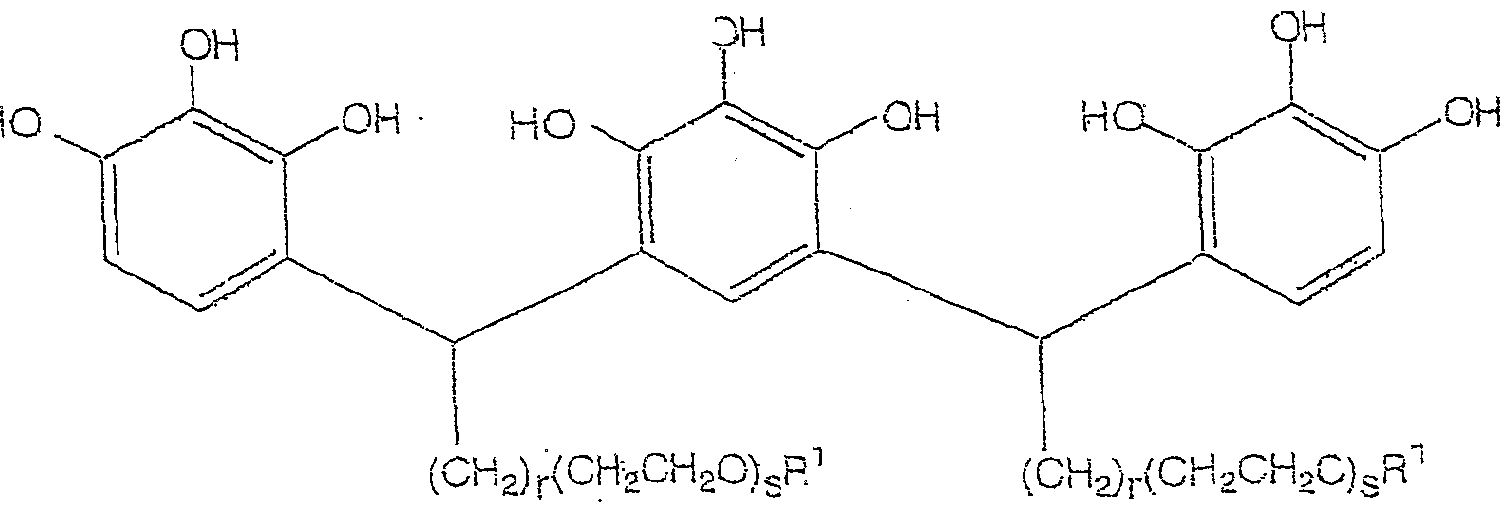
  • r is an integer of from 1 to 3
  • s is an integer of from 2 to 4
  • R 1 is -CF 3 , an alkyl group, or a branched perfluoroalkyl group
  • x is an integer of from 6 to 18, preferably 1 to 3
  • y is an integer of from 4 to 16, preferably 2 to 4
  • Ri is as before.
  • the condensation reaction can be performed at ambient temperatures, although the use of elevated temperatures is not excluded, provided that the principal products of the reaction are open-chain condensates.
  • the condensation reaction is carried, out at a temperature of from 15 to 30°C.
  • reaction time of from 1 to 48 hours, preferably from 10 to 20 hours, for example, about -16 hours, is usually appropriate, but shorter or longer times can be used to produce different product mixtures as desired.
  • the condensation reaction is preferably carried out without the presence of a solvent, and for example, the reactants, together with the acid catalyst, can be ground together in a suitable vessel. It has been found that such solventless procedures usually give rise to colourless products, usually in a period of minutes. Where a solvent is present, it has been found that the nature of the organic solvent influences the chain length of the oligomers and polymers.
  • Suitable solvents that may be used are aprotic organic solvents such as, for example, tetrahydrofuran (THF) , ethyl acetate, and ether.
  • the nature of the catalyst influences the reaction yield, and strong acids such as hydrochloric acid, trifluoroacetic acid and sulphuric acid are preferred. Other acids that can be used include toluene-p-sulfonic acid and oxalic acid.
  • the ratio of the reactants influences the complexity of the product mixture obtained, and preferred equivalent ratios include, for example, 1:1, 1:1.5, and 2:1 phenol : aldehyde .
  • the method of the fourth aspect of the invention can be used to change the surface properties of a wide range of materials.
  • the method can be used to change the contact angle of a surface to water or oil droplets, or to render a' surface hydrophobic or water repellent and/or oleophobic or oil repellent.
  • the method can be applied to a wide range of substrates, and especially hydrophilic substrates including, for example, paper, cotton, wood, leather, hair, teeth; metals, for example, steel, zinc, copper, nickel, and aluminium; stone, glass; fabrics (especially hydrophilic synthetic fabrics) , and hydrophilic polymeric materials.
  • Other substrates, such as plastics materials and metals can be rendered oleophobic by the method of the invention.
  • Oleophobic properties are particularly improved by the use of fluoro-substituted aldehyde phenol condensates according to the invention.
  • application of the fluoro-substituted condensates in aqueous emulsions, after drying, can render surfaces painted with emulsion paint both hydrophobic and oleophobic.
  • An important potential application of aldehyde phenol condensates of the invention comprising polyethylene glycol pendant chains and their terminal alkyl ethers, is in the inhibition of protein adhesion, notably but not exclusively when applied to biomedical inserts and related devices.
  • Other surface properties for example, conductivity, may also be changed by the method of the invention.
  • the aldehyde phenol condensate solution or dispersion can simply be sprayed on to the substrate, or the substrate can be dipped into the solution or dispersion as appropriate.
  • the aldehyde phenol condensate can be applied dissolved or dispersed in an organic solvent, such as, for example, tetrahydrofuran or acetone.
  • the aldehyde phenol condensate can be applied as a dilute aqueous emulsion, comprising a small quantity of a volatile organic solvent.
  • concentration of the aldehyde phenol condensate in the solvent or emulsion is preferably from 0.001 to 10% by weight, more preferably from 0.01 to 5% by weight, most preferably from 0.05 to 1.5% by weight.
  • the method is preferably carried out at ambient temperatures up to about 30°C.
  • the phenol aldehyde condensates of the first aspect of the invention can be further reacted to introduce surface reactive groups into the oligomer or polymer chain.
  • surface reactive groups in this specification is meant groups which are capable of reacting with surfaces in order to bind the oligomer or polymer thereto.
  • groups include, for example, aromatic ring substituents such as amino groups, especially when flanked by hydroxyl groups, and unsaturated ether groups.
  • the aldehyde phenol condensates of the first aspect of the invention can, for example, be reacted with primary or secondary amines together with formaldehyde to give Mannich products in which a hydrogen atom flanked by hydroxyl groups on a aromatic ring is replaced by a monoalkylaminomethyl or dialkylaminomethyl group.
  • Mannich products in which a hydrogen atom flanked by hydroxyl groups on a aromatic ring is replaced by a monoalkylaminomethyl or dialkylaminomethyl group.
  • Such new oligomers and polymers can give improved binding to metals and are also included in the invention.
  • Such compounds can, for example, have the formula:
  • R 2 is a substituted or unsubstituted alkyl or alkenyl group, preferably having from 1 to 6 carbon atoms, and R and n are as previously defined.
  • the aldehyde phenol condensates of the first aspect of the invention can be partially or completely etherified by treatment with a base and an appropriate alkenyl halide, for example, an allyl or propargyl halide, to insert one or more polymerisable groupings into the aromatic ring which are important for film durability in certain applications of the method of the fourth aspect of the invention.
  • an appropriate alkenyl halide for example, an allyl or propargyl halide
  • Such new oligomers and polymers are also included in the invention and can, for example, have the formula:
  • R 3 is a polymerisable group, for example, an alkenyl, alkynyl, or alkoxycarbonyl group
  • p is 2 or 3
  • n is as previously defined.
  • Perfluoro-l-H-2, 2-H-decanal (0.57 g) (derived from perfluorooctyl iodide and ethyl vinyl ether) together with resorcinol (136 mg, 1 equiv. ) in tetrahydrofuran
  • This material gave high and persistent contact angles with oil on kitchen paper treated with a 0.2% solution in THF, dipped at ambient temperature and dried at 140°. Contact angles with water were low but paper floated on water 5 days and there was no oil soak in.
  • Perfluoro-l-H-2, 2-H-octanal (1.0 g.2.76 mMol) , undec- 10-enal (232 mg. 1.38 mMol.) pyrogallol (0.52 g. 4.14 mMol) and toluene-p-sulfonic acid (2.6 mg.) were ground together for 15 minutes and then set aside at 20°. After 60 h., the mixture was ground with light petroleum bp 40-60° to remove any unreacted undecenal and the mixture was filtered to give the product (836 mg) .
  • Formation of the aldehyde phenol condensates can also be achieved by grinding the reagents together in the absence of a solvent.
  • pyrogallol (0.9 g.) and decanal (1.1 g., 1 equiv.) were ground in a pestle and mortar for 15 minutes with toluene-p-sulfonic acid hydrate (15 mg.). The mixture gradually became more and more viscous and at the end of the grinding period gave a free flowing solid.
  • the same results were achieved with the use of 1.2 mg. of toluene-p-sulfonic acid but with a reaction time of 60 hours.
  • the NMR spectrum of the product obtained was essentially identical with that obtained as above.
  • the paper test gave very high contact angles and excellent persistence using 1% by weight solutions of the product in THF.
  • the product has an advantage over the solution- based procedure of giving essentially colourless test solutions and samples.
  • Example 6b Decanal (2.83g.) resorcinol (2g. 1 equivalent) and toluene-p-sulfonic acid (6 mg) were ground together for 10 minutes and then set aside at 20° for 15 h. The hard solid which resulted (was dissolved in acetone (60 ml.) and anhydrous potassium carbonate (15 g.) was added. --The mixture was stirred under reflux for 15 minutes and then a solution of propargyl bromide (80% w/w in toluene, 1.2 g. 50% hydroxyl equivalent) in acetone (5 ml.) was added to the refluxing solution in three equal portions at - : 20 minute intervals.
  • acetone 60 ml.
  • anhydrous potassium carbonate 15 g.
  • Decanal (7.09 g.) resorcinol (5 g. 1 equivalent) and toluene-p-sulfonic acid (5mg) were ground together for 10 minutes and then set aside at 20° for 15 h. A portion (1 g.) of the hard solid which resulted after
  • Triethyleneglycol monomethyl ether (2.24 g) and 1,3- dioxanylethyl bromide (4g.) (50% excess) were dissolved in 60-80 petrol (20ml) .

Landscapes

  • Chemical & Material Sciences (AREA)
  • Organic Chemistry (AREA)
  • Health & Medical Sciences (AREA)
  • Chemical Kinetics & Catalysis (AREA)
  • Medicinal Chemistry (AREA)
  • Polymers & Plastics (AREA)
  • Phenolic Resins Or Amino Resins (AREA)

Abstract

A solvent-soluble oligomer or polymer comprising an open­-chain condensate of an aldehyde of formula R - CHO (I). Wherein R is a substituted or unsubstituted hydrocarbon group, for example, an alkyl group, or a fluorinated alkyl group, having from 5 to 20 carbon atoms, an alkenyl group, or a fluorinated alkenyl group, having from 5 to 20 carbon atoms, an aralkyl group, or a fluorinated aralkyl group, having from 5 to 20 carbon atoms, or a substituted or non-substituted aryl or fluorinated aryl group, or a precursor or derivative thereof, with a mono­-or polyhydric phenol, or a precursor or derivative thereof. The oligomers and polymers find use, for example, in the surface modification of a wide range of materials.

Description

ALDEHYDE PHENOL CONDENSATES
This invention relates to aldehyde phenol condensates, and more particularly to certain novel oligomers and polymers, and mixtures thereof, prepared by the condensation of aldehydes and phenols and precursors or derivatives thereof, and optional introduction of surface reactive groups .
Phenol-aldehyde resins manufactured by polycondensation processes are widely used in industry. An example of such a manufacturing process is described in GB 1089936. Aldehyde-resorcinol condensations have also been described by Niederl and Vogel, J. Am. Chem. Soc. (1940), 62, 2512-14 and Sen and Sinha, J. Am. Chem. Soc. (1923), 45, 2984-96.
Aldehyde phenol cyclic condensates are also known, and, for example, certain cyclic tetrameric structures known variously as calixarenes and cone-type calix [4] resorcinarenes have been described in WO97/39077 and EP0671220, together with their use as surface modifying agents.. Calixarenes can be prepared, for example, from polyhydric phenols and aldehydes by acid-catalysed condensation in an organic solvent under reflux or elevated temperature conditions. A detailed review of the different types of calixarenes and their methods of manufacture is given in Boh er, Angew. Chem. Int. Ed. Engl.1995, 34, 713-715.
Calixarenes can be difficult to purify, - and separation from coloured impurities' can also be difficult, which somewhat reduces their useful applications. The development of new aldehyde phenol condensates, which are simpler to manufacture and have improved properties, would therefore be highly desirable.
Certain new open-chain oligomers and polymers, and mixtures of such oligomers and polymers have now been discovered, which are prepared by the acid catalysed condensation of an aldehyde and a mono- or polyhydric phenol, or their precursors or derivatives.
In a first aspect, the invention provides a solvent- soluble oligomer or polymer comprising an open-chain condensate of an aldehyde of formula:
R - CHO (I)
wherein R is a substituted or unsubstituted hydrocarbon group, for example, an alkyl group, or a fluorinated alkyl group, having from 5 to 20 carbon atoms, an alkenyl group, or a fluorinated alkenyl group, having from 5 to 20 carbon atoms, an aralkyl group, or a fluorinated aralkyl group, having from 5 to 20 carbon atoms, or a substituted or non-substituted aryl or fluorinated aryl group, which alkyl, alkenyl, aralkyl or aryl groups may contain substituent hetero-atoms, or a precursor or derivative thereof, with a mono- or polyhydric phenol, or a precursor or derivative thereof.
In a second aspect, the invention provides a method of manufacturing a solvent-soluble oligomer or polymer comprising an open-chain condensate of an aldehyde of formula (I), or a precursor or derivative- thereof, and a mono- or polyhydric phenol, or a precursor or derivative thereof, which comprises condensing the aldehyde and the phenol,- or their precursors or derivatives, in the presence of an acid catalyst. In a third aspect, the invention provides a solvent- soluble open-chain oligomer or polymer, or a mixture of oligomers or polymers, or both, prepared by the acid catalysed condensation of an aldehyde of formula (I), or a precursor or derivative thereof, and a mono- or polyhydric phenol, or a precursor or derivative thereof.
In a fourth aspect, the invention provides a method of changing the surface properties of a material, which comprises contacting the material with a solution or dispersion of an oligomer or polymer comprising an open- chain condensate of an aldehyde of formula (I) , or a precursor or derivative thereof, and a mono- or polyhydric phenol, or a precursor or derivative thereof, in a liquid medium.
It has been found to be unnecessary to isolate or purify individual Oligomers and polymers from the condensation reaction mixture, and for many applications it is preferred to use a mixture of oligomers and/or polymers for changing the surface properties of a material in the fourth .aspect of the invention.
It is frequently found that the reaction products of the method of the second aspect of the invention are colourless mixtures, and for many purposes these are preferred for use in the fourth aspect of the invention.
In formula (I) the group R can be a substituted or unsubstituted hydrocarbon group, preferably an alkyl group, an alkenyl group, an aralkyl . group, or similar, and may contain hetero-atoms, for example, oxygen, nitrogen or sulphur atoms in the. alkyl or alkenyl chain, or in substituent side groups of the' alkyl, alkenyl or aralkyl groups.
The group R is preferably an alkyl group having from 6 to 18 carbon atoms, more preferably from 7 to 15 carbon atoms, and most preferably from 9 to 12 carbon atoms. R may be a straight chain or branched chain alkyl group, and may have other substituents having hydrophobic properties, for example, fluorine atoms. Preferably the group R is a perfluoroalkyl group, preferably comprising from 10 to 30 fluorine atoms, more preferably from 15 to 25 fluorine atoms, or an alkyl chain terminated with a perfluoroalkyl segment having, for example, 6, 8 or 10 carbon atoms.
In other embodiments the group R can comprise a plurality of repeating units such as (-CH2-CH2-0-) , one or more end groups such as - (OCH2CH2)mOMe, and/or nitrogen heterocyclic groups, for example, pyridyl and/or N-alkyl and S-alkyl groups. The terminal segment can comprise, for example, perfluoralkenyl or hydroxyperfluoroalkyl .
Examples of suitable aldehydes include hexanal, octanal, decanal, undec-10-al, dodecanal, perfluoro-l-H-2, 2-H- hexanal, perfluoro-l-H-2, 2-H-octanal and perfluoro-1-H- 2,2-H-decanal.
Where R is an alkenyl group (which term in this specification includes both alkene and alkyne groups) , the oligomers and polymers of the invention can be further chain extended or cross-linked, and this is a further aspect of the invention. Chain extension or cross-linking can be accomplished, for example, by the use of ultraviolet light, irradiation, or by other free- radical initiators. Chain extension or cross-linking may, for example, improve the binding of the aldehyde where m is an integer, preferably from 1 to 16, more preferably from 1 to 4, phenol condensate to a substrate surface, improve the strength of any mono- or multilayer film present on the surface, or provide sites for binding other reactive groups.
Precursors and derivatives of the aldehyde of formula (I) include the corresponding acetals, for example 0-1, 3- dioxanylethyl-O-methyltriethyleneglycol, and the corresponding imines.
The mono- or polyhydric phenol preferably comprises a hydroxyl-substituted benzene ring, for example resorcinol or pyrogallol. Other polyhydric phenols which can be used include, for example, orcinol (5-methylbenzene-l, 3- diol) , 2- and 5-alkylylresorcinols, and 5- methoxyresorcinol. Mono- or polyhydric phenols comprising more than one aryl group, or fused aryl groups are, however, not excluded. Examples of such more complex phenols include, for example, dihydroxynaphthalenes .
Precursors and derivatives of mono- and polyhydric phenols that may be used in the invention include, for example, phenyl ethers.
In a preferred embodiment of the invention, the oligomer or polymer is an open-chain condensate comprising the unit :
Figure imgf000007_0001
where n is an integer greater than or equal to 1, p is 2 or 3, and R is as previously defined, the condensate having at least one terminal group selected from H atoms, alkenyl groups, hydroxyalkyl groups, dihydroxyaryl groups, trihydroxyaryl groups, perfluoroalkyl groups and perfluoroalkenyl groups.
Preferably n is an integer of from 2 to 6,
In addition to the terminal groups recited above, the new oligomers and polymers in accordance with the invention can also be terminated by other chain terminating atoms or groups, as desired.
The oligomers and polymers of the present invention preferably have molecular masses of less than around 2500 Daltons', more preferably less than 2000, most preferably less than 1500 Daltons.
Specific examples of oligomers and polymers according to the invention include:
Figure imgf000008_0001
Where q is an integer of from '6 to t
Figure imgf000008_0002
Where r is an integer of from 1 to 3, s is an integer of from 2 to 4, and R1 is -CF3, an alkyl group, or a branched perfluoroalkyl group,
Figure imgf000009_0001
and
Figure imgf000009_0002
Where x is an integer of from 6 to 18, preferably 1 to 3, y is an integer of from 4 to 16, preferably 2 to 4 , and Ri is as before.
The condensation reaction can be performed at ambient temperatures, although the use of elevated temperatures is not excluded, provided that the principal products of the reaction are open-chain condensates. Preferably the condensation reaction is carried, out at a temperature of from 15 to 30°C.
It has-been found that the products -of the condensation reaction also depend upon the reaction time. A reaction time of from 1 to 48 hours, preferably from 10 to 20 hours, for example, about -16 hours, is usually appropriate, but shorter or longer times can be used to produce different product mixtures as desired.
The condensation reaction is preferably carried out without the presence of a solvent, and for example, the reactants, together with the acid catalyst, can be ground together in a suitable vessel. It has been found that such solventless procedures usually give rise to colourless products, usually in a period of minutes. Where a solvent is present, it has been found that the nature of the organic solvent influences the chain length of the oligomers and polymers. Suitable solvents that may be used are aprotic organic solvents such as, for example, tetrahydrofuran (THF) , ethyl acetate, and ether.
The nature of the catalyst influences the reaction yield, and strong acids such as hydrochloric acid, trifluoroacetic acid and sulphuric acid are preferred. Other acids that can be used include toluene-p-sulfonic acid and oxalic acid.
The ratio of the reactants influences the complexity of the product mixture obtained, and preferred equivalent ratios include, for example, 1:1, 1:1.5, and 2:1 phenol : aldehyde .
The method of the fourth aspect of the invention can be used to change the surface properties of a wide range of materials. In many instances, the method can be used to change the contact angle of a surface to water or oil droplets, or to render a' surface hydrophobic or water repellent and/or oleophobic or oil repellent. In this aspect, the method can be applied to a wide range of substrates, and especially hydrophilic substrates including, for example, paper, cotton, wood, leather, hair, teeth; metals, for example, steel, zinc, copper, nickel, and aluminium; stone, glass; fabrics (especially hydrophilic synthetic fabrics) , and hydrophilic polymeric materials. Other substrates, such as plastics materials and metals can be rendered oleophobic by the method of the invention. Oleophobic properties are particularly improved by the use of fluoro-substituted aldehyde phenol condensates according to the invention. For example, application of the fluoro-substituted condensates in aqueous emulsions, after drying, can render surfaces painted with emulsion paint both hydrophobic and oleophobic. An important potential application of aldehyde phenol condensates of the invention comprising polyethylene glycol pendant chains and their terminal alkyl ethers, is in the inhibition of protein adhesion, notably but not exclusively when applied to biomedical inserts and related devices. Other surface properties, for example, conductivity, may also be changed by the method of the invention.
In the method of the fourth aspect of the invention, the aldehyde phenol condensate solution or dispersion can simply be sprayed on to the substrate, or the substrate can be dipped into the solution or dispersion as appropriate. The aldehyde phenol condensate can be applied dissolved or dispersed in an organic solvent, such as, for example, tetrahydrofuran or acetone.
Alternatively, the aldehyde phenol condensate can be applied as a dilute aqueous emulsion, comprising a small quantity of a volatile organic solvent. The concentration of the aldehyde phenol condensate in the solvent or emulsion is preferably from 0.001 to 10% by weight, more preferably from 0.01 to 5% by weight, most preferably from 0.05 to 1.5% by weight. The method is preferably carried out at ambient temperatures up to about 30°C.
In another important fifth aspect of the invention, the phenol aldehyde condensates of the first aspect of the invention can be further reacted to introduce surface reactive groups into the oligomer or polymer chain. By "surface reactive groups" in this specification is meant groups which are capable of reacting with surfaces in order to bind the oligomer or polymer thereto. Such groups include, for example, aromatic ring substituents such as amino groups, especially when flanked by hydroxyl groups, and unsaturated ether groups.
In the method of the fifth aspect of the invention, the aldehyde phenol condensates of the first aspect of the invention can, for example, be reacted with primary or secondary amines together with formaldehyde to give Mannich products in which a hydrogen atom flanked by hydroxyl groups on a aromatic ring is replaced by a monoalkylaminomethyl or dialkylaminomethyl group. Such new oligomers and polymers can give improved binding to metals and are also included in the invention. Such compounds can, for example, have the formula:
Figure imgf000013_0001
Where X is -CH2NR2 or -OR2, R2 is a substituted or unsubstituted alkyl or alkenyl group, preferably having from 1 to 6 carbon atoms, and R and n are as previously defined.
In another example of the method of the fifth aspect of the invention, the aldehyde phenol condensates of the first aspect of the invention can be partially or completely etherified by treatment with a base and an appropriate alkenyl halide, for example, an allyl or propargyl halide, to insert one or more polymerisable groupings into the aromatic ring which are important for film durability in certain applications of the method of the fourth aspect of the invention. Such new oligomers and polymers are also included in the invention and can, for example, have the formula:
Figure imgf000014_0001
Where R3 is a polymerisable group, for example, an alkenyl, alkynyl, or alkoxycarbonyl group, p is 2 or 3, is 1 or 2, and n is as previously defined.
Various embodiments of oligomers and polymers and methods of manufacturing and using them in accordance with the invention are illustrated by the following Examples.
Evaluation of the surface modifications obtained is by dip and dry treatment of standard kitchen paper with known concentrations of oligomers and polymers followed by drying under standard conditions in air either at ambient temperature or at 140C. Oil refers to standard reagent grade liquid paraffin. NMR refers to proton NMR in acetone. MALDI refers to matrix assisted desorption ionisation spectrometry which is a non-fragmenting method for obtaining molecular masses in the region 500 to 25,000 daltons. THF refers - to tetrahydrofuran and TFA refers to trifluoroacetic acid. Example 1
Perfluoro-l-H-2, 2-H-decanal (0.57 g) (derived from perfluorooctyl iodide and ethyl vinyl ether) together with resorcinol (136 mg, 1 equiv. ) in tetrahydrofuran
(THF) (4.5 ml.) were treated with cone, hydrochloric acid
(1ml.). The mixture was stirred at 20°C for 24h. The slightly turbid mixture was evaporated in vacuo at 25mm and 50°C to give a residue (660 mg.) MALDI (Figure 1) spectrometry showed molecular weight (663) consistent with a 2:1 phenol : aldehyde condensate as the main product. NMR was consistent with this structure. This material gave high and persistent contact angles with water and with oil on kitchen paper treated by dipping in a 0.2% solution of the material in THF at ambient temperature and drying at 140°. These effects persisted for at least 5 days. When the kitchen paper was treated with a 0.1% solution of the material in THF, water beads disappeared after 5 min. but oil beads persisted for at least 24h.
Example 2
Perfluoro-l-H-2, 2-H-decanal (513 mg.) and resorcinol (122 mg, 1 equiv.) in ether (5 ml.) were treated with trifluoroacetic acid (1ml.) and the mixture was stirred at 20°C for 19h. Evaporation as above gave a residue (513 mg) , (MALDI Figure 2) . Kitchen paper, treated with this material as a 0.2% solution in THF at ambient temperature, floated on water for at least 17 h and oil drops gave high contact angles. Water drops had lower contact angles than for the pyrogallol derived material of Example 3 below. When ethyl acetate was used as the reaction solvent, MALDI spectrometry showed the main product to be the 2 : 3 phenol : aldehyde condensate,
When cone. HCl (1ml.) was used in place of trifluoroacetic acid and with a reaction time of 24 h, the slightly turbid reaction mixture was evaporated to give a product (660 mg) whose MALDI spectrum showed 2:1 phenol condensate as well as other products with slightly larger molecular weights. At 0.2% in THF, this material gave oil and water protection over 4 days to kitchen paper floating on the surface of water.
Example 3
Perfluoro-l-H-2, 2-H-decanal (621 mg) and pyrogallol (169mg, 1 equiv.) in ether (5 ml.) were treated with trifluoroacetic acid (1ml.) and the mixture was stirred at 20° C for 60 h. The mixture was evaporated in vacuo at 50° to give a residue (657mg.). This material gave high and persistent contact angles with oil on kitchen paper treated by dipping in a 0.2% THF solution of the material at ambient temperature, and drying at 140°. Paper floated for 5 days and there was no oil soak in. The same results were obtained with tetrahydrofuran (THF) as reaction solvent.
When cone. HCl (1ml.) was used in place of trifluoroacetic acid and with a reaction time of 24 h, the slightly turbid reaction mixture was evaporated to give a product (660 mg) whose MALDI (Figure 3) spectrum showed 2:1 phenol condensate as well as other products with slightly larger molecular weights. At 0.2% in THF, this material gave oil and water protection over 4 days to kitchen paper floating on the surface of water.
Example 4
Perfluoro-l-H-2, 2-H-decanal (570 mg) and pyrogallol (233mg, -.1.5 equiv.) in THF (5.5 ml.) were treated with cone, hydrochloric (1ml.) and the mixture was stirred at 20°C for 24 h. The mixture was evaporated in vacuo at 50° to give a residue (710 mg.) MALDI (Figure 4) spectrometry showed a complex mixture of materials in the molecular weight range 565 to 887.
This material gave high and persistent contact angles with oil on kitchen paper treated with a 0.2% solution in THF, dipped at ambient temperature and dried at 140°. Contact angles with water were low but paper floated on water 5 days and there was no oil soak in.
When, in the method of Example 4, THF was replaced by ethyl acetate as solvent and the reaction was carried out at 20°C for 60 hours, the product was shown by MALDI (Figure 5) spectrometry to contain two sets of oligomers with molecular weights centred .at 663 and 1303 respectively. The surface effects were similar to those of Example 4.
Example 4a
Perfluoro-l-H-2, 2-H-octanal (3.4 g.), pyrogallol (1.18 g. 1 equivalent) and toluene-p-sulfonic acid (5 mg. ) were ground together for 10 minutes and then set aside at 20°. After 18 h. the mixture was- a viscous gum and after 42 h was an amorphous solid. The product at 0.2% in THF gave excellent long term (<1 week) water and oil resistance to kitchen paper. MALDI showed mass peaks at 1016 and 1032 consistent' with -a 2:1 aldehyde- pyrogallol condensate (Figure 6) . Example 4b
Perfluoro-l-H-2, 2-H-octanal (1.0 g.2.76 mMol) , undec- 10-enal (232 mg. 1.38 mMol.) pyrogallol (0.52 g. 4.14 mMol) and toluene-p-sulfonic acid (2.6 mg.) were ground together for 15 minutes and then set aside at 20°. After 60 h., the mixture was ground with light petroleum bp 40-60° to remove any unreacted undecenal and the mixture was filtered to give the product (836 mg) . NMR showed incorporation of both aldehydes (terminal vinyl group and perfluoroalkyl chains) in this product and MALDI showed a mixture of many components (Figure 7) . A strong peak at 978 was consistent with combination of two pyrogallol residues with one each of the aldehydes. Kitchen paper test at 0.2 % in THF showed 5 minute resistance to oil and water drops.
Example 5
(i) Decanal (1.1 g, ) and pyrogallol (888 mg. , 1 equiv.) in tetrahydrofuran (5 ml.) were treated with cone, sulfuric acid (1 drop, 33 mg.) and the mixture was stirred for 65 hr at 20°C. Sodium bicarbonate (60 mg.) was added and after being thoroughly stirred the mixture was poured into ice-water (200 ml.). The gummy insoluble product was removed and dissolved in methanol. Evaporation gave the product (1.45 g.). NMR was consistent with aldehyde-phenol oligomers. Tests of kitchen paper dipped at ambient temperature in a 0.5% tetrahydrofuran solution of the product
_ showed that it conferred the ability to float on water .
(ii) Decanal (1.2g.) and pyrogallol (969 mg., 1 equiv.) in tetrahydrofuran (5 ml.) were treated with trifluoroacetic acid (2ml.) and the mixture was stirred for 19 hr at 20°C-. A portion (2.5 ml.) of the solution was removed and evaporated to give the product (740 mg.) The NMR showed an aldehyde- phenol condensate and MALDI (Figure 8) was consistent with a 4:4 non cyclic oligomer.
In the kitchen paper drip and dry test using a 0.5% solution in acetone the paper floated for 12h. and gave high contact angles with water. At 0.25%, paper gives a high (ca. 80°) water contapt angle but water drops soaked in after 2 min.
After 5 days, the remainder of the solution was evaporated to give a residue (1.29 g. ) , which was much less soluble in chloroform than the shorter term material. NMR was closely similar to the previous (short reaction time material) . MALDI (Figure 9) showed a main product with a slightly higher (1077) molecular weight.
The kitchen paper dip and dry test with a 0.5% solution in acetone showed improved water resistance but lower than in the preceding Examples.
Formation of the aldehyde phenol condensates can also be achieved by grinding the reagents together in the absence of a solvent. Typically, pyrogallol (0.9 g.) and decanal (1.1 g., 1 equiv.) were ground in a pestle and mortar for 15 minutes with toluene-p-sulfonic acid hydrate (15 mg.). The mixture gradually became more and more viscous and at the end of the grinding period gave a free flowing solid. The same results were achieved with the use of 1.2 mg. of toluene-p-sulfonic acid but with a reaction time of 60 hours. "The NMR spectrum of the product obtained was essentially identical with that obtained as above. The paper test gave very high contact angles and excellent persistence using 1% by weight solutions of the product in THF. The product has an advantage over the solution- based procedure of giving essentially colourless test solutions and samples.
Example 6
Decanal (1.418g.) and resorcinol (lg.) in tetrahydrofuran (5 ml.) were treated with trifluoroacetic acid (1 ml.) and the mixture was stirred for 28 hr. Evaporation gave a residue (2.3g. ) whose NMR showed phenol-aldehyde condensate. At 0.5% at 20°C in acetone the kitchen paper dip and dry test showed water beading but 2 min soak-in time. At 1% in THF kitchen paper floated on water for many hours and water drops persisted for many hours also.
When the acid catalyst was cone. HCl (1ml.) and THF (7 ml.) was the solvent, NMR again showed the product to be aldehyde-phenol condensate and in the kitchen paper dip and dry test at 0.5% in THF the water soak-in time was again ca 2 min. At 1% in THF there was good persistence of floating and drops but somewhat less well than with TFA catalysis.
Example 6a
Pyrogallol (1 g.), decanal (1.24 g. 1 equivalent) and toluene-p-sulfonic acid (1.2 mg.)were ground together with a pestle and mortar. After 5 min. there was thickening of the mixture and after 2 days it had set to a hard white solid: MALDI showed the main component to be a tetrameric phenol-aldehyde condensate (Figure 10) .
Example 6b Decanal (2.83g.) resorcinol (2g. 1 equivalent) and toluene-p-sulfonic acid (6 mg) were ground together for 10 minutes and then set aside at 20° for 15 h. The hard solid which resulted (was dissolved in acetone (60 ml.) and anhydrous potassium carbonate (15 g.) was added. --The mixture was stirred under reflux for 15 minutes and then a solution of propargyl bromide (80% w/w in toluene, 1.2 g. 50% hydroxyl equivalent) in acetone (5 ml.) was added to the refluxing solution in three equal portions at -: 20 minute intervals. The mixture was then boiled under reflux for 2 days and poured into water (150 ml.). The mixture was extracted with ether (3 x 60 ml.) and the extracts were washed successively with IM HCL and water. The extracts were dried (and evaporated to give the product (4.5 g.) . The
IR spectrum (Figure 11a). showed bands at 3312 cirf-'-
(triple bond C-H) and at 2123 cm-1- (C-C triple bond) . MALDI showed a mixture of compounds (figure 11) . Kitchen paper test for water at 1% in THF showed excellent water resistance
Example' 6c
Decanal (7.09 g.) resorcinol (5 g. 1 equivalent) and toluene-p-sulfonic acid (5mg) were ground together for 10 minutes and then set aside at 20° for 15 h. A portion (1 g.) of the hard solid which resulted after
60h. was further ground with dibutylamine (484 mg. 1 equivalent for a Mannich reaction) , paraformaldehyde
(350 mg., 3 moles excess) and toluene-p-sulfonic acid (5 mg.). After 16 h'. , the mixture . was taken up in acetone (50 ml.) and filtered to remove excess of paraformaldehyde. The filtrates were evaporated in vacuo to constant weight to remove any unreacted dibutylamine, giving the product whose NMR showed a peak for methylene groups adjacent to nitrogen absent from the starting material and an intensified terminal methyl group signal. MALDI showed a mixture of compounds (Figure 12) . Reaction schemes for Examples 6b and 6c are illustrated in Figure 14.
Example 7
0-1,3 -Dioxanylethyl -O-methyltriethyleneglycol
Triethyleneglycol monomethyl ether (2.24 g) and 1,3- dioxanylethyl bromide (4g.) (50% excess) were dissolved in 60-80 petrol (20ml) . Tetrabutylammonium bromide
(0.324g) was added together with sodium hydroxide (14 g.) in water (14 ml.) . The mixture was stirred vigorously under reflux for 21 h cooled, and brought close to neutrality by dropwise addition of cone. HCL. After complete neutralisation with acetic acid, the top layer (petrol) was removed and evaporated to give a residue (2.02g) which was kugelled. Fr. 1 bath 125°/25 mm (0.20 g.) Fr 2 bath 240°/9mm (1.15 g) NMR consistent with the coupled structure.
Aldehyde-pyrogallol Condensate
The above dioxanyl PEG ether (910 mg) and pyrogallol
(413 g., 1 mole) were ' dissolved in ethanol under argon and cone, hydrochloric acid (0.6 ml) was added. The mixture was allowed to stand at- 20° for 18h. Water (40 ml) was added, the mixture was warmed and decanted. The decantate was evaporated (1.3g) (no IR carbonyl group) and was extracted with cold acetone leaving a dark residue A. Evaporation of the acetone solution gave a residue (709 mg) whose NMR spectrum was consistent with an aldehyde phenol condensate. The reaction scheme is illustrated in Figure 15.
The insoluble material A was extracted with boiling THF. Evaporation of the ; THF solution gave a dark residue which was extracted with cold acetone (15ml) to give a clear extract giving, on evaporation, a residue (190 mg) as a dark powder softening at 97-100° and melting at 157-9° ■ MALDI was consistent with that of the PEG pyrogallol tetramer together with some lower molecular weight condensates (Figure 13) . This material applied on a dip and dry basis at 0.6% in methanol to steel gives a change in contact angle from 70° to 10°.
The reader's attention is directed to all papers and documents which are filed concurrently with or previous to this specification in connection with this application and which are open to public inspection with this specification, and the contents of all such papers and documents are incorporated herein by reference.
All of the features disclosed in this specification (including any accompanying claims, abstract and drawings) , and/or all of the steps of any method or process so disclosed, may be combined in any combination, except combinations where at least some of such features and/or steps are mutually exclusive.
Each feature disclosed in this specification (including any accompanying claims, abstract and drawings) , may be replaced by alternative features serving the same, equivalent or similar purpose, unless expressly stated otherwise. Thus, unless expressly stated otherwise, each feature disclosed is one example only of a generic series of equivalent or similar features.
The invention is not restricted to the details of any foregoing embodiments. .The invention extends to any novel one, or any novel combination, of the features disclosed in this specification (including any accompanying claims, abstract and drawings) , or to any novel one, or any novel combination, of the steps of any method or process so disclosed.

Claims

1. A solvent-soluble oligomer or polymer comprising an open-chain condensate of an aldehyde of formula:
R - CHO (I) wherein R is a substituted or unsubstituted hydrocarbon group, or a precursor or derivative thereof, with a mono- or polyhydric phenol, or a precursor or derivative thereof.
2. An oligomer or polymer according to claim 1, wherein R is an alkyl group, or a fluorinated alkyl group, having from 5 to 20 carbon atoms, an alkenyl group, or a fluorinated alkenyl group, having from 5 to 20 carbon atoms, an aralkyl group, or a fluorinated aralkyl group, having from 5 to 20 carbon atoms, or a substituted or non-substituted aryl or fluorinated aryl group, which alkyl, alkenyl, aralkyl or aryl groups may contain substituent hetero-atoms.
3. An oligomer or polymer according to claim 2, in which R is an alkyl group, an alkenyl group, a hydroxyalkyl group or a perfluoroalkyl group.
4. An oligomer or polymer according to any one of claims 1 to 3, that is present in a mixture of such oligomers or polymers.
5. An oligomer or polymer according to any one of the preceding claims,- that is colourless.
6. An oligomer or polymer according to any one of the preceding claims, in which the group R is an alkyl group having from 7 to 15 carbon atoms.
7. An oligomer or polymer according to claim 6, in which the group R is a fluorinated alkyl group.
8. An oligomer or polymer according to any one of claims 1 to 5, in which the group R is an alkenyl group having from 7 to 15 carbon atoms.
9. An oligomer or polymer according to claim 8, that is capable of chain extension or cross-linking in the presence of a free-radical initiator.
10. An oligomer or polymer according to any one of the preceding claims, wherein the mono- or polyhydric phenol comprises a hydroxyl-substituted benzene ring .
11. An oligomer or polymer according to any one of the preceding claims, which is an open-chain condensate comprising the units:
Figure imgf000026_0001
where n is an integer greater than or equal to 1, p is 2 or 3, and R is as previously- defined, the condensate having at least one terminal group selected from H atoms, alkenyl groups, hydroxyalkyl groups, dihydroxyaryl groups and trihydroxyaryl groups .
12. An oligomer or polymer according to claim 11, wherein n is an integer of from 2 to 4.
13. An oligomer or polymer according to any one of the preceding claims, having a molecular mass of less than 2000 Daltons.
14. An oligmer or polymer according to one of the following formulae:
Figure imgf000028_0001
Where q is an integer of from 6 to 18.
15. An oligomer or polymer according to the 'formula:
Figure imgf000028_0002
where r is an integer of from 1 to 3, s is an integer of from 2 to 4 and R1 is -CF3 or a branched perfluoroalkyl group .
16. An oligomer or polymer according to the formula:
Figure imgf000029_0001
Where x is an integer of from 6 to 18, y is an inreger of from 4 to 16 and R1 is -CF3, an alkyl group, or a branched perfluoralkyl group.
17 An oligomer or polymer substantially as hereinbefore described.
8. A method of manufacturing a solvent-soluble oligomer or polymer comprising an open-chain condensate of an aldehyde of formula (I)-, or a precursor or derivative thereof, and a mono- or polyhydric phenol, or a precursor or derivative thereof, which comprises condensing the aldehyde and the phenol, or their precursors or derivatives, in the presence of an acid catalyst.
19. A method according to claim 18, wherein the group R in formula (I) is an alkyl group having from. 7 to 15 carbon atoms .
20. A method according to claim 18 or 19, wherein the group R is a fluorinated alkyl group.
21. A method according to any one of claims 18 to 20, wherein the group R is a perfluorinated alkyl group comprising from 15 to 25 fluorine atoms.
22. A method according to any one of claims 18 to 21, wherein the aldehyde is hexanal, octanal, decanal, undec-10-al, dodecanal, perfluoro-l-H-2, 2-H-hexanal, perfluoro-l-H-2, 2-H-octanal and perfluoro-l-H-2 , 2-H- decanal.
23. A method according to any one of claims 18 to 22, wherein the group R is an alkenyl group.
24- A method according to claim 23, which further comprises polymerising the condensate in the presence of a free-radical initiator.
25. A method according to any .one of claims 18 to 24, in which the mono- or polyhydric phenol comprises a hydroxyl-substituted benzene ring.
26. A method according to any one of claims 18 to 25, in which the mono- or polyhydric phenol is resorcinol or pyrogallol.
27. A method according to any one of claims 18 to 26, in which the precursor or derivative of the aldehyde of formula (I) is an acetal or an imine .
28. A method according to any one of claims 18 to 27, in which the precursor or derivative of the mono- or polyhydric phenol is a phenyl ether.
29. A method according to any one of claims 18 to 28, that is carried out at a temperature of from 15 to 30°C.
30. A method according to any one of claims 18 to 29, that is carried out in the presence of an aprotic organic solvent.
31. A method according to any one of claims 18 to 30, that is carried out in the presence of a strong acid catalyst.
32. A method according to any one of claims 18 to 31, wherein the phenol to aldehyde equivalent ratio is from 1 : 1 to 2 : 1.
33. A method according to any one of claims 18 to 32, which further comprises reacting the phenol aldehyde condensate to introduce surface reactive groups into the oligomer or polymer chain.
4. A method according to claim 33, which comprises the step of reacting the aldehyde phenol condensate with a primary or secondary amine together with formaldehyde to give a Mannich product in which a hydrogen atom flanked by hydroxyl groups on an aromatic ring is replaced by a monoalkylaminomethyl or dialkylaminomethyl group.
35. A method according to claim 34, in which the amine is dibutylamine.
36. A method according to claim 33, which comprises the step of partially or completely etherifying the aldehyde phenol condensate with a base and an alkenyl halide to. insert polymerisable groups therein.
37. A method according to claim 36, in which the alkenyl halide is an allyl or propargyl halide.
38. A method for the manufacture of an oligomer or polymer substantially as described in the Examples.
39. A method for the manufacture of an oligomer or polymer substantially as hereinbefore described.
40. A solvent-soluble open-chain oligomer or polymer, or a mixture of oligomers or polymers, or both, prepared by the acid catalysed condensation of an aldehyde of formula (I) , or a precursor or derivative thereof, and a mono- or polyhydric phenol, or a precursor or derivative thereof.
41. An oligomer or polymer prepared by a method according to any one of claims 18 to 39.
42. An oligomer or polymer, or- mixture of oligomers or polymers, or both, according to any one of claims 1 to 17 when prepared by a method according to any one of claims 18 to 39.
43. A method of changing the surface properties of a material, which comprises contacting the material with a solution or dispersion of an oligomer or polymer comprising an open-chain condensate of an aldehyde of formula (I) , or a precursor or derivative thereof, and a mono- or polyhydric phenol, or a precursor or derivative thereof, in a liquid medium.
44. A method according to claim 43, wherein there is used a mixture of oligomers and/or polymers.
45. A method according to claim 44 or 45, wherein there is used an oligomer or polymer according to any one of claims 1 to 17.
46. A method according to any one of claims 43 to 45 wherein there is used an oligomer or polymer prepared by a method according to any one of claims 18 to 39.
47. A method according to any one of claims 43 to 46, in which the aldehyde phenol condensate is applied dissolved or dispersed in an organic solvent.
48. A method according to claim 47, wherein' the concentration of the aldehyde phenol condensate in the solvent is from 0.01 to 5% by weight.
49. A method of changing the surface properties of a substrate substantially as described in the Examples .
50. A method of changing the surface properties of a substrate substantially as hereinbefore described.
51. An oligomer or polymer having the formula:
Figure imgf000034_0001
Where X is -CH2NR2 2 or -OR2, R2 is a substituted or unsubstituted alkyl or alkenyl group, preferably having from 1 to 6 carbon atoms, R is a substituted or unsubstituted hydrocarbon group and n is an integer greater than or equal to 1.
2. An oligomer or polymer having the formula:
Figure imgf000035_0001
Where R3 is a polymerisable group, for example, an alkenyl, alkynyl, or alkoxycarbonyl group, p is 2 or 3, d is 1 or 2, and n is an integer greater than or equal to 1.
PCT/GB2003/003621 2002-08-20 2003-08-19 Aldehyde phenol condensates Ceased WO2004018402A1 (en)

Priority Applications (1)

Application Number Priority Date Filing Date Title
AU2003255809A AU2003255809A1 (en) 2002-08-20 2003-08-19 Aldehyde phenol condensates

Applications Claiming Priority (2)

Application Number Priority Date Filing Date Title
GB0219380.3 2002-08-20
GB0219380A GB2392163A (en) 2002-08-20 2002-08-20 Soluble phenol-aldehyde condensate

Publications (1)

Publication Number Publication Date
WO2004018402A1 true WO2004018402A1 (en) 2004-03-04

Family

ID=9942658

Family Applications (1)

Application Number Title Priority Date Filing Date
PCT/GB2003/003621 Ceased WO2004018402A1 (en) 2002-08-20 2003-08-19 Aldehyde phenol condensates

Country Status (3)

Country Link
AU (1) AU2003255809A1 (en)
GB (1) GB2392163A (en)
WO (1) WO2004018402A1 (en)

Cited By (4)

* Cited by examiner, † Cited by third party
Publication number Priority date Publication date Assignee Title
WO2013104916A2 (en) 2012-01-11 2013-07-18 Camstent Limited Medical devices, coatings and compounds
KR20180075555A (en) * 2015-10-29 2018-07-04 헥시온 인코포레이티드 Novel alkylphenol resins and processes for their preparation
US10696838B2 (en) 2017-10-06 2020-06-30 Hexion Inc. Rubber compositions containing tackifiers
US10808068B2 (en) 2018-01-26 2020-10-20 Hexion Inc. Manufacture of novolacs and resoles using lignin

Families Citing this family (1)

* Cited by examiner, † Cited by third party
Publication number Priority date Publication date Assignee Title
GB0921666D0 (en) 2009-12-10 2010-01-27 Cambridge Biopolymers Ltd Resins

Citations (4)

* Cited by examiner, † Cited by third party
Publication number Priority date Publication date Assignee Title
GB1001351A (en) * 1963-04-05 1965-08-18 Ethyl Corp Halogenated bisphenols and applications thereof
GB1323494A (en) * 1970-05-01 1973-07-18 Tenneco Chem Methylene-bis-chlorophenol
US4358624A (en) * 1980-12-31 1982-11-09 General Electric Company Fluorinated monophenols and diphenols and method for their preparation
US4365098A (en) * 1980-12-31 1982-12-21 General Electric Company Fluorinated diphenols and method for their preparation

Family Cites Families (8)

* Cited by examiner, † Cited by third party
Publication number Priority date Publication date Assignee Title
FR504392A (en) * 1919-07-19 1920-07-02 Coralex Soc Process for the preparation of pure phenolic resins, basic phenolic resins or phenolic salt ethers with a view to obtaining plastics and insulating materials, varnishes, enamels and finishes
GB184961A (en) * 1921-07-07 1922-08-31 Lorival Mfg Company Ltd Improved manufacture of condensation products of phenolic bodies with aldehydic compounds
US3931329A (en) * 1970-10-29 1976-01-06 Minnesota Mining And Manufacturing Company Aldehyde condensation products of fluoroaliphatic phenols
JPH0649158A (en) * 1992-08-04 1994-02-22 Sumitomo Durez Co Ltd Water-soluble phenolic resin for impregnation of honeycomb core
EP0722120B1 (en) * 1994-12-27 2000-10-18 Mitsubishi Chemical Corporation Photosensitive resin composition and method for forming photoresist pattern using the same
JP3633773B2 (en) * 1998-02-03 2005-03-30 株式会社カネカ Polymerization scale prevention method
ATE215572T1 (en) * 1999-01-29 2002-04-15 Bakelite Ag METHOD FOR PRODUCING RESOLES
JP3651835B2 (en) * 1999-11-05 2005-05-25 住友ベークライト株式会社 Method for producing water-soluble phenolic resin

Patent Citations (4)

* Cited by examiner, † Cited by third party
Publication number Priority date Publication date Assignee Title
GB1001351A (en) * 1963-04-05 1965-08-18 Ethyl Corp Halogenated bisphenols and applications thereof
GB1323494A (en) * 1970-05-01 1973-07-18 Tenneco Chem Methylene-bis-chlorophenol
US4358624A (en) * 1980-12-31 1982-11-09 General Electric Company Fluorinated monophenols and diphenols and method for their preparation
US4365098A (en) * 1980-12-31 1982-12-21 General Electric Company Fluorinated diphenols and method for their preparation

Cited By (9)

* Cited by examiner, † Cited by third party
Publication number Priority date Publication date Assignee Title
WO2013104916A2 (en) 2012-01-11 2013-07-18 Camstent Limited Medical devices, coatings and compounds
KR20180075555A (en) * 2015-10-29 2018-07-04 헥시온 인코포레이티드 Novel alkylphenol resins and processes for their preparation
KR102084700B1 (en) * 2015-10-29 2020-03-04 헥시온 인코포레이티드 New alkyl phenol resins and preparation method thereof
US10982034B2 (en) 2015-10-29 2021-04-20 Hexion Inc. Alkylphenol resins and a method of preparing thereof
US11518839B2 (en) 2015-10-29 2022-12-06 Bakelite UK Holding Ltd. Alkylphenol resins and a method of preparing thereof
US10696838B2 (en) 2017-10-06 2020-06-30 Hexion Inc. Rubber compositions containing tackifiers
US10982087B2 (en) 2017-10-06 2021-04-20 Hexion Inc. Rubber compositions containing tackifiers
US10808068B2 (en) 2018-01-26 2020-10-20 Hexion Inc. Manufacture of novolacs and resoles using lignin
US11697703B2 (en) 2018-01-26 2023-07-11 Bakelite UK Holding Ltd. Manufacture of novolacs and resoles using lignin

Also Published As

Publication number Publication date
AU2003255809A1 (en) 2004-03-11
GB2392163A (en) 2004-02-25
GB0219380D0 (en) 2002-09-25

Similar Documents

Publication Publication Date Title
Ikeda et al. A new crosslinkable polyphenol from a renewable resource
Atta et al. Synthesis and characterization of tetra-functional epoxy resins from rosin
Uyama et al. Enzymatic Synthesis and Thermal Properties of a New Class of Polyphenol.
CN115867596B (en) Benzoxazine derivative glass polymers
Sangermano et al. Phenolic hyperbranched polymers as additives in cationic photopolymerization of epoxy systems
Wurm et al. Synthesis and characterization of poly (glyceryl glycerol) block copolymers
García et al. Polyphenolic resins prepared with maritime pine bark tannin and bulky-aldehydes
CN110964202B (en) A kind of preparation method of polysiloxane/diphenol type benzoxazine
Kiskan et al. Preparation of conductive polybenzoxazines by oxidative polymerization
DE60013213T2 (en) Fluorine-containing curable silicone compositions
WO2004018402A1 (en) Aldehyde phenol condensates
Zhang et al. Preparation of a novel melamine formaldehyde resin with palmitoylated melamine involved and its functional coating
JP2592473B2 (en) Method for producing urea aldehyde polycondensate
Atta et al. Synthesis and characterization of high thermally stable poly (Schiff) epoxy coatings
Essawy et al. Upgrading the adhesion properties of a fast‐curing epoxy using hydrophilic/hydrophobic hyperbranched poly (amidoamine) s
Bagherifam et al. Thermal degradation of polysiloxane and polyetherester containing benzoxazine moieties in the main chain
KR102433610B1 (en) Recyclable and/or degradable polymer thermosets and synthetic method and application thereof
Uttaravalli et al. Kinetics of thermal decomposition of ketonic resins
KR940010009B1 (en) Polyacetal copolymer and composition thereof
Semenova et al. Transesterification of dialkyl carbonates by poly (4-vinylphenol)
Barriau et al. Systematic investigation of functional core variation within hyperbranched polyglycerols
JPH09143238A (en) New amino resin composition
Yonezawa et al. Synthesis of aromatic poly (ether ketone) s having adhesion property to steel surface
CN115710336A (en) Modified melamine formaldehyde resin and preparation method and application thereof
KR102295391B1 (en) Benzoxazine and Method of Preparing Polybenzoxazine using the Same

Legal Events

Date Code Title Description
AK Designated states

Kind code of ref document: A1

Designated state(s): AE AG AL AM AT AU AZ BA BB BG BR BY BZ CA CH CN CO CR CU CZ DE DK DM DZ EC EE ES FI GB GD GE GH GM HR HU ID IL IN IS JP KE KG KP KR KZ LC LK LR LS LT LU LV MA MD MG MK MN MW MX MZ NI NO NZ OM PG PH PL PT RO RU SC SD SE SG SK SL SY TJ TM TN TR TT TZ UA UG US UZ VC VN YU ZA ZM ZW

AL Designated countries for regional patents

Kind code of ref document: A1

Designated state(s): GH GM KE LS MW MZ SD SL SZ TZ UG ZM ZW AM AZ BY KG KZ MD RU TJ TM AT BE BG CH CY CZ DE DK EE ES FI FR GB GR HU IE IT LU MC NL PT RO SE SI SK TR BF BJ CF CG CI CM GA GN GQ GW ML MR NE SN TD TG

121 Ep: the epo has been informed by wipo that ep was designated in this application
122 Ep: pct application non-entry in european phase
NENP Non-entry into the national phase

Ref country code: JP

WWW Wipo information: withdrawn in national office

Country of ref document: JP