DESCRI PTION 2-AMINOPYRIMIDINE DERIVATIVES AS ADENOSINE Al AND A2A RECEPTOR ANTAGONISTS
TECHNICAL FIELD
The present invention relates to a novel aminopyrimidine compound and a salt thereof, which are useful as medicaments.
BACKGROUND ART
2-Aminopyridine compounds to exhibit adenosine receptor antagonism are known (WO 02/14282) .
2-Amino-4-phenyl-5- (6-oxo-l, 6-dihydro-pyrid-3-yl) - pyrimidine compounds and derivatives thereof are novel, so there has been no knowledge about these compounds. In addition, any aminopyrimidine compounds having both of adenosine Ai and A2a inhibitory activities are not known.
DISCLOSURE OF INVENTION
The present invention relates to a novel aminopyrimidine compound and a pharmaceutically acceptable salt thereof, which are useful as medicaments; processes for the preparation of said aminopyrimidine compound and a salt thereof; a pharmaceutical composition comprising, as an active ingredient, said aminopyrimidine compound or a pharmaceutically acceptable salt thereof; a use of said aminopyrimidine compound or a pharmaceutically acceptable salt thereof as a medicament; and a method for using said aminopyrimidine compound or a pharmaceutically acceptable salt thereof for therapeutic purposes, which comprises administering said aminopyrimidine compound or a pharmaceutically acceptable salt thereof to a human being or an animal .
The aminopyrimidine compound and a salt thereof are adenosine antagonists (especially, Ai receptor and A2 (particularly A2a) receptor dual antagonists) and possess various pharmacological actions such as anticatalepsy action, cognitive enhancing action, analgesic action, locomotor action, antidepressant action, diuretic action, cardioprotective action, cardiotonic action,
vasodilating action (e.g. cerebral vasodilating action, etc.), the action of increasing the renal blood flow, renal protective action, improvement action of renal function, enhancing action of lipolysis, inhibition action of anaphylactic bronchoconstriction, acceleration action of the insulin release, the action of increasing the production of erythropoietin, inhibiting action of platelet aggregation, or the like.
They are useful as cognitive enhancer, antianxietry drug, antidementia drug, psychostimulant, analgesic, cardioprotective agent, antidepressant, ameliorants of cerebral circulation, tranquilizer, drug for heart failure, cardiotonic agent, antihypertensive agent, drug for renal failure (renal insufficiency) , drug for renal toxicity, renal protective agent, drug for improvement of renal function, diuretic, drug for edema, antiobesity, antiasthmatic, bronchodilator, drug for apnea, drug for gout, drug for hyperuricemia, drug for sudden infant death syndrome (SIDS) , ameliorants of immunosuppressive action of adenosine, antidiabetic agent, drug for ulcer, drug for pancreatitis, drug for Meniere's syndrome, drug for anemia; drug for thrombosis, drug for myocardial infarction, drug for obstruction, drug for arteriosclerosis obliterans, drug for thrombophlebitis, drug for cerebral infarction, drug for transient ischemic attack, drug for angina pectoris, or the like; and useful for the prevention and/or treatment of depression, dementia (e.g. Alzheimer's disease, cerebrovascular dementia, dementia accompanying Parkinson's disease, etc.), Parkinson's disease, anxiety, pain, cerebrovascular disease (e.g. stroke, etc.), heart failure; hypertension (e.g. essential hypertension, nephrogenous hypertension, etc. ) ; circulatory insufficiency (acute circulatory insufficiency) cuased by, for example, ischemia/reperfusion injury (e.g. myocardial ischemia/reperfusion injury, cerebral
ischemia/reperfusion injury, peripheral ischemia/reperfusion injury, etc.), shock (e.g. endotoxin shock, hemorrhagic shock, etc.), surgical procedure, or the like; post-resuscitation asystole; bradyarrhythmia; electro-mechanical dissociation; hemodynamic collapse;
SIRS (systemic inflammatory response syndrome) ; multiple organ failure; renal failure (renal insufficiency) (e.g. acute renal failure, etc.), renal toxicity [e.g. renal toxicity induced by a drug such as cisplatins, gentamicin, FR-900506 (disclosed in
EP-0184162) , cyclosporin (e.g. cyclosporinA) orthelike; glycerol, etc.], nephrosis, nephritis, edema (e.g. cardiac edema, nephrotic edema, hepatic edema, idiopathic edema, drug edema, acute angioneurotic edema, hereditary angioneurotic edema, carcinomatous ascites, gestational edema, etc.); obesity, bronchial asthma, gout, hyperuricemia, sudden infant death syndrome, immunosuppression, diabetes, ulcer such as peptic ulcer (e.g. gastric ulcer, duodenal ulcer, etc.), pancreatitis,
Meniere's syndrome, anemia, dialysis-induced hypotension, constipation, ischemic bowel disease, ileus (e.g. mechanical ileus, adynamic ileus, etc.); and myocardial infarction, thrombosis (e.g. arterial thrombosis, cerebral thrombosis, etc.), obstruction, arteriosclerosis obliterans, thrombophlebitis, cerebral infarction, transient ischemic attack, angina pectoris, or the like.
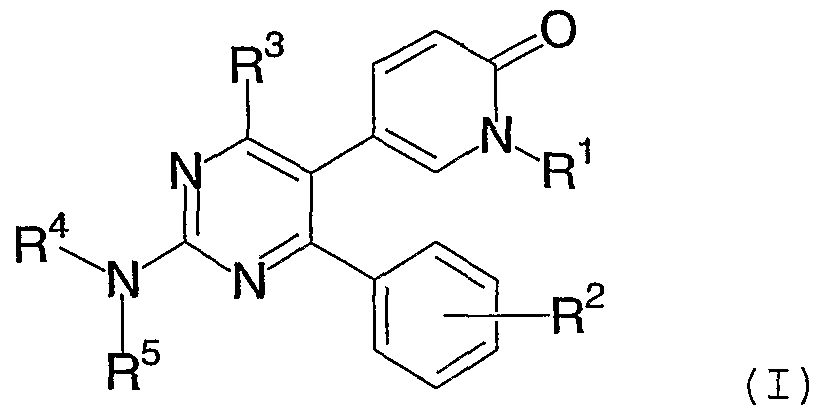
The novel aminopyrimidine compound of the present invention can be shown by the following formula (I) .
R1 is hydrogen, lower alkyl, cyclo (lower) alkyl which may be interrupted by an oxygen atom or aryl (lower) alkyl, R2 is hydrogen, halogen, hydroxy, lower alkyl, lower alkoxy, amino (lower) alkoxy or pyperidinyloxy,
R3 is hydrogen, hydroxy, lower alkyl or lower alkoxy, and R4 and R5 are each hydrogen, lower alkyl or acyl, or a salt thereof.
The preferred embodiments of the aminopyrimidine compound of the present invention represented by the general formula (I) are as follows.
(1) The aminopyrimidine compound of the general formula (I) wherein
R1 is hydrogen or lower alkyl,
R2 is hydrogen, halogen, hydroxy, lower alkyl, lower alkoxy, amino (lower) alkoxy or pyperidinyloxy,
R3 is hydrogen, lower alkyl or lower alkoxy and
R4 and R5 are each hydrogen, or a salt thereof.
(2) The aminopyrimidine compound of (1) above wherein
R1 is hydrogen, methyl, ethyl, propyl or isopropyl,
R2 is hydrogen, fluoro, hydroxy, methoxy, aminoethoxy or piperidinyloxy
R3 is hydrogen, methyl or methoxy, and
R4 and R5 are each hydrogen, or a salt thereof.
(3) The aminopyrimidine compound of the general formula (I) wherein
R1 is hydrogen or isopropyl, R2 is hydrogen or fluoro, R3 is hydrogen, methyl or methoxy, and R4 and R5 are each hydrogen, or a salt thereof.
The object compound (I) and a salt thereof of the present invention can be prepared by the following processes. Process 1
hydrolysis
(Ha) ( la) or a salt thereof or a salt thereof
Process 2
(Ia) (III) (lb) or a salt thereof or a salt thereof or a salt thereof
Process 3
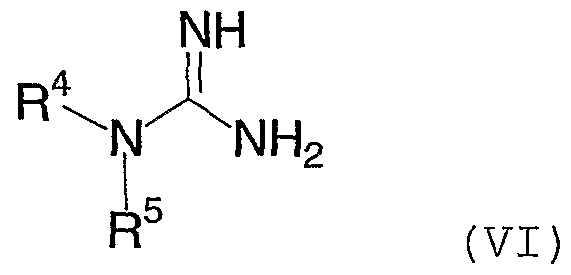
( IV) (V) or a salt thereof or a salt thereof (VI) or a salt thereof
(I) or a salt thereof
Process 4
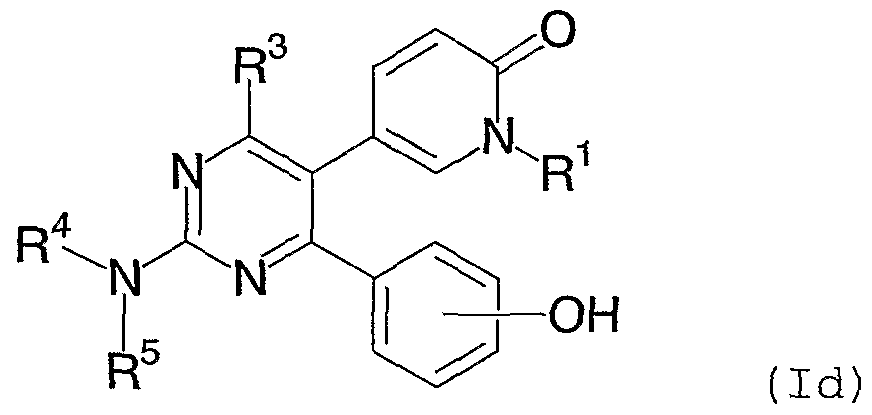
(Ic) (Id) or a salt thereof or a salt thereof
Process 5
(Id) ■ (Ie) or a salt thereof (VII) or a salt thereof or a salt thereof
Process 6
(lib) (la) or a salt thereof or a salt thereof
wherein
R1 is hydrogen, lower alkyl, cyclo (lower) alkyl which may be interrupted by an oxygen atom or aryl (lower) alkyl,
Rla is lower alkyl, cyclo (lower) alkyl which may be interrupted by an oxygen atom or aryl (lower) alkyl,
R2 is hydrogen, halogen, hydroxy, lower alkyl, lower alkoxy, amino (lower) alkoxy or pyperidinyloxy,
R3 is hydrogen, hydroxy, lower alkyl or lower alkoxy,
R4 and R5 are each hydrogen, lower alkyl or acyl,
R6, R7 and R8a are each lower alkyl,
R8b is amino (lower) alkyl or cyclo (lower) alkyl which may be interrupted by an oxygen atom,
R9 is benzyl which is optionally substituted by suitable substituent (s) , selected from the group consisting of halogen,
hydroxy, lower alkyl, lower alkoxy, nitro and cyano, and Y1 and Y2 are a leaving group.
The starting compounds or a salt thereof are novel and can be prepared, for example, by the following reaction schemes. Process A
(VIII) (Xa) or a salt thereof (IX) or a salt thereof or a salt thereof
(V) ( Ha) or a salt thereof (VI) or a salt thereof or a salt thereof
wherein R2, R3, R4, R5, R6 and R7 are as defined above, and Y3 is a leaving group.
Process B
wherein R2, R6 and Y3 are as defined above.
Process C
(V) (He) or a salt thereof (VI) or a salt thereof or a salt thereof
(Ila) or a salt thereof
wherein R2, R3, R4, R5, R6 and R7 are as defined above, and
R10 is arylsulfonyl which may have one or more suitable substituent (s) .
Process D
(VIII) (XHIa) or a salt thereof or a salt thereof
(XI lib) or a salt thereof
(Xa) (XIV) or a salt thereof or a salt thereof
wherein R2, R6 and Y3 are as defined above, Y4 is a leaving group, and TMS is trimethylsilyl.
Process E
(XV) (XVI) or a salt thereof ( IX) or a salt thereof or a sε ilt thereof
wherein R1 and R2 are as defined above, and Y5 is a leaving group.
Process F
(XVIIa) (XVIIb) or a salt thereof (XVIII) or a salt thereof or a salt thereof
(XlXa) (lid) or a salt thereof or a salt thereof
wherein R2, R3, R4 and R5 are as defined above,
R11 is lower alkyl or benzyl which is optionally substituted by suitable substituent (s) , selected from the group consisting of halogen, hydroxy, lower alkyl, lower alkoxy, nitro and cyano,
and
Y6 is a leaving group, preferably a halogen atom.
Process G
(XVIIc) (XVIId) or a salt thereof (XX) or a salt thereof or a salt thereof
wherein R2, R4 and R5 are as defined above, R12 is lower alkyl, and Y7 is a leaving group.
Process H
(XXI) (XXIII) or a salt thereof or a salt thereof
(XXII) or a salt thereof
(XlXb) or a salt thereof
wherein R9 is as defined above.
In addition to the processes as mentioned above, the object compound (I) and a salt thereof can be prepared, for example,
according to the procedures as illustrated in Examples in the present specification or in a manner similar thereto.
The starting compounds canbe prepared, forexample, according to the procedures as illustrated in Preparations in the present specification or in a manner similar thereto.
The object compound (I) and a salt thereof can be prepared according to the methods as shown in Preparations or Examples, or in a manner similar thereto.
It is to be noted that the object compound (I) may include the geometrical isomer (s) due to the double bond(s) and/or the stereo isomer(s) due to the asymmetric carbon atom(s). In this regard, one isomer can be converted to another according to a conventional method in this field of the art.
It is also to be noted that the solvating form of the compound (I) (e.g. hydrate, etc.) and any form of the crystal of the compound (I) are included within the scope of the present invention.
Suitable salts of the object compound (I) are conventional pharmaceutically acceptable ones and include a metal salt such as an alkali metal salt (e.g. sodium salt, potassium salt, etc.) and an alkaline earth metal salt (e.g. calcium salt, magnesium salt, etc.), an ammonium salt, an organic base salt (e.g. trimethylamine salt, triethylamine salt, pyridine salt, picoline salt, dicyclohexylamine salt, N,N' -dibenzylethylenediamine salt, etc.), an organic acid salt (e.g. acetate, trifluoroacetate, maleate, tartrate, fumarate, methanesulfonate, benzenesulfonate, formate, toluenesulfonate, etc.), an inorganic acid salt (e.g. hydrochloride, hydrobromide, hydriodide, sulfate, phosphate, etc.), a salt with an amino acid (e.g. arginine, aspartic acid, glutamic acid, etc.), and the like.
Suitable examples and illustrations of the various definitions which the present invention includes within the scope thereof and which appear in the above and following description in the present specification are explained in detail as follows.
The term "lower" is intended to mean 1 to 6 carbon atom(s) unless otherwise indicated.
Suitable "lower alkyl" may include straight or branched (Cl-Cβ) alkyl such as methyl, ethyl, propyl, isopropyl, butyl, tert-butyl, pentyl, hexyl or the like, in which the preferred one may be methyl, ethyl, propyl or isopropyl.
Suitable "lower alkyl"moiety in the terms "aryl (lower) alkyl" such as phenyl (lower) alkyl may include straight ones such as methyl, ethyl, propyl, butyl, pentyl, hexyl or the like, in which the preferred one may be (C1-C4) alkyl and the more preferred one may be methyl or ethyl .
Suitable "lower alkoxy" may include straight or branched ones such as methoxy, ethoxy, propoxy, isopropoxy, butoxy, tert-butoxy, pentyloxy, hexyloxy or the like, in which the preferred one may be (C1-C4 ) alkoxy and the more preferred one may be methoxy.
Suitable "cyclo (lower) alkyl" may be cyclo (C3-C8) alkyl such as cyclopropyl, cyclobutyl, cyclopentyl, cyclohexyl, cycloheptyl, cyclooctyl or the like, inwhich the preferredonemaybe cyclohexyl.
Said "cyclo (lower) alkyl" may be interrupted by an oxygen atom, in which the preferred one may be saturated 3-8-membered heteromonocyclic group containing an oxygen atom such as tetrahydrofuranyl or tetrahydropyranyl .
Suitable "acyl" may include "optionally substituted carbonyl" such as lower alkanoyl, substituted lower alkanoyl, cyclo (lower) alkanoyl, optionally substituted benzoyl, or optionally substituted carbamoyl, or "optionally substituted sulfonyl", or the like.
Suitable examples of aforesaid "lower alkanoyl" may include for yl, acetyl, propionyl, butyryl, isobutyryl, valeryl, isovaleryl, pivaloyl, hexanoyl or the like, in which the preferred one may be (C1-C4) alkanoyl and the more preferred one may be acetyl.
Suitable examples of aforesaid "substituted lower alkanoyl" may include phenyl (lower) alkanoyl, methoxyphenyl (lower) alkanoyl, phenyloxy (lower) alkanoyl, or the like, in which the preferred one may be phenylacetyl, methoxyphenylacetyl, phenyloxyacetyl, or the like.
Suitable examples of aforesaid "cyclo (lower) alkanoyl" may be cyclopropanoyl, cyclobutanoyl, cyclobutanoyl, cyclopentanoyl, in which the preferred one is cyclohexanoyl .
Suitable examples of aforesaid "optionally substituted benzoyl" may include benzoyl, lower alkyl benzoyl, or the like, in which the preferred one may be benzoyl.
Suitable examples of aforesaid "optionally substituted carbamoyl" may include carbamoyl or N-substituted carbamoyl such as N- (lower) alkylcarbamoyl, N-arylcarbamoyl,
N-aryl (lower) alkylcarbamoyl, N-arylsulfonylcarbamoyl, or the like, in which the preferred example of "N-substituted carbamoyl" may be phenylcarbamoyl, tolylcarbamoyl, benzylcarbamoyl, tosylcarbamoyl, or the like.
Suitable examples of aforesaid "optionally substituted sulfonyl" may include sulfino, lower alkylsulfonyl, arylsulfonyl, or the like, in which the preferred example of "substituted sulfonyl" may be esyl, tosyl, or the like.
Suitable "aryl" may include phenyl, naphthyl, indenyl, anthryl, or the like, in which the preferred one may be (C6-C10) aryl, and the more preferred one may be phenyl.
Suitable "ar (lower) alkyl" may include phenyl (lower) alkyl (e.g. benzyl, phenethyl, etc.), diphenyl (lower) alkyl (e.g. benzhydryl, etc.), triphenyl (lower) alkyl (e.g. trityl, etc.), naphthyl (lower) alkyl, indenyl (lower) alkyl or anthryl (lower) alkyl and the like, in which the preferred one may be phenyl (lower) alkyl, and the more preferred one may be phenyl (C1-C4 ) alkyl .
Suitable "halogen" may be fluoro, chloro, bromo and iodo,
in which the preferred one may be fluoro.
Suitable "a leaving group" may include halogen (e.g. fluoro, chloro, bromo and iodo) , hydroxy, acyloxy such as alkanoyloxy (e.g. acetoxy, propionyloxy, etc.), sulfonyloxy (e.g. mesyloxy, tosyloxy, etc.), or the like, in which the preferred one may be bromo or iodo.
Suitable "arylsulfonyl" may include phenylsulfonyl, tolylsulfonyl, naphthylsulfonyl and the like, and said "arylsulfonyl" may have one or more (preferably 1 to 3) suitable substituent (s) such as aforesaid lower alkoxy, aforesaid halogen, or the like.
The processes for preparing the object aminopyrimidine compound (I) are explained in detail in the following.
Process 1
The compound (Ia) or a salt thereof can be preparedby subjecting the compound (Ila) or a salt thereof to hydrolysis.
Suitable salt of the compound (Ila) can be referred to an acid addition salt as exemplified for the compound (I) .
This reaction is carried out in accordance with a conventional method.
The hydrolysis is preferably carried out in the presence of a base or an acid including Lewis acid.
Suitable base includes an inorganic base and an organic base such as an alkali metal (e.g. sodium, potassium, etc.), an alkaline earth metal (e.g. magnesium, calcium, etc.), the hydroxide or carbonate or hydrogencarbonate thereof, trialkylamide (e.g. trimethylamine, triethylamine, etc.), hydrazine, picoline, 1, 5-diazabicyclo [4.3.0]non-5-ene, 1, 4-diazabicyclo [2.2.2]- octane, 1, 8-diazabicyclo [5.4.0] ndec-7-ene, or the like.
Suitable acid includes an organic acid (e.g. formic acid, acetic acid, propionic acid, trichloroacetic acid,
trifluoroacetic acid, etc.) and an inorganic acid (e.g. hydrochloric acid, hydrobro ic acid, sulfuric acid, hydrogen chloride, hydrogen bromide, etc.) .
The elimination using Lewis acid such as BBr3, BC13, BF3, A1C13, TiCl4 or the like is preferably carried out in the presence of cation trapping agents (e.g. anisole, phenol, etc.).
The reaction is usually carried out in a solvent such as water, an alcohol (e.g. methanol, ethanol, isopropyl alcohol, etc.), tetrahydrofuran, dioxane, toluene, methylene chloride, ethylene dichloride, chloroform, N,N-dimethylformamide,
N,N-dimethylacetamide, or any other organic solvents which do not adversely affect the reaction, or a mixture thereof.
A liquid base or acid can be also used as the solvent. The reaction temperature is not critical and the reaction is usually carried out under cooling to heating. Process 2
The compound (lb) or a salt thereof can be prepared by reacting the compound (Ia) or a salt thereof with the compound (III) or a salt thereof.
Suitable salt of the compound (Ia) can be referred to an acid addition salt as exemplified for the compound (I) .
Suitable salt of the compound (III) can be referred to the ones as exemplified for the compound (I) .
The present reaction may be carried out in a solvent such as water, phosphate buffer, acetone, chloroform, acetonitrile, nitrobenzene, methylene chloride, ethylene chloride, forma ide, N, N-dimethylformamide, methanol, ethanol, sec-butanol, amyl alcohol, diethyl ether, dioxane, tetrahydrofuran, dimethyl sulfoxide, or any other organic solvent which does not adversely affect the reaction, preferably in ones having strong polarities. Among the solvents, hydrophilic solvents may be used in a mixture with water. When the compound (III) is in liquid, it can also be used as a solvent. The reaction is preferably conducted in
the presence of a base, for example, inorganic base such as alkali metal hydroxide, alkalimetal carbonate, alkali metal bicarbonate, alkali metal hydride (e.g. sodium hydride, etc.), organic base such as trialkylamine, and the like.
The reaction temperature is not critical, and the reaction is usually carried out at ambient temperature, under warming or under heating.
The present reaction is preferably carried out in the presence of alkali metal halide (e.g. sodium iodide, potassium iodide, etc.), alkali metal thiocyanate (e.g. sodium thiocyanate, potassium thiocyanate, etc.), di (lower) alkyl azodicarboxylate (e.g. diethyl azodicarboxylate, diisopropyl azodicarboxylate, etc.) or the like.
When Y1 is -OH, activation of OH with triphenylphosphine and the like may be necessary. Process 3
The compound (I) or a salt thereof can be prepared by subjecting the compound (IV) or a salt thereof to formation reaction of pyrimidine ring.
Suitable salt of the compound (IV) and (V) can be referred to the ones as exemplified for the compound (I) .
Suitable salt of the compound (VI) can be referred to an acid addition salt as exemplified for the compound (I) , in which the preferred one is hydrochloride .
This reaction can be carried out by reacting the compound (IV) or a salt thereof with the compound (V) or a salt thereof, and further reacting with the compound (VI) or a salt thereof.
The reaction may be carried out in a conventional solvent such as water, alcohol (e.g. methanol, ethanol, etc.), acetone, dioxane, acetonitrile, chloroform, methylene chloride, ethylene chloride, tetrahydrofuran, ethyl acetate, N,N-dimethylformamide, pyridine or any other organic solvent which does not adversely affect the reaction. These conventional solvents may also be
used in a mixture with water. In this case, the compound V can also be used as a single solvent. The reaction is preferably conducted in the presence of a base, for example, inorganic base such as alkali metal hydroxide (e.g. sodium hydroxide, potassium hydroxide, etc.), alkali metal carbonate (e . g. sodium carbonate, potassium carbonate, etc.), alkali metal bicarbonate (e . g. sodium hydrogen carbonate, potassium hydrogen carbonate, etc.), alkali metal hydride (e.g. sodium hydride) , alkalimetal alkoxide (e.g. MeONa, EtONa, t-BuOK, etc.) organic base such as trialkylamine, and the like.
The reaction temperature is not critical, and the reaction is usually carried out at ambient temperature, under warming or under heating. Process 4
The compound (Id) or a salt thereof can be prepared by subjecting the compound (Ic) or a salt thereof to elimination reaction of alkyl group.
Suitable salts of the compound (Ic) and (Id) can be referred to the ones as exemplified for the compound (I) .
This reaction is carried out in accordance with a conventional method such as hydrolysis.
The hydrolysis can be carried out in the same manner as in the aforementioned Process 1, and therefore the reagents to be used and the reaction conditions (e.g., solvent, reaction temperature, etc.) can be referred to those of Process 1.
The reaction of this process can be also carried out according to a conventional reduction method employed in this field of the art (e.g. chemical reduction, catalytic reduction, etc.).
The reaction temperature is not critical and the reaction is usually carried out at ambient temperature, under warming or under heating. Process 5
The compound (Ie) or a salt thereof can be prepared by reacting
the compound (Id) or a salt thereof with the compound (VII) or a salt thereof.
Suitable salt of the compound (Id) can be referred to an acid addition salt as exemplified for the compound (I) .
Suitable salt of the compound (VII) can be referred to the ones as exemplified for the compound (I) .
The reaction of this process can be carried out in the same manner as in the aforementioned Process 2, and therefore the reagents to be used and the reaction conditions (e.g., solvent, reaction temperature, etc.) can be referred to those of Process 2. Process 6
The compound (Ia) or a salt thereof can be preparedby subjecting the compound (lib) or a salt thereof to reduction reaction.
Suitable salts of the compound (lib) can be referred to the ones as exemplified for the compound (I) .
This reaction is carried out in accordance with a conventional hydrogenation or reduction (e.g. chemical reduction, catalytic reduction, etc.) method employed in this field of the art.
The reaction is usually carried out in a solvent such as water, alcohol (e.g. methanol, ethanol, isopropyl alcohol, etc.), tetrahydrofuran, dioxane, toluene, methylene chloride, ethylene dichloride, chloroform, N, -dimethylformamide,
N, N-dimethylacetamide, acetic acid, pyridine, or anyother organic solvents which do not adversely affect the reaction, or a mixture thereof.
The reaction temperature is not critical and the reaction is usually carried out at ambient temperature, under warming or under heating.
The reaction of this process can be also carried out in the manner similar to that of Process 1 or 4. Process A
The reactions of steps 1 and 2 can be respectively carried
out by the methods disclosed in Preparations 1 and 2 mentioned later or the similar manners thereto.
The reaction of steps 3 can be carried out in the same manner as in the aforementioned Process 3, and therefore the reagents to be used and the reaction conditions (e.g., solvent, reaction temperature, etc.) can be referred to those of Process 3. Process B
The reaction can be carried out by the method disclosed in Preparation 3 mentioned later or the similar manners thereto. Process C
The reaction of Step 1 can be carried out by the method disclosed in Preparation 2 mentioned later or the similar manners thereto.
The reaction of step 2 can be carried out in the same manner as in the aforementioned Process 3, and therefore the reagents to be used and the reaction conditions (e.g., solvent, reaction temperature, etc.) can be referred to those of Process 3.
The reaction of steps 3 can be respectively carried out by the method disclosed in Preparations 7 mentioned later or the similar manners thereto. Process D
The reactions of steps 1, 2 and 3 can be respectively carried out by the methods disclosed in Preparations 8, 9 and 1 mentioned later or the similar manners thereto. Process E
The reactions of steps 1 and 2 can be respectively carried out by the methods disclosed in Preparations 1 and 2 mentioned later or the similar manners thereto. Process F
The reactions of steps 1 and 2 can be respectively carried out by the methods disclosed in Preparations 31 and 32 mentioned later or the similar manners thereto. Process G
The reaction can be respectively carried out by the methods
disclosed in Preparation 33 mentioned later or the similar manners thereto.
Process H
The reactions of steps 1 and 2 can be respectively carried out by the methods disclosed in Preparations 29 and 30 mentioned later or the similar manners thereto.
The object compound (I) of the present invention is an adenosine antagonist and possesses the various pharmacological actions as stated before.
In order to show the usefulness of the compound (I) of the present invention, the pharmacological test result of the representative compound of the present invention is shown in the following.
Test 1 : Adenosine antagonistic activity
[I] Test method
The adenosine antagonistic activity [Ki (nM) ] of the test compound was examined by radioligand binding techniques using 8-cyclopentyl-l , 3-dipropylxanthine , [dipropyl-2 , 3-3H (N) ] ( [3H] DPCPX, 4 . 5nM) for human Ax receptor and [3H] CGS 21680 (20nM) for human A a receptor .
[II ] Test compound
5- [2-Amino-4- (4-fluorophenyl) -5-pyrimidinyl] - l-isopropyl-2 (IH) -pyridinone (Example 3)
5- [2-Amino-4- (4-fluorophenyl) -5-pyrimidinyl] -1-ethyl- 2 (IH") -pyridinone (Example 5)
5- (2-Amino-4-phenyl-5-pyrimidinyl) -l-isopropyl-2 (Iff) - pyridinone (Example 7)
5- (2-Amino-4-phenyl-5-pyrimidinyl) -l-ethyl-2 (Iff) - pyridinone (Example 8)
5- [2-Amino-4- (2-methoxyphenyl) -5-pyrimidinyl] - l-isopropyl-2 (Iff) -pyridinone (Example 12)
5- [2-amino-4- (2-hydroxyphenyl) -5-pyrimidinyl] - l-isopropyl-2 (Iff) -pyridinone (Example 17)
5- (2-Amino-4-methyl-6-phenyl-5-pyrimidinyl) - 2 (Iff) -pyridinone (Example 22)
5- [2-Amino-4- (4-fluorophenyl) -6-methoxy-5-pyrimidinyl] - l-isopropyl-2 (Iff) -pyridinone (Example 27) [III] Test result
Table 1
Adenosine receptor binding Test compound (Example No.) (Ki:nM) i A2s
3 11.05 2.37
5 11.02 5.35
7 3.36 0.93
8 2.90 2.62 12 2.16 1.22 17 9.86 4.38 22 35.97 2.59 27 13.87 10.79
Test 2 : Anticatalepsy activity in Mouse
[I] Test method
The test compound (3.2mg/kg) was administered orally with ddY mice(n=7). Then, haloperidol (0.32mg/kg) was injected intraperitoneally 30min . after the administration of the compound . Thirty min. after the injection, the cataleptic responses of mice were measured. The forelimbs of each mouse were placed on a 3 cm high, 3 mmwide horizontal bar, and the duration of cataleptic posture was measured for up to 30 sec.
[II] Test compound
5- [2-Amino-4- (4-fluorophenyl) -5-pyrimidinyl] -1- isopropyl-2 (Iff) -pyridinone (Example 3)
5- [2-Amino-4- (4-fluorophenyl) -5-pyrimidinyl] -1-ethyl- 2 (Iff) -pyridinone (Example 5)
5- (2-Amino-4-phenyl-5-pyrimidinyl) -l-isopropyl-2 (Iff) - pyridinone (Example 7)
5- (2-Amino-4-phenyl-5-pyrimidinyl) -l-ethyl-2 (Iff) - pyridinone (Example 8)
5- [2-Amino-4- (2-methoxyphenyl) -5-pyrimidinyl] - l-isopropyl-2 (Iff) -pyridinone (Example 12)
5- (2-Amino-4-methyl-6-phenyl-5-pyrimidinyl) - 2 ( Iff) -pyridinone (Example 22) [III] Test result
Table 2
Test compound Manifestation rate of catalepsy
(Example No. ) (number of mouse)
3 0/7
5 0/7
7 1/7
8 1/7 12 1/7 22 0/7
The aminopyrimidine compound (I) and a salt thereof of this invention are useful as adenosine antagonists (especially, i receptor and A2 (particularly A2a) receptor dual antagonists) and for the prevention and/or the treatment of depression, dementia (e.g. Alzheimer's disease, cerebrovascular dementia, dementia accompanying Parkinson's disease, etc.), Parkinson's disease, anxiety, pain, cerebrovascular disease, heart failure, hypertension, circulatory insufficiency, post-resuscitation, asystole, bradyarrhythmia, electro-mechanical dissociation, hemodynamic collapse, SIRS (systemic inflammatory response
syndrome) , multiple organ failure, renal failure (renal insufficiency) , renal toxicity, nephrosis, nephritis, edema, obesity, bronchial asthma, gout, hyperurice ia, sudden infant death syndrome, immunosuppression, diabetes, ulcer, pancreatitis, Meniere's syndrome, anemia, dialysis-induced hypotension, constipation, ischemic bowel disease, ileus, myocardial infarction, thrombosis, obstruction, arteriosclerosis obliterans, thrombophlebitis, cerebral infarction, transient ischemic attack, angina pectoris, and the like.
Adenosine antagonists can be useful for Parkinson's disease by co-administrating with L-3, 4-dihidroxy-phenylalanine (L-DOPA) , which is the most popular drug for Parkinson's disease (R.Grondin et.al, Neurology, 52, 1673-1677(1999)). So the combination use of the pyridazine compound (I) and a salt thereof of this invention with L-DOPA may be also useful for treatment and/or prevention of Parkinson' s disease with decreasing or reducing the side effect such as the onset of dyskinesia eliciting by the long-team application of L-DOPA, and so on.
And additionally, as to a series of the compounds disclosed in our previous patents and patent applications of this field
(e.g. WO 99/24424, WO 02/18382, WO 02/100864, WO 03/039451, WO 03/057689, etc.), the combination use with L-DOPA may be also useful same as mentioned above.
The pharmaceutical composition of this invention can be used in the form of a pharmaceutical preparation, for example, in a solid, semisolid or liquid form, which contains the aminopyrimidine compound (I) or a pharmaceutically acceptable salt thereof as an active ingredient in admixture with an organic or inorganic carrier or excipient suitable for rectal, pulmonary
(nasal or buccal inhalation) , nasal, ocular, external (topical), oral or parenteral (including subcutaneous, intravenous and intramuscular) administrations or insufflation. The active ingredient maybe compounded, for example, with the usual non-toxic,
pharmaceutically acceptable carriers for tablets, pellets, troches, capsules, suppositories, creams, ointments, aerosols, powders for insufflation, solutions, emulsions, suspensions, and any other form suitable for use. In addition, auxiliary, stabilizing agents, thickening agents, coloring agents and perfumes may be used where necessary. The aminopyrimidine compound (I) or a pharmaceutically acceptable salt thereof is included in a pharmaceutical composition in an amount sufficient to produce the desired aforesaid pharmaceutical effect upon the process or condition of diseases.
For applying the composition to a human being or an animal, it is preferable to apply it by intravenous, intramuscular, pulmonary or oral administration, or insufflation. While the dosage of therapeutically effective amount of the aminopyrimidine compound (I) varies depending on the age and condition of each individual patient to be treated, in the case of intravenous administration, a daily dose of 0.01 - 100 mg of the aminopyrimidine compound (I) per kg weight of a human being or an animal, in the case of intramuscular administration, a daily dose of 0.1 - 100 mg of the aminopyrimidine compound (I) per kg weight of a human being or an animal, and in case of oral administration, a daily dose of 0.1 - 100 mg of the aminopyrimidine compound (1) per kg weight of a human being or an animal is generally given for the prevention and/or treatment of the aforesaid diseases .
The following Preparations and Examples are given for the purpose of illustrating the present invention in more detail.
The abbreviations, symbols and terms used in the Preparations and Examples have the following meanings. AcOH acetic acid CH2C12 dichloromethane
CHC13 chloroform
DME 1 , 2-dimethoxyethane
DMF N, N-dimethylf ormamide
DMSO dimethyl sulfoxide
Et3N triethylamine
EtOAc ethyl acetate
EtOH ethanol
MeOH methanol
THF tetrahydrofuran
HC1 hydrochloric acid
H2S04 sulfuric acid
K2C03 potassium carbonate
MgS04 magnesium sulfate
NaH sodium hydride
NaHC03 sodium hydrogen carbonate
NaOH sodium hydroxide
NaOMe sodium ethoxide
Pd/C palladium on carbon
Preparation 1
To a mixture of 5-bromo-2-methoxypyridine (21. 8 g) , ethynylbenzene ( 15. 4 g) , dichlorobis (triphenylphosphine) - palladium (II) ( 814 mg) and copper (I) iodide (221 mg) in DMF (109 ml) was added dropwise Et3N (21.0 ml) at ambient temperature under nitrogen atmosphere . The mixture was then heated at 60-65 °C for 4 hours under nitrogen atmosphere . After being cooled to ambient temperature, the reaction mixture was poured into water and extracted with EtOAc (x2) . The combined extracts were washed successively with water and brine, dried over anhydrous MgS04 and concentrated under reduced pressure . The residue was purified by silica-gel column chromatography (n-hexane, n-hexane-EtOAc 50 : 1) to give 2-methoxy-5- (phenylethynyl) pyridine ( 18 .07 g) as oil .
NMR (CDCI3, δ) : 3.96 (3H, s) , 6.73 (IH, d, J=8.6 Hz), 7.33-7.37 (3H, m), 7.50-7.55 (2H, ) , 7.69 (IH, dd, J=8.6, 2.3 Hz), 8.35 (IH, d, J=2.3 Hz) . ESI/MS: 210 [M+H]+ Preparation 2
To a solution of 2-methoxy-5- (phenylethynyl) pyridine (18.0 g) in AcOH (36 ml) was added dropwise cone. H2S04 (90 ml) and the mixture was heated to reflux for 2 hours. After being cooled to ambient temperature, the reaction mixture was poured into ice, neutralized with aqueous NaOH solution and extracted with EtOAc (x2) . The combined extracts were washed successively with water and brine, dried over anhydrous MgS04 and concentrated under reduced pressure. The crude material was purified by silica-gel column chromatography (n-hexane-EtOAc, 5:1) to give colorless crystals of 2- (6-methoxy-3-pyridyl) - 1-phenylethanone (8.70 g) .
NMR (CDCI3, δ) : 3.92 (3H, s) , 4.22 (2H, s) , 6.73 (IH, d, J=8.5 Hz), 7.46-7.51 (3H, 3), 7.56-7.60 (IH, m) , 8.00-8.05 (3H, m) . APCI/MS: 228 [M+H]+. Preparation 3
A solution of acetophenone (1.85 g) in dioxane (6 ml) was added dropwise to a solution of lithium bis (trimethylsilyl) amide in THF (1.0M. 30.8 ml) at 5°C over a period of 15 minutes, under nitrogen atmosphere . A solution of tri-tert-butylphosphine (15.6 mg) and tris (dibenzylideneacetone) dipalladium(O) (353 mg) in dioxane (16 ml) was added at ambient temperature, followed by 5-bromo-2-methoxypyridine (1.54 g) in dioxane (8 ml). The mixture was then heated at 90 °C for 2 hours. The reaction mixture was cooled to ambient tempereture and was partitioned between 1 N HC1 and CH2C12. After an additional extraction with CH2C12, the combined extracts were washed with water, dried over anhydrous MgS04 and concentrated under reduced pressure to afford an oil, which was then purified by silica-gel column chromatography
(n-hexane-EtOAc, 10:1) to give 2- (6-methoxy-3-pyridyl) - 1-phenylethanone (0.92 g) . ESI/MS: 250 [M+Na]+. Preparation 4
A mixture of 2- ( 6-methoxy-3-pyridyl) -1-phenylethanone (950 mg) and DMF-dimethylacetal (1.11 ml) was heated under nitrogen atmosphere at 100 °C for 1.5 hours. Volatiles were removed under reduced pressure and the residue was dissolved in EtOH. To the solution was added guanidine HC1 (481 mg) followed by NaOMe in MeOH (28% w/w, 1.61 ml) and the mixture was heated to reflux for 1 hour. The reaction mixture was poured into ice/water, and precipitates were filtered, washed with water and dried to give crude material, which was then purified by silica-gel column chromatography (CHCl-EtOAc, 10:3) to give 5- (6-methoxy- 3-pyridyl) -4-phenyl-2-pyrimidinamine (478 mg) as colorless crystals . NMR (DMSO-d6, δ) : 3.82 (3H, s) , 6.70 (IH, s) , 6.85 (2H, s) , 7.30-7.35
(6H, m) , 7.95 (IH, d, J=2. Hz), 8.27 (IH, s) . ESI/MS: 279 [M+H]+, 301 [M+Na]+. Preparation 5 l-Phenyl-2- [6- (phenylsulfonyl) -3-pyridyl] ethanone was obtained as yellow solid according to a similar manner to that of Preparation 2.
NMR (DMSO-d6, δ) : 4.64(2H, s) , 7.57-7.75 (6H, m) , 7.97-8.23 (5H, m) , 8.21(1H, d, J=8.0 Hz), 8.59(1H, d, J=l .7 Hz) ESI/MS: 360 [M+Na]+. Preparation 6
4-Phenyl-5-[6- (phenylsulfonyl) -3-pyridyl] - 2-pyrimidinamine was obtained according to a similar manner to that of Preparation 4. NMR (DMSO-d6, δ) : 7.09 (2H, brd.s), 7.24-7.34 (5H, ) , 7.64-7.74
(3H, m) , 7.82 (IH, dd, J=8.2, 2.2 Hz), 7.91-7.96 (2H, m) , 8.08
(IH, d, J=8.2 Hz), 8.39 (IH, s) , 8.39 (IH, d, J=2.2 Hz). ESI/MS: 411 [M+Na]+. Preparation 7
A mixture of 4-phenyl-5- [ 6- (phenylsulfonyl) -3-pyridyl] - 2-pyrimidinamine (1.89 g) and NaOMe in MeOH (28% w/w, 1.89 ml) in dioxane (38 ml) was heated at 100°C for 1 hour. The mixture was poured into ice, and precipitates were collectedby filtration, washed with water and dried to afford 1.20 g of crude material, which was purified by silica-gel column chromatography (CHCl3-EtOAc, 10:1 - 5:1) to give colorless crystals of 5- ( 6-methoxy-3-pyridyl) -4-phenyl-2-pyrimidinamine. ESI/MS: 301 [M+Na]+. Preparation 8
To a solution of 5-bromo-2-methoxypyridine (30.4 g) and trimethylsilylacetylene (25.9 ml) in THF (60 ml) was added dichlorobis (triphenylphosphine) palladium(II) (1.13 g) and copper(I) iodide (308mg) under nitrogen atmosphere. Tothemixture was added dropwise a solution of Et3N (29.2 ml) in THF (16 ml) at 20-23 °C over a period of 10 minutes. The mixture was then heated to reflux for 4 hours and 50 minutes. The reaction mixture was poured into a mixture of water and n-hexane and the organic layer was separated. After an additional extraction with n-hexane, the combined extracts were washed with water , dried over anhydrous MgS04 and evaporated under reduced pressure. The crude material was purified by silica-gel column chromatography (n-hexane-EtOAc, 20:1) to give 2-methoxy-5- [ (trimethylsilyl) ethynyl] yridine (26.64 g) as an oil.
NMR (CDC13, δ) : 0.27(9H, s) , 3.94(3H, s) , 6.67(1H, d, J=8.5 Hz), 7.6K1H, dd, J=8.5, 2.4 Hz), 8.28(1H, d, J=2.4 Hz). Preparation 9
A mixture of 2-methoxy-5- [ (trimethylsilyl) ethynyl] pyridine (26.6g) andK2C03 (21.5g) inMeOH was stirred at ambient temperature for 2 hours and 10 minutes. The reaction mixture was poured into
a mixture of ice and water and extracted with n-hexane (x2) . The combined extracts were washed with water, dried over anhydrous MgS04 and concentrated under reduced pressure. The crude material was purified by silica-gel column chromatography (n-hexane) to afford 5-ethynyl-2-methoxypyridine (13.9 g) as an oil. NMR (CDCI3, δ) : 3.11(1H, s) , 3.95(3H, s) , 6.65(1H, d, J=8.4 Hz), 7.64(1H, dd, J=8.4, 2.4 Hz), 8.31 (IH, d, J=2.2 Hz). Preparation 10
5- [ (4-Fluorophenyl) ethynyl] -2-methoxypyridine was obtained as colorless crystals according to a similar manner to that of Preparation 1.
NMR (CDCI3, δ) : 3.96(3H, s), 6.73(1H, d, J=8.5Hz), 7.00-7.09 (2H, m) , 7.45-7.53(2H, m) , 7.67 (IH, dd, J=8.5,2.0 Hz), 8.34(1H, d, J=2.0 Hz) . ESI/MS: 228 [M+H]+. Preparation 11
1- (4-Fluorophenyl) -2- (6-methoxy-3-pyridyl) ethanone was obtained as colorless crystals according to a similar manner to that of Preparation 2.
NMR (CDCI3, δ) : 3.92 (3H, s) , 4.19 (2H, s) , 6.74 (IH, d, J=8.5 Hz) , 7.11-7.21 (2H, m) , 7.48 (IH, dd, J=8.5,2.5 Hz) , 7.99-8.09 (3H, m) . ESI/MS: 268 [M+Na]+. Preparation 12
4- (4-Fluorophenyl) -5- (6-methoxy-3-pyridyl) - 2-pyrimidinamine was obtained according to a similar manner to that of Preparation 4.
NMR (DMSO-d6, δ) : 3.83 (3H, s) , 6.73 (IH, d, J=8.6 Hz), 6.88 (2H, brd.s), 7.12-7.22(2H, ) , 7.31-7.41 (3H, m) , 7.97(1H, d, J=2.4 Hz) , 7.28 (IH, s) . Preparation 13
5-[ (4-Fluorophenyl) ethynyl] -l-isopropyl-2 (Iff) -pyridinone was obtained according to a similar manner to that of Preparation
1 .
NMR (CDCI3, δ) : 1.39 (6H, d, J=6.9 Hz), 5.20-5.34 (IH, m) , 6.54 (IH, d, J=9.2 Hz), 7.00-7.09 (2H, m) , 7.36 (IH, dd, J=9.2, 2.4 Hz), 7.43-7.50 (2H, m) , 7.59 (IH, d, J=2.4 Hz). ESI/MS: 278 [M+Na]+. Preparation 14
5- [2- (4-Fluorophenyl) -2-oxoethyl] -1-isopropyl- 2 (Iff) -pyridinone was obtained according to a similar manner to that of Preparation 2.
NMR (CDCI3, δ) : 1.35 (6H, d, J=6.7 Hz), 4.01 (2H, s), 5.22-5.35 (IH, m) , 6.62 (IH, d, J=10.0 Hz), 7.12-7.27 (4H, m) , 7.99-8.07 (2H, m) .
ESI/MS: 296 [M+Na]+. Preparation 15 l-Ethyl-5- (phenylethynyl) -2 (Iff) -pyridinone was obtained according to a similar manner to that of Preparation 1. NMR (CDCI3, δ) : 1.39 (3H, t, J=7.1 Hz), 4.00 (2H, q, J=7.1 Hz), 6.54 (IH, d, J=9.2 Hz), 7.32-7.49 (6H, m) , 7.58 (IH, d, J=2.4 Hz)
ESI/MS: 223 [M+Na]+ Preparation 16 l-Ethyl-5- (2-oxo-2-phenylethyl) -2 (Iff) -pyridinone was obtained according to a similar manner to that of Preparation 2.
NMR (CDCI3, δ) : 1.35 (3H, t, J=7.2 Hz), 3.98 (2H, q, J=7.2 Hz), 4.05 (2H, s), 6.57 (IH, d, J=9.lHz), 7.18-7.27 (2H, m) , 7.47-7.62 (3H, m) , 7.97-8.02 (2H, m) ESI/MS: 264 [M+Na]+ Preparation 17 l-Isopropyl-5- (phenylethynyl) -2 ( Iff) -pyridinone was obtained according to a similar manner to that of Preparation 1.
NMR (CDCI3, δ) : 1.37 (6H, t, J=7.0 Hz), 5.21-5.34 (IH, m) , 6.55 (IH, d, J=9.1 Hz), 7.33-7.41 (4H, m) , 7.46-7.51 (2H, m) , 7.60 (IH, d, J=2.3 Hz) ESI/MS: 260 [M+Na]+ Preparation 18 l-Isopropyl-5- (2-oxo-2-phenylethyl) -2 (Iff) -pyridinone was obtained according to a similar manner to that of Preparation 2.
NMR (CDCI3, δ) : 1.34 (6H, d, J=6.9 Hz), 4.08 (2H, s) , 5.21-5.35 (IH, m) , 6.56 (IH, d, J=10.0 Hz), 7.18-7.27 (2H, m) , 7.46-7.62 (3H, m) , 7.98-8.02 (2H, m) ESI/MS: 256 [M+Na]+ Preparation 19 l-Isopropyl-5- [ (2-methoxyphenyl) ethynyl] -2 (Iff) -pyridinone was obtained according to a similar manner to tha.t of Preparation 1.
NMR (CDCI3, δ) : 1.39 (6H, d, J=6.8 Hz), 3.82 (3H, s) , 5.27 (IH, m) , 6.55 (IH, d, J=9.5Hz), 6.89 (IH, dd, J=9.5, 2.3Hz), 7.00-7.10 (2H, m) , 7.21-7.37 (2H, m) , 7.61 (IH, d, J=2.3 Hz) ESI/MS: 290 [M+Na]+ Preparation 20 l-Isopropyl-5- [2- (2-methoxyphenyl) -2-oxoethyl] - 2 (Iff) -pyridinone was obtained according to a similar manner to that of Preparation 2.
NMR (CDCI
3, δ) : 1.31 (6H, d, J=7.0 Hz), 3.86 (3H, s) , 4.06(2H, s), 5.21-5.34 (IH, m) , 6.56 (IH, d, J=10.1 Hz), 7.12-7.23 (3H, m) , 7.41 (IH, t, J=7.9 Hz), 7.50-7.60 (2H, m)
Preparation 21 l-Isopropyl-5- [ (3-methoxyphenyl) ethynyl] -2 (Iff) -pyridinone was obtained according to a similar manner to that of Preparation 1.
NMR (CDCI3, δ) : 1.38 (6H, d, J=6.8 Hz), 3.83 (3H, s) , 5.24 (IH, m) , 6.54 (IH, d, J=10.3 Hz), 6.85-6.91 (2H, m) , 7.27-7.44 (3H, m), 7.57 (IH, d, J=2.4 Hz) ESI/MS: 290 [M+Na]
+ Preparation 22 l-Isopropyl-5- [2- (3-methoxyphenyl) -2-oxoethyl] - 2 (Iff) -pyridinone was obtained according to a similar manner to that of Preparation 2.
NMR (CDCI3, δ) : 1.31 (6H, d, J=6.9 Hz), 3.87 (3H, s), 4.05(2H, s), 5.21-5.34 (IH, m) , 6.56 (IH, d, J=10.0 Hz), 7.13-7.22 (3H, m) , 7.37-7.60 (3H, m) ESI/MS: 284 [M-H]~ Preparation 23 l-Isopropyl-5- [ ( 4-methoxyphenyl) ethynyl] -2 ( Iff) -pyridinone was obtained according to a similar manner to that of Preparation 1.
NMR (CDCI3, δ) : 1.36 (6H, d, J=6.9 Hz), 3.82 (3H, s) , 5.18-5.30 (IH, m) , 6.54 (IH, d, J=9.5 Hz), 6.90 (IH, dd, J=9.5, 2.4 Hz), 7.00-7.10 (2H, m) , 7.22-7.27 (2H, m) , 7.61 (IH, d, J=2.4 Hz) ESI/MS: 290 [M+Na]+ Preparation 24 l-Isopropyl-5- [2- (4-methoxyphenyl) -2-oxoethyl] - 2 (Iff) -pyridinone was obtained according to a similar manner to that of Preparation 2.
NMR (CDCI3, δ) : 1.34 (6H, d, J=6.9 Hz), 3.89 (3H, s), 4.02(2H, s), 5.20-5.34 (IH, m) , 6.55 (IH, d, J=10.0 Hz), 6.93-7.00 (2H, m) , 7.18-7.24 (2H, m) , 7.95-8.02 (2H, m) ESI/MS: 286 [M+H]+, 308 [M+Na]+ Preparation 25
5- [ (2-Fluorophenyl) ethynyl] -l-isopropyl-2 (Iff) -pyridinone was obtained according to a similar manner to that of Preparation 1.
NMR (CDC13, δ) : 1.32 (6H, d, J=6.9 Hz), 5.21-5.34 (IH, m) , 6.55
(IH, d, J=9.2 Hz), 7.10-7.16 (2H, m) , 7.28-7.43 (3H, ) , 7.63
(IH, d, J=2.4 Hz) ESI/MS: 278 [M+Na]+ Preparation 26
5- [2- (2-Fluorophenyl) -2-oxoethyl] -1-isopropyl- 2 (Iff) -pyridinone was obtained according to a similar manner to that of Preparation 2.
NMR (CDCI
3, δ) : 1.34 (6H, d, J=6.9 Hz), 4.05 (2H, d, J=2.8 Hz), 5.20-5.34 (IH, m) , 6.55 (IH, d, J=10.1 Hz), 7.12-7.30 (4H, m) , 7.54-7.58 (IH, m) , 7.88 (IH, td, J=7.6, 1.8 Hz)
Preparation 27
5- [ (3-Fluorophenyl) ethynyl] -l-isopropyl-2 (Iff) -pyridinone was obtained according to a similar manner to that of Preparation 1. NMR (CDCI3, δ) : 1.39 (6H, d, J=6.9 Hz), 5.20-5.34 (IH, ) , 6.55
(IH, d, J=9.5 Hz), 7.00-7.05 (IH, m) , 7.15-7.04 (4H, m) , 7.61
(IH, d, J=2.3 Hz) ESI/MS: 278 [M+Na]+ Preparation 28
5- [2- (3-Fluorophenyl) -2-oxoethyl] -1-isopropyl- 2 (Iff) -pyridinone was obtained according to a similar manner to that of Preparation 2. NMR (CDCI3, δ) : 1.35 (6H, d, J=6.7 Hz), 4.06 (2H, s) , 5.21-5.35
(IH, m) , 6.57 (IH, d, J=10.2 Hz), 7.17-7.22 (2H, m) , 7.27-7.32
(IH, m) , 7.47-7.56 (IH, m) , 7.65-7.71 (IH, m) , 7.76-7.81 (IH, m)
ESI/MS: 274 [M+H]+, 296 [M+Na]+ Preparation 29
To a solution of 2, 5-dibromopyridine (6.50 g) and
(4-methoxyphenyl) ethanol (11.2 g) in DME (65 ml) was added 60%
NaH in mineral oil (3.25 g) under ice cooling and the mixture was warmed up to 25 °C. The mixture was then heated to reflux for 4.5 hours. The reaction mixture was poured into water (300 ml) and extracted twice with EtOAc. The combined extracts were washed with brine, dried over MgS04 and concentrated under reduced pressure. The residue was purified by silica gel column chromatography (n-hexane-EtOAc, 50:1) to afford 5-bromo- 2- [ (4-methoxybenzyl) oxy] pyridine (7.61g) as colorless crystals . NMR (DMSO-de, δ) : 3.80 (3H, s) , 5.26(2H, s) , 6.68 (IH, d, J=8.6 Hz), 6.86-6.94 (2H, m) , 7.34-7.41 (2H, m) , 7.63 (IH, dd, J=8.6, 2.4 Hz), 8.20 (IH, d, J=2. Hz) ESI/MS: 316 and 318 [M+Na]+ Preparation 30
Under nitrogen atmosphere, a solution of 5-bromo- 2- [ (4-methoxybenzyl) oxy] pyridine (1.34 g) in THF (5.4 ml) was cooled in a dry-ice/acetone bath to -78 °C. To this was added a solution of butyllithium in hexane (1.59 M, 2.87 ml) at -70 78 °C over a period of 5 minutes. After the solution was stirred at -70 ~ -78°C for 2 hours, triisopropyl borate (1.29 g) was added to the solution at -75 ~ -65°C over a period of 5 minutes and the mixture was stirred at -75 ~ 10 °C. The reaction mixture was poured into ice/water and pH was adjusted to 7. Precipitates were filtered, washed with water and dried to give { 6- [ (4-methoxybenzyl) oxy] - 3-pyridyl }boronic acid (1.07 g) as colorless powder.
NMR (DMSO-d6, δ) : 3.75 (3H, s) , 5.28 (2H, s) , 6.78 (IH, d, J=8.6 Hz), 6.93 (2H, d, J=8.7 Hz), 7.38 (2H, d, J=8.7 Hz), 8.01 (IH, dd, J=8.7, 2.0 Hz), 8.13 (2H, s) , 8.52 (IH, d, J=2.0 Hz) ESI/MS: 258 [M-H]~ Preparation 31
A solution of 4-methyl-6-phenyl-2-pyrimidinamine (5.38 g) and N-iodosuccinimide (8.50 g) in DMF (54 ml) was heated at 50°C for 6.5 hours . The reaction mixture was partitioned between water
and EtOAc. After an additional extraction with EtOAc, the combined extracts were washed with sodium thiosulfate solution, water and brine, dried over MgS04 and concentrated under reduced pressure to afford the crude material, which was purified by silica gel column chromatography (CHCl3-MeOH, 50:1) to afford 5-iodo- 4-methyl-6-phenyl-2-pyrimidinamine (4.34 g) as colorless crystals .
NMR (DMSO-d6, δ) : 2.51 (3H, s) , 6.81 (2H, s) , 7.44 (5H, s) ESI/MS: 312 [M+H]+ Preparation 32
Under N2 atmosphere, a mixture of 5-iodo-4-methyl-6-phenyl- 2-pyrimidinamine (2.23 g) , (6-methoxy-3-pyridyl) boronic acid
(1.21 g) , tetrakistriphenylphosphinepalladium (0) (414 mg) and 2M sodium carbonate (8.25 ml) in DME (25 ml) was heated to reflux for 18 hours. The solvent was removed under reduced pressure and the residue was partitioned between water and EtOAc. After an additional extraction with EtOAc, the combined extracts were washed with brine, dried over MgS04 and concentrated under reduced pressure. The residue (2.74 g) was purified by silica gel column chromatography (n-hexane-EtOAc, 3:1) to afford 5- (6-methoxy- 3-pyridyl) -4-methyl-6-phenyl-2-pyrimidinamine (1.57 g) as colorless crystals, mp: 171-172°C (EtOAc)
NMR (DMSO-d6, δ) : 2.12 (3H, s) , 3.80 (3H, s) , 6.71 (2H, br s) , 6.74 (IH, d, J=8.5 Hz), 7.16-7.26 (5H, m) , 7.47 (IH, dd, J=8.5, 2.4 Hz), 7.83 (IH, d, J=2.5 Hz) ESI/MS: 293 [M+H]+, 315 [M+Na]+ Preparation 33
To a solution of 2-amino-6- (4-fluorophenyl) -4-pyrimidinol
(2.62 g) in DMF (60 ml) was added 60% NaH in mineral oil (564 mg) at 5°C and the mixture was stirred at the same temperature for 10 minutes. Then iodomethane (1.99 g) was added to the mixture and stirred at 25 °C for 15 hours. The reaction mixture was poured
into water and precipitates were collected by filtration, washed with water and dried to give crude material (2.14 g) . Purification by silica gel column chromatography (CHCl3-MeOH, 50:1) gave 4- (4-fluorophenyl) -6-methoxy- 2-pyrimidinamine (1.56 g) as colorless crystals.
NMR (DMSO-de, δ) : 3.29 (3H, s) , 6.21 (IH, s) , 7.22-7.32 (4H, m) , 7.97-8.08 (2H, m) Preparation 34
4- (4-Fluorophenyl) -5-iodo-6-methoxy-2-pyrimidinamine was obtained according to a similar manner to that of Preparation 31.
NMR (DMSO-d6, δ) : 3.37 (3H, s) , 7.20-7.31 (2H, m) , 7.43 (2H, br s), 7.48-7.58 (2H, m) ESI/MS: 346 [M+H]+, 368 [M+Na]+ Preparation 35
4- (4-Fluorophenyl) -6-methoxy-5- { 6- [ (4-methoxybenzyl) oxy] - 3-pyridyl} -2-pyrimidinamine was obtained according to a similar manner to that of Preparation 32. ESI/MS: 455 [M+H]+ Example 1
A mixture of 5- (6-methoxy-3-pyridyl) -4-phenyl- 2-pyrimidinamine (2.03 g) and 6N HC1 (9 ml) in dioxane (20 ml) was heated to reflux for 4 hours. The reaction mixture was poured into a mixture of ice and water and the mixture was neutralized with K2C03. Precipitates were filtered, washed with water and dried to afford 5- (2-amino-4-phenyl-5-pyrimidinyl) - 2 (Iff) -pyridinone.
ΝMR (DMSO-d6, δ) : 6.15 (IH, d, J=9.4 Hz) , 6.81 (2H, brd.s) , 6.97 (IH, dd, J=9.4,2.4Hz) , 7.23 (IH, d, J=2.4Hz) , 7.32-7.45 (5H, m) , 8.24 (IH, s) , 11.65(1H, brd.s) . ESI/MS: 287 [M+Νa]+. Example 2
5- [2-Amino-4- (4-fluorophenyl) -5-pyrimidinyl] - 2 (Iff) -pyridinone was obtained according to a similar manner to that of Example 1. NMR (DMSO-de, δ) : 6.19 (IH, d, J=9.4 Hz), 6.80 (2H, brd.s), 6.98
(IH, dd, J=9.4, 2.7 Hz), 7.16-7.25 (3H, ) , 7.42-7.50 (2H, m) , 8.23 (IH, s), 11.64 (IH, brd.s). ESI/MS: 305 [M+Na]+. Example 3
To a suspension of 5- (2-amino-4-phenyl-5-pyrimidinyl) - 2 (Iff) -pyridinone (1.40 g) in DMF (28 ml) was added NaH (60% in mineral oil, 218 mg) at 5°C and the resulting mixture was stirred at the same temperature for 15 minutes. Then, isopropyl iodide
(0.743 ml) was added to the mixture and stirred at 5°C for 15 minutes and at ambient temperature overnight. The reaction mixture was poured into a mixture of ice and water, and extracted with EtOAc (x2) . The combined extracts were washed with successively with water and brine, dried over anhydrous MgS0 and concentrated under reduced pressure. The crude material was purified by silica-gel column chromatography (CHCl3-MeOH, 50:1) to afford pale yellow crystals of 5- [2-amino-4- (4-fluorophenyl) - 5-pyrimidinyl] -l-isopropyl-2 (Iff) -pyridinone (283 mg) . mp: 258-259°C (90% EtOH) . NMR (DMS0-d6, δ) : 1.12 (6H, d, J=6.8Hz), 4.91-5.05 (IH, m) , 6.29
(IH, d, J=9.2 Hz) 6.84 (2H, brd.s), 7.10 (IH, dd, J=9.2, 2.5 Hz) ,
7.15-7.27 (3H, m) , 7.40-7.47 (3H, m) , 8.29 (IH, s) .
ESI /MS : 347 [M+Na] + .
Elemental Analysis for Ci8Hι FN 0
Calcd.: C,66.65; H,5.28; N, 17.27
Found : C,66.66; H,5.34; N,17.18
Example 4
5- [2-Amino-4- (4-fluorophenyl) -5-pyrimidinyl] -1-n-propyl- 2 (Iff) -pyridinone was obtained according to a similar manner to that of Example 3.
mp: 210-211°C (90% EtOH) .
NMR (DMSO-de, δ) : 0.77 (3H, t, J=7. Hz), 1.47-1.65 (2H, m) , 3.78
(2H, t, J=7.1 Hz), 6.25 (IH, d, J=9.3 Hz), 6.83 (2H, brd.s), 6.99 (IH, dd, J=9.3, 2.5 Hz) , 7.21 (2H, t, J=8.9 Hz), 7.42-7.49
(2H, m) , 7.56 (IH, d, J=2.5 Hz), 8.25(1H, s) . ESI/MS: 347 [M+Na]+. Elemental Analysis for CιgH17FN40 Calcd. : C,66.65; H,5.28; N, 17.27 Found : C, 66. 5; H,5.34; N, 17.02 Example 5
5- [2-Amino-4- (4-fluorophenyl) -5-pyrimidinyl] -1-ethyl- 2 (Iff) -pyridinone was obtained according to a similar manner to that of Example 3. mp: 232-233°C (90% EtOH) .
NMR (DMSO-de, δ) : 1.14 (3H, t, J=7.1Hz), 3.85 (2H, q, J=7.1Hz), 6.24 (IH, d, J=9.3 Hz), 6.84 (2H, brd.s), 6.96 (IH, dd, J=9.3, 2.5 Hz), 7.21 (2H, td, J=8.0, 1.9 Hz), 7.42-7.50 (2H, m) , 7.61
(IH, d, J=2.5 Hz), 8.27 (IH, s) . ESI/MS: 333 [M+Na]+. Elemental Analysis for Cι7Hι5FN40 Calcd.: C, 65.80; H,4.87; N, 18.05 Found : C, 65.79; H,4.95; N,17.95 Example 6
5- [2-Amino-4- (4-fluorophenyl) -5-pyrimidinyl] -1-methyl- 2 (Iff) -pyridinone was obtained according to a similar manner to that of Example 3. mp: 247-248°C (90% EtOH) . NMR (DMSO-de, δ) : 3.42 (3H, s) , 6.21 (IH, d, J=9.3Hz), 6.82-6.88
(3H, m) , 7.21 (2H, t, J=8.0 Hz), 7.44-7.53 (2H, ) , 7.74 (IH, d, J=2.5 Hz) , 8.25 (IH, s) .
ESI/MS: 319 [M+Na]+.
Elemental Analysis for C16Hi3FN 0
Calcd.: C, 64.86; H,4.42; N,18.91 Found : C, 64.75; H,4.52; N,18.95 Example 7
5- (2-Amino-4-phenyl-5-pyrimidinyl) -1-isopropyl- 2 (Iff) -pyridinone was obtained according to a similar manner to that of Example 3. mp: > 250°C (90% EtOH) .
NMR (DMSO-d6, δ) : 1.09 (6H, d, J=6.9Hz), 4.89-5.02 (IH, m) , 6.27 (IH, d, J=9.3 Hz), 6.81 (2H, s) , 7.10 (IH, dd, J=9.3, 2.5 Hz), 7.37 (6H, brd.s), 8.29 (IH, s) . ESI/MS: 329 [M+Na]+. Elemental Analysis for C18Hχ8N0 Calcd.: C, 70.57; H,5.92; N, 18.29 Found : C, 70.47; H,5.94; N, 18.36 Example 8
5- (2-Amino-4-phenyl-5-pyrimidinyl) -1-ethyl- 2 (Iff) -pyridinone was obtained according to a similar manner to that of Example 3. mp: 240-241°C (95% EtOH) .
NMR (DMS0-d6, δ) : 1.12 (3H, t, J=7 : 1 Hz), 3.84 (2H, q, J=7.1Hz), 6.21 (IH, d, J=9.3 Hz), 6.82 (2H, brd. s) , 6.95 (IH, dd, J=9.3, 2.5 Hz), 7.34-7.43 (5H, m) , 7.57 (IH, d, J=2.5 Hz), 8.28 (IH, s) .
ESI/MS: 315 [M+Na]+. Elemental Analysis for Cι7H16N40 Calcd.: C, 69.85; H,5.52; N,19.17 Found : C, 69.49; H,5.53; N,19.05 Example 9
5- (2-Amino-4-phenyl-5-pyrimidinyl) -1-methyl- 2 (Iff) -pyridinone was obtained according to a similar manner to that of Example 3. mp: 209-210°C (90% EtOH) .
NMR (DMSO-de, δ) : 3.41 (3H, s) , 6.17 (IH, d, J=9.3 Hz), 6.80-6.86 (3H, m) , 7.33-7.47 (5H, ) , 7.73 (IH, d, J=2.5 Hz), 8.25 (IH, s) .
ESI/MS: 301 [M+Na]+.
Elemental Analysis for Cι6H14N40O .5H20 Calcd.: C, 66.88; H,5.27; N, 19.50 Found : C,66.90; H,5.24; N, 19.52 Example 10
5- [2-Amino-4- (4-fluorophenyl) -5-pyrimidinyl] - 1-isopropyl- 2 (Iff) -pyridinone was obtained according to a similar manner to that of Preparation 4. mp: 255-257°C (90% EtOH). Example 11
5- (2-Amino-4-phenyl-5-pyrimidinyl) -1-ethyl- 2 (Iff) -pyridinone was obtained according to a similar manner to that of Preparation 4. mp: 240-241°C (95% EtOH) Example 12
5- [2-Amino-4- (2-methoxyphenyl) -5-pyrimidinyl] - l-isopropyl-2 (Iff) -pyridinone was obtained according to a similar manner to that of Preparation 4. mp: 213-214°C (95% EtOH)
NMR (DMSO-de, δ) : 1.11 (6H, d, J=6.7 Hz), 3.66 (3H, s) , 4.90-5.04 (IH, ) , 6.28 (IH, d, J=9.3 Hz), 6.82 (2H, br s) , 6.89-6.97 (3H, m) , 7.09 (IH, dd, J=9.3, 2.5 Hz), 7.24-7.32 (IH, ) , 7.40 (IH, d, J=2.5 Hz) , 8.29 (IH, s)
Example 13
5- [2-Amino-4- (3-methoxyphenyl) -5-pyrimidinyl] - l-isopropyl-2 (Iff) -pyridinone was obtained according to a similar manner to that of Preparation 4. mp: 212-213°C (95% EtOH)
NMR (DMSO-d6, δ) : 1.11 (6H, d, J=6.8 Hz), 3.66 (3H, s) , 4.91-5.04
(IH, m) , 6.28 (IH, d, J=9.3 Hz), 6.82 (2H, br s) , 6.89-6.97 (3H, m) , 7.09 (IH, dd, J=9.3, 2.5 Hz), 7.24-7.32 (IH, m) , 7.40 (IH, d, J=2.5 Hz) , 8.29 (IH, s) ESI/MS: 337 [M+H]+, 359 [M+Na]+ Example 14
5- [2-Amino-4- (4-methoxyphenyl) -5-pyrimidinyl] - l-isopropyl-2 (Iff) -pyridinone was obtained according to a similar manner to that of Preparation 4. p: 226-227°C (95% EtOH) NMR (DMSO-de, δ) : 1.16 (6H, d, J=6.8 Hz), 3.75 (3H, s) , 4.93-5.07
(IH, m) , 6.28 (IH, d, J=9.3 Hz), 6.76 (2H, br s) , 6.89-6.96 (2H, m) , 7.06 (IH, dd, J=9.3, 2.5 Hz), 7.33-7.40 (2H, m) , 7.46 (IH, d, J=2.5 Hz) , 8.24 (IH, s) ESI/MS: 337 [M+H]+, 359 [M+Na]+ Example 15
5- [2-Amino-4- (2-fluorophenyl) -5-pyrimidinyl] - l-isopropyl-2 (Iff) -pyridinone was obtained according to a similar manner to that of Preparation 4. mp: > 270°C (95% EtOH) NMR (DMSO-de, δ) : 1.01 (6H, d, J=6.8 Hz) , 4.84-4.98 (IH, m) , 6.27
(IH, d, J=9.1 Hz), 6.89 (2H, br s) , 7.14-7.32 (4H, m) , 7.41-7.51
(2H, m) , 8.33 (IH, s) ESI/MS: 325 [M+H]+, 347 [M+Na]+ Example 16
5- [2-Amino-4- (3-f luorophenyl) -5-pyrimidinyl] - l-isopropyl-2 (Iff) -pyridinone was obtained according to a similar manner to that of Preparation 4. mp: 250-251°C (95% EtOH) NMR (DMSO-de, δ) : 1.11 (6H, d, J=6.7 Hz) , 4.91-5.04 (IH, ) , 6.30
(IH, d, J=9.3 Hz), 6.88 (2H, br s) , 7.11-7.24 (4H, m) , 7.38-7.42
(2H, m) , 8.32 (IH, s)
ESI/MS: 325 [M+H]+, 347 [M+Na]+ Example 17
To a suspension of 5- [2-amino-4- (2-methoxyphenyl) - 5-pyrimidinyl] -l-isopropyl-2 (Iff) -pyridinone (457 mg) in CH2C12 (9 ml) was added boron tribromide (1.70 g) under ice cooling and the mixture was allowed to stand overnight at 25 °C. The reaction mixture was quenched with water, and the CH2C12 was removed under reduced pressure. The aqueous solution was neutralized with saturated aHC03 solution. Precipitates were collected by filtration, washed with water and dried to give 390 mg of colorless solid, which was triturated with hot MeOH, cooled to 25°C, filtered and dried to afford 5-[2-amino- 4- (2-hydroxyphenyl) -5-pyrimidinyl] -1-isopropyl- 2 (Iff) -pyridinone (342 mg) as colorless crystals, mp: > 200°C (MeOH)
NMR (DMSO-de, δ) : 1.12 (6H, d, J=6.8Hz), 4.90-5.01 (IH, m) , 6.28 (IH, d, J=9.3 Hz), 6.71-6.82 (5H, m) , 7.07-7.18 (2H, m) , 7.37 (IH, d, J=2.4 Hz), 8.27 (IH, s), 9.52 (IH, br s) ESI/MS: 323 [M+H] +, 345 [M+Na]+ Example 18
5- [2-Amino-4- (3-hydroxyphenyl) -5-pyrimidinyl] - l-isopropyl-2 (Iff) -pyridinone was obtained according to a similar manner to that of Example 17. mp: > 200°C (MeOH)
NMR (DMSO-de, δ) : 1.12 (6H, d, J=6.8 Hz), 4.91-5.04 (IH, m) , 6.28 (IH, d, J=9.3 Hz), 6.71-6.82 (5H, m) , 7.08-7.18 (2H, m) , 7.37 (IH, d, J=2.4 Hz), 8.27 (IH, s) , 9.52 (IH, br s) ESI/MS: 323 [M+H]+, 345 [M+Na]+ Example 19
A mixture of 5- [2-amino-4- (3-hydroxyphenyl) -5-pyrimidinyl] - l-isopropyl-2 (Iff) -pyridinone (141 mg) , triphenylphosphine (172 mg) , tert-butyl 4-hydroxy-l-piperidinecarboxylate (114 mg) , and diethylazodicarboxylate (114 mg) in THF (1.4 ml) was stirred
at 25 °C overnight. Solvent was removed under reduced pressure and the residue was partitioned between water and CHC13. After an additional extraction with CHCI3, the combined extracts were washed with brine, dried over MgS04 and concentrated under reduced pressure. The residue was dissolved in dioxane (5 ml) and 4N HC1 in dioxane (2 ml) was added under ice cooling and stirred at 0 - 25°C for 7 hours. The reaction mixture was poured into water and was made basic with lJVΝaOH. The mixture was extracted twice with EtOAc and the combined extracts were washed with brine, dried over MgS04 and concentrated under reduced pressure. The residue was purified by silica gel column chromatography
(CHCl3-MeOH, 80:1) to afford an oil (111 mg) , which was dissolved in EtOAc and 4NHC1 in dioxane was added. Precipitates were collected by filtration, washed with EtOAc and dried to give 5-{2-amino- 4- [ 3- ( 4-piperidinyloxy) phenyl] -5-pyrimidinyl } -1-isopropyl- 2 (Iff) -pyridinone dihydrochloride (79.4 mg) as a yellow solid, mp: 128°C (decomp.) MR (DMS0-d6, δ) : 1.11 (6Hr d, J=6.7 Hz), 1.60-1.81 (2H, m) , 1.91-2.08 (2H, m) , 2.84-3.30 (4H, m) , 4.52 (IH, m) , 4.88-5.01
(IH, ), 6.31 (IH, d, J=9.3 Hz), 6.97-7.04 (2H, m) , 7.12 (IH, dd, J=9.3, 2.4 Hz), 7.34 (IH, t, J=7.9 Hz), 7.43 (IH, d, J=2.4 Hz), 7.58-7.68 (2H, m) , 7.79-7.89 (2H, ) , 8.42 (IH, s) , 9.02
(2H, m) .
ESI/MS: 406 [M+H]+ Example' 20
5-{2-Amino-4- [3- (2-aminoethoxy) phenyl] -5-pyrimidinyl }- l-isopropyl-2 (Iff) -pyridinone dihydrochloride was obtained according to a similar manner to that of Example 19. mp: > 200 °C (EtOAc)
ΝMR (DMSO-de, δ) : 1.12 (6H, d, J=6.7 Hz), 2.81 (2H, t, J=5.8 Hz), 3.81 (2H, t, J=5.8 Hz), 4.91-5.04 (IH, m) , 6.28 (IH, d, J=9.3 Hz), 6.89-6.94 (5H, m) , 7.09 (IH, dd, J=9.3, 2.5 Hz), 7.26 (IH, t, J=7.8 Hz), 7.41 (IH, d, J=2.5 Hz), 8.29 (IH, s)
ESI/MS: 366 [M+H]+, 388 [M+Na]+ Example 21
5- [2-Amino-4- ( 4-hydroxyphenyl) -5-pyrimidinyl] - l-isopropyl-2 (Iff) -pyridinone was obtained according to a similar manner to that of Example 17. mp: > 200°C (MeOH)
NMR (DMSO-de, δ) : 1.17 (6H, d, J=6.8 Hz) , 4.93-5.06 (IH, m) , 6.28 (IH, d, J=9.3 Hz), 6.69-6.74 (4H, m) , 7.06 (IH, dd, J=9.3, 2.5 Hz), 7.25 (2H, d, J=8.6 Hz), 7.44 (IH, d, J=2.5 Hz), 8.20(1H, s), 9.77 (IH, br) ESI/MS: 323 [M+H]+, 345 [M+Na]+ Example 22
5- (2-Amino-4-methyl-6-phenyl-5-pyrimidinyl) - 2 (Iff) -pyridinone was obtained according to a similar manner to that of Example 1. mp: > 200°C (EtOH)
NMR (DMSO-de, δ) : 2.18 (3H, s), 6.23 (IH, d, J=9.3 Hz), 6.66 (2H, br s), 7.01 (IH, d, J=2.5 Hz), 7.20 (IH, dd, J=9.3, 2.5 Hz), 7.29 (5H, s), 11.52 (IH, br) ESI/MS: 279 [M+H]+, 301 [M+Na]+ Example 23
5- (2-Amino-4-methyl~6-phenyl-5-pyrimidinyl) -1-methyl- 2 (Iff) -pyridinone was obtained according to a similar manner to that of Example 3. mp: > 200 °C (EtOAc-EtOH)
NMR (DMSO-de, δ) : 2.19 (3H, s) , 3.14 (3H, s) , 6.27 (IH, d, J=9.3 Hz), 6.68 (2H, br s), 7.13 (IH, dd, J=9.3, 2.5 Hz), 7.29 (5H, d, J=3.9 Hz), 7.47 (IH, d, J=2.5 Hz) ESI/MS: 293 [M+H]+, 315 [M+Na]+ Example 24
5- (2-Amino-4-methyl-6-phenyl-5-pyrimidinyl) -1-ethyl-
2 (Iff) -pyridinone was obtained according to a similar manner to that of Example 3. mp: > 200°C (EtOAc)
NMR (DMSO-de, δ) : 0.95( 3H, t, J=7.1Hz), 2.21 (3H, s) , 3.74 (2H, br) , 6.29 (IH, d, J=9.3 Hz), 6.69 (2H, br s) , 7.20 (IH, dd, J=9.3,
2.5 Hz) , 7.28 (5H, s) ,
7.33 (IH, d, J=2.5 Hz)
ESI/MS: 307 [M+H]+, 329 [M+Na]+
Example 25
5- (2-Amino-4-methyl-6-phenyl-5-pyrimidinyl) -1-isopropyl- 2 (Iff) -pyridinone was obtained according to a similar manner to that of Example 3. mp: > 200°C (EtOAc)
NMR (CDC13, δ) : 1.01 (6H, br, 2.34 (3H, s) , 5.11-5.18 (IH, m) , 5.22 (2H, s), 6.58 (IH, d, J=9.3 Hz), 6.75 (IH, d, J=2.5 Hz), 7.18 (IH, dd, J=9.3, 2.5 Hz), 7.24-7.29 (5H, m) ESI/MS: 321 [M+H]+, 343 [M+Na]+ Example 26
A solution of 4- (4-fluorophenyl) -6-methoxy- 5-{6-[ (4-methoxybenzyl) oxy] -3-pyridyl } -2-pyrimidinamine in AcOH (7 ml) was hydrogenated over 10% Pd/C (150 mg) at 25°C (1 atm. ) for 8 hours. Pd/C was removed by filtration, washed with a mixture of CHC13 and MeOH and the filtrate was concentrated under reduced pressure. To the residue was added saturated NaHC03 and EtOAc. Insoluble material was collected by filtration, washed with water and EtOAc and dried to afford 5-[2-amino- 4- (4-fluorophenyl) -6-methoxy-5-pyrimidinyl] -2 (Iff) -pyridinone (314 mg) as a colorless solid.
NMR (DMSO-de, δ) : 3.29 (3H, s) , 6.16 (IH, d, J=9.3 Hz), 6.92 (IH, d, J=2.5 Hz), 7.06 (IH, dd, J=9.3, 2.5 Hz), 7.09-7.18 (2H, m) , 7.26-7.40 (4H, m) , 11.37 (IH, br) ESI/MS: 335 [M+Na]+
Example 27
5- [2-Amino-4- (4 -fluorophenyl) -6-methoxy-5-pyrimidinyl] - l-isopropyl-2 (Iff) -pyridinone was obtained according to a similar manner to that of Example 3. mp: > 200°C (EtOAc)
NMR (CDC13, δ) : 1.06 (6H, d, J=6.8 Hz), 3.52 (3H, s) , 5.09-5.23 (IH, ) , 5.30 (2H, br s) , 6.50 (IH, d, J=9.4 Hz), 6.94-7.03 (3H, m) , 7.23-7.37 ESI/MS: 355 [M+H]+, 377 [M+Na] +