WO2004010943A2 - Substituted benzanilides as modulators of the ccr5 receptor - Google Patents

Substituted benzanilides as modulators of the ccr5 receptor Download PDF

Info

Publication number
WO2004010943A2
WO2004010943A2 PCT/US2003/023524 US0323524W WO2004010943A2 WO 2004010943 A2 WO2004010943 A2 WO 2004010943A2 US 0323524 W US0323524 W US 0323524W WO 2004010943 A2 WO2004010943 A2 WO 2004010943A2
Authority
WO
WIPO (PCT)
Prior art keywords
carboxamide
methoxyphenyl
piperidinyl
galkyl
biphenyl
Prior art date
Legal status (The legal status is an assumption and is not a legal conclusion. Google has not performed a legal analysis and makes no representation as to the accuracy of the status listed.)
Ceased
Application number
PCT/US2003/023524
Other languages
French (fr)
Other versions
WO2004010943A3 (en
Inventor
William E. Bondinell
Michael J. Neeb
Current Assignee (The listed assignees may be inaccurate. Google has not performed a legal analysis and makes no representation or warranty as to the accuracy of the list.)
SmithKline Beecham Corp
Original Assignee
SmithKline Beecham Corp
Priority date (The priority date is an assumption and is not a legal conclusion. Google has not performed a legal analysis and makes no representation as to the accuracy of the date listed.)
Filing date
Publication date
Application filed by SmithKline Beecham Corp filed Critical SmithKline Beecham Corp
Priority to AU2003256923A priority Critical patent/AU2003256923A1/en
Publication of WO2004010943A2 publication Critical patent/WO2004010943A2/en
Publication of WO2004010943A3 publication Critical patent/WO2004010943A3/en
Anticipated expiration legal-status Critical
Ceased legal-status Critical Current

Links

Classifications

    • CCHEMISTRY; METALLURGY
    • C07ORGANIC CHEMISTRY
    • C07DHETEROCYCLIC COMPOUNDS
    • C07D413/00Heterocyclic compounds containing two or more hetero rings, at least one ring having nitrogen and oxygen atoms as the only ring hetero atoms
    • C07D413/02Heterocyclic compounds containing two or more hetero rings, at least one ring having nitrogen and oxygen atoms as the only ring hetero atoms containing two hetero rings
    • C07D413/12Heterocyclic compounds containing two or more hetero rings, at least one ring having nitrogen and oxygen atoms as the only ring hetero atoms containing two hetero rings linked by a chain containing hetero atoms as chain links
    • CCHEMISTRY; METALLURGY
    • C07ORGANIC CHEMISTRY
    • C07DHETEROCYCLIC COMPOUNDS
    • C07D207/00Heterocyclic compounds containing five-membered rings not condensed with other rings, with one nitrogen atom as the only ring hetero atom
    • C07D207/02Heterocyclic compounds containing five-membered rings not condensed with other rings, with one nitrogen atom as the only ring hetero atom with only hydrogen or carbon atoms directly attached to the ring nitrogen atom
    • C07D207/04Heterocyclic compounds containing five-membered rings not condensed with other rings, with one nitrogen atom as the only ring hetero atom with only hydrogen or carbon atoms directly attached to the ring nitrogen atom having no double bonds between ring members or between ring members and non-ring members
    • C07D207/08Heterocyclic compounds containing five-membered rings not condensed with other rings, with one nitrogen atom as the only ring hetero atom with only hydrogen or carbon atoms directly attached to the ring nitrogen atom having no double bonds between ring members or between ring members and non-ring members with hydrocarbon radicals, substituted by hetero atoms, attached to ring carbon atoms
    • CCHEMISTRY; METALLURGY
    • C07ORGANIC CHEMISTRY
    • C07DHETEROCYCLIC COMPOUNDS
    • C07D211/00Heterocyclic compounds containing hydrogenated pyridine rings, not condensed with other rings
    • C07D211/04Heterocyclic compounds containing hydrogenated pyridine rings, not condensed with other rings with only hydrogen or carbon atoms directly attached to the ring nitrogen atom
    • C07D211/06Heterocyclic compounds containing hydrogenated pyridine rings, not condensed with other rings with only hydrogen or carbon atoms directly attached to the ring nitrogen atom having no double bonds between ring members or between ring members and non-ring members
    • C07D211/08Heterocyclic compounds containing hydrogenated pyridine rings, not condensed with other rings with only hydrogen or carbon atoms directly attached to the ring nitrogen atom having no double bonds between ring members or between ring members and non-ring members with hydrocarbon or substituted hydrocarbon radicals directly attached to ring carbon atoms
    • C07D211/18Heterocyclic compounds containing hydrogenated pyridine rings, not condensed with other rings with only hydrogen or carbon atoms directly attached to the ring nitrogen atom having no double bonds between ring members or between ring members and non-ring members with hydrocarbon or substituted hydrocarbon radicals directly attached to ring carbon atoms with substituted hydrocarbon radicals attached to ring carbon atoms
    • C07D211/20Heterocyclic compounds containing hydrogenated pyridine rings, not condensed with other rings with only hydrogen or carbon atoms directly attached to the ring nitrogen atom having no double bonds between ring members or between ring members and non-ring members with hydrocarbon or substituted hydrocarbon radicals directly attached to ring carbon atoms with substituted hydrocarbon radicals attached to ring carbon atoms with hydrocarbon radicals, substituted by singly bound oxygen or sulphur atoms
    • C07D211/22Heterocyclic compounds containing hydrogenated pyridine rings, not condensed with other rings with only hydrogen or carbon atoms directly attached to the ring nitrogen atom having no double bonds between ring members or between ring members and non-ring members with hydrocarbon or substituted hydrocarbon radicals directly attached to ring carbon atoms with substituted hydrocarbon radicals attached to ring carbon atoms with hydrocarbon radicals, substituted by singly bound oxygen or sulphur atoms by oxygen atoms
    • CCHEMISTRY; METALLURGY
    • C07ORGANIC CHEMISTRY
    • C07DHETEROCYCLIC COMPOUNDS
    • C07D211/00Heterocyclic compounds containing hydrogenated pyridine rings, not condensed with other rings
    • C07D211/04Heterocyclic compounds containing hydrogenated pyridine rings, not condensed with other rings with only hydrogen or carbon atoms directly attached to the ring nitrogen atom
    • C07D211/06Heterocyclic compounds containing hydrogenated pyridine rings, not condensed with other rings with only hydrogen or carbon atoms directly attached to the ring nitrogen atom having no double bonds between ring members or between ring members and non-ring members
    • C07D211/08Heterocyclic compounds containing hydrogenated pyridine rings, not condensed with other rings with only hydrogen or carbon atoms directly attached to the ring nitrogen atom having no double bonds between ring members or between ring members and non-ring members with hydrocarbon or substituted hydrocarbon radicals directly attached to ring carbon atoms
    • C07D211/18Heterocyclic compounds containing hydrogenated pyridine rings, not condensed with other rings with only hydrogen or carbon atoms directly attached to the ring nitrogen atom having no double bonds between ring members or between ring members and non-ring members with hydrocarbon or substituted hydrocarbon radicals directly attached to ring carbon atoms with substituted hydrocarbon radicals attached to ring carbon atoms
    • C07D211/26Heterocyclic compounds containing hydrogenated pyridine rings, not condensed with other rings with only hydrogen or carbon atoms directly attached to the ring nitrogen atom having no double bonds between ring members or between ring members and non-ring members with hydrocarbon or substituted hydrocarbon radicals directly attached to ring carbon atoms with substituted hydrocarbon radicals attached to ring carbon atoms with hydrocarbon radicals, substituted by nitrogen atoms
    • CCHEMISTRY; METALLURGY
    • C07ORGANIC CHEMISTRY
    • C07DHETEROCYCLIC COMPOUNDS
    • C07D211/00Heterocyclic compounds containing hydrogenated pyridine rings, not condensed with other rings
    • C07D211/04Heterocyclic compounds containing hydrogenated pyridine rings, not condensed with other rings with only hydrogen or carbon atoms directly attached to the ring nitrogen atom
    • C07D211/06Heterocyclic compounds containing hydrogenated pyridine rings, not condensed with other rings with only hydrogen or carbon atoms directly attached to the ring nitrogen atom having no double bonds between ring members or between ring members and non-ring members
    • C07D211/08Heterocyclic compounds containing hydrogenated pyridine rings, not condensed with other rings with only hydrogen or carbon atoms directly attached to the ring nitrogen atom having no double bonds between ring members or between ring members and non-ring members with hydrocarbon or substituted hydrocarbon radicals directly attached to ring carbon atoms
    • C07D211/18Heterocyclic compounds containing hydrogenated pyridine rings, not condensed with other rings with only hydrogen or carbon atoms directly attached to the ring nitrogen atom having no double bonds between ring members or between ring members and non-ring members with hydrocarbon or substituted hydrocarbon radicals directly attached to ring carbon atoms with substituted hydrocarbon radicals attached to ring carbon atoms
    • C07D211/34Heterocyclic compounds containing hydrogenated pyridine rings, not condensed with other rings with only hydrogen or carbon atoms directly attached to the ring nitrogen atom having no double bonds between ring members or between ring members and non-ring members with hydrocarbon or substituted hydrocarbon radicals directly attached to ring carbon atoms with substituted hydrocarbon radicals attached to ring carbon atoms with hydrocarbon radicals, substituted by carbon atoms having three bonds to hetero atoms with at the most one bond to halogen, e.g. ester or nitrile radicals
    • CCHEMISTRY; METALLURGY
    • C07ORGANIC CHEMISTRY
    • C07DHETEROCYCLIC COMPOUNDS
    • C07D211/00Heterocyclic compounds containing hydrogenated pyridine rings, not condensed with other rings
    • C07D211/04Heterocyclic compounds containing hydrogenated pyridine rings, not condensed with other rings with only hydrogen or carbon atoms directly attached to the ring nitrogen atom
    • C07D211/06Heterocyclic compounds containing hydrogenated pyridine rings, not condensed with other rings with only hydrogen or carbon atoms directly attached to the ring nitrogen atom having no double bonds between ring members or between ring members and non-ring members
    • C07D211/36Heterocyclic compounds containing hydrogenated pyridine rings, not condensed with other rings with only hydrogen or carbon atoms directly attached to the ring nitrogen atom having no double bonds between ring members or between ring members and non-ring members with hetero atoms or with carbon atoms having three bonds to hetero atoms with at the most one bond to halogen, e.g. ester or nitrile radicals, directly attached to ring carbon atoms
    • C07D211/56Nitrogen atoms
    • C07D211/58Nitrogen atoms attached in position 4
    • CCHEMISTRY; METALLURGY
    • C07ORGANIC CHEMISTRY
    • C07DHETEROCYCLIC COMPOUNDS
    • C07D211/00Heterocyclic compounds containing hydrogenated pyridine rings, not condensed with other rings
    • C07D211/04Heterocyclic compounds containing hydrogenated pyridine rings, not condensed with other rings with only hydrogen or carbon atoms directly attached to the ring nitrogen atom
    • C07D211/68Heterocyclic compounds containing hydrogenated pyridine rings, not condensed with other rings with only hydrogen or carbon atoms directly attached to the ring nitrogen atom having one double bond between ring members or between a ring member and a non-ring member
    • C07D211/72Heterocyclic compounds containing hydrogenated pyridine rings, not condensed with other rings with only hydrogen or carbon atoms directly attached to the ring nitrogen atom having one double bond between ring members or between a ring member and a non-ring member with hetero atoms or with carbon atoms having three bonds to hetero atoms, with at the most one bond to halogen, directly attached to ring carbon atoms
    • CCHEMISTRY; METALLURGY
    • C07ORGANIC CHEMISTRY
    • C07DHETEROCYCLIC COMPOUNDS
    • C07D401/00Heterocyclic compounds containing two or more hetero rings, having nitrogen atoms as the only ring hetero atoms, at least one ring being a six-membered ring with only one nitrogen atom
    • C07D401/02Heterocyclic compounds containing two or more hetero rings, having nitrogen atoms as the only ring hetero atoms, at least one ring being a six-membered ring with only one nitrogen atom containing two hetero rings
    • C07D401/12Heterocyclic compounds containing two or more hetero rings, having nitrogen atoms as the only ring hetero atoms, at least one ring being a six-membered ring with only one nitrogen atom containing two hetero rings linked by a chain containing hetero atoms as chain links

Definitions

  • This invention relates to substituted benzanilides which are modulators, agonists or antagonists, of the CC chemokine receptor CC-CKR5 now designated as CCR5 (Nature Medicine 1996, 2, 1174-8).
  • this invention relates to the treatment and prevention of disease states mediated by CCR5.
  • T cells are not only key regulators of the immune response to infectious agents but are believed critical for the initiation and maintenance of the inflammatory reaction in a variety of chronic diseases.
  • Increased numbers or enhanced activation state of T cells, especially CD4+ T cells have been demonstrated in the synovium of individuals with rheumatoid arthritis (M. J. Elliott and R. N. Maini, Int. Arch. Allergy Immunol. 104: 112-1125, 1994), in the bronchial mucosa of asthmatics (C.J. Corrigan and A.B. Kay, Immunol. Today 13:501-506, 1992), in the lesions of multiple sclerosis (R. Martin and H. F. McFarland, Crit. Rev. Clin. Lab. Sci.
  • T cells as well as other inflammatory cells, will migrate into tissues in response to the production of a variety of chemotactic factors.
  • chemokines a superfamily of 8-12 kDa proteins known as the chemokines. These proteins share structural features such as the presence of 3-4 conserved cysteine residues.
  • RANTES which stands for Regulated upon Activation Normal T cell Expressed and Secreted, is an 8 kDa protein member of CC branch of the chemokine family. These proteins recruit and activate immune and inflammatory cells through an interaction with G-protein coupled receptors.
  • the CC branch is defined by the absence of an intervening amino acid residue between the first two cysteine residues and members of this family predominately elicit the migration of mononuclear cells, eosinophils and basophils (M. Baggiolini, B. Dewald, and B. Moser, Adv. Immunol. 55: 97-179, 1994; and J.J. Oppenheim, C.O.C. Zachariae, N. Mukaida, and K. Matsushima, Annu. Rev. Immunol. 9: 617-648, 1991).
  • RANTES potently produces chemotaxis of T cells, basophils, eosinophils, monocytes and mast cells.
  • RANTES was originally identified as gene product induced late after antigen activation of T-cells (TJ. Schall, J. Jongstra, BJ. Dyer, J. Jorgensen, et al., J. Immunol. 141:1018-1025, 1988), however, RANTES has been shown to be synthesized and secreted by a diverse group of cells that include epithelial and endothelial cells (C. Stellato, L.A. Beck, G.A. Gorgone, D. Proud, et al., J. Immunol. 155: 410-418, 1995; and A. Marfaing-Koka, O. Devergne, G. Gorgone, A. Portier, et al., J.
  • RANTES mRNA is rapidly upregulated in response to IL-1 or TNFv
  • RANTES mRNA is not usually detected in normal tissues (J.M. Pattison, P J. Nelson, and A.M. Krensky, Clin. Immunother. 4: 1- 1995)
  • increased mRNA or protein has been found in diseases characterized by a mononuclear infiltrate.
  • RANTES mRNA was visualized using in situ hybridization in renal allografts undergoing rejection (J.M. Pattison, P J. Nelson, and A.M. Krensky, Clin. Immunother.
  • CCR5 when expressed in either HEK 293 cells or CHO cells, binds RANTES. This receptor is expressed in T-cells and in monocytes and macrophages, immune/inflammatory cells that are important in the maintenance of a chronic inflammatory reaction. Pharmacological characterization of CCR5 indicates similarities to the RANTES binding site observed on isolated T cells. Therefore, antagonism of RANTES' action on CCR5, as well as antagonism of other natural modulators of CCR5, should inhibit the recruitment and activation of T cells and macrophages into inflammatory lesions and provide a novel therapeutic approach for the treatment of atopic and autoimmune disorders.
  • T cells express CCR5, selective receptor modulators of CCR5, particularly antagonists, are likely to provide beneficial effects in diseases including, but not limited to, asthma and atopic disorders (for example, atopic dermatitis and allergies), rheumatoid arthritis, sarcoidosis, or idiopathic pulmonary fibrosis and other fibrotic diseases, atherosclerosis, psoriasis, autoimmune diseases such as multiple sclerosis, treating and/or preventing rejection of transplanted organs, and inflammatory bowel disease, all in mammals, preferably humans.
  • atopic disorders for example, atopic dermatitis and allergies
  • sarcoidosis for example, atopic dermatitis and allergies
  • idiopathic pulmonary fibrosis and other fibrotic diseases for example, atherosclerosis, psoriasis, autoimmune diseases such as multiple sclerosis, treating and/or preventing rejection of transplanted organs, and inflammatory bowel disease, all in mammals, preferably humans.
  • CCR5 may play a role in their recruitment and therefore antagonists to CCR5 could provide potential therapeutic in the treatment of COPD. Also, since CCR5 is a co-receptor for the entry of HIV into cells, selective receptor modulators may be useful in the treatment of HIV infection.
  • Patent 3,931,195 issued Jan. 6, 1976; and U.S. Patent 4,000,143, issued Dec. 28, 1976.
  • WO 99/01127, published January 14, 1999 discloses substituted benzanilides useful for modulating CCR5-mediated diseases.
  • the present invention is to novel compounds of formula (I) and their use as CCR5 modulators for the treatment and or prophylaxis of certain disease states, including, but not limited to, COPD, asthma and atopic disorders (for example, atopic dermatitis and allergies), rheumatoid arthritis, sarcoidosis, or idiopathic pulmonary fibrosis and other fibrotic diseases, atherosclerosis, psoriasis, autoimmune diseases such as multiple sclerosis, treating and/or preventing rejection of transplanted organs, inflammatory bowel disease, and HIV infection, all in mammals, preferably humans.
  • the preferred compounds for use as CCR5 modulators are those compounds of Formula (I) as noted herein.
  • the present invention is directed to a method of preventing or treating CCR5-mediated diseases in a mammal, preferably a human, by administering to the mammal an effective amount of a CCR5 receptor ligand, or a pharmaceutically acceptable salt or solvate thereof.
  • the present invention is directed to methods for making and using the compounds of formula (I), as well as pharmaceutical compositions of formula (I) or a pharmaceutically acceptable salts or solvates thereof.
  • the present invention is directed to the use of a CCR5 receptor ligand in the manufacture of a medicament for the prophylaxis or treatment of certain disease states, including, but not limited to, COPD, asthma and atopic disorders (for example, atopic dermatitis and allergies), rheumatoid arthritis, sarcoidosis, or idiopathic pulmonary fibrosis and other fibrotic diseases, atherosclerosis, psoriasis, autoimmune diseases such as multiple sclerosis, treating and/or preventing rejection of transplanted organs, inflammatory bowel disease, and HIV infection, for example in a mammal such as a human.
  • COPD COPD
  • asthma and atopic disorders for example, atopic dermatitis and allergies
  • rheumatoid arthritis for example, atopic
  • the present invention is directed to a CCR5 receptor ligand, or a pharmaceutically acceptable salt, or solvate thereof, for use in the prophylaxis or treatment of certain disease states, including, but not limited to, COPD, asthma and atopic disorders (for example, atopic dermatitis and allergies), rheumatoid arthritis, sarcoidosis, or idiopathic pulmonary fibrosis and other fibrotic diseases, atherosclerosis, psoriasis, autoimmune diseases such as multiple sclerosis, treating and/or preventing rejection of transplanted organs, inflammatory bowel disease, and HIV infection, for example in a mammal such as a human.
  • COPD COPD
  • asthma and atopic disorders for example, atopic dermatitis and allergies
  • rheumatoid arthritis for example, atopic dermatitis and allergies
  • sarcoidosis or idiopathic pulmonary fibrosis and other fibrotic diseases
  • atherosclerosis
  • the present invention is also directed to combined therapy to modulate chemokine receptor activity and thereby prevent and treat inflammatory and immunoregulatory disorders or diseases, including asthma and allergic diseases, as well as rheumatoid arthritis and atherosclerosis, and those pathologies noted above, and is illustrated by the combination of the compounds of this invention and other compounds which are know for such utilities.
  • the present invention is further directed to combinations of the present compounds of formula (I) with one or more agents useful in the prevention or treatment of AIDS.
  • the compounds of this invention may be effectively administered, whpther at periods of pre-exposure and/or post-exposure, in combination with effective amounts of the AIDS antivirals, immunomodulators, anti-infectives, or vaccines known to the skilled artisan.
  • substituted benzanilides of formula (I) are CCR5 receptor modulators. It has also now been discovered that selective inhibition of CCR5 receptor mechanisms by treatment with the receptor modulators of formula (I), or a pharmaceutically acceptable salt or solvate thereof, represents a novel therapeutic and preventative approach to the treatment of a variety of disease states, including, but not limited to, asthma and atopic disorders (for example, atopic dermatitis and allergies), rheumatoid arthritis, sarcoidosis, or idiopathic pulmonary fibrosis and other fibrotic diseases, atherosclerosis, psoriasis, autoimmune diseases such as multiple sclerosis, treating and/or preventing rejection of transplanted organs, and inflammatory bowel disease, all in mammals, preferably humans.
  • atopic disorders for example, atopic dermatitis and allergies
  • sarcoidosis or idiopathic pulmonary fibrosis and other fibrotic diseases
  • atherosclerosis psoriasis
  • CCR5 may play a role in their recruitment and therefore antagonists to CCR5 could provide potential therapeutic in the treatment of COPD. Also, since CCR5 is a co-receptor for entry into cells, selective receptor modulators may be useful in the treatment of HTV infection.
  • Compounds of formula (I) for use herein as CCR5 modulators include the 5- HT ligands as described in international application publication number WO 95/15954, published 15 June 1995, (U.S.S.N. 08/652,581, filed June 7, 1996); international application publication number WO 95/17398, published 29 June 1995, (U.S.S.N. 08/663,291, filed June 21, 1996); international application publication number WO 95/26328, published 5 October 1995, (USSN 08/718,481, filed Sept. 26, 1996); international application publication number WO 96/06079, published 29 February 1996, (USSN 08/793,428, filed Feb.
  • Preferred compounds for use as CCR5 modulators are those compounds of Formula (I) as noted herein.
  • a preferred group of compounds for use herein are those compounds of the Formula (I) or a pharmaceutically acceptable salt or solvate thereof:
  • Ar represents a group selected from (i), (ii) or (iii); wherein: the basic nitrogen in moiety E may be optionally quaternized with Ci.galkyl or is optionally present as the N-oxide; R 1 ' and R 2 ' are independently one or more of hydrogen, C ⁇ _6alkyl, C2- galkenyl, C2_6al ynyl, C3_7cycloalkyl, C . ⁇ cycloalkenyl, aryl, (CH2) NR 7 'R 8 ', (CH 2 ) a 'NR 7 'COR 9 ', (CH 2 )a'NR 7 'CO 2 R 10 ', (CH 2 )a'NR 7 'SO 2 R 11 ', (CH2)a'CONR 12 'R 13 ', hydroxyCi .galkyl, Ci ⁇ alkoxyalkyl (optionally substituted by a C ⁇ _4alkoxy or hydroxy group),
  • R ' and R ' are independently one or more of hydrogen, Cx.galkyl, 03. 7cycloalkyl, C ⁇ .gcycloalkenyl, hydroxyC ⁇ _6alkyl, C ⁇ . ⁇ alkylOC ⁇ . ⁇ alkyl, CONR 29 'R30', CO2R 31 ', cyano, aryl, trifluoromethyl, NR 29 'R30', nitro, hydroxy, C ⁇ _6alkoxy, acyloxy, or halogen;
  • R ⁇ ' is one or more of hydrogen, Cj.gaikyl, C _6alkoxy or halogen;
  • R ⁇ ' and R ⁇ ' form a fused benzo ring optionally substituted with C ⁇ _6 alkyl, Ci.galkoxy or halogen;
  • R 7 ' and R 8 ' are independently hydrogen or C ⁇ _galkyl, or together with the nitrogen to which they are attached, R 7 ' and R 8 ' form a 5- to 6-membered heterocyclic ring, which ring may optionally be substituted by an oxo group and, which, when the ring is 6-membered, may optionally contain in the ring one oxygen or sulfur atom;
  • R 9 ' is hydrogen, C ⁇ _6alkyl or Cj ⁇ alkoxy alkyl; R 10 ' is C ⁇ _6alkyl;
  • R! 1' is Cx.galkyl or phenyl
  • R! 2 ' and R ⁇ 3 ' are independently hydrogen or C ⁇ alkyl, or together with the nitrogen to which they are attached, R 12 ' and R ⁇ 3 ' form a 5- to 6-membered heterocyclic ring, which, when the ring is 6-membered, may optionally contain in the ring one oxygen or sulfur atom;
  • Rl4' is C ⁇ _4alkyl, optionally substituted by C ⁇ _6alkoxy;
  • Rl5' and R ⁇ ' are independently hydrogen or C ⁇ _6alkyl
  • R 17 ' is hydrogen or C ⁇ _6alkyl
  • R! 8 ' is hydrogen or C ⁇ .galkyl
  • R ⁇ 9 ' and R 2 ⁇ ' are independently hydrogen or C ⁇ _6alkyl
  • R 2 !' is hydrogen or C ⁇ _6alkyl
  • R 22 ' is hydrogen or Ci .galkyl optionally substituted with one or two substituents selected from C ⁇ _galkyl, C ⁇ _6alkoxy, hydroxy, or NR 7 'R 8 ;
  • R 2 ' and R 2 4' are independently hydrogen or C ⁇ ..galkyl;
  • R 2 ⁇ ' and R ⁇ ' are independently hydrogen or Cx.galkyl, or together with the nitrogen to which they are attached, R 2 ⁇ ' and R 2 ⁇ ' form a 5- to 6-membered heterocyclic ring, which, when the ring is 6-membered, may optionally contain in the ring one oxygen or sulfur atom;
  • R 27 ' is hydrogen or C ⁇ _6alkyl;
  • R 28 ' is C ⁇ _6alkyl
  • R 29 ', R30' and R31' are independently hydrogen or C ⁇ _ ⁇ alkyl
  • R3 2 is Cx.galkyl, hydroxyC ⁇ _6alkyl, or C ⁇ _4alkanoyl
  • R33' is hydrogen or C j .galkyl; R ' is hydrogen or C ⁇ _6alkyl;
  • R35' is hydrogen or C ⁇ _galkyl
  • R36' and R3 7 ' are independently hydrogen or C ⁇ _galkyl or together with the nitrogen to which they are attached, R 6' and R3 7 form a 5- to 6-membered heterocyclic ring, which ring may be optionally substituted by an oxo group and, which, when the ring is 6-membered, may optionally contain one oxygen or sulfur atom or an NH group or a group NR 43 ', wherein R 4 3' is Cx.galkyl, COR 44 ' or CO2R 4 ⁇ ', wherein R 44 ' and R45' are independently hydrogen or C ⁇ _6alkyl;
  • R3 8 ' is hydrogen or Ci.galkyl
  • R 39 ' is C ⁇ _ 6 alkoxy, CO 2 H, CO 2 C ⁇ _6alkyl or CONR 3 6'R37' ;
  • R40' is C ⁇ _ 6 alkyl;
  • R41' and R 42 ' are independently hydrogen or Cj.galkyl;
  • P is a 5 to 7-membered heterocyclic ring containing 1 to 4 heteroatoms selected from oxygen, nitrogen or sulfur;
  • a' is 1, 2, 3 or 4;
  • b' is O, 1, 2 or 3;
  • c' is 1, 2 or 3;
  • d' is 0, 1, 2, 3, 4, 5, or 6;
  • e' is 1, 2, 3, 4, 5 or 6; and further wherein, when Ar is (i), (ii) or (iii), and
  • A is CONR 46 ', NHCO, - NHCH2, or CH2NH, wherein R 4 ⁇ ' is hydrogen or C ⁇ _6alkyl, E represents a group (a):
  • R! and R 2 are independently hydrogen or C ⁇ _galkyl; alternatively is OCR 1 R 2 CR 1 (OH)CR 1 R 2 or OCR 1 R 2 CR 1 (OCOCH 3 )CR 1 R 2 ;
  • R3 and R 4 are independently hydrogen, C ⁇ _6alkyl, C3_7cycloalkyl, aralkyl, or together with the nitrogen atom to which they are attached form an optionally substituted 5- to 7-membered heterocyclic ring which may contain an additional heteroatom selected from oxygen, nitrogen or sulfur, where optional substituents include C ⁇ alkyl, aryl, CONR ⁇ R 11 , NR 10 R n , hydroxy, OCOR 12 , NHCOCF3, NHSO 2 R 13 , NHCO 2 R 14 or NHCOC()-6alkyl wherein the alkyl of NHCOCQ. galkyl is optionally substituted by OH;
  • R 5 is hydrogen, C ⁇ _ 6 alkyl, aryl, CN, CONR 15 R 16 , CO 2 R 17 , trifluoromethyl, NHCO2R 18 , hydroxy, C ⁇ _6alkoxy, benzyloxy, OCH2C ⁇ 2C ⁇ _ 6 alkyl, OCF3, S(O) d R 19 , SO 2 NR 20 R 21 or halogen;
  • R 7 , R 8 , RlO, Rll, Rl 2 , Rl5, R16, R17, R20 5 R21 5 R22 S and R 23 are independently hydrogen or Cx.galkyl;
  • R 9 is hydrogen, Cx.galkyl, or phenylC ⁇ _6alkyl
  • R 13 , R 14 , R 18 , and R 19 are independently C ⁇ alkyl
  • a is 1, 2, 3, or 4
  • b is 1 or 2
  • c and d are independently 0, 1 or 2
  • e is 2, 3 or 4
  • f is O, 1, 2 or 3
  • Ar is (i), (ii) or (iii)
  • A is CONR 46 ', NHCO, or CH2NH, wherein R 4 ⁇ ' is hydrogen or C _galkyl, alternatively, E represents a group (b):
  • R 24 , R 25 , R 26 , R 27 , R 28 , R 29 , R 31 , and R 32 are independently hydrogen or C ⁇ _galkyl;
  • R 0 is hydrogen, Cx.galkyl, or C3_7cycloalkyl
  • J is oxygen, CR 36 R 37 , or NR38 ? or J is a group S(O)k;
  • R34 ; 35 5 36 5 R37 ; anc ⁇ R38 are independently hydrogen or Cx.galkyl; g is 1, 2 or 3; h is 1, 2 or 3; i is 2, 3, or 4; j is O, 1, 2, or 3; k is 0, 1 or 2; and further wherein, when Ar is (i), (ii) or (iii), and A is CONR 46 ', NHCO, -
  • R3 and R40 are independently hydrogen or Cx.galkyl;
  • R41 is a group of formula (d):
  • R41 is a group of formula (e):
  • R 42 is hydrogen, Ci .galkyl, aryl, CN, CONR 4 8R49 ; c ⁇ 2 R 50 , trifluoromethyl, NHCO2R ⁇ 1 , hydroxy, C ⁇ _galkoxy, benzyloxy, OCH2CO2CX. galkyl, OCF3, S(O) s R 52 , SO 2 NR 53 R 5 , or halogen;
  • R47 is hydrogen, C ⁇ .galkyl, or 03.7 cycloalkyl;
  • R51 and R ⁇ 2 are independently C .galkyl;
  • l is O, 1, 2, or 3;
  • m is 1 or 2;
  • n is O, 1, or 2 o, p, and q are independently integers having the value 1, 2, or 3;
  • r is 0,1, 2, or 3;
  • s is O, 1, or 2;
  • t is 2 or 3; and further wherein, when Ar is (i), (ii) or (iii), and A is CONH, NHCO, or CH 2 NH, alternatively, E represents a group (f):
  • R ⁇ 7 and R ⁇ 8 are independently hydrogen or O ⁇ .galkyl;
  • R ⁇ 9 and R ⁇ O are independently hydrogen, C .galkyl, C3_7cycloalkyl, aralkyl, or together with the nitrogen atom to which they are attached form an optionally substituted 5- to 7-membered heterocyclic ring which may contain an additional heteroatom selected from oxygen, nitrogen or sulfur, where optional substituents include C ⁇ .galkyl, aryl, CONR 61 R 62 , NR 61 R 62 , hydroxy, OCOR 63 , NHCOCF3, NHSO 2 R 64 , NHCO 2 R 65 , or NHCOC 0 .galkyl wherein the alkyl of NHCOCQ.galkyl is optionally substituted by OH;
  • T is -(CR 66 R 67 ) V - or -O(CR 66 R 67 ) w -;
  • R 61 , R 62 , R 63 , R 66 , R 67 R 68 , R 69 , and R 70 are independently hydrogen or
  • R64 and R65 are independently O ⁇ .galkyl; u is 1 to 4; v is 2 or 3; w is 1, 2, or 3; x is 0, 1 or 2; and further wherein, when Ar is (i), (ii) or (iii), and A is CONR46' 5 NHCO, or CH2NH, wherein R4 ' ⁇ s hydrogen or C ⁇ .galkyl, alternatively, E represents a group (g):
  • R 71 is a 5- to 7-membered saturated or partially saturated heterocyclic ring containing a nitrogen atom and optionally a further 1 or 2 heteroatoms selected from nitrogen, oxygen or sulfur or R 7i is an optionally substituted 6,6 or 6,5 bicyclic ring containing a nitrogen atom and optionally a further heteroatom selected from oxygen, nitrogen or sulfur, which ring systems may be optionally substituted with one or more of O .galkyl and optionally substituted on nitrogen with hydrogen, C ⁇ _ galkyl or C3_7cycloalkyl;
  • R 72 is hydrogen, C ⁇ _galkyl, aryl, CN, CONR 74 R 75 , c ⁇ 2 R 76 , trifluoromethyl, NHCO2R 77 , hydroxy, C ⁇ .galkoxy, benzyloxy, OCH2CO 2 C ⁇ . galkyl, OCF3, S(O) z R 78 , SO 2 NR 79 R 80 , or halogen;
  • R 77 and R 7 are independently C ⁇ _galkyl; y is 1 or 2; z is O, l, or 2; aa is 2, 3 or 4; ab is O, 1, 2 or 3; and further wherein, when Ar is (i), (ii) or (iii), and A is CONR 4 ⁇ ', NHCO, or CH2NH, wherein R 4 "' is hydrogen or C ⁇ .galkyl, alternatively, E represents a group (h):
  • R 83 and R 84 are independently hydrogen or C ⁇ _galkyl;
  • R * and R 8 ° are independently hydrogen, C ⁇ _galkyl, C3_7cycloalkyl, aralkyl, or together with the nitrogen atom to which they are attached form an optionally substituted 5- to 7-membered heterocyclic ring which may contain an additional heteroatom selected from oxygen, nitrogen or sulfur, where optional substituents include C ⁇ _galkyl, aryl, CONR 88 R 89 , NR 90 R 91 , hydroxy, OCOR 92 , NHCOCF3, NHSO 2 R 93 , NHCO 2 R 94 , or NHCOC 0 .galkyl wherein the alkyl of NHCOCo-galkyl is optionally substituted by OH;
  • Z is an optionally substituted 5 to 7-membered heterocyclic ring containing 1 to 3 heteroatoms selected from oxygen, nitrogen or sulfur;
  • R 88 , R 89 , R 90 , R 91 , R 92 , R 95 , and R 96 are independently hydrogen or C ⁇ _ galkyl;
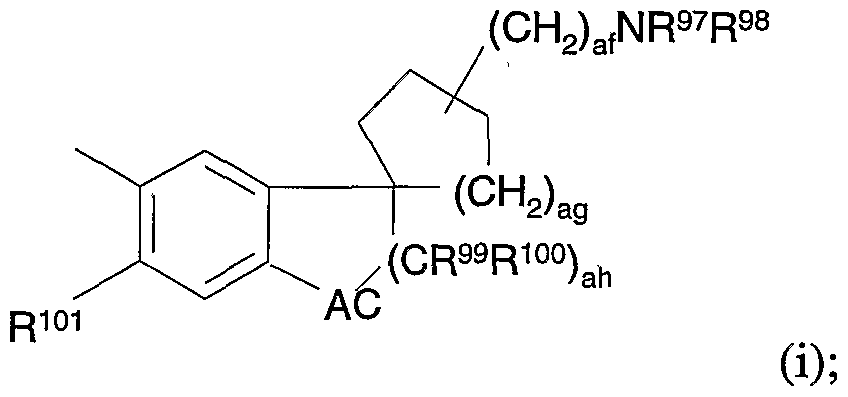
  • R 93 and R 9 4 are independently C ⁇ .galkyl; ac is 0 to 4; ad is 1, 2 or 3; ae is 0, 1 or 2; and further wherein, when Ar is (i), (ii) or (iii), and A is CONR 46 ', NHCO, or CH2NH, wherein R 4 6' is hydrogen or Cx .galkyl, alternatively, E represents a group (i): wherein:
  • R 97 and R 98 are independently hydrogen, C ⁇ .galkyl, C3_7cycloalkyl, aralkyl, or together with the nitrogen atom to which they are attached form an optionally substituted 5- to 7-membered heterocyclic ring which may contain an additional heteroatom selected from oxygen, nitrogen or sulfur, where optional substituents include C ⁇ .galkyl, aryl, CONR 102 R 103 , NR 104 R 105 , hydroxy, OCOR 106 , NHCOCF3, NHSO 2 R 107 , NHCO 2 R 108 , or NHCOC 0 -galkyl wherein the alkyl of NHCOCQ-galkyl is optionally substituted by OH; R 99 and R l00 are independently hydrogen or C ⁇ _ga ky ⁇ ;
  • AC is oxygen, CR 1 1 ⁇ R 112 or NR 113 or AC is a group S(O)ak;
  • RlO 2 Rl03 , R104 R 105, R 106, R 109 R110, R l 11, R l 12 an d Rl I 3 are independently hydrogen or O ⁇ .galkyl;
  • Rl07 and R ⁇ 0 are independently C _ga ky ⁇ ; afis O, 1, 2, 3, or 4; ag is 1, 2, or 3; ah is 1, 2, 3 or 4; ai is 2, 3 or 4; aj is O, 1, 2, or 3; and ak is 0, 1 or 2.
  • Ar is (i),(ii), or (iii).
  • Ar is (i) or (ii).
  • the terminal phenyl group in (i) and (ii) can be attached to the phenyl group bearing group A in any position.
  • the terminal phenyl ring is attached to the phenyl bearing group A in a position meta or para to group A.
  • R 1 ' and R 2 ' are independently one or more of hydrogen, C ⁇ _galkyl, C 2 _ galkenyl, C2_galkynyl, C3_7cycloalkyl, C3_gcycloalkenyl, aryl, (CH2) a NR 7 'R 8 ', (CH 2 ) a 'NR 7 'COR 9 ', (CH2) a 'NR 7 'CO2R 10 ', (CH2)a'NR 7 'SO2R n ', (CH 2 ) a !
  • R 1 ' and R 2 ' are independently one or more of hydrogen, C ⁇ _ galkyl, hydroxyC ⁇ .galkyl, COR 17 ', CONR 12 'R 13 ', CO 2 R 22 ', cyano, trifluoromethyl, NR 7 'R 8 ', NR 7 'COR 9 ', NR 2 3'C0NR 23 'R 24 ', NR 7 'SO2R n ', nitro, hydroxy, C ⁇ .galkoxy, SO2R 28 ', SO2NR 25 'R 26 ', or halogen.
  • R3' and R 4 ' are independently one or more of hydrogen, C ⁇ .galkyl, C3_7cycloalkyl, C3_gcycloalkenyl, hydroxyC ⁇ .galkyl, C ⁇ _galkylOC ⁇ . alkyl, CONR 29 'R30', CO 2 R 31 ', cyano, aryl, trifluoromethyl, NR 29 'R30', nitro, hydroxy, C ⁇ _galkoxy, acyloxy, or halogen.
  • R ⁇ ' is one or more of hydrogen, C ⁇ .galkyl, C ⁇ _galkoxy or halogen.
  • R 7 ' and R 8 ' are independently hydrogen or C ⁇ .galkyl, or together with the nitrogen to which they are attached, R 7 ' and R 8 ' form a 5- to 6-membered heterocyclic ring, which ring may optionally be substituted by an oxo group and, which, when the ring is 6-membered, may optionally contain in the ring one oxygen or sulfur atom.
  • R 9 ' is hydrogen, C ⁇ _galkyl or C _4alkoxy alkyl.
  • R 10 ' is C ⁇ .galkyl.
  • R 11 ' is C ⁇ _galkyl or phenyl.
  • R 12 ' and R* 3 ' are independently hydrogen or C ⁇ _galkyl, or together with the nitrogen to which they are attached, R 12 ' and R 13 ' form a 5- to 6- membered heterocyclic ring, which, when the ring is 6-membered, may optionally contain in the ring one oxygen or sulfur atom.
  • R 14 ' is C ⁇ _4alkyl, optionally substituted by C ⁇ _galkoxy.
  • R ⁇ ' and R 16 ' are independently hydrogen or C ⁇ _galkyl.
  • R 1 ⁇ is hydrogen or C ⁇ _galkyl.
  • R 18 ' is hydrogen or C ⁇ _galkyl.
  • R 19 ' and R 20 ' are independently hydrogen or C ⁇ _galkyl.
  • R 21 ' is hydrogen or C ⁇ .galkyl.
  • R 22 ' is hydrogen or C ⁇ .galkyl optionally substituted with one or two substituents selected from C ⁇ _galkyl, C ⁇ _galkoxy, hydroxy, or NR 7 'R 8 '.
  • R 23 ' and R 24 ' are independently hydrogen or O ⁇ .galkyl.
  • R 2 ⁇ ' and R 26 ' are independently hydrogen or C ⁇ _galkyl, or together with the nitrogen to which they are attached, R ⁇ ' and R 26 ' form a 5- to 6- membered heterocyclic ring, which, when the ring is 6-membered, may optionally contain in the ring one oxygen or sulfur atom.
  • R 27 ' is hydrogen or C ⁇ _galkyl.
  • R 28 ' is Cx .galkyl.
  • R 29 ', R 30 ' and R 31 ' are independently hydrogen or C ⁇ _galkyl.
  • R 32 ' is C x .galkyl, hydroxyC x .galkyl, or C x _4alkanoyl.
  • R 33 ' is hydrogen or C ⁇ _galkyl.
  • R34' is hydrogen or C ⁇ .galkyl.
  • R35' is hydrogen or C .galkyl.
  • R36' and R37' are independently hydrogen or C ⁇ .galkyl or together with the nitrogen to which they are attached, R36' and R37' form a 5- to 6-membered heterocyclic ring, which ring may be optionally substituted by an oxo group and, which, when the ring is 6-membered, may optionally contain one oxygen or sulfur atom or an NH group or a group NR 3', wherein R4 ' is O ⁇ .galkyl, COR44' or CO2R45', wherein R 44 ' and R 4 ⁇ ' are independently hydrogen or O ⁇ .galkyl.
  • R3 ' is hydrogen or C x .galkyl.
  • R 9 ' is C ⁇ _galkoxy, CO 2 H, CO 2 C ⁇ .galkyl or CONR 36 R 37 '.
  • R4 1 ' and R 42 ' are independently hydrogen or C ⁇ .galkyl.
  • P is a 5- to 7-membered heterocyclic ring containing 1 to 4 heteroatoms selected from oxygen, nitrogen, or sulfur
  • suitable heterocyclic rings include aromatic groups such as thienyl, furyl, pyrrolyl, triazolyl, diazolyl, imidazolyl, oxazolyl, thiazolyl, oxadiazolyl, isothiazolyl, isoxazolyl, thiadiazolyl, pyridyl, pyrimidyl, pyrazinyl, and dioxanyl.
  • Saturated and partially saturated rings are also within the scope of the invention, in particular rings including an oxo or thioxo moiety such as lactams and thiolactams.
  • the heterocyclic ring can be linked to the remainder of the molecule via a carbon atom, or, when present, a nitrogen atom.
  • Suitable substituents for these rings include one or more of R4 .
  • P is l,2,4-oxadiazol-3-yl wherein R 4 'is 5-methyl, or tetrazol-5-yl.
  • a' is 1, 2, 3 or 4.
  • b' is 0, 1, 2 or 3.
  • c' is 1, 2 or 3.
  • d' is 0, 1, 2, 3, 4, 5, or 6.
  • e' is 1, 2, 3, 4, 5 or 6.
  • substituent E is selected from the following groups:
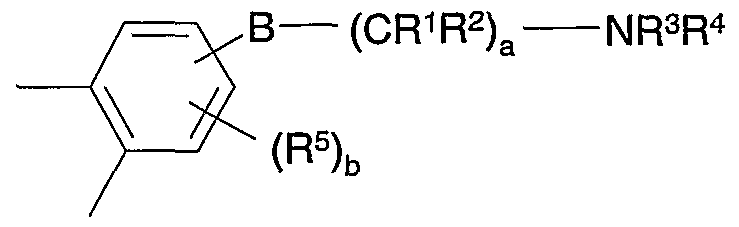
  • Ar is (i), (ii) or (iii), and A is CONR 46 ', NHCO, -NHCH 2 , or CH2NH, wherein R46' i s hydrogen or C ⁇ .galkyl, E suitably represents a group (a):
  • B is preferably CR 7 R 8 , or oxygen.
  • R 1 and R 2 are suitably independently hydrogen or C ⁇ _galkyl.
  • R 1 and R 2 are hydrogen.
  • B(CR 1 R 2 ) a is OCR 1 R 2 CR 1 (OH)CR 1 R 2 or OCR 1 R 2 CR 1 (OCOCH 3 )CR 1 R 2 .
  • B(CR!R 2 ) a is OCRiR ⁇ R ⁇ O ⁇ CRiR 2 or OCR 1 R 2 CR 1 (OCOCH 3 )CR 1 R 2
  • R 1 and R 2 are hydrogen.
  • R3 and R 4 are suitably independently hydrogen, C ⁇ .galkyl, C3_7cycloalkyl, aralkyl, or together with the nitrogen atom to which they are attached form an optionally substituted 5- to 7-membered heterocyclic ring which may contain an additional heteroatom selected from oxygen, nitrogen or sulfur, where optional substituents include C ⁇ .galkyl, aryl, CONR ⁇ R 11 , NR 10 R n , hydroxy, OCOR 12 , NHCOCF3, NHSO 2 R 13 , NHCO2R 14 , or NHCOCo-galkyl wherein the alkyl of NHCOCo-galkyl is optionally substituted by OH.
  • R 3 and R 4 are both Cx .galkyl, or together with the nitrogen atom to which they are attached form an optionally substituted 5- to 7-membered heterocyclic ring which may contain an additional heteroatom selected from oxygen, nitrogen or sulfur.
  • B-(CR 1 R 2 ) a -NR 3 R 4 is ortho to R 5 , meta to A and para to R 6 , and R ⁇ is para to A.
  • R 5 is suitably hydrogen, C ⁇ _galkyl, aryl, CN, CONR 15 R 16 , CO2R 17 , trifluoromethyl, NHCO2R 18 , hydroxy, C ⁇ _galkoxy, benzyloxy, OCH2CO 2 C ⁇ _ galkyl, OCF3, S(O)dR 19 , SO2NR 20 R 21 , or halogen.
  • R 5 is preferably C ⁇ .galkoxy, SC ⁇ _galkyl or halogen.
  • R 6 is hydrogen.
  • R 7 , R 8 , RlO, Rll, R 12 , Rl5, Rl6, R17, R20, R 21, R 22, and R 2 3 are suitably independently hydrogen or O ⁇ .galkyl.
  • R 9 is suitably hydrogen, C ⁇ .galkyl, or phenylC ⁇ . galkyl.
  • R13, R14, R18, and R 19 are suitably independently C ⁇ . galkyl.
  • a is suitably 1, 2, 3, or 4.
  • b is suitably 1 or 2.
  • b is 1.
  • c and d are suitably independently 0, 1, or 2.
  • e is suitably 2, 3, or 4.
  • f is suitably 0, 1, 2, or 3.
  • Ar is (i), (ii) or (iii), and A is CONR 46 ', NHCO, or CH2NH, wherein R 46 ' is hydrogen or C .galkyl, E suitably represents a group (b):
  • R 24 , R 25 , R 26 , R 27 , R 28 , R 29 , R 31 , and R 32 are suitably independently hydrogen or C ⁇ .galkyl.
  • R 24 , R 25 , R 26 , R 27 , R 28 , R 29 , R 31 , and R 32 are preferably hydrogen.
  • R 0 is suitably hydrogen, O ⁇ .galkyl, or C3_7cycloalkyl.
  • R30 is Cx .galkyl or C3_7cycloalkyl.
  • R3 is suitably hydrogen, C ⁇ _galkyl, trifluoromethyl, hydroxy or halogen, or R33 and R 46 ' together form a group -K- where K is (CR 34 R35) i or K is (CR34R35)J .
  • R33 is hydrogen.
  • J is suitably oxygen, CR36R37, or NR3 8 , or J is a group S(O) ⁇ ⁇ .
  • J is oxygen.
  • J is para to A.
  • R 4, R 5, R36, R37, R38 are suitably independently hydrogen or C ⁇ _galkyl.
  • g is suitably 1, 2, or 3.
  • h is suitably 1, 2, or 3.
  • h is 1.
  • i is suitably 2, 3, or 4.
  • j is suitably 0, 1, 2, or 3.
  • k is suitably 0, 1 or 2.
  • Ar is (i), (ii) or (iii), and A is CONR 46 ', NHCO, -
  • E suitably represents a group (f):
  • R ⁇ 7 and R ⁇ 8 are independently hydrogen or O ⁇ .galkyl; suitably R ⁇ 9 and R 60 are independently hydrogen, C ⁇ _galkyl, C3_7cycloalkyl, aralkyl, or together with the nitrogen atom to which they are attached form an optionally substituted 5- to 7-membered heterocyclic ring which may contain an additional heteroatom selected from oxygen, nitrogen or sulfur, where optional substituents include C ⁇ .galkyl, aryl, CONR 61 R 62 , NR 61 R 62 , hydroxy, OCOR 63 , NHCOCF3, NHSO 2 R 64 , NHCO R 65 or NHCOC 0 .galkyl wherein the alkyl of NHCOCo-galkyl is optionally substituted by OH, and wherein R 61 , R 62 , and R 63 are independently hydrogen or Cx .galkyl, and R 6 4 and R 6 ⁇ are independently C .galkyl; suitably, T is -(
  • R 71 is an optionally substituted 5- to 7-membered saturated or partially saturated heterocyclic ring containing a nitrogen atom and optionally a further one or two heteroatoms selected from nitrogen, oxygen or sulfur, or R 7 is an optionally substituted 6,6 or 6,5-bicyclic ring system containing a nitrogen atom and optionally a further heteroatom selected from oxygen, nitrogen or sulfur, which ring systems may be optionally substituted with one or more of C .galkyl, and substituted on nitrogen with hydrogen, C .galkyl, or C3_7cycloalkyl.
  • R 71 is an optionally substituted 5- or 6-membered saturated or partially saturated heterocyclic ring containing a nitrogen atom and is substituted on nitrogen with C ⁇ _ galkyl or C3_7cycloalkyl.
  • R 1 is preferably located meta to A, ortho to R 72 and para to R 73 , and R 72 is located para to A.
  • R 72 is hydrogen, C ⁇ .galkyl, aryl, CN, CONR 74 R 75 , CO 2 R 76 , trifluoromethyl, NHCO2R 77 , hydroxy, C ⁇ .galkoxy, benzyloxy, OCH2C ⁇ 2C ⁇ _ galkyl, OCF3, S(O) z R 78 , SO 2 NR 79 R 80 , or halogen wherein R 74 , R 75 , R 76 , R 79 and R 80 are independently hydrogen or C ⁇ .galkyl, R 77 and R 78 are C ⁇ _galkyl, and z is 0, 1, or 2.
  • R 72 is preferably C ⁇ _galkoxy, SO ⁇ .galkyl or halogen.
  • R 73 is hydrogen.
  • y is an integer from 1-2. Preferably, y is 1.
  • Ar is (i), (ii) or (iii), and A is CONR 6 ', NHCO, or CH2NH, wherein R4 6 ' is hydrogen or C ⁇ .galkyl
  • E suitably represents a group (h):
  • Ar is (i), (ii) or (iii), and A is CONR 46 ', NHCO, or CH 2 NH, wherein R 46 ' is hydrogen or C ⁇ .galkyl, E suitably represents a group (i):
  • OCOR 106 NHCOCF3, NHSO 2 R 107 , NHCO 2 R 108 , or NHCOC 0 .galkyl wherein the alkyl of NHCOCo-galkyl is optionally substituted by OH, and wherein R 102 , R103, R104 R105 and R 106 are independently hydrogen or C ⁇ _galkyl, and R 107 and R 108 are independently Cl-6alkyl; suitably, R 99 and R 00 are independently hydrogen or C ⁇ .galkyl; suitably, AC is oxygen, CR 1 !
  • R111 , R112 a d R 113 are independently hydrogen or C ⁇ _galkyl or AC is a group S(O)ak wherein ak is 0, 1 or 2; suitably, ag is an integer from 1-3, ah is an integer from 1-4, and af is 0-4.
  • A is CONR 46 ', NHCO, or CH 2 NH, wherein R 46 ' is hydrogen. More preferably, A is CONR4 6 ' or NHCO, wherein R4 ' is hydrogen. Most preferably, A is CONR 46 ', wherein R 46 ' is hydrogen.
  • Ar is (i), (ii), or (iii)
  • E represents group (a), (b), or (g). More preferably, when Ar is (i), (ii) or (iii), E represents group (g).
  • E represents group (g). More preferably, when Ar is (i) or (ii), the terminal phenyl in (i) and (ii) is attached to the phenyl ring bearing group A in a position para to group A.
  • R 1 ' and R 2 ' are independently one or more of hydrogen, methyl, hydroxymethyl, acetyl, carbamoyl, ethoxycarbonyl, cyano, trifluoromethyl, amino, methylamino, butylamino, dimethylamino, acetamido, uriedo, (dimethylamino)carbonylamino, methanesulfonamido, nitro, hydroxy, methoxy, ethoxy, isopropoxy, methanesulfonyl, sulfamoyl, chloro or fluoro.
  • A is attached to group (a) meta to B- (CR 1 R 2 ) a -NR 3 R 4 and para to (R 5 )b, wherein B is oxygen or CR 7 R 8 , R 1 and R 2 are hydrogen, R ⁇ is methoxy, methylthio or iodo, R3 and R 4 are independently C3_ galkyl, or R3 and R 4 taken together with the nitrogen to which they are attached form a 5- or 6-membered heterocyclic ring optionally substituted with one or more of O ⁇ .galkyl and acetamido or hydroxyl, R 6 is hydrogen, a is 2 or 3 when B is oxygen and a is 2 when B is CH2, and b is 1.
  • A is attached to group (a) meta to B- (CR 1 R 2 ) a -NR 3 R 4 and para to (R 5 )b, wherein B is oxygen or CH2, R 1 and R 2 are hydrogen, R is methoxy, R3 and R 4 are independently isopropyl or tert-butyl, or R3 and R 4 taken together with the nitrogen to which they are attached are 1 -(2,2,6,6- tetramethylpiperidinyl), l-(4-acetamido-2,2,6,6-tetramethyl piperidinyl), l-(4- hydroxy-2,2,6,6-tetramethyl piperidinyl) or l-(4-hydroxy-2,2,4,6,6- (pentamethyl)piperidinyl), R 6 is hydrogen, a is 2 when B is oxygen, and b is 1.
  • E is group (b) A is attached to group (b) para to J, J is oxygen, R 33 is hydrogen, R 24 , R 5, R26, R27, R28, R29, R31 and R 32 are hydrogen, R 30 is C3_galkyl, g is 2 and h is 1.
  • R 3 3 is hydrogen, R 24 , R 2 5, R26, R27, R28, R29, R31 and R 32 are hydrogen, R3° is isopropyl, g is 2 and h is 1.
  • R 71 is an optionally substituted 5- or 6-membered saturated or partially saturated heterocyclic ring containing a nitrogen atom and substituted on nitrogen with C3_galkyl or C3_7cycloalkyl
  • R 72 is methoxy, methylthio or iodo
  • y is 1
  • R 7 3 is hydrogen.
  • E is group (g)
  • A is attached to group (g) meta to R 71 and para to R 72 wherein R 71 is piperidin-4-yl, l,2,3,6-tetrahydropyridin-4-yl, or pyrrolidin-3-yl substituted on nitrogen with isopropyl, 3-pentyl, cyclopropyl, or cyclopentyl, R 72 is methoxy, y is 1, and R 7 3 is hydrogen.
  • a particularly effective subgenus of compounds of formula (I) is wherein: Ar is (i) or (ii), E is group (g), and A is CONR4 6 ' and R4 ' is hydrogen, and further wherein, A is attached to group (g) meta to R 71 and para to R 72 , and wherein R 71 is piperidin-4-yl, l,2,3,6-tetrahydropyridin-4-yl, or pyrrolidin-3-yl substituted on nitrogen with isopropyl, 3-pentyl, cyclopropyl, or cyclopentyl, R 72 is methoxy, y is 1, and R 7 3 is hydrogen.
  • acyloxy is used herein at all occurrences to mean a moiety -O-C(O)-R, wherein R is hydrogen or C ⁇ _galkyl as defined below.
  • C ⁇ _4alkanoyl is used herein at all occurrences to mean a - C(O)C ⁇ -4alkyl group wherein the alkyl portion is as defined below.
  • alkenyl is used herein at all occurrences to mean a straight or branched chain radical of 2 to 6 carbon atoms, unless the length is limited thereto, wherein there is at least one double bond between two of the carbon atoms in the chain, including, but not limited to, ethenyl, 1-propenyl, 2-propenyl, 2-methyl-l- propenyl, 1-butenyl, 2-butenyl, and the like.
  • alkoxy is used herein at all occurrences to mean a straight or branched chain radical of 1 to 6 carbon atoms, unless the chain length is limited thereto, bonded to an oxygen atom, including, but not limited to, methoxy, ethoxy, n- propoxy, isopropoxy, and the like.
  • C ⁇ .galkoxyC ⁇ .galkoxy is used herein at all occurrences to mean an alkoxy group as defined above, substituted with an alkoxy group as defined above.
  • C ⁇ _4alkoxy alkyl is used herein at all occurrences to mean a C ⁇ _
  • C ⁇ .galkyl is used herein at all occurrences to mean a straight or branched chain radical of 1 to 6 carbon atoms, unless the chain length is limited thereto, including, but not limited to, methyl, ethyl, n-propyl, isopropyl, n-butyl, sec- butyl, isobutyl, tert-butyl, and the like.
  • alkynyl is used herein at all occurrences to mean a straight or branched chain radical of 2 to 8 carbon atoms, unless the chain length is limited thereto, wherein there is at least one triple bond between two of the carbon atoms in the chain, including, but not limited to, acetylene, 1- propylene, 2-propylene, and the like.
  • aralkyl is used herein at all occurrences to mean an aryl moiety as defined above, which is connected to an alkyl moiety as defined below, including, but not limited to, benzyl or phenethyl, and the like.
  • aryl is used herein at all occurrences to mean a 6-14-membered substituted or unsubstituted aromatic ring(s) or ring systems which may include bi- or tri-cyclic systems, including, but not limited to, phenyl, naphthalenyl, biphenyl, phenanthryl, anthracenyl, and the like.
  • 6,6 or 6,5 bicyclic ring is used herein at all occurrences to mean a 6,6 or 6,5-bicyclic ring system containing a nitrogen atom and optionally a further heteroatom selected from nitrogen, oxygen, or sulfur, which ring system may be optionally substituted with C ⁇ _galkyl.
  • ring systems include, but are not limited to, tropane, isoquinuclidine and granatane rings.
  • cycloalkenyl is used herein at all occurrences to mean cyclic radicals, preferably of 5 to 8 carbons, which have at least one double bond between two of the carbon atoms in the ring, including but not limited to, cyclopentenyl, cyclohexenyl, and the like.
  • cycloalkyl and “cyclic alkyl” are used herein at all occurrences to mean cyclic radicals, preferably comprising 3 to 7 carbon atoms which may be mono- or bicyclo- fused ring systems which may additionally include unsaturation, including, but not limited to, cyclopropyl, cyclopentyl, cyclohexyl, 1,2,3,4- tetrahydronaphthalenyl, and the like.
  • halo or halogen are used interchangeably herein at all occurrences to mean radicals derived from the elements chlorine, fluorine, iodine and bromine.
  • heteroaryl is used herein at all occurrences to mean a 5-14- membered substituted or unsubstituted aromatic ring(s) or ring systems which may include bi- or tri-cyclic systems, which ring or ring systems contain 1 to 4 heteroatoms selected from nitrogen, oxygen, and sulfur, including, but not limited to, indolyl, benzofuranyl, thianaphthenyl, quinolyl, isoquinolyl, pyrrolyl, furanyl, thienyl, pyridyl, and the like.
  • hydroxyC ⁇ _galkoxy is used herein at all occurrences to mean an hydroxyl group bonded to an alkoxy group as defined above, including, but not limited to, -O-CH 2 -CH(OH)CH 3 and the like.
  • hydroxyC ⁇ .galkyl and "hydroxyalkyl” are used herein interchangeably to mean an hydroxyl group bonded to a C .galkyl group as defined above, including, but not limited to, methanol, ethanol, n-propanol, isopropanol, n- butanol, sec-butanol, isobutanol, tert-butanol, and the like.
  • heterocyclic ring is used herein at all occurrences to mean a saturated or, wholly or partially saturated, 5-10-membered ring system (unless the cyclic ring system is otherwise limited) wherein the ring system contains one to 3 heteroatoms selected from oxygen, sulfur, or nitrogen, which ring system may be optionally substituted with C ⁇ _ galkyl.
  • examples of such rings include, but are not limited to, piperidine, tetrahydropyridine, and piperazine, pyrrolidine, piperidine, morpholine, imidazolidine, pyrazolidine, hexahydroazepine, tropane, isoquinuclidine, granatane, and the like.
  • heterocyclic ring When the heterocyclic ring is fused to a phenyl group, as when E is the group (h), the term "heterocyclic ring", together with the phenyl ring to which it is fused, forms a ring which includes, but is not limited to, dihydro-l,4-benzoxazine, 1,2,3,4-tetrahydroquinoline, 1,2,3,6-tetrahydropyridine, and hexahydroazepine, which may be optionally substituted by O ⁇ .galkyl or oxo.
  • heteroatom is used herein at all occurrences to mean an oxygen atom, a sulfur atom or a nitrogen atom. It will be recognized that when the heteroatom is nitrogen, it may form an NR a or NR a b moiety, wherein R a and Rb are, independently, hydrogen or Ci to Cg alkyl, or together with the nitrogen to which they are bound, form a saturated or unsaturated 5-, 6- or 7-membered ring, including, but not limited to, pyrrolidine, piperidine, piperazine, morpholine, pyridine, and the like. It will be recognized that the saturated or unsaturated 5-, 6- or 7-membered ring may optionally have one or more additional heteroatoms in the ring.
  • optionally substituted is used herein at all occurrences to mean an optionally substituted 5- to 7-membered heterocyclic ring wherein the optional substituents are one or more of C .galkyl.
  • CCR5 mediated disease state is used herein at all occurrences to mean any disease state which is mediated (or modulated) by CCR5.
  • pharmaceutically acceptable salts of formula (I) include, but are not limited to, salts with inorganic acids such as hydrochloride, sulfate, phosphate, diphosphate, hydrobromide, and nitrate, or salts with an organic acid such as malate, maleate, fumarate, tartrate, succinate, citrate, acetate, lactate, methanesulfonate, p- toluenesulfonate, palmitate, salicylate, and stearate.
  • inorganic acids such as hydrochloride, sulfate, phosphate, diphosphate, hydrobromide, and nitrate
  • an organic acid such as malate, maleate, fumarate, tartrate, succinate, citrate, acetate, lactate, methanesulfonate, p- toluenesulfonate, palmitate, salicylate, and stearate.
  • the compounds of the invention can exist in unsolvated as well as solvated forms, including hydrated forms.
  • the solvated forms with pharmaceutically acceptable solvents such as water, ethanol, and the like, are equivalent to the unsolvated forms for purposes of this invention.
  • the compounds of the present invention may contain one or more asymmetric carbon atoms and may exist in racemic and optically active forms.
  • the stereocenters may be of any combination of R and S configuration, for example, (R,R), (R,S), (S,S) or (S,R). All of these compounds are within the scope of the present invention.
  • the preferred compounds of the invention are the following compounds:
  • the pharmaceutically effective compounds of this invention are administered in conventional dosage forms prepared by combining a compound of formula (I) ("active ingredient”) in an amount sufficient to treat COPD, asthma and atopic disorders (for example, atopic dermatitis and allergies), rheumatoid arthritis, sarcoidosis, or idiopathic pulmonary fibrosis and other fibrotic diseases, atherosclerosis, psoriasis, autoimmune diseases such as multiple sclerosis, treating and/or preventing rejection of transplanted organs, inflammatory bowel disease, and HIV infection, ("CCR5-mediated disease states”) with standard pharmaceutical carriers or diluents according to conventional procedures well known in the art.
  • atopic disorders for example, atopic dermatitis and allergies
  • sarcoidosis for example, atopic dermatitis and allergies
  • idiopathic pulmonary fibrosis and other fibrotic diseases for example, atherosclerosis, psoriasis, autoimmune diseases such as multiple sclerosis
  • the pharmaceutical carrier employed may be, for example, either a solid or liquid.
  • solid carriers are lactose, terra alba, sucrose, talc, gelatin, agar, pectin, acacia, magnesium stearate, stearic acid and the like.
  • liquid carriers are syrup, peanut oil, olive oil, water and the like.
  • the carrier or diluent may include time delay material well known to the art, such as glyceryl monostearate or glyceryl distearate alone or with a wax.
  • the preparation can be tableted, placed in a hard gelatin capsule in powder or pellet form or in the form of a troche or lozenge.
  • the amount of solid carrier will vary widely but preferably will be from about 25 mg to about 1000 mg.
  • the preparation will be in the form of a syrup, emulsion, soft gelatin capsule, sterile injectable liquid such as an ampule or nonaqueous liquid suspension.
  • the active ingredient may also be administered topically to a mammal in need of treatment or prophylaxis of CCR5 mediated disease states.
  • the amount of active ingredient required for therapeutic effect on topical administration will, of course, vary with the compound chosen, the nature and severity of the disease state being treated and the mammal undergoing treatment, and is ultimately at the discretion of the physician.
  • a suitable dose of an active ingredient is 1.5 mg to 500 mg for topical administration, the most preferred dosage being 1 mg to 100 mg, for example 5 to 25 mg administered two or three times daily.
  • topical administration non-systemic administration and includes the application of the active ingredient externally to the epidermis, to the buccal cavity and instillation of such a compound into the ear, eye and nose, and where the compound does not significantly enter the blood stream.
  • systemic administration is meant oral, intravenous, intraperitoneal and intramuscular administration.
  • an active ingredient may be administered alone as the raw chemical, it is preferable to present it as a pharmaceutical formulation.
  • the active ingredient may comprise, for topical administration, from 0.001% to 10% w/w, e.g. from 1% to 2% by weight of the formulation although it may comprise as much as 10% w/w but preferably not in excess of 5% w/w and more preferably from 0.1% to 1% w/w of the formulation.
  • the topical formulations of the present invention both for veterinary and for human medical use, comprise an active ingredient together with one or more acceptable carrier(s) therefor and optionally any other therapeutic ingredient(s).
  • the carrier(s) must be 'acceptable' in the sense of being compatible with the other ingredients of the formulation and not deleterious to the recipient thereof.
  • Formulations suitable for topical administration include liquid or semi-liquid preparations suitable for penetration through the skin to the site of inflammation such as liniments, lotions, creams, ointments or pastes, and drops suitable for administration to the eye, ear or nose
  • Drops according to the present invention may comprise sterile aqueous or oily solutions or suspensions and may be prepared by dissolving the active ingredient in a suitable aqueous or alcoholic solution of a bactericidal and/or fungicidal agent and/or any other suitable preservative, and preferably including a surface active agent.
  • the resulting solution may then be clarified by filtration, transferred to a suitable container which is then sealed and sterilized by autoclaving or maintaining at 98-100°C for half an hour.
  • the solution may be sterilized by filtration and transferred to the container by an aseptic technique.
  • bactericidal and fungicidal agents suitable for inclusion in the drops are phenylmercuric nitrate or acetate (0.002%), benzalkonium chloride (0.01%) and chlorhexidine acetate (0.01%).
  • Suitable solvents for the preparation of an oily solution include glycerol, diluted alcohol and propylene glycol.
  • Lotions according to the present invention include those suitable for application to the skin or eye.
  • An eye lotion may comprise a sterile aqueous solution optionally containing a bactericide and may be prepared by methods similar to those for the preparation of drops.
  • Lotions or liniments for application to the skin may also include an agent to hasten drying and to cool the skin, such as an alcohol or acetone, and/or a moisturizer such as glycerol or an oil such as castor oil or arachis oil.
  • Creams, ointments or pastes according to the present invention are semi-solid formulations of the active ingredient for external application.
  • the basis may comprise hydrocarbons such as hard, soft or liquid paraffin, glycerol, beeswax, a metallic soap; a mucilage; an oil of natural origin such as almond, corn, arachis, castor or olive oil; wool fat or its derivatives, or a fatty acid such as stearic or oleic acid together with an alcohol such as propylene glycol.
  • the formulation may incorporate any suitable surface active agent such as an anionic, cationic or non-ionic surfactant such as esters or polyoxyethylene derivatives thereof.
  • suitable surface active agent such as an anionic, cationic or non-ionic surfactant such as esters or polyoxyethylene derivatives thereof.
  • Suspending agents such as natural gums, cellulose derivatives or inorganic materials such as silicaceous silicas, and other ingredients such as lanolin, may also be included.
  • the active ingredient may also be administered by inhalation.
  • inhalation is meant intranasal and oral inhalation administration.
  • Appropriate dosage forms for such administration such as an aerosol formulation or a metered dose inhaler, may be prepared by conventional techniques.
  • the daily dosage amount of the active ingredient administered by inhalation is from about 0.1 mg to about 100 mg per day, preferably about 1 mg to about 10 mg per day.
  • this invention relates to a method of treating COPD, asthma and atopic disorders (for example, atopic dermatitis and allergies), rheumatoid arthritis, sarcoidosis, or idiopathic pulmonary fibrosis and other fibrotic diseases, atherosclerosis, psoriasis, autoimmune diseases such as multiple sclerosis, treating and/or preventing rejection of transplanted organs, inflammatory bowel disease, and HIV infection, all in mammals, preferably humans, which comprises administering to such mammal an effective amount of a CCR5 receptor modulator, in particular, a compound as depicted in formula (I).
  • treating is meant either prophylactic or therapeutic therapy.
  • Such formula (I) compound can be administered to such mammal in a conventional dosage form prepared by combining the formula (I) compound with a conventional pharmaceutically acceptable carrier or diluent according to known techniques. It will be recognized by one of skill in the art that the form and character of the pharmaceutically acceptable carrier or diluent is dictated by the amount of active ingredient with which it is to be combined, the route of administration and other well-known variables.
  • the formula (I) compound is administered to a mammal in need of treatment for COPD, asthma and atopic disorders (for example, atopic dermatitis and allergies), rheumatoid arthritis, sarcoidosis, or idiopathic pulmonary fibrosis and other fibrotic diseases, atherosclerosis, psoriasis, autoimmune diseases such as multiple sclerosis, treating and/or preventing rejection of transplanted organs, inflammatory bowel disease, and HIV infection, in an amount sufficient to decrease symptoms associated with these disease states.
  • the route of administration may be oral or parenteral.
  • the invention relates to a method for modulating factors which exacerbate the symptoms of the CCR5-mediated diseases described herein.
  • parenteral as used herein includes intravenous, intramuscular, subcutaneous, intra-rectal, intravaginal or intraperitoneal administration.
  • the subcutaneous and intramuscular forms of parenteral administration are generally preferred.
  • the daily parenteral dosage regimen will preferably be from about 30 mg to about 300 mg per day of active ingredient.
  • the daily oral dosage regimen will preferably be from about 100 mg to about 2000 mg per day of active ingredient. It will be recognized by one of skill in the art that the optimal quantity and spacing of individual dosages of a formula (I) compound will be determined by the nature and extent of the condition being treated, the form, route and site of administration, and the particular mammal being treated, and that such optimums can be determined by conventional techniques.
  • the compounds of formula (I) can be prepared by art-recognized procedures from known or commercially available starting materials. If the starting materials are unavailable from a commercial source, their synthesis is described herein, or they can be prepared by procedures known in the art.
  • compounds of formula (I) wherein A is NR 46 ' are synthesized from an appropriately substituted benzoic acid, for example 1-1, and an appropriately substituted aniline 1-2 by treatment with a suitable coupling reagent, for example benzotriazol-1- yloxytris(dimethylamino)phosphonium hexafluorophosphate, and a suitable base, for example dusopropylethylamine, in a suitable solvent, for example acetonitrile, to afford the title compound 1-3.
  • a suitable coupling reagent for example benzotriazol-1- yloxytris(dimethylamino)phosphonium hexafluorophosphate
  • a suitable base for example dusopropylethylamine
  • a suitable solvent for example acetonitrile
  • E is a group of formula (i) are prepared according to the methods of international application publication number WO 97/19070 published 29 May 1997.
  • Nitric acid (70%, 3.1 mL) was added portionwise to a solution of the compound of Preparation 1(d) (5.0 g, 17 mmol) in acetic anhydride (17 mL) at 0°C.
  • the mixture was maintained at 0°C for an additional 30 min, combined with an identical concurrently run reaction, and poured into water (600 mL).
  • the pH of the resultant mixture was adjusted to >9 by the addition of aqueous sodium carbonate followed by 10% sodium hydroxide.
  • Preparation 6 Preparation of 3-r 2,3,6-Tetrahydro-l-(l-methylethyl)-4-pyridinyl]-4- methoxyaniline a) l,2,3,6-tetrahydro-4-(2-methoxyphenyl)-l-(trifluoroacetyl)piperidine Following the general procedure of Preparation 1(d), except substituting the compound of Preparation 1(b) for the compound of Preparation 1(c), gave the title compound. b) 1 ,2,3,6-tetrahydro-4-(2-methoxy-5-nitrophenyl)-l- (trifluoroacetyl)piperidine
  • Preparation 7 Preparation of 3-lT-(l -Methylethy l)-3 -pyrrolidinyll -4-methoxyaniline a) l-benzyl-3-hydroxy-3-(2-methoxyphenyl)pyrrolidine Following the general procedure of Preparation 1(a), except substituting 1- benzyl-3-pyrrolidinone for tert-butyl 4-oxo-l-piperidinecarboxylate, gave the title compound. MS(ES) m/e 284.2 [M+H]+.
  • Examples 10-53 A mixture of a solution of the compound of Preparation 2 in dimethylformamide (0.188M, 0.8 mL, 0.15 mmol), a solution of an appropriately substituted aryl bromide in dimethylformamide (IM, 0.3 mL.
  • CCR5 Receptor Binding Assay CHO cell membranes (0.25 xlO 6 cell equivalents) derived from CHO cells stably transfected with CCR5 were incubated with 0.3 125 I-RANTES in a 96 well plate for 45 min. at room temperature (final reaction volume 200 ul). The reaction was terminated by filtration and the filters (GF/C) were washed twelve times with a solution of phosphate buffered saline containing 0.1 % bovine serum albumin and 0.05 % NaN3. The radioactivity bound to filters was measured by liquid scintillation spectrometry. Non-specific binding was determined in the presence of unlabelled RANTES (10 or 30 nM) and averages 30-50% of total binding.
  • CCR5 Receptor Functional Assay CHO cell membranes (0.25 xlO 6 cell equivalents) derived from CHO cells stably transfected with CCR5 were incubated with 0.3 125 I-RANTES in a 96 well plate for 45 min
  • the cellular functional assay used to assess antagonist activity of compounds was RANTES -induced Ca 2+ mobilization in RBL 2H3 cells stably expressing the hCCR5 receptor (RBL 2H3 hCCR5).
  • Agonist activity is determined by Ca 2 + mobilization in the same cells which is inhibitable by a selective CCR5 antagonist.
  • Cells were grown to 80-100% confluency in T-150 flasks and washed with phosphate-buffered saline. Cells were lifted from the flasks by treating with 3 mL of 1 mM EDTA for 3 min.
  • the percent of maximal RANTES -induced Ca + was determined for each concentration of antagonist and the IC50 defined as the concentration of test compound that inhibits 50% of the maximal 33 nM RANTES response, obtained from the concentration-response curves (5-7 concentrations of antagonists).
  • the compounds of this invention show CCR5 receptor modulator activity having IC50 values in the range of 0.0001 to 100 ⁇ M.
  • the full structure/activity relationship has not yet been established for the compounds of this invention.
  • one of ordinary skill in the art can utilize the present assays in order to determine which compounds of formula (I) are modulators of the CCR5 receptor and which bind thereto with an IC50 value in the range of 0.0001 to 100 ⁇ M.
  • All publications, including, but not limited to, patents and patent applications cited in this specification are herein incorporated by reference as if each individual publication were specifically and individually indicated to be incorporated by reference herein as though fully set forth. The above description fully discloses the invention including preferred embodiments thereof.

Landscapes

  • Chemical & Material Sciences (AREA)
  • Organic Chemistry (AREA)
  • Pharmaceuticals Containing Other Organic And Inorganic Compounds (AREA)
  • Acyclic And Carbocyclic Compounds In Medicinal Compositions (AREA)
  • Hydrogenated Pyridines (AREA)

Abstract

This invention relates to substituted benzanilides which are modulators, agonists or antagonists, of the CCR5 receptor. In addition, this invention relates to the treatment and prevention of disease states mediated by CCR5, including, but not limited to, asthma and atopic disorders (for example, atopic dermatitis and allergies), rheumatoid arthritis, sarcoidosis and other fibrotic diseases, atherosclerosis, psoriasis, autoimmune diseases such as multiple sclerosis, and inflammatory bowel disease, all in mammals, by the use of substituted benzanilides which are CCR5 receptor antagonists. Furthermore, since CD8+ T cells have been implicated in COPD, CCR5 may play a role in their recruitment and therefore antagonists to CCR5 could provide potential therapeutic in the treatment of COPD. Also, since CCR5 is a co-receptor for the entry of HIV into cells, selective receptor modulators may be useful in the treatment of HIV infection.

Description

SUBSTITUTED BENZANILIDES AS MODULATORS OF THE
CCR5 RECEPTOR
FIELD OF THE INVENTION
This invention relates to substituted benzanilides which are modulators, agonists or antagonists, of the CC chemokine receptor CC-CKR5 now designated as CCR5 (Nature Medicine 1996, 2, 1174-8). In addition, this invention relates to the treatment and prevention of disease states mediated by CCR5.
BACKGROUND OF THE INVENTION
T cells are not only key regulators of the immune response to infectious agents but are believed critical for the initiation and maintenance of the inflammatory reaction in a variety of chronic diseases. Increased numbers or enhanced activation state of T cells, especially CD4+ T cells, have been demonstrated in the synovium of individuals with rheumatoid arthritis (M. J. Elliott and R. N. Maini, Int. Arch. Allergy Immunol. 104: 112-1125, 1994), in the bronchial mucosa of asthmatics (C.J. Corrigan and A.B. Kay, Immunol. Today 13:501-506, 1992), in the lesions of multiple sclerosis (R. Martin and H. F. McFarland, Crit. Rev. Clin. Lab. Sci. 32: 121-182, 1995), in psoriatic lesions (J.L. Jones, J. Berth-Jqne, A. Fletcher and P.E. Hutchinson, J. Pathol. 174: 77-82, 1994) and in the fatty streaks of atherosclerosis (R. Ross, Annu. Rev. Physiol. 57: 791-804, 1995).
T cells, as well as other inflammatory cells, will migrate into tissues in response to the production of a variety of chemotactic factors. Among these factors are a superfamily of 8-12 kDa proteins known as the chemokines. These proteins share structural features such as the presence of 3-4 conserved cysteine residues. RANTES, which stands for Regulated upon Activation Normal T cell Expressed and Secreted, is an 8 kDa protein member of CC branch of the chemokine family. These proteins recruit and activate immune and inflammatory cells through an interaction with G-protein coupled receptors. The CC branch is defined by the absence of an intervening amino acid residue between the first two cysteine residues and members of this family predominately elicit the migration of mononuclear cells, eosinophils and basophils (M. Baggiolini, B. Dewald, and B. Moser, Adv. Immunol. 55: 97-179, 1994; and J.J. Oppenheim, C.O.C. Zachariae, N. Mukaida, and K. Matsushima, Annu. Rev. Immunol. 9: 617-648, 1991). RANTES potently produces chemotaxis of T cells, basophils, eosinophils, monocytes and mast cells. RANTES was originally identified as gene product induced late after antigen activation of T-cells (TJ. Schall, J. Jongstra, BJ. Dyer, J. Jorgensen, et al., J. Immunol. 141:1018-1025, 1988), however, RANTES has been shown to be synthesized and secreted by a diverse group of cells that include epithelial and endothelial cells (C. Stellato, L.A. Beck, G.A. Gorgone, D. Proud, et al., J. Immunol. 155: 410-418, 1995; and A. Marfaing-Koka, O. Devergne, G. Gorgone, A. Portier, et al., J. Immunol. 154: 1870-1878, 1994), synovial fibroblasts (P. Rathanaswami, M. Hachicha, M. Sadick, T J. Schall, et al., J. Biol. Chem. 268: 5834-5839, 1993) and dermal fibroblasts (M. Sticherling, M. Kupper, F. Koltrowitz, E. Bornscheuer, et al., (J. Invest. Dermatol. 105: 585-591, 1995), mesangial cells (G. Wolf, S. Aberle, F. Thaiss, et al., Kidney Int. 44: 795-804, 1994) and platelets (Y. Koameyoshi, A. Dorschner, A.I. Mallet, E. Christophers, et al., J. Exp. Med. 176: 587-592, 1992). In these cells, RANTES mRNA is rapidly upregulated in response to IL-1 or TNFv Although RANTES mRNA is not usually detected in normal tissues (J.M. Pattison, P J. Nelson, and A.M. Krensky, Clin. Immunother. 4: 1- 1995), increased mRNA or protein has been found in diseases characterized by a mononuclear infiltrate. For example, RANTES mRNA was visualized using in situ hybridization in renal allografts undergoing rejection (J.M. Pattison, P J. Nelson, and A.M. Krensky, Clin. Immunother. 4: 1-8, 1995; and K.C. Nadeau, H. Azuma and N.I. Tilney, Proc. Natl. Acad. USA 92: 8729-8733, 1995) in the skin of atopic dermatitis patients after exposure to antigen (S. Ying, L. Taborda-Barata, Q. Meng, M. Humbert, et al., J. Exp. Med. 181: 2153-2159, 1995), and in endothelial cells of coronary arteries undergoing accelerated atherosclerosis after cardiac transplant (J.M. Pattison, P.J. Nelson, and A.M. Krensky, Clin. Immunother. 4: 1-8, 1995). Further, increased immunoreactive protein for RANTES has been detected in bronchoalveolar lavage fluid (R. Alam, J. York, M. Boyers, et al., Am. J. Resp. Crit. Care Med. 149: A951, 1994) and sputum from asthmatic individuals (CM. Gelder, P.S. Thomas, D.H. Yates, I.M. Adcock, et al., Thorax 50: 1033-1037, 1995). Several receptors have been identified that bind RANTES. In particular,
CCR5, when expressed in either HEK 293 cells or CHO cells, binds RANTES. This receptor is expressed in T-cells and in monocytes and macrophages, immune/inflammatory cells that are important in the maintenance of a chronic inflammatory reaction. Pharmacological characterization of CCR5 indicates similarities to the RANTES binding site observed on isolated T cells. Therefore, antagonism of RANTES' action on CCR5, as well as antagonism of other natural modulators of CCR5, should inhibit the recruitment and activation of T cells and macrophages into inflammatory lesions and provide a novel therapeutic approach for the treatment of atopic and autoimmune disorders.
Since T cells express CCR5, selective receptor modulators of CCR5, particularly antagonists, are likely to provide beneficial effects in diseases including, but not limited to, asthma and atopic disorders (for example, atopic dermatitis and allergies), rheumatoid arthritis, sarcoidosis, or idiopathic pulmonary fibrosis and other fibrotic diseases, atherosclerosis, psoriasis, autoimmune diseases such as multiple sclerosis, treating and/or preventing rejection of transplanted organs, and inflammatory bowel disease, all in mammals, preferably humans. Furthermore, since CD8+ T cells have been implicated in chronic obstructive pulmonary disease (COPD), CCR5 may play a role in their recruitment and therefore antagonists to CCR5 could provide potential therapeutic in the treatment of COPD. Also, since CCR5 is a co-receptor for the entry of HIV into cells, selective receptor modulators may be useful in the treatment of HIV infection. A subset of compounds included in formula (I) have been reported to have 5-HT receptor activity (international application publication number WO 95/15954, published 15 June 1995, international application publication number WO 95/17398, published 29 June 1995, international application publication number WO 95/26328, published 5 October 1995, international application publication number WO 96/06079, published 29 February 1996, GB 2276161 published 21 September 1994, and GB 2276165 published 21 September 1994; international application publication number WO 95/30675 published 16 November 1995; international application publication number WO 95/17401 published 29 June 1995; international application publication number WO 96/31508 published 10 October 1996; international application publication number WO 97/10824 published 27 March 1997; international application publication number WO 96/11934 published 25 April 1996; international application publication number WO 96/19477 published 27 June 1996; international application publication number WO 97/17350 published 15 May 1997; international application publication number WO 97/34900 published 25 September 1997; international application publication number WO 97/34901 published 25 September 1997; international application publication number WO 97/35862 published 2 October 1997; international application publication number WO 97/19070 published 29 May 1997; international application publication number WO 95/32967 published 7 December 1995; international application publication number WO 97/07120 published 27 February 1997; U.S. Patent 3,931,195, issued Jan. 6, 1976; and U.S. Patent 4,000,143, issued Dec. 28, 1976). In addition, WO 99/01127, published January 14, 1999, discloses substituted benzanilides useful for modulating CCR5-mediated diseases.
Surprisingly, it has now been discovered that this class of non-peptide compounds, in particular substituted benzanilides of formula (I), function as CCR5 receptor modulators, and therefore, have utility in the treatment and prevention of disease states mediated by CCR5 receptor mechanisms.
SUMMARY OF THE INVENTION
The present invention is to novel compounds of formula (I) and their use as CCR5 modulators for the treatment and or prophylaxis of certain disease states, including, but not limited to, COPD, asthma and atopic disorders (for example, atopic dermatitis and allergies), rheumatoid arthritis, sarcoidosis, or idiopathic pulmonary fibrosis and other fibrotic diseases, atherosclerosis, psoriasis, autoimmune diseases such as multiple sclerosis, treating and/or preventing rejection of transplanted organs, inflammatory bowel disease, and HIV infection, all in mammals, preferably humans. The preferred compounds for use as CCR5 modulators are those compounds of Formula (I) as noted herein.
In addition, the present invention is directed to a method of preventing or treating CCR5-mediated diseases in a mammal, preferably a human, by administering to the mammal an effective amount of a CCR5 receptor ligand, or a pharmaceutically acceptable salt or solvate thereof.
Further, the present invention is directed to methods for making and using the compounds of formula (I), as well as pharmaceutical compositions of formula (I) or a pharmaceutically acceptable salts or solvates thereof. Yet further, the present invention is directed to the use of a CCR5 receptor ligand in the manufacture of a medicament for the prophylaxis or treatment of certain disease states, including, but not limited to, COPD, asthma and atopic disorders (for example, atopic dermatitis and allergies), rheumatoid arthritis, sarcoidosis, or idiopathic pulmonary fibrosis and other fibrotic diseases, atherosclerosis, psoriasis, autoimmune diseases such as multiple sclerosis, treating and/or preventing rejection of transplanted organs, inflammatory bowel disease, and HIV infection, for example in a mammal such as a human.
Still further, the present invention is directed to a CCR5 receptor ligand, or a pharmaceutically acceptable salt, or solvate thereof, for use in the prophylaxis or treatment of certain disease states, including, but not limited to, COPD, asthma and atopic disorders (for example, atopic dermatitis and allergies), rheumatoid arthritis, sarcoidosis, or idiopathic pulmonary fibrosis and other fibrotic diseases, atherosclerosis, psoriasis, autoimmune diseases such as multiple sclerosis, treating and/or preventing rejection of transplanted organs, inflammatory bowel disease, and HIV infection, for example in a mammal such as a human.
The present invention is also directed to combined therapy to modulate chemokine receptor activity and thereby prevent and treat inflammatory and immunoregulatory disorders or diseases, including asthma and allergic diseases, as well as rheumatoid arthritis and atherosclerosis, and those pathologies noted above, and is illustrated by the combination of the compounds of this invention and other compounds which are know for such utilities. The present invention is further directed to combinations of the present compounds of formula (I) with one or more agents useful in the prevention or treatment of AIDS. For example, the compounds of this invention may be effectively administered, whpther at periods of pre-exposure and/or post-exposure, in combination with effective amounts of the AIDS antivirals, immunomodulators, anti-infectives, or vaccines known to the skilled artisan.
DETAILED DESCRIPTION OF THE INVENTION
It has now been discovered that substituted benzanilides of formula (I) are CCR5 receptor modulators. It has also now been discovered that selective inhibition of CCR5 receptor mechanisms by treatment with the receptor modulators of formula (I), or a pharmaceutically acceptable salt or solvate thereof, represents a novel therapeutic and preventative approach to the treatment of a variety of disease states, including, but not limited to, asthma and atopic disorders (for example, atopic dermatitis and allergies), rheumatoid arthritis, sarcoidosis, or idiopathic pulmonary fibrosis and other fibrotic diseases, atherosclerosis, psoriasis, autoimmune diseases such as multiple sclerosis, treating and/or preventing rejection of transplanted organs, and inflammatory bowel disease, all in mammals, preferably humans. Furthermore, since CD8+ T cells have been implicated in COPD, CCR5 may play a role in their recruitment and therefore antagonists to CCR5 could provide potential therapeutic in the treatment of COPD. Also, since CCR5 is a co-receptor for entry into cells, selective receptor modulators may be useful in the treatment of HTV infection.
Compounds of formula (I) for use herein as CCR5 modulators include the 5- HT ligands as described in international application publication number WO 95/15954, published 15 June 1995, (U.S.S.N. 08/652,581, filed June 7, 1996); international application publication number WO 95/17398, published 29 June 1995, (U.S.S.N. 08/663,291, filed June 21, 1996); international application publication number WO 95/26328, published 5 October 1995, (USSN 08/718,481, filed Sept. 26, 1996); international application publication number WO 96/06079, published 29 February 1996, (USSN 08/793,428, filed Feb. 21, 1997); GB 2276161 published 21 September 1994, and GB 2276165 published 21 September 1994; international application publication number WO 95/30675, published 16 November 1995, (USSN 08/737,147); international application publication number WO 95/17401, published 29 June 1995 (USSN 08/663,290, filed June 21, 1996); international application publication number WO 96/31508, published 10 October 1996 (USSN 08/930,848, filed Oct. 7, 1997); international application publication number WO 97/10824, published 27 March 1997 (USSN 09/043,346); international application publication number WO 96/11934, published 25 April 1996, (USSN 08/817,619); international application publication number WO 96/19477, published 27 June 1996 (USSN 08/849,932); international application publication number WO 97/17350, published 15 May 1997 (USSN 09/068,382, filed May 8, 1998); international application publication number WO 97/34900, published 25 September 1997
(Attorney Docket No. P31419); international application publication number WO 97/34901, published 25 September 1997 (Attorney Docket No. P31418); international application publication number WO 97/35862, published 2 October 1997 (Attorney Docket No. P31426); international application publication number WO 97/19070, published 29 May 1997 (USSN 09/077,263); international application publication number WO 95/32967, published 7 December 1995 (USSN 08/737,660); international application publication number WO 97/07120, published 27 February 1997 (USSN 09/011,338, filed Feb. 11, 1998); U.S. Patent 3,931,195, issued Jan. 6, 1976; and U.S. Patent 4,000,143, issued Dec. 28, 1976. Each of these references is incorporated herein in their entirety.
Preferred compounds for use as CCR5 modulators are those compounds of Formula (I) as noted herein.
A preferred group of compounds for use herein are those compounds of the Formula (I) or a pharmaceutically acceptable salt or solvate thereof:
^ A E Formula (I) wherein Ar represents a group selected from (i), (ii) or (iii);
Figure imgf000008_0001
wherein: the basic nitrogen in moiety E may be optionally quaternized with Ci.galkyl or is optionally present as the N-oxide; R1' and R2' are independently one or more of hydrogen, Cχ_6alkyl, C2- galkenyl, C2_6al ynyl, C3_7cycloalkyl, C .βcycloalkenyl, aryl, (CH2) NR7'R8', (CH2)a'NR7'COR9', (CH2)a'NR7'CO2R10', (CH2)a'NR7'SO2R11', (CH2)a'CONR12'R13', hydroxyCi .galkyl, Ci^alkoxyalkyl (optionally substituted by a Cι_4alkoxy or hydroxy group), (CH2)a'C02cl-6alkyL (CH2)b C(O)Rl4', CR15=NOR16', CNR15'=NOR16', COR17', CONR12'R13', CONR12'(CH2)C CI_ 4alkyl, CONR12'(CH2)a'CO2R18', CONHNR19'R20', CONR12'SO2R21', CO2R22', cyano, trifluoromethyl, NR7'R8', NR7'COR9',
NR 3'CO(CH2)a'NR23'R 4', NR 3'CONR23'R24', NR7'CO2R1 ', NR7'SO2R11',
Figure imgf000008_0002
hydroxyCχ_6alkoxy, Cχ_ 6alkoxyCι_6alkoxy, OC(O)NR25'R26', SR27', SOR28', SO2R28', Sθ2NR25'R26' or halogen;
R ' and R ' are independently one or more of hydrogen, Cx.galkyl, 03. 7cycloalkyl, Cβ.gcycloalkenyl, hydroxyCχ_6alkyl, C^.^alkylOC^.^alkyl, CONR29'R30', CO2R31', cyano, aryl, trifluoromethyl, NR29'R30', nitro, hydroxy, Cχ_6alkoxy, acyloxy, or halogen;
R^' is one or more of hydrogen, Cj.gaikyl, C _6alkoxy or halogen;
R6' is one or more of hydrogen, Cχ.galkyl, C3_7cycloalkyl (optionally substituted by a hydroxy or an oxo group), hydroxyC _6alkyl, hydroxyC3_6alkenyl, hydroxyC3_6alkynyl, (CH2)d R32', (CH2)d'COR33', (CH2)d'CR34 =NOR35', CONR36'R37'S2R38', hydroxy, O(CH2)e'R39', NR36* 37', SR40';
SO2NR41'R4 ' or halogen; or, R^' and R^' form a fused benzo ring optionally substituted with Cχ_6 alkyl, Ci.galkoxy or halogen;
R7' and R8' are independently hydrogen or Cχ_galkyl, or together with the nitrogen to which they are attached, R7' and R8' form a 5- to 6-membered heterocyclic ring, which ring may optionally be substituted by an oxo group and, which, when the ring is 6-membered, may optionally contain in the ring one oxygen or sulfur atom;
R9' is hydrogen, Cχ_6alkyl or Cj^alkoxy alkyl; R10' is Cι_6alkyl;
R! 1' is Cx.galkyl or phenyl;
R!2' and R^3' are independently hydrogen or C^alkyl, or together with the nitrogen to which they are attached, R12' and R^3' form a 5- to 6-membered heterocyclic ring, which, when the ring is 6-membered, may optionally contain in the ring one oxygen or sulfur atom;
Rl4' is Cχ_4alkyl, optionally substituted by Cχ_6alkoxy;
Rl5' and R^' are independently hydrogen or Cχ_6alkyl;
R17' is hydrogen or Cχ_6alkyl; R!8' is hydrogen or Cι .galkyl;
R^9' and R2^' are independently hydrogen or Cχ_6alkyl;
R2!' is hydrogen or Cχ_6alkyl;
R22' is hydrogen or Ci .galkyl optionally substituted with one or two substituents selected from Cχ_galkyl, Cχ_6alkoxy, hydroxy, or NR7'R8 ; R2 ' and R24' are independently hydrogen or C \ ..galkyl;
R2^' and R ^' are independently hydrogen or Cx.galkyl, or together with the nitrogen to which they are attached, R2^' and R2^' form a 5- to 6-membered heterocyclic ring, which, when the ring is 6-membered, may optionally contain in the ring one oxygen or sulfur atom; R27 ' is hydrogen or C \ _6alkyl;
R28' is Cι_6alkyl;
R29', R30' and R31' are independently hydrogen or Cχ_βalkyl;
R32'is Cx.galkyl, hydroxyCχ_6alkyl, or Cχ_4alkanoyl;
R33' is hydrogen or Cj.galkyl; R ' is hydrogen or Cχ_6alkyl;
R35'is hydrogen or Cχ_galkyl;
R36' and R37' are independently hydrogen or Cχ_galkyl or together with the nitrogen to which they are attached, R 6' and R37 form a 5- to 6-membered heterocyclic ring, which ring may be optionally substituted by an oxo group and, which, when the ring is 6-membered, may optionally contain one oxygen or sulfur atom or an NH group or a group NR43', wherein R43' is Cx.galkyl, COR44' or CO2R4^', wherein R44' and R45' are independently hydrogen or Cχ_6alkyl;
R38' is hydrogen or Ci.galkyl;
R39'is Cι_6alkoxy, CO2H, CO2Cι _6alkyl or CONR36'R37'; R40'is Cι_6alkyl;
R41' and R42' are independently hydrogen or Cj.galkyl; P is a 5 to 7-membered heterocyclic ring containing 1 to 4 heteroatoms selected from oxygen, nitrogen or sulfur; a' is 1, 2, 3 or 4; b' is O, 1, 2 or 3; c' is 1, 2 or 3; d' is 0, 1, 2, 3, 4, 5, or 6; and e' is 1, 2, 3, 4, 5 or 6; and further wherein, when Ar is (i), (ii) or (iii), and A is CONR46', NHCO, - NHCH2, or CH2NH, wherein R4^' is hydrogen or Cχ_6alkyl, E represents a group (a):
Figure imgf000010_0001
R* (a); wherein:
B is oxygen, Cg C, S(O)c, CR7=CR8, or CR7R8, or B is NR9; R! and R2 are independently hydrogen or Cχ_galkyl; alternatively
Figure imgf000010_0002
is OCR1R2CR1(OH)CR1R2 or OCR1R2CR1(OCOCH3)CR1R2;
R3 and R4 are independently hydrogen, Cχ_6alkyl, C3_7cycloalkyl, aralkyl, or together with the nitrogen atom to which they are attached form an optionally substituted 5- to 7-membered heterocyclic ring which may contain an additional heteroatom selected from oxygen, nitrogen or sulfur, where optional substituents include C^alkyl, aryl, CONR^R11, NR10Rn, hydroxy, OCOR12, NHCOCF3, NHSO2R13, NHCO2R14 or NHCOC()-6alkyl wherein the alkyl of NHCOCQ. galkyl is optionally substituted by OH;
R5 is hydrogen, Cι_6alkyl, aryl, CN, CONR15R16, CO2R17, trifluoromethyl, NHCO2R18, hydroxy, Cχ_6alkoxy, benzyloxy, OCH2Cθ2Cχ_ 6alkyl, OCF3, S(O)dR19, SO2NR20R21 or halogen;
R^ is hydrogen, Cj.galkyl, aryl, trifluoromethyl, hydroxy, Cχ_galkoxy or halogen, or R^ taken together with R3^' forms a group D where D is (CR 2R23)e or D is (CR22R23)f-G where G is oxygen, sulfur or CR22=CR23, CR22=N, =CR22O, =CR22S, or =CR22-NR23;
R7, R8, RlO, Rll, Rl2, Rl5, R16, R17, R205 R215 R22S and R23 are independently hydrogen or Cx.galkyl;
R9 is hydrogen, Cx.galkyl, or phenylCχ_6alkyl; R13, R14, R18, and R19 are independently C^alkyl; a is 1, 2, 3, or 4; b is 1 or 2; c and d are independently 0, 1 or 2; e is 2, 3 or 4; f is O, 1, 2 or 3; and further wherein, when Ar is (i), (ii) or (iii), and A is CONR46', NHCO, or CH2NH, wherein R4^' is hydrogen or C _galkyl, alternatively, E represents a group (b):
Figure imgf000011_0001
R24, R25, R26, R27, R28, R29, R31 , and R32 are independently hydrogen or Cχ_galkyl;
R 0 is hydrogen, Cx.galkyl, or C3_7cycloalkyl;
R33 is hydrogen, Cχ_galkyl, trifluoromethyl, hydroxy or halogen, or R33 and R30' together form a group -K- where K is (CR3 R35)j or K is (CR34R35)j _M and M is oxygen, sulfur, CR 4=CR35, CR34=N, or N=N;
J is oxygen, CR36R37, or NR38? or J is a group S(O)k;
R34; 355 365 R37; anc\ R38 are independently hydrogen or Cx.galkyl; g is 1, 2 or 3; h is 1, 2 or 3; i is 2, 3, or 4; j is O, 1, 2, or 3; k is 0, 1 or 2; and further wherein, when Ar is (i), (ii) or (iii), and A is CONR46', NHCO, -
NHCH2, or CH2NH, wherein R 6' is hydrogen or Cx.galkyl, alternatively, E represents a group (c):
Figure imgf000011_0002
wherein:
Q is oxygen, S(O)n, CR44=CR45, CR44R455 or Q is NR46; R3 and R40 are independently hydrogen or Cx.galkyl; R41 is a group of formula (d):
Figure imgf000012_0001
or R41 is a group of formula (e):
Figure imgf000012_0002
R42 is hydrogen, Ci .galkyl, aryl, CN, CONR48R49;2R50, trifluoromethyl, NHCO2R^1, hydroxy, Cχ_galkoxy, benzyloxy, OCH2CO2CX. galkyl, OCF3, S(O)sR52, SO2NR53R5 , or halogen;
R43 is hydrogen or R43 together with R ^' forms a group R where R is CR55=CR56, CR55=CR56CR55R56, or (CR55R56)t; R44, R ; R46; R48S R49; R50S R53} R54; R55? and R56 are independently hydrogen or C\ .galkyl;
R47 is hydrogen, C\ .galkyl, or 03.7 cycloalkyl; R51 and R^2 are independently C .galkyl; l is O, 1, 2, or 3; m is 1 or 2; n is O, 1, or 2 o, p, and q are independently integers having the value 1, 2, or 3; r is 0,1, 2, or 3; s is O, 1, or 2; t is 2 or 3; and further wherein, when Ar is (i), (ii) or (iii), and A is CONH, NHCO, or CH2NH, alternatively, E represents a group (f):
Figure imgf000012_0003
wherein:
R^7 and R^8 are independently hydrogen or Oχ .galkyl; R^9 and R^O are independently hydrogen, C .galkyl, C3_7cycloalkyl, aralkyl, or together with the nitrogen atom to which they are attached form an optionally substituted 5- to 7-membered heterocyclic ring which may contain an additional heteroatom selected from oxygen, nitrogen or sulfur, where optional substituents include Cχ.galkyl, aryl, CONR61R62, NR61R62, hydroxy, OCOR63, NHCOCF3, NHSO2R64, NHCO2R65, or NHCOC0.galkyl wherein the alkyl of NHCOCQ.galkyl is optionally substituted by OH;
T is -(CR66R67)V- or -O(CR66R67)w-;
W is oxygen, S(O)x, NR68, or W is CR69=CR70 or CR69R70; R61 , R62, R63, R66, R67 R68, R69, and R70 are independently hydrogen or
Cx .galkyl;
R64 and R65 are independently Oχ .galkyl; u is 1 to 4; v is 2 or 3; w is 1, 2, or 3; x is 0, 1 or 2; and further wherein, when Ar is (i), (ii) or (iii), and A is CONR46'5 NHCO, or CH2NH, wherein R4 ' χs hydrogen or C\ .galkyl, alternatively, E represents a group (g):
Figure imgf000013_0001
wherein:
R71 is a 5- to 7-membered saturated or partially saturated heterocyclic ring containing a nitrogen atom and optionally a further 1 or 2 heteroatoms selected from nitrogen, oxygen or sulfur or R7i is an optionally substituted 6,6 or 6,5 bicyclic ring containing a nitrogen atom and optionally a further heteroatom selected from oxygen, nitrogen or sulfur, which ring systems may be optionally substituted with one or more of O .galkyl and optionally substituted on nitrogen with hydrogen, Cχ_ galkyl or C3_7cycloalkyl;
R72 is hydrogen, Cχ_galkyl, aryl, CN, CONR74R75, cθ2R76, trifluoromethyl, NHCO2R77, hydroxy, Cχ.galkoxy, benzyloxy, OCH2CO2Cχ. galkyl, OCF3, S(O)zR78, SO2NR79R80, or halogen;
R73 is hydrogen, C .galkyl, hydroxy, Cχ_galkoxy or halogen, or R73 and R30' taken together from a group -X- where X is (CR8lR82)aa or x is (CR8lR 2)aχ,-Y and Y is oxygen, sulfur or CR81=CR82; R74; R755 R765 R79? 80S R815 and R82 are independently hydrogen or Cχ_ galkyl;
R77 and R7 are independently Cχ_galkyl; y is 1 or 2; z is O, l, or 2; aa is 2, 3 or 4; ab is O, 1, 2 or 3; and further wherein, when Ar is (i), (ii) or (iii), and A is CONR4^', NHCO, or CH2NH, wherein R4"' is hydrogen or C\ .galkyl, alternatively, E represents a group (h):
Figure imgf000014_0001
R87 (h); wherein:
R83 and R84 are independently hydrogen or Cχ_galkyl; R * and R8° are independently hydrogen, Cχ_galkyl, C3_7cycloalkyl, aralkyl, or together with the nitrogen atom to which they are attached form an optionally substituted 5- to 7-membered heterocyclic ring which may contain an additional heteroatom selected from oxygen, nitrogen or sulfur, where optional substituents include Cχ_galkyl, aryl, CONR88R89, NR90R91, hydroxy, OCOR92, NHCOCF3, NHSO2R93, NHCO2R94, or NHCOC0.galkyl wherein the alkyl of NHCOCo-galkyl is optionally substituted by OH;
R87 is hydrogen or C\ .galkyl, Cχ.galkoxy, or halogen, or R87 together with R30' forms a group -AA- where AA is (CR95R96)ad or AA is (CR95=CR96)ae-AB and AB is oxygen, sulfur, CR95=CR96, CR95=N, CR95NR96 or N=N;
Z is an optionally substituted 5 to 7-membered heterocyclic ring containing 1 to 3 heteroatoms selected from oxygen, nitrogen or sulfur;
R88, R89, R90, R91, R92, R95, and R96 are independently hydrogen or Cχ_ galkyl;
R93 and R94 are independently Cχ.galkyl; ac is 0 to 4; ad is 1, 2 or 3; ae is 0, 1 or 2; and further wherein, when Ar is (i), (ii) or (iii), and A is CONR46', NHCO, or CH2NH, wherein R46' is hydrogen or Cx .galkyl, alternatively, E represents a group (i):
Figure imgf000015_0001
wherein:
R97 and R98 are independently hydrogen, C\ .galkyl, C3_7cycloalkyl, aralkyl, or together with the nitrogen atom to which they are attached form an optionally substituted 5- to 7-membered heterocyclic ring which may contain an additional heteroatom selected from oxygen, nitrogen or sulfur, where optional substituents include Cχ.galkyl, aryl, CONR102R103, NR104R105, hydroxy, OCOR106, NHCOCF3, NHSO2 R107, NHCO2R108, or NHCOC0-galkyl wherein the alkyl of NHCOCQ-galkyl is optionally substituted by OH; R99 and Rl00 are independently hydrogen or Cχ_ga kyχ;
R!°1 is hydrogen or Cχ_galkyl or Rl"1 and R30' together form a group - AD- where AD is (CR109R! 10)ai or AD is (CR10^110)aj-AE and AE is oxygen, sulfur or CR109=CR110;
AC is oxygen, CR11 ΪR112 or NR113 or AC is a group S(O)ak; RlO2 Rl03 , R104 R105, R106, R109 R110, Rl 11, Rl 12 and Rl I3 are independently hydrogen or Oχ .galkyl;
Rl07 and R^0 are independently C _ga kyχ; afis O, 1, 2, 3, or 4; ag is 1, 2, or 3; ah is 1, 2, 3 or 4; ai is 2, 3 or 4; aj is O, 1, 2, or 3; and ak is 0, 1 or 2.
For compounds of formula (I) various embodiments are as follows. It will be understood that the basic nitrogen in moiety E may be optionally quatemized with Oχ .galkyl or is optionally present as the N-oxide.
Suitably, Ar is (i),(ii), or (iii). Preferably, Ar is (i) or (ii).
Suitably, when Ar is (i) or (ii), the terminal phenyl group in (i) and (ii) can be attached to the phenyl group bearing group A in any position. Preferably, the terminal phenyl ring is attached to the phenyl bearing group A in a position meta or para to group A.
Suitably, R1' and R2' are independently one or more of hydrogen, Cχ_galkyl, C2_ galkenyl, C2_galkynyl, C3_7cycloalkyl, C3_gcycloalkenyl, aryl, (CH2)aNR7'R8', (CH2)a'NR7'COR9', (CH2)a'NR7'CO2R10', (CH2)a'NR7'SO2Rn', (CH2)a !CONR12'R13', hydroxyC .galkyl, Cχ_4alkoxy alkyl (optionally substituted by a Cχ_4alkoxy or hydroxy group), (CH2)a'Cθ2Cχ.galkyl, (CH2)b C(O)R14', CRI5 =NORl6', CNR15 =NOR16', COR17', CONR12'R13', CONR12'(CH2)c Cχ.4alkyl, CONR12'(CH2)aCO2R18', CONHNR19'R20', CONR12'SO2R21 ', CO2R22', cyano, trifluoromethyl, NR7'R8', NR7'COR9', NR23'CO(CH2)a'NR23'R24', NR23'CONR23'R24', NR7 CO2R10', NR7'SO2Rn', N=CNR23'NR23'R24', nitro, hydroxy, Cχ.galkoxy, hydroxyCχ.galkoxy, Cχ_ galkoxyCχ_galkoxy, OC(O)NR25'R26', SR27', SOR28', SO2R28', SO2NR25'R26 ' or halogen.
Preferably, R1' and R2' are independently one or more of hydrogen, Cχ_ galkyl, hydroxyCχ .galkyl, COR17', CONR12'R13', CO2R22', cyano, trifluoromethyl, NR7'R8', NR7'COR9', NR23'C0NR23'R24', NR7'SO2Rn', nitro, hydroxy, Cχ.galkoxy, SO2R28', SO2NR25'R26', or halogen.
Suitably, R3' and R4' are independently one or more of hydrogen, Cχ.galkyl, C3_7cycloalkyl, C3_gcycloalkenyl, hydroxyCχ .galkyl, Cχ_galkylOCχ. alkyl, CONR29'R30', CO2R31 ', cyano, aryl, trifluoromethyl, NR29'R30', nitro, hydroxy, Cχ_galkoxy, acyloxy, or halogen.
Suitably, R^' is one or more of hydrogen, C\ .galkyl, Cχ_galkoxy or halogen.
Suitably, R6' is one or more of hydrogen, Cχ_galkyl, C3_7cycloalkyl (optionally substituted by a hydroxy or an oxo group), hydroxyCχ .galkyl, hydroxyC3_galkenyl, hydroxyC3_galkynyl, (CH2)d R32', (CH2)d'COR33', (CH2)d'CR34 =NOR35', CONR36'R37', CO2R38', hydroxy, O(CH2)e'R39', NR36'R37', SR40', SO2NR41 'R42' or halogen; or, R5' and R6' form a fused benzo ring optionally substituted with Cχ_g alkyl, Cχ_galkoxy or halogen.
Suitably, R7' and R8' are independently hydrogen or C\ .galkyl, or together with the nitrogen to which they are attached, R7' and R8' form a 5- to 6-membered heterocyclic ring, which ring may optionally be substituted by an oxo group and, which, when the ring is 6-membered, may optionally contain in the ring one oxygen or sulfur atom.
Suitably, R9' is hydrogen, Cχ_galkyl or C _4alkoxy alkyl. Suitably, R10' is Cχ.galkyl.
Suitably, R11 ' is Cχ_galkyl or phenyl.
Suitably, R12' and R*3' are independently hydrogen or Cχ_galkyl, or together with the nitrogen to which they are attached, R12' and R13' form a 5- to 6- membered heterocyclic ring, which, when the ring is 6-membered, may optionally contain in the ring one oxygen or sulfur atom.
Suitably, R14' is Cχ_4alkyl, optionally substituted by Cχ_galkoxy.
Suitably, R ^' and R16' are independently hydrogen or Cχ_galkyl. Suitably, R1^ is hydrogen or Cχ_galkyl.
Suitably, R18' is hydrogen or Cχ_galkyl.
Suitably, R19' and R20' are independently hydrogen or Cχ_galkyl.
Suitably, R21' is hydrogen or C\ .galkyl. Suitably, R22' is hydrogen or Cχ.galkyl optionally substituted with one or two substituents selected from Cχ_galkyl, Cχ_galkoxy, hydroxy, or NR7'R8'.
Suitably, R23' and R24' are independently hydrogen or Oχ .galkyl.
Suitably, R2^' and R26' are independently hydrogen or Cχ_galkyl, or together with the nitrogen to which they are attached, R ^' and R26' form a 5- to 6- membered heterocyclic ring, which, when the ring is 6-membered, may optionally contain in the ring one oxygen or sulfur atom.
Suitably, R27' is hydrogen or Cχ_galkyl.
Suitably, R28'is Cx .galkyl.
Suitably, R29', R30' and R31' are independently hydrogen or Cχ_galkyl. Suitably, R32' is C x .galkyl, hydroxyC x .galkyl, or C x _4alkanoyl.
Suitably, R33'is hydrogen or Cχ_galkyl.
Suitably, R34' is hydrogen or Cχ.galkyl.
Suitably, R35' is hydrogen or C .galkyl.
Suitably, R36' and R37' are independently hydrogen or Cχ.galkyl or together with the nitrogen to which they are attached, R36' and R37' form a 5- to 6-membered heterocyclic ring, which ring may be optionally substituted by an oxo group and, which, when the ring is 6-membered, may optionally contain one oxygen or sulfur atom or an NH group or a group NR 3', wherein R4 ' is Oχ .galkyl, COR44' or CO2R45', wherein R44' and R4^' are independently hydrogen or Oχ .galkyl. Suitably, R3 ' is hydrogen or C x .galkyl.
Suitably, R 9'is Cχ_galkoxy, CO2H, CO2Cχ.galkyl or CONR36R37'.
Suitably, R40' is Cχ.galkyl.
Suitably, R41' and R42' are independently hydrogen or C\ .galkyl.
Suitably, P is a 5- to 7-membered heterocyclic ring containing 1 to 4 heteroatoms selected from oxygen, nitrogen, or sulfur, suitable heterocyclic rings include aromatic groups such as thienyl, furyl, pyrrolyl, triazolyl, diazolyl, imidazolyl, oxazolyl, thiazolyl, oxadiazolyl, isothiazolyl, isoxazolyl, thiadiazolyl, pyridyl, pyrimidyl, pyrazinyl, and dioxanyl. Saturated and partially saturated rings are also within the scope of the invention, in particular rings including an oxo or thioxo moiety such as lactams and thiolactams. Suitably, the heterocyclic ring can be linked to the remainder of the molecule via a carbon atom, or, when present, a nitrogen atom. Suitable substituents for these rings include one or more of R4 . Preferably, P is l,2,4-oxadiazol-3-yl wherein R4'is 5-methyl, or tetrazol-5-yl.
Suitably, a' is 1, 2, 3 or 4.
Suitably, b' is 0, 1, 2 or 3.
Suitably, c' is 1, 2 or 3.
Suitably, d' is 0, 1, 2, 3, 4, 5, or 6. and
Suitably, e' is 1, 2, 3, 4, 5 or 6.
Suitably, when Ar is (i), (ii), or (iii), substituent E is selected from the following groups:
Figure imgf000018_0001
Suitably, when Ar is (i), (ii) or (iii), and A is CONR46', NHCO, -NHCH2, or CH2NH, wherein R46' is hydrogen or Cχ.galkyl, E suitably represents a group (a):
Figure imgf000019_0001
R6 (a).
B is suitably oxygen, Cg C, S(O)c, CR7=CR8' or CR7R8, or B is NR9. B is preferably CR7R8, or oxygen.
R1 and R2 are suitably independently hydrogen or Cχ_galkyl. Preferably, R1 and R2 are hydrogen. Alternatively, B(CR1R2)a is OCR1R2CR1(OH)CR1R2 or OCR1R2CR1(OCOCH3)CR1R2. Preferably, when B(CR!R2)a is OCRiR^R^O^CRiR2 or OCR1R2CR1(OCOCH3)CR1R2, R1 and R2 are hydrogen.
R3 and R4 are suitably independently hydrogen, C\ .galkyl, C3_7cycloalkyl, aralkyl, or together with the nitrogen atom to which they are attached form an optionally substituted 5- to 7-membered heterocyclic ring which may contain an additional heteroatom selected from oxygen, nitrogen or sulfur, where optional substituents include Cχ.galkyl, aryl, CONR^R11, NR10Rn, hydroxy, OCOR12, NHCOCF3, NHSO2 R13, NHCO2R14, or NHCOCo-galkyl wherein the alkyl of NHCOCo-galkyl is optionally substituted by OH. Preferably R3 and R4 are both Cx .galkyl, or together with the nitrogen atom to which they are attached form an optionally substituted 5- to 7-membered heterocyclic ring which may contain an additional heteroatom selected from oxygen, nitrogen or sulfur.
Preferably, B-(CR1R2)a-NR3R4 is ortho to R5, meta to A and para to R6, and R^ is para to A.
R5 is suitably hydrogen, Cχ_galkyl, aryl, CN, CONR15R16, CO2R17, trifluoromethyl, NHCO2R18, hydroxy, Cχ_galkoxy, benzyloxy, OCH2CO2Cχ_ galkyl, OCF3, S(O)dR19, SO2NR20R21, or halogen. R5 is preferably Cχ.galkoxy, SCχ_galkyl or halogen. R is suitably hydrogen, Cχ_galkyl, aryl, trifluoromethyl, hydroxy, Cχ_ galkoxy, or halogen, or R6 taken together with R46' forms a group D where D is (CR22R23)e or D is (CR22R23)f-G where G is oxygen, sulfur, or CR22=CR23, CR22=N, =CR22O, =CR22S, or =CR22-NR23. Preferably, R6 is hydrogen. R7, R8, RlO, Rll, R12, Rl5, Rl6, R17, R20, R21, R22, and R23 are suitably independently hydrogen or Oχ .galkyl.
R9 is suitably hydrogen, C\ .galkyl, or phenylCχ. galkyl. R13, R14, R18, and R19 are suitably independently Cχ.galkyl. a is suitably 1, 2, 3, or 4. Preferably, a is 2 or 3. b is suitably 1 or 2. Preferably, b is 1. c and d are suitably independently 0, 1, or 2. e is suitably 2, 3, or 4. f is suitably 0, 1, 2, or 3.
Alternatively, when Ar is (i), (ii) or (iii), and A is CONR46', NHCO, or CH2NH, wherein R46' is hydrogen or C .galkyl, E suitably represents a group (b):
Figure imgf000020_0001
R24, R25, R26, R27, R28, R29, R31, and R32 are suitably independently hydrogen or Cχ.galkyl. R24, R25, R26, R27, R28, R29, R31, and R32 are preferably hydrogen.
R 0 is suitably hydrogen, Oχ .galkyl, or C3_7cycloalkyl. Preferably, R30 is Cx .galkyl or C3_7cycloalkyl.
R3 is suitably hydrogen, Cχ_galkyl, trifluoromethyl, hydroxy or halogen, or R33 and R46' together form a group -K- where K is (CR34R35)i or K is (CR34R35)J .M and M is oxygen, sulfur, CR34=CR35, CR34=N, or N=N. Preferably, R33 is hydrogen.
J is suitably oxygen, CR36R37, or NR38, or J is a group S(O)χζ. Preferably, J is oxygen. Preferably, J is para to A.
R 4, R 5, R36, R37, R38 are suitably independently hydrogen or Cχ_galkyl. g is suitably 1, 2, or 3. Preferably, g is 2 or 3. h is suitably 1, 2, or 3. Preferably, h is 1. i is suitably 2, 3, or 4. j is suitably 0, 1, 2, or 3. k is suitably 0, 1 or 2. Alternatively, when Ar is (i), (ii) or (iii), and A is CONR46', NHCO, -
NHCH2, or CH2NH, wherein R46' is hydrogen or Cχ_galkyl, E suitably represents a group (c):
Figure imgf000020_0002
Suitably, Q is oxygen, S(O)n, CR44=CR45, C=C , or CR 4R45, wherein n is
0, 1 or 2, and R44 and R45 are independently hydrogen or Cx .galkyl, or suitably, Q is NR46 wherein R46 is hydrogen or alkyl; suitably, R39 and R40 are independently hydrogen or Cχ_galkyl; suitably, R42 is hydrogen, Cχ_galkyl, aryl, CN, CONR48R49, CO2R50, trifluoromethyl, NHC jR51, hydroxy, Cχ.galkoxy, benzyloxy, OCH2CO2Cχ_galkyl, OCF3, S(O)sR52, SO2NR53R54, or halogen, wherein R48, R49, R50, R53, and R54 are hydrogen or Cχ.galkyl, and R51 and R^2 are C .galkyl; suitably, R4 is hydrogen or R43 together with R46' forms a group R where R is CR55=CR56, CR55=CR56CR55R56> or (CR55R56)t wherein R^5 and R^ are independently hydrogen or C\ .galkyl and t is 2 or 3; suitably, R41 is selected from a group of formula (d) or (e); suitably R47 is hydrogen, C\ .galkyl, or C3_7 cycloalkyl; suitably, 1 is 0, 1, 2 or 3, m is 1 or 2, n and s are independently 0, 1 or 2, o, p and q are independently 1, 2 or 3, and r is 0, 1, 2 or 3.
Alternatively, when Ar is (i), (ii) or (iii), and A is CONH, NHCO, or CH2NH, E suitably represents a group (f):
Figure imgf000021_0001
Suitably, R^7 and R^8 are independently hydrogen or Oχ .galkyl; suitably R^9 and R60 are independently hydrogen, Cχ_galkyl, C3_7cycloalkyl, aralkyl, or together with the nitrogen atom to which they are attached form an optionally substituted 5- to 7-membered heterocyclic ring which may contain an additional heteroatom selected from oxygen, nitrogen or sulfur, where optional substituents include Cχ.galkyl, aryl, CONR61R62, NR61R62, hydroxy, OCOR63, NHCOCF3, NHSO2R64, NHCO R65 or NHCOC0.galkyl wherein the alkyl of NHCOCo-galkyl is optionally substituted by OH, and wherein R61, R62, and R63 are independently hydrogen or Cx .galkyl, and R64 and R6^ are independently C .galkyl; suitably, T is -(CR66R67)V- or -O(CR66R67)w-, wherein R66 and R67 are independently hydrogen or Cχ_galkyl, wherein v is 2 or 3, and w is 1, 2 or 3; suitably, W is oxygen, S(O)x, wherein x is 0, 1 or 2, or W is NR68, wherein R68 is hydrogen or Cχ.galkyl, or W is CR69=CR70, C=C, or CR69R7°, wherein R69 and R70 are independently hydrogen or Cχ_galkyl; and suitably, u is an integer from 1-4. Alternatively, when Ar is (i), (ii) or (iii), and A is CONR46', NHCO, or
CH2NH, wherein R46'is hydrogen or Cχ_galkyl, E suitably represents a group (g):
Figure imgf000022_0001
Suitably, R71 is an optionally substituted 5- to 7-membered saturated or partially saturated heterocyclic ring containing a nitrogen atom and optionally a further one or two heteroatoms selected from nitrogen, oxygen or sulfur, or R7 is an optionally substituted 6,6 or 6,5-bicyclic ring system containing a nitrogen atom and optionally a further heteroatom selected from oxygen, nitrogen or sulfur, which ring systems may be optionally substituted with one or more of C .galkyl, and substituted on nitrogen with hydrogen, C .galkyl, or C3_7cycloalkyl. Examples of such ring systems include, but are not limited to, pyrrolidine, piperidine, piperazine, morpholine, imidazolidine, pyrazolidine, 1,2,3,6-tetrahydropyridine, hexahydroazepine, tropane, isoquinuclidine and granatane rings. Preferably, R71 is an optionally substituted 5- or 6-membered saturated or partially saturated heterocyclic ring containing a nitrogen atom and is substituted on nitrogen with Cχ_ galkyl or C3_7cycloalkyl. R 1 is preferably located meta to A, ortho to R72 and para to R73, and R72 is located para to A.
Suitably, R72 is hydrogen, Cχ.galkyl, aryl, CN, CONR74R75, CO2R76, trifluoromethyl, NHCO2R77, hydroxy, Cχ.galkoxy, benzyloxy, OCH2Cθ2Cχ_ galkyl, OCF3, S(O)zR78, SO2NR79R80, or halogen wherein R74, R75, R76, R79 and R80 are independently hydrogen or Cχ.galkyl, R77 and R78 are Cχ_galkyl, and z is 0, 1, or 2. R72 is preferably Cχ_galkoxy, SOχ .galkyl or halogen.
Suitably, R73 is hydrogen, Cχ_galkyl, hydroxy, Cχ_galkoxy or halogen, or R73 and R46' taken together from a group -X- where X is (CR 1R 2)aa, wherein aa is 2, 3 or 4, and R81 and R82 are independently hydrogen or Oχ .galkyl, or X is (CR81R82)ab-Y, wherein ab is 0, 1 , 2 or 3, and Y is oxygen, sulfur or CR8 i=CR82 wherein R81 and R82 are independently hydrogen or C\ .galkyl. Preferably, R73 is hydrogen.
Suitably, y is an integer from 1-2. Preferably, y is 1. Alternatively, when Ar is (i), (ii) or (iii), and A is CONR 6', NHCO, or CH2NH, wherein R46' is hydrogen or Cχ.galkyl, E suitably represents a group (h):
Figure imgf000022_0002
R87 (h). Suitably, R87 is hydrogen, C .galkyl, Cχ_galkoxy or halogen, or R87 together with R46' form a group -AA-, wherein AA is (CR9^R8 )ad, wherein ad is 1, 2 or 3, and R9^ and R88 are independently hydrogen or Cχ_galkyl, or AA is (CR95CR96)ae-AB, wherein ae is 0, 1 or 2, and AB is oxygen, sulfur, CR95=CR96, CR95=N, CR95NR96 or N=N wherein R95 and R96 are independently hydrogen or Cχ_galkyl; suitably, R83 and R84 are independently hydrogen or Cχ_galkyl; suitably, R ^ and R86 are independently hydrogen, Cχ.galkyl, C3_7cycloalkyl, aralkyl, or together with the nitrogen atom to which they are attached form an optionally substituted 5- to 7-membered heterocyclic ring which may contain an additional heteroatom selected from oxygen, nitrogen or sulfur, where optional substituents include Cχ_galkyl, aryl, CONR88R89, NR90R91, hydroxy, OCOR92, NHCOCF3, NHSO2R93, NHCO2R94, or NHCOC0.galkyl wherein the alkyl of the NHCOCo-galkyl is optionally substituted by OH, and wherein R88, R89, R90, R91 and R92 are independently hydrogen or Oχ .galkyl, and R93 and R94 are independently Cχ_galkyl; suitably Z is an optionally substituted 5 to 7-membered heterocyclic ring containing 1 to 3 heteroatoms selected from oxygen, nitrogen or sulfur; suitably ac is 0-4.
Alternatively, when Ar is (i), (ii) or (iii), and A is CONR46', NHCO, or CH2NH, wherein R46' is hydrogen or Cχ.galkyl, E suitably represents a group (i):
Figure imgf000023_0001
Suitably, R1 1 is hydrogen or C\ .galkyl or R101 and R46' together form a group -AD- wherein AD is (CR109R110)ai wherein ai is 2, 3 or 4 or AD is (CR109R110) aj-AE wherein aj is 0, 1, 2 or 3 and AE is oxygen, sulfur or CR109=CR110 , and R109 and R110 are independently hydrogen or Cχ_galkyl; suitably, R97 and R98 are independently hydrogen, C\ .galkyl, C3_7cycloalkyl, aralkyl, or together with the nitrogen atom to which they are attached form an optionally substituted 5- to 7-membered heterocyclic ring which may contain an additional heteroatom selected from oxygen, nitrogen or sulfur, where optional substituents include Cχ.galkyl, aryl, CONR102R103, NR104R105, hydroxy,
OCOR106, NHCOCF3, NHSO2 R107, NHCO2R108, or NHCOC0.galkyl wherein the alkyl of NHCOCo-galkyl is optionally substituted by OH, and wherein R102, R103, R104 R105 and R106 are independently hydrogen or Cχ_galkyl, and R107 and R108 are independently Cl-6alkyl; suitably, R99 and R 00 are independently hydrogen or Cχ.galkyl; suitably, AC is oxygen, CR1 ! iR 2 or NR113 wherein R111 , R112 a d R113 are independently hydrogen or Cχ_galkyl or AC is a group S(O)ak wherein ak is 0, 1 or 2; suitably, ag is an integer from 1-3, ah is an integer from 1-4, and af is 0-4.
Preferably, A is CONR46', NHCO, or CH2NH, wherein R46' is hydrogen. More preferably, A is CONR46' or NHCO, wherein R4 ' is hydrogen. Most preferably, A is CONR46', wherein R46' is hydrogen. Preferably, when Ar is (i), (ii), or (iii), E represents group (a), (b), or (g). More preferably, when Ar is (i), (ii) or (iii), E represents group (g).
Most preferably, when Ar is (i) or (ii), E represents group (g). More preferably, when Ar is (i) or (ii), the terminal phenyl in (i) and (ii) is attached to the phenyl ring bearing group A in a position para to group A.
More preferably, R1' and R2' are independently one or more of hydrogen, methyl, hydroxymethyl, acetyl, carbamoyl, ethoxycarbonyl, cyano, trifluoromethyl, amino, methylamino, butylamino, dimethylamino, acetamido, uriedo, (dimethylamino)carbonylamino, methanesulfonamido, nitro, hydroxy, methoxy, ethoxy, isopropoxy, methanesulfonyl, sulfamoyl, chloro or fluoro.
More preferably, when E is group (a), A is attached to group (a) meta to B- (CR1R2)a-NR3R4 and para to (R5)b, wherein B is oxygen or CR7R8, R1 and R 2 are hydrogen, R^ is methoxy, methylthio or iodo, R3 and R4 are independently C3_ galkyl, or R3 and R4 taken together with the nitrogen to which they are attached form a 5- or 6-membered heterocyclic ring optionally substituted with one or more of Oχ .galkyl and acetamido or hydroxyl, R6 is hydrogen, a is 2 or 3 when B is oxygen and a is 2 when B is CH2, and b is 1.
Most preferably, when E is group (a), A is attached to group (a) meta to B- (CR1R2)a-NR3R4 and para to (R5)b, wherein B is oxygen or CH2, R1 and R 2 are hydrogen, R is methoxy, R3 and R4 are independently isopropyl or tert-butyl, or R3 and R4 taken together with the nitrogen to which they are attached are 1 -(2,2,6,6- tetramethylpiperidinyl), l-(4-acetamido-2,2,6,6-tetramethyl piperidinyl), l-(4- hydroxy-2,2,6,6-tetramethyl piperidinyl) or l-(4-hydroxy-2,2,4,6,6- (pentamethyl)piperidinyl), R6 is hydrogen, a is 2 when B is oxygen, and b is 1.
More preferably, when E is group (b), A is attached to group (b) para to J, J is oxygen, R33 is hydrogen, R24, R 5, R26, R27, R28, R29, R31 and R32 are hydrogen, R30 is C3_galkyl, g is 2 and h is 1. Most preferably, when E is group (b), A is attached to group (b) para to J, J is oxygen, R33 is hydrogen, R24, R25, R26, R27, R28, R29, R31 and R32 are hydrogen, R3° is isopropyl, g is 2 and h is 1.
More preferably, when E is group (g), A is attached to group (g) meta to R71 and para to R72, R71 is an optionally substituted 5- or 6-membered saturated or partially saturated heterocyclic ring containing a nitrogen atom and substituted on nitrogen with C3_galkyl or C3_7cycloalkyl, R72 is methoxy, methylthio or iodo, y is 1, and R73 is hydrogen..
Most preferably, when E is group (g), A is attached to group (g) meta to R71 and para to R72 wherein R71 is piperidin-4-yl, l,2,3,6-tetrahydropyridin-4-yl, or pyrrolidin-3-yl substituted on nitrogen with isopropyl, 3-pentyl, cyclopropyl, or cyclopentyl, R72 is methoxy, y is 1, and R73 is hydrogen.
A particularly effective subgenus of compounds of formula (I) is wherein: Ar is (i) or (ii), E is group (g), and A is CONR46' and R4 ' is hydrogen, and further wherein, A is attached to group (g) meta to R71 and para to R72, and wherein R71 is piperidin-4-yl, l,2,3,6-tetrahydropyridin-4-yl, or pyrrolidin-3-yl substituted on nitrogen with isopropyl, 3-pentyl, cyclopropyl, or cyclopentyl, R72 is methoxy, y is 1, and R73 is hydrogen.
The term "acyloxy" is used herein at all occurrences to mean a moiety -O-C(O)-R, wherein R is hydrogen or Cχ_galkyl as defined below.
The term " Cχ_4alkanoyl " is used herein at all occurrences to mean a - C(O)Cχ-4alkyl group wherein the alkyl portion is as defined below.
The term "alkenyl" is used herein at all occurrences to mean a straight or branched chain radical of 2 to 6 carbon atoms, unless the length is limited thereto, wherein there is at least one double bond between two of the carbon atoms in the chain, including, but not limited to, ethenyl, 1-propenyl, 2-propenyl, 2-methyl-l- propenyl, 1-butenyl, 2-butenyl, and the like.
The term "alkoxy" is used herein at all occurrences to mean a straight or branched chain radical of 1 to 6 carbon atoms, unless the chain length is limited thereto, bonded to an oxygen atom, including, but not limited to, methoxy, ethoxy, n- propoxy, isopropoxy, and the like.
The term "Cχ.galkoxyCχ.galkoxy" is used herein at all occurrences to mean an alkoxy group as defined above, substituted with an alkoxy group as defined above. The term "Cχ_4alkoxy alkyl" is used herein at all occurrences to mean a Cχ_
4alkoxy group as defined above bonded to an alkyl group as defined below, including, but not limited to, -CH2-CH2-O-CH2-CH2-CH3 and the like. The term "Cχ.galkyl" is used herein at all occurrences to mean a straight or branched chain radical of 1 to 6 carbon atoms, unless the chain length is limited thereto, including, but not limited to, methyl, ethyl, n-propyl, isopropyl, n-butyl, sec- butyl, isobutyl, tert-butyl, and the like. The term "alkynyl" is used herein at all occurrences to mean a straight or branched chain radical of 2 to 8 carbon atoms, unless the chain length is limited thereto, wherein there is at least one triple bond between two of the carbon atoms in the chain, including, but not limited to, acetylene, 1- propylene, 2-propylene, and the like. The term "aralkyl" is used herein at all occurrences to mean an aryl moiety as defined above, which is connected to an alkyl moiety as defined below, including, but not limited to, benzyl or phenethyl, and the like.
The term "aryl" is used herein at all occurrences to mean a 6-14-membered substituted or unsubstituted aromatic ring(s) or ring systems which may include bi- or tri-cyclic systems, including, but not limited to, phenyl, naphthalenyl, biphenyl, phenanthryl, anthracenyl, and the like.
The term "6,6 or 6,5 bicyclic ring" is used herein at all occurrences to mean a 6,6 or 6,5-bicyclic ring system containing a nitrogen atom and optionally a further heteroatom selected from nitrogen, oxygen, or sulfur, which ring system may be optionally substituted with Cχ_galkyl. Examples of such ring systems include, but are not limited to, tropane, isoquinuclidine and granatane rings.
The term "cycloalkenyl" is used herein at all occurrences to mean cyclic radicals, preferably of 5 to 8 carbons, which have at least one double bond between two of the carbon atoms in the ring, including but not limited to, cyclopentenyl, cyclohexenyl, and the like.
The terms "cycloalkyl" and "cyclic alkyl" are used herein at all occurrences to mean cyclic radicals, preferably comprising 3 to 7 carbon atoms which may be mono- or bicyclo- fused ring systems which may additionally include unsaturation, including, but not limited to, cyclopropyl, cyclopentyl, cyclohexyl, 1,2,3,4- tetrahydronaphthalenyl, and the like.
The terms "halo" or "halogen" are used interchangeably herein at all occurrences to mean radicals derived from the elements chlorine, fluorine, iodine and bromine.
The term "heteroaryl" is used herein at all occurrences to mean a 5-14- membered substituted or unsubstituted aromatic ring(s) or ring systems which may include bi- or tri-cyclic systems, which ring or ring systems contain 1 to 4 heteroatoms selected from nitrogen, oxygen, and sulfur, including, but not limited to, indolyl, benzofuranyl, thianaphthenyl, quinolyl, isoquinolyl, pyrrolyl, furanyl, thienyl, pyridyl, and the like.
The term "hydroxyCχ_galkoxy" is used herein at all occurrences to mean an hydroxyl group bonded to an alkoxy group as defined above, including, but not limited to, -O-CH2-CH(OH)CH3 and the like.
The terms "hydroxyCχ .galkyl" and "hydroxyalkyl" are used herein interchangeably to mean an hydroxyl group bonded to a C .galkyl group as defined above, including, but not limited to, methanol, ethanol, n-propanol, isopropanol, n- butanol, sec-butanol, isobutanol, tert-butanol, and the like. The term "heterocyclic ring" is used herein at all occurrences to mean a saturated or, wholly or partially saturated, 5-10-membered ring system (unless the cyclic ring system is otherwise limited) wherein the ring system contains one to 3 heteroatoms selected from oxygen, sulfur, or nitrogen, which ring system may be optionally substituted with Cχ_ galkyl. Examples of such rings include, but are not limited to, piperidine, tetrahydropyridine, and piperazine, pyrrolidine, piperidine, morpholine, imidazolidine, pyrazolidine, hexahydroazepine, tropane, isoquinuclidine, granatane, and the like. When the heterocyclic ring is fused to a phenyl group, as when E is the group (h), the term "heterocyclic ring", together with the phenyl ring to which it is fused, forms a ring which includes, but is not limited to, dihydro-l,4-benzoxazine, 1,2,3,4-tetrahydroquinoline, 1,2,3,6-tetrahydropyridine, and hexahydroazepine, which may be optionally substituted by Oχ .galkyl or oxo.
The term "heteroatom" is used herein at all occurrences to mean an oxygen atom, a sulfur atom or a nitrogen atom. It will be recognized that when the heteroatom is nitrogen, it may form an NRa or NRa b moiety, wherein Ra and Rb are, independently, hydrogen or Ci to Cg alkyl, or together with the nitrogen to which they are bound, form a saturated or unsaturated 5-, 6- or 7-membered ring, including, but not limited to, pyrrolidine, piperidine, piperazine, morpholine, pyridine, and the like. It will be recognized that the saturated or unsaturated 5-, 6- or 7-membered ring may optionally have one or more additional heteroatoms in the ring. The term "optionally substituted" is used herein at all occurrences to mean an optionally substituted 5- to 7-membered heterocyclic ring wherein the optional substituents are one or more of C .galkyl.
The term "oxo" is used herein at all occurrences to mean a double bonded oxygen atom attached to a chemical moiety as a substituent. The term "CCR5 mediated disease state" is used herein at all occurrences to mean any disease state which is mediated (or modulated) by CCR5. Suitably, pharmaceutically acceptable salts of formula (I) include, but are not limited to, salts with inorganic acids such as hydrochloride, sulfate, phosphate, diphosphate, hydrobromide, and nitrate, or salts with an organic acid such as malate, maleate, fumarate, tartrate, succinate, citrate, acetate, lactate, methanesulfonate, p- toluenesulfonate, palmitate, salicylate, and stearate.
The compounds of the invention can exist in unsolvated as well as solvated forms, including hydrated forms. In general, the solvated forms, with pharmaceutically acceptable solvents such as water, ethanol, and the like, are equivalent to the unsolvated forms for purposes of this invention. The compounds of the present invention may contain one or more asymmetric carbon atoms and may exist in racemic and optically active forms. The stereocenters may be of any combination of R and S configuration, for example, (R,R), (R,S), (S,S) or (S,R). All of these compounds are within the scope of the present invention. Among the preferred compounds of the invention are the following compounds:
N- [3- [ 1 -( 1 -methylethyl)-4-piperidinyl]-4-methoxyphenyl] -1,1 -biphenyl-4- carboxamide;
N-[3-[l-(l-methylethyl)-4-piperidinyl]-2-methoxyphenyl]-l,l'-biphenyl-4- carboxamide;
3'-Methyl-N-[3-[l-(l-methylethyl)-4-piperidinyl]-4-methoxyphenyl]-l, - biphenyl-4-carboxamide;
2'-Chloro-N-[3-[l-(l-methylethyl)-4-piperidinyl]-4-methoxyphenyl]-l,l'- biphenyl-4-carboxamide; 3 ',5 -Dichloro-N-[3- [1 -( 1 -methylethyl)-4-piperidinyl]-4-methoxyphenyl]-
1 , 1 -biphenyl-4-carboxamide;
4-Cyclohexyl-N-[3-[l-(l-methylethyl)-4-piperidinyl]-4-methoxyphenyl]- benzamide;
2',6'-Dichloro-N-[3- [ 1 -( 1 -methylethyl)-4-piperidinyl]-4-methoxyphenyl]- l, -biphenyl-4-carboxamide;
4-Iodo-N-[3-[l-(l-methylethyl)-4-piperidinyl]-4-methoxyphenyl]- benzamide;
4-Bromo-N-[3-[l-(l-methylethyl)-4-piperidinyl]-4-methoxyphenyl]- benzamide; N-[3-[l,2,3,6-Tetrahydro-l-(l-methylethyl)-4-pyridinyl]-4-methoxyphenyl]-
1 , 1 -biphenyl-4-carboxamide; N-[3-[l-(l-Methylethyl)-3-pyrrolidinyl]-4-methoxyphenyl]-l,l'-biphenyl-4- carboxamide;
N-[3-[l-Cyclopropyl-4-piperidinyl]-4-methoxyphenyl]-l,l'-biphenyl-4- carboxamide; N-[3-[l-Cyclopentyl-4-piperidinyl]-4-methoxyphenyl]-l,l'-biphenyl-4- carboxamide;
3 -Hydroxymethyl-N- [3-[ 1 -( 1 -methylethyl)-4-piperidinyl]-4- methoxyphenyl]- 1 , 1 -biphenyl-4-carboxamide;
3'-[4-(lH-Tetrazol-5-yl)]-N-[3-[l-(l-methylethyl)-4-piperidinyl]-4- methoxyphenyl]- 1 , 1 -biphenyl-4-carboxamide;
5 -Chloro-2'-methyl-N-[3-[l-(l-methylethyl)-4-piperidinyl]-4- methoxyphenyl]-l,r-biphenyl-4-carboxamide;
3 -Fluoro-N- [3- [ 1 -( 1 -methylethyl)-4-piperidinyl] -4-methoxyphenyl] -1,1 - biphenyl-4-carboxamide ; 3 -Hydroxy-N-[3- [ 1 -( 1 -methylethyl)-4-piperidinyl]-4-methoxyphenyl]- 1 , 1 '- biphenyl-4-carboxamide;
3 -Ethoxy carbonyl-N- [3 - [ 1 -( 1 -methylethyl)-4-piperidinyl]-4- methoxyphenyl]-l, -biphenyl-4-carboxamide;
4 -[4-(lH-Tetrazol-5-yl)]-N-[3-[l-(l-methylethyl)-4-piperidinyl]-4- methoxyphenyl] -1,1 -biphenyl-4-carboxamide;
4 -Ethoxycarbonyl-N- [3- [ 1 -( 1 -methylethyl)-4-piperidinyl] -4- methoxyphenyl]-l, -biphenyl-4-carboxamide;
2',5'-Dimethyl-N-[3-[l-(l-methylethyl)-4-piperidinyl]-4-methoxyphenyl]- 1 , 1 -biphenyl-4-carboxamide; 4 -Methyl-2'-nitro-N-[3-[l-(l-methylethyl)-4-piperidinyl]-4- methoxyphenyl]-l, -biphenyl-4-carboxamide;
2 -Amino-4'-trifluoromethyl-N-[3-[l-(l-methylethyl)-4-piperidinyl]-4- methoxyphenyl]-l, -biphenyl-4-carboxamide;
3 -Dimethylamino-N- [3 - [ 1 -( 1 -methylethyl)-4-piperidinyl]-4- methoxyphenyl]- 1 , 1 -biphenyl-4-carboxamide;
4'-Acetamido-3'-methyl-N-[3-[l-(l-methylethyl)-4-piperidinyl]-4- methoxyphenyl]- 1 , 1 -biphenyl-4-carboxamide;
4-Methanesulfonyl-N-[3-[l-(l-methylethyl)-4-piperidinyl]-4- methoxyphenyl]- 1 , 1 -biphenyl-4-carboxamide; 4 -Acetamido-N-[3-[l-(l-methylethyl)-4-piperidinyl]-4-methoxyphenyl]-
1 , 1 -biphenyl-4-carboxamide; 3 -Sulf amoyl-N-[3- [ l-( 1 -methylethyl)-4-piperidinyl]-4-methoxyphenyl]- 1 , 1 - biphenyl-4-carboxamide;
4 -Hydroxymethyl-N- [3-[ 1 -( 1 -methylethyl)-4-piperidinyl]-4- methoxyphenyl]- 1 , 1 -biphenyl-4-carboxamide; 4 -Acetamido-3'-fluoro-N-[3-[l-(l-methylethyl)-4-piperidinyl]-4- methoxyphenyl]- 1 , 1 -biphenyl-4-carboxamide;
2 -Hydroxymethyl-N- [3- [ 1 -( 1 -methylethyl)-4-piperidinyl] -4- methoxyphenyl]- 1 , 1 -biphenyl-4-carboxamide;
3 -Uriedo-N- [3 - [ 1 -( 1 -methylethyl)-4-piperidinyl] -4-methoxyphenyl]- 1,1 - biphenyl-4-carboxamide;
3 '- Amino-N- [3- [ 1 -( 1 -methylethyl)-4-piperidinyl] -4-methoxyphenyl] -1,1 - biphenyl-4-carboxamide;
2'-Carbamoyl-N-[3-[l-(l-methylethyl)-4-piperidinyl]-4-methoxyphenyl]- 1 , 1 '-biphenyl-4-carboxamide; 4 -Chloro-N-[3-[l-(l-methylethyl)-4-piperidinyl]-4-methoxyphenyl]-l,r- biphenyl-4-carboxamide;
4 -Methoxy-2 -methyl-N- [3- [ 1 -( 1 -methylethyl)-4-piρeridinyl] -4- methoxyphenyl]- 1 , 1 -biphenyl-4-carboxamide;
3 -Chloro-N-[3-[ l-( 1 -methylethyl)-4-piperidinyl]-4-methoxyphenyl]- 1 , 1 - biphenyl-4-carboxamide;
4'-Isopropoxy-N-[3-[l-(l-methylethyl)-4-piperidinyl]-4-methoxyphenyl]- 1 , 1 -biphenyl-4-carboxamide;
3 -Carbamoyl-N- [3 - [ 1 -( 1 -methylethyl)-4-piperidiny 1] -4-methoxyphenyl] - 1 , 1 -biphenyl-4-carboxamide; 3 -Trifluoromethyl-N-[3-[l-(l-methylethyl)-4-piperidinyl]-4- methoxyphenyl]- 1 , 1 -biphenyl-4-carboxamide;
4 -Dimethylamino-N- [3- [ 1 -( l-methylethyl)-4-piperidinyl]-4- methoxyphenyl]- 1 , 1 -biphenyl-4-carboxamide;
3 -Chloro-4 -methyl-N- [3-[ 1 -( 1 -methylethyl)-4-piperidinyl]-4- methoxyphenyl]-l, -biphenyl-4-carboxamide;
4'-Fluoro-N-[3- [ 1 -( 1 -methylethyl)-4-piperidinyl]-4-methoxyphenyl]- 1 , 1 - biphenyl-4-carboxamide;
3 -Isopropoxy-N- [3 - [ 1 -( 1 -methylethyl)-4-piperidinyl] -4-methoxyphenyl]- 1 , 1 '-biphenyl-4-carboxamide; 3 -Cyano-N-[3- [ 1 -( 1 -methylethyl)-4-piperidinyl]-4-methoxyphenyl]- 1 , 1 '- biphenyl-4-carboxamide ; 3',5'-Dimethyl-N-[3-[l-(l-methylethyl)-4-piperidinyl]-4-methoxyphenyl]- 1 , 1 -biphenyl-4-carboxamide;
4 - Amino-N- [3- [ 1 -( 1 -methylethyl)-4-piperidinyl]-4-methoxyphenyl]- 1 , 1 - biphenyl-4-carboxamide; 5 -Amino-2'-methyl-N-[3-[l-(l-methylethyl)-4-piperidinyl]-4- methoxyphenyl]- 1 , 1 -biphenyl-4-carboxamide;
3 -Aminomethyl-N-[3-[ 1 -( 1 -methylethyl)-4-piperidinyl]-4-methoxyphenyl]- 1 , 1 '-biphenyl-4-carboxamide;
3 '- Acetyl-N-[3- [ 1 -( 1 -methylethyl)-4-piperidinyl]-4-methoxyphenyl]- 1 , 1 - biphenyl-4-carboxamide;
3'-Butylamino-N-[3-[l-(l-methylethyl)-4-piperidinyl]-4-methoxyphenyl]- 1 , 1 '-biphenyl-4-carboxamide;
3 -Methylamino-N-[3-[l-(l-methylethyl)-4-piperidinyl]-4-methoxyphenyl]- 1 , 1 '-biphenyl-4-carboxamide; 3 '- Acetamido-N-[3-[ 1 -( 1 -methylethyl)-4-piperidinyl]-4-methoxyphenyl]-
1 , 1 '-biphenyl-4-carboxamide;
3 -Methanesulf onamido-N- [3- [ 1 -( 1 -methylethyl)-4-piperidinyl] -4- methoxyphenyl]- 1 , 1 -biphenyl-4-carboxamide;
3 -(5-Methyl-l,2,4-oxadiazol-3-yl)-N-[3-[l-(l-methylethyl)-4-ρiperidinyl]-4- methoxyphenyl]- 1 , 1 -biphenyl-4-carboxamide;
3'-[4-[[(Dimethylamino)carbonyl]amino]]-N-[3-[l-(l-methylethyl)-4- piperidinyl]-4-methoxyphenyl]- 1 , 1 -biphenyl-4-carboxamide;
3'-Ethoxy-N-[3-[l-(l-methylethyl)-4-piperidinyl]-4-methoxyphenyl]-l,l - biphenyl-4-carboxamide; 2 -Chloro-N- [3 - [ 1 -cyclopentyl-4-piperidinyl] -4-methoxyphenyl]- 1,1 - biphenyl-4-carboxamide;
3 -Methyl-N- [3 - [ 1 -cyclopentyl-4-piperidinyl] -4-methoxyphenyl] -1,1 - biphenyl-4-carboxamide;
3 -[4-(lH-Tetrazol-5-yl)]-N-[3-[l-cyclopentyl-4-piperidinyl]-4- methoxyphenyl]- 1 , 1 '-biphenyl-4-carboxamide;
N-[3-[l -Cyclohexyl-4-piperidinyl] -4-methoxyphenyl]- 1 , 1 -biphenyl-4- carboxamide;
N-[3-[l-(3-Pentyl)-4-piperidinyl]-4-methoxyphenyl]-l, -biphenyl-4- carboxamide; N-[3-[l-(2,2-Dimethylpropyl)-4-piperidinyl]-4-methoxyphenyl]-l,l - biphenyl-4-carboxamide; 3'-Ethoxycarbonyl-N-[3-[l-cyclopentyl-4-piperidinyl]-4-methoxyphenyl]- 1 , 1 -biphenyl-4-carboxamide;
3 -Chloro-N- [3 - [ 1 -cyclopentyl-4-piperidinyl] -4-methoxyphenyl]- 1 , 1 '- biphenyl-4-carboxamide; 3 -Isopropoxy-N- [3 - [ 1 -cy clopentyl-4-piperidiny 1] -4-methoxyphenyl] -1,1 - biphenyl-4-carboxamide;
3 -Cy ano-N- [3- [ 1 -cyclopentyl-4-piperidinyl] -4-methoxyphenyl]- 1 , 1 - biphenyl-4-carboxamide;
3 ',5 -Dimethyl-N- [3 - [ 1 -cy clopentyl-4-piperidinyl] -4-methoxyphenyl] -1,1 - biphenyl-4-carboxamide;
3 '- Acetamido-N- [3- [ 1 -cyclopentyl-4-piperidinyl]-4-methoxyphenyl]- 1 , 1 - biphenyl-4-carboxamide ;
3 -Acetyl-N- [3- [ 1 -cyclopentyl-4-piperidinyl]-4-methoxyphenyl]- 1,1 - biphenyl-4-carboxamide; 3 '-(3-Methyl- 1 ,2,4-oxadiazol-5-yl)-N-[3- [ 1 -cyclopentyl-4-piperidinyl]-4- methoxyphenyl]- 1 , 1 -biphenyl-4-carboxamide;
3'-Methanesulfonamido-N-[3-[l-cyclopentyl-4-piperidinyl]-4- methoxyphenyl]-l , 1 -biphenyl-4-carboxamide;
3 ',5 -Chloro-N- [3 - [ 1 -cyclopentyl-4-piperidinyl] -4-methoxyphenyl]- 1,1 - biphenyl-4-carboxamide;
3',5'-Di(methoxycarbonyl)-N-[3-[l-cyclopentyl-4-piperidinyl]-4- methoxyphenyl]- 1 , 1 -biphenyl-4-carboxamide;
3 -Sulf amoyl-N- [3- [ 1 -cyclopentyl-4-piperidinyl] -4-methoxyphenyl] -1,1 - biphenyl-4-carboxamide; 3 -Uriedo-N- [3 - [ 1 -cyclopentyl-4-piperidinyl] -4-methoxyphenyl]- 1 , 1 '- biphenyl-4-carboxamide ;
3 -Carbamoyl-N-[3-[l-cyclopentyl-4-piperidinyl]-4-methoxyphenyl]-l, - biphenyl-4-carboxamide;
N-[3-(4-Piperidinyl)-4-methoxyphenyl]-l, -biphenyl-4-carboxamide; and 3 -Uriedo-N- [4-methoxy-3-[2-(2,2,6,6-tetramethyl- 1 - piperidinyl)ethoxy]phenyl]-l, -biphenyl-4-carboxamide.
Among the more preferred compounds of the invention is the following compound:
N- [3 - [ 1 -( 1 -methylethyl)-4-piperidinyl] -4-methoxyphenyl] -1,1 -biphenyl-4- carboxamide;
3 -Methyl-N-[3-[l-(l-methylethyl)-4-piperidinyl]-4-methoxyphenyl]-l,r- biphenyl-4-carboxamide ; 2 -Chloro-N-[3-[l-(l-methylethyl)-4-piperidinyl]-4-methoxyphenyl]-l,l - biphenyl-4-carboxamide;
3',5'-Dichloro-N-[3-[l-(l-methylethyl)-4-piperidinyl]-4-methoxyphenyl]- 1 , 1 -biphenyl-4-carboxamide; 4-Cyclohexyl-N-[3-[l-(l-methylethyl)-4-piperidinyl]-4-methoxyphenyl]- benzamide;
2 ',6 -Dichloro-N- [3- [ 1 -( 1 -methylethyl)-4-piperidinyl] -4-methoxyphenyl] - 1 , 1 -biphenyl-4-carboxamide;
4-Iodo-N- [3-[ 1 -( 1 -methylethyl)-4-piperidinyl]-4-methoxyphenyl]- benzamide;
4-Bromo-N- [3 - [ 1 -( 1 -methylethyl)-4-piperidinyl] -4-methoxyphenyl] - benzamide;
N- [3- [ 1 ,2,3 ,6-Tetrahydro- 1 -( 1 -methylethyl)-4-pyridinyl]-4-methoxyphenyl]- 1 , 1 -biphenyl-4-carboxamide; N- [3- [ 1 -( 1 -Methylethyl)-3-pyrrolidinyl]-4-methoxyphenyl]- 1 , 1 -biphenyl-4- carboxamide;
N- [3- [ 1 -Cyclopropyl-4-piperidinyl] -4-methoxyphenyl] -1,1 -biphenyl-4- carboxamide;
N-[3-[l-Cyclopentyl-4-piperidinyl]-4-methoxyphenyl]-l , 1 -biphenyl-4- carboxamide;
3 -Hydroxymethyl-N- [3- [ 1 -( 1 -methylethyl)-4-piperidinyl] -4- methoxyphenyl]- 1 , 1 -biphenyl-4-carboxamide;
3'-[4-(lH-Tetrazol-5-yl)]-N-[3-[l-(l-methylethyl)-4-piperidinyl]-4- methoxyphenyl]- 1 , 1 '-biphenyl-4-carboxamide; 5 -Chloro-2 -methyl-N-[3-[l-(l-methylethyl)-4-piperidinyl]-4- methoxyphenyl]- 1 , 1 -biphenyl-4-carboxamide;
3 -Fluoro-N-[3- [ 1 -( 1 -methylethyl)-4-piperidinyl]-4-methoxyphenyl]- 1 , 1 - biphenyl-4-carboxamide;
3 -Hy droxy-N- [3- [ 1 -( 1 -methylethyl)-4-piperidinyl] -4-methoxyphenyl] -1,1 - biphenyl-4-carboxamide;
3'-Ethoxycarbonyl-N-[3-[l-(l-methylethyl)-4-piperidinyl]-4- methoxyphenyl]- 1 , 1 -biphenyl-4-carboxamide;
4 -Ethoxy carbonyl-N- [3 - [ 1 -( 1 -methy lethy 1) -4-piperidiny 1] -4- methoxyphenyl]- 1 , 1 -biphenyl-4-carboxamide; 2',5'-Dimethyl-N-[3-[l-(l-methylethyl)-4-piperidinyl]-4-methoxyphenyl]-
1 , 1 -biphenyl-4-carboxamide; 4 -Methyl-2'-nitro-N-[3-[l-(l-methylethyl)-4-piperidinyl]-4- methoxyphenyl]- 1 , 1 -biphenyl-4-carboxamide;
2 -A mino-4'-trifluoromethyl-N-[3-[l-(l-methylethyl)-4-piperidinyl]-4- methoxyphenyl]- 1 , 1 -biphenyl-4-carboxamide; 3 -Dimethylamino-N-[3-[l-(l-methylethyl)-4-piperidinyl]-4- methoxyphenyl]- 1 , 1 -biphenyl-4-carboxamide;
4'-Acetamido-3'-methyl-N-[3-[l-(l-methylethyl)-4-piperidinyl]-4- methoxyphenyl]-l, -biphenyl-4-carboxamide;
4'-Methanesulfonyl-N-[3-[l-(l-methylethyl)-4-piperidinyl]-4- methoxyphenyl]- 1 , 1 -biphenyl-4-carboxamide;
4 -Acetamido-N-[3-[l-(l-methylethyl)-4-piperidinyl]-4-methoxyphenyl]- 1 , 1 -biphenyl-4-carboxamide;
3 -Sulfamoyl-N- [3- [ 1 -( 1 -methylethyl)-4-piperidinyl]-4-methoxyphenyl]- 1 , 1 '- biphenyl-4-carboxamide ; 4 -Hydroxymethyl-N- [3-[ 1 -( 1 -methylethyl)-4-piperidinyl]-4- methoxyphenyl]- 1 , 1 -biphenyl-4-carboxamide;
4 - Acetamido-3 '-fluoro-N- [3 - [ 1 -( 1 -methylethyl)-4-piperidinyl] -4- methoxyphenyl]-l , 1 -biphenyl-4-carboxamide;
2 -Hydroxymethyl-N- [3 - [ 1 - ( 1 -methylethy 1) -4-piperidinyl] -4- methoxyphenyl] -1,1 -biphenyl-4-carboxamide ;
3 -Uriedo-N- [3 - [ 1 -( 1 -methylethyl)-4-piperidinyl] -4-methoxyphenyl] -1,1 - biphenyl-4-carboxamide;
3 '- Amino-N- [3 - [ 1 -( 1 -methylethy l)-4-piperidinyl] -4-methoxyphenyl]- 1,1 - biphenyl-4-carboxamide; 2'-Carbamoyl-N-[3-[l-(l-methylethyl)-4-piperidinyl]-4-methoxyphenyl]-
1 , 1 -biphenyl-4-carboxamide;
4 -Chloro-N-[3-[l-(l-methylethyl)-4-piperidinyl]-4-methoxyphenyl]-l, - biphenyl-4-carboxamide;
4 -Methoxy-2'-methyl-N-[3-[l-(l-methylethyl)-4-piperidinyl]-4- methoxyphenyl]-l , 1 -biphenyl-4-carboxamide;
3 -Chloro-N-[3-[l-(l-methylethyl)-4-piperidinyl]-4-methoxyphenyl]-l,l - biρhenyl-4-carboxamide ;
4 -Isopropoxy-N- [3 - [ 1 -( 1 -methylethy l)-4-piperidinyl] -4-methoxyphenyl]- 1 , 1 -biphenyl-4-carboxamide; 3'-Carbamoyl-N-[3-[l-(l-methylethyl)-4-piperidinyl]-4-methoxyphenyl]-
1 , 1 -biphenyl-4-carboxamide; 3 -Trifluoromethyl-N-[3-[ 1 -( 1 -methylethyl)-4-piperidinyl]-4- methoxyphenyl]-l, -biphenyl-4-carboxamide;
4 -Dimethylamino-N-[3-[ 1 -( 1 -methylethyl)-4-piperidinyl]-4- methoxyphenyl]- 1 , 1 -biphenyl-4-carboxamide; 3 -Chloro-4 -methyl-N- [3-[ 1 -( 1 -methylethyl)-4-ρiρeridinyl]-4- methoxyphenyl]- 1 , 1 -biphenyl-4-carboxamide;
4'-Fluoro-N-[3-[l-(l-methylethyl)-4-piperidinyl]-4-methoxyphenyl]-l,l'- biphenyl-4-carboxamide;
3'-Isopropoxy-N-[3-[l-(l-methylethyl)-4-piperidinyl]-4-methoxyphenyl]- 1,1 -biphenyl-4-carboxamide;
3 -Cyano-N-[3-[l-(l-methylethyl)-4-piperidinyl]-4-methoxyphenyl]-l, - biphenyl-4-carboxamide;
3',5'-Dimethyl-N-[3-[l-(l-methylethyl)-4-piperidinyl]-4-methoxyphenyl]- 1 , 1 -biphenyl-4-carboxamide; 4 '- Amino-N- [3 - [ 1 - ( 1 -methylethy l)-4-piperidinyl] -4-methoxyphenyl] -1,1 - biphenyl-4-carboxamide;
5 -Amino-2'-methyl-N-[3-[l-(l-methylethyl)-4-piperidinyl]-4- methoxyphenyl] -1,1 -biphenyl-4-carboxamide ;
3 -Aminomethy 1-N- [3 - [ 1 - ( 1 -methylethy 1) -4-piperidinyl] -4-methoxyphenyl] - l, -biphenyl-4-carboxamide;
3 '- Acetyl-N-[3- [ 1 -( 1 -methylethyl)-4-piperidinyl]-4-methoxyphenyl]- 1,1 - biphenyl-4-carboxamide;
3 -Butylamino-N- [3-[ 1 -( 1 -methylethy l)-4-piperidinyl]-4-methoxyphenyl]- 1 , 1 -biphenyl-4-carboxamide; 3'-Methylamino-N-[3-[l-(l-methylethyl)-4-piperidinyl]-4-methoxyphenyl]-
1 , 1 -biphenyl-4-carboxamide;
3'-Acetamido-N-[3-[l-(l-methylethyl)-4-piperidinyl]-4-methoxyphenyl]- 1 , 1 -biphenyl-4-carboxamide;
3 -Methanesulf onamido-N- [3 - [ 1 -( 1 -methylethyl)-4-piperidinyl] -4- methoxyphenyl]- 1 , 1 -biphenyl-4-carboxamide;
3 -(5-Methyl-l,2,4-oxadiazol-3-yl)-N-[3-[l-(l-methylethyl)-4-piρeridinyl]-4- methoxyphenyl]- 1 , 1 -biphenyl-4-carboxamide;
3 -[4-[[(Dimethylamino)carbonyl]amino]]-N-[3-[l-(l-methylethyl)-4- piperidinyl]-4-methoxyphenyl]- 1 , 1 -biphenyl-4-carboxamide; 3'-Ethoxy-N-[3-[l-(l-methylethyl)-4-piperidinyl]-4-methoxyphenyl]-l,l'- biphenyl-4-carboxamide; 2 -Chloro-N- [3- [ 1 -cyclopentyl-4-piperidinyl] -4-methoxyphenyl] -1,1 - biphenyl-4-carboxamide ;
3 -Methyl-N- [3 - [ 1 -cyclopentyl-4-piperidinyl] -4-methoxyphenyl] -1,1 - biphenyl-4-carboxamide; 3 -[4-(lH-Tetrazol-5-yl)]-N-[3-[l-cyclopentyl-4-piρeridinyl]-4- methoxyphenyl]- 1 , 1 -biphenyl-4-carboxamide;
N- [3- [ 1 -Cyclohexyl-4-piperidinyl] -4-methoxyphenyl] -1,1 -biphenyl-4- carboxamide;
N-[3-[l-(3-Pentyl)-4-piperidinyl]-4-methoxyphenyl]-l,l'-biphenyl-4- carboxamide;
N-[3-[l-(2,2-Dimethylpropyl)-4-piperidinyl]-4-methoxyphenyl]-l , 1 - biphenyl-4-carboxamide;
3 '-Ethoxycarbonyl-N- [3 - [ 1 -cyclopentyl-4-piperidinyl] -4-methoxyphenyl] - 1 , 1 -biphenyl-4-carboxamide; 3 -Chloro-N- [3 - [ 1 -cyclopentyl-4-piperidinyl] -4-methoxyphenyl] -1,1 - biphenyl-4-carboxamide;
3 -Isopropoxy-N-[3-[l-cyclopentyl-4-piperidinyl]-4-methoxyphenyl]-l, - biphenyl-4-carboxamide;
3 '-Cy ano-N- [3- [ 1 -cyclopentyl-4-piperidinyl] -4-methoxyphenyl] -1,1 - biphenyl-4-carboxamide;
3 ',5 -Dimethyl-N- [3 - [ 1 -cy clopentyl-4-piperidinyl] -4-methoxyphenyl] -1,1 - biphenyl-4-carboxamide ;
3 '- Acetamido-N- [3 - [ 1 -cy clopentyl-4-piperidinyl]-4-methoxyphenyl] -1,1 - biphenyl-4-carboxamide; 3 '- Acety 1-N- [3 - [ 1 -cy clopentyl-4-piperidinyl] -4-methoxyphenyl] -1,1 - biphenyl-4-carboxamide;
3'-(3-Methyl-l,2,4-oxadiazol-5-yl)-N-[3-[l-cyclopentyl-4-piperidinyl]-4- methoxyphenyl]-l, -biphenyl-4-carboxamide;
3'-Methanesulfonamido-N-[3-[l-cyclopentyl-4-piperidinyl]-4- methoxyphenyl]- 1 , 1 -biphenyl-4-carboxamide;
3',5'-Chloro-N-[3-[l-cyclopentyl-4-piperidinyl]-4-methoxyρhenyl]-l, - biphenyl-4-carboxamide;
3 ',5 -Di(methoxycarbonyl)-N-[3-[ l-cyclopentyl-4-piperidinyl]-4- methoxyphenyl]-l, -biphenyl-4-carboxamide; 3'-Sulfamoyl-N-[3-[l-cyclopentyl-4-piρeridinyl]-4-methoxyphenyl]-l, - biphenyl-4-carboxamide; 3 -Uriedo-N- [3- [ 1 -cy clopentyl-4-piperidinyl] -4-methoxyphenyl] -1,1 - biphenyl-4-carboxamide;
3 -Carbamoyl-N-[3-[l-cyclopentyl-4-piperidinyl]-4-methoxyphenyl]-l, - biphenyl-4-carboxamide; N- [3-(4-Piperidinyl)-4-methoxyphenyl]- 1 , 1 -biphenyl-4-carboxamide; and
3 -Uriedo-N-[4-methoxy-3-[2-(2,2,6,6-tetramethyl-l- piperidinyl)ethoxy]phenyl]- 1 , 1 -biphenyl-4-carboxamide.
Among the most preferred compounds of the invention is the following compound: N-[3-[l-(l -methy lethyl)-4-piperidiny 1] -4-methoxyphenyl] -1,1 -bipheny 1-4- carboxamide;
3 -Methyl-N-[3-[l-(l-methylethyl)-4-piperidinyl]-4-methoxyphenyl]-l, - biphenyl-4-carboxamide;
2'-Chloro-N-[3-[l-(l-methylethyl)-4-piperidinyl]-4-methoxyphenyl]-l, - biphenyl-4-carboxamide;
3 ',5 -Dichloro-N-[3- [ 1 -( 1 -methy lethyl)-4-piperidinyl]-4-methoxyphenyl]- 1 , 1 -biphenyl-4-carboxamide;
2',6'-Dichloro-N-[3-[l-(l-methylethyl)-4-piperidinyl]-4-methoxyphenyl]- 1 , 1 '-biphenyl-4-carboxamide; N-[3-[ 1 -Cyclopentyl-4-piperidinyl] -4-methoxyphenyl]- 1 , 1 -bipheny 1-4- carboxamide;
3 -Hydroxymethyl-N- [3- [ 1 -( 1 -methy lethyl)-4-piperidinyl] -4- methoxyphenyl]- 1 , 1 -biphenyl-4-carboxamide;
3 '-[4-( lH-Tetrazol-5-yl)]-N-[3-[ l-( 1 -methylethyl)-4-piperidinyl]-4- methoxyphenyl]- 1 , 1 -bipheny 1-4-carboxamide;
5 -Chloro-2'-methyl-N-[3-[l-(l-methylethyl)-4-piperidinyl]-4- methoxyphenyl]- 1 , 1 -biphenyl-4-carboxamide;
3 -Fluoro-N- [3- [ 1 -( 1 -methylethy l)-4-piperidinyl] -4-methoxyphenyl] -1,1 - biphenyl-4-carboxamide ; 3'-Hydroxy-N-[3-[l-(l-methylethyl)-4-piperidinyl]-4-methoxyphenyl]-l, - biphenyl-4-carboxamide;
3 -Ethoxycarbonyl-N-[3-[l-(l-methylethyl)-4-piperidinyl]-4- methoxyphenyl]-l, -biphenyl-4-carboxamide;
2',5'-Dimethyl-N-[3-[l-(l-methylethyl)-4-piperidinyl]-4-methoxyphenyl]- 1,1 -bipheny 1-4-carboxamide;
4'-Methyl-2'-nitro-N-[3-[l-(l-methylethyl)-4-piperidinyl]-4- methoxyphenyl]-l, -biphenyl-4-carboxamide; 2'-Amino-4'-trifluoromethyl-N-[3-[l-(l-methylethyl)-4-piperidinyl]-4- methoxyphenyl]- 1 , 1 -biphenyl-4-carboxamide;
3'-Dimethylamino-N-[3-[l-(l-methylethyl)-4-piperidinyl]-4- methoxyphenyl]- 1 , 1 -biphenyl-4-carboxamide; 4 -Methanesulfonyl-N-[3-[l-(l-methylethyl)-4-piperidinyl]-4- methoxyphenyl]-l, -biphenyl-4-carboxamide;
3 -Sulfamoyl-N- [3 - [ 1 -( 1 -methylethyl)-4-piperidinyl] -4-methoxyphenyl]- 1 , 1 '- biphenyl-4-carboxamide;
2 -Hydroxymethyl-N- [3-[ 1 -( 1 -methylethyl)-4-piperidinyl]-4- methoxyphenyl]- 1 , 1 -biphenyl-4-carboxamide;
3 -Uriedo-N-[3- [ 1 -( 1 -methylethyl)-4-piperidinyl]-4-methoxyphenyl]- 1 , 1 '- biphenyl-4-carboxarnide;
3'-Amino-N-[3-[l-(l-methylethyl)-4-piperidinyl]-4-methoxyphenyl]-l, - biphenyl-4-carboxamide; 4'-Chloro-N-[3-[l-(l-methylethyl)-4-piperidinyl]-4-methoxyphenyl]-l,l - biphenyl-4-carboxamide;
4'-Methoxy-2'-methyl-N-[3-[l-(l-methylethyl)-4-piperidinyl]-4- methoxyphenyl]- 1 , 1 -biphenyl-4-carboxamide;
3 -Chloro-N- [3 - [ 1 -( 1 -methylethyl)-4-piperidinyl]-4-methoxyphenyl]- 1 , 1 - biphenyl-4-carboxamide;
4'-Isopropoxy-N- [3- [ 1 -( 1 -methy lethyl)-4-piperidinyl] -4-methoxyphenyl] - 1 , 1 -bipheny 1-4-carboxamide;
3 -Trifluoromethyl-N- [3- [ 1 -( 1 -methylethyl)-4-piperidinyl] -4- methoxyphenyl]- 1 , 1 -biphenyl-4-carboxamide; 4'-Dimethylamino-N-[3- [ 1 -( 1 -methylethyl)-4-piperidinyl]-4- methoxyphenyl]-l, -biphenyl-4-carboxamide;
3 -Chloro-4'-methyl-N- [3-[ 1 -( 1 -methylethyl)-4-piperidinyl]-4- methoxyphenyl]-l, -biphenyl-4-carboxamide;
4'-Fluoro-N-[3- [ 1 -( 1 -methylethyl)-4-piperidinyl]-4-methoxyphenyl]- 1 , 1 - biphenyl-4-carboxamide;
3'-Isopropoxy-N-[3-[l-(l-methylethyl)-4-piperidinyl]-4-methoxyphenyl]- 1 , 1 -bipheny 1-4-carboxamide;
3 -Cyano-N-[3-[l-(l-methylethyl)-4-piperidinyl]-4-methoxyphenyl]-l,l - biphenyl-4-carboxamide; 3',5'-Dimethyl-N-[3-[l-(l-methylethyl)-4-ρiperidinyl]-4-methoxyphenyl]-
1 , 1 -bipheny 1-4-carboxamide; 5'-Amino-2'-methyl-N-[3-[l-(l-methylethyl)-4-piperidinyl]-4- methoxyphenyl]- 1 , 1 -biphenyl-4-carboxamide;
3 - Acetyl-N- [3- [ 1 -( 1 -methylethy l)-4-piperidinyl]-4-methoxyphenyl]- 1 , 1 - biphenyl-4-carboxamide ; 3'-Butylamino-N-[3-[l-(l-methylethyl)-4-piperidinyl]-4-methoxyphenyl]-
1 , 1 '-bipheny 1-4-carboxamide;
3'-Methylamino-N-[3-[l-(l-methylethyl)-4-piperidinyl]-4-methoxyphenyl]- 1 , 1 -bipheny 1-4-carboxamide;
3 '-Acetamido-N- [3- [ 1 -( 1 -methylethy l)-4-piperidinyl]-4-methoxyphenyl]- l, -biphenyl-4-carboxamide;
3 -Methanesulfonamido-N- [3 - [ 1 -( 1 -methylethyl)-4-piperidinyl]-4- methoxyphenyl]-l, -biphenyl-4-carboxamide;
3 '-(5-Methyl- 1 ,2,4-oxadiazol-3-yl)-N- [3-[ 1 -( 1 -methylethyl)-4-piperidinyl]-4- methoxyphenyl]- 1 , 1 '-biphenyl-4-carboxamide; 3'-Ethoxy-N-[3-[l-(l-methylethyl)-4-piperidinyl]-4-methoxyphenyl]-l,l - biphenyl-4-carboxamide;
2 -Chloro-N- [3 - [ 1 -cyclopentyl-4-piperidinyl] -4-methoxyphenyl]- 1 , 1 '- biphenyl-4-carboxamide;
3 -Methyl-N- [3 - [ 1 -cyclopentyl-4-piperidinyl] -4-methoxyphenyl] -1,1'- biphenyl-4-carboxamide;
N-[3-[l-(3-Pentyl)-4-piperidinyl]-4-methoxyphenyl]-l,l'-biphenyl-4- carboxamide;
3'-Ethoxycarbonyl-N-[3-[l-cyclopentyl-4-piperidinyl]-4-methoxyphenyl]- 1 , 1 -biphenyl-4-carboxamide; 3 -Chloro-N- [3- [ 1 -cyclopentyl-4-piperidinyl] -4-methoxyphenyl] -1,1 - biphenyl-4-carboxamide;
3'-Isopropoxy-N-[3-[l-cyclopentyl-4-piperidinyl]-4-methoxyphenyl]-l, - biphenyl-4-carboxamide ;
3 -Cy ano-N- [3- [ 1 -cyclopentyl-4-piperidinyl] -4-methoxyphenyl]- 1,1 - biphenyl-4-carboxamide;
3 ', 5 -Dimethyl-N- [3 - [ 1 -cy clopentyl-4-piperidiny 1] -4-methoxyphenyl] -1,1 - biphenyl-4-carboxamide;
3 -Acetamido-N- [3 - [ 1 -cy clopentyl-4-piperidinyl] -4-methoxyphenyl] -1,1 - biphenyl-4-carboxamide; 3 -Acetyl-N- [3 - [ 1 -cy clopentyl-4-piperidiny 1] -4-methoxyphenyl] -1,1 - biphenyl-4-carboxamide; 3'-(3-Methyl-l,2,4-oxadiazol-5-yl)-N-[3-[l-cyclopentyl-4-piperidinyl]-4- methoxyphenyl]- 1 , 1 -bipheny 1-4-carboxamide;
3 -Methanesulfonamido-N-[3-[l-cyclopentyl-4-piperidinyl]-4- methoxyphenyl]- 1 , 1 -biphenyl-4-carboxamide; 3',5'-Chloro-N-[3-[l-cyclopentyl-4-piperidinyl]-4-methoxyphenyl]-l,l'- biphenyl-4-carboxamide;
3',5'-Di(methoxycarbonyl)-N-[3-[l-cyclopentyl-4-piperidinyl]-4- methoxyphenyl]- 1 , 1 -biphenyl-4-carboxamide; and
3 -Uriedo-N-[3-[l-cyclopentyl-4-piperidinyl]-4-methoxyphenyl]-l, - biphenyl-4-carboxamide.
Formulation of Pharmaceutical Compositions
The pharmaceutically effective compounds of this invention (and the pharmaceutically acceptable salts thereof) are administered in conventional dosage forms prepared by combining a compound of formula (I) ("active ingredient") in an amount sufficient to treat COPD, asthma and atopic disorders (for example, atopic dermatitis and allergies), rheumatoid arthritis, sarcoidosis, or idiopathic pulmonary fibrosis and other fibrotic diseases, atherosclerosis, psoriasis, autoimmune diseases such as multiple sclerosis, treating and/or preventing rejection of transplanted organs, inflammatory bowel disease, and HIV infection, ("CCR5-mediated disease states") with standard pharmaceutical carriers or diluents according to conventional procedures well known in the art. These procedures may involve mixing, granulating and compressing or dissolving the ingredients as appropriate to the desired preparation. The pharmaceutical carrier employed may be, for example, either a solid or liquid. Exemplary of solid carriers are lactose, terra alba, sucrose, talc, gelatin, agar, pectin, acacia, magnesium stearate, stearic acid and the like. Exemplary of liquid carriers are syrup, peanut oil, olive oil, water and the like. Similarly, the carrier or diluent may include time delay material well known to the art, such as glyceryl monostearate or glyceryl distearate alone or with a wax.
A wide variety of pharmaceutical forms can be employed. Thus, if a solid carrier is used, the preparation can be tableted, placed in a hard gelatin capsule in powder or pellet form or in the form of a troche or lozenge. The amount of solid carrier will vary widely but preferably will be from about 25 mg to about 1000 mg. When a liquid carrier is used, the preparation will be in the form of a syrup, emulsion, soft gelatin capsule, sterile injectable liquid such as an ampule or nonaqueous liquid suspension. The active ingredient may also be administered topically to a mammal in need of treatment or prophylaxis of CCR5 mediated disease states. The amount of active ingredient required for therapeutic effect on topical administration will, of course, vary with the compound chosen, the nature and severity of the disease state being treated and the mammal undergoing treatment, and is ultimately at the discretion of the physician. A suitable dose of an active ingredient is 1.5 mg to 500 mg for topical administration, the most preferred dosage being 1 mg to 100 mg, for example 5 to 25 mg administered two or three times daily.
By topical administration is meant non-systemic administration and includes the application of the active ingredient externally to the epidermis, to the buccal cavity and instillation of such a compound into the ear, eye and nose, and where the compound does not significantly enter the blood stream. By systemic administration is meant oral, intravenous, intraperitoneal and intramuscular administration.
While it is possible for an active ingredient to be administered alone as the raw chemical, it is preferable to present it as a pharmaceutical formulation. The active ingredient may comprise, for topical administration, from 0.001% to 10% w/w, e.g. from 1% to 2% by weight of the formulation although it may comprise as much as 10% w/w but preferably not in excess of 5% w/w and more preferably from 0.1% to 1% w/w of the formulation. The topical formulations of the present invention, both for veterinary and for human medical use, comprise an active ingredient together with one or more acceptable carrier(s) therefor and optionally any other therapeutic ingredient(s). The carrier(s) must be 'acceptable' in the sense of being compatible with the other ingredients of the formulation and not deleterious to the recipient thereof. Formulations suitable for topical administration include liquid or semi-liquid preparations suitable for penetration through the skin to the site of inflammation such as liniments, lotions, creams, ointments or pastes, and drops suitable for administration to the eye, ear or nose.
Drops according to the present invention may comprise sterile aqueous or oily solutions or suspensions and may be prepared by dissolving the active ingredient in a suitable aqueous or alcoholic solution of a bactericidal and/or fungicidal agent and/or any other suitable preservative, and preferably including a surface active agent. The resulting solution may then be clarified by filtration, transferred to a suitable container which is then sealed and sterilized by autoclaving or maintaining at 98-100°C for half an hour. Alternatively, the solution may be sterilized by filtration and transferred to the container by an aseptic technique. Examples of bactericidal and fungicidal agents suitable for inclusion in the drops are phenylmercuric nitrate or acetate (0.002%), benzalkonium chloride (0.01%) and chlorhexidine acetate (0.01%). Suitable solvents for the preparation of an oily solution include glycerol, diluted alcohol and propylene glycol.
Lotions according to the present invention include those suitable for application to the skin or eye. An eye lotion may comprise a sterile aqueous solution optionally containing a bactericide and may be prepared by methods similar to those for the preparation of drops. Lotions or liniments for application to the skin may also include an agent to hasten drying and to cool the skin, such as an alcohol or acetone, and/or a moisturizer such as glycerol or an oil such as castor oil or arachis oil. Creams, ointments or pastes according to the present invention are semi-solid formulations of the active ingredient for external application. They may be made by mixing the active ingredient in finely-divided or powdered form, alone or in solution or suspension in an aqueous or non-aqueous fluid, with the aid of suitable machinery, with a greasy or non-greasy basis. The basis may comprise hydrocarbons such as hard, soft or liquid paraffin, glycerol, beeswax, a metallic soap; a mucilage; an oil of natural origin such as almond, corn, arachis, castor or olive oil; wool fat or its derivatives, or a fatty acid such as stearic or oleic acid together with an alcohol such as propylene glycol. The formulation may incorporate any suitable surface active agent such as an anionic, cationic or non-ionic surfactant such as esters or polyoxyethylene derivatives thereof. Suspending agents such as natural gums, cellulose derivatives or inorganic materials such as silicaceous silicas, and other ingredients such as lanolin, may also be included.
The active ingredient may also be administered by inhalation. By "inhalation" is meant intranasal and oral inhalation administration. Appropriate dosage forms for such administration, such as an aerosol formulation or a metered dose inhaler, may be prepared by conventional techniques. The daily dosage amount of the active ingredient administered by inhalation is from about 0.1 mg to about 100 mg per day, preferably about 1 mg to about 10 mg per day.
In one aspect, this invention relates to a method of treating COPD, asthma and atopic disorders (for example, atopic dermatitis and allergies), rheumatoid arthritis, sarcoidosis, or idiopathic pulmonary fibrosis and other fibrotic diseases, atherosclerosis, psoriasis, autoimmune diseases such as multiple sclerosis, treating and/or preventing rejection of transplanted organs, inflammatory bowel disease, and HIV infection, all in mammals, preferably humans, which comprises administering to such mammal an effective amount of a CCR5 receptor modulator, in particular, a compound as depicted in formula (I). By the term "treating" is meant either prophylactic or therapeutic therapy. Such formula (I) compound can be administered to such mammal in a conventional dosage form prepared by combining the formula (I) compound with a conventional pharmaceutically acceptable carrier or diluent according to known techniques. It will be recognized by one of skill in the art that the form and character of the pharmaceutically acceptable carrier or diluent is dictated by the amount of active ingredient with which it is to be combined, the route of administration and other well-known variables. The formula (I) compound is administered to a mammal in need of treatment for COPD, asthma and atopic disorders (for example, atopic dermatitis and allergies), rheumatoid arthritis, sarcoidosis, or idiopathic pulmonary fibrosis and other fibrotic diseases, atherosclerosis, psoriasis, autoimmune diseases such as multiple sclerosis, treating and/or preventing rejection of transplanted organs, inflammatory bowel disease, and HIV infection, in an amount sufficient to decrease symptoms associated with these disease states. The route of administration may be oral or parenteral.
In another aspect, the invention relates to a method for modulating factors which exacerbate the symptoms of the CCR5-mediated diseases described herein.
The term parenteral as used herein includes intravenous, intramuscular, subcutaneous, intra-rectal, intravaginal or intraperitoneal administration. The subcutaneous and intramuscular forms of parenteral administration are generally preferred. The daily parenteral dosage regimen will preferably be from about 30 mg to about 300 mg per day of active ingredient. The daily oral dosage regimen will preferably be from about 100 mg to about 2000 mg per day of active ingredient. It will be recognized by one of skill in the art that the optimal quantity and spacing of individual dosages of a formula (I) compound will be determined by the nature and extent of the condition being treated, the form, route and site of administration, and the particular mammal being treated, and that such optimums can be determined by conventional techniques. It will also be appreciated by one of skill in the art that the optimal course of treatment, i.e., the number of doses of the formula (I) compound given per day for a defined number of days, can be ascertained by those skilled in the art using conventional course of treatment determination tests.
Methods of Preparation The compounds of formula (I) can be prepared by art-recognized procedures from known or commercially available starting materials. If the starting materials are unavailable from a commercial source, their synthesis is described herein, or they can be prepared by procedures known in the art. For example, as shown in Scheme 1, compounds of formula (I) wherein A is NR46' are synthesized from an appropriately substituted benzoic acid, for example 1-1, and an appropriately substituted aniline 1-2 by treatment with a suitable coupling reagent, for example benzotriazol-1- yloxytris(dimethylamino)phosphonium hexafluorophosphate, and a suitable base, for example dusopropylethylamine, in a suitable solvent, for example acetonitrile, to afford the title compound 1-3. Many additional methods for converting a carboxylic acid to an amide are known, and can be found in standard reference books, such as "Compendium of Organic Synthetic Methods", Vol. I - VI (published by Wiley-Interscience). Alternatively, compounds of formula (I) may be obtained as shown in Scheme 2 by treatment of a suitably substituted aniline 1-2 with a suitably substituted boronobenzoic acid, for example 2-1, with a suitable coupling reagent, for example 1- (dimethylaminopropyl)-3-ethylcarbodimide hydrochloride and l-hydroxy-7- azabenzotriazole, in a suitable solvent, for example acetonitrile, to give 2-2. Treatment of 2-2 with a suitably substituted aryl bromide, aryl iodide or aryl triflate, in the presence of a suitable catalyst, for example [l,l'-bis(diphenyl- phosphino)ferrocene]dichloropalladium(II), and a suitable base, for example 2M sodium carbonate, in a suitable solvent, for example dimethylformamide, at a suitable temperature, for example 80°C, for a suitable time, for example overnight, affords compounds of formula (I) 1-3.
Scheme 1
Figure imgf000044_0001
1-1 1-2 1-3
Scheme 2
Figure imgf000045_0001
2-1 1-2
Figure imgf000045_0002
DMF, 80°C, 16 h
2-2
Compounds 2-2 of Scheme 2 are novel intermediates useful in preparing compounds of formula (I), and as such are also included within the scope of this invention.
Specifically, compounds of formula (I) wherein Ar is represented by group (i) or (ii), A is CONH and E is represented by group (a), were prepared according to the methods of international application publication number WO 95/26328, published 5 October 1995 and international application publication number WO 95/15954, published 15 June 1995.
Compounds of formula (I) wherein Ar is represented by group (ii), A is CONH and E is represented by group (f), were prepared according to the methods of international application publication number WO 95/17401, published 29 June 1995. Compounds of formula (I) wherein Ar is represented by group (i), A is CONH and E is represented by group (g), were prepared according the methods of international application publication number WO 96/31508 published 10 October 1996.
Compounds of formula (I) wherein Ar is represented by group (i), A is CONH and E is represented by group (c), were prepared according the methods of international application publication number WO 95/30675, published 16 November 1995. Compounds of formula (I) wherein Ar is represented by group (i), A is CONH and E is represented by group (b), were prepared according the methods of international application publication number WO 96/11934, published 25 April 1996. Compounds of formula (I) wherein Ar is represented by group (i) or (ii) and
A is represented by CONR46' and E is represented by group (a), where R46' and R6 are represented by group D, where D is (CR22R23)e, where e is 2, 3 or 4 and R22 and R23 are independently hydrogen or Oχ .galkyl or D is (CR22R23)f-G where f is 0, 1, 2 or 3 and G is oxygen, sulfur or CR22=CR23, were prepared according the methods of international application publication number WO 96/06079, published 29 February 1996 and international application publication number WO 95/17398, published 29 June 1995.
Compounds of formula (I) wherein Ar is represented by group (i) or (ii), and A is represented by CONR46' and E is represented by group (h), were prepared according the methods of international application publication number WO 97/07120, published 27 February 1997.
Compounds of formula (I) wherein Ar is represented by group (i) and A is represented by CONR46' and E is represented by group (b), where R46' and R33 are represented by the group K, where K is (CR34R35)χ, where i is 2, 3, or 4 and R34 and R3^ are independently hydrogen or Cχ_galkyl or K is (CR34R35)J_]VI where j is 0, 1, 2, or 3 and L is oxygen, sulfur or CR34=CR355 were prepared according the methods of international application publication number WO 96/19477, published 27 June 1996.
Compounds of formula (I) wherein Ar is represented by group (i) and A is represented by CONR46 and E is represented by group (i), were prepared according the methods of international application publication number WO 97/19070 published 29 May 1997.
Specifically, compounds of formula (I) wherein Ar is represented by group (i), (ii) or (iii), A is CONR46', NHCO or CH2NH, and E is represented by group (a), were prepared according to the methods of international application publication number WO 95/15954, published 15 June 1995, international application publication number WO 95/17398, published 29 June 1995, international application publication number WO 95/26328, published 5 October 1995, international application publication number WO 96/06079, published 29 February 1996, GB 2276161 published 21 September 1994, and GB 2276165 published 21 September 1994. Compounds of formula (I) wherein Ar is (i) or (ii), and A is CONR46' or NHCO, and E is represented by group (b), were prepared according to the methods of international application publication number WO 96/11934, published 25 April 1996, and WO 96/19477, published 27 June 1996. Other applications cover the spiro compounds WO 97/17350 published 15 May 1997; WO 97/34900 published 25 September 1997; WO 97/34901 published 25 September 1997; WO 97/35861 published 2 October 1997; WO 97/35862 published 2 October 1997.
Compounds of formula (I) wherein Ar is (i), (ii) or (iii), A is CONR46', NHCO or CH2NH, and E represents (c), were prepared according the methods of international application publication number WO 95/30675 published 16 November 1995 and GB 2276165 published 21 September 1994. Compounds of formula (I) wherein Ar is (i) or (ii), A is CONR46', and E represents a group (g), were prepared according the methods of international application publication number WO 96/31508, published 10 October 1996.
Compounds of formula (I) when Ar is (i) or (ii), A is CONR46', and E represents group (h), were prepared according the methods of international application publication number WO 95/32967, published 7 December 1995 and WO 97/07120, published 27 February 1997.
Compounds of formula (I) Ar is (i) or (ii), and A is CONR46' or CH NH, and E represents group (i), were prepared according the methods of international application publication number WO 97/19070, published 29 May 1997. Suitably substituted anilines used to prepare compounds of formula (I) where E is a group or formula (g) are prepared according to the methods of international application publication number WO 96/31508 published 10 October 1996. Other intermediates useful in preparing compounds of formula (I) wherein E is a group (g) are described in international application (Attorney Docket No. P51156, filed July 13, 2001).
Suitably substituted anilines used to prepare compounds of formula (I) where E is a group of formula (h) are prepared according to the methods of international application publication number WO 95/32967, published 7 December 1995 and WO 97/07120, published 27 February 1997, WO 97/07120, published 27 February 1997. Suitably substituted anilines used to prepare compounds of formula (I) where
E is a group of formula (i) are prepared according to the methods of international application publication number WO 97/19070 published 29 May 1997.
The invention will now be described by reference to the following examples which are merely illustrative and are not to be construed as a limitation of the scope of the present invention. In the Examples, mass spectra were performed upon a VG Zab mass spectrometer using fast atom bombardment, unless otherwise indicated. EXAMPLES
Preparation 1 Preparation of 4-Methoxy-3-ri-(l-methylethyl)-4-piperidinyl1benzenamine a) l-(tert-butoxycarbonyl)-4-hydroxy-4-(2-methoxyphenyl)piperidine Tert-Butyl 4-oxo-l-piperidinecarboxylate (36 g, 0.18 mol) was added to a solution of IM 2-methoxyphenylmagnesium bromide in tetrahydrofuran (240 mL, 0.24 mol) stirred at 0°C over 1 h. The mixture was heated to reflux for 1 h and stirred at RT for 5 h. The resulting mixture was carefully quenched with aqueous ammonium chloride (-25 mL) until the supernatant was clear and salts settled. The mixture was filtered and the filtrate was concentrated in vacuo. The residue was dissolved in dichloromethane, dried (MgSO4), concentrated in vacuo, and the residue was purified by chromatography (silica gel, 20-33% hexane/ethyl acetate) to give the title compound. b) 1 ,2,3 ,6-tetrahydro-4-(2-methoxyphenyl)piperidine The compound of Preparation 1(a) (37 g, 0.12 mol) dissolved in dichloromethane (225 mL) was treated with trifluoroacetic acid (50 mL) and stirred at RT for 16 h. The resulting mixture was concentrated in vacuo to give the title compound, which was used without purification. c) 4-(2-methoxyphenyl)piperidine A mixture of the compound of Preparation 1 (b) (0.12 mol) dissolved in methanol (125 mL) and 10% palladium-on-carbon (2.5 g) in a Parr bottle was shaken in a hydrogen atmosphere (50 psi) for 3.5 h. The mixture was filtered through Celite®, the filtrate was concentrated in vacuo, and the residue was partitioned between ethyl acetate and aqueous sodium hydroxide. The organic phase was washed with water, dried (MgSO4), and concentrated in vacuo to give the title compound. d) 4-(2-methoxyphenyl)- 1 -(trifluoroacetyl)piperidine Trifluoroacetic anhydride (8.1 g, 39 mmol) was added portionwise over 10 min to a solution of the compound of Preparation 1(c) (6.7 g, 35 mmol), triethylamine (7.8 g, 77 mmol), and dichloromethane (100 mL) at RT. The reaction was maintained at RT for 16 h. The resultant mixture was washed with saturated sodium bicarbonate, saturated ammonium chloride, and with brine, dried (MgSO4), and concentrated in vacuo to afford 10 g (99%) of the title compound as an amber oil. MS(ES) m/e 288.1 [M+H] +. e) 4-(2-methoxy-5-nitrophenyl)-l-(trifluoroacetyl)piperidine
Nitric acid (70%, 3.1 mL) was added portionwise to a solution of the compound of Preparation 1(d) (5.0 g, 17 mmol) in acetic anhydride (17 mL) at 0°C. The mixture was maintained at 0°C for an additional 30 min, combined with an identical concurrently run reaction, and poured into water (600 mL). The pH of the resultant mixture was adjusted to >9 by the addition of aqueous sodium carbonate followed by 10% sodium hydroxide. The resulting mixture was extracted with dichloromethane (2 x 400 mL) and the organic extracts were combined and washed with brine, dried (MgSO4), and concentrated in vacuo to give 12 g (>100%) of a 2.2:1 mixture of the title compound and 4-(2-methoxy-3-nitrophenyl)-l- (trifluoroacetyl)piperidine. The crude product was recrystallized from methanol (30 mL) to give 5.9 g (54%) of the title compound as off-white crystals. MS(ES) m/e 333.1 [M+H] +. f) 4-(2-methoxy-5-nitrophenyl)piperidine
Potassium carbonate (10 g, 74 mmol) was added to a solution of the compound of Preparation 1(e) (4.9 g, 15 mmol) in methanol (100 mL) and water (7.5 mL). The resultant mixture was stirred at RT for 40 h, concentrated in vacuo, and the residue partitioned between water and dichloromethane. The layers were separated and the aqueous layer was extracted with dichloromethane. The organic extracts were combined and washed with brine, dried (MgSO4), and concentrated in vacuo to give 3.7 g (>100%) of the title compound as an off-white solid. MS(ES) m/e 237.2 [M+H] +. g) 4-(2-methoxy-5-nitrophenyl)-l-(l -methylethy l)piperidine
Potassium carbonate (8.6 g, 62 mmol) and isopropyl iodide (8.0 g, 47 mmol) were added to a solution of the compound of Preparation 1(f) (3.7 g, 16 mmol), dimethylformamide (10 mL) and acetonitrile (50 mL). The resultant mixture was heated at 70°C for 20 h, concentrated in vacuo, and the residue partitioned between water and dichloromethane. The aqueous phase was extracted with dichloromethane and the organic extracts were combined and washed with water (3 x 100 mL) and with brine, dried (MgSO4), and concentrated in vacuo to provide 4.0 g (90%) of the title compound as a yellow solid. MS(ES) m/e 279.2 [M+H] +. h) 4-methoxy-3- [ 1 -( 1 -methylethyl)-4-piperidinyl]benzenamine Palladium hydroxide on carbon (1.2 g, 20% dry weight) was added to a solution of the compound of Preparation 1(g) (4.0 g, 14 mmol) in ethanol (100 mL) in a Parr bottle. The mixture was hydrogenated at 50 psi for 4 h, filtered tlirough Celite®, and concentrated in vacuo. The residue was dissolved in ether (200 mL) and washed with 10% sodium carbonate and with water (2 x 100 mL). The ether solution was dried (MgSO4) and concentrated in vacuo to provide 3.0 g (84%) of the title compound as a tan solid. MS(ES) m/e 249.2 [M+H]+. Preparation 2 Preparation of N-[4-Methoxy-3-ri-(l-methylethyl)-4-piperidinynphenyll-4-(4,4,5,5- tetramethyl- 1 ,3 ,2-dioxaborolan-2-yl)benzamide
A mixture of the compound of Preparation 1(h) (2.48 g, 10 mmol), 4- (4,4,5,5-tetramethyl-l,3,2-dioxaborolan-2-yl)benzoic acid (2.48 g, 10 mmol), and 1- hydroxy-7-azabenzotriazole (1.39 g, 10 mmol) dissolved in acetonitrile (75 mL) was treated with l-(dimethylaminopropyl)-3-ethylcarbodimide hydrochloride (2.31 g, 12 mmol) and stirred at RT for 16 h. The mixture was concentrated in vacuo and the residue was partitioned between dichloromethane and aqueous 5% sodium carbonate. The organic phase was dried (MgSO4) and concentrated in vacuo to afford the title compound. MS(ES) m/e 478.4 [M+H]+.
Preparation 3 Preparation of 2-Methoxy-3-[l-(l-methylethyl)-4-piperidinyl1benzenamine Following the general procedure of Example l(f)(g)(h), except substituting
4-(2-methoxy-3-nitrophenyl)-l-(trifluoroacetyl)piperidine [Preparation 1(e)] for the compound of Preparation 1(e), gave the title compound.
Preparation 4 Preparation of 4-Methoxy-3-[l-cyclopentyl-4-piperidinyl1benzenamine a) 4-(2-methoxy-5-nitrophenyl)- l-(cyclopentyl)piperidine A solution of the compound of Preparation 1(f) (3.4 g, 14.4 mmol) in methanol (21 mL) was treated with acetic acid (8.5 g, 0.14 mol), cyclopentanone (6.12 g, 71.4 mmol) and sodium cyanoborohydride (3.74 g, 57.8 mmol). The resulting mixture was heated to reflux for 16 h, concentrated in vacuo, and the residue was partitioned between dichloromethane and 2N sodium hydroxide. The organic phase was dried (MgSO4) and concentrated in vacuo to afford the title compound. b) 4-methoxy-3-[l-cyclopentyl-4-piperidinyl]benzenamine Following the general procedure of Preparation 1(h), except substituting the compound of Preparation 4(a) for the compound of Preparation 1(g), gave the title compound.
Preparation 5 Preparation of N-[4-Methoxy-3-[l-cyclopentyl-4-piperidinyl]phenyl1-4-(4,4,5.5- tetramethyl- 13.2-dioxaborolan-2-yl)benzamide Following the general procedure of Preparation 2, except substituting the compound of Preparation 4(b) for the compound of Preparation 1(h), gave the title compound. MS(ES) m/e 504.4 [M+H]+.
Preparation 6 Preparation of 3-r 2,3,6-Tetrahydro-l-(l-methylethyl)-4-pyridinyl]-4- methoxyaniline a) l,2,3,6-tetrahydro-4-(2-methoxyphenyl)-l-(trifluoroacetyl)piperidine Following the general procedure of Preparation 1(d), except substituting the compound of Preparation 1(b) for the compound of Preparation 1(c), gave the title compound. b) 1 ,2,3,6-tetrahydro-4-(2-methoxy-5-nitrophenyl)-l- (trifluoroacetyl)piperidine
Following the general procedure of Preparation 1(e), except substituting the compound of Preparation 6(a) for the compound of Preparation 1(d), gave the title compound. MS(ES) m/e 235.0 [M+H]+. c) 1 ,2,3,6-tetrahydro-4-(2-methoxy-5-nitrophenyl)piperidine Following the general procedure of Preparation 1(f), except substituting the compound of Preparation 6(b) for the compound of Preparation 1(e), gave the title compound.. d) l,2,3,6-tetrahydro-4-(2-methoxy-5-nitrophenyl)-l-(l- methylethyl)piperidine
Following the general procedure of Preparation 1(g), except substituting the compound of Preparation 6(c) for the compound of Preparation 1(f), gave the title compound. e) 3-[l,2,3,6-tetrahydro-l-(l-methylethyl)-4-pyridinyl]-4-methoxyaniline
A solution of stannous chloride dihydrate (0.7 g, 3.1 mmol) in concentrated hydrochloric acid (1 mL) was added in portions to a solution of the compound of
Preparation 6(d) in acetic acid (2 mL) over 1 h. The mixture was stirred at RT for 16 h, made alkaline with 10% sodium carbonate and with 10% sodium hydroxide, extracted with dichloromethane, and the organic extracts were combined and washed with water, dried (MgSO4) and concentrated in vacuo to give the title compound.
Preparation 7 Preparation of 3-lT-(l -Methylethy l)-3 -pyrrolidinyll -4-methoxyaniline a) l-benzyl-3-hydroxy-3-(2-methoxyphenyl)pyrrolidine Following the general procedure of Preparation 1(a), except substituting 1- benzyl-3-pyrrolidinone for tert-butyl 4-oxo-l-piperidinecarboxylate, gave the title compound. MS(ES) m/e 284.2 [M+H]+. b) 1 -benzyl-3-(2-methoxyphenyl)-dihydropyrrole Following the general procedure of Preparation 1(b), except substituting the compound of Preparation 7(a) for the compound of Preparation 1(a), gave the title compound. MS(ES) m/e 266.4 [M+H]+. c) 1 -benzyl-3-(2-methoxyphenyl)pyrrolidine
Following the general procedure of Preparation 1(c), except substituting the compound of Preparation 7(b) for the compound of Preparation 1(b), gave the title compound. MS(ES) m/e 268.2 [M+H]+. d) 3-(2-methoxyphenyl)pyrrolidine
The compound of Preparation 7(c) (200 mg, 0.7 mmol) was treated with 1- chloroethyl chloroformate (210 mg, 1.5 mmol) and then with methanol to give the title compound. e) l-trifluoroacetyl-3-(2-methoxyphenyl)pyrrolidine
Following the general procedure of Preparation 1(d), except substituting the compound of Preparation 7(d) for the compound of Preparation 1(c), gave the title compound. f) l-trifluoroacetyl-3-(2-methoxy-5-nitrophenyl)pyrrolidine and 1- trifluoroacetyl-3-(2-methoxy-3-nitrophenyl)pyrrolidine
Following the general procedure of Preparation 1(e), except substituting the compound of Preparation 7(e) for the compound of Preparation 1(d), gave the title compounds in a 3:1 ratio. g) 3-(2-methoxy-5-nitrophenyl)pyrrolidine and 3-(2-methoxy-3- nitrophenyl)pyrrolidine
Following the general procedure of Preparation 1(f), except substituting the compounds of Preparation 7(f) for the compound of Preparation 1(e), gave the title compounds in a 3:1 ratio. MS(ES) m/e 265.2 [M+H]+. h) l-(l-methylethyl)-3-(2-methoxy-5-nitrophenyl)pyrrolidine and 1-(1- methylethyl)-3-(2-methoxy-3-nitrophenyl)pyrrolidine
Following the general procedure of Preparation 1(g), except substituting the compounds of Preparation 7(g) for the compound of Preparation 1(e), gave the title compounds in a 2: 1 ratio. Preparation 8
Preparation of 3-[l-Cvclopropyl-4-piperidinyl]-4-methoxyaniline Following the general procedure of Preparation 4(a)(b), except substituting [(l-ethoxycyclopropane)oxy]trimethylsilane for cyclopentanone, gave the title compound.
Preparation 9
Preparation of 3-[l-(tert-Butoxycarbonyl)-4-piperidinyl1-4-methoxyaniline a) 3 - [ 1 -(trifluoroacetyl)-4-piperidinyl] -4-methoxy aniline
Following the general procedure of Preparation 1(h), except substituting the compound of Preparation 1(e) for the compound of Preparation 1(g), gave the title compound. b) 3-(4-piperidinyl)-4-methoxyaniline
Following the general procedure of Preparation 1(f), except substituting the compound of Preparation 9(a) for the compound of Preparation 1(e), gave the title compound. c) 3-[l-(tert-butoxycarbonyl)-4-piperidinyl]-4-methoxyaniline
The compound of Preparation 9(b) (1.7 g, 8.5 mmol) was treated with di-tert- butyl dicarbonate (1.9 g, 8.6 mmol) in dichloromethane, stirred for 2 h, and concentrated in vacuo to give the title compound which was used without further purification. MS(ES) m/e 307.2 [M+H]+.
Preparation 10 Preparation of N-r4-Methoxy-3-r2-(2,2,6,6-tetramethyl-l-piperidinyl)ethoxy1phenyll-4- (4,4,5,5-tetramethyl- 1 ,3 ,2-dioxaborolan-2-yl)benzamide
Following the procedure of Preparation 2, except substituting 4-methoxy-3- [2-(2,2,6,6-tetramethyl- 1 -piperidinyl)ethoxy]benzenamine,
(WO 9901127) for the compound of Preparation 1(h), gave the title compound. MS(ES) m/e 536.4 [M+H]+.
Example 1 Preparation of N-r3-ri-(l-Methylethyl)-4-piperidinyl1-4-methoxyphenyl1- - biphenyl-4-carboxamide
A mixture of the compound of Preparation 1(h) (20 mg, 0.08 mmol), 1,1 - biphenyl-4-carboxylic acid (16 mg, 0.08 mmol) and dusopropylethylamine (26 mg, 0.2 mmol) in acetonitrile (15 mL) was stirred at RT and treated with benzotriazol-1- yloxytris(dimethylamino)phosphonium hexafluorophosphate ("BOP") (40 mg, 0.09 mmol). The resulting solution was stirred for 16 h, concentrated in vacuo, and the residue was dissolved in dimethyl sulfoxide and purified by HPLC (YMC GuardPak ODS-A, 50 x 20 mm, 20 mL/min, A:0.1% trifluoroacetic acid in acetonitrile B:0.1% aqueous trifluoroacetic acid, A:25 to 80% during 10 min, UV detection at 254 nm) to afford the title compound. MS(ES) m/e 429.4 [M+H]+.
Example 2
Preparation of N- [3- \ 1 -( 1 -Methy lethyl)-4-piperidinyl1 -2-methoxyphenyl] -1.1 - biphenyl-4-carboxamide
Following the general procedure of Example 1, except substituting the compound of Preparation 3 for the compound of Preparation 1(e), gave the title compound. MS(ES) m/e 429.4 [M+H]+.
Example 3 Preparation of 3'-Methyl-N-r3-[l-(l-methylethyl)-4-piperidinyl]-4-methoxyphenyn- 1 , 1 -biphenyl-4-carboxamide 3 -Methy 1-1,1 -bipheny 1-4-carboxylic acid (0.1 mmol), the compound of Preparation
1(h) (0.1 mmol) and triethylamine were dissolved in acetonitrile (1 mL) and treated with 1- hydroxy-7-azabenzotriazole ("HO AT") (0.1 mmol) dissolved in dimethylformamide (0.5 mL) followed by l-(dimethylaminopropyl)-3-ethylcarbodimide hydrochloride ("EDCI")(0.12 mmol) in dimethylformamide/acetonitrile (0.5 mL). The resulting mixture was shaken at RT for 16 h, concentrated, and purified by HPLC (YMC CombiPrep ODS-A, 50 x 20 mm, 20 mL/min, A:0.1% trifluoroacetic acid in acetonitrile B:0.1% aqueous trifluoroacetic acid, A: 10 to 90% during 10 min, UV detection at 254 nm) to give the title compound. MS(ES) m/e 443.4[M+H]+.
Examples 4-9
Following the general procedure of Example 3, except substituting 2'-chloro- 1,1 -bipheny 1-4-carboxylic acid, 3',5'-dichloro-l, -biphenyl-4-carboxylic acid, 4- (cyclohexyl)benzoic acid, 2 ',6 -dichloro-1,1 -biphenyl-4-carboxylic acid, 4- iodobenzoic acid, and 4-bromobenzoic acid for 3 -methy 1-1,1 -bipheny 1-4-carboxylic acid, gave the following compounds:
2 -chloro-N-[3-[l-(l-methylethyl)-4-piperidinyl]-4-methoxyphenyl]-l , 1 '- biphenyl-4-carboxamide: MS(ES) m/e 463.2 [M+H]+;
3 ',5 -dichloro-N- [3- [ 1 -( 1 -methylethyl)-4-piperidinyl] -4-methoxyphenyl] -1,1 - biphenyl-4-carboxamide: MS(ES) m/e 497.2 [M+H]+; 4-cyclohexyl-N- [3 - [ 1 -( 1 -methy lethyl)-4-piperidinyl] -4-methoxyphenyl]- benzamide: MS(ES) m/e 435.4[M+H]+; 2',6'-dichloro-N-[3-[l -(l-methylethyl)-4-piperidinyl]-4-methoxyphenyl]- 1 , 1 '- biphenyl-4-carboxamide: MS(ES) m/e 497.4[M+H]+; 4-iodo-N- [3 - [ 1 -( 1 -methylethy l)-4-piperidinyl] -4-methoxyphenyl] -benzamide : MS(ES) m/e 479.2 [M+H]+; and 4-bromo-N-[3-[l-(l-methylethyl)-4-piperidinyl]-4-methoxyphenyl]-benzamide: MS(ES) m/e 431.2 [M+H]+.
Examples 10-53 A mixture of a solution of the compound of Preparation 2 in dimethylformamide (0.188M, 0.8 mL, 0.15 mmol), a solution of an appropriately substituted aryl bromide in dimethylformamide (IM, 0.3 mL. 0.3 mmol), a solution of [1,1 -bis(diphenylphosphino)- ferrocene]dichloropalladium(π) ("PdCl (dppf)") in dimethylformamide (0.0245M, 0.2 mL), and aqueous 2M sodium carbonate (0.3 mL, 0.6 mmol) was heated to 80°C for 16 h, concentrated in vacuo, and the residue was purified by HPLC (YMC CombiPrep ODS-A, 50 x 20 mm, 20 mL/min, A:0.1 % trifluoroacetic acid in acetonitrile B :0.1 % aqueous trifluoroacetic acid, A: 10 to 90% during 10 min, UV detection at 254 nm) to give the following compounds:
3 '-hydroxymethyl-N- [3 - [ 1 -( 1 -methylethy l)-4-piperidiny l]-4- methoxyphenyl]-l,r-biphenyl-4-carboxamide: MS(ES) m/e 459.1 [M+H]+; 5'-chloro-2'-methyl-N-[3-[l-(l-methylethyl)-4-piperidinyl]-4- methoxyphenyl]- l,r-biphenyl-4-carboxamide: MS(ES) m/e 477.2 [M+H]+;
3 '-fluoro-N- [3 - [ 1 -( 1 -methylethy l)-4-piperidinyl] -4-methoxyphenyl] -1,1'- biphenyl-4-carboxamide: MS(ES) m/e 447.1 [M+H]+;
3'-hydroxy-N-[3-[l-(l-methylethyl)-4-piperidinyl]-4-methoxyphenyl]-l,r- biphenyl-4-carboxamide: MS(ES) m/e 445.1 [M+H]+; 3 '-ethoxy carbonyl-N- [3 - [ 1 - ( 1 -methylethy 1) -4-piperidinyl] -4- methoxyphenyl]-l,r-biphenyl-4-carboxamide: MS(ES) m/e 501.4 [M+H]+;
4'-[4-(lH-tetrazol-5-yl)]-N-[3-[l-(l-methylethyl)-4-piperidinyl]-4- methoxyphenyl]-l,r-biphenyl-4-carboxamide: MS(ES) m/e 497.4 [M+H]+; 4'-ethoxycarbonyl-N-[3-[l-(l-methylethyl)-4-piperidinyl]-4- methoxyphenyl]- l,r-biphenyl-4-carboxamide: MS(ES) m e 501.4 [M+H]+;
2' ,5'-dimethyl-N- [3 - [ 1 -( 1 -methy lethyl)-4-piperidinyl] -4-methoxyphenyl] - l,r-biphenyl-4-carboxarnide: MS(ES) m e 457.3 [M+H]+;
4'-methyl-2'-nitro-N-[3-[l-(l-methylethyl)-4-piperidinyl]-4-methoxyphenyl]- l,l'-biphenyl-4-carboxamide: MS(ES) m/e 488.4 [M+H]+; 2'-amino-4'-trifluoromethyl-N-[3-[l-(l-methylethyl)-4-piperidinyl]-4- methoxyρhenyl]-l,r-biphenyl-4-carboxamide: MS(ES) m/e 512.2 [M+H]+; 4 -acetamido-3'-methyl-N-[3-[l-(l-methylethyl)-4-piperidinyl]-4- methoxyphenyl]-l,r-biphenyl-4-carboxamide: MS(ES) m/e 500.4 [M+H]+;
4 -methanesulfonyl-N- [3 - [ 1 -( 1 -methy lethyl)-4-piperidinyl] -4- methoxyphenyl]-l,r-biphenyl-4-carboxamide: MS(ES) m/e 507.2 [M+H]+; 4 -acetamido-N- [3 - [ 1 - ( 1 -methy lethyl) -4-piperidinyl] -4-methoxyphenyl] -1,1 - biphenyl-4-carboxamide: MS(ES) m/e 486.4 [M+H]+;
3 -sulf amoy 1-N- [3 - [ 1 -( 1 -methy lethyl)-4-piperidinyl] -4-methoxyphenyl] -1,1 - biphenyl-4-carboxamide: MS(ES) m/e 508.2 [M+H]+;
4 -hydroxymethyl-N- [3- [ 1 -( 1 -methylethyl)-4-piperidinyl]-4- methoxyphenyl]- l,l'-biρhenyl-4-carboxamide: MS(ES) m/e 459.1 [M+H]+; 4'-acetamido-3'-fluoro-N-[3-[l-(l-methylethyl)-4-piperidinyl]-4- methoxyphenyl]-l,l'-biphenyl-4-carboxamide: MS(ES) m/e 504.4 [M+H]+;
2 -hydroxymethyl-N- [3- [ 1 -( 1 -methy lethyl)-4-piperidinyl]-4- methoxyphenyl]-l,l -biphenyl-4-carboxamide: MS(ES) m/e 517.4 [M+H]+; 3 -uriedo-N- [3 - [ 1 -( 1 -methy lethyl)-4-piperidinyl]-4-methoxyphenyl]- 1 , 1 '- biphenyl-4-carboxamide: MS(ES) m/e 545.2 [M+H]+;
3 -amino-N- [3 - [ 1 -( 1 -methylethyl)-4-piperidinyl] -4-methoxyphenyl]- 1 , 1 '- biphenyl-4-carboxamide: MS(ES) m/e 444.3 [M+H]+;
2'-carbamoyl-N-[3-[l-(l-methylethyl)-4-piperidinyl]-4-methoxyphenyl]-l, - biphenyl-4-carboxamide: MS(ES) m e 472.3 [M+H]+;
4 -chloro-N- [3 - [ 1 -( 1 -methylethy l)-4-piperidinyl] -4-methoxyphenyl] -1,1 - biphenyl-4-carboxamide: MS(ES) m e 463.3 [M+H]+;
4 -methoxy-2'-methyl-N-[3-[l-(l-methylethyl)-4-piperidinyl]-4- methoxyphenyl]-l, -biphenyl-4-carboxamide: MS(ES) m/e 473.3 [M+H]+; 3 -chloro-N-[3-[l-(l-methylethyl)-4-piperidinyl]-4-methoxyphenyl]-l,l - biphenyl-4-carboxamide: MS(ES) m/e 463.3 [M+H]+;
4'-isopropoxy-N-[3-[l-(l-methylethyl)-4-piperidinyl]-4-methoxyphenyl]- l,l'-biphenyl-4-carboxamide: MS(ES) m/e 487.3 [M+H]+;
3'-trifluoromethyl-N-[3-[l-(l-methylethyl)-4-piperidinyl]-4- methoxyphenyl]- l,l'-biphenyl-4-carboxamide: MS(ES) m/e 497.1 [M+H]+;
4'-dimethylamino-N-[3-[l-(l-methylethyl)-4-piperidinyl]-4-methoxyphenyl]- l,l'-biphenyl-4-carboxamide: MS(ES) m/e 472.3[M+H]+;
3 -chloro-4'-methyl-N-[3-[ 1 -( 1 -methylethyl)-4-piperidinyl]-4- methoxyphenyl]-l,l'-biρhenyl-4-carboxamide: MS(ES) m/e 477.3[M+H]+; 4-fluoro-N-[3-[l-(l-methylethyl)-4-piperidinyl]-4-methoxyphenyl]-l, - biphenyl-4-carboxamide: MS(ES) m/e 447.1 [M+H]+; 3'-isopropoxy-N-[3-[l-(l-methylethyl)-4-piperidinyl]-4-methoxyphenyl]- l,l'-biphenyl-4-carboxamide: MS(ES) m/e 487.3 [M+H]+;
3 -cyano-N-[3-[l-(l-methylethyl)-4-piperidinyl]-4-methoxyphenyl]-l,l'- biphenyl-4-carboxamide: MS(ES) m/e 454.1 [M+H]+; 3',5'-dimethyl-N-[3-[l-(l-methylethyl)-4-piperidinyl]-4-methoxyphenyl]- l,l'-biρhenyl-4-carboxamide: MS(ES) m/e 457.3 [M+H]+;
4 -amino-N- [3 - [ 1 -( 1 -methylethy l)-4-piperidinyl] -4-methoxyphenyl] -1,1 - biphenyl-4-carboxamide: MS(ES) m/e 444.3 [M+H]+;
5'-amino-2'-methyl-N-[3-[l-(l-methylethyl)-4-piperidinyl]-4- methoxyphenyl]- l,l'-biphenyl-4-carboxamide: MS(ES) m/e 458.3 [M+H]+;
3 -aminomethy l-N-[3- [ 1 -( 1 -methylethy l)-4-piperidiny l]-4-methoxyphenyl]- l,l'-biphenyl-4-carboxamide: MS(ES) m/e 458.3 [M+H]+;
3'-[4-(lH-tetrazol-5-yl)]-N-[3-[l-(l-methylethyl)-4-piperidinyl]-4- methoxyphenyl]-l,r-biphenyl-4-carboxamide: MS(ES) m/e 497.4 [M+H]+; 3'-dimethylamino-N-[3-[l-(l-methylethyl)-4-piperidinyl]-4-methoxyphenyl]- l,l'-biphenyl-4-carboxamide: MS(ES) m/e 472.4[M+H]+;
3 -acetyl-N- [3 - [ 1 -( 1 -methy lethyl)-4-piperidinyl] -4-methoxyphenyl]- 1,1 - biρhenyl-4-carboxamide: MS(ES) m/e 471.4 [M+H]+;
3'-butylamino-N-[3-[l-(l-methylethyl)-4-piperidinyl]-4-methoxyphenyl]- 1,1 '-biphenyl-4-carboxamide: MS(ES) m e 500.6[M+H]+;
3 -methylamino-N- [3 - [ 1 -( 1 -methylethy l)-4-piperidinyl] -4-methoxypheny 1]- l,l'-biρhenyl-4-carboxamide: MS(ES) m/e 458.4[M+H]+;
3 -acetamido-N- [3 - [ 1 -( 1 -methylethyl)-4-piperidinyl] -4-methoxyphenyl] -1,1 - biphenyl-4-carboxamide: MS(ES) m/e 486.4[M+H]+; 3'-methanesulfonamido-N-[3-[l-(l-methylethyl)-4-piperidinyl]-4- methoxyphenyl]-l,l'-biphenyl-4-carboxamide: MS(ES) m/e 522.2 [M+H]+;
3 -(5-methyl-l,2,4-oxadiazol-3-yl)-N-[3-[l-(l-methylethyl)-4-ρiperidinyl]-4- methoxyphenyl]-l, -biphenyl-4-carboxamide: MS(ES) m/e 511.4 [M+H]+;
3 -[4-[[(dimethylamino)carbonyl]amino]]-N-[3-[l-(l-methylethyl)-4- piperidinyl]-4-methoxyphenyl]-l,l -biphenyl-4-carboxamide: MS(ES) m/e 515.4[M+H]+; and
3'-ethoxy-N-[3-[l-(l-methylethyl)-4-piperidinyl]-4-methoxyphenyl}-l,l - biphenyl-4-carboxamide: MS(ES) m/e 473.2[M+H]+.
Example 54
Preparation of N-f3- r 1.2,3.6-Tetrahydro- 1 -( 1 -methylethyl)-4-pyridinyl1-4- methoxyphenyl]- 1.1 -biphenyl-4-carboxamide The compound of Preparation 6(e) (25 mg, 0.1 mmol) was added to a mixture of 1,1 -bipheny 1-4-carboxylic acid (20 mg, 0.1 mmol), benzotriazol-1- yloxytris(dimethylamino)phosphonium hexafluorophosphate (49 mg, 0.11 mmol) and triethylamine (51 mg, 0.5 mmol) in dichloromethane, and stirred at RT for 16 h. The resulting mixture was concentrated in vacuo and the residue was dissolved in dimethyl sulfoxide and purified by HPLC (YMC CombiPrep ODS-A, 50 x 20 mm, 20 mL/min, A:0.1% trifluoroacetic acid in acetonitrile B:0.1% aqueous trifluoroacetic acid, A: 10 to 90% during 10 min, UV detection at 254 nm) to afford the title compound. MS(ES) m/e 427.2 [M+H]+.
Examples 55-56 Preparation of N-r3-ri-(l-Methylethyl)-3-pynolidinyl1-4-methoxyphenyl1-l, - biphenyl-4-carboxamide) and N-r3-[l-(l-methylethyl)-3-pyrrolidinyl]-2- methoxyphenyl]- 1 , 1 '-biphenyl-4-carboxamide Following the general procedure of Example 54, except substituting the compounds of Preparation 7(h) for the compound of Preparation 6(e), gave the title compounds in a 2: 1 ratio which were separated by HPLC. MS(ES) m/e 415.4 [M+H]+.
Examples 57-58 Following the general procedure of Example 54, except substituting the compounds of Preparation 8 and Preparation 4(b) for the compound of Preparation 6(e), gave the following compounds:
N- [3 - [ 1 -cy clopropyl-4-piperidiny 1] -4-methoxyphenyl] -1,1 -bipheny 1-4- carboxamide: MS(ES) m/e 427.2 [M+H]+; and N-[3-[l-cyclopentyl-4-piperidinyl]-4-methoxyphenyl]-l,l'-biphenyl-4- carboxamide: MS(ES) m/e 455.2 [M+H]+.
Example 59 Preparation of N-[3-(4-Piperidinyl)-4-methoxyphenyl]-U '-biphenyl-4-carboxamide a) N-[3-[l-(tert-butoxycarbonyl)-4-piperidinyl]-4-methoxyphenyl]-l, - biphenyl-4-carboxamide
Following the general procedure of Example 54, except substituting the compound of Preparation 9(c) for the compound of Preparation 6(e), gave the title compound. MS(ES) m/e 487.4 [M+H]+. b) N-[3-(4-piperidinyl)-4-methoxyphenyl]- 1 , 1 -biphenyl-4-carboxamide
Following the general procedure of Preparation 1(b), except substituting the compound of Example 59(a) for the compound of Preparation 1(a), gave the title compound. MS(ES) m/e 387.4 [M+H]+.
Examples 60 Preparation of N-[3-[l-Cvclohexyl-4-piperidinyl1-4-methoxyphenyl1- l -biphenyl- 4-carboxamide
Following the general procedure of Preparation 4(a), except substituting the compound of Example 59(b) for the compound of Preparation 1 (f) and substituting cyclohexanone for cyclopentanone, gave the title compound. MS(ES) m/e 469.4 [M+H]+. Examples 61-62
Following the general procedure of Example 60, except substituting 3- pentanone and 2,2-(dimethyl)propanal for cyclohexanone, gave the following compounds:
N-[3-[l-(3-pentyl)-4-piperidinyl]-4-methoxyphenyl]-l,l'-biphenyl-4- carboxamide: MS(ES) m e 457.4 [M+H]+; and
N-[3-[l-(2,2-dimethylpropyl)-4-piperidinyl]-4-methoxyphenyl]-l,l'- biphenyl-4-carboxamide: MS(ES) m/e 457.4 [M+H]+.
Examples 63-64 Following the general procedure of Example 58, except substituting 2- chloro-l,l'-biphenyl-4-carboxylic acid and 3'-methyl-l,l'-biphenyl-4-carboxylic acid for l,l'-biphenyl-4-carboxylic acid, gave the following compounds: 2 -chloro-N- [3- [ 1 -cy clopentyl-4-piperidinyl] -4-methoxyphenyl] -1,1 - biphenyl-4-carboxamide: MS(ES) m/e 489.2 [M+H]+; and
3 -methyl-N- [3- [ 1 -cyclopentyl-4-piperidinyl] -4-methoxyphenyl] -1,1 - biphenyl-4-carboxamide: MS (ES) m/e 461.2 [M+H]+.
Examples 65-79
Following the general procedure of Example 10, except substituting the compound of Preparation 5 for the compound of Preparation 1(h) and substituting the appropriately substituted aryl bromide for 3 -hydroxymethyl- 1- bromobenzene, gave the following compounds: 3'-[4-(lH-tetrazol-5-yl)]-N-[3-[l-cyclopentyl-4-ρiρeridinyl]-4- methoxyphenyl]-l,l'-biphenyl-4-carboxamide: MS (ES) m/e 523.4 [M+H]+;
3 -ethoxycarbonyl-N- [3- [ 1 -cyclopentyl-4-piperidinyl] -4-methoxyphenyl] - l,l'-biphenyl-4-carboxamide: MS(ES) m e 527.3 [M+H]+;
3 -chloro-N-[3- [ 1 -cyclopentyl-4-piperidinyl]-4-methoxyphenyl]- 1 , 1 '- biphenyl-4-carboxamide: MS(ES) m/e 489.3 [M+H]+;
3 -isopropoxy-N- [3- [ 1 -cyclopentyl-4-piperidinyl] -4-methoxyphenyl]- 1 , 1 '- biphenyl-4-carboxamide: MS(ES) m/e 513.5 [M+H]+;
3 -cy ano-N- [3 - [ 1 -cyclopentyl-4-piperidinyl] -4-methoxyphenyl]- 1,1 - biphenyl-4-carboxamide: MS(ES) m e 480.3 [M+H]+; 3',5'-dimethyl-N-[3-[l-cyclopentyl-4-piperidinyl]-4-methoxyphenyl]-l,l'- biphenyl-4-carboxamide: MS(ES) m/e 483.5 [M+H]+; 3 -acetamido-N- [3 - [ 1 -cyclopentyl-4-piperidinyl]-4-methoxyphenyl] -1,1 - biphenyl-4-carboxamide: MS(ES) m/e 512.5[M+H]+;
3 -acetyl-N- [3 - [ 1 -cyclopentyl-4-piperidinyl] -4-methoxyphenyl]- 1,1 - biρhenyl-4-carboxamide: MS(ES) m/e 497.3 [M+H]+; 3'-(3-methyl-l,2,4-oxadiazol-5-yl)-N-[3-[l-cyclopentyl-4-piperidinyl]-4- methoxyρhenyl]-l,l'-biphenyl-4-carboxamide: MS(ES) m/e 537.3 [M+H]+;
3 -methanesulfonamido-N- [3 - [ 1 -cyclopentyl-4-piperidinyl] -4- methoxyphenyl]-l, -biphenyl-4-carboxamide: MS(ES) m/e 548.5 [M+H]+;
3 ',5 -chloro-N-[3- [ 1 -cyclopentyl-4-piperidinyl]-4-methoxyphenyl]- 1 , 1 '- biphenyl-4-carboxamide: MS(ES) m e 523.3 [M+H]+;
3',5'-di(methoxycarbonyl)-N-[3-[l-cyclopentyl-4-piperidinyl]-4- methoxyphenyl]-l,l'-biphenyl-4-carboxamide: MS(ES) m/e 571.3 [M+H]+;
3 - sulf amoy 1-N- [3 - [ 1 -cyclopentyl-4-piperidiny 1] -4-methoxyphenyl] -1,1 - biphenyl-4-carboxamide: MS(ES) m/e 534.3 [M+H]+; 3'-uriedo-N-[3-[l-cyclopentyl-4-piperidinyl]-4-methoxyphenyl]-l,l - biphenyl-4-carboxamide: MS(ES) m/e 513.5 [M+H]+; and
3'-carbamoyl-N-[3-[l-cyclopentyl-4-piperidinyl]-4-methoxyphenyl]-l, - ,biphenyl-4-carboxamide: MS(ES) m/e 498.4 [M+H]+.
Example 80
Preparation of 3'-Uriedo-N-r4-methoxy-3-r2-(2,2.6,6-tetramethyl-l- piperidinyDethoxylphenyll- 1 , 1 '-biphenyl-4-carboxamide
Following the general procedure of Example 10, except substituting the compound of Preparation 10 for the compound of Preparation 1(h) and substituting 3-uriedo- 1 -bromobenzene for 3-hydroxymethyl- 1 -bromobenzene, gave the title compound MS(ES) m/e 545.4 [M+H]+.
Biological Data:
CCR5 Receptor Binding Assay CHO cell membranes (0.25 xlO6 cell equivalents) derived from CHO cells stably transfected with CCR5 were incubated with 0.3 125I-RANTES in a 96 well plate for 45 min. at room temperature (final reaction volume 200 ul). The reaction was terminated by filtration and the filters (GF/C) were washed twelve times with a solution of phosphate buffered saline containing 0.1 % bovine serum albumin and 0.05 % NaN3. The radioactivity bound to filters was measured by liquid scintillation spectrometry. Non-specific binding was determined in the presence of unlabelled RANTES (10 or 30 nM) and averages 30-50% of total binding. CCR5 Receptor Functional Assay
The cellular functional assay used to assess antagonist activity of compounds was RANTES -induced Ca2+ mobilization in RBL 2H3 cells stably expressing the hCCR5 receptor (RBL 2H3 hCCR5). Agonist activity is determined by Ca2+ mobilization in the same cells which is inhibitable by a selective CCR5 antagonist. Cells were grown to 80-100% confluency in T-150 flasks and washed with phosphate-buffered saline. Cells were lifted from the flasks by treating with 3 mL of 1 mM EDTA for 3 min. at room temperature and diluting to 2 X IO6 cells/mL with Krebs Ringer Henseleit buffer (KRH; 118 mM NaCl, 4.6 mM KC1, 25 mM NaHCO , 1 mM KH2PO4 and 11 mM glucose) containing 5 mM HEPES (pH 7.4), 1 mM CaCl , 1 mM MgCl2 and 0.1% BSA and centrifuged at 200g for 3 min. Cells were resuspended at 2 X IO6 cells/mL in the same buffer with 2 μM Fura-2AM, and incubated for 35 min. at 37° C. Cells were centrifuged at 200 x g for 3 min. and resuspended in the same buffer without Fura-2AM, then incubated for 15 min. at 37° C to complete the hydrolysis of intracellular Fura-2AM, and then centrifuged as before. Cells (IO6 cells/mL) were resuspended in cold KRH with 5 mM HEPES (pH 7.4), 1 mM CaCl , 1 mM MgCl and 0.1% gelatin and maintained on ice until assayed. For antagonist studies, aliquots (2 mL) of cells were prewarmed at 37° C for 5 min. in 3 mL plastic cuvettes and fluorescence measured in a fluorometer (Johnson Foundation Biomedical Group, Philadelphia, PA, USA) with magnetic stimng and temperature maintained at 37° C. Excitation was set at 340 nm and emission set at 510 nm. Various concentrations of antagonists or vehicle were added and fluorescence monitored for -15 sec to ensure that there was no change in baseline fluorescence, followed by the addition of 33 nM RANTES. Maximal Ca2+ attained after 33 nM RANTES stimulation was calculated as described by
Grynkiewicz et al., (1985). The percent of maximal RANTES -induced Ca + was determined for each concentration of antagonist and the IC50 defined as the concentration of test compound that inhibits 50% of the maximal 33 nM RANTES response, obtained from the concentration-response curves (5-7 concentrations of antagonists).
The compounds of this invention show CCR5 receptor modulator activity having IC50 values in the range of 0.0001 to 100 μM. The full structure/activity relationship has not yet been established for the compounds of this invention. However, given the disclosure herein, one of ordinary skill in the art can utilize the present assays in order to determine which compounds of formula (I) are modulators of the CCR5 receptor and which bind thereto with an IC50 value in the range of 0.0001 to 100 μM. All publications, including, but not limited to, patents and patent applications cited in this specification, are herein incorporated by reference as if each individual publication were specifically and individually indicated to be incorporated by reference herein as though fully set forth. The above description fully discloses the invention including preferred embodiments thereof. Modifications and improvements of the embodiments specifically disclosed herein are within the scope of the following claims. Without further elaboration it is believed that one, skilled in the art can, given the preceding description, utilize the present invention to its fullest extent. Therefore any examples are to be construed as merely illustrative and not a limitation on the scope of the present invention in any way. The embodiments of the invention in which an exclusive property or privilege is claimed are defined as follows.

Claims

What is claimed is:
1. A compound of formula (I) or a pharmaceutically acceptable salt or solvate thereof:
Ar— A-E
Formula (I) wherein Ar represents a group selected from (i), (ii) or (iii);
Figure imgf000064_0001
wherein: the basic nitrogen in moiety E may be optionally quatemized with C\ .galkyl or is optionally present as the N-oxide; Rl ' and R2' are independently one or more of hydrogen, C\ .galkyl, C2_ galkenyl, C2_galkynyl, C3_7cycloalkyl, C3_gcycloalkenyl, aryl, (CH2)aNR7'R8', (CH2)a'NR7'C0R9', (CH2)a>NR7CO2R10', (CH2)a>NR7'SO2R1 1', (CH2)aCONR12'R13', hydroxyCχ .galkyl, Cχ_4alkoxyalkyl (optionally substituted by a Cχ.4alkoxy or hydroxy group), (CH2)aCO2Cχ. galkyl, (CH2) C(O)Rl4', CR15'=N0R16', CNR15 =NOR16', C0R17', CONR12'R13', CONR12'(CH2)c Cχ_ 4alkyl, CONR12'(CH2)aCO2Rl8', CONHNR19'R20', C0NR12'S02R21', CO2R22', cyano, trifluoromethyl, NR7'R8', NR7'COR9',
NR23'C0(CH2)a'NR23'R24', NR23'C0NR23'R24', NR7'CO2R10', NR7'SO2RH', N=CNR23'NR23'R24', nitro, hydroxy, Cχ_galkoxy, hydroxyCχ.galkoxy, Cχ_ alkoxyCχ_galkoxy, OC(O)NR25'R26', SR27', SOR28', SO2R28', SO2NR25'R26' or halogen;
R3' and R4' are independently one or more of hydrogen, C\ .galkyl, C3_ 7cycloalkyl, C3_gcycloalkenyl, hydroxyCχ .galkyl, Cχ_galkylOCχ .galkyl, CONR29'R3°', CO2R31', cyano, aryl, trifluoromethyl, NR29'R30'5 nitro, hydroxy, Cχ_galkoxy, acyloxy, or halogen;
R5' is one or more of hydrogen, C\ .galkyl, Cχ_galkoxy or halogen; R6' is one or more of hydrogen, Cχ_galkyl, C3_7cycloalkyl (optionally substituted by a hydroxy or an oxo group), hydroxyCχ .galkyl, hydroxyC3_galkenyl, hydroxyC3_galkynyl, (CH2)d R 2', (CH2)d€OR33', (CH2)dCR34'=NOR35', CONR 6'R37', CO2R38', hydroxy, O(CH2)e>R39', NR36'R37', SR40', SO2NR l R42' or halogen; or, R^' and R6' form a fused benzo ring optionally substituted with Cχ_g alkyl, C .galkoxy or halogen; R7 and R8' are independently hydrogen or C\ .galkyl, or together with the nitrogen to which they are attached, R7' and R8' form a 5- to 6-membered heterocyclic ring, which ring may optionally be substituted by an oxo group and, which, when the ring is 6-membered, may optionally contain in the ring one oxygen or sulfur atom; > R9' is hydrogen, Cχ_galkyl or Cχ_4alkoxy alkyl;
R10' is Cχ.galkyl;
Rl 1' is Cx .galkyl or phenyl;
Rl2' and Rl3' are independently hydrogen or Cχ_galkyl, or together with the nitrogen to which they are attached, Rl2' and Rl3' form a 5- to 6-membered heterocyclic ring, which, when the ring is 6-membered, may optionally contain in the ring one oxygen or sulfur atom;
Rl4'is Cχ_4alkyl, optionally substituted by Cχ_galkoxy;
R!5' and R^6' are independently hydrogen or Cχ_galkyl;
Rl7'is hydrogen or Oχ .galkyl; R 18 ' is hydrogen or C \ .galkyl ;
Rl9' and R2^' are independently hydrogen or Cχ_galkyl;
R2 ' is hydrogen or C\ .galkyl;
R22' is hydrogen or O .galkyl optionally substituted with one or two substituents selected from Oχ .galkyl, Cχ_galkoxy, hydroxy, or NR7 R8'; R23' and R24' are independently hydrogen or Cχ.galkyl;
R2 ' and R26' are independently hydrogen or Cχ_galkyl, or together with the nitrogen to which they are attached, R2^' and R26' form a 5- to 6-membered heterocyclic ring, which, when the ring is 6-membered, may optionally contain in the ring one oxygen or sulfur atom; R27 ' is hydrogen or C .galkyl ;
R28'is Cχ_galkyl;
R29'5 R30' and R31' are independently hydrogen or Cχ_galkyl;
R32' is Cχ_galkyl, hydroxyCχ .galkyl, or Cχ_4alkanoyl;
R33' is hydrogen or Cχ.galkyl; R34' is hydrogen or C x .galkyl
R3^' is hydrogen or Cχ_galkyl R36' and R37' are independently hydrogen or Cχ_galkyl or together with the nitrogen to which they are attached, R36' and R37' form a 5- to 6-membered heterocyclic ring, which ring may be optionally substituted by an oxo group and, which, when the ring is 6-membered, may optionally contain one oxygen or sulfur atom or an NH group or a group NR43', wherein R43' is Cx .galkyl, COR44' or CO R45'5 wherein R44' and R ^' are independently hydrogen or Oχ .galkyl;
R38' is hydrogen or C .galkyl;
R39' is Cχ.galkoxy, CO2H, CO2Cχ.galkyl or CONR36'R37';
R40' is Cχ_galkyl; R41 ' and R42' are independently hydrogen or Cχ_galkyl;
P is a 5 to 7-membered heterocyclic ring containing 1 to 4 heteroatoms selected from oxygen, nitrogen or sulfur; a' is 1, 2, 3 or 4; b'is O, 1, 2 or 3; c' is 1, 2 or 3; d' is O, 1, 2, 3, 4, 5, or 6; and e' is 1, 2, 3, 4, 5 or 6; and further wherein, when Ar is (i), (ii) or (iii), and A is CONR46', NHCO, - NHCH2, or CH NH, wherein R46' is hydrogen or Cχ_galkyl, E represents a group (a):
Figure imgf000066_0001
wherein:
B is oxygen, Cg C, S(O)c, CR7=CR8, or CR7R8, or B is NR9; Rl and R2 are independently hydrogen or Cχ_galkyl; alternatively
Figure imgf000066_0002
is OCR1R2CR1(OH)CR1R2 or OCR1R2CR1(OCOCH3)CR1R2;
R3 and R4 are independently hydrogen, Cx .galkyl, C3_7cycloalkyl, aralkyl, or together with the nitrogen atom to which they are attached form an optionally substituted 5- to 7-membered heterocyclic ring which may contain an additional heteroatom selected from oxygen, nitrogen or sulfur, where optional substituents include Cχ_galkyl, aryl, CONR10R , NR^R11, hydroxy, OCOR12, NHCOCF3, NHSO2R13, NHCO2Rl4, or NHCOC0.galkyl wherein the alkyl of NHCOCQ. galkyl is optionally substituted by OH; R5 is hydrogen, Cχ_galkyl, aryl, CN, CONR15R16, CO2R17, trifluoromethyl, NHCO R18, hydroxy, Cχ_galkoxy, benzyloxy, OCH2CO Cχ_ galkyl, OCF3, S(O)dR19, SO2NR20R21 or halogen;
R6 is hydrogen, C .galkyl, aryl, trifluoromethyl, hydroxy, Cχ_galkoxy or halogen, or R6 taken together with R3^' forms a group D where D is (CR22R23)e or D is (CR22R23)f-G where G is oxygen, sulfur or CR22=CR23, CR22=N, =CR22O, =CR22S, or =CR22-NR23;
R7, R8, R10, RU, R12, R15, R16, R17> R20, R21, R22, and R23 are independently hydrogen or Oχ .galkyl; R9 is hydrogen, Cχ_galkyl, or phenylCχ .galkyl;
R13, R14, R18, and R19 are independently Cχ.galkyl; a is 1, 2, 3, or 4; b is 1 or 2; c and d are independently 0, 1 or 2; e is 2, 3 or 4; f is O, 1, 2 or 3; and further wherein, when Ar is (i), (ii) or (iii), and A is CONR46', NHCO, or CH NH, wherein R46' is hydrogen or Cχ_galkyl, alternatively, E represents a group (b):
Figure imgf000067_0001
R24, R25, R26, R27, R28, R29, R31, and R32 are independently hydrogen or Cχ. alkyl;
R3^ is hydrogen, Cχ.galkyl, or C3_7cycloalkyl;
R33 χs hydrogen, Cχ_galkyl, trifluoromethyl, hydroxy or halogen, or R33 and R30' together form a group -K- where K is (CR34R35)χ or K is (CR34R 5)j -M and M is oxygen, sulfur, CR34=CR35, CR34=N, or N=N;
J is oxygen, CR 6R37, or NR38, or J is a group S(O)t;
R34, R3^, R36, R37, and R38 are independently hydrogen or Cχ.galkyl; g is 1, 2 or 3; h is 1, 2 or 3; i is 2, 3, or 4; j is O, 1, 2, or 3; k is 0, 1 or 2; and further wherein, when Ar is (i), (ii) or (iii), and A is CONR46', NHCO, NHCH , or CH NH, wherein R46' is hydrogen or Cχ_galkyl, alternatively, E represents a group (c):
Figure imgf000068_0001
wherein:
Q is oxygen, S(O)n, CR44=CR45, CR44R45, or Q is NR46; R39 and R ^ are independently hydrogen or C .galkyl; R41 is a group of formula (d):
Figure imgf000068_0002
or R i is a group of formula (e):
Figure imgf000068_0003
R42 is hydrogen, Cχ_galkyl, aryl, CN, CONR48R49, CO2R50, trifluoromethyl, NHCO2R51, hydroxy, Cχ.galkoxy, benzyloxy, OCH CO Cχ_ galkyl, OCF3, S(O)sR52, SO2NR53R54, or halogen;
R43 is hydrogen or R43 together with R3^' forms a group R where R is CR55=CR56, CR55=CR56CR55R56, or (CR55R56)t;
R44, R45, R46, R48, R49, R50, R53, R54, R55, and R56 are independently hydrogen or C\ .galkyl;
R47 is hydrogen, Cχ_galkyl, or C3_7 cycloalkyl;
R^l and R^2 are independently Cx .galkyl; l is O, 1, 2, or 3; m is 1 or 2; n is 0, 1, or 2 o, p, and q are independently integers having the value 1, 2, or 3; r is 0,1, 2, or 3; s is O, 1, or 2; t is 2 or 3; and further wherein, when Ar is (i), (ii) or (iii), and A is CONH, NHCO, or CH2NH, alternatively, E represents a group (f):
Figure imgf000069_0001
wherein:
R^7 and R^8 are independently hydrogen or Cχ_galkyl;
R^9 and R ^ are independently hydrogen, C\ .galkyl, C3_7cycloalkyl, aralkyl, or together with the nitrogen atom to which they are attached form an optionally substituted 5- to 7-membered heterocyclic ring which may contain an additional heteroatom selected from oxygen, nitrogen or sulfur, where optional substituents include Cχ_galkyl, aryl, CONR61R62, NR61R62, hydroxy, OCOR63, NHCOCF3, NHSO2R64, NHCO2R65, or NHCOC0_galkyl wherein the alkyl of NHCOCo-galkyl is optionally substituted by OH;
T is -(CR66R67)V- or -O(CR66R67)w-;
W is oxygen, S(O)x, NR68, or W is CR69=CR70 or CR69R70;
R61, R62, R63, R66, R67 R68, R69, and R70 are independently hydrogen or Cx .galkyl; R64 and R65 are independently C x .galkyl; u is 1 to 4; v is 2 or 3; w is 1, 2, or 3; x is 0, 1 or 2; and further wherein, when Ar is (i), (ii) or (iii), and A is CONR46', NHCO, or CH2NH, wherein R4 'is hydrogen or Cχ_galkyl, alternatively, E represents a group (g):
Figure imgf000069_0002
wherein: R71 is a 5- to 7-membered saturated or partially saturated heterocyclic ring containing a nitrogen atom and optionally a further 1 or 2 heteroatoms selected from nitrogen, oxygen or sulfur or R71 is an optionally substituted 6,6 or 6,5 bicyclic ring containing a nitrogen atom and optionally a further heteroatom selected from oxygen, nitrogen or sulfur, which ring systems may be optionally substituted with one or more of Oχ .galkyl and optionally substituted on nitrogen with hydrogen, Cχ_ galkyl or C3_7cycloalkyl; R72 is hydrogen, C χ_galkyl, aryl, CN, CONR74R75, CO2R76, trifluoromethyl, NHCO2R77, hydroxy, Cχ_galkoxy, benzyloxy, OCH2CO Cχ. galkyl, OCF3, S(O)zR78, SO2NR79R80, or halogen;
R73 is hydrogen, C\ .galkyl, hydroxy, Cχ_galkoxy or halogen, or R73 and R ^' taken together from a group -X- where X is (CR8^R82)aa or X is (CR8 !R82)ab-Y and Y is oxygen, sulfur or CR8 *=CR82;
R74, R75, R76, R79, R 0, RSI, and R82 are independently hydrogen or Cχ_ galkyl;
R77 and R78 are independently C\ .galkyl; y is 1 or 2; z is O, l, or 2; aa is 2, 3 or 4; ab is O, 1, 2 or 3; and further wherein, when Ar is (i), (ii) or (iii), and A is CONR46', NHCO, or CH NH, wherein R46' is hydrogen or Cχ_galkyl, alternatively, E represents a group Qa):
Figure imgf000070_0001
R87 (h); wherein:
R83 and R84 are independently hydrogen or C\ .galkyl; R8^ and R86 are independently hydrogen, Cχ_galkyl, C3_7cycloalkyl, aralkyl, or together with the nitrogen atom to which they are attached form an optionally substituted 5- to 7-membered heterocyclic ring which may contain an additional heteroatom selected from oxygen, nitrogen or sulfur, where optional substituents include Cχ.galkyl, aryl, CONR88R89, NR90R91, hydroxy, OCOR92, NHCOCF3, NHSO2R93, NHCO2R94, or NHCOCo-galkyl wherein the alkyl of NHCOCo-galkyl is optionally substituted by OH;
R87 is hydrogen or Oχ .galkyl, Cχ_galkoxy, or halogen, or R87 together with R30' forms a group -AA- where AA is (CR95R96)ad or AA is (CR95=CR96)ae-AB and AB is oxygen, sulfur, CR95=CR96, CR95=N, CR95NR96 or N=N;
Z is an optionally substituted 5 to 7-membered heterocyclic ring containing 1 to 3 heteroatoms selected from oxygen, nitrogen or sulfur; R88, R89, R90, R91, R92, R95, and R96 are independently hydrogen or Cχ_ galkyl;
R93 and R94 are independently Cχ.galkyl; ac is 0 to 4; ad is 1, 2 or 3; ae is 0, 1 or 2; and further wherein, when Ar is (i), (ii) or (iii), and A is CONR46', NHCO, or CH2NH, wherein R46' is hydrogen or Oχ .galkyl, alternatively, E represents a group (i):
Figure imgf000071_0001
wherein:
R97 and R98 are independently hydrogen, C\ .galkyl, C3_7cycloalkyl, aralkyl, or together with the nitrogen atom to which they are attached form an optionally substituted 5- to 7-membered heterocyclic ring which may contain an additional heteroatom selected from oxygen, nitrogen or sulfur, where optional substituents include Cχ.galkyl, aryl, CONR102R103, NR10 R105, hydroxy, OCORlO6, NHCOCF3, NHSO2 RIO7, NHCO2Rl08, or NHCOC0.galkyl wherein the alkyl of NHCOCo-galkyl is optionally substituted by OH;
R99 and R 100 are independently hydrogen or Cχ_gaikyχ; Rl l is hydrogen or C .galkyl or RlOl and R30' together form a group -
AD- where AD is (CR10^110)ai or AD is (CR10^1 10)aj-AE and AE is oxygen, sulfur or CRiO^CRHO;
AC is oxygen, CR11 ΪR112 or NR113 or AC is a group S(O)ak;
R1025 R1035 R104 R1055 R106 R109, RI IO, RI U R112 ^ RI B m independently hydrogen or Cχ. galkyl;
Rl07 and Rχ08 are independently Cχ_gaXkyi; afis O, 1, 2, 3, or 4; ag is 1, 2, or 3; ah is 1, 2, 3 or 4; ai is 2, 3 or 4; aj is O, 1, 2, or 3; and ak is 0, 1 or 2.
2. A compound selected from:
N-[3-[ 1 -( 1 -methy lethyl)-4-piperidinyl]-4-methoxyphenyl]- 1 , 1 -bipheny 1-4- carboxamide;
N- [3- [ 1 -( 1 -methylethy l)-4-piperidinyl] -2-methoxyphenyl] -1,1 -biphenyl-4- carboxamide;
3 -Methyl-N-[3-[l-(l-methylethyl)-4-piρeridinyl]-4-methoxyphenyl]-l,l - biphenyl-4-carboxamide;
2 -Chloro-N-[3-[l-(l-methylethyl)-4-piρeridinyl]-4-methoxyρhenyl]-l,l - biphenyl-4-carboxamide; 3 ', 5 -Dichloro-N- [3 - [ 1 -( 1 -methy lethyl) -4-piperidinyl] -4-methoxyphenyl] -
1 , 1 -bipheny 1-4-carboxamide;
4-Cyclohexyl-N-[3-[l-(l-methylethyl)-4-piperidinyl]-4-methoxyphenyl]- benzamide;
2',6'-Dichloro-N-[3-[l-(l-methylethyl)-4-piperidinyl]-4-methoxyphenyl]- 1,1 -bipheny 1-4-carboxamide;
4-Iodo-N-[3-[l-(l-methylethyl)-4-piperidinyl]-4-methoxyphenyl]- benzamide;
4-Bromo-N-[3-[l-(l-methylethyl)-4-piperidinyl]-4-methoxyphenyl]- benzamide; N-[3-[l,2,3,6-Tetrahydro-l-(l-methylethyl)-4-ρyridinyl]-4-methoxyphenyl]-
1 , 1 -biphenyl-4-carboxamide;
N-[3-[l-(l-Methylethyl)-3-pynolidinyl]-4-methoxyphenyl]-l,l'-biphenyl-4- carboxamide;
N-[3-[l -Cyclopropyl-4-piperidinyl] -4-methoxyphenyl]- 1 , 1 -biphenyl-4- carboxamide;
N- [3- [ 1 -Cyclopentyl-4-piperidinyl] -4-methoxyphenyl]- 1 , 1 -biphenyl-4- carboxamide;
3 -Hydroxymethyl-N-[3-[ 1 -( 1 -methylethyl)-4-piperidinyl]-4- methoxy phenyl]- 1 , 1 -biphenyl-4-carboxamide; 3'-[4-(lH-Tetrazol-5-yl)]-N-[3-[l-(l-methylethyl)-4-piperidinyl]-4- methoxy phenyl]- 1 , 1 -biphenyl-4-carboxamide;
5'-Chloro-2'-methyl-N-[3-[l-(l-methylethyl)-4-piperidinyl]-4- methoxyphenyl]- 1 , 1 -biphenyl-4-carboxamide;
3'-Fluoro-N-[3-[l-(l-methylethyl)-4-piperidinyl]-4-methoxyphenyl]-l,l - biphenyl-4-carboxamide;
3'-Hydroxy-N-[3-[l-(l-methylethyl)-4-piperidinyl]-4-methoxyphenyl]-l,r- biphenyl-4-carboxamide; 3 -Ethoxycarbonyl-N-[3-[l-(l-methylethyl)-4-piperidinyl]-4- methoxyphenyl]- 1 , 1 -biphenyl-4-carboxamide;
4'-[4-(lH-Tetrazol-5-yl)]-N-[3-[l-(l-methylethyl)-4-piperidinyl]-4- methoxyphenyl]- 1 , 1 -biphenyl-4-carboxamide; 4 -Ethoxycarbonyl-N- [3 - [ 1 -( 1 -methylethyl)-4-piperidinyl] -4- methoxyphenyl]- 1 , 1 -biphenyl-4-carboxamide;
2',5'-Dimethyl-N-[3-[l-(l-methylethyl)-4-piperidinyl]-4-methoxyphenyl]- 1 , 1 -biphenyl-4-carboxamide;
\ 4 -Methyl-2'-nitro-N-[3-[l-(l-methylethyl)-4-piperidinyl]-4- methoxyphenyl]- 1 , 1 -biphenyl-4-carboxamide;
2'-Amino-4'-trifluoromethyl-N-[3-[l-(l-methylethyl)-4-piperidinyl]-4- methoxyphenyl]- 1 , 1 -biphenyl-4-carboxamide;
3 -Dimethy lamino-N- [3 - [ 1 -( 1 -methylethyl)-4-piperidinyl]-4- methoxyphenyl]- 1 , 1 -biphenyl-4-carboxamide; 4 -Acetamido-3'-methyl-N-[3-[l-(l-methylethyl)-4-piperidinyl]-4- methoxyphenyl]- 1 , 1 -biphenyl-4-carboxamide;
4'-Methanesulfonyl-N-[3-[ 1 -( 1 -methylethyl)-4-piperidinyl]-4- methoxyphenyl]- 1 , 1 -biphenyl-4-carboxamide;
4'-Acetamido-N-[3-[l-(l-methylethyl)-4-piperidinyl]-4-methoxyphenyl]- 1,1 '-biphenyl-4-carboxamide;
3 -Sulfamoyl-N- [3 - [ 1 -( 1 -methylethyl)-4-piperidinyl]-4-methoxyphenyl] -1,1 - biphenyl-4-carboxamide;
4'-Hydroxymethyl-N-[3-[l-(l-methylethyl)-4-piperidinyl]-4- methoxyphenyl]- 1 , 1 -biphenyl-4-carboxamide; 4'-Acetamido-3'-fluoro-N-[3-[l-(l-methylethyl)-4-piperidinyl]-4- methoxyphenyl]- 1 , 1 -biphenyl-4-carboxamide;
2'-Hydroxymethyl-N-[3-[l-(l-methylethyl)-4-piperidinyl]-4- methoxyphenyl]- 1 , 1 -bipheny 1-4-carboxamide;
3 -Uriedo-N- [3- [ 1 -( 1 -methylethy l)-4-piperidinyl] -4-methoxyphenyl] -1,1 - biphenyl-4-carboxamide;
3'-Amino-N-[3-[l-(l-methylethyl)-4-piperidinyl]-4-methoxyphenyl]-l, - bipheny 1-4-carboxamide ;
2 -Carbamoyl-N-[3-[l-(l-methylethyl)-4-piperidinyl]-4-methoxyphenyl]- 1 , 1 -bipheny 1-4-carboxamide; 4 -Chloro-N-[3-[l-(l-methylethyl)-4-ρiperidinyl]-4-methoxyphenyl]-l,l - biphenyl-4-carboxamide; 4 -Methoxy-2'-methyl-N-[3-[l-(l-methylethyl)-4-piperidinyl]-4- methoxyphenyl]- 1 , 1 -biphenyl-4-carboxamide;
3'-Chloro-N-[3-[l-(l-methylethyl)-4-ρiperidinyl]-4-methoxyρhenyl]-l,l - biphenyl-4-carboxamide; 4 -Isopropoxy-N- [3- [ 1 -( 1 -methylethyl)-4-piperidinyl]-4-methoxyphenyl]-
1 , 1 -biphenyl-4-carboxamide;
3'-Carbamoyl-N-[3-[l-(l-methylethyl)-4-piperidinyl]-4-methoxyphenyl]- 1 , 1 -biphenyl-4-carboxamide;
3 -Trifluoromethyl-N-[3-[l -( 1 -methylethyl)-4-piperidinyl]-4- methoxyphenyl]- 1 , 1 -biphenyl-4-carboxamide;
4'-Dimethylamino-N-[3-[ 1 -( 1 -methylethyl)-4-piperidinyl]-4- methoxyphenyl]- 1 , 1 -bipheny 1-4-carboxamide;
3 -Chloro-4'-methyl-N-[3- [ 1 -( 1 -methylethyl)-4-piperidinyl]-4- methoxyphenyl]- 1 , 1 -biphenyl-4-carboxamide; 4'-Fluoro-N-[3- [ 1 -( 1 -methylethyl)-4-piperidinyl]-4-methoxyphenyl]- 1 , 1 - biphenyl-4-carboxamide ;
3 -Isopropoxy-N- [3- [ 1 -( 1 -methy lethyl)-4-piperidinyl] -4-methoxyphenyl] - 1 , 1 -biphenyl-4-carboxamide;
3 -Cyano-N- [3-[ 1 -( 1 -methylethyl)-4-piperidinyl]-4-methoxyphenyl]- 1 , 1 - biphenyl-4-carboxamide;
3',5'-Dimethyl-N-[3-[l-(l-methylethyl)-4-piperidinyl]-4-methoxyphenyl]- 1 , 1 -bipheny 1-4-carboxamide;
4'-Amino-N-[3-[l-(l-methylethyl)-4-piperidinyl]-4-methoxyphenyl]-l , 1 '- biphenyl-4-carboxamide; 5 -Amino-2'-methyl-N-[3-[l-(l-methylethyl)-4-piρeridinyl]-4- methoxyphenyl]- 1 , 1 -biphenyl-4-carboxamide;
3 -Aminomethyl-N-[3-[l-(l-methylethyl)-4-piperidinyl]-4-methoxyphenyl]- 1 , 1 '-biphenyl-4-carboxamide;
3 - Acetyl-N-[3- [ 1 -( 1 -methylethyl)-4-piperidinyl]-4-methoxyphenyl]- 1 , 1 - biphenyl-4-carboxamide;
3 -Butylamino-N-[3-[l-(l-methylethyl)-4-piperidinyl]-4-methoxyphenyl]- 1 , 1 -biphenyl-4-carboxamide;
3'-Methylamino-N-[3-[l-(l-methylethyl)-4-piperidinyl]-4-methoxyphenyl]- 1 , 1 -bipheny 1-4-carboxamide; 3 -Acetamido-N- [3 -[ 1 -( 1 -methy lethyl)-4-piperidinyl] -4-methoxyphenyl] -
1 , 1 -biphenyl-4-carboxamide; 3 -Methanesulf onamido-N- [3 - [ 1 -( 1 -methylethy l)-4-piperidinyl]-4- methoxyphenyl]- 1 , 1 -biphenyl-4-carboxamide;
3 '-(5-Methyl- 1 ,2,4-oxadiazol-3-yl)-N-[3-[ 1 -( 1 -methylethyl)-4-ρiρeridinyl]-4- methoxyphenyl]- 1 , 1 -bipheny 1-4-carboxamide; 3'-[4-[[(Dimethylamino)carbonyl]amino]]-N-[3-[l-(l-methylethyl)-4- piperidinyl]-4-methoxyphenyl]- 1 , 1 -biphenyl-4-carboxamide;
3 -Ethoxy-N- [3 - [ 1 -( 1 -methy lethyl)-4-piperidiny 1] -4-methoxyphenyl] -1,1 - biphenyl-4-carboxamide;
2'-Chloro-N-[3-[l-cyclopentyl-4-piperidinyl]-4-methoxyphenyl]-l,l'- biphenyl-4-carboxamide;
3'-Methyl-N-[3-[l-cyclopentyl-4-piperidinyl]-4-methoxyphenyl]-l,l - biphenyl-4-carboxamide;
3 '- [4-( lH-Tetrazol-5-yl)]-N- [3-[ 1 -cyclopentyl-4-piperidinyl]-4- methoxyphenyl]- 1 , 1 '-biphenyl-4-carboxamide; N-[3-[l-Cyclohexyl-4-piperidinyl]-4-methoxyphenyl]-l,l'-biphenyl-4- carboxamide;
N-[3-[l-(3-Pentyl)-4-piperidinyl]-4-methoxyphenyl]-l,l'-biphenyl-4- carboxamide;
N-[3-[l-(2,2-Dimethylpropyl)-4-piperidinyl]-4-methoxyphenyl]-l,l - biphenyl-4-carboxamide;
3 '-Ethoxycarbonyl-N- [3 - [ 1 -cyclopentyl-4-piperidinyl] -4-methoxyphenyl] - 1 , 1 -bipheny 1-4-carboxamide;
3'-Chloro-N-[3-[l-cyclopentyl-4-piperidinyl]-4-methoxyphenyl]-l , 1 '- biphenyl-4-carboxamide; 3'-Isopropoxy-N-[3-[l-cyclopentyl-4-piperidinyl]-4-methoxyphenyl]-l,l'- biphenyl-4-carboxamide;
3'-Cyano-N-[3-[l-cyclopentyl-4-piperidinyl]-4-methoxyphenyl]-l,l'- biphenyl-4-carboxamide;
3',5'-Dimethyl-N-[3-[l-cyclopentyl-4-piperidinyl]-4-methoxyphenyl]-l, - biphenyl-4-carboxamide;
3 -Acetamido-N- [3 - [ 1 -cyclopentyl-4-piperidinyl] -4-methoxyphenyl]- 1,1 - biphenyl-4-carboxamide;
3'-Acetyl-N-[3-[l-cyclopentyl-4-piperidinyl]-4-methoxyphenyl]-l,l - biphenyl-4-carboxamide; 3'-(3-Methyl-l,2,4-oxadiazol-5-yl)-N-[3-[l-cyclopentyl-4-piperidinyl]-4- methoxyphenyl]- 1 , 1 -biphenyl-4-carboxamide; 3 -Methanesulfonamido-N- [3 - [ 1 -cyclopentyl-4-piperidinyl]-4- methoxyphenyl]- 1 , 1 -bipheny 1-4-carboxamide;
3',5'-Chloro-N-[3-[l-cyclopentyl-4-piperidinyl]-4-methoxyphenyl]-l , 1 - biphenyl-4-carboxamide; 3 ',5 -Di(methoxycarbonyl)-N- [3 - [ 1 -cyclopentyl-4-piperidinyl] -4- methoxyphenyl]- 1 , 1 -bipheny 1-4-carboxamide;
3 -Sulfamoyl-N- [3- [ 1 -cy clopentyl-4-piperidinyl] -4-methoxyphenyl]- 1,1 - biphenyl-4-carboxamide;
3'-Uriedo-N-[3-[l-cyclopentyl-4-piperidinyl]-4-methoxyphenyl]-l,l - biphenyl-4-carboxamide;
3'-Carbamoyl-N-[3-[l-cyclopentyl-4-piperidinyl]-4-methoxyphenyl]-l, - biphenyl-4-carboxamide;
3'-(3-Methyl-l,2,4-oxadiazol-5-yl)-N-[3-[l-cyclopentyl-4-piperidinyl]-4- methoxyphenyl]- 1 , 1 -biphenyl-4-carboxamide; and 3 -Uriedo-N-[4-methoxy-3-[2-(2,2,6,6-tetramethyl- 1- piperidinyl)ethoxy]phenyl]-l, -biphenyl-4-carboxamide, or a pharmaceutically acceptable salt or solvate thereof.
3. A compound selected from: N-[3-[l -( l-methylethyl)-4-piperidinyl]-4-methoxyρhenyl]- 1 , 1 -biphenyl-4- carboxamide;
3'-Methyl-N-[3-[l-(l-methylethyl)-4-piperidinyl]-4-methoxyphenyl]-l,l - biphenyl-4-carboxamide;
2 -Chloro-N-[3-[l-(l-methylethyl)-4-piperidinyl]-4-methoxyρhenyl]-l,l - biphenyl-4-carboxamide;
3 ', 5 -Dichloro-N- [3 - [ 1 - ( 1 -methylethyl) -4-piperidinyl] -4-methoxyphenyl] - 1 , 1 -biphenyl-4-carboxamide;
4-Cy clohexyl-N- [3- [ 1 -( 1 -methy lethyl)-4-piperidinyl] -4-methoxyphenyl]- benzamide; 2',6'-Dichloro-N-[3-[l-(l-methylethyl)-4-piperidinyl]-4-methoxyphenyl]-
1 , 1 -bipheny 1-4-carboxamide;
4-Iodo-N- [3 - [ 1 -( 1 -methy lethyl)-4-piperidinyl] -4-methoxyphenyl] - benzamide;
4-Bromo-N- [3 - [ 1 -( 1 -methy lethyl)-4-piperidinyl]-4-methoxyphenyl] - benzamide;
N-[3-[l,2,3,6-Tetrahydro-l-(l-methylethyl)-4-ρyridinyl]-4-methoxyphenyl]- 1 , 1 -biphenyl-4-carboxamide; N-[3-[l-(l-Methylethyl)-3-pyrrolidinyl]-4-methoxyphenyl]-l,l'-biphenyl-4- carboxamide;
N-[3-[l-Cyclopropyl-4-piperidinyl]-4-methoxyphenyl]-l,l'-biphenyl-4- carboxamide; N- [3 - [ 1 -Cy clopentyl-4-piperidinyl] -4-methoxyphenyl] -1,1 -biphenyl-4- carboxamide;
3 -Hydroxymethyl-N-[3-[ 1 -( l-methylethyl)-4-piperidinyl]-4- methoxyphenyl]-l, -biphenyl-4-carboxamide;
3'-[4-(lH-Tetrazol-5-yl)]-N-[3-[l-(l-methylethyl)-4-piρeridinyl]-4- methoxyphenyl] -1,1 -bipheny 1-4-carboxamide;
5 -Chloro-2'-methyl-N- [3-[ 1 -( 1 -methylethyl)-4-piperidinyl]-4- methoxyphenyl]-l,l'-biphenyl-4-carboxamide;
3 -Fluoro-N- [3 - [ 1 -( 1 -methylethyl)-4-piperidinyl] -4-methoxyphenyl] -1,1 - biphenyl-4-carboxamide; 3 -Hy droxy-N- [3- [ 1 -( 1 -methylethy l)-4-piperidinyl]-4-methoxyphenyl]- 1,1 - biphenyl-4-carboxamide ;
3 -Ethoxycarbonyl-N- [3 - [ 1 -( 1 -methylethyl)-4-piperidinyl]-4- methoxyphenyl]- 1 , 1 -biphenyl-4-carboxamide;
4'-Ethoxycarbonyl-N-[3-[l-(l-methylethyl)-4-piperidinyl]-4- methoxyphenyl]- 1 , 1 '-biphenyl-4-carboxamide;
2 ',5 -Dimethyl-N- [3 - [ 1 -( 1 -methy lethyl)-4-piperidinyl] -4-methoxyphenyl] - 1 , 1 -biphenyl-4-carboxamide;
4'-Methyl-2'-nitro-N-[3-[l-(l-methylethyl)-4-piperidinyl]-4- methoxyphenyl]- 1 , 1 -biphenyl-4-carboxamide; 2'-Amino-4 -trifluoromethyl-N-[3-[l-(l-methylethyl)-4-piperidinyl]-4- methoxyphenyl]- 1 , 1 -biphenyl-4-carboxamide;
3 -Dimethylamino-N- [3 - [ 1 -( 1 -methy lethyl)-4-piperidinyl] -4- methoxyphenyl]- 1 , 1 -biphenyl-4-carboxamide;
4'-Acetamido-3'-methyl-N-[3-[l-(l-methylethyl)-4-piperidinyl]-4- methoxyphenyl]- 1 , 1 -biphenyl-4-carboxamide;
4 -Methanesulfonyl-N-[3-[l-(l-methylethyl)-4-piperidinyl]-4- ' methoxyphenyl]- 1 , 1 -biphenyl-4-carboxamide;
4 -Acetamido-N- [3 - [ 1 -( 1 -methylethy l)-4-piperidinyl] -4-methoxyphenyl] - 1 , 1 -biphenyl-4-carboxamide; 3'-Sulfamoyl-N-[3-[l-(l-methylethyl)-4-piperidinyl]-4-methoxyphenyl]-l,l'- biphenyl-4-carboxamide; 4'-Hydroxymethyl-N-[3-[l-(l-methylethyl)-4-piperidinyl]-4- methoxyphenyl]- 1 , 1 -biphenyl-4-carboxamide;
4 - Acetamido-3 '-fluoro-N-[3-[ 1 -( 1 -methylethyl)-4-piperidinyl]-4- methoxyphenyl]- 1 , 1 -biphenyl-4-carboxamide; 2 -Hydroxymethyl-N- [3- [ 1 -( 1 -methylethyl)-4-piperidinyl]-4- methoxyphenyl]-l , 1 -biphenyl-4-carboxamide;
3 -Uriedo-N- [3 - [ 1 -( 1 -methylethyl)-4-piperidinyl] -4-methoxyphenyl]- 1,1 - biphenyl-4-carboxamide;
3 '- Amino-N- [3 - [ 1 -( 1 -methy lethyl)-4-piperidinyl] -4-methoxyphenyl]- 1,1 - biphenyl-4-carboxamide;
2 -Carbamoyl-N- [3- [ 1 -( 1 -methylethy l)-4-piperidinyl]-4-methoxyphenyl]- 1 , 1 -biphenyl-4-carboxamide;
4'-Chloro-N-[3-[l-(l-methylethyl)-4-piperidinyl]-4-methoxyphenyl]-l,l - biphenyl-4-carboxamide; 4 -Methoxy-2'-methyl-N-[3-[l-(l-methylethyl)-4-piperidinyl]-4- methoxyphenyl]-l, -biphenyl-4-carboxamide;
3 -Chloro-N-[3-[ 1 -( 1 -methylethyl)-4-piρeridinyl]-4-methoxyphenyl]- 1 , 1 '- biphenyl-4-carboxamide;
4 -Isopropoxy-N- [3 - [ 1 -( 1 -methy lethyl)-4-piperidinyl]-4-methoxyphenyl] - l, -biphenyl-4-carboxamide;
3 -Carbamoyl-N-[3-[l -( 1 -methy lethyl)-4-piperidinyl] -4-methoxyphenyl] - 1 , 1 -biphenyl-4-carboxamide;
3 -Trifluoromethyl-N- [3- [ 1 -( 1 -methylethyl)-4-piperidinyl] -4- methoxyphenyl]-l , 1 -biphenyl-4-carboxamide; 4'-Dimethylamino-N-[3-[l-(l-methylethyl)-4-piperidinyl]-4- methoxyphenyl]- 1 , 1 -biphenyl-4-carboxamide;
3 -Chloro-4 -methyl-N- [3 - [ 1 -( 1 -methylethyl)-4-piperidinyl] -4- methoxyphenyl]- 1 , 1 -biphenyl-4-carboxamide;
4'-Fluoro-N-[3-[l-(l-methylethyl)-4-piperidinyl]-4-methoxyphenyl]-l,l - biphenyl-4-carboxamide;
3'-Isopropoxy-N-[3-[l-(l-methylethyl)-4-piperidinyl]-4-methoxyphenyl]- 1 , 1 '-biphenyl-4-carboxamide;
3 -Cy ano-N- [3- [ 1 -( 1 -methylethyl)-4-piperidinyl] -4-methoxyphenyl] -1,1 - biphenyl-4-carboxamide; 3',5'-Dimethyl-N-[3-[l-(l-methylethyl)-4-piperidinyl]-4-methoxyphenyl]-
1 , 1 '-biphenyl-4-carboxamide; 4 - Amino-N- [3 - [ 1 -( 1 -methylethyl)-4-piperidinyl] -4-methoxyphenyl] -1,1 - biphenyl-4-carboxamide;
5'-Amino-2'-methyl-N-[3-[l-(l-methylethyl)-4-piperidinyl]-4- methoxy phenyl]- 1 , 1 -biphenyl-4-carboxamide; 3 -Aminomethyl-N- [3 - [ 1 - ( 1 -methy lethyl) -4-piperidinyl] -4-methoxyphenyl] -
1 , 1 -biphenyl-4-carboxamide;
3 -Acetyl-N- [3- [ 1 -( 1 -methylethyl)-4-piperidinyl] -4-methoxyphenyl] -1,1 - biphenyl-4-carboxamide;
3 -Butylamino-N-[3-[l-(l-methylethyl)-4-piperidinyl]-4-methoxyphenyl]- l, -biphenyl-4-carboxamide;
3 -Methy lamino-N- [3 - [ 1 -( 1 -methy lethyl)-4-piperidinyl] -4-methoxyphenyl] - 1 , 1 '-biphenyl-4-carboxamide;
3 -Acetamido-N- [3 - [ 1 -( 1 -methylethy l)-4-piperidinyl] -4-methoxyphenyl] - 1 , 1 -biphenyl-4-carboxamide; 3 -Methanesulf onamido-N- [3 - [ 1 -( 1 -methy lethyl)-4-piperidinyl] -4- methoxyphenyl]- 1 , 1 -biphenyl-4-carboxamide;
3 '-(5-Methyl- 1 ,2,4-oxadiazol-3-yl)-N-[3- [ 1 -( 1 -methylethyl)-4-piperidinyl]-4- methoxyphenyl]- 1 , 1 -biphenyl-4-carboxamide;
3'-[4-[[(Dimethylamino)carbonyl]amino]]-N-[3-[l-(l-methylethyl)-4- piperidinyl]-4-methoxyphenyl]- 1 , 1 '-biphenyl-4-carboxamide;
3 -Ethoxy-N- [3 - [ 1 -( 1 -methylethyl)-4-piperidinyl] -4-methoxyphenyl] -1,1 - bipheny 1-4-carboxamide ;
2 -Chloro-N- [3 - [ 1 -cyclopentyl-4-piperidinyl] -4-methoxyphenyl] -1,1 - biphenyl-4-carboxamide; 3 -Methyl-N- [3- [ 1 -cyclopentyl-4-piperidinyl] -4-methoxyphenyl] -1,1 - biphenyl-4-carboxamide;
3'-[4-(lH-Tetrazol-5-yl)]-N-[3-[l-cyclopentyl-4-piperidinyl]-4- methoxyphenyl]-l, -biphenyl-4-carboxamide;
N- [3- [ 1 -Cyclohexyl-4-piperidinyl] -4-methoxyphenyl] -1,1 -biphenyl-4- carboxamide;
N-[3-[l-(3-Pentyl)-4-piperidinyl]-4-methoxyphenyl]-l,l'-biphenyl-4- carboxamide;
N-[3-[l-(2,2-Dimethylpropyl)-4-piperidinyl]-4-methoxyphenyl]-l,l'- biphenyl-4-carboxamide; 3 -Ethoxycarbonyl-N- [3- [ 1 -cyclopentyl-4-piperidinyl] -4-methoxyphenyl] -
1 , 1 -biphenyl-4-carboxamide; 3 -Chloro-N-[3 - [ 1 -cyclopentyl-4-piperidinyl] -4-methoxyphenyl] -1,1 - biphenyl-4-carboxamide;
3 -Isopropoxy-N- [3- [ 1 -cyclopentyl-4-ρiperidinyl] -4-methoxyphenyl]- 1,1 - biphenyl-4-carboxamide; 3 -Cy ano-N- [3 - [ 1 -cyclopentyl-4-piperidinyl] -4-methoxyphenyl] -1,1 - biphenyl-4-carboxamide;
3 ',5 -Dimethyl-N- [3- [ 1 -cyclopentyl-4-piperidinyl] -4-methoxyphenyl] -1,1 - biphenyl-4-carboxamide;
3 -Acetamido-N- [3 - [ 1 -cyclopentyl-4-piperidinyl] -4-methoxyphenyl]- 1,1 - biphenyl-4-carboxamide;
3'-Acetyl-N-[3-[l-cyclopentyl-4-piperidinyl]-4-methoxyphenyl]-l,l'- biphenyl-4-carboxamide ;
3 -(3-Methyl-l,2,4-oxadiazol-5-yl)-N-[3-[l-cyclopentyl-4-piperidinyl]-4- methoxyphenyl]- 1 , 1 -biphenyl-4-carboxamide; 3 -Methanesulf onamido-N-[3 - [ 1 -cyclopentyl-4-piperidinyl] -4- methoxyphenyl]- 1 , 1 -biphenyl-4-carboxamide;
3 ',5 -Chloro-N- [3 - [ 1 -cyclopentyl-4-piperidinyl] -4-methoxyphenyl] -1,1 - biphenyl-4-carboxamide;
3',5'-Di(methoxycarbonyl)-N-[3-[l-cyclopentyl-4-piperidinyl]-4- methoxyphenyl]- 1 , 1 -biphenyl-4-carboxamide;
3 -Sulfamoyl-N-[3-[l -cyclopentyl-4-piperidinyl] -4-methoxyphenyl]- 1 , 1 - biphenyl-4-carboxamide;
3 -Uriedo-N- [3 - [ 1 -cyclopentyl-4-piperidinyl] -4-methoxyphenyl] -1,1 - biphenyl-4-carboxamide; 3'-Carbamoyl-N-[3-[l-cyclopentyl-4-piperidinyl]-4-methoxyphenyl]-l, - biphenyl-4-carboxamide;
3 '-(3-Methyl- 1 ,2,4-oxadiazol-5-yl)-N-[3-[ l-cyclopentyl-4-piperidinyl]-4- methoxyphenyl]-l, -biphenyl-4-carboxamide; and
3'-Uriedo-N-[4-methoxy-3-[2-(2,2,6,6-tetramethyl-l- piperidinyl)ethoxy]phenyl]- 1,1 -bipheny 1-4-carboxamide or a 'pharmaceutically acceptable salt or solvate thereof..
4. A compound selected from:
N-[3-[l-(l-methylethyl)-4-piperidinyl]-4-methoxyphenyl]-l,l'-biphenyl-4- carboxamide;
3'-Methyl-N-[3-[l-(l-methylethyl)-4-piperidinyl]-4-methoxyphenyl]-l, - biphenyl-4-carboxamide ; 2 -Chloro-N-[3-[l-(l-methylethyl)-4-piperidinyl]-4-methoxyphenyl]-l,l - biphenyl-4-carboxamide;
3 ',5 -Dichloro-N-[3- [ 1 -( 1 -methylethyl)-4-piperidinyl]-4-methoxyphenyl]- 1 , 1 -bipheny 1-4-carboxamide; 2',6'-Dichloro-N-[3-[l-(l-methylethyl)-4-piperidinyl]-4-methoxyphenyl]-
1 , 1 -biphenyl-4-carboxamide;
N-[3-[l-Cyclopentyl-4-piperidinyl]-4-methoxyphenyl]-l,l'-biphenyl-4-
I carboxamide;
3'-Hydroxymethyl-N-[3-[l-(l-methylethyl)-4-piperidinyl]-4- methoxyphenyl]- 1 , 1 '-biphenyl-4-carboxamide;
3'-[4-(lH-Tetrazol-5-yl)]-N-[3-[l-(l-methylethyl)-4-piperidinyl]-4- methoxyphenyl]- 1 , 1 -biphenyl-4-carboxamide;
5 -Chloro-2'-methyl-N-[3-[ 1 -(1 -methylethyl)-4-piρeridinyl]-4- methoxyphenyl]- 1 , 1 '-biphenyl-4-carboxamide; 3'-Fluoro-N-[3-[l-(l-methylethyl)-4-piperidinyl]-4-methoxyphenyl]-l, - biphenyl-4-carboxamide;
3 -Hydroxy-N-[3-[l-(l-methylethyl)-4-piperidinyl]-4-methoxyphenyl]-l, - biphenyl-4-carboxamide;
3 -Ethoxycarbonyl-N- [3 - [ 1 -( 1 -methy lethyl)-4-piperidinyl] -4- methoxyphenyl]- 1 , 1 -biphenyl-4-carboxamide;
2',5'-Dimethyl-N-[3-[l-(l-methylethyl)-4-piperidinyl]-4-methoxyphenyl]- 1 , 1 -biphenyl-4-carboxamide;
4'-Methyl-2'-nitro-N-[3-[l-(l-methylethyl)-4-piperidinyl]-4- methoxyphenyl]-l , 1 '-biphenyl-4-carboxamide; 2'-Amino-4'-trifluoromethyl-N-[3-[l-(l-methylethyl)-4-piperidinyl]-4- methoxyphenyl]-l, -biphenyl-4-carboxamide;
3'-Dimethylamino-N-[3-[l-(l-methylethyl)-4-piperidinyl]-4- methoxyphenyl]- 1 , 1 -biphenyl-4-carboxamide;
4 -Methanesulfonyl-N-[3-[l-(l-methylethyl)-4-piperidinyl]-4- methoxyphenyl]-l, -biphenyl-4-carboxamide;
3 -Sulfamoyl-N- [3 - [ 1 -( 1 -methy lethyl)-4-piperidinyl] -4-methoxyphenyl] -1,1 - biphenyl-4-carboxamide;
2 -Hydroxymethyl-N-[3-[l-(l-methylethyl)-4-piperidinyl]-4- methoxyphenyl]- 1 , 1 '-biphenyl-4-carboxamide; 3'-Uriedo-N-[3-[l-(l-methylethyl)-4-piperidinyl]-4-methoxyphenyl]-l,l - biphenyl-4-carboxamide; 3 -Amino-N-[3-[l-(l-methylethyl)-4-piperidinyl]-4-methoxyphenyl]-l, - biphenyl-4-carboxamide;
4'-Chloro-N-[3-[l-(l-methylethyl)-4-piperidinyl]-4-methoxyphenyl]-l,r- biphenyl-4-carboxamide; 4'-Methoxy-2'-methyl-N-[3-[l-(l-methylethyl)-4-piperidinyl]-4- methoxyphenyl]-l , 1 -bipheny 1-4-carboxamide;
3'-Chloro-N-[3-[l-(l-methylethyl)-4-piperidinyl]-4-methoxyphenyl]-l,l'- biphenyl-4-carboxamide;
4 -Isopropoxy-N- [3- [ 1 -( 1 -methylethy l)-4-piperidinyl] -4-methoxypheny 1]- l, -biphenyl-4-carboxamide;
3 -Trifluoromethyl-N- [3-[ 1 -( 1 -methylethyl)-4-piperidinyl]-4- methoxyphenyl]- 1 , 1 '-biphenyl-4-carboxamide;
4'-Dimethylamino-N-[3-[l-(l-methylethyl)-4-piperidinyl]-4- methoxyphenyl]-l, -biphenyl-4-carboxamide; 3 -Chloro-4 -methyl-N- [3- [ 1 -( 1 -methylethyl)-4-piperidinyl]-4- methoxyphenyl]- 1 , 1 -bipheny 1-4-carboxamide;
4 -Fluoro-N- [3 - [ 1 - ( 1 -methylethyl)-4-piperidinyl] -4-methoxyphenyl] -1,1 - biphenyl-4-carboxamide;
3 -Isopropoxy-N- [3 - [ 1 -( 1 -methy lethyl)-4-piperidinyl]-4-methoxyphenyl] - 1,1 -bipheny 1-4-carboxamide ;
3 -Cyano-N- [3- [ 1 -( 1 -methy lethyl)-4-piperidinyl]-4-methoxyphenyl]- 1,1 - biphenyl-4-carboxamide;
3',5'-Dimethyl-N-[3-[l-(l-methylethyl)-4-piperidinyl]-4-methoxyphenyl]- 1 , 1 -biphenyl-4-carboxamide; 5 '- Amino-2 -methyl-N- [3 - [ 1 -( 1 -methylethyl)-4-piperidinyl]-4- methoxyphenyl]- 1 , 1 -biphenyl-4-carboxamide;
3 -Acetyl-N- [3- [ 1 -( 1 -methylethyl)-4-piperidinyl]-4-methoxyphenyl]- 1 , 1 '- biphenyl-4-carboxamide;
3 -Butylamino-N- [3-[ 1 -( 1 -methylethyl)-4-piperidinyl]-4-methoxyphenyl]- l, -biphenyl-4-carboxamide;
3 -Methylamino-N- [3 - [ 1 -( 1 -methy lethyl)-4-piperidinyl] -4-methoxypheny 1]- 1 , 1 -bipheny 1-4-carboxamide;
3'-Acetamido-N-[3-[l-(l-methylethyl)-4-piperidinyl]-4-methoxyphenyl]- 1 , 1 -biphenyl-4-carboxamide; 3 -Methanesulf onamido-N- [3- [ 1 -( 1 -methy lethyl)-4-piperidinyl] -4- methoxyphenyl]- 1 , 1 -biphenyl-4-carboxamide; 3 '-(5-Methyl- 1 ,2,4-oxadiazol-3-yl)-N-[3-[ 1 -( 1 -methylethyl)-4-piperidinyl]-4- methoxyphenyl]- 1 , 1 -biphenyl-4-carboxamide;
3'-Ethoxy-N-[3-[l-(l-methylethyl)-4-piperidinyl]-4-methoxyphenyl]-l,l - biphenyl-4-carboxamide; 2 -Chloro-N- [3 - [ 1 -cyclopentyl-4-piperidinyl]-4-methoxyphenyl] -1,1 - biphenyl-4-carboxamide;
3 '-Methyl-N- [3 - [ 1 -cyclopentyl-4-piperidinyl] -4-methoxyphenyl]- 1,1 - biphenyl-4-carboxamide; and
N-[3-[l -(3-Pentyl)-4-piperidinyl]-4-methoxyphenyl]- 1 , 1 -biphenyl-4- carboxamide, or a pharmaceutically acceptable salt or solvate thereof.
5. A compound of formula (I) or a pharmaceutically acceptable salt or solvate thereof:
Ar— A-E Formula (I) wherein Ar is a group selected from (i) or (ii);
Figure imgf000083_0001
wherein: the basic nitrogen in moiety E may be optionally quatemized with C\ .galkyl or is optionally present as the N-oxide;
Rl' and R2' are independently one or more of hydrogen, C\ .galkyl, C2_ galkenyl, C2_galkynyl, C3_7cycloalkyl, C3_gcycloalkenyl, aryl, (CH2)aNR7'R8', (CH2)a>NR7 'COR9', (CH2)a>NR7 CO2RlO', (CH2)a>NR7'SO2R11 ',
(CH )aCONR12'R13', hydroxyCχ.galkyl, Cχ_4alkoxy alkyl (optionally substituted by a Cχ_4alkoxy or hydroxy group), (CH2)a€O2Cχ .galkyl, (CH2)b C(O)R14', CR15'=NOR16', CNR15'=NOR16', CORI7', CONR12'R13', CONRl2'(CH2)c Cχ. 4alkyl, CONR12'(CH2)a€O2Rl8', CONHNR19'R20', CONR12'SO2R2l', CO2R22', cyano, trifluoromethyl, NR7'R8', NR7'COR9',
NR23 CO(CH2)a'NR23 R24', NR23'CONR23'R24', NR7CO2R10', NR7'SO2Rn', N=CNR23'NR23'R24', nitro, hydroxy, Cχ_galkoxy, hydroxyCχ_galkoxy, Cχ_ galkoxyCχ.galkoxy, OC(O)NR25'R26', SR27', SOR28', SO2R28', SO2NR25'R26' or halogen;
R3' and R4' are independently one or more of hydrogen, Cχ.galkyl, 03. 7cycloalkyl, C3_gcycloalkenyl, hydroxyCχ .galkyl, Cχ_galkylOCχ_galkyl, CONR29'R30', CO2R31 ', cyano, aryl, trifluoromethyl, NR29'R30', nitro, hydroxy, Cχ.galkoxy, acyloxy, or halogen;
R7 and R8 are independently hydrogen or C\ .galkyl, or together with the nitrogen to which they are attached, R7' and R8' form a 5- to 6-membered heterocyclic ring, which ring may optionally be substituted by an oxo group and, which, when the ring is 6-membered, may optionally contain in the ring one oxygen or sulfur atom;
R9' is hydrogen, C\ .galkyl or Cχ_4alkoxyalkyl;
R10' is Cχ.galkyl;
R11' is Cχ_galkyl or phenyl; Rl2' and Rl3' are independently hydrogen or Cχ_galkyl, or together with the nitrogen to which they are attached, Rl2' and Rl3' form a 5- to 6-membered heterocyclic ring, which, when the ring is 6-membered, may optionally contain in the ring one oxygen or sulfur atom;
Rl4' is Cχ_4alkyl, optionally substituted by Cχ_galkoxy; R 1 ^ ' and R 1 ' are independently hydrogen or C x .galkyl ;
Rl7' is hydrogen or C\ .galkyl;
Rl ' is hydrogen or C\ .galkyl;
R*9 and R20' are independently hydrogen or Cχ_galkyl;
R2l'is hydrogen or C\ .galkyl; R22' is hydrogen or C\ .galkyl optionally substituted with one or two substituents selected from Cχ_galkyl, Cχ_galkoxy, hydroxy, or NR7'R8';
R23' and R24' are independently hydrogen or Cχ_galkyl;
R2*' and R26' are independently hydrogen or Cχ_galkyl, or together with the nitrogen to which they are attached, R2^' and R26' form a 5- to 6-membered heterocyclic ring, which, when the ring is 6-membered, may optionally contain in the ring one oxygen or sulfur atom;
R27' is hydrogen or Cχ_galkyl;
R28 ' is Cx .galkyl;
R29', R30' and R31' are independently hydrogen or Cχ_galkyl; P is a 5 to 7-membered heterocyclic ring containing 1 to 4 heteroatoms selected from oxygen, nitrogen or sulfur; a' is 1, 2, 3 or 4; b' is O, 1, 2 or 3; c' is 1, 2 or 3; d' is 0, 1, 2, 3, 4, 5, or 6; and e'is 1, 2, 3, 4, 5 or 6; and further wherein, Ar is (i) or (ii), A is CONR46', NHCO, or CH NH, wherein R46' is hydrogen or Oχ .galkyl, and E is a group (g):
Figure imgf000085_0001
wherein: R71 is a 5- to 7-membered saturated or partially saturated heterocyclic ring containing a nitrogen atom and optionally a further 1 or 2 heteroatoms selected from nitrogen, oxygen or sulfur or R7^ is an optionally substituted 6,6 or 6,5 bicyclic ring containing a nitrogen atom and optionally a further heteroatom selected from oxygen, nitrogen or sulfur, which ring systems may be optionally substituted with one or more of C\ .galkyl and optionally substituted on nitrogen with hydrogen, Cχ_ galkyl or C3_7cycloalkyl;
R72 is hydrogen, Oχ .galkyl, aryl, CN, CONR74R75, CO2R76, trifluoromethyl, NHCO2R77, hydroxy, Cχ_galkoxy, benzyloxy, OCH2CO2Cχ_ galkyl, OCF3, S(O)zR78, SO2NR79R80, or halogen; R73 is hydrogen, Oχ .galkyl, hydroxy, C _galkoxy or halogen, or R73 and
R30' taken together from a group -X- where X is (CR lR82)aa or X is (CR81R82)ab-Y and Y is oxygen, sulfur or CR81=CR82;
R74, R75, R76, R79, R80, R81, and R82 are independently hydrogen or Cχ_ galkyl; R77 and R78 are independently Oχ .galkyl; y is 1 or 2; z is O, 1, or 2; aa is 2, 3 or 4; and ab is 0, 1, 2 or 3.
6. The compound of formula (I) according to claim 5, wherein Ar is (i) or (ii), E is group (g), A is CONR46' and R46' is hydrogen.
7. The compound of formula (I) according to claim 6 wherein, A is attached to group (g) meta to R7 and para to R72, and wherein R7 is piperidin-4- yl, l,2,3,6-tetrahydropyridin-4-yl, or pyrrolidin-3-yl substituted on nitrogen with isopropyl, 3-pentyl, cyclopropyl, or cyclopentyl, R72 is methoxy, y is 1, and R73 is hydrogen.
8. A compound of formula (I) or a pharmaceutically acceptable salt or solvate thereof:
Ar— A-E
Formula (I) wherein Ar represents a group selected from (i) or (ii);
Figure imgf000086_0001
wherein: the basic nitrogen in moiety E may be optionally quatemized with Oχ .galkyl or is optionally present as the N-oxide;
Rl and R2' are independently one or more of hydrogen, Cχ_galkyl, C2_ galkenyl, C2_galkynyl, C3_7cycloalkyl, C3_gcycloalkenyl, aryl, (CH2)aNR7'R8',
(CH2)a'NR7'COR9', (CH2)aNR7'CO2RlO', (CH2)a>NR7'SO2RH',
(CH2)a'CONRl2'R13', hydroxyCχ .galkyl, Cχ_4alkoxyalkyl (optionally substituted by a Cχ.4alkoxy or hydroxy group), (CH2)aCO2Cχ. galkyl, (CH2)b C(O)Rl4',
CR15'=NORl6', CNR15'=NOR16', COR*7', CONRI2'R13', CONR12'(CH2)c Cχ.
4alkyl, CONRl2'(CH2)aCO2Rl8', CONHNR1 'R20', CONR12'SO2R21',
CO2R22', cyano, trifluoromethyl, NR7'R8', NR7'COR9',
NR23'CO(CH2)a>NR23 R24', NR23'CONR2 'R24', NR7'CO2R10', NR 'SO2RH', N=CNR23'NR23'R24', nitro, hydroxy, Cχ_galkoxy, hydroxyCχ.galkoxy, Cχ_ galkoxyCχ.galkoxy, OC(O)NR25'R26', SR27', SOR28', SO2R28', SO2NR25'R26' or halogen;
R3' and R4' are independently one or more of hydrogen, Cχ_galkyl, C-$_
7cycloalkyl, C3_gcycloalkenyl, hydroxyCχ .galkyl, Cχ_galkylOCχ .galkyl, CONR29'R30', CO2R31 ', cyano, aryl, trifluoromethyl, NR29'R30', nitro, hydroxy,
Cχ_galkoxy, acyloxy, or halogen;
R7' and R8' are independently hydrogen or Cx .galkyl, or together with the nitrogen to which they are attached, R7' and R8' form a 5- to 6-membered heterocyclic ring, which ring may optionally be substituted by an oxo group and, which, when the ring is 6-membered, may optionally contain in the ring one oxygen or sulfur atom;
R9'is hydrogen, O .galkyl or Cχ_4alkoxy alkyl; R10'is C .galkyl;
Rl 1' is Cχ_galkyl or phenyl;
Rl2' and Rl3' are independently hydrogen or Cχ_galkyl, or together with the nitrogen to which they are attached, Rl2 and R*3' form a 5- to 6-membered heterocyclic ring, which, when the ring is 6-membered, may optionally contain in the ring one oxygen or sulfur atom;
Rl4' is Cχ_4alkyl, optionally substituted by Cχ_galkoxy;
Rl5' and Ri6' are independently hydrogen or Cχ_galkyl;
R 7' is hydrogen or C\ .galkyl;
Rl8'is hydrogen or Cχ_galkyl; Rl9' and R20' are independently hydrogen or Cχ_galkyl; '
R2x ' is hydrogen or C\ .galkyl;
R22' is hydrogen or C\ .galkyl optionally substituted with one or two substituents selected from C\ .galkyl, Cχ_galkoxy, hydroxy, or NR7'R8';
R23' and R24' are independently hydrogen or Cχ.galkyl; ' R2^' and R26' are independently hydrogen or Cχ_galkyl, or together with the nitrogen to which they are attached, R2^' and R26' form a 5- to 6-membered heterocyclic ring, which, when the ring is 6-membered, may optionally contain in the ring one oxygen or sulfur atom;
R27' is hydrogen or C\ .galkyl; R28'is Cχ.galkyl;
R29', R30' and R31' are independently hydrogen or Cχ_galkyl;
P is a 5 to 7-membered heterocyclic ring containing 1 to 4 heteroatoms selected from oxygen, nitrogen or sulfur; a' is 1, 2, 3 or 4; b' is 0, 1, 2 or 3; c'is 1, 2 or 3; d'is O, 1, 2, 3, 4, 5, or 6; and e'is 1, 2, 3, 4, 5 or 6; and further wherein, Ar is (i) or (ii); A is CONR46', NHCO, -NHCH2, or CH2NH, wherein R46' is hydrogen or Cχ_galkyl, and E is a group (a):
Figure imgf000088_0001
wherein:
B is oxygen, Cg C, S(O)c, CR7=CR8, or CR7R8, or B is NR9; Rl and R2 are independently hydrogen or Oχ .galkyl; alternatively B(CR!R2)a is OCR1R2CR1(OH)CR1R2 or OCR1R2CR1(OCOCH3)CR1R2;
R3 and R4 are independently hydrogen, Cχ_galkyl, C3_7cycloalkyl, aralkyl, or together with the nitrogen atom to which they are attached form an optionally substituted 5- to 7-membered heterocyclic ring which may contain an additional heteroatom selected from oxygen, nitrogen or sulfur, where optional substituents include Cχ.galkyl, aryl, CONRΪOR11, NR10R! 1, hydroxy, OCOR12, NHCOCF3, NHSO2Rl3, NHCO2R14, or NHCOC0.galkyl wherein the alkyl of NHCOC0. galkyl is optionally substituted by OH;
R5 is hydrogen, Cχ.galkyl, aryl, CN, CONR15R16, CO2R17, trifluoromethyl, NHCO2Rl8, hydroxy, Cχ_galkoxy, benzyloxy, OCH2CO Cχ_ galkyl, OCF3, S(O)dR19, SO2NR20R21 or halogen;
R6 is hydrogen, Cχ.galkyl, aryl, trifluoromethyl, hydroxy, Cχ_galkoxy or halogen, or R6 taken together with R30' forms a group D where D is (CR 2R23)e or D is (CR22R23)f-G where G is oxygen, sulfur or CR22=CR23, CR22=N, =CR22O, =CR22S, or =CR22-NR23; R7, R8, RiO, Rl 1, Rl2 R15, R16; R17, R205 R21? R22, and R23 are independently hydrogen or C\ .galkyl;
R9 is hydrogen, Cχ.galkyl, or phenylCχ .galkyl; R13, R14, R18, and R19 are independently Cχ.galkyl; a is 1, 2, 3, or 4; b is 1 or 2; c and d are independently 0, 1 or 2; e is 2, 3 or 4; and f is O, 1, 2 or 3.
9. A compound of formula (I) or a pharmaceutically acceptable salt or solvate thereof:
Ar— A-E Formula (I) wherein Ar represents a group selected from (i) or (ii);
Figure imgf000089_0001
wherein: the basic nitrogen in moiety E may be optionally quatemized with Oχ .galkyl or is optionally present as the N-oxide;
R1' and R2' are independently one or more of hydrogen, C\ .galkyl, C2_ galkenyl, C2_galkynyl, C3_7cycloalkyl, C3_gcycloalkenyl, aryl, (CH2)aNR7'R8', (CH2)a'NR7'COR9', (CH2)aNR7'CO2R10', (CH2)a'NR7'SO2R11', (CH2)aCONR12'R13', hydroxyCχ.galkyl, Cχ_4alkoxy alkyl (optionally substituted by a Cχ.4alkoxy or hydroxy group), (CH2)a>CO2Cχ_ galkyl, (CH2)bOC(O)Rl4', CR15'=N0R1 ', CNR15'=NOR16', COR17', CONR12'R13', CONRl2'(CH2)cOCχ_ 4alkyl, CONR12'(CH2)aCO2R18', CONHNR19'R20', CONR12'SO2R21', CO2R22', cyano, trifluoromethyl, NR7'R8', NR7 COR9', NR23'CO(CH2)a'NR2 'R24', NR2 'CONR 3'R24', NR7'CO2R10', NR7'SO2RH ', N=CNR23'NR23'R24', nitro, hydroxy, Cχ.galkoxy, hydroxyCχ_galkoxy, Cχ_ galkoxyCχ.galkoxy, OC(O)NR25'R26', SR27', SOR28', SO2R28', SO2NR25'R26' or halogen;
R3' and R4' are independently one or more of hydrogen, Cχ_galkyl, C^. 7cycloalkyl, C3_gcycloalkenyl, hydroxyCχ. galkyl, Cχ_galkylOCχ_galkyl,
CONR29'R30', CO2R31', cyano, aryl, trifluoromethyl, NR29'R30', nitro, hydroxy, Cχ_galkoxy, acyloxy, or halogen;
R7' and R8' are independently hydrogen or Oχ .galkyl, or together with the nitrogen to which they are attached, R7' and R8' form a 5- to 6-membered heterocyclic ring, which ring may optionally be substituted by an oxo group and, which, when the ring is 6-membered, may optionally contain in the ring one oxygen or sulfur atom;
R 'is hydrogen, Cχ_galkyl or Cχ_4alkoxyalkyl; RlO'is Cχ.galkyl; Rl ! ' is Cχ_galkyl or phenyl;
Rl2' and R1 ' are independently hydrogen or O .galkyl, or together with the nitrogen to which they are attached, R*2' and R13' form a 5- to 6-membered heterocyclic ring, which, when the ring is 6-membered, may optionally contain in the ring one oxygen or sulfur atom;
R14' is Cχ_4alkyl, optionally substituted by Cχ_galkoxy;
R1^' and R16' are independently hydrogen or C\ .galkyl; R17' is hydrogen or Cχ_galkyl;
R18'is hydrogen or Cχ_galkyl;
R19' and R2 ' are independently hydrogen or Cχ_galkyl;
R21 ' is hydrogen or C\ .galkyl;
R22' is hydrogen or C\ .galkyl optionally substituted with one or two substituents selected from Cχ_galkyl, Cχ.galkoxy, hydroxy, or NR7'R8';
R23' and R24' are independently hydrogen or Cχ_galkyl;
R2^' and R26' are independently hydrogen or C\ .galkyl, or together with the nitrogen to which they are attached, R2^' and R26' form a 5- to 6-membered heterocyclic ring, which, when the ring is 6-membered, may optionally contain in the ring one oxygen or sulfur atom;
R27' is hydrogen or C\ .galkyl;
R28' is Cx .galkyl;
R29', R30' and R31' are independently hydrogen or Cχ.galkyl;
P is a 5 to 7-membered heterocyclic ring containing 1 to 4 heteroatoms selected from oxygen, nitrogen or sulfur; a' is 1, 2, 3 or 4; b' is O, 1, 2 or 3; c' is 1, 2 or 3; d' is 0, 1, 2, 3, 4, 5, or 6; and e' is 1, 2, 3, 4, 5 or 6; and further wherein, Ar is (i) or (ii), A is CONR46', NHCO, or CH2NH, wherein R46' is hydrogen or C\ .galkyl, and E is a group (b):
Figure imgf000090_0001
wherein:
R24, R25, R26, R27, R28, R29, R31, and R32 are independently hydrogen or Cχ_galkyl;
R30 is hydrogen, C\ .galkyl, or C3_7cycloalkyl; R33 is hydrogen, Cχ.galkyl, trifluoromethyl, hydroxy or halogen, or R33 and R30' together form a group -K- where K is (CR34R35)χ or K is (CR34R35)j -M and M is oxygen, sulfur, CR34=CR35, CR34=N, or N=N;
J is oxygen, CR36R37, or NR38, or J is a group 8(0)^; R34, R35, R36, R37, and R38 are independently hydrogen or Cχ_galkyl; g is 1, 2 or 3; h is 1, 2 or 3; i is 2, 3, or 4; j is O, 1, 2, or 3; and k is 0, 1 or 2.
10. A pharmaceutical composition comprising a compound according to any one of claims 1 to 9 and a pharmaceutically acceptable carrier.
11. A method for treating or preventing a CCR5-mediated disease in a mammal by administering to the mammal in need thereof, an effective amount of a CCR5 receptor ligand according to any one of claims 1 to 9, or a pharmaceutically acceptable salt or solvate thereof.
12. The method according to claim 11, wherein the CCR5- mediated disease states are selected from COPD, asthma and atopic disorders (for example, atopic dermatitis and allergies), rheumatoid arthritis, sarcoidosis, or idiopathic pulmonary fibrosis and other fibrotic diseases, atherosclerosis, psoriasis, autoimmune diseases such as multiple sclerosis, treating and/or preventing rejection of transplanted organs, inflammatory bowel disease, and HIV infection.
13. A process for preparing a compound of formula (I) according to any one of the preceding claims comprising: a) coupling a compound of formula (IT)
H— N— E
R46' Formula (H)
with a compound of formula (UJ)
Figure imgf000092_0001
Formula (DJ)
to provide a compound of formula (I); or
b) coupling a compound of formula (II) with a compound of formula (IV)
Figure imgf000092_0002
Formula (IV)
to provide a compound of formula (V)
Figure imgf000092_0003
Formula (V)
and c) treating the compound of formula (V) with an aryl compound of formula (VI)
Figure imgf000092_0004
Formula (VI) wherein X is a group selected from bromo, iodo, or [(trifluoromethane)sulfonyl]oxy, to provide a compound of formula (I).
14. A compound of formula (IV):
Figure imgf000093_0001
Formula (IV) wherein:
R3' is hydrogen, Oχ .galkyl, C3_7cycloalkyl, C3_gcycloalkenyl, hydroxyCχ. galkyl, C .galkylOCχ. galkyl, CONR29'R30', CO2R31', cyano, aryl, trifluoromethyl, NR29 R30', nitro, hydroxy, Cχ_galkoxy, acyloxy, or halogen.
15. A compound which is :
N-[3-(4-Piperidinyl)-4-methoxyphenyl]- 1 , 1 -biphenyl-4-carboxamide;
N-[4-Methoxy-3-[l-(l-methylethyl)-4-piperidinyl]phenyl]-4-(4,4,5,5- tetramethyl-l,3,2-dioxaborolan-2-yl)benzamide;
N-[4-Methoxy-3-[l-cyclopentyl-4-piperidinyl]phenyl]-4-(4 ,4,5,5- tetramethyl- 1 ,3 ,2-dioxaborolan-2-yl)benzamide; and
N-[4-Methoxy-3-[2-(2,2,6,6-tetramethyl-l-piperidinyl)ethoxy]phenyl]-4- (4,4,5,5-tetramethyl-l,3,2-dioxaborolan-2-yl)benzamide.
16. A compound of formula (II)
H— N— E
R46' Formula (JJ) wherein:
E is a group (g):
Figure imgf000093_0002
R46' is hydrogen or C _galkyl; R71 is piperidin-4-yl; R72 is methoxy; and
R73 is hydrogen.
17. The compound of formula (II) according to claim 16 selected from:
4-Methoxy-3-[ 1 -( 1 -methy lethyl)-4-piperidinyl]benzenamine; -Methoxy-3-[l-cyclopentyl-4-piperidinyl]benzenamine; -[l,2,3,6-Tetrahydro-l-(l-methylethyl)-4-pyridinyl]-4-methoxyaniline; -[l-(l-Methylethyl)-3-pyrrolidinyl]-4-methoxyaniline; and -[l-Cyclopropyl-4-piperidinyl]-4-methoxy aniline.
PCT/US2003/023524 2002-07-31 2003-07-28 Substituted benzanilides as modulators of the ccr5 receptor Ceased WO2004010943A2 (en)

Priority Applications (1)

Application Number Priority Date Filing Date Title
AU2003256923A AU2003256923A1 (en) 2002-07-31 2003-07-28 Substituted benzanilides as modulators of the ccr5 receptor

Applications Claiming Priority (2)

Application Number Priority Date Filing Date Title
US40025702P 2002-07-31 2002-07-31
US60/400,257 2002-07-31

Publications (2)

Publication Number Publication Date
WO2004010943A2 true WO2004010943A2 (en) 2004-02-05
WO2004010943A3 WO2004010943A3 (en) 2004-09-16

Family

ID=31188674

Family Applications (1)

Application Number Title Priority Date Filing Date
PCT/US2003/023524 Ceased WO2004010943A2 (en) 2002-07-31 2003-07-28 Substituted benzanilides as modulators of the ccr5 receptor

Country Status (2)

Country Link
AU (1) AU2003256923A1 (en)
WO (1) WO2004010943A2 (en)

Cited By (33)

* Cited by examiner, † Cited by third party
Publication number Priority date Publication date Assignee Title
WO2007025240A1 (en) * 2005-08-25 2007-03-01 Bright Entertainment Limited Providing interactive experience with audiovisual content
US7230022B2 (en) 2004-02-19 2007-06-12 Bristol-Myers Squibb Company Substituted fused bicyclic amines as modulators of chemokine receptor activity
US7288563B2 (en) 2004-02-19 2007-10-30 Bristol-Myers Squibb Company Substituted bicycloalkylamine derivatives as modulators of chemokine receptor activity
US7381738B2 (en) 2004-02-19 2008-06-03 Bristol-Myers Squibb Company Substituted bicycloalkylamine derivatives as modulators of chemokine receptor activity
US7479496B2 (en) 2004-02-19 2009-01-20 Bristol-Myers Squibb Company Substituted spiro azabicyclics as modulators of chemokine receptor activity
US7820817B2 (en) 2004-05-28 2010-10-26 Vertex Pharmaceuticals Incorporated Modulators of muscarinic receptors
US7858790B2 (en) 2006-06-29 2010-12-28 Vertex Pharmaceuticals Incorporated Modulators of muscarinic receptors
US7863449B2 (en) 2004-11-29 2011-01-04 Vertex Pharmaceuticals Incorporated Modulators of muscarinic receptors
US8258148B2 (en) 2004-08-19 2012-09-04 Vertex Pharmaceutical Incorporated Spiroindoline modulators of muscarinic receptors
US8304423B2 (en) 2006-02-22 2012-11-06 Vertex Pharmaceutical Incorporated Modulators of muscarinic receptors
US8367691B2 (en) 2004-08-19 2013-02-05 Vertex Pharmaceutical Incorporated Modulators of muscarinic receptors
WO2013082490A1 (en) * 2011-12-01 2013-06-06 Chemocentryx, Inc. Substituted anilines as ccr(4) antagonists
WO2014125233A3 (en) * 2013-02-14 2014-10-09 Galderma Research & Development Method for synthesising 4-piperidin-4-yl-benzene-1,3-diol and the salts of same and novel compound tert-butyl 4-(2,4-dihydroxy-phenyl)-4-hydroxy-piperidine-1-carboxylate
US9249085B2 (en) 2011-09-16 2016-02-02 Fovea Pharmaceuticals Aniline derivatives, their preparation and their therapeutic application
US9676747B2 (en) 2011-12-21 2017-06-13 Novira Therapeutics, Inc. Hepatitis B antiviral agents
US9873671B2 (en) 2014-01-16 2018-01-23 Novira Therapeutics, Inc. Azepane derivatives and methods of treating hepatitis B infections
US9884818B2 (en) 2013-05-17 2018-02-06 Janssen Sciences Ireland Uc Sulphamoylpyrrolamide derivatives and the use thereof as medicaments for the treatment of hepatitis B
US9895349B2 (en) 2013-04-03 2018-02-20 Janssen Sciences Ireland Us N-phenyl-carboxamide derivatives and the use thereof as medicaments for the treatment of hepatitis B
US10071961B2 (en) 2013-10-23 2018-09-11 Janssen Sciences Ireland Uc Carboxamide derivatives and the use thereof as medicaments for the treatment of hepatitis B
US10077239B2 (en) 2015-09-29 2018-09-18 Novira Therapeutics, Inc. Crystalline forms of a hepatitis B antiviral agent
US10125094B2 (en) 2013-02-28 2018-11-13 Janssen Sciences Ireland Uc Sulfamoyl-arylamides and the use thereof as medicaments for the treatment of hepatitis B
US10213420B2 (en) 2014-02-05 2019-02-26 Novira Therapeutics, Inc. Combination therapy for treatment of HBV infections
US10392349B2 (en) 2014-01-16 2019-08-27 Novira Therapeutics, Inc. Azepane derivatives and methods of treating hepatitis B infections
US10441589B2 (en) 2016-04-15 2019-10-15 Novira Therapeutics, Inc. Combinations and methods comprising a capsid assembly inhibitor
US10450270B2 (en) 2013-07-25 2019-10-22 Janssen Sciences Ireland Uc Glyoxamide substituted pyrrolamide derivatives and the use thereof as medicaments for the treatment of hepatitis B
US10537580B2 (en) 2015-03-19 2020-01-21 Novira Therapeutics, Inc. Azocane and azonane derivatives and methods of treating hepatitis B infections
US10676429B2 (en) 2012-08-28 2020-06-09 Janssen Sciences Ireland Uc Sulfamoyl-arylamides and the use thereof as medicaments for the treatment of hepatitis B
US10875876B2 (en) 2015-07-02 2020-12-29 Janssen Sciences Ireland Uc Cyclized sulfamoylarylamide derivatives and the use thereof as medicaments for the treatment of hepatitis B
US10973801B2 (en) 2018-03-14 2021-04-13 Janssen Sciences Ireland Unlimited Company Capsid assembly modulator dosing regimen
US11078193B2 (en) 2014-02-06 2021-08-03 Janssen Sciences Ireland Uc Sulphamoylpyrrolamide derivatives and the use thereof as medicaments for the treatment of hepatitis B
US11096931B2 (en) 2019-02-22 2021-08-24 Janssen Sciences Ireland Unlimited Company Amide derivatives useful in the treatment of HBV infection or HBV-induced diseases
US11446289B2 (en) 2018-08-29 2022-09-20 Chemocentryx, Inc. Combination therapy using C-C chemokine receptor 4 (CCR4) antagonists and one or more immune checkpoint inhibitors
US11491148B2 (en) 2019-05-06 2022-11-08 Janssen Sciences Ireland Unlimited Company Amide derivatives useful in the treatment of HBV infection or HBV-induced diseases

Family Cites Families (1)

* Cited by examiner, † Cited by third party
Publication number Priority date Publication date Assignee Title
DE69505362T2 (en) * 1994-03-26 1999-04-29 Smithkline Beecham P.L.C., Brentford, Middlesex BIPHENYL DERIVATIVES AS 5HT1D ANTAGONISTS

Cited By (60)

* Cited by examiner, † Cited by third party
Publication number Priority date Publication date Assignee Title
US7230022B2 (en) 2004-02-19 2007-06-12 Bristol-Myers Squibb Company Substituted fused bicyclic amines as modulators of chemokine receptor activity
US7288563B2 (en) 2004-02-19 2007-10-30 Bristol-Myers Squibb Company Substituted bicycloalkylamine derivatives as modulators of chemokine receptor activity
US7381738B2 (en) 2004-02-19 2008-06-03 Bristol-Myers Squibb Company Substituted bicycloalkylamine derivatives as modulators of chemokine receptor activity
US7479496B2 (en) 2004-02-19 2009-01-20 Bristol-Myers Squibb Company Substituted spiro azabicyclics as modulators of chemokine receptor activity
US7820817B2 (en) 2004-05-28 2010-10-26 Vertex Pharmaceuticals Incorporated Modulators of muscarinic receptors
US8367691B2 (en) 2004-08-19 2013-02-05 Vertex Pharmaceutical Incorporated Modulators of muscarinic receptors
US8497295B2 (en) 2004-08-19 2013-07-30 Vertex Pharmaceuticals Incorporated Spiroindoline modulators of muscarinic receptors
US8258148B2 (en) 2004-08-19 2012-09-04 Vertex Pharmaceutical Incorporated Spiroindoline modulators of muscarinic receptors
US7863449B2 (en) 2004-11-29 2011-01-04 Vertex Pharmaceuticals Incorporated Modulators of muscarinic receptors
WO2007025240A1 (en) * 2005-08-25 2007-03-01 Bright Entertainment Limited Providing interactive experience with audiovisual content
US8304423B2 (en) 2006-02-22 2012-11-06 Vertex Pharmaceutical Incorporated Modulators of muscarinic receptors
US7858790B2 (en) 2006-06-29 2010-12-28 Vertex Pharmaceuticals Incorporated Modulators of muscarinic receptors
US9624159B2 (en) 2011-09-16 2017-04-18 Sanofi Aniline derivatives, their preparation and their therapeutic application
US9249085B2 (en) 2011-09-16 2016-02-02 Fovea Pharmaceuticals Aniline derivatives, their preparation and their therapeutic application
JP2015500242A (en) * 2011-12-01 2015-01-05 ケモセントリックス,インコーポレイティド Substituted anilines as CCR (4) antagonists
US8835419B2 (en) 2011-12-01 2014-09-16 Chemocentryx, Inc. Substituted anilines as CCR(4) antagonists
US10407417B2 (en) 2011-12-01 2019-09-10 Chemocentryx, Inc. Substituted anilines as CCR(4) antagonists
KR20140104004A (en) * 2011-12-01 2014-08-27 케모센트릭스, 인크. Substituted anilines as ccr(4) antagonists
KR102000770B1 (en) 2011-12-01 2019-07-16 케모센트릭스, 인크. Substituted anilines as ccr(4) antagonists
CN103998429A (en) * 2011-12-01 2014-08-20 凯莫森特里克斯股份有限公司 Substituted anilines as ccr(4) antagonists
US11142521B2 (en) 2011-12-01 2021-10-12 Chemocentryx, Inc. Substituted anilines as CCR(4) antagonists
CN103998429B (en) * 2011-12-01 2016-12-07 凯莫森特里克斯股份有限公司 Substituted phenyl amines as CCR (4) antagonist
AU2012345746B2 (en) * 2011-12-01 2016-12-08 Chemocentryx, Inc. Substituted anilines as CCR(4) antagonists
US9567323B2 (en) 2011-12-01 2017-02-14 Chemocentryx, Inc. Substituted anilines as CCR(4) antagonists
WO2013082490A1 (en) * 2011-12-01 2013-06-06 Chemocentryx, Inc. Substituted anilines as ccr(4) antagonists
US11884654B2 (en) 2011-12-01 2024-01-30 Chemocentryx, Inc. Substituted anilines as CCR(4) antagonists
US9758512B2 (en) 2011-12-01 2017-09-12 Chemocentryx, Inc. Substituted anilines as CCR(4) antagonists
US9751857B2 (en) 2011-12-21 2017-09-05 Novira Therapeutics, Inc. Hepatitis B antiviral agents
US9676747B2 (en) 2011-12-21 2017-06-13 Novira Therapeutics, Inc. Hepatitis B antiviral agents
US10196376B2 (en) 2011-12-21 2019-02-05 Novira Therapeutics, Inc. Hepatitis B antiviral agents
US10995064B2 (en) 2012-08-28 2021-05-04 Janssen Sciences Ireland Uc Sulfamoyl-arylamides and the use thereof as medicaments for the treatment of hepatitis B
US10676429B2 (en) 2012-08-28 2020-06-09 Janssen Sciences Ireland Uc Sulfamoyl-arylamides and the use thereof as medicaments for the treatment of hepatitis B
US9650337B2 (en) 2013-02-14 2017-05-16 Galderma Research & Development Method of synthesising 4-piperidin-4-yl-benzene-1,3-diol and the salts of same and novel compound tert-butyl 4-(2,4-dihydroxy-phenyl)-4-hydroxy-piperidine-1-carboxylate
JP2016511761A (en) * 2013-02-14 2016-04-21 ガルデルマ・リサーチ・アンド・デヴェロップメント Method for synthesizing 4-piperidin-4-yl-benzene-1,3-diol and salts thereof, and novel compound tert-butyl 4- (2,4-dihydroxy-phenyl) -4-hydroxy-piperidine-1-carboxylate
CN104995170A (en) * 2013-02-14 2015-10-21 盖尔德马研究及发展公司 Synthesis of 4-piperidin-4-yl-benzene-1,3-diol and its salts and a novel compound 4-(2,4-dihydroxy-phenyl)-4-hydroxy-piperidine-1-carboxylic acid tert-butyl Ester method
WO2014125233A3 (en) * 2013-02-14 2014-10-09 Galderma Research & Development Method for synthesising 4-piperidin-4-yl-benzene-1,3-diol and the salts of same and novel compound tert-butyl 4-(2,4-dihydroxy-phenyl)-4-hydroxy-piperidine-1-carboxylate
US10125094B2 (en) 2013-02-28 2018-11-13 Janssen Sciences Ireland Uc Sulfamoyl-arylamides and the use thereof as medicaments for the treatment of hepatitis B
US10941113B2 (en) 2013-02-28 2021-03-09 Janssen Sciences Ireland Uc Sulfamoyl-arylamides and the use thereof as medicaments for the treatment of hepatitis B
US10398677B2 (en) 2013-04-03 2019-09-03 Janssen Sciences Ireland Uc N-phenyl-carboxamide derivatives and the use thereof as medicaments for the treatment of hepatitis B
US9895349B2 (en) 2013-04-03 2018-02-20 Janssen Sciences Ireland Us N-phenyl-carboxamide derivatives and the use thereof as medicaments for the treatment of hepatitis B
US9884818B2 (en) 2013-05-17 2018-02-06 Janssen Sciences Ireland Uc Sulphamoylpyrrolamide derivatives and the use thereof as medicaments for the treatment of hepatitis B
US10457638B2 (en) 2013-05-17 2019-10-29 Janssen Sciences Ireland Uc Sulphamoylpyrrolamide derivatives and the use thereof as medicaments for the treatment of hepatitis B
US10450270B2 (en) 2013-07-25 2019-10-22 Janssen Sciences Ireland Uc Glyoxamide substituted pyrrolamide derivatives and the use thereof as medicaments for the treatment of hepatitis B
US10377709B2 (en) 2013-10-23 2019-08-13 Janssen Sciences Ireland Uc Carboxamide derivatives and the use thereof as medicaments for the treatment of hepatitis B
US10071961B2 (en) 2013-10-23 2018-09-11 Janssen Sciences Ireland Uc Carboxamide derivatives and the use thereof as medicaments for the treatment of hepatitis B
US9873671B2 (en) 2014-01-16 2018-01-23 Novira Therapeutics, Inc. Azepane derivatives and methods of treating hepatitis B infections
US10392349B2 (en) 2014-01-16 2019-08-27 Novira Therapeutics, Inc. Azepane derivatives and methods of treating hepatitis B infections
US10632112B2 (en) 2014-02-05 2020-04-28 Novira Therapeutics, Inc. Combination therapy for treatment of HBV infections
US10213420B2 (en) 2014-02-05 2019-02-26 Novira Therapeutics, Inc. Combination therapy for treatment of HBV infections
US11078193B2 (en) 2014-02-06 2021-08-03 Janssen Sciences Ireland Uc Sulphamoylpyrrolamide derivatives and the use thereof as medicaments for the treatment of hepatitis B
US10537580B2 (en) 2015-03-19 2020-01-21 Novira Therapeutics, Inc. Azocane and azonane derivatives and methods of treating hepatitis B infections
US10875876B2 (en) 2015-07-02 2020-12-29 Janssen Sciences Ireland Uc Cyclized sulfamoylarylamide derivatives and the use thereof as medicaments for the treatment of hepatitis B
US10077239B2 (en) 2015-09-29 2018-09-18 Novira Therapeutics, Inc. Crystalline forms of a hepatitis B antiviral agent
US11129834B2 (en) 2016-04-15 2021-09-28 Novira Therapeutics, Inc. Combinations and methods comprising a capsid assembly inhibitor
US10441589B2 (en) 2016-04-15 2019-10-15 Novira Therapeutics, Inc. Combinations and methods comprising a capsid assembly inhibitor
US10973801B2 (en) 2018-03-14 2021-04-13 Janssen Sciences Ireland Unlimited Company Capsid assembly modulator dosing regimen
US11446289B2 (en) 2018-08-29 2022-09-20 Chemocentryx, Inc. Combination therapy using C-C chemokine receptor 4 (CCR4) antagonists and one or more immune checkpoint inhibitors
US12011439B2 (en) 2018-08-29 2024-06-18 Chemocentryx, Inc. Combination therapy using C—C chemokine receptor 4 (CCR4) antagonists and one or more immune checkpoint inhibitors
US11096931B2 (en) 2019-02-22 2021-08-24 Janssen Sciences Ireland Unlimited Company Amide derivatives useful in the treatment of HBV infection or HBV-induced diseases
US11491148B2 (en) 2019-05-06 2022-11-08 Janssen Sciences Ireland Unlimited Company Amide derivatives useful in the treatment of HBV infection or HBV-induced diseases

Also Published As

Publication number Publication date
AU2003256923A8 (en) 2004-02-16
AU2003256923A1 (en) 2004-02-16
WO2004010943A3 (en) 2004-09-16

Similar Documents

Publication Publication Date Title
WO2004010943A2 (en) Substituted benzanilides as modulators of the ccr5 receptor
WO2004011427A2 (en) Substituted benzanilides as modulators of the ccr5 receptor
WO2002005819A1 (en) Compounds and methods
WO2000006146A1 (en) Substituted anilide compounds and methods
WO2000006153A1 (en) Propenamides as ccr5 modulators
WO2004010942A2 (en) Substituted heterocyclic compounds as modulators of the ccr5 receptor
JP2005501025A (en) Methods of using soluble epoxide hydrolase inhibitors
US7291644B2 (en) Indole derivatives
JP2002535256A (en) Compounds and methods
US20100016387A1 (en) Method of treatment
EP1037635A1 (en) Compounds and methods
JP2006516640A (en) Novel arylpiperazinyl compounds
JP2002322096A (en) Combination of medicine for therapy of attack and traumatic brain impediment
TWI410410B (en) Phenylacetic acid compounds
KR20010014419A (en) Compounds and Methods
CN101516361A (en) Soluble Epoxide Hydrolase Inhibitors
CN101679258A (en) 4-piperidinylurea compounds as soluble epoxide hydrolase inhibitors
TW201014590A (en) Heteroalkyl antagonists of prostaglandin D2 receptors
JP2013028538A (en) Novel amide derivative
WO2001064213A1 (en) Compounds and methods
US7135495B2 (en) Indole derivatives
JP4448902B2 (en) Sulfonamide derivatives
CA2325201A1 (en) Methods of administering apo b-secretion/mtp inhibitors
HUP0301287A2 (en) New pharmaceutical combinations for nos inhibitors
JP2011528346A (en) Novel compounds active as muscarinic receptor antagonists

Legal Events

Date Code Title Description
AK Designated states

Kind code of ref document: A2

Designated state(s): AE AG AL AM AT AU AZ BA BB BG BR BY BZ CA CH CN CO CR CU CZ DE DK DM DZ EC EE ES FI GB GD GE GH GM HR HU ID IL IN IS JP KE KG KP KR KZ LC LK LR LS LT LU LV MA MD MG MK MN MW MX MZ NI NO NZ OM PG PH PL PT RO RU SC SD SE SG SK SL SY TJ TM TN TR TT TZ UA UG US UZ VC VN YU ZA ZM ZW

AL Designated countries for regional patents

Kind code of ref document: A2

Designated state(s): GH GM KE LS MW MZ SD SL SZ TZ UG ZM ZW AM AZ BY KG KZ MD RU TJ TM AT BE BG CH CY CZ DE DK EE ES FI FR GB GR HU IE IT LU MC NL PT RO SE SI SK TR BF BJ CF CG CI CM GA GN GQ GW ML MR NE SN TD TG

121 Ep: the epo has been informed by wipo that ep was designated in this application
DFPE Request for preliminary examination filed prior to expiration of 19th month from priority date (pct application filed before 20040101)
122 Ep: pct application non-entry in european phase
NENP Non-entry into the national phase

Ref country code: JP

WWW Wipo information: withdrawn in national office

Country of ref document: JP