WO2004000906A1 - Low emission tin catalysts - Google Patents
Low emission tin catalysts Download PDFInfo
- Publication number
- WO2004000906A1 WO2004000906A1 PCT/EP2003/006265 EP0306265W WO2004000906A1 WO 2004000906 A1 WO2004000906 A1 WO 2004000906A1 EP 0306265 W EP0306265 W EP 0306265W WO 2004000906 A1 WO2004000906 A1 WO 2004000906A1
- Authority
- WO
- WIPO (PCT)
- Prior art keywords
- plastic article
- organotin compound
- article according
- anyone
- plastic
- Prior art date
- Legal status (The legal status is an assumption and is not a legal conclusion. Google has not performed a legal analysis and makes no representation as to the accuracy of the status listed.)
- Ceased
Links
Classifications
-
- C—CHEMISTRY; METALLURGY
- C08—ORGANIC MACROMOLECULAR COMPOUNDS; THEIR PREPARATION OR CHEMICAL WORKING-UP; COMPOSITIONS BASED THEREON
- C08G—MACROMOLECULAR COMPOUNDS OBTAINED OTHERWISE THAN BY REACTIONS ONLY INVOLVING UNSATURATED CARBON-TO-CARBON BONDS
- C08G18/00—Polymeric products of isocyanates or isothiocyanates
- C08G18/06—Polymeric products of isocyanates or isothiocyanates with compounds having active hydrogen
- C08G18/08—Processes
- C08G18/16—Catalysts
- C08G18/22—Catalysts containing metal compounds
- C08G18/24—Catalysts containing metal compounds of tin
- C08G18/244—Catalysts containing metal compounds of tin tin salts of carboxylic acids
- C08G18/246—Catalysts containing metal compounds of tin tin salts of carboxylic acids containing also tin-carbon bonds
-
- C—CHEMISTRY; METALLURGY
- C08—ORGANIC MACROMOLECULAR COMPOUNDS; THEIR PREPARATION OR CHEMICAL WORKING-UP; COMPOSITIONS BASED THEREON
- C08G—MACROMOLECULAR COMPOUNDS OBTAINED OTHERWISE THAN BY REACTIONS ONLY INVOLVING UNSATURATED CARBON-TO-CARBON BONDS
- C08G18/00—Polymeric products of isocyanates or isothiocyanates
- C08G18/06—Polymeric products of isocyanates or isothiocyanates with compounds having active hydrogen
- C08G18/08—Processes
- C08G18/16—Catalysts
- C08G18/22—Catalysts containing metal compounds
- C08G18/24—Catalysts containing metal compounds of tin
-
- C—CHEMISTRY; METALLURGY
- C08—ORGANIC MACROMOLECULAR COMPOUNDS; THEIR PREPARATION OR CHEMICAL WORKING-UP; COMPOSITIONS BASED THEREON
- C08J—WORKING-UP; GENERAL PROCESSES OF COMPOUNDING; AFTER-TREATMENT NOT COVERED BY SUBCLASSES C08B, C08C, C08F, C08G or C08H
- C08J5/00—Manufacture of articles or shaped materials containing macromolecular substances
-
- C—CHEMISTRY; METALLURGY
- C08—ORGANIC MACROMOLECULAR COMPOUNDS; THEIR PREPARATION OR CHEMICAL WORKING-UP; COMPOSITIONS BASED THEREON
- C08G—MACROMOLECULAR COMPOUNDS OBTAINED OTHERWISE THAN BY REACTIONS ONLY INVOLVING UNSATURATED CARBON-TO-CARBON BONDS
- C08G2110/00—Foam properties
- C08G2110/0083—Foam properties prepared using water as the sole blowing agent
-
- C—CHEMISTRY; METALLURGY
- C08—ORGANIC MACROMOLECULAR COMPOUNDS; THEIR PREPARATION OR CHEMICAL WORKING-UP; COMPOSITIONS BASED THEREON
- C08G—MACROMOLECULAR COMPOUNDS OBTAINED OTHERWISE THAN BY REACTIONS ONLY INVOLVING UNSATURATED CARBON-TO-CARBON BONDS
- C08G2290/00—Compositions for creating anti-fogging
-
- C—CHEMISTRY; METALLURGY
- C08—ORGANIC MACROMOLECULAR COMPOUNDS; THEIR PREPARATION OR CHEMICAL WORKING-UP; COMPOSITIONS BASED THEREON
- C08K—Use of inorganic or non-macromolecular organic substances as compounding ingredients
- C08K5/00—Use of organic ingredients
- C08K5/56—Organo-metallic compounds, i.e. organic compounds containing a metal-to-carbon bond
- C08K5/57—Organo-tin compounds
Definitions
- the present invention is related to the use of dialkyltin dicarboxylates
- Tin compounds are well known as very effective catalysts for the manufacturing of polyurethanes, silicones, and polyesters.
- Polyurethanes are basically manufactured by reaction of isocyanates with polyols. Commonly used isocyanates are either aromatic or aliphatic di- or polyiso-
- cyanates commonly used polyols are either polyetherpolyols or polyesterpolyols.
- Polyurethanes derived from aliphatic isocyanates have the general advantage of a better light stability than polyurethanes derived from aromatic isocyanates. Aliphatic isocyanates are generally less reactive than aromatic isocyanates and hence require
- organotin catalysts are used, either alone or in
- Polymers, and in particular polyurethanes are of increasing importance in the
- a general problem connected with the use of plastics in car interiors is the emission of volatile organic compounds at elevated temperatures; said volatile organic compounds may form condensate films on the car windows, reducing the visual transparency and thereby causing the so called "fogging effect".
- the emissivity (“fogging") properties of a plastic material are determined either by the amount (by weight) of condensate formed under defined conditions, or by the loss of transparency caused by this condensate on a glass sheet.
- Modern plastic materials are formulations of different base materials and additives, which can separately or in combination contribute to the fogging. Several efforts have been undertaken to reduce the fogging from plastic materials by optimising base materials and additives.
- Common catalysts for the urethane reaction are tertiary amines, stannous tin compounds, dialkyltin compounds, and compounds of other metals.
- the mentioned classes of catalysts may contribute to fogging either because of their own volatility (e.g. amines), or by formation of volatile reaction products or degradation products.
- a useful polyurethane catalyst must have high activity for the urethane reac ⁇
- Dialkyltin compounds are well known for their strong catalytic power in
- dialkyltin dicarboxylates Particularly useful are dialkyltin dicarboxylates.
- dialkyltin dicarboxylate polyurethane catalysts dimethyltin dicarboxylates are the dialkyltin dicarboxylates.
- dialkyltin carboxylates are acetate, 2-ethylhexanoate, neodecanoate, and laurate. All dialkyltin carboxylates
- dialkyltin dicarboxylates derived from car- carboxylic acids with longer alkyl chain than lauric acid would contribute less to
- boxylate is further increased (e.g. to saturated C ⁇ 3 - C ⁇ ), one significant drawback
- melting points e.g. dimethyltin dimyristate approx. 70°C, dimethyltin dipalmitate
- formulations i.e. polyols and/or isocyanates
- limited compatibility i.e. polyols and/or isocyanates
- dialkyltin dicarboxylates having 13 or more carbon atoms and at
- At least one olefmic double bond in the carboxylate alkyl chain are liquid at ambient
- Example are oleates, ricinoleates, linolates, and linoleates of di ⁇
- dimethyltin dioleate has been described as a heat stabiliser for PVC.
- dibutyltin dioleate has been described as a heat stabiliser for PVC, as
- dibutyltin dioleate as polyurethane foam catalyst, but said article teaches that dibutyltin dioleate is a particularly poor catalyst. No reference to emissivity was made.
- the present invention is directed to low emission organotin compounds of the general formula
- R 2 SnX 2 wherein R is -Cs-hydrocarbyl, preferred are methyl and butyl, particularly
- X is a carboxylate group with 14-20 carbon atoms having at
- At least one olefinic double bond optionally substituted; preferred are oleate, rici-
- noleate, linoleate and linolenate particularly preferred is oleate.
- the invention is further directed to the use of said organotin compounds_. as
- polyurethanes derived from aliphatic isocyanates The inventive catalysts can be used alone or in combination with other catalysts.
- the present invention is directed to low emission dialkyltin dicarboxylates of
- R is a CrCrhydrocarbyl group. Typically, R is an aliphatic, saturated, unbranched,
- alkyl group such as methyl, ethyl, propyl, butyl, pentyl, hexyl, heptyl and octyl,.
- Preferred alkyl groups are methyl, butyl, and octyl. Particularly preferred is methyl.
- X is a carboxylate group derived from a carboxylic acid of the type
- R'-COOH wherein R' is a C ⁇ - g-hydrocarbyl group having one or more olefinic double bonds.
- R' is an aliphatic and unbranched alkenyl group; it may be further
- alkenyl group maybe
- Preferred carboxylate groups are oleate, ricinoleate, linoleate and linolenate.
- Said low emission dialkyltin dicarboxylates can be synthesised from commercially
- dialkyltin dicarboxy- lates available raw materials using standard synthesis methods for dialkyltin dicarboxy- lates; e.g. by reaction of dialkyltin oxides with carboxylic acids, or by reaction of dialkyltin dichlorides with alkali carboxylates, or by reaction of dialkyltin dichlo-
- Said low emission dialkyltin dicarboxylates are liquid at room temperature, or melt
- polyurethanes When dissolved, they have an excellent compatibility with said polyols and isocyanates, and do not precipitate from solution when stored at ambient temperature. When dissolved in isocyanates, they do not promote the formation of isocyanurates (isocyanate trimers), which is a common
- Said low emission dialkyltin dicarboxylates have only very low volatility, and when degraded by hydrolysis, alcoholysis, acidolysis, or related reactions, the degradation
- Said low emission dialkyltin dicarboxylates have a high but at least sufficient catalytic activity for catalyzing the reaction of isocyanates with alcohols to form urethanes.
- the present invention is further directed to the use of said low emission dial ⁇
- kyltin dicarboxylates as catalysts for the production of low emission polyurethanes or polysilicones. Said low emission polyurethanes or polysilicones produced by to the use_of
- said low emission dialkyltin dicarboxylates may appear in any form generally
- polyurethanes or polysilicones as foams (rigid, flexible, high resiliency, integral, microcellular), RIM, RRTM, elastomers, coatings, etc.
- foams rigid, flexible, high resiliency, integral, microcellular Certainly, foams (rigid, flexible, high resiliency, integral, microcellular Certainly, RTJVI, RRTM, elastomers, coatings, etc.
- Preferred low emission polyurethanes are polyurethane foams.
- low emission polyurethanes are light stable polyurethanes de ⁇
- dialkyltin dicarboxylate catalysts can be used either alone or in combination with
- tertiary amine catalysts may be used to speed and
- boxylate catalysts can be either added prior to the reaction to the polyol component,
- TDI toluene diisocyanate
- diphenylmethane diisocyanate polymeric MDI
- IPDI isophorone diisocyanate
- HDI hexamethylene diisocyanate
- the blocking agent has
- polyols commonly used in the production of polyurethanes are also well known to those skilled in the art.
- the most important classes are polyeste ⁇ olyols
- polyethe ⁇ olyols which are basically polyester resp. polyether chains, termi ⁇
- polyethe ⁇ olyols are derived from ethylen oxide
- the polyurethane may contain further additives (like blowing agents, foam
- the present invention is further directed to the use of said low emission
- polyurethanes for use in car interiors.
- Polyol 1 is a 3500 MW polyether polyol, (OH-No. approx. 38) available from Elastogran as Lupranol 3032.
- Polyol 2 is a 4700 MW polyether polyol (OH-No. approx. 36), available from Shell
- Polyol 3 is a 6000 MW polyether polyol (OH-No. approx. 28), available from DOW
- Polyol 4 is a 6000 MW polyether polyol (OH-No. approx. 32-35), available from
- Isocyanate 1 is toluene diisocyanate (TDI, mixture of 80% para, and 20% ortho).
- Isocyanate 2 is Isophorone diisocyanate (LPDi).
- Isocyanate 3 is 4,4'-Diphenylmethane diisocyanate (MDI 2447).
- Foam stabiliser 1 is a silicone, available from Crompton Co ⁇ . as Niax RS-171.
- Amine cocatalyst 1 is Diethanolamine (DEOA).
- Amine cocatalyst 2 is blend of bis(dimethylaminoethyl)ether and dipropylene glycol, available from Crompton Co ⁇ . as Niax A-l.
- the mixture was heated to approx. 80 °C, then the stirrer was stopped and the phases allowed to settle.
- ganic phase was dried in a rotary evaporator at approx. 80°C / 1 mbar, and subse ⁇
- the isocyanate/catalyst mixture is added to the polyol at room temperature, and the mixture stirred for 2 more minutes.
- the glass bottle was immersed in an oil heating bath, placed under a Brookfield rotary viscosimeter. The oil bath was heated
- a master blend was made of 3.6 g of water, 0.5 g of Foam stabiliser 1, 0,6 g of Amine
- a polyurethane foam formed and expanded. Cream time and rise time of the foam were recorded.
- a silicone rubber ring was fitted to the neck of the beaker, the aluminum foil was
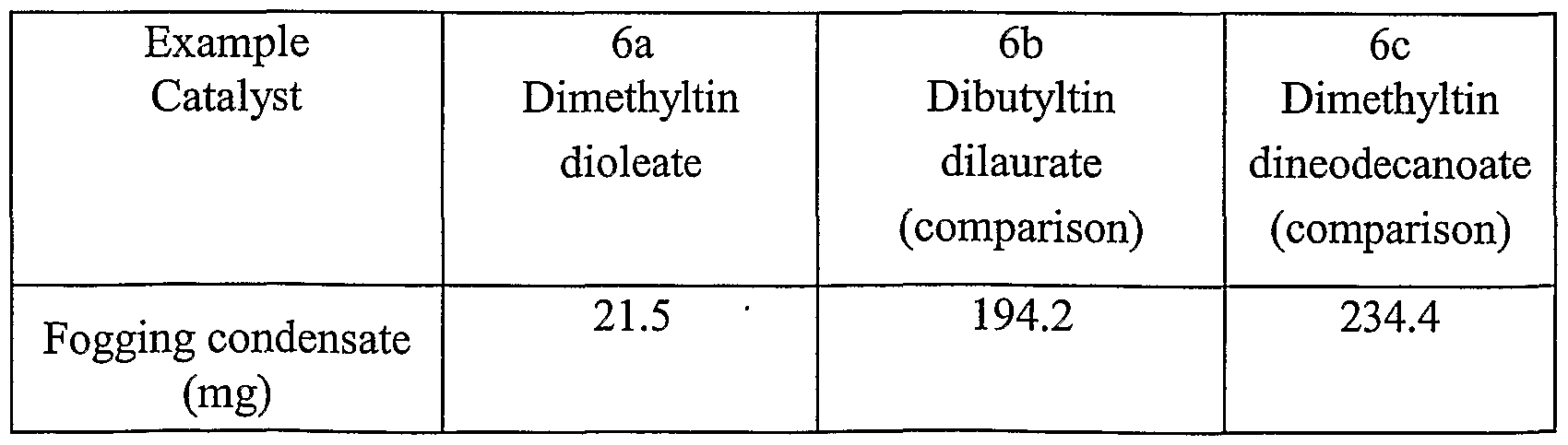
- the aluminum foil was then weighed again, and the weight difference (in mg) was recorded as mg of fogging condensate.
- Example 5 The foam samples prepared in Example 5 were cut into round disks (each 80 mm in
- Example 6 was repeated with the difference, that instead of 5 g of the resp. liquid organotin catalyst and 0.5 g of water, now the resp. foam disks were placed onto the bottom of the glass beaker.
Landscapes
- Chemical & Material Sciences (AREA)
- Health & Medical Sciences (AREA)
- Chemical Kinetics & Catalysis (AREA)
- Medicinal Chemistry (AREA)
- Polymers & Plastics (AREA)
- Organic Chemistry (AREA)
- Engineering & Computer Science (AREA)
- Manufacturing & Machinery (AREA)
- Materials Engineering (AREA)
- Polyurethanes Or Polyureas (AREA)
- Catalysts (AREA)
Abstract
Description



Claims
Priority Applications (9)
| Application Number | Priority Date | Filing Date | Title |
|---|---|---|---|
| JP2004514718A JP2005530016A (en) | 2002-06-21 | 2003-06-13 | Low emission tin catalyst |
| EP03760617A EP1532186B1 (en) | 2002-06-21 | 2003-06-13 | Low emission tin catalysts |
| AU2003242702A AU2003242702A1 (en) | 2002-06-21 | 2003-06-13 | Low emission tin catalysts |
| KR10-2004-7020427A KR20050012286A (en) | 2002-06-21 | 2003-06-13 | Low Emission Tin Catalysts |
| BR0312164-0A BR0312164A (en) | 2002-06-21 | 2003-06-13 | Low Emission Tin Catalysts |
| MXPA04012883A MXPA04012883A (en) | 2002-06-21 | 2003-06-13 | Low emission tin catalysts. |
| CA002490252A CA2490252A1 (en) | 2002-06-21 | 2003-06-13 | Low emission tin catalysts |
| US10/524,127 US20060111516A1 (en) | 2002-06-21 | 2003-06-13 | Low emission tin catalysts |
| DE60320416T DE60320416D1 (en) | 2002-06-21 | 2003-06-13 | EMISSION-SAVED TIN CATALYSTS |
Applications Claiming Priority (2)
| Application Number | Priority Date | Filing Date | Title |
|---|---|---|---|
| EP02013830.1 | 2002-06-21 | ||
| EP02013830A EP1375546A1 (en) | 2002-06-21 | 2002-06-21 | Low emission tin catalysts |
Publications (1)
| Publication Number | Publication Date |
|---|---|
| WO2004000906A1 true WO2004000906A1 (en) | 2003-12-31 |
Family
ID=29716819
Family Applications (1)
| Application Number | Title | Priority Date | Filing Date |
|---|---|---|---|
| PCT/EP2003/006265 Ceased WO2004000906A1 (en) | 2002-06-21 | 2003-06-13 | Low emission tin catalysts |
Country Status (13)
| Country | Link |
|---|---|
| US (1) | US20060111516A1 (en) |
| EP (2) | EP1375546A1 (en) |
| JP (1) | JP2005530016A (en) |
| KR (1) | KR20050012286A (en) |
| AT (1) | ATE392445T1 (en) |
| AU (1) | AU2003242702A1 (en) |
| BR (1) | BR0312164A (en) |
| CA (1) | CA2490252A1 (en) |
| DE (1) | DE60320416D1 (en) |
| MX (1) | MXPA04012883A (en) |
| TW (1) | TW200400210A (en) |
| WO (1) | WO2004000906A1 (en) |
| ZA (1) | ZA200409958B (en) |
Cited By (5)
| Publication number | Priority date | Publication date | Assignee | Title |
|---|---|---|---|---|
| WO2014085077A1 (en) | 2012-11-29 | 2014-06-05 | Dow Global Technologies Llc | Process for the production of polyurethane foam using tetraalkylstannoxy based catalyst |
| US8841403B2 (en) | 2009-07-18 | 2014-09-23 | Evonik Degussa Gmbh | Use of metal salts of a carboxylic acid in the production of polyurethane systems |
| CN106883259A (en) * | 2017-02-17 | 2017-06-23 | 云南锡业股份有限公司化工材料分公司 | A kind of preparation method of oleic acid methyl tin |
| US10584269B2 (en) | 2015-07-17 | 2020-03-10 | The Yokohama Rubber Co., Ltd. | Adhesive composition and production method therefor |
| US10723924B2 (en) | 2015-07-17 | 2020-07-28 | The Yokohama Rubber Co., Ltd. | Adhesive composition and production method therefor |
Families Citing this family (7)
| Publication number | Priority date | Publication date | Assignee | Title |
|---|---|---|---|---|
| US8530534B2 (en) | 2006-05-04 | 2013-09-10 | Air Products And Chemicals, Inc. | Trimerization catalysts from sterically hindered salts |
| JPWO2017014199A1 (en) * | 2015-07-17 | 2018-05-17 | 横浜ゴム株式会社 | Adhesive composition and method for producing adhesive composition |
| CN107849422B (en) * | 2015-07-17 | 2021-01-08 | 横滨橡胶株式会社 | Adhesive composition and method for producing adhesive composition |
| KR102054642B1 (en) * | 2019-07-16 | 2019-12-11 | 강대권 | Method of preparation catalytic compound |
| CN111793082A (en) * | 2020-07-10 | 2020-10-20 | 云南锡业锡化工材料有限责任公司 | Preparation method of methyl tin neodecanoate |
| CN114790276B (en) * | 2022-05-25 | 2023-10-17 | 浙江禾欣科技有限公司 | Solvent-free polyurethane resin with controllable reaction, preparation method and use method thereof |
| WO2024163147A1 (en) * | 2023-02-03 | 2024-08-08 | Galata Chemicals Llc | Process for manufacturing polyurethane foam |
Citations (5)
| Publication number | Priority date | Publication date | Assignee | Title |
|---|---|---|---|---|
| GB1141708A (en) * | 1965-02-19 | 1969-01-29 | Allied Chem | Curable urethane compositions |
| GB1250498A (en) * | 1968-10-15 | 1971-10-20 | ||
| US4332927A (en) * | 1980-11-14 | 1982-06-01 | Caschem, Inc. | Catalyst-containing stable polyurethane forming compositions which are non-cytotoxic when cured and separatory devices employing same |
| JPH03200872A (en) * | 1989-12-28 | 1991-09-02 | Toshiba Silicone Co Ltd | Adhesive silicone rubber composition |
| US20020025989A1 (en) * | 2000-06-20 | 2002-02-28 | Ralf Hoffmann | Combination of metal salts of ricinoleic acid with reactive amines in producing polyurethane forms |
Family Cites Families (4)
| Publication number | Priority date | Publication date | Assignee | Title |
|---|---|---|---|---|
| JPS6138662A (en) * | 1984-07-30 | 1986-02-24 | Toyoda Gosei Co Ltd | Process for curing urethane coating film |
| US5656677A (en) * | 1989-01-20 | 1997-08-12 | Recticel | Method for preparing and applying a sprayable, light stable polyurethane |
| DE10022848B4 (en) * | 2000-05-10 | 2004-07-15 | Bayer Ag | Molded body made of thermoplastic polyurethane with reduced fogging |
| MXPA05000007A (en) * | 2002-06-21 | 2005-04-08 | Recticel | Micro-cellular or non-cellular light-stable polyurethane material and method for the production thereof. |
-
2002
- 2002-06-21 EP EP02013830A patent/EP1375546A1/en not_active Withdrawn
-
2003
- 2003-03-17 TW TW092105738A patent/TW200400210A/en unknown
- 2003-06-13 EP EP03760617A patent/EP1532186B1/en not_active Expired - Lifetime
- 2003-06-13 AU AU2003242702A patent/AU2003242702A1/en not_active Abandoned
- 2003-06-13 MX MXPA04012883A patent/MXPA04012883A/en active IP Right Grant
- 2003-06-13 AT AT03760617T patent/ATE392445T1/en not_active IP Right Cessation
- 2003-06-13 BR BR0312164-0A patent/BR0312164A/en not_active Application Discontinuation
- 2003-06-13 JP JP2004514718A patent/JP2005530016A/en active Pending
- 2003-06-13 KR KR10-2004-7020427A patent/KR20050012286A/en not_active Withdrawn
- 2003-06-13 DE DE60320416T patent/DE60320416D1/en not_active Expired - Lifetime
- 2003-06-13 US US10/524,127 patent/US20060111516A1/en not_active Abandoned
- 2003-06-13 CA CA002490252A patent/CA2490252A1/en not_active Abandoned
- 2003-06-13 WO PCT/EP2003/006265 patent/WO2004000906A1/en not_active Ceased
-
2004
- 2004-12-08 ZA ZA200409958A patent/ZA200409958B/en unknown
Patent Citations (5)
| Publication number | Priority date | Publication date | Assignee | Title |
|---|---|---|---|---|
| GB1141708A (en) * | 1965-02-19 | 1969-01-29 | Allied Chem | Curable urethane compositions |
| GB1250498A (en) * | 1968-10-15 | 1971-10-20 | ||
| US4332927A (en) * | 1980-11-14 | 1982-06-01 | Caschem, Inc. | Catalyst-containing stable polyurethane forming compositions which are non-cytotoxic when cured and separatory devices employing same |
| JPH03200872A (en) * | 1989-12-28 | 1991-09-02 | Toshiba Silicone Co Ltd | Adhesive silicone rubber composition |
| US20020025989A1 (en) * | 2000-06-20 | 2002-02-28 | Ralf Hoffmann | Combination of metal salts of ricinoleic acid with reactive amines in producing polyurethane forms |
Non-Patent Citations (1)
| Title |
|---|
| DATABASE WPI Section Ch Week 199141, Derwent World Patents Index; Class A12, AN 1991-300328, XP002216476 * |
Cited By (6)
| Publication number | Priority date | Publication date | Assignee | Title |
|---|---|---|---|---|
| US8841403B2 (en) | 2009-07-18 | 2014-09-23 | Evonik Degussa Gmbh | Use of metal salts of a carboxylic acid in the production of polyurethane systems |
| WO2014085077A1 (en) | 2012-11-29 | 2014-06-05 | Dow Global Technologies Llc | Process for the production of polyurethane foam using tetraalkylstannoxy based catalyst |
| ITMI20131026A1 (en) * | 2013-06-20 | 2014-12-20 | Dow Global Technologies Llc | PROCESS FOR THE PRODUCTION OF A POLYURETHANE EXPAND THAT USES A CATALYST TETRAALCHILSTANNOSSI |
| US10584269B2 (en) | 2015-07-17 | 2020-03-10 | The Yokohama Rubber Co., Ltd. | Adhesive composition and production method therefor |
| US10723924B2 (en) | 2015-07-17 | 2020-07-28 | The Yokohama Rubber Co., Ltd. | Adhesive composition and production method therefor |
| CN106883259A (en) * | 2017-02-17 | 2017-06-23 | 云南锡业股份有限公司化工材料分公司 | A kind of preparation method of oleic acid methyl tin |
Also Published As
| Publication number | Publication date |
|---|---|
| EP1375546A1 (en) | 2004-01-02 |
| JP2005530016A (en) | 2005-10-06 |
| ZA200409958B (en) | 2005-10-18 |
| DE60320416D1 (en) | 2008-05-29 |
| KR20050012286A (en) | 2005-01-31 |
| CA2490252A1 (en) | 2003-12-31 |
| EP1532186B1 (en) | 2008-04-16 |
| AU2003242702A1 (en) | 2004-01-06 |
| TW200400210A (en) | 2004-01-01 |
| ATE392445T1 (en) | 2008-05-15 |
| US20060111516A1 (en) | 2006-05-25 |
| MXPA04012883A (en) | 2006-04-07 |
| EP1532186A1 (en) | 2005-05-25 |
| BR0312164A (en) | 2005-03-29 |
Similar Documents
| Publication | Publication Date | Title |
|---|---|---|
| EP0182203B1 (en) | Delayed action/enhanced curing catalysis in polyurethane systems | |
| EP2725047B1 (en) | Delay action catalyst for improving the stability of polyurethane systems having halogen containing blowing agents | |
| EP1532186B1 (en) | Low emission tin catalysts | |
| EP1852448B1 (en) | New trimerization catalysts from sterically hindered salts | |
| US20050119436A1 (en) | Preparation of organyloxysilyl-terminated polymers | |
| US3240728A (en) | Polyurethanes containing cyclic phosphonitrilamidates | |
| US20160229972A1 (en) | Foam products and methods of producing the same | |
| CA1281702C (en) | Catalyst systems for the preparation of foams containing isocyanurate and urethane linkages | |
| KR101132864B1 (en) | Method for the production of prepolymers containing isocyanate groups | |
| CN1105157C (en) | Catalyst for low temp. cure of blocked isocyanates | |
| JP2006509070A (en) | Organometallic catalyst composition and polyurethane production process using said catalyst | |
| EP0139251B1 (en) | Amino and amido divalent metal carboxylates useful as catalysts for polyurethane formulations | |
| US20030199663A1 (en) | Delayed action tin catalysts | |
| US5770672A (en) | Catalyst for low temperature cure of blocked isocyanates | |
| JP3422079B2 (en) | Method for producing hyperbranched aliphatic-aromatic polyester polyol | |
| EP4253445A1 (en) | Polyester polyol and polyurethane prepared therefrom | |
| JPH0816191B2 (en) | Polyisocyanate composition | |
| CA1050699A (en) | Hydrolytically stable urethane foam precursors | |
| JPH07116164B2 (en) | Method for producing isocyanurate compound | |
| JP2017218528A (en) | Catalyst for polyurethane resin production and polyurethane resin | |
| CN104903372A (en) | Process for the production of polyurethane foam using tetraalkylstannoxy based catalyst | |
| HK1073853A1 (en) | Ytterbium(iii) acetylacetonate as a catalyst for the preparation of aliphatic oligocarbonate polyols | |
| HK1073853B (en) | Ytterbium(iii) acetylacetonate as a catalyst for the preparation of aliphatic oligocarbonate polyols |
Legal Events
| Date | Code | Title | Description |
|---|---|---|---|
| AK | Designated states |
Kind code of ref document: A1 Designated state(s): AE AG AL AM AT AU AZ BA BB BG BR BY BZ CA CH CN CO CR CU CZ DE DK DM DZ EC EE ES FI GB GD GE GH GM HR HU ID IL IN IS JP KE KG KP KR KZ LC LK LR LS LT LU LV MA MD MG MK MN MW MX MZ NI NO NZ OM PH PL PT RO RU SC SD SE SG SK SL TJ TM TN TR TT TZ UA UG US UZ VC VN YU ZA ZM ZW |
|
| AL | Designated countries for regional patents |
Kind code of ref document: A1 Designated state(s): GH GM KE LS MW MZ SD SL SZ TZ UG ZM ZW AM AZ BY KG KZ MD RU TJ TM AT BE BG CH CY CZ DE DK EE ES FI FR GB GR HU IE IT LU MC NL PT RO SE SI SK TR BF BJ CF CG CI CM GA GN GQ GW ML MR NE SN TD TG |
|
| DFPE | Request for preliminary examination filed prior to expiration of 19th month from priority date (pct application filed before 20040101) | ||
| 121 | Ep: the epo has been informed by wipo that ep was designated in this application | ||
| WWE | Wipo information: entry into national phase |
Ref document number: 1020047020427 Country of ref document: KR |
|
| WWE | Wipo information: entry into national phase |
Ref document number: PA/a/2004/012883 Country of ref document: MX Ref document number: 2003242702 Country of ref document: AU |
|
| WWE | Wipo information: entry into national phase |
Ref document number: 2490252 Country of ref document: CA Ref document number: 2004514718 Country of ref document: JP |
|
| WWE | Wipo information: entry into national phase |
Ref document number: 2003760617 Country of ref document: EP |
|
| WWP | Wipo information: published in national office |
Ref document number: 1020047020427 Country of ref document: KR |
|
| WWP | Wipo information: published in national office |
Ref document number: 2003760617 Country of ref document: EP |
|
| ENP | Entry into the national phase |
Ref document number: 2006111516 Country of ref document: US Kind code of ref document: A1 |
|
| WWE | Wipo information: entry into national phase |
Ref document number: 10524127 Country of ref document: US |
|
| WWP | Wipo information: published in national office |
Ref document number: 10524127 Country of ref document: US |
|
| WWG | Wipo information: grant in national office |
Ref document number: 2003760617 Country of ref document: EP |