STEREOSELECTIVE SYNTHESIS OF 1,2-DISUBSTITUTED CYCLOALKYLS
RELATED APPLICATION
This application claims the benefit of U.S. Provisional No: 60/389,418, filed June 14, 2002. The entire teaching of the above application is incorporated herein by reference.
BACKGROUND OF THE INVENTION Conservative estimates indicate that, in the U.S. alone, approximately 300,000 individuals per year suffer heart attacks. Approximately half of these die from sudden cardiac death, the major cause of which is ventricular fibrillation, a type of cardiac arrhythmia.
1,2-Disubstituted cycloalkyls, such as the aminocycloalkyl ether compounds disclosed in WO 99/50225 and WO 00/47547, have been shown to be effective in treating cardiac disease, such as cardiac arrhythmias. However, the methods of synthesizing aminocycloalkyl ethers provided in WO 99/50225 and WO 00/47547 lead to a mixture of stereoisomers. It is often desirable to obtain a stereochemically pure form of a pharmaceutically active compound because pharmaceuticals which interact with a specific target are often more potent and/or have less deleterious side effects when they are administered in their stereochemically pure form. Separation of stereoisomers after synthesis is often difficult, if not impossible. In addition, separation of isomers leads to waste since a portion of the product has the wrong stereochemistry and must be discarded. Therefore, a need exists for a method to form stereochemically pure 1,2-disubstituted cycloalkyls that overcome or minimize the problems discussed above.
SUMMARY OF THE INVENTION
The invention is a method of stereoselectively preparing a 1,2-disubstiruted cycloalkane represented by Structural Formula I:
I.
hi Structural Formula I, ring A is substituted or unsubstituted; n is 1, 2, or 3; Xt is -O-, -S-, or -NR2~; X7 is a bond, -O-, -S-, or -CR20=CR21-; R is an alkylene group; Rj is -OR3, -SR3 or -NR4R5; R13 is an aliphatic group, an aryl group or a heteroaryl group; R2 and R3 are each, independently, -H, an aliphatic group, an aliphatic carbonyl, an aralkyl, an aryl, a heteroaryl, a heteroaralkyl, a heterocycloalkyl, or a group represented by the formula
-Y-R6, wherein Y is an alkylene group and R6 is a heterocycloalkyl group; and R4 and R5 are each, independently, -H, an aliphatic group, an aliphatic carbonyl, an aralkyl, an aryl, a heteroaryl, a heteroaralkyl, a heterocycloalkyl, or a group represented by the formula -Y-R6; or R4 and R5 together with the nitrogen to which they are attached are a heteroaryl or a heterocycloalkyl; R20 and R21 are each, independently, -H, an aliphatic group, an aryl group, or an aralkyl. The method involves reacting a trans-lR,2R-disubstituted cycloalkane represented by Structural Formula JJ:
π.
with a compound having a leaving group represented by Structural Formula LTI:
. . -R 13
X *xf m.
to form a compound represented by Structural Formula TV:
IV.
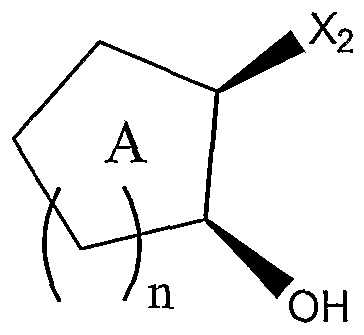
h Structural Formula TJ, X2 is -OH, -SH, or -NHR2; X3 is -OH, a protected alcohol, or a halo; and n is defined as in Structural Formula I. In Structural Formula HI, X7, R, and R13 are defined as in Structural Formula I, and X4 is a leaving group. Leaving groups that can be used in the above reaction include halogens, -OSO2-aryl, -OSO2-(aliphatic group), and 2,2,2-trihaloacetimidate. In Structural Formula IV, Xl3 X7, R, R13 and n are defined as in Structural Formula I, and X3 is defined as in Structural Formula H
A compound represented by Structural Formula IV is reacted with a carboxylic acid in the presence of triphenyl phosphine and dialkyl azodicarboxylate or a halogen source to form a compound represented by Structural Formula V. When the compound represented by Structural Formula TV is reacted with a carboxylic acid, the ester formed is hydrolyzed with, for example NaOH, to form a hydroxy group and the hydroxy group is reacted with a compound selected from the group consisting of X-SO2-aryl, X-SO2-(aliphatic group), and 2,2,2-trihaloacetonitrile. The compound formed by reaction with the halogen source or the carboxylic acid is represented by Structural Formula V:
V.
i Structural Formula V, X5 is a halo, -OSO2-aryl, -OSO2-(aliphatic group), or 2,2,2- trihaloacetimidate; and Xl5 X7, R, R13 and n are defined as in Structural Formula I. In general, the reaction is done under conditions that promote SN2 substitution while minimizing SN1 substitution.
A compound represented by Structural Formula V, is reacted with a nucleophile selected from the group consisting of HRj or M^Rj, wherein M+ is a metal cation, such as Na+, Li+ or K+, to form a compound represented by Structural Formula I. h general, this reaction is also carried out under conditions that promote SN2 substitution. For example, the nucleophile should be a strong base or deprotonated by a strong base. When the nucleophile is HRl5 a strong base, such as NaH, a trialkyl amine, 1,8- diazabicyclo[5,4.0]undec-7-ene (DBU) and the like, can be used to deprotonate HRX and thus facilitate SN2 reaction. Non-polar solvents may also be used to minimize SN1 reaction. h an alternative embodiment, compounds represented by Structural Formula I are stereoselectively prepared by reacting a cis-2-substituted cycloalkanol represented by Structural Formula VI:
VI.
with a galactose derivative represented by Structural Formula VTI:
vπ.
to form a galactose-substituted cycloalkanol represented by Structural Formula Vllt:
In Structural Formula VI, X2 is defined as in Structural Formula π. In Structural Formulas VI and Vm, n is defined as in Structural Formula I. In Structural Formula VTA, X! is defined as in Structural Formula I. hi Structural Formulas VII and VITJ, R9 for each occurrence is, independently, -H or an alcohol protecting group. Alternatively, two adjacent -ORc, groups together with the carbon atoms to which they are attached form a [l,3]dioxolane. hi a preferred embodiment, each Re, is -H in Structural formula VII. R12 is an aryl, a cycloalkyl, or a heterocycloalkyl. The reaction is carried out in the presence of an enzyme that stereoselectively catalyzes addition of galactose to the hydroxy, thio, or amine
group at the carbon having an R-configuration in Structural Formula VI. A preferred enzyme is β-galactosidase. h general, the solvent for the reaction is water, a water miscible solvent (e.g., tetrahydrofuran, dioxane, an alcohol, dimethyl formamide, dimethyl sulfoxide, and the like), or a mixture of water and a water miscible solvent. After galactose-substituted cycloalkanol represented by Structural Formula VHI has been formed, two hydroxy groups on adjacent carbon atoms (1,2-diol) and/or two hydroxy groups on carbon atoms that are separated from each other by one carbon atom (1,3-diol) of the galactose substituent are protected with a cyclic acetal or a cyclic ketal. Methods for protecting 1,2-diols and 1,3-diols as cyclic acetals and cyclic ketals can be found in Greene, et al, Protective Groups in Organic Synthesis, (1991), John Wiley & Sons, Inc., pages 118-142, the teachings of which are incorporated herein by reference in their entirety. A preferred ketal for protecting 1,2-diols or 1,3-diols is isopropylidene ketal. Id., pages 123-127.
The compound represented by Structural Formula VHI is reacted with an alcohol protecting group to form a compound represented by Structural Formula LX:
IX.
In Structural Formula LX, X! and n are defined as in Structural Formula I, Re, is defined as in Structural Formula VII, and R10 is an alcohol protecting group, such as a substituted or unsubstituted benzyl group. When a substituted or unsubstituted benzyl protecting group is used, a compound represented by Structural Formula VIJJ is reacted with, for example, a substituted or unsubstituted benzyl halide, such as benzyl chloride or benzyl bromide, in the presence of a base, such as potassium hydroxide.
The compound represented by Structural Formula LX is treated with an acid to form a protected cycloalkanol represented by Structural Formula X:
X.
In Structural Formula X, n is defined as in Structural Formula I, X2 is defined as in Structural Formula π, and R10 is defined as in Structural Formula LX.
The compound represented by Structural Formula X is reacted with a compound represented by Structural Formula III to form a compound represented by Structural Formula XI:
In Structural Formula XI, Xl5 X7, R, R13, and n are defined as in Structural Formula I, and R10 is defined as in Structural Formula IX. The alcohol protecting group represented by R10 in Structural Formula XI is removed to form a compound represented by Structural Formula XII:
xπ.
h Structural Formula XII, Xl5 X7, R, R13, and n are defined as in Structural Formula I. When R10 is a benzyl group, the benzyl group can be removed by treating a compound represented by Structural Formula XI with a catalytic amount of palladium in the presence of hydrogen gas. Typically, the reaction is carried out in a protic solvent, such as an alcohol, in a hydrogen atmosphere. When Rx of Structural Formula I is -SR3, it is desirable to avoid using a palladium catalyst to remove the benzyl protecting group because the palladium will poison the sulfide nucleophile used to displace the activated alcohol in the next reaction step, h this case, the benzyl protecting group can be removed by an alternative method, such as treatment with iodotrimethylsilane in acetonitrile or Ph3C+BF4 " in CH2C12. For other methods of cleaving benzyl protecting groups see Greene, Protective Groups in Organic Synthesis, (1999), John Wiley & Sons, Inc., pages 86-112. Alternatively, an acid stable alcohol protecting group other than a benzyl group can be used.
A compound represented by Structural Formula XII is reacted with an alcohol activating agent and a nucleophile selected from the group consisting of HRj or M+"Rl5 wherein M " is a metal cation, to form a compound represented by Structural Formula I. Typical, alcohol activating agents that can be used in this reaction include X-SO2-aryl, for example tosyl chloride or tosyl bromide, X-SO2-(aliphatic group), for example mesyl chloride, mesyl bromide or trifluromethanesulfonyl chloride, and 2,2,2-trihaloacetonitrile, for example trifluoroacetimidoyl chloride, wherein X is a halo, to form an activated alcohol, hi general, the alcohol group is reacted with the alcohol activating agent in the presence of an aprotic base such as a trialkyl arnine, pyridine or DBU. Then the activated alcohol is displaced by BRX or M^ j under conditions that promote SN2 substitution while minimizing SN1 substitution.
In another alternative embodiment, compounds represented by Structural Formula I can be stereoselectively prepared by reacting a galactose substituted cycloalkanol represented by Structural Formula VIE with an alcohol activating agent and a nucleophile selected from the group consisting of HRj or M^'R,, wherein M+ is a metal cation, to form a compound represented by Structural Formula XHI:
xm.
hi Structural Formula XHI, X]5 Rl5 and n are defined as in Structural Formula I, and Re, is defined as in Structural Formula VII. hi a preferred embodiment, two hydroxy groups on adjacent carbon atoms (1,2-diols) and/or two hydroxy groups on carbon atoms that are separated from each other by one carbon atom (1,3-diols) of the galactose substituted cycloalkanol represented by Structural Formula VHI are protected with a cyclic acetal or a cyclic ketal prior to reacting the galactose substituted cycloalkanol with the alcohol activating agent and the nucleophile. A compound represented by Structural Formula XHI is treated with an acid to form a compound represented by Structural Formula XTV:
XIV.
hi Structural Formula XJV, Rx and n are defined as in Structural Formula I, and X2 is defined as in Structural Formula π.
The compound represented by Structural Formula XIV is reacted with a compound represented by Structural Formula HI to form a compound represented by Structural Formula I.
In another alternative embodiment, compounds represented by Structural Formula I can be stereoselectively prepared by reacting a cis- 1 R-substituted-2S-halo-cycloalkyl represented by Structural Formula XV:
XV.
with a compound represented by Structural Formula HI to form a compound represented by Structural Formula XVI:
XVI.
h Structural Formula XV, X2 is defined as in Structural Formula H, n is defined as in Structural Formula I, and X6 is a halo, hi Structural Formula XVI, Xl5 X7, R, R13, and n are defined as in Structural Formula I, and X6 is defined as in Structural Formula XV.
A compound represented by Structural Formula XVI is reacted with HR
j or
wherein ^
" is a metal cation, to form a compound represented by Structural Formula I. general, this reaction is also carried out under conditions that promote S
N2 substitution while minimizing S
N1 substitution. The method of the invention provides a stereoselective route to 1,2-disubstituted cycloalkyl compounds, such as aminocycloalkyl ether compounds. Thus, stereochemically pure stereoisomers of 1,2-disubstituted cycloalkyl compounds can be obtained by the method of the invention while avoiding, or reducing the difficulty of separating stereoisomers.
DETAILED DESCRIPTION OF THE INVENTION
The term "aliphatic" as used herein refers to optionally substituted straight-chain, branched or cyclic CJ-CJ, hydrocarbons which are completely saturated or which contain one or more units of unsaturation but which are not aromatic. For example, suitable aliphatic groups include substituted or unsubstituted linear, branched or cyclic alkyl, alkenyl, alkynyl groups and hybrids thereof such as (cycloalkyl)alkyl, (cycloalkenyl)alkyl or (cycloalkyl)alkenyl. The terms "alkyl," "alkoxy," and "alkylthio," used alone or as part of a larger moiety includes both straight and branched chains containing one to twelve carbon atoms. The terms "alkenyl" and "alkynyl" used alone or as part of a larger moiety includes both straight and branched chains containing two to twelve carbon atoms. The
term "cycloalkyl" used alone or as part of a larger moiety includes cyclic C3-C12 hydrocarbons which are completely saturated or which contain one or more units of unsaturation, but which are not aromatic.
The term "alkylene," as used herein, refers to optionally substituted divalent aliphatic group that has two points of attachments. Preferably, alkylene groups are divalent alkyl group having two points of attachments, such as -CH2-, -CH2CH2-, -CH(CH3)CH2-, and the like.
As used herein, aryl groups are optionally substituted carbocyclic aromatic ring systems (e.g. phenyl), optionally substituted fused polycyclic aromatic ring systems (e.g. naphthyl and anthracenyl) and optionally substituted aromatic ring systems fused to optionally substituted carbocyclic non- aromatic ring systems (e.g., 1,2,3, 4-tetrahydro- naphthyl and indanyl) having six to about fourteen carbon atoms. The term "aryl" used alone or as part of a larger moiety as in "aralkyl," 'aralkoxy," or "aryloxyalkyl," refers to aromatic ring groups having six to fourteen members, such as phenyl, benzyl, phenethyl, 1-napthyl, 2-naphthyl, 1-anthracyl and 2-anthracyl. The term "aryl" may be used interchangeably with the term "aryl ring."
The terms "haloalkyl," "haloalkenyl," and "haloalkoxy" means alkyl, alkenyl or alkoxy, as the case may be, substituted with one or more halogen atoms. The term "halo" or "halogen" means F, Cl, Br or I. The term "heteroatom" means nitrogen, oxygen, or sulfur and includes any oxidized form of nitrogen and sulfur, and the quatemized form of any basic nitrogen.
When a nitrogen atom is part of a heterocycloalkyl or heteroaryl ring, it can be substituted or unsubstituted. For example, in a saturated or partially unsaturated ring having 0-3 heteroatoms selected from oxygen, sulfur or nitrogen, the nitrogen may be N (as in 3,4-dihydro-2H-pyrrolyl), NH (as in pyrrolidinyl) or NRπ (as in N-substituted pyrrolidinyl). Ru is a substituent. Examples of substituents encompassed by Ru are described below.
The term "heterocycloalkyl," as used herein refers to optionally substituted non-aromatic ring systems having three to fourteen members, preferably five to ten, in which one or more ring carbons, preferably one to four, are each replaced by a heteroatom
such as N, O, or S. Examples of heterocycloalkyl rings include 3-lH-benzimidazol-2-one, 3-tetrahydrofuranyl, 2-tetrahydropyranyl, 3-tetrahydropyranyl, 4-tetrahydropyranyl, [l,3]-dioxalanyl, [l,3]-dithiolanyl, [l,3]-dioxanyl, 2-tetrahydrothiophenyl, 3-tetrahydrothiophenyl, 2-morpholinyl, 3-morpholinyl, 4-morpholinyl, 2-thiomo holinyl, 3-thiomorpholinyl, 4-thiomorpholinyl, 1 -pyrrolidinyl, 2-pyrrolidinyl, 3-pyrorolidinyl, 1-piperazinyl, 2-piperazinyl, 1-piperidinyl, 2-piperidinyl, 3-piperidinyl, 4-piperidinyl, 4-thiazolidinyl, diazolonyl, N-substituted diazolonyl, 1-phthalimidinyl, benzoxanyl, benzopyrrolidinyl, benzopiperidinyl, benzoxolanyl, benzothiolanyl, and benzothianyl. Also included within the scope of the term "heterocycloalkyl," as it is used herein, is a group in which a non-aromatic heteroatom-containing ring is fused to one or more aromatic or non-aromatic rings, such as in an indolinyl, chromanyl, phenanthridinyl, or tetrahydroquinolinyl, where the radical or point of attachment is on the non-aromatic heteroatom-containing ring. The term "heterocycloalkyl," whether saturated or partially unsaturated, also refers to rings that are optionally substituted. The term "heteroaryl," used alone or as part of a larger moiety as in "heteroaralkyl," refers to optionally substituted heteroaromatic ring groups having five to fourteen members, wherein from one to about six members are heteroatoms. Examples of heteroaryl rings include 2-furanyl, 3-furanyl, N-imidazolyl, 2-imidazolyl, 4-imidazolyl, 5-imidazolyl, 3-isoxazolyl, 4-isoxazolyl, 5-isoxazolyl, 2-oxadiazolyl, 5-oxadiazolyl, 2-oxazolyl, 4-oxazolyl, 5-oxazolyl, 1-pyrrolyl, 2-pyrrolyl, 3-pyrrolyl, 2-pyridyl, 3-pyridyl, 4-pyridyl, 2-pyrimidyl, 4-pyrimidyl, 5-pyrimidyl, 3-pyridazmyl, 2-thiazolyl, 4-thiazolyl, 5-thiazolyl, 2-triazolyl, 5-triazolyl, 2-thienyl, 3-thienyl, thianaphthenyl, carbazolyl, benzimidazolyl, benzothienyl, benzofuranyl, indolyl, quinolinyl, benzotriazolyl, benzothiazolyl, benzooxazolyl, benzimidazolyl, isoquinolinyl, indolyl, isoindolyl, acridinyl, or benzoisazolyl. Also included within the scope of the term "heteroaryl," as it is used herein, is a group in which an optionally substituted heteroatomic ring is fused to one or more optionally substituted aromatic or optionally substituted nonaromatic rings where the radical or point of attachment is on the heteroaromatic ring. Examples include tetrahydroquinolinyl, tetrahydroisoquinolinyl, and pyrido [3, 4-d] pyrimidinyl.
An araU yl group, as used herein, is an aryl substituent that is linked to a compound by an alkylene group having from one to twelve carbon atoms.
An heteroaralkyl group, as used herein, is a heteroaryl substituent that is linked to a compound by an alkylene group having from one to twelve carbon atoms. An alkoxy group, as used herein, is a CrC12 alkyl group that is connected to a compound via an oxygen atom. Examples of alkoxy groups include, but are not limited to, methoxy, ethoxy, propoxy, isopropoxy, and t-butoxy.
A aliphatic carbonyl group, as used herein, is an aliphatic group that is connected to a compound via a carbonyl group. A preferred aliphatic carbonyl is acetyl. Alcohol protecting groups are known to those skilled in the art. For examples of alcohol protecting groups see Greene, et al, Protective Groups in Organic Synthesis, (1999), John Wiley & Sons, Inc., pages 17-245, the teachings of which are incorporated herein by reference in their entirety. A preferred alcohol protecting group is a benzyl group. A "leaving group" is defined herein as a group that can be displaced by a nucleophile (e.g., -OH, -SH, or -NR5R6) to form a weak base. Examples of leaving groups include halo, -OSO2-(substituted or unsubstituted aryl), -OSO2-(substituted or unsubstituted alkyl), and 2,2,2-trihaloacetimidate.
Suitable halogen sources are a compound that provides halogen ions. Examples of suitable halogen sources include SOCl2, PBr3, POBr3, PC13, POCl3 and halide salts such as LiBr or LiCl.
An aryl group (e.g., ring B of Structural Formula I) or a heteroaryl group may contain one or more substituents. Examples of suitable substituents include aliphatic groups (including haloalkyl, such as trifluoromethyl and trichloromethyl), aryl groups, alkoxy groups, heteroaryl groups, heteroaralkyl groups, aralkyl groups, halo, hydroxy, -OR14, -COR14, -COOR14, -NHCOR14, -OCOR14, benzyl, halo, cyano, nitro, -SO3", -SH, -SR14, -NH2, -NHR14, -NR14R15, -NR14CO2R15, -NR14R15C(O)N(R16)2, -C(O)CH2C(O)R14, -CO2R14, -C(0)R14, -C(O)N(R14)2, -OC(O)N(R14)2, -S(O)2R14, -SO2N(R14)2, -S(O)R14, -C(=S)N(R14)2, -C(=NH)-N(R14)2, and COOH, wherein R14, R15 and R16 are each, independently, an aliphatic group, an aryl group, or an aralky group.
A heterocycloalkyl, aliphatic group (e.g., ring A of Structural Formula I), or an alkylene group may contain one or more substituents. Examples of suitable substituents on a saturated or unsaturated carbon of a heterocycloalkyl, aliphatic group or alkylene group include those listed above for an aryl and heteroaryl groups. In addition, the following groups can be a substituent on a saturated carbon of a heteroaryl, aliphatic group or alkylene group: =0, =S, =NNHR17, =NN(R17)2, -NNHC(O)R17, =NNHCO2(alkyl), -NNHSO2(alkyl), or =NR17, where each R17 is independently selected from hydrogen, an aliphatic group.
Suitable substitutents on the nitrogen of a non-aromatic heterocycloalkyl or on an unsaturated nitrogen of a heteroaryl include -R18, -N(R18)2, -C(O)R18, -CO2R18,
-C(O)CH2C(0)R18, -C(-S)N(R18)2, and -C(=NH)N(Rι8)2; wherein R18 is hydrogen, an aliphatic group, phenyl, substituted phenyl, benzyl, or a heteroaryl or heterocycloalky. Examples of substituents on R18 when R18 is an aliphatic group or a phenyl include aniino, alkylamino, dialkylamino, aminocarbonyl, halogen, alkyl, allcylaminocarbonyl, dialkylaminocarbonyloxy, alkoxy, nitro, cyano, carboxy, alkoxycarbonyl, alkylcarbonyl, hydroxy, haloalkoxy, or haloalkyl.
The invention is a method of stereoselectively preparing a 1,2-disubstituted cycloalkyl represented by Structural Formula I. h one embodiment, trans-lR,2R- disubstituted cycloalkyl represented by Structural Formula H is reacted with a compound represented by Structural Formula HI via a nucleophihc displacement reaction (e.g., SN1 or SN2 reaction) to form a compound represented by Structural Formula IV. h a preferred embodiment, R13 of Structural Formula HI is a phenyl, naphthyl, indolyl, fluorenyl, or acenaphthyl. Typically, the leaving group represented by X4 is a halo, -OSO2-aryl, such as tosyl, -OSO2-(aliphatic group), such as mesyl or triflate, and 2,2,2-trihaloacetimidate, such as 2,2,2-trichloroacetimidate or 2,2,2-trifluoroacetimidate.
The compound represented by Structural Formula IV is reacted with a halogen source to form a cis- 1,2-disubstituted cycloalkyl represented by Structural Formula V in which X5 is a halo. Alternatively, the compound represented by Structural Formula IV is reacted with a carboxylic acid to form an ester. The ester is then hydrolyzed to form an alcohol which can be reacted with an alcohol activating agent, such as X-SO2-aryl,
X-SO2-(aliphatic group), or 2,2,2-trihaloacetomtrile (see, for example, Scheme I) to form a compound represented by Structural Formula N in which X5 is -OSO2-aryl, -OSO2-(aliphatic group) or 2,2,2-trihaloacetimidate.
ΝaOH mesyl chloride H
90 pyridine
Scheme I: Inversion of hydroxy stereochemistry via reaction with a carboxylic acid, followed by activation with mesyl chloride. (R' is an aliphatic group, an aryl group or an aralkyl group.)
When X3 of the compound represented by Structural Formula IV is -OH, the halogen source is typically SOCl2 in pyridine or a diarylchlorophosphite followed by HBr. When X3 is a protected alcohol, the alcohol protecting group is removed first, and the free alcohol group is reacted with SOCl2 in pyridine or a diarylchlorophosphite followed by HBr.
In an alternative embodiment, when X3 is -OH, the reaction with the halogen source involves two steps, hi the first step, the compound represented by Structural Formula V is
reacted with a compound selected from the group consisting of X-SO2-aryl, X-SO2-(aliphatic group), and 2,2,2-trihaloacetomtrile, wherein X is a halo, to form an activated alcohol. This reaction is typically carried out in the presence of an aprotic base such as pyridine, trialkyl amine, or DBU. hi the second step, the activated alcohol is reacted with a halide salt, such as LiCl or LiBr. When X3 is a protected alcohol, the alcohol protecting group is removed first, and the free alcohol group is reacted with X-SO2-aryl, X-SO2-(aliphatic group), and 2,2,2-trihaloacetonitrile.
The compound represented by Structural Formula V is then reacted with a nucleophile selected from the group consisting of HR
1 or
h a preferred embodiment, the nucleophile is HNR
4R
5. hi a more preferred embodiment, the nucleophile is represented by Structural Formula XVH:
XVH.
hi Structural Formula XVH, R8 is -H or an alcohol protecting group; and ring C is substituted or unsubstituted.
In one embodiment, Rg is -H. hi another embodiment, the compound having leaving group X4 is a compound represented by Structural Formula XVHI:
xvm.
hi Structural Formula XVHI, X4 is defined as in Structural Formula HI.
i another embodiment, R8 is -H, n is 2, Xt is -O-, X2 is -OH and the 1,2- disubstituted cycloalkyl formed is the compound prepared is represented by Structural Formula XVH:
XVH.
Preferably, the compound represented by Structural Formula (XVH) is 1R-(3R- hydroxypyrrolidin- 1 -yl)-2R-(2-phenylethoxy)-cyclohexane. h an alternative embodiment, a 1,2-disubstituted cycloalkyl represented by Structural Formula I is stereoselectively prepared from a cis-2-substituted-cycloalkanol represented by Structural Formula VI. The compound represented by Structural Formula VI is reacted with a galactose derivative represented by Structural Formula VH in the presence of β-galactosidase. β-galactosidase preferentially catalyzes the reaction of X2 of the compound represented by Structural Formula VI (i.e., the nucleophihc substituent on the carbon having an R-configuration) with the galactose derivative to form a galactose substituted cycloalkanol represented by Structural Formula VHT. The reaction is typically carried out in water, a water miscible solvent, or a mixture of water and a water miscible solvent.
Reaction of the 2R-substituent with the galactose derivative allows the alcohol group having the S-configuration to be selectively protected with an alcohol protecting group to form a compound represented by Structural Formula IX. h one embodiment, the alcohol is protected with a benzyl group.
The galactose substituent is then removed by treating the compound represented by Structural Formula JX with an acid to form a compound represented by Structural Formula
X. Typically, the galactose group is removed by treating the compound represented by Structural Formula LX with HC1 in an alcohol.
The compound represented by Structural Formula X is reacted with a compound represented by Structural Formula HI via a nucleophihc displacement reaction (e.g., SN1 or SN2 reaction) to form a compound represented by Structural Formula XI.
R10 is removed to form a compound represented by Structural Formula XH. When R10 is a benzyl group, it is typically removed by reacting the compound represented by Structural Formula XI with hydrogen gas in the presence of palladium on carbon and a protic solvent. The compound represented by Structural Formula XH is then reacted with an alcohol activating agent and a nucleophile selected from the group consisting of HRj or M^Rj. hi one embodiment, the reaction is a Mitsunobu reaction (Hugh, Org. Prep. Proced. Int., (1996), 28:127-164, the entire teachings of which are incorporated herein by reference), a preferred embodiment, the nucleopliile is HNR4R5 and the activating agent includes a dialkyl azodicarboxylate and triphenyl phosphine. More preferably, the nucleophile is a compound represented by Structural Formula XVH. Alternatively, the alcohol activating agent is selected from the group consisting of X-SO2-aryl, X-SO2-(aliphatic group), and 2,2,2-trihaloacetonitrile, wherein X is a halo, and the nucleophile is HNR4R5. More preferably, the nucleophile is a compound represented by Structural Formula XVH. hi another alternative embodiment, a 1,2-disubstituted cycloalkyl represented by Structural Formula I is stereoselectively prepared from a galactose substituted cycloalkanol represented by Structural Formula VHI. The galactose substituted cycloalkanol is reacted with an alcohol activating agent and a nucleophile selected from HRj and M+"Rj to form a compound represented by Structural Formula XLT. h a preferred embodiment, the nucleophile is HNR4R5. More preferably, the nucleophile is a compound represented by Structural Formula XVH. When it is desirable to prevent wasting the nucleophile and/or the alcohol activating agent, the 1,2-diol and 1,3-diol groups of the galactose substituent of Structural Formula VHI are selectively protected as a cyclic acetal or a cyclic ketal before reaction with the alcohol activating agent and the nucleophile.
The galactose substituent is then removed by treating the compound represented by Structural Formula XIH with an acid to form a compound represented by Structural Formula XTV. Typically, the galactose group is removed by treating the compound represented by Structural Formula XHI with HC1 in an alcohol. The compound represented by Structural Formula XTV is reacted with a compound represented by Structural Formula HI via a nucleophihc displacement reaction (e.g., SN1 or SN2 reaction) to form a compound represented by Structural Formula I. h another alternative embodiment, a 1,2-disubstituted cycloalkyl represented by Structural Formula I is stereoselectively prepared from a lR-substituted-2S-halo-cycloalkyl represented by Structural Formula XV. When X2 of Structural Formula XV is -NHR2, R2 is preferably a group that decreases the nucleophilicity of the nitrogen, such as an aliphatic carbonyl group. The compound represented by Structural Formula XV is reacted with a compound represented by Structural Formula HI via a nucleophihc displacement reaction (e.g., SN1 or SN2 reaction) to form a compound represented by Structural Fonnula XVI. The compound represented by Structural Formula XVI is then reacted with a nucleophile selected from the group consisting of HRj or M+"Rj. h a preferred embodiment, the nucleophile is HNR4R5. More preferably, the nucleophile is a compound represented by Structural Formula XVH.
The following are examples of specific embodiments of the invention and are not intended to be limiting in any way.
EXAMPLES
I. Method I for preparing lR-(3R-hydroxypyrrolidin-l-yl)-2R-(2-phenylethoxy)- cyclohexane.
Scheme H: Method I for preparing lR-(3R-hydroxypyrrolidin-l-yl)-2R-(2- phenylethoxy)-cyclohexane.
The starting material, IR, 2R-cyclohexanediol, is commercially available or can be prepared by enzymatic hydrolysis of the racemic diacetate of cyclohexandiol (Faber, K., "Biotransformation in Organic Chemistry: a Textbook," 3rd Edition, Springer- Verlag, Berlin, (1997), p. 72, the entire teachings of which are incorporated herein by reference). About 1 equ. of NaH is add to a solution of IR, 2R-cyclohexanediol in dimethylformamide (DMF), followed by addition 4-(2-bromo-ethyl)-benzene to form a mixture of mono-ether, di-ether and unreacted starting material. This mixture is easily separated based on the differences in solubility and chromatographic properties of the constituents. The mono- ether product, 2R-(2-phenylethoxy)-cyclohexan-lR-ol, is dissolved in pyridine and an excess amount of mesyl chloride is added to the reaction mixture to form 1R- methanesulfonate-2R-(2-phenylethoxy)-cyclohexane. lR-Methanesulfonate-2R-(2- phenylethoxy)-cyclohexane is dissolved in acetone and an excess amount of LiBr is added to achieve an SN2 displacement of the methanesulfonate group to form lS-bromo-2R-(2- phenylethoxy)-cyclohexane. lS-Bromo-2R-(2-phenylethoxy)-cyclohexane and pyrrolidin- 3R-ol are dissolved in acetonitrile in about equal molar amounts. The amino group of the pyrrolidin-3R-ol reacts in preference to the alcohol group to achieve an SN2 displacement of the bromo group of lS-bromo-2R-(2-phenylethoxy)-cyclohexane to form 1R-(3R- hydroxypyrrolidin- 1 -yl)-2R-(2-phenylethoxy)-cyclohexane.
Alternatively, 3R-benzyloxy-pyrrolidine can be used in the final reaction of Method I instead of pyrrolidin-3R-ol. 3R-Benzyloxy-pyrrolidine is prepared by treating pyrrolidin- 3R-ol in a solution of THF with about 1 equ. of NaH. The reaction mixture is stirred for about 5 min. to about 30 min., then about 1 equ. of benzyl bromide is added to the reaction mixture. After stirring for about 2 hours, 3R-benzyloxy-pyrrolidine is formed.
When 3R-benzyloxy-pyrrolidine is used in the final reaction of Method I the benzyl protecting group is removed by dissolving the product in ethanol in the presence of a catalytic amount of palladium on carbon. The reaction is shaken under a hydrogen atmosphere to yield lR-(3R-hydroxypyrrolidin-l-yl)-2R-(2-phenylethoxy)-cyclohexane.
H. Method H for preparing lR-(3R-hydroxypyrrolidin-l-yl)-2R-(2-phenylethoxy)- cyclohexane.
OH
Scheme H: Method H for preparing lR-(3R-hydroxypyrrolidin- 1 -yl)-2R-(2- phenylethoxy)-cyclohexane ("Ph" is phenyl).
About equal molar amounts of meso-cis-1, 2-cyclohexanediol and l'-phenoxy- galactose are dissolved in a 1:1 mixture of water and methanol in the presence of a
catalytic amount of β-galactosidase. β-galactosidase preferentially catalyzes reaction of the chiral carbon of meso-cis-1, 2-cyclohexanediol having an R-configuration with l'-O- phenyl-galactose. A benzyl protecting group is added to all free hydroxyl groups of the product by dissolving the product in dimethylformamide (DMF) in the presence of potassium hydroxide and an excess amount of benzyl bromide. The reaction mixture is typically heated to about 130°C to about 140°C. The benzylated product is dissolved in a mixture of hydrochloric acid in methanol to cleave the glycosidic bond by acid hydrolysis, resulting in 2S-benzyloxy-cyclohexan-lR-ol. About 1 equ. of NaH is add to a solution of the 2S-benzyloxy-cyclohexan-lR-ol in THF. After the reaction mixture has stirred for about 5 min. to about 30 min., 4-(2-bromo-ethyl)-benzene is added to the reaction mixture to form lS-benzyloxy-2R-(2-phenylethoxy)-cyclohexane. lS-Benzyloxy-2R-(2- phenylethoxy)-cyclohexane is dissolved in ethanol in the presence of a catalytic amount of palladium on carbon. The reaction is shaken under a hydrogen atmosphere until the benzyl group is removed to form 2R-(2-phenylethoxy)-cyclohexan-lS-ol. 2R-(2-phenylethoxy)- cyclohexan-lS-ol is dissolved in pyridine, and an excess amount of mesyl chloride is added to the reaction mixture to form lS-methanesulfonate-2R-(2-phenylethoxy)- cyclohexane. lS-Methanesulfonate-2R-(2-phenylethoxy)-cyclohexane and pyrrolidin-3R-ol are dissolved in dichloromethane in about equal molar amounts. The amino group of the pyrrolidin-3R-ol reacts in preference to the alcohol group to achieve an SN2 displacement of the methanesulfonate group to form lR-(3R-hydroxypyrrolidin-l-yl)-2R-(2- phenylethoxy)-cyclohexane.
Alternatively, 3R-benzyloxy-pyrrolidine can be used in the final reaction of Method H instead of pyrrolidin-3R-ol. When 3R-benzyloxy-pyrrolidine is used in the final reaction of Method H, the benzyl protecting group is removed as described in Method I to yield 1R- (3R-hydroxypyrrolidin- 1 -yl)-2R-(2-phenylethoxy)-cyclohexane.
HL Method HI for lR-(3R-hydroxypyrrolidin-l-yl)-2R-(2-phenylethoxy)-cyclohexane.
Scheme HI: Method HI for lR-(3R-hydroxypyrrolidin-l-yl)-2R-(2-phenylethoxy)- cyclohexane.
2R-(2-phenylethoxy)-cyclohexan-lS-ol (prepared as in Method H), triphenyl phosphine (PPh3), and diethylazodicarboxylate (DEAD) are dissolved in THF in about equal molar amounts with about 1.2 equ. to about 2 equ. of 3R-benzyloxy-pyrrolidine. After stirring at about -25°C to about 25°C, lR-(3R-benzyloxy-pyrrolidin-l-yl)-2R-(2- phenylethoxy)-cyclohexane is formed. The benzyl protecting group is removed to form lR-(3R-hydroxypyrrolidin-l-yl)-2R-(2-phenylethoxy)-cyclohexane as described in Method I.
EQUIVALENTS
While this invention has been particularly shown and described with references to preferred embodiments thereof, it will be understood by those skilled in the art that various changes in form and details may be made therein without departing from the scope of the invention encompassed by the appended claims.