WO2002102707A2 - Transition metal oxo, sulfido and amido complexes as catalysts of nucleophilic addition reactions - Google Patents

Transition metal oxo, sulfido and amido complexes as catalysts of nucleophilic addition reactions Download PDF

Info

Publication number
WO2002102707A2
WO2002102707A2 PCT/US2002/016178 US0216178W WO02102707A2 WO 2002102707 A2 WO2002102707 A2 WO 2002102707A2 US 0216178 W US0216178 W US 0216178W WO 02102707 A2 WO02102707 A2 WO 02102707A2
Authority
WO
WIPO (PCT)
Prior art keywords
hydrocarbyl
group
complex
heteroatom
substituted
Prior art date
Legal status (The legal status is an assumption and is not a legal conclusion. Google has not performed a legal analysis and makes no representation as to the accuracy of the status listed.)
Ceased
Application number
PCT/US2002/016178
Other languages
French (fr)
Other versions
WO2002102707A3 (en
Inventor
Robert H. Grubbs
F. Dean Toste
Current Assignee (The listed assignees may be inaccurate. Google has not performed a legal analysis and makes no representation or warranty as to the accuracy of the list.)
California Institute of Technology
Original Assignee
California Institute of Technology
Priority date (The priority date is an assumption and is not a legal conclusion. Google has not performed a legal analysis and makes no representation as to the accuracy of the date listed.)
Filing date
Publication date
Application filed by California Institute of Technology filed Critical California Institute of Technology
Priority to AU2002316153A priority Critical patent/AU2002316153A1/en
Publication of WO2002102707A2 publication Critical patent/WO2002102707A2/en
Publication of WO2002102707A3 publication Critical patent/WO2002102707A3/en
Anticipated expiration legal-status Critical
Ceased legal-status Critical Current

Links

Classifications

    • B—PERFORMING OPERATIONS; TRANSPORTING
    • B01—PHYSICAL OR CHEMICAL PROCESSES OR APPARATUS IN GENERAL
    • B01J—CHEMICAL OR PHYSICAL PROCESSES, e.g. CATALYSIS OR COLLOID CHEMISTRY; THEIR RELEVANT APPARATUS
    • B01J31/00—Catalysts comprising hydrides, coordination complexes or organic compounds
    • B01J31/16—Catalysts comprising hydrides, coordination complexes or organic compounds containing coordination complexes
    • B01J31/18—Catalysts comprising hydrides, coordination complexes or organic compounds containing coordination complexes containing nitrogen, phosphorus, arsenic or antimony as complexing atoms, e.g. in pyridine ligands, or in resonance therewith, e.g. in isocyanide ligands C=N-R or as complexed central atoms
    • B01J31/1805—Catalysts comprising hydrides, coordination complexes or organic compounds containing coordination complexes containing nitrogen, phosphorus, arsenic or antimony as complexing atoms, e.g. in pyridine ligands, or in resonance therewith, e.g. in isocyanide ligands C=N-R or as complexed central atoms the ligands containing nitrogen
    • B01J31/181—Cyclic ligands, including e.g. non-condensed polycyclic ligands, comprising at least one complexing nitrogen atom as ring member, e.g. pyridine
    • B01J31/1815—Cyclic ligands, including e.g. non-condensed polycyclic ligands, comprising at least one complexing nitrogen atom as ring member, e.g. pyridine with more than one complexing nitrogen atom, e.g. bipyridyl, 2-aminopyridine
    • B01J31/182—Cyclic ligands, including e.g. non-condensed polycyclic ligands, comprising at least one complexing nitrogen atom as ring member, e.g. pyridine with more than one complexing nitrogen atom, e.g. bipyridyl, 2-aminopyridine comprising aliphatic or saturated rings
    • B—PERFORMING OPERATIONS; TRANSPORTING
    • B01—PHYSICAL OR CHEMICAL PROCESSES OR APPARATUS IN GENERAL
    • B01J—CHEMICAL OR PHYSICAL PROCESSES, e.g. CATALYSIS OR COLLOID CHEMISTRY; THEIR RELEVANT APPARATUS
    • B01J31/00—Catalysts comprising hydrides, coordination complexes or organic compounds
    • B01J31/16—Catalysts comprising hydrides, coordination complexes or organic compounds containing coordination complexes
    • B01J31/18—Catalysts comprising hydrides, coordination complexes or organic compounds containing coordination complexes containing nitrogen, phosphorus, arsenic or antimony as complexing atoms, e.g. in pyridine ligands, or in resonance therewith, e.g. in isocyanide ligands C=N-R or as complexed central atoms
    • B01J31/1805—Catalysts comprising hydrides, coordination complexes or organic compounds containing coordination complexes containing nitrogen, phosphorus, arsenic or antimony as complexing atoms, e.g. in pyridine ligands, or in resonance therewith, e.g. in isocyanide ligands C=N-R or as complexed central atoms the ligands containing nitrogen
    • B—PERFORMING OPERATIONS; TRANSPORTING
    • B01—PHYSICAL OR CHEMICAL PROCESSES OR APPARATUS IN GENERAL
    • B01J—CHEMICAL OR PHYSICAL PROCESSES, e.g. CATALYSIS OR COLLOID CHEMISTRY; THEIR RELEVANT APPARATUS
    • B01J31/00—Catalysts comprising hydrides, coordination complexes or organic compounds
    • B01J31/16—Catalysts comprising hydrides, coordination complexes or organic compounds containing coordination complexes
    • B01J31/18—Catalysts comprising hydrides, coordination complexes or organic compounds containing coordination complexes containing nitrogen, phosphorus, arsenic or antimony as complexing atoms, e.g. in pyridine ligands, or in resonance therewith, e.g. in isocyanide ligands C=N-R or as complexed central atoms
    • B01J31/1805—Catalysts comprising hydrides, coordination complexes or organic compounds containing coordination complexes containing nitrogen, phosphorus, arsenic or antimony as complexing atoms, e.g. in pyridine ligands, or in resonance therewith, e.g. in isocyanide ligands C=N-R or as complexed central atoms the ligands containing nitrogen
    • B01J31/181—Cyclic ligands, including e.g. non-condensed polycyclic ligands, comprising at least one complexing nitrogen atom as ring member, e.g. pyridine
    • B01J31/184—Cyclic ligands, including e.g. non-condensed polycyclic ligands, comprising at least one complexing nitrogen atom as ring member, e.g. pyridine mixed aromatic/aliphatic ring systems, e.g. indoline
    • B—PERFORMING OPERATIONS; TRANSPORTING
    • B01—PHYSICAL OR CHEMICAL PROCESSES OR APPARATUS IN GENERAL
    • B01J—CHEMICAL OR PHYSICAL PROCESSES, e.g. CATALYSIS OR COLLOID CHEMISTRY; THEIR RELEVANT APPARATUS
    • B01J31/00—Catalysts comprising hydrides, coordination complexes or organic compounds
    • B01J31/16—Catalysts comprising hydrides, coordination complexes or organic compounds containing coordination complexes
    • B01J31/22—Organic complexes
    • B01J31/2204—Organic complexes the ligands containing oxygen or sulfur as complexing atoms
    • B01J31/2208—Oxygen, e.g. acetylacetonates
    • B01J31/2226—Anionic ligands, i.e. the overall ligand carries at least one formal negative charge
    • B—PERFORMING OPERATIONS; TRANSPORTING
    • B01—PHYSICAL OR CHEMICAL PROCESSES OR APPARATUS IN GENERAL
    • B01J—CHEMICAL OR PHYSICAL PROCESSES, e.g. CATALYSIS OR COLLOID CHEMISTRY; THEIR RELEVANT APPARATUS
    • B01J31/00—Catalysts comprising hydrides, coordination complexes or organic compounds
    • B01J31/16—Catalysts comprising hydrides, coordination complexes or organic compounds containing coordination complexes
    • B01J31/24—Phosphines, i.e. phosphorus bonded to only carbon atoms, or to both carbon and hydrogen atoms, including e.g. sp2-hybridised phosphorus compounds such as phosphabenzene, phosphole or anionic phospholide ligands
    • B—PERFORMING OPERATIONS; TRANSPORTING
    • B01—PHYSICAL OR CHEMICAL PROCESSES OR APPARATUS IN GENERAL
    • B01J—CHEMICAL OR PHYSICAL PROCESSES, e.g. CATALYSIS OR COLLOID CHEMISTRY; THEIR RELEVANT APPARATUS
    • B01J31/00—Catalysts comprising hydrides, coordination complexes or organic compounds
    • B01J31/16—Catalysts comprising hydrides, coordination complexes or organic compounds containing coordination complexes
    • B01J31/24—Phosphines, i.e. phosphorus bonded to only carbon atoms, or to both carbon and hydrogen atoms, including e.g. sp2-hybridised phosphorus compounds such as phosphabenzene, phosphole or anionic phospholide ligands
    • B01J31/2404—Cyclic ligands, including e.g. non-condensed polycyclic ligands, the phosphine-P atom being a ring member or a substituent on the ring
    • B01J31/2409—Cyclic ligands, including e.g. non-condensed polycyclic ligands, the phosphine-P atom being a ring member or a substituent on the ring with more than one complexing phosphine-P atom
    • B—PERFORMING OPERATIONS; TRANSPORTING
    • B01—PHYSICAL OR CHEMICAL PROCESSES OR APPARATUS IN GENERAL
    • B01J—CHEMICAL OR PHYSICAL PROCESSES, e.g. CATALYSIS OR COLLOID CHEMISTRY; THEIR RELEVANT APPARATUS
    • B01J31/00—Catalysts comprising hydrides, coordination complexes or organic compounds
    • B01J31/16—Catalysts comprising hydrides, coordination complexes or organic compounds containing coordination complexes
    • B01J31/24—Phosphines, i.e. phosphorus bonded to only carbon atoms, or to both carbon and hydrogen atoms, including e.g. sp2-hybridised phosphorus compounds such as phosphabenzene, phosphole or anionic phospholide ligands
    • B01J31/2404—Cyclic ligands, including e.g. non-condensed polycyclic ligands, the phosphine-P atom being a ring member or a substituent on the ring
    • B01J31/2442—Cyclic ligands, including e.g. non-condensed polycyclic ligands, the phosphine-P atom being a ring member or a substituent on the ring comprising condensed ring systems
    • B01J31/2447—Cyclic ligands, including e.g. non-condensed polycyclic ligands, the phosphine-P atom being a ring member or a substituent on the ring comprising condensed ring systems and phosphine-P atoms as substituents on a ring of the condensed system or on a further attached ring
    • B01J31/2452—Cyclic ligands, including e.g. non-condensed polycyclic ligands, the phosphine-P atom being a ring member or a substituent on the ring comprising condensed ring systems and phosphine-P atoms as substituents on a ring of the condensed system or on a further attached ring with more than one complexing phosphine-P atom
    • C—CHEMISTRY; METALLURGY
    • C07—ORGANIC CHEMISTRY
    • C07B—GENERAL METHODS OF ORGANIC CHEMISTRY; APPARATUS THEREFOR
    • C07B53/00—Asymmetric syntheses
    • C—CHEMISTRY; METALLURGY
    • C07—ORGANIC CHEMISTRY
    • C07C—ACYCLIC OR CARBOCYCLIC COMPOUNDS
    • C07C29/00—Preparation of compounds having hydroxy or O-metal groups bound to a carbon atom not belonging to a six-membered aromatic ring
    • C07C29/132—Preparation of compounds having hydroxy or O-metal groups bound to a carbon atom not belonging to a six-membered aromatic ring by reduction of an oxygen containing functional group
    • C07C29/136—Preparation of compounds having hydroxy or O-metal groups bound to a carbon atom not belonging to a six-membered aromatic ring by reduction of an oxygen containing functional group of >C=O containing groups, e.g. —COOH
    • C07C29/143—Preparation of compounds having hydroxy or O-metal groups bound to a carbon atom not belonging to a six-membered aromatic ring by reduction of an oxygen containing functional group of >C=O containing groups, e.g. —COOH of ketones
    • C—CHEMISTRY; METALLURGY
    • C07—ORGANIC CHEMISTRY
    • C07C—ACYCLIC OR CARBOCYCLIC COMPOUNDS
    • C07C41/00—Preparation of ethers; Preparation of compounds having groups, groups or groups
    • C07C41/01—Preparation of ethers
    • C07C41/18—Preparation of ethers by reactions not forming ether-oxygen bonds
    • C07C41/20—Preparation of ethers by reactions not forming ether-oxygen bonds by hydrogenation of carbon-to-carbon double or triple bonds
    • C—CHEMISTRY; METALLURGY
    • C07—ORGANIC CHEMISTRY
    • C07C—ACYCLIC OR CARBOCYCLIC COMPOUNDS
    • C07C67/00—Preparation of carboxylic acid esters
    • C07C67/30—Preparation of carboxylic acid esters by modifying the acid moiety of the ester, such modification not being an introduction of an ester group
    • C07C67/303—Preparation of carboxylic acid esters by modifying the acid moiety of the ester, such modification not being an introduction of an ester group by hydrogenation of unsaturated carbon-to-carbon bonds
    • C—CHEMISTRY; METALLURGY
    • C07—ORGANIC CHEMISTRY
    • C07F—ACYCLIC, CARBOCYCLIC OR HETEROCYCLIC COMPOUNDS CONTAINING ELEMENTS OTHER THAN CARBON, HYDROGEN, HALOGEN, OXYGEN, NITROGEN, SULFUR, SELENIUM OR TELLURIUM
    • C07F13/00—Compounds containing elements of Groups 7 or 17 of the Periodic Table
    • C07F13/005—Compounds without a metal-carbon linkage
    • B—PERFORMING OPERATIONS; TRANSPORTING
    • B01—PHYSICAL OR CHEMICAL PROCESSES OR APPARATUS IN GENERAL
    • B01J—CHEMICAL OR PHYSICAL PROCESSES, e.g. CATALYSIS OR COLLOID CHEMISTRY; THEIR RELEVANT APPARATUS
    • B01J2231/00—Catalytic reactions performed with catalysts classified in B01J31/00
    • B01J2231/30—Addition reactions at carbon centres, i.e. to either C-C or C-X multiple bonds
    • B01J2231/32—Addition reactions to C=C or C-C triple bonds
    • B01J2231/323—Hydrometalation, e.g. bor-, alumin-, silyl-, zirconation or analoguous reactions like carbometalation, hydrocarbation
    • B—PERFORMING OPERATIONS; TRANSPORTING
    • B01—PHYSICAL OR CHEMICAL PROCESSES OR APPARATUS IN GENERAL
    • B01J—CHEMICAL OR PHYSICAL PROCESSES, e.g. CATALYSIS OR COLLOID CHEMISTRY; THEIR RELEVANT APPARATUS
    • B01J2231/00—Catalytic reactions performed with catalysts classified in B01J31/00
    • B01J2231/60—Reduction reactions, e.g. hydrogenation
    • B01J2231/64—Reductions in general of organic substrates, e.g. hydride reductions or hydrogenations
    • B01J2231/641—Hydrogenation of organic substrates, i.e. H2 or H-transfer hydrogenations, e.g. Fischer-Tropsch processes
    • B01J2231/643—Hydrogenation of organic substrates, i.e. H2 or H-transfer hydrogenations, e.g. Fischer-Tropsch processes of R2C=O or R2C=NR (R= C, H)
    • B—PERFORMING OPERATIONS; TRANSPORTING
    • B01—PHYSICAL OR CHEMICAL PROCESSES OR APPARATUS IN GENERAL
    • B01J—CHEMICAL OR PHYSICAL PROCESSES, e.g. CATALYSIS OR COLLOID CHEMISTRY; THEIR RELEVANT APPARATUS
    • B01J2231/00—Catalytic reactions performed with catalysts classified in B01J31/00
    • B01J2231/60—Reduction reactions, e.g. hydrogenation
    • B01J2231/64—Reductions in general of organic substrates, e.g. hydride reductions or hydrogenations
    • B01J2231/641—Hydrogenation of organic substrates, i.e. H2 or H-transfer hydrogenations, e.g. Fischer-Tropsch processes
    • B01J2231/645—Hydrogenation of organic substrates, i.e. H2 or H-transfer hydrogenations, e.g. Fischer-Tropsch processes of C=C or C-C triple bonds
    • B—PERFORMING OPERATIONS; TRANSPORTING
    • B01—PHYSICAL OR CHEMICAL PROCESSES OR APPARATUS IN GENERAL
    • B01J—CHEMICAL OR PHYSICAL PROCESSES, e.g. CATALYSIS OR COLLOID CHEMISTRY; THEIR RELEVANT APPARATUS
    • B01J23/00—Catalysts comprising metals or metal oxides or hydroxides, not provided for in group B01J21/00
    • B01J23/16—Catalysts comprising metals or metal oxides or hydroxides, not provided for in group B01J21/00 of arsenic, antimony, bismuth, vanadium, niobium, tantalum, polonium, chromium, molybdenum, tungsten, manganese, technetium or rhenium
    • B01J23/32—Manganese, technetium or rhenium
    • B01J23/36—Rhenium
    • B—PERFORMING OPERATIONS; TRANSPORTING
    • B01—PHYSICAL OR CHEMICAL PROCESSES OR APPARATUS IN GENERAL
    • B01J—CHEMICAL OR PHYSICAL PROCESSES, e.g. CATALYSIS OR COLLOID CHEMISTRY; THEIR RELEVANT APPARATUS
    • B01J2531/00—Additional information regarding catalytic systems classified in B01J31/00
    • B01J2531/02—Compositional aspects of complexes used, e.g. polynuclearity
    • B01J2531/0261—Complexes comprising ligands with non-tetrahedral chirality
    • B01J2531/0266—Axially chiral or atropisomeric ligands, e.g. bulky biaryls such as donor-substituted binaphthalenes, e.g. "BINAP" or "BINOL"
    • B—PERFORMING OPERATIONS; TRANSPORTING
    • B01—PHYSICAL OR CHEMICAL PROCESSES OR APPARATUS IN GENERAL
    • B01J—CHEMICAL OR PHYSICAL PROCESSES, e.g. CATALYSIS OR COLLOID CHEMISTRY; THEIR RELEVANT APPARATUS
    • B01J2531/00—Additional information regarding catalytic systems classified in B01J31/00
    • B01J2531/60—Complexes comprising metals of Group VI (VIA or VIB) as the central metal
    • B01J2531/64—Molybdenum
    • B—PERFORMING OPERATIONS; TRANSPORTING
    • B01—PHYSICAL OR CHEMICAL PROCESSES OR APPARATUS IN GENERAL
    • B01J—CHEMICAL OR PHYSICAL PROCESSES, e.g. CATALYSIS OR COLLOID CHEMISTRY; THEIR RELEVANT APPARATUS
    • B01J2531/00—Additional information regarding catalytic systems classified in B01J31/00
    • B01J2531/60—Complexes comprising metals of Group VI (VIA or VIB) as the central metal
    • B01J2531/66—Tungsten
    • B—PERFORMING OPERATIONS; TRANSPORTING
    • B01—PHYSICAL OR CHEMICAL PROCESSES OR APPARATUS IN GENERAL
    • B01J—CHEMICAL OR PHYSICAL PROCESSES, e.g. CATALYSIS OR COLLOID CHEMISTRY; THEIR RELEVANT APPARATUS
    • B01J2531/00—Additional information regarding catalytic systems classified in B01J31/00
    • B01J2531/70—Complexes comprising metals of Group VII (VIIB) as the central metal
    • B01J2531/74—Rhenium
    • B—PERFORMING OPERATIONS; TRANSPORTING
    • B01—PHYSICAL OR CHEMICAL PROCESSES OR APPARATUS IN GENERAL
    • B01J—CHEMICAL OR PHYSICAL PROCESSES, e.g. CATALYSIS OR COLLOID CHEMISTRY; THEIR RELEVANT APPARATUS
    • B01J2531/00—Additional information regarding catalytic systems classified in B01J31/00
    • B01J2531/80—Complexes comprising metals of Group VIII as the central metal
    • B01J2531/82—Metals of the platinum group
    • B01J2531/821—Ruthenium
    • B—PERFORMING OPERATIONS; TRANSPORTING
    • B01—PHYSICAL OR CHEMICAL PROCESSES OR APPARATUS IN GENERAL
    • B01J—CHEMICAL OR PHYSICAL PROCESSES, e.g. CATALYSIS OR COLLOID CHEMISTRY; THEIR RELEVANT APPARATUS
    • B01J2531/00—Additional information regarding catalytic systems classified in B01J31/00
    • B01J2531/80—Complexes comprising metals of Group VIII as the central metal
    • B01J2531/82—Metals of the platinum group
    • B01J2531/825—Osmium
    • C—CHEMISTRY; METALLURGY
    • C07—ORGANIC CHEMISTRY
    • C07B—GENERAL METHODS OF ORGANIC CHEMISTRY; APPARATUS THEREFOR
    • C07B2200/00—Indexing scheme relating to specific properties of organic compounds
    • C07B2200/07—Optical isomers

Definitions

  • This invention relates generally to a catalytic method for the addition of nucleophilic reactants to an electrophilic substrate using transition metal oxo, sulfido and amido complexes as catalysts. More particularly, the invention relates to a catalytic method for the addition of silyl groups to unsaturated bonds, using a transition metal-oxo complex as a silylation catalyst for such a reaction.
  • Organosilicon compounds have utility in a wide range of commercial applications.
  • organosilanes are used as precursors to silicon-containing polymers, which, in turn, have numerous uses in the electronics, adhesives, and plastics industries.
  • Organosilanes are also useful in a host of synthetic organic processes, typically as reducing agents and/or silylating agents.
  • organosilicon compounds such as hydrolyzable silyl ethers (also termed alkoxysilanes) are used in the manufacture of coatings, glasses, and binders, while less reactive, lower molecular weight silyl ethers find utility as lubricant, heat-transfer, and dielectric fluids.
  • a well known and widely used reaction for synthesizing organosilicon compounds is the hydrosilylation of olefins, in which a silane reactant R 3 Si-H is added to an unsaturated carbon- carbon bond in the presence of a catalyst selected to activate the Si-H bond in the silane precursor.
  • Hydrosilylation of olefins and carbonyl compounds has traditionally been achieved by employing low-valent late transition metal complexes as catalysts, e.g., palladium, platinum, rhodium, and iridium complexes. See Ojima et al., "Recent Advances in the Hydrosilations and Related Reactions," in The Chemistry of Organic Silicon Compounds, vol.
  • the catalyst used would be air- and moisture-insensitive, significantly less expensive than the platinum-group catalysts, and tolerant of a range of functional groups. It would also be desirable if such a catalyst were useful in catalyzing stereoselective, e.g., enantioselective, silylation reactions.
  • the present mvention is addressed to the aforementioned need in the art, and provides a novel method for catalyzing a nucleophilic addition reaction wherein an electrophilic reactant containing an electrophilic site in the form of an unsaturated bond between a carbon atom and a second atom Q, wherein Q is selected from O, S, N and C, is contacted with a nucleophilic reactant in the presence of a catalytically effective amount of a transition metal oxo, sulfido or amido complex.
  • the reaction is carried out under conditions that provide for nucleophilic addition of the nucleophilic reactant to the electrophilic site of the electrophilic reactant.
  • M is a transition metal, preferably selected from Groups 6, 7 and 8 of the Periodic Table of the Elements, with Mo, W, Re, Ru or Os particularly preferred; and Z is O, S or NR 1 wherein R 1 is hydrogen or hydrocarbyl.
  • transition metal complexes are transition metal-oxo complexes in which Z is O.
  • particularly preferred are those complexes wherein n is 2, such that the catalyst is a transition metal-dioxo complex.
  • n the complex may be charged and associated with a counterion of opposite charge.
  • transition metal complexes are d 2 -metal-dioxo complexes, which, in contrast to d 0 -metal-dioxo complexes (e.g., (CH 3 ) 3 Re0 3 ) provide for enhanced Lewis basicity of the oxo ligands, and enhanced Lewis acidity at the metal center.
  • d 0 -metal-dioxo complexes e.g., (CH 3 ) 3 Re0 3
  • the HOMO (highest occupied molecular orbital) of the present complexes is localized on the oxygen atom of the oxo moieties (or on the sulfur or nitrogen atoms of sulfido or amido moieties, when X is S or NH, respectively), while the LUMO (lowest occupied molecular orbital) is localized on the metal center.
  • the complexes act as bifunctional catalysts in which the oxo (or sulfido or amido) ligand acts as a Lewis base catalyst and the metal acts as a Lewis acid catalyst.
  • the preferred d 2 -metal-dioxo complexes of the invention appear to function as catalysts of a wide variety of nucleophilic addition reactions, in general, by virtue of activating both the nucleophilic and the electrophilic reactants without oxidizing either component.
  • Such reactions include, by way of example, hydrosilylation and other hydrometalation reactions, hydroamination, silylmetalation, carbometalation, aldol reactions, hydro- and carbometalation initiated cyclization/polymerization, and epoxide/aziridine opening.
  • the complexes disclosed herein are versatile catalysts useful in catalyzing a wide variety of reactions, it will be appreciated that they may also be used in catalyzing tandem reactions, wherein a first nucleophilic addition reaction results in a product that is also capable of undergoing such a reaction, with each reaction catalyzed by the same complex 0.
  • the nucleophilic reactant is a silane
  • the electrophilic reactant is a compound containing an unsaturated C-C, C-O, C-N, or C-S bond, e.g., an alkene, an alkyne, an aldehyde, a ketone, a thioketone, or an imine.
  • the silane will generally have the structure of
  • R 1 , R 2 and R 3 are independently selected from the group consisting of hydrocarbyl, substituted hydrocarbyl, heteroatom-containing hydrocarbyl, and substituted heteroatom- containing hydrocarbyl; and X is hydrogen, cyano, cyanato, azido, alkenyl, alkenyloxy, alkenylthio, or boronato.
  • the electrophilic reactant will generally have the structure of formula (II)
  • R 4 , R 4A and R 5 are independently selected from the group consisting of hydrogen, hydrocarbyl, substituted hydrocarbyl, heteroatom-containing hydrocarbyl, substituted heteroatom- containing hydrocarbyl, and a functional group; ⁇ is an optional bond; and x, y, and z are zero or 1, with the provisos that (a) when Q is O or S, then ⁇ is absent, x is 1, and y and z are zero; (b) when Q is N, then ⁇ is absent, x and z are 1, and y is zero; (c) when Q is C and ⁇ is absent, then x, y and z are 1 ; and (d) when Q is C and ⁇ is present, then x and y are zero and z is 1.
  • novel transition metal complexes are provided that are useful as catalysts, e.g., in the reaction described above.
  • the novel complexes are transition metal dioxo complexes such as the rhenium (V) dioxo complex having the structure of formula (XV) wherein:
  • Y " is an anion; p and q are independently zero or 1 ;
  • R 10 , R 11 , R 12 and R 13 are independently selected from the group consisting of hydrogen, hydrocarbyl, substituted hydrocarbyl, heteroatom-containing hydrocarbyl, substituted heteroatom- containing hydrocarbyl, and functional groups;
  • R 19 , R 22 , R 23 and R 26 are independently selected from the group consisting of hydrocarbyl, substituted hydrocarbyl, heteroatom-containing hydrocarbyl, and substituted heteroatom- containing hydrocarbyl;
  • R 20 , R 21 , R 24 and R 25 are independently selected from the group consisting of hydrogen, hydrocarbyl, substituted hydrocarbyl, heteroatom-containing hydrocarbyl, and substituted heteroatom-containing hydrocarbyl, and further wherein any two or more of R 19 , R 20 , R 21 , R 22 , R 23 , R 24 , R 25 and R 26 may be taken together to form a cyclic group.
  • R 19 and R 20 , R 21 and R 22 , R 23 and R 24 , and R 25 and R 26 are linked to form cyclic groups, such that the transition metal complex has the structure of formula (XVI)
  • R 27 , R 28 , R 29 , R 30 , R 31 , R 32 , R 33 and R 34 are independently selected from the group consisting of hydrogen, -Cn alkyl, phenyl, and benzyl, or wherein R 27 and R 2S , R 29 and R 30 , R 31 and R , and/or R and R are linked to form a cyclic group.
  • the configuration of the R , R , R 29 , R 30 , R 31 , R 32 , R 33 and R 34 can be selected so as to provide a chiral complex, such that the complex may be used in catalyzing stereoselective, e.g., enantioselective, reactions.
  • alkyl refers to a linear, branched or cyclic saturated hydrocarbon group typically although not necessarily containing 1 to about 20 carbon atoms, such as methyl, ethyl, n-propyl, isopropyl, ra-butyl, isobutyl, ⁇ -butyl, octyl, decyl, and the like, as well as cycloalkyl groups such as cyclopentyl, cyclohexyl and the like. Generally, although again not necessarily, alkyl groups herein contain 1 to about 12 carbon atoms.
  • lower alkyl intends an alkyl group of 1 to 6 carbon atoms
  • cycloalkyl intends a cyclic alkyl group, typically having 4 to 8, preferably 5 to 7, carbon atoms.
  • substituted alkyl refers to alkyl substituted with one or more substituent groups
  • heteroatom-containing alkyl and “heteroalkyl” refer to alkyl in which at least one carbon atom is replaced with a heteroatom. If not otherwise indicated, the terms “alkyl” and “lower alkyl” include linear, branched, cyclic, unsubstituted, substituted, and/or heteroatom-containing alkyl and lower alkyl, respectively.
  • alk lene refers to a difunctional linear, branched or cyclic alkyl group, where "alkyl” is as defined above.
  • alkenyl refers to a linear, branched or cyclic hydrocarbon group of 2 to 20 carbon atoms containing at least one double bond, such as ethenyl, 7J-propenyl, isopropenyl, ra-butenyl, isobutenyl, octenyl, decenyl, tetradecenyl, hexadecenyl, eicosenyl, tetracosenyl, and the like.
  • Preferred alkenyl groups herein contain 2 to 12 carbon atoms.
  • lower alkenyl intends an alkenyl group of 2 to 6 carbon atoms
  • specific term “cycloalkenyl” intends a cyclic alkenyl group, preferably having 5 to 8 carbon atoms.
  • substituted alkenyl refers to alkenyl substituted with one or more substituent groups
  • heteroatom-containing alkenyl and “heteroalkenyl” refer to alkenyl in which at least one carbon atom is replaced with a heteroatom.
  • alkenyl and lower alkenyl include linear, branched, cyclic, unsubstituted, substituted, and/or heteroatom- containing alkenyl and lower alkenyl, respectively.
  • alkenylene refers to a difunctional linear, branched or cyclic alkenyl group, where “alkenyl” is as defined above.
  • alkynyl refers to a linear or branched hydrocarbon group of 2 to 20 carbon atoms containing at least one triple bond, such as ethynyl, r ⁇ -propynyl, and the like. Preferred alkynyl groups herein contain 2 to 12 carbon atoms. The term “lower alkynyl” intends an alkynyl group of 2 to 6 carbon atoms.
  • substituted alkynyl refers to alkynyl substituted with one or more substituent groups
  • heteroatom-containing alkynyl and “heteroalkynyl” refer to alkynyl in which at least one carbon atom is replaced with a heteroatom.
  • alkynyl and “lower alkynyl” include linear, branched, unsubstituted, substituted, and/or heteroatom-containing alkynyl arid lower alkynyl, respectively.
  • alkoxy intends an alkyl group bound through a single, terminal ether linkage; that is, an “alkoxy” group may be represented as -O-alkyl where alkyl is as defined above.
  • a "lower alkoxy” group intends an alkoxy group containing 1 to 6 carbon atoms.
  • alkenyloxy and lower alkenyloxy respectively refer to an alkenyl and lower alkenyl group bound through a single, terminal ether linkage
  • alkynyloxy and “lower alkynyloxy” respectively refer to an alkynyl and lower alkynyl group bound through a single, terminal ether linkage.
  • aryl refers to an aromatic substituent containing a single aromatic ring or multiple aromatic rings that are fused together, directly linked, or indirectly linked (such that the different aromatic rings are bound to a common group such as a methylene or ethylene moiety).
  • Preferred aryl groups contain one aromatic ring or 2 to 4 fused or linked aromatic rings, e.g., phenyl, naphthyl, biphenyl, and the like.
  • Substituted aryl refers to an aryl moiety substituted with one or more substituent groups
  • heteroatom-containing aryl and “heteroaryl” refer to aryl in which at least one carbon atom is replaced with a heteroatom.
  • aromatic and “arylene” include heteroaromatic, substituted aromatic, and substituted heteroaromatic species.
  • aryloxy refers to an aryl group bound through a single, terminal ether linkage.
  • An "aryloxy” group may be represented as -O-aryl where aryl is as defined above.
  • aralkyl refers to an alkyl group with an aryl substituent, and the term
  • aralkylene refers to an alkylene group with an aryl substituent
  • alkaryl refers to an aryl group that has an alkyl substituent
  • alkarylene refers to an arylene group with an alkyl substituent
  • alicyclic refers to an aliphatic cyclic moiety, which may or may not be bicyclic or polycyclic.
  • halo and “halogen” are used in the conventional sense to refer to a chloro, bromo, fluoro or iodo substituent.
  • haloalkyl refers to an alkyl, alkenyl or alkynyl group, respectively, in which at least one of the hydrogen atoms in the group has been replaced with a halogen atom.
  • Hydrocarbyl refers to univalent hydrocarbyl radicals containing 1 to about 30 carbon atoms, preferably 1 to about 20 carbon atoms, most preferably 1 to about 12 carbon atoms, including linear, branched, cyclic, saturated and unsaturated species, such as alkyl groups, alkenyl groups, aryl groups, and the like.
  • lower hydrocarbyl intends a hydrocarbyl group of 1 to 6 carbon atoms
  • hydrocarbylene intends a divalent hydrocarbyl moiety containing 1 to about 30 carbon atoms, preferably 1 to about 20 carbon atoms, most preferably 1 to about 12 carbon atoms, including linear, branched, cyclic, saturated and unsaturated species.
  • lower hydrocarbylene intends a hydrocarbylene group of 1 to 6 carbon atoms.
  • Substituted hydrocarbyl refers to hydrocarbyl substituted with one or more substituent groups
  • heteroatom-containing hydrocarbyl and “heterohydrocarbyl” refer to hydrocarbyl in which at least one carbon atom is replaced with a heteroatom
  • substituted hydrocarbylene refers to hydrocarbylene substituted with one or more substituent groups
  • heteroatom-containing hydrocarbylene and heterohydrocarbylene refer to hydrocarbylene in which at least one carbon atom is replaced with a heteroatom.
  • hydrocarbyl and hydrocarbylene are to be interpreted as including substituted and/or heteroatom-containing hydrocarbyl and hydrocarbylene moieties, respectively.
  • heteroatom-containing hydrocarbyl group refers to a hydrocarbon molecule or a hydrocarbyl molecular fragment in which one or more carbon atoms is replaced with an atom other than carbon, e.g., nitrogen, oxygen, sulfur, phosphorus or silicon, typically nitrogen, oxygen or sulfur.
  • heteroalkyl refers to an alkyl substituent that is heteroatom-containing
  • heterocyclic refers to a cyclic substituent that is heteroatom-containing
  • heteroaryl and heteroaromatic respectively refer to “aryl” and “aromatic” substituents that are heteroatom-containing, and the like.
  • a “heterocyclic” group or compound may or may not be aromatic, and further that “heterocycles” may be monocyclic, bicyclic, or polycyclic as described above with respect to the term “aryl.”
  • substituted as in “substituted hydrocarbyl,” “substituted alkyl,” “substituted aryl,” and the like, as alluded to in some of the aforementioned definitions, is meant that in the hydrocarbyl, alkyl, aryl, or other moiety, at least one hydrogen atom bound to a carbon (or other) atom is replaced with one or more non-hydrogen substituents.
  • substituents include, without limitation, functional groups such as: halo; hydroxyl; sulfhydryl; C ⁇ -C 2 o alkoxy; C 2 -C 2 o alkenyloxy; C 2 -C 2 o alkynyloxy; C 5 -C 2 o aryloxy; C 2 -C 2 o acyl, including C 2 -C 2 o alkylcarbonyl (-CO- alkyl) and C 6 -C 2 o arylcarbonyl (-CO-aryl); C 2 -C 2 o acyloxy, including C 2 -C 2 o alkoxycarbonyl (-(CO)-O-alkyl) and C 6 -C 20 aryloxycarbonyl (-(CO)-O-aryl); halocarbonyl (-CO)-X where X is halo); carboxy (-COOH); carboxylato (-COO-); carbamoyl (-(CO)-(CO
  • Suitable substituents also include the hydrocarbyl moieties C 1 -C 2 0 alkyl (preferably C 1 -C 12 alkyl, more preferably C ⁇ -C 6 alkyl), C 2 -C 20 alkenyl (preferably C -C ⁇ 2 alkenyl, more preferably C 2 -C 6 alkenyl), C 2 -C 24 alkynyl (preferably C 2 -C 12 alkynyl, more preferably C 2 -C 6 alkynyl), C 5 -C 20 aryl (preferably C 5 -C ⁇ 2 aryl), and C 6 -C 20 aralkyl (preferably C 6 -C ⁇ 2 aralkyl).
  • C 1 -C 2 0 alkyl preferably C 1 -C 12 alkyl, more preferably C ⁇ -C 6 alkyl
  • C 2 -C 20 alkenyl preferably C -C ⁇ 2 alkenyl, more preferably C 2 -C 6 alkenyl
  • hydrocarbyl moieties may be further substituted with one or more functional groups or additional hydrocarbyl moieties.
  • the above-mentioned functional groups may, if a particular group permits, be further substituted with one or more additional functional groups or with one or more hydrocarbyl moieties such as those specifically enumerated above.
  • substituted When the term "substituted" appears prior to a list of possible substituted groups, it is intended that the term apply to every member of that group. That is, the phrase “substituted alkyl, alkenyl and alkynyl” is to be interpreted as “substituted alkyl, substituted alkenyl and substituted alkynyl.” Similarly, “optionally substituted alkyl, alkenyl and alkynyl” is to be interpreted as “optionally substituted alkyl, optionally substituted alkenyl and optionally substituted alkynyl.”
  • stereoselective refers to a chemical reaction that preferentially results in one stereoisomer relative to a second stereoisomer, i.e., gives rise to a product of which the ratio of a desired stereoisomer to a less desired stereoisomer is greater than 1:1.
  • enantioselective refers to a stereoselective reaction in which the stereoisomers are enantiomers; that is, an enantioselective reaction preferentially results in one enantiomer relative to a second enantiomer.
  • Optional or “optionally” means that the subsequently described circumstance may or may not occur, so that the description includes instances where the circumstance occurs and instances where it does not.
  • the phrase “optionally substituted” means that a non- hydrogen substituent may or may not be present on a given atom, and, thus, the description includes structures wherein a non-hydrogen substituent is present and structures wherein a non- hydrogen substituent is not present.
  • the reactions of the invention are carried out catalytically, using a transition metal oxo, sulfido or amido complex as a catalyst.
  • M is a transition metal, preferably selected from Groups 6, 7 and 8 of the Periodic Table of the Elements, with Mo, W, Re, Ru or Os particularly preferred; and
  • Z is O, S or NR 1 wherein R 1 is hydrogen or hydrocarbyl, and preferred Z moieties are O, such that the complex is a transition metal oxo complex.
  • rhenium (V) complexes are electronically neutral when m is 3, n is 2, and the L groups are monodentate ligands, but bear a positive charge when m is 2, n is 2, and the L groups are bidentate diimine ligands.
  • the complex will be in the form of a salt, i.e., associated with a halide ion or other anion.
  • a salt i.e., associated with a halide ion or other anion.
  • m is 5, n is 1, M is Re, and the L groups are monodentate ligands;
  • m is 4, n is 1, M is Re, one L group is a bidentate ligand, and three L groups are monodentate ligands; and (3) m is 2, n is 2, M is Re, the L groups are bidentate diimine ligands, and the complex is positively charged and associated with an anionic counterion.
  • transition metal complexes for use in conjunction with the methods of the invention have the structure of formula (V)
  • L 1 and L 2 are neutral electron donor ligands, and may be the same or different.
  • suitable L 1 and L 2 moieties include, without limitation, phosphine, sulfonated phosphine, phosphite, phosphinite, phosphonite, arsine, stibine, ether (including cyclic ethers), amine, amide, i ine, sulfoxide, carboxyl, nitrosyl, pyridine, substituted pyridine (e.g., halogenated pyridine), imidazole, substituted imidazole (e.g., halogenated imidazole), pyrazine (e.g., substituted pyrazine), and thioether.
  • L 1 and L 2 are phosphines of the formula PR 3 , where each R is independently aryl or Ci- o alkyl, particularly primary alkyl, secondary alkyl or cycloalkyl.
  • L is selected from the group consisting of -P(cyclohexyl) 3 , -P(cyclopentyl) 3 , -P(isopropyl) 3 , -P(phenyl) 3 , -P(phenyl) 2 (R A ) and -P(phenyl)(R A ) 2 , in which R A is alkyl, typically lower alkyl.
  • weaker ligands such as the nitrogen-containing heterocycles, which enhance catalytic activity presumably because of the requirement that the L ligand dissociate for initiation to occur.
  • R 6 , R 7 and R 8 are each independently hydrogen, halide, or one of the following groups: C ⁇ -C 20 alkyl, C 5 -C 2 o aryl, C ⁇ -C 20 alkoxy, C5-C 20 aryloxy, C 3 -C 20 alkyldiketonate, Cs-C 20 aryldiketonate, C 2 -C 20 alkoxycarbonyl, C 5 -C 20 aryloxycarbonyl, C 2 -C 2 o acyl, C ⁇ -C 20 alkylsulfonato, C5-C 2 0 arylsulfonato, C C 2 o alkylsulfanyl, C 5 -C 2 o arylsulfanyl, C ⁇ -C 20 alkylsulfinyl, or C 5 -C 20 arylsulfinyl.
  • R 6 , R 7 and R 8 are halide, benzoate, C 2 -C 6 acyl, C 2 -C 6 alkoxycarbonyl, C ⁇ -C 6 alkyl, phenoxy, C ⁇ -C 6 alkoxy, C ⁇ -C 6 alkylsulfanyl, aryl, or C ⁇ -C 6 alkylsulfonyl.
  • R 6 , R 7 and R 8 are each halide, CF 3 CO 2 , CH 3 C0 2 , CFH 2 CO 2 , (CH 3 ) 3 CO, (CF 3 ) 2 (CH 3 )CO, (CF 3 )(CH 3 ) 2 CO, phenoxy, methoxy, ethoxy, tosylate, mesylate, or trifluoromethanesulfonate.
  • R 6 , R 7 and R 8 are each methoxy, ethoxy, chloride or iodide.
  • R 6 , R 7 and R 8 may be substituted with one or more moieties selected from the group consisting of -C 12 alkyl, -C ⁇ alkoxy, C 5 -C 20 aryl, and halide, which may, in turn, with the exception of halide, be further substituted with one or more groups selected from halide, C C 6 alkyl, C ⁇ -C 6 alkoxy, and phenyl.
  • one of R 6 , R 7 and R 8 is as just defined and the other two together form a second oxo moiety.
  • the transition metal complex has the structure of formula (VI)
  • M is a Group 7 or Group 8 transition metal
  • Y "k is an anion bearing a charge of -k; either j and k are both 1 , or j and k are both 2; p and q are independently zero or 1;
  • R 10 , R 11 , R 12 and R 13 are independently selected from the group consisting of hydrogen, hydrocarbyl, substituted hydrocarbyl, heteroatom-containing hydrocarbyl, substituted heteroatom- containing hydrocarbyl, and functional groups; oti, ⁇ 2 , ⁇ 3 and ⁇ 4 are optional bonds;
  • X 1 , X 2 , X 3 and X 4 are independently selected from NR 14 , NR 15 R 16 and PR 17 R 18 , with the proviso that when any of X 1 , X 2 , X 3 and X 4 are NR 14 , then the adjacent ⁇ -i, ⁇ 2 , ⁇ 3 or ⁇ 4 is present, and when any of X 1 , X 2 , X 3 and X 4 are NR 15 R 16 or PR 17 R 18 , then the adjacent ⁇ ⁇ 2 , ⁇ 3 or ⁇ 4 is absent; and R 14 , R 15 , R 16 , R 17 and R 18 are independently selected from the group consisting of hydrocarbyl, substituted hydrocarbyl, heteroatom-containing hydrocarbyl, and substituted heteroatom-containing hydrocarbyl, and further wherein any two or more of R 14 , R 15 , R 16 , R 17 and R 1S may be taken together, optionally with any of R 10 , R 11 , R 12
  • M is Re, in which case j and k are 1 , or M is Ru or Os, in which case j and k are 2.
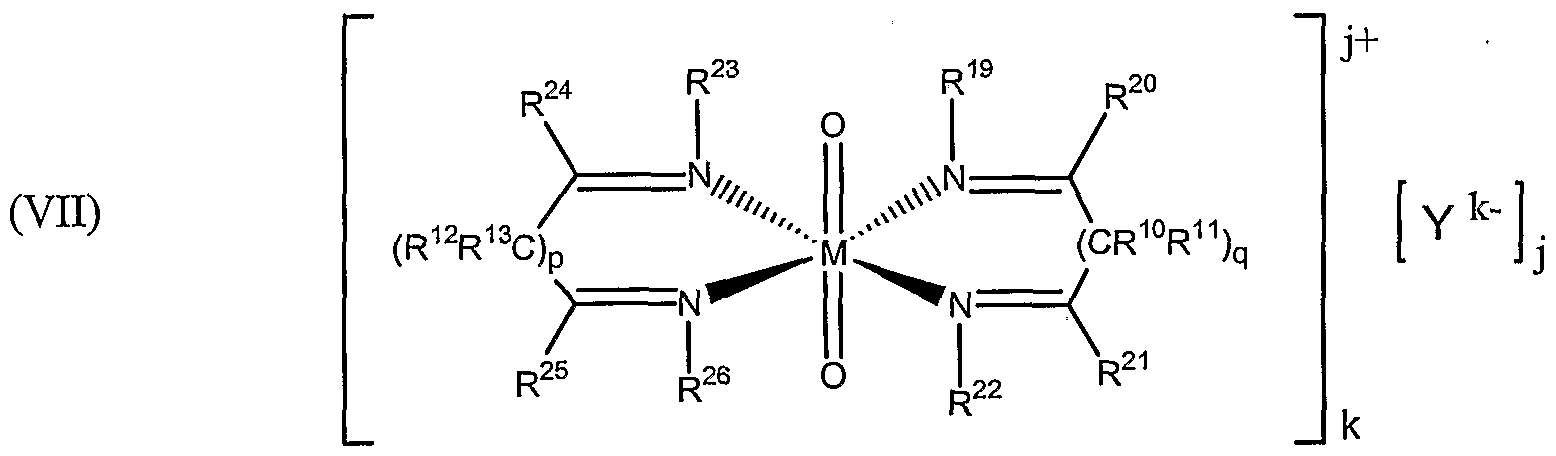
  • a transition metal complex of formula (VI) containing bidentate diimine ligands will have the structure of formula (VII)
  • R 19 , R 22 , R 23 and R 2 ⁇ are independently selected from the group consisting of hydrocarbyl, substituted hydrocarbyl, heteroatom-containing hydrocarbyl, and substituted heteroatom- containing hydrocarbyl;
  • R 20 , R 21 , R 24 and R 25 are independently selected from the group consisting of hydrogen, hydrocarbyl, substituted hydrocarbyl, heteroatom-containing hydrocarbyl, and substituted heteroatom-containing hydrocarbyl, and further wherein any two or more of R 19 , R 20 , R 21 , R 22 , R 23 , R 24 , R 25 and R 26 may be taken together to form a cyclic group.
  • R 10 , R 11 , R 12 and R 13 are independently selected from the group consisting of hydrogen, -C ⁇ alkyl, and cyano.
  • R 10 and R 12 may be hydrogen, and R 11 and R 13 may be cyano or -C 12 alkyl, e.g., methyl.
  • R 10 , R 11 , R 12 and R 13 may all be -C 12 alkyl, e.g., methyl.
  • cyclic groups when R 19 and R 20 , R 21 and R 22 , R 23 and R 24 , and R 25 and R 26 are linked to form cyclic groups, those cyclic groups may be five- or six-membered rings, or may comprise two or three five- or six-membered rings, which may be either fused or linked.
  • the cyclic groups may be aliphatic or aromatic, and may contain one or more heteroatoms in addition to the nitrogen atoms shown in the structure.
  • the cyclic groups formed are oxazole groups, with 4,5-dihydrooxazole groups particularly preferred.
  • Such transition metal complex has the structure of formula (VIII)
  • R 27 , R 28 , R 29 , R 30 , R 31 , R 32 , R 33 and R 34 are independently selected from the group consisting of hydrogen, C C 12 alkyl, phenyl, and benzyl, or wherein R and R , R and R , R and R , and/or R and R are linked to form a cyclic group.
  • the complex may or not be chiral, depending on the stereochemical configuration of R 27 ,
  • the ligands are mono-anionic, and instead of a second oxo ligand, a water molecule occupies the remaining coordination site, as shown in the structure of formula (VIIIB):
  • M is Re
  • R 10 , R n , R 12 and R 13 are independently selected from the group consisting of hydrogen, -C ⁇ alkyl, and cyano
  • R 28 , R 29 , R 32 and R 33 are hydrogen
  • R 27 , R 30 , R 31 and R 34 are aryl, e.g., phenyl or benzyl.
  • M is Re
  • R 10 , R 11 , R 12 and R 13 are independently selected from the group consisting of hydrogen, C 1 - 2 alkyl, and cyano
  • R 27 and R 28 , R 29 and R 30 , R 31 and R 32 , and R 33 and R 34 are linked to form cyclic groups, such that the complex has the structure of formula (XVIII)
  • R , 65 , r R, 66 , ⁇ R> 6 D 7 / , ⁇ R> 6S , ⁇ R> 69 , ⁇ R>7'0 u , ⁇ R.7'1 1 and R are independently selected from the group consisting of hydrogen, -C 12 alkyl, phenyl, and benzyl, or wherein R 65 and R 66 , R 67 and R 68 , R 69 and R , and R and R are linked to form cyclic groups.
  • R 65 and R 66 , R 67 and R 68 , R 69 and R , and R and R are linked to form cyclic groups.
  • Complexes of formula (VI) are not necessarily diimme-containmg complexes, however.
  • the ligands may also contain phosphorus and/or oxygen atoms that coordinate to the metal center.
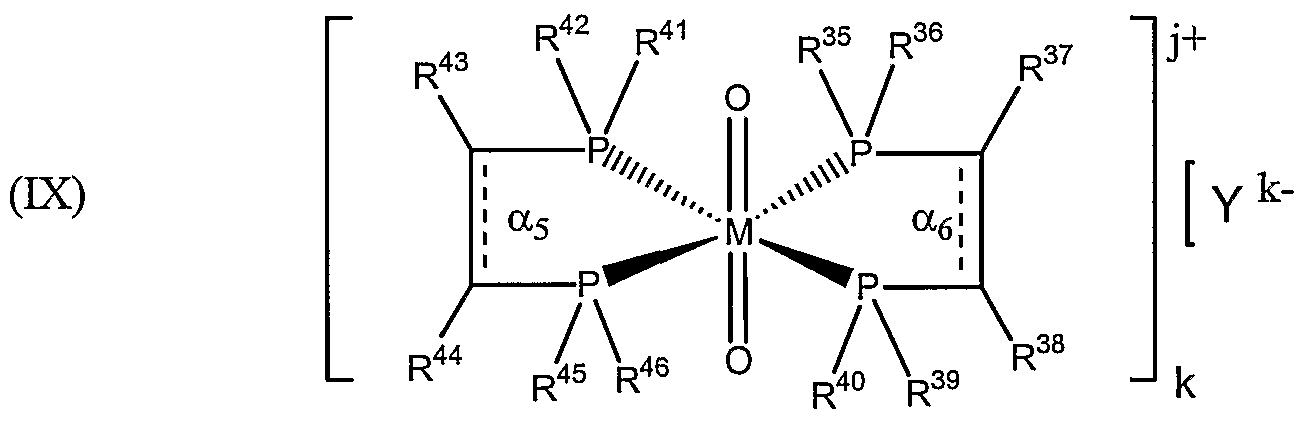
  • X 1 , X 2 , X 3 and X 4 are phosphorus atoms in two bidentate phosphine ligands.
  • Such complexes have the structure of formula (IX)
  • M is a Group 7 or Group 8 transition metal, preferably a Group 7 transition metal;
  • Y " is an anion bearing a charge of -k; either j and k are both 1, or j and k are both 2;
  • ⁇ 5 and ⁇ 6 are optional bonds,
  • R 35 , R 36 , R 39 , R 40 , R 41 , R 42 , R 45 and 46 are independently selected from the group consisting of hydrocarbyl, substituted hydrocarbyl, heteroatom-containing hydrocarbyl, and substituted heteroatom-containing hydrocarbyl; and
  • R 37 , R 38 , R 43 and R 44 are independently selected from the group consisting of hydrogen, hydrocarbyl, substituted hydrocarbyl, heteroatom-containing hydrocarbyl, and substituted heteroatom-containing hydrocarbyl, and further wherein any two or more of R 35 , R 36 , R 37 , R 38 , R 39 , R 40 , R 41 , R 42 , R 43 , R 44 and R 45 may be taken together to form a cyclic group.
  • M is Re
  • j and k are 1, or M is Os or Ru
  • j and k are 2.
  • Particularly preferred complexes of formula (IX) are those wherein ⁇ 5 and 6 are present, and R 37 and R 38 taken together, and R 43 and R 44 taken together, are phenyl or naphthalenyl.
  • ⁇ 5 and ⁇ 6 are absent, R 37 , R 38 , R 43 and R 44 are hydrogen, and R 35 , R 36 , R 39 , R 40 , R 41 , R 42 , R 45 and R 46 are aryl, e.g., phenyl.
  • complexes of formula (VI) are Re(V) complexes that contain a coordinating oxygen atom at two or more of X 1 , X 2 , X 3 and X 4 .
  • Exemplary such complexes have the structure of formula (X)
  • Z + is a cation; p and q are independently zero or 1 ;
  • R 10 , R ⁇ , R 12 and R 13 are independently selected from the group consisting of hydrogen, hydrocarbyl, substituted hydrocarbyl, heteroatom-containing hydrocarbyl, substituted heteroatom- containing hydrocarbyl, and functional groups;
  • R 47 and R 48 are independently selected from the group consisting of hydrocarbyl, substituted hydrocarbyl, heteroatom-containing hydrocarbyl, and substituted heteroatom- containing hydrocarbyl;
  • R 49 and R 50 are independently selected from the group consisting of hydrogen, hydrocarbyl, substituted hydrocarbyl, heteroatom-containing hydrocarbyl, and substituted heteroatom-containing hydrocarbyl, and further wherein either R 47 and R 49 , or R 47 and R 48 and/or R 49 and R 50 , may be taken together to form a cyclic group.
  • cyclic groups may be five- or six-membered rings, or may comprise two or three five- or six-membered rings, which may be either fused or linked.
  • the cyclic groups may be aliphatic or aromatic, and may contain one or more heteroatoms in addition to the nitrogen atoms shown in the structure.
  • the cyclic groups formed are oxazole groups, with 4,5-dihydrooxazole groups particularly preferred.
  • transition metal oxo complexes useful in the present methods are rhenium complexes having the structure of formula (XI)
  • L 3 is a neutral electron donor ligand, and is defined as for L 1 and L 2 ;
  • R 51 and R 52 are anionic ligands, and are defined as for R 6 , R 7 and R 8 ;
  • R 53 , R 54 and R 55 are independently selected from the group consisting of hydrogen, hydrocarbyl, substituted hydrocarbyl, heteroatom-containing hydrocarbyl, and substituted heteroatom-containing hydrocarbyl;
  • R 56 is selected from the group consisting of hydrocarbyl, substituted hydrocarbyl, heteroatom-containing hydrocarbyl, and substituted heteroatom-containing hydrocarbyl, and further wherein R 53 and R 54 , and/or R 5S and R 56 , may be taken together to form a cyclic group.
  • R 53 and R 54 together form a phenyl ring, and R 55 and R 56 together form a 4,5-dihydrooxazole ring optionally substituted at the 4-position, such that the structure has the formula (XII)
  • L 3 is P(cyclohexyl) 3 or -P(cyclopentyl) 3 ;
  • R 51 and R 52 are halide
  • R 57 is selected from the group consisting of hydrogen, -C 12 alkyl, phenyl, and benzyl.
  • R 58 , R 59 and R 60 are halide, and R 61 , R 62 , R 63 and R 64 are aryl, or wherein R 61 and R 62 , and/or R 63 and R 64 , may be taken together to form a cyclic group.
  • j, k, p, q, Y, and the various R groups are as defined herein with respect to the complexes of formulae (VII), (VIII), and (VIIIA).
  • Those complexes described in this section that are not new chemical entities may be purchased from commercial sources, e.g., Aldrich (Milwaukee Wl) or Strem Chemicals, Inc.
  • transition metal oxo complexes Prior catalytic applications of transition metal oxo complexes, and transition metal dioxo complexes in particular, involved functional group oxidation and oxygen transfer reactions such as epoxidations and dihydroxylation.
  • the transition metal complexes of the invention are now used in the catalysis of nucleophilic addition reactions, wherein the complex serves as a bifunctional catalyst, with the oxo (or sulfido or amido) ligand acting as a Lewis base catalyst and the metal center acting as a Lewis acid catalyst.
  • the complexes of the invention find utility in catalyzing a host of nucleophilic addition reactions, including, but not limited to, hydrosilylation and other hydrometalation reactions, hydroamination, silylmetalation, carbometalation, aldol reactions, hydro- and carbometalation initiated cyclization/polymerization, and epoxide/aziridine opening.
  • Hydrosilylation and other hydrometalation reactions Hydride reduction of carbonyl groups represents one of the simplest and most often used reactions in organic chemistry. In many cases, the alcohol produced from the reaction is subsequently protected as a silyl ether. Despite the fact that hydrosilylation of ketones and aldehydes should provide the opportunity to accomplish this transformation in a single operation, those working in the field have encountered numerous obstacles to development of a suitable reaction. Many hydrosilylation reactions have employed low-valent late transition metal catalysts that, by virtue of their low oxidation state, are often air- and moisture-sensitive. Low valent early transition metal metallocene catalysts, which have also been used, suffer from similar problems as well as being incompatible with a variety of Lewis basic functional groups.
  • the methodology of the invention provides a catalyst system that is air- and moisture-insensitive, has high functional group tolerance, and provides synthetically useful silyl ethers (e.g., t-butyldimethylsilyl, or "TBDMS").
  • TDMS synthetically useful silyl ethers
  • the nucleophilic reactant is a silane
  • the electrophilic reactant is a compound containing an unsaturated C-C, C-O, C-N, or C-S bond, e.g., an alkene, an alkyne, an aldehyde, a ketone, a thioketone, or an imine.
  • the silane will generally have the structure of formula (I)
  • R 1 , R 2 and R 3 are independently selected from the group consisting of hydrocarbyl, substituted hydrocarbyl, heteroatom-containing hydrocarbyl, and substituted heteroatom- containing hydrocarbyl, and X is hydrogen.
  • the electrophilic reactant has the structure of formula (II)
  • R 4 , R 4A and R 5 are independently selected from the group consisting of hydrogen, hydrocarbyl, substituted hydrocarbyl, heteroatom-containing hydrocarbyl, substituted heteroatom- containing hydrocarbyl, and a functional group; ⁇ is an optional bond; and x, y, and z are zero or 1, with the provisos that (a) when Q is O or S, then ⁇ is absent, x is 1, and y and z are zero; (b) when Q is N, then ⁇ is absent, x and z are 1, and y is zero; (c) when Q is C and ⁇ is absent, then x, y and z are 1; and (d) when Q is C and ⁇ is present, then x and y are zero and z is 1.
  • reaction is not necessarily limited to hydrosilylation, however, and that other silylation reactions wherein X is other than hydrogen, e.g., cyano, cyanato, azido, alkenyl, alkenyloxy, alkenylthio, or boronato, are also possible, as will be discussed in detail below.
  • X is other than hydrogen
  • the aforementioned reaction is not limited to silicon-containing nucleophiles, and that analogous hydrostannylation and hydroboration reactions will be similarly catalyzed using the present catalysts.
  • Transition metal catalyzed hydroamination of olefins and alkynes continues to receive considerable attention.
  • two approaches have been employed: (1) activation of the olefin by complexation to electrophilic transition metals (e.g., Pd(II), Pt(II)), and (2) N-H bond activation by early transition metal, lanthanides and actinides.
  • the methodology of the invention now allows for activation of both an unsaturated reactant and the amine in a hydroamination reaction.
  • Such a reaction will typically involve a silylazide, e.g., a trialkylsilylazide, and an unsaturated reactant in the form of an alkene or alkyne.
  • the silane reactant will have the structure of formula (I), wherein X is azido (-N 3 ) and R 1 , R 2 and R 3 are C ⁇ - 2 alkyl, preferably lower alkyl, and the unsaturated electrophilic reactant will have the structure of formula (II) wherein R 4 , R 4A and R 5 are as defined previously, ⁇ is an optional bond, and when ⁇ is absent, then x, y and z are 1, and ⁇ is present, then x and y are zero and z is 1.
  • Reaction with an olefin can serve as an initial step toward the formation of a primary amine, as follows:
  • TMS-N 3 trimethylsilylazide
  • Reaction of an alkyne substrate with a trialkylsilylazide produces a vinyl silane that can be further employed in a cross-coupling reaction, in which reduction of the azide intermediate is followed by hydrolysis of the resultant imine to give a ketone, effectively performing a regioselective hydration of a disubstituted alkyne.
  • This reaction may be illustrated as follows:
  • the present invention is also useful in the silylmetalation of unsaturated compounds, particularly olefins and carbonyl compounds.
  • the adducts formed upon silylmetalation are useful as intermediates in the further synthesis of a variety of compounds.
  • silylboration of a ketone produces a silyl ether containing a quaternary carbon-boron bond
  • subsequent Suzuki cross coupling allows for the introduction of a variety of aryl, vinyl and alkyl halides:
  • silylstannylation produces an alkylstannane that can be further utilized to produce organolithium reagents:
  • Carbometalation The addition of silyl cyanides and allyl silanes to carbonyl compounds has been most often accomplished by Lewis acid catalyzed activation of the carbonyl partner (as in the Sakurai reaction).
  • Lewis acids excludes the use of substrates that contain Lewis basic functional groups, and the catalysts are often very moisture-sensitive.
  • the complexes and methods of the invention lack these constraints.
  • the present catalysts do not require a Lewis basic carbonyl oxygen to promote the reactions. Therefore, the present invention enables the extension of reactions that have traditionally been limited to addition to the carbonyl to other types of unsaturated substrates.
  • transition metal dioxo catalyzed reaction of trimethylsilyl cyanide with olefins, followed by protodesilylation produces the equivalent of a Markovnikov hydrocyanation reaction, illustrated in the following scheme:
  • Transition metal catalyzed cross-coupling using the catalysts and methods of the invention thus provides a stereoselective synthetic route to trisubstituted olefins.
  • oxidative cleavage of the remaining olef ⁇ n affords the product which would be derived from a conjugate addition to an ⁇ , ⁇ -unsaturated aldehyde.
  • Sequential alkyne allylsilylation and cross-coupling provides for regio- and stereoselective entry into 1,4- dienes.
  • a trialkyl metal complex such as trimethylaluminum
  • a transition metal-dioxo complex will form an aluminoxymetal alkyl, such that coordination of the olefin to the metal center precedes insertion of the olefin into the metal-carbon bond.
  • coordination of a second equivalent of organoaluminum to the remaining oxo-ligand which would decrease the ⁇ -donation from the oxo to the metal, further facilitates the insertion reaction.
  • olefin polymerization may be initiated by the previously discussed hydrosilylation reaction.
  • the principles applied in the polymerization reactions may also be applied in cyclization reactions.
  • the cyclization reaction may be initiated by a number of the reactions that have previously been discussed. For example, hydro-, azido-, boryl- or cyano-metalation of an alkyne or olefin produces an alkyl metal intermediate. Insertion of pendant unsaturation (e.g. an aldehyde, imine or olefin) into the alkylmetal bond followed by silyl transfer produces the cyclized products, illustrated as follows:
  • the alkylmetal intermediate generated from the first cyclization reaction can undergo further reaction with the allyl moiety to provide bicyclic products.
  • Epoxide/aziridine opening Epoxides are some of the most versatile building blocks in organic synthesis. As such, methods for enantioselective additions of nucleophiles, including water, to epoxides are highly desirable.
  • the present invention encompasses such reactions, wherein nucleophilic reactants are activated by the oxo (or sulfido or amido) moiety of a transition metal complex as provided herein, and the epoxide or aziridine ring is activated by coordination to the Lewis acid metal center.
  • aldehydes, ketones, imines, olefins and silanes were purchased from Aldrich and used without further purification.
  • the bis-oxazoline ligands were purchased from Aldrich (Milwaukee, Wl), the bis-phosphine ligands were purchased from Strem Chemicals Inc. (Newburyport, MA), and the oxazolylphenol ligands were prepared from 2-cyanophenol (Bolm et al. (1991) Chem. Ber. 124:1173).
  • Iodo[bis(triphenylphosphine)]dioxorhenium(V) was prepared from potassium perrhenate by a modification of Ciani et al. (1983) Inorg. Chim. Ada. 72:29, bis(triphenylarsine)oxorhenium(V)trichloride was prepared according to Fonatine et al. (1991) J. Chem. Soc, Dalton Trans, 1519, and bis(triphenylphosphine) oxorhenium(V)trichloride was prepared according to Chart et al. (1962) J. Chem. Soc, 4019. Unless otherwise specified, all other reagents were also purchased from commercial suppliers and used without further purification.

Landscapes

  • Chemical & Material Sciences (AREA)
  • Organic Chemistry (AREA)
  • Chemical Kinetics & Catalysis (AREA)
  • Inorganic Chemistry (AREA)
  • Engineering & Computer Science (AREA)
  • Materials Engineering (AREA)
  • Organic Low-Molecular-Weight Compounds And Preparation Thereof (AREA)
  • Epoxy Compounds (AREA)
  • Catalysts (AREA)

Abstract

Methods are provided for carrying out nucleophilic addition reactions using oxo, sulfido or amido complexes of transition metals as reaction catalysts. Exemplary catalysts are oxo complexes of Group 7 transition metals, with rhenium (V) oxo complexes, including dioxo complexes, preferred. Nucleophilic addition reactions that can be catalyzed using the present methods include silylation, hydrosilylation, hydroamination, silylmetalation, carbometalation, aldol reactions, hydro- and carbometalation initiated cyclization/polymerization, and epoxide/aziridine opening. The invention also pertains to novel transition metal complexes that have utility in catalyzing such reactions.

Description

TRANSITION METAL OXO, SULFIDO AND AMIDO COMPLEXES AS CATALYSTS OF NUCLEOPHILIC ADDITION REACTIONS
TECHNICAL FffiLD
This invention relates generally to a catalytic method for the addition of nucleophilic reactants to an electrophilic substrate using transition metal oxo, sulfido and amido complexes as catalysts. More particularly, the invention relates to a catalytic method for the addition of silyl groups to unsaturated bonds, using a transition metal-oxo complex as a silylation catalyst for such a reaction.
BACKGROUND OF THE INVENTION
Organosilicon compounds have utility in a wide range of commercial applications. For example, organosilanes are used as precursors to silicon-containing polymers, which, in turn, have numerous uses in the electronics, adhesives, and plastics industries. Organosilanes are also useful in a host of synthetic organic processes, typically as reducing agents and/or silylating agents.
Other organosilicon compounds such as hydrolyzable silyl ethers (also termed alkoxysilanes) are used in the manufacture of coatings, glasses, and binders, while less reactive, lower molecular weight silyl ethers find utility as lubricant, heat-transfer, and dielectric fluids.
A well known and widely used reaction for synthesizing organosilicon compounds is the hydrosilylation of olefins, in which a silane reactant R3Si-H is added to an unsaturated carbon- carbon bond in the presence of a catalyst selected to activate the Si-H bond in the silane precursor. Hydrosilylation of olefins and carbonyl compounds has traditionally been achieved by employing low-valent late transition metal complexes as catalysts, e.g., palladium, platinum, rhodium, and iridium complexes. See Ojima et al., "Recent Advances in the Hydrosilations and Related Reactions," in The Chemistry of Organic Silicon Compounds, vol. 2 (New York: Wiley and Sons, 1998), at pages 1687-1792. Illustrative of such catalysts are platinum supported on carbon, cliloroplatinic acid, complexes of platinic chloride and unsaturated organic compounds, and compounds and complexes of rhodium, as described, for example, in U.K. Patent Application No. 1,041,237. Also see Chalk (1971), Ann. N.Y. Acad. Sci. l_72(13):533-540, which describes hydrosilylation of olefins using iridium, platinum and rhodium complexes as hydrosilylation catalysts. Organosilicon compounds have also been synthesized by silylation of carbonyl compounds, including aldehydes and ketones, traditionally using Lewis acid metal complexes as catalysts.
Use of the platinum group metals as hydrosilylation catalysts is, however, problematic in several respects. Complexes of the platinum group metals are typically air- and moisture- sensitive, and, therefore, any reactions catalyzed with such complexes cannot be carried out without taking precautions to avoid air and/or water contamination. These catalysts are also expensive, precluding widespread utility on an industrial scale. In addition, use of highly Lewis acidic complexes as catalysts for the silylation of carbonyl-containing compounds precludes the use of reactants that contain Lewis basic functional groups. Furthermore, in many cases the Lewis acid catalysts are highly intolerant to the presence of water.
Accordingly, there is a need in the art for a new method of catalyzing a silylation reaction that would not be associated with the aforementioned problems. Optimally, then, the catalyst used would be air- and moisture-insensitive, significantly less expensive than the platinum-group catalysts, and tolerant of a range of functional groups. It would also be desirable if such a catalyst were useful in catalyzing stereoselective, e.g., enantioselective, silylation reactions. Furthermore, an ideal catalyst would be useful not only in silylation, but would also be useful in catalyzing other nucleophilic addition reactions wherein a nucleophilic reactant is added to an electrophilic compound containing, as an electrophilic site, an unsaturated carbon-carbon bond, a carbonyl group, a thiocarbonyl group (C=S), or an imino (C=NH) group.
SUMMARY OF THE INVENTION
The present mvention is addressed to the aforementioned need in the art, and provides a novel method for catalyzing a nucleophilic addition reaction wherein an electrophilic reactant containing an electrophilic site in the form of an unsaturated bond between a carbon atom and a second atom Q, wherein Q is selected from O, S, N and C, is contacted with a nucleophilic reactant in the presence of a catalytically effective amount of a transition metal oxo, sulfido or amido complex. The reaction is carried out under conditions that provide for nucleophilic addition of the nucleophilic reactant to the electrophilic site of the electrophilic reactant. The transition metal complex that serves as the catalyst has the structure LmM(=Z)n wherein: m is an integer in the range of 2 to 5 inclusive; n is 1 or 2; the L groups are ligands, and may be the same or different;
M is a transition metal, preferably selected from Groups 6, 7 and 8 of the Periodic Table of the Elements, with Mo, W, Re, Ru or Os particularly preferred; and Z is O, S or NR1 wherein R1 is hydrogen or hydrocarbyl.
Preferred transition metal complexes are transition metal-oxo complexes in which Z is O. Of the transition metal-oxo complexes, particularly preferred are those complexes wherein n is 2, such that the catalyst is a transition metal-dioxo complex. It will be appreciated that depending on the particular transition metal, number of ligands (m), nature of the ligands (monodentate, bidentate, etc.), and number of (=Z) groups (i.e., n), the complex may be charged and associated with a counterion of opposite charge.
Particularly preferred transition metal complexes are d2-metal-dioxo complexes, which, in contrast to d0-metal-dioxo complexes (e.g., (CH3)3Re03) provide for enhanced Lewis basicity of the oxo ligands, and enhanced Lewis acidity at the metal center. In general, the HOMO (highest occupied molecular orbital) of the present complexes is localized on the oxygen atom of the oxo moieties (or on the sulfur or nitrogen atoms of sulfido or amido moieties, when X is S or NH, respectively), while the LUMO (lowest occupied molecular orbital) is localized on the metal center. In this way, the complexes act as bifunctional catalysts in which the oxo (or sulfido or amido) ligand acts as a Lewis base catalyst and the metal acts as a Lewis acid catalyst. Without wishing to be bound by theory, the preferred d2-metal-dioxo complexes of the invention appear to function as catalysts of a wide variety of nucleophilic addition reactions, in general, by virtue of activating both the nucleophilic and the electrophilic reactants without oxidizing either component. Such reactions include, by way of example, hydrosilylation and other hydrometalation reactions, hydroamination, silylmetalation, carbometalation, aldol reactions, hydro- and carbometalation initiated cyclization/polymerization, and epoxide/aziridine opening. Because the complexes disclosed herein are versatile catalysts useful in catalyzing a wide variety of reactions, it will be appreciated that they may also be used in catalyzing tandem reactions, wherein a first nucleophilic addition reaction results in a product that is also capable of undergoing such a reaction, with each reaction catalyzed by the same complex 0.
While the present method is, accordingly, useful in catalyzing nucleophilic addition reactions in general, a preferred application of the method is in silylation. In this embodiment, the nucleophilic reactant is a silane, and the electrophilic reactant is a compound containing an unsaturated C-C, C-O, C-N, or C-S bond, e.g., an alkene, an alkyne, an aldehyde, a ketone, a thioketone, or an imine.
In the aforementioned silylation reaction, the silane will generally have the structure of
Figure imgf000004_0001
wherein: R1, R2 and R3 are independently selected from the group consisting of hydrocarbyl, substituted hydrocarbyl, heteroatom-containing hydrocarbyl, and substituted heteroatom- containing hydrocarbyl; and X is hydrogen, cyano, cyanato, azido, alkenyl, alkenyloxy, alkenylthio, or boronato. The electrophilic reactant will generally have the structure of formula (II)
R4 (R5))
(II) \= =
/ " α \
(R4A)x (H)z wherein:
R4, R4A and R5 are independently selected from the group consisting of hydrogen, hydrocarbyl, substituted hydrocarbyl, heteroatom-containing hydrocarbyl, substituted heteroatom- containing hydrocarbyl, and a functional group; α is an optional bond; and x, y, and z are zero or 1, with the provisos that (a) when Q is O or S, then α is absent, x is 1, and y and z are zero; (b) when Q is N, then α is absent, x and z are 1, and y is zero; (c) when Q is C and α is absent, then x, y and z are 1 ; and (d) when Q is C and α is present, then x and y are zero and z is 1.
For example, when α is absent, such that the electrophilic reactant has the structure of formula (IH)
Figure imgf000005_0001
nucleophilic addition of the silane reactant using a complex of the invention as a catalyst results in a reaction product having the structure of formula (IV)
Figure imgf000005_0002
In another embodiment, novel transition metal complexes are provided that are useful as catalysts, e.g., in the reaction described above. The novel complexes are transition metal dioxo complexes such as the rhenium (V) dioxo complex having the structure of formula (XV)
Figure imgf000006_0001
wherein:
Y" is an anion; p and q are independently zero or 1 ;
R10, R11, R12 and R13 are independently selected from the group consisting of hydrogen, hydrocarbyl, substituted hydrocarbyl, heteroatom-containing hydrocarbyl, substituted heteroatom- containing hydrocarbyl, and functional groups;
R19, R22, R23 and R26 are independently selected from the group consisting of hydrocarbyl, substituted hydrocarbyl, heteroatom-containing hydrocarbyl, and substituted heteroatom- containing hydrocarbyl; and
R20, R21, R24 and R25 are independently selected from the group consisting of hydrogen, hydrocarbyl, substituted hydrocarbyl, heteroatom-containing hydrocarbyl, and substituted heteroatom-containing hydrocarbyl, and further wherein any two or more of R19, R20, R21, R22, R23, R24, R25 and R26 may be taken together to form a cyclic group.
In preferred such complexes, R19 and R20, R21 and R22, R23 and R24, and R25 and R26 are linked to form cyclic groups, such that the transition metal complex has the structure of formula (XVI)
Figure imgf000006_0002
wherein R27, R28, R29, R30, R31, R32, R33 and R34 are independently selected from the group consisting of hydrogen, -Cn alkyl, phenyl, and benzyl, or wherein R27 and R2S, R29 and R30, R31 and R , and/or R and R are linked to form a cyclic group. The configuration of the R , R , R29, R30, R31, R32, R33 and R34 can be selected so as to provide a chiral complex, such that the complex may be used in catalyzing stereoselective, e.g., enantioselective, reactions.
DETAILED DESCRIPTION OF THE INVENTION
I. DEFINITIONS AND NOMENCLATURE:
It is to be understood that unless otherwise indicated this invention is not limited to specific reactants, reaction conditions, ligands, metal complexes, or the like, as such may vary. It is also to be understood that the terminology used herein is for the purpose of describing particular embodiments only and is not intended to be limiting.
As used in the specification and the appended claims, the singular forms "a," "an" and "the" include plural referents unless the context clearly dictates otherwise. Thus, for example, reference to "a compound" encompasses a combination or mixture of different compounds as well as a single compound, reference to "a functional group" includes a single functional group as well as two or more functional groups that may or may not be the same, and the like.
In this specification and in the claims that follow, reference will be made to a number of terms, which shall be defined to have the following meanings:
As used herein, the phrase "having the formula" or "having the structure" is not intended to be limiting and is used in the same way that the term "comprising" is commonly used.
The term "alkyl" as used herein refers to a linear, branched or cyclic saturated hydrocarbon group typically although not necessarily containing 1 to about 20 carbon atoms, such as methyl, ethyl, n-propyl, isopropyl, ra-butyl, isobutyl, ϊ-butyl, octyl, decyl, and the like, as well as cycloalkyl groups such as cyclopentyl, cyclohexyl and the like. Generally, although again not necessarily, alkyl groups herein contain 1 to about 12 carbon atoms. The term "lower alkyl" intends an alkyl group of 1 to 6 carbon atoms, and the specific term "cycloalkyl" intends a cyclic alkyl group, typically having 4 to 8, preferably 5 to 7, carbon atoms. The term "substituted alkyl" refers to alkyl substituted with one or more substituent groups, and the terms "heteroatom-containing alkyl" and "heteroalkyl" refer to alkyl in which at least one carbon atom is replaced with a heteroatom. If not otherwise indicated, the terms "alkyl" and "lower alkyl" include linear, branched, cyclic, unsubstituted, substituted, and/or heteroatom-containing alkyl and lower alkyl, respectively.
The term "alk lene" as used herein refers to a difunctional linear, branched or cyclic alkyl group, where "alkyl" is as defined above.
The term "alkenyl" as used herein refers to a linear, branched or cyclic hydrocarbon group of 2 to 20 carbon atoms containing at least one double bond, such as ethenyl, 7J-propenyl, isopropenyl, ra-butenyl, isobutenyl, octenyl, decenyl, tetradecenyl, hexadecenyl, eicosenyl, tetracosenyl, and the like. Preferred alkenyl groups herein contain 2 to 12 carbon atoms. The term "lower alkenyl" intends an alkenyl group of 2 to 6 carbon atoms, and the specific term "cycloalkenyl" intends a cyclic alkenyl group, preferably having 5 to 8 carbon atoms. The term "substituted alkenyl" refers to alkenyl substituted with one or more substituent groups, and the terms "heteroatom-containing alkenyl" and "heteroalkenyl" refer to alkenyl in which at least one carbon atom is replaced with a heteroatom. If not otherwise indicated, the terms "alkenyl" and "lower alkenyl" include linear, branched, cyclic, unsubstituted, substituted, and/or heteroatom- containing alkenyl and lower alkenyl, respectively. The term "alkenylene" as used herein refers to a difunctional linear, branched or cyclic alkenyl group, where "alkenyl" is as defined above.
The term "alkynyl" as used herein refers to a linear or branched hydrocarbon group of 2 to 20 carbon atoms containing at least one triple bond, such as ethynyl, rø-propynyl, and the like. Preferred alkynyl groups herein contain 2 to 12 carbon atoms. The term "lower alkynyl" intends an alkynyl group of 2 to 6 carbon atoms. The term "substituted alkynyl" refers to alkynyl substituted with one or more substituent groups, and the terms "heteroatom-containing alkynyl" and "heteroalkynyl" refer to alkynyl in which at least one carbon atom is replaced with a heteroatom. If not otherwise indicated, the terms "alkynyl" and "lower alkynyl" include linear, branched, unsubstituted, substituted, and/or heteroatom-containing alkynyl arid lower alkynyl, respectively.
The term "alkoxy" as used herein intends an alkyl group bound through a single, terminal ether linkage; that is, an "alkoxy" group may be represented as -O-alkyl where alkyl is as defined above. A "lower alkoxy" group intends an alkoxy group containing 1 to 6 carbon atoms. Analogously, "alkenyloxy" and "lower alkenyloxy" respectively refer to an alkenyl and lower alkenyl group bound through a single, terminal ether linkage, and "alkynyloxy" and "lower alkynyloxy" respectively refer to an alkynyl and lower alkynyl group bound through a single, terminal ether linkage.
The term "aryl" as used herein, and unless otherwise specified, refers to an aromatic substituent containing a single aromatic ring or multiple aromatic rings that are fused together, directly linked, or indirectly linked (such that the different aromatic rings are bound to a common group such as a methylene or ethylene moiety). Preferred aryl groups contain one aromatic ring or 2 to 4 fused or linked aromatic rings, e.g., phenyl, naphthyl, biphenyl, and the like. "Substituted aryl" refers to an aryl moiety substituted with one or more substituent groups, and the terms "heteroatom-containing aryl" and "heteroaryl" refer to aryl in which at least one carbon atom is replaced with a heteroatom. Unless otherwise indicated, the terms "aromatic," "aryl," and "arylene" include heteroaromatic, substituted aromatic, and substituted heteroaromatic species.
The term "aryloxy" as used herein refers to an aryl group bound through a single, terminal ether linkage. An "aryloxy" group may be represented as -O-aryl where aryl is as defined above. The term "aralkyl" refers to an alkyl group with an aryl substituent, and the term
"aralkylene" refers to an alkylene group with an aryl substituent; the term "alkaryl" refers to an aryl group that has an alkyl substituent, and the term "alkarylene" refers to an arylene group with an alkyl substituent.
The term "alicyclic" refers to an aliphatic cyclic moiety, which may or may not be bicyclic or polycyclic.
The terms "halo" and "halogen" are used in the conventional sense to refer to a chloro, bromo, fluoro or iodo substituent. The terms "haloalkyl," "haloalkenyl" or "haloalkynyl" (or "halogenated alkyl," "halogenated alkenyl," or "halogenated alkynyl") refers to an alkyl, alkenyl or alkynyl group, respectively, in which at least one of the hydrogen atoms in the group has been replaced with a halogen atom.
"Hydrocarbyl" refers to univalent hydrocarbyl radicals containing 1 to about 30 carbon atoms, preferably 1 to about 20 carbon atoms, most preferably 1 to about 12 carbon atoms, including linear, branched, cyclic, saturated and unsaturated species, such as alkyl groups, alkenyl groups, aryl groups, and the like. The term "lower hydrocarbyl" intends a hydrocarbyl group of 1 to 6 carbon atoms, and the term "hydrocarbylene" intends a divalent hydrocarbyl moiety containing 1 to about 30 carbon atoms, preferably 1 to about 20 carbon atoms, most preferably 1 to about 12 carbon atoms, including linear, branched, cyclic, saturated and unsaturated species. The term "lower hydrocarbylene" intends a hydrocarbylene group of 1 to 6 carbon atoms. "Substituted hydrocarbyl" refers to hydrocarbyl substituted with one or more substituent groups, and the terms "heteroatom-containing hydrocarbyl" and "heterohydrocarbyl" refer to hydrocarbyl in which at least one carbon atom is replaced with a heteroatom. Similarly, "substituted hydrocarbylene" refers to hydrocarbylene substituted with one or more substituent groups, and the terms "heteroatom-containing hydrocarbylene" and heterohydrocarbylene" refer to hydrocarbylene in which at least one carbon atom is replaced with a heteroatom. Unless otherwise indicated, the term "hydrocarbyl" and "hydrocarbylene" are to be interpreted as including substituted and/or heteroatom-containing hydrocarbyl and hydrocarbylene moieties, respectively.
The term "heteroatom-containing" as in a "heteroatom-containing hydrocarbyl group" refers to a hydrocarbon molecule or a hydrocarbyl molecular fragment in which one or more carbon atoms is replaced with an atom other than carbon, e.g., nitrogen, oxygen, sulfur, phosphorus or silicon, typically nitrogen, oxygen or sulfur. Similarly, the term "heteroalkyl" refers to an alkyl substituent that is heteroatom-containing, the term "heterocyclic" refers to a cyclic substituent that is heteroatom-containing, the terms "heteroaryl" and heteroaromatic" respectively refer to "aryl" and "aromatic" substituents that are heteroatom-containing, and the like. It should be noted that a "heterocyclic" group or compound may or may not be aromatic, and further that "heterocycles" may be monocyclic, bicyclic, or polycyclic as described above with respect to the term "aryl."
By "substituted" as in "substituted hydrocarbyl," "substituted alkyl," "substituted aryl," and the like, as alluded to in some of the aforementioned definitions, is meant that in the hydrocarbyl, alkyl, aryl, or other moiety, at least one hydrogen atom bound to a carbon (or other) atom is replaced with one or more non-hydrogen substituents. Examples of such substituents include, without limitation, functional groups such as: halo; hydroxyl; sulfhydryl; Cι-C2o alkoxy; C2-C2o alkenyloxy; C2-C2o alkynyloxy; C5-C2o aryloxy; C2-C2o acyl, including C2-C2o alkylcarbonyl (-CO- alkyl) and C6-C2o arylcarbonyl (-CO-aryl); C2-C2o acyloxy, including C2-C2o alkoxycarbonyl (-(CO)-O-alkyl) and C6-C20 aryloxycarbonyl (-(CO)-O-aryl); halocarbonyl (-CO)-X where X is halo); carboxy (-COOH); carboxylato (-COO-); carbamoyl (-(CO)-NH2); C2-C2o alkylcarbamoyl (-(CO)- H-alkyl); C6-C20 arylcarbamoyl (-(CO)- H-aryl); thiocarbamoyl (-(CS)-NH2); carbamido (-NH-(CO)-NH2); cyano(-C≡N); isocyano (-N÷≡C-); cyanato (-O-C≡N); isocyanato (-O-IST'≡C"); isothiocyanato (-S-C≡N); azido (-^N T); formyl (-(CO)-H); thioformyl (-(CS)-H); amino, including primary amino (-NH2), mono- and di-(alkyl)-substituted amino, and mono- and di-(aryι)- substituted amino; C2-C20 alkylamido (-NH-(CO)-alkyl); C6-C20 arylamido (-NH-(CO)-aryl); C2- C2o imino (-CR=NH where R = hydrogen, alkyl, aryl, alkaryl, etc.); C2-C2o alkylimino (-CR=N(alkyl), where R = hydrogen, alkyl, aryl, alkaryl, etc.); arylimino (-CR=N(aryl), where R = hydrogen, alkyl, aryl, alkaryl, etc.); nitro (-N02); nitroso (-NO); mercapto (-SH); sulfo (-S02-OH); sulfonato (-S02-0"); Cι-C2o alkylsulfanyl (-S-alkyl; also termed "alkylthio"); C5-C2o arylsulfanyl (- S-aryl; also termed "arylthio"); -C20 alkylsulfinyl (-(SO)-O-alkyl); C5-C20 arylsulfinyl (-(SO)-O- aryl); C1-C20 alkylsulfonyl (-S02-0-alkyl); C5-C20 arylsulfonyl (-S02-0-aryl); thiocarbonyl (=S); boryl (-BH2); borono (-B(OH)2); boronato (-B(OR)2 where R is alkyl or other hydrocarbyl); phosphono (-P(0)(OH)2); phosphonato (-P(0)(0")2); phosphinato (-P(0)(0~)); phospho (-P02); and phosphino (-PH2). Suitable substituents also include the hydrocarbyl moieties C1-C20 alkyl (preferably C1-C12 alkyl, more preferably Cι-C6 alkyl), C2-C20 alkenyl (preferably C -Cι2 alkenyl, more preferably C2-C6 alkenyl), C2-C24 alkynyl (preferably C2-C12 alkynyl, more preferably C2-C6 alkynyl), C5-C20aryl (preferably C5-Cι2 aryl), and C6-C20 aralkyl (preferably C6-Cι2 aralkyl).
In addition, the aforementioned hydrocarbyl moieties may be further substituted with one or more functional groups or additional hydrocarbyl moieties. Analogously, the above-mentioned functional groups may, if a particular group permits, be further substituted with one or more additional functional groups or with one or more hydrocarbyl moieties such as those specifically enumerated above.
When the term "substituted" appears prior to a list of possible substituted groups, it is intended that the term apply to every member of that group. That is, the phrase "substituted alkyl, alkenyl and alkynyl" is to be interpreted as "substituted alkyl, substituted alkenyl and substituted alkynyl." Similarly, "optionally substituted alkyl, alkenyl and alkynyl" is to be interpreted as "optionally substituted alkyl, optionally substituted alkenyl and optionally substituted alkynyl."
The term "stereoselective" refers to a chemical reaction that preferentially results in one stereoisomer relative to a second stereoisomer, i.e., gives rise to a product of which the ratio of a desired stereoisomer to a less desired stereoisomer is greater than 1:1. The term "enantioselective" refers to a stereoselective reaction in which the stereoisomers are enantiomers; that is, an enantioselective reaction preferentially results in one enantiomer relative to a second enantiomer.
"Optional" or "optionally" means that the subsequently described circumstance may or may not occur, so that the description includes instances where the circumstance occurs and instances where it does not. For example, the phrase "optionally substituted" means that a non- hydrogen substituent may or may not be present on a given atom, and, thus, the description includes structures wherein a non-hydrogen substituent is present and structures wherein a non- hydrogen substituent is not present.
In the molecular structures herein, the use of bold and dashed lines to denote particular conformation of groups follows the IUPAC convention. A bond indicated by a broken line indicates that the group in question is below the general plane of the molecule as drawn (the "α" configuration), and a bond indicated by a bold line indicates that the group at the position in question is above the general plane of the molecule as drawn (the "β" configuration).
II. CATALYSTS:
The reactions of the invention are carried out catalytically, using a transition metal oxo, sulfido or amido complex as a catalyst. The transition metal complex that serves as the catalyst has the structure LmM(=Z)n wherein: m is an integer in the range of 2 to 5 inclusive; n is 1 or 2; the L groups are ligands, and may be the same or different;
M is a transition metal, preferably selected from Groups 6, 7 and 8 of the Periodic Table of the Elements, with Mo, W, Re, Ru or Os particularly preferred; and
Z is O, S or NR1 wherein R1 is hydrogen or hydrocarbyl, and preferred Z moieties are O, such that the complex is a transition metal oxo complex. The complex may be charged and associated with a counterion of opposite charge, depending on the particular transition metal, number of ligands (m), nature of the ligands (monodentate, bidentate, etc.), and number of (=Z) groups (i.e., n). For example, rhenium (V) complexes are electronically neutral when m is 3, n is 2, and the L groups are monodentate ligands, but bear a positive charge when m is 2, n is 2, and the L groups are bidentate diimine ligands. In the latter case, the complex will be in the form of a salt, i.e., associated with a halide ion or other anion. In one group of preferred complexes: (1) m is 5, n is 1, M is Re, and the L groups are monodentate ligands; (2) m is 4, n is 1, M is Re, one L group is a bidentate ligand, and three L groups are monodentate ligands; and (3) m is 2, n is 2, M is Re, the L groups are bidentate diimine ligands, and the complex is positively charged and associated with an anionic counterion.
Exemplary transition metal complexes for use in conjunction with the methods of the invention have the structure of formula (V)
Figure imgf000012_0001
wherein the various substituents are as follows:
M is a Group 7 transition metal, with Re(V) particularly preferred. L1 and L2 are neutral electron donor ligands, and may be the same or different. Examples of suitable L1 and L2 moieties include, without limitation, phosphine, sulfonated phosphine, phosphite, phosphinite, phosphonite, arsine, stibine, ether (including cyclic ethers), amine, amide, i ine, sulfoxide, carboxyl, nitrosyl, pyridine, substituted pyridine (e.g., halogenated pyridine), imidazole, substituted imidazole (e.g., halogenated imidazole), pyrazine (e.g., substituted pyrazine), and thioether. In more preferred embodiments, L1 and L2 are phosphines of the formula PR3, where each R is independently aryl or Ci- o alkyl, particularly primary alkyl, secondary alkyl or cycloalkyl. In the most preferred embodiments, L is selected from the group consisting of -P(cyclohexyl)3, -P(cyclopentyl)3, -P(isopropyl)3, -P(phenyl)3, -P(phenyl)2(RA) and -P(phenyl)(RA)2, in which RA is alkyl, typically lower alkyl. Also preferred are weaker ligands such as the nitrogen-containing heterocycles, which enhance catalytic activity presumably because of the requirement that the L ligand dissociate for initiation to occur.
R6, R7 and R8 are anionic ligands, and may be the same or different, or any two of R6, R7 and R8 may be linked together to form a cyclic group, typically although not necessarily a five- to eight-membered ring, or may be taken together to form a second oxo group =0. In preferred embodiments, R6, R7 and R8 are each independently hydrogen, halide, or one of the following groups: Cι-C20 alkyl, C5-C2o aryl, Cι-C20 alkoxy, C5-C20 aryloxy, C3-C20 alkyldiketonate, Cs-C20 aryldiketonate, C2-C20 alkoxycarbonyl, C5-C20 aryloxycarbonyl, C2-C2o acyl, Cι-C20 alkylsulfonato, C5-C20 arylsulfonato, C C2o alkylsulfanyl, C5-C2o arylsulfanyl, Cι-C20 alkylsulfinyl, or C5-C20 arylsulfinyl. In more preferred embodiments, R6, R7 and R8 are halide, benzoate, C2-C6 acyl, C2-C6 alkoxycarbonyl, Cι-C6 alkyl, phenoxy, Cι-C6 alkoxy, Cι-C6 alkylsulfanyl, aryl, or Cι-C6 alkylsulfonyl. In even more preferred embodiments, R6, R7 and R8 are each halide, CF3CO2, CH3C02, CFH2CO2, (CH3)3CO, (CF3)2(CH3)CO, (CF3)(CH3)2CO, phenoxy, methoxy, ethoxy, tosylate, mesylate, or trifluoromethanesulfonate. In the most preferred embodiments, R6, R7 and R8 are each methoxy, ethoxy, chloride or iodide. Optionally, R6, R7 and R8 may be substituted with one or more moieties selected from the group consisting of -C12 alkyl, -Cπ alkoxy, C5-C20 aryl, and halide, which may, in turn, with the exception of halide, be further substituted with one or more groups selected from halide, C C6 alkyl, Cι-C6 alkoxy, and phenyl. In other preferred embodiments, one of R6, R7 and R8 is as just defined and the other two together form a second oxo moiety. hi another embodiment, the transition metal complex has the structure of formula (VI)
Figure imgf000013_0001
wherein:
M is a Group 7 or Group 8 transition metal;
Y"k is an anion bearing a charge of -k; either j and k are both 1 , or j and k are both 2; p and q are independently zero or 1;
R10, R11, R12 and R13 are independently selected from the group consisting of hydrogen, hydrocarbyl, substituted hydrocarbyl, heteroatom-containing hydrocarbyl, substituted heteroatom- containing hydrocarbyl, and functional groups; oti, α2, α3 and α4 are optional bonds;
X1, X2, X3 and X4 are independently selected from NR14, NR15R16 and PR17R18, with the proviso that when any of X1, X2, X3 and X4 are NR14, then the adjacent α-i, α2, α3 or α4 is present, and when any of X1, X2, X3 and X4 are NR15R16 or PR17R18, then the adjacent α α2, α3 or α4is absent; and R14, R15, R16, R17 and R18 are independently selected from the group consisting of hydrocarbyl, substituted hydrocarbyl, heteroatom-containing hydrocarbyl, and substituted heteroatom-containing hydrocarbyl, and further wherein any two or more of R14, R15, R16, R17 and R1S may be taken together, optionally with any of R10, R11, R12 and R13, to form a cyclic group.
In preferred complexes of formula (VI), M is Re, in which case j and k are 1 , or M is Ru or Os, in which case j and k are 2.
It should be appreciated that although the complex of formula (VI) is drawn as a trans- dioxo complex, the structure is intended to encompass cis-dioxo complexes as well, which, technically, have the structure (VIA)
Figure imgf000014_0001
A transition metal complex of formula (VI) containing bidentate diimine ligands will have the structure of formula (VII)
Figure imgf000014_0002
wherein:
R19, R22, R23 and R2δ are independently selected from the group consisting of hydrocarbyl, substituted hydrocarbyl, heteroatom-containing hydrocarbyl, and substituted heteroatom- containing hydrocarbyl; and
R20, R21, R24 and R25 are independently selected from the group consisting of hydrogen, hydrocarbyl, substituted hydrocarbyl, heteroatom-containing hydrocarbyl, and substituted heteroatom-containing hydrocarbyl, and further wherein any two or more of R19, R20, R21, R22, R23, R24, R25 and R26 may be taken together to form a cyclic group.
In preferred complexes of formula (VII), when p and q are 1, R10, R11, R12 and R13 are independently selected from the group consisting of hydrogen, -Cπ alkyl, and cyano. For example, R10 and R12 may be hydrogen, and R11 and R13 may be cyano or -C12 alkyl, e.g., methyl. As another example R10, R11, R12 and R13 may all be -C12 alkyl, e.g., methyl.
In these complexes, when R19 and R20, R21 and R22, R23 and R24, and R25 and R26 are linked to form cyclic groups, those cyclic groups may be five- or six-membered rings, or may comprise two or three five- or six-membered rings, which may be either fused or linked. The cyclic groups may be aliphatic or aromatic, and may contain one or more heteroatoms in addition to the nitrogen atoms shown in the structure. In one preferred embodiment, the cyclic groups formed are oxazole groups, with 4,5-dihydrooxazole groups particularly preferred. Such transition metal complex has the structure of formula (VIII)
Figure imgf000015_0001
wherein R27, R28, R29, R30, R31, R32, R33 and R34 are independently selected from the group consisting of hydrogen, C C12 alkyl, phenyl, and benzyl, or wherein R and R , R and R , R and R , and/or R and R are linked to form a cyclic group.
The complex may or not be chiral, depending on the stereochemical configuration of R27,
R28, R29, R30, R31, R32, R33 and R34. To catalyze stereoselective reactions, and enantioselective reactions in particular, the various substituents have the stereochemical configurations indicated in the structure of formula (VIIIA)
(VIIIA)
Figure imgf000015_0002
In a variation on such complexes, the ligands are mono-anionic, and instead of a second oxo ligand, a water molecule occupies the remaining coordination site, as shown in the structure of formula (VIIIB):
(VIIIB)
Figure imgf000016_0001
In an exemplary complex of formula (IX), M is Re, R10, Rn, R12 and R13 are independently selected from the group consisting of hydrogen, -Cπ alkyl, and cyano, R28, R29, R32 and R33 are hydrogen, and R27, R30, R31 and R34 are aryl, e.g., phenyl or benzyl.
In another exemplary complex of formula (IX), M is Re, R10, R11, R12 and R13 are independently selected from the group consisting of hydrogen, C1- 2 alkyl, and cyano, and R27 and R28, R29 and R30, R31 and R32, and R33 and R34 are linked to form cyclic groups, such that the complex has the structure of formula (XVIII)
Figure imgf000016_0002
wherein R , 65 , r R, 66 , τ R> 6D7/, τ R> 6S , τ R> 69 , τ R>7'0u, τ R.7'11 and R, are independently selected from the group consisting of hydrogen, -C12 alkyl, phenyl, and benzyl, or wherein R65 and R66, R67 and R68, R69 and R , and R and R are linked to form cyclic groups. One example of such a complex is that having the structure of formula (XIX)
Figure imgf000017_0001
Complexes of formula (VI) are not necessarily diimme-containmg complexes, however. As indicated by the definitions of X1, X2, X3 and X4, the ligands may also contain phosphorus and/or oxygen atoms that coordinate to the metal center. In one such complex, X1, X2, X3 and X4 are phosphorus atoms in two bidentate phosphine ligands. Such complexes have the structure of formula (IX)
Figure imgf000017_0002
wherein:
M is a Group 7 or Group 8 transition metal, preferably a Group 7 transition metal; Y" is an anion bearing a charge of -k; either j and k are both 1, or j and k are both 2; α5 and α6 are optional bonds, R35, R36, R39, R40, R41, R42, R45 and 46 are independently selected from the group consisting of hydrocarbyl, substituted hydrocarbyl, heteroatom-containing hydrocarbyl, and substituted heteroatom-containing hydrocarbyl; and
R37, R38, R43 and R44 are independently selected from the group consisting of hydrogen, hydrocarbyl, substituted hydrocarbyl, heteroatom-containing hydrocarbyl, and substituted heteroatom-containing hydrocarbyl, and further wherein any two or more of R35, R36, R37, R38, R39, R40, R41, R42, R43, R44 and R45 may be taken together to form a cyclic group.
In a preferred embodiment, M is Re, and j and k are 1, or M is Os or Ru, and j and k are 2. Particularly preferred complexes of formula (IX) are those wherein α5 and 6 are present, and R37 and R38 taken together, and R43 and R44 taken together, are phenyl or naphthalenyl. In another preferred embodiment, α5 and α6 are absent, R37, R38, R43 and R44 are hydrogen, and R35, R36, R39, R40, R41, R42, R45 and R46 are aryl, e.g., phenyl.
Other complexes of formula (VI) are Re(V) complexes that contain a coordinating oxygen atom at two or more of X1, X2, X3 and X4. Exemplary such complexes have the structure of formula (X)
Figure imgf000018_0001
wherein:
Z+ is a cation; p and q are independently zero or 1 ;
R10, Rπ, R12 and R13 are independently selected from the group consisting of hydrogen, hydrocarbyl, substituted hydrocarbyl, heteroatom-containing hydrocarbyl, substituted heteroatom- containing hydrocarbyl, and functional groups;
R47 and R48 are independently selected from the group consisting of hydrocarbyl, substituted hydrocarbyl, heteroatom-containing hydrocarbyl, and substituted heteroatom- containing hydrocarbyl; and
R49 and R50 are independently selected from the group consisting of hydrogen, hydrocarbyl, substituted hydrocarbyl, heteroatom-containing hydrocarbyl, and substituted heteroatom-containing hydrocarbyl, and further wherein either R47 and R49, or R47 and R48 and/or R49 and R50 , may be taken together to form a cyclic group.
As discussed above with respect to complexes of formulae (VTi) and (VIII), when R47 and R49, orR47 and R48 and/or R49 and R50, are linked to form cyclic groups, those cyclic groups may be five- or six-membered rings, or may comprise two or three five- or six-membered rings, which may be either fused or linked. The cyclic groups may be aliphatic or aromatic, and may contain one or more heteroatoms in addition to the nitrogen atoms shown in the structure. In one preferred embodiment, the cyclic groups formed are oxazole groups, with 4,5-dihydrooxazole groups particularly preferred.
Still other transition metal oxo complexes useful in the present methods are rhenium complexes having the structure of formula (XI)
Figure imgf000019_0001
wherein:
L3 is a neutral electron donor ligand, and is defined as for L1 and L2; R51 and R52 are anionic ligands, and are defined as for R6, R7 and R8;
R53, R54 and R55 are independently selected from the group consisting of hydrogen, hydrocarbyl, substituted hydrocarbyl, heteroatom-containing hydrocarbyl, and substituted heteroatom-containing hydrocarbyl; and
R56 is selected from the group consisting of hydrocarbyl, substituted hydrocarbyl, heteroatom-containing hydrocarbyl, and substituted heteroatom-containing hydrocarbyl, and further wherein R53 and R54, and/or R5S and R56, may be taken together to form a cyclic group.
In exemplary complexes of formula (XI), R53 and R54 together form a phenyl ring, and R55 and R56 together form a 4,5-dihydrooxazole ring optionally substituted at the 4-position, such that the structure has the formula (XII)
Figure imgf000019_0002
wherein:
L3 is P(cyclohexyl)3 or -P(cyclopentyl)3;
R51 and R52 are halide; and
R57 is selected from the group consisting of hydrogen, -C12 alkyl, phenyl, and benzyl.
Still another transition metal oxo complex useful in the present catalytic methods have the structure of formula (XIII)
Figure imgf000020_0001
wherein R58, R59 and R60 are halide, and R61 and R62 are aryl, and the structure of formula (XIV)
Figure imgf000020_0002
wherein R58, R59 and R60 are halide, and R61, R62, R63 and R64 are aryl, or wherein R61 and R62, and/or R63 and R64, may be taken together to form a cyclic group.
Complexes of formulae (VII), (VIII), (VIIIA), (VIIIB), (X) through (XIV), (XVIII) and (XIX) are new chemical entities. Particularly preferred novel complexes herein are the dioxo complexes having the structures of formulae (VII), (VIII), and (VIIIA), wherein M is rhenium (V), as follows:
Figure imgf000020_0003
Figure imgf000021_0001
In the foregoing structures, j, k, p, q, Y, and the various R groups are as defined herein with respect to the complexes of formulae (VII), (VIII), and (VIIIA). Those complexes described in this section that are not new chemical entities may be purchased from commercial sources, e.g., Aldrich (Milwaukee Wl) or Strem Chemicals, Inc.
(Newburyport, MA). The novel complexes can be synthesized using the general procedures described in the experimental section herein, in Examples 4, 5 and 6, or modifications thereof, as will be appreciated by those of ordinary skill in the art.
HI. REACTIONS:
Prior catalytic applications of transition metal oxo complexes, and transition metal dioxo complexes in particular, involved functional group oxidation and oxygen transfer reactions such as epoxidations and dihydroxylation. In contrast, the transition metal complexes of the invention are now used in the catalysis of nucleophilic addition reactions, wherein the complex serves as a bifunctional catalyst, with the oxo (or sulfido or amido) ligand acting as a Lewis base catalyst and the metal center acting as a Lewis acid catalyst. As such, the complexes of the invention find utility in catalyzing a host of nucleophilic addition reactions, including, but not limited to, hydrosilylation and other hydrometalation reactions, hydroamination, silylmetalation, carbometalation, aldol reactions, hydro- and carbometalation initiated cyclization/polymerization, and epoxide/aziridine opening.
Hydrosilylation and other hydrometalation reactions: Hydride reduction of carbonyl groups represents one of the simplest and most often used reactions in organic chemistry. In many cases, the alcohol produced from the reaction is subsequently protected as a silyl ether. Despite the fact that hydrosilylation of ketones and aldehydes should provide the opportunity to accomplish this transformation in a single operation, those working in the field have encountered numerous obstacles to development of a suitable reaction. Many hydrosilylation reactions have employed low-valent late transition metal catalysts that, by virtue of their low oxidation state, are often air- and moisture-sensitive. Low valent early transition metal metallocene catalysts, which have also been used, suffer from similar problems as well as being incompatible with a variety of Lewis basic functional groups. Furthermore, prior catalytic systems often use polyhydridic silanes and therefore the alcohol and not the silyl ether is isolated. By contrast, the methodology of the invention provides a catalyst system that is air- and moisture-insensitive, has high functional group tolerance, and provides synthetically useful silyl ethers (e.g., t-butyldimethylsilyl, or "TBDMS"). In hydrosilylation, the nucleophilic reactant is a silane, and the electrophilic reactant is a compound containing an unsaturated C-C, C-O, C-N, or C-S bond, e.g., an alkene, an alkyne, an aldehyde, a ketone, a thioketone, or an imine. In hydrosilylation reactions, the silane will generally have the structure of formula (I)
Figure imgf000022_0001
wherein R1, R2 and R3 are independently selected from the group consisting of hydrocarbyl, substituted hydrocarbyl, heteroatom-containing hydrocarbyl, and substituted heteroatom- containing hydrocarbyl, and X is hydrogen. The electrophilic reactant has the structure of formula (II)
Figure imgf000022_0002
wherein:
R4, R4A and R5 are independently selected from the group consisting of hydrogen, hydrocarbyl, substituted hydrocarbyl, heteroatom-containing hydrocarbyl, substituted heteroatom- containing hydrocarbyl, and a functional group; α is an optional bond; and x, y, and z are zero or 1, with the provisos that (a) when Q is O or S, then α is absent, x is 1, and y and z are zero; (b) when Q is N, then α is absent, x and z are 1, and y is zero; (c) when Q is C and α is absent, then x, y and z are 1; and (d) when Q is C and α is present, then x and y are zero and z is 1.
When α is absent, such that the electrophilic reactant has the structure of formula (III)
Figure imgf000023_0001
nucleophilic addition of the silane reactant using a complex of the invention as a catalyst results in a reaction product having the structure of formula (IV)
Figure imgf000023_0002
It will be appreciated that the reaction is not necessarily limited to hydrosilylation, however, and that other silylation reactions wherein X is other than hydrogen, e.g., cyano, cyanato, azido, alkenyl, alkenyloxy, alkenylthio, or boronato, are also possible, as will be discussed in detail below. Furthermore, the aforementioned reaction is not limited to silicon-containing nucleophiles, and that analogous hydrostannylation and hydroboration reactions will be similarly catalyzed using the present catalysts.
Hydroamination: Transition metal catalyzed hydroamination of olefins and alkynes continues to receive considerable attention. In general, two approaches have been employed: (1) activation of the olefin by complexation to electrophilic transition metals (e.g., Pd(II), Pt(II)), and (2) N-H bond activation by early transition metal, lanthanides and actinides. The methodology of the invention now allows for activation of both an unsaturated reactant and the amine in a hydroamination reaction. Such a reaction will typically involve a silylazide, e.g., a trialkylsilylazide, and an unsaturated reactant in the form of an alkene or alkyne. That is, the silane reactant will have the structure of formula (I), wherein X is azido (-N3) and R1, R2 and R3 are Cι- 2 alkyl, preferably lower alkyl, and the unsaturated electrophilic reactant will have the structure of formula (II) wherein R4, R4A and R5 are as defined previously, α is an optional bond, and when α is absent, then x, y and z are 1, and α is present, then x and y are zero and z is 1. Reaction with an olefin can serve as an initial step toward the formation of a primary amine, as follows:
Figure imgf000024_0001
The initial catalytic reaction adding a trialkylsilylazide such as trimethylsilylazide (TMS-N3) provides a β-azidoalkylsilane, which can then undergo protodesilylation and reduction of the azide to the amine. Alternatively, oxidation of the C-Si bond (e.g., via the Tamao-Fleming reaction) followed by reduction of the azide provides a β-amino alcohol:
Figure imgf000024_0002
Reaction of an alkyne substrate with a trialkylsilylazide produces a vinyl silane that can be further employed in a cross-coupling reaction, in which reduction of the azide intermediate is followed by hydrolysis of the resultant imine to give a ketone, effectively performing a regioselective hydration of a disubstituted alkyne. This reaction may be illustrated as follows:
Figure imgf000024_0003
/K Silylmetalation: The present invention is also useful in the silylmetalation of unsaturated compounds, particularly olefins and carbonyl compounds. The adducts formed upon silylmetalation are useful as intermediates in the further synthesis of a variety of compounds. For example, silylboration of a ketone produces a silyl ether containing a quaternary carbon-boron bond, and subsequent Suzuki cross coupling allows for the introduction of a variety of aryl, vinyl and alkyl halides:
Figure imgf000025_0001
Similarly, silylstannylation produces an alkylstannane that can be further utilized to produce organolithium reagents:
Figure imgf000025_0002
Therefore, the silylmetalation of carbonyl compounds allows for the normal electrophilic behavior of the carbonyl carbon to be reversed, such that this carbon is now reacting with electrophiles. Furthermore, when ketones and 1,1-disubstituted olefins are employed this reaction sequence constitutes a new method for the formation of quaternary centers.
Carbometalation: The addition of silyl cyanides and allyl silanes to carbonyl compounds has been most often accomplished by Lewis acid catalyzed activation of the carbonyl partner (as in the Sakurai reaction). However, the use of Lewis acids excludes the use of substrates that contain Lewis basic functional groups, and the catalysts are often very moisture-sensitive. The complexes and methods of the invention lack these constraints. Furthermore, unlike the Lewis acid catalysts, the present catalysts do not require a Lewis basic carbonyl oxygen to promote the reactions. Therefore, the present invention enables the extension of reactions that have traditionally been limited to addition to the carbonyl to other types of unsaturated substrates. For example, transition metal dioxo catalyzed reaction of trimethylsilyl cyanide with olefins, followed by protodesilylation, produces the equivalent of a Markovnikov hydrocyanation reaction, illustrated in the following scheme:
Figure imgf000026_0001
Reduction of the cyano group to the aldehyde affords the equivalent of a hydroformylation reaction in which the regioselectivity of addition has been reversed. When the analogous reaction is carried out employing an alkyne, a vinyl silane is obtained:
Figure imgf000026_0002
Transition metal catalyzed cross-coupling using the catalysts and methods of the invention thus provides a stereoselective synthetic route to trisubstituted olefins.
Similar reactions can be conducted with allyl silanes in which the activation of the silicon- carbon bond produces a siloxymetal allyl intermediate that can further react with a variety of functional groups. For example, reaction of allyl silanes with olefins, followed by protodesilylation, produces the equivalent of a chemo- and regioselective "ene" reaction:
Figure imgf000026_0003
Furthermore, oxidative cleavage of the remaining olefϊn, as shown above, affords the product which would be derived from a conjugate addition to an α,β-unsaturated aldehyde. Sequential alkyne allylsilylation and cross-coupling provides for regio- and stereoselective entry into 1,4- dienes. Aldol reactions: The addition of silyl enol ethers to aldehydes (Mukaiyama aldol) has previously been catalyzed by either Lewis acid catalyzed activation of the aldehyde (Sawamura et al., in Catalytic Asymmetric Synthesis 2nd ed., Ojima, Ed., Wiley- VCH, New York, 2000, Chapter 8B1; Carreira, in Catalytic Asymmetric Synthesis 2nd ed., Ojima, Ed., Wiley- VCH, New York, 2000, Chapter 8B), transition metal catalyzed activation of the enol ether (Kriiger et al. (1998) J. Am. Chem. Soc. 120:837; Sodeoka et al. (1995) J. Org. Chem. 60:2648), or Lewis base catalyzed activation of trichlorosilylenol ethers (Denmark (2000) Ace. Chem. Res. 33:432). These methods suffer from air and moisture sensitivity as well as functional group incompatibility. The present methodology overcomes these limitations in the art by employing air- and moisture-insensitive transition metal complexes as catalysts that are also tolerant of most functional groups. The following scheme illustrates such a reaction in which a transition metal complex of the invention activates the Si-0 bond of a silyl enol ether to afford novel metal enolates:
Figure imgf000027_0001
Coordination of aldehydes, ketones and imines to the metal center promotes the addition of these enolates. Therefore, in these aldol reactions the transition metal complex serves as a bifunctional catalyst to activate both the enolate and the electrophile. The methodology readily extends to the three-component coupling of a silane, an enone and an aldehyde, providing a new route to aldol adducts. The hydrosilylation of an enone produces a metal enolate that can subsequently undergo reaction with aldehydes, ketones and imines:
Figure imgf000027_0002
Hydro- and carbometalation initiated cyclization/polymerization: The transition metal complexes provided herein additionally serve as well-defined and tunable catalysts for olefin polymerizations, illustrated in the following schemes: R = H, lower alkyl
Figure imgf000028_0001
R
Figure imgf000028_0002
Without wishing to be bound by theory, it is proposed that the addition of a trialkyl metal complex such as trimethylaluminum to a transition metal-dioxo complex will form an aluminoxymetal alkyl, such that coordination of the olefin to the metal center precedes insertion of the olefin into the metal-carbon bond. Furthermore, coordination of a second equivalent of organoaluminum to the remaining oxo-ligand, which would decrease the π-donation from the oxo to the metal, further facilitates the insertion reaction. Alternatively, olefin polymerization may be initiated by the previously discussed hydrosilylation reaction. The principles applied in the polymerization reactions may also be applied in cyclization reactions. The cyclization reaction may be initiated by a number of the reactions that have previously been discussed. For example, hydro-, azido-, boryl- or cyano-metalation of an alkyne or olefin produces an alkyl metal intermediate. Insertion of pendant unsaturation (e.g. an aldehyde, imine or olefin) into the alkylmetal bond followed by silyl transfer produces the cyclized products, illustrated as follows:
Figure imgf000028_0003
Figure imgf000028_0004
In allylmetalation, the alkylmetal intermediate generated from the first cyclization reaction can undergo further reaction with the allyl moiety to provide bicyclic products. This represents a novel utility for allylsilanes in which they serve as one of the partners in a [2+2+2] cycloaddition reaction.
Epoxide/aziridine opening: Epoxides are some of the most versatile building blocks in organic synthesis. As such, methods for enantioselective additions of nucleophiles, including water, to epoxides are highly desirable. The present invention encompasses such reactions, wherein nucleophilic reactants are activated by the oxo (or sulfido or amido) moiety of a transition metal complex as provided herein, and the epoxide or aziridine ring is activated by coordination to the Lewis acid metal center.
It will be appreciated that the foregoing reactions are merely illustrative of the many types of nucleophilic addition reactions enabled by the present catalytic method, and the invention is not limited with respect to the specifically exemplified reactions above.
EXPERIMENTAL:
All aldehydes, ketones, imines, olefins and silanes (triethylsilane, dimethylphenylsilane, t- butyldimethyl silane, frimethylsilylcyanide and the silyl enol ethers) were purchased from Aldrich and used without further purification. The bis-oxazoline ligands were purchased from Aldrich (Milwaukee, Wl), the bis-phosphine ligands were purchased from Strem Chemicals Inc. (Newburyport, MA), and the oxazolylphenol ligands were prepared from 2-cyanophenol (Bolm et al. (1991) Chem. Ber. 124:1173). Iodo[bis(triphenylphosphine)]dioxorhenium(V) was prepared from potassium perrhenate by a modification of Ciani et al. (1983) Inorg. Chim. Ada. 72:29, bis(triphenylarsine)oxorhenium(V)trichloride was prepared according to Fonatine et al. (1991) J. Chem. Soc, Dalton Trans, 1519, and bis(triphenylphosphine) oxorhenium(V)trichloride was prepared according to Chart et al. (1962) J. Chem. Soc, 4019. Unless otherwise specified, all other reagents were also purchased from commercial suppliers and used without further purification. All solvents were purified by passage through a solvent column (containing activated A-2 alumina; see Pangborn et al. (1996) Organometallics 15:1518-1520.). Analytical thin-layer chromatography (TLC) was performed using silica gel 60 F254 precoated plates (0.25 mm thickness) with a fluorescent indicator. Flash column chromatography was performed using silica gel 60 (230-400 mesh) from EM Science. !H, 13C, and 31P NMR spectra were obtained on a Varian 300 MHz Fourier Transform spectrometer (300 MHz % 75.4 MHz 13C, 121.4 MHz 31P). All chemical shift values are given in parts-per million (δ) and are referenced with respect to residual solvent (!H and 13C) or phosphoric acid (31P).
EXAMPLE1 GENERALPROCEDUREFORREDUCTIONOFALDEHYDESANDKETONES
Figure imgf000029_0001
In a 5 mL flask opened to the air, to a clear solution of 4-bromobenzaldehyde (91 mg, 0.492 mmol) in benzene (0.5mL) was added dimethylphenylsilane (Me2PhSiH) (91 μL, 0.590 mmol). The flask was placed in a 60°C bath and iodo[bis(triphenylphosphine)]dioxorhenium(V) (9 mg, 0.010 mmol) was added. The resulting brown solution was heated at 60°C for 2 hours. The crude reaction mixture was directly applied to a Si02 column and chromatographed eluting with 99:1 hexanes: diethyl ether to afford dimethylphenylsilyl protected 4-bromobenzylalcohol (145 mg, 92% yield) as a colorless liquid.
The reaction was repeated using different aldehydes and silanes, including triethylsilane (Et3SiH), t-butyldimethylsilane (t-BuMe2SiH), and friisopropylsilane ((i-Pr)3SiH). The reaction conditions, mole % catalyst, and isolated yield are indicated in Table 1.
Table 1. Rhenium(V) catalyzed hydrosilation of aldehydes moI% aldehyde silane (PPh3)Re(0)2l time/temp. isolated yield
X = CH30 Et3SiH 5% 15 min./60° 91 %
Figure imgf000030_0001
(/-Pr)3SiH 5% 3h/60° 0%
= (CH3)2N Me2PhSiH 5% 30 min./60° 86%
= H Me2PhSiH 2% 2h/60° 94%
= Br Me2PhSiH 2% 2h/60° 92%
= N02 Me2PhSiH 2% 2h/60° 90%
Et3SiH 2% 2h/60° 95%
Figure imgf000030_0002
Figure imgf000030_0003
Isolated yield of alcohol in parenthesis The reaction was then carried out using additional electrophilic reactants, including a variety of ketones, and, as nucleophiles, the silanes Et3SiH and Me2PhSiH. The reaction conditions, mole % catalyst, and isolated yield are indicated in Table 2.
Table 2. Rhenium(V) catalyzed hydrosilation of ketones
Aldehyde silane catalyst3 time/temp. isolated yield
Figure imgf000031_0001
0
Me2PhSiH 5% A 5h/60° 63%(6%)b Et02C/ ~"^
xis)
Figure imgf000031_0002
Me2PhSiH 5% A 14h/80° 21 %(60%)b
= H Me2PhSiH 5% A 5h/80° 57%
= CH3 Me2PhSiH 5% A 5h/80° 0%
Me2PhSiH 5% A 10h/80° 0%
Figure imgf000031_0003
Me2PhSiH 5% B 10h/80° 0% (38% ) (3.2:1 trans:cis)
Figure imgf000031_0004
' Catalyst A (PPh3)2Re(0)2l B (PPh3)2Re(0)CI3 b isolated yield of alcohol in parenthesis
EXAMPLE 2 GENERAL PROCEDURE FOR REDUCTION OF IMINES
Figure imgf000031_0005
In a 5 mL flask opened to the air, to a clear solution of N-benzylidenebenzene sulfonamide (100 mg, 0.408 mmol) in benzene (0.4mL) was added dimethylphenylsilane (125 μL, 0.816 mmol). The flask was placed in a 60°C bath and iodo[bis(triphenylphosphine)] oxorhenium(V) (18 mg, 0.021 mmol) was added. The resulting brown solution was heated at 60°C for 2 hours. To the reaction mixture was added methanol (0.4mL) followed by frifluoroacetic acid (35 μL), and heating continued for an additional 2h. The crude reaction mixture was directly applied to a Si02 column and chromatographed eluting with 1:1 hexanes: diethyl ether to afford N- phenylsulfonylbenzylamine (87 mg, 86% yield) as a slightly yellow solid.
EXAMPLE 3 GENERAL PROCEDURE FOR HYDROGENATION OF OLEFINS
5% (PPh)3Re(0)2l, Et3SiH, C6H6 60°, 2h
Figure imgf000032_0001
Figure imgf000032_0002
^/C°2f- -Bu 5% (PPh)3Re(0)2l, Et3SiH, C6H6 60°, 12h
„C02r-Bu 95%
5% (PPh)3Re(0)2l, Et3SiH, C6H6 60°, 12h
Figure imgf000032_0003
Figure imgf000032_0004
In a 5 mL flask opened to the air, to a clear solution of 3,4-dimethoxystyrene (100 μL, 0.755 mmol) in benzene (0.8mL) was added triethylsilane (240 μL, 0.816 mmol). The flask was placed in a 60°C bath and iodo[bis(triphenylphosphine)]dioxorhenium(V) (32 mg, 0.037 mmol) was added. The resulting brown solution was heated at 60°C for 12 hours. The crude reaction mixture was directly applied to a Si02 column and chromatographed eluting with 4: 1 hexanes:diethyl ether to afford 3,4-dimethoxyethylbenzene (52 mg, 57% yield) as a colorless liquid. The reaction was repeated using pent-2-enal and t-butyl acrylate as the electrophilic reactants, as indicated in the first two schemes above (wherein "TES" represents triethylsilyl).
EXAMPLE 4
REPRESENTATIVE PROCEDURE FOR SYNTHESIS OF
RHENIUM (V) Dioxo COMPLEXES
Figure imgf000033_0001
To a yellow suspension of bis(friphenylarsine)oxorhenium(V) trichloride (2.7g, 2.93 mmol) in methylene chloride (60 mL) was added (4S)-(+)-phenyl-α-[(4S)-phenyloxazolin-2- oxazoline-2-acetonifrile (1.0 g, 3.02 mmol). The resulting brown/green reaction mixture was stirred at room temperature for lh, then diluted with diethyl ether (150 mL). The precipitated green solid was collected and washed with diethyl ether (3 x 50 mL) to afford the desired complex (1.82g, 68%) as a grass green solid. Η-NMR (CD2C12): δ 7.42 (m 20H), 5.56 (br s, 4H), 5.23 (br t, 4H), 4.68 (br t, 4H). MS: 915.1034 and 917.0946 (M+Ci-), 879.1611 and 881.1560 (M). An analogous procedure was carried out to prepare the following complexes from bis(triphenylarsine)oxorhenium(V)trichloride and an appropriately substituted 2-oxazolidin-2- ylidenemethyl-4,5-dihydrooxazole:
Figure imgf000033_0002
EXAMPLE 5
REPRESENTATIVE PROCEDURE FOR SYNTHESIS OF
RHENIUM (V) PHENOXY-OXAZOLIDINE COMPLEXES
Figure imgf000034_0001
Figure imgf000034_0002
To a clear solution of the 2-(2-hydroxyphenyi)-(4S)-isopropyloxazolidine (3.7g, 18.0 mmol) in benzene (150 mL), at reflux, was added bis(triphenylphosphine) oxorhenium(V) trichloride (1.5g, 1.80 mmol). The resulting green solution was refluxed for 2h, cooled to room temperature and concentrated to approximately 50 mL. The green precipitate was collected and washed with diethyl ether (3 x 50 mL), to afford the chiral rhenium complex (1.10g, 83%) as a green solid. Η-NMR (CD2C12): δ 7.60-7.37 (m, 19H), 7.12 (ddq, J = 8.2, 7.1 and 1.8 Hz, IH), 6.91 (td, J = 7.1 and 1.8 Hz, IH), 6.63 (dd, J = 8.2 and 0.8 Hz), 4.48 (dd, J = 9.8 and 4.3 Hz, IH), 3.96 (t, J = 9.8 Hz, IH), 3.57 (ddd, J = 9.8, 4.0 and 2.8 Hz, IH), 2.92 (m, IH), 1.00 (d, J = 6.6 Hz, 3H), 0.82 (d, J = 7.1 Hz, 3H). 31P-NMR (CD2C12): -18.5. An analogous procedure was carried out to synthesize the benzyloxazolidine analogue using 2-(2-hydroxyphenyl)-(4S)-benzyloxazolidine as a starting material. EXAMPLE 6 REPRESENTATIVE PROCEDURE FOR SYNTHESIS OF CHIRAL BISPHOSPHINE RHENΠJM (V) COMPLEXES
Figure imgf000035_0001
Figure imgf000035_0002
To a yellow suspension of bis(friphenylarsine)oxorhenium(V) trichloride (1.3g, 1.41 mmol) in methylene chloride (40 mL) was added l,2-bis((2S,5S)-2,5-diethylphospholano) benzene ((S,S)-Et-DUPHOS, obtained from Strem Chemicals Inc., Newburyport, MA) (500 mg, 1.38 mmol), as shown in the first scheme above. The resulting green reaction mixture was stirred at room temperature for lOh, then filtered to remove some white precipitate. The filtrate was concentrated to approximately 10 mL and then diluted with diethyl ether (150 mL). The precipitated green solid was collected and washed with diethyl ether (3 x 50 mL) to afford the desired complex (1.08g, 81%) as a green solid. Η-NMR (CD2C12): δ 8.0 (m, 2H), 7.8 (m, 2H), 3.0-2.0 (m, 8H), 2.0-1.0 (m, 24H). 31P-NMR (CD2C12): 40.20, 31.73. An analogous procedure was used to prepare the rhenium complex shown in the second scheme above, substituting 2,2'- bis(diphenylphosphino)-l,r-binaphthyl (BINAP) for ((S,S)-Et-DUPHOS. EXAMPLE7 GENERALPROCEDUREFORENANTIOSELECTIVEREDUCTION OFALDEHYDESANDKETONES
Figure imgf000036_0001
MeOH 12%, 41 % ee
Figure imgf000036_0002
In a 5 mL flask opened to the air, to a clear solution of acetophenone (100 mg, 0.832 mmol) in tefrahydrofuran (0.8mL) was added dimethylphenylsilane (91 μL, 0.590 mmol) followed by the chiral dioxorhenium(V) complex (25 mg, 0.042 mmol). The resulting brown solution was heated at room temperature for 18 hours. The crude reaction mixture was directly applied to a Si02 column and chromatographed eluting with 98:2 hexanes: diethyl ether to afford dimethylphenylsilyl protected 4-bromobenzylalcohol (176 mg, 83% yield) as a colorless liquid. 'H-NMR (C6D6): δ 7.54 (m, 2H), 7.25-7.02 (m, 8H), 4.74 (q, J = 6.3Hz, IH), 1.33 (d, J = 6.3 Hz, 3H), 0.27 (s, 3H), 0.21 (s, 3H). 13C-NMR (C6D6): δ 146.7, 138.4, 133.9, 129.8, 128.5, 128.1, 127.2, 125.7, 71.6, 27.4, -0.5, -1.0.
The reaction was repeated using: (a) acetophenone and diphenylsilane; (b) 2- bromoacetophenone and dimethylphenylsilane; and (c) 4-phenyl-butan-2-one and dimethylphenylsilane, as indicated in the above schemes. Enantiomeric excess ("ee") was determined by deprotection of the silyl ether with tefrabutylammonium fluoride (TBAF) to afford the alcohol. Enantiomers of the alcohol were separated by gas chromatography using a chiral (G- TA) column. Retention times: minor enantiomer 24.83 min.; major enantiomer 24.98 min.

Claims

WE CLAIM:
1. A method for catalyzing a nucleophilic addition reaction, comprising contacting (a) an electrophilic reactant containing an electrophilic site* in the form of an unsaturated bond between a carbon atom and a second atom Q, wherein Q is selected from O, S, N and C, with (b) a nucleophilic reactant, in the presence of (c) a catalytically effective amount of a transition metal oxo, sulfido or amido complex, under reaction conditions that provide for nucleophilic addition of the nucleophilic reactant to the electrophilic site of the electrophilic reactant.
2. The method of claim 1, wherein the fransition metal complex has the structure
LmM(=Z)n wherein: m is an integer in the range of 2 to 5 inclusive; n is 1 or 2; the L groups are ligands, and may be the same or different; M is a transition metal; and Z is O, S or NR1 wherein R1 is hydrogen or hydrocarbyl.
3. The method of claim 2, wherein M is a transition metal selected from Groups 6, 7 and 8 of the Periodic Table of the Elements.
4. The method of claim 3, wherein M is Mo, W, Re, Ru or Os.
5. The method of claim 4, wherein Z is O.
6. The method of claim 2, wherein the complex is charged and associated with a counterion of opposite charge.
7. The method of claim 5, wherein m is 5, n is 1, M is Re, and the L groups are monodentate ligands.
8. The method of claim 5, wherein m is 4, n is 1, M is Re, one L group is a bidentate ligand, and three L groups are monodentate ligands.
9. The method of claim 5, wherein m is 2, n is 2, M is Re, the L groups are bidentate ligands, and the complex is positively charged and associated with an anionic counterion.
10. The method of claim 1, wherein the nucleophilic reactant is a silane having the structure of formula (I) \

® R2 — — SSSiii X
/
RJ wherein:
R1, R2 and R3 are independently selected from the group consisting of hydrocarbyl, substituted hydrocarbyl, heteroatom-containing hydrocarbyl, and substituted heteroatom- containing hydrocarbyl; and X is hydrogen, cyano, cyanato, azido, alkenyl, alkenyloxy, alkenylthio, or boronato.
11. The method of claim 1, wherein R1, R2 and R3 are independently selected from the group consisting of Cι-C20 alkyl and C5-C2o aryl.
12. The method of claim 11, wherein X is hydrogen, cyano, alkenyl, alkenyloxy, or boronato.
13. The method of claim 10, wherein the electrophilic reactant has the structure of formula (II)
Figure imgf000039_0001
wherein:
R4, R4A and R5 are independently selected from the group consisting of hydrogen, hydrocarbyl, substituted hydrocarbyl, heteroatom-containing hydrocarbyl, substituted heteroatom- containing hydrocarbyl, and a functional group; α is an optional bond; and x, y, and z are zero or 1, with the provisos that (a) when Q is O or S, then α is absent, x is
1, and y and z are zero; (b) when Q is N, then α is absent, x and z are 1, and y is zero; (c) when Q is C and α is absent, then x, y and z are 1; and (d) when Q is C and α is present, then x and y are zero and z is 1.
14. The method of claim 13, wherein α is absent, such that the electrophilic reactant has the structure of formula (III)
Figure imgf000040_0001
and nucleophilic addition of the silane reactant results in a reaction product having the structure of formula (IV)
Figure imgf000040_0002
15. The method of claim 1, wherein the transition metal complex has the structure of formula (V)
Figure imgf000040_0003
wherein M is a Group 7 transition metal, L1 and L2 are neutral electron donor ligands, and R6, R7 and R8 are anionic ligands, or R7 and R8 taken together foπn a second oxo moiety.
16. The method of claim 15, wherein: M is Re;
L1 and L2 are independently selected from the group consisting of phosphine, sulfonated phosphine, phosphite, phosphinite, phosphonite, arsine, stibine, ether, amine, amide, imine, sulfoxide, carboxyl, nifrosyl, pyridine, substituted pyridine, imidazole, substituted imidazole, pyrazine, and thioether; and
Rδ, R7 and R8 are independently selected from the group consisting of hydrogen, halide, Cι-C2o alkyl, C5-C2o aryl, C1-C20 alkoxy, C5-C2o aryloxy, C3-C2o alkyldiketonate, C5-C20 aryldiketonate, C2-C20 alkoxycarbonyl, C5-C20 aryloxycarbonyl, C2-C20 acyl, Cι-C20 alkylsulfonato, C5-C20 arylsulfonato, C1-C20 alkylsulfanyl, C5-C2o arylsulfanyl, Cι-C2o alkylsulfinyl, or C5-C2o arylsulfinyl, any of which, with the exception of halide, are optionally further substituted with one or more groups selected from halide, Cι-C6 alkyl, Cι-C68alkoxy, and phenyl, or R7 and Rs taken together form a second oxo moiety.
17. The method of claim 16, wherein:
L1 and L2 are independently selected from phosphines of the formula PR3, where each R is independently aryl or - o alkyl; and
Rδ, R7 and R8 are independently selected from the group consisting of halide and lower alkoxy, or R7 and R8 taken together form a second oxo moiety.
18. The method of claim 17, wherein:
L1 and L2 are independently selected from the group consisting of -P(cyclohexyl)3, -P(cyclopentyl)3, -P(isopropyl)3, -P(phenyl)3, P(phenyl)3, -P(phenyl) (R9) and -P(phenyl)(R9)2, in which R9 is lower alkyl; and
R6, R7 and R8 are independently selected from the group consisting of halide, methoxy, ethoxy, or R7 and R8 taken together form a second oxo moiety.
19. The method of claim 18, wherein R7 and R8 together form a second oxo moiety.
20. The method of claim 19, wherein L1 and L2 are -P(cyclohexyl)3 or -P(cyclopentyl)3.
21. The method of claim 20, wherein R6 is halide.
22. The method of claim 18, wherein R6 R7 and R8 are independently selected from the group consisting of halide, methoxy and ethoxy.
23. The method of claim 22, wherein R6 is ethoxy or halide and R7 and R8 are halide.
24. The method of claim 1, wherein the fransition metal complex has the structure of formula (VI)
Figure imgf000041_0001
wherein:
M is a Group 7 or Group 8 transition metal;
Y"k is an anion bearing a charge of -k; either j and k are both 1, or j and k are both 2; p and q are independently zero or 1 ;
R10, R11, R12 and R13 are independently selected from the group consisting of hydrogen, hydrocarbyl, substituted hydrocarbyl, heteroatom-containing hydrocarbyl, substituted heteroatom- containing hydrocarbyl, and functional groups; α-i, α2, α3 and α4 are optional bonds;
X1, X2, X3 and X4 are independently selected from NR14, NR15R]6 and PR17R18, with the proviso that when any of X1, X2, X3 and X4 are NR14, then the adjacent 04, α2, α3 or α4 is present, and when any of X1, X2, X3 and X4 are NR15R16 or PR17R18, then the adjacent α α2, α3 or α4is absent; and
R14, R15, R16, R17 and R18 are independently selected from the group consisting of hydrocarbyl, substituted hydrocarbyl, heteroatom-containing hydrocarbyl, and substituted heteroatom-containing hydrocarbyl, and further wherein any two or more of R14, R15, R16, R17 and R18 may be taken together to form a cyclic group.
25. The method of claim 24, wherein the transition metal complex has the structure of formula (VII)
Figure imgf000042_0001
wherein:
R19, R22, R23 and R26 are independently selected from the group consisting of hydrocarbyl, substituted hydrocarbyl, heteroatom-containing hydrocarbyl, and substituted heteroatom- containing hydrocarbyl; and
R20, R21, R24 and R25 are independently selected from the group consisting of hydrogen, hydrocarbyl, substituted hydrocarbyl, heteroatom-containing hydrocarbyl, and substituted heteroatom-containing hydrocarbyl, and further wherein any two or more of R 19, R20, R21, R22, R23, R24, R25 and R26 may be taken together to form a cyclic group.
26. The method of claim 25, wherein M is Re, and j and k are 1.
27. The method of claim 25, wherein M is Os or Ru, and j and k are 2.
28. The method of claim 25, wherein R19 and R20, R21 and R22, R23 and R24, and R2S and R26 are linked to form cyclic groups, such that the transition metal complex has the structure of formula (VIII)
Figure imgf000043_0001
wherein R27, R28, R29, R30, R31, R32, R33 and R34 are independently selected from the group consisting of hydrogen, Ci-Cπ alkyl, phenyl, and benzyl, or wherein R and R , R and R , R and R32, and/or R33 and R34 are linked to form a cyclic group.
29. The method of claim 25, wherein M is Re, and j and k are 1.
30. The method of claim 26, wherein M is Os or Ru, and j and k are 2.
31. The method of claim 28, wherein the complex has the structure of formula (VIIIA) (VIIIA)
Figure imgf000044_0001
32. The method of claim 31 , wherein M is Re, and j and k are 1.
33. The method of claim 32, wherein M is Os or Ru, and j and k are 2.
34. The method of claim 1, wherein the transition metal complex has the structure of formula (VIIIB)
(VIIIB)
Figure imgf000044_0002
wherein:
M is a Group 7 or Group 8 transition metal;
Y"k is an anion bearing a charge of -k; either j and k are both 1 , or j and k are both 2; p and q are independently zero or 1;
R10, R11, R12 and R13 are independently selected from the group consisting of hydrogen, hydrocarbyl, substituted hydrocarbyl, heteroatom-containing hydrocarbyl, substituted heteroatom- containing hydrocarbyl, and functional groups; and R27, R28, R29, R30, R31, R32, R33 and R34 are independently selected from the group consisting of hydrogen, - 2 alkyl, phenyl, and benzyl, or wherein R27 and R28, R29 and R30, R3 and R32, and/or R33 and R34 are linked to form a cyclic group.
35. The method of claim 24, wherein the complex has the structure of formula (IX)
Figure imgf000045_0001
wherein: as and α6 are optional bonds;
R35, R36, R39, R40, R41, R42, R45 and R46 are independently selected from the group consisting of hydrocarbyl, substituted hydrocarbyl, heteroatom-containing hydrocarbyl, and substituted heteroatom-containing hydrocarbyl; and
R37, R38, R43 and R44 are independently selected from the group consisting of hydrogen, hydrocarbyl, substituted hydrocarbyl, heteroatom-containing hydrocarbyl, and substituted heteroatom-containing hydrocarbyl, and further wherein any two or more of R35, R36, R37, R38, R39, R40, R41, R42, R43, R44 and R45 may be taken together to form a cyclic group.
36. The method of claim 35, wherein M is Re, and j and k are 1.
37. The method of claim 36, wherein M is Os or Ru, and j and k are 2.
38. The method of claim 35, wherein 5 and α6 are absent.
39. The method of claim 38, wherein R , R , R and R are hydrogen
40. The method of claim T
Figure imgf000045_0002
R, 36 , , R,3"9y, - Rr.440U, R 4 4 1 1, ϋ 4"2, „ R4 5 3 „ and, ϋ R46t) . are aryl
41. The method of claim 40, wherein R \ R , R39, R4U, R41, R42, R45 and R46 are phenyl
42. The method of claim 35, wherein α5 and a6 are present.
43. The method of claim 42, wherein R37 and R38 taken together, and R43 and R44 taken together, are phenyl or naphthalenyl.
44. The method of claim 1, wherein the transition metal complex has the structure of formula (X)
Figure imgf000046_0001
wherein:
Z+ is a cation; p and q are independently zero or 1;
R10, R11, R12 and R13 are independently selected from the group consisting of hydrogen, hydrocarbyl, substituted hydrocarbyl, heteroatom-containing hydrocarbyl, substituted heteroatom- containing hydrocarbyl, and functional groups;
R47 and R48 are independently selected from the group consisting of hydrocarbyl, substituted hydrocarbyl, heteroatom-containing hydrocarbyl, and substituted heteroatom- containing hydrocarbyl; and
R49 and R50 are independently selected from the group consisting of hydrogen, hydrocarbyl, substituted hydrocarbyl, heteroatom-containing hydrocarbyl, and substituted heteroatom-containing hydrocarbyl, and further wherein either R47 and R49, or R47 and R48 and/or R49 and R50 , may be taken together to form a cyclic group.
45. The method of claim 1, wherein the transition metal complex has the structure of
Figure imgf000046_0002
L3 is a neutral electron donor ligand; R51 and R52 are anionic ligands;
R53, R54 and R55 are independently selected from the group consisting of hydrogen, hydrocarbyl, substituted hydrocarbyl, heteroatom-containing hydrocarbyl, and substituted heteroatom-containing hydrocarbyl; and R56 is selected from the group consisting of hydrocarbyl, substituted hydrocarbyl, heteroatom-containing hydrocarbyl, and substituted heteroatom-containing hydrocarbyl, and further wherein R53 and R54, and/or R55 and R56, may be taken together to form a cyclic group.
46. The method of claim 45, wherein the transition metal complex has the structure of formula (XII)
Figure imgf000047_0001
wherein: L3 is P(cyclohexyl)3 or -P(cyclopentyl)3;
R51 and R52 are halide; and R57 is selected from the group consisting of hydrogen, - 2 alkyl, phenyl, and benzyl.
47. The method of claim 1, wherein the transition metal complex has the structure of formula (XIII)
Figure imgf000047_0002
wherein R )i"8S, Γ R559y „ a„ndJ - RD 6o0υ are halide, and Rbl and R° are aryl
48. The method of claim 1, wherein the transition metal complex has the structure of formula (XTV)
Figure imgf000048_0001
wherein R58, R59 and R60 are halide, and R61 , R62, R63 and R64 are aryl, or wherein R61 and R62, and/or R63 and R64, may be taken together to form a cyclic group.
49. A transition metal complex having the structure of formula (VII)
Figure imgf000048_0002
wherein:
M is a Group 7 or Group 8 transition metal;
Y" is an anion; p and q are independently zero or 1 ;
R10, Rn, R12 and R13 are independently selected from the group consisting of hydrogen, hydrocarbyl, substituted hydrocarbyl, heteroatom-containing hydrocarbyl, substituted heteroatom- containing hydrocarbyl, and functional groups;
R , R , R and R are independently selected from the group consisting of hydrocarbyl, substituted hydrocarbyl, heteroatom-containing hydrocarbyl, and substituted heteroatom- containing hydrocarbyl; and
R20, R21, R24 and R25 are independently selected from the group consisting of hydrogen, hydrocarbyl, substituted hydrocarbyl, heteroatom-containing hydrocarbyl, and substituted heteroatom-containing hydrocarbyl, and further wherein any two or more of R19, R20, R21, R22, R23, R24, R25 and R26 may be taken together to form a cyclic group.
50. The complex of claim 49, wherein p and q are zero.
51. The complex of claim 49, wherein p and q are 1.
52. The complex of claim 51, wherein R10, R11, R12 and R13 are independently selected from the group consisting of hydrogen, Cι-C]2 alkyl, and cyano.
53. The complex of claim 52, wherein R and R are hydrogen, and R and R are - C12 alkyl.
54. The complex of claim 53, wherein R and R are methyl.
55. The complex of claim 52, wherein R and R are hydrogen, and R and R are cyano.
56. The complex of claim 52, wherein R , R , R11 and R13 are d-Cι2 alkyl
57. The complex of claim 52, wherein R , R , R and R are methyl.
58. A transition metal complex having the structure of formula (VIIIB)
(VIIIB)
Figure imgf000049_0001
wherein:
M is a Group 7 or Group 8 transition metal; Y"k is an anion bearing a charge of -k; either j and k are both 1, or j and k are both 2; p and q are independently zero or 1;
R10, R11, R12 and R13 are independently selected from the group consisting of hydrogen, hydrocarbyl, substituted hydrocarbyl, heteroatom-containing hydrocarbyl, substituted heteroatom- containing hydrocarbyl, and functional groups; and
R27, R28, R29, R30, R31, R32, R33 and R34 are independently selected from the group consisting of hydrogen, -C12 alkyl, phenyl, and benzyl, or wherein R and R , R and R , R and R32, and/or R33 and R34 are linked to form a cyclic group.
59. The complex of claim 49, wherein M is Re, j and k are 1, and R19 and R20, R21 and R22,
R and R , and R and R are linked to form cyclic groups, such that the transition metal complex has the structure of formula (XVI)
Figure imgf000050_0001
wherein R ,27 , - R,,28 , R,29 , T R, 30 , R,31 , , R,32 , τ R,3333 „ a„nd j τ R>3344 . are independently selected from the group consisting of hydrogen, -C12 alkyl, phenyl, and benzyl, or wherein R and R , R and R , R and R32, and/or R33 and R34 are linked to form a cyclic group.
60. The complex of claim 59, having the structure of formula (XVII)
Figure imgf000050_0002
61. The complex of claim 60, wherein R28, R29, R32 and R33 are hydrogen.
62. The complex of claim 60, wherein R27, R30, R31 and R34 are aryl.
63. The complex of claim 62, wherein R27, R30, R31 and R34 are phenyl.
64. The complex of claim 62, wherein R27, R30, R31 and R34 are benzyl.
65. The comple of claim 60, wherein p and q are zero.
66. The complex of claim 60, wherein p and q are 1.
67. The complex of claim 66, wherein Y is halide and R10, R11, R12 and R13 are independently selected from the group consisting of hydrogen, Cι-C12 alkyl, and cyano.
68. The complex of claim 67, wherein R10 and R12 are hydrogen, and R11 and R13 are - Cu alkyl.
69. The complex of claim 67, wherein R11 and R13 are methyl.
70. The complex of claim 67, wherein R10 and R12 are hydrogen, and Rπ and R13 are cyano.
71. The complex of claim 67, wherein R10, R11, R12 and R13 are C1-C12 alkyl.
72. The complex of claim 71, wherein R10, R11, R12 and R13 are methyl.
73. The complex of claim 60, wherein R27 and R28, R29 and R , R31 and R32, and R33 and R34 are linked to form cyclic groups, such that the complex has the structure of formula (XVIII)
(XVIII)
Figure imgf000052_0001
wherein R65, R66, R67, R68, R69, R70, R71 and R72 are independently selected from the group consisting of hydrogen, Cι-C12 alkyl, phenyl, and benzyl, or wherein R65 and R66, R67 and R6S, R69 and R , and R and R are linked to form cyclic groups.
74. The complex of claim 73, having the structure of formula (XIX)
Figure imgf000052_0002
75. The complex of claim 74, wherein Y is halide and R10, R11, R12 and R13 are independently selected from the group consisting of hydrogen, Cι-C12 alkyl, and cyano.
76. The complex of claim 75, wherein R10 and R12 are hydrogen, and Rπ and R13 are - 2 alkyl.
77. The complex of claim 76, wherein R and R are methyl
78. The complex of claim 75, wherein R10and R12 are hydrogen, and Ru and R13 are cyano.
79. The complex of claim 75, wherein R , R", R and R1J are C C12 alkyl
80. The complex of claim 79, wherein R , R , R and R are methyl
81. A transition metal oxo complex having the structure of formula (LX)
Figure imgf000053_0001
wherein:
M is a Group 7 or Group 8 fransition metal; Y"k is an anion bearing a charge of -k; either j and k are both 1 , or j and k are both 2; α5 and α6 are optional bonds; R35, R36, R39, R40, R41, R42, R45 and R46 are independently selected from the group consisting of hydrocarbyl, substituted hydrocarbyl, heteroatom-containing hydrocarbyl, and substituted heteroatom-containing hydrocarbyl; and
R37, R38, R43 and R44 are independently selected from the group consisting of hydrogen, hydrocarbyl, substituted hydrocarbyl, heteroatom-containing hydrocarbyl, and substituted heteroatom-containing hydrocarbyl, and further wherein any two or more of R3\ RM, R3/, R38, R 9, R4U, R41, R , R , R44 and
R may be taken together to form a cyclic group.
82. The complex of claim 81 , wherein M is Re, and j and k are 1.
83. The complex of claim 81, wherein M is Os or Ru, and j and k are 2.
84. The method of claim 81, wherein α5 and a are absent.
85. The method of claim 84, wherein R , R , R4' and R44 are hydrogen,
86. The method of claim 85, wherein R3\ R3b, Rjy, R4υ, R41, RT\ R4D and R40 are aryl
87. The method of claim 86, wherein R35, R36, R39, R40, R41, R42, R45 and R46 are phenyl.
88. The method of claim 81, wherein α5 and a* are present.
89. The method of claim 88, wherein R37 and R38 taken together, and R43 and R44 taken together, are phenyl or naphthalenyl.
90. A transition metal complex having the structure of formula (X)
Figure imgf000054_0001
wherein:
Z+ is a cation; p and q are independently zero or 1 ;
R10, R11, R12 and R13 are independently selected from the group consisting of hydrogen, hydrocarbyl, substituted hydrocarbyl, heteroatom-containing hydrocarbyl, substituted heteroatom- containing hydrocarbyl, and functional groups; R and R are independently selected from the group consisting of hydrocarbyl, substituted hydrocarbyl, heteroatom-containing hydrocarbyl, and substituted heteroatom- containing hydrocarbyl; and
R49 and R50 are independently selected from the group consisting of hydrogen, hydrocarbyl, substituted hydrocarbyl, heteroatom-containing hydrocarbyl, and substituted heteroatom-containing hydrocarbyl, and further wherein either R47 and R49, or R47 and R48 and/or R49 and R50 , may be taken together to form a cyclic group.
91. A transition metal complex having the structure of formula (XI)
Figure imgf000055_0001
wherein:
L3 is a neutral electron donor ligand;
R51 and R52 are anionic ligands;
R53, R54 and R55 are independently selected from the group consisting of hydrogen, hydrocarbyl, substituted hydrocarbyl, heteroatom-containing hydrocarbyl, and substituted heteroatom-containing hydrocarbyl; and
R56 is selected from the group consisting of hydrocarbyl, substituted hydrocarbyl, heteroatom-containing hydrocarbyl, and substituted heteroatom-containing hydrocarbyl, and further wherein R53 and R54, and/or R55 and R56, may be taken together to form a cyclic group.
92. The complex of claim 91, having the structure of foπnula (XII)
Figure imgf000055_0002
wherein:
L3 is P(cyclohexyl)3 or -P(cyclopentyl)3;
R51 and R52 are halide; and
R57 is selected from the group consisting of hydrogen, C1-C12 alkyl, phenyl, and benzyl.
93. A transition metal complex having the structure of formula (XIII)
Figure imgf000056_0001
wherein R , and RbU are halide, and R 6"1 „ a„nd A τ R> 6"22 , are aryl
94. A transition metal complex having the structure of formula (XIV)
Figure imgf000056_0002
wherein R58, R59 and R60 are halide, and R61, R62, R63 and R64 are aryl, or wherein R61 and R62, and/or R63 and R64, may be taken together to form a cyclic group.
PCT/US2002/016178 2001-05-22 2002-05-21 Transition metal oxo, sulfido and amido complexes as catalysts of nucleophilic addition reactions Ceased WO2002102707A2 (en)

Priority Applications (1)

Application Number Priority Date Filing Date Title
AU2002316153A AU2002316153A1 (en) 2001-05-22 2002-05-21 Transition metal oxo, sulfido and amido complexes as catalysts of nucleophilic addition reactions

Applications Claiming Priority (4)

Application Number Priority Date Filing Date Title
US29282201P 2001-05-22 2001-05-22
US60/292,822 2001-05-22
US29326901P 2001-05-23 2001-05-23
US60/293,269 2001-05-23

Publications (2)

Publication Number Publication Date
WO2002102707A2 true WO2002102707A2 (en) 2002-12-27
WO2002102707A3 WO2002102707A3 (en) 2003-02-20

Family

ID=26967580

Family Applications (1)

Application Number Title Priority Date Filing Date
PCT/US2002/016178 Ceased WO2002102707A2 (en) 2001-05-22 2002-05-21 Transition metal oxo, sulfido and amido complexes as catalysts of nucleophilic addition reactions

Country Status (3)

Country Link
US (1) US7262315B2 (en)
AU (1) AU2002316153A1 (en)
WO (1) WO2002102707A2 (en)

Cited By (3)

* Cited by examiner, † Cited by third party
Publication number Priority date Publication date Assignee Title
WO2025003359A1 (en) 2023-06-29 2025-01-02 Thomas Swan & Co. Ltd. Bleach catalysts
GB2631436A (en) * 2023-06-29 2025-01-08 Swan Thomas & Co Ltd Environmentally acceptable bleach catalyst delivery composition
GB2631437A (en) * 2023-06-29 2025-01-08 Swan Thomas & Co Ltd Detergent composition comprising environmentally acceptable bleach catalyst

Families Citing this family (3)

* Cited by examiner, † Cited by third party
Publication number Priority date Publication date Assignee Title
US8961776B2 (en) * 2009-10-08 2015-02-24 The Regents Of The University Of California Molecular metal-Oxo catalysts for generating hydrogen from water
US20150299233A1 (en) * 2014-04-21 2015-10-22 Massachusetts Institute Of Technology Compositions and methods comprising rhenium for the treatment of cancers
WO2016004156A1 (en) 2014-07-01 2016-01-07 Massachusetts Institute Of Technology Compositions and methods comprising osmium for treatment of cancers

Family Cites Families (9)

* Cited by examiner, † Cited by third party
Publication number Priority date Publication date Assignee Title
US5342985A (en) 1988-12-10 1994-08-30 Hoechst Ag Organic derivatives of rhenium oxides and their preparation and use for the metathesis of olefins
WO1994017080A1 (en) * 1993-01-26 1994-08-04 Utah State University Rhodium catalyzed silaformylation of aldehydes and products obtained therefrom
US5654455A (en) 1995-12-21 1997-08-05 Ciba-Geigy Corporation Tris-phosphite ligands and their use in transitioin metal catalyzed processes
US5618958A (en) 1996-08-08 1997-04-08 Hoechst Celanese Corporation Chiralrhenium catalysts and processes for preparing the same
US6242379B1 (en) 1998-04-01 2001-06-05 United Catalysts Inc. Dehydrogenation catalysts
US6130358A (en) 1998-10-16 2000-10-10 Eastman Chemical Company Hydroformylation process using novel phosphite-metal catalyst system
CA2298240C (en) 1999-02-24 2007-08-21 Goldschmidt Ag Synergistic catalyst system and process for carrying out hydrosilylation reactions
US6576772B1 (en) * 1999-11-10 2003-06-10 The Penn State Research Foundation Chiral phosphines, transition metal complexes thereof and uses thereof in asymmetric reactions
US6326506B1 (en) 2001-06-11 2001-12-04 Dow Corning Asia, Ltd. Method of preparing an organosilicon compound

Non-Patent Citations (3)

* Cited by examiner, † Cited by third party
Title
ARIAS ET AL.: 'Kinetics and mechanisms of catalytic oxygen atom transfer with oxorhenium (V) oxazoline complexes' INORGANIC CHEMISTRY vol. 40, 2001, pages 2185 - 2192, XP002959115 *
CHE ET AL.: 'Oxidation by hydrocarbons by lutherium-oxo complexes' PREPRINTS, AMERICAN CHEMICAL SOCIETY, DIVISION OF PETROLEUM CHEMISTRY vol. 35, no. 2, 1990, pages 179 - 186, XP002959116 *
DATABASE CAPLUS [Online] ZHESKO ET AL.: 'Hydrogenation of cyclododecatriene on rhenium complexes', XP002959117 Retrieved from STN Database accession no. 1980:197980 & SH. FIZ. KIM. vol. 54, no. 1, 1980, pages 202 - 203 *

Cited By (4)

* Cited by examiner, † Cited by third party
Publication number Priority date Publication date Assignee Title
WO2025003359A1 (en) 2023-06-29 2025-01-02 Thomas Swan & Co. Ltd. Bleach catalysts
GB2631436A (en) * 2023-06-29 2025-01-08 Swan Thomas & Co Ltd Environmentally acceptable bleach catalyst delivery composition
GB2631437A (en) * 2023-06-29 2025-01-08 Swan Thomas & Co Ltd Detergent composition comprising environmentally acceptable bleach catalyst
GB2632918A (en) * 2023-06-29 2025-02-26 Swan Thomas & Co Ltd Bleach catalysts

Also Published As

Publication number Publication date
WO2002102707A3 (en) 2003-02-20
US20030105306A1 (en) 2003-06-05
AU2002316153A1 (en) 2003-01-02
US7262315B2 (en) 2007-08-28

Similar Documents

Publication Publication Date Title
US6613910B2 (en) One-pot synthesis of group 8 transition metal carbene complexes useful as olefin metathesis catalysts
EP1395616B1 (en) Group 8 transition metal carbene complexes as enantioselective olefin metathesis catalysts
Chen et al. Synthesis and Lewis acid properties of a ferrocene-based planar-chiral borenium cation
EP2663398B1 (en) Z-selective olefin metathesis catalysts and their synthetic procedure
US8642812B2 (en) Frustrated Lewis pair compositions
JP3723241B2 (en) Optically active phosphorus compound
WO2015149068A1 (en) Chiral ligand-based metal-organic frameworks for broad-scope asymmetric catalysis
Lass et al. Synthesis and Molecular Structure of the First Neutral Transition‐Metal Complex Containing a Linear M C C C C CR2 chain
AU2012206966A1 (en) Z-selective olefin metathesis catalysts and their synthetic procedure
HU217368B (en) Chiral 2,5-dialkyl phospholanes, preparation thereof and enantioselective hydrogenating catalysts containing said compounds as ligands
US5457219A (en) Phosphorus compounds
EP3552700B1 (en) Organometallic complex catalyst
Crochet et al. Novel ruthenium (II) complexes containing imino-or aminophosphine ligands for catalytic transfer hydrogenation
WO2008035687A1 (en) METHOD FOR PRODUCING PHOSPHORUS-CONTAINING α-AMINO ACID AND PRODUCTION INTERMEDIATE THEREOF
US7262315B2 (en) Transition metal oxo, sulfido and amido complexes as catalysts of nucleophilic addition reactions
Armstrong et al. Syntheses and structures of an unsolvated tetrakisimidophosphate {Li 3 [P (NBu t) 3 (NSiMe 3)]} 2 and the face-sharing double-cubane {Li 2 (THF)[P (O)(NBu t) 2 (NHBu t)]} 2
WO2009157386A1 (en) Method for producing optically active amine compound
KR101179382B1 (en) Monophosphine compounds, transition metal complexes thereof and production of optically active compounds using the complexes as asymmetric catalyst
US7312349B2 (en) Diene-bis-aquo-rhodium(I) complexes, process for preparing them and their use
Schumann et al. Synthesis and characterization of intramolecularly stabilized chiral dimethylindium alkoxides and their use as cross coupling reagents
US6348612B1 (en) Chiral amido-phosphine-phosphinite compounds
van Vuuren et al. Cyclometallated iridium NHC complexes containing self-isomerised ligands as catalysts for hydrosilylation and transfer hydrogenation reactions
EP1107936B1 (en) Copper-catalysed enantioselective allylic substitution reactions
Cabanes et al. Oxidation-promoted synthesis of ferrocenyl planar chiral rhodium (iii) complexes for C–H functionalization catalysis
Lang et al. Synthesis of 1-molybda-2-phosphatriazoline and-aziridine derivatives via 1, 3-dipolar cycloaddition of aryl azides to. sigma. 3,. lambda. 4-phosphanediyl complexes

Legal Events

Date Code Title Description
AK Designated states

Kind code of ref document: A2

Designated state(s): AE AG AL AM AT AU AZ BA BB BG BR BY BZ CA CH CN CO CR CU CZ DE DK DM DZ EC EE ES FI GB GD GE GH GM HR HU ID IL IN IS JP KE KG KP KR KZ LC LK LR LS LT LU LV MA MD MG MK MN MW MX MZ NO NZ OM PH PL PT RO RU SD SE SG SI SK SL TJ TM TN TR TT TZ UA UG US UZ VN YU ZA ZM ZW

AL Designated countries for regional patents

Kind code of ref document: A2

Designated state(s): GH GM KE LS MW MZ SD SL SZ TZ UG ZM ZW AM AZ BY KG KZ MD RU TJ TM AT BE CH CY DE DK ES FI FR GB GR IE IT LU MC NL PT SE TR BF BJ CF CG CI CM GA GN GQ GW ML MR NE SN TD TG

AK Designated states

Kind code of ref document: A3

Designated state(s): AE AG AL AM AT AU AZ BA BB BG BR BY BZ CA CH CN CO CR CU CZ DE DK DM DZ EC EE ES FI GB GD GE GH GM HR HU ID IL IN IS JP KE KG KP KR KZ LC LK LR LS LT LU LV MA MD MG MK MN MW MX MZ NO NZ OM PH PL PT RO RU SD SE SG SI SK SL TJ TM TN TR TT TZ UA UG US UZ VN YU ZA ZM ZW

AL Designated countries for regional patents

Kind code of ref document: A3

Designated state(s): GH GM KE LS MW MZ SD SL SZ TZ UG ZM ZW AM AZ BY KG KZ MD RU TJ TM AT BE CH CY DE DK ES FI FR GB GR IE IT LU MC NL PT SE TR BF BJ CF CG CI CM GA GN GQ GW ML MR NE SN TD TG

121 Ep: the epo has been informed by wipo that ep was designated in this application
DFPE Request for preliminary examination filed prior to expiration of 19th month from priority date (pct application filed before 20040101)
REG Reference to national code

Ref country code: DE

Ref legal event code: 8642

122 Ep: pct application non-entry in european phase
NENP Non-entry into the national phase

Ref country code: JP

WWW Wipo information: withdrawn in national office

Country of ref document: JP