WO2002056872A2 - Antiproliferative colchicine compositions and uses thereof - Google Patents
Antiproliferative colchicine compositions and uses thereof Download PDFInfo
- Publication number
- WO2002056872A2 WO2002056872A2 PCT/US2001/044661 US0144661W WO02056872A2 WO 2002056872 A2 WO2002056872 A2 WO 2002056872A2 US 0144661 W US0144661 W US 0144661W WO 02056872 A2 WO02056872 A2 WO 02056872A2
- Authority
- WO
- WIPO (PCT)
- Prior art keywords
- colchicine
- antiproliferative agent
- family member
- antiproliferative
- agent comprises
- Prior art date
- Legal status (The legal status is an assumption and is not a legal conclusion. Google has not performed a legal analysis and makes no representation as to the accuracy of the status listed.)
- Ceased
Links
Classifications
-
- A—HUMAN NECESSITIES
- A61—MEDICAL OR VETERINARY SCIENCE; HYGIENE
- A61K—PREPARATIONS FOR MEDICAL, DENTAL OR TOILETRY PURPOSES
- A61K31/00—Medicinal preparations containing organic active ingredients
- A61K31/33—Heterocyclic compounds
- A61K31/335—Heterocyclic compounds having oxygen as the only ring hetero atom, e.g. fungichromin
- A61K31/337—Heterocyclic compounds having oxygen as the only ring hetero atom, e.g. fungichromin having four-membered rings, e.g. taxol
-
- A—HUMAN NECESSITIES
- A61—MEDICAL OR VETERINARY SCIENCE; HYGIENE
- A61K—PREPARATIONS FOR MEDICAL, DENTAL OR TOILETRY PURPOSES
- A61K31/00—Medicinal preparations containing organic active ingredients
- A61K31/33—Heterocyclic compounds
- A61K31/395—Heterocyclic compounds having nitrogen as a ring hetero atom, e.g. guanethidine or rifamycins
- A61K31/435—Heterocyclic compounds having nitrogen as a ring hetero atom, e.g. guanethidine or rifamycins having six-membered rings with one nitrogen as the only ring hetero atom
- A61K31/47—Quinolines; Isoquinolines
- A61K31/4738—Quinolines; Isoquinolines ortho- or peri-condensed with heterocyclic ring systems
- A61K31/4745—Quinolines; Isoquinolines ortho- or peri-condensed with heterocyclic ring systems condensed with ring systems having nitrogen as a ring hetero atom, e.g. phenantrolines
-
- A—HUMAN NECESSITIES
- A61—MEDICAL OR VETERINARY SCIENCE; HYGIENE
- A61K—PREPARATIONS FOR MEDICAL, DENTAL OR TOILETRY PURPOSES
- A61K31/00—Medicinal preparations containing organic active ingredients
- A61K31/33—Heterocyclic compounds
- A61K31/395—Heterocyclic compounds having nitrogen as a ring hetero atom, e.g. guanethidine or rifamycins
- A61K31/435—Heterocyclic compounds having nitrogen as a ring hetero atom, e.g. guanethidine or rifamycins having six-membered rings with one nitrogen as the only ring hetero atom
- A61K31/47—Quinolines; Isoquinolines
- A61K31/475—Quinolines; Isoquinolines having an indole ring, e.g. yohimbine, reserpine, strychnine, vinblastine
-
- A—HUMAN NECESSITIES
- A61—MEDICAL OR VETERINARY SCIENCE; HYGIENE
- A61K—PREPARATIONS FOR MEDICAL, DENTAL OR TOILETRY PURPOSES
- A61K31/00—Medicinal preparations containing organic active ingredients
- A61K31/70—Carbohydrates; Sugars; Derivatives thereof
- A61K31/7028—Compounds having saccharide radicals attached to non-saccharide compounds by glycosidic linkages
- A61K31/7034—Compounds having saccharide radicals attached to non-saccharide compounds by glycosidic linkages attached to a carbocyclic compound, e.g. phloridzin
- A61K31/704—Compounds having saccharide radicals attached to non-saccharide compounds by glycosidic linkages attached to a carbocyclic compound, e.g. phloridzin attached to a condensed carbocyclic ring system, e.g. sennosides, thiocolchicosides, escin, daunorubicin
-
- A—HUMAN NECESSITIES
- A61—MEDICAL OR VETERINARY SCIENCE; HYGIENE
- A61K—PREPARATIONS FOR MEDICAL, DENTAL OR TOILETRY PURPOSES
- A61K31/00—Medicinal preparations containing organic active ingredients
- A61K31/70—Carbohydrates; Sugars; Derivatives thereof
- A61K31/7042—Compounds having saccharide radicals and heterocyclic rings
- A61K31/7048—Compounds having saccharide radicals and heterocyclic rings having oxygen as a ring hetero atom, e.g. leucoglucosan, hesperidin, erythromycin, nystatin, digitoxin or digoxin
-
- A—HUMAN NECESSITIES
- A61—MEDICAL OR VETERINARY SCIENCE; HYGIENE
- A61K—PREPARATIONS FOR MEDICAL, DENTAL OR TOILETRY PURPOSES
- A61K33/00—Medicinal preparations containing inorganic active ingredients
- A61K33/24—Heavy metals; Compounds thereof
- A61K33/243—Platinum; Compounds thereof
-
- A—HUMAN NECESSITIES
- A61—MEDICAL OR VETERINARY SCIENCE; HYGIENE
- A61K—PREPARATIONS FOR MEDICAL, DENTAL OR TOILETRY PURPOSES
- A61K45/00—Medicinal preparations containing active ingredients not provided for in groups A61K31/00 - A61K41/00
- A61K45/06—Mixtures of active ingredients without chemical characterisation, e.g. antiphlogistics and cardiaca
-
- A—HUMAN NECESSITIES
- A61—MEDICAL OR VETERINARY SCIENCE; HYGIENE
- A61P—SPECIFIC THERAPEUTIC ACTIVITY OF CHEMICAL COMPOUNDS OR MEDICINAL PREPARATIONS
- A61P35/00—Antineoplastic agents
Definitions
- the technical field of the invention is the use of colchicine family members with antiproliferative agents to treat a host with a cellular proliferative disease.
- Microtubules are involved in many important cellular functions such as cell division, cell motility, secretion, ciliary and flagellar movement, intracellular transport, and the maintenance of cell shape. Agents that interfere with mitotic spindle function likewise inhibit mitosis. Such agents are sometimes referred to as "antimitotic agents.”
- paclitaxel and the vinca alkaloids such as vincristine, vinblastine and vinorelbine are currently approved as anticancer drugs.
- agents for targeting the colchicine binding site of tubulin, in particular colchicine remain unexploited as anticancer medicines.
- colchicine an antiinflammatory agent
- Conventional cancer chemotherapies utilize agents from a variety of chemical classes having antiproliferative activity. There is considerable interest in modulating the efficacy of currently used antiproliferative agents to increase the rates and duration of antitumor effects in conventional antineoplastic therapies.
- Topoisomerase inhibitors and cisplatin are important antiproliferative agents for cancer chemotherapy.
- the clinical activity of topoisomerase inhibitors and cisplatin against a number of types of cancers are demonstratable. However, improvements in tumor response rates, duration of response and ultimately patient survival are still sought.
- One aspect of the invention described herein is the novel use of DNA targeting agents to potentiate the antitumor effects of chemotherapeutic drugs, including cisplatin and topoisomerase I and II inhibiting agents, in particular, etoposide and camptothecins.
- taxanes and vinca alkaloids agents which are believed to share a binding site on tubulin, demonstrate antiproliferative activity against a number of cancers. Again, however, improvements in tumor response rates, duration of response and ultimately patient survival are still sought.
- another aspect of the invention described herein is the novel use of colchicine, colchicine analogs, and other agents which bind to the colchicine binding site of beta-tubulin, to control tumor growth in a therapeutic treatment regimen with other tubulin targeting agents, such as the taxane, paclitaxel, and the vinca alkaloids, vinblastine and vincristine.
- compositions are provided for the treatment of a host with a cellular proliferative disease, particularly a neoplasia.
- a pharmaceutically acceptable colchicine family member and an antiproliferative agent are administered in an amount sufficient to modulate the cellular proliferative disease.
- the colchicine family member comprises colchicine, (S)-N- (5,6,7,9-tetrahydro-l,2,3, 10-tetramethoxy-9-oxobenzo[a]heptalen-7-yl)acetamide; in another aspect, the colchicine family member comprises an analog thereof.
- the antiproliferative agent of the invention may comprise an agent that interacts with nucleic acids.
- the antiproliferative agent may comprise an agent that interacts with tubulin targets.
- the antiproliferative agent comprises taxanes, vinca alkaloids or a tubulin targeted agent. In other aspects, the antiproliferative agent comprises paclitaxel. In still other aspects, the antiproliferative agent comprises vinblastine.
- the antiproliferative agent may comprise etoposide.
- the antiproliferative agent may comprise camptothecin.
- the antiproliferative agent may comprise cisplatin.
- the antiproliferative agent of the invention may comprise an alkylating agent.
- the antiproliferative agent may be an intercalating agent.
- the antiproliferative agent is a metal coordination complex.
- the antiproliferative may be a pyrimidine nucleoside.
- the antiproliferative agent is a purine nucleoside.
- the antiproliferative agent is an inhibitor of nucleic acid associated enzymes or an inhibitor of nucleic acid associated proteins.
- the antiproliferative agent may be an antimitotic agent.
- the antiproliferative agent is an antimetabolite.
- the antiproliferative agent may also be a structural protein agent, an antibiotic, a hormone antagonist or a nucleic acid damaging agent.
- the antiproliferative agent is an intercalating agent.
- the antiproliferative agent may also be a topoisomerase inhibitor, an agent that affects tubulin or a metal coordination complex.
- the colchicine family member is administered before the administration of said antiproliferative agent.
- the colchicine family member is administered during the administration of said antiproliferative agent.
- the colchicine family member is administered after the administration of said antiproliferative agent.
- the effect on the treated disease with the colchicine family member and antiproliferative composition is greater than that for said antiproliferative agent alone.
- the invention also includes a composition comprising a colchicine family member and an antiproliferative agent.
- the colchicine family member of the composition may comprise colchicine, i.e., (S)-N-(5,6,7,9-tetrahydro-l,2,3,10-tetramethoxy-9-oxobenzo[a]heptalen-7- yl)acetamide, or it may comprise an analog thereof.
- the invention also includes such compositions wherein the antiproliferative agent comprises etoposide, cisplatin, or camptothecin.
- the compositions of the invention include an antiproliferative agent such as vinblastine or paclitaxel.
- a colchicine family member and an antiproliferative agent in the formulation of a medicament for the treatment of a cellular proliferative disease is also encompassed by the present invention.
- the antiproliferative used is vinblastine.
- the antiproliferative used is paclitaxel.
- the antiproliferative used may be etoposide, camptothecin or cisplatin.
- Figure 1 depicts the general structure of a colchicine family member.
- R x through I ⁇ represent possible substitution groups.
- Figure 2 depicts the chemical structure of colchicine, a colchicine family member described by the chemical name (S)-N-(5,6,7,9-tetrahydro-l,2,3,10-tetramethoxy-9- oxobenzo[a]heptalen-7-yl)acetamide.
- Figure 3 depicts tumor growth delay, as tumor volume on days after treatment with etoposide, colchicine, or both colchicine and etoposide.
- Figure 4 depicts tumor growth delay, as tumor volume on days after treatment with camptothecin, colchicine, or both colchicine and camptothecin.
- Figure 5 demonstrates data from an additional experiment with camptothecin.
- Figure 5 depicts tumor growth delay, as tumor volume on days after treatment with camptothecin, colchicine, or both colchicine and camptothecin.
- Coldx3 or “Colchicine x 3” indicates treatment with three doses of colchicine.
- Figure 6 depicts tumor growth delay, as tumor volume on days after treatment with cisplatin, colchicine, or both colchicine and cisplatin.
- Figures 7 and 8 depict tumor growth delay, as tumor volume on days after treatment with vinblastine, colchicine, or both colchicine and vinblastine.
- Figure 9 depicts tumor growth delay, as tumor volume on days after treatment with paclitaxel, colchicine, or both colchicine and paclitaxel.
- compositions are provided for the treatment of a host with a cellular proliferative disease, particularly a neoplasia.
- a pharmaceutically acceptable colchicine family member is administered, orally or systemically, in conjunction with an antiproliferative agent to improve the anticancer effects.
- the colchicine family member provides a chemopotentiator effect.
- modulation of a cellular proliferative disease comprises a reduction in tumor growth.
- modulation of a disease comprises inhibition of tumor growth.
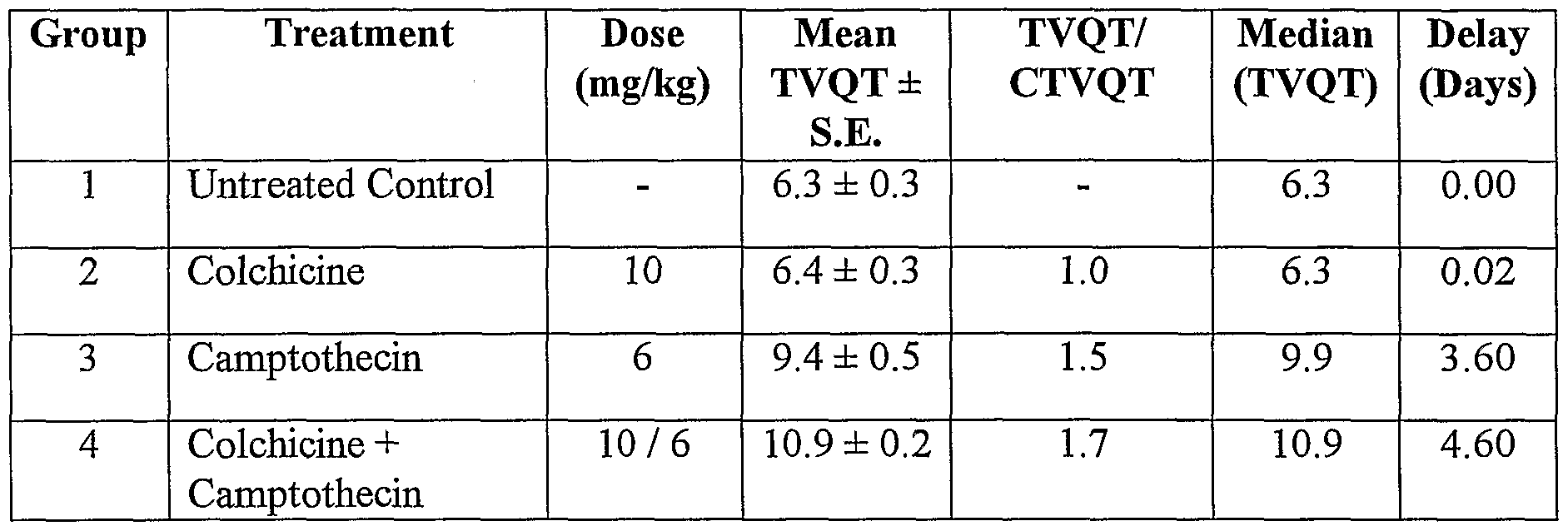
- modulation of a cellular proliferative disease comprises an increase in tumor volume quadrupling time (described below).
- modulation of a cellular proliferative disease comprises a chemopotentiator effect.
- modulation of a disease comprises a chemosensitizing effect.
- modulation of a disease comprises cytostasis.
- modulation of a disease comprises a cytotoxic effect.
- a chemical agent is a "chemopotentiator" when it enhances the effect of a known antiproliferative drug in a more than additive fashion relative to the activity of the chemopotentiator or antiproliferative agent used alone. In some cases, a "chemosensitizing" effect may be observed. This is defined as the effect of use of an agent that if used alone would not demonstrate significant antitumor effects but would improve the antitumor effects of an antiproliferative agent as compared to the antiproliferative agent by itself.
- colchicines or “the colchicine family” includes colchicine and colchicine analogs, generally defined by the chemical structure in Figure 1.
- a preferred colchicine family member is colchicine, (S)-N-(5,6,7,9-tetrahydro-l,2,3,10- tetramethoxy-9-oxobenzo[a]heptalen-7-yl)acetamide, depicted in Figure 2.
- Colchicine may also be described by the following chemical and drug names: N-(5,6,7,9-tetrahydro-l,2,3,10- tetramethoxy-9-oxobenzo[a]heptalen-7-yl)-acetamide; N-acetyltrimethylcolchicinic acid methyl ether; 7-acetamido-6,7-dihydro-l,2,3,10-tetramethoxybenzo[a]heptalen-9(5H)-one;
- a colchicine analog is another preferred member of the colchicine family, generally defined by but not limited to the structure depicted in Figure 1, having substituent changes or substitute groups at one or more of R x through Rg .
- Table 1 lists some possible structures of
- R j through Rg for colchicine analogs are typically employed to improve biological activity, enhance pharmaceutical attributes such as bioavailability or stability, or decrease toxicity.
- R groups include alkyl substitutions (e.g., methyl, ethyl, propyl etc.).
- R groups include an alkoxy (e.g., methoxy, ethoxy, propoxy, butoxy, etc.) substitution.
- R groups include an amino group substitution.
- R groups include a thiol group substitution. Substitutions at R x through Rg are not limited to the above examples, however.
- substitution or substitutions are of one or more of the substituents corresponding to the R x through Rg positions of colchicine.
- the colchicine analog is thiocolchicine (i.e., (S)- N-[5, 6, 7, 9-Tetrahydro-l, 2, 3-trimethoxy-10-(methylthio)-9-oxobenzo[a]heptalen-7-yl]- acetamide).
- the colchicine analog is 3-demethyl thiocolchicine.
- the colchicine analog is thiocolchicoside (i.e., 2-demethoxy-2-glucosidoxythiocolchicine, Colcamyl, Coltramyl, Coltromyl, Coltrax, or Musco-Ril).
- the colchicine analog is colchicinamide.
- Conventional antiproliferative agents used in the treatment of cancer are broadly grouped as (1) chemical compounds which affect the integrity of nucleic acid polymers by binding, alkylating, inducing strand breaks, intercalating between base pairs or affecting enzymes which maintain the integrity and function of DNA and RNA; (2) chemical agents that bind to proteins to inhibit enzymatic action (e.g., antimetabolites) or the function of structural proteins necessary for cellular integrity (e.g., antitubulin agents).
- Other chemical compounds that have been identified to be useful in the treatment of some cancers include drugs which block steroid hormone action for the treatment of breast and prostate cancer, photochemically activated agents, radiation sensitizers and protectors.
- antiproliferative agents are compounds which induce cytostasis or cytotoxicity. "Cytostasis” is the inhibition of cells from growing, while “cytotoxicity” is defined as the killing of cells.
- Specific examples of antiproliferative agents include: antimetabolites, such as methotrexate, 5-fluorouracil, gemcitabine, cytarabine, pentostatin, 6- mercaptopurine, 6-thioguanine, L-asparaginase, hydroxyurea, N-phosphonoacetyl-L-aspartate (PALA), fludarabine, 2-chlorodeoxyadenosine, and floxuridine; structural protein agents, such as the vinca alkaloids, including vinblastine, vincristine, vindesine, vinorelbine, and paclitaxel; antibiotics, such as dactinomycin, daunorubicin, doxorubicin, idarubicin, bleomycins, plicamycin
- Nucleic acid polymers such as DNA and RNA are prime targets for anticancer drugs.
- Alkylating agents such as nitrogen mustards, nitrosoureas, aziridine containing compounds directly attack DNA.
- Metal coordination compounds such as cisplatin and carboplatin similarly directly attack the nucleic acid structure resulting in lesions that are difficult for the cells to repair, which in turn, can result in cell death.
- nucleic acid affecting compounds include anthracycline molecules such as doxorubicin, which intercalates between the nucleic acid base pairs of DNA polymers, bleomycin which causes nucleic acid strand breaks, and fraudulent nucleosides such as pyrimidine and purine nucleoside analogs which are inappropriately incorporated into nucleic polymer structures and ultimately cause premature DNA chain termination.
- anthracycline molecules such as doxorubicin, which intercalates between the nucleic acid base pairs of DNA polymers, bleomycin which causes nucleic acid strand breaks, and fraudulent nucleosides such as pyrimidine and purine nucleoside analogs which are inappropriately incorporated into nucleic polymer structures and ultimately cause premature DNA chain termination.
- Certain enzymes that affect the integrity and functionality of the genome can also be inhibited in cancer cells by specific chemical agents and result in cancer cell death.
- ribonucleoti.de reductase e.g., hydroxyurea, gemcitabine
- topoisomerase I e.g., camptothecin
- topoisomerase II e.g., etoposide
- topoisomerase I topi
- topoisomerase II top2
- Topoisomerase I inhibition has become important in cancer chemotherapy through the finding that camptothecin (CPT), an alkaloid of plant origin, is the best known inhibitor of topi and is a very potent anticancer agent.
- CPT camptothecin
- a number of analogs have become approved for commercial use to treat a number of tumor types. These include CPT-11 (irinotecan) and topotecan.
- Topoisomerase II inhibition has also become important in cancer chemotherapy.
- Chemical families such as the anthracyclines and epipodophyllotoxins play a key role.
- Drugs from these families e.g., doxorubicin and etoposide among other chemicals affecting topoisomerase II such as amsacrine, elliptinium, mitoxantrone, azatoxin, genistein, amonafide etc.
- topoisomerase II e.g., doxorubicin and etoposide among other chemicals affecting topoisomerase II such as amsacrine, elliptinium, mitoxantrone, azatoxin, genistein, amonafide etc.
- topoisomerase II inhibitors for example, doxorubicin, amsacrine, etoposide and mitoxantrone, have provided clinical utility to a number of cancers, in particular, solid tumors.
- cisplatin cis-diamminedichloroplatinum II
- This compound is active against several human cancers including testicular, small-cell lung, bladder, cervical and head and neck cancer.
- antitubulin agents are also known as “antimitotic agents,” “microtubule inhibitors” or as “spindle poisons.”
- antimitotic agents may be arbitrarily divided into three classes: those compounds that competitively inhibit colchicine binding to tubulin and thereby interact with tubulin on the colchicine binding sites (including colchicinoids, podophyllotoxins, steganacins, combretastatins, and amphethinile), those compounds that are believed to share a common binding site on tubulin with the Catharanthus (Vinca) alkaloids (including compounds such as vincristine, vinblastine, maytansinoids, phomopsin A, rhizoxin, the marine antimitotic peptide dolastatin 10) and paclitaxel, a novel taxane diterpenoid isolated from the bark of the Pacific yew which has a very unique antimitotic action.
- paclitaxel and other taxanes promote the formation of stable microtubules that eventually lead to mitotic arrest of proliferating cells.
- transplantable experimental murine fibrosarcomas (2x10 ⁇ PJF-1 cells) were grown intradermally in the flanks of 3 month old female C3H mice (Charles River, Holister, CA). When the tumors reached a volume of approximately lOOmm ⁇ , the mice were randomly assigned to each experimental group (4 mice per group).
- Colchicine was obtained from Sigma- Aldrich (St. Louis, MO) and was made to the appropriate concentration in water for injection. After the treatments described below, the growth of the tumors was monitored three times per week by caliper measurements of three perpendicular diameters of the tumor. The tumor volume was calculated from the formula:
- V l /6 x D 1 x D 2 x D 3 , where Di .3 are the diameter measurements in mm.
- TVQT day zero treatment volume
- Mean TVQT is the mean days required for individual tumors to grow to four times the tumor volume at the initial treatment day.
- the "delay" is the median of days required for a tumor to grow to four times the mean size of the treated group, minus the median of days required to grow to four times the mean size of the control group.
- the data is also expressed as the ratio of the tumor volume quadrupling time of the treated tumor over the untreated control group
- Etoposide (Sigma- Aldrich, lot. 46H078) was made to the appropriate concentration in DMSO. Etoposide and colchicine were injected systemically (i.e., intraperitoneally, i.p.), in a volume of 100 ⁇ l. The experimental compositions were prepared as described in Table 2. Table 2
- Camptothecin (Boehringer Ingelheim-Lot 71012 ) was made to the appropriate concentration in DMSO.
- Colchicine was given orally in a volume of 100 ⁇ l.
- Camptothecin was injected systemically (i.e., intraperitoneally, i.p.), in a volume of 100 ⁇ l.
- colchicine was given orally immediately prior to the intraperitoneal injection of camptothecin.
- Figure 5 demonstrates the results of an additional experiment using camptothecin and colchicine.
- the arrow indicates a one hour interval separating treatment with each agent.
- the experimental compositions were prepared as described above.
- colchicine was administered orally in three doses ("colchx3" or "colchicine x 3 "). When three dosages of colchicine were administered, the first was given one hour after the administration of camptothecin (day 0), the second on day 1 and the third on day 2.
- the arrow ⁇ - represents a 1 hour interval D represents day of treatment.
- Cisplatin (David Bull Laboratories- Mulgrave, Australia, lot. 5201844x) was made to the appropriate concentration in water for injection. Colchicine was given orally in a volume of 100 ⁇ l. Cisplatin was injected systemically (i.e., intraperitoneally, i.p.), in a volume of 100 ⁇ l. For the treatment of group 3, colchicine was given orally immediately prior to the intraperitoneal injection of cisplatin. The experimental compositions were prepared as described in Table 7. Table 7
- Vinblastine was obtained from Faulding (Elizabeth, NJ) and was made to the appropriate concentration in water for injection.
- the compositions (1 mg/kg of either colchicine or vinblastine) were injected systemically (i.e., intraperitoneally, i.p.), in a volume of 100 ⁇ l.
- vinblastine treatments were given three times, on days 0, 3, and 6 (Day 0 is the first day of treatment).
- vinblastine treatments were given twice, on days 0 and 3, and colchine was given on day 6.
- four vinblastine treatments were given on days 0, 3, 6 and 8.
- vinblastine treatments were given on days 0 and 3 a colchicine treatment was given on day 6, and a third vinblastine treatment was given on day 8.
- Paclitaxel was obtained prediluted at 1 mg/ml in a cremaphor/ethanol solution. Colchicine was given at a dose of 2 mg/kg and paclitaxel was given, for each injection, at a dose of 10 mg/kg. For group 4, a total of three paclitaxel injections were given, one each on days 0, 3 and 5. The compositions were injected systemically (i.e., intraperitoneally, i.p.), in a volume of lOO ⁇ l.
Landscapes
- Health & Medical Sciences (AREA)
- Life Sciences & Earth Sciences (AREA)
- General Health & Medical Sciences (AREA)
- Public Health (AREA)
- Medicinal Chemistry (AREA)
- Pharmacology & Pharmacy (AREA)
- Chemical & Material Sciences (AREA)
- Animal Behavior & Ethology (AREA)
- Veterinary Medicine (AREA)
- Epidemiology (AREA)
- Molecular Biology (AREA)
- Inorganic Chemistry (AREA)
- Chemical Kinetics & Catalysis (AREA)
- General Chemical & Material Sciences (AREA)
- Nuclear Medicine, Radiotherapy & Molecular Imaging (AREA)
- Organic Chemistry (AREA)
- Acyclic And Carbocyclic Compounds In Medicinal Compositions (AREA)
- Pharmaceuticals Containing Other Organic And Inorganic Compounds (AREA)
Abstract
Description




Claims
Priority Applications (2)
| Application Number | Priority Date | Filing Date | Title |
|---|---|---|---|
| AU2002246542A AU2002246542A1 (en) | 2000-10-31 | 2001-10-31 | Antiproliferative colchicine compositions and uses thereof |
| EP01994115A EP1330242A2 (en) | 2000-10-31 | 2001-10-31 | Antiproliferative colchicine compositions and uses thereof |
Applications Claiming Priority (10)
| Application Number | Priority Date | Filing Date | Title |
|---|---|---|---|
| US24491000P | 2000-10-31 | 2000-10-31 | |
| US24491200P | 2000-10-31 | 2000-10-31 | |
| US24491300P | 2000-10-31 | 2000-10-31 | |
| US24476500P | 2000-10-31 | 2000-10-31 | |
| US24491100P | 2000-10-31 | 2000-10-31 | |
| US60/244,910 | 2000-10-31 | ||
| US60/244,765 | 2000-10-31 | ||
| US60/244,911 | 2000-10-31 | ||
| US60/244,913 | 2000-10-31 | ||
| US60/244,912 | 2000-10-31 |
Publications (2)
| Publication Number | Publication Date |
|---|---|
| WO2002056872A2 true WO2002056872A2 (en) | 2002-07-25 |
| WO2002056872A3 WO2002056872A3 (en) | 2002-11-07 |
Family
ID=27540205
Family Applications (1)
| Application Number | Title | Priority Date | Filing Date |
|---|---|---|---|
| PCT/US2001/044661 Ceased WO2002056872A2 (en) | 2000-10-31 | 2001-10-31 | Antiproliferative colchicine compositions and uses thereof |
Country Status (4)
| Country | Link |
|---|---|
| US (1) | US20020123469A1 (en) |
| EP (1) | EP1330242A2 (en) |
| AU (1) | AU2002246542A1 (en) |
| WO (1) | WO2002056872A2 (en) |
Cited By (3)
| Publication number | Priority date | Publication date | Assignee | Title |
|---|---|---|---|---|
| WO2016059650A1 (en) | 2014-10-14 | 2016-04-21 | Council Of Scientific & Industrial Research | 10-substituted colchicinoids as potent anticancer agents |
| WO2026064527A1 (en) | 2024-09-19 | 2026-03-26 | Tesseract Medicines Us, Llc | Kras-targeting covalent-induced drug conjugates comprising a tubulin inhibitor payload |
| WO2026064520A1 (en) | 2024-09-19 | 2026-03-26 | Tesseract Medicines Us, Llc | Covalent-induced drug conjugates targeting kras and comprising a tubulin inhibitor payload |
Families Citing this family (6)
| Publication number | Priority date | Publication date | Assignee | Title |
|---|---|---|---|---|
| US7135481B2 (en) * | 2000-04-12 | 2006-11-14 | Chemgenex Pharmaceuticals, Inc. | Naphthalimide compositions and uses thereof |
| US20060211648A1 (en) * | 2000-04-12 | 2006-09-21 | Chemgenex Pharmaceuticals, Inc. | Naphthalimide compositions and uses thereof |
| US6627614B1 (en) * | 2002-06-05 | 2003-09-30 | Super Gen, Inc. | Sequential therapy comprising a 20(S)-camptothecin and an anthracycline |
| AU2005249593A1 (en) * | 2004-06-04 | 2005-12-15 | Chemgenex Pharmaceuticals Inc. | Methods of treating cellular proliferative disease using naphthalimide and PARP-1 inhibitors |
| JP2008529667A (en) * | 2005-02-10 | 2008-08-07 | ケムジェネックス・ファーマシューティカルズ・インコーポレイテッド | Medical device |
| WO2016139303A1 (en) * | 2015-03-03 | 2016-09-09 | Universität Zu Köln | Pharmaceutical composition for the therapy of diseases caused by highly proliferating cells |
Family Cites Families (10)
| Publication number | Priority date | Publication date | Assignee | Title |
|---|---|---|---|---|
| GB953955A (en) * | 1961-05-26 | 1964-04-02 | Ciba Ltd | Pharmaceutical and agricultural preparations comprising colchicine derivatives |
| IE53332B1 (en) * | 1980-03-14 | 1988-10-26 | Efamol Ltd | Pharmaceutical compositions |
| CA2179490A1 (en) * | 1993-12-21 | 1995-06-29 | Trimurtulu Golakoti | New cryptophycins |
| US5786344A (en) * | 1994-07-05 | 1998-07-28 | Arch Development Corporation | Camptothecin drug combinations and methods with reduced side effects |
| DE69900689T2 (en) * | 1998-06-26 | 2002-08-29 | Quanam Medical Corp., Santa Clara | TOPOISOMERASE INHIBITORS FOR RESTENOSE PREVENTION |
| US5916913A (en) * | 1998-08-03 | 1999-06-29 | Joseph; Hazel L. | Inhibition of wound contraction with paclitaxel, colchicine and penicillamine |
| US6168619B1 (en) * | 1998-10-16 | 2001-01-02 | Quanam Medical Corporation | Intravascular stent having a coaxial polymer member and end sleeves |
| EP1150670A2 (en) * | 1999-02-12 | 2001-11-07 | Quanam Medical Corporation | Alkylating agents for treatment of cellular proliferation |
| DK1263440T3 (en) * | 2000-03-15 | 2006-10-23 | Chemgenex Pharmaceuticals Inc | Cephalotaxin alkaloid combination preparations and applications thereof |
| US6624317B1 (en) * | 2000-09-25 | 2003-09-23 | The University Of North Carolina At Chapel Hill | Taxoid conjugates as antimitotic and antitumor agents |
-
2001
- 2001-10-31 AU AU2002246542A patent/AU2002246542A1/en not_active Abandoned
- 2001-10-31 WO PCT/US2001/044661 patent/WO2002056872A2/en not_active Ceased
- 2001-10-31 EP EP01994115A patent/EP1330242A2/en not_active Withdrawn
- 2001-10-31 US US09/996,354 patent/US20020123469A1/en not_active Abandoned
Cited By (3)
| Publication number | Priority date | Publication date | Assignee | Title |
|---|---|---|---|---|
| WO2016059650A1 (en) | 2014-10-14 | 2016-04-21 | Council Of Scientific & Industrial Research | 10-substituted colchicinoids as potent anticancer agents |
| WO2026064527A1 (en) | 2024-09-19 | 2026-03-26 | Tesseract Medicines Us, Llc | Kras-targeting covalent-induced drug conjugates comprising a tubulin inhibitor payload |
| WO2026064520A1 (en) | 2024-09-19 | 2026-03-26 | Tesseract Medicines Us, Llc | Covalent-induced drug conjugates targeting kras and comprising a tubulin inhibitor payload |
Also Published As
| Publication number | Publication date |
|---|---|
| EP1330242A2 (en) | 2003-07-30 |
| WO2002056872A3 (en) | 2002-11-07 |
| AU2002246542A1 (en) | 2002-07-30 |
| US20020123469A1 (en) | 2002-09-05 |
Similar Documents
| Publication | Publication Date | Title |
|---|---|---|
| US20110008307A1 (en) | Cephalotaxine Alkaloid Compositions and Uses Thereof | |
| RU2131250C1 (en) | Antitumor composition containing taxane derivatives | |
| CN1536995A (en) | Antitumor composition containing taxane derivative | |
| EP1274458B1 (en) | Compositions containing a naphthalmide and an antiproliferative agent | |
| EA003134B1 (en) | Antitumor composition containing a synergistic combination of an anthracycline derivative with a campothecin derivative | |
| US20020123469A1 (en) | Antiproliferative colchicine compositions and uses thereof | |
| AU2001245803A1 (en) | Cephalotaxine alkaloid compositions and uses thereof | |
| US20020037328A1 (en) | Hexitol compositions and uses thereof | |
| US20050170015A1 (en) | Antiproliferative colchicine compositions and uses thereof | |
| US20020040011A1 (en) | Naphthoquinone compositions and uses thereof | |
| US20070207977A1 (en) | Naphthalimide compositions and uses thereof | |
| US20020022652A1 (en) | Methylnogarol compositions and uses thereof | |
| AU2001253483B2 (en) | Compositions containing a naphthalimide and an antiproliferative agent | |
| HK1052138B (en) | Cephalotaxine alkaloid combination compositions and uses thereof | |
| AU2006202650A1 (en) | Compositions containing a naphthalimide and an antiproliferative agent | |
| AU2001253483A1 (en) | Compositions containing a naphthalimide and an antiproliferative agent | |
| KR20010077400A (en) | Anticancer agents by combination of Ftase inhibitor(LB42908) and other anticancer drugs |
Legal Events
| Date | Code | Title | Description |
|---|---|---|---|
| AK | Designated states |
Kind code of ref document: A2 Designated state(s): AE AG AL AM AT AU AZ BA BB BG BR BY BZ CA CH CN CO CR CU CZ DE DK DM DZ EC EE ES FI GB GD GE GH GM HR HU ID IL IN IS JP KE KG KP KR KZ LC LK LR LS LT LU LV MA MD MG MK MN MW MX MZ NO NZ OM PH PL PT RO RU SD SE SG SI SK SL TJ TM TR TT TZ UA UG US UZ VN YU ZA ZW |
|
| AL | Designated countries for regional patents |
Kind code of ref document: A2 Designated state(s): GH GM KE LS MW MZ SD SL SZ TZ UG ZW AM AZ BY KG KZ MD RU TJ TM AT BE CH CY DE DK ES FI FR GB GR IE IT LU MC NL PT SE TR BF BJ CF CG CI CM GA GN GQ GW ML MR NE SN TD TG |
|
| DFPE | Request for preliminary examination filed prior to expiration of 19th month from priority date (pct application filed before 20040101) | ||
| 121 | Ep: the epo has been informed by wipo that ep was designated in this application | ||
| AK | Designated states |
Kind code of ref document: A3 Designated state(s): AE AG AL AM AT AU AZ BA BB BG BR BY BZ CA CH CN CO CR CU CZ DE DK DM DZ EC EE ES FI GB GD GE GH GM HR HU ID IL IN IS JP KE KG KP KR KZ LC LK LR LS LT LU LV MA MD MG MK MN MW MX MZ NO NZ OM PH PL PT RO RU SD SE SG SI SK SL TJ TM TR TT TZ UA UG US UZ VN YU ZA ZW |
|
| AL | Designated countries for regional patents |
Kind code of ref document: A3 Designated state(s): GH GM KE LS MW MZ SD SL SZ TZ UG ZW AM AZ BY KG KZ MD RU TJ TM AT BE CH CY DE DK ES FI FR GB GR IE IT LU MC NL PT SE TR BF BJ CF CG CI CM GA GN GQ GW ML MR NE SN TD TG |
|
| WWE | Wipo information: entry into national phase |
Ref document number: 2001994115 Country of ref document: EP |
|
| WWP | Wipo information: published in national office |
Ref document number: 2001994115 Country of ref document: EP |
|
| REG | Reference to national code |
Ref country code: DE Ref legal event code: 8642 |
|
| NENP | Non-entry into the national phase |
Ref country code: JP |
|
| WWW | Wipo information: withdrawn in national office |
Ref document number: 2001994115 Country of ref document: EP |