WO2001004100A1 - Process for preparing 2-amino-4-(4-fluorphenyl)-6-alkylpyrimidine-5-carboxylate - Google Patents

Process for preparing 2-amino-4-(4-fluorphenyl)-6-alkylpyrimidine-5-carboxylate Download PDF

Info

Publication number
WO2001004100A1
WO2001004100A1 PCT/EP2000/006099 EP0006099W WO0104100A1 WO 2001004100 A1 WO2001004100 A1 WO 2001004100A1 EP 0006099 W EP0006099 W EP 0006099W WO 0104100 A1 WO0104100 A1 WO 0104100A1
Authority
WO
WIPO (PCT)
Prior art keywords
methyl
formula
general formula
fluorophenyl
compound
Prior art date
Legal status (The legal status is an assumption and is not a legal conclusion. Google has not performed a legal analysis and makes no representation as to the accuracy of the status listed.)
Ceased
Application number
PCT/EP2000/006099
Other languages
French (fr)
Inventor
Ulrich Veith
Current Assignee (The listed assignees may be inaccurate. Google has not performed a legal analysis and makes no representation or warranty as to the accuracy of the list.)
Lonza AG
Original Assignee
Lonza AG
Priority date (The priority date is an assumption and is not a legal conclusion. Google has not performed a legal analysis and makes no representation as to the accuracy of the date listed.)
Filing date
Publication date
Priority to HU0202006A priority Critical patent/HU228303B1/en
Priority to HK02108215.0A priority patent/HK1046682B/en
Priority to DE60023296T priority patent/DE60023296T2/en
Priority to AU62666/00A priority patent/AU6266600A/en
Priority to CA002378782A priority patent/CA2378782C/en
Priority to EP00949231A priority patent/EP1194414B1/en
Priority to SK22-2002A priority patent/SK285993B6/en
Priority to ES00949231T priority patent/ES2251392T3/en
Priority to AT00949231T priority patent/ATE307120T1/en
Application filed by Lonza AG filed Critical Lonza AG
Priority to US10/030,077 priority patent/US6579984B1/en
Priority to JP2001509711A priority patent/JP4649813B2/en
Publication of WO2001004100A1 publication Critical patent/WO2001004100A1/en
Priority to NO20020163A priority patent/NO328103B1/en
Anticipated expiration legal-status Critical
Priority to US10/806,315 priority patent/US6984757B2/en
Priority to NO20092393A priority patent/NO334937B1/en
Ceased legal-status Critical Current

Links

Classifications

    • CCHEMISTRY; METALLURGY
    • C07ORGANIC CHEMISTRY
    • C07DHETEROCYCLIC COMPOUNDS
    • C07D239/00Heterocyclic compounds containing 1,3-diazine or hydrogenated 1,3-diazine rings
    • C07D239/02Heterocyclic compounds containing 1,3-diazine or hydrogenated 1,3-diazine rings not condensed with other rings
    • C07D239/24Heterocyclic compounds containing 1,3-diazine or hydrogenated 1,3-diazine rings not condensed with other rings having three or more double bonds between ring members or between ring members and non-ring members
    • C07D239/28Heterocyclic compounds containing 1,3-diazine or hydrogenated 1,3-diazine rings not condensed with other rings having three or more double bonds between ring members or between ring members and non-ring members with hetero atoms or with carbon atoms having three bonds to hetero atoms with at the most one bond to halogen, directly attached to ring carbon atoms
    • C07D239/32One oxygen, sulfur or nitrogen atom
    • C07D239/42One nitrogen atom
    • CCHEMISTRY; METALLURGY
    • C07ORGANIC CHEMISTRY
    • C07CACYCLIC OR CARBOCYCLIC COMPOUNDS
    • C07C229/00Compounds containing amino and carboxyl groups bound to the same carbon skeleton
    • C07C229/02Compounds containing amino and carboxyl groups bound to the same carbon skeleton having amino and carboxyl groups bound to acyclic carbon atoms of the same carbon skeleton
    • C07C229/34Compounds containing amino and carboxyl groups bound to the same carbon skeleton having amino and carboxyl groups bound to acyclic carbon atoms of the same carbon skeleton the carbon skeleton containing six-membered aromatic rings
    • CCHEMISTRY; METALLURGY
    • C07ORGANIC CHEMISTRY
    • C07CACYCLIC OR CARBOCYCLIC COMPOUNDS
    • C07C311/00Amides of sulfonic acids, i.e. compounds having singly-bound oxygen atoms of sulfo groups replaced by nitrogen atoms, not being part of nitro or nitroso groups
    • C07C311/01Sulfonamides having sulfur atoms of sulfonamide groups bound to acyclic carbon atoms
    • C07C311/02Sulfonamides having sulfur atoms of sulfonamide groups bound to acyclic carbon atoms of an acyclic saturated carbon skeleton
    • C07C311/03Sulfonamides having sulfur atoms of sulfonamide groups bound to acyclic carbon atoms of an acyclic saturated carbon skeleton having the nitrogen atoms of the sulfonamide groups bound to hydrogen atoms or to acyclic carbon atoms
    • C07C311/05Sulfonamides having sulfur atoms of sulfonamide groups bound to acyclic carbon atoms of an acyclic saturated carbon skeleton having the nitrogen atoms of the sulfonamide groups bound to hydrogen atoms or to acyclic carbon atoms to acyclic carbon atoms of hydrocarbon radicals substituted by nitrogen atoms, not being part of nitro or nitroso groups
    • CCHEMISTRY; METALLURGY
    • C07ORGANIC CHEMISTRY
    • C07DHETEROCYCLIC COMPOUNDS
    • C07D239/00Heterocyclic compounds containing 1,3-diazine or hydrogenated 1,3-diazine rings
    • C07D239/02Heterocyclic compounds containing 1,3-diazine or hydrogenated 1,3-diazine rings not condensed with other rings
    • C07D239/24Heterocyclic compounds containing 1,3-diazine or hydrogenated 1,3-diazine rings not condensed with other rings having three or more double bonds between ring members or between ring members and non-ring members
    • C07D239/28Heterocyclic compounds containing 1,3-diazine or hydrogenated 1,3-diazine rings not condensed with other rings having three or more double bonds between ring members or between ring members and non-ring members with hetero atoms or with carbon atoms having three bonds to hetero atoms with at the most one bond to halogen, directly attached to ring carbon atoms

Definitions

  • the present invention relates to a novel process for the preparation of compounds of the general formula
  • Compounds of the formula I are important intermediates for the preparation of pharmaceutically active compounds, for example of HMG-Co A reductase inhibitors.
  • Japanese Patent publication JP-A 06 256318, and Watanabe M. et al., Bioorg. Med. Chem. 1997, Vol. 5, No. 2, 437-444 describe processes for the preparation of compounds of the formula I.
  • JP-A 06 256318 has the disadvantage that three stages are needed in order to prepare 2-amino-4- (4-fluorophenyl) -6-isopropyl-pyri- midine-5-carboxylic acid.
  • p-fluorobenzaldehyde is converted using ethyl iso- butyrylacetate into an unsaturated ketoester, which is then cyclocondensed in the second stage with S- methylisothiourea hydrogensulphate and subsequently dehydrated in the third stage to give the corresponding pyrimidine.
  • this is then oxidized using m-chloroperbenzoic acid to give the corresponding sulphonylpyrimidine, which is then reacted in the fifth stage with methylamine and subsequent treatment with methanesulphonyl chloride to give ethyl 4- (4-fluorophenyl) -6-isopropyl-2- (N-methanesulphonyl-N-methyl- amino) pyrimidine-5-carboxylate.
  • the object of the invention was to make available an economical, industrially feasible process for the preparation of compounds of the formula I.
  • R is hydrogen or a group of the formula -S0 2 R x ;
  • R 1 is Ci-e-alkyl;
  • R 2 is hydrogen or C ⁇ _ 6 -alkyl
  • R 3 is Ci-e-alkyl
  • R 4 is Ci-e-alkyl, are prepared in that, in a first stage, a compound of the general formula in which R 3 and R 4 have the abovementioned meaning, is reacted in the presence of a Lewis acid with 4-fluorobenzonitrile to give a compound of the general formula
  • C ⁇ - 6 -alkyl is understood here and below as meaning linear and branched alkyl groups having 1-6 carbon atoms, such as, for example, methyl, ethyl, propyl, isopropyl, butyl, tert-butyl, isobutyl, sec-butyl, pentyl and its iso ers and hexyl and its isomers.
  • the compounds of the formula II can be prepared according to Chem . Berichte 1958, 91 , 759 or are commercially available organic synthetic chemicals. 4-Fluorobenzonitrile is a commercially available organic synthetic chemical.
  • the Lewis acid employed in the first stage is expediently an aprotic Lewis acid such as, for example, tin tetrachloride, titanium tetrachloride or aluminium chloride. Tin tetrachloride is preferably employed.
  • the first stage is expediently carried out in the presence of an organic solvent.
  • the organic solvents employed can be, for example, aromatic hydrocarbons, chlorinated aromatic and aliphatic hydrocarbons.
  • Aromatic hydrocarbons employed are preferably toluene, benzene or xylene.
  • the chlorinated aromatic hydrocarbon employed is preferably chlorobenzene; the chlorinated aliphatic hydrocarbon employed is preferably 1, 2-dichloroethane .
  • 1, 2-dichloroethane are particularly preferably employed.
  • the reaction in the first stage is expediently carried out at a temperature from -5 to 140 °C, advantageously at 60 to 100 °C.
  • the compounds of the formula III can be isolated by known methods such as, for example, by extraction or can be employed directly, without isolation, for the second stage.
  • the intermediate (formula III) is preferably isolated.
  • the invention comprises, on the one hand, compounds of the formula I in which R and R 2 are hydrogen. These compounds are prepared by reaction of compounds of the formula III with cyanamide .
  • the reaction with cyanamide is expediently carried out in the presence of an organic solvent, a mixture of water with an organic solvent or in water.
  • Water is particularly preferably employed.
  • Organic solvents employed are advantageously toluene or ethyl acetate.
  • Organic solvents employed as a mixture with water are advantageously alcohols such as, for example, methanol, ethers such as, for example, dioxane or aromatic hydrocarbons such as, for example, toluene or N,W-dimethylacetamide.
  • the reaction with cyanamide is expediently carried out at a temperature of 10 to 120°C, advantageously at 40 to 100 °C.
  • the pH is expediently in a range from 3 to 9, advantageously in a range from 4 to 7.
  • R 3 has the meaning indicated in formula I are prepared in that, in a first stage, an alkyl iso- butyrylacetate of the general formula in which R has the meaning mentioned is reacted in the presence of a Lewis acid with 4-fluorobenzonitrile to give a 2- [1-amino-l- (4-fluorophenyl)methylene] -4- methyl-3-oxopentanoic acid ester of the general formula
  • the radical R 3 is preferably methyl.
  • the compounds of the formula III are novel and also a subject of the invention.
  • the invention comprises, on the other hand, compounds of the formula I in which R is a group of the formula -S0 2 R 1 and R 1 and R 2 are C ⁇ _ 6 -alkyl.
  • R is a group of the formula -S0 2 R 1 and R 1 and R 2 are C ⁇ _ 6 -alkyl.
  • These 4- (4-fluorophenyl) -6-alkyl-2- (N-alkanesulphonyl-W- alkylamino) pyrimidine-5-carboxylic acid esters of the general formula in which R 1 , R 2 , R 3 and R 4 are identical or different and are a C ⁇ _ 6 -alkyl group can be prepared in that 2- [1-amino-l- (4-fluorophenyl)methylene] -4-alkyl-3-oxo- alkanoic acid esters of the general formula
  • R 1 and R 2 are a C ⁇ - 6 -alkyl group.
  • the reaction can be carried out either in the presence of a base or in the presence of a Lewis acid.
  • Bases which can be employed are alkali metal compounds such as, for example, alkali metal hydrides, alkali metal carbonates, alkali metal alkoxides or alkali metal silazanes.
  • Alkali metal carbonates which can be used are lithium, sodium or potassium carbonate.
  • the alkali metal hydride employed can be potassium, lithium or sodium hydride; sodium hydride is preferably employed.
  • the alkali metal alkoxide employed can be sodium or potassium tert-pentoxide or sodium or potassium tert-butoxide, preferably sodium tert- pentoxide or sodium tert-butoxide.
  • the alkali metal silazane used can be sodium hexamethyldisilazane or potassium hexamethyldisilazane.
  • the base preferably employed is an alkali metal hydride or an alkali metal alkoxide .
  • the reaction is expediently carried out in the presence of a base in a polar organic solvent.
  • the polar solvent used can be, for example, N,N-dimethyl- acetamide, isopropanol, tert-butanol, toluene, di- methylformamide, tetrahydrofuran, 1,4-dioxane or mixtures of these.
  • N-Alkylalkanesulphonamides such as, for example, W-methylmethanesulphonamide are likewise suitable as solvents.
  • the reaction is preferably carried out in W-alkylalkanesulphonamide and tert- butanol.
  • the reaction can be carried out in the presence of a base at a temperature from -10 to 150 °C, preferably from 0 to 80°C.
  • the reaction of compounds of the formula Illb with compounds of the formula IVb in the presence of a Lewis acid is expediently carried out in the solvent which is inert to the Lewis acid.
  • Inert solvents which can be employed are, for example, aromatic hydrocarbons, and chlorinated aromatic and aliphatic hydrocarbons.
  • Aromatic hydrocarbons employed are preferably toluene or xylene.
  • the chlorinated aromatic hydrocarbon employed is preferably chlorobenzene; chlorinated aliphatic hydrocarbons employed are preferably dichloromethane or 1, 2-dichloroethane .
  • the reaction in the presence of a Lewis acid can be carried out at a temperature from 20 to 150°C, preferably from 80 to 120°C.
  • Suitable Lewis acids are for example TiCl 4 ,
  • Titanium tetrachloride is preferred.
  • the amount of Lewis acid is 0.1 to 2 molar equivalents based on the compound of the formula Illb.
  • R 1 and R 2 are C ⁇ -6-alkyl
  • Suitable bases are the bases described beforehand.
  • the cyanogen halide employed can be cyanogen fluoride, cyanogen chloride, cyanogen bromide or cyanogen iodide. Cyanogen chloride or cyanogen bromide is preferably employed. This reaction can likewise be carried out in the polar organic solvents described beforehand. The reaction is preferably carried out in tetrahydrofuran.
  • the reaction is expediently carried out at a temperature from -20 to 50°C, preferably at a temperature from -10 to +20°C.
  • Examples of compounds of the formula IVb are: N-cyano-W-methylmethanesulphonamide, N-cyano-iV-ethyl- methanesulphonamide, W-cyano-N-propylmethanesulphon- amide, N-cyano-N-butylmethanesulphonamide, ⁇ J-cyano-N- pentylmethanesulphonamide and N-cyano-N-hexylmethane- sulphonamide.
  • N-Cyano-N-methylmethanesulphonamide is preferred.
  • the compounds of the formula I can also be prepared in that a compound of the general formula in which R 3 and R 4 have the meaning mentioned in Claim 1, is reacted with a compound of the formula IV.
  • reaction is carried out analogously to the reaction of the compounds of the formula III with compounds of the formula IV, preferably in the presence of a base in a polar organic solvent at a temperature from -10 to 150°C.
  • Suitable bases and solvents correspond to the bases and solvents which are listed under the reaction of compounds of the formula III with compounds of the formula IV.
  • compounds of the general formula lb are prepared in that a compound of the formula VI is reacted with a compound of the formula IVb in a polar organic solvent at a temperature from 0 to 80°C in the presence of a base.
  • the compounds of the formula VI can be prepared by reaction of C ⁇ - 6 -alkyl nitriles with C ⁇ _ 6 -alkyl 4-fluorobenzoylacetate in the presence of a Lewis acid.
  • a compound of the formula VI in which R 3 is methyl and R 4 is isopropyl is preferred.
  • the Lewis acid is preferably tin tetrachloride.
  • the reaction is expediently carried out in a polar solvent. Suitable solvents correspond to the solvents which are listed under the reaction of compounds of the formula II with compounds of the formula III described above.
  • the reaction in the first stage is expediently carried out at a temperature from -5 to 140°C, advantageously at 60 to 100°C.
  • the compounds of the formula VI are novel and likewise a subject of the invention.
  • R 3 methyl, toluene, SnCl 4
  • R 3 methyl, toluene, SnCl 4 22.53 g of methyl isobutyrylacetate (0.15 mol, concentration 96%) and 18.54 g of 4-fluorobenzonitrile (0.15 mol, concentration 98%) were dissolved in 150 ml of toluene and treated with 43.32 g of tin tetrachloride (0.165 mol, concentration 99%) at room temperature over the course of 12 min. After half an hour at room temperature, the mixture was heated to 80°C. After 3 h, the suspension was cooled to room temperature and treated with 150 ml of water. It was diluted with 100 ml of ethyl acetate and the phases were separated.
  • R 3 methyl, 1, 2-dichloroethane, A1C1 3 754 mg of methyl isobutyrylacetate (5.00 mmol, concentration 96%) and 618 mg of 4-fluorobenzonitrile (5.00 mmol, concentration 98%) were introduced into 5 ml of 1, 2-dichloroethane and treated with 673 mg of aluminium chloride (5.00 mol) at room temperature. After one hour at room temperature, the mixture was heated to 80°C. After 19 h - the mixture contained 13.9 area per cent of product according to HPLC analysis - the mixture was cooled to room temperature and treated with water (5 ml) .
  • R 3 methyl, toluene, SnCl 4
  • the solid contained an 84 : 16 product/starting material mixture, which corresponds to a yield of 27% of methyl 4- (4-fluorophenyl) -6-isopropyl-2- ( -methanesulphonyl-W- methylamino) pyrimidine-5-carboxylate .
  • the reaction progressed exothermically.
  • the red-orange- coloured suspension was heated to 110 °C and stirred for 4.5 h. It was then cooled to room temperature and treated with 30 ml of water.
  • the organic phase was separated off and the aqueous phase was extracted with ethyl acetate (30 ml) .
  • the combined organic phases were washed with 30 ml of water and dried over magnesium sulphate. After filtering and concentrating the solution in a water-jet vacuum and drying in vacuo, 11.54 g of crude product were obtained in the form of a tacky oil.
  • the organic phase was separated off and the aqueous phase was extracted with methylene chloride (2 x 30 ml) .
  • the combined organic phases were washed with 30 ml of water and dried over magnesium sulphate. After filtering and concentrating the solution in a water-jet vacuum and drying in vacuo, 12.02 g of crude product were obtained in the form of a tacky oil.

Landscapes

  • Chemical & Material Sciences (AREA)
  • Organic Chemistry (AREA)
  • Organic Low-Molecular-Weight Compounds And Preparation Thereof (AREA)
  • Low-Molecular Organic Synthesis Reactions Using Catalysts (AREA)
  • Pharmaceuticals Containing Other Organic And Inorganic Compounds (AREA)

Abstract

Process for the preparation of compounds of general formula (I), in which R is hydrogen or a group of formula -SO2R1 R1 is C¿1-6?-alkyl; R?2¿ is hydrogen or C¿1-6?-alkyl; R?3¿ is C¿1-6?-alkyl; R?4¿ is C¿1-6?-alkyl, characterized in that, in a first stage, a compound of formula (II), in which R?3 and R4¿ have the abovementioned meaning, is reacted in the presence of a Lewis acid with 4-fluoro-benzonitrile to give a compound of general formula (III), in which R?3 and R4¿ have the abovementioned meaning and in a second stage the compound of formula (III) obtained is reacted with the compound of formula (IV), in which R and R2 have the abovementioned meaning, to give the final product of formula (I).

Description

PROCESS FOR PREPARING 2-AMINO-4-(4-FLUORPHENYL)-6- ALKYLPYRIMIDINE-5-CARBOXYLATE
Description :
The present invention relates to a novel process for the preparation of compounds of the general formula
Figure imgf000002_0001
in which R, R >2, nR3 and R have the meaning below.
Compounds of the formula I are important intermediates for the preparation of pharmaceutically active compounds, for example of HMG-Co A reductase inhibitors. Japanese Patent publication JP-A 06 256318, and Watanabe M. et al., Bioorg. Med. Chem. 1997, Vol. 5, No. 2, 437-444 describe processes for the preparation of compounds of the formula I.
The process described in JP-A 06 256318 has the disadvantage that three stages are needed in order to prepare 2-amino-4- (4-fluorophenyl) -6-isopropyl-pyri- midine-5-carboxylic acid.
A process for the preparation of ethyl 4- (4-fluorophenyl) -6-isopropyl-2- (-V-methanesulphonyl-]V- methylamino)pyrimidine-5-carboxylate has been described by Watanabe M. et al., Bioorg. Med. Chem . 1997, Vol. 5, No. 2, 437-444. In this process, in the first stage p-fluorobenzaldehyde is converted using ethyl iso- butyrylacetate into an unsaturated ketoester, which is then cyclocondensed in the second stage with S- methylisothiourea hydrogensulphate and subsequently dehydrated in the third stage to give the corresponding pyrimidine. In the fourth stage, this is then oxidized using m-chloroperbenzoic acid to give the corresponding sulphonylpyrimidine, which is then reacted in the fifth stage with methylamine and subsequent treatment with methanesulphonyl chloride to give ethyl 4- (4-fluorophenyl) -6-isopropyl-2- (N-methanesulphonyl-N-methyl- amino) pyrimidine-5-carboxylate.
It is disadvantageous in this process, on the one hand, that many reaction stages are necessary and, on the other hand, that the desired product is only formed in moderate yield.
The object of the invention was to make available an economical, industrially feasible process for the preparation of compounds of the formula I.
The object is achieved by the novel process according to Patent Claim 1.
According to the invention, compounds of the general formula
Figure imgf000003_0001
in which
R is hydrogen or a group of the formula -S02Rx; R1 is Ci-e-alkyl;
R2 is hydrogen or Cι_6-alkyl;
R3 is Ci-e-alkyl;
R4 is Ci-e-alkyl, are prepared in that, in a first stage, a compound of the general formula
Figure imgf000004_0001
in which R3 and R4 have the abovementioned meaning, is reacted in the presence of a Lewis acid with 4-fluorobenzonitrile to give a compound of the general formula
Figure imgf000004_0002
in which R3 and R4 have the abovementioned meaning, and in a second stage the compound of the formula III obtained is reacted with a compound of the general formula
Figure imgf000004_0003
in which R and R2 have the abovementioned meaning, to give the final product of the formula I.
"Cι-6-alkyl" is understood here and below as meaning linear and branched alkyl groups having 1-6 carbon atoms, such as, for example, methyl, ethyl, propyl, isopropyl, butyl, tert-butyl, isobutyl, sec-butyl, pentyl and its iso ers and hexyl and its isomers.
The compounds of the formula II can be prepared according to Chem . Berichte 1958, 91 , 759 or are commercially available organic synthetic chemicals. 4-Fluorobenzonitrile is a commercially available organic synthetic chemical.
The Lewis acid employed in the first stage is expediently an aprotic Lewis acid such as, for example, tin tetrachloride, titanium tetrachloride or aluminium chloride. Tin tetrachloride is preferably employed.
The first stage is expediently carried out in the presence of an organic solvent. The organic solvents employed can be, for example, aromatic hydrocarbons, chlorinated aromatic and aliphatic hydrocarbons. Aromatic hydrocarbons employed are preferably toluene, benzene or xylene. The chlorinated aromatic hydrocarbon employed is preferably chlorobenzene; the chlorinated aliphatic hydrocarbon employed is preferably 1, 2-dichloroethane . Toluene and
1, 2-dichloroethane are particularly preferably employed.
The reaction in the first stage is expediently carried out at a temperature from -5 to 140 °C, advantageously at 60 to 100 °C.
After a reaction time of 30 min to 6 h and subsequent hydrolysis, the compounds of the formula III can be isolated by known methods such as, for example, by extraction or can be employed directly, without isolation, for the second stage. The intermediate (formula III) is preferably isolated.
Compounds of the formula III include cis and trans isomers.
In a second stage, a compound of the formula
III is reacted with a compound of the formula IV to give the final product of the formula I . The invention comprises, on the one hand, compounds of the formula I in which R and R2 are hydrogen. These compounds are prepared by reaction of compounds of the formula III with cyanamide .
The reaction with cyanamide is expediently carried out in the presence of an organic solvent, a mixture of water with an organic solvent or in water. Water is particularly preferably employed. Organic solvents employed are advantageously toluene or ethyl acetate. Organic solvents employed as a mixture with water are advantageously alcohols such as, for example, methanol, ethers such as, for example, dioxane or aromatic hydrocarbons such as, for example, toluene or N,W-dimethylacetamide.
The reaction with cyanamide is expediently carried out at a temperature of 10 to 120°C, advantageously at 40 to 100 °C. The pH is expediently in a range from 3 to 9, advantageously in a range from 4 to 7. After a reaction time of, in total, 1 to 20h, the compounds of the general formula I are obtained, which can be worked up according to known methods.
In a particular embodiment, 2-amino-4- (4- fluorophenyl) -6-isopropylpyrimidine-5-carboxylic acid esters of the general formula
Figure imgf000006_0001
in which R3 has the meaning indicated in formula I are prepared in that, in a first stage, an alkyl iso- butyrylacetate of the general formula
Figure imgf000007_0001
in which R has the meaning mentioned is reacted in the presence of a Lewis acid with 4-fluorobenzonitrile to give a 2- [1-amino-l- (4-fluorophenyl)methylene] -4- methyl-3-oxopentanoic acid ester of the general formula
Figure imgf000007_0002
and in a second stage the compound of the formula Ilia is reacted with cyanamide of the formula
Figure imgf000007_0003
in which R and R are hydrogen, to give the final product of the formula la.
The radical R3 is preferably methyl.
The compounds of the formula III are novel and also a subject of the invention.
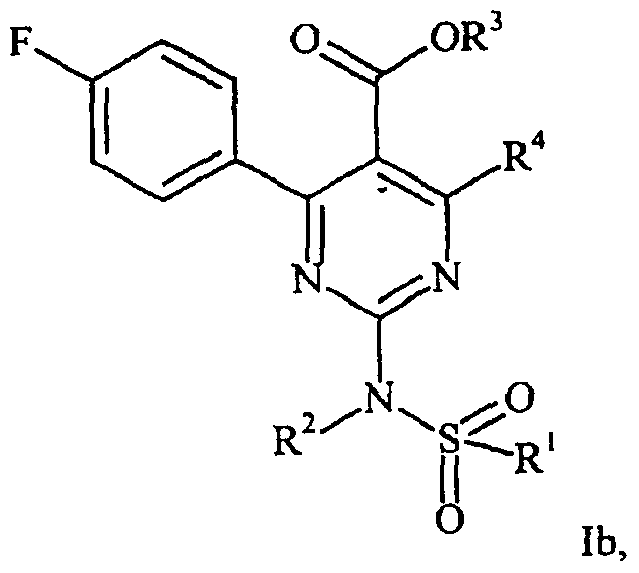
The invention comprises, on the other hand, compounds of the formula I in which R is a group of the formula -S02R1 and R1 and R2 are Cι_6-alkyl. These 4- (4-fluorophenyl) -6-alkyl-2- (N-alkanesulphonyl-W- alkylamino) pyrimidine-5-carboxylic acid esters of the general formula
Figure imgf000008_0001
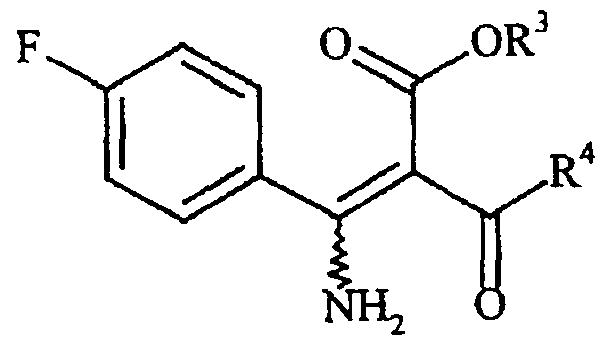
in which R1, R2, R3 and R4 are identical or different and are a Cι_6-alkyl group, can be prepared in that 2- [1-amino-l- (4-fluorophenyl)methylene] -4-alkyl-3-oxo- alkanoic acid esters of the general formula
Figure imgf000008_0002
Illb, in which R3 and R4 have the abovementioned meaning, are reacted with IV-cyano-N-alkylalkanesulphonamides, optionally isolated or prepared in situ, of the general formula
Figure imgf000008_0003
in which R1 and R2 are a Cι-6-alkyl group.
The reaction can be carried out either in the presence of a base or in the presence of a Lewis acid.
Bases which can be employed are alkali metal compounds such as, for example, alkali metal hydrides, alkali metal carbonates, alkali metal alkoxides or alkali metal silazanes. Alkali metal carbonates which can be used are lithium, sodium or potassium carbonate. The alkali metal hydride employed can be potassium, lithium or sodium hydride; sodium hydride is preferably employed. The alkali metal alkoxide employed can be sodium or potassium tert-pentoxide or sodium or potassium tert-butoxide, preferably sodium tert- pentoxide or sodium tert-butoxide. The alkali metal silazane used can be sodium hexamethyldisilazane or potassium hexamethyldisilazane. The base preferably employed is an alkali metal hydride or an alkali metal alkoxide .
The reaction is expediently carried out in the presence of a base in a polar organic solvent. The polar solvent used can be, for example, N,N-dimethyl- acetamide, isopropanol, tert-butanol, toluene, di- methylformamide, tetrahydrofuran, 1,4-dioxane or mixtures of these. N-Alkylalkanesulphonamides such as, for example, W-methylmethanesulphonamide are likewise suitable as solvents. The reaction is preferably carried out in W-alkylalkanesulphonamide and tert- butanol.
The reaction can be carried out in the presence of a base at a temperature from -10 to 150 °C, preferably from 0 to 80°C.
The reaction of compounds of the formula Illb with compounds of the formula IVb in the presence of a Lewis acid is expediently carried out in the solvent which is inert to the Lewis acid. Inert solvents which can be employed are, for example, aromatic hydrocarbons, and chlorinated aromatic and aliphatic hydrocarbons. Aromatic hydrocarbons employed are preferably toluene or xylene. The chlorinated aromatic hydrocarbon employed is preferably chlorobenzene; chlorinated aliphatic hydrocarbons employed are preferably dichloromethane or 1, 2-dichloroethane . The reaction in the presence of a Lewis acid can be carried out at a temperature from 20 to 150°C, preferably from 80 to 120°C.
Suitable Lewis acids are for example TiCl4,
TiBr4 or SnCl4. Titanium tetrachloride is preferred.
The amount of Lewis acid is 0.1 to 2 molar equivalents based on the compound of the formula Illb.
After a reaction time of 1 to 24 h, the final products of the general formula lb can be isolated by known working-up methods .
In a preferred embodiment, the final product of the formula lb isolated is ethyl 4- (4-fluorophenyl) - 6-isopropyl-2- (-V-methanesulphonyl-N-methylamino) - pyrimidine-5-carboxylate (R1 = R2 = R3 = methyl, R ,44 isopropyl) .
Compounds of the formula IVb are expediently prepared in that a compound of the general formula
Figure imgf000010_0001
in which R1 and R2 are Cχ-6-alkyl, is reacted with cyanogen halide in the presence of a base.
Suitable bases are the bases described beforehand.
The cyanogen halide employed can be cyanogen fluoride, cyanogen chloride, cyanogen bromide or cyanogen iodide. Cyanogen chloride or cyanogen bromide is preferably employed. This reaction can likewise be carried out in the polar organic solvents described beforehand. The reaction is preferably carried out in tetrahydrofuran.
The reaction is expediently carried out at a temperature from -20 to 50°C, preferably at a temperature from -10 to +20°C.
After a reaction time of ^ to 1 h, the compounds of the formula IVb, which have not yet been described in the literature, can then be isolated in a manner known to the person skilled in the art.
These compounds of the formula IVb are also a subject of the invention.
Compounds of the formula IVb can be prepared in situ, i.e. they are formed directly from the corresponding starting materials during the reaction without isolation. However, they can also be prepared and isolated separately in order then to employ them for the reaction.
Examples of compounds of the formula IVb are: N-cyano-W-methylmethanesulphonamide, N-cyano-iV-ethyl- methanesulphonamide, W-cyano-N-propylmethanesulphon- amide, N-cyano-N-butylmethanesulphonamide, ΛJ-cyano-N- pentylmethanesulphonamide and N-cyano-N-hexylmethane- sulphonamide. N-Cyano-N-methylmethanesulphonamide is preferred.
The compounds of the formula I can also be prepared in that a compound of the general formula
Figure imgf000012_0001
in which R3 and R4 have the meaning mentioned in Claim 1, is reacted with a compound of the formula IV.
The reaction is carried out analogously to the reaction of the compounds of the formula III with compounds of the formula IV, preferably in the presence of a base in a polar organic solvent at a temperature from -10 to 150°C.
Suitable bases and solvents correspond to the bases and solvents which are listed under the reaction of compounds of the formula III with compounds of the formula IV.
In a preferred embodiment, compounds of the general formula lb are prepared in that a compound of the formula VI is reacted with a compound of the formula IVb in a polar organic solvent at a temperature from 0 to 80°C in the presence of a base.
The compounds of the formula VI can be prepared by reaction of Cι-6-alkyl nitriles with Cι_6-alkyl 4-fluorobenzoylacetate in the presence of a Lewis acid. A compound of the formula VI in which R3 is methyl and R4 is isopropyl is preferred. The Lewis acid is preferably tin tetrachloride. The reaction is expediently carried out in a polar solvent. Suitable solvents correspond to the solvents which are listed under the reaction of compounds of the formula II with compounds of the formula III described above. The reaction in the first stage is expediently carried out at a temperature from -5 to 140°C, advantageously at 60 to 100°C.
The compounds of the formula VI are novel and likewise a subject of the invention.
Examples :
Example 1 : Methyl 2- [1-amino-l- (4-fluorophenyl)methylene] -4-methyl- 3-oxopentanoate
Ilia, R3 = methyl, toluene, SnCl4
1.50 g of methyl isobutyrylacetate (10.0 mmol, concentration 96%) and 1.24 g of 4-fluorobenzonitrile (10 mmol, concentration 98%) were dissolved in 10 ml of toluene and treated with 2.63 g of tin tetrachloride
(10 mmol, concentration 99%) at room temperature over the course of 6 min. After 3 h at room temperature, the mixture was heated to 80 °C. After 2.5 h, the suspension was again cooled to room temperature and treated with 10 ml of water. It was diluted with 5 ml of ethyl acetate and the phases were separated. After extraction of the aqueous phase with ethyl acetate (2 x 5 ml) , the combined organic phases were dried over magnesium sulphate. After concentration in vacuo, 3.50 g of crude product were obtained in the form of a pale yellow, tacky solid. The solid was dissolved in ethyl acetate and purified by flash chromatography (n-hexane/ethyl acetate 5:1 to 1:1). After concentration in vacuo, 1.44 g of methyl 2- [1-amino-l- (4-fluorophenyl) - methylene] -4-methyl-3-oxopentanoate were obtained. Yield: 54.3% (concentration > 99%) in the form of a colourless solid. Melting point: 85.8 - 86.6°C. Example 2 :
Methyl 2- [1-amino-l- (4-fluorophenyl)methylene] -4-methyl-
3-oxopentanoate
Ilia, R3 = methyl, toluene, SnCl4 22.53 g of methyl isobutyrylacetate (0.15 mol, concentration 96%) and 18.54 g of 4-fluorobenzonitrile (0.15 mol, concentration 98%) were dissolved in 150 ml of toluene and treated with 43.32 g of tin tetrachloride (0.165 mol, concentration 99%) at room temperature over the course of 12 min. After half an hour at room temperature, the mixture was heated to 80°C. After 3 h, the suspension was cooled to room temperature and treated with 150 ml of water. It was diluted with 100 ml of ethyl acetate and the phases were separated. After extraction of the aqueous phase with ethyl acetate (2 x 100 ml) , the combined organic phases were washed with 100 ml of saturated aqueous sodium hydrogencarbonate solution and 100 ml of IN sodium hydroxide solution and dried over magnesium sulphate. After concentration in vacuo, 46.46 g of crude product were obtained in the form of a yellowish solid. The solid was dissolved in a mixture of 50 ml of n-hexane and 5 ml of toluene under reflux and filtered hot. The product precipitated from the filtrate on cooling. By filtering through a frit and washing the filter cake with 2 x 40 ml of n-hexane, 32.42 g of methyl 2- [1-amino-l- (4-fluorophenyl) methylene] -
4-methyl-3-oxopentanoate were obtained in the form of a spectroscopically pure solid. Yield: 80.7% (concentration 99.0%) Melting point: 84.0 - 84.9°C.
*H NMR (DMSO-d6, 400 MHz): δ = 0.98 (d, 6H) ; 3.06 (sept,
1H) ; 3.24 (s, 3H) ; 7.27 (t, 2H) ; 7.35 (m, 2H) ; 8.38 (s, 1H); 10.59 (s,
1H) . 13C NMR ( DMSO-d6 , 100 MHz ) : δ = 19 . 45 ( q) ; 36 . 04 ( d)
50.74 (q); 101.54 (s) 115.11 (sd); 115.33 (sd) 129.16 (dd); 129.25 (dd) ; 133.68 (sd); 161.46.54 (s); 163.91 (s); 165.59 (s); 169.71 (s); 201.10 (s) .
Example 3
Methyl 2- [1-amino-l- ( -fluorophenyl)methylene] -4-methyl-
3-oxopentanoate Ilia, R3 = methyl, toluene, SnCl4
75.09 g of methyl isobutyrylacetate (0.50 mol, concentration 96%) and 61.80 g of 4-fluorobenzonitrile (0.50 mol, concentration 98%) were introduced into [500 ml of toluene and treated with 144.7 g of tin tetrachloride (0.55 mol, concentration 99%) at room temperature over the course of 16 min. After half an hour at room temperature, the thick suspension was heated to 80°C. After 3 h, 175 ml of toluene were distilled off at normal pressure, and the mixture was cooled to room temperature and treated with 450 ml of saturated sodium carbonate and 300 ml of ethyl acetate. The organic phase was separated off and the aqueous phase (after dilution with 300 ml of water) was again extracted with 300 ml of ethyl acetate. After drying the combined organic phases over sodium sulphate, the solvent was removed in vacuo (40°C/25 mbar) . 127.2 g of crude product were obtained in the form of a slightly yellowish solid, which was dissolved in 160 ml of n-hexane (slightly turbid solution) . After hot filtration and subsequent cooling in an ice bath, 99.8 g of methyl 2- [1-amino-l- (4-fluorophenyl) - methylene] -4-methyl-3-oxopentanoate were obtained after filtration in the form of a pale yellow solid. Yield: 74.5% (concentration 99.3%) Melting point: 86.4 - 87.8°C. Example 4
Methyl 2- [1-amino-l- (4-fluorophenyl)methylene] -4-methyl-
3-oxopentanoate
Ilia, R3 = methyl, 1, 2-dichloroethane, A1C13 754 mg of methyl isobutyrylacetate (5.00 mmol, concentration 96%) and 618 mg of 4-fluorobenzonitrile (5.00 mmol, concentration 98%) were introduced into 5 ml of 1, 2-dichloroethane and treated with 673 mg of aluminium chloride (5.00 mol) at room temperature. After one hour at room temperature, the mixture was heated to 80°C. After 19 h - the mixture contained 13.9 area per cent of product according to HPLC analysis - the mixture was cooled to room temperature and treated with water (5 ml) . The organic phase was separated off and the aqueous phase was extracted with dichloromethane (3 x 5 ml) . The combined organic phases were dried over magnesium sulphate and concentrated in vacuo. 1.01 g of crude product were obtained, which contained 3% (30 mg) of methyl 2-[l-amino- 1- (4-fluorophenyl) methylene] -4-methyl-3-oxopentanoate according to XH-NMR spectrum.
Example 5
Methyl 2- [1-amino-l- (4-fluorophenyl)methylene] -4-methyl- 3-oxopentanoate
Ilia, R3 = methyl, toluene, SnCl4
75.09 g of methyl isobutyrylacetate (0.50 mol, concentration 96%) and 61.8 g of 4-fluorobenzonitrile (0.50 mol, concentration 98%) were dissolved in 500 ml of toluene and treated with 144.72 g of tin tetrachloride (0.55 mol, concentration 99%) at room temperature over the course of 15 min. After half an hour at room temperature, the mixture was heated to 80°C. After 3 h, the suspension was cooled to 10°C and treated with 500 ml of water. The mixture was diluted with 100 ml of dichloroethane and the phases were separated. The organic phase was washed with 2 x 100 ml of IN sodium hydroxide solution. After concentration in vacuo, 125.5 g of crude product were obtained in the form of a yellowish solid. The solid was dissolved in 160 ml of n-hexane under reflux and filtered hot. The product precipitated from the filtrate on cooling. By filtering through a frit and washing the filter cake with 130 ml of n-hexane, 79.8 g of methyl 2-[l-amino- 1- (4-fluorophenyl)methylene] -4-methyl-3-oxopentanoate were obtained in the form of a spectroscopically pure solid.
Yield: 60.7% (concentration 98.7%) Melting point: 88.4 - 89.3°C.
Example 6
Methyl 2-amino-4- (4-fluorophenyl) -6-isopropylpyrimidine-
5 - carboxy la te la, R3 = methyl, water
A suspension of 1.33 g of methyl 2- [1-amino- 1- (4-fluorophenyl) methylene] -4-methyl-3-oxopentanoate (5.00 mmol) in 4.20 g of 50% strength aqueous cyanamide solution (50.0 mmol) was heated to reflux. After 17 h, it was cooled to room temperature and treated with ethyl acetate (5 ml) and water (5 ml) . The undissolved solid was filtered off. The organic phase was separated off and the aqueous phase was extracted with ethyl acetate (2 x 5 ml) . The combined organic phases were dried over magnesium sulphate and concentrated in vacuo. The crude product (0.97 g) was purified by flash chromatography on silica gel (eluent: methylene chloride). 121.6 mg of methyl 2-amino-4- (4-fluorophenyl) - 6-isopropylpyrimidine-5-carboxylate were obtained in the form of a colourless solid. Yield: 8.4%
Melting point: 146.2 - 147.0°C. lH NMR (DMSO-d6, 400 MHz): δ = 1.08 (d, 6H) ; 3.04 (sept,
1H) ; 3.57 (s, 3H) ; 7.05 (s, broad, 2H) ; 7.28 (m,
2H) ; 7.53 (m, 2H) . Example 7
Methyl 2-amino-4- (4-fluorophenyl) -6-isopropylpyrimidine-
5-carboxylate la, R3 = methyl, N,W-dimethylacetamide 5.00 g of methyl 2- [1-amino-l- (4-fluorophenyl) - methylene] -4-methyl-3-oxopentanoate (18.7 mmol) were treated with 5 ml of N-N-dimethylacetamide and 15.71 g of a 50% strength aqueous cyanamide solution (187 mmol) and heated to reflux. After 5 h, the solution was poured onto 50 ml of water. The mixture was cooled in an ice bath and the deposited precipitate was isolated by means of a suction filter. After drying, 2.72 g of crude product were obtained in the form of a yellowish solid. After flash chromatography (150 g of silica gel; eluent: hexane/ethyl acetate 3:2), 1.19 g of methyl 2-amino-4- (4-fluorophenyl) -6-isopropylpyrimidine- 5-carboxylate were isolated in the form of a colourless solid. Yield: 22.0% Melting point: 145 - 146°C.
Example 8 N-Cyano-N-methylmethanesulphonamide
IVb, R1 = R2 = methyl 12.22 g (0.28 mol) of sodium hydride (55% in oil) were twice suspended in 100 ml of n-hexane under nitrogen and freed from the oil by means of a frit. The hexane-moist sodium hydride was taken up in 200 ml of tetrahydrofuran and cautiously treated at 2°C with 22.98 g (0.20 mol) of -methylmethanesulphonamide
(concentration 95%) . Evolution of gas was observed.
After addition was complete (25 min) , the cooling bath was removed and the mixture was subsequently reacted at room temperature for 3 h 40 min until evolution of hydrogen was no longer observed. The mixture was subsequently cooled again using an ice bath and 20.0 g (0.32 mol) of cyanogen chloride (concentration 99%) were cautiously introduced over the course of 40 min (slightly exothermic) . After subsequent reaction at 0 - 5°C for 45 min, the reaction mixture was poured onto 200 ml of ice water. The phases were separated and the aqueous phase was extracted with 1 x 200 ml and two times 100 ml of diethyl ether. The organic phases were combined and dried over magnesium sulphate. After filtration and concentration in vacuo, 26.57 g of crude product were obtained in the form of a yellowish, two-phase oil, which partially crystallized in the refrigerator. After distillation in vacuo (boiling point 90 - 95°C/0.01 mbar) , 17.24 g of W-cyano-N- methylmethanesulphonamide were obtained in the form of a colourless oil, which crystallized in the refrigerator. Yield: 61.7%, [concentration: 96.0% (GC) ] Melting point: 29 - 30°C.
Example 9 N-Cyano-N-meth lmethanesulphonamide
IVb, R1 = R2 = methyl 36.65 g (0.84 mol) of sodium hydride (55% in oil) were suspended three times in 200 ml of n-hexane under nitrogen and freed from the oil by means of a frit. The hexane-moist sodium hydride was taken up in 600 ml of tetrahydrofuran and cautiously treated at 2°C with 68.94 g (0.60 mol) of N-methylmethanesulphonamide
(concentration 95%) . Evolution of gas was observed.
After addition was complete (45 min) , the cooling bath was removed and the mixture was subsequently reacted at room temperature for 4 h 25 min until evolution of hydrogen was no longer observed. It was subsequently cooled again using an ice bath and 59.6 g (0.96 mol) of cyanogen chloride (concentration 99%) were cautiously introduced over the course of 1 h 45 min (slightly exothermic) . After subsequent reaction at 0 - 5°C for 20 min, the reaction mixture was poured onto 600 ml of ice water. The phases were separated and the aqueous phase was extracted with 2 x 500 ml of diethyl ether. The combined organic phases were dried over magnesium sulphate. After filtration and concentration in vacuo, 99.22 g of crude product were obtained, which crystallized at 15°C. After filtration, 70.56 g of crude product were isolated in the form of a tacky, colourless solid. After distillation in vacuo (boiling point 90 - 95°C/0.01 mbar) , 57.4 g of N-cyano- -methyl- methanesulphonamide were obtained in the form of a colourless oil, which crystallized in the refrigerator. Yield: 71.3%, [concentration: > 99% (GC) ] Melting point: 29.0 - 30.0°C. XH NMR (DMSO-d6, 400 MHz): δ = 3.28 (s, 3H) ; 3.48
(s, 3H) . 13C NMR (DMSO-d6, 100 MHz): δ = 35.46 (q) ; 37.74 (q) ;
109.35 (s) .
Example 10
N-Cyano-N-methylmethanesulphonamide
IVb, R1 = R2 = methyl
36.7 g (0.84 mol) of sodium hydride (55% in oil) were suspended three times in 200 ml of n-hexane under nitrogen and freed from the oil by means of a frit. The hexane-moist sodium hydride was taken up in
600 ml of tetrahydrofuran and cautiously treated at 2°C with €8.94 g (0.60 mol) of N-methylmethanesulphonamide
(concentration 95%) . Evolution of gas was observed. After addition was complete (30 min), the cooling bath was removed and the mixture was subsequently reacted at room temperature for 4 h until evolution of hydrogen was no longer observed. It was subsequently cooled again using an ice bath and 59.6 g (0.96 mol) of cyanogen chloride (concentration 99%) were cautiously introduced over the course of 2 h (slightly exothermic) . After subsequent reaction at 0 - 5CC for 20 min, the reaction mixture was poured onto 600 ml of ice water. After addition of 500 ml of diethyl ether, the phases were separated and the aqueous phase was extracted with 500 ml of diethyl ether. The combined organic phases were dried over magnesium sulphate. After filtration and concentration in vacuo, 99.22 g of crude product were obtained, which crystallized at 15°C. After filtration, 86.5 g of crude product were isolated in the form of a tacky, colourless solid. After distillation in vacuo (boiling point 91 93°C/0.1 mbar) , 72.9 g of N-cyano-N-methylmethane- sulphonamide were obtained in the form of a colourless oil which crystallized in the refrigerator. Yield: 90.6%, [concentration: > 99% (GC) ]
Example 11 Methyl 4- (4-fluorophenyl) -6-isopropyl-2- (N-methane- sulphonyl-N-methylamino)pyrimidine-5-carboxylate lb, R1 = R2 = R3 = methyl, R4 = isopropyl, NaH
2.66 g (10.0 mmol) of methyl 2- [1-amino- 1- (4-fluorophenyl) methylene] -4-methyl-3-oxopentanoate were introduced into 12 g of ΛJ,W-dimethylacetamide together with 2.70 g (20.0 mmol) of N-cyano-W- methylmethanesulphonamide. 440 mg (11.0 mmol) of sodium hydride (60% in oil) were added to this solution at room temperature over the course of 2 h. An orange-red clear solution was obtained. After 6 h at room temperature, the reaction solution was poured onto 25 ml of water. The suspension was stirred in an ice bath for 30 minutes, and the precipitate was filtered off and washed with water (2 x 10 ml) . After drying in a high vacuum, 1.11 g (29.1%) of methyl 4- (4-fluorophenyl) -6-isopropyl-2- (W-methanesulphonyl-N- methylamino) pyrimidine-5-carboxylate were obtained in the form of a pale beige solid. The product still contained traces of methyl 2-[l-amino- 1- (4-fluorophenyl) methylene] -4-methyl-3-oxopentanoate.
XR NMR (DMSO-d6, 400 MHz): δ = 1.15 (d, 6H) ; 3.17 (sept,
1H) ; 3.50 (s, 3H) ; 3.58 (s, 3H) ; 3.73 (s, 3H) ; 7.39 (m, 2H) ; 7.69 (m, 2H) . Example 12
Methyl 4- (4-fluorophenyl) -6-isopropyl-2- (N-methane- sulphonyl-N-methylamino)pyrimidine-5-carboxylate lb, R1 = R2 = R3 = methyl, R4 = isopropyl, sodium tert- pentoxide
2.66 g (10.0 mmol) of methyl 2-[l-amino- 1- (4-fluorophenyl) methylene] -4-methyl-3-oxopentanoate were introduced into 7 g of N,N-dimethylacetamide together with 2.70 g (20.0 mmol) of N-cyano-N- methylmethanesulphonamide. 1.21 g (11.0 mmol) of sodium tert-pentoxide in 5 g of dimethylacetamide were added to this solution at room temperature after the course of 3 h. An orange-red clear solution was obtained. After 2.5 h at room temperature, the reaction solution was poured onto 25 ml of water. The suspension was stirred in an ice bath for 30 minutes, and the precipitate was filtered off and washed with water
(10 ml). After drying in a high vacuum, 1.65 g of crude product were obtained in the form of a pale beige solid which contained 676.5 mg of methyl 4- (4-fluorophenyl) - 6-isopropyl-2- (N-methanesulphonyl-N-methylamino) - pyrimidine-5-carboxylate . Yield: 17.7%
Example 13
Methyl 4- (4-fluorophenyl) -6-isopropyl-2- (N-methane- sulphonyl-N-methylamino)pyrimidine-5-carboxylate lb, R1 = R2 = R3 = methyl, R4 = isopropyl, NaH
10.0 g (37.7 mmol) of methyl 2-[l-amino- 1- (4-fluorophenyl) methylene] -4-methyl-3-oxopentanoate were introduced into 45 ml of -V,N-dimethylacetamide together with 15.2 g (113 mmol) of N-cyano-N- methylmethanesulphonamide. 3.50 g (88.7 mmol) of sodium hydride (60% in oil) were added at room temperature to this solution. An orange-red viscous solution was obtained. The reaction solution was poured onto 120 ml of water and stirred in an ice bath for 30 minutes. The precipitate was filtered off and washed with water (10 ml). After drying in a high vacuum, 4.60 g of 'crude product were obtained in the form of a pale beige solid. According to the 1H NMR spectrum, the solid contained an 84 : 16 product/starting material mixture, which corresponds to a yield of 27% of methyl 4- (4-fluorophenyl) -6-isopropyl-2- ( -methanesulphonyl-W- methylamino) pyrimidine-5-carboxylate .
Example 14
Methyl 4- (4-fluorophenyl) -6-isopropyl-2- (N-methane- sulphonyl-N-methylamino)pyrimidine-5-carboxylate lb, R1 = R2 = R3 = methyl, R4 = isopropyl, NaH, compound of the formula IVb formed in situ
2.65 g (10.0 mmol) of methyl 2-[l-amino- 1- (4-fluorophenyl) methylene] -4-methyl-3-oxopentanoate were introduced into 5 g of N-W-dimethylacetamide together with 2.30 g (20.0 mmol) of N-methylmethane- sulphonamide. 470 mg (20.0 mmol) of sodium hydride (60% in oil) were added to this solution at room temperature. The reaction solution was treated with 2.40 g (40.0 mmol) of cyanogen chloride at room temperature. After 20 h, the mixture was poured onto 40 ml of water and the yellowish suspension was cooled in an ice bath. The precipitate deposited was filtered off and washed with 20 ml of water. After drying in vacuo, 2.22 g of crude product were obtained in the form of a pale beige solid, which according to the "H NMR spectrum contained a 70 : 30 starting material/product mixture, which corresponds to a yield of 22% of methyl 4- (4-fluorophenyl) -6-isopropyl-2- ( N- methanesulphonyl-N-methylamino) pyrimidine-5- carboxylate.
Example 15
Methyl 4- (4-fluorophenyl) -6-isopropyl-2- (N-methane- sulphonyl-N-methylamino)pyrimidine-5-carboxylate lb, R1 = R2 = R3 = methyl, R4 = isopropyl, NaH, compound of the formula IVb formed in situ
13.3 g (50.0 mmol) of methyl 2- [1-amino- 1- (4-fluorophenyl) methylene] -4-methy1-3-oxopentanoate were introduced into 25 g of iV,W-dimethylacetamide together with 10.9 g (100.0 mmol) of N- methylmethanesulphonamide. 3.60 g (90.0 mmol) of sodium hydride (60% in oil) were added to this solution at 25°C. Vigorous foaming was observed. After 15 min at 25°C, 6.0 g (100.0 mmol) of cyanogen chloride gas were introduced after the course of 20 min. An orange- coloured suspension was formed. This was stirred at 25°C for 2 h and 2.40 g (60.0 mmol) of sodium hydride (60% in oil) and subsequently 6.0 g (100.0 mmol) of cyanogen chloride were added again. The mixture was stirred at 25°C again for 1 h before a further 3.60 g (90.0 mmol) of sodium hydride (60% in oil) were added. The reaction mixture was poured onto an ice/water mixture (200 ml) and stirred at 0°C for 1 h. The resulting solid was filtered off and washed with 100 ml of water. After drying in a high vacuum, 14.62 g of crude product were obtained in the form of a beige solid. 8.22 g of this solid were recrystallized in an acetone/water mixture. 4.24 g of product were obtained in the form of a pale beige solid, which corresponds to a yield of 29% [concentration (GC) 72%] .
Example 16 Methyl 4- (4-fluorophenyl) -6-isopropyl-2- (N-methane- sulphonyl-W-methylamino)pyrimidine-5-carboxylate lb, R1 = R2 = R3 = methyl, R4 = isopropyl, NaH, compound of the formula IVb formed in situ
13.3 g (50.0 mmol) of methyl 2-[l-amino- 1- (4-fluorophenyl)methylene] -4-methyl-3-oxopentanoate were introduced into 25 g of N,N-dimethylacetamide together with 10.9 g (100.0 mmol) of N- methylmethanesulphonamide. 3.60 g (90.0 mmol) of sodium hydride (60% in oil) were added to this solution at 25°C. Vigorous foaming was observed. After 25 min at 25°C, 6.0 g (100.0 mmol) of cyanogen chloride gas were introduced after the course of 12 min. During this, the temperature rose temporarily to 32 °C. An orange- coloured suspension was formed. The mixture was stirred at 25°C for 1 h 25 min and 2.40 g (60.0 mmol) of sodium hydride (60% in oil) and subsequently 3.0 g (50.0 mmol) of cyanogen chloride were added again. The mixture was stirred at 25°C again for 1 h 40 min before a further 2.40 g (60.0 mmol) of sodium hydride (60% in oil) and 3.0 g (50.0 mmol) of cyanogen chloride were added. After addition of a further 2.40 g (60.0 mmol) of sodium hydride (60% in oil), the reaction mixture was poured onto an ice/water mixture (200 ml) . The apparatus was washed with 50 ml of water and the mixture was stirred at 0°C for 1 h. The resulting solid was filtered off and washed with 50 ml of water. After drying in a high vacuum, 10.47 g of crude product were obtained in the form of a beige solid. 8.00 g of this solid were recrystallized in an acetone/water mixture. 5.50 g of product were obtained in the form of a pale beige solid, which corresponded to a yield of 30.2% [concentration (GC) 80%] .
Example 17
Methyl 4- (4-fluorophenyl) -6-isopropyl-2- (N-methane- sulphonyl-N-methylamino)pyrimidine-5-carboxylate lb, R1 = R2 = R3 = methyl, R4 = isopropyl, NaH, compound of the formula IVb formed in situ 13.3 g (50.0 mmol) of methyl 2-[l-amino-
1- (4-fluorophenyl) methylene] -4-methyl-3-oxopentanoate were introduced into 50.0 g (0.46 mol) of W-methyl- methanesulphonamide. 12.0 g (0.30 mol) of sodium hydride (60% in oil) were added to this solution at 25°C after the course of 1 h 45 min. Vigorous foaming was observed. In order to guarantee better stirrability, 30.0 g (0.275 mol) of N-methyl-methane- sulphonamide were added again during the addition. After 30 min at 25°C, 15.0 g (0.25 mol) of cyanogen chloride gas were introduced over the course of 50 min. The suspension was transferred to an autoclave and stirred at 60°C for 18.5 h. The reaction mixture was poured onto an ice/water mixture (200 ml) and stirred at 0°C for 30 min. The resulting solid was filtered off and washed with 50 ml of water. After drying in a high vacuum, 18.71 g of crude product were obtained in the form of a beige solid. 10.0 g of this solid were recrystallized in an acetone/water mixture. 5.40 g of methyl 4- (4-fluorophenyl) -6-isopropyl-2- (N-methane- sulphonyl-N-methylamino ) pyrimidine-5-carboxylate were obtained in the form of a colourless solid. Yield of 50.6%, [concentration 95.5% (GC) ] .
Example 18
Methyl 4- (4-fluorophenyl) -6-isopropyl-2- (N-methane- sulphonyl-W-methylamino)pyrimidine-5-carboxylate lb, R1 = R2 = R3 = methyl, R4 = isopropyl, sodium tert- pentoxide, compound of the formula IVb formed in situ 13.3 g (50.0 mmol) of methyl 2-[l-amino-
1- (4-fluorophenyl) methylene] -4-methyl-3-oxopentanoate were introduced into 50.0 g (0.46 mol) of N- methylmethanesulphonamide. 33.0 g (0.30 mol) of sodium tert-pentoxide were added to this solution at 25°C after the course of 20 min. A yellowish, thick suspension was formed. After 30 min at 25 °C, 15.0 g (0.25 mmol) of cyanogen chloride gas were introduced after the course of 25 min. The suspension, which was now more readily stirrable, was transferred to an autoclave and stirred at 60°C for 17 h. The reaction mixture was poured onto an ice/water mixture (200 ml) and stirred at 0°C for 30 min. The resulting solid was filtered off and washed with 50 ml of water. After drying in a high vacuum, 20.81 g of crude product were obtained in the form of a beige solid having a concentration of about 68% (GC) . This corresponded to a yield of 74.1% of methyl 4- (4-fluorophenyl) - 6-isopropyl-2- (N-methane sulphonyl-N- methylamino) pyrimidine-5-carboxylate . Example 19
Methyl 4- (4-fluorophenyl) -6-isopropyl-2- (N-methane- sulphonyl-N-methylamino)pyrimidine-5-carboxylate lb, R1 = R2 = R3 = methyl, R4 = isopropyl, TiCl4, chlorobenzene
10.0 g (37.7 mmol) of methyl 2-[l-amino- 1- (4-fluorophenyl) methylene] -4-methyl-3-oxopentanoate were introduced into 50 ml of chlorobenzene together with 10.17 g (75.4 mmol) of N-cyano-iV-methylmethane- sulphonamide and the mixture was treated at room temperature with 7.22 g (37.7 mmol) of titanium tetrachloride. The reaction progressed exothermically . The red-orange-coloured suspension was heated to 110 - 120°C and stirred for 3.5 h. It was then cooled to room temperature and treated with 30 ml of water. The organic phase was separated off and the aqueous phase was extracted with methylene chloride (30 ml) . The combined organic phases were washed with 30 ml of water and dried over magnesium sulphate. After filtering and concentrating the solution in a water-jet vacuum and drying in vacuo, 11.48 g of crude product were obtained in the form of a tacky solid. Yield: 37.8% [concentration (HPLC) 47.3%].
Example 20
Methyl 4- (4-fluorophenyl) -6-isopropyl-2- (N-methane- sulphonyl-N^methylamino)pyrimidine-5-carboxylate lb, R1 = R2 = R3 = methyl, R4 = isopropyl, TiCl4, chlorobenzene 10.0 g (37.7 mmol) of methyl 2-[l-amino-
1- (4-fluorophenyl) methylene] -4-methyl-3-oxopentanoate were introduced into 50 ml of chlorobenzene together with 10.17 g (75.4 mmol) of W-cyano- -methylmethane- sulphonamide and the mixture was treated at room temperature with 14.45 g (75.4 mmol) of titanium tetrachloride. The reaction progressed exothermically. The red-orange-coloured suspension was heated to 110 °C and stirred for 17.5 h. It was then cooled to room temperature and treated with 30 ml of water. The organic phase was separated off and the aqueous phase was extracted with methylene chloride (2 x 30 ml) . The combined organic phases were washed with 30 ml of water and dried over magnesium sulphate. After filtering and concentrating the solution in a water-jet vacuum and drying in vacuo, 12.92 g of crude product were obtained in the form of a brownish oil. Yield: 23.3% [concentration (HPLC) 25.9%].
Example 21
Methyl 4- (4-fluorophenyl) -6-isopropyl-2- (N-methane- sulphonyl-N-methylamino)pyrimidine-5-carboxylate lb, R1 = R2 = R3 = methyl, R4 = isopropyl, TiCl4, toluene 10.0 g (37.7 mmol) of methyl 2-[l-amino- 1- (4-fluorophenyl) methylene] -4-methyl-3-oxopentanoate were introduced into 50 ml of toluene together with 10.17 g (75.4 mmol) of N-cyano-N-methylmethanesulphon- amide and the mixture was treated at room temperature with 3.61 g (18.9 mmol) of titanium tetrachloride. The reaction progressed exothermically. The red-orange- coloured suspension was heated to 110 °C and stirred for 4.5 h. It was then cooled to room temperature and treated with 30 ml of water. The organic phase was separated off and the aqueous phase was extracted with ethyl acetate (30 ml) . The combined organic phases were washed with 30 ml of water and dried over magnesium sulphate. After filtering and concentrating the solution in a water-jet vacuum and drying in vacuo, 11.54 g of crude product were obtained in the form of a tacky oil.
Yield: 13.5% [concentration (HPLC) 16.8%].
Example 22
Methyl 4- (4-fluorophenyl) -6-isopropyl-2- (N-methane- sulphonyl-N-methylamino) pyrimidine-5-carboxylate lb, R1 = R2 = R3 = methyl, R4 = isopropyl, TiCl4, chlorobenzene
10.0 g (37.7 mmol) of methyl 2-[l-amino- 1- (4-fluorophenyl) methylene] -4-methyl-3-oxopentanoate were introduced into 50 ml of chlorobenzene together with 5.08 g (37.7 mmol) of W-cyano-W-methylmethane- sulphonamide and the mixture was treated at room temperature with 7.22 g (37.7 mmol) of titanium tetrachloride. The reaction progressed exothermically. The red-orange-coloured suspension was heated to 110 - 120°C and stirred for 5 h. It was then cooled to room temperature and treated with 30 ml of water. The organic phase was separated off and the aqueous phase was extracted with methylene chloride (2 x 30 ml) . The combined organic phases were washed with 30 ml of water and dried over magnesium sulphate. After filtering and concentrating the solution in a water-jet vacuum and drying in vacuo, 12.02 g of crude product were obtained in the form of a tacky oil.
Yield: 15.0% [concentration (HPLC) 17.9%].
Example 23
Methyl 3-amino-2- [1- (4-fluorophenyl) methanoyl] -4-methyl - pent-2-enoate
VI , R3 = R4 = methyl
5.00 g of methyl 4-fluorobenzoylacetate (24.2 mmol, concentration 95%) and 1.69 g of isobutyronitrile (24.2 mmol, concentration 98%) were dissolved in 25 ml of toluene and treated with 7.01 g of tin tetrachloride (26.6 mmol, concentration >99%) at room temperature after the course of 10 minutes. After 3 h at room temperature, the mixture was heated to 80°C. After 11.5 h, the suspension was again cooled to room temperature and treated with 25 ml of water. The mixture was diluted with 10 ml of ethyl acetate and the phases were separated. The organic phase was washed twice with 10 ml of IN sodium hydroxide solution and concentrated in vacuo (40°C/25 mbar) after drying over magnesium sulphate. 6.18 g of crude product were obtained in the form of a yellow oil. After chromatography on silica gel (eluent: hexane/ethyl acetate 1.5:1), 3.84 g of methyl 3-amino-2- [1- (4-fluorophenyl) methanoyl] -4-methylpent-2-enoate were obtained in the form of an oil. Yield: 59.0%; concentration (HPLC): 98.6%. GC-MS: M+ = 265. lH NMR (CDC13, 400 MHz) : δ = 0.98 (d) ; 1.25 (d) ; 2.90
(sept); 3.34 (s) ; 3.47
(s); 3.52 (sept); 5.50 (s, broad); 5.90 (s, broad);
7.08 (m) ; 7.50 (dd) ; 7.85
(dd) ; 9.04 (s, broad);
10.86 (s, broad) .
13 C NMR (CDCI3, 100 MHz) : δ = 20.68 (q) J 20.76 (q
30.58 (d), 30.78 (d
50.57 (q). 51.17 (q
96.86 (s) ; 101.09 ( s
114.85 (d) 115.06 (d
115.16 (d) 115.37 (d
128.67 (d) 128.76 (d
131.33 (d) 131.42 (d
136.98 (s) 137.01 ( s
139.37 (s) 139.40 ( s
162.48 (s) 164.04 ( s
164.95 (s) 166.56 ( s
169.33 (s) 170.33 ( s
171.58 (s) 175.91 (s
193.24 (s) 194.40 ( s
Example 24 Methyl 3-amino-2- [1- (4-fluorophenyl) methanoyl] -4-methyl - pent-2-enoate
VI , R3 = R4 = methyl
39.2 g of methyl 4-fluorobenzoylacetate (0.20 mmol) and 16.8 g of isobutyronitrile (0.24 mol, concentration >99%) were dissolved in 200 ml of toluene and treated with 57.9 g of tin tetrachloride (0.22 mmol, concentration >99%) at room temperature after the course of 10 minutes. After 30 min at room temperature, the mixture was heated to 80°C. After 8 h, the suspension was again cooled to room temperature and treated with 200 ml of water. The mixture was diluted with 200 ml of ethyl acetate and the phases were separated. The organic phase was washed twice with 40 ml of IN sodium hydroxide solution and concentrated in vacuo (40°C/25 mbar) after drying over magnesium sulphate. 50.9 g of crude product were obtained in the form of a yellow oil. After chromatography of 12.0 g of crude product on silica gel (eluent: hexane/isopropanol 90:10), 10.08 g of methyl 3-amino-2- [1- (4-fluorophenyl) methanoyl] -4-methylpent-2-enoate were obtained in the form of a yellowish oil. Yield: 86.3%; (concentration: >99%).
Example 25
Methyl 4- (4-fluorophenyl) -6-isopropyl-2- (N-methane- sulphonyl-N-methylamino)pyrimidine-5-carboxylate lb, R1 = R2 = R3 = methyl, R4 = isopropyl
2.65 g (10.0 mmol) of methyl 3-amino- 2- [1- (4-fluorophenyl) methanoyl] -4-methylpent-2-enoate were introduced into 5.52 g (50.0 mmol) of N- methylmethanesulphonamide and 1.48 g (20.0 mmol) of tert-butanol. 4.95 g (50.0 mmol) of sodium tert- butoxide were added to this solution after the course of 2 min between 23 and 52 °C. A yellowish, thick suspension was formed. After 1 h, 2.00 g (32.5 mmol) of cyanogen chloride gas were introduced at 25°C after the course of 20 min. The suspension, which was now more readily stirrable, was stirred for 18 h at 60°C. The reaction mixture was poured onto water (20 ml) . The resulting solid was filtered off and washed with water (2 5 ml) . After drying in a high vacuum, 740 mg of crude product were obtained in the form of a beige solid having a concentration of 70.0% (HPLC). This corresponded to a yield of 13.6% of methyl 4- (4-fluorophenyl) -6-isopropyl-2- (W-methanesulphonyl-N- methylamino) pyrimidine-5-carboxylate . Example 26
Methyl 4- (4- luorophenyl) -6-isopropyl-2- (N-methane- sulphonyl-27-methylamino)pyrimidine-5-carboxylate lb, R1 = R2 = R3 = methyl, R4 = isopropyl 2.50 g (9.42 mmol) of methyl 3-amino-
2- [1- (4-fluorophenyl) methanoyl] -4-methylpent-2-enoate were introduced into 2.08 g (28.3 mmol) of N- methylmethanesulphonamide and 3.49 g (47.1 mmol) of tert-butanol together with 3.79 g (28.3 mmol) of N- cyano-N-methylmethanesulphonamide . 1.87 g (18.8 mmol) of sodium tert-butoxide were added to this suspension at room temperature after the course of 15 min (exothermic) . After 4 h at 76°C, the reaction suspension was poured onto 20 g of ice water. The suspension was stirred in an ice bath, and the precipitate was filtered off and washed with water
(2 x 2.5 ml) . After drying in a high vacuum, 1.61 g of methyl 4- (4-fluorophenyl) -6-isopropyl-2- (N-methane- sulphonyl-W-methylamino) pyrimidine-5-carboxylate were obtained in the form of a pale beige solid. Yield: 9.8%; concentration (HPLC): 21.9%.
Example 27
Methyl 4- (4-fluorophenyl) -6-isopropyl-2- (N-methane- sulphonyl-N-methylamino)pyrimidine-5-carboxylate lb, R1 = R2 = R3 = methyl, R4 = isopropyl, sodium tert- butoxide, compound of the formula IVb formed in situ
132.6 g (0.50 mol) of methyl 2-[l-amino- 1- (4-fluorophenyl)methylene] -4-methyl-3-oxopentanoate were introduced into 276.2 g (2.50 mol) of N- methylmethanesulphonamide and 74.1 g (1.00 mol) of tert-butanol. 243.7 g (2.50 mol) of sodium tert- butoxide were added to this suspension at 30°C in portions such that the temperature did not rise above 60°C. A yellowish, thick suspension was formed. After 20 min at 28°C, the mixture was heated to 50°C and 100.0 g (1.63 mol) of cyanogen chloride gas were introduced after the course of 1 h. The suspension, which was now more readily stirrable, was stirred at 60°C for 19.5 h. The reaction mixture was poured onto water (750 ml) and stirred at room temperature for 15 min. The resulting solid was filtered off and washed with 2 x 250 ml of water and 2 x 200 ml of cold methanol. After drying in a high vacuum, 119.1 g of crude product were obtained in the form of a beige solid having a concentration of 90.1% (HPLC). This corresponded to a yield of 56.3% of methyl 4- (4- fluorophenyl) -6-isopropyl-2- (N-methanesulphonyl-N- methylamino) pyrimidine-5-carboxylate .
Example 28
Methyl 4- (4-fluorophenyl) -6-isopropyl-2- (N-methane- sulphonyl--V-methylamino)pyrimidine-5-carboxylate lb, R1 = R2 = R3 = methyl, R4 = isopropyl, NaOtBu, MMSA, CMMSA
2.97 g (11.2 mmol) of methyl 2-[l-amino- 1- (4-fluorophenyl) methylene] - -methyl-3-oxopentanoate were introduced into 2.45 g (22.4 mmol) of W-methyl- methanesulphonamide (MMSA) and 4.19 g (55.9 mmol) of tert-butanol together with 4.51 g (36.6 mmol) of N- cyano-N-methylmethanesulphonamide (CMMSA). 2.22 g (22.4 mmol) of sodium tert-butoxide were added to this suspension at room temperature in portions. An orange- coloured suspension was obtained. It was heated to 50°C and stirred at 50°C for 19.9 h. The suspension was poured onto 20 g of ice water, and the precipitate was filtered off and washed with water (2 x 5 ml) . After drying in a high vacuum, 2.91 g of methyl 4-(4-fluoro- phenyl) -6-isopropyl-2- (N-methanesulphonyl-W-methyl- amino) pyrimidine-5-carboxylate were obtained in the form of a pale beige solid having a concentration of 76.4% (HPLC), which corresponds to a yield of 52.1%.

Claims

Patent Claims:
1. Process for the preparation of compounds of the general formula
Figure imgf000034_0001
in which
R is hydrogen or a group of the formula -SO2R1; R1 is Cι-6-alkyl; R2 is hydrogen or Cι-6-alkyl; R3 is Cι-6-alkyl; R4 is Cχ-6-alkyl, characterized in that, in a first stage, a compound of the general formula
Figure imgf000034_0002
in which R3 and R4 have the abovementioned meaning, is reacted in the presence of a Lewis acid with
4-fluorobenzonitrile to give a compound of the general formula
Figure imgf000034_0003
in which R3 and R4 have the abovementioned meaning, and in a second stage the compound of the formula III obtained is reacted with a compound of the general formula
Figure imgf000035_0001
in which R and R have the abovementioned meaning, to give the final product of the formula I.
2. Process for the preparation of 2-amino- 4- (4-fluorophenyl) -6-isopropylpyrimidine-5-carboxylic acid esters of the general formula
Figure imgf000035_0002
in which R3 has the meaning indicated in Claim 1, characterized in that, in a first stage, an alkyl isobutyrylacetate of the general formula
Figure imgf000035_0003
in which R3 has the meaning indicated in Claim 1, is reacted in the presence of a Lewis acid with 4-fluorobenzonitrile to give a 2- [1-amino-l- (4-fluorophenyl) methylene] -4-methyl-3-oxopentanoic acid ester of the general formula
Figure imgf000036_0001
in which R has the meaning mentioned, and in a second stage the compound of the formula Ilia is reacted with cyanamide of the formula
Figure imgf000036_0002
in which R and R are hydrogen, to give the final product of the formula la.
3. Process according to Claim 2, characterized in that R3 is a methyl group.
4. Process according to Claim 2 or 3, characterized in that the Lewis acid employed in the first stage is tin tetrachloride.
5. Process according to one of Claims 2 to 4, characterized in that the first stage is carried out in the presence of an organic solvent.
6. Process according to one of Claims 2 to 5, characterized in that the reaction in the first stage is carried out at a temperature from -5 to 140°C.
7. Process according to one of Claims 2 to 6, characterized in that the second stage is carried out in the presence of an organic solvent, a mixture of water with an organic solvent or in water.
8. Process according to one of Claims 2 to 7, characterized in that the reaction in the second stage is carried out at a temperature from 10 to 120°C.
9. Process according to one of Claims 2 to 8, characterized in that the intermediate of the formula Ilia is isolated.
10. 2- [1-Amino-l- (4-fluorophenyl) methylene] -4- methyl-3-oxopentanoic acid esters of the general formula
Figure imgf000037_0001
in which R3 has the meaning mentioned in Claim 1
11. Methyl 2- [1-amino-l- (4-fluorophenyl) -methylene] - 4-methyl-3-oxopentanoate .
12. Process for the preparation of 4- (4- fluorophenyl) -6-alkyl-2-N-alkansulphonyl-W-alkylamino) - pyrimidine-5-carboxylic acid esters of the general formula
Figure imgf000037_0002
in which R1, R2, R3 and R4 are identical or different and are a Cι_6-alkyl group, characterized in that a 2-[-l- amino-1- (4-fluorophenyl)methylene] -4-alkyl-3-oxo- alkanoic acid ester of the general formula
Figure imgf000038_0001
Illb, in which R3 and R4 are a Cι_6-alkyl group, is reacted with an N-cyano-N-alkylalkanesulphonamide, optionally isolated or prepared in situ, of the general formula
Figure imgf000038_0002
in which R1 and R2 are a Cι_6-alkyl group, to give the final product of the formula lb.
13. Process according to Claim 12, characterized in that the reaction is carried out in a polar organic solvent in the presence of a base.
14. Process according to Claim 12 or 13, characterized in that the reaction is carried out at a temperature from -10 to 150°C.
15. Process according to Claim 12, characterized in that the reaction is carried out in an inert solvent in the presence of a Lewis acid.
16. Process according to Claim 15, characterized in that the reaction is carried out in the presence of titanium tetrachloride.
17. Process according to Claim 15 or 16, characterized in that the reaction is carried out at a temperature from 20 to 150°C.
18. Process for the preparation of- N-cyano-N- alkylalkanesulphonamides of the general formula
Figure imgf000039_0001
in which R1 and R2 are a Cι_6-alkylgroup characterized in that a cyanogen halide is prepared using an N-alkyl- alkanesulphonamide of the general formula
Figure imgf000039_0002
in which R1 and R2 are a Cι_6-alkyl group, in the presence of a base.
19. -Cyano-W-alkylalkanesulphonamides of the general formula
Figure imgf000039_0003
in which R1 and R2 are a Cι-6-alkyl group .
20, N-Cyano-N-methylmethanesulphonamide.
21. Process for the preparation of compounds of the general formula I, where R, R1, R2, R3 and R4 have the meaning indicated in Claim 1, characterized in that a compound of the general formula
Figure imgf000039_0004
in which R3 and R4 have the meaning mentioned in Claim 1, is reacted with a compound of the formula IV.
22. Process for the preparation of a compound of the general formula lb, characterized in that a compound of the formual VI according to Claim 21 is reacted in the presence of a base with a compound of the formula IVb in a polar organic solvent at a temperature from -5 to 140°C.
23. Compounds of the formula VI, in which R3 and R4 have the meaning mentioned in Claim 1.
PCT/EP2000/006099 1999-07-13 2000-06-30 Process for preparing 2-amino-4-(4-fluorphenyl)-6-alkylpyrimidine-5-carboxylate Ceased WO2001004100A1 (en)

Priority Applications (14)

Application Number Priority Date Filing Date Title
AT00949231T ATE307120T1 (en) 1999-07-13 2000-06-30 METHOD FOR PRODUCING 2-AMINO-4(4-FLUOROPHENYL)-6-ALKYLPYRIMIDINE-5-CARBONIC ACID RESIDUALS
DE60023296T DE60023296T2 (en) 1999-07-13 2000-06-30 PROCESS FOR THE PREPARATION OF 2-AMINO-4 (4-FLUORPHENYL) -6-ALKYLPYRIMIDINE-5-CARBOXYLIC ACID ESTERS
AU62666/00A AU6266600A (en) 1999-07-13 2000-06-30 Process for preparing 2-amino-4-(4-fluorphenyl)-6-alkylpyrimidine-5-carboxylate
CA002378782A CA2378782C (en) 1999-07-13 2000-06-30 Process for preparing 2-amino-4-(4-fluorphenyl)-6-alkylpyrimidine-5-carboxylate
EP00949231A EP1194414B1 (en) 1999-07-13 2000-06-30 Process for preparing 2-amino-4-(4-fluorphenyl)-6-alkylpyrimidine-5-carboxylate
SK22-2002A SK285993B6 (en) 1999-07-13 2000-06-30 Process for producing derivatives of pyrimidine substituted by amino group
ES00949231T ES2251392T3 (en) 1999-07-13 2000-06-30 PROCEDURE TO PREPARE 2-AMINO-4- (4-FLUOROPHENYL) -6-ALKYL PYRIMIDINE-5-CARBOXYLATES.
HU0202006A HU228303B1 (en) 1999-07-13 2000-06-30 Process for preparing 2-amino-4-(4-fluorphenyl)-6-alkylpyrimidine-5-carboxylate
US10/030,077 US6579984B1 (en) 1999-07-13 2000-06-30 Process for preparing 2-amino-4-(4-fluorphenyl)-6-alkylpyrimidine-5-carboxylate
HK02108215.0A HK1046682B (en) 1999-07-13 2000-06-30 Process for preparing 2-amino-4-(4-fluorphenyl)-6-alkylpyrimidine-5-carboxylate
JP2001509711A JP4649813B2 (en) 1999-07-13 2000-06-30 Process for producing 2-amino-4- (4-fluorophenyl) -6-alkylpyrimidine-5-carboxylate
NO20020163A NO328103B1 (en) 1999-07-13 2002-01-11 Process for the preparation of 2-amino-4- (4-fluorophenyl) -6-alkylpyrimidine-5-carboxylates and intermediates thereof
US10/806,315 US6984757B2 (en) 1999-07-13 2004-03-23 Process for preparing 2-amino-4-(4-fluorphenyl)-6-alkylpyrimidine-5-carboxylate
NO20092393A NO334937B1 (en) 1999-07-13 2009-06-23 Process for the preparation of N-cyano-N-alkylalkanesulfonamides and 4-phenylpyrimidines and such compounds

Applications Claiming Priority (10)

Application Number Priority Date Filing Date Title
EP99113711.8 1999-07-13
EP99113711 1999-07-13
EP99120417.3 1999-10-14
EP99120417 1999-10-14
US18537100P 2000-02-28 2000-02-28
US18546500P 2000-02-28 2000-02-28
US60/185,465 2000-02-28
US60/185,371 2000-02-28
EP00106303.1 2000-03-23
EP00106303 2000-03-23

Related Child Applications (3)

Application Number Title Priority Date Filing Date
US10030077 A-371-Of-International 2000-06-30
US10/030,077 A-371-Of-International US6579984B1 (en) 1999-07-13 2000-06-30 Process for preparing 2-amino-4-(4-fluorphenyl)-6-alkylpyrimidine-5-carboxylate
US10/443,797 Division US6710178B2 (en) 1999-07-13 2003-05-23 Preparation of 4-(4-flourophenyl)-6-alkyl-2-N-alkansulfonyl-N-alkylamino)pyrimidine-5-carboxylic acid ester

Publications (1)

Publication Number Publication Date
WO2001004100A1 true WO2001004100A1 (en) 2001-01-18

Family

ID=27513029

Family Applications (1)

Application Number Title Priority Date Filing Date
PCT/EP2000/006099 Ceased WO2001004100A1 (en) 1999-07-13 2000-06-30 Process for preparing 2-amino-4-(4-fluorphenyl)-6-alkylpyrimidine-5-carboxylate

Country Status (17)

Country Link
US (3) US6579984B1 (en)
EP (1) EP1194414B1 (en)
JP (1) JP4649813B2 (en)
KR (1) KR100649927B1 (en)
CN (1) CN1164577C (en)
AT (1) ATE307120T1 (en)
AU (1) AU6266600A (en)
CA (1) CA2378782C (en)
CZ (1) CZ304307B6 (en)
DE (1) DE60023296T2 (en)
ES (1) ES2251392T3 (en)
HK (1) HK1046682B (en)
HU (1) HU228303B1 (en)
NO (2) NO328103B1 (en)
PL (1) PL211797B1 (en)
SK (1) SK285993B6 (en)
WO (1) WO2001004100A1 (en)

Cited By (10)

* Cited by examiner, † Cited by third party
Publication number Priority date Publication date Assignee Title
WO2001060804A1 (en) * 2000-02-15 2001-08-23 Astrazeneca Ab Crystalline salts of 7-[4-(4-fluorophenyl)-6-isopropyl-2-[methyl(methylsulfonyl)amino]pyrimidin-5-yl]-(3r,5s)-3,5-dihydroxyhept-6-enoic acid
WO2004054986A2 (en) 2002-12-16 2004-07-01 Astrazeneca Uk Limited Process for the preparation of pyrimidine compounds
CN1301977C (en) * 2001-07-13 2007-02-28 阿斯特拉曾尼卡英国有限公司 The preparation method of aminopyrimidine compound
RU2301801C2 (en) * 2001-07-13 2007-06-27 АстраЗенека Ю-Кей Лимитед Method for preparing sulfonulaminopyrimidine compounds (variants), intermediate substances and methods for their preparing
CN100361979C (en) * 2002-08-13 2008-01-16 阿斯利康(英国)有限公司 Process for preparing the calcium salt of rosuvastatin
US8034932B2 (en) 2004-12-24 2011-10-11 Astrazeneca Uk Limited Chemical process
WO2012013325A1 (en) 2010-07-26 2012-02-02 Lek Pharmaceuticals D.D. Process for the preparation of key intermediates for the synthesis of statins or pharmaceutically acceptable salts thereof
US8609717B2 (en) 2010-08-18 2013-12-17 Samumed, Llc β- and γ-diketones and γ-hydroxyketones as WNT/β-catenin signaling pathway activators
US9533976B2 (en) 2013-02-22 2017-01-03 Samumed, Llc γ-diketones as WNT/β-catenin signaling pathway activators
US9795550B2 (en) 2014-08-20 2017-10-24 Samumed, Llc Gamma-diketones for treatment and prevention of aging skin and wrinkles

Families Citing this family (2)

* Cited by examiner, † Cited by third party
Publication number Priority date Publication date Assignee Title
CN103910644B (en) * 2014-04-21 2015-06-24 广西师范大学 Beta-enaminone ester compounds, and synthesis method and application of beta-enaminone ester compounds
CN110483341A (en) * 2019-07-23 2019-11-22 上海药明康德新药开发有限公司 A kind of synthetic method of 1- cyano-N-methyl Methanesulfomide

Citations (4)

* Cited by examiner, † Cited by third party
Publication number Priority date Publication date Assignee Title
US4013706A (en) * 1973-11-14 1977-03-22 Sucreries Du Soissonnais Et Compagnie Sucriere Derivatives of substituted urea, acyl ureas, and sulphonyl ureas, and a process for producing the same
DE3717815A1 (en) * 1987-05-27 1988-12-15 Bayer Ag Fungicidal compositions based on substituted cyanamides
EP0521471A1 (en) * 1991-07-01 1993-01-07 Shionogi Seiyaku Kabushiki Kaisha Pyrimidine derivatives as HMG-CoA reductase inhibitors
JPH06256318A (en) * 1993-03-01 1994-09-13 Shionogi & Co Ltd Method for synthesizing 5-carboalkoxypyrimidine derivative

Patent Citations (4)

* Cited by examiner, † Cited by third party
Publication number Priority date Publication date Assignee Title
US4013706A (en) * 1973-11-14 1977-03-22 Sucreries Du Soissonnais Et Compagnie Sucriere Derivatives of substituted urea, acyl ureas, and sulphonyl ureas, and a process for producing the same
DE3717815A1 (en) * 1987-05-27 1988-12-15 Bayer Ag Fungicidal compositions based on substituted cyanamides
EP0521471A1 (en) * 1991-07-01 1993-01-07 Shionogi Seiyaku Kabushiki Kaisha Pyrimidine derivatives as HMG-CoA reductase inhibitors
JPH06256318A (en) * 1993-03-01 1994-09-13 Shionogi & Co Ltd Method for synthesizing 5-carboalkoxypyrimidine derivative

Non-Patent Citations (4)

* Cited by examiner, † Cited by third party
Title
BREAUX E J ET AL: "An improved general synthesis of 4-aryl-5-pyrimidinecarboxylates", JOURNAL OF HETEROCYCLIC CHEMISTRY,US,HETEROCORPORATION. PROVO, vol. 18, January 1981 (1981-01-01), pages 183 - 184, XP002117468, ISSN: 0022-152X *
KIN-YA AKIBA ET AL.: "Ring Transformation Equilibrium (Bond Switch) in the 5-(2-Aminovinyl)isothiazole System via Hypervalent Sulfurane. Synthesis, Structure Determination, and Kinetic Study", JOURNAL OF THE AMERICAN CHEMICAL SOCIETY, vol. 107, no. 9, 1985, pages 2721 - 30, XP002153123 *
PATENT ABSTRACTS OF JAPAN vol. 018, no. 656 (C - 1286) 13 December 1994 (1994-12-13) *
WATANABE M ET AL: "SYNTHESIS AND BIOLOGICAL ANTIVITY OF METHANESULFONAMIDE PYRIMIDINE-AND N-METHANESULFONYL PYRROLE-SUBSTITUTED 3,5-DIHYDROXY-6-HEPTENOATES, A NOVEL SERIES OF HMG-COA REDUCTASE INHIBITORS", BIOORGANIC & MEDICINAL CHEMISTRY,GB,ELSEVIER SCIENCE LTD, vol. 5, no. 2, 1997, pages 437 - 444, XP000882043, ISSN: 0968-0896 *

Cited By (39)

* Cited by examiner, † Cited by third party
Publication number Priority date Publication date Assignee Title
EP1873148A1 (en) * 2000-02-15 2008-01-02 AstraZeneca AB pharmaceutical compositions containing crystalline salts of 7-[4-(4-fluorophenyl)-6-isopropyl-2-[methyl(methylsulfonyl)amino]pyrimidin-5-yl]-(3R,5S)-3,5-dihydroxyhept-6-enoic acid
WO2001060804A1 (en) * 2000-02-15 2001-08-23 Astrazeneca Ab Crystalline salts of 7-[4-(4-fluorophenyl)-6-isopropyl-2-[methyl(methylsulfonyl)amino]pyrimidin-5-yl]-(3r,5s)-3,5-dihydroxyhept-6-enoic acid
CZ302136B6 (en) * 2000-02-15 2010-11-10 Astrazeneca Ab Crystalline salts of 7-{4-(4-fluorophenyl)-6-isopropyl-2-[methyl(methylsulfonyl)amino]pyrimidin-5-yl}-(3R,5S)-3,5-dihydroxyhept-6-enoic acid
US6841554B2 (en) 2000-02-15 2005-01-11 Astrazeneca Ab Crystalline salts of 7-[4-(4-fluorophenyl)-6-isopropyl-2-[methyl(methylsulfonyl)amino]pyrimidin-5-yl]-(3r,5s)-3,5-dihydroxyhept-6-enoic acid
US7129352B2 (en) 2000-02-15 2006-10-31 Astrazeneca Ab Crystalline salts of 7-′4-(4-fluorophenyl) -6-isopropyl-2-′methyl (methylsulfonyl) amino!pyrimidin-5-yl!- (3R, 5S) -3, 5-dihydroxyhept-6-enoic acid
CN1301977C (en) * 2001-07-13 2007-02-28 阿斯特拉曾尼卡英国有限公司 The preparation method of aminopyrimidine compound
US7816528B2 (en) 2001-07-13 2010-10-19 Astrazeneca Uk Limited Preparation of aminopyrimidine compounds
CN100349877C (en) * 2001-07-13 2007-11-21 阿斯特拉曾尼卡英国有限公司 Preparation of aminopyrimidine compounds.
US7304156B2 (en) 2001-07-13 2007-12-04 Astrazeneca Uk Limited Preparation of aminopyrimidine compounds
RU2301801C2 (en) * 2001-07-13 2007-06-27 АстраЗенека Ю-Кей Лимитед Method for preparing sulfonulaminopyrimidine compounds (variants), intermediate substances and methods for their preparing
US8222412B2 (en) 2001-07-13 2012-07-17 Astrazeneca Uk Limited Preparation of aminopyrimidine compounds
JP2009167167A (en) * 2001-07-13 2009-07-30 Astrazeneca Uk Ltd Raw material compound for producing aminopyrimidine compound, and method for producing the raw material compound
US8614320B2 (en) 2001-07-13 2013-12-24 Astrazeneca Uk Limited Preparation of aminopyrimidine compounds
CN100361979C (en) * 2002-08-13 2008-01-16 阿斯利康(英国)有限公司 Process for preparing the calcium salt of rosuvastatin
US8273878B2 (en) 2002-12-16 2012-09-25 Astrazeneca Uk Limited Process for the preparation of pyrimidine compounds
WO2004054986A3 (en) * 2002-12-16 2004-12-02 Astrazeneca Uk Ltd Process for the preparation of pyrimidine compounds
EP2088142A2 (en) 2002-12-16 2009-08-12 AstraZeneca UK Limited Compounds and Processes
WO2004054986A2 (en) 2002-12-16 2004-07-01 Astrazeneca Uk Limited Process for the preparation of pyrimidine compounds
US7524955B2 (en) 2002-12-16 2009-04-28 Astrazeneca Uk Limited Process for the preparation of pyrimidine compounds
US8034932B2 (en) 2004-12-24 2011-10-11 Astrazeneca Uk Limited Chemical process
EP2423195A1 (en) 2010-07-26 2012-02-29 LEK Pharmaceuticals d.d. Process for the preparation of key intermediates for the synthesis of statins or pharmaceutically acceptable salts thereof
US9085538B2 (en) 2010-07-26 2015-07-21 Lek Pharmaceuticals D.D. Process for the preparation of key intermediates for the synthesis of statins or pharmaceutically acceptable salts thereof
WO2012013325A1 (en) 2010-07-26 2012-02-02 Lek Pharmaceuticals D.D. Process for the preparation of key intermediates for the synthesis of statins or pharmaceutically acceptable salts thereof
US9493437B2 (en) 2010-08-18 2016-11-15 Samumed, Llc β- and γ-diketones and γ-hydroxyketones as Wnt/ β-catenin signaling pathway activators
US8921413B2 (en) 2010-08-18 2014-12-30 Samumed, Llc β- and γ-diketones and γ-hydroxyketones as WNT/ β-catenin signaling pathway activators
US8629176B1 (en) 2010-08-18 2014-01-14 Samumed, Llc β- and γ-diketones and γ-hydroxyketones as WNT/ β-catenin signaling pathway activators
US9303010B2 (en) 2010-08-18 2016-04-05 Samumed, Llc β- and γ-diketones and γ-hydroxyketones as Wnt/β-catenin signaling pathway activators
US8609717B2 (en) 2010-08-18 2013-12-17 Samumed, Llc β- and γ-diketones and γ-hydroxyketones as WNT/β-catenin signaling pathway activators
US9884053B2 (en) 2010-08-18 2018-02-06 Samumed, Llc β- and γ-diketones and γ-hydroxyketones as WNT/β-catenin signaling pathway activators
US10314832B2 (en) 2010-08-18 2019-06-11 Samumed, Llc β- and γ-diketones and γ-hydroxyketones as Wnt/β-catenin signaling pathway activators
US11034682B2 (en) 2013-02-22 2021-06-15 Samumed, Llc Gamma-diketones as wnt/β-catenin signaling pathway activators
US9533976B2 (en) 2013-02-22 2017-01-03 Samumed, Llc γ-diketones as WNT/β-catenin signaling pathway activators
US9951053B2 (en) 2013-02-22 2018-04-24 Samumed, Llc γ-diketones as Wnt/β-catenin signaling pathway activators
US11673885B2 (en) 2013-02-22 2023-06-13 Biosplice Therapeutics, Inc. γ-diketones as Wnt/β-catenin signaling pathway activators
US10457672B2 (en) 2013-02-22 2019-10-29 Samumed, Llc γ-diketones as Wnt/β-catenin signaling pathway activators
US9795550B2 (en) 2014-08-20 2017-10-24 Samumed, Llc Gamma-diketones for treatment and prevention of aging skin and wrinkles
US11077046B2 (en) 2014-08-20 2021-08-03 Biosplice Therapeutics, Inc. Gamma-diketones for treatment and prevention of aging skin and wrinkles
US10434052B2 (en) 2014-08-20 2019-10-08 Samumed, Llc Gamma-diketones for treatment and prevention of aging skin and wrinkles
US11839679B2 (en) 2014-08-20 2023-12-12 Biosplice Therapeutics, Inc. Gamma-diketones for treatment and prevention of aging skin and wrinkles

Also Published As

Publication number Publication date
US6710178B2 (en) 2004-03-23
SK285993B6 (en) 2008-01-07
HUP0202006A2 (en) 2002-12-28
HK1046682A1 (en) 2003-01-24
EP1194414B1 (en) 2005-10-19
NO328103B1 (en) 2009-12-07
CZ200261A3 (en) 2002-05-15
PL353058A1 (en) 2003-10-06
PL211797B1 (en) 2012-06-29
AU6266600A (en) 2001-01-30
CA2378782A1 (en) 2001-01-18
ATE307120T1 (en) 2005-11-15
HK1046682B (en) 2005-04-08
US20040181065A1 (en) 2004-09-16
DE60023296D1 (en) 2006-03-02
CA2378782C (en) 2009-11-10
ES2251392T3 (en) 2006-05-01
CN1370151A (en) 2002-09-18
DE60023296T2 (en) 2006-07-20
KR20020012007A (en) 2002-02-09
US20030199695A1 (en) 2003-10-23
JP2003504359A (en) 2003-02-04
US6984757B2 (en) 2006-01-10
NO20092393L (en) 2002-01-11
SK222002A3 (en) 2002-06-04
HUP0202006A3 (en) 2003-02-28
HU228303B1 (en) 2013-03-28
KR100649927B1 (en) 2006-11-27
JP4649813B2 (en) 2011-03-16
NO20020163L (en) 2002-01-11
CZ304307B6 (en) 2014-02-26
US6579984B1 (en) 2003-06-17
EP1194414A1 (en) 2002-04-10
CN1164577C (en) 2004-09-01
NO334937B1 (en) 2014-07-21
NO20020163D0 (en) 2002-01-11

Similar Documents

Publication Publication Date Title
AU2002318041B2 (en) Preparation of aminopyrimidine compounds
NO334937B1 (en) Process for the preparation of N-cyano-N-alkylalkanesulfonamides and 4-phenylpyrimidines and such compounds
AU2002318041A1 (en) Preparation of aminopyrimidine compounds
AU2005317880B2 (en) Process for preparing rosuvastatin
CA2646795A1 (en) Process for the preparation of bosentan
KR100535450B1 (en) Preparation of pyrimidine derivatives
US6187926B1 (en) Process for producing quinolone derivatives
AU658965B2 (en) N-5-protected 2,5-diamino-4,6-dichloro-pyrimidines and processes for their preparation
WO2011021216A2 (en) Improved process for the preparation of 4-(1,1-dimethylethyl)-n-[6-(2-hydroxyethoxy)-5-(2-methoxyphenoxy)[2,2'-bipyrimidin]-4-yl]benzenesulfonamide
HK1160468A (en) Process for preparing rosuvastatin

Legal Events

Date Code Title Description
AK Designated states

Kind code of ref document: A1

Designated state(s): AE AG AL AM AT AU AZ BA BB BG BR BY BZ CA CH CN CR CU CZ DE DK DM DZ EE ES FI GB GD GE GH GM HR HU ID IL IN IS JP KE KG KP KR KZ LC LK LR LS LT LU LV MA MD MG MK MN MW MX MZ NO NZ PL PT RO RU SD SE SG SI SK SL TJ TM TR TT TZ UA UG US UZ VN YU ZA ZW

AL Designated countries for regional patents

Kind code of ref document: A1

Designated state(s): GH GM KE LS MW MZ SD SL SZ TZ UG ZW AM AZ BY KG KZ MD RU TJ TM AT BE CH CY DE DK ES FI FR GB GR IE IT LU MC NL PT SE BF BJ CF CG CI CM GA GN GW ML MR NE SN TD TG

121 Ep: the epo has been informed by wipo that ep was designated in this application
DFPE Request for preliminary examination filed prior to expiration of 19th month from priority date (pct application filed before 20040101)
WWE Wipo information: entry into national phase

Ref document number: 222002

Country of ref document: SK

Ref document number: PV2002-61

Country of ref document: CZ

WWE Wipo information: entry into national phase

Ref document number: 2000949231

Country of ref document: EP

WWE Wipo information: entry into national phase

Ref document number: 2378782

Country of ref document: CA

WWE Wipo information: entry into national phase

Ref document number: 1020027000488

Country of ref document: KR

WWP Wipo information: published in national office

Ref document number: 1020027000488

Country of ref document: KR

WWE Wipo information: entry into national phase

Ref document number: 008116768

Country of ref document: CN

WWE Wipo information: entry into national phase

Ref document number: 10030077

Country of ref document: US

WWP Wipo information: published in national office

Ref document number: 2000949231

Country of ref document: EP

REG Reference to national code

Ref country code: DE

Ref legal event code: 8642

WWP Wipo information: published in national office

Ref document number: PV2002-61

Country of ref document: CZ

WWG Wipo information: grant in national office

Ref document number: 2000949231

Country of ref document: EP