USRE40987E1 - Cyclosporin with improved activity profile - Google Patents
Cyclosporin with improved activity profile Download PDFInfo
- Publication number
- USRE40987E1 USRE40987E1 US12/123,601 US12360199A USRE40987E US RE40987 E1 USRE40987 E1 US RE40987E1 US 12360199 A US12360199 A US 12360199A US RE40987 E USRE40987 E US RE40987E
- Authority
- US
- United States
- Prior art keywords
- cyclosporin
- thr
- val
- solution
- coome
- Prior art date
- Legal status (The legal status is an assumption and is not a legal conclusion. Google has not performed a legal analysis and makes no representation as to the accuracy of the status listed.)
- Expired - Lifetime
Links
- BDQZMTDQTHNXSA-UHFFFAOYSA-N CCC1=CC=C(CP(=O)(O)O)C=C1 Chemical compound CCC1=CC=C(CP(=O)(O)O)C=C1 BDQZMTDQTHNXSA-UHFFFAOYSA-N 0.000 description 4
- YNQLUTRBYVCPMQ-UHFFFAOYSA-N CCC1=CC=CC=C1 Chemical compound CCC1=CC=CC=C1 YNQLUTRBYVCPMQ-UHFFFAOYSA-N 0.000 description 4
- NNPPMTNAJDCUHE-UHFFFAOYSA-N CC(C)C Chemical compound CC(C)C NNPPMTNAJDCUHE-UHFFFAOYSA-N 0.000 description 3
- JFZFRBPCQKSFLA-UHFFFAOYSA-N CCC1=CC=C(CP(=O)(OC)OC)C=C1 Chemical compound CCC1=CC=C(CP(=O)(OC)OC)C=C1 JFZFRBPCQKSFLA-UHFFFAOYSA-N 0.000 description 3
- CNKJGRMIKJNNNV-PSIAQVCTSA-N C.C.C.C.C.C.C.C.C.C.C.C.C.C.C.C.C.C.C.C.C.C.CCCCCCC.CCCCCCC.CCCCCCCC(=O)[C@@H](NC1N[C@H](C)C1(=O)[2H]N[C@H](C)C(C)=O)C(C)C.CCCC[U][Y]CN[C@H](C(=O)CN[C@H](C)C(=O)[2H]N[C@H](C)C(C)=O)C(C)C Chemical compound C.C.C.C.C.C.C.C.C.C.C.C.C.C.C.C.C.C.C.C.C.C.CCCCCCC.CCCCCCC.CCCCCCCC(=O)[C@@H](NC1N[C@H](C)C1(=O)[2H]N[C@H](C)C(C)=O)C(C)C.CCCC[U][Y]CN[C@H](C(=O)CN[C@H](C)C(=O)[2H]N[C@H](C)C(C)=O)C(C)C CNKJGRMIKJNNNV-PSIAQVCTSA-N 0.000 description 2
- QMBLXRHXCGJOGU-UHFFFAOYSA-N CCC1=CC=C(CC(=O)O)C=C1 Chemical compound CCC1=CC=C(CC(=O)O)C=C1 QMBLXRHXCGJOGU-UHFFFAOYSA-N 0.000 description 2
- BHIQFQYCZIJUIG-UHFFFAOYSA-N CCC1=CC=C(CC(=O)OC)C=C1 Chemical compound CCC1=CC=C(CC(=O)OC)C=C1 BHIQFQYCZIJUIG-UHFFFAOYSA-N 0.000 description 2
- HXDOZKJGKXYMEW-UHFFFAOYSA-N CCC1=CC=C(O)C=C1 Chemical compound CCC1=CC=C(O)C=C1 HXDOZKJGKXYMEW-UHFFFAOYSA-N 0.000 description 2
- IWPJSNCDLNSKRI-AYOITDPKSA-N C.C.C.C.C.C.C.C.C.C.C.CC(C)[C@@H]1NCC(=O)[C@@H](C)NC(=O)[C@@H](C)N[2H]CCCCCN[C@@H](CO)C(=O)CC1=O Chemical compound C.C.C.C.C.C.C.C.C.C.C.CC(C)[C@@H]1NCC(=O)[C@@H](C)NC(=O)[C@@H](C)N[2H]CCCCCN[C@@H](CO)C(=O)CC1=O IWPJSNCDLNSKRI-AYOITDPKSA-N 0.000 description 1
- XHWRQNZCTHZWQZ-INHQUIBBSA-N C.C.C.C.C.C.C.C.C.C.C.CCCCCCC.CCCC[U][Y]CN[C@H](C(=O)CN[C@H](C)C(=O)[2H]N[C@H](C)C(C)=O)C(C)C Chemical compound C.C.C.C.C.C.C.C.C.C.C.CCCCCCC.CCCC[U][Y]CN[C@H](C(=O)CN[C@H](C)C(=O)[2H]N[C@H](C)C(C)=O)C(C)C XHWRQNZCTHZWQZ-INHQUIBBSA-N 0.000 description 1
- KFZMGEQAYNKOFK-UHFFFAOYSA-N CC(C)O Chemical compound CC(C)O KFZMGEQAYNKOFK-UHFFFAOYSA-N 0.000 description 1
- QWTDNUCVQCZILF-UHFFFAOYSA-N CCC(C)C Chemical compound CCC(C)C QWTDNUCVQCZILF-UHFFFAOYSA-N 0.000 description 1
Images


Classifications
-
- C—CHEMISTRY; METALLURGY
- C07—ORGANIC CHEMISTRY
- C07K—PEPTIDES
- C07K7/00—Peptides having 5 to 20 amino acids in a fully defined sequence; Derivatives thereof
- C07K7/64—Cyclic peptides containing only normal peptide links
- C07K7/645—Cyclosporins; Related peptides
-
- A—HUMAN NECESSITIES
- A61—MEDICAL OR VETERINARY SCIENCE; HYGIENE
- A61P—SPECIFIC THERAPEUTIC ACTIVITY OF CHEMICAL COMPOUNDS OR MEDICINAL PREPARATIONS
- A61P31/00—Antiinfectives, i.e. antibiotics, antiseptics, chemotherapeutics
- A61P31/12—Antivirals
- A61P31/14—Antivirals for RNA viruses
- A61P31/18—Antivirals for RNA viruses for HIV
-
- A—HUMAN NECESSITIES
- A61—MEDICAL OR VETERINARY SCIENCE; HYGIENE
- A61P—SPECIFIC THERAPEUTIC ACTIVITY OF CHEMICAL COMPOUNDS OR MEDICINAL PREPARATIONS
- A61P37/00—Drugs for immunological or allergic disorders
- A61P37/02—Immunomodulators
- A61P37/04—Immunostimulants
-
- A—HUMAN NECESSITIES
- A61—MEDICAL OR VETERINARY SCIENCE; HYGIENE
- A61K—PREPARATIONS FOR MEDICAL, DENTAL OR TOILETRY PURPOSES
- A61K38/00—Medicinal preparations containing peptides
Definitions
- the present invention relates to a novel cyclosporin (Cs), the pharmaceutical use thereof and to a pharmaceutical composition containing it.
- Cyclosporins are a class of cyclic poly-N-methylated undecapeptides having several pharmacological activities; in particular, they are immunosuppressants, anti-inflammatories, anti-parasitic agents, drug resistance suppressors (anti-MDR) and anti-viral agents.
- the first cyclosporin isolated from a fungal culture is cyclosporin A which is found in the natural state and which is represented by the following formula:
- Cyclosporin A isolated 20 years ago from Tolypocladium inflatum has considerable immunosuppressive activity. It has revolutionised organ transplantation and is commonly used in the treatment of autoimmune diseases.
- CsA Cyclosporin A
- CsA results mainly in the selective suppression of the activation of T lymphocytes.
- This immunosuppressive activity is explained by the fact that CsA binds to an intracellular proteic receptor cyclophilin A (CyP), forming a CyP-CsA complex which interacts with calcineurin (CaN) and thus inhibits its phosphatase activity.
- CyP proteic receptor cyclophilin A
- CaN calcineurin
- the transcription of families of genes exhibiting precocious activation will be blocked (cf. O'Keefe, S. J; Tamura, J; Nature 1992, 357, 692-694).
- the present invention provides the production of a novel cyclosporin with considerable HIV-1 (human immunodeficiency virus) inhibitory activity and not having the immunosuppressive activity of CsA.
- the mode of infection of HIV type 1 is unique amongst the retroviruses because it requires the specific incorporation into its virion of the cellular protein CyP which interacts with the polyprotein Gag (cf. Eltaly Kara Franke, Bi-Xing Chem. Journal of Virology, September 1995, vol. 69 no. 9). It is well known that CyP binds to CsA and CaN in a ternary complex. However, the native function of CyP is to catalyse the isomerisation of peptidyl-prolyl bonds, a limiting and important step in the process allowing proteins to acquire a definitive three-dimensional structure. CyP also protects cells from thermal shocks or acts as a chaperone protein.
- the product of the Gag gene of HIV-1 prohibits the formation of a ternary complex with CyP and CaN.
- the HIV virus needs CyP in order to bind to the product of the Gag gene so as to form its own virions (cf. Franke, E. K; 1994 Nature 372, 359-362).
- CsA there is direct competition with the polyprotein derived from the Gag gene of HIV-1 to bind the CyP. This CsA acts at two levels on the replication of the viral cycle. Firstly, at the level of translocation towards the core of the pre-integrated complex, then in the production of infectious viral particles.
- Another patent WO 97/04005 uses the method of preparation of the patent EP 484 281 and the method developed by Seebach EP 194972 in order to produce derivatives in position 3 such as, for example, (D)-MeSer 3 -(4-OH)MeLeu 4 cyclosporin.
- This substance has a better affinity for CyP but only has limited anti-HIV activity compared with the reference derivative MeIle 4 -Cs (NIM 811). The more hydrophilic nature of this substance prevents it penetrating the cells and the organism. This is reflected directly in the reduced anti-HIV activity of this substance (cf. Cristos Papageorgiou, J. J. Sanglier and RenéTraber—Bioorganic & Medicinal Chemistry Letters, Vol. 6, No. 1, pp. 23-26, 1996).
- FIG. 1 shows the general structure of the novel cyclosporin according to the invention
- FIGS. 2 and 3 show analysis spectra for NEtIle4-Cs
- Table I shows affinity results of Cs derivatives for cyclophilin A in a competitive ELISA test
- Table II shows the percentage protection during HIV infection of a CEM-SS cell line
- TABLE III shows examples of cyclosporins with different groups R1, R2, R3 and R4.
- the substances described in this invention have the dual advantage of retaining the same affinity for CyP as that observed with [(4-OH)MeLeu 4 ]-Cs or cyclosporin A whilst having anti-HIV activity which is identical to or greater than that of the reference derivatives (MeVal 4 -Cs or MeIle 4 -Cs) and appreciably greater than the anti-HIV activity of cyclosporin A or of (4-OH)MeLeu 4 -Cs.
- the object of the invention is to provide a novel cyclosporin which does not have the immunosuppressive activity of CsA and has an improved profile of activity.
- This new family of Cs is characterised by the formula (I): wherein:
- the new cyclosporin molecule thus obtained offers the unexpected and surprising advantage of having much better stability towards metabolisation than all the other cyclosporins known hitherto.
- This new molecule is much more resistant to the phenomena of oxidation and degradation which take place in the cell. Consequently, the “in vivo” life of this new N-alkyl as Cs is particularly prolonged.
- this new N-alkyl aa 4 cyclosporin has high affinity for CyP and has anti-HIV activity which is equal to or greater than the best existing cyclosporins.
- FIG. 1 represents the general structure of this novel cyclosporin.
- the groups R1, R2, R3 and R4 will be largely described in Table III.
- Table III Thus, by transforming these 4 key positions, it was possible to retain a very good affinity for cyclophilin and to prevent the formation of a ternary complex with CaN and, above all, to increase, in a particularly advantageous manner, its stability towards enzymatic oxidation and consequently its anti-HIV activity.
- This novel cyclosporin is thus characterised principally by the presence, in position 4, of a residue with R>CH 3 and R ⁇ C 10 H 21 .
- the substituent of nitrogen used will be, for example, ethyl, propyl, butyl or pentyl, but these examples are not limiting.
- This novel cyclosporin is particularly active if the residue in position 4 is an N-ethylated amino acid (see drawings 2 and 3).
- the invention also claims the pharmaceutical composition of the substance as described by formula (I). This may be combined with a pharmaceutically acceptable solution.
- the pharmaceutical formulation thus produced makes it possible to increase the solubility in water or to keep the composition in the form of microemulsions in suspension in water.
- the object of the present invention is also to provide a new medicinal product which may be used, for example, in the treatment and prevention of AIDS (acquired immunodeficiency syndrome).
- AIDS immunodeficiency syndrome
- the cyclosporin modified in position 4 by a residue Z, namely N-ethyl-valine will be used in particular for the production of a medicinal product intended for the treatment and prevention of AIDS.
- the application for the prevention of AIDS is not limiting.
- This substance may also be used, for example, for its anti-inflammatory properties.
- CsA The process for the synthesis of CsA is described in: R. Wenger (Helv. Chim. Acta Vol. 67, p. 502-525 (1984)).
- the process for opening protected cyclosporin A (OAc) is described in Peptides 1996.
- the CsA molecule is treated with Meerwein's reagent (CH 3 ) 3 OBF 4 then cleaved by treatment with acid in methanol or hydrolysed by water in order to convert it to a linear peptide of 11 amino acid residues: H-MeLeu-Val-MeLeu-Ala-(D)Ala-MeLeu-MeLeu-MeVal-MeBmt(OAc)-Abu-Sar-OCH3.
- the product is then used for the following synthesis routes without an additional purification step.
- This substance is hydrolysed then activated and condensed with 1 corresponding amino acid in order to produce a new peptide with 11 residues, the starting product for the cyclisation and production of a novel cyclosporin with the desired properties.
- the crude product (900 mg) is purified by chromatography [150 g of silica gel (0.4-0.63)], use of dichloromethane/methanol/triethylamine (17:3:0.05) as eluants) to eluate 700 mg (95%) of pure, deprotected undecapeptide (4).
- the trimethyloxoformate is evaporated under vacuum and the remainder of the aqueous solution is diluted in 300 ml of water. This solution is then extracted 2 ⁇ with 100 ml of diethylether. The organic phase is then re-extracted 3 ⁇ with a 0.1 N aqueous solution of HCl. The combined aqueous phases are cooled to 0° C. then the pH is adjusted to 9 using (2N)NaOH. The solution then becomes cloudy. The aqueous suspension is extracted 4 ⁇ with 100 ml of diethylether. The combined organic phases are then dried with Na 2 SO 4 , filtered and the solvent is finally evaporated.
- the results of Table 1 show the affinity of the derivatives of Cs for cyclophilin A in a competitive ELISA test described by Quesniaux in Eur. J. Immunology 1987, 17, 1359-1365.
- Cs bound to BSA serum albumin
- the concentration required to obtain 50% inhibition (IC 50 ) of the reference reaction in the absence of competitor is then calculated.
- the results are expressed by the binding index BI which is the ratio of the IC 50 of the derivative and the IC 50 of CsA.
- a binding index (BI) of 1.0 indicates that the compound tested binds as well as CsA.
- a value lower than 1.0 indicates that the derivative binds better than CsA, and a value greater than 1.0 means that the derivative binds less well to CyP than CsA.
- Cs is regarded as being immunosuppressive if its activity in the mixed lymphocyte reaction (MLR) is greater than 5%.
- MLR mixed lymphocyte reaction
- the reaction (MLR) is described by T. Meo in “Immunological Methods”, L. Lefkovits and B. Devis, Eds, Académie Prev. N.Y. pp: 227-239 (1979).
- Spleen cells (0.5.10 6 ) originating from Balb/c mice (female, 8 to 10 weeks) are co-incubated for 5 days in the presence of treated spleen cells originating from CBA mice (females, 8 to 10 weeks). These cells were treated with mitomycin C or were irradiated at 2000 rads. The non-irradiated allogenic spleen cells exhibit a proliferative response in Balb/c cells which can be measured by incorporating a labelled precursor in the DNA. If the stimulator cells are irradiated (or treated with mitomycin C), the Balb/c cells no longer exhibit a proliferative response but retain their antigenicity.
- the IC 50 calculated in the MLR test is compared with the IC 50 corresponding to CsA in a parallel experiment.
- the IR index is thus found, this being the ratio of the IC 50 of the MLR test of the derivatives over the IC 50 of cyclosporin A.
- a value of 1.0 for the IR means an activity similar to CsA.
- a lower value means better activity and a value greater than 1.0 shows that the activity of the compound is lower than that of CsA.
- Table II describes the percentage protection during infection with HIV of a CEM-SS cell line.
- the protection of this line in the presence of a Cs derivative is compared with the infection of a line cultivated in the absence of Cs (reference control).
- a mean value is established at a concentration of the derivative of 2 ⁇ 10 ⁇ 6 molar. This anti-HIV activity was measured by the NCI (National Cancer Institute) in Washington in the USA.
Landscapes
- Health & Medical Sciences (AREA)
- Chemical & Material Sciences (AREA)
- Life Sciences & Earth Sciences (AREA)
- Organic Chemistry (AREA)
- General Health & Medical Sciences (AREA)
- Medicinal Chemistry (AREA)
- Immunology (AREA)
- Molecular Biology (AREA)
- Genetics & Genomics (AREA)
- Biochemistry (AREA)
- General Chemical & Material Sciences (AREA)
- Proteomics, Peptides & Aminoacids (AREA)
- Nuclear Medicine, Radiotherapy & Molecular Imaging (AREA)
- Biophysics (AREA)
- Pharmacology & Pharmacy (AREA)
- Animal Behavior & Ethology (AREA)
- Virology (AREA)
- Public Health (AREA)
- Veterinary Medicine (AREA)
- Chemical Kinetics & Catalysis (AREA)
- Communicable Diseases (AREA)
- Tropical Medicine & Parasitology (AREA)
- Oncology (AREA)
- AIDS & HIV (AREA)
- Engineering & Computer Science (AREA)
- Bioinformatics & Cheminformatics (AREA)
- Medicines That Contain Protein Lipid Enzymes And Other Medicines (AREA)
- Peptides Or Proteins (AREA)
- Preparation Of Compounds By Using Micro-Organisms (AREA)
Abstract
The invention relates to a novel cyclosporin, the pharmaceutical use thereof and a pharmaceutical composition containing it.
Description
The present invention relates to a novel cyclosporin (Cs), the pharmaceutical use thereof and to a pharmaceutical composition containing it.
Cyclosporins are a class of cyclic poly-N-methylated undecapeptides having several pharmacological activities; in particular, they are immunosuppressants, anti-inflammatories, anti-parasitic agents, drug resistance suppressors (anti-MDR) and anti-viral agents. The first cyclosporin isolated from a fungal culture is cyclosporin A which is found in the natural state and which is represented by the following formula:

-
- Abu=L-α-aminobutyric acid
- Ala=L-alanine
- MeBmt=N-methyl-(4R)-4-[(E)-2-butenyl]-4-methyl-L-threonine
- Leu=L-leucine
- MeLeu=N-methyl-L-leucine
- MeVal=N-methyl-L-valine
- Nva=L-norvaline
- Sar=sarcosine
- Thr=L-threonine
- Val=L-valine
The amino acids described according to their conventional abbreviation have the configuration L unless otherwise specified.
Since this fist cyclosporin was discovered, a large number of other varieties have been isolated and identified, as have non-natural varieties obtained by synthetic or semi-synthetic methods, or even by the application of modified culture techniques. The production of cyclosporin A is described by [Kobel et al. European Journal of Applied Microbiology and Biotechnology 14, 237-240 (1982)]. The production of artificial cyclosporins produced by a purely synthetic method developed by R. Wenger is also described—see Traber et al. 1, Traber et al. 2 and Kobel et al., U.S. Pat. Nos. 4,108,985; 4,210,581; 4,220,641; 4,288,431; 4,554,351 and 4,396,542; EP 34 567 and 54 782; WO 86/02080; Wenger 1, Transpl. Proc. 15, Suppl. 1:2230 (1983); Wenger 2, Angew. Chem.Int. Ed., 24,77 (1985); and Wenger 3, Progress in the Chemistry of Organic Natural Products 50, 123 (1986).
Cyclosporin A (CsA) isolated 20 years ago from Tolypocladium inflatum has considerable immunosuppressive activity. It has revolutionised organ transplantation and is commonly used in the treatment of autoimmune diseases. For a recent review of the use of CsA and its mechanisms of action, see Wenger et al; Cyclosporine Chemistry, Structure-activity relationships and Mode of Action, Progress in Clinical Biochemistry and Medicine, Vol. 2, 176 (1986).
The therapeutic effect of CsA results mainly in the selective suppression of the activation of T lymphocytes. This immunosuppressive activity is explained by the fact that CsA binds to an intracellular proteic receptor cyclophilin A (CyP), forming a CyP-CsA complex which interacts with calcineurin (CaN) and thus inhibits its phosphatase activity. Thus, the transcription of families of genes exhibiting precocious activation will be blocked (cf. O'Keefe, S. J; Tamura, J; Nature 1992, 357, 692-694).
The present invention provides the production of a novel cyclosporin with considerable HIV-1 (human immunodeficiency virus) inhibitory activity and not having the immunosuppressive activity of CsA.
The mode of infection of HIV type 1 is unique amongst the retroviruses because it requires the specific incorporation into its virion of the cellular protein CyP which interacts with the polyprotein Gag (cf. Eltaly Kara Franke, Bi-Xing Chem. Journal of Virology, September 1995, vol. 69 no. 9). It is well known that CyP binds to CsA and CaN in a ternary complex. However, the native function of CyP is to catalyse the isomerisation of peptidyl-prolyl bonds, a limiting and important step in the process allowing proteins to acquire a definitive three-dimensional structure. CyP also protects cells from thermal shocks or acts as a chaperone protein. Unlike CsA, the product of the Gag gene of HIV-1 prohibits the formation of a ternary complex with CyP and CaN. In fact, the HIV virus needs CyP in order to bind to the product of the Gag gene so as to form its own virions (cf. Franke, E. K; 1994 Nature 372, 359-362). In the presence of CsA, there is direct competition with the polyprotein derived from the Gag gene of HIV-1 to bind the CyP. This CsA acts at two levels on the replication of the viral cycle. Firstly, at the level of translocation towards the core of the pre-integrated complex, then in the production of infectious viral particles.
U.S. Pat. No. 4,814,323 already describes anti-HIV activity of CsA, but the latter also has considerable immunosuppressive activity which is undesirable for the treatment of patients infected with the HIV virus. Recently, another type of cyclosporin has been developed, namely derivatives in position 4 such as MeIle4Cs, MeVal4Cs, or (4-OH)MeLeu4-Cs to mention only the most anti-HIV and the least immunosuppressive substances. The derivative [(4-OH) MeLeu4Cs] is synthesised by oxidation of cyclosporin A using a microorganism. Another patent WO 97/04005 uses the method of preparation of the patent EP 484 281 and the method developed by Seebach EP 194972 in order to produce derivatives in position 3 such as, for example, (D)-MeSer3-(4-OH)MeLeu4 cyclosporin. This substance has a better affinity for CyP but only has limited anti-HIV activity compared with the reference derivative MeIle4-Cs (NIM 811). The more hydrophilic nature of this substance prevents it penetrating the cells and the organism. This is reflected directly in the reduced anti-HIV activity of this substance (cf. Cristos Papageorgiou, J. J. Sanglier and RenéTraber—Bioorganic & Medicinal Chemistry Letters, Vol. 6, No. 1, pp. 23-26, 1996).
Table I shows affinity results of Cs derivatives for cyclophilin A in a competitive ELISA test;
Table II shows the percentage protection during HIV infection of a CEM-SS cell line; and
TABLE III shows examples of cyclosporins with different groups R1, R2, R3 and R4.
The substances described in this invention have the dual advantage of retaining the same affinity for CyP as that observed with [(4-OH)MeLeu4]-Cs or cyclosporin A whilst having anti-HIV activity which is identical to or greater than that of the reference derivatives (MeVal4-Cs or MeIle4-Cs) and appreciably greater than the anti-HIV activity of cyclosporin A or of (4-OH)MeLeu4-Cs. The object of the invention is to provide a novel cyclosporin which does not have the immunosuppressive activity of CsA and has an improved profile of activity. This new family of Cs is characterised by the formula (I):
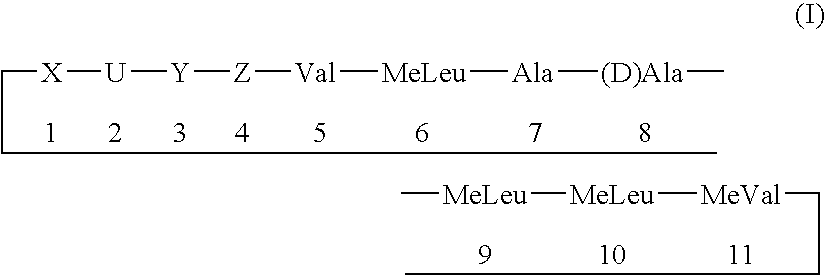
wherein:
wherein:
-
- X is -MeBmt or 6,7-dihydro-MeBmt-
- U is -Abu, Nva, Val or Thr
- Y is Sar or (D)-MeSer or (D)-MeAla or (D)-MeSer (OAcyl)
- Z is (N-R)aa where aa={Val, Ile, Thr, Phe, Tyr, Thr, (OAc), Thr (OG1), Phe (G2), PheCH2(G3), or Tyr (OG3)} with R={alkyl>CH3};
- G1={phenyl-COOH, phenyl-COOMe or phenyl-COOEt};
- G2={CH2COOH, CH2COOMe(Et), CH2PO(OMe)2, or CH2PO(OH)2};
- G3={PO(OH)2, PO(OCH2CH═CH2)2, CH2COOH, or CH2COOMe(Et)}
Thus by replacing the natural MeLeu group in position 4 by an N-(alkyl)aa group (where alkyl>CH3), the anti-HIV 1 activity of this derivative is improved.
The new cyclosporin molecule thus obtained offers the unexpected and surprising advantage of having much better stability towards metabolisation than all the other cyclosporins known hitherto.
This new molecule is much more resistant to the phenomena of oxidation and degradation which take place in the cell. Consequently, the “in vivo” life of this new N-alkyl as Cs is particularly prolonged.
Moreover, this new N-alkyl aa4 cyclosporin has high affinity for CyP and has anti-HIV activity which is equal to or greater than the best existing cyclosporins.
This novel cyclosporin is thus characterised principally by the presence, in position 4, of a residue with R>CH3 and R<C10 H21. The substituent of nitrogen used will be, for example, ethyl, propyl, butyl or pentyl, but these examples are not limiting. This novel cyclosporin is particularly active if the residue in position 4 is an N-ethylated amino acid (see drawings 2 and 3).
The invention also claims the pharmaceutical composition of the substance as described by formula (I). This may be combined with a pharmaceutically acceptable solution. The pharmaceutical formulation thus produced makes it possible to increase the solubility in water or to keep the composition in the form of microemulsions in suspension in water. The object of the present invention is also to provide a new medicinal product which may be used, for example, in the treatment and prevention of AIDS (acquired immunodeficiency syndrome). The cyclosporin modified in position 4 by a residue Z, namely N-ethyl-valine will be used in particular for the production of a medicinal product intended for the treatment and prevention of AIDS. The application for the prevention of AIDS is not limiting. This substance may also be used, for example, for its anti-inflammatory properties.
With regard to the process for the production of this novel cyclosporin, we used conventional techniques described in the literature and certain specific methods developed in the laboratory.
The process for the synthesis of CsA is described in: R. Wenger (Helv. Chim. Acta Vol. 67, p. 502-525 (1984)). The process for opening protected cyclosporin A (OAc) is described in Peptides 1996. The CsA molecule is treated with Meerwein's reagent (CH3)3OBF4 then cleaved by treatment with acid in methanol or hydrolysed by water in order to convert it to a linear peptide of 11 amino acid residues: H-MeLeu-Val-MeLeu-Ala-(D)Ala-MeLeu-MeLeu-MeVal-MeBmt(OAc)-Abu-Sar-OCH3. This process was presented at the international conference of the European Society of Peptides (EPS-24) in Edinburgh 8-13 Sep. 1996 and published in Peptides 1996 by R. Wenger. This linear peptide is then treated according to the conventional Edman process in order to cleave its last amino acid residue (MeLeu) and to provide our starting product: the decapeptide H-Val-MeLeu-Ala-(D)Ala-MeLeu-MeVal-MeBmt (OAc)-Abu-Sar-OMe. This product is then used in the following steps:
Preparation of (1) (protection):
Boc-Val-MeLeu-Ala-(D)Ala-MeLeu-MeLeu-MeValMeBmt (OAc)-Abu-Sar-OMe (1)
0.72 ml (4.18 mmoles) of a solution of diisopropylethylamine and 0.65 g (2.95 mmoles) of Boc anhydride in 50 ml of dioxane are added to a solution of 2.83 g (2.46 mmoles) of the decapeptide H-Val MeLeu-Ala-(D)Ala-MeLeu-MeVal-MeBmt(OAc)-Abu-Sar-OMe in 120 ml of dioxane. 17 ml of water are added to the solution which is mixed for 2 hours at ambient temperature. The solvent is then evaporated and the resulting reaction mixture is dissolved in 300 ml of ethyl acetate then washed 3× with a 5% solution of citric acid, 3× with a saturated solution of NaHCO3 and finally 3× with a solution of NaCl. The organic phases are dried with anhydrous Na2SO4, filtered, and the solvent is finally evaporated under vacuum. 3 g (98%) of the protected decapeptide (Boc-decapeptide methyl ester) are thus obtained.
The product is then used for the following synthesis routes without an additional purification step. This substance is hydrolysed then activated and condensed with 1 corresponding amino acid in order to produce a new peptide with 11 residues, the starting product for the cyclisation and production of a novel cyclosporin with the desired properties.
Preparation of (2) (hydrolysis of the ester):
Boc-Val-MeLeu-Ala-(D)Ala-MeLeu-MeLeu-MeValMeBmt (OAc)-Abu-Sar-OH (2)
192 mg (4.56 mmoles) of LiOH/H2O dissolved in 36 ml of water are added dropwise (at 15° C.) to 4.08 g (3.26 mmoles) of the previous compound (1) in 146 ml of tetrahydrofuran. The whole mixture is stirred at 15° C. The reaction is complete after 120 hours after the successive addition of 5 portions respectively of 1.4 equivalents of LiOH/H2O each. The solution obtained is neutralised with 0.1 N HCl and the solvent is then evaporated. The solid product recovered is then dissolved in 500 ml of ethyl acetate and washed 2× with a 5% solution of citric acid and 2× with a brine solution. The aqueous phases are extracted 4× with 50 ml of ethyl acetate and the combined organic phases are then dried with anhydrous Na2SO4, filtered and evaporated. 3.84 g (95%) of compound (2) are thus obtained. The product is then used without additional purification.
Preparation of (3) (addition of a new amino acid):
Boc-Val-MeLeu-Ala-(D)Ala-MeLeu-MeLeu-MeValMeBmt(OAc)-Abu-Sar-EtVal-OtBu (3)
6.18 g (5 mmoles) of compound (2) are dissolved in 250 ml of anhydrous dichloromethane under argon. The solution is then cooled and 3.9 ml of N-methylmorpholine (10 mmoles; pH 8.5) and 1.1 ml (10 mmoles) of isobutylchloroformate are then added slowly under argon. The solution is stirred for 15 minutes at −15° C. A solution of 2.4 g (12 mmoles) of H-NEt Val-OtBu dissolved in 40 ml of anhydrous dichloromethane is then added within a period of 20 minutes. The mixture is then stirred for 1 hour at −15° C., then for 1 hour at 0° C. and finally overnight at ambient temperature. 400 ml of dichloromethane are then added, then 3 extractions are carried out with a 5% solution of citric acid followed by 3 extractions with a saturated solution of NaHCO3 and finally 3 final extractions with a saturated solution of NaCl. The organic phases are dried with anhydrous Na2SO4 then filtered and finally the solvent is evaporated. After chromatography, 4.42 g (62%) of pure undecapeptide are recovered.
Preparation of (4) (deprotection):
H-Val-MeLeu-Ala-(D)Ala-MeLeu-MeLeu-MeVal-MeBmt (OAc)-Abu-Sar-EtVal-OH (4)
830 mg (0.58 mmole) of protected undecapeptide (4) are dissolved in 15 ml of pure dichloromethane. 3.2 ml of trifluoroacetic acid are added to this solution within a period of 3 minutes at ambient temperature. The reaction is monitored by HPLC which proves to be complete after 1 h 30. The solvent is evaporated and the remaining trifluoroacetic acid is evaporated 2× in the presence of ethyl acetate.
The crude product (900 mg) is purified by chromatography [150 g of silica gel (0.4-0.63)], use of dichloromethane/methanol/triethylamine (17:3:0.05) as eluants) to eluate 700 mg (95%) of pure, deprotected undecapeptide (4).
Preparation of (5) (cyclisation):
MeBmt(OAc)1-EtVal4-Cs (5)
275 mg of TFFH (1.04 mmoles) are dissolved under argon in 3.45 l of anhydrous dichloromethane. The deprotected undecapeptide (4) [438 mg (0.347 mmole)] is then dissolved in 40 ml of anhydrous dichloromethane, and 0.52 ml (3.82 mmoles) of collidine are added thereto. This slightly basic peptide solution is added dropwise to the solution of TFFH within a period of 20 minutes under argon and with vigorous stirring. After 1 h 30 all the starting material is cyclised. In order to trap the excess TFFH, 5 ml of water are added, then the solution is evaporated. 200 ml of dichloromethane are added then the whole mixture is washed respectively 3× with a 0.1 N solution of aqueous HCl, 3× with a brine solution then dried with Na2SO4, filtered, and the solvent is evaporated. 360 mg of a yellowish oil are obtained. The crude product is purified by chromatography on silica gel using 100 g of silica gel (0.04-0.063 mm) and 1% of methanol in ethyl acetate as eluant. 230 mg (54%) of the pure derivative (5) are thus produced.
Cleavage of the MeBmt (OAc)-EtVal4-Cs (5) acetate group and production of EtVal4-Cs (6):
1.44 ml of a 0.45 molar solution of NaOCH3 in MeOH (0.647 mmole) are added dropwise, under argon, to a solution of 700 mg (0.562 mmole) of the derivative of Cs (5) in 28 ml of MeOH. [The solution of NaOCH3 in methanol is prepared by adding sodium to pure MeOH.] The reaction is complete after 48 h with stirring at ambient temperature. The mixture is adjusted to pH 5 by adding 50% acetic acid in water. The solvents are removed under vacuum. The crude product is dissolved in 200 ml of ethyl acetate and extracted 2× with water. The aqueous phase is re-extracted with 50 ml of ethyl acetate then the combined organic phases are washed 2× with a brine solution, dried with Na2SO4, filtered and the solvent is evaporated.
The product obtained (750 g) is chromatographed on 180 g of silica gel (0.04-0.063 mm) using a solution of acetone/hexane 1:1 (20 ml fractions). 550 mg (82%) of (EtVal4)Cs (6) are thus produced.
Preparation of H-EtVal-Ot-Bu:
4.1 ml (23.83 mmoles) of diisopropylethylamine are added, under argon, to a suspension of 5 g (23.8 mmoles) of II-ValOtBuxHCl in 1 l of trimethyloxoformate. At the end of 10 minutes the suspension becomes clear. 13.5 ml (0.24 mmole) of acetaldehyde dissolved in 30 ml of trimethyloxoformate are added dropwise to this solution under anhydrous conditions. The reaction mixture is stirred for 45 minutes under argon at ambient temperature.
Using a low vacuum, the excess acetaldehyde is removed by evaporation for 1 h 30. 25 g (0.112 mmole) of solid NaBH(OAc)3 are added, under argon, to this solution. After 15 minutes, the solution is cooled to 0° C. and 500 ml of a 2% aqueous solution of HCl are added slowly.
The trimethyloxoformate is evaporated under vacuum and the remainder of the aqueous solution is diluted in 300 ml of water. This solution is then extracted 2× with 100 ml of diethylether. The organic phase is then re-extracted 3× with a 0.1 N aqueous solution of HCl. The combined aqueous phases are cooled to 0° C. then the pH is adjusted to 9 using (2N)NaOH. The solution then becomes cloudy. The aqueous suspension is extracted 4× with 100 ml of diethylether. The combined organic phases are then dried with Na2SO4, filtered and the solvent is finally evaporated.
4.2 g of a yellowish oil resulting from this step are purified by chromatography using 900 g of silica gel (0.04-0.063 mm) and a mixture of hexane/ethyl acetate 8:2 as eluant. Finally, 3.13 g (65%) of pure H-EtLeu-OtBu are obtained.
The results of Table 1 show the affinity of the derivatives of Cs for cyclophilin A in a competitive ELISA test described by Quesniaux in Eur. J. Immunology 1987, 17, 1359-1365. In this test, during incubation with cyclophilin, Cs bound to BSA (serum albumin) is added to the Cs to be tested. The concentration required to obtain 50% inhibition (IC50) of the reference reaction in the absence of competitor is then calculated. The results are expressed by the binding index BI which is the ratio of the IC50 of the derivative and the IC50 of CsA. A binding index (BI) of 1.0 indicates that the compound tested binds as well as CsA. A value lower than 1.0 indicates that the derivative binds better than CsA, and a value greater than 1.0 means that the derivative binds less well to CyP than CsA.
| Substance | Structure | BI | IR | ||
| UNIL 001 | CsA | 1.0 | 1.0 | ||
| UNIL 002 | MeVal4-Cs | 0.6 | >200 | ||
| UNIL 004 | EtVal4-Cs | 1.0 | >200 | ||
| UNIL 007 | MeIle4-Cs | 0.5 | >200 | ||
| UNIL 013 | EtIle4-Cs | 1.3 | >200 | ||
| UNIL 014 | EtPhe(4-CH2PO(OMe)2)-Cs | 0.5 | >200 | ||
Cs is regarded as being immunosuppressive if its activity in the mixed lymphocyte reaction (MLR) is greater than 5%. The reaction (MLR) is described by T. Meo in “Immunological Methods”, L. Lefkovits and B. Devis, Eds, Académie Prev. N.Y. pp: 227-239 (1979).
Spleen cells (0.5.106) originating from Balb/c mice (female, 8 to 10 weeks) are co-incubated for 5 days in the presence of treated spleen cells originating from CBA mice (females, 8 to 10 weeks). These cells were treated with mitomycin C or were irradiated at 2000 rads. The non-irradiated allogenic spleen cells exhibit a proliferative response in Balb/c cells which can be measured by incorporating a labelled precursor in the DNA. If the stimulator cells are irradiated (or treated with mitomycin C), the Balb/c cells no longer exhibit a proliferative response but retain their antigenicity. The IC50 calculated in the MLR test is compared with the IC50 corresponding to CsA in a parallel experiment. The IR index is thus found, this being the ratio of the IC50 of the MLR test of the derivatives over the IC50 of cyclosporin A.
As with the binding index (BI) above, a value of 1.0 for the IR means an activity similar to CsA. Similarly, a lower value means better activity and a value greater than 1.0 shows that the activity of the compound is lower than that of CsA.
An IR value of >20 shows that the substance is not immunosuppressive. The immunosuppression values of the derivatives are given in Table I.
Table II describes the percentage protection during infection with HIV of a CEM-SS cell line. The protection of this line in the presence of a Cs derivative is compared with the infection of a line cultivated in the absence of Cs (reference control). A mean value is established at a concentration of the derivative of 2×10⁻⁶ molar. This anti-HIV activity was measured by the NCI (National Cancer Institute) in Washington in the USA.
| Percentage HIV | ||||
| Substance | Structure | Protection | ||
| UNIL 002 | MeVal4-Cs | 66.4 | ||
| UNIL 004 | EtVal4-Cs | 74.0 | ||
| UNIL 007 | MeIle4-Cs | 68.5 | ||
A better percentage of protection against HIV infection obtained with the compound EtVal4-Cs (compared with the two other references known to be 10× better than CsA) shows the advantage of substitution by N-ethyl in
| TABLE III | |||||
| Substance | R1 | R2 | R3 | R4 | [α]n 20 |
| EtVal4CS | —CH2CH3 | CH2CH3 | —H |
 |
c = 0.07, MeOH −177 |
| EtIle4CS | —CH2CH3 | CH2CH3 | —H |
 |
c = 0.05, MeOH −204 |
| EtThr4CS | —CH2CH3 | CH2CH3 | —H |
 |
|
| EtPhe4CS | —CH2CH3 | CH2CH3 | —H |
 |
c = 0.24, MeOH −159 |
| EtTyr4CS | —CH2CH3 | CH2CH3 | —H |
 |
|
| MePhe4CS | —CH3 | CH2CH3 | —H |
 |
c = 0.06, MeOH −134 |
| MeTyr4CS | —CH3 | CH2CH3 | —H |
 |
c = 0.07, MeOH −95 |
| D-MeAla3EtVal4CS | —CH2CH3 | CH2CH3 | —CH3 |
 |
c = 0.12, MeOH −145 |
| D-MeSer3EtVal4CS | —CH2CH3 | CH2CH3 | —CH2OH |
 |
|
| D-MeAla3EtPhe4CS | CH2CH3 | CH2CH3 | CH3 |
 |
c = 0.06, MeOH −138 |
| D-MeAla3-EtPhe4(4-CH2—PO(OMe)2 | CH2CH3 | CH2CH3 | —CH3 |
 |
|
| D-MeSer3-EtPhe4(4-CH2—PO(OMe)2 | CH2CH3 | CH2CH3 | —CH2OH |
 |
|
| D-MeAla3-EtPhe4(4-CH2—PO(OH)2 | CH2CH3 | CH2CH3 | —CH3 |
 |
|
| D-MeSer3-EtPhe4(4-CH2—PO(OH)2 | CH2CH3 | CH2CH3 | —CH2OH |
 |
|
| EtPhe4(4-CH2—PO(OMe)2 | CH2CH3 | CH2CH3 | —H |
 |
c = 0.05, MeOH −136 |
| EtPhe4(4-CH2—PO(OMe)2 | CH2CH3 | CH2CH3 | —H |
 |
|
| EtPhe(4-CH2COOMe)4CS | CH2CH3 | CH2CH3 | —H |
 |
c = 0.15, MeOH −160 |
| D-MeAla3-EtPhe(4-CH2COOMe)4CS | CH2CH3 | CH2CH3 | —CH3 |
 |
|
| EtPhe(4-CH2COOH)4CS | CH2CH3 | CH2CH3 | —H |
 |
|
| D-MeAla3-EtPhe(4-CH2COOH)4CS | CH2CH3 | CH2CH3 | —CH3 |
 |
|
Claims (8)
1. Synthesised cyclosporin having the formula:

wherein:
X is -MeBmt or 6,7-dihydro-MeBmt-
U is -Abu, Nva, Val or Thr
Y is Sar or (D)-MeSer or (D)-MeAla or (D)-MeSer (OAcyl)
Z is (N-R)aa where aa={Val, Ile, Thr, Phe, Tyr, Thr (OAc), Thr (OG1), Phe (G2), PheCH2(G3) or Tyr (OG3)} with R={alkyl>CH3};
G1={phenyl-COOH, phenyl-COOMe or phenyl-COOEt};
G2={CH2COOH, CH2COOMe(Et), CH2PO(OMe)2 or CH2PO(OH)2};
G3={PO(OH)2, PO(OCH2CH═CH2)2, CH2COOH, CH2COOMe, or CH2COOEt}
2. Cyclosporin according to claim 1 , wherein the residue Z in position 4 is (R)Val where R>CH3 and R<C10H11.
3. Cyclosporin according to claim 1 , wherein the residue Z in position 4 is N-ethyl-Valine.
4. Pharmaceutical composition containing the compound having the formula:

wherein:
X is -MeBmt or 6,7-dihydro-MeBmt-
U is -Abu, Nva, Val or Thr
Y is Sar or (D)-MeSer or (D)-MeAla or (D)-MeSer (OAcyl)
Z is (N-R)aa where aa={Val, Ile, Thr, Phe, Tyr, Thr (OAc), Thr (OG1), Phe (G2), PheCH2(G3) or Tyr (OG3)} with R={alkyl>CH3};
G1={phenyl-COOH, phenyl-COOMe or phenyl-COOEt};
G2={CH2COOH, CH2COOMe(Et), CH2PO(OMe)2 or CH2PO(OH)2};
G3={PO(OH)2, PO(OCH2CH═CH2)2, CH2COOH, CH2COOMe, or CH2COOEt}
5. Pharmaceutical composition according to claim 4 , combined with a pharmaceutically acceptable solution.
6. A medicinal product for the treatment and prevention of acquired immunodeficiency syndrome (AIDS) containing the cyclosporin according to claim 1 or claim 4 .
7. A medicinal product for the treatment and prevention of AIDS containing the cyclosporin according to claim 3 .
8. The pharmaceutical composition according to claim 4 for the treatment of acquired immunodeficiency syndrome AIDS.
Applications Claiming Priority (3)
| Application Number | Priority Date | Filing Date | Title |
|---|---|---|---|
| CH140598 | 1998-07-01 | ||
| PCT/IB1999/001232 WO2000001715A1 (en) | 1998-07-01 | 1999-06-30 | Novel cyclosporin with improved activity profile |
| US09/720,923 US6927208B1 (en) | 1998-07-01 | 1999-06-30 | Cyclosporin with improved activity profile |
Related Parent Applications (1)
| Application Number | Title | Priority Date | Filing Date |
|---|---|---|---|
| US09/720,923 Reissue US6927208B1 (en) | 1998-07-01 | 1999-06-30 | Cyclosporin with improved activity profile |
Publications (1)
| Publication Number | Publication Date |
|---|---|
| USRE40987E1 true USRE40987E1 (en) | 2009-11-17 |
Family
ID=4209677
Family Applications (2)
| Application Number | Title | Priority Date | Filing Date |
|---|---|---|---|
| US12/123,601 Expired - Lifetime USRE40987E1 (en) | 1998-07-01 | 1999-06-30 | Cyclosporin with improved activity profile |
| US09/720,923 Ceased US6927208B1 (en) | 1998-07-01 | 1999-06-30 | Cyclosporin with improved activity profile |
Family Applications After (1)
| Application Number | Title | Priority Date | Filing Date |
|---|---|---|---|
| US09/720,923 Ceased US6927208B1 (en) | 1998-07-01 | 1999-06-30 | Cyclosporin with improved activity profile |
Country Status (14)
| Country | Link |
|---|---|
| US (2) | USRE40987E1 (en) |
| EP (1) | EP1091975B1 (en) |
| JP (1) | JP4350898B2 (en) |
| CN (1) | CN1218958C (en) |
| AT (1) | ATE312843T1 (en) |
| AU (1) | AU759480B2 (en) |
| BR (1) | BR9911724A (en) |
| CA (1) | CA2335903C (en) |
| DE (1) | DE69928938T2 (en) |
| DK (1) | DK1091975T3 (en) |
| ES (1) | ES2255275T3 (en) |
| MX (1) | MXPA00013019A (en) |
| PT (1) | PT1091975E (en) |
| WO (1) | WO2000001715A1 (en) |
Cited By (2)
| Publication number | Priority date | Publication date | Assignee | Title |
|---|---|---|---|---|
| US20130267460A1 (en) * | 2010-09-16 | 2013-10-10 | The Johns Hopkins University | Methods of Inhibiting Alphavirus Replication and Treating Alphavirus Infection |
| US20160051625A1 (en) * | 2009-01-30 | 2016-02-25 | Enanta Pharmaceuticals, Inc. | Cyclosporin analogues for preventing or treating hepatitis c infection |
Families Citing this family (53)
| Publication number | Priority date | Publication date | Assignee | Title |
|---|---|---|---|---|
| AU759480B2 (en) | 1998-07-01 | 2003-04-17 | Debiopharm S.A. | Novel cyclosporin with improved activity profile |
| WO2000046239A1 (en) * | 1999-02-05 | 2000-08-10 | Debiopharm S.A. | Cyclosporin derivatives and method for the production of said derivatives |
| US6995139B2 (en) | 2001-04-20 | 2006-02-07 | Debiopharm S.A. | Cyclic undecapeptide pro-drugs and uses thereof |
| US7538084B2 (en) * | 2003-03-17 | 2009-05-26 | Amr Technology, Inc. | Cyclosporins |
| GB0320638D0 (en) | 2003-09-03 | 2003-10-01 | Novartis Ag | Organic compounds |
| US20060035821A1 (en) * | 2004-08-16 | 2006-02-16 | Hunt Kevin W | Cyclosporin analogs for the treatment of immunoregulatory disorders and respiratory diseases |
| JP2008514701A (en) | 2004-09-29 | 2008-05-08 | エーエムアール テクノロジー インコーポレイテッド | Cyclosporine alkyne analogs and their pharmaceutical use |
| JP2008514702A (en) | 2004-09-29 | 2008-05-08 | エーエムアール テクノロジー インコーポレイテッド | Novel cyclosporine analogues and their pharmaceutical use |
| DK1793844T3 (en) * | 2004-10-01 | 2011-03-21 | Debiopharm Sa | Use of [D-MeAla] 3- [EtVal] 4-cyclosporin for the treatment of hepatitis C infection |
| SI1802650T1 (en) * | 2004-10-01 | 2012-03-30 | Scynexis Inc | 3-ether and 3-thioether substituted cyclosporin derivatives for the treatment and prevention of hepatitis c infection |
| US7196161B2 (en) * | 2004-10-01 | 2007-03-27 | Scynexis Inc. | 3-ether and 3-thioether substituted cyclosporin derivatives for the treatment and prevention of hepatitis C infection |
| JP2008515886A (en) | 2004-10-06 | 2008-05-15 | エーエムアール テクノロジー インコーポレイテッド | Cyclosporine alkynes and their usefulness as medical drugs |
| JP2008526816A (en) * | 2005-01-10 | 2008-07-24 | デビオファーム ソシエテ アノニム | Use of cyclic undecapeptides for the manufacture of a medicament for administration during myocardial ischemia |
| EP1931696B1 (en) | 2005-09-30 | 2011-02-16 | Scynexis, Inc. | Arylalkyl and heteroarylalkyl derivatives of cyclosporine a for the treatment and prevention of viral infection |
| JP5517454B2 (en) | 2005-09-30 | 2014-06-11 | スシネキス インク | Methods and pharmaceutical compositions for the treatment and prevention of hepatitis C infection |
| PT1957518E (en) * | 2005-10-26 | 2016-02-26 | Astellas Pharma Inc | New cyclic peptide compounds |
| US7696166B2 (en) * | 2006-03-28 | 2010-04-13 | Albany Molecular Research, Inc. | Use of cyclosporin alkyne/alkene analogues for preventing or treating viral-induced disorders |
| US7696165B2 (en) * | 2006-03-28 | 2010-04-13 | Albany Molecular Research, Inc. | Use of cyclosporin alkyne analogues for preventing or treating viral-induced disorders |
| EP2023918B1 (en) | 2006-05-19 | 2011-03-23 | Scynexis, Inc. | Cyclosporins for the treatment and prevention of ocular disorders |
| CN101502196A (en) * | 2006-06-02 | 2009-08-05 | 克洛德·安妮·佩里西恩 | Management of active electrons |
| CN101108178B (en) * | 2006-07-20 | 2010-09-15 | 复旦大学 | Application of a cyclophilin A inhibitor in the preparation of anti-AIDS drugs |
| CA2665415A1 (en) * | 2006-10-12 | 2008-04-17 | Novartis Ag | Use of modified cyclosporins |
| WO2008069917A2 (en) * | 2006-11-20 | 2008-06-12 | Scynexis, Inc. | Novel cyclic peptides |
| US8450281B2 (en) | 2007-01-04 | 2013-05-28 | Debiopharm S.A. | Non-immunosuppressive cyclosporin for treatment of Ullrich congenital muscular dystrophy |
| WO2008127613A1 (en) * | 2007-04-11 | 2008-10-23 | Scynexis, Inc. | New pharmaceutical compositions |
| KR20100017547A (en) * | 2007-05-02 | 2010-02-16 | 아스텔라스세이야쿠 가부시키가이샤 | New cyclic peptide compounds |
| US8394763B2 (en) | 2007-09-26 | 2013-03-12 | Oregon Health & Science University | Cyclic undecapeptides and derivatives as multiple sclerosis therapies |
| WO2009098533A1 (en) * | 2008-02-08 | 2009-08-13 | Debiopharm Sa | Non -immunosuppressive cyclosporin for the treatment of muscular dystrophy |
| US20090306033A1 (en) * | 2008-06-06 | 2009-12-10 | Keqiang Li | Novel cyclic peptides |
| CN102083852A (en) | 2008-06-06 | 2011-06-01 | 西尼克斯公司 | Cyclosporin analogs and their use in the treatment of HCV infections |
| DE102008060549A1 (en) | 2008-12-04 | 2010-06-10 | MAX-PLANCK-Gesellschaft zur Förderung der Wissenschaften e.V. | Drug-peptide construct for extracellular accumulation |
| EP2376524B1 (en) | 2008-12-31 | 2017-03-15 | Cypralis Limited | Derivatives of cyclosporin a |
| US8685917B2 (en) * | 2009-07-09 | 2014-04-01 | Enanta Pharmaceuticals, Inc. | Cyclosporin analogues |
| EA201200650A1 (en) | 2009-10-30 | 2012-12-28 | Бёрингер Ингельхайм Интернациональ Гмбх | COMBINED TREATMENTS OF HEPATITIS C VIRUS, INCLUDING BI201335, INTERFERON-ALPHA AND RIBAVIRIN COURSES |
| PH12012501216A1 (en) * | 2009-12-18 | 2012-11-05 | Boehringer Ingelheim Int | Hcv combination therapy |
| EP2516387B1 (en) | 2009-12-21 | 2018-02-21 | Institut National de la Sante et de la Recherche Medicale (INSERM) | Inhibitors of cyclophilins for use in the prevention and/or the treatment of viral pathologies or infections |
| WO2012009715A2 (en) | 2010-07-16 | 2012-01-19 | S&T Global Inc. | Novel cyclosporin derivatives for the treatment and prevention of a viral infection |
| US9573978B2 (en) | 2010-08-12 | 2017-02-21 | S&T Global, Inc. | Cyclosporin derivatives for the treatment and prevention of a viral infection |
| US9890198B2 (en) | 2010-12-03 | 2018-02-13 | S&T Global Inc. | Cyclosporin derivatives and uses thereof |
| JO3337B1 (en) * | 2010-12-13 | 2019-03-13 | Debiopharm Sa | Pharmaceutical Compositions Comprising Alisporivir |
| BR112013014890B1 (en) | 2010-12-15 | 2023-10-24 | Contravir Pharmaceuticals, Inc | ANALOG COMPOUND OF MOLECULES BELONGING TO THE CYCLOSPORINE FAMILY, PHARMACEUTICAL COMPOSITION COMPRISING THE SAME, THERAPEUTIC OR PROPHYLACTIC USE OF SAID COMPOUND AND PROCESSES FOR PREPARING THE SAME |
| EP2583677A3 (en) | 2011-10-21 | 2013-07-03 | Abbvie Inc. | Methods for treating HCV comprising at least two direct acting antiviral agent, ribavirin but not interferon. |
| US8492386B2 (en) | 2011-10-21 | 2013-07-23 | Abbvie Inc. | Methods for treating HCV |
| US8466159B2 (en) | 2011-10-21 | 2013-06-18 | Abbvie Inc. | Methods for treating HCV |
| DE202012012955U1 (en) | 2011-10-21 | 2014-07-14 | Abbvie Inc. | A combination of at least two direct-acting antiviral agents (DAAs) for use in the treatment of HCV |
| AR090964A1 (en) * | 2012-05-09 | 2014-12-17 | Novartis Ag | PROCESS FOR THE PREPARATION OF CYCLE UNDECAPEPTIDES |
| EP2705856A1 (en) | 2012-09-07 | 2014-03-12 | Deutsches Zentrum für Neurodegenerative Erkrankungen e.V. | Compounds for the treatment of neurodegenerative disorders |
| WO2014085623A1 (en) | 2012-11-28 | 2014-06-05 | Enanta Pharmaceuticals, Inc. | Novel [n-me-4-hydroxyleucine]-9-cyclosporin analogues |
| JP2016538317A (en) | 2013-08-26 | 2016-12-08 | エナンタ ファーマシューティカルズ インコーポレイテッド | Novel cyclosporine analogues for preventing or treating hepatitis C |
| CN104744570A (en) * | 2013-12-31 | 2015-07-01 | 深圳先进技术研究院 | Synthesis method of cyclosporins |
| US9669095B2 (en) | 2014-11-03 | 2017-06-06 | Enanta Pharmaceuticals, Inc. | Cyclosporin analogues for preventing or treating hepatitis C infection |
| EA201892448A1 (en) | 2016-04-28 | 2019-06-28 | Эмори Юниверсити | ALKYN-CONTAINING NUCLEOTIDE AND NUCLEOSIDE THERAPEUTIC COMPOSITIONS AND RELATED APPLICATION METHODS |
| WO2021205338A1 (en) | 2020-04-06 | 2021-10-14 | Debiopharm International Sa | Alisporivir for use in human viral infections |
Citations (23)
| Publication number | Priority date | Publication date | Assignee | Title |
|---|---|---|---|---|
| US4108985A (en) | 1975-11-04 | 1978-08-22 | Sandoz Ltd. | Dihydrocyclosporin c |
| US4210581A (en) | 1975-11-04 | 1980-07-01 | Sandoz Ltd. | Organic compounds |
| US4220641A (en) | 1977-05-10 | 1980-09-02 | Sandoz Ltd. | Organic compounds |
| US4288431A (en) | 1978-10-18 | 1981-09-08 | Sandoz Ltd. | Cyclosporin derivatives, their production and pharmaceutical compositions containing them |
| US4396542A (en) | 1980-02-14 | 1983-08-02 | Sandoz Ltd. | Method for the total synthesis of cyclosporins, novel cyclosporins and novel intermediates and methods for their production |
| US4441644A (en) * | 1980-12-18 | 1984-04-10 | Karl M. Reich Maschinenfabrik Gmbh | Buffer system for fastener driving devices |
| EP0056782B1 (en) | 1981-01-09 | 1984-08-01 | Sandoz Ag | Novel cyclosporins |
| EP0034567B1 (en) | 1980-02-14 | 1984-11-07 | Sandoz Ag | A method for the total synthesis of cyclosporins and novel cyclosporins |
| WO1986002080A1 (en) | 1984-10-04 | 1986-04-10 | Sandoz Ag | Monoclonal antibodies to cyclosporings |
| US4814323A (en) | 1986-03-25 | 1989-03-21 | Andrieu J M | Process for the treatment and the prevention of AIDS and other disorders induced by the LAV/HTLV III virus |
| GB2222770A (en) | 1988-09-16 | 1990-03-21 | Sandoz Ltd | Cyclosporin emulsion compositions |
| EP0484281A2 (en) | 1990-11-02 | 1992-05-06 | Sandoz Ltd. | Cyclosporins |
| EP0194972B1 (en) | 1985-03-11 | 1992-07-29 | Sandoz Ag | Novel cyclosporins |
| US5525590A (en) | 1987-06-17 | 1996-06-11 | Sandoz Ltd. | Cyclosporins and their use as pharmaceuticals |
| WO1997004005A2 (en) | 1995-07-17 | 1997-02-06 | C-Chem Ag | Cyclosporin derivatives with anti-hiv effect |
| WO1997018828A1 (en) | 1995-11-20 | 1997-05-29 | Guilford Pharmaceuticals Inc. | Inhibitors of cyclophilin rotamase activity |
| US5639724A (en) | 1984-07-24 | 1997-06-17 | Sandoz Ltd. | Cyclosporin galenic forms |
| WO1998028329A1 (en) | 1996-12-24 | 1998-07-02 | Rhone-Poulenc Rorer S.A. | Cyclosporin derivatives, their preparation and pharmaceutical compositions containing them |
| WO1998028328A1 (en) | 1996-12-24 | 1998-07-02 | Rhone-Poulenc Rorer S.A. | Cyclosporin derivative, its preparation and pharmaceutical compositions containing same |
| WO1998028330A1 (en) | 1996-12-24 | 1998-07-02 | Rhone-Poulenc Rorer S.A. | Novel cyclosporin derivatives, method of preparation and pharmaceutical compositions containing them |
| WO2000001715A1 (en) | 1998-07-01 | 2000-01-13 | Debiopharm S.A. | Novel cyclosporin with improved activity profile |
| WO2005021028A1 (en) | 2003-09-03 | 2005-03-10 | Novartis Ag | Use of modified cyclosporins for the treatment of hcv disorders |
| US7439277B2 (en) | 2005-05-19 | 2008-10-21 | Fina Technology, Inc. | In-situ preparation of hydroperoxide functionalized rubber |
-
1999
- 1999-06-30 AU AU43856/99A patent/AU759480B2/en not_active Expired
- 1999-06-30 ES ES99926684T patent/ES2255275T3/en not_active Expired - Lifetime
- 1999-06-30 CN CNB998081558A patent/CN1218958C/en not_active Expired - Lifetime
- 1999-06-30 PT PT99926684T patent/PT1091975E/en unknown
- 1999-06-30 AT AT99926684T patent/ATE312843T1/en active
- 1999-06-30 BR BR9911724-0A patent/BR9911724A/en not_active Application Discontinuation
- 1999-06-30 DE DE69928938T patent/DE69928938T2/en not_active Expired - Lifetime
- 1999-06-30 DK DK99926684T patent/DK1091975T3/en active
- 1999-06-30 MX MXPA00013019A patent/MXPA00013019A/en active IP Right Grant
- 1999-06-30 JP JP2000558116A patent/JP4350898B2/en not_active Expired - Lifetime
- 1999-06-30 EP EP99926684A patent/EP1091975B1/en not_active Expired - Lifetime
- 1999-06-30 US US12/123,601 patent/USRE40987E1/en not_active Expired - Lifetime
- 1999-06-30 WO PCT/IB1999/001232 patent/WO2000001715A1/en not_active Ceased
- 1999-06-30 US US09/720,923 patent/US6927208B1/en not_active Ceased
- 1999-06-30 CA CA002335903A patent/CA2335903C/en not_active Expired - Lifetime
Patent Citations (30)
| Publication number | Priority date | Publication date | Assignee | Title |
|---|---|---|---|---|
| US4210581A (en) | 1975-11-04 | 1980-07-01 | Sandoz Ltd. | Organic compounds |
| US4108985A (en) | 1975-11-04 | 1978-08-22 | Sandoz Ltd. | Dihydrocyclosporin c |
| US4220641A (en) | 1977-05-10 | 1980-09-02 | Sandoz Ltd. | Organic compounds |
| US4288431A (en) | 1978-10-18 | 1981-09-08 | Sandoz Ltd. | Cyclosporin derivatives, their production and pharmaceutical compositions containing them |
| US4554351A (en) | 1980-02-14 | 1985-11-19 | Sandoz Ltd. | Method for the total synthesis of cyclosporins, novel cyclosporins and novel intermediates and methods for their production |
| US4396542A (en) | 1980-02-14 | 1983-08-02 | Sandoz Ltd. | Method for the total synthesis of cyclosporins, novel cyclosporins and novel intermediates and methods for their production |
| EP0034567B1 (en) | 1980-02-14 | 1984-11-07 | Sandoz Ag | A method for the total synthesis of cyclosporins and novel cyclosporins |
| US4441644A (en) * | 1980-12-18 | 1984-04-10 | Karl M. Reich Maschinenfabrik Gmbh | Buffer system for fastener driving devices |
| EP0056782B1 (en) | 1981-01-09 | 1984-08-01 | Sandoz Ag | Novel cyclosporins |
| US5639724A (en) | 1984-07-24 | 1997-06-17 | Sandoz Ltd. | Cyclosporin galenic forms |
| WO1986002080A1 (en) | 1984-10-04 | 1986-04-10 | Sandoz Ag | Monoclonal antibodies to cyclosporings |
| EP0194972B1 (en) | 1985-03-11 | 1992-07-29 | Sandoz Ag | Novel cyclosporins |
| US4814323A (en) | 1986-03-25 | 1989-03-21 | Andrieu J M | Process for the treatment and the prevention of AIDS and other disorders induced by the LAV/HTLV III virus |
| US5525590A (en) | 1987-06-17 | 1996-06-11 | Sandoz Ltd. | Cyclosporins and their use as pharmaceuticals |
| GB2222770A (en) | 1988-09-16 | 1990-03-21 | Sandoz Ltd | Cyclosporin emulsion compositions |
| EP0484281A2 (en) | 1990-11-02 | 1992-05-06 | Sandoz Ltd. | Cyclosporins |
| US6255100B1 (en) | 1990-11-02 | 2001-07-03 | Novartis Ag | Cyclosporin fermentation process |
| US5981479A (en) | 1990-11-02 | 1999-11-09 | Novartis Ag | Cyclosporins |
| US5767069A (en) | 1990-11-02 | 1998-06-16 | Novartis Ag | Cyclosporins |
| US5948884A (en) | 1995-07-17 | 1999-09-07 | C-Chem Ag | Cyclosporin derivatives with anti-HIV effect |
| WO1997004005A2 (en) | 1995-07-17 | 1997-02-06 | C-Chem Ag | Cyclosporin derivatives with anti-hiv effect |
| WO1997018828A1 (en) | 1995-11-20 | 1997-05-29 | Guilford Pharmaceuticals Inc. | Inhibitors of cyclophilin rotamase activity |
| US6444643B1 (en) | 1995-11-20 | 2002-09-03 | Guilford Pharmaceuticals Inc. | Methods of using inhibitors of cyclophilin rotamase activity to affect neurological activity |
| WO1998028328A1 (en) | 1996-12-24 | 1998-07-02 | Rhone-Poulenc Rorer S.A. | Cyclosporin derivative, its preparation and pharmaceutical compositions containing same |
| WO1998028330A1 (en) | 1996-12-24 | 1998-07-02 | Rhone-Poulenc Rorer S.A. | Novel cyclosporin derivatives, method of preparation and pharmaceutical compositions containing them |
| WO1998028329A1 (en) | 1996-12-24 | 1998-07-02 | Rhone-Poulenc Rorer S.A. | Cyclosporin derivatives, their preparation and pharmaceutical compositions containing them |
| WO2000001715A1 (en) | 1998-07-01 | 2000-01-13 | Debiopharm S.A. | Novel cyclosporin with improved activity profile |
| US6927208B1 (en) | 1998-07-01 | 2005-08-09 | Debiopharm S.A. | Cyclosporin with improved activity profile |
| WO2005021028A1 (en) | 2003-09-03 | 2005-03-10 | Novartis Ag | Use of modified cyclosporins for the treatment of hcv disorders |
| US7439277B2 (en) | 2005-05-19 | 2008-10-21 | Fina Technology, Inc. | In-situ preparation of hydroperoxide functionalized rubber |
Non-Patent Citations (67)
Cited By (3)
| Publication number | Priority date | Publication date | Assignee | Title |
|---|---|---|---|---|
| US20160051625A1 (en) * | 2009-01-30 | 2016-02-25 | Enanta Pharmaceuticals, Inc. | Cyclosporin analogues for preventing or treating hepatitis c infection |
| US9603895B2 (en) * | 2009-01-30 | 2017-03-28 | Enanta Pharmaceuticals, Inc. | Cyclosporin analogues for preventing or treating hepatitis C infection |
| US20130267460A1 (en) * | 2010-09-16 | 2013-10-10 | The Johns Hopkins University | Methods of Inhibiting Alphavirus Replication and Treating Alphavirus Infection |
Also Published As
| Publication number | Publication date |
|---|---|
| CN1308635A (en) | 2001-08-15 |
| CN1218958C (en) | 2005-09-14 |
| JP2002519434A (en) | 2002-07-02 |
| ATE312843T1 (en) | 2005-12-15 |
| BR9911724A (en) | 2001-03-20 |
| US6927208B1 (en) | 2005-08-09 |
| AU4385699A (en) | 2000-01-24 |
| JP4350898B2 (en) | 2009-10-21 |
| ES2255275T3 (en) | 2006-06-16 |
| DK1091975T3 (en) | 2006-04-18 |
| CA2335903A1 (en) | 2000-01-13 |
| CA2335903C (en) | 2009-11-10 |
| MXPA00013019A (en) | 2003-07-14 |
| EP1091975A1 (en) | 2001-04-18 |
| DE69928938T2 (en) | 2006-08-17 |
| WO2000001715A1 (en) | 2000-01-13 |
| EP1091975B1 (en) | 2005-12-14 |
| AU759480B2 (en) | 2003-04-17 |
| PT1091975E (en) | 2006-05-31 |
| DE69928938D1 (en) | 2006-01-19 |
Similar Documents
| Publication | Publication Date | Title |
|---|---|---|
| USRE40987E1 (en) | Cyclosporin with improved activity profile | |
| US6809077B2 (en) | Cyclosporin analogs for the treatment of autoimmune diseases | |
| US6979671B2 (en) | Cyclosporins for the treatment of immune disorders | |
| US7012064B2 (en) | Cyclosporins for the treatment of immune disorders | |
| US7468419B2 (en) | Cyclosporin derivatives for the treatment of immune disorders | |
| US7012065B2 (en) | Cyclosporins for the treatment of immune disorders | |
| US6255100B1 (en) | Cyclosporin fermentation process | |
| JP4477777B2 (en) | New cyclosporine | |
| WO1999010373A1 (en) | Non-immunosuppressive cyclosporins and their use in the prevention and treatment of hiv infection | |
| NZ554514A (en) | 3-ether and 3-thioether substituted cyclosporin derivatives for the treatment and prevention of hepatitis C infection | |
| CA2847486C (en) | Template-fixed beta-hairpin peptidomimetics with cxcr4 antagonizing activity | |
| US6995139B2 (en) | Cyclic undecapeptide pro-drugs and uses thereof | |
| WO2008069917A2 (en) | Novel cyclic peptides | |
| KR20110045032A (en) | Non-Immunosuppressive Cyclosporin Analog Molecules | |
| US20040110666A1 (en) | Cyclosporins for the treatment of immune disorders | |
| KR101443171B1 (en) | Template-fixed beta-hairpin peptidomimetics with protease inhibitory activity | |
| US6270957B1 (en) | Non-Imuunosuppressive cyclosporins and their use in the prevention and treatment of HIV infection | |
| WO1993017039A1 (en) | Iso-cyclosporin salts | |
| RU2085589C1 (en) | Cyclosporine | |
| HK1161277A (en) | Nonimmunosuppressive cyclosporine analogue molecules |
Legal Events
| Date | Code | Title | Description |
|---|---|---|---|
| FEPP | Fee payment procedure |
Free format text: PAYOR NUMBER ASSIGNED (ORIGINAL EVENT CODE: ASPN); ENTITY STATUS OF PATENT OWNER: LARGE ENTITY |
|
| FPAY | Fee payment |
Year of fee payment: 8 |
|
| FPAY | Fee payment |
Year of fee payment: 12 |