USPP36436P2 - Calluna plant named ‘Lynn’ - Google Patents
Calluna plant named ‘Lynn’ Download PDFInfo
- Publication number
- USPP36436P2 USPP36436P2 US18/582,771 US202418582771V USPP36436P2 US PP36436 P2 USPP36436 P2 US PP36436P2 US 202418582771 V US202418582771 V US 202418582771V US PP36436 P2 USPP36436 P2 US PP36436P2
- Authority
- US
- United States
- Prior art keywords
- lynn
- plant
- color
- calluna
- leaf
- Prior art date
- Legal status (The legal status is an assumption and is not a legal conclusion. Google has not performed a legal analysis and makes no representation as to the accuracy of the status listed.)
- Active
Links
- 241000722682 Calluna Species 0.000 title claims abstract description 9
- 241000196324 Embryophyta Species 0.000 abstract description 26
- 230000001488 breeding effect Effects 0.000 description 4
- 239000003086 colorant Substances 0.000 description 3
- 238000005520 cutting process Methods 0.000 description 3
- JPSNJFMTQIIVFG-UHFFFAOYSA-M lithium;ethanethiolate Chemical compound [Li+].CC[S-] JPSNJFMTQIIVFG-UHFFFAOYSA-M 0.000 description 3
- 240000002804 Calluna vulgaris Species 0.000 description 2
- 235000007575 Calluna vulgaris Nutrition 0.000 description 2
- 241000607479 Yersinia pestis Species 0.000 description 2
- 230000001154 acute effect Effects 0.000 description 2
- 230000005200 bud stage Effects 0.000 description 2
- 238000013480 data collection Methods 0.000 description 2
- 201000010099 disease Diseases 0.000 description 2
- 208000037265 diseases, disorders, signs and symptoms Diseases 0.000 description 2
- 230000007613 environmental effect Effects 0.000 description 2
- 239000003205 fragrance Substances 0.000 description 2
- 230000000762 glandular Effects 0.000 description 2
- 210000004209 hair Anatomy 0.000 description 2
- VIKNJXKGJWUCNN-XGXHKTLJSA-N norethisterone Chemical compound O=C1CC[C@@H]2[C@H]3CC[C@](C)([C@](CC4)(O)C#C)[C@@H]4[C@@H]3CCC2=C1 VIKNJXKGJWUCNN-XGXHKTLJSA-N 0.000 description 2
- 239000011122 softwood Substances 0.000 description 2
- 239000002689 soil Substances 0.000 description 2
- 241001164374 Calyx Species 0.000 description 1
- 235000013399 edible fruits Nutrition 0.000 description 1
- 239000011121 hardwood Substances 0.000 description 1
- 230000000977 initiatory effect Effects 0.000 description 1
- 239000000203 mixture Substances 0.000 description 1
- 210000000056 organ Anatomy 0.000 description 1
- 230000002085 persistent effect Effects 0.000 description 1
- 230000001850 reproductive effect Effects 0.000 description 1
- 230000021749 root development Effects 0.000 description 1
- 210000003462 vein Anatomy 0.000 description 1
Images


Definitions
- Botanical classification Calluna vulgaris.
- the present invention relates to a new and distinct cultivar of Calluna vulgaris and will be referred to hereafter by its cultivar name, ‘Lynn’.
- ‘Lynn’ is a new cultivar of evergreen shrub grown for use as a landscape plant.
- the new Invention arose as the result of an ongoing controlled breeding program by the Inventor in Wezep, The Netherlands.
- the goal of the breeding program is to develop new cultivars of Calluna with healthy plant habits and long life spans as both indoor and garden plants that produce numerous flowers in clear colors.
- ‘Lynn’ arose from a cross made in September 2014 between unnamed and unpatented proprietary plants from the Inventor's breeding program.
- ‘Lynn’ was selected as a single unique plant by the Inventor in September 2015 from the resulting seedlings of the above cross.
- the female parent of ‘Lynn’ differ from ‘Lynn’ in having a less floriferous blooming habit, flowers that are lighter purple in color, and a shorter life span as an indoor and garden plant.
- the male parent of ‘Lynn’ differs from ‘Lynn’ in having less dense branching, a less floriferous blooming habit, and flowers that are lighter purple in color.
- ‘Lynn’ can be most closely compared to the Calluna cultivars ‘Lianne’ (not patented), ‘Liset’ (not patented), and ‘Viva’. ‘Lianne’ and ‘Liset’ are both similar to ‘Lynn’ in foliage and flower color.
- ‘Viva’ is similar to ‘Lynn’ in having a floriferous blooming habit, a similar plant habit, and similar foliage color. ‘Lianne’ differs from ‘Lynn’ in having a less upright plant habit, a less floriferous blooming habit, and a shorter life span as an indoor and garden plant. ‘Liset’ differs from ‘Lynn’ in having less vigorous growth habit, a less floriferous blooming habit, and a shorter life span as an indoor and garden plant. ‘Viva’ differs from ‘Lynn’ in having flowers that are white in color.
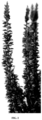
- FIG. 1 provides a side view of the plant habit of ‘Lynn’ in bloom.
- FIG. 2 provides a close-up view of the inflorescences of ‘Lynn’.
- FIG. 3 provides a close-up view of the foliage of ‘Lynn’.
Landscapes
- Cultivation Of Plants (AREA)
Abstract
A new cultivar of Calluna plant named ‘Lynn’ that is characterized by its highly floriferous blooming habit, its long life span as both an indoor and garden plant, and its flowers that are deep purple in color.
Description
Botanical classification: Calluna vulgaris.
Variety denomination: ‘Lynn’.
This application is related to a European plant breeders' rights application filed on Jan. 24, 2022, application No. 2022/0205. The information for the plant breeders' rights application was received directly from the Inventor. This application is co-pending with a U.S. Plant Patent Application filed for a plant derived from the same breeding program that is entitled Calluna Plant Named ‘Viva’ (U.S. Plant patent application Ser. No. 18/528,786).
The present invention relates to a new and distinct cultivar of Calluna vulgaris and will be referred to hereafter by its cultivar name, ‘Lynn’. ‘Lynn’ is a new cultivar of evergreen shrub grown for use as a landscape plant.
The new Invention arose as the result of an ongoing controlled breeding program by the Inventor in Wezep, The Netherlands. The goal of the breeding program is to develop new cultivars of Calluna with healthy plant habits and long life spans as both indoor and garden plants that produce numerous flowers in clear colors. ‘Lynn’ arose from a cross made in September 2014 between unnamed and unpatented proprietary plants from the Inventor's breeding program. The female parent designated by accession No. K12-1163 and the male parent designated by accession No. E13-105. ‘Lynn’ was selected as a single unique plant by the Inventor in September 2015 from the resulting seedlings of the above cross.
Asexual propagation of the new cultivar was first accomplished by the Inventor by softwood stem cuttings in September of 2015 in Wezep, The Netherlands. Asexual propagation of the new cultivar by softwood and hardwood stem cuttings has determined that the characteristics are stable and are reproduced true to type in successive generations.
The following traits have been repeatedly observed and represent the characteristics of the new cultivar. These attributes in combination distinguish ‘Lynn’ as a unique cultivar of Calluna.
-
- 1. ‘Lynn’ exhibits a broadly spreading and upright plant habit.
- 2. ‘Lynn’ exhibits a highly floriferous blooming habit.
- 3. ‘Lynn’ exhibits a long life span as both an indoor and garden plant.
- 4. ‘Lynn’ exhibits flowers that are deep purple in color.
The female parent of ‘Lynn’ differ from ‘Lynn’ in having a less floriferous blooming habit, flowers that are lighter purple in color, and a shorter life span as an indoor and garden plant. The male parent of ‘Lynn’ differs from ‘Lynn’ in having less dense branching, a less floriferous blooming habit, and flowers that are lighter purple in color. ‘Lynn’ can be most closely compared to the Calluna cultivars ‘Lianne’ (not patented), ‘Liset’ (not patented), and ‘Viva’. ‘Lianne’ and ‘Liset’ are both similar to ‘Lynn’ in foliage and flower color. ‘Viva’ is similar to ‘Lynn’ in having a floriferous blooming habit, a similar plant habit, and similar foliage color. ‘Lianne’ differs from ‘Lynn’ in having a less upright plant habit, a less floriferous blooming habit, and a shorter life span as an indoor and garden plant. ‘Liset’ differs from ‘Lynn’ in having less vigorous growth habit, a less floriferous blooming habit, and a shorter life span as an indoor and garden plant. ‘Viva’ differs from ‘Lynn’ in having flowers that are white in color.
The accompanying color photographs illustrate the overall appearance and distinct characteristics of the new Calluna. The photographs were taken of a 1-year-old plant as grown outdoors in a 10-cm container in Wezep, The Netherlands.
The photograph in FIG. 1 provides a side view of the plant habit of ‘Lynn’ in bloom.
The photograph in FIG. 2 provides a close-up view of the inflorescences of ‘Lynn’.
The photograph in FIG. 3 provides a close-up view of the foliage of ‘Lynn’.
The colors in the photographs are as close as possible with the photographic and printing technology utilized and the color values cited in the detailed botanical description accurately describe the colors of the new Calluna.
The following is a description of a 1-year-old plant as grown outdoors in 10-cm containers in Wezep, The Netherlands. The phenotype of the new cultivar may vary with variations in environmental, climatic, and cultural conditions, as it has not been tested under all possible environmental conditions. The color determination is in accordance with The 2015 Colour Chart of The Royal Horticultural Society, London, England, except where general color terms of ordinary dictionary significance are used.
- General description:
-
- Blooming period.—8 weeks from late September to mid-November in The Netherlands.
- Plant type.—Evergreen shrub.
- Plant habit.—Broadly spreading, upright, and densely branched.
- Height and spread.—Average of 20.2 cm in height, (soil level to top of foliar plane), 24.6 cm in height (soil level to top of floral plane), 21.2 cm in diameter as a one-year-old plant in a container, a fully mature plant in the landscape reaches 50 cm in height and spread.
- Hardiness.—At least in U.S.D.A. Zones 5 to 9.
- Diseases and pests.—No resistance or susceptibility to diseases or pests has been observed.
- Root description.—Fine.
- Propagation.—Stem cuttings.
- Root development.—Root initiation is 5 weeks, time to produce a young rooted plant is approximately 6 months.
- Growth rate.—Moderately vigorous.
-
- Branch description:
-
- Branch shape.—Round.
- Branch strength.—Strong.
- Branch color.—Young; 183A, mature; 197A, older branches and bark; 200C to 200D.
- Branch size.—Lateral branches are an average of 13.5 cm in length and 1.75 mm in diameter.
- Branch surface.—Matte, densely covered with glandular pubescence; an average of 0.1 mm in length, 194C to 194D in color.
- Branch aspect.—Held in an average angle of 30° to main branch.
- Internode length.—Average of 5 mm.
- Branching.—Freely branched from base with 12 main stems and 90 lateral branches per plant.
-
- Foliage description:
-
- Leaf shape.—Narrow ovate to narrow oblong.
- Leaf division.—Simple.
- Leaf base.—Cuneate.
- Leaf apex.—Bluntly acute.
- Leaf fragrance.—None.
- Leaf venation.—Pinnate, main vein visible on lower surface, 138B to 138C.
- Leaf margins.—Entire.
- Leaf arrangement.—Opposite.
- Leaf attachment.—Sessile.
- Leaf aspect.—Triangular in cross-section, average angle of 45° to lateral branch.
- Leaf number.—Average of 1,000 per lateral branch.
- Leaf surface.—Smooth, slightly leathery, both surfaces non-rugose, very slightly glossy, upper surface and margins are sparsely covered with very short glandular hairs, 0.1 mm in length, thin and transparent hard to measure color.
- Leaf size.—Average of 2 mm in length and 0.75 mm in width.
- Leaf color.—Young upper surface; 143A, young lower surface; 143A, tinged 176A, mature upper and lower surface; 137A.
-
- Inflorescence description:
-
- Flower type.—Solitary, flower buds borne at the leaf-axils, flowers remain in the bud stage and do not open.
- Flower fragrance.—None.
- Flower lastingness.—Average of 1 month, persistent.
- Flower bud description.—Ovate in shape, an average of 4 mm in length and 1.5 mm in width, surface is smooth, moderately glossy, and glabrous, 71A in color.
- Flower quantity.—Average of 4,000 per plant.
- Flower density.—Medium to dense.
- Flower aspect.—Held outward to slightly drooping.
- Flower shape.—Ovate.
- Flower size.—An average of 1.75 mm in depth and 5 mm in diameter.
- Peduncles.—Average of 1 mm in length, 0.5 mm in diameter, held in an average angle of 45°, surface is matte, smooth and glabrous, 183A in color.
- Pedicels.—None.
- Calyx form.—Rotate in form, average of 1 mm in length and 1.75 mm in diameter.
- Sepals.—4, whorled, average of 1 mm in length, 0.8 mm in width, ovate in shape, margin entire and fimbriate hairs less than 0.2 mm in length, NN155A in color, apex is bluntly acute, cuneate and fused base, surface is smooth, matte, glabrous, both surfaces 137A in color.
- Petals.—Do not open, remain in closed bud stage, only visible outer surface (lower side) smooth, glabrous, very slightly velvety, moderately glossy, color; young 70A, mature; a blend of 70B and 75A, top 75B.
-
- Reproductive organs:
-
- Stamens.—Flowers remain in bud form; therefore, no stamens were available for data collection.
- Pistils.—Flowers remain in bud form; therefore, no pistils were available for data collection.
- Fruit and seed.—None have been observed to form.
-
Claims (1)
1. A new and distinct cultivar of Calluna plant named ‘Lynn’ as herein illustrated and described.
Priority Applications (1)
| Application Number | Priority Date | Filing Date | Title |
|---|---|---|---|
| US18/582,771 USPP36436P2 (en) | 2024-02-21 | 2024-02-21 | Calluna plant named ‘Lynn’ |
Applications Claiming Priority (1)
| Application Number | Priority Date | Filing Date | Title |
|---|---|---|---|
| US18/582,771 USPP36436P2 (en) | 2024-02-21 | 2024-02-21 | Calluna plant named ‘Lynn’ |
Publications (1)
| Publication Number | Publication Date |
|---|---|
| USPP36436P2 true USPP36436P2 (en) | 2025-02-11 |
Family
ID=94483586
Family Applications (1)
| Application Number | Title | Priority Date | Filing Date |
|---|---|---|---|
| US18/582,771 Active USPP36436P2 (en) | 2024-02-21 | 2024-02-21 | Calluna plant named ‘Lynn’ |
Country Status (1)
| Country | Link |
|---|---|
| US (1) | USPP36436P2 (en) |
-
2024
- 2024-02-21 US US18/582,771 patent/USPP36436P2/en active Active
Non-Patent Citations (1)
| Title |
|---|
| UPOV Pluto 20240624 for Calluna Lynn, retrieved on Jun. 27, 2024 at https://pluto.upov.int/result, one page. (Year: 2024). * |
Similar Documents
| Publication | Publication Date | Title |
|---|---|---|
| USPP34444P2 (en) | Hebe plant named ‘HOP102’ | |
| USPP36436P2 (en) | Calluna plant named ‘Lynn’ | |
| USPP36235P2 (en) | Calluna plant named ‘Viva’ | |
| USPP37209P3 (en) | Cotinus plant named ‘Kolmagipur’ | |
| USPP35565P2 (en) | Heuchera plant named ‘MS2020’ | |
| USPP36348P2 (en) | Buddleja plant named ‘Botex 007’ | |
| USPP35553P2 (en) | Hydrangea plant named ‘GRHP12’ | |
| USPP35996P2 (en) | Verbena plant named ‘Jelverpurp’ | |
| USPP36649P2 (en) | Buddleja plant named ‘Botex 012’ | |
| USPP35882P3 (en) | Clematis plant named ‘Zo18179’ | |
| USPP37144P2 (en) | Sedum plant named ‘PPC093’ | |
| USPP37070P2 (en) | Hydrangea plant named ‘GRHYAR2008’ | |
| USPP33994P2 (en) | Sedum plant named ‘Dolseb’ | |
| USPP37241P2 (en) | Cornus plant named ‘Botfire’ | |
| USPP35517P2 (en) | Abelia plant named ‘Minabaut01’ | |
| USPP36245P2 (en) | Heuchera plant named ‘Snowy Panky’ | |
| USPP35995P2 (en) | Verbena plant named ‘Jelvercaro’ | |
| USPP36082P2 (en) | Aubrieta plant named ‘Doaubropuim’ | |
| USPP36825P2 (en) | Buddleja plant named ‘Botex 010’ | |
| USPP35987P2 (en) | Hydrangea plant named ‘Bokorubs’ | |
| USPP35937P2 (en) | Verbena plant named ‘Jelverwhit’ | |
| USPP36650P2 (en) | Buddleja plant named ‘Botex 013’ | |
| USPP36579P2 (en) | Buddleja plant named ‘Botex 009’ | |
| USPP36137P2 (en) | Cotinus plant named ‘Mincolem04’ | |
| USPP34515P3 (en) | Buddleja plant named ‘Botex 001’ |
Legal Events
| Date | Code | Title | Description |
|---|---|---|---|
| FEPP | Fee payment procedure |
Free format text: ENTITY STATUS SET TO UNDISCOUNTED (ORIGINAL EVENT CODE: BIG.); ENTITY STATUS OF PATENT OWNER: SMALL ENTITY |
|
| FEPP | Fee payment procedure |
Free format text: ENTITY STATUS SET TO SMALL (ORIGINAL EVENT CODE: SMAL); ENTITY STATUS OF PATENT OWNER: SMALL ENTITY |