USPP35152P2 - Alocasia plant named ‘AS12-1’ - Google Patents
Alocasia plant named ‘AS12-1’ Download PDFInfo
- Publication number
- USPP35152P2 USPP35152P2 US17/803,796 US202217803796V USPP35152P2 US PP35152 P2 USPP35152 P2 US PP35152P2 US 202217803796 V US202217803796 V US 202217803796V US PP35152 P2 USPP35152 P2 US PP35152P2
- Authority
- US
- United States
- Prior art keywords
- leaves
- alocasia
- leaf
- plant
- color
- Prior art date
- Legal status (The legal status is an assumption and is not a legal conclusion. Google has not performed a legal analysis and makes no representation as to the accuracy of the status listed.)
- Active, expires
Links
Images




Definitions
- Genus and species Alocasia hybrid.
- the present invention comprises a new and distinct interspecific hybrid plant of Alocasia , hereinafter referred to by its cultivar name ‘AS12-1’.
- the new cultivar was derived from a controlled breeding program conducted by the inventors at a nursery in Mount Dora, Fla.
- the overall purpose of the breeding program is to make new selections of Alocasia plants with unique foliage that are durable with a good growth rate in Florida.
- ‘AS12-1’ is the product of a controlled cross made by the inventors in April 2021 between the hybrid Alocasia plant named ‘Calidora’ (unpatented) as the female parent and the species Alocasia amazonica as the male parent.
- ‘AS12-1’ was selected by the inventors in the spring of 2022 as a single unique plant in Mount Dora, Fla. from amongst progeny plants derived from said cross.
- the new cultivar was selected based on its distinctive coloration, unique scalloped leaf appearance and durability as compared to other commercially available Alocasia cultivars. ‘AS12-1’ was first reproduced asexually by vegetative rhizome divisions in August 2022 in Mount Dora, Fla. Asexual propagation by vegetative rhizome divisions of the new cultivar has shown that the unique features of the new cultivar are stable and reproduce true-to-type in successive generations.
- the new Alocasia cultivar has not been observed under all possible environmental conditions.
- the phenotype may vary somewhat with variations in environment such as temperature, day length, light intensity, water status, fertilizer rate and type, without, however, any variance in genotype.
- This new Alocasia cultivar is illustrated by the accompanying-colored photographs which show the overall appearance and distinct characteristics of the plant. The colors shown are as true as can be reasonably obtained by conventional photographic procedures.
- the photographs are of a 1-year-old plant grown in a 3-gallon container under 60 to 90 percent shade in a ploy covered greenhouse in Mount Dora, Fla. Colors in the photographs may differ slightly from the color values cited in the botanical description which accurately describes the colors of the new variety.
- FIG. 1 shows a top view of the overall plant form and foliage of ‘AS12-1’.
- FIG. 2 shows a side view of the overall plant form and foliage of ‘AS12-1’.
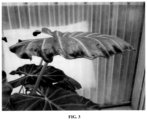
- FIG. 3 shows a side view close up of a mature leaf of ‘AS12-1’.
- FIG. 4 shows a closeup of the abaxial surface of a mature leaf of ‘AS12-1’.
- FIG. 5 shows a closeup of the abaxial surface of a juvenile leaf of ‘AS12-1’.
- ‘AS12-1’ differs from the female parent Alocasia plant ‘Calidora’ in that ‘AS12-1’ has larger leaves that are broadly ovate to cordate in shape with undulating leaf margins that fold downwards giving the leaf an overall scalloped appearance, whereas leaves of ‘Calidora’ are flattened with little to no undulating margins. Additionally, ‘AS12-1’ has mature leaves that are moderate olive green on the adaxial surface, whereas ‘Calidora’ has mature leaves that are a lighter yellow green on the adaxial surface. ‘AS12-1’ differs from the male parent species A. amazonica in that ‘AS12-1’ has leaves that are broadly ovate to cordate in shape, whereas leaves of A. amazonica are narrowly sagittate in shape. In addition, leaves of ‘AS12-1’ are more horizontal in orientation, compared to the downwardly nodding leaves of A. amazonica.
- ‘AS12-1’ When ‘AS12-1’ is compared to the commercial Alocasia plant ‘AP091520’ (U.S. Plant Pat. No. 34,129), leaves of ‘AS12-1’ are more horizontal in orientation compared to the more vertically upright leaves of ‘AP091520’. Additionally, ‘AS12-1’ has leaves that are more broadly ovate to cordate in shape with undulating leaf margins that fold downwards giving the leaf an overall scalloped appearance, whereas leaves of ‘AP091520’ are less ovate and more cordate in shape with margins that are more flattened and less undulating in appearance.
Landscapes
- Cultivation Of Plants (AREA)
- Breeding Of Plants And Reproduction By Means Of Culturing (AREA)
Abstract
A new and distinct Alocasia plant named ‘AS12-1’ particularly distinguished by unique large and broadly ovate to cordate shaped leaves with undulating leaf margins that fold downwards giving the leaf an overall scalloped appearance, moderate olive-green color on the upper side of mature leaves and unique dark greyish purple color on the underside of mature leaves.
Description
Genus and species: Alocasia hybrid.
Variety denomination: ‘AS12-1’.
The present invention comprises a new and distinct interspecific hybrid plant of Alocasia, hereinafter referred to by its cultivar name ‘AS12-1’.
The new cultivar was derived from a controlled breeding program conducted by the inventors at a nursery in Mount Dora, Fla. The overall purpose of the breeding program is to make new selections of Alocasia plants with unique foliage that are durable with a good growth rate in Florida. ‘AS12-1’ is the product of a controlled cross made by the inventors in April 2021 between the hybrid Alocasia plant named ‘Calidora’ (unpatented) as the female parent and the species Alocasia amazonica as the male parent. ‘AS12-1’ was selected by the inventors in the spring of 2022 as a single unique plant in Mount Dora, Fla. from amongst progeny plants derived from said cross.
The new cultivar was selected based on its distinctive coloration, unique scalloped leaf appearance and durability as compared to other commercially available Alocasia cultivars. ‘AS12-1’ was first reproduced asexually by vegetative rhizome divisions in August 2022 in Mount Dora, Fla. Asexual propagation by vegetative rhizome divisions of the new cultivar has shown that the unique features of the new cultivar are stable and reproduce true-to-type in successive generations.
Plant Breeder's Rights for this variety have not been applied for. ‘AS12-1’ has not been made publicly available or sold anywhere in the world prior to the effective filing date of this application.
The new Alocasia cultivar has not been observed under all possible environmental conditions. The phenotype may vary somewhat with variations in environment such as temperature, day length, light intensity, water status, fertilizer rate and type, without, however, any variance in genotype.
The following are the most outstanding and distinguishing characteristics of this new Alocasia cultivar. The combination of these characteristics distinguishes ‘AS12-1’ as a new and distinct variety of Alocasia:
-
- 1. Large and broadly ovate to cordate shaped leaves;
- 2. Undulating leaf margins that fold downwards giving the leaf an overall scalloped appearance;
- 3. Moderate olive-green color on the upper side of mature leaves; and
- 4. Unique dark greyish purple color on the underside of mature leaves.
This new Alocasia cultivar is illustrated by the accompanying-colored photographs which show the overall appearance and distinct characteristics of the plant. The colors shown are as true as can be reasonably obtained by conventional photographic procedures. The photographs are of a 1-year-old plant grown in a 3-gallon container under 60 to 90 percent shade in a ploy covered greenhouse in Mount Dora, Fla. Colors in the photographs may differ slightly from the color values cited in the botanical description which accurately describes the colors of the new variety.
In the following description, color references are made to The Royal Horticultural Society Colour Chart, Sixth Edition, except where general color terms of ordinary dictionary significance are used.
The following observations and measurements describe plants grown under 60 to 90 percent shade in a poly covered greenhouse in Mount Dora, Fla. Detailed descriptions were taken in October to November 2022 from a 1-year-old plant grown in a 3-gallon container. Measurements and numerical values represent averages of typical plant types.
- Classification:
-
- Family.—Araceae.
- Botanical.—Alocasia hybrid.
- Common.—Alocasia or Elephant Ear.
- Denomination.—‘AS12-1’.
-
- General description:
-
- Plant type.—Tropical perennial.
- Growth habit.—Upright and becoming outwardly arching with development.
- Height from soil level to top of foliar plane.—Approximately 70.0 cm.
- Plant spread.—Approximately 86.0 cm.
- Number of basal shoots per plant.—4.
- Primary stem.—Rhizomatous, approximately 7.6 cm in diameter at the base.
- Growth rate.—Moderate.
- Propagation type.—Vegetative rhizome divisions.
- Roots.—Thick, fleshy and fibrous, colored 156D (yellowish white).
-
- Foliage description:
-
- Quantity of leaves per plant.—Primary shoot: 6. Young axillary shoots: 5.
- Arrangement.—Alternate.
- Attachment.—Petiolate.
- Division.—Simple.
- Lamina.—Shape: Broadly ovate to cordate. Length: Approximately 30.0 cm to 33.0 cm when measured along the center axis of the foliar plane. Width: Approximately 20.3 cm at the widest point above the lobes. Orientation: Initially held vertically and becoming horizontal when mature. Appearance: Undulating margins that fold downwards giving the leaf an overall scalloped appearance. Apex: Acuminate when developing, becoming cuspidate when developed. Base: Deeply lobed, lobes about 10.0 cm to 12.0 cm in width and about 7.5 cm in depth. Margins: Undulate. Texture and luster, adaxial surface: Slightly rugose, shiny and becoming more matt on mature leaves. Texture and luster, abaxial surface: Smooth, glabrous and glossy. Venation pattern: Pinnate, one primary vein (midvein) and approximately 14 secondary veins with numerous veinlets appearing in a netted pattern. Color: Juvenile foliage, adaxial surface: Interveinal areas: NN137B (greyish olive green). Primary vein: N144C (strong yellow green). Secondary veins: N144C (strong yellow green), darkening towards the margins, 144B (strong yellow green). Veinlets: N144D (strong yellow green). Juvenile foliage, abaxial surface: Interveinal areas: 187A (dark red). Primary vein: 145A (strong yellow green). Secondary veins: 145A (strong yellow green) close to the primary vein, darkening towards the margins and tinged with N187C (purplish grey). Veinlets: Tinged with N187D (light purplish grey). Mature foliage, adaxial surface: Interveinal areas: NN137A (moderate olive green). Basal notch: 145B (light yellow green). Primary vein: N144D (strong yellow green) near the basal notch, becoming 137C (moderate yellowish green) towards the leaf margin. Secondary veins: 137C (moderate yellowish green). Veinlets: Inconspicuous. Mature foliage, abaxial surface: Interveinal areas: N186B (dark greyish purple). Primary vein: 145C (light yellow green). Secondary veins: 145C (light yellow green) near the primary vein, tinged with N186B (dark greyish purple) towards the leaf margin with a prominent notch of 145C (light yellow green) about halfway towards the leaf margin. Veinlets: Inconspicuous.
- Petioles.—Strength: Flexible. Aspect: Initially upright and straight and becoming more arching with development. Length: Approximately 53.0 cm to 55.0 cm. Diameter: Distally: Approximately 1.0 cm. Proximally: Approximately 9.0 cm. Texture and luster: Glabrous and glossy. Color: Close to 145A (strong yellow green) with mottled streaks of 145D (light yellow green). Wing length: Approximately 17.7 cm. Wing width: Approximately 9.0 cm at the base. Wing texture and luster (both inner and outer surfaces): Glabrous and glossy. Wing color (both inner and outer surfaces): 145C to 145D (light yellow green).
-
- Inflorescence:
-
- Type.—Spadix surrounded by a spathe, male portion held above female portion.
- Peduncle.—Length: Up to 15.0 cm. Diameter: 0.6 cm, widening towards the base of the spadix, 1.3 cm. Color: 145A (strong yellow green).
- Spathe.—Shape: Wedge-shaped above female zone, elliptic in shape surrounding female zone. Margin: Entire. Length: 11.4 cm above female zone, 3.2 cm surrounding female zone. Width: 3.2 cm above female zone, 2.5 cm surrounding female zone. Color: 145A (strong yellow green) above female zone when opening and fully opened, fading to 162D before shriveling. Color: 136B (dark yellowish green) surrounding the female zone.
- Spadix.—Length: 14.6 cm. Appendix zone: Shape: Lanceolate. Apex: Obtuse. Length: 9.0 cm. Width: 3.3 cm. Color: NN155A (yellowish white). Male zone: Shape: Cylindrical. Length: 2.5 cm. Width: 1.3 cm. Color: N155C (pinkish white). Female zone: Shape: Conical. Length: 3.2 cm. Width: 2.5 cm.
-
- Cold tolerance: Good.
- Disease and pest tolerance: Good.
- Fruit and seed set: None observed to date.
- Drought tolerance: Good.
‘AS12-1’ differs from the female parent Alocasia plant ‘Calidora’ in that ‘AS12-1’ has larger leaves that are broadly ovate to cordate in shape with undulating leaf margins that fold downwards giving the leaf an overall scalloped appearance, whereas leaves of ‘Calidora’ are flattened with little to no undulating margins. Additionally, ‘AS12-1’ has mature leaves that are moderate olive green on the adaxial surface, whereas ‘Calidora’ has mature leaves that are a lighter yellow green on the adaxial surface. ‘AS12-1’ differs from the male parent species A. amazonica in that ‘AS12-1’ has leaves that are broadly ovate to cordate in shape, whereas leaves of A. amazonica are narrowly sagittate in shape. In addition, leaves of ‘AS12-1’ are more horizontal in orientation, compared to the downwardly nodding leaves of A. amazonica.
When ‘AS12-1’ is compared to the commercial Alocasia plant ‘AP091520’ (U.S. Plant Pat. No. 34,129), leaves of ‘AS12-1’ are more horizontal in orientation compared to the more vertically upright leaves of ‘AP091520’. Additionally, ‘AS12-1’ has leaves that are more broadly ovate to cordate in shape with undulating leaf margins that fold downwards giving the leaf an overall scalloped appearance, whereas leaves of ‘AP091520’ are less ovate and more cordate in shape with margins that are more flattened and less undulating in appearance.
Claims (1)
1. A new and distinct variety of Alocasia plant named ‘AS12-1’, substantially as illustrated and described herein.
Priority Applications (1)
| Application Number | Priority Date | Filing Date | Title |
|---|---|---|---|
| US17/803,796 USPP35152P2 (en) | 2022-11-28 | 2022-11-28 | Alocasia plant named ‘AS12-1’ |
Applications Claiming Priority (1)
| Application Number | Priority Date | Filing Date | Title |
|---|---|---|---|
| US17/803,796 USPP35152P2 (en) | 2022-11-28 | 2022-11-28 | Alocasia plant named ‘AS12-1’ |
Publications (1)
| Publication Number | Publication Date |
|---|---|
| USPP35152P2 true USPP35152P2 (en) | 2023-05-02 |
Family
ID=86160517
Family Applications (1)
| Application Number | Title | Priority Date | Filing Date |
|---|---|---|---|
| US17/803,796 Active 2042-11-28 USPP35152P2 (en) | 2022-11-28 | 2022-11-28 | Alocasia plant named ‘AS12-1’ |
Country Status (1)
| Country | Link |
|---|---|
| US (1) | USPP35152P2 (en) |
-
2022
- 2022-11-28 US US17/803,796 patent/USPP35152P2/en active Active
Similar Documents
| Publication | Publication Date | Title |
|---|---|---|
| USPP34347P2 (en) | Philodendron plant named ‘Summer Glory’ | |
| USPP35152P2 (en) | Alocasia plant named ‘AS12-1’ | |
| USPP32564P2 (en) | Peperomia plant named ‘EC-PEPE-1904’ | |
| USPP36407P2 (en) | Philodendron plant named ‘Tropic Blush’ | |
| USPP36932P2 (en) | Alocasia plant named ‘Dragon Wings’ | |
| USPP36966P2 (en) | Alocasia plant named ‘White Dragon’ | |
| USPP36933P2 (en) | Alocasia plant named ‘Silver Wings’ | |
| USPP36149P2 (en) | Begonia plant named ‘EC-BEGO-2305’ | |
| USPP35554P2 (en) | Alocasia plant named ‘Green Unicorn’ | |
| USPP33107P2 (en) | Sedum plant named ‘TAT1801’ | |
| USPP37274P3 (en) | Ilex plant named ‘MONWILDE’ | |
| USPP36393P2 (en) | Dieffenbachia plant named ‘DIEMAWO’ | |
| USPP36979P2 (en) | Camellia plant named ‘FARROWCJPD’ | |
| USPP34873P2 (en) | Pyracantha plant ‘Orange Star’ | |
| USPP36758P2 (en) | Rhododendron plant named ‘ROBLEZN’ | |
| USPP34604P2 (en) | Peperomia plant named ‘EC-PEPE-2104’ | |
| USPP34113P2 (en) | Salvia plant named ‘Pink Serenade’ | |
| USPP36148P2 (en) | Begonia plant named ‘EC-BEGO-2304’ | |
| USPP34046P2 (en) | Loropetalum plant named ‘CANRL01’ | |
| USPP36544P3 (en) | Anthurium plant named ‘BLOCANTMIC’ | |
| USPP36301P3 (en) | Physocarpus plant named ‘GRDARK01’ | |
| USPP34015P2 (en) | Hibiscus plant named ‘ALTEARLYBIRD’ | |
| USPP34826P2 (en) | Mandevilla plant named ‘LVDIP1601’ | |
| USPP35303P2 (en) | Crocosmia hybrid plant named ‘DARK FIRE’ | |
| USPP35952P2 (en) | Peperomia plant named ‘EC-PEPE-2301’ |
Legal Events
| Date | Code | Title | Description |
|---|---|---|---|
| FEPP | Fee payment procedure |
Free format text: ENTITY STATUS SET TO UNDISCOUNTED (ORIGINAL EVENT CODE: BIG.); ENTITY STATUS OF PATENT OWNER: SMALL ENTITY |
|
| FEPP | Fee payment procedure |
Free format text: ENTITY STATUS SET TO SMALL (ORIGINAL EVENT CODE: SMAL); ENTITY STATUS OF PATENT OWNER: SMALL ENTITY |