USPP25426P2 - Caladium plant named ‘Flare’ - Google Patents
Caladium plant named ‘Flare’ Download PDFInfo
- Publication number
- USPP25426P2 USPP25426P2 US13/986,556 US201313986556V USPP25426P2 US PP25426 P2 USPP25426 P2 US PP25426P2 US 201313986556 V US201313986556 V US 201313986556V US PP25426 P2 USPP25426 P2 US PP25426P2
- Authority
- US
- United States
- Prior art keywords
- plants
- close
- caladium
- plant
- color
- Prior art date
- Legal status (The legal status is an assumption and is not a legal conclusion. Google has not performed a legal analysis and makes no representation as to the accuracy of the status listed.)
- Active, expires
Links
- 241000725152 Caladium Species 0.000 title claims abstract description 42
- 241000196324 Embryophyta Species 0.000 abstract description 85
- 239000002932 luster Substances 0.000 abstract description 5
- 241000220317 Rosa Species 0.000 abstract description 4
- 244000010375 Talinum crassifolium Species 0.000 description 7
- 235000015055 Talinum crassifolium Nutrition 0.000 description 7
- 244000178231 Rosmarinus officinalis Species 0.000 description 6
- 239000003086 colorant Substances 0.000 description 5
- 230000018109 developmental process Effects 0.000 description 5
- 240000001140 Mimosa pudica Species 0.000 description 3
- 241000607479 Yersinia pestis Species 0.000 description 2
- 230000011681 asexual reproduction Effects 0.000 description 2
- 238000013465 asexual reproduction Methods 0.000 description 2
- 210000005257 cortical tissue Anatomy 0.000 description 2
- 230000010154 cross-pollination Effects 0.000 description 2
- 230000007613 environmental effect Effects 0.000 description 2
- 210000002615 epidermis Anatomy 0.000 description 2
- 239000003205 fragrance Substances 0.000 description 2
- 239000002689 soil Substances 0.000 description 2
- 241000233639 Pythium Species 0.000 description 1
- 241000589634 Xanthomonas Species 0.000 description 1
- 230000001154 acute effect Effects 0.000 description 1
- 230000001488 breeding effect Effects 0.000 description 1
- 235000009508 confectionery Nutrition 0.000 description 1
- 201000010099 disease Diseases 0.000 description 1
- 208000037265 diseases, disorders, signs and symptoms Diseases 0.000 description 1
- 235000013399 edible fruits Nutrition 0.000 description 1
- 238000005562 fading Methods 0.000 description 1
- 230000005078 fruit development Effects 0.000 description 1
- 238000005259 measurement Methods 0.000 description 1
- 210000001672 ovary Anatomy 0.000 description 1
- 244000052769 pathogen Species 0.000 description 1
- 230000002085 persistent effect Effects 0.000 description 1
- 230000033458 reproduction Effects 0.000 description 1
- 230000008117 seed development Effects 0.000 description 1
- 230000017260 vegetative to reproductive phase transition of meristem Effects 0.000 description 1
Images



Classifications
-
- A—HUMAN NECESSITIES
- A01—AGRICULTURE; FORESTRY; ANIMAL HUSBANDRY; HUNTING; TRAPPING; FISHING
- A01H—NEW PLANTS OR NON-TRANSGENIC PROCESSES FOR OBTAINING THEM; PLANT REPRODUCTION BY TISSUE CULTURE TECHNIQUES
- A01H6/00—Angiosperms, i.e. flowering plants, characterised by their botanic taxonomy
- A01H6/10—Aroideae, e.g. Zantedeschia
Definitions
- Botanical designation Caladium ⁇ hortulanum.
- the present invention relates to a new and distinct cultivar of Caladium plant, botanically known as Caladium ⁇ hortulanum , commercially referred to as a lance (strap) leaf-type Caladium and hereinafter referred to by the name ‘Flare’.
- the objective of the Inventor's breeding program is to create new Caladium plants that have uniform plant habit, exceptional container and garden performance and attractive and unique leaf coloration.
- the new Caladium plant originated from a cross-pollination made by the Inventor in April, 2007 in Lake Placid, Fla. of Caladium ⁇ hortulanum ‘White Christmas’, not patented, as the female, or seed, parent with Caladium ⁇ hortulanum ‘Rosemary’, disclosed in U.S. Plant Pat. No. 20,993, the male, or pollen, parent.
- the new Caladium plant was discovered and selected by the Inventor as a single plant within the progeny of the stated cross-pollination in a controlled outdoor nursery environment in Zolfo Springs, Fla. on Sep. 15, 2008.
- Plants of the new Caladium have not been observed under all possible environmental conditions and cultural practices.
- the phenotype may vary somewhat with variations in environmental conditions such as temperature and light intensity, without, however, any variance in genotype.
- Plants of the new Caladium differ primarily from plants of the female parent, ‘White Christmas’, in leaf shape and color as plants of ‘White Christmas’ have broad fancy-type white-colored leaves with distinct dark green-colored venation and margins. In addition, plants of the new Caladium are more compact than plants of ‘White Christmas’.
- Plants of the new Caladium differ primarily from plants of the male parent, ‘Rosemary’, in leaf and leaf petiole color as plants of ‘Rosemary’ have leaves that are darker rose red in color with mottled light and dark green-colored borders and leaf petioles that are tan pink to tan green in color with greenish brown-colored stippling.
- plants of the new Caladium are more compact than plants of ‘Rosemary’.
- Plants of the new Caladium can be compared to plants of Caladium ⁇ hortulanum ‘Florida Sweetheart’, disclosed in U.S. Plant Pat. No. 8,526. In side-by-side comparisons, plants of the new Caladium differed primarily from plants of ‘Florida Sweetheart’ in the following characteristics:
- Plants of the new Caladium can be compared to plants of Caladium ⁇ hortulanum ‘Pink Symphony’, not patented. In side-by-side comparisons, plants of the new Caladium differed primarily from plants of ‘Pink Symphony’ in the following characteristics:
- the photograph on the first sheet is a side perspective view of a typical plant of ‘Flare’ in a 15-cm container and grown in a shadehouse.
- the photograph at the top of the second sheet is a comparison view of typical plants of ‘Flare’ grown in 15-cm containers; the plant on the left has not had its tuber de-eyed and the plant on the right has had its tuber de-eyed prior to planting.
- the photograph at the bottom of the second sheet is a close-up view of a typical inflorescence of ‘Flare’.
- the photograph at the top of the third sheet is a close-up view of typical freshly-harvested tubers and roots of ‘Flare’.
- the photograph at the bottom of the third sheet is a close-up view of typical plants of ‘Flare’ grown in an open field.
- the photograph at the top of the fourth sheet is a comparison view of typical potted plants of ‘Florida Sweetheart’ (left), ‘Flare’ (center) and ‘Pink Symphony’ (right).
- the photograph at the bottom of the fourth sheet is a comparison view of typical potted plants of the female parent, ‘White Christmas’ (left), ‘Flare’ (center) and the male parent, ‘Rosemary’ (right).
Landscapes
- Health & Medical Sciences (AREA)
- Life Sciences & Earth Sciences (AREA)
- Natural Medicines & Medicinal Plants (AREA)
- Physiology (AREA)
- Botany (AREA)
- Developmental Biology & Embryology (AREA)
- Environmental Sciences (AREA)
- Breeding Of Plants And Reproduction By Means Of Culturing (AREA)
- Cultivation Of Plants (AREA)
Abstract
A new and distinct cultivar of Caladium plant named ‘Flare’, characterized by its compact, upright and uniformly mounding plant habit; vigorous growth habit and rapid growth rate; lance-type leaves that are shiny in luster with rose red-colored centers surrounded by a greyed green and pink-colored speckling and dark green-colored margins; and good landscape performance.
Description
Botanical designation: Caladium×hortulanum.
Cultivar denomination: ‘FLARE’.
The present invention relates to a new and distinct cultivar of Caladium plant, botanically known as Caladium×hortulanum, commercially referred to as a lance (strap) leaf-type Caladium and hereinafter referred to by the name ‘Flare’.
The objective of the Inventor's breeding program is to create new Caladium plants that have uniform plant habit, exceptional container and garden performance and attractive and unique leaf coloration.
The new Caladium plant originated from a cross-pollination made by the Inventor in April, 2007 in Lake Placid, Fla. of Caladium×hortulanum ‘White Christmas’, not patented, as the female, or seed, parent with Caladium×hortulanum ‘Rosemary’, disclosed in U.S. Plant Pat. No. 20,993, the male, or pollen, parent. The new Caladium plant was discovered and selected by the Inventor as a single plant within the progeny of the stated cross-pollination in a controlled outdoor nursery environment in Zolfo Springs, Fla. on Sep. 15, 2008.
Asexual reproduction of the new Caladium plant by ‘chipping’ the tubers (cutting the tuber into segments with each segment containing an axillary bud and tuber cortical tissue) in a controlled outdoor nursery environment in Zolfo Springs, Fla. since Apr. 15, 2009 has shown that the unique features of this new Caladium plant are stable and reproduced true to type in successive generations of asexual reproduction.
Plants of the new Caladium have not been observed under all possible environmental conditions and cultural practices. The phenotype may vary somewhat with variations in environmental conditions such as temperature and light intensity, without, however, any variance in genotype.
The following traits have been repeatedly observed and are determined to be the unique characteristics of ‘Flare’. These characteristics in combination distinguish ‘Flare’ as a new and distinct Caladium plant:
-
- 1. Compact, upright and uniformly mounding plant habit.
- 2. Vigorous growth habit and rapid growth rate.
- 3. Lance-type leaves that are shiny in luster with rose red-colored centers surrounded by a greyed green and pink-colored speckling and dark green-colored margins.
- 4. Good landscape performance.
Plants of the new Caladium differ primarily from plants of the female parent, ‘White Christmas’, in leaf shape and color as plants of ‘White Christmas’ have broad fancy-type white-colored leaves with distinct dark green-colored venation and margins. In addition, plants of the new Caladium are more compact than plants of ‘White Christmas’.
Plants of the new Caladium differ primarily from plants of the male parent, ‘Rosemary’, in leaf and leaf petiole color as plants of ‘Rosemary’ have leaves that are darker rose red in color with mottled light and dark green-colored borders and leaf petioles that are tan pink to tan green in color with greenish brown-colored stippling. In addition, plants of the new Caladium are more compact than plants of ‘Rosemary’.
Plants of the new Caladium can be compared to plants of Caladium×hortulanum ‘Florida Sweetheart’, disclosed in U.S. Plant Pat. No. 8,526. In side-by-side comparisons, plants of the new Caladium differed primarily from plants of ‘Florida Sweetheart’ in the following characteristics:
-
- 1. Plants of the new Caladium were more upright than plants of ‘Florida Sweetheart’.
- 2. Plants of the new Caladium grew faster and produced finished plants about one week earlier than plants of ‘Florida Sweetheart’.
- 3. Plants of the new Caladium and ‘Florida Sweetheart’ differed in leaf luster and coloration as leaves of plants of ‘Florida Sweetheart’ were dull and had lighter rose red-colored centers and dark green-colored margins.
Plants of the new Caladium can be compared to plants of Caladium×hortulanum ‘Pink Symphony’, not patented. In side-by-side comparisons, plants of the new Caladium differed primarily from plants of ‘Pink Symphony’ in the following characteristics:
-
- 1. Plants of the new Caladium were more compact than plants of ‘Pink Symphony’.
- 2. Plants of the new Caladium grew faster and produced finished plants about one to two weeks earlier than plants of ‘Pink Symphony’.
- 3. Plants of the new Caladium had broader leaves than plants of ‘Pink Symphony’.
- 4. Plants of the new Caladium and ‘Pink Symphony’ differed in leaf luster and coloration as leaves of plants of ‘Pink Symphony’ were dull with mostly pink or pale pink-colored centers surrounded by a green-colored border with white to greenish white-colored venation.
The accompanying photographs illustrate the overall appearance of the new Caladium plant showing the colors as true as it is reasonably possible to obtain in colored reproductions of this type. Colors in the photographs may differ slightly from the color values cited in the detailed botanical description which accurately describe the colors of the new Caladium plant.
The photograph on the first sheet is a side perspective view of a typical plant of ‘Flare’ in a 15-cm container and grown in a shadehouse.
The photograph at the top of the second sheet is a comparison view of typical plants of ‘Flare’ grown in 15-cm containers; the plant on the left has not had its tuber de-eyed and the plant on the right has had its tuber de-eyed prior to planting.
The photograph at the bottom of the second sheet is a close-up view of a typical inflorescence of ‘Flare’.
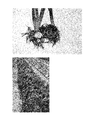
The photograph at the top of the third sheet is a close-up view of typical freshly-harvested tubers and roots of ‘Flare’.
The photograph at the bottom of the third sheet is a close-up view of typical plants of ‘Flare’ grown in an open field.
The photograph at the top of the fourth sheet is a comparison view of typical potted plants of ‘Florida Sweetheart’ (left), ‘Flare’ (center) and ‘Pink Symphony’ (right).
The photograph at the bottom of the fourth sheet is a comparison view of typical potted plants of the female parent, ‘White Christmas’ (left), ‘Flare’ (center) and the male parent, ‘Rosemary’ (right).
The aforementioned photographs and following observations and measurements describe plants grown in 15-cm containers in a polypropylene-covered shadehouse (30% light reduction) in Avon Park, Fla. and plants grown in ground beds in an outdoor nursery in Crewsville, Fla. The plants were grown under cultural practices typical of commercial shadehouse and outdoor nursery production. During the production of the plants, day temperatures ranged from about 29° C. to 33° C. (shadehouse) or 29° C. to 35° C. (outdoor nursery), night temperatures ranged from about 22° C. to 25° C. (shadehouse) or 23° C. to 26° C. (outdoor nursery) and light levels were about 8,000 foot-candles (shadehouse) or 10,000 to 12,000 foot-candles (outdoor nursery). Plants grown in the shadehouse were eight weeks old and plants grown in the outdoor nursery were seven months old when the photographs and the detailed description were taken. In the following description, color references are made to The Royal Horticultural Society Colour Chart, 2001 Edition, except where general terms of ordinary dictionary significance are used.
- Botanical classification: Caladium×hortulanum ‘Flare’.
- Parentage:
-
- Female, or seed, parent.—Caladium×hortulanum ‘White Christmas’, not patented.
- Male, or pollen, parent.—Caladium×hortulanum ‘Rosemary’, disclosed in U.S. Plant Pat. No. 20,993.
-
- Propagation:
-
- Type.—By “chipping” the tubers.
- Time to initiate roots, summer.—About seven to ten days at 32° C.
- Time to initiate roots, winter.—About two to three weeks at 24° C.
- Tuber description (outdoor nursery-grown plants).—Appearance: Multi-segmented and somewhat flattened; individual segments ovate to elliptic in shape. Height: About 2.6 cm. Diameter: About 3.6 cm. Segment height: About 2 cm. Segment diameter: About 1.4 cm. Texture: Thick, starchy; somewhat brittle. Color: Epidermis, freshly-harvested: Close to 199A and N199B. Epidermis, dried: Close to 200A to 200B. Cortical tissue: Close to 2C to 2D. Axillary buds: Close to 27C. Root description: Thick, fleshy contractile roots; color, close to 155C. Rooting habit: Few lateral branches; moderately dense.
-
- Plant description:
-
- Plant type.—Herbaceous perennial; suitable as a potted plant in containers 15-cm to 25-cm and suitable as a landscape plant in shaded areas.
- Plant and growth habit.—Compact, upright and uniformly mounding plant habit; vigorous and dense growth habit; rapid growth rate, potted plants in finished or saleable form in about six to seven weeks after planting tubers; leaf petioles and leaves arise from one or more growing points on tubers; petioles mostly upright and arching outwardly with development.
- Plant height, from soil level to top of foliar plane, shadehouse-grown potted plants.—About 26 cm to 30 cm.
- Plant height, from soil level to top of inflorescences, shadehouse-grown potted plants.—About 37 cm.
- Plant diameter or spread, shadehouse-grown potted plants.—About 39 cm to 44 cm.
- Number of clumps per plant, shadehouse-grown potted plants.—About three to four from de-eyed tubers.
- Cataphylls, shadehouse-grown potted plants.—Length: About 4 cm to 6.5 cm. Width: About 1 cm to 1.8 cm. Shape: Wedge-shaped. Apex: Acuminate. Base: Sheathing the stem. Color, outer surface: Close to N170D and N170D tinged with close to 182D; stippled, streaked and tessellated with close to 200C and faintly tinged with close to 147D; with development, color becoming closer to 200D. Color, inner surface: Close to N155C; outer surface colors and patterns visible.
-
- Foliage description:
-
- Arrangement and type.—Alternate; simple; lance-type.
- Length, shadehouse-grown potted plants.—About 16 cm to 20 cm.
- Width, shadehouse-grown potted plants, flattened.—About 10.9 cm to 13 cm.
- Shape.—Ovate.
- Apex.—Acute.
- Base.—Sagittate, peltate; cordate.
- Margin.—Entire; wavy with broad undulations.
- Texture, upper surface.—Smooth, glabrous; leathery; shiny in luster.
- Texture, lower surface.—Smooth, glabrous; glaucous.
- Venation pattern.—Pinnate.
- Color, shadehouse-grown potted plants.—Developing leaves, upper and lower surfaces: Background color: Central areas, close to 185B tinged with close to 53B and 182A to 182B; marginal areas, close to 183A; margins, close to 147A. Basal notch: Close to 187A. Venation: Close to 53B and 187B. Fully expanded leaves, upper surface: Background color: Central areas, close to 185B tinged with close to 53B with flecking close to 182A to 182B; marginal areas, close to 183A with flecking close to 157A, 147C, 184B and 182A to 182B; margins, close to 147A and 139A. Basal notch: Close to 187A. Venation: Close to 53B and 187C. Fully expanded leaves, lower surface: Background color: Central areas, close to 184B to 184C with flecking close to 160D and 182D; marginal areas, close to 184A to 184B with flecking close to 160D; margins, close to 187B. Basal notch: Close to 187B. Venation: Close to 184A tinged with close to 53B.
- Petiole.—Aspect: Initially upright and straight; with development, leaning outwardly and curving; flexible. Length, shadehouse-grown potted plants: About 16 cm to 27 cm. Diameter, distal, shadehouse-grown potted plants: About 4 mm. Diameter, proximal, shadehouse-grown potted plants: About 5 mm to 8 mm. Color, shadehouse-grown potted plants: Close to N170D and N170D tinged with close to 182D, stippled, streaked and tessellated with close to 200C and faintly tinged with close to 147D; distally, close to 51 C stippled, streaked and tessellated with close to 184C to 184D. Wing length, shadehouse-grown potted plants: About 3.5 cm to 10.2 cm. Wing diameter, shadehouse-grown potted plants: About 4 mm to 9 mm. Wing color, shadehouse-grown potted plants, outer surface: Close to N170D and N170D tinged with close to 182D, stippled, streaked and tessellated with close to 200C and faintly tinged with close to 147D. Wing color, shadehouse-grown potted plants, inner surface: Close to N155C; outer surface colors and patterns visible.
-
- Inflorescence description: Inflorescences observed on ten week-old shadehouse-grown potted plants.
-
- Inflorescence arrangement.—Upright hooded spathes surrounding a columnar spadix borne on a tall upright scape; spadix with sessile, simple female and male flowers separated into two zones; female flowers develop on the lower one-third of the spadix; male flowers develop on the upper two-thirds of the spadix; sterile flowers develop at junction of female and male flower zones; near this junction, the spathe constricts and surrounds and encloses the female flowers; spathe open and cupped around male flowers.
- Fragrance.—Strongly night fragrant; sweet jasmine-like fragrance with camphor-like notes.
- Natural flowering season and flower longevity.—Plants of the new Caladium typically flower during the spring or early summer in central Florida; flowers develop about ten weeks after growth commences; inflorescences last about three days before fading; inflorescences persistent.
- Spathe.—Length, overall: About 12.5 cm. Length, distal open portion: About 8.7 cm. Length, proximal closed portion: About 3.8 cm. Width, distal open portion: About 2.2 cm. Width, at constriction: About 1 cm. Width, proximal closed portion: About 2 cm. Shape: Ovate. Apex: Acute. Base: Tapering to the peduncle. Margin: Entire. Texture, front and rear surfaces: Smooth, glabrous. Color, front surface: Distal open portion: Close to 160D and 159D; proximally speckled with close to 60B; with development, color becoming closer to N199B. Proximal closed portion: Close to 138C and 147C; towards the base, heavily tinged with close to 187A and 187C to 187D; color does not change with development. Color, rear surface: Distal open portion: Close to 160D and 157C to 157D. Proximal closed portion: Close to 195B to 195C, 160D and 147D with areas tinged with close to 181D and 183D.
- Spadix.—Length: About 7.7 cm. Length, male flower zone: About 5.8 cm. Length, sterile zone: Less than 1 cm. Length, female flower zone: About 1.9 cm. Diameter, male flower zone: About 9 mm. Diameter, sterile flower zone: About 7 mm. Diameter, female flower zone: About 1 cm. Shape: Columnar, spindle-shaped. Apex: Obtuse. Base: Obtuse. Aspect: Upright. Color, mature, male zone: Close to 159D. Color, mature, sterile zone: Close to 159D. Color, mature, female zone: Close to 19C to 19D. Male flowers: Quantity per spadix: About 105. Shape: Obovate. Height: About 3 mm. Diameter: About 3.5 mm. Pollen amount: Abundant. Pollen color: Close to 5D. Female flowers: Quantity per spadix: About 115. Shape: Obovate. Height: About 3 mm. Diameter: About 1.5 mm. Stigma color: Close to 158B. Ovary color: Close to 155C.
- Scape.—Length: About 24.5 cm. Diameter: About 6 mm. Strength: Sturdy; flexible. Aspect: Mostly erect. Texture: Smooth, glabrous; glaucous. Color: Close to 199D tinged with close to N170D and stippled, streaked and tessellated with close to 177A to 177B; distally, close to 147B to 147C tinged with close to 183C to 183D.
- Seeds and fruits.—Seed and fruit development have not been observed on plants of the new Caladium.
-
- Disease & pest tolerance: Plants of the new Caladium have been observed to have above average tolerance to Xanthomonas Leaf Spot and to have average tolerance to Pythium Root Rot. Plants of the new Caladium have not been observed to have resistance to pests and other pathogens common to Caladium plants.
- Temperature tolerance: Plants of the new Caladium have been observed to be tolerant to temperatures ranging from about 7° C. to about 40° C. and are suitable for USDA Hardiness Zones 8A to 11.
Claims (1)
1. A new and distinct Caladium plant named ‘Flare’ as illustrated and described.
Priority Applications (1)
| Application Number | Priority Date | Filing Date | Title |
|---|---|---|---|
| US13/986,556 USPP25426P2 (en) | 2013-05-14 | 2013-05-14 | Caladium plant named ‘Flare’ |
Applications Claiming Priority (1)
| Application Number | Priority Date | Filing Date | Title |
|---|---|---|---|
| US13/986,556 USPP25426P2 (en) | 2013-05-14 | 2013-05-14 | Caladium plant named ‘Flare’ |
Publications (1)
| Publication Number | Publication Date |
|---|---|
| USPP25426P2 true USPP25426P2 (en) | 2015-04-07 |
Family
ID=52745376
Family Applications (1)
| Application Number | Title | Priority Date | Filing Date |
|---|---|---|---|
| US13/986,556 Active 2033-09-21 USPP25426P2 (en) | 2013-05-14 | 2013-05-14 | Caladium plant named ‘Flare’ |
Country Status (1)
| Country | Link |
|---|---|
| US (1) | USPP25426P2 (en) |
-
2013
- 2013-05-14 US US13/986,556 patent/USPP25426P2/en active Active
Similar Documents
| Publication | Publication Date | Title |
|---|---|---|
| USPP32251P3 (en) | Caladium plant named ‘Burst My Bubble’ | |
| USPP27095P2 (en) | Caladium plant named ‘Radiance’ | |
| USPP25421P2 (en) | Caladium plant named ‘Desert Sunset’ | |
| USPP27093P2 (en) | Caladium plant named ‘Classic Pink’ | |
| USPP27096P2 (en) | Caladium plant named ‘Red Alert’ | |
| USPP25426P2 (en) | Caladium plant named ‘Flare’ | |
| USPP34987P2 (en) | Caladium plant named ‘WON OF14-1246’ | |
| USPP33402P2 (en) | Caladium plant named ‘PCL 1522-50’ | |
| USPP32523P2 (en) | Caladium plant named ‘MOL 158-47’ | |
| USPP23815P2 (en) | Caladium plant named ‘White Cap’ | |
| USPP33470P2 (en) | Caladium plant named ‘GPR SWT STR 013-993’ | |
| USPP31061P3 (en) | Caladium plant named ‘Tickle Me Pink’ | |
| USPP25424P2 (en) | Caladium plant named ‘Puppy Love’ | |
| USPP25420P2 (en) | Caladium plant named ‘Summer Breeze’ | |
| USPP25427P2 (en) | Caladium plant named ‘Modern Art’ | |
| USPP31569P2 (en) | Caladium plant named ‘ZRD 2318-183’ | |
| USPP31252P2 (en) | Caladium plant named ‘BLZ 158-14’ | |
| USPP30651P2 (en) | Caladium plant named ‘Bottle Rocket’ | |
| USPP25425P2 (en) | Caladium plant named ‘Red Glamour’ | |
| USPP25419P2 (en) | Caladium plant named ‘Scarlet Flame’ | |
| USPP26265P2 (en) | Caladium plant named ‘RS-03-03’ | |
| USPP28000P2 (en) | Caladium plant named ‘PSY LAV 2322-566B’ | |
| USPP29546P2 (en) | Caladium plant named ‘Caribbean Coral’ | |
| USPP27942P2 (en) | Caladium plant named ‘Southern Charm’ | |
| USPP26263P2 (en) | Caladium plant named ‘Sangria’ |