USPP19953P2 - Juniper plant named ‘Hulsdonk Yellow’ - Google Patents
Juniper plant named ‘Hulsdonk Yellow’ Download PDFInfo
- Publication number
- USPP19953P2 USPP19953P2 US12/151,752 US15175208V USPP19953P2 US PP19953 P2 USPP19953 P2 US PP19953P2 US 15175208 V US15175208 V US 15175208V US PP19953 P2 USPP19953 P2 US PP19953P2
- Authority
- US
- United States
- Prior art keywords
- juniper
- plants
- yellow
- new
- hulsdonk
- Prior art date
- Legal status (The legal status is an assumption and is not a legal conclusion. Google has not performed a legal analysis and makes no representation as to the accuracy of the status listed.)
- Active
Links
- 241000721662 Juniperus Species 0.000 title claims abstract description 25
- 241000196324 Embryophyta Species 0.000 abstract description 34
- 241000209643 Juniperus pingii Species 0.000 description 6
- 239000003086 colorant Substances 0.000 description 3
- 238000005520 cutting process Methods 0.000 description 3
- 241000607479 Yersinia pestis Species 0.000 description 2
- 238000004519 manufacturing process Methods 0.000 description 2
- 230000035772 mutation Effects 0.000 description 2
- 230000001154 acute effect Effects 0.000 description 1
- 230000011681 asexual reproduction Effects 0.000 description 1
- 238000013465 asexual reproduction Methods 0.000 description 1
- 201000010099 disease Diseases 0.000 description 1
- 208000037265 diseases, disorders, signs and symptoms Diseases 0.000 description 1
- 230000007613 environmental effect Effects 0.000 description 1
- 239000003205 fragrance Substances 0.000 description 1
- 238000005259 measurement Methods 0.000 description 1
- 244000052769 pathogen Species 0.000 description 1
- 230000033458 reproduction Effects 0.000 description 1
- 239000002689 soil Substances 0.000 description 1
Images

Classifications
-
- A—HUMAN NECESSITIES
- A01—AGRICULTURE; FORESTRY; ANIMAL HUSBANDRY; HUNTING; TRAPPING; FISHING
- A01H—NEW PLANTS OR NON-TRANSGENIC PROCESSES FOR OBTAINING THEM; PLANT REPRODUCTION BY TISSUE CULTURE TECHNIQUES
- A01H7/00—Gymnosperms, e.g. conifers
Definitions
- Botanical designation Juniperus pingii.
- the present Invention relates to a new and distinct cultivar of Juniper, botanically known as Juniperus pingii, and hereinafter referred to by the name ‘Hulsdonk Yellow’.
- the new Juniper is a naturally-occurring branch mutation of Juniperus pingii ‘Loderi’, not patented.
- the new Juniper was discovered and selected by the Inventor from within a population of plants of ‘Loderi’ in a controlled greenhouse environment in Deurne, The Netherlands in 2000.
- Plants of the cultivar Hulsdonk Yellow have not been observed under all possible environmental conditions.
- the phenotype may vary somewhat with variations in environment and culture such as temperature and light intensity without, however, any variance in genotype.
- Plants of the new Juniper are most similar to plants of the parent, ‘Loderi’. Plants of the new Juniper differ from plants of ‘Loderi’ in the following characteristics:
- Plants of the new Juniper can also be compared to plants of Juniperus pingii ‘Glassell’, not patented. Plants of the new Juniper differ from plants of ‘Glassell’ in the following characteristics:
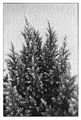
- the photograph on the first sheet is a side perspective view of a typical plant of ‘Hulsdonk Yellow’ grown in a container.
- the photograph on the second sheet is a close-up view of the foliage of a typical plant of ‘Hulsdonk Yellow’.
- Juniperus pingii ‘Hulsdonk Yellow’ Juniperus pingii ‘Hulsdonk Yellow’.
Landscapes
- Life Sciences & Earth Sciences (AREA)
- Health & Medical Sciences (AREA)
- Natural Medicines & Medicinal Plants (AREA)
- Botany (AREA)
- Developmental Biology & Embryology (AREA)
- Environmental Sciences (AREA)
- Breeding Of Plants And Reproduction By Means Of Culturing (AREA)
Abstract
A new and distinct cultivar of Juniper plant named ‘Hulsdonk Yellow’, characterized by its semi-dwarf and pyramidal plant form; yellow and dark green-colored leaves; and winter hardiness.
Description
Botanical designation: Juniperus pingii.
Cultivar denomination: ‘Hulsdonk Yellow’.
The present Invention relates to a new and distinct cultivar of Juniper, botanically known as Juniperus pingii, and hereinafter referred to by the name ‘Hulsdonk Yellow’.
The new Juniper is a naturally-occurring branch mutation of Juniperus pingii ‘Loderi’, not patented. The new Juniper was discovered and selected by the Inventor from within a population of plants of ‘Loderi’ in a controlled greenhouse environment in Deurne, The Netherlands in 2000.
Asexual reproduction of the new Juniper by cuttings in a controlled greenhouse environment in Deurne, The Netherlands since 2000, has shown that the unique features of this new Juniper are stable and reproduced true to type in successive generations.
Plants of the cultivar Hulsdonk Yellow have not been observed under all possible environmental conditions. The phenotype may vary somewhat with variations in environment and culture such as temperature and light intensity without, however, any variance in genotype.
The following traits have been repeatedly observed and are determined to be the unique characteristics of the new Juniper. These characteristics in combination distinguish ‘Hulsdonk Yellow’ as a new and distinct cultivar of Juniper:
-
- 1. Semi-dwarf and pyramidal plant form.
- 2. Yellow and dark green-colored leaves.
- 3. Winter hardy.
Plants of the new Juniper are most similar to plants of the parent, ‘Loderi’. Plants of the new Juniper differ from plants of ‘Loderi’ in the following characteristics:
-
- 1. Plants of the new Juniper are more compact than plants of ‘Loderi’.
- 2. Plants of the new Juniper grow slower than plants of ‘Loderi’.
- 3. Plants of the new Juniper and ‘Loderi’ differ in leaf color as plants of ‘Loderi’ have green-colored leaves.
Plants of the new Juniper can also be compared to plants of Juniperus pingii ‘Glassell’, not patented. Plants of the new Juniper differ from plants of ‘Glassell’ in the following characteristics:
-
- 1. Plants of the new Juniper are more uniform than plants of ‘Glassell’.
- 2. Plants of the new Juniper and ‘Glassell’ differ in leaf color as plants of ‘Glassell’ have green-colored leaves.
The accompanying colored photographs illustrate the overall appearance of the new Juniper, showing the colors as true as it is reasonably possible to obtain in colored reproductions of this type. Colors in the photographs may differ slightly from the color values cited in the detailed botanical description which accurately describe the colors of the new Juniper.
The photograph on the first sheet is a side perspective view of a typical plant of ‘Hulsdonk Yellow’ grown in a container.
The photograph on the second sheet is a close-up view of the foliage of a typical plant of ‘Hulsdonk Yellow’.
Plants used for the aforementioned photographs and following observations and measurements were grown in Deurne, The Netherlands during the summer and early autumn in an outdoor nursery and under conditions which approximate commercial Juniper production. During the production of the plants, day temperatures ranged from 10° C. to 28° C. and night temperatures ranged from 4° C. to 15° C. Plants had been growing for four years when the photographs and description were taken. In the following description, color references are made to The Royal Horticultural Society Colour Chart, 2001 Edition, except where general terms of ordinary dictionary significance are used.
- Botanical classification:
Juniperus pingii ‘Hulsdonk Yellow’.
- Parentage:
Naturally-occurring branch mutation of Juniperus pingii ‘Loderi’, not patented.
- Propagation:
-
- Type.—By cuttings.
- Time to initiate roots.—About three months at 15° C. to 25° C.
- Time to produce a rooted cutting.—About 250 days at 15° C. to 25C.
- Root description.—Fibrous, fleshy; white to brown in color.
- Rooting habit.—Moderate branching; moderately dense.
-
- Plant description:
-
- Form/growth habit.—Semi-dwarf and pyramidal perennial evergreen shrub; upright to outwardly spreading plant habit. Low vigor.
- Branching habit.—Freely branching with about 50 lateral branches developing per plant. Branches mostly upright. Plants maintain their lower branches and foliage at the soil level.
- Plant height.—About 31.8 cm.
- Plant diameter.—About 28.3 cm.
- Lateral branch description.—Length: About 15.7 cm. Diameter: About 4 mm. Internode length: About 6 mm. Texture: Smooth, scaly. Strength: Strong. Color, developing: Close to 144A to 144C. Color, mature: Close to 200D.
- Leaf description.—Appearance/arrangement: Flattened and appressed; opposite; sessile. Length: About 5 mm. Width: About 1.2 mm. Shape: Lanceolate, scale-like. Apex: Acute. Base: Cuneate. Margin: Entire. Texture, upper and lower surface: Smooth, glabrous. Venation pattern: Linear. Fragrance: Juniper-like. Color: Developing leaves, upper surface: Close to 157D. Developing leaves, lower surface: Between 1C to 2C. Fully expanded leaves, upper surface: Close to N155A; venation, similar to lamina. Fully expanded leaves, lower surface: Close to 137B; venation, similar to lamina.
- Cone description.—Cone development has not been observed.
-
- Disease/pest resistance: Plants of the new Juniper have not been noted to be resistant to pathogens or pests common to Juniper.
- Weather tolerance: Plants of the new Juniper have been observed to be tolerant to drought, rain, wind and temperatures ranging from about −17° C. to about 35° C.
Claims (1)
1. A new and distinct Juniper plant named ‘Hulsdonk Yellow’ as illustrated and described.
Priority Applications (1)
| Application Number | Priority Date | Filing Date | Title |
|---|---|---|---|
| US12/151,752 USPP19953P2 (en) | 2008-05-08 | 2008-05-08 | Juniper plant named ‘Hulsdonk Yellow’ |
Applications Claiming Priority (1)
| Application Number | Priority Date | Filing Date | Title |
|---|---|---|---|
| US12/151,752 USPP19953P2 (en) | 2008-05-08 | 2008-05-08 | Juniper plant named ‘Hulsdonk Yellow’ |
Publications (1)
| Publication Number | Publication Date |
|---|---|
| USPP19953P2 true USPP19953P2 (en) | 2009-04-21 |
Family
ID=40550603
Family Applications (1)
| Application Number | Title | Priority Date | Filing Date |
|---|---|---|---|
| US12/151,752 Active USPP19953P2 (en) | 2008-05-08 | 2008-05-08 | Juniper plant named ‘Hulsdonk Yellow’ |
Country Status (1)
| Country | Link |
|---|---|
| US (1) | USPP19953P2 (en) |
-
2008
- 2008-05-08 US US12/151,752 patent/USPP19953P2/en active Active
Similar Documents
| Publication | Publication Date | Title |
|---|---|---|
| USPP19953P2 (en) | Juniper plant named ‘Hulsdonk Yellow’ | |
| USPP20289P2 (en) | Vinca plant named ‘24 Carat’ | |
| USPP32048P2 (en) | Thuja tree named ‘RLH-GG’ | |
| USPP19948P2 (en) | Chamaecyparis plant named ‘Lucas’ | |
| USPP32032P2 (en) | Thuja tree named ‘RLH-CS’ | |
| USPP32414P2 (en) | Sedum plant named ‘Gold Form’ | |
| USPP23190P2 (en) | Cordyline plant named ‘Spricorfantasy’ | |
| USPP17611P2 (en) | Elaeocarpus plant named ‘Monproud’ | |
| USPP22743P2 (en) | Juniper plant named ‘Hegedus’ | |
| USPP20883P2 (en) | Chamaecyparis plant named ‘Dow Whiting’ | |
| USPP16049P2 (en) | Taxus plant named ‘Geers’ | |
| USPP32393P2 (en) | Juniper plant named ‘SMNJCB’ | |
| USPP16280P2 (en) | Thuja plant named ‘Walter Brown’ | |
| USPP19963P2 (en) | Cordyline plant named ‘Paradise’ | |
| USPP22359P2 (en) | Chamaecyparis plant named ‘Minlem’ | |
| USPP21319P2 (en) | Buxus plant named ‘Furore’ | |
| USPP16954P2 (en) | Cordyline plant named ‘Maroon Magic’ | |
| USPP25503P2 (en) | Tsuga plant named ‘MonKinn’ | |
| USPP30232P2 (en) | Physocarpus plant named ‘SMNPMS’ | |
| USPP16188P2 (en) | Pittosporum plant named ‘CNI Three’ | |
| USPP30017P2 (en) | Juniper plant named ‘RLH-SS1PI’ | |
| USPP20451P3 (en) | Variety of Phormium plant named ‘FIT01’ | |
| USPP24748P2 (en) | Nandina plant named ‘Sunset’ | |
| USPP22760P2 (en) | Cotoneaster plant named ‘Gerald’ | |
| USPP21016P2 (en) | Alternanthera plant named ‘Raspberry Rum’ |
Legal Events
| Date | Code | Title | Description |
|---|---|---|---|
| AS | Assignment |
Owner name: WITTEMAN & CO., NETHERLANDS Free format text: ASSIGNMENT OF ASSIGNORS INTEREST;ASSIGNOR:CORNELIUS PETRUS FRANCISCUS KOOLS;REEL/FRAME:020985/0641 Effective date: 20080206 |