USPP19075P2 - pelargonium plant named ‘Fistarol’ - Google Patents
pelargonium plant named ‘Fistarol’ Download PDFInfo
- Publication number
- USPP19075P2 USPP19075P2 US11/803,252 US80325207V USPP19075P2 US PP19075 P2 USPP19075 P2 US PP19075P2 US 80325207 V US80325207 V US 80325207V US PP19075 P2 USPP19075 P2 US PP19075P2
- Authority
- US
- United States
- Prior art keywords
- rhs
- fistarol
- color
- plant
- pelargonium
- Prior art date
- Legal status (The legal status is an assumption and is not a legal conclusion. Google has not performed a legal analysis and makes no representation as to the accuracy of the status listed.)
- Active
Links
- 241000208181 Pelargonium Species 0.000 title claims abstract description 12
- 241000196324 Embryophyta Species 0.000 abstract description 18
- 235000014653 Carica parviflora Nutrition 0.000 abstract description 6
- 230000017260 vegetative to reproductive phase transition of meristem Effects 0.000 abstract description 4
- 241000243321 Cnidaria Species 0.000 abstract 1
- 244000132059 Carica parviflora Species 0.000 description 5
- 240000001140 Mimosa pudica Species 0.000 description 5
- 241000972773 Aulopiformes Species 0.000 description 4
- 235000019515 salmon Nutrition 0.000 description 4
- DGOBMKYRQHEFGQ-UHFFFAOYSA-L acid green 5 Chemical compound [Na+].[Na+].C=1C=C(C(=C2C=CC(C=C2)=[N+](CC)CC=2C=C(C=CC=2)S([O-])(=O)=O)C=2C=CC(=CC=2)S([O-])(=O)=O)C=CC=1N(CC)CC1=CC=CC(S([O-])(=O)=O)=C1 DGOBMKYRQHEFGQ-UHFFFAOYSA-L 0.000 description 3
- 238000005520 cutting process Methods 0.000 description 3
- 230000000762 glandular Effects 0.000 description 3
- 201000010099 disease Diseases 0.000 description 2
- 208000037265 diseases, disorders, signs and symptoms Diseases 0.000 description 2
- 241000894007 species Species 0.000 description 2
- 241001573881 Corolla Species 0.000 description 1
- 241000208152 Geranium Species 0.000 description 1
- 241000238631 Hexapoda Species 0.000 description 1
- 241000218922 Magnoliophyta Species 0.000 description 1
- 244000017583 Pelargonium zonale Species 0.000 description 1
- 241000607479 Yersinia pestis Species 0.000 description 1
- 230000001154 acute effect Effects 0.000 description 1
- 235000010208 anthocyanin Nutrition 0.000 description 1
- 229930002877 anthocyanin Natural products 0.000 description 1
- 239000004410 anthocyanin Substances 0.000 description 1
- 150000004636 anthocyanins Chemical class 0.000 description 1
- 125000003118 aryl group Chemical group 0.000 description 1
- 230000011681 asexual reproduction Effects 0.000 description 1
- 238000013465 asexual reproduction Methods 0.000 description 1
- 230000001488 breeding effect Effects 0.000 description 1
- DGQLVPJVXFOQEV-JNVSTXMASA-N carminic acid Chemical compound OC1=C2C(=O)C=3C(C)=C(C(O)=O)C(O)=CC=3C(=O)C2=C(O)C(O)=C1[C@@H]1O[C@H](CO)[C@@H](O)[C@H](O)[C@H]1O DGQLVPJVXFOQEV-JNVSTXMASA-N 0.000 description 1
- 239000003086 colorant Substances 0.000 description 1
- 235000013399 edible fruits Nutrition 0.000 description 1
- 230000007613 environmental effect Effects 0.000 description 1
- 238000011156 evaluation Methods 0.000 description 1
- 239000003205 fragrance Substances 0.000 description 1
- 238000000034 method Methods 0.000 description 1
- 210000000056 organ Anatomy 0.000 description 1
- 230000001850 reproductive effect Effects 0.000 description 1
Images
Classifications
-
- A—HUMAN NECESSITIES
- A01—AGRICULTURE; FORESTRY; ANIMAL HUSBANDRY; HUNTING; TRAPPING; FISHING
- A01H—NEW PLANTS OR NON-TRANSGENIC PROCESSES FOR OBTAINING THEM; PLANT REPRODUCTION BY TISSUE CULTURE TECHNIQUES
- A01H6/00—Angiosperms, i.e. flowering plants, characterised by their botanic taxonomy
- A01H6/42—Geraniaceae, e.g. Geranium
-
- A—HUMAN NECESSITIES
- A01—AGRICULTURE; FORESTRY; ANIMAL HUSBANDRY; HUNTING; TRAPPING; FISHING
- A01H—NEW PLANTS OR NON-TRANSGENIC PROCESSES FOR OBTAINING THEM; PLANT REPRODUCTION BY TISSUE CULTURE TECHNIQUES
- A01H5/00—Angiosperms, i.e. flowering plants, characterised by their plant parts; Angiosperms characterised otherwise than by their botanic taxonomy
- A01H5/02—Flowers
Definitions
- the present invention comprises a new and distinct cultivar of Pelargonium, botanically known as Pelargonium ⁇ hortorum and hereinafter referred to by the cultivar name ‘Fistarol’.
- the new cultivar is a product of a planned breeding program which had the objective of creating new varieties having pink flowers, good flower color stability, medium green foliage and vigorous growth.
- ‘Fistarol’ was discovered as a seedling resulting from a cross between the proprietary female parent ‘K92-1044-3’ (unpatented), a pelargonium having deep salmon-colored flowers and the male parent, ‘Fisvita’ (U.S. Plant Pat. No. 15,011), a pelargonium having light salmon and white semi-double flowers. A single plant selection was chosen for further evaluation and for asexual propagation in 2003.
- the new cultivar was created in 2002 in Hillscheid, Germany and has been asexually reproduced repeatedly by vegetative cuttings in Galdar, Gran Canaria, Spain, and Hillscheid, Germany, over a 4-year period. ‘Fistarol’ has not been observed under all possible environmental conditions, thus the phenotype may vary significantly with variations in the environment such as temperature, light intensity and day length. It has been found to retain its distinctive characteristics through successive asexual propagations.
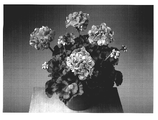
- This new pelargonium plant is illustrated by the accompanying photograph which shows blooms, buds, and foliage of the plant; the colors shown are as true as can be reasonably obtained by conventional photographic procedures.
- the photograph is of and un-pinched plant about 14-weeks-old and grown from rooted cuttings in a 14-cm pot under greenhouse conditions which approximate those generally used in commercial practice.
- ‘Fistarol’ differs from the female parent ‘K92-1044-3’ (unpatented) in that ‘Fistarol’ has semi-double flowers, while ‘K92-1044-3’ has single-type flowers and a more compact growth habit.
- ‘Fistarol’ differs from the male (pollen) parent ‘Fisvita’ (U.S. Plant Pat. No. 15,011) in that ‘Fistarol’ has light red to coral flowers, while ‘Fisvita’ has light salmon and white flowers. Additionally, ‘Fistarol’ has dark-green leaves, while ‘Fisvita’ has medium green leaves.
- ‘Fistarol’ differs from the commercial comparison variety ‘Fisrorose’ (U.S. Plant Pat. No. 12,362) in that the flower color of ‘Fistarol’ has a slightly less bluish hue than ‘Fisrorose’. Additionally, ‘Fistarol’ has dark-green leaves, while ‘Fisrorose’ has medium-green leaves.
- ‘Fistarol’ differs from the commercial comparison variety ‘Americana Coral’ (U.S. Plant Pat. No. 7,934) in that ‘Fistarol’ has dark-green leaves with stronger zonation. while ‘Americana Coral’ has larger, medium-green leaves and a more orange flower color.
Landscapes
- Life Sciences & Earth Sciences (AREA)
- Health & Medical Sciences (AREA)
- Physiology (AREA)
- Botany (AREA)
- Developmental Biology & Embryology (AREA)
- Environmental Sciences (AREA)
- Natural Medicines & Medicinal Plants (AREA)
- Breeding Of Plants And Reproduction By Means Of Culturing (AREA)
Abstract
A new cultivar of Pelargonium particularly characterized by having light red to coral, semi-double flowers with medium-sized inflorescences, dark-green foliage with medium-sized leaves and strong zonation, a vigorous growth habit, a relatively tall, rounded, bushy and tight plant habit and an early to mid-season flowering response, is disclosed.
Description
Genus and species: Pelargonium×hortorum.
Variety denomination: ‘Fistarol’.
The present invention comprises a new and distinct cultivar of Pelargonium, botanically known as Pelargonium×hortorum and hereinafter referred to by the cultivar name ‘Fistarol’. The new cultivar is a product of a planned breeding program which had the objective of creating new varieties having pink flowers, good flower color stability, medium green foliage and vigorous growth. ‘Fistarol’ was discovered as a seedling resulting from a cross between the proprietary female parent ‘K92-1044-3’ (unpatented), a pelargonium having deep salmon-colored flowers and the male parent, ‘Fisvita’ (U.S. Plant Pat. No. 15,011), a pelargonium having light salmon and white semi-double flowers. A single plant selection was chosen for further evaluation and for asexual propagation in 2003.
The new cultivar was created in 2002 in Hillscheid, Germany and has been asexually reproduced repeatedly by vegetative cuttings in Galdar, Gran Canaria, Spain, and Hillscheid, Germany, over a 4-year period. ‘Fistarol’ has not been observed under all possible environmental conditions, thus the phenotype may vary significantly with variations in the environment such as temperature, light intensity and day length. It has been found to retain its distinctive characteristics through successive asexual propagations.
Plant Breeder's Rights for this cultivar were applied for in Germany on Apr. 25, 2006 and in Canada on Apr. 26, 2006.
The following are the most outstanding and distinguishing characteristics of this new cultivar when grown under normal commercial practices in Hillscheid, Germany.
-
- 1. Light red to coral, semi-double flowers;
- 2. Medium-sized inflorescences that are initially short and later are borne well above the foliage;
- 3. Dark-green, nearly round, medium-sized leaves with strong zonation;
- 4. A vigorous growth habit and a relatively tall plant habit;
- 5. A rounded, bushy and moderately tight plant habit; and
- 6. An early to mid-season flowering response.
This new pelargonium plant is illustrated by the accompanying photograph which shows blooms, buds, and foliage of the plant; the colors shown are as true as can be reasonably obtained by conventional photographic procedures. The photograph is of and un-pinched plant about 14-weeks-old and grown from rooted cuttings in a 14-cm pot under greenhouse conditions which approximate those generally used in commercial practice.
The following detailed descriptions set forth the distinctive characteristics of ‘Fistarol’. The data which define these characteristics were collected from asexual reproductions carried out in Hillscheid, Germany. The plant history was taken on 10-week-old, un-pinched plants in 12-cm pots in a greenhouse in mid-May 2006. The color readings were determined under natural light in mid-May from flowers grown in a greenhouse. Color references are to the R.H.S. Colour Chart of The Royal Horticultural Society of London (R.H.S.) (2001).
- Classification:
-
- Botanical.—Pelargonium×hortorum.
- Common name.—Zonal geranium.
-
- Parentage:
-
- Female parent.—‘K92-1044-3’ a proprietary (unpatented) pelargonium having deep salmon-colored flowers.
- Male parent.—‘Fisvita’ (U.S. Plant Pat. No. 15,011) a pelargonium having light salmon and white semi-double flowers.
-
- Plant:
-
- Form.—Shrub, self-branching with a rounded shape.
- Branching habit.—About 4.8 branches per plant.
- Height.—12.0 cm for a 10-week-old plant (measured from base of stem to the tips of the branches, excluding the inflorescences).
- Width.—21.6 cm for a 10-week-old plant.
- Time to produce a finished flowering plant.—In the spring of 2006, about 7 weeks after planting of rooted cuttings, 50% of plants were flowering with at least one open flower.
- Outdoor plant performance.—Plants continuously flower; a flower count in mid-September 2006 in Hillscheid, Germany indicated about 15-18 inflorescences per plant.
-
- Leaves:
-
- Arrangement.—Alternate; opposite at the flowering stems.
- Color, immature leaf.—General: Deep green. Upper surface: RHS 137A to RHS 137B. Lower surface: RHS 137C.
- Color, mature leaf.—General: Dark-green. Upper surface: RHS 137A. Lower surface: RHS 137C to RHS 137D.
- Length.—5.5 cm to 6.0 cm.
- Width.—8.5 cm.
- Zonation color.—RHS 200A to RHS 200B (deep brown), relatively strong.
- Zonation diameter.—Inner diameter of the ring is 4.0 cm to 4.5 cm, the band or belt of zonation is about 1.0 cm to 1.3 cm wide.
- Shape.—Nearly round and only weakly kidney-shaped with nearly no lobes and with an open gap between the lowest lobes.
- Apex.—Rounded.
- Base.—Cordate.
- Margin.—Bi-crenate and somewhat wavy.
- Texture.—Upper surface is dull and velvety.
-
- Petioles:
-
- Length.—Approximately 5.0 cm to 7.0 cm.
- Diameter.—0.3 cm.
- Color.—RHS 143B to RHS 143C (light-green).
- Texture.—Covered with fine pubescence.
-
- Stems:
-
- Length.—6.0 cm to 8.0 cm.
- Internode length.—0.5 cm to 1.5 cm.
- Color.—RHS 143B (green) and infused with RHS 174A (brown) in parts.
- Texture.—Appears smooth, yet covered with very short pubescence.
-
- Flower buds (just before petals unfold):
-
- Length.—1.9 cm.
- Width.—0.9 cm to 1.1 cm.
- Shape.—Elliptical.
- Color of sepals.—RHS 137D (green).
- Color of petals.—RHS 41A to RHS 41B (orange-red).
-
- Inflorescence:
-
- Type.—An umbel composed of about 40 to 60 flowers and buds.
- Umbel diameter.—9.8 cm.
- Umbel depth (height).—5.0 cm to 5.5 cm.
- Umbel shape.—Nearly semi-spherical.
- Lastingness of the umbel on the plant.—About 18 days.
- Peduncle.—Length: 11.6 cm. Diameter: 0.5 cm to 0.6 cm. Texture: Covered with dense, short glandular hair. Color: RHS 138A (light-green) and partly infused with RHS 181A (reddish) anthocyanin.
- Pedicel.—Length: 2.5 cm. Diameter: 0.15 cm. Texture: Covered with very short glandular hair. Color: RHS 144A (green) and the upper part is RHS 181A (reddish).
-
- Corolla:
-
- Form.—Semi-double.
- Diameter.—4.8 cm.
- Depth.—1.5 cm to 2.0 cm.
- General color.—Light carmine red or coral red.
- Shape.—Round outline with the upper and lower petals roughly of the same size and basically flat cup-shaped; the inner petals may be slanting upward or somewhat irregularly directed.
- Number of petals.—6 to 8.
- Petaloids: Present. Number: 0 to 3. Shape: Variable; shorter and narrower than the petals and often folded or twisted. Color: Approximately RHS 43C or RHS 50B. Lastingness of the individual flowers on the plant: 7 to 8 days at 18° C. Fragrance: The umbels are not fragrant but the peduncles, pedicels and sepals when touched, give off an aromatic scent (typical for Pelargonium zonale or Pelargonium×hortorum varieties).
-
- Petals:
-
- Upper petals.—Length: 2.5 cm. Width: 1.7 cm to 1.9 cm. Color: Upper surface: Between RHS 52A and RHS 52B. Lower surface: From RHS 43C to RHS 52C. Markings: No real markings, base of petals have a more salmon hue of RHS 43B to RHS 43C.
- Lower petals.—Length: 2.3 cm. Width: 1.9 cm to 2.1 cm. Color: Upper surface: Between RHS 52A and RHS 52B. Lower surface: Mainly RHS 43C or lighter in parts. Markings: Absent.
- Shape.—Obovate.
- Apex.—Rounded.
- Base.—Broadly acute.
- Margin.—Entire.
- Texture.—Smooth, slightly glossy.
-
- Sepals:
-
- Number.—5.
- Length.—10-11 mm.
- Width.—0.4 cm for the largest upper sepal and 0.3 cm for the other sepals.
- Shape.—Lanceolate.
- Apex.—Acute.
- Base.—Fused.
- Margin.—Entire.
- Texture.—Has short glandular hair.
- Color.—Upper (outer) surface: RSH 144A (light-green). Lower (inner) surface: RHS 144B.
-
- Reproductive organs:
-
- Androecium.—Number of anthers: Most often 5. Filament color: Mainly RHS 49C (pale light-pink). Filament length: 0.7 cm. Pollen color: RHS 24A (light orange). Pollen amount: Moderate (typical).
- Gynoecium.—Pistil number: 1. Pistil length: 0.8 cm. Stigma color: RHS 42A. Stigma shape: 5 to 6 lobed. Style color: RHS 49C (pale pink). Style length: 0.5 cm to 0.6 cm. Style shape: Filiform (filament-like) with the lobes of the stigma at right angles.
-
- Fruit/seed set: No seed set observed.
- Disease and insect resistance: No special observations made; average susceptibility or tolerance (not resistant to diseases and pests common to the species).
‘Fistarol’ differs from the female parent ‘K92-1044-3’ (unpatented) in that ‘Fistarol’ has semi-double flowers, while ‘K92-1044-3’ has single-type flowers and a more compact growth habit.
‘Fistarol’ differs from the male (pollen) parent ‘Fisvita’ (U.S. Plant Pat. No. 15,011) in that ‘Fistarol’ has light red to coral flowers, while ‘Fisvita’ has light salmon and white flowers. Additionally, ‘Fistarol’ has dark-green leaves, while ‘Fisvita’ has medium green leaves.
‘Fistarol’ differs from the commercial comparison variety ‘Fisrorose’ (U.S. Plant Pat. No. 12,362) in that the flower color of ‘Fistarol’ has a slightly less bluish hue than ‘Fisrorose’. Additionally, ‘Fistarol’ has dark-green leaves, while ‘Fisrorose’ has medium-green leaves.
‘Fistarol’ differs from the commercial comparison variety ‘Americana Coral’ (U.S. Plant Pat. No. 7,934) in that ‘Fistarol’ has dark-green leaves with stronger zonation. while ‘Americana Coral’ has larger, medium-green leaves and a more orange flower color.
Claims (1)
1. A new and distinct cultivar of Pelargonium plant as shown and described herein.
Priority Applications (1)
| Application Number | Priority Date | Filing Date | Title |
|---|---|---|---|
| US11/803,252 USPP19075P2 (en) | 2007-05-14 | 2007-05-14 | pelargonium plant named ‘Fistarol’ |
Applications Claiming Priority (1)
| Application Number | Priority Date | Filing Date | Title |
|---|---|---|---|
| US11/803,252 USPP19075P2 (en) | 2007-05-14 | 2007-05-14 | pelargonium plant named ‘Fistarol’ |
Publications (1)
| Publication Number | Publication Date |
|---|---|
| USPP19075P2 true USPP19075P2 (en) | 2008-08-05 |
Family
ID=39670938
Family Applications (1)
| Application Number | Title | Priority Date | Filing Date |
|---|---|---|---|
| US11/803,252 Active USPP19075P2 (en) | 2007-05-14 | 2007-05-14 | pelargonium plant named ‘Fistarol’ |
Country Status (1)
| Country | Link |
|---|---|
| US (1) | USPP19075P2 (en) |
-
2007
- 2007-05-14 US US11/803,252 patent/USPP19075P2/en active Active
Similar Documents
| Publication | Publication Date | Title |
|---|---|---|
| USPP19058P2 (en) | Pelargonium plant named ‘Fistansal’ | |
| USPP19075P2 (en) | pelargonium plant named ‘Fistarol’ | |
| USPP16934P2 (en) | Pelargonium plant named ‘Fishelus’ | |
| USPP14456P2 (en) | Geranium plant named ‘Fiscaseye’ | |
| USPP12455P2 (en) | Geranium plant named ‘Balfancori’ | |
| USPP16976P2 (en) | Pelargonium plant named ‘Fislore’ | |
| USPP10635P (en) | Geranium plant named `Flofetti` | |
| USPP19076P2 (en) | Pelargonium plant named ‘Fisrolamon’ | |
| USPP18383P2 (en) | Pelargonium plant named ‘Fisnow’ | |
| USPP18081P2 (en) | Pelargonium plant named ‘Cante Laver’ | |
| USPP18973P2 (en) | Pelargonium plant named ‘Fisrello’ | |
| USPP16933P2 (en) | Pelargonium plant named ‘Fisroccal’ | |
| USPP13195P3 (en) | Geranium plant named ‘Fisblufort’ | |
| USPP18722P2 (en) | Pelargonium plant named ‘Fisropink ’ | |
| USPP18749P2 (en) | Pelargonium plant named ‘Fisprit’ | |
| USPP16891P2 (en) | Pelargonium plant named ‘Fisorangtan’ | |
| USPP16974P2 (en) | Pelargonium plant named ‘Fisroweiss’ | |
| USPP12406P2 (en) | Geranium plant named ‘Fisgopi’ | |
| USPP13185P3 (en) | Geranium plant named ‘Fisdapi’ | |
| USPP13249P3 (en) | Geranium plant named ‘Fisrobrav’ | |
| USPP13190P3 (en) | Geranium plant named ‘Fistwi’ | |
| USPP18700P2 (en) | Pelargonium plant named ‘Gradosal’ | |
| USPP18721P2 (en) | Pelargonium plant named ‘Gramon ’ | |
| USPP18695P2 (en) | Pelargonium plant named ‘Gradored’ | |
| USPP16892P2 (en) | Pelargonium plant named ‘Fismopink’ |