USPP1802P - Poinsettia plant - Google Patents
Poinsettia plant Download PDFInfo
- Publication number
- USPP1802P USPP1802P US PP1802 P USPP1802 P US PP1802P
- Authority
- US
- United States
- Prior art keywords
- bracts
- plant
- color
- pale
- poinsettia
- Prior art date
Links
- 240000002395 Euphorbia pulcherrima Species 0.000 title description 13
- 241000196324 Embryophyta Species 0.000 description 11
- 239000011521 glass Substances 0.000 description 4
- 241000208341 Hedera Species 0.000 description 2
- UUTKICFRNVKFRG-WDSKDSINSA-N Pidotimod Chemical compound OC(=O)[C@@H]1CSCN1C(=O)[C@H]1NC(=O)CC1 UUTKICFRNVKFRG-WDSKDSINSA-N 0.000 description 1
- 229940003694 Ultiva Drugs 0.000 description 1
- 230000011681 asexual reproduction Effects 0.000 description 1
- 239000003086 colorant Substances 0.000 description 1
- 230000002349 favourable Effects 0.000 description 1
- 230000004720 fertilization Effects 0.000 description 1
- 238000010438 heat treatment Methods 0.000 description 1
- 238000002156 mixing Methods 0.000 description 1
- 230000002093 peripheral Effects 0.000 description 1
- WFBMIPUMYUHANP-UHFFFAOYSA-N remifentanil hydrochloride Chemical compound [Cl-].C1C[NH+](CCC(=O)OC)CCC1(C(=O)OC)N(C(=O)CC)C1=CC=CC=C1 WFBMIPUMYUHANP-UHFFFAOYSA-N 0.000 description 1
- 238000009877 rendering Methods 0.000 description 1
- 230000033458 reproduction Effects 0.000 description 1
- 239000011122 softwood Substances 0.000 description 1
- 101700082413 tant Proteins 0.000 description 1
Images
Definitions
- Claim. (Cl. 47-60) .
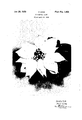
- the subject of the present invention or discovery is a new and distinct variety of poinsettia plant. (Euphorbia pulcherrima) originating as a"c'ultiva ted sport.
- this newvariety ofpoinsettia plant is distinguishable from its parent plant, as 'well as from other known varieties, mainly in the shape,- color and arrangement of the bracts which are predominantlya pale greenish tint of creamy. white..color, and. of substantially The, :colors referredj to inj the color tabulation; herein orrespon ub tant al y-wi hth sesh wn Di t ary of Color by Maerz and 'Paul (first edition, 1930.);and are more particularly identified by the color plate of said color standard by recapitulationg in tabular form herein.
- Z The following is a detailed description of this new variety of poinsettia pl'ant.
- time temperature being warmer-and subject to the varying conditions of light, heating, thickness of glass, cultivation, character 'ofsoil,- "fertilizen and pruning; 0r
- foliage leayestare arrapgeduargund the peduncle, the. nodes being more closely :spa d; than usual.
- foliageuleavesiarenofientirely o-rnpginshape the foliageuleavesiarenofientirely o-rnpginshape, but may be describedzas; generallypyat and having, points at the edges towarduthenoutergrengil They; have herringbone venation.
- the color of the foliage leaves may be broadly described as dark ivy green.
- the large bracts, in planar contour, are elongated and prolately ovate-.accuminate; they are numerically greater in number of individual bracts than any of the known varieties of white poinsettias which have broad prolately
- This new'variety of oinsettia" plant has been asexually reproduced and cultivated by me in my said greenhouse or glass house by cuttings, and successive reproductions thereof have remained true to type and the herein describedcharacteristics through the propagation, cultivation and asexual reproduction of several generations of this new variety, and it 'has shown its qualities and characteristics to be permanently fixed. producing this new variety I have found it satisfactory and efficient to cut pieces of stalk of soft Wood substan- In asexually revidual pots. My experience has been thatfthe optimum.
- the bracts maybe generally and broadly described as predominantly a pale greenish tint of creamy white with some, but .not all, of the bracts having a pale greenish-yellow tint of creamy white in the outer terminalend portion of their. planar area, and a'pale green tint to the peripheral edge portionof the bracts, as said coloration is more particularly describedin the color tabulation below.
- the venation of the bracts is of the herringbone type.
- a node is formed at the upper axial end of each main stalk'or peduncle from which the bract-bearing branches or spurs grow upwardly and expansively apart, being usually three in number, and upon these branches or spurs grow a plurality of flower cyathia on short sub-acaulescent stems.
- Each cyathium is cup-like and contains a single pistillate flower surrounded by numerous staminate flowers, the pistillate flower pushing upward to the top where the stigma is spread for polination.
- the cyathia are a pale green color at their base, blending into a pale yellow at the opening of the cup.
- Petioles 0i hmr-t do at -e- -llight tint of pale t 19 K p ,6
Family
ID=
Similar Documents
| Publication | Publication Date | Title |
|---|---|---|
| USPP1802P (en) | Poinsettia plant | |
| USPP34709P2 (en) | Spathiphyllum wallisii plant named ‘Lucia’ | |
| USPP1780P (en) | Poinsettia plant | |
| USPP32723P2 (en) | Betula tree named ‘STN-01’ | |
| USPP2243P (en) | Poinsettia plant | |
| USPP2260P (en) | Poinsettia plant | |
| USPP33040P2 (en) | Paulownia tree named ‘WEGROW-B7’ | |
| USPP2261P (en) | Poinsettia plant | |
| USPP2398P (en) | Poinsettia plant | |
| USPP32333P2 (en) | Sansevieria plant named ‘Spearmint’ | |
| USPP3207P (en) | Apbican violet | |
| USPP1871P (en) | greene | |
| USPP32153P2 (en) | Crocosmia plant named ‘Fire Starter’ | |
| USPP3305P (en) | Carnation | |
| USPP1055P (en) | Poinsettia plant | |
| USPP1779P (en) | Poinsettia plant | |
| US20230172088P1 (en) | SANSEVIERIA PLANT NAMED "Pheasant Tail" | |
| USPP242P (en) | Poinsettia | |
| USPP1068P (en) | Poinsettia plant | |
| USPP1207P (en) | Poinsettia plant | |
| USPP27073P3 (en) | Dracaena plant named ‘EVE’ | |
| USPP19959P2 (en) | Cordyline plant named ‘Pink Joy’ | |
| USPP3206P (en) | Koltkamp | |
| USPP14081P3 (en) | Gladiolus plant named ‘Prissy's Purple’ | |
| USPP3099P (en) | Poinsettia plant |