US999968A - Spanner-wrench. - Google Patents
Spanner-wrench. Download PDFInfo
- Publication number
- US999968A US999968A US58136210A US1910581362A US999968A US 999968 A US999968 A US 999968A US 58136210 A US58136210 A US 58136210A US 1910581362 A US1910581362 A US 1910581362A US 999968 A US999968 A US 999968A
- Authority
- US
- United States
- Prior art keywords
- wrench
- nut
- jaw
- face
- facet
- Prior art date
- Legal status (The legal status is an assumption and is not a legal conclusion. Google has not performed a legal analysis and makes no representation as to the accuracy of the status listed.)
- Expired - Lifetime
Links
Images

Classifications
-
- B—PERFORMING OPERATIONS; TRANSPORTING
- B25—HAND TOOLS; PORTABLE POWER-DRIVEN TOOLS; MANIPULATORS
- B25B—TOOLS OR BENCH DEVICES NOT OTHERWISE PROVIDED FOR, FOR FASTENING, CONNECTING, DISENGAGING, OR HOLDING
- B25B13/00—Spanners; Wrenches
- B25B13/02—Spanners; Wrenches with rigid jaws
- B25B13/08—Spanners; Wrenches with rigid jaws of open jaw type
Definitions
- My invention relates broadlyto spanner wrenches and particularly to that type known as a ratcheting wrench so"proportioned and designed that it is unnecessary to remove the wrench from the nut in order to obtain a fresh hold upon a new face, the wrench tending to grip the nut only when rotated in one direction.
- My invention provides a wrench of this class, the jaws of which .are peculiarly welladapted'rfor the reception of a series of nuts without adjust ment, and so designed that theirfaces contact with the faces of the nuts gripped.
- a specific feature of my invention is the provision of a number of independent serrated jaws, attachable to and detachable from the handle and fixed jaw. By this means an almost unlimited series of nuts canbe accommodated in a single wrench.
- Figure 1 is a side elevation of my improved wrench
- Fig. 2 is a bottom view thereof
- Fig. 3 is a view similar to Fig. 2, showing a modification
- Fig. 4 is a view similar to Fig. 1,
- Fig. 5 is a diagram natic view of one end of the wrench engaging a nut
- Fig. 6 1s a similar view of a modification
- Fig. 7 is a diagrammatic view illustrating-the action ofthe wrench in rotating to the nut
- Fig. 8 is a .diagrammaticview illus- "trating the ratcheting action of the wrench.
- the numeral 1 designates a wrench having the two ends 2 and 3 provided, respectively, with jaws 4 and 5, and 6 and 7.
- the jaws 4 and 7 are provided, respectively, with i'nternal curvilinear faces 8 and 9, while upon formed a series ofirests.
- a These rests comprise a series of faces 10 ,having the same general direction as the axis'of the wrench,
- the proportions must be such that when the direction of rotation of the wrench is reversed, 2 S Shown by the ar- 110 FBI row in Fig. 8, the wrench will then slide on the two points of contact, as 13 and 14', and in this case the effective radius of rotation must be sufficient to permit the opposite or curved jaw to clear the opposite corner of the nut, as there illustrated.
- 2 S Shown by the ar- 110 FBI row in Fig. 8 the wrench will then slide on the two points of contact, as 13 and 14', and in this case the effective radius of rotation must be sufficient to permit the opposite or curved jaw to clear the opposite corner of the nut, as there illustrated.
- To accomplish this efiect it is necessary to make the first rest of each pair short. This does not, however, interfere with the operation,
- Fig. t illustrates a wrench similar in all respects to the wrench which I have described with; the exception that it is designed for use with square nuts instead of hexagonal.
- Fig. 6 I have illustrated a modification wherein the aw having the rectilinear rests is made removable. I find that by providing a number of jaws having rectilinear rests of various desigml can accommodate alarge series of nuts, both square and hexagonal, in a wrench having a single fixed curved jaw. To illustrate this feature of advantage more clearly, the fixed jaw is shown in Fig. 6 as having exactly the same curvature as the curvilinear face of Fig. 5, but I have provided the wrench of Fig. 6 with a removable jaw in which the rectilinear rests are slightly modified so as to accommodate a series of square nuts in place of the hexagonal nuts. The dotted line 16 indicates how this wrench might be equipped with a removable jaw having the same configuration as the righthand jaw of the wrench of Fig. 5. It would then perform all the functions of that Wrench as efficiently as does that structure.
- a wrench for accommodating nuts of diiferentsizes having a jaw with a convexly curved face adapted to engage a facet of the nut to be operated, between the corners thereof, and a second jaw having a plurality of substantially plane grip faces, each adapted to engage a nut of appropriate size upon a facet diametrically opposite to the nut facet engaged by the curved face of the first jaw, each of said grip faces on said second jaw being substantially arallel to the tangent to the curved jaw ace at the point of engagement of said jaw face with a facet of that nut with which the corresponding grip face is adapted to engage.
- a wrench for accommodating nuts of different sizes having a. jaw with a convexly curved face adapted to engage a facet of the nut to be operated, between the corners thereof, and 'ata point beyond, in the direction in which the nut is to be rotated, the line of intersection of a plane passing through the axis of rotation ofsaid nut and.
- A. wrench for accommodating nuts of difl erent sizes having a jaw with a convexly curved face adapted to engage a facet of the nut to be operated, between the corners thereof, and a second jaw having a plurality of substantially plane grip faces, each adapted to engageanut of appropriate size upon a facet diametrically opposite to the nut facet engaged by the curved face of the first jaw, each of said grip faces on said second jaw being substantially parallel to the tangent to the curved jaw face at the point of en gagement of said jaw face with a facet of that nut with which the corresponding grip face is adapted to engage, said curved jawface and grip face engaging their respective.
- nut facets at points located upon opposite sides of a line passing through the center.
- a wrench for accommodatin nuts of different sizes having a jaw wit a convexlycurved face adapted to engage a facet of the nut to be operated, between the corners thereof, and a second jaw having a p1u rality of rests comprising substantially plane grip faces and transverse faces, each grip face adapted to engage a nut of appropriate size upon a facet diametricallyoposite to the nut facet engaged by the curved ace of the first jaw, each of said grip faces on said second jaw being substantially parallel to the tangent to the curved jaw face at the point of engagement of said jaw face with a facet of that nut with which the corresponding grip face isadapted to engage, the transverse faces of said rests being disposed to the corresponding grip faces at angles equal to the angles between adjacent facets of the nuts to be received by the rests, whereby adjacent facets of said nuts will be closely engaged by said rests.
- a wrench for accommodating nuts of different sizes having a jaw with a convexly curved face adapted to engage a facet of the nut. to be operated, between the corners thereof, and a second jaw having a plurality of substantially. plane grip faces, each adapted to engage a nut of appropriate size upon'a facet diametrically opposite to the .nut face-t engaged by the curved face of the first jaw, each of said grip faces on said second jaw being substantially parallel to the tangent to the curved jaW face at the point of engagement of said jaw face with a facet of that nut with which the corresponding grip face is adapted to engage, the proportions of said aws being such that the wrench will rotate freely about the nut in one direction.
- a wrench for accommodating nuts of different sizes having a jaw with a convexly curved face adapted'to engage a facet ofjthe nut to be operated aremovable jaw having a plurality of substantially plane grip faces, each adapted to engage a nut of appropriate size upon afacet diametrically opposite to the nut facet engaged by the curved face of the first jaw, each of said grip faces on said second jaw being substantially parallel to the tangent to the curved jaw face at the point ofengagement of said jaw face with a facet of that nut with which the corresponding grip face is adapted to engage, and means for detachably securing said removable jaw to said wrench.
- a wrench for accommodating nuts of different sizes having a jaw with a single face adapted to engage a facet of a nut of any of the sizes which the wrench is designed to operate, and a second jaw having a plurality of rests, each comprising a substantially plane grip face adapted to engage a nut of appropriate size upon a facet diametrically opposite' to the nut facet engaged by the face ofthe first jaw, and a substantially plane transverse face disposed at an angle to the corresponding grip face equal to the angle between adjacent facets of the nut to be received by said grip and transverse faces, whereby said transverse.
- a wrench having a a'w with a convexly curved face adapted to engage a facetjofa nut between the corners thereof, and a second jaw having a substantially plane grip face adapted to engage a diametrically 0pposite facet of the nut, said grip face being substantially parallel to the tangent to the-1 curved aw face at the point of engagement of said jaw face with the nut facet, said curved jaw face and grip face engaging their respective nut facets at points located upon opposite sides of a line passing through F.
Landscapes
- Engineering & Computer Science (AREA)
- Mechanical Engineering (AREA)
- Details Of Spanners, Wrenches, And Screw Drivers And Accessories (AREA)
Description
B. A. DENHAM.
SPANNER WRENCH.
APPLICATION FILED SEPT. 10, 1910.
999,968. Patented Aug. 8,1911.
2 SHEETS-SHEET 1.
5 Q FIGTi.
WITNESSES: I I
INVENTOR KM/M E. A. DENHAM.
SPANNEB. WRENCH.
APILIGATION FILED SEPT. 10. 1910.
999,968, Patented Aug. 8,1911.
2 SHEETS-SHEET 2. l 'I G. 5.
WITNESSES:
g VENTOR ATTORNEY UNITED STATES PATENT OFFICE.
EDWIN A. DENHAJ E, OF YORK, N. Y., ASSIGNOB TO THE ,EBIE WRENCH COMPANY, OF NEW YORK, N. Y., A-COBPORATIQN OF NEW YORK.
srannnnrwnnncn.
Patented Aug. 8, 1911.
.lpplication filcd September 10,1910. Serial No'. 531,862.
To all whom it my concmn:
Be it known thatI, EDWIN A. Damn, a c tizen of the United States, residing in the city, county, and State of New York, have invented certain new and useful Improvements in Spanner-Wrenches, of which the following is a specification. I
My invention relates broadlyto spanner wrenches and particularly to that type known as a ratcheting wrench so"proportioned and designed that it is unnecessary to remove the wrench from the nut in order to obtain a fresh hold upon a new face, the wrench tending to grip the nut only when rotated in one direction. My invention provides a wrench of this class, the jaws of which .are peculiarly welladapted'rfor the reception of a series of nuts without adjust ment, and so designed that theirfaces contact with the faces of the nuts gripped.
' A specific feature of my invention is the provision of a number of independent serrated jaws, attachable to and detachable from the handle and fixed jaw. By this means an almost unlimited series of nuts canbe accommodated in a single wrench.
One grbat objection to ratchet wrenches of the fixed jaw type has been their tendency to grip the corners instead of the facesof the nuts. In order to minimize mutilation of the corners of the nuts it has heretofore. been necessary to make the wrench of heavy stock, generally forged. Since my wrench when in operative position is always inengagement. with a substantial area of the.
faces of the nut instead of the corners there: of, I find it possible to construct the wrench of thin stock, at a much lower cost than that of a forged-wrench. Thus a doubleended wrench can readily be made to fit as many as six or eight nuts without alteration,
and by the replaceable jaw hereafter de-.
scribed,- an extended seriesof-nuts may be accommodated. By my novel construction I am further enabled to make a multiple wrench having all the manifold advantages of the so-called ratchet type at a costno greater than that of an accurately made spanner wrench of prior type.- 2
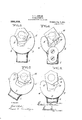
In the accompanying drawings which form a part of this specification, Figure 1 is a side elevation of my improved wrench; Fig. 2 is a bottom view thereof; Fig. 3 is a view similar to Fig. 2, showing a modification; Fig. 4 is a view similar to Fig. 1,
the inner faces of the jaws 5 and 6 are requirement that the point of tangency. be-
showinga modification; Fig. 5 is a diagram natic view of one end of the wrench engaging a nut; Fig. 6 1s a similar view of a modification; Fig. 7 is a diagrammatic view illustrating-the action ofthe wrench in rotating to the nut; Fig. 8 is a .diagrammaticview illus- "trating the ratcheting action of the wrench.
about anut. I
Referring to the drawings in detail, the numeral 1 designates a wrench having the two ends 2 and 3 provided, respectively, with jaws 4 and 5, and 6 and 7. The jaws 4 and 7 are provided, respectively, with i'nternal curvilinear faces 8 and 9, while upon formed a series ofirests. A These rests comprise a series of faces 10 ,having the same general direction as the axis'of the wrench,
ut eachbearing a different angular rela-' tion thereto, which faces maybe'tenned'the longitudinal faces or grips.'- .Intersecting these faces at adefinite:aiigle,, depending upon the character of thenut forwl iich thewrench is designed, is a. second series of faces 11, which" may be termed the transverse faces. The angle between any transverse "face and its corresponding adjacentlongitudinal face will be degrees in case the wrench is designed for use with square nuts, and will, be 120 degrees in case the wrench-is designed for' use with. hexagonal nuts. The curvature offtthe faces. 4 and '7 and theangular' relation ofa'n'y pair of rests to the next pair are'mutually dependent, as
is best illustrated in the diagrammatic Figs. so
5, .7;- and 8.1 In designing a multiple wrench in which no ratcheting action is desired, it
would be only necessary to have the curvature ofthe faces 4- and 7 conform to the tween the curve and the nut, two of whose faces engage a pair of rests shall .lie above the axis of the nut with relation to the two particularfaces then in engagementjwith the other jaw. of the-wrench. To rotate a nut it is necessary to impress a couple upon it; that is, two equal, and opposite forces acting at equal distances from the center of rotation,- and the described structure accomplishes this-result,*as illustrated in Fig. 7. When it is also desired that the multiple wrench should be so designed as to have a ratcheting efiect, the proportions must be such that when the direction of rotation of the wrench is reversed, 2 S Shown by the ar- 110 FBI row in Fig. 8, the wrench will then slide on the two points of contact, as 13 and 14', and in this case the effective radius of rotation must be sufficient to permit the opposite or curved jaw to clear the opposite corner of the nut, as there illustrated. To accomplish this efiect it is necessary to make the first rest of each pair short. This does not, however, interfere with the operation,
t since the effective force at that side in any case is all applied below the axis 15 of the nut, as shown in Fig. 7. Therefore, by designing my wrench'so that tangents to the curvilinear face at such a distance from one of the longitudinal rests as will just admit a nut, will be parallel to such rests, I am enabled to construct a wrench combining the desirable characteristics of the multiple wrench, with those of the ratchet Wrench. I find that I can readily make a wrench to accommodate as many as three or four different sizes of nuts in one pair of jaws, as illustrated in full and dotted lines of Fig. 5, withoutdeparting from a design which will give adequate strength to the wrench and at the same time be readily manufactured.
It is obvious that my invention may be applied with equal facility either to square, hexagonal or other shaped nuts.
Fig. t illustrates a wrench similar in all respects to the wrench which I have described with; the exception that it is designed for use with square nuts instead of hexagonal.
In Fig. 6 I have illustrated a modification wherein the aw having the rectilinear rests is made removable. I find that by providing a number of jaws having rectilinear rests of various desigml can accommodate alarge series of nuts, both square and hexagonal, in a wrench having a single fixed curved jaw. To illustrate this feature of advantage more clearly, the fixed jaw is shown in Fig. 6 as having exactly the same curvature as the curvilinear face of Fig. 5, but I have provided the wrench of Fig. 6 with a removable jaw in which the rectilinear rests are slightly modified so as to accommodate a series of square nuts in place of the hexagonal nuts. The dotted line 16 indicates how this wrench might be equipped with a removable jaw having the same configuration as the righthand jaw of the wrench of Fig. 5. It would then perform all the functions of that Wrench as efficiently as does that structure.
Because of the fact that my improved wrench does not tend to mutilate the corners of the nuts, buthas surface contact throughout its operation, I am enabled :to' use a thin wrench such as is illustrated in Fig. 3, which may be identical, so far as the configuration of the jaws is concerned, with any of the wrenches illustrated in the other figures, but which is made of comparatively eaaeee thin stock, which may be stamped or punched-instead of forged. In all cases the design m'ust'be such that the tangents to the curve at the point where the nut strikes it must be parallel to one of the faces of the rest receivingthat nut.
While I have illustrated several modifica tions of my improved device, my features of inventionarc capable of extended application, and I do not wish to be limited to the specific structures shown and described.
"Having thus described my invention, I claim:
1. A wrench for accommodating nuts of diiferentsizes having a jaw with a convexly curved face adapted to engage a facet of the nut to be operated, between the corners thereof, and a second jaw having a plurality of substantially plane grip faces, each adapted to engage a nut of appropriate size upon a facet diametrically opposite to the nut facet engaged by the curved face of the first jaw, each of said grip faces on said second jaw being substantially arallel to the tangent to the curved jaw ace at the point of engagement of said jaw face with a facet of that nut with which the corresponding grip face is adapted to engage.'
2. A wrench for accommodating nuts of different sizes having a. jaw with a convexly curved face adapted to engage a facet of the nut to be operated, between the corners thereof, and 'ata point beyond, in the direction in which the nut is to be rotated, the line of intersection of a plane passing through the axis of rotation ofsaid nut and. normal to the plane of said facet, with the plane of said facet, and a second jaw having a pinrality of substantially plane grip faces, each adapted to engage a nut of appropriate size upon a facet diametrically opposite to the nut facet engaged by the curved face of the first jaw, each of said grip faces on said second jaw-being substantially parallel to the tangent to the curved jaw face at the point of engagement of said jaw face with a facet of that nut with which the corresponding grip face is adapted to engage.
3. A. wrench for accommodating nuts of difl erent sizes having a jaw with a convexly curved face adapted to engage a facet of the nut to be operated, between the corners thereof, and a second jaw having a plurality of substantially plane grip faces, each adapted to engageanut of appropriate size upon a facet diametrically opposite to the nut facet engaged by the curved face of the first jaw, each of said grip faces on said second jaw being substantially parallel to the tangent to the curved jaw face at the point of en gagement of said jaw face with a facet of that nut with which the corresponding grip face is adapted to engage, said curved jawface and grip face engaging their respective. nut facets at points located upon opposite sides of a line passing through the center. of
rotation of the nut and normal to the planes of said facets.
4. A wrench for accommodatin nuts of different sizes having a jaw wit a convexlycurved face adapted to engage a facet of the nut to be operated, between the corners thereof, and a second jaw having a p1u rality of rests comprising substantially plane grip faces and transverse faces, each grip face adapted to engage a nut of appropriate size upon a facet diametricallyoposite to the nut facet engaged by the curved ace of the first jaw, each of said grip faces on said second jaw being substantially parallel to the tangent to the curved jaw face at the point of engagement of said jaw face with a facet of that nut with which the corresponding grip face isadapted to engage, the transverse faces of said rests being disposed to the corresponding grip faces at angles equal to the angles between adjacent facets of the nuts to be received by the rests, whereby adjacent facets of said nuts will be closely engaged by said rests.
5. A wrench for accommodating nuts of different sizes having a jaw with a convexly curved face adapted to engage a facet of the nut. to be operated, between the corners thereof, and a second jaw having a plurality of substantially. plane grip faces, each adapted to engage a nut of appropriate size upon'a facet diametrically opposite to the .nut face-t engaged by the curved face of the first jaw, each of said grip faces on said second jaw being substantially parallel to the tangent to the curved jaW face at the point of engagement of said jaw face with a facet of that nut with which the corresponding grip face is adapted to engage, the proportions of said aws being such that the wrench will rotate freely about the nut in one direction. j
6. A wrench for accommodating nuts of different sizes having a jaw with a convexly curved face adapted'to engage a facet ofjthe nut to be operated, aremovable jaw having a plurality of substantially plane grip faces, each adapted to engage a nut of appropriate size upon afacet diametrically opposite to the nut facet engaged by the curved face of the first jaw, each of said grip faces on said second jaw being substantially parallel to the tangent to the curved jaw face at the point ofengagement of said jaw face with a facet of that nut with which the corresponding grip face is adapted to engage, and means for detachably securing said removable jaw to said wrench.
7. A wrench for accommodating nuts of different sizes having a jaw with a single face adapted to engage a facet of a nut of any of the sizes which the wrench is designed to operate, and a second jaw having a plurality of rests, each comprising a substantially plane grip face adapted to engage a nut of appropriate size upon a facet diametrically opposite' to the nut facet engaged by the face ofthe first jaw, and a substantially plane transverse face disposed at an angle to the corresponding grip face equal to the angle between adjacent facets of the nut to be received by said grip and transverse faces, whereby said transverse. face will engage a facet of said nut adjacent to that engaged by the cor-responding grip face, said first jaw face and said grip face engaging their respective nut facets at points located upon opposite sides of a line passing through the center'of rotation of the nut and normal to the planes of said facets, the parts being so proportioned that the wrench will rotate freely'about the nut in one direction.
8. A wrench having a a'w with a convexly curved face adapted to engage a facetjofa nut between the corners thereof, and a second jaw having a substantially plane grip face adapted to engage a diametrically 0pposite facet of the nut, said grip face being substantially parallel to the tangent to the-1 curved aw face at the point of engagement of said jaw face with the nut facet, said curved jaw face and grip face engaging their respective nut facets at points located upon opposite sides of a line passing through F. G. NAGLE, J. J. MCMAHON.
Priority Applications (1)
| Application Number | Priority Date | Filing Date | Title |
|---|---|---|---|
| US58136210A US999968A (en) | 1910-09-10 | 1910-09-10 | Spanner-wrench. |
Applications Claiming Priority (1)
| Application Number | Priority Date | Filing Date | Title |
|---|---|---|---|
| US58136210A US999968A (en) | 1910-09-10 | 1910-09-10 | Spanner-wrench. |
Publications (1)
| Publication Number | Publication Date |
|---|---|
| US999968A true US999968A (en) | 1911-08-08 |
Family
ID=3068295
Family Applications (1)
| Application Number | Title | Priority Date | Filing Date |
|---|---|---|---|
| US58136210A Expired - Lifetime US999968A (en) | 1910-09-10 | 1910-09-10 | Spanner-wrench. |
Country Status (1)
| Country | Link |
|---|---|
| US (1) | US999968A (en) |
Cited By (5)
| Publication number | Priority date | Publication date | Assignee | Title |
|---|---|---|---|---|
| US2671368A (en) * | 1951-03-12 | 1954-03-09 | Diebold Fritz | Wrench, including movable or stationary jaws |
| US2907243A (en) * | 1958-01-07 | 1959-10-06 | Mently M Maclean | Slidable jaw face, open-end wrench |
| US3916735A (en) * | 1973-12-17 | 1975-11-04 | Johnson Paul H | Adjustable multiple purpose ratcheting wrench |
| WO2000027594A1 (en) * | 1998-11-09 | 2000-05-18 | Blacklock Gordon D | Multi-sized, reversible ratcheting action open end wrench |
| US20060266164A1 (en) * | 2005-05-31 | 2006-11-30 | Hua Gao | Open-ended ratcheting wrench having adjusting mechanism |
-
1910
- 1910-09-10 US US58136210A patent/US999968A/en not_active Expired - Lifetime
Cited By (6)
| Publication number | Priority date | Publication date | Assignee | Title |
|---|---|---|---|---|
| US2671368A (en) * | 1951-03-12 | 1954-03-09 | Diebold Fritz | Wrench, including movable or stationary jaws |
| US2907243A (en) * | 1958-01-07 | 1959-10-06 | Mently M Maclean | Slidable jaw face, open-end wrench |
| US3916735A (en) * | 1973-12-17 | 1975-11-04 | Johnson Paul H | Adjustable multiple purpose ratcheting wrench |
| WO2000027594A1 (en) * | 1998-11-09 | 2000-05-18 | Blacklock Gordon D | Multi-sized, reversible ratcheting action open end wrench |
| US6276240B1 (en) * | 1998-11-09 | 2001-08-21 | Gordon D. Blacklock | Multi-sized, reversible ratcheting action open end wrench |
| US20060266164A1 (en) * | 2005-05-31 | 2006-11-30 | Hua Gao | Open-ended ratcheting wrench having adjusting mechanism |
Similar Documents
| Publication | Publication Date | Title |
|---|---|---|
| US10596685B2 (en) | Engaging portion for a hand tool | |
| TWI878650B (en) | Anti-slip torque tool | |
| ES2895766T3 (en) | Multi-Grip Allen Bit | |
| US8056448B2 (en) | Multi-size wrench | |
| US2712259A (en) | Open ended ratchet wrench | |
| US4367664A (en) | Combination tool | |
| US3931749A (en) | Reversible self-retaining ratcheting wrench | |
| US6131492A (en) | Fixed wrench | |
| US3695124A (en) | Wrench head | |
| US2421665A (en) | Steel barrel plug wrench | |
| US2334069A (en) | Spanner wrench | |
| US20110259158A1 (en) | Dual Hex Pattern Wrench | |
| US1802832A (en) | End wrench | |
| US2028406A (en) | Double jaw wrench | |
| US3252359A (en) | Open end wrench | |
| US3955450A (en) | Adjustable wrench for torqueing and ratcheting a symmetrical polygon member | |
| US20160288300A1 (en) | Combination wrench | |
| US2697372A (en) | Slidable jaw insert for crescent head wrenches | |
| US1626809A (en) | Open-end wrench | |
| TWM554037U (en) | Fitting part structure of hand tool | |
| US7024967B1 (en) | Ratchet wheel structure | |
| US20210046617A1 (en) | Adaptable wrench for damage fastener engagement head | |
| US2704004A (en) | Jaw construction for a slidable side jaw wrench | |
| US4534245A (en) | Tight-grip wrench | |
| CN202943565U (en) | a wrench |