US9980929B2 - Trifluoromethylpropanamide derivatives - Google Patents
Trifluoromethylpropanamide derivatives Download PDFInfo
- Publication number
- US9980929B2 US9980929B2 US15/683,341 US201715683341A US9980929B2 US 9980929 B2 US9980929 B2 US 9980929B2 US 201715683341 A US201715683341 A US 201715683341A US 9980929 B2 US9980929 B2 US 9980929B2
- Authority
- US
- United States
- Prior art keywords
- optionally substituted
- phenyl
- trifluoro
- methyl
- oxopentan
- Prior art date
- Legal status (The legal status is an assumption and is not a legal conclusion. Google has not performed a legal analysis and makes no representation as to the accuracy of the status listed.)
- Expired - Fee Related
Links
- 0 [1*]C([2*])(C(=O)C(F)(F)F)N([3*])C(=O)C([4*])([5*])N([6*])C([7*])=O Chemical compound [1*]C([2*])(C(=O)C(F)(F)F)N([3*])C(=O)C([4*])([5*])N([6*])C([7*])=O 0.000 description 13
- NXTBTQXWDNMQRY-XZOYJPPVSA-N CC(C)[C@H](CC(=O)[C@H](CC1=CC=CC=C1)NC(=O)CCC1=CC(Cl)=C(Cl)C=C1)[C@H](O)C(F)(F)F Chemical compound CC(C)[C@H](CC(=O)[C@H](CC1=CC=CC=C1)NC(=O)CCC1=CC(Cl)=C(Cl)C=C1)[C@H](O)C(F)(F)F NXTBTQXWDNMQRY-XZOYJPPVSA-N 0.000 description 2
- HKUANCXNAVXUPS-UHFFFAOYSA-N COC1=CC=C(C(CC2=CC=C(Cl)C=C2)C(=O)O)C=C1 Chemical compound COC1=CC=C(C(CC2=CC=C(Cl)C=C2)C(=O)O)C=C1 HKUANCXNAVXUPS-UHFFFAOYSA-N 0.000 description 2
- VFSWXEYVTICENL-UHFFFAOYSA-N COC1=CC=C(OC(CC(=O)O)C2=CC=CC(Cl)=C2)C=C1 Chemical compound COC1=CC=C(OC(CC(=O)O)C2=CC=CC(Cl)=C2)C=C1 VFSWXEYVTICENL-UHFFFAOYSA-N 0.000 description 2
- HIDAQNLWKIHXFW-UHFFFAOYSA-N O=C(O)C(CC1=NC=CN=C1)OC1=CC(Cl)=CC(Cl)=C1 Chemical compound O=C(O)C(CC1=NC=CN=C1)OC1=CC(Cl)=CC(Cl)=C1 HIDAQNLWKIHXFW-UHFFFAOYSA-N 0.000 description 2
- XEAKFAOXIXVMNM-UHFFFAOYSA-N O=C(O)C(CC1CCCCC1)OC1=CC(Cl)=CC(Cl)=C1 Chemical compound O=C(O)C(CC1CCCCC1)OC1=CC(Cl)=CC(Cl)=C1 XEAKFAOXIXVMNM-UHFFFAOYSA-N 0.000 description 2
- DTUUZFIBPFQNSV-FANCZXOKSA-M Br[Mg]C1=CC=C([Y])C=C1.CC1=CC(/C=C/C(=O)O)=CC(C)=C1C.CC1=CC(C(CC(=O)O)C2=CC=C([Y])C=C2)=CC(C)=C1C.COC1=CC=C(C(CC(=O)O)C2=CC(C)=C(C)C(C)=C2)C=C1.COC1=CC=CC=C1 Chemical compound Br[Mg]C1=CC=C([Y])C=C1.CC1=CC(/C=C/C(=O)O)=CC(C)=C1C.CC1=CC(C(CC(=O)O)C2=CC=C([Y])C=C2)=CC(C)=C1C.COC1=CC=C(C(CC(=O)O)C2=CC(C)=C(C)C(C)=C2)C=C1.COC1=CC=CC=C1 DTUUZFIBPFQNSV-FANCZXOKSA-M 0.000 description 1
- HCQSTVJIYXHOAC-CYQBVJFFSA-M Br[Mg]C1=CC=C([Y])C=C1.CC1=CC(C(CC(=O)O)C2=CC=C([Y])C=C2)=CC(C)=C1C.CCOC(=O)/C(C#N)=C\C1=CC(C)=C(C)C(C)=C1.CCOC(=O)C(C#N)C(C1=CC=C([Y])C=C1)C1=CC(C)=C(C)C(C)=C1.[C-]#[N+]CC(=O)OCC.[H]C(=O)C1=CC(C)=C(C)C(C)=C1 Chemical compound Br[Mg]C1=CC=C([Y])C=C1.CC1=CC(C(CC(=O)O)C2=CC=C([Y])C=C2)=CC(C)=C1C.CCOC(=O)/C(C#N)=C\C1=CC(C)=C(C)C(C)=C1.CCOC(=O)C(C#N)C(C1=CC=C([Y])C=C1)C1=CC(C)=C(C)C(C)=C1.[C-]#[N+]CC(=O)OCC.[H]C(=O)C1=CC(C)=C(C)C(C)=C1 HCQSTVJIYXHOAC-CYQBVJFFSA-M 0.000 description 1
- YUAGXRJRHGRJNN-UHFFFAOYSA-N C=CCC(O)C1=CC(C)=C(C)C(C)=C1.C=CCC(OC1=CC=C([Y])C=C1)C1=CC(C)=C(C)C(C)=C1.CC1=CC(C(CC(=O)O)OC2=CC=C([Y])C=C2)=CC(C)=C1C.OC1=CC=C([Y])C=C1 Chemical compound C=CCC(O)C1=CC(C)=C(C)C(C)=C1.C=CCC(OC1=CC=C([Y])C=C1)C1=CC(C)=C(C)C(C)=C1.CC1=CC(C(CC(=O)O)OC2=CC=C([Y])C=C2)=CC(C)=C1C.OC1=CC=C([Y])C=C1 YUAGXRJRHGRJNN-UHFFFAOYSA-N 0.000 description 1
- HMBCWOBHMLKCEB-UHFFFAOYSA-N C=CCC(OC1=CC=C(OC)C=C1)C1=CC=CC(Cl)=C1 Chemical compound C=CCC(OC1=CC=C(OC)C=C1)C1=CC=CC(Cl)=C1 HMBCWOBHMLKCEB-UHFFFAOYSA-N 0.000 description 1
- LOEORFCHWMSUDN-ZEJIAQGSSA-N CC(C)[C@@H](C(C(F)(F)F)=O)NC([C@H](Cc1cc(Cl)ccc1)NC(CC(c(cc1Cl)ccc1Cl)Oc(cc1)ccc1OC)=O)=O Chemical compound CC(C)[C@@H](C(C(F)(F)F)=O)NC([C@H](Cc1cc(Cl)ccc1)NC(CC(c(cc1Cl)ccc1Cl)Oc(cc1)ccc1OC)=O)=O LOEORFCHWMSUDN-ZEJIAQGSSA-N 0.000 description 1
- XZTIHJXCWXKABP-AXJMSPCVSA-N CC(C)[C@@H](C(C(F)(F)F)=O)NC([C@H](c1cc(OC)ccc1)NC(CC(c1ccccc1)c1cc(Cl)ccc1)=O)=O Chemical compound CC(C)[C@@H](C(C(F)(F)F)=O)NC([C@H](c1cc(OC)ccc1)NC(CC(c1ccccc1)c1cc(Cl)ccc1)=O)=O XZTIHJXCWXKABP-AXJMSPCVSA-N 0.000 description 1
- PVPNLKDXXVPYIA-FCXBDULKSA-N CC(C)[C@@H](C(C(F)(F)F)=O)NC([C@H](c1cccc(OC)c1)NC(/C=C/c(cc1)cc(Cl)c1Cl)=O)=O Chemical compound CC(C)[C@@H](C(C(F)(F)F)=O)NC([C@H](c1cccc(OC)c1)NC(/C=C/c(cc1)cc(Cl)c1Cl)=O)=O PVPNLKDXXVPYIA-FCXBDULKSA-N 0.000 description 1
- CZMHVZQADIWKBO-HUASTKEASA-N CC(C)[C@@H](C(C(F)(F)F)=O)NC([C@H](c1ccccc1)NC(CC(c1ccccc1)c1cccc(Cl)c1)=O)=O Chemical compound CC(C)[C@@H](C(C(F)(F)F)=O)NC([C@H](c1ccccc1)NC(CC(c1ccccc1)c1cccc(Cl)c1)=O)=O CZMHVZQADIWKBO-HUASTKEASA-N 0.000 description 1
- GQTODHTWWNMXGY-YDHLFZDLSA-N CC(C)[C@H](CC(=O)[C@@H](N)CC1=CC=CC=C1)[C@H](O)C(F)(F)F.[H]Cl Chemical compound CC(C)[C@H](CC(=O)[C@@H](N)CC1=CC=CC=C1)[C@H](O)C(F)(F)F.[H]Cl GQTODHTWWNMXGY-YDHLFZDLSA-N 0.000 description 1
- LQALPPMUDVDIQE-NVQXNPDNSA-N CC(C)[C@H](CC(=O)[C@@H](NC(=O)/C1=C(\C2=CC=CC=C2)C2=C(C=C(Cl)C=C2)O1)C1=CC=CC=C1)C(=O)C(F)(F)F Chemical compound CC(C)[C@H](CC(=O)[C@@H](NC(=O)/C1=C(\C2=CC=CC=C2)C2=C(C=C(Cl)C=C2)O1)C1=CC=CC=C1)C(=O)C(F)(F)F LQALPPMUDVDIQE-NVQXNPDNSA-N 0.000 description 1
- ACMIJPQCVJJBRQ-CPJSRVTESA-N CC(C)[C@H](CC(=O)[C@@H](NC(=O)/C1=C(\C2=CC=CC=C2)C2=C(O1)C(Cl)=CC(Cl)=C2)C1=CC=CC=C1)C(=O)C(F)(F)F Chemical compound CC(C)[C@H](CC(=O)[C@@H](NC(=O)/C1=C(\C2=CC=CC=C2)C2=C(O1)C(Cl)=CC(Cl)=C2)C1=CC=CC=C1)C(=O)C(F)(F)F ACMIJPQCVJJBRQ-CPJSRVTESA-N 0.000 description 1
- KKWDWIYFXXNGDB-JXFKEZNVSA-N CC(C)[C@H](CC(=O)[C@@H](NC(=O)/C1=C/C2=C(O1)C(Br)=CC(Cl)=C2)C1=CC=CC=C1)C(=O)C(F)(F)F Chemical compound CC(C)[C@H](CC(=O)[C@@H](NC(=O)/C1=C/C2=C(O1)C(Br)=CC(Cl)=C2)C1=CC=CC=C1)C(=O)C(F)(F)F KKWDWIYFXXNGDB-JXFKEZNVSA-N 0.000 description 1
- LXJLJXWBFAPDIY-DRYNZDGASA-N CC(C)[C@H](CC(=O)[C@@H](NC(=O)/C=C/C1=CC(Cl)=C(Cl)C=C1)C1=CC=C(Cl)C=C1)C(=O)C(F)(F)F Chemical compound CC(C)[C@H](CC(=O)[C@@H](NC(=O)/C=C/C1=CC(Cl)=C(Cl)C=C1)C1=CC=C(Cl)C=C1)C(=O)C(F)(F)F LXJLJXWBFAPDIY-DRYNZDGASA-N 0.000 description 1
- IBGRIGJKKRNKDG-FJSXWPCHSA-N CC(C)[C@H](CC(=O)[C@@H](NC(=O)/C=C/C1=CC(Cl)=C(Cl)C=C1)C1=CC=CC=C1)C(=O)C(F)(F)F Chemical compound CC(C)[C@H](CC(=O)[C@@H](NC(=O)/C=C/C1=CC(Cl)=C(Cl)C=C1)C1=CC=CC=C1)C(=O)C(F)(F)F IBGRIGJKKRNKDG-FJSXWPCHSA-N 0.000 description 1
- CSTYKDGQZXWTPX-AXFKQKATSA-N CC(C)[C@H](CC(=O)[C@@H](NC(=O)C(CC1=CC(Cl)=C(Cl)C=C1)OC1=CC(Cl)=C(Cl)C=C1)C1=CC=CC=C1)C(=O)C(F)(F)F Chemical compound CC(C)[C@H](CC(=O)[C@@H](NC(=O)C(CC1=CC(Cl)=C(Cl)C=C1)OC1=CC(Cl)=C(Cl)C=C1)C1=CC=CC=C1)C(=O)C(F)(F)F CSTYKDGQZXWTPX-AXFKQKATSA-N 0.000 description 1
- HDLBRDXNJJSCGJ-VNBODJOOSA-N CC(C)[C@H](CC(=O)[C@@H](NC(=O)C(CC1=CC=CC=C1)OC1=CC(F)=CC(F)=C1)C1=CC=CC=C1)C(=O)C(F)(F)F Chemical compound CC(C)[C@H](CC(=O)[C@@H](NC(=O)C(CC1=CC=CC=C1)OC1=CC(F)=CC(F)=C1)C1=CC=CC=C1)C(=O)C(F)(F)F HDLBRDXNJJSCGJ-VNBODJOOSA-N 0.000 description 1
- KJQMWFPYGXTISW-VNBODJOOSA-N CC(C)[C@H](CC(=O)[C@@H](NC(=O)C(CC1CCCCC1)OC1=CC(Cl)=CC(Cl)=C1)C1=CC=CC=C1)C(=O)C(F)(F)F Chemical compound CC(C)[C@H](CC(=O)[C@@H](NC(=O)C(CC1CCCCC1)OC1=CC(Cl)=CC(Cl)=C1)C1=CC=CC=C1)C(=O)C(F)(F)F KJQMWFPYGXTISW-VNBODJOOSA-N 0.000 description 1
- ZBWQSDIBADJQRW-BRVRNLPISA-N CC(C)[C@H](CC(=O)[C@@H](NC(=O)C(OC1=CC(Cl)=CC(Cl)=C1)C1=CC=CC=C1)C1=CC=CC=C1)C(=O)C(F)(F)F Chemical compound CC(C)[C@H](CC(=O)[C@@H](NC(=O)C(OC1=CC(Cl)=CC(Cl)=C1)C1=CC=CC=C1)C1=CC=CC=C1)C(=O)C(F)(F)F ZBWQSDIBADJQRW-BRVRNLPISA-N 0.000 description 1
- ULNCSZJTVNBAFF-WEHCNXAUSA-N CC(C)[C@H](CC(=O)[C@@H](NC(=O)CC(C1=CC=CC=C1)C1=CC(Cl)=CC=C1)C1=CC=C(Cl)C=C1)C(=O)C(F)(F)F Chemical compound CC(C)[C@H](CC(=O)[C@@H](NC(=O)CC(C1=CC=CC=C1)C1=CC(Cl)=CC=C1)C1=CC=C(Cl)C=C1)C(=O)C(F)(F)F ULNCSZJTVNBAFF-WEHCNXAUSA-N 0.000 description 1
- STMIDBRJDMSGOA-WEHCNXAUSA-N CC(C)[C@H](CC(=O)[C@@H](NC(=O)CC(C1=CC=CC=C1)C1=CC(Cl)=CC=C1)C1=CC=CC=C1)C(=O)C(F)(F)F Chemical compound CC(C)[C@H](CC(=O)[C@@H](NC(=O)CC(C1=CC=CC=C1)C1=CC(Cl)=CC=C1)C1=CC=CC=C1)C(=O)C(F)(F)F STMIDBRJDMSGOA-WEHCNXAUSA-N 0.000 description 1
- IUAMAVLPNGQQBG-PKEBIQIFSA-N CC(C)[C@H](CC(=O)[C@@H](NC(=O)CC(C1=CC=CC=C1)C1=CC=CC(Cl)=C1)[C@@H](C)C1=CC=CC=C1)C(=O)C(F)(F)F Chemical compound CC(C)[C@H](CC(=O)[C@@H](NC(=O)CC(C1=CC=CC=C1)C1=CC=CC(Cl)=C1)[C@@H](C)C1=CC=CC=C1)C(=O)C(F)(F)F IUAMAVLPNGQQBG-PKEBIQIFSA-N 0.000 description 1
- MFASEVAWIDMELW-JTSKRJEESA-N CC(C)[C@H](CC(=O)[C@@H](NC(=O)CCC1=CC(Cl)=C(Cl)C=C1)C1=CC=C(Cl)C=C1)C(=O)C(F)(F)F Chemical compound CC(C)[C@H](CC(=O)[C@@H](NC(=O)CCC1=CC(Cl)=C(Cl)C=C1)C1=CC=C(Cl)C=C1)C(=O)C(F)(F)F MFASEVAWIDMELW-JTSKRJEESA-N 0.000 description 1
- PEPJTEBHDCZKKR-JTSKRJEESA-N CC(C)[C@H](CC(=O)[C@@H](NC(=O)CCC1=CC(Cl)=C(Cl)C=C1)C1=CC=CC=C1)C(=O)C(F)(F)F Chemical compound CC(C)[C@H](CC(=O)[C@@H](NC(=O)CCC1=CC(Cl)=C(Cl)C=C1)C1=CC=CC=C1)C(=O)C(F)(F)F PEPJTEBHDCZKKR-JTSKRJEESA-N 0.000 description 1
- GIVOGLWNJJKYRE-UXSWERMXSA-N CC(C)[C@H](CC(=O)[C@@H](NC(=O)CCC1=CC(Cl)=C(Cl)C=C1)[C@@H](C)C1=CC=CC=C1)C(=O)C(F)(F)F Chemical compound CC(C)[C@H](CC(=O)[C@@H](NC(=O)CCC1=CC(Cl)=C(Cl)C=C1)[C@@H](C)C1=CC=CC=C1)C(=O)C(F)(F)F GIVOGLWNJJKYRE-UXSWERMXSA-N 0.000 description 1
- VQVRDRFXLYSNTE-UGKGYDQZSA-N CC(C)[C@H](CC(=O)[C@@H](NC(=O)CCC1=CC(F)=CC(F)=C1)C1=CC=CC=C1)C(=O)C(F)(F)F Chemical compound CC(C)[C@H](CC(=O)[C@@H](NC(=O)CCC1=CC(F)=CC(F)=C1)C1=CC=CC=C1)C(=O)C(F)(F)F VQVRDRFXLYSNTE-UGKGYDQZSA-N 0.000 description 1
- JYQBLKLWHRUANO-UGKGYDQZSA-N CC(C)[C@H](CC(=O)[C@@H](NC(=O)CCC1CCCCC1)C1=CC=CC=C1)C(=O)C(F)(F)F Chemical compound CC(C)[C@H](CC(=O)[C@@H](NC(=O)CCC1CCCCC1)C1=CC=CC=C1)C(=O)C(F)(F)F JYQBLKLWHRUANO-UGKGYDQZSA-N 0.000 description 1
- JVMHHJYTTMGCJL-RXVVDRJESA-N CC(C)[C@H](CC(=O)[C@@H](NC(=O)COC1=CC(Cl)=CC(Cl)=C1)C1=CC=C(Cl)C=C1)C(=O)C(F)(F)F Chemical compound CC(C)[C@H](CC(=O)[C@@H](NC(=O)COC1=CC(Cl)=CC(Cl)=C1)C1=CC=C(Cl)C=C1)C(=O)C(F)(F)F JVMHHJYTTMGCJL-RXVVDRJESA-N 0.000 description 1
- SDWHPLHBRISBCO-RXVVDRJESA-N CC(C)[C@H](CC(=O)[C@@H](NC(=O)COC1=CC(Cl)=CC(Cl)=C1)C1=CC=CC=C1)C(=O)C(F)(F)F Chemical compound CC(C)[C@H](CC(=O)[C@@H](NC(=O)COC1=CC(Cl)=CC(Cl)=C1)C1=CC=CC=C1)C(=O)C(F)(F)F SDWHPLHBRISBCO-RXVVDRJESA-N 0.000 description 1
- QDMFGQMMBQPROX-RXVVDRJESA-N CC(C)[C@H](CC(=O)[C@@H](NC(=O)COC1=CC(F)=CC(F)=C1)C1=CC=CC=C1)C(=O)C(F)(F)F Chemical compound CC(C)[C@H](CC(=O)[C@@H](NC(=O)COC1=CC(F)=CC(F)=C1)C1=CC=CC=C1)C(=O)C(F)(F)F QDMFGQMMBQPROX-RXVVDRJESA-N 0.000 description 1
- BVFCQDXMNRITKC-CHZKFRDHSA-N CC(C)[C@H](CC(=O)[C@@H](NC(=O)C[C@@H](C1=CC(Cl)=C(Cl)C=C1)N1CCS(=O)(=O)CC1)C1=CC=CC=C1)C(=O)C(F)(F)F Chemical compound CC(C)[C@H](CC(=O)[C@@H](NC(=O)C[C@@H](C1=CC(Cl)=C(Cl)C=C1)N1CCS(=O)(=O)CC1)C1=CC=CC=C1)C(=O)C(F)(F)F BVFCQDXMNRITKC-CHZKFRDHSA-N 0.000 description 1
- BVFCQDXMNRITKC-CLLDFNAGSA-N CC(C)[C@H](CC(=O)[C@@H](NC(=O)C[C@H](C1=CC(Cl)=C(Cl)C=C1)N1CCS(=O)(=O)CC1)C1=CC=CC=C1)C(=O)C(F)(F)F Chemical compound CC(C)[C@H](CC(=O)[C@@H](NC(=O)C[C@H](C1=CC(Cl)=C(Cl)C=C1)N1CCS(=O)(=O)CC1)C1=CC=CC=C1)C(=O)C(F)(F)F BVFCQDXMNRITKC-CLLDFNAGSA-N 0.000 description 1
- HWULTTJHXGXMSY-OIKPOIBNSA-N CC(C)[C@H](CC(=O)[C@@H](NC(=O)[C@@H](CC1=CC=CC=C1)OC1=CC(Cl)=CC(Cl)=C1)C1=CC=CC=C1)C(=O)C(F)(F)F Chemical compound CC(C)[C@H](CC(=O)[C@@H](NC(=O)[C@@H](CC1=CC=CC=C1)OC1=CC(Cl)=CC(Cl)=C1)C1=CC=CC=C1)C(=O)C(F)(F)F HWULTTJHXGXMSY-OIKPOIBNSA-N 0.000 description 1
- ROPWWQWENVKENY-DMDYGQEQSA-N CC(C)[C@H](CC(=O)[C@@H](NC(=O)[C@@H](CC1=CC=CN=C1)OC1=CC(Cl)=CC(Cl)=C1)C1=CC=CC=C1)C(=O)C(F)(F)F Chemical compound CC(C)[C@H](CC(=O)[C@@H](NC(=O)[C@@H](CC1=CC=CN=C1)OC1=CC(Cl)=CC(Cl)=C1)C1=CC=CC=C1)C(=O)C(F)(F)F ROPWWQWENVKENY-DMDYGQEQSA-N 0.000 description 1
- APSNKOLGMDJENS-DMDYGQEQSA-N CC(C)[C@H](CC(=O)[C@@H](NC(=O)[C@@H](CC1=NC=CC=C1)OC1=CC(Cl)=CC(Cl)=C1)C1=CC=CC=C1)C(=O)C(F)(F)F Chemical compound CC(C)[C@H](CC(=O)[C@@H](NC(=O)[C@@H](CC1=NC=CC=C1)OC1=CC(Cl)=CC(Cl)=C1)C1=CC=CC=C1)C(=O)C(F)(F)F APSNKOLGMDJENS-DMDYGQEQSA-N 0.000 description 1
- OOKQDPYLIMIJSC-CAOCKLPOSA-N CC(C)[C@H](CC(=O)[C@@H](NC(=O)[C@@H](CC1=NC=CN=C1)OC1=CC(Cl)=CC(Cl)=C1)C1=CC=CC=C1)C(=O)C(F)(F)F Chemical compound CC(C)[C@H](CC(=O)[C@@H](NC(=O)[C@@H](CC1=NC=CN=C1)OC1=CC(Cl)=CC(Cl)=C1)C1=CC=CC=C1)C(=O)C(F)(F)F OOKQDPYLIMIJSC-CAOCKLPOSA-N 0.000 description 1
- ROPWWQWENVKENY-RNXOBYDBSA-N CC(C)[C@H](CC(=O)[C@@H](NC(=O)[C@H](CC1=CC=CN=C1)OC1=CC(Cl)=CC(Cl)=C1)C1=CC=CC=C1)C(=O)C(F)(F)F Chemical compound CC(C)[C@H](CC(=O)[C@@H](NC(=O)[C@H](CC1=CC=CN=C1)OC1=CC(Cl)=CC(Cl)=C1)C1=CC=CC=C1)C(=O)C(F)(F)F ROPWWQWENVKENY-RNXOBYDBSA-N 0.000 description 1
- APSNKOLGMDJENS-RNXOBYDBSA-N CC(C)[C@H](CC(=O)[C@@H](NC(=O)[C@H](CC1=NC=CC=C1)OC1=CC(Cl)=CC(Cl)=C1)C1=CC=CC=C1)C(=O)C(F)(F)F Chemical compound CC(C)[C@H](CC(=O)[C@@H](NC(=O)[C@H](CC1=NC=CC=C1)OC1=CC(Cl)=CC(Cl)=C1)C1=CC=CC=C1)C(=O)C(F)(F)F APSNKOLGMDJENS-RNXOBYDBSA-N 0.000 description 1
- OOKQDPYLIMIJSC-HVCNVCAESA-N CC(C)[C@H](CC(=O)[C@@H](NC(=O)[C@H](CC1=NC=CN=C1)OC1=CC(Cl)=CC(Cl)=C1)C1=CC=CC=C1)C(=O)C(F)(F)F Chemical compound CC(C)[C@H](CC(=O)[C@@H](NC(=O)[C@H](CC1=NC=CN=C1)OC1=CC(Cl)=CC(Cl)=C1)C1=CC=CC=C1)C(=O)C(F)(F)F OOKQDPYLIMIJSC-HVCNVCAESA-N 0.000 description 1
- LEYFEWXBPBAALC-MNVLBWLKSA-N CC(C)[C@H](CC(=O)[C@H](CC1=CC=C(Cl)C=C1)NC(=O)/C=C/C1=CC(Cl)=C(Cl)C=C1)C(=O)C(F)(F)F Chemical compound CC(C)[C@H](CC(=O)[C@H](CC1=CC=C(Cl)C=C1)NC(=O)/C=C/C1=CC(Cl)=C(Cl)C=C1)C(=O)C(F)(F)F LEYFEWXBPBAALC-MNVLBWLKSA-N 0.000 description 1
- VBRWNBIYZKLXCV-UOBDRKKNSA-N CC(C)[C@H](CC(=O)[C@H](CC1=CC=C(Cl)C=C1)NC(=O)/C=C/C1=CC(Cl)=CC(Cl)=C1)C(=O)C(F)(F)F Chemical compound CC(C)[C@H](CC(=O)[C@H](CC1=CC=C(Cl)C=C1)NC(=O)/C=C/C1=CC(Cl)=CC(Cl)=C1)C(=O)C(F)(F)F VBRWNBIYZKLXCV-UOBDRKKNSA-N 0.000 description 1
- SCKPWTRHWUHOJT-LLOGBAKRSA-N CC(C)[C@H](CC(=O)[C@H](CC1=CC=C(Cl)C=C1)NC(=O)CC(C1=CC=CC=C1)C1=CC=C(Cl)C=C1)C(=O)C(F)(F)F Chemical compound CC(C)[C@H](CC(=O)[C@H](CC1=CC=C(Cl)C=C1)NC(=O)CC(C1=CC=CC=C1)C1=CC=C(Cl)C=C1)C(=O)C(F)(F)F SCKPWTRHWUHOJT-LLOGBAKRSA-N 0.000 description 1
- QLWWXPTXDVYMON-PMACEKPBSA-N CC(C)[C@H](CC(=O)[C@H](CC1=CC=C(Cl)C=C1)NC(=O)COC1=CC(Cl)=CC(Cl)=C1)C(=O)C(F)(F)F Chemical compound CC(C)[C@H](CC(=O)[C@H](CC1=CC=C(Cl)C=C1)NC(=O)COC1=CC(Cl)=CC(Cl)=C1)C(=O)C(F)(F)F QLWWXPTXDVYMON-PMACEKPBSA-N 0.000 description 1
- LIXFJKCGPHWYIM-FCRGVEGXSA-N CC(C)[C@H](CC(=O)[C@H](CC1=CC=CC(Cl)=C1)NC(=O)/C=C/C1=CC(Cl)=C(Cl)C=C1)C(=O)C(F)(F)F Chemical compound CC(C)[C@H](CC(=O)[C@H](CC1=CC=CC(Cl)=C1)NC(=O)/C=C/C1=CC(Cl)=C(Cl)C=C1)C(=O)C(F)(F)F LIXFJKCGPHWYIM-FCRGVEGXSA-N 0.000 description 1
- GLOZCGKAMFWVAF-PXNSSMCTSA-N CC(C)[C@H](CC(=O)[C@H](CC1=CC=CC(Cl)=C1)NC(=O)C1=CSC2=C1C=C(Cl)C=C2)C(=O)C(F)(F)F Chemical compound CC(C)[C@H](CC(=O)[C@H](CC1=CC=CC(Cl)=C1)NC(=O)C1=CSC2=C1C=C(Cl)C=C2)C(=O)C(F)(F)F GLOZCGKAMFWVAF-PXNSSMCTSA-N 0.000 description 1
- LCKDBYCDTDTFMT-RXVVDRJESA-N CC(C)[C@H](CC(=O)[C@H](CC1=CC=CC(Cl)=C1)NC(=O)CCC1=CC(Cl)=C(Cl)C=C1)C(=O)C(F)(F)F Chemical compound CC(C)[C@H](CC(=O)[C@H](CC1=CC=CC(Cl)=C1)NC(=O)CCC1=CC(Cl)=C(Cl)C=C1)C(=O)C(F)(F)F LCKDBYCDTDTFMT-RXVVDRJESA-N 0.000 description 1
- CDKTTWBHYSDKFQ-SFTDATJTSA-N CC(C)[C@H](CC(=O)[C@H](CC1=CC=CC(Cl)=C1)NC(=O)CCC1=CC(Cl)=CC(Cl)=C1)C(=O)C(F)(F)F Chemical compound CC(C)[C@H](CC(=O)[C@H](CC1=CC=CC(Cl)=C1)NC(=O)CCC1=CC(Cl)=CC(Cl)=C1)C(=O)C(F)(F)F CDKTTWBHYSDKFQ-SFTDATJTSA-N 0.000 description 1
- SLICVRHPCSTTRG-HSJPWVCISA-N CC(C)[C@H](CC(=O)[C@H](CC1=CC=CC=C1)N(C)C(=O)CC(C1=CC=CC=C1)C1=CC(Cl)=CC=C1)C(=O)C(F)(F)F Chemical compound CC(C)[C@H](CC(=O)[C@H](CC1=CC=CC=C1)N(C)C(=O)CC(C1=CC=CC=C1)C1=CC(Cl)=CC=C1)C(=O)C(F)(F)F SLICVRHPCSTTRG-HSJPWVCISA-N 0.000 description 1
- SBUIDMMNKLAKBC-SFTDATJTSA-N CC(C)[C@H](CC(=O)[C@H](CC1=CC=CC=C1)N(C)C(=O)COC1=CC(Cl)=CC=C1)C(=O)C(F)(F)F Chemical compound CC(C)[C@H](CC(=O)[C@H](CC1=CC=CC=C1)N(C)C(=O)COC1=CC(Cl)=CC=C1)C(=O)C(F)(F)F SBUIDMMNKLAKBC-SFTDATJTSA-N 0.000 description 1
- UAIUKHAAVYLEBA-VIEJVQOZSA-N CC(C)[C@H](CC(=O)[C@H](CC1=CC=CC=C1)NC(=O)/C=C/C1=CC=C(Cl)C=C1)C(=O)C(F)(F)F Chemical compound CC(C)[C@H](CC(=O)[C@H](CC1=CC=CC=C1)NC(=O)/C=C/C1=CC=C(Cl)C=C1)C(=O)C(F)(F)F UAIUKHAAVYLEBA-VIEJVQOZSA-N 0.000 description 1
- MNUFHMIOBYSIMI-QIELNMHASA-N CC(C)[C@H](CC(=O)[C@H](CC1=CC=CC=C1)NC(=O)C(CC1CCCCC1)OC1=CC(Cl)=CC(Cl)=C1)C(=O)C(F)(F)F Chemical compound CC(C)[C@H](CC(=O)[C@H](CC1=CC=CC=C1)NC(=O)C(CC1CCCCC1)OC1=CC(Cl)=CC(Cl)=C1)C(=O)C(F)(F)F MNUFHMIOBYSIMI-QIELNMHASA-N 0.000 description 1
- MXSFXROPEYNWNB-LLOGBAKRSA-N CC(C)[C@H](CC(=O)[C@H](CC1=CC=CC=C1)NC(=O)CC(C1=CC=CC=C1)C1=CC(Cl)=CC=C1)C(=O)C(F)(F)F Chemical compound CC(C)[C@H](CC(=O)[C@H](CC1=CC=CC=C1)NC(=O)CC(C1=CC=CC=C1)C1=CC(Cl)=CC=C1)C(=O)C(F)(F)F MXSFXROPEYNWNB-LLOGBAKRSA-N 0.000 description 1
- QTLFBYUAAUKNDE-BDYUSTAISA-N CC(C)[C@H](CC(=O)[C@H](CC1=CC=CC=C1)NC(=O)CC(C1=CC=CC=C1)C1=CC=CC=C1)C(=O)C(F)(F)F Chemical compound CC(C)[C@H](CC(=O)[C@H](CC1=CC=CC=C1)NC(=O)CC(C1=CC=CC=C1)C1=CC=CC=C1)C(=O)C(F)(F)F QTLFBYUAAUKNDE-BDYUSTAISA-N 0.000 description 1
- BAUNWVXNJRREAF-RXVVDRJESA-N CC(C)[C@H](CC(=O)[C@H](CC1=CC=CC=C1)NC(=O)CCC1=CC(Cl)=C(Cl)C=C1)C(=O)C(F)(F)F Chemical compound CC(C)[C@H](CC(=O)[C@H](CC1=CC=CC=C1)NC(=O)CCC1=CC(Cl)=C(Cl)C=C1)C(=O)C(F)(F)F BAUNWVXNJRREAF-RXVVDRJESA-N 0.000 description 1
- SPEGFRYEUANWCQ-SFTDATJTSA-N CC(C)[C@H](CC(=O)[C@H](CC1=CC=CC=C1)NC(=O)CCC1=CC(F)=CC(F)=C1)C(=O)C(F)(F)F Chemical compound CC(C)[C@H](CC(=O)[C@H](CC1=CC=CC=C1)NC(=O)CCC1=CC(F)=CC(F)=C1)C(=O)C(F)(F)F SPEGFRYEUANWCQ-SFTDATJTSA-N 0.000 description 1
- CTNDACAGLPEEHY-PXNSSMCTSA-N CC(C)[C@H](CC(=O)[C@H](CC1=CC=CC=C1)NC(=O)COC1=CC(Cl)=C(Cl)C=C1)C(=O)C(F)(F)F Chemical compound CC(C)[C@H](CC(=O)[C@H](CC1=CC=CC=C1)NC(=O)COC1=CC(Cl)=C(Cl)C=C1)C(=O)C(F)(F)F CTNDACAGLPEEHY-PXNSSMCTSA-N 0.000 description 1
- WZHJRZXDPAGVQS-PMACEKPBSA-N CC(C)[C@H](CC(=O)[C@H](CC1=CC=CC=C1)NC(=O)COC1=CC(Cl)=CC=C1)C(=O)C(F)(F)F Chemical compound CC(C)[C@H](CC(=O)[C@H](CC1=CC=CC=C1)NC(=O)COC1=CC(Cl)=CC=C1)C(=O)C(F)(F)F WZHJRZXDPAGVQS-PMACEKPBSA-N 0.000 description 1
- SOBJUFQHLBGLJP-BQFCYCMXSA-N CC(C)[C@H](CC(=O)[C@H](CC1=CC=CC=C1)NC(=O)OC(C)(C)C)[C@H](O)C(F)(F)F Chemical compound CC(C)[C@H](CC(=O)[C@H](CC1=CC=CC=C1)NC(=O)OC(C)(C)C)[C@H](O)C(F)(F)F SOBJUFQHLBGLJP-BQFCYCMXSA-N 0.000 description 1
- PPMFNNPJALOQJX-UNCTUWKVSA-N CC(C)[C@H](CC(=O)[C@H](CC1=CC=CC=C1)NC(=O)[C@@H](CC1=CC=CC=C1)OC1=CC(Cl)=CC(Cl)=C1)C(=O)C(F)(F)F Chemical compound CC(C)[C@H](CC(=O)[C@H](CC1=CC=CC=C1)NC(=O)[C@@H](CC1=CC=CC=C1)OC1=CC(Cl)=CC(Cl)=C1)C(=O)C(F)(F)F PPMFNNPJALOQJX-UNCTUWKVSA-N 0.000 description 1
- JBSHHFXQAXZOBY-HSJPWVCISA-N CC(C)[C@H](CC(=O)[C@H](CCC1=CC=CC=C1)NC(=O)CC(C1=CC=CC=C1)C1=CC=CC(Cl)=C1)C(=O)C(F)(F)F Chemical compound CC(C)[C@H](CC(=O)[C@H](CCC1=CC=CC=C1)NC(=O)CC(C1=CC=CC=C1)C1=CC=CC(Cl)=C1)C(=O)C(F)(F)F JBSHHFXQAXZOBY-HSJPWVCISA-N 0.000 description 1
- DUZHOACSHLITIK-UGKGYDQZSA-N CC(C)[C@H](CC(=O)[C@H](CCC1=CC=CC=C1)NC(=O)CCC1=CC(Cl)=C(Cl)C=C1)C(=O)C(F)(F)F Chemical compound CC(C)[C@H](CC(=O)[C@H](CCC1=CC=CC=C1)NC(=O)CCC1=CC(Cl)=C(Cl)C=C1)C(=O)C(F)(F)F DUZHOACSHLITIK-UGKGYDQZSA-N 0.000 description 1
- DMADIIVTTHGALE-SZRRCOCZSA-N CC1=CC(/C(=C\C2=CC=C([Y])C=C2)C(=O)O)=CC(C)=C1C.CC1=CC(C(CC2=CC=C([Y])C=C2)C(=O)O)=CC(C)=C1C.CC1=CC(CC(=O)O)=CC(C)=C1C.[H]C(=O)C1=CC=C([Y])C=C1 Chemical compound CC1=CC(/C(=C\C2=CC=C([Y])C=C2)C(=O)O)=CC(C)=C1C.CC1=CC(C(CC2=CC=C([Y])C=C2)C(=O)O)=CC(C)=C1C.CC1=CC(CC(=O)O)=CC(C)=C1C.[H]C(=O)C1=CC=C([Y])C=C1 DMADIIVTTHGALE-SZRRCOCZSA-N 0.000 description 1
- KAQDYICXKBQLDC-UHFFFAOYSA-N CCOC(=O)C(CC1=CN=CC=N1)OC1=CC(Cl)=CC(Cl)=C1 Chemical compound CCOC(=O)C(CC1=CN=CC=N1)OC1=CC(Cl)=CC(Cl)=C1 KAQDYICXKBQLDC-UHFFFAOYSA-N 0.000 description 1
- MUFIARIFMWWLIT-UHFFFAOYSA-N CCOC(=O)C(O)CC1=CN=CC=N1 Chemical compound CCOC(=O)C(O)CC1=CN=CC=N1 MUFIARIFMWWLIT-UHFFFAOYSA-N 0.000 description 1
- RBLXZYLHVWATMW-UHFFFAOYSA-N CCOC(=O)C1OC1C1=CN=CC=N1 Chemical compound CCOC(=O)C1OC1C1=CN=CC=N1 RBLXZYLHVWATMW-UHFFFAOYSA-N 0.000 description 1
- GJWYGDPOYJSYOP-UHFFFAOYSA-N COC(=O)C(CC1CCCCC1)OC1=CC(Cl)=CC(Cl)=C1 Chemical compound COC(=O)C(CC1CCCCC1)OC1=CC(Cl)=CC(Cl)=C1 GJWYGDPOYJSYOP-UHFFFAOYSA-N 0.000 description 1
- IXQZHRKDPRWGLQ-XNTDXEJSSA-N COC1=CC=C(/C(=C\C2=CC=C(Cl)C=C2)C(=O)O)C=C1 Chemical compound COC1=CC=C(/C(=C\C2=CC=C(Cl)C=C2)C(=O)O)C=C1 IXQZHRKDPRWGLQ-XNTDXEJSSA-N 0.000 description 1
- WYNCOBZKTOECFD-WEHCNXAUSA-N COC1=CC=C(C(CC(=O)N[C@@H](CC2=CC=C(Cl)C=C2)C(=O)C[C@H](C(=O)C(F)(F)F)C(C)C)C2=CC=C(Cl)C(Cl)=C2)C=C1 Chemical compound COC1=CC=C(C(CC(=O)N[C@@H](CC2=CC=C(Cl)C=C2)C(=O)C[C@H](C(=O)C(F)(F)F)C(C)C)C2=CC=C(Cl)C(Cl)=C2)C=C1 WYNCOBZKTOECFD-WEHCNXAUSA-N 0.000 description 1
- SZYVGJITTKEQTG-HSJPWVCISA-N COC1=CC=C(C(CC(=O)N[C@@H](CC2=CC=C(Cl)C=C2)C(=O)C[C@H](C(=O)C(F)(F)F)C(C)C)C2=CC=C(Cl)C=C2)C=C1 Chemical compound COC1=CC=C(C(CC(=O)N[C@@H](CC2=CC=C(Cl)C=C2)C(=O)C[C@H](C(=O)C(F)(F)F)C(C)C)C2=CC=C(Cl)C=C2)C=C1 SZYVGJITTKEQTG-HSJPWVCISA-N 0.000 description 1
- DUBBBBZEYMJEMT-WEHCNXAUSA-N COC1=CC=C(C(CC(=O)N[C@@H](CC2=CC=CC(Cl)=C2)C(=O)C[C@H](C(=O)C(F)(F)F)C(C)C)C2=CC(Cl)=C(Cl)C=C2)C=C1 Chemical compound COC1=CC=C(C(CC(=O)N[C@@H](CC2=CC=CC(Cl)=C2)C(=O)C[C@H](C(=O)C(F)(F)F)C(C)C)C2=CC(Cl)=C(Cl)C=C2)C=C1 DUBBBBZEYMJEMT-WEHCNXAUSA-N 0.000 description 1
- YYOZNCJOACATSK-HSJPWVCISA-N COC1=CC=C(C(CC(=O)N[C@@H](CC2=CC=CC(Cl)=C2)C(=O)C[C@H](C(=O)C(F)(F)F)C(C)C)C2=CC=C(Cl)C=C2)C=C1 Chemical compound COC1=CC=C(C(CC(=O)N[C@@H](CC2=CC=CC(Cl)=C2)C(=O)C[C@H](C(=O)C(F)(F)F)C(C)C)C2=CC=C(Cl)C=C2)C=C1 YYOZNCJOACATSK-HSJPWVCISA-N 0.000 description 1
- CZZSACUUDGKNNT-LLOGBAKRSA-N COC1=CC=C(C(CC(=O)N[C@@H](CC2=NC=CC=C2)C(=O)C[C@H](C(=O)C(F)(F)F)C(C)C)C2=CC=C(Cl)C=C2)C=C1 Chemical compound COC1=CC=C(C(CC(=O)N[C@@H](CC2=NC=CC=C2)C(=O)C[C@H](C(=O)C(F)(F)F)C(C)C)C2=CC=C(Cl)C=C2)C=C1 CZZSACUUDGKNNT-LLOGBAKRSA-N 0.000 description 1
- ZAJLUBFGVGABJU-UHFFFAOYSA-N COC1=CC=C(C(CC(=O)O)C2=CC(Cl)=C(Cl)C=C2)C=C1 Chemical compound COC1=CC=C(C(CC(=O)O)C2=CC(Cl)=C(Cl)C=C2)C=C1 ZAJLUBFGVGABJU-UHFFFAOYSA-N 0.000 description 1
- QMLKNTZXIUWSCJ-UHFFFAOYSA-N COC1=CC=C(C(CC(=O)O)C2=CC=C(Cl)C=C2)C=C1 Chemical compound COC1=CC=C(C(CC(=O)O)C2=CC=C(Cl)C=C2)C=C1 QMLKNTZXIUWSCJ-UHFFFAOYSA-N 0.000 description 1
- ZKICNPSNWLOMRP-HSJPWVCISA-N COC1=CC=C(C(CC2=CC=C(Cl)C=C2)C(=O)N[C@@H](CC2=CC=CC(Cl)=C2)C(=O)C[C@H](C(=O)C(F)(F)F)C(C)C)C=C1 Chemical compound COC1=CC=C(C(CC2=CC=C(Cl)C=C2)C(=O)N[C@@H](CC2=CC=CC(Cl)=C2)C(=O)C[C@H](C(=O)C(F)(F)F)C(C)C)C=C1 ZKICNPSNWLOMRP-HSJPWVCISA-N 0.000 description 1
- NUXAPZKXJUKGRL-DARYULOESA-N COC1=CC=C(OC(CC(=O)N[C@@H](CC2=CC=C(Cl)C=C2)C(=O)C[C@H](C(=O)C(F)(F)F)C(C)C)C2=CC=C(Cl)C=C2)C=C1 Chemical compound COC1=CC=C(OC(CC(=O)N[C@@H](CC2=CC=C(Cl)C=C2)C(=O)C[C@H](C(=O)C(F)(F)F)C(C)C)C2=CC=C(Cl)C=C2)C=C1 NUXAPZKXJUKGRL-DARYULOESA-N 0.000 description 1
- PWPPGMAHTIRQQH-DARYULOESA-N COC1=CC=C(OC(CC(=O)N[C@@H](CC2=CC=C(Cl)C=C2)C(=O)C[C@H](C(=O)C(F)(F)F)C(C)C)C2=CC=CC(Cl)=C2)C=C1 Chemical compound COC1=CC=C(OC(CC(=O)N[C@@H](CC2=CC=C(Cl)C=C2)C(=O)C[C@H](C(=O)C(F)(F)F)C(C)C)C2=CC=CC(Cl)=C2)C=C1 PWPPGMAHTIRQQH-DARYULOESA-N 0.000 description 1
- BMBNFWOBQAFHMF-RDPNNQSWSA-N COC1=CC=C(OC(CC(=O)N[C@@H](CC2=CC=CC(Cl)=C2)C(=O)C[C@H](C(=O)C(F)(F)F)C(C)C)C2=CC=C(Cl)C(Cl)=C2)C=C1 Chemical compound COC1=CC=C(OC(CC(=O)N[C@@H](CC2=CC=CC(Cl)=C2)C(=O)C[C@H](C(=O)C(F)(F)F)C(C)C)C2=CC=C(Cl)C(Cl)=C2)C=C1 BMBNFWOBQAFHMF-RDPNNQSWSA-N 0.000 description 1
- NBKWQRFNPILPPE-DARYULOESA-N COC1=CC=C(OC(CC(=O)N[C@@H](CC2=CC=CC(Cl)=C2)C(=O)C[C@H](C(=O)C(F)(F)F)C(C)C)C2=CC=C(Cl)C=C2)C=C1 Chemical compound COC1=CC=C(OC(CC(=O)N[C@@H](CC2=CC=CC(Cl)=C2)C(=O)C[C@H](C(=O)C(F)(F)F)C(C)C)C2=CC=C(Cl)C=C2)C=C1 NBKWQRFNPILPPE-DARYULOESA-N 0.000 description 1
- YQQLHTNKIBBYGB-DARYULOESA-N COC1=CC=C(OC(CC(=O)N[C@@H](CC2=CC=CC=C2)C(=O)C[C@H](C(=O)C(F)(F)F)C(C)C)C2=CC=C(Cl)C=C2)C=C1 Chemical compound COC1=CC=C(OC(CC(=O)N[C@@H](CC2=CC=CC=C2)C(=O)C[C@H](C(=O)C(F)(F)F)C(C)C)C2=CC=C(Cl)C=C2)C=C1 YQQLHTNKIBBYGB-DARYULOESA-N 0.000 description 1
- JFHBINJJONSKLX-UHFFFAOYSA-N COC1=CC=C(OC(CC(=O)O)C2=CC=C(Cl)C(Cl)=C2)C=C1 Chemical compound COC1=CC=C(OC(CC(=O)O)C2=CC=C(Cl)C(Cl)=C2)C=C1 JFHBINJJONSKLX-UHFFFAOYSA-N 0.000 description 1
- YHGLRUGSWDGXFS-UHFFFAOYSA-N COC1=CC=C(OC(CC(=O)O)C2=CC=C(Cl)C=C2)C=C1 Chemical compound COC1=CC=C(OC(CC(=O)O)C2=CC=C(Cl)C=C2)C=C1 YHGLRUGSWDGXFS-UHFFFAOYSA-N 0.000 description 1
- BCKNLIKCYAHSQY-REUBFRLUSA-N COC1=CC=C([C@@H](CC2=CC=C(Cl)C=C2)C(=O)N[C@H](C(=O)C[C@H](C(=O)C(F)(F)F)C(C)C)C2=CC=CC=C2)C=C1 Chemical compound COC1=CC=C([C@@H](CC2=CC=C(Cl)C=C2)C(=O)N[C@H](C(=O)C[C@H](C(=O)C(F)(F)F)C(C)C)C2=CC=CC=C2)C=C1 BCKNLIKCYAHSQY-REUBFRLUSA-N 0.000 description 1
- BCKNLIKCYAHSQY-NSVAZKTRSA-N COC1=CC=C([C@H](CC2=CC=C(Cl)C=C2)C(=O)N[C@H](C(=O)C[C@H](C(=O)C(F)(F)F)C(C)C)C2=CC=CC=C2)C=C1 Chemical compound COC1=CC=C([C@H](CC2=CC=C(Cl)C=C2)C(=O)N[C@H](C(=O)C[C@H](C(=O)C(F)(F)F)C(C)C)C2=CC=CC=C2)C=C1 BCKNLIKCYAHSQY-NSVAZKTRSA-N 0.000 description 1
- UONRDFIQUJBGEH-REWPJTCUSA-N COC1=CC=C([C@H](NC(=O)COC2=CC(C#N)=CC=C2)C(=O)C[C@H](C(=O)C(F)(F)F)C(C)C)C=C1 Chemical compound COC1=CC=C([C@H](NC(=O)COC2=CC(C#N)=CC=C2)C(=O)C[C@H](C(=O)C(F)(F)F)C(C)C)C=C1 UONRDFIQUJBGEH-REWPJTCUSA-N 0.000 description 1
- AIVKEJIUACXZSJ-OIKPOIBNSA-N COC1=CC=C([C@H](NC(=O)[C@@H](CC2=NC=CC=C2)OC2=CC(Cl)=CC(Cl)=C2)C(=O)C[C@H](C(=O)C(F)(F)F)C(C)C)C=C1 Chemical compound COC1=CC=C([C@H](NC(=O)[C@@H](CC2=NC=CC=C2)OC2=CC(Cl)=CC(Cl)=C2)C(=O)C[C@H](C(=O)C(F)(F)F)C(C)C)C=C1 AIVKEJIUACXZSJ-OIKPOIBNSA-N 0.000 description 1
- JXUKKOAXUAQBNM-DMDYGQEQSA-N COC1=CC=C([C@H](NC(=O)[C@@H](CC2=NC=CN=C2)OC2=CC(Cl)=CC(Cl)=C2)C(=O)C[C@H](C(=O)C(F)(F)F)C(C)C)C=C1 Chemical compound COC1=CC=C([C@H](NC(=O)[C@@H](CC2=NC=CN=C2)OC2=CC(Cl)=CC(Cl)=C2)C(=O)C[C@H](C(=O)C(F)(F)F)C(C)C)C=C1 JXUKKOAXUAQBNM-DMDYGQEQSA-N 0.000 description 1
- AIVKEJIUACXZSJ-URORMMCBSA-N COC1=CC=C([C@H](NC(=O)[C@H](CC2=NC=CC=C2)OC2=CC(Cl)=CC(Cl)=C2)C(=O)C[C@H](C(=O)C(F)(F)F)C(C)C)C=C1 Chemical compound COC1=CC=C([C@H](NC(=O)[C@H](CC2=NC=CC=C2)OC2=CC(Cl)=CC(Cl)=C2)C(=O)C[C@H](C(=O)C(F)(F)F)C(C)C)C=C1 AIVKEJIUACXZSJ-URORMMCBSA-N 0.000 description 1
- JXUKKOAXUAQBNM-RNXOBYDBSA-N COC1=CC=C([C@H](NC(=O)[C@H](CC2=NC=CN=C2)OC2=CC(Cl)=CC(Cl)=C2)C(=O)C[C@H](C(=O)C(F)(F)F)C(C)C)C=C1 Chemical compound COC1=CC=C([C@H](NC(=O)[C@H](CC2=NC=CN=C2)OC2=CC(Cl)=CC(Cl)=C2)C(=O)C[C@H](C(=O)C(F)(F)F)C(C)C)C=C1 JXUKKOAXUAQBNM-RNXOBYDBSA-N 0.000 description 1
- DDDKYAQMEPNIFK-IMXJLNMUSA-N COC1=CC=CC([C@@H](NC(=O)/C=C/C2=CC(Cl)=C(Cl)C=C2)C(=O)C[C@H](C(=O)C(F)(F)F)C(C)C)=C1 Chemical compound COC1=CC=CC([C@@H](NC(=O)/C=C/C2=CC(Cl)=C(Cl)C=C2)C(=O)C[C@H](C(=O)C(F)(F)F)C(C)C)=C1 DDDKYAQMEPNIFK-IMXJLNMUSA-N 0.000 description 1
- IUKBGTWMOZLJCN-GXMVQEQZSA-N COC1=CC=CC([C@@H](NC(=O)CC(C2=CC=CC=C2)C2=CC(Cl)=CC=C2)C(=O)C[C@H](C(=O)C(F)(F)F)C(C)C)=C1 Chemical compound COC1=CC=CC([C@@H](NC(=O)CC(C2=CC=CC=C2)C2=CC(Cl)=CC=C2)C(=O)C[C@H](C(=O)C(F)(F)F)C(C)C)=C1 IUKBGTWMOZLJCN-GXMVQEQZSA-N 0.000 description 1
- IJGLVPWWZXMTAJ-FDDCHVKYSA-N COC1=CC=CC([C@@H](NC(=O)CCC2=CC(Cl)=C(Cl)C=C2)C(=O)C[C@H](C(=O)C(F)(F)F)C(C)C)=C1 Chemical compound COC1=CC=CC([C@@H](NC(=O)CCC2=CC(Cl)=C(Cl)C=C2)C(=O)C[C@H](C(=O)C(F)(F)F)C(C)C)=C1 IJGLVPWWZXMTAJ-FDDCHVKYSA-N 0.000 description 1
- BADATACWKHPCSH-NZQKXSOJSA-N COC1=CC=CC([C@@H](NC(=O)CCC2=CC(Cl)=CC(Cl)=C2)C(=O)C[C@H](C(=O)C(F)(F)F)C(C)C)=C1 Chemical compound COC1=CC=CC([C@@H](NC(=O)CCC2=CC(Cl)=CC(Cl)=C2)C(=O)C[C@H](C(=O)C(F)(F)F)C(C)C)=C1 BADATACWKHPCSH-NZQKXSOJSA-N 0.000 description 1
- DDDKYAQMEPNIFK-AEBTWKCKSA-N COC1=CC=CC([C@H](NC(=O)/C=C/C2=CC(Cl)=C(Cl)C=C2)C(=O)C[C@H](C(=O)C(F)(F)F)C(C)C)=C1 Chemical compound COC1=CC=CC([C@H](NC(=O)/C=C/C2=CC(Cl)=C(Cl)C=C2)C(=O)C[C@H](C(=O)C(F)(F)F)C(C)C)=C1 DDDKYAQMEPNIFK-AEBTWKCKSA-N 0.000 description 1
- IUKBGTWMOZLJCN-HCRCYYOUSA-N COC1=CC=CC([C@H](NC(=O)CC(C2=CC=CC=C2)C2=CC(Cl)=CC=C2)C(=O)C[C@H](C(=O)C(F)(F)F)C(C)C)=C1 Chemical compound COC1=CC=CC([C@H](NC(=O)CC(C2=CC=CC=C2)C2=CC(Cl)=CC=C2)C(=O)C[C@H](C(=O)C(F)(F)F)C(C)C)=C1 IUKBGTWMOZLJCN-HCRCYYOUSA-N 0.000 description 1
- IJGLVPWWZXMTAJ-MBSDFSHPSA-N COC1=CC=CC([C@H](NC(=O)CCC2=CC(Cl)=C(Cl)C=C2)C(=O)C[C@H](C(=O)C(F)(F)F)C(C)C)=C1 Chemical compound COC1=CC=CC([C@H](NC(=O)CCC2=CC(Cl)=C(Cl)C=C2)C(=O)C[C@H](C(=O)C(F)(F)F)C(C)C)=C1 IJGLVPWWZXMTAJ-MBSDFSHPSA-N 0.000 description 1
- BADATACWKHPCSH-REWPJTCUSA-N COC1=CC=CC([C@H](NC(=O)CCC2=CC(Cl)=CC(Cl)=C2)C(=O)C[C@H](C(=O)C(F)(F)F)C(C)C)=C1 Chemical compound COC1=CC=CC([C@H](NC(=O)CCC2=CC(Cl)=CC(Cl)=C2)C(=O)C[C@H](C(=O)C(F)(F)F)C(C)C)=C1 BADATACWKHPCSH-REWPJTCUSA-N 0.000 description 1
- ZYKFUZZYHBQWHN-UHFFFAOYSA-N O=C(O)C(CC1=CC=C(Cl)C(Cl)=C1)OC1=CC(Cl)=C(Cl)C=C1 Chemical compound O=C(O)C(CC1=CC=C(Cl)C(Cl)=C1)OC1=CC(Cl)=C(Cl)C=C1 ZYKFUZZYHBQWHN-UHFFFAOYSA-N 0.000 description 1
- TZGJNRVLVMFINU-UHFFFAOYSA-N O=C(O)C(CC1=CC=CC=N1)OC1=CC(Cl)=CC(Cl)=C1 Chemical compound O=C(O)C(CC1=CC=CC=N1)OC1=CC(Cl)=CC(Cl)=C1 TZGJNRVLVMFINU-UHFFFAOYSA-N 0.000 description 1
- DFZOFVATMDJPFB-CQSZACIVSA-N O=C(O)[C@@H](CC1=CC=CC=C1)OC1=CC(Cl)=CC(Cl)=C1 Chemical compound O=C(O)[C@@H](CC1=CC=CC=C1)OC1=CC(Cl)=CC(Cl)=C1 DFZOFVATMDJPFB-CQSZACIVSA-N 0.000 description 1
- WMIYKUGLXMEGST-CQSZACIVSA-N O=C(O)[C@@H](CC1=CC=CC=C1)OC1=CC(F)=CC(F)=C1 Chemical compound O=C(O)[C@@H](CC1=CC=CC=C1)OC1=CC(F)=CC(F)=C1 WMIYKUGLXMEGST-CQSZACIVSA-N 0.000 description 1
- XMPWSRWVQUIQEM-UHFFFAOYSA-M O=C([O-])C(CC1=CC=CN=C1)OC1=CC(Cl)=CC(Cl)=C1.[Li+] Chemical compound O=C([O-])C(CC1=CC=CN=C1)OC1=CC(Cl)=CC(Cl)=C1.[Li+] XMPWSRWVQUIQEM-UHFFFAOYSA-M 0.000 description 1
- SBCHBYOIKASXOI-DKIDIMRWSA-N [H][C@]12CC3C[C@]([H])(C1)C[C@]([H])(C2)C3CC(=O)N[C@H](C(=O)C[C@H](C(=O)C(F)(F)F)C(C)C)C1=CC=CC=C1 Chemical compound [H][C@]12CC3C[C@]([H])(C1)C[C@]([H])(C2)C3CC(=O)N[C@H](C(=O)C[C@H](C(=O)C(F)(F)F)C(C)C)C1=CC=CC=C1 SBCHBYOIKASXOI-DKIDIMRWSA-N 0.000 description 1
Classifications
-
- A—HUMAN NECESSITIES
- A61—MEDICAL OR VETERINARY SCIENCE; HYGIENE
- A61K—PREPARATIONS FOR MEDICAL, DENTAL OR TOILETRY PURPOSES
- A61K31/00—Medicinal preparations containing organic active ingredients
- A61K31/16—Amides, e.g. hydroxamic acids
- A61K31/165—Amides, e.g. hydroxamic acids having aromatic rings, e.g. colchicine, atenolol, progabide
-
- C—CHEMISTRY; METALLURGY
- C07—ORGANIC CHEMISTRY
- C07C—ACYCLIC OR CARBOCYCLIC COMPOUNDS
- C07C255/00—Carboxylic acid nitriles
- C07C255/49—Carboxylic acid nitriles having cyano groups bound to carbon atoms of six-membered aromatic rings of a carbon skeleton
- C07C255/54—Carboxylic acid nitriles having cyano groups bound to carbon atoms of six-membered aromatic rings of a carbon skeleton containing cyano groups and etherified hydroxy groups bound to the carbon skeleton
-
- A—HUMAN NECESSITIES
- A61—MEDICAL OR VETERINARY SCIENCE; HYGIENE
- A61K—PREPARATIONS FOR MEDICAL, DENTAL OR TOILETRY PURPOSES
- A61K31/00—Medicinal preparations containing organic active ingredients
- A61K31/33—Heterocyclic compounds
- A61K31/395—Heterocyclic compounds having nitrogen as a ring hetero atom, e.g. guanethidine or rifamycins
- A61K31/435—Heterocyclic compounds having nitrogen as a ring hetero atom, e.g. guanethidine or rifamycins having six-membered rings with one nitrogen as the only ring hetero atom
- A61K31/44—Non condensed pyridines; Hydrogenated derivatives thereof
- A61K31/4402—Non condensed pyridines; Hydrogenated derivatives thereof only substituted in position 2, e.g. pheniramine, bisacodyl
-
- A—HUMAN NECESSITIES
- A61—MEDICAL OR VETERINARY SCIENCE; HYGIENE
- A61K—PREPARATIONS FOR MEDICAL, DENTAL OR TOILETRY PURPOSES
- A61K31/00—Medicinal preparations containing organic active ingredients
- A61K31/33—Heterocyclic compounds
- A61K31/395—Heterocyclic compounds having nitrogen as a ring hetero atom, e.g. guanethidine or rifamycins
- A61K31/435—Heterocyclic compounds having nitrogen as a ring hetero atom, e.g. guanethidine or rifamycins having six-membered rings with one nitrogen as the only ring hetero atom
- A61K31/44—Non condensed pyridines; Hydrogenated derivatives thereof
- A61K31/4406—Non condensed pyridines; Hydrogenated derivatives thereof only substituted in position 3, e.g. zimeldine
-
- A—HUMAN NECESSITIES
- A61—MEDICAL OR VETERINARY SCIENCE; HYGIENE
- A61K—PREPARATIONS FOR MEDICAL, DENTAL OR TOILETRY PURPOSES
- A61K31/00—Medicinal preparations containing organic active ingredients
- A61K31/33—Heterocyclic compounds
- A61K31/395—Heterocyclic compounds having nitrogen as a ring hetero atom, e.g. guanethidine or rifamycins
- A61K31/495—Heterocyclic compounds having nitrogen as a ring hetero atom, e.g. guanethidine or rifamycins having six-membered rings with two or more nitrogen atoms as the only ring heteroatoms, e.g. piperazine or tetrazines
- A61K31/4965—Non-condensed pyrazines
-
- A—HUMAN NECESSITIES
- A61—MEDICAL OR VETERINARY SCIENCE; HYGIENE
- A61P—SPECIFIC THERAPEUTIC ACTIVITY OF CHEMICAL COMPOUNDS OR MEDICINAL PREPARATIONS
- A61P1/00—Drugs for disorders of the alimentary tract or the digestive system
- A61P1/16—Drugs for disorders of the alimentary tract or the digestive system for liver or gallbladder disorders, e.g. hepatoprotective agents, cholagogues, litholytics
-
- A—HUMAN NECESSITIES
- A61—MEDICAL OR VETERINARY SCIENCE; HYGIENE
- A61P—SPECIFIC THERAPEUTIC ACTIVITY OF CHEMICAL COMPOUNDS OR MEDICINAL PREPARATIONS
- A61P13/00—Drugs for disorders of the urinary system
- A61P13/12—Drugs for disorders of the urinary system of the kidneys
-
- A—HUMAN NECESSITIES
- A61—MEDICAL OR VETERINARY SCIENCE; HYGIENE
- A61P—SPECIFIC THERAPEUTIC ACTIVITY OF CHEMICAL COMPOUNDS OR MEDICINAL PREPARATIONS
- A61P27/00—Drugs for disorders of the senses
- A61P27/02—Ophthalmic agents
-
- A—HUMAN NECESSITIES
- A61—MEDICAL OR VETERINARY SCIENCE; HYGIENE
- A61P—SPECIFIC THERAPEUTIC ACTIVITY OF CHEMICAL COMPOUNDS OR MEDICINAL PREPARATIONS
- A61P29/00—Non-central analgesic, antipyretic or antiinflammatory agents, e.g. antirheumatic agents; Non-steroidal antiinflammatory drugs [NSAID]
-
- A—HUMAN NECESSITIES
- A61—MEDICAL OR VETERINARY SCIENCE; HYGIENE
- A61P—SPECIFIC THERAPEUTIC ACTIVITY OF CHEMICAL COMPOUNDS OR MEDICINAL PREPARATIONS
- A61P3/00—Drugs for disorders of the metabolism
- A61P3/08—Drugs for disorders of the metabolism for glucose homeostasis
- A61P3/10—Drugs for disorders of the metabolism for glucose homeostasis for hyperglycaemia, e.g. antidiabetics
-
- A—HUMAN NECESSITIES
- A61—MEDICAL OR VETERINARY SCIENCE; HYGIENE
- A61P—SPECIFIC THERAPEUTIC ACTIVITY OF CHEMICAL COMPOUNDS OR MEDICINAL PREPARATIONS
- A61P43/00—Drugs for specific purposes, not provided for in groups A61P1/00-A61P41/00
-
- A—HUMAN NECESSITIES
- A61—MEDICAL OR VETERINARY SCIENCE; HYGIENE
- A61P—SPECIFIC THERAPEUTIC ACTIVITY OF CHEMICAL COMPOUNDS OR MEDICINAL PREPARATIONS
- A61P9/00—Drugs for disorders of the cardiovascular system
- A61P9/10—Drugs for disorders of the cardiovascular system for treating ischaemic or atherosclerotic diseases, e.g. antianginal drugs, coronary vasodilators, drugs for myocardial infarction, retinopathy, cerebrovascula insufficiency, renal arteriosclerosis
-
- C—CHEMISTRY; METALLURGY
- C07—ORGANIC CHEMISTRY
- C07C—ACYCLIC OR CARBOCYCLIC COMPOUNDS
- C07C237/00—Carboxylic acid amides, the carbon skeleton of the acid part being further substituted by amino groups
- C07C237/02—Carboxylic acid amides, the carbon skeleton of the acid part being further substituted by amino groups having the carbon atoms of the carboxamide groups bound to acyclic carbon atoms of the carbon skeleton
- C07C237/22—Carboxylic acid amides, the carbon skeleton of the acid part being further substituted by amino groups having the carbon atoms of the carboxamide groups bound to acyclic carbon atoms of the carbon skeleton having nitrogen atoms of amino groups bound to the carbon skeleton of the acid part, further acylated
-
- C—CHEMISTRY; METALLURGY
- C07—ORGANIC CHEMISTRY
- C07D—HETEROCYCLIC COMPOUNDS
- C07D213/00—Heterocyclic compounds containing six-membered rings, not condensed with other rings, with one nitrogen atom as the only ring hetero atom and three or more double bonds between ring members or between ring members and non-ring members
- C07D213/02—Heterocyclic compounds containing six-membered rings, not condensed with other rings, with one nitrogen atom as the only ring hetero atom and three or more double bonds between ring members or between ring members and non-ring members having three double bonds between ring members or between ring members and non-ring members
- C07D213/04—Heterocyclic compounds containing six-membered rings, not condensed with other rings, with one nitrogen atom as the only ring hetero atom and three or more double bonds between ring members or between ring members and non-ring members having three double bonds between ring members or between ring members and non-ring members having no bond between the ring nitrogen atom and a non-ring member or having only hydrogen or carbon atoms directly attached to the ring nitrogen atom
- C07D213/06—Heterocyclic compounds containing six-membered rings, not condensed with other rings, with one nitrogen atom as the only ring hetero atom and three or more double bonds between ring members or between ring members and non-ring members having three double bonds between ring members or between ring members and non-ring members having no bond between the ring nitrogen atom and a non-ring member or having only hydrogen or carbon atoms directly attached to the ring nitrogen atom containing only hydrogen and carbon atoms in addition to the ring nitrogen atom
-
- C—CHEMISTRY; METALLURGY
- C07—ORGANIC CHEMISTRY
- C07D—HETEROCYCLIC COMPOUNDS
- C07D213/00—Heterocyclic compounds containing six-membered rings, not condensed with other rings, with one nitrogen atom as the only ring hetero atom and three or more double bonds between ring members or between ring members and non-ring members
- C07D213/02—Heterocyclic compounds containing six-membered rings, not condensed with other rings, with one nitrogen atom as the only ring hetero atom and three or more double bonds between ring members or between ring members and non-ring members having three double bonds between ring members or between ring members and non-ring members
- C07D213/04—Heterocyclic compounds containing six-membered rings, not condensed with other rings, with one nitrogen atom as the only ring hetero atom and three or more double bonds between ring members or between ring members and non-ring members having three double bonds between ring members or between ring members and non-ring members having no bond between the ring nitrogen atom and a non-ring member or having only hydrogen or carbon atoms directly attached to the ring nitrogen atom
- C07D213/24—Heterocyclic compounds containing six-membered rings, not condensed with other rings, with one nitrogen atom as the only ring hetero atom and three or more double bonds between ring members or between ring members and non-ring members having three double bonds between ring members or between ring members and non-ring members having no bond between the ring nitrogen atom and a non-ring member or having only hydrogen or carbon atoms directly attached to the ring nitrogen atom with substituted hydrocarbon radicals attached to ring carbon atoms
- C07D213/54—Radicals substituted by carbon atoms having three bonds to hetero atoms with at the most one bond to halogen, e.g. ester or nitrile radicals
- C07D213/56—Amides
-
- C—CHEMISTRY; METALLURGY
- C07—ORGANIC CHEMISTRY
- C07D—HETEROCYCLIC COMPOUNDS
- C07D241/00—Heterocyclic compounds containing 1,4-diazine or hydrogenated 1,4-diazine rings
- C07D241/02—Heterocyclic compounds containing 1,4-diazine or hydrogenated 1,4-diazine rings not condensed with other rings
- C07D241/10—Heterocyclic compounds containing 1,4-diazine or hydrogenated 1,4-diazine rings not condensed with other rings having three double bonds between ring members or between ring members and non-ring members
- C07D241/12—Heterocyclic compounds containing 1,4-diazine or hydrogenated 1,4-diazine rings not condensed with other rings having three double bonds between ring members or between ring members and non-ring members with only hydrogen atoms, hydrocarbon or substituted hydrocarbon radicals, directly attached to ring carbon atoms
-
- C—CHEMISTRY; METALLURGY
- C07—ORGANIC CHEMISTRY
- C07D—HETEROCYCLIC COMPOUNDS
- C07D295/00—Heterocyclic compounds containing polymethylene-imine rings with at least five ring members, 3-azabicyclo [3.2.2] nonane, piperazine, morpholine or thiomorpholine rings, having only hydrogen atoms directly attached to the ring carbon atoms
- C07D295/04—Heterocyclic compounds containing polymethylene-imine rings with at least five ring members, 3-azabicyclo [3.2.2] nonane, piperazine, morpholine or thiomorpholine rings, having only hydrogen atoms directly attached to the ring carbon atoms with substituted hydrocarbon radicals attached to ring nitrogen atoms
- C07D295/14—Heterocyclic compounds containing polymethylene-imine rings with at least five ring members, 3-azabicyclo [3.2.2] nonane, piperazine, morpholine or thiomorpholine rings, having only hydrogen atoms directly attached to the ring carbon atoms with substituted hydrocarbon radicals attached to ring nitrogen atoms substituted by carbon atoms having three bonds to hetero atoms with at the most one bond to halogen, e.g. ester or nitrile radicals
- C07D295/145—Heterocyclic compounds containing polymethylene-imine rings with at least five ring members, 3-azabicyclo [3.2.2] nonane, piperazine, morpholine or thiomorpholine rings, having only hydrogen atoms directly attached to the ring carbon atoms with substituted hydrocarbon radicals attached to ring nitrogen atoms substituted by carbon atoms having three bonds to hetero atoms with at the most one bond to halogen, e.g. ester or nitrile radicals with the ring nitrogen atoms and the carbon atoms with three bonds to hetero atoms attached to the same carbon chain, which is not interrupted by carbocyclic rings
-
- C—CHEMISTRY; METALLURGY
- C07—ORGANIC CHEMISTRY
- C07D—HETEROCYCLIC COMPOUNDS
- C07D307/00—Heterocyclic compounds containing five-membered rings having one oxygen atom as the only ring hetero atom
- C07D307/77—Heterocyclic compounds containing five-membered rings having one oxygen atom as the only ring hetero atom ortho- or peri-condensed with carbocyclic rings or ring systems
- C07D307/78—Benzo [b] furans; Hydrogenated benzo [b] furans
- C07D307/82—Benzo [b] furans; Hydrogenated benzo [b] furans with hetero atoms or with carbon atoms having three bonds to hetero atoms with at the most one bond to halogen, e.g. ester or nitrile radicals, directly attached to carbon atoms of the hetero ring
- C07D307/84—Carbon atoms having three bonds to hetero atoms with at the most one bond to halogen
- C07D307/85—Carbon atoms having three bonds to hetero atoms with at the most one bond to halogen attached in position 2
-
- C—CHEMISTRY; METALLURGY
- C07—ORGANIC CHEMISTRY
- C07D—HETEROCYCLIC COMPOUNDS
- C07D333/00—Heterocyclic compounds containing five-membered rings having one sulfur atom as the only ring hetero atom
- C07D333/50—Heterocyclic compounds containing five-membered rings having one sulfur atom as the only ring hetero atom condensed with carbocyclic rings or ring systems
- C07D333/52—Benzo[b]thiophenes; Hydrogenated benzo[b]thiophenes
- C07D333/62—Benzo[b]thiophenes; Hydrogenated benzo[b]thiophenes with hetero atoms or with carbon atoms having three bonds to hetero atoms with at the most one bond to halogen, e.g. ester or nitrile radicals, directly attached to carbon atoms of the hetero ring
- C07D333/68—Carbon atoms having three bonds to hetero atoms with at the most one bond to halogen
-
- C—CHEMISTRY; METALLURGY
- C07—ORGANIC CHEMISTRY
- C07B—GENERAL METHODS OF ORGANIC CHEMISTRY; APPARATUS THEREFOR
- C07B2200/00—Indexing scheme relating to specific properties of organic compounds
- C07B2200/07—Optical isomers
-
- C—CHEMISTRY; METALLURGY
- C07—ORGANIC CHEMISTRY
- C07C—ACYCLIC OR CARBOCYCLIC COMPOUNDS
- C07C2601/00—Systems containing only non-condensed rings
- C07C2601/12—Systems containing only non-condensed rings with a six-membered ring
- C07C2601/14—The ring being saturated
-
- C—CHEMISTRY; METALLURGY
- C07—ORGANIC CHEMISTRY
- C07C—ACYCLIC OR CARBOCYCLIC COMPOUNDS
- C07C2603/00—Systems containing at least three condensed rings
- C07C2603/56—Ring systems containing bridged rings
- C07C2603/58—Ring systems containing bridged rings containing three rings
- C07C2603/70—Ring systems containing bridged rings containing three rings containing only six-membered rings
- C07C2603/74—Adamantanes
Definitions
- the present invention relates to novel compounds of formula I, as described herein, having pharmaceutical activity, their manufacture, pharmaceutical compositions containing them and their potential use as medicaments.
- HtrA1 serine protease HtrA1
- HtrA1 serine protease HtrA1
- Wet AMD also known as exudative AMD
- exudative AMD is associated with pathologic posterior choroidal neovascularization subsequent to the disruption of the delimiting Bruch's membrane. Tissue edema due to the leakage from the abnormal blood vessels damages the macula and impairs vision, eventually leading to blindness.
- dry AMD drusen have been reported in the macula of the eye, the cells in the macula die for the progressive accumulation of the drusen, resulting in progressive vision loss.
- Dry AMD is clinically described to occur in three stages: 1) early, 2) intermediate, and 3) advanced dry AMD. Dry AMD can also progress into wet AMD during any stage of the disease.
- HtrA1 is a fundamental factor involved in the pathophysiology and progression in AMD.
- Missense mutations of the fibulin 5 gene have been associated with reduced secretion of fibulin 5.
- Htra1 protease activity is directed to the cleavage of the fibulins as substrates.
- a direct inhibition of HtrA1 protease activity is expected to provide a protection reducing degradation of extracellular matrix proteins, in particular fibulins and fibrionectin, therefore preserving the retina tissue structure.
- the relevance of HtrA1's role in maintenance of the physiological homeostasis of the ECM components is firmly provided by the identification of human loss-of-function mutations causing familial ischemic cerebral small-vessel disease.
- HtrA1 The molecular mechanism underlies in the deficient TGFbeta inhibition by HtrA1 resulting in increased signaling levels, which in conjunction with deficient HtrA1-mediated degradation of various extracellular matrix components determine thickening of the intima responsible for the ischemic small-vessels.
- TGFbeta intracellular signaling pathways
- ECM proteins turnover HtrA1 has been involved in several pathologies, as ocular diseases, rheumatoid arthritis, osteoarthritis, Alzheimer's disease, and some types of cancer.
- the present invention provides novel compounds of formula (I)
- the present inventions provide for pharmaceutical compositions comprising compounds of Formula I.
- the present invention relates to organic compounds useful for therapy or prophylaxis in a mammal, and in particular to serine protease HtrA1 inhibitors for the treatment or prophylaxis of HtrA1-mediated ocular diseases, such as wet or dry age-related macular degeneration, geographic atrophy, diabetic retinopathy, retinopathy of prematurity and polypoidal choroidal vasculopathy.
- HtrA1-mediated ocular diseases such as wet or dry age-related macular degeneration, geographic atrophy, diabetic retinopathy, retinopathy of prematurity and polypoidal choroidal vasculopathy.
- Objects of the present invention are the compounds of formula (I) and their aforementioned salts and esters and their use as therapeutically active substances, a process for the manufacture of the said compounds, intermediates, pharmaceutical compositions, medicaments containing the said compounds, their pharmaceutically acceptable salts or esters, the use of the said compounds, salts or esters for the treatment or prophylaxis of disorders or conditions that are associated with the activity of HtrA1, particularly in the treatment or prophylaxis of wet or dry age-related macular degeneration, geographic atrophy, diabetic retinopathy, retinopathy of prematurity and polypoidal choroidal vasculopathy.
- adamantanylalkyl denotes an alkyl group wherein one of the hydrogen atoms of the alkyl group has been replaced by an adamantanyl.
- Particular adamantanylalkyl group is adamantanylmethyl.
- alkenyl denotes a monovalent linear or branched hydrocarbon group of 2 to 7 carbon atoms with at least one double bond. In particular embodiments, alkenyl has 2 to 4 carbon atoms with at least one double bond. Examples of alkenyl include ethenyl, propenyl, prop-2-enyl, isopropenyl, n-butenyl and iso-butenyl. Particular alkenyl group is ethenyl.
- alkoxy denotes a group of the formula —O—R′, wherein R′ is an alkyl group.
- alkoxy group include methoxy, ethoxy, n-propoxy, isopropoxy, n-butoxy, isobutoxy and tert-butoxy. Particular example is methoxy.
- alkyl denotes a monovalent linear or branched saturated hydrocarbon group of 1 to 12 carbon atoms. In particular embodiments, alkyl has 1 to 7 carbon atoms, and in more particular embodiments 1 to 4 carbon atoms. Examples of alkyl include methyl, ethyl, propyl, isopropyl, n-butyl, iso-butyl, sec-butyl, tert-butyl and pentyl. Particular alkyl group is isopropyl.
- aryl denotes a monovalent aromatic carbocyclic mono- or bicyclic ring system comprising 6 to 10 carbon ring atoms.
- aryl group include phenyl and naphthyl. Particular aryl group is phenyl.
- arylalkenyl denotes an alkenyl group wherein one of the hydrogen atoms of the alkyl group has been replaced by an aryl group.
- Particular arylalkenyl group is phenylalkenyl.
- Particular example of arylalkenyl is phenylethylenyl.
- arylalkyl denotes an alkyl group wherein one of the hydrogen atoms of the alkyl group has been replaced by an aryl group.
- Particular arylalkyl group is phenylalkyl.
- Particular examples of arylalkyl are phenylmethyl and phenylethyl.
- arylaryloxyalkyl denotes an alkyl group wherein one of the hydrogen atoms of the alkyl group has been replaced by an aryl group and another one of the hydrogen atoms of the alkyl group has been replaced by an aryloxy group.
- Particular arylaryloxyalkyl group is phenylphenoxyalkyl.
- Particular examples of arylaryloxyalkyl are phenylphenoxymethyl and phenylphenoxyethyl.
- aryloxycycloalkylalkyl denotes an alkyl group wherein one of the hydrogen atoms of the alkyl group has been replaced by an aryloxy group and another one of the hydrogen atoms of the alkyl group has been replaced by a cycloalkyl group.
- Particular aryloxycycloalkylalkyl is phenoxycycloalkylalkyl, more particularly phenoxyhexanylalkyl.
- arylheteroarylalkyl denotes an alkyl group wherein one of the hydrogen atoms of the alkyl group has been replaced by an aryl group and another one of the hydrogen atoms of the alkyl group has been replaced by a heteroaryl group.
- aryloxy denotes a group of the formula —O—R′, wherein R′ is an aryl group. Particular examples of aryloxy group are groups wherein R′ is phenyl.
- aryloxyalkyl denotes an alkyl group wherein one of the hydrogen atoms of the alkyl group has been replaced by an aryloxy group.
- aryloxyalkyl is phenoxyalkyl.
- phenoxymethyl is particularly particular example.
- aryloxyheteroarylalkyl denotes an alkyl group wherein one of the hydrogen atoms of the alkyl group has been replaced by an aryloxy group and another one of the hydrogen atoms of the alkyl group has been replaced by a heteroaryl group.
- bicyclic ring system denotes two rings which are fused to each other via a common single or double bond (annelated bicyclic ring system), via a sequence of three or more common atoms (bridged bicyclic ring system) or via a common single atom (spiro bicyclic ring system).
- Bicyclic ring systems can be saturated, partially unsaturated, unsaturated or aromatic.
- Bicyclic ring systems can comprise heteroatoms selected from N, O and S.
- cyano denotes a —C ⁇ N group.
- cycloalkyl denotes a monovalent saturated monocyclic or bicyclic hydrocarbon group of 3 to 10 ring carbon atoms.
- cycloalkyl denotes a monovalent saturated monocyclic hydrocarbon group of 3 to 8 ring carbon atoms.
- Bicyclic means a ring system consisting of two saturated carbocycles having two carbon atoms in common.
- monocyclic cycloalkyl are cyclopropyl, cyclobutanyl, cyclopentyl, cyclohexyl or cycloheptyl.
- bicyclic cycloalkyl are bicyclo[2.2.1]heptanyl or bicyclo[2.2.2]octanyl.
- Particular monocyclic cycloalkyl groups are cyclopropyl, cyclobutanyl, cyclopentyl and cyclohexyl. More particular monocyclic cycloalkyl group is cyclohexyl.
- cycloalkylalkyl denotes an alkyl group wherein at least one of the hydrogen atoms of the alkyl group is replaced by a cycloalkyl group.
- examples of cycloalkylalkyl include cyclopropylmethyl, cyclopropylethyl, cyclopropylbutyl, cyclobutylpropyl, 2-cyclopropylbutyl, cyclopentylbutyl, cyclohexylmethyl, cyclohexylethyl, bicyclo[4.1.0]heptanylmethyl, bicyclo[4.1.0]heptanylethyl, bicyclo[2.2.2]octanylmethyl and bicyclo[2.2.2]octanylethyl.
- cycloalkylalkyl are cyclohexylmethyl, cyclohexylethyl, bicyclo[4.1.0]heptanylmethyl, bicyclo[4.1.0]heptanylethyl, bicyclo[2.2.2]octanylmethyl and bicyclo[2.2.2]octanylethyl.
- Further particular examples cycloalkylalkyl is cyclohexylethyl.
- diarylalkyl denotes an alkyl group wherein two of the hydrogen atoms of the alkyl group have been replaced by two independently selected aryl groups.
- Particular diarylalkyl group is diphenyl alkyl.
- Examples of diarylalkyl are diphenylmethyl and diphenylethyl.
- Particular example of diarylalkyl is phenyl ethyl. Further particular examples are 1,2-diphenylethyl and 2,2-diphenylethyl.
- diaryloxyalkyl denotes an alkyl group wherein two of the hydrogen atoms of the alkyl group have been replaced by two independently selected aryloxy groups.
- Particular diaryloxyalkyl group is diphenoxyalkyl.
- Particular example of diaryloxyethyl is 1,2-diphenoxyethyl.
- dicycloalkylalkyl denotes an alkyl group wherein two of the hydrogen atoms of the alkyl group have been replaced by two independently selected cycloalkyl groups.
- haloalkoxy denotes an alkoxy group wherein at least one of the hydrogen atoms of the alkoxy group has been replaced by same or different halogen atoms.
- perhaloalkoxy denotes an alkoxy group where all hydrogen atoms of the alkoxy group have been replaced by the same or different halogen atoms.
- haloalkoxy include fluoromethoxy, difluoromethoxy, trifluoromethoxy, trifluoroethoxy, trifluoromethylethoxy, trifluorodimethylethoxy and pentafluoroethoxy.
- Particular haloalkoxy groups is trifluoromethoxy.
- haloalkyl denotes an alkyl group wherein at least one of the hydrogen atoms of the alkyl group has been replaced by the same or different halogen atoms.
- perhaloalkyl denotes an alkyl group where all hydrogen atoms of the alkyl group have been replaced by the same or different halogen atoms. Examples of haloalkyl include fluoromethyl, difluoromethyl, trifluoromethyl, trifluoroethyl, trifluoromethylethyl and pentafluoroethyl. Particular haloalkyl group is trifluoromethyl.
- halogen and “halo” are used interchangeably herein and denote fluoro, chloro, bromo or iodo. Particular halogen is chloro.
- heteroaryl denotes a monovalent aromatic heterocyclic mono- or bicyclic ring system of 5 to 12 ring atoms, comprising 1, 2, 3 or 4 heteroatoms selected from N, O and S, the remaining ring atoms being carbon.
- heteroaryl group examples include pyrrolyl, furanyl, thienyl, imidazolyl, oxazolyl, thiazolyl, triazolyl, oxadiazolyl, thiadiazolyl, tetrazolyl, pyridinyl, pyrazinyl, pyrazolyl, pyridazinyl, pyrimidinyl, triazinyl, azepinyl, diazepinyl, isoxazolyl, benzofuranyl, isothiazolyl, benzothienyl, indolyl, isoindolyl, isobenzofuranyl, benzimidazolyl, benzoxazolyl, benzoisoxazolyl, benzothiazolyl, benzoisothiazolyl, benzooxadiazolyl, benzothiadiazolyl, benzotriazolyl, purinyl, quinolinyl, isoquinolin
- heteroaryl groups are pyrrolyl, furanyl, thienyl, imidazolyl, oxazolyl, thiazolyl, triazolyl, oxadiazolyl, thiadiazolyl, tetrazolyl, pyridinyl, pyrazinyl, pyrazolyl, pyridazinyl, pyrimidinyl, isoxazolyl, isothiazolyl, benzofuranyl and benzothiophenyl.
- heteroaryl groups are imidazolyl, oxazolyl, thiazolyl, oxadiazolyl, thiadiazolyl, tetrazolyl, pyridinyl, pyrazinyl, pyrazolyl, pyridazinyl, pyrimidinyl, isoxazolyl, isothiazolyl, benzofuranyl and benzothiophenyl.
- heteroaryl groups include are pyridinyl, benzofuranyl and benzothiophenyl.
- particular heteroarylalkyl groups are benzofuranyl and benzothiophenyl.
- heteroarylalkyl denotes an alkyl group wherein one of the hydrogen atoms of the alkyl group has been replaced by a heteroaryl group.
- particular heteroarylalkyl group is pyridinylalkyl.
- heteroarylalkenyl denotes an alkenyl group wherein one of the hydrogen atoms of the alkyl group has been replaced by a heteroaryl group.
- heterocycloalkyl denotes a monovalent saturated or partly unsaturated mono- or bicyclic ring system of 4 to 9 ring atoms, comprising 1, 2, or 3 ring heteroatoms selected from N, O and S, the remaining ring atoms being carbon.
- Bicyclic means consisting of two cycles having two ring atoms in common, i.e. the bridge separating the two rings is either a single bond or a chain of one or two ring atoms.
- Examples for monocyclic saturated heterocycloalkyl are 4,5-dihydro-oxazolyl, oxetanyl, azetidinyl, pyrrolidinyl, 2-oxo-pyrrolidin-3-yl, tetrahydrofuranyl, tetrahydro-thienyl, pyrazolidinyl, imidazolidinyl, oxazolidinyl, isoxazolidinyl, thiazolidinyl, piperidinyl, tetrahydropyranyl, tetrahydrothiopyranyl, piperazinyl, morpholinyl, thiomorpholinyl, 1,1-dioxo-thiomorpholin-4-yl, azepanyl, diazepanyl, homopiperazinyl, or oxazepanyl.
- bicyclic saturated heterocycloalkyl examples include 8-aza-bicyclo[3.2.1]octyl, quinuclidinyl, 8-oxa-3-aza-bicyclo[3.2.1]octyl, 9-aza-bicyclo[3.3.1]nonyl, 3-oxa-9-aza-bicyclo[3.3.1]nonyl, or 3-thia-9-aza-bicyclo[3.3.1]nonyl.
- Examples for partly unsaturated heterocycloalkyl are dihydrofuryl, imidazolinyl, dihydro-oxazolyl, tetrahydro-pyridinyl, or dihydropyranyl.
- heterocycloalkylarylalkyl denotes an alkyl group wherein one of the hydrogen atoms of the alkyl group has been replaced by a heterocycloalkyl group and another one of the hydrogen atoms of the alkyl group has been replaced by an aryl group.
- particular heterocycloalkylarylalkyl group is an alkyl group wherein the heterocycloalkyl group is 1,1-dioxo-1,4-thiazinanyl and the aryl group is phenyl.
- phenoxy denotes a group of the formula —O—R′, wherein R′ is a phenyl.
- salts refers to those salts which retain the biological effectiveness and properties of the free bases or free acids, which are not biologically or otherwise undesirable.
- the salts are formed with inorganic acids such as hydrochloric acid, hydrobromic acid, sulfuric acid, nitric acid, phosphoric acid and the like, in particular hydrochloric acid, and organic acids such as acetic acid, propionic acid, glycolic acid, pyruvic acid, oxalic acid, maleic acid, malonic acid, succinic acid, fumaric acid, tartaric acid, citric acid, benzoic acid, cinnamic acid, mandelic acid, methanesulfonic acid, ethanesulfonic acid, p-toluenesulfonic acid, salicylic acid, N-acetylcystein and the like.
- salts may be prepared by addition of an inorganic base or an organic base to the free acid.
- Salts derived from an inorganic base include, but are not limited to, the sodium, potassium, lithium, ammonium, calcium, magnesium salts and the like.
- Salts derived from organic bases include, but are not limited to salts of primary, secondary, and tertiary amines, substituted amines including naturally occurring substituted amines, cyclic amines and basic ion exchange resins, such as isopropylamine, trimethylamine, diethylamine, triethylamine, tripropylamine, ethanolamine, lysine, arginine, N-ethylpiperidine, piperidine, polyimine resins and the like.
- Particular pharmaceutically acceptable salts of compounds of formula (I) are the hydrochloride salts, methanesulfonic acid salts and citric acid salts.
- “Pharmaceutically acceptable esters” means that compounds of general formula (I) may be derivatised at functional groups to provide derivatives which are capable of conversion back to the parent compounds in vivo. Examples of such compounds include physiologically acceptable and metabolically labile ester derivatives, such as methoxymethyl esters, methylthiomethyl esters and pivaloyloxymethyl esters. Additionally, any physiologically acceptable equivalents of the compounds of general formula (I), similar to the metabolically labile esters, which are capable of producing the parent compounds of general formula (I) in vivo, are within the scope of this invention.
- protecting group denotes a group which selectively blocks a reactive site in a multifunctional compound such that a chemical reaction can be carried out selectively at another unprotected reactive site in the meaning conventionally associated with it in synthetic chemistry.
- Protecting groups can be removed at the appropriate point.
- Exemplary protecting groups are amino-protecting groups, carboxy-protecting groups or hydroxy-protecting groups.
- Particular protecting groups are the tert-butoxycarbonyl (Boc), benzyloxycarbonyl (Cbz), fluorenylmethoxycarbonyl (Fmoc) and benzyl (Bn) groups.
- Further particular protecting groups are the tert-butoxycarbonyl (Boc) and the fluorenylmethoxycarbonyl (Fmoc) groups. More particular protecting group is the tert-butoxycarbonyl (Boc) group.
- uM means microMolar and is equivalent to the symbol ⁇ M.
- the abbreviation uL means microliter and is equivalent to the symbol ⁇ L.
- the abbreviation ug means microgram and is equivalent to the symbol ⁇ g.
- the compounds of formula (I) can contain several asymmetric centers and can be present in the form of optically pure enantiomers, mixtures of enantiomers such as, for example, racemates, optically pure diastereoisomers, mixtures of diastereoisomers, diastereoisomeric racemates or mixtures of diastereoisomeric racemates.
- the asymmetric carbon atom can be of the “R” or “S” configuration.
- CF 3 -ketone moieties in compounds I exist in part, mainly or totally in form of its hydrate.
- any description of a CF 3 -ketone moiety always describes both ketone and hydrate form.
- an embodiment of the present invention are compounds according to formula (I) as described herein and pharmaceutically acceptable salts or esters thereof, in particular compounds according to formula (I) as described herein and pharmaceutically acceptable salts thereof, more particularly compounds according to formula (I) as described herein.
- Another embodiment of the present invention are compounds according to formula (I) as described herein, wherein R 1 is alkyl.
- a particular embodiment of the present invention are compounds according to formula (I) as described herein, wherein R 3 is H and alkyl.
- a more particular embodiment of the present invention are compounds according to formula (I) as described herein, wherein R 4 is substituted phenyl, substituted phenylalkyl or substituted pyridinylalkyl, wherein substituted phenyl, substituted phenylalkyl and substituted pyridinylalkyl are substituted by one to three substituents independently selected from H, alkoxy or halogen.
- a further more particular embodiment of the present invention are compounds according to formula (I) as described herein, wherein R 4 is phenylalkyl, phenyl, phenyl substituted by one alkoxy or phenylalkyl substituted by one halogen.
- a further more particular embodiment of the present invention are compounds according to formula (I) as described herein, wherein R 4 is phenylmethyl, phenyl, methoxyphenyl or chlorophenylmethyl.
- the present invention also relates to compounds according to formula (I) as described herein, wherein R 5 is H.
- a particular embodiment of the present invention are compounds according to formula (I) as described herein, wherein R 6 is H.
- R 7 is substituted cycloalkylalkyl, substituted phenylalkyl, substituted phenylalkenyl, substituted diphenylalkyl, substituted phenoxyalkyl, substituted phenylphenoxyalkyl, substituted benzofuranyl or substituted benzothiophenyl, wherein substituted cycloalkylalkyl, substituted phenylalkyl, substituted phenylalkenyl, substituted diphenylalkyl, substituted phenoxyalkyl, substituted phenylphenoxyalkyl, substituted benzofuranyl and substituted benzothiophenyl are substituted by one to three substituents independently selected from H, halogen, alkoxy and phenyl.
- R 7 is substituted phenylalkenyl, substituted diphenylalkyl, substituted phenoxyalkyl or substituted phenylphenoxyalkyl, wherein substituted phenylalkenyl, substituted diphenylalkyl, substituted phenoxyalkyl and substituted phenylphenoxyalkyl are substituted by one to three substituents independently selected from H and halogen.
- R 7 is 2-chlorophenyl-2-phenylmethyl, dichlorophenoxymethyl, dichlorophenylethylenyl or 2-dichlorophenoxy-2-phenylmethyl.
- Another embodiment of the present invention are compounds according to formula (I) as described herein, wherein the compound is of formula (Ia).
- the preparation of compounds of formula (I) of the present invention may be carried out in sequential or convergent synthetic routes. Syntheses of the invention are shown in the following general schemes. The skills required for carrying out the reactions and purifications of the resulting products are known to those persons skilled in the art. In case a mixture of enantiomers or diastereoisomers is produced during a reaction, these enantiomers or diastereoisomers can be separated by methods described herein or known to the man skilled in the art such as e.g. (chiral) chromatography or crystallization. The substituents and indices used in the following description of the processes have the significance given herein.
- N-protected- ⁇ -amino acid compounds 1 such as BOC-L-phenyl alanine
- derivatives 2 can be accomplished by using one of the well-known coupling reagents such as TBTU, HATU, EDCI/HOBT, etc. and a base like Huenig's base or TEA in a solvent like N,N-dimethylformamide preferably between 0° C. and room temperature to give compounds 3 (step a).
- step a Subsequent deprotection under appropriate conditions, depending on the nature of the protecting group PG (step b), gives compounds 4 (e.g.
- acidic conditions such as treatment with 4M HCl in dioxane in a solvent like MeOH or treatment with TFA in DCM around room temperature can be used for removal of a BOC protecting group
- catalytic hydrogenation conditions using suitable catalysts such as Pd/C, Pd(OH) 2 in a solvent like MeOH, EtOH or AcOEt around room temperature can be used for removal of a CBz protecting group
- treatment with a mild base such as piperidine in a solvent like DCM around room temperature can be used for removal of a Fmoc protecting group, etc.
- N-protected-oxazolidin-5-one derivatives 52 can be prepared by formylation of the corresponding enantiopure N-protected- ⁇ -amino acid derivatives 51, such as CBz-L-Valine, with paraformaldehyde in presence of Lewis acid catalysts, such as ZnCl 2 , AlCl 3 , BF 3 or preferably in presence of Brönstedt acid catalysts, such as pTsOH, CSA, AcOH, H 2 SO 4 , in a solvent like toluene, and in a temperature range preferably between 75° C.
- Lewis acid catalysts such as ZnCl 2 , AlCl 3 , BF 3
- Brönstedt acid catalysts such as pTsOH, CSA, AcOH, H 2 SO 4
- step a Subsequent nucleophilic addition of a trifluoromethylating reagent, such as trifluoromethyltrimethylsilane (Ruppert's reagent), in the presence of a catalytic amount of a fluoride source such as TBAF or CsF, in a solvent like THF, and in a temperature range preferably between 0° C. and about 10° C., followed by deprotection of the TMS group by treatment in MeOH, gives compounds 53 with preferred stereochemistry as shown if R 2 ⁇ H (step b).
- a trifluoromethylating reagent such as trifluoromethyltrimethylsilane (Ruppert's reagent)
- Stereoselective reduction of compounds 53 using suitable reducing agents such as NaBH 4 , LiBH 4 , LiBHEt 3 , DIBALH, NaBH 4 —CeCl 3 preferably NaBH 4 —ZnCl 2 , in a solvent like MeOH, EtOH, IPA, tBuOH, THF, DMF, preferably in tert-butyl methyl ether around room temperature, followed by alkaline hydrolysis with a base, such as aqueous or non aqueous sodium, potassium or cesium carbonate, sodium or potassium hydroxyde, in a solvent like MeOH, EtOH and water around room temperature, gives compounds 54 (step c).
- suitable reducing agents such as NaBH 4 , LiBH 4 , LiBHEt 3 , DIBALH, NaBH 4 —CeCl 3 preferably NaBH 4 —ZnCl 2 , in a solvent like MeOH, EtOH, IPA, tBuOH, THF, DMF, preferably in tert
- step d deprotection under appropriate conditions, depending on the nature of the protecting group PG (step d), gives compounds 55 (e.g. acidic conditions such as treatment with 4M HCl in dioxane in a solvent like MeOH or treatment with TFA in DCM around room temperature can be used for removal of a BOC protecting group, catalytic hydrogenation conditions using suitable catalysts such as Pd/C, Pd(OH) 2 in a solvent like MeOH, EtOH or AcOEt around room temperature can be used for removal of a CBz protecting group, treatment with a mild base such as piperidine in a solvent like DCM around room temperature can be used for removal of a Fmoc protecting group).
- acidic conditions such as treatment with 4M HCl in dioxane in a solvent like MeOH or treatment with TFA in DCM around room temperature can be used for removal of a BOC protecting group
- catalytic hydrogenation conditions using suitable catalysts such as Pd/C, Pd(OH) 2 in a solvent like Me
- N-protected- ⁇ -amino trifluoromethyl alcohol derivatives 54 can be protected with a suitable protecting group, such as MOM, MEM, PMB or preferably THP using the appropriate conditions known by the person skilled in the art to give compounds 56 (step e).
- a suitable protecting group such as MOM, MEM, PMB or preferably THP using the appropriate conditions known by the person skilled in the art to give compounds 56 (step e).
- acidic conditions such as treatment with 4M HCl in dioxane in a solvent like MeOH around room temperature can be used for removal of a BOC, MOM, MEM or THP protecting groups
- catalytic hydrogenation conditions using suitable catalysts such as Pd/C, Pd(OH) 2 in a solvent like MeOH, EtOH or AcOEt around room temperature can be used for removal of CBz or PMB protecting groups).
- carboxylic acid derivatives 5 are from the family of alpha-phenyl-substituted phenylpropanoic acid derivatives 103
- these intermediates can be prepared according to the Perkin conditions, which may be exemplified by the general synthetic procedure below (scheme 5).
- the phenyl acetic acid derivatives 100 react with aromatic aldehyde derivatives 101 in the presence of a weak base, like the sodium or potassium salt of the acid, TEA or Huenig's base, in a solvent like acetic acid or acetic anhydride, and in temperature range between 80° C.
- a weak base like the sodium or potassium salt of the acid, TEA or Huenig's base
- step a to give preferentially alpha-phenylcinnamic acid stereoisomers in which the phenyl groups are in a cis relationship 102 (step a).
- catalytic hydrogenation using homogeneous conditions such as Wilkinson's catalyst, in a solvent like MeOH, EtOH or AcOEt, in a temperature range preferably between room temperature and the boiling point of the solvents used, potentially under pressure or using heterogeneous conditions such as Pd/C, in a solvent like MeOH, EtOH, or AcOEt around room temperature and under atmospheric pressure, gives alpha-phenyl-substituted phenylpropanoic acid derivatives 103 (step b).
- homogeneous conditions such as Wilkinson's catalyst, in a solvent like MeOH, EtOH or AcOEt, in a temperature range preferably between room temperature and the boiling point of the solvents used, potentially under pressure or using heterogeneous conditions such as Pd/C, in a solvent like MeOH, EtOH,
- carboxylic acid derivatives 5 are from the family of beta-phenyl substituted phenylpropanoic acid derivatives 151, 152, 153
- these intermediates can be prepared by a variety of conditions, which may be exemplified by the general synthetic procedures below, named here “Grignard route” and the “Friedel-craft route” (scheme 6) and the “Michael condensation route” (scheme 7).
- Grignard route and the “Friedel-craft route” (scheme 6) and the “Michael condensation route” (scheme 7).
- the person skilled in the art will appreciate that compounds 151, 152, 153 can also be prepared by variations of these procedures.
- the phenyl cinnamic acid derivatives 104 react with phenyl magnesium bromide derivatives 105 optionally in presence of catalytic amount of CuI, in a solvent like diethylether or THF, and in temperature range preferably between ⁇ 10° C. and 0° C., to give beta-phenylsubstituted phenylpropanoic acid compounds 151 (step a).
- the phenyl cinnamic acid derivatives 104 react with anisol 106 in presence of a Brönstedt acid, such as para toluene sulfonic acid, in temperature range between about 50° C. and 150° C., preferably around 80° C. to give beta-phenylsubstituted methoxyphenylpropanoic acid derivatives 152 (step b).
- aromatic aldehyde derivatives 107 are condensed with ethyl-2-cyanoacetate 108 in presence of a base such as sodium or potassium hydroxide pellets, in a solvent like EtOH, and around room temperature, to give preferentially the cis cyanophenylcinnamic esters 109.
- a base such as sodium or potassium hydroxide pellets
- phenyl magnesium bromide derivatives 105 optionally in presence of catalytic amount of CuI, in a solvent like diethylether or THF, and in temperature range preferably between ⁇ 10° C. and 0° C., gives compounds 110 (step b).
- step c hydrolysis and decarboxylation under acidic conditions using a mixture of acetic acid and sulfuric acid in water, in a temperature range between 100° C. and 120° C., preferably around reflux, gives the beta-phenylsubstituted phenylpropanoic acid derivatives 151 (step c).
- carboxylic acid derivatives 5 are from the family of beta-phenoxy phenylpropanoic acid derivatives 153
- these intermediates can be prepared by a variety of conditions, which may be exemplified by the general synthetic procedure below (scheme 8).
- Mitsunobu reaction between phenyl buten-ol derivatives 111 and suitable phenol derivatives 112, such as 4-methoxyphenol, using e.g. DIAD, triphenylphosphine, in a solvent like THF and in a temperature range between 0° C. and room temperature gives ether derivatives 113 (step a).
- step b a mixture of sodium periodate and potassium permanganate in presence of a base such as potassium carbonate, in a solvent mixture like tBuOH/water, and in a temperature range preferably between 0° C. and room temperature finally gives suitable beta substituted phenoxy phenylpropanoic acid derivatives 153 (step b).
- carboxylic acid derivatives 5 belong to the family of alpha-aryloxy substituted phenyl or cyclohexyl propanoic acid derivatives 154
- these intermediates can be prepared by a variety of conditions, which may be exemplified by the general synthetic procedure below (scheme 9).
- Mitsunobu reaction between alpha-hydroxy substituted phenyl or alpha-hydroxy substituted cyclohexyl propanoate derivatives 114 and suitable phenol derivatives 115, such as 3,5-dichlorophenol, using e.g. DIAD, triphenylphosphine, in a solvent like THF and in a temperature range between 0° C. and room temperature gives ether derivatives 116 (step a).
- Alkaline hydrolysis of the ester functional group with an appropriate base such as aqueous or non aqueous sodium, potassium or cesium carbonate, sodium or potassium hydroxide, preferably lithium hydroxide, in a solvent like MeOH, EtOH, THF, dioxane, preferably in a mixture of THF/water and in a temperature range between room temperature and the reflux temperature of the solvents, gives the alpha-phenoxy substituted phenyl or cyclohexyl propanoic acid derivatives 154 (step b).
- an appropriate base such as aqueous or non aqueous sodium, potassium or cesium carbonate, sodium or potassium hydroxide, preferably lithium hydroxide, in a solvent like MeOH, EtOH, THF, dioxane, preferably in a mixture of THF/water and in a temperature range between room temperature and the reflux temperature of the solvents
- carboxylic acid derivatives 5 are from the family of alpha-phenoxy aryl or heteroaryl propanoic acid derivatives 155
- these intermediates can be prepared by a variety of conditions, which may be exemplified by the general synthetic procedure below (scheme 10).
- a suitable aryl or heteroaryl aldehyde 117 and alpha haloester compounds 115 such as ethyl 2-chloroacetate
- a strong base such as NaH, KH, NaOEt, LiHMDS, LDA, preferably NaHMDS
- a solvent like THF and in a temperature range between ⁇ 78° C.
- step a Selective epoxide hydrogenolysis using an appropriate catalyst, such as Pd/C, Pd/Fe 2 O 3 , preferably Pd(OH) 2 in a solvent like AcOEt around room temperature gives the alpha-hydroxy aryl or heteroaryl propanoate derivatives 119 (step b).
- step b Subsequent Mitsunobu reaction by treatment of compounds 119 with a suitable phenol derivatives 115, such as 3,5-dichlorophenol, using e.g. DIAD, triphenylphosphine, in a solvent like THF and in a temperature range between 0° C.
- a suitable phenol derivatives 115 such as 3,5-dichlorophenol
- ether derivatives 120 (step c).
- Alkaline hydrolysis of the ester functional group with an appropriate base such as aqueous or non aqueous sodium, potassium or cesium carbonate, sodium or potassium hydroxide, preferably lithium hydroxide, in a solvent like MeOH, EtOH, THF, dioxane, preferably in a mixture of THF/water in a temperature range between room temperature and the reflux temperature of the solvents finally gives the alpha-phenoxy aryl or heteroaryl propanoic acid derivatives 155 (step d).
- an embodiment of the present invention is a process to prepare a compound of formula (I) as defined above comprising the reaction of a compound of formula (II) in oxidative conditions;
- R 1 , R 2 , R 3 , R 4 , R 5 , R 6 and R 7 are as defined above.
- an object of the present invention is a compound according to formula (I) as described herein for use as a therapeutically active substance.
- an object of the present invention is a pharmaceutical composition
- a pharmaceutical composition comprising a compound according to formula (I) as described herein and a therapeutically inert carrier.
- An object of the invention is the use of a compound according to formula (I) as described herein for the treatment or prophylaxis of ocular diseases, in particular HtrA1-mediated ocular diseases, more particularly wet or dry age-related macular degeneration, geographic atrophy, diabetic retinopathy, retinopathy of prematurity or polypoidal choroidal vasculopathy.
- HtrA1-mediated ocular diseases more particularly wet or dry age-related macular degeneration, geographic atrophy, diabetic retinopathy, retinopathy of prematurity or polypoidal choroidal vasculopathy.
- the compounds of formula (I) or their pharmaceutically acceptable salts and esters can be used for the treatment or prophylaxis of wet or dry age-related macular degeneration, geographic atrophy, diabetic retinopathy, retinopathy of prematurity or polypoidal choroidal vasculopathy.
- the present invention also relates to the use of a compound according to formula (I) as described herein for the preparation of a medicament for the treatment or prophylaxis of wet or dry age-related macular degeneration, geographic atrophy, diabetic retinopathy, retinopathy of prematurity and polypoidal choroidal vasculopathy.
- an object of the invention is a method for the treatment or prophylaxis of wet or dry age-related macular degeneration, geographic atrophy, diabetic retinopathy, retinopathy of prematurity and polypoidal choroidal vasculopathy, which method comprises administering an effective amount of a compound according to formula (I) as described herein.
- Human HtrA1 protein comprising the catalytic and the PDZ domain from amino acid Asp161 up to Pro480 of was expressed in BL21(DE3) cells as an N-terminal fusion protein with a 6 ⁇ His-SUMO tag.
- the transformed cells were grown in LB medium at 37° C. until the optical density at 600 nm was between 0.6 and 0.8. Then, the temperature was decreased to 18° C. and the recombinant protein production induced by adding IPTG to a final concentration of 250 mM. Fermentation was performed over night at 18° C.
- the protein was purified to homogeneity following a four-step procedure. 40 g of cells were suspended in 50 mM HEPES pH 7.8, 250 mM NaCl, 10 mM MgCl2, 0.35% CHAPS, 10% glycerol containing 20 tabs per liter of EDTA-free cOmplete Protease Inhibitor (Roche) as well as 30 mg/l DNAse and Rnase. The cells were broken by a single passage through a homogenizer at 750 bar and then centrifuged at 20′000 ⁇ g for 30 minutes.
- HtrA1 fusion protein was eluted within a linear gradient from 10 to 100% of the same buffer containing 500 mM imidazole.
- HtrA1 containing fractions were pooled, concentrated and then applied to a Superdex 5200 prep grade (XK26/100—GE Healthcare) column equilibrated in 50 mM ethanolamine pH 9.6, 500 mM NaCl, 0.35% CHAPS, 10% glycerol, 0.02% sodium azide.
- the pooled fractions from the size exclusion chromatography were blended with SUMO protease (Life Technologies) and incubated ca. 20 hours at RT.
- HtrA1 was isolated out of the reaction solution by chromatography on a Superdex S200 prep grade (XK26/100—GE Healthcare) column equilibrated 50 mM ethanolamine pH 9.6, 500 mM NaCl, 0.35% CHAPS, 10% glycerol, 0.02% sodium azide. Fractions containing active HtrA1 were pooled and concentrated. Following the above strategy 150 mg of the HtrA1 (catalytical domain/PDZ construct) could be purified. As shown by RP-HPLC and SDS-PAGE, >98% pure protein was obtained.
- Enzyme activity is measured by observing the increase in fluorescence intensity caused by cleavage of a peptide substrate containing a fluorophore, whose emission is quenched in the intact peptide.
- Assay buffer 500 mM Tris pH 8.0, 200 mM NaCl, 0.025% CHAPS, 0.005% BSG
- Enzyme human HtrA1 Cat-PDZ, final concentration 1 nM
- ctrl without protease compound is as neg. ctrl with test compounds at desired concentration
- the compounds are added to the protease-substrate reaction mix only after 2 h incubation, when all the substrate is turned over, to identify auto-fluorescent or absorbing compounds giving false positive hits.
- the compounds of formula (I) and their pharmaceutically acceptable salts can be used as medicaments (e.g. in the form of pharmaceutical preparations).
- the pharmaceutical preparations can be administered internally, such as orally (e.g. in the form of tablets, coated tablets, dragées, hard and soft gelatin capsules, solutions, emulsions or suspensions), nasally (e.g. in the form of nasal sprays), rectally (e.g. in the form of suppositories) or topical ocularly (e.g. in the form of solutions, ointments, gels or water soluble polymeric inserts).
- the administration can also be effected parenterally, such as intramuscularly, intravenously, or intraocularly (e.g. in the form of sterile injection solutions).
- the compounds of formula (I) and their pharmaceutically acceptable salts can be processed with pharmaceutically inert, inorganic or organic adjuvants for the production of tablets, coated tablets, dragées, hard gelatin capsules, injection solutions or topical formulations; lactose, corn starch or derivatives thereof, talc, stearic acid or its salts etc. can be used, for example, as such adjuvants for tablets, dragées and hard gelatin capsules.
- Suitable adjuvants for soft gelatin capsules are, for example, vegetable oils, waxes, fats, semi-solid substances and liquid polyols, etc.
- Suitable adjuvants for the production of solutions and syrups are, for example, water, polyols, saccharose, invert sugar, glucose, etc.
- Suitable adjuvants for injection solutions are, for example, water, alcohols, polyols, glycerol, vegetable oils, etc.
- Suitable adjuvants for suppositories are, for example, natural or hardened oils, waxes, fats, semi-solid or liquid polyols, etc.
- Suitable adjuvants for topical ocular formulations are, for example, cyclodextrins, mannitol or many other carriers and excipients known in the art.
- the pharmaceutical preparations can contain preservatives, solubilizers, viscosity-increasing substances, stabilizers, wetting agents, emulsifiers, sweeteners, colorants, flavorants, salts for varying the osmotic pressure, buffers, masking agents or antioxidants. They can also contain still other therapeutically valuable substances.
- the dosage can vary in wide limits and will, of course, be fitted to the individual requirements in each particular case.
- the formulation can contain 0.001% to 15% by weight of medicament and the required dose, which can be between 0.1 and 25 mg, can be administered either by single dose per day or per week, or by multiple doses (2 to 4) per day, or by multiple doses per week.
- the formulation can contain 0.001% to 15% by weight of medicament and the required dose, which can be between 0.01 and 25 mg, can be administered either by single dose per day, per week or per month, or by multiple doses (2 to 4) per day, or by multiple doses per week or per month. It will, however, be clear that the upper or lower limit given herein can be exceeded when this is shown to be indicated.
- the pure enantiomers can be obtained by methods described herein or by methods known to those skilled in the art, such as e.g. chiral chromatography or crystallization.
- (2S)-2-amino-3-phenyl-N-[(1S,2S)-3,3,3-trifluoro-2-hydroxy-1-isopropyl-propyl]propanamide hydrochloride (0.05 g, 0.141 mmol), HATU (0.064 g, 0.169 mmol) and 3-(3,4-dichlorophenyl)propanoic acid (0.031 g, 0.141 mmol) were mixed in DMF (1 mL). Then Hünig's base (0.062 mL, 0.352 mmol) was added and the reaction mixture was stirred at room temperature for 4 h.
- step [A] methyl (2S)-2-hydroxy-3-phenyl-propanoate has been reacted with 3,5-difluorophenol, triphenylphosphine and DIAD under Mitsunobu conditions (step [A]), followed by hydrolysis with an aqueous solution of LiOH (step [B]) to give the title compound as colorless oil.
- step [A] methyl 3-(3,4-dichlorophenyl)-2-hydroxy-propanoate has been reacted with 3,4-dichlorophenol, triphenylphosphine and DIAD under Mitsunobu conditions (step [A]), followed by hydrolysis with an aqueous solution of LiOH (step [B]) to give the title compound as an orange solid.
- step [A] ethyl 2-chloroacetate has been reacted with pyridine-2-carbaldehyde and NaHMDS (step [A]), followed by epoxide reduction with Pd(OH) 2 on carbon under hydrogen atmosphere (step [B]) to give ethyl 2-hydroxy-3-(2-pyridyl)propanoate.
- step [A] ethyl 2-chloroacetate has been reacted with nicotinaldehyde and NaHMDS (step [A]), followed by epoxide reduction with Pd(OH) 2 on carbon under hydrogen atmosphere (step [B]) to give ethyl 2-hydroxy-3-(3-pyridyl)propanoate.
- a compound of formula (I) can be used in a manner known per se as the active ingredient for the production of tablets of the following composition:
- a compound of formula (I) can be used in a manner known per se as the active ingredient for the production of capsules of the following composition:
Landscapes
- Chemical & Material Sciences (AREA)
- Organic Chemistry (AREA)
- Health & Medical Sciences (AREA)
- Veterinary Medicine (AREA)
- Public Health (AREA)
- General Health & Medical Sciences (AREA)
- Animal Behavior & Ethology (AREA)
- Life Sciences & Earth Sciences (AREA)
- Pharmacology & Pharmacy (AREA)
- Medicinal Chemistry (AREA)
- Epidemiology (AREA)
- Chemical Kinetics & Catalysis (AREA)
- Bioinformatics & Cheminformatics (AREA)
- General Chemical & Material Sciences (AREA)
- Engineering & Computer Science (AREA)
- Nuclear Medicine, Radiotherapy & Molecular Imaging (AREA)
- Diabetes (AREA)
- Urology & Nephrology (AREA)
- Hematology (AREA)
- Pain & Pain Management (AREA)
- Emergency Medicine (AREA)
- Endocrinology (AREA)
- Cardiology (AREA)
- Obesity (AREA)
- Ophthalmology & Optometry (AREA)
- Vascular Medicine (AREA)
- Rheumatology (AREA)
- Gastroenterology & Hepatology (AREA)
- Heart & Thoracic Surgery (AREA)
- Organic Low-Molecular-Weight Compounds And Preparation Thereof (AREA)
- Pharmaceuticals Containing Other Organic And Inorganic Compounds (AREA)
- Acyclic And Carbocyclic Compounds In Medicinal Compositions (AREA)
- Medicines That Contain Protein Lipid Enzymes And Other Medicines (AREA)
- Peptides Or Proteins (AREA)
Abstract

wherein R1, R2, R3, R4, R5, R6 and R7 are as described herein, compositions including the compounds and methods of using the compounds.
Description

-
- R1 is alkyl, haloalkyl or cycloalkyl;
- R2 is H, alkyl, haloalkyl or cycloalkyl;
- R3 is H, alkyl or cycloalkyl;
- R4 is optionally substituted aryl, optionally substituted arylalkyl, optionally substituted heteroaryl or optionally substituted heteroarylalkyl, wherein each moiety is optionally substituted by one to three substituents independently selected from halogen, alkyl, haloalkyl, cycloalkyl, cyano, hydroxy, alkoxy or haloalkoxy;
- R5 is H, alkyl, haloalkyl or cycloalkyl;
- R6 is H, alkyl or cycloalkyl;
- R7 is optionally substituted adamantanylalkyl, optionally substituted cycloalkyl, optionally substituted cycloalkylalkyl, optionally substituted dicycloalkylalkyl, optionally substituted heterocycloalkylarylalkyl, optionally substituted aryloxycycloalkylalkyl, optionally substituted aryl, optionally substituted arylalkyl, optionally substituted arylalkenyl, optionally substituted diarylalkyl, optionally substituted aryloxyalkyl, optionally substituted diaryloxyalkyl, optionally substituted arylaryloxyalkyl, optionally substituted heteroaryl, optionally substituted heteroarylalkyl, optionally substituted heteroarylalkenyl, optionally substituted arylheteroarylalkyl or optionally substituted aryloxyheteroarylalkyl, wherein the optional substituents are one to three groups independently selected from halogen, alkyl, haloalkyl, cycloalkyl, cyano, hydroxy, alkoxy, haloalkoxy or phenyl;

-
- R1 is alkyl, haloalkyl or cycloalkyl;
- R2 is H, alkyl, haloalkyl or cycloalkyl;
- R3 is H, alkyl or cycloalkyl;
- R4 is substituted aryl, substituted arylalkyl, substituted heteroaryl or substituted heteroarylalkyl, wherein substituted aryl, substituted arylalkyl, substituted heteroaryl and substituted heteroarylalkyl are substituted by one to three substituents independently selected from H, halogen, alkyl, haloalkyl, cycloalkyl, cyano, hydroxy, alkoxy and haloalkoxy;
- R5 is H, alkyl, haloalkyl or cycloalkyl;
- R6 is H, alkyl or cycloalkyl;
- R7 is substituted adamantanylalkyl, substituted cycloalkyl, substituted cycloalkylalkyl, substituted dicycloalkylalkyl, substituted aryl, substituted arylalkyl, substituted arylalkenyl, substituted diarylalkyl, substituted aryloxyalkyl, substituted diaryloxyalkyl, substituted arylaryloxyalkyl, substituted heteroaryl, substituted heteroarylalkyl, substituted heteroarylalkenyl, substituted arylheteroarylalkyl or substituted aryloxyheteroarylalkyl, wherein substituted adamantanylalkyl, substituted cycloalkyl, substituted cycloalkylalkyl, substituted dicycloalkylalkyl, substituted aryl, substituted arylalkyl, substituted arylalkenyl, substituted diarylalkyl, substituted aryloxyalkyl, substituted diaryloxyalkyl, substituted arylaryloxyalkyl, substituted heteroaryl, substituted heteroarylalkyl, substituted heteroarylalkenyl, substituted arylheteroarylalkyl and substituted aryloxyheteroarylalkyl are substituted by one to three substituents independently selected from H, halogen, alkyl, haloalkyl, cycloalkyl, cyano, hydroxy, alkoxy, haloalkoxy and phenyl;

-
- R1 is alkyl;
- R2, R3, R5 and R6 are H;
- R4 is phenylalkyl, phenyl, phenyl substituted by one alkoxy or phenylalkyl substituted by one halogen;
- R7 is substituted phenylalkenyl, substituted diphenylalkyl, substituted phenoxyalkyl or substituted phenylphenoxyalkyl, wherein substituted phenylalkenyl, substituted diphenyl alkyl, substituted phenoxyalkyl and substituted phenylphenoxyalkyl are substituted by one to three substituents independently selected from H and halogen;
or pharmaceutically acceptable salts
- (2S)-2-[3,4-Dichlorophenyl)propanoylamino]-3-phenyl-N-[(3S)-1,1,1-trifluoro-4-methyl-2-oxopentan-3-yl]propanamide;
- (2S)-2-[[2-(3-Chlorophenoxy)acetyl]amino]-3-phenyl-N-[(3S)-1,1,1-trifluoro-4-methyl-2-oxopentan-3-yl]propanamide;
- (2S)-2-[[2-(3,4-Dichlorophenoxy)acetyl]amino]-3-phenyl-N-[(3S)-1,1,1-trifluoro-4-methyl-2-oxopentan-3-yl]propanamide;
- (2S)-2-[[(3R/S)-(3-Chlorophenyl)-3-phenylpropanoyl]amino]-3-phenyl-N-[(3S)-1,1,1-trifluoro-4-methyl-2-oxopentan-3-yl]propanamide;
- (2S)-2-(3,3-Diphenylpropanoylamino)-3-phenyl-N-[(3S)-1,1,1-trifluoro-4-methyl-2-oxopentan-3-yl]propanamide;
- (2S)-2-[[(3R/S)-(4-Chlorophenyl)-3-(4-methoxyphenoxy)propanoyl]amino]-3-phenyl-N-[(3S)-1,1,1-trifluoro-4-methyl-2-oxopentan-3-yl]propanamide;
- (2S)-3-(4-Chlorophenyl)-2-[[(3R/S)-(4-chlorophenyl)-3-(4-methoxyphenoxy)propanoyl]amino]-N-[(3S)-1,1,1-trifluoro-4-methyl-2-oxopentan-3-yl]propanamide;
- (2S)-2-[[(E)-3-(4-Chlorophenyl)prop-2-enoyl]amino]-3-phenyl-N-[(3S)-1,1,1-trifluoro-4-methyl-2-oxopentan-3-yl]propanamide;
- (2S)-3-(4-Chlorophenyl)-2-[[(3R/S)-(4-chlorophenyl)-3-(4-methoxyphenyl)propanoyl]amino]-N-[(3S)-1,1,1-trifluoro-4-methyl-2-oxopentan-3-yl]propanamide;
- (2S)-3-(4-Chlorophenyl)-2-[[(3R/S)-(4-chlorophenyl)-3-phenylpropanoyl]amino]-N-[(3S)-1,1,1-trifluoro-4-methyl-2-oxopentan-3-yl]propanamide;
- (2S)-3-(4-Chlorophenyl)-2-[[(3R/S)-(3-chlorophenyl)-3-(4-methoxyphenoxy)propanoyl]amino]-N-[(3S)-1,1,1-trifluoro-4-methyl-2-oxopentan-3-yl]propanamide;
- (2S)-3-(4-Chlorophenyl)-2-[[(3R/S)-(3,4-dichlorophenyl)-3-(4-methoxyphenyl)propanoyl]amino]-N-[(3S)-1,1,1-trifluoro-4-methyl-2-oxopentan-3-yl]propanamide;
- (2S)-2-[[(3R/S)-(4-Chlorophenyl)-3-(4-methoxyphenyl)propanoyl]amino]-3-pyridin-2-yl-N-[(3S)-1,1,1-trifluoro-4-methyl-2-oxopentan-3-yl]propanamide;
- (2S)-3-(4-Chlorophenyl)-2-[[(E)-3-(3,4-dichlorophenyl)prop-2-enoyl]amino]-N-[(3S)-1,1,1-trifluoro-4-methyl-2-oxopentan-3-yl]propanamide;
- (2S)-3-(3-Chlorophenyl)-2-[3-(3,4-dichlorophenyl)propanoylamino]-N-[(3S)-1,1,1-trifluoro-4-methyl-2-oxopentan-3-yl]propanamide;
- (2S)-3-(3-Chlorophenyl)-2-[[(3R/S)-(3,4-dichlorophenyl)-3-(4-methoxyphenyl)propanoyl]amino]-N-[(3S)-1,1,1-trifluoro-4-methyl-2-oxopentan-3-yl]propanamide;
- (2S)-3-(3-Chlorophenyl)-2-[[(3R/S)-(4-chlorophenyl)-3-(4-methoxyphenyl)propanoyl]amino]-N-[(3S)-1,1,1-trifluoro-4-methyl-2-oxopentan-3-yl]propanamide;
- (2S)-3-(3-Chlorophenyl)-2-[[(3R/S)-(4-chlorophenyl)-3-(4-methoxyphenoxy)propanoyl]amino]-N-[(3S)-1,1,1-trifluoro-4-methyl-2-oxopentan-3-yl]propanamide;
- (2S)-3-(3-Chlorophenyl)-2-[[(E)-3-(3,4-dichlorophenyl)prop-2-enoyl]amino]-N-[(3S)-1,1,1-trifluoro-4-methyl-2-oxopentan-3-yl]propanamide;
- (2S)-3-(3-Chlorophenyl)-2-[3-(3,5-dichlorophenyl)propanoylamino]-N-[(3S)-1,1,1-trifluoro-4-methyl-2-oxopentan-3-yl]propanamide;
- (2S)-3-(4-Chlorophenyl)-2-[[2-(3,5-dichlorophenoxy)acetyl]amino]-N-[(3S)-1,1,1-trifluoro-4-methyl-2-oxopentan-3-yl]propanamide;
- (2S)-3-(4-Chlorophenyl)-2-[[(E)-3-(3,5-dichlorophenyl)prop-2-enoyl]amino]-N-[(3S)-1,1,1-trifluoro-4-methyl-2-oxopentan-3-yl]propanamide;
- 3-(3,4-Dichlorophenyl)-N-[(1S and 1R)-2-oxo-1-phenyl-2-[[(3S)-1,1,1-trifluoro-4-methyl-2-oxopentan-3-yl]amino]ethyl]propanamide;
- (3R/S)-(3-Chlorophenyl)-N-[(1S and 1R)-2-oxo-1-phenyl-2-[[(3S)-1,1,1-trifluoro-4-methyl-2-oxopentan-3-yl]amino]ethyl]-3-phenylpropanamide;
- (2S)-2-[[2-(3-Chlorophenoxy)acetyl]-methyl amino]-3-phenyl-N-[(3S)-1,1,1-trifluoro-4-methyl-2-oxopentan-3-yl]propanamide;
- (2S)-2-[[(3R/S)-(3-Chlorophenyl)-3-phenylpropanoyl]-methylamino]-3-phenyl-N-[(3S)-1,1,1-trifluoro-4-methyl-2-oxopentan-3-yl]propanamide;
- 5-Chloro-N-[(2S)-3-(3-chlorophenyl)-1-oxo-1-[[(3S)-1,1,1-trifluoro-4-methyl-2-oxopentan-3-yl]amino]propan-2-yl]-1-benzothiophene-3-carboxamide;
- (E)-3-(3,4-Dichlorophenyl)-N-[(1S and 1R)-2-oxo-1-phenyl-2-[[(3S)-1,1,1-trifluoro-4-methyl-2-oxopentan-3-yl]amino]ethyl]prop-2-enamide;
- (2S and 2R)-2-[[2-(3,5-Dichlorophenoxy)acetyl]amino]-2-phenyl-N-[(3S)-1,1,1-trifluoro-4-methyl-2-oxopentan-3-yl]acetamide;
- N-[(1S and 1R)-1-(4-Chlorophenyl)-2-oxo-2-[[(3S)-1,1,1-trifluoro-4-methyl-2-oxopentan-3-yl]amino]ethyl]-3-(3,4-dichlorophenyl)propanamide;
- (3R/S)-(3-Chlorophenyl)-N-[(1 S and 1R)-1-(4-chlorophenyl)-2-oxo-2-[[(3S)-1,1,1-trifluoro-4-methyl-2-oxopentan-3-yl]amino]ethyl]-3-phenylpropanamide;
- (2S)-3-(3-Chlorophenyl)-2-[[(3R/S)-(3,4-dichlorophenyl)-3-(4-methoxyphenoxy)propanoyl]amino]-N-[(3S)-1,1,1-trifluoro-4-methyl-2-oxopentan-3-yl]propanamide;
- (E)-N-[(1S and 1R)-1-(4-Chlorophenyl)-2-oxo-2-[[(3S)-1,1,1-trifluoro-4-methyl-2-oxopentan-3-yl]amino]ethyl]-3-(3,4-dichlorophenyl)prop-2-enamide;
- 3-(4-Chlorophenyl)-N-[(2S)-3-(3-chlorophenyl)-1-oxo-1-[[(3S)-1,1,1-trifluoro-4-methyl-2-oxopentan-3-yl]amino]propan-2-yl]-(2R/S)-(4-methoxyphenyl)propanamide;
- (2S and 2R)-2-(4-Chlorophenyl)-2-[[2-(3,5-dichlorophenoxy)acetyl]amino]-N-[(3S)-1,1,1-trifluoro-4-methyl-2-oxopentan-3-yl]acetamide;
- (2S and 2R)-2-[[(2R/S)-(3,5-Dichlorophenoxy)-2-phenyl acetyl]amino]-2-phenyl-N-[(3S)-1,1,1-trifluoro-4-methyl-2-oxopentan-3-yl]acetamide;
- 6-Chloro-N-[(1S and 1R)-2-oxo-1-phenyl-2-[[(3S)-1,1,1-trifluoro-4-methyl-2-oxopentan-3-yl]amino]ethyl]-3-phenyl-1-benzofuran-2-carboxamide;
- 7-Bromo-5-chloro-N-[(1S and 1R)-2-oxo-1-phenyl-2-[[(3S)-1,1,1-trifluoro-4-methyl-2-oxopentan-3-yl]amino]ethyl]-1-benzofuran-2-carboxamide;
- 3-Cyclohexyl-N-[(1S and 1R)2-oxo-1-phenyl-2-[[(3S)-1,1,1-trifluoro-4-methyl-2-oxopentan-3-yl]amino]ethyl]propanamide;
- 5,7-Dichloro-N-[(1S and 1R)-2-oxo-1-phenyl-2-[[(3S)-1,1,1-trifluoro-4-methyl-2-oxopentan-3-yl]amino]ethyl]-3-phenyl-1-benzofuran-2-carboxamide;
- (2S and 2R)-2-[[2-(2-Adamantyl)acetyl]amino]-2-phenyl-N-[(3S)-1,1,1-trifluoro-4-methyl-2-oxopentan-3-yl]acetamide;
- (2S,3S)-2-[3-(3,4-Dichlorophenyl)propanoylamino]-3-phenyl-N-[(3S)-1,1,1-trifluoro-4-methyl-2-oxopentan-3-yl]butanamide;
- (2S,3S)-2-[[(3R/S)-(3-Chlorophenyl)-3-phenylpropanoyl]amino]-3-phenyl-N-[(3S)-1,1,1-trifluoro-4-methyl-2-oxopentan-3-yl]butanamide;
- (2S)-2-[3-(3,4-Dichlorophenyl)propanoylamino]-4-phenyl-N-[(3S)-1,1,1-trifluoro-4-methyl-2-oxopentan-3-yl]butanamide;
- (2S)-2-[[(3R/S)-(3-Chlorophenyl)-3-phenylpropanoyl]amino]-4-phenyl-N-[(3S)-1,1,1-trifluoro-4-methyl-2-oxopentan-3-yl]butanamide;
- 3-(3,4-Dichlorophenyl)-N-[(1S or 1R)-1-(3-methoxyphenyl)-2-oxo-2-[[(3S)-1,1,1-trifluoro-4-methyl-2-oxopentan-3-yl]amino]ethyl]propanamide;
- 3-(3,4-Dichlorophenyl)-N-[(1R or 1S)-1-(3-methoxyphenyl)-2-oxo-2-[[(3S)-1,1,1-trifluoro-4-methyl-2-oxopentan-3-yl]amino]ethyl]propanamide;
- (2S or 2R)-2-[[2-(3,5-Dichlorophenoxy)acetyl]amino]-2-(3-methoxyphenyl)-N-[(3S)-1,1,1-trifluoro-4-methyl-2-oxopentan-3-yl]acetamide;
- (2R or 2 S)-2-[[2-(3,5-Dichlorophenoxy)acetyl]amino]-2-(3-methoxyphenyl)-N-[(3S)-1,1,1-trifluoro-4-methyl-2-oxopentan-3-yl]acetamide;
- (E)-3-(3,4-Dichlorophenyl)-N-[(1S or 1R)-1-(3-methoxyphenyl)-2-oxo-2-[[(3S)-1,1,1-trifluoro-4-methyl-2-oxopentan-3-yl]amino]ethyl]prop-2-enamide;
- (E)-3-(3,4-Dichlorophenyl)-N-[(1R or 1 S)-1-(3-methoxyphenyl)-2-oxo-2-[[(3S)-1,1,1-trifluoro-4-methyl-2-oxopentan-3-yl]amino]ethyl]prop-2-enamide;
- (3R/S)-(3-Chlorophenyl)-N-[(1S or 1R)-1-(3-methoxyphenyl)-2-oxo-2-[[(3S)-1,1,1-trifluoro-4-methyl-2-oxopentan-3-yl]amino]ethyl]-3-phenylpropanamide;
- (3R/S)-(3-Chlorophenyl)-N-[(1R or 1S)-1-(3-methoxyphenyl)-2-oxo-2-[[(3S)-1,1,1-trifluoro-4-methyl-2-oxopentan-3-yl]amino]ethyl]-3-phenylpropanamide;
- (2R)-2-(3,5-Dichlorophenoxy)-N-[(1 S and 1R)-2-oxo-1-phenyl-2-[[(3S)-1,1,1-trifluoro-4-methyl-2-oxopentan-3-yl]amino]ethyl]-3-phenylpropanamide;
- (2R/S)-(3,4-Dichlorophenoxy)-3-(3,4-dichlorophenyl)-N-[(1S and 1R)-2-oxo-1-phenyl-2-[[(3S)-1,1,1-trifluoro-4-methyl-2-oxopentan-3-yl]amino]ethyl]propanamide;
- (3R or 3S)-(4-Chlorophenyl)-2-(4-methoxyphenyl)-N-[(1S and 1R)-2-oxo-1-phenyl-2-[[(3S)-1,1,1-trifluoro-4-methyl-2-oxopentan-3-yl]amino]ethyl]propanamide;
- (3S or 3R)-(4-Chlorophenyl)-2-(4-methoxyphenyl)-N-[(1 S and 1R)-2-oxo-1-phenyl-2-[[(3S)-1,1,1-trifluoro-4-methyl-2-oxopentan-3-yl]amino]ethyl]propanamide;
- (3S or 3R)-(3,4-Dichlorophenyl)-3-(1,1-dioxo-1,4-thiazinan-4-yl)-N-[(1S and 1R)-2-oxo-1-phenyl-2-[[(3S)-1,1,1-trifluoro-4-methyl-2-oxopentan-3-yl]amino]ethyl]propanamide;
- (3R or 3S)-(3,4-Dichlorophenyl)-3-(1,1-dioxo-1,4-thiazinan-4-yl)-N-[(1 S and 1R)-2-oxo-1-phenyl-2-[[(3S)-1,1,1-trifluoro-4-methyl-2-oxopentan-3-yl]amino]ethyl]propanamide;
- (S)-2-(3-(3,5-Difluorophenyl)propanamido)-3-phenyl-N—((S)-1,1,1-trifluoro-4-methyl-2-oxopentan-3-yl)propanamide;
- (R)-2-(3,5-Dichlorophenoxy)-N—((S)-1-oxo-3-phenyl-1-(((S)-1,1,1-trifluoro-4-methyl-2-oxopentan-3-yl)amino)propan-2-yl)-3-phenylpropanamide;
- 3-(3,5-Difluorophenyl)-N-[(1S and 1R)-2-oxo-1-phenyl-2-[[(3S)-1,1,1-trifluoro-4-methyl-2-oxopentan-3-yl]amino]ethyl]propanamide;
- (R)-2-(3,5-Difluorophenoxy)-N-((1S and 1R)-2-oxo-1-phenyl-2-(((S)-1,1,1-trifluoro-4-methyl-2-oxopentan-3-yl)amino)ethyl)-3-phenylpropanamide;
- (3R/S)-Cyclohexyl-2-(3,5-dichlorophenoxy)-N-[(1S and 1R)-2-oxo-1-phenyl-2-[[(3S)-1,1,1-trifluoro-4-methyl-2-oxopentan-3-yl]amino]ethyl]propanamide;
- (2S and 2R)-2-[[2-(3,5-Difluorophenoxy)acetyl]amino]-2-phenyl-N-[(3S)-1,1,1-trifluoro-4-methyl-2-oxopentan-3-yl]acetamide;
- (2S)-2-[[(2S/R)-3-Cyclohexyl-2-(3,5-dichlorophenoxy)propanoyl]amino]-3-phenyl-N-[(3S)-1,1,1-trifluoro-4-methyl-2-oxopentan-3-yl]propanamide;
- (2S or 2R)-(3,5-Dichlorophenoxy)-N-[(1 S and 1R)-2-oxo-1-phenyl-2-[[(3S)-1,1,1-trifluoro-4-methyl-2-oxopentan-3-yl]amino]ethyl]-3-pyrazin-2-ylpropanamide;
- (2R or 2S)-(3,5-Dichlorophenoxy)-N-[(1 S and 1R)-2-oxo-1-phenyl-2-[[(3S)-1,1,1-trifluoro-4-methyl-2-oxopentan-3-yl]amino]ethyl]-3-pyrazin-2-ylpropanamide;
- (2S or 2R)-(3,5-Dichlorophenoxy)-N-[(1 S and 1R)-2-oxo-1-phenyl-2-[[(3S)-1,1,1-trifluoro-4-methyl-2-oxopentan-3-yl]amino]ethyl]-3-pyridin-2-ylpropanamide;
- (2R or 2S)-(3,5-Dichlorophenoxy)-N-[(1 S and 1R)-2-oxo-1-phenyl-2-[[(3S)-1,1,1-trifluoro-4-methyl-2-oxopentan-3-yl]amino]ethyl]-3-pyridin-3-ylpropanamide;
- (2S or 2R)-(3,5-Dichlorophenoxy)-N-[(1 S and 1R)-2-oxo-1-phenyl-2-[[(3S)-1,1,1-trifluoro-4-methyl-2-oxopentan-3-yl]amino]ethyl]-3-pyridin-3-ylpropanamide;
- (2R or 2S)-(3,5-Dichlorophenoxy)-N-[(1 S and 1R)-2-oxo-1-phenyl-2-[[(3S)-1,1,1-trifluoro-4-methyl-2-oxopentan-3-yl]amino]ethyl]-3-pyridin-3-ylpropanamide;
- (2S or 2R)-(3,5-Dichlorophenoxy)-N-[(1S)-1-(4-methoxyphenyl)-2-oxo-2-[[(3S)-1,1,1-trifluoro-4-methyl-2-oxopentan-3-yl]amino]ethyl]-3-pyridin-2-ylpropanamide;
- (2R or 2S)-(3,5-Dichlorophenoxy)-N-[(1 S)-1-(4-methoxyphenyl)-2-oxo-2-[[(3S)-1,1,1-trifluoro-4-methyl-2-oxopentan-3-yl]amino]ethyl]-3-pyridin-2-ylpropanamide;
- (2S or 2R)-(3,5-Dichlorophenoxy)-N—((S)-1-(4-methoxyphenyl)-2-oxo-2-(((S)-1,1,1-trifluoro-4-methyl-2-oxopentan-3-yl)amino)ethyl)-3-(pyrazin-2-yl)propanamide;
- (2R or 2S)-(3,5-Dichlorophenoxy)-N—((S)-1-(4-methoxyphenyl)-2-oxo-2-(((S)-1,1,1-trifluoro-4-methyl-2-oxopentan-3-yl)amino)ethyl)-3-(pyrazin-2-yl)propanamide;
- (S)-2-(2-(3-Cyanophenoxy)acetamido)-2-(4-methoxyphenyl)-N—((S)-1,1,1-trifluoro-4-methyl-2-oxopentan-3-yl)acetamide;
- (2S)-2-[[(3R/S)-(3-Chlorophenyl)-3-phenylpropanoyl]amino]-3-phenyl-N-[(3S)-1,1,1-trifluoro-4-methyl-2-oxopentan-3-yl]propanamide;
- (2S)-3-(4-Chlorophenyl)-2-[[2-(3,5-dichlorophenoxy)acetyl]amino]-N-[(3S)-1,1,1-trifluoro-4-methyl-2-oxopentan-3-yl]propanamide;
- (E)-3-(3,4-Dichlorophenyl)-N-[(1S and 1R)-2-oxo-1-phenyl-2-[[(3S)-1,1,1-trifluoro-4-methyl-2-oxopentan-3-yl]amino]ethyl]prop-2-enamide;
- (2S and 2R)-2-[[2-(3,5-Dichlorophenoxy)acetyl]amino]-2-phenyl-N-[(3S)-1,1,1-trifluoro-4-methyl-2-oxopentan-3-yl]acetamide;
- (2S and 2R)-2-[[(2R/S)-(3,5-Dichlorophenoxy)-2-phenyl acetyl]amino]-2-phenyl-N-[(3S)-1,1,1-trifluoro-4-methyl-2-oxopentan-3-yl]acetamide;
- 3-(3,4-Dichlorophenyl)-N-[(1S or 1R)-1-(3-methoxyphenyl)-2-oxo-2-[[(3S)-1,1,1-trifluoro-4-methyl-2-oxopentan-3-yl]amino]ethyl]propanamide;
- (2R)-2-(3,5-Dichlorophenoxy)-N-[(1S and 1R)-2-oxo-1-phenyl-2-[[(3S)-1,1,1-trifluoro-4-methyl-2-oxopentan-3-yl]amino]ethyl]-3-phenylpropanamide;
- (2S or 2R)-(3,5-Dichlorophenoxy)-N-[(1 S and 1R)-2-oxo-1-phenyl-2-[[(3S)-1,1,1-trifluoro-4-methyl-2-oxopentan-3-yl]amino]ethyl]-3-pyridin-2-ylpropanamide;
- (2R or 2S)-(3,5-Dichlorophenoxy)-N-[(1 S)-1-(4-methoxyphenyl)-2-oxo-2-[[(3S)-1,1,1-trifluoro-4-methyl-2-oxopentan-3-yl]amino]ethyl]-3-pyridin-2-ylpropanamide;
- (2S or 2R)-(3,5-Dichlorophenoxy)-N—((S)-1-(4-methoxyphenyl)-2-oxo-2-(((S)-1,1,1-trifluoro-4-methyl-2-oxopentan-3-yl)amino)ethyl)-3-(pyrazin-2-yl)propanamide;


For the analysis ΔRFU is calculated as RFUend−RFUstart and then percent inhibition is calculated with the following formula:
PCT_Inhibition=100−100*(ΔRFU compound −ΔRFU blank)/(ΔRFU negctrl −ΔRFU blank)
where
neg.ctrl is protease with substrate and DMSO
blank is as neg. ctrl without protease
compound is as neg. ctrl with test compounds at desired concentration
The IC50 is determined using a 4-point Hill-fit equation where
x=concentration of test compound
A=extrapolated value of the curve at effector concentration equals 0
B=extrapolated value of the curve at effector concentration equals infinite
C=concentration at the inflection point of the sigmoidal curve (IC50)
D=Hill coefficient of slope at the inflection point of the fitted curve
| Example | IC50 (μM) | |
| 1 | 0.1 | |
| 2 | 0.193 | |
| 3 | 0.11 | |
| 4 | 0.037 | |
| 5 | 1.1 | |
| 6 | 0.06 | |
| 7 | 0.21 | |
| 8 | 0.125 | |
| 9 | 0.08 | |
| 10 | 0.135 | |
| 11 | 0.055 | |
| 12 | 0.035 | |
| 13 | 1.555 | |
| 14 | 0.058 | |
| 15 | 0.225 | |
| 16 | 0.09 | |
| 17 | 0.07 | |
| 18 | 0.09 | |
| 19 | 0.015 | |
| 20 | 0.14 | |
| 21 | 0.045 | |
| 22 | 0.06 | |
| 23 | 0.015 | |
| 24 | 0.01 | |
| 25 | 3.1 | |
| 26 | 2.54 | |
| 27 | 0.77 | |
| 28 | 0.009 | |
| 29 | 0.02 | |
| 30 | 0.02 | |
| 31 | 0.065 | |
| 32 | 0.05 | |
| 33 | 0.025 | |
| 34 | 0.07 | |
| 35 | 0.035 | |
| 36 | 0.01 | |
| 37 | 0.13 | |
| 38 | 0.03 | |
| 39 | 0.08 | |
| 40 | 0.06 | |
| 41 | 0.21 | |
| 42 | 3.45 | |
| 43 | 0.94 | |
| 44 | 0.13 | |
| 45 | 0.07 | |
| 46 | 0.006 | |
| 48 | 0.01 | |
| 50 | 0.01 | |
| 52 | 0.023 | |
| 54 | 0.000976 | |
| 55 | 0.00118 | |
| 56 | 0.0151 | |
| 57 | 0.0778 | |
| 58 | 0.0602 | |
| 59 | 0.059 | |
| 60 | 0.65 | |
| 61 | 0.00331 | |
| 62 | 0.218 | |
| 63 | 0.004525 | |
| 64 | 0.00447 | |
| 65 | 0.4945 | |
| 66 | 0.0106 | |
| 67 | 0.0566 | |
| 68 | 0.0505 | |
| 69 | 0.00607 | |
| 70 | 0.04855 | |
| 71 | 0.0101 | |
| 72 | 0.0589 | |
| 73 | 0.0373 | |
| 74 | 0.00428 | |
| 75 | 0.002885 | |
| 76 | 0.0483 | |
| 77 | 0.345 | |


| TABLE 1 | |||
| Name | MS | ||
| Ex | Aspect | Reactant | (M + H+) |
| 2 |
 |
2-(3- chlorophenoxy)acetic acid (to be used in step [C]) | 485.2 |
| 3 |
 |
2-(3,4- dichlorophenoxy)acetic acid (to be used in step [C]) | 519.1 |
| 4 |
 |
3-(3-chlorophenyl)-3- phenyl-propanoic acid (to be used in step [C]) | 559.2 |
| 5 |
 |
3,3- diphenylpropanoic acid (to be used in step [C]) | 525.4 |
| 6 |
 |
3-(4-chlorophenyl)-3- (4- methoxyphenoxy) propanoic acid (intermediate B-2) (to be used in step [C]) | (M − H−) 603.2 |
| 7 |
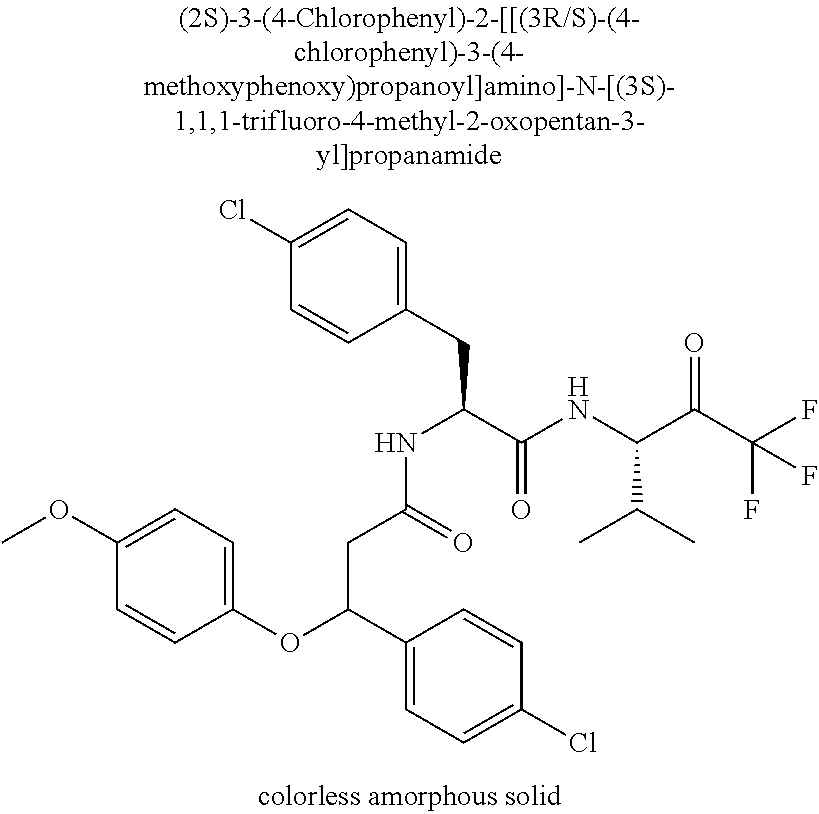 |
(2S)-2-(tert- butoxycarbonylamino)- 3-(4- chlorophenyl)propanoic acid (to be used in step [A]) 3-(4-chlorophenyl)-3- (4- methoxyphenoxy) propanoic acid (intermediate B-2) (to be used in step [C]) | 639.3 |
| 8 |
 |
(E)-3-(4- chlorophenyl)prop-2- enoic acid (to be used in step [C]) | 481.3 |
| 9 |
 |
(2S)-2-(tert- butoxycarbonylamino)- 3-(4- chlorophenyl)propanoic acid (to be used in step [A]) 3-(4-chlorophenyl)-3- (4- methoxyphenyl) propanoic acid (intermediate B-5 to be used in step [C]) | 623.2 |
| 10 |
 |
(2S)-2-(tert- butoxycarbonylamino)- 3-(4- chlorophenyl)propanoic acid (to be used in step [A]) 3-(4-chlorophenyl)-3- phenyl-propanoic acid (to be used in step [C]) | 593.3 |
| 11 |
 |
(2S)-2-(tert- butoxycarbonylamino)- 3-(4- chlorophenyl)propanoic acid (to be used in step [A]) 3-(3-chlorophenyl)-3- (4- methoxyphenoxy) propanoic acid (intermediate B-1) (to be used in step [C]) | 639.2 |
| 12 |
 |
(2S)-2-(tert- butoxycarbonylamino)- 3-(4- chlorophenyl)propanoic acid (to be used in step [A]) 3-(3,4- dichlorophenyl)-3-(4- methoxyphenyl) propanoic acid (intermediate B-6 to be used in step [C]) | 657.3 |
| 13 |
 |
(2S)-2-(tert- butoxycarbonylamino)- 3-(2- pyridyl)propanoic acid (to be used in step [A]) 3-(4-chlorophenyl)-3- (4- methoxyphenyl) propanoic acid (intermediate B-5 to be used in step [C]) | 590.4 |
| 14 |
 |
(2S)-2-(tert- butoxycarbonylamino)- 3-(4- chlorophenyl)propanoic acid (to be used in step [A]) (E)-3-(3,4- dichlorophenyl)prop- 2-enoic acid (to be used in step [C]) | 551.2 |
| 15 |
 |
(2S)-2-(tert- butoxycarbonylamino)- 3-(3- chlorophenyl)propanoic acid (to be used in step [A]) 3-(3,4- dichlorophenyl)propanoic acid (to be used in step [C]) | 553.3 |
| 16 |
 |
(2S)-2-(tert- butoxycarbonylamino)- 3-(3- chlorophenyl)propanoic acid (to be used in step [A]) 3-(3,4- dichlorophenyl)-3-(4- methoxyphenyl) propanoic acid (intermediate B-6 to be used in step [C]) | 659.3 |
| 17 |
 |
(2S)-2-(tert- butoxycarbonylamino)- 3-(3- chlorophenyl)propanoic acid (to be used in step [A]) 3-(4-chlorophenyl)-3- (4- methoxyphenyl) propanoic acid (intermediate B-5 to be used in step [C]) | 623.3 |
| 18 |
 |
(2S)-2-(tert- butoxycarbonylamino)- 3-(3- chlorophenyl)propanoic acid (to be used in step [A]) 3-(4-chlorophenyl)-3- (4- methoxyphenoxy) propanoic acid (intermediate B-2) (to be used in step [C]) | 639.4 |
| 19 |
 |
(2S)-2-(tert- butoxycarbonylamino)- 3-(3- chlorophenyl)propanoic acid (to be used in step [A]) (E)-3-(3,4- dichlorophenyl)prop- 2-enoic acid (to be used in step [C]) | 549.2 |
| 20 |
 |
(2S)-2-(tert- butoxycarbonylamino)- 3-(3- chlorophenyl)propanoic acid (to be used in step [A]) 3-(3,5- dichlorophenyl)propanoic acid (to be used in step [C]) | 551.1 |
| 21 |
 |
(2S)-2-(tert- butoxycarbonylamino)- 3-(4- chlorophenyl)propanoic acid (to be used in step [A]) 2-(3,5- dichlorophenoxy)acetic acid (to be used in step [C]) | 555.2 |
| 22 |
 |
(2S)-2-(tert- butoxycarbonylamino)- 3-(4- chlorophenyl)propanoic acid (to be used in step [A]) ((E)-3-(3,5- dichlorophenyl)prop- 2-enoic acid (to be used in step [C]) | 551.2 |
| 23 |
 |
(2S)-2-(tert- butoxycarbonylamino)- 2-phenyl-acetic acid (to be used in step [A]) 3-(3,4- dichlorophenyl)propanoic acid (to be used in step [C]) | 503.2 |
| 24 |
 |
(2S)-2-(tert- butoxycarbonylamino)- 2-phenyl-acetic acid (to be used in step [A]) 3-(3-chlorophenyl)-3- phenyl-propanoic acid (to be used in step [C]) | 563.3 (+H2O) |
| 25 |
 |
(2S)-2-[tert- butoxycarbonyl(methyl) amino]-3-phenyl- propanoic acid (to be used in step [A]) 2-(3- chlorophenoxy)acetic acid (to be used in step [C]) | 499.3 |
| 26 |
 |
(2S)-2-[tert- butoxycarbonyl(methyl) amino]-3-phenyl- propanoic acid (to be used in step [A]) 3-(3-chlorophenyl)-3- phenyl-propanoic acid (to be used in step [C]) | 575.2 |
| 27 |
 |
(2S)-2-(tert- butoxycarbonylamino)- 3-(3- chlorophenyl)propanoic acid (to be used in step [A]) 5- chlorobenzothiophene- 3-carboxylic acid (to be used in step [C]) | 547.2 |
| 28 |
 |
(2S)-2-(tert- butoxycarbonylamino)- 2-phenyl-acetic acid (to be used in step [A]) ((E)-3-(3,4- dichlorophenyl)prop- 2-enoic acid (to be used in step [C]) | 501.2 |
| 29 |
 |
(2S)-2-(tert- butoxycarbonylamino)- 2-phenyl-acetic acid (to be used in step [A]) 2-(3,5- dichlorophenoxy)acetic acid (to be used in step [C]) | 505.2 |
| 30 |
 |
(2S)-2-(tert- butoxycarbonylamino)- 2-(4- chlorophenyl)acetic acid (to be used in step [A]) 3-(3,4- dichlorophenyl)propanoic acid (to be used in step [C]) | 537.1 |
| 31 |
 |
(2S)-2-(tert- butoxycarbonylamino)- 2-(4- chlorophenyl)acetic acid (to be used in step [A]) 3-(3-chlorophenyl)-3- phenyl-propanoic acid (to be used in step [C]) | 597.1 (+H2O) |
| 32 |
 |
(2S)-2-(tert- butoxycarbonylamino)- 3-(3- chlorophenyl)propanoic acid (to be used in step [A]) 3-(3,4- dichlorophenyl)-3-(4- methoxyphenoxy) propanoic acid (intermediate B-3) (to be used in step [C]) | 673.2 |
| 33 |
 |
(2S)-2-(tert- butoxycarbonylamino)- 2-(4- chlorophenyl)acetic acid (to be used in step [A]) (E)-3-(3,4- dichlorophenyl)prop- 2-enoic acid (to be used in step [C]) | 535.1 |
| 34 |
 |
(2S)-2-(tert- butoxycarbonylamino)- 3-(3- chlorophenyl)propanoic acid (to be used in step [A]) 3-(4-Chlorophenyl)- 2-(4- methoxyphenyl) propanoic acid (intermediate B-4 to be used in step [C]) | 623.2 |
| 35 |
 |
(2S)-2-(tert- butoxycarbonylamino)- 2-(4- chlorophenyl)acetic acid (to be used in step [A]) 2-(3,5- dichlorophenoxy)acetic acid (to be used in step [C]) | 557.1 (+H2O) |
| 36 |
 |
(2S)-2-(tert- butoxycarbonylamino)- 2-phenyl-acetic acid (to be used in step [A]) 2-(3,5- dichlorophenoxy)-2- phenyl-acetic acid (to be used in step [C]) | 581.2 |
| 37 |
 |
(2S)-2-(tert- butoxycarbonylamino)- 2-phenyl-acetic acid (to be used in step [A]) 6-chloro-3-phenyl- benzofuran-2- carboxylic acid (to be used in step [C]) | 575.1 (+H2O) |
| 38 |
 |
(2S)-2-(tert- butoxycarbonylamino)- 2-phenyl-acetic acid (to be used in step [A]) 7-bromo-5-chloro- benzofuran-2- carboxylic acid (to be used in step [C]) | 577.0 (+H2O) |
| 39 |
 |
(2S)-2-(tert- butoxycarbonylamino)- 2-phenyl-acetic acid (to be used in step [A]) 3- cyclohexylpropanoic acid (to be used in step [C]) | 459.3 (+H2O) |
| 40 |
 |
(2S)-2-(tert- butoxycarbonylamino)- 2-phenyl-acetic acid (to be used in step [A]) 5,7-dichloro-3- phenyl-benzofuran-2- carboxylic acid (to be used in step [C]) | 591.1 |
| 41 |
 |
(2S)-2-(tert- butoxycarbonylamino)- 2-phenyl-acetic acid (to be used in step [A]) 2-(2-adamantyl)acetic acid (to be used in step [C]) | 497.3 (+H2O) |
| 42 |
 |
(2S,3S)-2-((tert- butoxycarbonyl)amino)- 3-phenylbutanoic acid (to be used in step [A]) 3-(3,4- dichlorophenyl)propanoic acid (to be used in step [C]) | 531.1 |
| 43 |
 |
(2S,3S)-2-((tert- butoxycarbonyl)amino)- 3-phenylbutanoic acid (to be used in step [A]) 3-(3-chlorophenyl)-3- phenyl-propanoic acid (to be used in step [C]) | 573.2 |
| 44 |
 |
(2S)-2-(tert- butoxycarbonylamino)- 4-phenyl-butanoic acid (to be used in step [A]) 3-(3,4- dichlorophenyl)propanoic acid (to be used in step [C]) | 531.2 |
| 45 |
 |
(2S)-2-(tert- butoxycarbonylamino)- 4-phenyl-butanoic acid (to be used in step [A]) 3-(3-chlorophenyl)-3- phenyl-propanoic acid (to be used in step [C]) | 573.3 |
| 46 |
 |
(2S)-2-(tert- butoxycarbonylamino)- 2-(3- methoxyphenyl)acetic acid (to be used in step [A]) 3-(3,4- dichlorophenyl)propanoic acid (to be used in step [C]) Purified by HPLC chromatography | 533.3 |
| 47 |
 |
(2S)-2-(tert- butoxycarbonylamino)- 2-(3- methoxyphenyl)acetic acid (to be used in step [A]) 3-(3,4- dichlorophenyl)propanoic acid (to be used in step [C]) Purified by HPLC chromatography | 533.1 |
| 48 |
 |
(2S)-2-(tert- butoxycarbonylamino)- 2-(3- methoxyphenyl)acetic acid (to be used in step [A]) 2-(3,5- dichlorophenoxy)acetic acid (to be used in step [C]) Purified by HPLC chromatography | 535.1 |
| 49 |
 |
(2S)-2-(tert- butoxycarbonylamino)- 2-(3- methoxyphenyl)acetic acid (to be used in step [A]) 2-(3,5- dichlorophenoxy)acetic acid (to be used in step [C]) Purified by HPLC chromatography | 535.1 |
| 50 |
 |
(2S)-2-(tert- butoxycarbonylamino)- 2-(3- methoxyphenyl)acetic acid (to be used in step [A]) ((E)-3-(3,4- dichlorophenyl)prop- 2-enoic acid (to be used in step [C]) Purified by HPLC chromatography | 531.2 |
| 51 |
 |
(2S)-2-(tert- butoxycarbonylamino)- 2-(3- methoxyphenyl)acetic acid (to be used in step [A]) ((E)-3-(3,4- dichlorophenyl)prop- 2-enoic acid (to be used in step [C]) Purified by HPLC chromatography | 531.2 |
| 52 |
 |
(2S)-2-(tert- butoxycarbonylamino)- 2-(3- methoxyphenyl)acetic acid (to be used in step [A]) 3-(3-chlorophenyl)-3- phenyl-propanoic acid (to be used in step [C]) Purified by HPLC chromatography | 575.2 |
| 53 |
 |
(2S)-2-(tert- butoxycarbonylamino)- 2-(3- methoxyphenyl)acetic acid (to be used in step [A]) 3-(3-chlorophenyl)-3- phenyl-propanoic acid (to be used in step [C]) Purified by HPLC chromatography | 575.2 |
| TABLE 2 | |||
| Name | MS | ||
| Ex | Aspect | Reactant | (M + H+) |
| 54 |
 |
(2S)-2-(tert- butoxycarbonylamino)- 2-phenyl-acetic acid (to be used in step [A]) (R)-2-(3,5- dichlorophenoxy)-3- phenylpropanoic acid (intermediate B-8 to be used in step [C]) | 595.2 |
| 55 |
 |
(2S)-2-(tert- butoxycarbonylamino)- 2-phenyl-acetic acid (to be used in step [A]) 2-(3,4- dichlorophenoxy)-3- (3,4- dichlorophenyl) propanoic acid (intermediate B-10 to be used in step [C]) | 663.2 |
| 56 |
 |
(2S)-2-(tert- butoxycarbonylamino)- 2-phenyl-acetic acid (to be used in step [A]) 3-(4-chlorophenyl)-2- (4- methoxyphenyl) propanoic acid (intermediate B-4 to be used in step [C]) Purified by HPLC chromatography | 575.2 |
| 57 |
 |
(2S)-2-(tert- butoxycarbonylamino)- 2-phenyl-acetic acid (to be used in step [A]) 3-(4-chlorophenyl)-2- (4- methoxyphenyl) propanoic acid (intermediate B-4 to be used in step [C]) Purified by HPLC chromatography | 575.2 |
| 58 |
 |
(2S)-2-(tert- butoxycarbonylamino)- 2-phenyl-acetic acid (to be used in step [A]) 3-(3,4- dichlorophenyl)-3- (1,1-dioxo-1,4- thiazinan-4- yl)propanoic acid (to be used in step [C]) Purified by HPLC chromatography | 636.2 |
| 59 |
 |
(2S)-2-(tert- butoxycarbonylamino)- 2-phenyl-acetic acid (to be used in step [A]) 3-(3,4- dichlorophenyl)-3- (1,1-dioxo-1,4- thiazinan-4- yl)propanoic acid (to be used in step [C]) Purified by HPLC chromatography | 636.2 |
| 60 |
 |
3-(3,5- difluorophenyl) propanoic acid (to be used in step [C]) | 485.3 |
| 61 |
 |
(R)-2-(3,5- Dichlorophenoxy)-3- phenylpropanoic acid (intermediate B-8 to be used in step [C]) | 609.2 |
| 62 |
 |
(2S)-2-(tert- butoxycarbonylamino)- 2-phenyl-acetic acid (to be used in step [A]) 3-(3,5- difluorophenyl) propanoic acid (to be used in step [C]) | (M + H2O)+ 489.2 |
| 63 |
 |
(2S)-2-(tert- butoxycarbonylamino)- 2-phenyl-acetic acid (to be used in step [A]) (R)-2-(3,5- difluorophenoxy)-3- phenylpropanoic acid (intermediate B-9 to be used in step [C]) | 563.2 |
| 64 |
 |
(2S)-2-(tert- butoxycarbonylamino)- 2-phenyl-acetic acid (to be used in step [A]) 3-cyclohexyl-2-(3,5- dichlorophenoxy) propanoic acid (intermediate B-7 to be used in step [C]) | 601.2 |
| 65 |
 |
(2S)-2-(tert- butoxycarbonylamino)- 2-phenyl-acetic acid (to be used in step [A]) 2-(3,5- difluorophenoxy) acetic acid (to be used in step [C]) | (M + H2O)+ 491.2 |
| 66 |
 |
3-cyclohexyl-2-(3,5- dichlorophenoxy) propanoic acid (intermediate B-7 to be used in step [C]) | 615.3 |
| 67 |
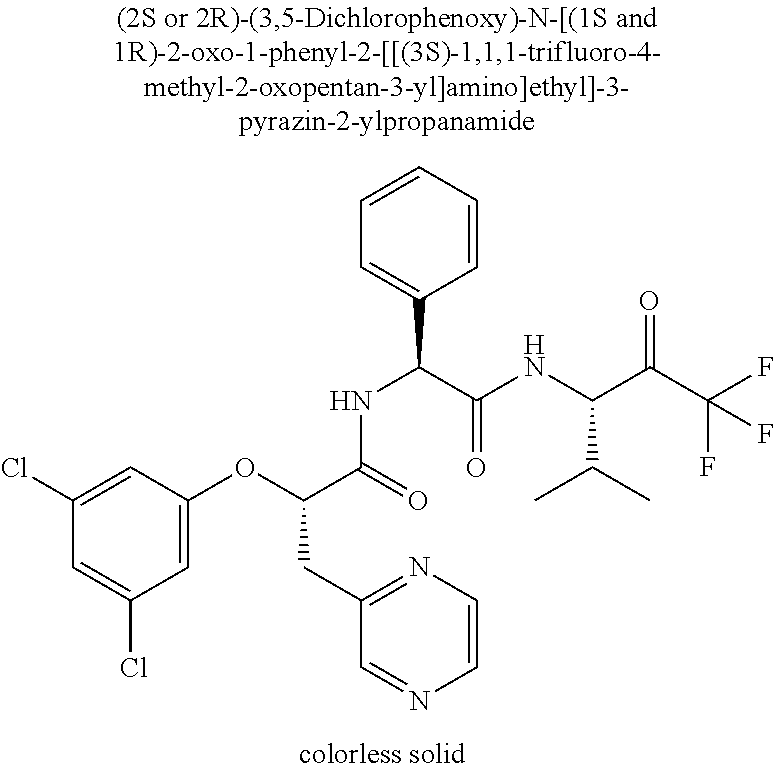 |
(2S)-2-(tert- butoxycarbonylamino)- 2-phenyl-acetic acid (to be used in step [A]) 2-(3,5- dichlorophenoxy)-3- (pyrazin-2- yl)propanoic acid (intermediate B-11 to be used in step [C]) Purified by HPLC chromatography | (M − H+)− 595.3 |
| 68 |
 |
(2S)-2-(tert- butoxycarbonylamino)- 2-phenyl-acetic acid (to be used in step [A]) 2-(3,5- dichlorophenoxy)-3- (pyrazin-2- yl)propanoic acid (intermediate B-11 to be used in step [C]) Purified by HPLC chromatography | (M − H+)− 595.4 |
| 69 |
 |
(2S)-2-(tert- butoxycarbonylamino)- 2-phenyl-acetic acid (to be used in step [A]) 2-(3,5- dichlorophenoxy)-3- (2-pyridyl)propanoic acid (intermediate B- 12 to be used in step [C]) Purified by HPLC chromatography | (M + H2O)+ 614.3 |
| 70 |
 |
(2S)-2-(tert- butoxycarbonylamino)- 2-phenyl-acetic acid (to be used in step [A]) 2-(3,5- dichlorophenoxy)-3- (2-pyridyl)propanoic acid (intermediate B- 12 to be used in step [C]) Purified by HPLC chromatography | (M + H2O)+ 614.3 |
| 71 |
 |
(2S)-2-(tert- butoxycarbonylamino)- 2-phenyl-acetic acid (to be used in step [A]) lithium 2-(3,5- dichlorophenoxy)-3- (pyridin-3- yl)propanoate (intermediate B-13 to be used in step [C]) Purified by HPLC chromatography | (M + H2O)+ 614.3 |
| 72 |
 |
(2S)-2-(tert- butoxycarbonylamino)- 2-phenyl-acetic acid (to be used in step [A]) lithium 2-(3,5- dichlorophenoxy)-3- (pyridin-3- yl)propanoate (intermediate B-13 to be used in step [C]) Purified by HPLC chromatography | (M + H2O)+ 614.3 |
| TABLE 3 | |||
| Name | MS | ||
| Ex | Aspect | Reactant | (M + H+) |
| 73 |
 |
2-(3,5- dichlorophenoxy)-3-(2- pyridyl)propanoic acid (intermediate B-12 to be used in step [C]) Purified by HPLC chromatography | (M + H2O)+ 644.3 |
| 74 |
 |
2-(3,5- dichlorophenoxy)-3-(2- pyridyl)propanoic acid (intermediate B-12 to be used in step [C]) Purified by HPLC chromatography | (M + H2O)+ 644.3 |
| 75 |
 |
2-(3,5- dichlorophenoxy)-3- (pyrazin-2-yl)propanoic acid (intermediate B-11 to be used in step [C]) Purified by HPLC chromatography | (M + H2O)+ 645.4 |
| 76 |
 |
2-(3,5- dichlorophenoxy)-3- (pyrazin-2-yl)propanoic acid (intermediate B-11 to be used in step [C]) Purified by HPLC chromatography | (M + H2O)+ 645.4 |
| 77 |
 |
2-(3- cyanophenoxy)acetic acid (to be used in step [C]) | 492.3 |
| Per tablet | |
| Active ingredient | 200 | mg | |||
| Microcrystalline cellulose | 155 | mg | |||
| Corn starch | 25 | mg | |||
| Talc | 25 | mg | |||
| Hydroxypropylmethylcellulose | 20 | mg | |||
| 425 | mg | ||||
| Per capsule | |
| Active ingredient | 100.0 | mg | |||
| Corn starch | 20.0 | mg | |||
| Lactose | 95.0 | mg | |||
| Talc | 4.5 | mg | |||
| Magnesium stearate | 0.5 | mg | |||
| 220.0 | mg | ||||
Claims (26)


Applications Claiming Priority (4)
| Application Number | Priority Date | Filing Date | Title |
|---|---|---|---|
| EP15156501.7 | 2015-02-25 | ||
| EP15156501 | 2015-02-25 | ||
| EP15156501 | 2015-02-25 | ||
| PCT/EP2016/053618 WO2016135070A1 (en) | 2015-02-25 | 2016-02-22 | New trifluoromethylpropanamide derivatives |
Related Parent Applications (1)
| Application Number | Title | Priority Date | Filing Date |
|---|---|---|---|
| PCT/EP2016/053618 Continuation WO2016135070A1 (en) | 2015-02-25 | 2016-02-22 | New trifluoromethylpropanamide derivatives |
Publications (2)
| Publication Number | Publication Date |
|---|---|
| US20170348257A1 US20170348257A1 (en) | 2017-12-07 |
| US9980929B2 true US9980929B2 (en) | 2018-05-29 |
Family
ID=54011494
Family Applications (1)
| Application Number | Title | Priority Date | Filing Date |
|---|---|---|---|
| US15/683,341 Expired - Fee Related US9980929B2 (en) | 2015-02-25 | 2017-08-22 | Trifluoromethylpropanamide derivatives |
Country Status (7)
| Country | Link |
|---|---|
| US (1) | US9980929B2 (en) |
| EP (1) | EP3262026B1 (en) |
| JP (1) | JP6836996B2 (en) |
| CN (1) | CN107207421B (en) |
| AR (1) | AR103742A1 (en) |
| TW (1) | TW201702214A (en) |
| WO (1) | WO2016135070A1 (en) |
Cited By (5)
| Publication number | Priority date | Publication date | Assignee | Title |
|---|---|---|---|---|
| US10865182B2 (en) * | 2016-07-18 | 2020-12-15 | Hoffmann-La Roche Inc. | Difluoroketamide derivatives as HtrA1 inhibitors |
| US10870623B2 (en) | 2016-08-23 | 2020-12-22 | Hoffmann-La Roche Inc. | Trifluoromethylpropanamide derivatives as HTRA1 inhibitors |
| US11001555B2 (en) | 2016-08-23 | 2021-05-11 | Hoffman-La Roche Inc. | Difluoroketamide derivatives as HTRA1 inhibitors |
| US11014963B2 (en) | 2016-03-04 | 2021-05-25 | Hoffmann-La Roche Inc. | Trifluoromethylpropanamide derivatives as HTRA1 inhibitors |
| US11059858B2 (en) | 2016-03-04 | 2021-07-13 | Hoffmann-La Roche Inc. | Difluoroketamide derivatives as HtrA1 inhibitors |
Families Citing this family (6)
| Publication number | Priority date | Publication date | Assignee | Title |
|---|---|---|---|---|
| MX382839B (en) * | 2016-06-21 | 2025-03-13 | Orion Ophthalmology LLC | ALIPHATIC PROLINAMIDE DERIVATIVES. |
| CA3025253A1 (en) * | 2016-06-21 | 2017-12-28 | Orion Ophthalmology LLC | Heterocyclic prolinamide derivatives |
| EP3472151A4 (en) | 2016-06-21 | 2020-03-04 | Orion Ophthalmology LLC | CARBOCYCLIC PROLINAMIDE DERIVATIVES |
| CN108947841A (en) * | 2018-06-28 | 2018-12-07 | 山东润博生物科技有限公司 | A kind of preparation method of benzene oxycarboxylic acid ester |
| CN108947839A (en) * | 2018-06-28 | 2018-12-07 | 山东润博生物科技有限公司 | A kind of preparation method of phenoxy carboxylic acid herbicides |
| PE20241590A1 (en) * | 2021-12-01 | 2024-08-01 | Pfizer | 3-PHENYL-1-BENZOTHIOPHEN-2-CARBOXYLIC ACID DERIVATIVES AS BRANCHED CHAIN ALPHA KETOACID DEHYDROGENASE KINASE INHIBITORS FOR THE TREATMENT OF DIABETES, KIDNEY DISEASES, NASH AND HEART FAILURE |
Citations (2)
| Publication number | Priority date | Publication date | Assignee | Title |
|---|---|---|---|---|
| WO2000061542A1 (en) | 1999-04-09 | 2000-10-19 | Cytovia, Inc. | Caspase inhibitors and the use thereof |
| WO2014086805A1 (en) | 2012-12-07 | 2014-06-12 | F. Hoffmann-La Roche Ag | Pyridine-2-amides useful as cb2 agonists |
Family Cites Families (1)
| Publication number | Priority date | Publication date | Assignee | Title |
|---|---|---|---|---|
| CN110101699A (en) * | 2013-03-15 | 2019-08-09 | 维颂公司 | Polysubstituted aromatic compounds as serpin |
-
2016
- 2016-02-22 WO PCT/EP2016/053618 patent/WO2016135070A1/en not_active Ceased
- 2016-02-22 EP EP16705540.9A patent/EP3262026B1/en active Active
- 2016-02-22 CN CN201680007490.5A patent/CN107207421B/en not_active Expired - Fee Related
- 2016-02-22 AR ARP160100451A patent/AR103742A1/en unknown
- 2016-02-22 JP JP2017544594A patent/JP6836996B2/en not_active Expired - Fee Related
- 2016-02-23 TW TW105105286A patent/TW201702214A/en unknown
-
2017
- 2017-08-22 US US15/683,341 patent/US9980929B2/en not_active Expired - Fee Related
Patent Citations (2)
| Publication number | Priority date | Publication date | Assignee | Title |
|---|---|---|---|---|
| WO2000061542A1 (en) | 1999-04-09 | 2000-10-19 | Cytovia, Inc. | Caspase inhibitors and the use thereof |
| WO2014086805A1 (en) | 2012-12-07 | 2014-06-12 | F. Hoffmann-La Roche Ag | Pyridine-2-amides useful as cb2 agonists |
Cited By (5)
| Publication number | Priority date | Publication date | Assignee | Title |
|---|---|---|---|---|
| US11014963B2 (en) | 2016-03-04 | 2021-05-25 | Hoffmann-La Roche Inc. | Trifluoromethylpropanamide derivatives as HTRA1 inhibitors |
| US11059858B2 (en) | 2016-03-04 | 2021-07-13 | Hoffmann-La Roche Inc. | Difluoroketamide derivatives as HtrA1 inhibitors |
| US10865182B2 (en) * | 2016-07-18 | 2020-12-15 | Hoffmann-La Roche Inc. | Difluoroketamide derivatives as HtrA1 inhibitors |
| US10870623B2 (en) | 2016-08-23 | 2020-12-22 | Hoffmann-La Roche Inc. | Trifluoromethylpropanamide derivatives as HTRA1 inhibitors |
| US11001555B2 (en) | 2016-08-23 | 2021-05-11 | Hoffman-La Roche Inc. | Difluoroketamide derivatives as HTRA1 inhibitors |
Also Published As
| Publication number | Publication date |
|---|---|
| CN107207421A (en) | 2017-09-26 |
| EP3262026B1 (en) | 2020-03-18 |
| WO2016135070A1 (en) | 2016-09-01 |
| AR103742A1 (en) | 2017-05-31 |
| US20170348257A1 (en) | 2017-12-07 |
| TW201702214A (en) | 2017-01-16 |
| JP2018509402A (en) | 2018-04-05 |
| JP6836996B2 (en) | 2021-03-03 |
| EP3262026A1 (en) | 2018-01-03 |
| CN107207421B (en) | 2021-04-20 |
Similar Documents
| Publication | Publication Date | Title |
|---|---|---|
| US20170348257A1 (en) | New trifluoromethylpropanamide derivatives | |
| US10428108B2 (en) | Difluoroketamide derivatives | |
| US11014963B2 (en) | Trifluoromethylpropanamide derivatives as HTRA1 inhibitors | |
| US11059858B2 (en) | Difluoroketamide derivatives as HtrA1 inhibitors | |
| US10865182B2 (en) | Difluoroketamide derivatives as HtrA1 inhibitors | |
| US10870623B2 (en) | Trifluoromethylpropanamide derivatives as HTRA1 inhibitors | |
| US11001555B2 (en) | Difluoroketamide derivatives as HTRA1 inhibitors | |
| KR20000057667A (en) | Novel carboxy substituted cyclic carboxamide derivatives | |
| HK1241851B (en) | New trifluoromethylpropanamide derivatives | |
| HK1241851A1 (en) | New trifluoromethylpropanamide derivatives | |
| HK40003361A (en) | New difluoroketamide derivatives as htra1 inhibitors |
Legal Events
| Date | Code | Title | Description |
|---|---|---|---|
| AS | Assignment |
Owner name: HOFFMANN-LA ROCHE INC., NEW JERSEY Free format text: ASSIGNMENT OF ASSIGNORS INTEREST;ASSIGNOR:F. HOFFMANN-LA ROCHE AG;REEL/FRAME:045535/0668 Effective date: 20150810 Owner name: F. HOFFMANN-LA ROCHE AG, SWITZERLAND Free format text: ASSIGNMENT OF ASSIGNORS INTEREST;ASSIGNORS:HORNSPERGER, BENOIT;IACONE, ROBERTO;KUHN, BERND;AND OTHERS;REEL/FRAME:045535/0610 Effective date: 20150508 |
|
| STCF | Information on status: patent grant |
Free format text: PATENTED CASE |
|
| MAFP | Maintenance fee payment |
Free format text: PAYMENT OF MAINTENANCE FEE, 4TH YEAR, LARGE ENTITY (ORIGINAL EVENT CODE: M1551); ENTITY STATUS OF PATENT OWNER: LARGE ENTITY Year of fee payment: 4 |
|
| FEPP | Fee payment procedure |
Free format text: MAINTENANCE FEE REMINDER MAILED (ORIGINAL EVENT CODE: REM.); ENTITY STATUS OF PATENT OWNER: LARGE ENTITY |
|
| LAPS | Lapse for failure to pay maintenance fees |
Free format text: PATENT EXPIRED FOR FAILURE TO PAY MAINTENANCE FEES (ORIGINAL EVENT CODE: EXP.); ENTITY STATUS OF PATENT OWNER: LARGE ENTITY |
|
| STCH | Information on status: patent discontinuation |
Free format text: PATENT EXPIRED DUE TO NONPAYMENT OF MAINTENANCE FEES UNDER 37 CFR 1.362 |
|
| FP | Lapsed due to failure to pay maintenance fee |
Effective date: 20260529 |