US9967562B2 - Method, device and system for changing quantization parameter for coding unit in HEVC - Google Patents
Method, device and system for changing quantization parameter for coding unit in HEVC Download PDFInfo
- Publication number
- US9967562B2 US9967562B2 US14/266,028 US201414266028A US9967562B2 US 9967562 B2 US9967562 B2 US 9967562B2 US 201414266028 A US201414266028 A US 201414266028A US 9967562 B2 US9967562 B2 US 9967562B2
- Authority
- US
- United States
- Prior art keywords
- coding unit
- bit allocation
- weighted value
- lcu
- partition size
- Prior art date
- Legal status (The legal status is an assumption and is not a legal conclusion. Google has not performed a legal analysis and makes no representation as to the accuracy of the status listed.)
- Active, expires
Links
Images


Classifications
-
- H—ELECTRICITY
- H04—ELECTRIC COMMUNICATION TECHNIQUE
- H04N—PICTORIAL COMMUNICATION, e.g. TELEVISION
- H04N19/00—Methods or arrangements for coding, decoding, compressing or decompressing digital video signals
- H04N19/60—Methods or arrangements for coding, decoding, compressing or decompressing digital video signals using transform coding
-
- H—ELECTRICITY
- H04—ELECTRIC COMMUNICATION TECHNIQUE
- H04N—PICTORIAL COMMUNICATION, e.g. TELEVISION
- H04N19/00—Methods or arrangements for coding, decoding, compressing or decompressing digital video signals
- H04N19/10—Methods or arrangements for coding, decoding, compressing or decompressing digital video signals using adaptive coding
- H04N19/102—Methods or arrangements for coding, decoding, compressing or decompressing digital video signals using adaptive coding characterised by the element, parameter or selection affected or controlled by the adaptive coding
- H04N19/124—Quantisation
-
- H—ELECTRICITY
- H04—ELECTRIC COMMUNICATION TECHNIQUE
- H04N—PICTORIAL COMMUNICATION, e.g. TELEVISION
- H04N19/00—Methods or arrangements for coding, decoding, compressing or decompressing digital video signals
-
- H—ELECTRICITY
- H04—ELECTRIC COMMUNICATION TECHNIQUE
- H04N—PICTORIAL COMMUNICATION, e.g. TELEVISION
- H04N19/00—Methods or arrangements for coding, decoding, compressing or decompressing digital video signals
- H04N19/10—Methods or arrangements for coding, decoding, compressing or decompressing digital video signals using adaptive coding
- H04N19/134—Methods or arrangements for coding, decoding, compressing or decompressing digital video signals using adaptive coding characterised by the element, parameter or criterion affecting or controlling the adaptive coding
- H04N19/146—Data rate or code amount at the encoder output
-
- H—ELECTRICITY
- H04—ELECTRIC COMMUNICATION TECHNIQUE
- H04N—PICTORIAL COMMUNICATION, e.g. TELEVISION
- H04N19/00—Methods or arrangements for coding, decoding, compressing or decompressing digital video signals
- H04N19/10—Methods or arrangements for coding, decoding, compressing or decompressing digital video signals using adaptive coding
- H04N19/134—Methods or arrangements for coding, decoding, compressing or decompressing digital video signals using adaptive coding characterised by the element, parameter or criterion affecting or controlling the adaptive coding
- H04N19/157—Assigned coding mode, i.e. the coding mode being predefined or preselected to be further used for selection of another element or parameter
- H04N19/159—Prediction type, e.g. intra-frame, inter-frame or bidirectional frame prediction
-
- H—ELECTRICITY
- H04—ELECTRIC COMMUNICATION TECHNIQUE
- H04N—PICTORIAL COMMUNICATION, e.g. TELEVISION
- H04N19/00—Methods or arrangements for coding, decoding, compressing or decompressing digital video signals
- H04N19/10—Methods or arrangements for coding, decoding, compressing or decompressing digital video signals using adaptive coding
- H04N19/169—Methods or arrangements for coding, decoding, compressing or decompressing digital video signals using adaptive coding characterised by the coding unit, i.e. the structural portion or semantic portion of the video signal being the object or the subject of the adaptive coding
Definitions
- Embodiments of the present inventive concept relate to a video encoding technology, and more particularly to a method, a device, and a system for changing quantization parameter for a coding unit in a high efficiency video coding standard (HEVC).
- HEVC high efficiency video coding standard
- the HEVC High Efficiency Video Coding
- MPEG Moving Picture Experts Group
- VCEG ITU-T Video Coding Experts Group
- JCT-VC Joint Collaborative Team on Video Coding
- An aspect of the present invention is directed to provide a method of changing a quantization parameter for a coding unit in HEVC, including receiving at least one of coding unit partition size information and prediction mode information, performing an adaptive bit allocation operation per coding unit based on at least one of the coding unit partition size information and the prediction mode information, and changing a quantization parameter per the coding unit according to the performed adaptive bit allocation operation.
- An aspect of the present invention provides a method for improving a visual quality of video in the HEVC.
- An aspect of the present invention is directed to provide a method of individually setting the quantization n parameter for each coding unit of a frame in high efficiency video coding (HEVC) is disclosed.
- the method for setting a quantization parameter for each coding unit in a frame for HEVC encoding includes receiving at least one of the partition size information of the coding unit and the prediction mode information of the coding unit, performing an adaptive bit allocation operation per each coding unit based on at least one of the unit partition size information of the coding unit and the prediction mode information of the coding unit, and setting the quantization parameter per each coding unit according to the performed adaptive bit allocation operation.
- the bit allocation operation is performed in proportion to the partition size of the coding unit.
- the coding unit is included in the largest coding unit.
- the bit allocation size of the coding unit is calculated by multiplying a target bit number of the LCU and a weighted value.
- a weighted value of the coding unit is smaller than a weighted value of the other coding units.
- a weighted value of the coding unit is greater than a weighted value of the other coding units.
- coding unit Considering four statistical information of the coding unit such as activity, smoothness, darkness, and static, if the coding unit has a flat characteristic, a relatively small weighted value is allocated, and if the coding unit has a complicated characteristic, a relatively great weighted value is allocated.
- a weighted value of the coding unit is smaller than a weighted value of the other coding units.
- a weighted value of the coding unit is greater than a weighted value of the other coding units.
- the prediction mode information indicates whether the coding unit is in an intra mode, an inter mode, a skip mode, or a merge mode.
- a weighted value of the coding unit is greater than a weighted value of other modes.
- a weighted value of the coding unit is smaller than the weighted value of the intra mode.
- a weighted value of the coding unit is smaller than a weighted value of the intra mode and a weighted value of the inter mode.
- An aspect of the present inventive concept is directed to provide a video encoder, including a bit allocation unit performing an adaptive bit allocation operation per coding unit based on at least one of coding unit partition size information and prediction mode information, and a quantization parameter control unit changing a quantization parameter per the coding unit according to the preformed adaptive bit allocation operation.
- the video encoder may further include a video source analyzer receiving video source data partitioned into coding units and analyzing the partitioned video source data.
- the video encoder may further include a QP offset control unit controlling an offset of the quantization parameter according to the analysis.
- An aspect of the inventive concept is directed to provide a system, including the video encoder, and a video decoder decoding compressed bitstream output from the video encoder and outputting video data.
- An aspect of the present inventive concept is directed to provide a system, including the video encoder, and a radio transceiver transmitting a compressed bitstream output from the video encoder.
- An aspect of the present inventive concept is directed to provide a system comprising: the encoder as described and claimed herein, being configured to encode a sequence of video frames; a processor configured to control the encoding operation of the encoder; a memory configured to store executable code for at least one of the processor and the encoder.
- the system may further comprise: a decoder configured to decompress the sequence of video frames previously encoded by the encoder.
- first, second, etc. may be used herein to describe various elements, these elements should not be limited by these terms. These terms are only used to distinguish one element from another. For example, a first signal could be termed a second signal, and, similarly, a second signal could be termed a first signal without departing from the teachings of the disclosure.
- FIG. 1 is a block diagram of a video encoder according to an exemplary embodiment of the inventive concept
- FIG. 2 is a diagram of a frame input to the video encoder shown in FIG. 1 ;
- FIG. 3 is a diagram depicting an exemplary embodiment of a largest coding unit (LCU) shown in FIG. 2 ;
- LCU largest coding unit
- FIG. 4 is a diagram depicting another exemplary embodiment of the LCU shown in FIG. 2 ;
- FIG. 5 is a diagram depicting an exemplary embodiment of a prediction mode of the LCU shown in FIG. 3 ;
- FIG. 6 is a diagram depicting another exemplary embodiment of the prediction mode of the LCU shown in FIG. 4 ;
- FIG. 7 is a block diagram of a Rate Controller shown in FIG. 1 ;
- FIG. 8 is a flowchart for describing an operation of the Rate Controller shown in FIG. 1 ;
- FIG. 9 is a block diagram depicting an exemplary embodiment of a system including the video encoder of FIG. 1 ;
- FIG. 10 is a block diagram depicting an exemplary embodiment of a system including the video encoder of FIG. 1 .
- FIG. 1 is a block diagram of a video encoder according to an exemplary embodiment of the inventive concept.
- a video encoder 100 compresses video source data VSD and outputs a compressed bitstream (CBS).
- the video source data may be uncompressed video frames obtained from a video camera (not shoe in FIG. 1 ) as shown in FIGS. 9 and 10 .
- the video encoder 100 includes a Prediction Module 103 , a First Adder 107 , a Transform Block 119 , a Quantization Block 121 , an Entropy Encoding Block 125 , an Inverse Quantization Block 127 , an inverse Transform Block 129 , a Second Adder 117 , a Filter Block 131 , a Memory 133 , and a Rate Controller 150 .
- Each module or a block in the inventive concept may be dedicated hardware circuit which may dedicated to perform a specific function and an operation according to each module or block's title as described in the inventive concept.
- Each module or a block may be implemented as a computer program code, executable by a processor, which may perform a the module or block's specific functions and operations.
- the executable code may be stored in a recording medium, e.g., a nonvolatile memory, installed and storing the computer program code which may perform the specific functions and operations.
- a module or a block may be a functional and/or structural combination of hardware for performing a technical concept of the inventive concept and software for driving the hardware.
- the Prediction Module 103 receives video source data VSD from a camera (not shown) or an external memory (not shown), and generates partitioned video source data VDS' from coding units based on the received video source data VSD.
- the video source data VSD may have YUV values, RGB values, or YCoCg values.
- FIG. 2 is a diagram of a video frame input to the video encoder shown in FIG. 1 .
- the Prediction Module 103 partitions the video source data VSD into a plurality of largest coding units (e.g., blocks LCU 0 to LCU 8 ) according to HEVC partitioning.
- the video source data VSD may be sequence of frames or frame data.
- the number of the largest coding units LCU 0 to LCU 8 is changed according to the size of the frame of the video source data VSD and the size of the largest coding unit LCU.
- Each of the largest coding units may have a special size (e.g., 64 ⁇ 64 pixels or 64 ⁇ 64 pixel data).
- FIG. 3 is a diagram depicting an exemplary embodiment of one largest coding unit (LCU) (e.g., LCU 0 ) shown in FIG. 2 .
- LCU largest coding unit
- the Prediction Module 103 partitions each of the largest coding units LCU 0 to LCU 8 into one or more coding units (CU).
- the number of coding units per LCU may be determined in advance. For example, LCU may be partitioned into one CU. For example, the Prediction Module 103 generates coding unit partition size information PS indicating that the size of one CU is 64 ⁇ 64 pixels.
- the coding unit partition size information PS indicates size information of CU included in LCU.
- FIG. 4 is a diagram depicting another exemplary embodiment of one LCU shown in FIG. 2 .
- LCU may be partitioned into a plurality of coding units CU 0 to CU 21 of various sizes according to an exemplary embodiment.
- each of the coding units CU 0 to CU 21 may be varied.
- the size of each of the coding units CU 0 to CU 21 may be selected from among 32 ⁇ 32 pixels (or 32 ⁇ 32 pixel data), 16 ⁇ 16 pixels (or 16 ⁇ 16 pixel data), and 8 ⁇ 8 pixels (or 8 ⁇ 8 pixel data).
- the Prediction Module 103 generates coding unit partition size information PS indicating that the size of each of the coding units CU 0 to CU 21 is one of 32 ⁇ 32 pixels, 16 ⁇ 16 pixels, and 8 ⁇ 8 pixels.
- the Prediction Module 103 may include a motion estimator (not shown) and a motion compensator (not shown).
- the motion estimator determines a motion vector, between frames, for each coding unit, or for macroblocks therein.
- the motion compensator generates a prediction unit or prediction block based on the motion vector.
- the size of the prediction unit/block may be smaller than the size of a coding unit.
- the Prediction Module 103 instead of the motion compensator may generate the prediction unit/block using other known methods.
- the Prediction Module 103 generates prediction mode information PM.
- the prediction mode information PM indicates whether a coding unit is in an intra mode, an inter mode, a skip mode, or a merge mode.
- the intra mode is defined to generate the prediction unit/blocks by using other pixels already encoded in a current video frame.
- the inter mode is defined to generate the prediction unit/block by using pixels in a previous video frame or a future video frame.
- the skip mode is defined to be similar to the intra mode without an operation by the Transform Block 119 .
- the merge mode is similar to the intra mode, but is defined to be that a plurality of prediction units are merged with each other.
- FIG. 5 is a diagram depicting an exemplary embodiment of a prediction mode of the LCU shown in FIG. 3 .
- an LCU may be encoded in an intra mode.
- the Prediction Module 103 generates prediction mode information PM indicating that all of the LCU is to be encoded in the intra mode.
- FIG. 6 is a diagram depicting another exemplary embodiment of the prediction mode of the LCU shown in FIG. 4 .
- each of coding units included in the exemplary LCU shown in FIG. 6 may be individually encoded in an intra mode, an inter mode, a skip mode, and a merge mode.
- the Prediction Module 103 generates prediction mode information PM indicating whether each of the coding units is to be encoded in an intra mode, an inter mode, a skip mode, and a merge mode.
- the First Adder 107 subtracts the prediction unit generated by the Prediction Module 103 from the video source data VSD to generate a residual data RD.
- the residual data RD may be referred to as a transition unit.
- the Transform Block 119 may applies a mathematical transform to the residual data RD output from the First Adder 107 .
- the transform may be discrete cosine transform (DCT) or similar transform defined by HEVC standard.
- the Transform Block 119 generates residual transform coefficients (CEF).
- the Transform Block 119 transforms the pixel region into frequency data.
- the Quantization Block 121 quantizes the residual transform coefficients CEF according to a quantization parameter QP so as to further reduce the bit rate.
- the Rate Controller 150 changes the quantization parameter QP per coding unit based on the video source data VDS' partitioned into coding units, the coding unit partition size information PS output from the Prediction Module 103 , the prediction mode information PM, or the compressed bitstream CBS output from the Entropy Encoding Block 125 . A detailed operation of the Rate Controller 150 will be described in detail with reference to FIG. 7 .
- the Entropy Encoding Block 125 After quantization is performed on the residual transform coefficients CEF, the Entropy Encoding Block 125 outputs the compressed bitstream CBS for storage or transmission.
- An Inverse Quantization Block 127 performs an inverse quantization operation and then the inverse Transform Block 129 performs an inverse transformation operation, so as to reconstruct quantized residual transform coefficients that are in a frequency data into a reconstructed pixel region.
- the Second Adder 117 adds the reconstructed residual data and a prediction unit generated by the Prediction Module 103 to output reconstructed video data.
- the Filter Block 131 applies filtering to the reconstructed video data so as to improve video quality.
- the memory 133 stores the filtered video data and outputs the filtered video data to the Prediction Module 103 .
- FIG. 7 is a block diagram of the Rate Controller shown in FIG. 1 .
- the Rate Controller 150 changes the quantization parameter QP per coding unit based on the coding unit partition size information PS output from the Prediction Module 103 , prediction mode information PM, or the compressed bitstream CBS output from the Entropy Encoding Block 125 .
- the Rate Controller 150 includes a LCU QP control block 151 and an adaptive QP control block 160 .
- the LCU QP control block 151 receives the compressed bitstream CBS from the Entropy Encoding Block 125 .
- the LCU QP control block 151 calculates fullness state of a real decoder buffer using the compressed bitstream CBS and generates a LCU base quantization parameter according to the calculated fullness.
- the adaptive QP control block 160 changes the quantization parameter QP per coding unit based on the coding unit partition size information PS, prediction mode information PM, or the LCU base quantization parameter, and outputs the quantization parameter QP to the Quantization Block 121 .
- the adaptive QP control block 160 includes a bit allocation unit 161 and a QP control unit 163 .
- the bit allocation unit 161 performs an adaptive bit allocation operation per coding unit based on at least one of the coding unit partition size information PS and the prediction mode information PM.
- the bit allocation unit 161 performs the bit allocation operation in proportion to the size of the coding units CU 0 to CU 21 shown in FIG. 4 .
- the size of a first coding unit CU 0 e.g., 32 ⁇ 32 pixels
- the size of a second coding unit CU 1 e.g., 16 ⁇ 16 pixels, so that more bits may be allocated to the first coding unit CU 0 .
- R Cui is the bit allocation size of an i th coding unit
- T LCU is a target bit number of the LCU (i.e., a target number of bits of the LCU)
- W Ni is a weighted value based on the size of the i th coding unit. The sum of weighted values is One.
- the weighted value of the first coding unit CU 0 e.g., 0.2
- the weighted value of the second coding unit CU 1 e.g., 0.4.
- the weighted value of the third coding unit CU 2 is greater than the weighted value of the second coding unit CU 1 , e.g., 0.4.
- R Cui is the bit allocation size of i th coding unit
- T LCU is a target bit number of the LCU
- W MODi is a weighted value based on a prediction mode of the i th coding unit. The sum of weighted values is One.
- the weighted value of the coding unit CU 0 is greater than the weighted value would be if in other modes, e.g., inter mode.
- the weighted value of the coding unit CU 1 is smaller than the weighted value would be in the intra mode.
- the weighted value of the coding unit CU 2 or CU 3 is smaller than the weighted value would be in the intra mode or than the weighted value would be in the inter mode.
- the Rate Controller 150 may further include the video source analyzer 170 .
- the video source analyzer 170 receives video source data VSD′ partitioned into coding units from the Prediction Module 103 , and analyzes the partitioned video source data VSD′.
- the video source analyzer 170 analyzes activity, darkness, or static of the partitioned video source data VSD′, and determines whether each coding unit CU 2 or CU 3 has homogeneity or complexity according to a result of the analysis.
- R Cui is the bit allocation size of i th coding unit
- T LCU is a target bit number of the LCU
- W Ni is a weighted value based on the size of the i th coding unit
- W STAi is a weighted value based on the analysis of the i th coding unit.
- ⁇ and ⁇ has a range between Zero and One, and the sum of ⁇ and ⁇ is One.
- the coding unit CU 0 may have a lower weighted value than other coding units.
- the coding unit CU 0 may have a higher weighted value than other coding units.
- R Cui is the bit allocation size of i th coding unit
- T LCU is a target bit number of the LCU
- W Ni is a weighted value based on the size of the i th coding unit
- W STAi is a weighted value based on the analysis of the i th coding unit
- W MODi is a weighted value based on a prediction mode of the i th coding unit.
- Each of ⁇ , ⁇ , and ⁇ has a range between Zero and One, and the sum of ⁇ , ⁇ , and ⁇ is One.
- the sum of weighted values based on the size of the i th coding unit is One
- the sum of weighted values based on an analysis of the i th coding unit is One
- the sum of weighted values based on an i th prediction mode is One.
- a QP control unit 121 changes a quantization parameter QP per each coding unit according to the performed adaptive bit allocation operation.
- each of the coding units may have a different value of quantization parameter QP.
- the QP control unit 121 may change the quantization parameter QP considering the LCU base quantization parameter.
- the Rate Controller 150 further includes a QP offset control unit 165 controlling an offset of the quantization parameter QP according to an analysis of the video source analyzer 170 .
- the QP offset control unit 165 may change an offset of the quantization parameter QP according to the analysis.
- FIG. 8 is a flowchart for describing an operation of the Rate Controller 150 shown in FIG. 1 .
- the bit allocation unit 161 performs an adaptive bit allocation operation per each coding unit based on at least one of coding unit partition size information PS and prediction mode information PM (step S 10 ).
- the QP control unit 151 changes the quantization parameter QP per the coding unit according to the performed adaptive bit allocation operation (step S 20 ).
- FIG. 9 is a block diagram depicting an exemplary embodiment of a system including the video encoder 100 of FIG. 1 .
- a system 900 may be embodied in a portable device such as a mobile phone, a smart phone, a tablet PC, a laptop computer, a personal digital assistant (PDA), an enterprise digital assistant (EDA), a digital still camera, a digital video camera, a portable multimedia player (PMP), a personal navigation device or portable navigation device (PDN), a handheld game console, a mobile internet device (MID), or an e-book.
- a portable device such as a mobile phone, a smart phone, a tablet PC, a laptop computer, a personal digital assistant (PDA), an enterprise digital assistant (EDA), a digital still camera, a digital video camera, a portable multimedia player (PMP), a personal navigation device or portable navigation device (PDN), a handheld game console, a mobile internet device (MID), or an e-book.
- PDA personal digital assistant
- EDA enterprise digital assistant
- PMP portable multimedia player
- PDN personal navigation device or portable navigation device
- MID mobile internet device
- the system 900 includes a system on chip (SoC) 910 and an external memory 935 .
- the system 900 may further include a display 945 and/or a camera module 955 .
- the SoC 910 controls an operation of the external memory 935 , of the display 945 , and of the camera module 955 .
- the SoC 910 may be referred to as an integrated circuit (IC) processor, an application processor, a multimedia processor, or an integrated multimedia processor.
- IC integrated circuit
- the SoC 910 includes a CPU 920 , a Memory controller 930 , a display controller 940 , a camera interface 950 , a video encoder 100 , and a video decoder 960 .
- the SoC 910 and/or the CPU may further include an internal random access memory (not shown) and registers (not shown) or cache memory, that can function as a main/system memory of the CPU 920 .
- Each of the components 920 , 930 , 940 , 950 , 100 , and 960 , and any internal random access memory can communicate with each other through a system bus 901 .
- architecture of the bus 901 may be various.
- the CPU 920 reads program commands (e.g., from the external memory 935 ) and executes the programs to control each of the components 920 , 930 , 940 , 950 , 100 , and 960 .
- the memory controller 930 may transmit the compressed bitstream CBS output from the video encoder 100 to the external memory 935 , and/or may transmit the compressed bitstream CBS stored in the external memory 935 to the video decoder 960 for decoding.
- the external memory 935 may be a volatile memory and/or a non-volatile memory.
- the volatile memory may be a dynamic random access memory (DRAM), a static random access memory (SRAM), a thyristor RAM (T-RAM), a zero capacitor RAM (Z-RAM), or a Twin Transistor RAM (TTRAM).
- the non-volatile memory may be an Electrically Erasable Programmable Read-Only Memory (EEPROM), flash memory, a Magnetic RAM (MRAM), a Phase change RAM (PRAM), or a resistive memory.
- EEPROM Electrically Erasable Programmable Read-Only Memory
- MRAM Magnetic RAM
- PRAM Phase change RAM
- the display controller 940 controls the display 945 so that video data decoded by the video decoder 960 may be displayed on the display 945 .
- the display 945 may be a liquid crystal display (LCD), a light emitting diode (LED) display, an organic light emitting diode (OLED) display, an active-matrix organic light-emitting diode (AMOLED) display, or a flexible display.
- LCD liquid crystal display
- LED light emitting diode
- OLED organic light emitting diode
- AMOLED active-matrix organic light-emitting diode
- the camera module 955 denotes a module capturing an optical scene and converting light into an electrical signal or binary data representing an image or sequence of images.
- An electrical image signal output from the camera module 955 preferably has a YUV pixel format.
- the electrical image signal may be the video source data VSD of FIG. 1 .
- the electrical image signal is transmitted as digital frame data to the video encoder 100 through the camera interface 950 for encoding.
- the video encoder 100 is the video encoder 100 of FIG. 1 .
- the video decoder 960 decodes the compressed bitstream CBS to display the video data on the display 945 , and outputs the video data to the display 945 .
- the video decoder 960 may be directly connected by a second bus (not shown) to the Display Controller 940 , to reduce the uncompressed video data traffic upon the system Bus.
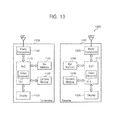
- FIG. 10 is a block diagram depicting an exemplary embodiment of a system including the video encoder 100 of FIG. 1 .
- a system 1000 includes a transmitter 1100 and a receiver 1200 , which may be separated from each other by a space.
- Each of the transmitter 1100 and the receiver 1200 may be a mobile phone, a smart phone, a mobile internet device, or a tablet PC.
- the transmitter 1100 includes a first SoC 1110 , a display 1120 , a camera module 1130 , an external memory 1140 , and a radio transceiver 1150 .
- the operations and functions of each of the first SoC 1110 , the display 1120 , the camera module 1130 , and the external memory 1140 are similar to the operations and a functions of the SoC 910 , the display 945 , the camera module 955 , and the external memory 935 of FIG. 9 , so that a redundant detailed description thereof is omitted.
- the first SoC 1110 includes the video encoder 100 shown in FIG. 1 .
- the radio transceiver 1150 can transmit the compressed bitstream CBS to the receiver 1200 via a first antenna ANT 1 .
- the transmitter 1100 may also operate as a receiver.
- the receiver 1200 includes a second SoC 1210 , a display 1220 , a camera module 1230 , an external memory 1240 , and a radio transceiver 1250 .
- the operations and functions of each of the SoC 1210 , the display 1220 , the camera module 1230 , and the external memory 1240 are similar to the operations and functions of the SoC 910 , the display 945 , the camera module 955 , and the external memory 935 shown in FIG. 9 , so that a redundant detailed description thereof is omitted.
- the second SoC 1210 includes the video decoder 1215 .
- the radio transceiver 1250 an receive the compressed bitstream CBS from the transmitter 1100 via a second antenna ANT 2 .
- the receiver 1200 may also operate as a transmitter.
- the video decoder 1215 can decode the compressed bitstream CBS to display video data on the display 1220 and output the resulting uncompressed video data.
- a method and a device which can change the quantization parameter for a coding unit in HEVC can perform an adaptive bit allocation operation per each coding unit based on coding unit partition size information, prediction mode information, or coding unit region analysis information and change a quantization parameter, thereby improving the visual quality.
Landscapes
- Engineering & Computer Science (AREA)
- Multimedia (AREA)
- Signal Processing (AREA)
- Compression Or Coding Systems Of Tv Signals (AREA)
Abstract
Description
R CUi =T LCU *W Ni [Equation 1]
R CUi =T LCU *W MODi [Equation 2]
R CUi =T LCU*(αW Ni +βW STAi) [Equation 3]
R CUi =T LCU*(αW Ni +βW STAi +τW MODi) [Equation 4]
Claims (18)
R CUi =T LCU*(αW Ni +βW STAi)
R CUi =T LCU*(αW Ni +βW STAi)
R CUi =T LCU*(αW Ni +βW STAi +ζW MODi)
R CUi =T LCU*(αW Ni +βW STAi)
R CUi =T LCU*(αW Ni +βW STAi +ζW MODi)
Applications Claiming Priority (2)
| Application Number | Priority Date | Filing Date | Title |
|---|---|---|---|
| KR10-2013-0049264 | 2013-05-02 | ||
| KR1020130049264A KR102161741B1 (en) | 2013-05-02 | 2013-05-02 | Method, device, and system for changing quantization parameter for coding unit in HEVC |
Publications (2)
| Publication Number | Publication Date |
|---|---|
| US20140328390A1 US20140328390A1 (en) | 2014-11-06 |
| US9967562B2 true US9967562B2 (en) | 2018-05-08 |
Family
ID=51841429
Family Applications (1)
| Application Number | Title | Priority Date | Filing Date |
|---|---|---|---|
| US14/266,028 Active 2036-12-23 US9967562B2 (en) | 2013-05-02 | 2014-04-30 | Method, device and system for changing quantization parameter for coding unit in HEVC |
Country Status (2)
| Country | Link |
|---|---|
| US (1) | US9967562B2 (en) |
| KR (1) | KR102161741B1 (en) |
Families Citing this family (4)
| Publication number | Priority date | Publication date | Assignee | Title |
|---|---|---|---|---|
| WO2017065490A1 (en) * | 2015-10-13 | 2017-04-20 | 엘지전자(주) | Method for encoding/decoding image, and apparatus therefor |
| KR102851376B1 (en) | 2016-11-11 | 2025-08-26 | 삼성전자주식회사 | Video processing device encoding frames comprised of hierarchical structure |
| KR20180105294A (en) | 2017-03-14 | 2018-09-28 | 한국전자통신연구원 | Image compression device |
| CN112492305B (en) * | 2020-11-18 | 2022-02-11 | 腾讯科技(深圳)有限公司 | Data processing method and device and computer readable storage medium |
Citations (33)
| Publication number | Priority date | Publication date | Assignee | Title |
|---|---|---|---|---|
| US6522693B1 (en) * | 2000-02-23 | 2003-02-18 | International Business Machines Corporation | System and method for reencoding segments of buffer constrained video streams |
| US20050084015A1 (en) | 2003-10-20 | 2005-04-21 | Samsung Electronics Co., Ltd. | Bit-rate control method and apparatus for normalizing visual quality |
| US7151856B2 (en) * | 2002-04-25 | 2006-12-19 | Matsushita Electric Industrial Co., Ltd. | Picture coding apparatus and picture coding method |
| US7227894B2 (en) * | 2004-02-24 | 2007-06-05 | Industrial Technology Research Institute | Method and apparatus for MPEG-4 FGS performance enhancement |
| US20070153916A1 (en) * | 2005-12-30 | 2007-07-05 | Sharp Laboratories Of America, Inc. | Wireless video transmission system |
| US20070280350A1 (en) | 2006-03-27 | 2007-12-06 | Samsung Electronics Co., Ltd. | Method of assigning priority for controlling bit rate of bitstream, method of controlling bit rate of bitstream, video decoding method, and apparatus using the same |
| JP2009141688A (en) | 2007-12-06 | 2009-06-25 | Nippon Telegr & Teleph Corp <Ntt> | Image encoding / decoding method and system, image encoding program, and image decoding program |
| US20090225829A2 (en) * | 2005-07-06 | 2009-09-10 | Do-Kyoung Kwon | Method and apparatus for operational frame-layerrate control in video encoder |
| US7602851B2 (en) | 2003-07-18 | 2009-10-13 | Microsoft Corporation | Intelligent differential quantization of video coding |
| US7784076B2 (en) * | 2004-10-30 | 2010-08-24 | Sharp Laboratories Of America, Inc. | Sender-side bandwidth estimation for video transmission with receiver packet buffer |
| US7797723B2 (en) * | 2004-10-30 | 2010-09-14 | Sharp Laboratories Of America, Inc. | Packet scheduling for video transmission with sender queue control |
| WO2011019384A1 (en) * | 2009-08-11 | 2011-02-17 | Thomson Licensing | Methods and apparatus for generalized weighted prediction |
| US20110090960A1 (en) * | 2008-06-16 | 2011-04-21 | Dolby Laboratories Licensing Corporation | Rate Control Model Adaptation Based on Slice Dependencies for Video Coding |
| US7936818B2 (en) * | 2002-07-01 | 2011-05-03 | Arris Group, Inc. | Efficient compression and transport of video over a network |
| US7961783B2 (en) * | 2005-07-07 | 2011-06-14 | Mediatek Incorporation | Methods and systems for rate control in video encoder |
| US8077772B2 (en) * | 2007-11-09 | 2011-12-13 | Cisco Technology, Inc. | Coding background blocks in video coding that includes coding as skipped |
| KR20110134319A (en) | 2010-06-07 | 2011-12-14 | (주)휴맥스 | Encoding / Decoding Method of High Resolution Image and Apparatus Performing the Same |
| KR20120012634A (en) | 2010-08-02 | 2012-02-10 | 서울대학교산학협력단 | Adaptive Unit-Level Bitrate Control Method for Real-Time Video Coding |
| US20120051438A1 (en) * | 2010-09-01 | 2012-03-01 | Qualcomm Incorporated | Filter description signaling for multi-filter adaptive filtering |
| US20120082243A1 (en) * | 2010-10-05 | 2012-04-05 | General Instrument Corporation | Method and Apparatus for Feature Based Video Coding |
| US20120136657A1 (en) * | 2010-11-30 | 2012-05-31 | Fujitsu Limited | Audio coding device, method, and computer-readable recording medium storing program |
| US20120170646A1 (en) * | 2010-10-05 | 2012-07-05 | General Instrument Corporation | Method and apparatus for spacial scalability for hevc |
| US20120177109A1 (en) * | 2009-09-10 | 2012-07-12 | Dolby Laboratories Licensing Corporation | Speedup Techniques for Rate Distortion Optimized Quantization |
| US20120183080A1 (en) | 2011-01-13 | 2012-07-19 | Texas Instruments Incorporated | Method and apparatus for a low complexity transform unit partitioning structure for hevc |
| US20120189052A1 (en) | 2011-01-24 | 2012-07-26 | Qualcomm Incorporated | Signaling quantization parameter changes for coded units in high efficiency video coding (hevc) |
| KR20120096911A (en) | 2011-02-23 | 2012-08-31 | 한국항공대학교산학협력단 | Method for video bit rate control and apparatus thereof |
| US8259798B2 (en) | 2008-09-26 | 2012-09-04 | Sungkyunkwan University Foundation For Corporate Collaboration | Distributed video encoder and decoder and distributed video decoding method |
| US20120243611A1 (en) * | 2009-12-22 | 2012-09-27 | Sony Corporation | Image processing apparatus and method as well as program |
| US8356327B2 (en) * | 2004-10-30 | 2013-01-15 | Sharp Laboratories Of America, Inc. | Wireless video transmission system |
| US20130034170A1 (en) * | 2011-08-01 | 2013-02-07 | Qualcomm Incorporated | Coding parameter sets for various dimensions in video coding |
| US20130051457A1 (en) * | 2011-06-25 | 2013-02-28 | Qualcomm Incorporated | Quantization in video coding |
| US20130064293A1 (en) * | 2010-05-19 | 2013-03-14 | Sk Telecom Co., Ltd | Image encoding/decoding device and method |
| US20140328397A1 (en) * | 2011-02-23 | 2014-11-06 | Lg Electronics Inc. | Intra-Prediction Method Using Filtering, And Apparatus Using The Method |
Family Cites Families (1)
| Publication number | Priority date | Publication date | Assignee | Title |
|---|---|---|---|---|
| EP2713612A4 (en) * | 2011-06-28 | 2014-11-26 | Samsung Electronics Co Ltd | METHOD AND APPARATUS FOR ENCODING AND DECODING IMAGE USING THE ADAPTIVE QUANTIFICATION PARAMETER DIFFERENTIAL |
-
2013
- 2013-05-02 KR KR1020130049264A patent/KR102161741B1/en active Active
-
2014
- 2014-04-30 US US14/266,028 patent/US9967562B2/en active Active
Patent Citations (34)
| Publication number | Priority date | Publication date | Assignee | Title |
|---|---|---|---|---|
| US6522693B1 (en) * | 2000-02-23 | 2003-02-18 | International Business Machines Corporation | System and method for reencoding segments of buffer constrained video streams |
| US7151856B2 (en) * | 2002-04-25 | 2006-12-19 | Matsushita Electric Industrial Co., Ltd. | Picture coding apparatus and picture coding method |
| US7936818B2 (en) * | 2002-07-01 | 2011-05-03 | Arris Group, Inc. | Efficient compression and transport of video over a network |
| US7602851B2 (en) | 2003-07-18 | 2009-10-13 | Microsoft Corporation | Intelligent differential quantization of video coding |
| US20050084015A1 (en) | 2003-10-20 | 2005-04-21 | Samsung Electronics Co., Ltd. | Bit-rate control method and apparatus for normalizing visual quality |
| US7227894B2 (en) * | 2004-02-24 | 2007-06-05 | Industrial Technology Research Institute | Method and apparatus for MPEG-4 FGS performance enhancement |
| US8356327B2 (en) * | 2004-10-30 | 2013-01-15 | Sharp Laboratories Of America, Inc. | Wireless video transmission system |
| US7784076B2 (en) * | 2004-10-30 | 2010-08-24 | Sharp Laboratories Of America, Inc. | Sender-side bandwidth estimation for video transmission with receiver packet buffer |
| US7797723B2 (en) * | 2004-10-30 | 2010-09-14 | Sharp Laboratories Of America, Inc. | Packet scheduling for video transmission with sender queue control |
| US20090225829A2 (en) * | 2005-07-06 | 2009-09-10 | Do-Kyoung Kwon | Method and apparatus for operational frame-layerrate control in video encoder |
| US7961783B2 (en) * | 2005-07-07 | 2011-06-14 | Mediatek Incorporation | Methods and systems for rate control in video encoder |
| US20070153916A1 (en) * | 2005-12-30 | 2007-07-05 | Sharp Laboratories Of America, Inc. | Wireless video transmission system |
| US20070280350A1 (en) | 2006-03-27 | 2007-12-06 | Samsung Electronics Co., Ltd. | Method of assigning priority for controlling bit rate of bitstream, method of controlling bit rate of bitstream, video decoding method, and apparatus using the same |
| US8077772B2 (en) * | 2007-11-09 | 2011-12-13 | Cisco Technology, Inc. | Coding background blocks in video coding that includes coding as skipped |
| JP2009141688A (en) | 2007-12-06 | 2009-06-25 | Nippon Telegr & Teleph Corp <Ntt> | Image encoding / decoding method and system, image encoding program, and image decoding program |
| US20110090960A1 (en) * | 2008-06-16 | 2011-04-21 | Dolby Laboratories Licensing Corporation | Rate Control Model Adaptation Based on Slice Dependencies for Video Coding |
| US8259798B2 (en) | 2008-09-26 | 2012-09-04 | Sungkyunkwan University Foundation For Corporate Collaboration | Distributed video encoder and decoder and distributed video decoding method |
| WO2011019384A1 (en) * | 2009-08-11 | 2011-02-17 | Thomson Licensing | Methods and apparatus for generalized weighted prediction |
| US20120177109A1 (en) * | 2009-09-10 | 2012-07-12 | Dolby Laboratories Licensing Corporation | Speedup Techniques for Rate Distortion Optimized Quantization |
| US20120243611A1 (en) * | 2009-12-22 | 2012-09-27 | Sony Corporation | Image processing apparatus and method as well as program |
| US20130064293A1 (en) * | 2010-05-19 | 2013-03-14 | Sk Telecom Co., Ltd | Image encoding/decoding device and method |
| KR20110134319A (en) | 2010-06-07 | 2011-12-14 | (주)휴맥스 | Encoding / Decoding Method of High Resolution Image and Apparatus Performing the Same |
| KR20120012634A (en) | 2010-08-02 | 2012-02-10 | 서울대학교산학협력단 | Adaptive Unit-Level Bitrate Control Method for Real-Time Video Coding |
| US20120051438A1 (en) * | 2010-09-01 | 2012-03-01 | Qualcomm Incorporated | Filter description signaling for multi-filter adaptive filtering |
| US20120170646A1 (en) * | 2010-10-05 | 2012-07-05 | General Instrument Corporation | Method and apparatus for spacial scalability for hevc |
| US20120082243A1 (en) * | 2010-10-05 | 2012-04-05 | General Instrument Corporation | Method and Apparatus for Feature Based Video Coding |
| US20120136657A1 (en) * | 2010-11-30 | 2012-05-31 | Fujitsu Limited | Audio coding device, method, and computer-readable recording medium storing program |
| US20120183080A1 (en) | 2011-01-13 | 2012-07-19 | Texas Instruments Incorporated | Method and apparatus for a low complexity transform unit partitioning structure for hevc |
| US20120189052A1 (en) | 2011-01-24 | 2012-07-26 | Qualcomm Incorporated | Signaling quantization parameter changes for coded units in high efficiency video coding (hevc) |
| KR20120096911A (en) | 2011-02-23 | 2012-08-31 | 한국항공대학교산학협력단 | Method for video bit rate control and apparatus thereof |
| KR20120096863A (en) | 2011-02-23 | 2012-08-31 | 한국전자통신연구원 | Rate control for hierarchical coding structure in high efficiency video coding(hevc) |
| US20140328397A1 (en) * | 2011-02-23 | 2014-11-06 | Lg Electronics Inc. | Intra-Prediction Method Using Filtering, And Apparatus Using The Method |
| US20130051457A1 (en) * | 2011-06-25 | 2013-02-28 | Qualcomm Incorporated | Quantization in video coding |
| US20130034170A1 (en) * | 2011-08-01 | 2013-02-07 | Qualcomm Incorporated | Coding parameter sets for various dimensions in video coding |
Also Published As
| Publication number | Publication date |
|---|---|
| US20140328390A1 (en) | 2014-11-06 |
| KR102161741B1 (en) | 2020-10-06 |
| KR20140131606A (en) | 2014-11-14 |
Similar Documents
| Publication | Publication Date | Title |
|---|---|---|
| US10448027B2 (en) | Method of encoding video data, video encoder performing the same and electronic system including the same | |
| US10757428B2 (en) | Luma and chroma reshaping of HDR video encoding | |
| US12537979B2 (en) | Method and an apparatus for encoding/decoding images and videos using artificial neural network based tools | |
| US11310514B2 (en) | Encoding method and apparatus using non-encoding region, block-based encoding region, and pixel-based encoding region | |
| JP2018050308A (en) | Performing motion vector prediction for video coding | |
| US20140211858A1 (en) | Spatially adaptive video coding | |
| US8548055B2 (en) | Encoding of multimedia data | |
| US9565404B2 (en) | Encoding techniques for banding reduction | |
| US9967562B2 (en) | Method, device and system for changing quantization parameter for coding unit in HEVC | |
| KR20180102565A (en) | Systems and methods for calculating distortion in display stream compression (DSC) | |
| CN116156168B (en) | Image coding and decoding method and device | |
| KR20180053028A (en) | Video processing device encoding frames comprised of hierarchical structure | |
| US10070139B2 (en) | Multimedia codec, application processor including the same, and method of operating the application processor | |
| US20260087680A1 (en) | Reinforcement learning-based rate control for end-to-end neural network based video compression | |
| US9894377B2 (en) | Method for predicting disparity vector for interlayer video decoding and encoding apparatus and method | |
| KR101757464B1 (en) | Method and Apparatus for Encoding and Method and Apparatus for Decoding | |
| US20110051815A1 (en) | Method and apparatus for encoding data and method and apparatus for decoding data | |
| CN118075458A (en) | Video encoding and decoding method and device | |
| KR20180032570A (en) | Modification to block size for transform mode in display stream compression | |
| US20130223516A1 (en) | Block quantizer in h.264 with reduced computational stages | |
| JP2022540659A (en) | Luma-to-chroma quantization parameter table signaling | |
| CN116760976B (en) | Affine prediction decision method, affine prediction decision device, affine prediction decision equipment and affine prediction decision storage medium | |
| US9013595B1 (en) | Digital video camera with internal data sample compression | |
| KR20150127166A (en) | Integrated spatial downsampling of video data | |
| CN110784719B (en) | Efficient encoding of video data in the presence of video annotations |
Legal Events
| Date | Code | Title | Description |
|---|---|---|---|
| AS | Assignment |
Owner name: SAMSUNG ELECTRONICS CO., LTD., KOREA, REPUBLIC OF Free format text: ASSIGNMENT OF ASSIGNORS INTEREST;ASSIGNORS:JANG, HYUK JAE;KWON, NYEONG KYU;REEL/FRAME:032790/0903 Effective date: 20140421 |
|
| STCF | Information on status: patent grant |
Free format text: PATENTED CASE |
|
| MAFP | Maintenance fee payment |
Free format text: PAYMENT OF MAINTENANCE FEE, 4TH YEAR, LARGE ENTITY (ORIGINAL EVENT CODE: M1551); ENTITY STATUS OF PATENT OWNER: LARGE ENTITY Year of fee payment: 4 |
|
| MAFP | Maintenance fee payment |
Free format text: PAYMENT OF MAINTENANCE FEE, 8TH YEAR, LARGE ENTITY (ORIGINAL EVENT CODE: M1552); ENTITY STATUS OF PATENT OWNER: LARGE ENTITY Year of fee payment: 8 |