US9944669B2 - Fumarate-CO-releasing molecule hybrids, their use in the treatment of inflammatory or cardiovascular diseases and their process of preparation - Google Patents
Fumarate-CO-releasing molecule hybrids, their use in the treatment of inflammatory or cardiovascular diseases and their process of preparation Download PDFInfo
- Publication number
- US9944669B2 US9944669B2 US15/127,674 US201515127674A US9944669B2 US 9944669 B2 US9944669 B2 US 9944669B2 US 201515127674 A US201515127674 A US 201515127674A US 9944669 B2 US9944669 B2 US 9944669B2
- Authority
- US
- United States
- Prior art keywords
- alkyl
- alkenyl
- alkynyl
- heteroaryl
- aryl
- Prior art date
- Legal status (The legal status is an assumption and is not a legal conclusion. Google has not performed a legal analysis and makes no representation as to the accuracy of the status listed.)
- Expired - Fee Related
Links
- 0 C*C(=O)*C(=O)/C=C/C(=O)C[Y].[1*]C(=O)/C=C/C(=O)*C(=O)*C Chemical compound C*C(=O)*C(=O)/C=C/C(=O)C[Y].[1*]C(=O)/C=C/C(=O)*C(=O)*C 0.000 description 37
- YICFYZOGHISIEX-URVVQHJCSA-N C#C(#CC/C(C(=O)/C=C/C1=CC(OC)=C(O)C=C1)=C(O)\C=C\C1=CC=C(O)C(C)=C1)C=O.[C-]#[O+].[C-]#[O+].[C-]#[O+].[C-]#[O+].[C-]#[O+].[Co][Co] Chemical compound C#C(#CC/C(C(=O)/C=C/C1=CC(OC)=C(O)C=C1)=C(O)\C=C\C1=CC=C(O)C(C)=C1)C=O.[C-]#[O+].[C-]#[O+].[C-]#[O+].[C-]#[O+].[C-]#[O+].[Co][Co] YICFYZOGHISIEX-URVVQHJCSA-N 0.000 description 2
- RJMLJVFGDCYIQZ-ZEKDQZNPSA-N C#CCC.C/C=C/C=C/CC.CCC(C)C(=O)O.CCC1=CC=CC1.CC[W]C(C)=S Chemical compound C#CCC.C/C=C/C=C/CC.CCC(C)C(=O)O.CCC1=CC=CC1.CC[W]C(C)=S RJMLJVFGDCYIQZ-ZEKDQZNPSA-N 0.000 description 2
- ULZNCXCPONSQSQ-KOIGGLTNSA-N C#CCOC(=O)/C=C/C(=O)OCC#C.CC=O.C[Co][Co].[C-]#[O+].[C-]#[O+].[C-]#[O+].[C-]#[O+].[C-]#[O+].[C-]#[O+].[C-]#[O+].[C-]#[O+].[C-]#[O+].[C-]#[O+].[C-]#[O+].[Co][Co] Chemical compound C#CCOC(=O)/C=C/C(=O)OCC#C.CC=O.C[Co][Co].[C-]#[O+].[C-]#[O+].[C-]#[O+].[C-]#[O+].[C-]#[O+].[C-]#[O+].[C-]#[O+].[C-]#[O+].[C-]#[O+].[C-]#[O+].[C-]#[O+].[Co][Co] ULZNCXCPONSQSQ-KOIGGLTNSA-N 0.000 description 2
- YUVFDYUHEIJXHY-SNAWJCMRSA-N C#CCOC(=O)/C=C/C(C)=O Chemical compound C#CCOC(=O)/C=C/C(C)=O YUVFDYUHEIJXHY-SNAWJCMRSA-N 0.000 description 2
- ZDAIPCDQZHLKOM-PIYYFGDRSA-N C#CCOC(=O)/C=C/C(C)=O.CC.CC(=O)/C=C/C(=O)OCC1=CN(CCN(C)C2=[SH]CS2)N=N1.CC(=O)/C=C/C(=O)OCCN(C)C1=[SH]CS1.CC(=O)/C=C/C(=O)OCCN(C)C1=[SH]CS1.CC(=O)/C=C/C(=O)OCCN1CCN(C2=[SH]CS2)CC1.CC(=O)/C=C/C(=O)OCCN1CCN(C2=[SH]CS2)CC1.CC(=O)/C=C/C(=O)[Mn].[C-]#[O+].[C-]#[O+].[C-]#[O+].[C-]#[O+].[C-]#[O+] Chemical compound C#CCOC(=O)/C=C/C(C)=O.CC.CC(=O)/C=C/C(=O)OCC1=CN(CCN(C)C2=[SH]CS2)N=N1.CC(=O)/C=C/C(=O)OCCN(C)C1=[SH]CS1.CC(=O)/C=C/C(=O)OCCN(C)C1=[SH]CS1.CC(=O)/C=C/C(=O)OCCN1CCN(C2=[SH]CS2)CC1.CC(=O)/C=C/C(=O)OCCN1CCN(C2=[SH]CS2)CC1.CC(=O)/C=C/C(=O)[Mn].[C-]#[O+].[C-]#[O+].[C-]#[O+].[C-]#[O+].[C-]#[O+] ZDAIPCDQZHLKOM-PIYYFGDRSA-N 0.000 description 2
- KVOJANPSFOTSGE-PCDGNHDNSA-N C#CCOC(=O)/C=C/C(C)=O.C[Co][Co].[C-]#[O+].[C-]#[O+].[C-]#[O+].[C-]#[O+].[C-]#[O+].[C-]#[O+] Chemical compound C#CCOC(=O)/C=C/C(C)=O.C[Co][Co].[C-]#[O+].[C-]#[O+].[C-]#[O+].[C-]#[O+].[C-]#[O+].[C-]#[O+] KVOJANPSFOTSGE-PCDGNHDNSA-N 0.000 description 2
- CMAQIXKXEYKXJD-UHFFFAOYSA-N C.C#C(C)#CC(C)(C)C.CC(C)(C)[W]C1=[SH]CS1 Chemical compound C.C#C(C)#CC(C)(C)C.CC(C)(C)[W]C1=[SH]CS1 CMAQIXKXEYKXJD-UHFFFAOYSA-N 0.000 description 2
- UVIDQXMCHRENFP-XIOYJQOGSA-M CC(=O)/C=C/C(=O)OCCN(C)C1=[SH][Mn]S1.[C-]#[O+].[C-]#[O+].[C-]#[O+].[C-]#[O+] Chemical compound CC(=O)/C=C/C(=O)OCCN(C)C1=[SH][Mn]S1.[C-]#[O+].[C-]#[O+].[C-]#[O+].[C-]#[O+] UVIDQXMCHRENFP-XIOYJQOGSA-M 0.000 description 2
- OTSKZNVDZOOHRX-ONEGZZNKSA-N CC(=O)/C=C/C(C)=O Chemical compound CC(=O)/C=C/C(C)=O OTSKZNVDZOOHRX-ONEGZZNKSA-N 0.000 description 2
- RDSWYLDQKTWWGW-WVFFXBQBSA-N O=C(/C=C/C(=O)CC[W]C1=[SH]CS1)C[Y] Chemical compound O=C(/C=C/C(=O)CC[W]C1=[SH]CS1)C[Y] RDSWYLDQKTWWGW-WVFFXBQBSA-N 0.000 description 2
- VGVAVMKGOYTSPM-USRGLUTNSA-N C#C(C)(C)#CCCC(=O)/C=C/C(=O)C[Y] Chemical compound C#C(C)(C)#CCCC(=O)/C=C/C(=O)C[Y] VGVAVMKGOYTSPM-USRGLUTNSA-N 0.000 description 1
- NIERSPNJUZZLKL-UHFFFAOYSA-N C#CC(C)(C)C.C#CC(C)(C)C.CC.CC(C)(C)C1NCOC1=O.CC(C)(C)[W]C1=[SH]CS1.CC(C)(C)[W]C1=[SH]CS1.C[Co][Co].[C-]#[O+].[C-]#[O+].[C-]#[O+].[C-]#[O+].[C-]#[O+].[C-]#[O+] Chemical compound C#CC(C)(C)C.C#CC(C)(C)C.CC.CC(C)(C)C1NCOC1=O.CC(C)(C)[W]C1=[SH]CS1.CC(C)(C)[W]C1=[SH]CS1.C[Co][Co].[C-]#[O+].[C-]#[O+].[C-]#[O+].[C-]#[O+].[C-]#[O+].[C-]#[O+] NIERSPNJUZZLKL-UHFFFAOYSA-N 0.000 description 1
- HCPCWUIRCDLWIZ-BQHQRNGBSA-N C#CC(C)(C)C.C/C=C/C=C/C(C)(C)C.CC(=S)[W]C(C)(C)C.CC(C(=O)O)C(C)(C)C.CC(C)(C)C1=CC=CC1 Chemical compound C#CC(C)(C)C.C/C=C/C=C/C(C)(C)C.CC(=S)[W]C(C)(C)C.CC(C(=O)O)C(C)(C)C.CC(C)(C)C1=CC=CC1 HCPCWUIRCDLWIZ-BQHQRNGBSA-N 0.000 description 1
- FXGFOVNDWDVTNP-CWIHXEDBSA-N C#CC/C(C(=O)/C=C/C1=CC(C)=C(O)C=C1)=C(O)\C=C\C1=CC=C(O)C(C)=C1.CC=O.[C-]#[O+].[C-]#[O+].[C-]#[O+].[C-]#[O+].[C-]#[O+].[Co][Co] Chemical compound C#CC/C(C(=O)/C=C/C1=CC(C)=C(O)C=C1)=C(O)\C=C\C1=CC=C(O)C(C)=C1.CC=O.[C-]#[O+].[C-]#[O+].[C-]#[O+].[C-]#[O+].[C-]#[O+].[Co][Co] FXGFOVNDWDVTNP-CWIHXEDBSA-N 0.000 description 1
- QKGYZIGKNNLHRC-ZEKDQZNPSA-N C#CCC.C/C=C/C=C/CC.CCCC(C)C(=O)O.CCCC1=CC=CC1.CCC[W]C(C)=S Chemical compound C#CCC.C/C=C/C=C/CC.CCCC(C)C(=O)O.CCCC1=CC=CC1.CCC[W]C(C)=S QKGYZIGKNNLHRC-ZEKDQZNPSA-N 0.000 description 1
- FMLYYDOSTJKHGI-TTWKNDKESA-N C#CCCC(=O)/C=C/C(=O)CCC#C.CC.CC Chemical compound C#CCCC(=O)/C=C/C(=O)CCC#C.CC.CC FMLYYDOSTJKHGI-TTWKNDKESA-N 0.000 description 1
- UDTFMMZGEOHGNU-AATRIKPKSA-N C#CCOC(=O)/C=C/C(=O)OCC#C Chemical compound C#CCOC(=O)/C=C/C(=O)OCC#C UDTFMMZGEOHGNU-AATRIKPKSA-N 0.000 description 1
- JAJSUDVTRPNKJM-LJBANSQJSA-N C#CCOC(=O)/C=C/C(=O)OCC#C.C#CCOC(=O)/C=C/C(C)=O.CC.CC.CC(=O)/C=C/C(=O)OCCN(C)C1=[SH]CS1.C[Co][Co].O=C=C=O.O=C=C=O.O=C=C=O Chemical compound C#CCOC(=O)/C=C/C(=O)OCC#C.C#CCOC(=O)/C=C/C(C)=O.CC.CC.CC(=O)/C=C/C(=O)OCCN(C)C1=[SH]CS1.C[Co][Co].O=C=C=O.O=C=C=O.O=C=C=O JAJSUDVTRPNKJM-LJBANSQJSA-N 0.000 description 1
- DGHKPZGZDHEHIQ-SLHPJXFGSA-N C.C#C(#CC(C)(C)C)[Co][Co].C#C(#CC(C)(C)C)[Co][Co][Co][Co].C/C=C/C(C)([Fe])/C=C/C(C)(C)C.CC(C)(C)C1NCOC1=O.CC(C)(C)[W]C1=[SH]CS1.CC(C)(C)[W]C1=[SH]CS1.[C-]#[O+].[C-]#[O+].[C-]#[O+].[C-]#[O+].[C-]#[O+].[C-]#[O+].[C-]#[O+].[C-]#[O+].[C-]#[O+].[C-]#[O+].[C-]#[O+].[C-]#[O+].[C-]#[O+].[C-]#[O+].[C-]#[O+].[C-]#[O+].[C-]#[O+].[C-]#[O+].[C-]#[O+] Chemical compound C.C#C(#CC(C)(C)C)[Co][Co].C#C(#CC(C)(C)C)[Co][Co][Co][Co].C/C=C/C(C)([Fe])/C=C/C(C)(C)C.CC(C)(C)C1NCOC1=O.CC(C)(C)[W]C1=[SH]CS1.CC(C)(C)[W]C1=[SH]CS1.[C-]#[O+].[C-]#[O+].[C-]#[O+].[C-]#[O+].[C-]#[O+].[C-]#[O+].[C-]#[O+].[C-]#[O+].[C-]#[O+].[C-]#[O+].[C-]#[O+].[C-]#[O+].[C-]#[O+].[C-]#[O+].[C-]#[O+].[C-]#[O+].[C-]#[O+].[C-]#[O+].[C-]#[O+] DGHKPZGZDHEHIQ-SLHPJXFGSA-N 0.000 description 1
- OYVGZFQRHUCGKB-UHFFFAOYSA-N C.C#C(#CC(C)(C)C)[Co][Co].C#C(C)#CC(C)(C)C.CC(C)(C)C1NCOC1=O.CC(C)(C)[W]C1=[SH]CS1.CC(C)(C)[W]C1=[SH]CS1.[C-]#[O+].[C-]#[O+].[C-]#[O+].[C-]#[O+].[C-]#[O+].[C-]#[O+] Chemical compound C.C#C(#CC(C)(C)C)[Co][Co].C#C(C)#CC(C)(C)C.CC(C)(C)C1NCOC1=O.CC(C)(C)[W]C1=[SH]CS1.CC(C)(C)[W]C1=[SH]CS1.[C-]#[O+].[C-]#[O+].[C-]#[O+].[C-]#[O+].[C-]#[O+].[C-]#[O+] OYVGZFQRHUCGKB-UHFFFAOYSA-N 0.000 description 1
- YMEHQIKXOMYUDX-UHFFFAOYSA-N C.C#C(#CC(C)(C)C)[Co][Co].CC(C)(C)[W]C1=[SH]CS1.CC(C)(C)[W]C1=[SH]CS1.[C-]#[O+].[C-]#[O+].[C-]#[O+].[C-]#[O+].[C-]#[O+].[C-]#[O+] Chemical compound C.C#C(#CC(C)(C)C)[Co][Co].CC(C)(C)[W]C1=[SH]CS1.CC(C)(C)[W]C1=[SH]CS1.[C-]#[O+].[C-]#[O+].[C-]#[O+].[C-]#[O+].[C-]#[O+].[C-]#[O+] YMEHQIKXOMYUDX-UHFFFAOYSA-N 0.000 description 1
- LQKWECAQLXWQIT-UHFFFAOYSA-N C.C#C(C)#CC(C)(C)C.CC(C)(C)[W]C1=[SH][Mn]S1.[C-]#[O+].[C-]#[O+].[C-]#[O+].[C-]#[O+] Chemical compound C.C#C(C)#CC(C)(C)C.CC(C)(C)[W]C1=[SH][Mn]S1.[C-]#[O+].[C-]#[O+].[C-]#[O+].[C-]#[O+] LQKWECAQLXWQIT-UHFFFAOYSA-N 0.000 description 1
- KYZMJEGOFNRXIH-UHFFFAOYSA-N C.C.C#C(#CC(C)(C)C)[Co][Co].C#C(C)#CC(C)(C)C.CC(C)(C)C1NCOC1=O.CC(C)(C)[W]C1=[SH]CS1.CC(C)(C)[W]C1=[SH][Mn]S1.[C-]#[O+].[C-]#[O+].[C-]#[O+].[C-]#[O+].[C-]#[O+].[C-]#[O+].[C-]#[O+].[C-]#[O+].[C-]#[O+].[C-]#[O+] Chemical compound C.C.C#C(#CC(C)(C)C)[Co][Co].C#C(C)#CC(C)(C)C.CC(C)(C)C1NCOC1=O.CC(C)(C)[W]C1=[SH]CS1.CC(C)(C)[W]C1=[SH][Mn]S1.[C-]#[O+].[C-]#[O+].[C-]#[O+].[C-]#[O+].[C-]#[O+].[C-]#[O+].[C-]#[O+].[C-]#[O+].[C-]#[O+].[C-]#[O+] KYZMJEGOFNRXIH-UHFFFAOYSA-N 0.000 description 1
- WDMDSIYZKTYFBZ-UHFFFAOYSA-N C.C.C#C(C)#CC(C)(C)C.CC(C)(C)[W]C1=[SH]CS1.CC(C)(C)[W]C1=[SH][Mn]S1.[C-]#[O+].[C-]#[O+].[C-]#[O+].[C-]#[O+] Chemical compound C.C.C#C(C)#CC(C)(C)C.CC(C)(C)[W]C1=[SH]CS1.CC(C)(C)[W]C1=[SH][Mn]S1.[C-]#[O+].[C-]#[O+].[C-]#[O+].[C-]#[O+] WDMDSIYZKTYFBZ-UHFFFAOYSA-N 0.000 description 1
- YEMZHLJELHSCGX-BHJYOFJKSA-L C.CC(=O)/C=C/C(=O)OCCN1CCN(C2=[SH][Mn]S2)CC1.OCCN1CCN(C2=[SH][Mn]S2)CC1.[C-]#[O+].[C-]#[O+].[C-]#[O+].[C-]#[O+].[C-]#[O+].[C-]#[O+].[C-]#[O+].[C-]#[O+] Chemical compound C.CC(=O)/C=C/C(=O)OCCN1CCN(C2=[SH][Mn]S2)CC1.OCCN1CCN(C2=[SH][Mn]S2)CC1.[C-]#[O+].[C-]#[O+].[C-]#[O+].[C-]#[O+].[C-]#[O+].[C-]#[O+].[C-]#[O+].[C-]#[O+] YEMZHLJELHSCGX-BHJYOFJKSA-L 0.000 description 1
- GPEACAUEHJLBMY-YWURNZKTSA-N CC(=O)/C=C/C(=O)C=O.[C-]#[O+].[C-]#[O+].[C-]#[O+].[C-]#[O+].[Mn] Chemical compound CC(=O)/C=C/C(=O)C=O.[C-]#[O+].[C-]#[O+].[C-]#[O+].[C-]#[O+].[Mn] GPEACAUEHJLBMY-YWURNZKTSA-N 0.000 description 1
- YASZEJPCIVEFBE-XSAVSNBGSA-N CC(=O)/C=C/C(=O)Cl.CC(=O)/C=C/C(=O)[Mn].[C-]#[O+].[C-]#[O+].[C-]#[O+].[C-]#[O+].[C-]#[O+] Chemical compound CC(=O)/C=C/C(=O)Cl.CC(=O)/C=C/C(=O)[Mn].[C-]#[O+].[C-]#[O+].[C-]#[O+].[C-]#[O+].[C-]#[O+] YASZEJPCIVEFBE-XSAVSNBGSA-N 0.000 description 1
- JCQIIKSGHATOCI-ZBVLQZEBSA-M CC(=O)/C=C/C(=O)OCC1=CN(CCN(C)C2=[SH]CS2)N=N1.CN(CCN1C=C(CO)N=N1)C1=[SH][Mn]S1.I.[C-]#[O+].[C-]#[O+].[C-]#[O+].[C-]#[O+] Chemical compound CC(=O)/C=C/C(=O)OCC1=CN(CCN(C)C2=[SH]CS2)N=N1.CN(CCN1C=C(CO)N=N1)C1=[SH][Mn]S1.I.[C-]#[O+].[C-]#[O+].[C-]#[O+].[C-]#[O+] JCQIIKSGHATOCI-ZBVLQZEBSA-M 0.000 description 1
- SQQJWNJSLZUGII-XIOYJQOGSA-M CC(=O)/C=C/C(=O)OCC1=CN(CCN(C)C2=[SH][Mn]S2)N=N1.[C-]#[O+].[C-]#[O+].[C-]#[O+].[C-]#[O+] Chemical compound CC(=O)/C=C/C(=O)OCC1=CN(CCN(C)C2=[SH][Mn]S2)N=N1.[C-]#[O+].[C-]#[O+].[C-]#[O+].[C-]#[O+] SQQJWNJSLZUGII-XIOYJQOGSA-M 0.000 description 1
- XMUAXOFJGIOBOI-KADLDAOTSA-J CC(=O)/C=C/C(=O)OCCN(C)C1=[SH][Ru](Cl)S1.CN(CCO)C1=[SH][Ru](Cl)S1.[2HH].[C-]#[O+].[C-]#[O+].[C-]#[O+].[C-]#[O+].[C-]#[O+].[C-]#[O+] Chemical compound CC(=O)/C=C/C(=O)OCCN(C)C1=[SH][Ru](Cl)S1.CN(CCO)C1=[SH][Ru](Cl)S1.[2HH].[C-]#[O+].[C-]#[O+].[C-]#[O+].[C-]#[O+].[C-]#[O+].[C-]#[O+] XMUAXOFJGIOBOI-KADLDAOTSA-J 0.000 description 1
- RXMPFWDUGCRWQZ-XIOYJQOGSA-L CC(=O)/C=C/C(=O)OCCN(C)C1=[SH][Ru](Cl)S1.[C-]#[O+].[C-]#[O+].[C-]#[O+] Chemical compound CC(=O)/C=C/C(=O)OCCN(C)C1=[SH][Ru](Cl)S1.[C-]#[O+].[C-]#[O+].[C-]#[O+] RXMPFWDUGCRWQZ-XIOYJQOGSA-L 0.000 description 1
- BJTPZKWRTZBVKF-YWURNZKTSA-M CC(=O)/C=C/C(=O)OCCN1CCN(C2=[SH][Mn]S2)CC1.[C-]#[O+].[C-]#[O+].[C-]#[O+].[C-]#[O+] Chemical compound CC(=O)/C=C/C(=O)OCCN1CCN(C2=[SH][Mn]S2)CC1.[C-]#[O+].[C-]#[O+].[C-]#[O+].[C-]#[O+] BJTPZKWRTZBVKF-YWURNZKTSA-M 0.000 description 1
- QEHRYQYKFGQDIF-BHJYOFJKSA-J CC(=O)/C=C/C(=O)OCCN1CCN(C2=[SH][Ru](Cl)S2)CC1.F.OCCN1CCN(C2=[SH][Ru](Cl)S2)CC1.[C-]#[O+].[C-]#[O+].[C-]#[O+].[C-]#[O+].[C-]#[O+].[C-]#[O+] Chemical compound CC(=O)/C=C/C(=O)OCCN1CCN(C2=[SH][Ru](Cl)S2)CC1.F.OCCN1CCN(C2=[SH][Ru](Cl)S2)CC1.[C-]#[O+].[C-]#[O+].[C-]#[O+].[C-]#[O+].[C-]#[O+].[C-]#[O+] QEHRYQYKFGQDIF-BHJYOFJKSA-J 0.000 description 1
- CFTXLLMHARBYCV-YWURNZKTSA-L CC(=O)/C=C/C(=O)OCCN1CCN(C2=[SH][Ru](Cl)S2)CC1.[C-]#[O+].[C-]#[O+].[C-]#[O+] Chemical compound CC(=O)/C=C/C(=O)OCCN1CCN(C2=[SH][Ru](Cl)S2)CC1.[C-]#[O+].[C-]#[O+].[C-]#[O+] CFTXLLMHARBYCV-YWURNZKTSA-L 0.000 description 1
- AAQGEZWTXFSZSO-UHFFFAOYSA-L CN(C)(C)C.O=C[Mn](Br)(C=O)(C=O)(C=O)OC(=O)CCC(=O)O Chemical compound CN(C)(C)C.O=C[Mn](Br)(C=O)(C=O)(C=O)OC(=O)CCC(=O)O AAQGEZWTXFSZSO-UHFFFAOYSA-L 0.000 description 1
- PXEXLEBOXAAEQH-UHFFFAOYSA-L CN(CCN1C=C(CO)N=N1)C(=S)S[Na].CN(CCN1C=C(CO)N=N1)C1=[SH][Mn]S1.[C-]#[O+].[C-]#[O+].[C-]#[O+].[C-]#[O+] Chemical compound CN(CCN1C=C(CO)N=N1)C(=S)S[Na].CN(CCN1C=C(CO)N=N1)C1=[SH][Mn]S1.[C-]#[O+].[C-]#[O+].[C-]#[O+].[C-]#[O+] PXEXLEBOXAAEQH-UHFFFAOYSA-L 0.000 description 1
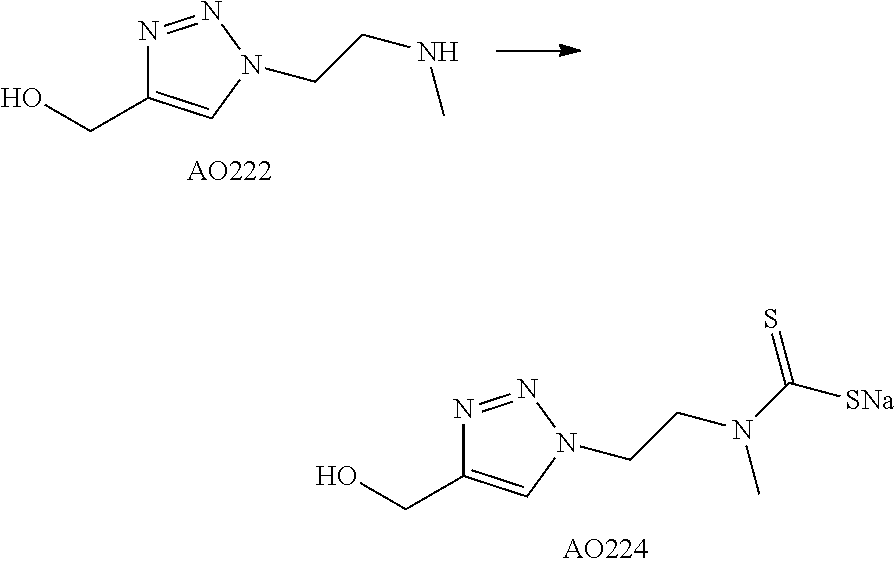
- FAEVOUOPXBWXCX-UHFFFAOYSA-M CN(CCN1C=C(CO)N=N1)C(=S)S[Na].CNCCN1C=C(CO)N=N1 Chemical compound CN(CCN1C=C(CO)N=N1)C(=S)S[Na].CNCCN1C=C(CO)N=N1 FAEVOUOPXBWXCX-UHFFFAOYSA-M 0.000 description 1
- SAGDJBCCXUFESM-UHFFFAOYSA-K CN(CCO)C(=S)[S-].CN(CCO)C1=[SH][Ru](Cl)S1.[C-]#[O+].[C-]#[O+].[C-]#[O+].[Na+] Chemical compound CN(CCO)C(=S)[S-].CN(CCO)C1=[SH][Ru](Cl)S1.[C-]#[O+].[C-]#[O+].[C-]#[O+].[Na+] SAGDJBCCXUFESM-UHFFFAOYSA-K 0.000 description 1
- QXOAYOGFDRZZMC-UHFFFAOYSA-M CN(CCO)C(=S)[S-].[Na+] Chemical compound CN(CCO)C(=S)[S-].[Na+] QXOAYOGFDRZZMC-UHFFFAOYSA-M 0.000 description 1
- NDEURZSDITWRKM-UHFFFAOYSA-M CN(CCO)C1=[SH][Mn]S1.[C-]#[O+].[C-]#[O+].[C-]#[O+].[C-]#[O+] Chemical compound CN(CCO)C1=[SH][Mn]S1.[C-]#[O+].[C-]#[O+].[C-]#[O+].[C-]#[O+] NDEURZSDITWRKM-UHFFFAOYSA-M 0.000 description 1
- BUQUJORQGSUZFR-UHFFFAOYSA-N CNCCCl.CNCCN=[N+]=[N-].Cl.Cl Chemical compound CNCCCl.CNCCN=[N+]=[N-].Cl.Cl BUQUJORQGSUZFR-UHFFFAOYSA-N 0.000 description 1
- LZUOYPOWANKPAZ-UHFFFAOYSA-N CNCCCl.CNCCO.Cl Chemical compound CNCCCl.CNCCO.Cl LZUOYPOWANKPAZ-UHFFFAOYSA-N 0.000 description 1
- ZYTZRTTZDRJKIY-UHFFFAOYSA-N CNCCN1C=C(CO)N=N1.CNCCN=[N+]=[N-].Cl Chemical compound CNCCN1C=C(CO)N=N1.CNCCN=[N+]=[N-].Cl ZYTZRTTZDRJKIY-UHFFFAOYSA-N 0.000 description 1
- XNLLOZAWSLVBRA-FSEHQYEXSA-K Cl[Ru].O=CCC(CCC(=O)/C=C/C(=O)CCC1N[Ru](Cl)OC1=O)C(=O)OC=O.[C-]#[O+].[C-]#[O+].[C-]#[O+].[C-]#[O+] Chemical compound Cl[Ru].O=CCC(CCC(=O)/C=C/C(=O)CCC1N[Ru](Cl)OC1=O)C(=O)OC=O.[C-]#[O+].[C-]#[O+].[C-]#[O+].[C-]#[O+] XNLLOZAWSLVBRA-FSEHQYEXSA-K 0.000 description 1
- MVGOLGNFKSVFJM-BRCCFAOYSA-L O=C(/C=C/C(=O)CCC1N[Ru](Cl)OC1=O)C[Y].[C-]#[O+].[C-]#[O+].[C-]#[O+] Chemical compound O=C(/C=C/C(=O)CCC1N[Ru](Cl)OC1=O)C[Y].[C-]#[O+].[C-]#[O+].[C-]#[O+] MVGOLGNFKSVFJM-BRCCFAOYSA-L 0.000 description 1
- VZHPHOOWDWOHKG-ZIDOSWBXSA-N O=C(/C=C/C(=O)C[W]CC1=[SH]CS1)CC[W]C1=[SH]CS1 Chemical compound O=C(/C=C/C(=O)C[W]CC1=[SH]CS1)CC[W]C1=[SH]CS1 VZHPHOOWDWOHKG-ZIDOSWBXSA-N 0.000 description 1
- VXXREBIEWRPZSF-UESNGYRASA-N O=C([Mn])/C=C/C(=O)C[Y].[C-]#[O+].[C-]#[O+].[C-]#[O+].[C-]#[O+].[C-]#[O+] Chemical compound O=C([Mn])/C=C/C(=O)C[Y].[C-]#[O+].[C-]#[O+].[C-]#[O+].[C-]#[O+].[C-]#[O+] VXXREBIEWRPZSF-UESNGYRASA-N 0.000 description 1
- NKUHNVJMLQDBQA-UHFFFAOYSA-L OCCN1CCN(C(=S)[S-])CC1.OCCN1CCN(C2=[SH][Mn]S2)CC1.[C-]#[O+].[C-]#[O+].[C-]#[O+].[C-]#[O+].[Na+] Chemical compound OCCN1CCN(C(=S)[S-])CC1.OCCN1CCN(C2=[SH][Mn]S2)CC1.[C-]#[O+].[C-]#[O+].[C-]#[O+].[C-]#[O+].[Na+] NKUHNVJMLQDBQA-UHFFFAOYSA-L 0.000 description 1
- LVXGJJJEASILLB-UHFFFAOYSA-K OCCN1CCN(C(=S)[S-])CC1.OCCN1CCN(C2=[SH][Ru](Cl)S2)CC1.[C-]#[O+].[C-]#[O+].[C-]#[O+].[Na+] Chemical compound OCCN1CCN(C(=S)[S-])CC1.OCCN1CCN(C2=[SH][Ru](Cl)S2)CC1.[C-]#[O+].[C-]#[O+].[C-]#[O+].[Na+] LVXGJJJEASILLB-UHFFFAOYSA-K 0.000 description 1
- HIDKJEDZYPLMKK-UHFFFAOYSA-M OCCN1CCN(C(=S)[S-])CC1.OCCN1CCNCC1.[Na+] Chemical compound OCCN1CCN(C(=S)[S-])CC1.OCCN1CCNCC1.[Na+] HIDKJEDZYPLMKK-UHFFFAOYSA-M 0.000 description 1
Images


Classifications
-
- C—CHEMISTRY; METALLURGY
- C07—ORGANIC CHEMISTRY
- C07F—ACYCLIC, CARBOCYCLIC OR HETEROCYCLIC COMPOUNDS CONTAINING ELEMENTS OTHER THAN CARBON, HYDROGEN, HALOGEN, OXYGEN, NITROGEN, SULFUR, SELENIUM OR TELLURIUM
- C07F13/00—Compounds containing elements of Groups 7 or 17 of the Periodic Table
-
- A—HUMAN NECESSITIES
- A61—MEDICAL OR VETERINARY SCIENCE; HYGIENE
- A61P—SPECIFIC THERAPEUTIC ACTIVITY OF CHEMICAL COMPOUNDS OR MEDICINAL PREPARATIONS
- A61P29/00—Non-central analgesic, antipyretic or antiinflammatory agents, e.g. antirheumatic agents; Non-steroidal antiinflammatory drugs [NSAID]
-
- A—HUMAN NECESSITIES
- A61—MEDICAL OR VETERINARY SCIENCE; HYGIENE
- A61P—SPECIFIC THERAPEUTIC ACTIVITY OF CHEMICAL COMPOUNDS OR MEDICINAL PREPARATIONS
- A61P9/00—Drugs for disorders of the cardiovascular system
-
- C—CHEMISTRY; METALLURGY
- C07—ORGANIC CHEMISTRY
- C07F—ACYCLIC, CARBOCYCLIC OR HETEROCYCLIC COMPOUNDS CONTAINING ELEMENTS OTHER THAN CARBON, HYDROGEN, HALOGEN, OXYGEN, NITROGEN, SULFUR, SELENIUM OR TELLURIUM
- C07F15/00—Compounds containing elements of Groups 8, 9, 10 or 18 of the Periodic Table
- C07F15/0006—Compounds containing elements of Groups 8, 9, 10 or 18 of the Periodic Table compounds of the platinum group
- C07F15/0046—Ruthenium compounds
-
- C—CHEMISTRY; METALLURGY
- C07—ORGANIC CHEMISTRY
- C07F—ACYCLIC, CARBOCYCLIC OR HETEROCYCLIC COMPOUNDS CONTAINING ELEMENTS OTHER THAN CARBON, HYDROGEN, HALOGEN, OXYGEN, NITROGEN, SULFUR, SELENIUM OR TELLURIUM
- C07F15/00—Compounds containing elements of Groups 8, 9, 10 or 18 of the Periodic Table
- C07F15/02—Iron compounds
-
- C—CHEMISTRY; METALLURGY
- C07—ORGANIC CHEMISTRY
- C07F—ACYCLIC, CARBOCYCLIC OR HETEROCYCLIC COMPOUNDS CONTAINING ELEMENTS OTHER THAN CARBON, HYDROGEN, HALOGEN, OXYGEN, NITROGEN, SULFUR, SELENIUM OR TELLURIUM
- C07F15/00—Compounds containing elements of Groups 8, 9, 10 or 18 of the Periodic Table
- C07F15/06—Cobalt compounds
Definitions
- the present invention relates to hybrid fumarate-CO-releasing molecules capable of activating heme oxygenase-1 (HO-1) activity and HO-1 protein expression, their synthesis and their use in therapeutic applications, in particular their use in the treatment of inflammatory and cardiovascular diseases.
- HO-1 heme oxygenase-1
- the HO-1/CO system is a significant part of the defense against the damage inflicted by a variety of stress conditions mediated by heavy metals, reactive oxygen species, lipopolysaccharide (LPS) and other inflammatory processes, thereby playing a pivotal role in the regulation of the cytoprotective and anti-inflammatory responses.
- CO gas administered at low doses (250 ppm) for restricted period of times has been shown to reproduce (restore) many of the beneficial effects of HO-1 in models of cardiovascular dysfunction, pulmonary hypertension, and inflammatory conditions such as sepsis and inflammatory bowel disease.
- CO-RMs CO-releasing molecules
- Nrf2 The transcription factor Nrf2 is a crucial initiator of the cellular stress response as it co-ordinates the expression of several antioxidant and detoxification genes that repair damage and restore cellular homeostasis.
- heme oxygenase-1 HO-1 plays a prominent role by utilizing heme to produce CO, biliverdin/bilirubin and iron, important signaling and protective molecules against oxidative stress and inflammation.
- Nrf2/HO-1 activators Many chemicals have been identified to act as Nrf2/HO-1 activators and among them several naturally-derived compounds having an ⁇ , ⁇ -unsaturated carbonyl functionality, including curcumin, the first chemical found to increase HO-1 expression, and chalcones.
- the list of Nrf2/HO-1 activators has now grown to include several hundred compounds. Because of their mechanism of action, Nrf2/HO-1 activators require time to mount the cellular stress response, resulting in a delayed, albeit essential, beneficial effect.
- Nrf2-dependent protective proteome The synthesis of a molecule possessing both the ability to rapidly release CO and simultaneously stimulate a longer-lasting Nrf2-dependent protective proteome, offers significant therapeutic advantages compared to CO-RMs or Nrf2 activating agents alone in diseases where these pathways are crucial for tissue protection, and there is therefore a need for such molecules.
- WO 2012/076696 discloses curcumin derivatives bound to a CO-releasing molecule.
- the inventors of the present invention have however shown that these molecules do not release carbon monoxide. This lack of CO-release results in molecules that do not exhibit the wide array of beneficial therapeutic effects related to the activation of HO-1 by CO.
- WO 2008/003953 also describes CO-releasing molecules of formula (I): Mn(CO) 4 XY wherein X and Y are monodentate ligands, or taken together form a bidentate ligand, for the therapeutic delivery of CO to humans and animals. More specifically, WO 2008/003953 discloses CO-releasing compound 364, wherein X represents O(O)CCH2CH2C(O)OH and Y represents Br. However, this molecule demonstrated poor CO-releasing abilities.
- hybrid molecules comprising a fumarate moiety and a CO-releasing molecule (CORM) are capable of rapidly liberating CO and activating the Nrf2/HO-1 pathway, resulting in a dual activation of the inflammatory defenses in cells and an improved therapeutic efficacy.
- CORM CO-releasing molecule
- the present invention concerns both compounds with one CORM moiety (mono-CORM compounds) and with two CORM moieties (bi-CORM compounds).
- mono-CORM compounds and with two CORM moieties
- bi-CORM compounds have discovered that both types of molecules have improved therapeutic activities.
- mono-CORM molecules release very quickly high levels of CO, thus exerting a “burst effect”.
- bi-CORM compounds release higher levels of CO (in particular because of the presence of a second CORM moiety), but less rapidly and over a longer period of time.
- mono-CORM compounds of the invention will be used when a “burst effect” is sought for, while bi-CORM compounds of the invention will be used when a sustained release over a long period of time is more appropriate for the patient or with regard to the disease or condition to be treated.
- the present invention therefore concerns hybrid fumarate-carbon monoxide releasing molecules (fumarate-CORM), their pharmaceutically acceptable salts, hydrates and solvates, of formula (I):
- CORM is chosen from among:
- the present invention preferably concerns hybrid fumarate-carbon monoxide releasing molecules (fumarate-CORM), their pharmaceutically acceptable salts, hydrates and solvates, of formula (I) above, wherein:
- A represents:
- W represents O or NR 4
- R 4 represents —(C 1 -C 6 )alkyl-
- L represents an ionic ligand such as halogen, or a counter-ion such as BF 4 or PF 6
- M represents Rh, Co, Ru, Mn, Mo, V or Fe, preferably Co, Ru or Mn and n is an integer, chosen so that the metal M has no free valency
- R 1 represents A′-CORM′
- CORM represents a carbonyl metal complex chosen from among:
- the present invention even more preferably relates to hybrid fumarate-carbon monoxide releasing molecules (fumarate-CORM), their pharmaceutically acceptable salts, hydrates and solvates, of formula (Ia):
- CORM represents a carbonyl metal complex of formula:
- M represents Rh, Co, Ru, Mn, Mo, V or Fe, preferably Co, Ru or Mn, and n is an integer chosen so that the metal M has no free valency, more preferably n is an integer from 1 to 4, chosen so that the metal M has no free valency.
- n is an integer chosen so that the metal M has no free valency, more preferably n is an integer from 1 to 4, chosen so that the metal M has no free valency.
- M represents Rh, n represents 2; when M represents Co, n represents 2; when M represents Ru, n represents 2; when M represents Mn, n represents 3; when M represents Mo, n represents 3; when M represents V; n represents 4; when M represents Fe, n represents 3.
- Q represents O or NR 2 , preferably O and R 2 represents H or (C 1 -C 6 )alkyl.
- Z represents —(C 1 -C 6 )alkyl-, —(C 2 -C 6 )alkenyl- or —(C 3 -C 8 )heterocyclyl-, —(C 1 -C 6 )alkyl-R 3 —(C 1 -C 6 )alkyl-, —(C 2 -C 6 )alkenyl-R 3 —(C 1 -C 6 )alkyl- and R 3 represents heteroaryl or (C 3 -C 8 )heterocyclyl.
- Q represents O, S or NR 2 , where R 2 represents H, (C 1 -C 6 )alkyl and Z represents —(C 1 -C 6 )alkyl-, —(C 2 -C 6 )alkenyl-, —(C 3 -C 6 )heterocyclyl-, —(C 1 -C 6 )alkyl-R 3 —(C 1 -C 6 )alkyl-, —(C 2 -C 6 )alkenyl-R 3 —(C 1 -C 6 )alkyl-, where R 3 represents heteroaryl or (C 3 -C 8 )heterocyclyl.
- Z represents:
- CORM is chosen from among:
- Q′ is O or NR 5 , preferably O.
- Y is chosen from among H; —(C 1 -C 6 )alkyl, —(C 2 -C 6 )alkenyl; -aryl, -heteroaryl, —(C 2 -C 6 )alkynyl, —(C 3 -C 6 )heterocyclyl; —(C 3 -C 8 )cycloalkyl or —(C 1 -C 6 )alkyl-aryl.
- the invention concerns a hybrid fumarate-carbon monoxide releasing molecule (fumarate-CO—RM), in which the fumarate moiety is substituted on one side by a CO-releasing carbonyl complex and on the other side by an acid, an ester, a thioester or an amide, of formula (Ia):
- the compounds of formula (Ia) are capable of releasing CO at a fast rate.
- compound A of the examples below illustrative of the compounds of formula (Ia)
- the compounds of formula (Ia) are therefore advantageous for a relatively fast biological activity.
- experiments demonstrate that the compounds of the invention comprising only one CORM group are potent activators of Nrf2 and inducers of HO-1 protein expression, and are more effective than dimethylfumarate.
- M represents Mn(CO) 4 or Ru(CO) 3 Cl
- Q, Q′, W, Z and Y are as defined for formula (I).
- Z—W is —CH 2 —CH 2 —NR 7 —
- R 7 represents (C 1 -C 3 )alkyl.
- Q is O or NR 2 , preferably O.
- Q′ is O or NR 5 , preferably O.
- Y represents H, —(C 1 -C 6 )alkyl or —(C 2 -C 6 )alkenyl.
- Y is H, —(C 1 -C 6 )alkyl or —(C 2 -C 6 )alkenyl and Q′ represents O.
- Y is H, —(C 1 -C 6 )alkyl or —(C 2 -C 6 )alkenyl
- Q′ is O
- Q and Z are as defined for formula (I).
- Q-Z is the side chain of an amino-acid such as serine, cysteine, tyrosine or lysine.
- M x (CO) y represents Co 2 (CO) 6 or Co 4 (CO) 10
- Q′, Q, Y and Z are as defined for formula (I).
- Y is H, —(C 1 -C 6 )alkyl or —(C 2 -C 6 )alkenyl
- Q′ is O
- Q and Z are as defined for formula (I).
- Q is O and Z is —(C 1 -C 6 )alkyl, preferably (C 1 -C 3 )alkyl.
- the invention concerns a hybrid fumarate-carbon monoxide releasing molecule (fumarate-CO-RM) in which the fumarate moiety is substituted on both sides by a CO-releasing carbonyl complex.
- fluarate-CO-RM hybrid fumarate-carbon monoxide releasing molecule
- compound B of the examples below illustrative of the compounds of formula (Ic) described thereafter, is capable of releasing CO over 480 minutes under the in vitro conditions described in the examples, which is a long period of time in the sense of the present invention.
- the hybrid fumarate-carbon monoxide releasing molecule is substituted on one side by one CO-releasing carbonyl complex and on the other side by a different CO-releasing carbonyl complex, according to formula (Ib):
- A-CORM and A′-CORM′ are as defined above or below for formula (I).
- CORM and CORM′ are respectively
- M is Mn(CO) 4 or Ru(CO) 3 Cl.
- A is Q-Z—W wherein Z—W is —CH 2 —CH 2 —NR 7 —,
- R 7 represents (C 1 -C 3 )alkyl and A′ is Q′-Z′, wherein Z′ is —(C 1 -C 6 )alkyl, preferably (C 1 -C 3 )alkyl.
- Q is O or NR 2 , preferably O and Q′ is O or NR 2 , preferably O.
- the compounds according to the second embodiment have formula (Ic), wherein the fumarate moiety is substituted on both sides by the same CO-releasing carbonyl complex:
- A-CORM is as defined for the compounds of formula (I).
- CORM preferably represents a carbonyl metal complex chosen from among:
- M represents Mn(CO) 4 or Ru(CO) 3 Cl, and Q and Z are as defined for formula (I).
- Z—W is —CH 2 —CH 2 —NR 7 —
- R 7 represents (C 1 -C 3 )alkyl
- Q is O or NR 2 , preferably O.
- Q-Z is the side chain of an amino-acid such as serine, cysteine, tyrosine or lysine.
- M x (CO) y represents Co 2 (CO) 6 or Co 4 (CO) 10 , preferably Co 4 (CO) 10
- Q and Z are as defined for formula (I). More advantageously, Q is O and Z is —(C 1 -C 6 )alkyl, preferably (C 1 -C 3 )alkyl.
- the compound of formula (I) is chosen from among:
- the compound of formula (I) is:
- the invention also concerns a pharmaceutical composition
- a pharmaceutical composition comprising at least one compound of formula (I), a pharmaceutically acceptable salt, solvate or hydrate thereof, as defined previously and at least one pharmaceutically acceptable excipient.
- compositions of the invention are advantageously suitable for administration via oral, sublingual, subcutaneous, intramuscular, intravenous, transdermal, topical or rectal route.
- the pharmaceutical compositions of the invention may also be administered by inhalation, for example by means of an aerosol.
- the active ingredient can be administered in unit forms for administration, mixed with conventional pharmaceutical carriers, to animals or to humans.
- the main active ingredient is mixed with a pharmaceutical vehicle and other conventional excipients known to those skilled in the art.
- the compounds of the invention can be used in a pharmaceutical composition at a dose ranging from 0.01 mg to 1000 mg a day, administered in only one dose once a day or in several doses along the day, for example twice a day.
- the daily administered dose is advantageously comprises between 5 mg and 500 mg, and more advantageously between 10 mg and 200 mg. However, it can be necessary to use doses out of these ranges, which could be noticed by the person skilled in the art.
- the present invention further concerns a compound of formula (I), a pharmaceutically acceptable salt, solvate or hydrate thereof, or a pharmaceutical composition comprising at least one compound of formula (I), a salt, solvate or hydrate thereof, for use as a drug.
- the present invention further concerns at least one compound of formula (I), a pharmaceutically acceptable salt, solvate or hydrate thereof, or a pharmaceutical composition comprising at least one compound of formula (I), a salt, solvate or hydrate thereof, for use in the treatment of cardiovascular or inflammatory diseases.
- the present invention further concerns the use of at least one compound of formula (I), a pharmaceutically acceptable salt, solvate or hydrate thereof, for the manufacture of a medicament for use in the treatment of cardiovascular or inflammatory diseases.
- the present invention further concerns a method for treating cardiovascular or inflammatory diseases, comprising the administration of at least one compound of formula (I), a pharmaceutically acceptable salt, solvate or hydrate thereof, or of a pharmaceutical composition comprising at least one compound of formula (I), a pharmaceutically acceptable salt, solvate or hydrate thereof, to a person in need thereof.
- Inflammatory and cardiovascular diseases include for example myocardial ischemia and heart diseases, rheumatoid arthritis, acute and chronic skin wound (wound healing), inflammatory bowel disease, post-operative ileus, brain ischemia, psoriasis, diabetes, diabetic nephropathy, metabolic syndrome, sickle-cell disease, neurodegenerative diseases such as Alzheimer's disease or Parkinson's disease, neuropathic pain, hypertension, pulmonary arterial hypertension, septicemia, septic or endotoxic shock, hemorrhagic shock, multiple sclerosis, cancer and chronic obstructive pulmonary disease.
- myocardial ischemia and heart diseases for example myocardial ischemia and heart diseases, rheumatoid arthritis, acute and chronic skin wound (wound healing), inflammatory bowel disease, post-operative ileus, brain ischemia, psoriasis, diabetes, diabetic nephropathy, metabolic syndrome, sickle-cell disease, neurodegenerative diseases such as Alzheimer
- Preferred inflammatory and cardiovascular diseases are skin wound (wound healing), brain and cardiac ischemia, psoriasis, diabetes, multiple sclerosis, cancer and chronic obstructive pulmonary disease.
- the present invention further concerns a process for preparing the compounds of formula (I), their salts, hydrates or solvates.
- the compounds of formula (I) can be obtained according to two methods.
- Step (1) The diacyl chloride, bromide, fluoride or di-activated ester of fumaric acid or the monoacyl chloride, bromide, fluoride or mono-activated ester of a mono-ester, mono-amide or mono-thioester of fumaric acid is esterified with a compound of formula (II) chosen from among:
- fumaric acid or the mono-ester of fumaric acid may be alkylated with a compound of formula (III) chosen from among:
- Step (2) the compound obtained in step (1) is reacted with a suitable carbonyl metal complex of formula L 1 L 2 M x (CO) y where x is 1 or 2 and y is 1 to 10, L 1 and L 2 represent each a monodentate ligand or L 1 L 2 represents a bidentate ligand to yield after optional deprotection the compound of formula (I).
- a suitable carbonyl metal complex of formula L 1 L 2 M x (CO) y where x is 1 or 2 and y is 1 to 10, L 1 and L 2 represent each a monodentate ligand or L 1 L 2 represents a bidentate ligand to yield after optional deprotection the compound of formula (I).
- the invention therefore concerns a process for the synthesis of a compound of formula (I) comprising the reaction of a fumaric acid derivative of formula (IV):
- the diacyl chloride, bromide, fluoride or di-activated ester of fumaric acid or the monoacyl chloride, bromide, fluoride or mono-activated ester of a mono-ester, mono-amide or mono-thioester of fumaric acid is esterified with a compound of formula H-A-CORM.
- fumaric acid or the mono-ester of fumaric acid may be alkylated with a compound of formula Hal-A-CORM, wherein A is as defined above and Hal represents a leaving group such as halogen or sulfonate, such as trifuoromethane-sulfonate.
- the invention therefore also concerns a process for the synthesis of a compound of formula (I) comprising the reaction of a fumaric acid derivative of formula (V):
- the term “leaving group” refers to a chemical group which can be easily replaced with a nucleophile during a nucleophile substitution reaction.
- activated ester is intended to designate an ester that enhances the reactivity of the carbonyl group(s) of fumaric acid.
- activated esters can be prepared before the reaction or generated in situ according to well-known procedures.
- reagents usable for preparing the activated esters include coupling agents, such as diisopropylcarbodiimide (DIC), dicyclohexylcarbodiimide (DCC), 1-(3-dimethylaminopropyl)-3-ethylcarbodiimide hydrochloride (EDC), carbonyldiimidazole (CDI), hexafluorophosphate 2H benzotriazole-1-yl)-1,1,3,3-tetramethyluronium (HBTU), tetrafluoroborate 2-(IH-benzotriazole-1-yl)-1,1,3,3-tetramethyluronium (TBTU), hexafluorophosphate O (7-azobenzotriazol-1-yl)-1,1,3,3-tetramethyluronium (HATU) or (benzotriazol-1-yloxy)tripyrrolodinophosphonium hexafluorophosphate (PyBOP); optional coup
- heteroatoms such as N or O
- protecting groups are necessary. Suitable protecting groups are known in the art and are for example disclosed in Greene, “Protective Groups In Organic synthesis”, (John Wiley & Sons, New York (1981).
- the monoesters of fumaric acid that is, the compounds of formula (II), wherein X 1 represents Q′-Y
- X 1 represents Q′-Y
- the compounds of formula (V) wherein X 1 represents A-CORM can be prepared by reacting fumaric acid with a compound of formula H-A-CORM or Hal-A-CORM according to method (b) described above, and if required transformation of the carboxylic acid into an acyl chloride, bromide, fluoride or activated ester.
- the compounds of formula (Ic) can be obtained in a one-step procedure by reacting the diacyl chloride of fumaric acid with two equivalents of a compound of formula H-A-CORM or two equivalents of a compound chosen from among:
- the compound of formula (Ia2) and (1c2) can be obtained by reacting the monoacyl chloride of a fumarate ester or the diacyl chloride of fumaric acid with an appropriate amount of an anionic manganese carbonyl complex such as Na + [Mn(CO) 5 ] ⁇ .
- the present invention encompasses only stable compounds.
- isomers when “isomers” are referred to, only stable isomers are considered.
- (C 1 -C 6 )alkyl designates an alkyl group or radical having 1 to 6 carbon atoms.
- —(C 1 -C 6 )alkyl designates an acyclic, saturated, linear or branched hydrocarbon chain comprising 1 to 6 carbon atoms.
- —(C 1 -C 6 )alkyl groups include methyl, ethyl, propyl, butyl, pentyl or hexyl.
- propyl, butyl, pentyl and hexyl include all possible isomers, in particular structural isomers.
- butyl comprises n-butyl, iso-butyl, sec-butyl and tert-butyl.
- —(C 2 -C 6 )alkenyl designates an acyclic, saturated, linear or branched hydrocarbon chain comprising 2 to 6 carbon atoms, at least two of which are linked via a double bond.
- Examples of “—(C 2 -C 6 )alkenyl” include ethenyl or vinyl, propenyl, butenyl, pentenyl or hexenyl. Unless explicitly stated, the definitions of propenyl, butenyl, pentenyl and hexenyl include all possible isomers, in particular structural and/or position isomers.
- —(C 2 -C 6 )alkynyl designates an acyclic, saturated, linear or branched hydrocarbon chain comprising 2 to 6 carbon atoms, at least two of which are linked via a triple bond.
- Examples of “—(C 2 -C 6 )alkynyl” include ethynyl, propynyl, butynyl, pentynyl or hexynyl. Unless explicitly stated, the definitions of propynyl, butynyl, pentynyl and hexynyl include all possible isomers, in particular structural and/or position isomers.
- substituted as used herein means that any of the hydrogen atoms can be replaced by a substituent, such as fluorine.
- —(C 3 -C 14 )cycloalkyl designates a saturated or partially saturated mono-, di- or tri-cyclic structure comprising from 3 to 14 carbon atoms.
- Examples of “—(C 3 -C 14 )cycloalkyl” include cyclopropyl, cyclobutyl, cyclopentyl, cyclohexyl, cycloheptyl, cyclooctyl, cyclopentenyl and cyclohexenyl.
- Examples of “—(C 3 -C 8 )cycloalkyl” include cyclopropyl, cyclobutyl, cyclopentyl, cyclohexyl, cycloheptyl or cyclooctyl. Unless explicitly stated, the cycloalkyls can be substituted by one or more groups such as methyl, ethyl, isopropyl, hydroxy, fluoro, chloro, bromo and iodo.
- —(C 3 -C 8 )heterocyclyl designates saturated heterocycles having 3, 4, 5, 6, 7 or 8 atoms in the ring where 1, 2 or 3 heteroatoms chosen from among N, O and S replace the corresponding number of carbon atoms.
- Examples of “—(C 3 -C 6 )heterocyclyl” include aziridinyl, oxyranyl, pyrrolidinyl, tetrahydrofuranyl, oxazolyl, piperidinyl, piperazinyl and morpholinyl.
- aryl designates an aromatic, monocyclic ring that may be fused with a second saturated, unsaturated or aromatic ring.
- aryl include, without restriction to the following examples, phenyl, indanyl, indenyl, naphtyl, anthracenyl, phenanthrenyl, tetrahydronaphtyl and dihydronaphtyl.
- the most preferred aryl are those comprising one six-membered aromatic ring.
- the aryl group may be substituted, preferably with one or more groups independently selected from the group consisting of alkyl, alkoxy, halogen, hydroxyl, amino, nitro, cyano, trifluoro, carboxylic acid or carboxylic ester.
- heteroaryl designates a mono- or polycyclic aryl as defined above where one or more carbon atoms have been replaced with one or more heteroatoms chosen from among N, O and S. Unless explicitly stated, the term “heteroaryl” includes all possible isomers, in particular position isomers.
- heteroaryl groups include furyl, thienyl, imidazolyl, pyridyl, pyrrolyl, N-alkyl pyrrolyl, pyrimidinyl, pyrazinyl, tetrazolyl, triazolyl and triazinyl.
- the heteroaryl group may be substituted, preferably with one or more groups independently selected from the group consisting of alkyl, alkoxy, halogen, hydroxyl, amino, nitro, cyano, trifluoro, carboxylic acid or carboxylic ester.
- Preferred heteroaryls are those having 5 or 6 atoms in the ring, such as indolyl, pyrrolyl, pyridinyl, pyrrazolyl, triazolyl, furanyl or thienyl.
- halogen designates a fluorine, chlorine, bromine or iodine atom.
- the term “pharmaceutically acceptable” is intended to mean what is useful to the preparation of a pharmaceutical composition, and what is generally safe and non-toxic, for a pharmaceutical use.
- salts comprise:
- organic bases comprise diethanolamine, ethanolamine, N-methylglucamine, triethanolamine, tromethamine and the like.
- Acceptable inorganic bases comprise aluminium hydroxide, calcium hydroxide, potassium hydroxide, sodium carbonate and sodium hydroxide.
- FIG. 1 represents the UV absorbance of carbon monoxy myoglobin (MbCO) in the presence of a curcumin derivative according to WO 2012/076696 ( FIG. 1A ), compound A ( FIG. 1B ) and compound B ( FIG. 1C ) at different times,
- the presence of absorbance peaks at 540 and 578 nm indicates the formation of carbon monoxy myoglobin (MbCO) ( FIG. 1A-C ).
- the intracellular CO according to the COP-1 assay of example 2 for different concentrations of Compound C is found in FIG. 1D .
- FIG. 2 represents heme oxygenase activity in BV2 microglia in the absence (CON) or in the presence of increasing concentrations of compound A ( FIG. 2A ), or compound C, comparative compound CORM-401 of WO 2008/003953 and comparative compound J ( FIG. 2B ). Heme oxygenase activity is expressed on the Y axis as percentage of control.
- FIG. 3 represents on the Y axis nitrite production expressed in ⁇ M in BV2 microglia (CON), in BV2 microglia challenged for 24 h with lipopolysaccharide (LPS, 1 ⁇ g/ml) (LPS) and in BV2 microglia challenged with lipopolysaccharide (LPS, 1 ⁇ g/ml) (LPS) in the presence of increasing concentrations of compound A ( FIG. 3A ) or compound B ( FIG. 3B ).
- 3D represent on the Y axis nitrite production expressed in ⁇ M in BV2 microglia (CON), in BV2 microglia challenged for 24 h with lipopolysaccharide (LPS, 1 ⁇ g/ml) and in BV2 microglia challenged with lipopolysaccharide (LPS, 1 ⁇ g/ml) (LPS) in the presence of increasing concentrations of compound C (1, 2.5 and 5 ⁇ M) and in the presence of 5 ⁇ M of a curcumin derivative according to WO 2012/076696 ( FIG. 3C ) or in the presence of 5 ⁇ M of comparative fumarate derivative (compound J) and comparative compound CORM-401 of WO 2008/003953 ( FIG. 3D ).
- FIG. 4 represents the cytotoxicity of compound A ( FIG. 4A ), compound B ( FIG. 4B ) measured in BV2 microglia and a comparative curcumin derivative according to WO 2012/076696 ( FIG. 4C ) measured in RAW macrophage, compound A measured in keratinocyte cells ( FIG. 4D ), or compound A measured in THP-1 cells ( FIG. 4E ) as percentage of control (Y axis) with increasing concentration of compound A or B (X axis).
- FIG. 5 represents Nrf-2 expression ( FIG. 5A ) in BV2 microglia (control), in BV2 microglia in the presence of compound A and in BV2 microglia in the presence of compound B. The presence of the compound in the experiment is indicated by “+” and its absence by “ ⁇ ”.
- FIG. 5B represents HO-1 expression in BV2 microglia in the absence (control) or in the presence of increasing concentration of compound A.
- FIG. 5C represents HO-1 expression and Nrf-2 expression in BV2 microglia in the presence of increasing concentration of compound C, comparative compound CORM-401 of WO 2008/003953 or comparative compound J.
- FIG. 5D represents HO-1 expression and Nrf-2 expression in keratinocyte cells over time in the presence of compound C.
- FIG. 5E represents HO-1 expression and Nrf-2 expression in keratinocytes cells in the presence of increasing concentration of compound C or comparative dimethylfumarate (DMF) or comparative positive control C+ (cynnamaldehyde, 100 ⁇ M) which are known to activate Nrf2.
- FIG. 5F represents HO-1 expression and Nrf-2 expression in THP-1 cells in the presence of increasing concentration of compound A, compound B or compound C.
- FIG. 6 represents the concentration of CO released (Y axis, expressed as the amount of carbon monoxy myoglobin detected in ⁇ M) as a function of time (X axis, expressed in minutes) using deoxymyoglobin (Mb, 100 ⁇ M) in the presence of compound A ( FIG. 6A , - ⁇ -) and compound B ( FIG. 6A and FIG. 6B , - ⁇ -).
- FIG. 7 represents TNF- ⁇ production in human macrophages challenged with LPS in the presence of compound C and compound E.
- FIG. 8 represents TNF- ⁇ production in human THP-1 cells challenged with LPS in the presence of compound C and compound E.
- Step 1 Preparation of Sodium (2-hydroxyethyl)(methyl)carbamodithioate
- step 2 To a solution of the compound obtained in step 2 (149 mg, 0.47 mmol, 1.0 eq.) in anhydrous dichloromethane (10 mL) are added under inert atmosphere of argon, (E)-Ethyl-4-chloro-4-oxobut-2-enoate (115 mg, 0.71 mmol, 1.5 eq., prepared as described in J. Am. Chem. Soc., 1996, 118, 8266-8277) and triethylamine (99 ⁇ L, 0.71 mmol, 1.5 eq.). After stirring at 20° C. under argon for 18 hours, the mixture is concentrated under reduced pressure. The crude mixture is taken up in diethyl ether and filtered over celite.
- Step 1 Preparation of Compound AO 83
- Myoglobin (lyophilized horse heart; 44 ⁇ M final concentration) was prepared in 1 ⁇ phosphate buffered saline (PBS, pH 7.4) in a cuvette from a 500 ⁇ M stock solution and converted to deoxymyoglobin (deoxyMb) by adding sodium dithionite. The solution was maintained at 37° C. in the spectrophotometer chamber throughout the assay using a JASCO temperature controller. A deoxyMb spectrum was recorded, revealing a characteristic peak at 560 nm. A 2-fold excess of a CO—RM molecule was then added to the cuvette to obtain a maximum carbonmonoxy-myoglobin (Mb-CO) spectrum (saturated Mb-CO).
- PBS phosphate buffered saline
- Raw Mb-CO data were corrected using a 4-point non-linear regression method to compensate for a shift in absorbance due to the CO-releasing compounds.
- concentration of Mb-CO at each time-point was calculated using the absorbance values at 540 nm and the extinction coefficient derived from the saturated Mb-CO spectrum, as described previously.
- 5 Mb-CO concentrations ( ⁇ M) were plotted against time (min) and t 1/2 were determined using GraphPad Prism software version 5.0 (San Diego, Calif.) by applying a Boltzmann sigmoidal non-linear regression curve fit.
- t 1/2 represent the time taken for the concentration of Mb-CO to equal half the maximum Mb-CO formed under the assay conditions.
- the amount of CO released was also measured as a function of time for compounds A and B. The results are presented in FIG. 6 .
- the monometallic hybrids of formula (Ia) release CO at a faster rate compared to the bi-metallic hybrid of formula (Ic), but the amount of CO finally released is much higher in the case of compound (Ic), in accordance with the presence of two bi-metallic carbonyl complexes.
- the compounds of formula (Ia) are therefore advantageous for a fast biological activity (burst effect).
- the bi-metallic hybrids of formula (Ic) are able to release more CO over a longer period of time, they are advantageous for a sustained biological activity.
- BV2 microglia cells (10 6 cells/ml) were washed once, incubated with PBS containing Ca 2+ and Mg 2+ and then treated for 15 min in the dark at 37° C. with compound C and comparative compound CORM-401 according to WO 2008/003953 (5 ⁇ M) of the following formula:
- compound C releases significantly more carbon monoxide than the comparative compound CORM-401 according to WO 2008/003953.
- Heme oxygenase activity was determined by a spectrophotometric assay that measures the formation of bilirubin as a difference in absorbance between 464 and 530 nm (extinction coefficient for bilirubin 40 mM ⁇ 1 ⁇ cm ⁇ 1 ).
- BV2 microglia was incubated with increasing concentrations of compound A for 6 h. Following incubation, cells were harvested in ice cold PBS (pH 7.4) containing 2 mM MgCl 2 and stored at ⁇ 80° C. Cell samples were incubated in the dark at 37° C.
- reaction for 1 h in a reaction mix containing PBS/MgCl 2 , 20 ⁇ M hemin (Frontier Scientific, Newark, Del.) as a heme oxygenase substrate, rat liver cytosol as a source of biliverdin reductase, 2 mM glucose-6-phosphate, 0.5 U/ml glucose-6-phosphate dehydrogenase and 0.8 mM NADPH.
- the reaction was terminated by addition of 1 ml pure chloroform and a solution containing only bilirubin was extracted by vortex-centrifugation cycles.
- Absorbance values corresponding to the formation of bilirubin were obtained using an UltraspecTM 500 pro visible spectrophotometer (GE Healthcare Life Sciences) and the data presented as pmoles bilirubin/mg protein/h. Protein concentrations were measured using a Pierce BCA Protein Assay kit (Thermo Scientific).
- compound C significantly improves HO-1 activity at a concentration as low as 1 ⁇ M. Furthermore, compound C exhibits an improved HO-1 activity compared to comparative compound J, which is a fumarate derivative not comprising any CORM. This thus demonstrates that the combination of a fumarate moiety and a CO-releasing molecule (CORM) has a synergistic action on Heme oxygenase activity.
- CORM CO-releasing molecule
- Nitrite production an index of inflammation, was measured in BV2 cells challenged for 24 h with lipopolysaccharide (LPS, 1 ⁇ g/ml) in the presence or absence of increasing concentrations of compound A or compound B.
- LPS lipopolysaccharide
- nitrite levels were measured using the Griess method. 12,14 Briefly, cell plates were centrifuged at 10,000 ⁇ g for 5 min and the cell-free supernatant was incubated with an equal volume of Griess reagent (2 mM N-(1-naphtyl)ethylenediamide, 30 mM sulfanilamide and 140 mM o-phosphoric acid) for 10 min at room temperature. The absorbance was measured at 560 nm. Concentrations of nitrite ( ⁇ M) were calculated from a standard curve of sodium nitrite.
- Compound A markedly decreased LPS-mediated nitrite accumulation, showing that the Co 2 (CO) 6 group contributes to the reduction of nitrite levels.
- compound B also decreased nitrite production in a concentration-dependent manner but was not as effective as compound A.
- Compound C was also assessed for its capacity to reduce nitrite level in a comparative assay with a curcumin derivative according to WO 2012/076696 of the following formula:
- compound C is significantly more active (by an almost 2-fold) than the curcumin derivative according to WO 2012/076696, since the same reduction of nitrite production is observed with 2.5 ⁇ M of compound C and 5 ⁇ M of the curcumin derivative.
- Compound C was also assessed for its capacity to reduce nitrite level in a comparative assay with comparative compounds CORM-401 and comparative compound J described above.
- compound C is significantly more active (by almost 5-fold) than the fumarate derivative (comparative compound J), since almost the same reduction of nitrite production is observed with 1 ⁇ M of compound C and 5 ⁇ M of the fumarate derivative J. Furthermore, comparative compound CORM-401 is not active.
- Compound A was also compared to dimethylfumarate derivative (comparative compound J) in the nitrite production assay. As shown by table 1, compound A allows a significant decrease of the inflammation caused by LPS (63.3%), which is more than 3 fold the decrease induced by the same concentration of dimethylfumarate derivative (comparative compound J). These results thus demonstrate that the combination of a fumarate moiety with a CORM induces a great benefit in disease treatment, more particularly inflammation treatment.
- compound 364 of WO 2008/003953 was able to decrease the nitrite production for less than 50% at a concentration as high as 100 ⁇ M.
- Compound 364 of WO 2008/003953 is thus for a lot less active than compound A of the present invention, which decreases nitrite production by more than 60% at a concentration as low as 5 ⁇ M (Table 1).
- Data are expressed as percentage of LDH released by treating cells with 2% triton (100% toxicity).
- Cytotoxicity of compound A is not significant at concentrations below 50 ⁇ M.
- Compound B only exhibits cytotoxicity at a concentration of 100 ⁇ M and is not cytotoxic below this concentration.
- curcumin derivative according to WO 2012/076696 already exhibits cytotoxicity at a concentration of 20 ⁇ M on RAW macrophages
- Cytotoxicity was evaluated in keratynocyte cells 24 h after incubation with increasing concentrations of compound A.
- HaCaT cells Human keratinocytes (HaCaT cells) were cultured in Dulbecco's Modified Eagle Medium (DMEM) supplemented with 1% penicillin/streptomycin, 1% sodium pyruvate and 10% fetal bovine serum. Cells at confluence were washed with PBS and treated with compound A at different concentrations and for different periods of time according to the experimental protocol. Compound A was dissolved in DMSO at 0.1% as a final concentration in complete medium.
- DMEM Dulbecco's Modified Eagle Medium
- Cytotoxicity of compound A is not significant at concentrations below 50 ⁇ M.
- Cytotoxicity was evaluated in THP-1 cells 24 h after incubation with increasing concentrations of compound A.
- Human monocytes (THP-1 cells) were cultured in RPMI 1640-Glutamax medium supplemented with 1% penicillin/streptomycin, 1% sodium pyruvate and 10% fetal bovine serum (RPMIc). Cells at confluence were washed with PBS and treated with compound A at different concentrations and for different periods of time according to the experimental protocol. Compound A was dissolved in DMSO at 0.1% as a final concentration in complete medium.
- Cytotoxicity of compound A is not significant at concentrations below 100 ⁇ M.
- BV2 microglia was incubated with 20 ⁇ M of compound A or compound B for 2 h to assess nuclear translocation of Nrf2.
- Nuclear fractions were isolated using a Nuclear Extract Kit from Active Motif (La Hulpe, Belgium), according to the manufacturer's instructions, and stored at ⁇ 80° C. Protein concentrations were measured using a Pierce BCA Protein Assay kit (Thermo Scientific).
- BV2 microglia was incubated with increasing concentrations of compound A for 6 h.
- cells were washed with ice cold DPBS (—Ca, —Mg; Gibcow Cell Culture, Life Technologies) and lysed during 30 min incubation at 4° C. in cell lysis buffer (50 mM HEPES, 150 mM NaCl, 50 mM NaF, 50 ⁇ M Na 3 VO 4 , 1% v/v Triton X-100 and 1% mammalian protease inhibitor). Lysates were centrifuged for 10 min at 15,000 ⁇ g and 4° C.; supernatants were collected and stored at ⁇ 80° C. Protein concentrations were measured using a Pierce BCA Protein Assay kit (Thermo Scientific).
- Nuclear extracts 50 ⁇ g protein/sample
- whole cell lysates (20 ⁇ g protein/sample) were resolved on 10 or 12% acrylamide gels, respectively, and proteins transferred to polyvinylidene difluroride membranes (Millipore, Brussels, Belgium).
- Membranes were blocked for 1 h at room temperature in 1 ⁇ Tris-buffered saline (pH 7.5) containing 0.1% v/v TWEEN 20 and 5% w/v non-fat dry milk and incubated overnight at 4° C. with the following primary antibody for Nrf2: clone C-20 rabbit polyclonal, Santa Cruz Biotechnology).
- Membranes were then incubated with secondary antibodies coupled to horseradish peroxidase (goat anti-mouse or anti-rabbit, Cell Signaling Technology or donkey anti-goat, Jackson ImmunoResearch) for 1 h at room temperature. Bands were detected with chemiluminescent substrates (Pierce ECL®, Thermo Scientific or RevelBIOt® Intense, Ozyme) and images captured using a G:Box F3 Imagery Station and GeneSys Software (Syngene, Cambridge, UK).
- horseradish peroxidase goat anti-mouse or anti-rabbit, Cell Signaling Technology or donkey anti-goat, Jackson ImmunoResearch
- comparison of compound C activity with comparative compounds CORM-401 and J shows that, at identical concentrations (5 ⁇ m), compound C is more potent than fumarate derivative (comparative compound J) and comparative compound CORM-401 at Nrf2 and HO-1 activation ( FIG. 5C ).
- compound C is, in keratinocyte cells, a potent activator of HO-1 via the Nrf2/HO-1 axis at concentrations well below the toxic concentration range. Hence, it can be used for the treatment of inflammatory diseases, more particularly skin inflammation such as wound healing or psoriasis.
- the compounds of the invention can be used for the treatment of inflammatory diseases.
- THP-1 cells were exposed to different concentration of compounds A, B, and C during 6 hours. As shown above with BV2 microglial cells, compounds A and C induced a concentration-dependent increase in HO-1 protein expression and an Nrf2 activation, whereas compound B was less effective both as an Nrf-2 activator and HO-1 inducing agent ( FIG. 5F ).
- Human THP-1 cells (ATCC; #TIB-202) were maintained at 37° C. and 5% CO2 in RPMI 1640 GlutaMax (Gibco, France) supplemented with 10% fetal bovine serum, 1% sodium pyruvate, 1% penicillin-streptomycin and 50 ⁇ M ⁇ -mercaptoethanol. Cells were seeded in 24-well plates (5 ⁇ 105/well/ml) and treated with phorbol myristate acetate [PMA (50 ng/ml)] for 24 h to induce macrophage differentiation. Human macrophages were then washed with PBS, incubated with medium and treated with LPS alone or with LPS in the presence of the various compounds for 24 h.
- PMA phorbol myristate acetate
- ELISA assay for TNF- ⁇ was performed according to the manufacturer's instructions (BD OptEIA Set). Briefly, the plates (F96 maxisorp-Nunc-immuno, Thermofischer) were coated with the capture antibody overnight. Then, the plates were washed with PBS/tween 0.05% and saturated for 1 h with PBS/FBS 10% at 3TC. After several washings, standards and samples were incubated for 2 h at room temperature. Later on, detection antibody and streptavidine-HRP were incubated for 1 h at room temperature. At the end, the substrate (TMB) was added leading to a blue color. The reaction was stopped with sulfuric acid leading to a yellow color. The plates were read at 450 nm using a microplate reader. Results were expressed in picograms per ml.
Landscapes
- Organic Chemistry (AREA)
- Chemical & Material Sciences (AREA)
- Health & Medical Sciences (AREA)
- Pharmacology & Pharmacy (AREA)
- Nuclear Medicine, Radiotherapy & Molecular Imaging (AREA)
- Veterinary Medicine (AREA)
- Chemical Kinetics & Catalysis (AREA)
- General Chemical & Material Sciences (AREA)
- Medicinal Chemistry (AREA)
- Life Sciences & Earth Sciences (AREA)
- Public Health (AREA)
- General Health & Medical Sciences (AREA)
- Animal Behavior & Ethology (AREA)
- Heart & Thoracic Surgery (AREA)
- Bioinformatics & Cheminformatics (AREA)
- Engineering & Computer Science (AREA)
- Cardiology (AREA)
- Pain & Pain Management (AREA)
- Rheumatology (AREA)
- Acyclic And Carbocyclic Compounds In Medicinal Compositions (AREA)
- Organic Low-Molecular-Weight Compounds And Preparation Thereof (AREA)
- Pharmaceuticals Containing Other Organic And Inorganic Compounds (AREA)
Abstract

Description

wherein:
A represents:
-
- a single bond, or
- —Z-Q-, where:
- Q represents O, S or NR2, where R2 represents H, (C1-C6)alkyl, aryl, heteroaryl, (C1-C6)alkyl-aryl, (C1-C6)alkyl-heteroaryl or (C1-C6)alkyl-(C3-C6)heterocyclyl, —(C3-C14)cycloalkyl, or R2 and Z are connected to form a (C3-C6)heterocyclyl,
- Z represents —(C1-C6)alkyl-, —(C2-C6)alkenyl-, -aryl-, -heteroaryl-, —(C2-C6)alkynyl-, —(C3-C6)heterocyclyl-, —(C3-C14)cycloalkyl, —(C1-C6)alkyl-R3—(C1-C6)alkyl-, —(C2-C6)alkenyl-R3—(C1-C6)alkyl-, —(C1-C6)alkyl-R3—(C2-C6)alkenyl-, —(C2-C6)alkenyl-R3—(C2-C6)alkenyl-, —(C1-C6)alkyl-R3—(C2-C6)alkynyl-, —(C2-C6)alkenyl-R3—(C2-C6)alkynyl-, —(C2-C6)alkynyl-R3—(C2-C6)alkynyl-, —(C2-C6)alkynyl-R3—(C1-C6)alkyl-, —(C2-C6)alkynyl-R3—(C2-C6)alkenyl-, —(C1-C6)alkyl-OCO—, or —CH2—(CHOR3)CH2O—(C1-C6)alkyl-, where R3 represents aryl, heteroaryl, (C3-C6)heterocyclyl, or (C3-C14)cycloalkyl,
CORM represents a carbonyl metal complex chosen from among:
- Mn(CO)5,

-
- where W represents O or NR4, where R4 represents —(C1-C6)alkyl-,
- L represents an ionic ligand such as halogen, or a counter-ion such as BF4 or PF6,
- M represents Rh, Co, Ru, Mn, Mo, V or Fe, preferably Co, Ru or Mn, and
- n is an integer chosen so that the metal M has no free valency,
preferably, CORM represents a carbonyl metal complex chosen from among: - Mn(CO)5,

-
- where W represents O or NR4, where R4 represents —(C1-C6)alkyl-,
- L represents an ionic ligand such as halogen, or a counter-ion such as BF4 or PF6,
and R1 represents: - -Q′-Y, where
- Q′ represents O, S or NR5, where R5 represents H, (C1-C6)alkyl, aryl, heteroaryl, (C1-C6)alkyl-aryl, (C1-C6)alkyl-heteroaryl or (C1-C6)alkyl-(C3-C8)heterocyclyl, —(C3-C14)cycloalkyl,
- Y represents H, —(C1-C6)alkyl, —(C2-C6)alkenyl, -aryl, -heteroaryl, —(C2-C6)alkynyl, —(C3-C8)heterocyclyl, —(C3-C14)cycloalkyl, —(C1-C6)alkyl-R6—(C1-C6)alkyl, —(C2-C6)alkenyl-R6—(C1-C6)alkyl, —(C1-C6)alkyl-R6—(C2-C6)alkenyl, —(C2-C6)alkenyl-R6—(C2-C6)alkenyl, —(C1-C6)alkyl-R6—(C2-C6)alkynyl, —(C2-C6)alkenyl-R7—(C2-C6)alkynyl, —(C2-C6)alkynyl-R6—(C2-C6)alkynyl, —(C2-C6)alkynyl-R6—(C1-C6)alkyl, —(C2-C6)alkynyl-R6—(C2-C6)alkenyl, (C1-C6)alkyl-R6, —(C2-C6)alkenyl-R6, —(C2-C6)alkynyl-R6, where R6 represents aryl, heteroaryl, (C3-C8)heterocyclyl, or (C3-C14)cycloalkyl, —CH2(CHOR6)CH2—OR7, where R7 represents H, (C1-C6)alkyl, aryl, heteroaryl, (C1-C6)alkyl-aryl, (C1-C6)alkyl-heteroaryl, (C1-C6)alkyl-(C3-C6)heterocyclyl, (C1-C6)alkyl-(C3-C14)cycloalkyl,
- or,
- A′-CORM′ where A′ and CORM′ are as defined respectively for A and CORM.
-
- Mn(CO)5,

more advantageously from among:

even more advantageously from among

-
- a single bond, or
- —Z-Q-, where:
- Q represents O, S or NR2, where R2 represents H, (C1-C6)alkyl, aryl, heteroaryl, (C1-C6)alkyl-aryl, (C1-C6)alkyl-heteroaryl or (C1-C6)alkyl-(C3-C8)heterocyclyl, —(C3-C14)cycloalkyl, or R2 and Z are connected to form a (C3-C8)heterocyclyl,
- Z represents —(C1-C6)alkyl-, —(C2-C6)alkenyl-, -aryl-, -heteroaryl-, —(C2-C6)alkynyl-, —(C3-C6)heterocyclyl-, —(C3-C14)cycloalkyl, —(C1-C6)alkyl-R3—(C1-C6)alkyl-, —(C2-C6)alkenyl-R3—(C1-C6)alkyl-, —(C1-C6)alkyl-R3—(C2-C6)alkenyl-, —(C2-C6)alkenyl-R3—(C2-C6)alkenyl-, —(C1-C6)alkyl-R3—(C2-C6)alkynyl-, —(C2-C6)alkenyl-R3—(C2-C6)alkynyl-, —(C2-C6)alkynyl-R3—(C2-C6)alkynyl-, —(C2-C6)alkynyl-R3—(C1-C6)alkyl-, —(C2-C6)alkynyl-R3—(C2-C6)alkenyl-, —(C1-C6)alkyl-OCO—, or —CH2—(CHOR3)CH2O—(C1-C6)alkyl-, where R3 represents aryl, heteroaryl, (C3-C8)heterocyclyl, or (C3-C14)cycloalkyl,
R1 represents:
- -Q′-Y, where
- Q′ represents O, S or NR5, where R5 represents H, (C1-C6)alkyl, aryl, heteroaryl, (C1-C6)alkyl-aryl, (C1-C6)alkyl-heteroaryl or (C1-C6)alkyl-(C3-C8)heterocyclyl, —(C3-C14)cycloalkyl,
- Y represents H, —(C1-C6)alkyl, —(C2-C6)alkenyl, -aryl, -heteroaryl, —(C2-C6)alkynyl, —(C3-C8)heterocyclyl, —(C3-C14)cycloalkyl, —(C1-C6)alkyl-R6—(C1-C6)alkyl, —(C2-C6)alkenyl-R6—(C1-C6)alkyl, —(C1-C6)alkyl-R6—(C2-C6)alkenyl, —(C2-C6)alkenyl-R6—(C2-C6)alkenyl, —(C1-C6)alkyl-R6—(C2-C6)alkynyl, —(C2-C6)alkenyl-R7—(C2-C6)alkynyl, —(C2-C6)alkynyl-R6—(C2-C6)alkynyl, —(C2-C6)alkynyl-R6—(C1-C6)alkyl, —(C2-C6)alkynyl-R6—(C2-C6)alkenyl, (C1-C6)alkyl-R6, —(C2-C6)alkenyl-R6, —(C2-C6)alkynyl-R6, where R6 represents aryl, heteroaryl, (C3-C8)heterocyclyl, or (C3-C14)cycloalkyl, —CH2(CHOR6)CH2—OR7, where R7 represents H, (C1-C6)alkyl, aryl, heteroaryl, (C1-C6)alkyl-aryl, (C1-C6)alkyl-heteroaryl, (C1-C6)alkyl-(C3-C6)heterocyclyl, (C1-C6)alkyl-(C3-C14)cycloalkyl,
- or,
- A′-CORM′ where A′ and CORM′ are as defined respectively for A and CORM, and, when R1 represents -Q′-Y, CORM represents a carbonyl metal complex chosen from among:
- Mn(CO)5,

where W represents O or NR4, where R4 represents —(C1-C6)alkyl-,
L represents an ionic ligand such as halogen, or a counter-ion such as BF4 or PF6,
M represents Rh, Co, Ru, Mn, Mo, V or Fe, preferably Co, Ru or Mn and
n is an integer, chosen so that the metal M has no free valency;
and when R1 represents A′-CORM′, CORM represents a carbonyl metal complex chosen from among:
-
- Mn(CO)5,

-
- where W represents O or NR4, where R4 represents —(C1-C6)alkyl-,
- L represents an ionic ligand such as halogen, or a counter-ion such as BF4 or PF6,
- M represents Rh, Co, Ru, Mn, Mo, V or Fe, preferably Fe, Co, Ru or Mn and
- n is an integer, chosen so that the metal M has no free valency;
- preferably CORM represents a carbonyl metal complex chosen from among:
- Mn(CO)5,

-
- where W represents O or NR4, where R4 represents —(C1-C6)alkyl-,
- L represents an ionic ligand such as halogen, or a counter-ion such as BF4 or PF6,
- M represents Rh, Ru, Mn, Mo, V or Fe, preferably Fe, Ru or Mn, and
- n is an integer, chosen so that the metal M has no free valency;
- even more preferably CORM represents a carbonyl metal complex chosen from among:

-
- where W represents O or NR4, where R4 represents —(C1-C6)alkyl-,
- L represents an ionic ligand such as halogen, or a counter-ion such as BF4 or PF6,
- M represents Fe or Mn, and
- n is an integer chosen so that the metal M has no free valency.

wherein A, CORM and -Q′-Y are as defined for formula (I).

M represents Rh, Co, Ru, Mn, Mo, V or Fe, preferably Co, Ru or Mn, and
n is an integer chosen so that the metal M has no free valency, more preferably
n is an integer from 1 to 4, chosen so that the metal M has no free valency. In particular, when M represents Rh, n represents 2; when M represents Co, n represents 2; when M represents Ru, n represents 2; when M represents Mn, n represents 3; when M represents Mo, n represents 3; when M represents V; n represents 4; when M represents Fe, n represents 3.


more advantageously from among

even more advantageously from among


wherein A, CORM and -Q′-Y are as defined for formula (I).

wherein:
M represents Mn(CO)4 or Ru(CO)3Cl, and
Q, Q′, W, Z and Y are as defined for formula (I).

where R7 represents (C1-C3)alkyl.

wherein:
Q′ and Y are as defined for formula (I).

wherein:
Q, Q′, Y and Z are as defined for formula (I).

wherein:
Mx(CO)y represents Co2(CO)6 or Co4(CO)10,
Q′, Q, Y and Z are as defined for formula (I).

wherein A-CORM and A′-CORM′ are as defined above or below for formula (I).

wherein M is Mn(CO)4 or Ru(CO)3Cl.

where R7 represents (C1-C3)alkyl and A′ is Q′-Z′, wherein Z′ is —(C1-C6)alkyl, preferably (C1-C3)alkyl. Advantageously, Q is O or NR2, preferably O and Q′ is O or NR2, preferably O.

wherein A-CORM is as defined for the compounds of formula (I).
-
- Mn(CO)5,

-
- where W represents O or NR4, where R4 represents —(C1-C6)alkyl-,
- L represents an ionic ligand such as halogen, or a counter-ion such as BF4 or PF6,
- M represents Rh, Co, Ru, Mn, Mo, V or Fe, preferably Fe, Co, Ru or Mn and
- n is an integer chosen so that the metal M has no free valency;
- preferably CORM represents a carbonyl metal complex chosen from among:
- Mn(CO)5,

-
- where W represents O or NR4, where R4 represents —(C1-C6)alkyl-,
- L represents an ionic ligand such as halogen, or a counter-ion such as BF4 or PF6,
- M represents Rh, Ru, Mn, Mo, V or Fe, preferably Fe, Ru or Mn, and
- n is an integer chosen so that the metal M has no free valency;
- even more preferably CORM represents a carbonyl metal complex chosen from among:
- Mn(CO)5,

-
- where W represents O or NR4, where R4 represents —(C1-C6)alkyl-,
- L represents an ionic ligand such as halogen, or a counter-ion such as BF4 or PF6,
- M represents Fe or Mn, and
- n is an integer chosen so that the metal M has no free valency.

wherein:
M represents Mn(CO)4 or Ru(CO)3Cl, and
Q and Z are as defined for formula (I).

where R7 represents (C1-C3)alkyl


wherein:
Q and Z are as defined for formula (I).

wherein:
Mx(CO)y represents Co2(CO)6 or Co4(CO)10, preferably Co4(CO)10,
Q and Z are as defined for formula (I).
More advantageously, Q is O and Z is —(C1-C6)alkyl, preferably (C1-C3)alkyl.
Advantageously, the compound of formula (I) is chosen from among:

In a particular embodiment, the compound of formula (I) is:


wherein Z and Q are as defined above.

wherein Z and Q are as defined above and Hal represents a leaving group such as halogen or sulfonate, such as trifuoromethane-sulfonate.
Step (2): the compound obtained in step (1) is reacted with a suitable carbonyl metal complex of formula L1L2Mx(CO)y where x is 1 or 2 and y is 1 to 10, L1 and L2 represent each a monodentate ligand or L1L2 represents a bidentate ligand to yield after optional deprotection the compound of formula (I).

-
- wherein:
- X1 represents A-R8, A-CORM, A′-CORM′ or Q′-Y as defined for formula (I), and
- R8 represents a group chosen from among:

with a carbonyl metal complex of formula L1L2Mx(CO)y where x is 1 or 2 and y is 1 to 10, L1 and L2 represent each a monodentate ligand or L1L2 represents a bidentate ligand.
Method (b):

-
- wherein:
- X1 represents Cl, F, Br or an ester, advantageously an activated ester,
- X2 represents Cl, F, Br or an ester, advantageously an activated ester, A-CORM, A′-CORM′ or Q′-Y as defined for formula (I),
with a compound of formula H-A-CORM wherein A-CORM is as defined for formula (I), - or,
the reaction of a compound of formula (I) wherein X1 and/or X2 represent OH with a compound of formula Hal-A-CORM where Hal represents a leaving group, such as halogen or sulfonate, for example a trifuoromethane-sulfonate.

followed by the reaction with at least two equivalents of a carbonyl metal complex of formula L1L2Mx(CO)y where x is 1 or 2 and y is 1 to 10, L1 and L2 represent each a monodentate ligand or L1L2 represents a bidentate ligand with respect to the amount of the fumarate ester.




was measured by adding the compounds to 44 μM deoxyMb and the solution overlaid with 400 μl olive oil to prevent loss of CO or oxygen diffusion, which would compete with CO binding to myoglobin. Samples were scanned immediately after addition of the compounds and at consecutive time-points to monitor the formation of Mb-CO (μM).


| TABLE 1 |
| Comparison of the anti-inflammatory potency of comparative |
| compound dimethylfumarate, comparative compound J and |
| compound A. |
| % decrease | ||
| Compound | Nitrite levels (μM) | vs. |
| (5 μM) | LPS | LPS + compound | LPS |
| Dimethylfumarate | 86.3 ± 2.9 | 69.2 ± 1.0* | 19.8% |
| Compound J | 86.7 ± 1.6 | 43.2 ± 1.0*† | 50.1% |
| Compound A | 78.0 ± 1.3 | 28.6 ± 1.3*†‡ | 63.3% |
| Nitrite levels were measured in cell following 24 hr incubation with 0.5 μg/ml lipopolysaccharide (LPS) ±5 μM of comparative compound dimethylfumarate comparative compund J or Compound A. | |||
| All values (mean ± SEM) are shown as percentage of LPS alone. | |||
| *p < 0.05 vs. LPS alone; †p < 0.05 vs. dimethylfumarate; ‡p < 0.05 vs. comparative compounds. | |||

(compound 364 of WO 2008/003953) was evaluated in a comparative nitrite production assay.

using a Cytotoxicity Detection Kit (LDH) (Roche Applied Science) to measure lactate dehydrogenase released from damaged cells. X-100 Triton solution (2%) prepared in medium was used as a positive control (100% cytotoxicity). The assay was performed according to the manufacturer's instructions. Briefly, at the end of the incubation, cell plates were centrifuged at 300×g for 5 min and 100 μl cell-free supernatant transferred to a 96-well plate. A reaction mixture was added to the supernatant and the plate was incubated in the dark at room temperature with gentle shaking for 10 min. Absorbance was measured at 485 nm.
Claims (19)


Applications Claiming Priority (4)
| Application Number | Priority Date | Filing Date | Title |
|---|---|---|---|
| EP14305408.8 | 2014-03-21 | ||
| EP14305408 | 2014-03-21 | ||
| EP14305408 | 2014-03-21 | ||
| PCT/EP2015/056024 WO2015140337A1 (en) | 2014-03-21 | 2015-03-20 | Fumarate-co-releasing molecule hybrids, their use in the treatment of inflammatory or cardiovascular diseases and their process of preparation |
Publications (2)
| Publication Number | Publication Date |
|---|---|
| US20170174716A1 US20170174716A1 (en) | 2017-06-22 |
| US9944669B2 true US9944669B2 (en) | 2018-04-17 |
Family
ID=50424158
Family Applications (1)
| Application Number | Title | Priority Date | Filing Date |
|---|---|---|---|
| US15/127,674 Expired - Fee Related US9944669B2 (en) | 2014-03-21 | 2015-03-20 | Fumarate-CO-releasing molecule hybrids, their use in the treatment of inflammatory or cardiovascular diseases and their process of preparation |
Country Status (8)
| Country | Link |
|---|---|
| US (1) | US9944669B2 (en) |
| EP (1) | EP3119791B1 (en) |
| JP (1) | JP6564785B2 (en) |
| CN (1) | CN106414468B (en) |
| AU (1) | AU2015233336B2 (en) |
| CA (1) | CA2943010A1 (en) |
| ES (1) | ES2718548T3 (en) |
| WO (1) | WO2015140337A1 (en) |
Families Citing this family (7)
| Publication number | Priority date | Publication date | Assignee | Title |
|---|---|---|---|---|
| CA2789950C (en) | 2010-02-18 | 2018-09-04 | High Point Pharmaceuticals, Llc | Substituted fused imidazole derivatives, pharmaceutical compositions, and methods of use thereof |
| US8759535B2 (en) | 2010-02-18 | 2014-06-24 | High Point Pharmaceuticals, Llc | Substituted fused imidazole derivatives, pharmaceutical compositions, and methods of use thereof |
| PE20211651A1 (en) * | 2018-03-23 | 2021-08-24 | Thomas P Daly | ZWITTERIONS DERIVED FROM CARBON DISULFIDE |
| KR102968929B1 (en) | 2018-06-08 | 2026-05-27 | 스미토모 세이카 가부시키가이샤 | Composition for inflammatory digestive tract diseases |
| JP7396598B2 (en) * | 2018-06-08 | 2023-12-12 | 住友精化株式会社 | Composition for skin wounds |
| MX2021008071A (en) * | 2019-01-18 | 2021-09-08 | Vtv Therapeutics Llc | Substituted fused imidazole derivatives and methods of treating sickle cell disease and related complications. |
| JP7208624B2 (en) * | 2019-03-06 | 2023-01-19 | 学校法人同志社 | Novel compounds, agents for the prevention and/or treatment of inflammatory diseases, or carbon monoxide delivery substances |
Citations (5)
| Publication number | Priority date | Publication date | Assignee | Title |
|---|---|---|---|---|
| WO2002092075A2 (en) | 2001-05-15 | 2002-11-21 | Northwick Park Institute For Medical Research | Therapeutic delivery of carbon monoxide |
| WO2008003953A2 (en) | 2006-07-05 | 2008-01-10 | Hemocorm Limited | Therapeutic delivery of carbon monoxide |
| WO2012076696A1 (en) | 2010-12-09 | 2012-06-14 | Universite Pierre Et Marie Curie (Paris 6) | New metal carbonyl complexes of curcumin derivatives, their synthesis and their uses in therapeutic application |
| WO2013013179A1 (en) | 2011-07-21 | 2013-01-24 | Alfama, Inc. | Ruthenium carbon monoxide releasing molecules and uses thereof |
| US20130203753A1 (en) | 2012-02-07 | 2013-08-08 | Xenoport, Inc. | Morpholinoalkyl fumarate compounds, pharmaceutical compositions, and methods of use |
Family Cites Families (1)
| Publication number | Priority date | Publication date | Assignee | Title |
|---|---|---|---|---|
| ATE555795T1 (en) * | 2007-07-24 | 2012-05-15 | Alfama Investigacao E Desenvolvimento De Productos Farmaceuticos Lda | PREVENTING STOMACH ULCER WITH CARBON MONOXIDE |
-
2015
- 2015-03-20 AU AU2015233336A patent/AU2015233336B2/en not_active Ceased
- 2015-03-20 CN CN201580015146.6A patent/CN106414468B/en not_active Expired - Fee Related
- 2015-03-20 ES ES15710821T patent/ES2718548T3/en active Active
- 2015-03-20 WO PCT/EP2015/056024 patent/WO2015140337A1/en not_active Ceased
- 2015-03-20 CA CA2943010A patent/CA2943010A1/en active Pending
- 2015-03-20 EP EP15710821.8A patent/EP3119791B1/en not_active Not-in-force
- 2015-03-20 JP JP2016558579A patent/JP6564785B2/en not_active Expired - Fee Related
- 2015-03-20 US US15/127,674 patent/US9944669B2/en not_active Expired - Fee Related
Patent Citations (6)
| Publication number | Priority date | Publication date | Assignee | Title |
|---|---|---|---|---|
| WO2002092075A2 (en) | 2001-05-15 | 2002-11-21 | Northwick Park Institute For Medical Research | Therapeutic delivery of carbon monoxide |
| WO2008003953A2 (en) | 2006-07-05 | 2008-01-10 | Hemocorm Limited | Therapeutic delivery of carbon monoxide |
| US20100105770A1 (en) | 2006-07-05 | 2010-04-29 | Roberto Angelo Motterlini | Therapeutic delivery of carbon monoxide |
| WO2012076696A1 (en) | 2010-12-09 | 2012-06-14 | Universite Pierre Et Marie Curie (Paris 6) | New metal carbonyl complexes of curcumin derivatives, their synthesis and their uses in therapeutic application |
| WO2013013179A1 (en) | 2011-07-21 | 2013-01-24 | Alfama, Inc. | Ruthenium carbon monoxide releasing molecules and uses thereof |
| US20130203753A1 (en) | 2012-02-07 | 2013-08-08 | Xenoport, Inc. | Morpholinoalkyl fumarate compounds, pharmaceutical compositions, and methods of use |
Non-Patent Citations (55)
| Title |
|---|
| A. Yabluchanskiy et al., 40 Critical Care Medicine, 544-552 (2012). * |
| Alcaraz et al., "Carbon Monoxide-Releasing Molecules: A Pharmacological Expedient to Counteract Inflammation," Current Pharmaceutical Design, vol. 14, No. 5, 2008, pp. 465-472. |
| Ashrafian et al., "Fumarate is Cardioprotective via Activation of the Nrf2 Antioxidant Pathway," Cell Metabolism, vol. 15, Mar. 7, 2012, pp. 361-371. |
| Beckman et al., "Inhaled carbon monoxide reduced leukocytosis in a murine model of sickle cell disease," American Journal of Physiology—Heart and Circulatory Physiology, vol. 297, No. 4, Oct. 2009 (Published online Jul. 17, 2009), pp. H1243-H1253 (22 pages). |
| C. Ha et al., 104 The American Journal of Gastroenterology, 1445-1451 (2009). * |
| C. Yang et al., 1282 Brain Research, 133-141 (2009). * |
| Christou et al., "Prevention of Hypoxia-Induced Pulmonary Hypertension by Enhancement of Endogenous Heme Oxygenase-1 in the Rat," Circulation Research, vol. 86, 2000, pp. 1224-1229. |
| D. D'Ambrosio et al., 273 Journal of Immunological Methods 3-13 (2003). * |
| De Backer et al., "Water-soluble CO-releasing molecules reduce the development of postoperative ileus via modulation of MAPK/HO-1 signalling and reduction of oxidative stress," Gut, vol. 58, 2009 (Published Online Nov. 20, 2008), pp. 347-356 (11 pages total). |
| Denmark et al., "Tandem [4+2]/[3+2] Cycloadditions of Nitroalkenes. 9. Synthesis of (−) -Rosmarinecine," J. Am. Chem. Soc., vol. 118, No. 35, 1996, pp. 8266-8277. |
| Draheim et al., "Activation of the Astrocytic Nrf2/ARE System Ameliorates the Formation of Demyelinating Lesions in a Multiple Sclerosis Animal Model," GLIA, vol. 64, No. 12, 2016 (Published online Sep. 19, 2016), pp. 2219-2230. |
| E. R. Sutherland et al., 350 The New England Journal of Medicine, 2689-2697 (2004). * |
| F.A. Scappaticci et al., 99 Journal of the National Cancer Institute, 1232-1239 (2007). * |
| Ferrándiz et al., "Treatment with a CO-releasing molecule (CORM-3) reduces joint inflammation and erosion in murine collagen-induced arthritis," Annals of the Rheumatic Diseases, vol. 67, 2008 (Published online Dec. 6, 2007), pp. 1211-1217 (8 pages total). |
| Foresti et al., "Small Molecule Activators of the Nrf2-HO-1 Antioxidant Axis Modulate Heme Metabolism and Inflammation in BV2 Microglia Cells," Pharmacological Research, vol. 76, 2013, pp. 132-148. |
| Ghoreschi et al., "Fumarates improve psoriasis and multiple sclerosis by inducing type II dendritic cells," The Journal of Experimental Medicine, vol. 208, No. 11, Oct. 10, 2011, pp. 2291-2303 (18 pages total). |
| Grochot-Przeczek et al., "Heme Oxygenase-1 Accelerates Cutaneous Wound Healing in Mice," PLoS One, vol. 4, Issue 6, e5803, Jun. 4, 2009, pp. 1-16. |
| Hegazi et al., "Carbon monoxide ameliorates chronic murine colitis through a heme oxygenase 1-dependent pathway," The Journal of Experimental Medicine, vol. 202, No. 12, Dec. 19, 2005, pp. 1703-1713. |
| Hervera et al., "Carbon Monoxide Reduces Neuropathic Pain and Spinal Microglial Activation by Inhibiting Nitric Oxide Synthesis in Mice," PLoS One, vol. 7, Issue 8, e43693, Aug. 22, 2012, pp. 1-10. |
| Hinkel et al., "Heme Oxygenase-1 Gene Therapy Provides Cardioprotection Via Control of Post-Ischemic Inflammation," Journal of the American College of Cardiology, vol. 66, No. 2, Jul. 14, 2015, pp. 154-165. |
| I.V. Turko et al., Pharmacological Reviews, 619-634 (2002). * |
| International Search Report (form PCT/ISA/210), dated Jun. 1, 2015, for International Application No. PCT/EP2015/056024. |
| Ishii et al., "Transcription Factor Nrf2 Plays a Pivotal Role in Protection against Elastase-Induced Pulmonary Inflammation and Emphysema," The Journal of Immunology, vol. 175, 2005, pp. 6968-6975 (9 pages total). |
| J. Wilson et al., 20 Chemistry—A European Journal, 14698-14704 (2014). * |
| Kobayashi et al., "Regulatory Role of Heme Oxygenase 1 in Inflammation of Rheumatoid Arthritis," Arthritis & Rheumatism, vol. 54, No. 4, Apr. 2006, pp. 1132-1142. |
| Lancel et al., "Carbon Monoxide Improves Cardiac Function and Mitochondrial Population Quality in a Mouse Model of Metabolic Syndrome," PLoS One, vol. 7, Issue 8, e41836, Aug. 1, 2012, pp. 1-11. |
| Lancel et al., "Carbon Monoxide Rescues Mice from Lethal Sepsis by Supporting Mitochondrial Energetic Metabolism and Activating Mitochondrial Biogenesis," The Journal of Pharmacology and Experimental Therapeutics, vol. 329, No. 2, 2009 (downloaded Apr. 24, 2009), pp. 641-648. |
| Lastres-Becker et al., "Repurposing the NRF2 Activator Dimethyl Fumarate as Therapy Against Synucleinopathy in Parkinson's Disease," Antioxidants & Redox Signaling, vol. 25, No. 2, 2016, pp. 61-77. |
| Liu et al., "Heme oxygenase-1 (HO-1) inhibits postmyocardial infarct remodeling and restores ventricular function," The FASEB Journal, vol. 20, Feb. 2006, pp. 207-216. |
| Long et al., "An Essential Role of NRF2 in Diabetic Wound Healing," Diabetes, vol. 65, Mar. 2016, pp. 780-793. |
| Motterlini et al., "Heme Oxygenase-1-Derived Carbon Monoxide Contributes to the Suppression of Acute Hypertensive Responses In Vivo," Circ. Res., vol. 83, Sep. 7, 1998, pp. 568-577. |
| Nakao et al., "Immunomodulatory effects of inhaled carbon monoxide on rat syngeneic small bowel graft motility," Gut, vol. 52, 2003, pp. 1278-1285. |
| Nakao et al., "Low-dose carbon monoxide inhibits progressive chronic allograft nephropathy and restores renal allograft function," Am. J. Physiol. Renal Physiol., vol. 297, Jul. 2009 (First Published Apr. 15, 2009), pp. F19-F26 (9 pages total). |
| Ndisang et al., "Upregulation of the heme oxygenase system ameliorates postprandial and fasting hyperglycemia in type 2 diabetes," Am. J. Physiol. Endocrinol. Metab., vol. 296, May 2009 (First published Feb. 10, 2008), pp. E1029-E1041 (14 pages total). |
| P.J. Koelink et al., 133 Pharmacology & Therapeutics, 1-18 (2012). * |
| R. Foresti et al., 76 Pharmacological Research, 132-148 (2013). * |
| R. Motterlini et al., 20 Antioxidants & Redox Signaling, 1810-1826 (2014). * |
| Rojo et al., "NRF2 deficiency replicates transcriptomic changes in Alzheimer's patients and worsens APP and TAU pathology," Redox Biology, vol. 13, 2017 (Available online Jul. 5, 2017), pp. 444-451. |
| S. Judge et al., 111 Pharmacology & Therapeutics, 224-259 (2006). * |
| S. Kalinin et al., 263 Journal of Neuroimmunology, 13-19 (2013). * |
| S. Lin et al., 3 ASN Neuro, 75-84 (2011). * |
| Shi et al., "Synthesis of Well-Defined Figure-of-Eight-Shaped Polymers by a Combination of ATRP and Click Chemistry," Macromolecular Rapid Communications, vol. 29, 2008, pp. 1672-1678. |
| Tamion et al., "Induction of Heme-oxygenase-1 Prevents the Systemic Responses to Hemorrhagic Shock," Am. J. Respir. Crit. Care Med., vol. 164, 2001, pp. 1933-1938. |
| Tertil et al., "Nrf2-heme oxygenase-1 axis in mucoepidermoid carcinoma of the lung: Antitumoral effects associated with down-regulation of matrix metalloproteinases," Free Radical Biology and Medicine, vol. 89, 2015 (Available online Sep. 21, 2015), pp. 147-157. |
| Uruno et al., "The Keap1-Nrf2 System Prevents Onset of Diabetes Mellitus," Molecular and Cellular Biology, vol. 33, No. 15, Aug. 2013 (Published ahead of print May 28, 2013), pp. 2996-3010. |
| V. Brinkmann et al., 9 Nature Reviews | Drug Discovery, 883-897 (2010). * |
| Vítek et al., "Antiproliferative effects of carbon monoxide on pancreatic cancer," Digestive and Liver Disease, vol. 46, 2014 (Available online Jan. 14, 2014), pp. 369-375. |
| Wang et al., "Carbon Monoxide-Activated Nrf2 Pathway Leads to Protection Against Permanent Focal Cerebral Ischemia," Stroke, vol. 42, 2011 (Published online Aug. 18, 2011), pp. 2605-2610 (9 pages total). |
| Wegiel et al., "Carbon Monoxide Expedites Metabolic Exhaustion to Inhibit Tumor Growth," Cancer Research, vol. 73, No. 23, 2013 (Published online Oct. 11, 2013), pp. 7009-7021 (14 pages total). |
| Wilson et al., "Design and Synthesis of New Hybrid Molecules that Activate the Transcription Factor Nrf2 and Simultaneously Release Carbon Monoxide," Chem. Eur. J., vol. 20, 2014 (Published online Sep. 15, 2014), pp. 14698-14704. |
| Wuts et al., "Greene's Protective Groups in Organic Synthesis," Fourth Edition, Table on Contents, John Wiley & Sons, Hoboken, New Jersey, 2007, Total 3 pages. |
| Yet et al., "Cardiac-Specific Expression of Heme Oxygenase-1 Protects Against Ischemia and Reperfusion Injury in Transgenic Mice," Circulation Research, vol. 89, 2001, pp. 168-173. |
| Yonchuk et al., "Characterization of the Potent, Selective Nrf2 Activator, PSTC, in Cellular and In Vivo Models of Pulmonary Oxidative Stress," JPET Fast Forward, ASPET Journals, JPET #241794, Aug. 8, 2017, pp. 1-50. |
| Zhu et al., "Reactions of Linked Tetrahedron Clusters [Co2(CO)6(μ-HC2CH2O)-]2R with Rh2(C0)4CI2 to Give Mixed-metal Linked Alkyne-bridged Butterfly Clusters Containing C2Co2Rh2 Unit," Journal of Organometallic Chemistry, vol. 691, No. 3, 2006 (Online Oct. 18, 2005), pp. 485-490, XP028047957. |
| ZHU, B.H. ; HU, B. ; HONG, H. ; YIN, Y.Q. ; SUN, J.: "Reactions of linked tetrahedron clusters [Co"2(CO)"6(@m-HC"2CH"2O)-]"2R with Rh"2(CO)"4Cl"2 to give mixed-metal linked alkyne-bridged butterfly clusters containing C"2Co"2Rh"2 unit", JOURNAL OF ORGANOMETALLIC CHEMISTRY., ELSEVIER-SEQUOIA S.A. LAUSANNE., CH, vol. 691, no. 3, 15 January 2006 (2006-01-15), CH, pages 485 - 490, XP028047957, ISSN: 0022-328X, DOI: 10.1016/j.jorganchem.2005.09.014 |
Also Published As
| Publication number | Publication date |
|---|---|
| CN106414468B (en) | 2019-05-03 |
| EP3119791A1 (en) | 2017-01-25 |
| JP6564785B2 (en) | 2019-08-21 |
| CN106414468A (en) | 2017-02-15 |
| EP3119791B1 (en) | 2019-01-16 |
| JP2017516747A (en) | 2017-06-22 |
| ES2718548T3 (en) | 2019-07-02 |
| US20170174716A1 (en) | 2017-06-22 |
| AU2015233336A1 (en) | 2016-09-29 |
| WO2015140337A1 (en) | 2015-09-24 |
| CA2943010A1 (en) | 2015-09-24 |
| AU2015233336B2 (en) | 2019-02-28 |
Similar Documents
| Publication | Publication Date | Title |
|---|---|---|
| US20170174716A1 (en) | Fumarate-co-releasing molecule hybrids, their use in the treatment of inflammatory or cardiovascular diseases and their process of preparation | |
| JP6989505B2 (en) | MALT1 inhibitor and its use | |
| CN111018891B (en) | Substituted amino six-membered saturated heteroalicyclic as long acting DPP-IV inhibitors | |
| CN115109116A (en) | Preparation and use of active oxygen scavenger derivatives | |
| JP2020532554A (en) | Preparation and use of reactive oxygen species scavengers | |
| WO2019170150A1 (en) | Protein degradation targeting bcr-abl compound and antitumor application thereof | |
| JP7025555B2 (en) | Inhibition of transient receptor potential A1 ion channels | |
| KR20220068224A (en) | PERK inhibitory compounds | |
| WO2025051180A1 (en) | Lactam derivative and use thereof | |
| RS55201B1 (en) | ANTIMALARIAN AGENTS | |
| JP7263659B2 (en) | Nitrogen-containing benzoheterocyclic compound containing carboxylic acid group, method for preparation and use thereof | |
| JP2013515766A (en) | Imatinib dichloroacetate and anticancer composition containing the same | |
| CN103304573B (en) | Narcissine compounds is preparing the application of antitumor drug | |
| CN115894439B (en) | PROTAC chimeric capable of degrading GPX4 in targeted manner, and preparation method and application thereof | |
| CN115286617A (en) | Protac compound for targeted degradation of NAMPT and application thereof | |
| US10793525B2 (en) | 13-cis-RAMBA retinamides that degrade MNKs for treating cancer | |
| WO2024220852A2 (en) | Tead core inhibitors for cancer therapeutics | |
| CN114315805A (en) | Aromatic ring-fused cyclic lactone thiohydantoin compound and preparation method and application thereof | |
| JP7527039B2 (en) | Isoquinoline derivatives for use in the treatment of glu1 deficiency syndrome - Patents.com | |
| US20220242894A1 (en) | Ruthenium (II) Complexes and Their Use as AntiCancer Agents | |
| CN107459491A (en) | Benzamide compound containing 1,2,3 triazole structures and application thereof | |
| US10519179B2 (en) | Highly efficient NRF2 activators-co-releasing molecule hybrids, their use in the treatment of inflammatory or cardiovascular diseases and their process of preparation | |
| CN111777626A (en) | A kind of compound of venetola and dihydroartemisinin and its preparation and application | |
| EP3822267B1 (en) | Polymorph of hdac6-selective inhibitor and application thereof | |
| WO2017050969A1 (en) | Heterocyclic ho-1 inducers, their use in the treatment of inflammatory or cardiovascular diseases and their process of preparation |
Legal Events
| Date | Code | Title | Description |
|---|---|---|---|
| AS | Assignment |
Owner name: CENTRE NATIONAL DE LA RECHERCHE SCIENTIFIQUE (CNRS Free format text: ASSIGNMENT OF ASSIGNORS INTEREST;ASSIGNORS:MOTTERLINI, ROBERTO;FORESTI, ROBERTA;MARTENS, THIERRY;AND OTHERS;SIGNING DATES FROM 20161007 TO 20161018;REEL/FRAME:040344/0841 Owner name: UNIVERSITE PARIS EST CRETEIL VAL DE MARNE, FRANCE Free format text: ASSIGNMENT OF ASSIGNORS INTEREST;ASSIGNORS:MOTTERLINI, ROBERTO;FORESTI, ROBERTA;MARTENS, THIERRY;AND OTHERS;SIGNING DATES FROM 20161007 TO 20161018;REEL/FRAME:040344/0841 Owner name: INSTITUT NATIONAL DE LA SANTE ET DE LA RECHERCHE M Free format text: ASSIGNMENT OF ASSIGNORS INTEREST;ASSIGNORS:MOTTERLINI, ROBERTO;FORESTI, ROBERTA;MARTENS, THIERRY;AND OTHERS;SIGNING DATES FROM 20161007 TO 20161018;REEL/FRAME:040344/0841 |
|
| STCF | Information on status: patent grant |
Free format text: PATENTED CASE |
|
| CC | Certificate of correction | ||
| MAFP | Maintenance fee payment |
Free format text: PAYMENT OF MAINTENANCE FEE, 4TH YEAR, LARGE ENTITY (ORIGINAL EVENT CODE: M1551); ENTITY STATUS OF PATENT OWNER: LARGE ENTITY Year of fee payment: 4 |
|
| FEPP | Fee payment procedure |
Free format text: MAINTENANCE FEE REMINDER MAILED (ORIGINAL EVENT CODE: REM.); ENTITY STATUS OF PATENT OWNER: LARGE ENTITY |
|
| LAPS | Lapse for failure to pay maintenance fees |
Free format text: PATENT EXPIRED FOR FAILURE TO PAY MAINTENANCE FEES (ORIGINAL EVENT CODE: EXP.); ENTITY STATUS OF PATENT OWNER: LARGE ENTITY |
|
| STCH | Information on status: patent discontinuation |
Free format text: PATENT EXPIRED DUE TO NONPAYMENT OF MAINTENANCE FEES UNDER 37 CFR 1.362 |
|
| FP | Lapsed due to failure to pay maintenance fee |
Effective date: 20260417 |