US9939413B2 - Measurement and imaging of scatterers with memory of scatterer parameters using at least two-frequency elastic wave pulse complexes - Google Patents
Measurement and imaging of scatterers with memory of scatterer parameters using at least two-frequency elastic wave pulse complexes Download PDFInfo
- Publication number
- US9939413B2 US9939413B2 US14/044,334 US201314044334A US9939413B2 US 9939413 B2 US9939413 B2 US 9939413B2 US 201314044334 A US201314044334 A US 201314044334A US 9939413 B2 US9939413 B2 US 9939413B2
- Authority
- US
- United States
- Prior art keywords
- pulse
- nonlinear
- signals
- scatterer
- scattering
- Prior art date
- Legal status (The legal status is an assumption and is not a legal conclusion. Google has not performed a legal analysis and makes no representation as to the accuracy of the status listed.)
- Active, expires
Links
Images
Classifications
-
- G—PHYSICS
- G01—MEASURING; TESTING
- G01N—INVESTIGATING OR ANALYSING MATERIALS BY DETERMINING THEIR CHEMICAL OR PHYSICAL PROPERTIES
- G01N29/00—Investigating or analysing materials by the use of ultrasonic, sonic or infrasonic waves; Visualisation of the interior of objects by transmitting ultrasonic or sonic waves through the object
- G01N29/34—Generating the ultrasonic, sonic or infrasonic waves, e.g. electronic circuits specially adapted therefor
- G01N29/341—Generating the ultrasonic, sonic or infrasonic waves, e.g. electronic circuits specially adapted therefor with time characteristics
- G01N29/343—Generating the ultrasonic, sonic or infrasonic waves, e.g. electronic circuits specially adapted therefor with time characteristics pulse waves, e.g. particular sequence of pulses, bursts
-
- A—HUMAN NECESSITIES
- A61—MEDICAL OR VETERINARY SCIENCE; HYGIENE
- A61B—DIAGNOSIS; SURGERY; IDENTIFICATION
- A61B8/00—Diagnosis using ultrasonic, sonic or infrasonic waves
- A61B8/08—Clinical applications
-
- A—HUMAN NECESSITIES
- A61—MEDICAL OR VETERINARY SCIENCE; HYGIENE
- A61B—DIAGNOSIS; SURGERY; IDENTIFICATION
- A61B8/00—Diagnosis using ultrasonic, sonic or infrasonic waves
- A61B8/48—Diagnostic techniques
- A61B8/485—Diagnostic techniques involving measuring strain or elastic properties
-
- G—PHYSICS
- G01—MEASURING; TESTING
- G01S—RADIO DIRECTION-FINDING; RADIO NAVIGATION; DETERMINING DISTANCE OR VELOCITY BY USE OF RADIO WAVES; LOCATING OR PRESENCE-DETECTING BY USE OF THE REFLECTION OR RERADIATION OF RADIO WAVES; ANALOGOUS ARRANGEMENTS USING OTHER WAVES
- G01S15/00—Systems using the reflection or reradiation of acoustic waves, e.g. sonar systems
- G01S15/88—Sonar systems specially adapted for specific applications
- G01S15/89—Sonar systems specially adapted for specific applications for mapping or imaging
- G01S15/8906—Short-range imaging systems; Acoustic microscope systems using pulse-echo techniques
- G01S15/895—Short-range imaging systems; Acoustic microscope systems using pulse-echo techniques characterised by the transmitted frequency spectrum
- G01S15/8952—Short-range imaging systems; Acoustic microscope systems using pulse-echo techniques characterised by the transmitted frequency spectrum using discrete, multiple frequencies
-
- G—PHYSICS
- G01—MEASURING; TESTING
- G01S—RADIO DIRECTION-FINDING; RADIO NAVIGATION; DETERMINING DISTANCE OR VELOCITY BY USE OF RADIO WAVES; LOCATING OR PRESENCE-DETECTING BY USE OF THE REFLECTION OR RERADIATION OF RADIO WAVES; ANALOGOUS ARRANGEMENTS USING OTHER WAVES
- G01S7/00—Details of systems according to groups G01S13/00, G01S15/00, G01S17/00
- G01S7/52—Details of systems according to groups G01S13/00, G01S15/00, G01S17/00 of systems according to group G01S15/00
- G01S7/52017—Details of systems according to groups G01S13/00, G01S15/00, G01S17/00 of systems according to group G01S15/00 particularly adapted to short-range imaging
- G01S7/52019—Details of transmitters
- G01S7/5202—Details of transmitters for pulse systems
- G01S7/52022—Details of transmitters for pulse systems using a sequence of pulses, at least one pulse manipulating the transmissivity or reflexivity of the medium
-
- G—PHYSICS
- G01—MEASURING; TESTING
- G01S—RADIO DIRECTION-FINDING; RADIO NAVIGATION; DETERMINING DISTANCE OR VELOCITY BY USE OF RADIO WAVES; LOCATING OR PRESENCE-DETECTING BY USE OF THE REFLECTION OR RERADIATION OF RADIO WAVES; ANALOGOUS ARRANGEMENTS USING OTHER WAVES
- G01S7/00—Details of systems according to groups G01S13/00, G01S15/00, G01S17/00
- G01S7/52—Details of systems according to groups G01S13/00, G01S15/00, G01S17/00 of systems according to group G01S15/00
- G01S7/52017—Details of systems according to groups G01S13/00, G01S15/00, G01S17/00 of systems according to group G01S15/00 particularly adapted to short-range imaging
- G01S7/52023—Details of receivers
- G01S7/52036—Details of receivers using analysis of echo signal for target characterisation
- G01S7/52038—Details of receivers using analysis of echo signal for target characterisation involving non-linear properties of the propagation medium or of the reflective target
-
- G—PHYSICS
- G01—MEASURING; TESTING
- G01S—RADIO DIRECTION-FINDING; RADIO NAVIGATION; DETERMINING DISTANCE OR VELOCITY BY USE OF RADIO WAVES; LOCATING OR PRESENCE-DETECTING BY USE OF THE REFLECTION OR RERADIATION OF RADIO WAVES; ANALOGOUS ARRANGEMENTS USING OTHER WAVES
- G01S7/00—Details of systems according to groups G01S13/00, G01S15/00, G01S17/00
- G01S7/52—Details of systems according to groups G01S13/00, G01S15/00, G01S17/00 of systems according to group G01S15/00
- G01S7/52017—Details of systems according to groups G01S13/00, G01S15/00, G01S17/00 of systems according to group G01S15/00 particularly adapted to short-range imaging
- G01S7/52077—Details of systems according to groups G01S13/00, G01S15/00, G01S17/00 of systems according to group G01S15/00 particularly adapted to short-range imaging with means for elimination of unwanted signals, e.g. noise or interference
-
- G—PHYSICS
- G01—MEASURING; TESTING
- G01S—RADIO DIRECTION-FINDING; RADIO NAVIGATION; DETERMINING DISTANCE OR VELOCITY BY USE OF RADIO WAVES; LOCATING OR PRESENCE-DETECTING BY USE OF THE REFLECTION OR RERADIATION OF RADIO WAVES; ANALOGOUS ARRANGEMENTS USING OTHER WAVES
- G01S7/00—Details of systems according to groups G01S13/00, G01S15/00, G01S17/00
- G01S7/52—Details of systems according to groups G01S13/00, G01S15/00, G01S17/00 of systems according to group G01S15/00
- G01S7/52017—Details of systems according to groups G01S13/00, G01S15/00, G01S17/00 of systems according to group G01S15/00 particularly adapted to short-range imaging
- G01S7/52085—Details related to the ultrasound signal acquisition, e.g. scan sequences
- G01S7/52095—Details related to the ultrasound signal acquisition, e.g. scan sequences using multiline receive beamforming
-
- G—PHYSICS
- G01—MEASURING; TESTING
- G01S—RADIO DIRECTION-FINDING; RADIO NAVIGATION; DETERMINING DISTANCE OR VELOCITY BY USE OF RADIO WAVES; LOCATING OR PRESENCE-DETECTING BY USE OF THE REFLECTION OR RERADIATION OF RADIO WAVES; ANALOGOUS ARRANGEMENTS USING OTHER WAVES
- G01S15/00—Systems using the reflection or reradiation of acoustic waves, e.g. sonar systems
- G01S15/88—Sonar systems specially adapted for specific applications
- G01S15/89—Sonar systems specially adapted for specific applications for mapping or imaging
- G01S15/8906—Short-range imaging systems; Acoustic microscope systems using pulse-echo techniques
- G01S15/8909—Short-range imaging systems; Acoustic microscope systems using pulse-echo techniques using a static transducer configuration
- G01S15/8929—Short-range imaging systems; Acoustic microscope systems using pulse-echo techniques using a static transducer configuration using a three-dimensional transducer configuration
-
- G—PHYSICS
- G01—MEASURING; TESTING
- G01S—RADIO DIRECTION-FINDING; RADIO NAVIGATION; DETERMINING DISTANCE OR VELOCITY BY USE OF RADIO WAVES; LOCATING OR PRESENCE-DETECTING BY USE OF THE REFLECTION OR RERADIATION OF RADIO WAVES; ANALOGOUS ARRANGEMENTS USING OTHER WAVES
- G01S7/00—Details of systems according to groups G01S13/00, G01S15/00, G01S17/00
- G01S7/52—Details of systems according to groups G01S13/00, G01S15/00, G01S17/00 of systems according to group G01S15/00
- G01S7/52017—Details of systems according to groups G01S13/00, G01S15/00, G01S17/00 of systems according to group G01S15/00 particularly adapted to short-range imaging
- G01S7/52046—Techniques for image enhancement involving transmitter or receiver
- G01S7/52049—Techniques for image enhancement involving transmitter or receiver using correction of medium-induced phase aberration
Definitions
- the present invention is directed to methods and instrumentation that utilizes nonlinear elasticity for measurements and imaging with elastic waves in materials, as for example, but not limited to medical ultrasound imaging, ultrasound nondestructive testing, sub sea SONAR applications, and geological applications.
- Nonlinear elasticity means that the material elastic stiffness changes with elastic deformation of the material. For example does the material volume compression stiffness increase with volume compression of the material with a subsequent increase in the volume compression wave propagation velocity. Similarly does volume expansion reduce the material volume compression stiffness with a subsequent reduction in volume compression wave propagation velocity.
- Gases and fluids are fully shape deformable, and hence do not have shear elasticity and shear waves.
- Soft biological tissues behave for pressure waves mainly as a fluid (water), but the solid constituents (cells) introduce a shear deformation elasticity with low shear modulus.
- the propagation velocity of pressure compression waves are for example ⁇ 1500 m/sec in soft tissues, while shear waves have propagation velocities ⁇ 1-10 m/sec only.
- shear deformation of solid materials has a more complex nonlinear elasticity, where in general for isotropic materials any shear deformation increases the shear modulus with a subsequent increase in shear wave velocity.
- the shear modulus is also in general influenced by volume compression, where as for the bulk modulus a volume compression increases the shear modulus with a subsequent increase in shear wave velocity while volume expansion decreases the shear modulus with a subsequent decrease in shear wave velocity.
- volume compression increases the shear modulus with a subsequent increase in shear wave velocity while volume expansion decreases the shear modulus with a subsequent decrease in shear wave velocity.
- the dependency of the shear modulus with shear deformation can be more complex, where shear deformation in certain directions can give a decrease in shear elastic modulus with a decrease in shear wave velocity.
- Nonlinear elasticity hence influences both propagation and scattering of pressure waves in gases, fluids and solids, and also of shear waves in solids.
- the nonlinear volume elasticity effect is generally strongest with gases, intermediate with fluids, and weakest with solid materials.
- the applications exemplify the method for ultrasound imaging of soft tissues, but it is clear that the method is applicable to all types of elastic wave imaging, as for example but not limited to, nondestructive testing of materials, sub sea SONAR applications, geological applications, etc.
- the methods are applicable with compression waves in gases, fluids, and solids, and also with shear waves in solids.
- Shear waves can for example be transmitted with special transducers, be generated by the radiation force from compression waves, or by skewed inclination of pressure waves at material interfaces. Similarly can pressure waves be generated both directly with transducers and with skewed inclination of shear waves at material interfaces.
- the different parts of the HF pulse gets different propagation velocities that introduces a change of the pulse length and possibly also a distortion of the pulse form of the HF pulse that accumulates along the propagation path.
- Such a variation of the LF pulse pressure can be found when the HF pulse is located on a spatial gradient of the LF pulse, but also when a comparatively long HF pulse is found around the pressure maxima and minima of the LF pulse.
- the HF pulse With an LF aperture that is so wide that the whole HF imaging range is within the near field of the LF beam, one can obtain a close to defined phase relation between the HF and LF pulse on the beam axis, where the HF pulse can be close to the crest or through of the LF pulse for the whole imaging range.
- the pressure in the focal zone is the time derivative of the pressure at the transducer surface.
- the phase relation between HF pulse and the LF pulse will hence in this case slide with depth.
- the pulse For the HF pulse to be at the crest (or trough) of the LF pulse in the LF focal region, the pulse must be transmitted at the negative (positive) spatial gradient of the LF pulse at the transducer.
- the LF pulse can provide different modifications to the HF pulse at different depths.
- the HF pulse be at the negative spatial gradient of the LF pulse at low depths and slide via an extremum with negligible spatial gradient of the LF pulse towards a positive spatial gradient of the LF pulse along the HF pulse at deep ranges.
- the HF pulse in this example observes accumulative pulse compression at shallow depths, via an intermediate region with limited pulse distortion, towards an accumulative pulse length expansion at deep ranges, where the deep range pulse length expansion counteracts the shallow range pulse length compression. Switching the polarity of the LF pulse changes the pulse compression to pulse expansion and vice versa.
- the pulse distortion changes the frequency content of the HF pulse, the frequency varying diffraction and power absorption will also change the HF pulse amplitude with the distortion, and we include these phenomena in the concept of HF pulse distortion.
- the HF pulse distortion will hence be different for different amplitudes, phases and polarities of the LF pulse, a phenomenon that limits the suppression of the linearly scattered signal to obtain the nonlinearly scattered signal with pure delay correction, for example as described in U.S. patent application Ser. No. 11/189,350 (US Pat Pub 2005/0277835) and (U.S. Pat. No. 8,036,616).
- the current invention presents methods that improve the suppression of the linear scattering for improved estimation of the nonlinear scattering, and also introduces improved methods of suppression of pulse reverberation noise.
- At least two elastic wave pulse complexes composed of a pulse in a low frequency (LF) band and a pulse in a high frequency (HF) band, are transmitted into the object, where at least the transmitted LF pulses varies for the transmitted pulse complexes, for example in phase (relative to the transmitted HF pulse), and/or amplitude, and/or frequency.
- the LF transmit aperture and focus can also vary between pulses.
- the LF pulses are used to nonlinearly manipulate the material elasticity observed by the HF pulses along at least parts of the propagation path of the HF pulses.
- the received HF signal mean received signal from the transmitted HF pulses that are one or both of scattered from the object and transmitted through the object, and where signal components from the transmitted LF pulse with potential harmonic components thereof, are removed from the signal, for example through filtering of the received HF signal.
- filtering can be found in the ultrasound transducers themselves or in the receiver channel of an instrument.
- one can also suppress received components of the transmitted LF pulse by transmitting a LF pulse with zero HF pulse and subtracting the received HF signal from this LF pulse with zero transmitted HF pulse from the received HF signal with a transmitted LF/HF pulse complex.
- the received HF signal can contain harmonic components of the HF band produced by propagation and scattering deformation of the HF pulse, and in the processing one can filter the received HF signal so that the fundamental band, or any harmonic band, or any combination thereof, of the HF pulse is used for image reconstruction.
- the harmonic components of the HF pulse can also be extracted with the well-known pulse inversion (PI) method where the received HF signals from transmitted HF pulses with opposite polarity are added.
- PI pulse inversion
- the received HF signal we hence mean at least one of the received HF radio frequency (RF) signal at the receiver transducer with any order of harmonic components thereof, and any demodulated form of the HF RF signal that contain the same information as the received HF RF signal, such as an I-Q demodulated version of the HF RF signal, or any shifting of the HF RF signal to another frequency band than that found at the receiver transducer.
- RF radio frequency
- the received HF signal will be picked up by a focused receive beam, usually dynamically focused, so that we will by large observe only the nonlinear manipulation of the object by the LF pulse for the HF pulse close to the axis of the receive beam.
- Variations of the LF pulse across the HF wave front can nonlinearly modify the focus of the transmitted HF beam, but this effect is small and can be compensated for by corrections of the received HF signal and/or modifications of the HF transmit focus delays.
- Diffraction also produces a transversal influence of the HF pulses across the HF wave front, but this effect is small and can also be compensated for in the fast time pulse distortion correction described below.
- the image reconstruction introduces a spatial resolution so that we in each pixel observe the nonlinear manipulation by the LF pulse for the HF pulse along the propagation path through said image pixel.
- the HF pulses from said at least two transmitted pulse complexes hence observe different propagation velocities and different nonlinear scattering from the object, the differences being produced by the differences in the transmitted LF pulses.
- the LF pulses often have opposite polarity for the said at least two different pulse complexes, but one also can vary the amplitude and/or phase and/or frequency and/or transmit aperture and/or transmit focus of the LF pulse for each transmitted pulse complex.
- the HF pulse can be a simple narrowband pulse, or it can be a more complex pulse with frequencies in the HF band, for example Barker, Golay, or chirp code pulses which allows transmission of higher power with limited pulse amplitude, for example limited by the MI, where improved resolution is obtained with pulse compression in the receive processing, according to known methods.
- frequencies in the HF band for example Barker, Golay, or chirp code pulses which allows transmission of higher power with limited pulse amplitude, for example limited by the MI, where improved resolution is obtained with pulse compression in the receive processing, according to known methods.
- a method for measurement or imaging of elastic wave nonlinear scatterers with a memory of scattering parameters in a region of a scattering object comprising selecting LF pulses having characteristics to change the scattering parameters of at least certain of the nonlinear scatterers with a memory that lasts for at least a time interval after the incident LF pulse has passed the nonlinear scatterer.
- a transmit time relation between the LF pulses and HF pulses is selected so that at least in the measurement or imaging depth range the incident HF pulse propagates spatially behind the incident LF pulse of the same pulse complex, but sufficiently close to the LF pulse that the HF pulse hits the nonlinear scatterers while the effect of the incident LF pulse on its scatterer parameters is observed by the HF pulse.
- At least two elastic wave pulse complexes are transmitted towards the region.
- the at least two pulse complex comprises a high frequency (HF) pulse in an HF band and a selected low frequency (LF) pulse in an LF band.
- HF high frequency
- LF low frequency
- At least the LF pulse varies for at least two transmitted pulse complexes, the LF pulse of a pulse complex can be zero, the LF pulse for at least one pulse complex is nonzero, and in the pulse complexes comprising an HF pulse and a non-zero LF pulse, the transmit time have the selected transmit time relation.
- Received HF signals are picked up from at least one of scattered and transmitted HF components from the at least two transmitted pulse complexes.
- the received HF signals from the at least two pulse complexes are combined to form nonlinear measurement HF signals representing the nonlinear scatterers with memory of scattering parameters, with suppression of received HF signals from other scatterers.
- the nonlinear scatterers may be micro-bubbles and/or micro-calcifications, for example.
- the nonlinear measurements or imaging signals may be processed to form an image display of said nonlinear scatterers with memory of scattering parameters, with suppression of image components from other scatterers.
- the depth range may be divided into depth intervals and the scattering object may be moving.
- the method may further comprise correcting at least one of the received HF signals in at least one depth interval by at least one of a) time delay correction with a correction delay determined by movement of the scattering object; and b) speckle correction with a speckle correction filter determined by movement of the scattering object.
- a group of at least two intermediate HF signals are formed from the at least two transmitted pulse complexes in the at least one depth interval.
- the at least two intermediate HF signals are combined to suppress linear scattering components from the moving object to form nonlinear measurement HF signals representing the local nonlinear scatterers in the at least one depth interval with memory of scattering parameters.
- the correction delay and/or the speckle correction filter may be estimated from a combination of the received HF signals from at least two pulse complexes.
- the at least two pulse complexes may include LF pulses having at least one common characteristic, such as center frequency, amplitude, polarity, and/or pulse length, for example.
- the at least two pulse complexes may include a pulse complex having a nonzero LF pulse and a pulse complex having a zero LF pulse.
- At least three pulse complexes may be transmitted, wherein at least two of the at least three pulse complexes have equal LF pulse and at least one of the at least three pulse complexes have a different pulse.
- the nonlinear scatterers may have a resonance frequency and the method may further comprise selecting the center frequency of the LF pulse close enough to the scatterer resonance frequency, so that a variation in scattering parameters with memory are produced by the resonating oscillations of the nonlinear scatterers excited by the LF pulse.
- a resonance frequency may be not be known, in which case multiple groups of pulse complexes may be transmitted, wherein the center frequency of the LF pulse is the same within each group and varies between each of the groups.
- the center frequency of the LF pulse for at least one of the groups is close enough to the nonlinear scatterer resonance frequencies of the nonlinear scatterers, so that a variation in scattering parameters with memory are produced by the resonating oscillations of nonlinear scatterers excited by the LF pulse for the at least one of the groups, then the presence of nonlinear scatterers may be detected from the received HF signals the presence of nonlinear scatterers with resonance frequencies close to the LF pulse center frequency for the at least one group.
- an instrument for measurement or imaging of elastic wave nonlinear scatterers with a memory of scattering parameters in a region of a scattering object comprising at least one controller configured to: i) select LF pulses having characteristics to change the scattering parameters of the nonlinear scatterers with a memory that lasts for at least a time interval after the incident LF pulse has passed the nonlinear scatterer; and ii) determine transmit time relation between the LF and HF pulses so that at least in the measurement or imaging range the incident HF pulse propagates spatially behind the incident LF pulse and close enough to the incident LF pulse that the HF pulse hits the nonlinear scatterers while the effect of the incident LF pulse on its scatterer parameters is observed by the HF pulse.
- the instrument further comprises a transmitter configured to transmit at least two elastic wave pulse complexes towards the region, each of the at least two elastic wave pulse complexes comprising a high frequency (HF) pulse in an HF band and a selected low frequency (LF) pulse in an LF band.
- HF high frequency
- LF low frequency
- At least the LF pulse varies for at least two transmitted pulse complexes, the LF pulse of a pulse complex can be zero, the LF pulse for at least one pulse complex is nonzero, and in the pulse complexes comprising an HF pulse and a nonzero LF pulse, the transmit time relations have the selected transmit time.
- a receiver is configured to pick received HF signals from at least one of scattered and transmitted HF components from the at least two transmitted pulse complexes.
- the at least one controller is further configured to combine the received HF signals from the at least two pulse complexes with different LF pulses to form nonlinear measurement or imaging HF signals that represent the local resonant scatterers, with suppression of received HF signals from other scatterers.
- the system may also be configured to implement the steps of the methods described above.
- the instrument may further comprise a display unit to display an image, and the controller may be configured to process the nonlinear measurement signals to form image signals of the nonlinear scatterers with memory of scattering parameters, with suppression of image components from other scatterers.
- the instrument may further comprise an HF receiver beam former configured to record the received HF signals from multiple HF receive beams, parallel in time.
- the at least one controller has sufficient processing capacity to process the received HF signals from the multiple HF receive beams, so that the image frame rate for 2D and 3D imaging is substantially increased as compared to a rate at which collected HF signals from single HF receive beam directions are received serially in time.
- the at least one controller may be further configured to select a processing method for best performance of the measurements or imaging under constraints that are preset or set by an operator.
- the controller may also be further configured to estimate wave front aberration corrections and correct the wave front aberrations.
- the processed HF signals are further processed to form image signals such as scattering amplitude images, color images representing Doppler frequencies, object displacement, displacement velocities, displacement strain, displacement strain rate, computer tomographic image reconstruction for transmitted signals at different directions, etc., where many such methods are known in the prior art, and also discussed in U.S. patent application Ser. No. 11/189,350 (US Pat Pub 205/0277835) and U.S. Pat. No. 8,036,616.
- the invention further includes instruments that incorporate the methods in practical elastic wave imaging of objects.
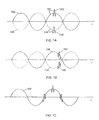
- FIGS. 1A-1C show examples of pulse complexes with LF and HF pulses with different phase relationships that occur in the application of the methods
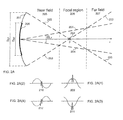
- FIG. 2A shows propagation sliding in the phase between the HF and LF pulses and the effect on pulse form distortion
- FIG. 2A ( 1 ) shows an on-axis HF pulse found at the crest of the LF pulse in the focal region
- FIG. 2A ( 2 ) shows an HF pulse transmitted at the array surface at the zero crossing with the negative spatial of gradient of the LF pulse
- FIG. 2A ( 3 ) shows an on-axis HF pulse found at the trough of the LF pulse in the focal region
- FIG. 2A ( 4 ) shows an HF pulse transmitted at the array surface at the zero crossing with a positive spatial gradient of the LF pulse
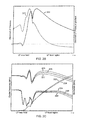
- FIGS. 2B and 2C show the results of a simulation of the effect of the observed LF pressure gradient on the HF pulse as a function of depth
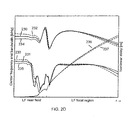
- FIG. 2D shows the results of variations in the transmitted pulses
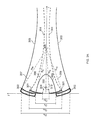
- FIG. 3A shows a cross-section of the HF and LF transducer arrays with the boundaries of the HF beam and LF beam indicated;
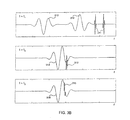
- FIG. 3B shows the HF pulse and the LF pulse at times t1, t2, and t3;
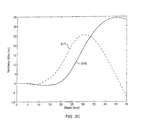
- FIG. 3C shows two developments of the HF pulse with depth of the nonlinear propagation delays for two different transmit time lags between the HF and LF pulses
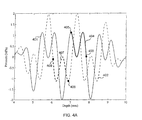
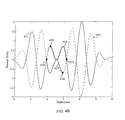
- FIGS. 4A and 4B show dual frequency component LF pulses with reduced pulse form distortion
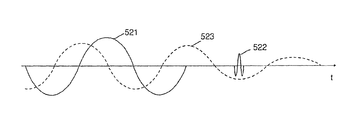
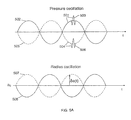
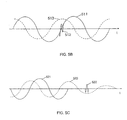
- FIGS. 5A-5C show phase relations between HF and LF pulses for best imaging of micro-bubbles when the LF frequency is below and close to the bubble resonance frequency;
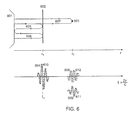
- FIG. 6 shows an illustration to how multiple scattering noise is generated and how it can be suppressed with methods according to the invention
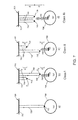
- FIG. 7 shows conceptual illustrations to pulse reverberation noise of Class I-III
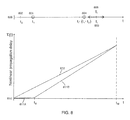
- FIG. 8 shows conceptual illustration of combined suppression for Class I and II pulse reverberation noise
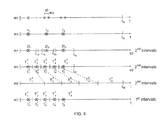
- FIG. 9 shows conceptual illustration of combined suppression for Class I and II pulse reverberation noise
- FIG. 10 shows a block diagram of signal processing for suppression of one or both of pulse reverberation noise, and linear scattering components to extract the nonlinearly scattered components
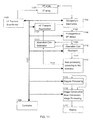
- FIG. 11 shows a block diagram of an instrument for backscatter imaging according to the invention.
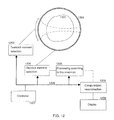
- FIG. 12 shows a block diagram of an instrument for computer tomographic image reconstruction from transmitted and scatterers waves
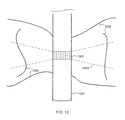
- FIG. 13 shows a conceptual illustration for imaging of geologic structures around an oil well according to the invention.
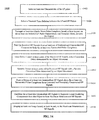
- FIG. 14 is a flow chart of an example of a method in accordance with an embodiment of the invention.
- FIG. 1A shows a 1 st example transmitted pulse complex 101 composed of a low frequency (LF) pulse 102 and a high frequency (HF) pulse 103 , together with a 2 nd example pulse complex 104 composed of a LF pulse 105 and a HF pulse 106 .
- the LF pulse 102 will compress the material at the location of the HF pulse 103 , and nonlinear elasticity will then increase the material stiffness and also the propagation velocity observed by the HF pulse 103 along its propagation path.
- the 2 nd pulse complex 104 the LF pulse 105 expands the material at the location of the HF pulse 106 , with a subsequent reduction in material stiffness and reduction in propagation velocity of the HF pulse 106 due to the nonlinear elasticity of the material.
- the invention makes use of the nonlinear manipulation of the material properties by the LF pulse as observed by a co-propagating HF pulse, and one will generally make use of multiple transmit pulse complexes with variations in the LF pulse between the complexes so that the HF pulses observes different material properties with the variations in the LF pulse.
- Example variations in the LF pulses can be such as, but not limited to, variations in the LF transmit amplitude, the polarity of the LF pulse, the phase relationship between the HF and LF pulses, variations in the frequency of the LF pulse, and also variations in the LF transmit aperture size and focus, and any combinations of these.
- the elasticity can generally be approximated to the 2 nd order in the pressure, i.e. the volume compression ⁇ V of a small volume ⁇ V is related to the pressure p as
- r is the spatial position vector
- K( r :p) is the nonlinear elasticity function of the general form and the expression to the right is the approximation to this function to the 2 nd order in the pressure, which holds in many situations, like in the soft tissue of medical imaging, and also in fluids and polymers.
- ⁇ ( r ) is the linear bulk compressibility of the material
- the material parameters have a spatial variation due to heterogeneity in the material. Gases generally show stronger nonlinear elasticity, where higher order terms in the pressure often must be included. Micro gas-bubbles in fluids with diameter much less than the ultrasound wavelength, also shows a resonant compression response to an oscillating pressure, which is discussed below.
- the propagation lag without manipulation of the propagation velocity by the LF pulse is t 0 (r).
- ⁇ (r) is the added nonlinear propagation delay produced by the nonlinear manipulation of the propagation velocity for the HF pulse by the LF pulse.
- the LF pulse pressure p LF drops considerably at the location of the scattered HF pulse so that the LF modification of the propagation velocity is negligible for the scattered wave. This means that we only get contribution in the integral for ⁇ (r) up to the 1 st scattering, an effect that we will use to suppress multiple scattered waves in the received signal.
- the variation of the propagation velocity with the pressure will also produce a self distortion of both the LF and HF pulses, that introduces harmonic components of the fundamental bands of the pulses.
- the different harmonic components have different diffraction, which also influences the net self-distortion from the nonlinear propagation velocity.
- the LF beam is generally composed of a near-field region where the beam is mainly defined by geometric extension of the LF radiation aperture, and a diffraction limited region, which is the focal region for a focused aperture, and the far-field for an unfocused aperture, as discussed in relation to FIG. 2A below.
- the nonlinear self distortion of the LF pulse is mainly a triangular distortion that do not change the amplitude of the LF pulse at the location of a co-propagating HF pulse.
- the nonlinear self distortion of the positive ( 102 ) and negative ( 105 ) LF pulses will be different so that the elasticity manipulation of the two pulses will be different in this region.
- the received HF signal we do in this description mean the received signal from the transmitted HF pulses that are either scattered from the object or transmitted through the object, and where signal components from the transmitted LF pulse with potential harmonic components thereof, are removed from the signal, for example through filtering of the received HF signal.
- filtering can be found in the ultrasound transducers themselves or in the receiver channel of an instrument.
- one can also suppress received components of the transmitted LF pulse by transmitting a LF pulse with zero HF pulse and subtracting the received signal from this LF pulse with zero transmitted HF pulse from the received HF signal with a transmitted LF/HF pulse complex.
- the received HF signal can contain harmonic components of the HF band produced by propagation and scattering deformation of the HF pulse, and in the processing one can filter the received HF signal so that the fundamental band, or any harmonic band, or any combination thereof, of the HF pulse is used for image reconstruction.
- the harmonic components of the HF pulse can also be extracted with the well known pulse inversion (PI) method where the received HF signals from transmitted HF pulses with opposite polarity are added.
- PI pulse inversion
- the received HF signal we hence mean at least one of the received HF radio frequency (RF) signal at the receiver transducer and any order of harmonic components thereof, and any demodulated form of the HF RF signal that contain the same information as the received HF RF signal, such as an I-Q demodulated version of the HF RF signal, or any shifting of the HF RF signal to another frequency band than that found at the receiver transducer.
- RF radio frequency
- the incident LF pulse will therefore in a nonlinearly heterogeneous material change the spatial variation of the local elasticity observed by the HF pulse, and hence produce a local scattering of the HF pulse that depends on the LF pressure at the HF pulse.
- the scattered HF pulse can therefore be separated into a linear component of the scattered signal that is found for zero LF pulse, and a nonlinear modification to the linear scattering obtained with the presence of a LF pulse. This nonlinear modification of the scattered signal is referred to as the nonlinear scattering component of elastic waves in the heterogeneous material, or the nonlinearly scattered wave or signal.
- the elastic parameters and hence the nonlinearly scattered signal will be approximately linear in the amplitude of the LF pressure at the location of the HF pulse.
- the elastic compression is more complex than the 2 nd order approximation to elasticity.
- do gases show a stronger nonlinear elasticity where higher order than the 2 nd order term in the pressure in Eq. (1) must be included.
- the bubble diameter is much smaller than the acoustic wave length in the fluid, one obtains large shear deformation of the fluid around the bubble when the bubble diameter changes. This shear deforming fluid behaves as a co-oscillating mass that interacts with the bubble elasticity to form a resonant oscillation dynamics of the bubble diameter.
- the volume of this co-oscillating mass is approximately 3 times the bubble volume.
- the scattering from such micro-bubbles will then depend on both the frequencies and the amplitudes of the LF and HF pulses.
- the bubble compression is dominated by the nonlinear bubble elasticity, which for high pressure amplitudes requires higher than 2 nd order approximation in the pressure.
- For frequencies around the resonance one gets a phase shift of around 90 deg between the pressure and the volume compression.
- For frequencies well above the resonance frequency the bubble compression is dominated by the co-oscillating mass with a phase shift of 180 deg to the incident pressure, which gives a negative compliance to the pressure.
- Gas bubbles can be found naturally in an acoustic medium, such as the swim bladder of fish and sea creatures, gas bubbles that form spontaneously in divers and astronauts during decompression, etc.
- Micro-bubbles are used for ultrasound contrast agent in medicine, but their density in tissue is usually so low that their effect on the wave propagation can usually be neglected, where they are mainly observed as local, nonlinear point scatterers.
- the forward pulse propagation therefore usually observes a 2 nd order elasticity of the surrounding tissue that produces a nonlinear propagation lag according to Eq. (3).
- the micro-bubbles can have marked nonlinear effect on the pressure variation of the wave propagation velocity, and also introduce a frequency dependent propagation velocity (dispersion) due to bubble resonances.
- a frequency dependent propagation velocity dispersion
- a change of polarity of the HF and LF pulses is then represented by a change in sign of p h1,h2 or p l1,l2 .
- ⁇ 1,2 (t) are the nonlinear propagation delays of the HF pulses 103 / 106 as a function of the fast time t, produced by the nonlinear manipulation of the wave propagation velocity for the HF pulses by the LF pulses 102 / 105 in FIG. 1A .
- the nonlinearly scattered HF signals from the two pulse complexes 101 and 104 are x n1 ( . . . ) and x n2 ( . . . ).
- the linearly scattered signal is proportional to the HF amplitude and is listed as p h1 x l (t) and p h2 x l (t) for the HF pulses 103 and 106 , where x l (t) is the signature of the linearly scattered signal.
- the nonlinearly scattered signal can be approximated as x n1 ( t;p h1 ,p l1 ) ⁇ p h1 p l1 x n ( t ) x n2 ( t;p h2 ,p l2 ) ⁇ p h2 p l2 x n ( t ) (5)
- the Mechanical Index (MI) is given by the negative pressure swing of the pulse complex and is often limited by safety regulations to avoid cavitation and destruction of the object.
- MI The Mechanical Index
- the amplitude of both the LF pulse 105 and the HF pulse 106 of the pulse complex 104 can have stronger limitations than the amplitudes for the pulse complex 101 .
- the nonlinearly scattered signal has shown to enhance the image contrast for:
- r ⁇ ( t ) ⁇ ⁇ ⁇ ( r ) ⁇ c ⁇ ( ⁇ ) ⁇ d ⁇ ⁇ ⁇ ⁇ c 0 ⁇ t 2 ( 8 )
- the gradient in Eq. (7) hence represents the local nonlinear propagation parameters of the object.
- the low frequency is so low that one can most often neglect individual variations in power absorption and wave front aberrations, and measure or calculate in computer simulations the LF pressure at the location of the HF pulse at any position along the beam. Dividing said local nonlinear propagation parameter with this estimated local amplitude of the manipulating LF pressure, one obtains a quantitative local nonlinear propagation parameter that represents local quantitative elasticity parameters of the object, as
- This parameter can be used to characterize the material, where for example in soft biological tissues fat or high fat content gives a high value of ⁇ n ⁇ .
- the LF field simulation must however be done with defined parameters of the mass density ⁇ and compressibility ⁇ , and in the actual material one can have deviations from the parameters used for simulation, particularly in heterogeneous materials where the parameters have a spatial variation.
- the vibration velocity of the element surface u LF (0) is close to independent of the load material characteristic impedance, and hence given by the electric drive voltage.
- a ne ⁇ ( r ) Env ⁇ ⁇ x ne ⁇ ( 2 ⁇ r / c 0 ) ⁇ ⁇ k HF 2 ⁇ v n ⁇ ( r ) ⁇ p LF ⁇ ( r ) ⁇ G ⁇ ( r ) ⁇ exp ⁇ ⁇ - 2 ⁇ f H ⁇ ⁇ F ⁇ ⁇ 0 r ⁇ d ⁇ ⁇ s ⁇ ⁇ ⁇ ⁇ ( ) ⁇ ( 12 )
- ⁇ HF 2 ⁇ f HF
- ⁇ n (r) is a nonlinear scattering parameter for the HF band laterally averaged across the receive beam
- G(r) is a depth variable gain factor given by beam shape and receiver depth variable gain settings
- the exponential function represents ultrasound power absorption in the HF band.
- x le ⁇ ( t ) p h ⁇ ⁇ 1 ⁇ p l ⁇ ⁇ 1 ⁇ s 2 ⁇ ( t + p l ⁇ ⁇ ⁇ ⁇ ( t ) ) - p h ⁇ ⁇ 2 ⁇ p l ⁇ ⁇ 2 ⁇ s 1 ⁇ ( t + ⁇ ⁇ ⁇ ( t ) ) p h ⁇ ⁇ 1 ⁇ p h ⁇ ⁇ 2 ⁇ ( p l ⁇ ⁇ 1 - p l ⁇ ⁇ 2 ) ( 13 )
- any of Eq. (4a, b) with delay correction can often be used as an estimate of the linearly scattered signal because the nonlinearly scattered signal is found at local points and often has much less amplitude than the linearly scattered signal.
- the envelope of the linearly scattered signal as a function of range r is similarly proportional to
- a le ⁇ ( r ) Env ⁇ ⁇ x le ⁇ ( 2 ⁇ r / c ) ⁇ ⁇ k H ⁇ ⁇ F 2 ⁇ v l ⁇ ( r ) ⁇ G ⁇ ( r ) ⁇ exp ⁇ ⁇ - 2 ⁇ f H ⁇ ⁇ F ⁇ ⁇ 0 r ⁇ ⁇ d ⁇ ⁇ s ⁇ ⁇ ⁇ ⁇ ( ) ⁇ ( 14 )
- ⁇ l (r) is a linear scattering parameter for the HF band and the other variables are as in Eq. (12).
- linearly and nonlinearly scattered signal components have the same amplitude variation due to beam divergence/convergence and power absorption, and one can obtain a local nonlinear scattering parameter by forming the ratio of the envelopes a ne (r) and a le (r) as
- Variations in both the quantitative local nonlinear propagation parameter and the local nonlinear scattering parameter of the object with heating or cooling of the object can then be used to assess local temperature changes of the object, for example with thermal treatment of the object.
- the temperature dependency of the propagation velocity (dc/dT) of soft tissue in medical ultrasound depends on the tissue composition where for fat or large fat content one has dc/dT ⁇ 0 while for other tissues, like liver parenchyma, one has dc/dT>0 and predictable.
- One or both of np ⁇ n ⁇ from Eqs. (9, 11) and ns ⁇ n / ⁇ l from Eqs. (16, 17) can then be used to estimate the fat content and hence dc/dT in the tissue, so that variations in the propagation lag with heating or cooling can be used to assess temperature.
- phase relation between the HF and LF pulses as shown in FIG. 1A can only be achieved over the whole propagation path for the near field region of the LF beam, which in practice means that the HF image range must be within the near field of the LF aperture.
- This can be an unfocused LF aperture producing a close to plane LF wave, but also the near field region 203 of a focused beam as shown in FIG. 2A .
- a slightly focused LF aperture to produce some LF beam convergence in the near field region to compensate for the weak absorption of the LF pulse often found.
- the HF transmit beam is generally focused, and for a plane wave or differently focused LF beam, there will be a sliding of the position of the HF pulse relative to the LF pulse across the focused HF beam wave front.
- the nonlinear propagation delay for the HF pulse will hence vary across the HF pulse wave front and hence produce a nonlinear focus modification of the HF beam, where the focus modification will depend on the polarity and amplitude of the LF pulse.
- this focus modification can be accounted for in the corrected, preset HF transmit focus delays, or as a correction in the delay, pulse form, and amplitude of the received HF signal, or a combination of theses.
- FIG. 2A shows typical LF and HF apertures 201 and 208 with diameters D LF and D HF , respectively, both focused at 202 .
- the LF beam is essentially determined by the outermost of these boundaries, where in the near field region 205 the beam width reduces with depth by the geometric cone as it is wider than the diffraction cone, while in the focal region 206 the beam is diffraction limited and the beam width expands with the diffraction cone where this is the widest, and further in the far field region 207 the beam expands again with the geometric cone which again is wider than the diffraction limited cone.
- the LF pressure pulse in the focal point 202 is the temporal derivative of the LF pressure pulse at the transducer array surface, and throughout the focal region the phase of the LF pulse slides ⁇ radians, with ⁇ /2 radian in the focus to present a temporal differentiation. This provides a sliding of the position of the HF pulse relative to the LF pulse of T LF /4 in the focus and further T LF /4 in the far-field cone, where T LF is the temporal period of the LF pulse.
- the field from a flat (unfocused) LF aperture is given by the modification of FIG. 2A where the focal point 202 is moved to infinite distance from the aperture, where again the LF pulse is the temporal derivative of the LF pulse on the array surface.
- the LF field is well approximated by a plane wave, where a fixed phase relation between the HF and LF pulses as in FIG. 1A is maintained for the whole range.
- the HF pulse undergoes a similar differentiation from the transducer array surface to its own focal region, but as the HF pulse is much shorter than the LF pulse, it is the sliding of the LF pulse phase that affects the phase relationship between the HF and LF pulses.
- the receive HF beam do generally have dynamic focusing and aperture, where we mainly will observe the interaction between the HF and LF pulses close to the HF beam axis. Variations of the phase between the HF and LF pulse across the HF transmit beam will nonlinearly affect the focus of the transmitted HF beam and can be accounted for in the HF transmit focus delays, or as a correction of the received HF signal as discussed below.
- the on-axis HF beam will however with propagation distance be influenced by the off-axis HF pulse form due to the diffraction nature of wave propagation.
- this effect is small, and the following holds in a 1 st approximation analysis that generally produce adequate results:
- the on-axis HF pulse For the on-axis HF pulse to be found at the crest of the LF pulse in the focal region, shown as 209 , FIG. 2A ( 1 ) the HF pulse must due to the differentiation of the LF pulse in the LF focus be transmitted at the array surface at the zero crossing with the negative spatial gradient of the LF pulse, shown as 210 , FIG. 2A ( 2 ).
- the HF pulse must at the array surface be transmitted at the zero crossing with the positive spatial gradient of the LF pulse, shown as 212 , FIG. 2A ( 4 ).
- the position of the HF pulse within the LF pulse complex will hence slide ⁇ LF /4 from the array surface to the focus (or far field for unfocused LF beam).
- the different parts of the HF pulse will propagate with different velocities leading to a pulse compression for the HF pulse 107 that propagates on a negative spatial gradient of the LF pulse 108 , because the tail of the pulse propagates faster than the front of the pulse.
- With more complex variations of the LF pulse pressure within the HF pulse one can get more complex distortions of the HF pulse shape.
- the HF pulse is long, or one have less difference between the high and low frequencies, one can get variable compression or stretching along the HF pulse, and even compression of one part and stretching of another part.
- the frequency content is changed which changes the diffraction.
- Absorption also increases with frequency and also produces a down-sliding of the pulse center frequency.
- the total pulse distortion is hence a combination of the spatial variation in the propagation velocity along the HF pulse produced by the nonlinear elasticity manipulation of the LF pulse, diffraction, and absorption.
- x k (t 0 ) represents the scattered signal that would have been obtained without pulse form distortion and nonlinear propagation delay at the fast time t 0 with a nonlinear propagation delay ⁇ k (t 0 ).
- x lk (t 0 ) is the linearly scattered signal that varies with k because the transmitted HF amplitude and polarity can vary, but also because diffraction and the power in harmonic components of the HF pulse can depend on the LF pulse.
- x nk (t 0 ) is the nonlinearly scattered signal for a transmitted LF pulse p lk (t 0 ), and it depends on the pulse number k because the LF pulse and potentially the HF pulse varies with k.
- x nk (t 0 ) is proportional to the LF and HF amplitudes as in Eq. (5), while for micro-bubbles the nonlinear dependency is more complex where even the scattered HF pulse form from the micro-bubble can depend on the LF pressure as discussed in relation to Eqs. (35, 36) below.
- the linear effect of variations in the amplitude and polarity of the HF pulse can be included in v k (t,t 0 ), while the nonlinear effect is included in the k variation of x nk (t 0 ).
- FIG. 2B and FIG. 2C results of a simulation of the effect of the observed LF pressure and LF pressure gradient on the HF pulse as a function of depth.
- the HF pulse is placed at the negative spatial gradient of the LF pulse at the array surface.
- 220 shows the observed LF pressure at the center of the HF pulse, while 221 shows the observed LF pressure gradient at the center of the HF pulse, both as a function of depth r.
- the observed LF pressure is given by the LF pressure amplitude as a function of depth, influenced by diffraction and absorption, and the local position of the HF pulse relative to the LF pulse.
- the HF pulse In the near field the HF pulse is near a zero crossing of the LF pulse and the observed LF pressure is hence low, while the observed LF pressure gradient is high. As the pulse complex propagates into the focal region, the LF pressure amplitude increases and the HF pulse slides towards the crest of the LF pulse, which increases the observed LF pressure while the observed LF pressure gradient drops.
- the resulting nonlinear propagation delay of the HF pulse for the positive LF pulse is shown as 222 in FIG. 2C , together with the center frequency 223 and the bandwidth 224 of the HF pulse.
- the center frequency and the bandwidth of the HF pulse for zero LF pulse is shown as 225 and 226 for comparison.
- the observed LF pressure gradient produces an increase of both the center frequency and the bandwidth of the HF pulse that accumulates with depth, compared to the HF pulse for zero LF pressure.
- the nonlinear propagation delay is low as the observed LF pressure is low.
- the increased observed LF pressure produces an accumulative increase in the nonlinear propagation delay, 222 , while the drop in the pressure gradient along the pulse reduces the increase in the difference between the center frequency and bandwidth of the HF pulses.
- the LF amplitude drops due to the geometric spread of the beam and both the observed LF pressure and pressure gradient at the HF pulse drops.
- the HF pulse also slides relative to the LF pulse to finally place the HF pulse at a zero crossing of the LF pulse, but this sliding is slower than in the near field.
- the dash-dot curves 227 and 228 shows the mean frequency and the bandwidth of the HF pulse for opposite polarity (negative) of the LF pulse.
- the dash-dot curve 229 shows the negative nonlinear propagation delay, ⁇ k (t), with opposite polarity of the LF pulse.
- the HF pulse is short compared to the LF wave length, so that the LF pulse gradient mainly produces a HF pulse length compression/expansion.
- the HF pulse bandwidth then follows the HF pulse center frequency as is clear in FIG. 2C . With longer HF pulses relative to the LF period there will be a more complex distortion of the HF pulse, where one needs more parameters than the center frequency and the bandwidth to describe the distortion, as discussed in relation to FIG. 1B above and in relation to Eq. (26).
- V k ⁇ ( ⁇ , t i ) - 1 ⁇ H k ⁇ ( ⁇ , t i ) 1 V k ⁇ ( ⁇ , t i ) ⁇ 1 1 + N / ⁇ V k ⁇ ( ⁇ , t i ) ⁇ 2 ( 21 )
- N is a noise power parameter to avoid noisy blow-up in H k ( ⁇ ,t i ) where the amplitude of V k ( ⁇ ,t i ) is low compared to noise in the measurement, while we get an inverse filter when the amplitude is sufficiently high above the noise, i.e.
- the nonlinear delay correction can be included in the inverse filter impulse response h k (t ⁇ t 0 ,t 0 ), but for calculation efficiency it is advantageous to separate the correction for nonlinear propagation delay as a pure delay correction where the filter then corrects only for pulse form distortion, as the filter impulse response then becomes shorter.
- the signal is normally digitally sampled, and Eqs. (18-24) are then modified by the sampled formulas known to anyone skilled in the art.
- the length of T(t i ) would typically be a couple of HF pulse lengths, and one would typically use intervals that overlap down to the density that t i represents each sample point of the received signal.
- U( ⁇ ,t i ) is the Fourier transform of the undistorted received pulse form from depth interval T i obtained with zero LF.
- the LF pulse is often at such a low frequency that individual variations of the acoustic LF pulse absorption between individuals in a specific type of measurement situation, can be neglected as discussed above.
- An uncertainty in this simulation is the actual nonlinear elasticity of the object.
- the invention devices several methods to assess the nonlinear elasticity, and also direct estimation of H k ( ⁇ ,t i ) from the signals as discussed following Eq. (52) below.
- This frequency shift do not change the bandwidth of the received HF signal, where the bandwidth can be modified with fast time filtering of the frequency mixed HF signal.
- this frequency mixing could be used to bring all received HF signals to the same, or approximately the same, center frequency of any value, for example zero center frequency which would be the well known IQ-demodulation.
- the bandwidth filtering we could also reduce the bandwidth of all signals to that of the signal with lowest bandwidth, for example 228 of FIG.
- bandwidth reduction is a robust operation and this operation would produce similar received HF pulse from point scatterers for all the signals.
- reducing the bandwidth also reduces the range resolution, but improved suppression of pulse reverberation noise and extraction of nonlinear scattering signal is often preferable relative the reduced range resolution.
- Eqs. (21-26) we note that this situation is somewhat different from that where all the pulse form correction is done with a filter, as in Eqs. (21-26).
- Eqs. (21-26) one wants to correct the HF pulse form of all the received signals to a signal with center frequency around the middle of the center frequencies of all received HF signals, which often is the received HF signal for zero LF pulse.
- one modify e.g. stretch or compress or more complex modification
- the pulse distortion in front of the interesting imaging range modifies the pulses to similar pulses for positive and negative polarity of the LF pulse within the interesting imaging range.
- 2D is shown the results of such variation in the transmit pulses, where 230 and 231 shows the depth variation of the center frequency and the bandwidth of the original transmitted HF pulse with zero transmitted LF pulse, 232 and 233 shows the center frequency and the bandwidth of time expanded transmitted HF pulse and how they are modified by the co-propagating positive LF pulse, while 234 and 235 shows the center frequency and the bandwidth of time compressed transmitted HF pulse and how they are modified by the co-propagating negative LF pulse.
- the nonlinear propagation delay for the positive LF pulse is shown as 236 and the negative nonlinear propagation delay for the negative LF pulse is shown as 237 .
- both the center frequency and the bandwidth of the HF pulses are close to equal throughout the LF focal range.
- the linear scattering will then be highly suppressed for the interesting imaging range where the pulses for positive and negative polarity of the LF pulse have close to the same form. It is not possible to do a complete correction on transmit only, and a transmit correction combined with a receive correction composed of frequency mixing and/or filtering generally gives the best result.
- a transmit correction combined with a receive correction composed of frequency mixing and/or filtering generally gives the best result.
- the near field of FIG. 2D there is a difference in the HF pulses for positive and negative polarity of the LF pulse. If the signal in the near range is important, one can for example do a limited correction on transmit combined with a depth variable frequency mixing and/or fast time filter correction on receive so that the received pulse is independent on the transmitted LF pulse over the interesting image range.
- the LF pressure at the HF pulse has limited variation throughout the image range.
- the range where the variation of the LF pressure at the HF pulse has limited variation can be extended by building up the image of multiple transmit regions, using transmit pulses with different focal depths for the different transmit regions of the image range.
- pulse distortion correction for pulse compression can for a limited fast time (depth-time) interval approximately be obtained by fast time expansion (stretching) of the received HF signal over that interval, and correction for pulse expansion can for a limited fast time (depth-time) interval approximately be obtained by fast time compression of the received HF signal over the limited interval.
- this longer interval can be divided into shorter fast time intervals where different fast time expansion/compression is done on each interval.
- the corrected signals from different intervals can then be spliced to each other for example by a fade-in/fade-out windowing technique of the signals from neighboring intervals across the interval borders.
- FIFO First In First Out
- the interference between the scatterers is modified by the correction because we modify the scattered pulse and not the distance between the scatterers.
- This modifies the envelope of the distorted signal to that obtained with no pulse distortion.
- the frequency mixing also changes the center frequency of the received HF signal without changing the distance between the scatterers, but the signal bandwidth is unmodified which means that the pulse form from point scatterers is unmodified. Additional fast time filtering will change this pulse form as described above.
- the fast time expansion/compression method is particularly interesting for low pulse distortion where it is a good approximation and a simple and fast method.
- a limited fast time expansion/compressions of the received signal and/or frequency mixing and/or approximate correction of the transmitted HF pulse can then be used to bring the frequency spectrum of the limited corrected pulse closer to the frequency spectrum of the undistorted pulse, so that the filtering correction becomes more robust.
- the LF wavelength is typically ⁇ 5-15 times longer than the HF wavelength, and to keep the LF beam adequately collimated to maintain the LF pulse pressure at deep ranges, the LF transmit aperture is preferably larger than the outer dimension of the HF transmit aperture.
- the HF pulse one wants adequately long transmit focus, which limits the width of the HF transmit aperture.
- circular apertures where one have analytic expressions for the continuous wave fields (CW) along the beam axis.
- CW continuous wave fields
- FIG. 3A shows a cross section of the HF ( 301 ) and LF ( 302 ) transducer arrays with indications of the boundaries of the HF beam 304 and LF beam 303 .
- HF HF
- HF LF
- the removed central part of the LF radiation aperture reduces the overlap between the LF and the HF beam in the near range, indicated as the near range region 305 where the LF field has low amplitude.
- the nonlinear elasticity manipulation by the LF pulse is therefore very low close to the beam axis in the near range region 305 , which reduces the near range nonlinear LF manipulation of the observed (close to the beam axis) transmitted HF pulse.
- P lt is the LF transmit pressure on the array surface
- R lo (r) is the distance 307 from the outer edge of the LF array to 306 on the z-axis
- P ht is the HF transmit pressure on the array surface
- R ho (r) is the distance 309 from the outer edge of the HF array to 306 on the beam axis-axis
- R hi (r) is the distance
- the delay difference between these pulses reduces, so that the two pulses start to overlap and form a single pulse as illustrated in the two lower panels of FIG. 3B , where 313 and 315 shows the HF pulses and 314 and 316 shows the LF pulses.
- the edge pulses interfere, both for the LF and HF waves.
- the interference can be both destructive, that reduces the amplitude, or constructive, that increases the amplitude in the overlap region.
- Taylor expansion of the second lines of Eqs In the focal zone, Taylor expansion of the second lines of Eqs.
- the pulse centers observe propagation lags from the transmit apertures to 306 for the LF and HF pulses as
- the LF pulse With adequately wide LF aperture, the LF pulse will in the near field be close to a replica of the LF pulse at the transmit surface, and we can design the LF aperture so that the phase relationship between the HF and LF pulses is close to the same throughout the whole LF near field region.
- ⁇ h (r) is sufficiently less than ⁇ l (r) so that by adequate timing between the transmit of the HF and LF pulses, the HF pulse is spatially in front of (i.e. deeper than) the LF pulse with no overlap in a near range.
- FIG. 3B An example of such a situation illustrated in FIG. 3B .
- the near range LF manipulation pressure observed by the HF pulse is efficiently zero.
- the HF pulse eventually slides into the LF pulse and starts to observe a nonlinear elasticity manipulation pressure of the LF pulse. For example, at the time point t 2 >t 1 the pulses have reached the relative position illustrated by 313 for the HF pulse and 314 for the LF pulse. This observed LF manipulation pressure for the HF pulse, produces a nonlinear propagation delay of the HF pulse.
- FIG. 3C An example of two developments with depth of the nonlinear propagation delays are shown in FIG. 3C , where 317 and 318 show the development with depth of the nonlinear propagation delay for two different transmit time lags between the HF and LF pulses.
- the HF pulse form distortion is also low in the near range.
- this curve provides a strong suppression of pulse reverberation noise where the 1 st scatterer is up to 20 mm depth, with a gain of the 1 st scattered signal at 45 mm depth of 2 sin( ⁇ 0 ⁇ ) ⁇ 1.75 ⁇ 4.87 dB.
- the uncorrelated electronic noise increase by 3 dB in the subtraction, this gives an increase in signal to electronic noise ratio of 1.87 dB at deep ranges, with strong suppression of pulse reverberation noise relative to imaging at the fundamental frequency.
- Due to the steering of the near range manipulation the suppression of the pulse reverberation noise is much stronger than for 2 nd harmonic imaging, with a far-field sensitivity better than 1 st harmonic imaging.
- the curve 317 has a strong suppression of pulse reverberation noise with the 1 st scatterer down to 10 mm, where the max gain after subtraction is found at ⁇ 30 mm.
- the sliding of the HF and LF pulses with this method do however produce pulse distortion in depth regions where the gradient of the LF pulse along the HF pulse is sufficiently large, for example as illustrated in FIG. 1B and the lower panel of FIG. 3B .
- the pulse form distortion in the image range do not produce great problems, once it is limited to deep ranges.
- the most important feature for the suppression of pulse reverberation noise is a large near range region with very low observed LF manipulation pressure and pressure gradient, with a rapid increase of the observed LF manipulation pressure with depth followed by a gradual attenuation of the LF manipulation pressure so that ⁇ 0 ⁇ (r) rises to the vicinity of ⁇ /2 and stays there, or a rapid increase in observed LF pressure gradient that produces pulse distortion.
- the pulse distortion produces problems as discussed above. It can then become important to do pulse distortion correction according to the discussion above, for example through filtering as in Eqs.
- the transmit time relation between the HF and LF pulses so that the HF pulse is found at a wanted phase relation to the LF pulse in the focal zone.
- the nonlinear elasticity manipulation by the LF pulse observed by the HF pulse then mainly produces a nonlinear propagation delay with limited pulse form distortion.
- This phase relation also maximizes the scattered signal from non-linear scatterers and resonant scatterers where the LF is adequately far from the resonance frequency.
- the HF pulse is found near zero crossings of the LF pulse with large observed pressure gradient, one obtains pulse distortion with limited increase in nonlinear propagation delay.
- the HF pulse will be longer so that parts of the pulse can observe a LF pressure gradient with limited LF pressure, while other parts can observe a limited LF pressure gradient with larger observed LF pressure. This produces a complex pulse distortion of the HF pulse as discussed in relation to Eq. (26).
- a disadvantage with the removed central part of the HF transmit aperture is that the side lobes in the HF transmit beam increase. However, these side lobes are further suppressed by a dynamically focused HF receive aperture.
- the approximation in Eq. (32) is best around the beam focus, and Eq. (34) do not fully remove phase sliding between the LF and HF pulses at low depths.
- Eq. (32) does not have as simple formulas for the axial field as in Eq. (27, 28) but the analysis above provides a guide for a selection of a HF transmit aperture with a removed center, for minimal phase sliding between the LF and the HF pulses with depth.
- Eq. (34) can be used as a guide to define radiation apertures with minimal phase sliding between the LF and HF pulses.
- the variation in pulse distortion between positive and negative polarity of the LF pulse can according to the invention be reduced by using LF pulses with dual peaked spectra, for example by adding a 2 nd harmonic band to the fundamental LF pulse band, as illustrated in FIG. 4A .
- This Figure shows a positive polarity LF pulse complex 401 and a negative polarity LF pulse complex 402 which both are obtained by adding a 2 nd harmonic component to the fundamental LF band.
- the HF pulse slides with propagation along the path 404 , for example from a near range position 403 to a far range position 405 .
- the near range position of the HF pulse For the negative polarity LF pulse 402 one can place the near range position of the HF pulse so that the HF pulse slides with propagation along the path 407 , for example from a near range position 406 to a far range position 408 .
- the HF pulse hence slides along similar gradients of the LF pulse for both the positive and negative polarity LF pulse, and similar pulse form distortion is therefore produced for both LF polarities.
- Other position sliding of the HF pulse along the LF pulse that produce close to the same pulse form distortion for the positive and negative LF pulse can be obtained with different transmit beam designs, as discussed in relation to FIG. 3A .
- FIG. 4B A variation of this type of LF pulse is shown in FIG. 4B where a frequency band around 1.5 times the center frequency of the fundamental band of the LF pulse is added.
- the positive polarity LF pulse is shown as 411 and the negative polarity LF pulse is shown as 412 .
- the HF pulse slides along the path 414 , for example from a near range position 413 until a far range position 415 .
- the transmit timing between the HF and LF pulse is modified so that the HF pulse slides along the path 417 , for example from a near range position 416 until a far range position 418 .
- the HF pulse also in this case slides along similar gradients of the LF pulse for both the positive and negative polarities of the LF pulse so that similar pulse form distortion for both LF polarities is obtained similarly to the situation exemplified in FIG. 4A .
- HF pulses of more complex shape as that shown in FIGS. 1A-1C , for example the use of longer, coded pulses, such as Barker, Golay, or chirp coded pulses, with pulse compression in the receiver to regain depth resolution, according to known methods.
- coded pulses such as Barker, Golay, or chirp coded pulses
- the longer transmitted pulses allow transmission of higher power under amplitude limitations, for example given by the MI limit, and hence improve signal to electronic noise ratio with improved penetration, without sacrificing image resolution.
- pulse form distortion will be more pronounced with the longer HF pulses as discussed in relation to Eq. (26), and should be corrected for best possible results.
- micro-bubbles have a resonant scattering introduced by interaction between the co-oscillating fluid mass around the bubble (3 times the bubble volume) and the gas/shell elasticity. This resonant scattering is different from scattering from ordinary soft tissue.
- the transfer function from the incident LF pressure to the radius oscillation amplitude ⁇ a is in the linear approximation
- ⁇ ⁇ ⁇ a - K 0 1 - ( ⁇ LF / ⁇ 0 ) 2 + i ⁇ ⁇ 2 ⁇ ⁇ ⁇ ( ⁇ LF / ⁇ 0 ) ⁇ P LF ( 35 )
- ⁇ 0 is the bubble resonance frequency for the equilibrium bubble radius a 0
- ⁇ is the oscillation losses
- K 0 is a low frequency, low amplitude radius compliance parameter.
- Resonance frequencies of commercial micro-bubble contrast agents are 2-4 MHz, but recent analysis [citation 4 ] indicates that the resonance frequency may be reduced in narrow vessels below 70 ⁇ m diameter, and can in capillaries with 10 ⁇ m diameter reduce down to 25% of the infinite fluid region resonance frequency (i.e. down to ⁇ 0.5-1 MHz).
- the nonlinear compression of the bubbles therefore often deviates strongly from the 2 nd order approximation of Eq. (1).
- the ratio of the LF to HF pulse frequencies is typically ⁇ 1:5-1:15, and typical HF imaging frequencies are from 2.5 MHz and upwards.
- the low frequency is close to the resonance frequency of ultrasound contrast agent micro-bubbles, one gets a phase lag between the incident LF pressure and the radius oscillation of micro-bubble that gives an interesting effect for the nonlinear scattering.
- the linear approximation of the scattered HF pulse amplitude P s (r) at distance r from the bubble, is for an incident CW HF wave with angular frequency ⁇ HF and low level amplitude P HF
- the HF pulse must be close to the crest or trough of the LF bubble radius, when it hits the bubble.
- nonlinearity in the LF bubble oscillation will show directly in the detection signal, where the LF nonlinearity often is much stronger than the 2 nd order approximation of Eq. (1).
- the detection signal can also have a nonlinear relation to the HF pressure amplitude.
- the variation of ⁇ c (a c ) with the LF pressure introduces a phase shift of the HF pulses from the different pulse complexes with differences in the LF pulse. This further increases the nonlinear detection signal from the bubble and makes a further deviation from the 2 nd order elasticity approximation in Eq. (6).
- the HF detection signal hence has increased sensitivity for HF around the bubble resonance frequency.
- FIG. 5A shows in the upper panel incident HF and LF pulse complexes 501 , composed of the LF pulse 502 and the HF pulse 503 , and 504 composed of the LF pulse 505 and HF pulse 506 .
- the lower panel shows the radius oscillation ⁇ a ⁇ KP LF produced by the incident LF pulse, where the LF pressure 502 produces the solid radius oscillation curve 508 , and the LF pressure 505 produces the dashed radius oscillation curve 507 .
- the HF pulse To produce maximal HF bubble detection signal, the HF pulse must hit the LF radius oscillations at a maximum and a minimum, which is found when the HF pulse is located at the trough ( 506 ) and crest ( 503 ) of the LF pressure pulses.
- the transmit timing between the HF and LF pulse should therefore be so that the HF pulse is found at the crest and trough of the LF pressure pulse in the interesting image region.
- FIG. 5B shows as 511 an incident LF pressure oscillation, with the resulting LF radius oscillation as 513 (dashed).
- the HF pulse For the HF pulse to hit the bubble at a maximal radius, the HF pulse must be placed at the negative to positive temporal zero crossing of the LF pulse. Switching the polarity of the incident LF pressure pulse then positions the HF pulse 512 at the positive to negative temporal zero-crossing of the LF pulse, which is then found at the trough of the LF radius oscillation.
- the HF pulse must then at least for the imaging distance propagate on the maximal positive or negative gradient of the LF pressure, which produces HF pulse form distortion that must be corrected for to maximally suppress the linear scattering from the tissue.
- the radius oscillations have a peak at the resonance frequency one then gets the most sensitive detection signal from the bubbles with resonance frequency close to the frequency of the LF pulse.
- this phase relationship between the HF and LF pulses implies that the HF pulse hits the bubble when the radius passes through the equilibrium value a 0 for these bubbles, and the two pulses hence have very small difference in the scattered HF signal from these bubbles with a subsequent very low detection signal.
- LF frequencies well above the bubble resonance frequency we have ⁇ a ⁇ KP LF ( ⁇ 0 / ⁇ LF ) 2 , which produces low ⁇ a c (P LF ) and detection signal.
- P LF ⁇ a c
- the LF frequency can get close to the bubble resonance frequency for HF frequencies of ⁇ 2.5 MHz and upwards, if we include the 0.5 MHz resonance frequencies of bubbles confined in capillaries.
- Mono-disperse micro-bubbles with a sharp resonance frequency in infinite fluid are under development.
- the reduction in bubble resonance introduced by the confining motion of smaller vessels can then combined with the LF resonant detection be used for selective detection of bubbles in different vessel dimensions.
- Tissue targeted micro-bubbles are also in development, and the resonance frequency for such bubbles also changes when the bubbles attach to tissue cells.
- the LF resonant detection of the micro-bubbles can hence be used for enhanced detection of the bubbles that have attached to the cells.
- Another method to obtain a resonance sensitive detection of the micro-bubbles is to select the frequency of the LF pulse close to the bubble resonance frequency and transmit the HF pulse with a delay after the LF pulse.
- the HF pulse delay is selected so that in the actual imaging range the transmitted HF pulse is sufficiently close to the tail of the transmitted LF pulse so that the HF pulse hits the resonating bubble while the radius is still ringing after the LF pulse has passed, preferably at a crest or trough of the radius oscillation, as shown in FIG. 5C .
- This Figure shows in the time domain by way of example in the actual imaging range the incident LF pressure pulse as 521 with a HF pulse 522 following at the tail of the LF pulse.
- the radius oscillation excited by the LF pressure is shown as 524 where it is observed that due to the resonance the radius oscillates (rings) for some time period after the end of the exciting LF pressure pulse.
- the HF pulse 522 hits the bubble when it has minimal radius produced by the LF pressure.
- the HF signal from the tissue is unaffected by the LF pulse.
- Spectral resonance selective imaging of bubbles with a set of different resonance frequencies can be done by using resonant detection with different LF frequencies corresponding to the set of resonance frequencies. This has interesting applications for molecular imaging with targeted micro-bubbles where micro-bubbles with different, mono disperse diameters are coated with different antibody ligands. With spectral resonance selective imaging, one can then determine which antibodies has produced attachment to specific tissues, and hence characterize potential disease in the tissue.
- the methods described in relation to FIG. 5C are also more generally useful for imaging scatterers that have a memory in a change of scattering parameters produced by the LF pulse 521 that lasts for a period longer than the delay between the LF and the HF pulses, so that the change in the scattering parameters produced by the LF pulse is observed by the HF pulse 522 .
- a memory is a micro-bubble that is subject to a radiation force from an ultrasound pulse.
- the LF pulse 521 can in this case be used to move the micro-bubble and the displacement can be observed with the subsequent HF pulse 522 .
- this displacement can last for a long time interval, but also when the bubble is confined in a viscoelastic tissue, the displacement produced by the LF pulse 521 can last for a sufficiently long time interval after the passage of the LF pulse that the displacement can be observed by the subsequent HF pulse 522
- the oscillations produced by the LF pulse changes the elasticity of the bubble shell where the change lasts for an interval after the LF pulse has passed, and hence falls into the category of changes of the scattering parameters with a memory.
- the change in elasticity can for example depend on the molecular structure of the shell.
- the LF pulse can also change the size of the bubble due to heating of the gas and shell, or due to gas transport across the bubble shell. For such bubbles the LF pulse produces a change in the scattering parameters that also has a memory that can last for enough time to be observed by the subsequent HF pulse 522 .
- Microcalcification in soft tissue with a viscous elasticity can also maintain a memory of a change in the scattering parameters produced by the LF pulse 521 that lasts for enough time to be observed by the subsequent HF pulse 522 , and can hence be detected with these methods.
- the change can be caused by one or both of a nonlinear change in the scattering cross section and a displacement of the micro-calcifications due to the radiation force of the LF pulse.
- a resonant bubble ringing after the LF pulse as described above, also fits the characteristic that the LF pulse changes the scattering parameters with a memory that lasts for enough time after the LF pulse 521 has passed the scatterer to be observed by the HF pulse 522 .
- the LF pulses do not produce the same change of the scattering parameters for the tissue as for nonlinear scatterers with such memory of the scattering parameters, and one obtains the same received HF signals from non-moving tissues for the two transmitted pulse complexes with differences in the LF pulse.
- Multiple scattering of the HF pulse produces acoustic noise which reduces image quality.
- the multiple scattering is dominated by linear scattering, and in a stationary tissue hence has the same properties as the 1 st order linear scattering from the tissue.
- Subtracting the received HF signals from the two pulse complexes with differences in the LF pulse will hence suppress the received HF signals from a stationary tissue, and relatively enhance the received HF signals from nonlinear scatterers with such memory in the scattering parameters.
- One can then for such nonlinear scatters also use a similar time relation between the LF and the HF pulses as shown in FIG. 5C to detect the nonlinear scatterers with a memory of changes in the scattering parameters produced by the LF pulse 521 and observable by the HF pulse 522 .
- the method is particularly useful for detection of micro-bubbles in large organs, like the liver parenchyma, the kidneys, etc., where one for example can use an HF imaging pulse at ⁇ 3-4 MHz around the micro-bubble resonance frequency, and the LF pulse for example at ⁇ 0.3-1 MHz, which is generally well below the bubble resonance frequency.
- the movement of the tissue produces a Doppler modification of the received HF signal from the tissue, that should be corrected for in at least one of the received HF signals, for maximal suppression of the tissue signal.
- pulse reverberation noise Since the pulse amplitude drops in each scattering, it is mainly the 3 rd order scattering that is seen as the multiple scattering or pulse reverberation noise in this case.
- the Doppler modification of the received HF signal from the tissue is found as a Doppler delay between the received HF signals from different pulse complexes, and can be corrected for by a delay correction related to the Doppler delay for at least one of the signals.
- the Doppler delay can in this case be obtained through correlation between the received HF signals from different transmitted pulse complexes with the same LF pulse.
- Multiple scattering HF signals will generally observe a different Doppler delay than the 1st order scattered HF signal that is found in the same fast-time receive interval, because the reverberation Doppler delay is produced by the composite movement of all the scatterers participating in the total multiple scattering chain with a total propagation delay falling within the last time interval.
- the reverberation scatterers found at different locations with different movements than the 1st order scatterers that produce received signal components in the same fast-time interval.
- the tissue signal that should be suppressed is the sum of the 1st and multiple order linearly scattered signal components from the tissue.
- tissue movement produces variable interference in the sum of these components that is represented by an average Doppler delay plus a change in the received HF signal speckle represented as a change in the received HF signal complex envelope.
- Suppression of 1 st and multiple order linearly scattered HF signal components in a fast-time interval of the received HF signal from the tissue can then be performed by transmitting at least two pulse complexes, where the LF pulses have different characteristics.
- the different characteristics may be one or more of center frequency, amplitude, polarity, and/or duration (pulse length), for example.
- One or more LF pulses can be zero and at least one LF pulse is nonzero.
- At least one of the received HF signals is:
- the LF pulse of the 1 st and 3 rd complex can for example be the same, for example zero, and the LF pulse of the 2 nd complex is different from the two others.
- ⁇ l is the received composite linearly scattered HF signal component from both 1 st and multiple order scattering, that is not manipulated by a LF pulse in a pulse complex as shown in FIG. 5C .
- D l is a filter that represents the changes of this received linear component produced by movement of the scatterers between two pulse complexes.
- the linear phase component of D l represents the average Doppler delay, while the rest of D l represents the speckle changes of the linear component due to tissue movement between the pulse complexes.
- X np is the received signal from the change in 1 st order scattering from a nonlinear scatterer with a memory of the scattering parameters that is affected by the LF pulse of a pulse complex as in FIG. 5C .
- the subscript p represents a pulse complex with non-zero LF pulse.
- D n is a filter that represents the changes of this received nonlinear component (1 st order scattering) produced by movement of the scatterers between two pulse complexes.
- the linear phase component of D n represents the average Doppler delay, while the rest of D n represents speckle changes of the nonlinear component between the pulse complex.
- the nonlinear signal component is so weak, that we mainly receive 1 st order scattering, where D n ⁇ exp ⁇ i ⁇ 1D ⁇ , where ⁇ 1D is the Doppler delay for 1 st order scattering from the nonlinear scatterer between pulse complexes.
- D ⁇ l ⁇ ( ⁇ ) S 02 ⁇ ( ⁇ ) S 01 ⁇ ( ⁇ ) ⁇ 1 1 + ⁇ N / ⁇ S 01 ⁇ ( ⁇ ) ⁇ 2 ( 36 ⁇ B )
- the last term in the denominator is a Wiener type noise limiting term that prevents excessive large values when the amplitude of S 01 is low
- ⁇ N is a noise limiting parameter.
- One skilled in the art would also be able to design other pulse sequences with matched processing of the received signal based on this example to obtain similar suppression of the signal from tissue, to enhance the signal from nonlinear scatterers with a memory in the scattering parameters, using pulse complexes as in FIG. 5C and processing similar to the description above.
- the outer edge wave from the LF aperture will arrive at the beam axis with a delay compared to the LF pulse from the more central part of the LF aperture, depending on the apodization and width of the LF aperture.
- the outer edge wave hence extends the tail of the LF pulse in the near field, and for the HF pulse to be sufficiently close to the LF pulse to observe the bubble radius ringing in the actual imaging range, one can, depending on the arrangement of the HF and LF apertures, have an overlap between the HF and LF pulses in the near field. This overlap introduces a nonlinear propagation delay and potential pulse distortion of the HF pulse.
- the HF pulse is found behind the LF pulse without any nonlinear modification on the propagation of the HF pulse.
- the HF pulse experiences an overlap with the LF pulse in the near field, one can obtain improved suppression of the linearly scattered signal from tissue by correcting the HF signal for nonlinear pulse distortion and/or propagation delay from the overlap region, or modify the transmitted HF pulses so that combined with the near field pulse distortion one gets the same form of the HF pulses in the imaging region for different variations of the LF pulse.
- FIG. 14 shows a flowchart of an example of a method 1400 for measurement or imaging of elastic wave nonlinear scatterers with a memory of scattering parameters in a region of a scattering object, in accordance with an embodiment of the invention.
- the method may be implemented by the instruments shown in FIG. 11 and FIG. 12 , for example, which are described in detail below. Other instruments having other configurations may be configured to implement embodiments of the invention, as well.
- an operator selects an imaging modality to detect nonlinear scatterers of a defined type, for example micro-bubbles with defined properties, so that the LF pulse changes the scattering parameters of the nonlinear scatterers with memory at least for a time interval after the incident LF pulse passes the nonlinear scatterer.
- the characteristics of the LF pulses are selected in Step 1402 so that at least some of the LF pulses produces a characteristic change of scattering parameters with memory of nonlinear scatterers for at least a time interval after the LF pulse passes the scatterer.
- the characteristics of the LF pulses may be selected by the instrument controller 1106 in FIG. 11 or the instrument controller 1207 in FIG. 12 , for example.
- Step 1404 the transmit time relation between the LF and HF pulses is selected by the instrument controller 1106 , 1207 , for example, so that at least in the measurement or imaging range the incident HF pulse propagates spatially behind the incident LF pulse, but sufficiently close to the LF pulse that the HF pulse hits the defined nonlinear scatterers while the effect of the incident LF pulse on its scatterer parameters with memory is observed by the HF pulse.
- At least two elastic wave pulse complexes are transmitted by the acoustic transducer array 1101 under the control of the controller 1106 , as described in relation to FIG. 11 , for example, towards the region.
- the pulse complexes are composed of a high frequency (HF) pulse in an HF band and a low frequency (LF) pulse in an LF band.
- At least the LF pulse varies between at least two transmitted pulse complexes.
- At least one of the pulse complexes includes a non-zero LF pulse and at least one of the pulse complexes can have a zero LF pulse.
- Step 1408 received HF signals are picked up from at least one of scattered and transmitted HF components from the at least two transmitted pulse complexes, by the acoustic transducer array 1101 .
- At least one of the received HF signals is in at least one depth interval corrected by a) time delay correction with a correction delay determined by an object movement, in Step 1410 , and/or b) speckle correction with a speckle correction filter determined by an object movement, in Step 1412 , by the instrument processing unit 1112 , 1205 in FIGS. 11 and 12 , for example.
- the processing units 1112 , 1205 may perform both delay correction and speckle correction by implementing the filter of Eq. (36B), as for example, in the 1 st line of Eq. (36c).
- Step 1414 a group of at least two intermediate HF signals from the at least two transmitted pulse complexes are formed from the corrected and potentially uncorrected HF signals, by the processing unit 1112 , 1205 . Two such signals are shown as the two signals of the first line of Eq. (36c).
- Step 1416 the at least two intermediate HF signals are combined to suppress linear scattering components from the object to form nonlinear measurement HF signals by the processing unit 1112 , 1205 .
- implementation of Eqs. (36B and 36C) by the instrument processing unit 1112 , 1205 also results in the combining of Step 1416 .
- Step 1418 at least one image may be reconstructed and displayed on the display 1117 , 1209 of FIGS. 11 and 12 , respectively, as described herein.
- a transmitted ultrasound pulse observes a 1 st reflection at 602 to give the received HF pulse 604 following the indicated path 605 .
- the pulse is further partly transmitted at 602 and observes a 1 st order scattering from 603 to give the received HF pulse 606 along the 1 st order scattering path indicated as 607 .
- the 1 st order scattering from 602 observes a 2 nd reflection from the transducer with a 3 rd scattering from 602 along the path indicated as 608 to give the received HF pulse 609 at about the same time lag as 606 , the 1 st order scattering from 603 , and appears hence as noise in the image.
- One method to reduce the nonlinear propagation delay and pulse form distortion at the 1 st scatterer 602 in a near range is to remove part of the LF radiation aperture around the center of the HF aperture, for example as illustrated in FIG. 3A .
- the removed part of the LF radiation aperture reduces the overlap between the LF and the HF beams in the near range indicated as the near range region 305 where the LF field has low amplitude.
- the nonlinear elasticity manipulation by the LF pulse is therefore very low in the near range region 305 .
- r 1 is the location of the 1 st volume scatterer ⁇ ( r 1 )d 3 r 1 (d 3 r 1 is the volume element at r 1 ) that is hit by the transmit beam profile focused at r t with spatial frequency response H t ( r 1 ; ⁇ ; r t ).
- H t spatial frequency response
- the 1 st order scattered wave is further scattered at 2 nd scatterers in V 2 and the 2 nd scattered wave propagates to the location of the 3 rd volume scatterer ⁇ ( r 3 )d 3 r 3 at r 3 (d 3 r 3 is the volume element at r 3 ) by the reverberation function H rev ( r 3 , r 1 ; ⁇ ).
- the variable ⁇ ( r 2 ; ⁇ ) in H rev ( r 3 , r ; ⁇ ) represents the 2 nd volume scatterer at r 2 and G( r j , r i ; ⁇ ) is the Green's function for propagation in the linear medium from location r i to r j .
- the nonlinear effect of the LF pulse is negligible after the 1 st reflection, so that HF pulse propagation from r 1 via r 2 to r 3 is linear and can be described by the Green's function.
- the 3 rd order scattered wave is then picked up by the receive transducer array with a spatial sensitivity given by the receive beam H r ( r 3 ; ⁇ ; r r ) focused at r r , and U r ( ⁇ ; r 1 ) is the Fourier transform of the received pulse when the 1 st scatterer is at r 1 .
- the total signal is found by summing over all the 1 st and 3 rd scatterers, i.e. integration over d 3 r 1 and d 3 r 3 .
- the LF pulse changes the propagation velocity of the transmitted HF pulse up to r l , given by the average LF pressure along the HF pulse, and changes the frequency content of the HF pulse due to the pulse distortion produced by gradients of the LF pressure along the HF pulse.
- the effect of the LF pulse will vary somewhat across the HF transmit beam, but as the receive beam is narrow, the effect can be included in received pulse Fourier transform U r ( ⁇ ; r 1 ), both as a change in the linear phase produced by the nonlinear propagation delay (propagation velocity) and a change of the frequency content produced by the pulse distortion.
- k denotes the pulse number coordinate with variations in the transmitted HF/LF pulse complexes
- v k2 (t ⁇ t 0 ;t 0 ) both the nonlinear propagation delay and pulse form distortion for the nonlinearly scattered signal, but can in addition represent nonlinear frequency changes in the nonlinearly scattered signal from f.ex. micro-bubbles with different LF and HF pressures so that the nonlinear scattering can be represented by a single signal x 2 (t).
- the last term represents the pulse reverberation noise at fast time t.
- x r (t;t 1 )dt 1 represents the pulse reverberation noise at t for zero LF pulse where the 1 st scatterers are in the interval (t 1 ,t 1 +dt 1 ), and v k r (t ⁇ t 0 ;t 1 ) represents the nonlinear propagation delay and pulse form distortion of the received pulse for non-zero LF pulse where the 1 st scatterer is at fast time location t 1 .
- the filter impulse responses represent both the nonlinear propagation delay and the pulse form distortion.
- the filter responses also include variations in the received HF signals from variations in the forward propagating HF pulses, for example due to nonlinear propagation and also variations in transmitted amplitude, polarity, frequency, and form (for example variations of a coded pulse).
- the nonlinear scattering is much weaker than the linear scattering, and the 2 nd term in Eqs. (40) can be neglected, reducing the number of unknown to be estimated. It can also be interesting in some cases to introduce more information carrying signals, for example separate the second term into a nonlinear term from soft tissue with second order nonlinear elasticity and a term from resonant micro-bubbles, or into terms representing micro-bubbles with different resonance frequencies in view of the discussion in relation to FIG. 5B and FIG. 5C .
- the last term hence represents the pulse reverberation noise at fast time t when there is no transmitted LF pulse.
- DetV is the operator determinant of the operator matrix V.
- the determinants are calculated in the same way as for a linear algebraic matrix.
- the multiplication of the elements means successive application of the element operators.
- DetV is hence an operator where [DetV] ⁇ 1 means the inverse of this operator, for example calculated through the Wiener type formula of the Fourier transform as in Eqs. (21-26).
- Inversion of the operator is hence a correction both for nonlinear propagation delay and pulse form distortion.
- operator inversion could be composed of a frequency mixing, fast time filter correction, fast time compression/expansion, and delay correction, per the discussion following Eq. (26).
- FIG. 7 schematically illustrates 3 different classes of pulse reverberation noise, Class I-III, b)-d), together with the propagation situation for 1 st order scattering in a).
- the Figures all show an ultrasound transducer array 700 with a front transmit/receive and reflecting surface 701 .
- the pulse propagation path and direction is indicated with the lines and arrows 702 , where the 1 st scatterer is indicated by the dot 703 , and the 3 rd scatterer is indicated by the dot 705 .
- Positions of multiple 2 nd scatterers are indicated as 704 .
- the two 1 st and 3 rd scatterers 703 and 705 then generates a tail of pulse reverberation noise 706 following the deepest of the 1 st and 3 rd scatterers.
- 707 shows for illustrative example a low echogenic region, for example in medicine the cross section of a vessel or a cyst, with a scattering surface 708 , that we want to image with high suppression of pulse reverberation noise.
- the object has so low internal scattering that the pulse reverberation noise 706 generated in the different classes produces disturbances in the definition of the scattering surface 708 .
- the 1 st -3 rd scatterers in Eq. (37) must be of a certain strength. In medical applications this is often found by fat layers in the body wall, while in technical applications one can encounter many different structures, depending on the application. In medical applications, the strongest 2 nd scatterer is often the ultrasound transducer array surface itself, as this can have a reflection coefficient that is ⁇ 10 dB or more higher than the reflection coefficient from other soft tissue structures.
- the pulse reverberation noise that involves the transducer surface as the 2 nd scatterer, is therefore particularly strong indicated by 709 .
- Class I (b) is the situation where the 1st scatterer ( 703 ) is closest to the transducer at fast time depth of t1.
- the 2nd scatterer ( 704 ) is at the fast time t2.
- the transducer surface 701 is the strongest 2nd scatterer, we get particularly strong noise at 709 .
- the nonlinear propagation lag and pulse distortion at the 1st scatterer is here low, and especially with a LF aperture that lacks the central part as described in relation to FIG. 3A the nonlinear propagation lag and pulse distortion can often be neglected at the 1st scatterer. Subtraction of the received signals from two pulse complexes with opposite polarity of the LF pulse will then produce a strong suppression of the pulse reverberation noise of Class I. When the central part of the LF transmit aperture is not missing, the suppression can however improve by a correction for pulse form distortion lag and/or the nonlinear propagation at the 1st scatterer, as discussed below.
- Class II (c) The 1 st scatterer 703 has moved so deep that the 3 rd ( 705 ) scatterer is closer to the transducer than the 1 st scatterer.
- Class II noise With 1 st and 3 rd scatterers interchanged. Class II hence shows the inverse propagation 702 of Class I, and the two classes of noise therefore always coexist.
- the reasoning for the tail of pulse reverberation noise 706 is the same as that for Class I, where a strongly reflecting transducer surface gives the noise 709 . With the same transmit and receive beams (focus and aperture), Eq.
- Class III This Class is found as a merger of Class I and Class II where the 1 st scatterer ( 703 ) has moved so deep that the 1 st and 3 rd ( 705 ) scatterers have similar depths or are the same, so that the nonlinear propagation lag and pulse distortions are approximately the same when the 1 st and 3 rd scatterers are interchanged.
- This noise hence includes a factor 2 in the amplitude, as a sum of the 1 st and 3 rd scatterer being 703 and 705 and the reverse path where the 1 st and 3 rd scatterers are 705 and 703 .
- This situation is often found with strongly scattering layers, as a metal layer in industrial applications and a fat layer or bone structure in medical applications.
- the reasoning for the tail of pulse reverberation noise 706 is the same as that for Class I/II, where a strongly reflecting transducer surface gives the noise 709 .
- One example is a fixed HF pulse with a relative variation of the LF transmit amplitudes between the 5 pulse complexes relative to the normalized LF pulse by p 1 -p 5 .
- p 1 0
- p 5 ⁇ p 2
- V k2 p k V k1 , as the operators represent the nonlinear propagation delay and pulse distortion of the forward propagating pulse.
- V k1 include variations in the forward propagating HF pulse, for example due to nonlinear propagation and also variations in transmitted amplitude, polarity, frequency, focusing, and form (for example variations of a coded pulse).
- the inverse filters of Eqs. (45-52) can be solved via a Fourier transform as in Eqs. (20-26) or with the discussion following Eq. (26, 45).
- the V kl operators in Eqs. (43, 44, 48) can be estimated based on the following considerations:
- the LF pulse has so low frequency compared to the image depth (typical image depth ⁇ 30 ⁇ LF ) that one can often neglect individual variations of absorption and wave front aberration for the LF beam for specific types of measurements.
- the nonlinear propagation delays and pulse distortion can therefore often be obtained with useful accuracy from simulations of the composite LF/HF elastic waves with known, assumed, adjusted, or estimated local propagation parameters.
- the propagation parameters are composed of the local mass density and linear and nonlinear elasticity parameters of the material. For adequately adjusted local nonlinear elasticity parameters as a function of propagation path of the HF pulse, one can use the formula in Eq. (3) to obtain an estimate of the nonlinear propagation delay ⁇ k (t).
- the correction delays can for example therefore be obtained from
- the pulse distortion correction can similarly be obtained from
- the manual adjustment of local propagation (elasticity) parameters or nonlinear correction delays can for example be done through multiple user controls in a set of selected depth intervals, for maximal suppression of the linearly scattered signal, or for maximal suppression of pulse reverberation noise as discussed.
- For feedback one can for example use the image signal as displayed on the screen.
- the V kl ⁇ ⁇ operators also contain a Doppler delay in addition to the nonlinear propagation delay, and one should then do a correction for the sum delay of the nonlinear propagation and Doppler delays.
- a Doppler delay in addition to the nonlinear propagation delay, and one should then do a correction for the sum delay of the nonlinear propagation and Doppler delays.
- + and ⁇ signals for the pulse form distortion and nonlinear propagation delay at the 1 st strong scatterer 602 located at fast time t 1 .
- the H t ⁇ represents a general pulse distortion correction, for example along the lines of Wiener filtering given in Eqs. (21-26), combined frequency mixing and fast time filtering, modifications of the transmitted pulses, fast time expansion/compression of the received HF signal as discussed following Eq. (26, 45) in relation to FIG. 2C and FIG. 2D , or a combination of these.
- the signal component from the scatterer 603 obtains further pulse form distortion and nonlinear propagation delay due to the further propagation along the transmit LF pulse from 602 to 603 .
- the HF pulses for positive and negative LF transmit pulses then obtains opposite pulse form distortion, i.e. a HF pulse length compression for the positive LF pulse gives a similar HF pulse length expansion for the negative LF pulse (and vice versa), and the nonlinear propagation delays have opposite signs. With zero transmitted LF pulse there is no HF pulse form distortion or nonlinear propagation delay.
- x ⁇ n ⁇ ( t ) H t ; t 1 + 1 / 2 ⁇ ⁇ z 1 ⁇ ( t - ( ⁇ ⁇ ⁇ ( t ) - ⁇ ⁇ ⁇ ( t 1 ) ) / 2 ) ⁇ - H t ; t 1 - 1 / 2 ⁇ ⁇ z 2 ⁇ ( t + ( ⁇ ⁇ ⁇ ( t ) - ⁇ ⁇ ⁇ ( t 1 ) / 2 ) ⁇ ⁇ H t ; t 1 + 1 / 2 ⁇ H t 1 + ⁇ V t + ⁇ ⁇ x + ⁇ ( t + ( ⁇ ⁇ ( t ) - ⁇ ⁇ ⁇ ( t 1 ) / 2 ) ⁇ - H t ; t 1 + 1 / 2 ⁇ ⁇ x ⁇ ( t + ( ⁇ ⁇ ( t ) - ⁇ ⁇ ⁇
- x n ⁇ (t) ⁇ x n+ (t) which is exact for 2 nd order elasticity.
- the nonlinear scattering is much weaker than the linear scattering which makes the approximations in Eq. (59) adequate also for other nonlinear scattering.
- ⁇ (t) is the nonlinear propagation delay down to fast time t and the factor (1 ⁇ a(t)) represents pulse time compression/expansion produced by gradients of the LF pulses along the HF pulses, where the sign of ⁇ a(t) is given by the sign of the LF pulses.
- ⁇ 1 and a 1 are the nonlinear propagation delay and pulse time compression factor where the 1 st scatterer is found at t 1 , which is the situation for the pulse reverberation noise.
- 800 shows a fast time scale with a strong 1 st scatterer at t l ( 801 ).
- a 2 nd scatterer ( 802 ) at fast time t 2 rescatters the back scattered wave to a forward wave.
- To have substantial Class I pulse reverberation noise at fast time t ( 803 ) we must also have a 3 rd strong scatterer at t ⁇ (t 1 ⁇ t 2 ), illustrated as 804 on the time scale 800 .
- the Class I noise has the same scatterers in the reverse order.
- dr ⁇ ( t ; p k ) dt 1 ⁇ dt 2 ⁇ ⁇ q ⁇ ( t ; t 1 ) ⁇ ⁇ t ⁇ v k ⁇ ( t ; t 1 ; p k ) ⁇ ⁇ t ⁇ x r ⁇ ( t - p k ⁇ ⁇ ⁇ ( t 1 ) ; t 1 , t 2 ) ⁇ Class ⁇ ⁇ I + v k ⁇ ( t ; t - t 1 + t 2 ; p k ) ⁇ ⁇ t ⁇ x r ⁇ ( t - p k ⁇ ⁇ ⁇ ( t - t 1 + t 2 ) ; t 1 , t 2 ) ⁇ Class ⁇ ⁇ II ( 69 )
- the transmit amplitude of the LF pulse is p k , where in particularly when the transmitted LF pulse changes polarity, p k changes sign.
- p k ⁇ ( ⁇ ) is the nonlinear propagation delay at the depth of the 1 st scatterer, which is t 1 for Class I and depth t ⁇ t 1 +t 2 for Class II noise.
- the total Class I and II noise for a variability of scatterers is then
- X li is the linearly scattered signal
- X ni is the nonlinearly scattered signal that is given with the general nonlinear dependency on p k that includes nonlinear scattering from micro-bubbles.
- the filter V li ( ⁇ ;p k ) represents the pulse form distortion as it affects the linear scattering
- the filter V ni ( ⁇ ;p k ) represents the pulse form distortion as it affects the nonlinear scattering.
- X li ⁇ ( ⁇ ) e i ⁇ ⁇ ⁇ ⁇ ⁇ p 1 ⁇ ⁇ ni ⁇ H i ⁇ ( ⁇ ; p 1 ) ⁇ S i ⁇ ( ⁇ ; p 1 ) - e - i ⁇ ⁇ ⁇ ⁇ p 1 ⁇ ⁇ ni ⁇ H i ⁇ ( ⁇ ; - p 1 ) ⁇ S i ⁇ ( ⁇ ; - p 1 ) e i ⁇ ⁇ ⁇ ⁇ p 1 ⁇ [ ⁇ ni - ⁇ i ] ⁇ H i ⁇ ( ⁇ ; p 1 ) ⁇ V li ⁇ ( ⁇ ; p 1 ) - e i ⁇ ⁇ ⁇ ⁇ ⁇ p 1 ⁇ [ ⁇ ni - ⁇ i ] ⁇ H i ⁇ ( ⁇ ; p 1 ) ⁇
- Eq. (81b) gives a signal where both the noise and the linear scattering is highly suppressed (eliminated), and hence represents a nonlinear scattering estimate.
- Eq. (81a) is an estimate for the linear scattering, or we could use the approximate estimate in Eq. (77) for the linear scattering.
- N i ⁇ ( ⁇ ; p k ) ⁇ 0 t 2 ⁇ m ⁇ d ⁇ ⁇ t 2 ⁇ ⁇ t 2 ( t i + t 2 ⁇ m ) / 2 ⁇ d ⁇ ⁇ t 1 ⁇ X ri ⁇ ( ⁇ ; t 1 , t 2 ) ⁇ 2 ⁇ cos ⁇ ⁇ ⁇ ⁇ ⁇ p k ⁇ [ ⁇ ⁇ ( t i - t 1 + t 2 ) - ⁇ ⁇ ( t 1 ) ] / 2 ⁇ ⁇ cos ⁇ ⁇ ⁇ ⁇ ⁇ p k ⁇ [ ⁇ ⁇ ( t i - t 1 + t 2 ) + ⁇ ⁇ ( t 1 ) - 2 ⁇ ⁇ ni ] / 2 ⁇ - i ⁇ ⁇ ⁇ 0 t 2 ⁇ m d ⁇
- N i ( ⁇ ; ⁇ p k ) N i ( ⁇ ;p k ), i.e. N i is invariant for changes in polarity of the LF pulse.
- FIG. 1001 indicates the received HF signals s 1 (t) . . . s k (t) . . . s K (t) from K transmitted pulse complexes with variations in the LF pulse, and with k as the pulse number coordinate (slow time coordinate).
- the variations in the LF pulse can be in the amplitude and/or phase and/or frequency of the transmitted LF pulse, and one can also have variations in the LF transmit aperture and focus.
- the whole image depth is divided into a set of image intervals, referred to as 2 nd intervals, where noise suppression and potential estimation of nonlinearly scattered signals, and nonlinear propagation and scattering parameters are done for each 2 nd interval separately according to the block diagram of FIG. 10 which we describe in more detail below.
- the 2 nd intervals can optionally be placed at a region of special interest of the image depth.
- the scatterers can be selected manually, for example through direct pointing on the display screen of a 2D image, a M-mode or an A-mode display, etc., or through automatic selection of the strongest back scatter amplitudes compensated for attenuation in the object, or a combination of these.
- the manual pointing can be done with a cursor technique or touch screen technique according to known methods.
- the attenuation compensation can for example be done with the depth gain controls found in ultrasound imaging instruments, or based on assumed or estimated attenuation coefficients.
- the scatterers can be selected for each beam direction, or they can be the same for a group of beam directions or the whole image.
- the rate of change of the nonlinear propagation lag and the pulse form distortion with fast time defines a resolution requirement ⁇ t along the fast time, indicated as 902 in the Figure.
- the nonlinear propagation delay and pulse form distortion changes accumulatively, Eq. (3), and hence vary slowly with depth. ⁇ t is therefore selected so that one have limited variation of the nonlinear propagation delay and pulse form distortion within ⁇ t, where the tolerable variation depends on the required suppression of the pulse reverberation noise.
- Strong scatterers that are closer to each other than ⁇ t are then grouped together and merged and represented by an equivalent scatterer of the group, for example at the point of gravity, indicated by on the fast time line 903 in the Figure.
- the equivalent scatterers give rise to Class III pulse reverberation noise at the fast time noise points 2t i shown as on the 2 nd intervals fast time scale 904 , shown compressed versus t/2.
- the locations of these Class I/II time points are in our example shown as ⁇ on the time line 904 .
- the end points (t 2 sn ,t 2 en ) of the 2 nd intervals T 2 n can then for example be defined by the midpoints between center noise points that gives the 2 nd intervals T 2 1 , T 2 2 , T 2 3 , T 2 4 , T 2 5 on the compressed fast time line 905 and the uncompressed fast time line 906 .
- the right endpoint of the last interval (T 2 5 ) can typically be set to the maximal image depth t M .
- the fast time line 907 shows as the correction time points t 1 1 , t 1 2 , t 1 3 , t 1 4 , t 1 5 for the five 2 nd intervals in the example.
- the parallel structure is shown for overview, and in a practical processor, the processing can be done in time series in the same processing structure, starting with the 1 st set of paired intervals.
- Said corrected HF signals are then combined in unit 1003 in the pulse number coordinate, for example through a high-pass filter along the pulse number coordinate (slow time), to form a set of noise suppressed HF signals 1004 , z 1 n (t), . . . , z m n (t), . . . , z M n (t), for the pair wise matched 2 nd interval T 2 n where the pulse reverberation noise (multiple scattering noise) is highly suppressed, similar to Eq. (56).
- the noise suppressed signals for each 2 nd intervals T 2 n (t 2 sn ,t 2 en ) are then in unit 1005 used for estimation of corrections for the nonlinear delays ⁇ circumflex over ( ⁇ ) ⁇ (t) and pulse distortion correction in said each 2 nd intervals.
- T 2 n (t 2 sn , t 2 en ), ⁇ circumflex over (x) ⁇ n (t), as exemplified in Eqs. (52, 58, 81).
- the linear scattering HF signal for the 2 nd interval T 2 n ⁇ circumflex over (x) ⁇ l (t),
- the nonlinear propagation parameter Eqs. (9-11)
- the envelopes of the nonlinear and linear scattering HF signals one estimates the nonlinear scattering parameter, Eqs. (15-17), in unit 1009 .
- Signal based estimation of the nonlinear propagation delay ⁇ circumflex over ( ⁇ ) ⁇ (t 1 ) and pulse distortion correction for a particular 1 st interval can typically be estimated from the noise suppressed signals 1004 in a unit 1005 .
- the estimates from this unit is used directly for correction for nonlinear propagation delay and pulse form distortion for suppression of linear scattering HF signal components in the 2 nd intervals in unit 1006 .
- the estimates are also communicated on the bus 1010 so that in the correction unit 1002 the corrections for the nonlinear propagation delays and pulse form distortions at the time points t 1 n for the 1 st intervals can be taken from the estimates of a previous block for 2 nd intervals that overlaps or are close to t 1 n .
- One can also work the opposite way, where one starts by selecting the fast time t 2 n as the center of a 2 nd interval where one wants to correct for pulse reverberation noise, and then apply the corrections for the nonlinear propagation delays and pulse form distortion at t/2 before the signals are combined to produce noise suppressed HF signals 1004 , z 1 n (t), . . . , z m n (t), . . . , z M n (t), for the 2 nd interval T 2 n (t 2 sn ,t 2 en ). This procedure will automatically select the intervals.
- the nonlinear propagation delay and pulse form distortion changes accumulatively, Eq. (3), and hence vary slowly with depth.
- the length of the 1 st intervals T 1 n is therefore often selected so that one have limited variation of the HF nonlinear propagation delay and HF pulse distortion within each interval (f.ex. given by ⁇ t in 902 ), where the limit is given by the required suppression of the pulse reverberation noise.
- the tolerable variation of the nonlinear propagation delay and pulse form distortion also depends on how many strong scatterers/reflectors are found within said 1 st interval.
- the LF transmit aperture When the LF transmit aperture has a large inactive region around the center, one can get a variation of ⁇ (t) indicated as 811 A/B in the diagram 810 of FIG. 8 .
- ⁇ (t) indicated as 811 A/B in the diagram 810 of FIG. 8 .
- the effect can be amplified by using a transmit timing of the HF pulse relative to the LF pulse, so that the HF pulse propagates in front of the LF pulse on the near field beam axis, and slides into the HF pulse with depth (at t 0 ) per the discussion in relation to FIGS. 3A-3C .
- the design of the LF radiation aperture is then conveniently done so that the part 811 A covers the body wall where one typically has very strong scatterers/reflectors. Suppression of pulse reverberation noise where 1 st scatterers are in the body wall can then be strongly suppressed without corrections for nonlinear propagation delay and pulse form distortion. However, when the 1 st scatterer moves into the region of manipulating LF pulse ( 811 B), delay correction and potentially pulse form correction will further suppress this noise.
- the strongest scatterers are usually found in the body wall, with weaker scatterers in the object inside the body wall. Designing the beams so that 811 A covers the body wall, it can be convenient to define three types of pulse reverberation noise as:
- x 1 (t) is the 1 st order linearly scattered signal
- x 2 (t) is the 1 st order nonlinearly scattered signal
- x 3 (t) is Class I/II/III pulse reverberation noise of Type A plus Class I pulse reverberation noise of Type B
- x 4 (t) is Class II pulse reverberation noise of Type B
- x 5 (t) is the Type C noise of Class I/II/III.
- x 5 (t) one can per Eq. (91b) correct for the nonlinear propagation delay and potential pulse form distortion at (t i +t 2a )/2 which for the transducer as the dominating 2 nd scatterer would be t i /2.
- the noise suppressed HF signals and the nonlinear scattering signals are useful both for backscatter imaging and for computer tomographic (CT) image reconstructions from forward transmitted and angularly scattered signals.
- CT computer tomographic
- the suppression of pulse reverberation noise in the signals greatly improves the estimation of corrections for wave front aberrations in the element signals from 1.75D and 2D arrays, for example according to the methods described in U.S. Pat. No. 6,485,423, U.S. Pat. No. 6,905,465, U.S. Pat. No. 7,273,455, U.S. Pat. No. 8,036,616 and U.S. patent application Ser. No. 11/189,350 (US Pat Pub 2005/0277835).
- the reverberation noise in the element signals is uncorrelated to the beam-former output signal.
- the correlation time is low, it is preferable to suppress the reverberation noise in the individual element or sub-aperture signals according to the methods described above, before the estimation of the aberration corrections, to reduce errors in the aberration correction estimates produced by the reverberation noise.
- FIG. 11 A block diagram of an imaging instrument that uses the described methods for back scatter imaging in its broadest sense according to the invention, is shown in FIG. 11 , where 1101 shows the acoustic transducer array that in this example has a high frequency (HF) and low frequency (LF) section.
- the array has a two-dimensional distribution of elements, which allows full electronic 3D steering of the high and the low frequency beams, referred to as 2D array, and the instrument is also capable of both estimating and correcting for wave front aberrations. It is clear however that the methods can be used with less complex arrays, as discussed below.
- the high frequency part of the array can in full 3D imaging applications have a large number of elements, for example 3,000-30,000, and the number of receive and transmit channels are then typically reduced in a sub-aperture unit 1102 , where in receive mode the signals from several neighboring array elements are delayed and summed to sub-aperture signals 1103 for further processing.
- the widths on the array surface of the sub-aperture groups are less than the correlation length of the wave front aberrations, where a typical number of sub-aperture groups and signals could be 100-1000.
- the HF transmit beam former 1104 feeds pulses to the sub-aperture unit 1102 , that delays and distributes the signals to all or sub-groups of HF-array elements, while the LF transmit beam former 1105 simultaneously feeds pulses to the LF array elements.
- the pulse complex transmission is triggered by the instrument controller 1106 , which communicates with the sub-units over the instrument bus 1107 .
- the instrument controller 1106 communicates with the sub-units over the instrument bus 1107 .
- the HF beam former transmits the complete LF/HF pulse complex.
- the receive sub-aperture signals 1103 are fed to the unit 1108 , where the sub-aperture signals are delayed for steering of receive beam direction and focusing under the assumption of a homogeneous medium with the constant, average propagation velocity, referred to as homogeneous delays.
- 3D beam steering and focusing can also be done with sparse arrays, where the sub-aperture unit 1102 could typically be missing, known to anyone skilled in the art.
- 1.75D arrays the number of HF array elements can also be reduced so much that the sub-aperture units could be left out. In the following we therefore use element and sub-aperture signals synonymously.
- the element signals that are corrected with the homogenous delays, 1109 are fed to a unit 1110 where corrections for the wave front aberrations are applied, for example estimated according to the methods described in U.S. Pat. No. 6,485,423, U.S. Pat. No. 6,905,465, U.S. Pat. No. 7,273,455, U.S. Pat. No. 8,036,616 and U.S. patent application Ser. No. 11/189,350 (US Pat Pub 2005/0277835), before the element signals are summed to the final receive beam signal.
- Aberration corrections in the HF transmit beam are done directly in the HF transmit beam former 1104 , where the corrections for the individual elements or sub-apertures are fed from aberration correction estimation unit 1113 .
- the LF and HF arrays are typically organized so that the LF transmit aperture can be selected to be larger than the HF transmit aperture, for the reasons discussed above.
- LF and HF apertures are for example given in relation to the discussion around Eqs. (29-34).
- receive mode one can want to be able to select a HF receive aperture that is wider than the LF transmit aperture for best resolution at deep ranges with dynamic HF receive aperture and focusing.
- the LF transmit beam former and HF transmit and receive beam formers are therefore generally set up to be able to vary the active area and focus of the LF transmit and HF transmit and receive apertures.
- the aberration corrections for the angularly offset beams could be a side shifted version of the corrections for the central beam, that are added together with the homogeneous delays for the angular offset in the unit 1110 .
- the output 1111 of the unit 1110 is hence one or more RF-signals for one or more receive beam directions in parallel, that is fed to the processing unit 1112 according to this invention, that performs one or more of the operations according to the methods described above, for example specially pronounced in Eqs. (21-26, 34-36, 43-77, 6-17).
- the aberration corrections are estimated in the unit 1113 , for example according to the methods described in relation to the cited patents and patent applications.
- the unit 1113 takes as its input the homogeneously delay corrected signals 1109 and possibly also final beam signals 1114 with suppression of the pulse reverberation noise according to this invention.
- the delay corrected element signals 1109 are typically first processed with methods according to this invention, typically the methods described in relation to FIGS. 6-10 and Eqs. (21-26, 43-77) to suppress the pulse reverberation noise before estimation of the aberration corrections.
- the reverberation noise in the element signals is uncorrelated to the beam-former output signal.
- slow updates of the aberration correction estimates are acceptable, one can use so long correlation time that the effect of the reverberation noise in the element or sub-aperture signals on the correction estimates can be negligible.
- the correlation time is low, it is preferable to also suppress the reverberation noise in the element or sub-aperture signals before the estimation of the aberration corrections, to reduce errors in the aberration correction estimates produced by the reverberation noise.
- the outputs of the unit 1112 are the linearly and nonlinearly scattered signals with suppression of pulse reverberation noise, the two quantitative nonlinear parameters, and Doppler phase and frequency data. These data can be fed directly to the image construction and scan converter unit 1116 that presents images of compressed and colorized versions of the amplitudes of the linearly and nonlinearly scattered signals, the quantitative nonlinear parameters/signals, and object radial displacements, displacement velocities, displacement strains and strain rates.
- unit 1115 To measure the radial velocities of blood or gas bubbles or other objects or fluids, one must further process the linearly or nonlinearly scattered signals in the slow time domain to suppress clutter echo from the object to retrieve the fluid signals for Doppler processing according to known methods, which is done in unit 1115 .
- the outputs of this unit are fed to the image construction unit 1116 to be selected and overlaid the images of the other information.
- the unite 1116 feeds its output to a display 1117 .
- unit 1108 can also be implemented as software in the same computer.
- the array could then be further simplified where elements symmetrically around the beam scan axis (the azimuth axis) are galvanically connected to further reduce the number of independent channels, often referred to as 1.5D arrays.
- the invention defines instruments with different complexity, or selectable complexity, and also instruments that can select between the different methods of processing described above, for best performance according to the measurement situation.
- the complexity of operation can be selected automatically by the instrument controller according to the application selected, or manually by the instrument operator to optimize image quality.
- FIG. 12 A block schematic of a typical instrument for tomographic image reconstruction according to the invention is shown in FIG. 12 .
- the Figure shows measurements with a ring array 1201 , where it is clear for anyone skilled in the art that other array configurations, also transducer arrays that would wholly or partly use mechanical scanning to collect the data, could be used without departing from the invention.
- the array surrounds the object 1202 .
- a unit 1203 selects a group of transmit elements, freely out of all the elements, and generates a transmit pulse complex composed of a low and a high frequency pulse overlapping in time and for example as visualized in FIGS.
- Transmissions of the pulse complexes are triggered by the controller unit 1207 via the controller bus 1208 .
- the unit 1204 selects receive elements, sequentially or in parallel or a combination of parallel-sequential manner, from the whole group of elements, and amplifies and digitizes the element signals for further processing according to the invention in the unit 1205 .
- This unit operates according to the principles according to the invention.
- the processing in unit 1205 provides one or more of the linearly scattered and transmitted signals with substantial suppression of the pulse reverberation noise (multiple scattering), nonlinearly scattered signals, and quantitative nonlinear propagation and scattering parameters that are forwarded to the unit 1206 that provides computerized tomographic images of 2D slices of the object. By mechanically moving the array relative to the object in the direction normal to the Figure, one obtains a 3D reconstructed image of the object.
- FIG. 1301 An example instrumentation for use of the methods for acoustic imaging of geologic structures around an oil well, is shown in FIG. 13, 1301 indicates the perforated oil-well production liner with surrounding geologic structures 1302 that typically is composed of porous rock filled with oil, gas, water or mixtures of these, where also solid rock regions can be found. 1303 illustrates an acoustic array for transmission and reception of acoustic pulse complexes according to the invention in selectable sector beams 1304 around the production liner. The received acoustic signals are processed according to the methods described above with the exemplified instrumentation shown in FIG. 11 .
- the vertical linear array switched or phase array
Landscapes
- Engineering & Computer Science (AREA)
- Physics & Mathematics (AREA)
- Remote Sensing (AREA)
- Radar, Positioning & Navigation (AREA)
- Health & Medical Sciences (AREA)
- Life Sciences & Earth Sciences (AREA)
- General Physics & Mathematics (AREA)
- Computer Networks & Wireless Communication (AREA)
- General Health & Medical Sciences (AREA)
- Pathology (AREA)
- Biomedical Technology (AREA)
- Animal Behavior & Ethology (AREA)
- Radiology & Medical Imaging (AREA)
- Biophysics (AREA)
- Acoustics & Sound (AREA)
- Heart & Thoracic Surgery (AREA)
- Medical Informatics (AREA)
- Molecular Biology (AREA)
- Surgery (AREA)
- Nuclear Medicine, Radiotherapy & Molecular Imaging (AREA)
- Public Health (AREA)
- Veterinary Medicine (AREA)
- Nonlinear Science (AREA)
- Immunology (AREA)
- Biochemistry (AREA)
- Analytical Chemistry (AREA)
- Chemical & Material Sciences (AREA)
- Ultra Sonic Daignosis Equipment (AREA)
Abstract
Description
where r is the spatial position vector, K(r:p) is the nonlinear elasticity function of the general form and the expression to the right is the approximation to this function to the 2nd order in the pressure, which holds in many situations, like in the soft tissue of medical imaging, and also in fluids and polymers. In this expression κ(r) is the linear bulk compressibility of the material, and βn(r)=1+B(r)/2A(r) is a nonlinearity parameter of the bulk compressibility. The material parameters have a spatial variation due to heterogeneity in the material. Gases generally show stronger nonlinear elasticity, where higher order terms in the pressure often must be included. Micro gas-bubbles in fluids with diameter much less than the ultrasound wavelength, also shows a resonant compression response to an oscillating pressure, which is discussed below.
c( r,p LF)=c 0( r ){1+βn( r )κ( r )p LF} (2)
where c0(r) is the unmodified propagation velocity as a function of HF pulse location r. For a dynamically focused HF receive beam one do with back-scatter imaging observe the object at a narrow region around the beam axis. The propagation lag of the HF pulse along the beam axis can then be approximated as
where Γ(r) is the propagation path of the HF pulse to depth r and the coordinate s denotes the ray location along the HF pulse at any time. The propagation lag without manipulation of the propagation velocity by the LF pulse is t0(r). For a homogeneous material t0(r)=(propagation length)/c0, where for backscatter imaging at a range r, we have propagation length=2r and t0(r)=2r/c0. τ(r) is the added nonlinear propagation delay produced by the nonlinear manipulation of the propagation velocity for the HF pulse by the LF pulse. We note that when a scattering/reflection occurs the LF pulse pressure pLF drops considerably at the location of the scattered HF pulse so that the LF modification of the propagation velocity is negligible for the scattered wave. This means that we only get contribution in the integral for τ(r) up to the 1st scattering, an effect that we will use to suppress multiple scattered waves in the received signal.
s 1(t)=p h1 x l(t−τ 1(t))+x n1(t−τ 1(t);p h1 ,p l1) a)
s 2(t)=p h2 x l(t−τ 2(t))+x n2(t−τ 2(t);p h2 ,p l2) b) (4)
where ph1,h2(t) are the HF pulses (103/106) with amplitudes ph1,h2, and pl1,l2(t) are the LF pressure pulses (102/106) with amplitudes pl1,l2. A change of polarity of the HF and LF pulses is then represented by a change in sign of ph1,h2 or pl1,l2. τ1,2(t) are the nonlinear propagation delays of the
x n1(t;p h1 ,p l1)≈p h1 p l1 x n(t)
x n2(t;p h2 ,p l2)≈p h2 p l2 x n(t) (5)
where the last equality is found with the 2nd order elasticity approximation for the nonlinear scattering in Eq. (5).
-
- soft scatterers (high bulk compliance and nonlinear elasticity) as for example gas bubbles either found naturally or injected as contrast agent micro-bubbles, liposomes and other fatty structures, polymers, wax on the inside wall of oil & gas pipes, etc., and
- hard scatterers (low bulk compliance and nonlinear elasticity) as micro calcifications, gall- and kidney-stones, connective tissue, scales on the wall of oil and gas pipes, metal objects like mines buried in the sea bed, etc.
where r(t) is the integrated depth variable that for back scatter imaging is
where the approximation is done with approximately constant propagation velocity c0 for back scattered (divide by 2) signals. The gradient in Eq. (7) hence represents the local nonlinear propagation parameters of the object. The low frequency is so low that one can most often neglect individual variations in power absorption and wave front aberrations, and measure or calculate in computer simulations the LF pressure at the location of the HF pulse at any position along the beam. Dividing said local nonlinear propagation parameter with this estimated local amplitude of the manipulating LF pressure, one obtains a quantitative local nonlinear propagation parameter that represents local quantitative elasticity parameters of the object, as
where kHF=ωHF/c0 is the wave vector for the center high frequency ωHF=2πfHF, νn(r) is a nonlinear scattering parameter for the HF band laterally averaged across the receive beam, G(r) is a depth variable gain factor given by beam shape and receiver depth variable gain settings, and the exponential function represents ultrasound power absorption in the HF band. Under the assumption of a material with 2nd order elasticity where Eq. (5) is valid, the linearly scattered component can be extracted from the received HF signals in Eq. (4) as
where νl(r) is a linear scattering parameter for the HF band and the other variables are as in Eq. (12).
further dividing by an estimate of the local LF pressure as in Eq. (9), one obtains a quantitative local nonlinear scattering parameter as
and using a simulated LF pressure we get
s k(t)=∫dt 0 v k(t−t 0 ,t 0)x k(t 0−τk(t 0))=s lk(t)+s nk(t)
x k(t 0)=x lk(t 0)+x nk(t 0) (18)
where vk(t,t0) represents the change in frequency content of the received HF signal due to pulse form distortion. xk(t0) represents the scattered signal that would have been obtained without pulse form distortion and nonlinear propagation delay at the fast time t0 with a nonlinear propagation delay τk(t0). xlk(t0) is the linearly scattered signal that varies with k because the transmitted HF amplitude and polarity can vary, but also because diffraction and the power in harmonic components of the HF pulse can depend on the LF pulse. xnk(t0) is the nonlinearly scattered signal for a transmitted LF pulse plk(t0), and it depends on the pulse number k because the LF pulse and potentially the HF pulse varies with k. For materials with 2nd order elasticity xnk(t0) is proportional to the LF and HF amplitudes as in Eq. (5), while for micro-bubbles the nonlinear dependency is more complex where even the scattered HF pulse form from the micro-bubble can depend on the LF pressure as discussed in relation to Eqs. (35, 36) below. The linear effect of variations in the amplitude and polarity of the HF pulse can be included in vk(t,t0), while the nonlinear effect is included in the k variation of xnk(t0).
s k(t)≈z lk(t−τ k(t))+z nk(t−τ k(t))
z lk(t)=∫dt 0 v k(t−t 0 ,t 0)x lk(t 0) z nk(t)=∫dt 0 v k(t−t 0 ,t 0)x nk(t 0) (19)
S k(ω,t i)=V k(ω,t i)X k(ω)e −iωτ
where we have also approximated τk(t0)≈τk(ti) over the interval T(ti). We then can device a pulse distortion correction filter, for example as a Wiener filter approximation to the inverse filter given by the formula
where N is a noise power parameter to avoid noisy blow-up in Hk(ω,ti) where the amplitude of Vk(ω,ti) is low compared to noise in the measurement, while we get an inverse filter when the amplitude is sufficiently high above the noise, i.e.
We hence can correct the received signal for the nonlinear propagation delay and pulse form distortion with the following filter
{circumflex over (X)} k(ω,t i)=H k(ω,t i)S k(ω,t i)e iωτ
Inverse Fourier transform of Hk(ω,ti) in Eq. (21) gives a filter impulse response as hk(t,ti). Fourier inversion of Eq. (23) and interpolation between ti gives an impulse response that is continuous in t0, and we can write the nonlinear delay and pulse distortion corrected signal in the time domain as
{circumflex over (x)} k(t)=∫dt 0 h k(t−t 0 ,t 0)s k(t 0+τk(t 0)) (24)
where U(ω,ti) is the Fourier transform of the undistorted received pulse form from depth interval Ti obtained with zero LF. The LF pulse is often at such a low frequency that individual variations of the acoustic LF pulse absorption between individuals in a specific type of measurement situation, can be neglected as discussed above. One can then use simulated or measured values of the LF pulse field at the location of the HF pulse, as a basis for estimation of the HF pulse form distortion vk(t,ti). An uncertainty in this simulation is the actual nonlinear elasticity of the object. The invention devices several methods to assess the nonlinear elasticity, and also direct estimation of Hk(ω,ti) from the signals as discussed following Eq. (52) below.
where ak=(ak1,ak2,ak3, . . . ). After the correction for nonlinear propagation delay and pulse form distortion, the received signals from at least two pulse complexes can be combined as in Eqs. (6, 13) to extract the nonlinearly and linearly scattered signal from the object.
where Plt is the LF transmit pressure on the array surface, Rlo(r) is the
where Pht is the HF transmit pressure on the array surface, Rho(r) is the
where τl(r) is the propagation lag from the low frequency array to 306 and τh(r) is the propagation lag from the high frequency array to 306. We hence see that for equal LF and HF transmit apertures with the same focus we have Rlo(r)=Rho(r) and Rli(r)=Rhi(r) so that relative propagation lag between the HF and LF pulse centers becomes zero and do not vary with depth, i.e.
Δτ(r)=τl(r)−τh(r)=0 (30)
when the last terms under the root sign are relatively small, we can approximate
The r variation of the propagation lag difference between the LF and HF pulses is then found by inserting Eqs. (31, 32) into Eq. (30) which gives
Hence, by choosing
a ho 2 +a hi 2 =a lo 2 +a li 2 (34)
we obtain within the approximation zero sliding between the HF and LF pulses in the focal range of the LF pulse, even in the situation where the outer dimension of the LF transmit aperture is larger than the outer dimension of the HF transmit aperture.
where ω0 is the bubble resonance frequency for the equilibrium bubble radius a0, ζ is the oscillation losses, K0 is a low frequency, low amplitude radius compliance parameter. Resonance frequencies of commercial micro-bubble contrast agents are 2-4 MHz, but recent analysis [citation 4] indicates that the resonance frequency may be reduced in narrow vessels below 70 μm diameter, and can in capillaries with 10 μm diameter reduce down to 25% of the infinite fluid region resonance frequency (i.e. down to ˜0.5-1 MHz).
where ωc(ac) is the bubble resonance frequency where the bubble radius is changed to ac by the LF pulse. The nonlinear detection signal from the bubble, e.g. Eq. (6), is proportional to the difference between the scattered HF pulses for different LF pulses of the at least two pulse complexes. As for the LF bubble oscillation we get a nonlinear effect both from compression variation of the resonance frequency and from nonlinear elasticity of the bubble. However, when the HF frequency is well above the resonance, the HF oscillation amplitude is reduced and the linear approximation in Eq. (36) is good. The scattered HF signal is in the linear approximation ˜−ac(PLF)PHF, so that the nonlinear detection signal from the bubble is in this linear approximation ˜−Δac(PLF)PHF=−[ac(PLF)−ac(−PLF)]PHF. To get maximal detection signal the HF pulse must be close to the crest or trough of the LF bubble radius, when it hits the bubble. We also note that nonlinearity in the LF bubble oscillation will show directly in the detection signal, where the LF nonlinearity often is much stronger than the 2nd order approximation of Eq. (1).
-
- a) delay corrected with a correction delay that compensates the average Doppler delay of the composite 1st and multiple scattering HF components in the interval from at least two pulse complexes with differences in the LF pulse, and
- b) speckle corrected with a speckle correction filter compensating the difference in speckle of the composite 1st and multiple scattering HF components in the interval from at least two pulse complexes with differences in the LF pulse, and
- c) the corrected HF receive signal is combined with the other received HF signals, which may include non-corrected received HF signals, to suppress the 1st and multiple ordered linearly scattered signals, to enhance the nonlinearly scattered signal from the scatterers with the scattering parameters that have a memory that lasts for at least a time interval after the LF pulse has passed.
S 01(ω)=Σl(ω)
S p(ω)=D n(ω)X np(ω)+D l(ω)Σl(ω)
S 02(ω)=D l 2(ω)Σl(ω) (36A)
where S01 is the received HF signal from the 1st pulse complex with zero LF pulse, S02 is the received HF signal from the 3rd pulse complex, i.e. the 2nd with zero LF pulse, and Sp is the received HF signal from the 2nd pulse complex, i.e. the one with non-zero LF pulse. Σl is the received composite linearly scattered HF signal component from both 1st and multiple order scattering, that is not manipulated by a LF pulse in a pulse complex as shown in
where the last term in the denominator is a Wiener type noise limiting term that prevents excessive large values when the amplitude of S01 is low, and μN is a noise limiting parameter. We can then suppress the received HF signal from linear scattering and enhance the received HF signal from nonlinear scatterers with a memory in the scattering parameters using pulse complexes of the form as in
where for the last approximation we assume that the estimated value is close to Dl.
where ω is the angular frequency and k=ω/c is the wave number with c as the propagation velocity. r 1 is the location of the 1st volume scatterer ν(r 1)d3r1 (d3r1 is the volume element at r 1) that is hit by the transmit beam profile focused at r t with spatial frequency response Ht(r 1;ω;r t). We should note that if the phase between the HF and LF pulses varies laterally across the HF near field wave front, for example because the LF and HF beams have different foci, the LF pulse will nonlinearly influence the focusing of the HF transmit beam, as discussed above.
σ( r 2;ω)=ik2R( r 2;ω)δ(S R( r 2)) (38)
where R(r 2;ω) is the reflection coefficient of the reflecting transducer surface SR defined by SR(r 2)=0, and δ( ) is the delta function. Body wall fat layers can also have so strong reflection that 3rd order scattering becomes visible. σ(r 2;ω) can then be modeled by a volume scattering distribution as
σ( r 2;ω)=−k 2ν( r 2) (39)
where k denotes the pulse number coordinate with variations in the transmitted HF/LF pulse complexes, the 1st and 2nd terms represents the linear and nonlinear 1st order scattering, where vk1(t−t0;t0) represents both the nonlinear propagation delay and pulse form distortion for the linearly scattered signal x1(t). Similarly represents vk2(t−t0;t0) both the nonlinear propagation delay and pulse form distortion for the nonlinearly scattered signal, but can in addition represent nonlinear frequency changes in the nonlinearly scattered signal from f.ex. micro-bubbles with different LF and HF pressures so that the nonlinear scattering can be represented by a single signal x2(t). The last term represents the pulse reverberation noise at fast time t. xr(t;t1)dt1 represents the pulse reverberation noise at t for zero LF pulse where the 1st scatterers are in the interval (t1,t1+dt1), and vk r(t−t0;t1) represents the nonlinear propagation delay and pulse form distortion of the received pulse for non-zero LF pulse where the 1st scatterer is at fast time location t1. For simplicity of notation we have let the filter impulse responses represent both the nonlinear propagation delay and the pulse form distortion. With phase relations between the HF and LF pulses so that pulse form distortions is negligible vk1, vk2, vk r then represents mainly nonlinear propagation delays. In practical corrections one would separate the correction for the nonlinear propagation delay (as a direct delay correction) and pulse form distortions to reduce the required length of the impulse responses for efficient calculation as discussed in relation to Eq. (24). The filter responses also include variations in the received HF signals from variations in the forward propagating HF pulses, for example due to nonlinear propagation and also variations in transmitted amplitude, polarity, frequency, and form (for example variations of a coded pulse).
The last term hence represents the pulse reverberation noise at fast time t when there is no transmitted LF pulse. Generally vk r(t−t0;t1) has a slow variation with t1, and we can divide the fast time interval into a set of N sub-intervals Tl and approximate the integral over t1 with a sum as
which gives the following set of linear operator equations with a finite set of unknowns
s=V{x}
where
where we have introduced arbitrary dimension K, L of the equation set. When K=L, the set of equations can for example be solved with the determinant method for matrix inversion
x=V −1 {s}
where V−1 can be calculated as
Kkl is the cofactor matrix where for calculation of Mkl the k-th row and 1-th column is removed from the operator matrix V. DetV is the operator determinant of the operator matrix V. The determinants are calculated in the same way as for a linear algebraic matrix. In the operator calculations the multiplication of the elements means successive application of the element operators. DetV is hence an operator where [DetV]−1 means the inverse of this operator, for example calculated through the Wiener type formula of the Fourier transform as in Eqs. (21-26). Inversion of the operator is hence a correction both for nonlinear propagation delay and pulse form distortion. One should also note that operator inversion could be composed of a frequency mixing, fast time filter correction, fast time compression/expansion, and delay correction, per the discussion following Eq. (26). In case one with the frequency mixing also reduces the bandwidth with fast time filtering, one would solve a band-reduced version of x1(t) and x2(t) with reduced range resolution, as discussed following Eq. (26). This could be preferred because of the improved suppression of reverberation noise and extraction of nonlinear scattering signals.
x l(t)=x 1(t)=[DetV] −1 [K k1 {s k(t)}]
x n(t)=x 2(t)=[DetV] −1 [K k2 {s k(t)}] (46)
where summation is done over the equal indexes k. Again we note that the algebraic multiplication of the operators in the equations above means successive application of the operators to the signals. We note that if we remove [DetV]−1 we will get a filtered version of x1(t) and x2(t). Per the discussion following Eq. (40) the nonlinear term can often be neglected (M=1), and also separated into more terms (M>2).
x (t)=(V T V)−1 V T {s} (47)
s 1(t)=V 11 {x 1(t)}+V 12 {x 2(t)}+V 13 {x 3(t)}+V 14 {x 4(t)}+V 15 {x 5(t)}
s 2(t)=V 21 {x 1(t)}+V 22 {x 2(t)}+V 23 {x 3(t)}+V 24 {x 4(t)}+V 25 {x 5(t)}
s 3(t)=V 31 {x 1(t)}+V 32 {x 2(t)}+V 33 {x 3(t)}+V 34 {x 4(t)}+V 35 {x 5(t)}
s 4(t)=V 41 {x 1(t)}+V 42 {x 2(t)}+V 43 {x 3(t)}+V 44 {x 4(t)}+V 45 {x 5(t)}
s 5(t)=V 51 {x 1(t)}+V 52 {x 2(t)}+V 53 {x 3(t)}+V 54 {x 4(t)}+V 55 {x 5(t)} (48)
where x T(t)={x1(t), x2(t), x3 (t), x4 (t), x5(t)} is the initial signals where x1(t) is the 1st order linearly scattered signal for zero LF pulse, x2(t) is the nonlinearly scattered signal for a normalized HF and LF pulse and x3(t), x4(t), x5(t) are the pulse reverberation noise of Class I, III, and II for zero LF pulse. One example is a fixed HF pulse with a relative variation of the LF transmit amplitudes between the 5 pulse complexes relative to the normalized LF pulse by p1-p5. Typically we can use p1=0, p5=−p2, and p4=−p3=−p2/2. For the 2nd order elasticity where the approximation of the nonlinear scattering of Eq. (5) is adequate we can set Vk2=pkVk1, as the operators represent the nonlinear propagation delay and pulse distortion of the forward propagating pulse. However, with heavily resonant HF scattering as from micro gas-bubbles, the LF pressure can also affect the scattered waveform so that Vk2≠pkVk1. However, making the assumption of Vk2=pkVk1 can help us to solve the above equations as the nonlinearly scattered signal is generally much weaker than the linearly scattered signal. In the same way as in Eqs. (40-44), one can let Vk1 include variations in the forward propagating HF pulse, for example due to nonlinear propagation and also variations in transmitted amplitude, polarity, frequency, focusing, and form (for example variations of a coded pulse).
where Vkl −1 is the inverse operator for Vkl, for example obtained along the lines of the Wiener type filter in Eqs. (21-26). In the above notation both the nonlinear propagation delay and the pulse form distortion is included in the filter operators, and the operator inversion hence implies correction for nonlinear propagation delay and pulse form distortion. For practical calculations of the inverse operators, one would do a direct delay correction for the nonlinear propagation delay, with a filter for the pulse form correction. This separation reduces the required length of the filter impulse responses. One should also note that operator inversion could be composed of a frequency mixing, fast time filter correction, fast time compression/expansion, and delay correction, per the discussion following Eqs. (26, 45). When the HF pulse propagates at the crest or trough of the LF pulse, the pulse form distortion can be negligible, and the inverse operator would be a delay correction only.
and proceeding in the same manner to suppress x3(t), we obtain signals where Class I-III multiple scattering noise is heavily suppressed
We can then proceed in the same manner and eliminate x2(t), or we can solve Eq. (51) with the algebraic formulas for two linear equations with two unknowns as
x l(t)=x 1(t)=[C 11 C 22 −C 12 C 21]−1 {C 22 {q 1(t)}−C 12 {q 2(t)}} a)
x n(t)=x 2(t)=[C 11 C 22 −C 12 C 21]−1 {C 11 {q 2(t)}−C 21 {q 1(t)}} b) (52)
-
- 1. simulated nonlinear propagation delays in simulations of the composite LF/HF elastic waves with one of
- assumed local propagation parameters for the materials, or
- manual adjustment of local propagation material parameters to one or both of
- i) minimize the pulse reverberation noise in the observed image, and
- ii) minimize the linear scattering component in the image, or
- 2. manual adjustment of the local correction delays to one or both of
- i) minimize the pulse reverberation noise in the observed image, and
- ii) minimize the linear scattering component in the image, or
- 3. as estimates of the nonlinear propagation delays for example as described in U.S. patent application Ser. No. 11/189,350 (US Pub 2005/027835) and U.S. Pat. No. 8,038,616, or
- 4. a combination of the above.
- 1. simulated nonlinear propagation delays in simulations of the composite LF/HF elastic waves with one of
-
- 1. simulated nonlinear pulse distortions in simulations of the composite LF/HF elastic waves with one of
- assumed local propagation parameters for the materials, or
- manual adjustment of local material propagation parameters to one or both of
- i) minimize the pulse reverberation noise in the observed image, and
- ii) minimize the linear scattering component in the image, or
- elastic parameters obtained from the fast time gradient of estimated correction delays, for example according to Eq. (7). Said estimated correction delays are for example obtained from manual local adjustment of the nonlinear propagation delays or estimations from received signals as described above, or
- 2. from direct estimation of the pulse distortion from the frequency spectrum of the received HF signals from a region of scatterers, and this spectral estimate is used to estimate fast time expansion/compression or vk(t,t0) in Eqs. (18-20), or
- 3. a combination of
points
- 1. simulated nonlinear pulse distortions in simulations of the composite LF/HF elastic waves with one of
s +(t)=V t + {x +(t+τ(t))}+V t
s 0(t)=x l(t)+w(t)
s −(t)=V t − {x −(t−τ(t))}+V t
V t ± {x ±(t)}=∫dt 0 v ±(t−t 0 ,t 0)x ±(t 0)
V t
where now Vt ± represents only the pulse form distortion while the nonlinear propagation delay is explicitly included in the time argument of the functions as in Eqs. (19-26) (See comments after Eqs. (24, 40)). The pulse reverberation noise is w(t) with the 1st and 3rd
y +(t)=H t
y −(t)=H t
H t
H t
where {circumflex over (τ)}(t1) is the estimated nonlinear propagation delay at fast time t1, and Ht
y +(t)−y −(t)=H t
z 1(t)=y +(t)−s 0(t)=H t
z 2(t)=s 0(t)−y −(t)=x l(t)−H t
H t;t
H t;t
where the Ht;t
where Ht;t
V t ± {x h(t±τ(t))}=∫dt 0 u[(1±a(t))(t−t 0),t 0]σh(t 0±τ(t))
V t
where u(t,t0) is the received pulse from a point scatterer at t0 with zero LF pulse, σh(t0) is the scatterer density for the linear scattering (h=l), the nonlinear scattering with positive LF pulse (h=n+), the nonlinear scattering for negative LF pulse (h=n−), and σw(t0) is an equivalent scatterer density for multiple scattering noise where the 1st scatterer is at t1. τ(t) is the nonlinear propagation delay down to fast time t and the factor (1±a(t)) represents pulse time compression/expansion produced by gradients of the LF pulses along the HF pulses, where the sign of ±a(t) is given by the sign of the LF pulses. τ1 and a1 are the nonlinear propagation delay and pulse time compression factor where the 1st scatterer is found at t1, which is the situation for the pulse reverberation noise. We note that for materials that can be approximated with 2nd order nonlinear elasticity as in Eqs. (1, 5) we have σn−(t0)=σn+(t0).
and H±a
which gives
y +(t)−y −(t)≈2(a(t)−a 1)∫dt 0(t−t 0){dot over (u)}(t−t 0 ,t 0)σl(t 0)+2(τ(t)−τ1)∫dt 0 u(t−t 0 ,t 0){dot over (σ)}l(t 0) (64)
where we have neglected the nonlinear scattering compared to the linear scattering.
which reduces to
{circumflex over (x)} n(t)≈H a
{circumflex over (x)} n(t)≈x n+(t+(τ(t)−τc))−x n−(t−(τ(t)−τc))+(a(t)−a c)∫dt 0(t−t 0){dot over (u)}(t−t 0 ,t 0){σn+(t 0+(τ(t)−τc))+σn−(t 0−(τ(t)−τc))} (68)
where we have defined
where for t2m<ti is the maximal depth of 2nd scatterers. We extract a delay pkτnik for correction, and modify this equation to
τnik should be selected so that the phase of Ni is minimized. Inserting Ai from Eq. (71), we get
S ik(ω;p k)=e −iωp
where Xli is the linearly scattered signal and Xni is the nonlinearly scattered signal that is given with the general nonlinear dependency on pk that includes nonlinear scattering from micro-bubbles. From fluids and tissue we generally can approximate Zni(ω;pk)≈pkZni(ω). The filter Vli(ω;pk) represents the pulse form distortion as it affects the linear scattering, and the filter Vni(ω;pk) represents the pulse form distortion as it affects the nonlinear scattering. We define the filter Hi(ω;pk) from the following relation
H i(ω;p k)N i(ω;p k)=N i(ω;0) (76)
S i(ω;p 1)=e −iωp
S i(ω;−p 1)=e iωp
with the solution
S i(ω;p 1)=e −iωp
S i(ω;0)=X li(ω)+N i(ω;0) b)
S i(ω;−p 1)=e iωp
where we have made the approximation Xni(ω;pk)≈pkXni(ω) for the linear scattering. Delay correction and filtering according to Eq. (76) and combination of a) and b), and c) and b) gives us two equations with noise highly suppressed
a 11 X li(ω)+a 12 X ni(ω)=b 1
a 21 X li(ω)+a 22 X ni(ω)=b 2 (80)
where
a11=eiωp
a21=e−iωp
b1=Hi(ω;p1)eiωp
b2=Hi(ω;−p1)e−iωp
with the solution for the linear and nonlinear scattering
A i(ω;t 1 ,t 2 ;p k)=2 cos {ωp k[τ(t i −t 1 +t 2)−τ(t 1)]/2} (82)
and
S i(ω;p 1)=e −iωp
S i(ω;−p 1)=e iωp
S i(ω;p 2)=e −iωp
S i(ω;−p 2)=e iωp
Delay correction and combination of the two first and the two last equations give us two equations with highly suppressed pulse reverberation noise that can be solved similar to Eqs. (80, 81) for the linear and nonlinear scattering signals.
Q i(ω;t 1)V ik(ω;t 1 ;p k)e −iωp
where we have defined
D ik(ω;t 1 ,t 2 ;p k)=Q i(ω;t 1)V ik(ω;t 1 ;p k)−V ik(ω;t i −t 1 +t 2 ;p k) (86)
The combined pulse reverberation noise of Class I-III in Eqs. (72, 73) can then be written as
R ik(ω;p k)=e −iωp
where we have defined

-
- Type A: For this type, 1st and the 3rd scatterers are in the body wall, and is the strongest component of the pulse reverberation noise. It is suppressed without corrections for nonlinear propagation delay or pulse form correction.
- Type B: This type is found when one of the scatterers move into the close to linear part of the delay curve (811B). As the scatterers beyond the body wall is weaker than the scatterers within the body wall, this type of noise is weaker than type A. Class I of this type is suppressed without corrections for nonlinear propagation delay or pulse form correction, as the 1st scatterer is within the body wall (811A). To suppress Class II noise of Type B, one must correct for the nonlinear propagation delay and potential pulse form distortion at the
location 802 of the outmost scatterer participating in the reverberation chain. - Type C: This type is found when both the 1st and the 3rd scatterers (810 and 802) are located inside the close to linear part of the delay curve (811B). As both scatterers are of the weak type beyond the body wall, this type of noise is weaker than both Type B and Type A noise.
When one or both of the scatterers move into the region of manipulating LF pulse (811B) (t−t1>t0) we note that the average propagation delay, as described in Eq. (73), takes the form
where for a) one of the scatterers are inside 811A and the other scatterer is within 811B, while for b) both the 1st and 3rd scatterers are within 811B. We note that in this last case, we get suppression of Class I-III pulse reverberation noise by delay correcting the received HF signal with τnik=τk((ti+t2a)/2) where t2a is an average depth of 2nd scatterers. This allows us to model the received signal from pulse complex no. k for t>t0 as
s k(t)=V k1 {x 1(t)}+V k2 {x 2(t)}+x 3(t)+V k4 {x 4(t)}+V k5 {x 5(t)} (92)
where x1(t) is the 1st order linearly scattered signal, x2(t) is the 1st order nonlinearly scattered signal, x3(t) is Class I/II/III pulse reverberation noise of Type A plus Class I pulse reverberation noise of Type B, x4(t) is Class II pulse reverberation noise of Type B, while x5(t) is the Type C noise of Class I/II/III.
- [1] U.S. patent application Ser. No. 11/189,350 (US Pat Pub 2005/0277835
- [2] U.S. Pat. No. 8,038,616 B2
- [3] U.S. Pat. No. 7,727,156 B2
- [4] E. Sassaroli and K. Hynynen. Resonance frequency of microbubbles in small blood vessels: a numerical study. Phys. Med. Biol., 2005, 50, 5293-5305.
Claims (26)
Priority Applications (1)
| Application Number | Priority Date | Filing Date | Title |
|---|---|---|---|
| US14/044,334 US9939413B2 (en) | 2008-01-09 | 2013-10-02 | Measurement and imaging of scatterers with memory of scatterer parameters using at least two-frequency elastic wave pulse complexes |
Applications Claiming Priority (5)
| Application Number | Priority Date | Filing Date | Title |
|---|---|---|---|
| US1048608P | 2008-01-09 | 2008-01-09 | |
| US12789808P | 2008-05-16 | 2008-05-16 | |
| US12/351,766 US20090178483A1 (en) | 2008-01-09 | 2009-01-09 | Nonlinear Elastic Imaging With Two-Frequency Elastic Pulse Complexes |
| US12/500,518 US8550998B2 (en) | 2008-01-09 | 2009-07-09 | Nonlinear elastic wave measurement and imaging with two-frequency elastic wave pulse complexes |
| US14/044,334 US9939413B2 (en) | 2008-01-09 | 2013-10-02 | Measurement and imaging of scatterers with memory of scatterer parameters using at least two-frequency elastic wave pulse complexes |
Related Parent Applications (1)
| Application Number | Title | Priority Date | Filing Date |
|---|---|---|---|
| US12/500,518 Continuation-In-Part US8550998B2 (en) | 2008-01-09 | 2009-07-09 | Nonlinear elastic wave measurement and imaging with two-frequency elastic wave pulse complexes |
Publications (2)
| Publication Number | Publication Date |
|---|---|
| US20140150556A1 US20140150556A1 (en) | 2014-06-05 |
| US9939413B2 true US9939413B2 (en) | 2018-04-10 |
Family
ID=50824113
Family Applications (1)
| Application Number | Title | Priority Date | Filing Date |
|---|---|---|---|
| US14/044,334 Active 2029-10-05 US9939413B2 (en) | 2008-01-09 | 2013-10-02 | Measurement and imaging of scatterers with memory of scatterer parameters using at least two-frequency elastic wave pulse complexes |
Country Status (1)
| Country | Link |
|---|---|
| US (1) | US9939413B2 (en) |
Cited By (7)
| Publication number | Priority date | Publication date | Assignee | Title |
|---|---|---|---|---|
| US20180206824A1 (en) * | 2017-01-20 | 2018-07-26 | Konica Minolta, Inc. | Ultrasound diagnostic apparatus |
| US11275006B2 (en) | 2018-12-17 | 2022-03-15 | Surf Technology As | Ultrasound estimation of nonlinear bulk elasticity of materials |
| US11280906B2 (en) * | 2018-01-25 | 2022-03-22 | Surf Technology As | Methods and instrumentation for estimation of wave propagation and scattering parameters |
| WO2022074458A1 (en) | 2020-10-07 | 2022-04-14 | Surf Technology As | System for stimulating immune response against an existing cancer in a patient |
| US20220233890A1 (en) * | 2019-05-31 | 2022-07-28 | Sunnybrook Research Institute | Systems and methods for reducing thermal skull-induced aberrations during transcranial ultrasound therapeutic procedures |
| WO2023047190A1 (en) | 2021-09-24 | 2023-03-30 | Surf Technology As | Estimation of vibration amplitude and elastic properties of extra-capillary tissue with ultrasound driven vibration of intra-capillary gas bubbles |
| US11885917B2 (en) | 2019-01-25 | 2024-01-30 | Surf Technology As | Methods and instrumentation for estimation of wave propagation and scattering parameters |
Families Citing this family (13)
| Publication number | Priority date | Publication date | Assignee | Title |
|---|---|---|---|---|
| KR101874101B1 (en) * | 2013-08-12 | 2018-07-03 | 삼성전자주식회사 | Method for producing elastic image and ultrasonic diagnostic apparatus |
| CN105939672B (en) * | 2014-12-22 | 2018-10-23 | 奥林巴斯株式会社 | Ultrasonic observation device and working method of the ultrasonic observation device |
| US9734686B2 (en) * | 2015-11-06 | 2017-08-15 | Blackberry Limited | System and method for enhancing a proximity warning sound |
| US10661309B2 (en) * | 2016-04-01 | 2020-05-26 | Fujifilm Sonosite, Inc. | Dual frequency ultrasound transducer including an ultrahigh frequency transducer stack and a low frequency ultrasound transducer stack |
| US12350526B2 (en) | 2016-07-17 | 2025-07-08 | Nina Medical Ltd | Doppler guided ultrasound therapy |
| FR3054325B1 (en) * | 2016-07-21 | 2019-08-16 | Centre National De La Recherche Scientifique - Cnrs - | METHOD AND ACOUSTIC DEVICE FOR MEASURING SURFACE MOVEMENTS. |
| LT3544745T (en) | 2016-11-22 | 2021-12-10 | Surf Technology As | Multi-band ultrasound transducer |
| JP6782649B2 (en) * | 2017-02-28 | 2020-11-11 | 株式会社日立製作所 | Ultrasound imaging device |
| US11372094B2 (en) * | 2017-05-11 | 2022-06-28 | Koninklijke Philips N.V. | Reverberation artifact cancellation in ultrasonic diagnostic images |
| WO2018213839A2 (en) * | 2017-05-19 | 2018-11-22 | Mayo Foundation For Medical Education And Research | System and method for visualization of tissue microvasculature using ultrasound |
| US11796659B2 (en) * | 2019-06-25 | 2023-10-24 | Surf Technology As | Suppression of multiple scattering noise in pulse echo imaging |
| EP4061234B1 (en) * | 2019-11-21 | 2025-04-09 | Koninklijke Philips N.V. | Reduction of reverberation artifacts in ultrasound images and associated devices, systems, and methods |
| CN111141827B (en) * | 2020-02-13 | 2022-04-26 | 中国地震局地球物理研究所 | Landslide dynamic change monitoring system based on measurement of multiple scattered waves |
Citations (22)
| Publication number | Priority date | Publication date | Assignee | Title |
|---|---|---|---|---|
| US2004023A (en) | 1934-03-17 | 1935-06-04 | Uffen John | Toilet seat hinge |
| US4215242A (en) | 1978-12-07 | 1980-07-29 | Norlin Industries, Inc. | Reverberation system |
| US4610255A (en) | 1983-12-02 | 1986-09-09 | Fujitsu Limited | Ultrasonic non-linear parameter measuring system |
| US5961464A (en) | 1998-09-16 | 1999-10-05 | Hewlett-Packard Company | Ultrasound contrast agent detection using spectral analysis from acoustic scan lines |
| US6312383B1 (en) | 1998-05-26 | 2001-11-06 | Riverside Research Institute | Dual band ultrasonic systems |
| US20020042572A1 (en) | 2000-08-02 | 2002-04-11 | Hiroshi Fukukita | Ultrasonic diagnostic apparatus |
| US6485423B2 (en) | 2000-01-31 | 2002-11-26 | Bjorn A. J. Angelsen | Correction of phasefront aberrations and pulse reverberations in medical ultrasound imaging |
| US20030114758A1 (en) | 2001-12-19 | 2003-06-19 | Jensen Seth E. | Combined fundamental and harmonic ultrasonic imaging at low MI or deeper depths |
| US20040006272A1 (en) | 2002-07-08 | 2004-01-08 | Insightec - Image Guided Treatment, Ltd. | Tissue inhomogeneity correction in ultrasound imaging |
| US6789018B1 (en) | 2003-08-29 | 2004-09-07 | Nonlinear Seismic Imaging, Inc. | Mapping reservoir rocks using frequency spectral broadening and the presence of the slow-wave |
| US20040236222A1 (en) | 2003-05-19 | 2004-11-25 | Zuhua Mao | Spread spectrum coding for ultrasound contrast agent imaging |
| US6845423B2 (en) | 2001-08-10 | 2005-01-18 | Jong-Won Park | Conflict-free memory system and method of address calculation and data routing by using the same |
| US6905465B2 (en) | 2002-04-05 | 2005-06-14 | Angelsen Bjoern A. J. | Corrections for pulse reverberations and phasefront aberrations in ultrasound imaging |
| US20050277835A1 (en) | 2003-05-30 | 2005-12-15 | Angelsen Bjorn A | Ultrasound imaging by nonlinear low frequency manipulation of high frequency scattering and propagation properties |
| US20060052699A1 (en) | 2003-05-30 | 2006-03-09 | Angelsen Bjern A | Acoustic imaging by nonlinear low frequency manipulation of high frequency scattering and propagation properties |
| US7273455B2 (en) | 2003-07-17 | 2007-09-25 | Angelsen Bjoern A J | Corrections for wavefront aberrations in ultrasound imaging |
| US20090178483A1 (en) | 2008-01-09 | 2009-07-16 | Angelsen Bjorn A J | Nonlinear Elastic Imaging With Two-Frequency Elastic Pulse Complexes |
| US7641613B2 (en) * | 2003-05-30 | 2010-01-05 | Angelsen Bjoern A J | Ultrasonic contrast agent detection and imaging by low frequency manipulation of high frequency scattering properties |
| US7727156B2 (en) | 2005-07-26 | 2010-06-01 | Angelsen Bjoern A J | Dual frequency band ultrasound transducer arrays |
| US20100249590A1 (en) | 2009-03-31 | 2010-09-30 | Kanayama Yuko | Ultrasonic diagnosis apparatus and ultrasonic image generating method |
| GB2498519A (en) | 2012-01-11 | 2013-07-24 | Univ Erasmus Medical Ct | Ultrasound imaging |
| US8550998B2 (en) * | 2008-01-09 | 2013-10-08 | Bjørn A. J. Angelsen | Nonlinear elastic wave measurement and imaging with two-frequency elastic wave pulse complexes |
-
2013
- 2013-10-02 US US14/044,334 patent/US9939413B2/en active Active
Patent Citations (23)
| Publication number | Priority date | Publication date | Assignee | Title |
|---|---|---|---|---|
| US2004023A (en) | 1934-03-17 | 1935-06-04 | Uffen John | Toilet seat hinge |
| US4215242A (en) | 1978-12-07 | 1980-07-29 | Norlin Industries, Inc. | Reverberation system |
| US4610255A (en) | 1983-12-02 | 1986-09-09 | Fujitsu Limited | Ultrasonic non-linear parameter measuring system |
| US6312383B1 (en) | 1998-05-26 | 2001-11-06 | Riverside Research Institute | Dual band ultrasonic systems |
| US5961464A (en) | 1998-09-16 | 1999-10-05 | Hewlett-Packard Company | Ultrasound contrast agent detection using spectral analysis from acoustic scan lines |
| US6485423B2 (en) | 2000-01-31 | 2002-11-26 | Bjorn A. J. Angelsen | Correction of phasefront aberrations and pulse reverberations in medical ultrasound imaging |
| US20020042572A1 (en) | 2000-08-02 | 2002-04-11 | Hiroshi Fukukita | Ultrasonic diagnostic apparatus |
| US6845423B2 (en) | 2001-08-10 | 2005-01-18 | Jong-Won Park | Conflict-free memory system and method of address calculation and data routing by using the same |
| US20030114758A1 (en) | 2001-12-19 | 2003-06-19 | Jensen Seth E. | Combined fundamental and harmonic ultrasonic imaging at low MI or deeper depths |
| US6905465B2 (en) | 2002-04-05 | 2005-06-14 | Angelsen Bjoern A. J. | Corrections for pulse reverberations and phasefront aberrations in ultrasound imaging |
| US20040006272A1 (en) | 2002-07-08 | 2004-01-08 | Insightec - Image Guided Treatment, Ltd. | Tissue inhomogeneity correction in ultrasound imaging |
| US20040236222A1 (en) | 2003-05-19 | 2004-11-25 | Zuhua Mao | Spread spectrum coding for ultrasound contrast agent imaging |
| US20050277835A1 (en) | 2003-05-30 | 2005-12-15 | Angelsen Bjorn A | Ultrasound imaging by nonlinear low frequency manipulation of high frequency scattering and propagation properties |
| US20060052699A1 (en) | 2003-05-30 | 2006-03-09 | Angelsen Bjern A | Acoustic imaging by nonlinear low frequency manipulation of high frequency scattering and propagation properties |
| US7641613B2 (en) * | 2003-05-30 | 2010-01-05 | Angelsen Bjoern A J | Ultrasonic contrast agent detection and imaging by low frequency manipulation of high frequency scattering properties |
| US8038616B2 (en) * | 2003-05-30 | 2011-10-18 | Surf Technology As | Acoustic imaging by nonlinear low frequency manipulation of high frequency scattering and propagation properties |
| US7273455B2 (en) | 2003-07-17 | 2007-09-25 | Angelsen Bjoern A J | Corrections for wavefront aberrations in ultrasound imaging |
| US6789018B1 (en) | 2003-08-29 | 2004-09-07 | Nonlinear Seismic Imaging, Inc. | Mapping reservoir rocks using frequency spectral broadening and the presence of the slow-wave |
| US7727156B2 (en) | 2005-07-26 | 2010-06-01 | Angelsen Bjoern A J | Dual frequency band ultrasound transducer arrays |
| US20090178483A1 (en) | 2008-01-09 | 2009-07-16 | Angelsen Bjorn A J | Nonlinear Elastic Imaging With Two-Frequency Elastic Pulse Complexes |
| US8550998B2 (en) * | 2008-01-09 | 2013-10-08 | Bjørn A. J. Angelsen | Nonlinear elastic wave measurement and imaging with two-frequency elastic wave pulse complexes |
| US20100249590A1 (en) | 2009-03-31 | 2010-09-30 | Kanayama Yuko | Ultrasonic diagnosis apparatus and ultrasonic image generating method |
| GB2498519A (en) | 2012-01-11 | 2013-07-24 | Univ Erasmus Medical Ct | Ultrasound imaging |
Non-Patent Citations (17)
| Title |
|---|
| Angelesen et al., "SURF Imaging-A New Method for Ultrasound Contrast Agent Imaging", Ultrasonics Symposium 2007, IEEE, Oct. 30, 2007, pp. 531-541. |
| Angelesen et al., "SURF Imaging—A New Method for Ultrasound Contrast Agent Imaging", Ultrasonics Symposium 2007, IEEE, Oct. 30, 2007, pp. 531-541. |
| Bouakaz et al., "Radial Modulation of Microbubbles for Ultrasound Contrast Imaging" Ultrasonics, Ferroelectrics & Frequency Control, IEEE vol. 54, No. 11, Nov. 1, 2007, pp. 2283-2290. |
| Cherin et al., "Radial Modulation Imaging of Microbubbles at High Frequency" Ultrasonics Symposium 2007, IEEE, Oct. 10, 2007, pp. 888-891. |
| Deng et al., "Study of Ultrasonic Contrast Agents Using a Dual-Frequency Band Technique", World Federation for Ultrasound in Medicine & Biology, vol. 26, No. 5, Jun. 1, 2000, pp. 819-831. |
| Extended Search Report dated May 21, 2013 issued in the corresponding European Patent Application No. 13 16 2029. |
| Final Office Action dated Mar. 2, 2012 issued in the related U.S. Appl. No. 12/500,518. |
| Final Office Action dated Oct. 5, 2012 issued in the related U.S. Appl. No. 12/351,766. |
| Kaupang et al., "Second-Harmonic Aberration Correction", Ultrasonics Symposium, 2007, IEEE, Conference Oct. 28-31, 2007, Nov. 4, 2007, pp. 1-4. |
| Masoy et al., "SURF Imaging: In Vivo Demonstration of an Ultrasound Contrast Agent Detection Technique", Internet, Sep. 19, 2007, pp. 1-20. |
| Masoy et al., "SURF Imaging: In Vivo Demonstration of an Ultrasound Contrast Agent Detection Technique", Ultrasonics, Ferroelectrics and Frequency Control, IEEE vol. 55, No. 5, May 1, 2008, pp. 1112-1121. |
| Notice of Allowance dated Mar. 12, 2013 issued in the related U.S. Appl. No. 12/500,518. |
| Office Action dated Apr. 13, 2011 issued in the related U.S. Appl. No. 12/351,766. |
| Office Action dated Jan. 15, 2015 issued in the related U.S. Appl. No. 12/351,766. |
| Office Action dated Jun. 22, 2011 issued in the related U.S. Appl. No. 12/500,518. |
| Sassaroli et al., "Resonance Frequency of Microbubbles in Small Blood Vessels: A Numerical Study", Institute of Physics Publishing, Phys. Med. Biol. 50, pp. 5293-5305, Nov. 2, 2005. |
| Search Report and Written Opinion dated Jun. 7, 2009 issued in the corresponding International Patent Application No. PCT/NO2009/000013. |
Cited By (9)
| Publication number | Priority date | Publication date | Assignee | Title |
|---|---|---|---|---|
| US20180206824A1 (en) * | 2017-01-20 | 2018-07-26 | Konica Minolta, Inc. | Ultrasound diagnostic apparatus |
| US11280906B2 (en) * | 2018-01-25 | 2022-03-22 | Surf Technology As | Methods and instrumentation for estimation of wave propagation and scattering parameters |
| US11275006B2 (en) | 2018-12-17 | 2022-03-15 | Surf Technology As | Ultrasound estimation of nonlinear bulk elasticity of materials |
| US11885917B2 (en) | 2019-01-25 | 2024-01-30 | Surf Technology As | Methods and instrumentation for estimation of wave propagation and scattering parameters |
| US20220233890A1 (en) * | 2019-05-31 | 2022-07-28 | Sunnybrook Research Institute | Systems and methods for reducing thermal skull-induced aberrations during transcranial ultrasound therapeutic procedures |
| US12318637B2 (en) * | 2019-05-31 | 2025-06-03 | Sunnybrook Research Institute | Systems and methods for reducing thermal skull-induced aberrations during transcranial ultrasound therapeutic procedures |
| WO2022074458A1 (en) | 2020-10-07 | 2022-04-14 | Surf Technology As | System for stimulating immune response against an existing cancer in a patient |
| WO2023047190A1 (en) | 2021-09-24 | 2023-03-30 | Surf Technology As | Estimation of vibration amplitude and elastic properties of extra-capillary tissue with ultrasound driven vibration of intra-capillary gas bubbles |
| US11672510B2 (en) | 2021-09-24 | 2023-06-13 | Surf Technology As | Estimation of vibration amplitude and elastic properties of extra-capillary tissue with ultrasound driven vibration of intra-capillary gas bubbles |
Also Published As
| Publication number | Publication date |
|---|---|
| US20140150556A1 (en) | 2014-06-05 |
Similar Documents
| Publication | Publication Date | Title |
|---|---|---|
| US8550998B2 (en) | Nonlinear elastic wave measurement and imaging with two-frequency elastic wave pulse complexes | |
| US20140150556A1 (en) | Measurement and Imaging of Scatterers with Memory of Scatterer Parameters Using at Least Two-Frequency Elastic Wave Pulse Complexes | |
| EP2294448B1 (en) | Nonlinear elastic imaging with two-frequency elastic pulse complexes | |
| US8038616B2 (en) | Acoustic imaging by nonlinear low frequency manipulation of high frequency scattering and propagation properties | |
| KR101868381B1 (en) | Solving for shear wave information in medical ultrasound imaging | |
| JP5665040B2 (en) | Displacement measuring method and apparatus, and ultrasonic diagnostic apparatus | |
| EP2287632A1 (en) | Ultrasound imaging using non-linear manipulation of forward propagation properties of a pulse | |
| Vignon et al. | Capon beamforming in medical ultrasound imaging with focused beams | |
| CN111819467B (en) | Methods and instruments for estimating wave propagation and scattering parameters | |
| US20050277835A1 (en) | Ultrasound imaging by nonlinear low frequency manipulation of high frequency scattering and propagation properties | |
| US10324063B2 (en) | Methods and systems for measuring properties with ultrasound | |
| CN114391868A (en) | Quantitative Viscoelastic Ultrasound Imaging | |
| WO2007030016A1 (en) | Acoustic imaging by nonlinear low frequency manipulation of high frequency scattering and propagation properties | |
| Hansen et al. | Utilizing dual frequency band transmit pulse complexes in medical ultrasound imaging | |
| US12442918B2 (en) | Acquisition and processing of V-wave ultrasound data using a linear or curved array transducer | |
| Pan et al. | A new method of plane-wave ultrasound imaging based on reverse time migration | |
| US11885917B2 (en) | Methods and instrumentation for estimation of wave propagation and scattering parameters | |
| Frijlink et al. | A simulation study on tissue harmonic imaging with a single-element intravascular ultrasound catheter | |
| Hansen et al. | Nonlinear propagation delay and pulse distortion resulting from dual frequency band transmit pulse complexes | |
| US20240374243A1 (en) | Ultrasound imaging using focusing beams for reducing mechanical index and thermal index | |
| US20240337737A1 (en) | System and methods for transmission of non-diffracting acoustic beams | |
| US20240315663A1 (en) | System and Method for Non-Invasive Determination of Pressure in a Biological Compartment | |
| MX2008003273A (en) | Acoustic imaging by nonlinear low frequency manipulation of high frequency scattering and propagation properties |
Legal Events
| Date | Code | Title | Description |
|---|---|---|---|
| AS | Assignment |
Owner name: SURF TECHNOLOGY AS, NORWAY Free format text: ASSIGNMENT OF ASSIGNORS INTEREST;ASSIGNORS:ANGELSEN, BJORN A. J.;HANSEN, RUNE;JOHANSEN, TONNI F.;AND OTHERS;SIGNING DATES FROM 20160714 TO 20160819;REEL/FRAME:039635/0817 |
|
| STCF | Information on status: patent grant |
Free format text: PATENTED CASE |
|
| MAFP | Maintenance fee payment |
Free format text: PAYMENT OF MAINTENANCE FEE, 4TH YR, SMALL ENTITY (ORIGINAL EVENT CODE: M2551); ENTITY STATUS OF PATENT OWNER: SMALL ENTITY Year of fee payment: 4 |
|
| FEPP | Fee payment procedure |
Free format text: MAINTENANCE FEE REMINDER MAILED (ORIGINAL EVENT CODE: REM.); ENTITY STATUS OF PATENT OWNER: SMALL ENTITY |