US9933147B2 - Terminal block assembly - Google Patents

Terminal block assembly Download PDF

Info

Publication number
US9933147B2
US9933147B2 US15/080,957 US201615080957A US9933147B2 US 9933147 B2 US9933147 B2 US 9933147B2 US 201615080957 A US201615080957 A US 201615080957A US 9933147 B2 US9933147 B2 US 9933147B2
Authority
US
United States
Prior art keywords
fuse
terminal block
block assembly
receiving
housing
Prior art date
Legal status (The legal status is an assumption and is not a legal conclusion. Google has not performed a legal analysis and makes no representation as to the accuracy of the status listed.)
Active, expires
Application number
US15/080,957
Other versions
US20170276341A1 (en
Inventor
Shih-Chang Wang
Pin-Hao Hsu
Hamid Kashani
Current Assignee (The listed assignees may be inaccurate. Google has not performed a legal analysis and makes no representation or warranty as to the accuracy of the list.)
Leotek Corp
Original Assignee
Lite On Technology Corp
Priority date (The priority date is an assumption and is not a legal conclusion. Google has not performed a legal analysis and makes no representation as to the accuracy of the date listed.)
Filing date
Publication date
Application filed by Lite On Technology Corp filed Critical Lite On Technology Corp
Priority to US15/080,957 priority Critical patent/US9933147B2/en
Assigned to LITE-ON TECHNOLOGY CORP. reassignment LITE-ON TECHNOLOGY CORP. ASSIGNMENT OF ASSIGNORS INTEREST (SEE DOCUMENT FOR DETAILS). Assignors: HSU, PIN-HAO, KASHANI, HAMID, WANG, SHIH-CHANG
Publication of US20170276341A1 publication Critical patent/US20170276341A1/en
Application granted granted Critical
Publication of US9933147B2 publication Critical patent/US9933147B2/en
Assigned to LEOTEK CORPORATION reassignment LEOTEK CORPORATION ASSIGNMENT OF ASSIGNORS INTEREST (SEE DOCUMENT FOR DETAILS). Assignors: LITE-ON TECHNOLOGY CORP.
Active legal-status Critical Current
Adjusted expiration legal-status Critical

Links

Images

Classifications

    • FMECHANICAL ENGINEERING; LIGHTING; HEATING; WEAPONS; BLASTING
    • F21LIGHTING
    • F21VFUNCTIONAL FEATURES OR DETAILS OF LIGHTING DEVICES OR SYSTEMS THEREOF; STRUCTURAL COMBINATIONS OF LIGHTING DEVICES WITH OTHER ARTICLES, NOT OTHERWISE PROVIDED FOR
    • F21V25/00Safety devices structurally associated with lighting devices
    • F21V25/10Safety devices structurally associated with lighting devices coming into action when lighting device is overloaded, e.g. thermal switch
    • FMECHANICAL ENGINEERING; LIGHTING; HEATING; WEAPONS; BLASTING
    • F21LIGHTING
    • F21VFUNCTIONAL FEATURES OR DETAILS OF LIGHTING DEVICES OR SYSTEMS THEREOF; STRUCTURAL COMBINATIONS OF LIGHTING DEVICES WITH OTHER ARTICLES, NOT OTHERWISE PROVIDED FOR
    • F21V23/00Arrangement of electric circuit elements in or on lighting devices
    • F21V23/06Arrangement of electric circuit elements in or on lighting devices the elements being coupling devices, e.g. connectors
    • FMECHANICAL ENGINEERING; LIGHTING; HEATING; WEAPONS; BLASTING
    • F21LIGHTING
    • F21VFUNCTIONAL FEATURES OR DETAILS OF LIGHTING DEVICES OR SYSTEMS THEREOF; STRUCTURAL COMBINATIONS OF LIGHTING DEVICES WITH OTHER ARTICLES, NOT OTHERWISE PROVIDED FOR
    • F21V31/00Gas-tight or water-tight arrangements
    • F21V31/005Sealing arrangements therefor
    • HELECTRICITY
    • H01ELECTRIC ELEMENTS
    • H01RELECTRICALLY-CONDUCTIVE CONNECTIONS; STRUCTURAL ASSOCIATIONS OF A PLURALITY OF MUTUALLY-INSULATED ELECTRICAL CONNECTING ELEMENTS; COUPLING DEVICES; CURRENT COLLECTORS
    • H01R13/00Details of coupling devices of the kinds covered by groups H01R12/70 or H01R24/00 - H01R33/00
    • H01R13/66Structural association with built-in electrical component
    • H01R13/665Structural association with built-in electrical component with built-in electronic circuit
    • H01R13/6666Structural association with built-in electrical component with built-in electronic circuit with built-in overvoltage protection
    • HELECTRICITY
    • H01ELECTRIC ELEMENTS
    • H01RELECTRICALLY-CONDUCTIVE CONNECTIONS; STRUCTURAL ASSOCIATIONS OF A PLURALITY OF MUTUALLY-INSULATED ELECTRICAL CONNECTING ELEMENTS; COUPLING DEVICES; CURRENT COLLECTORS
    • H01R13/00Details of coupling devices of the kinds covered by groups H01R12/70 or H01R24/00 - H01R33/00
    • H01R13/66Structural association with built-in electrical component
    • H01R13/68Structural association with built-in electrical component with built-in fuse
    • H01R13/684Structural association with built-in electrical component with built-in fuse the fuse being removable
    • H01R13/688Structural association with built-in electrical component with built-in fuse the fuse being removable with housing part adapted for accessing the fuse
    • FMECHANICAL ENGINEERING; LIGHTING; HEATING; WEAPONS; BLASTING
    • F21LIGHTING
    • F21WINDEXING SCHEME ASSOCIATED WITH SUBCLASSES F21K, F21L, F21S and F21V, RELATING TO USES OR APPLICATIONS OF LIGHTING DEVICES OR SYSTEMS
    • F21W2131/00Use or application of lighting devices or systems not provided for in codes F21W2102/00-F21W2121/00
    • F21W2131/10Outdoor lighting

Definitions

  • the disclosure relates to a terminal block, more particularly to a terminal block assembly incorporating a fuse and a surge protection device.
  • outdoor lamps in the United States oftentimes include a lamp casing, a light-emitting module, a terminal block that is disposed in the lamp casing and that is electrically connected to the light-emitting module and a plurality of power supply cables, a surge protection device that is disposed adjacent to the terminal block in the lamp casing and that is electrically connected to the terminal block to protect the light-emitting module against electrical surges caused by lightning, and a fuse that is disposed adjacent to the terminal block in the lamp casing and that is electrically connected to the terminal block.
  • the terminal block, the surge protection device and the fuse are individual components of the outdoor lamp and are not incorporated into one assembly, a relatively large space is required for accommodating the above-mentioned components in the lamp casing and for placement of electrical wires that connect the above-mentioned components. Furthermore, the cost of installing the surge protection device and the fuse adds to the overall manufacturing cost of the outdoor lamp.
  • an object of the disclosure is to provide a terminal block assembly that can alleviate at least one of the aforesaid drawbacks of the prior art.
  • the terminal block assembly is used in an outdoor lamp that includes a light-emitting module, and is connected to a plurality of electrical cables.
  • the terminal block assembly includes a block housing, a surge protection device, a plurality of cable-receiving seats, a plurality of connector sets and a first fuse.
  • the block housing defines an accommodating space.
  • the surge protection device is confined in the accommodating space.
  • the cable-receiving seats are mounted on the block housing for receiving the electrical cables, respectively.
  • the connector sets are mounted on the block housing.
  • Each of the connector sets includes at least one first connector that is electrically connected to the light-emitting module, and a second connector that extends into the accommodating space and that is electrically connected to the surge protection device.
  • the first fuse is mounted to the block housing, and is electrically connected to the surge protection device and a first selected one of the electrical cables.
  • FIG. 1 is a perspective view illustrating a first exemplary embodiment of a terminal block assembly according to the disclosure
  • FIG. 2 is an exploded perspective view of the first exemplary embodiment
  • FIG. 3 is a fragmentary schematic view, illustrating the first exemplary embodiment being installed in an outdoor lamp and connected to three electrical cables;
  • FIG. 4 is a schematic circuit block diagram illustrating two fuses and a surge protection device of the first exemplary embodiment being electrically connected to a light-emitting module;
  • FIG. 5 is a schematic circuit block diagram illustrating a modification of the first exemplary embodiment, in which one of the fuses is omitted;
  • FIG. 6 is a fragmentary schematic view, illustrating the modification of the first exemplary embodiment being installed in the outdoor lamp and connected to the electrical cables;
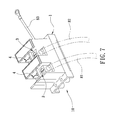
  • FIG. 7 is a perspective view illustrating a second exemplary embodiment of the terminal block assembly according to the disclosure.
  • FIG. 8 is an exploded perspective view of the second exemplary embodiment.
  • a first exemplary embodiment of a terminal block assembly 10 is used in an outdoor lamp 9 (see FIG. 3 ) that includes a light-emitting module 91 , and is connected to a plurality of electrical cables 81 , 82 , 83 for power supply (hereinafter referred to as live line 81 , neutral 82 and ground 83 ).
  • the terminal block assembly 10 includes a block housing 1 , a surge protection device 2 , three cable-receiving seats 3 , three connector sets 4 , a first fuse 51 , a second fuse 52 , two fuse holders 6 and two partitions 7 .
  • the block housing 1 includes a housing body 11 and a cover board 12 .
  • the housing body 11 and the cover board 12 cooperatively define an accommodating space 111 , and are sealed together so as to prevent water vapor from entering into the accommodating space 111 .
  • the housing body 11 has an outer surface that is formed with three spaced-apart grooves 112 , and has two fuse-receiving portions 113 .
  • Each of the grooves 112 receives a respective one of the cable-receiving seats 3 and a respective one of the connector sets 4 therein.
  • Each of the fuse-receiving portions 113 is configured as a slot that communicates spatially with the accommodating space 111 , and permits a respective one of the first and second fuses 51 , 52 to be mounted thereto.
  • the grooves 112 are arranged alternately with the fuse-receiving portions 113 .
  • the surge protection device 2 is confined in the accommodating space 111 .
  • the surge protection device 2 includes three metal oxide varistors (MOVs). Since the principle of how the surge protection device 2 functions is well-known to those skilled in the art, further detail of the same will not be provided herein for the sake of brevity.
  • the surge protection device 2 may include only one metal oxide varistor. It should be noted that in other examples, the surge protection device 2 is not limited to being MOVs, and may be selected from gas discharge tubes, spark gaps, etc., with no particular restriction.
  • the cable-receiving seats 3 are cubic in shape, are disposed in the respective grooves 112 of the housing body 11 , and receive the electrical cables 81 , 82 , 83 , respectively.
  • the electrical cables 81 , 82 , 83 are fixedly and respectively disposed in the cable-receiving seats 3 by virtue of a plurality of set screws 30 .
  • the connector sets 4 are disposed in the respective grooves 112 .
  • Each of the connector sets 4 is disposed adjacent to a corresponding one of the cable-receiving seats 3 , and includes four first connectors 41 and a second connector 42 .
  • the first connectors 41 extend in a direction away from the accommodating space 111 , and are for electrical connection to the light-emitting module 91 .
  • the second connector 42 extends into the accommodating space 111 and is electrically connected to the surge protection device 2 .
  • the first fuse 51 is mounted in the respective one of the fuse-receiving portion 113 of the housing body 11 , and is electrically connected to the surge protection device 2 and a first selected one of the electrical cables 81 , 82 , 83 , e.g., the live line 81 .
  • the second fuse 52 is mounted in the respective one of the fuse-receiving portion 113 of the housing body 11 , and is electrically connected to the surge protection device 2 and a second selected one of the electrical cables 81 , 82 , 83 , e.g., the neutral 82 .
  • the first and second fuses 51 , 52 are glass tube fuses.
  • the first and second fuses 51 , 52 may be blade type fuses or other type of fuses, with no particular restriction.
  • the maximum current rating of the first and second fuses 51 , 52 is, but not limited to, 10 amperes. In other variations of this exemplary embodiment, the maximum current rating of the first and second fuses 51 , 52 may be 20 amperes.
  • each of the fuse holders 6 respectively engage the fuse-receiving portions 113 of the housing body 11 .
  • each of the fuse holders 6 includes a base board 61 and a holding frame 62 which is fixedly connected to one surface of the base board 61 , and on which a respective one of the first and second fuses 51 , 52 is securely disposed.
  • the partitions 7 are respectively disposed in selected ones of the grooves 112 which correspond in position to the live line 81 and the neutral 82 , respectively. Each of the partitions 7 is disposed between and separates a corresponding one of the cable-receiving seats 3 and a corresponding one of the connector sets 4 . In this exemplary embodiment, the partitions 7 and the housing body 11 are integrally formed.
  • the first and second fuses 51 , 52 serve as additional protection for protecting the light-emitting module 91 .
  • the partitions 7 are configured to ensure that the live line 81 and the neutral 82 do not contact the first connectors 41 or electric wires (not shown) connecting the first connectors 41 and the light-emitting module 91 , so as to prevent occurrence of a short circuit which bypasses the first fuse 51 or the second fuse 52 .
  • the arrangement of the first and second fuses 51 , 52 and the partitions 7 ensures that the lightning surge passes through one of the first and second fuses 51 , 52 even if the live line 81 is incorrectly connected to the second fuse 52 , and the neutral 82 is incorrectly connected to the second fuse 52 .
  • the number of the cable-receiving seats 3 , of the connector sets 4 , and of the grooves 112 is not limited to three, and the number of the fuses 51 , 52 , of the fuse holders 6 , and of the fuse-receiving portions 113 of the housing body 11 is not limited to two, and may vary depending on the number of the electrical cables 81 , 82 , 83 to be connected to the terminal block assembly 10 .
  • the terminal block assembly 10 of the disclosure can prevent the light-emitting module 91 of the lamp 9 from damage of about 90% of surge incidents.
  • the surge incidents are, for example, lighting strikes or power outages that result in a voltage spike which produces a corresponding increase in current to about 20 KA.
  • the surge protection device 2 is disposed in the accommodating space 111 , and the first and second fuses 51 , 52 are directly mounted to the block housing 1 , space utilization of the outdoor lamp 9 is improved, and the outdoor lamp 9 may be designed to be relatively compact in size. Furthermore, since the cost of installing the surge protection device 2 is saved, the overall manufacturing cost of the outdoor lamp 9 is reduced.
  • the second fuse 52 is omitted.
  • the terminal block assembly 10 includes only one fuse holder 6 on which the first fuse 51 is securely disposed, and one partition 7 that separates one of the cable-receiving seats 3 , which receives the live line 81 , and a corresponding one of the connector sets 4 .
  • the block housing 1 includes only one fuse-receiving portion 113 that engages the fuse holder 6 .
  • Such modification has the same size-reducing and cost-saving advantages as those of the exemplary embodiment.

Landscapes

  • Engineering & Computer Science (AREA)
  • General Engineering & Computer Science (AREA)
  • Microelectronics & Electronic Packaging (AREA)
  • Arrangement Of Elements, Cooling, Sealing, Or The Like Of Lighting Devices (AREA)
  • Fuses (AREA)

Abstract

A terminal block assembly includes a block housing, a surge protection device, a plurality of cable-receiving seats, a plurality of connector sets and a first fuse. The block housing defines an accommodating space that confines the surge protection device. The cable-receiving seats and the connector sets are mounted on the block housing. Each of the connector sets includes at least one first connector that is electrically connected to a light-emitting module of an outdoor lamp, and a second connector that extends into the accommodating space and that is electrically connected to the surge protection device. The first fuse is mounted to the block housing, and is electrically connected to the surge protection device.

Description

FIELD
The disclosure relates to a terminal block, more particularly to a terminal block assembly incorporating a fuse and a surge protection device.
BACKGROUND
In general, outdoor lamps in the United States oftentimes include a lamp casing, a light-emitting module, a terminal block that is disposed in the lamp casing and that is electrically connected to the light-emitting module and a plurality of power supply cables, a surge protection device that is disposed adjacent to the terminal block in the lamp casing and that is electrically connected to the terminal block to protect the light-emitting module against electrical surges caused by lightning, and a fuse that is disposed adjacent to the terminal block in the lamp casing and that is electrically connected to the terminal block. By virtue of the surge protection device and the fuse, damage due to lightning or a sudden electrical surge is effectively prevented.
However, since the terminal block, the surge protection device and the fuse are individual components of the outdoor lamp and are not incorporated into one assembly, a relatively large space is required for accommodating the above-mentioned components in the lamp casing and for placement of electrical wires that connect the above-mentioned components. Furthermore, the cost of installing the surge protection device and the fuse adds to the overall manufacturing cost of the outdoor lamp.
SUMMARY
Therefore, an object of the disclosure is to provide a terminal block assembly that can alleviate at least one of the aforesaid drawbacks of the prior art.
According to the disclosure, the terminal block assembly is used in an outdoor lamp that includes a light-emitting module, and is connected to a plurality of electrical cables. The terminal block assembly includes a block housing, a surge protection device, a plurality of cable-receiving seats, a plurality of connector sets and a first fuse.
The block housing defines an accommodating space. The surge protection device is confined in the accommodating space. The cable-receiving seats are mounted on the block housing for receiving the electrical cables, respectively. The connector sets are mounted on the block housing. Each of the connector sets includes at least one first connector that is electrically connected to the light-emitting module, and a second connector that extends into the accommodating space and that is electrically connected to the surge protection device. The first fuse is mounted to the block housing, and is electrically connected to the surge protection device and a first selected one of the electrical cables.
BRIEF DESCRIPTION OF THE DRAWINGS
Other features and advantages of the disclosure will become apparent in the following detailed description of the exemplary embodiment with reference to the accompanying drawings, of which:
FIG. 1 is a perspective view illustrating a first exemplary embodiment of a terminal block assembly according to the disclosure;
FIG. 2 is an exploded perspective view of the first exemplary embodiment;
FIG. 3 is a fragmentary schematic view, illustrating the first exemplary embodiment being installed in an outdoor lamp and connected to three electrical cables;
FIG. 4 is a schematic circuit block diagram illustrating two fuses and a surge protection device of the first exemplary embodiment being electrically connected to a light-emitting module;
FIG. 5 is a schematic circuit block diagram illustrating a modification of the first exemplary embodiment, in which one of the fuses is omitted;
FIG. 6 is a fragmentary schematic view, illustrating the modification of the first exemplary embodiment being installed in the outdoor lamp and connected to the electrical cables;
FIG. 7 is a perspective view illustrating a second exemplary embodiment of the terminal block assembly according to the disclosure; and
FIG. 8 is an exploded perspective view of the second exemplary embodiment.
DETAILED DESCRIPTION
Before the disclosure is described in greater detail, it should be noted that like elements are denoted by the same reference numerals throughout the disclosure.
Referring to FIGS. 1, 2 and 3, a first exemplary embodiment of a terminal block assembly 10 according to this disclosure is used in an outdoor lamp 9 (see FIG. 3) that includes a light-emitting module 91, and is connected to a plurality of electrical cables 81, 82, 83 for power supply (hereinafter referred to as live line 81, neutral 82 and ground 83). The terminal block assembly 10 includes a block housing 1, a surge protection device 2, three cable-receiving seats 3, three connector sets 4, a first fuse 51, a second fuse 52, two fuse holders 6 and two partitions 7.
The block housing 1 includes a housing body 11 and a cover board 12. The housing body 11 and the cover board 12 cooperatively define an accommodating space 111, and are sealed together so as to prevent water vapor from entering into the accommodating space 111. The housing body 11 has an outer surface that is formed with three spaced-apart grooves 112, and has two fuse-receiving portions 113. Each of the grooves 112 receives a respective one of the cable-receiving seats 3 and a respective one of the connector sets 4 therein. Each of the fuse-receiving portions 113 is configured as a slot that communicates spatially with the accommodating space 111, and permits a respective one of the first and second fuses 51, 52 to be mounted thereto. In this exemplary embodiment, the grooves 112 are arranged alternately with the fuse-receiving portions 113.
The surge protection device 2 is confined in the accommodating space 111. In this exemplary embodiment, the surge protection device 2 includes three metal oxide varistors (MOVs). Since the principle of how the surge protection device 2 functions is well-known to those skilled in the art, further detail of the same will not be provided herein for the sake of brevity. In other variations of this exemplary embodiment, the surge protection device 2 may include only one metal oxide varistor. It should be noted that in other examples, the surge protection device 2 is not limited to being MOVs, and may be selected from gas discharge tubes, spark gaps, etc., with no particular restriction.
The cable-receiving seats 3 are cubic in shape, are disposed in the respective grooves 112 of the housing body 11, and receive the electrical cables 81, 82, 83, respectively. The electrical cables 81, 82, 83 are fixedly and respectively disposed in the cable-receiving seats 3 by virtue of a plurality of set screws 30.
The connector sets 4 are disposed in the respective grooves 112. Each of the connector sets 4 is disposed adjacent to a corresponding one of the cable-receiving seats 3, and includes four first connectors 41 and a second connector 42. The first connectors 41 extend in a direction away from the accommodating space 111, and are for electrical connection to the light-emitting module 91. The second connector 42 extends into the accommodating space 111 and is electrically connected to the surge protection device 2.
The first fuse 51 is mounted in the respective one of the fuse-receiving portion 113 of the housing body 11, and is electrically connected to the surge protection device 2 and a first selected one of the electrical cables 81, 82, 83, e.g., the live line 81.
The second fuse 52 is mounted in the respective one of the fuse-receiving portion 113 of the housing body 11, and is electrically connected to the surge protection device 2 and a second selected one of the electrical cables 81, 82, 83, e.g., the neutral 82. In this exemplary embodiment, the first and second fuses 51, 52 are glass tube fuses. Alternatively, the first and second fuses 51, 52 may be blade type fuses or other type of fuses, with no particular restriction. Additionally, in this exemplary embodiment, the maximum current rating of the first and second fuses 51, 52 is, but not limited to, 10 amperes. In other variations of this exemplary embodiment, the maximum current rating of the first and second fuses 51, 52 may be 20 amperes.
The fuse holders 6 respectively engage the fuse-receiving portions 113 of the housing body 11. In greater detail, each of the fuse holders 6 includes a base board 61 and a holding frame 62 which is fixedly connected to one surface of the base board 61, and on which a respective one of the first and second fuses 51, 52 is securely disposed.
The partitions 7 are respectively disposed in selected ones of the grooves 112 which correspond in position to the live line 81 and the neutral 82, respectively. Each of the partitions 7 is disposed between and separates a corresponding one of the cable-receiving seats 3 and a corresponding one of the connector sets 4. In this exemplary embodiment, the partitions 7 and the housing body 11 are integrally formed.
Referring to FIGS. 3 and 4, when a lightning surge travels along the live line 81 and through the first fuse 51, most of the current of the lightning surge is diverted to the surge protection device 2. As a result, the light-emitting module 91 is prevented from damage due to the lightning surge. The first and second fuses 51, 52 serve as additional protection for protecting the light-emitting module 91. The partitions 7 are configured to ensure that the live line 81 and the neutral 82 do not contact the first connectors 41 or electric wires (not shown) connecting the first connectors 41 and the light-emitting module 91, so as to prevent occurrence of a short circuit which bypasses the first fuse 51 or the second fuse 52. The arrangement of the first and second fuses 51, 52 and the partitions 7 ensures that the lightning surge passes through one of the first and second fuses 51, 52 even if the live line 81 is incorrectly connected to the second fuse 52, and the neutral 82 is incorrectly connected to the second fuse 52.
It should be noted that the number of the cable-receiving seats 3, of the connector sets 4, and of the grooves 112 is not limited to three, and the number of the fuses 51, 52, of the fuse holders 6, and of the fuse-receiving portions 113 of the housing body 11 is not limited to two, and may vary depending on the number of the electrical cables 81, 82, 83 to be connected to the terminal block assembly 10.
It is worth mentioning that in actual use, the terminal block assembly 10 of the disclosure can prevent the light-emitting module 91 of the lamp 9 from damage of about 90% of surge incidents. The surge incidents are, for example, lighting strikes or power outages that result in a voltage spike which produces a corresponding increase in current to about 20 KA.
To sum up, since the surge protection device 2 is disposed in the accommodating space 111, and the first and second fuses 51, 52 are directly mounted to the block housing 1, space utilization of the outdoor lamp 9 is improved, and the outdoor lamp 9 may be designed to be relatively compact in size. Furthermore, since the cost of installing the surge protection device 2 is saved, the overall manufacturing cost of the outdoor lamp 9 is reduced.
Referring to FIGS. 5 and 6, in a modification of the first exemplary embodiment, the second fuse 52 is omitted. The terminal block assembly 10 includes only one fuse holder 6 on which the first fuse 51 is securely disposed, and one partition 7 that separates one of the cable-receiving seats 3, which receives the live line 81, and a corresponding one of the connector sets 4. The block housing 1 includes only one fuse-receiving portion 113 that engages the fuse holder 6. Such modification has the same size-reducing and cost-saving advantages as those of the exemplary embodiment.
Referring to FIGS. 7 and 8, a second exemplary embodiment of the terminal block assembly 10 according to the disclosure is similar to the first exemplary embodiment, the difference therebetween resides in that the terminal block assembly 10 of the second exemplary embodiment includes two of the cable-receiving seats 3 that are for respectively receiving the live line 81 and the neutral 82, and two of the connector sets 4 that correspond in position to the two cable-receiving seats 3, respectively. The terminal block assembly 10 of the second exemplary embodiment is provided with the ground 83 that is electrically connected to the surge protection device 2, that extends out of the block housing 1, and that is adapted to be directly connected to the lamp 9 (not shown).
While the disclosure has been described in connection with what are considered the exemplary embodiments, it is understood that this disclosure is not limited to the disclosed embodiments but is intended to cover various arrangements included within the spirit and scope of the broadest interpretation so as to encompass all such modifications and equivalent arrangements.

Claims (16)

What is claimed is:
1. A terminal block assembly adapted for use in an outdoor lamp including a light-emitting module, and adapted to be connected to a plurality of electrical cables, said terminal block assembly comprising:
a block housing defining an accommodating space;
a surge protection device confined in said accommodating space;
a plurality of cable-receiving seats mounted to said block housing for receiving the electrical cables, respectively;
a plurality of connector sets mounted to said block housing, each of said connector sets including at least one first connector that is for electrical connection to the light-emitting module, and a second connector that extends into said accommodating space and that is electrically connected to said surge protection device; and
a first fuse mounted to said block housing, and electrically connected to said surge protection device and a first selected one of the electrical cables.
2. The terminal block assembly of claim 1, wherein each of said cable-receiving seats is disposed adjacent to a respective one of said connector sets, said terminal block assembly further comprising a partition disposed between and separating one of said cable-receiving seats, which receives the first selected one of the electrical cables, and a corresponding one of said connector sets.
3. The terminal block assembly of claim 1, wherein:
said block housing is formed with a plurality of spaced-apart grooves, and has a fuse-receiving portion;
each of said grooves receives a respective one of said cable-receiving seats and a respective one of said connector sets therein; and
said fuse-receiving portion permits said first fuse to be mounted thereto.
4. The terminal block assembly of claim 3, wherein said fuse-receiving portion is configured as a slot, said terminal block assembly further comprising a fuse holder which engages said fuse-receiving portion and on which said first fuse is securely disposed.
5. The terminal block assembly of claim 4, wherein said grooves and said fuse-receiving portion are formed in an outer surface of said block housing.
6. The terminal block assembly of claim 5, wherein said partition is disposed in one of said grooves which corresponds in position to the first selected one of the electrical cables.
7. The terminal block assembly of claim 1, further comprises a second fuse mounted to said block housing, and electrically connected to said surge protection device and a second selected one of the electrical cables.
8. The terminal block assembly of claim 7, wherein each of said cable-receiving seats is disposed adjacent to a respective one of said connector sets, said terminal block assembly further comprising a plurality of partitions, each of which being disposed between and separating a corresponding one of said cable-receiving seats and a corresponding one of said connector sets.
9. The terminal block assembly of claim 8, wherein said block housing is formed with a plurality of spaced-apart grooves, and has two fuse-receiving portions;
each of said grooves receives a respective one of said cable-receiving seats and a respective one of said connector sets therein; and
said fuse-receiving portions permit said first and second fuses to be respectively mounted thereto.
10. The terminal block assembly of claim 9, wherein said grooves are arranged alternately with said fuse-receiving portions.
11. The terminal block assembly of claim 9, wherein each of said fuse-receiving portions is configured as a slot, said terminal block assembly further comprising two fuse holders which respectively engage said fuse-receiving portions and on which said first and second fuses are respectively and securely disposed.
12. The terminal block assembly of claim 11, wherein said grooves and said fuse-receiving portions are formed in an outer surface of said block housing.
13. The terminal block assembly of claim 11, wherein said partitions are respectively disposed in selected ones of said grooves which correspond in position to the first and second selected ones of the electrical cables, respectively.
14. The terminal block assembly of claim 1, wherein said block housing includes a housing body and a cover board, said cover board and said housing body cooperatively defining said accommodating space, and being sealed together so as to prevent water vapor from entering into said accommodating space.
15. The terminal block assembly of claim 1, wherein said surge protection device includes at least one metal oxide varistor.
16. The terminal block assembly of claim 1, wherein a maximum current rating of said first fuse includes 10 amperes.
US15/080,957 2016-03-25 2016-03-25 Terminal block assembly Active 2036-05-14 US9933147B2 (en)

Priority Applications (1)

Application Number Priority Date Filing Date Title
US15/080,957 US9933147B2 (en) 2016-03-25 2016-03-25 Terminal block assembly

Applications Claiming Priority (1)

Application Number Priority Date Filing Date Title
US15/080,957 US9933147B2 (en) 2016-03-25 2016-03-25 Terminal block assembly

Publications (2)

Publication Number Publication Date
US20170276341A1 US20170276341A1 (en) 2017-09-28
US9933147B2 true US9933147B2 (en) 2018-04-03

Family

ID=59897809

Family Applications (1)

Application Number Title Priority Date Filing Date
US15/080,957 Active 2036-05-14 US9933147B2 (en) 2016-03-25 2016-03-25 Terminal block assembly

Country Status (1)

Country Link
US (1) US9933147B2 (en)

Cited By (2)

* Cited by examiner, † Cited by third party
Publication number Priority date Publication date Assignee Title
US10320181B1 (en) * 2016-11-03 2019-06-11 Universal Lighting Technologies, Inc. Failure detection and alerting circuit for a common mode surge protection device in an LED driver
US12272910B1 (en) 2023-12-08 2025-04-08 Justin McCarty Power distribution block

Families Citing this family (1)

* Cited by examiner, † Cited by third party
Publication number Priority date Publication date Assignee Title
USD900029S1 (en) * 2017-03-06 2020-10-27 Wago Verwaltungsgesellschaft Mit Beschraenkter Haftung Electrical connector

Citations (2)

* Cited by examiner, † Cited by third party
Publication number Priority date Publication date Assignee Title
US20140305693A1 (en) * 2013-01-16 2014-10-16 William Greenberg Fuse and Power Distribution Block
US20160079687A1 (en) * 2014-09-12 2016-03-17 Siemens Industry, Inc. Fusible switch assemblies, and load base assemblies, line base assemblies, line bus connector assemblies, fuse clip assemblies, fuse clip and lug assemblies, and operational methods thereof

Patent Citations (3)

* Cited by examiner, † Cited by third party
Publication number Priority date Publication date Assignee Title
US20140305693A1 (en) * 2013-01-16 2014-10-16 William Greenberg Fuse and Power Distribution Block
US9306379B2 (en) * 2013-01-16 2016-04-05 William Greenberg Fuse and power distribution block
US20160079687A1 (en) * 2014-09-12 2016-03-17 Siemens Industry, Inc. Fusible switch assemblies, and load base assemblies, line base assemblies, line bus connector assemblies, fuse clip assemblies, fuse clip and lug assemblies, and operational methods thereof

Cited By (2)

* Cited by examiner, † Cited by third party
Publication number Priority date Publication date Assignee Title
US10320181B1 (en) * 2016-11-03 2019-06-11 Universal Lighting Technologies, Inc. Failure detection and alerting circuit for a common mode surge protection device in an LED driver
US12272910B1 (en) 2023-12-08 2025-04-08 Justin McCarty Power distribution block

Also Published As

Publication number Publication date
US20170276341A1 (en) 2017-09-28

Similar Documents

Publication Publication Date Title
US10446988B2 (en) Fuse assembly
US4086648A (en) Protector module
US8669840B2 (en) Fuse assembly
US20120206848A1 (en) Pluggable surge protection system
US10497920B2 (en) Battery system
HU186806B (en) Overvoltage protecting device mountable to distributing connector
US9872360B2 (en) Photocontrol with surge protecting function
US9933147B2 (en) Terminal block assembly
CN105121214A (en) Surge protection device for protecting an onboard power system of an electric vehicle from an electric surge, corresponding method, and electric vehicle with the surge protection device
US20180190964A1 (en) Electrical energy storage module
US20120034801A1 (en) Electrical outlet assembly and manufacturing method thereof
US10014639B1 (en) Electrical receptacle
TWI763862B (en) Charging connector, charging device and kit and charging method
CN102084561A (en) Surge arrester
US8004385B2 (en) Electrical protective device
US3961226A (en) Multi-terminal arrestor holder and connector module
CA2610127A1 (en) Fuse having a plurality of configurable thermal ceilings
WO2025044160A1 (en) Surge protection device
KR20160008823A (en) Battery pack formed by parallel connection of a plurality of secondary battery cells
JP2011258412A (en) Battery connection plate
JP2006166622A (en) Distribution board with lightning arrester
ES2984495T3 (en) Arrangement of a power distribution component and an electrical socket with an overcurrent protection device
RU2091930C1 (en) Connecting module
EP1506598A4 (en) ELECTRICAL TERMINAL FOR OVERVOLTAGE PROTECTION CARTRIDGE
US9462656B2 (en) Lamp base having integral semiconductor transient protection device

Legal Events

Date Code Title Description
AS Assignment

Owner name: LITE-ON TECHNOLOGY CORP., TAIWAN

Free format text: ASSIGNMENT OF ASSIGNORS INTEREST;ASSIGNORS:WANG, SHIH-CHANG;HSU, PIN-HAO;KASHANI, HAMID;REEL/FRAME:038101/0265

Effective date: 20160314

STCF Information on status: patent grant

Free format text: PATENTED CASE

MAFP Maintenance fee payment

Free format text: PAYMENT OF MAINTENANCE FEE, 4TH YEAR, LARGE ENTITY (ORIGINAL EVENT CODE: M1551); ENTITY STATUS OF PATENT OWNER: LARGE ENTITY

Year of fee payment: 4

AS Assignment

Owner name: LEOTEK CORPORATION, TAIWAN

Free format text: ASSIGNMENT OF ASSIGNORS INTEREST;ASSIGNOR:LITE-ON TECHNOLOGY CORP.;REEL/FRAME:060116/0081

Effective date: 20220504

MAFP Maintenance fee payment

Free format text: PAYMENT OF MAINTENANCE FEE, 8TH YEAR, LARGE ENTITY (ORIGINAL EVENT CODE: M1552); ENTITY STATUS OF PATENT OWNER: LARGE ENTITY

Year of fee payment: 8