US9920090B2 - Betulinic acid derivatives with HIV maturation inhibitory activity - Google Patents
Betulinic acid derivatives with HIV maturation inhibitory activity Download PDFInfo
- Publication number
- US9920090B2 US9920090B2 US15/313,139 US201515313139A US9920090B2 US 9920090 B2 US9920090 B2 US 9920090B2 US 201515313139 A US201515313139 A US 201515313139A US 9920090 B2 US9920090 B2 US 9920090B2
- Authority
- US
- United States
- Prior art keywords
- alkyl
- group
- compound
- substituted
- cycloalkyl
- Prior art date
- Legal status (The legal status is an assumption and is not a legal conclusion. Google has not performed a legal analysis and makes no representation as to the accuracy of the status listed.)
- Expired - Fee Related
Links
- 0 [1*][C@@H]1CC[C@]2(C)CC(C)[C@]3(C)[C@]([H])(CC[C@]4([H])[C@@]5(C)Ccc(C[Y])C(C)(C)[C@]5([H])CC(C)[C@]43C)[C@@]12[H].[1*][C@@H]1CC[C@]2(C)CC[C@]3(C)[C@]([H])(CC[C@]4([H])[C@@]5(C)CC6OC6(C[Y])C(C)(C)[C@]5([H])CC[C@]43C)[C@@]12[H].[1*][C@@H]1CC[C@]2(C)CC[C@]3(C)[C@]([H])(CC[C@]4([H])[C@@]5(C)Ccc(C[Y])C(C)(C)[C@]5([H])CC[C@]43C)[C@@]12[H] Chemical compound [1*][C@@H]1CC[C@]2(C)CC(C)[C@]3(C)[C@]([H])(CC[C@]4([H])[C@@]5(C)Ccc(C[Y])C(C)(C)[C@]5([H])CC(C)[C@]43C)[C@@]12[H].[1*][C@@H]1CC[C@]2(C)CC[C@]3(C)[C@]([H])(CC[C@]4([H])[C@@]5(C)CC6OC6(C[Y])C(C)(C)[C@]5([H])CC[C@]43C)[C@@]12[H].[1*][C@@H]1CC[C@]2(C)CC[C@]3(C)[C@]([H])(CC[C@]4([H])[C@@]5(C)Ccc(C[Y])C(C)(C)[C@]5([H])CC[C@]43C)[C@@]12[H] 0.000 description 16
- IRLGCJLCTNPDDM-JABVSJTCSA-N [H][C@@]12CC[C@]3(C)[C@]([H])(CC[C@@]4([H])[C@@]3(C)CC[C@@]3(C)CC[C@@H](C(=C)C)[C@@]34[H])[C@@]1(C)C(=O)C=C(C1=CC=C(OC=O)C=C1)C2(C)C.[H][C@@]12CC[C@]3(C)[C@]([H])(CC[C@]4([H])[C@@]5([H])[C@H](C(=C)C)CC[C@]5(C(C)=O)CC[C@]43C)[C@@]1(C)C[C@@H]1O[C@]1(C1=CC=C(OC=O)C=C1)C2(C)C.[H][C@@]12CC[C@]3(C)[C@]([H])(CC[C@]4([H])[C@@]5([H])[C@H](C(C)C)CC[C@]5(NCCN5CCS(=O)(=O)CC5)CC[C@@]34C)[C@@]1(C)C(=O)C=C(C1=CC=C(OC=O)C=C1)C2(C)C Chemical compound [H][C@@]12CC[C@]3(C)[C@]([H])(CC[C@@]4([H])[C@@]3(C)CC[C@@]3(C)CC[C@@H](C(=C)C)[C@@]34[H])[C@@]1(C)C(=O)C=C(C1=CC=C(OC=O)C=C1)C2(C)C.[H][C@@]12CC[C@]3(C)[C@]([H])(CC[C@]4([H])[C@@]5([H])[C@H](C(=C)C)CC[C@]5(C(C)=O)CC[C@]43C)[C@@]1(C)C[C@@H]1O[C@]1(C1=CC=C(OC=O)C=C1)C2(C)C.[H][C@@]12CC[C@]3(C)[C@]([H])(CC[C@]4([H])[C@@]5([H])[C@H](C(C)C)CC[C@]5(NCCN5CCS(=O)(=O)CC5)CC[C@@]34C)[C@@]1(C)C(=O)C=C(C1=CC=C(OC=O)C=C1)C2(C)C IRLGCJLCTNPDDM-JABVSJTCSA-N 0.000 description 2
- HUZCCDBFPITGRJ-XBVVUODUSA-N [H][C@@]12CC[C@]3(C)[C@]([H])(CC[C@]4([H])[C@@]5([H])[C@H](C(=C)C)CC[C@]5(C(=O)CCCCN5CCCCC5)CC[C@@]34C)[C@@]1(C)[C@@H](O)C=C(C1=CC=C(OC=O)C=C1)C2(C)C.[H][C@@]12CC[C@]3(C)[C@]([H])(CC[C@]4([H])[C@@]5([H])[C@H](C(=C)C)CC[C@]5(C(=O)CCCCN5CCCCC5)CC[C@@]34C)[C@@]1(C)[C@H](F)C=C(C1=CC=C(OC=O)C=C1)C2(C)C.[H][C@@]12CC[C@]3(C)[C@]([H])(CC[C@]4([H])[C@@]5([H])[C@H](C(=C)C)CC[C@]5(C(C)=O)CC[C@@]34C)[C@@]1(C)C(=O)C=C(C1=CC=C(OC=O)C=C1)C2(C)C.[H][C@@]12C[C@@H]3OC(C)(C)O[C@H]4C[C@@]5(C(C)=O)CC[C@@H](C(=C)C)[C@]5([H])[C@@]5([H])CC[C@]([H])([C@@]1(C)CC=C(C1=CC=C(OC=O)C=C1)C2(C)C)[C@]3(C)[C@]45C.[H][C@@]12C[C@H](O)[C@]3(C)[C@]([H])(CC[C@]4([H])[C@@]5([H])[C@H](C(=C)C)CC[C@]5(NCCN5CCS(=O)(=O)CC5)C[C@H](O)[C@]43C)[C@@]1(C)CC=C(C1=CC=C(C(=O)O)C=C1)C2(C)C Chemical compound [H][C@@]12CC[C@]3(C)[C@]([H])(CC[C@]4([H])[C@@]5([H])[C@H](C(=C)C)CC[C@]5(C(=O)CCCCN5CCCCC5)CC[C@@]34C)[C@@]1(C)[C@@H](O)C=C(C1=CC=C(OC=O)C=C1)C2(C)C.[H][C@@]12CC[C@]3(C)[C@]([H])(CC[C@]4([H])[C@@]5([H])[C@H](C(=C)C)CC[C@]5(C(=O)CCCCN5CCCCC5)CC[C@@]34C)[C@@]1(C)[C@H](F)C=C(C1=CC=C(OC=O)C=C1)C2(C)C.[H][C@@]12CC[C@]3(C)[C@]([H])(CC[C@]4([H])[C@@]5([H])[C@H](C(=C)C)CC[C@]5(C(C)=O)CC[C@@]34C)[C@@]1(C)C(=O)C=C(C1=CC=C(OC=O)C=C1)C2(C)C.[H][C@@]12C[C@@H]3OC(C)(C)O[C@H]4C[C@@]5(C(C)=O)CC[C@@H](C(=C)C)[C@]5([H])[C@@]5([H])CC[C@]([H])([C@@]1(C)CC=C(C1=CC=C(OC=O)C=C1)C2(C)C)[C@]3(C)[C@]45C.[H][C@@]12C[C@H](O)[C@]3(C)[C@]([H])(CC[C@]4([H])[C@@]5([H])[C@H](C(=C)C)CC[C@]5(NCCN5CCS(=O)(=O)CC5)C[C@H](O)[C@]43C)[C@@]1(C)CC=C(C1=CC=C(C(=O)O)C=C1)C2(C)C HUZCCDBFPITGRJ-XBVVUODUSA-N 0.000 description 2
- IRITZYMANGMVOR-SFKPUVPOSA-N [H][C@@]12CC[C@]3(C)[C@]([H])(CC[C@]4([H])[C@@]5([H])[C@H](C(=C)C)CC[C@]5(C(=O)CCCCN5CCCCC5)CC[C@@]34C)[C@@]1(C)[C@@H](O)C=C(C1=CC=C(OC=O)C=C1)C2(C)C.[H][C@@]12CC[C@]3(C)[C@]([H])(CC[C@]4([H])[C@@]5([H])[C@H](C(=C)C)CC[C@]5(C(=O)CCCCN5CCCCC5)CC[C@@]34C)[C@@]1(C)[C@H](F)C=C(C1=CC=C(OC=O)C=C1)C2(C)C.[H][C@@]12CC[C@]3(C)[C@]([H])(CC[C@]4([H])[C@@]5([H])[C@H](C(=C)C)CC[C@]5(C(C)=O)CC[C@@]34C)[C@@]1(C)[C@@H](O)C=C(C1=CC=C(OC=O)C=C1)C2(C)C.[H][C@@]12CC[C@]3(C)[C@]([H])(CC[C@]4([H])[C@@]5([H])[C@H](C(=C)C)CC[C@]5(C(C)=O)CC[C@@]34C)[C@@]1(C)[C@H](O)C=C(C1=CC=C(OC=O)C=C1)C2(C)C Chemical compound [H][C@@]12CC[C@]3(C)[C@]([H])(CC[C@]4([H])[C@@]5([H])[C@H](C(=C)C)CC[C@]5(C(=O)CCCCN5CCCCC5)CC[C@@]34C)[C@@]1(C)[C@@H](O)C=C(C1=CC=C(OC=O)C=C1)C2(C)C.[H][C@@]12CC[C@]3(C)[C@]([H])(CC[C@]4([H])[C@@]5([H])[C@H](C(=C)C)CC[C@]5(C(=O)CCCCN5CCCCC5)CC[C@@]34C)[C@@]1(C)[C@H](F)C=C(C1=CC=C(OC=O)C=C1)C2(C)C.[H][C@@]12CC[C@]3(C)[C@]([H])(CC[C@]4([H])[C@@]5([H])[C@H](C(=C)C)CC[C@]5(C(C)=O)CC[C@@]34C)[C@@]1(C)[C@@H](O)C=C(C1=CC=C(OC=O)C=C1)C2(C)C.[H][C@@]12CC[C@]3(C)[C@]([H])(CC[C@]4([H])[C@@]5([H])[C@H](C(=C)C)CC[C@]5(C(C)=O)CC[C@@]34C)[C@@]1(C)[C@H](O)C=C(C1=CC=C(OC=O)C=C1)C2(C)C IRITZYMANGMVOR-SFKPUVPOSA-N 0.000 description 2
- PHYDLCUPZKVHMT-ZHIWGYQOSA-N [H][C@@]12CC[C@]3(C)[C@]([H])(CC[C@]4([H])[C@@]5([H])[C@H](C(=C)C)CC[C@]5(C(C)=O)CC[C@@]34C)[C@@]1(C)C(=O)C=C(C1=CC=C(OC=O)C=C1)C2(C)C.[H][C@@]12C[C@@H]3OC(C)(C)O[C@H]4C[C@@]5(C(C)=O)CC[C@@H](C(=C)C)[C@]5([H])[C@@]5([H])CC[C@]([H])([C@@]1(C)CC=C(C1=CC=C(OC=O)C=C1)C2(C)C)[C@]3(C)[C@]45C.[H][C@@]12C[C@H](O)[C@]3(C)[C@]([H])(CC[C@]4([H])[C@@]5([H])[C@H](C(=C)C)CC[C@]5(C(C)=O)C[C@H](O)[C@]43C)[C@@]1(C)CC=C(C1=CC=C(OC=O)C=C1)C2(C)C.[H][C@@]12C[C@H](O)[C@]3(C)[C@]([H])(CC[C@]4([H])[C@@]5([H])[C@H](C(=C)C)CC[C@]5(NCCN5CCS(=O)(=O)CC5)C[C@H](O)[C@]43C)[C@@]1(C)CC=C(C1=CC=C(C(=O)O)C=C1)C2(C)C Chemical compound [H][C@@]12CC[C@]3(C)[C@]([H])(CC[C@]4([H])[C@@]5([H])[C@H](C(=C)C)CC[C@]5(C(C)=O)CC[C@@]34C)[C@@]1(C)C(=O)C=C(C1=CC=C(OC=O)C=C1)C2(C)C.[H][C@@]12C[C@@H]3OC(C)(C)O[C@H]4C[C@@]5(C(C)=O)CC[C@@H](C(=C)C)[C@]5([H])[C@@]5([H])CC[C@]([H])([C@@]1(C)CC=C(C1=CC=C(OC=O)C=C1)C2(C)C)[C@]3(C)[C@]45C.[H][C@@]12C[C@H](O)[C@]3(C)[C@]([H])(CC[C@]4([H])[C@@]5([H])[C@H](C(=C)C)CC[C@]5(C(C)=O)C[C@H](O)[C@]43C)[C@@]1(C)CC=C(C1=CC=C(OC=O)C=C1)C2(C)C.[H][C@@]12C[C@H](O)[C@]3(C)[C@]([H])(CC[C@]4([H])[C@@]5([H])[C@H](C(=C)C)CC[C@]5(NCCN5CCS(=O)(=O)CC5)C[C@H](O)[C@]43C)[C@@]1(C)CC=C(C1=CC=C(C(=O)O)C=C1)C2(C)C PHYDLCUPZKVHMT-ZHIWGYQOSA-N 0.000 description 2
- GNEBIVSGKIVBEL-MODOMUFBSA-N [H][C@@]12CC[C@]3(C)[C@]([H])(CC[C@]4([H])[C@@]5([H])[C@H](C(=C)C)CC[C@]5(N)CC[C@@]34C)[C@@]1(C)C(=O)C=C(C1=CC=C(OC=O)C=C1)C2(C)C.[H][C@@]12CC[C@]3(C)[C@]([H])(CC[C@]4([H])[C@@]5([H])[C@H](C(C)C)CC[C@]5(NCCN5CCCCC5)CC[C@@]34C)[C@@]1(C)C(=O)C=C(C1=CC=C(OC=O)C=C1)C2(C)C Chemical compound [H][C@@]12CC[C@]3(C)[C@]([H])(CC[C@]4([H])[C@@]5([H])[C@H](C(=C)C)CC[C@]5(N)CC[C@@]34C)[C@@]1(C)C(=O)C=C(C1=CC=C(OC=O)C=C1)C2(C)C.[H][C@@]12CC[C@]3(C)[C@]([H])(CC[C@]4([H])[C@@]5([H])[C@H](C(C)C)CC[C@]5(NCCN5CCCCC5)CC[C@@]34C)[C@@]1(C)C(=O)C=C(C1=CC=C(OC=O)C=C1)C2(C)C GNEBIVSGKIVBEL-MODOMUFBSA-N 0.000 description 2
- SUPCTKDYLLDLAQ-GUCXYOBSSA-M B.C.C.O=C=O.O=C=O.O=C=O.O[Na].[H][C@@]12CC[C@]3(C)[C@]([H])(CC[C@]4([H])[C@@]5([H])[C@H](C(C)C)CC[C@]5(C(=O)O)CC[C@@]34C)[C@@]1(C)C(O)C=C(C1=CC=C(C)C=C1)C2(C)C.[H][C@@]12CC[C@]3(C)[C@]([H])(CC[C@]4([H])[C@@]5([H])[C@H](C(C)C)CC[C@]5(C(=O)O)CC[C@@]34C)[C@@]1(C)[C@@H](O)C=C(C1=CC=C(OC=O)C=C1)C2(C)C.[H][C@@]12CC[C@]3(C)[C@]([H])(CC[C@]4([H])[C@@]5([H])[C@H](C(C)C)CC[C@]5(C(=O)O)CC[C@@]34C)[C@@]1(C)[C@H](O)C=C(C1=CC=C(OC=O)C=C1)C2(C)C.[H][C@@]12CC[C@]3(C)[C@]([H])(CC[C@]4([H])[C@@]5([H])[C@H](C(C)C)CC[C@]5(C(=O)OCC5=CC=CC=C5)CC[C@@]34C)[C@@]1(C)C(=O)C=C(C1=CC=C(C)C=C1)C2(C)C.[H][C@@]12CC[C@]3(C)[C@]([H])(CC[C@]4([H])[C@@]5([H])[C@H](C(C)C)CC[C@]5(C(=O)OCC5=CC=CC=C5)CC[C@@]34C)[C@@]1(C)C(O)C=C(C1=CC=C(C)C=C1)C2(C)C.[NaH] Chemical compound B.C.C.O=C=O.O=C=O.O=C=O.O[Na].[H][C@@]12CC[C@]3(C)[C@]([H])(CC[C@]4([H])[C@@]5([H])[C@H](C(C)C)CC[C@]5(C(=O)O)CC[C@@]34C)[C@@]1(C)C(O)C=C(C1=CC=C(C)C=C1)C2(C)C.[H][C@@]12CC[C@]3(C)[C@]([H])(CC[C@]4([H])[C@@]5([H])[C@H](C(C)C)CC[C@]5(C(=O)O)CC[C@@]34C)[C@@]1(C)[C@@H](O)C=C(C1=CC=C(OC=O)C=C1)C2(C)C.[H][C@@]12CC[C@]3(C)[C@]([H])(CC[C@]4([H])[C@@]5([H])[C@H](C(C)C)CC[C@]5(C(=O)O)CC[C@@]34C)[C@@]1(C)[C@H](O)C=C(C1=CC=C(OC=O)C=C1)C2(C)C.[H][C@@]12CC[C@]3(C)[C@]([H])(CC[C@]4([H])[C@@]5([H])[C@H](C(C)C)CC[C@]5(C(=O)OCC5=CC=CC=C5)CC[C@@]34C)[C@@]1(C)C(=O)C=C(C1=CC=C(C)C=C1)C2(C)C.[H][C@@]12CC[C@]3(C)[C@]([H])(CC[C@]4([H])[C@@]5([H])[C@H](C(C)C)CC[C@]5(C(=O)OCC5=CC=CC=C5)CC[C@@]34C)[C@@]1(C)C(O)C=C(C1=CC=C(C)C=C1)C2(C)C.[NaH] SUPCTKDYLLDLAQ-GUCXYOBSSA-M 0.000 description 1
- OUQWEYROEZZRQQ-UHFFFAOYSA-N C=C1CCN1C(C)(C)C.CC(C)(C)N1CCCCC1=O.CC(C)N1CCCC1=O Chemical compound C=C1CCN1C(C)(C)C.CC(C)(C)N1CCCCC1=O.CC(C)N1CCCC1=O OUQWEYROEZZRQQ-UHFFFAOYSA-N 0.000 description 1
- CHNSNUUOLRKABK-ZKUMDSQQSA-N CC(C)([C@@H]1CC2)[C@@]3(c(cc4)ccc4C(O)=O)O[C@H]3C[C@]1(C)[C@@H](CC1)[C@]2(C)[C@](C)(CC2)[C@H]1[C@@H]([C@@H](CC1)C(C)=C)[C@@]21C(O)=O Chemical compound CC(C)([C@@H]1CC2)[C@@]3(c(cc4)ccc4C(O)=O)O[C@H]3C[C@]1(C)[C@@H](CC1)[C@]2(C)[C@](C)(CC2)[C@H]1[C@@H]([C@@H](CC1)C(C)=C)[C@@]21C(O)=O CHNSNUUOLRKABK-ZKUMDSQQSA-N 0.000 description 1
- CBABEQGCWJDGQY-IGHRLQGBSA-N CC1(C)C(c(cc2)ccc2C(O)=O)=CC[C@@]2(C)[C@H]1C[C@@H]1OC(C)(C)O[C@@H](C3)[C@@]4(C)[C@@]1(C)[C@@H]2CC[C@@H]4[C@@H]([C@@H](CC1)C(C)=C)[C@@]31C(O)=O Chemical compound CC1(C)C(c(cc2)ccc2C(O)=O)=CC[C@@]2(C)[C@H]1C[C@@H]1OC(C)(C)O[C@@H](C3)[C@@]4(C)[C@@]1(C)[C@@H]2CC[C@@H]4[C@@H]([C@@H](CC1)C(C)=C)[C@@]31C(O)=O CBABEQGCWJDGQY-IGHRLQGBSA-N 0.000 description 1
- LMFKMMSUVCLRNF-YLMIPNDTSA-N CCN(CC)S(F)(F)F.NCCCN1CCS(=O)(=O)CC1.O=C(Cl)C(=O)Cl.O=C=O.O=C=O.O=C=O.[H][C@@]12CC[C@]3(C)[C@]([H])(CC[C@]4([H])[C@@]5([H])[C@H](C(C)C)CC[C@]5(C(=O)O)CC[C@@]34C)[C@@]1(C)C(F)C=C(C1=CC=C(C)C=C1)C2(C)C.[H][C@@]12CC[C@]3(C)[C@]([H])(CC[C@]4([H])[C@@]5([H])[C@H](C(C)C)CC[C@]5(C(=O)OCC5=CC=CC=C5)CC[C@@]34C)[C@@]1(C)C(F)C=C(C1=CC=C(C)C=C1)C2(C)C.[H][C@@]12CC[C@]3(C)[C@]([H])(CC[C@]4([H])[C@@]5([H])[C@H](C(C)C)CC[C@]5(C(=O)OCC5=CC=CC=C5)CC[C@@]34C)[C@@]1(C)C(O)C=C(C1=CC=C(C)C=C1)C2(C)C Chemical compound CCN(CC)S(F)(F)F.NCCCN1CCS(=O)(=O)CC1.O=C(Cl)C(=O)Cl.O=C=O.O=C=O.O=C=O.[H][C@@]12CC[C@]3(C)[C@]([H])(CC[C@]4([H])[C@@]5([H])[C@H](C(C)C)CC[C@]5(C(=O)O)CC[C@@]34C)[C@@]1(C)C(F)C=C(C1=CC=C(C)C=C1)C2(C)C.[H][C@@]12CC[C@]3(C)[C@]([H])(CC[C@]4([H])[C@@]5([H])[C@H](C(C)C)CC[C@]5(C(=O)OCC5=CC=CC=C5)CC[C@@]34C)[C@@]1(C)C(F)C=C(C1=CC=C(C)C=C1)C2(C)C.[H][C@@]12CC[C@]3(C)[C@]([H])(CC[C@]4([H])[C@@]5([H])[C@H](C(C)C)CC[C@]5(C(=O)OCC5=CC=CC=C5)CC[C@@]34C)[C@@]1(C)C(O)C=C(C1=CC=C(C)C=C1)C2(C)C LMFKMMSUVCLRNF-YLMIPNDTSA-N 0.000 description 1
- GOOLUPZXIOBPFH-GMSBKIHFSA-M COC(=O)C1=CC=C(B(O)O)C=C1.C[SiH](C)C(C)(C)C.O[Na].[H][C@@]12C[C@@H]3OC(C)(C)O[C@H]4C[C@@]5(C(=O)O)CC[C@@H](C(=C)C)[C@]5([H])[C@@]5([H])CC[C@]([H])([C@@]1(C)CC=C(C1=CC=C(C(=O)O)C=C1)C2(C)C)[C@]3(C)[C@]45C.[H][C@@]12C[C@@H]3OC(C)(C)O[C@H]4C[C@@]5(C(=O)O)CC[C@@H](C(=C)C)[C@]5([H])[C@@]5([H])CC[C@]([H])([C@@]1(C)CC=C(C1=CC=C(C(=O)OC)C=C1)C2(C)C)[C@]3(C)[C@]45C.[H][C@@]12C[C@@H]3OC(C)(C)O[C@H]4C[C@@]5(C(=O)OCC6=CC=CC=C6)CC[C@@H](C(=C)C)[C@]5([H])[C@@]5([H])CC[C@]([H])([C@@]1(C)CC=C(C)C2(C)C)[C@]3(C)[C@]45C.[H][C@@]12C[C@@H]3OC(C)(C)O[C@H]4C[C@@]5(C(=O)OCC6=CC=CC=C6)CC[C@@H](C(=C)C)[C@]5([H])[C@@]5([H])CC[C@]([H])([C@@]1(C)CC=C(C1=CC=C(C(=O)OC)C=C1)C2(C)C)[C@]3(C)[C@]45C Chemical compound COC(=O)C1=CC=C(B(O)O)C=C1.C[SiH](C)C(C)(C)C.O[Na].[H][C@@]12C[C@@H]3OC(C)(C)O[C@H]4C[C@@]5(C(=O)O)CC[C@@H](C(=C)C)[C@]5([H])[C@@]5([H])CC[C@]([H])([C@@]1(C)CC=C(C1=CC=C(C(=O)O)C=C1)C2(C)C)[C@]3(C)[C@]45C.[H][C@@]12C[C@@H]3OC(C)(C)O[C@H]4C[C@@]5(C(=O)O)CC[C@@H](C(=C)C)[C@]5([H])[C@@]5([H])CC[C@]([H])([C@@]1(C)CC=C(C1=CC=C(C(=O)OC)C=C1)C2(C)C)[C@]3(C)[C@]45C.[H][C@@]12C[C@@H]3OC(C)(C)O[C@H]4C[C@@]5(C(=O)OCC6=CC=CC=C6)CC[C@@H](C(=C)C)[C@]5([H])[C@@]5([H])CC[C@]([H])([C@@]1(C)CC=C(C)C2(C)C)[C@]3(C)[C@]45C.[H][C@@]12C[C@@H]3OC(C)(C)O[C@H]4C[C@@]5(C(=O)OCC6=CC=CC=C6)CC[C@@H](C(=C)C)[C@]5([H])[C@@]5([H])CC[C@]([H])([C@@]1(C)CC=C(C1=CC=C(C(=O)OC)C=C1)C2(C)C)[C@]3(C)[C@]45C GOOLUPZXIOBPFH-GMSBKIHFSA-M 0.000 description 1
- NKDVJRLEGRJSSR-LWUCAQEASA-N COC(C)(C)OC.O=S(=O)(N(C1=CC=CC=C1)S(=O)(=O)C(F)(F)F)C(F)(F)F.[H][C@@]12CC[C@]3(C)[C@]([H])(CC[C@]4([H])[C@@]5([H])[C@H](C(=C)C)CC[C@]5(C(=O)O)CC[C@]43C)[C@@]1(C)CCC(=O)C2(C)C.[H][C@@]12C[C@@H]3OC(C)(C)O[C@H]4C[C@@]5(C(=O)OCC6=CC=CC=C6)CC[C@@H](C(=C)C)[C@]5([H])[C@@]5([H])CC[C@]([H])([C@@]1(C)CCC(=O)C2(C)C)[C@]3(C)[C@]45C.[H][C@@]12C[C@H](O)[C@]3(C)[C@]([H])(CC[C@]4([H])[C@@]5([H])[C@H](C(=C)C)CC[C@]5(C(=O)O)C[C@H](O)[C@]43C)[C@@]1(C)CCC(=O)C2(C)C.[H][C@@]12C[C@H](O)[C@]3(C)[C@]([H])(CC[C@]4([H])[C@@]5([H])[C@H](C(=C)C)CC[C@]5(C(=O)OCC5=CC=CC=C5)C[C@H](O)[C@]43C)[C@@]1(C)CCC(=O)C2(C)C Chemical compound COC(C)(C)OC.O=S(=O)(N(C1=CC=CC=C1)S(=O)(=O)C(F)(F)F)C(F)(F)F.[H][C@@]12CC[C@]3(C)[C@]([H])(CC[C@]4([H])[C@@]5([H])[C@H](C(=C)C)CC[C@]5(C(=O)O)CC[C@]43C)[C@@]1(C)CCC(=O)C2(C)C.[H][C@@]12C[C@@H]3OC(C)(C)O[C@H]4C[C@@]5(C(=O)OCC6=CC=CC=C6)CC[C@@H](C(=C)C)[C@]5([H])[C@@]5([H])CC[C@]([H])([C@@]1(C)CCC(=O)C2(C)C)[C@]3(C)[C@]45C.[H][C@@]12C[C@H](O)[C@]3(C)[C@]([H])(CC[C@]4([H])[C@@]5([H])[C@H](C(=C)C)CC[C@]5(C(=O)O)C[C@H](O)[C@]43C)[C@@]1(C)CCC(=O)C2(C)C.[H][C@@]12C[C@H](O)[C@]3(C)[C@]([H])(CC[C@]4([H])[C@@]5([H])[C@H](C(=C)C)CC[C@]5(C(=O)OCC5=CC=CC=C5)C[C@H](O)[C@]43C)[C@@]1(C)CCC(=O)C2(C)C NKDVJRLEGRJSSR-LWUCAQEASA-N 0.000 description 1
- XMJVLVNNSXQKJF-MPOZOFQLSA-M Cl.O=C=O.O=C=O.O=C=O.O[Na].[H][C@@]12CC[C@]3(C)[C@]([H])(CC[C@]4([H])[C@@]5([H])[C@H](C(C)C)CC[C@]5(C(=O)O)CC[C@@]34C)[C@@]1(C)C(=O)C=C(C1=CC=C(C)C=C1)C2(C)C.[H][C@@]12CC[C@]3(C)[C@]([H])(CC[C@]4([H])[C@@]5([H])[C@H](C(C)C)CC[C@]5(N)CC[C@@]34C)[C@@]1(C)C(=O)C=C(C1=CC=C(C)C=C1)C2(C)C.[H][C@@]12CC[C@]3(C)[C@]([H])(CC[C@]4([H])[C@@]5([H])[C@H](C(C)C)CC[C@]5(N)CC[C@@]34C)[C@@]1(C)C(=O)C=C(C1=CC=C(OC=O)C=C1)C2(C)C.[H][C@@]12CC[C@]3(C)[C@]([H])(CC[C@]4([H])[C@@]5([H])[C@H](C(C)C)CC[C@]5(N=C=O)CC[C@@]34C)[C@@]1(C)C(=O)C=C(C1=CC=C(C)C=C1)C2(C)C Chemical compound Cl.O=C=O.O=C=O.O=C=O.O[Na].[H][C@@]12CC[C@]3(C)[C@]([H])(CC[C@]4([H])[C@@]5([H])[C@H](C(C)C)CC[C@]5(C(=O)O)CC[C@@]34C)[C@@]1(C)C(=O)C=C(C1=CC=C(C)C=C1)C2(C)C.[H][C@@]12CC[C@]3(C)[C@]([H])(CC[C@]4([H])[C@@]5([H])[C@H](C(C)C)CC[C@]5(N)CC[C@@]34C)[C@@]1(C)C(=O)C=C(C1=CC=C(C)C=C1)C2(C)C.[H][C@@]12CC[C@]3(C)[C@]([H])(CC[C@]4([H])[C@@]5([H])[C@H](C(C)C)CC[C@]5(N)CC[C@@]34C)[C@@]1(C)C(=O)C=C(C1=CC=C(OC=O)C=C1)C2(C)C.[H][C@@]12CC[C@]3(C)[C@]([H])(CC[C@]4([H])[C@@]5([H])[C@H](C(C)C)CC[C@]5(N=C=O)CC[C@@]34C)[C@@]1(C)C(=O)C=C(C1=CC=C(C)C=C1)C2(C)C XMJVLVNNSXQKJF-MPOZOFQLSA-M 0.000 description 1
- KCBZQFVJKBAEGP-LGSKZATESA-N Cl.O=S1(=O)CCN(CCCl)CC1.[H][C@@]12C[C@@H]3OC(C)(C)O[C@H]4C[C@@]5(C(=O)O)CC[C@@H](C(=C)C)[C@]5([H])[C@@]5([H])CC[C@]([H])([C@@]1(C)CC=C(C1=CC=C(C(=O)OC)C=C1)C2(C)C)[C@]3(C)[C@]45C.[H][C@@]12C[C@@H]3OC(C)(C)O[C@H]4C[C@@]5(N)CC[C@@H](C(=C)C)[C@]5([H])[C@@]5([H])CC[C@]([H])([C@@]1(C)CC=C(C1=CC=C(C(=O)OC)C=C1)C2(C)C)[C@]3(C)[C@]45C.[H][C@@]12C[C@@H]3OC(C)(C)O[C@H]4C[C@@]5(N=O)CC[C@@H](C(=C)C)[C@]5([H])[C@@]5([H])CC[C@]([H])([C@@]1(C)CC=C(C1=CC=C(C(=O)OC)C=C1)C2(C)C)[C@]3(C)[C@]45C.[N-]=[N+]=NP(=O)(OC1=CC=CC=C1)OC1=CC=CC=C1 Chemical compound Cl.O=S1(=O)CCN(CCCl)CC1.[H][C@@]12C[C@@H]3OC(C)(C)O[C@H]4C[C@@]5(C(=O)O)CC[C@@H](C(=C)C)[C@]5([H])[C@@]5([H])CC[C@]([H])([C@@]1(C)CC=C(C1=CC=C(C(=O)OC)C=C1)C2(C)C)[C@]3(C)[C@]45C.[H][C@@]12C[C@@H]3OC(C)(C)O[C@H]4C[C@@]5(N)CC[C@@H](C(=C)C)[C@]5([H])[C@@]5([H])CC[C@]([H])([C@@]1(C)CC=C(C1=CC=C(C(=O)OC)C=C1)C2(C)C)[C@]3(C)[C@]45C.[H][C@@]12C[C@@H]3OC(C)(C)O[C@H]4C[C@@]5(N=O)CC[C@@H](C(=C)C)[C@]5([H])[C@@]5([H])CC[C@]([H])([C@@]1(C)CC=C(C1=CC=C(C(=O)OC)C=C1)C2(C)C)[C@]3(C)[C@]45C.[N-]=[N+]=NP(=O)(OC1=CC=CC=C1)OC1=CC=CC=C1 KCBZQFVJKBAEGP-LGSKZATESA-N 0.000 description 1
- QVWPBNORCDIHRM-KZMFTGBKSA-M Cl.O[Na].[H][C@@]12C[C@@H]3OC(C)(C)O[C@H]4C[C@@]5(NCCN6CCS(=O)(=O)CC6)CC[C@@H](C(=C)C)[C@]5([H])[C@@]5([H])CC[C@]([H])([C@@]1(C)CC=C(C1=CC=C(C(=O)OC)C=C1)C2(C)C)[C@]3(C)[C@]45C.[H][C@@]12C[C@H](O)[C@]3(C)[C@]([H])(CC[C@]4([H])[C@@]5([H])[C@H](C(=C)C)CC[C@]5(NCCN5CCS(=O)(=O)CC5)C[C@H](O)[C@]43C)[C@@]1(C)CC=C(C1=CC=C(C(=O)O)C=C1)C2(C)C.[H][C@@]12C[C@H](O)[C@]3(C)[C@]([H])(CC[C@]4([H])[C@@]5([H])[C@H](C(=C)C)CC[C@]5(NCCN5CCS(=O)(=O)CC5)C[C@H](O)[C@]43C)[C@@]1(C)CC=C(C1=CC=C(C(=O)OC)C=C1)C2(C)C Chemical compound Cl.O[Na].[H][C@@]12C[C@@H]3OC(C)(C)O[C@H]4C[C@@]5(NCCN6CCS(=O)(=O)CC6)CC[C@@H](C(=C)C)[C@]5([H])[C@@]5([H])CC[C@]([H])([C@@]1(C)CC=C(C1=CC=C(C(=O)OC)C=C1)C2(C)C)[C@]3(C)[C@]45C.[H][C@@]12C[C@H](O)[C@]3(C)[C@]([H])(CC[C@]4([H])[C@@]5([H])[C@H](C(=C)C)CC[C@]5(NCCN5CCS(=O)(=O)CC5)C[C@H](O)[C@]43C)[C@@]1(C)CC=C(C1=CC=C(C(=O)O)C=C1)C2(C)C.[H][C@@]12C[C@H](O)[C@]3(C)[C@]([H])(CC[C@]4([H])[C@@]5([H])[C@H](C(=C)C)CC[C@]5(NCCN5CCS(=O)(=O)CC5)C[C@H](O)[C@]43C)[C@@]1(C)CC=C(C1=CC=C(C(=O)OC)C=C1)C2(C)C QVWPBNORCDIHRM-KZMFTGBKSA-M 0.000 description 1
- WNPUBHWFBITDCR-CVTNUBJCSA-M O=C(OO)C1=CC=CC(Cl)=C1.O=C=O.O=C=O.O[Na].[H][C@@]12CC[C@]3(C)[C@]([H])(CC[C@]4([H])[C@@]5([H])[C@H](C(C)C)CC[C@]5(C(=O)O)CC[C@]43C)[C@@]1(C)C[C@@H]1O[C@]1(C1=CC=C(OC=O)C=C1)C2(C)C.[H][C@@]12CC[C@]3(C)[C@]([H])(CC[C@]4([H])[C@@]5([H])[C@H](C(C)C)CC[C@]5(C(=O)OCC5=CC=CC=C5)CC[C@]43C)[C@@]1(C)CC=C(C1=CC=C(C)C=C1)C2(C)C.[H][C@@]12CC[C@]3(C)[C@]([H])(CC[C@]4([H])[C@@]5([H])[C@H](C(C)C)CC[C@]5(C(=O)OCC5=CC=CC=C5)CC[C@]43C)[C@@]1(C)C[C@@H]1O[C@]1(C1=CC=C(C)C=C1)C2(C)C.[H][C@@]12CC[C@]3(C)[C@]([H])(CC[C@]4([H])[C@@]5([H])[C@H](C(C)C)CC[C@]5(C(=O)OCC5=CC=CC=C5)CC[C@]43C)[C@@]1(C)C[C@@H]1O[C@]1(C1=CC=C(OC=O)C=C1)C2(C)C.[H][Si](C)(C)C(C)(C)C Chemical compound O=C(OO)C1=CC=CC(Cl)=C1.O=C=O.O=C=O.O[Na].[H][C@@]12CC[C@]3(C)[C@]([H])(CC[C@]4([H])[C@@]5([H])[C@H](C(C)C)CC[C@]5(C(=O)O)CC[C@]43C)[C@@]1(C)C[C@@H]1O[C@]1(C1=CC=C(OC=O)C=C1)C2(C)C.[H][C@@]12CC[C@]3(C)[C@]([H])(CC[C@]4([H])[C@@]5([H])[C@H](C(C)C)CC[C@]5(C(=O)OCC5=CC=CC=C5)CC[C@]43C)[C@@]1(C)CC=C(C1=CC=C(C)C=C1)C2(C)C.[H][C@@]12CC[C@]3(C)[C@]([H])(CC[C@]4([H])[C@@]5([H])[C@H](C(C)C)CC[C@]5(C(=O)OCC5=CC=CC=C5)CC[C@]43C)[C@@]1(C)C[C@@H]1O[C@]1(C1=CC=C(C)C=C1)C2(C)C.[H][C@@]12CC[C@]3(C)[C@]([H])(CC[C@]4([H])[C@@]5([H])[C@H](C(C)C)CC[C@]5(C(=O)OCC5=CC=CC=C5)CC[C@]43C)[C@@]1(C)C[C@@H]1O[C@]1(C1=CC=C(OC=O)C=C1)C2(C)C.[H][Si](C)(C)C(C)(C)C WNPUBHWFBITDCR-CVTNUBJCSA-M 0.000 description 1
- XINHKUKCHZXXOM-KGQFZTIWSA-M O=C=O.O=C=O.O=C=O.O=[Cr](=O)=O.O[Na].[H][C@@]12CC[C@]3(C)[C@]([H])(CC[C@]4([H])[C@@]5([H])[C@H](C(C)C)CC[C@]5(C(=O)O)CC[C@@]34C)[C@@]1(C)C(=O)C=C(C1=CC=C(C)C=C1)C2(C)C.[H][C@@]12CC[C@]3(C)[C@]([H])(CC[C@]4([H])[C@@]5([H])[C@H](C(C)C)CC[C@]5(C(=O)O)CC[C@@]34C)[C@@]1(C)C(=O)C=C(C1=CC=C(OC=O)C=C1)C2(C)C.[H][C@@]12CC[C@]3(C)[C@]([H])(CC[C@]4([H])[C@@]5([H])[C@H](C(C)C)CC[C@]5(C(=O)OCC5=CC=CC=C5)CC[C@@]34C)[C@@]1(C)C(=O)C=C(C1=CC=C(C)C=C1)C2(C)C.[H][C@@]12CC[C@]3(C)[C@]([H])(CC[C@]4([H])[C@@]5([H])[C@H](C(C)C)CC[C@]5(C(=O)OCC5=CC=CC=C5)CC[C@]43C)[C@@]1(C)CC=C(C1=CC=C(C)C=C1)C2(C)C.[H][Si](C)(C)C(C)(C)C Chemical compound O=C=O.O=C=O.O=C=O.O=[Cr](=O)=O.O[Na].[H][C@@]12CC[C@]3(C)[C@]([H])(CC[C@]4([H])[C@@]5([H])[C@H](C(C)C)CC[C@]5(C(=O)O)CC[C@@]34C)[C@@]1(C)C(=O)C=C(C1=CC=C(C)C=C1)C2(C)C.[H][C@@]12CC[C@]3(C)[C@]([H])(CC[C@]4([H])[C@@]5([H])[C@H](C(C)C)CC[C@]5(C(=O)O)CC[C@@]34C)[C@@]1(C)C(=O)C=C(C1=CC=C(OC=O)C=C1)C2(C)C.[H][C@@]12CC[C@]3(C)[C@]([H])(CC[C@]4([H])[C@@]5([H])[C@H](C(C)C)CC[C@]5(C(=O)OCC5=CC=CC=C5)CC[C@@]34C)[C@@]1(C)C(=O)C=C(C1=CC=C(C)C=C1)C2(C)C.[H][C@@]12CC[C@]3(C)[C@]([H])(CC[C@]4([H])[C@@]5([H])[C@H](C(C)C)CC[C@]5(C(=O)OCC5=CC=CC=C5)CC[C@]43C)[C@@]1(C)CC=C(C1=CC=C(C)C=C1)C2(C)C.[H][Si](C)(C)C(C)(C)C XINHKUKCHZXXOM-KGQFZTIWSA-M 0.000 description 1
- IIZQGUGNHWELJO-RZNNUVMMSA-M O=C=O.O=C=O.O=S1(=O)CCN(CCCl)CC1.O[Na].[H][C@@]12CC[C@]3(C)[C@]([H])(CC[C@]4([H])[C@@]5([H])[C@H](C(C)C)CC[C@]5(N)CC[C@@]34C)[C@@]1(C)C(=O)C=C(C1=CC=C(C)C=C1)C2(C)C.[H][C@@]12CC[C@]3(C)[C@]([H])(CC[C@]4([H])[C@@]5([H])[C@H](C(C)C)CC[C@]5(NCCN5CCS(=O)(=O)CC5)CC[C@@]34C)[C@@]1(C)C(=O)C=C(C1=CC=C(C)C=C1)C2(C)C.[H][C@@]12CC[C@]3(C)[C@]([H])(CC[C@]4([H])[C@@]5([H])[C@H](C(C)C)CC[C@]5(NCCN5CCS(=O)(=O)CC5)CC[C@@]34C)[C@@]1(C)C(=O)C=C(C1=CC=C(OC=O)C=C1)C2(C)C Chemical compound O=C=O.O=C=O.O=S1(=O)CCN(CCCl)CC1.O[Na].[H][C@@]12CC[C@]3(C)[C@]([H])(CC[C@]4([H])[C@@]5([H])[C@H](C(C)C)CC[C@]5(N)CC[C@@]34C)[C@@]1(C)C(=O)C=C(C1=CC=C(C)C=C1)C2(C)C.[H][C@@]12CC[C@]3(C)[C@]([H])(CC[C@]4([H])[C@@]5([H])[C@H](C(C)C)CC[C@]5(NCCN5CCS(=O)(=O)CC5)CC[C@@]34C)[C@@]1(C)C(=O)C=C(C1=CC=C(C)C=C1)C2(C)C.[H][C@@]12CC[C@]3(C)[C@]([H])(CC[C@]4([H])[C@@]5([H])[C@H](C(C)C)CC[C@]5(NCCN5CCS(=O)(=O)CC5)CC[C@@]34C)[C@@]1(C)C(=O)C=C(C1=CC=C(OC=O)C=C1)C2(C)C IIZQGUGNHWELJO-RZNNUVMMSA-M 0.000 description 1
- RDPSKEZYLXPKHR-HRTXQYNASA-M O=C=O.O=C=O.O[Na].[H][C@@]12CC[C@]3(C)[C@]([H])(CC[C@]4([H])[C@@]5([H])[C@H](C(C)C)CC[C@]5(C(=O)CCCCN5CCS(=O)(=O)CC5)CC[C@@]34C)[C@@]1(C)C(Cl)C=C(C1=CC=C(C)C=C1)C2(C)C.[H][C@@]12CC[C@]3(C)[C@]([H])(CC[C@]4([H])[C@@]5([H])[C@H](C(C)C)CC[C@]5(C(=O)CCCCN5CCS(=O)(=O)CC5)CC[C@@]34C)[C@@]1(C)C(F)C=C(C1=CC=C(C)C=C1)C2(C)C.[H][C@@]12CC[C@]3(C)[C@]([H])(CC[C@]4([H])[C@@]5([H])[C@H](C(C)C)CC[C@]5(C(=O)CCCCN5CCS(=O)(=O)CC5)CC[C@@]34C)[C@@]1(C)[C@@H](O)C=C(C1=CC=C(OC=O)C=C1)C2(C)C.[H][C@@]12CC[C@]3(C)[C@]([H])(CC[C@]4([H])[C@@]5([H])[C@H](C(C)C)CC[C@]5(C(=O)CCCCN5CCS(=O)(=O)CC5)CC[C@@]34C)[C@@]1(C)[C@H](F)C=C(C1=CC=C(OC=O)C=C1)C2(C)C Chemical compound O=C=O.O=C=O.O[Na].[H][C@@]12CC[C@]3(C)[C@]([H])(CC[C@]4([H])[C@@]5([H])[C@H](C(C)C)CC[C@]5(C(=O)CCCCN5CCS(=O)(=O)CC5)CC[C@@]34C)[C@@]1(C)C(Cl)C=C(C1=CC=C(C)C=C1)C2(C)C.[H][C@@]12CC[C@]3(C)[C@]([H])(CC[C@]4([H])[C@@]5([H])[C@H](C(C)C)CC[C@]5(C(=O)CCCCN5CCS(=O)(=O)CC5)CC[C@@]34C)[C@@]1(C)C(F)C=C(C1=CC=C(C)C=C1)C2(C)C.[H][C@@]12CC[C@]3(C)[C@]([H])(CC[C@]4([H])[C@@]5([H])[C@H](C(C)C)CC[C@]5(C(=O)CCCCN5CCS(=O)(=O)CC5)CC[C@@]34C)[C@@]1(C)[C@@H](O)C=C(C1=CC=C(OC=O)C=C1)C2(C)C.[H][C@@]12CC[C@]3(C)[C@]([H])(CC[C@]4([H])[C@@]5([H])[C@H](C(C)C)CC[C@]5(C(=O)CCCCN5CCS(=O)(=O)CC5)CC[C@@]34C)[C@@]1(C)[C@H](F)C=C(C1=CC=C(OC=O)C=C1)C2(C)C RDPSKEZYLXPKHR-HRTXQYNASA-M 0.000 description 1
- YCGNSVOUZDCCTC-POIWFYQDSA-N [C-17].[C-28].[CH-3].[H][C@@]12C3CC[C@@]4([H])[C@@](C)(CC[C@@]5([H])C(C)(C)[C@@H](O)CC[C@@]54C)[C@]3(C)CC[C@@]1(CO)CC[C@H]2C(=C)C Chemical compound [C-17].[C-28].[CH-3].[H][C@@]12C3CC[C@@]4([H])[C@@](C)(CC[C@@]5([H])C(C)(C)[C@@H](O)CC[C@@]54C)[C@]3(C)CC[C@@]1(CO)CC[C@H]2C(=C)C YCGNSVOUZDCCTC-POIWFYQDSA-N 0.000 description 1
- AWIPENBFVXYXRN-CDCNLTLOSA-N [H][C@@]12CC[C@]3(C)[C@]([H])(CC[C@]4([H])[C@@]5([H])[C@H](C(=C)C)CC[C@]5(C(=O)CCCCN5CCS(=O)(=O)CC5)CC[C@@]34C)[C@@]1(C)[C@@H](O)C=C(C1=CC=C(OC=O)C=C1)C2(C)C Chemical compound [H][C@@]12CC[C@]3(C)[C@]([H])(CC[C@]4([H])[C@@]5([H])[C@H](C(=C)C)CC[C@]5(C(=O)CCCCN5CCS(=O)(=O)CC5)CC[C@@]34C)[C@@]1(C)[C@@H](O)C=C(C1=CC=C(OC=O)C=C1)C2(C)C AWIPENBFVXYXRN-CDCNLTLOSA-N 0.000 description 1
- LXVMBIAFJGSUKM-XMUUJGSWSA-N [H][C@@]12CC[C@]3(C)[C@]([H])(CC[C@]4([H])[C@@]5([H])[C@H](C(=C)C)CC[C@]5(C(=O)CCCCN5CCS(=O)(=O)CC5)CC[C@@]34C)[C@@]1(C)[C@H](F)C=C(C1=CC=C(OC=O)C=C1)C2(C)C Chemical compound [H][C@@]12CC[C@]3(C)[C@]([H])(CC[C@]4([H])[C@@]5([H])[C@H](C(=C)C)CC[C@]5(C(=O)CCCCN5CCS(=O)(=O)CC5)CC[C@@]34C)[C@@]1(C)[C@H](F)C=C(C1=CC=C(OC=O)C=C1)C2(C)C LXVMBIAFJGSUKM-XMUUJGSWSA-N 0.000 description 1
- KFXNZCUKPFJLKI-IZCPIOFISA-N [H][C@@]12CC[C@]3(C)[C@]([H])(CC[C@]4([H])[C@@]5([H])[C@H](C(=C)C)CC[C@]5(C(=O)O)CC[C@@]34C)[C@@]1(C)C(=O)C=C(C1=CC=C(OC=O)C=C1)C2(C)C Chemical compound [H][C@@]12CC[C@]3(C)[C@]([H])(CC[C@]4([H])[C@@]5([H])[C@H](C(=C)C)CC[C@]5(C(=O)O)CC[C@@]34C)[C@@]1(C)C(=O)C=C(C1=CC=C(OC=O)C=C1)C2(C)C KFXNZCUKPFJLKI-IZCPIOFISA-N 0.000 description 1
- WUZXTWIFEKJJQW-XALPYTFRSA-N [H][C@@]12CC[C@]3(C)[C@]([H])(CC[C@]4([H])[C@@]5([H])[C@H](C(=C)C)CC[C@]5(C(=O)O)CC[C@@]34C)[C@@]1(C)[C@@H](O)C=C(C1=CC=C(OC=O)C=C1)C2(C)C Chemical compound [H][C@@]12CC[C@]3(C)[C@]([H])(CC[C@]4([H])[C@@]5([H])[C@H](C(=C)C)CC[C@]5(C(=O)O)CC[C@@]34C)[C@@]1(C)[C@@H](O)C=C(C1=CC=C(OC=O)C=C1)C2(C)C WUZXTWIFEKJJQW-XALPYTFRSA-N 0.000 description 1
- WUZXTWIFEKJJQW-XUYYPUMUSA-N [H][C@@]12CC[C@]3(C)[C@]([H])(CC[C@]4([H])[C@@]5([H])[C@H](C(=C)C)CC[C@]5(C(=O)O)CC[C@@]34C)[C@@]1(C)[C@H](O)C=C(C1=CC=C(OC=O)C=C1)C2(C)C Chemical compound [H][C@@]12CC[C@]3(C)[C@]([H])(CC[C@]4([H])[C@@]5([H])[C@H](C(=C)C)CC[C@]5(C(=O)O)CC[C@@]34C)[C@@]1(C)[C@H](O)C=C(C1=CC=C(OC=O)C=C1)C2(C)C WUZXTWIFEKJJQW-XUYYPUMUSA-N 0.000 description 1
- OYXZTCBPFDGYQA-JJOZVQRUSA-N [H][C@@]12CC[C@]3(C)[C@]([H])(CC[C@]4([H])[C@@]5([H])[C@H](C(=C)C)CC[C@]5(C(=O)O)CC[C@]43C)[C@@]1(C)C[C@@H]1O[C@]1(C1=CC=C(OC=O)C=C1)C2(C)C Chemical compound [H][C@@]12CC[C@]3(C)[C@]([H])(CC[C@]4([H])[C@@]5([H])[C@H](C(=C)C)CC[C@]5(C(=O)O)CC[C@]43C)[C@@]1(C)C[C@@H]1O[C@]1(C1=CC=C(OC=O)C=C1)C2(C)C OYXZTCBPFDGYQA-JJOZVQRUSA-N 0.000 description 1
- NHQQFDLBXOJGMD-JGCJDBDRSA-N [H][C@@]12CC[C@]3(C)[C@]([H])(CC[C@]4([H])[C@@]5([H])[C@H](C(=C)C)CC[C@]5(N)CC[C@@]34C)[C@@]1(C)C(=O)C=C(C1=CC=C(OC=O)C=C1)C2(C)C Chemical compound [H][C@@]12CC[C@]3(C)[C@]([H])(CC[C@]4([H])[C@@]5([H])[C@H](C(=C)C)CC[C@]5(N)CC[C@@]34C)[C@@]1(C)C(=O)C=C(C1=CC=C(OC=O)C=C1)C2(C)C NHQQFDLBXOJGMD-JGCJDBDRSA-N 0.000 description 1
- LOVUWVXFRHGFDQ-DKUHRPHCSA-N [H][C@@]12CC[C@]3(C)[C@]([H])(CC[C@]4([H])[C@@]5([H])[C@H](C(C)C)CC[C@]5(NCCN5CCS(=O)(=O)CC5)CC[C@@]34C)[C@@]1(C)C(=O)C=C(C1=CC=C(OC=O)C=C1)C2(C)C Chemical compound [H][C@@]12CC[C@]3(C)[C@]([H])(CC[C@]4([H])[C@@]5([H])[C@H](C(C)C)CC[C@]5(NCCN5CCS(=O)(=O)CC5)CC[C@@]34C)[C@@]1(C)C(=O)C=C(C1=CC=C(OC=O)C=C1)C2(C)C LOVUWVXFRHGFDQ-DKUHRPHCSA-N 0.000 description 1
- SAKZNDSNFRTQFH-NXIAGLFLSA-N [H][C@@]12C[C@@H]3OC(C)(C)O[C@H]4C[C@@]5(C(=O)O)CC[C@@H](C(=C)C)[C@]5([H])[C@@]5([H])CC[C@]([H])([C@@]1(C)CC=C(C1=CC=C(OC=O)C=C1)C2(C)C)[C@]3(C)[C@]45C Chemical compound [H][C@@]12C[C@@H]3OC(C)(C)O[C@H]4C[C@@]5(C(=O)O)CC[C@@H](C(=C)C)[C@]5([H])[C@@]5([H])CC[C@]([H])([C@@]1(C)CC=C(C1=CC=C(OC=O)C=C1)C2(C)C)[C@]3(C)[C@]45C SAKZNDSNFRTQFH-NXIAGLFLSA-N 0.000 description 1
- ICVJNLAAWFYNQK-ZRLLVWGHSA-N [H][C@@]12C[C@H](O)[C@]3(C)[C@]([H])(CC[C@]4([H])[C@@]5([H])[C@H](C(=C)C)CC[C@]5(C(=O)O)C[C@H](O)[C@]43C)[C@@]1(C)CC=C(C1=CC=C(C(=O)O)C=C1)C2(C)C Chemical compound [H][C@@]12C[C@H](O)[C@]3(C)[C@]([H])(CC[C@]4([H])[C@@]5([H])[C@H](C(=C)C)CC[C@]5(C(=O)O)C[C@H](O)[C@]43C)[C@@]1(C)CC=C(C1=CC=C(C(=O)O)C=C1)C2(C)C ICVJNLAAWFYNQK-ZRLLVWGHSA-N 0.000 description 1
- FHYJVOXSDOOQDR-OHACNRNRSA-N [H][C@@]12C[C@H](O)[C@]3(C)[C@]([H])(CC[C@]4([H])[C@@]5([H])[C@H](C(=C)C)CC[C@]5(C(=O)O)C[C@H](O)[C@]43C)[C@@]1(C)CC=C(C1=CC=C(OC=O)C=C1)C2(C)C Chemical compound [H][C@@]12C[C@H](O)[C@]3(C)[C@]([H])(CC[C@]4([H])[C@@]5([H])[C@H](C(=C)C)CC[C@]5(C(=O)O)C[C@H](O)[C@]43C)[C@@]1(C)CC=C(C1=CC=C(OC=O)C=C1)C2(C)C FHYJVOXSDOOQDR-OHACNRNRSA-N 0.000 description 1
- LCBHNLIBOOLPKL-AMFRTXQBSA-N [H][C@@]12C[C@H](O)[C@]3(C)[C@]([H])(CC[C@]4([H])[C@@]5([H])[C@H](C(=C)C)CC[C@]5(NCCN5CCS(=O)(=O)CC5)C[C@H](O)[C@]43C)[C@@]1(C)CC=C(C1=CC=C(C(=O)O)C=C1)C2(C)C Chemical compound [H][C@@]12C[C@H](O)[C@]3(C)[C@]([H])(CC[C@]4([H])[C@@]5([H])[C@H](C(=C)C)CC[C@]5(NCCN5CCS(=O)(=O)CC5)C[C@H](O)[C@]43C)[C@@]1(C)CC=C(C1=CC=C(C(=O)O)C=C1)C2(C)C LCBHNLIBOOLPKL-AMFRTXQBSA-N 0.000 description 1
- VRBZQALCWVCKKK-QVZCYSCRSA-N [H][C@]12CCC3[C@@]4(C)CCC(=O)C(C)(C)[C@]4([H])C[C@H](O)[C@@]3(C)[C@]1(C)[C@@H](O)C[C@@]1(C(=O)O)CC[C@@H](C(=C)C)C12 Chemical compound [H][C@]12CCC3[C@@]4(C)CCC(=O)C(C)(C)[C@]4([H])C[C@H](O)[C@@]3(C)[C@]1(C)[C@@H](O)C[C@@]1(C(=O)O)CC[C@@H](C(=C)C)C12 VRBZQALCWVCKKK-QVZCYSCRSA-N 0.000 description 1
Classifications
-
- C—CHEMISTRY; METALLURGY
- C07—ORGANIC CHEMISTRY
- C07J—STEROIDS
- C07J63/00—Steroids in which the cyclopenta(a)hydrophenanthrene skeleton has been modified by expansion of only one ring by one or two atoms
- C07J63/008—Expansion of ring D by one atom, e.g. D homo steroids
-
- A—HUMAN NECESSITIES
- A61—MEDICAL OR VETERINARY SCIENCE; HYGIENE
- A61P—SPECIFIC THERAPEUTIC ACTIVITY OF CHEMICAL COMPOUNDS OR MEDICINAL PREPARATIONS
- A61P31/00—Antiinfectives, i.e. antibiotics, antiseptics, chemotherapeutics
- A61P31/12—Antivirals
- A61P31/14—Antivirals for RNA viruses
- A61P31/18—Antivirals for RNA viruses for HIV
-
- C—CHEMISTRY; METALLURGY
- C07—ORGANIC CHEMISTRY
- C07J—STEROIDS
- C07J71/00—Steroids in which the cyclopenta(a)hydrophenanthrene skeleton is condensed with a heterocyclic ring
- C07J71/0005—Oxygen-containing hetero ring
- C07J71/001—Oxiranes
-
- C—CHEMISTRY; METALLURGY
- C07—ORGANIC CHEMISTRY
- C07J—STEROIDS
- C07J71/00—Steroids in which the cyclopenta(a)hydrophenanthrene skeleton is condensed with a heterocyclic ring
- C07J71/0005—Oxygen-containing hetero ring
- C07J71/0026—Oxygen-containing hetero ring cyclic ketals
Definitions
- the present invention relates to novel compounds useful against HIV and, more particularly, to compounds derived from betulinic acid and other structurally-related compounds which are useful as HIV maturation inhibitors, and to pharmaceutical compositions containing same, as well as to methods for their preparation.
- HIV-1 human immunodeficiency virus ⁇ 1
- HIV-1 human immunodeficiency virus ⁇ 1
- RT nucleoside reverse transcriptase
- AZT or RETROVIR® zidovudine
- VIDEX® didanosine
- stavudine or ZERIT®
- lamivudine or 3TC or EPIVIR®
- zalcitabine or DDC or HIVID®
- abacavir succinate or ZIAGEN®
- Tenofovir disoproxil fumarate salt or VIREAD®
- emtricitabine or FTC-EMTRIVA®
- COMBIVIR® contains—3TC plus AZT
- TRIZIVIR® contains abacavir, lamivudine, and zidovudine
- EPZICOM® contains abacavir and lamivudine
- TRUVADA® contains VIREAD® and EMTRIVA®
- HIV-1 high replication rate and rapid turnover of HIV-1 combined with the frequent incorporation of mutations, leads to the appearance of drug-resistant variants and treatment failures when sub-optimal drug concentrations are present. Therefore, novel anti-HIV agents exhibiting distinct resistance patterns, and favorable pharmacokinetic as well as safety profiles are needed to provide more treatment options. Improved HIV fusion inhibitors and HIV entry coreceptor antagonists are two examples of new classes of anti-HIV agents further being studied by a number of investigators.
- HIV attachment inhibitors are a further subclass of antiviral compounds that bind to the HIV surface glycoprotein gp120, and interfere with the interaction between the surface protein gp120 and the host cell receptor CD4. Thus, they prevent HIV from attaching to the human CD4 T-cell, and block HIV replication in the first stage of the HIV life cycle.
- the properties of HIV attachment inhibitors have been improved in an effort to obtain compounds with maximized utility and efficacy as antiviral agents.
- U.S. Pat. No. 7,354,924 and U.S. Pat. No. 7,745,625 are illustrative of HIV attachment inhibitors.
- HIV maturation inhibitors Another emerging class of compounds for the treatment of HIV are called HIV maturation inhibitors. Maturation is the last of as many as 10 or more steps in HIV replication or the HIV life cycle, in which HIV becomes infectious as a consequence of several HIV protease-mediated cleavage events in the gag protein that ultimately results in release of the capsid (CA) protein. Maturation inhibitors prevent the HIV capsid from properly assembling and maturing, from forming a protective outer coat, or from emerging from human cells. Instead, non-infectious viruses are produced, preventing subsequent cycles of HIV infection.
- Bevirimat or PA-457 One HIV maturation compound that has been in development has been identified as Bevirimat or PA-457, with the chemical formula of C 36 H 56 O 6 and the IUPAC name of 3 ⁇ -(3-carboxy-3-methyl-butanoyloxy) 1up-20(29)-en-28-oic acid.
- the present invention provides compounds of Formulas I, II and III below, including pharmaceutically acceptable salts thereof, their pharmaceutical formulations, and their use in patients suffering from or susceptible to a virus such as HIV.
- the compounds of Formulas I, II and III are effective antiviral agents, particularly as inhibitors of HIV. They are useful for the treatment of HIV and AIDS.
- One embodiment of the present invention is directed to a compound, including pharmaceutically acceptable salts thereof, which is selected from the group of:
- R 1 is isopropenyl or isopropyl
- E 1 is selected from the group of —CHOR 22 , —CO, —CHF and —CF 2
- E 2 and E 3 are selected from —CHOR 22 and F; or E 2 and E 3 can together form a ketal:
- X is selected from the group of phenyl, heteroaryl ring, C 4-8 cycloalkyl, C 4-8 cycloalkenyl, C 4-9 spirocycloalkyl, C 4-9 spirocycloalkenyl, C 4-8 oxacycloalkyl, C 4-8 dioxacycloalkyl, C 6-8 oxacycloalkenyl, C 6-8 dioxacycloalkenyl and C 6 cyclodialkenyl;
- X is substituted with A, wherein A is at least one member selected from the group of —H, -halo, -hydroxyl, —C 1-6 alkyl, —C 1-6 alkoxy, —C 1-6 haloalkyl, —NR 2 R 2 , —COOR 2 , and —C(O)NR 2 R 2 , wherein R 2 is selected from the group of —H, —C 1-6 alkyl, -alkyl
- R 10 and R 11 are independently selected from the group of —H, —C 1-6 alkyl, —C 1-6 substituted alkyl and —C 3-6 cycloalkyl
- R 12 is selected from the group of —C 1-6 alkyl, —C 1-6 alkyl-OH; —C 1-6 alkyl, —C 1-6 substituted alkyl, —C 3-6 cycloalkyl, and —COR 7
- R 13 and R 14 are independently selected from the group of —H, —C 1-6 alkyl, —C 3-6 cycloalkyl, —C 1-6 substituted alkyl, —C 1-6 alkyl-Q 3 , —C 1-6 alkyl-C 3-6 cycloalkyl-Q 3 , and C 1-6 substituted alkyl-Q 3
- Q 3 is selected from the group of -heteroaryl, substituted
- R 22 is selected from H and —COR 3 .
- a method for treating mammals infected with a virus, especially wherein said virus is HIV comprising administering to said mammal an antiviral effective amount of a compound which is selected from the group of compounds of Formulas I, II and III, and one or more pharmaceutically acceptable carriers, excipients or diluents.
- the compound of Formulas I, II and III can be administered in combination with an antiviral effective amount of another-AIDS treatment agent selected from the group consisting of: (a) an AIDS antiviral agent; (b) an anti-infective agent; (c) an immunomodulator; and (d) other HIV entry inhibitors.
- Another embodiment of the present invention is a pharmaceutical composition
- a pharmaceutical composition comprising one or more compounds of Formulas I, II, and III, and one or more pharmaceutically acceptable carriers, excipients, and/or diluents; and optionally in combination with another AIDS treatment agent selected from the group consisting of: (a) an AIDS antiviral agent; (b) an anti-infective agent; (c) an immunomodulator; and (d) other HIV entry inhibitors.
- the present invention is directed to these, as well as other important ends, hereinafter described.
- the present disclosure includes the individual diastereoisomeric forms of the compounds of Formulas I, II and III in addition to the mixtures thereof.
- H refers to hydrogen, including its isotopes, such as deuterium.
- C 1-6 alkyl as used herein and in the claims (unless specified otherwise) mean straight or branched chain alkyl groups such as methyl, ethyl, propyl, isopropyl, butyl, isobutyl, t-butyl, amyl, hexyl and the like.
- C 1 -C 4 fluoroalkyl refers to F-substituted C 1 -C 4 alkyl wherein at least one H atom is substituted with F atom, and each H atom can be independently substituted by F atom;
- Halogen or “halo” refers to chlorine, bromine, iodine or fluorine.
- aryl or “Ar” group refers to an all carbon monocyclic or fused-ring polycyclic (i.e., rings which share adjacent pairs of carbon atoms) groups having a completely conjugated pi-electron system. Examples, without limitation, of aryl groups are phenyl, naphthalenyl and anthracenyl. The aryl group may be substituted or unsubstituted.
- the substituent group(s) are preferably one or more selected from alkyl, cycloalkyl, aryl, heteroaryl, heteroalicyclic, hydroxy, alkoxy, aryloxy, heteroaryloxy, heteroalicycloxy, thiohydroxy, thioaryloxy, thioheteroaryloxy, thioheteroalicycloxy, cyano, halogen, nitro, carbonyl, O-carbamyl, N-carbamyl, C-amido, N-amido, C-carboxy, O-carboxy, sulfinyl, sulfonyl, sulfonamido, trihalomethyl, ureido, amino and —NR x R y , wherein R x and R y are independently selected from the group consisting of hydrogen, alkyl, cycloalkyl, aryl, carbonyl, C-carboxy, sulfonyl, trihalomethyl
- heteroaryl refers to a monocyclic or fused ring (i.e., rings which share an adjacent pair of atoms) group having in the ring(s) one or more atoms selected from the group consisting of nitrogen, oxygen and sulfur and, in addition, having a completely conjugated pi-electron system. Unless otherwise indicated, the heteroaryl group may be attached at either a carbon or nitrogen atom within the heteroaryl group. It should be noted that the term heteroaryl is intended to encompass an N-oxide of the parent heteroaryl if such an N-oxide is chemically feasible as is known in the art.
- heteroaryl groups are furyl, thienyl, benzothienyl, thiazolyl, imidazolyl, oxazolyl, oxadiazolyl, thiadiazolyl, benzothiazolyl, triazolyl, tetrazolyl, isoxazolyl, isothiazolyl, pyrrolyl, pyranyl, tetrahydropyranyl, pyrazolyl, pyridyl, pyrimidinyl, quinolinyl, isoquinolinyl, purinyl, carbazolyl, benzoxazolyl, benzimidazolyl, indolyl, isoindolyl, pyrazinyl.
- the substituted group(s) is preferably one or more selected from alkyl, cycloalkyl, aryl, heteroaryl, heteroalicyclic, hydroxy, alkoxy, aryloxy, heteroaryloxy, heteroalicycloxy, thioalkoxy, thiohydroxy, thioaryloxy, thioheteroaryloxy, thioheteroalicycloxy, cyano, halogen, nitro, carbonyl, O-carbamyl, N-carbamyl, C-amido, N-amido, C-carboxy, O-carboxy, sulfinyl, sulfonyl, sulfonamido, trihalomethyl, ureido, amino, and —NR x R y , wherein R x and R y are as defined above.
- a “heteroalicyclic” group refers to a monocyclic or fused ring group having in the ring(s) one or more atoms selected from the group consisting of nitrogen, oxygen and sulfur. Rings are selected from those which provide stable arrangements of bonds and are not intended to encompass systems which would not exist. The rings may also have one or more double bonds. However, the rings do not have a completely conjugated pi-electron system.
- heteroalicyclic groups examples, without limitation, of heteroalicyclic groups are azetidinyl, piperidyl, piperazinyl, imidazolinyl, thiazolidinyl, 3-pyrrolidin-1-yl, morpholinyl, thiomorpholinyl and its S oxides and tetrahydropyranyl.
- the substituted group(s) is preferably one or more selected from alkyl, cycloalkyl, aryl, heteroaryl, heteroalicyclic, hydroxy, alkoxy, aryloxy, heteroaryloxy, heteroalicycloxy, thiohydroxy, thioalkoxy, thioaryloxy, thioheteroaryloxy, thioheteroalicycloxy, cyano, halogen, nitro, carbonyl, thiocarbonyl, O-carbamyl, N-carbamyl, O-thiocarbamyl, N-thiocarbamyl, C-amido, C-thioamido, N-amido, C-carboxy, O-carboxy, sulfinyl, sulfonyl, sulfonamido, trihalomethanesulfonamido, trihalomethanesulfonyl, silyl, guanyl, guanidino,
- alkyl group refers to a saturated aliphatic hydrocarbon including straight chain and branched chain groups.
- the alkyl group has 1 to 20 carbon atoms (whenever a numerical range; e.g., “1-20”, is stated herein, it means that the group, in this case the alkyl group may contain 1 carbon atom, 2 carbon atoms, 3 carbon atoms, etc. up to and including 20 carbon atoms). More preferably, it is a medium size alkyl having 1 to 10 carbon atoms. Most preferably, it is a lower alkyl having 1 to 4 carbon atoms.
- the alkyl group may be substituted or unsubstituted.
- the substituent group(s) is preferably one or more individually selected from trihaloalkyl, cycloalkyl, aryl, heteroaryl, heteroalicyclic, hydroxy, alkoxy, aryloxy, heteroaryloxy, heteroalicycloxy, thiohydroxy, thioalkoxy, thioaryloxy, thioheteroaryloxy, thioheteroalicycloxy, cyano, halo, nitro, carbonyl, thiocarbonyl, O-carbamyl, N-carbamyl, O-thiocarbamyl, N-thiocarbamyl, C-amido, C-thioamido, N-amido, C-carboxy, O-carboxy, sulfinyl, sulfonyl, sulfonamido, trihalomethanesulfonamido, trihalomethanesulfonyl, and combined, a five- or six-member
- a “cycloalkyl” group refers to an all-carbon monocyclic or fused ring (i.e., rings which share and adjacent pair of carbon atoms) group wherein one or more rings does not have a completely conjugated pi-electron system.
- examples, without limitation, of cycloalkyl groups are cyclopropane, cyclobutane, cyclopentane, cyclopentene, cyclohexane, cyclohexene, cycloheptane, cycloheptene and adamantane.
- a cycloalkyl group may be substituted or unsubstituted.
- the substituent group(s) is preferably one or more individually selected from alkyl, aryl, heteroaryl, heteroalicyclic, hydroxy, alkoxy, aryloxy, heteroaryloxy, heteroalicycloxy, thiohydroxy, thioalkoxy, thioaryloxy, thioheteroaryloxy, thioheteroalicycloxy, cyano, halo, nitro, carbonyl, thiocarbonyl, O-carbamyl, N-carbamyl, O-thiocarbamyl, N-thiocarbamyl, C-amido, C-thioamido, N-amido, C-carboxy, O-carboxy, sulfinyl, sulfonyl, sulfonamido, trihalomethanesulfonamido, trihalomethanesulfonyl, silyl, amidino, guanidino, ureido, silyl,
- alkenyl refers to an alkyl group, as defined herein, having at least two carbon atoms and at least one carbon-carbon double bond.
- alkynyl group refers to an alkyl group, as defined herein, having at least two carbon atoms and at least one carbon-carbon triple bond.
- a “hydroxy” group refers to an —OH group.
- alkoxy refers to both an —O-alkyl and an —O-cycloalkyl group as defined herein.
- aryloxy refers to both an —O-aryl and an —O-heteroaryl group, as defined herein.
- heteroaryloxy refers to a heteroaryl-O— group with heteroaryl as defined herein.
- heteroalicycloxy refers to a heteroalicyclic-O— group with heteroalicyclic as defined herein.
- a “thiohydroxy” group refers to an —SH group.
- a “thioalkoxy” group refers to both an S-alkyl and an —S-cycloalkyl group, as defined herein.
- a “thioaryloxy” group refers to both an —S-aryl and an —S-heteroaryl group, as defined herein.
- a “thioheteroaryloxy” group refers to a heteroaryl-S— group with heteroaryl as defined herein.
- a “thioheteroalicycloxy” group refers to a heteroalicyclic-S— group with heteroalicyclic as defined herein.
- a “carbonyl” group refers to a —C( ⁇ O)—R′′ group, where R′′ is selected from the group consisting of hydrogen, alkyl, alkenyl, alkynyl, cycloalkyl, aryl, heteroaryl (bonded through a ring carbon) and heteroalicyclic (bonded through a ring carbon), as each is defined herein.
- aldehyde refers to a carbonyl group where R′′ is hydrogen.
- a “thiocarbonyl” group refers to a —C( ⁇ S)—R′′ group, with R′′ as defined herein.
- a “keto” group refers to a —CC( ⁇ O)C— group wherein the carbon on either or both sides of the C ⁇ O may be alkyl, cycloalkyl, aryl or a carbon of a heteroaryl or heteroalicyclic group.
- a “trihalomethanecarbonyl” group refers to a Z 3 CC( ⁇ O)— group with said Z being a halogen.
- C-carboxy refers to a —C( ⁇ O)O—R′′ groups, with R′′ as defined herein.
- O-carboxy refers to a R′′C(—O)O-group, with R′′ as defined herein.
- a “carboxylic acid” group refers to a C-carboxy group in which R′′ is hydrogen.
- a “trihalomethyl” group refers to a —CZ 3 , group wherein Z is a halogen group as defined herein.
- a “trihalomethanesulfonyl” group refers to an Z 3 CS( ⁇ O) 2 — groups with Z as defined above.
- a “trihalomethanesulfonamido” group refers to a Z 3 CS( ⁇ O) 2 NR x — group with Z as defined above and R x being H or (C 1-6 )alkyl.
- a “sulfinyl” group refers to a —S( ⁇ O)—R′′ group, with R′′ being (C 1-6 )alkyl.
- a “sulfonyl” group refers to a —S( ⁇ O) 2 R′′ group with R′′ being (C 1-6 )alkyl.
- a “S-sulfonamido” group refers to a —S( ⁇ O) 2 NR X R Y , with R X and R Y independently being H or (C 1-6 )alkyl.
- N-sulfonamido refers to a R′′S( ⁇ O) 2 NR x — group, with R x being H or (C 1-6 )alkyl.
- a “O-carbamyl” group refers to a —OC( ⁇ O)NR x R y group, with R X and R Y independently being H or (C 1-6 )alkyl.
- N-carbamyl refers to a R x OC( ⁇ O)NR y group, with R x and R y independently being H or (C 1-6 )alkyl.
- a “O-thiocarbamyl” group refers to a —OC( ⁇ S)NR x R y group, with R x and R y independently being H or (C 1-6 )alkyl.
- N-thiocarbamyl refers to a R x OC( ⁇ S)NR y — group, with R x and R y independently being H or (C 1-6 )alkyl.
- amino refers to an —NH 2 group.
- a “C-amido” group refers to a —C( ⁇ O)NR x R y group, with R x and R y independently being H or (C 1-6 )alkyl.
- C-thioamido refers to a —C( ⁇ S)NR x R y group, with R x and R y independently being H or (C 1-6 )alkyl.
- N-amido group refers to a R x C( ⁇ O)NR y — group, with R x and R y independently being H or (C 1-6 )alkyl.
- an “ureido” group refers to a —NR x C( ⁇ O)NR y R y2 group, with R x , R y , and R y2 independently being H or (C 1-6 )alkyl.
- a “guanidino” group refers to a —R x NC( ⁇ N)NR y R y2 group, with R x , R y , and R y2 independently being H or (C 1-6 )alkyl.
- a “amidino” group refers to a R x R y NC( ⁇ N)— group, with R x and R y independently being H or (C 1-6 )alkyl.
- a “cyano” group refers to a —CN group.
- a “silyl” group refers to a —Si(R′′) 3 , with R′′ being (C 1-6 )alkyl or phenyl.
- a “phosphonyl” group refers to a P( ⁇ O)(OR x ) 2 with R x being (C 1-6 )alkyl.
- a “hydrazino” group refers to a —NR x NR y R y2 group, with R x , R y , and R y2 independently being H or (C 1-6 )alkyl.
- a “4, 5, or 6 membered ring cyclic N-lactam” group refers to
- a “spiro” group is a bicyclic organic group with rings connected through just one atom.
- the rings can be different in nature or identical.
- the connecting atom is also called the spiroatom, most often a quaternary carbon (“spiro carbon”).
- oxospiro or “oxaspiro” group is a spiro group having an oxygen contained within the bicyclic ring structure.
- a “dioxospiro” or “dioxaspiro” group has two oxygens within the bicyclic ring structure.
- Any two adjacent R groups may combine to form an additional aryl, cycloalkyl, heteroaryl or heterocyclic ring fused to the ring initially bearing those R groups.
- nitrogen atoms in heteroaryl systems can be “participating in a heteroaryl ring double bond”, and this refers to the form of double bonds in the two tautomeric structures which comprise five-member ring heteroaryl groups. This dictates whether nitrogens can be substituted as well understood by chemists in the art.
- the disclosure and claims of the present disclosure are based on the known general principles of chemical bonding. It is understood that the claims do not encompass structures known to be unstable or not able to exist based on the literature.
- salts and prodrugs of compounds disclosed herein are within the scope of the invention.
- pharmaceutically acceptable salt as used herein and in the claims is intended to include nontoxic base addition salts. Suitable salts include those derived from organic and inorganic acids such as, without limitation, hydrochloric acid, hydrobromic acid, phosphoric acid, sulfuric acid, methanesulfonic acid, acetic acid, tartaric acid, lactic acid, sulfinic acid, citric acid, maleic acid, fumaric acid, sorbic acid, aconitic acid, salicylic acid, phthalic acid, and the like.
- salts of acidic groups such as a carboxylate
- suitable organic bases such as lower alkylamines (methylamine, ethylamine, cyclohexylamine, and the like) or with substituted lower alkylamines (e.g. hydroxyl-substituted alkylamines such as diethanolamine, triethanolamine or tris(hydroxymethyl)-aminomethane), or with bases such as piperidine or morpholine.
- the compounds of the invention also include “prodrugs”.
- prodrug as used herein encompasses both the term “prodrug esters” and the term “prodrug ethers”.
- the invention is directed to a compound, including pharmaceutically acceptable salts thereof, which is selected from the group of:
- R 1 is isopropenyl or isopropyl
- E 1 is selected from the group of —CHOR 22 , —CO, —CHF and —CF 2
- E 2 and E 3 are selected from —CHOR 22 and F; or E 2 and E 3 can together form a ketal:
- X is selected from the group of phenyl, heteroaryl ring, C 4-8 cycloalkyl, C 4-8 cycloalkenyl, C 4-9 spirocycloalkyl, C 4-9 spirocycloalkenyl, C 4-8 oxacycloalkyl, C 4-8 dioxacycloalkyl, C 6-8 oxacycloalkenyl, C 6-8 dioxacycloalkenyl and C 6 cyclodialkenyl;
- X is substituted with A, wherein A is at least one member selected from the group of —H, -halo, -hydroxyl, —C 1-6 alkyl, —C 1-6 alkoxy, —C 1-6 haloalkyl, —NR 2 R 2 , —COOR 2 , and —C(O)NR 2 R 2 , wherein R 2 is selected from the group of —H, —C 1-6 alkyl, -alkyl
- R 10 and R 11 are independently selected from the group of —H, —C 1-6 alkyl, —C 1-6 substituted alkyl and —C 3-6 cycloalkyl
- R 12 is selected from the group of —C 1-6 alkyl, —C 1-6 alkyl-OH; —C 1-6 alkyl, —C 1-6 substituted alkyl, —C 3-6 cycloalkyl, and —COR 7
- R 13 and R 14 are independently selected from the group of —H, —C 1-6 alkyl, —C 3-6 cycloalkyl, —C 1-6 substituted alkyl, —C 1-6 alkyl-Q 3 , —C 1-6 alkyl-C 3-6 cycloalkyl-Q 3 , and C 1-6 substituted alkyl-Q 3
- Q 3 is selected from the group of -heteroaryl, substituted
- R 22 is selected from H and —COR 3 .
- More preferred compounds include those wherein R 1 is isopropenyl.
- the compound of the invention has the Formula I.
- E 1 is —CHOR 22 . More preferably, E 1 is —CHOH or is —CO or is —CHF.
- the compound of the invention has the Formula II.
- E 2 and E 3 are each —CHOR 22 . It is also preferred that E 2 and E 3 together form a ketal. Also preferred is the embodiment wherein R 3 is methyl.
- the compound of the invention has the Formula III. In these embodiments, it is also preferred that W is —(CH 2 ) 0-1 NR 4 R 5 .
- Preferred compounds including pharmaceutically acceptable salts thereof, as part of the invention including the following:
- Preferred compounds, including pharmaceutically acceptable salts thereof, as part of the invention also include the following:
- the compounds above represent the mixture of diastereoisomers, and the two individual disastereomers. In certain embodiments, one of the specific diastereomers may be particularly preferred.
- the compounds of the present invention may be administered orally, parenterally (including subcutaneous injections, intravenous, intramuscular, intrasternal injection or infusion techniques), by inhalation spray, or rectally, and by other means, in dosage unit formulations containing non-toxic pharmaceutically acceptable carriers, excipients and diluents available to the skilled artisan.
- One or more adjuvants may also be included.
- a method of treatment for treating viral infections such as HIV infection and AIDS.
- the treatment involves administering to a patient in need of such treatment a pharmaceutical composition which contains an antiviral effective amount of one or more of the compounds of Formulas I, II, and III together with one or more pharmaceutically acceptable carriers, excipients or diluents.
- antiviral effective amount means the total amount of each active component of the composition and method that is sufficient to show a meaningful patient benefit, i.e., inhibiting, ameliorating, or healing of acute conditions characterized by inhibition of HIV infection.
- the term refers to that ingredient alone.
- the term refers to combined amounts of the active ingredients that result in the therapeutic effect, whether administered in combination, serially or simultaneously.
- the terms “treat, treating, treatment” as used herein and in the claims means preventing, inhibiting, ameliorating and/or healing diseases and conditions associated with HIV infection.
- compositions of the invention may be in the form of orally administrable suspensions or tablets; as well as nasal sprays, sterile injectable preparations, for example, as sterile injectable aqueous or oleaginous suspensions or suppositories.
- Pharmaceutically acceptable carriers, excipients or diluents may be utilized in the pharmaceutical compositions, and are those utilized in the art of pharmaceutical preparations.
- these compositions When administered orally as a suspension, these compositions are prepared according to techniques typically known in the art of pharmaceutical formulation and may contain microcrystalline cellulose for imparting bulk, alginic acid or sodium alginate as a suspending agent, methylcellulose as a viscosity enhancer, and sweeteners/flavoring agents known in the art.
- these compositions may contain microcrystalline cellulose, dicalcium phosphate, starch, magnesium stearate and lactose and/or other excipients, binders, extenders, disintegrants, diluents, and lubricants known in the art.
- the injectable solutions or suspensions may be formulated according to known art, using suitable non-toxic, parenterally acceptable diluents or solvents, such as mannitol, 1,3-butanediol, water, Ringer's solution or isotonic sodium chloride solution, or suitable dispersing or wetting and suspending agents, such as sterile, bland, fixed oils, including synthetic mono- or diglycerides, and fatty acids, including oleic acid.
- suitable non-toxic, parenterally acceptable diluents or solvents such as mannitol, 1,3-butanediol, water, Ringer's solution or isotonic sodium chloride solution, or suitable dispersing or wetting and suspending agents, such as sterile, bland, fixed oils, including synthetic mono- or diglycerides, and fatty acids, including oleic acid.
- the compounds herein set forth can be administered orally to humans in a dosage range of about 1 to 100 mg/kg body weight in divided doses, usually over an extended period, such as days, weeks, months, or even years.
- One preferred dosage range is about 1 to 10 mg/kg body weight orally in divided doses.
- Another preferred dosage range is about 1 to 20 mg/kg body weight in divided doses. It will be understood, however, that the specific dose level and frequency of dosage for any particular patient may be varied and will depend upon a variety of factors including the activity of the specific compound employed, the metabolic stability and length of action of that compound, the age, body weight, general health, sex, diet, mode and time of administration, rate of excretion, drug combination, the severity of the particular condition, and the host undergoing therapy.
- the compounds of Formulas I, II and III herein set forth are combinations of the compounds of Formulas I, II and III herein set forth, together with one or more other agents useful in the treatment of AIDS.
- the compounds of this disclosure may be effectively administered, whether at periods of pre-exposure and/or post-exposure, in combination with effective amounts of the AIDS antivirals, immunomodulators, antiinfectives, or vaccines, such as those in the following non-limiting table:
- AIDS, ARC, HIV Ind. Ltd. (Osaka, positive Japan) asymptomatic ddC Hoffman-La Roche HIV infection, AIDS, Dideoxycytidine ARC ddI Bristol-Myers Squibb HIV infection, AIDS, Dideoxyinosine ARC; combination with AZT/d4T DMP-450 AVID HIV infection, (Camden, NJ) AIDS, ARC (protease inhibitor) Efavirenz Bristol Myers Squibb HIV infection, (DMP 266, SUSTIVA ®) AIDS, ARC ( ⁇ )6-Chloro-4-(S)- (non-nucleoside RT cyclopropylethynyl- inhibitor) 4(S)-trifluoro- methyl-1,4-dihydro- 2H-3,1-benzoxazin- 2-one, STOCRINE EL10 Elan Corp, PLC HIV infection (Gainesville, GA) Etravirine Tibotec/J & J HIV infection
- HIV infection HIV infection, AIDS, ARC Recombinant Human Triton Biosciences AIDS, Kaposi's Interferon Beta (Almeda, CA) sarcoma, ARC Interferon alfa-n3 Interferon Sciences ARC, AIDS Indinavir Merck HIV infection, AIDS, ARC, asymptomatic HIV positive, also in combination with AZT/ddI/ddC ISIS 2922 ISIS Pharmaceuticals CMV retinitis KNI-272 Nat'l Cancer Institute HIV-assoc.
- Lamivudine 3TC Glaxo Wellcome HIV infection, AIDS, ARC (reverse transcriptase inhibitor); also with AZT Lobucavir Bristol-Myers Squibb CMV infection Nelfinavir Agouron HIV infection, Pharmaceuticals AIDS, ARC (protease inhibitor) Nevirapine Boeheringer HIV infection, Ingleheim AIDS, ARC (RT inhibitor) Novapren Novaferon Labs, Inc. HIV inhibitor (Akron, OH) Peptide T Peninsula Labs AIDS Octapeptide (Belmont, CA) Sequence Trisodium Astra Pharm. CMV retinitis, HIV Phosphonoformate Products, Inc.
- HIV infection other CMV infections PNU-140690 Pharmacia Upjohn HIV infection, AIDS, ARC (protease inhibitor) Probucol Vyrex HIV infection, AIDS RBC-CD4 Sheffield Med. HIV infection, Tech (Houston, TX) AIDS, ARC Ritonavir Abbott HIV infection, AIDS, ARC (protease inhibitor) Saquinavir Hoffmann- HIV infection, LaRoche AIDS, ARC (protease inhibitor) Stavudine; d4T Bristol-Myers Squibb HIV infection, AIDS, Didehydrodeoxy- ARC Thymidine Tipranavir Boehringer Ingelheim HIV infection, AIDS, ARC (protease inhibitor) Valaciclovir Glaxo Wellcome Genital HSV & CMV infections Virazole Viratek/ICN asymptomatic HIV Ribavirin (Costa Mesa, CA) positive, LAS, ARC VX-478 Vertex HIV infection, AIDS, ARC Zalcitabine Hoffmann-LaRoche HIV infection,
- AIDS ARC (Irving, TX) CL246,738 Wyeth AIDS, Kaposi's Lederle Labs sarcoma FP-21399 Fuki ImmunoPharm Blocks HIV fusion with CD4+ cells
- Gamma Interferon Genentech ARC in combination w/TNF (tumor necrosis factor) Granulocyte Genetics Institute AIDS Macrophage Colony Sandoz Stimulating Factor Granulocyte Hoechst-Roussel AIDS Macrophage Colony Immunex Stimulating Factor Granulocyte Schering-Plough AIDS, Macrophage Colony combination Stimulating Factor w/AZT HIV Core Particle Rorer Seropositive HIV Immunostimulant IL-2 Cetus AIDS, in combination Interleukin-2 w/AZT IL-2 Hoffman-LaRoche AIDS, ARC, HIV, in Interleukin-2 Immunex combination w/AZT IL-2 Chiron AIDS, increase in Interleukin-2 CD4 cell counts
- Kaposi's sarcoma Muramyl-Tripeptide Granulocyte Amgen AIDS, in combination Colony Stimulating w/AZT Factor Remune Immune Response Immunotherapeutic Corp.
- rCD4 Genentech AIDS ARC Recombinant Soluble Human CD4 rCD4-IgG AIDS, ARC hybrids Recombinant Biogen AIDS, ARC Soluble Human CD4 Interferon Hoffman-La Roche Kaposi's sarcoma Alfa 2a AIDS, ARC, in combination w/AZT SK&F106528 Smith Kline HIV infection Soluble T4 Thymopentin Immunobiology HIV infection Research Institute (Annandale, NJ) Tumor Necrosis Genentech ARC, in combination Factor; TNF w/gamma Interferon ANTI-INFECTIVES Clindamycin with Pharmacia Upjohn PCP Primaquine Fluconazole Pfizer Cryptococcal meningitis, candidiasis Pastille Squib
- the compounds of the disclosure herein set forth may be used in combination with HIV entry inhibitors.
- HIV entry inhibitors are discussed in DRUGS OF THE FUTURE 1999, 24(12), pp. 1355-1362; CELL, Vol. 9, pp. 243-246, Oct. 29, 1999; and DRUG DISCOVERY TODAY, Vol. 5, No. 5, May 2000, pp. 183-194 and Inhibitors of the entry of HIV into host cells . Meanwell, Nicholas A.; Kadow, John F., Current Opinion in Drug Discovery & Development (2003), 6(4), 451-461.
- the compounds can be utilized in combination with attachment inhibitors, fusion inhibitors, and chemokine receptor antagonists aimed at either the CCR5 or CXCR4 coreceptor.
- HIV attachment inhibitors are also set forth in U.S. Pat. No. 7,354,924 and U.S. Pat. No. 7,745,625.
- Preferred combinations are simultaneous or alternating treatments with a compound of the present disclosure and an inhibitor of HIV protease and/or a non-nucleoside inhibitor of HIV reverse transcriptase.
- An optional fourth component in the combination is a nucleoside inhibitor of HIV reverse transcriptase, such as AZT, 3TC, ddC or ddI.
- a preferred inhibitor of HIV protease is REYATAZ® (active ingredient Atazanavir). Typically a dose of 300 to 600 mg is administered once a day. This may be co-administered with a low dose of Ritonavir (50 to 500 mgs).
- Another preferred inhibitor of HIV protease is KALETRA®.
- indinavir is the sulfate salt of N-(2(R)-hydroxy-1-(S)-indanyl)-2(R)-phenylmethyl-4-(S)-hydroxy-5-(1-(4-(3-pyridyl-methyl)-2(S)—N′-(t-butylcarboxamido)-piperazinyl))-pentaneamide ethanolate, and is synthesized according to U.S. Pat. No. 5,413,999.
- Indinavir is generally administered at a dosage of 800 mg three times a day.
- Other preferred protease inhibitors are nelfinavir and ritonavir.
- HIV protease is saquinavir which is administered in a dosage of 600 or 1200 mg tid.
- Preferred non-nucleoside inhibitors of HIV reverse transcriptase include efavirenz. These combinations may have unexpected effects on limiting the spread and degree of infection of HIV.
- Preferred combinations include those with the following (1) indinavir with efavirenz, and, optionally, AZT and/or 3TC and/or ddI and/or ddC; (2) indinavir, and any of AZT and/or ddI and/or ddC and/or 3TC, in particular, indinavir and AZT and 3TC; (3) stavudine and 3TC and/or zidovudine; (4) tenofovir disoproxil fumarate salt and emtricitabine.
- the compound of the present invention and other active agents may be administered separately or in conjunction.
- the administration of one element may be prior to, concurrent to, or subsequent to the administration of other agent(s).
- the present invention comprises compounds of Formulas I, II and III, their pharmaceutical formulations, and their use in patients suffering from or susceptible to HIV infection.
- the compounds of Formulas I, II and III also include pharmaceutically acceptable salts thereof. Procedures to construct compounds of Formulas I, II and III and intermediates useful for their synthesis are described after the Abbreviations.
- KHMDS potassium bis(trimethylsilyl)amide
- DIPEA N,N-diisopropylethylamine
- HATU [O-(7-azabenzotriazol-1-yl)-1,1,3,3-tetramethyluronium hexafluorophosphate]
- AIBN azobisisobutyronitrile
- TBTU O-(benzotriazol-1-yl)-N,N,N′,N′-tetramethyluronium tetrafluoroborate
- ⁇ g microgram(s)
- TBSOTf trimethylsilyl trifluoromethanesulfonate
- PhNTf 2 N-Phenyl-bis(trifluoromethanesulfonimide)
- C-3 and C-28 refer to certain positions of a triterpene core as numbered in accordance with IUPAC rules (positions depicted below with respect to an illustrative triterpene: betulin):
- Solvent A 90% water, 10% acetonitrile, 0.1% TFA
- Solvent B 10% water, 90% acetonitrile, 0.1% TFA
- Solvent A 95% Water, 5% methanol/10 Mm ammonium acetate
- Solvent B 5% Water, 95% methanol/10 Mm ammonium acetate
- Solvent A 5% acetonitrile, 95% water/0.01 M ammonium acetate
- Solvent B 95% acetonitrile, 5% water/0.01 M ammonium acetate
- Solvent A 20% acetonitrile, 80% water/0.05% TFA
- Solvent B 80% acetonitrile, 20% water/0.05% TFA
- Solvent A 10% ACN-90% H 2 O-0.1% TFA
- Solvent B 90% ACN-10% H 2 O-0.1% TFA
- Solvent A 10% ACN-90% H 2 O-0.1% TFA
- Solvent B 90% ACN-10% H 2 O-0.1% TFA
- Solvent A 10% ACN-90% H 2 O-0.1% TFA
- Solvent B 90% ACN-10% H 2 O-0.1% TFA
- Solvent A 10% ACN-90% H 2 O-0.1% TFA
- Solvent B 90% ACN-10% H 2 O-0.1% TFA
- Solvent A 20% acetonitrile, 80% water/0.05% TFA
- Solvent B 80% acetonitrile, 20% water/0.05% TFA
- Step 1 Preparation of (1R,3aS,5S,5aR,5bR,6S,7aR,11aR,13aR)-5,6-dihydroxy-5a,5b,8,8,11a-pentamethyl-9-oxo-1-(prop-1-en-2-yl)icosahydro-1H-cyclopenta[a]chrysene-3a-carboxylic acid (7 ⁇ , 15 ⁇ -dihydroxybetulonic acid)
- Ingredients for SG-M2 medium are: Glucose monohydrate 22 g, Toasted Nutrisoy 5 g, Tastone154 5 g, K 2 HPO 4 5 g, deionized water 1000 mL. After mixing, the pH was adjusted to 7.0, and then autoclaved. One culture vial (1 mL) of Bacillus megaterium (SC16644, ATCC14581) was used to inoculate a 500 mL flask containing 100 mL of sterile SG-M2 medium. The flask was shaken at 30° C. and 250 rpm.
- stage 1 culture was used to inoculate (0.4% inoculation) sixteen 4 L flasks each with 500 mL of SG-M2 medium. The flasks were shaken at 30° C. and 250 rpm for 17 h.
- stage 2 culture of Bacillus megaterium SC16644, ATCC14581
- betulonic acid 50 mg
- 5 mL of DMSO 5 mL
- betulonic acid 800 mg was added to sixteen flasks.
- Biotransformation was conducted by shaking the 4 L flasks at 30° C. and 250 rpm. Biotransformation was monitored by taking out samples each day and analyzing by HPLC (Method 6) and LCMS (Method 3).
- a dihydroxy product (MW 486, M+32) was found to be the major product peak with 5 to 15% of unreacted betulinic acid in different flasks.
- Biotransformation mixtures from all flasks were combined and acidified to pH 4.0 with 6 N HCl.
- Another 800 mL aqueous 0.01 M HCl was used to rinse all empty flasks and combined with the biotransformation mixture.
- the mixture was filtered through a pad (200 g) of celite.
- the filtrate was extracted with 2 L of EtOAc.
- the EtOAc phase contained no dihydroxy product or betulonic acid, but contained a small amount (estimated to be about 28 mg by HPLC) of a possible trihydroxy product (MW 502).
- This 2 L EtOAc extract was used below.
- the soft cake together with the celite was transferred into a 3-L beaker and stirred vigorously with 1.6 L MeOH with an overhead stirrer for 1 h.
- the MeOH extract was collected by filtration.
- the cake was again extracted with 1 L MeOH in the same way. Finally, the cake was treated in the filter funnel with 200 mL MeOH. All MeOH extracts were combined (2.8 L). The MeOH extract was concentrated on a rotary evaporator at 30° C. to about 200 mL, mixed with 200 mL of brine, and extracted twice (1.2 L and 0.8 L) with the above EtOAc extract containing the trihydroxy compound. The combined EtOAc extract was washed twice with 500 mL of brine and filtered through a filter paper. Removal of solvent from the EtOAc solution gave a brown residue, which was further dried in a vacuum oven at room temperature overnight to give 4.2 g of brown solid.
- the different components (01, 02, 03, 04, 05) and MeOH solution (05A) were analyzed by TLC, HPLC (method 6) and LCMS (method 3).
- the components 01, 03 and 05A contained no peaks related to betulonic acid and were discarded.
- Components 02 (Solid 94 mg, MW 470, AP 23) and 05 (Solid 308 mg, MW 502, AP 19) were kept for separation and isolation of biotransformation products.
- Component 04 (Major product, MW 486, AP 38, 0.5 g solid) was dissolved in MeOH at 40° C. The solution was concentrated to about 10 mL. Water (90 mL) was added slowly when a precipitate was formed. The mixture was kept in an ice-bath for 1 h and then filtered providing 280 mg solid, MW 486, AP 50 (Table 1 Component 06).
- the first crop (146 mg, AP 87, Component 08) and chromatographically purified fraction from the second crop (72 mg, AP 85, Component 11) were combined and subjected to silica gel (42 g) column chromatography and eluted with CH 2 Cl 2 containing 3% of MeOH and 3% of HOAc. Removal of solvent from the fractions 13-19 gave the title compound as a white solid (153 mg).
- 1 H NMR signals 1 H NMR (500 MHz, MeOH-d4) ⁇ 4.71 (s, 1H), 4.62 (s, 1H), 3.95 (m, 1H), 3.78 (m, 1H), 3.00 (m, 1H), 2.4-2.6 (m, 3H), 2.14 (m, 1H), 2.04 (m, 1H), 1.85-1.95 (m, 2H), 1.74 (m, 1H), 1.70 (s, 3H).
- Step 2 Preparation of (1R,3aS,5S,5aR,5bR,6S,7aR,11aR,11bR,13aR,13bR)-benzyl 5,6-dihydroxy-5a,5b,8,8,11a-pentamethyl-9-oxo-1-(prop-1-en-2-yl)icosahydro-1H-cyclopenta[a]chrysene-3a-carboxylate
- the mixture was heated to 60° C. for 16 h, then cooled to rt.
- the mixture was diluted with water (25 mL) and extracted with ethyl acetate (3 ⁇ 25 mL).
- the combined organic layers were washed with sat. aq. NaCl and dried over magnesium sulfate, filtered, and concentrated under reduced pressure.
- the residue was purified by flash chromatography using a 10-60% EtOAc in hexanes gradient with a 25 g silica gel column. The fractions containing the product were combined and concentrated under reduced pressure to give the title compound (0.306 g, 84% yield) as a white foam.
- Step 3 Preparation of (1R,3aS,4aS,4a1R,7aS,7a1R,8aR,12aR,12bR,14aR,14bR)-benzyl 4a1,6,6,7a1,9,9,12a-heptamethyl-10-oxo-1-(prop-1-en-2-yl)icosahydro-1H-cyclopenta[1,2]chryseno[4,5-def][1,3]dioxepine-3a-carboxylate
- the flask was attached to a Dean-Stark trap containing 4A molecular sieves in the side arm and the mixture was heated to reflux. After 1 h of heating, the mixture was cooled to rt and filtered through a plug of silica gel and celite which was then washed with DCM followed by a 25% EtOAc in hexanes solution. The filtrate was concentrated under reduced pressure. To the crude mixture of products in 1,4-dioxane (5 mL) was added water (0.2 mL) and pyridinium p-toluenesulfonate (0.020 g, 0.078 mmol). The mixture was warmed to 60° C.
- the mixture was diluted with 1,4-dioxane (2 mL) and water (0.5 mL), flushed with nitrogen and then heated to 85° C. After 3 h of heating, the mixture was cooled to rt, diluted with water (20 mL), and extracted with ethyl acetate (3 ⁇ 20 mL). The combined organic layers were washed with brine, dried over magnesium sulfate, filtered and concentrated under reduced pressure. The residue was adsorbed to silica gel and purified by flash chromatography using a 0-15% EtOAc in hexanes gradient and a 25 g silica gel column to give the title product (0.134 g, 72.1% yield) as a yellow foam.
- Step 7 To a solution of (1R,3aS,4aS,4a1R,7aS,7a1R,8aR,12aS,12bR,14aR,14bR)-10-(4-(methoxycarbonyl)phenyl)-4a1,6,6,7a1,9,9,12a-heptamethyl-1-(prop-1-en-2-yl)-2,3,3a,4,4a,4a1,7a,7a1,8,8a,9,12,12a,12b,13,14,14a,14b-octadecahydro-1H-cyclopenta[1,2]chryseno[4,5-def][1,3]dioxepine-3a-carboxylic acid (28 mg, 0.043 mmol) in 1,4-dioxane (2 mL) was added 1N NaOH (0.217 mL, 0.217 mmol).
- the mixture was heated to 65° C. for 5 h, then was cooled to rt and diluted with 1N HCl (2 mL). The mixture was extracted with dichloromethane (3 ⁇ 7 mL) and the organic layers were dried over sodium sulfate. The drying agent was removed by filtration and the filtrate was concentrated under reduced pressure.
- Step 1 Preparation of methyl 4-((1R,3aS,4aS,4a1R,7aS,7a1R,8aR,12aS,12bR,14aR,14bR)-3a-isocyanato-4a1,6,6,7a1,9,9,12a-heptamethyl-1-(prop-1-en-2-yl)-2,3,3a,4,4a,4a1,7a,7a1,8,8a,9,12,12a,12b,13,14,14a,14b-octadecahydro-1H-cyclopenta[1,2]chryseno[4,5-def][1,3]dioxepin-10-yl)benzoate
- the mixture was heated to reflux for 19 h, then it was cooled to rt.
- the mixture was concentrated under reduced pressure, adsorbed to silica gel, and purified by flash chromatography using a 0-10% EtOAc in hexanes gradient and a 12 g silica gel column.
- the fractions containing the expected product were combined and concentrated under reduced pressure to give the title product (0.033 g, 0.051 mmol, 73.7% yield) as a clear, colorless film.
- Step 2 Preparation of methyl 4-((1R,3aS,4aS,4a1R,7aS,7a1R,8aR,12aS,12bR,14aR,14bR)-3a-amino-4a1,6,6,7a1,9,9,12a-heptamethyl-1-(prop-1-en-2-yl)-2,3,3a,4,4a,4a1,7a,7a1,8,8a,9,12,12a,12b,13,14,14a,14b-octadecahydro-1H-cyclopenta[1,2]chryseno[4,5-def][1,3]dioxepin-10-yl)benzoate
- Step 3 Preparation of methyl 4-((1R,3aS,4aS,4a1R,7aS,7a1R,8aR,12aS,12bR,14aR,14bR)-3a-((2-(1,1-dioxidothiomorpholino)ethyl)amino)-4a1,6,6,7a1,9,9,12a-heptamethyl-1-(prop-1-en-2-yl)-2,3,3a,4,4a,4a1,7a,7a1,8,8a,9,12,12a,12b,13,14,14a,14b-octadecahydro-1H-cyclopenta[1,2]chryseno[4,5-def][1,3]dioxepin-10-yl)benzoate
- Step 4 Preparation of methyl 4-((1R,3aS,5S,5aR,5bR,6S,7aR,11aS,11bR,13aR,13bR)-3a-((2-(1,1-dioxidothiomorpholino)ethyl)amino)-5,6-dihydroxy-5a,5b,8,8,11a-pentamethyl-1-(prop-1-en-2-yl)-2,3,3a,4,5,5a,5b,6,7,7a,8,11,11a,11b,12,13,13a,13b-octadecahydro-1H-cyclopenta[a]chrysen-9-yl)benzoate
- Step 5 To a solution of methyl 4-((1R,3aS,5S,5aR,5bR,6S,7aR,11aS,11bR,13aR,13bR)-3a-((2-(1,1-dioxidothiomorpholino)ethyl)amino)-5,6-dihydroxy-5a,5b,8,8,11a-pentamethyl-1-(prop-1-en-2-yl)-2,3,3a,4,5,5a,5b,6,7,7a,8,11,11a,11b,12,13,13a,13b-octadecahydro-1H-cyclopenta[a]chrysen-9-yl)benzoate (0.004 g, 5.43 ⁇ mol) in 1,4-dioxane (0.25 mL) was added NaOH (1N) (0.054 mL, 0.054 mmol).
- Step 1 Preparation of (1S,3aS,5aR,5bR,7aS,11aS,11bS,13aR,13bR)-benzyl 1-isopropyl-9-(4-(methoxycarbonyl)phenyl)-5a,5b,8,8,11a-pentamethyl-11-oxo-2,3,3a,4,5,5a,5b,6,7,7a,8,11,11a,11b,12,13,13a,13b-octadecahydro-1H-cyclopenta[a]chrysene-3a-carboxylate
- Step 3 Preparation of (1S,3aS,5aR,5bR,7aS,11aS,11bS,13aR,13bR)-9-(4-carboxyphenyl)-1-isopropyl-5a,5b,8,8,11a-pentamethyl-11-oxo-2,3,3a,4,5,5a,5b,6,7,7a,8,11,11a,11b,12,13,13a,13b-octadecahydro-1H-cyclopenta[a]chrysene-3a-carboxylic acid
- Step 1 Preparation of (1S,3aS,5aR,5bR,7aS,11aS,11bS,13aR,13bR)-benzyl 11-hydroxy-1-isopropyl-9-(4-(methoxycarbonyl)phenyl)-5a,5b,8,8,11a-pentamethyl-2,3,3a,4,5,5a,5b,6,7,7a,8,11,11a,11b,12,13,13a,13b-octadecahydro-1H-cyclopenta[a]chrysene-3a-carboxylate
- Step 3 A mixture of (1S,3aS,5aR,5bR,7aS,11aS,11bS,13aR,13bR)-11-hydroxy-1-isopropyl-9-(4-(methoxycarbonyl)phenyl)-5a,5b,8,8,11a-pentamethyl-2,3,3a,4,5,5a,5b,6,7,7a,8,11,11a,11b,12,13,13a,13b-octadecahydro-1H-cyclopenta[a]chrysene-3a-carboxylic acid (15 mg, 0.025 mmol) and 1N sodium hydroxide (0.124 mL, 0.124 mmol) in dioxane (1 mL) was heated up at 78° C.
- Example 5 (1S,3aS,5aR,5bR,7aS,11S,11aS,11bS,13aR,13bR)-9-(4-carboxyphenyl)-11-hydroxy-1-isopropyl-5a,5b,8,8,11a-pentamethyl-2,3,3a,4,5,5a,5b,6,7,7a,8,11,11a,11b,12,13,13a,13b-octadecahydro-1H-cyclopenta[a]chrysene-3a-carboxylic acid (6 mg, 40%).
- Step 1 Preparation of (1S,3aS,5aR,5bR,7aS,11aS,11bS,13aR,13bR)-benzyl 11-fluoro-1-isopropyl-9-(4-(methoxycarbonyl)phenyl)-5a,5b,8,8,11a-pentamethyl-2,3,3a,4,5,5a,5b,6,7,7a,8,11,11a,11b,12,13,13a,13b-octadecahydro-1H-cyclopenta[a]chrysene-3a-carboxylate
- Step 3 A mixture of (1S,3aS,5aR,5bR,7aS,11aS,11bS,13aR,13bR)-benzyl 11-fluoro-1-isopropyl-9-(4-(methoxycarbonyl)phenyl)-5a,5b,8,8,11a-pentamethyl-2,3,3a,4,5,5a,5b,6,7,7a,8,11,11a,11b,12,13,13a,13b-octadecahydro-1H-cyclopenta[a]chrysene-3a-carboxylate (30 mg, 0.049 mmol) and oxalyl dichloride (0.247 mL, 0.494 mmol) in dichloromethane (1 mL) was stirred at rt for 3 h. The reaction mixture was concentrated under reduced pressure to provide the corresponding acid chloride.
- Step 4 The mixture of methyl 4-((1S,3aS,5aR,5bR,7aS,11aS,11bS,13aR,13bR)-11-chloro-3a-((3-(1,1-dioxidothiomorpholino)propyl)carbamoyl)-1-isopropyl-5a,5b,8,8,11a-pentamethyl-2,3,3a,4,5,5a,5b,6,7,7a,8,11,11a,11b,12,13,13a,13b-octadecahydro-1H-cyclopenta[a]chrysen-9-yl)benzoate and methyl 4-((1S,3aS,5aR,5bR,7aS,11aS,11bS,13aR,13bR)-3a-((3-(1,1-dioxidothiomorpholino)propyl)carbamoyl)-11-fluoro-1-is
- Example 7 4-((1S,3aS,5aR,5bR,7aS,11S,11aS,11bS,13aR,13bR)-3a-((3-(1,1-dioxidothiomorpholino)propyl)carbamoyl)-11-hydroxy-1-isopropyl-5a,5b,8,8,11a-pentamethyl-2,3,3a,4,5,5a,5b,6,7,7a,8,11,11a,11b,12,13,13a,13b-octadecahydro-1H-cyclopenta[a]chrysen-9-yl)benzoic acid as a white solid (8.2 mg, 23%).
- Example 8 4-((1S,3aS,5aR,5bR,7aS,11R,11aS,11bS,13aR,13bR)-3a-((3-(1,1-dioxidothiomorpholino)propyl)carbamoyl)-11-fluoro-1-isopropyl-5a,5b,8,8,11a-pentamethyl-2,3,3a,4,5,5a,5b
- Step 1 Preparation of methyl 4-((1S,3aS,5aR,5bR,7aS,11aS,11bS,13aR,13bR)-3a-isocyanato-1-isopropyl-5a,5b,8,8,11a-pentamethyl-11-oxo-2,3,3a,4,5,5a,5b,6,7,7a,8,11,11a,11b,12,13,13a,13b-octadecahydro-1H-cyclopenta[a]chrysen-9-yl)benzoate
- Step 2 Preparation of methyl 4-((1S,3aS,5aR,5bR,7aS,11aS,11bS,13aR,13bR)-3a-amino-1-isopropyl-5a,5b,8,8,11a-pentamethyl-11-oxo-2,3,3a,4,5,5a,5b,6,7,7a,8,11,11a,11b,12,13,13a,13b-octadecahydro-1H-cyclopenta[a]chrysen-9-yl)benzoate
- Step 3 A mixture of methyl 4-((1S,3aS,5aR,5bR,7aS,11aS,11bS,13aR,13bR)-3a-amino-1-isopropyl-5a,5b,8,8,11a-pentamethyl-11-oxo-2,3,3a,4,5,5a,5b,6,7,7a,8,11,11a,11b,12,13,13a,13b-octadecahydro-1H-cyclopenta[a]chrysen-9-yl)benzoate (5 mg, 8.93 ⁇ mol) and 1N sodium hydroxide (0.089 mL, 0.089 mmol) in dioxane (1 mL) was heated up at 80° C.
- Step 1 Preparation of methyl 4-((1S,3aS,5aR,5bR,7aS,11aS,11bS,13aR,13bR)-3a-((2-(1,1-dioxidothiomorpholino)ethyl)amino)-1-isopropyl-5a,5b,8,8,11a-pentamethyl-11-oxo-2,3,3a,4,5,5a,5b,6,7,7a,8,11,11a,11b,12,13,13a,13b-octadecahydro-1H-cyclopenta[a]chrysen-9-yl)benzoate
- Step 2 A mixture of methyl 4-((1S,3aS,5aR,5bR,7aS,11aS,11bS,13aR,13bR)-3a-((2-(1,1-dioxidothiomorpholino)ethyl)amino)-1-isopropyl-5a,5b,8,8,11a-pentamethyl-11-oxo-2,3,3a,4,5,5a,5b,6,7,7a,8,11,11a,11b,12,13,13a,13b-octadecahydro-1H-cyclopenta[a]chrysen-9-yl)benzoate (13 mg, 0.018 mmol) and 1N sodium hydroxide (0.180 mL, 0.180 mmol) in dioxane (1 mL) was heated up at 80° C.
- Step 3 A mixture of 4-((1S,3aS,5aR,5bR,7aR,8aS,9aS,10aR,10bR,12aR,12bR)-3a-((benzyloxy)carbonyl)-1-isopropyl-5a,5b,8,8,10a-pentamethylicosahydro-1H-cyclopenta[7,8]chryseno[2,3-b]oxiren-8a-yl)benzoic acid (15 mg, 0.022 mmol), tert-butyldimethylsilane (5.23 mg, 0.045 mmol), TEA (5.02 ⁇ L, 0.036 mmol) and palladium acetate (1.262 mg, 5.62 ⁇ mol) in dichloroethane (1 mL) in a seal tube was heated up at 60° C.
- MT-2 cells and 293T cells were obtained from the NIH AIDS Research and Reference Reagent Program.
- MT-2 cells were propagated in RPMI 1640 media supplemented with 10% heat inactivated fetal bovine serum, 100 ⁇ g/mL penicillin G and up to 100 units/mL streptomycin.
- the 293T cells were propagated in DMEM media supplemented with 10% heat inactivated fetal bovine serum (FBS), 100 units/mL penicillin G and 100 ⁇ g/mL streptomycin.
- FBS heat inactivated fetal bovine serum
- the proviral DNA clone of NL 4-3 was obtained from the NIH AIDS Research and Reference Reagent Program.
- a recombinant NL 4-3 virus in which a section of the nef gene from NL4-3 was replaced with the Renilla luciferase gene, was used as a reference virus.
- residue Gag P373 was converted to P373S.
- the recombinant virus was prepared by transfection of the altered proviral clone of NL 4-3 . Transfections were performed in 293T cells using LipofectAMINE PLUS from Invitrogen (Carlsbad, Calif.), according to manufacturer's instruction. The virus was titered in MT-2 cells using luciferase enzyme activity as a marker.
- Luciferase was quantitated using the Dual Luciferase kit from Promega (Madison, Wis.), with modifications to the manufacturer's protocol.
- the diluted Passive Lysis solution was pre-mixed with the re-suspended Luciferase Assay Reagent and the re-suspended Stop & Glo Substrate (2:1:1 ratio).
- Fifty (50) ⁇ L of the mixture was added to each aspirated well on assay plates and luciferase activity was measured immediately on a Wallac TriLux (Perkin-Elmer).
- Antiviral activities of inhibitors toward the recombinant virus were quantified by measuring luciferase activity in cells infected for 4-5 days with NLRluc recombinants in the presence serial dilutions of the inhibitor.
- the EC 50 data for the compounds is shown in Table 1.
Landscapes
- Chemical & Material Sciences (AREA)
- Organic Chemistry (AREA)
- Health & Medical Sciences (AREA)
- General Health & Medical Sciences (AREA)
- Life Sciences & Earth Sciences (AREA)
- Virology (AREA)
- Oncology (AREA)
- Medicinal Chemistry (AREA)
- Tropical Medicine & Parasitology (AREA)
- Communicable Diseases (AREA)
- AIDS & HIV (AREA)
- Chemical Kinetics & Catalysis (AREA)
- General Chemical & Material Sciences (AREA)
- Molecular Biology (AREA)
- Nuclear Medicine, Radiotherapy & Molecular Imaging (AREA)
- Pharmacology & Pharmacy (AREA)
- Animal Behavior & Ethology (AREA)
- Public Health (AREA)
- Veterinary Medicine (AREA)
- Pharmaceuticals Containing Other Organic And Inorganic Compounds (AREA)
- Steroid Compounds (AREA)
Abstract

These compounds are useful for the treatment of HIV and AIDS.
Description
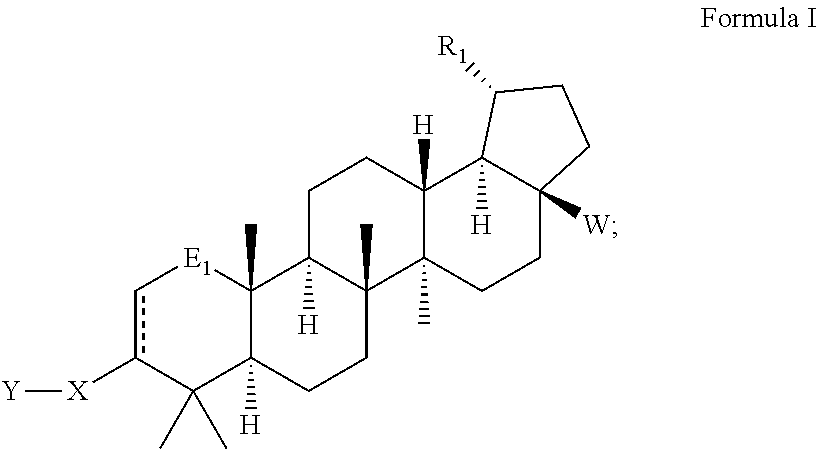
a compound of formula II

and a compound of formula III

wherein R1 is isopropenyl or isopropyl;
E1 is selected from the group of —CHOR22, —CO, —CHF and —CF2;
E2 and E3 are selected from —CHOR22 and F; or
E2 and E3 can together form a ketal:

wherein X is selected from the group of phenyl, heteroaryl ring, C4-8 cycloalkyl, C4-8 cycloalkenyl, C4-9 spirocycloalkyl, C4-9 spirocycloalkenyl, C4-8 oxacycloalkyl, C4-8 dioxacycloalkyl, C6-8 oxacycloalkenyl, C6-8 dioxacycloalkenyl and C6 cyclodialkenyl;
X is substituted with A, wherein A is at least one member selected from the group of —H, -halo, -hydroxyl, —C1-6 alkyl, —C1-6 alkoxy, —C1-6 haloalkyl, —NR2R2, —COOR2, and —C(O)NR2R2,
wherein R2 is selected from the group of —H, —C1-6 alkyl, -alkylsubstituted C1-6 alkyl, and -arylsubstituted C1-6 alkyl;
Y is selected from the group of —COOR2, —C(O)NR2SO2R3, —C3-6 cycloalkyl-COOR2, —C1-6 alkyl-COOR2, -alkylsubstituted C1-6alkyl-COOR2, —SO2NR2C(O)R2, and tetrazole,
R3 is —C1-6 alkyl or -alkylsubstituted C1-6 alkyl;
W is —COOR2, —(CH2)0-1NR4R5, or —CONR20R21;
R4 is selected from the group of —H, —C1-6 alkyl, —C1-6alkyl-C(OR3)2—C3-6cycloalkyl, —C1-6 substituted alkyl, —C1-6 alkyl-C3-6 cycloalkyl, —C1-6 alkyl-Q1, —C1-6alkyl-C3-6cycloalkyl-Q1, -aryl, -heteroaryl, substituted heteroaryl, —COR6, —COCOR6, —SO2R7, and —SO2NR2R2,
wherein Q1 is selected from the group of -heteroaryl, substituted heteroaryl, -halogen, —CF3, —OR2, —COOR2, —NR8R9, —CONR10R11 and —SO2R2;
R5 is selected from the group of —H, —C1-6 alkyl, —C3-6 cycloalkyl, —C1-6 alkylsubstituted alkyl, —C1-6alkyl-NR8R9, —COR10, —COR6, —COCOR6, —SO2R7 and —SO2NR2R2;
with the proviso that only one of R4 or R5 can be selected from the group of —COR6, —COCOR6, —SO2R7 and —SO2NR2R2;
R6 is selected from the group of —H, —C1-6 alkyl, —C1-6 alkyl-substituted alkyl, —C3-6 cycloalkyl, —C3-6 substituted cycloalkyl-Q2, —C1-6 alkyl-Q2, —C1-6 alkyl-substitutedalkyl-Q2, —C3-6 cycloalkyl-Q2, aryl-Q2, —NR13R14, and —OR15;
wherein Q2 is selected from the group of -aryl, -heteroaryl, substituted heteroaryl, —OR2, —COOR2, —NR8R9, SO2R7, —CONHSO2R3, and —CONHSO2NR2R2;
R7 is selected from the group of —C1-6 alkyl, —C1-6 substituted alkyl, —C3-6 cycloalkyl, aryl, and -heteroaryl;
R8 and R9 are independently selected from the group of —H, —C1-6 alkyl, —C1-6 substituted alkyl, aryl, heteroaryl, substituted aryl, substituted heteroaryl, —C1-6 alkyl-Q2, and —COOR3,
or R8 and R9 are taken together with the adjacent N to form a cycle selected from the group of:

with the proviso that only one of R8 or R9 can be —COOR3;
R10 and R11 are independently selected from the group of —H, —C1-6 alkyl, —C1-6 substituted alkyl and —C3-6 cycloalkyl;
R12 is selected from the group of —C1-6 alkyl, —C1-6 alkyl-OH; —C1-6 alkyl, —C1-6 substituted alkyl, —C3-6 cycloalkyl, and —COR7;
R13 and R14 are independently selected from the group of —H, —C1-6 alkyl, —C3-6 cycloalkyl, —C1-6 substituted alkyl, —C1-6 alkyl-Q3, —C1-6 alkyl-C3-6 cycloalkyl-Q3, and C1-6 substituted alkyl-Q3;
Q3 is selected from the group of -heteroaryl, substituted heteroaryl, —NR18R19, —CONR2R2, —COOR2, —OR2, and —SO2R3;
R15 is selected from the group of —C1-6 alkyl, —C3-6 cycloalkyl, —C1-6 substituted alkyl, —C1-6 alkyl-Q3, —C1-6 alkyl-C3-6 cycloalkyl-Q3 and —C1-6 substituted alkyl-Q3;
R16 is selected from the group of —H, —C1-6 alkyl, —NR2R2, and —COOR3;
R17 is selected from the group of —H, —C1-6 alkyl, —COOR3, and -aryl;
R18 and R19 are independently selected from the group of —H, —C1-6 alkyl, —C1-6 substituted alkyl, —C1-6 substituted alkyl-OR2, and —COR3;
R20 and R21 are independently selected from the group of —H, —C1-6 alkyl, —C1-6 substituted alkyl, aryl, heteroaryl, substituted aryl, substituted heteroaryl, —C1-6 alkyl-Q2, and —COOR3,
or R20 and R21 are taken together with the adjacent N to form a cycle selected from the group of:

and
R22 is selected from H and —COR3.


a compound of formula II

and a compound of formula III

wherein R1 is isopropenyl or isopropyl;
E1 is selected from the group of —CHOR22, —CO, —CHF and —CF2;
E2 and E3 are selected from —CHOR22 and F; or
E2 and E3 can together form a ketal:

wherein X is selected from the group of phenyl, heteroaryl ring, C4-8 cycloalkyl, C4-8 cycloalkenyl, C4-9 spirocycloalkyl, C4-9 spirocycloalkenyl, C4-8 oxacycloalkyl, C4-8 dioxacycloalkyl, C6-8 oxacycloalkenyl, C6-8 dioxacycloalkenyl and C6 cyclodialkenyl;
X is substituted with A, wherein A is at least one member selected from the group of —H, -halo, -hydroxyl, —C1-6 alkyl, —C1-6 alkoxy, —C1-6 haloalkyl, —NR2R2, —COOR2, and —C(O)NR2R2,
wherein R2 is selected from the group of —H, —C1-6 alkyl, -alkylsubstituted C1-6 alkyl, and -arylsubstituted C1-6 alkyl;
Y is selected from the group of —COOR2, —C(O)NR2SO2R3, —C3-6 cycloalkyl-COOR2, —C1-6 alkyl-COOR2, -alkylsubstituted C1-6alkyl-COOR2, —SO2NR2C(O)R2, and tetrazole,
R3 is —C1-6 alkyl or -alkylsubstituted C1-6 alkyl;
W is —COOR2, —(CH2)0-4NR4R5, or —CONR20R21;
R4 is selected from the group of —H, —C1-6 alkyl, —C1-6alkyl-C(OR3)2—C3-6cycloalkyl, —C1-6 substituted alkyl, —C1-6 alkyl-C3-6 cycloalkyl, —C1-6 alkyl-Q1, —C1-6 alkyl-C3-6 cycloalkyl-Q1, -aryl, -heteroaryl, substituted heteroaryl, —COR6, —COCOR6, —SO2R7, and —SO2NR2R2,
wherein Q1 is selected from the group of -heteroaryl, substituted heteroaryl, -halogen, —CF3, —OR2, —COOR2, —NR8R9, —CONR10R11 and —SO2R7;
R5 is selected from the group of —H, —C1-6 alkyl, —C3-6 cycloalkyl, —C1-6 alkylsubstituted alkyl, —C1-6 alkyl-NR8R9, —COR10, —COR6, —COCOR6, —SO2R7 and —SO2NR2R2;
with the proviso that only one of R4 or R5 can be selected from the group of —COR6, —COCOR6, —SO2R7 and —SO2NR2R2;
R6 is selected from the group of —H, —C1-6 alkyl, —C1-6 alkyl-substitutedalkyl, —C3-6 cycloalkyl, —C3-6 substitutedcycloalkyl-Q2, —C1-6 alkyl-Q2, —C1-6 alkyl-substitutedalkyl-Q2, —C3-6 cycloalkyl-Q2, aryl-Q2, —NR13R14, and —OR15;
wherein Q2 is selected from the group of -aryl, -heteroaryl, substituted heteroaryl, —OR2, —COOR2, —NR8R9, SO2R7, —CONHSO2R3, and —CONHSO2NR2R2;
R7 is selected from the group of —C1-6 alkyl, —C1-6 substituted alkyl, —C3-6 cycloalkyl, aryl, and -heteroaryl;
R8 and R9 are independently selected from the group of —H, —C1-6 alkyl, —C1-6 substituted alkyl, aryl, heteroaryl, substituted aryl, substituted heteroaryl, —C1-6 alkyl-Q2, and —COOR3,
or R8 and R9 are taken together with the adjacent N to form a cycle selected from the group of:

with the proviso that only one of R8 or R9 can be —COOR3;
R10 and R11 are independently selected from the group of —H, —C1-6 alkyl, —C1-6 substituted alkyl and —C3-6 cycloalkyl;
R12 is selected from the group of —C1-6 alkyl, —C1-6 alkyl-OH; —C1-6 alkyl, —C1-6 substituted alkyl, —C3-6 cycloalkyl, and —COR7;
R13 and R14 are independently selected from the group of —H, —C1-6 alkyl, —C3-6 cycloalkyl, —C1-6 substituted alkyl, —C1-6 alkyl-Q3, —C1-6 alkyl-C3-6 cycloalkyl-Q3, and C1-6 substituted alkyl-Q3;
Q3 is selected from the group of -heteroaryl, substituted heteroaryl, —NR18R19, —CONR2R2, —COOR2, —OR2, and —SO2R3;
R15 is selected from the group of —C1-6 alkyl, —C3-6 cycloalkyl, —C1-6 substituted alkyl, —C1-6 alkyl-Q3, —C1-6 alkyl-C3-6 cycloalkyl-Q3 and —C1-6 substituted alkyl-Q3;
R16 is selected from the group of —H, —C1-6 alkyl, —NR2R2, and —COOR3;
R17 is selected from the group of —H, —C1-6 alkyl, —COOR3, and -aryl;
R18 and R19 are independently selected from the group of —H, —C1-6 alkyl, —C1-6 substituted alkyl, —C1-6 substituted alkyl-OR2, and —COR3;
R20 and R21 are independently selected from the group of —H, —C1-6 alkyl, —C1-6 substituted alkyl, aryl, heteroaryl, substituted aryl, substituted heteroaryl, —C1-6 alkyl-Q2, and —COOR3,
or R20 and R21 are taken together with the adjacent N to form a cycle selected from the group of:

and
R22 is selected from H and —COR3.


| Drug Name | Manufacturer | Indication |
| ANTIVIRALS |
| 097 | Hoechst/Bayer | HIV infection, |
| AIDS, ARC | ||
| (non-nucleoside | ||
| reverse transcriptase | ||
| (RT) | ||
| inhibitor) | ||
| Amprenavir | Glaxo Wellcome | HIV infection, |
| 141 W94 | AIDS, ARC | |
| GW 141 | (protease inhibitor) | |
| Abacavir (1592U89) | Glaxo Wellcome | HIV infection, |
| GW 1592 | AIDS, ARC | |
| (RT inhibitor) | ||
| Acemannan | Carrington Labs | ARC |
| (Irving, TX) | ||
| Acyclovir | Burroughs Wellcome | HIV infection, AIDS, |
| ARC | ||
| AD-439 | Tanox Biosystems | HIV infection, AIDS, |
| ARC | ||
| AD-519 | Tanox Biosystems | HIV infection, AIDS, |
| ARC | ||
| Adefovir dipivoxil | Gilead Sciences | HIV infection |
| AL-721 | Ethigen | ARC, PGL |
| (Los Angeles, CA) | HIV positive, AIDS | |
| Alpha Interferon | Glaxo Wellcome | Kaposi's sarcoma, |
| HIV in combination w/Retrovir | ||
| Ansamycin | Adria Laboratories | ARC |
| LM 427 | (Dublin, OH) | |
| Erbamont | ||
| (Stamford, CT) | ||
| Antibody which | Advanced Biotherapy | AIDS, ARC |
| Neutralizes pH | Concepts | |
| Labile alpha aberrant | (Rockville, MD) | |
| Interferon | ||
| AR177 | Aronex Pharm | HIV infection, AIDS, |
| ARC | ||
| Beta-fluoro-ddA | Nat'l Cancer Institute | AIDS-associated |
| diseases | ||
| BMS-234475 | Bristol-Myers Squibb/ | HIV infection, |
| (CGP-61755) | Novartis | AIDS, ARC |
| (protease inhibitor) | ||
| CI-1012 | Warner-Lambert | HIV-1 infection |
| Cidofovir | Gilead Science | CMV retinitis, |
| herpes, papillomavirus | ||
| Curdlan sulfate | AJI Pharma USA | HIV infection |
| Cytomegalovirus | MedImmune | CMV retinitis |
| Immune globin | ||
| Cytovene | Syntex | Sight threatening |
| Ganciclovir | CMV | |
| peripheral CMV | ||
| retinitis | ||
| Darunavir | Tibotec-J & J | HIV infection, AIDS, ARC |
| (protease inhibitor) | ||
| Delaviridine | Pharmacia-Upjohn | HIV infection, |
| AIDS, ARC | ||
| (RT inhibitor) | ||
| Dextran Sulfate | Ueno Fine Chem. | AIDS, ARC, HIV |
| Ind. Ltd. (Osaka, | positive | |
| Japan) | asymptomatic | |
| ddC | Hoffman-La Roche | HIV infection, AIDS, |
| Dideoxycytidine | ARC | |
| ddI | Bristol-Myers Squibb | HIV infection, AIDS, |
| Dideoxyinosine | ARC; combination | |
| with AZT/d4T | ||
| DMP-450 | AVID | HIV infection, |
| (Camden, NJ) | AIDS, ARC | |
| (protease inhibitor) | ||
| Efavirenz | Bristol Myers Squibb | HIV infection, |
| (DMP 266, SUSTIVA ®) | AIDS, ARC | |
| (−)6-Chloro-4-(S)- | (non-nucleoside RT | |
| cyclopropylethynyl- | inhibitor) | |
| 4(S)-trifluoro- | ||
| methyl-1,4-dihydro- | ||
| 2H-3,1-benzoxazin- | ||
| 2-one, STOCRINE | ||
| EL10 | Elan Corp, PLC | HIV infection |
| (Gainesville, GA) | ||
| Etravirine | Tibotec/J & J | HIV infection, AIDS, ARC |
| (non-nucleoside | ||
| reverse transcriptase | ||
| inhibitor) | ||
| Famciclovir | Smith Kline | herpes zoster, |
| herpes simplex | ||
| GS 840 | Gilead | HIV infection, |
| AIDS, ARC | ||
| (reverse transcriptase | ||
| inhibitor) | ||
| HBY097 | Hoechst Marion | HIV infection, |
| Roussel | AIDS, ARC | |
| (non-nucleoside | ||
| reverse transcriptase | ||
| inhibitor) | ||
| Hypericin | VIMRx Pharm. | HIV infection, AIDS, |
| ARC | ||
| Recombinant Human | Triton Biosciences | AIDS, Kaposi's |
| Interferon Beta | (Almeda, CA) | sarcoma, ARC |
| Interferon alfa-n3 | Interferon Sciences | ARC, AIDS |
| Indinavir | Merck | HIV infection, AIDS, |
| ARC, asymptomatic | ||
| HIV positive, also in | ||
| combination with | ||
| AZT/ddI/ddC | ||
| ISIS 2922 | ISIS Pharmaceuticals | CMV retinitis |
| KNI-272 | Nat'l Cancer Institute | HIV-assoc. diseases |
| Lamivudine, 3TC | Glaxo Wellcome | HIV infection, |
| AIDS, ARC | ||
| (reverse | ||
| transcriptase | ||
| inhibitor); also | ||
| with AZT | ||
| Lobucavir | Bristol-Myers Squibb | CMV infection |
| Nelfinavir | Agouron | HIV infection, |
| Pharmaceuticals | AIDS, ARC | |
| (protease inhibitor) | ||
| Nevirapine | Boeheringer | HIV infection, |
| Ingleheim | AIDS, ARC | |
| (RT inhibitor) | ||
| Novapren | Novaferon Labs, Inc. | HIV inhibitor |
| (Akron, OH) | ||
| Peptide T | Peninsula Labs | AIDS |
| Octapeptide | (Belmont, CA) | |
| Sequence | ||
| Trisodium | Astra Pharm. | CMV retinitis, HIV |
| Phosphonoformate | Products, Inc. | infection, other CMV |
| infections | ||
| PNU-140690 | Pharmacia Upjohn | HIV infection, |
| AIDS, ARC | ||
| (protease inhibitor) | ||
| Probucol | Vyrex | HIV infection, AIDS |
| RBC-CD4 | Sheffield Med. | HIV infection, |
| Tech (Houston, TX) | AIDS, ARC | |
| Ritonavir | Abbott | HIV infection, |
| AIDS, ARC | ||
| (protease inhibitor) | ||
| Saquinavir | Hoffmann- | HIV infection, |
| LaRoche | AIDS, ARC | |
| (protease inhibitor) | ||
| Stavudine; d4T | Bristol-Myers Squibb | HIV infection, AIDS, |
| Didehydrodeoxy- | ARC | |
| Thymidine | ||
| Tipranavir | Boehringer Ingelheim | HIV infection, AIDS, ARC |
| (protease inhibitor) | ||
| Valaciclovir | Glaxo Wellcome | Genital HSV & CMV |
| infections | ||
| Virazole | Viratek/ICN | asymptomatic HIV |
| Ribavirin | (Costa Mesa, CA) | positive, LAS, ARC |
| VX-478 | Vertex | HIV infection, AIDS, |
| ARC | ||
| Zalcitabine | Hoffmann-LaRoche | HIV infection, AIDS, |
| ARC, with AZT | ||
| Zidovudine; AZT | Glaxo Wellcome | HIV infection, AIDS, |
| ARC, Kaposi's | ||
| sarcoma, in combination with | ||
| other therapies | ||
| Tenofovir disoproxil, | Gilead | HIV infection, |
| fumarate salt (VIREAD ®) | AIDS, | |
| (reverse transcriptase | ||
| inhibitor) | ||
| EMTRIVA ® | Gilead | HIV infection, |
| (Emtricitabine) (FTC) | AIDS, | |
| (reverse transcriptase | ||
| inhibitor) | ||
| COMBIVIR ® | GSK | HIV infection, |
| AIDS, | ||
| (reverse transcriptase | ||
| inhibitor) | ||
| Abacavir succinate | GSK | HIV infection, |
| (or ZIAGEN ®) | AIDS, | |
| (reverse transcriptase | ||
| inhibitor) | ||
| REYATAZ ® | Bristol-Myers Squibb | HIV infection |
| (or atazanavir) | AIDs, protease | |
| inhibitor | ||
| FUZEON ® | Roche/Trimeris | HIV infection |
| (Enfuvirtide or T-20) | AIDs, viral Fusion | |
| inhibitor | ||
| LEXIVA ® | GSK/Vertex | HIV infection |
| (or Fosamprenavir calcium) | AIDs, viral protease | |
| inhibitor | ||
| Selzentry | Pfizer | HIV infection |
| Maraviroc; (UK 427857) | AIDs, (CCR5 antagonist, in | |
| development) | ||
| Trizivir ® | GSK | HIV infection |
| AIDs, (three drug combination) | ||
| Sch-417690 (vicriviroc) | Schering-Plough | HIV infection |
| AIDs, (CCR5 antagonist, in | ||
| development) | ||
| TAK-652 | Takeda | HIV infection |
| AIDs, (CCR5 antagonist, in | ||
| development) | ||
| GSK 873140 | GSK/ONO | HIV infection |
| (ONO-4128) | AIDs, (CCR5 antagonist, | |
| in development) | ||
| Integrase Inhibitor | Merck | HIV infection |
| MK-0518 | AIDs | |
| Raltegravir | ||
| TRUVADA ® | Gilead | Combination of Tenofovir |
| disoproxil fumarate salt | ||
| (VIREAD ®) and EMTRIVA ® | ||
| (Emtricitabine) | ||
| Integrase Inhibitor | Gilead/Japan Tobacco | HIV Infection |
| GS917/JTK-303 | AIDs | |
| Elvitegravir | in development | |
| Triple drug combination | Gilead/Bristol-Myers Squibb | Combination of Tenofovir |
| ATRIPLA ® | disoproxil fumarate salt | |
| (VIREAD ®), EMTRIVA ® | ||
| (Emtricitabine), and | ||
| SUSTIVA ® (Efavirenz) | ||
| FESTINAVIR ® | Oncolys BioPharma | HIV infection |
| 4′-ethynyl-d4T | BMS | AIDs |
| in development | ||
| CMX-157 | Chimerix | HIV infection |
| Lipid conjugate of | AIDs | |
| nucleotide tenofovir | ||
| GSK1349572 | GSK | HIV infection |
| Integrase inhibitor | AIDs | |
| dolutegravir | ||
| S/GSK1265744 | GSK | HIV infection |
| Integrase inhibitor | AIDs |
| IMMUNOMODULATORS |
| AS-101 | Wyeth-Ayerst | AIDS |
| Bropirimine | Pharmacia Upjohn | Advanced AIDS |
| Acemannan | Carrington Labs, Inc. | AIDS, ARC |
| (Irving, TX) | ||
| CL246,738 | Wyeth | AIDS, Kaposi's |
| Lederle Labs | sarcoma | |
| FP-21399 | Fuki ImmunoPharm | Blocks HIV fusion |
| with CD4+ cells | ||
| Gamma Interferon | Genentech | ARC, in combination |
| w/TNF (tumor | ||
| necrosis factor) | ||
| Granulocyte | Genetics Institute | AIDS |
| Macrophage Colony | Sandoz | |
| Stimulating Factor | ||
| Granulocyte | Hoechst-Roussel | AIDS |
| Macrophage Colony | Immunex | |
| Stimulating Factor | ||
| Granulocyte | Schering-Plough | AIDS, |
| Macrophage Colony | combination | |
| Stimulating Factor | w/AZT | |
| HIV Core Particle | Rorer | Seropositive HIV |
| Immunostimulant | ||
| IL-2 | Cetus | AIDS, in combination |
| Interleukin-2 | w/AZT | |
| IL-2 | Hoffman-LaRoche | AIDS, ARC, HIV, in |
| Interleukin-2 | Immunex | combination w/AZT |
| IL-2 | Chiron | AIDS, increase in |
| Interleukin-2 | CD4 cell counts | |
| (aldeslukin) | ||
| Immune Globulin | Cutter Biological | Pediatric AIDS, in |
| Intravenous | (Berkeley, CA) | combination w/AZT |
| (human) | ||
| IMREG-1 | Imreg | AIDS, Kaposi's |
| (New Orleans, LA) | sarcoma, ARC, PGL | |
| IMREG-2 | Imreg | AIDS, Kaposi's |
| (New Orleans, LA) | sarcoma, ARC, PGL | |
| Imuthiol Diethyl | Merieux Institute | AIDS, ARC |
| Dithio Carbamate | ||
| Alpha-2 | Schering Plough | Kaposi's sarcoma |
| Interferon | w/AZT, AIDS | |
| Methionine- | TNI Pharmaceutical | AIDS, ARC |
| Enkephalin | (Chicago, IL) | |
| MTP-PE | Ciba-Geigy Corp. | Kaposi's sarcoma |
| Muramyl-Tripeptide | ||
| Granulocyte | Amgen | AIDS, in combination |
| Colony Stimulating | w/AZT | |
| Factor | ||
| Remune | Immune Response | Immunotherapeutic |
| Corp. | ||
| rCD4 | Genentech | AIDS, ARC |
| Recombinant | ||
| Soluble Human CD4 | ||
| rCD4-IgG | AIDS, ARC | |
| hybrids | ||
| Recombinant | Biogen | AIDS, ARC |
| Soluble Human CD4 | ||
| Interferon | Hoffman-La Roche | Kaposi's sarcoma |
| Alfa 2a | AIDS, ARC, | |
| in combination w/AZT | ||
| SK&F106528 | Smith Kline | HIV infection |
| Soluble T4 | ||
| Thymopentin | Immunobiology | HIV infection |
| Research Institute | ||
| (Annandale, NJ) | ||
| Tumor Necrosis | Genentech | ARC, in combination |
| Factor; TNF | w/gamma Interferon |
| ANTI-INFECTIVES |
| Clindamycin with | Pharmacia Upjohn | PCP |
| Primaquine | ||
| Fluconazole | Pfizer | Cryptococcal |
| meningitis, | ||
| candidiasis | ||
| Pastille | Squibb Corp. | Prevention of |
| Nystatin Pastille | oral candidiasis | |
| Ornidyl | Merrell Dow | PCP |
| Eflornithine | ||
| Pentamidine | LyphoMed | PCP treatment |
| Isethionate (IM & IV) | (Rosemont, IL) | |
| Trimethoprim | Antibacterial | |
| Trimethoprim/sulfa | Antibacterial | |
| Piritrexim | Burroughs Wellcome | PCP treatment |
| Pentamidine | Fisons Corporation | PCP prophylaxis |
| Isethionate for | ||
| Inhalation | ||
| Spiramycin | Rhone-Poulenc | Cryptosporidial |
| diarrhea | ||
| Intraconazole- | Janssen-Pharm. | Histoplasmosis; |
| R51211 | cryptococcal | |
| meningitis | ||
| Trimetrexate | Warner-Lambert | PCP |
| Daunorubicin | NeXstar, Sequus | Kaposi's sarcoma |
| Recombinant Human | Ortho Pharm. Corp. | Severe anemia |
| Erythropoietin | assoc. with AZT | |
| therapy | ||
| Recombinant Human | Serono | AIDS-related |
| Growth Hormone | wasting, cachexia | |
| Megestrol Acetate | Bristol-Myers Squibb | Treatment of |
| anorexia assoc. | ||
| W/AIDS | ||
| Testosterone | Alza, Smith Kline | AIDS-related wasting |
| Total Enteral | Norwich Eaton | Diarrhea and |
| Nutrition | Pharmaceuticals | malabsorption |
| related to AIDS | ||

The same numbering is maintained when referring to the compound series in schemes and general descriptions of methods.


| TABLE 1 |
| Separation of Bacillus megaterium SC 16644 biotransformation mixture of |
| betulonic acid |
| HPLC and LCMS | ||||
| MW (Molecular | ||||
| TLC with 50:50:1 of | weight) | |||
| Components | Descriptions | Heptane:EtOAc:HOAc | Weight | AP (Area percent) |
| Crude mixture | SM Rf 0.55 not | 4.2 g | ||
| before | collected; | |||
| chromatography | One major product spot | |||
| Rf 0.15; Some minor | ||||
| spots. | ||||
| 01 | Fraction 17-23 | Rf 0.35 | No betulonic acid | |
| related compound | ||||
| peak | ||||
| 02 | Fraction 29-35 | Rf 0.3 | 94 mg | MW 470, AP 23 |
| 03 | Fraction 41-45 | Rf 0.2 | No betulonic acid | |
| related compound | ||||
| peak | ||||
| 04 | Fraction 59-68 | Major product Rf 0.15 | 0.5 g | MW 486, AP 38 |
| 05 | Fraction 78-108 | Rf 0.1 | 308 mg | MW 502, AP 19 |
| 05A | MeOH extract | Mixture Rf 0 to 0.1 | No betulonic acid | |
| related compound | ||||
| peak | ||||
| 06 | Solid from 04 in | 280 mg | MW 486, AP 50 | |
| MeOH-water | ||||
| 07 | Mother liquor of | 112 mg | Product AP 0.2 | |
| MeOH-water | ||||
| 08 | First solid from | 146 mg | Product AP 87 | |
| 06 in EtOAc- | (9.9 min), 3.9 min | |||
| heptane | impurity AP 8 | |||
| 09 | Second solid | 90 mg | Product AP 35, | |
| after 08 | 3.9 min AP 62 | |||
| 10 | Mother liquor of | 34 mg | Product AP 26, | |
| EtOAc-heptane | 3.9 min AP 36 | |||
| 11 | Chromatography | 72 mg | Product AP 85 | |
| of component | (9.9 min) | |||
| 09, | ||||
| Fractions 22-25 | ||||


| TABLE 1 | ||
| Example | (EC50, | |
| # | Structure | uM) |
| 1 |
 |
0.04 |
| 2 |
 |
1.56 |
| 3 |
 |
0.017 |
| 4 |
 |
0.029 |
| 5 |
 |
0.41 |
| 6 |
 |
1.73 |
| 7 |
 |
2.67E−03 |
| 8 |
 |
3.31E−03 |
| 9 |
 |
0.0012 |
| 10 |
 |
0.0012 |
| 11 |
 |
1.31 |
Claims (19)


Priority Applications (1)
| Application Number | Priority Date | Filing Date | Title |
|---|---|---|---|
| US15/313,139 US9920090B2 (en) | 2014-06-19 | 2015-06-17 | Betulinic acid derivatives with HIV maturation inhibitory activity |
Applications Claiming Priority (3)
| Application Number | Priority Date | Filing Date | Title |
|---|---|---|---|
| US201462014212P | 2014-06-19 | 2014-06-19 | |
| US15/313,139 US9920090B2 (en) | 2014-06-19 | 2015-06-17 | Betulinic acid derivatives with HIV maturation inhibitory activity |
| PCT/US2015/036191 WO2015195776A1 (en) | 2014-06-19 | 2015-06-17 | Betulinic acid derivatives with hiv maturation inhibitory activity |
Publications (2)
| Publication Number | Publication Date |
|---|---|
| US20170204133A1 US20170204133A1 (en) | 2017-07-20 |
| US9920090B2 true US9920090B2 (en) | 2018-03-20 |
Family
ID=53488480
Family Applications (1)
| Application Number | Title | Priority Date | Filing Date |
|---|---|---|---|
| US15/313,139 Expired - Fee Related US9920090B2 (en) | 2014-06-19 | 2015-06-17 | Betulinic acid derivatives with HIV maturation inhibitory activity |
Country Status (2)
| Country | Link |
|---|---|
| US (1) | US9920090B2 (en) |
| WO (1) | WO2015195776A1 (en) |
Families Citing this family (5)
| Publication number | Priority date | Publication date | Assignee | Title |
|---|---|---|---|---|
| CA3075729A1 (en) | 2017-09-14 | 2019-03-21 | Phoenix Biotechnology, Inc. | Use of oleandrin to treatn viral infection |
| MX2020002884A (en) | 2017-09-14 | 2020-10-05 | Phoenix Biotechnology Inc | Method and improved neuroprotective composition for treating neurological conditions. |
| KR20220151038A (en) | 2020-03-31 | 2022-11-11 | 피닉스 바이오테크놀러지 인코포레이티드. | Compositions for preventing coronavirus infection |
| EP4295854A3 (en) | 2020-03-31 | 2024-04-03 | Phoenix Biotechnology, Inc. | Method and compositions for treating coronavirus infection |
| CN112142819B (en) * | 2020-09-14 | 2021-09-24 | 南通大学 | Application of betulinic acid derivatives in the preparation of antitumor drugs |
Citations (1)
| Publication number | Priority date | Publication date | Assignee | Title |
|---|---|---|---|---|
| WO2012106188A1 (en) | 2011-01-31 | 2012-08-09 | Bristol-Myers Squibb Company | C-28 amines of c-3 modified betulinic acid derivatives as hiv maturation inhibitors |
Family Cites Families (16)
| Publication number | Priority date | Publication date | Assignee | Title |
|---|---|---|---|---|
| US5413999A (en) | 1991-11-08 | 1995-05-09 | Merck & Co., Inc. | HIV protease inhibitors useful for the treatment of AIDS |
| US5679828A (en) | 1995-06-05 | 1997-10-21 | Biotech Research Labs, Inc. | Betulinic acid and dihydrobetulinic acid derivatives and uses therefor |
| US20040110785A1 (en) | 2001-02-02 | 2004-06-10 | Tao Wang | Composition and antiviral activity of substituted azaindoleoxoacetic piperazine derivatives |
| US7365221B2 (en) | 2002-09-26 | 2008-04-29 | Panacos Pharmaceuticals, Inc. | Monoacylated betulin and dihydrobetulin derivatives, preparation thereof and use thereof |
| US7745625B2 (en) | 2004-03-15 | 2010-06-29 | Bristol-Myers Squibb Company | Prodrugs of piperazine and substituted piperidine antiviral agents |
| BRPI0508854A (en) | 2004-03-17 | 2007-08-28 | Panacos Pharmaceuticals Inc | pharmaceutical salts of 3-o- (3 ', 3'-dimethylsuccinyl) betulinic acid |
| TW200628161A (en) | 2004-11-12 | 2006-08-16 | Panacos Pharmaceuticals Inc | Novel betulin derivatives, preparation thereof and use thereof |
| WO2008115281A2 (en) | 2006-10-16 | 2008-09-25 | Myriad Genetics, Inc. | Compounds for treating viral infections |
| CA2714049A1 (en) | 2008-02-14 | 2009-08-20 | Virochem Pharma Inc. | Novel 17.beta. lupane derivatives |
| US9067966B2 (en) | 2009-07-14 | 2015-06-30 | Hetero Research Foundation, Hetero Drugs Ltd. | Lupeol-type triterpene derivatives as antivirals |
| JP2013509804A (en) | 2009-10-30 | 2013-03-14 | ヒューレット−パッカード デベロップメント カンパニー エル.ピー. | 3D display system |
| RS54239B1 (en) | 2010-06-04 | 2015-12-31 | Bristol-Myers Squibb Company | C-28 MODIFIED C-3 BETULINIC ACID DERIVATIVES AS INHIBITORS OF HIV AGING |
| US8754068B2 (en) | 2010-06-04 | 2014-06-17 | Bristol-Myers Squibb Company | Modified C-3 betulinic acid derivatives as HIV maturation inhibitors |
| US8846647B2 (en) | 2011-01-31 | 2014-09-30 | Bristol-Myers Squibb Company | C-17 and C-3 modified triterpenoids with HIV maturation inhibitory activity |
| US8906889B2 (en) | 2012-02-15 | 2014-12-09 | Bristol-Myers Squibb Company | C-3 cycloalkenyl triterpenoids with HIV maturation inhibitory activity |
| US8889854B2 (en) | 2012-05-07 | 2014-11-18 | Bristol-Myers Squibb Company | C-17 bicyclic amines of triterpenoids with HIV maturation inhibitory activity |
-
2015
- 2015-06-17 WO PCT/US2015/036191 patent/WO2015195776A1/en not_active Ceased
- 2015-06-17 US US15/313,139 patent/US9920090B2/en not_active Expired - Fee Related
Patent Citations (2)
| Publication number | Priority date | Publication date | Assignee | Title |
|---|---|---|---|---|
| WO2012106188A1 (en) | 2011-01-31 | 2012-08-09 | Bristol-Myers Squibb Company | C-28 amines of c-3 modified betulinic acid derivatives as hiv maturation inhibitors |
| US8748415B2 (en) * | 2011-01-31 | 2014-06-10 | Bristol-Myers Squibb Company | C-28 amines of C-3 modified betulinic acid derivatives as HIV maturation inhibitors |
Non-Patent Citations (2)
| Title |
|---|
| HIV Vaccine: How Close Are We? [online]. Retrieved from the internet on Jul. 6, 2017 URL: <http://www.healthline.com/health/hiv-aids/vaccine-how-close-are-we>. * |
| HIV Vaccines [online]. Retrieved from the internet on Jul. 6, 2017 URL: <http://www.hiv.gov/hiv-basics/hiv-prevention/potential-future-options/hiv-vaccines>. * |
Also Published As
| Publication number | Publication date |
|---|---|
| US20170204133A1 (en) | 2017-07-20 |
| WO2015195776A1 (en) | 2015-12-23 |
Similar Documents
| Publication | Publication Date | Title |
|---|---|---|
| AU2014218754B2 (en) | C-3 alkyl and alkenyl modified betulinic acid derivatives useful in the treatment of HIV | |
| CA2801491C (en) | C-28 amides of modified c-3 betulinic acid derivatives as hiv maturation inhibitors | |
| US8754068B2 (en) | Modified C-3 betulinic acid derivatives as HIV maturation inhibitors | |
| US8906889B2 (en) | C-3 cycloalkenyl triterpenoids with HIV maturation inhibitory activity | |
| US8754069B2 (en) | Betulinic acid derivatives with antiviral activity | |
| US20130296554A1 (en) | C-17 bicyclic amines of triterpenoids with hiv maturation inhibitory activity | |
| US10421774B2 (en) | C-3 and C-17 modified triterpenoids as HIV-1 inhibitors | |
| US9920090B2 (en) | Betulinic acid derivatives with HIV maturation inhibitory activity | |
| US9969767B2 (en) | Oxolupene derivatives | |
| US10047118B2 (en) | C17-aryl substituted betulinic acid analogs | |
| US9914747B2 (en) | Extended betulinic acid analogs |
Legal Events
| Date | Code | Title | Description |
|---|---|---|---|
| AS | Assignment |
Owner name: BRISTOL-MYERS SQUIBB COMPANY, NEW JERSEY Free format text: ASSIGNMENT OF ASSIGNORS INTEREST;ASSIGNORS:REGUEIRO-REN, ALICIA;GOSWAMI, ANIMESH;GUO, ZHIWEI;AND OTHERS;SIGNING DATES FROM 20150710 TO 20150908;REEL/FRAME:040398/0954 Owner name: VIIV HEALTHCARE UK (NO.5) LIMITED, UNITED KINGDOM Free format text: ASSIGNMENT OF ASSIGNORS INTEREST;ASSIGNOR:BRISTOL-MYERS SQUIBB COMPANY;REEL/FRAME:040399/0076 Effective date: 20160222 |
|
| STCF | Information on status: patent grant |
Free format text: PATENTED CASE |
|
| MAFP | Maintenance fee payment |
Free format text: PAYMENT OF MAINTENANCE FEE, 4TH YEAR, LARGE ENTITY (ORIGINAL EVENT CODE: M1551); ENTITY STATUS OF PATENT OWNER: LARGE ENTITY Year of fee payment: 4 |
|
| FEPP | Fee payment procedure |
Free format text: MAINTENANCE FEE REMINDER MAILED (ORIGINAL EVENT CODE: REM.); ENTITY STATUS OF PATENT OWNER: LARGE ENTITY |