US9914723B2 - Small molecule inhibitors of Mcl-1 and uses thereof - Google Patents
Small molecule inhibitors of Mcl-1 and uses thereof Download PDFInfo
- Publication number
- US9914723B2 US9914723B2 US14/386,230 US201314386230A US9914723B2 US 9914723 B2 US9914723 B2 US 9914723B2 US 201314386230 A US201314386230 A US 201314386230A US 9914723 B2 US9914723 B2 US 9914723B2
- Authority
- US
- United States
- Prior art keywords
- mcl
- compound
- umi
- compounds
- cancer
- Prior art date
- Legal status (The legal status is an assumption and is not a legal conclusion. Google has not performed a legal analysis and makes no representation as to the accuracy of the status listed.)
- Expired - Fee Related
Links
- 0 *OC(=O)C1=C([3*])OC2=C1C(C([1*])[2*])=C(O)C1=C([5*])C([6*])=C([7*])C([8*])=C21 Chemical compound *OC(=O)C1=C([3*])OC2=C1C(C([1*])[2*])=C(O)C1=C([5*])C([6*])=C([7*])C([8*])=C21 0.000 description 3
- HFIFWANUFXIVBP-UHFFFAOYSA-N C.CC(=O)N1CCN(C(C)(C)C)CC1.CC(C)(C)N1CCC2=C(C=CC=C2)C1.CC(C)(C)N1CCCCC1.CC(C)(C)N1CCOCC1.CC(C)N1CCN(C(C)(C)C)CC1.CCN1CCN(C(C)(C)C)CC1.CN1CCN(C(C)(C)C)CC1.COC(C)(C)C Chemical compound C.CC(=O)N1CCN(C(C)(C)C)CC1.CC(C)(C)N1CCC2=C(C=CC=C2)C1.CC(C)(C)N1CCCCC1.CC(C)(C)N1CCOCC1.CC(C)N1CCN(C(C)(C)C)CC1.CCN1CCN(C(C)(C)C)CC1.CN1CCN(C(C)(C)C)CC1.COC(C)(C)C HFIFWANUFXIVBP-UHFFFAOYSA-N 0.000 description 3
- XTVSJHDHVQNYHE-UHFFFAOYSA-N C=C(N)CC(C)(C)C.CCC(C)(C)C.CCC(C)(C)C Chemical compound C=C(N)CC(C)(C)C.CCC(C)(C)C.CCC(C)(C)C XTVSJHDHVQNYHE-UHFFFAOYSA-N 0.000 description 3
- JXEGBEIVBHWKKK-UHFFFAOYSA-N CC(C)(C)CCOC(C)(C)C.CC(C)(C)COC(C)(C)C.CC(C)(C)OCC1=CC(F)=CC=C1.CC(C)(C)OCC1=CC2=C(C=CC=C2)O1.CC(C)(C)OCC1=CC=CC=C1.CC(C)(C)OCC1CCCC1.CC(C)(C)OCC1CCCCC1.CC(C)(C)OCCC(F)(F)F.CC(C)(C)OCCC1=CC=C(F)C=C1.CC(C)(C)OCCC1=CC=CC=C1.CC(C)(C)OCCCC1CC1.CC(C)(C)OCCCC1CCC1.CC(C)COC(C)(C)C.COC(C)(C)C.COC1=CC(CCOC(C)(C)C)=CC(OC)=C1 Chemical compound CC(C)(C)CCOC(C)(C)C.CC(C)(C)COC(C)(C)C.CC(C)(C)OCC1=CC(F)=CC=C1.CC(C)(C)OCC1=CC2=C(C=CC=C2)O1.CC(C)(C)OCC1=CC=CC=C1.CC(C)(C)OCC1CCCC1.CC(C)(C)OCC1CCCCC1.CC(C)(C)OCCC(F)(F)F.CC(C)(C)OCCC1=CC=C(F)C=C1.CC(C)(C)OCCC1=CC=CC=C1.CC(C)(C)OCCCC1CC1.CC(C)(C)OCCCC1CCC1.CC(C)COC(C)(C)C.COC(C)(C)C.COC1=CC(CCOC(C)(C)C)=CC(OC)=C1 JXEGBEIVBHWKKK-UHFFFAOYSA-N 0.000 description 2
- IXEFQICNMGJVNP-UHFFFAOYSA-N CC(C)(C)COC1=CC(C(C2=C3C(=C4C=CC=CC4=C2O)O/C=C\3C(=O)O)N2CCCCC2)=CC=N1.CC(C)OC1=CC(C(C2=C3C(=C4C=C(F)C(F)=CC4=C2O)O/C=C\3C(=O)O)N2CCCCC2)=CC=N1.CC1=C(Cl)C=C(COC2=CC(C(C3=C4C(=C5C=CC=CC5=C3O)O/C=C\4C(=O)O)N3CCN(C)CC3)=CC=N2)C=C1Cl.O=C(O)/C1=C/OC2=C3C=CC=C(F)C3=C(O)C(C(C3=CC=NC(OC4CC4)=C3)N3CCCCC3)=C21 Chemical compound CC(C)(C)COC1=CC(C(C2=C3C(=C4C=CC=CC4=C2O)O/C=C\3C(=O)O)N2CCCCC2)=CC=N1.CC(C)OC1=CC(C(C2=C3C(=C4C=C(F)C(F)=CC4=C2O)O/C=C\3C(=O)O)N2CCCCC2)=CC=N1.CC1=C(Cl)C=C(COC2=CC(C(C3=C4C(=C5C=CC=CC5=C3O)O/C=C\4C(=O)O)N3CCN(C)CC3)=CC=N2)C=C1Cl.O=C(O)/C1=C/OC2=C3C=CC=C(F)C3=C(O)C(C(C3=CC=NC(OC4CC4)=C3)N3CCCCC3)=C21 IXEFQICNMGJVNP-UHFFFAOYSA-N 0.000 description 2
- REWKNNNDWIHDPY-UHFFFAOYSA-N CC(C)(C)COC1=CC(C(C2=C3C(C(=O)O)=COC3=C3C=CC=CC3=C2O)N2CCCCC2)=CC=N1.O=C(O)C1=COC2=C3C=CC=CC3=C(O)C(C(C3=CC=NC(OC4=CC=CC=C4)=C3)N3CCCCC3)=C12.O=C(O)C1=COC2=C3C=CC=CC3=C(O)C(C(C3=CC=NC(OC4CC4)=C3)N3CCCCC3)=C12.O=C(O)C1=COC2=C3C=CC=CC3=C(O)C(C(C3=CC=NC(OCC4CC4)=C3)N3CCCCC3)=C12 Chemical compound CC(C)(C)COC1=CC(C(C2=C3C(C(=O)O)=COC3=C3C=CC=CC3=C2O)N2CCCCC2)=CC=N1.O=C(O)C1=COC2=C3C=CC=CC3=C(O)C(C(C3=CC=NC(OC4=CC=CC=C4)=C3)N3CCCCC3)=C12.O=C(O)C1=COC2=C3C=CC=CC3=C(O)C(C(C3=CC=NC(OC4CC4)=C3)N3CCCCC3)=C12.O=C(O)C1=COC2=C3C=CC=CC3=C(O)C(C(C3=CC=NC(OCC4CC4)=C3)N3CCCCC3)=C12 REWKNNNDWIHDPY-UHFFFAOYSA-N 0.000 description 2
- YYNCRRVZBUTKSJ-UHFFFAOYSA-N CC1=C(C(=O)O)C2=C(C(C3=CC(F)=NC=C3)N3CCN(C)CC3)C(O)=C3C=C(F)C=CC3=C2O1.CC1=C(C(=O)O)C2=C(C(C3=CC(F)=NC=C3)N3CCN(C)CC3)C(O)=C3C=CC=CC3=C2O1.CCOC(=O)C1=C(C)OC2=C3C=CC=CC3=C(O)C(C(C3=CC=C(OC)C=C3)N3CCN(C)CC3)=C21.CN1CCN(C(C2=CC(F)=NC=C2)C2=C3C(C(=O)O)=COC3=C3C=CC=CC3=C2O)CC1.COC(=O)C1=C(C)OC2=C3C=CC=CC3=C(O)C(C(C3=CC(F)=NC=C3)N3CCN(C)CC3)=C21 Chemical compound CC1=C(C(=O)O)C2=C(C(C3=CC(F)=NC=C3)N3CCN(C)CC3)C(O)=C3C=C(F)C=CC3=C2O1.CC1=C(C(=O)O)C2=C(C(C3=CC(F)=NC=C3)N3CCN(C)CC3)C(O)=C3C=CC=CC3=C2O1.CCOC(=O)C1=C(C)OC2=C3C=CC=CC3=C(O)C(C(C3=CC=C(OC)C=C3)N3CCN(C)CC3)=C21.CN1CCN(C(C2=CC(F)=NC=C2)C2=C3C(C(=O)O)=COC3=C3C=CC=CC3=C2O)CC1.COC(=O)C1=C(C)OC2=C3C=CC=CC3=C(O)C(C(C3=CC(F)=NC=C3)N3CCN(C)CC3)=C21 YYNCRRVZBUTKSJ-UHFFFAOYSA-N 0.000 description 2
- MCSUWCTZUXKHKJ-UHFFFAOYSA-N CC1=C(C(=O)O)C2=C(C(C3=CC=NC=C3)N3CCCCC3)C(O)=C3C=CC=CC3=C2O1.CCOC(=O)C1=C(C)OC2=C3C=CC=CC3=C(O)C(C(C3=CC=NC=C3)N3CCCCC3)=C21.CCOC(=O)C1=C(C)OC2=C3C=CC=CC3=C(O)C(C(C3=CC=NC=C3)N3CCNCC3)=C21.CCOC(=O)C1=C(C)OC2=C3C=CC=CC3=C(O)C(C(C3=CC=NC=C3)N3CCNCC3)=C21.COC(=O)C1=C(C)OC2=C3C=CC=CC3=C(O)C(C(C3=CC=NC=C3)N3CCCCC3)=C21 Chemical compound CC1=C(C(=O)O)C2=C(C(C3=CC=NC=C3)N3CCCCC3)C(O)=C3C=CC=CC3=C2O1.CCOC(=O)C1=C(C)OC2=C3C=CC=CC3=C(O)C(C(C3=CC=NC=C3)N3CCCCC3)=C21.CCOC(=O)C1=C(C)OC2=C3C=CC=CC3=C(O)C(C(C3=CC=NC=C3)N3CCNCC3)=C21.CCOC(=O)C1=C(C)OC2=C3C=CC=CC3=C(O)C(C(C3=CC=NC=C3)N3CCNCC3)=C21.COC(=O)C1=C(C)OC2=C3C=CC=CC3=C(O)C(C(C3=CC=NC=C3)N3CCCCC3)=C21 MCSUWCTZUXKHKJ-UHFFFAOYSA-N 0.000 description 2
- KRUUHRYVPJUXHJ-UHFFFAOYSA-N CC1=C(C(=O)O)C2=C(C(C3=CC=NC=C3)N3CCN(C(C)C)CC3)C(O)=C3C=CC=CC3=C2O1.CCN1CCN(C(C2=CC=NC=C2)C2=C3C(=C4C=CC=CC4=C2O)OC(C)=C3C(=O)O)CC1.CCN1CCN(C(C2=CC=NC=C2)C2=C3C(=C4C=CC=CC4=C2O)OC(C)=C3C(=O)OCN)CC1.CCN1CCN(C(C2=CC=NC=C2)C2=C3C(=C4C=CC=CC4=C2O)OC(C)=C3C(=O)OCO)CC1.COC(=O)C1=C(C)OC2=C3C=CC=CC3=C(O)C(C(C3=CC=NC=C3)N3CCN(C(C)C)CC3)=C21 Chemical compound CC1=C(C(=O)O)C2=C(C(C3=CC=NC=C3)N3CCN(C(C)C)CC3)C(O)=C3C=CC=CC3=C2O1.CCN1CCN(C(C2=CC=NC=C2)C2=C3C(=C4C=CC=CC4=C2O)OC(C)=C3C(=O)O)CC1.CCN1CCN(C(C2=CC=NC=C2)C2=C3C(=C4C=CC=CC4=C2O)OC(C)=C3C(=O)OCN)CC1.CCN1CCN(C(C2=CC=NC=C2)C2=C3C(=C4C=CC=CC4=C2O)OC(C)=C3C(=O)OCO)CC1.COC(=O)C1=C(C)OC2=C3C=CC=CC3=C(O)C(C(C3=CC=NC=C3)N3CCN(C(C)C)CC3)=C21 KRUUHRYVPJUXHJ-UHFFFAOYSA-N 0.000 description 2
- PIRAQQUUPVAXGP-UHFFFAOYSA-N CC1=C(C(=O)OCN)C2=C(C(C3=CC=NC=C3)N3CCN(C(C)C)CC3)C(O)=C3C=CC=CC3=C2O1.CC1=C(C(=O)OCO)C2=C(C(C3=CC=NC=C3)N3CCN(C(C)C)CC3)C(O)=C3C=CC=CC3=C2O1.CCOC(=O)C1=COC2=C3C=CC=CC3=C(O)C(C(C3=CC=NC=C3)N3CCCCC3)=C12.COC(=O)C1=COC2=C3C=CC=CC3=C(O)C(C(C3=CC=NC=C3)N3CCCCC3)=C12.O=C(O)C1=COC2=C3C=CC=CC3=C(O)C(C(C3=CC=NC=C3)N3CCCCC3)=C12 Chemical compound CC1=C(C(=O)OCN)C2=C(C(C3=CC=NC=C3)N3CCN(C(C)C)CC3)C(O)=C3C=CC=CC3=C2O1.CC1=C(C(=O)OCO)C2=C(C(C3=CC=NC=C3)N3CCN(C(C)C)CC3)C(O)=C3C=CC=CC3=C2O1.CCOC(=O)C1=COC2=C3C=CC=CC3=C(O)C(C(C3=CC=NC=C3)N3CCCCC3)=C12.COC(=O)C1=COC2=C3C=CC=CC3=C(O)C(C(C3=CC=NC=C3)N3CCCCC3)=C12.O=C(O)C1=COC2=C3C=CC=CC3=C(O)C(C(C3=CC=NC=C3)N3CCCCC3)=C12 PIRAQQUUPVAXGP-UHFFFAOYSA-N 0.000 description 2
- PGIQFOZWWLOZQS-UHFFFAOYSA-N CC1=CC2=C(O)C(C(C3=CC=NC(OCC4=CC=CC=C4)=C3)N3CCCCC3)=C3C(=C2C=C1)O/C=C\3C(=O)O.O=C(O)/C1=C/OC2=C3C=CC=CC3=C(O)C(C(C3=CC=NC(OC4=CC=CC=C4)=C3)N3CCCCC3)=C21.O=C(O)/C1=C/OC2=C3C=CC=CC3=C(O)C(C(C3=CC=NC(OCC4CC4)=C3)N3CCCCC3)=C21.O=C(O)/C1=C/OC2=C3C=CC=CC3=C(O)C(C(C3=CC=NC(OCCC4CC4)=C3)N3CCCCC3)=C21 Chemical compound CC1=CC2=C(O)C(C(C3=CC=NC(OCC4=CC=CC=C4)=C3)N3CCCCC3)=C3C(=C2C=C1)O/C=C\3C(=O)O.O=C(O)/C1=C/OC2=C3C=CC=CC3=C(O)C(C(C3=CC=NC(OC4=CC=CC=C4)=C3)N3CCCCC3)=C21.O=C(O)/C1=C/OC2=C3C=CC=CC3=C(O)C(C(C3=CC=NC(OCC4CC4)=C3)N3CCCCC3)=C21.O=C(O)/C1=C/OC2=C3C=CC=CC3=C(O)C(C(C3=CC=NC(OCCC4CC4)=C3)N3CCCCC3)=C21 PGIQFOZWWLOZQS-UHFFFAOYSA-N 0.000 description 2
- UKTPGPWAJYBDOZ-UHFFFAOYSA-N CCOC(=O)/C1=C(\C)OC2=C3C=CC=CC3=C(O)C(C(C3=CC=NC(CCC4=CC=CC=C4)=C3)N3CCN(C)CC3)=C21.CCOC(=O)/C1=C(\C)OC2=C3C=CC=CC3=C(O)C(C(C3=CC=NC(OCC4=CC(Cl)=C(F)C=C4)=C3)N3CCN(C)CC3)=C21.CCOC(=O)/C1=C(\C)OC2=C3C=CC=CC3=C(O)C(C(C3=CC=NC(OCC4=CC=C(Cl)C=C4)=C3)N3CCN(C)CC3)=C21.CCOC(=O)/C1=C(\C)OC2=C3C=CC=CC3=C(O)C(C(C3=CC=NC(OCC4=CC=C(F)C=C4)=C3)N3CCN(C)CC3)=C21 Chemical compound CCOC(=O)/C1=C(\C)OC2=C3C=CC=CC3=C(O)C(C(C3=CC=NC(CCC4=CC=CC=C4)=C3)N3CCN(C)CC3)=C21.CCOC(=O)/C1=C(\C)OC2=C3C=CC=CC3=C(O)C(C(C3=CC=NC(OCC4=CC(Cl)=C(F)C=C4)=C3)N3CCN(C)CC3)=C21.CCOC(=O)/C1=C(\C)OC2=C3C=CC=CC3=C(O)C(C(C3=CC=NC(OCC4=CC=C(Cl)C=C4)=C3)N3CCN(C)CC3)=C21.CCOC(=O)/C1=C(\C)OC2=C3C=CC=CC3=C(O)C(C(C3=CC=NC(OCC4=CC=C(F)C=C4)=C3)N3CCN(C)CC3)=C21 UKTPGPWAJYBDOZ-UHFFFAOYSA-N 0.000 description 2
- ZQSRHNQSZIFAJY-UHFFFAOYSA-N CCOC(=O)/C1=C(\C)OC2=C3C=CC=CC3=C(O)C(C(C3=CC=NC(OC(C)C)=C3)N3CCCCC3)=C21.CCOC(=O)/C1=C(\C)OC2=C3C=CC=CC3=C(O)C(C(C3=CC=NC(OCC(C)(C)C)=C3)N3CCCCC3)=C21.CCOC(=O)/C1=C(\C)OC2=C3C=CC=CC3=C(O)C(C(C3=CC=NC(OCC4=CC(Cl)=C(C)C(Cl)=C4)=C3)N3CCN(C)CC3)=C21.CCOC(=O)/C1=C(\C)OC2=C3C=CC=CC3=C(O)C(C(C3=CC=NC(OCC4=CC=CC(OC)=C4)=C3)N3CCN(C)CC3)=C21 Chemical compound CCOC(=O)/C1=C(\C)OC2=C3C=CC=CC3=C(O)C(C(C3=CC=NC(OC(C)C)=C3)N3CCCCC3)=C21.CCOC(=O)/C1=C(\C)OC2=C3C=CC=CC3=C(O)C(C(C3=CC=NC(OCC(C)(C)C)=C3)N3CCCCC3)=C21.CCOC(=O)/C1=C(\C)OC2=C3C=CC=CC3=C(O)C(C(C3=CC=NC(OCC4=CC(Cl)=C(C)C(Cl)=C4)=C3)N3CCN(C)CC3)=C21.CCOC(=O)/C1=C(\C)OC2=C3C=CC=CC3=C(O)C(C(C3=CC=NC(OCC4=CC=CC(OC)=C4)=C3)N3CCN(C)CC3)=C21 ZQSRHNQSZIFAJY-UHFFFAOYSA-N 0.000 description 2
- MKQRGLVOIJSBCW-UHFFFAOYSA-N CCOC(=O)/C1=C(\C)OC2=C3C=CC=CC3=C(O)C(C(C3=CC=NC(OC(C)C)=C3)N3CCN(C)CC3)=C21.CCOC(=O)/C1=C(\C)OC2=C3C=CC=CC3=C(O)C(C(C3=CC=NC(OC4=CC=CC=C4)=C3)N3CCN(C)CC3)=C21.CCOC(=O)/C1=C(\C)OC2=C3C=CC=CC3=C(O)C(C(C3=CC=NC(OC4CC4)=C3)N3CCN(C)CC3)=C21.CCOC(=O)/C1=C(\C)OC2=C3C=CC=CC3=C(O)C(C(C3=CC=NC(OCC(C)(C)C)=C3)N3CCN(C)CC3)=C21 Chemical compound CCOC(=O)/C1=C(\C)OC2=C3C=CC=CC3=C(O)C(C(C3=CC=NC(OC(C)C)=C3)N3CCN(C)CC3)=C21.CCOC(=O)/C1=C(\C)OC2=C3C=CC=CC3=C(O)C(C(C3=CC=NC(OC4=CC=CC=C4)=C3)N3CCN(C)CC3)=C21.CCOC(=O)/C1=C(\C)OC2=C3C=CC=CC3=C(O)C(C(C3=CC=NC(OC4CC4)=C3)N3CCN(C)CC3)=C21.CCOC(=O)/C1=C(\C)OC2=C3C=CC=CC3=C(O)C(C(C3=CC=NC(OCC(C)(C)C)=C3)N3CCN(C)CC3)=C21 MKQRGLVOIJSBCW-UHFFFAOYSA-N 0.000 description 2
- NKMHDLZAIWIQSA-UHFFFAOYSA-N CCOC(=O)/C1=C(\C)OC2=C3C=CC=CC3=C(O)C(C(C3=CC=NC(OC4=CC=CC=C4)=C3)N3CCCCC3)=C21.CCOC(=O)/C1=C(\C)OC2=C3C=CC=CC3=C(O)C(C(C3=CC=NC(OC4CC4)=C3)N3CCCCC3)=C21.CCOC(=O)/C1=C(\C)OC2=C3C=CC=CC3=C(O)C(C(C3=CC=NC(OCC4=CC=CC=C4)=C3)N3CCCCC3)=C21.CCOC(=O)/C1=C(\C)OC2=C3C=CC=CC3=C(O)C(C(C3=CC=NC(OCC4CC4)=C3)N3CCCCC3)=C21 Chemical compound CCOC(=O)/C1=C(\C)OC2=C3C=CC=CC3=C(O)C(C(C3=CC=NC(OC4=CC=CC=C4)=C3)N3CCCCC3)=C21.CCOC(=O)/C1=C(\C)OC2=C3C=CC=CC3=C(O)C(C(C3=CC=NC(OC4CC4)=C3)N3CCCCC3)=C21.CCOC(=O)/C1=C(\C)OC2=C3C=CC=CC3=C(O)C(C(C3=CC=NC(OCC4=CC=CC=C4)=C3)N3CCCCC3)=C21.CCOC(=O)/C1=C(\C)OC2=C3C=CC=CC3=C(O)C(C(C3=CC=NC(OCC4CC4)=C3)N3CCCCC3)=C21 NKMHDLZAIWIQSA-UHFFFAOYSA-N 0.000 description 2
- ZXVAJWNCKFRVIQ-UHFFFAOYSA-N CCOC(=O)/C1=C(\C)OC2=C3C=CC=CC3=C(O)C(C(C3=CC=NC(OCC4=CC=CC=C4)=C3)N3CCN(C)CC3)=C21.CCOC(=O)/C1=C(\C)OC2=C3C=CC=CC3=C(O)C(C(C3=CC=NC(OCC4CC4)=C3)N3CCN(C)CC3)=C21.CCOC(=O)/C1=C(\C)OC2=C3C=CC=CC3=C(O)C(C(C3=CC=NC(OCC4CCCC4)=C3)N3CCN(C)CC3)=C21.CCOC(=O)/C1=C(\C)OC2=C3C=CC=CC3=C(O)C(C(C3=CC=NC(OCC4CCCCC4)=C3)N3CCN(C)CC3)=C21 Chemical compound CCOC(=O)/C1=C(\C)OC2=C3C=CC=CC3=C(O)C(C(C3=CC=NC(OCC4=CC=CC=C4)=C3)N3CCN(C)CC3)=C21.CCOC(=O)/C1=C(\C)OC2=C3C=CC=CC3=C(O)C(C(C3=CC=NC(OCC4CC4)=C3)N3CCN(C)CC3)=C21.CCOC(=O)/C1=C(\C)OC2=C3C=CC=CC3=C(O)C(C(C3=CC=NC(OCC4CCCC4)=C3)N3CCN(C)CC3)=C21.CCOC(=O)/C1=C(\C)OC2=C3C=CC=CC3=C(O)C(C(C3=CC=NC(OCC4CCCCC4)=C3)N3CCN(C)CC3)=C21 ZXVAJWNCKFRVIQ-UHFFFAOYSA-N 0.000 description 2
- GRSPUIBBMSRZOG-UHFFFAOYSA-N CCOC(=O)CN1CCN(C(C2=CC=CC=C2)C2=C(O)C3=CC=CC=C3C3=C2C(C(=O)OCC)=C(C)O3)CC1 Chemical compound CCOC(=O)CN1CCN(C(C2=CC=CC=C2)C2=C(O)C3=CC=CC=C3C3=C2C(C(=O)OCC)=C(C)O3)CC1 GRSPUIBBMSRZOG-UHFFFAOYSA-N 0.000 description 2
- LZJYCMJRLMGPKO-UHFFFAOYSA-N O=C(O)/C1=C/OC2=C3C=C(F)C=CC3=C(O)C(C(C3=CC=NC(OCC4=CC(Cl)=C(F)C=C4)=C3)N3CCCCC3)=C21.O=C(O)/C1=C/OC2=C3C=CC(F)=CC3=C(O)C(C(C3=CC=NC(CCC4=CC=CC=C4)=C3)N3CCCCC3)=C21.O=C(O)/C1=C/OC2=C3C=CC=CC3=C(O)C(C(C3=CC=NC(OCC4=CC=C(Cl)C=C4)=C3)N3CCCCC3)=C21.O=C(O)/C1=C/OC2=C3C=CC=CC3=C(O)C(C(C3=CC=NC(OCC4=CC=C(F)C=C4)=C3)N3CCCCC3)=C21 Chemical compound O=C(O)/C1=C/OC2=C3C=C(F)C=CC3=C(O)C(C(C3=CC=NC(OCC4=CC(Cl)=C(F)C=C4)=C3)N3CCCCC3)=C21.O=C(O)/C1=C/OC2=C3C=CC(F)=CC3=C(O)C(C(C3=CC=NC(CCC4=CC=CC=C4)=C3)N3CCCCC3)=C21.O=C(O)/C1=C/OC2=C3C=CC=CC3=C(O)C(C(C3=CC=NC(OCC4=CC=C(Cl)C=C4)=C3)N3CCCCC3)=C21.O=C(O)/C1=C/OC2=C3C=CC=CC3=C(O)C(C(C3=CC=NC(OCC4=CC=C(F)C=C4)=C3)N3CCCCC3)=C21 LZJYCMJRLMGPKO-UHFFFAOYSA-N 0.000 description 2
- BOPINALGILEDTQ-UHFFFAOYSA-N O=C(O)/C1=C/OC2=C3C=CC(Cl)=CC3=C(O)C(C(C3=CC=NC(OCCC4CCCC4)=C3)N3CCCCC3)=C21.O=C(O)/C1=C/OC2=C3C=CC(F)=CC3=C(O)C(C(C3=CC=NC(OCCC4CCCCC4)=C3)N3CCCCC3)=C21.O=C(O)/C1=C/OC2=C3C=CC=CC3=C(O)C(C(C3=CC=NC(OCC4CCCC4)=C3)N3CCCCC3)=C21.O=C(O)/C1=C/OC2=C3C=CC=CC3=C(O)C(C(C3=CC=NC(OCC4CCCCC4)=C3)N3CCCCC3)=C21 Chemical compound O=C(O)/C1=C/OC2=C3C=CC(Cl)=CC3=C(O)C(C(C3=CC=NC(OCCC4CCCC4)=C3)N3CCCCC3)=C21.O=C(O)/C1=C/OC2=C3C=CC(F)=CC3=C(O)C(C(C3=CC=NC(OCCC4CCCCC4)=C3)N3CCCCC3)=C21.O=C(O)/C1=C/OC2=C3C=CC=CC3=C(O)C(C(C3=CC=NC(OCC4CCCC4)=C3)N3CCCCC3)=C21.O=C(O)/C1=C/OC2=C3C=CC=CC3=C(O)C(C(C3=CC=NC(OCC4CCCCC4)=C3)N3CCCCC3)=C21 BOPINALGILEDTQ-UHFFFAOYSA-N 0.000 description 2
- SAGHXUNNYLKSHG-UHFFFAOYSA-N C.C.C.C.C.C.C.C.C.C.C.C.C.C.C.CC(C)(C)CCOC(C)(C)C.CC(C)(C)COC(C)(C)C.CC(C)(C)OCC1=CC(F)=CC=C1.CC(C)(C)OCC1=CC2=C(C=CC=C2)O1.CC(C)(C)OCC1=CC=CC=C1.CC(C)(C)OCC1CCCC1.CC(C)(C)OCC1CCCCC1.CC(C)(C)OCCC(F)(F)F.CC(C)(C)OCCC1=CC=C(F)C=C1.CC(C)(C)OCCC1=CC=CC=C1.CC(C)(C)OCCCC1CC1.CC(C)(C)OCCCC1CCC1.CC(C)COC(C)(C)C.COC(C)(C)C.COC1=CC(CCOC(C)(C)C)=CC(OC)=C1 Chemical compound C.C.C.C.C.C.C.C.C.C.C.C.C.C.C.CC(C)(C)CCOC(C)(C)C.CC(C)(C)COC(C)(C)C.CC(C)(C)OCC1=CC(F)=CC=C1.CC(C)(C)OCC1=CC2=C(C=CC=C2)O1.CC(C)(C)OCC1=CC=CC=C1.CC(C)(C)OCC1CCCC1.CC(C)(C)OCC1CCCCC1.CC(C)(C)OCCC(F)(F)F.CC(C)(C)OCCC1=CC=C(F)C=C1.CC(C)(C)OCCC1=CC=CC=C1.CC(C)(C)OCCCC1CC1.CC(C)(C)OCCCC1CCC1.CC(C)COC(C)(C)C.COC(C)(C)C.COC1=CC(CCOC(C)(C)C)=CC(OC)=C1 SAGHXUNNYLKSHG-UHFFFAOYSA-N 0.000 description 1
- UOOGOEXPXQPCAD-UHFFFAOYSA-N C.C.C.C.C.C.C.C.C.CC(C)(C)OCC1=CC2=C(C=CC=C2)C=C1.CC(C)(C)OCC1=CC=CC2=C1C=CC(F)=C2.CC(C)(C)OCC1=CC=CC2=C1C=CC=C2.CC(C)(C)OCCC1=CC=CC(F)=C1.CC(C)(C)OCCC1CCC(F)(F)CC1.CC(C)(C)OCCC1CCCC1.CC(C)(C)OCCC1CCCCC1.COC1=CC(CCOC(C)(C)C)=CC=C1.COC1=CC=CC(CCOC(C)(C)C)=C1C Chemical compound C.C.C.C.C.C.C.C.C.CC(C)(C)OCC1=CC2=C(C=CC=C2)C=C1.CC(C)(C)OCC1=CC=CC2=C1C=CC(F)=C2.CC(C)(C)OCC1=CC=CC2=C1C=CC=C2.CC(C)(C)OCCC1=CC=CC(F)=C1.CC(C)(C)OCCC1CCC(F)(F)CC1.CC(C)(C)OCCC1CCCC1.CC(C)(C)OCCC1CCCCC1.COC1=CC(CCOC(C)(C)C)=CC=C1.COC1=CC=CC(CCOC(C)(C)C)=C1C UOOGOEXPXQPCAD-UHFFFAOYSA-N 0.000 description 1
- WDSAPNGFRPBBFO-JQXYROGOSA-N C.C.C.C/C(=C\OC1=CC(C(C)(C)C)=CC=N1)CC1=CC=CC=C1.CC(C)(C)C1=CC=CC=C1.CC(C)(C)C1=CC=NC(OC2=CC=CC=C2)=C1.CC(C)(C)C1=CC=NC(OC2CC2)=C1.CC(C)(C)C1=CC=NC(OCC2CC2)=C1.CC(C)(C)C1=CC=NC(OCC2CCCC2)=C1.CC(C)(C)C1=CC=NC(OCCC2CC2)=C1.CC(C)(C)C1=CC=NC(OCCC2CCCC2)=C1.CC(C)(C)C1=CC=NC(OCCC2CCCCC2)=C1.CC(C)(C)COC1=CC(C(C)(C)C)=CC=N1.CC(C)OC1=CC(C(C)(C)C)=CC=N1 Chemical compound C.C.C.C/C(=C\OC1=CC(C(C)(C)C)=CC=N1)CC1=CC=CC=C1.CC(C)(C)C1=CC=CC=C1.CC(C)(C)C1=CC=NC(OC2=CC=CC=C2)=C1.CC(C)(C)C1=CC=NC(OC2CC2)=C1.CC(C)(C)C1=CC=NC(OCC2CC2)=C1.CC(C)(C)C1=CC=NC(OCC2CCCC2)=C1.CC(C)(C)C1=CC=NC(OCCC2CC2)=C1.CC(C)(C)C1=CC=NC(OCCC2CCCC2)=C1.CC(C)(C)C1=CC=NC(OCCC2CCCCC2)=C1.CC(C)(C)COC1=CC(C(C)(C)C)=CC=N1.CC(C)OC1=CC(C(C)(C)C)=CC=N1 WDSAPNGFRPBBFO-JQXYROGOSA-N 0.000 description 1
- PEROZOMZMAVPRP-AEHKOUGQSA-N C.CC(C)(C)COC1=CC(C(C2=C3C(C(=O)O)=COC3=C3C=C(OCCC4=CC=C(F)C=C4)C=CC3=C2O)N2CCCCC2)=CC=N1.CC1=C(C(=O)O)C2=C(C(C3=CC=NC(OCCC4=C(F)C=CC=C4)=C3)N3CCN(C)CC3)C(O)=C3C=CC(OCCC4CCCCC4)=CC3=C2O1.CCOC(=O)C1=COC2=C3C=C(OCCC(C)(C)C)C=CC3=C(O)C(C(C3=CC=NC(O/C=C(\C)CC4=CC=CC=C4)=C3)N3CCOCC3)=C12.COC(=O)C1=COC2=C3C=C(OCCC4=CC=C(F)C=C4)C=CC3=C(O)C(C(C3=CC=NC(OCCC4=CC=CS4)=C3)N3CCCCC3)=C12.O=C(O)C1=COC2=C3C=C(OCCC4CCCCC4)C=CC3=C(O)C(C(C3=CC=NC(OCCC4=C(F)C=CC=C4)=C3)N3CCCCC3)=C12 Chemical compound C.CC(C)(C)COC1=CC(C(C2=C3C(C(=O)O)=COC3=C3C=C(OCCC4=CC=C(F)C=C4)C=CC3=C2O)N2CCCCC2)=CC=N1.CC1=C(C(=O)O)C2=C(C(C3=CC=NC(OCCC4=C(F)C=CC=C4)=C3)N3CCN(C)CC3)C(O)=C3C=CC(OCCC4CCCCC4)=CC3=C2O1.CCOC(=O)C1=COC2=C3C=C(OCCC(C)(C)C)C=CC3=C(O)C(C(C3=CC=NC(O/C=C(\C)CC4=CC=CC=C4)=C3)N3CCOCC3)=C12.COC(=O)C1=COC2=C3C=C(OCCC4=CC=C(F)C=C4)C=CC3=C(O)C(C(C3=CC=NC(OCCC4=CC=CS4)=C3)N3CCCCC3)=C12.O=C(O)C1=COC2=C3C=C(OCCC4CCCCC4)C=CC3=C(O)C(C(C3=CC=NC(OCCC4=C(F)C=CC=C4)=C3)N3CCCCC3)=C12 PEROZOMZMAVPRP-AEHKOUGQSA-N 0.000 description 1
- LEZOJWKNEHHVNX-WRCPOLIWSA-N C/C(=C\OC1=CC(C(C)(C)C)=CC=N1)CC1=CC=CC=C1.CC(C)(C)C1=CC=CC=C1.CC(C)(C)C1=CC=NC(OC2=CC=CC=C2)=C1.CC(C)(C)C1=CC=NC(OC2CC2)=C1.CC(C)(C)C1=CC=NC(OCC2CC2)=C1.CC(C)(C)C1=CC=NC(OCC2CCCC2)=C1.CC(C)(C)C1=CC=NC(OCCC2CC2)=C1.CC(C)(C)C1=CC=NC(OCCC2CCCC2)=C1.CC(C)(C)C1=CC=NC(OCCC2CCCCC2)=C1.CC(C)(C)COC1=CC(C(C)(C)C)=CC=N1.CC(C)OC1=CC(C(C)(C)C)=CC=N1.COC1=CC(COC2=CC(C(C)(C)C)=CC=N2)=CC(C)=C1 Chemical compound C/C(=C\OC1=CC(C(C)(C)C)=CC=N1)CC1=CC=CC=C1.CC(C)(C)C1=CC=CC=C1.CC(C)(C)C1=CC=NC(OC2=CC=CC=C2)=C1.CC(C)(C)C1=CC=NC(OC2CC2)=C1.CC(C)(C)C1=CC=NC(OCC2CC2)=C1.CC(C)(C)C1=CC=NC(OCC2CCCC2)=C1.CC(C)(C)C1=CC=NC(OCCC2CC2)=C1.CC(C)(C)C1=CC=NC(OCCC2CCCC2)=C1.CC(C)(C)C1=CC=NC(OCCC2CCCCC2)=C1.CC(C)(C)COC1=CC(C(C)(C)C)=CC=N1.CC(C)OC1=CC(C(C)(C)C)=CC=N1.COC1=CC(COC2=CC(C(C)(C)C)=CC=N2)=CC(C)=C1 LEZOJWKNEHHVNX-WRCPOLIWSA-N 0.000 description 1
- GUFLHEBHDCGWLK-FDMLUPPYSA-N C/C(=C\OC1=CC(C(C)(C)C)=CC=N1)CC1=CC=CC=C1.CC(C)(C)C1=CC=CC=C1.CC(C)(C)C1=CC=NC(OC2=CC=CC=C2)=C1.CC(C)(C)C1=CC=NC(OC2CC2)=C1.CC(C)(C)C1=CC=NC(OCC2CC2)=C1.CC(C)(C)C1=CC=NC(OCC2CCCC2)=C1.CC(C)(C)C1=CC=NC(OCCC2CC2)=C1.CC(C)(C)C1=CC=NC(OCCC2CCCCC2)=C1.CC(C)(C)COC1=CC(C(C)(C)C)=CC=N1.CC(C)OC1=CC(C(C)(C)C)=CC=N1 Chemical compound C/C(=C\OC1=CC(C(C)(C)C)=CC=N1)CC1=CC=CC=C1.CC(C)(C)C1=CC=CC=C1.CC(C)(C)C1=CC=NC(OC2=CC=CC=C2)=C1.CC(C)(C)C1=CC=NC(OC2CC2)=C1.CC(C)(C)C1=CC=NC(OCC2CC2)=C1.CC(C)(C)C1=CC=NC(OCC2CCCC2)=C1.CC(C)(C)C1=CC=NC(OCCC2CC2)=C1.CC(C)(C)C1=CC=NC(OCCC2CCCCC2)=C1.CC(C)(C)COC1=CC(C(C)(C)C)=CC=N1.CC(C)OC1=CC(C(C)(C)C)=CC=N1 GUFLHEBHDCGWLK-FDMLUPPYSA-N 0.000 description 1
- YVBPSHMYSIGSIP-AQSADXEBSA-N C/C1=C(\C(=O)O)C2=C(C(C3=CC=NC(OCCC4=C(F)C=CC=C4)=C3)N3CCN(C)CC3)C(O)=C3C=CC(OCCC4CCCCC4)=CC3=C2O1.CCOC(=O)/C1=C/OC2=C3C=C(OCCC(C)(C)C)C=CC3=C(O)C(C(C3=CC=NC(O/C=C(\C)CC4=CC=CC=C4)=C3)N3CCOCC3)=C21.COC(=O)/C1=C/OC2=C3C=C(OCCC4=CC=C(F)C=C4)C=CC3=C(O)C(C(C3=CC=NC(OCCC4=CC=CS4)=C3)N3CCCCC3)=C21.O=C(O)/C1=C/OC2=C3C=C(OCCC4CCCCC4)C=CC3=C(O)C(C(C3=CC=NC(OCCC4=C(F)C=CC=C4)=C3)N3CCCCC3)=C21 Chemical compound C/C1=C(\C(=O)O)C2=C(C(C3=CC=NC(OCCC4=C(F)C=CC=C4)=C3)N3CCN(C)CC3)C(O)=C3C=CC(OCCC4CCCCC4)=CC3=C2O1.CCOC(=O)/C1=C/OC2=C3C=C(OCCC(C)(C)C)C=CC3=C(O)C(C(C3=CC=NC(O/C=C(\C)CC4=CC=CC=C4)=C3)N3CCOCC3)=C21.COC(=O)/C1=C/OC2=C3C=C(OCCC4=CC=C(F)C=C4)C=CC3=C(O)C(C(C3=CC=NC(OCCC4=CC=CS4)=C3)N3CCCCC3)=C21.O=C(O)/C1=C/OC2=C3C=C(OCCC4CCCCC4)C=CC3=C(O)C(C(C3=CC=NC(OCCC4=C(F)C=CC=C4)=C3)N3CCCCC3)=C21 YVBPSHMYSIGSIP-AQSADXEBSA-N 0.000 description 1
- JKHAFLWCSSAWIO-UHFFFAOYSA-N C/C1=C(\C(=O)O)C2=C(C(C3=CC=NC=C3)N3CCCCC3)C(O)=C3C=CC=CC3=C2O1.CCOC(=O)/C1=C(\C)OC2=C3C=CC=CC3=C(O)C(C(C3=CC=NC=C3)N3CCN(C(C)=O)CC3)=C21.CCOC(=O)/C1=C(\C)OC2=C3C=CC=CC3=C(O)C(C(C3=CC=NC=C3)N3CCOCC3)=C21.CCOC(=O)/C1=C(\C)OC2=C3C=CC=CC3=C(O)C(C(C3=CC=NC=C3)N3CCOCC3)=C21.COC(=O)/C1=C(\C)OC2=C3C=CC=CC3=C(O)C(C(C3=CC=NC=C3)N3CCCCC3)=C21 Chemical compound C/C1=C(\C(=O)O)C2=C(C(C3=CC=NC=C3)N3CCCCC3)C(O)=C3C=CC=CC3=C2O1.CCOC(=O)/C1=C(\C)OC2=C3C=CC=CC3=C(O)C(C(C3=CC=NC=C3)N3CCN(C(C)=O)CC3)=C21.CCOC(=O)/C1=C(\C)OC2=C3C=CC=CC3=C(O)C(C(C3=CC=NC=C3)N3CCOCC3)=C21.CCOC(=O)/C1=C(\C)OC2=C3C=CC=CC3=C(O)C(C(C3=CC=NC=C3)N3CCOCC3)=C21.COC(=O)/C1=C(\C)OC2=C3C=CC=CC3=C(O)C(C(C3=CC=NC=C3)N3CCCCC3)=C21 JKHAFLWCSSAWIO-UHFFFAOYSA-N 0.000 description 1
- YMUQSAIUDYZICI-UHFFFAOYSA-N C/C1=C(\C(=O)O)C2=C(C(C3=CC=NC=C3)N3CCN(C)CC3)C(O)=C3C(F)=C(Cl)C=CC3=C2O1.C/C1=C(\C(=O)O)C2=C(C(C3=CC=NC=C3)N3CCN(C)CC3)C(O)=C3C=C(F)C=CC3=C2O1.CCOC(=O)/C1=C/OC2=C3C=CC(Cl)=C(F)C3=C(O)C(C(C3=CC=NC=C3)N3CCN(C)CC3)=C21.CCOC(=O)/C1=C/OC2=C3C=CC(F)=CC3=C(O)C(C(C3=CC=NC=C3)N3CCN(C)CC3)=C21.CCOC(=O)/C1=C/OC2=C3C=CC=C(F)C3=C(O)C(C(C3=CC=NC=C3)N3CCN(C)CC3)=C21 Chemical compound C/C1=C(\C(=O)O)C2=C(C(C3=CC=NC=C3)N3CCN(C)CC3)C(O)=C3C(F)=C(Cl)C=CC3=C2O1.C/C1=C(\C(=O)O)C2=C(C(C3=CC=NC=C3)N3CCN(C)CC3)C(O)=C3C=C(F)C=CC3=C2O1.CCOC(=O)/C1=C/OC2=C3C=CC(Cl)=C(F)C3=C(O)C(C(C3=CC=NC=C3)N3CCN(C)CC3)=C21.CCOC(=O)/C1=C/OC2=C3C=CC(F)=CC3=C(O)C(C(C3=CC=NC=C3)N3CCN(C)CC3)=C21.CCOC(=O)/C1=C/OC2=C3C=CC=C(F)C3=C(O)C(C(C3=CC=NC=C3)N3CCN(C)CC3)=C21 YMUQSAIUDYZICI-UHFFFAOYSA-N 0.000 description 1
- YKLWCIZRHIGFGH-UHFFFAOYSA-N C/C1=C(\C(=O)O)C2=C(C(C3=CC=NC=C3)N3CCN(C)CC3)C(O)=C3C(F)=CC=CC3=C2O1.CCOC(=O)/C1=C(\C)OC2=C3C=CC(Cl)=C(F)C3=C(O)C(C(C3=CC=NC=C3)N3CCN(C)CC3)=C21.COC(=O)/C1=C(\C)OC2=C3C=CC(Cl)=C(F)C3=C(O)C(C(C3=CC=NC=C3)N3CCN(C)CC3)=C21.COC(=O)/C1=C(\C)OC2=C3C=CC(F)=CC3=C(O)C(C(C3=CC=NC=C3)N3CCN(C)CC3)=C21.COC(=O)/C1=C(\C)OC2=C3C=CC=C(F)C3=C(O)C(C(C3=CC=NC=C3)N3CCN(C)CC3)=C21 Chemical compound C/C1=C(\C(=O)O)C2=C(C(C3=CC=NC=C3)N3CCN(C)CC3)C(O)=C3C(F)=CC=CC3=C2O1.CCOC(=O)/C1=C(\C)OC2=C3C=CC(Cl)=C(F)C3=C(O)C(C(C3=CC=NC=C3)N3CCN(C)CC3)=C21.COC(=O)/C1=C(\C)OC2=C3C=CC(Cl)=C(F)C3=C(O)C(C(C3=CC=NC=C3)N3CCN(C)CC3)=C21.COC(=O)/C1=C(\C)OC2=C3C=CC(F)=CC3=C(O)C(C(C3=CC=NC=C3)N3CCN(C)CC3)=C21.COC(=O)/C1=C(\C)OC2=C3C=CC=C(F)C3=C(O)C(C(C3=CC=NC=C3)N3CCN(C)CC3)=C21 YKLWCIZRHIGFGH-UHFFFAOYSA-N 0.000 description 1
- WCUVFZNBYXMXGY-UHFFFAOYSA-N C/C1=C(\C(=O)O)C2=C(C(C3=CC=NC=C3)N3CCN(C)CC3)C(O)=C3C=C(OCC(C)(C)C)C=CC3=C2O1.C/C1=C(\C(=O)O)C2=C(C(C3=CC=NC=C3)N3CCN(C)CC3)C(O)=C3C=C(OCC4=CC=CC=C4)C=CC3=C2O1.C/C1=C(\C(=O)O)C2=C(C(C3=CC=NC=C3)N3CCN(C)CC3)C(O)=C3C=C(OCC4CCCC4)C=CC3=C2O1.C/C1=C(\C(=O)O)C2=C(C(C3=CC=NC=C3)N3CCN(C)CC3)C(O)=C3C=C(OCC4CCCCC4)C=CC3=C2O1.CCOC(=O)/C1=C(\C)OC2=C3C=CC(OCC4=CC=C(F)C=C4)=CC3=C(O)C(C(C3=CC=NC=C3)N3CCCCC3)=C21 Chemical compound C/C1=C(\C(=O)O)C2=C(C(C3=CC=NC=C3)N3CCN(C)CC3)C(O)=C3C=C(OCC(C)(C)C)C=CC3=C2O1.C/C1=C(\C(=O)O)C2=C(C(C3=CC=NC=C3)N3CCN(C)CC3)C(O)=C3C=C(OCC4=CC=CC=C4)C=CC3=C2O1.C/C1=C(\C(=O)O)C2=C(C(C3=CC=NC=C3)N3CCN(C)CC3)C(O)=C3C=C(OCC4CCCC4)C=CC3=C2O1.C/C1=C(\C(=O)O)C2=C(C(C3=CC=NC=C3)N3CCN(C)CC3)C(O)=C3C=C(OCC4CCCCC4)C=CC3=C2O1.CCOC(=O)/C1=C(\C)OC2=C3C=CC(OCC4=CC=C(F)C=C4)=CC3=C(O)C(C(C3=CC=NC=C3)N3CCCCC3)=C21 WCUVFZNBYXMXGY-UHFFFAOYSA-N 0.000 description 1
- NDHSWDHEYFPQDY-UHFFFAOYSA-N C/C1=C(\C(=O)O)C2=C(C(C3=CC=NC=C3)N3CCN(C)CC3)C(O)=C3C=C(OCC4=CC5=C(C=CC=C5)C=C4)C=CC3=C2O1.C/C1=C(\C(=O)O)C2=C(C(C3=CC=NC=C3)N3CCN(C)CC3)C(O)=C3C=C(OCC4=CC=CC5=C4C=CC=C5)C=CC3=C2O1.C/C1=C(\C(=O)O)C2=C(C(C3=CC=NC=C3)N3CCN(C)CC3)C(O)=C3C=C(OCCC4=CC=CC=C4)C=CC3=C2O1.C/C1=C(\C(=O)O)C2=C(C(C3=CC=NC=C3)N3CCN(C)CC3)C(O)=C3C=C(OCCC4CCCC4)C=CC3=C2O1.C/C1=C(\C(=O)O)C2=C(C(C3=CC=NC=C3)N3CCN(C)CC3)C(O)=C3C=C(OCCC4CCCCC4)C=CC3=C2O1 Chemical compound C/C1=C(\C(=O)O)C2=C(C(C3=CC=NC=C3)N3CCN(C)CC3)C(O)=C3C=C(OCC4=CC5=C(C=CC=C5)C=C4)C=CC3=C2O1.C/C1=C(\C(=O)O)C2=C(C(C3=CC=NC=C3)N3CCN(C)CC3)C(O)=C3C=C(OCC4=CC=CC5=C4C=CC=C5)C=CC3=C2O1.C/C1=C(\C(=O)O)C2=C(C(C3=CC=NC=C3)N3CCN(C)CC3)C(O)=C3C=C(OCCC4=CC=CC=C4)C=CC3=C2O1.C/C1=C(\C(=O)O)C2=C(C(C3=CC=NC=C3)N3CCN(C)CC3)C(O)=C3C=C(OCCC4CCCC4)C=CC3=C2O1.C/C1=C(\C(=O)O)C2=C(C(C3=CC=NC=C3)N3CCN(C)CC3)C(O)=C3C=C(OCCC4CCCCC4)C=CC3=C2O1 NDHSWDHEYFPQDY-UHFFFAOYSA-N 0.000 description 1
- HSRQOERELXFVRI-UHFFFAOYSA-N C/C1=C(\C(=O)O)C2=C(C(C3=CC=NC=C3)N3CCN(C)CC3)C(O)=C3C=C(OCC4=CC=C(F)C=C4)C=CC3=C2O1.COC(=O)/C1=C/OC2=C3C=CC(OCC4=CC=CC(F)=C4)=CC3=C(O)C(C(C3=CC=NC=C3)N3CCN(C)CC3)=C21.COC(=O)/C1=C/OC2=C3C=CC(OCC4CCCC4)=CC3=C(O)C(C(C3=CC=NC=C3)N3CCN(C)CC3)=C21.COC(=O)/C1=C/OC2=C3C=CC(OCC4CCCCC4)=CC3=C(O)C(C(C3=CC=NC=C3)N3CCN(C)CC3)=C21.COC1=CC=CC(CCOC2=CC3=C(O)C(C(C4=CC=NC=C4)N4CCN(C)CC4)=C4C(=C3C=C2)O/C(C)=C\4C(=O)O)=C1C Chemical compound C/C1=C(\C(=O)O)C2=C(C(C3=CC=NC=C3)N3CCN(C)CC3)C(O)=C3C=C(OCC4=CC=C(F)C=C4)C=CC3=C2O1.COC(=O)/C1=C/OC2=C3C=CC(OCC4=CC=CC(F)=C4)=CC3=C(O)C(C(C3=CC=NC=C3)N3CCN(C)CC3)=C21.COC(=O)/C1=C/OC2=C3C=CC(OCC4CCCC4)=CC3=C(O)C(C(C3=CC=NC=C3)N3CCN(C)CC3)=C21.COC(=O)/C1=C/OC2=C3C=CC(OCC4CCCCC4)=CC3=C(O)C(C(C3=CC=NC=C3)N3CCN(C)CC3)=C21.COC1=CC=CC(CCOC2=CC3=C(O)C(C(C4=CC=NC=C4)N4CCN(C)CC4)=C4C(=C3C=C2)O/C(C)=C\4C(=O)O)=C1C HSRQOERELXFVRI-UHFFFAOYSA-N 0.000 description 1
- SHLPXSIVQWYOKR-UHFFFAOYSA-N C/C1=C(\C(=O)O)C2=C(C(C3=CC=NC=C3)N3CCN(C)CC3)C(O)=C3C=CC=CC3=C2O1.C/C1=C(\C(=O)OCC(N)=O)C2=C(C(C3=CC=NC=C3)N3CCN(C)CC3)C(O)=C3C=CC=CC3=C2O1.C/C1=C(\C(=O)OCN)C2=C(C(C3=CC=NC=C3)N3CCN(C)CC3)C(O)=C3C=CC=CC3=C2O1.CCOC(=O)/C1=C/OC2=C3C=CC=CC3=C(O)C(C(C3=CC=NC=C3)N3CCN(C)CC3)=C21.COC(=O)/C1=C/OC2=C3C=CC=CC3=C(O)C(C(C3=CC=NC=C3)N3CCN(C)CC3)=C21 Chemical compound C/C1=C(\C(=O)O)C2=C(C(C3=CC=NC=C3)N3CCN(C)CC3)C(O)=C3C=CC=CC3=C2O1.C/C1=C(\C(=O)OCC(N)=O)C2=C(C(C3=CC=NC=C3)N3CCN(C)CC3)C(O)=C3C=CC=CC3=C2O1.C/C1=C(\C(=O)OCN)C2=C(C(C3=CC=NC=C3)N3CCN(C)CC3)C(O)=C3C=CC=CC3=C2O1.CCOC(=O)/C1=C/OC2=C3C=CC=CC3=C(O)C(C(C3=CC=NC=C3)N3CCN(C)CC3)=C21.COC(=O)/C1=C/OC2=C3C=CC=CC3=C(O)C(C(C3=CC=NC=C3)N3CCN(C)CC3)=C21 SHLPXSIVQWYOKR-UHFFFAOYSA-N 0.000 description 1
- VSGYGVKMXSTKMY-UHFFFAOYSA-N C/C1=C(\C(=O)OCO)C2=C(C(C3=CC=NC=C3)N3CCN(C)CC3)C(O)=C3C=CC=CC3=C2O1.CCOC(=O)/C1=C(\C(C)(C)C)OC2=C1C(C(C1=CC=NC=C1)N1CCN(C)CC1)=C(O)C1=CC=CC=C12.CCOC(=O)/C1=C(\C2=CC=CC=C2)OC2=C1C(C(C1=CC=NC=C1)N1CCN(C)CC1)=C(O)C1=CC=CC=C12.CCOC(=O)/C1=C(\CC)OC2=C1C(C(C1=CC=NC=C1)N1CCN(C)CC1)=C(O)C1=CC=CC=C12.COC(=O)/C1=C(\C)OC2=C1C(C(C1=CC=NC=C1)N1CCN(C)CC1)=C(O)C1=CC=CC=C12 Chemical compound C/C1=C(\C(=O)OCO)C2=C(C(C3=CC=NC=C3)N3CCN(C)CC3)C(O)=C3C=CC=CC3=C2O1.CCOC(=O)/C1=C(\C(C)(C)C)OC2=C1C(C(C1=CC=NC=C1)N1CCN(C)CC1)=C(O)C1=CC=CC=C12.CCOC(=O)/C1=C(\C2=CC=CC=C2)OC2=C1C(C(C1=CC=NC=C1)N1CCN(C)CC1)=C(O)C1=CC=CC=C12.CCOC(=O)/C1=C(\CC)OC2=C1C(C(C1=CC=NC=C1)N1CCN(C)CC1)=C(O)C1=CC=CC=C12.COC(=O)/C1=C(\C)OC2=C1C(C(C1=CC=NC=C1)N1CCN(C)CC1)=C(O)C1=CC=CC=C12 VSGYGVKMXSTKMY-UHFFFAOYSA-N 0.000 description 1
- SBGDOTKFMOHWKZ-UHFFFAOYSA-N C=C(C)N1CCN(C(C2=CC=NC=C2)C2=C3C(=C4C=CC=CC4=C2O)OC(C)=C3C(=O)OCC)CC1.CC1=C(C(=O)O)C2=C(C(C3=CC=NC=C3)N3CCCCC3)C(O)=C3C=CC=CC3=C2O1.CCOC(=O)C1=C(C)OC2=C3C=CC=CC3=C(O)C(C(C3=CC=NC=C3)N3CCOCC3)=C21.CCOC(=O)C1=C(C)OC2=C3C=CC=CC3=C(O)C(C(C3=CC=NC=C3)N3CCOCC3)=C21.COC(=O)C1=C(C)OC2=C3C=CC=CC3=C(O)C(C(C3=CC=NC=C3)N3CCCCC3)=C21 Chemical compound C=C(C)N1CCN(C(C2=CC=NC=C2)C2=C3C(=C4C=CC=CC4=C2O)OC(C)=C3C(=O)OCC)CC1.CC1=C(C(=O)O)C2=C(C(C3=CC=NC=C3)N3CCCCC3)C(O)=C3C=CC=CC3=C2O1.CCOC(=O)C1=C(C)OC2=C3C=CC=CC3=C(O)C(C(C3=CC=NC=C3)N3CCOCC3)=C21.CCOC(=O)C1=C(C)OC2=C3C=CC=CC3=C(O)C(C(C3=CC=NC=C3)N3CCOCC3)=C21.COC(=O)C1=C(C)OC2=C3C=CC=CC3=C(O)C(C(C3=CC=NC=C3)N3CCCCC3)=C21 SBGDOTKFMOHWKZ-UHFFFAOYSA-N 0.000 description 1
- PCJGPOXNNHTLTL-UHFFFAOYSA-N C=C(C)N1CCN(C(C2=CC=NC=C2)C2=C3C(C(=O)OCC)=COC3=C3C=CC=CC3=C2O)CC1.CCOC(=O)C1=COC2=C3C=CC=CC3=C(O)C(C(C3=CC=NC=C3)N3CCN(C(C)=O)CC3)=C12.CCOC(=O)C1=COC2=C3C=CC=CC3=C(O)C(C(C3=CC=NC=C3)N3CCN(C(C)=O)CC3)=C12.CCOC(=O)C1=COC2=C3C=CC=CC3=C(O)C(C(C3=CC=NC=C3)N3CCN(CC)CC3)=C12.CCOC(=O)C1=COC2=C3C=CC=CC3=C(O)C(C(C3=CC=NC=C3)N3CCOCC3)=C12.COC(=O)C1=COC2=C3C=CC=CC3=C(O)C(C(C3=CC=NC=C3)N3CCN(C(C)=O)CC3)=C12 Chemical compound C=C(C)N1CCN(C(C2=CC=NC=C2)C2=C3C(C(=O)OCC)=COC3=C3C=CC=CC3=C2O)CC1.CCOC(=O)C1=COC2=C3C=CC=CC3=C(O)C(C(C3=CC=NC=C3)N3CCN(C(C)=O)CC3)=C12.CCOC(=O)C1=COC2=C3C=CC=CC3=C(O)C(C(C3=CC=NC=C3)N3CCN(C(C)=O)CC3)=C12.CCOC(=O)C1=COC2=C3C=CC=CC3=C(O)C(C(C3=CC=NC=C3)N3CCN(CC)CC3)=C12.CCOC(=O)C1=COC2=C3C=CC=CC3=C(O)C(C(C3=CC=NC=C3)N3CCOCC3)=C12.COC(=O)C1=COC2=C3C=CC=CC3=C(O)C(C(C3=CC=NC=C3)N3CCN(C(C)=O)CC3)=C12 PCJGPOXNNHTLTL-UHFFFAOYSA-N 0.000 description 1
- SYNQEEBKVYZOLY-UHFFFAOYSA-N C=C(N)COC(=O)C1=C(C)OC2=C3C=CC=CC3=C(O)C(C(C3=CC=NC=C3)N3CCN(C)CC3)=C21.CC1=C(C(=O)O)C2=C(C(C3=CC=NC=C3)N3CCN(C)CC3)C(O)=C3C=CC=CC3=C2O1.CC1=C(C(=O)OCN)C2=C(C(C3=CC=NC=C3)N3CCN(C)CC3)C(O)=C3C=CC=CC3=C2O1.CC1=C(C(=O)OCO)C2=C(C(C3=CC=NC=C3)N3CCN(C)CC3)C(O)=C3C=CC=CC3=C2O1.CCOC(=O)C1=C(C)OC2=C3C=CC=CC3=C(O)C(C(C3=CC=NC=C3)N3CCN(C)CC3)=C21 Chemical compound C=C(N)COC(=O)C1=C(C)OC2=C3C=CC=CC3=C(O)C(C(C3=CC=NC=C3)N3CCN(C)CC3)=C21.CC1=C(C(=O)O)C2=C(C(C3=CC=NC=C3)N3CCN(C)CC3)C(O)=C3C=CC=CC3=C2O1.CC1=C(C(=O)OCN)C2=C(C(C3=CC=NC=C3)N3CCN(C)CC3)C(O)=C3C=CC=CC3=C2O1.CC1=C(C(=O)OCO)C2=C(C(C3=CC=NC=C3)N3CCN(C)CC3)C(O)=C3C=CC=CC3=C2O1.CCOC(=O)C1=C(C)OC2=C3C=CC=CC3=C(O)C(C(C3=CC=NC=C3)N3CCN(C)CC3)=C21 SYNQEEBKVYZOLY-UHFFFAOYSA-N 0.000 description 1
- JQGLZZVXDZLTMQ-UHFFFAOYSA-N CC(=O)N1CCN(C(C2=CC=NC=C2)C2=C3C(=C4C=CC=CC4=C2O)O/C(C)=C\3C(=O)OCN)CC1.CC(=O)N1CCN(C(C2=CC=NC=C2)C2=C3C(=C4C=CC=CC4=C2O)O/C(C)=C\3C(=O)OCO)CC1.CCN1CCN(C(C2=CC=NC=C2)C2=C3C(=C4C=CC=CC4=C2O)O/C(C)=C\3C(=O)OC)CC1.CCOC(=O)/C1=C(\C)OC2=C3C=CC=CC3=C(O)C(C(C3=CC=NC=C3)N3CCN(CC)CC3)=C21.COC(=O)/C1=C(\C)OC2=C3C=CC=CC3=C(O)C(C(C3=CC=NC=C3)N3CCN(C(C)=O)CC3)=C21 Chemical compound CC(=O)N1CCN(C(C2=CC=NC=C2)C2=C3C(=C4C=CC=CC4=C2O)O/C(C)=C\3C(=O)OCN)CC1.CC(=O)N1CCN(C(C2=CC=NC=C2)C2=C3C(=C4C=CC=CC4=C2O)O/C(C)=C\3C(=O)OCO)CC1.CCN1CCN(C(C2=CC=NC=C2)C2=C3C(=C4C=CC=CC4=C2O)O/C(C)=C\3C(=O)OC)CC1.CCOC(=O)/C1=C(\C)OC2=C3C=CC=CC3=C(O)C(C(C3=CC=NC=C3)N3CCN(CC)CC3)=C21.COC(=O)/C1=C(\C)OC2=C3C=CC=CC3=C(O)C(C(C3=CC=NC=C3)N3CCN(C(C)=O)CC3)=C21 JQGLZZVXDZLTMQ-UHFFFAOYSA-N 0.000 description 1
- URQNCUUIJPXQNP-UHFFFAOYSA-N CC(=O)N1CCN(C(C2=CC=NC=C2)C2=C3C(=C4C=CC=CC4=C2O)O/C=C\3C(=O)OCN)CC1.CCN1CCN(C(C2=CC=NC=C2)C2=C3C(=C4C=CC=CC4=C2O)O/C=C\3C(=O)O)CC1.CCN1CCN(C(C2=CC=NC=C2)C2=C3C(=C4C=CC=CC4=C2O)O/C=C\3C(=O)OC)CC1.CCN1CCN(C(C2=CC=NC=C2)C2=C3C(=C4C=CC=CC4=C2O)O/C=C\3C(=O)OCO)CC1.CCOC(=O)/C1=C/OC2=C3C=CC=CC3=C(O)C(C(C3=CC=NC=C3)N3CCN(CC)CC3)=C21 Chemical compound CC(=O)N1CCN(C(C2=CC=NC=C2)C2=C3C(=C4C=CC=CC4=C2O)O/C=C\3C(=O)OCN)CC1.CCN1CCN(C(C2=CC=NC=C2)C2=C3C(=C4C=CC=CC4=C2O)O/C=C\3C(=O)O)CC1.CCN1CCN(C(C2=CC=NC=C2)C2=C3C(=C4C=CC=CC4=C2O)O/C=C\3C(=O)OC)CC1.CCN1CCN(C(C2=CC=NC=C2)C2=C3C(=C4C=CC=CC4=C2O)O/C=C\3C(=O)OCO)CC1.CCOC(=O)/C1=C/OC2=C3C=CC=CC3=C(O)C(C(C3=CC=NC=C3)N3CCN(CC)CC3)=C21 URQNCUUIJPXQNP-UHFFFAOYSA-N 0.000 description 1
- ADHRUJVMERRFBO-UHFFFAOYSA-N CC(=O)N1CCN(C(C2=CC=NC=C2)C2=C3C(=C4C=CC=CC4=C2O)O/C=C\3C(=O)OCO)CC1.CCOC(=O)/C1=C/OC2=C3C=CC=CC3=C(O)C(C(C3=CC=NC=C3)N3CCN(C(C)=O)CC3)=C21.CCOC(=O)/C1=C/OC2=C3C=CC=CC3=C(O)C(C(C3=CC=NC=C3)N3CCOCC3)=C21.CCOC(=O)/C1=C/OC2=C3C=CC=CC3=C(O)C(C(C3=CC=NC=C3)N3CCOCC3)=C21.COC(=O)/C1=C/OC2=C3C=CC=CC3=C(O)C(C(C3=CC=NC=C3)N3CCN(C(C)=O)CC3)=C21 Chemical compound CC(=O)N1CCN(C(C2=CC=NC=C2)C2=C3C(=C4C=CC=CC4=C2O)O/C=C\3C(=O)OCO)CC1.CCOC(=O)/C1=C/OC2=C3C=CC=CC3=C(O)C(C(C3=CC=NC=C3)N3CCN(C(C)=O)CC3)=C21.CCOC(=O)/C1=C/OC2=C3C=CC=CC3=C(O)C(C(C3=CC=NC=C3)N3CCOCC3)=C21.CCOC(=O)/C1=C/OC2=C3C=CC=CC3=C(O)C(C(C3=CC=NC=C3)N3CCOCC3)=C21.COC(=O)/C1=C/OC2=C3C=CC=CC3=C(O)C(C(C3=CC=NC=C3)N3CCN(C(C)=O)CC3)=C21 ADHRUJVMERRFBO-UHFFFAOYSA-N 0.000 description 1
- XBMNOWUDQKBBRI-UHFFFAOYSA-N CC(=O)N1CCN(C(C2=CC=NC=C2)C2=C3C(=C4C=CC=CC4=C2O)OC(C)=C3C(=O)OCN)CC1.CC(=O)N1CCN(C(C2=CC=NC=C2)C2=C3C(=C4C=CC=CC4=C2O)OC(C)=C3C(=O)OCO)CC1.COC(=O)C1=C(C)OC2=C3C=CC=CC3=C(O)C(C(C3=CC=NC=C3)N3CCN(C(C)=O)CC3)=C21 Chemical compound CC(=O)N1CCN(C(C2=CC=NC=C2)C2=C3C(=C4C=CC=CC4=C2O)OC(C)=C3C(=O)OCN)CC1.CC(=O)N1CCN(C(C2=CC=NC=C2)C2=C3C(=C4C=CC=CC4=C2O)OC(C)=C3C(=O)OCO)CC1.COC(=O)C1=C(C)OC2=C3C=CC=CC3=C(O)C(C(C3=CC=NC=C3)N3CCN(C(C)=O)CC3)=C21 XBMNOWUDQKBBRI-UHFFFAOYSA-N 0.000 description 1
- UBDKDPBBNVVZIF-UHFFFAOYSA-N CC(=O)N1CCN(C(C2=CC=NC=C2)C2=C3C(C(=O)OCN)=COC3=C3C=CC=CC3=C2O)CC1.CC(=O)N1CCN(C(C2=CC=NC=C2)C2=C3C(C(=O)OCO)=COC3=C3C=CC=CC3=C2O)CC1.CCN1CCN(C(C2=CC=NC=C2)C2=C3C(C(=O)OC)=COC3=C3C=CC=CC3=C2O)CC1.CCOC(=O)C1=COC2=C3C=CC=CC3=C(O)C(C(C3=CC=NC=C3)N3CCN(CC)CC3)=C12 Chemical compound CC(=O)N1CCN(C(C2=CC=NC=C2)C2=C3C(C(=O)OCN)=COC3=C3C=CC=CC3=C2O)CC1.CC(=O)N1CCN(C(C2=CC=NC=C2)C2=C3C(C(=O)OCO)=COC3=C3C=CC=CC3=C2O)CC1.CCN1CCN(C(C2=CC=NC=C2)C2=C3C(C(=O)OC)=COC3=C3C=CC=CC3=C2O)CC1.CCOC(=O)C1=COC2=C3C=CC=CC3=C(O)C(C(C3=CC=NC=C3)N3CCN(CC)CC3)=C12 UBDKDPBBNVVZIF-UHFFFAOYSA-N 0.000 description 1
- ITJSYHFNYFWFHL-UHFFFAOYSA-N CC(C)(C)C1=CC(Cl)=NC=C1.CC(C)(C)C1=CC(F)=CC=C1.CC(C)(C)C1=CC(F)=CC=C1.CC(C)(C)C1=CC=CC(Cl)=C1.CC(C)(C)C1=CC=CC(F)=C1.CC(C)(C)C1=CC=CC=C1.CC(C)(C)C1=CC=CC=C1F.CC(C)(C)C1=CN=CC=C1.CC1=C(C)C(Cl)=CC(COC2=CC(C(C)(C)C)=CC=N2)=C1.CC1=CC=C(C(C)(C)C)C=C1.CC1=CC=C(C(C)(C)C)C=C1.CC1=CC=C(C(C)(C)C)C=C1.COC1=CC(COC2=CC(C(C)(C)C)=CC=N2)=CC=C1.COC1=CC=C(C(C)(C)C)C=C1 Chemical compound CC(C)(C)C1=CC(Cl)=NC=C1.CC(C)(C)C1=CC(F)=CC=C1.CC(C)(C)C1=CC(F)=CC=C1.CC(C)(C)C1=CC=CC(Cl)=C1.CC(C)(C)C1=CC=CC(F)=C1.CC(C)(C)C1=CC=CC=C1.CC(C)(C)C1=CC=CC=C1F.CC(C)(C)C1=CN=CC=C1.CC1=C(C)C(Cl)=CC(COC2=CC(C(C)(C)C)=CC=N2)=C1.CC1=CC=C(C(C)(C)C)C=C1.CC1=CC=C(C(C)(C)C)C=C1.CC1=CC=C(C(C)(C)C)C=C1.COC1=CC(COC2=CC(C(C)(C)C)=CC=N2)=CC=C1.COC1=CC=C(C(C)(C)C)C=C1 ITJSYHFNYFWFHL-UHFFFAOYSA-N 0.000 description 1
- TYQKPGHXTGQKOB-UHFFFAOYSA-N CC(C)(C)C1=CC(F)=CC=C1.CC1=C(C)C(Cl)=CC(COC2=CC(C(C)(C)C)=CC=N2)=C1.CC1=C(F)C=CC(COC2=CC(C(C)(C)C)=CC=N2)=C1.CC1=CC=C(COC2=CC(C(C)(C)C)=CC=N2)C=C1.CC1=CC=C(COC2=CC(C(C)(C)C)=CC=N2)C=C1.CC1=CC=CC(C(C)(C)C)=C1.CC1=NC=CC(C(C)(C)C)=C1.COC1=CC(COC2=CC(C(C)(C)C)=CC=N2)=CC=C1 Chemical compound CC(C)(C)C1=CC(F)=CC=C1.CC1=C(C)C(Cl)=CC(COC2=CC(C(C)(C)C)=CC=N2)=C1.CC1=C(F)C=CC(COC2=CC(C(C)(C)C)=CC=N2)=C1.CC1=CC=C(COC2=CC(C(C)(C)C)=CC=N2)C=C1.CC1=CC=C(COC2=CC(C(C)(C)C)=CC=N2)C=C1.CC1=CC=CC(C(C)(C)C)=C1.CC1=NC=CC(C(C)(C)C)=C1.COC1=CC(COC2=CC(C(C)(C)C)=CC=N2)=CC=C1 TYQKPGHXTGQKOB-UHFFFAOYSA-N 0.000 description 1
- WNQALCLKQGPWIE-UHFFFAOYSA-N CC(C)(C)C1=CC=CC(F)=C1.CC(C)(C)C1=CC=CC=C1.CC(C)(C)C1=CC=CC=C1F.CC(C)(C)C1=CN=CC=C1.CC1=C(C)C(Cl)=CC(COC2=CC(C(C)(C)C)=CC=N2)=C1.CC1=C(F)C=CC(COC2=CC(C(C)(C)C)=CC=N2)=C1.CC1=CC(C(C)(C)C)=CC=N1.CC1=CC=C(C(C)(C)C)C=C1.CC1=CC=C(C(C)(C)C)C=C1.CC1=CC=C(C(C)(C)C)C=C1.CC1=CC=C(COC2=CC(C(C)(C)C)=CC=N2)C=C1.CC1=CC=CC(C(C)(C)C)=C1.CC1=NC=CC(C(C)(C)C)=C1.CC1=NC=CC(C(C)(C)C)=C1.COC1=CC(COC2=CC(C(C)(C)C)=CC=N2)=CC=C1.COC1=CC=C(C(C)(C)C)C=C1 Chemical compound CC(C)(C)C1=CC=CC(F)=C1.CC(C)(C)C1=CC=CC=C1.CC(C)(C)C1=CC=CC=C1F.CC(C)(C)C1=CN=CC=C1.CC1=C(C)C(Cl)=CC(COC2=CC(C(C)(C)C)=CC=N2)=C1.CC1=C(F)C=CC(COC2=CC(C(C)(C)C)=CC=N2)=C1.CC1=CC(C(C)(C)C)=CC=N1.CC1=CC=C(C(C)(C)C)C=C1.CC1=CC=C(C(C)(C)C)C=C1.CC1=CC=C(C(C)(C)C)C=C1.CC1=CC=C(COC2=CC(C(C)(C)C)=CC=N2)C=C1.CC1=CC=CC(C(C)(C)C)=C1.CC1=NC=CC(C(C)(C)C)=C1.CC1=NC=CC(C(C)(C)C)=C1.COC1=CC(COC2=CC(C(C)(C)C)=CC=N2)=CC=C1.COC1=CC=C(C(C)(C)C)C=C1 WNQALCLKQGPWIE-UHFFFAOYSA-N 0.000 description 1
- YTZKOQUCBOVLHL-UHFFFAOYSA-N CC(C)(C)C1=CC=CC=C1 Chemical compound CC(C)(C)C1=CC=CC=C1 YTZKOQUCBOVLHL-UHFFFAOYSA-N 0.000 description 1
- RPELMQFODPALIH-UHFFFAOYSA-N CC(C)(C)C1=CC=CC=C1F.CC1=CC(C(C)(C)C)=CC=C1.CC1=CC(C(C)(C)C)=CC=N1 Chemical compound CC(C)(C)C1=CC=CC=C1F.CC1=CC(C(C)(C)C)=CC=C1.CC1=CC(C(C)(C)C)=CC=N1 RPELMQFODPALIH-UHFFFAOYSA-N 0.000 description 1
- ATKAMDLRCWDIFI-UHFFFAOYSA-N CC(C)(C)C1=CC=NC(CCC2=CC=CC=C2)=C1.CC(C)(C)C1=CC=NC(OCC2=CC=CC=C2)=C1.CC(C)(C)C1=CC=NC(OCC2CCCC2)=C1.CC(C)(C)C1=CC=NC(OCC2CCCCC2)=C1.CC(C)(C)C1=CC=NC(OCCC2=C(F)C=CC=C2)=C1.CC(C)(C)C1=CC=NC(OCCC2=CC=CS2)=C1.CC1=CC=C(COC2=CC(C(C)(C)C)=CC=N2)C=C1 Chemical compound CC(C)(C)C1=CC=NC(CCC2=CC=CC=C2)=C1.CC(C)(C)C1=CC=NC(OCC2=CC=CC=C2)=C1.CC(C)(C)C1=CC=NC(OCC2CCCC2)=C1.CC(C)(C)C1=CC=NC(OCC2CCCCC2)=C1.CC(C)(C)C1=CC=NC(OCCC2=C(F)C=CC=C2)=C1.CC(C)(C)C1=CC=NC(OCCC2=CC=CS2)=C1.CC1=CC=C(COC2=CC(C(C)(C)C)=CC=N2)C=C1 ATKAMDLRCWDIFI-UHFFFAOYSA-N 0.000 description 1
- PXMNQWSUKCDPLK-UHFFFAOYSA-N CC(C)(C)C1=CC=NC(CCC2=CC=CC=C2)=C1.CC(C)(C)C1=CC=NC(OCC2=CC=CC=C2)=C1.CC(C)(C)C1=CC=NC(OCC2CCCC2)=C1.CC(C)(C)C1=CC=NC(OCC2CCCCC2)=C1.CC(C)(C)C1=CC=NC(OCCC2=C(F)C=CC=C2)=C1.CC(C)(C)C1=CC=NC(OCCC2=CC=CS2)=C1.COC1=CC(COC2=CC(C(C)(C)C)=CC=N2)=CC(C)=C1 Chemical compound CC(C)(C)C1=CC=NC(CCC2=CC=CC=C2)=C1.CC(C)(C)C1=CC=NC(OCC2=CC=CC=C2)=C1.CC(C)(C)C1=CC=NC(OCC2CCCC2)=C1.CC(C)(C)C1=CC=NC(OCC2CCCCC2)=C1.CC(C)(C)C1=CC=NC(OCCC2=C(F)C=CC=C2)=C1.CC(C)(C)C1=CC=NC(OCCC2=CC=CS2)=C1.COC1=CC(COC2=CC(C(C)(C)C)=CC=N2)=CC(C)=C1 PXMNQWSUKCDPLK-UHFFFAOYSA-N 0.000 description 1
- KUAUNHRWFWGOBB-UHFFFAOYSA-N CC(C)(C)C1=CC=NC(OCC2=CC=CC=C2)=C1.CC(C)(C)C1=CC=NC(OCC2CCCC2)=C1.CC1=C(F)C=CC(COC2=CC(C(C)(C)C)=CC=N2)=C1.CC1=CC=C(COC2=CC(C(C)(C)C)=CC=N2)C=C1.CC1=CC=C(COC2=CC(C(C)(C)C)=CC=N2)C=C1 Chemical compound CC(C)(C)C1=CC=NC(OCC2=CC=CC=C2)=C1.CC(C)(C)C1=CC=NC(OCC2CCCC2)=C1.CC1=C(F)C=CC(COC2=CC(C(C)(C)C)=CC=N2)=C1.CC1=CC=C(COC2=CC(C(C)(C)C)=CC=N2)C=C1.CC1=CC=C(COC2=CC(C(C)(C)C)=CC=N2)C=C1 KUAUNHRWFWGOBB-UHFFFAOYSA-N 0.000 description 1
- HVHPNNMZVXPRAI-UHFFFAOYSA-N CC(C)(C)C1=CC=NC(OCC2CCCCC2)=C1.CC(C)(C)C1=CC=NC(OCCC2=C(F)C=CC=C2)=C1.CC(C)(C)C1=CC=NC(OCCC2=CC=CS2)=C1.CC(C)(C)C1=CC=NC(OCCC2CCCC2)=C1.CC(C)C1=CC=NC(OCC2=CC=CC=C2)=C1.COC1=CC(COC2=CC(C(C)(C)C)=CC=N2)=CC(C)=C1 Chemical compound CC(C)(C)C1=CC=NC(OCC2CCCCC2)=C1.CC(C)(C)C1=CC=NC(OCCC2=C(F)C=CC=C2)=C1.CC(C)(C)C1=CC=NC(OCCC2=CC=CS2)=C1.CC(C)(C)C1=CC=NC(OCCC2CCCC2)=C1.CC(C)C1=CC=NC(OCC2=CC=CC=C2)=C1.COC1=CC(COC2=CC(C(C)(C)C)=CC=N2)=CC(C)=C1 HVHPNNMZVXPRAI-UHFFFAOYSA-N 0.000 description 1
- SSCAKZJEGZHRHB-UHFFFAOYSA-O CC(C)(C)CCOc(cc1)cc2c1c(O)c(C(c1cc(OC=C(C)Cc3ccccc3)ncc1)N1CCOCC1)c1c2[o]cc1C(OC[NH3+])=O Chemical compound CC(C)(C)CCOc(cc1)cc2c1c(O)c(C(c1cc(OC=C(C)Cc3ccccc3)ncc1)N1CCOCC1)c1c2[o]cc1C(OC[NH3+])=O SSCAKZJEGZHRHB-UHFFFAOYSA-O 0.000 description 1
- SVJPNVGJWAQLSR-UHFFFAOYSA-N CC(C)(C)COC1=CC(C(C2=C3C(=C4C=C(OCCC5=CC=C(F)C=C5)C=CC4=C2O)O/C=C\3C(=O)O)N2CCCCC2)=CC=N1.COC(=O)/C1=C(\C)OC2=C3C=C(OCC/C4=C/C5=C(C=CC=C5)O4)C=CC3=C(O)C(C(C3=CC=NC=C3)N3CCCCC3)=C21.COC(=O)/C1=C(\C)OC2=C3C=C(OCCC4=CC=C(F)C=C4)C=CC3=C(O)C(C(C3=CC=NC=C3)N3CCCCC3)=C21.COC(=O)/C1=C(\C)OC2=C3C=C(OCCC4CCCC4)C=CC3=C(O)C(C(C3=CC=NC=C3)N3CCCCC3)=C21.COC(=O)/C1=C(\C)OC2=C3C=C(OCCCC4CCC4)C=CC3=C(O)C(C(C3=CC=NC=C3)N3CCCCC3)=C21 Chemical compound CC(C)(C)COC1=CC(C(C2=C3C(=C4C=C(OCCC5=CC=C(F)C=C5)C=CC4=C2O)O/C=C\3C(=O)O)N2CCCCC2)=CC=N1.COC(=O)/C1=C(\C)OC2=C3C=C(OCC/C4=C/C5=C(C=CC=C5)O4)C=CC3=C(O)C(C(C3=CC=NC=C3)N3CCCCC3)=C21.COC(=O)/C1=C(\C)OC2=C3C=C(OCCC4=CC=C(F)C=C4)C=CC3=C(O)C(C(C3=CC=NC=C3)N3CCCCC3)=C21.COC(=O)/C1=C(\C)OC2=C3C=C(OCCC4CCCC4)C=CC3=C(O)C(C(C3=CC=NC=C3)N3CCCCC3)=C21.COC(=O)/C1=C(\C)OC2=C3C=C(OCCCC4CCC4)C=CC3=C(O)C(C(C3=CC=NC=C3)N3CCCCC3)=C21 SVJPNVGJWAQLSR-UHFFFAOYSA-N 0.000 description 1
- SJSIVVIQIKOSJV-UHFFFAOYSA-N CC(C)(C)COC1=CC(C(C2=C3C(C(=O)O)=COC3=C3C=C(OCCC4=CC=C(F)C=C4)C=CC3=C2O)N2CCCCC2)=CC=N1.CC1=C(C(=O)O)C2=C(C(C3=CC=NC(OCCC4=C(F)C=CC=C4)=C3)N3CCN(C)CC3)C(O)=C3C=CC(OCCC4CCCCC4)=CC3=C2O1.COC(=O)C1=COC2=C3C=C(OCC/C4=C/C5=C(C=CC=C5)O4)C=CC3=C(O)C(C(C3=CC=NC=C3)N3CCCCC3)=C12.COC(=O)C1=COC2=C3C=C(OCCC4=CC=C(F)C=C4)C=CC3=C(O)C(C(C3=CC=NC(OCCC4=CC=CS4)=C3)N3CCCCC3)=C12.COC(=O)C1=COC2=C3C=C(OCCC4=CC=C(F)C=C4)C=CC3=C(O)C(C(C3=CC=NC=C3)N3CCCCC3)=C12.O=C(O)C1=COC2=C3C=C(OCCC4CCCCC4)C=CC3=C(O)C(C(C3=CC=NC(OCCC4=C(F)C=CC=C4)=C3)N3CCCCC3)=C12 Chemical compound CC(C)(C)COC1=CC(C(C2=C3C(C(=O)O)=COC3=C3C=C(OCCC4=CC=C(F)C=C4)C=CC3=C2O)N2CCCCC2)=CC=N1.CC1=C(C(=O)O)C2=C(C(C3=CC=NC(OCCC4=C(F)C=CC=C4)=C3)N3CCN(C)CC3)C(O)=C3C=CC(OCCC4CCCCC4)=CC3=C2O1.COC(=O)C1=COC2=C3C=C(OCC/C4=C/C5=C(C=CC=C5)O4)C=CC3=C(O)C(C(C3=CC=NC=C3)N3CCCCC3)=C12.COC(=O)C1=COC2=C3C=C(OCCC4=CC=C(F)C=C4)C=CC3=C(O)C(C(C3=CC=NC(OCCC4=CC=CS4)=C3)N3CCCCC3)=C12.COC(=O)C1=COC2=C3C=C(OCCC4=CC=C(F)C=C4)C=CC3=C(O)C(C(C3=CC=NC=C3)N3CCCCC3)=C12.O=C(O)C1=COC2=C3C=C(OCCC4CCCCC4)C=CC3=C(O)C(C(C3=CC=NC(OCCC4=C(F)C=CC=C4)=C3)N3CCCCC3)=C12 SJSIVVIQIKOSJV-UHFFFAOYSA-N 0.000 description 1
- PHRBEBVAKLOWKG-UHFFFAOYSA-N CC(C)(C)COC1=CC(C(C2=C3C(C(=O)O)=COC3=C3C=CC=CC3=C2O)N2CCCCC2)=CC=N1.CC(C)OC1=CC(C(C2=C3C(C(=O)O)=COC3=C3C=CC=CC3=C2O)N2CCCCC2)=CC=N1.COC(=O)C1=COC2=C3C=CC=CC3=C(O)C(C(C3=CC=NC(OCC4=CC(Cl)=C(C)C(Cl)=C4)=C3)N3CCN(C)CC3)=C12.COC(=O)C1=COC2=C3C=CC=CC3=C(O)C(C(C3=CC=NC(OCC4=CC=CC(OC)=C4)=C3)N3CCN(C)CC3)=C12 Chemical compound CC(C)(C)COC1=CC(C(C2=C3C(C(=O)O)=COC3=C3C=CC=CC3=C2O)N2CCCCC2)=CC=N1.CC(C)OC1=CC(C(C2=C3C(C(=O)O)=COC3=C3C=CC=CC3=C2O)N2CCCCC2)=CC=N1.COC(=O)C1=COC2=C3C=CC=CC3=C(O)C(C(C3=CC=NC(OCC4=CC(Cl)=C(C)C(Cl)=C4)=C3)N3CCN(C)CC3)=C12.COC(=O)C1=COC2=C3C=CC=CC3=C(O)C(C(C3=CC=NC(OCC4=CC=CC(OC)=C4)=C3)N3CCN(C)CC3)=C12 PHRBEBVAKLOWKG-UHFFFAOYSA-N 0.000 description 1
- SMENIMSUQJYIKF-UHFFFAOYSA-N CC(C)(C)COC1=CC(C(C2=C3C(C(=O)O)=COC3=C3C=CC=CC3=C2O)N2CCCCC2)=CC=N1.CC(C)OC1=CC(C(C2=C3C(C(=O)O)=COC3=C3C=CC=CC3=C2O)N2CCCCC2)=CC=N1.COC(=O)C1=COC2=C3C=CC=CC3=C(O)C(C(C3=CC=NC(OCC4=CC(Cl)=C(C)C(Cl)=C4)=C3)N3CCN(C)CC3)=C12.O=C(O)C1=COC2=C3C=CC=CC3=C(O)C(C(C3=CC=NC(OC4CC4)=C3)N3CCCCC3)=C12 Chemical compound CC(C)(C)COC1=CC(C(C2=C3C(C(=O)O)=COC3=C3C=CC=CC3=C2O)N2CCCCC2)=CC=N1.CC(C)OC1=CC(C(C2=C3C(C(=O)O)=COC3=C3C=CC=CC3=C2O)N2CCCCC2)=CC=N1.COC(=O)C1=COC2=C3C=CC=CC3=C(O)C(C(C3=CC=NC(OCC4=CC(Cl)=C(C)C(Cl)=C4)=C3)N3CCN(C)CC3)=C12.O=C(O)C1=COC2=C3C=CC=CC3=C(O)C(C(C3=CC=NC(OC4CC4)=C3)N3CCCCC3)=C12 SMENIMSUQJYIKF-UHFFFAOYSA-N 0.000 description 1
- RSVIUCBJPRWLIZ-UHFFFAOYSA-N CC(C)(C)N1CCCCC1 Chemical compound CC(C)(C)N1CCCCC1 RSVIUCBJPRWLIZ-UHFFFAOYSA-N 0.000 description 1
- ZWCRBIYRLDBTNJ-UHFFFAOYSA-N CC(C)(C)OCC1=CC2=C(C=CC=C2)C=C1.CC(C)(C)OCC1=CC=C(F)C=C1.CC(C)(C)OCC1=CC=CC2=C1C=CC(F)=C2.CC(C)(C)OCC1=CC=CC2=C1C=CC=C2.CC(C)(C)OCCC1CCC(F)(F)CC1.CC(C)(C)OCCC1CCCC1.CC(C)(C)OCCC1CCCCC1.COC1=CC(CCOC(C)(C)C)=CC=C1.COC1=CC=CC(CCOC(C)(C)C)=C1C Chemical compound CC(C)(C)OCC1=CC2=C(C=CC=C2)C=C1.CC(C)(C)OCC1=CC=C(F)C=C1.CC(C)(C)OCC1=CC=CC2=C1C=CC(F)=C2.CC(C)(C)OCC1=CC=CC2=C1C=CC=C2.CC(C)(C)OCCC1CCC(F)(F)CC1.CC(C)(C)OCCC1CCCC1.CC(C)(C)OCCC1CCCCC1.COC1=CC(CCOC(C)(C)C)=CC=C1.COC1=CC=CC(CCOC(C)(C)C)=C1C ZWCRBIYRLDBTNJ-UHFFFAOYSA-N 0.000 description 1
- DXFMLOZNZMJIHD-UHFFFAOYSA-N CC(C)(C)OCC1=CC2=C(C=CC=C2)C=C1.CC(C)(C)OCC1=CC=C(F)C=C1.CC(C)(C)OCC1=CC=CC2=C1C=CC=C2.CC(C)(C)OCCC1CCC(F)(F)CC1.CC(C)(C)OCCC1CCCC1.CC(C)(C)OCCC1CCCCC1.CC1=CC2=C(C=C1)C(COC(C)(C)C)=CC=C2.COC1=CC(CCOC(C)(C)C)=CC=C1.COC1=CC=CC(CCOC(C)(C)C)=C1C Chemical compound CC(C)(C)OCC1=CC2=C(C=CC=C2)C=C1.CC(C)(C)OCC1=CC=C(F)C=C1.CC(C)(C)OCC1=CC=CC2=C1C=CC=C2.CC(C)(C)OCCC1CCC(F)(F)CC1.CC(C)(C)OCCC1CCCC1.CC(C)(C)OCCC1CCCCC1.CC1=CC2=C(C=C1)C(COC(C)(C)C)=CC=C2.COC1=CC(CCOC(C)(C)C)=CC=C1.COC1=CC=CC(CCOC(C)(C)C)=C1C DXFMLOZNZMJIHD-UHFFFAOYSA-N 0.000 description 1
- FYNFHMUWDYRPQB-UHFFFAOYSA-N CC(C)N1CCN(C(C2=CC=NC=C2)C2=C3C(=C4C=CC=CC4=C2O)O/C=C\3C(=O)O)CC1.CC(C)N1CCN(C(C2=CC=NC=C2)C2=C3C(=C4C=CC=CC4=C2O)O/C=C\3C(=O)OCO)CC1.CCN1CCN(C(C2=CC=NC=C2)C2=C3C(=C4C=CC=CC4=C2O)O/C=C\3C(=O)OCN)CC1.CCOC(=O)/C1=C/OC2=C3C=CC=CC3=C(O)C(C(C3=CC=NC=C3)N3CCN(C(C)C)CC3)=C21.COC(=O)/C1=C/OC2=C3C=CC=CC3=C(O)C(C(C3=CC=NC=C3)N3CCN(C(C)C)CC3)=C21 Chemical compound CC(C)N1CCN(C(C2=CC=NC=C2)C2=C3C(=C4C=CC=CC4=C2O)O/C=C\3C(=O)O)CC1.CC(C)N1CCN(C(C2=CC=NC=C2)C2=C3C(=C4C=CC=CC4=C2O)O/C=C\3C(=O)OCO)CC1.CCN1CCN(C(C2=CC=NC=C2)C2=C3C(=C4C=CC=CC4=C2O)O/C=C\3C(=O)OCN)CC1.CCOC(=O)/C1=C/OC2=C3C=CC=CC3=C(O)C(C(C3=CC=NC=C3)N3CCN(C(C)C)CC3)=C21.COC(=O)/C1=C/OC2=C3C=CC=CC3=C(O)C(C(C3=CC=NC=C3)N3CCN(C(C)C)CC3)=C21 FYNFHMUWDYRPQB-UHFFFAOYSA-N 0.000 description 1
- BWECVAHJSYMXFU-UHFFFAOYSA-N CC(C)N1CCN(C(C2=CC=NC=C2)C2=C3C(=C4C=CC=CC4=C2O)O/C=C\3C(=O)OCN)CC1.CC1=CC2=C(O)C(C(C3=CC=NC=C3)N3CCCCC3)=C3C(=C2C=C1)O/C=C\3C(=O)O.CCOC(=O)/C1=C/OC2=C3C=CC(Cl)=CC3=C(O)C(C(C3=CC=NC=C3)N3CCNCC3)=C21.CCOC(=O)/C1=C/OC2=C3C=CC=C(F)C3=C(O)C(C(C3=CC=NC=C3)N3CCCCC3)=C21.COC(=O)/C1=C/OC2=C3C=CC(F)=CC3=C(O)C(C(C3=CC=NC=C3)N3CCCCC3)=C21 Chemical compound CC(C)N1CCN(C(C2=CC=NC=C2)C2=C3C(=C4C=CC=CC4=C2O)O/C=C\3C(=O)OCN)CC1.CC1=CC2=C(O)C(C(C3=CC=NC=C3)N3CCCCC3)=C3C(=C2C=C1)O/C=C\3C(=O)O.CCOC(=O)/C1=C/OC2=C3C=CC(Cl)=CC3=C(O)C(C(C3=CC=NC=C3)N3CCNCC3)=C21.CCOC(=O)/C1=C/OC2=C3C=CC=C(F)C3=C(O)C(C(C3=CC=NC=C3)N3CCCCC3)=C21.COC(=O)/C1=C/OC2=C3C=CC(F)=CC3=C(O)C(C(C3=CC=NC=C3)N3CCCCC3)=C21 BWECVAHJSYMXFU-UHFFFAOYSA-N 0.000 description 1
- SZWDODQISLYUOM-UHFFFAOYSA-N CC(C)N1CCN(C(C2=CC=NC=C2)C2=C3C(C(=O)O)=COC3=C3C=CC=CC3=C2O)CC1.CC(C)N1CCN(C(C2=CC=NC=C2)C2=C3C(C(=O)OCN)=COC3=C3C=CC=CC3=C2O)CC1.CC(C)N1CCN(C(C2=CC=NC=C2)C2=C3C(C(=O)OCO)=COC3=C3C=CC=CC3=C2O)CC1.CC1=CC2=C(O)C(C(C3=CC=NC=C3)N3CCCCC3)=C3C(C(=O)O)=COC3=C2C=C1.CCOC(=O)C1=COC2=C3C=CC=C(F)C3=C(O)C(C(C3=CC=NC=C3)N3CCCCC3)=C12.COC(=O)C1=COC2=C3C=CC(F)=CC3=C(O)C(C(C3=CC=NC=C3)N3CCCCC3)=C12 Chemical compound CC(C)N1CCN(C(C2=CC=NC=C2)C2=C3C(C(=O)O)=COC3=C3C=CC=CC3=C2O)CC1.CC(C)N1CCN(C(C2=CC=NC=C2)C2=C3C(C(=O)OCN)=COC3=C3C=CC=CC3=C2O)CC1.CC(C)N1CCN(C(C2=CC=NC=C2)C2=C3C(C(=O)OCO)=COC3=C3C=CC=CC3=C2O)CC1.CC1=CC2=C(O)C(C(C3=CC=NC=C3)N3CCCCC3)=C3C(C(=O)O)=COC3=C2C=C1.CCOC(=O)C1=COC2=C3C=CC=C(F)C3=C(O)C(C(C3=CC=NC=C3)N3CCCCC3)=C12.COC(=O)C1=COC2=C3C=CC(F)=CC3=C(O)C(C(C3=CC=NC=C3)N3CCCCC3)=C12 SZWDODQISLYUOM-UHFFFAOYSA-N 0.000 description 1
- TYAHTCAEMUTHCH-UHFFFAOYSA-N CC(C)N1CCN(C(C2=CC=NC=C2)C2=C3C(C(=O)O)=COC3=C3C=CC=CC3=C2O)CC1.CC(C)N1CCN(C(C2=CC=NC=C2)C2=C3C(C(=O)OCN)=COC3=C3C=CC=CC3=C2O)CC1.CC(C)N1CCN(C(C2=CC=NC=C2)C2=C3C(C(=O)OCO)=COC3=C3C=CC=CC3=C2O)CC1.COC(=O)C1=COC2=C3C=CC=CC3=C(O)C(C(C3=CC=NC=C3)N3CCN(C(C)C)CC3)=C12 Chemical compound CC(C)N1CCN(C(C2=CC=NC=C2)C2=C3C(C(=O)O)=COC3=C3C=CC=CC3=C2O)CC1.CC(C)N1CCN(C(C2=CC=NC=C2)C2=C3C(C(=O)OCN)=COC3=C3C=CC=CC3=C2O)CC1.CC(C)N1CCN(C(C2=CC=NC=C2)C2=C3C(C(=O)OCO)=COC3=C3C=CC=CC3=C2O)CC1.COC(=O)C1=COC2=C3C=CC=CC3=C(O)C(C(C3=CC=NC=C3)N3CCN(C(C)C)CC3)=C12 TYAHTCAEMUTHCH-UHFFFAOYSA-N 0.000 description 1
- WGUWKYAUVBUYJT-UHFFFAOYSA-N CC(C)OC1=CC(C(C2=C3C(=C4C=CC=CC4=C2O)O/C=C\3C(=O)O)N2CCCCC2)=CC=N1.COC(=O)/C1=C/OC2=C3C=CC=CC3=C(O)C(C(C3=CC=NC(OCC4=CC(Cl)=C(C)C(Cl)=C4)=C3)N3CCN(C)CC3)=C21.COC(=O)/C1=C/OC2=C3C=CC=CC3=C(O)C(C(C3=CC=NC(OCC4=CC(Cl)=C(F)C=C4)=C3)N3CCN(C)CC3)=C21.COC(=O)/C1=C/OC2=C3C=CC=CC3=C(O)C(C(C3=CC=NC(OCC4=CC=CC(OC)=C4)=C3)N3CCN(C)CC3)=C21 Chemical compound CC(C)OC1=CC(C(C2=C3C(=C4C=CC=CC4=C2O)O/C=C\3C(=O)O)N2CCCCC2)=CC=N1.COC(=O)/C1=C/OC2=C3C=CC=CC3=C(O)C(C(C3=CC=NC(OCC4=CC(Cl)=C(C)C(Cl)=C4)=C3)N3CCN(C)CC3)=C21.COC(=O)/C1=C/OC2=C3C=CC=CC3=C(O)C(C(C3=CC=NC(OCC4=CC(Cl)=C(F)C=C4)=C3)N3CCN(C)CC3)=C21.COC(=O)/C1=C/OC2=C3C=CC=CC3=C(O)C(C(C3=CC=NC(OCC4=CC=CC(OC)=C4)=C3)N3CCN(C)CC3)=C21 WGUWKYAUVBUYJT-UHFFFAOYSA-N 0.000 description 1
- BJGIZQCKQVTWKT-UHFFFAOYSA-N CC(C)OC1=CC(C(C2=C3C(C(=O)O)=COC3=C3C=C(F)C(F)=CC3=C2O)N2CCCCC2)=CC=N1.CC1=C(Cl)C=C(COC2=CC(C(C3=C4C(C(=O)O)=COC4=C4C=CC=CC4=C3O)N3CCN(C)CC3)=CC=N2)C=C1Cl.CN1CCN(C(C2=CC=NC(OCC3=CC(Cl)=C(F)C=C3)=C2)C2=C3C(C(=O)O)=COC3=C3C=CC=CC3=C2O)CC1.COC1=CC(COC2=CC(C(C3=C4C(C(=O)O)=COC4=C4C=CC=CC4=C3O)N3CCN(C)CC3)=CC=N2)=CC=C1 Chemical compound CC(C)OC1=CC(C(C2=C3C(C(=O)O)=COC3=C3C=C(F)C(F)=CC3=C2O)N2CCCCC2)=CC=N1.CC1=C(Cl)C=C(COC2=CC(C(C3=C4C(C(=O)O)=COC4=C4C=CC=CC4=C3O)N3CCN(C)CC3)=CC=N2)C=C1Cl.CN1CCN(C(C2=CC=NC(OCC3=CC(Cl)=C(F)C=C3)=C2)C2=C3C(C(=O)O)=COC3=C3C=CC=CC3=C2O)CC1.COC1=CC(COC2=CC(C(C3=C4C(C(=O)O)=COC4=C4C=CC=CC4=C3O)N3CCN(C)CC3)=CC=N2)=CC=C1 BJGIZQCKQVTWKT-UHFFFAOYSA-N 0.000 description 1
- NKLBELGLFDIZAX-UHFFFAOYSA-N CC1=C(C(=O)O)C2=C(C(C3=CC(F)=NC=C3)N3CCN(C)CC3)C(O)=C3C=C(F)C=CC3=C2O1.CC1=C(C(=O)O)C2=C(C(C3=CC(F)=NC=C3)N3CCN(C)CC3)C(O)=C3C=CC=CC3=C2O1.CN1CCN(C(C2=CC(F)=NC=C2)C2=C3C(C(=O)O)=COC3=C3C=CC=CC3=C2O)CC1.O=C(O)C1=COC2=C3C=CC(Cl)=C(F)C3=C(O)C(C(C3=CC(F)=NC=C3)N3CCCCC3)=C12 Chemical compound CC1=C(C(=O)O)C2=C(C(C3=CC(F)=NC=C3)N3CCN(C)CC3)C(O)=C3C=C(F)C=CC3=C2O1.CC1=C(C(=O)O)C2=C(C(C3=CC(F)=NC=C3)N3CCN(C)CC3)C(O)=C3C=CC=CC3=C2O1.CN1CCN(C(C2=CC(F)=NC=C2)C2=C3C(C(=O)O)=COC3=C3C=CC=CC3=C2O)CC1.O=C(O)C1=COC2=C3C=CC(Cl)=C(F)C3=C(O)C(C(C3=CC(F)=NC=C3)N3CCCCC3)=C12 NKLBELGLFDIZAX-UHFFFAOYSA-N 0.000 description 1
- JBHBHJPHPKDYDZ-UHFFFAOYSA-N CC1=C(C(=O)O)C2=C(C(C3=CC=NC(OCC4=CC(Cl)=C(C)C(Cl)=C4)=C3)N3CCCCC3)C(O)=C3C=CC=CC3=C2O1.CC1=C(Cl)C=C(COC2=CC(C(C3=C4C(C(=O)O)=COC4=C4C=CC(F)=CC4=C3O)N3CCCCC3)=CC=N2)C=C1Cl.COC1=CC(COC2=CC(C(C3=C4C(C(=O)O)=COC4=C4C=CC=CC4=C3O)N3CCCCC3)=CC=N2)=CC(F)=C1 Chemical compound CC1=C(C(=O)O)C2=C(C(C3=CC=NC(OCC4=CC(Cl)=C(C)C(Cl)=C4)=C3)N3CCCCC3)C(O)=C3C=CC=CC3=C2O1.CC1=C(Cl)C=C(COC2=CC(C(C3=C4C(C(=O)O)=COC4=C4C=CC(F)=CC4=C3O)N3CCCCC3)=CC=N2)C=C1Cl.COC1=CC(COC2=CC(C(C3=C4C(C(=O)O)=COC4=C4C=CC=CC4=C3O)N3CCCCC3)=CC=N2)=CC(F)=C1 JBHBHJPHPKDYDZ-UHFFFAOYSA-N 0.000 description 1
- KIDAPCFNXSJEDI-UHFFFAOYSA-N CC1=C(C(=O)O)C2=C(C(C3=CC=NC(OCC4=CC(Cl)=C(C)C(Cl)=C4)=C3)N3CCCCC3)C(O)=C3C=CC=CC3=C2O1.CCOC(=O)C1=C(C)OC2=C3C=CC(OCC(C)(C)C)=CC3=C(O)C(C(C3=CC=NC=C3)N3CCN(C)CC3)=C21.CCOC(=O)C1=C(C)OC2=C3C=CC(OCC4=CC=CC=C4)=CC3=C(O)C(C(C3=CC=NC=C3)N3CCN(C)CC3)=C21.CCOC(=O)C1=C(C)OC2=C3C=CC(OCC4CCCC4)=CC3=C(O)C(C(C3=CC=NC=C3)N3CCN(C)CC3)=C21.CCOC(=O)C1=C(C)OC2=C3C=CC(OCC4CCCCC4)=CC3=C(O)C(C(C3=CC=NC=C3)N3CCN(C)CC3)=C21 Chemical compound CC1=C(C(=O)O)C2=C(C(C3=CC=NC(OCC4=CC(Cl)=C(C)C(Cl)=C4)=C3)N3CCCCC3)C(O)=C3C=CC=CC3=C2O1.CCOC(=O)C1=C(C)OC2=C3C=CC(OCC(C)(C)C)=CC3=C(O)C(C(C3=CC=NC=C3)N3CCN(C)CC3)=C21.CCOC(=O)C1=C(C)OC2=C3C=CC(OCC4=CC=CC=C4)=CC3=C(O)C(C(C3=CC=NC=C3)N3CCN(C)CC3)=C21.CCOC(=O)C1=C(C)OC2=C3C=CC(OCC4CCCC4)=CC3=C(O)C(C(C3=CC=NC=C3)N3CCN(C)CC3)=C21.CCOC(=O)C1=C(C)OC2=C3C=CC(OCC4CCCCC4)=CC3=C(O)C(C(C3=CC=NC=C3)N3CCN(C)CC3)=C21 KIDAPCFNXSJEDI-UHFFFAOYSA-N 0.000 description 1
- JMMXJTQHPNVVKQ-UHFFFAOYSA-N CC1=C(C(=O)O)C2=C(C(C3=CC=NC=C3)N3CCCCC3)C(O)=C3C=CC=CC3=C2O1.CCOC(=O)C1=C(C)OC2=C3C=CC=CC3=C(O)C(C(C3=CC=NC=C3)N3CCN(C(C)=O)CC3)=C21.CCOC(=O)C1=C(C)OC2=C3C=CC=CC3=C(O)C(C(C3=CC=NC=C3)N3CCOCC3)=C21 Chemical compound CC1=C(C(=O)O)C2=C(C(C3=CC=NC=C3)N3CCCCC3)C(O)=C3C=CC=CC3=C2O1.CCOC(=O)C1=C(C)OC2=C3C=CC=CC3=C(O)C(C(C3=CC=NC=C3)N3CCN(C(C)=O)CC3)=C21.CCOC(=O)C1=C(C)OC2=C3C=CC=CC3=C(O)C(C(C3=CC=NC=C3)N3CCOCC3)=C21 JMMXJTQHPNVVKQ-UHFFFAOYSA-N 0.000 description 1
- UZYSJLMOYWGJJW-UHFFFAOYSA-N CC1=C(C(=O)O)C2=C(C(C3=CC=NC=C3)N3CCCCC3)C(O)=C3C=CC=CC3=C2O1.CCOC(=O)C1=C(C)OC2=C3C=CC=CC3=C(O)C(C(C3=CC=NC=C3)N3CCNCC3)=C21.CCOC(=O)C1=C(C)OC2=C3C=CC=CC3=C(O)C(C(C3=CC=NC=C3)N3CCNCC3)=C21 Chemical compound CC1=C(C(=O)O)C2=C(C(C3=CC=NC=C3)N3CCCCC3)C(O)=C3C=CC=CC3=C2O1.CCOC(=O)C1=C(C)OC2=C3C=CC=CC3=C(O)C(C(C3=CC=NC=C3)N3CCNCC3)=C21.CCOC(=O)C1=C(C)OC2=C3C=CC=CC3=C(O)C(C(C3=CC=NC=C3)N3CCNCC3)=C21 UZYSJLMOYWGJJW-UHFFFAOYSA-N 0.000 description 1
- CCMSHJWXBMJJGP-UHFFFAOYSA-N CC1=C(C(=O)O)C2=C(C(C3=CC=NC=C3)N3CCN(C(C)C)CC3)C(O)=C3C=CC=CC3=C2O1.CC1=C(C(=O)OCN)C2=C(C(C3=CC=NC=C3)N3CCN(C(C)C)CC3)C(O)=C3C=CC=CC3=C2O1.CC1=C(C(=O)OCO)C2=C(C(C3=CC=NC=C3)N3CCN(C(C)C)CC3)C(O)=C3C=CC=CC3=C2O1.COC(=O)C1=C(C)OC2=C3C=CC=CC3=C(O)C(C(C3=CC=NC=C3)N3CCN(C(C)C)CC3)=C21 Chemical compound CC1=C(C(=O)O)C2=C(C(C3=CC=NC=C3)N3CCN(C(C)C)CC3)C(O)=C3C=CC=CC3=C2O1.CC1=C(C(=O)OCN)C2=C(C(C3=CC=NC=C3)N3CCN(C(C)C)CC3)C(O)=C3C=CC=CC3=C2O1.CC1=C(C(=O)OCO)C2=C(C(C3=CC=NC=C3)N3CCN(C(C)C)CC3)C(O)=C3C=CC=CC3=C2O1.COC(=O)C1=C(C)OC2=C3C=CC=CC3=C(O)C(C(C3=CC=NC=C3)N3CCN(C(C)C)CC3)=C21 CCMSHJWXBMJJGP-UHFFFAOYSA-N 0.000 description 1
- UINCWTDCSXSLNG-UHFFFAOYSA-N CC1=C(C(=O)O)C2=C(C(C3=CC=NC=C3)N3CCN(C)CC3)C(O)=C3C(F)=C(Cl)C=CC3=C2O1.CCOC(=O)C1=COC2=C3C=CC(Cl)=C(F)C3=C(O)C(C(C3=CC=NC=C3)N3CCN(C)CC3)=C12.CCOC(=O)C1=COC2=C3C=CC(F)=CC3=C(O)C(C(C3=CC=NC=C3)N3CCN(C)CC3)=C12.CCOC(=O)C1=COC2=C3C=CC=C(F)C3=C(O)C(C(C3=CC=NC=C3)N3CCN(C)CC3)=C12 Chemical compound CC1=C(C(=O)O)C2=C(C(C3=CC=NC=C3)N3CCN(C)CC3)C(O)=C3C(F)=C(Cl)C=CC3=C2O1.CCOC(=O)C1=COC2=C3C=CC(Cl)=C(F)C3=C(O)C(C(C3=CC=NC=C3)N3CCN(C)CC3)=C12.CCOC(=O)C1=COC2=C3C=CC(F)=CC3=C(O)C(C(C3=CC=NC=C3)N3CCN(C)CC3)=C12.CCOC(=O)C1=COC2=C3C=CC=C(F)C3=C(O)C(C(C3=CC=NC=C3)N3CCN(C)CC3)=C12 UINCWTDCSXSLNG-UHFFFAOYSA-N 0.000 description 1
- ZRVWWLKYKCVUTE-UHFFFAOYSA-N CC1=C(C(=O)O)C2=C(C(C3=CC=NC=C3)N3CCN(C)CC3)C(O)=C3C(F)=C(Cl)C=CC3=C2O1.CCOC(=O)C1=COC2=C3C=CC(Cl)=C(F)C3=C(O)C(C(C3=CC=NC=C3)N3CCN(C)CC3)=C12.CCOC(=O)C1=COC2=C3C=CC(F)=CC3=C(O)C(C(C3=CC=NC=C3)N3CCN(C)CC3)=C12.CCOC(=O)C1=COC2=C3C=CC=C(F)C3=C(O)C(C(C3=CC=NC=C3)N3CCN(C)CC3)=C12.COC(=O)C1=COC2=C3C=CC=C(F)C3=C(O)C(C(C3=CC=NC=C3)N3CCN(C)CC3)=C12 Chemical compound CC1=C(C(=O)O)C2=C(C(C3=CC=NC=C3)N3CCN(C)CC3)C(O)=C3C(F)=C(Cl)C=CC3=C2O1.CCOC(=O)C1=COC2=C3C=CC(Cl)=C(F)C3=C(O)C(C(C3=CC=NC=C3)N3CCN(C)CC3)=C12.CCOC(=O)C1=COC2=C3C=CC(F)=CC3=C(O)C(C(C3=CC=NC=C3)N3CCN(C)CC3)=C12.CCOC(=O)C1=COC2=C3C=CC=C(F)C3=C(O)C(C(C3=CC=NC=C3)N3CCN(C)CC3)=C12.COC(=O)C1=COC2=C3C=CC=C(F)C3=C(O)C(C(C3=CC=NC=C3)N3CCN(C)CC3)=C12 ZRVWWLKYKCVUTE-UHFFFAOYSA-N 0.000 description 1
- LUMGQOZYADSHLH-UHFFFAOYSA-N CC1=C(C(=O)O)C2=C(C(C3=CC=NC=C3)N3CCN(C)CC3)C(O)=C3C(F)=CC=CC3=C2O1.CC1=C(C(=O)O)C2=C(C(C3=CC=NC=C3)N3CCN(C)CC3)C(O)=C3C=C(F)C=CC3=C2O1.COC(=O)C1=C(C)OC2=C3C=CC(Cl)=C(F)C3=C(O)C(C(C3=CC=NC=C3)N3CCN(C)CC3)=C21.COC(=O)C1=C(C)OC2=C3C=CC(F)=CC3=C(O)C(C(C3=CC=NC=C3)N3CCN(C)CC3)=C21 Chemical compound CC1=C(C(=O)O)C2=C(C(C3=CC=NC=C3)N3CCN(C)CC3)C(O)=C3C(F)=CC=CC3=C2O1.CC1=C(C(=O)O)C2=C(C(C3=CC=NC=C3)N3CCN(C)CC3)C(O)=C3C=C(F)C=CC3=C2O1.COC(=O)C1=C(C)OC2=C3C=CC(Cl)=C(F)C3=C(O)C(C(C3=CC=NC=C3)N3CCN(C)CC3)=C21.COC(=O)C1=C(C)OC2=C3C=CC(F)=CC3=C(O)C(C(C3=CC=NC=C3)N3CCN(C)CC3)=C21 LUMGQOZYADSHLH-UHFFFAOYSA-N 0.000 description 1
- RTMABGQRMBNQPP-UHFFFAOYSA-N CC1=C(C(=O)O)C2=C(C(C3=CC=NC=C3)N3CCN(C)CC3)C(O)=C3C(F)=CC=CC3=C2O1.CC1=C(C(=O)O)C2=C(C(C3=CC=NC=C3)N3CCN(C)CC3)C(O)=C3C=C(F)C=CC3=C2O1.COC(=O)C1=C(C)OC2=C3C=CC(Cl)=C(F)C3=C(O)C(C(C3=CC=NC=C3)N3CCN(C)CC3)=C21.COC(=O)C1=C(C)OC2=C3C=CC(F)=CC3=C(O)C(C(C3=CC=NC=C3)N3CCN(C)CC3)=C21.COC(=O)C1=C(C)OC2=C3C=CC=C(F)C3=C(O)C(C(C3=CC=NC=C3)N3CCN(C)CC3)=C21 Chemical compound CC1=C(C(=O)O)C2=C(C(C3=CC=NC=C3)N3CCN(C)CC3)C(O)=C3C(F)=CC=CC3=C2O1.CC1=C(C(=O)O)C2=C(C(C3=CC=NC=C3)N3CCN(C)CC3)C(O)=C3C=C(F)C=CC3=C2O1.COC(=O)C1=C(C)OC2=C3C=CC(Cl)=C(F)C3=C(O)C(C(C3=CC=NC=C3)N3CCN(C)CC3)=C21.COC(=O)C1=C(C)OC2=C3C=CC(F)=CC3=C(O)C(C(C3=CC=NC=C3)N3CCN(C)CC3)=C21.COC(=O)C1=C(C)OC2=C3C=CC=C(F)C3=C(O)C(C(C3=CC=NC=C3)N3CCN(C)CC3)=C21 RTMABGQRMBNQPP-UHFFFAOYSA-N 0.000 description 1
- GSCABMOWABZBOX-UHFFFAOYSA-N CC1=C(C(=O)O)C2=C(C(C3=CC=NC=C3)N3CCN(C)CC3)C(O)=C3C=C(OCC(C)(C)C)C=CC3=C2O1.CC1=C(C(=O)O)C2=C(C(C3=CC=NC=C3)N3CCN(C)CC3)C(O)=C3C=C(OCC4=CC=CC=C4)C=CC3=C2O1.CC1=C(C(=O)O)C2=C(C(C3=CC=NC=C3)N3CCN(C)CC3)C(O)=C3C=C(OCC4CCCC4)C=CC3=C2O1.CC1=C(C(=O)O)C2=C(C(C3=CC=NC=C3)N3CCN(C)CC3)C(O)=C3C=C(OCC4CCCCC4)C=CC3=C2O1.CC1=C(C(=O)O)C2=C(C(C3=CC=NC=C3)N3CCN(C)CC3)C(O)=C3C=C(OCCC4=CC=CC=C4)C=CC3=C2O1.CC1=C(C(=O)O)C2=C(C(C3=CC=NC=C3)N3CCN(C)CC3)C(O)=C3C=C(OCCC4CCCCC4)C=CC3=C2O1 Chemical compound CC1=C(C(=O)O)C2=C(C(C3=CC=NC=C3)N3CCN(C)CC3)C(O)=C3C=C(OCC(C)(C)C)C=CC3=C2O1.CC1=C(C(=O)O)C2=C(C(C3=CC=NC=C3)N3CCN(C)CC3)C(O)=C3C=C(OCC4=CC=CC=C4)C=CC3=C2O1.CC1=C(C(=O)O)C2=C(C(C3=CC=NC=C3)N3CCN(C)CC3)C(O)=C3C=C(OCC4CCCC4)C=CC3=C2O1.CC1=C(C(=O)O)C2=C(C(C3=CC=NC=C3)N3CCN(C)CC3)C(O)=C3C=C(OCC4CCCCC4)C=CC3=C2O1.CC1=C(C(=O)O)C2=C(C(C3=CC=NC=C3)N3CCN(C)CC3)C(O)=C3C=C(OCCC4=CC=CC=C4)C=CC3=C2O1.CC1=C(C(=O)O)C2=C(C(C3=CC=NC=C3)N3CCN(C)CC3)C(O)=C3C=C(OCCC4CCCCC4)C=CC3=C2O1 GSCABMOWABZBOX-UHFFFAOYSA-N 0.000 description 1
- GTFGJRKPXREIQB-UHFFFAOYSA-N CC1=C(C(=O)O)C2=C(C(C3=CC=NC=C3)N3CCN(C)CC3)C(O)=C3C=C(OCC(C)(C)C)C=CC3=C2O1.CC1=C(C(=O)O)C2=C(C(C3=CC=NC=C3)N3CCN(C)CC3)C(O)=C3C=C(OCCC4=CC=CC=C4)C=CC3=C2O1.CC1=C(C(=O)O)C2=C(C(C3=CC=NC=C3)N3CCN(C)CC3)C(O)=C3C=C(OCCC4CCCCC4)C=CC3=C2O1 Chemical compound CC1=C(C(=O)O)C2=C(C(C3=CC=NC=C3)N3CCN(C)CC3)C(O)=C3C=C(OCC(C)(C)C)C=CC3=C2O1.CC1=C(C(=O)O)C2=C(C(C3=CC=NC=C3)N3CCN(C)CC3)C(O)=C3C=C(OCCC4=CC=CC=C4)C=CC3=C2O1.CC1=C(C(=O)O)C2=C(C(C3=CC=NC=C3)N3CCN(C)CC3)C(O)=C3C=C(OCCC4CCCCC4)C=CC3=C2O1 GTFGJRKPXREIQB-UHFFFAOYSA-N 0.000 description 1
- DZLOLHCLJDKNFY-UHFFFAOYSA-N CC1=C(C(=O)O)C2=C(C(C3=CC=NC=C3)N3CCN(C)CC3)C(O)=C3C=C(OCC4=CC5=C(C=CC=C5)C=C4)C=CC3=C2O1.CC1=C(C(=O)O)C2=C(C(C3=CC=NC=C3)N3CCN(C)CC3)C(O)=C3C=C(OCC4=CC=C(F)C=C4)C=CC3=C2O1.CC1=C(C(=O)O)C2=C(C(C3=CC=NC=C3)N3CCN(C)CC3)C(O)=C3C=C(OCC4=CC=CC5=C4C=CC=C5)C=CC3=C2O1.CC1=C(C(=O)O)C2=C(C(C3=CC=NC=C3)N3CCN(C)CC3)C(O)=C3C=C(OCCC4CCCC4)C=CC3=C2O1.COC1=CC=CC(CCOC2=CC3=C(O)C(C(C4=CC=NC=C4)N4CCN(C)CC4)=C4C(=C3C=C2)OC(C)=C4C(=O)O)=C1C Chemical compound CC1=C(C(=O)O)C2=C(C(C3=CC=NC=C3)N3CCN(C)CC3)C(O)=C3C=C(OCC4=CC5=C(C=CC=C5)C=C4)C=CC3=C2O1.CC1=C(C(=O)O)C2=C(C(C3=CC=NC=C3)N3CCN(C)CC3)C(O)=C3C=C(OCC4=CC=C(F)C=C4)C=CC3=C2O1.CC1=C(C(=O)O)C2=C(C(C3=CC=NC=C3)N3CCN(C)CC3)C(O)=C3C=C(OCC4=CC=CC5=C4C=CC=C5)C=CC3=C2O1.CC1=C(C(=O)O)C2=C(C(C3=CC=NC=C3)N3CCN(C)CC3)C(O)=C3C=C(OCCC4CCCC4)C=CC3=C2O1.COC1=CC=CC(CCOC2=CC3=C(O)C(C(C4=CC=NC=C4)N4CCN(C)CC4)=C4C(=C3C=C2)OC(C)=C4C(=O)O)=C1C DZLOLHCLJDKNFY-UHFFFAOYSA-N 0.000 description 1
- HSOYUVVCFISAQB-UHFFFAOYSA-N CC1=C(C(=O)O)C2=C(C(C3=CC=NC=C3)N3CCN(C)CC3)C(O)=C3C=C(OCC4=CC5=C(C=CC=C5)C=C4)C=CC3=C2O1.COC1=CC=CC(CCOC2=CC3=C(O)C(C(C4=CC=NC=C4)N4CCN(C)CC4)=C4C(=C3C=C2)OC(C)=C4C(=O)O)=C1C Chemical compound CC1=C(C(=O)O)C2=C(C(C3=CC=NC=C3)N3CCN(C)CC3)C(O)=C3C=C(OCC4=CC5=C(C=CC=C5)C=C4)C=CC3=C2O1.COC1=CC=CC(CCOC2=CC3=C(O)C(C(C4=CC=NC=C4)N4CCN(C)CC4)=C4C(=C3C=C2)OC(C)=C4C(=O)O)=C1C HSOYUVVCFISAQB-UHFFFAOYSA-N 0.000 description 1
- DPTQZNPUUGVIND-UHFFFAOYSA-N CC1=C(C(=O)O)C2=C(C(C3=CC=NC=C3)N3CCN(C)CC3)C(O)=C3C=C(OCC4=CC=C(F)C=C4)C=CC3=C2O1.COC(=O)C1=COC2=C3C=CC(OCC4=CC=CC(F)=C4)=CC3=C(O)C(C(C3=CC=NC=C3)N3CCN(C)CC3)=C12.COC(=O)C1=COC2=C3C=CC(OCC4CCCCC4)=CC3=C(O)C(C(C3=CC=NC=C3)N3CCN(C)CC3)=C12 Chemical compound CC1=C(C(=O)O)C2=C(C(C3=CC=NC=C3)N3CCN(C)CC3)C(O)=C3C=C(OCC4=CC=C(F)C=C4)C=CC3=C2O1.COC(=O)C1=COC2=C3C=CC(OCC4=CC=CC(F)=C4)=CC3=C(O)C(C(C3=CC=NC=C3)N3CCN(C)CC3)=C12.COC(=O)C1=COC2=C3C=CC(OCC4CCCCC4)=CC3=C(O)C(C(C3=CC=NC=C3)N3CCN(C)CC3)=C12 DPTQZNPUUGVIND-UHFFFAOYSA-N 0.000 description 1
- UZPNDGWBXHOLJE-UHFFFAOYSA-N CC1=C(C(=O)O)C2=C(C(C3=CC=NC=C3)N3CCN(C)CC3)C(O)=C3C=C(OCC4=CC=CC5=C4C=CC=C5)C=CC3=C2O1.CC1=C(C(=O)O)C2=C(C(C3=CC=NC=C3)N3CCN(C)CC3)C(O)=C3C=C(OCCC4CCCC4)C=CC3=C2O1 Chemical compound CC1=C(C(=O)O)C2=C(C(C3=CC=NC=C3)N3CCN(C)CC3)C(O)=C3C=C(OCC4=CC=CC5=C4C=CC=C5)C=CC3=C2O1.CC1=C(C(=O)O)C2=C(C(C3=CC=NC=C3)N3CCN(C)CC3)C(O)=C3C=C(OCCC4CCCC4)C=CC3=C2O1 UZPNDGWBXHOLJE-UHFFFAOYSA-N 0.000 description 1
- HEDKSOUUSJWDIZ-UHFFFAOYSA-N CC1=C(C(=O)O)C2=C(C(C3=CC=NC=C3)N3CCN(C)CC3)C(O)=C3C=C(OCC4=CC=CC=C4)C=CC3=C2O1.CC1=C(C(=O)O)C2=C(C(C3=CC=NC=C3)N3CCN(C)CC3)C(O)=C3C=C(OCC4CCCC4)C=CC3=C2O1.CC1=C(C(=O)O)C2=C(C(C3=CC=NC=C3)N3CCN(C)CC3)C(O)=C3C=C(OCC4CCCCC4)C=CC3=C2O1 Chemical compound CC1=C(C(=O)O)C2=C(C(C3=CC=NC=C3)N3CCN(C)CC3)C(O)=C3C=C(OCC4=CC=CC=C4)C=CC3=C2O1.CC1=C(C(=O)O)C2=C(C(C3=CC=NC=C3)N3CCN(C)CC3)C(O)=C3C=C(OCC4CCCC4)C=CC3=C2O1.CC1=C(C(=O)O)C2=C(C(C3=CC=NC=C3)N3CCN(C)CC3)C(O)=C3C=C(OCC4CCCCC4)C=CC3=C2O1 HEDKSOUUSJWDIZ-UHFFFAOYSA-N 0.000 description 1
- LSRRRZVBOGXWBO-UHFFFAOYSA-N CC1=C(C(=O)O)C2=C(C(C3=CC=NC=C3)N3CCN(C)CC3)C(O)=C3C=CC=CC3=C2O1.CC1=C(C(=O)OCC(N)=O)C2=C(C(C3=CC=NC=C3)N3CCN(C)CC3)C(O)=C3C=CC=CC3=C2O1.CCOC(=O)C1=COC2=C3C=CC=CC3=C(O)C(C(C3=CC=NC=C3)N3CCN(C)CC3)=C12.CN1CCN(C(C2=CC=NC=C2)C2=C3C(C(=O)OCO)=COC3=C3C=CC=CC3=C2O)CC1.COC(=O)C1=COC2=C3C=CC=CC3=C(O)C(C(C3=CC=NC=C3)N3CCN(C)CC3)=C12 Chemical compound CC1=C(C(=O)O)C2=C(C(C3=CC=NC=C3)N3CCN(C)CC3)C(O)=C3C=CC=CC3=C2O1.CC1=C(C(=O)OCC(N)=O)C2=C(C(C3=CC=NC=C3)N3CCN(C)CC3)C(O)=C3C=CC=CC3=C2O1.CCOC(=O)C1=COC2=C3C=CC=CC3=C(O)C(C(C3=CC=NC=C3)N3CCN(C)CC3)=C12.CN1CCN(C(C2=CC=NC=C2)C2=C3C(C(=O)OCO)=COC3=C3C=CC=CC3=C2O)CC1.COC(=O)C1=COC2=C3C=CC=CC3=C(O)C(C(C3=CC=NC=C3)N3CCN(C)CC3)=C12 LSRRRZVBOGXWBO-UHFFFAOYSA-N 0.000 description 1
- SOARZJBIAHDGAI-UHFFFAOYSA-N CC1=C(C(=O)OCN)C2=C(C(C3=CC=NC=C3)N3CCN(C)CC3)C(O)=C3C=CC=CC3=C2O1.CC1=C(C(=O)OCO)C2=C(C(C3=CC=NC=C3)N3CCN(C)CC3)C(O)=C3C=CC=CC3=C2O1.CCOC(=O)C1=C(C(C)(C)C)OC2=C1C(C(C1=CC=NC=C1)N1CCN(C)CC1)=C(O)C1=CC=CC=C12.CCOC(=O)C1=C(C2=CC=CC=C2)OC2=C1C(C(C1=CC=NC=C1)N1CCN(C)CC1)=C(O)C1=CC=CC=C12.COC(=O)C1=C(C)OC2=C1C(C(C1=CC=NC=C1)N1CCN(C)CC1)=C(O)C1=CC=CC=C12 Chemical compound CC1=C(C(=O)OCN)C2=C(C(C3=CC=NC=C3)N3CCN(C)CC3)C(O)=C3C=CC=CC3=C2O1.CC1=C(C(=O)OCO)C2=C(C(C3=CC=NC=C3)N3CCN(C)CC3)C(O)=C3C=CC=CC3=C2O1.CCOC(=O)C1=C(C(C)(C)C)OC2=C1C(C(C1=CC=NC=C1)N1CCN(C)CC1)=C(O)C1=CC=CC=C12.CCOC(=O)C1=C(C2=CC=CC=C2)OC2=C1C(C(C1=CC=NC=C1)N1CCN(C)CC1)=C(O)C1=CC=CC=C12.COC(=O)C1=C(C)OC2=C1C(C(C1=CC=NC=C1)N1CCN(C)CC1)=C(O)C1=CC=CC=C12 SOARZJBIAHDGAI-UHFFFAOYSA-N 0.000 description 1
- URUPBRCLNSFRKV-UHFFFAOYSA-N CC1=C(Cl)C=C(COC2=CC(C(C3=C4C(C(=O)O)=COC4=C4C=CC(F)=CC4=C3O)N3CCCCC3)=CC=N2)C=C1Cl.COC1=CC(COC2=CC(C(C3=C4C(C(=O)O)=COC4=C4C=CC=CC4=C3O)N3CCCCC3)=CC=N2)=CC(F)=C1.O=C(O)C1=COC2=C3C=C(F)C=CC3=C(O)C(C(C3=CC=NC(OCC4=CC(Cl)=C(F)C=C4)=C3)N3CCCCC3)=C12.O=C(O)C1=COC2=C3C=CC=CC3=C(O)C(C(C3=CC=NC(OCC4=CC=C(Cl)C=C4)=C3)N3CCCCC3)=C12 Chemical compound CC1=C(Cl)C=C(COC2=CC(C(C3=C4C(C(=O)O)=COC4=C4C=CC(F)=CC4=C3O)N3CCCCC3)=CC=N2)C=C1Cl.COC1=CC(COC2=CC(C(C3=C4C(C(=O)O)=COC4=C4C=CC=CC4=C3O)N3CCCCC3)=CC=N2)=CC(F)=C1.O=C(O)C1=COC2=C3C=C(F)C=CC3=C(O)C(C(C3=CC=NC(OCC4=CC(Cl)=C(F)C=C4)=C3)N3CCCCC3)=C12.O=C(O)C1=COC2=C3C=CC=CC3=C(O)C(C(C3=CC=NC(OCC4=CC=C(Cl)C=C4)=C3)N3CCCCC3)=C12 URUPBRCLNSFRKV-UHFFFAOYSA-N 0.000 description 1
- ISMLMPFZYIQJEK-UHFFFAOYSA-N CC1=CC2=C(O)C(C(C3=CC=NC(OCC4=CC=CC=C4)=C3)N3CCCCC3)=C3C(C(=O)O)=COC3=C2C=C1.O=C(O)C1=COC2=C3C=CC(F)=CC3=C(O)C(C(C3=CC=NC(OCCC4CCCCC4)=C3)N3CCCCC3)=C12.O=C(O)C1=COC2=C3C=CC=CC3=C(O)C(C(C3=CC=NC(OCC4CCCCC4)=C3)N3CCCCC3)=C12.O=C(O)C1=COC2=C3C=CC=CC3=C(O)C(C(C3=CC=NC(OCCC4CC4)=C3)N3CCCCC3)=C12 Chemical compound CC1=CC2=C(O)C(C(C3=CC=NC(OCC4=CC=CC=C4)=C3)N3CCCCC3)=C3C(C(=O)O)=COC3=C2C=C1.O=C(O)C1=COC2=C3C=CC(F)=CC3=C(O)C(C(C3=CC=NC(OCCC4CCCCC4)=C3)N3CCCCC3)=C12.O=C(O)C1=COC2=C3C=CC=CC3=C(O)C(C(C3=CC=NC(OCC4CCCCC4)=C3)N3CCCCC3)=C12.O=C(O)C1=COC2=C3C=CC=CC3=C(O)C(C(C3=CC=NC(OCCC4CC4)=C3)N3CCCCC3)=C12 ISMLMPFZYIQJEK-UHFFFAOYSA-N 0.000 description 1
- SGCAEYPRTIGVCY-UHFFFAOYSA-N CC1=CC2=C(O)C(C(C3=CC=NC=C3)N3CCCCC3)=C3C(C(=O)O)=COC3=C2C=C1.CCOC(=O)C1=COC2=C3C=CC(Cl)=CC3=C(O)C(C(C3=CC=NC=C3)N3CCNCC3)=C12.CCOC(=O)C1=COC2=C3C=CC=C(F)C3=C(O)C(C(C3=CC=NC=C3)N3CCCCC3)=C12.COC(=O)C1=COC2=C3C=CC(F)=CC3=C(O)C(C(C3=CC=NC=C3)N3CCCCC3)=C12 Chemical compound CC1=CC2=C(O)C(C(C3=CC=NC=C3)N3CCCCC3)=C3C(C(=O)O)=COC3=C2C=C1.CCOC(=O)C1=COC2=C3C=CC(Cl)=CC3=C(O)C(C(C3=CC=NC=C3)N3CCNCC3)=C12.CCOC(=O)C1=COC2=C3C=CC=C(F)C3=C(O)C(C(C3=CC=NC=C3)N3CCCCC3)=C12.COC(=O)C1=COC2=C3C=CC(F)=CC3=C(O)C(C(C3=CC=NC=C3)N3CCCCC3)=C12 SGCAEYPRTIGVCY-UHFFFAOYSA-N 0.000 description 1
- YSOYKIBBEZIAKZ-UHFFFAOYSA-N CCN1CCN(C(C2=CC=NC=C2)C2=C3C(=C4C=CC=CC4=C2O)OC(C)=C3C(=O)O)CC1.CCN1CCN(C(C2=CC=NC=C2)C2=C3C(=C4C=CC=CC4=C2O)OC(C)=C3C(=O)OC)CC1.CCN1CCN(C(C2=CC=NC=C2)C2=C3C(=C4C=CC=CC4=C2O)OC(C)=C3C(=O)OCN)CC1.CCN1CCN(C(C2=CC=NC=C2)C2=C3C(=C4C=CC=CC4=C2O)OC(C)=C3C(=O)OCO)CC1 Chemical compound CCN1CCN(C(C2=CC=NC=C2)C2=C3C(=C4C=CC=CC4=C2O)OC(C)=C3C(=O)O)CC1.CCN1CCN(C(C2=CC=NC=C2)C2=C3C(=C4C=CC=CC4=C2O)OC(C)=C3C(=O)OC)CC1.CCN1CCN(C(C2=CC=NC=C2)C2=C3C(=C4C=CC=CC4=C2O)OC(C)=C3C(=O)OCN)CC1.CCN1CCN(C(C2=CC=NC=C2)C2=C3C(=C4C=CC=CC4=C2O)OC(C)=C3C(=O)OCO)CC1 YSOYKIBBEZIAKZ-UHFFFAOYSA-N 0.000 description 1
- RGZQMCRKPKBTNJ-UHFFFAOYSA-N CCN1CCN(C(C2=CC=NC=C2)C2=C3C(=C4C=CC=CC4=C2O)OC(C)=C3C(=O)OC)CC1.CCOC(=O)C1=C(C)OC2=C3C=CC=CC3=C(O)C(C(C3=CC=NC=C3)N3CCN(C(C)=O)CC3)=C21.CCOC(=O)C1=C(C)OC2=C3C=CC=CC3=C(O)C(C(C3=CC=NC=C3)N3CCN(C(C)=O)CC3)=C21.CCOC(=O)C1=C(C)OC2=C3C=CC=CC3=C(O)C(C(C3=CC=NC=C3)N3CCN(CC)CC3)=C21.COC(=O)C1=C(C)OC2=C3C=CC=CC3=C(O)C(C(C3=CC=NC=C3)N3CCN(C(C)=O)CC3)=C21 Chemical compound CCN1CCN(C(C2=CC=NC=C2)C2=C3C(=C4C=CC=CC4=C2O)OC(C)=C3C(=O)OC)CC1.CCOC(=O)C1=C(C)OC2=C3C=CC=CC3=C(O)C(C(C3=CC=NC=C3)N3CCN(C(C)=O)CC3)=C21.CCOC(=O)C1=C(C)OC2=C3C=CC=CC3=C(O)C(C(C3=CC=NC=C3)N3CCN(C(C)=O)CC3)=C21.CCOC(=O)C1=C(C)OC2=C3C=CC=CC3=C(O)C(C(C3=CC=NC=C3)N3CCN(CC)CC3)=C21.COC(=O)C1=C(C)OC2=C3C=CC=CC3=C(O)C(C(C3=CC=NC=C3)N3CCN(C(C)=O)CC3)=C21 RGZQMCRKPKBTNJ-UHFFFAOYSA-N 0.000 description 1
- NKFZTJVPBZTPKQ-UHFFFAOYSA-N CCN1CCN(C(C2=CC=NC=C2)C2=C3C(C(=O)O)=COC3=C3C=CC=CC3=C2O)CC1.CCN1CCN(C(C2=CC=NC=C2)C2=C3C(C(=O)OC)=COC3=C3C=CC=CC3=C2O)CC1.CCN1CCN(C(C2=CC=NC=C2)C2=C3C(C(=O)OCN)=COC3=C3C=CC=CC3=C2O)CC1.CCN1CCN(C(C2=CC=NC=C2)C2=C3C(C(=O)OCO)=COC3=C3C=CC=CC3=C2O)CC1.CCOC(=O)C1=COC2=C3C=CC=CC3=C(O)C(C(C3=CC=NC=C3)N3CCN(C(C)C)CC3)=C12.COC(=O)C1=COC2=C3C=CC=CC3=C(O)C(C(C3=CC=NC=C3)N3CCN(C(C)C)CC3)=C12 Chemical compound CCN1CCN(C(C2=CC=NC=C2)C2=C3C(C(=O)O)=COC3=C3C=CC=CC3=C2O)CC1.CCN1CCN(C(C2=CC=NC=C2)C2=C3C(C(=O)OC)=COC3=C3C=CC=CC3=C2O)CC1.CCN1CCN(C(C2=CC=NC=C2)C2=C3C(C(=O)OCN)=COC3=C3C=CC=CC3=C2O)CC1.CCN1CCN(C(C2=CC=NC=C2)C2=C3C(C(=O)OCO)=COC3=C3C=CC=CC3=C2O)CC1.CCOC(=O)C1=COC2=C3C=CC=CC3=C(O)C(C(C3=CC=NC=C3)N3CCN(C(C)C)CC3)=C12.COC(=O)C1=COC2=C3C=CC=CC3=C(O)C(C(C3=CC=NC=C3)N3CCN(C(C)C)CC3)=C12 NKFZTJVPBZTPKQ-UHFFFAOYSA-N 0.000 description 1
- HRSFSXYIGNGGMD-UHFFFAOYSA-N CCN1CCN(C(C2=CC=NC=C2)C2=C3C(C(=O)O)=COC3=C3C=CC=CC3=C2O)CC1.CCN1CCN(C(C2=CC=NC=C2)C2=C3C(C(=O)OCN)=COC3=C3C=CC=CC3=C2O)CC1.CCN1CCN(C(C2=CC=NC=C2)C2=C3C(C(=O)OCO)=COC3=C3C=CC=CC3=C2O)CC1.CCOC(=O)C1=COC2=C3C=CC=CC3=C(O)C(C(C3=CC=NC=C3)N3CCN(C(C)C)CC3)=C12 Chemical compound CCN1CCN(C(C2=CC=NC=C2)C2=C3C(C(=O)O)=COC3=C3C=CC=CC3=C2O)CC1.CCN1CCN(C(C2=CC=NC=C2)C2=C3C(C(=O)OCN)=COC3=C3C=CC=CC3=C2O)CC1.CCN1CCN(C(C2=CC=NC=C2)C2=C3C(C(=O)OCO)=COC3=C3C=CC=CC3=C2O)CC1.CCOC(=O)C1=COC2=C3C=CC=CC3=C(O)C(C(C3=CC=NC=C3)N3CCN(C(C)C)CC3)=C12 HRSFSXYIGNGGMD-UHFFFAOYSA-N 0.000 description 1
- NHEVEZLDFHJCHE-UHFFFAOYSA-N CCOC(=O)/C1=C(\C)OC2=C1C(C(C1=CC=C(C)C=C1)N1CCN(C)CC1)=C(O)C1=CC=CC=C12.CCOC(=O)/C1=C(\C)OC2=C1C(C(C1=CC=C(Cl)C=C1)N1CCN(C)CC1)=C(O)C1=CC=CC=C12.CCOC(=O)/C1=C(\C)OC2=C1C(C(C1=CC=CC(F)=C1)N1CCN(C)CC1)=C(O)C1=CC=CC=C12.CCOC(=O)/C1=C(\C)OC2=C1C(C(C1=CC=CC=C1F)N1CCN(C)CC1)=C(O)C1=CC=CC=C12.CCOC(=O)/C1=C(\C)OC2=C1C(C(C1=CC=NC(Cl)=C1)N1CCN(C)CC1)=C(O)C1=CC=CC=C12 Chemical compound CCOC(=O)/C1=C(\C)OC2=C1C(C(C1=CC=C(C)C=C1)N1CCN(C)CC1)=C(O)C1=CC=CC=C12.CCOC(=O)/C1=C(\C)OC2=C1C(C(C1=CC=C(Cl)C=C1)N1CCN(C)CC1)=C(O)C1=CC=CC=C12.CCOC(=O)/C1=C(\C)OC2=C1C(C(C1=CC=CC(F)=C1)N1CCN(C)CC1)=C(O)C1=CC=CC=C12.CCOC(=O)/C1=C(\C)OC2=C1C(C(C1=CC=CC=C1F)N1CCN(C)CC1)=C(O)C1=CC=CC=C12.CCOC(=O)/C1=C(\C)OC2=C1C(C(C1=CC=NC(Cl)=C1)N1CCN(C)CC1)=C(O)C1=CC=CC=C12 NHEVEZLDFHJCHE-UHFFFAOYSA-N 0.000 description 1
- DKYNZMFJRLUNTE-UHFFFAOYSA-N CCOC(=O)/C1=C(\C)OC2=C1C(C(C1=CC=C(F)C=C1)N1CCN(C)CC1)=C(O)C1=CC=CC=C12.CCOC(=O)/C1=C(\C)OC2=C1C(C(C1=CC=CC=C1)N1CCN(C)CC1)=C(O)C1=CC=CC=C12.CCOC(=O)/C1=C(\C)OC2=C1C(C(C1=CC=NC=C1)N1CCN(C(C)C)CC1)=C(O)C1=CC=CC=C12.CCOC(=O)/C1=C(\C)OC2=C1C(C(C1=CC=NC=C1)N1CCN(C)CC1)=C(O)C1=CC=CC=C12.CCOC(=O)/C1=C(\C)OC2=C1C(C(C1=CC=NC=C1)N1CCN(CC)CC1)=C(O)C1=CC=CC=C12 Chemical compound CCOC(=O)/C1=C(\C)OC2=C1C(C(C1=CC=C(F)C=C1)N1CCN(C)CC1)=C(O)C1=CC=CC=C12.CCOC(=O)/C1=C(\C)OC2=C1C(C(C1=CC=CC=C1)N1CCN(C)CC1)=C(O)C1=CC=CC=C12.CCOC(=O)/C1=C(\C)OC2=C1C(C(C1=CC=NC=C1)N1CCN(C(C)C)CC1)=C(O)C1=CC=CC=C12.CCOC(=O)/C1=C(\C)OC2=C1C(C(C1=CC=NC=C1)N1CCN(C)CC1)=C(O)C1=CC=CC=C12.CCOC(=O)/C1=C(\C)OC2=C1C(C(C1=CC=NC=C1)N1CCN(CC)CC1)=C(O)C1=CC=CC=C12 DKYNZMFJRLUNTE-UHFFFAOYSA-N 0.000 description 1
- GOOHLCJOHDWGKI-UHFFFAOYSA-N CCOC(=O)/C1=C(\C)OC2=C1C(C(C1=CC=NC=C1)N1CCC3=C(C=CC=C3)C1)=C(O)C1=CC=CC=C12.CCOC(=O)/C1=C(\C)OC2=C1C(C(C1=CC=NC=C1)N1CCN(C)CC1)=C(O)C1=CC=CC=C12.CCOC(=O)/C1=C(\C)OC2=C1C(C(C1=CC=NC=C1)N1CCOCC1)=C(O)C1=CC=CC=C12.CCOC(=O)/C1=C(\C)OC2=C1C(C(OC)C1=CC=NC=C1)=C(O)C1=CC=CC=C12.CCOC(=O)/C1=C(\C)OC2=C1C(CN1CCC3=C(C=CC=C3)C1)=C(O)C1=CC=CC=C12 Chemical compound CCOC(=O)/C1=C(\C)OC2=C1C(C(C1=CC=NC=C1)N1CCC3=C(C=CC=C3)C1)=C(O)C1=CC=CC=C12.CCOC(=O)/C1=C(\C)OC2=C1C(C(C1=CC=NC=C1)N1CCN(C)CC1)=C(O)C1=CC=CC=C12.CCOC(=O)/C1=C(\C)OC2=C1C(C(C1=CC=NC=C1)N1CCOCC1)=C(O)C1=CC=CC=C12.CCOC(=O)/C1=C(\C)OC2=C1C(C(OC)C1=CC=NC=C1)=C(O)C1=CC=CC=C12.CCOC(=O)/C1=C(\C)OC2=C1C(CN1CCC3=C(C=CC=C3)C1)=C(O)C1=CC=CC=C12 GOOHLCJOHDWGKI-UHFFFAOYSA-N 0.000 description 1
- IBOUFAKUPJABLR-UHFFFAOYSA-N CCOC(=O)/C1=C(\C)OC2=C1C=C(O)C(C)C2C Chemical compound CCOC(=O)/C1=C(\C)OC2=C1C=C(O)C(C)C2C IBOUFAKUPJABLR-UHFFFAOYSA-N 0.000 description 1
- MLMPGEZIMMYQFX-UHFFFAOYSA-N CCOC(=O)/C1=C(\C)OC2=C1C=C(O)C(C)C2C.CCOC(=O)/C1=C(\C)OC2=C1C=C(O)C1=CC=CC=C12 Chemical compound CCOC(=O)/C1=C(\C)OC2=C1C=C(O)C(C)C2C.CCOC(=O)/C1=C(\C)OC2=C1C=C(O)C1=CC=CC=C12 MLMPGEZIMMYQFX-UHFFFAOYSA-N 0.000 description 1
- RJYGSNAUWBVFAQ-UHFFFAOYSA-N CCOC(=O)/C1=C(\C)OC2=C1C=C(O)C1=CC=CC=C12.CCOC(=O)C1=C(C(C2=CC=NC=C2)N2CCN(C)CC2)C(O)=C2C=CC=CC2=C1.CN1CCN(C(C2=CC=NC=C2)C2=C(CC(=O)O)C=C3C=CC=CC3=C2O)CC1.COC(=O)C1=C(C(C2=CC=NC=C2)N2CCN(C)CC2)C(O)=C2C=CC=CC2=C1.O=C(O)CC1=C(C(C2=CC=NC=C2)N2CCCCC2)C(O)=C2C=CC=CC2=C1.O=C(O)CC1=C(C(C2=CC=NC=C2)N2CCCCC2)C(O)=C2C=CC=CC2=C1 Chemical compound CCOC(=O)/C1=C(\C)OC2=C1C=C(O)C1=CC=CC=C12.CCOC(=O)C1=C(C(C2=CC=NC=C2)N2CCN(C)CC2)C(O)=C2C=CC=CC2=C1.CN1CCN(C(C2=CC=NC=C2)C2=C(CC(=O)O)C=C3C=CC=CC3=C2O)CC1.COC(=O)C1=C(C(C2=CC=NC=C2)N2CCN(C)CC2)C(O)=C2C=CC=CC2=C1.O=C(O)CC1=C(C(C2=CC=NC=C2)N2CCCCC2)C(O)=C2C=CC=CC2=C1.O=C(O)CC1=C(C(C2=CC=NC=C2)N2CCCCC2)C(O)=C2C=CC=CC2=C1 RJYGSNAUWBVFAQ-UHFFFAOYSA-N 0.000 description 1
- BTMCYVVWFPCVIM-UHFFFAOYSA-N CCOC(=O)/C1=C(\C)OC2=C3C=C(OCC(C)C)C=CC3=C(O)C(C(C3=CC=NC=C3)N3CCN(C)CC3)=C21.CCOC(=O)/C1=C(\C)OC2=C3C=C(OCCC(C)(C)C)C=CC3=C(O)C(C(C3=CC=NC=C3)N3CCN(C)CC3)=C21.CCOC(=O)/C1=C(\C)OC2=C3C=C(OCCC(F)(F)F)C=CC3=C(O)C(C(C3=CC=NC=C3)N3CCN(C)CC3)=C21.COC(=O)/C1=C/OC2=C3C=CC(OCC4=CC=C(F)C=C4)=CC3=C(O)C(C(C3=CC=NC=C3)N3CCN(C)CC3)=C21.COC(=O)/C1=C/OC2=C3C=CC(OCCC4=CC(OC)=CC(OC)=C4)=CC3=C(O)C(C(C3=CC=NC=C3)N3CCN(C)CC3)=C21 Chemical compound CCOC(=O)/C1=C(\C)OC2=C3C=C(OCC(C)C)C=CC3=C(O)C(C(C3=CC=NC=C3)N3CCN(C)CC3)=C21.CCOC(=O)/C1=C(\C)OC2=C3C=C(OCCC(C)(C)C)C=CC3=C(O)C(C(C3=CC=NC=C3)N3CCN(C)CC3)=C21.CCOC(=O)/C1=C(\C)OC2=C3C=C(OCCC(F)(F)F)C=CC3=C(O)C(C(C3=CC=NC=C3)N3CCN(C)CC3)=C21.COC(=O)/C1=C/OC2=C3C=CC(OCC4=CC=C(F)C=C4)=CC3=C(O)C(C(C3=CC=NC=C3)N3CCN(C)CC3)=C21.COC(=O)/C1=C/OC2=C3C=CC(OCCC4=CC(OC)=CC(OC)=C4)=CC3=C(O)C(C(C3=CC=NC=C3)N3CCN(C)CC3)=C21 BTMCYVVWFPCVIM-UHFFFAOYSA-N 0.000 description 1
- CEYLIYDNNMDDBH-UHFFFAOYSA-N CCOC(=O)/C1=C(\C)OC2=C3C=C(OCC/C4=C/C5=C(C=CC=C5)O4)C=CC3=C(O)C(C(C3=CC=NC=C3)N3CCN(C)CC3)=C21.CCOC(=O)/C1=C(\C)OC2=C3C=C(OCCC4=CC=C(F)C=C4)C=CC3=C(O)C(C(C3=CC=NC=C3)N3CCN(C)CC3)=C21.CCOC(=O)/C1=C(\C)OC2=C3C=C(OCCC4CCCC4)C=CC3=C(O)C(C(C3=CC=NC=C3)N3CCN(C)CC3)=C21.COC(=O)/C1=C(\C)OC2=C3C=C(OCC(C)C)C=CC3=C(O)C(C(C3=CC=NC=C3)N3CCCCC3)=C21.COC(=O)/C1=C(\C)OC2=C3C=C(OCCC(C)(C)C)C=CC3=C(O)C(C(C3=CC=NC=C3)N3CCCCC3)=C21 Chemical compound CCOC(=O)/C1=C(\C)OC2=C3C=C(OCC/C4=C/C5=C(C=CC=C5)O4)C=CC3=C(O)C(C(C3=CC=NC=C3)N3CCN(C)CC3)=C21.CCOC(=O)/C1=C(\C)OC2=C3C=C(OCCC4=CC=C(F)C=C4)C=CC3=C(O)C(C(C3=CC=NC=C3)N3CCN(C)CC3)=C21.CCOC(=O)/C1=C(\C)OC2=C3C=C(OCCC4CCCC4)C=CC3=C(O)C(C(C3=CC=NC=C3)N3CCN(C)CC3)=C21.COC(=O)/C1=C(\C)OC2=C3C=C(OCC(C)C)C=CC3=C(O)C(C(C3=CC=NC=C3)N3CCCCC3)=C21.COC(=O)/C1=C(\C)OC2=C3C=C(OCCC(C)(C)C)C=CC3=C(O)C(C(C3=CC=NC=C3)N3CCCCC3)=C21 CEYLIYDNNMDDBH-UHFFFAOYSA-N 0.000 description 1
- BKQVEBAGKFOCQH-UHFFFAOYSA-N CCOC(=O)/C1=C(\C)OC2=C3C=C(OCC4=CC=CC=C4)C=CC3=C(O)C(C(C3=CC=NC=C3)N3CCN(C)CC3)=C21.CCOC(=O)/C1=C(\C)OC2=C3C=C(OCCC4=CC=CC=C4)C=CC3=C(O)C(C(C3=CC=NC=C3)N3CCN(C)CC3)=C21.CCOC(=O)/C1=C(\C)OC2=C3C=C(OCCC4CCCCC4)C=CC3=C(O)C(C(C3=CC=NC=C3)N3CCN(C)CC3)=C21.CCOC(=O)/C1=C(\C)OC2=C3C=C(OCCCC4CC4)C=CC3=C(O)C(C(C3=CC=NC=C3)N3CCN(C)CC3)=C21.CCOC(=O)/C1=C(\C)OC2=C3C=C(OCCCC4CC4)C=CC3=C(O)C(C(C3=CC=NC=C3)N3CCN(C)CC3)=C21 Chemical compound CCOC(=O)/C1=C(\C)OC2=C3C=C(OCC4=CC=CC=C4)C=CC3=C(O)C(C(C3=CC=NC=C3)N3CCN(C)CC3)=C21.CCOC(=O)/C1=C(\C)OC2=C3C=C(OCCC4=CC=CC=C4)C=CC3=C(O)C(C(C3=CC=NC=C3)N3CCN(C)CC3)=C21.CCOC(=O)/C1=C(\C)OC2=C3C=C(OCCC4CCCCC4)C=CC3=C(O)C(C(C3=CC=NC=C3)N3CCN(C)CC3)=C21.CCOC(=O)/C1=C(\C)OC2=C3C=C(OCCCC4CC4)C=CC3=C(O)C(C(C3=CC=NC=C3)N3CCN(C)CC3)=C21.CCOC(=O)/C1=C(\C)OC2=C3C=C(OCCCC4CC4)C=CC3=C(O)C(C(C3=CC=NC=C3)N3CCN(C)CC3)=C21 BKQVEBAGKFOCQH-UHFFFAOYSA-N 0.000 description 1
- GQMXJRYJXYLSCE-UHFFFAOYSA-N CCOC(=O)/C1=C(\C)OC2=C3C=CC(F)=CC3=C(O)C(C(C3=CC=NC=C3)N3CCN(C)CC3)=C21.CCOC(=O)/C1=C(\C)OC2=C3C=CC=C(F)C3=C(O)C(C(C3=CC=NC=C3)N3CCN(C)CC3)=C21.CN1CCN(C(C2=CC=NC=C2)C2=C3C(=C4C=CC=CC4=C2O)O/C=C\3C(=O)O)CC1.CN1CCN(C(C2=CC=NC=C2)C2=C3C(=C4C=CC=CC4=C2O)O/C=C\3C(=O)OCN)CC1.CN1CCN(C(C2=CC=NC=C2)C2=C3C(=C4C=CC=CC4=C2O)O/C=C\3C(=O)OCO)CC1 Chemical compound CCOC(=O)/C1=C(\C)OC2=C3C=CC(F)=CC3=C(O)C(C(C3=CC=NC=C3)N3CCN(C)CC3)=C21.CCOC(=O)/C1=C(\C)OC2=C3C=CC=C(F)C3=C(O)C(C(C3=CC=NC=C3)N3CCN(C)CC3)=C21.CN1CCN(C(C2=CC=NC=C2)C2=C3C(=C4C=CC=CC4=C2O)O/C=C\3C(=O)O)CC1.CN1CCN(C(C2=CC=NC=C2)C2=C3C(=C4C=CC=CC4=C2O)O/C=C\3C(=O)OCN)CC1.CN1CCN(C(C2=CC=NC=C2)C2=C3C(=C4C=CC=CC4=C2O)O/C=C\3C(=O)OCO)CC1 GQMXJRYJXYLSCE-UHFFFAOYSA-N 0.000 description 1
- KFXIOTCFUBDGHL-UHFFFAOYSA-N CCOC(=O)/C1=C(\C)OC2=C3C=CC(OCC(C)(C)C)=CC3=C(O)C(C(C3=CC=NC=C3)N3CCCCC3)=C21.CCOC(=O)/C1=C(\C)OC2=C3C=CC(OCC4=CC=CC=C4)=CC3=C(O)C(C(C3=CC=NC=C3)N3CCCCC3)=C21.CCOC(=O)/C1=C(\C)OC2=C3C=CC(OCC4CCCC4)=CC3=C(O)C(C(C3=CC=NC=C3)N3CCCCC3)=C21.CCOC(=O)/C1=C(\C)OC2=C3C=CC(OCC4CCCCC4)=CC3=C(O)C(C(C3=CC=NC=C3)N3CCCCC3)=C21.CCOC(=O)/C1=C(\C)OC2=C3C=CC(OCCC4=CC=CC=C4)=CC3=C(O)C(C(C3=CC=NC=C3)N3CCCCC3)=C21 Chemical compound CCOC(=O)/C1=C(\C)OC2=C3C=CC(OCC(C)(C)C)=CC3=C(O)C(C(C3=CC=NC=C3)N3CCCCC3)=C21.CCOC(=O)/C1=C(\C)OC2=C3C=CC(OCC4=CC=CC=C4)=CC3=C(O)C(C(C3=CC=NC=C3)N3CCCCC3)=C21.CCOC(=O)/C1=C(\C)OC2=C3C=CC(OCC4CCCC4)=CC3=C(O)C(C(C3=CC=NC=C3)N3CCCCC3)=C21.CCOC(=O)/C1=C(\C)OC2=C3C=CC(OCC4CCCCC4)=CC3=C(O)C(C(C3=CC=NC=C3)N3CCCCC3)=C21.CCOC(=O)/C1=C(\C)OC2=C3C=CC(OCCC4=CC=CC=C4)=CC3=C(O)C(C(C3=CC=NC=C3)N3CCCCC3)=C21 KFXIOTCFUBDGHL-UHFFFAOYSA-N 0.000 description 1
- HVYAHNJACQWELA-UHFFFAOYSA-N CCOC(=O)/C1=C(\C)OC2=C3C=CC(OCC(C)(C)C)=CC3=C(O)C(C(C3=CC=NC=C3)N3CCN(C)CC3)=C21.CCOC(=O)/C1=C(\C)OC2=C3C=CC(OCC4CCCC4)=CC3=C(O)C(C(C3=CC=NC=C3)N3CCN(C)CC3)=C21.CCOC(=O)/C1=C(\C)OC2=C3C=CC(OCC4CCCCC4)=CC3=C(O)C(C(C3=CC=NC=C3)N3CCN(C)CC3)=C21.CCOC(=O)/C1=C(\C)OC2=C3C=CC(OCCC4=CC=CC=C4)=CC3=C(O)C(C(C3=CC=NC=C3)N3CCN(C)CC3)=C21.CCOC(=O)/C1=C(\C)OC2=C3C=CC(OCCC4CCCCC4)=CC3=C(O)C(C(C3=CC=NC=C3)N3CCN(C)CC3)=C21 Chemical compound CCOC(=O)/C1=C(\C)OC2=C3C=CC(OCC(C)(C)C)=CC3=C(O)C(C(C3=CC=NC=C3)N3CCN(C)CC3)=C21.CCOC(=O)/C1=C(\C)OC2=C3C=CC(OCC4CCCC4)=CC3=C(O)C(C(C3=CC=NC=C3)N3CCN(C)CC3)=C21.CCOC(=O)/C1=C(\C)OC2=C3C=CC(OCC4CCCCC4)=CC3=C(O)C(C(C3=CC=NC=C3)N3CCN(C)CC3)=C21.CCOC(=O)/C1=C(\C)OC2=C3C=CC(OCCC4=CC=CC=C4)=CC3=C(O)C(C(C3=CC=NC=C3)N3CCN(C)CC3)=C21.CCOC(=O)/C1=C(\C)OC2=C3C=CC(OCCC4CCCCC4)=CC3=C(O)C(C(C3=CC=NC=C3)N3CCN(C)CC3)=C21 HVYAHNJACQWELA-UHFFFAOYSA-N 0.000 description 1
- SVPQHNJUDNOEJG-UHFFFAOYSA-N CCOC(=O)/C1=C(\C)OC2=C3C=CC(OCC4=CC5=C(C=CC=C5)C=C4)=CC3=C(O)C(C(C3=CC=NC=C3)N3CCCCC3)=C21.CCOC(=O)/C1=C(\C)OC2=C3C=CC(OCC4=CC=CC5=C4C=CC=C5)=CC3=C(O)C(C(C3=CC=NC=C3)N3CCCCC3)=C21.CCOC(=O)/C1=C(\C)OC2=C3C=CC(OCCC4=C(C)C(OC)=CC=C4)=CC3=C(O)C(C(C3=CC=NC=C3)N3CCCCC3)=C21.CCOC(=O)/C1=C(\C)OC2=C3C=CC(OCCC4CCCC4)=CC3=C(O)C(C(C3=CC=NC=C3)N3CCCCC3)=C21.CCOC(=O)/C1=C(\C)OC2=C3C=CC(OCCC4CCCCC4)=CC3=C(O)C(C(C3=CC=NC=C3)N3CCCCC3)=C21 Chemical compound CCOC(=O)/C1=C(\C)OC2=C3C=CC(OCC4=CC5=C(C=CC=C5)C=C4)=CC3=C(O)C(C(C3=CC=NC=C3)N3CCCCC3)=C21.CCOC(=O)/C1=C(\C)OC2=C3C=CC(OCC4=CC=CC5=C4C=CC=C5)=CC3=C(O)C(C(C3=CC=NC=C3)N3CCCCC3)=C21.CCOC(=O)/C1=C(\C)OC2=C3C=CC(OCCC4=C(C)C(OC)=CC=C4)=CC3=C(O)C(C(C3=CC=NC=C3)N3CCCCC3)=C21.CCOC(=O)/C1=C(\C)OC2=C3C=CC(OCCC4CCCC4)=CC3=C(O)C(C(C3=CC=NC=C3)N3CCCCC3)=C21.CCOC(=O)/C1=C(\C)OC2=C3C=CC(OCCC4CCCCC4)=CC3=C(O)C(C(C3=CC=NC=C3)N3CCCCC3)=C21 SVPQHNJUDNOEJG-UHFFFAOYSA-N 0.000 description 1
- QMJRDXHKOIVDQE-UHFFFAOYSA-N CCOC(=O)/C1=C(\C)OC2=C3C=CC(OCC4=CC=C(F)C=C4)=CC3=C(O)C(C(C3=CC=NC=C3)N3CCN(C)CC3)=C21.CCOC(=O)/C1=C(\C)OC2=C3C=CC(OCCC4=CC5=C(C=CC=C5)C=C4)=CC3=C(O)C(C(C3=CC=NC=C3)N3CCN(C)CC3)=C21.CCOC(=O)/C1=C(\C)OC2=C3C=CC(OCCC4=CC=CC(OC)=C4C)=CC3=C(O)C(C(C3=CC=NC=C3)N3CCN(C)CC3)=C21.CCOC(=O)/C1=C(\C)OC2=C3C=CC(OCCC4=CC=CC5=C4C=CC=C5)=CC3=C(O)C(C(C3=CC=NC=C3)N3CCN(C)CC3)=C21.CCOC(=O)/C1=C(\C)OC2=C3C=CC(OCCC4CCCC4)=CC3=C(O)C(C(C3=CC=NC=C3)N3CCN(C)CC3)=C21 Chemical compound CCOC(=O)/C1=C(\C)OC2=C3C=CC(OCC4=CC=C(F)C=C4)=CC3=C(O)C(C(C3=CC=NC=C3)N3CCN(C)CC3)=C21.CCOC(=O)/C1=C(\C)OC2=C3C=CC(OCCC4=CC5=C(C=CC=C5)C=C4)=CC3=C(O)C(C(C3=CC=NC=C3)N3CCN(C)CC3)=C21.CCOC(=O)/C1=C(\C)OC2=C3C=CC(OCCC4=CC=CC(OC)=C4C)=CC3=C(O)C(C(C3=CC=NC=C3)N3CCN(C)CC3)=C21.CCOC(=O)/C1=C(\C)OC2=C3C=CC(OCCC4=CC=CC5=C4C=CC=C5)=CC3=C(O)C(C(C3=CC=NC=C3)N3CCN(C)CC3)=C21.CCOC(=O)/C1=C(\C)OC2=C3C=CC(OCCC4CCCC4)=CC3=C(O)C(C(C3=CC=NC=C3)N3CCN(C)CC3)=C21 QMJRDXHKOIVDQE-UHFFFAOYSA-N 0.000 description 1
- HLHXXNIEVDOSLP-UHFFFAOYSA-N CCOC(=O)/C1=C(\C)OC2=C3C=CC=CC3=C(O)C(C(C3=CC(Cl)=NC=C3)N3CCN(C)CC3)=C21.CCOC(=O)/C1=C(\C)OC2=C3C=CC=CC3=C(O)C(C(C3=CC(F)=CC=C3)N3CCN(C)CC3)=C21.CCOC(=O)/C1=C(\C)OC2=C3C=CC=CC3=C(O)C(C(C3=CC(F)=NC=C3)N3CCN(C)CC3)=C21.CCOC(=O)/C1=C(\C)OC2=C3C=CC=CC3=C(O)C(C(C3=CN=CC=C3)N3CCN(C)CC3)=C21.CCOC(=O)/C1=C/OC2=C3C=C(OC)C=CC3=C(O)C(C(C3=CC=NC=C3)N3CCOCC3)=C21 Chemical compound CCOC(=O)/C1=C(\C)OC2=C3C=CC=CC3=C(O)C(C(C3=CC(Cl)=NC=C3)N3CCN(C)CC3)=C21.CCOC(=O)/C1=C(\C)OC2=C3C=CC=CC3=C(O)C(C(C3=CC(F)=CC=C3)N3CCN(C)CC3)=C21.CCOC(=O)/C1=C(\C)OC2=C3C=CC=CC3=C(O)C(C(C3=CC(F)=NC=C3)N3CCN(C)CC3)=C21.CCOC(=O)/C1=C(\C)OC2=C3C=CC=CC3=C(O)C(C(C3=CN=CC=C3)N3CCN(C)CC3)=C21.CCOC(=O)/C1=C/OC2=C3C=C(OC)C=CC3=C(O)C(C(C3=CC=NC=C3)N3CCOCC3)=C21 HLHXXNIEVDOSLP-UHFFFAOYSA-N 0.000 description 1
- SUKLQKRVSKQDHC-UHFFFAOYSA-N CCOC(=O)/C1=C(\C)OC2=C3C=CC=CC3=C(O)C(C(C3=CC=NC(CCC4=CC=CC=C4)=C3)N3CCCCC3)=C21.CCOC(=O)/C1=C(\C)OC2=C3C=CC=CC3=C(O)C(C(C3=CC=NC(OCC4=CC=C(F)C=C4)=C3)N3CCCCC3)=C21.CCOC(=O)/C1=C(\C)OC2=C3C=CC=CC3=C(O)C(C(C3=CC=NC(OCC4CCCC4)=C3)N3CCCCC3)=C21.CCOC(=O)/C1=C(\C)OC2=C3C=CC=CC3=C(O)C(C(C3=CC=NC(OCC4CCCCC4)=C3)N3CCCCC3)=C21 Chemical compound CCOC(=O)/C1=C(\C)OC2=C3C=CC=CC3=C(O)C(C(C3=CC=NC(CCC4=CC=CC=C4)=C3)N3CCCCC3)=C21.CCOC(=O)/C1=C(\C)OC2=C3C=CC=CC3=C(O)C(C(C3=CC=NC(OCC4=CC=C(F)C=C4)=C3)N3CCCCC3)=C21.CCOC(=O)/C1=C(\C)OC2=C3C=CC=CC3=C(O)C(C(C3=CC=NC(OCC4CCCC4)=C3)N3CCCCC3)=C21.CCOC(=O)/C1=C(\C)OC2=C3C=CC=CC3=C(O)C(C(C3=CC=NC(OCC4CCCCC4)=C3)N3CCCCC3)=C21 SUKLQKRVSKQDHC-UHFFFAOYSA-N 0.000 description 1
- BNXXSKXYTAQPLO-UHFFFAOYSA-N CCOC(=O)/C1=C(\C)OC2=C3C=CC=CC3=C(O)C(C(C3=CC=NC(OCC4=CC(Cl)=C(C)C(Cl)=C4)=C3)N3CCCCC3)=C21.COC(=O)/C1=C/OC2=C3C=CC=CC3=C(O)C(C(C3=CC=NC(OC(C)C)=C3)N3CCN(C)CC3)=C21.COC(=O)/C1=C/OC2=C3C=CC=CC3=C(O)C(C(C3=CC=NC(OC4CC4)=C3)N3CCN(C)CC3)=C21.COC(=O)/C1=C/OC2=C3C=CC=CC3=C(O)C(C(C3=CC=NC(OCC(C)(C)C)=C3)N3CCN(C)CC3)=C21 Chemical compound CCOC(=O)/C1=C(\C)OC2=C3C=CC=CC3=C(O)C(C(C3=CC=NC(OCC4=CC(Cl)=C(C)C(Cl)=C4)=C3)N3CCCCC3)=C21.COC(=O)/C1=C/OC2=C3C=CC=CC3=C(O)C(C(C3=CC=NC(OC(C)C)=C3)N3CCN(C)CC3)=C21.COC(=O)/C1=C/OC2=C3C=CC=CC3=C(O)C(C(C3=CC=NC(OC4CC4)=C3)N3CCN(C)CC3)=C21.COC(=O)/C1=C/OC2=C3C=CC=CC3=C(O)C(C(C3=CC=NC(OCC(C)(C)C)=C3)N3CCN(C)CC3)=C21 BNXXSKXYTAQPLO-UHFFFAOYSA-N 0.000 description 1
- HVERATCCHIONIG-UHFFFAOYSA-N CCOC(=O)/C1=C(\C)OC2=C3C=CC=CC3=C(O)C(C(C3=CC=NC(OCC4=CC(Cl)=C(F)C=C4)=C3)N3CCCCC3)=C21.CCOC(=O)/C1=C(\C)OC2=C3C=CC=CC3=C(O)C(C(C3=CC=NC(OCC4=CC=C(Cl)C=C4)=C3)N3CCCCC3)=C21.CCOC(=O)/C1=C(\C)OC2=C3C=CC=CC3=C(O)C(C(C3=CC=NC(OCC4=CC=CC(OC)=C4)=C3)N3CCCCC3)=C21 Chemical compound CCOC(=O)/C1=C(\C)OC2=C3C=CC=CC3=C(O)C(C(C3=CC=NC(OCC4=CC(Cl)=C(F)C=C4)=C3)N3CCCCC3)=C21.CCOC(=O)/C1=C(\C)OC2=C3C=CC=CC3=C(O)C(C(C3=CC=NC(OCC4=CC=C(Cl)C=C4)=C3)N3CCCCC3)=C21.CCOC(=O)/C1=C(\C)OC2=C3C=CC=CC3=C(O)C(C(C3=CC=NC(OCC4=CC=CC(OC)=C4)=C3)N3CCCCC3)=C21 HVERATCCHIONIG-UHFFFAOYSA-N 0.000 description 1
- ADYFTTVUKMVJDS-UHFFFAOYSA-N CCOC(=O)/C1=C/OC2=C3C=C(F)C(C)=CC3=C(O)C(C(C3=CC=NC=C3)N3CCCCC3)=C21.CCOC(=O)/C1=C/OC2=C3C=C(F)C(F)=CC3=C(O)C(C(C3=CC=NC=C3)N3CCNCC3)=C21.CCOC(=O)/C1=C/OC2=C3C=CC(OC)=CC3=C(O)C(C(C3=CC=NC=C3)N3CCOCC3)=C21.COC(=O)/C1=C/OC2=C3C=CC(Cl)=C(F)C3=C(O)C(C(C3=CC=NC=C3)N3CCCCC3)=C21.O=C(O)/C1=C/OC2=C3C=CC=C(F)C3=C(O)C(C(C3=CC=NC=C3)N3CCCCC3)=C21 Chemical compound CCOC(=O)/C1=C/OC2=C3C=C(F)C(C)=CC3=C(O)C(C(C3=CC=NC=C3)N3CCCCC3)=C21.CCOC(=O)/C1=C/OC2=C3C=C(F)C(F)=CC3=C(O)C(C(C3=CC=NC=C3)N3CCNCC3)=C21.CCOC(=O)/C1=C/OC2=C3C=CC(OC)=CC3=C(O)C(C(C3=CC=NC=C3)N3CCOCC3)=C21.COC(=O)/C1=C/OC2=C3C=CC(Cl)=C(F)C3=C(O)C(C(C3=CC=NC=C3)N3CCCCC3)=C21.O=C(O)/C1=C/OC2=C3C=CC=C(F)C3=C(O)C(C(C3=CC=NC=C3)N3CCCCC3)=C21 ADYFTTVUKMVJDS-UHFFFAOYSA-N 0.000 description 1
- JXMCPBMKADIWJI-UHFFFAOYSA-N CCOC(=O)/C1=C/OC2=C3C=CC=CC3=C(O)C(C(C3=CC=NC=C3)N3CCCCC3)=C21.CCOC(=O)/C1=C/OC2=C3C=CC=CC3=C(O)C(C(C3=CC=NC=C3)N3CCNCC3)=C21.CCOC(=O)/C1=C/OC2=C3C=CC=CC3=C(O)C(C(C3=CC=NC=C3)N3CCNCC3)=C21.COC(=O)/C1=C/OC2=C3C=CC=CC3=C(O)C(C(C3=CC=NC=C3)N3CCCCC3)=C21.O=C(O)/C1=C/OC2=C3C=CC=CC3=C(O)C(C(C3=CC=NC=C3)N3CCCCC3)=C21 Chemical compound CCOC(=O)/C1=C/OC2=C3C=CC=CC3=C(O)C(C(C3=CC=NC=C3)N3CCCCC3)=C21.CCOC(=O)/C1=C/OC2=C3C=CC=CC3=C(O)C(C(C3=CC=NC=C3)N3CCNCC3)=C21.CCOC(=O)/C1=C/OC2=C3C=CC=CC3=C(O)C(C(C3=CC=NC=C3)N3CCNCC3)=C21.COC(=O)/C1=C/OC2=C3C=CC=CC3=C(O)C(C(C3=CC=NC=C3)N3CCCCC3)=C21.O=C(O)/C1=C/OC2=C3C=CC=CC3=C(O)C(C(C3=CC=NC=C3)N3CCCCC3)=C21 JXMCPBMKADIWJI-UHFFFAOYSA-N 0.000 description 1
- LPBHUZWEACWMOJ-UHFFFAOYSA-N CCOC(=O)C1=C(C(C)(C)C)OC2=C1C(C(C1=CC=NC=C1)N1CCN(C)CC1)=C(O)C1=CC=CC=C12.CCOC(=O)C1=C(C)OC2=C1C(C(C1=CC=CC=C1F)N1CCN(C)CC1)=C(O)C1=CC=CC=C12.CCOC(=O)C1=C(C2=CC=CC=C2)OC2=C1C(C(C1=CC=NC=C1)N1CCN(C)CC1)=C(O)C1=CC=CC=C12.CCOC(=O)C1=C(CC)OC2=C1C(C(C1=CC=NC=C1)N1CCN(C)CC1)=C(O)C1=CC=CC=C12.COC(=O)C1=C(C)OC2=C1C(C(C1=CC=NC=C1)N1CCN(C)CC1)=C(O)C1=CC=CC=C12 Chemical compound CCOC(=O)C1=C(C(C)(C)C)OC2=C1C(C(C1=CC=NC=C1)N1CCN(C)CC1)=C(O)C1=CC=CC=C12.CCOC(=O)C1=C(C)OC2=C1C(C(C1=CC=CC=C1F)N1CCN(C)CC1)=C(O)C1=CC=CC=C12.CCOC(=O)C1=C(C2=CC=CC=C2)OC2=C1C(C(C1=CC=NC=C1)N1CCN(C)CC1)=C(O)C1=CC=CC=C12.CCOC(=O)C1=C(CC)OC2=C1C(C(C1=CC=NC=C1)N1CCN(C)CC1)=C(O)C1=CC=CC=C12.COC(=O)C1=C(C)OC2=C1C(C(C1=CC=NC=C1)N1CCN(C)CC1)=C(O)C1=CC=CC=C12 LPBHUZWEACWMOJ-UHFFFAOYSA-N 0.000 description 1
- JSKZDJIJAGYICQ-UHFFFAOYSA-N CCOC(=O)C1=C(C(C2=CC=NC=C2)N2CCN(C)CC2)C(O)=C2C=CC=CC2=C1.CN1CCN(C(C2=CC=NC=C2)C2=C(CC(=O)O)C=C3C=CC=CC3=C2O)CC1.COC(=O)C1=C(C(C2=CC=NC=C2)N2CCN(C)CC2)C(O)=C2C=CC=CC2=C1.COC(=O)CC1=C(C(C2=CC=NC=C2)N2CCCCC2)C(O)=C2C=CC=CC2=C1.O=C(O)CC1=C(C(C2=CC=NC=C2)N2CCCCC2)C(O)=C2C=CC=CC2=C1.O=C(O)CC1=C(C(C2=CC=NC=C2)N2CCCCC2)C(O)=C2C=CC=CC2=C1 Chemical compound CCOC(=O)C1=C(C(C2=CC=NC=C2)N2CCN(C)CC2)C(O)=C2C=CC=CC2=C1.CN1CCN(C(C2=CC=NC=C2)C2=C(CC(=O)O)C=C3C=CC=CC3=C2O)CC1.COC(=O)C1=C(C(C2=CC=NC=C2)N2CCN(C)CC2)C(O)=C2C=CC=CC2=C1.COC(=O)CC1=C(C(C2=CC=NC=C2)N2CCCCC2)C(O)=C2C=CC=CC2=C1.O=C(O)CC1=C(C(C2=CC=NC=C2)N2CCCCC2)C(O)=C2C=CC=CC2=C1.O=C(O)CC1=C(C(C2=CC=NC=C2)N2CCCCC2)C(O)=C2C=CC=CC2=C1 JSKZDJIJAGYICQ-UHFFFAOYSA-N 0.000 description 1
- HXZWJXDMDYOLDZ-UHFFFAOYSA-N CCOC(=O)C1=C(C)OC2=C1C(C(C1=CC(Cl)=NC=C1)N1CCOCC1)=C(O)C1=CC=CC=C12.CCOC(=O)CN1CCN(C(C2=CC=NC=C2)C2=C(O)C3=CC=CC=C3C3=C2C(C(=O)OCC)=C(C)O3)CC1.COC(=O)C1=C(C)OC2=C1C(C(C1=CC=NC=C1)N1CCOCC1)=C(O)C1=CC=CC=C12 Chemical compound CCOC(=O)C1=C(C)OC2=C1C(C(C1=CC(Cl)=NC=C1)N1CCOCC1)=C(O)C1=CC=CC=C12.CCOC(=O)CN1CCN(C(C2=CC=NC=C2)C2=C(O)C3=CC=CC=C3C3=C2C(C(=O)OCC)=C(C)O3)CC1.COC(=O)C1=C(C)OC2=C1C(C(C1=CC=NC=C1)N1CCOCC1)=C(O)C1=CC=CC=C12 HXZWJXDMDYOLDZ-UHFFFAOYSA-N 0.000 description 1
- CRRVDWWGZGPECH-UHFFFAOYSA-N CCOC(=O)C1=C(C)OC2=C1C(C(C1=CC=C(C)C=C1)N1CCN(C)CC1)=C(O)C1=CC=CC=C12.CCOC(=O)C1=C(C)OC2=C1C(C(C1=CC=CC(F)=C1)N1CCN(C)CC1)=C(O)C1=CC=CC=C12.CCOC(=O)C1=C(C)OC2=C1C(C(C1=CC=CC=C1F)N1CCN(C)CC1)=C(O)C1=CC=CC=C12.CCOC(=O)C1=C(C)OC2=C1C(C(C1=CC=NC(Cl)=C1)N1CCN(C)CC1)=C(O)C1=CC=CC=C12.CCOC(=O)C1=C(CC)OC2=C1C(C(C1=CC=NC=C1)N1CCN(C)CC1)=C(O)C1=CC=CC=C12 Chemical compound CCOC(=O)C1=C(C)OC2=C1C(C(C1=CC=C(C)C=C1)N1CCN(C)CC1)=C(O)C1=CC=CC=C12.CCOC(=O)C1=C(C)OC2=C1C(C(C1=CC=CC(F)=C1)N1CCN(C)CC1)=C(O)C1=CC=CC=C12.CCOC(=O)C1=C(C)OC2=C1C(C(C1=CC=CC=C1F)N1CCN(C)CC1)=C(O)C1=CC=CC=C12.CCOC(=O)C1=C(C)OC2=C1C(C(C1=CC=NC(Cl)=C1)N1CCN(C)CC1)=C(O)C1=CC=CC=C12.CCOC(=O)C1=C(CC)OC2=C1C(C(C1=CC=NC=C1)N1CCN(C)CC1)=C(O)C1=CC=CC=C12 CRRVDWWGZGPECH-UHFFFAOYSA-N 0.000 description 1
- ZFGHUUZHLMYRPM-UHFFFAOYSA-N CCOC(=O)C1=C(C)OC2=C1C(C(C1=CC=C(Cl)C=C1)N1CCN(C)CC1)=C(O)C1=CC=CC=C12.CCOC(=O)C1=C(C)OC2=C1C(C(C1=CC=C(F)C=C1)N1CCN(C)CC1)=C(O)C1=CC=CC=C12.CCOC(=O)C1=C(C)OC2=C1C(C(C1=CC=CC=C1)N1CCN(C)CC1)=C(O)C1=CC=CC=C12.CCOC(=O)C1=C(C)OC2=C1C(C(C1=CC=NC=C1)N1CCN(C(C)C)CC1)=C(O)C1=CC=CC=C12.CCOC(=O)C1=C(C)OC2=C1C(C(C1=CN=CC=C1)N1CCN(C)CC1)=C(O)C1=CC=CC=C12 Chemical compound CCOC(=O)C1=C(C)OC2=C1C(C(C1=CC=C(Cl)C=C1)N1CCN(C)CC1)=C(O)C1=CC=CC=C12.CCOC(=O)C1=C(C)OC2=C1C(C(C1=CC=C(F)C=C1)N1CCN(C)CC1)=C(O)C1=CC=CC=C12.CCOC(=O)C1=C(C)OC2=C1C(C(C1=CC=CC=C1)N1CCN(C)CC1)=C(O)C1=CC=CC=C12.CCOC(=O)C1=C(C)OC2=C1C(C(C1=CC=NC=C1)N1CCN(C(C)C)CC1)=C(O)C1=CC=CC=C12.CCOC(=O)C1=C(C)OC2=C1C(C(C1=CN=CC=C1)N1CCN(C)CC1)=C(O)C1=CC=CC=C12 ZFGHUUZHLMYRPM-UHFFFAOYSA-N 0.000 description 1
- GMHOREOMQOPLNL-UHFFFAOYSA-N CCOC(=O)C1=C(C)OC2=C1C(C(C1=CC=CC(F)=C1)N1CCN(C)CC1)=C(O)C1=CC=CC=C12.CCOC(=O)C1=C(C)OC2=C1C(C(C1=CC=NC(Cl)=C1)N1CCN(C)CC1)=C(O)C1=CC=CC=C12 Chemical compound CCOC(=O)C1=C(C)OC2=C1C(C(C1=CC=CC(F)=C1)N1CCN(C)CC1)=C(O)C1=CC=CC=C12.CCOC(=O)C1=C(C)OC2=C1C(C(C1=CC=NC(Cl)=C1)N1CCN(C)CC1)=C(O)C1=CC=CC=C12 GMHOREOMQOPLNL-UHFFFAOYSA-N 0.000 description 1
- XVMNUHDUGPPFRQ-UHFFFAOYSA-N CCOC(=O)C1=C(C)OC2=C1C(C(C1=CC=NC=C1)N1CCC3=C(C=CC=C3)C1)=C(O)C1=CC=CC=C12.CCOC(=O)C1=C(C)OC2=C1C(C(C1=CC=NC=C1)N1CCN(C)CC1)=C(O)C1=CC=CC=C12.CCOC(=O)C1=C(C)OC2=C1C(C(C1=CC=NC=C1)N1CCN(CC)CC1)=C(O)C1=CC=CC=C12.CCOC(=O)C1=C(C)OC2=C1C(C(C1=CC=NC=C1)N1CCOCC1)=C(O)C1=CC=CC=C12.CCOC(=O)C1=C(C)OC2=C1C(C(OC)C1=CC=NC=C1)=C(O)C1=CC=CC=C12.CCOC(=O)C1=C(C)OC2=C1C(CN1CCC3=C(C=CC=C3)C1)=C(O)C1=CC=CC=C12 Chemical compound CCOC(=O)C1=C(C)OC2=C1C(C(C1=CC=NC=C1)N1CCC3=C(C=CC=C3)C1)=C(O)C1=CC=CC=C12.CCOC(=O)C1=C(C)OC2=C1C(C(C1=CC=NC=C1)N1CCN(C)CC1)=C(O)C1=CC=CC=C12.CCOC(=O)C1=C(C)OC2=C1C(C(C1=CC=NC=C1)N1CCN(CC)CC1)=C(O)C1=CC=CC=C12.CCOC(=O)C1=C(C)OC2=C1C(C(C1=CC=NC=C1)N1CCOCC1)=C(O)C1=CC=CC=C12.CCOC(=O)C1=C(C)OC2=C1C(C(OC)C1=CC=NC=C1)=C(O)C1=CC=CC=C12.CCOC(=O)C1=C(C)OC2=C1C(CN1CCC3=C(C=CC=C3)C1)=C(O)C1=CC=CC=C12 XVMNUHDUGPPFRQ-UHFFFAOYSA-N 0.000 description 1
- VLXHDKRUCSAQOS-UHFFFAOYSA-N CCOC(=O)C1=C(C)OC2=C1C(C(C1=CC=NC=C1)N1CCC3=C(C=CC=C3)C1)=C(O)C1=CC=CC=C12.CCOC(=O)C1=C(C)OC2=C1C(C(OC)C1=CC=NC=C1)=C(O)C1=CC=CC=C12 Chemical compound CCOC(=O)C1=C(C)OC2=C1C(C(C1=CC=NC=C1)N1CCC3=C(C=CC=C3)C1)=C(O)C1=CC=CC=C12.CCOC(=O)C1=C(C)OC2=C1C(C(OC)C1=CC=NC=C1)=C(O)C1=CC=CC=C12 VLXHDKRUCSAQOS-UHFFFAOYSA-N 0.000 description 1
- BITBGPDCSKVIIQ-UHFFFAOYSA-N CCOC(=O)C1=C(C)OC2=C1C(C(C1=CC=NC=C1)N1CCN(C(C)C)CC1)=C(O)C1=CC=CC=C12 Chemical compound CCOC(=O)C1=C(C)OC2=C1C(C(C1=CC=NC=C1)N1CCN(C(C)C)CC1)=C(O)C1=CC=CC=C12 BITBGPDCSKVIIQ-UHFFFAOYSA-N 0.000 description 1
- BFIZZGRMUXHTEE-UHFFFAOYSA-N CCOC(=O)C1=C(C)OC2=C1C(C(C1=CC=NC=C1)N1CCN(C(C)C)CC1)=C(O)C1=CC=CC=C12.CCOC(=O)C1=C(C)OC2=C1C(C(C1=CC=NC=C1)N1CCN(C)CC1)=C(O)C1=CC=CC=C12.CCOC(=O)C1=C(C)OC2=C1C(C(C1=CC=NC=C1)N1CCN(CC)CC1)=C(O)C1=CC=CC=C12.CCOC(=O)C1=C(C)OC2=C1C(C(C1=CC=NC=C1)N1CCOCC1)=C(O)C1=CC=CC=C12.COC(=O)C1=C(C)OC2=C1C(C(C1=CC=NC=C1)N1CCN(C)CC1)=C(O)C1=CC=CC=C12 Chemical compound CCOC(=O)C1=C(C)OC2=C1C(C(C1=CC=NC=C1)N1CCN(C(C)C)CC1)=C(O)C1=CC=CC=C12.CCOC(=O)C1=C(C)OC2=C1C(C(C1=CC=NC=C1)N1CCN(C)CC1)=C(O)C1=CC=CC=C12.CCOC(=O)C1=C(C)OC2=C1C(C(C1=CC=NC=C1)N1CCN(CC)CC1)=C(O)C1=CC=CC=C12.CCOC(=O)C1=C(C)OC2=C1C(C(C1=CC=NC=C1)N1CCOCC1)=C(O)C1=CC=CC=C12.COC(=O)C1=C(C)OC2=C1C(C(C1=CC=NC=C1)N1CCN(C)CC1)=C(O)C1=CC=CC=C12 BFIZZGRMUXHTEE-UHFFFAOYSA-N 0.000 description 1
- HELOJCCLWWZENT-UHFFFAOYSA-N CCOC(=O)C1=C(C)OC2=C1C(C(C1=CC=NC=C1)N1CCN(C)CC1)=C(O)C1=CC=CC=C12 Chemical compound CCOC(=O)C1=C(C)OC2=C1C(C(C1=CC=NC=C1)N1CCN(C)CC1)=C(O)C1=CC=CC=C12 HELOJCCLWWZENT-UHFFFAOYSA-N 0.000 description 1
- XEZQFAMOFWHKCX-UHFFFAOYSA-N CCOC(=O)C1=C(C)OC2=C3C=C(OCC(C)C)C=CC3=C(O)C(C(C3=CC=NC=C3)N3CCN(C)CC3)=C21.CCOC(=O)C1=C(C)OC2=C3C=C(OCCC(C)(C)C)C=CC3=C(O)C(C(C3=CC=NC=C3)N3CCN(C)CC3)=C21.CCOC(=O)C1=C(C)OC2=C3C=C(OCCC(F)(F)F)C=CC3=C(O)C(C(C3=CC=NC=C3)N3CCN(C)CC3)=C21 Chemical compound CCOC(=O)C1=C(C)OC2=C3C=C(OCC(C)C)C=CC3=C(O)C(C(C3=CC=NC=C3)N3CCN(C)CC3)=C21.CCOC(=O)C1=C(C)OC2=C3C=C(OCCC(C)(C)C)C=CC3=C(O)C(C(C3=CC=NC=C3)N3CCN(C)CC3)=C21.CCOC(=O)C1=C(C)OC2=C3C=C(OCCC(F)(F)F)C=CC3=C(O)C(C(C3=CC=NC=C3)N3CCN(C)CC3)=C21 XEZQFAMOFWHKCX-UHFFFAOYSA-N 0.000 description 1
- LPKYZEFGMFCGQM-UHFFFAOYSA-N CCOC(=O)C1=C(C)OC2=C3C=C(OCC(C)C)C=CC3=C(O)C(C(C3=CC=NC=C3)N3CCN(C)CC3)=C21.CCOC(=O)C1=C(C)OC2=C3C=C(OCCC(C)(C)C)C=CC3=C(O)C(C(C3=CC=NC=C3)N3CCN(C)CC3)=C21.COC(=O)C1=COC2=C3C=CC(OCC4=CC5=C(C=CC=C5)C=C4)=CC3=C(O)C(C(C3=CC=NC=C3)N3CCN(C)CC3)=C12.COC(=O)C1=COC2=C3C=CC(OCC4=CC=C(F)C=C4)=CC3=C(O)C(C(C3=CC=NC=C3)N3CCN(C)CC3)=C12.COC(=O)C1=COC2=C3C=CC(OCC4=CC=CC5=C4C=CC(F)=C5)=CC3=C(O)C(C(C3=CC=NC=C3)N3CCN(C)CC3)=C12.COC(=O)C1=COC2=C3C=CC(OCCC4=CC(OC)=CC(OC)=C4)=CC3=C(O)C(C(C3=CC=NC=C3)N3CCN(C)CC3)=C12 Chemical compound CCOC(=O)C1=C(C)OC2=C3C=C(OCC(C)C)C=CC3=C(O)C(C(C3=CC=NC=C3)N3CCN(C)CC3)=C21.CCOC(=O)C1=C(C)OC2=C3C=C(OCCC(C)(C)C)C=CC3=C(O)C(C(C3=CC=NC=C3)N3CCN(C)CC3)=C21.COC(=O)C1=COC2=C3C=CC(OCC4=CC5=C(C=CC=C5)C=C4)=CC3=C(O)C(C(C3=CC=NC=C3)N3CCN(C)CC3)=C12.COC(=O)C1=COC2=C3C=CC(OCC4=CC=C(F)C=C4)=CC3=C(O)C(C(C3=CC=NC=C3)N3CCN(C)CC3)=C12.COC(=O)C1=COC2=C3C=CC(OCC4=CC=CC5=C4C=CC(F)=C5)=CC3=C(O)C(C(C3=CC=NC=C3)N3CCN(C)CC3)=C12.COC(=O)C1=COC2=C3C=CC(OCCC4=CC(OC)=CC(OC)=C4)=CC3=C(O)C(C(C3=CC=NC=C3)N3CCN(C)CC3)=C12 LPKYZEFGMFCGQM-UHFFFAOYSA-N 0.000 description 1
- AUIKAEXMVCYSGB-UHFFFAOYSA-N CCOC(=O)C1=C(C)OC2=C3C=C(OCC/C4=C/C5=C(C=CC=C5)O4)C=CC3=C(O)C(C(C3=CC=NC=C3)N3CCN(C)CC3)=C21.CCOC(=O)C1=C(C)OC2=C3C=C(OCCC4=CC=C(F)C=C4)C=CC3=C(O)C(C(C3=CC=NC=C3)N3CCN(C)CC3)=C21 Chemical compound CCOC(=O)C1=C(C)OC2=C3C=C(OCC/C4=C/C5=C(C=CC=C5)O4)C=CC3=C(O)C(C(C3=CC=NC=C3)N3CCN(C)CC3)=C21.CCOC(=O)C1=C(C)OC2=C3C=C(OCCC4=CC=C(F)C=C4)C=CC3=C(O)C(C(C3=CC=NC=C3)N3CCN(C)CC3)=C21 AUIKAEXMVCYSGB-UHFFFAOYSA-N 0.000 description 1
- DLHZRPZGEHINKC-UHFFFAOYSA-N CCOC(=O)C1=C(C)OC2=C3C=C(OCC/C4=C/C5=C(C=CC=C5)O4)C=CC3=C(O)C(C(C3=CC=NC=C3)N3CCN(C)CC3)=C21.CCOC(=O)C1=C(C)OC2=C3C=C(OCCC4=CC=C(F)C=C4)C=CC3=C(O)C(C(C3=CC=NC=C3)N3CCN(C)CC3)=C21.CCOC(=O)C1=C(C)OC2=C3C=C(OCCC4CCCC4)C=CC3=C(O)C(C(C3=CC=NC=C3)N3CCN(C)CC3)=C21.COC(=O)C1=C(C)OC2=C3C=C(OCC(C)C)C=CC3=C(O)C(C(C3=CC=NC=C3)N3CCCCC3)=C21.COC(=O)C1=C(C)OC2=C3C=C(OCCC(C)(C)C)C=CC3=C(O)C(C(C3=CC=NC=C3)N3CCCCC3)=C21.COC(=O)C1=C(C)OC2=C3C=C(OCCC(F)(F)F)C=CC3=C(O)C(C(C3=CC=NC=C3)N3CCCCC3)=C21 Chemical compound CCOC(=O)C1=C(C)OC2=C3C=C(OCC/C4=C/C5=C(C=CC=C5)O4)C=CC3=C(O)C(C(C3=CC=NC=C3)N3CCN(C)CC3)=C21.CCOC(=O)C1=C(C)OC2=C3C=C(OCCC4=CC=C(F)C=C4)C=CC3=C(O)C(C(C3=CC=NC=C3)N3CCN(C)CC3)=C21.CCOC(=O)C1=C(C)OC2=C3C=C(OCCC4CCCC4)C=CC3=C(O)C(C(C3=CC=NC=C3)N3CCN(C)CC3)=C21.COC(=O)C1=C(C)OC2=C3C=C(OCC(C)C)C=CC3=C(O)C(C(C3=CC=NC=C3)N3CCCCC3)=C21.COC(=O)C1=C(C)OC2=C3C=C(OCCC(C)(C)C)C=CC3=C(O)C(C(C3=CC=NC=C3)N3CCCCC3)=C21.COC(=O)C1=C(C)OC2=C3C=C(OCCC(F)(F)F)C=CC3=C(O)C(C(C3=CC=NC=C3)N3CCCCC3)=C21 DLHZRPZGEHINKC-UHFFFAOYSA-N 0.000 description 1
- ZDUIVHNRRGFKSK-UHFFFAOYSA-N CCOC(=O)C1=C(C)OC2=C3C=C(OCC4=CC=CC=C4)C=CC3=C(O)C(C(C3=CC=NC=C3)N3CCN(C)CC3)=C21.CCOC(=O)C1=C(C)OC2=C3C=C(OCCC(F)(F)F)C=CC3=C(O)C(C(C3=CC=NC=C3)N3CCN(C)CC3)=C21.CCOC(=O)C1=C(C)OC2=C3C=C(OCCC4=CC=CC=C4)C=CC3=C(O)C(C(C3=CC=NC=C3)N3CCN(C)CC3)=C21.CCOC(=O)C1=C(C)OC2=C3C=C(OCCC4CCCCC4)C=CC3=C(O)C(C(C3=CC=NC=C3)N3CCN(C)CC3)=C21.CCOC(=O)C1=C(C)OC2=C3C=C(OCCCC4CC4)C=CC3=C(O)C(C(C3=CC=NC=C3)N3CCN(C)CC3)=C21.CCOC(=O)C1=C(C)OC2=C3C=C(OCCCC4CCC4)C=CC3=C(O)C(C(C3=CC=NC=C3)N3CCN(C)CC3)=C21 Chemical compound CCOC(=O)C1=C(C)OC2=C3C=C(OCC4=CC=CC=C4)C=CC3=C(O)C(C(C3=CC=NC=C3)N3CCN(C)CC3)=C21.CCOC(=O)C1=C(C)OC2=C3C=C(OCCC(F)(F)F)C=CC3=C(O)C(C(C3=CC=NC=C3)N3CCN(C)CC3)=C21.CCOC(=O)C1=C(C)OC2=C3C=C(OCCC4=CC=CC=C4)C=CC3=C(O)C(C(C3=CC=NC=C3)N3CCN(C)CC3)=C21.CCOC(=O)C1=C(C)OC2=C3C=C(OCCC4CCCCC4)C=CC3=C(O)C(C(C3=CC=NC=C3)N3CCN(C)CC3)=C21.CCOC(=O)C1=C(C)OC2=C3C=C(OCCCC4CC4)C=CC3=C(O)C(C(C3=CC=NC=C3)N3CCN(C)CC3)=C21.CCOC(=O)C1=C(C)OC2=C3C=C(OCCCC4CCC4)C=CC3=C(O)C(C(C3=CC=NC=C3)N3CCN(C)CC3)=C21 ZDUIVHNRRGFKSK-UHFFFAOYSA-N 0.000 description 1
- SGBYKVVYGPPYKQ-UHFFFAOYSA-N CCOC(=O)C1=C(C)OC2=C3C=C(OCC4=CC=CC=C4)C=CC3=C(O)C(C(C3=CC=NC=C3)N3CCN(C)CC3)=C21.CCOC(=O)C1=C(C)OC2=C3C=C(OCCC4=CC=CC=C4)C=CC3=C(O)C(C(C3=CC=NC=C3)N3CCN(C)CC3)=C21 Chemical compound CCOC(=O)C1=C(C)OC2=C3C=C(OCC4=CC=CC=C4)C=CC3=C(O)C(C(C3=CC=NC=C3)N3CCN(C)CC3)=C21.CCOC(=O)C1=C(C)OC2=C3C=C(OCCC4=CC=CC=C4)C=CC3=C(O)C(C(C3=CC=NC=C3)N3CCN(C)CC3)=C21 SGBYKVVYGPPYKQ-UHFFFAOYSA-N 0.000 description 1
- WLLPRQDFMRDGEV-UHFFFAOYSA-N CCOC(=O)C1=C(C)OC2=C3C=C(OCCC4CCCC4)C=CC3=C(O)C(C(C3=CC=NC=C3)N3CCN(C)CC3)=C21.CCOC(=O)C1=C(C)OC2=C3C=C(OCCCC4CCC4)C=CC3=C(O)C(C(C3=CC=NC=C3)N3CCN(C)CC3)=C21 Chemical compound CCOC(=O)C1=C(C)OC2=C3C=C(OCCC4CCCC4)C=CC3=C(O)C(C(C3=CC=NC=C3)N3CCN(C)CC3)=C21.CCOC(=O)C1=C(C)OC2=C3C=C(OCCCC4CCC4)C=CC3=C(O)C(C(C3=CC=NC=C3)N3CCN(C)CC3)=C21 WLLPRQDFMRDGEV-UHFFFAOYSA-N 0.000 description 1
- VHKRPNIERJUQDQ-UHFFFAOYSA-N CCOC(=O)C1=C(C)OC2=C3C=C(OCCC4CCCCC4)C=CC3=C(O)C(C(C3=CC=NC=C3)N3CCN(C)CC3)=C21.CCOC(=O)C1=C(C)OC2=C3C=C(OCCCC4CC4)C=CC3=C(O)C(C(C3=CC=NC=C3)N3CCN(C)CC3)=C21 Chemical compound CCOC(=O)C1=C(C)OC2=C3C=C(OCCC4CCCCC4)C=CC3=C(O)C(C(C3=CC=NC=C3)N3CCN(C)CC3)=C21.CCOC(=O)C1=C(C)OC2=C3C=C(OCCCC4CC4)C=CC3=C(O)C(C(C3=CC=NC=C3)N3CCN(C)CC3)=C21 VHKRPNIERJUQDQ-UHFFFAOYSA-N 0.000 description 1
- AZGPMRSVZRBAPL-UHFFFAOYSA-N CCOC(=O)C1=C(C)OC2=C3C=CC(Cl)=C(F)C3=C(O)C(C(C3=CC=NC=C3)N3CCN(C)CC3)=C21.CCOC(=O)C1=C(C)OC2=C3C=CC(F)=CC3=C(O)C(C(C3=CC=NC=C3)N3CCN(C)CC3)=C21.CCOC(=O)C1=C(C)OC2=C3C=CC=C(F)C3=C(O)C(C(C3=CC=NC=C3)N3CCN(C)CC3)=C21.CN1CCN(C(C2=CC=NC=C2)C2=C3C(C(=O)O)=COC3=C3C=CC=CC3=C2O)CC1.CN1CCN(C(C2=CC=NC=C2)C2=C3C(C(=O)OCN)=COC3=C3C=CC=CC3=C2O)CC1 Chemical compound CCOC(=O)C1=C(C)OC2=C3C=CC(Cl)=C(F)C3=C(O)C(C(C3=CC=NC=C3)N3CCN(C)CC3)=C21.CCOC(=O)C1=C(C)OC2=C3C=CC(F)=CC3=C(O)C(C(C3=CC=NC=C3)N3CCN(C)CC3)=C21.CCOC(=O)C1=C(C)OC2=C3C=CC=C(F)C3=C(O)C(C(C3=CC=NC=C3)N3CCN(C)CC3)=C21.CN1CCN(C(C2=CC=NC=C2)C2=C3C(C(=O)O)=COC3=C3C=CC=CC3=C2O)CC1.CN1CCN(C(C2=CC=NC=C2)C2=C3C(C(=O)OCN)=COC3=C3C=CC=CC3=C2O)CC1 AZGPMRSVZRBAPL-UHFFFAOYSA-N 0.000 description 1
- BFXZWIIVARPUAV-UHFFFAOYSA-N CCOC(=O)C1=C(C)OC2=C3C=CC(Cl)=C(F)C3=C(O)C(C(C3=CC=NC=C3)N3CCN(C)CC3)=C21.CCOC(=O)C1=C(C)OC2=C3C=CC(F)=CC3=C(O)C(C(C3=CC=NC=C3)N3CCN(C)CC3)=C21.CCOC(=O)C1=C(C)OC2=C3C=CC=C(F)C3=C(O)C(C(C3=CC=NC=C3)N3CCN(C)CC3)=C21.COC(=O)C1=C(C)OC2=C3C=CC=C(F)C3=C(O)C(C(C3=CC=NC=C3)N3CCN(C)CC3)=C21 Chemical compound CCOC(=O)C1=C(C)OC2=C3C=CC(Cl)=C(F)C3=C(O)C(C(C3=CC=NC=C3)N3CCN(C)CC3)=C21.CCOC(=O)C1=C(C)OC2=C3C=CC(F)=CC3=C(O)C(C(C3=CC=NC=C3)N3CCN(C)CC3)=C21.CCOC(=O)C1=C(C)OC2=C3C=CC=C(F)C3=C(O)C(C(C3=CC=NC=C3)N3CCN(C)CC3)=C21.COC(=O)C1=C(C)OC2=C3C=CC=C(F)C3=C(O)C(C(C3=CC=NC=C3)N3CCN(C)CC3)=C21 BFXZWIIVARPUAV-UHFFFAOYSA-N 0.000 description 1
- BIZWSYRLZLGHLX-UHFFFAOYSA-N CCOC(=O)C1=C(C)OC2=C3C=CC(OCC(C)(C)C)=CC3=C(O)C(C(C3=CC=NC=C3)N3CCCCC3)=C21.CCOC(=O)C1=C(C)OC2=C3C=CC(OCC4=CC=C(F)C=C4)=CC3=C(O)C(C(C3=CC=NC=C3)N3CCN(C)CC3)=C21.CCOC(=O)C1=C(C)OC2=C3C=CC(OCC4=CC=CC=C4)=CC3=C(O)C(C(C3=CC=NC=C3)N3CCCCC3)=C21.CCOC(=O)C1=C(C)OC2=C3C=CC(OCC4CCCC4)=CC3=C(O)C(C(C3=CC=NC=C3)N3CCCCC3)=C21.CCOC(=O)C1=C(C)OC2=C3C=CC(OCC4CCCCC4)=CC3=C(O)C(C(C3=CC=NC=C3)N3CCCCC3)=C21.CCOC(=O)C1=C(C)OC2=C3C=CC(OCCC4=CC=CC=C4)=CC3=C(O)C(C(C3=CC=NC=C3)N3CCCCC3)=C21 Chemical compound CCOC(=O)C1=C(C)OC2=C3C=CC(OCC(C)(C)C)=CC3=C(O)C(C(C3=CC=NC=C3)N3CCCCC3)=C21.CCOC(=O)C1=C(C)OC2=C3C=CC(OCC4=CC=C(F)C=C4)=CC3=C(O)C(C(C3=CC=NC=C3)N3CCN(C)CC3)=C21.CCOC(=O)C1=C(C)OC2=C3C=CC(OCC4=CC=CC=C4)=CC3=C(O)C(C(C3=CC=NC=C3)N3CCCCC3)=C21.CCOC(=O)C1=C(C)OC2=C3C=CC(OCC4CCCC4)=CC3=C(O)C(C(C3=CC=NC=C3)N3CCCCC3)=C21.CCOC(=O)C1=C(C)OC2=C3C=CC(OCC4CCCCC4)=CC3=C(O)C(C(C3=CC=NC=C3)N3CCCCC3)=C21.CCOC(=O)C1=C(C)OC2=C3C=CC(OCCC4=CC=CC=C4)=CC3=C(O)C(C(C3=CC=NC=C3)N3CCCCC3)=C21 BIZWSYRLZLGHLX-UHFFFAOYSA-N 0.000 description 1
- XYINBCJUTTWVPN-UHFFFAOYSA-N CCOC(=O)C1=C(C)OC2=C3C=CC(OCC(C)(C)C)=CC3=C(O)C(C(C3=CC=NC=C3)N3CCCCC3)=C21.CCOC(=O)C1=C(C)OC2=C3C=CC(OCC4CCCC4)=CC3=C(O)C(C(C3=CC=NC=C3)N3CCCCC3)=C21.CCOC(=O)C1=C(C)OC2=C3C=CC(OCCC4=CC=CC=C4)=CC3=C(O)C(C(C3=CC=NC=C3)N3CCCCC3)=C21 Chemical compound CCOC(=O)C1=C(C)OC2=C3C=CC(OCC(C)(C)C)=CC3=C(O)C(C(C3=CC=NC=C3)N3CCCCC3)=C21.CCOC(=O)C1=C(C)OC2=C3C=CC(OCC4CCCC4)=CC3=C(O)C(C(C3=CC=NC=C3)N3CCCCC3)=C21.CCOC(=O)C1=C(C)OC2=C3C=CC(OCCC4=CC=CC=C4)=CC3=C(O)C(C(C3=CC=NC=C3)N3CCCCC3)=C21 XYINBCJUTTWVPN-UHFFFAOYSA-N 0.000 description 1
- YSCFMYRCOHJLDL-UHFFFAOYSA-N CCOC(=O)C1=C(C)OC2=C3C=CC(OCC(C)(C)C)=CC3=C(O)C(C(C3=CC=NC=C3)N3CCN(C)CC3)=C21.CCOC(=O)C1=C(C)OC2=C3C=CC(OCCC4=CC=CC=C4)=CC3=C(O)C(C(C3=CC=NC=C3)N3CCN(C)CC3)=C21.CCOC(=O)C1=C(C)OC2=C3C=CC(OCCC4CCCCC4)=CC3=C(O)C(C(C3=CC=NC=C3)N3CCN(C)CC3)=C21 Chemical compound CCOC(=O)C1=C(C)OC2=C3C=CC(OCC(C)(C)C)=CC3=C(O)C(C(C3=CC=NC=C3)N3CCN(C)CC3)=C21.CCOC(=O)C1=C(C)OC2=C3C=CC(OCCC4=CC=CC=C4)=CC3=C(O)C(C(C3=CC=NC=C3)N3CCN(C)CC3)=C21.CCOC(=O)C1=C(C)OC2=C3C=CC(OCCC4CCCCC4)=CC3=C(O)C(C(C3=CC=NC=C3)N3CCN(C)CC3)=C21 YSCFMYRCOHJLDL-UHFFFAOYSA-N 0.000 description 1
- NGKISHSMWLMABF-UHFFFAOYSA-N CCOC(=O)C1=C(C)OC2=C3C=CC(OCC4=CC5=C(C=CC=C5)C=C4)=CC3=C(O)C(C(C3=CC=NC=C3)N3CCCCC3)=C21.CCOC(=O)C1=C(C)OC2=C3C=CC(OCC4=CC=C(F)C=C4)=CC3=C(O)C(C(C3=CC=NC=C3)N3CCCCC3)=C21.CCOC(=O)C1=C(C)OC2=C3C=CC(OCC4=CC=CC5=C4C=CC=C5)=CC3=C(O)C(C(C3=CC=NC=C3)N3CCCCC3)=C21.CCOC(=O)C1=C(C)OC2=C3C=CC(OCCC4=C(C)C(OC)=CC=C4)=CC3=C(O)C(C(C3=CC=NC=C3)N3CCCCC3)=C21.CCOC(=O)C1=C(C)OC2=C3C=CC(OCCC4CCCC4)=CC3=C(O)C(C(C3=CC=NC=C3)N3CCCCC3)=C21.CCOC(=O)C1=C(C)OC2=C3C=CC(OCCC4CCCCC4)=CC3=C(O)C(C(C3=CC=NC=C3)N3CCCCC3)=C21 Chemical compound CCOC(=O)C1=C(C)OC2=C3C=CC(OCC4=CC5=C(C=CC=C5)C=C4)=CC3=C(O)C(C(C3=CC=NC=C3)N3CCCCC3)=C21.CCOC(=O)C1=C(C)OC2=C3C=CC(OCC4=CC=C(F)C=C4)=CC3=C(O)C(C(C3=CC=NC=C3)N3CCCCC3)=C21.CCOC(=O)C1=C(C)OC2=C3C=CC(OCC4=CC=CC5=C4C=CC=C5)=CC3=C(O)C(C(C3=CC=NC=C3)N3CCCCC3)=C21.CCOC(=O)C1=C(C)OC2=C3C=CC(OCCC4=C(C)C(OC)=CC=C4)=CC3=C(O)C(C(C3=CC=NC=C3)N3CCCCC3)=C21.CCOC(=O)C1=C(C)OC2=C3C=CC(OCCC4CCCC4)=CC3=C(O)C(C(C3=CC=NC=C3)N3CCCCC3)=C21.CCOC(=O)C1=C(C)OC2=C3C=CC(OCCC4CCCCC4)=CC3=C(O)C(C(C3=CC=NC=C3)N3CCCCC3)=C21 NGKISHSMWLMABF-UHFFFAOYSA-N 0.000 description 1
- GPPRLEKKHBVCIA-UHFFFAOYSA-N CCOC(=O)C1=C(C)OC2=C3C=CC(OCC4=CC5=C(C=CC=C5)C=C4)=CC3=C(O)C(C(C3=CC=NC=C3)N3CCCCC3)=C21.CCOC(=O)C1=C(C)OC2=C3C=CC(OCC4=CC=C(F)C=C4)=CC3=C(O)C(C(C3=CC=NC=C3)N3CCCCC3)=C21.CCOC(=O)C1=C(C)OC2=C3C=CC(OCCC4=C(C)C(OC)=CC=C4)=CC3=C(O)C(C(C3=CC=NC=C3)N3CCCCC3)=C21 Chemical compound CCOC(=O)C1=C(C)OC2=C3C=CC(OCC4=CC5=C(C=CC=C5)C=C4)=CC3=C(O)C(C(C3=CC=NC=C3)N3CCCCC3)=C21.CCOC(=O)C1=C(C)OC2=C3C=CC(OCC4=CC=C(F)C=C4)=CC3=C(O)C(C(C3=CC=NC=C3)N3CCCCC3)=C21.CCOC(=O)C1=C(C)OC2=C3C=CC(OCCC4=C(C)C(OC)=CC=C4)=CC3=C(O)C(C(C3=CC=NC=C3)N3CCCCC3)=C21 GPPRLEKKHBVCIA-UHFFFAOYSA-N 0.000 description 1
- JHEMXTMZAODAFA-UHFFFAOYSA-N CCOC(=O)C1=C(C)OC2=C3C=CC(OCC4=CC5=C(C=CC=C5)C=C4)=CC3=C(O)C(C(C3=CC=NC=C3)N3CCN(C)CC3)=C21.CCOC(=O)C1=C(C)OC2=C3C=CC(OCC4=CC=CC5=C4C=CC=C5)=CC3=C(O)C(C(C3=CC=NC=C3)N3CCN(C)CC3)=C21.CCOC(=O)C1=C(C)OC2=C3C=CC(OCCC4=C(C)C(OC)=CC=C4)=CC3=C(O)C(C(C3=CC=NC=C3)N3CCN(C)CC3)=C21.CCOC(=O)C1=C(C)OC2=C3C=CC(OCCC4=CC=CC=C4)=CC3=C(O)C(C(C3=CC=NC=C3)N3CCN(C)CC3)=C21.CCOC(=O)C1=C(C)OC2=C3C=CC(OCCC4CCCC4)=CC3=C(O)C(C(C3=CC=NC=C3)N3CCN(C)CC3)=C21.CCOC(=O)C1=C(C)OC2=C3C=CC(OCCC4CCCCC4)=CC3=C(O)C(C(C3=CC=NC=C3)N3CCN(C)CC3)=C21 Chemical compound CCOC(=O)C1=C(C)OC2=C3C=CC(OCC4=CC5=C(C=CC=C5)C=C4)=CC3=C(O)C(C(C3=CC=NC=C3)N3CCN(C)CC3)=C21.CCOC(=O)C1=C(C)OC2=C3C=CC(OCC4=CC=CC5=C4C=CC=C5)=CC3=C(O)C(C(C3=CC=NC=C3)N3CCN(C)CC3)=C21.CCOC(=O)C1=C(C)OC2=C3C=CC(OCCC4=C(C)C(OC)=CC=C4)=CC3=C(O)C(C(C3=CC=NC=C3)N3CCN(C)CC3)=C21.CCOC(=O)C1=C(C)OC2=C3C=CC(OCCC4=CC=CC=C4)=CC3=C(O)C(C(C3=CC=NC=C3)N3CCN(C)CC3)=C21.CCOC(=O)C1=C(C)OC2=C3C=CC(OCCC4CCCC4)=CC3=C(O)C(C(C3=CC=NC=C3)N3CCN(C)CC3)=C21.CCOC(=O)C1=C(C)OC2=C3C=CC(OCCC4CCCCC4)=CC3=C(O)C(C(C3=CC=NC=C3)N3CCN(C)CC3)=C21 JHEMXTMZAODAFA-UHFFFAOYSA-N 0.000 description 1
- KXDCPJXZZACACL-UHFFFAOYSA-N CCOC(=O)C1=C(C)OC2=C3C=CC(OCC4=CC5=C(C=CC=C5)C=C4)=CC3=C(O)C(C(C3=CC=NC=C3)N3CCN(C)CC3)=C21.CCOC(=O)C1=C(C)OC2=C3C=CC(OCCC4=C(C)C(OC)=CC=C4)=CC3=C(O)C(C(C3=CC=NC=C3)N3CCN(C)CC3)=C21 Chemical compound CCOC(=O)C1=C(C)OC2=C3C=CC(OCC4=CC5=C(C=CC=C5)C=C4)=CC3=C(O)C(C(C3=CC=NC=C3)N3CCN(C)CC3)=C21.CCOC(=O)C1=C(C)OC2=C3C=CC(OCCC4=C(C)C(OC)=CC=C4)=CC3=C(O)C(C(C3=CC=NC=C3)N3CCN(C)CC3)=C21 KXDCPJXZZACACL-UHFFFAOYSA-N 0.000 description 1
- TWMCKRYSNBJBSY-UHFFFAOYSA-N CCOC(=O)C1=C(C)OC2=C3C=CC(OCC4=CC=C(F)C=C4)=CC3=C(O)C(C(C3=CC=NC=C3)N3CCN(C)CC3)=C21.CCOC(=O)C1=C(C)OC2=C3C=CC(OCC4=CC=CC=C4)=CC3=C(O)C(C(C3=CC=NC=C3)N3CCCCC3)=C21.CCOC(=O)C1=C(C)OC2=C3C=CC(OCC4CCCCC4)=CC3=C(O)C(C(C3=CC=NC=C3)N3CCCCC3)=C21 Chemical compound CCOC(=O)C1=C(C)OC2=C3C=CC(OCC4=CC=C(F)C=C4)=CC3=C(O)C(C(C3=CC=NC=C3)N3CCN(C)CC3)=C21.CCOC(=O)C1=C(C)OC2=C3C=CC(OCC4=CC=CC=C4)=CC3=C(O)C(C(C3=CC=NC=C3)N3CCCCC3)=C21.CCOC(=O)C1=C(C)OC2=C3C=CC(OCC4CCCCC4)=CC3=C(O)C(C(C3=CC=NC=C3)N3CCCCC3)=C21 TWMCKRYSNBJBSY-UHFFFAOYSA-N 0.000 description 1
- XGSYVJCQVJFBQK-UHFFFAOYSA-N CCOC(=O)C1=C(C)OC2=C3C=CC(OCC4=CC=CC5=C4C=CC=C5)=CC3=C(O)C(C(C3=CC=NC=C3)N3CCCCC3)=C21.CCOC(=O)C1=C(C)OC2=C3C=CC(OCCC4CCCC4)=CC3=C(O)C(C(C3=CC=NC=C3)N3CCCCC3)=C21.CCOC(=O)C1=C(C)OC2=C3C=CC(OCCC4CCCCC4)=CC3=C(O)C(C(C3=CC=NC=C3)N3CCCCC3)=C21 Chemical compound CCOC(=O)C1=C(C)OC2=C3C=CC(OCC4=CC=CC5=C4C=CC=C5)=CC3=C(O)C(C(C3=CC=NC=C3)N3CCCCC3)=C21.CCOC(=O)C1=C(C)OC2=C3C=CC(OCCC4CCCC4)=CC3=C(O)C(C(C3=CC=NC=C3)N3CCCCC3)=C21.CCOC(=O)C1=C(C)OC2=C3C=CC(OCCC4CCCCC4)=CC3=C(O)C(C(C3=CC=NC=C3)N3CCCCC3)=C21 XGSYVJCQVJFBQK-UHFFFAOYSA-N 0.000 description 1
- BZPROXVFMPMIMJ-UHFFFAOYSA-N CCOC(=O)C1=C(C)OC2=C3C=CC(OCC4=CC=CC5=C4C=CC=C5)=CC3=C(O)C(C(C3=CC=NC=C3)N3CCN(C)CC3)=C21.CCOC(=O)C1=C(C)OC2=C3C=CC(OCCC4CCCC4)=CC3=C(O)C(C(C3=CC=NC=C3)N3CCN(C)CC3)=C21 Chemical compound CCOC(=O)C1=C(C)OC2=C3C=CC(OCC4=CC=CC5=C4C=CC=C5)=CC3=C(O)C(C(C3=CC=NC=C3)N3CCN(C)CC3)=C21.CCOC(=O)C1=C(C)OC2=C3C=CC(OCCC4CCCC4)=CC3=C(O)C(C(C3=CC=NC=C3)N3CCN(C)CC3)=C21 BZPROXVFMPMIMJ-UHFFFAOYSA-N 0.000 description 1
- QPQYQXCBZGZRHF-UHFFFAOYSA-N CCOC(=O)C1=C(C)OC2=C3C=CC(OCC4=CC=CC=C4)=CC3=C(O)C(C(C3=CC=NC=C3)N3CCN(C)CC3)=C21.CCOC(=O)C1=C(C)OC2=C3C=CC(OCC4CCCC4)=CC3=C(O)C(C(C3=CC=NC=C3)N3CCN(C)CC3)=C21.CCOC(=O)C1=C(C)OC2=C3C=CC(OCC4CCCCC4)=CC3=C(O)C(C(C3=CC=NC=C3)N3CCN(C)CC3)=C21 Chemical compound CCOC(=O)C1=C(C)OC2=C3C=CC(OCC4=CC=CC=C4)=CC3=C(O)C(C(C3=CC=NC=C3)N3CCN(C)CC3)=C21.CCOC(=O)C1=C(C)OC2=C3C=CC(OCC4CCCC4)=CC3=C(O)C(C(C3=CC=NC=C3)N3CCN(C)CC3)=C21.CCOC(=O)C1=C(C)OC2=C3C=CC(OCC4CCCCC4)=CC3=C(O)C(C(C3=CC=NC=C3)N3CCN(C)CC3)=C21 QPQYQXCBZGZRHF-UHFFFAOYSA-N 0.000 description 1
- QNMYFNWACRFORD-UHFFFAOYSA-N CCOC(=O)C1=C(C)OC2=C3C=CC=CC3=C(O)C(C(C3=CC(Cl)=CC=C3)N3CCN(C)CC3)=C21.CCOC(=O)C1=C(C)OC2=C3C=CC=CC3=C(O)C(C(C3=CC(F)=CC=C3)N3CCN(C)CC3)=C21.CCOC(=O)C1=C(C)OC2=C3C=CC=CC3=C(O)C(C(C3=CC(F)=NC=C3)N3CCN(C)CC3)=C21.CCOC(=O)C1=C(C)OC2=C3C=CC=CC3=C(O)C(C(C3=CN=CC=C3)N3CCN(C)CC3)=C21.CCOC(=O)C1=COC2=C3C=C(OC)C=CC3=C(O)C(C(C3=CC=NC=C3)N3CCOCC3)=C12 Chemical compound CCOC(=O)C1=C(C)OC2=C3C=CC=CC3=C(O)C(C(C3=CC(Cl)=CC=C3)N3CCN(C)CC3)=C21.CCOC(=O)C1=C(C)OC2=C3C=CC=CC3=C(O)C(C(C3=CC(F)=CC=C3)N3CCN(C)CC3)=C21.CCOC(=O)C1=C(C)OC2=C3C=CC=CC3=C(O)C(C(C3=CC(F)=NC=C3)N3CCN(C)CC3)=C21.CCOC(=O)C1=C(C)OC2=C3C=CC=CC3=C(O)C(C(C3=CN=CC=C3)N3CCN(C)CC3)=C21.CCOC(=O)C1=COC2=C3C=C(OC)C=CC3=C(O)C(C(C3=CC=NC=C3)N3CCOCC3)=C12 QNMYFNWACRFORD-UHFFFAOYSA-N 0.000 description 1
- YVPXFKCOPDCWGB-UHFFFAOYSA-N CCOC(=O)C1=C(C)OC2=C3C=CC=CC3=C(O)C(C(C3=CC(Cl)=NC=C3)N3CCN(C)CC3)=C21.CCOC(=O)C1=C(C)OC2=C3C=CC=CC3=C(O)C(C(C3=CC(F)=CC=C3)N3CCN(C)CC3)=C21.COC(=O)C1=C(C)OC2=C3C=CC=CC3=C(O)C(C(C3=CC(F)=NC=C3)N3CCN(C)CC3)=C21 Chemical compound CCOC(=O)C1=C(C)OC2=C3C=CC=CC3=C(O)C(C(C3=CC(Cl)=NC=C3)N3CCN(C)CC3)=C21.CCOC(=O)C1=C(C)OC2=C3C=CC=CC3=C(O)C(C(C3=CC(F)=CC=C3)N3CCN(C)CC3)=C21.COC(=O)C1=C(C)OC2=C3C=CC=CC3=C(O)C(C(C3=CC(F)=NC=C3)N3CCN(C)CC3)=C21 YVPXFKCOPDCWGB-UHFFFAOYSA-N 0.000 description 1
- PCOLBIWGOANNLV-UHFFFAOYSA-N CCOC(=O)C1=C(C)OC2=C3C=CC=CC3=C(O)C(C(C3=CC(F)=NC=C3)N3CCN(C)CC3)=C21.CCOC(=O)C1=C(C)OC2=C3C=CC=CC3=C(O)C(C(C3=CN=CC=C3)N3CCN(C)CC3)=C21.CCOC(=O)C1=COC2=C3C=C(OC)C=CC3=C(O)C(C(C3=CC=NC=C3)N3CCOCC3)=C12.CCOC(=O)C1=COC2=C3C=CC(OC)=CC3=C(O)C(C(C3=CC=NC=C3)N3CCOCC3)=C12 Chemical compound CCOC(=O)C1=C(C)OC2=C3C=CC=CC3=C(O)C(C(C3=CC(F)=NC=C3)N3CCN(C)CC3)=C21.CCOC(=O)C1=C(C)OC2=C3C=CC=CC3=C(O)C(C(C3=CN=CC=C3)N3CCN(C)CC3)=C21.CCOC(=O)C1=COC2=C3C=C(OC)C=CC3=C(O)C(C(C3=CC=NC=C3)N3CCOCC3)=C12.CCOC(=O)C1=COC2=C3C=CC(OC)=CC3=C(O)C(C(C3=CC=NC=C3)N3CCOCC3)=C12 PCOLBIWGOANNLV-UHFFFAOYSA-N 0.000 description 1
- DGUBVENBHZDBKR-UHFFFAOYSA-N CCOC(=O)C1=C(C)OC2=C3C=CC=CC3=C(O)C(C(C3=CC=NC(CCC4=CC=CC=C4)=C3)N3CCCCC3)=C21.CCOC(=O)C1=C(C)OC2=C3C=CC=CC3=C(O)C(C(C3=CC=NC(OCC4=CC=C(Cl)C=C4)=C3)N3CCCCC3)=C21.CCOC(=O)C1=C(C)OC2=C3C=CC=CC3=C(O)C(C(C3=CC=NC(OCC4=CC=C(F)C=C4)=C3)N3CCCCC3)=C21.CCOC(=O)C1=C(C)OC2=C3C=CC=CC3=C(O)C(C(C3=CC=NC(OCC4CCCC4)=C3)N3CCCCC3)=C21 Chemical compound CCOC(=O)C1=C(C)OC2=C3C=CC=CC3=C(O)C(C(C3=CC=NC(CCC4=CC=CC=C4)=C3)N3CCCCC3)=C21.CCOC(=O)C1=C(C)OC2=C3C=CC=CC3=C(O)C(C(C3=CC=NC(OCC4=CC=C(Cl)C=C4)=C3)N3CCCCC3)=C21.CCOC(=O)C1=C(C)OC2=C3C=CC=CC3=C(O)C(C(C3=CC=NC(OCC4=CC=C(F)C=C4)=C3)N3CCCCC3)=C21.CCOC(=O)C1=C(C)OC2=C3C=CC=CC3=C(O)C(C(C3=CC=NC(OCC4CCCC4)=C3)N3CCCCC3)=C21 DGUBVENBHZDBKR-UHFFFAOYSA-N 0.000 description 1
- XDGXCPBUNXOPMT-UHFFFAOYSA-N CCOC(=O)C1=C(C)OC2=C3C=CC=CC3=C(O)C(C(C3=CC=NC(CCC4=CC=CC=C4)=C3)N3CCN(C)CC3)=C21.CCOC(=O)C1=C(C)OC2=C3C=CC=CC3=C(O)C(C(C3=CC=NC(OCC4=CC=CC=C4)=C3)N3CCN(C)CC3)=C21.CCOC(=O)C1=C(C)OC2=C3C=CC=CC3=C(O)C(C(C3=CC=NC(OCC4CCCC4)=C3)N3CCN(C)CC3)=C21.CCOC(=O)C1=C(C)OC2=C3C=CC=CC3=C(O)C(C(C3=CC=NC(OCC4CCCCC4)=C3)N3CCN(C)CC3)=C21 Chemical compound CCOC(=O)C1=C(C)OC2=C3C=CC=CC3=C(O)C(C(C3=CC=NC(CCC4=CC=CC=C4)=C3)N3CCN(C)CC3)=C21.CCOC(=O)C1=C(C)OC2=C3C=CC=CC3=C(O)C(C(C3=CC=NC(OCC4=CC=CC=C4)=C3)N3CCN(C)CC3)=C21.CCOC(=O)C1=C(C)OC2=C3C=CC=CC3=C(O)C(C(C3=CC=NC(OCC4CCCC4)=C3)N3CCN(C)CC3)=C21.CCOC(=O)C1=C(C)OC2=C3C=CC=CC3=C(O)C(C(C3=CC=NC(OCC4CCCCC4)=C3)N3CCN(C)CC3)=C21 XDGXCPBUNXOPMT-UHFFFAOYSA-N 0.000 description 1
- PZBBLSBPRXHBBD-UHFFFAOYSA-N CCOC(=O)C1=C(C)OC2=C3C=CC=CC3=C(O)C(C(C3=CC=NC(OC(C)C)=C3)N3CCCCC3)=C21.CCOC(=O)C1=C(C)OC2=C3C=CC=CC3=C(O)C(C(C3=CC=NC(OC4CC4)=C3)N3CCCCC3)=C21.CCOC(=O)C1=C(C)OC2=C3C=CC=CC3=C(O)C(C(C3=CC=NC(OCC(C)(C)C)=C3)N3CCCCC3)=C21.CCOC(=O)C1=C(C)OC2=C3C=CC=CC3=C(O)C(C(C3=CC=NC(OCC4=CC(Cl)=C(C)C(Cl)=C4)=C3)N3CCN(C)CC3)=C21 Chemical compound CCOC(=O)C1=C(C)OC2=C3C=CC=CC3=C(O)C(C(C3=CC=NC(OC(C)C)=C3)N3CCCCC3)=C21.CCOC(=O)C1=C(C)OC2=C3C=CC=CC3=C(O)C(C(C3=CC=NC(OC4CC4)=C3)N3CCCCC3)=C21.CCOC(=O)C1=C(C)OC2=C3C=CC=CC3=C(O)C(C(C3=CC=NC(OCC(C)(C)C)=C3)N3CCCCC3)=C21.CCOC(=O)C1=C(C)OC2=C3C=CC=CC3=C(O)C(C(C3=CC=NC(OCC4=CC(Cl)=C(C)C(Cl)=C4)=C3)N3CCN(C)CC3)=C21 PZBBLSBPRXHBBD-UHFFFAOYSA-N 0.000 description 1
- ISOIXJZBSYXSHO-UHFFFAOYSA-N CCOC(=O)C1=C(C)OC2=C3C=CC=CC3=C(O)C(C(C3=CC=NC(OC(C)C)=C3)N3CCN(C)CC3)=C21.CN1CCN(C(C2=CC(F)=NC=C2)C2=C3C(C(=O)O)=COC3=C3C=CC(Cl)=C(F)C3=C2O)CC1.COC(=O)C1=COC2=C3C=CC(F)=CC3=C(O)C(C(C3=CC(F)=NC=C3)N3CCCCC3)=C12.COC(=O)C1=COC2=C3C=CC=CC3=C(O)C(C(C3=CC(F)=NC=C3)N3CCCCC3)=C12.COC1=CC2=C(O)C(C(C3=CC(F)=NC=C3)N3CCCCC3)=C3C(C(=O)O)=COC3=C2C=C1.O=C(O)C1=COC2=C3C=CC=CC3=C(O)C(C(C3=CC(F)=NC=C3)N3CCCCC3)=C12 Chemical compound CCOC(=O)C1=C(C)OC2=C3C=CC=CC3=C(O)C(C(C3=CC=NC(OC(C)C)=C3)N3CCN(C)CC3)=C21.CN1CCN(C(C2=CC(F)=NC=C2)C2=C3C(C(=O)O)=COC3=C3C=CC(Cl)=C(F)C3=C2O)CC1.COC(=O)C1=COC2=C3C=CC(F)=CC3=C(O)C(C(C3=CC(F)=NC=C3)N3CCCCC3)=C12.COC(=O)C1=COC2=C3C=CC=CC3=C(O)C(C(C3=CC(F)=NC=C3)N3CCCCC3)=C12.COC1=CC2=C(O)C(C(C3=CC(F)=NC=C3)N3CCCCC3)=C3C(C(=O)O)=COC3=C2C=C1.O=C(O)C1=COC2=C3C=CC=CC3=C(O)C(C(C3=CC(F)=NC=C3)N3CCCCC3)=C12 ISOIXJZBSYXSHO-UHFFFAOYSA-N 0.000 description 1
- FYIMKBRNOGVJIA-UHFFFAOYSA-N CCOC(=O)C1=C(C)OC2=C3C=CC=CC3=C(O)C(C(C3=CC=NC(OC4=CC=CC=C4)=C3)N3CCCCC3)=C21.CCOC(=O)C1=C(C)OC2=C3C=CC=CC3=C(O)C(C(C3=CC=NC(OCC4=CC=CC=C4)=C3)N3CCCCC3)=C21.CCOC(=O)C1=C(C)OC2=C3C=CC=CC3=C(O)C(C(C3=CC=NC(OCC4CC4)=C3)N3CCCCC3)=C21.CCOC(=O)C1=C(C)OC2=C3C=CC=CC3=C(O)C(C(C3=CC=NC(OCC4CCCCC4)=C3)N3CCCCC3)=C21 Chemical compound CCOC(=O)C1=C(C)OC2=C3C=CC=CC3=C(O)C(C(C3=CC=NC(OC4=CC=CC=C4)=C3)N3CCCCC3)=C21.CCOC(=O)C1=C(C)OC2=C3C=CC=CC3=C(O)C(C(C3=CC=NC(OCC4=CC=CC=C4)=C3)N3CCCCC3)=C21.CCOC(=O)C1=C(C)OC2=C3C=CC=CC3=C(O)C(C(C3=CC=NC(OCC4CC4)=C3)N3CCCCC3)=C21.CCOC(=O)C1=C(C)OC2=C3C=CC=CC3=C(O)C(C(C3=CC=NC(OCC4CCCCC4)=C3)N3CCCCC3)=C21 FYIMKBRNOGVJIA-UHFFFAOYSA-N 0.000 description 1
- YONYITJLFGUOMT-UHFFFAOYSA-N CCOC(=O)C1=C(C)OC2=C3C=CC=CC3=C(O)C(C(C3=CC=NC(OC4=CC=CC=C4)=C3)N3CCN(C)CC3)=C21.CCOC(=O)C1=C(C)OC2=C3C=CC=CC3=C(O)C(C(C3=CC=NC(OC4CC4)=C3)N3CCN(C)CC3)=C21.CCOC(=O)C1=C(C)OC2=C3C=CC=CC3=C(O)C(C(C3=CC=NC(OCC(C)(C)C)=C3)N3CCN(C)CC3)=C21.CCOC(=O)C1=C(C)OC2=C3C=CC=CC3=C(O)C(C(C3=CC=NC(OCC4CC4)=C3)N3CCN(C)CC3)=C21 Chemical compound CCOC(=O)C1=C(C)OC2=C3C=CC=CC3=C(O)C(C(C3=CC=NC(OC4=CC=CC=C4)=C3)N3CCN(C)CC3)=C21.CCOC(=O)C1=C(C)OC2=C3C=CC=CC3=C(O)C(C(C3=CC=NC(OC4CC4)=C3)N3CCN(C)CC3)=C21.CCOC(=O)C1=C(C)OC2=C3C=CC=CC3=C(O)C(C(C3=CC=NC(OCC(C)(C)C)=C3)N3CCN(C)CC3)=C21.CCOC(=O)C1=C(C)OC2=C3C=CC=CC3=C(O)C(C(C3=CC=NC(OCC4CC4)=C3)N3CCN(C)CC3)=C21 YONYITJLFGUOMT-UHFFFAOYSA-N 0.000 description 1
- WUKVXIXBALMFNG-UHFFFAOYSA-N CCOC(=O)C1=C(C)OC2=C3C=CC=CC3=C(O)C(C(C3=CC=NC(OCC4=CC(Cl)=C(C)C(Cl)=C4)=C3)N3CCCCC3)=C21.CCOC(=O)C1=C(C)OC2=C3C=CC=CC3=C(O)C(C(C3=CC=NC(OCC4=CC(Cl)=C(F)C=C4)=C3)N3CCCCC3)=C21.CCOC(=O)C1=C(C)OC2=C3C=CC=CC3=C(O)C(C(C3=CC=NC(OCC4=CC=C(Cl)C=C4)=C3)N3CCCCC3)=C21.CCOC(=O)C1=C(C)OC2=C3C=CC=CC3=C(O)C(C(C3=CC=NC(OCC4=CC=CC(OC)=C4)=C3)N3CCCCC3)=C21 Chemical compound CCOC(=O)C1=C(C)OC2=C3C=CC=CC3=C(O)C(C(C3=CC=NC(OCC4=CC(Cl)=C(C)C(Cl)=C4)=C3)N3CCCCC3)=C21.CCOC(=O)C1=C(C)OC2=C3C=CC=CC3=C(O)C(C(C3=CC=NC(OCC4=CC(Cl)=C(F)C=C4)=C3)N3CCCCC3)=C21.CCOC(=O)C1=C(C)OC2=C3C=CC=CC3=C(O)C(C(C3=CC=NC(OCC4=CC=C(Cl)C=C4)=C3)N3CCCCC3)=C21.CCOC(=O)C1=C(C)OC2=C3C=CC=CC3=C(O)C(C(C3=CC=NC(OCC4=CC=CC(OC)=C4)=C3)N3CCCCC3)=C21 WUKVXIXBALMFNG-UHFFFAOYSA-N 0.000 description 1
- GZDRBHPEWYBYEC-UHFFFAOYSA-N CCOC(=O)C1=C(C)OC2=C3C=CC=CC3=C(O)C(C(C3=CC=NC(OCC4=CC(Cl)=C(C)C(Cl)=C4)=C3)N3CCCCC3)=C21.CCOC(=O)C1=C(C)OC2=C3C=CC=CC3=C(O)C(C(C3=CC=NC(OCC4=CC(Cl)=C(F)C=C4)=C3)N3CCCCC3)=C21.CCOC(=O)C1=C(C)OC2=C3C=CC=CC3=C(O)C(C(C3=CC=NC(OCC4=CC=CC(OC)=C4)=C3)N3CCCCC3)=C21.COC(=O)C1=COC2=C3C=CC=CC3=C(O)C(C(C3=CC=NC(OC(C)C)=C3)N3CCN(C)CC3)=C12 Chemical compound CCOC(=O)C1=C(C)OC2=C3C=CC=CC3=C(O)C(C(C3=CC=NC(OCC4=CC(Cl)=C(C)C(Cl)=C4)=C3)N3CCCCC3)=C21.CCOC(=O)C1=C(C)OC2=C3C=CC=CC3=C(O)C(C(C3=CC=NC(OCC4=CC(Cl)=C(F)C=C4)=C3)N3CCCCC3)=C21.CCOC(=O)C1=C(C)OC2=C3C=CC=CC3=C(O)C(C(C3=CC=NC(OCC4=CC=CC(OC)=C4)=C3)N3CCCCC3)=C21.COC(=O)C1=COC2=C3C=CC=CC3=C(O)C(C(C3=CC=NC(OC(C)C)=C3)N3CCN(C)CC3)=C12 GZDRBHPEWYBYEC-UHFFFAOYSA-N 0.000 description 1
- SBVRPKOXISFCGQ-UHFFFAOYSA-N CCOC(=O)C1=C(C)OC2=C3C=CC=CC3=C(O)C(C(C3=CC=NC(OCC4=CC(Cl)=C(F)C=C4)=C3)N3CCN(C)CC3)=C21.CCOC(=O)C1=C(C)OC2=C3C=CC=CC3=C(O)C(C(C3=CC=NC(OCC4=CC=C(Cl)C=C4)=C3)N3CCN(C)CC3)=C21.CCOC(=O)C1=C(C)OC2=C3C=CC=CC3=C(O)C(C(C3=CC=NC(OCC4=CC=C(F)C=C4)=C3)N3CCN(C)CC3)=C21.CCOC(=O)C1=C(C)OC2=C3C=CC=CC3=C(O)C(C(C3=CC=NC(OCC4=CC=CC(OC)=C4)=C3)N3CCN(C)CC3)=C21 Chemical compound CCOC(=O)C1=C(C)OC2=C3C=CC=CC3=C(O)C(C(C3=CC=NC(OCC4=CC(Cl)=C(F)C=C4)=C3)N3CCN(C)CC3)=C21.CCOC(=O)C1=C(C)OC2=C3C=CC=CC3=C(O)C(C(C3=CC=NC(OCC4=CC=C(Cl)C=C4)=C3)N3CCN(C)CC3)=C21.CCOC(=O)C1=C(C)OC2=C3C=CC=CC3=C(O)C(C(C3=CC=NC(OCC4=CC=C(F)C=C4)=C3)N3CCN(C)CC3)=C21.CCOC(=O)C1=C(C)OC2=C3C=CC=CC3=C(O)C(C(C3=CC=NC(OCC4=CC=CC(OC)=C4)=C3)N3CCN(C)CC3)=C21 SBVRPKOXISFCGQ-UHFFFAOYSA-N 0.000 description 1
- ARIAGKAOHUEENO-UHFFFAOYSA-N CCOC(=O)C1=C(C)OC2=C3C=CC=CC3=C(O)C(C(C3=CC=NC(OCC4=CC=C(F)C=C4)=C3)N3CCCCC3)=C21.CCOC(=O)C1=C(C)OC2=C3C=CC=CC3=C(O)C(C(C3=CC=NC(OCC4=CC=CC=C4)=C3)N3CCCCC3)=C21.CCOC(=O)C1=C(C)OC2=C3C=CC=CC3=C(O)C(C(C3=CC=NC(OCC4CCCC4)=C3)N3CCCCC3)=C21.CCOC(=O)C1=C(C)OC2=C3C=CC=CC3=C(O)C(C(C3=CC=NC(OCC4CCCCC4)=C3)N3CCCCC3)=C21 Chemical compound CCOC(=O)C1=C(C)OC2=C3C=CC=CC3=C(O)C(C(C3=CC=NC(OCC4=CC=C(F)C=C4)=C3)N3CCCCC3)=C21.CCOC(=O)C1=C(C)OC2=C3C=CC=CC3=C(O)C(C(C3=CC=NC(OCC4=CC=CC=C4)=C3)N3CCCCC3)=C21.CCOC(=O)C1=C(C)OC2=C3C=CC=CC3=C(O)C(C(C3=CC=NC(OCC4CCCC4)=C3)N3CCCCC3)=C21.CCOC(=O)C1=C(C)OC2=C3C=CC=CC3=C(O)C(C(C3=CC=NC(OCC4CCCCC4)=C3)N3CCCCC3)=C21 ARIAGKAOHUEENO-UHFFFAOYSA-N 0.000 description 1
- AIJJPPLEJQRYPM-UHFFFAOYSA-N CCOC(=O)C1=C(C)OC2=C3C=CC=CC3=C(O)C(C(C3=CC=NC=C3)N3CCCCC3)=C21.CN1CCN(C(C2=CC=NC=C2)C2=C3C(C(=O)O)=COC3=C3C=CC(Cl)=C(F)C3=C2O)CC1.CN1CCN(C(C2=CC=NC=C2)C2=C3C(C(=O)O)=COC3=C3C=CC(F)=CC3=C2O)CC1.CN1CCN(C(C2=CC=NC=C2)C2=C3C(C(=O)O)=COC3=C3C=CC=C(F)C3=C2O)CC1.COC(=O)C1=COC2=C3C=CC(Cl)=C(F)C3=C(O)C(C(C3=CC=NC=C3)N3CCN(C)CC3)=C12.COC(=O)C1=COC2=C3C=CC(F)=CC3=C(O)C(C(C3=CC=NC=C3)N3CCN(C)CC3)=C12 Chemical compound CCOC(=O)C1=C(C)OC2=C3C=CC=CC3=C(O)C(C(C3=CC=NC=C3)N3CCCCC3)=C21.CN1CCN(C(C2=CC=NC=C2)C2=C3C(C(=O)O)=COC3=C3C=CC(Cl)=C(F)C3=C2O)CC1.CN1CCN(C(C2=CC=NC=C2)C2=C3C(C(=O)O)=COC3=C3C=CC(F)=CC3=C2O)CC1.CN1CCN(C(C2=CC=NC=C2)C2=C3C(C(=O)O)=COC3=C3C=CC=C(F)C3=C2O)CC1.COC(=O)C1=COC2=C3C=CC(Cl)=C(F)C3=C(O)C(C(C3=CC=NC=C3)N3CCN(C)CC3)=C12.COC(=O)C1=COC2=C3C=CC(F)=CC3=C(O)C(C(C3=CC=NC=C3)N3CCN(C)CC3)=C12 AIJJPPLEJQRYPM-UHFFFAOYSA-N 0.000 description 1
- AQJWBLDNLNBRPT-UHFFFAOYSA-N CCOC(=O)C1=C(C)OC2=C3C=CC=CC3=C(O)C(C(C3=CC=NC=C3)N3CCCCC3)=C21.CN1CCN(C(C2=CC=NC=C2)C2=C3C(C(=O)O)=COC3=C3C=CC(Cl)=C(F)C3=C2O)CC1.CN1CCN(C(C2=CC=NC=C2)C2=C3C(C(=O)O)=COC3=C3C=CC(F)=CC3=C2O)CC1.COC(=O)C1=C(C)OC2=C3C=CC=CC3=C(O)C(C(C3=CC=NC=C3)N3CCCCC3)=C21 Chemical compound CCOC(=O)C1=C(C)OC2=C3C=CC=CC3=C(O)C(C(C3=CC=NC=C3)N3CCCCC3)=C21.CN1CCN(C(C2=CC=NC=C2)C2=C3C(C(=O)O)=COC3=C3C=CC(Cl)=C(F)C3=C2O)CC1.CN1CCN(C(C2=CC=NC=C2)C2=C3C(C(=O)O)=COC3=C3C=CC(F)=CC3=C2O)CC1.COC(=O)C1=C(C)OC2=C3C=CC=CC3=C(O)C(C(C3=CC=NC=C3)N3CCCCC3)=C21 AQJWBLDNLNBRPT-UHFFFAOYSA-N 0.000 description 1
- XXPVHEPDWGBHTL-UHFFFAOYSA-N CCOC(=O)C1=COC2=C3C=C(F)C(C)=CC3=C(O)C(C(C3=CC=NC=C3)N3CCCCC3)=C12.CCOC(=O)C1=COC2=C3C=C(F)C(F)=CC3=C(O)C(C(C3=CC=NC=C3)N3CCNCC3)=C12.CCOC(=O)C1=COC2=C3C=CC(Cl)=CC3=C(O)C(C(C3=CC=NC=C3)N3CCNCC3)=C12.CCOC(=O)C1=COC2=C3C=CC(OC)=CC3=C(O)C(C(C3=CC=NC=C3)N3CCOCC3)=C12.COC(=O)C1=COC2=C3C=CC(Cl)=C(F)C3=C(O)C(C(C3=CC=NC=C3)N3CCCCC3)=C12.O=C(O)C1=COC2=C3C=CC=C(F)C3=C(O)C(C(C3=CC=NC=C3)N3CCCCC3)=C12 Chemical compound CCOC(=O)C1=COC2=C3C=C(F)C(C)=CC3=C(O)C(C(C3=CC=NC=C3)N3CCCCC3)=C12.CCOC(=O)C1=COC2=C3C=C(F)C(F)=CC3=C(O)C(C(C3=CC=NC=C3)N3CCNCC3)=C12.CCOC(=O)C1=COC2=C3C=CC(Cl)=CC3=C(O)C(C(C3=CC=NC=C3)N3CCNCC3)=C12.CCOC(=O)C1=COC2=C3C=CC(OC)=CC3=C(O)C(C(C3=CC=NC=C3)N3CCOCC3)=C12.COC(=O)C1=COC2=C3C=CC(Cl)=C(F)C3=C(O)C(C(C3=CC=NC=C3)N3CCCCC3)=C12.O=C(O)C1=COC2=C3C=CC=C(F)C3=C(O)C(C(C3=CC=NC=C3)N3CCCCC3)=C12 XXPVHEPDWGBHTL-UHFFFAOYSA-N 0.000 description 1
- IHZQHBWHKOAPSG-UHFFFAOYSA-N CCOC(=O)C1=COC2=C3C=C(F)C(C)=CC3=C(O)C(C(C3=CC=NC=C3)N3CCCCC3)=C12.CCOC(=O)C1=COC2=C3C=C(F)C(F)=CC3=C(O)C(C(C3=CC=NC=C3)N3CCNCC3)=C12.COC(=O)C1=COC2=C3C=CC(Cl)=C(F)C3=C(O)C(C(C3=CC=NC=C3)N3CCCCC3)=C12.O=C(O)C1=COC2=C3C=CC=C(F)C3=C(O)C(C(C3=CC=NC=C3)N3CCCCC3)=C12 Chemical compound CCOC(=O)C1=COC2=C3C=C(F)C(C)=CC3=C(O)C(C(C3=CC=NC=C3)N3CCCCC3)=C12.CCOC(=O)C1=COC2=C3C=C(F)C(F)=CC3=C(O)C(C(C3=CC=NC=C3)N3CCNCC3)=C12.COC(=O)C1=COC2=C3C=CC(Cl)=C(F)C3=C(O)C(C(C3=CC=NC=C3)N3CCCCC3)=C12.O=C(O)C1=COC2=C3C=CC=C(F)C3=C(O)C(C(C3=CC=NC=C3)N3CCCCC3)=C12 IHZQHBWHKOAPSG-UHFFFAOYSA-N 0.000 description 1
- TZZQBSGPJHOMRS-IMVLJIQESA-N CCOC(=O)C1=COC2=C3C=C(OCCC(C)(C)C)C=CC3=C(O)C(C(C3=CC=NC(O/C=C(\C)CC4=CC=CC=C4)=C3)N3CCOCC3)=C12 Chemical compound CCOC(=O)C1=COC2=C3C=C(OCCC(C)(C)C)C=CC3=C(O)C(C(C3=CC=NC(O/C=C(\C)CC4=CC=CC=C4)=C3)N3CCOCC3)=C12 TZZQBSGPJHOMRS-IMVLJIQESA-N 0.000 description 1
- UJGUCCBGCJKTLF-UHFFFAOYSA-N CCOC(=O)C1=COC2=C3C=CC=CC3=C(O)C(C(C3=CC=NC=C3)N3CCCCC3)=C12.CCOC(=O)C1=COC2=C3C=CC=CC3=C(O)C(C(C3=CC=NC=C3)N3CCNCC3)=C12.CCOC(=O)C1=COC2=C3C=CC=CC3=C(O)C(C(C3=CC=NC=C3)N3CCNCC3)=C12.CCOC(=O)C1=COC2=C3C=CC=CC3=C(O)C(C(C3=CC=NC=C3)N3CCOCC3)=C12.COC(=O)C1=COC2=C3C=CC=CC3=C(O)C(C(C3=CC=NC=C3)N3CCCCC3)=C12.O=C(O)C1=COC2=C3C=CC=CC3=C(O)C(C(C3=CC=NC=C3)N3CCCCC3)=C12 Chemical compound CCOC(=O)C1=COC2=C3C=CC=CC3=C(O)C(C(C3=CC=NC=C3)N3CCCCC3)=C12.CCOC(=O)C1=COC2=C3C=CC=CC3=C(O)C(C(C3=CC=NC=C3)N3CCNCC3)=C12.CCOC(=O)C1=COC2=C3C=CC=CC3=C(O)C(C(C3=CC=NC=C3)N3CCNCC3)=C12.CCOC(=O)C1=COC2=C3C=CC=CC3=C(O)C(C(C3=CC=NC=C3)N3CCOCC3)=C12.COC(=O)C1=COC2=C3C=CC=CC3=C(O)C(C(C3=CC=NC=C3)N3CCCCC3)=C12.O=C(O)C1=COC2=C3C=CC=CC3=C(O)C(C(C3=CC=NC=C3)N3CCCCC3)=C12 UJGUCCBGCJKTLF-UHFFFAOYSA-N 0.000 description 1
- FIEOGNRDVJGLFX-UHFFFAOYSA-N CCOC(=O)C1=COC2=C3C=CC=CC3=C(O)C(C(C3=CC=NC=C3)N3CCCCC3)=C12.CCOC(=O)C1=COC2=C3C=CC=CC3=C(O)C(C(C3=CC=NC=C3)N3CCNCC3)=C12.COC(=O)C1=COC2=C3C=CC=CC3=C(O)C(C(C3=CC=NC=C3)N3CCCCC3)=C12.O=C(O)C1=COC2=C3C=CC=CC3=C(O)C(C(C3=CC=NC=C3)N3CCCCC3)=C12 Chemical compound CCOC(=O)C1=COC2=C3C=CC=CC3=C(O)C(C(C3=CC=NC=C3)N3CCCCC3)=C12.CCOC(=O)C1=COC2=C3C=CC=CC3=C(O)C(C(C3=CC=NC=C3)N3CCNCC3)=C12.COC(=O)C1=COC2=C3C=CC=CC3=C(O)C(C(C3=CC=NC=C3)N3CCCCC3)=C12.O=C(O)C1=COC2=C3C=CC=CC3=C(O)C(C(C3=CC=NC=C3)N3CCCCC3)=C12 FIEOGNRDVJGLFX-UHFFFAOYSA-N 0.000 description 1
- DXKJAUNCTRAIOY-UHFFFAOYSA-N CCOC(=O)C1=COC2=C3C=CC=CC3=C(O)C(C(C3=CC=NC=C3)N3CCN(C(C)=O)CC3)=C12.CCOC(=O)C1=COC2=C3C=CC=CC3=C(O)C(C(C3=CC=NC=C3)N3CCOCC3)=C12.CCOC(=O)C1=COC2=C3C=CC=CC3=C(O)C(C(C3=CC=NC=C3)N3CCOCC3)=C12.COC(=O)C1=COC2=C3C=CC=CC3=C(O)C(C(C3=CC=NC=C3)N3CCN(C(C)=O)CC3)=C12 Chemical compound CCOC(=O)C1=COC2=C3C=CC=CC3=C(O)C(C(C3=CC=NC=C3)N3CCN(C(C)=O)CC3)=C12.CCOC(=O)C1=COC2=C3C=CC=CC3=C(O)C(C(C3=CC=NC=C3)N3CCOCC3)=C12.CCOC(=O)C1=COC2=C3C=CC=CC3=C(O)C(C(C3=CC=NC=C3)N3CCOCC3)=C12.COC(=O)C1=COC2=C3C=CC=CC3=C(O)C(C(C3=CC=NC=C3)N3CCN(C(C)=O)CC3)=C12 DXKJAUNCTRAIOY-UHFFFAOYSA-N 0.000 description 1
- OMHPZSWVJCUZDY-UHFFFAOYSA-N CCOC(=O)C1=COC2=C3C=CC=CC3=C(O)C(C(C3=CC=NC=C3)N3CCNCC3)=C12.COC(=O)C1=COC2=C3C=CC=CC3=C(O)C(C(C3=CC=NC=C3)N3CCCCC3)=C12 Chemical compound CCOC(=O)C1=COC2=C3C=CC=CC3=C(O)C(C(C3=CC=NC=C3)N3CCNCC3)=C12.COC(=O)C1=COC2=C3C=CC=CC3=C(O)C(C(C3=CC=NC=C3)N3CCCCC3)=C12 OMHPZSWVJCUZDY-UHFFFAOYSA-N 0.000 description 1
- OZQSCKVGJFWGMJ-UHFFFAOYSA-N CCOC(=O)CC1=C(C(C2=CC=NC=C2)N2CCCCC2)C(O)=C2C=CC=CC2=C1.CCOC(=O)CC1=C(C(C2=CC=NC=C2)N2CCCCC2)C(O)=C2C=CC=CC2=C1.CCOC(=O)CC1=C(C(C2=CC=NC=C2)N2CCN(C)CC2)C(O)=C2C=CC=CC2=C1.COC(=O)CC1=C(C(C2=CC=NC=C2)N2CCCCC2)C(O)=C2C=CC=CC2=C1.COC(=O)CC1=C(C(C2=CC=NC=C2)N2CCCCC2)C(O)=C2C=CC=CC2=C1.COC(=O)CC1=C(C(C2=CC=NC=C2)N2CCN(C)CC2)C(O)=C2C=CC=CC2=C1 Chemical compound CCOC(=O)CC1=C(C(C2=CC=NC=C2)N2CCCCC2)C(O)=C2C=CC=CC2=C1.CCOC(=O)CC1=C(C(C2=CC=NC=C2)N2CCCCC2)C(O)=C2C=CC=CC2=C1.CCOC(=O)CC1=C(C(C2=CC=NC=C2)N2CCN(C)CC2)C(O)=C2C=CC=CC2=C1.COC(=O)CC1=C(C(C2=CC=NC=C2)N2CCCCC2)C(O)=C2C=CC=CC2=C1.COC(=O)CC1=C(C(C2=CC=NC=C2)N2CCCCC2)C(O)=C2C=CC=CC2=C1.COC(=O)CC1=C(C(C2=CC=NC=C2)N2CCN(C)CC2)C(O)=C2C=CC=CC2=C1 OZQSCKVGJFWGMJ-UHFFFAOYSA-N 0.000 description 1
- FSYSTFPEDVLPFO-UHFFFAOYSA-N CCOC(=O)CC1=C(C(C2=CC=NC=C2)N2CCCCC2)C(O)=C2C=CC=CC2=C1.CCOC(=O)CC1=C(C(C2=CC=NC=C2)N2CCCCC2)C(O)=C2C=CC=CC2=C1.CCOC(=O)CC1=C(C(C2=CC=NC=C2)N2CCN(C)CC2)C(O)=C2C=CC=CC2=C1.COC(=O)CC1=C(C(C2=CC=NC=C2)N2CCCCC2)C(O)=C2C=CC=CC2=C1.COC(=O)CC1=C(C(C2=CC=NC=C2)N2CCN(C)CC2)C(O)=C2C=CC=CC2=C1 Chemical compound CCOC(=O)CC1=C(C(C2=CC=NC=C2)N2CCCCC2)C(O)=C2C=CC=CC2=C1.CCOC(=O)CC1=C(C(C2=CC=NC=C2)N2CCCCC2)C(O)=C2C=CC=CC2=C1.CCOC(=O)CC1=C(C(C2=CC=NC=C2)N2CCN(C)CC2)C(O)=C2C=CC=CC2=C1.COC(=O)CC1=C(C(C2=CC=NC=C2)N2CCCCC2)C(O)=C2C=CC=CC2=C1.COC(=O)CC1=C(C(C2=CC=NC=C2)N2CCN(C)CC2)C(O)=C2C=CC=CC2=C1 FSYSTFPEDVLPFO-UHFFFAOYSA-N 0.000 description 1
- HKTDWJWDUFWMMF-UHFFFAOYSA-N CN1CCN(C(C2=CC=NC(OCC3=CC(Cl)=C(F)C=C3)=C2)C2=C3C(=C4C=CC=CC4=C2O)O/C=C\3C(=O)O)CC1.CN1CCN(C(C2=CC=NC(OCC3=CC=C(Cl)C=C3)=C2)C2=C3C(=C4C=CC=CC4=C2O)O/C=C\3C(=O)O)CC1.CN1CCN(C(C2=CC=NC(OCC3=CC=C(F)C=C3)=C2)C2=C3C(=C4C=CC=CC4=C2O)O/C=C\3C(=O)O)CC1.COC1=CC(COC2=CC(C(C3=C4C(=C5C=CC=CC5=C3O)O/C=C\4C(=O)O)N3CCN(C)CC3)=CC=N2)=CC=C1 Chemical compound CN1CCN(C(C2=CC=NC(OCC3=CC(Cl)=C(F)C=C3)=C2)C2=C3C(=C4C=CC=CC4=C2O)O/C=C\3C(=O)O)CC1.CN1CCN(C(C2=CC=NC(OCC3=CC=C(Cl)C=C3)=C2)C2=C3C(=C4C=CC=CC4=C2O)O/C=C\3C(=O)O)CC1.CN1CCN(C(C2=CC=NC(OCC3=CC=C(F)C=C3)=C2)C2=C3C(=C4C=CC=CC4=C2O)O/C=C\3C(=O)O)CC1.COC1=CC(COC2=CC(C(C3=C4C(=C5C=CC=CC5=C3O)O/C=C\4C(=O)O)N3CCN(C)CC3)=CC=N2)=CC=C1 HKTDWJWDUFWMMF-UHFFFAOYSA-N 0.000 description 1
- HTSYDVRMGBDWEP-UHFFFAOYSA-N CN1CCN(C(C2=CC=NC(OCC3=CC(Cl)=C(F)C=C3)=C2)C2=C3C(C(=O)O)=COC3=C3C=CC=CC3=C2O)CC1.CN1CCN(C(C2=CC=NC(OCC3=CC=C(Cl)C=C3)=C2)C2=C3C(C(=O)O)=COC3=C3C=CC=CC3=C2O)CC1.COC1=CC(COC2=CC(C(C3=C4C(C(=O)O)=COC4=C4C=CC=CC4=C3O)N3CCN(C)CC3)=CC=N2)=CC=C1 Chemical compound CN1CCN(C(C2=CC=NC(OCC3=CC(Cl)=C(F)C=C3)=C2)C2=C3C(C(=O)O)=COC3=C3C=CC=CC3=C2O)CC1.CN1CCN(C(C2=CC=NC(OCC3=CC=C(Cl)C=C3)=C2)C2=C3C(C(=O)O)=COC3=C3C=CC=CC3=C2O)CC1.COC1=CC(COC2=CC(C(C3=C4C(C(=O)O)=COC4=C4C=CC=CC4=C3O)N3CCN(C)CC3)=CC=N2)=CC=C1 HTSYDVRMGBDWEP-UHFFFAOYSA-N 0.000 description 1
- IBWPJSFSJVQIFB-UHFFFAOYSA-N CN1CCN(C(C2=CC=NC(OCC3=CC=C(Cl)C=C3)=C2)C2=C3C(C(=O)O)=COC3=C3C=CC=CC3=C2O)CC1.CN1CCN(C(C2=CC=NC(OCC3=CC=C(F)C=C3)=C2)C2=C3C(C(=O)O)=COC3=C3C=CC=CC3=C2O)CC1.O=C(O)C1=COC2=C3C=CC=CC3=C(O)C(C(C3=CC=NC(CCC4=CC=CC=C4)=C3)N3CCCCC3)=C12.O=C(O)C1=COC2=C3C=CC=CC3=C(O)C(C(C3=CC=NC(OCC4CCCC4)=C3)N3CCCCC3)=C12 Chemical compound CN1CCN(C(C2=CC=NC(OCC3=CC=C(Cl)C=C3)=C2)C2=C3C(C(=O)O)=COC3=C3C=CC=CC3=C2O)CC1.CN1CCN(C(C2=CC=NC(OCC3=CC=C(F)C=C3)=C2)C2=C3C(C(=O)O)=COC3=C3C=CC=CC3=C2O)CC1.O=C(O)C1=COC2=C3C=CC=CC3=C(O)C(C(C3=CC=NC(CCC4=CC=CC=C4)=C3)N3CCCCC3)=C12.O=C(O)C1=COC2=C3C=CC=CC3=C(O)C(C(C3=CC=NC(OCC4CCCC4)=C3)N3CCCCC3)=C12 IBWPJSFSJVQIFB-UHFFFAOYSA-N 0.000 description 1
- WKHSOWVLNRUGAX-UHFFFAOYSA-N CN1CCN(C(C2=CC=NC(OCC3=CC=C(F)C=C3)=C2)C2=C3C(C(=O)O)=COC3=C3C=CC=CC3=C2O)CC1.O=C(O)C1=COC2=C3C=CC=CC3=C(O)C(C(C3=CC=NC(CCC4=CC=CC=C4)=C3)N3CCCCC3)=C12.O=C(O)C1=COC2=C3C=CC=CC3=C(O)C(C(C3=CC=NC(OCC4CCCC4)=C3)N3CCCCC3)=C12.O=C(O)C1=COC2=C3C=CC=CC3=C(O)C(C(C3=CC=NC(OCC4CCCCC4)=C3)N3CCCCC3)=C12 Chemical compound CN1CCN(C(C2=CC=NC(OCC3=CC=C(F)C=C3)=C2)C2=C3C(C(=O)O)=COC3=C3C=CC=CC3=C2O)CC1.O=C(O)C1=COC2=C3C=CC=CC3=C(O)C(C(C3=CC=NC(CCC4=CC=CC=C4)=C3)N3CCCCC3)=C12.O=C(O)C1=COC2=C3C=CC=CC3=C(O)C(C(C3=CC=NC(OCC4CCCC4)=C3)N3CCCCC3)=C12.O=C(O)C1=COC2=C3C=CC=CC3=C(O)C(C(C3=CC=NC(OCC4CCCCC4)=C3)N3CCCCC3)=C12 WKHSOWVLNRUGAX-UHFFFAOYSA-N 0.000 description 1
- RBRFPLCQGONFJP-UHFFFAOYSA-N CN1CCN(C(C2=CC=NC=C2)C2=C3C(=C4C=CC(Cl)=C(F)C4=C2O)O/C=C\3C(=O)O)CC1.CN1CCN(C(C2=CC=NC=C2)C2=C3C(=C4C=CC(F)=CC4=C2O)O/C=C\3C(=O)O)CC1.CN1CCN(C(C2=CC=NC=C2)C2=C3C(=C4C=CC=C(F)C4=C2O)O/C=C\3C(=O)O)CC1.COC(=O)/C1=C/OC2=C3C=CC(Cl)=C(F)C3=C(O)C(C(C3=CC=NC=C3)N3CCN(C)CC3)=C21.COC(=O)/C1=C/OC2=C3C=CC(F)=CC3=C(O)C(C(C3=CC=NC=C3)N3CCN(C)CC3)=C21.COC(=O)/C1=C/OC2=C3C=CC=C(F)C3=C(O)C(C(C3=CC=NC=C3)N3CCN(C)CC3)=C21 Chemical compound CN1CCN(C(C2=CC=NC=C2)C2=C3C(=C4C=CC(Cl)=C(F)C4=C2O)O/C=C\3C(=O)O)CC1.CN1CCN(C(C2=CC=NC=C2)C2=C3C(=C4C=CC(F)=CC4=C2O)O/C=C\3C(=O)O)CC1.CN1CCN(C(C2=CC=NC=C2)C2=C3C(=C4C=CC=C(F)C4=C2O)O/C=C\3C(=O)O)CC1.COC(=O)/C1=C/OC2=C3C=CC(Cl)=C(F)C3=C(O)C(C(C3=CC=NC=C3)N3CCN(C)CC3)=C21.COC(=O)/C1=C/OC2=C3C=CC(F)=CC3=C(O)C(C(C3=CC=NC=C3)N3CCN(C)CC3)=C21.COC(=O)/C1=C/OC2=C3C=CC=C(F)C3=C(O)C(C(C3=CC=NC=C3)N3CCN(C)CC3)=C21 RBRFPLCQGONFJP-UHFFFAOYSA-N 0.000 description 1
- GTYYJRSZNNBMHT-UHFFFAOYSA-N CN1CCN(C(C2=CC=NC=C2)C2=C3C(C(=O)O)=COC3=C3C=CC=C(F)C3=C2O)CC1.COC(=O)C1=COC2=C3C=CC(Cl)=C(F)C3=C(O)C(C(C3=CC=NC=C3)N3CCN(C)CC3)=C12.COC(=O)C1=COC2=C3C=CC(F)=CC3=C(O)C(C(C3=CC=NC=C3)N3CCN(C)CC3)=C12.COC(=O)C1=COC2=C3C=CC=C(F)C3=C(O)C(C(C3=CC=NC=C3)N3CCN(C)CC3)=C12 Chemical compound CN1CCN(C(C2=CC=NC=C2)C2=C3C(C(=O)O)=COC3=C3C=CC=C(F)C3=C2O)CC1.COC(=O)C1=COC2=C3C=CC(Cl)=C(F)C3=C(O)C(C(C3=CC=NC=C3)N3CCN(C)CC3)=C12.COC(=O)C1=COC2=C3C=CC(F)=CC3=C(O)C(C(C3=CC=NC=C3)N3CCN(C)CC3)=C12.COC(=O)C1=COC2=C3C=CC=C(F)C3=C(O)C(C(C3=CC=NC=C3)N3CCN(C)CC3)=C12 GTYYJRSZNNBMHT-UHFFFAOYSA-N 0.000 description 1
- IWVMWTIWDFBLGO-UHFFFAOYSA-N CN1CCN(C(C2=CC=NC=C2)C2=C3C(C(=O)O)=COC3=C3C=CC=CC3=C2O)CC1.CN1CCN(C(C2=CC=NC=C2)C2=C3C(C(=O)OCN)=COC3=C3C=CC=CC3=C2O)CC1.CN1CCN(C(C2=CC=NC=C2)C2=C3C(C(=O)OCO)=COC3=C3C=CC=CC3=C2O)CC1.COC(=O)C1=COC2=C3C=CC=CC3=C(O)C(C(C3=CC=NC=C3)N3CCN(C)CC3)=C12 Chemical compound CN1CCN(C(C2=CC=NC=C2)C2=C3C(C(=O)O)=COC3=C3C=CC=CC3=C2O)CC1.CN1CCN(C(C2=CC=NC=C2)C2=C3C(C(=O)OCN)=COC3=C3C=CC=CC3=C2O)CC1.CN1CCN(C(C2=CC=NC=C2)C2=C3C(C(=O)OCO)=COC3=C3C=CC=CC3=C2O)CC1.COC(=O)C1=COC2=C3C=CC=CC3=C(O)C(C(C3=CC=NC=C3)N3CCN(C)CC3)=C12 IWVMWTIWDFBLGO-UHFFFAOYSA-N 0.000 description 1
- MQEIGANVKGMYOW-UHFFFAOYSA-N COC(=O)/C1=C(\C)OC2=C3C=C(OCC4=CC(F)=CC=C4)C=CC3=C(O)C(C(C3=CC=NC=C3)N3CCCCC3)=C21.COC(=O)/C1=C(\C)OC2=C3C=C(OCCC(F)(F)F)C=CC3=C(O)C(C(C3=CC=NC=C3)N3CCCCC3)=C21.COC(=O)/C1=C(\C)OC2=C3C=C(OCCC4=CC=CC(OC)=C4)C=CC3=C(O)C(C(C3=CC=NC=C3)N3CCCCC3)=C21.COC(=O)/C1=C(\C)OC2=C3C=C(OCCC4CCC(F)(F)CC4)C=CC3=C(O)C(C(C3=CC=NC=C3)N3CCCCC3)=C21.COC(=O)/C1=C(\C)OC2=C3C=C(OCCCC4CC4)C=CC3=C(O)C(C(C3=CC=NC=C3)N3CCCCC3)=C21 Chemical compound COC(=O)/C1=C(\C)OC2=C3C=C(OCC4=CC(F)=CC=C4)C=CC3=C(O)C(C(C3=CC=NC=C3)N3CCCCC3)=C21.COC(=O)/C1=C(\C)OC2=C3C=C(OCCC(F)(F)F)C=CC3=C(O)C(C(C3=CC=NC=C3)N3CCCCC3)=C21.COC(=O)/C1=C(\C)OC2=C3C=C(OCCC4=CC=CC(OC)=C4)C=CC3=C(O)C(C(C3=CC=NC=C3)N3CCCCC3)=C21.COC(=O)/C1=C(\C)OC2=C3C=C(OCCC4CCC(F)(F)CC4)C=CC3=C(O)C(C(C3=CC=NC=C3)N3CCCCC3)=C21.COC(=O)/C1=C(\C)OC2=C3C=C(OCCCC4CC4)C=CC3=C(O)C(C(C3=CC=NC=C3)N3CCCCC3)=C21 MQEIGANVKGMYOW-UHFFFAOYSA-N 0.000 description 1
- BBDHDEXHXQIKIV-UHFFFAOYSA-N COC(=O)/C1=C/OC2=C3C=CC(F)=CC3=C(O)C(C(C3=CC(F)=NC=C3)N3CCCCC3)=C21.COC(=O)/C1=C/OC2=C3C=CC=CC3=C(O)C(C(C3=CC(F)=NC=C3)N3CCCCC3)=C21.COC1=CC2=C(O)C(C(C3=CC(F)=NC=C3)N3CCCCC3)=C3C(=C2C=C1)O/C=C\3C(=O)O.O=C(O)/C1=C/OC2=C3C=CC(Cl)=C(F)C3=C(O)C(C(C3=CC(F)=NC=C3)N3CCCCC3)=C21.O=C(O)/C1=C/OC2=C3C=CC=CC3=C(O)C(C(C3=CC(F)=NC=C3)N3CCCCC3)=C21 Chemical compound COC(=O)/C1=C/OC2=C3C=CC(F)=CC3=C(O)C(C(C3=CC(F)=NC=C3)N3CCCCC3)=C21.COC(=O)/C1=C/OC2=C3C=CC=CC3=C(O)C(C(C3=CC(F)=NC=C3)N3CCCCC3)=C21.COC1=CC2=C(O)C(C(C3=CC(F)=NC=C3)N3CCCCC3)=C3C(=C2C=C1)O/C=C\3C(=O)O.O=C(O)/C1=C/OC2=C3C=CC(Cl)=C(F)C3=C(O)C(C(C3=CC(F)=NC=C3)N3CCCCC3)=C21.O=C(O)/C1=C/OC2=C3C=CC=CC3=C(O)C(C(C3=CC(F)=NC=C3)N3CCCCC3)=C21 BBDHDEXHXQIKIV-UHFFFAOYSA-N 0.000 description 1
- MURGMMGMXQEXLF-UHFFFAOYSA-N COC(=O)/C1=C/OC2=C3C=CC(OCC(C)(C)C)=CC3=C(O)C(C(C3=CC=NC=C3)N3CCN(C)CC3)=C21.COC(=O)/C1=C/OC2=C3C=CC(OCC4=CC5=C(C=CC=C5)C=C4)=CC3=C(O)C(C(C3=CC=NC=C3)N3CCN(C)CC3)=C21.COC(=O)/C1=C/OC2=C3C=CC(OCCC4=CC=C(F)C=C4)=CC3=C(O)C(C(C3=CC=NC=C3)N3CCN(C)CC3)=C21.COC(=O)/C1=C/OC2=C3C=CC(OCCC4CCCC4)=CC3=C(O)C(C(C3=CC=NC=C3)N3CCN(C)CC3)=C21.COC(=O)/C1=C/OC2=C3C=CC(OCCC4CCCCC4)=CC3=C(O)C(C(C3=CC=NC=C3)N3CCN(C)CC3)=C21 Chemical compound COC(=O)/C1=C/OC2=C3C=CC(OCC(C)(C)C)=CC3=C(O)C(C(C3=CC=NC=C3)N3CCN(C)CC3)=C21.COC(=O)/C1=C/OC2=C3C=CC(OCC4=CC5=C(C=CC=C5)C=C4)=CC3=C(O)C(C(C3=CC=NC=C3)N3CCN(C)CC3)=C21.COC(=O)/C1=C/OC2=C3C=CC(OCCC4=CC=C(F)C=C4)=CC3=C(O)C(C(C3=CC=NC=C3)N3CCN(C)CC3)=C21.COC(=O)/C1=C/OC2=C3C=CC(OCCC4CCCC4)=CC3=C(O)C(C(C3=CC=NC=C3)N3CCN(C)CC3)=C21.COC(=O)/C1=C/OC2=C3C=CC(OCCC4CCCCC4)=CC3=C(O)C(C(C3=CC=NC=C3)N3CCN(C)CC3)=C21 MURGMMGMXQEXLF-UHFFFAOYSA-N 0.000 description 1
- UKADYEBXYVPEPF-UHFFFAOYSA-N COC(=O)/C1=C/OC2=C3C=CC=CC3=C(O)C(C(C3=CC=NC(CCC4=CC=CC=C4)=C3)N3CCN(C)CC3)=C21.COC(=O)/C1=C/OC2=C3C=CC=CC3=C(O)C(C(C3=CC=NC(OCC4=CC=C(Cl)C=C4)=C3)N3CCN(C)CC3)=C21.COC(=O)/C1=C/OC2=C3C=CC=CC3=C(O)C(C(C3=CC=NC(OCC4=CC=C(F)C=C4)=C3)N3CCN(C)CC3)=C21.COC(=O)/C1=C/OC2=C3C=CC=CC3=C(O)C(C(C3=CC=NC(OCC4CCCC4)=C3)N3CCN(C)CC3)=C21 Chemical compound COC(=O)/C1=C/OC2=C3C=CC=CC3=C(O)C(C(C3=CC=NC(CCC4=CC=CC=C4)=C3)N3CCN(C)CC3)=C21.COC(=O)/C1=C/OC2=C3C=CC=CC3=C(O)C(C(C3=CC=NC(OCC4=CC=C(Cl)C=C4)=C3)N3CCN(C)CC3)=C21.COC(=O)/C1=C/OC2=C3C=CC=CC3=C(O)C(C(C3=CC=NC(OCC4=CC=C(F)C=C4)=C3)N3CCN(C)CC3)=C21.COC(=O)/C1=C/OC2=C3C=CC=CC3=C(O)C(C(C3=CC=NC(OCC4CCCC4)=C3)N3CCN(C)CC3)=C21 UKADYEBXYVPEPF-UHFFFAOYSA-N 0.000 description 1
- GSBOYHVAUMAOMP-UHFFFAOYSA-N COC(=O)/C1=C/OC2=C3C=CC=CC3=C(O)C(C(C3=CC=NC(OC4=CC=CC=C4)=C3)N3CCN(C)CC3)=C21.COC(=O)/C1=C/OC2=C3C=CC=CC3=C(O)C(C(C3=CC=NC(OCC4=CC=CC=C4)=C3)N3CCN(C)CC3)=C21.COC(=O)/C1=C/OC2=C3C=CC=CC3=C(O)C(C(C3=CC=NC(OCC4CC4)=C3)N3CCN(C)CC3)=C21.COC(=O)/C1=C/OC2=C3C=CC=CC3=C(O)C(C(C3=CC=NC(OCC4CCCCC4)=C3)N3CCN(C)CC3)=C21 Chemical compound COC(=O)/C1=C/OC2=C3C=CC=CC3=C(O)C(C(C3=CC=NC(OC4=CC=CC=C4)=C3)N3CCN(C)CC3)=C21.COC(=O)/C1=C/OC2=C3C=CC=CC3=C(O)C(C(C3=CC=NC(OCC4=CC=CC=C4)=C3)N3CCN(C)CC3)=C21.COC(=O)/C1=C/OC2=C3C=CC=CC3=C(O)C(C(C3=CC=NC(OCC4CC4)=C3)N3CCN(C)CC3)=C21.COC(=O)/C1=C/OC2=C3C=CC=CC3=C(O)C(C(C3=CC=NC(OCC4CCCCC4)=C3)N3CCN(C)CC3)=C21 GSBOYHVAUMAOMP-UHFFFAOYSA-N 0.000 description 1
- FXRQBYSRXVTFQZ-UHFFFAOYSA-N COC(=O)C1=C(C)OC2=C3C=C(OCC(C)C)C=CC3=C(O)C(C(C3=CC=NC=C3)N3CCCCC3)=C21.COC(=O)C1=C(C)OC2=C3C=C(OCCC(C)(C)C)C=CC3=C(O)C(C(C3=CC=NC=C3)N3CCCCC3)=C21.COC(=O)C1=C(C)OC2=C3C=C(OCCC(F)(F)F)C=CC3=C(O)C(C(C3=CC=NC=C3)N3CCCCC3)=C21 Chemical compound COC(=O)C1=C(C)OC2=C3C=C(OCC(C)C)C=CC3=C(O)C(C(C3=CC=NC=C3)N3CCCCC3)=C21.COC(=O)C1=C(C)OC2=C3C=C(OCCC(C)(C)C)C=CC3=C(O)C(C(C3=CC=NC=C3)N3CCCCC3)=C21.COC(=O)C1=C(C)OC2=C3C=C(OCCC(F)(F)F)C=CC3=C(O)C(C(C3=CC=NC=C3)N3CCCCC3)=C21 FXRQBYSRXVTFQZ-UHFFFAOYSA-N 0.000 description 1
- RCZVKLWEGWFAEF-UHFFFAOYSA-N COC(=O)C1=C(C)OC2=C3C=C(OCC/C4=C/C5=C(C=CC=C5)O4)C=CC3=C(O)C(C(C3=CC=NC=C3)N3CCCCC3)=C21.COC(=O)C1=C(C)OC2=C3C=C(OCCC4=CC=C(F)C=C4)C=CC3=C(O)C(C(C3=CC=NC=C3)N3CCCCC3)=C21 Chemical compound COC(=O)C1=C(C)OC2=C3C=C(OCC/C4=C/C5=C(C=CC=C5)O4)C=CC3=C(O)C(C(C3=CC=NC=C3)N3CCCCC3)=C21.COC(=O)C1=C(C)OC2=C3C=C(OCCC4=CC=C(F)C=C4)C=CC3=C(O)C(C(C3=CC=NC=C3)N3CCCCC3)=C21 RCZVKLWEGWFAEF-UHFFFAOYSA-N 0.000 description 1
- JEXKNRJQFCBPRB-UHFFFAOYSA-N COC(=O)C1=C(C)OC2=C3C=C(OCC4=CC(F)=CC=C4)C=CC3=C(O)C(C(C3=CC=NC=C3)N3CCCCC3)=C21.COC(=O)C1=C(C)OC2=C3C=C(OCCC4=CC=CC(OC)=C4)C=CC3=C(O)C(C(C3=CC=NC=C3)N3CCCCC3)=C21 Chemical compound COC(=O)C1=C(C)OC2=C3C=C(OCC4=CC(F)=CC=C4)C=CC3=C(O)C(C(C3=CC=NC=C3)N3CCCCC3)=C21.COC(=O)C1=C(C)OC2=C3C=C(OCCC4=CC=CC(OC)=C4)C=CC3=C(O)C(C(C3=CC=NC=C3)N3CCCCC3)=C21 JEXKNRJQFCBPRB-UHFFFAOYSA-N 0.000 description 1
- HURMCRTWIIYVAQ-UHFFFAOYSA-N COC(=O)C1=C(C)OC2=C3C=C(OCC4=CC(F)=CC=C4)C=CC3=C(O)C(C(C3=CC=NC=C3)N3CCCCC3)=C21.COC(=O)C1=C(C)OC2=C3C=C(OCCC4=CC=CC(OC)=C4)C=CC3=C(O)C(C(C3=CC=NC=C3)N3CCCCC3)=C21.COC(=O)C1=C(C)OC2=C3C=C(OCCC4CCC(F)(F)CC4)C=CC3=C(O)C(C(C3=CC=NC=C3)N3CCCCC3)=C21.COC(=O)C1=C(C)OC2=C3C=C(OCCC4CCCC4)C=CC3=C(O)C(C(C3=CC=NC=C3)N3CCCCC3)=C21.COC(=O)C1=C(C)OC2=C3C=C(OCCCC4CC4)C=CC3=C(O)C(C(C3=CC=NC=C3)N3CCCCC3)=C21.COC(=O)C1=C(C)OC2=C3C=C(OCCCC4CCC4)C=CC3=C(O)C(C(C3=CC=NC=C3)N3CCCCC3)=C21 Chemical compound COC(=O)C1=C(C)OC2=C3C=C(OCC4=CC(F)=CC=C4)C=CC3=C(O)C(C(C3=CC=NC=C3)N3CCCCC3)=C21.COC(=O)C1=C(C)OC2=C3C=C(OCCC4=CC=CC(OC)=C4)C=CC3=C(O)C(C(C3=CC=NC=C3)N3CCCCC3)=C21.COC(=O)C1=C(C)OC2=C3C=C(OCCC4CCC(F)(F)CC4)C=CC3=C(O)C(C(C3=CC=NC=C3)N3CCCCC3)=C21.COC(=O)C1=C(C)OC2=C3C=C(OCCC4CCCC4)C=CC3=C(O)C(C(C3=CC=NC=C3)N3CCCCC3)=C21.COC(=O)C1=C(C)OC2=C3C=C(OCCCC4CC4)C=CC3=C(O)C(C(C3=CC=NC=C3)N3CCCCC3)=C21.COC(=O)C1=C(C)OC2=C3C=C(OCCCC4CCC4)C=CC3=C(O)C(C(C3=CC=NC=C3)N3CCCCC3)=C21 HURMCRTWIIYVAQ-UHFFFAOYSA-N 0.000 description 1
- CGNOOSBEVRULPR-UHFFFAOYSA-N COC(=O)C1=C(C)OC2=C3C=C(OCCC4CCC(F)(F)CC4)C=CC3=C(O)C(C(C3=CC=NC=C3)N3CCCCC3)=C21.COC(=O)C1=C(C)OC2=C3C=C(OCCC4CCCC4)C=CC3=C(O)C(C(C3=CC=NC=C3)N3CCCCC3)=C21.COC(=O)C1=C(C)OC2=C3C=C(OCCCC4CC4)C=CC3=C(O)C(C(C3=CC=NC=C3)N3CCCCC3)=C21.COC(=O)C1=C(C)OC2=C3C=C(OCCCC4CCC4)C=CC3=C(O)C(C(C3=CC=NC=C3)N3CCCCC3)=C21 Chemical compound COC(=O)C1=C(C)OC2=C3C=C(OCCC4CCC(F)(F)CC4)C=CC3=C(O)C(C(C3=CC=NC=C3)N3CCCCC3)=C21.COC(=O)C1=C(C)OC2=C3C=C(OCCC4CCCC4)C=CC3=C(O)C(C(C3=CC=NC=C3)N3CCCCC3)=C21.COC(=O)C1=C(C)OC2=C3C=C(OCCCC4CC4)C=CC3=C(O)C(C(C3=CC=NC=C3)N3CCCCC3)=C21.COC(=O)C1=C(C)OC2=C3C=C(OCCCC4CCC4)C=CC3=C(O)C(C(C3=CC=NC=C3)N3CCCCC3)=C21 CGNOOSBEVRULPR-UHFFFAOYSA-N 0.000 description 1
- KZMUURGNTQUEHZ-UHFFFAOYSA-N COC(=O)C1=COC2=C3C=CC(F)=CC3=C(O)C(C(C3=CC(F)=NC=C3)N3CCCCC3)=C12.COC(=O)C1=COC2=C3C=CC=CC3=C(O)C(C(C3=CC(F)=NC=C3)N3CCCCC3)=C12.COC1=CC2=C(O)C(C(C3=CC(F)=NC=C3)N3CCCCC3)=C3C(C(=O)O)=COC3=C2C=C1.O=C(O)C1=COC2=C3C=CC=CC3=C(O)C(C(C3=CC(F)=NC=C3)N3CCCCC3)=C12 Chemical compound COC(=O)C1=COC2=C3C=CC(F)=CC3=C(O)C(C(C3=CC(F)=NC=C3)N3CCCCC3)=C12.COC(=O)C1=COC2=C3C=CC=CC3=C(O)C(C(C3=CC(F)=NC=C3)N3CCCCC3)=C12.COC1=CC2=C(O)C(C(C3=CC(F)=NC=C3)N3CCCCC3)=C3C(C(=O)O)=COC3=C2C=C1.O=C(O)C1=COC2=C3C=CC=CC3=C(O)C(C(C3=CC(F)=NC=C3)N3CCCCC3)=C12 KZMUURGNTQUEHZ-UHFFFAOYSA-N 0.000 description 1
- CXTMBXNNLDONJX-UHFFFAOYSA-N COC(=O)C1=COC2=C3C=CC(OCC(C)(C)C)=CC3=C(O)C(C(C3=CC=NC=C3)N3CCN(C)CC3)=C12.COC(=O)C1=COC2=C3C=CC(OCC4=CC=CC(F)=C4)=CC3=C(O)C(C(C3=CC=NC=C3)N3CCN(C)CC3)=C12.COC(=O)C1=COC2=C3C=CC(OCC4CCCC4)=CC3=C(O)C(C(C3=CC=NC=C3)N3CCN(C)CC3)=C12.COC(=O)C1=COC2=C3C=CC(OCC4CCCCC4)=CC3=C(O)C(C(C3=CC=NC=C3)N3CCN(C)CC3)=C12.COC(=O)C1=COC2=C3C=CC(OCCC4=CC=C(F)C=C4)=CC3=C(O)C(C(C3=CC=NC=C3)N3CCN(C)CC3)=C12.COC(=O)C1=COC2=C3C=CC(OCCC4CCCC4)=CC3=C(O)C(C(C3=CC=NC=C3)N3CCN(C)CC3)=C12.COC(=O)C1=COC2=C3C=CC(OCCC4CCCCC4)=CC3=C(O)C(C(C3=CC=NC=C3)N3CCN(C)CC3)=C12 Chemical compound COC(=O)C1=COC2=C3C=CC(OCC(C)(C)C)=CC3=C(O)C(C(C3=CC=NC=C3)N3CCN(C)CC3)=C12.COC(=O)C1=COC2=C3C=CC(OCC4=CC=CC(F)=C4)=CC3=C(O)C(C(C3=CC=NC=C3)N3CCN(C)CC3)=C12.COC(=O)C1=COC2=C3C=CC(OCC4CCCC4)=CC3=C(O)C(C(C3=CC=NC=C3)N3CCN(C)CC3)=C12.COC(=O)C1=COC2=C3C=CC(OCC4CCCCC4)=CC3=C(O)C(C(C3=CC=NC=C3)N3CCN(C)CC3)=C12.COC(=O)C1=COC2=C3C=CC(OCCC4=CC=C(F)C=C4)=CC3=C(O)C(C(C3=CC=NC=C3)N3CCN(C)CC3)=C12.COC(=O)C1=COC2=C3C=CC(OCCC4CCCC4)=CC3=C(O)C(C(C3=CC=NC=C3)N3CCN(C)CC3)=C12.COC(=O)C1=COC2=C3C=CC(OCCC4CCCCC4)=CC3=C(O)C(C(C3=CC=NC=C3)N3CCN(C)CC3)=C12 CXTMBXNNLDONJX-UHFFFAOYSA-N 0.000 description 1
- PIAAXUWPAWDZEX-UHFFFAOYSA-N COC(=O)C1=COC2=C3C=CC(OCC(C)(C)C)=CC3=C(O)C(C(C3=CC=NC=C3)N3CCN(C)CC3)=C12.COC(=O)C1=COC2=C3C=CC(OCC4CCCC4)=CC3=C(O)C(C(C3=CC=NC=C3)N3CCN(C)CC3)=C12.COC(=O)C1=COC2=C3C=CC(OCCC4=CC=C(F)C=C4)=CC3=C(O)C(C(C3=CC=NC=C3)N3CCN(C)CC3)=C12 Chemical compound COC(=O)C1=COC2=C3C=CC(OCC(C)(C)C)=CC3=C(O)C(C(C3=CC=NC=C3)N3CCN(C)CC3)=C12.COC(=O)C1=COC2=C3C=CC(OCC4CCCC4)=CC3=C(O)C(C(C3=CC=NC=C3)N3CCN(C)CC3)=C12.COC(=O)C1=COC2=C3C=CC(OCCC4=CC=C(F)C=C4)=CC3=C(O)C(C(C3=CC=NC=C3)N3CCN(C)CC3)=C12 PIAAXUWPAWDZEX-UHFFFAOYSA-N 0.000 description 1
- NDNNVEXZTKYPAD-UHFFFAOYSA-N COC(=O)C1=COC2=C3C=CC(OCC4=CC5=C(C=CC=C5)C=C4)=CC3=C(O)C(C(C3=CC=NC=C3)N3CCN(C)CC3)=C12.COC(=O)C1=COC2=C3C=CC(OCC4=CC=CC5=C4C=CC(F)=C5)=CC3=C(O)C(C(C3=CC=NC=C3)N3CCN(C)CC3)=C12 Chemical compound COC(=O)C1=COC2=C3C=CC(OCC4=CC5=C(C=CC=C5)C=C4)=CC3=C(O)C(C(C3=CC=NC=C3)N3CCN(C)CC3)=C12.COC(=O)C1=COC2=C3C=CC(OCC4=CC=CC5=C4C=CC(F)=C5)=CC3=C(O)C(C(C3=CC=NC=C3)N3CCN(C)CC3)=C12 NDNNVEXZTKYPAD-UHFFFAOYSA-N 0.000 description 1
- FDNXZXUWLMAPDR-UHFFFAOYSA-N COC(=O)C1=COC2=C3C=CC(OCC4=CC=C(F)C=C4)=CC3=C(O)C(C(C3=CC=NC=C3)N3CCN(C)CC3)=C12.COC(=O)C1=COC2=C3C=CC(OCCC4=CC(OC)=CC(OC)=C4)=CC3=C(O)C(C(C3=CC=NC=C3)N3CCN(C)CC3)=C12 Chemical compound COC(=O)C1=COC2=C3C=CC(OCC4=CC=C(F)C=C4)=CC3=C(O)C(C(C3=CC=NC=C3)N3CCN(C)CC3)=C12.COC(=O)C1=COC2=C3C=CC(OCCC4=CC(OC)=CC(OC)=C4)=CC3=C(O)C(C(C3=CC=NC=C3)N3CCN(C)CC3)=C12 FDNXZXUWLMAPDR-UHFFFAOYSA-N 0.000 description 1
- CSECALCYKLPPSR-UHFFFAOYSA-N COC(=O)C1=COC2=C3C=CC(OCCC4CCCC4)=CC3=C(O)C(C(C3=CC=NC=C3)N3CCN(C)(C)CC3)=C12.COC(=O)C1=COC2=C3C=CC(OCCC4CCCCC4)=CC3=C(O)C(C(C3=CC=NC=C3)N3CCN(C)(C)CC3)=C12 Chemical compound COC(=O)C1=COC2=C3C=CC(OCCC4CCCC4)=CC3=C(O)C(C(C3=CC=NC=C3)N3CCN(C)(C)CC3)=C12.COC(=O)C1=COC2=C3C=CC(OCCC4CCCCC4)=CC3=C(O)C(C(C3=CC=NC=C3)N3CCN(C)(C)CC3)=C12 CSECALCYKLPPSR-UHFFFAOYSA-N 0.000 description 1
- MUOATGALQMEEJV-UHFFFAOYSA-N COC(=O)C1=COC2=C3C=CC=CC3=C(O)C(C(C3=CC=NC(CCC4=CC=CC=C4)=C3)N3CCN(C)CC3)=C12.COC(=O)C1=COC2=C3C=CC=CC3=C(O)C(C(C3=CC=NC(OCC4=CC(Cl)=C(F)C=C4)=C3)N3CCN(C)CC3)=C12.COC(=O)C1=COC2=C3C=CC=CC3=C(O)C(C(C3=CC=NC(OCC4=CC=C(Cl)C=C4)=C3)N3CCN(C)CC3)=C12.COC(=O)C1=COC2=C3C=CC=CC3=C(O)C(C(C3=CC=NC(OCC4=CC=C(F)C=C4)=C3)N3CCN(C)CC3)=C12 Chemical compound COC(=O)C1=COC2=C3C=CC=CC3=C(O)C(C(C3=CC=NC(CCC4=CC=CC=C4)=C3)N3CCN(C)CC3)=C12.COC(=O)C1=COC2=C3C=CC=CC3=C(O)C(C(C3=CC=NC(OCC4=CC(Cl)=C(F)C=C4)=C3)N3CCN(C)CC3)=C12.COC(=O)C1=COC2=C3C=CC=CC3=C(O)C(C(C3=CC=NC(OCC4=CC=C(Cl)C=C4)=C3)N3CCN(C)CC3)=C12.COC(=O)C1=COC2=C3C=CC=CC3=C(O)C(C(C3=CC=NC(OCC4=CC=C(F)C=C4)=C3)N3CCN(C)CC3)=C12 MUOATGALQMEEJV-UHFFFAOYSA-N 0.000 description 1
- HCFMXAHKMUSQMB-UHFFFAOYSA-N COC(=O)C1=COC2=C3C=CC=CC3=C(O)C(C(C3=CC=NC(CCC4=CC=CC=C4)=C3)N3CCN(C)CC3)=C12.COC(=O)C1=COC2=C3C=CC=CC3=C(O)C(C(C3=CC=NC(OCC4=CC=CC=C4)=C3)N3CCN(C)CC3)=C12.COC(=O)C1=COC2=C3C=CC=CC3=C(O)C(C(C3=CC=NC(OCC4CCCC4)=C3)N3CCN(C)CC3)=C12.COC(=O)C1=COC2=C3C=CC=CC3=C(O)C(C(C3=CC=NC(OCC4CCCCC4)=C3)N3CCN(C)CC3)=C12 Chemical compound COC(=O)C1=COC2=C3C=CC=CC3=C(O)C(C(C3=CC=NC(CCC4=CC=CC=C4)=C3)N3CCN(C)CC3)=C12.COC(=O)C1=COC2=C3C=CC=CC3=C(O)C(C(C3=CC=NC(OCC4=CC=CC=C4)=C3)N3CCN(C)CC3)=C12.COC(=O)C1=COC2=C3C=CC=CC3=C(O)C(C(C3=CC=NC(OCC4CCCC4)=C3)N3CCN(C)CC3)=C12.COC(=O)C1=COC2=C3C=CC=CC3=C(O)C(C(C3=CC=NC(OCC4CCCCC4)=C3)N3CCN(C)CC3)=C12 HCFMXAHKMUSQMB-UHFFFAOYSA-N 0.000 description 1
- WXPXSADEEXIFPC-UHFFFAOYSA-N COC(=O)C1=COC2=C3C=CC=CC3=C(O)C(C(C3=CC=NC(OC(C)C)=C3)N3CCN(C)CC3)=C12.COC(=O)C1=COC2=C3C=CC=CC3=C(O)C(C(C3=CC=NC(OC4=CC=CC=C4)=C3)N3CCN(C)CC3)=C12.COC(=O)C1=COC2=C3C=CC=CC3=C(O)C(C(C3=CC=NC(OC4CC4)=C3)N3CCN(C)CC3)=C12.COC(=O)C1=COC2=C3C=CC=CC3=C(O)C(C(C3=CC=NC(OCC(C)(C)C)=C3)N3CCN(C)CC3)=C12 Chemical compound COC(=O)C1=COC2=C3C=CC=CC3=C(O)C(C(C3=CC=NC(OC(C)C)=C3)N3CCN(C)CC3)=C12.COC(=O)C1=COC2=C3C=CC=CC3=C(O)C(C(C3=CC=NC(OC4=CC=CC=C4)=C3)N3CCN(C)CC3)=C12.COC(=O)C1=COC2=C3C=CC=CC3=C(O)C(C(C3=CC=NC(OC4CC4)=C3)N3CCN(C)CC3)=C12.COC(=O)C1=COC2=C3C=CC=CC3=C(O)C(C(C3=CC=NC(OCC(C)(C)C)=C3)N3CCN(C)CC3)=C12 WXPXSADEEXIFPC-UHFFFAOYSA-N 0.000 description 1
- CMSFFFAYAKJPQB-UHFFFAOYSA-N COC(=O)C1=COC2=C3C=CC=CC3=C(O)C(C(C3=CC=NC(OC4=CC=CC=C4)=C3)N3CCN(C)CC3)=C12.COC(=O)C1=COC2=C3C=CC=CC3=C(O)C(C(C3=CC=NC(OC4CC4)=C3)N3CCN(C)CC3)=C12.COC(=O)C1=COC2=C3C=CC=CC3=C(O)C(C(C3=CC=NC(OCC(C)(C)C)=C3)N3CCN(C)CC3)=C12.COC(=O)C1=COC2=C3C=CC=CC3=C(O)C(C(C3=CC=NC(OCC4CC4)=C3)N3CCN(C)CC3)=C12 Chemical compound COC(=O)C1=COC2=C3C=CC=CC3=C(O)C(C(C3=CC=NC(OC4=CC=CC=C4)=C3)N3CCN(C)CC3)=C12.COC(=O)C1=COC2=C3C=CC=CC3=C(O)C(C(C3=CC=NC(OC4CC4)=C3)N3CCN(C)CC3)=C12.COC(=O)C1=COC2=C3C=CC=CC3=C(O)C(C(C3=CC=NC(OCC(C)(C)C)=C3)N3CCN(C)CC3)=C12.COC(=O)C1=COC2=C3C=CC=CC3=C(O)C(C(C3=CC=NC(OCC4CC4)=C3)N3CCN(C)CC3)=C12 CMSFFFAYAKJPQB-UHFFFAOYSA-N 0.000 description 1
- FSKCPVJLHXJWSN-UHFFFAOYSA-N COC(=O)C1=COC2=C3C=CC=CC3=C(O)C(C(C3=CC=NC(OCC4=CC(Cl)=C(F)C=C4)=C3)N3CCN(C)CC3)=C12.COC(=O)C1=COC2=C3C=CC=CC3=C(O)C(C(C3=CC=NC(OCC4=CC=C(Cl)C=C4)=C3)N3CCN(C)CC3)=C12.COC(=O)C1=COC2=C3C=CC=CC3=C(O)C(C(C3=CC=NC(OCC4=CC=C(F)C=C4)=C3)N3CCN(C)CC3)=C12.COC(=O)C1=COC2=C3C=CC=CC3=C(O)C(C(C3=CC=NC(OCC4=CC=CC(OC)=C4)=C3)N3CCN(C)CC3)=C12 Chemical compound COC(=O)C1=COC2=C3C=CC=CC3=C(O)C(C(C3=CC=NC(OCC4=CC(Cl)=C(F)C=C4)=C3)N3CCN(C)CC3)=C12.COC(=O)C1=COC2=C3C=CC=CC3=C(O)C(C(C3=CC=NC(OCC4=CC=C(Cl)C=C4)=C3)N3CCN(C)CC3)=C12.COC(=O)C1=COC2=C3C=CC=CC3=C(O)C(C(C3=CC=NC(OCC4=CC=C(F)C=C4)=C3)N3CCN(C)CC3)=C12.COC(=O)C1=COC2=C3C=CC=CC3=C(O)C(C(C3=CC=NC(OCC4=CC=CC(OC)=C4)=C3)N3CCN(C)CC3)=C12 FSKCPVJLHXJWSN-UHFFFAOYSA-N 0.000 description 1
- JAJJYIVHWWBFEZ-UHFFFAOYSA-N COC(=O)C1=COC2=C3C=CC=CC3=C(O)C(C(C3=CC=NC(OCC4=CC=CC=C4)=C3)N3CCN(C)CC3)=C12.COC(=O)C1=COC2=C3C=CC=CC3=C(O)C(C(C3=CC=NC(OCC4CC4)=C3)N3CCN(C)CC3)=C12.COC(=O)C1=COC2=C3C=CC=CC3=C(O)C(C(C3=CC=NC(OCC4CCCC4)=C3)N3CCN(C)CC3)=C12.COC(=O)C1=COC2=C3C=CC=CC3=C(O)C(C(C3=CC=NC(OCC4CCCCC4)=C3)N3CCN(C)CC3)=C12 Chemical compound COC(=O)C1=COC2=C3C=CC=CC3=C(O)C(C(C3=CC=NC(OCC4=CC=CC=C4)=C3)N3CCN(C)CC3)=C12.COC(=O)C1=COC2=C3C=CC=CC3=C(O)C(C(C3=CC=NC(OCC4CC4)=C3)N3CCN(C)CC3)=C12.COC(=O)C1=COC2=C3C=CC=CC3=C(O)C(C(C3=CC=NC(OCC4CCCC4)=C3)N3CCN(C)CC3)=C12.COC(=O)C1=COC2=C3C=CC=CC3=C(O)C(C(C3=CC=NC(OCC4CCCCC4)=C3)N3CCN(C)CC3)=C12 JAJJYIVHWWBFEZ-UHFFFAOYSA-N 0.000 description 1
- QSSKWTXGHNASJS-UHFFFAOYSA-N Cc1c(C(OC)=O)c(c(C(c2ccncc2)N2CCOCC2)c(c(cc2)c3cc2OCCc(cc2)ccc2F)O)c3[o]1 Chemical compound Cc1c(C(OC)=O)c(c(C(c2ccncc2)N2CCOCC2)c(c(cc2)c3cc2OCCc(cc2)ccc2F)O)c3[o]1 QSSKWTXGHNASJS-UHFFFAOYSA-N 0.000 description 1
- ABIXZCTZNJFALW-UHFFFAOYSA-N Cc1c(C(OC)=O)c(c(C(c2ccncc2)N2CCOCC2)c(c(cc2)c3cc2OCCc2cc4ccccc4[o]2)O)c3[o]1 Chemical compound Cc1c(C(OC)=O)c(c(C(c2ccncc2)N2CCOCC2)c(c(cc2)c3cc2OCCc2cc4ccccc4[o]2)O)c3[o]1 ABIXZCTZNJFALW-UHFFFAOYSA-N 0.000 description 1
- XYNJSMFXKCUZRD-UHFFFAOYSA-N O=C(O)/C1=C/OC2=C3C=CC=CC3=C(O)C(C(C3=CC=NC(CCC4=CC=CC=C4)=C3)N3CCCCC3)=C21.O=C(O)/C1=C/OC2=C3C=CC=CC3=C(O)C(C(C3=CC=NC(OCC4=CC=CC=C4)=C3)N3CCCCC3)=C21.O=C(O)/C1=C/OC2=C3C=CC=CC3=C(O)C(C(C3=CC=NC(OCC4CCCC4)=C3)N3CCCCC3)=C21.O=C(O)/C1=C/OC2=C3C=CC=CC3=C(O)C(C(C3=CC=NC(OCC4CCCCC4)=C3)N3CCCCC3)=C21 Chemical compound O=C(O)/C1=C/OC2=C3C=CC=CC3=C(O)C(C(C3=CC=NC(CCC4=CC=CC=C4)=C3)N3CCCCC3)=C21.O=C(O)/C1=C/OC2=C3C=CC=CC3=C(O)C(C(C3=CC=NC(OCC4=CC=CC=C4)=C3)N3CCCCC3)=C21.O=C(O)/C1=C/OC2=C3C=CC=CC3=C(O)C(C(C3=CC=NC(OCC4CCCC4)=C3)N3CCCCC3)=C21.O=C(O)/C1=C/OC2=C3C=CC=CC3=C(O)C(C(C3=CC=NC(OCC4CCCCC4)=C3)N3CCCCC3)=C21 XYNJSMFXKCUZRD-UHFFFAOYSA-N 0.000 description 1
- UMKFYYGAPAIRPB-UHFFFAOYSA-N O=C(O)C1=COC2=C3C=CC(Cl)=CC3=C(O)C(C(C3=CC=NC(OCCC4CCCC4)=C3)N3CCCCC3)=C12.O=C(O)C1=COC2=C3C=CC(F)=CC3=C(O)C(C(C3=CC=NC(CCC4=CC=CC=C4)=C3)N3CCCCC3)=C12.O=C(O)C1=COC2=C3C=CC=CC3=C(O)C(C(C3=CC=NC(OCC4=CC=C(F)C=C4)=C3)N3CCCCC3)=C12.O=C(O)C1=COC2=C3C=CC=CC3=C(O)C(C(C3=CC=NC(OCC4CCCC4)=C3)N3CCCCC3)=C12 Chemical compound O=C(O)C1=COC2=C3C=CC(Cl)=CC3=C(O)C(C(C3=CC=NC(OCCC4CCCC4)=C3)N3CCCCC3)=C12.O=C(O)C1=COC2=C3C=CC(F)=CC3=C(O)C(C(C3=CC=NC(CCC4=CC=CC=C4)=C3)N3CCCCC3)=C12.O=C(O)C1=COC2=C3C=CC=CC3=C(O)C(C(C3=CC=NC(OCC4=CC=C(F)C=C4)=C3)N3CCCCC3)=C12.O=C(O)C1=COC2=C3C=CC=CC3=C(O)C(C(C3=CC=NC(OCC4CCCC4)=C3)N3CCCCC3)=C12 UMKFYYGAPAIRPB-UHFFFAOYSA-N 0.000 description 1
- PYOUOZQTLJIRGE-UHFFFAOYSA-N O=C(O)C1=COC2=C3C=CC=CC3=C(O)C(C(C3=CC=NC(OC4=CC=CC=C4)=C3)N3CCCCC3)=C12.O=C(O)C1=COC2=C3C=CC=CC3=C(O)C(C(C3=CC=NC(OC4CC4)=C3)N3CCCCC3)=C12.O=C(O)C1=COC2=C3C=CC=CC3=C(O)C(C(C3=CC=NC(OCC4=CC=CC=C4)=C3)N3CCCCC3)=C12.O=C(O)C1=COC2=C3C=CC=CC3=C(O)C(C(C3=CC=NC(OCC4CC4)=C3)N3CCCCC3)=C12 Chemical compound O=C(O)C1=COC2=C3C=CC=CC3=C(O)C(C(C3=CC=NC(OC4=CC=CC=C4)=C3)N3CCCCC3)=C12.O=C(O)C1=COC2=C3C=CC=CC3=C(O)C(C(C3=CC=NC(OC4CC4)=C3)N3CCCCC3)=C12.O=C(O)C1=COC2=C3C=CC=CC3=C(O)C(C(C3=CC=NC(OCC4=CC=CC=C4)=C3)N3CCCCC3)=C12.O=C(O)C1=COC2=C3C=CC=CC3=C(O)C(C(C3=CC=NC(OCC4CC4)=C3)N3CCCCC3)=C12 PYOUOZQTLJIRGE-UHFFFAOYSA-N 0.000 description 1
- MXBBGCWTBNBYSN-UHFFFAOYSA-N O=C(O)C1=COC2=C3C=CC=CC3=C(O)C(C(C3=CC=NC(OC4=CC=CC=C4)=C3)N3CCCCC3)=C12.O=C(O)C1=COC2=C3C=CC=CC3=C(O)C(C(C3=CC=NC(OCC4=CC=CC=C4)=C3)N3CCCCC3)=C12.O=C(O)C1=COC2=C3C=CC=CC3=C(O)C(C(C3=CC=NC(OCC4CC4)=C3)N3CCCCC3)=C12.O=C(O)C1=COC2=C3C=CC=CC3=C(O)C(C(C3=CC=NC(OCC4CCCCC4)=C3)N3CCCCC3)=C12 Chemical compound O=C(O)C1=COC2=C3C=CC=CC3=C(O)C(C(C3=CC=NC(OC4=CC=CC=C4)=C3)N3CCCCC3)=C12.O=C(O)C1=COC2=C3C=CC=CC3=C(O)C(C(C3=CC=NC(OCC4=CC=CC=C4)=C3)N3CCCCC3)=C12.O=C(O)C1=COC2=C3C=CC=CC3=C(O)C(C(C3=CC=NC(OCC4CC4)=C3)N3CCCCC3)=C12.O=C(O)C1=COC2=C3C=CC=CC3=C(O)C(C(C3=CC=NC(OCC4CCCCC4)=C3)N3CCCCC3)=C12 MXBBGCWTBNBYSN-UHFFFAOYSA-N 0.000 description 1
Images


Classifications
-
- C—CHEMISTRY; METALLURGY
- C07—ORGANIC CHEMISTRY
- C07D—HETEROCYCLIC COMPOUNDS
- C07D405/00—Heterocyclic compounds containing both one or more hetero rings having oxygen atoms as the only ring hetero atoms, and one or more rings having nitrogen as the only ring hetero atom
- C07D405/02—Heterocyclic compounds containing both one or more hetero rings having oxygen atoms as the only ring hetero atoms, and one or more rings having nitrogen as the only ring hetero atom containing two hetero rings
- C07D405/06—Heterocyclic compounds containing both one or more hetero rings having oxygen atoms as the only ring hetero atoms, and one or more rings having nitrogen as the only ring hetero atom containing two hetero rings linked by a carbon chain containing only aliphatic carbon atoms
-
- A—HUMAN NECESSITIES
- A61—MEDICAL OR VETERINARY SCIENCE; HYGIENE
- A61K—PREPARATIONS FOR MEDICAL, DENTAL OR TOILETRY PURPOSES
- A61K31/00—Medicinal preparations containing organic active ingredients
- A61K31/33—Heterocyclic compounds
- A61K31/395—Heterocyclic compounds having nitrogen as a ring hetero atom, e.g. guanethidine or rifamycins
- A61K31/495—Heterocyclic compounds having nitrogen as a ring hetero atom, e.g. guanethidine or rifamycins having six-membered rings with two or more nitrogen atoms as the only ring heteroatoms, e.g. piperazine or tetrazines
- A61K31/496—Non-condensed piperazines containing further heterocyclic rings, e.g. rifampin, thiothixene or sparfloxacin
-
- A—HUMAN NECESSITIES
- A61—MEDICAL OR VETERINARY SCIENCE; HYGIENE
- A61K—PREPARATIONS FOR MEDICAL, DENTAL OR TOILETRY PURPOSES
- A61K31/00—Medicinal preparations containing organic active ingredients
- A61K31/33—Heterocyclic compounds
- A61K31/395—Heterocyclic compounds having nitrogen as a ring hetero atom, e.g. guanethidine or rifamycins
- A61K31/535—Heterocyclic compounds having nitrogen as a ring hetero atom, e.g. guanethidine or rifamycins having six-membered rings with at least one nitrogen and one oxygen as the ring hetero atoms, e.g. 1,2-oxazines
- A61K31/5375—1,4-Oxazines, e.g. morpholine
- A61K31/5377—1,4-Oxazines, e.g. morpholine not condensed and containing further heterocyclic rings, e.g. timolol
-
- A—HUMAN NECESSITIES
- A61—MEDICAL OR VETERINARY SCIENCE; HYGIENE
- A61K—PREPARATIONS FOR MEDICAL, DENTAL OR TOILETRY PURPOSES
- A61K45/00—Medicinal preparations containing active ingredients not provided for in groups A61K31/00 - A61K41/00
- A61K45/06—Mixtures of active ingredients without chemical characterisation, e.g. antiphlogistics and cardiaca
-
- A—HUMAN NECESSITIES
- A61—MEDICAL OR VETERINARY SCIENCE; HYGIENE
- A61P—SPECIFIC THERAPEUTIC ACTIVITY OF CHEMICAL COMPOUNDS OR MEDICINAL PREPARATIONS
- A61P35/00—Antineoplastic agents
-
- C—CHEMISTRY; METALLURGY
- C07—ORGANIC CHEMISTRY
- C07D—HETEROCYCLIC COMPOUNDS
- C07D307/00—Heterocyclic compounds containing five-membered rings having one oxygen atom as the only ring hetero atom
- C07D307/77—Heterocyclic compounds containing five-membered rings having one oxygen atom as the only ring hetero atom ortho- or peri-condensed with carbocyclic rings or ring systems
- C07D307/92—Naphthofurans; Hydrogenated naphthofurans
-
- C—CHEMISTRY; METALLURGY
- C07—ORGANIC CHEMISTRY
- C07D—HETEROCYCLIC COMPOUNDS
- C07D405/00—Heterocyclic compounds containing both one or more hetero rings having oxygen atoms as the only ring hetero atoms, and one or more rings having nitrogen as the only ring hetero atom
- C07D405/14—Heterocyclic compounds containing both one or more hetero rings having oxygen atoms as the only ring hetero atoms, and one or more rings having nitrogen as the only ring hetero atom containing three or more hetero rings
-
- C—CHEMISTRY; METALLURGY
- C07—ORGANIC CHEMISTRY
- C07D—HETEROCYCLIC COMPOUNDS
- C07D409/00—Heterocyclic compounds containing two or more hetero rings, at least one ring having sulfur atoms as the only ring hetero atoms
- C07D409/14—Heterocyclic compounds containing two or more hetero rings, at least one ring having sulfur atoms as the only ring hetero atoms containing three or more hetero rings
Definitions
- This invention is in the field of medicinal chemistry.
- the invention relates to a new class of small-molecules having a [(1-piperazinyl)-4-pyridinylmethyl]-Naphtho[1,2-b]furan structure which function as inhibitors of Mcl-1 protein, and their use as therapeutics for the treatment of cancer and other diseases.
- Mcl-1 plays profound roles in response to a variety of death stimuli. Functional studies have confirmed that Mcl-1 is capable of blocking apoptosis induced by various apoptotic stimuli, including chemotherapy and radiation (see, e.g., Reynolds J E, at al, Cancer Res. 1994; 54:6348-52; Reynolds J E, at al, Exp Cell Res. 1996; 225:430-6, Zhou P, at al, Blood 1997; 89: 630-43). Antisense or siRNA strategies have shown that the anti-apoptotic function of Mcl-1 is essential for maintenance of cell viability (Moulding D A, et al., Blood 2000; 96: 1756-63, Marsden V S, et al., Annu Rev Immunol.
- Mcl-1 protein expression in support of cell survival has been well documented in a number of cell systems, including human myeloblastic leukemia (Moulding D A, et al., Blood 2000; 96: 1756-63), myeloma (Marsden V S, et al., Annu Rev Immunol. 2003; 21: 71-105, MacCallum D E, et al., Cancer Res.
- Mcl-1 is overexpressed in many human tumor specimens (Miyamoto Y, et al., Oncology 1999; 56:73-82, Chung T K, et al., Cancer Lett. 2002; 180:63-8, Sieghart W, et al., J. Hepatol. 2006; 44:151-7, Cho-Vega J H, et al., Hum Pathol. 2004; 35: 1095-100, Khoury J D, et al., J. Pathol. 2003; 199:90-7) and metastatic tissue (Backus H H, et al., Ann Oncol.
- Mcl-1 Down-regulation of Mcl-1 is increasing the sensitivity to rituximab-mediated killing of chronic and acute lymphoid leukemia (CLL and ALL) (Hussain S R, et al., Clin Cancer Res. 2007; 13:2144-50).
- Antisense strategies targeting Mcl-1 in vitro and in vivo have given promising results in sensitizing human melanoma to drugs (Thallinger C, et al., J Invest Dermatol. 2003; 120:1081-6). These data suggest that therapies which specifically target Mcl-1 could be effective in the treatment of hematological and other malignanices as a single agent and in combination with other therapy.
- PC pancreatic cancer
- Mcl-1 is a potent anti-apoptotic protein and an important survival factor for many cancers, including PC. Its overexpression has been associated with tumor initiation, progression and resistance to current anticancer therapies.
- Mcl-1 is a homologous protein related to other anti-apoptotic proteins such as Bcl-2 and Bcl-x L , but it has a distinctly different structure and exhibits selective binding to the pro-apoptotic BH3-only proteins. This suggests that specific targeting of the Mcl-1 protein is possible and that drugs specific to Mcl-1 can be developed.
- the present invention contemplates that exposure of animals (e.g., humans) suffering from cancer (e.g., and/or cancer related disorders) to therapeutically effective amounts of drug(s) (e.g., small molecules) that inhibit the activity of Mcl-1 will inhibit the growth of cancer cells or supporting cells outright and/or render such cells as a population more susceptible to the cell death-inducing activity of cancer therapeutic drugs or radiation therapies.
- drug(s) e.g., small molecules
- Mcl-1 activity occurs through, for example, inhibiting the interaction between Mcl-1 and Bak and/or Bax.
- the inhibition of Mcl-1 activity occurs through, for example, binding the BH3 binding groove of Mcl-1.
- the present invention contemplates that inhibitors of Mcl-1 activity satisfy an unmet need for the treatment of multiple cancer types, either when administered as monotherapy to induce cell growth inhibition, apoptosis and/or cell cycle arrest in cancer cells, or when administered in a temporal relationship with additional agent(s), such as other cell death-inducing or cell cycle disrupting cancer therapeutic drugs or radiation therapies (combination therapies), so as to render a greater proportion of the cancer cells or supportive cells susceptible to executing the apoptosis program compared to the corresponding proportion of cells in an animal treated only with the cancer therapeutic drug or radiation therapy alone.
- additional agent(s) such as other cell death-inducing or cell cycle disrupting cancer therapeutic drugs or radiation therapies (combination therapies)
- combination treatment of animals with a therapeutically effective amount of a compound of the present invention and a course of an anticancer agent produces a greater tumor response and clinical benefit in such animals compared to those treated with the compound or anticancer drugs/radiation alone. Since the doses for all approved anticancer drugs and radiation treatments are known, the present invention contemplates the various combinations of them with the present compounds.
- the present invention relates to [(1-piperazinyl)-4-pyridinylmethyl]-Naphtho[1,2-b]furan compounds useful for inhibiting Mcl-1 activity (e.g., thereby facilitating cell apoptosis), and increasing the sensitivity of cells to inducers of apoptosis and/or cell cycle arrest.
- Certain [(1-piperazinyl)-4-pyridinylmethyl]-Naphtho[1,2-b]furan compounds of the present invention may exist as stereoisomers including optical isomers.
- the invention includes all stereoisomers, both as pure individual stereoisomer preparations and enriched preparations of each, and both the racemic mixtures of such stereoisomers as well as the individual diastereomers and enantiomers that may be separated according to methods that are well known to those of skill in the art.
- Formula I is not limited to a particular chemical moieties for R1, R2, R3 and/or R4.
- R1, R2, R3, R4, R5, R6, R7 and/or R8 include any chemical moieties that permit the resulting compound to bind with an Mcl-1 protein.
- R1, R2, R3, R4, R5, R6, R7 and/or R8 include any chemical moieties that permits the resulting compound to inhibit the activity of Mcl-1 protein.
- R1 may be, for example, hydrogen, a phenyl group (substituted or unsubstituted) or a pyridine (substituted or unsubstituted). In some embodiments, R1 may be, for example, any of the following chemical moieties: hydrogen,
- R2 may be, for example, hydrogen, a piperazine group (substituted or unsubstituted), or a morpholino group (substituted or unsubstituted). In some embodiments, R2 may be, for example, any of the following chemical moieties:
- R3 may be, for example, hydrogen, an alkyl moiety (substituted or unsubstituted) or aromatic (substituted or unsubstituted). In some embodiments, R3 may be, for example, hydrogen, methyl, ethyl, phenyl, or tert-butyl.
- R4 may be, for example, hydrogen or an alkyl moiety (substituted or unsubstituted). In some embodiments, R4 may be, for example,
- FIG. 7 shows a synthetic scheme for developing compounds of Formula I where R4 is ethyl.
- R5, R6, R7, and R8 may independently be, for example, hydrogen
- alkyl e.g., substituted, unsubstituted
- a halogen e.g., chlorine, fluorine
- FIGS. 1, 2, 3, and 4 show various compounds for Formula I having various R1, R2, R3, R4, R5, R6, R7 and R8 groups, and related structure activity relationship (SAR) for each respective compound (IC 50 values were determined with fluorescence polarizing binding assay).
- the present invention provides the following Mcl-1 inhibitors:
- the invention also provides the use of compounds to induce cell cycle arrest and/or apoptosis in cells containing functional Mcl-1 proteins.
- the invention also relates to the use of compounds for sensitizing cells to additional agent(s), such as inducers of apoptosis and/or cell cycle arrest, and chemoprotection of normal cells through the induction of cell cycle arrest prior to treatment with chemotherapeutic agents.
- the compounds of the invention are useful for the treatment, amelioration, or prevention of disorders, such as those responsive to induction of apoptotic cell death, e.g., disorders characterized by dysregulation of apoptosis, including hyperproliferative diseases such as cancer.
- the compounds can be used to treat, ameliorate, or prevent cancer that is characterized by resistance to cancer therapies (e.g., those cancer cells which are chemoresistant, radiation resistant, hormone resistant, and the like).
- the compounds can be used to treat hyperproliferative diseases characterized by expression of functional Mcl-1 and/or Mcl-1 related proteins.
- the invention also provides pharmaceutical compositions comprising the compounds of the invention in a pharmaceutically acceptable carrier.
- kits comprising a compound of the invention and instructions for administering the compound to an animal.
- the kits may optionally contain other therapeutic agents, e.g., anticancer agents or apoptosis-modulating agents.
- UMI-1033 was shown to effectively target cellular Mcl-1, and its dose-dependent cytotoxic activity and induction of apoptosis depend on Bax and Bak, suggesting that this class of compounds function as BH3 mimetics (see, e.g., FIGS. 9-12 ).
- the present invention further provides methods for treating cancer through administration of therapeutic amounts of any of the compounds described in Formula I (e.g., UMI-1033, UMI-1007, UMI-1008, UMI-1009, UMI-1026, UMI-1036, UMI-1042, and/or UMI-1035) to a subject suffering from cancer.
- the methods are not limited to a particular type of cancer.
- the cancer is any cancer having Mcl-1 protein activity.
- the cancer is melanoma.
- the cancer is acute myeloid leukemia (AML).
- administering results in inhibition of Mcl-1 protein activity.
- the administered compound of Formula I e.g., UMI-1033
- the administered compound of Formula I e.g., UMI-1033
- the compound of Formula I e.g., UMI-1033
- FIGS. 1, 2, 3, 4 and 6 show various [(1-piperazinyl)-4-pyridinylmethyl]-Naphtho[1,2-b]furan compounds and IC 50 values for binding to Mcl-1.
- FIG. 5 describes the structure activity relationship of [(1-piperazinyl)-4-pyridinylmethyl]-Naphtho[1,2-b]furan compounds.
- FIG. 7 shows a synthetic scheme for synthesizing compounds of Formula I where R4 is ethyl.
- FIG. 8 shows a panel of melanoma cell lines that were tested in cell growth inhibition studies and the expression profile of three members anti-apoptotic proteins: Mcl-1, Bcl-2 and Bcl-xL.
- FIG. 9 shows the growth inhibition, IC 50 , of Mcl-1 inhibitors presented in this invention against a panel of melanoma cells.
- FIG. 10 shows that BL-Noxa selectively pulled down cellular Mcl-1 from 2LMP cell lysate and UMI-1007, effectively disrupts the interactions between BL-Noxa and cellular Mcl-1.
- FIG. 11 shows cell viability studies using wild type (WT) murine embryonic fibroblasts (MEF) and double knockout (DKO) cells deficient in both, Bax and Bak.
- FIGS. 12A and 12B shows that UMI-1009 induces apoptosis and caspase-3 activation in HL-60 human leukemia cells.
- anticancer agent refers to any therapeutic agents (e.g., chemotherapeutic compounds and/or molecular therapeutic compounds), antisense therapies, radiation therapies, or surgical interventions, used in the treatment of hyperproliferative diseases such as cancer (e.g., in mammals, e.g., in humans).
- therapeutic agents e.g., chemotherapeutic compounds and/or molecular therapeutic compounds
- antisense therapies e.g., radiation therapies, or surgical interventions, used in the treatment of hyperproliferative diseases such as cancer (e.g., in mammals, e.g., in humans).
- prodrug refers to a pharmacologically inactive derivative of a parent “drug” molecule that requires biotransformation (e.g., either spontaneous or enzymatic) within the target physiological system to release, or to convert (e.g., enzymatically, physiologically, mechanically, electromagnetically) the prodrug into the active drug.
- Prodrugs are designed to overcome problems associated with stability, water solubility, toxicity, lack of specificity, or limited bioavailability.
- Exemplary prodrugs comprise an active drug molecule itself and a chemical masking group (e.g., a group that reversibly suppresses the activity of the drug).
- Some prodrugs are variations or derivatives of compounds that have groups cleavable under metabolic conditions.
- Prodrugs can be readily prepared from the parent compounds using methods known in the art, such as those described in A Textbook of Drug Design and Development, Krogsgaard-Larsen and H. Bundgaard (eds.), Gordon & Breach, 1991, particularly Chapter 5: “Design and Applications of Prodrugs”; Design of Prodrugs, H. Bundgaard (ed.), Elsevier, 1985; Prodrugs: Topical and Ocular Drug Delivery, K. B. Sloan (ed.), Marcel Dekker, 1998; Methods in Enzymology, K. Widder et al. (eds.), Vol. 42, Academic Press, 1985, particularly pp.
- prodrugs become pharmaceutically active in vivo or in vitro when they undergo solvolysis under physiological conditions or undergo enzymatic degradation or other biochemical transformation (e.g., phosphorylation, hydrogenation, dehydrogenation, glycosylation).
- Prodrugs often offer advantages of water solubility, tissue compatibility, or delayed release in the mammalian organism. (See e.g., Bundgard, Design of Prodrugs, pp. 7-9, 21-24, Elsevier, Amsterdam (1985); and Silverman, The Organic Chemistry of Drug Design and Drug Action, pp. 352-401, Academic Press, San Diego, Calif. (1992)).
- Common prodrugs include acid derivatives such as esters prepared by reaction of parent acids with a suitable alcohol (e.g., a lower alkanol) or esters prepared by reaction of parent alcohol with a suitable carboxylic acid, (e.g., an amino acid), amides prepared by reaction of the parent acid compound with an amine, basic groups reacted to form an acylated base derivative (e.g., a lower alkylamide), or phosphorus-containing derivatives, e.g., phosphate, phosphonate, and phosphoramidate esters, including cyclic phosphate, phosphonate, and phosphoramidate (see, e.g., US Patent Application Publication No. US 2007/0249564 A1; herein incorporated by reference in its entirety).
- a suitable alcohol e.g., a lower alkanol
- salts of the compounds of the present invention refers to any salt (e.g., obtained by reaction with an acid or a base) of a compound of the present invention that is physiologically tolerated in the target animal (e.g., a mammal). Salts of the compounds of the present invention may be derived from inorganic or organic acids and bases.
- acids include, but are not limited to, hydrochloric, hydrobromic, sulfuric, nitric, perchloric, fumaric, maleic, phosphoric, glycolic, lactic, salicylic, succinic, toluene-p-sulfonic, tartaric, acetic, citric, methanesulfonic, ethanesulfonic, formic, benzoic, malonic, sulfonic, naphthalene-2-sulfonic, benzenesulfonic acid, and the like.
- Other acids such as oxalic, while not in themselves pharmaceutically acceptable, may be employed in the preparation of salts useful as intermediates in obtaining the compounds of the invention and their pharmaceutically acceptable acid addition salts.
- bases include, but are not limited to, alkali metal (e.g., sodium) hydroxides, alkaline earth metal (e.g., magnesium) hydroxides, ammonia, and compounds of formula NW 4 + , wherein W is C 1-4 alkyl, and the like.
- alkali metal e.g., sodium
- alkaline earth metal e.g., magnesium
- W is C 1-4 alkyl
- salts include, but are not limited to: acetate, adipate, alginate, aspartate, benzoate, benzenesulfonate, bisulfate, butyrate, citrate, camphorate, camphorsulfonate, cyclopentanepropionate, digluconate, dodecylsulfate, ethanesulfonate, fumarate, flucoheptanoate, glycerophosphate, hemisulfate, heptanoate, hexanoate, chloride, bromide, iodide, 2-hydroxyethanesulfonate, lactate, maleate, mesylate, methanesulfonate, 2-naphthalenesulfonate, nicotinate, oxalate, palmoate, pectinate, persulfate, phenylpropionate, picrate, pivalate, propionate, succinate, tartrate, thiocyan
- salts include anions of the compounds of the present invention compounded with a suitable cation such as Na + , NH 4 + , and NW 4 + (wherein W is a C 1-4 alkyl group), and the like.
- a suitable cation such as Na + , NH 4 + , and NW 4 + (wherein W is a C 1-4 alkyl group), and the like.
- salts of the compounds of the present invention are contemplated as being pharmaceutically acceptable.
- salts of acids and bases that are non-pharmaceutically acceptable may also find use, for example, in the preparation or purification of a pharmaceutically acceptable compound.
- solvate refers to the physical association of a compound of the invention with one or more solvent molecules, whether organic or inorganic. This physical association often includes hydrogen bonding. In certain instances, the solvate is capable of isolation, for example, when one or more solvate molecules are incorporated in the crystal lattice of the crystalline solid. “Solvate” encompasses both solution-phase and isolable solvates. Exemplary solvates include hydrates, ethanolates, and methanolates.
- a therapeutically effective amount refers to that amount of the therapeutic agent sufficient to result in amelioration of one or more symptoms of a disorder, or prevent advancement of a disorder, or cause regression of the disorder.
- a therapeutically effective amount will refer to the amount of a therapeutic agent that decreases the rate of tumor growth, decreases tumor mass, decreases the number of metastases, increases time to tumor progression, or increases survival time by at least 5%, at least 10%, at least 15%, at least 20%, at least 25%, at least 30%, at least 35%, at least 40%, at least 45%, at least 50%, at least 55%, at least 60%, at least 65%, at least 70%, at least 75%, at least 80%, at least 85%, at least 90%, at least 95%, or at least 100%.
- sensitize and “sensitizing,” as used herein, refer to making, through the administration of a first agent (e.g., a [(1-piperazinyl)-4-pyridinylmethyl]-Naphtho[1,2-b]furan compound of the invention), an animal or a cell within an animal more susceptible, or more responsive, to the biological effects (e.g., promotion or retardation of an aspect of cellular function including, but not limited to, cell division, cell growth, proliferation, invasion, angiogenesis, necrosis, or apoptosis) of a second agent.
- a first agent e.g., a [(1-piperazinyl)-4-pyridinylmethyl]-Naphtho[1,2-b]furan compound of the invention
- a second agent e.g., a [(1-piperazinyl)-4-pyridinylmethyl]-Naphtho[1,2-b]furan compound of the
- the sensitizing effect of a first agent on a target cell can be measured as the difference in the intended biological effect (e.g., promotion or retardation of an aspect of cellular function including, but not limited to, cell growth, proliferation, invasion, angiogenesis, or apoptosis) observed upon the administration of a second agent with and without administration of the first agent.
- the intended biological effect e.g., promotion or retardation of an aspect of cellular function including, but not limited to, cell growth, proliferation, invasion, angiogenesis, or apoptosis
- the response of the sensitized cell can be increased by at least about 10%, at least about 20%, at least about 30%, at least about 40%, at least about 50%, at least about 60%, at least about 70%, at least about 80%, at least about 90%, at least about 100%, at least about 150%, at least about 200%, at least about 250%, at least 300%, at least about 350%, at least about 400%, at least about 450%, or at least about 500% over the response in the absence of the first agent.
- Dysregulation of apoptosis refers to any aberration in the ability of (e.g., predisposition) a cell to undergo cell death via apoptosis.
- Dysregulation of apoptosis is associated with or induced by a variety of conditions, non-limiting examples of which include, autoimmune disorders (e.g., systemic lupus erythematosus, rheumatoid arthritis, graft-versus-host disease, myasthenia gravis, or Sjögren's syndrome), chronic inflammatory conditions (e.g., psoriasis, asthma or Crohn's disease), hyperproliferative disorders (e.g., tumors, B cell lymphomas, or T cell lymphomas), viral infections (e.g., herpes, papilloma, or HIV), and other conditions such as osteoarthritis and atherosclerosis.
- autoimmune disorders e.g., systemic lupus erythematosus,
- Mcl-1 refers to wild-type Mcl-1 expressed at normal, high, or low levels and mutant Mcl-1 that retains at least about 5% of the activity of wild-type Mcl-1, e.g., at least about 10%, about 20%, about 30%, about 40%, about 50%, or more of wild-type activity.
- Mcl-1-related protein refers to proteins that have partial sequence homology (e.g., at least 5%, 10%, 25%, 50%, 75%, 85%, 95%, 99%, 99.999%) with Mcl-1, have tumor suppressor activity, and are inhibited by interaction with a compound of the present invention (e.g., UMI-1033, UMI-1007, UMI-1008, UMI-1009, UMI-1026, UMI-1036, UMI-1042, and/or UMI-1035).
- a compound of the present invention e.g., UMI-1033, UMI-1007, UMI-1008, UMI-1009, UMI-1026, UMI-1036, UMI-1042, and/or UMI-1035.
- hyperproliferative disease refers to any condition in which a localized population of proliferating cells in an animal is not governed by the usual limitations of normal growth.
- hyperproliferative disorders include tumors, neoplasms, lymphomas and the like.
- a neoplasm is said to be benign if it does not undergo invasion or metastasis and malignant if it does either of these.
- a “metastatic” cell means that the cell can invade and destroy neighboring body structures.
- Hyperplasia is a form of cell proliferation involving an increase in cell number in a tissue or organ without significant alteration in structure or function.
- Metaplasia is a form of controlled cell growth in which one type of fully differentiated cell substitutes for another type of differentiated cell.
- autoimmune disorder refers to any condition in which an organism produces antibodies or immune cells which recognize the organism's own molecules, cells or tissues.
- Non-limiting examples of autoimmune disorders include autoimmune hemolytic anemia, autoimmune hepatitis, Berger's disease or IgA nephropathy, celiac sprue, chronic fatigue syndrome, Crohn's disease, dermatomyositis, fibromyalgia, graft versus host disease, Grave's disease, Hashimoto's thyroiditis, idiopathic thrombocytopenia purpura, lichen planus, multiple sclerosis, myasthenia gravis, psoriasis, rheumatic fever, rheumatic arthritis, scleroderma, Sjögren's syndrome, systemic lupus erythematosus, type 1 diabetes, ulcerative colitis, vitiligo, and the like.
- neoplastic disease refers to any abnormal growth of cells being either benign (non-cancerous) or malignant (cancerous).
- normal cell refers to a cell that is not undergoing abnormal growth or division. Normal cells are non-cancerous and are not part of any hyperproliferative disease or disorder.
- anti-neoplastic agent refers to any compound that retards the proliferation, growth, or spread of a targeted (e.g., malignant) neoplasm.
- prevention refers to a decrease in the occurrence of pathological cells (e.g., hyperproliferative or neoplastic cells) in an animal.
- the prevention may be complete, e.g., the total absence of pathological cells in a subject.
- the prevention may also be partial, such that the occurrence of pathological cells in a subject is less than that which would have occurred without the present invention.
- pharmaceutically acceptable carrier or “pharmaceutically acceptable vehicle” encompasses any of the standard pharmaceutical carriers, solvents, surfactants, or vehicles. Suitable pharmaceutically acceptable vehicles include aqueous vehicles and nonaqueous vehicles. Standard pharmaceutical carriers and their formulations are described in Remington's Pharmaceutical Sciences, Mack Publishing Co., Easton, Pa., 19th ed. 1995.
- Mcl-1 Myeloid cell leukemia-1
- Mcl-1 is a potent anti-apoptotic protein, belonging to the prosurvival Bcl-2 subfamily and its role is emerging as a critical survival factor in a broad range of human cancers (see, e.g., Day C L, et al., J Biol. Chem. 2005; 280:4738-44; Day C L, et al., J Mol. Biol. 2008; 380:958-71; each herein incorporated by reference in its entirety).
- Functional studies have confirmed that Mcl-1 is capable of blocking apoptosis induced by various apoptotic stimuli, including chemotherapy and radiation (see, e.g., Zhou P, et al., Blood.
- Mcl-1 in melanoma, a particularly aggressive tumor type that exhibits a high level of resistance to apoptosis.
- Antisense oligonucleotide/siRNA strategies to down-regulate Mcl-1 increases the melanoma cell sensitivity to apoptosis induced by dacarbazine treatment in vivo, (Thallinger C, et al., J Invest Dermatol. 2003; 120:1081-6), ionizing radiation in vitro (Anticancer Res.
- Mcl-1 has been demonstrated to be essential for development and survival of acute myeloid leukemia cells (see, e.g., Glaser S P, et al., Genes Dev 2012; 26:120-125).
- Mcl-1 represents a very attractive molecular target for developing a new class of cancer therapy for treatment of cancers associated with Mcl-1 activity (e.g., pancreatic cancer) (e.g., acute myeloid leukemia) by overcoming resistance to chemotherapeutic agents.
- cancers associated with Mcl-1 activity e.g., pancreatic cancer
- acute myeloid leukemia e.g., acute myeloid leukemia
- Potent small molecule inhibitors of Bcl-2 subfamily include the Bad-like BH3 mimetics (see, e.g., Oltersdorf T, et al., Nature. 200; 435-677-81; Tse C, et al., Cancer Res. 2008; 68:3421-8; each herein incorporated by reference in its entirety).
- ABT-737 one of these mimetics, binds with high affinity (K i ⁇ 1 nM) to Bcl-2, Bcl-x L , and Bcl-w but fails to bind to Mcl-1 (see, e.g., Oltersdorf T, et al., Nature. 2005; 435:677-81; herein incorporated by reference in its entirety).
- FIGS. 1, 2, 3 and 4 show various [(1-piperazinyl)-4-pyridinylmethyl]-Naphtho[1,2-b]furan compounds and IC 50 values for binding with Mcl-1.
- Mcl-1 inhibitor e.g., UMI-1033, UMI-1007, UMI-1008, UMI-1009, UMI-1036, UMI-1039, UMI-1042, and/or UMI-1035
- UMI-1033, UMI-1007, UMI-1008, UMI-1009, UMI-1036, UMI-1039, UMI-1042, and/or UMI-1035 novel selective small molecule Mcl-1 inhibitor
- the present invention relates to compounds which function as inhibitors of Mcl-1 proteins.
- Mcl-1 By inhibiting the activity of Mcl-1, these compounds sensitize cells to inducers of apoptosis and/or cell cycle arrest and, in some instances, themselves induce apoptosis and/or cell cycle arrest. Therefore, the invention relates to methods of sensitizing cells to inducers of apoptosis and/or cell cycle arrest and to methods of inducing apoptosis and/or cell cycle arrest in cells, comprising contacting the cells with a compound of the invention alone or in combination with additional agent(s), e.g., an inducer of apoptosis or a cell cycle disrupter.
- additional agent(s) e.g., an inducer of apoptosis or a cell cycle disrupter.
- the invention further relates to methods of treating, ameliorating, or preventing disorders in a patient, such as those that are responsive to induction of apoptosis, comprising administering to the patient a compound of the invention and additional agent(s), e.g., an inducer of apoptosis.
- disorders include those characterized by a dysregulation of apoptosis and those characterized by the proliferation of cells expressing functional Mcl-1 proteins (e.g., pancreatic cancer and acute myeloid leukemia).
- Formula I is not limited to a particular chemical moieties for R1, R2, R3 and/or R4.
- R1, R2, R3, R4, R5, R6, R7 and/or R8 include any chemical moieties that permit the resulting compound to bind with an Mcl-1 protein.
- R1, R2, R3, R4, R5, R6, R7 and/or R8 include any chemical moieties that permits the resulting compound to inhibit the activity of Mcl-1 protein.
- R1 may be, for example, hydrogen, a phenyl group (substituted or unsubstituted) or a pyridine (substituted or unsubstituted). In some embodiments, R1 may be, for example, any of the following chemical moieties: hydrogen,
- R2 may be, for example, hydrogen, a piperazine group (substituted or unsubstituted), or a morpholino group (substituted or unsubstituted). In some embodiments, R2 may be, for example, any of the following chemical moieties: hydrogen,
- R3 may be, for example, hydrogen, an alkyl moiety (substituted or unsubstituted) or aromatic (substituted or unsubstituted). In some embodiments, R3 may be, for example, hydrogen, methyl, ethyl, phenyl, or tert-butyl.
- R4 may be, for example, hydrogen or an alkyl moiety (substituted or unsubstituted). In some embodiments, R4 may be, for example,
- FIG. 7 shows a synthetic scheme for developing compounds of Formula I where R4 is ethyl.
- R5, R6, R7, and R8 may independently be, for example, hydrogen
- alkyl e.g., substituted, unsubstituted
- a halogen e.g., chlorine, fluorine
- FIGS. 1, 2, 3, and 4 show various compounds for Formula I having various R1, R2, R3, R4, R5, R6, R7 and R8 groups, and related structure activity relationship (SAR) for each respective compound (IC 50 values were determined with fluorescence polarizing binding assay).
- the present invention provides the following Mcl-1 inhibitors:
- An important aspect of the present invention is that compounds of the invention induce cell cycle arrest and/or apoptosis and also potentiate the induction of cell cycle arrest and/or apoptosis either alone or in response to additional apoptosis induction signals. Therefore, it is contemplated that these compounds sensitize cells to induction of cell cycle arrest and/or apoptosis, including cells that are resistant to such inducing stimuli.
- the Mcl-1 inhibitors of the present invention can be used to induce apoptosis in any disorder that can be treated, ameliorated, or prevented by the induction of apoptosis.
- the inhibitors can be used to induce apoptosis in cells comprising functional Mcl-1 and/or Mcl-1-related proteins.
- compositions and methods of the present invention are used to treat diseased cells, tissues, organs, or pathological conditions and/or disease states in an animal (e.g., a mammalian patient including, but not limited to, humans and veterinary animals).
- an animal e.g., a mammalian patient including, but not limited to, humans and veterinary animals.
- various diseases and pathologies are amenable to treatment or prophylaxis using the present methods and compositions.
- a non-limiting exemplary list of these diseases and conditions includes, but is not limited to, pancreatic cancer, acute myeloid leukemia (AML), breast cancer, prostate cancer, lymphoma, skin cancer, colon cancer, melanoma, malignant melanoma, ovarian cancer, brain cancer, primary brain carcinoma, head-neck cancer, glioma, glioblastoma, liver cancer, bladder cancer, non-small cell lung cancer, head or neck carcinoma, breast carcinoma, ovarian carcinoma, lung carcinoma, small-cell lung carcinoma, Wilms' tumor, cervical carcinoma, testicular carcinoma, bladder carcinoma, pancreatic carcinoma, stomach carcinoma, colon carcinoma, prostatic carcinoma, genitourinary carcinoma, thyroid carcinoma, esophageal carcinoma, myeloma, multiple myeloma, adrenal carcinoma, renal cell carcinoma, endometrial carcinoma, adrenal cortex carcinoma, malignant pancreatic insulinoma, malignant carcinoid carcinoma, choriocarcinoma, mycosis fungoides, malignant hyper
- Some embodiments of the present invention provide methods for administering an effective amount of a compound of the invention and at least one additional therapeutic agent (including, but not limited to, chemotherapeutic antineoplastics, apoptosis-modulating agents, antimicrobials, antivirals, antifungals, and anti-inflammatory agents) and/or therapeutic technique (e.g., surgical intervention, and/or radiotherapies).
- the additional therapeutic agent(s) is a anticancer agent.
- anticancer agents are contemplated for use in the methods of the present invention. Indeed, the present invention contemplates, but is not limited to, administration of numerous anticancer agents such as: agents that induce apoptosis; polynucleotides (e.g., anti-sense, ribozymes, siRNA); polypeptides (e.g., enzymes and antibodies); biological mimetics; alkaloids; alkylating agents; antitumor antibiotics; antimetabolites; hormones; platinum compounds; monoclonal or polyclonal antibodies (e.g., antibodies conjugated with anticancer drugs, toxins, defensins), toxins; radionuclides; biological response modifiers (e.g., interferons (e.g., IFN- ⁇ ) and interleukins (e.g., IL-2)); adoptive immunotherapy agents; hematopoietic growth factors; agents that induce tumor cell differentiation (e.g., all-trans-retinoic acid); gene therapy
- anticancer agents comprise agents that induce or stimulate apoptosis.
- Agents that induce apoptosis include, but are not limited to, radiation (e.g., X-rays, gamma rays, UV); tumor necrosis factor (TNF)-related factors (e.g., TNF family receptor proteins, TNF family ligands, TRAIL, antibodies to TRAIL-R1 or TRAIL-R2); kinase inhibitors (e.g., epidermal growth factor receptor (EGFR) kinase inhibitor, vascular growth factor receptor (VGFR) kinase inhibitor, fibroblast growth factor receptor (FGFR) kinase inhibitor, platelet-derived growth factor receptor (PDGFR) kinase inhibitor, and Bcr-Abl kinase inhibitors (such as GLEEVEC)); antisense molecules; antibodies (e.g., HERCEPTIN, RITUXAN, ZEVALIN, and AVASTIN); anti-be
- compositions and methods of the present invention provide a compound of the invention and at least one anti-hyperproliferative or antineoplastic agent selected from alkylating agents, antimetabolites, and natural products (e.g., herbs and other plant and/or animal derived compounds).
- at least one anti-hyperproliferative or antineoplastic agent selected from alkylating agents, antimetabolites, and natural products (e.g., herbs and other plant and/or animal derived compounds).
- Alkylating agents suitable for use in the present compositions and methods include, but are not limited to: 1) nitrogen mustards (e.g., mechlorethamine, cyclophosphamide, ifosfamide, melphalan (L-sarcolysin); and chlorambucil); 2) ethylenimines and methylmelamines (e.g., hexamethylmelamine and thiotepa); 3) alkyl sulfonates (e.g., busulfan); 4) nitrosoureas (e.g., carmustine (BCNU); lomustine (CCNU); semustine (methyl-CCNU); and streptozocin (streptozotocin)); and 5) triazenes (e.g., dacarbazine (DTIC; dimethyltriazenoimid-azolecarboxamide).
- nitrogen mustards e.g., mechlorethamine, cyclophosphamide,
- antimetabolites suitable for use in the present compositions and methods include, but are not limited to: 1) folic acid analogs (e.g., methotrexate (amethopterin)); 2) pyrimidine analogs (e.g., fluorouracil (5-fluorouracil; 5-FU), floxuridine (fluorode-oxyuridine; FudR), and cytarabine (cytosine arabinoside)); and 3) purine analogs (e.g., mercaptopurine (6-mercaptopurine; 6-MP), thioguanine (6-thioguanine; TG), and pentostatin (2′-deoxycoformycin)).
- folic acid analogs e.g., methotrexate (amethopterin)
- pyrimidine analogs e.g., fluorouracil (5-fluorouracil; 5-FU), floxuridine (fluorode-oxyuridine; FudR), and cytarabine
- chemotherapeutic agents suitable for use in the compositions and methods of the present invention include, but are not limited to: 1) vinca alkaloids (e.g., vinblastine (VLB), vincristine); 2) epipodophyllotoxins (e.g., etoposide and teniposide); 3) antibiotics (e.g., dactinomycin (actinomycin D), daunorubicin (daunomycin; rubidomycin), doxorubicin, bleomycin, plicamycin (mithramycin), and mitomycin (mitomycin C)); 4) enzymes (e.g., L-asparaginase); 5) biological response modifiers (e.g., interferon-alfa); 6) platinum coordinating complexes (e.g., cisplatin (cis-DDP) and carboplatin); 7) anthracenediones (e.g., mitoxantrone); 8) substitute
- any oncolytic agent that is routinely used in a cancer therapy context finds use in the compositions and methods of the present invention.
- the U.S. Food and Drug Administration maintains a formulary of oncolytic agents approved for use in the United States. International counterpart agencies to the U.S.F.D.A. maintain similar formularies.
- Table 1 provides a list of exemplary antineoplastic agents approved for use in the U.S. Those skilled in the art will appreciate that the “product labels” required on all U.S. approved chemotherapeutics describe approved indications, dosing information, toxicity data, and the like, for the exemplary agents.
- Anticancer agents further include compounds which have been identified to have anticancer activity. Examples include, but are not limited to, 3-AP, 12-O-tetradecanoylphorbol-13-acetate, 17AAG, 852A, ABI-007, ABR-217620, ABT-751, ADI-PEG 20, AE-941, AG-013736, AGRO100, alanosine, AMG 706, antibody G250, antineoplastons, AP23573, apaziquone, APC8015, atiprimod, ATN-161, atrasenten, azacitidine, BB-10901, BCX-1777, bevacizumab, BG00001, bicalutamide, BMS 247550, bortezomib, bryostatin-1, buserelin, calcitriol, CCI-779, CDB-2914, cefixime, cetuximab, CG0070, cilengitide, clofarabine, combretastatin
- anticancer agents and other therapeutic agents those skilled in the art are referred to any number of instructive manuals including, but not limited to, the Physician's Desk Reference and to Goodman and Gilman's “Pharmaceutical Basis of Therapeutics” tenth edition, Eds. Hardman et al., 2002.
- the present invention provides methods for administering a compound of the invention with radiation therapy.
- the invention is not limited by the types, amounts, or delivery and administration systems used to deliver the therapeutic dose of radiation to an animal.
- the animal may receive photon radiotherapy, particle beam radiation therapy, other types of radiotherapies, and combinations thereof.
- the radiation is delivered to the animal using a linear accelerator.
- the radiation is delivered using a gamma knife.
- the source of radiation can be external or internal to the animal.
- External radiation therapy is most common and involves directing a beam of high-energy radiation to a tumor site through the skin using, for instance, a linear accelerator. While the beam of radiation is localized to the tumor site, it is nearly impossible to avoid exposure of normal, healthy tissue. However, external radiation is usually well tolerated by animals.
- Internal radiation therapy involves implanting a radiation-emitting source, such as beads, wires, pellets, capsules, particles, and the like, inside the body at or near the tumor site including the use of delivery systems that specifically target cancer cells (e.g., using particles attached to cancer cell binding ligands). Such implants can be removed following treatment, or left in the body inactive.
- Types of internal radiation therapy include, but are not limited to, brachytherapy, interstitial irradiation, intracavity irradiation, radioimmunotherapy, and the like.
- the animal may optionally receive radiosensitizers (e.g., metronidazole, misonidazole, intra-arterial Budr, intravenous iododeoxyuridine (IudR), nitroimidazole, 5-substituted-4-nitroimidazoles, 2H-isoindolediones, [[(2-bromoethyl)-amino]methyl]-nitro-1H-imidazole-1-ethanol, nitroaniline derivatives, DNA-affinic hypoxia selective cytotoxins, halogenated DNA ligand, 1,2,4 benzotriazine oxides, 2-nitroimidazole derivatives, fluorine-containing nitroazole derivatives, benzamide, nicotinamide, acridine-intercalator, 5-thiotretrazole derivative, 3-nitro-1,2,4-triazole, 4,5-dinitroimidazole derivative, hydroxylated texaphrins, cisp
- Radiotherapy any type of radiation can be administered to an animal, so long as the dose of radiation is tolerated by the animal without unacceptable negative side-effects.
- Suitable types of radiotherapy include, for example, ionizing (electromagnetic) radiotherapy (e.g., X-rays or gamma rays) or particle beam radiation therapy (e.g., high linear energy radiation).
- Ionizing radiation is defined as radiation comprising particles or photons that have sufficient energy to produce ionization, i.e., gain or loss of electrons (as described in, for example, U.S. Pat. No. 5,770,581 incorporated herein by reference in its entirety).
- the effects of radiation can be at least partially controlled by the clinician.
- the dose of radiation is fractionated for maximal target cell exposure and reduced toxicity.
- the total dose of radiation administered to an animal is about 0.01 Gray (Gy) to about 100 Gy.
- about 10 Gy to about 65 Gy e.g., about 15 Gy, 20 Gy, 25 Gy, 30 Gy, 35 Gy, 40 Gy, 45 Gy, 50 Gy, 55 Gy, or 60 Gy
- a complete dose of radiation can be administered over the course of one day
- the total dose is ideally fractionated and administered over several days.
- radiotherapy is administered over the course of at least about 3 days, e.g., at least 5, 7, 10, 14, 17, 21, 25, 28, 32, 35, 38, 42, 46, 52, or 56 days (about 1-8 weeks).
- a daily dose of radiation will comprise approximately 1-5 Gy (e.g., about 1 Gy, 1.5 Gy, 1.8 Gy, 2 Gy, 2.5 Gy, 2.8 Gy, 3 Gy, 3.2 Gy, 3.5 Gy, 3.8 Gy, 4 Gy, 4.2 Gy, or 4.5 Gy), or 1-2 Gy (e.g., 1.5-2 Gy).
- the daily dose of radiation should be sufficient to induce destruction of the targeted cells.
- radiation is not administered every day, thereby allowing the animal to rest and the effects of the therapy to be realized.
- radiation desirably is administered on 5 consecutive days, and not administered on 2 days, for each week of treatment, thereby allowing 2 days of rest per week.
- radiation can be administered 1 day/week, 2 days/week, 3 days/week, 4 days/week, 5 days/week, 6 days/week, or all 7 days/week, depending on the animal's responsiveness and any potential side effects.
- Radiation therapy can be initiated at any time in the therapeutic period. In one embodiment, radiation is initiated in week 1 or week 2, and is administered for the remaining duration of the therapeutic period. For example, radiation is administered in weeks 1-6 or in weeks 2-6 of a therapeutic period comprising 6 weeks for treating, for instance, a solid tumor. Alternatively, radiation is administered in weeks 1-5 or weeks 2-5 of a therapeutic period comprising 5 weeks.
- These exemplary radiotherapy administration schedules are not intended, however, to limit the present invention.
- Antimicrobial therapeutic agents may also be used as therapeutic agents in the present invention. Any agent that can kill, inhibit, or otherwise attenuate the function of microbial organisms may be used, as well as any agent contemplated to have such activities.
- Antimicrobial agents include, but are not limited to, natural and synthetic antibiotics, antibodies, inhibitory proteins (e.g., defensins), antisense nucleic acids, membrane disruptive agents and the like, used alone or in combination. Indeed, any type of antibiotic may be used including, but not limited to, antibacterial agents, antiviral agents, antifungal agents, and the like.
- a compound of the invention and one or more therapeutic agents or anticancer agents are administered to an animal under one or more of the following conditions: at different periodicities, at different durations, at different concentrations, by different administration routes, etc.
- the compound is administered prior to the therapeutic or anticancer agent, e.g., 0.5, 1, 2, 3, 4, 5, 10, 12, or 18 hours, 1, 2, 3, 4, 5, or 6 days, or 1, 2, 3, or 4 weeks prior to the administration of the therapeutic or anticancer agent.
- the compound is administered after the therapeutic or anticancer agent, e.g., 0.5, 1, 2, 3, 4, 5, 10, 12, or 18 hours, 1, 2, 3, 4, 5, or 6 days, or 1, 2, 3, or 4 weeks after the administration of the anticancer agent.
- the compound and the therapeutic or anticancer agent are administered concurrently but on different schedules, e.g., the compound is administered daily while the therapeutic or anticancer agent is administered once a week, once every two weeks, once every three weeks, or once every four weeks.
- the compound is administered once a week while the therapeutic or anticancer agent is administered daily, once a week, once every two weeks, once every three weeks, or once every four weeks.
- compositions within the scope of this invention include all compositions wherein the compounds of the present invention are contained in an amount which is effective to achieve its intended purpose. While individual needs vary, determination of optimal ranges of effective amounts of each component is within the skill of the art.
- the compounds may be administered to mammals, e.g. humans, orally at a dose of 0.0025 to 50 mg/kg, or an equivalent amount of the pharmaceutically acceptable salt thereof, per day of the body weight of the mammal being treated for disorders responsive to induction of apoptosis. In one embodiment, about 0.01 to about 25 mg/kg is orally administered to treat, ameliorate, or prevent such disorders.
- the dose is generally about one-half of the oral dose.
- a suitable intramuscular dose would be about 0.0025 to about 25 mg/kg, or from about 0.01 to about 5 mg/kg.
- the unit oral dose may comprise from about 0.01 to about 1000 mg, for example, about 0.1 to about 100 mg of the compound.
- the unit dose may be administered one or more times daily as one or more tablets or capsules each containing from about 0.1 to about 10 mg, conveniently about 0.25 to 50 mg of the compound or its solvates.
- the compound may be present at a concentration of about 0.01 to 100 mg per gram of carrier. In a one embodiment, the compound is present at a concentration of about 0.07-1.0 mg/ml, for example, about 0.1-0.5 mg/ml, and in one embodiment, about 0.4 mg/ml.
- the compounds of the invention may be administered as part of a pharmaceutical preparation containing suitable pharmaceutically acceptable carriers comprising excipients and auxiliaries which facilitate processing of the compounds into preparations which can be used pharmaceutically.
- suitable pharmaceutically acceptable carriers comprising excipients and auxiliaries which facilitate processing of the compounds into preparations which can be used pharmaceutically.
- the preparations particularly those preparations which can be administered orally or topically and which can be used for one type of administration, such as tablets, dragees, slow release lozenges and capsules, mouth rinses and mouth washes, gels, liquid suspensions, hair rinses, hair gels, shampoos and also preparations which can be administered rectally, such as suppositories, as well as suitable solutions for administration by intravenous infusion, injection, topically or orally, contain from about 0.01 to 99 percent, in one embodiment from about 0.25 to 75 percent of active compound(s), together with the excipient.
- compositions of the invention may be administered to any patient which may experience the beneficial effects of the compounds of the invention.
- mammals e.g., humans, although the invention is not intended to be so limited.
- Other patients include veterinary animals (cows, sheep, pigs, horses, dogs, cats and the like).
- the compounds and pharmaceutical compositions thereof may be administered by any means that achieve their intended purpose.
- administration may be by parenteral, subcutaneous, intravenous, intramuscular, intraperitoneal, transdermal, buccal, intrathecal, intracranial, intranasal or topical routes.
- administration may be by the oral route.
- the dosage administered will be dependent upon the age, health, and weight of the recipient, kind of concurrent treatment, if any, frequency of treatment, and the nature of the effect desired.
- compositions of the present invention are manufactured in a manner which is itself known, for example, by means of conventional mixing, granulating, dragee-making, dissolving, or lyophilizing processes.
- pharmaceutical preparations for oral use can be obtained by combining the active compounds with solid excipients, optionally grinding the resulting mixture and processing the mixture of granules, after adding suitable auxiliaries, if desired or necessary, to obtain tablets or dragee cores.
- Suitable excipients are, in particular, fillers such as saccharides, for example lactose or sucrose, mannitol or sorbitol, cellulose preparations and/or calcium phosphates, for example tricalcium phosphate or calcium hydrogen phosphate, as well as binders such as starch paste, using, for example, maize starch, wheat starch, rice starch, potato starch, gelatin, tragacanth, methyl cellulose, hydroxypropylmethylcellulose, sodium carboxymethylcellulose, and/or polyvinyl pyrrolidone.
- fillers such as saccharides, for example lactose or sucrose, mannitol or sorbitol, cellulose preparations and/or calcium phosphates, for example tricalcium phosphate or calcium hydrogen phosphate, as well as binders such as starch paste, using, for example, maize starch, wheat starch, rice starch, potato starch, gelatin, tragacanth, methyl cellulose,
- disintegrating agents may be added such as the above-mentioned starches and also carboxymethyl-starch, cross-linked polyvinyl pyrrolidone, agar, or alginic acid or a salt thereof, such as sodium alginate.
- Auxiliaries are, above all, flow-regulating agents and lubricants, for example, silica, talc, stearic acid or salts thereof, such as magnesium stearate or calcium stearate, and/or polyethylene glycol.
- Dragee cores are provided with suitable coatings which, if desired, are resistant to gastric juices.
- concentrated saccharide solutions may be used, which may optionally contain gum arabic, talc, polyvinyl pyrrolidone, polyethylene glycol and/or titanium dioxide, lacquer solutions and suitable organic solvents or solvent mixtures.
- suitable cellulose preparations such as acetylcellulose phthalate or hydroxypropylmethyl-cellulose phthalate, are used.
- Dye stuffs or pigments may be added to the tablets or dragee coatings, for example, for identification or in order to characterize combinations of active compound doses.
- Other pharmaceutical preparations which can be used orally include push-fit capsules made of gelatin, as well as soft, sealed capsules made of gelatin and a plasticizer such as glycerol or sorbitol.
- the push-fit capsules can contain the active compounds in the form of granules which may be mixed with fillers such as lactose, binders such as starches, and/or lubricants such as talc or magnesium stearate and, optionally, stabilizers.
- the active compounds are in one embodiment dissolved or suspended in suitable liquids, such as fatty oils, or liquid paraffin.
- stabilizers may be added.
- Possible pharmaceutical preparations which can be used rectally include, for example, suppositories, which consist of a combination of one or more of the active compounds with a suppository base.
- Suitable suppository bases are, for example, natural or synthetic triglycerides, or paraffin hydrocarbons.
- gelatin rectal capsules which consist of a combination of the active compounds with a base.
- Possible base materials include, for example, liquid triglycerides, polyethylene glycols, or paraffin hydrocarbons.
- Suitable formulations for parenteral administration include aqueous solutions of the active compounds in water-soluble form, for example, water-soluble salts and alkaline solutions.
- suspensions of the active compounds as appropriate oily injection suspensions may be administered.
- Suitable lipophilic solvents or vehicles include fatty oils, for example, sesame oil, or synthetic fatty acid esters, for example, ethyl oleate or triglycerides or polyethylene glycol-400.
- Aqueous injection suspensions may contain substances which increase the viscosity of the suspension include, for example, sodium carboxymethyl cellulose, sorbitol, and/or dextran.
- the suspension may also contain stabilizers.
- the topical compositions of this invention are formulated in one embodiment as oils, creams, lotions, ointments and the like by choice of appropriate carriers.
- Suitable carriers include vegetable or mineral oils, white petrolatum (white soft paraffin), branched chain fats or oils, animal fats and high molecular weight alcohol (greater than C 12 ).
- the carriers may be those in which the active ingredient is soluble.
- Emulsifiers, stabilizers, humectants and antioxidants may also be included as well as agents imparting color or fragrance, if desired.
- transdermal penetration enhancers can be employed in these topical formulations. Examples of such enhancers can be found in U.S. Pat. Nos. 3,989,816 and 4,444,762; each herein incorporated by reference in its entirety.
- Ointments may be formulated by mixing a solution of the active ingredient in a vegetable oil such as almond oil with warm soft paraffin and allowing the mixture to cool.
- a vegetable oil such as almond oil
- a typical example of such an ointment is one which includes about 30% almond oil and about 70% white soft paraffin by weight.
- Lotions may be conveniently prepared by dissolving the active ingredient, in a suitable high molecular weight alcohol such as propylene glycol or polyethylene glycol.
- This example shows a synthetic route for generating lead compounds of the present invention.
- synthesis of UMI-1033-class of compounds was accomplished in two steps starting from starting materials ethyl acetoacetate (see, e.g., Matiichuk, V. S.; et al., Farmatsevtichnii Zhurnal (Kiev) 2002, 6, 45-51; incorporated herein by reference in its entirety) (1) and naphthoquinone (see, e.g., Kumar, A.; et al., Tetrahedron Lett. 2010, 51, 1582-1584; incorporated herein by reference in its entirety) (2).
- FIG. 7 shows this synthetic scheme for developing compounds of Formula I where R4 is ethyl.
- This example describes the binding relationship between UMI-1033 and Mcl-1.
- a Schrödinger's Induced Fit Docking (IFD) protocol was employed to explore the binding modes of UMI-1033 to the BH3 binding groove of Mcl-1.
- Both enantiomers of UMI-1033 were docked into the peptide binding groove of Mcl-1 using IFD, using the PDB structure: 2NLA.
- the docking poses were clustered, and the typical ones were further processed molecular dynamics (MD) simulation using Monte Carlo/Stochastic Dynamics (MC/SD) embedded in MarcroModel 9.8 by Schrödinger.
- MD molecular dynamics
- MC/SD Monte Carlo/Stochastic Dynamics
- UMI-1033 fits and binds the BH3 binding groove very well.
- the pyridine ring mimicking the residue of Leu 62 of Bim, inserts into the h2 pocket and is very close to Leu 267 and Val 253.
- the naphthalene ring mimicking the residue of Ile 65 of Bim, is accommodated by the h3 pocket, forming hydrophobic interactions mainly with Val 220, which is on the rims of both the h3 and h4 pockets.
- the hydroxyl group attaching the naphthalene ring forms a hydrogen bond with a nitrogen atom in the imidazole ring of His 224.
- the ester group mimicking the conserved Asp residue of BH3 peptides forms hydrogen bond network with Arg 263 and Asn 260.
- the 4-methyl-1-piperazinyl group which is positively charged, exposes to solvent and has no direct interactions with the protein of Mcl-1, as was expected based on its hydrophilic nature.
- This example further demonstrates binding properties of the compounds of the present invention.
- 4-Methyl-1-piperazinyl of compound UMI-1033 exposed to solvent and has not direct interactions with the protein as indicated by the mode in FIGS. 1 and 6
- four different compounds in which the 4-methyl-1-piperazinyl group of compound UMI-1033 was replaced by other groups were synthesized and assayed for their abilities to inhibit Mcl-1 (see, FIG. 2 ).
- This example describes the binding properties of compounds of the present invention (see, FIG. 3 ).
- the pyridine ring in the compound UMI-1033 inserting into the h2 pocket of Mcl-1, mimics the residue of Leu 62 of Bim and forms hydrophobic interactions mainly with Leu 267 and Val 253 of the protein. It was expected that if replacing the pyridine ring by a more hydrophobic ring, such as a benzene ring, the inhibition against Mcl-1 would be increased.
- compound UMI-1001 where the pyridine ring was replaced with a benzene ring the binding affinity to Mcl-1 protein was decreased for about 2 fold (see, FIG. 3 ).
- This example describes the binding properties of compounds of the present invention (see, FIG. 4 ).
- the 2-methyl-furan ring does not form direct interactions with the protein of Mcl-1.
- the methyl group in the furan ring is close to Asn 260, suggesting that bulker hydrophobic groups in this position will not be tolerated.
- Three compounds were synthesized which proved this hypothesis.
- the substitution of the methyl group with ethyl, tert-butyl and phenyl groups leads to decrease of the binding activity to 0.21, 0.47 and 1.21 ⁇ M, respectively.
- FIG. 8 shows the expression profile of three members anti-apoptotic proteins: Mcl-1, Bcl-2 and Bcl-xL in a panel of melanoma cell lines that were used in cell growth inhibition studies. All of the tested cell lines have high expression level of Mcl-1 protein.
- FIG. 9 shows that compounds of the present invention inhibit the cell growth of all tested melanoma cell lines.
- Mcl-1 inhibitors This example demonstrates the selective binding of Mcl-1 inhibitors against five members of Bcl-2 family anti-apoptotic proteins. As shown in Table 2, the binding profile studies showed that Mcl-1 inhibitors displayed significantly decreased binding affinities to the rest of the anti-apoptotic proteins, demonstrating high selectivity for binding to Mcl-1 protein.
- Mcl-1 inhibitors of the present invention are able to bind cellular, endogenous Mcl-1 protein.
- a pull-down assay using a biotin-labeled Noxa BH3 peptide (BL-Noxa) was employed and cell lysate obtained from 2LMP cancer cell lines.
- BL-Noxa biotin-labeled Noxa BH3 peptide
- FIG. 10 BL-Noxa selectively pulled down cellular Mcl-1 from 2LMP cell lysate and UMI-1007, effectively disrupted the interactions between BL-Noxa and cellular Mcl-1. Consistent with the in vitro binding results, these data demonstrate that UMI-1007 binds the endogenous, cellular Mcl-1 protein and blocks the binding of BL-Noxa to Mcl-1.
- FIG. 11 demonstrates that tested Mcl-1 inhibitors induce cell death mediated through Bcl-2 family in a Bax/Bak-dependent mechanisms. It is known that apoptotic effectors Bak and Bax can be suppressed by multidomain anti-apoptotic proteins such as Mcl-1. To interrogate the mechanism of action, the activity of several novel Mcl-1 inhibitors were evaluated in mouse embryonic fibroblast (MEF) cells that included wild-type (WT) as well as cells deficient in Bax/Bak (DKO). All tested compounds, UMI-1035, -1036 and -1042 induced cell death in MEF WT but not in MEF DKO cells. These results demonstrate that tested Mcl-1 inhibitors induced cell death mediated through Bcl-2 family in a Bax/Bak-dependent mechanisms.
- MEF mouse embryonic fibroblast
- Mcl-1 is essential for development and survival of acute myelogenous leukemia cells. Therefore the cellular activity of Mcl-1 inhibitors against AML human cancer cell lines was tested. Blockade of Mcl-1 by these inhibitors (see Table 3) killed AML-derived cell lines, HL-60 and MV4-11, but had less impact on the human CML-derived (K562) cell line.
- FIGS. 12A and 12B demonstrates that that UMI-1009 induced apoptosis in AML human cells through activation of the intrinsic apoptotic pathway.
- the HL-60 cell line was selected and investigated if apoptosis contributes to the antiproliferative effect. Induction of apoptosis was monitored by flow cytometry using Annexin V and propidium iodide double staining. Consistent with the binding and functional results, UMI-1009 induced apoptosis in a dose-dependent manner and 5 and 10 ⁇ M concentrations resulted in 37% and 57%, respectively. The induction of apoptosis was accompanied by activation of caspase-3. These results demonstrated that UMI-1009 induced apoptosis in AML human cells through activation of the intrinsic apoptotic pathway.
Landscapes
- Chemical & Material Sciences (AREA)
- Organic Chemistry (AREA)
- Health & Medical Sciences (AREA)
- Public Health (AREA)
- Medicinal Chemistry (AREA)
- Veterinary Medicine (AREA)
- Pharmacology & Pharmacy (AREA)
- Life Sciences & Earth Sciences (AREA)
- Animal Behavior & Ethology (AREA)
- General Health & Medical Sciences (AREA)
- Epidemiology (AREA)
- Chemical Kinetics & Catalysis (AREA)
- Nuclear Medicine, Radiotherapy & Molecular Imaging (AREA)
- General Chemical & Material Sciences (AREA)
- Pharmaceuticals Containing Other Organic And Inorganic Compounds (AREA)
Abstract
Description

including pharmaceutically acceptable salts, solvates, and/or prodrugs thereof.


hydrogen, methyl or ethyl.


alkyl (e.g., substituted, unsubstituted) (e.g., methyl), or a halogen (e.g., chlorine, fluorine).


or a pharmaceutically acceptable salt, solvate, or prodrug thereof.


or a pharmaceutically acceptable salt, solvate, or prodrug thereof.


as selective Mcl-1 inhibitors. Indeed, a predicted computational model showed that the interaction between UMI-1033 and Mcl-1 is mediated by highly conserved BH3 elements forming the hydrophobic pockets h2 and h3, and hydrogen bonding network including the conserved hydrogen bond interaction with Arg 263 and A260 (see, e.g.,

including pharmaceutically acceptable salts, solvates, and/or prodrugs thereof.


hydrogen, methyl or ethyl.


alkyl (e.g., substituted, unsubstituted) (e.g., methyl), or a halogen (e.g., chlorine, fluorine).


or a pharmaceutically acceptable salt, solvate, or prodrug thereof.


or a pharmaceutically acceptable salt, solvate, or prodrug thereof.

| TABLE 1 | ||
| Aldesleukin | Proleukin | Chiron Corp., |
| (des-alanyl-1, serine-125 human | Emeryville, CA | |
| interleukin-2) | ||
| Alemtuzumab | Campath | Millennium and ILEX |
| (IgG1κ anti CD52 antibody) | Partners, LP, | |
| Cambridge, MA | ||
| Alitretinoin | Panretin | Ligand Pharmaceuticals, |
| (9-cis-retinoic acid) | Inc., San Diego CA | |
| Allopurinol | Zyloprim | GlaxoSmithKline, |
| (1,5-dihydro-4H-pyrazolo[3,4- | Research Triangle Park, | |
| d]pyrimidin-4-one monosodium salt) | NC | |
| Altretamine | Hexalen | US Bioscience, West |
| (N,N,N′,N′,N″,N″,-hexamethyl-1,3,5- | Conshohocken, PA | |
| triazine-2,4,6-triamine) | ||
| Amifostine | Ethyol | US Bioscience |
| (ethanethiol, 2-[(3- | ||
| aminopropyl)amino]-, dihydrogen | ||
| phosphate (ester)) | ||
| Anastrozole | Arimidex | AstraZeneca |
| (1,3-Benzenediacetonitrile, a,a,a′,a′- | Pharmaceuticals, LP, | |
| tetramethyl-5-(1H-1,2,4-triazol-1- | Wilmington, DE | |
| ylmethyl)) | ||
| Arsenic trioxide | Trisenox | Cell Therapeutic, Inc., |
| Seattle, WA | ||
| Asparaginase | Elspar | Merck & Co., Inc., |
| (L-asparagine amidohydrolase, type | Whitehouse Station, NJ | |
| EC-2) | ||
| BCG Live | TICE | Organon Teknika, Corp., |
| (lyophilized preparation of an | BCG | Durham, NC |
| attenuated strain of Mycobacterium | ||
| bovis (Bacillus Calmette-Gukin [BCG], | ||
| substrain Montreal) | ||
| bexarotene capsules | Targretin | Ligand Pharmaceuticals |
| (4-[1-(5,6,7,8-tetrahydro-3,5,5,8,8- | ||
| pentamethyl-2-napthalenyl) ethenyl] | ||
| benzoic acid) | ||
| bexarotene gel | Targretin | Ligand Pharmaceuticals |
| Bleomycin | Blenoxane | Bristol-Myers Squibb |
| (cytotoxic glycopeptide antibiotics | Co., NY, NY | |
| produced by Streptomyces verticillus ; | ||
| bleomycin A2 and bleomycin B2) | ||
| Capecitabine | Xeloda | Roche |
| (5′-deoxy-5-fluoro-N- | ||
| [(pentyloxy)carbonyl]-cytidine) | ||
| Carboplatin | Paraplatin | Bristol-Myers Squibb |
| (platinum, diammine [1,1- | ||
| cyclobutanedicarboxylato(2-)-0,0′]-, | ||
| (SP-4-2)) | ||
| Carmustine | BCNU, | Bristol-Myers Squibb |
| (1,3-bis(2-chloroethyl)-1-nitrosourea) | BiCNU | |
| Carmustine with Polifeprosan 20 | Gliadel | Guilford |
| Implant | Wafer | Pharmaceuticals, Inc., |
| Baltimore, MD | ||
| Celecoxib | Celebrex | Searle Pharmaceuticals, |
| (as 4-[5-(4-methylphenyl)-3- | England | |
| (trifluoromethyl)-1H-pyrazol-1-yl] | ||
| benzenesulfonamide) | ||
| Chlorambucil | Leukeran | GlaxoSmithKline |
| (4- | ||
| [bis(2chlorethyl)amino]benzenebutanoic | ||
| acid) | ||
| Cisplatin | Platinol | Bristol-Myers Squibb |
| (PtCl2H6N2) | ||
| Cladribine | Leustatin, | R.W. Johnson |
| (2-chloro-2′-deoxy-b-D-adenosine) | 2-CdA | Pharmaceutical |
| Research Institute, | ||
| Raritan, NJ | ||
| Cyclophosphamide | Cytoxan, | Bristol-Myers Squibb |
| (2-[bis(2-chloroethyl)amino] | Neosar | |
| tetrahydro-2H-13,2-oxazaphosphorine | ||
| 2-oxide monohydrate) | ||
| Cytarabine | Cytosar-U | Pharmacia & Upjohn |
| (1-b-D-Arabinofuranosylcytosine, | Company | |
| C9H13N3O5) | ||
| cytarabine liposomal | DepoCyt | Skye Pharmaceuticals, |
| Inc., San Diego, CA | ||
| Dacarbazine | DTIC- | Bayer AG, Leverkusen, |
| (5-(3,3-dimethyl-1-triazeno)-imidazole- | Dome | Germany |
| 4-carboxamide (DTIC)) | ||
| Dactinomycin, actinomycin D | Cosmegen | Merck |
| (actinomycin produced by | ||
| Streptomyces parvullus, C62H86N12O16) | ||
| Darbepoetin alfa | Aranesp | Amgen, Inc., Thousand |
| (recombinant peptide) | Oaks, CA | |
| daunorubicin liposomal | DanuoXome | Nexstar |
| ((8S-cis)-8-acetyl-10-[(3-amino-2,3,6- | Pharmaceuticals, Inc., | |
| trideoxy-a-L-lyxo-hexopyranosyl)oxy]- | Boulder, CO | |
| 7,8,9,10-tetrahydro-6,8,11-trihydroxy- | ||
| 1-methoxy-5,12-naphthacenedione | ||
| hydrochloride) | ||
| Daunorubicin HCl, daunomycin | Cerubidine | Wyeth Ayerst, Madison, |
| ((1S,3S)-3-Acetyl-1,2,3,4,6,11- | NJ | |
| hexahydro-3,5,12-trihydroxy-10- | ||
| methoxy-6,11-dioxo-1-naphthacenyl 3- | ||
| amino-2,3,6-trideoxy-(alpha)-L-lyxo- | ||
| hexopyranoside hydrochloride) | ||
| Denileukin diftitox | Ontak | Seragen, Inc., |
| (recombinant peptide) | Hopkinton, MA | |
| Dexrazoxane | Zinecard | Pharmacia & Upjohn |
| ((S)-4,4′-(1-methyl-1,2-ethanediyl)bis- | Company | |
| 2,6-piperazinedione) | ||
| Docetaxel | Taxotere | Aventis |
| ((2R,3S)-N-carboxy-3-phenylisoserine, | Pharmaceuticals, Inc., | |
| N-tert-butyl ester, 13-ester with 5b-20- | Bridgewater, NJ | |
| epoxy-12a,4,7b,10b,13a- | ||
| hexahydroxytax-11-en-9-one 4-acetate | ||
| 2-benzoate, trihydrate) | ||
| Doxorubicin HCl | Adriamycin, | Pharmacia & Upjohn |
| (8S,10S)-10-[(3-amino-2,3,6-trideoxy- | Rubex | Company |
| a-L-lyxo-hexopyranosyl)oxy]-8- | ||
| glycolyl-7,8,9,10-tetrahydro-6,8,11- | ||
| trihydroxy-1-methoxy-5,12- | ||
| naphthacenedione hydrochloride) | ||
| doxorubicin | Adriamycin | Pharmacia & Upjohn |
| PFS | Company | |
| Intravenous | ||
| injection | ||
| doxorubicin liposomal | Doxil | Sequus Pharmaceuticals, |
| Inc., Menlo park, CA | ||
| dromostanolone propionate | Dromostanolone | Eli Lilly & Company, |
| (17b-Hydroxy-2a-methyl-5a-androstan- | Indianapolis, IN | |
| 3-one propionate) | ||
| dromostanolone propionate | Masterone | Syntex, Corp., Palo |
| injection | Alto, CA | |
| Elliott's B Solution | Elliott's B | Orphan Medical, Inc |
| Solution | ||
| Epirubicin | Ellence | Pharmacia & Upjohn |
| ((8S-cis)-10-[(3-amino-2,3,6-trideoxy- | Company | |
| a-L-arabino-hexopyranosyl)oxy]- | ||
| 7,8,9,10-tetrahydro-6,8,11-trihydroxy- | ||
| 8-(hydroxyacetyl)-1-methoxy-5,12- | ||
| naphthacenedione hydrochloride) | ||
| Epoetin alfa | Epogen | Amgen, Inc |
| (recombinant peptide) | ||
| Estramustine | Emcyt | Pharmacia & Upjohn |
| (estra-1,3,5(10)-triene-3,17- | Company | |
| diol(17(beta))-, 3-[bis(2- | ||
| chloroethyl)carbamate] 17-(dihydrogen | ||
| phosphate), disodium salt, | ||
| monohydrate, or estradiol 3-[bis(2- | ||
| chloroethyl)carbamate] 17-(dihydrogen | ||
| phosphate), disodium salt, | ||
| monohydrate) | ||
| Etoposide phosphate | Etopophos | Bristol-Myers Squibb |
| (4′-Demethylepipodophyllotoxin 9- | ||
| [4,6-O-(R)-ethylidene-(beta)-D- | ||
| glucopyranoside], 4′-(dihydrogen | ||
| phosphate)) | ||
| etoposide, VP-16 | Vepesid | Bristol-Myers Squibb |
| (4′-demethylepipodophyllotoxin 9-[4,6- | ||
| 0-(R)-ethylidene-(beta)-D- | ||
| glucopyranoside]) | ||
| Exemestane | Aromasin | Pharmacia & Upjohn |
| (6-methylenandrosta-1,4-diene-3,17- | Company | |
| dione) | ||
| Filgrastim | Neupogen | Amgen, Inc |
| (r-metHuG-CSF) | ||
| floxuridine (intraarterial) | FUDR | Roche |
| (2′-deoxy-5-fluorouridine) | ||
| Fludarabine | Fludara | Berlex Laboratories, |
| (fluorinated nucleotide analog of the | Inc., Cedar Knolls, NJ | |
| antiviral agent vidarabine, 9-b-D- | ||
| arabinofuranosyladenine (ara-A)) | ||
| Fluorouracil, 5-FU | Adrucil | ICN Pharmaceuticals, |
| (5-fluoro-2,4(1H,3H)-pyrimidinedione) | Inc., Humacao, Puerto | |
| Rico | ||
| Fulvestrant | Faslodex | IPR Pharmaceuticals, |
| (7-alpha-[9-(4,4,5,5,5-penta | Guayama, Puerto Rico | |
| fluoropentylsulphinyl) nonyl]estra- | ||
| 1,3,5-(10)-triene-3,17-beta-diol) | ||
| Gemcitabine | Gemzar | Eli Lilly |
| (2′-deoxy-2′,2′-difluorocytidine | ||
| monohydrochloride (b-isomer)) | ||
| Gemtuzumab Ozogamicin | Mylotarg | Wyeth Ayerst |
| (anti-CD33 hP67.6) | ||
| Goserelin acetate | Zoladex | AstraZeneca |
| Implant | Pharmaceuticals | |
| Hydroxyurea | Hydrea | Bristol-Myers Squibb |
| Ibritumomab Tiuxetan | Zevalin | Biogen IDEC, Inc., |
| (immunoconjugate resulting from a | Cambridge MA | |
| thiourea covalent bond between the | ||
| monoclonal antibody Ibritumomab and | ||
| the linker-chelator tiuxetan [N-[2- | ||
| bis(carboxymethyl)amino]-3-(p- | ||
| isothiocyanatophenyl)-propyl]-[N-[2- | ||
| bis(carboxymethyl)amino]-2-(methyl)- | ||
| ethyl]glycine) | ||
| Idarubicin | Idamycin | Pharmacia & Upjohn |
| (5,12-Naphthacenedione, 9-acetyl-7- | Company | |
| [(3-amino-2,3,6-trideoxy-(alpha)-L- | ||
| lyxo-hexopyranosyl)oxy]-7,8,9,10- | ||
| tetrahydro-6,9,11- | ||
| trihydroxyhydrochloride, (7S-cis)) | ||
| Ifosfamide | IFEX | Bristol-Myers Squibb |
| (3-(2-chloroethyl)-2-[(2- | ||
| chloroethyl)amino]tetrahydro-2H- | ||
| 1,3,2-oxazaphosphorine 2-oxide) | ||
| Imatinib Mesilate | Gleevec | Novartis AG, Basel, |
| (4-[(4-Methyl-1-piperazinyl)methyl]- | Switzerland | |
| N-[4-methyl-3-[[4-(3-pyridinyl)-2- | ||
| pyrimidinyl]amino]-phenyl]benzamide | ||
| methanesulfonate) | ||
| Interferon alfa-2a | Roferon-A | Hoffmann-La Roche, |
| (recombinant peptide) | Inc., Nutley, NJ | |
| Interferon alfa-2b | Intron A | Schering AG, Berlin, |
| (recombinant peptide) | (Lyophilized | Germany |
| Betaseron) | ||
| Irinotecan HCl | Camptosar | Pharmacia & Upjohn |
| ((4S)-4,11-diethyl-4-hydroxy-9-[(4- | Company | |
| piperidinopiperidino)carbonyloxy]- | ||
| 1H-pyrano[3′,4′:6,7]indolizino[1,2-b] | ||
| quinoline-3,14(4H,12H) dione | ||
| hydrochloride trihydrate) | ||
| Letrozole | Femara | Novartis |
| (4,4′-(1H-1,2,4-Triazol-1-ylmethylene) | ||
| dibenzonitrile) | ||
| Leucovorin | Wellcovorin, | Immunex, Corp., Seattle, |
| (L-Glutamic acid, N[4[[(2amino-5- | Leucovorin | WA |
| formyl1,4,5,6,7,8 hexahydro4oxo6- | ||
| pteridinyl)methyl]amino]benzoyl], | ||
| calcium salt (1:1)) | ||
| Levamisole HCl | Ergamisol | Janssen Research |
| ((−)-(S)-2,3,5,6-tetrahydro-6- | Foundation, Titusville, | |
| phenylimidazo [2,1-b] thiazole | NJ | |
| monohydrochloride C11H12N2S•HCl) | ||
| Lomustine | CeeNU | Bristol-Myers Squibb |
| (1-(2-chloro-ethyl)-3-cyclohexyl-1- | ||
| nitrosourea) | ||
| Meclorethamine, nitrogen mustard | Mustargen | Merck |
| (2-chloro-N-(2-chloroethyl)-N- | ||
| methylethanamine hydrochloride) | ||
| Megestrol acetate | Megace | Bristol-Myers Squibb |
| 17α(acetyloxy)-6-methylpregna-4,6- | ||
| diene-3,20-dione | ||
| Melphalan, L-PAM | Alkeran | GlaxoSmithKline |
| (4-[bis(2-chloroethyl) amino]-L- | ||
| phenylalanine) | ||
| Mercaptopurine, 6-MP | Purinethol | GlaxoSmithKline |
| (1,7-dihydro-6H-purine-6-thione | ||
| monohydrate) | ||
| Mesna | Mesnex | Asta Medica |
| (sodium 2-mercaptoethane sulfonate) | ||
| Methotrexate | Methotrexate | Lederle Laboratories |
| (N-[4-[[(2,4-diamino-6- | ||
| pteridinyl)methyl]methylamino]benzoyl]- | ||
| L-glutamic acid) | ||
| Methoxsalen | Uvadex | Therakos, Inc., Way |
| (9-methoxy-7H-furo[3,2-g][1]- | Exton, Pa | |
| benzopyran-7-one) | ||
| Mitomycin C | Mutamycin | Bristol-Myers Squibb |
| mitomycin C | Mitozytrex | SuperGen, Inc., Dublin, |
| CA | ||
| Mitotane | Lysodren | Bristol-Myers Squibb |
| (1,1-dichloro-2-(o-chlorophenyl)-2-(p- | ||
| chlorophenyl) ethane) | ||
| Mitoxantrone | Novantrone | Immunex Corporation |
| (1,4-dihydroxy-5,8-bis[[2-[(2- | ||
| hydroxyethyl)amino]ethyl]amino]- | ||
| 9,10-anthracenedione dihydrochloride) | ||
| Nandrolone phenpropionate | Durabolin- | Organon, Inc., West |
| 50 | Orange, NJ | |
| Nofetumomab | Verluma | Boehringer Ingelheim |
| Pharma KG, Germany | ||
| Oprelvekin | Neumega | Genetics Institute, Inc., |
| (IL-11) | Alexandria, VA | |
| Oxaliplatin | Eloxatin | Sanofi Synthelabo, Inc., |
| (cis-[(1R,2R)-1,2-cyclohexanediamine- | NY, NY | |
| N,N′] [oxalato(2-)-O,O′] platinum) | ||
| Paclitaxel | TAXOL | Bristol-Myers Squibb |
| (5β,20-Epoxy-1,2a,4,7β,10β,13a- | ||
| hexahydroxytax-11-en-9-one 4,10- | ||
| diacetate 2-benzoate 13-ester with (2R, | ||
| 3S) - N-benzoyl-3-phenylisoserine) | ||
| Pamidronate | Aredia | Novartis |
| (phosphonic acid (3-amino-1- | ||
| hydroxypropylidene) bis-, disodium | ||
| salt, pentahydrate, (APD)) | ||
| Pegademase | Adagen | Enzon Pharmaceuticals, |
| ((monomethoxypolyethylene glycol | (Pegademase | Inc., Bridgewater, NJ |
| succinimidyl) 11-17-adenosine | Bovine) | |
| deaminase) | ||
| Pegaspargase | Oncaspar | Enzon |
| (monomethoxypolyethylene glycol | ||
| succinimidyl L-asparaginase) | ||
| Pegfilgrastim | Neulasta | Amgen, Inc |
| (covalent conjugate of recombinant | ||
| methionyl human G-CSF (Filgrastim) | ||
| and monomethoxypolyethylene glycol) | ||
| Pentostatin | Nipent | Parke-Davis |
| Pharmaceutical Co., | ||
| Rockville, MD | ||
| Pipobroman | Vercyte | Abbott Laboratories, |
| Abbott Park, IL | ||
| Plicamycin, Mithramycin | Mithracin | Pfizer, Inc., NY, NY |
| (antibiotic produced by Streptomyces | ||
| plicatus) | ||
| Porfimer sodium | Photofrin | QLT Phototherapeutics, |
| Inc., Vancouver, | ||
| Canada | ||
| Procarbazine | Matulane | Sigma Tau |
| (N-isopropyl-μ-(2-methylhydrazino)-p- | Pharmaceuticals, Inc., | |
| toluamide monohydrochloride) | Gaithersburg, MD | |
| Quinacrine | Atabrine | Abbott Labs |
| (6-chloro-9-(1-methyl-4-diethyl- | ||
| amine) butylamino-2-methoxyacridine) | ||
| Rasburicase | Elitek | Sanofi-Synthelabo, Inc., |
| (recombinant peptide) | ||
| Rituximab | Rituxan | Genentech, Inc., South |
| (recombinant anti-CD20 antibody) | San Francisco, CA | |
| Sargramostim | Prokine | Immunex Corp |
| (recombinant peptide) | ||
| Streptozocin | Zanosar | Pharmacia & Upjohn |
| (streptozocin 2-deoxy-2- | Company | |
| [[(methylnitrosoamino)carbonyl]amino]- | ||
| a(and b)-D-glucopyranose and | ||
| 220 mg citric acid anhydrous) | ||
| Talc | Sclerosol | Bryan, Corp., Woburn, |
| (Mg3Si4O10(OH)2) | MA | |
| Tamoxifen | Nolvadex | AstraZeneca |
| ((Z)2-[4-(1,2-diphenyl-1-butenyl) | Pharmaceuticals | |
| phenoxy]-N,N-dimethylethanamine 2- | ||
| hydroxy-1,2,3-propanetricarboxylate | ||
| (1:1)) | ||
| Temozolomide | Temodar | Schering |
| (3,4-dihydro-3-methyl-4- | ||
| oxoimidazo[5,1-d]-as-tetrazine-8- | ||
| carboxamide) | ||
| teniposide, VM-26 | Vumon | Bristol-Myers Squibb |
| (4′-demethylepipodophyllotoxin 9-[4,6- | ||
| 0-(R)-2-thenylidene-(beta)-D- | ||
| glucopyranoside]) | ||
| Testolactone | Teslac | Bristol-Myers Squibb |
| (13-hydroxy-3-oxo-13,17- | ||
| secoandrosta-1,4-dien-17-oic acid [dgr]- | ||
| lactone) | ||
| Thioguanine, 6-TG | Thioguanine | GlaxoSmithKline |
| (2-amino-1,7-dihydro-6H-purine-6- | ||
| thione) | ||
| Thiotepa | Thioplex | Immunex Corporation |
| (Aziridine, 1,1′,1″- | ||
| phosphinothioylidynetris-, or Tris (1- | ||
| aziridinyl) phosphine sulfide) | ||
| Topotecan HCl | Hycamtin | GlaxoSmithKline |
| ((S)-10-[(dimethylamino) methyl]-4- | ||
| ethyl-4,9-dihydroxy-1H-pyrano[3′,4′: | ||
| 6,7] indolizino [1,2-b] quinoline-3,14- | ||
| (4H,12H)-dione monohydrochloride) | ||
| Toremifene | Fareston | Roberts Pharmaceutical |
| (2-(p-[(Z)-4-chloro-1,2-diphenyl-1- | Corp., Eatontown, NJ | |
| butenyl]-phenoxy)-N,N- | ||
| dimethylethylamine citrate (1:1)) | ||
| Tositumomab, I 131 Tositumomab | Bexxar | Corixa Corp., Seattle, |
| (recombinant murine | WA | |
| immunotherapeutic monoclonal IgG2a | ||
| lambda anti-CD20 antibody (I 131 is a | ||
| radioimmunotherapeutic antibody)) | ||
| Trastuzumab | Herceptin | Genentech, Inc |
| (recombinant monoclonal IgG1 kappa | ||
| anti-HER2 antibody) | ||
| Tretinoin, ATRA | Vesanoid | Roche |
| (all-trans retinoic acid) | ||
| Uracil Mustard | Uracil | Roberts Labs |
| Mustard | ||
| Capsules | ||
| Valrubicin, N- | Valstar | Anthra --> Medeva |
| trifluoroacetyladriamycin-14-valerate | ||
| ((2S-cis)-2-[1,2,3,4,6,11-hexahydro- | ||
| 2,5,12-trihydroxy-7 methoxy-6,11- | ||
| dioxo-[[4 2,3,6-trideoxy-3- | ||
| [(trifluoroacetyl)-amino-α-L-lyxo- | ||
| hexopyranosyl]oxyl]-2-naphthacenyl]- | ||
| 2-oxoethyl pentanoate) | ||
| Vinblastine, Leurocristine | Velban | Eli Lilly |
| (C46H56N4O10•H2SO4) | ||
| Vincristine | Oncovin | Eli Lilly |
| (C46H56N4O10•H2SO4) | ||
| Vinorelbine | Navelbine | GlaxoSmithKline |
| (3′,4′-didehydro-4′-deoxy-C′- | ||
| norvincaleukoblastine [R—(R*,R*)-2,3- | ||
| dihydroxybutanedioate (1:2)(salt)]) | ||
| Zoledronate, Zoledronic acid | Zometa | Novartis |
| ((1-Hydroxy-2-imidazol-1-yl- | ||
| phosphonoethyl) phosphonic acid | ||
| monohydrate) | ||
| TABLE 2 |
| Binding affinity of Mcl-1 inhibitors against five |
| members of Bcl-2 family anti-apoptotic proteins |
| Mcl-1 | A1 | Bcl-w | Bcl-2 | Bcl-xL | |
| Compound | Ki [μM] | Ki [μM] | Ki [μM] | Ki [μM] | Ki [μM] |
| UMI-1033 | 0.020 | >25 | >30 | 16.73 | >30 |
| UMI-1007 | 0.020 | >25 | >30 | >30 | >30 |
| UMI-1009 | 0.015 | >25 | >30 | >30 | >30 |
| UMI-1026 | 0.030 | >25 | >30 | >30 | >30 |
| UMI-1033-3 | 0.120 | >25 | 33 | >30 | >30 |
| UMI-1035 | 0.015 | >25 | 28 | 13.83 | >30 |
| UMI-1039 | 0.600 | >25 | >30 | >30 | >30 |
| TABLE 3 |
| Cellular activity of Mcl-1 inhibitors. EC50 values of |
| tested inhibitors against leukemia human tumor cell lines. |
| HL-60 | MV4-11 | K562 | |||
| Compound | EC50 [μM] | EC50 [μM] | EC50 [μM] | ||
| 1007NB | 15.98 | 12.79 | N/A | ||
| 1009NB | 3.98 | 7.15 | >30 | ||
| 1033LM | 11.30 | 7.05 | >30 | ||
| 1035LM | 12.30 | 6.16 | 24.64 | ||
| 1036LM | 16.16 | 8.22 | >30 | ||
| 1042LM | 14.71 | 10.10 | >30 | ||

Claims (11)


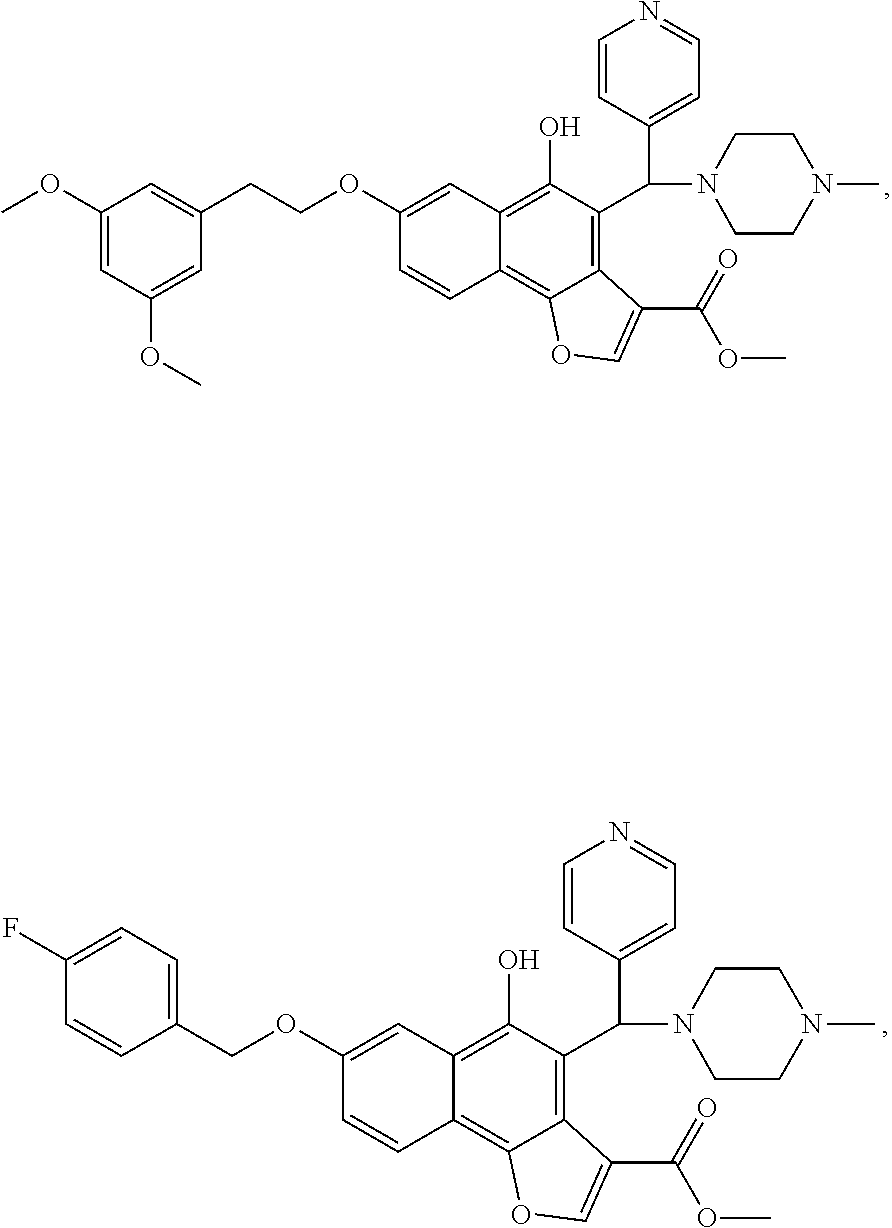


Priority Applications (1)
| Application Number | Priority Date | Filing Date | Title |
|---|---|---|---|
| US14/386,230 US9914723B2 (en) | 2012-03-29 | 2013-03-29 | Small molecule inhibitors of Mcl-1 and uses thereof |
Applications Claiming Priority (3)
| Application Number | Priority Date | Filing Date | Title |
|---|---|---|---|
| US201261617473P | 2012-03-29 | 2012-03-29 | |
| PCT/US2013/034565 WO2013149124A1 (en) | 2012-03-29 | 2013-03-29 | Small molecule inhibitors of mcl-1 and uses thereof |
| US14/386,230 US9914723B2 (en) | 2012-03-29 | 2013-03-29 | Small molecule inhibitors of Mcl-1 and uses thereof |
Publications (2)
| Publication Number | Publication Date |
|---|---|
| US20150045357A1 US20150045357A1 (en) | 2015-02-12 |
| US9914723B2 true US9914723B2 (en) | 2018-03-13 |
Family
ID=49261282
Family Applications (1)
| Application Number | Title | Priority Date | Filing Date |
|---|---|---|---|
| US14/386,230 Expired - Fee Related US9914723B2 (en) | 2012-03-29 | 2013-03-29 | Small molecule inhibitors of Mcl-1 and uses thereof |
Country Status (4)
| Country | Link |
|---|---|
| US (1) | US9914723B2 (en) |
| EP (1) | EP2831067B1 (en) |
| ES (1) | ES2657649T3 (en) |
| WO (1) | WO2013149124A1 (en) |
Families Citing this family (9)
| Publication number | Priority date | Publication date | Assignee | Title |
|---|---|---|---|---|
| JO3474B1 (en) | 2014-08-29 | 2020-07-05 | Amgen Inc | Tetrahydronaphthalene derivatives that inhibit mcl-1 protein |
| WO2016172218A1 (en) * | 2015-04-20 | 2016-10-27 | The Regents Of The University Of Michigan | Small molecule inhibitors of mcl-1 and uses thereof |
| US10463649B2 (en) | 2015-06-08 | 2019-11-05 | Texas Tech University System | Inhibitors of Mc1-1 as drugs to overcome resistance to BRAF inhibitors and MEK inhibitors |
| WO2017147410A1 (en) | 2016-02-25 | 2017-08-31 | Amgen Inc. | Compounds that inhibit mcl-1 protein |
| JP6453507B2 (en) | 2017-03-30 | 2019-01-16 | アムジエン・インコーポレーテツド | Compound that inhibits MCL-1 protein |
| MA49908A (en) | 2017-08-18 | 2021-04-28 | Amgen Inc | MCL-1 PROTEIN INHIBITORS |
| US11279712B2 (en) | 2017-08-29 | 2022-03-22 | Amgen Inc. | Macrocyclic compounds that inhibit MCL-1 protein |
| MA54985A (en) | 2018-03-05 | 2021-12-29 | Amgen Inc | ALPHA-HYDROXY PHENYLACETIC ACID PHARMACOPHORES OR ANTAGONISTS OF BIOISOSTERY MCL-1 PROTEIN |
| CN113149972B (en) * | 2021-04-09 | 2022-09-13 | 四川大学 | 2- (aryl (azacycloalkane-1-yl) methyl) phenol derivatives and use thereof |
Citations (4)
| Publication number | Priority date | Publication date | Assignee | Title |
|---|---|---|---|---|
| US5244917A (en) | 1992-06-02 | 1993-09-14 | The Dupont Merck Pharmaceutical Company | Substituted naphthofurans as anti-inflammatory agents |
| US20090054402A1 (en) | 2007-04-16 | 2009-02-26 | Abbott Laboratories | 7-substituted indole mcl-1 inhibitors |
| WO2010024783A1 (en) | 2008-08-27 | 2010-03-04 | Agency For Science, Technology And Research | Biarylrhodanine and pyridylrhodanine compounds and their use |
| WO2011094708A2 (en) | 2010-01-29 | 2011-08-04 | Dana-Farber Cancer Institute, Inc | Small molecules for the modulation of mcl-1 and methods of modulatiing cell death, cell division, cell differentiation and methods of treating disorders |
Family Cites Families (5)
| Publication number | Priority date | Publication date | Assignee | Title |
|---|---|---|---|---|
| CA149442A (en) | 1912-12-16 | 1913-07-22 | Frans Kankkonen | Boat |
| CA158976A (en) | 1914-07-19 | 1914-11-17 | George E. Mallott | Loom mechanism |
| US3989816A (en) | 1975-06-19 | 1976-11-02 | Nelson Research & Development Company | Vehicle composition containing 1-substituted azacycloheptan-2-ones |
| US4444762A (en) | 1980-04-04 | 1984-04-24 | Nelson Research & Development Company | Vehicle composition containing 1-substituted azacyclopentan-2-ones |
| US6605712B1 (en) | 1990-12-20 | 2003-08-12 | Arch Development Corporation | Gene transcription and ionizing radiation: methods and compositions |
-
2013
- 2013-03-29 WO PCT/US2013/034565 patent/WO2013149124A1/en not_active Ceased
- 2013-03-29 ES ES13767518.7T patent/ES2657649T3/en active Active
- 2013-03-29 US US14/386,230 patent/US9914723B2/en not_active Expired - Fee Related
- 2013-03-29 EP EP13767518.7A patent/EP2831067B1/en active Active
Patent Citations (4)
| Publication number | Priority date | Publication date | Assignee | Title |
|---|---|---|---|---|
| US5244917A (en) | 1992-06-02 | 1993-09-14 | The Dupont Merck Pharmaceutical Company | Substituted naphthofurans as anti-inflammatory agents |
| US20090054402A1 (en) | 2007-04-16 | 2009-02-26 | Abbott Laboratories | 7-substituted indole mcl-1 inhibitors |
| WO2010024783A1 (en) | 2008-08-27 | 2010-03-04 | Agency For Science, Technology And Research | Biarylrhodanine and pyridylrhodanine compounds and their use |
| WO2011094708A2 (en) | 2010-01-29 | 2011-08-04 | Dana-Farber Cancer Institute, Inc | Small molecules for the modulation of mcl-1 and methods of modulatiing cell death, cell division, cell differentiation and methods of treating disorders |
Non-Patent Citations (75)
| Title |
|---|
| "Expert Scientific Group on Phase One Clinical Trials Final Report" Nov. 30, 2006, pp. C1, C35-C38. * |
| Akgul et al. Cell. Mol. Life Sci. 2009, 66, 1326-1336. * |
| Backus HH, et al., "Rb, mcl-1 and p53 expression correlate with clinical outcome in patients with liver metastases from colorectal cancer." Ann Oncol. 2001; 12(6):779-85. |
| Boisvert-Adamo K., et al., "Mcl-1 is required for melanoma cell resistance to anoikis." Mol Cancer Res. 2009; 7:549-56. |
| Cancer Drug Design and Discovery Neidle, Stephen, ed. (Elsevier/Academic Press, 2008) p. 427. * |
| CAS Registry Entry for Registry No. 132474-46-5, which entered STN on Mar. 8, 1991. * |
| CAS Registry Entry for Registry No. 371136-76-4, which entered STN on Nov. 20, 2001. * |
| CAS Registry Entry for Registry No. 438484-78-7, which entered STN on Jul. 12, 2002. * |
| CAS Registry Entry for Registry No. 438485-05-3, which entered STN on Jul. 12, 2002. * |
| CAS Registry Entry for Registry No. 438485-17-7, which entered STN on Jul. 12, 2002. * |
| CAS Registry Entry for Registry No. 438485-20-2, which entered STN on Jul. 12, 2002. * |
| CAS Registry Entry for Registry No. 438485-31-5, which entered STN on Jul. 12, 2002. * |
| CAS Registry Entry for Registry No. 438485-33-7, which entered STN on Jul. 12, 2002. * |
| CAS Registry Entry for Registry No. 438485-48-4, which entered STN on Jul. 12, 2002. * |
| CAS Registry Entry for Registry No. 438485-51-9, which entered STN on Jul. 12, 2002. * |
| CAS Registry No. 438484-78-7, which entered STN on Jul. 12, 2002. * |
| CAS Registry No. 438484-89-0, which entered STN on Jul. 12, 2002. * |
| CAS Registry No. 438488-44-9, which entered STN on Jul. 12, 2002. * |
| Cavarretta IT, et al., "The antiapoptotic effect of IL-6 autocrine loop in a cellular model of advanced prostate cancer is mediated by Mcl-1." Oncogene 2007; 26: 2822-32. |
| Chen S, et al., "Mcl-1 down-regulation potentiates ABT-737 lethality by cooperatively inducing Bak activation and Bax translocation." Cancer Res. 2007; 67:782-91. |
| Cho-Vega JH, et al., "Mcl-1 expression in B-cell non-Hodgkin's lymphomas." Hum Pathol. 2004; 35(9)1095-100. |
| Chung TK, et al., "Expression of apoptotic regulators and their significance in cervical cancer." Cancer Lett. 2002; 180:63-8. |
| Day CL, et al., "Solution structure of prosurvival Mcl-1 and characterization of its binding by proapoptotic BH3-only ligands." J Biol Chem. 2005; 280(6):4738-44. |
| Day CL, et al., "Structure of the BH3 domains from the p53-inducible BH3-only proteins Noxa and Puma in complex with Mc1-1." J Mol Biol. 2008; 380(5):958-71. |
| Emmett et al. Am. J. Cancer Res. 2011,1, 852-868. * |
| Glaser et al. Genes Dec. 2012, 26, 120-125. * |
| Glaser SP, et al., "Anti-apoptotic Mcl-1 is essential for the development and sustained growth of acute myeloid leukemia." Genes Dev 2012; 26(2): 120-125. |
| Gomez-Bougie P, et al., "Noxa up-regulation and Mcl-1 cleavage are associated to apoptosis induction by bortezomib in multiple myeloma." Cancer Res. 2007; 67(11):5418-24. |
| Gomez-Bougie P, et al., "The imbalance between Bim and Mcl-1 expression controls the survival of human myeloma cells." Eur J Immunol. 2004; 34(11):3156-64. |
| Gura, Science Nov. 7, 1997: vol. 278. No. 5340, pp. 1041-1042. * |
| Hanahan D, et al., "The hallmarks of cancer." Cell. 2000; 100(1):57-70. |
| Huang S, et al., "BH3 mimetic ABT-737 potentiates Trail-mediated apoptotic signaling by unsequestering Bim and Bak in human pancreatic cancer cells." Cancer Res. 2008; 68(8):2944-51. |
| Hussain SR, et al., "Mcl-1 is a relevant therapeutic target in acute and chronic lymphoid malignancies: down-regulation enhances rituximab-mediated apoptosis and complement-dependent cytotoxicity." Clin Cancer Res. 2007; 13(7):2144-50. |
| International Search Report and Written Opinion, dated Sep. 2, 2013, PCT/US2013/034565. |
| Jiang CC, et al., "Up-regulation of Mcl-1 is critical for survival of human melanoma cells upon endoplasmic reticulum stress." Cancer Res. 2008; 68:6708-17. |
| Kamb, Nature Reviews Drug Discovery 4, 161-165 (Feb. 2005). * |
| Kaufmann SH, et al., "Elevated Expression of the Apoptotic Regulator Mcl-1 at the Time of Leukemic Relapse." Blood 1998; 91(3):991-1000. |
| Khoury JD, et al., "Expression of Mcl-1 in mantle cell lymphoma is associated with high-grade morphology, a high proliferative state, and p53 overexpression." J Pathol. 2003; 199(1):90-7. |
| Kitada S, et al., "Expression of apoptosis-regulating proteins in chronic lymphocytic leukemia: correlations with In vitro and In vivo chemoresponses." Blood 1998; 91(9):3379-89. |
| Leaf, Clifton, Health Administrator vol. XVII, No. 1: 172-183, 2005. * |
| Luo et al. Cell 2009, 136, 823-837. * |
| MacCallum DE, et al., "Seliciclib (CYC202, R-Roscovitine) induces cell death in multiple myeloma cells by inhibition of RNA polymerase II-dependent transcription and down-regulation of Mcl-1." Cancer Res. 2005; 65(12):5399-407. |
| Marsden VS, et al., "Control of apoptosis in the immune system: Bcl-2, BH3-only proteins and more." Annu Rev Immunol. 2003; 21: 71-105. |
| Michels J, et al., "Mcl-1 is required for Akata6 B-lymphoma cell survival and is converted to a cell death molecule by efficient caspase-mediated cleavage." Oncogene 2004; 23(28):4818-27. |
| Miyamoto Y, et al., "Immunohistochemical analysis of Bcl-2, Bax, Bcl-X, and Mcl-1 expression in pancreatic cancers." Oncology 1999; 56(1)73-82. |
| Moulding DA, et al., "Apoptosis is rapidly triggered by antisense depletion of MCL-1 in differentiating U937 cells." Blood 2000; 96(5):1756-63. |
| Mukhanova et al. "Synthesis of Aminomethyl Derivatives of Naphto(1,2-b) Furan" Pharmaceutical Chemistry Journal, 1990, vol. 24, No. 11, pp. 802-805. |
| National Center for Biotechnology Information. PubChem BioAssay Database; AID=1021, https://pubchem.ncbi.nlm.nih.gov/bioassay/1021 (accessed May 14, 2016). * |
| National Center for Biotechnology Information. PubChem BioAssay Database; AID=1021, https://pubchem.ncbi.nlm.nih.gov/bioassay/1021 (deposited Jan. 8, 2008; accessed Sep. 18, 2016). * |
| National Center for Biotechnology Information. PubChem BioAssay Database; AID=1418, https://pubchem.ncbi.nlm.nih.gov/bioassay/1418 (accessed May 14, 2016). * |
| National Center for Biotechnology Information. PubChem BioAssay Database; AID=1418, https://pubchem.ncbi.nlm.nih.gov/bioassay/1418 (deposit dated Oct. 29, 2008, accessed Oct. 18, 2015). * |
| National Center for Biotechnology Information. PubChem BioAssay Database; AID=648, https://pubchem.ncbi.nlm.nih.gov/bioassay/648 (deposited Apr. 5, 2007; accessed Oct. 18, 2015). * |
| National Center for Biotechnology Information. PubChem Compound Database; CID=3000201, https://pubchem.ncbi.nlm.nih.gov/compound/3000201 (accessed May 14, 2016). * |
| National Center for Biotechnology Information. PubChem Compound Database; CID=3313092, https://pubchem.ncbi.nlm.nih.gov/compound/3313092 (created Sep. 7, 2005, accessed Oct. 18, 2015). * |
| National Center for Biotechnology Information. PubChem Compound Database; CID=3313095, https://pubchem.ncbi.nlm.nih.gov/compound/3313095 (created Sep. 7, 2005; accessed Sep. 18, 2016). * |
| National Center for Biotechnology Information. PubChem Compound Database; CID=3483973, https://pubchem.ncbi.nlm.nih.gov/compound/3483973 (created Sep. 8, 2005; accessed Sep. 18, 2016). * |
| Nguyen M, et al., "Small molecule obatoclax (GX15-070) antagonizes MCL-1 and overcomes MCL-1-mediated resistance to apoptosis." Proc Natl Acad Sci U S A. 2007; 104(49): 19512-19517. |
| Nijhawan D, et al., "Elimination of Mcl-1 is required for the initiation of apoptosis following ultraviolet irradiation." Genes Dev. 2003; 17(12):1475-86. |
| Oltersdorf T, et al., "An inhibitor of Bcl-2 family proteins induces regression of solid tumours." Nature. 2005;435:677-81. |
| PubChemCompound, datasheet [online compound summary] Retrieved from the Internet: <URL: http://pubchem.ncbi.nlm.nih.gov/summary/summary.dgi> See CID 3313094 (Sep. 7, 2005), CID 3316360 (Sep. 7, 2005), CID 2999047 (Jul. 30, 2005) etc. |
| Qin JZ, et al., "Enhanced Killing of Melanoma Cells by Simultaneously Targeting Mc1-1 and NOXA." Cancer Res. 2006; 66(19):9636-45. |
| Reynolds JE, et al., "BCL-2 and MCL-1 expression in Chinese hamster ovary cells inhibits intracellular acidification and apoptosis induced by staurosporine." Exp Cell Res. 1996; 225(2):430-6. |
| Reynolds JE, et al., "Mcl-1, a member of the Bcl-2 family, delays apoptosis induced by c-Myc overexpression in Chinese hamster ovary cells." Cancer Res. 1994; 54(24):6348-52. |
| Saxena A, et al., "Mc1-1 and Bcl-2/Bax Ratio Are Associated With Treatment Response but Not with Rai Stage in B-Cell Chronic Lymphocytic Leukemia." Am J Hematol. 2004; 7: 522-33. |
| Sieghart W., et al., "Mc1-1 overexpression in hepatocellular carcinoma: a potential target for antisense therapy." J Hepatol. 2006; 44:151-7. |
| Skin Cancer Foundation, Melanoma Prevention Guidelines, obtained from http://www.skincancer.org/skin-cancer-information/melanoma/melanoma-prevention-guidelines on Oct. 18, 2015. * |
| Skvara H. et al., "Mcl-1 blocks radiation-induced apoptosis and inhibits clonogenic cell death." Anticancer Res. 2005, 25(4):2697-703. |
| Song L, et al., "Mcl-1 regulates survival and sensitivity to diverse apoptotic stimuli in human non-small cell lung cancer cells." Cancer Biol Ther. 2005; 4(3):267-76. |
| Supplementary European Search Report, EP Patent Application No. 13767518.7, dated Oct. 23, 2015. |
| Thallinger C, et al., "Mcl-1 antisense therapy chemosensitizes human melanoma in a SCID mouse xenotransplantation model." J Invest Dermatol. 2003; 120(6)1081-6. |
| Tse C, et al., "ABT-263: a potent and orally bioavailable Bcl-2 family inhibitor." Cancer Res. 2008; 68(9):3421-8. |
| Van Delft MF, et al., "The BH3 mimetic ABT-737 targets selective Bcl-2 proteins and efficiently induces apoptosis via Bak/Bax if Mcl-1 is neutralized." Cancer Cell. 2006; 10(5): 389-399. |
| Wuilleme-Toumi S, et al., "Mcl-1 is overexpressed in multiple myeloma and associated with relapse and shorter survival." Leukemia 2005; 19(7):1248-52. |
| Zhang B, et al., "Myeloid cell factor-1 is a critical survival factor for multiple myeloma." Blood 2002; 99: 1885-93. |
| Zhou P, et al., "Mcl-1, a Bcl-2 family member, delays the death of hematopoietic cells under a variety of apoptosis-inducing conditions." Blood. 1997; 89(2):630-43. |
Also Published As
| Publication number | Publication date |
|---|---|
| WO2013149124A1 (en) | 2013-10-03 |
| EP2831067A4 (en) | 2015-11-04 |
| ES2657649T3 (en) | 2018-03-06 |
| EP2831067A1 (en) | 2015-02-04 |
| US20150045357A1 (en) | 2015-02-12 |
| EP2831067B1 (en) | 2017-11-01 |
Similar Documents
| Publication | Publication Date | Title |
|---|---|---|
| US9394303B2 (en) | Small molecule inhibitors of MCL-1 and uses thereof | |
| US9745314B2 (en) | MDM2 inhibitors and therapeutic methods using the same | |
| US7737174B2 (en) | Indole inhibitors of MDM2 and the uses thereof | |
| US8629141B2 (en) | Spiro-oxindole MDM2 antagonists | |
| US8222288B2 (en) | Small molecule inhibitors of MDM2 and the uses thereof | |
| ES2425965T3 (en) | New inhibitors of small molecules of MDM2 and their uses | |
| EP2831067B1 (en) | Small molecule inhibitors of mcl-1 and uses thereof | |
| US20090118377A1 (en) | Apogossypolone and the uses thereof | |
| US20190002460A1 (en) | Small molecule inhibitors of egfr and pi3k | |
| US20060247305A1 (en) | Chromen-4-one inhibitors of anti-apoptotic Bcl-2 family members and the uses thereof | |
| US20200078360A1 (en) | Small molecule dual inhibitors of egfr/pi3k and uses thereof | |
| US20230041761A1 (en) | Small molecule modulators of sigma-1 and sigma-2 receptors and uses thereof | |
| US20240124419A1 (en) | Small molecule inhibitors of grp78 and uses thereof | |
| US9884841B2 (en) | Small molecule inhibitors of Mcl-1 and uses thereof | |
| US11214567B2 (en) | Small molecule inhibitors of MYC and uses thereof | |
| US20220274991A1 (en) | Small molecule inhibitors of ku70/80 and uses thereof | |
| US12521386B2 (en) | Small molecule inhibitors of the androgen receptor activity and/or expression and uses thereof | |
| EP3934634B1 (en) | Substituted bicyclic and tetracyclic quinones and related methods of use | |
| HK40061093A (en) | Substituted bicyclic and tetracyclic quinones and related methods of use | |
| HK40061093B (en) | Substituted bicyclic and tetracyclic quinones and related methods of use | |
| HK1128127B (en) | New small molecule inhibitors of mdm2 and the uses thereof | |
| HK1128127A (en) | New small molecule inhibitors of mdm2 and the uses thereof | |
| NZ617580B2 (en) | Spiro-oxindole mdm2 antagonists |
Legal Events
| Date | Code | Title | Description |
|---|---|---|---|
| AS | Assignment |
Owner name: THE REGENTS OF THE UNIVERSITY OF MICHIGAN, MICHIGA Free format text: ASSIGNMENT OF ASSIGNORS INTEREST;ASSIGNORS:NIKOLOVSKA-COLESKA, ZANETA;BAJWA, NAVAL;LIAO, CHENZHONG;AND OTHERS;SIGNING DATES FROM 20141110 TO 20141218;REEL/FRAME:034565/0292 |
|
| AS | Assignment |
Owner name: NATIONAL INSTITUTES OF HEALTH (NIH), U.S. DEPT. OF Free format text: CONFIRMATORY LICENSE;ASSIGNOR:UNIVERSITY OF MICHIGAN;REEL/FRAME:040326/0212 Effective date: 20161114 |
|
| STCF | Information on status: patent grant |
Free format text: PATENTED CASE |
|
| FEPP | Fee payment procedure |
Free format text: MAINTENANCE FEE REMINDER MAILED (ORIGINAL EVENT CODE: REM.); ENTITY STATUS OF PATENT OWNER: SMALL ENTITY |
|
| PRDP | Patent reinstated due to the acceptance of a late maintenance fee |
Effective date: 20220413 |
|
| FEPP | Fee payment procedure |
Free format text: PETITION RELATED TO MAINTENANCE FEES FILED (ORIGINAL EVENT CODE: PMFP); ENTITY STATUS OF PATENT OWNER: SMALL ENTITY Free format text: PETITION RELATED TO MAINTENANCE FEES GRANTED (ORIGINAL EVENT CODE: PMFG); ENTITY STATUS OF PATENT OWNER: SMALL ENTITY Free format text: SURCHARGE, PETITION TO ACCEPT PYMT AFTER EXP, UNINTENTIONAL. (ORIGINAL EVENT CODE: M2558); ENTITY STATUS OF PATENT OWNER: SMALL ENTITY |
|
| MAFP | Maintenance fee payment |
Free format text: PAYMENT OF MAINTENANCE FEE, 4TH YR, SMALL ENTITY (ORIGINAL EVENT CODE: M2551); ENTITY STATUS OF PATENT OWNER: SMALL ENTITY Year of fee payment: 4 |
|
| FEPP | Fee payment procedure |
Free format text: MAINTENANCE FEE REMINDER MAILED (ORIGINAL EVENT CODE: REM.); ENTITY STATUS OF PATENT OWNER: SMALL ENTITY |
|
| LAPS | Lapse for failure to pay maintenance fees |
Free format text: PATENT EXPIRED FOR FAILURE TO PAY MAINTENANCE FEES (ORIGINAL EVENT CODE: EXP.); ENTITY STATUS OF PATENT OWNER: SMALL ENTITY |
|
| STCH | Information on status: patent discontinuation |
Free format text: PATENT EXPIRED DUE TO NONPAYMENT OF MAINTENANCE FEES UNDER 37 CFR 1.362 |
|
| FP | Lapsed due to failure to pay maintenance fee |
Effective date: 20260313 |