US9908858B2 - Method for the synthesis of a hydrazine that can be used in the treatment of the papilloma virus - Google Patents
Method for the synthesis of a hydrazine that can be used in the treatment of the papilloma virus Download PDFInfo
- Publication number
- US9908858B2 US9908858B2 US14/655,266 US201314655266A US9908858B2 US 9908858 B2 US9908858 B2 US 9908858B2 US 201314655266 A US201314655266 A US 201314655266A US 9908858 B2 US9908858 B2 US 9908858B2
- Authority
- US
- United States
- Prior art keywords
- group
- formula
- optionally substituted
- compound
- ortho
- Prior art date
- Legal status (The legal status is an assumption and is not a legal conclusion. Google has not performed a legal analysis and makes no representation as to the accuracy of the status listed.)
- Active
Links
- 0 *.*C1=CC=C(CN(C)CC)C=C1.B.[1*]C.[2*]C Chemical compound *.*C1=CC=C(CN(C)CC)C=C1.B.[1*]C.[2*]C 0.000 description 6
- WQAPSRQTWPILLR-UHFFFAOYSA-N *.B.CCN(C)C(N)=O Chemical compound *.B.CCN(C)C(N)=O WQAPSRQTWPILLR-UHFFFAOYSA-N 0.000 description 3
- HOICZTWXUHGIKP-UHFFFAOYSA-N *.B.CCNC Chemical compound *.B.CCNC HOICZTWXUHGIKP-UHFFFAOYSA-N 0.000 description 3
- FJDAADIXRGJNPK-UHFFFAOYSA-N *.B.CCN(C)N Chemical compound *.B.CCN(C)N FJDAADIXRGJNPK-UHFFFAOYSA-N 0.000 description 2
- CHLZQOAMNQNVJS-UHFFFAOYSA-N *.*.*.B.B.B.CCN(C)C(N)=O.CCN(C)N.CCNC Chemical compound *.*.*.B.B.B.CCN(C)C(N)=O.CCN(C)N.CCNC CHLZQOAMNQNVJS-UHFFFAOYSA-N 0.000 description 1
- MCNLBTDAYCITLL-UHFFFAOYSA-N *.B.CCN(C)C Chemical compound *.B.CCN(C)C MCNLBTDAYCITLL-UHFFFAOYSA-N 0.000 description 1
- GQWYUGONWZBGOM-UHFFFAOYSA-N *.B.CCN(C)C(=O)CC(=O)C(Cl)(Cl)Cl Chemical compound *.B.CCN(C)C(=O)CC(=O)C(Cl)(Cl)Cl GQWYUGONWZBGOM-UHFFFAOYSA-N 0.000 description 1
- HRRZSQUNTUTMFT-UHFFFAOYSA-N *.B.CCN(C)C(=O)CC(C)=O Chemical compound *.B.CCN(C)C(=O)CC(C)=O HRRZSQUNTUTMFT-UHFFFAOYSA-N 0.000 description 1
Classifications
-
- C—CHEMISTRY; METALLURGY
- C07—ORGANIC CHEMISTRY
- C07D—HETEROCYCLIC COMPOUNDS
- C07D295/00—Heterocyclic compounds containing polymethylene-imine rings with at least five ring members, 3-azabicyclo [3.2.2] nonane, piperazine, morpholine or thiomorpholine rings, having only hydrogen atoms directly attached to the ring carbon atoms
- C07D295/04—Heterocyclic compounds containing polymethylene-imine rings with at least five ring members, 3-azabicyclo [3.2.2] nonane, piperazine, morpholine or thiomorpholine rings, having only hydrogen atoms directly attached to the ring carbon atoms with substituted hydrocarbon radicals attached to ring nitrogen atoms
- C07D295/12—Heterocyclic compounds containing polymethylene-imine rings with at least five ring members, 3-azabicyclo [3.2.2] nonane, piperazine, morpholine or thiomorpholine rings, having only hydrogen atoms directly attached to the ring carbon atoms with substituted hydrocarbon radicals attached to ring nitrogen atoms substituted by singly or doubly bound nitrogen atoms
- C07D295/135—Heterocyclic compounds containing polymethylene-imine rings with at least five ring members, 3-azabicyclo [3.2.2] nonane, piperazine, morpholine or thiomorpholine rings, having only hydrogen atoms directly attached to the ring carbon atoms with substituted hydrocarbon radicals attached to ring nitrogen atoms substituted by singly or doubly bound nitrogen atoms with the ring nitrogen atoms and the substituent nitrogen atoms separated by carbocyclic rings or by carbon chains interrupted by carbocyclic rings
-
- C—CHEMISTRY; METALLURGY
- C07—ORGANIC CHEMISTRY
- C07D—HETEROCYCLIC COMPOUNDS
- C07D295/00—Heterocyclic compounds containing polymethylene-imine rings with at least five ring members, 3-azabicyclo [3.2.2] nonane, piperazine, morpholine or thiomorpholine rings, having only hydrogen atoms directly attached to the ring carbon atoms
- C07D295/04—Heterocyclic compounds containing polymethylene-imine rings with at least five ring members, 3-azabicyclo [3.2.2] nonane, piperazine, morpholine or thiomorpholine rings, having only hydrogen atoms directly attached to the ring carbon atoms with substituted hydrocarbon radicals attached to ring nitrogen atoms
- C07D295/14—Heterocyclic compounds containing polymethylene-imine rings with at least five ring members, 3-azabicyclo [3.2.2] nonane, piperazine, morpholine or thiomorpholine rings, having only hydrogen atoms directly attached to the ring carbon atoms with substituted hydrocarbon radicals attached to ring nitrogen atoms substituted by carbon atoms having three bonds to hetero atoms with at the most one bond to halogen, e.g. ester or nitrile radicals
- C07D295/155—Heterocyclic compounds containing polymethylene-imine rings with at least five ring members, 3-azabicyclo [3.2.2] nonane, piperazine, morpholine or thiomorpholine rings, having only hydrogen atoms directly attached to the ring carbon atoms with substituted hydrocarbon radicals attached to ring nitrogen atoms substituted by carbon atoms having three bonds to hetero atoms with at the most one bond to halogen, e.g. ester or nitrile radicals with the ring nitrogen atoms and the carbon atoms with three bonds to hetero atoms separated by carbocyclic rings or by carbon chains interrupted by carbocyclic rings
Definitions
- the present invention relates to a novel method for the synthesis of compounds that can be used in the treatment of the papilloma virus described particularly in application WO 2007/135106.
- G 1 , A and B are as defined above, characterized in that said method uses a urea of formula (III) as a synthesis intermediate:
- G 1 , A and B are as defined above.
- pharmaceutically acceptable is meant that which can be used in the production of a pharmaceutical composition and which is generally safe, nontoxic and neither biologically nor otherwise undesirable and which is acceptable for veterinary use as well as human pharmaceutical use.
- salts that are pharmaceutically acceptable, as defined herein, and that have the desired pharmacological activity of the parent compound.
- Such salts comprise:
- unsaturated is meant, in the context of the present invention, that the group comprises one or more unsaturations.
- halogen is meant, in the context of the present invention, a fluorine, bromine, chlorine or iodine atom.
- fluorine is meant, in the context of the present invention, a fluorine, bromine, chlorine or iodine atom.
- it is a fluorine, bromine or chlorine atom.
- alkyl group is meant, in the context of the present invention, a linear or branched saturated hydrocarbon chain comprising 1 to 6 carbon atoms, in particular methyl, ethyl, n-propyl, isopropyl, n-butyl, isobutyl, sec-butyl, tert-butyl, n-pentyl or n-hexyl groups.
- it is methyl.
- cycloalkyl group is meant, in the context of the present invention, a saturated monocyclic or polycyclic system, preferably a saturated mono-, bi- or tricyclic system, comprising 3 to 12 carbon atoms, wherein the ring pairs may be fused or bridged, such as cyclopropyl, cyclopentyl, cyclohexyl, cycloheptyl, cyclooctyl, adamantyl, decalinyl or norbornyl groups.
- N-cycloalkyl group is meant, in the context of the present invention, a cycloalkyl group as defined above wherein a carbon atom has been substituted by a nitrogen atom, the link with the molecule being made by means of this nitrogen atom. It is advantageously a piperidin-1-yl or pyrrolidin-1-yl group.
- acyl is meant, in the context of the present invention, a group of formula —C(O)—Z, where Z is an alkyl group as defined above or a phenyl. It may be advantageously an acetyl, ethylcarbonyl or benzoyl group.
- alkoxy group is meant, in the context of the present invention, an alkyl group as defined above linked to the molecule by means of an oxygen atom. It may be in particular a methoxy, ethoxy, n-propoxy, isopropoxy, n-butoxy, iso-butoxy, sec-butoxy or tert-butoxy group.
- haloalkoxy group is meant, in the context of the present invention, an alkoxy group as defined above substituted by one or more halogen atom(s) as defined above.
- it will be fluoroalkoxy, that is, an alkoxy group substituted by one or more fluorine atom(s), such as an —OCF 3 or —OCH 2 CF 3 group.
- aryl group is meant, in the context of the present invention, an aromatic group preferably comprising 5 to 10 carbon atoms and comprising one or more joined rings, such as, for example, a phenyl or naphthyl group.
- aryl is meant, in the context of the present invention, an aromatic group preferably comprising 5 to 10 carbon atoms and comprising one or more joined rings, such as, for example, a phenyl or naphthyl group.
- it is phenyl.
- heterocycle is meant, in the context of the present invention, a saturated, unsaturated or aromatic monocyclic or polycyclic system, and preferably a saturated, unsaturated or aromatic mono- or bi-cyclic system, comprising 3 to 12 members, wherein the ring pairs may be fused, spiro-fused or bridged, and comprising 1 to 4 identical or different heteroatoms selected from O, S and N, and optionally comprising one or two oxo or thioxo groups, with the understanding that in the case of a polycyclic system one of the rings may be aromatic whereas the other(s) may be aromatic, saturated or unsaturated.
- it will be piperidyl, piperazyl, furyl, thienyl, pyrrolyl, pyrazolyl, imidazolyl, pyridyl, pyrimidyl, pyrazinyl, pyradizinyl, benzofuryl, benzothienyl, indolyl, quinolyl, isoquinolyl, benzodioxolyl, benzodioxinyl, benzo[1,2,5]thiadiazolyl, benzo[1,2,5]oxadiazolyl, [1,2,3]triazolyl and [1,2,4]triazolyl groups.
- arylalkyl is meant, in the context of the present invention, an aryl group as defined above linked to the molecule by means of an alkyl group as defined above. Preferably, it is a benzyl group.
- acylaminoalkyl is meant, in the context of the present invention, a group of formula -Alk-NHCO-Alk′, where Alk and Alk′ independently represent an alkyl group as defined above.
- the hydrazine of formula (I) as defined above may thus be produced from the urea of formula (III) as defined above by Shestakov rearrangement.
- This Shestakov rearrangement will be advantageously carried out in the presence of a rearrangement inducing agent selected from NaOCl and KOCl, and preferably being NaOCl.
- the rearrangement inducing agent is introduced in a staggered fashion.
- the inducing agent may be introduced in several portions spread over time, or dropwise, or in a continuous and slow manner such that the addition is sufficiently spread over time.
- the person skilled in the art will be able to adapt the addition parameter (such as addition rate for continuous addition) of the inducing agent such that the addition is optimal.
- At least 1 molar equivalent, advantageously between 1 and 1.5 molar equivalents, and preferably about 1 molar equivalent, of rearrangement inducing agent is used in this reaction, for 1 molar equivalent of the urea of formula (III).
- Shestakov rearrangement may be carried out in a dioxane/water mixture or in alcohol as solvent, and preferably in tert-butanol.
- alcohol is meant, in the context of the present invention, a compound of formula Alk-OH, where Alk is an alkyl group as defined above. Preferably, it is methanol, ethanol or tert-butanol.
- This rearrangement is carried out advantageously under basic conditions, particularly in the presence of sodium hydroxide or potassium hydroxide, and preferably in the presence of potassium hydroxide.
- urea of formula (III) as defined above may be produced from the amine of formula (II) as defined above according to the following steps:
- Step (1) may be carried out in a solvent such as acetonitrile, tetrahydrofuran, dichloromethane or dioxane, and preferably in acetonitrile.
- a solvent such as acetonitrile, tetrahydrofuran, dichloromethane or dioxane, and preferably in acetonitrile.
- Step (1) may be carried out at room temperature, that is, at temperatures varying between 20 and 40° C., and preferably at about 25° C.
- Sodium or potassium hydroxide, and preferably KOH, may be used as a base in step (2).
- the solvent used in this step (2) will be an alcohol as defined above and preferably will be methanol, step (2) being carried out in particular at reflux of this solvent.
- the hydrazine of preceding formula (I) may be produced according to the following successive steps:
- Isolation of the final product may be carried out by techniques well-known to the person skilled in the art, such as, for example, by extraction, solvent evaporation or by precipitation and filtration.
- the hydrazine thus obtained may in addition be purified if necessary by methods well-known to the person skilled in the art, such as by recrystallization if the compound is crystalline, or by distillation.
- G 1 is a bond or a linear and saturated hydrocarbon chain comprising 1 to 4 carbon atoms, and preferably is a bond.
- radical A defined above is an aryl, preferably a phenyl, substituted in the meta or para position, preferably in the para position, by an alkoxy group, such as methoxy, or by an aryl or arylalkyl group, such as phenyl or benzyl, optionally substituted by one or two identical or different substituents, such as an acyl or alkoxy group.
- B is an aryl group, preferably a phenyl, substituted in the ortho position by a heterocycle, preferably an N-cycloalkyl, such as a piperidin-1-yl group, and optionally substituted in the ortho′ position by an alkyl group, such as a methyl.
- hydrazine of formula (I) is N-(4-benzyl-phenyl)-N-(2-methyl-6-piperidin-1-yl-phenyl)-hydrazine (hydrazine (Ia)).
- preceding hydrazine (Ia) is produced from 1-(4-benzyl-phenyl)-1-(2-methyl-6-piperidin-1-yl-phenyl)-urea (compound (IIIa)), itself produced from (4-benzyl-phenyl)-(2-methyl-6-piperidin-1-yl-phenyl)-amine (compound (IIa)).
- Another subject matter of the present invention is a method for producing a compound of formula (V) as follows:
- the compounds of formula (V) correspond to compounds that can be used in the treatment of the papilloma virus described in application WO 2007/135106.
- This patent application further describes the method for producing compounds of formula (V) from the hydrazine of formula (I), as well as the method for producing the amines of formula (II).
- esters is meant, in the context of the present invention, a —CO—O-Alk group, where Alk is an alkyl group as defined above.
- R2 is a halogen atom, such as a bromine atom, preferably in the meta position relative to R3.
- G 1 is a bond or a linear and saturated hydrocarbon chain comprising 1 to 4 carbon atoms, and preferably is a bond.
- radical A defined above is an aryl, preferably a phenyl, substituted in the meta or para position, preferably in the para position, by an alkoxy group, such as methoxy, or by an aryl or arylalkyl group, such as phenyl or benzyl, optionally substituted by one or two identical or different substituents, such as an acyl or alkoxy group.
- B is an aryl group, preferably a phenyl, substituted in the ortho position by a heterocycle, preferably an N-cycloalkyl, such as a piperidin-1-yl group, and optionally substituted in the ortho′ position by an alkyl group, such as a methyl.
- the compound of formula (V) has the following features:
- the compound of formula (V) is 4-[N′-(4-benzyl-phenyl)-N′-(2-methyl-6-piperidin-1-yl-phenyl)-hydrazinocarbonyl methyl]-5-bromo-2-methoxy-benzoic acid hydrochloride (compound (Va)).
- compound (Va) may be produced from intermediates (Ia), (IIa) and (IIIa) mentioned above.
- G 1 is a bond or a linear and saturated hydrocarbon chain comprising 1 to 4 carbon atoms, and preferably is a bond.
- the radical A defined above is an aryl, preferably a phenyl, substituted in the meta or para position, preferably in the para position, by an alkoxy group, such as methoxy, or by an aryl or arylalkyl group, such as phenyl or benzyl, optionally substituted by one or two identical or different substituents, such as an acyl or alkoxy group.
- B is an aryl group, preferably a phenyl, substituted in the ortho position by a heterocycle, preferably an N-cycloalkyl, such as a piperidin-1-yl group, and optionally substituted in the ortho′ position by an alkyl group, such as a methyl.
- compound (III) will be 1-(4-benzyl-phenyl)-1-(2-methyl-6-piperidin-1-yl-phenyl)-urea (compound (IIIa)).
- step (1) To a solution of the crude intermediate obtained in step (1) above (6.13 g, 11.2 mmol, 1.0 eq) in methanol (120 ml), KOH aqueous solution (12.73 g of KOH, 224.0 mmol, 20 eq, in 25 ml of water) is added under stirring. The reaction mixture is then heated at 75° C. with shaking for 1.5 hours at the same temperature. After complete consumption of the intermediate (monitored by TLC), the reaction mixture is concentrated to dryness.
- the combined organic phases are concentrated to dryness under reduced pressure to give the desired hydrazine (4 g, 83% purity determined by HPLC).
- the residue thus obtained is then purified by flash chromatography on a silica gel column (eluent: 95/5 cyclohexane/ethyl acetate) to give the desired hydrazine (3.4 g, 9.1 mmol, 81% total yield) in the form of a cream-colored solid with a purity of 95.6% determined by HPLC.
- This compound is produced from hydrazine (Ia) obtained in preceding stage 3 according to the protocol described in application WO 2007/135106. This protocol is described in example 27 of this application, and corresponds to stages 5 and 6 of this example (pages 91-92).
Landscapes
- Chemical & Material Sciences (AREA)
- Organic Chemistry (AREA)
- Hydrogenated Pyridines (AREA)
- Pharmaceuticals Containing Other Organic And Inorganic Compounds (AREA)
- Organic Low-Molecular-Weight Compounds And Preparation Thereof (AREA)
Abstract

Description

wherein:
-
- A is an optionally substituted aryl, cycloalkyl, cycloalkenyl or heterocycle group,
- B is an optionally substituted aryl or heterocycle,
- R1 and R2 are independently a hydrogen atom or various substituents,
- R3 is an acid functional group or a prodrug radical or a bioisostere of this functional group,
- G1 is a bond or a hydrocarbon chain, and
- G2 is a

-
- group, where R is a hydrogen atom or various substituents, W is O, S or NH and G is a bond or a hydrocarbon chain.

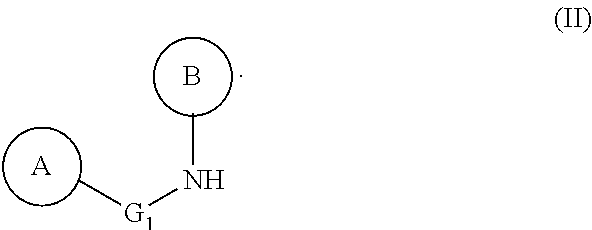
which is itself prepared from the amine of the following structure:

and the pharmaceutically acceptable salts thereof,
wherein:
-
- G1 is a bond or a linear or branched, saturated or unsaturated hydrocarbon chain comprising 1 to 4 carbon atoms, optionally substituted by one or two preferably identical alkyl groups,
- A is an aryl group, such as phenyl, optionally substituted:
- in the meta or para position by:
- a halogen atom or a cyano, alkoxy, haloalkoxy, acylaminoalkyl or —XR group where X is —O—, —S—, —SO—, —SO2— or —CO— and R is an arylalkyl, cycloalkyl or aryl group, each optionally substituted by one or two identical or different substituents, such as a halogen atom, an alkoxy or acyl group, or
- a cycloalkyl, aryl or arylalkyl group, each optionally substituted by one or two identical or different substituents, such as an acyl or alkoxy group,
- and/or in the ortho or meta position by an alkyl group, and
- in the meta or para position by:
- B is an aryl group, preferably a phenyl, substituted in the ortho position by a heterocycle, preferably an N-cycloalkyl, such as a piperidin-1-yl group, and optionally substituted in the ortho′ position by an alkyl group, such as a methyl, from an amine of formula (II):

wherein G1, A and B are as defined above,
characterized in that said method uses a urea of formula (III) as a synthesis intermediate:

wherein G1, A and B are as defined above.
- (1) hydrates and solvates,
- (2) acid addition salts formed with inorganic acids such as hydrochloric acid, hydrobromic acid, sulfuric acid, nitric acid, phosphoric acid and the like; or formed with organic acids such as acetic acid, benzenesulfonic acid, benzoic acid, camphorsulfonic acid, citric acid, ethane-sulfonic acid, fumaric acid, glucoheptonic acid, gluconic acid, glutamic acid, glycolic acid, hydroxynaphthoic acid, 2-hydroxyethanesulfonic acid, lactic acid, maleic acid, malic acid, mandelic acid, methanesulfonic acid, muconic acid, 2-naphthalene-sulfonic acid, propionic acid, salicylic acid, succinic acid, dibenzoyl-L-tartaric acid, tartaric acid, p-toluenesulfonic acid, trimethylacetic acid, trifluoroacetic acid and the like; and
- (3) salts formed when an acidic proton present in the parent compound either is replaced by a metal ion, for example an alkaline metal ion (Na+, K+ or Li+, for example), an alkaline-earth metal ion (such as Ca2+ or Mg2+) or an aluminum ion; or coordinates with an organic or inorganic base. Acceptable organic bases comprise diethanolamine, ethanolamine, N-methylglucamine, triethanolamine, tromethamine and the like. Acceptable inorganic bases comprise aluminum hydroxide, calcium hydroxide, potassium hydroxide, sodium carbonate and sodium hydroxide.
-
- (1) reaction of the amine of formula (II) with trichloroacetyl isocyanate (Cl3CC(O)—N═C═O) to give the compound of formula (IV):

-
-
- wherein G1, A and B are as defined above, and
- (2) treatment in basic medium of the compound of formula (IV) obtained in the preceding step to give a urea of formula (III).
-
-
- (1) reaction of an amine of formula (II) as defined above with Cl3CC(O)—N═C═O to give a compound of formula (IV) as defined above,
- (2) treatment in basic medium of the compound of formula (IV) obtained in the preceding step to give a urea of formula (III) as defined above,
- (3) Shestakov reaction starting from the urea of formula (III) obtained in the preceding step to give a hydrazine of formula (I) as defined above, and
- (4) isolation from the reaction medium of the hydrazine of formula (I) obtained in the preceding step.

and the pharmaceutically acceptable salts thereof,
wherein:
-
- R1 is an alkoxy group, such as methoxy, preferably in the ortho position relative to R3,
- R2 is a hydrogen or halogen atom, such as chlorine or bromine, or an alkyl group, such as methyl, preferably in the meta position relative to R3,
- R3 is an acid or ester group, and preferably an acid group,
- n is an integer between 1 and 4, preferably between 1 and 2, and more preferably is 1,
- G1 is a bond or a linear or branched, saturated or unsaturated hydrocarbon chain comprising 1 to 4 carbon atoms, optionally substituted by one or two preferably identical alkyl groups,
- A is an aryl group, such as phenyl, optionally substituted:
- in the meta or para position by:
- a halogen atom or a cyano, alkoxy, haloalkoxy, acylaminoalkyl or —XR group where X is —O—, —S—, —SO—, —SO2— or —CO— and R is an arylalkyl, cycloalkyl or aryl group, each optionally substituted by one or two identical or different substituents, such as a halogen atom, an alkoxy or acyl group, or
- a cycloalkyl, aryl or arylalkyl group, each optionally substituted by one or two identical or different substituents, such as an acyl or alkoxy group,
- and/or in the ortho or meta position by an alkyl group, and
- in the meta or para position by:
- B is an aryl group, preferably a phenyl, substituted in the ortho position by a heterocycle, preferably an N-cycloalkyl, such as a piperidin-1-yl group, and optionally substituted in the ortho′ position by an alkyl group, such as a methyl,
characterized in that it comprises a method for producing a compound of formula (I) as defined above.
-
- A is a phenyl group substituted in the para position by a benzyl group,
- B is a phenyl group substituted in the ortho position by a piperidin-1-yl group and in the ortho′ position by a methyl group,
- G1 is a bond, and
- R1, R2, R3 and n are as defined above.

wherein:
-
- G1 is a bond or a linear or branched, saturated or unsaturated hydrocarbon chain comprising 1 to 4 carbon atoms, optionally substituted by one or two preferably identical alkyl groups,
- A is an aryl group, such as phenyl, optionally substituted:
- in the meta or para position by:
- a halogen atom or a cyano, alkoxy, haloalkoxy, acylaminoalkyl or —XR group where X is —O—, —S—, —SO—, —SO2— or —CO— and R is an arylalkyl, cycloalkyl or aryl group, each optionally substituted by one or two identical or different substituents, such as a halogen atom, an alkoxy or acyl group, or
- a cycloalkyl, aryl or arylalkyl group, each optionally substituted by one or two identical or different substituents, such as an acyl or alkoxy group,
- and/or in the ortho or meta position by an alkyl group, and
- in the meta or para position by:
- B is an aryl group, preferably a phenyl, substituted in the ortho position by a heterocycle, preferably an N-cycloalkyl, such as a piperidin-1-yl group, and optionally substituted in the ortho′ position by an alkyl group, such as a methyl.
- TLC Thin-layer chromatography
- eq Molar equivalent
- HPLC High-performance liquid chromatography
- NMR Nuclear magnetic resonance
- MS Mass spectrometry
Claims (15)


Applications Claiming Priority (3)
| Application Number | Priority Date | Filing Date | Title |
|---|---|---|---|
| FR1262872 | 2012-12-27 | ||
| FR1262872A FR3000490B1 (en) | 2012-12-27 | 2012-12-27 | PROCESS FOR SYNTHESIZING HYDRAZINE USEFUL IN THE TREATMENT OF PAPILLOMA VIRUS |
| PCT/EP2013/078035 WO2014102313A1 (en) | 2012-12-27 | 2013-12-27 | Method for the synthesis of a hydrazine that can be used in the treatment of the papilloma virus |
Publications (2)
| Publication Number | Publication Date |
|---|---|
| US20150353517A1 US20150353517A1 (en) | 2015-12-10 |
| US9908858B2 true US9908858B2 (en) | 2018-03-06 |
Family
ID=48083277
Family Applications (1)
| Application Number | Title | Priority Date | Filing Date |
|---|---|---|---|
| US14/655,266 Active US9908858B2 (en) | 2012-12-27 | 2013-12-27 | Method for the synthesis of a hydrazine that can be used in the treatment of the papilloma virus |
Country Status (13)
| Country | Link |
|---|---|
| US (1) | US9908858B2 (en) |
| EP (1) | EP2938595B1 (en) |
| JP (1) | JP6169721B2 (en) |
| CN (1) | CN104870425B (en) |
| AR (1) | AR094304A1 (en) |
| BR (1) | BR112015015428A2 (en) |
| ES (1) | ES2636817T3 (en) |
| FR (1) | FR3000490B1 (en) |
| IL (1) | IL239555A0 (en) |
| PL (1) | PL2938595T3 (en) |
| PT (1) | PT2938595T (en) |
| RU (1) | RU2649006C2 (en) |
| WO (1) | WO2014102313A1 (en) |
Citations (1)
| Publication number | Priority date | Publication date | Assignee | Title |
|---|---|---|---|---|
| US20090209586A1 (en) | 2006-05-19 | 2009-08-20 | Anaconda Pharma | Piperidine derivatives as human papilloma virus inhibitors |
Family Cites Families (1)
| Publication number | Priority date | Publication date | Assignee | Title |
|---|---|---|---|---|
| HU227475B1 (en) * | 1998-08-20 | 2011-07-28 | Toyama Chemical Co Ltd | Nitrogenous heterocyclic carboxamide derivatives or salts thereof and antiviral agents containing them |
-
2012
- 2012-12-27 FR FR1262872A patent/FR3000490B1/en not_active Expired - Fee Related
-
2013
- 2013-12-27 CN CN201380067991.9A patent/CN104870425B/en not_active Expired - Fee Related
- 2013-12-27 PL PL13814987T patent/PL2938595T3/en unknown
- 2013-12-27 JP JP2015550081A patent/JP6169721B2/en active Active
- 2013-12-27 WO PCT/EP2013/078035 patent/WO2014102313A1/en not_active Ceased
- 2013-12-27 US US14/655,266 patent/US9908858B2/en active Active
- 2013-12-27 EP EP13814987.7A patent/EP2938595B1/en not_active Not-in-force
- 2013-12-27 BR BR112015015428A patent/BR112015015428A2/en not_active IP Right Cessation
- 2013-12-27 PT PT138149877T patent/PT2938595T/en unknown
- 2013-12-27 RU RU2015126766A patent/RU2649006C2/en not_active IP Right Cessation
- 2013-12-27 ES ES13814987.7T patent/ES2636817T3/en active Active
- 2013-12-27 AR ARP130105059A patent/AR094304A1/en unknown
-
2015
- 2015-06-21 IL IL239555A patent/IL239555A0/en unknown
Patent Citations (2)
| Publication number | Priority date | Publication date | Assignee | Title |
|---|---|---|---|---|
| US20090209586A1 (en) | 2006-05-19 | 2009-08-20 | Anaconda Pharma | Piperidine derivatives as human papilloma virus inhibitors |
| US9452991B2 (en) | 2006-05-19 | 2016-09-27 | Aviragen Therapeutics, Inc. | Piperidine derivatives as human papilloma virus inhibitors |
Non-Patent Citations (7)
| Title |
|---|
| Collet, A. et al. Practical Synthesis of Optically Active α-Hydrazino Acids from α-Amino Acids. Tetrahedron. 1987, vol. 43, p. 891. * |
| International Search Report issued in application No. PCT/EP2013/078035 dated May 3, 2014. |
| Murakami, et al., An Efficient Method for Synthesis of 1, 1-Diarylhydrazines as an Intermediate for Indole Synthesis, Heterocycles, 1979, vol. 12, No. 12, p. 1571-1574. |
| Murakami, Yasuoki, et al., "An Efficient Synthesis of 1, 1-Disubstituted Hydrazines", Chem. Pharm. Bull., 1983, vol. 31, No. 2, p. 423-428. |
| Translation of Official Action from Japanese Patent Office, dated Nov. 28, 2016. |
| Viret et al., "Practical synthesis of optically active á-hydrazino acids from á-amino acids," Tetrahedron, vol. 43, No. 5, pp. 891-894, 1987. |
| Viret, Joelle, et al., Practical Synthesis of Optically Active α-Hydrazino Acids from α-Amino Acids, Tetrahedron, 1987, vol. 43, No. 5, p. 891-894. |
Also Published As
| Publication number | Publication date |
|---|---|
| AR094304A1 (en) | 2015-07-22 |
| CN104870425A (en) | 2015-08-26 |
| HK1214260A1 (en) | 2016-07-22 |
| US20150353517A1 (en) | 2015-12-10 |
| RU2015126766A (en) | 2017-01-27 |
| EP2938595B1 (en) | 2017-06-14 |
| WO2014102313A1 (en) | 2014-07-03 |
| CN104870425B (en) | 2017-06-13 |
| FR3000490A1 (en) | 2014-07-04 |
| EP2938595A1 (en) | 2015-11-04 |
| RU2649006C2 (en) | 2018-03-29 |
| PT2938595T (en) | 2017-09-22 |
| PL2938595T3 (en) | 2017-12-29 |
| IL239555A0 (en) | 2015-08-31 |
| ES2636817T3 (en) | 2017-10-09 |
| BR112015015428A2 (en) | 2017-07-11 |
| JP2016503068A (en) | 2016-02-01 |
| FR3000490B1 (en) | 2015-03-13 |
| JP6169721B2 (en) | 2017-07-26 |
Similar Documents
| Publication | Publication Date | Title |
|---|---|---|
| TWI382973B (en) | method | |
| CN102639486B (en) | Process for producing N-acylbiphenylalanine | |
| KR102671396B1 (en) | Intermediates useful for the synthesis of a selective inhibitor against protein kinase and processes for preparing the same | |
| UA81808C2 (en) | Normal;heading 1;heading 2;DERIVATIVES OF PIPERIDINYL- AND PIPERAZINYL-ALKYL CARBAMATES, PROCESS FOR PREPARATION AND THERAPEUTIC USES THEREOF | |
| JP2015180665A (en) | Synthetic intermediate of 6-(7-((1-aminocyclopropyl)methoxy)-6-methoxyquinolin-4-yloxy)-n-methyl-1-naphthoamide and pharmaceutically acceptable salt and application of the same | |
| JP4617292B2 (en) | Preparation of arylalkyl carbamate derivatives and their therapeutic use | |
| EP2707364B1 (en) | Process for the manufacture of dabigatran etexilate and intermediates thereof | |
| WO2022232948A1 (en) | Processes for the preparation of the enantiomers of 3,4-methylenedioxymethamphetamine (mdma) and n-methyl-1,3-benzodioxolylbutanamine (mbdb) | |
| CN105051031B (en) | The preparation method of 1-([1,3]dioxolane-4-ylmethyl)-1H-pyrazole-3-amine | |
| CN101563329A (en) | Novel method for producing 4,4'-(1-methyl-1,2-ethanediyl)-bis-(2,6-piperazinedione) | |
| WO2012145932A1 (en) | A novel process for the preparation of peramivir and intermediates thereof | |
| JP2018090551A (en) | L-carnosine derivative or salt thereof, and method for producing L-carnosine or salt thereof | |
| NO179407B (en) | Process for Preparation of Cyclic Amino Acid Compounds against Spasms | |
| CN115397807A (en) | Process for preparing substituted enamine compounds | |
| US10487074B2 (en) | Method for purifying benzopyran derivative, crystal form thereof, and method for preparing crystal form | |
| US20150353517A1 (en) | Method for the synthesis of a hydrazine that can be used in the treatment of the papilloma virus | |
| US8815870B2 (en) | 4-(2-(6-substituted-hexylidene) hydrazinyl)benzonitrile and preparation thereof | |
| KR102748251B1 (en) | Intermediates and methods for the preparation of linagliptin and its salts | |
| US20090054648A1 (en) | Method for producing asymmetric tetrasubstituted carbon atom-containing compound | |
| HK1214260B (en) | Method for the synthesis of a hydrazine that can be used in the treatment of the papilloma virus | |
| US8093384B2 (en) | Processes for the preparation of alfuzosin | |
| Moskalenko et al. | Synthesis of N-arylmethyl-3-azabicyclo [3.3. 1] nonan-9-ones. | |
| KR102184129B1 (en) | Production method of intermediate compound for synthesizing medicament | |
| EP2152697A2 (en) | Process for the preparation of alfuzosin and salts thereof | |
| KR20190037172A (en) | Production method of intermediate compound for synthesizing medicament |
Legal Events
| Date | Code | Title | Description |
|---|---|---|---|
| AS | Assignment |
Owner name: ANACONDA PHARMA, FRANCE Free format text: ASSIGNMENT OF ASSIGNORS INTEREST;ASSIGNORS:BLUMENFELD, MARTA;COMPERE, DELPHINE;CIUFOLINI, MARCO A.;SIGNING DATES FROM 20150625 TO 20150703;REEL/FRAME:036297/0838 |
|
| AS | Assignment |
Owner name: BIOTA PHARMACEUTICALS, INC., GEORGIA Free format text: TRANSFER OF OWNERSHIP;ASSIGNOR:ANACONDA PHARMA;REEL/FRAME:037155/0463 Effective date: 20150225 |
|
| AS | Assignment |
Owner name: AVIRAGEN THERAPEUTICS, INC., GEORGIA Free format text: CHANGE OF NAME;ASSIGNOR:BIOTA PHARMACEUTICALS, INC.;REEL/FRAME:044456/0563 Effective date: 20160411 |
|
| STCF | Information on status: patent grant |
Free format text: PATENTED CASE |
|
| MAFP | Maintenance fee payment |
Free format text: PAYMENT OF MAINTENANCE FEE, 4TH YR, SMALL ENTITY (ORIGINAL EVENT CODE: M2551); ENTITY STATUS OF PATENT OWNER: SMALL ENTITY Year of fee payment: 4 |
|
| MAFP | Maintenance fee payment |
Free format text: PAYMENT OF MAINTENANCE FEE, 8TH YR, SMALL ENTITY (ORIGINAL EVENT CODE: M2552); ENTITY STATUS OF PATENT OWNER: SMALL ENTITY Year of fee payment: 8 |