US9908633B2 - Variable-capture supersonic inlet - Google Patents

Variable-capture supersonic inlet Download PDF

Info

Publication number
US9908633B2
US9908633B2 US14/674,170 US201514674170A US9908633B2 US 9908633 B2 US9908633 B2 US 9908633B2 US 201514674170 A US201514674170 A US 201514674170A US 9908633 B2 US9908633 B2 US 9908633B2
Authority
US
United States
Prior art keywords
inlet
cowl
leading edge
mach number
design mach
Prior art date
Legal status (The legal status is an assumption and is not a legal conclusion. Google has not performed a legal analysis and makes no representation as to the accuracy of the status listed.)
Active
Application number
US14/674,170
Other versions
US20160288917A1 (en
Inventor
Thuy Huynh
David J. Wilson
Current Assignee (The listed assignees may be inaccurate. Google has not performed a legal analysis and makes no representation or warranty as to the accuracy of the list.)
Boeing Co
Original Assignee
Boeing Co
Priority date (The priority date is an assumption and is not a legal conclusion. Google has not performed a legal analysis and makes no representation as to the accuracy of the date listed.)
Filing date
Publication date
Application filed by Boeing Co filed Critical Boeing Co
Priority to US14/674,170 priority Critical patent/US9908633B2/en
Assigned to THE BOEING COMPANY reassignment THE BOEING COMPANY ASSIGNMENT OF ASSIGNORS INTEREST (SEE DOCUMENT FOR DETAILS). Assignors: HUYNH, THUY, WILSON, DAVID J.
Priority to EP16151379.1A priority patent/EP3075663B1/en
Priority to CN201610157395.5A priority patent/CN106121824B/en
Publication of US20160288917A1 publication Critical patent/US20160288917A1/en
Application granted granted Critical
Publication of US9908633B2 publication Critical patent/US9908633B2/en
Active legal-status Critical Current
Anticipated expiration legal-status Critical

Links

Images

Classifications

    • FMECHANICAL ENGINEERING; LIGHTING; HEATING; WEAPONS; BLASTING
    • F02COMBUSTION ENGINES; HOT-GAS OR COMBUSTION-PRODUCT ENGINE PLANTS
    • F02CGAS-TURBINE PLANTS; AIR INTAKES FOR JET-PROPULSION PLANTS; CONTROLLING FUEL SUPPLY IN AIR-BREATHING JET-PROPULSION PLANTS
    • F02C7/00Features, components parts, details or accessories, not provided for in, or of interest apart form groups F02C1/00 - F02C6/00; Air intakes for jet-propulsion plants
    • F02C7/04Air intakes for gas-turbine plants or jet-propulsion plants
    • BPERFORMING OPERATIONS; TRANSPORTING
    • B64AIRCRAFT; AVIATION; COSMONAUTICS
    • B64DEQUIPMENT FOR FITTING IN OR TO AIRCRAFT; FLIGHT SUITS; PARACHUTES; ARRANGEMENT OR MOUNTING OF POWER PLANTS OR PROPULSION TRANSMISSIONS IN AIRCRAFT
    • B64D33/00Arrangement in aircraft of power plant parts or auxiliaries not otherwise provided for
    • B64D33/02Arrangement in aircraft of power plant parts or auxiliaries not otherwise provided for of combustion air intakes
    • BPERFORMING OPERATIONS; TRANSPORTING
    • B64AIRCRAFT; AVIATION; COSMONAUTICS
    • B64CAEROPLANES; HELICOPTERS
    • B64C1/00Fuselages; Constructional features common to fuselages, wings, stabilising surfaces or the like
    • B64C1/0009Aerodynamic aspects
    • FMECHANICAL ENGINEERING; LIGHTING; HEATING; WEAPONS; BLASTING
    • F01MACHINES OR ENGINES IN GENERAL; ENGINE PLANTS IN GENERAL; STEAM ENGINES
    • F01KSTEAM ENGINE PLANTS; STEAM ACCUMULATORS; ENGINE PLANTS NOT OTHERWISE PROVIDED FOR; ENGINES USING SPECIAL WORKING FLUIDS OR CYCLES
    • F01K7/00Steam engine plants characterised by the use of specific types of engine; Plants or engines characterised by their use of special steam systems, cycles or processes; Control means specially adapted for such systems, cycles or processes; Use of withdrawn or exhaust steam for feed-water heating
    • F01K7/10Steam engine plants characterised by the use of specific types of engine; Plants or engines characterised by their use of special steam systems, cycles or processes; Control means specially adapted for such systems, cycles or processes; Use of withdrawn or exhaust steam for feed-water heating characterised by the engine exhaust pressure
    • FMECHANICAL ENGINEERING; LIGHTING; HEATING; WEAPONS; BLASTING
    • F02COMBUSTION ENGINES; HOT-GAS OR COMBUSTION-PRODUCT ENGINE PLANTS
    • F02CGAS-TURBINE PLANTS; AIR INTAKES FOR JET-PROPULSION PLANTS; CONTROLLING FUEL SUPPLY IN AIR-BREATHING JET-PROPULSION PLANTS
    • F02C7/00Features, components parts, details or accessories, not provided for in, or of interest apart form groups F02C1/00 - F02C6/00; Air intakes for jet-propulsion plants
    • F02C7/04Air intakes for gas-turbine plants or jet-propulsion plants
    • F02C7/042Air intakes for gas-turbine plants or jet-propulsion plants having variable geometry
    • BPERFORMING OPERATIONS; TRANSPORTING
    • B64AIRCRAFT; AVIATION; COSMONAUTICS
    • B64DEQUIPMENT FOR FITTING IN OR TO AIRCRAFT; FLIGHT SUITS; PARACHUTES; ARRANGEMENT OR MOUNTING OF POWER PLANTS OR PROPULSION TRANSMISSIONS IN AIRCRAFT
    • B64D33/00Arrangement in aircraft of power plant parts or auxiliaries not otherwise provided for
    • B64D33/02Arrangement in aircraft of power plant parts or auxiliaries not otherwise provided for of combustion air intakes
    • B64D2033/0253Arrangement in aircraft of power plant parts or auxiliaries not otherwise provided for of combustion air intakes specially adapted for particular type of aircraft
    • B64D2033/026Arrangement in aircraft of power plant parts or auxiliaries not otherwise provided for of combustion air intakes specially adapted for particular type of aircraft for supersonic or hypersonic aircraft
    • BPERFORMING OPERATIONS; TRANSPORTING
    • B64AIRCRAFT; AVIATION; COSMONAUTICS
    • B64DEQUIPMENT FOR FITTING IN OR TO AIRCRAFT; FLIGHT SUITS; PARACHUTES; ARRANGEMENT OR MOUNTING OF POWER PLANTS OR PROPULSION TRANSMISSIONS IN AIRCRAFT
    • B64D33/00Arrangement in aircraft of power plant parts or auxiliaries not otherwise provided for
    • B64D33/02Arrangement in aircraft of power plant parts or auxiliaries not otherwise provided for of combustion air intakes
    • B64D2033/0266Arrangement in aircraft of power plant parts or auxiliaries not otherwise provided for of combustion air intakes specially adapted for particular type of power plants
    • B64D2033/0273Arrangement in aircraft of power plant parts or auxiliaries not otherwise provided for of combustion air intakes specially adapted for particular type of power plants for jet engines

Definitions

  • Embodiments of the disclosure relate generally to supersonic inlets for aircraft jet engines and more particularly to an inlet adjustable to simultaneously vary capture area and compression.
  • Inlet aperture is typically located to provide optimum performance at a nominal design Mach number.
  • a compression surface may be employed in conjunction with the inlet aperture.
  • the compression surface is typically fixed.
  • inefficiency associated with operation at off-design Mach numbers where mass flow exceeds engine need requires excess air to be spilled or bypassed.
  • the shock waves generated by the compression surface and the resulting compression effects may not be ideal for desired performance.
  • Exemplary embodiments provide an engine inlet for efficient operation at both design Mach number and off-design Mach numbers having a fixed compression surface and a leading edge that is variably extendible over the fixed compression surface to simultaneously vary capture area, compression and shock wave position.
  • the embodiments provide a method for simultaneous modification of capture area and compression for an aircraft inlet with a fixed compression surface.
  • a leading edge of an inlet is established on a cowl.
  • An aircraft with the inlet is operated at a design Mach number with the leading edge and cowl fully retracted.
  • the aircraft is operated at speeds less than the design Mach number with an extension of the leading edge over a compression surface to simultaneously vary compression and inlet area.
  • FIG. 1A is side view of a portion of an aircraft having an inlet according to an exemplary embodiment as described herein;
  • FIG. 1B is a perspective view of a fuselage portion and associated inlet with a fixed compression surface of the embodiment of FIG. 1A ;
  • FIGS. 1C-1G show alternative inlet locations for the embodiment disclosed herein;
  • FIG. 2A is side partial section view of the aircraft of FIG. 1A showing the inlet in section:
  • FIG. 2B is a detailed view of the side section of the inlet of FIG. 2B operating at design Mach number with the fixed;
  • FIG. 3 is a detailed side section view of the inlet with an extended leading edge covering the fixed compression surface
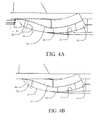
  • FIG. 4A is a detailed side section view of the inlet with the leading edge retracted to a first intermediate position showing exemplary shock wave positions;
  • FIG. 4B is a detailed side section view of the inlet with the leading edge retracted to a second intermediate position
  • FIG. 4C is a detailed side section view of the inlet with the leading edge retracted to a third intermediate position
  • FIG. 4D is a detailed side section view of the inlet with the leading edge retracted to a fourth intermediate position
  • FIG. 4E is a detailed side section view of the inlet with the leading edge retracted to a fifth intermediate position
  • FIG. 4F is a detailed side section view of the inlet with the leading edge fully retracted to the design Mach number position showing exemplary shock wave positions;
  • FIG. 5A is a pictorial view of the aircraft fuselage and inlet with the leading edge in the fully extended position
  • FIG. 5B is a pictorial view of the aircraft fuselage and inlet with the leading edge in an intermediate extended position
  • FIG. 5C is a pictorial view of the aircraft fuselage and inlet with the leading edge in the fully retracted position:
  • FIG. 6A is a pictorial view of the aircraft fuselage and inlet inverted with the leading edge in the fully extended position showing relative inlet area;
  • FIG. 6B is a pictorial view of the aircraft fuselage and inlet inverted with the leading edge in the intermediate extended position showing relative inlet area;
  • FIG. 6C is a pictorial view of the aircraft fuselage and inlet inverted with the leading edge in the fully retracted position showing relative inlet area;
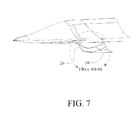
  • FIG. 7 is a pictorial section view of the aircraft fuselage and inlet with the leading edge in the fully retracted position showing a structural implementation of the cowl for extending the inlet leading edge;
  • FIG. 8A is a pictorial detailed section view of the inlet of FIG. 7 with the cowl in the fully extended position showing the exposed scrubbing surface receiving the cowl;
  • FIG. 8B is a pictorial detailed section view of the inlet of FIG. 7 with the cowl in a first partially retracted position;
  • FIG. 8C is a pictorial detailed section view of the inlet of FIG. 7 with the cowl in a second partially retracted position;
  • FIG. 8D is a pictorial detailed section view of the inlet of FIG. 7 with the cowl in a third partially retracted position;
  • FIG. 8E is a pictorial detailed section view of the inlet of FIG. 7 with the cowl in a fully retracted position for operation at design Mach number;
  • FIG. 9 is a flow chart for a method to operate a variable leading edge for matched off-design performance in an inlet having a fixed compression surface.
  • the system and methods described herein provide embodiments for an inlet having a leading edge variably extendible over a fixed compression surface to simultaneously vary capture area and compression.
  • the inlet leading edge may be configured on a cowl to pivot about a remote axis perpendicular to the direction of airflow and transverse to the compression surface.
  • the capture area is adjusted by extension and retraction of the cowl and leading edge to match mass flow with engine need and/or align with off-design shock waves from the compression surface. Thereby minimizing or obviating excess airflow to be spilled or caused to bypass the inlet.
  • the inlet is also configured such that as the leading edge is retracted with increasing speed and increasing amount of compression surface is exposed thereby increasing the capture area.
  • the position of the inlet leading edge relative to the fixed compression surface also causes the compression to vary and repositions the shock waves created by the compression surface. Pivoting the inlet cowl about a remote axis with mating scrubbing surfaces in the inlet flow path defined by the radius to the axis and consistent with desired flow turning into a diffuser for the aircraft engine provides for a simple mechanism to simultaneously vary capture area, compression and shock wave position to enhance efficiency.
  • FIGS. 1A and 1B show representative portions of an exemplary aircraft employing the embodiments of an inlet as disclosed herein.
  • An inlet 10 is placed under a fuselage 12 . While shown in the exemplary embodiment in the drawings as an under fuselage (chin) inlet, alternative embodiments may be employed in fuselage top, over-wing or under-wing, under wing root (armpit) and over wing root (shoulder) installations as seen in FIGS. 1C-1G respectively.
  • a diffuser 14 extends from the inlet 10 to a jet engine (not shown) which is carried in the fuselage for the exemplary embodiments.
  • a compression surface 16 is present on a bottom surface 18 of the fuselage 12 or other aerodynamic structure of the aircraft for cooperative operation with the inlet.
  • the inlet 10 configured for operation at the design Mach number is shown in FIGS. 2A and 2B .
  • the compression surface 16 may be either a single ramp or an isentropic system for creating the desired compression at the inlet.
  • a series of shock waves (represented by exemplary shock waves 20 a - 20 d ) are created by the compression surface 16 yielding the desired compression at the inlet with creation of a normal shock 22 in the inlet aperture.
  • the leading edge 24 of the inlet 10 is positioned at the design Mach number to create a nominal area of the inlet aperture in conjunction with the compression surface 16 for desired performance, as will be described in greater detail subsequently.
  • the inlet transitions into a diffuser 14 for introduction of flow into the engine.
  • the inlet and diffuser are contoured with a curvature to provide flow turning into the engine buried in the aircraft fuselage.
  • the inlet 10 is provided with a cowl 26 which incorporates the leading edge 24 as seen in FIG. 3 .
  • the cowl 26 is movable to extend and retract the leading edge 24 across a range of positions from a fully retracted position as seen in FIG. 2B to a fully extended position as seen in FIG. 3 . In the fully extended position, the leading edge substantially covers the compression surface.
  • the cowl 26 is curved and during extension of the leading edge, the effective area of the inlet aperture is reduced, as will be described in greater detail subsequently.
  • the cowl has a radius 28 from a remote axis 30 perpendicular to the direction of airflow into the inlet, as indicated by arrows 31 and transverse to the fixed compression surface.
  • a mating scrubbing surface 32 having a radius 29 from the remote axis extended for thickness of the cowl 26 is fixed on the interior of the inlet 10 and engages the cowl for rotation about the remote axis to extend and retract the cowl and leading edge 24 while maintaining a substantially smooth aerodynamic surface for turning of the flow into the diffuser 14 . Operation of the aircraft at subsonic speeds is accomplished with the cowl 26 and leading edge 24 in the fully extended position.
  • the cowl 26 is retracted, rotating about the remote axis 30 .
  • the leading edge 24 is positioned to expose an initial portion of the fixed compression surface 16 which generates a first desired compression condition with associated positioning of shock wave 20 e .
  • the cowl 26 is retracted further as seen in FIG. 4B which exposes a greater portion of the fixed compression surface 16 generating a second desired compression condition with positioning of shock waves 20 f and 20 g .
  • FIGS. 4C-4E Further retraction of the cowl 26 with increasing speeds is shown in FIGS. 4C-4E with additional exposure of the compression surface 16 at each position.
  • the varying compression created by the compression surface is with positioning of the representative shock waves 20 h and 20 i ( FIG. 4C ), 20 j , 20 k and 20 l ( FIG. 4D ) and 20 m , 20 n and 20 o ( FIG. 4E ).
  • the cowl exposes the maximum extent of the compression surface 16 with commensurate compression defined by shock waves 20 a - 20 d as previously described with respect to FIG. 2B .
  • FIGS. 5A-5C An exemplary three dimensional (3D) configuration of the inlet 10 with the cowl 26 is shown in FIGS. 5A-5C with the cowl in the fully extended position, retracted to a mid-position, and fully retracted to the design Mach number position respectively.
  • the effective area of the inlet aperture represented in the figures as elements 34 a , 34 b and 34 c is altered by the relative position of the cowl.
  • the effective area 34 a is significantly reduced over the maximum area 34 c over which it is superimposed.
  • the effective area 32 b is greater than area 34 a but remains less than maximum area 34 c .
  • the effective area 34 c is provided as seen in FIG. 6C .
  • the area “turn down” which may be achieved by the extension of the cowl is determined by the radius 28 (location of the axis 30 ). A reduced radius provides greater reduction in effective inlet area from fully retracted to fully extended.
  • the exemplary 3D inlet configuration is shown in section in FIG. 7 with detailed views of the cowl 26 and mating scrubbing surfaces 32 shown in FIGS. 8A-8E in a range of positions from fully extended ( FIG. 8A ) to fully retracted for operation at the design Mach number ( FIG. 8E ).
  • the intimate integration of the scrubbing surface 32 and cowl 26 with common radii from the remote axis provide substantially smooth internal surfaces of the inlet for aerodynamic efficiency. While described with respect to the figures at discrete points of extension or retraction, the cowl 26 is smoothly extendible through the entire range from fully retracted to fully extended to allow scheduling of positioning of the cowl to accommodate a range of aircraft speeds up to the design Mach number.
  • cowl 26 is shown in the exemplary embodiments as internal to the inlet 10 , the cowl may be external to the inlet in alternative embodiments. Further, while the inlet 10 in the present embodiments is shown under a fuselage, the inlet may be positioned on a wing or other structure with the compression surface mounted on a surface of that structure.
  • a method of simultaneous modification of capture area and compression for an aircraft inlet with a fixed compression surface is accomplished for the embodiments disclosed by establishing a leading edge of the inlet on a cowl, step 902 .
  • the cowl has a radius from an axis and is engaged with a mating scrubbing surface in the inlet with a second radius from the axis to accommodate the thickness of the cowl, step 904 .
  • the aircraft is operated at a design Mach number with the leading edge and cowl fully retracted, step 906 .
  • the aircraft is operated at speeds less than the design Mach number with extension of the leading edge over the compression surface, step 908 , by rotating the cowl about the axis to simultaneously vary compression and inlet area. Extension of the leading edge may be scheduled from a maximum extended position at subsonic speeds to a fully retracted position at design Mach number, step 910 .

Landscapes

  • Engineering & Computer Science (AREA)
  • Chemical & Material Sciences (AREA)
  • Combustion & Propulsion (AREA)
  • Mechanical Engineering (AREA)
  • Aviation & Aerospace Engineering (AREA)
  • Physics & Mathematics (AREA)
  • General Engineering & Computer Science (AREA)
  • Fluid Mechanics (AREA)
  • Geometry (AREA)
  • Structures Of Non-Positive Displacement Pumps (AREA)
  • Aiming, Guidance, Guns With A Light Source, Armor, Camouflage, And Targets (AREA)

Abstract

An engine inlet for efficient operation at both design Mach number and off-design Mach numbers has a fixed compression surface and a leading edge that is variably extendible over the fixed compression surface to simultaneously vary capture area, compression and shock wave position.

Description

BACKGROUND INFORMATION
Field
Embodiments of the disclosure relate generally to supersonic inlets for aircraft jet engines and more particularly to an inlet adjustable to simultaneously vary capture area and compression.
Background
Engine inlets for supersonic aircraft have complex aerodynamic requirements based on Mach number and other flight conditions. Inlet aperture is typically located to provide optimum performance at a nominal design Mach number. To provide necessary flow control a compression surface may be employed in conjunction with the inlet aperture. For simplicity of design, the compression surface is typically fixed. However, inefficiency associated with operation at off-design Mach numbers where mass flow exceeds engine need requires excess air to be spilled or bypassed. Additionally at off-design Mach numbers, the shock waves generated by the compression surface and the resulting compression effects may not be ideal for desired performance.
It is therefore desirable to provide an inlet which will help improve performance at off-design Mach numbers by adjusting inlet area to minimize or avoid requirements to bypass or spill excess air and simultaneously modifies the shock waves generated by the compression surface.
SUMMARY
Exemplary embodiments provide an engine inlet for efficient operation at both design Mach number and off-design Mach numbers having a fixed compression surface and a leading edge that is variably extendible over the fixed compression surface to simultaneously vary capture area, compression and shock wave position.
The embodiments provide a method for simultaneous modification of capture area and compression for an aircraft inlet with a fixed compression surface. A leading edge of an inlet is established on a cowl. An aircraft with the inlet is operated at a design Mach number with the leading edge and cowl fully retracted. The aircraft is operated at speeds less than the design Mach number with an extension of the leading edge over a compression surface to simultaneously vary compression and inlet area.
BRIEF DESCRIPTION OF THE DRAWINGS
The features, functions, and advantages that have been discussed can be achieved independently in various embodiments of the present disclosure or may be combined in yet other embodiments, further details of which can be seen with reference to the following description and drawings.
FIG. 1A is side view of a portion of an aircraft having an inlet according to an exemplary embodiment as described herein;
FIG. 1B is a perspective view of a fuselage portion and associated inlet with a fixed compression surface of the embodiment of FIG. 1A;
FIGS. 1C-1G show alternative inlet locations for the embodiment disclosed herein;
FIG. 2A is side partial section view of the aircraft of FIG. 1A showing the inlet in section:
FIG. 2B is a detailed view of the side section of the inlet of FIG. 2B operating at design Mach number with the fixed;
FIG. 3 is a detailed side section view of the inlet with an extended leading edge covering the fixed compression surface;
FIG. 4A is a detailed side section view of the inlet with the leading edge retracted to a first intermediate position showing exemplary shock wave positions;
FIG. 4B is a detailed side section view of the inlet with the leading edge retracted to a second intermediate position;
FIG. 4C is a detailed side section view of the inlet with the leading edge retracted to a third intermediate position;
FIG. 4D is a detailed side section view of the inlet with the leading edge retracted to a fourth intermediate position;
FIG. 4E is a detailed side section view of the inlet with the leading edge retracted to a fifth intermediate position;
FIG. 4F is a detailed side section view of the inlet with the leading edge fully retracted to the design Mach number position showing exemplary shock wave positions;
FIG. 5A is a pictorial view of the aircraft fuselage and inlet with the leading edge in the fully extended position;
FIG. 5B is a pictorial view of the aircraft fuselage and inlet with the leading edge in an intermediate extended position;
FIG. 5C is a pictorial view of the aircraft fuselage and inlet with the leading edge in the fully retracted position:
FIG. 6A is a pictorial view of the aircraft fuselage and inlet inverted with the leading edge in the fully extended position showing relative inlet area;
FIG. 6B is a pictorial view of the aircraft fuselage and inlet inverted with the leading edge in the intermediate extended position showing relative inlet area;
FIG. 6C is a pictorial view of the aircraft fuselage and inlet inverted with the leading edge in the fully retracted position showing relative inlet area;
FIG. 7 is a pictorial section view of the aircraft fuselage and inlet with the leading edge in the fully retracted position showing a structural implementation of the cowl for extending the inlet leading edge;
FIG. 8A is a pictorial detailed section view of the inlet of FIG. 7 with the cowl in the fully extended position showing the exposed scrubbing surface receiving the cowl;
FIG. 8B is a pictorial detailed section view of the inlet of FIG. 7 with the cowl in a first partially retracted position;
FIG. 8C is a pictorial detailed section view of the inlet of FIG. 7 with the cowl in a second partially retracted position;
FIG. 8D is a pictorial detailed section view of the inlet of FIG. 7 with the cowl in a third partially retracted position;
FIG. 8E is a pictorial detailed section view of the inlet of FIG. 7 with the cowl in a fully retracted position for operation at design Mach number; and,
FIG. 9 is a flow chart for a method to operate a variable leading edge for matched off-design performance in an inlet having a fixed compression surface.
DETAILED DESCRIPTION
The system and methods described herein provide embodiments for an inlet having a leading edge variably extendible over a fixed compression surface to simultaneously vary capture area and compression. The inlet leading edge may be configured on a cowl to pivot about a remote axis perpendicular to the direction of airflow and transverse to the compression surface. The capture area is adjusted by extension and retraction of the cowl and leading edge to match mass flow with engine need and/or align with off-design shock waves from the compression surface. Thereby minimizing or obviating excess airflow to be spilled or caused to bypass the inlet. The inlet is also configured such that as the leading edge is retracted with increasing speed and increasing amount of compression surface is exposed thereby increasing the capture area. The position of the inlet leading edge relative to the fixed compression surface also causes the compression to vary and repositions the shock waves created by the compression surface. Pivoting the inlet cowl about a remote axis with mating scrubbing surfaces in the inlet flow path defined by the radius to the axis and consistent with desired flow turning into a diffuser for the aircraft engine provides for a simple mechanism to simultaneously vary capture area, compression and shock wave position to enhance efficiency.
Referring to the drawings, FIGS. 1A and 1B show representative portions of an exemplary aircraft employing the embodiments of an inlet as disclosed herein. An inlet 10 is placed under a fuselage 12. While shown in the exemplary embodiment in the drawings as an under fuselage (chin) inlet, alternative embodiments may be employed in fuselage top, over-wing or under-wing, under wing root (armpit) and over wing root (shoulder) installations as seen in FIGS. 1C-1G respectively. A diffuser 14 extends from the inlet 10 to a jet engine (not shown) which is carried in the fuselage for the exemplary embodiments. A compression surface 16 is present on a bottom surface 18 of the fuselage 12 or other aerodynamic structure of the aircraft for cooperative operation with the inlet.
The inlet 10 configured for operation at the design Mach number is shown in FIGS. 2A and 2B. The compression surface 16 may be either a single ramp or an isentropic system for creating the desired compression at the inlet. As seen in FIG. 2B, a series of shock waves (represented by exemplary shock waves 20 a-20 d) are created by the compression surface 16 yielding the desired compression at the inlet with creation of a normal shock 22 in the inlet aperture. The leading edge 24 of the inlet 10 is positioned at the design Mach number to create a nominal area of the inlet aperture in conjunction with the compression surface 16 for desired performance, as will be described in greater detail subsequently. As seen in the section view, the inlet transitions into a diffuser 14 for introduction of flow into the engine. The inlet and diffuser are contoured with a curvature to provide flow turning into the engine buried in the aircraft fuselage.
For operation at speeds less than the design Mach number, the inlet 10 is provided with a cowl 26 which incorporates the leading edge 24 as seen in FIG. 3. The cowl 26 is movable to extend and retract the leading edge 24 across a range of positions from a fully retracted position as seen in FIG. 2B to a fully extended position as seen in FIG. 3. In the fully extended position, the leading edge substantially covers the compression surface. The cowl 26 is curved and during extension of the leading edge, the effective area of the inlet aperture is reduced, as will be described in greater detail subsequently. For the embodiment shown, the cowl has a radius 28 from a remote axis 30 perpendicular to the direction of airflow into the inlet, as indicated by arrows 31 and transverse to the fixed compression surface. A mating scrubbing surface 32 having a radius 29 from the remote axis extended for thickness of the cowl 26 is fixed on the interior of the inlet 10 and engages the cowl for rotation about the remote axis to extend and retract the cowl and leading edge 24 while maintaining a substantially smooth aerodynamic surface for turning of the flow into the diffuser 14. Operation of the aircraft at subsonic speeds is accomplished with the cowl 26 and leading edge 24 in the fully extended position.
As speed of the aircraft is increased, the cowl 26 is retracted, rotating about the remote axis 30. In a first representative position seen in FIG. 4A, the leading edge 24 is positioned to expose an initial portion of the fixed compression surface 16 which generates a first desired compression condition with associated positioning of shock wave 20 e. With further increase in speed, the cowl 26 is retracted further as seen in FIG. 4B which exposes a greater portion of the fixed compression surface 16 generating a second desired compression condition with positioning of shock waves 20 f and 20 g. Further retraction of the cowl 26 with increasing speeds is shown in FIGS. 4C-4E with additional exposure of the compression surface 16 at each position. The varying compression created by the compression surface is with positioning of the representative shock waves 20 h and 20 i (FIG. 4C), 20 j, 20 k and 20 l (FIG. 4D) and 20 m, 20 n and 20 o (FIG. 4E). At the fully retracted condition when the aircraft reaches the design Mach number shown in FIG. 4F, the cowl exposes the maximum extent of the compression surface 16 with commensurate compression defined by shock waves 20 a-20 d as previously described with respect to FIG. 2B.
An exemplary three dimensional (3D) configuration of the inlet 10 with the cowl 26 is shown in FIGS. 5A-5C with the cowl in the fully extended position, retracted to a mid-position, and fully retracted to the design Mach number position respectively. As seen in corresponding FIGS. 6A-6C with the 3D configuration inverted for clarity, the effective area of the inlet aperture represented in the figures as elements 34 a, 34 b and 34 c is altered by the relative position of the cowl. As seen in FIG. 6A with the cowl 26 in the fully extended position the effective area 34 a is significantly reduced over the maximum area 34 c over which it is superimposed. In the mid-position of FIG. 6B, the effective area 32 b is greater than area 34 a but remains less than maximum area 34 c. With the cowl 26 fully retracted, the effective area 34 c is provided as seen in FIG. 6C. Within the limits of effective flow turning in the inlet and diffuser, the area “turn down” which may be achieved by the extension of the cowl is determined by the radius 28 (location of the axis 30). A reduced radius provides greater reduction in effective inlet area from fully retracted to fully extended.
The exemplary 3D inlet configuration is shown in section in FIG. 7 with detailed views of the cowl 26 and mating scrubbing surfaces 32 shown in FIGS. 8A-8E in a range of positions from fully extended (FIG. 8A) to fully retracted for operation at the design Mach number (FIG. 8E). The intimate integration of the scrubbing surface 32 and cowl 26 with common radii from the remote axis provide substantially smooth internal surfaces of the inlet for aerodynamic efficiency. While described with respect to the figures at discrete points of extension or retraction, the cowl 26 is smoothly extendible through the entire range from fully retracted to fully extended to allow scheduling of positioning of the cowl to accommodate a range of aircraft speeds up to the design Mach number. Additionally, while the cowl 26 is shown in the exemplary embodiments as internal to the inlet 10, the cowl may be external to the inlet in alternative embodiments. Further, while the inlet 10 in the present embodiments is shown under a fuselage, the inlet may be positioned on a wing or other structure with the compression surface mounted on a surface of that structure.
A method of simultaneous modification of capture area and compression for an aircraft inlet with a fixed compression surface is accomplished for the embodiments disclosed by establishing a leading edge of the inlet on a cowl, step 902. The cowl has a radius from an axis and is engaged with a mating scrubbing surface in the inlet with a second radius from the axis to accommodate the thickness of the cowl, step 904. The aircraft is operated at a design Mach number with the leading edge and cowl fully retracted, step 906. The aircraft is operated at speeds less than the design Mach number with extension of the leading edge over the compression surface, step 908, by rotating the cowl about the axis to simultaneously vary compression and inlet area. Extension of the leading edge may be scheduled from a maximum extended position at subsonic speeds to a fully retracted position at design Mach number, step 910.
Having now described various embodiments of the disclosure in detail as required by the patent statutes, those skilled in the art will recognize modifications and substitutions to the specific embodiments disclosed herein. Such modifications are within the scope and intent of the present disclosure as defined in the following claims.

Claims (14)

What is claimed is:
1. An engine inlet for efficient operation at off-design Mach number comprising:
a fixed compression surface;
a mating scrubbing surface having a shape defined by a first radius from an axis; and
a single cowl incorporating a leading edge and having a shape defined by a second radius from the axis concentric with the scrubbing surface, said cowl rotatable about the axis to extend and retract the leading edge across a range of positions from a fully retracted position to a fully extended position over the fixed compression surface to simultaneously vary capture area, compression and shock wave position, said cowl closely received in sliding engagement by the mating scrubbing surface throughout the range of positions.
2. The engine inlet for efficient operation at off-design Mach number as defined in claim 1 wherein the remote axis is perpendicular to a direction of airflow and transverse to the fixed compression surface.
3. The engine inlet for efficient operation at off-design Mach number as defined in claim 1 wherein the leading edge is fully retracted at a design Mach number.
4. The engine inlet for efficient operation at off-design Mach number as defined in claim 1 wherein the leading edge is fully extended at subsonic operation.
5. An aircraft having efficient operation at off-design Mach number comprising:
an aerodynamic structure;
an inlet having
a fixed compression surface mounted on a surface of the aerodynamic structure; and,
a mating scrubbing surface in the inlet opposite the surface, having a shape defined by a first radius from an axis; and
a single cowl incorporating a leading edge and having a shape defined by a second radius from the axis concentric with the scrubbing surface, said cowl rotatable about the axis to extend and retract the leading edge across a range of positions from a fully retracted position to a fully extended position over the fixed compression surface to simultaneously vary capture area, compression and shock wave position, said cowl closely received in sliding engagement by the mating scrubbing surface throughout the range of positions.
6. The aircraft having efficient operation at off-design Mach number as defined in claim 5 wherein the remote axis is perpendicular to a direction of airflow and transverse to the fixed compression surface.
7. The aircraft having efficient operation at off-design Mach number as defined in claim 5 wherein the leading edge is fully retracted at a design Mach number.
8. The aircraft having efficient operation at off-design Mach number as defined in claim 5 wherein the leading edge is fully extended at subsonic operation.
9. The aircraft having efficient operation at off-design Mach number as defined in claim 5 wherein the aerodynamic structure is a fuselage and the surface is selected from a bottom surface and a top surface of the fuselage.
10. The aircraft having efficient operation at off-design Mach number as defined in claim 5 wherein the aerodynamic structure is a wing and the surface is selected from a bottom surface of the wing, a top surface of the wing.
11. The aircraft having efficient operation at off-design Mach number as defined in claim 5 wherein the aerodynamic structure is a wing and fuselage and the surface is selected from a top surface of the wing and a side surface of the fuselage.
12. A method for simultaneous modification of capture area and compression for an aircraft inlet with a fixed compression surface comprising
establishing a leading edge of an inlet on a cowl;
engaging the cowl with a mating scrubbing surface in the inlet, the scrubbing surface having a shape defined by a radius from an axis and the cowl having shape defined by a second radius from the axis concentric with the scrubbing surface to closely receive the cowl;
operating an aircraft with the inlet at a design Mach number with the leading edge and cowl fully retracted;
operating the aircraft at speeds less than the design Mach number; and
extending the leading edge over the compression surface by rotating the cowl about the axis with the scrubbing surface closely receiving the cowl in sliding engagement throughout the rotation to simultaneously vary compression and inlet area.
13. The method as defined in claim 12 further comprising scheduling extension of the leading edge from a maximum extended position at subsonic speeds to a fully retracted position at design Mach number.
14. The method as defined in claim 12 wherein the compression surface is placed on a fuselage bottom, a fuselage top, a wing top, a wing bottom or a fuselage side.
US14/674,170 2015-03-31 2015-03-31 Variable-capture supersonic inlet Active US9908633B2 (en)

Priority Applications (3)

Application Number Priority Date Filing Date Title
US14/674,170 US9908633B2 (en) 2015-03-31 2015-03-31 Variable-capture supersonic inlet
EP16151379.1A EP3075663B1 (en) 2015-03-31 2016-01-14 Variable-capture supersonic inlet
CN201610157395.5A CN106121824B (en) 2015-03-31 2016-03-17 Variable capture supersonic inlets

Applications Claiming Priority (1)

Application Number Priority Date Filing Date Title
US14/674,170 US9908633B2 (en) 2015-03-31 2015-03-31 Variable-capture supersonic inlet

Publications (2)

Publication Number Publication Date
US20160288917A1 US20160288917A1 (en) 2016-10-06
US9908633B2 true US9908633B2 (en) 2018-03-06

Family

ID=55168167

Family Applications (1)

Application Number Title Priority Date Filing Date
US14/674,170 Active US9908633B2 (en) 2015-03-31 2015-03-31 Variable-capture supersonic inlet

Country Status (3)

Country Link
US (1) US9908633B2 (en)
EP (1) EP3075663B1 (en)
CN (1) CN106121824B (en)

Cited By (8)

* Cited by examiner, † Cited by third party
Publication number Priority date Publication date Assignee Title
US11111028B2 (en) * 2017-06-08 2021-09-07 Airbus Defence and Space GmbH Variable and adaptable diverterless bump inlet
US11390393B2 (en) 2019-06-04 2022-07-19 Rohr, Inc. Nacelle with a translatable inlet for an aircraft propulsion system
US11441482B2 (en) 2019-06-04 2022-09-13 Rohr, Inc. Single track translating inlet
US11560841B2 (en) 2021-06-25 2023-01-24 Rohr, Inc. Aircraft propulsion system with variable area inlet
US11725581B2 (en) 2021-06-25 2023-08-15 Rohr, Inc. Aircraft propulsion system with variable area inlet
US11767124B2 (en) 2021-09-10 2023-09-26 Rohr, Inc. Aircraft propulsion system with variable area inlet
US11840985B2 (en) 2021-09-10 2023-12-12 Rohr, Inc. Aircraft propulsion system with variable area inlet
US20240229713A1 (en) * 2022-09-15 2024-07-11 Rohr, Inc. Aircraft propulsion system with variable area inlet

Families Citing this family (5)

* Cited by examiner, † Cited by third party
Publication number Priority date Publication date Assignee Title
US10723474B2 (en) * 2017-05-24 2020-07-28 Sikorsky Aircraft Corporation Variable geometry engine inlet for high speed aircraft
US11261785B2 (en) 2017-06-06 2022-03-01 Raytheon Company Flight vehicle air breathing engine with isolator having bulged section
CN114852351A (en) * 2022-06-02 2022-08-05 上海甘石星经智能科技有限公司 Low-resistance and high-efficiency subsonic inlet channel
DE102022129097B3 (en) 2022-11-03 2024-03-14 Airbus Defence and Space GmbH Aircraft structure with an improved inlet opening for engine air
CN118793516B (en) * 2024-06-24 2025-11-28 南京航空航天大学 Axisymmetric double-S-bend ramjet engine air inlet channel and design method thereof

Citations (7)

* Cited by examiner, † Cited by third party
Publication number Priority date Publication date Assignee Title
GB761235A (en) 1953-02-24 1956-11-14 Rolls Royce Improvements in or relating to air intakes for jet-propulsion power plants
US3067573A (en) * 1958-02-27 1962-12-11 James F Connors Telescoping-spike supersonic inlet for aircraft engines
GB926345A (en) 1961-05-30 1963-05-15 Svenska Flygmotor Aktiebolaget Improvements in and relating to air intakes for jet propulsion engines
US3242671A (en) * 1964-04-08 1966-03-29 Boeing Co Fixed spike inlet with variable throat and capture area
US3974648A (en) 1968-08-19 1976-08-17 United Technologies Corporation Variable geometry ramjet engine
US7837142B2 (en) * 2006-10-12 2010-11-23 Aerion Corporation Supersonic aircraft jet engine
US20130087661A1 (en) * 2011-10-05 2013-04-11 Rolls-Royce Plc Propulsive unit for an aircraft

Family Cites Families (4)

* Cited by examiner, † Cited by third party
Publication number Priority date Publication date Assignee Title
US4477039A (en) * 1982-06-30 1984-10-16 Mcdonnell Douglas Corporation Vented cowl variable geometry inlet for aircraft
FR2710607B1 (en) * 1993-10-01 1995-12-01 Onera (Off Nat Aerospatiale) Two-dimensional supersonic and hypersonic air inlet, with three movable ramps, for the combustion air of an aircraft engine.
CN101798961B (en) * 2010-03-29 2012-08-22 南京航空航天大学 Two-stage beveled supersonic speed air inlet lip
CN103939217B (en) * 2014-04-18 2016-03-02 南京航空航天大学 Rectangular cross-section hypersonic change geometry intake duct and design method and working method

Patent Citations (8)

* Cited by examiner, † Cited by third party
Publication number Priority date Publication date Assignee Title
GB761235A (en) 1953-02-24 1956-11-14 Rolls Royce Improvements in or relating to air intakes for jet-propulsion power plants
US3067573A (en) * 1958-02-27 1962-12-11 James F Connors Telescoping-spike supersonic inlet for aircraft engines
GB926345A (en) 1961-05-30 1963-05-15 Svenska Flygmotor Aktiebolaget Improvements in and relating to air intakes for jet propulsion engines
US3242671A (en) * 1964-04-08 1966-03-29 Boeing Co Fixed spike inlet with variable throat and capture area
US3974648A (en) 1968-08-19 1976-08-17 United Technologies Corporation Variable geometry ramjet engine
US7837142B2 (en) * 2006-10-12 2010-11-23 Aerion Corporation Supersonic aircraft jet engine
US20130087661A1 (en) * 2011-10-05 2013-04-11 Rolls-Royce Plc Propulsive unit for an aircraft
US8857760B2 (en) * 2011-10-05 2014-10-14 Rolls-Royce Plc Propulsive unit for an aircraft

Cited By (8)

* Cited by examiner, † Cited by third party
Publication number Priority date Publication date Assignee Title
US11111028B2 (en) * 2017-06-08 2021-09-07 Airbus Defence and Space GmbH Variable and adaptable diverterless bump inlet
US11390393B2 (en) 2019-06-04 2022-07-19 Rohr, Inc. Nacelle with a translatable inlet for an aircraft propulsion system
US11441482B2 (en) 2019-06-04 2022-09-13 Rohr, Inc. Single track translating inlet
US11560841B2 (en) 2021-06-25 2023-01-24 Rohr, Inc. Aircraft propulsion system with variable area inlet
US11725581B2 (en) 2021-06-25 2023-08-15 Rohr, Inc. Aircraft propulsion system with variable area inlet
US11767124B2 (en) 2021-09-10 2023-09-26 Rohr, Inc. Aircraft propulsion system with variable area inlet
US11840985B2 (en) 2021-09-10 2023-12-12 Rohr, Inc. Aircraft propulsion system with variable area inlet
US20240229713A1 (en) * 2022-09-15 2024-07-11 Rohr, Inc. Aircraft propulsion system with variable area inlet

Also Published As

Publication number Publication date
EP3075663A1 (en) 2016-10-05
US20160288917A1 (en) 2016-10-06
CN106121824B (en) 2019-11-29
CN106121824A (en) 2016-11-16
EP3075663B1 (en) 2021-03-10

Similar Documents

Publication Publication Date Title
US9908633B2 (en) Variable-capture supersonic inlet
EP3069999B1 (en) Supersonic caret inlet system leading edge slat for improved inlet performance at off-design flight conditions
EP1206384B1 (en) Supersonic external-compression diffuser and method for designing same
US11434850B2 (en) Split sleeve hidden door thrust reverser
US6276632B1 (en) Axi-symmetric mixed compression inlet with variable geometry centerbody
US9719465B2 (en) Reverse core engine with thrust reverser
US9885291B2 (en) Turbomachine comprising a plurality of fixed radial blades mounted upstream of the fan
US10436112B2 (en) Translating turning vanes for a nacelle inlet
CA3003031C (en) Rotating devices for mitigation of adverse flow conditions in an ultra-short nacelle inlet
US6910327B2 (en) Apparatus and methods for varying inlet lip geometry of a jet engine inlet
EP3048049B1 (en) Supersonic caret inlet system
US8690097B1 (en) Variable-geometry rotating spiral cone engine inlet compression system and method
RU2010126506A (en) DEVICE FOR AFT PART OF SPACE AIRCRAFT HOUSING
US9879561B2 (en) Turbomachine comprising a plurality of fixed radial blades mounted upstream of the fan
US8371324B1 (en) Collapsible supersonic inlet centerbody
US10443539B2 (en) Hybrid exhaust nozzle
US10662895B2 (en) Aircraft gas turbine engine nacelle
EP2921684A1 (en) Integrated primary nozzle

Legal Events

Date Code Title Description
AS Assignment

Owner name: THE BOEING COMPANY, ILLINOIS

Free format text: ASSIGNMENT OF ASSIGNORS INTEREST;ASSIGNORS:HUYNH, THUY;WILSON, DAVID J.;REEL/FRAME:035298/0271

Effective date: 20150331

STCF Information on status: patent grant

Free format text: PATENTED CASE

MAFP Maintenance fee payment

Free format text: PAYMENT OF MAINTENANCE FEE, 4TH YEAR, LARGE ENTITY (ORIGINAL EVENT CODE: M1551); ENTITY STATUS OF PATENT OWNER: LARGE ENTITY

Year of fee payment: 4

MAFP Maintenance fee payment

Free format text: PAYMENT OF MAINTENANCE FEE, 8TH YEAR, LARGE ENTITY (ORIGINAL EVENT CODE: M1552); ENTITY STATUS OF PATENT OWNER: LARGE ENTITY

Year of fee payment: 8